Hybrid Security
Trends
2024
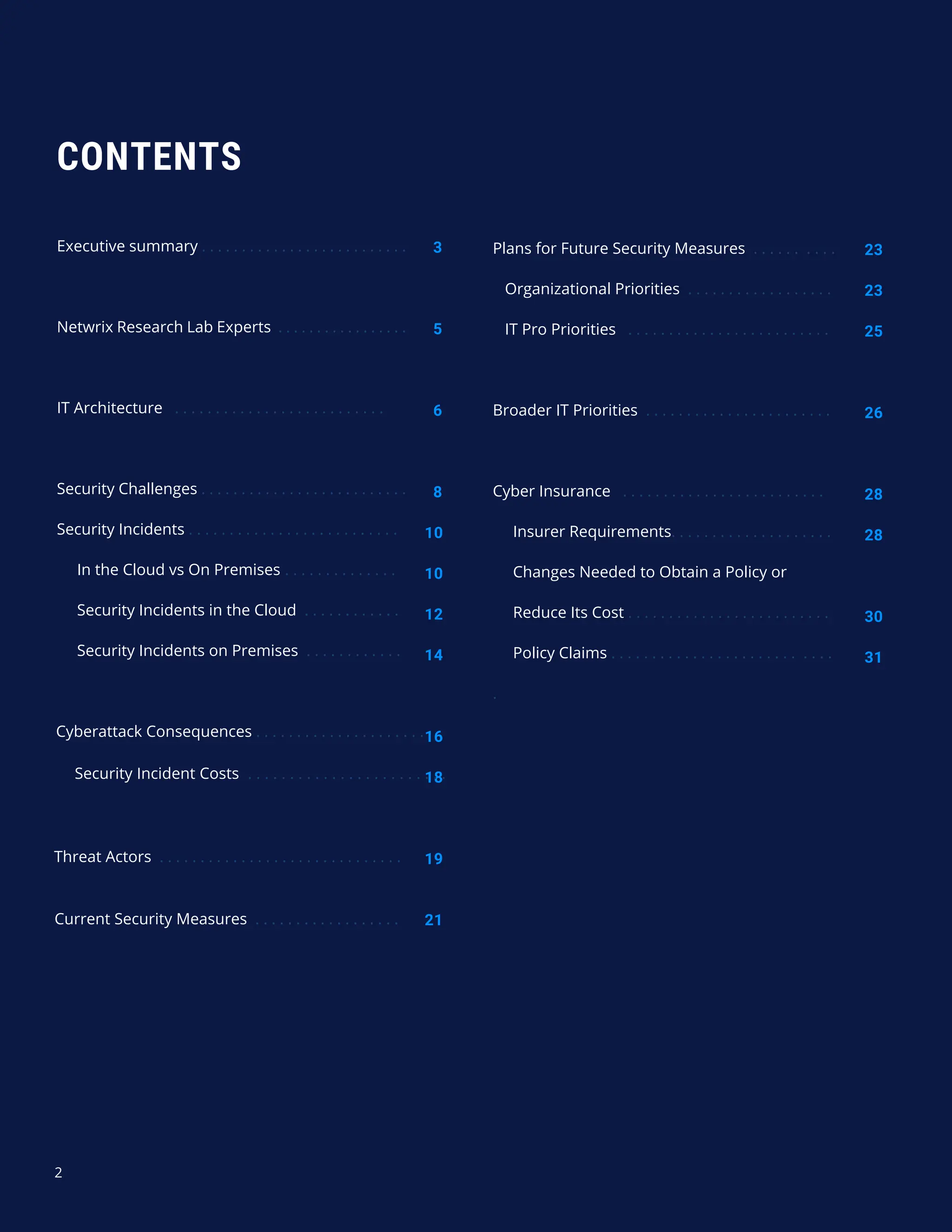
Executive summary . . . . . . . . . . . . . . . . . . . . . . . . . .
Netwrix Research Lab Experts . . . . . . . . . . . . . . . . .
IT Architecture . . . . . . . . . . . . . . . . . . . . . . . . . .
Security Challenges . . . . . . . . . . . . . . . . . . . . . . . . . .
Security Incidents . . . . . . . . . . . . . . . . . . . . . . . . . .
In the Cloud vs On Premises . . . . . . . . . . . . . .
Security Incidents in the Cloud . . . . . . . . . . . .
Security Incidents on Premises . . . . . . . . . . . .
Threat Actors . . . . . . . . . . . . . . . . . . . . . . . . . . . . . .
Current Security Measures . . . . . . . . . . . . . . . . . .
Broader IT Priorities . . . . . . . . . . . . . . . . . . . . . . .
Cyber Insurance . . . . . . . . . . . . . . . . . . . . . . . . .
Insurer Requirements. . . . . . . . . . . . . . . . . . . .
Changes Needed to Obtain a Policy or
Reduce Its Cost . . . . . . . . . . . . . . . . . . . . . . . . .
Policy Claims . . . . . . . . . . . . . . . . . . . . . . . . . . .
.
Plans for Future Security Measures . . . . . . . . . .
Organizational Priorities . . . . . . . . . . . . . . . . . .
IT Pro Priorities . . . . . . . . . . . . . . . . . . . . . . . . .
2
​CONTENTS
3
5
6
8
10
10
12
14
16
18
19
21
23
23
25
26
28
28
30
31
Security Incident Costs . . . . . . . . . . . . . . . . . . . . . . . .
Cyberattack Consequences . . . . . . . . . . . . . . . . . . . . .
3
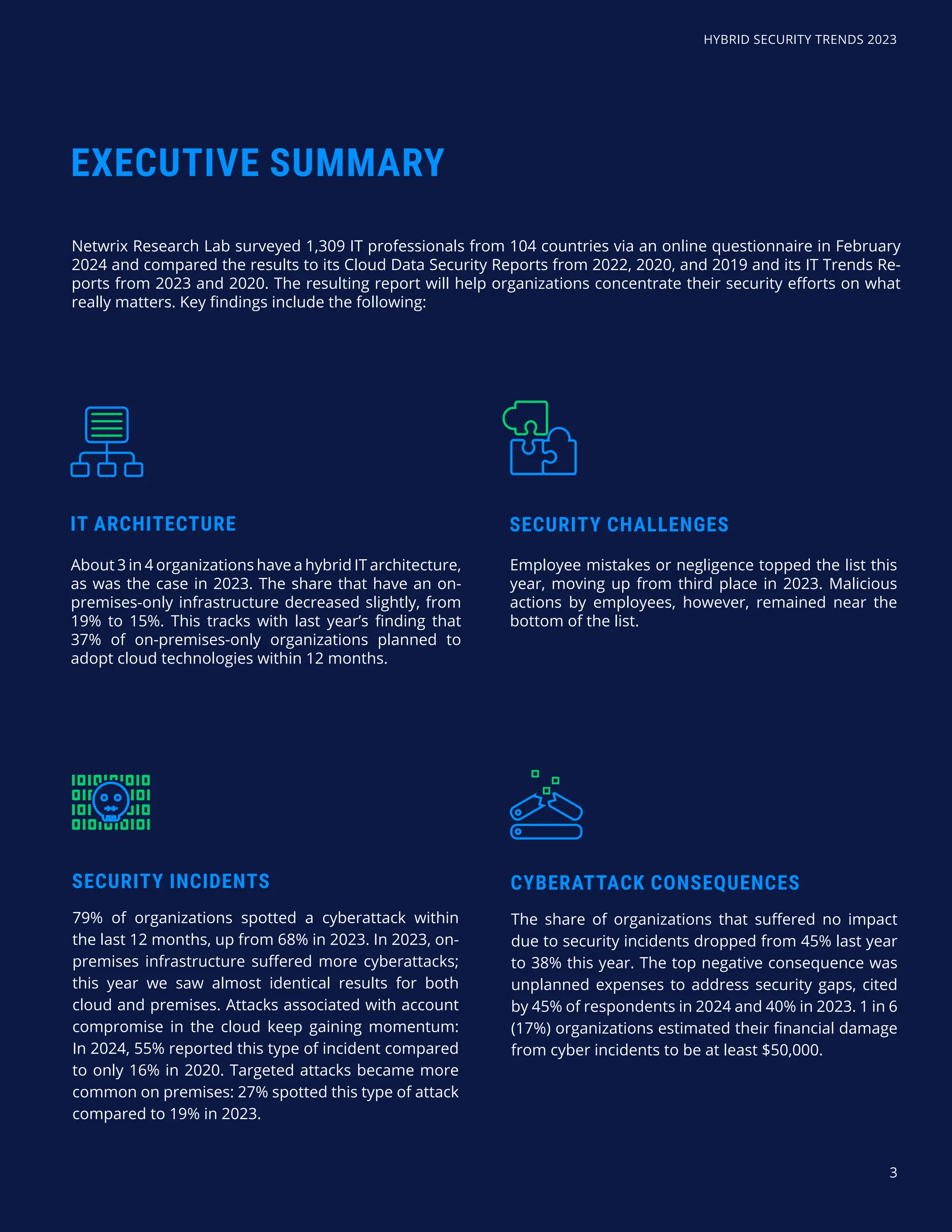
Netwrix Research Lab surveyed 1,309 IT professionals from 104 countries via an online questionnaire in February
2024 and compared the results to its Cloud Data Security Reports from 2022, 2020, and 2019 and its IT Trends Re-
ports from 2023 and 2020. The resulting report will help organizations concentrate their security efforts on what
really matters. Key findings include the following:
About 3 in 4 organizations have a hybrid IT architecture,
as was the case in 2023. The share that have an on-
premises-only infrastructure decreased slightly, from
19% to 15%. This tracks with last year’s finding that
37% of on-premises-only organizations planned to
adopt cloud technologies within 12 months.
3
EXECUTIVE SUMMARY
IT ARCHITECTURE
HYBRID SECURITY TRENDS 2023
Employee mistakes or negligence topped the list this
year, moving up from third place in 2023. Malicious
actions by employees, however, remained near the
bottom of the list.
SECURITY CHALLENGES
The share of organizations that suffered no impact
due to security incidents dropped from 45% last year
to 38% this year. The top negative consequence was
unplanned expenses to address security gaps, cited
by 45% of respondents in 2024 and 40% in 2023. 1 in 6
(17%) organizations estimated their financial damage
from cyber incidents to be at least $50,000.
CYBERATTACK CONSEQUENCES
79% of organizations spotted a cyberattack within
the last 12 months, up from 68% in 2023. In 2023, on-
premises infrastructure suffered more cyberattacks;
this year we saw almost identical results for both
cloud and premises. Attacks associated with account
compromise in the cloud keep gaining momentum:
In 2024, 55% reported this type of incident compared
to only 16% in 2020. Targeted attacks became more
common on premises: 27% spotted this type of attack
compared to 19% in 2023.
SECURITY INCIDENTS
4
CONTENTS
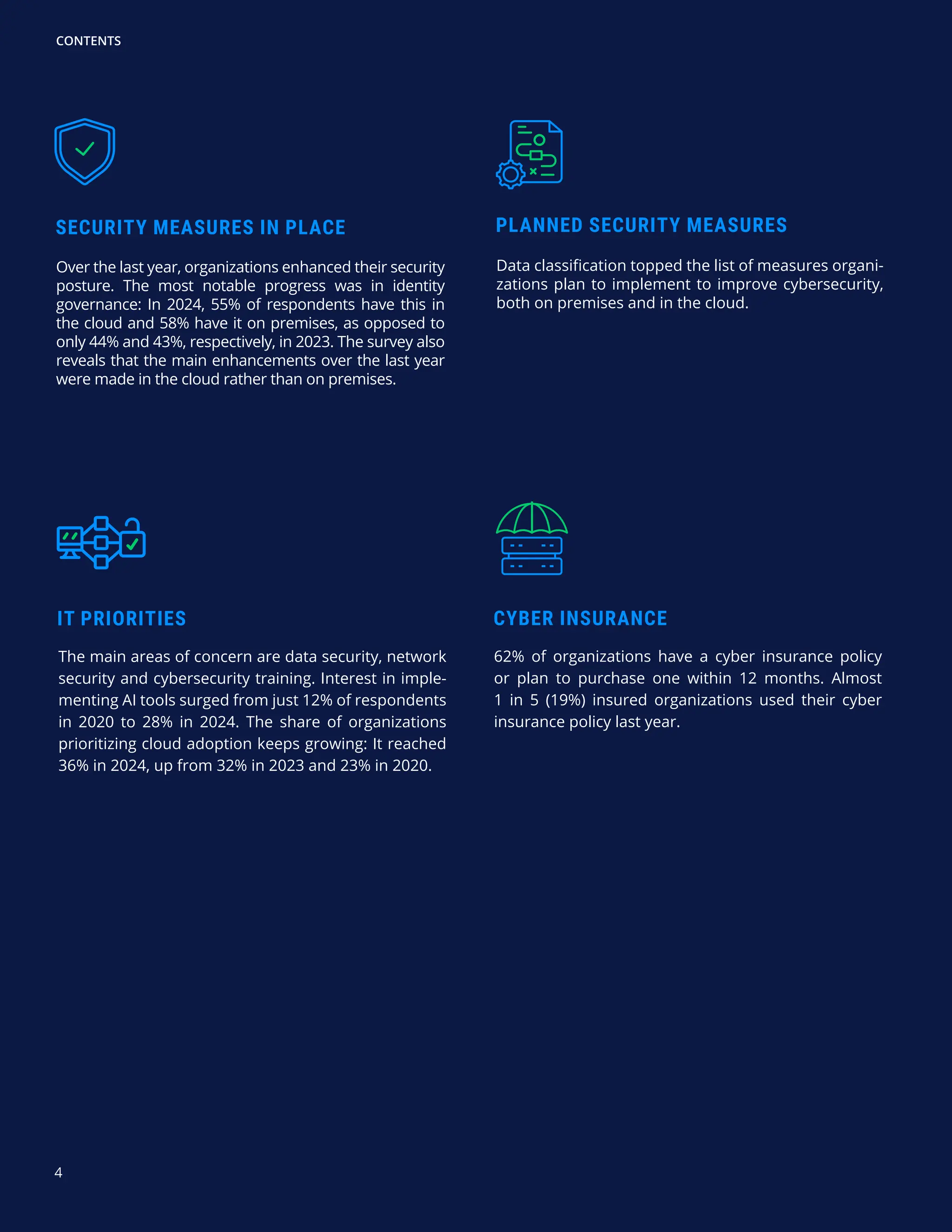
62% of organizations have a cyber insurance policy
or plan to purchase one within 12 months. Almost
1 in 5 (19%) insured organizations used their cyber
insurance policy last year.
CYBER INSURANCE
4
The main areas of concern are data security, network
security and cybersecurity training. Interest in imple-
menting AI tools surged from just 12% of respondents
in 2020 to 28% in 2024. The share of organizations
prioritizing cloud adoption keeps growing: It reached
36% in 2024, up from 32% in 2023 and 23% in 2020.
IT PRIORITIES
CONTENTS
Over the last year, organizations enhanced their security
posture. The most notable progress was in identity
governance: In 2024, 55% of respondents have this in
the cloud and 58% have it on premises, as opposed to
only 44% and 43%, respectively, in 2023. The survey also
reveals that the main enhancements over the last year
were made in the cloud rather than on premises.
SECURITY MEASURES IN PLACE
Data classification topped the list of measures organi-
zations plan to implement to improve cybersecurity,
both on premises and in the cloud.
PLANNED SECURITY MEASURES
5
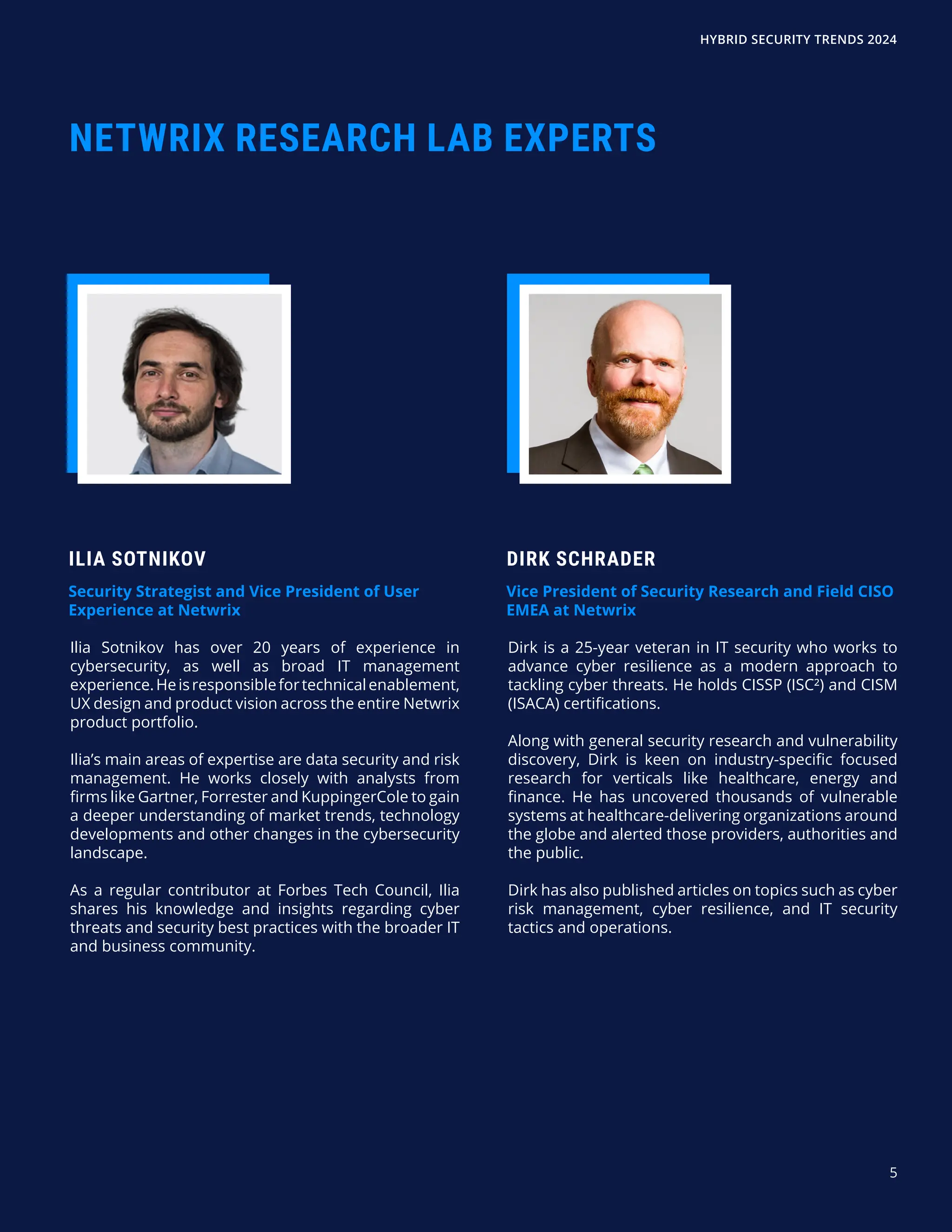
Ilia Sotnikov has over 20 years of experience in
cybersecurity, as well as broad IT management
experience.Heisresponsiblefortechnicalenablement,
UX design and product vision across the entire Netwrix
product portfolio.
Ilia’s main areas of expertise are data security and risk
management. He works closely with analysts from
firms like Gartner, Forrester and KuppingerCole to gain
a deeper understanding of market trends, technology
developments and other changes in the cybersecurity
landscape.
As a regular contributor at Forbes Tech Council, Ilia
shares his knowledge and insights regarding cyber
threats and security best practices with the broader IT
and business community.
Dirk is a 25-year veteran in IT security who works to
advance cyber resilience as a modern approach to
tackling cyber threats. He holds CISSP (ISC²) and CISM
(ISACA) certifications.
Along with general security research and vulnerability
discovery, Dirk is keen on industry-specific focused
research for verticals like healthcare, energy and
finance. He has uncovered thousands of vulnerable
systems at healthcare-delivering organizations around
the globe and alerted those providers, authorities and
the public.
Dirk has also published articles on topics such as cyber
risk management, cyber resilience, and IT security
tactics and operations.
NETWRIX RESEARCH LAB EXPERTS
ILIA SOTNIKOV DIRK SCHRADER
Security Strategist and Vice President of User
Experience at Netwrix
Vice President of Security Research and Field CISO
EMEA at Netwrix
HYBRID SECURITY TRENDS 2024
5
6
CONTENTS
IT ARCHITECTURE
On premises only On premises only
Cloud only
Cloud only
Hybrid Hybrid
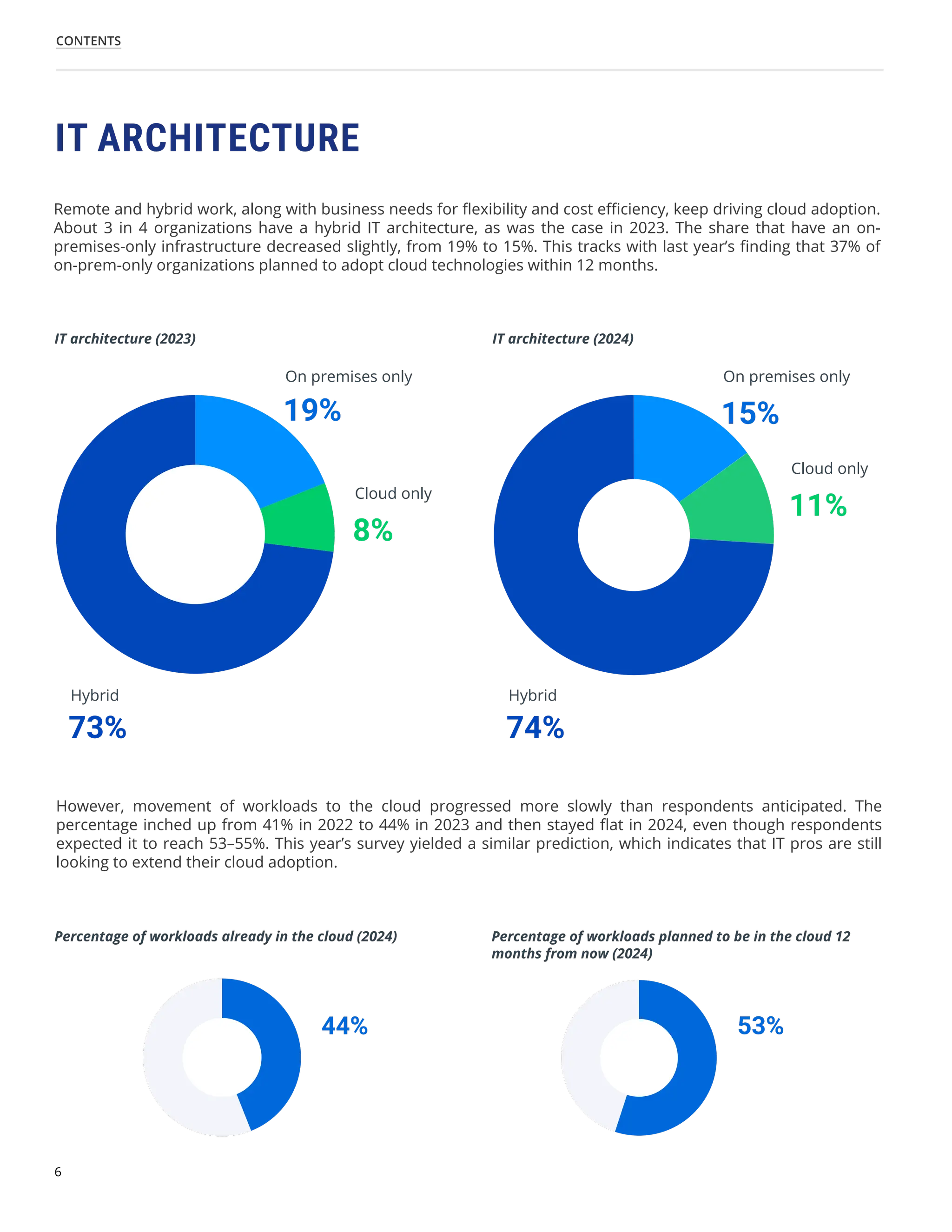
Remote and hybrid work, along with business needs for flexibility and cost efficiency, keep driving cloud adoption.
About 3 in 4 organizations have a hybrid IT architecture, as was the case in 2023. The share that have an on-
premises-only infrastructure decreased slightly, from 19% to 15%. This tracks with last year’s finding that 37% of
on-prem-only organizations planned to adopt cloud technologies within 12 months.
However, movement of workloads to the cloud progressed more slowly than respondents anticipated. The
percentage inched up from 41% in 2022 to 44% in 2023 and then stayed flat in 2024, even though respondents
expected it to reach 53–55%. This year’s survey yielded a similar prediction, which indicates that IT pros are still
looking to extend their cloud adoption.
19% 15%
44%
8%
11%
73% 74%
IT architecture (2023) IT architecture (2024)
Percentage of workloads already in the cloud (2024) Percentage of workloads planned to be in the cloud 12
months from now (2024)
53%
7
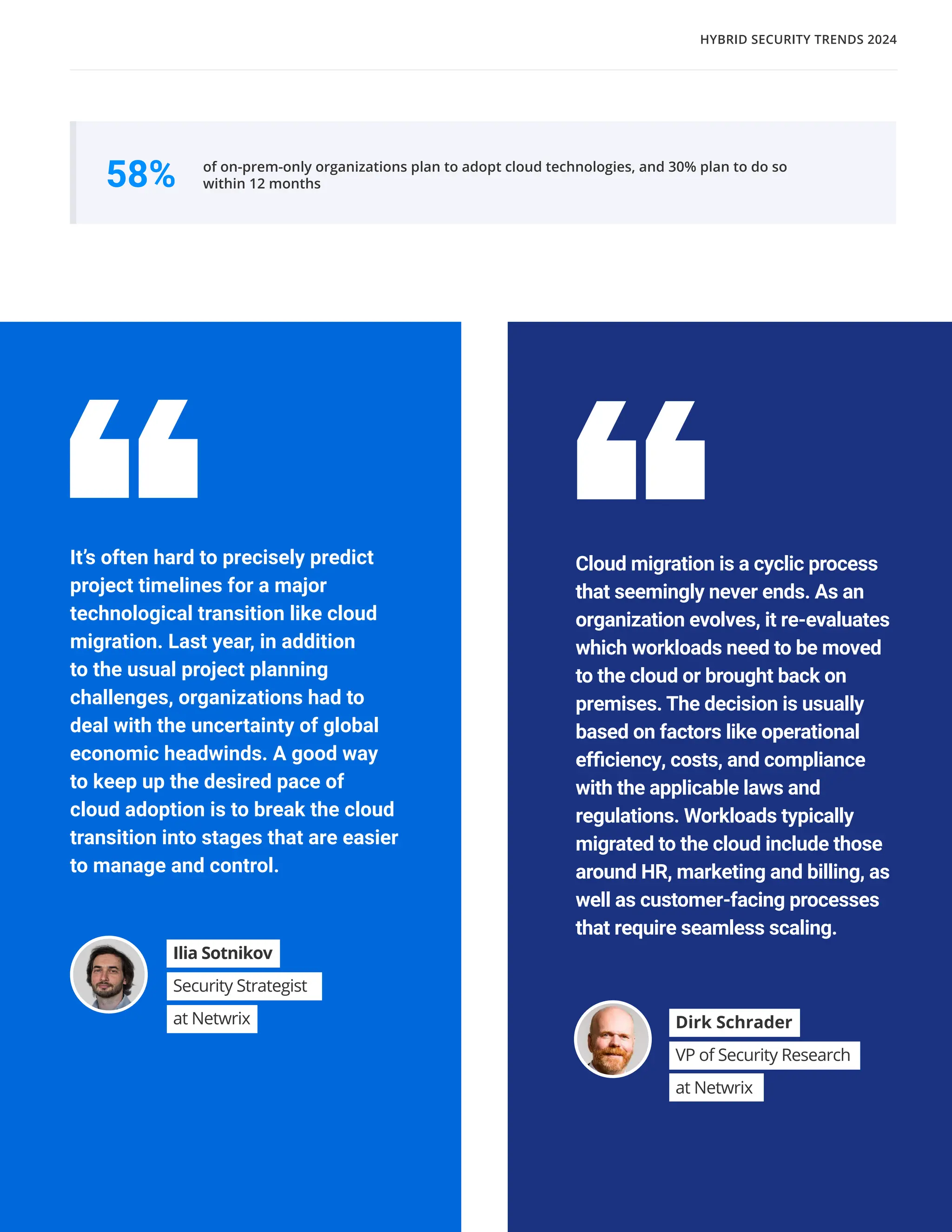
58% of on-prem-only organizations plan to adopt cloud technologies, and 30% plan to do so
within 12 months
7
It’s often hard to precisely predict
project timelines for a major
technological transition like cloud
migration. Last year, in addition
to the usual project planning
challenges, organizations had to
deal with the uncertainty of global
economic headwinds. A good way
to keep up the desired pace of
cloud adoption is to break the cloud
transition into stages that are easier
to manage and control.
Cloud migration is a cyclic process
that seemingly never ends. As an
organization evolves, it re-evaluates
which workloads need to be moved
to the cloud or brought back on
premises. The decision is usually
based on factors like operational
efficiency, costs, and compliance
with the applicable laws and
regulations. Workloads typically
migrated to the cloud include those
around HR, marketing and billing, as
well as customer-facing processes
that require seamless scaling.
Dirk Schrader
VP of Security Research
at Netwrix
Ilia Sotnikov
Security Strategist
at Netwrix
HYBRID SECURITY TRENDS 2024
8
CONTENTS
8
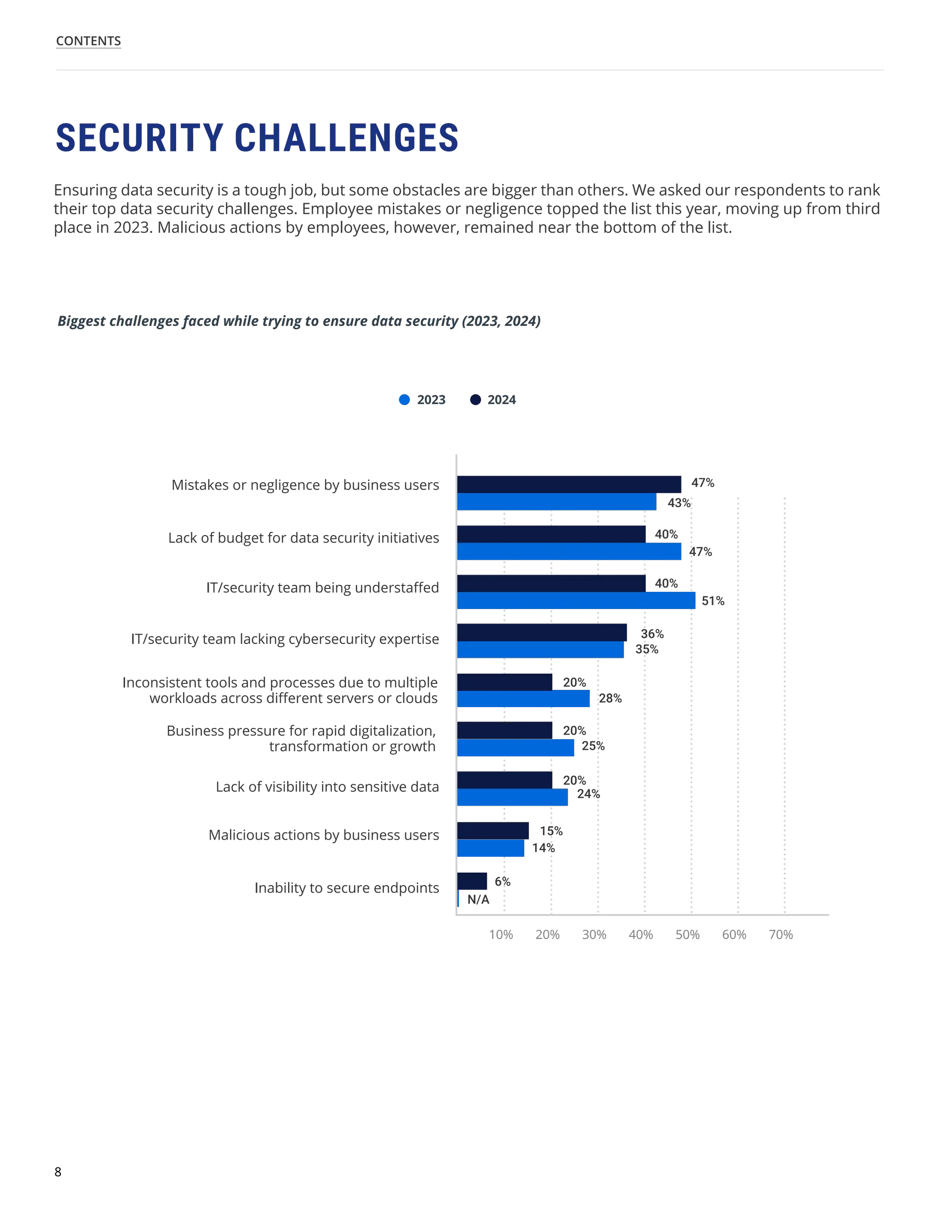
Ensuring data security is a tough job, but some obstacles are bigger than others. We asked our respondents to rank
their top data security challenges. Employee mistakes or negligence topped the list this year, moving up from third
place in 2023. Malicious actions by employees, however, remained near the bottom of the list.
SECURITY CHALLENGES
Biggest challenges faced while trying to ensure data security (2023, 2024)
47%
43%
40%
40%
47%
51%
35%
36%
28%
20%
20%
20%
15%
25%
24%
14%
6%
N/A
10% 30% 50%
20% 40% 60% 70%
Business pressure for rapid digitalization,
transformation or growth
Mistakes or negligence by business users
Lack of visibility into sensitive data
Malicious actions by business users
Inability to secure endpoints
Lack of budget for data security initiatives
IT/security team being understaffed
IT/security team lacking cybersecurity expertise
Inconsistent tools and processes due to multiple
workloads across different servers or clouds
2024
2023
CLOUD ADOPTION GOALS AND CHALLENGES
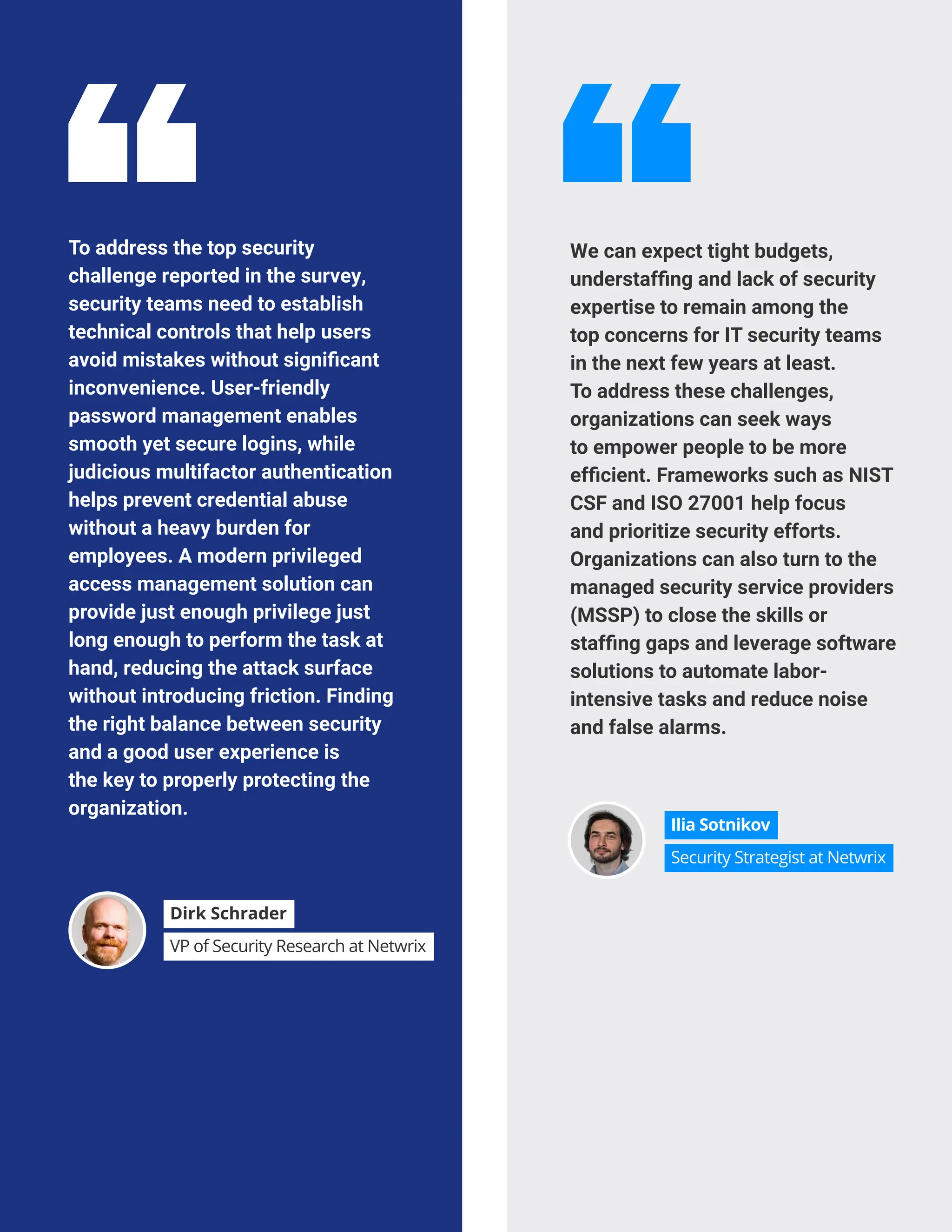
To address the top security
challenge reported in the survey,
security teams need to establish
technical controls that help users
avoid mistakes without significant
inconvenience. User-friendly
password management enables
smooth yet secure logins, while
judicious multifactor authentication
helps prevent credential abuse
without a heavy burden for
employees. A modern privileged
access management solution can
provide just enough privilege just
long enough to perform the task at
hand, reducing the attack surface
without introducing friction. Finding
the right balance between security
and a good user experience is
the key to properly protecting the
organization.
We can expect tight budgets,
understaffing and lack of security
expertise to remain among the
top concerns for IT security teams
in the next few years at least.
To address these challenges,
organizations can seek ways
to empower people to be more
efficient. Frameworks such as NIST
CSF and ISO 27001 help focus
and prioritize security efforts.
Organizations can also turn to the
managed security service providers
(MSSP) to close the skills or
staffing gaps and leverage software
solutions to automate labor-
intensive tasks and reduce noise
and false alarms.
Dirk Schrader
VP of Security Research at Netwrix
Ilia Sotnikov
Security Strategist at Netwrix
10
CONTENTS
We asked respondents whose organizations experienced a security incident to share details about the attack. In
2023, they reported more attacks on their on-premises infrastructures than the cloud, especially phishing and
malware attacks. This year, however, the respondents reported almost identical results for both segments of their
infrastructure.
SECURITY INCIDENTS
Most common security incidents (2023) Most common security incidents (2024)
Phishing Phishing
Ransomware or other
malware attack
Ransomware or other
malware attack
User account compromise
Accidental data leakage
Targeted attacks
on premises/on cloud
Targeted attacks
on premises/on cloud
Data theft by insiders
Data theft by hackers
Admin account
compromise
Admin account
compromise
Supply chain compromise
Data theft by hackers
Data theft by insiders
58% 73%
19% 38%
27% 31%
20% 28%
30% 20%
14% 17%
12% 14%
17% 13%
15% 9%
74% 74%
37% 34%
31% 34%
24% 27%
19% 21%
18% 16%
17% 12%
16% 12%
16% 8%
On premises On premises
In the cloud In the cloud
IN THE CLOUD VS ON PREMISES
79% of organizations spotted a cyberattack within the last 12 months, up from 68% in 2023.
SECURITY INCIDENTS IN THE CLOUD
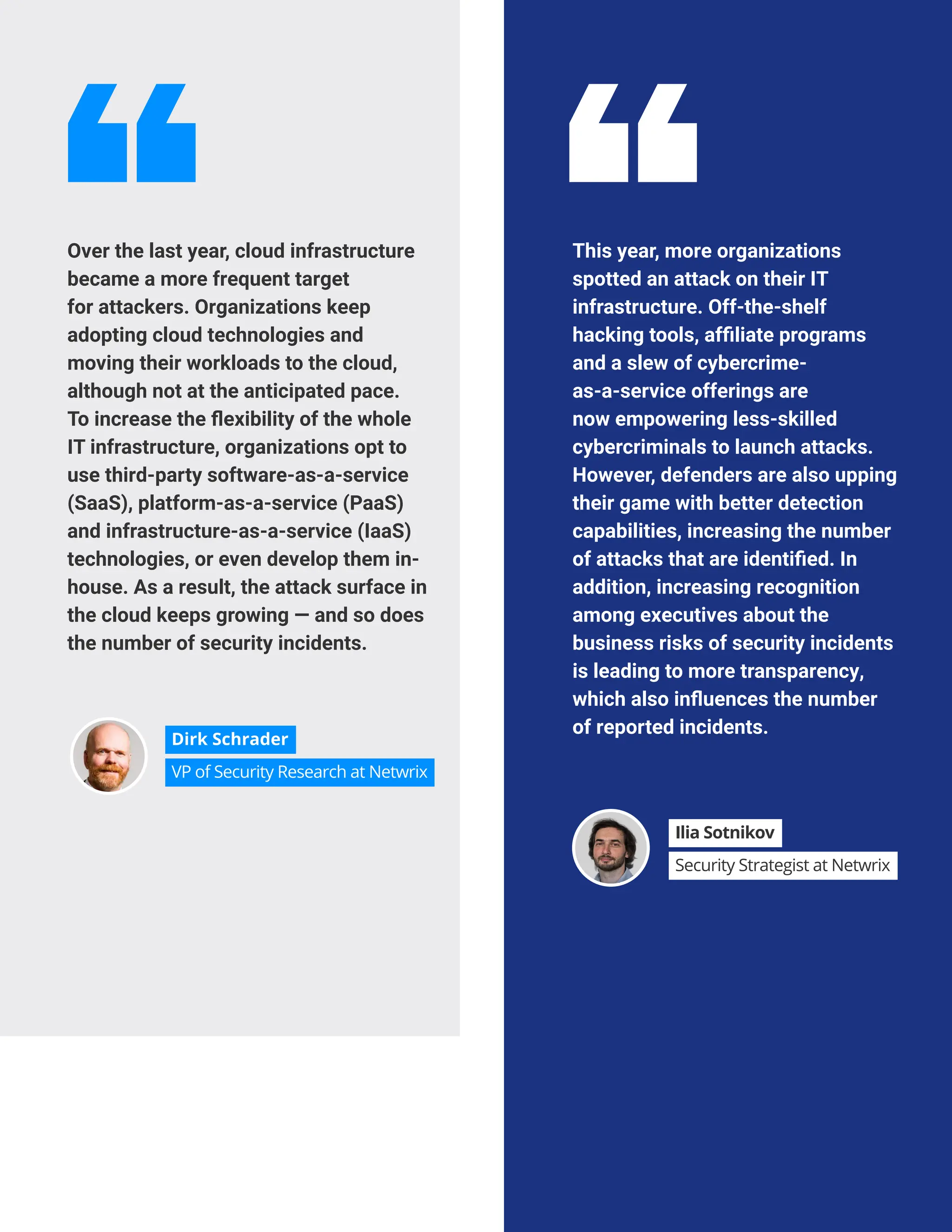
This year, more organizations
spotted an attack on their IT
infrastructure. Off-the-shelf
hacking tools, affiliate programs
and a slew of cybercrime-
as-a-service offerings are
now empowering less-skilled
cybercriminals to launch attacks.
However, defenders are also upping
their game with better detection
capabilities, increasing the number
of attacks that are identified. In
addition, increasing recognition
among executives about the
business risks of security incidents
is leading to more transparency,
which also influences the number
of reported incidents.
Over the last year, cloud infrastructure
became a more frequent target
for attackers. Organizations keep
adopting cloud technologies and
moving their workloads to the cloud,
although not at the anticipated pace.
To increase the flexibility of the whole
IT infrastructure, organizations opt to
use third-party software-as-a-service
(SaaS), platform-as-a-service (PaaS)
and infrastructure-as-a-service (IaaS)
technologies, or even develop them in-
house. As a result, the attack surface in
the cloud keeps growing — and so does
the number of security incidents.
Dirk Schrader
VP of Security Research at Netwrix
Ilia Sotnikov
Security Strategist at Netwrix
12
CONTENTS
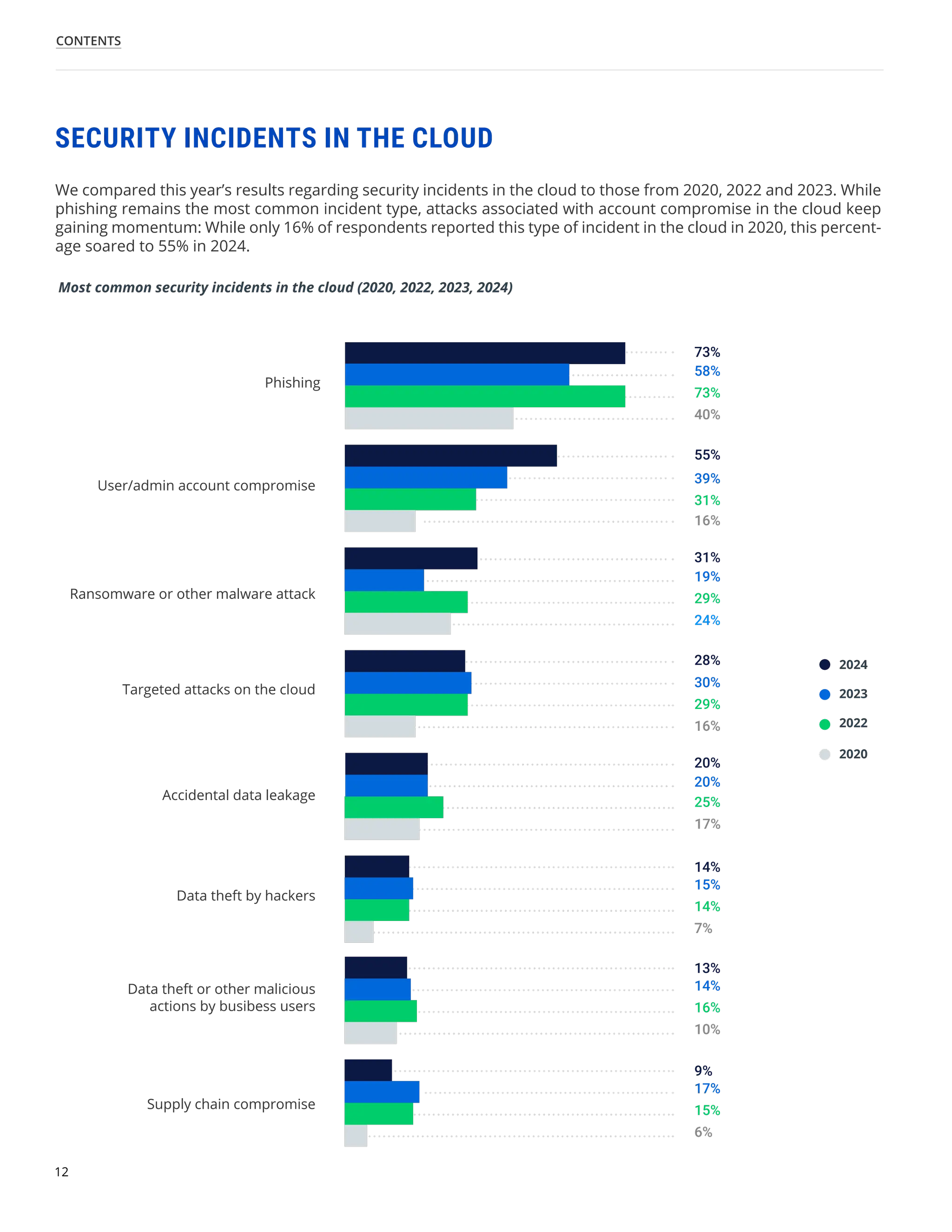
We compared this year’s results regarding security incidents in the cloud to those from 2020, 2022 and 2023. While
phishing remains the most common incident type, attacks associated with account compromise in the cloud keep
gaining momentum: While only 16% of respondents reported this type of incident in the cloud in 2020, this percent-
age soared to 55% in 2024.
SECURITY INCIDENTS IN THE CLOUD
2024
2023
2022
2020
58%
39%
55%
31%
28%
20%
15%
19%
14%
73%
73%
31%
14%
14%
13%
29%
16%
40%
16%
7%
24%
10%
Most common security incidents in the cloud (2020, 2022, 2023, 2024)
Phishing
User/admin account compromise
30%
29%
16%
Targeted attacks on the cloud
20%
25%
17%
Accidental data leakage
Ransomware or other malware attack
9%
17%
15%
6%
Supply chain compromise
Data theft by hackers
Data theft or other malicious
actions by busibess users
DATA BREACH CONSEQUENCES
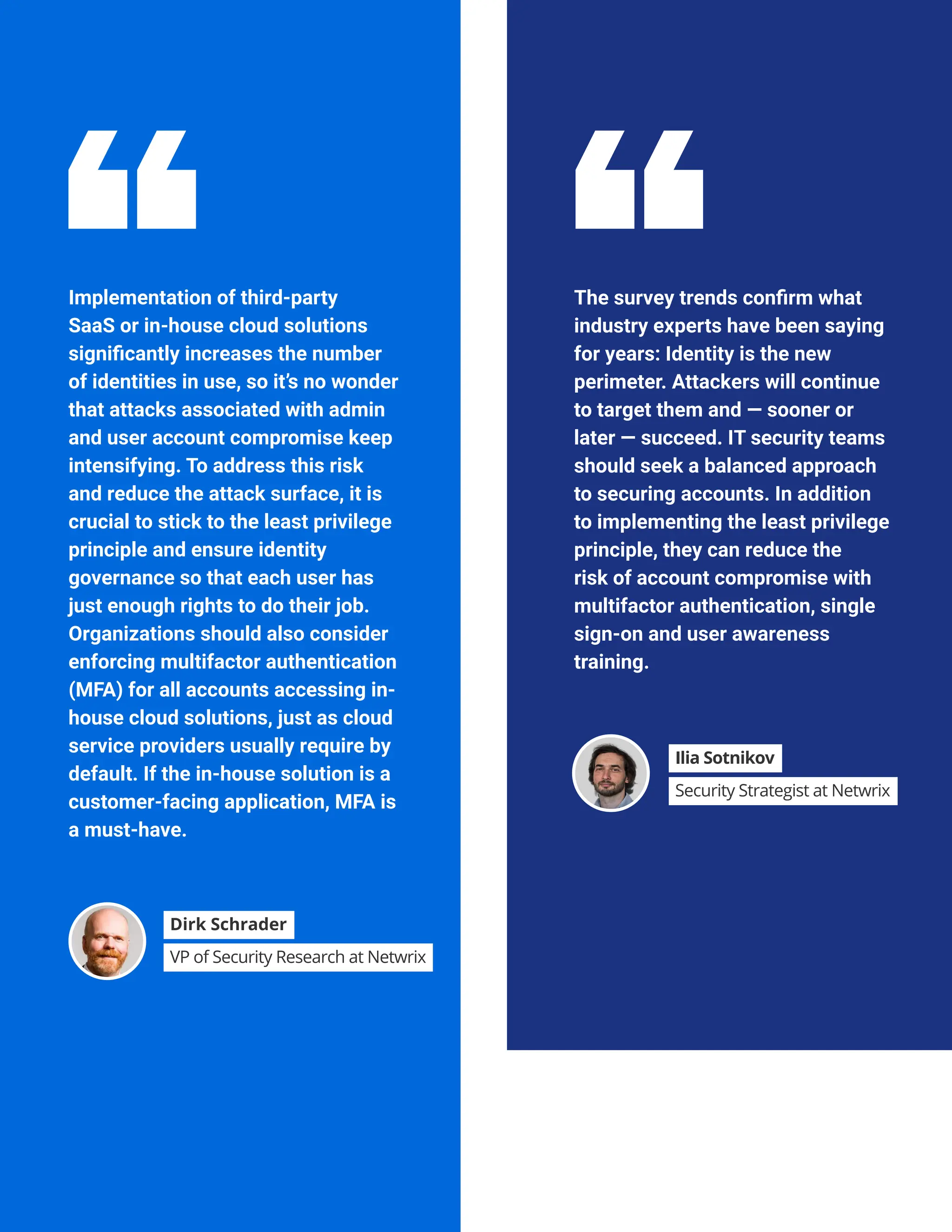
Implementation of third-party
SaaS or in-house cloud solutions
significantly increases the number
of identities in use, so it’s no wonder
that attacks associated with admin
and user account compromise keep
intensifying. To address this risk
and reduce the attack surface, it is
crucial to stick to the least privilege
principle and ensure identity
governance so that each user has
just enough rights to do their job.
Organizations should also consider
enforcing multifactor authentication
(MFA) for all accounts accessing in-
house cloud solutions, just as cloud
service providers usually require by
default. If the in-house solution is a
customer-facing application, MFA is
a must-have.
The survey trends confirm what
industry experts have been saying
for years: Identity is the new
perimeter. Attackers will continue
to target them and — sooner or
later — succeed. IT security teams
should seek a balanced approach
to securing accounts. In addition
to implementing the least privilege
principle, they can reduce the
risk of account compromise with
multifactor authentication, single
sign-on and user awareness
training.
Dirk Schrader
VP of Security Research at Netwrix
Ilia Sotnikov
Security Strategist at Netwrix
14
CONTENTS
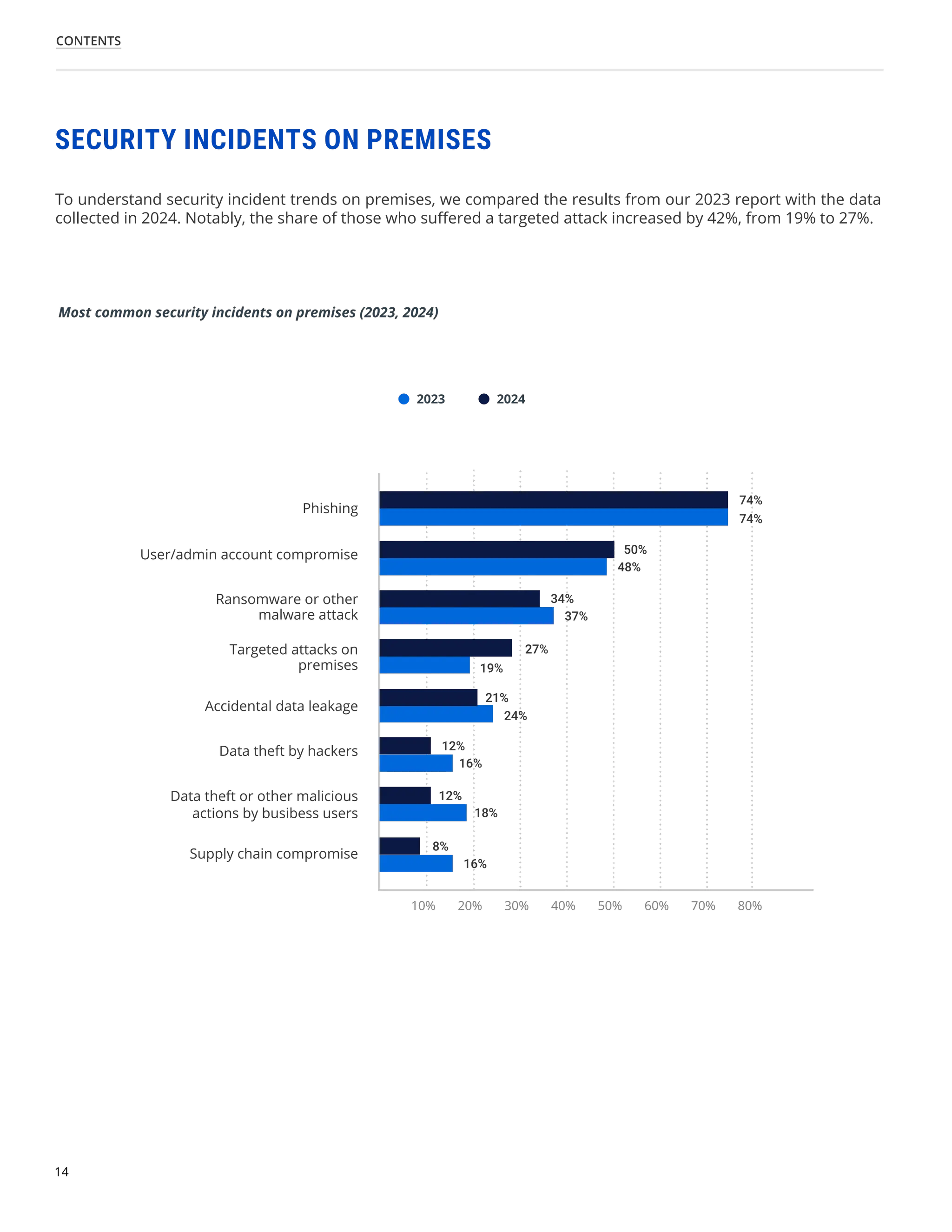
To understand security incident trends on premises, we compared the results from our 2023 report with the data
collected in 2024. Notably, the share of those who suffered a targeted attack increased by 42%, from 19% to 27%.
SECURITY INCIDENTS ON PREMISES
Most common security incidents on premises (2023, 2024)
Phishing
Ransomware or other
malware attack
User/admin account compromise
Accidental data leakage
Targeted attacks on
premises
Supply chain compromise
Data theft by hackers
2023 2024
74%
74%
50%
34%
48%
37%
19%
27%
24%
21%
12%
12%
8%
16%
18%
16%
10% 30% 50%
20% 40% 60% 70% 80%
Data theft or other malicious
actions by busibess users
CLOUD ADOPTION GOALS AND CHALLENGES
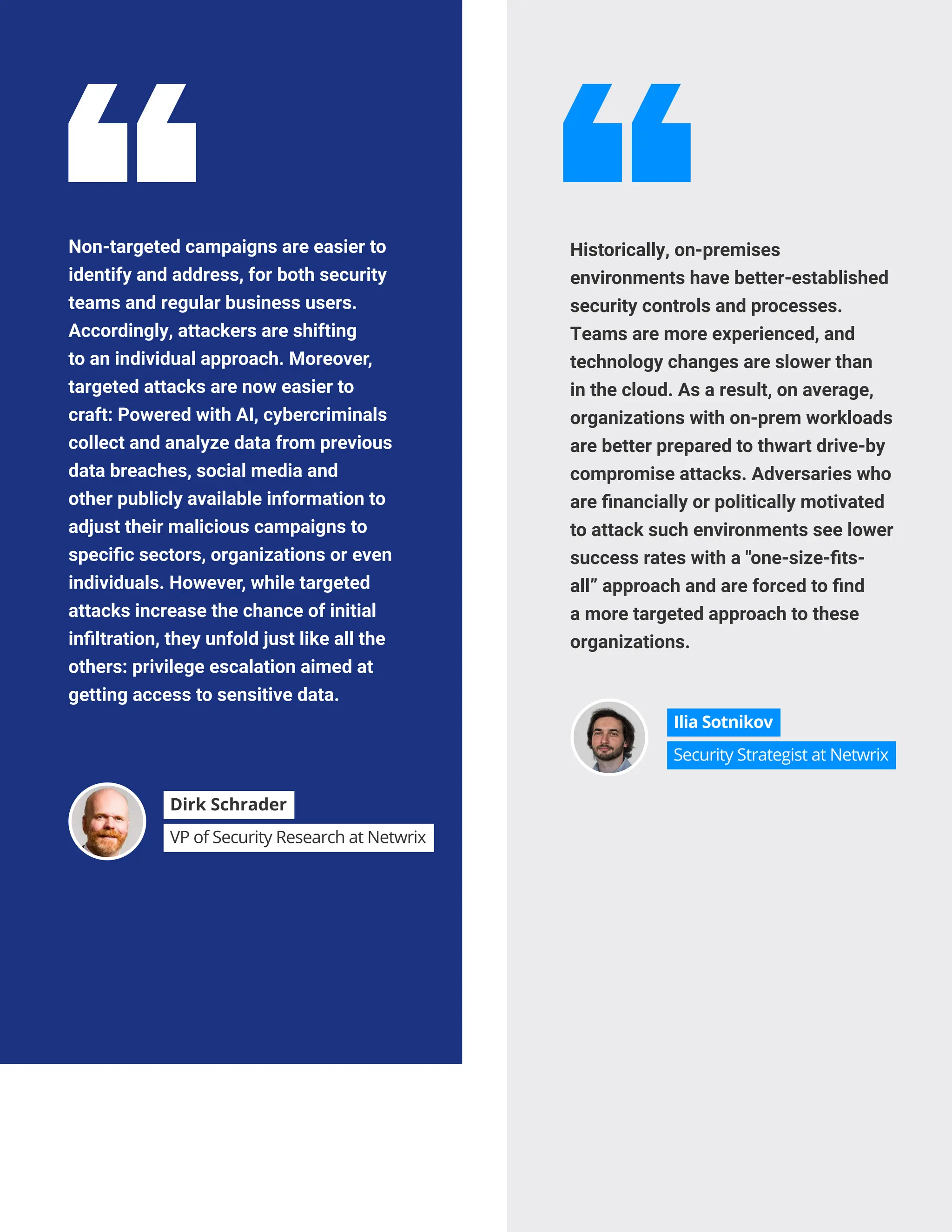
Non-targeted campaigns are easier to
identify and address, for both security
teams and regular business users.
Accordingly, attackers are shifting
to an individual approach. Moreover,
targeted attacks are now easier to
craft: Powered with AI, cybercriminals
collect and analyze data from previous
data breaches, social media and
other publicly available information to
adjust their malicious campaigns to
specific sectors, organizations or even
individuals. However, while targeted
attacks increase the chance of initial
infiltration, they unfold just like all the
others: privilege escalation aimed at
getting access to sensitive data.
Historically, on-premises
environments have better-established
security controls and processes.
Teams are more experienced, and
technology changes are slower than
in the cloud. As a result, on average,
organizations with on-prem workloads
are better prepared to thwart drive-by
compromise attacks. Adversaries who
are financially or politically motivated
to attack such environments see lower
success rates with a "one-size-fits-
all” approach and are forced to find
a more targeted approach to these
organizations.
Dirk Schrader
VP of Security Research at Netwrix
Ilia Sotnikov
Security Strategist at Netwrix
16
CONTENTS
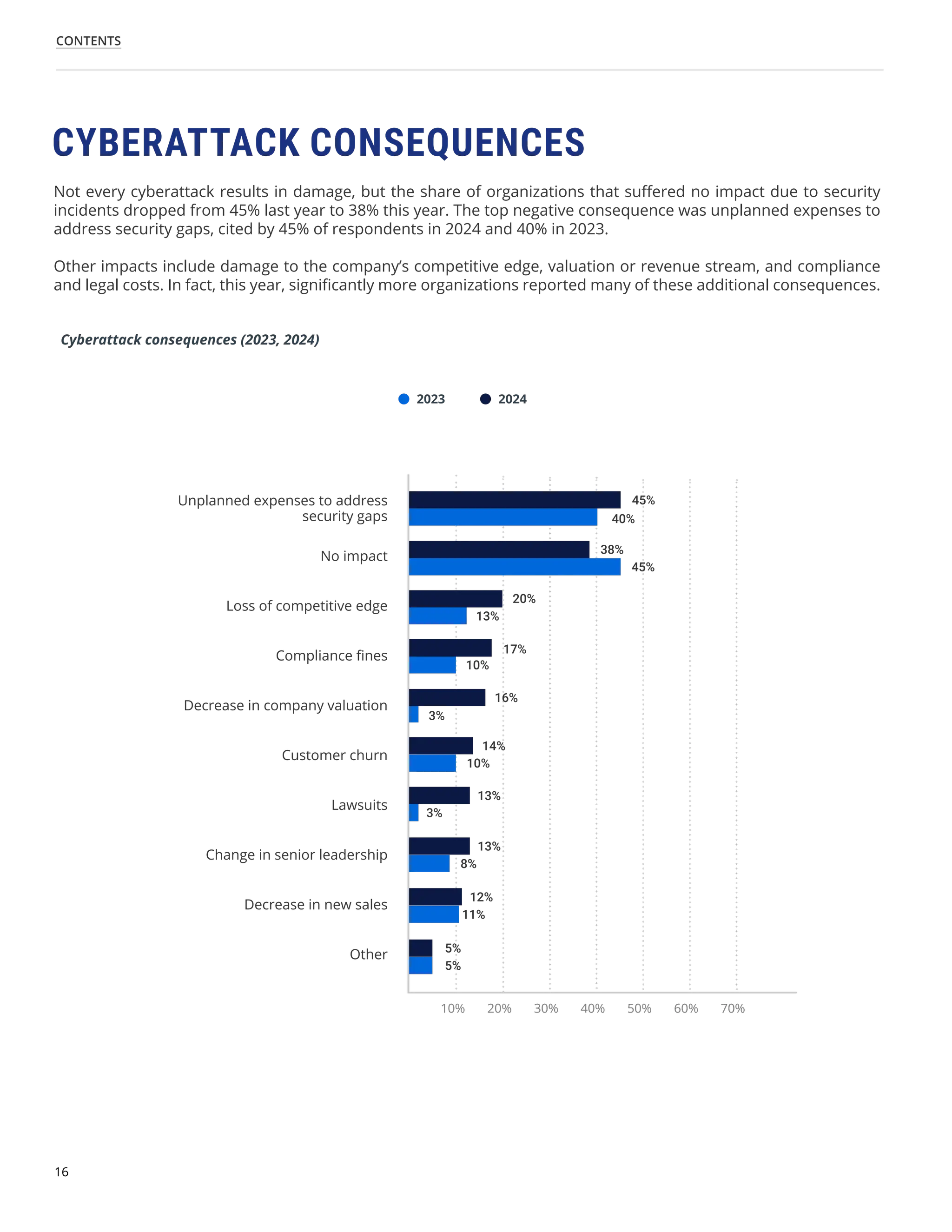
Not every cyberattack results in damage, but the share of organizations that suffered no impact due to security
incidents dropped from 45% last year to 38% this year. The top negative consequence was unplanned expenses to
address security gaps, cited by 45% of respondents in 2024 and 40% in 2023.
Other impacts include damage to the company’s competitive edge, valuation or revenue stream, and compliance
and legal costs. In fact, this year, significantly more organizations reported many of these additional consequences.
CYBERATTACK CONSEQUENCES
Cyberattack consequences (2023, 2024)
Unplanned expenses to address
security gaps
No impact
Loss of competitive edge
Compliance fines
Decrease in company valuation
Customer churn
Lawsuits
Change in senior leadership
Decrease in new sales
Other
2023 2024
45%
40%
38%
20%
45%
13%
10%
17%
3%
16%
14%
13%
13%
12%
5%
10%
3%
8%
11%
5%
10% 30% 50%
20% 40% 60% 70%
17
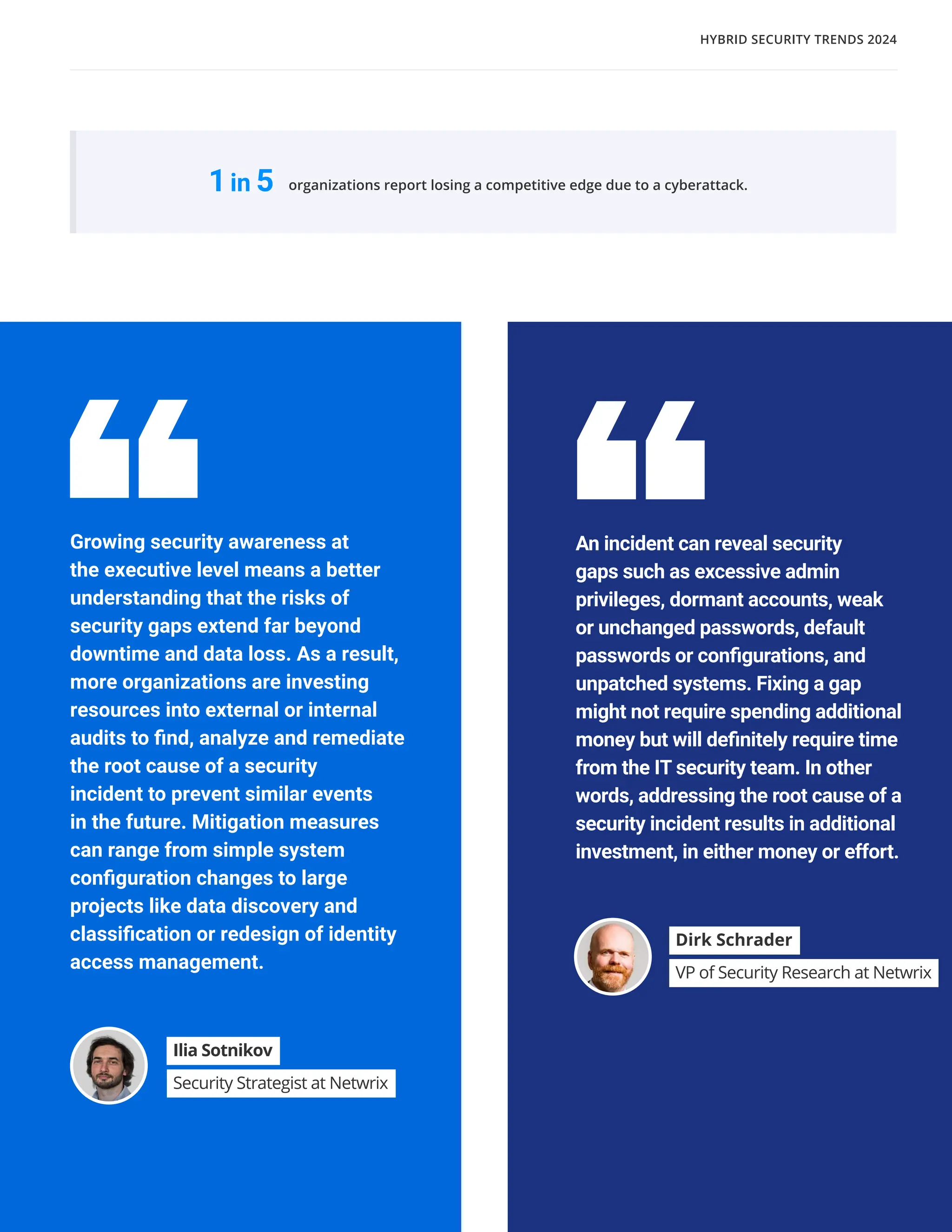
organizations report losing a competitive edge due to a cyberattack.
Growing security awareness at
the executive level means a better
understanding that the risks of
security gaps extend far beyond
downtime and data loss. As a result,
more organizations are investing
resources into external or internal
audits to find, analyze and remediate
the root cause of a security
incident to prevent similar events
in the future. Mitigation measures
can range from simple system
configuration changes to large
projects like data discovery and
classification or redesign of identity
access management.
An incident can reveal security
gaps such as excessive admin
privileges, dormant accounts, weak
or unchanged passwords, default
passwords or configurations, and
unpatched systems. Fixing a gap
might not require spending additional
money but will definitely require time
from the IT security team. In other
words, addressing the root cause of a
security incident results in additional
investment, in either money or effort.
Dirk Schrader
VP of Security Research at Netwrix
1in 5
Ilia Sotnikov
Security Strategist at Netwrix
HYBRID SECURITY TRENDS 2024
18
CONTENTS
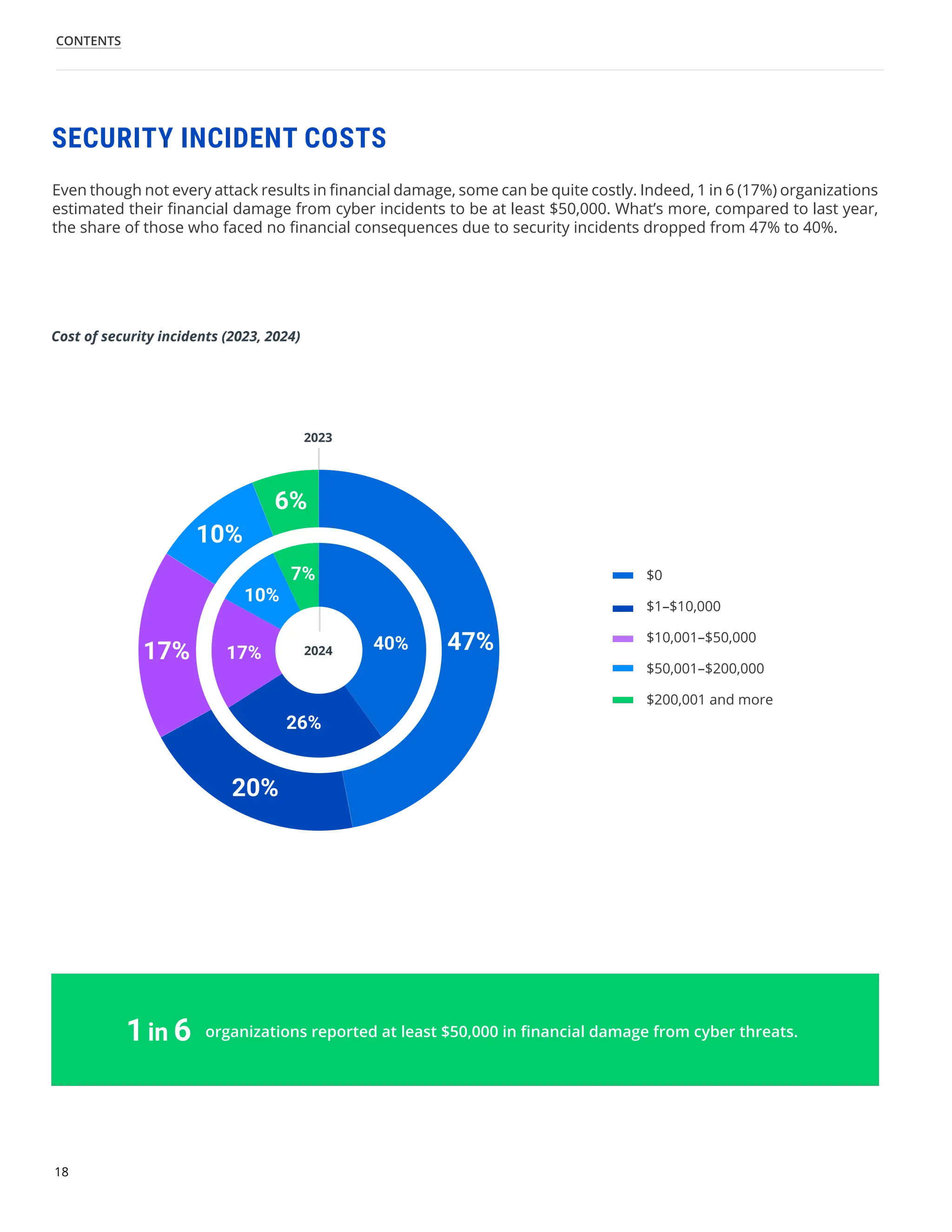
Cost of security incidents (2023, 2024)
$0
$1–$10,000
$10,001–$50,000
$50,001–$200,000
$200,001 and more
Even though not every attack results in financial damage, some can be quite costly. Indeed, 1 in 6 (17%) organizations
estimated their financial damage from cyber incidents to be at least $50,000. What’s more, compared to last year,
the share of those who faced no financial consequences due to security incidents dropped from 47% to 40%.
SECURITY INCIDENT COSTS
organizations reported at least $50,000 in financial damage from cyber threats.
2023
40%
26%
17%
10%
2024
7%
47%
17%
6%
20%
10%
1in 6
19
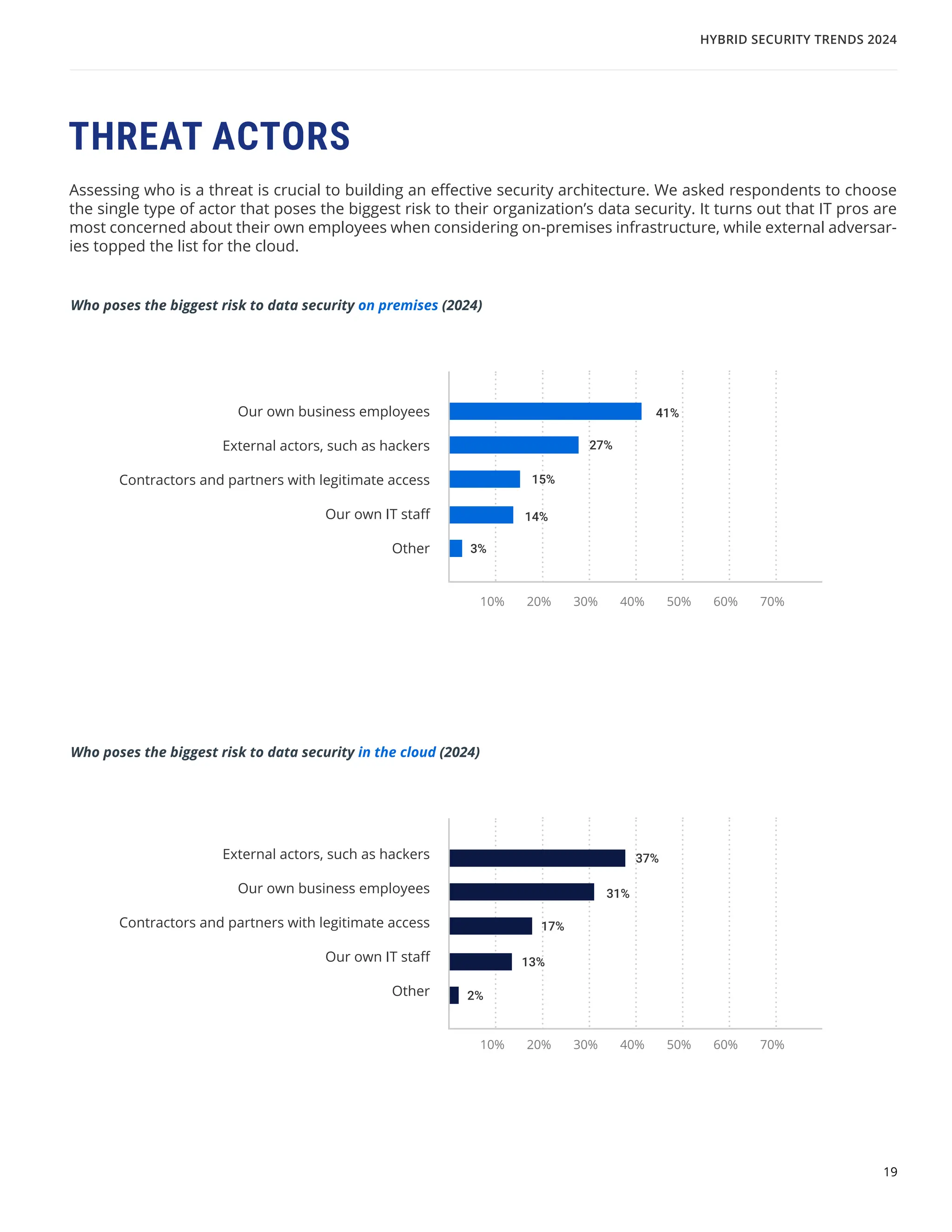
Who poses the biggest risk to data security on premises (2024)
Who poses the biggest risk to data security in the cloud (2024)
Assessing who is a threat is crucial to building an effective security architecture. We asked respondents to choose
the single type of actor that poses the biggest risk to their organization’s data security. It turns out that IT pros are
most concerned about their own employees when considering on-premises infrastructure, while external adversar-
ies topped the list for the cloud.
THREAT ACTORS
41%
37%
15%
17%
27%
31%
14%
13%
3%
2%
Our own business employees
External actors, such as hackers
Contractors and partners with legitimate access
Our own IT staff
Other
External actors, such as hackers
Our own business employees
Contractors and partners with legitimate access
Our own IT staff
Other
10%
10%
30%
30%
50%
50%
20%
20%
40%
40%
60%
60%
70%
70%
HYBRID SECURITY TRENDS 2024
HYBRID SECURITY TRENDS 2023
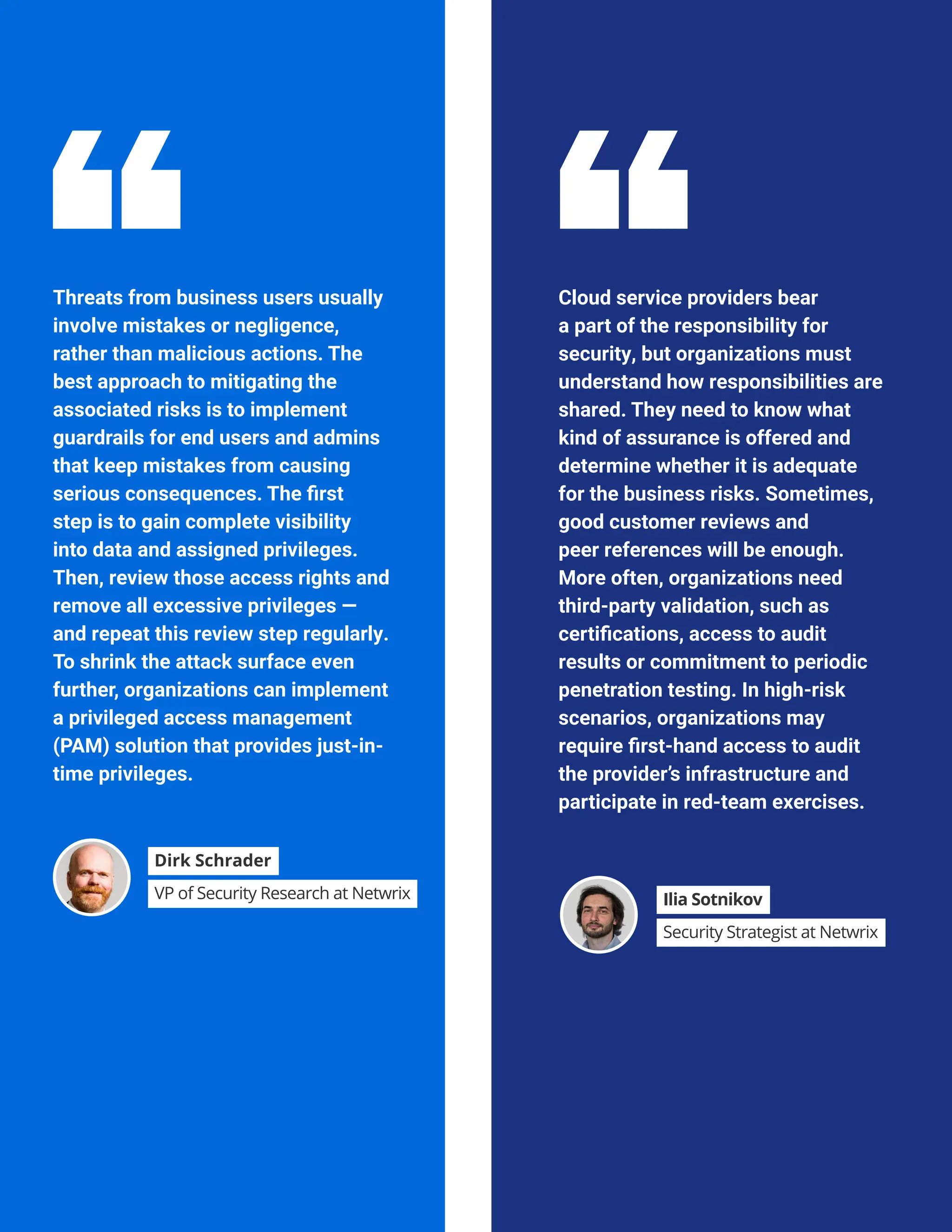
Threats from business users usually
involve mistakes or negligence,
rather than malicious actions. The
best approach to mitigating the
associated risks is to implement
guardrails for end users and admins
that keep mistakes from causing
serious consequences. The first
step is to gain complete visibility
into data and assigned privileges.
Then, review those access rights and
remove all excessive privileges —
and repeat this review step regularly.
To shrink the attack surface even
further, organizations can implement
a privileged access management
(PAM) solution that provides just-in-
time privileges.
Cloud service providers bear
a part of the responsibility for
security, but organizations must
understand how responsibilities are
shared. They need to know what
kind of assurance is offered and
determine whether it is adequate
for the business risks. Sometimes,
good customer reviews and
peer references will be enough.
More often, organizations need
third-party validation, such as
certifications, access to audit
results or commitment to periodic
penetration testing. In high-risk
scenarios, organizations may
require first-hand access to audit
the provider’s infrastructure and
participate in red-team exercises.
Dirk Schrader
VP of Security Research at Netwrix Ilia Sotnikov
Security Strategist at Netwrix
21
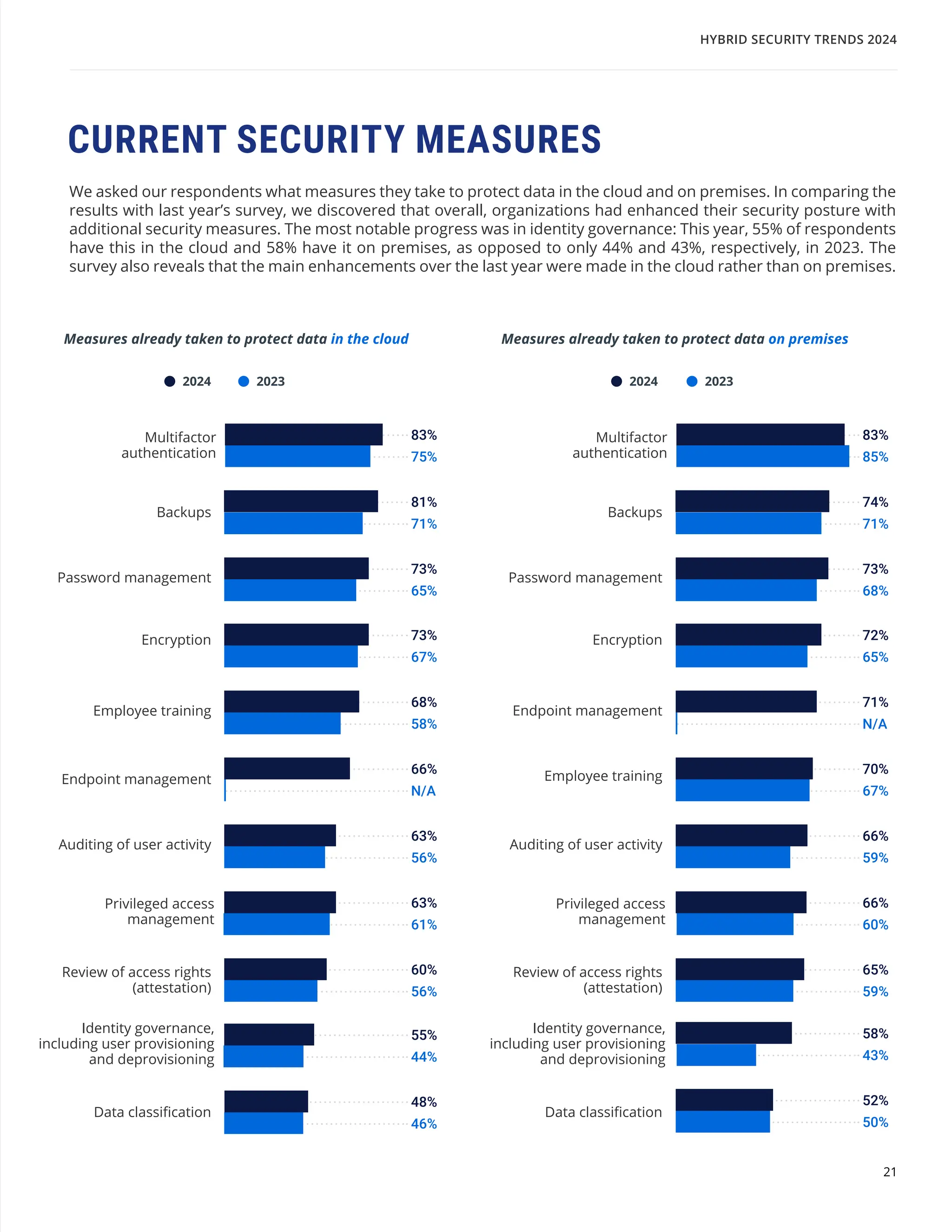
We asked our respondents what measures they take to protect data in the cloud and on premises. In comparing the
results with last year’s survey, we discovered that overall, organizations had enhanced their security posture with
additional security measures. The most notable progress was in identity governance: This year, 55% of respondents
have this in the cloud and 58% have it on premises, as opposed to only 44% and 43%, respectively, in 2023. The
survey also reveals that the main enhancements over the last year were made in the cloud rather than on premises.
CURRENT SECURITY MEASURES
Measures already taken to protect data in the cloud Measures already taken to protect data on premises
Multifactor
authentication
Multifactor
authentication
Backups Backups
Password management Password management
Encryption Encryption
Employee training
Employee training
Endpoint management
Endpoint management
Auditing of user activity Auditing of user activity
Privileged access
management
Privileged access
management
Identity governance,
including user provisioning
and deprovisioning
Identity governance,
including user provisioning
and deprovisioning
Review of access rights
(attestation)
Review of access rights
(attestation)
Data classification Data classification
83% 83%
81% 74%
73% 73%
73% 72%
68% 71%
66% 70%
63% 66%
63%
55%
66%
58%
60%
48%
65%
52%
75% 85%
71% 71%
65% 68%
67% 65%
58% N/A
N/A 67%
56% 59%
61%
44%
60%
43%
56%
46%
59%
50%
2023 2023
2024 2024
HYBRID SECURITY TRENDS 2024
22
CONTENTS HYBRID SECURITY TRENDS 2023
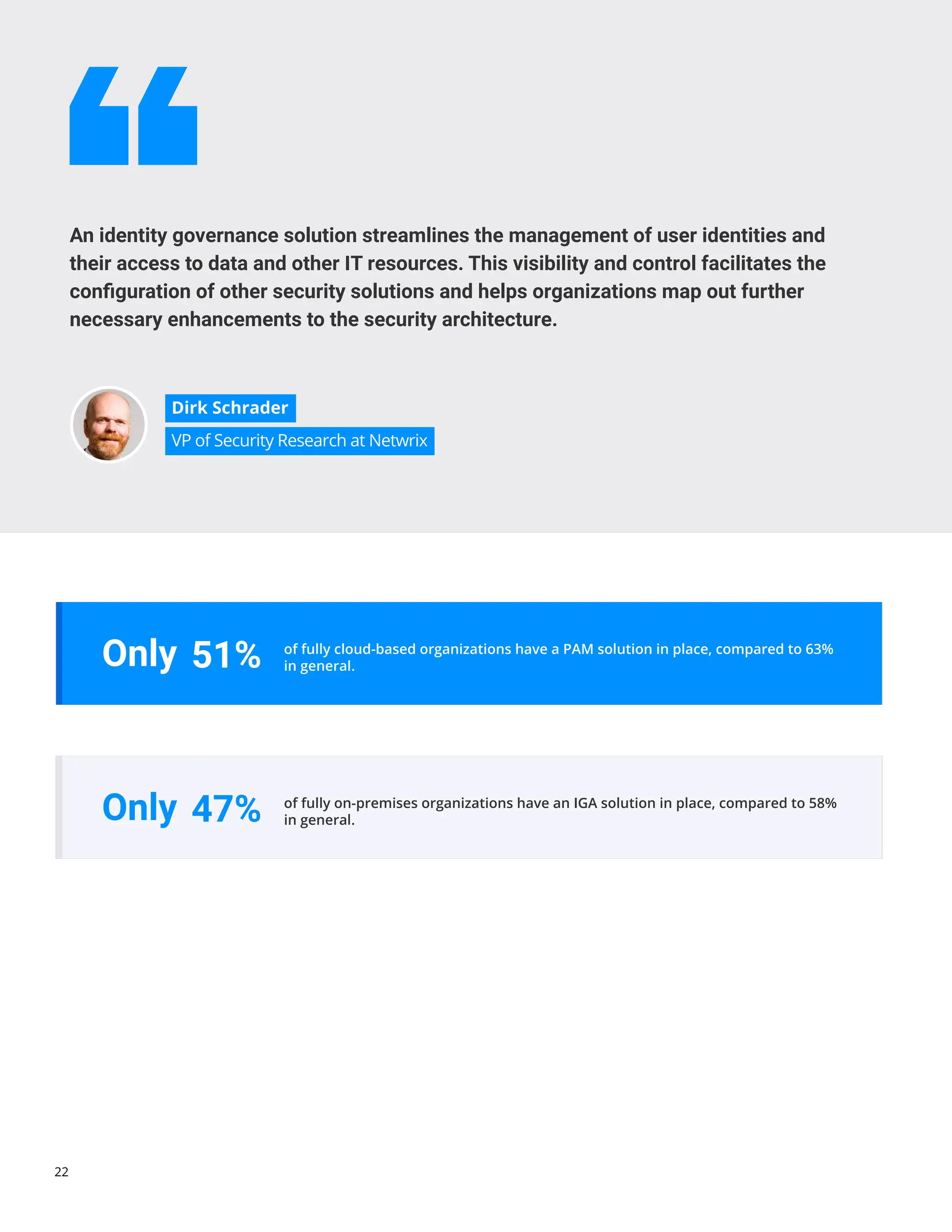
An identity governance solution streamlines the management of user identities and
their access to data and other IT resources. This visibility and control facilitates the
configuration of other security solutions and helps organizations map out further
necessary enhancements to the security architecture.
Dirk Schrader
VP of Security Research at Netwrix
51%
47%
Only
Only
of fully cloud-based organizations have a PAM solution in place, compared to 63%
in general.
of fully on-premises organizations have an IGA solution in place, compared to 58%
in general.
23
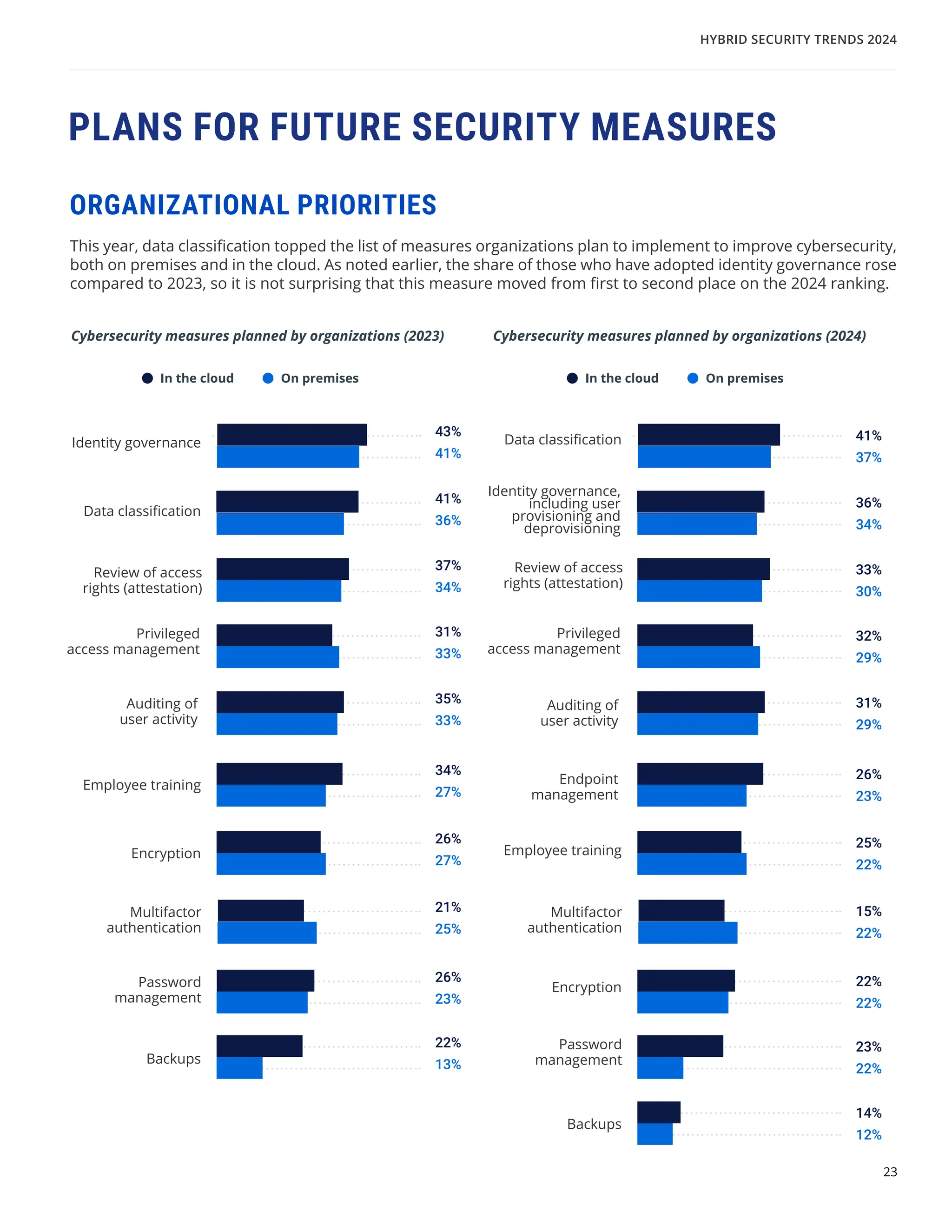
This year, data classification topped the list of measures organizations plan to implement to improve cybersecurity,
both on premises and in the cloud. As noted earlier, the share of those who have adopted identity governance rose
compared to 2023, so it is not surprising that this measure moved from first to second place on the 2024 ranking.
PLANS FOR FUTURE SECURITY MEASURES
ORGANIZATIONAL PRIORITIES
Identity governance
Data classification
Employee training
Encryption
Backups
Data classification
Employee training
Encryption
Backups
43% 41%
41% 36%
37% 33%
31% 32%
35% 31%
34% 26%
26% 25%
21% 15%
26% 22%
22% 23%
14%
41% 37%
36% 34%
34% 30%
33% 29%
33% 29%
27% 23%
27% 22%
25% 22%
23% 22%
13% 22%
12%
Review of access
rights (attestation)
Review of access
rights (attestation)
Auditing of
user activity
Auditing of
user activity
Endpoint
management
Privileged
access management
Privileged
access management
Identity governance,
including user
provisioning and
deprovisioning
Multifactor
authentication
Multifactor
authentication
Password
management
Password
management
Cybersecurity measures planned by organizations (2023) Cybersecurity measures planned by organizations (2024)
On premises On premises
In the cloud In the cloud
HYBRID SECURITY TRENDS 2024
HYBRID SECURITY TRENDS 2023
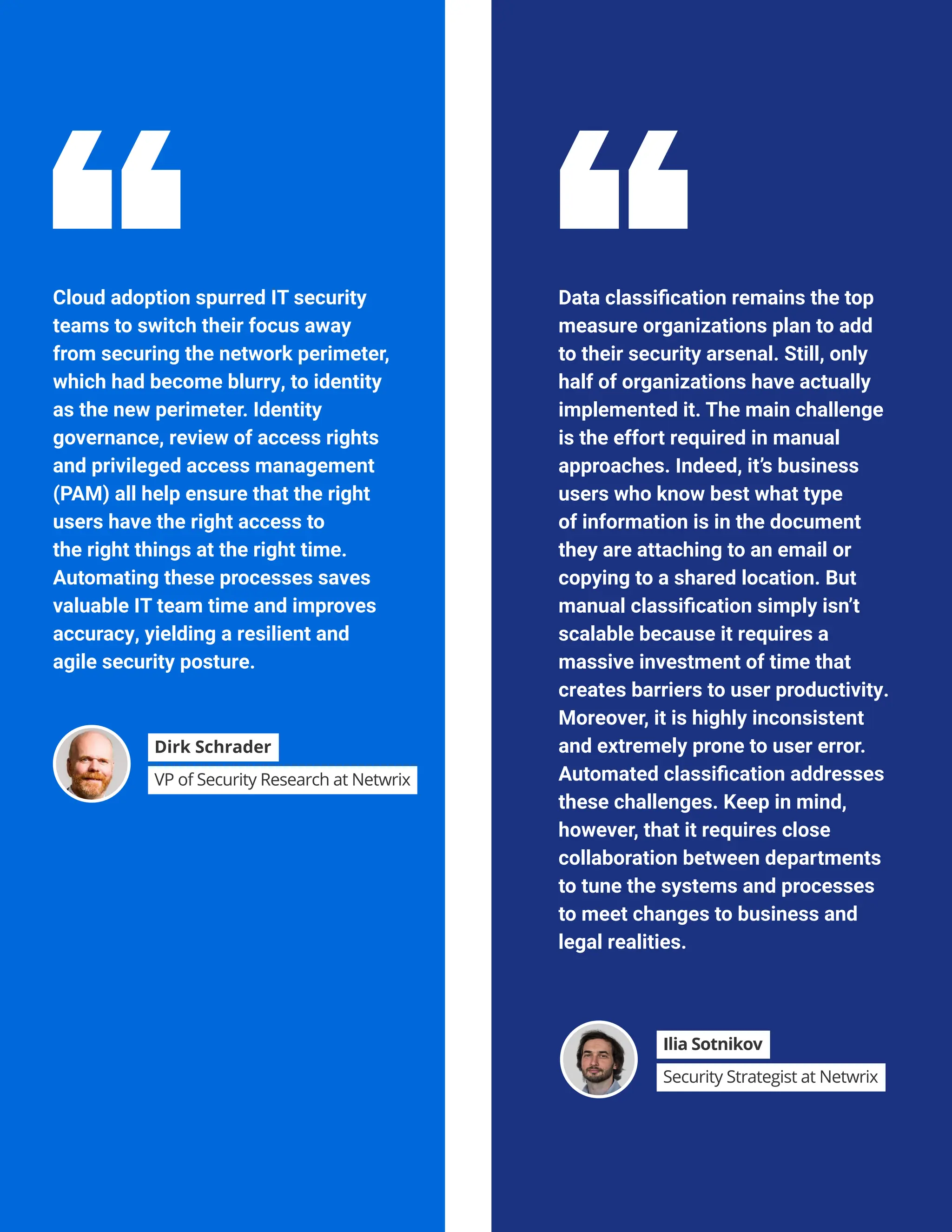
Cloud adoption spurred IT security
teams to switch their focus away
from securing the network perimeter,
which had become blurry, to identity
as the new perimeter. Identity
governance, review of access rights
and privileged access management
(PAM) all help ensure that the right
users have the right access to
the right things at the right time.
Automating these processes saves
valuable IT team time and improves
accuracy, yielding a resilient and
agile security posture.
Data classification remains the top
measure organizations plan to add
to their security arsenal. Still, only
half of organizations have actually
implemented it. The main challenge
is the effort required in manual
approaches. Indeed, it’s business
users who know best what type
of information is in the document
they are attaching to an email or
copying to a shared location. But
manual classification simply isn’t
scalable because it requires a
massive investment of time that
creates barriers to user productivity.
Moreover, it is highly inconsistent
and extremely prone to user error.
Automated classification addresses
these challenges. Keep in mind,
however, that it requires close
collaboration between departments
to tune the systems and processes
to meet changes to business and
legal realities.
Dirk Schrader
VP of Security Research at Netwrix
Ilia Sotnikov
Security Strategist at Netwrix
25
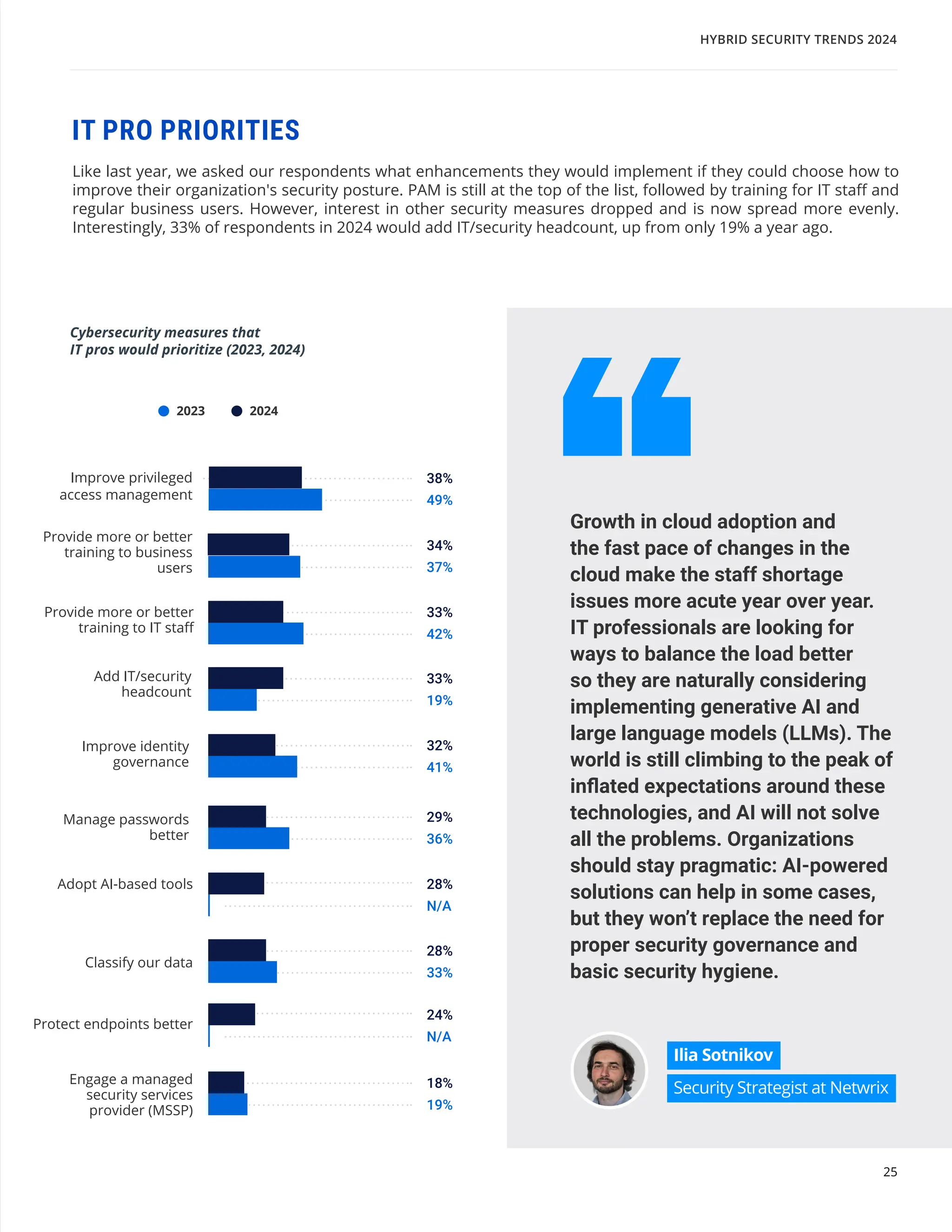
Like last year, we asked our respondents what enhancements they would implement if they could choose how to
improve their organization's security posture. PAM is still at the top of the list, followed by training for IT staff and
regular business users. However, interest in other security measures dropped and is now spread more evenly.
Interestingly, 33% of respondents in 2024 would add IT/security headcount, up from only 19% a year ago.
IT PRO PRIORITIES
Cybersecurity measures that
IT pros would prioritize (2023, 2024)
2024
2023
Improve privileged
access management
Provide more or better
training to business
users
38%
34%
33%
33%
32%
29%
28%
24%
28%
18%
49%
37%
42%
19%
41%
36%
N/A
N/A
33%
19%
Provide more or better
training to IT staff
Improve identity
governance
Manage passwords
better
Add IT/security
headcount
Classify our data
Adopt AI-based tools
Engage a managed
security services
provider (MSSP)
Protect endpoints better
Growth in cloud adoption and
the fast pace of changes in the
cloud make the staff shortage
issues more acute year over year.
IT professionals are looking for
ways to balance the load better
so they are naturally considering
implementing generative AI and
large language models (LLMs). The
world is still climbing to the peak of
inflated expectations around these
technologies, and AI will not solve
all the problems. Organizations
should stay pragmatic: AI-powered
solutions can help in some cases,
but they won’t replace the need for
proper security governance and
basic security hygiene.
Ilia Sotnikov
Security Strategist at Netwrix
HYBRID SECURITY TRENDS 2024
26
CONTENTS
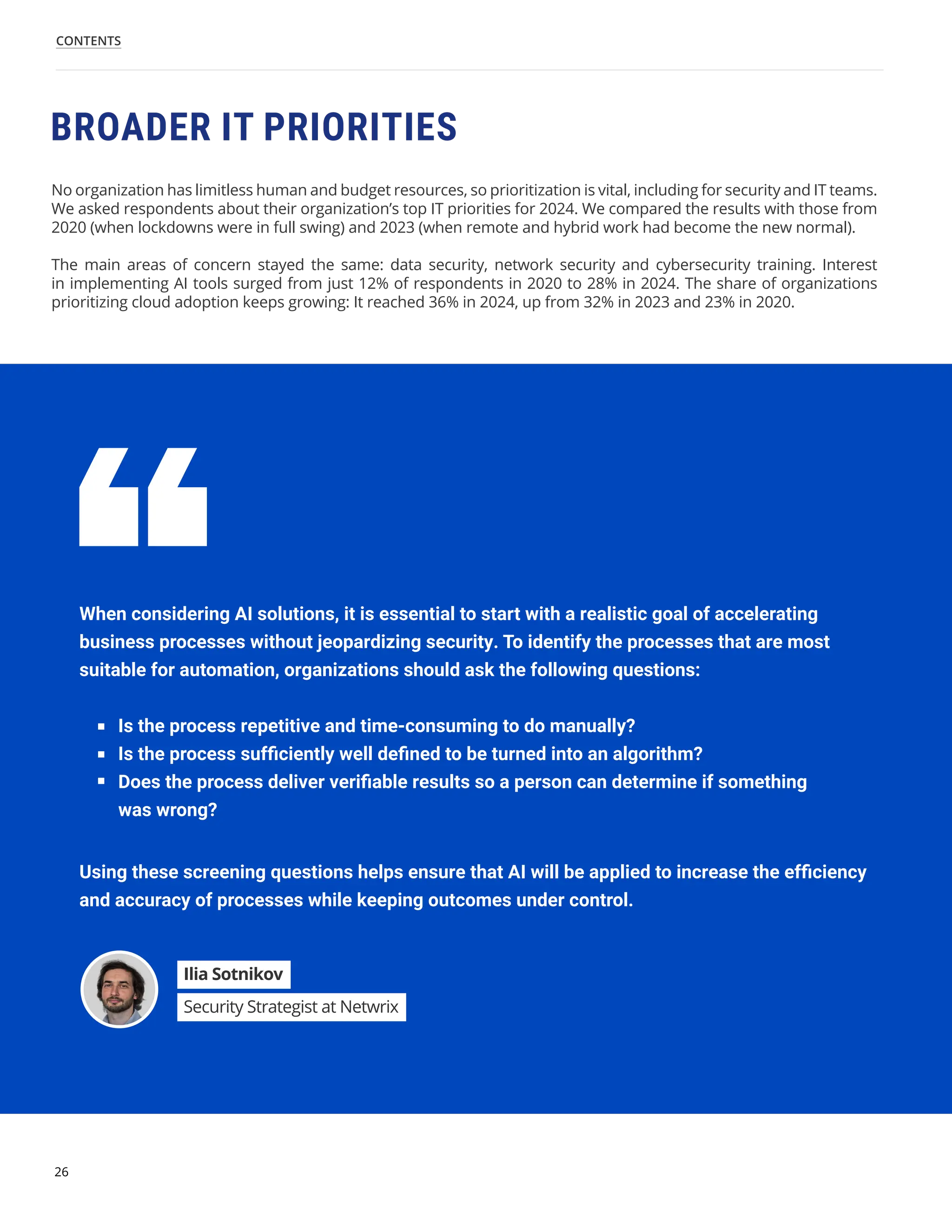
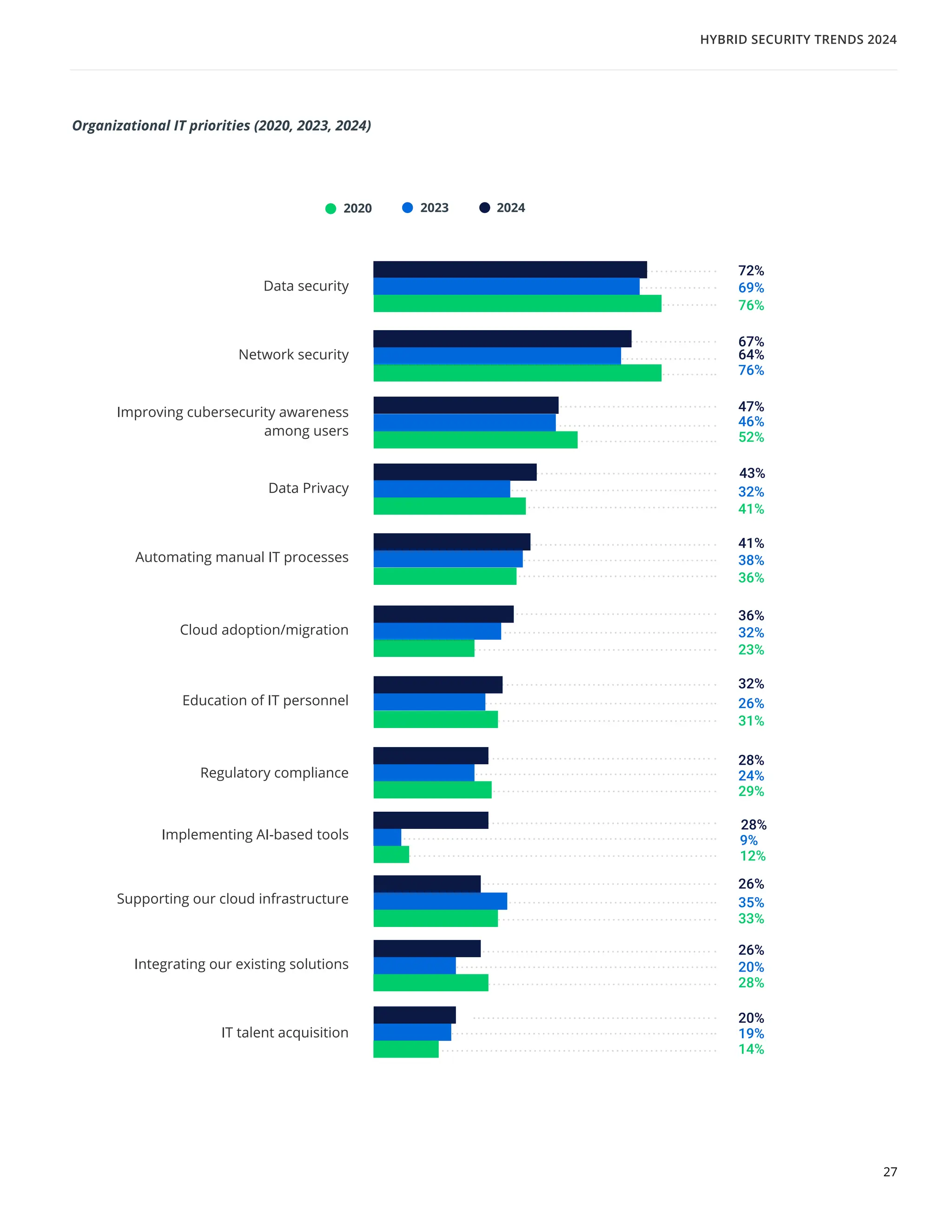
No organization has limitless human and budget resources, so prioritization is vital, including for security and IT teams.
We asked respondents about their organization’s top IT priorities for 2024. We compared the results with those from
2020 (when lockdowns were in full swing) and 2023 (when remote and hybrid work had become the new normal).
The main areas of concern stayed the same: data security, network security and cybersecurity training. Interest
in implementing AI tools surged from just 12% of respondents in 2020 to 28% in 2024. The share of organizations
prioritizing cloud adoption keeps growing: It reached 36% in 2024, up from 32% in 2023 and 23% in 2020.
BROADER IT PRIORITIES
When considering AI solutions, it is essential to start with a realistic goal of accelerating
business processes without jeopardizing security. To identify the processes that are most
suitable for automation, organizations should ask the following questions:
Using these screening questions helps ensure that AI will be applied to increase the efficiency
and accuracy of processes while keeping outcomes under control.
Is the process repetitive and time-consuming to do manually?
Is the process sufficiently well defined to be turned into an algorithm?
Does the process deliver verifiable results so a person can determine if something
was wrong?
Ilia Sotnikov
Security Strategist at Netwrix
27
2024
2023
2020
72%
46%
43%
36%
28%
28%
26%
26%
20%
64%
67%
41%
32%
69%
52%
32%
32%
24%
9%
35%
20%
19%
76%
38%
26%
76%
47%
41%
36%
23%
29%
31%
12%
33%
28%
14%
Organizational IT priorities (2020, 2023, 2024)
Data security
Network security
Improving cubersecurity awareness
among users
Automating manual IT processes
Supporting our cloud infrastructure
Data Privacy
Cloud adoption/migration
Education of IT personnel
Implementing AI-based tools
Regulatory compliance
IT talent acquisition
Integrating our existing solutions
HYBRID SECURITY TRENDS 2024
28
CONTENTS
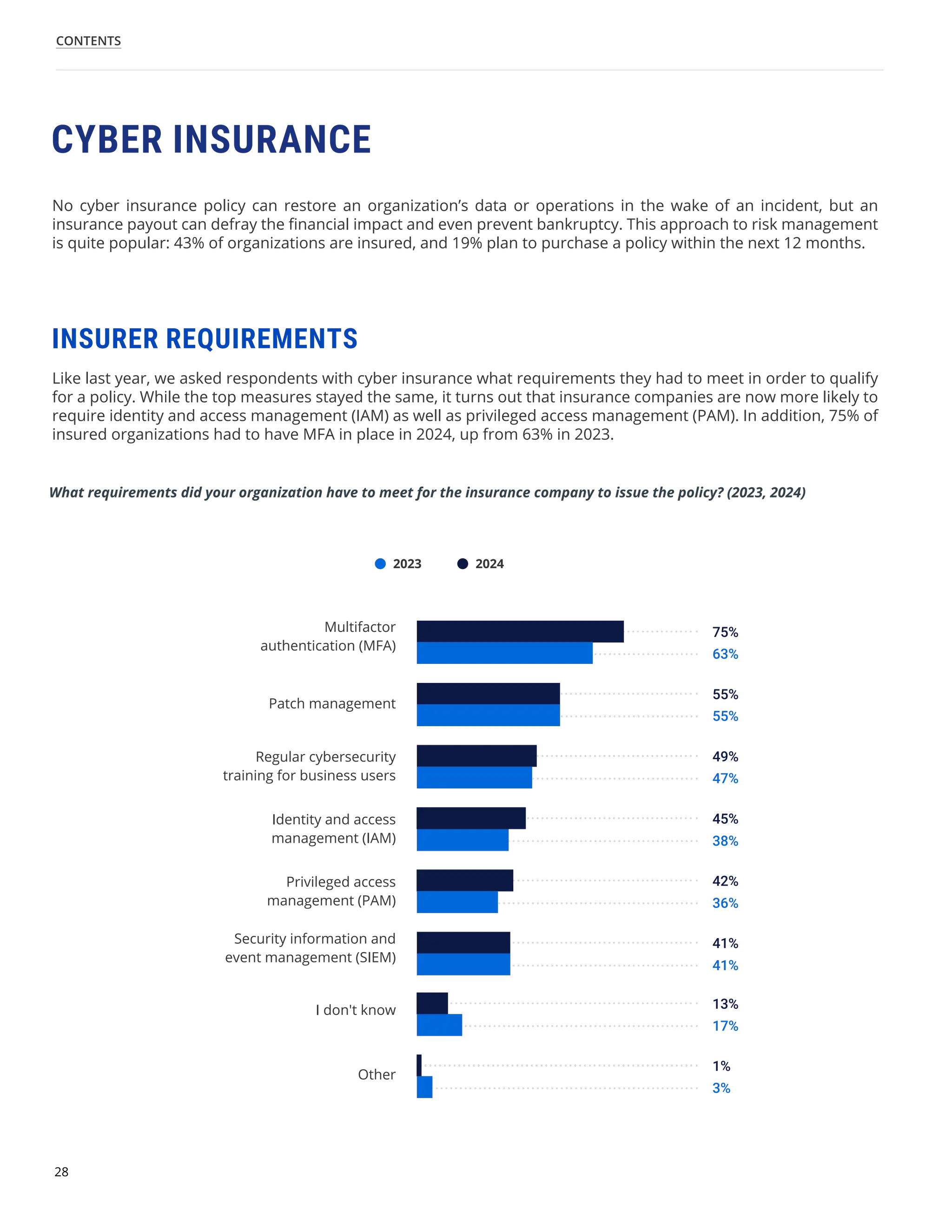
No cyber insurance policy can restore an organization’s data or operations in the wake of an incident, but an
insurance payout can defray the financial impact and even prevent bankruptcy. This approach to risk management
is quite popular: 43% of organizations are insured, and 19% plan to purchase a policy within the next 12 months.
Like last year, we asked respondents with cyber insurance what requirements they had to meet in order to qualify
for a policy. While the top measures stayed the same, it turns out that insurance companies are now more likely to
require identity and access management (IAM) as well as privileged access management (PAM). In addition, 75% of
insured organizations had to have MFA in place in 2024, up from 63% in 2023.
CYBER INSURANCE
What requirements did your organization have to meet for the insurance company to issue the policy? (2023, 2024)
INSURER REQUIREMENTS
63%
38%
55%
36%
47%
41%
17%
3%
75%
45%
55%
42%
49%
41%
13%
1%
2023 2024
Multifactor
authentication (MFA)
Patch management
Privileged access
management (PAM)
Security information and
event management (SIEM)
Identity and access
management (IAM)
Regular cybersecurity
training for business users
Other
I don't know
29
of organizations have a cyber insurance policy or plan to purchase one within 12
months, up from 59% in 2023.
62%
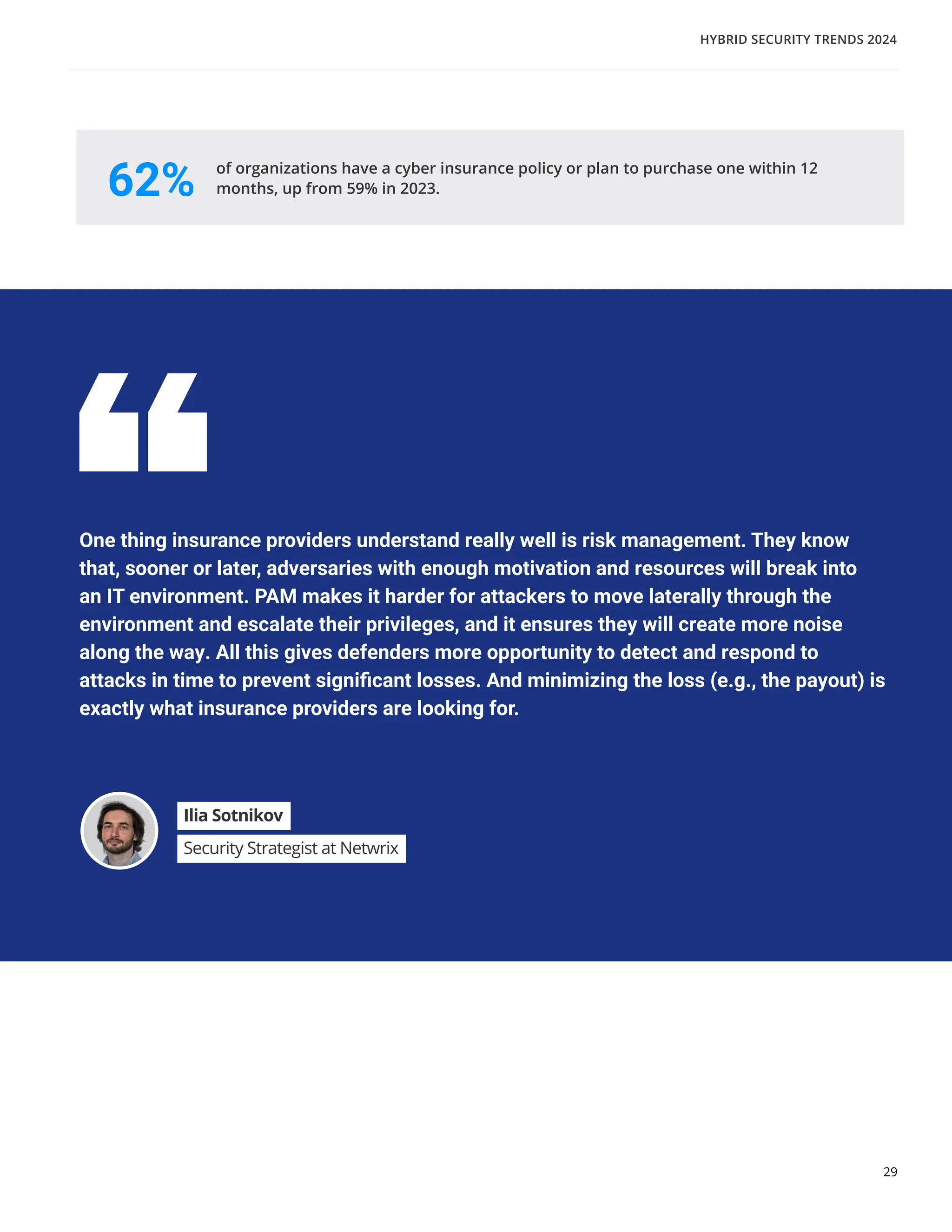
One thing insurance providers understand really well is risk management. They know
that, sooner or later, adversaries with enough motivation and resources will break into
an IT environment. PAM makes it harder for attackers to move laterally through the
environment and escalate their privileges, and it ensures they will create more noise
along the way. All this gives defenders more opportunity to detect and respond to
attacks in time to prevent significant losses. And minimizing the loss (e.g., the payout) is
exactly what insurance providers are looking for.
Ilia Sotnikov
Security Strategist at Netwrix
HYBRID SECURITY TRENDS 2024
30
CONTENTS
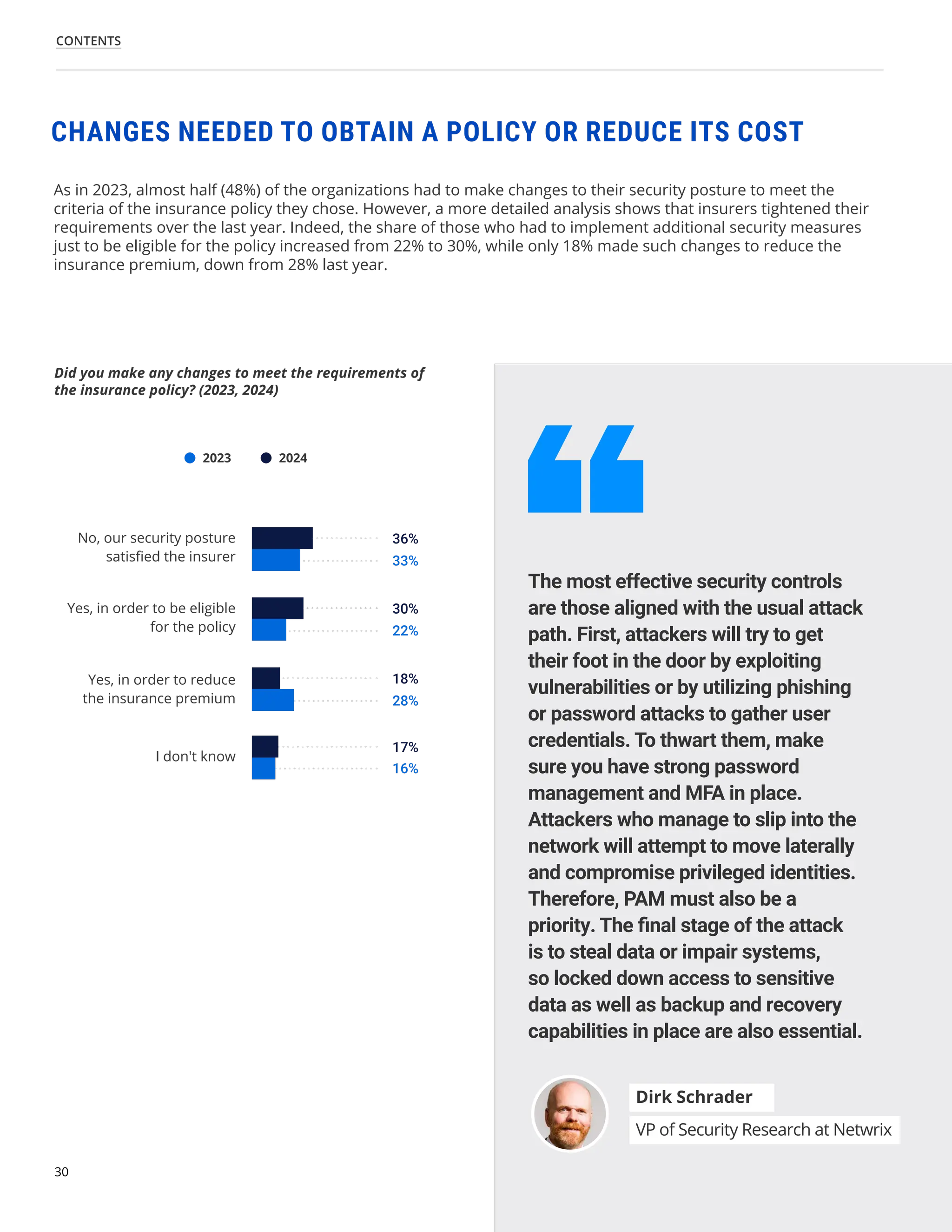
As in 2023, almost half (48%) of the organizations had to make changes to their security posture to meet the
criteria of the insurance policy they chose. However, a more detailed analysis shows that insurers tightened their
requirements over the last year. Indeed, the share of those who had to implement additional security measures
just to be eligible for the policy increased from 22% to 30%, while only 18% made such changes to reduce the
insurance premium, down from 28% last year.
Did you make any changes to meet the requirements of
the insurance policy? (2023, 2024)
CHANGES NEEDED TO OBTAIN A POLICY OR REDUCE ITS COST
No, our security posture
satisfied the insurer
Yes, in order to be eligible
for the policy
Yes, in order to reduce
the insurance premium
I don't know
33%
22%
16%
28%
36%
30%
17%
18%
2023 2024
The most effective security controls
are those aligned with the usual attack
path. First, attackers will try to get
their foot in the door by exploiting
vulnerabilities or by utilizing phishing
or password attacks to gather user
credentials. To thwart them, make
sure you have strong password
management and MFA in place.
Attackers who manage to slip into the
network will attempt to move laterally
and compromise privileged identities.
Therefore, PAM must also be a
priority. The final stage of the attack
is to steal data or impair systems,
so locked down access to sensitive
data as well as backup and recovery
capabilities in place are also essential.
Dirk Schrader
VP of Security Research at Netwrix
31
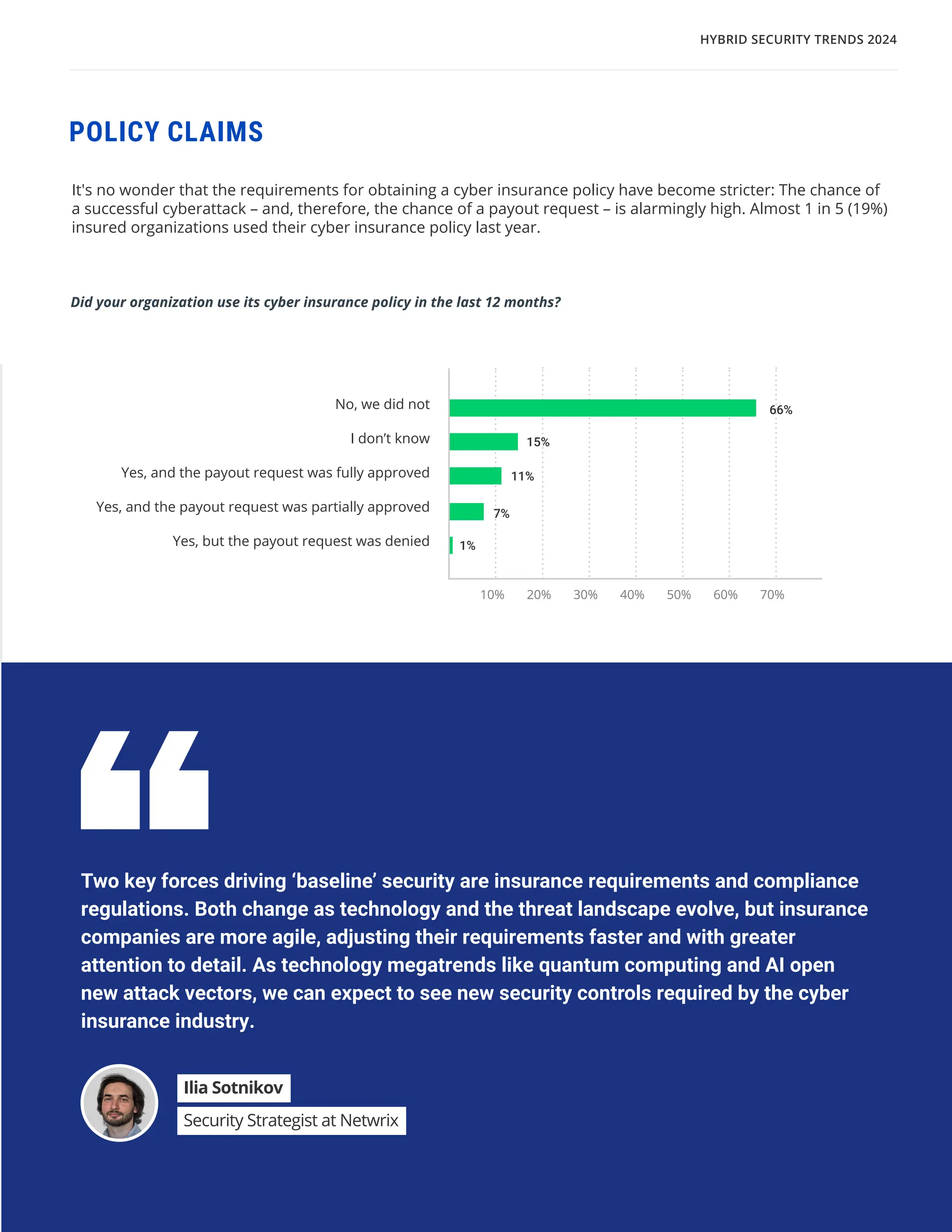
It's no wonder that the requirements for obtaining a cyber insurance policy have become stricter: The chance of
a successful cyberattack – and, therefore, the chance of a payout request – is alarmingly high. Almost 1 in 5 (19%)
insured organizations used their cyber insurance policy last year.
POLICY CLAIMS
Did your organization use its cyber insurance policy in the last 12 months?
66%
11%
15%
7%
1%
No, we did not
I don’t know
Yes, and the payout request was fully approved
Yes, and the payout request was partially approved
Yes, but the payout request was denied
10% 30% 50%
20% 40% 60% 70%
CLOUD ADOPTION GOALS AND CHALLENGES
Two key forces driving ‘baseline’ security are insurance requirements and compliance
regulations. Both change as technology and the threat landscape evolve, but insurance
companies are more agile, adjusting their requirements faster and with greater
attention to detail. As technology megatrends like quantum computing and AI open
new attack vectors, we can expect to see new security controls required by the cyber
insurance industry.
Ilia Sotnikov
Security Strategist at Netwrix
HYBRID SECURITY TRENDS 2024
32
CONTENTS
Corporate Headquarters:
Phone: 1-949-407-5125 Toll-free: 888-638-9749 EMEA: +44 (0) 203-588-3023 www.netwrix.com/social
Copyright © Netwrix Corporation. All rights reserved. Netwrix is trademark of Netwrix Corporation and/or one or more of its
subsidiaries and may be registered in the U.S. Patent and Trademark Office and in other countries. All other trademarks and
registered trademarks are the property of their respective owners.
ABOUT THE REPORT
ABOUT NETWRIX
The report is brought to you by Netwrix Research Lab, which conducts industry surveys among IT pros worldwide to
discover important changes and trends. For more reports, please visit www.netwrix.com/research
For more information, visit www.netwrix.com
6160 Warren Parkway, Suite 100, Frisco, TX, US 75034
Netwrix champions cybersecurity to ensure a brighter digital future for any organization. Netwrix's innovative
solutions safeguard data, identities, and infrastructure reducing both the risk and impact of a breach for more than
13,500 organizations across 100+ countries. Netwrix empowers security professionals to face digital threats with
confidence by enabling them to identify and protect sensitive data as well as to detect, respond to, and recover
from attacks.

Netwrix Hybrid Security Trends Report 2024.pdf

  • 1.
  • 2.
    Executive summary .. . . . . . . . . . . . . . . . . . . . . . . . . Netwrix Research Lab Experts . . . . . . . . . . . . . . . . . IT Architecture . . . . . . . . . . . . . . . . . . . . . . . . . . Security Challenges . . . . . . . . . . . . . . . . . . . . . . . . . . Security Incidents . . . . . . . . . . . . . . . . . . . . . . . . . . In the Cloud vs On Premises . . . . . . . . . . . . . . Security Incidents in the Cloud . . . . . . . . . . . . Security Incidents on Premises . . . . . . . . . . . . Threat Actors . . . . . . . . . . . . . . . . . . . . . . . . . . . . . . Current Security Measures . . . . . . . . . . . . . . . . . . Broader IT Priorities . . . . . . . . . . . . . . . . . . . . . . . Cyber Insurance . . . . . . . . . . . . . . . . . . . . . . . . . Insurer Requirements. . . . . . . . . . . . . . . . . . . . Changes Needed to Obtain a Policy or Reduce Its Cost . . . . . . . . . . . . . . . . . . . . . . . . . Policy Claims . . . . . . . . . . . . . . . . . . . . . . . . . . . . Plans for Future Security Measures . . . . . . . . . . Organizational Priorities . . . . . . . . . . . . . . . . . . IT Pro Priorities . . . . . . . . . . . . . . . . . . . . . . . . . 2 ​CONTENTS 3 5 6 8 10 10 12 14 16 18 19 21 23 23 25 26 28 28 30 31 Security Incident Costs . . . . . . . . . . . . . . . . . . . . . . . . Cyberattack Consequences . . . . . . . . . . . . . . . . . . . . .
  • 3.
    3 Netwrix Research Labsurveyed 1,309 IT professionals from 104 countries via an online questionnaire in February 2024 and compared the results to its Cloud Data Security Reports from 2022, 2020, and 2019 and its IT Trends Re- ports from 2023 and 2020. The resulting report will help organizations concentrate their security efforts on what really matters. Key findings include the following: About 3 in 4 organizations have a hybrid IT architecture, as was the case in 2023. The share that have an on- premises-only infrastructure decreased slightly, from 19% to 15%. This tracks with last year’s finding that 37% of on-premises-only organizations planned to adopt cloud technologies within 12 months. 3 EXECUTIVE SUMMARY IT ARCHITECTURE HYBRID SECURITY TRENDS 2023 Employee mistakes or negligence topped the list this year, moving up from third place in 2023. Malicious actions by employees, however, remained near the bottom of the list. SECURITY CHALLENGES The share of organizations that suffered no impact due to security incidents dropped from 45% last year to 38% this year. The top negative consequence was unplanned expenses to address security gaps, cited by 45% of respondents in 2024 and 40% in 2023. 1 in 6 (17%) organizations estimated their financial damage from cyber incidents to be at least $50,000. CYBERATTACK CONSEQUENCES 79% of organizations spotted a cyberattack within the last 12 months, up from 68% in 2023. In 2023, on- premises infrastructure suffered more cyberattacks; this year we saw almost identical results for both cloud and premises. Attacks associated with account compromise in the cloud keep gaining momentum: In 2024, 55% reported this type of incident compared to only 16% in 2020. Targeted attacks became more common on premises: 27% spotted this type of attack compared to 19% in 2023. SECURITY INCIDENTS
  • 4.
    4 CONTENTS 62% of organizationshave a cyber insurance policy or plan to purchase one within 12 months. Almost 1 in 5 (19%) insured organizations used their cyber insurance policy last year. CYBER INSURANCE 4 The main areas of concern are data security, network security and cybersecurity training. Interest in imple- menting AI tools surged from just 12% of respondents in 2020 to 28% in 2024. The share of organizations prioritizing cloud adoption keeps growing: It reached 36% in 2024, up from 32% in 2023 and 23% in 2020. IT PRIORITIES CONTENTS Over the last year, organizations enhanced their security posture. The most notable progress was in identity governance: In 2024, 55% of respondents have this in the cloud and 58% have it on premises, as opposed to only 44% and 43%, respectively, in 2023. The survey also reveals that the main enhancements over the last year were made in the cloud rather than on premises. SECURITY MEASURES IN PLACE Data classification topped the list of measures organi- zations plan to implement to improve cybersecurity, both on premises and in the cloud. PLANNED SECURITY MEASURES
  • 5.
    5 Ilia Sotnikov hasover 20 years of experience in cybersecurity, as well as broad IT management experience.Heisresponsiblefortechnicalenablement, UX design and product vision across the entire Netwrix product portfolio. Ilia’s main areas of expertise are data security and risk management. He works closely with analysts from firms like Gartner, Forrester and KuppingerCole to gain a deeper understanding of market trends, technology developments and other changes in the cybersecurity landscape. As a regular contributor at Forbes Tech Council, Ilia shares his knowledge and insights regarding cyber threats and security best practices with the broader IT and business community. Dirk is a 25-year veteran in IT security who works to advance cyber resilience as a modern approach to tackling cyber threats. He holds CISSP (ISC²) and CISM (ISACA) certifications. Along with general security research and vulnerability discovery, Dirk is keen on industry-specific focused research for verticals like healthcare, energy and finance. He has uncovered thousands of vulnerable systems at healthcare-delivering organizations around the globe and alerted those providers, authorities and the public. Dirk has also published articles on topics such as cyber risk management, cyber resilience, and IT security tactics and operations. NETWRIX RESEARCH LAB EXPERTS ILIA SOTNIKOV DIRK SCHRADER Security Strategist and Vice President of User Experience at Netwrix Vice President of Security Research and Field CISO EMEA at Netwrix HYBRID SECURITY TRENDS 2024 5
  • 6.
    6 CONTENTS IT ARCHITECTURE On premisesonly On premises only Cloud only Cloud only Hybrid Hybrid Remote and hybrid work, along with business needs for flexibility and cost efficiency, keep driving cloud adoption. About 3 in 4 organizations have a hybrid IT architecture, as was the case in 2023. The share that have an on- premises-only infrastructure decreased slightly, from 19% to 15%. This tracks with last year’s finding that 37% of on-prem-only organizations planned to adopt cloud technologies within 12 months. However, movement of workloads to the cloud progressed more slowly than respondents anticipated. The percentage inched up from 41% in 2022 to 44% in 2023 and then stayed flat in 2024, even though respondents expected it to reach 53–55%. This year’s survey yielded a similar prediction, which indicates that IT pros are still looking to extend their cloud adoption. 19% 15% 44% 8% 11% 73% 74% IT architecture (2023) IT architecture (2024) Percentage of workloads already in the cloud (2024) Percentage of workloads planned to be in the cloud 12 months from now (2024) 53%
  • 7.
    7 58% of on-prem-onlyorganizations plan to adopt cloud technologies, and 30% plan to do so within 12 months 7 It’s often hard to precisely predict project timelines for a major technological transition like cloud migration. Last year, in addition to the usual project planning challenges, organizations had to deal with the uncertainty of global economic headwinds. A good way to keep up the desired pace of cloud adoption is to break the cloud transition into stages that are easier to manage and control. Cloud migration is a cyclic process that seemingly never ends. As an organization evolves, it re-evaluates which workloads need to be moved to the cloud or brought back on premises. The decision is usually based on factors like operational efficiency, costs, and compliance with the applicable laws and regulations. Workloads typically migrated to the cloud include those around HR, marketing and billing, as well as customer-facing processes that require seamless scaling. Dirk Schrader VP of Security Research at Netwrix Ilia Sotnikov Security Strategist at Netwrix HYBRID SECURITY TRENDS 2024
  • 8.
    8 CONTENTS 8 Ensuring data securityis a tough job, but some obstacles are bigger than others. We asked our respondents to rank their top data security challenges. Employee mistakes or negligence topped the list this year, moving up from third place in 2023. Malicious actions by employees, however, remained near the bottom of the list. SECURITY CHALLENGES Biggest challenges faced while trying to ensure data security (2023, 2024) 47% 43% 40% 40% 47% 51% 35% 36% 28% 20% 20% 20% 15% 25% 24% 14% 6% N/A 10% 30% 50% 20% 40% 60% 70% Business pressure for rapid digitalization, transformation or growth Mistakes or negligence by business users Lack of visibility into sensitive data Malicious actions by business users Inability to secure endpoints Lack of budget for data security initiatives IT/security team being understaffed IT/security team lacking cybersecurity expertise Inconsistent tools and processes due to multiple workloads across different servers or clouds 2024 2023
  • 9.
    CLOUD ADOPTION GOALSAND CHALLENGES To address the top security challenge reported in the survey, security teams need to establish technical controls that help users avoid mistakes without significant inconvenience. User-friendly password management enables smooth yet secure logins, while judicious multifactor authentication helps prevent credential abuse without a heavy burden for employees. A modern privileged access management solution can provide just enough privilege just long enough to perform the task at hand, reducing the attack surface without introducing friction. Finding the right balance between security and a good user experience is the key to properly protecting the organization. We can expect tight budgets, understaffing and lack of security expertise to remain among the top concerns for IT security teams in the next few years at least. To address these challenges, organizations can seek ways to empower people to be more efficient. Frameworks such as NIST CSF and ISO 27001 help focus and prioritize security efforts. Organizations can also turn to the managed security service providers (MSSP) to close the skills or staffing gaps and leverage software solutions to automate labor- intensive tasks and reduce noise and false alarms. Dirk Schrader VP of Security Research at Netwrix Ilia Sotnikov Security Strategist at Netwrix
  • 10.
    10 CONTENTS We asked respondentswhose organizations experienced a security incident to share details about the attack. In 2023, they reported more attacks on their on-premises infrastructures than the cloud, especially phishing and malware attacks. This year, however, the respondents reported almost identical results for both segments of their infrastructure. SECURITY INCIDENTS Most common security incidents (2023) Most common security incidents (2024) Phishing Phishing Ransomware or other malware attack Ransomware or other malware attack User account compromise User account compromise Accidental data leakage Accidental data leakage Targeted attacks on premises/on cloud Targeted attacks on premises/on cloud Data theft by insiders Data theft by hackers Admin account compromise Admin account compromise Supply chain compromise Supply chain compromise Data theft by hackers Data theft by insiders 58% 73% 19% 38% 27% 31% 20% 28% 30% 20% 14% 17% 12% 14% 17% 13% 15% 9% 74% 74% 37% 34% 31% 34% 24% 27% 19% 21% 18% 16% 17% 12% 16% 12% 16% 8% On premises On premises In the cloud In the cloud IN THE CLOUD VS ON PREMISES 79% of organizations spotted a cyberattack within the last 12 months, up from 68% in 2023.
  • 11.
    SECURITY INCIDENTS INTHE CLOUD This year, more organizations spotted an attack on their IT infrastructure. Off-the-shelf hacking tools, affiliate programs and a slew of cybercrime- as-a-service offerings are now empowering less-skilled cybercriminals to launch attacks. However, defenders are also upping their game with better detection capabilities, increasing the number of attacks that are identified. In addition, increasing recognition among executives about the business risks of security incidents is leading to more transparency, which also influences the number of reported incidents. Over the last year, cloud infrastructure became a more frequent target for attackers. Organizations keep adopting cloud technologies and moving their workloads to the cloud, although not at the anticipated pace. To increase the flexibility of the whole IT infrastructure, organizations opt to use third-party software-as-a-service (SaaS), platform-as-a-service (PaaS) and infrastructure-as-a-service (IaaS) technologies, or even develop them in- house. As a result, the attack surface in the cloud keeps growing — and so does the number of security incidents. Dirk Schrader VP of Security Research at Netwrix Ilia Sotnikov Security Strategist at Netwrix
  • 12.
    12 CONTENTS We compared thisyear’s results regarding security incidents in the cloud to those from 2020, 2022 and 2023. While phishing remains the most common incident type, attacks associated with account compromise in the cloud keep gaining momentum: While only 16% of respondents reported this type of incident in the cloud in 2020, this percent- age soared to 55% in 2024. SECURITY INCIDENTS IN THE CLOUD 2024 2023 2022 2020 58% 39% 55% 31% 28% 20% 15% 19% 14% 73% 73% 31% 14% 14% 13% 29% 16% 40% 16% 7% 24% 10% Most common security incidents in the cloud (2020, 2022, 2023, 2024) Phishing User/admin account compromise 30% 29% 16% Targeted attacks on the cloud 20% 25% 17% Accidental data leakage Ransomware or other malware attack 9% 17% 15% 6% Supply chain compromise Data theft by hackers Data theft or other malicious actions by busibess users
  • 13.
    DATA BREACH CONSEQUENCES Implementationof third-party SaaS or in-house cloud solutions significantly increases the number of identities in use, so it’s no wonder that attacks associated with admin and user account compromise keep intensifying. To address this risk and reduce the attack surface, it is crucial to stick to the least privilege principle and ensure identity governance so that each user has just enough rights to do their job. Organizations should also consider enforcing multifactor authentication (MFA) for all accounts accessing in- house cloud solutions, just as cloud service providers usually require by default. If the in-house solution is a customer-facing application, MFA is a must-have. The survey trends confirm what industry experts have been saying for years: Identity is the new perimeter. Attackers will continue to target them and — sooner or later — succeed. IT security teams should seek a balanced approach to securing accounts. In addition to implementing the least privilege principle, they can reduce the risk of account compromise with multifactor authentication, single sign-on and user awareness training. Dirk Schrader VP of Security Research at Netwrix Ilia Sotnikov Security Strategist at Netwrix
  • 14.
    14 CONTENTS To understand securityincident trends on premises, we compared the results from our 2023 report with the data collected in 2024. Notably, the share of those who suffered a targeted attack increased by 42%, from 19% to 27%. SECURITY INCIDENTS ON PREMISES Most common security incidents on premises (2023, 2024) Phishing Ransomware or other malware attack User/admin account compromise Accidental data leakage Targeted attacks on premises Supply chain compromise Data theft by hackers 2023 2024 74% 74% 50% 34% 48% 37% 19% 27% 24% 21% 12% 12% 8% 16% 18% 16% 10% 30% 50% 20% 40% 60% 70% 80% Data theft or other malicious actions by busibess users
  • 15.
    CLOUD ADOPTION GOALSAND CHALLENGES Non-targeted campaigns are easier to identify and address, for both security teams and regular business users. Accordingly, attackers are shifting to an individual approach. Moreover, targeted attacks are now easier to craft: Powered with AI, cybercriminals collect and analyze data from previous data breaches, social media and other publicly available information to adjust their malicious campaigns to specific sectors, organizations or even individuals. However, while targeted attacks increase the chance of initial infiltration, they unfold just like all the others: privilege escalation aimed at getting access to sensitive data. Historically, on-premises environments have better-established security controls and processes. Teams are more experienced, and technology changes are slower than in the cloud. As a result, on average, organizations with on-prem workloads are better prepared to thwart drive-by compromise attacks. Adversaries who are financially or politically motivated to attack such environments see lower success rates with a "one-size-fits- all” approach and are forced to find a more targeted approach to these organizations. Dirk Schrader VP of Security Research at Netwrix Ilia Sotnikov Security Strategist at Netwrix
  • 16.
    16 CONTENTS Not every cyberattackresults in damage, but the share of organizations that suffered no impact due to security incidents dropped from 45% last year to 38% this year. The top negative consequence was unplanned expenses to address security gaps, cited by 45% of respondents in 2024 and 40% in 2023. Other impacts include damage to the company’s competitive edge, valuation or revenue stream, and compliance and legal costs. In fact, this year, significantly more organizations reported many of these additional consequences. CYBERATTACK CONSEQUENCES Cyberattack consequences (2023, 2024) Unplanned expenses to address security gaps No impact Loss of competitive edge Compliance fines Decrease in company valuation Customer churn Lawsuits Change in senior leadership Decrease in new sales Other 2023 2024 45% 40% 38% 20% 45% 13% 10% 17% 3% 16% 14% 13% 13% 12% 5% 10% 3% 8% 11% 5% 10% 30% 50% 20% 40% 60% 70%
  • 17.
    17 organizations report losinga competitive edge due to a cyberattack. Growing security awareness at the executive level means a better understanding that the risks of security gaps extend far beyond downtime and data loss. As a result, more organizations are investing resources into external or internal audits to find, analyze and remediate the root cause of a security incident to prevent similar events in the future. Mitigation measures can range from simple system configuration changes to large projects like data discovery and classification or redesign of identity access management. An incident can reveal security gaps such as excessive admin privileges, dormant accounts, weak or unchanged passwords, default passwords or configurations, and unpatched systems. Fixing a gap might not require spending additional money but will definitely require time from the IT security team. In other words, addressing the root cause of a security incident results in additional investment, in either money or effort. Dirk Schrader VP of Security Research at Netwrix 1in 5 Ilia Sotnikov Security Strategist at Netwrix HYBRID SECURITY TRENDS 2024
  • 18.
    18 CONTENTS Cost of securityincidents (2023, 2024) $0 $1–$10,000 $10,001–$50,000 $50,001–$200,000 $200,001 and more Even though not every attack results in financial damage, some can be quite costly. Indeed, 1 in 6 (17%) organizations estimated their financial damage from cyber incidents to be at least $50,000. What’s more, compared to last year, the share of those who faced no financial consequences due to security incidents dropped from 47% to 40%. SECURITY INCIDENT COSTS organizations reported at least $50,000 in financial damage from cyber threats. 2023 40% 26% 17% 10% 2024 7% 47% 17% 6% 20% 10% 1in 6
  • 19.
    19 Who poses thebiggest risk to data security on premises (2024) Who poses the biggest risk to data security in the cloud (2024) Assessing who is a threat is crucial to building an effective security architecture. We asked respondents to choose the single type of actor that poses the biggest risk to their organization’s data security. It turns out that IT pros are most concerned about their own employees when considering on-premises infrastructure, while external adversar- ies topped the list for the cloud. THREAT ACTORS 41% 37% 15% 17% 27% 31% 14% 13% 3% 2% Our own business employees External actors, such as hackers Contractors and partners with legitimate access Our own IT staff Other External actors, such as hackers Our own business employees Contractors and partners with legitimate access Our own IT staff Other 10% 10% 30% 30% 50% 50% 20% 20% 40% 40% 60% 60% 70% 70% HYBRID SECURITY TRENDS 2024
  • 20.
    HYBRID SECURITY TRENDS2023 Threats from business users usually involve mistakes or negligence, rather than malicious actions. The best approach to mitigating the associated risks is to implement guardrails for end users and admins that keep mistakes from causing serious consequences. The first step is to gain complete visibility into data and assigned privileges. Then, review those access rights and remove all excessive privileges — and repeat this review step regularly. To shrink the attack surface even further, organizations can implement a privileged access management (PAM) solution that provides just-in- time privileges. Cloud service providers bear a part of the responsibility for security, but organizations must understand how responsibilities are shared. They need to know what kind of assurance is offered and determine whether it is adequate for the business risks. Sometimes, good customer reviews and peer references will be enough. More often, organizations need third-party validation, such as certifications, access to audit results or commitment to periodic penetration testing. In high-risk scenarios, organizations may require first-hand access to audit the provider’s infrastructure and participate in red-team exercises. Dirk Schrader VP of Security Research at Netwrix Ilia Sotnikov Security Strategist at Netwrix
  • 21.
    21 We asked ourrespondents what measures they take to protect data in the cloud and on premises. In comparing the results with last year’s survey, we discovered that overall, organizations had enhanced their security posture with additional security measures. The most notable progress was in identity governance: This year, 55% of respondents have this in the cloud and 58% have it on premises, as opposed to only 44% and 43%, respectively, in 2023. The survey also reveals that the main enhancements over the last year were made in the cloud rather than on premises. CURRENT SECURITY MEASURES Measures already taken to protect data in the cloud Measures already taken to protect data on premises Multifactor authentication Multifactor authentication Backups Backups Password management Password management Encryption Encryption Employee training Employee training Endpoint management Endpoint management Auditing of user activity Auditing of user activity Privileged access management Privileged access management Identity governance, including user provisioning and deprovisioning Identity governance, including user provisioning and deprovisioning Review of access rights (attestation) Review of access rights (attestation) Data classification Data classification 83% 83% 81% 74% 73% 73% 73% 72% 68% 71% 66% 70% 63% 66% 63% 55% 66% 58% 60% 48% 65% 52% 75% 85% 71% 71% 65% 68% 67% 65% 58% N/A N/A 67% 56% 59% 61% 44% 60% 43% 56% 46% 59% 50% 2023 2023 2024 2024 HYBRID SECURITY TRENDS 2024
  • 22.
    22 CONTENTS HYBRID SECURITYTRENDS 2023 An identity governance solution streamlines the management of user identities and their access to data and other IT resources. This visibility and control facilitates the configuration of other security solutions and helps organizations map out further necessary enhancements to the security architecture. Dirk Schrader VP of Security Research at Netwrix 51% 47% Only Only of fully cloud-based organizations have a PAM solution in place, compared to 63% in general. of fully on-premises organizations have an IGA solution in place, compared to 58% in general.
  • 23.
    23 This year, dataclassification topped the list of measures organizations plan to implement to improve cybersecurity, both on premises and in the cloud. As noted earlier, the share of those who have adopted identity governance rose compared to 2023, so it is not surprising that this measure moved from first to second place on the 2024 ranking. PLANS FOR FUTURE SECURITY MEASURES ORGANIZATIONAL PRIORITIES Identity governance Data classification Employee training Encryption Backups Data classification Employee training Encryption Backups 43% 41% 41% 36% 37% 33% 31% 32% 35% 31% 34% 26% 26% 25% 21% 15% 26% 22% 22% 23% 14% 41% 37% 36% 34% 34% 30% 33% 29% 33% 29% 27% 23% 27% 22% 25% 22% 23% 22% 13% 22% 12% Review of access rights (attestation) Review of access rights (attestation) Auditing of user activity Auditing of user activity Endpoint management Privileged access management Privileged access management Identity governance, including user provisioning and deprovisioning Multifactor authentication Multifactor authentication Password management Password management Cybersecurity measures planned by organizations (2023) Cybersecurity measures planned by organizations (2024) On premises On premises In the cloud In the cloud HYBRID SECURITY TRENDS 2024
  • 24.
    HYBRID SECURITY TRENDS2023 Cloud adoption spurred IT security teams to switch their focus away from securing the network perimeter, which had become blurry, to identity as the new perimeter. Identity governance, review of access rights and privileged access management (PAM) all help ensure that the right users have the right access to the right things at the right time. Automating these processes saves valuable IT team time and improves accuracy, yielding a resilient and agile security posture. Data classification remains the top measure organizations plan to add to their security arsenal. Still, only half of organizations have actually implemented it. The main challenge is the effort required in manual approaches. Indeed, it’s business users who know best what type of information is in the document they are attaching to an email or copying to a shared location. But manual classification simply isn’t scalable because it requires a massive investment of time that creates barriers to user productivity. Moreover, it is highly inconsistent and extremely prone to user error. Automated classification addresses these challenges. Keep in mind, however, that it requires close collaboration between departments to tune the systems and processes to meet changes to business and legal realities. Dirk Schrader VP of Security Research at Netwrix Ilia Sotnikov Security Strategist at Netwrix
  • 25.
    25 Like last year,we asked our respondents what enhancements they would implement if they could choose how to improve their organization's security posture. PAM is still at the top of the list, followed by training for IT staff and regular business users. However, interest in other security measures dropped and is now spread more evenly. Interestingly, 33% of respondents in 2024 would add IT/security headcount, up from only 19% a year ago. IT PRO PRIORITIES Cybersecurity measures that IT pros would prioritize (2023, 2024) 2024 2023 Improve privileged access management Provide more or better training to business users 38% 34% 33% 33% 32% 29% 28% 24% 28% 18% 49% 37% 42% 19% 41% 36% N/A N/A 33% 19% Provide more or better training to IT staff Improve identity governance Manage passwords better Add IT/security headcount Classify our data Adopt AI-based tools Engage a managed security services provider (MSSP) Protect endpoints better Growth in cloud adoption and the fast pace of changes in the cloud make the staff shortage issues more acute year over year. IT professionals are looking for ways to balance the load better so they are naturally considering implementing generative AI and large language models (LLMs). The world is still climbing to the peak of inflated expectations around these technologies, and AI will not solve all the problems. Organizations should stay pragmatic: AI-powered solutions can help in some cases, but they won’t replace the need for proper security governance and basic security hygiene. Ilia Sotnikov Security Strategist at Netwrix HYBRID SECURITY TRENDS 2024
  • 26.
    26 CONTENTS No organization haslimitless human and budget resources, so prioritization is vital, including for security and IT teams. We asked respondents about their organization’s top IT priorities for 2024. We compared the results with those from 2020 (when lockdowns were in full swing) and 2023 (when remote and hybrid work had become the new normal). The main areas of concern stayed the same: data security, network security and cybersecurity training. Interest in implementing AI tools surged from just 12% of respondents in 2020 to 28% in 2024. The share of organizations prioritizing cloud adoption keeps growing: It reached 36% in 2024, up from 32% in 2023 and 23% in 2020. BROADER IT PRIORITIES When considering AI solutions, it is essential to start with a realistic goal of accelerating business processes without jeopardizing security. To identify the processes that are most suitable for automation, organizations should ask the following questions: Using these screening questions helps ensure that AI will be applied to increase the efficiency and accuracy of processes while keeping outcomes under control. Is the process repetitive and time-consuming to do manually? Is the process sufficiently well defined to be turned into an algorithm? Does the process deliver verifiable results so a person can determine if something was wrong? Ilia Sotnikov Security Strategist at Netwrix
  • 27.
    27 2024 2023 2020 72% 46% 43% 36% 28% 28% 26% 26% 20% 64% 67% 41% 32% 69% 52% 32% 32% 24% 9% 35% 20% 19% 76% 38% 26% 76% 47% 41% 36% 23% 29% 31% 12% 33% 28% 14% Organizational IT priorities(2020, 2023, 2024) Data security Network security Improving cubersecurity awareness among users Automating manual IT processes Supporting our cloud infrastructure Data Privacy Cloud adoption/migration Education of IT personnel Implementing AI-based tools Regulatory compliance IT talent acquisition Integrating our existing solutions HYBRID SECURITY TRENDS 2024
  • 28.
    28 CONTENTS No cyber insurancepolicy can restore an organization’s data or operations in the wake of an incident, but an insurance payout can defray the financial impact and even prevent bankruptcy. This approach to risk management is quite popular: 43% of organizations are insured, and 19% plan to purchase a policy within the next 12 months. Like last year, we asked respondents with cyber insurance what requirements they had to meet in order to qualify for a policy. While the top measures stayed the same, it turns out that insurance companies are now more likely to require identity and access management (IAM) as well as privileged access management (PAM). In addition, 75% of insured organizations had to have MFA in place in 2024, up from 63% in 2023. CYBER INSURANCE What requirements did your organization have to meet for the insurance company to issue the policy? (2023, 2024) INSURER REQUIREMENTS 63% 38% 55% 36% 47% 41% 17% 3% 75% 45% 55% 42% 49% 41% 13% 1% 2023 2024 Multifactor authentication (MFA) Patch management Privileged access management (PAM) Security information and event management (SIEM) Identity and access management (IAM) Regular cybersecurity training for business users Other I don't know
  • 29.
    29 of organizations havea cyber insurance policy or plan to purchase one within 12 months, up from 59% in 2023. 62% One thing insurance providers understand really well is risk management. They know that, sooner or later, adversaries with enough motivation and resources will break into an IT environment. PAM makes it harder for attackers to move laterally through the environment and escalate their privileges, and it ensures they will create more noise along the way. All this gives defenders more opportunity to detect and respond to attacks in time to prevent significant losses. And minimizing the loss (e.g., the payout) is exactly what insurance providers are looking for. Ilia Sotnikov Security Strategist at Netwrix HYBRID SECURITY TRENDS 2024
  • 30.
    30 CONTENTS As in 2023,almost half (48%) of the organizations had to make changes to their security posture to meet the criteria of the insurance policy they chose. However, a more detailed analysis shows that insurers tightened their requirements over the last year. Indeed, the share of those who had to implement additional security measures just to be eligible for the policy increased from 22% to 30%, while only 18% made such changes to reduce the insurance premium, down from 28% last year. Did you make any changes to meet the requirements of the insurance policy? (2023, 2024) CHANGES NEEDED TO OBTAIN A POLICY OR REDUCE ITS COST No, our security posture satisfied the insurer Yes, in order to be eligible for the policy Yes, in order to reduce the insurance premium I don't know 33% 22% 16% 28% 36% 30% 17% 18% 2023 2024 The most effective security controls are those aligned with the usual attack path. First, attackers will try to get their foot in the door by exploiting vulnerabilities or by utilizing phishing or password attacks to gather user credentials. To thwart them, make sure you have strong password management and MFA in place. Attackers who manage to slip into the network will attempt to move laterally and compromise privileged identities. Therefore, PAM must also be a priority. The final stage of the attack is to steal data or impair systems, so locked down access to sensitive data as well as backup and recovery capabilities in place are also essential. Dirk Schrader VP of Security Research at Netwrix
  • 31.
    31 It's no wonderthat the requirements for obtaining a cyber insurance policy have become stricter: The chance of a successful cyberattack – and, therefore, the chance of a payout request – is alarmingly high. Almost 1 in 5 (19%) insured organizations used their cyber insurance policy last year. POLICY CLAIMS Did your organization use its cyber insurance policy in the last 12 months? 66% 11% 15% 7% 1% No, we did not I don’t know Yes, and the payout request was fully approved Yes, and the payout request was partially approved Yes, but the payout request was denied 10% 30% 50% 20% 40% 60% 70% CLOUD ADOPTION GOALS AND CHALLENGES Two key forces driving ‘baseline’ security are insurance requirements and compliance regulations. Both change as technology and the threat landscape evolve, but insurance companies are more agile, adjusting their requirements faster and with greater attention to detail. As technology megatrends like quantum computing and AI open new attack vectors, we can expect to see new security controls required by the cyber insurance industry. Ilia Sotnikov Security Strategist at Netwrix HYBRID SECURITY TRENDS 2024
  • 32.
    32 CONTENTS Corporate Headquarters: Phone: 1-949-407-5125Toll-free: 888-638-9749 EMEA: +44 (0) 203-588-3023 www.netwrix.com/social Copyright © Netwrix Corporation. All rights reserved. Netwrix is trademark of Netwrix Corporation and/or one or more of its subsidiaries and may be registered in the U.S. Patent and Trademark Office and in other countries. All other trademarks and registered trademarks are the property of their respective owners. ABOUT THE REPORT ABOUT NETWRIX The report is brought to you by Netwrix Research Lab, which conducts industry surveys among IT pros worldwide to discover important changes and trends. For more reports, please visit www.netwrix.com/research For more information, visit www.netwrix.com 6160 Warren Parkway, Suite 100, Frisco, TX, US 75034 Netwrix champions cybersecurity to ensure a brighter digital future for any organization. Netwrix's innovative solutions safeguard data, identities, and infrastructure reducing both the risk and impact of a breach for more than 13,500 organizations across 100+ countries. Netwrix empowers security professionals to face digital threats with confidence by enabling them to identify and protect sensitive data as well as to detect, respond to, and recover from attacks.