2018-2019
NORTHERN VIRGINIA SNOW BRIEFING
Lauren Mollerup, P.E., CCM, District
Maintenance Engineer
Elected Officials, Media, and Other Stakeholders
November 30, 2018
…already here
Virginia Department of Transportation
Northern Virginia
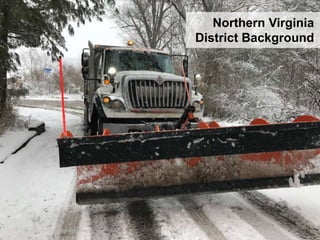
District Background
4
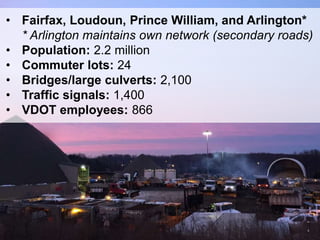
• Fairfax, Loudoun, Prince William, and Arlington*
* Arlington maintains own network (secondary roads)
• Population: 2.2 million
• Commuter lots: 24
• Bridges/large culverts: 2,100
• Traffic signals: 1,400
• VDOT employees: 866
5
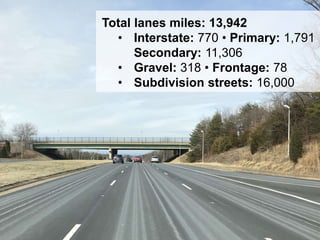
Total lanes miles: 13,942
• Interstate: 770 • Primary: 1,791
Secondary: 11,306
• Gravel: 318 • Frontage: 78
• Subdivision streets: 16,000
6
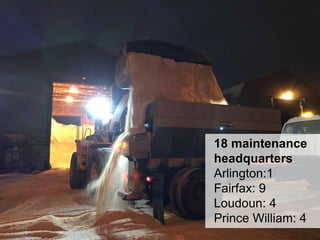
18 maintenance
headquarters
Arlington:1
Fairfax: 9
Loudoun: 4
Prince William: 4
7
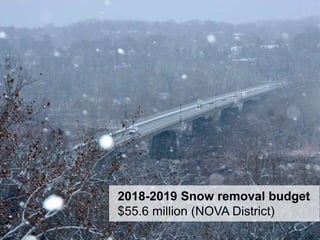
2018-2019 Snow removal budget
$55.6 million (NOVA District)
8
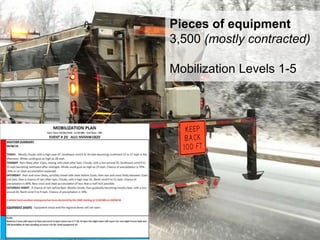
Pieces of equipment
3,500 (mostly contracted)
Mobilization Levels 1-5
9
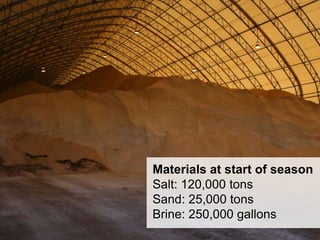
Materials at start of season
Salt: 120,000 tons
Sand: 25,000 tons
Brine: 250,000 gallons
10
Contractor vehicles are inspected
and fitted for A-frames and spreaders
11
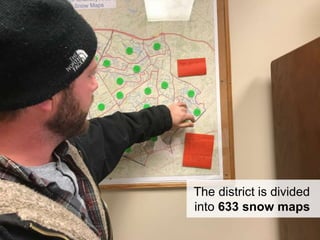
The district is divided
into 633 snow maps
12
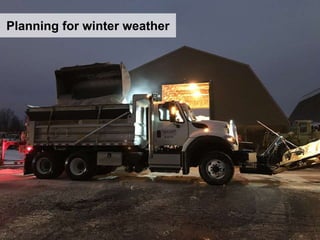
Planning for winter weather
13
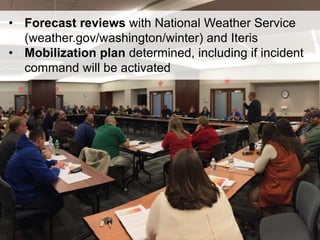
• Forecast reviews with National Weather Service
(weather.gov/washington/winter) and Iteris
• Mobilization plan determined, including if incident
command will be activated
14
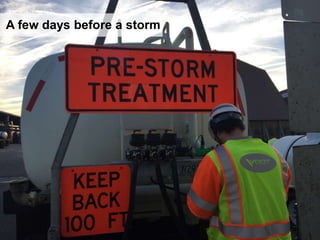
A few days before a storm
15
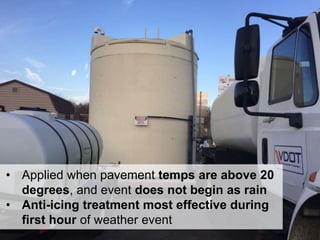
• Applied when pavement temps are above 20
degrees, and event does not begin as rain
• Anti-icing treatment most effective during
first hour of weather event
16
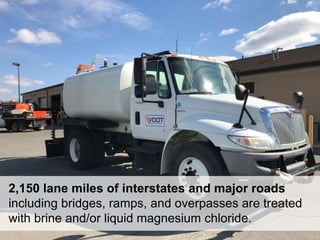
2,150 lane miles of interstates and major roads
including bridges, ramps, and overpasses are treated
with brine and/or liquid magnesium chloride.
17
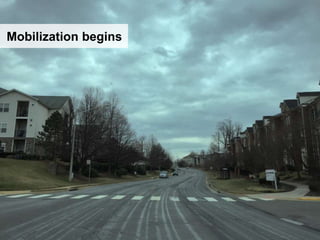
Mobilization begins
18
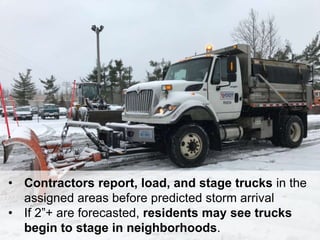
• Contractors report, load, and stage trucks in the
assigned areas before predicted storm arrival
• If 2”+ are forecasted, residents may see trucks
begin to stage in neighborhoods.
19
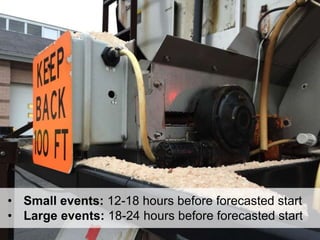
• Small events: 12-18 hours before forecasted start
• Large events: 18-24 hours before forecasted start
20
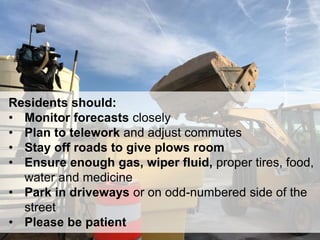
Residents should:
• Monitor forecasts closely
• Plan to telework and adjust commutes
• Stay off roads to give plows room
• Ensure enough gas, wiper fluid, proper tires, food,
water and medicine
• Park in driveways or on odd-numbered side of the
street
• Please be patient
21
Stay informed:
• virginiadot.org/novaemergency One-stop shop
for links to news releases, Twitter feed, status
updates, VDOT Plows, customer service, FAQs
and other resources
• @vadotnova for updates
• 511virginia.org for road conditions and traffic
cameras
• vdotplows.org for status of subdivisions once 2”
have fallen
22
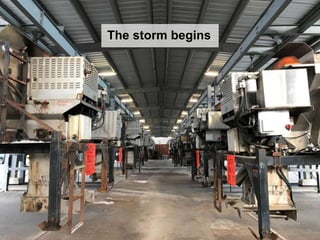
The storm begins
23
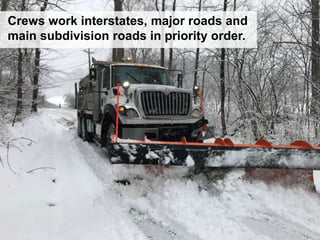
Crews work interstates, major roads and
main subdivision roads in priority order.
24
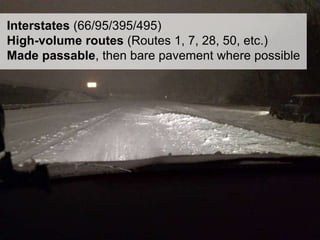
Interstates (66/95/395/495)
High-volume routes (Routes 1, 7, 28, 50, etc.)
Made passable, then bare pavement where possible
25
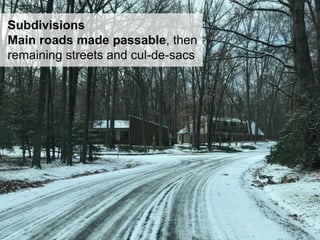
Subdivisions
Main roads made passable, then
remaining streets and cul-de-sacs
26
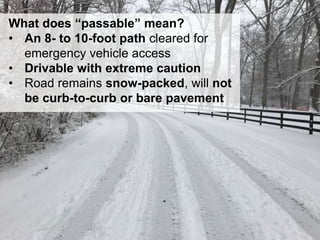
What does “passable” mean?
• An 8- to 10-foot path cleared for
emergency vehicle access
• Drivable with extreme caution
• Road remains snow-packed, will not
be curb-to-curb or bare pavement
27
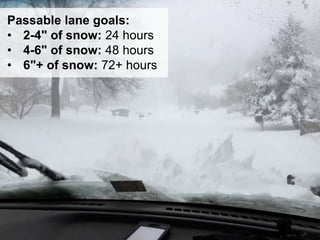
Passable lane goals:
• 2-4" of snow: 24 hours
• 4-6" of snow: 48 hours
• 6"+ of snow: 72+ hours
28
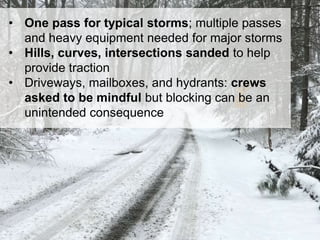
• One pass for typical storms; multiple passes
and heavy equipment needed for major storms
• Hills, curves, intersections sanded to help
provide traction
• Driveways, mailboxes, and hydrants: crews
asked to be mindful but blocking can be an
unintended consequence
29
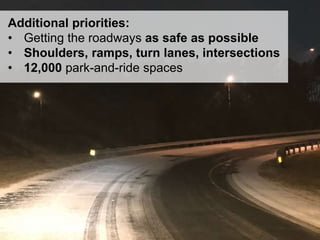
Additional priorities:
• Getting the roadways as safe as possible
• Shoulders, ramps, turn lanes, intersections
• 12,000 park-and-ride spaces
30
• Monitors: Staff inspect routes for quality control
and customer calls
• Maps marked complete when a driver reports
back and monitors have spot-checked
• Once roads are made passable, call center logs
inquiries to investigate
• Automatic Vehicle Locator (AVL) plow-tracking
can help verify, provide data for inquiries
31
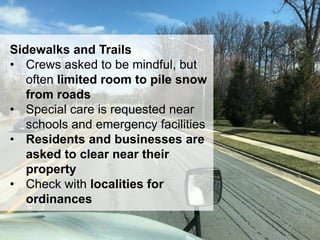
Sidewalks and Trails
• Crews asked to be mindful, but
often limited room to pile snow
from roads
• Special care is requested near
schools and emergency facilities
• Residents and businesses are
asked to clear near their
property
• Check with localities for
ordinances
32
After the storm
33
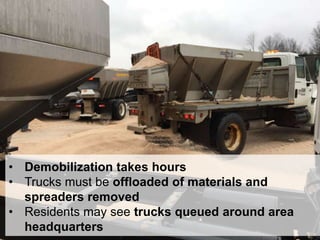
• Demobilization takes hours
• Trucks must be offloaded of materials and
spreaders removed
• Residents may see trucks queued around area
headquarters
34
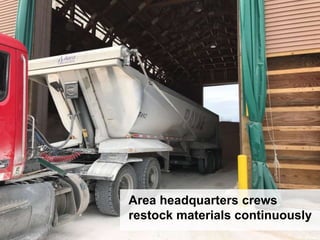
Area headquarters crews
restock materials continuously
35
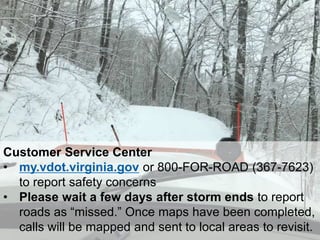
Customer Service Center
• my.vdot.virginia.gov or 800-FOR-ROAD (367-7623)
to report safety concerns
• Please wait a few days after storm ends to report
roads as “missed.” Once maps have been completed,
calls will be mapped and sent to local areas to revisit.
36
Questions?

2018 NOVA Annual Snow Briefing

  • 1.
    2018-2019 NORTHERN VIRGINIA SNOWBRIEFING Lauren Mollerup, P.E., CCM, District Maintenance Engineer Elected Officials, Media, and Other Stakeholders November 30, 2018
  • 2.
  • 3.
    Virginia Department ofTransportation Northern Virginia District Background
  • 4.
    4 • Fairfax, Loudoun,Prince William, and Arlington* * Arlington maintains own network (secondary roads) • Population: 2.2 million • Commuter lots: 24 • Bridges/large culverts: 2,100 • Traffic signals: 1,400 • VDOT employees: 866
  • 5.
    5 Total lanes miles:13,942 • Interstate: 770 • Primary: 1,791 Secondary: 11,306 • Gravel: 318 • Frontage: 78 • Subdivision streets: 16,000
  • 6.
  • 7.
    7 2018-2019 Snow removalbudget $55.6 million (NOVA District)
  • 8.
    8 Pieces of equipment 3,500(mostly contracted) Mobilization Levels 1-5
  • 9.
    9 Materials at startof season Salt: 120,000 tons Sand: 25,000 tons Brine: 250,000 gallons
  • 10.
    10 Contractor vehicles areinspected and fitted for A-frames and spreaders
  • 11.
    11 The district isdivided into 633 snow maps
  • 12.
  • 13.
    13 • Forecast reviewswith National Weather Service (weather.gov/washington/winter) and Iteris • Mobilization plan determined, including if incident command will be activated
  • 14.
    14 A few daysbefore a storm
  • 15.
    15 • Applied whenpavement temps are above 20 degrees, and event does not begin as rain • Anti-icing treatment most effective during first hour of weather event
  • 16.
    16 2,150 lane milesof interstates and major roads including bridges, ramps, and overpasses are treated with brine and/or liquid magnesium chloride.
  • 17.
  • 18.
    18 • Contractors report,load, and stage trucks in the assigned areas before predicted storm arrival • If 2”+ are forecasted, residents may see trucks begin to stage in neighborhoods.
  • 19.
    19 • Small events:12-18 hours before forecasted start • Large events: 18-24 hours before forecasted start
  • 20.
    20 Residents should: • Monitorforecasts closely • Plan to telework and adjust commutes • Stay off roads to give plows room • Ensure enough gas, wiper fluid, proper tires, food, water and medicine • Park in driveways or on odd-numbered side of the street • Please be patient
  • 21.
    21 Stay informed: • virginiadot.org/novaemergencyOne-stop shop for links to news releases, Twitter feed, status updates, VDOT Plows, customer service, FAQs and other resources • @vadotnova for updates • 511virginia.org for road conditions and traffic cameras • vdotplows.org for status of subdivisions once 2” have fallen
  • 22.
  • 23.
    23 Crews work interstates,major roads and main subdivision roads in priority order.
  • 24.
    24 Interstates (66/95/395/495) High-volume routes(Routes 1, 7, 28, 50, etc.) Made passable, then bare pavement where possible
  • 25.
    25 Subdivisions Main roads madepassable, then remaining streets and cul-de-sacs
  • 26.
    26 What does “passable”mean? • An 8- to 10-foot path cleared for emergency vehicle access • Drivable with extreme caution • Road remains snow-packed, will not be curb-to-curb or bare pavement
  • 27.
    27 Passable lane goals: •2-4" of snow: 24 hours • 4-6" of snow: 48 hours • 6"+ of snow: 72+ hours
  • 28.
    28 • One passfor typical storms; multiple passes and heavy equipment needed for major storms • Hills, curves, intersections sanded to help provide traction • Driveways, mailboxes, and hydrants: crews asked to be mindful but blocking can be an unintended consequence
  • 29.
    29 Additional priorities: • Gettingthe roadways as safe as possible • Shoulders, ramps, turn lanes, intersections • 12,000 park-and-ride spaces
  • 30.
    30 • Monitors: Staffinspect routes for quality control and customer calls • Maps marked complete when a driver reports back and monitors have spot-checked • Once roads are made passable, call center logs inquiries to investigate • Automatic Vehicle Locator (AVL) plow-tracking can help verify, provide data for inquiries
  • 31.
    31 Sidewalks and Trails •Crews asked to be mindful, but often limited room to pile snow from roads • Special care is requested near schools and emergency facilities • Residents and businesses are asked to clear near their property • Check with localities for ordinances
  • 32.
  • 33.
    33 • Demobilization takeshours • Trucks must be offloaded of materials and spreaders removed • Residents may see trucks queued around area headquarters
  • 34.
    34 Area headquarters crews restockmaterials continuously
  • 35.
    35 Customer Service Center •my.vdot.virginia.gov or 800-FOR-ROAD (367-7623) to report safety concerns • Please wait a few days after storm ends to report roads as “missed.” Once maps have been completed, calls will be mapped and sent to local areas to revisit.
  • 36.

Editor's Notes

  • #5 Overnight truck loading continues at daybreak at Burke AHQ.
  • #6 Brine lines on I-395 ahead of a storm. (Kristin King, WTOP)
  • #7 Salt and salt/sand combo sheds at Chantilly AHQ.
  • #8 Our second biggest dome, the Regional Dome, in Manassas.
  • #9 Eric Hartless of Leesburg AHQ, statewide Roadeo winner for tandem dump truck.
  • #10 The Megadome, our largest, located at I-395 and Van Dorn, holds 33,000 tons of salt.
  • #11 Tony Hannah of Chantilly AHQ inspects an A-frame.
  • #12 A sample snow map.
  • #13 Spreader racks at Chantilly AHQ.
  • #14 Maintenance personnel meet ahead of snow season.
  • #15 Chemical signs near a brine tank at Chantilly AHQ.
  • #16 Andrew Baker (formerly Chantilly AHQ, current Loudoun Specialty crew) fills a brine tanker at Chantilly AHQ.
  • #17 A brine tanker before it treats Rugby Road.
  • #18 Salt resting on a mounted spreader at Fairfax Equipment Shop.
  • #19 A contract crew from Rappahannock County, responsible for clearing Centreville and McLearen roads.
  • #20 A front end loader helps refill the Chantilly AHQ salt shed.
  • #21 Fairfax County Parkway after one lane was brined with a tanker that covers a full lane.
  • #22 Inside a spreader rack at Chantilly AHQ.
  • #23 Front end loaders ready for deployment at Chantilly AHQ.
  • #24 A single-axle dump truck at Leesburg AHQ before working the ramps and shoulders near Route 7.
  • #25 Interstate 66 during Snowzilla.
  • #26 A resident gives VDOT feedback after Brian Kimmer of Materials helps open up her road during Snowzilla.
  • #27 A passable street.
  • #28 Jesse Bowers of Burke AHQ starts down Braddock Green Court during Snowzilla.
  • #29 During Snowzilla, even plow trucks got stuck on Braddock Road.
  • #30 Tommy Laycock of Leesburg AHQ clears a shoulder on Route 7/15 bypass.
  • #31 Interstate 95 during Snowzilla.
  • #32 One lane of brine treatment begins drying and adhering to pavement on Rugby Road.
  • #33 Trucks offload salt at Chantilly AHQ.
  • #34 Multiple trucks return salt during a recent demobilization at Chantilly AHQ.
  • #35 Joe Jenkins of Leesburg AHQ oversees a salt delivery.
  • #36 Heavy equipment was used to clear Interstate 95 during Snowzilla.
  • #37 Wayne Turner of Chantilly AHQ waves goodbye as he heads out to continue brining.