IBM Watson IoT / © 2018 IBM Corporation
What if you could have your
own expert systems
engineering assistant?
—
Stella Liu,
Offering Management
Kevin McHugh,
Services Lead
Agenda
–
IBM Watson IoT / © 2018 IBM Corporation
Lessons from the Renaissance
The Principal Engineer’s Modern Dilemma
Hiring Watson
Applying Watson to Engineering
IBM Watson IoT / © 2018 IBM Corporation
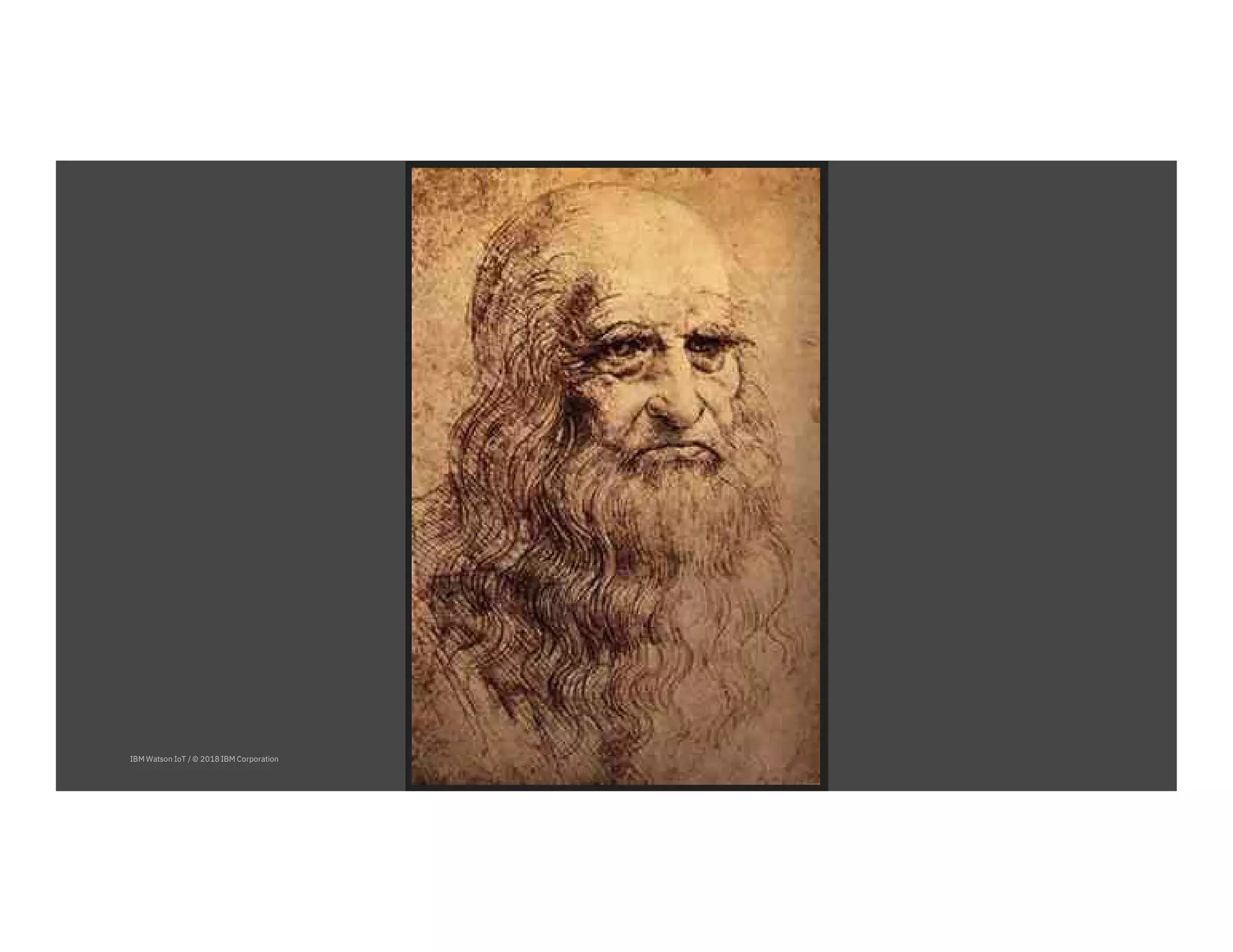
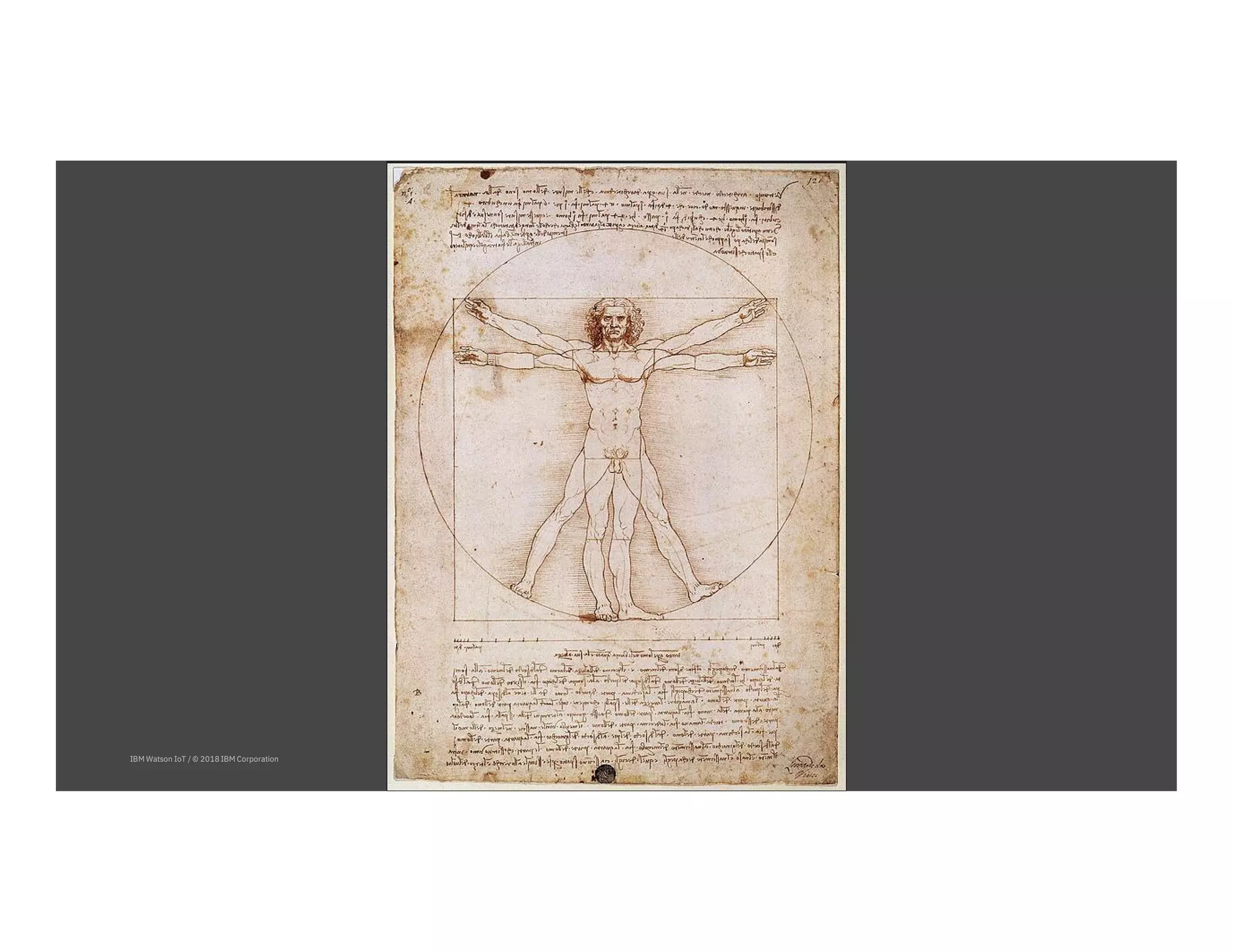
Leonardo da Vinci [Public domain], via Wikimedia Commons
IBM Watson IoT / © 2018 IBM Corporation
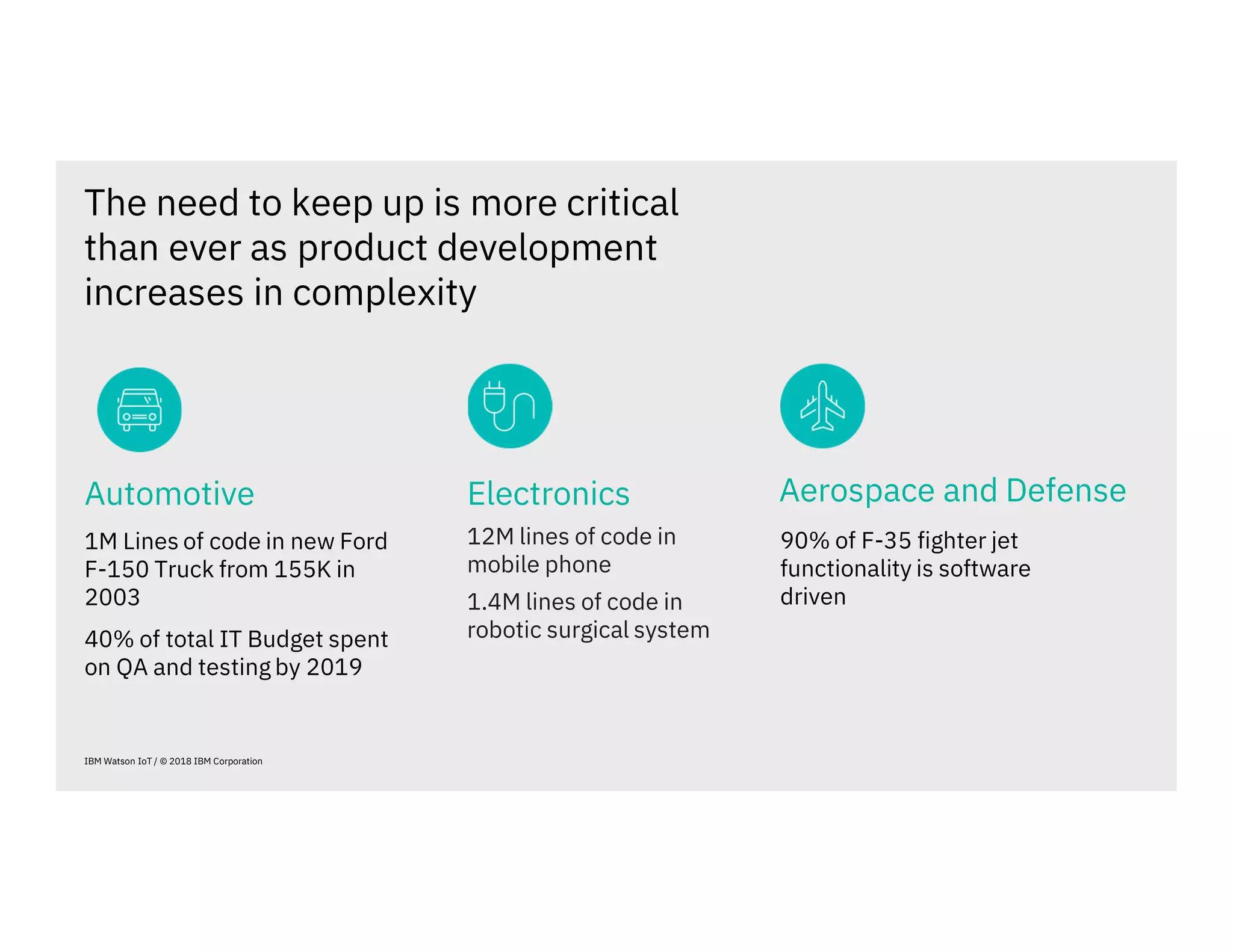
Automotive
1M Lines of code in new Ford
F-150 Truck from 155K in
2003
40% of total IT Budget spent
on QA and testing by 2019
90% of F-35 fighter jet
functionality is software
driven
Electronics
12M lines of code in
mobile phone
1.4M lines of code in
robotic surgical system
The need to keep up is more critical
than ever as product development
increases in complexity
Aerospace and Defense
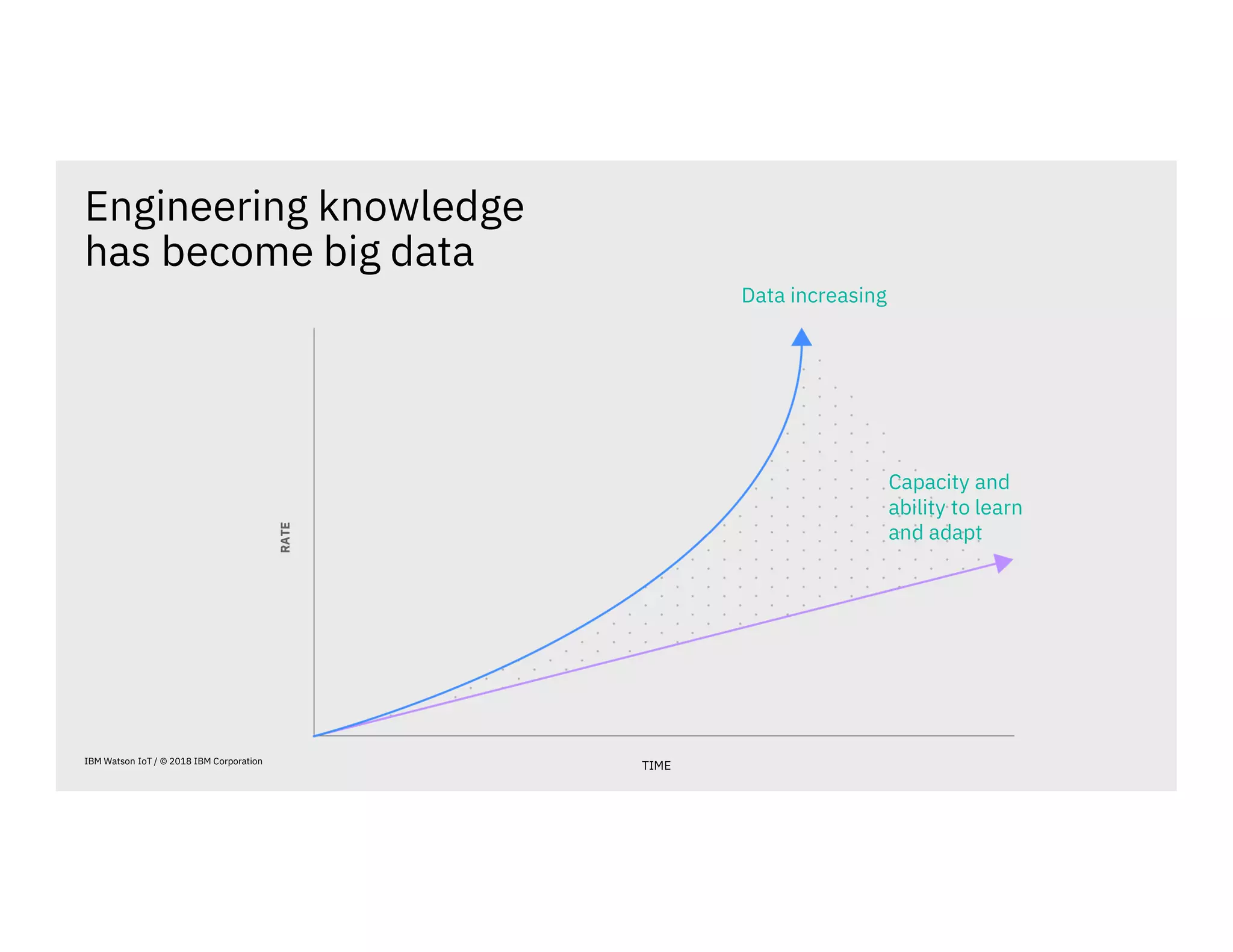
Engineering knowledge
has become big data
Data increasing
Capacity and
ability to learn
and adapt
TIME
RATE
IBM Watson IoT / © 2018 IBM Corporation
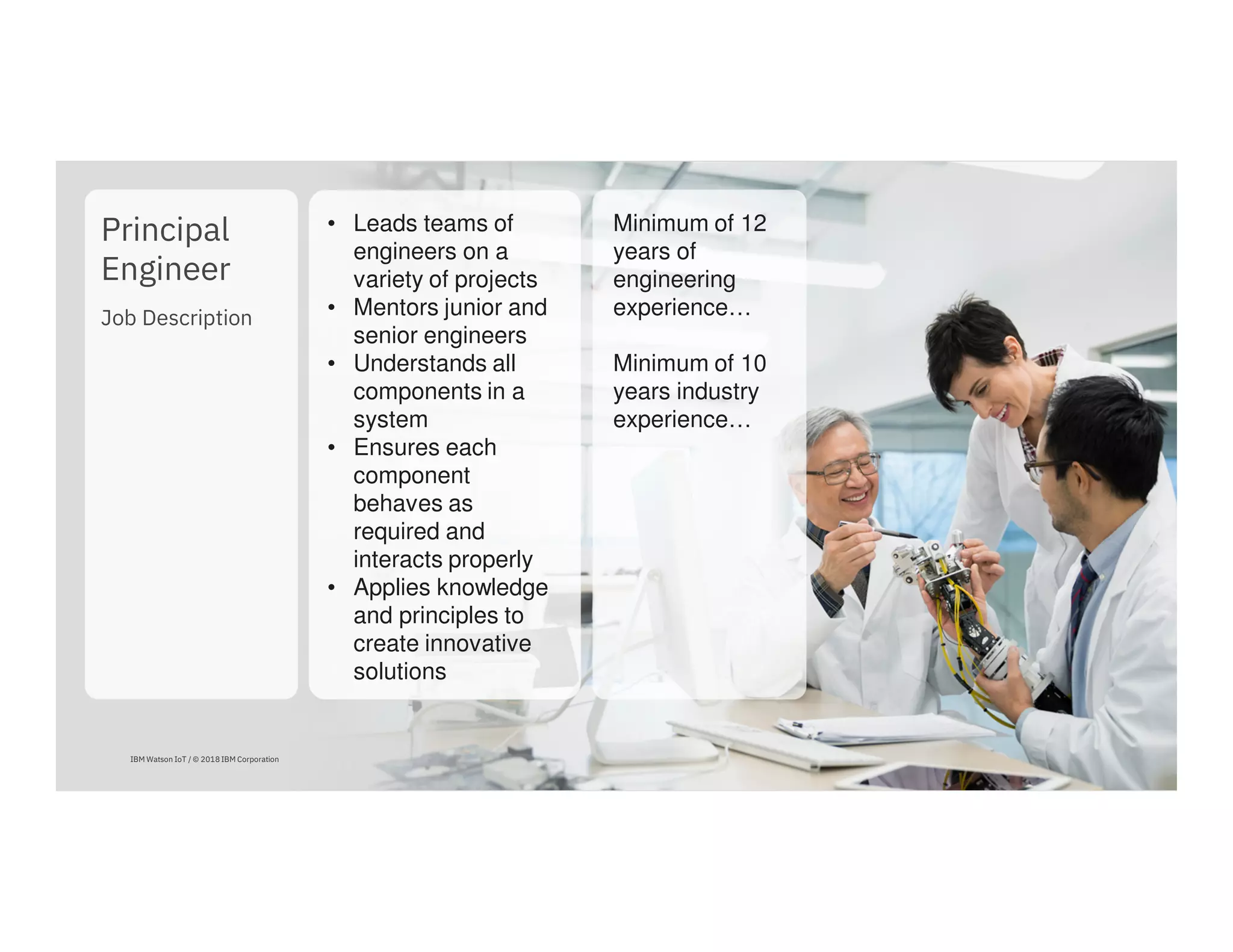
Principal
Engineer
Job Description
• Leads teams of
engineers on a
variety of projects
• Mentors junior and
senior engineers
• Understands all
components in a
system
• Ensures each
component
behaves as
required and
interacts properly
• Applies knowledge
and principles to
create innovative
solutions
Minimum of 12
years of
engineering
experience…
Minimum of 10
years industry
experience…
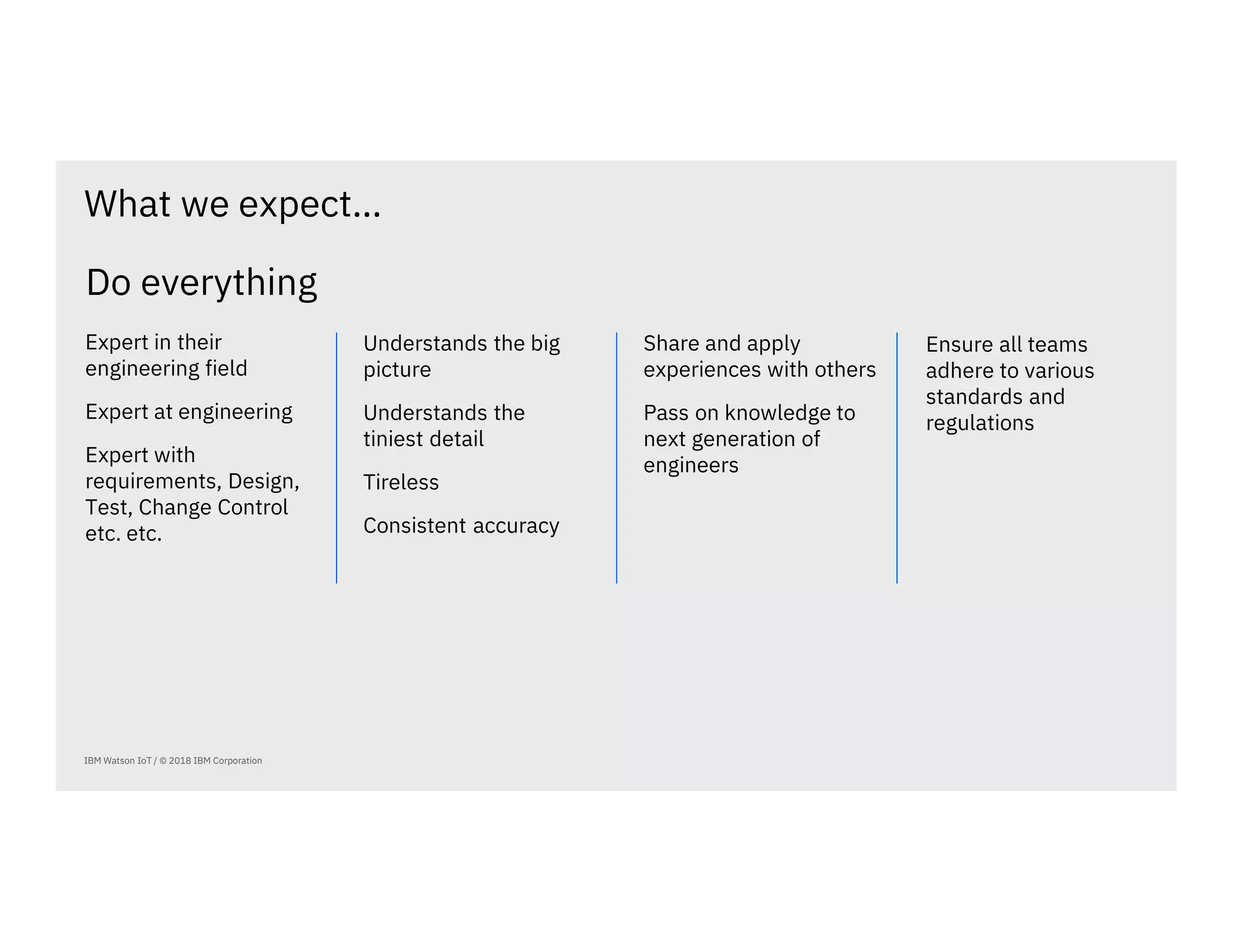
What we expect…
IBM Watson IoT / © 2018 IBM Corporation
Expert in their
engineering field
Expert at engineering
Expert with
requirements, Design,
Test, Change Control
etc. etc.
Share and apply
experiences with others
Pass on knowledge to
next generation of
engineers
Understands the big
picture
Understands the
tiniest detail
Tireless
Consistent accuracy
Ensure all teams
adhere to various
standards and
regulations
Do everything
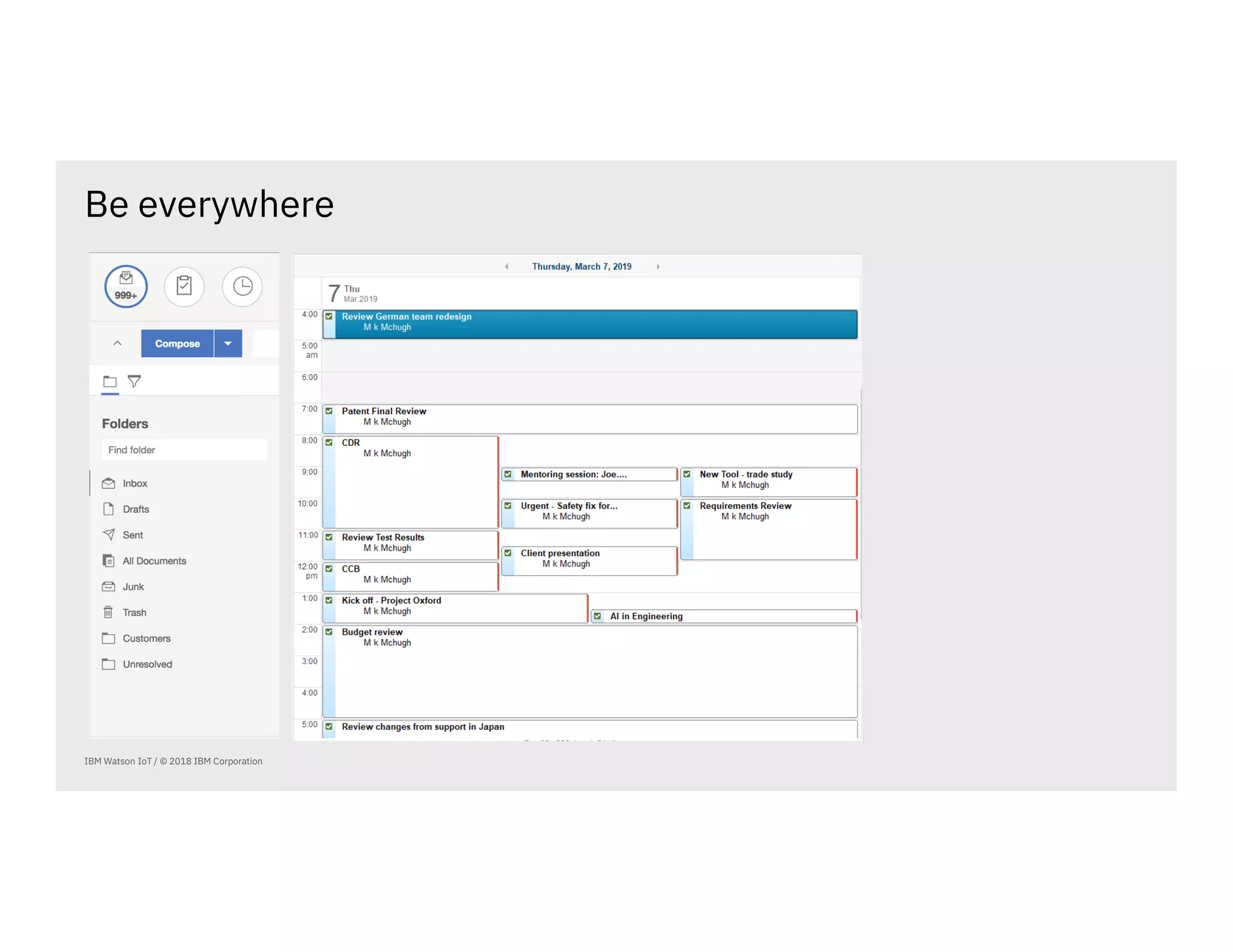
Be everywhere
IBM Watson IoT / © 2018 IBM Corporation
0
100
200
300
400
500
600
700
800
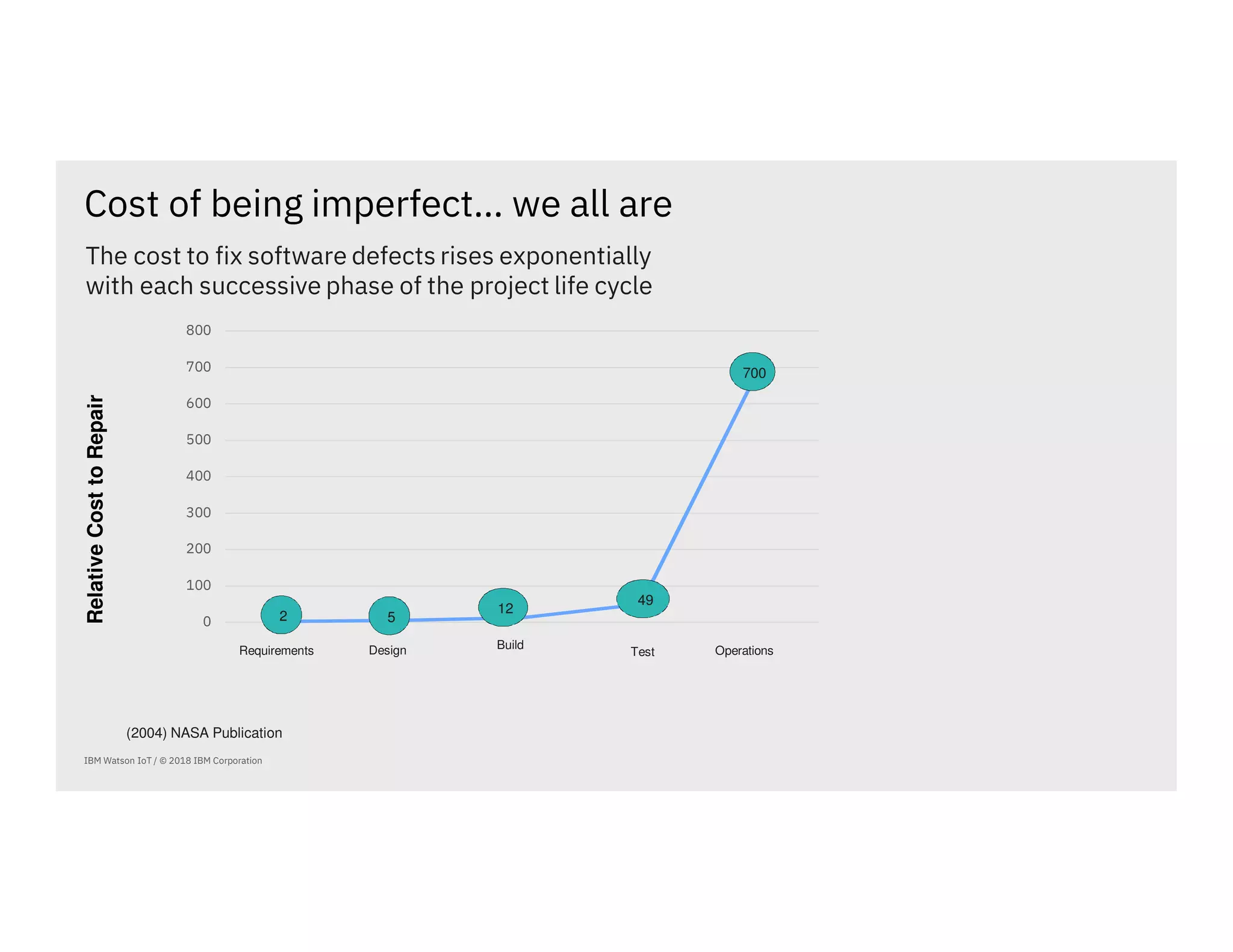
Cost of being imperfect… we all are
IBM Watson IoT / © 2018 IBM Corporation
RelativeCosttoRepair
The cost to fix software defects rises exponentially
with each successive phase of the project life cycle
(2004) NASA Publication
Design Build
Test Operations
700
49
12
52
Requirements
IBM Watson IoT / © 2018 IBM Corporation
But we know it’s not
possible
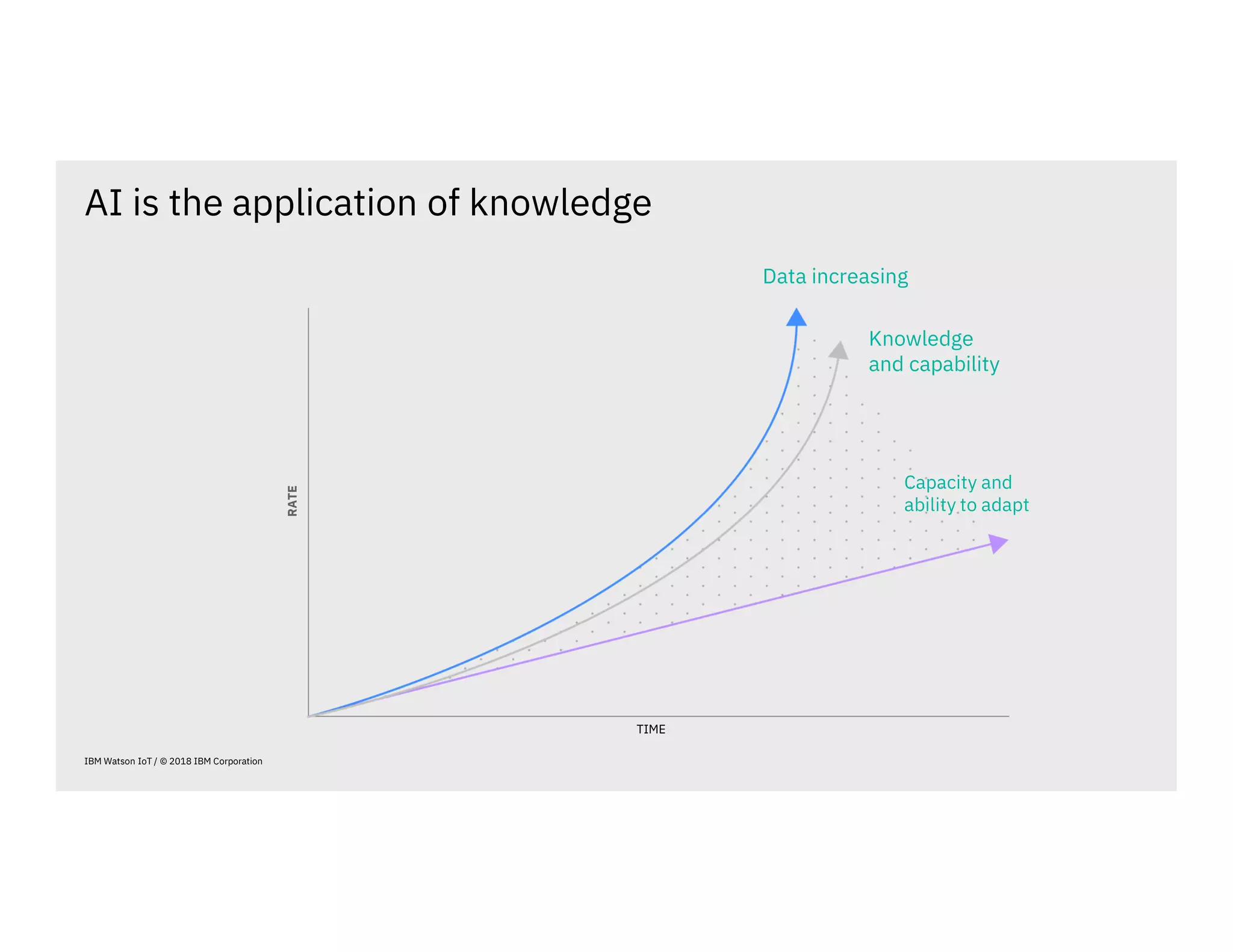
AI is the application of knowledge
Capacity and
ability to adapt
TIME
RATE
Knowledge
and capability
Data increasing
IBM Watson IoT / © 2018 IBM Corporation
Let’s hire Watson
AI contrasted with the human mind
IBM Watson IoT / © 2018 IBM Corporation
AI contrasted with the human mind
IBM Watson IoT / © 2018 IBM Corporation
AI contrasted with the human mind
IBM Watson IoT / © 2018 IBM Corporation
AI contrasted with the human mind
When do your engineers have to
cope with massive amounts of
information?
IBM Watson IoT / © 2018 IBM Corporation
What tasks do your engineers
have to do today that are
manual, consistent and
repetitive?
IBM Watson IoT / © 2018 IBM Corporation
Where are there gaps of
knowledge in your organization?
IBM Watson IoT / © 2018 IBM Corporation
Who are the users? And their intents?
IBM Watson IoT / © 2018 IBM Corporation
What data do they use to make decisions?
IBM Watson IoT / © 2018 IBM Corporation
What AI models should we use to process that information?
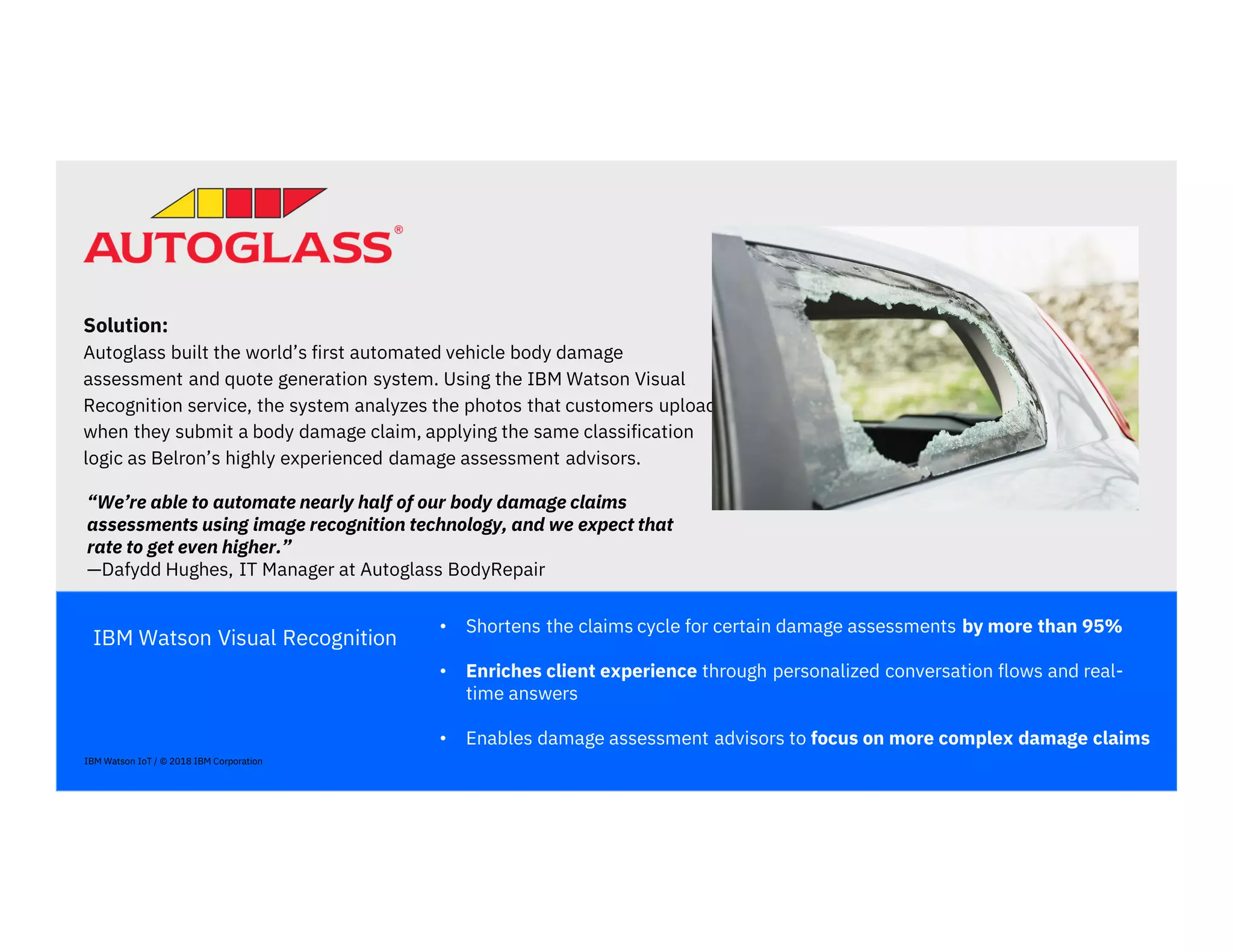
IBM Watson Visual Recognition
• Shortens the claims cycle for certain damage assessments by more than 95%
• Enriches client experience through personalized conversation flows and real-
time answers
• Enables damage assessment advisors to focus on more complex damage claims
Solution:
Autoglass built the world’s first automated vehicle body damage
assessment and quote generation system. Using the IBM Watson Visual
Recognition service, the system analyzes the photos that customers upload
when they submit a body damage claim, applying the same classification
logic as Belron’s highly experienced damage assessment advisors.
“We’re able to automate nearly half of our body damage claims
assessments using image recognition technology, and we expect that
rate to get even higher.”
—Dafydd Hughes, IT Manager at Autoglass BodyRepair
IBM Watson IoT / © 2018 IBM Corporation
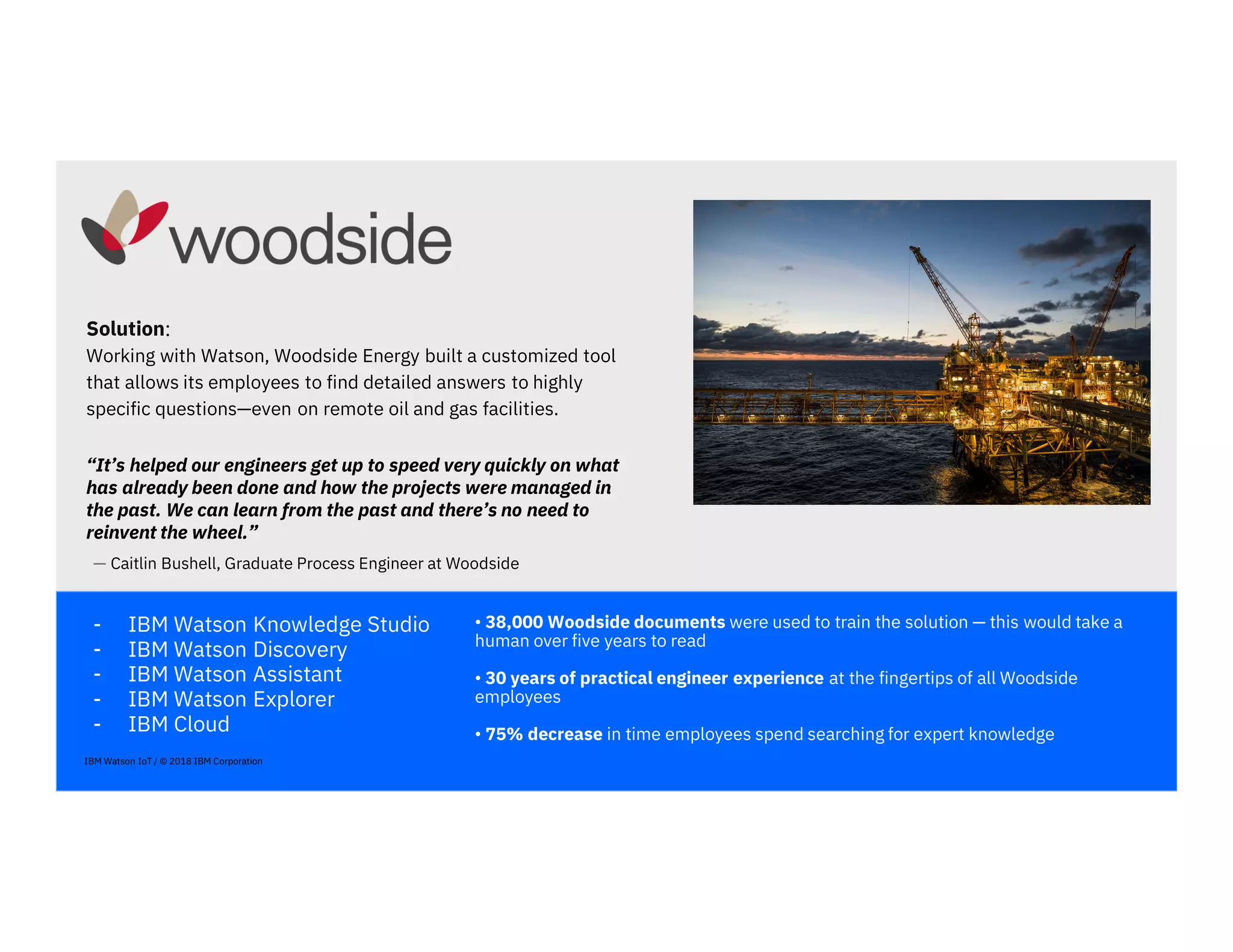
- IBM Watson Knowledge Studio
- IBM Watson Discovery
- IBM Watson Assistant
- IBM Watson Explorer
- IBM Cloud
• 38,000 Woodside documents were used to train the solution — this would take a
human over five years to read
• 30 years of practical engineer experience at the fingertips of all Woodside
employees
• 75% decrease in time employees spend searching for expert knowledge
Solution::::
Working with Watson, Woodside Energy built a customized tool
that allows its employees to find detailed answers to highly
specific questions—even on remote oil and gas facilities.
“It’s helped our engineers get up to speed very quickly on what
has already been done and how the projects were managed in
the past. We can learn from the past and there’s no need to
reinvent the wheel.”
— Caitlin Bushell, Graduate Process Engineer at Woodside
IBM Watson IoT / © 2018 IBM Corporation
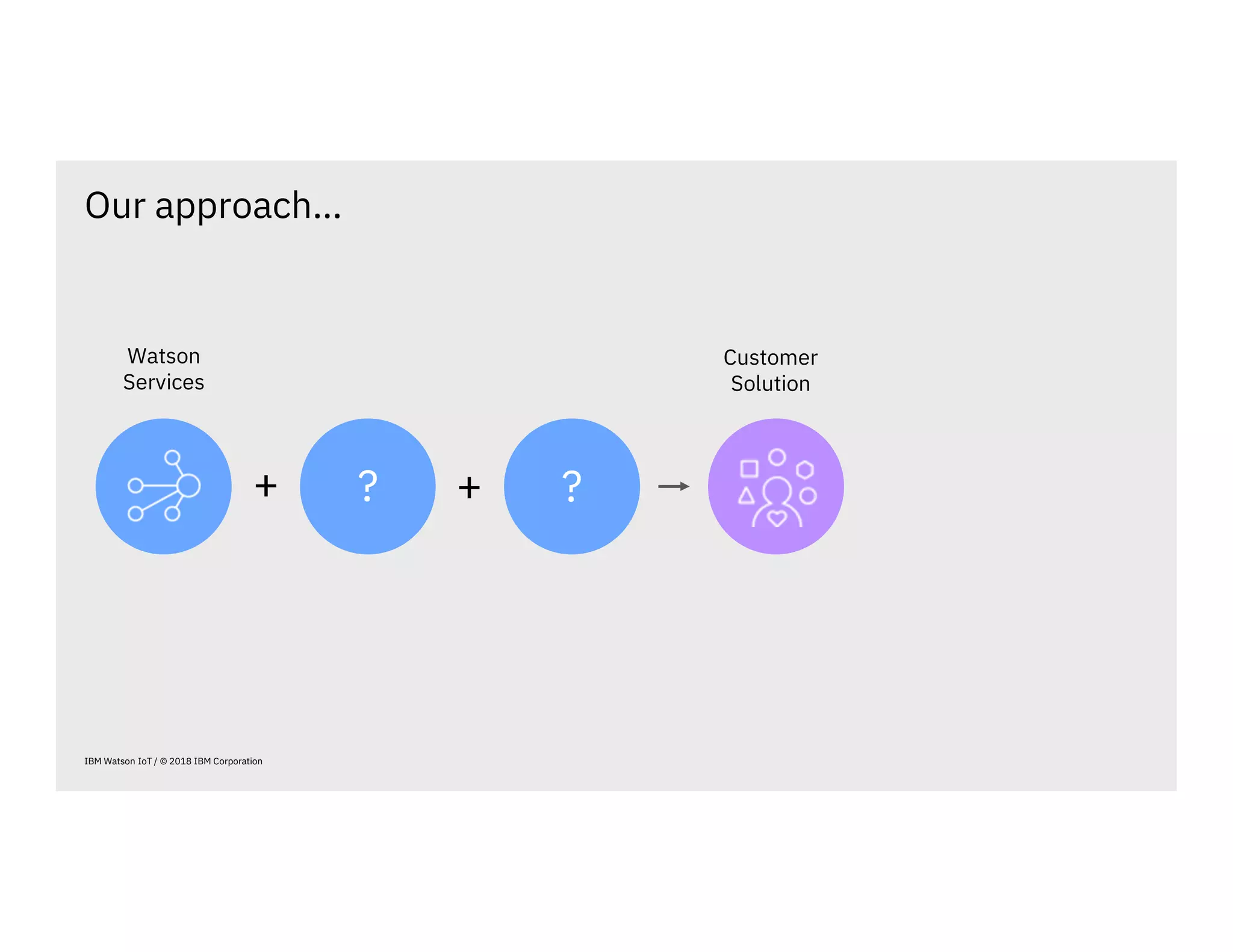
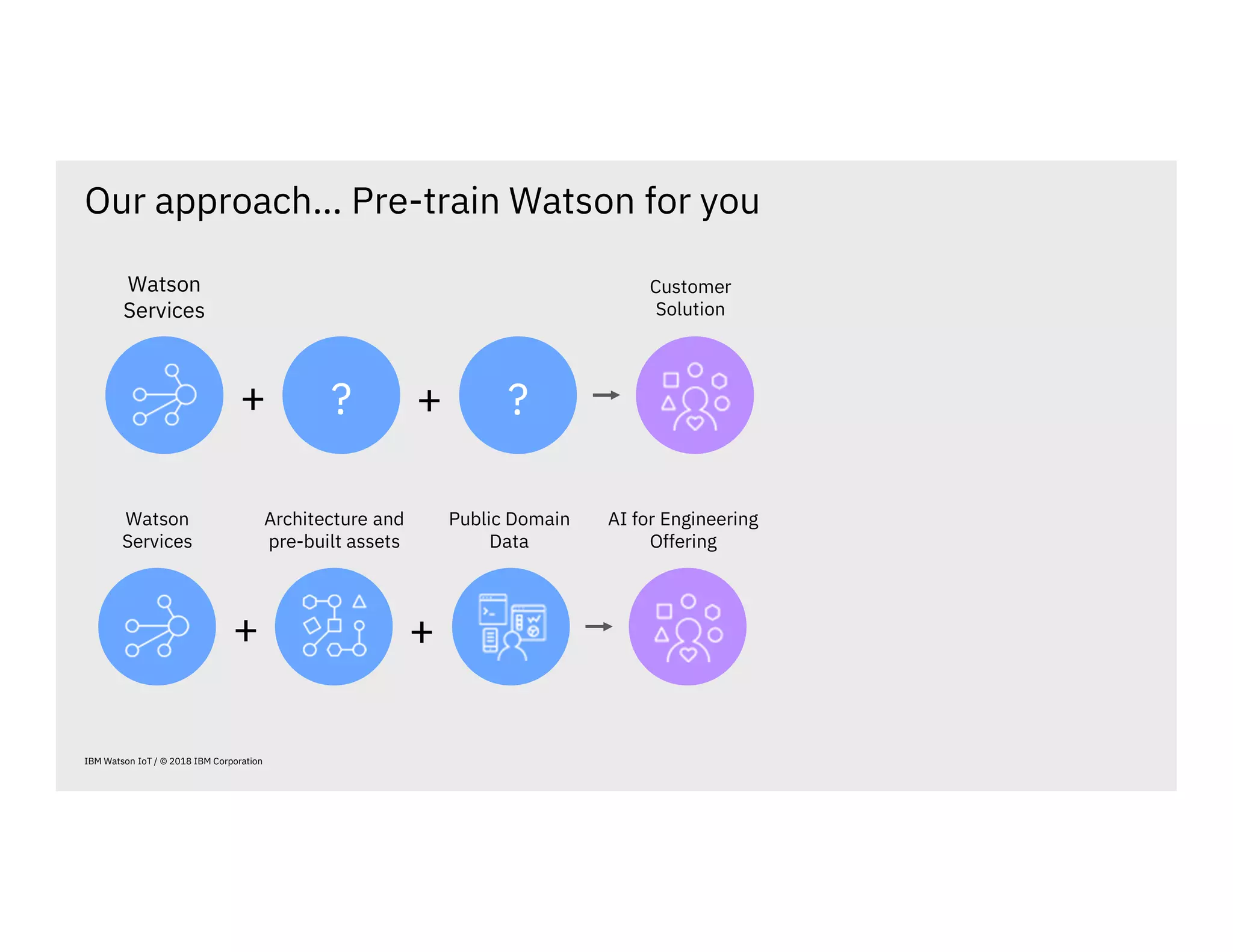
Our approach…
Watson
Services
Customer
Solution
+ +? ?
IBM Watson IoT / © 2018 IBM Corporation
Our approach… Pre-train Watson for you
Watson
Services
Customer
Solution
+ +? ?
Watson
Services
AI for Engineering
Offering
Architecture and
pre-built assets
Public Domain
Data
+ +
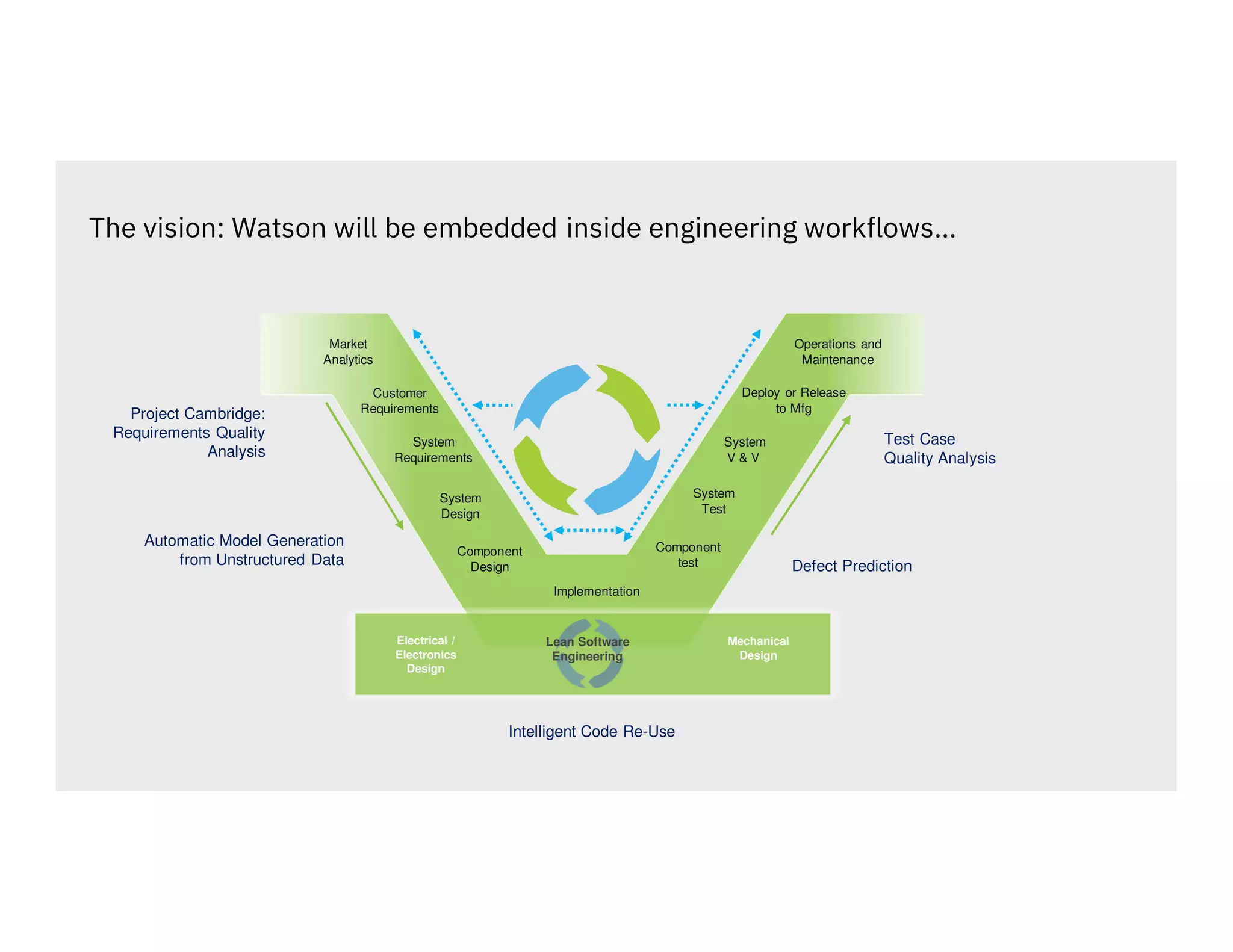
Market
Analytics
System
V & V
System
Test
System
Requirements
System
Design
Deploy or Release
to Mfg
Customer
Requirements
Operations and
Maintenance
Implementation
Electrical /
Electronics
Design
Mechanical
Design
Lean Software
Engineering
Continuous
Engineering
Component
test
Component
Design
The vision: Watson will be embedded inside engineering workflows…
Project Cambridge:
Requirements Quality
Analysis
Intelligent Code Re-Use
Test Case
Quality Analysis
Automatic Model Generation
from Unstructured Data Defect Prediction
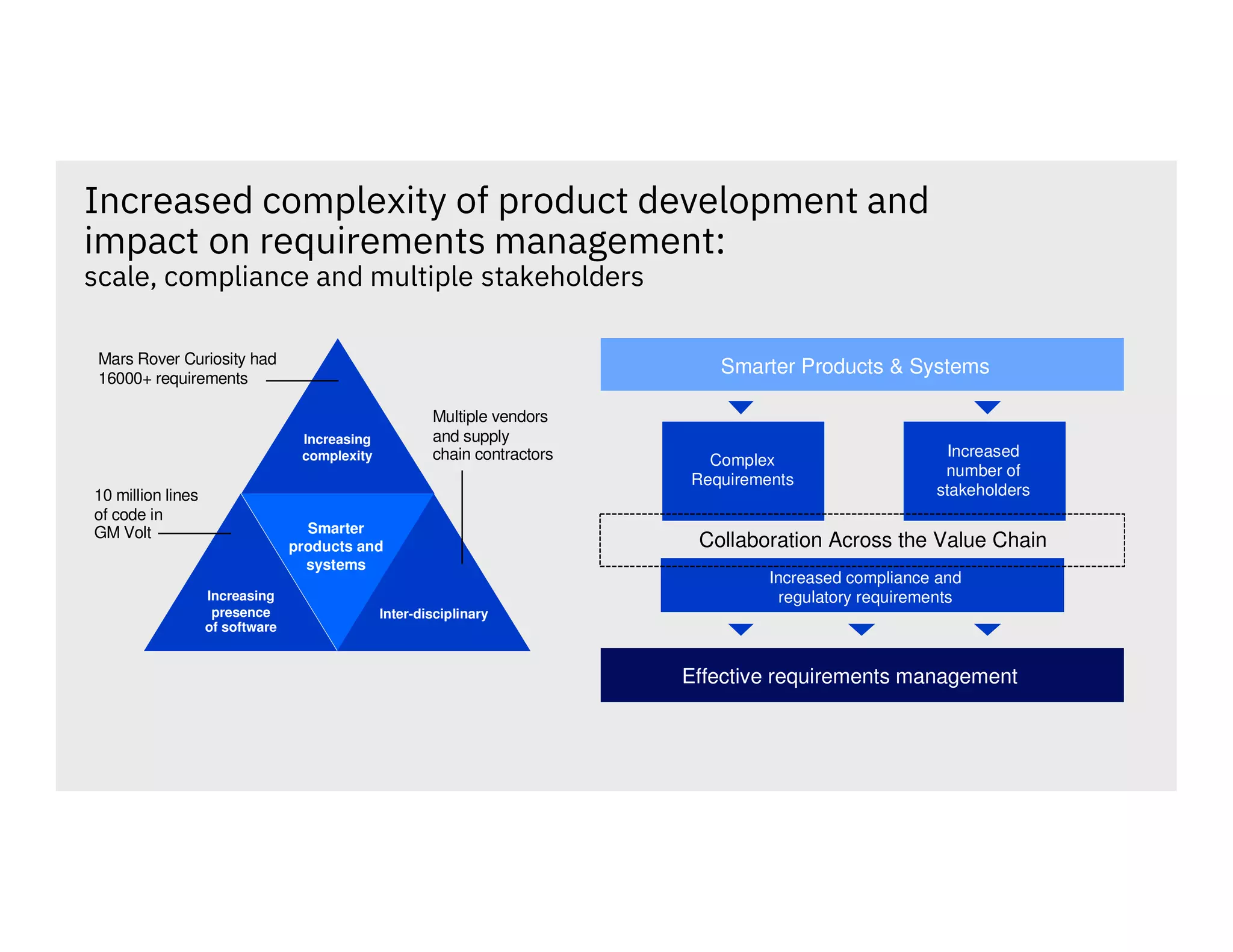
Increased complexity of product development and
impact on requirements management:
scale, compliance and multiple stakeholders
Increasing
presence
of software
Inter-disciplinary
Increasing
complexity
Smarter
products and
systems
10 million lines
of code in
GM Volt
Mars Rover Curiosity had
16000+ requirements
Multiple vendors
and supply
chain contractors
Smarter Products & Systems
Complex
Requirements
Increased
number of
stakeholders
Increased compliance and
regulatory requirements
Effective requirements management
Collaboration Across the Value Chain
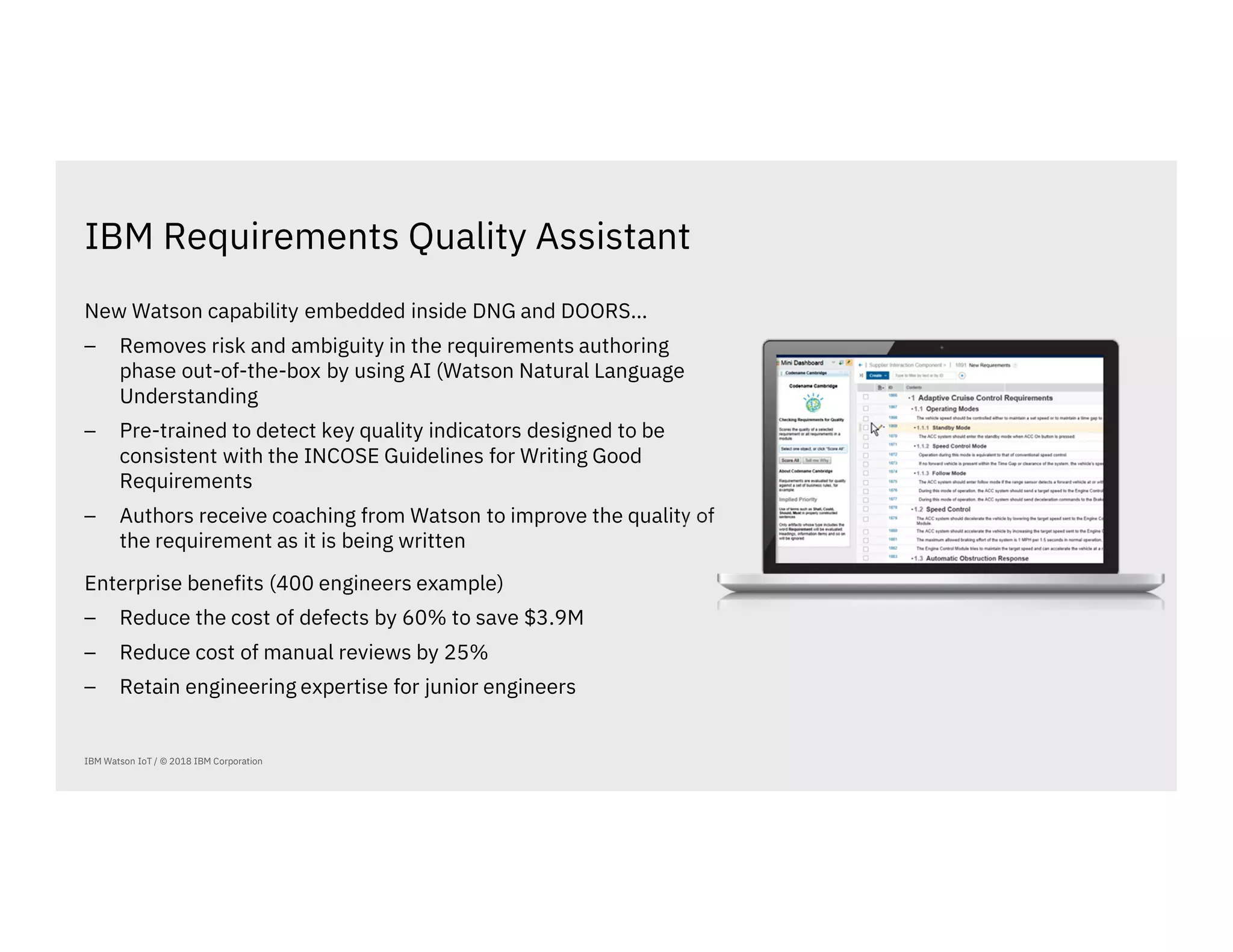
IBM Requirements Quality Assistant
IBM Watson IoT / © 2018 IBM Corporation
New Watson capability embedded inside DNG and DOORS…
⎯ Removes risk and ambiguity in the requirements authoring
phase out-of-the-box by using AI (Watson Natural Language
Understanding
⎯ Pre-trained to detect key quality indicators designed to be
consistent with the INCOSE Guidelines for Writing Good
Requirements
⎯ Authors receive coaching from Watson to improve the quality of
the requirement as it is being written
Enterprise benefits (400 engineers example)
⎯ Reduce the cost of defects by 60% to save $3.9M
⎯ Reduce cost of manual reviews by 25%
⎯ Retain engineering expertise for junior engineers
The subject of a requirement statement must to be appropriate to the level to which it refers. Requirements referring
to the business level therefore have the form “The <business> shall ...”; those referring to the stakeholder level have
the form “The <stakeholder> shall ...”; those referring to the system level have the form “The <system> shall ...”;
requirements referring to the subsystem level have the form “The <subsystem> shall ...”; and requirements referring
to the component level have the form “The <component> shall ...”. As a general rule, requirements stated at a
particular level should refer only to that level—that is, the business requirements refer to the business level,
stakeholder requirements refer to the stakeholder level, system requirements refer to the system level, subsystem
requirements refer to the subsystem level, and component requirements refer to the component level. In some
cases, however, a higher level may wish to be prescriptive at a lower level. For example, it may be important for a
business to mandate that the new aircraft under development must utilize a particular engine (perhaps for support
reasons) in which case they may make a statement at the business level that refers to an entity at the subsystem
level, Therefore, any level of the organization can state (at that level) requirements that refer to two levels: to that
level, as well any lower level (should there be a good reason to do so). Consequently, regardless of the level at which
the requirement is stated, the subject of a requirement statement must be appropriate to the level to which it refers.
To continue our aircraft example above, although the majority of requirements at the business level will begin with
“ACME Aircraft Company shall ...”, the business may therefore wish to state at the business level a requirement
referring to the subsystem level regarding the engine “The Engine shall ...”. Similarly, the verb of a requirement
statement must be appropriate to the subject of the requirement at the level it is stated. Requirements with the
verbs “safe”, “support”, “process”, “handle”, “track”, “manage”, “Áag”, etc. are too vague and thus ambiguous and
unveriÀable unless these functions are decomposed into speciÀc sub-functions that are intended by the writer. At
the business level, for example, the use of a verb such as “safe”, may be acceptable as long as it is unambiguous at
that level, decomposed at the lower levels, and is veriÀable at the level stated. Unacceptable system requirement:
“The User shall ..........” {This is unacceptable because the requirement should be on the system, not the user or
operator of the system. This wording is often the result of writing requirements directly from user stories, without
doing the transformation of the user need into a system requirement. Ask, what does the system have to do so that
the user need can be achieved?} A set of requirements that has been documented, agreed-to, and baselined at one
level will Áow down to the next level as shown in Figure 1. At each level, the requirements are a result of the
transformation process of the needs at that level as well a result of the elaboration (decomposition and/or
derivation) of the requirements from the previous level. As such, SyRS or SyRD requirements are either decomposed
from (that is, made explicit) or derived from (that is, implied) by the requirements of the system OpsCon and StRS or
StRD. Consequently, several systems, each described by the system OpsCon and SyRS, may be deÀned to meet the
capability required by the StRS. The same is true at the subsystem level, where the subsystem requirements may be
either decomposed or derived from the subsystem OpsCon and SyRS or SyRD. In all cases, for each
level shown in Figure 1, the set of requirements can be traced back to the needs from which they were transformed
as well as the requirements at the previous level from which they were either decomposed or derived. How
requirements are expressed differs through these levels and, therefore, so do the rules for expressing them. As
requirements are developed - and solutions designed - down through the levels of abstraction, we expect
requirement statements to become more and more speciÀc. At the highest, governance level, the ideal requirement
is not speciÀc to a particular solution, and permits a range of possible implementations or solutions. It is important
to note that the form of requirements at one level may not be appropriate for another level. For example, at the
business management level, there may be a requirement that all products shall be “safe” or of the “highest quality”
or projects shall develop products using “best practices” deÀned by organizations like INCOSE, Project Management
Institute (PMI), or Capability Maturity Model Integrated (CMMI). At the business management level, they may deÀne
process requirements for implementing some capability level of Model Based Systems Engineering (MBSE) or Agile.
While these are poor system level requirements, it is appropriate for the Business Management level. At the system
level, more speciÀc safety and quality requirements will be developed for that speciÀc system. These requirements
will then be allocated to the system elements at the next lower level. The Programs or Projects responsible for
developing the systems will develop speciÀc requirements for how they will implement the management and
systems engineering process requirements deÀned
IBM Watson IoT / © 2018 IBM Corporation
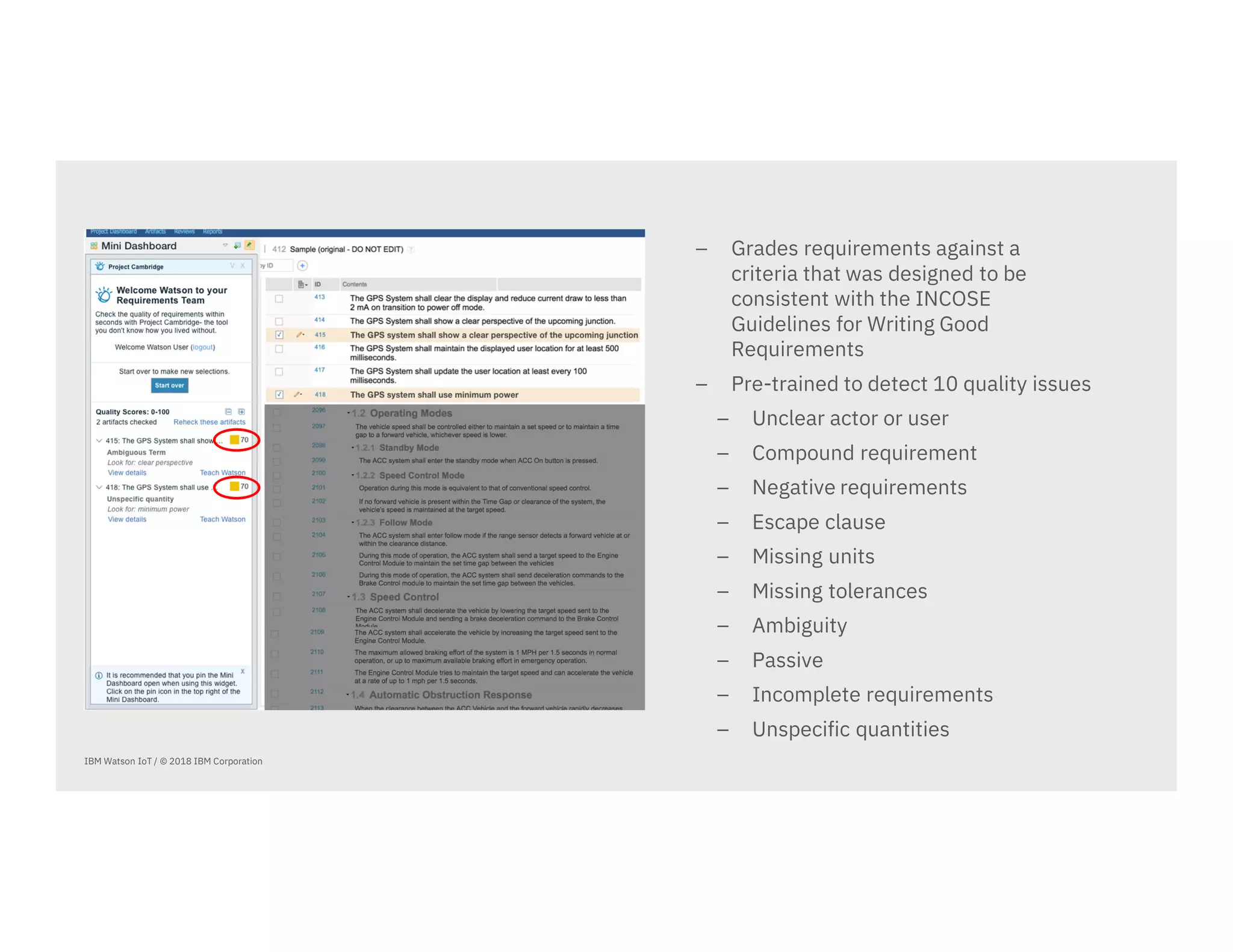
⎯ Grades requirements against a
criteria that was designed to be
consistent with the INCOSE
Guidelines for Writing Good
Requirements
⎯ Pre-trained to detect 10 quality issues
⎯ Unclear actor or user
⎯ Compound requirement
⎯ Negative requirements
⎯ Escape clause
⎯ Missing units
⎯ Missing tolerances
⎯ Ambiguity
⎯ Passive
⎯ Incomplete requirements
⎯ Unspecific quantities
IBM Watson IoT / © 2018 IBM Corporation
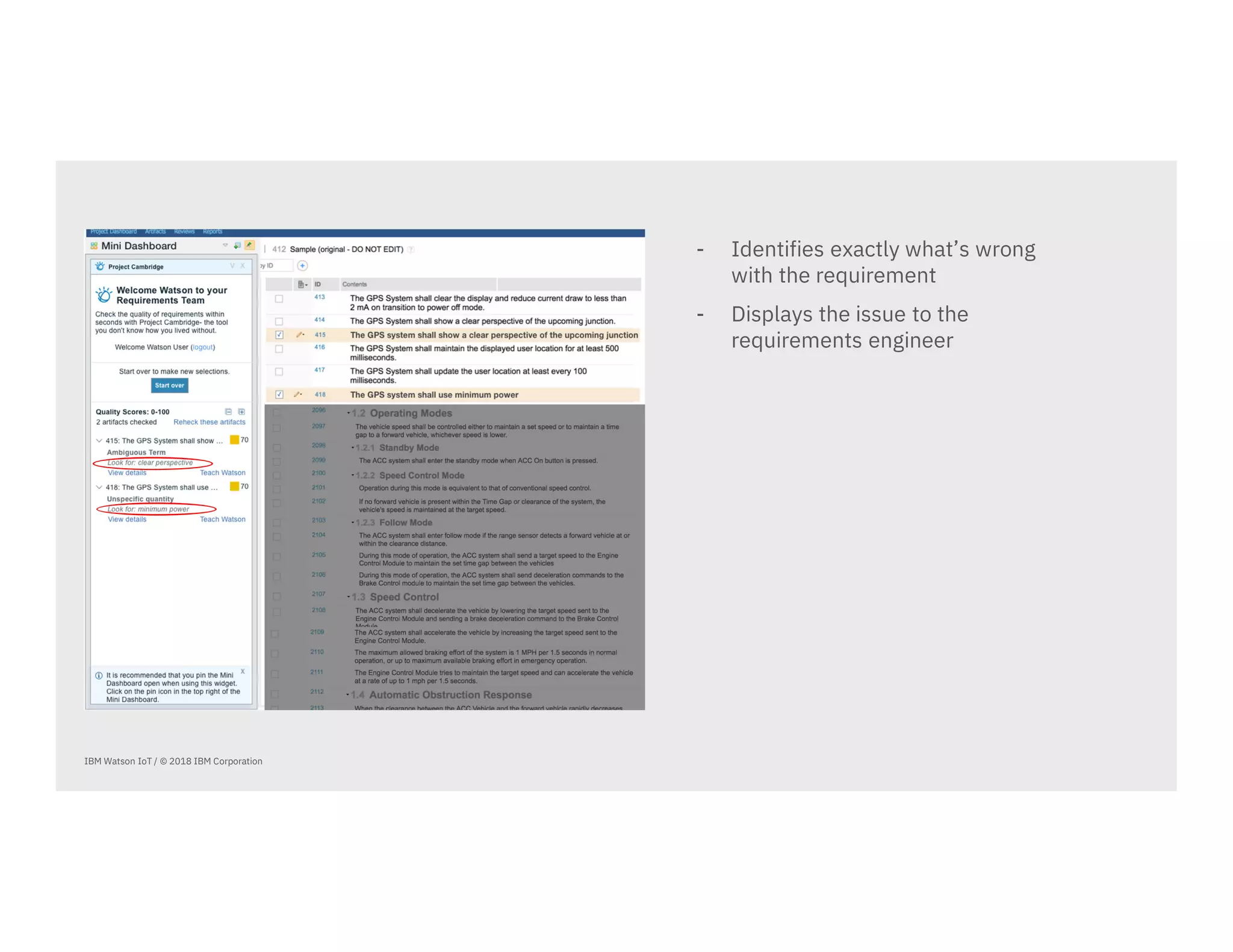
- Identifies exactly what’s wrong
with the requirement
- Displays the issue to the
requirements engineer
IBM Watson IoT / © 2018 IBM Corporation
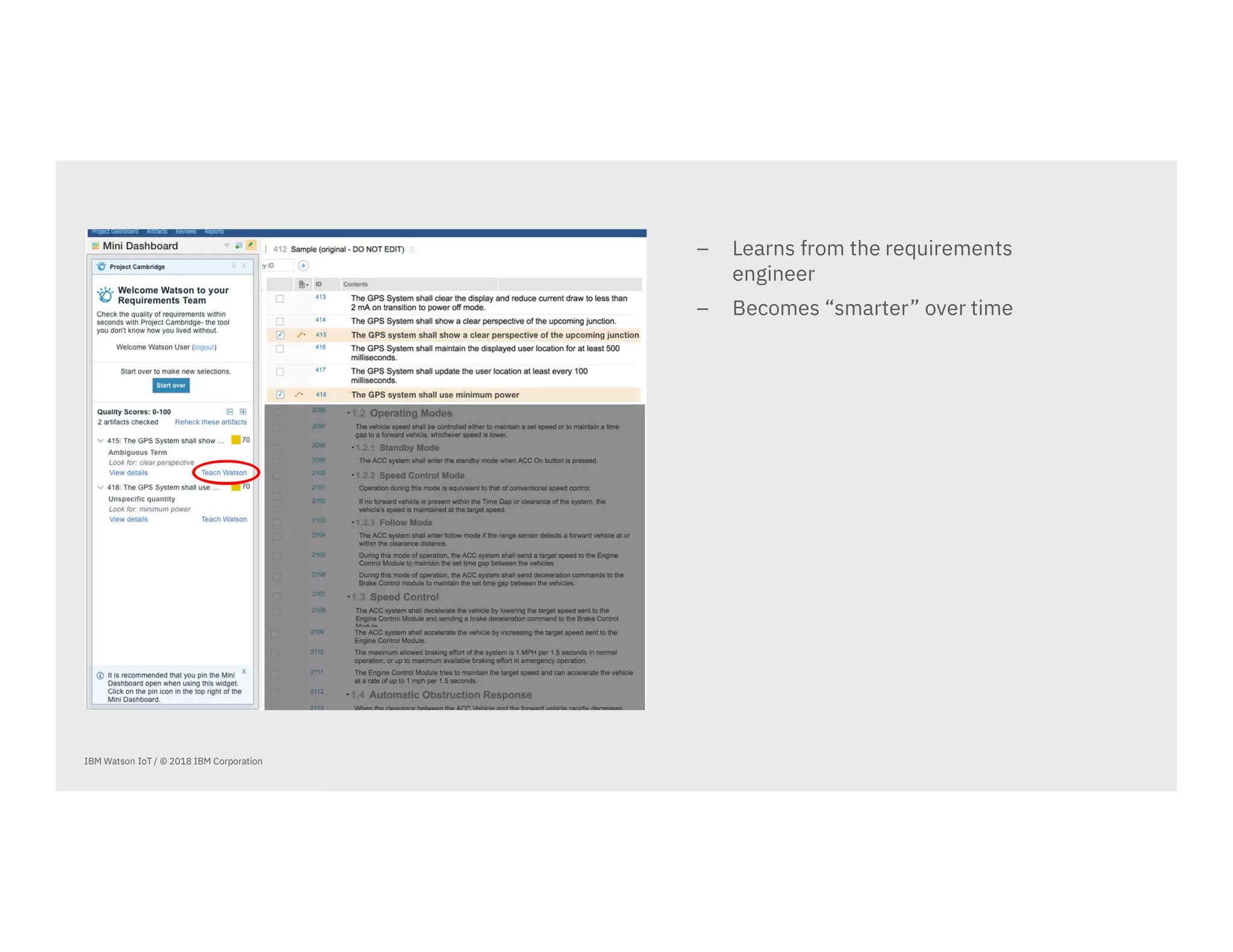
⎯ Learns from the requirements
engineer
⎯ Becomes “smarter” over time
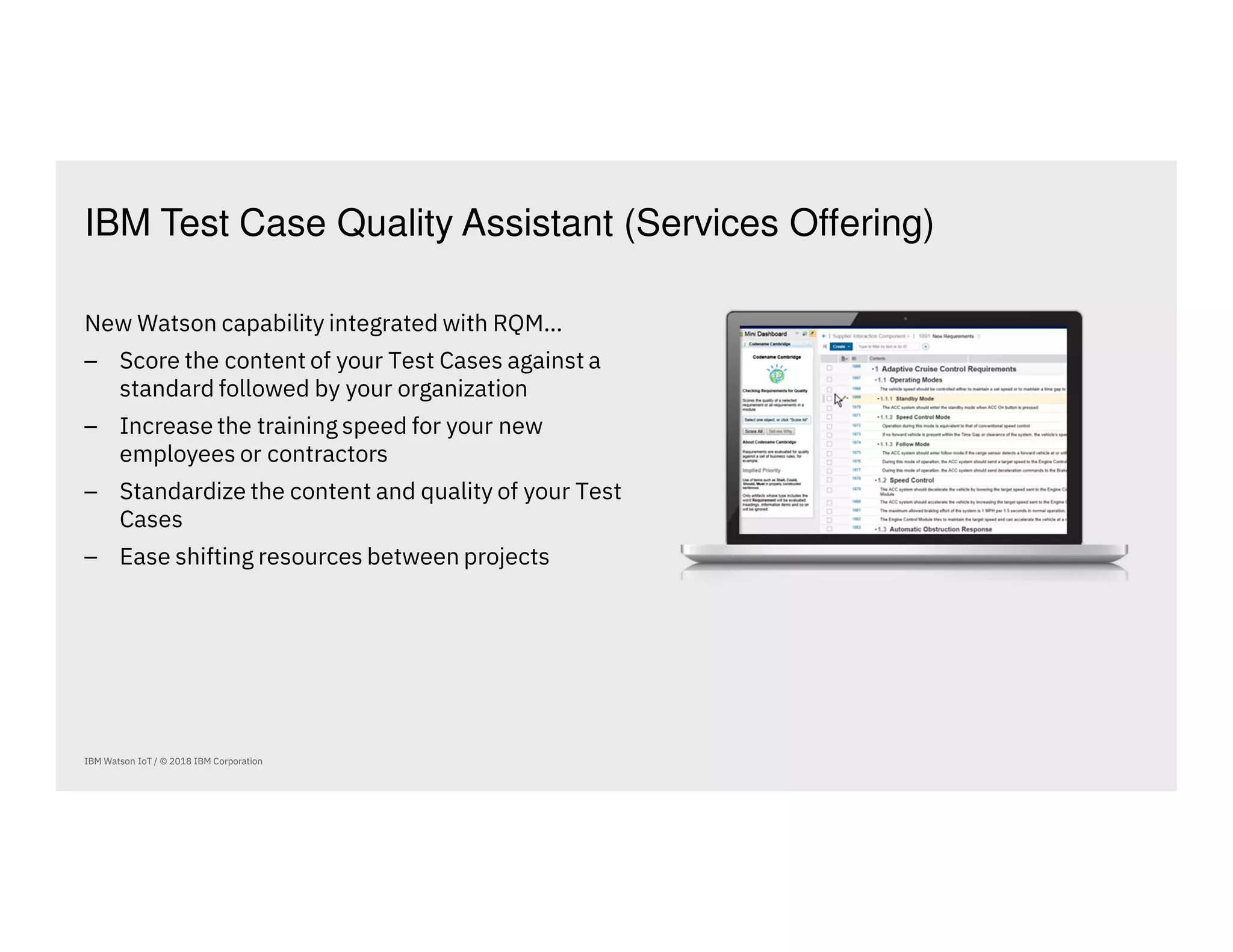
IBM Test Case Quality Assistant (Services Offering)
IBM Watson IoT / © 2018 IBM Corporation
New Watson capability integrated with RQM…
⎯ Score the content of your Test Cases against a
standard followed by your organization
⎯ Increase the training speed for your new
employees or contractors
⎯ Standardize the content and quality of your Test
Cases
⎯ Ease shifting resources between projects
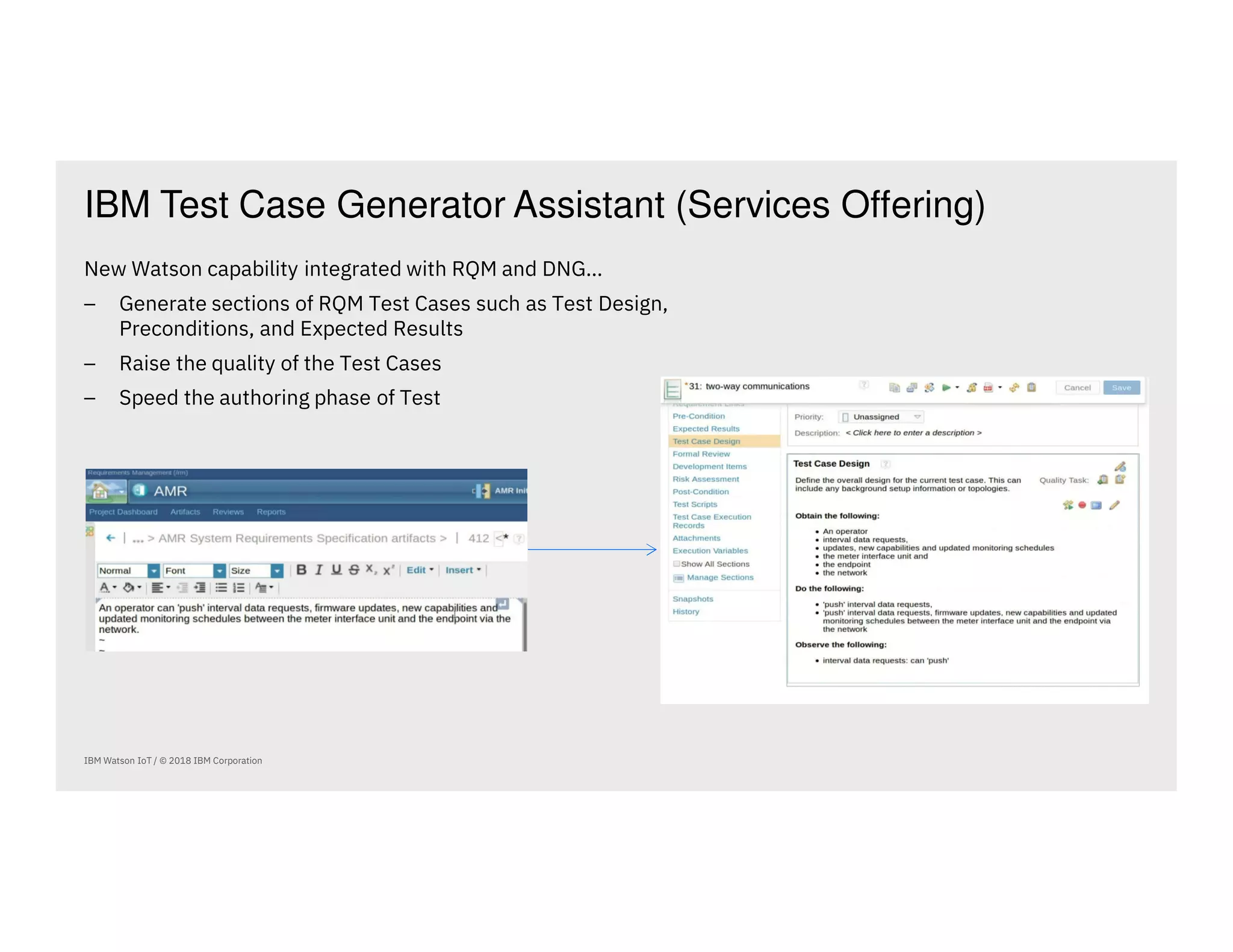
IBM Test Case Generator Assistant (Services Offering)
IBM Watson IoT / © 2018 IBM Corporation
New Watson capability integrated with RQM and DNG…
⎯ Generate sections of RQM Test Cases such as Test Design,
Preconditions, and Expected Results
⎯ Raise the quality of the Test Cases
⎯ Speed the authoring phase of Test
AI is the application of knowledge
Capacity and
ability to adapt
TIME
RATE
Knowledge
and capability
Data increasing
IBM Watson IoT / © 2018 IBM Corporation
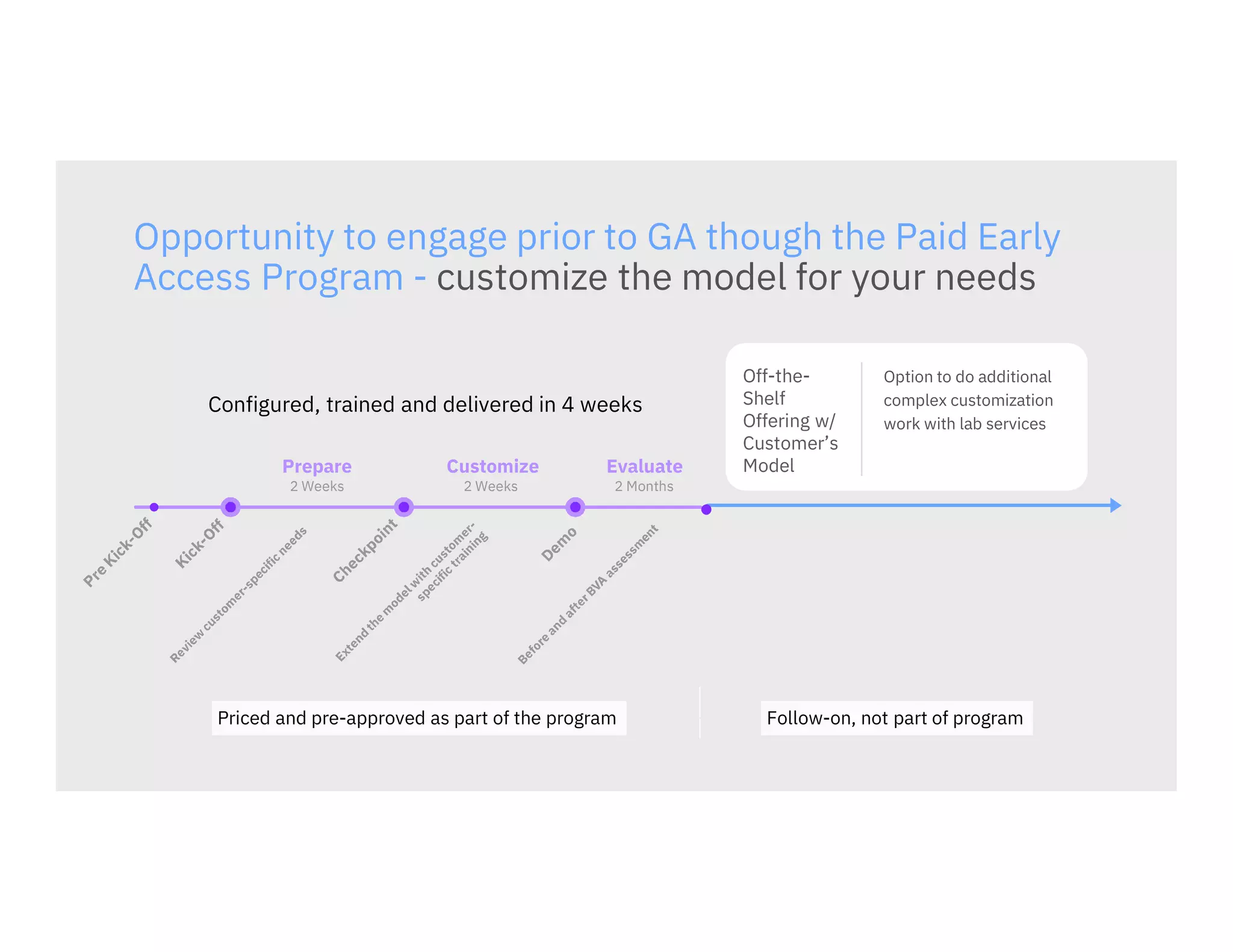
Opportunity to engage prior to GA though the Paid Early
Access Program - customize the model for your needs
Evaluate
2 Weeks 2 Weeks 2 Months
Prepare Customize
Configured, trained and delivered in 4 weeks
Off-the-
Shelf
Offering w/
Customer’s
Model
Priced and pre-approved as part of the program Follow-on, not part of program
Option to do additional
complex customization
work with lab services
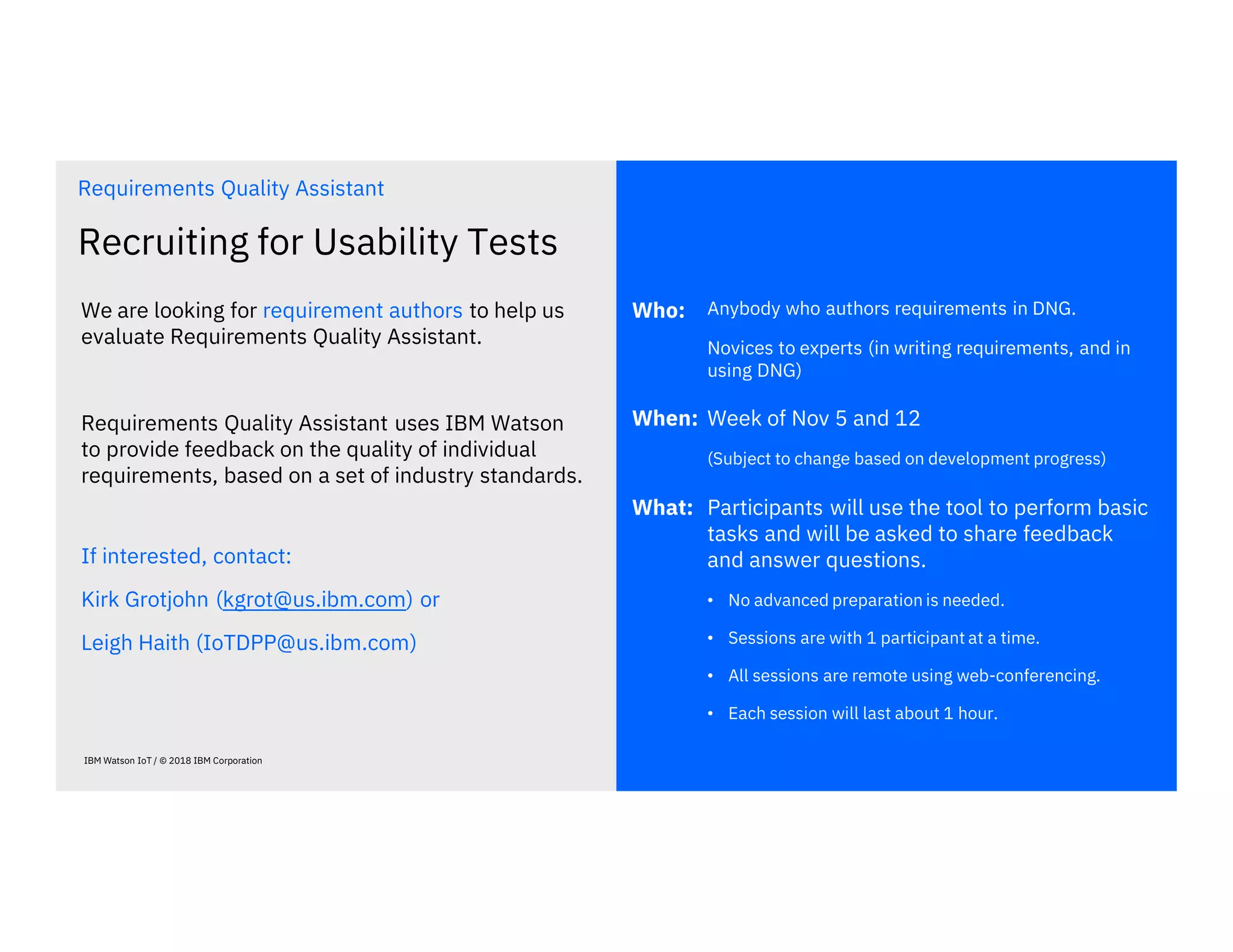
Recruiting for Usability Tests
Anybody who authors requirements in DNG.
Novices to experts (in writing requirements, and in
using DNG)
We are looking for requirement authors to help us
evaluate Requirements Quality Assistant.
Requirements Quality Assistant uses IBM Watson
to provide feedback on the quality of individual
requirements, based on a set of industry standards.
IBM Watson IoT / © 2018 IBM Corporation
Requirements Quality Assistant
Who:
Week of Nov 5 and 12
(Subject to change based on development progress)
When:
Participants will use the tool to perform basic
tasks and will be asked to share feedback
and answer questions.
• No advanced preparation is needed.
• Sessions are with 1 participant at a time.
• All sessions are remote using web-conferencing.
• Each session will last about 1 hour.
What:
If interested, contact:
Kirk Grotjohn (kgrot@us.ibm.com) or
Leigh Haith (IoTDPP@us.ibm.com)
Find out more at
the AE Summit
IBM Watson IoT / © 2018 IBM Corporation
Room Calvert Tuesday - 13:15 – 14:30
Using Cognitive Computing to Elevate Requirements
Quality and Auto-generate Test Cases
Room Capitol Wednesday – 11:15 AM to 11:45 AM
Technical deep dive on near term applications of AI
to engineering
Room Capitol Wednesday – 1:15 PM to 1:45 PM
Technologies and use cases for applying AI to
accelerate engineering processes
Room Capitol Wednesday - 2PM - 2:45 PM
Examining Opportunities to Apply AI to Engineering
IBM Watson IoT / © 2018 IBM Corporation

2018 ibm agile engineering summit - spotlight presentation

  • 1.
    IBM Watson IoT/ © 2018 IBM Corporation What if you could have your own expert systems engineering assistant? — Stella Liu, Offering Management Kevin McHugh, Services Lead
  • 2.
    Agenda – IBM Watson IoT/ © 2018 IBM Corporation Lessons from the Renaissance The Principal Engineer’s Modern Dilemma Hiring Watson Applying Watson to Engineering
  • 3.
    IBM Watson IoT/ © 2018 IBM Corporation
  • 4.
    IBM Watson IoT/ © 2018 IBM Corporation
  • 5.
    IBM Watson IoT/ © 2018 IBM Corporation
  • 6.
    IBM Watson IoT/ © 2018 IBM Corporation
  • 7.
    IBM Watson IoT/ © 2018 IBM Corporation
  • 8.
    IBM Watson IoT/ © 2018 IBM Corporation
  • 9.
    IBM Watson IoT/ © 2018 IBM Corporation
  • 10.
    IBM Watson IoT/ © 2018 IBM Corporation Leonardo da Vinci [Public domain], via Wikimedia Commons
  • 11.
    IBM Watson IoT/ © 2018 IBM Corporation
  • 12.
    IBM Watson IoT/ © 2018 IBM Corporation
  • 13.
    IBM Watson IoT/ © 2018 IBM Corporation
  • 14.
    IBM Watson IoT/ © 2018 IBM Corporation
  • 15.
    IBM Watson IoT/ © 2018 IBM Corporation Automotive 1M Lines of code in new Ford F-150 Truck from 155K in 2003 40% of total IT Budget spent on QA and testing by 2019 90% of F-35 fighter jet functionality is software driven Electronics 12M lines of code in mobile phone 1.4M lines of code in robotic surgical system The need to keep up is more critical than ever as product development increases in complexity Aerospace and Defense
  • 16.
    Engineering knowledge has becomebig data Data increasing Capacity and ability to learn and adapt TIME RATE IBM Watson IoT / © 2018 IBM Corporation
  • 17.
    IBM Watson IoT/ © 2018 IBM Corporation Principal Engineer Job Description • Leads teams of engineers on a variety of projects • Mentors junior and senior engineers • Understands all components in a system • Ensures each component behaves as required and interacts properly • Applies knowledge and principles to create innovative solutions Minimum of 12 years of engineering experience… Minimum of 10 years industry experience…
  • 18.
    What we expect… IBMWatson IoT / © 2018 IBM Corporation Expert in their engineering field Expert at engineering Expert with requirements, Design, Test, Change Control etc. etc. Share and apply experiences with others Pass on knowledge to next generation of engineers Understands the big picture Understands the tiniest detail Tireless Consistent accuracy Ensure all teams adhere to various standards and regulations Do everything
  • 19.
    Be everywhere IBM WatsonIoT / © 2018 IBM Corporation
  • 20.
    0 100 200 300 400 500 600 700 800 Cost of beingimperfect… we all are IBM Watson IoT / © 2018 IBM Corporation RelativeCosttoRepair The cost to fix software defects rises exponentially with each successive phase of the project life cycle (2004) NASA Publication Design Build Test Operations 700 49 12 52 Requirements
  • 21.
    IBM Watson IoT/ © 2018 IBM Corporation But we know it’s not possible
  • 22.
    AI is theapplication of knowledge Capacity and ability to adapt TIME RATE Knowledge and capability Data increasing IBM Watson IoT / © 2018 IBM Corporation
  • 23.
    IBM Watson IoT/ © 2018 IBM Corporation Let’s hire Watson
  • 24.
    AI contrasted withthe human mind IBM Watson IoT / © 2018 IBM Corporation
  • 25.
    IBM Watson IoT/ © 2018 IBM Corporation AI contrasted with the human mind
  • 26.
    IBM Watson IoT/ © 2018 IBM Corporation AI contrasted with the human mind
  • 27.
    IBM Watson IoT/ © 2018 IBM Corporation AI contrasted with the human mind
  • 28.
    When do yourengineers have to cope with massive amounts of information? IBM Watson IoT / © 2018 IBM Corporation
  • 29.
    What tasks doyour engineers have to do today that are manual, consistent and repetitive? IBM Watson IoT / © 2018 IBM Corporation
  • 30.
    Where are theregaps of knowledge in your organization? IBM Watson IoT / © 2018 IBM Corporation
  • 31.
    IBM Watson IoT/ © 2018 IBM Corporation Who are the users? And their intents?
  • 32.
    IBM Watson IoT/ © 2018 IBM Corporation What data do they use to make decisions?
  • 33.
    IBM Watson IoT/ © 2018 IBM Corporation What AI models should we use to process that information?
  • 34.
    IBM Watson VisualRecognition • Shortens the claims cycle for certain damage assessments by more than 95% • Enriches client experience through personalized conversation flows and real- time answers • Enables damage assessment advisors to focus on more complex damage claims Solution: Autoglass built the world’s first automated vehicle body damage assessment and quote generation system. Using the IBM Watson Visual Recognition service, the system analyzes the photos that customers upload when they submit a body damage claim, applying the same classification logic as Belron’s highly experienced damage assessment advisors. “We’re able to automate nearly half of our body damage claims assessments using image recognition technology, and we expect that rate to get even higher.” —Dafydd Hughes, IT Manager at Autoglass BodyRepair IBM Watson IoT / © 2018 IBM Corporation
  • 35.
    - IBM WatsonKnowledge Studio - IBM Watson Discovery - IBM Watson Assistant - IBM Watson Explorer - IBM Cloud • 38,000 Woodside documents were used to train the solution — this would take a human over five years to read • 30 years of practical engineer experience at the fingertips of all Woodside employees • 75% decrease in time employees spend searching for expert knowledge Solution:::: Working with Watson, Woodside Energy built a customized tool that allows its employees to find detailed answers to highly specific questions—even on remote oil and gas facilities. “It’s helped our engineers get up to speed very quickly on what has already been done and how the projects were managed in the past. We can learn from the past and there’s no need to reinvent the wheel.” — Caitlin Bushell, Graduate Process Engineer at Woodside IBM Watson IoT / © 2018 IBM Corporation
  • 36.
    IBM Watson IoT/ © 2018 IBM Corporation
  • 37.
    IBM Watson IoT/ © 2018 IBM Corporation Our approach… Watson Services Customer Solution + +? ?
  • 38.
    IBM Watson IoT/ © 2018 IBM Corporation Our approach… Pre-train Watson for you Watson Services Customer Solution + +? ? Watson Services AI for Engineering Offering Architecture and pre-built assets Public Domain Data + +
  • 39.
    Market Analytics System V & V System Test System Requirements System Design Deployor Release to Mfg Customer Requirements Operations and Maintenance Implementation Electrical / Electronics Design Mechanical Design Lean Software Engineering Continuous Engineering Component test Component Design The vision: Watson will be embedded inside engineering workflows… Project Cambridge: Requirements Quality Analysis Intelligent Code Re-Use Test Case Quality Analysis Automatic Model Generation from Unstructured Data Defect Prediction
  • 40.
    Increased complexity ofproduct development and impact on requirements management: scale, compliance and multiple stakeholders Increasing presence of software Inter-disciplinary Increasing complexity Smarter products and systems 10 million lines of code in GM Volt Mars Rover Curiosity had 16000+ requirements Multiple vendors and supply chain contractors Smarter Products & Systems Complex Requirements Increased number of stakeholders Increased compliance and regulatory requirements Effective requirements management Collaboration Across the Value Chain
  • 41.
    IBM Requirements QualityAssistant IBM Watson IoT / © 2018 IBM Corporation New Watson capability embedded inside DNG and DOORS… ⎯ Removes risk and ambiguity in the requirements authoring phase out-of-the-box by using AI (Watson Natural Language Understanding ⎯ Pre-trained to detect key quality indicators designed to be consistent with the INCOSE Guidelines for Writing Good Requirements ⎯ Authors receive coaching from Watson to improve the quality of the requirement as it is being written Enterprise benefits (400 engineers example) ⎯ Reduce the cost of defects by 60% to save $3.9M ⎯ Reduce cost of manual reviews by 25% ⎯ Retain engineering expertise for junior engineers
  • 42.
    The subject ofa requirement statement must to be appropriate to the level to which it refers. Requirements referring to the business level therefore have the form “The <business> shall ...”; those referring to the stakeholder level have the form “The <stakeholder> shall ...”; those referring to the system level have the form “The <system> shall ...”; requirements referring to the subsystem level have the form “The <subsystem> shall ...”; and requirements referring to the component level have the form “The <component> shall ...”. As a general rule, requirements stated at a particular level should refer only to that level—that is, the business requirements refer to the business level, stakeholder requirements refer to the stakeholder level, system requirements refer to the system level, subsystem requirements refer to the subsystem level, and component requirements refer to the component level. In some cases, however, a higher level may wish to be prescriptive at a lower level. For example, it may be important for a business to mandate that the new aircraft under development must utilize a particular engine (perhaps for support reasons) in which case they may make a statement at the business level that refers to an entity at the subsystem level, Therefore, any level of the organization can state (at that level) requirements that refer to two levels: to that level, as well any lower level (should there be a good reason to do so). Consequently, regardless of the level at which the requirement is stated, the subject of a requirement statement must be appropriate to the level to which it refers. To continue our aircraft example above, although the majority of requirements at the business level will begin with “ACME Aircraft Company shall ...”, the business may therefore wish to state at the business level a requirement referring to the subsystem level regarding the engine “The Engine shall ...”. Similarly, the verb of a requirement statement must be appropriate to the subject of the requirement at the level it is stated. Requirements with the verbs “safe”, “support”, “process”, “handle”, “track”, “manage”, “Áag”, etc. are too vague and thus ambiguous and unveriÀable unless these functions are decomposed into speciÀc sub-functions that are intended by the writer. At the business level, for example, the use of a verb such as “safe”, may be acceptable as long as it is unambiguous at that level, decomposed at the lower levels, and is veriÀable at the level stated. Unacceptable system requirement: “The User shall ..........” {This is unacceptable because the requirement should be on the system, not the user or operator of the system. This wording is often the result of writing requirements directly from user stories, without doing the transformation of the user need into a system requirement. Ask, what does the system have to do so that the user need can be achieved?} A set of requirements that has been documented, agreed-to, and baselined at one level will Áow down to the next level as shown in Figure 1. At each level, the requirements are a result of the transformation process of the needs at that level as well a result of the elaboration (decomposition and/or derivation) of the requirements from the previous level. As such, SyRS or SyRD requirements are either decomposed from (that is, made explicit) or derived from (that is, implied) by the requirements of the system OpsCon and StRS or StRD. Consequently, several systems, each described by the system OpsCon and SyRS, may be deÀned to meet the capability required by the StRS. The same is true at the subsystem level, where the subsystem requirements may be either decomposed or derived from the subsystem OpsCon and SyRS or SyRD. In all cases, for each level shown in Figure 1, the set of requirements can be traced back to the needs from which they were transformed as well as the requirements at the previous level from which they were either decomposed or derived. How requirements are expressed differs through these levels and, therefore, so do the rules for expressing them. As requirements are developed - and solutions designed - down through the levels of abstraction, we expect requirement statements to become more and more speciÀc. At the highest, governance level, the ideal requirement is not speciÀc to a particular solution, and permits a range of possible implementations or solutions. It is important to note that the form of requirements at one level may not be appropriate for another level. For example, at the business management level, there may be a requirement that all products shall be “safe” or of the “highest quality” or projects shall develop products using “best practices” deÀned by organizations like INCOSE, Project Management Institute (PMI), or Capability Maturity Model Integrated (CMMI). At the business management level, they may deÀne process requirements for implementing some capability level of Model Based Systems Engineering (MBSE) or Agile. While these are poor system level requirements, it is appropriate for the Business Management level. At the system level, more speciÀc safety and quality requirements will be developed for that speciÀc system. These requirements will then be allocated to the system elements at the next lower level. The Programs or Projects responsible for developing the systems will develop speciÀc requirements for how they will implement the management and systems engineering process requirements deÀned IBM Watson IoT / © 2018 IBM Corporation
  • 43.
    IBM Watson IoT/ © 2018 IBM Corporation
  • 44.
    IBM Watson IoT/ © 2018 IBM Corporation ⎯ Grades requirements against a criteria that was designed to be consistent with the INCOSE Guidelines for Writing Good Requirements ⎯ Pre-trained to detect 10 quality issues ⎯ Unclear actor or user ⎯ Compound requirement ⎯ Negative requirements ⎯ Escape clause ⎯ Missing units ⎯ Missing tolerances ⎯ Ambiguity ⎯ Passive ⎯ Incomplete requirements ⎯ Unspecific quantities
  • 45.
    IBM Watson IoT/ © 2018 IBM Corporation - Identifies exactly what’s wrong with the requirement - Displays the issue to the requirements engineer
  • 46.
    IBM Watson IoT/ © 2018 IBM Corporation ⎯ Learns from the requirements engineer ⎯ Becomes “smarter” over time
  • 47.
    IBM Test CaseQuality Assistant (Services Offering) IBM Watson IoT / © 2018 IBM Corporation New Watson capability integrated with RQM… ⎯ Score the content of your Test Cases against a standard followed by your organization ⎯ Increase the training speed for your new employees or contractors ⎯ Standardize the content and quality of your Test Cases ⎯ Ease shifting resources between projects
  • 48.
    IBM Test CaseGenerator Assistant (Services Offering) IBM Watson IoT / © 2018 IBM Corporation New Watson capability integrated with RQM and DNG… ⎯ Generate sections of RQM Test Cases such as Test Design, Preconditions, and Expected Results ⎯ Raise the quality of the Test Cases ⎯ Speed the authoring phase of Test
  • 49.
    AI is theapplication of knowledge Capacity and ability to adapt TIME RATE Knowledge and capability Data increasing IBM Watson IoT / © 2018 IBM Corporation
  • 50.
    Opportunity to engageprior to GA though the Paid Early Access Program - customize the model for your needs Evaluate 2 Weeks 2 Weeks 2 Months Prepare Customize Configured, trained and delivered in 4 weeks Off-the- Shelf Offering w/ Customer’s Model Priced and pre-approved as part of the program Follow-on, not part of program Option to do additional complex customization work with lab services
  • 51.
    Recruiting for UsabilityTests Anybody who authors requirements in DNG. Novices to experts (in writing requirements, and in using DNG) We are looking for requirement authors to help us evaluate Requirements Quality Assistant. Requirements Quality Assistant uses IBM Watson to provide feedback on the quality of individual requirements, based on a set of industry standards. IBM Watson IoT / © 2018 IBM Corporation Requirements Quality Assistant Who: Week of Nov 5 and 12 (Subject to change based on development progress) When: Participants will use the tool to perform basic tasks and will be asked to share feedback and answer questions. • No advanced preparation is needed. • Sessions are with 1 participant at a time. • All sessions are remote using web-conferencing. • Each session will last about 1 hour. What: If interested, contact: Kirk Grotjohn (kgrot@us.ibm.com) or Leigh Haith (IoTDPP@us.ibm.com)
  • 52.
    Find out moreat the AE Summit IBM Watson IoT / © 2018 IBM Corporation Room Calvert Tuesday - 13:15 – 14:30 Using Cognitive Computing to Elevate Requirements Quality and Auto-generate Test Cases Room Capitol Wednesday – 11:15 AM to 11:45 AM Technical deep dive on near term applications of AI to engineering Room Capitol Wednesday – 1:15 PM to 1:45 PM Technologies and use cases for applying AI to accelerate engineering processes Room Capitol Wednesday - 2PM - 2:45 PM Examining Opportunities to Apply AI to Engineering
  • 53.
    IBM Watson IoT/ © 2018 IBM Corporation