OCTOBER19,2016
DESCRIPTION
EXCERPT
DETAILS
CREDITS
SAMPLE SPREADS
02
07
08
09
10
Press Contacts
Annie Eby
Morphosis
a.eby@morphosis.net
208.201.4381
Asma Mahdi
UCLA Sustainable LA Grand Challenge
amahdi@conet.ucla.edu
310.794.5705
1
The Now Institute
A VISIONARY LOOK AT LOS ANGELES’
SUSTAINABLE FUTURE
Press Kit
Two new publications from Thom Mayne
of The Now Institute at UCLA explore a
sustainable future for Los Angeles in 2050, as
the county is expected to welcome 1.5 million
more people. These reports mark the first
visual attempt at imagining what the future
might look like in the nation’s second largest
city.
The publications, entitled 100% Sustainable:
Strategies for 2050 Renewable Energy,
Local Water, and Ecosystem Health
in Los Angeles and 99% Preservation,
1% Densification: A Case for 2050
Sustainability Through a Denser, More
Connected Los Angeles, were developed by
Pritzker Architecture Prize-winning architect
and UCLA Distinguished Professor, Thom
Mayne, and The Now Institute to address
and conceptualize the energy, water, and
ecosystem goals laid out by the UCLA
Sustainable LA Grand Challenge in light of a
growing population.
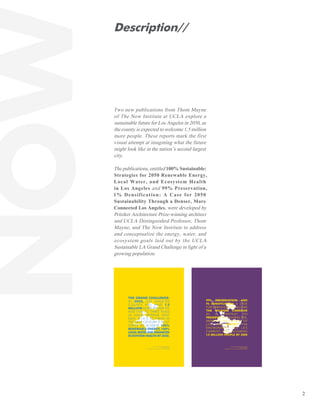
UCLA Sustainable LA Grand Challenge
The NOW Institute
UCLA Department of Architecture and Urban Design
THE GRAND CHALLENGE:
IN 2050, LOS ANGELES
COUNTY WILL HAVE 1.5
MILLION MORE RESIDENTS
AND TWO TO THREE TIMES
AS MANY EXTREME HEAT
DAYS. IF LA IS TO THRIVE IN
THE NEXT CENTURY IT MUST
STRIVE TO ACHIEVE 100%
RENEWABLE ENERGY, 100%
LOCALWATERANDENHANCED
ECOSYSTEM HEALTH BY 2050.
2
Description//
UCLA Sustainable LA Grand Challenge
The NOW Institute
UCLA Department of Architecture and Urban Design
99% PRESERVATION AND
1% DENSIFICATION: A CASE
FORURBANDENSITYALONG
THE WILSHIRE CORRIDOR
AS A STRATEGY TO
PRESERVETHE CHARACTER,
IMPROVE THE QUALITY OF
LIFE, AND PROTECT THE
ENVIRONMENT FOR LA’S
CURRENT AND INCOMING
1.5 MILLION PEOPLE BY 2050
The greater Los Angeles region holds nearly
half of the state’s population and makes up
the third largest metropolitan economy in
the world. The effort put forward in these
publications is twofold: The first publication
evaluatestheSustainableLAGrandChallenge
goals to achieve 100% renewable energy,
100% locally sourced water and enhanced
ecosystem and human health for Los Angeles
County by 2050. The second analyzes
the viability of three distinct urban growth
scenarios, with a full demonstration study of
a scenario which preserves 99% of LA County
by densifying 1% of land and measures the
impactofdensificationonfuturesustainability.
By 2050, the County of Los Angeles is
projected to increase in population by 1.5
million people. Historically, conventional
approaches to accommodating growth in LA
County have included developing suburban
communities at further distances from the
urban core. Although The Now Institute
has analyzed potential growth scenarios
that include greater urbanization in the less
developed northern LA County, they opted
to focus on a scenario that accommodated
projected growth while maintaining the
County’s neighborhood integrity over the
largest area feasible. “By densifying just 1%
of the County along the Wilshire Corridor
at a density lower than Manhattan’s, we can
preserve 99% of LA’s classic urban texture
and natural landscape,” noted Mayne.
3
24
DENSIFYING ONLY 1%
24
DENSIFYING ONLY 1% TO SUSTAIN 99% OF LA LIFESTYLE
4
Despite the presence of numerous highly
dense cities and communities, Los Angeles
is infamous for its urban-sprawl approach to
population adaptation. As part of the UCLA
Sustainable LA Grand Challenge, The NOW
Institute study includes a proposal to extend
the purple Metro line and provide a high
density, interconnected, urban community
along Los Angeles’ iconic Wilshire Corridor.
In response to a potential 15% population
increase, The Now Institute advocates
for limiting the expansion of a suburban
residential development beyond the current
urbanized footprint with a densification
strategy that protects 99% of the region’s
existing single family residential fabric
by densifying less than 1% of County land,
primarily along Wilshire Boulevard.
Connecting three cities and 13 neighborhoods,
the Wilshire Corridor is a microcosm of the
cultural, economic, and physical diversity of
Los Angeles. The corridor is an ideal “urban
laboratory” for studying the interrelationship
of density, demographics, transit, and access
to resources in the city, and for exploring
various planning scenarios that respond to and
accommodate anticipated population growth,
while encouraging positive transformation in
termsofwalkability,safety,andenvironmental
responsibility. By analyzing Wilshire
Boulevard in comparison to significant streets
in other global metropolises – including
Barcelona’s Avenue Diagonal and New
York’s Broadway – the study examines real-
world responses to growth and transformation
that could offer alternative, more sustainable
strategies for Los Angeles.
5
As new research pushes forward to inform
current models, The Now Institute recognizes
that these scenarios can and will change.
These publications are living documents and
a first step in a process towards building a
Sustainable LA.
Mayne is presenting these publications for
the first time on a panel discussion with
city and state leaders focused on visions
for a sustainable future for Los Angeles at
UCLA’s Earth Now: Earth 2050 symposium
on Wednesday, October 19.
6
“Thom Mayne and The Now Institute have
provided a provocative vision for what a
sustainable Los Angeles could look like. My
hope is that it leads to meaningful dialogue
on what we [Los Angeles] can become in the
future.”
- Mark Gold,
Associate Vice
Chancellor for
Environment and
Sustainability at
UCLA
Excerpt//
7
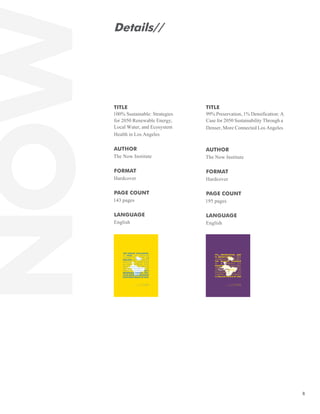
TITLE
100% Sustainable: Strategies
for 2050 Renewable Energy,
Local Water, and Ecosystem
Health in Los Angeles
AUTHOR
The Now Institute
FORMAT
Hardcover
PAGE COUNT
143 pages
LANGUAGE
English
TITLE
99% Preservation, 1% Densification: A
Casefor2050SustainabilityThrough a
Denser, More Connected Los Angeles
AUTHOR
The Now Institute
FORMAT
Hardcover
PAGE COUNT
195 pages
LANGUAGE
English
UCLA Sustainable LA Grand Challenge
The NOW Institute
UCLA Department of Architecture and Urban Design
THE GRAND CHALLENGE:
IN 2050, LOS ANGELES
COUNTY WILL HAVE 1.5
MILLION MORE RESIDENTS
AND TWO TO THREE TIMES
AS MANY EXTREME HEAT
DAYS. IF LA IS TO THRIVE IN
THE NEXT CENTURY IT MUST
STRIVE TO ACHIEVE 100%
RENEWABLE ENERGY, 100%
LOCALWATERANDENHANCED
ECOSYSTEM HEALTH BY 2050.
UCLA Sustainable LA Grand Challenge
The NOW Institute
UCLA Department of Architecture and Urban Design
99% PRESERVATION AND
1% DENSIFICATION: A CASE
FORURBANDENSITYALONG
THE WILSHIRE CORRIDOR
AS A STRATEGY TO
PRESERVETHE CHARACTER,
IMPROVE THE QUALITY OF
LIFE, AND PROTECT THE
ENVIRONMENT FOR LA’S
CURRENT AND INCOMING
1.5 MILLION PEOPLE BY 2050
8
Details//
Executive Editor
Thom Mayne, Founder, The NOW
Institute
Senior Editor
Eui-Sung Yi, Director, The NOW
Institute
Research Editor
Annie Eby
Publication Editor
Ryan A. Doyle
Cartographic Editor
Cagdas Delen
Graphic Editor
Beyza Paksoy
Graphic Assistant
Lily Bakhshi
Research Assistant
Julie LeRenard
Executive Editor
Thom Mayne, Founder, The NOW
Institute
Senior Editor
Eui-Sung Yi, Director, The NOW
Institute
Research Editor
Annie Eby
Ryan A. Doyle
Publication Editor
Beyza Paksoy
Cartographic Editor
Cagdas Delen
Graphic Editor
Beyza Paksoy
Graphic Assistant
Lily Bakhshi
Research Assistant
Julie LeRenard
UCLA Sustainable LA Grand Challenge
The NOW Institute
UCLA Department of Architecture and Urban Design
THE GRAND CHALLENGE:
IN 2050, LOS ANGELES
COUNTY WILL HAVE 1.5
MILLION MORE RESIDENTS
AND TWO TO THREE TIMES
AS MANY EXTREME HEAT
DAYS. IF LA IS TO THRIVE IN
THE NEXT CENTURY IT MUST
STRIVE TO ACHIEVE 100%
RENEWABLE ENERGY, 100%
LOCALWATERANDENHANCED
ECOSYSTEM HEALTH BY 2050.
UCLA Sustainable LA Grand Challenge
The NOW Institute
UCLA Department of Architecture and Urban Design
99% PRESERVATION AND
1% DENSIFICATION: A CASE
FORURBANDENSITYALONG
THE WILSHIRE CORRIDOR
AS A STRATEGY TO
PRESERVETHE CHARACTER,
IMPROVE THE QUALITY OF
LIFE, AND PROTECT THE
ENVIRONMENT FOR LA’S
CURRENT AND INCOMING
1.5 MILLION PEOPLE BY 2050
9
Credits//
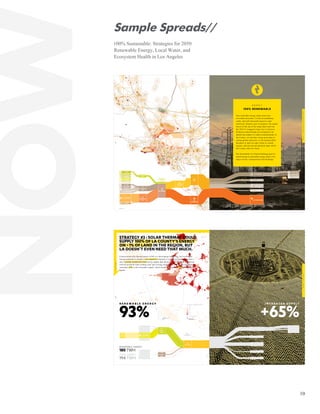
Sample Spreads//
100% Sustainable: Strategies for 2050
Renewable Energy, Local Water, and
Ecosystem Health in Los Angeles
10
F
0 10
Miles
14% SINGLE FAMILY
5% MULTI FAMILY
1% CONDOMINIUM
20% RESIDENTIAL
18% INDUSTRIAL AND
INSTITUTIONAL
10.5% COMMERCIAL
3% OTHER
48.5% TRANSPORTATION
51.5% GASOLINE
4.5% DIESELD
6.5% COAL
3% NUCLEAR
11% NATURAL GAS
13.5% UNSPECIFIED
5% WIND
3% GEOTHERMAL
1% BIOMASS
0.4% SOLAR
0.4% HYDRO
56%
NON-RENEWABLE
FUEL
34%
NON-RENEWABLE
ENERGY
10% RENEWABLE
ENERGY
10% RENEWABLE
ENERGY
90%
TOTAL
NON- RENEWABLE
36%
GRID SOURCES
BY UTILITY
2.8%
18.5%
UNACCOUNTED FOR GRID
44.5%
TRANSPORTATION
54.5%
BUILT
32 Non-renewable energy means more non-
reversible emissions. LA has an immediate,
costly, and self-interested reason to curb
emissions. Despite years of progress, the region
hovers at the top of the smog charts and was
the 2015 #1 smoggiest large city in America.
Pollution-related deaths are estimated to be
double the number of vehicle-related deaths in
the County. LA also has a long-term stake in
cutting global emissions, as the heating effect
threatens to melt ice-caps, flood its coastal
regions, and prevent precipitation upon which
the County relies for water.
The Sustainable LA Grand Challenge goal of
transitioning to renewable energy affects two
major sectors: transportation and buildings.
energy:transportation&buildings
s u p p l y d e m a n d
e n e r g y
100% RENEWABLE
Average Direct N ormal Solar I rradiance
≤6. 2
≤7.0
≤7.6
≤8.0
≤8.8
Cou n ty B ou n d ar y
F
0 10
Miles
23% SINGLE FAMILY
8.5% MULTI FAMILY
2% CONDOMINIUM
33.5% RESIDENTIAL
30.5% INDUSTRIAL AND
INSTITUTIONAL
17.5% COMMERCIAL
13.5% TRANSPORTATION
5% OTHER
1.5% COAL
0.5% NUCLEAR
2.5% NATURAL GAS
3% UNSPECIFIED
8.5% WIND
5.5% GEOTHERMAL
2% BIOMASS
0.8% HYDRO
74% CSP
2% PV
76% SOLAR
7.5%
NON-RENEWABLE
ENERGY
92.5%
RENEWABLE
ENERGY
66%
GRID ENERGY
34%
UNACCOUNTED FOR GRID
48
energy:buildings
STRATEGY #3 : SOLAR THERMAL COULD
SUPPLY 100% OF LA COUNTY’S ENERGY
ON < 1% OF LAND IN THE REGION, BUT
LA DOESN’T EVEN NEED THAT MUCH.
Concentrated solar thermal power (CSP) is a developing technology, but its thermal
storage potential is already a less expensive alternative to batteries and can provide a
more constant around-the-clock power supply than photovoltaics and wind. Combined
with the potential from rooftop solar and existing renewables, CSP would only need to
contribute 65% to the renewable supply, which would only require 0.4% of land in the
region.
s u p p l y i n c r e a s e d
top-down
R E N E W A B L E E N E R G Y
93%
I N C R E A S E D S U P P LY
+65%
RENEWABLE ENERGY
180 TWH
TOTAL ENERGY
194 TWH
11
Storm water Catch m en t Areas
Rainfal l I ntensity
50 years 24 hours
2.6 - 6.6
6.7 - 8.8
8.9 - 11. 2
11.3 - 13.6
13.7 - 16.0
PumpStation
OpenChannel
N aturalDrainage
Cou n ty B ou n d ar y
F
0 10
Miles
27% CALIFORNIA AQUEDUCT
21% COLORADO RIVER AQUEDUCT
5% LA AQUEDUCT
22% STORM WATER CAPTURE
22% NATURAL RECHARGE
3% RECYCLED WATER
44% GROUND WATER
47% LOCAL
53% IMPORTED
20% OUTDOOR
43% INDOOR
35% SINGLE FAMILY
28% MULTI FAMILY
63% RESIDENTIAL
3% INDUSTRIAL
7% INSTITUTIONAL
18% COMMERCIAL
9% OTHER
22% STORM WATER CAPTURE
44% GROUND WATER
47% LOCAL
53% IMPORTED
58
water
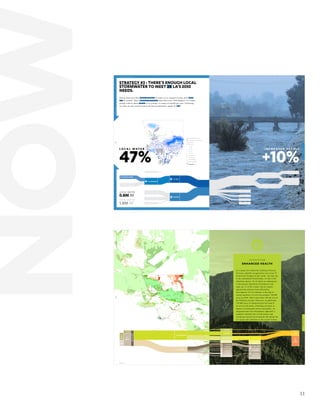
STRATEGY #3 : THERE’S ENOUGH LOCAL
STORMWATER TO MEET 2X LA’S 2050
NEEDS.
Storms drop more than 253,000 acre-feet of water in Los Angeles County after every
inch of rainfall. That’s 3.8 million acre-feet, more than twice 2050 demand. LA County
already collects about an inch of its average 15 inches of rainfall per year. Collecting
less than an inch would increase the local groundwater supply by 10%
s u p p l y i n c r e a s e d
top-down
s u p p l y i n c r e a s e d
bottom-up
L O C A L W AT E R
47%
I N C R E A S E D S U P P LY
+10%
LOCAL WATER
0.8M AF
TOTAL WATER
1.8M AF
F
0 10
Miles
66%
NOT
PROTECTED
34%
PROTECTED
0.06% MIXED USE
0.65% HARBORS - MARINAS
2.2% MILITARY
2.5% OTHER
13% SINGLE FAMILY
2% MULTI FAMILY
2% OTHER
25.5% REGIONAL PARKS
0.4% LOCAL PARKS
3% INDUSTRIAL
8.5% ROADS
4% INSTITUTIONAL
4% COMMERCIAL
17.5% RESIDENTAL
3% OTHER
28.5% OPEN SPACE
3% AGRICULTURE
3.5% OTHER
25.5% VACANT
40% DEVELOPED
60% NON-DEVELOPED
66%
NOT
PROTECTED
34%
PROTECTED
0.06% MIXED USE
0.65% HARBORS - MARINAS
2.2% MILITARY
2.5% OTHER
13% SINGLE FAMILY
2% MULTI FAMILY
2% OTHER
25.5% REGIONAL PARKS
0.4% LOCAL PARKS
3% INDUSTRIAL
8.5% ROADS
4% INSTITUTIONAL
4% COMMERCIAL
17.5% RESIDENTAL
3% OTHER
28.5% OPEN SPACE
3% AGRICULTURE
3.5% OTHER
25.5% VACANT
40% DEVELOPED
60% NON-DEVELOPED
3% ISLANDS
%46
URBAN
%51
NON
URBAN 97%
MAINLAND
100%TOTALLAND
66
ecosystem
LA County lies within the California Floristic
Province, globally recognized as one of just 35
biodiversity hotspots in the world - the only one
in the continental United States. LA has 4,346
identified species, 92 of which are endangered
or threatened. Significant Ecological Areas
make up 1/4 of the County, but are largely
unprotected and have been affected by
development. If LA continues to develop at
current densities, LA will lose another 150,000
acres by 2050. That’s more than 10X the size of
the Wilshire corridor. Moreover, an additional
150,000 acres of urbanized land will need to
be served with parks, stretching resources to
improve existing park access and quality. An
integrated and cross-disciplinary approach is
needed to identify how to both protect and
incorporate natural environments that define the
LA region and contribute to the overall welfare
of its citizens.
s u p p l y d e m a n d
e c o s y s t e m
ENHANCED HEALTH
introduction
20
Slauson / Blue Line
Florence / Blue Line
Firestone / Blue Line
Imperial / Blue Line
Vermont / Green Line
Hawthorne / Green Line
Aviation / I-105 / Green Line
Sierra Madre / Gold Line
Del Amo / Blue Line
West Carson / Carson Street Bus
Station
Third Street Specific Plan
Pasadena
Long Beach
Union Station / Red & Purple Line
Civic Center - Grand Park / Purple Line
Pershing Square / Purple Line
7th - Metro Center / Red & Purple Line
Westlake - MacArthur Park / Purple
Line
Vermont / Purple Line
Normandie / Purple Line
Western / Purple Line
La Brea / Purple Line
Fairfax / Purple Line
La Cienega / Purple Line
Rodeo Drive / Purple Line
Century City / Purple Line
Westwood - UCLA / Purple Line
Westwood - VA / Purple Line
Bundy / Purple Line
26th / Purple Line
16th/ Purple Line
4th/ Purple Line
This map supposes a Purple Line extension along Wilshire Boulevard extending from Union Station
downtown to 4th Street Santa Monica. It currently runs from Union Station to Western, with plans
underway for an extension to Westwood.
Wilshire Corridor
DRP GENERAL PLAN 2035
+1MILLIONPEOPLE+0.5MILLIONPEOPLE
1.5 MILLION MORE PEOPLE ON
1% OF LAND
With the establishment of County-wide goals in
energy, water, and ecosystem health and preservation,
densification offers an integrated strategy toward
achieving all these goals. This approach can double its
impact by reducing transportation-related emissions,
which account for [x%] of County-wide CO2
emissions. High-density, transit-oriented development
(TOD) makes it easy for people to adopt a more
sustainable lifestyle, reducing energy and water
consumption via smaller multi-family units and less
need for outdoor irrigation (the largest demand on
residential water). Ecosystem health is enhanced since
vertical development allows more groundspace for
parks and limits further encroachment on the senstive
ecosystem at the urban border. Moreover, a critical
mass of transit riders brings the per-passenger-mile
energy-expenditure and emissions of public transit
below that of private vehicles. Densification strategies
should take place where they will be an asset and
not a detractor to the economy, culture, and local
neighborhood character. Connecting the downtown to
the coast, and already one of the more dense corridors
in LA County with a substantial amount of jobs,
schools, parks, and other urban assets, the Wilshire
corridor is an ideal location for densification.
High-density, transit-oriented development can accommodate 1.5 million people on just 1% of County
land. The Wilshire corridor, 0.6% of the County area, can absorb an additional 1 million more people,
with the remaining newcomers settling in other distributed centers across LA.
wilshire2050
48
SANTA MONICA
OCEAN EDGE CITY
500 sqft
per person
78.5K people
per sqmi
120K people
28.6K people 18.6K people
per sqmi
745 sqft
per person
2015
2050
9%6%
70 210 21
OF WILSHIRE OF EXTRA POP.
WATER ENERGYOPEN SPACE
Gallons
per day
per capita
KiloWatt hours
per day
per capita
Square Feet
per capita
24 MIN DOWNTOWN
12 MIN LACMA
10 MIN CENTURY CITY
8 MIN UCLA
Santa Monica is the beach city of Los Angeles,
a possible terminus for the upcoming Purple
Line Extension and the place where land meets
the sea. The city has a 50 ft-high edge condition
that combines three layers of nature: ocean,
beach and park.
Sample Spreads//
99% Preservation, 1% Densification: A Case
for 2050 Sustainability Through a Denser,
More Connected Los Angeles
12
13
HOUSING
METRIC
MICRO UNIT
HOUSING
PROTOTYPE
+ + ++
+
+
+
+
+
+
+
+
+
+
+
+
+
+
+
+
+
+
+
+
+
+
+
+
MY MICRO UNIT (NY)
LARGE STUDIO
37 SQ/M
400 SF
LARGE ONE BEDROOM
67 SQ/M
720 SF
SMALL STUDIO
29 SQ/M
315 SF
TRANSFORMING ONE BEDROOM
67 SQ/M
720 SF
MICRO STUDIO
21 SQ/M
225 SF
COMPACT ONE BEDROOM
58 SQ/M
630 SF
BALCONY STUD
21 SQ/M
225 SF
BALCONY STUD
43 SQ/M
465 SF
Project Statement
The rapid urbanization of today’s metropolitan centers
requires a rethinking of traditional concepts of density. Our
renewedawarenessofhumanity’simpactontheenvironment
andtheincreasinglytemporalnatureofurbandwellingacross
the world necessitates a new model for living. Today’s global
cities compete for intellectual capital and must endeavor
to provide relevant services and cultural experiences for
a highly diverse and informed populace. The growing
“Millennial” generation and other creative entrepreneurs
demand continual access to these places of interaction
and commerce, viewing their shared experiences and
relationships as integral to their changing cultural agency. In
contrast to it’s traditionally sprawling character, Los Angeles
now has the opportunity to reinvent itself as a world leader
in smart, efficient, and flexible urban living.
Analysis of existing microunit projects and other forms of
collective living and working led to the development of a
flexible system of compact furniture and living modules
that can be arranged in a variety of configurations. A simple
steel frame structures a series of interconnected modular
furniture components, which together provides a flexible
system for today’s changing lifestyles. Exterior spaces
provide a connection to nature and heighten the collective
experience of the occupants. While corridors traditionally
provide only access to individual living spaces, here this
common space is re-imagined as a flexible co-working zone
for today’s young digital workers. Developed into a variety
of scales and configurations, this flexible modular system
providestheframeworkforaseriesoftowers,courtyards,and
dense dwelling units that can be deployed along Wilshire
Boulevard to accommodate the growing population of Los
Angeles County in the coming decades.
HOUSING
METRIC
MICRO UNIT
HOUSING
PROTOTYPE
+ + +++ ++
+
+
+
+
+
+
+
+
+
+
+
+
+
+
+
+
+
+
+
+
+
+
+
+
MY MICRO UNIT (NY)
LARGE STUDIO
37 SQ/M
400 SF
LARGE ONE BEDROOM
67 SQ/M
720 SF
SMALL STUDIO
29 SQ/M
315 SF
TRANSFORMING ONE BEDROOM
67 SQ/M
720 SF
MICRO STUDIO
21 SQ/M
225 SF
COMPACT ONE BEDROOM
58 SQ/M
630 SF
BALCONY STUDIO
21 SQ/M
225 SF STEEL FRAME
FURNITURE MODULE
UTILITY CORE
EXTERIOR CLOSURE
HOUSING MODULE
COMPONENTS
COMMON FUNCTIONAL
CORRIDOR
BALCONY STUDIO
43 SQ/M
465 SF
ROTATING WALL
+
+
+
+
Project Statement
The rapid urbanization of today’s metropolitan centers
requires a rethinking of traditional concepts of density. Our
renewedawarenessofhumanity’simpactontheenvironment
andtheincreasinglytemporalnatureofurbandwellingacross
the world necessitates a new model for living. Today’s global
cities compete for intellectual capital and must endeavor
to provide relevant services and cultural experiences for
a highly diverse and informed populace. The growing
“Millennial” generation and other creative entrepreneurs
demand continual access to these places of interaction
and commerce, viewing their shared experiences and
relationships as integral to their changing cultural agency. In
contrast to it’s traditionally sprawling character, Los Angeles
now has the opportunity to reinvent itself as a world leader
in smart, efficient, and flexible urban living.
Analysis of existing microunit projects and other forms of
collective living and working led to the development of a
flexible system of compact furniture and living modules
that can be arranged in a variety of configurations. A simple
steel frame structures a series of interconnected modular
furniture components, which together provides a flexible
system for today’s changing lifestyles. Exterior spaces
provide a connection to nature and heighten the collective
experience of the occupants. While corridors traditionally
provide only access to individual living spaces, here this
common space is re-imagined as a flexible co-working zone
for today’s young digital workers. Developed into a variety
of scales and configurations, this flexible modular system
providestheframeworkforaseriesoftowers,courtyards,and
dense dwelling units that can be deployed along Wilshire
Boulevard to accommodate the growing population of Los
Angeles County in the coming decades.
ING
IC
NIT
PE
+ + ++ ++ ++ ++
+
+
+
+
+
+
+
+
+
+
+
+
+
+
+
+
+
+
+
+
+
+
+
+
MY MICRO UNIT (NY)
LARGE STUDIO
37 SQ/M
400 SF
LARGE ONE BEDROOM
67 SQ/M
720 SF
SMALL STUDIO
29 SQ/M
315 SF
TRANSFORMING ONE BEDROOM
67 SQ/M
720 SF
MICRO STUDIO
21 SQ/M
225 SF
COMPACT ONE BEDROOM
58 SQ/M
630 SF
BALCONY STUDIO
21 SQ/M
225 SF STEEL FRAME
FURNITURE MODULE
UTILITY CORE
EXTERIOR CLOSURE
HOUSING MODULE
COMPONENTS
COMMON FUNCTIONAL
CORRIDOR
BALCONY STUDIO
43 SQ/M
465 SF
ROTATING WALL ELEVATING BED
+
+
+
+
litan centers
f density. Our
environment
wellingacross
oday’s global
ust endeavor
periences for
The growing
ntrepreneurs
of interaction
eriences and
ral agency. In
Los Angeles
world leader
ther forms of
opment of a
ing modules
ons. A simple
cted modular
des a flexible
erior spaces
the collective
traditionally
es, here this
working zone
into a variety
dular system
urtyards,and
ong Wilshire
ulation of Los
+ ++ + ++ + ++ ++
+
+
+
+
+
+
+
+
+
+
+
+
MICRO STUDIO
21 SQ/M
225 SF
COMPACT ONE BEDROOM
58 SQ/M
630 SF
BALCONY STUDIO
21 SQ/M
225 SF STEEL FRAME
FURNITURE MODULE
UTILITY CORE
EXTERIOR CLOSURE
HOUSING MODULE
COMPONENTS
COMMON FUNCTIONAL
CORRIDOR
BALCONY STUDIO
43 SQ/M
465 SF
ROTATING WALL ELEVATING BED OVERHEAD LOFT
+
+
+
+
+ + ++ ++ + +++ +
STEEL FRAME
FURNITURE MODULE
UTILITY CORE
EXTERIOR CLOSURE
ELEVATING BED OVERHEAD LOFT COMPACT LIVING CORE
+
+ ++ ++ +++ + +
OVERHEAD LOFT COMPACT LIVING CORE TRANSFORMING CORE
HOUSING
METRIC
MICRO UNIT
HOUSING
PROTOTYPE
+ + + ++ + ++ + ++ ++
+
+
+
+
+
+
+
+
+
+
+
+
+
+
+
+
+
+
+
+
+
+
+
+
MY MICRO UNIT (NY)
LARGE STUDIO
37 SQ/M
400 SF
LARGE ONE BEDROOM
67 SQ/M
720 SF
SMALL STUDIO
29 SQ/M
315 SF
TRANSFORMING ONE BEDROOM
67 SQ/M
720 SF
MICRO STUDIO
21 SQ/M
225 SF
COMPACT ONE BEDROOM
58 SQ/M
630 SF
BALCONY STUDIO
21 SQ/M
225 SF STEEL FRAME
FURNITURE MODULE
UTILITY CORE
EXTERIOR CLOSURE
HOUSING MODULE
COMPONENTS
COMMON FUNCTIONAL
CORRIDOR
BALCONY STUDIO
43 SQ/M
465 SF
ROTATING WALL ELEVATING BED OVERHEAD LOFT
+
+
+
+
Project Statement
The rapid urbanization of today’s metropolitan centers
requires a rethinking of traditional concepts of density. Our
renewedawarenessofhumanity’simpactontheenvironment
andtheincreasinglytemporalnatureofurbandwellingacross
the world necessitates a new model for living. Today’s global
cities compete for intellectual capital and must endeavor
to provide relevant services and cultural experiences for
a highly diverse and informed populace. The growing
“Millennial” generation and other creative entrepreneurs
demand continual access to these places of interaction
and commerce, viewing their shared experiences and
relationships as integral to their changing cultural agency. In
contrast to it’s traditionally sprawling character, Los Angeles
now has the opportunity to reinvent itself as a world leader
in smart, efficient, and flexible urban living.
Analysis of existing microunit projects and other forms of
collective living and working led to the development of a
flexible system of compact furniture and living modules
that can be arranged in a variety of configurations. A simple
steel frame structures a series of interconnected modular
furniture components, which together provides a flexible
system for today’s changing lifestyles. Exterior spaces
provide a connection to nature and heighten the collective
experience of the occupants. While corridors traditionally
provide only access to individual living spaces, here this
common space is re-imagined as a flexible co-working zone
for today’s young digital workers. Developed into a variety
of scales and configurations, this flexible modular system
providestheframeworkforaseriesoftowers,courtyards,and
dense dwelling units that can be deployed along Wilshire
Boulevard to accommodate the growing population of Los
Angeles County in the coming decades.
appendix
96
MY MICRO UNIT (NYC)
OVERHEAD LOFT
ELEVATING BED
ROTATING WALL
TRANSFORMING CORE
COMPACT LIVING CORE
The rapid urbanization of today’s metropolitan
centers requires a rethinking of traditional
concepts of density. Our renewed awareness of
humanity’s impact on the environment and the
increasingly temporal nature of urban dwelling
across the world necessitates a new model
for living. Today’s global cities compete for
intellectual capital and must endeavor to provide
relevant services and cultural experiences for
a highly diverse and informed populace. The
growing “Millennial” generation and other
creative entrepreneurs demand continual
access to these places of interaction and
commerce, viewing their shared experiences
and relationships as integral to their changing
cultural agency. In contrast to it’s traditionally
sprawling character, Los Angeles now has the
opportunity to reinvent itself as a world leader in
smart, efficient, and flexible urban living.
Analysis of existing microunit projects and
other forms of collective living and working
led to the development of a flexible system of
compact furniture and living modules that can be
arranged in a variety of configurations. A simple
steel frame structures a series of interconnected
modular furniture components, which together
provides a flexible system for today’s changing
lifestyles. Exterior spaces provide a connection
to nature and heighten the collective experience
of the occupants. While corridors traditionally
provide only access to individual living spaces,
here this common space is re-imagined as a
flexible co-working zone for today’s young
digital workers. Developed into a variety of
scales and configurations, this flexible modular
system provides the framework for a series of
towers, courtyards, and dense dwelling units
that can be deployed along Wilshire Boulevard
to accommodate the growing population of Los
Angeles County in the coming decades.
HOUSING PROTOTYPE
MICROUNIT
prototype
14
UCLA Grand Challenges
Sustainable LA Grand Challenge
UCLA Grand Challenges connects faculty,
students and partners from all disciplines to
work together, adopting a comprehensive
approach to solve critical societal problems.
The Sustainable LA Grand Challenge
is transforming Los Angeles through
partnerships with government, business,
academic institutions and community leaders,
and cutting edge research to develop the
technologies, policies and strategies to
reach its goals of 100% renewable energy,
100% locally sourced water, and enhanced
ecosystem and human health by 2050.
The Now Institute is an urban planning
and research center hosted at UCLA’s
Architecture and Urban Design (A.UD)
Department, with a focus on the investigation
and application of urban strategies to complex
problems in modern advanced metropolises
and informal settlements.
Led by Pritzker Architecture Prize-winning
architect and UCLA Distinguished Professor
Thom Mayne and Director Eui-Sung Yi, The
Now Institute is a product of over 10 years
of research initiatives in collaboration with
A.UD’s SUPRASTUDIO and establishes a
new territory that integrates academic and
professional pursuits that span cities across
the United States and the world, including Los
Angeles, New Orleans, Madrid, Beijing, Port-
au Prince, and Cap-Haïtien. The NowInstitute
focuses on the investigation and application
of urban strategies to complex problems in
modern advanced metropolises and informal
settlements, working with cities affected by
challenges of resilience, sustainability and
mobility.
15
16
The Now Institute
www.thenowinstitute.org

2016_1019 Press Release

  • 1.
    OCTOBER19,2016 DESCRIPTION EXCERPT DETAILS CREDITS SAMPLE SPREADS 02 07 08 09 10 Press Contacts AnnieEby Morphosis a.eby@morphosis.net 208.201.4381 Asma Mahdi UCLA Sustainable LA Grand Challenge amahdi@conet.ucla.edu 310.794.5705 1 The Now Institute A VISIONARY LOOK AT LOS ANGELES’ SUSTAINABLE FUTURE Press Kit
  • 2.
    Two new publicationsfrom Thom Mayne of The Now Institute at UCLA explore a sustainable future for Los Angeles in 2050, as the county is expected to welcome 1.5 million more people. These reports mark the first visual attempt at imagining what the future might look like in the nation’s second largest city. The publications, entitled 100% Sustainable: Strategies for 2050 Renewable Energy, Local Water, and Ecosystem Health in Los Angeles and 99% Preservation, 1% Densification: A Case for 2050 Sustainability Through a Denser, More Connected Los Angeles, were developed by Pritzker Architecture Prize-winning architect and UCLA Distinguished Professor, Thom Mayne, and The Now Institute to address and conceptualize the energy, water, and ecosystem goals laid out by the UCLA Sustainable LA Grand Challenge in light of a growing population. UCLA Sustainable LA Grand Challenge The NOW Institute UCLA Department of Architecture and Urban Design THE GRAND CHALLENGE: IN 2050, LOS ANGELES COUNTY WILL HAVE 1.5 MILLION MORE RESIDENTS AND TWO TO THREE TIMES AS MANY EXTREME HEAT DAYS. IF LA IS TO THRIVE IN THE NEXT CENTURY IT MUST STRIVE TO ACHIEVE 100% RENEWABLE ENERGY, 100% LOCALWATERANDENHANCED ECOSYSTEM HEALTH BY 2050. 2 Description// UCLA Sustainable LA Grand Challenge The NOW Institute UCLA Department of Architecture and Urban Design 99% PRESERVATION AND 1% DENSIFICATION: A CASE FORURBANDENSITYALONG THE WILSHIRE CORRIDOR AS A STRATEGY TO PRESERVETHE CHARACTER, IMPROVE THE QUALITY OF LIFE, AND PROTECT THE ENVIRONMENT FOR LA’S CURRENT AND INCOMING 1.5 MILLION PEOPLE BY 2050
  • 3.
    The greater LosAngeles region holds nearly half of the state’s population and makes up the third largest metropolitan economy in the world. The effort put forward in these publications is twofold: The first publication evaluatestheSustainableLAGrandChallenge goals to achieve 100% renewable energy, 100% locally sourced water and enhanced ecosystem and human health for Los Angeles County by 2050. The second analyzes the viability of three distinct urban growth scenarios, with a full demonstration study of a scenario which preserves 99% of LA County by densifying 1% of land and measures the impactofdensificationonfuturesustainability. By 2050, the County of Los Angeles is projected to increase in population by 1.5 million people. Historically, conventional approaches to accommodating growth in LA County have included developing suburban communities at further distances from the urban core. Although The Now Institute has analyzed potential growth scenarios that include greater urbanization in the less developed northern LA County, they opted to focus on a scenario that accommodated projected growth while maintaining the County’s neighborhood integrity over the largest area feasible. “By densifying just 1% of the County along the Wilshire Corridor at a density lower than Manhattan’s, we can preserve 99% of LA’s classic urban texture and natural landscape,” noted Mayne. 3
  • 4.
    24 DENSIFYING ONLY 1% 24 DENSIFYINGONLY 1% TO SUSTAIN 99% OF LA LIFESTYLE 4
  • 5.
    Despite the presenceof numerous highly dense cities and communities, Los Angeles is infamous for its urban-sprawl approach to population adaptation. As part of the UCLA Sustainable LA Grand Challenge, The NOW Institute study includes a proposal to extend the purple Metro line and provide a high density, interconnected, urban community along Los Angeles’ iconic Wilshire Corridor. In response to a potential 15% population increase, The Now Institute advocates for limiting the expansion of a suburban residential development beyond the current urbanized footprint with a densification strategy that protects 99% of the region’s existing single family residential fabric by densifying less than 1% of County land, primarily along Wilshire Boulevard. Connecting three cities and 13 neighborhoods, the Wilshire Corridor is a microcosm of the cultural, economic, and physical diversity of Los Angeles. The corridor is an ideal “urban laboratory” for studying the interrelationship of density, demographics, transit, and access to resources in the city, and for exploring various planning scenarios that respond to and accommodate anticipated population growth, while encouraging positive transformation in termsofwalkability,safety,andenvironmental responsibility. By analyzing Wilshire Boulevard in comparison to significant streets in other global metropolises – including Barcelona’s Avenue Diagonal and New York’s Broadway – the study examines real- world responses to growth and transformation that could offer alternative, more sustainable strategies for Los Angeles. 5
  • 6.
    As new researchpushes forward to inform current models, The Now Institute recognizes that these scenarios can and will change. These publications are living documents and a first step in a process towards building a Sustainable LA. Mayne is presenting these publications for the first time on a panel discussion with city and state leaders focused on visions for a sustainable future for Los Angeles at UCLA’s Earth Now: Earth 2050 symposium on Wednesday, October 19. 6
  • 7.
    “Thom Mayne andThe Now Institute have provided a provocative vision for what a sustainable Los Angeles could look like. My hope is that it leads to meaningful dialogue on what we [Los Angeles] can become in the future.” - Mark Gold, Associate Vice Chancellor for Environment and Sustainability at UCLA Excerpt// 7
  • 8.
    TITLE 100% Sustainable: Strategies for2050 Renewable Energy, Local Water, and Ecosystem Health in Los Angeles AUTHOR The Now Institute FORMAT Hardcover PAGE COUNT 143 pages LANGUAGE English TITLE 99% Preservation, 1% Densification: A Casefor2050SustainabilityThrough a Denser, More Connected Los Angeles AUTHOR The Now Institute FORMAT Hardcover PAGE COUNT 195 pages LANGUAGE English UCLA Sustainable LA Grand Challenge The NOW Institute UCLA Department of Architecture and Urban Design THE GRAND CHALLENGE: IN 2050, LOS ANGELES COUNTY WILL HAVE 1.5 MILLION MORE RESIDENTS AND TWO TO THREE TIMES AS MANY EXTREME HEAT DAYS. IF LA IS TO THRIVE IN THE NEXT CENTURY IT MUST STRIVE TO ACHIEVE 100% RENEWABLE ENERGY, 100% LOCALWATERANDENHANCED ECOSYSTEM HEALTH BY 2050. UCLA Sustainable LA Grand Challenge The NOW Institute UCLA Department of Architecture and Urban Design 99% PRESERVATION AND 1% DENSIFICATION: A CASE FORURBANDENSITYALONG THE WILSHIRE CORRIDOR AS A STRATEGY TO PRESERVETHE CHARACTER, IMPROVE THE QUALITY OF LIFE, AND PROTECT THE ENVIRONMENT FOR LA’S CURRENT AND INCOMING 1.5 MILLION PEOPLE BY 2050 8 Details//
  • 9.
    Executive Editor Thom Mayne,Founder, The NOW Institute Senior Editor Eui-Sung Yi, Director, The NOW Institute Research Editor Annie Eby Publication Editor Ryan A. Doyle Cartographic Editor Cagdas Delen Graphic Editor Beyza Paksoy Graphic Assistant Lily Bakhshi Research Assistant Julie LeRenard Executive Editor Thom Mayne, Founder, The NOW Institute Senior Editor Eui-Sung Yi, Director, The NOW Institute Research Editor Annie Eby Ryan A. Doyle Publication Editor Beyza Paksoy Cartographic Editor Cagdas Delen Graphic Editor Beyza Paksoy Graphic Assistant Lily Bakhshi Research Assistant Julie LeRenard UCLA Sustainable LA Grand Challenge The NOW Institute UCLA Department of Architecture and Urban Design THE GRAND CHALLENGE: IN 2050, LOS ANGELES COUNTY WILL HAVE 1.5 MILLION MORE RESIDENTS AND TWO TO THREE TIMES AS MANY EXTREME HEAT DAYS. IF LA IS TO THRIVE IN THE NEXT CENTURY IT MUST STRIVE TO ACHIEVE 100% RENEWABLE ENERGY, 100% LOCALWATERANDENHANCED ECOSYSTEM HEALTH BY 2050. UCLA Sustainable LA Grand Challenge The NOW Institute UCLA Department of Architecture and Urban Design 99% PRESERVATION AND 1% DENSIFICATION: A CASE FORURBANDENSITYALONG THE WILSHIRE CORRIDOR AS A STRATEGY TO PRESERVETHE CHARACTER, IMPROVE THE QUALITY OF LIFE, AND PROTECT THE ENVIRONMENT FOR LA’S CURRENT AND INCOMING 1.5 MILLION PEOPLE BY 2050 9 Credits//
  • 10.
    Sample Spreads// 100% Sustainable:Strategies for 2050 Renewable Energy, Local Water, and Ecosystem Health in Los Angeles 10 F 0 10 Miles 14% SINGLE FAMILY 5% MULTI FAMILY 1% CONDOMINIUM 20% RESIDENTIAL 18% INDUSTRIAL AND INSTITUTIONAL 10.5% COMMERCIAL 3% OTHER 48.5% TRANSPORTATION 51.5% GASOLINE 4.5% DIESELD 6.5% COAL 3% NUCLEAR 11% NATURAL GAS 13.5% UNSPECIFIED 5% WIND 3% GEOTHERMAL 1% BIOMASS 0.4% SOLAR 0.4% HYDRO 56% NON-RENEWABLE FUEL 34% NON-RENEWABLE ENERGY 10% RENEWABLE ENERGY 10% RENEWABLE ENERGY 90% TOTAL NON- RENEWABLE 36% GRID SOURCES BY UTILITY 2.8% 18.5% UNACCOUNTED FOR GRID 44.5% TRANSPORTATION 54.5% BUILT 32 Non-renewable energy means more non- reversible emissions. LA has an immediate, costly, and self-interested reason to curb emissions. Despite years of progress, the region hovers at the top of the smog charts and was the 2015 #1 smoggiest large city in America. Pollution-related deaths are estimated to be double the number of vehicle-related deaths in the County. LA also has a long-term stake in cutting global emissions, as the heating effect threatens to melt ice-caps, flood its coastal regions, and prevent precipitation upon which the County relies for water. The Sustainable LA Grand Challenge goal of transitioning to renewable energy affects two major sectors: transportation and buildings. energy:transportation&buildings s u p p l y d e m a n d e n e r g y 100% RENEWABLE Average Direct N ormal Solar I rradiance ≤6. 2 ≤7.0 ≤7.6 ≤8.0 ≤8.8 Cou n ty B ou n d ar y F 0 10 Miles 23% SINGLE FAMILY 8.5% MULTI FAMILY 2% CONDOMINIUM 33.5% RESIDENTIAL 30.5% INDUSTRIAL AND INSTITUTIONAL 17.5% COMMERCIAL 13.5% TRANSPORTATION 5% OTHER 1.5% COAL 0.5% NUCLEAR 2.5% NATURAL GAS 3% UNSPECIFIED 8.5% WIND 5.5% GEOTHERMAL 2% BIOMASS 0.8% HYDRO 74% CSP 2% PV 76% SOLAR 7.5% NON-RENEWABLE ENERGY 92.5% RENEWABLE ENERGY 66% GRID ENERGY 34% UNACCOUNTED FOR GRID 48 energy:buildings STRATEGY #3 : SOLAR THERMAL COULD SUPPLY 100% OF LA COUNTY’S ENERGY ON < 1% OF LAND IN THE REGION, BUT LA DOESN’T EVEN NEED THAT MUCH. Concentrated solar thermal power (CSP) is a developing technology, but its thermal storage potential is already a less expensive alternative to batteries and can provide a more constant around-the-clock power supply than photovoltaics and wind. Combined with the potential from rooftop solar and existing renewables, CSP would only need to contribute 65% to the renewable supply, which would only require 0.4% of land in the region. s u p p l y i n c r e a s e d top-down R E N E W A B L E E N E R G Y 93% I N C R E A S E D S U P P LY +65% RENEWABLE ENERGY 180 TWH TOTAL ENERGY 194 TWH
  • 11.
    11 Storm water Catchm en t Areas Storm water Catch m en t Areas Rainfal l I ntensity 50 years 24 hours 2.6 - 6.6 6.7 - 8.8 8.9 - 11. 2 11.3 - 13.6 13.7 - 16.0 PumpStation OpenChannel N aturalDrainage Cou n ty B ou n d ar y F 0 10 Miles 27% CALIFORNIA AQUEDUCT 21% COLORADO RIVER AQUEDUCT 5% LA AQUEDUCT 22% STORM WATER CAPTURE 22% NATURAL RECHARGE 3% RECYCLED WATER 44% GROUND WATER 47% LOCAL 53% IMPORTED 20% OUTDOOR 43% INDOOR 35% SINGLE FAMILY 28% MULTI FAMILY 63% RESIDENTIAL 3% INDUSTRIAL 7% INSTITUTIONAL 18% COMMERCIAL 9% OTHER 22% STORM WATER CAPTURE 44% GROUND WATER 47% LOCAL 53% IMPORTED 58 water STRATEGY #3 : THERE’S ENOUGH LOCAL STORMWATER TO MEET 2X LA’S 2050 NEEDS. Storms drop more than 253,000 acre-feet of water in Los Angeles County after every inch of rainfall. That’s 3.8 million acre-feet, more than twice 2050 demand. LA County already collects about an inch of its average 15 inches of rainfall per year. Collecting less than an inch would increase the local groundwater supply by 10% s u p p l y i n c r e a s e d top-down s u p p l y i n c r e a s e d bottom-up L O C A L W AT E R 47% I N C R E A S E D S U P P LY +10% LOCAL WATER 0.8M AF TOTAL WATER 1.8M AF F 0 10 Miles 66% NOT PROTECTED 34% PROTECTED 0.06% MIXED USE 0.65% HARBORS - MARINAS 2.2% MILITARY 2.5% OTHER 13% SINGLE FAMILY 2% MULTI FAMILY 2% OTHER 25.5% REGIONAL PARKS 0.4% LOCAL PARKS 3% INDUSTRIAL 8.5% ROADS 4% INSTITUTIONAL 4% COMMERCIAL 17.5% RESIDENTAL 3% OTHER 28.5% OPEN SPACE 3% AGRICULTURE 3.5% OTHER 25.5% VACANT 40% DEVELOPED 60% NON-DEVELOPED 66% NOT PROTECTED 34% PROTECTED 0.06% MIXED USE 0.65% HARBORS - MARINAS 2.2% MILITARY 2.5% OTHER 13% SINGLE FAMILY 2% MULTI FAMILY 2% OTHER 25.5% REGIONAL PARKS 0.4% LOCAL PARKS 3% INDUSTRIAL 8.5% ROADS 4% INSTITUTIONAL 4% COMMERCIAL 17.5% RESIDENTAL 3% OTHER 28.5% OPEN SPACE 3% AGRICULTURE 3.5% OTHER 25.5% VACANT 40% DEVELOPED 60% NON-DEVELOPED 3% ISLANDS %46 URBAN %51 NON URBAN 97% MAINLAND 100%TOTALLAND 66 ecosystem LA County lies within the California Floristic Province, globally recognized as one of just 35 biodiversity hotspots in the world - the only one in the continental United States. LA has 4,346 identified species, 92 of which are endangered or threatened. Significant Ecological Areas make up 1/4 of the County, but are largely unprotected and have been affected by development. If LA continues to develop at current densities, LA will lose another 150,000 acres by 2050. That’s more than 10X the size of the Wilshire corridor. Moreover, an additional 150,000 acres of urbanized land will need to be served with parks, stretching resources to improve existing park access and quality. An integrated and cross-disciplinary approach is needed to identify how to both protect and incorporate natural environments that define the LA region and contribute to the overall welfare of its citizens. s u p p l y d e m a n d e c o s y s t e m ENHANCED HEALTH
  • 12.
    introduction 20 Slauson / BlueLine Florence / Blue Line Firestone / Blue Line Imperial / Blue Line Vermont / Green Line Hawthorne / Green Line Aviation / I-105 / Green Line Sierra Madre / Gold Line Del Amo / Blue Line West Carson / Carson Street Bus Station Third Street Specific Plan Pasadena Long Beach Union Station / Red & Purple Line Civic Center - Grand Park / Purple Line Pershing Square / Purple Line 7th - Metro Center / Red & Purple Line Westlake - MacArthur Park / Purple Line Vermont / Purple Line Normandie / Purple Line Western / Purple Line La Brea / Purple Line Fairfax / Purple Line La Cienega / Purple Line Rodeo Drive / Purple Line Century City / Purple Line Westwood - UCLA / Purple Line Westwood - VA / Purple Line Bundy / Purple Line 26th / Purple Line 16th/ Purple Line 4th/ Purple Line This map supposes a Purple Line extension along Wilshire Boulevard extending from Union Station downtown to 4th Street Santa Monica. It currently runs from Union Station to Western, with plans underway for an extension to Westwood. Wilshire Corridor DRP GENERAL PLAN 2035 +1MILLIONPEOPLE+0.5MILLIONPEOPLE 1.5 MILLION MORE PEOPLE ON 1% OF LAND With the establishment of County-wide goals in energy, water, and ecosystem health and preservation, densification offers an integrated strategy toward achieving all these goals. This approach can double its impact by reducing transportation-related emissions, which account for [x%] of County-wide CO2 emissions. High-density, transit-oriented development (TOD) makes it easy for people to adopt a more sustainable lifestyle, reducing energy and water consumption via smaller multi-family units and less need for outdoor irrigation (the largest demand on residential water). Ecosystem health is enhanced since vertical development allows more groundspace for parks and limits further encroachment on the senstive ecosystem at the urban border. Moreover, a critical mass of transit riders brings the per-passenger-mile energy-expenditure and emissions of public transit below that of private vehicles. Densification strategies should take place where they will be an asset and not a detractor to the economy, culture, and local neighborhood character. Connecting the downtown to the coast, and already one of the more dense corridors in LA County with a substantial amount of jobs, schools, parks, and other urban assets, the Wilshire corridor is an ideal location for densification. High-density, transit-oriented development can accommodate 1.5 million people on just 1% of County land. The Wilshire corridor, 0.6% of the County area, can absorb an additional 1 million more people, with the remaining newcomers settling in other distributed centers across LA. wilshire2050 48 SANTA MONICA OCEAN EDGE CITY 500 sqft per person 78.5K people per sqmi 120K people 28.6K people 18.6K people per sqmi 745 sqft per person 2015 2050 9%6% 70 210 21 OF WILSHIRE OF EXTRA POP. WATER ENERGYOPEN SPACE Gallons per day per capita KiloWatt hours per day per capita Square Feet per capita 24 MIN DOWNTOWN 12 MIN LACMA 10 MIN CENTURY CITY 8 MIN UCLA Santa Monica is the beach city of Los Angeles, a possible terminus for the upcoming Purple Line Extension and the place where land meets the sea. The city has a 50 ft-high edge condition that combines three layers of nature: ocean, beach and park. Sample Spreads// 99% Preservation, 1% Densification: A Case for 2050 Sustainability Through a Denser, More Connected Los Angeles 12
  • 13.
  • 14.
    HOUSING METRIC MICRO UNIT HOUSING PROTOTYPE + +++ + + + + + + + + + + + + + + + + + + + + + + + + MY MICRO UNIT (NY) LARGE STUDIO 37 SQ/M 400 SF LARGE ONE BEDROOM 67 SQ/M 720 SF SMALL STUDIO 29 SQ/M 315 SF TRANSFORMING ONE BEDROOM 67 SQ/M 720 SF MICRO STUDIO 21 SQ/M 225 SF COMPACT ONE BEDROOM 58 SQ/M 630 SF BALCONY STUD 21 SQ/M 225 SF BALCONY STUD 43 SQ/M 465 SF Project Statement The rapid urbanization of today’s metropolitan centers requires a rethinking of traditional concepts of density. Our renewedawarenessofhumanity’simpactontheenvironment andtheincreasinglytemporalnatureofurbandwellingacross the world necessitates a new model for living. Today’s global cities compete for intellectual capital and must endeavor to provide relevant services and cultural experiences for a highly diverse and informed populace. The growing “Millennial” generation and other creative entrepreneurs demand continual access to these places of interaction and commerce, viewing their shared experiences and relationships as integral to their changing cultural agency. In contrast to it’s traditionally sprawling character, Los Angeles now has the opportunity to reinvent itself as a world leader in smart, efficient, and flexible urban living. Analysis of existing microunit projects and other forms of collective living and working led to the development of a flexible system of compact furniture and living modules that can be arranged in a variety of configurations. A simple steel frame structures a series of interconnected modular furniture components, which together provides a flexible system for today’s changing lifestyles. Exterior spaces provide a connection to nature and heighten the collective experience of the occupants. While corridors traditionally provide only access to individual living spaces, here this common space is re-imagined as a flexible co-working zone for today’s young digital workers. Developed into a variety of scales and configurations, this flexible modular system providestheframeworkforaseriesoftowers,courtyards,and dense dwelling units that can be deployed along Wilshire Boulevard to accommodate the growing population of Los Angeles County in the coming decades. HOUSING METRIC MICRO UNIT HOUSING PROTOTYPE + + +++ ++ + + + + + + + + + + + + + + + + + + + + + + + + MY MICRO UNIT (NY) LARGE STUDIO 37 SQ/M 400 SF LARGE ONE BEDROOM 67 SQ/M 720 SF SMALL STUDIO 29 SQ/M 315 SF TRANSFORMING ONE BEDROOM 67 SQ/M 720 SF MICRO STUDIO 21 SQ/M 225 SF COMPACT ONE BEDROOM 58 SQ/M 630 SF BALCONY STUDIO 21 SQ/M 225 SF STEEL FRAME FURNITURE MODULE UTILITY CORE EXTERIOR CLOSURE HOUSING MODULE COMPONENTS COMMON FUNCTIONAL CORRIDOR BALCONY STUDIO 43 SQ/M 465 SF ROTATING WALL + + + + Project Statement The rapid urbanization of today’s metropolitan centers requires a rethinking of traditional concepts of density. Our renewedawarenessofhumanity’simpactontheenvironment andtheincreasinglytemporalnatureofurbandwellingacross the world necessitates a new model for living. Today’s global cities compete for intellectual capital and must endeavor to provide relevant services and cultural experiences for a highly diverse and informed populace. The growing “Millennial” generation and other creative entrepreneurs demand continual access to these places of interaction and commerce, viewing their shared experiences and relationships as integral to their changing cultural agency. In contrast to it’s traditionally sprawling character, Los Angeles now has the opportunity to reinvent itself as a world leader in smart, efficient, and flexible urban living. Analysis of existing microunit projects and other forms of collective living and working led to the development of a flexible system of compact furniture and living modules that can be arranged in a variety of configurations. A simple steel frame structures a series of interconnected modular furniture components, which together provides a flexible system for today’s changing lifestyles. Exterior spaces provide a connection to nature and heighten the collective experience of the occupants. While corridors traditionally provide only access to individual living spaces, here this common space is re-imagined as a flexible co-working zone for today’s young digital workers. Developed into a variety of scales and configurations, this flexible modular system providestheframeworkforaseriesoftowers,courtyards,and dense dwelling units that can be deployed along Wilshire Boulevard to accommodate the growing population of Los Angeles County in the coming decades. ING IC NIT PE + + ++ ++ ++ ++ + + + + + + + + + + + + + + + + + + + + + + + + MY MICRO UNIT (NY) LARGE STUDIO 37 SQ/M 400 SF LARGE ONE BEDROOM 67 SQ/M 720 SF SMALL STUDIO 29 SQ/M 315 SF TRANSFORMING ONE BEDROOM 67 SQ/M 720 SF MICRO STUDIO 21 SQ/M 225 SF COMPACT ONE BEDROOM 58 SQ/M 630 SF BALCONY STUDIO 21 SQ/M 225 SF STEEL FRAME FURNITURE MODULE UTILITY CORE EXTERIOR CLOSURE HOUSING MODULE COMPONENTS COMMON FUNCTIONAL CORRIDOR BALCONY STUDIO 43 SQ/M 465 SF ROTATING WALL ELEVATING BED + + + + litan centers f density. Our environment wellingacross oday’s global ust endeavor periences for The growing ntrepreneurs of interaction eriences and ral agency. In Los Angeles world leader ther forms of opment of a ing modules ons. A simple cted modular des a flexible erior spaces the collective traditionally es, here this working zone into a variety dular system urtyards,and ong Wilshire ulation of Los + ++ + ++ + ++ ++ + + + + + + + + + + + + MICRO STUDIO 21 SQ/M 225 SF COMPACT ONE BEDROOM 58 SQ/M 630 SF BALCONY STUDIO 21 SQ/M 225 SF STEEL FRAME FURNITURE MODULE UTILITY CORE EXTERIOR CLOSURE HOUSING MODULE COMPONENTS COMMON FUNCTIONAL CORRIDOR BALCONY STUDIO 43 SQ/M 465 SF ROTATING WALL ELEVATING BED OVERHEAD LOFT + + + + + + ++ ++ + +++ + STEEL FRAME FURNITURE MODULE UTILITY CORE EXTERIOR CLOSURE ELEVATING BED OVERHEAD LOFT COMPACT LIVING CORE + + ++ ++ +++ + + OVERHEAD LOFT COMPACT LIVING CORE TRANSFORMING CORE HOUSING METRIC MICRO UNIT HOUSING PROTOTYPE + + + ++ + ++ + ++ ++ + + + + + + + + + + + + + + + + + + + + + + + + MY MICRO UNIT (NY) LARGE STUDIO 37 SQ/M 400 SF LARGE ONE BEDROOM 67 SQ/M 720 SF SMALL STUDIO 29 SQ/M 315 SF TRANSFORMING ONE BEDROOM 67 SQ/M 720 SF MICRO STUDIO 21 SQ/M 225 SF COMPACT ONE BEDROOM 58 SQ/M 630 SF BALCONY STUDIO 21 SQ/M 225 SF STEEL FRAME FURNITURE MODULE UTILITY CORE EXTERIOR CLOSURE HOUSING MODULE COMPONENTS COMMON FUNCTIONAL CORRIDOR BALCONY STUDIO 43 SQ/M 465 SF ROTATING WALL ELEVATING BED OVERHEAD LOFT + + + + Project Statement The rapid urbanization of today’s metropolitan centers requires a rethinking of traditional concepts of density. Our renewedawarenessofhumanity’simpactontheenvironment andtheincreasinglytemporalnatureofurbandwellingacross the world necessitates a new model for living. Today’s global cities compete for intellectual capital and must endeavor to provide relevant services and cultural experiences for a highly diverse and informed populace. The growing “Millennial” generation and other creative entrepreneurs demand continual access to these places of interaction and commerce, viewing their shared experiences and relationships as integral to their changing cultural agency. In contrast to it’s traditionally sprawling character, Los Angeles now has the opportunity to reinvent itself as a world leader in smart, efficient, and flexible urban living. Analysis of existing microunit projects and other forms of collective living and working led to the development of a flexible system of compact furniture and living modules that can be arranged in a variety of configurations. A simple steel frame structures a series of interconnected modular furniture components, which together provides a flexible system for today’s changing lifestyles. Exterior spaces provide a connection to nature and heighten the collective experience of the occupants. While corridors traditionally provide only access to individual living spaces, here this common space is re-imagined as a flexible co-working zone for today’s young digital workers. Developed into a variety of scales and configurations, this flexible modular system providestheframeworkforaseriesoftowers,courtyards,and dense dwelling units that can be deployed along Wilshire Boulevard to accommodate the growing population of Los Angeles County in the coming decades. appendix 96 MY MICRO UNIT (NYC) OVERHEAD LOFT ELEVATING BED ROTATING WALL TRANSFORMING CORE COMPACT LIVING CORE The rapid urbanization of today’s metropolitan centers requires a rethinking of traditional concepts of density. Our renewed awareness of humanity’s impact on the environment and the increasingly temporal nature of urban dwelling across the world necessitates a new model for living. Today’s global cities compete for intellectual capital and must endeavor to provide relevant services and cultural experiences for a highly diverse and informed populace. The growing “Millennial” generation and other creative entrepreneurs demand continual access to these places of interaction and commerce, viewing their shared experiences and relationships as integral to their changing cultural agency. In contrast to it’s traditionally sprawling character, Los Angeles now has the opportunity to reinvent itself as a world leader in smart, efficient, and flexible urban living. Analysis of existing microunit projects and other forms of collective living and working led to the development of a flexible system of compact furniture and living modules that can be arranged in a variety of configurations. A simple steel frame structures a series of interconnected modular furniture components, which together provides a flexible system for today’s changing lifestyles. Exterior spaces provide a connection to nature and heighten the collective experience of the occupants. While corridors traditionally provide only access to individual living spaces, here this common space is re-imagined as a flexible co-working zone for today’s young digital workers. Developed into a variety of scales and configurations, this flexible modular system provides the framework for a series of towers, courtyards, and dense dwelling units that can be deployed along Wilshire Boulevard to accommodate the growing population of Los Angeles County in the coming decades. HOUSING PROTOTYPE MICROUNIT prototype 14
  • 15.
    UCLA Grand Challenges SustainableLA Grand Challenge UCLA Grand Challenges connects faculty, students and partners from all disciplines to work together, adopting a comprehensive approach to solve critical societal problems. The Sustainable LA Grand Challenge is transforming Los Angeles through partnerships with government, business, academic institutions and community leaders, and cutting edge research to develop the technologies, policies and strategies to reach its goals of 100% renewable energy, 100% locally sourced water, and enhanced ecosystem and human health by 2050. The Now Institute is an urban planning and research center hosted at UCLA’s Architecture and Urban Design (A.UD) Department, with a focus on the investigation and application of urban strategies to complex problems in modern advanced metropolises and informal settlements. Led by Pritzker Architecture Prize-winning architect and UCLA Distinguished Professor Thom Mayne and Director Eui-Sung Yi, The Now Institute is a product of over 10 years of research initiatives in collaboration with A.UD’s SUPRASTUDIO and establishes a new territory that integrates academic and professional pursuits that span cities across the United States and the world, including Los Angeles, New Orleans, Madrid, Beijing, Port- au Prince, and Cap-Haïtien. The NowInstitute focuses on the investigation and application of urban strategies to complex problems in modern advanced metropolises and informal settlements, working with cities affected by challenges of resilience, sustainability and mobility. 15
  • 16.