Road Show
presentation
Full year 2016
January 18th 2017
Table of contents
1. Latest results
2. Overview and Strategy
3. Market Overview
- Household Care
- Food & Beverages
- Bioenergy
- Agriculture & Feed
- Technical & Pharma
4. Sustainability
5. Financials and Governance
2
3
12
23
24
27
29
33
39
40
45
Full year
results 2016
2
3
DKKm
11,234 11,746
12,459
14,002 14,142
2012 2013 2014 2015 2016
2,016
2,201
2,525
2,825
3,050
20%
22%
24%
26%
28%
30%
32%
34%
36%
2012 2013 2014 2015 2016
EBIT margin
DKKm
5-year organic growth and DKKm
5-year net profit growth and DKKm
+4% +7% +7% +4% +2%
Organic growth
2016 came in at
+2%. EBIT margin
expanded to the
highest ever
Good progress on strategic priorities
• Our pipeline of significant market-expanding
opportunities is advancing as planned
• 4 new products launched in Q4 2016; 8 total
launches in 2016
• Organization adjusted to invest in growth areas and
pursue opportunities in emerging markets
• Customer relationships and near-market innovation
+10% +9% +15% +12% +8%
2-5% organic growth in 2017
• Main sales areas expected to grow
• EBIT margin maintained
LATEST RESULTS • OVERVIEW AND STRATEGY • MARKET OVERVIEW • SUSTAINABILITY • FINANCIALS AND GOVERNANCE
4
Long-term targets:Novozymes will maintain a significant R&D investment
level
• Progress on adjusting pipeline and innovation programs
• Reallocation of resources to high-growth opportunities
and growth markets
• Strengthening our technology leadership
Strong pipeline with significant potential
• Hygiene platform to launch first product in 2017
• BioAg launched first new product in 2016
Big opportunities in emerging markets
• Unlock potential in Asia Pacific, Africa and the Middle
East; especially within Household Care and Food &
Beverages
• Specific initiatives under way in India and Turkey
Our six Impact targets
will remain unchanged
ROIC incl. goodwill
EBIT margin
Return
to historical
growth rates
≥26%
≥25%
Novozymes will
keep investing in
the future of
biological
solutions
Organic growth
LATEST RESULTS • OVERVIEW AND STRATEGY • MARKET OVERVIEW • SUSTAINABILITY • FINANCIALS AND GOVERNANCE
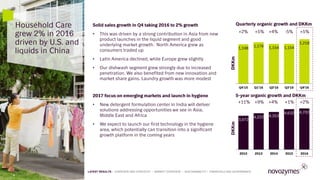
Solid sales growth in Q4 taking 2016 to 2% growth
• This was driven by a strong contribution in Asia from new
product launches in the liquid segment and good
underlying market growth. North America grew as
consumers traded up
• Latin America declined, while Europe grew slightly
• Our dishwash segment grew strongly due to increased
penetration. We also benefited from new innovation and
market share gains. Laundry growth was more modest
DKKm
1,148
1,176 1,154 1,154
1,218
Q4'15 Q1'16 Q2'16 Q3'16 Q4'16
3,972
4,222 4,353
4,632 4,702
2012 2013 2014 2015 2016
DKKm
Quarterly organic growth and DKKm
5-year organic growth and DKKm
+2% +5% +4% -5% +5%
+11% +9% +4% +1% +2%
Household Care
grew 2% in 2016
driven by U.S. and
liquids in China
2017 focus on emerging markets and launch in hygiene
• New detergent formulation center in India will deliver
solutions addressing opportunities we see in Asia,
Middle East and Africa
• We expect to launch our first technology in the hygiene
area, which potentially can transition into a significant
growth platform in the coming years
5
LATEST RESULTS • OVERVIEW AND STRATEGY • MARKET OVERVIEW • SUSTAINABILITY • FINANCIALS AND GOVERNANCE
Technical & Pharma did well in 2016, while Q4 was down
• Good uptake of our Pharma enzymes and albumin. We also
saw increased royalties from GSK’s sale of Tanzeum®
• In sales to the Technical industries, textiles and wastewater
treatment performed satisfactorily, while leather ended the
year slightly positive
• Q4 ended down due to lumpiness in Pharma. Technical
ended slightly positive for the quarter supported by
continued growth in textile and wastewater treatment
711 757
829
982
1,055
2012 2013 2014 2015 2016
DKKm
264
299
279
258
219
Q4'15 Q1'16 Q2'16 Q3'16 Q4'16
DKKm
+21% +37% +9% +16% -12%
-5% +6% +9% +6% +13%
Technical & Pharma
grew 13% in 2016
with solid growth
across most
segments
6
Quarterly organic growth and DKKm
5-year organic growth and DKKm
LATEST RESULTS • OVERVIEW AND STRATEGY • MARKET OVERVIEW • SUSTAINABILITY • FINANCIALS AND GOVERNANCE
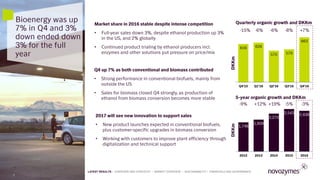
Market share in 2016 stable despite intense competition
• Full-year sales down 3%, despite ethanol production up 3%
in the US, and 2% globally
• Continued product trialing by ethanol producers incl.
enzymes and other solutions put pressure on price/mix
DKKm
616 626
570 579
663
Q4'15 Q1'16 Q2'16 Q3'16 Q4'16
1,748
1,909
2,270
2,543 2,438
2012 2013 2014 2015 2016
DKKm
-15% -6% -6% -8% +7%
-9% +12% +19% -5% -3%
Bioenergy was up
7% in Q4 and 3%
down ended down
3% for the full
year
2017 will see new innovation to support sales
• New product launches expected in conventional biofuels,
plus customer-specific upgrades in biomass conversion
• Working with customers to improve plant efficiency through
digitalization and technical support
Q4 up 7% as both conventional and biomass contributed
• Strong performance in conventional biofuels, mainly from
outside the US
• Sales for biomass closed Q4 strongly, as production of
ethanol from biomass conversion becomes more stable
7
Quarterly organic growth and DKKm
5-year organic growth and DKKm
LATEST RESULTS • OVERVIEW AND STRATEGY • MARKET OVERVIEW • SUSTAINABILITY • FINANCIALS AND GOVERNANCE
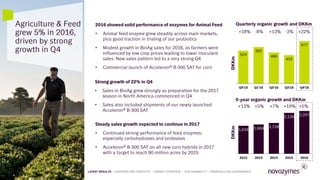
2016 showed solid performance of enzymes for Animal Feed
• Animal feed enzyme grew steadily across main markets,
plus good traction in trialing of our probiotics
• Modest growth in BioAg sales for 2016, as farmers were
influenced by low crop prices leading to lower inoculant
sales. New sales pattern led to a very strong Q4
• Commercial launch of Acceleron® B-300 SAT for corn
DKKm
524
582
496
452
677
Q4'15 Q1'16 Q2'16 Q3'16 Q4'16
1,616 1,669 1,728
2,130 2,207
2012 2013 2014 2015 2016
DKKm
+18% -8% +13% -3% +22%
+13% +5% +7% +19% +5%
Agriculture & Feed
grew 5% in 2016,
driven by strong
growth in Q4
Strong growth of 22% in Q4
• Sales in BioAg grew strongly as preparation for the 2017
season in North America commenced in Q4
• Sales also included shipments of our newly launched
Acceleron® B-300 SAT
Steady sales growth expected to continue in 2017
• Continued strong performance of feed enzymes;
especially carbohydrases and proteases
• Acceleron® B-300 SAT on all new corn hybrids in 2017
with a target to reach 90 million acres by 2025
8
Quarterly organic growth and DKKm
5-year organic growth and DKKm
LATEST RESULTS • OVERVIEW AND STRATEGY • MARKET OVERVIEW • SUSTAINABILITY • FINANCIALS AND GOVERNANCE
DKKm
900
926 930 947 937
Q4'15 Q1'16 Q2'16 Q3'16 Q4'16
3,186 3,190 3,278
3,715 3,740
2012 2013 2014 2015 2016
DKKm
+4% +2% +4% -2% +4%
+1% +3% +4% +5% +2%
In 2017, we see growth coming from emerging markets, Starch
and Food & Nutrition
• To support strong growth in the emerging markets, we are
adding sales resources and technical service facilities –
including a baking development lab in Turkey
• We are prioritizing our starch business to capture growth in
the global starch-refining business and by opening a new
growth platform in grain milling
• Food & Nutrition will return to growth as we recover in infant
nutrition
• Baking growth opportunities in emerging markets, but price
erosion expected in the North American freshkeeping market
Food & beverages
grew 2% in 2016.
Beverages and
Starch showed
strong growth;
Baking flat
Food & Beverages growth driven by emerging markets and
sales to the starch industry
• Strong growth in Asia Pacific, broadly across segments
with baking and starch in China as key drivers
• The Middle East and Africa delivered good results, driven
by brewing and starch
• Europe overall was flat, with solid growth in baking and
starch offset by lost market share in infant nutrition
• Americas contracted, with modest growth in starch
outweighed by a decline in baking
9
Quarterly organic growth and DKKm
5-year organic growth and DKKm
LATEST RESULTS • OVERVIEW AND STRATEGY • MARKET OVERVIEW • SUSTAINABILITY • FINANCIALS AND GOVERNANCE
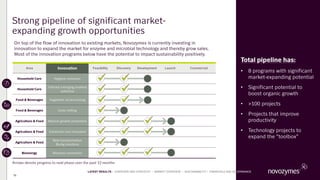
Area Innovation Feasibility Discovery Development Launch Commercial
Household Care Hygiene solutions
Household Care
Tailored emerging markets
solutions
Food & Beverages Vegetable oil processing
Food & Beverages Grain milling
Agriculture & Feed Natural growth promotion
Agriculture & Feed Enhanced corn inoculant
Agriculture & Feed
New transformative
BioAg solutions
Bioenergy Biomass conversion
Strong pipeline of significant market-
expanding growth opportunities
Total pipeline has:
• 8 programs with significant
market-expanding potential
• Significant potential to
boost organic growth
• >100 projects
• Projects that improve
productivity
• Technology projects to
expand the ”toolbox”
Arrows denote progress to next phase over the past 12 months
On top of the flow of innovation to existing markets, Novozymes is currently investing in
innovation to expand the market for enzyme and microbial technology and thereby grow sales.
Most of the innovation programs below have the potential to impact sustainability positively.
10
LATEST RESULTS • OVERVIEW AND STRATEGY • MARKET OVERVIEW • SUSTAINABILITY • FINANCIALS AND GOVERNANCE
11
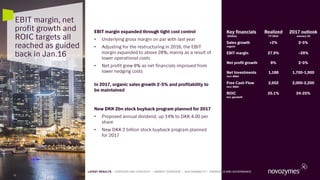
EBIT margin, net
profit growth and
ROIC targets all
reached as guided
back in Jan.16
EBIT margin expanded through tight cost control
• Underlying gross margin on par with last year
• Adjusting for the restructuring in 2016, the EBIT
margin expanded to above 28%; mainly as a result of
lower operational costs
• Net profit grew 8% as net financials improved from
lower hedging costs
In 2017, organic sales growth 2-5% and profitability to
be maintained
New DKK 2bn stock buyback program planned for 2017
• Proposed annual dividend, up 14% to DKK 4.00 per
share
• New DKK 2 billion stock buyback program planned
for 2017
Key financials
(DKKm)
Realized
FY 2016
2017 outlook
January 18
Sales growth
organic
+2% 2-5%
EBIT margin 27.9% ~28%
Net profit growth 8% 2-5%
Net Investments
excl. M&A
1,188 1,700-1,900
Free Cash Flow
excl. M&A
2,652 2,000-2,200
ROIC
incl. goodwill
25.1% 24-25%
LATEST RESULTS • OVERVIEW AND STRATEGY • MARKET OVERVIEW • SUSTAINABILITY • FINANCIALS AND GOVERNANCE
Overview and Strategy
13
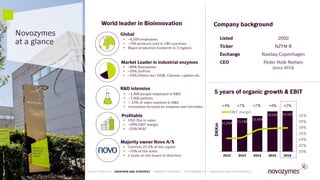
Novozymes
at a glance
World leader in Bioinnovation
Listed 2000
Ticker NZYM B
Exchange Nasdaq Copenhagen
CEO Peder Holk Nielsen
(since 2013)
• ~6,500 employees
• ~700 products sold in 140 countries
• Major production footprint in 3 regions
Global
Profitable
Majority owner Novo A/S
R&D intensive
• ~1,400 people employed in R&D
• ~7,000 patents
• ~ 13% of sales invested in R&D
• Innovation focused on enzymes and microbes
• Controls 25.5% of the capital
• ~70% of the votes
• 2 seats on the board of directors
11,234 11,746
12,459
14,002 14,142
20%
22%
24%
26%
28%
30%
32%
34%
36%
2012 2013 2014 2015 2016
EBIT margin
• USD 2bn in sales
• ~28% EBIT margin
• ~25% ROIC
DKKm
5 years of organic growth & EBIT
+4% +7% +7% +4% +2%
Market Leader in industrial enzymes
• ~48% Novozymes
• ~19% DuPont
• ~33% Others incl. DSM, Chinese, captive etc.
Company background
13
LATEST RESULTS • OVERVIEW AND STRATEGY • MARKET OVERVIEW • SUSTAINABILITY • FINANCIALS AND GOVERNANCE
14
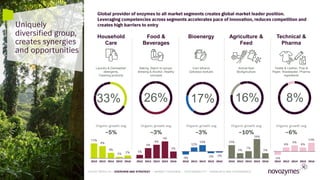
Uniquely
diversified group,
creates synergies
and opportunities
11%
9%
4%
1% 2%
2012 2013 2014 2015 2016
1%
3%
4%
5%
2%
2012 2013 2014 2015 2016
-9%
12%
19%
-5% -3%
2012 2013 2014 2015 2016
13%
5%
7%
19%
5%
2012 2013 2014 2015 2016
-5%
6%
9%
6%
13%
2012 2013 2014 2015 2016
~5% ~3% ~3% ~10% ~6%
33% 26% 17% 16% 8%
Household
Care
Food &
Beverages
Bioenergy Agriculture &
Feed
Technical &
Pharma
Laundry & Dishwasher
detergents,
Cleaning products
Baking, Starch to syrups,
Brewing & Alcohol, Healthy
concepts
Corn ethanol
Cellulosic biofuels
Animal feed
BioAgriculture
Textile & Leather, Pulp &
Paper, Wastewater, Pharma
ingredients
Organic growth avg. Organic growth avg. Organic growth avg Organic growth avg Organic growth avg
Global provider of enzymes to all market segments creates global market leader position.
Leveraging competencies across segments accelerates pace of innovation, reduces competition and
creates high barriers to entry
14
LATEST RESULTS • OVERVIEW AND STRATEGY • MARKET OVERVIEW • SUSTAINABILITY • FINANCIALS AND GOVERNANCE
15
Existing tech in new
market
(example; launch
advanced protease in
Emerging Markets)
New tech in existing
market
(example; introduce a
new enzyme in the
1G Ethanol market)
Just do it
(example, launch
new version of
Novamyl in the
baking industry)
Find partner, reduce
one risk
(example; BioAg
Alliance with
Monsanto or Feed
Alliance with DSM)
CommercialRisk
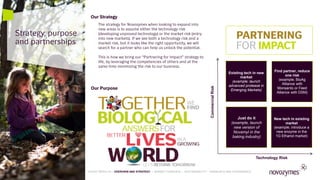
The strategy for Novozymes when looking to expand into
new areas is to assume either the technology risk
(developing unproved technology) or the market risk (entry
into new markets). If we see both a technology risk and a
market risk, but it looks like the right opportunity, we will
search for a partner who can help us unlock the potential.
This is how we bring our “Partnering for Impact” strategy to
life, by leveraging the competencies of others and at the
same time minimizing the risk to our business.
Technology Risk
Strategy, purpose
and partnerships
Our Purpose
Our Strategy
15
LATEST RESULTS • OVERVIEW AND STRATEGY • MARKET OVERVIEW • SUSTAINABILITY • FINANCIALS AND GOVERNANCE
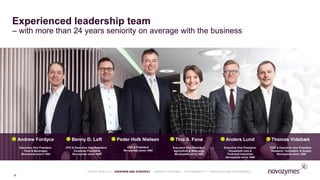
Experienced leadership team
– with more than 24 years seniority on average with the business
Tina S. Fanø
Executive Vice President,
Agriculture & Bioenergy
Novozymes since 1993
Peder Holk Nielsen
CEO & President
Novozymes since 1984
Thomas Videbæk
COO & Executive Vice President,
Research, Innovation & Supply
Novozymes since 1988
Anders Lund
Executive Vice President,
Household Care &
Technical Industries
Novozymes since 1999
Benny D. Loft
CFO & Executive Vice President,
Corporate Functions
Novozymes since 1998
Andrew Fordyce
Executive Vice President,
Food & Beverages
Novozymes since 1993
16
LATEST RESULTS • OVERVIEW AND STRATEGY • MARKET OVERVIEW • SUSTAINABILITY • FINANCIALS AND GOVERNANCE
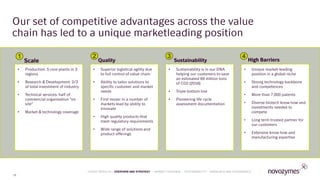
Our set of competitive advantages across the value
chain has led to a unique marketleading position
• Production: 5 core plants in 3
regions
• Research & Development: 2/3
of total investment of industry
• Technical services: half of
commercial organization “on
site”
• Market & technology coverage
• Superior logistical agility due
to full control of value chain
• Ability to tailor solutions to
specific customer and market
needs
• First mover in a number of
markets lead by ability to
innovate
• High quality products that
meet regulatory requirements
• Wide range of solutions and
product offerings
• Sustainability is in our DNA
helping our customers to save
an estimated 69 million tons
of CO2 (2016)
• Triple bottom line
• Pioneering life cycle
assessment documentation
• Unique market-leading
position in a global niche
• Strong technology backbone
and competences
• More than 7,000 patents
• Diverse biotech know how and
investments needed to
compete
• Long term trusted partner for
our customers
• Extensive know how and
manufacturing expertise
17
Scale
1
Quality Sustainability High Barriers
2 3 4
LATEST RESULTS • OVERVIEW AND STRATEGY • MARKET OVERVIEW • SUSTAINABILITY • FINANCIALS AND GOVERNANCE
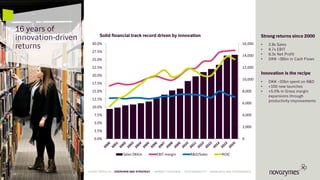
16 years of
innovation-driven
returns
0.0%
2.5%
5.0%
7.5%
10.0%
12.5%
15.0%
17.5%
20.0%
22.5%
25.0%
27.5%
30.0%
0
2,000
4,000
6,000
8,000
10,000
12,000
14,000
16,000
Sales DKKm EBIT margin R&D/Sales ROIC
Strong returns since 2000
• 2.8x Sales
• 4.7x EBIT
• 6.3x Net Profit
• DKK ~36bn in Cash Flows
Innovation is the recipe
• DKK ~20bn spent on R&D
• +100 new launches
• +5.5% in Gross margin
expansions through
productivity improvements
Solid financial track record driven by innovation
18
LATEST RESULTS • OVERVIEW AND STRATEGY • MARKET OVERVIEW • SUSTAINABILITY • FINANCIALS AND GOVERNANCE
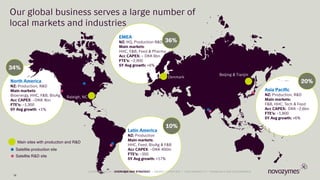
Latin America
NZ: Production
Main markets:
HHC, Feed, BioAg & F&B
Acc CAPEX: ~DKK 400m
FTE’s: ~350
5Y Avg growth: +17%
North America
NZ: Production, R&D
Main markets:
Bioenergy, HHC, F&B, BioAg
Acc CAPEX: ~DKK 4bn
FTE’s: ~1,300
5Y Avg growth: +1%
Asia Pacific
NZ: Production, R&D
Main markets:
F&B, HHC, Tech & Feed
Acc CAPEX: DKK ~2,6bn
FTE’s: ~1,800
5Y Avg growth: +6%
EMEA
NZ: HQ, Production R&D
Main markets:
HHC, F&B, Feed & Pharma
Acc CAPEX: ~ DKK 6bn
FTE’s: ~2,900
5Y Avg growth: +6%
1919
Satellite production site
Main sites with production and R&D
Satellite R&D site
34%
36%
10%
20%
Beijing & Tianjin
Denmark
Raleigh, NC
Our global business serves a large number of
local markets and industries
LATEST RESULTS • OVERVIEW AND STRATEGY • MARKET OVERVIEW • SUSTAINABILITY • FINANCIALS AND GOVERNANCE
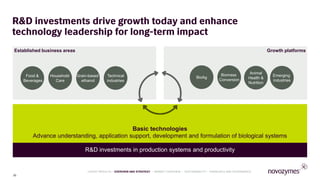
R&D investments drive growth today and enhance
technology leadership for long-term impact
Established business areas
Basic technologies
Advance understanding, application support, development and formulation of biological systems
R&D investments in production systems and productivity
Growth platforms
Household
Care
Food &
Beverages
Grain-based
ethanol
BioAg
Biomass
Conversion
Animal
Health &
Nutrition
Emerging
industries
Technical
industries
20
LATEST RESULTS • OVERVIEW AND STRATEGY • MARKET OVERVIEW • SUSTAINABILITY • FINANCIALS AND GOVERNANCE
21
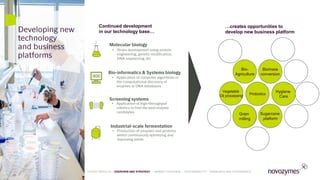
• Strain development using protein
engineering, genetic modification,
DNA sequencing, etc
Molecular biology
Industrial-scale fermentation
Screening systems
• Production of enzymes and proteins
whilst continuously optimizing and
improving yields
• Application of computer algorithms in
the computational discovery of
enzymes in DNA databases
Bio-informatics & Systems biology
• Application of high-throughput
robotics to find the best enzyme
candidates
Developing new
technology
and business
platforms
Biomass
conversion
Bio-
Agriculture
Probiotics
Sugarcane
platform
Continued development
in our technology base…
…creates opportunities to
develop new business platform
Hygiene
Care
Grain
milling
Vegetable
Oil processing
LATEST RESULTS • OVERVIEW AND STRATEGY • MARKET OVERVIEW • SUSTAINABILITY • FINANCIALS AND GOVERNANCE
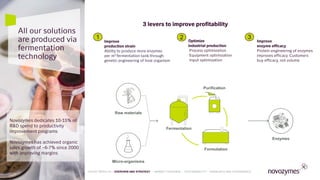
Novozymes dedicates 10-15% of
R&D spend to productivity
improvement programs
Novozymes has achieved organic
sales growth of ~6-7% since 2000
with improving margins
Raw materials
Micro-organisms
Enzymes
Fermentation
Purification
Formulation
All our solutions
are produced via
fermentation
technology
Improve
production strain
Ability to produce more enzymes
per m3 fermentation tank through
genetic engineering of host organism
Optimize
industrial production
Process optimization
Equipment optimization
Input optimization
Improve
enzyme efficacy
Protein engineering of enzymes
improves efficacy. Customers
buy efficacy, not volume
3 levers to improve profitability
1 2 3
22
LATEST RESULTS • OVERVIEW AND STRATEGY • MARKET OVERVIEW • SUSTAINABILITY • FINANCIALS AND GOVERNANCE
Market Overview
24
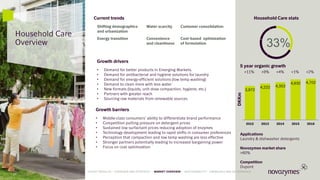
Household Care
Overview 33%
Applications
Laundry & dishwasher detergents
Novozymes market share
>60%
Competition
Dupont
Household Care stats
3,972
4,222 4,353
4,632 4,702
2012 2013 2014 2015 2016
5 year organic growth
+11% +9% +4% +1% +2%
Current trends
Growth drivers
• Demand for better products in Emerging Markets.
• Demand for antibacterial and hygiene solutions for laundry
• Demand for energy-efficient solutions (low temp washing)
• Demand to clean more with less water
• New formats (liquids, unit dose compaction, hygiene, etc.)
• Partners with greater reach
• Sourcing raw materials from renewable sources
Growth barriers
• Middle-class consumers’ ability to differentiate brand performance
• Competition putting pressure on detergent prices
• Sustained low surfactant prices reducing adoption of enzymes
• Technology development leading to rapid shifts in consumer preferences
• Perception that compaction and low temp washing are less effective
• Stronger partners potentially leading to increased bargaining power
• Focus on cost optimization
Shifting demographics
and urbanization
Water scarcity Customer consolidation
Energy transition Convenience
and cleanliness
Cost-based optimization
of formulation
DKKm
LATEST RESULTS • OVERVIEW AND STRATEGY • MARKET OVERVIEW • SUSTAINABILITY • FINANCIALS AND GOVERNANCE
24
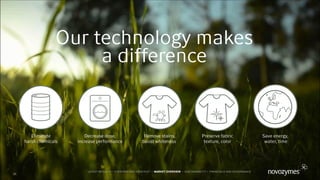
Eliminate
harsh chemicals
Decrease dose,
increase performance
Preserve fabric
texture, color
Our technology makes
a difference
Remove stains,
boost whiteness
Save energy,
water, time
25
LATEST RESULTS • OVERVIEW AND STRATEGY • MARKET OVERVIEW • SUSTAINABILITY • FINANCIALS AND GOVERNANCE
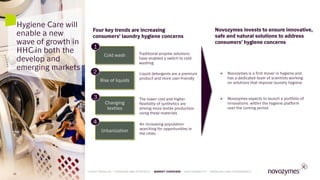
Traditional enzyme solutions
have enabled a switch to cold
washing
 Novozymes is a first mover in hygiene and
has a dedicated team of scientists working
on solutions that improve laundry hygiene
 Novozymes expects to launch a portfolio of
innovations within the hygiene platform
over the coming period
Four key trends are increasing
consumers’ laundry hygiene concerns
Novozymes invests to ensure innovative,
safe and natural solutions to address
consumers’ hygiene concerns
Cold wash
Rise of liquids
Changing
textiles
Urbanization
Liquid detergents are a premium
product and more user-friendly
The lower cost and higher
flexibility of synthetics are
driving more textile production
using these materials
An increasing population
searching for opportunities in
the cities
2
1
3
4
Hygiene Care will
enable a new
wave of growth in
HHC in both the
develop and
emerging markets
26
LATEST RESULTS • OVERVIEW AND STRATEGY • MARKET OVERVIEW • SUSTAINABILITY • FINANCIALS AND GOVERNANCE
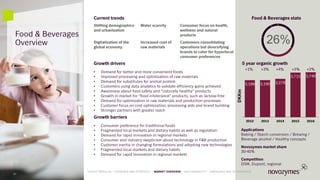
Food & Beverages
Overview 26%
Applications
Baking / Starch conversion / Brewing /
Beverage alcohol / Healthy concepts
Novozymes market share
30-40%
Competition
DSM, Dupont, regional
Food & Beverages statsCurrent trends
Growth drivers
• Demand for better and more convenient foods
• Improved processing and optimization of raw materials
• Demand for substitutes for animal protein
• Customers using data analytics to validate efficiency gains achieved
• Awareness about food safety and “naturally healthy” products
• Growth in market for “food intolerance” products, such as lactose-free
• Demand for optimization in raw materials and production processes
• Customer focus on cost optimization, processing aids and brand building
• Stronger partners with greater reach
Growth barriers
• Consumer preference for traditional foods
• Fragmented local markets and dietary habits as well as regulation
• Demand for rapid innovation in regional markets
• Consumer and industry skepticism about technology in F&B production
• Customer inertia in changing formulations and adopting new technologies
• Fragmented local markets and dietary habits
• Demand for rapid innovation in regional markets
Shifting demographics
and urbanization
Water scarcity Consumer focus on health,
wellness and natural
products
Digitalization of the
global economy
Increased cost of
raw materials
Customers consolidating
operations but diversifying
brands to cater for hyperlocal
consumer preferences
3,186 3,190 3,278
3,715 3,740
2012 2013 2014 2015 2016
DKKm
5 year organic growth
+1% +3% +4% +5% +2%
27
LATEST RESULTS • OVERVIEW AND STRATEGY • MARKET OVERVIEW • SUSTAINABILITY • FINANCIALS AND GOVERNANCE
28
LATEST RESULTS • OVERVIEW AND STRATEGY • MARKET OVERVIEW • SUSTAINABILITY • FINANCIALS AND GOVERNANCE
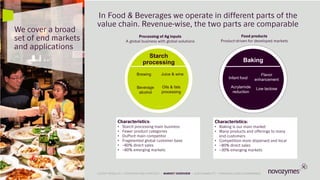
In Food & Beverages we operate in different parts of the
value chain. Revenue-wise, the two parts are comparable
We cover a broad
set of end markets
and applications
Processing of Ag inputs
A global business with global solutions
Food products
Product-driven for developed markets
Characteristics:
• Starch processing main business
• Fewer product categories
• DuPont main competitor
• Fragmented global customer base
• ~60% direct sales
• ~60% emerging markets
Characteristics:
• Baking is our main market
• Many products and offerings to many
end customers
• Competition more dispersed and local
• ~80% direct sales
• ~30% emerging markets
Brewing
Starch
processing
Beverage
alcohol
Oils & fats
processing
Juice & wine
Baking
Infant food
Acrylamide
reduction
Low lactose
Flavor
enhancement
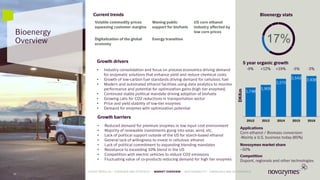
Bioenergy
Overview
Applications
Corn ethanol / Biomass conversion
-Mainly a U.S. business today (85%)
Novozymes market share
~50%
Competition
Dupont, regionals and other technologies
Bioenergy statsCurrent trends
Growth drivers
• Industry consolidation and focus on process economics driving demand
for enzymatic solutions that enhance yield and reduce chemical costs
• Growth of low-carbon fuel standards driving demand for cellulosic fuel
• Modern and automated ethanol facilities using data analytics to monitor
performance and potential for optimization gains (high tier enzymes)
• Continued stable political mandate driving adoption of biofuels
• Growing calls for CO2 reductions in transportation sector
• Price and yield stability of low-tier enzymes
• Demand for enzymes with optimization potential
Growth barriers
• Reduced demand for premium enzymes in low input cost environment
• Majority of renewable investments going into solar, wind, etc.
• Lack of political support outside of the US for starch-based ethanol
• General lack of willingness to invest in cellulosic ethanol
• Lack of political commitment to expanding blending mandates
• Resistance to exceeding 10% blend in the US
• Competition with electric vehicles to reduce CO2 emissions
• Fluctuating value of co-products reducing demand for high tier enzymes
Volatile commodity prices
squeezing customer margins
Waning public
support for biofuels
US corn ethanol
industry affected by
low corn prices
Digitalization of the global
economy
Energy transition
17%
1,748
1,909
2,270
2,543 2,438
2012 2013 2014 2015 2016
DKKm
5 year organic growth
-9% +12% +19% -5% -3%
29
LATEST RESULTS • OVERVIEW AND STRATEGY • MARKET OVERVIEW • SUSTAINABILITY • FINANCIALS AND GOVERNANCE
30
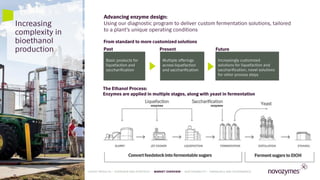
The Ethanol Process:
Enzymes are applied in multiple stages, along with yeast in fermentation
Increasing
complexity in
bioethanol
production
Basic products for
liquefaction and
saccharification
Multiple offerings
across liquefaction
and saccharification
Increasingly customized
solutions for liquefaction and
saccharification, novel solutions
for other process steps
From standard to more customized solutions
Advancing enzyme design:
Using our diagnostic program to deliver custom fermentation solutions, tailored
to a plant’s unique operating conditions
Past Present Future
LATEST RESULTS • OVERVIEW AND STRATEGY • MARKET OVERVIEW • SUSTAINABILITY • FINANCIALS AND GOVERNANCE
31
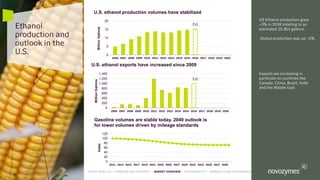
Ethanol
production and
outlook in the
U.S. 0
5
10
15
20
2006 2007 2008 2009 2010 2011 2012 2013 2014 2015 2016 2017 2018 2019 2020
BillionGallons
U.S. ethanol production volumes have stabilized
0
200
400
600
800
1,000
1,200
1,400
2006 2007 2008 2009 2010 2011 2012 2013 2014 2015 2016 2017 2018 2019 2020
MillionGallons
U.S. ethanol exports have increased since 2009
0
20
40
60
80
100
120
2011 2013 2015 2017 2019 2021 2023 2025 2027 2029 2031 2033 2035 2037 2039
Index
Gasoline volumes are stable today. 2040 outlook is
for lower volumes driven by mileage standards
US Ethanol production grew
~3% in 2016 totalling to an
estimated 15.3bn gallons.
Global production was up ~2%
Exports are increasing in
particular to countries like
Canada, China, Brazil, India
and the Middle East
LATEST RESULTS • OVERVIEW AND STRATEGY • MARKET OVERVIEW • SUSTAINABILITY • FINANCIALS AND GOVERNANCE
Est.
Est.
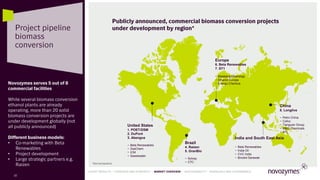
Novozymes serves 5 out of 8
commercial facilities
While several biomass conversion
ethanol plants are already
operating, more than 20 solid
biomass conversion projects are
under development globally (not
all publicly announced)
Different business models:
• Co-marketing with Beta
Renewables
• Project development
• Large strategic partners e.g.
Raízen
32
Publicly announced, commercial biomass conversion projects
under development by region*
Brazil
4. Raízen
5. GranBio
− Solvay
− CTC
United States
1. POET/DSM
2. DuPont
3. Abengoa
− Beta Renewables
− ZeaChem
− ICM
− Sweetwater
Europe
6. Beta Renewables
7. ST1
− Maabjerg Bioenergy
− Ethanol Europe
− Energo Chemica
India and South East Asia
− Beta Renewables
− India Oil
− CVC India
− Brooke Sarawak
China
8. Longlive
− Petro China
− Cofco
− Tianguan Group
− M&G Chemicals
− NTL
*Non-exhaustive
Project pipeline
biomass
conversion
32
LATEST RESULTS • OVERVIEW AND STRATEGY • MARKET OVERVIEW • SUSTAINABILITY • FINANCIALS AND GOVERNANCE
33
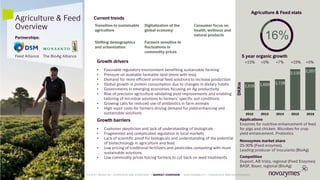
Agriculture & Feed
Overview
Partnerships:
Feed Alliance The BioAg Alliance
Applications
Enzymes for nutritive enhancement of feed
for pigs and chicken. Microbes for crop
yield enhancement. Probiotics
Novozymes market share
25-30% (Feed enzymes).
Leading producer of inoculants (BioAg)
Competition
Dupont, AB Vista, regional (Feed Enzymes)
BASF, Bayer, regional (BioAg)
Agriculture & Feed stats
Current trends
Growth drivers
• Favorable regulatory environment benefiting sustainable farming
• Pressure on available farmable land (more with less)
• Demand for more efficient animal feed solutions to increase production
• Global growth in protein consumption due to changes in dietary habits
• Governments in emerging economies focusing on Ag productivity
• Rise of precision agriculture validating yield improvements and enabling
tailoring of microbial solutions to farmers’ specific soil conditions
• Growing calls for reduced use of antibiotics in farm animals
• High input costs for farmers driving demand for yield-enhancing and
sustainable solutions
Growth barriers
• Customer skepticism and lack of understanding of biologicals
• Fragmented and complicated regulation in local markets
• Lack of scientific proof for biologicals and understanding of the potential
of biotechnology in agriculture and feed
• Low pricing of traditional fertilizers and pesticides competing with more
sustainable solutions
• Low commodity prices forcing farmers to cut back on seed treatments
Transition to sustainable
agriculture
Digitalization of the
global economy
Consumer focus on
health, wellness and
natural products
Shifting demographics
and urbanization
Farmers sensitive to
fluctuations in
commodity prices
16%
1,616 1,669 1,728
2,130 2,207
2012 2013 2014 2015 2016
DKKm
5 year organic growth
+13% +5% +7% +19% +5%
33 LATEST RESULTS • OVERVIEW AND STRATEGY • MARKET OVERVIEW • SUSTAINABILITY • FINANCIALS AND GOVERNANCE
34 QUARTERLY RESULTS • NOVOZYMES OVERVIEW • STRATEGY • MARKET OVERVIEW • SUSTAINABILITY • FINANCIAL REVIEW34
LATEST RESULTS • OVERVIEW AND STRATEGY • MARKET OVERVIEW • SUSTAINABILITY • FINANCIALS AND GOVERNANCE
35 QUARTERLY RESULTS • NOVOZYMES OVERVIEW • STRATEGY • MARKET OVERVIEW • SUSTAINABILITY • FINANCIAL REVIEW35
LATEST RESULTS • OVERVIEW AND STRATEGY • MARKET OVERVIEW • SUSTAINABILITY • FINANCIALS AND GOVERNANCE
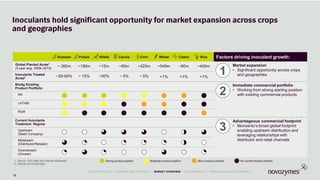
Inoculants hold significant opportunity for market expansion across crops
and geographies
Soybean Pulses Alfalfa Canola Corn Wheat Cotton Rice Factors driving inoculant growth:
Global Planted Acres1
(5 year avg. 2009–2013)
~ 260m ~190m ~15m ~85m ~425m ~549m ~80m ~400m Market expansion
• Significant opportunity across crops
and geographiesInoculants Treated
Acres2 ~55-60% ~ 15% ~50% ~ 5% ~ 5% <1% <1% <1%
BioAg Existing
Product Portfolio
Immediate commercial portfolio
• Working from strong starting position
with existing commercial productsNA
LATAM
RoW
Current Inoculants
Treatment Regime
Advantageous commercial footprint
• Monsanto’s broad global footprint
enabling upstream distribution and
leveraging relationships with
distributor and retail channels
Upstream
(Seed Company)
Midstream
(Distributor/Retailer)
Downstream
(Grower)
1. Source: FAO stats and Internal estimates
2. Internal 2014 estimates
Strong product position Moderate product position Minor product position No current product position
1
2
3
36
LATEST RESULTS • OVERVIEW AND STRATEGY • MARKET OVERVIEW • SUSTAINABILITY • FINANCIALS AND GOVERNANCE
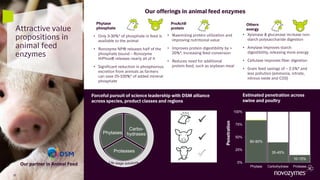
• Only 3-30%* of phosphate in feed is
available to the animal
• Ronozyme NP® releases half of the
phosphate bound – Ronozyme
HiPhos® releases nearly all of it
• Significant reduction in phosphorous
excretion from animals as farmers
can save 25-100%* of added mineral
phosphate
• Maximizing protein utilization and
improving nutritional value
• Improves protein digestibility by >
20%*, increasing feed conversion
• Reduces need for additional
protein feed, such as soybean meal
• Xylanase & glucanase increase non-
starch polysaccharide digestion
• Amylase improves starch
digestibility, releasing more energy
• Cellulase improves fiber digestion
• Grain feed savings of ~ 2.5%* and
less pollution (ammonia, nitrate,
nitrous oxide and CO2)
37
Attractive value
propositions in
animal feed
enzymes
Phytase
phosphate
ProAct®
protein
Others
energy
Carbo-
hydrases
Proteases
Phytases
Forceful pursuit of science leadership with DSM alliance
across species, product classes and regions
80-90%
35-45%
10-15%
0%
25%
50%
75%
100%
Phytase Carbohydrase Protease
Estimated penetration across
swine and poultry
Penetration
Our offerings in animal feed enzymes
Our partner in Animal Feed
Relevance of innovation cluster
The world needs sustainable efficiency gains in animal production
• 9+ billion people by 2050
• Protein demand to double next 40 years
• Feed costs in 50% of costs in animal production
• Arable land per capita expected to decrease by 35% from 2000 to 2050
• Antibiotic resistance and regulation are driving the need for
alternatives to antibiotics
Improving the yield in animal production would have significantly positive
impact in terms of global warming and use of agricultural land
3838
Approach and status
As part of our efforts to leverage biological solutions to enable efficiency
gains in animal products, we aim to leverage our capabilities to develop
additives for natural growth promotion
In 2015 we initiated a partnership with Adisseo with the shared ambition
to enter and develop the market for probiotics
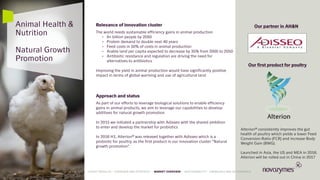
In 2016 H1, Alterion® was released together with Adisseo which is a
probiotic for poultry, as the first product in our innovation cluster “Natural
growth promotion”.
Alterion® consistently improves the gut
health of poultry which yields a lower Feed
Conversion Ratio (FCR) and increase Body
Weight Gain (BWG).
Launched in Asia, the US and MEA in 2016.
Alterion will be rolled out in China in 2017
Animal Health &
Nutrition
Natural Growth
Promotion
Our partner in AH&N
Our first product for poultry
38
LATEST RESULTS • OVERVIEW AND STRATEGY • MARKET OVERVIEW • SUSTAINABILITY • FINANCIALS AND GOVERNANCE
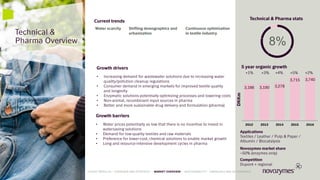
Technical &
Pharma Overview
Applications
Textiles / Leather / Pulp & Paper /
Albumin / Biocatalysis
Novozymes market share
~50% (enzymes only)
Competition
Dupont + regional
Technical & Pharma stats
Current trends
Growth drivers
• Increasing demand for wastewater solutions due to increasing water
quality/pollution cleanup regulations
• Consumer demand in emerging markets for improved textile quality
and longevity
• Enzymatic solutions potentially optimizing processes and lowering costs
• Non-animal, recombinant input sources in pharma
• Better and more sustainable drug delivery and formulation (pharma)
Growth barriers
• Water prices potentially so low that there is no incentive to invest in
watersaving solutions
• Demand for low-quality textiles and raw materials
• Preference for lower-cost, chemical solutions to enable market growth
• Long and resource-intensive development cycles in pharma
Water scarcity Shifting demographics and
urbanization
Continuous optimization
in textile industry
8%
3,186 3,190 3,278
3,715 3,740
2012 2013 2014 2015 2016
DKKm
5 year organic growth
+1% +3% +4% +5% +2%
39
LATEST RESULTS • OVERVIEW AND STRATEGY • MARKET OVERVIEW • SUSTAINABILITY • FINANCIALS AND GOVERNANCE
Sustainability
40
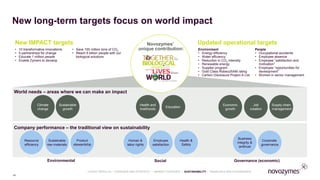
New long-term targets focus on world impact
New IMPACT targets
Company performance – the traditional view on sustainability
World needs – areas where we can make an impact
SocialEnvironmental
• 10 transformative innovations
• 5 partnerships for change
• Educate 1 million people
• Enable Zymers to develop
• Save 100 million tons of CO2
• Reach 6 billion people with our
biological solutions
Sustainable
raw materials
Resource
efficiency
Product
stewardship
Health &
Safety
Human &
labor rights
Employee
satisfaction
Sustainable
growth
Education
Health and
livelihoods
Climate
change
Novozymes’
unique contribution:
Updated operational targets
Environment
• Energy efficiency
• Water efficiency
• Reduction in CO2 intensity
• Renewable energy
• Supplier program
• Gold Class RobecoSAM rating
• Carbon Disclosure Project A List
People
• Occupational accidents
• Employee absence
• Employee “satisfaction and
motivation”
• Employee “opportunities for
development”
• Women in senior management
Governance (economic)
Corporate
governance
Business
integrity &
antitrust
Economic
growth
Job
creation
Supply chain
management
41
LATEST RESULTS • OVERVIEW AND STRATEGY • MARKET OVERVIEW • SUSTAINABILITY • FINANCIALS AND GOVERNANCE
0%
20%
40%
60%
80%
100%
120%
140%
160%
2005 2006 2007 2008 2009 2010 2011 2012 2013 2014 2015 2016
%changefrom2005baseline
0.0%
0.5%
1.0%
1.5%
2.0%
2.5%
3.0%
3.5%
0
2
4
6
8
10
12
2000 2001 2002 2003 2004 2005 2006 2007 2008 2009 2010 2011 2012 2013 2014 2015 2016
Occupational accidents per million working hours
Employee absence (%)
Gross profit
Water
Energy
CO2 emissions
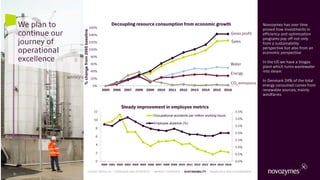
Decoupling resource consumption from economic growthWe plan to
continue our
journey of
operational
excellence
Steady improvement in employee metrics
Sales
Novozymes has over time
proved how investments in
efficiency and optimization
programs pay off not only
from a sustainability
perspective but also from an
economic perspective
In the US we have a biogas
plant which turns wastewater
into steam
In Denmark 24% of the total
energy consumed comes from
renewable sources; mainly
windfarms
42
LATEST RESULTS • OVERVIEW AND STRATEGY • MARKET OVERVIEW • SUSTAINABILITY • FINANCIALS AND GOVERNANCE
43
Cereals:
110 kg CO2
per ton of bread
Detergent:
50-150 kg CO2
per ton of laundry
Beverage:
25 kg CO2
per 1000 litre of beer
Vegetable oil:
44 kg CO2
per ton of oil
Dairy:
230 kg CO2
per ton of mozzarella
Margarine:
23 kg CO2
per ton of hardstock
Animal feed:
80 kg CO2
per ton of feed
Textile:
1100 kg CO2
per ton of fabric
Agriculture:
15 kg CO2
per ton of corn
Leather:
100 kg CO2
per ton of hide
Paper making:
150 kg CO2
per ton of pulp
Cosmetics:
190 kg CO2
per ton of fatty acid ester
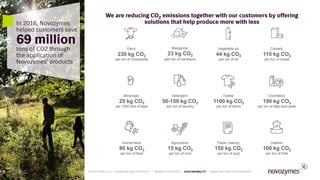
In 2016, Novozymes
helped customers save
tons of CO2 through
the application of
Novozymes’ products
69 million
We are reducing CO2 emissions together with our customers by offering
solutions that help produce more with less
43
LATEST RESULTS • OVERVIEW AND STRATEGY • MARKET OVERVIEW • SUSTAINABILITY • FINANCIALS AND GOVERNANCE
44
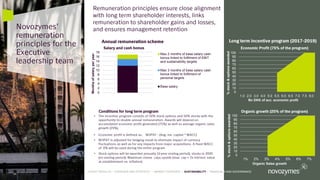
Long term incentive program (2017-2019)
0
10
20
30
40
50
60
70
80
90
100
1.0 2.0 3.0 4.0 5.0 5.5 6.0 6.5 7.0 7.5 8.0
%stock&optionsawarded
Bn DKK of acc. economic profit
0
2
4
6
8
10
12
14
16
18
Monthsofsalaryperyear
Max 2 months of base salary cash
bonus linked to fulfilment of EBIT
and sustainability targets
Max 3 months of base salary cash
bonus linked to fulfilment of
personal targets
Base salary
• The incentive program consists of 50% stock options and 50% stocks with the
opportunity to double annual remuneration. Awards will depend on
accumulated economic profit generated (75%) as well as average organic sales
growth (25%).
• Economic profit is defined as: NOPAT - (Avg. inv. capital * WACC)
• NOPAT is adjusted for hedging result to eliminate impact of currency
fluctuations as well as for any impacts from major acquisitions. A fixed WACC
of 6% will be used during the entire program
• Stock options will be awarded annually (3-year vesting period), stocks in 2020
(no vesting period). Maximum clause caps upside (max. cap = 2x intrinsic value
at establishment ex. inflation)
Economic Profit (75% of the program)
0
10
20
30
40
50
60
70
80
90
100
1% 2% 3% 4% 5% 6% 7%
%stock&optionsawarded
Organic Sales growth
Organic growth (25% of the program)
Annual remuneration scheme
Conditions for long term program
Novozymes’
remuneration
principles for the
Executive
leadership team
Salary and cash bonus
44
LATEST RESULTS • OVERVIEW AND STRATEGY • MARKET OVERVIEW • SUSTAINABILITY • FINANCIALS AND GOVERNANCE
Remuneration principles ensure close alignment
with long term shareholder interests, links
remuneration to shareholder gains and losses,
and ensures management retention
Financials and
Governance
45
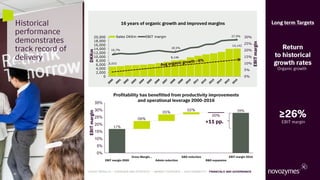
Historical
performance
demonstrates
track record of
delivery
5,033
8,146
14,142
16.7%
18.5%
27.9%
0
2,000
4,000
6,000
8,000
10,000
12,000
14,000
16,000
18,000
20,000
0%
5%
10%
15%
20%
25%
30%Sales DKKm EBIT margin
DKKm
EBITmargin
EBITmargin
16 years of organic growth and improved margins
Profitability has benefitted from productivity improvements
and operational leverage 2000-2016
+11 pp.
Long term Targets
EBIT margin
Return
to historical
growth rates
≥26%
Organic growth
46
LATEST RESULTS • OVERVIEW AND STRATEGY • MARKET OVERVIEW • SUSTAINABILITY • FINANCIALS AND GOVERNANCE
-1,000
-500
0
500
1,000
1,500
2,000
-0.40
-0.20
0.00
0.20
0.40
0.60
0.80
1.00
Net Interestbearing debt NIBD/EBITDA
0
5,000
10,000
15,000
0%
5%
10%
15%
20%
25%
30%Invested Capital ROIC
0
500
1,000
1,500
0%
2%
4%
6%
8%
10%
12%
14%CAPEX CAPEX to Sales
DKKmDKKmDKKm
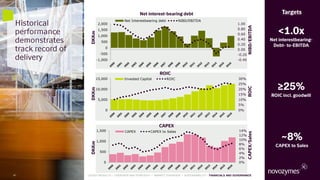
Historical
performance
demonstrates
track record of
delivery
NIBD/EBITDAROICCAPEX/Sales
≥25%
ROIC incl. goodwill
~8%
CAPEX to Sales
<1.0x
Net interestbearing-
Debt- to-EBITDA
Targets
CAPEX
ROIC
Net interest-bearing debt
47 LATEST RESULTS • OVERVIEW AND STRATEGY • MARKET OVERVIEW • SUSTAINABILITY • FINANCIALS AND GOVERNANCE
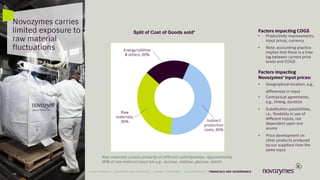
Raw
materials;
35%
Energy/utilities
& others; 20%
Indirect
production
costs; 45%
Novozymes carries
limited exposure to
raw material
fluctuations
Split of Cost of Goods sold*
Raw materials consist primarily of different carbohydrates. Approximately
50% of raw material input are e.g., sucrose, maltose, glucose, starch.
Factors impacting COGS
• Productivity improvements,
input prices, currency
• Note: accounting practice
implies that there is a time
lag between current price
levels and COGS
Factors impacting
Novozymes’ input prices:
• Geographical location, e.g.,
differences in input
• Contractual agreements,
e.g., timing, duration
• Substitution possibilities,
i.e., flexibility in use of
different inputs, not
dependent upon one
source
• Price development on
other products produced
by our suppliers from the
same input
48
LATEST RESULTS • OVERVIEW AND STRATEGY • MARKET OVERVIEW • SUSTAINABILITY • FINANCIALS AND GOVERNANCE
49
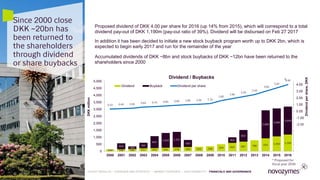
Since 2000 close
DKK ~20bn has
been returned to
the shareholders
through dividend
or share buybacks
Proposed dividend of DKK 4.00 per share for 2016 (up 14% from 2015), which will correspond to a total
dividend pay-out of DKK 1,190m (pay-out ratio of 39%). Dividend will be disbursed on Feb 27 2017
In addition it has been decided to initiate a new stock buyback program worth up to DKK 2bn, which is
expected to begin early 2017 and run for the remainder of the year
Accumulated dividends of DKK ~8bn and stock buybacks of DKK ~12bn have been returned to the
shareholders since 2000
124 146 162 217 231 255 278 309 326 358 504 600 687 786 925 1,062 1,190
424
185
392
847
1,053 1,107
500
400
832
2,000
2,000
2,000
0.33 0.40 0.45 0.63 0.70 0.80 0.90 1.00 1.05 1.15
1.60
1.90
2.20
2.50
3.00
3.50
4.00
-6.00
-5.00
-4.00
-3.00
-2.00
-1.00
0.00
1.00
2.00
3.00
4.00
0
500
1,000
1,500
2,000
2,500
3,000
3,500
4,000
4,500
5,000
2000 2001 2002 2003 2004 2005 2006 2007 2008 2009 2010 2011 2012 2013 2014 2015 2016
Dividendpershare,DKK
DKKmillion
Dividend / Buybacks
Dividend Buyback Dividend per share
49
LATEST RESULTS • OVERVIEW AND STRATEGY • MARKET OVERVIEW • SUSTAINABILITY • FINANCIALS AND GOVERNANCE
*
* Proposed for
fiscal year 2016
50
*Distribution equals where
shares are managed, Dec 2016
Denmark;
21%UK; 30%
Own shares;
3%
Rest of Europe;
12%
North America;
20%
Novo A/S;
10%
Rest of
World; 4%
Shareholder
distribution
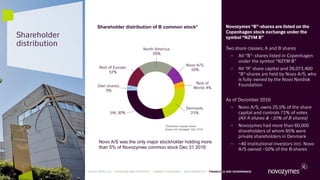
Novozymes “B”-shares are listed on the
Copenhagen stock exchange under the
symbol “NZYM B”
Two share classes; A and B shares
– All “B”- shares listed in Copenhagen
under the symbol “NZYM B”
– All “A” share capital and 26,071,400
“B”-shares are held by Novo A/S, who
is fully owned by the Novo Nordisk
Foundation
As of December 2016
– Novo A/S, owns 25.5% of the share
capital and controls 71% of votes
(All A shares & ~10% of B shares)
– Novozymes had more than 60,000
shareholders of whom 95% were
private shareholders in Denmark
– ~40 institutional investors incl. Novo
A/S owned ~50% of the B-shares
Shareholder distribution of B common stock*
Novo A/S was the only major stockholder holding more
than 5% of Novozymes common stock Dec 31 2016
50
LATEST RESULTS • OVERVIEW AND STRATEGY • MARKET OVERVIEW • SUSTAINABILITY • FINANCIALS AND GOVERNANCE
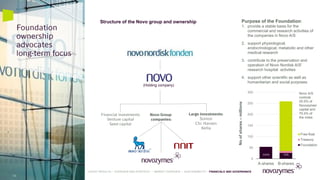
(Holding company)
Large investments:
Sonion
Chr. Hansen
Xellia
Financial investments
Venture capital
Seed capital
Novo Group
companies:
Foundation
ownership
advocates
long-term focus
Purpose of the Foundation:
1. provide a stable basis for the
commercial and research activities of
the companies in Novo A/S
2. support physiological,
endocrinological, metabolic and other
medical research
3. contribute to the preservation and
operation of Novo Nordisk A/S'
research hospital activities
4. support other scientific as well as
humanitarian and social purposes
0
50
100
150
200
250
300
A-shares B-shares
Noofshares–millions
Free-float
Treasury
Foundation
100% 10%
Novo A/S
controls
25.5% of
Novozymes’
capital and
70.4% of
the votes
Structure of the Novo group and ownership
51
LATEST RESULTS • OVERVIEW AND STRATEGY • MARKET OVERVIEW • SUSTAINABILITY • FINANCIALS AND GOVERNANCE
Further investor relations information is available from the company homepage at
www.novozymes.com/investor
Novozymes
Investor
Relations team
Nicolai Kobborg
Manager, Investor Relations
Mobile: +45 3077 1348
E-mail: niak@novozymes.com
Martin Riise
Head of Investor Relations
Mobile: +45 3077 0738
E-mail: mrsn@novozymes.com
Klaus Sindahl
Sr. Manager, Investor Relations
Mobile: +45 5363 0134
E-mail: ksdh@novozymes.com
Naja Wivel
Coordinator, Investor Relations
Mobile: +45 3077 2076
E-mail: nwv@novozymes.com
52
LATEST RESULTS • OVERVIEW AND STRATEGY • MARKET OVERVIEW • SUSTAINABILITY • FINANCIALS AND GOVERNANCE
Forward Looking Statements
This presentation and its related comments contain forward-looking statements, including statements about future events, future financial performance, plans, strategies and expectations. Forward-looking
statements are associated with words such as, but not limited to, "believe," "anticipate," "expect," "estimate," "intend," "plan," "project," "could," "may," "might" and other words of similar meaning.
Forward-looking statements are by their very nature associated with risks and uncertainties that may cause actual results to differ materially from expectations, both positively and negatively. The risks and
uncertainties may, among other things, include unexpected developments in i) the ability to develop and market new products; ii) the demand for Novozymes’ products, market-driven price decreases, industry
consolidation, and launches of competing products or disruptive technologies in Novozymes’ core areas; iii) the ability to protect and enforce the company’s intellectual property rights; iv) significant litigation or
breaches of contract; v) the materialization of the company’s growth platforms, notably the opportunity for marketing biomass conversion technologies or the development of microbial solutions for broad-acre
crops; vi) the political conditions, such as acceptance of enzymes produced by genetically modified organisms; vii) the global economic and capital market conditions, including, but not limited to, currency
exchange rates (USD/DKK and EUR/DKK in particular, but not exclusively), interest rates and inflation; viii) significant price decreases on input and materials that compete with Novozymes’ biological solutions.
The company undertakes no obligation to update any forward-looking statements as a result of future developments or new information.

2016 Q4 Novozymes Roadshow Presentation

  • 1.
    Road Show presentation Full year2016 January 18th 2017
  • 2.
    Table of contents 1.Latest results 2. Overview and Strategy 3. Market Overview - Household Care - Food & Beverages - Bioenergy - Agriculture & Feed - Technical & Pharma 4. Sustainability 5. Financials and Governance 2 3 12 23 24 27 29 33 39 40 45 Full year results 2016 2
  • 3.
    3 DKKm 11,234 11,746 12,459 14,002 14,142 20122013 2014 2015 2016 2,016 2,201 2,525 2,825 3,050 20% 22% 24% 26% 28% 30% 32% 34% 36% 2012 2013 2014 2015 2016 EBIT margin DKKm 5-year organic growth and DKKm 5-year net profit growth and DKKm +4% +7% +7% +4% +2% Organic growth 2016 came in at +2%. EBIT margin expanded to the highest ever Good progress on strategic priorities • Our pipeline of significant market-expanding opportunities is advancing as planned • 4 new products launched in Q4 2016; 8 total launches in 2016 • Organization adjusted to invest in growth areas and pursue opportunities in emerging markets • Customer relationships and near-market innovation +10% +9% +15% +12% +8% 2-5% organic growth in 2017 • Main sales areas expected to grow • EBIT margin maintained LATEST RESULTS • OVERVIEW AND STRATEGY • MARKET OVERVIEW • SUSTAINABILITY • FINANCIALS AND GOVERNANCE
  • 4.
    4 Long-term targets:Novozymes willmaintain a significant R&D investment level • Progress on adjusting pipeline and innovation programs • Reallocation of resources to high-growth opportunities and growth markets • Strengthening our technology leadership Strong pipeline with significant potential • Hygiene platform to launch first product in 2017 • BioAg launched first new product in 2016 Big opportunities in emerging markets • Unlock potential in Asia Pacific, Africa and the Middle East; especially within Household Care and Food & Beverages • Specific initiatives under way in India and Turkey Our six Impact targets will remain unchanged ROIC incl. goodwill EBIT margin Return to historical growth rates ≥26% ≥25% Novozymes will keep investing in the future of biological solutions Organic growth LATEST RESULTS • OVERVIEW AND STRATEGY • MARKET OVERVIEW • SUSTAINABILITY • FINANCIALS AND GOVERNANCE
  • 5.
    Solid sales growthin Q4 taking 2016 to 2% growth • This was driven by a strong contribution in Asia from new product launches in the liquid segment and good underlying market growth. North America grew as consumers traded up • Latin America declined, while Europe grew slightly • Our dishwash segment grew strongly due to increased penetration. We also benefited from new innovation and market share gains. Laundry growth was more modest DKKm 1,148 1,176 1,154 1,154 1,218 Q4'15 Q1'16 Q2'16 Q3'16 Q4'16 3,972 4,222 4,353 4,632 4,702 2012 2013 2014 2015 2016 DKKm Quarterly organic growth and DKKm 5-year organic growth and DKKm +2% +5% +4% -5% +5% +11% +9% +4% +1% +2% Household Care grew 2% in 2016 driven by U.S. and liquids in China 2017 focus on emerging markets and launch in hygiene • New detergent formulation center in India will deliver solutions addressing opportunities we see in Asia, Middle East and Africa • We expect to launch our first technology in the hygiene area, which potentially can transition into a significant growth platform in the coming years 5 LATEST RESULTS • OVERVIEW AND STRATEGY • MARKET OVERVIEW • SUSTAINABILITY • FINANCIALS AND GOVERNANCE
  • 6.
    Technical & Pharmadid well in 2016, while Q4 was down • Good uptake of our Pharma enzymes and albumin. We also saw increased royalties from GSK’s sale of Tanzeum® • In sales to the Technical industries, textiles and wastewater treatment performed satisfactorily, while leather ended the year slightly positive • Q4 ended down due to lumpiness in Pharma. Technical ended slightly positive for the quarter supported by continued growth in textile and wastewater treatment 711 757 829 982 1,055 2012 2013 2014 2015 2016 DKKm 264 299 279 258 219 Q4'15 Q1'16 Q2'16 Q3'16 Q4'16 DKKm +21% +37% +9% +16% -12% -5% +6% +9% +6% +13% Technical & Pharma grew 13% in 2016 with solid growth across most segments 6 Quarterly organic growth and DKKm 5-year organic growth and DKKm LATEST RESULTS • OVERVIEW AND STRATEGY • MARKET OVERVIEW • SUSTAINABILITY • FINANCIALS AND GOVERNANCE
  • 7.
    Market share in2016 stable despite intense competition • Full-year sales down 3%, despite ethanol production up 3% in the US, and 2% globally • Continued product trialing by ethanol producers incl. enzymes and other solutions put pressure on price/mix DKKm 616 626 570 579 663 Q4'15 Q1'16 Q2'16 Q3'16 Q4'16 1,748 1,909 2,270 2,543 2,438 2012 2013 2014 2015 2016 DKKm -15% -6% -6% -8% +7% -9% +12% +19% -5% -3% Bioenergy was up 7% in Q4 and 3% down ended down 3% for the full year 2017 will see new innovation to support sales • New product launches expected in conventional biofuels, plus customer-specific upgrades in biomass conversion • Working with customers to improve plant efficiency through digitalization and technical support Q4 up 7% as both conventional and biomass contributed • Strong performance in conventional biofuels, mainly from outside the US • Sales for biomass closed Q4 strongly, as production of ethanol from biomass conversion becomes more stable 7 Quarterly organic growth and DKKm 5-year organic growth and DKKm LATEST RESULTS • OVERVIEW AND STRATEGY • MARKET OVERVIEW • SUSTAINABILITY • FINANCIALS AND GOVERNANCE
  • 8.
    2016 showed solidperformance of enzymes for Animal Feed • Animal feed enzyme grew steadily across main markets, plus good traction in trialing of our probiotics • Modest growth in BioAg sales for 2016, as farmers were influenced by low crop prices leading to lower inoculant sales. New sales pattern led to a very strong Q4 • Commercial launch of Acceleron® B-300 SAT for corn DKKm 524 582 496 452 677 Q4'15 Q1'16 Q2'16 Q3'16 Q4'16 1,616 1,669 1,728 2,130 2,207 2012 2013 2014 2015 2016 DKKm +18% -8% +13% -3% +22% +13% +5% +7% +19% +5% Agriculture & Feed grew 5% in 2016, driven by strong growth in Q4 Strong growth of 22% in Q4 • Sales in BioAg grew strongly as preparation for the 2017 season in North America commenced in Q4 • Sales also included shipments of our newly launched Acceleron® B-300 SAT Steady sales growth expected to continue in 2017 • Continued strong performance of feed enzymes; especially carbohydrases and proteases • Acceleron® B-300 SAT on all new corn hybrids in 2017 with a target to reach 90 million acres by 2025 8 Quarterly organic growth and DKKm 5-year organic growth and DKKm LATEST RESULTS • OVERVIEW AND STRATEGY • MARKET OVERVIEW • SUSTAINABILITY • FINANCIALS AND GOVERNANCE
  • 9.
    DKKm 900 926 930 947937 Q4'15 Q1'16 Q2'16 Q3'16 Q4'16 3,186 3,190 3,278 3,715 3,740 2012 2013 2014 2015 2016 DKKm +4% +2% +4% -2% +4% +1% +3% +4% +5% +2% In 2017, we see growth coming from emerging markets, Starch and Food & Nutrition • To support strong growth in the emerging markets, we are adding sales resources and technical service facilities – including a baking development lab in Turkey • We are prioritizing our starch business to capture growth in the global starch-refining business and by opening a new growth platform in grain milling • Food & Nutrition will return to growth as we recover in infant nutrition • Baking growth opportunities in emerging markets, but price erosion expected in the North American freshkeeping market Food & beverages grew 2% in 2016. Beverages and Starch showed strong growth; Baking flat Food & Beverages growth driven by emerging markets and sales to the starch industry • Strong growth in Asia Pacific, broadly across segments with baking and starch in China as key drivers • The Middle East and Africa delivered good results, driven by brewing and starch • Europe overall was flat, with solid growth in baking and starch offset by lost market share in infant nutrition • Americas contracted, with modest growth in starch outweighed by a decline in baking 9 Quarterly organic growth and DKKm 5-year organic growth and DKKm LATEST RESULTS • OVERVIEW AND STRATEGY • MARKET OVERVIEW • SUSTAINABILITY • FINANCIALS AND GOVERNANCE
  • 10.
    Area Innovation FeasibilityDiscovery Development Launch Commercial Household Care Hygiene solutions Household Care Tailored emerging markets solutions Food & Beverages Vegetable oil processing Food & Beverages Grain milling Agriculture & Feed Natural growth promotion Agriculture & Feed Enhanced corn inoculant Agriculture & Feed New transformative BioAg solutions Bioenergy Biomass conversion Strong pipeline of significant market- expanding growth opportunities Total pipeline has: • 8 programs with significant market-expanding potential • Significant potential to boost organic growth • >100 projects • Projects that improve productivity • Technology projects to expand the ”toolbox” Arrows denote progress to next phase over the past 12 months On top of the flow of innovation to existing markets, Novozymes is currently investing in innovation to expand the market for enzyme and microbial technology and thereby grow sales. Most of the innovation programs below have the potential to impact sustainability positively. 10 LATEST RESULTS • OVERVIEW AND STRATEGY • MARKET OVERVIEW • SUSTAINABILITY • FINANCIALS AND GOVERNANCE
  • 11.
    11 EBIT margin, net profitgrowth and ROIC targets all reached as guided back in Jan.16 EBIT margin expanded through tight cost control • Underlying gross margin on par with last year • Adjusting for the restructuring in 2016, the EBIT margin expanded to above 28%; mainly as a result of lower operational costs • Net profit grew 8% as net financials improved from lower hedging costs In 2017, organic sales growth 2-5% and profitability to be maintained New DKK 2bn stock buyback program planned for 2017 • Proposed annual dividend, up 14% to DKK 4.00 per share • New DKK 2 billion stock buyback program planned for 2017 Key financials (DKKm) Realized FY 2016 2017 outlook January 18 Sales growth organic +2% 2-5% EBIT margin 27.9% ~28% Net profit growth 8% 2-5% Net Investments excl. M&A 1,188 1,700-1,900 Free Cash Flow excl. M&A 2,652 2,000-2,200 ROIC incl. goodwill 25.1% 24-25% LATEST RESULTS • OVERVIEW AND STRATEGY • MARKET OVERVIEW • SUSTAINABILITY • FINANCIALS AND GOVERNANCE
  • 12.
  • 13.
    13 Novozymes at a glance Worldleader in Bioinnovation Listed 2000 Ticker NZYM B Exchange Nasdaq Copenhagen CEO Peder Holk Nielsen (since 2013) • ~6,500 employees • ~700 products sold in 140 countries • Major production footprint in 3 regions Global Profitable Majority owner Novo A/S R&D intensive • ~1,400 people employed in R&D • ~7,000 patents • ~ 13% of sales invested in R&D • Innovation focused on enzymes and microbes • Controls 25.5% of the capital • ~70% of the votes • 2 seats on the board of directors 11,234 11,746 12,459 14,002 14,142 20% 22% 24% 26% 28% 30% 32% 34% 36% 2012 2013 2014 2015 2016 EBIT margin • USD 2bn in sales • ~28% EBIT margin • ~25% ROIC DKKm 5 years of organic growth & EBIT +4% +7% +7% +4% +2% Market Leader in industrial enzymes • ~48% Novozymes • ~19% DuPont • ~33% Others incl. DSM, Chinese, captive etc. Company background 13 LATEST RESULTS • OVERVIEW AND STRATEGY • MARKET OVERVIEW • SUSTAINABILITY • FINANCIALS AND GOVERNANCE
  • 14.
    14 Uniquely diversified group, creates synergies andopportunities 11% 9% 4% 1% 2% 2012 2013 2014 2015 2016 1% 3% 4% 5% 2% 2012 2013 2014 2015 2016 -9% 12% 19% -5% -3% 2012 2013 2014 2015 2016 13% 5% 7% 19% 5% 2012 2013 2014 2015 2016 -5% 6% 9% 6% 13% 2012 2013 2014 2015 2016 ~5% ~3% ~3% ~10% ~6% 33% 26% 17% 16% 8% Household Care Food & Beverages Bioenergy Agriculture & Feed Technical & Pharma Laundry & Dishwasher detergents, Cleaning products Baking, Starch to syrups, Brewing & Alcohol, Healthy concepts Corn ethanol Cellulosic biofuels Animal feed BioAgriculture Textile & Leather, Pulp & Paper, Wastewater, Pharma ingredients Organic growth avg. Organic growth avg. Organic growth avg Organic growth avg Organic growth avg Global provider of enzymes to all market segments creates global market leader position. Leveraging competencies across segments accelerates pace of innovation, reduces competition and creates high barriers to entry 14 LATEST RESULTS • OVERVIEW AND STRATEGY • MARKET OVERVIEW • SUSTAINABILITY • FINANCIALS AND GOVERNANCE
  • 15.
    15 Existing tech innew market (example; launch advanced protease in Emerging Markets) New tech in existing market (example; introduce a new enzyme in the 1G Ethanol market) Just do it (example, launch new version of Novamyl in the baking industry) Find partner, reduce one risk (example; BioAg Alliance with Monsanto or Feed Alliance with DSM) CommercialRisk The strategy for Novozymes when looking to expand into new areas is to assume either the technology risk (developing unproved technology) or the market risk (entry into new markets). If we see both a technology risk and a market risk, but it looks like the right opportunity, we will search for a partner who can help us unlock the potential. This is how we bring our “Partnering for Impact” strategy to life, by leveraging the competencies of others and at the same time minimizing the risk to our business. Technology Risk Strategy, purpose and partnerships Our Purpose Our Strategy 15 LATEST RESULTS • OVERVIEW AND STRATEGY • MARKET OVERVIEW • SUSTAINABILITY • FINANCIALS AND GOVERNANCE
  • 16.
    Experienced leadership team –with more than 24 years seniority on average with the business Tina S. Fanø Executive Vice President, Agriculture & Bioenergy Novozymes since 1993 Peder Holk Nielsen CEO & President Novozymes since 1984 Thomas Videbæk COO & Executive Vice President, Research, Innovation & Supply Novozymes since 1988 Anders Lund Executive Vice President, Household Care & Technical Industries Novozymes since 1999 Benny D. Loft CFO & Executive Vice President, Corporate Functions Novozymes since 1998 Andrew Fordyce Executive Vice President, Food & Beverages Novozymes since 1993 16 LATEST RESULTS • OVERVIEW AND STRATEGY • MARKET OVERVIEW • SUSTAINABILITY • FINANCIALS AND GOVERNANCE
  • 17.
    Our set ofcompetitive advantages across the value chain has led to a unique marketleading position • Production: 5 core plants in 3 regions • Research & Development: 2/3 of total investment of industry • Technical services: half of commercial organization “on site” • Market & technology coverage • Superior logistical agility due to full control of value chain • Ability to tailor solutions to specific customer and market needs • First mover in a number of markets lead by ability to innovate • High quality products that meet regulatory requirements • Wide range of solutions and product offerings • Sustainability is in our DNA helping our customers to save an estimated 69 million tons of CO2 (2016) • Triple bottom line • Pioneering life cycle assessment documentation • Unique market-leading position in a global niche • Strong technology backbone and competences • More than 7,000 patents • Diverse biotech know how and investments needed to compete • Long term trusted partner for our customers • Extensive know how and manufacturing expertise 17 Scale 1 Quality Sustainability High Barriers 2 3 4 LATEST RESULTS • OVERVIEW AND STRATEGY • MARKET OVERVIEW • SUSTAINABILITY • FINANCIALS AND GOVERNANCE
  • 18.
    16 years of innovation-driven returns 0.0% 2.5% 5.0% 7.5% 10.0% 12.5% 15.0% 17.5% 20.0% 22.5% 25.0% 27.5% 30.0% 0 2,000 4,000 6,000 8,000 10,000 12,000 14,000 16,000 SalesDKKm EBIT margin R&D/Sales ROIC Strong returns since 2000 • 2.8x Sales • 4.7x EBIT • 6.3x Net Profit • DKK ~36bn in Cash Flows Innovation is the recipe • DKK ~20bn spent on R&D • +100 new launches • +5.5% in Gross margin expansions through productivity improvements Solid financial track record driven by innovation 18 LATEST RESULTS • OVERVIEW AND STRATEGY • MARKET OVERVIEW • SUSTAINABILITY • FINANCIALS AND GOVERNANCE
  • 19.
    Latin America NZ: Production Mainmarkets: HHC, Feed, BioAg & F&B Acc CAPEX: ~DKK 400m FTE’s: ~350 5Y Avg growth: +17% North America NZ: Production, R&D Main markets: Bioenergy, HHC, F&B, BioAg Acc CAPEX: ~DKK 4bn FTE’s: ~1,300 5Y Avg growth: +1% Asia Pacific NZ: Production, R&D Main markets: F&B, HHC, Tech & Feed Acc CAPEX: DKK ~2,6bn FTE’s: ~1,800 5Y Avg growth: +6% EMEA NZ: HQ, Production R&D Main markets: HHC, F&B, Feed & Pharma Acc CAPEX: ~ DKK 6bn FTE’s: ~2,900 5Y Avg growth: +6% 1919 Satellite production site Main sites with production and R&D Satellite R&D site 34% 36% 10% 20% Beijing & Tianjin Denmark Raleigh, NC Our global business serves a large number of local markets and industries LATEST RESULTS • OVERVIEW AND STRATEGY • MARKET OVERVIEW • SUSTAINABILITY • FINANCIALS AND GOVERNANCE
  • 20.
    R&D investments drivegrowth today and enhance technology leadership for long-term impact Established business areas Basic technologies Advance understanding, application support, development and formulation of biological systems R&D investments in production systems and productivity Growth platforms Household Care Food & Beverages Grain-based ethanol BioAg Biomass Conversion Animal Health & Nutrition Emerging industries Technical industries 20 LATEST RESULTS • OVERVIEW AND STRATEGY • MARKET OVERVIEW • SUSTAINABILITY • FINANCIALS AND GOVERNANCE
  • 21.
    21 • Strain developmentusing protein engineering, genetic modification, DNA sequencing, etc Molecular biology Industrial-scale fermentation Screening systems • Production of enzymes and proteins whilst continuously optimizing and improving yields • Application of computer algorithms in the computational discovery of enzymes in DNA databases Bio-informatics & Systems biology • Application of high-throughput robotics to find the best enzyme candidates Developing new technology and business platforms Biomass conversion Bio- Agriculture Probiotics Sugarcane platform Continued development in our technology base… …creates opportunities to develop new business platform Hygiene Care Grain milling Vegetable Oil processing LATEST RESULTS • OVERVIEW AND STRATEGY • MARKET OVERVIEW • SUSTAINABILITY • FINANCIALS AND GOVERNANCE
  • 22.
    Novozymes dedicates 10-15%of R&D spend to productivity improvement programs Novozymes has achieved organic sales growth of ~6-7% since 2000 with improving margins Raw materials Micro-organisms Enzymes Fermentation Purification Formulation All our solutions are produced via fermentation technology Improve production strain Ability to produce more enzymes per m3 fermentation tank through genetic engineering of host organism Optimize industrial production Process optimization Equipment optimization Input optimization Improve enzyme efficacy Protein engineering of enzymes improves efficacy. Customers buy efficacy, not volume 3 levers to improve profitability 1 2 3 22 LATEST RESULTS • OVERVIEW AND STRATEGY • MARKET OVERVIEW • SUSTAINABILITY • FINANCIALS AND GOVERNANCE
  • 23.
  • 24.
    24 Household Care Overview 33% Applications Laundry& dishwasher detergents Novozymes market share >60% Competition Dupont Household Care stats 3,972 4,222 4,353 4,632 4,702 2012 2013 2014 2015 2016 5 year organic growth +11% +9% +4% +1% +2% Current trends Growth drivers • Demand for better products in Emerging Markets. • Demand for antibacterial and hygiene solutions for laundry • Demand for energy-efficient solutions (low temp washing) • Demand to clean more with less water • New formats (liquids, unit dose compaction, hygiene, etc.) • Partners with greater reach • Sourcing raw materials from renewable sources Growth barriers • Middle-class consumers’ ability to differentiate brand performance • Competition putting pressure on detergent prices • Sustained low surfactant prices reducing adoption of enzymes • Technology development leading to rapid shifts in consumer preferences • Perception that compaction and low temp washing are less effective • Stronger partners potentially leading to increased bargaining power • Focus on cost optimization Shifting demographics and urbanization Water scarcity Customer consolidation Energy transition Convenience and cleanliness Cost-based optimization of formulation DKKm LATEST RESULTS • OVERVIEW AND STRATEGY • MARKET OVERVIEW • SUSTAINABILITY • FINANCIALS AND GOVERNANCE 24
  • 25.
    Eliminate harsh chemicals Decrease dose, increaseperformance Preserve fabric texture, color Our technology makes a difference Remove stains, boost whiteness Save energy, water, time 25 LATEST RESULTS • OVERVIEW AND STRATEGY • MARKET OVERVIEW • SUSTAINABILITY • FINANCIALS AND GOVERNANCE
  • 26.
    Traditional enzyme solutions haveenabled a switch to cold washing  Novozymes is a first mover in hygiene and has a dedicated team of scientists working on solutions that improve laundry hygiene  Novozymes expects to launch a portfolio of innovations within the hygiene platform over the coming period Four key trends are increasing consumers’ laundry hygiene concerns Novozymes invests to ensure innovative, safe and natural solutions to address consumers’ hygiene concerns Cold wash Rise of liquids Changing textiles Urbanization Liquid detergents are a premium product and more user-friendly The lower cost and higher flexibility of synthetics are driving more textile production using these materials An increasing population searching for opportunities in the cities 2 1 3 4 Hygiene Care will enable a new wave of growth in HHC in both the develop and emerging markets 26 LATEST RESULTS • OVERVIEW AND STRATEGY • MARKET OVERVIEW • SUSTAINABILITY • FINANCIALS AND GOVERNANCE
  • 27.
    Food & Beverages Overview26% Applications Baking / Starch conversion / Brewing / Beverage alcohol / Healthy concepts Novozymes market share 30-40% Competition DSM, Dupont, regional Food & Beverages statsCurrent trends Growth drivers • Demand for better and more convenient foods • Improved processing and optimization of raw materials • Demand for substitutes for animal protein • Customers using data analytics to validate efficiency gains achieved • Awareness about food safety and “naturally healthy” products • Growth in market for “food intolerance” products, such as lactose-free • Demand for optimization in raw materials and production processes • Customer focus on cost optimization, processing aids and brand building • Stronger partners with greater reach Growth barriers • Consumer preference for traditional foods • Fragmented local markets and dietary habits as well as regulation • Demand for rapid innovation in regional markets • Consumer and industry skepticism about technology in F&B production • Customer inertia in changing formulations and adopting new technologies • Fragmented local markets and dietary habits • Demand for rapid innovation in regional markets Shifting demographics and urbanization Water scarcity Consumer focus on health, wellness and natural products Digitalization of the global economy Increased cost of raw materials Customers consolidating operations but diversifying brands to cater for hyperlocal consumer preferences 3,186 3,190 3,278 3,715 3,740 2012 2013 2014 2015 2016 DKKm 5 year organic growth +1% +3% +4% +5% +2% 27 LATEST RESULTS • OVERVIEW AND STRATEGY • MARKET OVERVIEW • SUSTAINABILITY • FINANCIALS AND GOVERNANCE
  • 28.
    28 LATEST RESULTS •OVERVIEW AND STRATEGY • MARKET OVERVIEW • SUSTAINABILITY • FINANCIALS AND GOVERNANCE In Food & Beverages we operate in different parts of the value chain. Revenue-wise, the two parts are comparable We cover a broad set of end markets and applications Processing of Ag inputs A global business with global solutions Food products Product-driven for developed markets Characteristics: • Starch processing main business • Fewer product categories • DuPont main competitor • Fragmented global customer base • ~60% direct sales • ~60% emerging markets Characteristics: • Baking is our main market • Many products and offerings to many end customers • Competition more dispersed and local • ~80% direct sales • ~30% emerging markets Brewing Starch processing Beverage alcohol Oils & fats processing Juice & wine Baking Infant food Acrylamide reduction Low lactose Flavor enhancement
  • 29.
    Bioenergy Overview Applications Corn ethanol /Biomass conversion -Mainly a U.S. business today (85%) Novozymes market share ~50% Competition Dupont, regionals and other technologies Bioenergy statsCurrent trends Growth drivers • Industry consolidation and focus on process economics driving demand for enzymatic solutions that enhance yield and reduce chemical costs • Growth of low-carbon fuel standards driving demand for cellulosic fuel • Modern and automated ethanol facilities using data analytics to monitor performance and potential for optimization gains (high tier enzymes) • Continued stable political mandate driving adoption of biofuels • Growing calls for CO2 reductions in transportation sector • Price and yield stability of low-tier enzymes • Demand for enzymes with optimization potential Growth barriers • Reduced demand for premium enzymes in low input cost environment • Majority of renewable investments going into solar, wind, etc. • Lack of political support outside of the US for starch-based ethanol • General lack of willingness to invest in cellulosic ethanol • Lack of political commitment to expanding blending mandates • Resistance to exceeding 10% blend in the US • Competition with electric vehicles to reduce CO2 emissions • Fluctuating value of co-products reducing demand for high tier enzymes Volatile commodity prices squeezing customer margins Waning public support for biofuels US corn ethanol industry affected by low corn prices Digitalization of the global economy Energy transition 17% 1,748 1,909 2,270 2,543 2,438 2012 2013 2014 2015 2016 DKKm 5 year organic growth -9% +12% +19% -5% -3% 29 LATEST RESULTS • OVERVIEW AND STRATEGY • MARKET OVERVIEW • SUSTAINABILITY • FINANCIALS AND GOVERNANCE
  • 30.
    30 The Ethanol Process: Enzymesare applied in multiple stages, along with yeast in fermentation Increasing complexity in bioethanol production Basic products for liquefaction and saccharification Multiple offerings across liquefaction and saccharification Increasingly customized solutions for liquefaction and saccharification, novel solutions for other process steps From standard to more customized solutions Advancing enzyme design: Using our diagnostic program to deliver custom fermentation solutions, tailored to a plant’s unique operating conditions Past Present Future LATEST RESULTS • OVERVIEW AND STRATEGY • MARKET OVERVIEW • SUSTAINABILITY • FINANCIALS AND GOVERNANCE
  • 31.
    31 Ethanol production and outlook inthe U.S. 0 5 10 15 20 2006 2007 2008 2009 2010 2011 2012 2013 2014 2015 2016 2017 2018 2019 2020 BillionGallons U.S. ethanol production volumes have stabilized 0 200 400 600 800 1,000 1,200 1,400 2006 2007 2008 2009 2010 2011 2012 2013 2014 2015 2016 2017 2018 2019 2020 MillionGallons U.S. ethanol exports have increased since 2009 0 20 40 60 80 100 120 2011 2013 2015 2017 2019 2021 2023 2025 2027 2029 2031 2033 2035 2037 2039 Index Gasoline volumes are stable today. 2040 outlook is for lower volumes driven by mileage standards US Ethanol production grew ~3% in 2016 totalling to an estimated 15.3bn gallons. Global production was up ~2% Exports are increasing in particular to countries like Canada, China, Brazil, India and the Middle East LATEST RESULTS • OVERVIEW AND STRATEGY • MARKET OVERVIEW • SUSTAINABILITY • FINANCIALS AND GOVERNANCE Est. Est.
  • 32.
    Novozymes serves 5out of 8 commercial facilities While several biomass conversion ethanol plants are already operating, more than 20 solid biomass conversion projects are under development globally (not all publicly announced) Different business models: • Co-marketing with Beta Renewables • Project development • Large strategic partners e.g. Raízen 32 Publicly announced, commercial biomass conversion projects under development by region* Brazil 4. Raízen 5. GranBio − Solvay − CTC United States 1. POET/DSM 2. DuPont 3. Abengoa − Beta Renewables − ZeaChem − ICM − Sweetwater Europe 6. Beta Renewables 7. ST1 − Maabjerg Bioenergy − Ethanol Europe − Energo Chemica India and South East Asia − Beta Renewables − India Oil − CVC India − Brooke Sarawak China 8. Longlive − Petro China − Cofco − Tianguan Group − M&G Chemicals − NTL *Non-exhaustive Project pipeline biomass conversion 32 LATEST RESULTS • OVERVIEW AND STRATEGY • MARKET OVERVIEW • SUSTAINABILITY • FINANCIALS AND GOVERNANCE
  • 33.
    33 Agriculture & Feed Overview Partnerships: FeedAlliance The BioAg Alliance Applications Enzymes for nutritive enhancement of feed for pigs and chicken. Microbes for crop yield enhancement. Probiotics Novozymes market share 25-30% (Feed enzymes). Leading producer of inoculants (BioAg) Competition Dupont, AB Vista, regional (Feed Enzymes) BASF, Bayer, regional (BioAg) Agriculture & Feed stats Current trends Growth drivers • Favorable regulatory environment benefiting sustainable farming • Pressure on available farmable land (more with less) • Demand for more efficient animal feed solutions to increase production • Global growth in protein consumption due to changes in dietary habits • Governments in emerging economies focusing on Ag productivity • Rise of precision agriculture validating yield improvements and enabling tailoring of microbial solutions to farmers’ specific soil conditions • Growing calls for reduced use of antibiotics in farm animals • High input costs for farmers driving demand for yield-enhancing and sustainable solutions Growth barriers • Customer skepticism and lack of understanding of biologicals • Fragmented and complicated regulation in local markets • Lack of scientific proof for biologicals and understanding of the potential of biotechnology in agriculture and feed • Low pricing of traditional fertilizers and pesticides competing with more sustainable solutions • Low commodity prices forcing farmers to cut back on seed treatments Transition to sustainable agriculture Digitalization of the global economy Consumer focus on health, wellness and natural products Shifting demographics and urbanization Farmers sensitive to fluctuations in commodity prices 16% 1,616 1,669 1,728 2,130 2,207 2012 2013 2014 2015 2016 DKKm 5 year organic growth +13% +5% +7% +19% +5% 33 LATEST RESULTS • OVERVIEW AND STRATEGY • MARKET OVERVIEW • SUSTAINABILITY • FINANCIALS AND GOVERNANCE
  • 34.
    34 QUARTERLY RESULTS• NOVOZYMES OVERVIEW • STRATEGY • MARKET OVERVIEW • SUSTAINABILITY • FINANCIAL REVIEW34 LATEST RESULTS • OVERVIEW AND STRATEGY • MARKET OVERVIEW • SUSTAINABILITY • FINANCIALS AND GOVERNANCE
  • 35.
    35 QUARTERLY RESULTS• NOVOZYMES OVERVIEW • STRATEGY • MARKET OVERVIEW • SUSTAINABILITY • FINANCIAL REVIEW35 LATEST RESULTS • OVERVIEW AND STRATEGY • MARKET OVERVIEW • SUSTAINABILITY • FINANCIALS AND GOVERNANCE
  • 36.
    Inoculants hold significantopportunity for market expansion across crops and geographies Soybean Pulses Alfalfa Canola Corn Wheat Cotton Rice Factors driving inoculant growth: Global Planted Acres1 (5 year avg. 2009–2013) ~ 260m ~190m ~15m ~85m ~425m ~549m ~80m ~400m Market expansion • Significant opportunity across crops and geographiesInoculants Treated Acres2 ~55-60% ~ 15% ~50% ~ 5% ~ 5% <1% <1% <1% BioAg Existing Product Portfolio Immediate commercial portfolio • Working from strong starting position with existing commercial productsNA LATAM RoW Current Inoculants Treatment Regime Advantageous commercial footprint • Monsanto’s broad global footprint enabling upstream distribution and leveraging relationships with distributor and retail channels Upstream (Seed Company) Midstream (Distributor/Retailer) Downstream (Grower) 1. Source: FAO stats and Internal estimates 2. Internal 2014 estimates Strong product position Moderate product position Minor product position No current product position 1 2 3 36 LATEST RESULTS • OVERVIEW AND STRATEGY • MARKET OVERVIEW • SUSTAINABILITY • FINANCIALS AND GOVERNANCE
  • 37.
    • Only 3-30%*of phosphate in feed is available to the animal • Ronozyme NP® releases half of the phosphate bound – Ronozyme HiPhos® releases nearly all of it • Significant reduction in phosphorous excretion from animals as farmers can save 25-100%* of added mineral phosphate • Maximizing protein utilization and improving nutritional value • Improves protein digestibility by > 20%*, increasing feed conversion • Reduces need for additional protein feed, such as soybean meal • Xylanase & glucanase increase non- starch polysaccharide digestion • Amylase improves starch digestibility, releasing more energy • Cellulase improves fiber digestion • Grain feed savings of ~ 2.5%* and less pollution (ammonia, nitrate, nitrous oxide and CO2) 37 Attractive value propositions in animal feed enzymes Phytase phosphate ProAct® protein Others energy Carbo- hydrases Proteases Phytases Forceful pursuit of science leadership with DSM alliance across species, product classes and regions 80-90% 35-45% 10-15% 0% 25% 50% 75% 100% Phytase Carbohydrase Protease Estimated penetration across swine and poultry Penetration Our offerings in animal feed enzymes Our partner in Animal Feed
  • 38.
    Relevance of innovationcluster The world needs sustainable efficiency gains in animal production • 9+ billion people by 2050 • Protein demand to double next 40 years • Feed costs in 50% of costs in animal production • Arable land per capita expected to decrease by 35% from 2000 to 2050 • Antibiotic resistance and regulation are driving the need for alternatives to antibiotics Improving the yield in animal production would have significantly positive impact in terms of global warming and use of agricultural land 3838 Approach and status As part of our efforts to leverage biological solutions to enable efficiency gains in animal products, we aim to leverage our capabilities to develop additives for natural growth promotion In 2015 we initiated a partnership with Adisseo with the shared ambition to enter and develop the market for probiotics In 2016 H1, Alterion® was released together with Adisseo which is a probiotic for poultry, as the first product in our innovation cluster “Natural growth promotion”. Alterion® consistently improves the gut health of poultry which yields a lower Feed Conversion Ratio (FCR) and increase Body Weight Gain (BWG). Launched in Asia, the US and MEA in 2016. Alterion will be rolled out in China in 2017 Animal Health & Nutrition Natural Growth Promotion Our partner in AH&N Our first product for poultry 38 LATEST RESULTS • OVERVIEW AND STRATEGY • MARKET OVERVIEW • SUSTAINABILITY • FINANCIALS AND GOVERNANCE
  • 39.
    Technical & Pharma Overview Applications Textiles/ Leather / Pulp & Paper / Albumin / Biocatalysis Novozymes market share ~50% (enzymes only) Competition Dupont + regional Technical & Pharma stats Current trends Growth drivers • Increasing demand for wastewater solutions due to increasing water quality/pollution cleanup regulations • Consumer demand in emerging markets for improved textile quality and longevity • Enzymatic solutions potentially optimizing processes and lowering costs • Non-animal, recombinant input sources in pharma • Better and more sustainable drug delivery and formulation (pharma) Growth barriers • Water prices potentially so low that there is no incentive to invest in watersaving solutions • Demand for low-quality textiles and raw materials • Preference for lower-cost, chemical solutions to enable market growth • Long and resource-intensive development cycles in pharma Water scarcity Shifting demographics and urbanization Continuous optimization in textile industry 8% 3,186 3,190 3,278 3,715 3,740 2012 2013 2014 2015 2016 DKKm 5 year organic growth +1% +3% +4% +5% +2% 39 LATEST RESULTS • OVERVIEW AND STRATEGY • MARKET OVERVIEW • SUSTAINABILITY • FINANCIALS AND GOVERNANCE
  • 40.
  • 41.
    New long-term targetsfocus on world impact New IMPACT targets Company performance – the traditional view on sustainability World needs – areas where we can make an impact SocialEnvironmental • 10 transformative innovations • 5 partnerships for change • Educate 1 million people • Enable Zymers to develop • Save 100 million tons of CO2 • Reach 6 billion people with our biological solutions Sustainable raw materials Resource efficiency Product stewardship Health & Safety Human & labor rights Employee satisfaction Sustainable growth Education Health and livelihoods Climate change Novozymes’ unique contribution: Updated operational targets Environment • Energy efficiency • Water efficiency • Reduction in CO2 intensity • Renewable energy • Supplier program • Gold Class RobecoSAM rating • Carbon Disclosure Project A List People • Occupational accidents • Employee absence • Employee “satisfaction and motivation” • Employee “opportunities for development” • Women in senior management Governance (economic) Corporate governance Business integrity & antitrust Economic growth Job creation Supply chain management 41 LATEST RESULTS • OVERVIEW AND STRATEGY • MARKET OVERVIEW • SUSTAINABILITY • FINANCIALS AND GOVERNANCE
  • 42.
    0% 20% 40% 60% 80% 100% 120% 140% 160% 2005 2006 20072008 2009 2010 2011 2012 2013 2014 2015 2016 %changefrom2005baseline 0.0% 0.5% 1.0% 1.5% 2.0% 2.5% 3.0% 3.5% 0 2 4 6 8 10 12 2000 2001 2002 2003 2004 2005 2006 2007 2008 2009 2010 2011 2012 2013 2014 2015 2016 Occupational accidents per million working hours Employee absence (%) Gross profit Water Energy CO2 emissions Decoupling resource consumption from economic growthWe plan to continue our journey of operational excellence Steady improvement in employee metrics Sales Novozymes has over time proved how investments in efficiency and optimization programs pay off not only from a sustainability perspective but also from an economic perspective In the US we have a biogas plant which turns wastewater into steam In Denmark 24% of the total energy consumed comes from renewable sources; mainly windfarms 42 LATEST RESULTS • OVERVIEW AND STRATEGY • MARKET OVERVIEW • SUSTAINABILITY • FINANCIALS AND GOVERNANCE
  • 43.
    43 Cereals: 110 kg CO2 perton of bread Detergent: 50-150 kg CO2 per ton of laundry Beverage: 25 kg CO2 per 1000 litre of beer Vegetable oil: 44 kg CO2 per ton of oil Dairy: 230 kg CO2 per ton of mozzarella Margarine: 23 kg CO2 per ton of hardstock Animal feed: 80 kg CO2 per ton of feed Textile: 1100 kg CO2 per ton of fabric Agriculture: 15 kg CO2 per ton of corn Leather: 100 kg CO2 per ton of hide Paper making: 150 kg CO2 per ton of pulp Cosmetics: 190 kg CO2 per ton of fatty acid ester In 2016, Novozymes helped customers save tons of CO2 through the application of Novozymes’ products 69 million We are reducing CO2 emissions together with our customers by offering solutions that help produce more with less 43 LATEST RESULTS • OVERVIEW AND STRATEGY • MARKET OVERVIEW • SUSTAINABILITY • FINANCIALS AND GOVERNANCE
  • 44.
    44 Long term incentiveprogram (2017-2019) 0 10 20 30 40 50 60 70 80 90 100 1.0 2.0 3.0 4.0 5.0 5.5 6.0 6.5 7.0 7.5 8.0 %stock&optionsawarded Bn DKK of acc. economic profit 0 2 4 6 8 10 12 14 16 18 Monthsofsalaryperyear Max 2 months of base salary cash bonus linked to fulfilment of EBIT and sustainability targets Max 3 months of base salary cash bonus linked to fulfilment of personal targets Base salary • The incentive program consists of 50% stock options and 50% stocks with the opportunity to double annual remuneration. Awards will depend on accumulated economic profit generated (75%) as well as average organic sales growth (25%). • Economic profit is defined as: NOPAT - (Avg. inv. capital * WACC) • NOPAT is adjusted for hedging result to eliminate impact of currency fluctuations as well as for any impacts from major acquisitions. A fixed WACC of 6% will be used during the entire program • Stock options will be awarded annually (3-year vesting period), stocks in 2020 (no vesting period). Maximum clause caps upside (max. cap = 2x intrinsic value at establishment ex. inflation) Economic Profit (75% of the program) 0 10 20 30 40 50 60 70 80 90 100 1% 2% 3% 4% 5% 6% 7% %stock&optionsawarded Organic Sales growth Organic growth (25% of the program) Annual remuneration scheme Conditions for long term program Novozymes’ remuneration principles for the Executive leadership team Salary and cash bonus 44 LATEST RESULTS • OVERVIEW AND STRATEGY • MARKET OVERVIEW • SUSTAINABILITY • FINANCIALS AND GOVERNANCE Remuneration principles ensure close alignment with long term shareholder interests, links remuneration to shareholder gains and losses, and ensures management retention
  • 45.
  • 46.
    Historical performance demonstrates track record of delivery 5,033 8,146 14,142 16.7% 18.5% 27.9% 0 2,000 4,000 6,000 8,000 10,000 12,000 14,000 16,000 18,000 20,000 0% 5% 10% 15% 20% 25% 30%SalesDKKm EBIT margin DKKm EBITmargin EBITmargin 16 years of organic growth and improved margins Profitability has benefitted from productivity improvements and operational leverage 2000-2016 +11 pp. Long term Targets EBIT margin Return to historical growth rates ≥26% Organic growth 46 LATEST RESULTS • OVERVIEW AND STRATEGY • MARKET OVERVIEW • SUSTAINABILITY • FINANCIALS AND GOVERNANCE
  • 47.
    -1,000 -500 0 500 1,000 1,500 2,000 -0.40 -0.20 0.00 0.20 0.40 0.60 0.80 1.00 Net Interestbearing debtNIBD/EBITDA 0 5,000 10,000 15,000 0% 5% 10% 15% 20% 25% 30%Invested Capital ROIC 0 500 1,000 1,500 0% 2% 4% 6% 8% 10% 12% 14%CAPEX CAPEX to Sales DKKmDKKmDKKm Historical performance demonstrates track record of delivery NIBD/EBITDAROICCAPEX/Sales ≥25% ROIC incl. goodwill ~8% CAPEX to Sales <1.0x Net interestbearing- Debt- to-EBITDA Targets CAPEX ROIC Net interest-bearing debt 47 LATEST RESULTS • OVERVIEW AND STRATEGY • MARKET OVERVIEW • SUSTAINABILITY • FINANCIALS AND GOVERNANCE
  • 48.
    Raw materials; 35% Energy/utilities & others; 20% Indirect production costs;45% Novozymes carries limited exposure to raw material fluctuations Split of Cost of Goods sold* Raw materials consist primarily of different carbohydrates. Approximately 50% of raw material input are e.g., sucrose, maltose, glucose, starch. Factors impacting COGS • Productivity improvements, input prices, currency • Note: accounting practice implies that there is a time lag between current price levels and COGS Factors impacting Novozymes’ input prices: • Geographical location, e.g., differences in input • Contractual agreements, e.g., timing, duration • Substitution possibilities, i.e., flexibility in use of different inputs, not dependent upon one source • Price development on other products produced by our suppliers from the same input 48 LATEST RESULTS • OVERVIEW AND STRATEGY • MARKET OVERVIEW • SUSTAINABILITY • FINANCIALS AND GOVERNANCE
  • 49.
    49 Since 2000 close DKK~20bn has been returned to the shareholders through dividend or share buybacks Proposed dividend of DKK 4.00 per share for 2016 (up 14% from 2015), which will correspond to a total dividend pay-out of DKK 1,190m (pay-out ratio of 39%). Dividend will be disbursed on Feb 27 2017 In addition it has been decided to initiate a new stock buyback program worth up to DKK 2bn, which is expected to begin early 2017 and run for the remainder of the year Accumulated dividends of DKK ~8bn and stock buybacks of DKK ~12bn have been returned to the shareholders since 2000 124 146 162 217 231 255 278 309 326 358 504 600 687 786 925 1,062 1,190 424 185 392 847 1,053 1,107 500 400 832 2,000 2,000 2,000 0.33 0.40 0.45 0.63 0.70 0.80 0.90 1.00 1.05 1.15 1.60 1.90 2.20 2.50 3.00 3.50 4.00 -6.00 -5.00 -4.00 -3.00 -2.00 -1.00 0.00 1.00 2.00 3.00 4.00 0 500 1,000 1,500 2,000 2,500 3,000 3,500 4,000 4,500 5,000 2000 2001 2002 2003 2004 2005 2006 2007 2008 2009 2010 2011 2012 2013 2014 2015 2016 Dividendpershare,DKK DKKmillion Dividend / Buybacks Dividend Buyback Dividend per share 49 LATEST RESULTS • OVERVIEW AND STRATEGY • MARKET OVERVIEW • SUSTAINABILITY • FINANCIALS AND GOVERNANCE * * Proposed for fiscal year 2016
  • 50.
    50 *Distribution equals where sharesare managed, Dec 2016 Denmark; 21%UK; 30% Own shares; 3% Rest of Europe; 12% North America; 20% Novo A/S; 10% Rest of World; 4% Shareholder distribution Novozymes “B”-shares are listed on the Copenhagen stock exchange under the symbol “NZYM B” Two share classes; A and B shares – All “B”- shares listed in Copenhagen under the symbol “NZYM B” – All “A” share capital and 26,071,400 “B”-shares are held by Novo A/S, who is fully owned by the Novo Nordisk Foundation As of December 2016 – Novo A/S, owns 25.5% of the share capital and controls 71% of votes (All A shares & ~10% of B shares) – Novozymes had more than 60,000 shareholders of whom 95% were private shareholders in Denmark – ~40 institutional investors incl. Novo A/S owned ~50% of the B-shares Shareholder distribution of B common stock* Novo A/S was the only major stockholder holding more than 5% of Novozymes common stock Dec 31 2016 50 LATEST RESULTS • OVERVIEW AND STRATEGY • MARKET OVERVIEW • SUSTAINABILITY • FINANCIALS AND GOVERNANCE
  • 51.
    (Holding company) Large investments: Sonion Chr.Hansen Xellia Financial investments Venture capital Seed capital Novo Group companies: Foundation ownership advocates long-term focus Purpose of the Foundation: 1. provide a stable basis for the commercial and research activities of the companies in Novo A/S 2. support physiological, endocrinological, metabolic and other medical research 3. contribute to the preservation and operation of Novo Nordisk A/S' research hospital activities 4. support other scientific as well as humanitarian and social purposes 0 50 100 150 200 250 300 A-shares B-shares Noofshares–millions Free-float Treasury Foundation 100% 10% Novo A/S controls 25.5% of Novozymes’ capital and 70.4% of the votes Structure of the Novo group and ownership 51 LATEST RESULTS • OVERVIEW AND STRATEGY • MARKET OVERVIEW • SUSTAINABILITY • FINANCIALS AND GOVERNANCE
  • 52.
    Further investor relationsinformation is available from the company homepage at www.novozymes.com/investor Novozymes Investor Relations team Nicolai Kobborg Manager, Investor Relations Mobile: +45 3077 1348 E-mail: niak@novozymes.com Martin Riise Head of Investor Relations Mobile: +45 3077 0738 E-mail: mrsn@novozymes.com Klaus Sindahl Sr. Manager, Investor Relations Mobile: +45 5363 0134 E-mail: ksdh@novozymes.com Naja Wivel Coordinator, Investor Relations Mobile: +45 3077 2076 E-mail: nwv@novozymes.com 52 LATEST RESULTS • OVERVIEW AND STRATEGY • MARKET OVERVIEW • SUSTAINABILITY • FINANCIALS AND GOVERNANCE
  • 53.
    Forward Looking Statements Thispresentation and its related comments contain forward-looking statements, including statements about future events, future financial performance, plans, strategies and expectations. Forward-looking statements are associated with words such as, but not limited to, "believe," "anticipate," "expect," "estimate," "intend," "plan," "project," "could," "may," "might" and other words of similar meaning. Forward-looking statements are by their very nature associated with risks and uncertainties that may cause actual results to differ materially from expectations, both positively and negatively. The risks and uncertainties may, among other things, include unexpected developments in i) the ability to develop and market new products; ii) the demand for Novozymes’ products, market-driven price decreases, industry consolidation, and launches of competing products or disruptive technologies in Novozymes’ core areas; iii) the ability to protect and enforce the company’s intellectual property rights; iv) significant litigation or breaches of contract; v) the materialization of the company’s growth platforms, notably the opportunity for marketing biomass conversion technologies or the development of microbial solutions for broad-acre crops; vi) the political conditions, such as acceptance of enzymes produced by genetically modified organisms; vii) the global economic and capital market conditions, including, but not limited to, currency exchange rates (USD/DKK and EUR/DKK in particular, but not exclusively), interest rates and inflation; viii) significant price decreases on input and materials that compete with Novozymes’ biological solutions. The company undertakes no obligation to update any forward-looking statements as a result of future developments or new information.