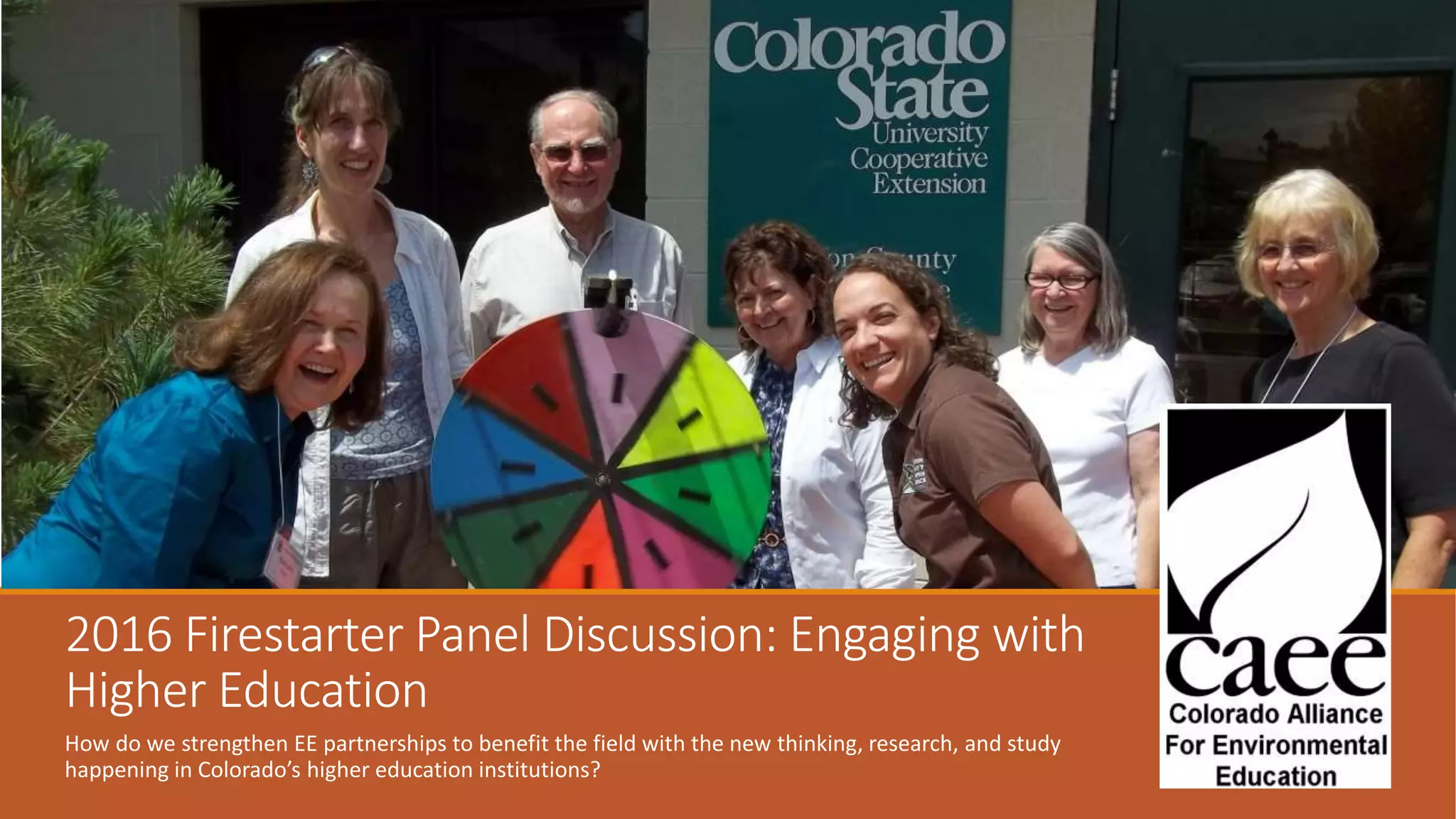
2016 Firestarter Panel Discussion: Engaging with
Higher Education
How do we strengthen EE partnerships to benefit the field with the new thinking, research, and study
happening in Colorado’s higher education institutions?
Panelists:
Melanie Armstrong, Assistant Professor, Environment & Sustainability, MEM Public Lands Coordinator,
Western State Colorado University
Corrie Colvin-Williams, Children, Youth & Environments Program, Community Engagement, Design and
Research Resource Center, Environmental Design Program, University of Colorado Boulder
Jamie Dahl, Experiential Learning Coordinator, Colorado State Forest Service and Warner College of Natural
Resources
Katrina Marzetta, PhD Candidate, Science Education, School of Education & Human Development,
Instructor, Department of Geography and Environmental Sciences, University of Colorado Denver
Christine Moroye, Associate Professor, Educational Foundations and Curriculum Studies, University of
Northern Colorado
Kay Phelps, Assistant Professor, Graduate and Undergraduate Science and Arts Integration Education, Fort
Lewis College
Moderator: Bryan Wee, PhD, Associate Professor, Department of Geography and Environmental Sciences
University of Colorado Denver
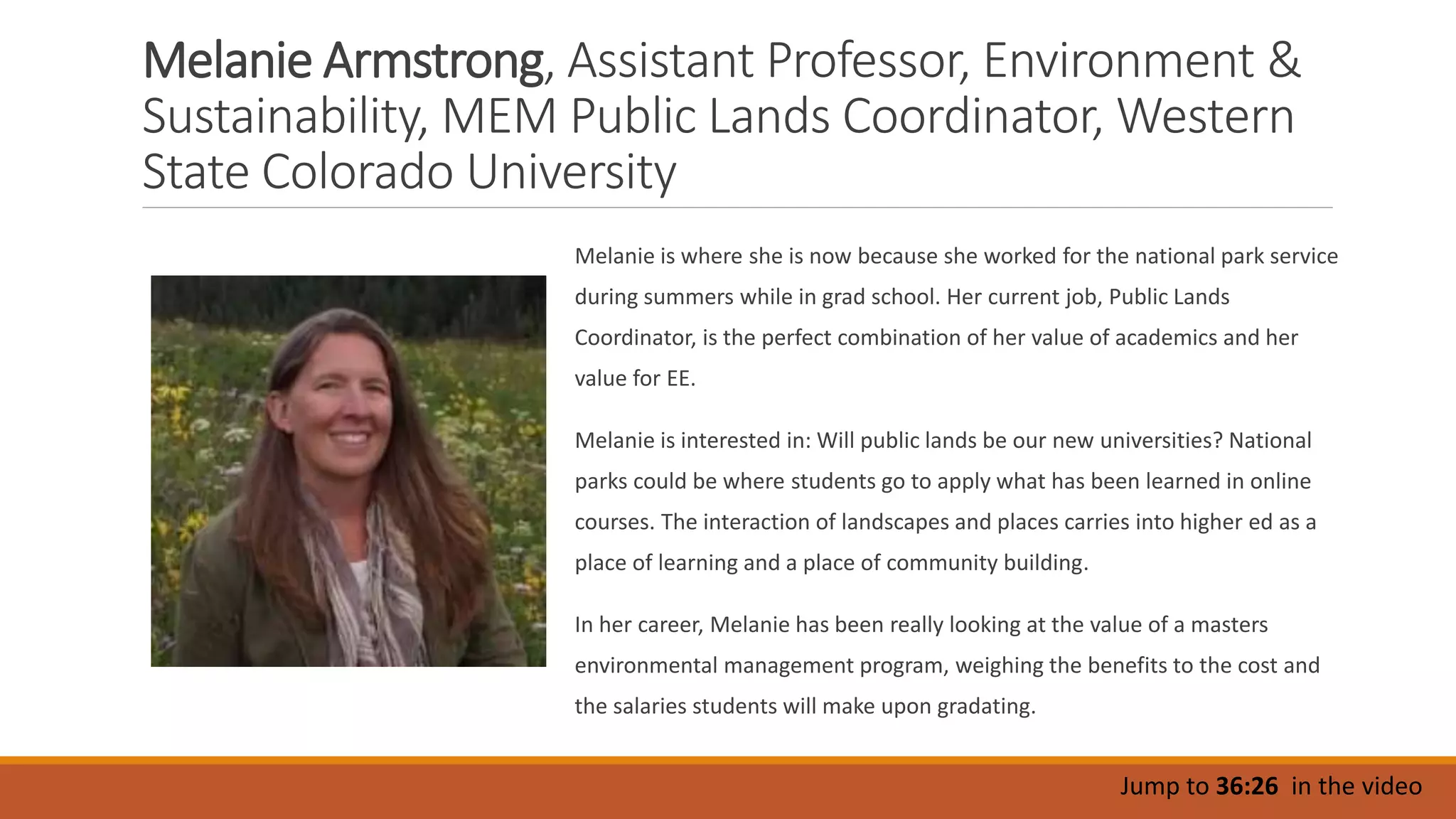
Melanie Armstrong, Assistant Professor, Environment &
Sustainability, MEM Public Lands Coordinator, Western
State Colorado University
Melanie is where she is now because she worked for the national park service
during summers while in grad school. Her current job, Public Lands
Coordinator, is the perfect combination of her value of academics and her
value for EE.
Melanie is interested in: Will public lands be our new universities? National
parks could be where students go to apply what has been learned in online
courses. The interaction of landscapes and places carries into higher ed as a
place of learning and a place of community building.
In her career, Melanie has been really looking at the value of a masters
environmental management program, weighing the benefits to the cost and
the salaries students will make upon gradating.
Jump to 36:26 in the video
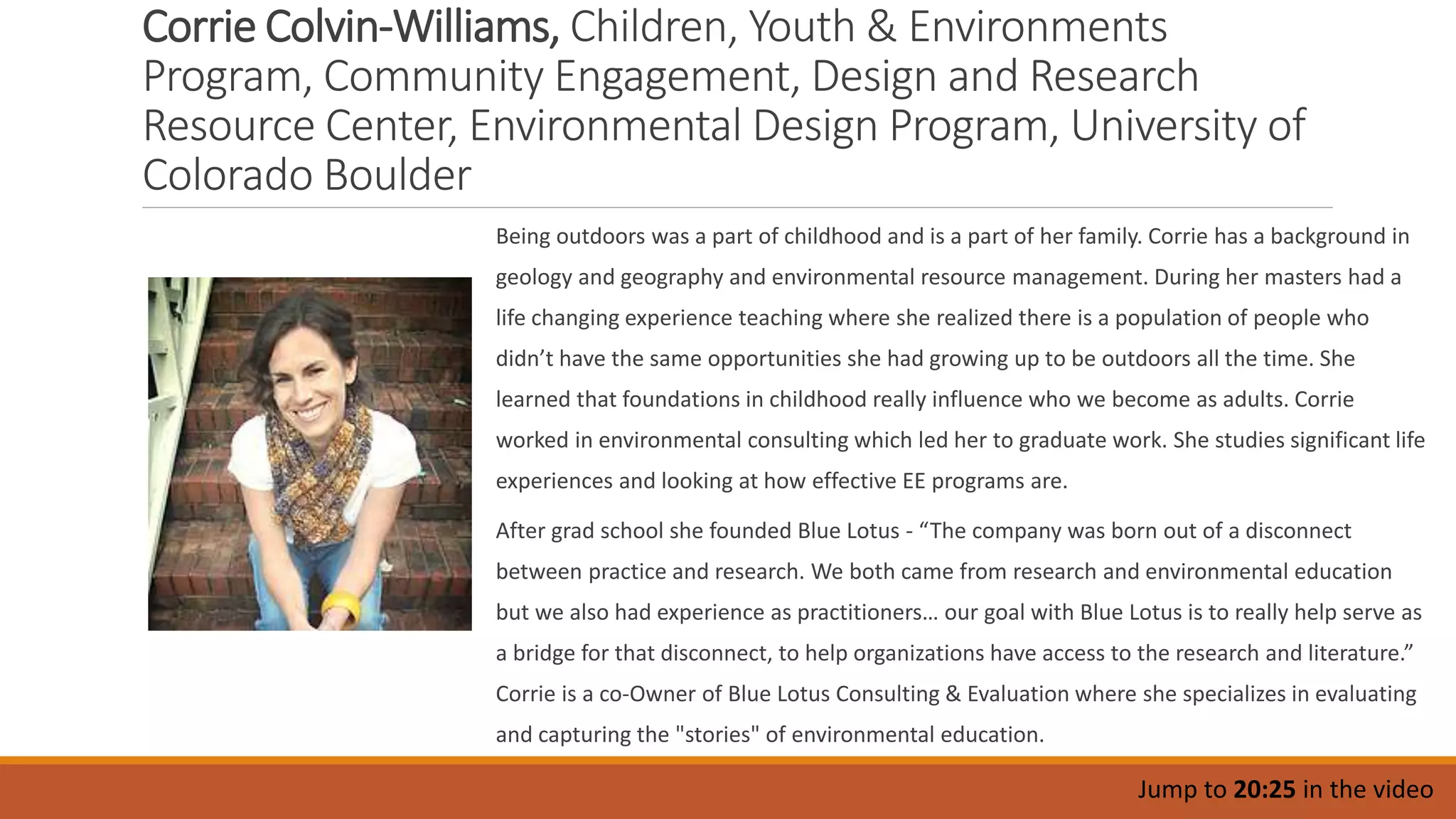
Corrie Colvin-Williams, Children, Youth & Environments
Program, Community Engagement, Design and Research
Resource Center, Environmental Design Program, University of
Colorado Boulder
Being outdoors was a part of childhood and is a part of her family. Corrie has a background in
geology and geography and environmental resource management. During her masters had a
life changing experience teaching where she realized there is a population of people who
didn’t have the same opportunities she had growing up to be outdoors all the time. She
learned that foundations in childhood really influence who we become as adults. Corrie
worked in environmental consulting which led her to graduate work. She studies significant life
experiences and looking at how effective EE programs are.
After grad school she founded Blue Lotus - “The company was born out of a disconnect
between practice and research. We both came from research and environmental education
but we also had experience as practitioners… our goal with Blue Lotus is to really help serve as
a bridge for that disconnect, to help organizations have access to the research and literature.”
Corrie is a co-Owner of Blue Lotus Consulting & Evaluation where she specializes in evaluating
and capturing the "stories" of environmental education.
Jump to 20:25 in the video
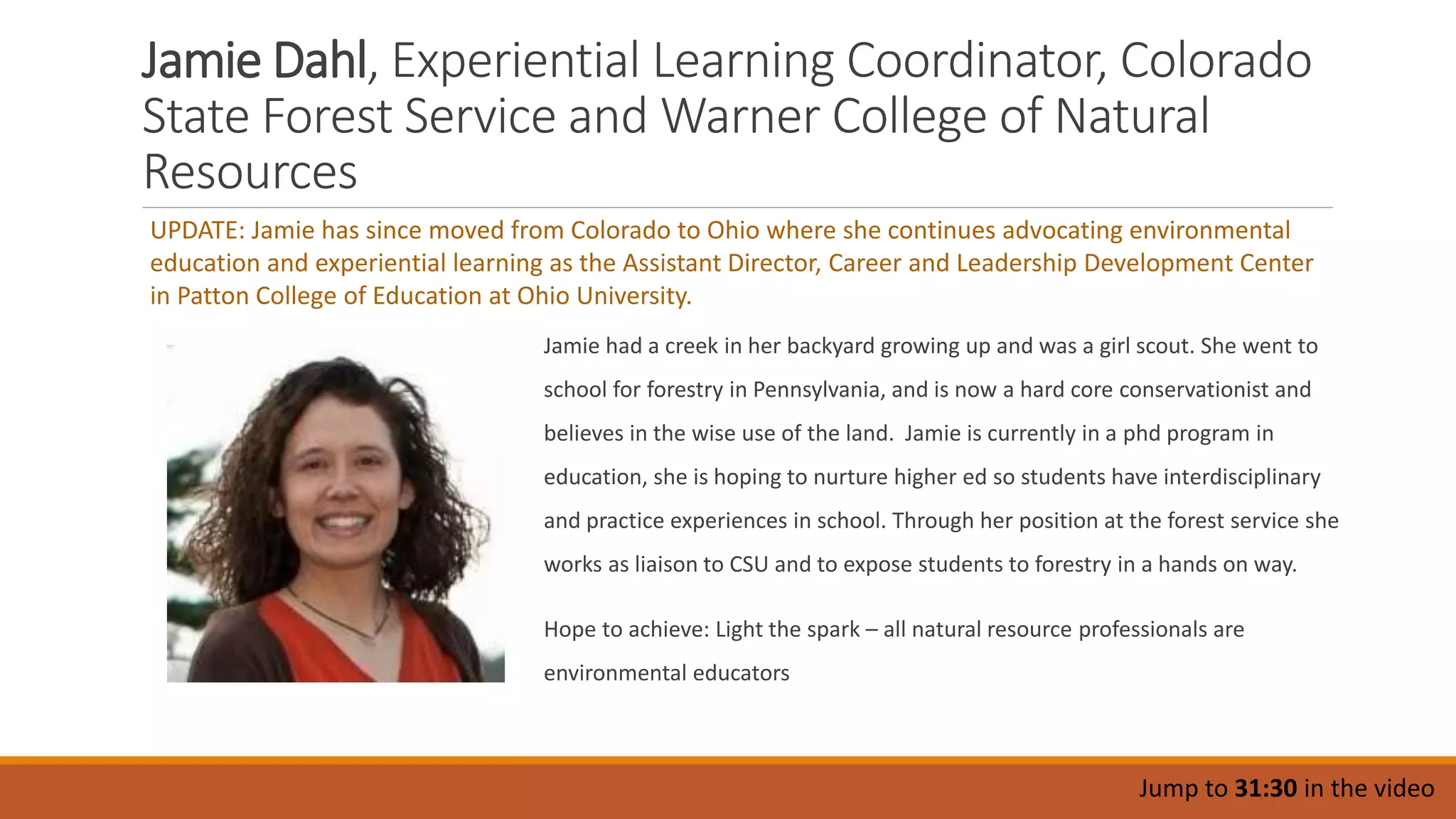
Jamie Dahl, Experiential Learning Coordinator, Colorado
State Forest Service and Warner College of Natural
Resources
Jamie had a creek in her backyard growing up and was a girl scout. She went to
school for forestry in Pennsylvania, and is now a hard core conservationist and
believes in the wise use of the land. Jamie is currently in a phd program in
education, she is hoping to nurture higher ed so students have interdisciplinary
and practice experiences in school. Through her position at the forest service she
works as liaison to CSU and to expose students to forestry in a hands on way.
Hope to achieve: Light the spark – all natural resource professionals are
environmental educators
Jump to 31:30 in the video
UPDATE: Jamie has since moved from Colorado to Ohio where she continues advocating environmental
education and experiential learning as the Assistant Director, Career and Leadership Development Center
in Patton College of Education at Ohio University.
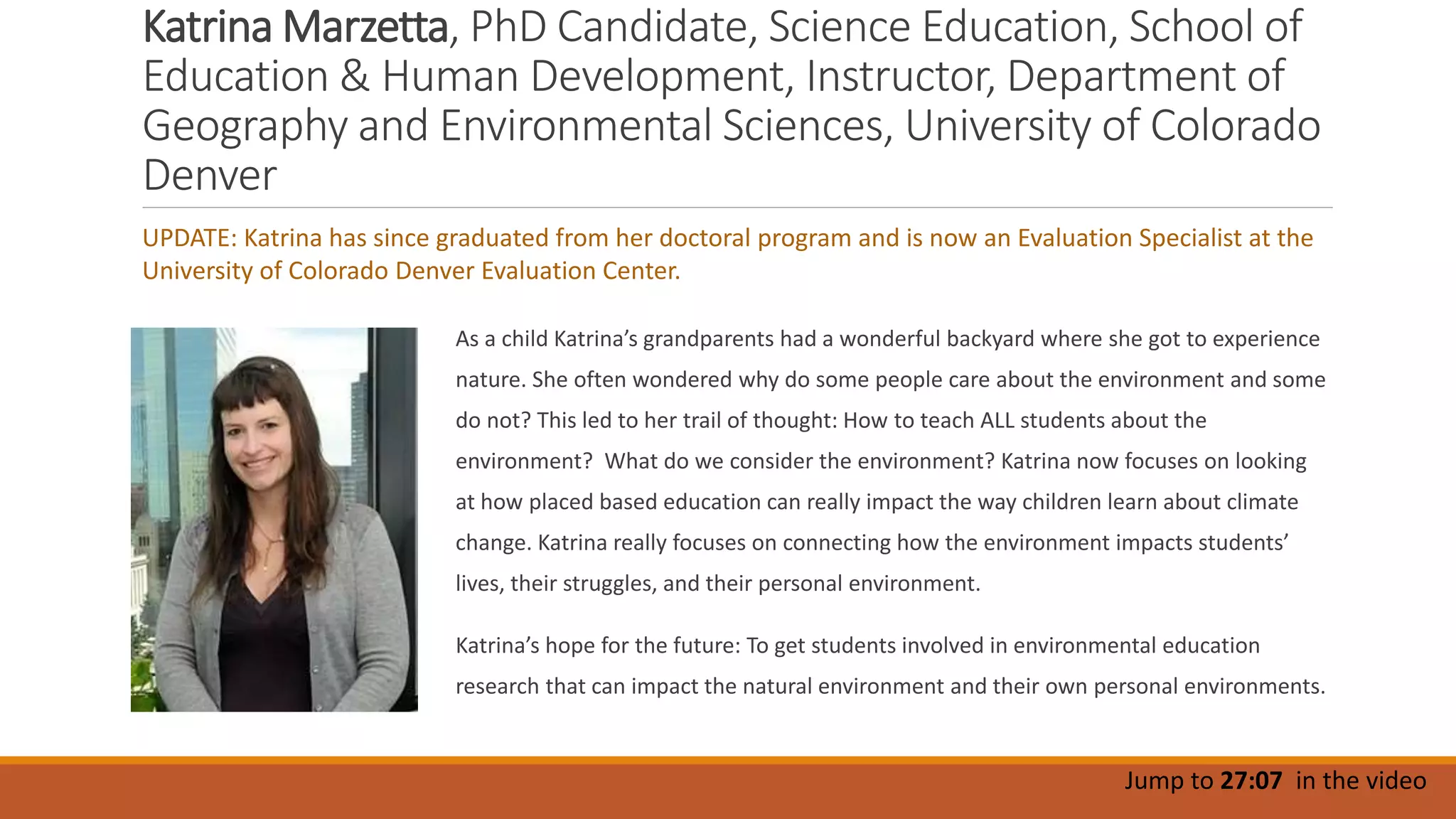
Katrina Marzetta, PhD Candidate, Science Education, School of
Education & Human Development, Instructor, Department of
Geography and Environmental Sciences, University of Colorado
Denver
As a child Katrina’s grandparents had a wonderful backyard where she got to experience
nature. She often wondered why do some people care about the environment and some
do not? This led to her trail of thought: How to teach ALL students about the
environment? What do we consider the environment? Katrina now focuses on looking
at how placed based education can really impact the way children learn about climate
change. Katrina really focuses on connecting how the environment impacts students’
lives, their struggles, and their personal environment.
Katrina’s hope for the future: To get students involved in environmental education
research that can impact the natural environment and their own personal environments.
Jump to 27:07 in the video
UPDATE: Katrina has since graduated from her doctoral program and is now an Evaluation Specialist at the
University of Colorado Denver Evaluation Center.
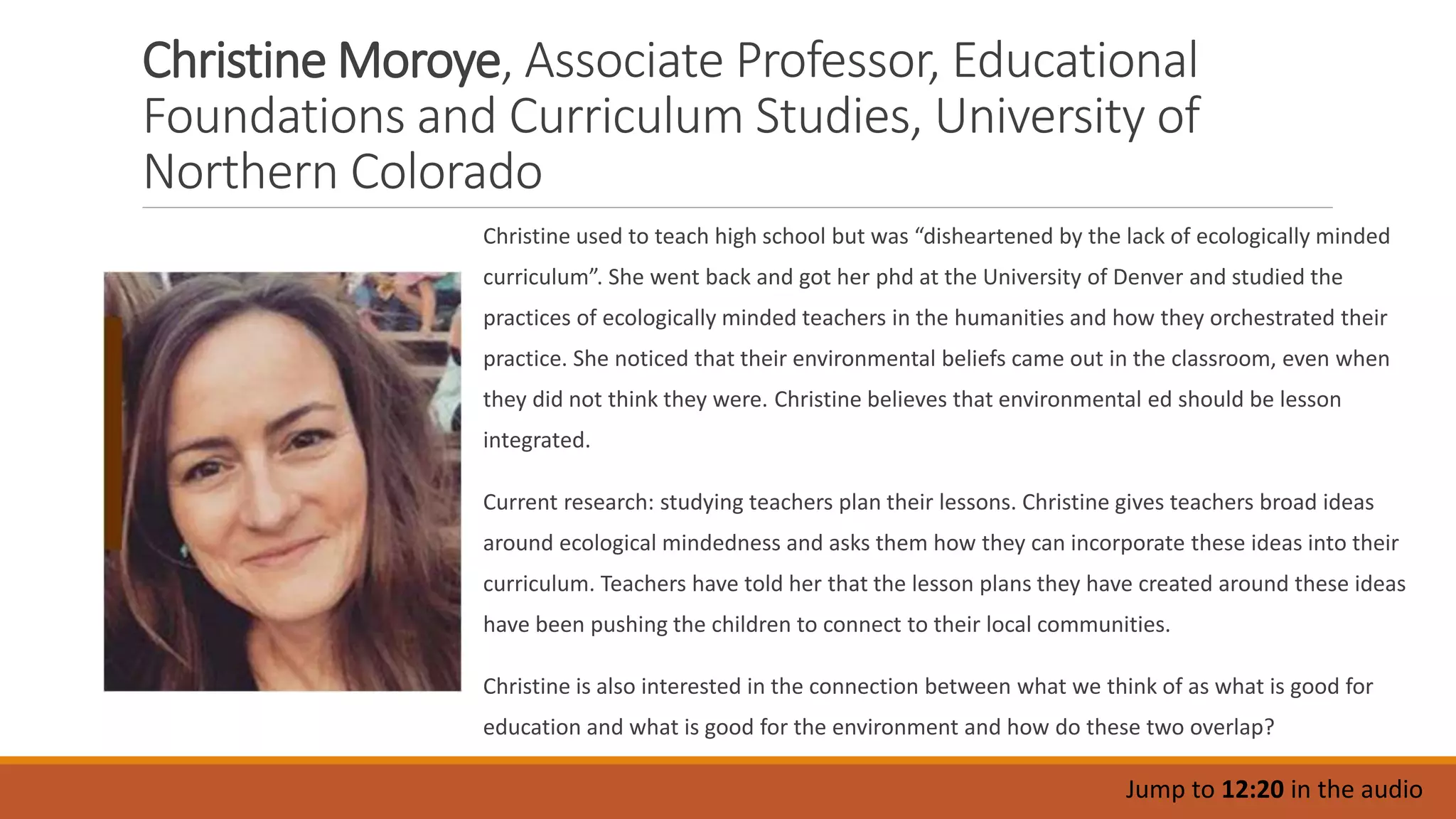
Christine Moroye, Associate Professor, Educational
Foundations and Curriculum Studies, University of
Northern Colorado
Christine used to teach high school but was “disheartened by the lack of ecologically minded
curriculum”. She went back and got her phd at the University of Denver and studied the
practices of ecologically minded teachers in the humanities and how they orchestrated their
practice. She noticed that their environmental beliefs came out in the classroom, even when
they did not think they were. Christine believes that environmental ed should be lesson
integrated.
Current research: studying teachers plan their lessons. Christine gives teachers broad ideas
around ecological mindedness and asks them how they can incorporate these ideas into their
curriculum. Teachers have told her that the lesson plans they have created around these ideas
have been pushing the children to connect to their local communities.
Christine is also interested in the connection between what we think of as what is good for
education and what is good for the environment and how do these two overlap?
Jump to 12:20 in the audio
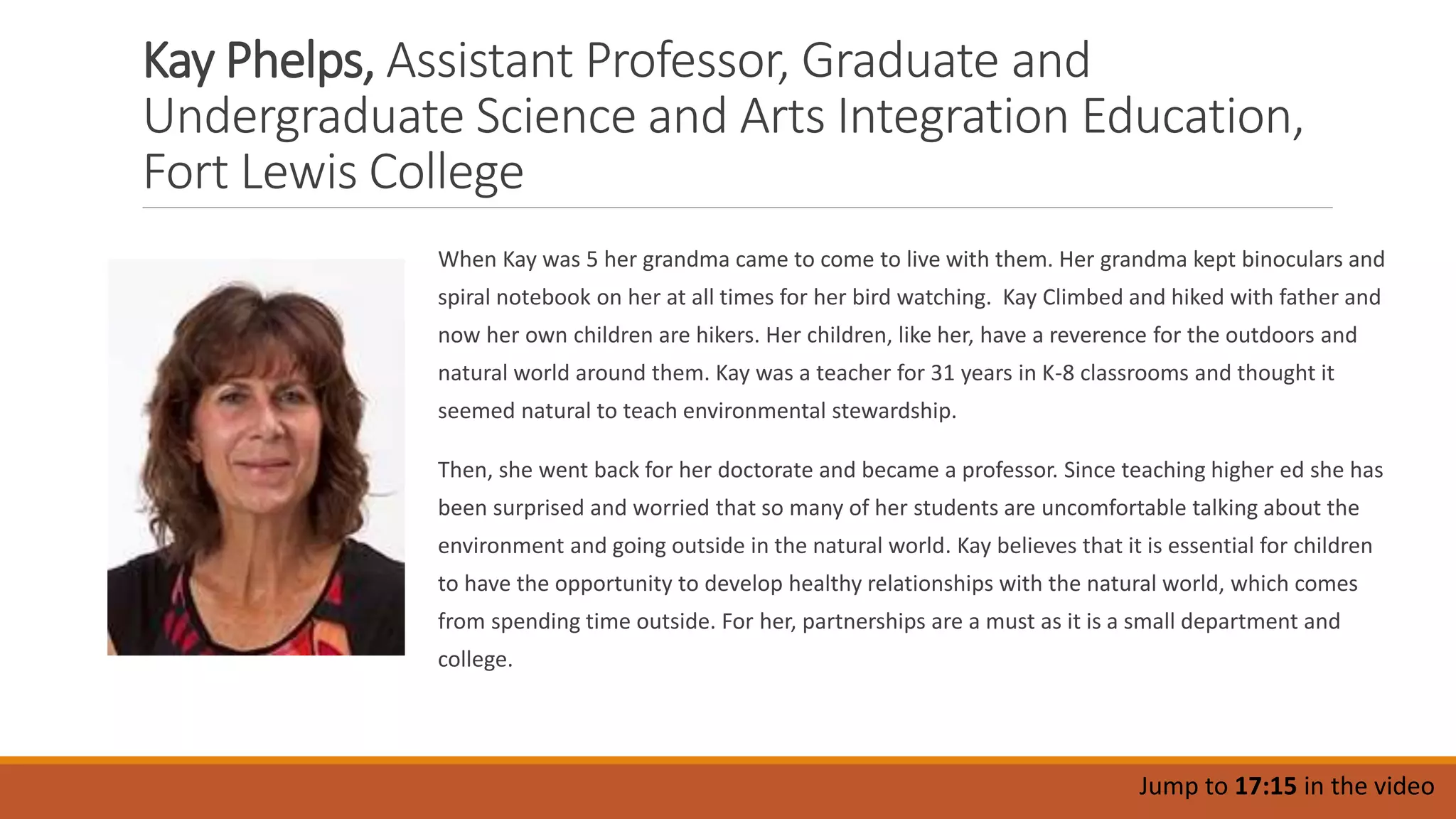
Kay Phelps, Assistant Professor, Graduate and
Undergraduate Science and Arts Integration Education,
Fort Lewis College
When Kay was 5 her grandma came to come to live with them. Her grandma kept binoculars and
spiral notebook on her at all times for her bird watching. Kay Climbed and hiked with father and
now her own children are hikers. Her children, like her, have a reverence for the outdoors and
natural world around them. Kay was a teacher for 31 years in K-8 classrooms and thought it
seemed natural to teach environmental stewardship.
Then, she went back for her doctorate and became a professor. Since teaching higher ed she has
been surprised and worried that so many of her students are uncomfortable talking about the
environment and going outside in the natural world. Kay believes that it is essential for children
to have the opportunity to develop healthy relationships with the natural world, which comes
from spending time outside. For her, partnerships are a must as it is a small department and
college.
Jump to 17:15 in the video

2016 Firestarter Panel Discussion: Engaging with Higher Education

  • 1.
    2016 Firestarter PanelDiscussion: Engaging with Higher Education How do we strengthen EE partnerships to benefit the field with the new thinking, research, and study happening in Colorado’s higher education institutions?
  • 2.
    Panelists: Melanie Armstrong, AssistantProfessor, Environment & Sustainability, MEM Public Lands Coordinator, Western State Colorado University Corrie Colvin-Williams, Children, Youth & Environments Program, Community Engagement, Design and Research Resource Center, Environmental Design Program, University of Colorado Boulder Jamie Dahl, Experiential Learning Coordinator, Colorado State Forest Service and Warner College of Natural Resources Katrina Marzetta, PhD Candidate, Science Education, School of Education & Human Development, Instructor, Department of Geography and Environmental Sciences, University of Colorado Denver Christine Moroye, Associate Professor, Educational Foundations and Curriculum Studies, University of Northern Colorado Kay Phelps, Assistant Professor, Graduate and Undergraduate Science and Arts Integration Education, Fort Lewis College Moderator: Bryan Wee, PhD, Associate Professor, Department of Geography and Environmental Sciences University of Colorado Denver
  • 3.
    Melanie Armstrong, AssistantProfessor, Environment & Sustainability, MEM Public Lands Coordinator, Western State Colorado University Melanie is where she is now because she worked for the national park service during summers while in grad school. Her current job, Public Lands Coordinator, is the perfect combination of her value of academics and her value for EE. Melanie is interested in: Will public lands be our new universities? National parks could be where students go to apply what has been learned in online courses. The interaction of landscapes and places carries into higher ed as a place of learning and a place of community building. In her career, Melanie has been really looking at the value of a masters environmental management program, weighing the benefits to the cost and the salaries students will make upon gradating. Jump to 36:26 in the video
  • 4.
    Corrie Colvin-Williams, Children,Youth & Environments Program, Community Engagement, Design and Research Resource Center, Environmental Design Program, University of Colorado Boulder Being outdoors was a part of childhood and is a part of her family. Corrie has a background in geology and geography and environmental resource management. During her masters had a life changing experience teaching where she realized there is a population of people who didn’t have the same opportunities she had growing up to be outdoors all the time. She learned that foundations in childhood really influence who we become as adults. Corrie worked in environmental consulting which led her to graduate work. She studies significant life experiences and looking at how effective EE programs are. After grad school she founded Blue Lotus - “The company was born out of a disconnect between practice and research. We both came from research and environmental education but we also had experience as practitioners… our goal with Blue Lotus is to really help serve as a bridge for that disconnect, to help organizations have access to the research and literature.” Corrie is a co-Owner of Blue Lotus Consulting & Evaluation where she specializes in evaluating and capturing the "stories" of environmental education. Jump to 20:25 in the video
  • 5.
    Jamie Dahl, ExperientialLearning Coordinator, Colorado State Forest Service and Warner College of Natural Resources Jamie had a creek in her backyard growing up and was a girl scout. She went to school for forestry in Pennsylvania, and is now a hard core conservationist and believes in the wise use of the land. Jamie is currently in a phd program in education, she is hoping to nurture higher ed so students have interdisciplinary and practice experiences in school. Through her position at the forest service she works as liaison to CSU and to expose students to forestry in a hands on way. Hope to achieve: Light the spark – all natural resource professionals are environmental educators Jump to 31:30 in the video UPDATE: Jamie has since moved from Colorado to Ohio where she continues advocating environmental education and experiential learning as the Assistant Director, Career and Leadership Development Center in Patton College of Education at Ohio University.
  • 6.
    Katrina Marzetta, PhDCandidate, Science Education, School of Education & Human Development, Instructor, Department of Geography and Environmental Sciences, University of Colorado Denver As a child Katrina’s grandparents had a wonderful backyard where she got to experience nature. She often wondered why do some people care about the environment and some do not? This led to her trail of thought: How to teach ALL students about the environment? What do we consider the environment? Katrina now focuses on looking at how placed based education can really impact the way children learn about climate change. Katrina really focuses on connecting how the environment impacts students’ lives, their struggles, and their personal environment. Katrina’s hope for the future: To get students involved in environmental education research that can impact the natural environment and their own personal environments. Jump to 27:07 in the video UPDATE: Katrina has since graduated from her doctoral program and is now an Evaluation Specialist at the University of Colorado Denver Evaluation Center.
  • 7.
    Christine Moroye, AssociateProfessor, Educational Foundations and Curriculum Studies, University of Northern Colorado Christine used to teach high school but was “disheartened by the lack of ecologically minded curriculum”. She went back and got her phd at the University of Denver and studied the practices of ecologically minded teachers in the humanities and how they orchestrated their practice. She noticed that their environmental beliefs came out in the classroom, even when they did not think they were. Christine believes that environmental ed should be lesson integrated. Current research: studying teachers plan their lessons. Christine gives teachers broad ideas around ecological mindedness and asks them how they can incorporate these ideas into their curriculum. Teachers have told her that the lesson plans they have created around these ideas have been pushing the children to connect to their local communities. Christine is also interested in the connection between what we think of as what is good for education and what is good for the environment and how do these two overlap? Jump to 12:20 in the audio
  • 8.
    Kay Phelps, AssistantProfessor, Graduate and Undergraduate Science and Arts Integration Education, Fort Lewis College When Kay was 5 her grandma came to come to live with them. Her grandma kept binoculars and spiral notebook on her at all times for her bird watching. Kay Climbed and hiked with father and now her own children are hikers. Her children, like her, have a reverence for the outdoors and natural world around them. Kay was a teacher for 31 years in K-8 classrooms and thought it seemed natural to teach environmental stewardship. Then, she went back for her doctorate and became a professor. Since teaching higher ed she has been surprised and worried that so many of her students are uncomfortable talking about the environment and going outside in the natural world. Kay believes that it is essential for children to have the opportunity to develop healthy relationships with the natural world, which comes from spending time outside. For her, partnerships are a must as it is a small department and college. Jump to 17:15 in the video