2016 Cost of Data Breach Study:
Brazil
Benchmark research sponsored by IBM
Independently conducted by Ponemon Institute LLC
June 2016
Ponemon Institute© Research Report
Ponemon Institute© Research Report Page 1
20161
Cost of Data Breach Study: Brazil
Ponemon Institute, June 2016
Part 1. Introduction
IBM and Ponemon Institute are pleased to present the 2016 Cost of Data Breach: Brazil, our
fourth annual benchmark study on the cost of data breach incidents for companies located in
Brazil. The research reveals that the average per capita cost
2
of data breach increased
significantly from R$175 (Brazilian Real) to R$225. The total organizational cost of data breach
increased from R$3.96 million to R$4.31 million.
The Cost of Data Breach research
series was launched 11 years ago in
the United States and four years ago
in Brazil. We have expanded the study
to include the United Kingdom,
France, Germany, Italy, India,
Australia, Japan, the United Arab
Emirates and Saudi Arabia (Arabian
region) and Canada. This year, for the
first time, we conducted our cost of
data breach research in South Africa.
To date, 130 Brazilian organizations have participated in the benchmarking process.
This year’s study examines the costs incurred by 33 Brazilian companies from 12 different
industry sectors following the loss or theft of protected personal data and the notification of
breach victims as required by various laws. It is important to note the costs presented in this
research are not hypothetical but are from actual data loss incidents. The costs are based upon
estimates provided by the individuals interviewed over a ten-month period in the companies
represented in this research.
The number of breached records per incident this year ranged from 3,900 records to 85,400
records. The average number of breached records was 24,830. We do not include organizations
that had data breaches in excess of 100,000 because they are not representative of most data
breaches, and to include them in the study would skew the results.
Seven global megatrends in the cost of data breach research
Over many years of studying the data breach experience of 2,013 organizations in every industry,
the research has revealed the following seven megatrends.
1. Since first conducting this research, the cost of data breach has not fluctuated significantly.
Thus, it is suggested to be a permanent cost that organizations need to be prepared to deal
with and incorporate in their data protection strategies.
2. The biggest financial consequence to organizations that experience a data breach is lost
business. Following a data breach, organizations need to take steps to retain customers’ trust
to reduce the long-term financial impact.
3. Most data breaches continue to be caused by criminal and malicious attacks. These
breaches also take the most time to detect and contain. As a result, they have the highest
cost per record.
1
For the first time, this report is dated in the year of publication rather than the fieldwork completion date. Please note that
the majority of data breach incidents studied in the current report happened in the 2015 calendar year.
2
The terms “per capita cost” and cost per compromised record have equivalent meaning in this report.
Brazil study at a glance
§ 33 companies participated
§ R$4.31 million is the average total cost of data
breach
§ 8.5% increase in total cost of data breach
§ R$225 is the average cost per lost or stolen record
§ 25% increase in cost per lost or stolen record
Ponemon Institute© Research Report Page 2
4. Organizations recognize that the longer it takes to detect and contain a data breach the more
costly it becomes to resolve. Over the years, detection and escalation costs in our research
have increased. This suggests investments are being made in technologies and in-house
expertise to reduce the time to detect and contain breaches.
5. Regulated industries, such as healthcare and financial services, have the most costly data
breaches because of fines and the higher than average rate of lost business and customers.
6. Improvements in data governance programs will reduce the cost of data breach. Incident
response plans, appointment of a CISO, employee training and awareness programs and a
business continuity management strategy continue to result in cost savings.
7. Investments in certain data loss prevention controls and activities such as encryption and
endpoint security solutions are important to preventing data breaches. This year’s study
revealed a reduction in the cost when companies participated in threat sharing and deployed
data loss prevention technologies.
The following are the most interesting findings and implications for organizations:
The per capita and total organizational cost of data breach increased. According to the
benchmark findings, the average per capita cost to organizations increased from an average of
R$175 per compromised record in 2015 to R$225 in 2016. The total average cost of data breach
increased from R$3.96 million in 2015 to R$4.31 in 2016.
Measures reveal why data breach costs increased. Four key metrics reveal why the cost of
data breach increased since 2015. The average per capita cost of a data breach increased
significantly by 25 percent. The average total cost and size of breach (the number of records lost
or stolen) both increased by 8 percent. Abnormal churn increased 4 percent. In the context of this
research, abnormal churn is defined as the greater than expected loss of customers in the normal
course of business.
Certain industries had higher data breach costs. Services, energy and financial services had
a per capita data breach cost substantially above the overall mean of R$225. Public sector,
transportation and consumer companies had a per capita cost well below the overall mean value.
Malicious attacks were the primary root cause of data breaches and the most costly.
3
Forty
percent of incidents involved a malicious or criminal attack. Employee or contractor negligence
represented 30 percent of all breaches, and system glitches account for another 30 percent of all
data breaches. According to our research, companies that experienced a malicious incident had a
per capita data breach cost of R$256. Companies that experienced system glitches had an
average cost of R$211. Employee negligence or human error cost an average of R$200.
Certain factors reduced the cost of data breach. Incident response plans, extensive use of
encryption, the involvement of business continuity management, employee training or
participation in threat sharing decreased the per capita cost of data breach. Data breaches
caused by extensive migration to the cloud, third party error or involvement or lost or stolen
devices increased the per capita cost of data breach.
The more records lost, the higher the cost of the data breach. Companies that had a data
breach involving less than 10,000 records had a data breach of R$1.88 million and data breaches
involving 50,000 or more records had an average of R$6.95 million.
3
Negligent insiders are individuals who cause a data breach because of their carelessness, as determined in a post data
breach investigation. In this study, hackers or criminal insiders (employees, contractors or other third parties) are typically
responsible for malicious or criminal attacks.
Ponemon Institute© Research Report Page 3
The more churn, the higher the cost of the data breach. The higher cost as a result of
customer churn is R$5.42 million for churn greater than 4 percent, and the lowest cost is R$3.81
million for churn that is less than1 percent.
Certain industries are more vulnerable to churn. Services, energy, financial and life science
organizations experienced relatively high abnormal churn and public sector (government) and
transportation companies experienced a very low abnormal churn rate.
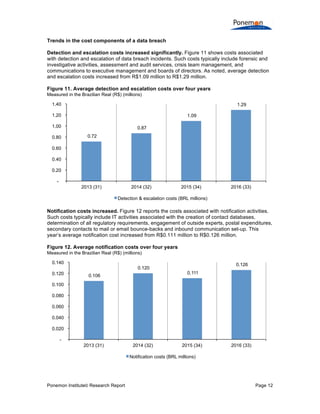
Detection and escalation costs increased. These costs typically include forensic and
investigative activities, assessment and audit services, crisis team management, and
communications to executive management and boards of directors. Average detection and
escalation costs increased from R$1.09 million in 2015 to R$1.29 million in 2016.
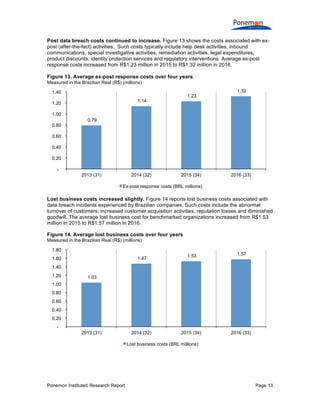
Notification costs increased. Notification costs include IT activities associated with the creation
of contact databases, determination of all regulatory requirements, engagement of outside
experts, postal expenditures, secondary mail contacts or email bounce-backs and inbound
communication set-up. This year’s average notification cost increased from R$0.11 million to
R$0.126 million.
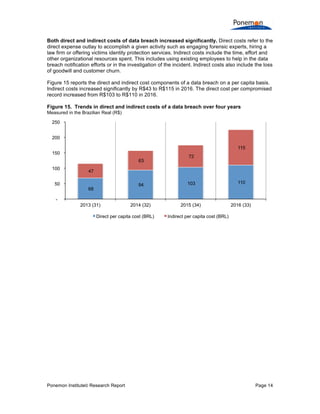
Post data breach costs continue to increase. Post data breach costs typically include help
desk activities, inbound communications, special investigative activities, remediation activities,
legal expenditures, product discounts, identity protection services and regulatory interventions.
Average ex-post response costs increased from R$1.23 million in 2015 to R$1.32 million in 2016.
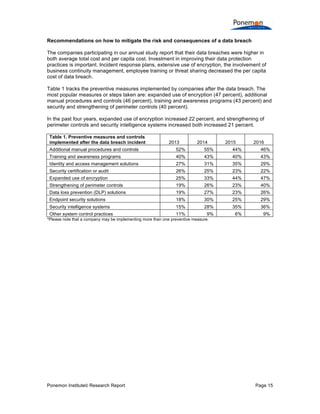
Lost business costs increased. Such costs include the abnormal turnover of customers,
increased customer acquisition activities, reputation losses and diminished goodwill. The average
lost business cost for benchmarked organizations increased from R$1.53 million in 2015 to
R$1.57 million in 2016.
Both direct and indirect costs of data breach increased significantly. Direct costs refer to the
direct expense outlay to accomplish a given activity, and indirect costs include the time, effort and
other organizational resources spent to resolve the data breach. The direct cost per compromised
record increased from R$103 to R$110. Indirect cost rose from R$72 per record to R$115.
Ponemon Institute© Research Report Page 4
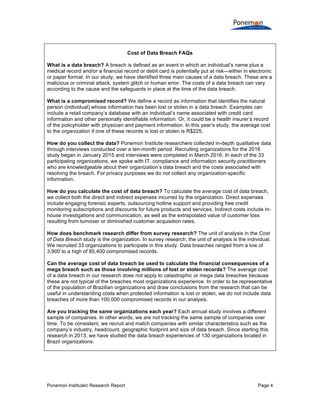
Cost of Data Breach FAQs
What is a data breach? A breach is defined as an event in which an individual’s name plus a
medical record and/or a financial record or debit card is potentially put at risk—either in electronic
or paper format. In our study, we have identified three main causes of a data breach. These are a
malicious or criminal attack, system glitch or human error. The costs of a data breach can vary
according to the cause and the safeguards in place at the time of the data breach.
What is a compromised record? We define a record as information that identifies the natural
person (individual) whose information has been lost or stolen in a data breach. Examples can
include a retail company’s database with an individual’s name associated with credit card
information and other personally identifiable information. Or, it could be a health insurer’s record
of the policyholder with physician and payment information. In this year’s study, the average cost
to the organization if one of these records is lost or stolen is R$225.
How do you collect the data? Ponemon Institute researchers collected in-depth qualitative data
through interviews conducted over a ten-month period. Recruiting organizations for the 2016
study began in January 2015 and interviews were completed in March 2016. In each of the 33
participating organizations, we spoke with IT, compliance and information security practitioners
who are knowledgeable about their organization’s data breach and the costs associated with
resolving the breach. For privacy purposes we do not collect any organization-specific
information.
How do you calculate the cost of data breach? To calculate the average cost of data breach,
we collect both the direct and indirect expenses incurred by the organization. Direct expenses
include engaging forensic experts, outsourcing hotline support and providing free credit
monitoring subscriptions and discounts for future products and services. Indirect costs include in-
house investigations and communication, as well as the extrapolated value of customer loss
resulting from turnover or diminished customer acquisition rates.
How does benchmark research differ from survey research? The unit of analysis in the Cost
of Data Breach study is the organization. In survey research, the unit of analysis is the individual.
We recruited 33 organizations to participate in this study. Data breaches ranged from a low of
3,900 to a high of 85,400 compromised records.
Can the average cost of data breach be used to calculate the financial consequences of a
mega breach such as those involving millions of lost or stolen records? The average cost
of a data breach in our research does not apply to catastrophic or mega data breaches because
these are not typical of the breaches most organizations experience. In order to be representative
of the population of Brazilian organizations and draw conclusions from the research that can be
useful in understanding costs when protected information is lost or stolen, we do not include data
breaches of more than 100,000 compromised records in our analysis.
Are you tracking the same organizations each year? Each annual study involves a different
sample of companies. In other words, we are not tracking the same sample of companies over
time. To be consistent, we recruit and match companies with similar characteristics such as the
company’s industry, headcount, geographic footprint and size of data breach. Since starting this
research in 2013, we have studied the data breach experiences of 130 organizations located in
Brazil organizations.
Ponemon Institute© Research Report Page 5
Part 2. Key Findings
In this section we provide the detailed findings of this research. Topics are presented in the
following order:
§ Understanding the cost of data breach
§ The root causes of data breach
§ Factors that influence the cost of data breach
§ Trends in the frequency of compromised records and customer turnover
§ Trends in the cost components of data breach
§ Recommendations on how to mitigate the risk and consequences of a data breach
Understanding the cost of data breach
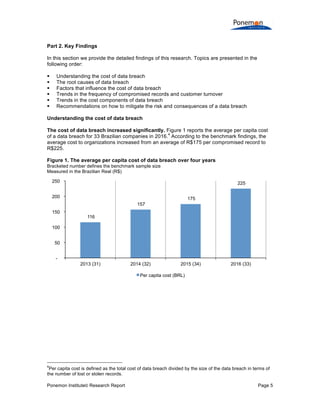
The cost of data breach increased significantly. Figure 1 reports the average per capita cost
of a data breach for 33 Brazilian companies in 2016.
4
According to the benchmark findings, the
average cost to organizations increased from an average of R$175 per compromised record to
R$225.
Figure 1. The average per capita cost of data breach over four years
Bracketed number defines the benchmark sample size
Measured in the Brazilian Real (R$)
4
Per capita cost is defined as the total cost of data breach divided by the size of the data breach in terms of
the number of lost or stolen records.
116
157
175
225
-
50
100
150
200
250
2013 (31) 2014 (32) 2015 (34) 2016 (33)
Per capita cost (BRL)
Ponemon Institute© Research Report Page 6
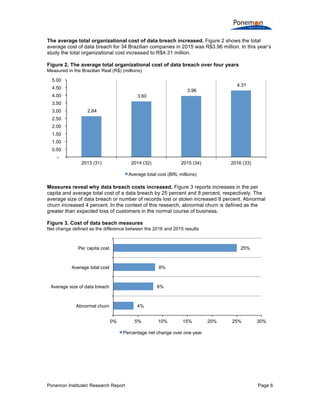
The average total organizational cost of data breach increased. Figure 2 shows the total
average cost of data breach for 34 Brazilian companies in 2015 was R$3.96 million. In this year’s
study the total organizational cost increased to R$4.31 million.
Figure 2. The average total organizational cost of data breach over four years
Measured in the Brazilian Real (R$) (millions)
Measures reveal why data breach costs increased. Figure 3 reports increases in the per
capita and average total cost of a data breach by 25 percent and 8 percent, respectively. The
average size of data breach or number of records lost or stolen increased 8 percent. Abnormal
churn increased 4 percent. In the context of this research, abnormal churn is defined as the
greater than expected loss of customers in the normal course of business.
Figure 3. Cost of data beach measures
Net change defined as the difference between the 2016 and 2015 results
2.64
3.60
3.96
4.31
-
0.50
1.00
1.50
2.00
2.50
3.00
3.50
4.00
4.50
5.00
2013 (31) 2014 (32) 2015 (34) 2016 (33)
Average total cost (BRL millions)
4%
8%
8%
25%
0% 5% 10% 15% 20% 25% 30%
Abnormal churn
Average size of data breach
Average total cost
Per capita cost
Percentage net change over one year
Ponemon Institute© Research Report Page 7
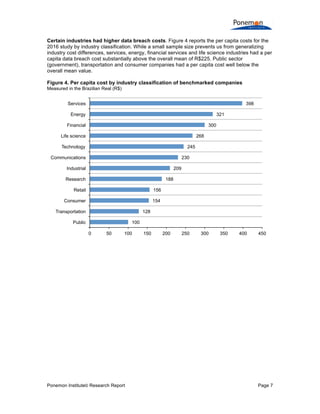
Certain industries had higher data breach costs. Figure 4 reports the per capita costs for the
2016 study by industry classification. While a small sample size prevents us from generalizing
industry cost differences, services, energy, financial services and life science industries had a per
capita data breach cost substantially above the overall mean of R$225. Public sector
(government), transportation and consumer companies had a per capita cost well below the
overall mean value.
Figure 4. Per capita cost by industry classification of benchmarked companies
Measured in the Brazilian Real (R$)
100
128
154
156
188
209
230
245
268
300
321
398
0 50 100 150 200 250 300 350 400 450
Public
Transportation
Consumer
Retail
Research
Industrial
Communications
Technology
Life science
Financial
Energy
Services
Ponemon Institute© Research Report Page 8
The root causes of data breach
Malicious attacks were the primary root cause of data breaches.
5
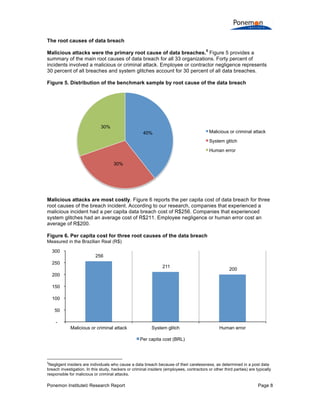
Figure 5 provides a
summary of the main root causes of data breach for all 33 organizations. Forty percent of
incidents involved a malicious or criminal attack. Employee or contractor negligence represents
30 percent of all breaches and system glitches account for 30 percent of all data breaches.
Figure 5. Distribution of the benchmark sample by root cause of the data breach
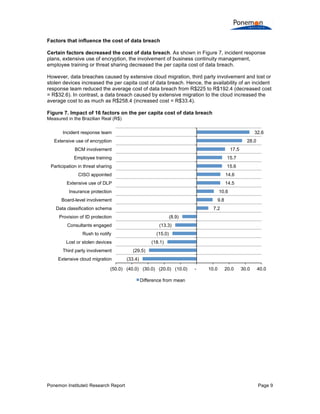
Malicious attacks are most costly. Figure 6 reports the per capita cost of data breach for three
root causes of the breach incident. According to our research, companies that experienced a
malicious incident had a per capita data breach cost of R$256. Companies that experienced
system glitches had an average cost of R$211. Employee negligence or human error cost an
average of R$200.
Figure 6. Per capita cost for three root causes of the data breach
Measured in the Brazilian Real (R$)
5
Negligent insiders are individuals who cause a data breach because of their carelessness, as determined in a post data
breach investigation. In this study, hackers or criminal insiders (employees, contractors or other third parties) are typically
responsible for malicious or criminal attacks.
40%
30%
30%
Malicious or criminal attack
System glitch
Human error
256
211
200
-
50
100
150
200
250
300
Malicious or criminal attack System glitch Human error
Per capita cost (BRL)
Ponemon Institute© Research Report Page 9
Factors that influence the cost of data breach
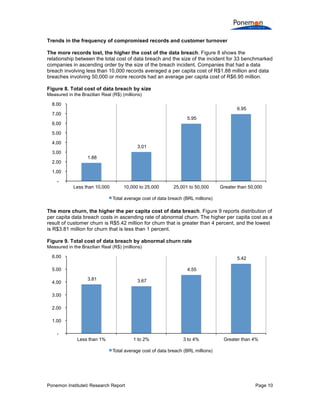
Certain factors decreased the cost of data breach. As shown in Figure 7, incident response
plans, extensive use of encryption, the involvement of business continuity management,
employee training or threat sharing decreased the per capita cost of data breach.
However, data breaches caused by extensive cloud migration, third party involvement and lost or
stolen devices increased the per capita cost of data breach. Hence, the availability of an incident
response team reduced the average cost of data breach from R$225 to R$192.4 (decreased cost
= R$32.6). In contrast, a data breach caused by extensive migration to the cloud increased the
average cost to as much as R$258.4 (increased cost = R$33.4).
Figure 7. Impact of 16 factors on the per capita cost of data breach
Measured in the Brazilian Real (R$)
(33.4)
(29.5)
(18.1)
(15.0)
(13.3)
(8.9)
7.2
9.8
10.6
14.5
14.6
15.6
15.7
17.5
28.0
32.6
(50.0) (40.0) (30.0) (20.0) (10.0) - 10.0 20.0 30.0 40.0
Extensive cloud migration
Third party involvement
Lost or stolen devices
Rush to notify
Consultants engaged
Provision of ID protection
Data classification schema
Board-level involvement
Insurance protection
Extensive use of DLP
CISO appointed
Participation in threat sharing
Employee training
BCM involvement
Extensive use of encryption
Incident response team
Difference from mean
Ponemon Institute© Research Report Page 10
Trends in the frequency of compromised records and customer turnover
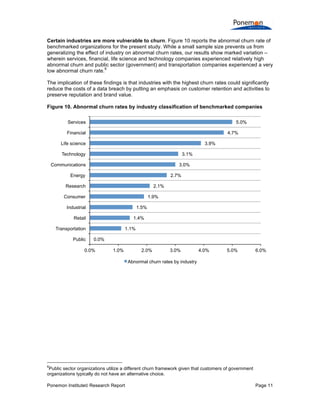
The more records lost, the higher the cost of the data breach. Figure 8 shows the
relationship between the total cost of data breach and the size of the incident for 33 benchmarked
companies in ascending order by the size of the breach incident. Companies that had a data
breach involving less than 10,000 records averaged a per capita cost of R$1.88 million and data
breaches involving 50,000 or more records had an average per capita cost of R$6.95 million.
Figure 8. Total cost of data breach by size
Measured in the Brazilian Real (R$) (millions)
The more churn, the higher the per capita cost of data breach. Figure 9 reports distribution of
per capita data breach costs in ascending rate of abnormal churn. The higher per capita cost as a
result of customer churn is R$5.42 million for churn that is greater than 4 percent, and the lowest
is R$3.81 million for churn that is less than 1 percent.
Figure 9. Total cost of data breach by abnormal churn rate
Measured in the Brazilian Real (R$) (millions)
1.88
3.01
5.95
6.95
-
1.00
2.00
3.00
4.00
5.00
6.00
7.00
8.00
Less than 10,000 10,000 to 25,000 25,001 to 50,000 Greater than 50,000
Total average cost of data breach (BRL millions)
3.81 3.67
4.55
5.42
-
1.00
2.00
3.00
4.00
5.00
6.00
Less than 1% 1 to 2% 3 to 4% Greater than 4%
Total average cost of data breach (BRL millions)
Ponemon Institute© Research Report Page 11
Certain industries are more vulnerable to churn. Figure 10 reports the abnormal churn rate of
benchmarked organizations for the present study. While a small sample size prevents us from
generalizing the effect of industry on abnormal churn rates, our results show marked variation –
wherein services, financial, life science and technology companies experienced relatively high
abnormal churn and public sector (government) and transportation companies experienced a very
low abnormal churn rate.
6
The implication of these findings is that industries with the highest churn rates could significantly
reduce the costs of a data breach by putting an emphasis on customer retention and activities to
preserve reputation and brand value.
Figure 10. Abnormal churn rates by industry classification of benchmarked companies
6
Public sector organizations utilize a different churn framework given that customers of government
organizations typically do not have an alternative choice.
0.0%
1.1%
1.4%
1.5%
1.9%
2.1%
2.7%
3.0%
3.1%
3.9%
4.7%
5.0%
0.0% 1.0% 2.0% 3.0% 4.0% 5.0% 6.0%
Public
Transportation
Retail
Industrial
Consumer
Research
Energy
Communications
Technology
Life science
Financial
Services
Abnormal churn rates by industry
Ponemon Institute© Research Report Page 12
Trends in the cost components of a data breach
Detection and escalation costs increased significantly. Figure 11 shows costs associated
with detection and escalation of data breach incidents. Such costs typically include forensic and
investigative activities, assessment and audit services, crisis team management, and
communications to executive management and boards of directors. As noted, average detection
and escalation costs increased from R$1.09 million to R$1.29 million.
Figure 11. Average detection and escalation costs over four years
Measured in the Brazilian Real (R$) (millions)
Notification costs increased. Figure 12 reports the costs associated with notification activities.
Such costs typically include IT activities associated with the creation of contact databases,
determination of all regulatory requirements, engagement of outside experts, postal expenditures,
secondary contacts to mail or email bounce-backs and inbound communication set-up. This
year’s average notification cost increased from R$0.111 million to R$0.126 million.
Figure 12. Average notification costs over four years
Measured in the Brazilian Real (R$) (millions)
0.72
0.87
1.09
1.29
-
0.20
0.40
0.60
0.80
1.00
1.20
1.40
2013 (31) 2014 (32) 2015 (34) 2016 (33)
Detection & escalation costs (BRL millions)
0.106
0.120
0.111
0.126
-
0.020
0.040
0.060
0.080
0.100
0.120
0.140
2013 (31) 2014 (32) 2015 (34) 2016 (33)
Notification costs (BRL millions)
Ponemon Institute© Research Report Page 13
Post data breach costs continued to increase. Figure 13 shows the costs associated with ex-
post (after-the-fact) activities. Such costs typically include help desk activities, inbound
communications, special investigative activities, remediation activities, legal expenditures,
product discounts, identity protection services and regulatory interventions. Average ex-post
response costs increased from R$1.23 million in 2015 to R$1.32 million in 2016.
Figure 13. Average ex-post response costs over four years
Measured in the Brazilian Real (R$) (millions)
Lost business costs increased slightly. Figure 14 reports lost business costs associated with
data breach incidents experienced by Brazilian companies. Such costs include the abnormal
turnover of customers, increased customer acquisition activities, reputation losses and diminished
goodwill. The average lost business cost for benchmarked organizations increased from R$1.53
million in 2015 to R$1.57 million in 2016.
Figure 14. Average lost business costs over four years
Measured in the Brazilian Real (R$) (millions)
0.79
1.14
1.23
1.32
-
0.20
0.40
0.60
0.80
1.00
1.20
1.40
2013 (31) 2014 (32) 2015 (34) 2016 (33)
Ex-post response costs (BRL millions)
1.03
1.47
1.53 1.57
-
0.20
0.40
0.60
0.80
1.00
1.20
1.40
1.60
1.80
2013 (31) 2014 (32) 2015 (34) 2016 (33)
Lost business costs (BRL millions)
Ponemon Institute© Research Report Page 14
Both direct and indirect costs of data breach increased significantly. Direct costs refer to the
direct expense outlay to accomplish a given activity such as engaging forensic experts, hiring a
law firm or offering victims identity protection services. Indirect costs include the time, effort and
other organizational resources spent. This includes using existing employees to help in the data
breach notification efforts or in the investigation of the incident. Indirect costs also include the loss
of goodwill and customer churn.
Figure 15 reports the direct and indirect cost components of a data breach on a per capita basis.
Indirect costs increased significantly by R$43 to R$115 in 2016. The direct cost per compromised
record increased from R$103 to R$110 in 2016.
Figure 15. Trends in direct and indirect costs of a data breach over four years
Measured in the Brazilian Real (R$)
68
94 103 110
47
63
72
115
-
50
100
150
200
250
2013 (31) 2014 (32) 2015 (34) 2016 (33)
Direct per capita cost (BRL) Indirect per capita cost (BRL)
Ponemon Institute© Research Report Page 15
Recommendations on how to mitigate the risk and consequences of a data breach
The companies participating in our annual study report that their data breaches were higher in
both average total cost and per capita cost. Investment in improving their data protection
practices is important. Incident response plans, extensive use of encryption, the involvement of
business continuity management, employee training or threat sharing decreased the per capita
cost of data breach.
Table 1 tracks the preventive measures implemented by companies after the data breach. The
most popular measures or steps taken are: expanded use of encryption (47 percent), additional
manual procedures and controls (46 percent), training and awareness programs (43 percent) and
security and strengthening of perimeter controls (40 percent).
In the past four years, expanded use of encryption increased 22 percent, and strengthening of
perimeter controls and security intelligence systems increased both increased 21 percent.
Table 1. Preventive measures and controls
implemented after the data breach incident 2013 2014 2015 2016
Additional manual procedures and controls 52% 55% 44% 46%
Training and awareness programs 40% 43% 40% 43%
Identity and access management solutions 27% 31% 35% 29%
Security certification or audit 26% 25% 23% 22%
Expanded use of encryption 25% 33% 44% 47%
Strengthening of perimeter controls 19% 26% 23% 40%
Data loss prevention (DLP) solutions 19% 27% 23% 26%
Endpoint security solutions 18% 30% 25% 29%
Security intelligence systems 15% 28% 35% 36%
Other system control practices 11% 9% 6% 9%
*Please note that a company may be implementing more than one preventive measure.
Ponemon Institute© Research Report Page 16
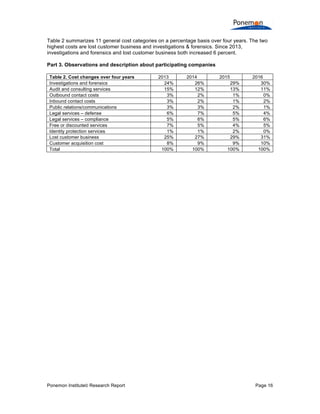
Table 2 summarizes 11 general cost categories on a percentage basis over four years. The two
highest costs are lost customer business and investigations & forensics. Since 2013,
investigations and forensics and lost customer business both increased 6 percent.
Part 3. Observations and description about participating companies
Table 2. Cost changes over four years 2013 2014 2015 2016
Investigations and forensics 24% 26% 29% 30%
Audit and consulting services 15% 12% 13% 11%
Outbound contact costs 3% 2% 1% 0%
Inbound contact costs 3% 2% 1% 2%
Public relations/communications 3% 3% 2% 1%
Legal services – defense 6% 7% 5% 4%
Legal services – compliance 5% 6% 5% 6%
Free or discounted services 7% 5% 4% 5%
Identity protection services 1% 1% 2% 0%
Lost customer business 25% 27% 29% 31%
Customer acquisition cost 8% 9% 9% 10%
Total 100% 100% 100% 100%
Ponemon Institute© Research Report Page 17
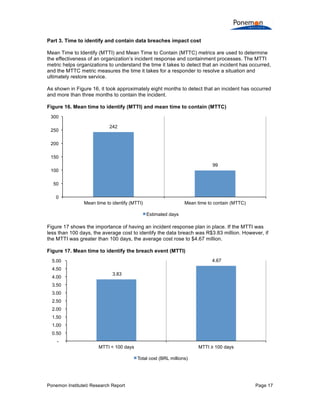
Part 3. Time to identify and contain data breaches impact cost
Mean Time to Identify (MTTI) and Mean Time to Contain (MTTC) metrics are used to determine
the effectiveness of an organization’s incident response and containment processes. The MTTI
metric helps organizations to understand the time it takes to detect that an incident has occurred,
and the MTTC metric measures the time it takes for a responder to resolve a situation and
ultimately restore service.
As shown in Figure 16, it took approximately eight months to detect that an incident has occurred
and more than three months to contain the incident.
Figure 16. Mean time to identify (MTTI) and mean time to contain (MTTC)
Figure 17 shows the importance of having an incident response plan in place. If the MTTI was
less than 100 days, the average cost to identify the data breach was R$3.83 million. However, if
the MTTI was greater than 100 days, the average cost rose to $4.67 million.
Figure 17. Mean time to identify the breach event (MTTI)
242
99
0
50
100
150
200
250
300
Mean time to identify (MTTI) Mean time to contain (MTTC)
Estimated days
3.83
4.67
-
0.50
1.00
1.50
2.00
2.50
3.00
3.50
4.00
4.50
5.00
MTTI < 100 days MTTI ≥ 100 days
Total cost (BRL millions)
Ponemon Institute© Research Report Page 18
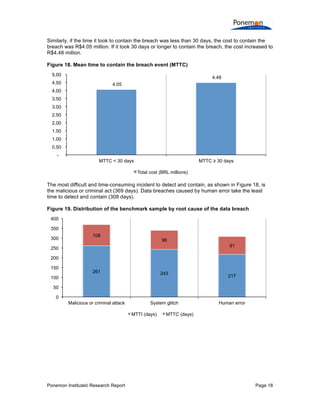
Similarly, if the time it took to contain the breach was less than 30 days, the cost to contain the
breach was R$4.05 million. If it took 30 days or longer to contain the breach, the cost increased to
R$4.48 million.
Figure 18. Mean time to contain the breach event (MTTC)
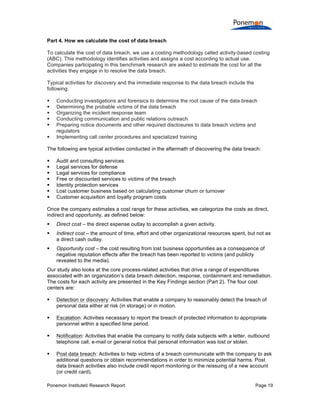
The most difficult and time-consuming incident to detect and contain, as shown in Figure 18, is
the malicious or criminal act (369 days). Data breaches caused by human error take the least
time to detect and contain (308 days).
Figure 19. Distribution of the benchmark sample by root cause of the data breach
4.05
4.48
-
0.50
1.00
1.50
2.00
2.50
3.00
3.50
4.00
4.50
5.00
MTTC < 30 days MTTC ≥ 30 days
Total cost (BRL millions)
261 243
217
108
96
91
0
50
100
150
200
250
300
350
400
Malicious or criminal attack System glitch Human error
MTTI (days) MTTC (days)
Ponemon Institute© Research Report Page 19
Part 4. How we calculate the cost of data breach
To calculate the cost of data breach, we use a costing methodology called activity-based costing
(ABC). This methodology identifies activities and assigns a cost according to actual use.
Companies participating in this benchmark research are asked to estimate the cost for all the
activities they engage in to resolve the data breach.
Typical activities for discovery and the immediate response to the data breach include the
following:
§ Conducting investigations and forensics to determine the root cause of the data breach
§ Determining the probable victims of the data breach
§ Organizing the incident response team
§ Conducting communication and public relations outreach
§ Preparing notice documents and other required disclosures to data breach victims and
regulators
§ Implementing call center procedures and specialized training
The following are typical activities conducted in the aftermath of discovering the data breach:
§ Audit and consulting services
§ Legal services for defense
§ Legal services for compliance
§ Free or discounted services to victims of the breach
§ Identity protection services
§ Lost customer business based on calculating customer churn or turnover
§ Customer acquisition and loyalty program costs
Once the company estimates a cost range for these activities, we categorize the costs as direct,
indirect and opportunity, as defined below:
§ Direct cost – the direct expense outlay to accomplish a given activity.
§ Indirect cost – the amount of time, effort and other organizational resources spent, but not as
a direct cash outlay.
§ Opportunity cost – the cost resulting from lost business opportunities as a consequence of
negative reputation effects after the breach has been reported to victims (and publicly
revealed to the media).
Our study also looks at the core process-related activities that drive a range of expenditures
associated with an organization’s data breach detection, response, containment and remediation.
The costs for each activity are presented in the Key Findings section (Part 2). The four cost
centers are:
§ Detection or discovery: Activities that enable a company to reasonably detect the breach of
personal data either at risk (in storage) or in motion.
§ Escalation: Activities necessary to report the breach of protected information to appropriate
personnel within a specified time period.
§ Notification: Activities that enable the company to notify data subjects with a letter, outbound
telephone call, e-mail or general notice that personal information was lost or stolen.
§ Post data breach: Activities to help victims of a breach communicate with the company to ask
additional questions or obtain recommendations in order to minimize potential harms. Post
data breach activities also include credit report monitoring or the reissuing of a new account
(or credit card).
Ponemon Institute© Research Report Page 20
In addition to the above process-related activities, most companies experience opportunity costs
associated with the breach incident, which results from diminished trust or confidence by present
and future customers. Accordingly, our Institute’s research shows that the negative publicity
associated with a data breach incident causes reputation effects that may result in abnormal
turnover or churn rates as well as a diminished rate for new customer acquisitions.
To extrapolate these opportunity costs, we use a cost estimation method that relies on the
“lifetime value” of an average customer as defined for each participating organization.
§ Turnover of existing customers: The estimated number of customers who will most likely
terminate their relationship as a result of the breach incident. The incremental loss is
abnormal turnover attributable to the breach incident. This number is an annual percentage,
which is based on estimates provided by management during the benchmark interview
process.
7
§ Diminished customer acquisition: The estimated number of target customers who will not
have a relationship with the organization as a consequence of the breach. This number is
provided as an annual percentage.
We acknowledge that the loss of non-customer data, such as employee records, may not impact
an organization’s churn or turnover.
8
In these cases, we would expect the business cost category
to be lower when data breaches do not involve customer or consumer data (including
transactional payment information).
7
In several instances, turnover is partial, wherein breach victims still continued their relationship with the
breached organization, but the volume of customer activity actually declines. This partial decline is
especially salient in certain industries – such as financial services or public sector entities – where
termination is costly or economically infeasible.
8
In this study, we consider citizen, patient and student information as customer data.
Ponemon Institute© Research Report Page 21
Part 5. Organizational characteristics and benchmark methods
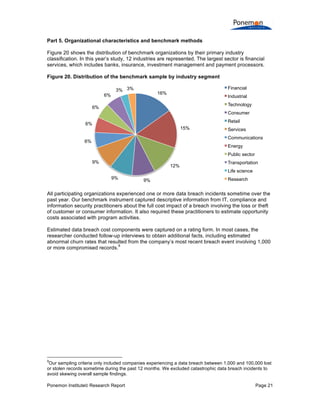
Figure 20 shows the distribution of benchmark organizations by their primary industry
classification. In this year’s study, 12 industries are represented. The largest sector is financial
services, which includes banks, insurance, investment management and payment processors.
Figure 20. Distribution of the benchmark sample by industry segment
All participating organizations experienced one or more data breach incidents sometime over the
past year. Our benchmark instrument captured descriptive information from IT, compliance and
information security practitioners about the full cost impact of a breach involving the loss or theft
of customer or consumer information. It also required these practitioners to estimate opportunity
costs associated with program activities.
Estimated data breach cost components were captured on a rating form. In most cases, the
researcher conducted follow-up interviews to obtain additional facts, including estimated
abnormal churn rates that resulted from the company’s most recent breach event involving 1,000
or more compromised records.
9
9
Our sampling criteria only included companies experiencing a data breach between 1,000 and 100,000 lost
or stolen records sometime during the past 12 months. We excluded catastrophic data breach incidents to
avoid skewing overall sample findings.
16%
15%
12%
9%9%
9%
6%
6%
6%
6%
3% 3% Financial
Industrial
Technology
Consumer
Retail
Services
Communications
Energy
Public sector
Transportation
Life science
Research
Ponemon Institute© Research Report Page 22
Data collection methods did not include actual accounting information, but instead relied upon
numerical estimation based on the knowledge and experience of each participant. Within each
category, cost estimation was a two-stage process. First, the benchmark instrument required
individuals to rate direct cost estimates for each cost category by marking a range variable
defined in the following number line format.
How to use the number line: The number line provided under each data breach cost category is one way to
obtain your best estimate for the sum of cash outlays, labor and overhead incurred. Please mark only one
point somewhere between the lower and upper limits set above. You can reset the lower and upper limits of
the number line at any time during the interview process.
Post your estimate of direct costs here for [presented cost category]
LL ______________________________________|___________________________________ UL
The numerical value obtained from the number line rather than a point estimate for each
presented cost category preserved confidentiality and ensured a higher response rate. The
benchmark instrument also required practitioners to provide a second estimate for indirect and
opportunity costs, separately.
To keep the benchmarking process to a manageable size, we carefully limited items to only those
cost activity centers that we considered crucial to data breach cost measurement. Based upon
discussions with learned experts, the final set of items included a fixed set of cost activities. Upon
collection of the benchmark information, each instrument was re-examined carefully for
consistency and completeness.
For purposes of complete confidentiality, the benchmark instrument did not capture any
company-specific information. Subject materials contained no tracking codes or other methods
that could link responses to participating companies.
The scope of data breach cost items contained within our benchmark instrument was limited to
known cost categories that applied to a broad set of business operations that handle personal
information. We believed that a study focused on business process – and not data protection or
privacy compliance activities – would yield a better quality of results.
Ponemon Institute© Research Report Page 23
Part 6. Limitations
Our study utilizes a confidential and proprietary benchmark method that has been successfully
deployed in earlier research. However, there are inherent limitations with this benchmark
research that need to be carefully considered before drawing conclusions from findings.
§ Non-statistical results: Our study draws upon a representative, non-statistical sample of
Brazilian-based entities that experienced a breach involving the loss or theft of customer or
consumer records during the past 12 months. Statistical inferences, margins of error and
confidence intervals cannot be applied to these data given that our sampling methods are not
scientific.
§ Non-response: The current findings are based on a small representative sample of
benchmarks. Thirty-three companies completed the benchmark process. Non-response bias
was not tested so it is always possible companies that did not participate are substantially
different in terms of underlying data breach cost.
§ Sampling-frame bias: Because our sampling frame is judgmental, the quality of the results is
influenced by the degree to which the frame is representative of the population of companies
being studied. It is our belief that the current sampling frame is biased toward companies with
more mature privacy or information security programs.
§ Company-specific information: The benchmark information is sensitive and confidential.
Thus, the current instrument does not capture company-identifying information. It also allows
individuals to use categorical response variables to disclose demographic information about
the company and industry category.
§ Unmeasured factors: To keep the interview script concise and focused, we decided to omit
other important variables from our analyses such as leading trends and organizational
characteristics. The extent to which omitted variables might explain benchmark results cannot
be determined.
§ Extrapolated cost results: The quality of benchmark research is based on the integrity of
confidential responses provided by respondents in participating companies. While certain
checks and balances can be incorporated into the benchmark process, there is always the
possibility that respondents did not provide accurate or truthful responses. In addition, the
use of cost extrapolation methods rather than actual cost data may inadvertently introduce
bias and inaccuracies.
Ponemon Institute© Research Report Page 24
If you have questions or comments about this research report or would like to obtain additional
copies of the document (including permission to quote or reuse this report), please contact by
letter, phone call or email:
Ponemon Institute LLC
Attn: Research Department
2308 US 31 North
Traverse City, Michigan 49686 USA
1.800.887.3118
research@ponemon.org
Complete copies of all country reports are available at www.ibm.com/security/data-breach
Ponemon Institute LLC
Advancing Responsible Information Management
Ponemon Institute is dedicated to independent research and education that advances responsible
information and privacy management practices within business and government. Our mission is
to conduct high quality, empirical studies on critical issues affecting the management and security
of sensitive information about people and organizations.
As a member of the Council of American Survey Research Organizations (CASRO), we
uphold strict data confidentiality, privacy and ethical research standards. We do not collect any
personally identifiable information from individuals (or company identifiable information in our
business research). Furthermore, we have strict quality standards to ensure that subjects are not
asked extraneous, irrelevant or improper questions.

2016 cost of data breach study brasil

  • 1.
    2016 Cost ofData Breach Study: Brazil Benchmark research sponsored by IBM Independently conducted by Ponemon Institute LLC June 2016 Ponemon Institute© Research Report
  • 2.
    Ponemon Institute© ResearchReport Page 1 20161 Cost of Data Breach Study: Brazil Ponemon Institute, June 2016 Part 1. Introduction IBM and Ponemon Institute are pleased to present the 2016 Cost of Data Breach: Brazil, our fourth annual benchmark study on the cost of data breach incidents for companies located in Brazil. The research reveals that the average per capita cost 2 of data breach increased significantly from R$175 (Brazilian Real) to R$225. The total organizational cost of data breach increased from R$3.96 million to R$4.31 million. The Cost of Data Breach research series was launched 11 years ago in the United States and four years ago in Brazil. We have expanded the study to include the United Kingdom, France, Germany, Italy, India, Australia, Japan, the United Arab Emirates and Saudi Arabia (Arabian region) and Canada. This year, for the first time, we conducted our cost of data breach research in South Africa. To date, 130 Brazilian organizations have participated in the benchmarking process. This year’s study examines the costs incurred by 33 Brazilian companies from 12 different industry sectors following the loss or theft of protected personal data and the notification of breach victims as required by various laws. It is important to note the costs presented in this research are not hypothetical but are from actual data loss incidents. The costs are based upon estimates provided by the individuals interviewed over a ten-month period in the companies represented in this research. The number of breached records per incident this year ranged from 3,900 records to 85,400 records. The average number of breached records was 24,830. We do not include organizations that had data breaches in excess of 100,000 because they are not representative of most data breaches, and to include them in the study would skew the results. Seven global megatrends in the cost of data breach research Over many years of studying the data breach experience of 2,013 organizations in every industry, the research has revealed the following seven megatrends. 1. Since first conducting this research, the cost of data breach has not fluctuated significantly. Thus, it is suggested to be a permanent cost that organizations need to be prepared to deal with and incorporate in their data protection strategies. 2. The biggest financial consequence to organizations that experience a data breach is lost business. Following a data breach, organizations need to take steps to retain customers’ trust to reduce the long-term financial impact. 3. Most data breaches continue to be caused by criminal and malicious attacks. These breaches also take the most time to detect and contain. As a result, they have the highest cost per record. 1 For the first time, this report is dated in the year of publication rather than the fieldwork completion date. Please note that the majority of data breach incidents studied in the current report happened in the 2015 calendar year. 2 The terms “per capita cost” and cost per compromised record have equivalent meaning in this report. Brazil study at a glance § 33 companies participated § R$4.31 million is the average total cost of data breach § 8.5% increase in total cost of data breach § R$225 is the average cost per lost or stolen record § 25% increase in cost per lost or stolen record
  • 3.
    Ponemon Institute© ResearchReport Page 2 4. Organizations recognize that the longer it takes to detect and contain a data breach the more costly it becomes to resolve. Over the years, detection and escalation costs in our research have increased. This suggests investments are being made in technologies and in-house expertise to reduce the time to detect and contain breaches. 5. Regulated industries, such as healthcare and financial services, have the most costly data breaches because of fines and the higher than average rate of lost business and customers. 6. Improvements in data governance programs will reduce the cost of data breach. Incident response plans, appointment of a CISO, employee training and awareness programs and a business continuity management strategy continue to result in cost savings. 7. Investments in certain data loss prevention controls and activities such as encryption and endpoint security solutions are important to preventing data breaches. This year’s study revealed a reduction in the cost when companies participated in threat sharing and deployed data loss prevention technologies. The following are the most interesting findings and implications for organizations: The per capita and total organizational cost of data breach increased. According to the benchmark findings, the average per capita cost to organizations increased from an average of R$175 per compromised record in 2015 to R$225 in 2016. The total average cost of data breach increased from R$3.96 million in 2015 to R$4.31 in 2016. Measures reveal why data breach costs increased. Four key metrics reveal why the cost of data breach increased since 2015. The average per capita cost of a data breach increased significantly by 25 percent. The average total cost and size of breach (the number of records lost or stolen) both increased by 8 percent. Abnormal churn increased 4 percent. In the context of this research, abnormal churn is defined as the greater than expected loss of customers in the normal course of business. Certain industries had higher data breach costs. Services, energy and financial services had a per capita data breach cost substantially above the overall mean of R$225. Public sector, transportation and consumer companies had a per capita cost well below the overall mean value. Malicious attacks were the primary root cause of data breaches and the most costly. 3 Forty percent of incidents involved a malicious or criminal attack. Employee or contractor negligence represented 30 percent of all breaches, and system glitches account for another 30 percent of all data breaches. According to our research, companies that experienced a malicious incident had a per capita data breach cost of R$256. Companies that experienced system glitches had an average cost of R$211. Employee negligence or human error cost an average of R$200. Certain factors reduced the cost of data breach. Incident response plans, extensive use of encryption, the involvement of business continuity management, employee training or participation in threat sharing decreased the per capita cost of data breach. Data breaches caused by extensive migration to the cloud, third party error or involvement or lost or stolen devices increased the per capita cost of data breach. The more records lost, the higher the cost of the data breach. Companies that had a data breach involving less than 10,000 records had a data breach of R$1.88 million and data breaches involving 50,000 or more records had an average of R$6.95 million. 3 Negligent insiders are individuals who cause a data breach because of their carelessness, as determined in a post data breach investigation. In this study, hackers or criminal insiders (employees, contractors or other third parties) are typically responsible for malicious or criminal attacks.
  • 4.
    Ponemon Institute© ResearchReport Page 3 The more churn, the higher the cost of the data breach. The higher cost as a result of customer churn is R$5.42 million for churn greater than 4 percent, and the lowest cost is R$3.81 million for churn that is less than1 percent. Certain industries are more vulnerable to churn. Services, energy, financial and life science organizations experienced relatively high abnormal churn and public sector (government) and transportation companies experienced a very low abnormal churn rate. Detection and escalation costs increased. These costs typically include forensic and investigative activities, assessment and audit services, crisis team management, and communications to executive management and boards of directors. Average detection and escalation costs increased from R$1.09 million in 2015 to R$1.29 million in 2016. Notification costs increased. Notification costs include IT activities associated with the creation of contact databases, determination of all regulatory requirements, engagement of outside experts, postal expenditures, secondary mail contacts or email bounce-backs and inbound communication set-up. This year’s average notification cost increased from R$0.11 million to R$0.126 million. Post data breach costs continue to increase. Post data breach costs typically include help desk activities, inbound communications, special investigative activities, remediation activities, legal expenditures, product discounts, identity protection services and regulatory interventions. Average ex-post response costs increased from R$1.23 million in 2015 to R$1.32 million in 2016. Lost business costs increased. Such costs include the abnormal turnover of customers, increased customer acquisition activities, reputation losses and diminished goodwill. The average lost business cost for benchmarked organizations increased from R$1.53 million in 2015 to R$1.57 million in 2016. Both direct and indirect costs of data breach increased significantly. Direct costs refer to the direct expense outlay to accomplish a given activity, and indirect costs include the time, effort and other organizational resources spent to resolve the data breach. The direct cost per compromised record increased from R$103 to R$110. Indirect cost rose from R$72 per record to R$115.
  • 5.
    Ponemon Institute© ResearchReport Page 4 Cost of Data Breach FAQs What is a data breach? A breach is defined as an event in which an individual’s name plus a medical record and/or a financial record or debit card is potentially put at risk—either in electronic or paper format. In our study, we have identified three main causes of a data breach. These are a malicious or criminal attack, system glitch or human error. The costs of a data breach can vary according to the cause and the safeguards in place at the time of the data breach. What is a compromised record? We define a record as information that identifies the natural person (individual) whose information has been lost or stolen in a data breach. Examples can include a retail company’s database with an individual’s name associated with credit card information and other personally identifiable information. Or, it could be a health insurer’s record of the policyholder with physician and payment information. In this year’s study, the average cost to the organization if one of these records is lost or stolen is R$225. How do you collect the data? Ponemon Institute researchers collected in-depth qualitative data through interviews conducted over a ten-month period. Recruiting organizations for the 2016 study began in January 2015 and interviews were completed in March 2016. In each of the 33 participating organizations, we spoke with IT, compliance and information security practitioners who are knowledgeable about their organization’s data breach and the costs associated with resolving the breach. For privacy purposes we do not collect any organization-specific information. How do you calculate the cost of data breach? To calculate the average cost of data breach, we collect both the direct and indirect expenses incurred by the organization. Direct expenses include engaging forensic experts, outsourcing hotline support and providing free credit monitoring subscriptions and discounts for future products and services. Indirect costs include in- house investigations and communication, as well as the extrapolated value of customer loss resulting from turnover or diminished customer acquisition rates. How does benchmark research differ from survey research? The unit of analysis in the Cost of Data Breach study is the organization. In survey research, the unit of analysis is the individual. We recruited 33 organizations to participate in this study. Data breaches ranged from a low of 3,900 to a high of 85,400 compromised records. Can the average cost of data breach be used to calculate the financial consequences of a mega breach such as those involving millions of lost or stolen records? The average cost of a data breach in our research does not apply to catastrophic or mega data breaches because these are not typical of the breaches most organizations experience. In order to be representative of the population of Brazilian organizations and draw conclusions from the research that can be useful in understanding costs when protected information is lost or stolen, we do not include data breaches of more than 100,000 compromised records in our analysis. Are you tracking the same organizations each year? Each annual study involves a different sample of companies. In other words, we are not tracking the same sample of companies over time. To be consistent, we recruit and match companies with similar characteristics such as the company’s industry, headcount, geographic footprint and size of data breach. Since starting this research in 2013, we have studied the data breach experiences of 130 organizations located in Brazil organizations.
  • 6.
    Ponemon Institute© ResearchReport Page 5 Part 2. Key Findings In this section we provide the detailed findings of this research. Topics are presented in the following order: § Understanding the cost of data breach § The root causes of data breach § Factors that influence the cost of data breach § Trends in the frequency of compromised records and customer turnover § Trends in the cost components of data breach § Recommendations on how to mitigate the risk and consequences of a data breach Understanding the cost of data breach The cost of data breach increased significantly. Figure 1 reports the average per capita cost of a data breach for 33 Brazilian companies in 2016. 4 According to the benchmark findings, the average cost to organizations increased from an average of R$175 per compromised record to R$225. Figure 1. The average per capita cost of data breach over four years Bracketed number defines the benchmark sample size Measured in the Brazilian Real (R$) 4 Per capita cost is defined as the total cost of data breach divided by the size of the data breach in terms of the number of lost or stolen records. 116 157 175 225 - 50 100 150 200 250 2013 (31) 2014 (32) 2015 (34) 2016 (33) Per capita cost (BRL)
  • 7.
    Ponemon Institute© ResearchReport Page 6 The average total organizational cost of data breach increased. Figure 2 shows the total average cost of data breach for 34 Brazilian companies in 2015 was R$3.96 million. In this year’s study the total organizational cost increased to R$4.31 million. Figure 2. The average total organizational cost of data breach over four years Measured in the Brazilian Real (R$) (millions) Measures reveal why data breach costs increased. Figure 3 reports increases in the per capita and average total cost of a data breach by 25 percent and 8 percent, respectively. The average size of data breach or number of records lost or stolen increased 8 percent. Abnormal churn increased 4 percent. In the context of this research, abnormal churn is defined as the greater than expected loss of customers in the normal course of business. Figure 3. Cost of data beach measures Net change defined as the difference between the 2016 and 2015 results 2.64 3.60 3.96 4.31 - 0.50 1.00 1.50 2.00 2.50 3.00 3.50 4.00 4.50 5.00 2013 (31) 2014 (32) 2015 (34) 2016 (33) Average total cost (BRL millions) 4% 8% 8% 25% 0% 5% 10% 15% 20% 25% 30% Abnormal churn Average size of data breach Average total cost Per capita cost Percentage net change over one year
  • 8.
    Ponemon Institute© ResearchReport Page 7 Certain industries had higher data breach costs. Figure 4 reports the per capita costs for the 2016 study by industry classification. While a small sample size prevents us from generalizing industry cost differences, services, energy, financial services and life science industries had a per capita data breach cost substantially above the overall mean of R$225. Public sector (government), transportation and consumer companies had a per capita cost well below the overall mean value. Figure 4. Per capita cost by industry classification of benchmarked companies Measured in the Brazilian Real (R$) 100 128 154 156 188 209 230 245 268 300 321 398 0 50 100 150 200 250 300 350 400 450 Public Transportation Consumer Retail Research Industrial Communications Technology Life science Financial Energy Services
  • 9.
    Ponemon Institute© ResearchReport Page 8 The root causes of data breach Malicious attacks were the primary root cause of data breaches. 5 Figure 5 provides a summary of the main root causes of data breach for all 33 organizations. Forty percent of incidents involved a malicious or criminal attack. Employee or contractor negligence represents 30 percent of all breaches and system glitches account for 30 percent of all data breaches. Figure 5. Distribution of the benchmark sample by root cause of the data breach Malicious attacks are most costly. Figure 6 reports the per capita cost of data breach for three root causes of the breach incident. According to our research, companies that experienced a malicious incident had a per capita data breach cost of R$256. Companies that experienced system glitches had an average cost of R$211. Employee negligence or human error cost an average of R$200. Figure 6. Per capita cost for three root causes of the data breach Measured in the Brazilian Real (R$) 5 Negligent insiders are individuals who cause a data breach because of their carelessness, as determined in a post data breach investigation. In this study, hackers or criminal insiders (employees, contractors or other third parties) are typically responsible for malicious or criminal attacks. 40% 30% 30% Malicious or criminal attack System glitch Human error 256 211 200 - 50 100 150 200 250 300 Malicious or criminal attack System glitch Human error Per capita cost (BRL)
  • 10.
    Ponemon Institute© ResearchReport Page 9 Factors that influence the cost of data breach Certain factors decreased the cost of data breach. As shown in Figure 7, incident response plans, extensive use of encryption, the involvement of business continuity management, employee training or threat sharing decreased the per capita cost of data breach. However, data breaches caused by extensive cloud migration, third party involvement and lost or stolen devices increased the per capita cost of data breach. Hence, the availability of an incident response team reduced the average cost of data breach from R$225 to R$192.4 (decreased cost = R$32.6). In contrast, a data breach caused by extensive migration to the cloud increased the average cost to as much as R$258.4 (increased cost = R$33.4). Figure 7. Impact of 16 factors on the per capita cost of data breach Measured in the Brazilian Real (R$) (33.4) (29.5) (18.1) (15.0) (13.3) (8.9) 7.2 9.8 10.6 14.5 14.6 15.6 15.7 17.5 28.0 32.6 (50.0) (40.0) (30.0) (20.0) (10.0) - 10.0 20.0 30.0 40.0 Extensive cloud migration Third party involvement Lost or stolen devices Rush to notify Consultants engaged Provision of ID protection Data classification schema Board-level involvement Insurance protection Extensive use of DLP CISO appointed Participation in threat sharing Employee training BCM involvement Extensive use of encryption Incident response team Difference from mean
  • 11.
    Ponemon Institute© ResearchReport Page 10 Trends in the frequency of compromised records and customer turnover The more records lost, the higher the cost of the data breach. Figure 8 shows the relationship between the total cost of data breach and the size of the incident for 33 benchmarked companies in ascending order by the size of the breach incident. Companies that had a data breach involving less than 10,000 records averaged a per capita cost of R$1.88 million and data breaches involving 50,000 or more records had an average per capita cost of R$6.95 million. Figure 8. Total cost of data breach by size Measured in the Brazilian Real (R$) (millions) The more churn, the higher the per capita cost of data breach. Figure 9 reports distribution of per capita data breach costs in ascending rate of abnormal churn. The higher per capita cost as a result of customer churn is R$5.42 million for churn that is greater than 4 percent, and the lowest is R$3.81 million for churn that is less than 1 percent. Figure 9. Total cost of data breach by abnormal churn rate Measured in the Brazilian Real (R$) (millions) 1.88 3.01 5.95 6.95 - 1.00 2.00 3.00 4.00 5.00 6.00 7.00 8.00 Less than 10,000 10,000 to 25,000 25,001 to 50,000 Greater than 50,000 Total average cost of data breach (BRL millions) 3.81 3.67 4.55 5.42 - 1.00 2.00 3.00 4.00 5.00 6.00 Less than 1% 1 to 2% 3 to 4% Greater than 4% Total average cost of data breach (BRL millions)
  • 12.
    Ponemon Institute© ResearchReport Page 11 Certain industries are more vulnerable to churn. Figure 10 reports the abnormal churn rate of benchmarked organizations for the present study. While a small sample size prevents us from generalizing the effect of industry on abnormal churn rates, our results show marked variation – wherein services, financial, life science and technology companies experienced relatively high abnormal churn and public sector (government) and transportation companies experienced a very low abnormal churn rate. 6 The implication of these findings is that industries with the highest churn rates could significantly reduce the costs of a data breach by putting an emphasis on customer retention and activities to preserve reputation and brand value. Figure 10. Abnormal churn rates by industry classification of benchmarked companies 6 Public sector organizations utilize a different churn framework given that customers of government organizations typically do not have an alternative choice. 0.0% 1.1% 1.4% 1.5% 1.9% 2.1% 2.7% 3.0% 3.1% 3.9% 4.7% 5.0% 0.0% 1.0% 2.0% 3.0% 4.0% 5.0% 6.0% Public Transportation Retail Industrial Consumer Research Energy Communications Technology Life science Financial Services Abnormal churn rates by industry
  • 13.
    Ponemon Institute© ResearchReport Page 12 Trends in the cost components of a data breach Detection and escalation costs increased significantly. Figure 11 shows costs associated with detection and escalation of data breach incidents. Such costs typically include forensic and investigative activities, assessment and audit services, crisis team management, and communications to executive management and boards of directors. As noted, average detection and escalation costs increased from R$1.09 million to R$1.29 million. Figure 11. Average detection and escalation costs over four years Measured in the Brazilian Real (R$) (millions) Notification costs increased. Figure 12 reports the costs associated with notification activities. Such costs typically include IT activities associated with the creation of contact databases, determination of all regulatory requirements, engagement of outside experts, postal expenditures, secondary contacts to mail or email bounce-backs and inbound communication set-up. This year’s average notification cost increased from R$0.111 million to R$0.126 million. Figure 12. Average notification costs over four years Measured in the Brazilian Real (R$) (millions) 0.72 0.87 1.09 1.29 - 0.20 0.40 0.60 0.80 1.00 1.20 1.40 2013 (31) 2014 (32) 2015 (34) 2016 (33) Detection & escalation costs (BRL millions) 0.106 0.120 0.111 0.126 - 0.020 0.040 0.060 0.080 0.100 0.120 0.140 2013 (31) 2014 (32) 2015 (34) 2016 (33) Notification costs (BRL millions)
  • 14.
    Ponemon Institute© ResearchReport Page 13 Post data breach costs continued to increase. Figure 13 shows the costs associated with ex- post (after-the-fact) activities. Such costs typically include help desk activities, inbound communications, special investigative activities, remediation activities, legal expenditures, product discounts, identity protection services and regulatory interventions. Average ex-post response costs increased from R$1.23 million in 2015 to R$1.32 million in 2016. Figure 13. Average ex-post response costs over four years Measured in the Brazilian Real (R$) (millions) Lost business costs increased slightly. Figure 14 reports lost business costs associated with data breach incidents experienced by Brazilian companies. Such costs include the abnormal turnover of customers, increased customer acquisition activities, reputation losses and diminished goodwill. The average lost business cost for benchmarked organizations increased from R$1.53 million in 2015 to R$1.57 million in 2016. Figure 14. Average lost business costs over four years Measured in the Brazilian Real (R$) (millions) 0.79 1.14 1.23 1.32 - 0.20 0.40 0.60 0.80 1.00 1.20 1.40 2013 (31) 2014 (32) 2015 (34) 2016 (33) Ex-post response costs (BRL millions) 1.03 1.47 1.53 1.57 - 0.20 0.40 0.60 0.80 1.00 1.20 1.40 1.60 1.80 2013 (31) 2014 (32) 2015 (34) 2016 (33) Lost business costs (BRL millions)
  • 15.
    Ponemon Institute© ResearchReport Page 14 Both direct and indirect costs of data breach increased significantly. Direct costs refer to the direct expense outlay to accomplish a given activity such as engaging forensic experts, hiring a law firm or offering victims identity protection services. Indirect costs include the time, effort and other organizational resources spent. This includes using existing employees to help in the data breach notification efforts or in the investigation of the incident. Indirect costs also include the loss of goodwill and customer churn. Figure 15 reports the direct and indirect cost components of a data breach on a per capita basis. Indirect costs increased significantly by R$43 to R$115 in 2016. The direct cost per compromised record increased from R$103 to R$110 in 2016. Figure 15. Trends in direct and indirect costs of a data breach over four years Measured in the Brazilian Real (R$) 68 94 103 110 47 63 72 115 - 50 100 150 200 250 2013 (31) 2014 (32) 2015 (34) 2016 (33) Direct per capita cost (BRL) Indirect per capita cost (BRL)
  • 16.
    Ponemon Institute© ResearchReport Page 15 Recommendations on how to mitigate the risk and consequences of a data breach The companies participating in our annual study report that their data breaches were higher in both average total cost and per capita cost. Investment in improving their data protection practices is important. Incident response plans, extensive use of encryption, the involvement of business continuity management, employee training or threat sharing decreased the per capita cost of data breach. Table 1 tracks the preventive measures implemented by companies after the data breach. The most popular measures or steps taken are: expanded use of encryption (47 percent), additional manual procedures and controls (46 percent), training and awareness programs (43 percent) and security and strengthening of perimeter controls (40 percent). In the past four years, expanded use of encryption increased 22 percent, and strengthening of perimeter controls and security intelligence systems increased both increased 21 percent. Table 1. Preventive measures and controls implemented after the data breach incident 2013 2014 2015 2016 Additional manual procedures and controls 52% 55% 44% 46% Training and awareness programs 40% 43% 40% 43% Identity and access management solutions 27% 31% 35% 29% Security certification or audit 26% 25% 23% 22% Expanded use of encryption 25% 33% 44% 47% Strengthening of perimeter controls 19% 26% 23% 40% Data loss prevention (DLP) solutions 19% 27% 23% 26% Endpoint security solutions 18% 30% 25% 29% Security intelligence systems 15% 28% 35% 36% Other system control practices 11% 9% 6% 9% *Please note that a company may be implementing more than one preventive measure.
  • 17.
    Ponemon Institute© ResearchReport Page 16 Table 2 summarizes 11 general cost categories on a percentage basis over four years. The two highest costs are lost customer business and investigations & forensics. Since 2013, investigations and forensics and lost customer business both increased 6 percent. Part 3. Observations and description about participating companies Table 2. Cost changes over four years 2013 2014 2015 2016 Investigations and forensics 24% 26% 29% 30% Audit and consulting services 15% 12% 13% 11% Outbound contact costs 3% 2% 1% 0% Inbound contact costs 3% 2% 1% 2% Public relations/communications 3% 3% 2% 1% Legal services – defense 6% 7% 5% 4% Legal services – compliance 5% 6% 5% 6% Free or discounted services 7% 5% 4% 5% Identity protection services 1% 1% 2% 0% Lost customer business 25% 27% 29% 31% Customer acquisition cost 8% 9% 9% 10% Total 100% 100% 100% 100%
  • 18.
    Ponemon Institute© ResearchReport Page 17 Part 3. Time to identify and contain data breaches impact cost Mean Time to Identify (MTTI) and Mean Time to Contain (MTTC) metrics are used to determine the effectiveness of an organization’s incident response and containment processes. The MTTI metric helps organizations to understand the time it takes to detect that an incident has occurred, and the MTTC metric measures the time it takes for a responder to resolve a situation and ultimately restore service. As shown in Figure 16, it took approximately eight months to detect that an incident has occurred and more than three months to contain the incident. Figure 16. Mean time to identify (MTTI) and mean time to contain (MTTC) Figure 17 shows the importance of having an incident response plan in place. If the MTTI was less than 100 days, the average cost to identify the data breach was R$3.83 million. However, if the MTTI was greater than 100 days, the average cost rose to $4.67 million. Figure 17. Mean time to identify the breach event (MTTI) 242 99 0 50 100 150 200 250 300 Mean time to identify (MTTI) Mean time to contain (MTTC) Estimated days 3.83 4.67 - 0.50 1.00 1.50 2.00 2.50 3.00 3.50 4.00 4.50 5.00 MTTI < 100 days MTTI ≥ 100 days Total cost (BRL millions)
  • 19.
    Ponemon Institute© ResearchReport Page 18 Similarly, if the time it took to contain the breach was less than 30 days, the cost to contain the breach was R$4.05 million. If it took 30 days or longer to contain the breach, the cost increased to R$4.48 million. Figure 18. Mean time to contain the breach event (MTTC) The most difficult and time-consuming incident to detect and contain, as shown in Figure 18, is the malicious or criminal act (369 days). Data breaches caused by human error take the least time to detect and contain (308 days). Figure 19. Distribution of the benchmark sample by root cause of the data breach 4.05 4.48 - 0.50 1.00 1.50 2.00 2.50 3.00 3.50 4.00 4.50 5.00 MTTC < 30 days MTTC ≥ 30 days Total cost (BRL millions) 261 243 217 108 96 91 0 50 100 150 200 250 300 350 400 Malicious or criminal attack System glitch Human error MTTI (days) MTTC (days)
  • 20.
    Ponemon Institute© ResearchReport Page 19 Part 4. How we calculate the cost of data breach To calculate the cost of data breach, we use a costing methodology called activity-based costing (ABC). This methodology identifies activities and assigns a cost according to actual use. Companies participating in this benchmark research are asked to estimate the cost for all the activities they engage in to resolve the data breach. Typical activities for discovery and the immediate response to the data breach include the following: § Conducting investigations and forensics to determine the root cause of the data breach § Determining the probable victims of the data breach § Organizing the incident response team § Conducting communication and public relations outreach § Preparing notice documents and other required disclosures to data breach victims and regulators § Implementing call center procedures and specialized training The following are typical activities conducted in the aftermath of discovering the data breach: § Audit and consulting services § Legal services for defense § Legal services for compliance § Free or discounted services to victims of the breach § Identity protection services § Lost customer business based on calculating customer churn or turnover § Customer acquisition and loyalty program costs Once the company estimates a cost range for these activities, we categorize the costs as direct, indirect and opportunity, as defined below: § Direct cost – the direct expense outlay to accomplish a given activity. § Indirect cost – the amount of time, effort and other organizational resources spent, but not as a direct cash outlay. § Opportunity cost – the cost resulting from lost business opportunities as a consequence of negative reputation effects after the breach has been reported to victims (and publicly revealed to the media). Our study also looks at the core process-related activities that drive a range of expenditures associated with an organization’s data breach detection, response, containment and remediation. The costs for each activity are presented in the Key Findings section (Part 2). The four cost centers are: § Detection or discovery: Activities that enable a company to reasonably detect the breach of personal data either at risk (in storage) or in motion. § Escalation: Activities necessary to report the breach of protected information to appropriate personnel within a specified time period. § Notification: Activities that enable the company to notify data subjects with a letter, outbound telephone call, e-mail or general notice that personal information was lost or stolen. § Post data breach: Activities to help victims of a breach communicate with the company to ask additional questions or obtain recommendations in order to minimize potential harms. Post data breach activities also include credit report monitoring or the reissuing of a new account (or credit card).
  • 21.
    Ponemon Institute© ResearchReport Page 20 In addition to the above process-related activities, most companies experience opportunity costs associated with the breach incident, which results from diminished trust or confidence by present and future customers. Accordingly, our Institute’s research shows that the negative publicity associated with a data breach incident causes reputation effects that may result in abnormal turnover or churn rates as well as a diminished rate for new customer acquisitions. To extrapolate these opportunity costs, we use a cost estimation method that relies on the “lifetime value” of an average customer as defined for each participating organization. § Turnover of existing customers: The estimated number of customers who will most likely terminate their relationship as a result of the breach incident. The incremental loss is abnormal turnover attributable to the breach incident. This number is an annual percentage, which is based on estimates provided by management during the benchmark interview process. 7 § Diminished customer acquisition: The estimated number of target customers who will not have a relationship with the organization as a consequence of the breach. This number is provided as an annual percentage. We acknowledge that the loss of non-customer data, such as employee records, may not impact an organization’s churn or turnover. 8 In these cases, we would expect the business cost category to be lower when data breaches do not involve customer or consumer data (including transactional payment information). 7 In several instances, turnover is partial, wherein breach victims still continued their relationship with the breached organization, but the volume of customer activity actually declines. This partial decline is especially salient in certain industries – such as financial services or public sector entities – where termination is costly or economically infeasible. 8 In this study, we consider citizen, patient and student information as customer data.
  • 22.
    Ponemon Institute© ResearchReport Page 21 Part 5. Organizational characteristics and benchmark methods Figure 20 shows the distribution of benchmark organizations by their primary industry classification. In this year’s study, 12 industries are represented. The largest sector is financial services, which includes banks, insurance, investment management and payment processors. Figure 20. Distribution of the benchmark sample by industry segment All participating organizations experienced one or more data breach incidents sometime over the past year. Our benchmark instrument captured descriptive information from IT, compliance and information security practitioners about the full cost impact of a breach involving the loss or theft of customer or consumer information. It also required these practitioners to estimate opportunity costs associated with program activities. Estimated data breach cost components were captured on a rating form. In most cases, the researcher conducted follow-up interviews to obtain additional facts, including estimated abnormal churn rates that resulted from the company’s most recent breach event involving 1,000 or more compromised records. 9 9 Our sampling criteria only included companies experiencing a data breach between 1,000 and 100,000 lost or stolen records sometime during the past 12 months. We excluded catastrophic data breach incidents to avoid skewing overall sample findings. 16% 15% 12% 9%9% 9% 6% 6% 6% 6% 3% 3% Financial Industrial Technology Consumer Retail Services Communications Energy Public sector Transportation Life science Research
  • 23.
    Ponemon Institute© ResearchReport Page 22 Data collection methods did not include actual accounting information, but instead relied upon numerical estimation based on the knowledge and experience of each participant. Within each category, cost estimation was a two-stage process. First, the benchmark instrument required individuals to rate direct cost estimates for each cost category by marking a range variable defined in the following number line format. How to use the number line: The number line provided under each data breach cost category is one way to obtain your best estimate for the sum of cash outlays, labor and overhead incurred. Please mark only one point somewhere between the lower and upper limits set above. You can reset the lower and upper limits of the number line at any time during the interview process. Post your estimate of direct costs here for [presented cost category] LL ______________________________________|___________________________________ UL The numerical value obtained from the number line rather than a point estimate for each presented cost category preserved confidentiality and ensured a higher response rate. The benchmark instrument also required practitioners to provide a second estimate for indirect and opportunity costs, separately. To keep the benchmarking process to a manageable size, we carefully limited items to only those cost activity centers that we considered crucial to data breach cost measurement. Based upon discussions with learned experts, the final set of items included a fixed set of cost activities. Upon collection of the benchmark information, each instrument was re-examined carefully for consistency and completeness. For purposes of complete confidentiality, the benchmark instrument did not capture any company-specific information. Subject materials contained no tracking codes or other methods that could link responses to participating companies. The scope of data breach cost items contained within our benchmark instrument was limited to known cost categories that applied to a broad set of business operations that handle personal information. We believed that a study focused on business process – and not data protection or privacy compliance activities – would yield a better quality of results.
  • 24.
    Ponemon Institute© ResearchReport Page 23 Part 6. Limitations Our study utilizes a confidential and proprietary benchmark method that has been successfully deployed in earlier research. However, there are inherent limitations with this benchmark research that need to be carefully considered before drawing conclusions from findings. § Non-statistical results: Our study draws upon a representative, non-statistical sample of Brazilian-based entities that experienced a breach involving the loss or theft of customer or consumer records during the past 12 months. Statistical inferences, margins of error and confidence intervals cannot be applied to these data given that our sampling methods are not scientific. § Non-response: The current findings are based on a small representative sample of benchmarks. Thirty-three companies completed the benchmark process. Non-response bias was not tested so it is always possible companies that did not participate are substantially different in terms of underlying data breach cost. § Sampling-frame bias: Because our sampling frame is judgmental, the quality of the results is influenced by the degree to which the frame is representative of the population of companies being studied. It is our belief that the current sampling frame is biased toward companies with more mature privacy or information security programs. § Company-specific information: The benchmark information is sensitive and confidential. Thus, the current instrument does not capture company-identifying information. It also allows individuals to use categorical response variables to disclose demographic information about the company and industry category. § Unmeasured factors: To keep the interview script concise and focused, we decided to omit other important variables from our analyses such as leading trends and organizational characteristics. The extent to which omitted variables might explain benchmark results cannot be determined. § Extrapolated cost results: The quality of benchmark research is based on the integrity of confidential responses provided by respondents in participating companies. While certain checks and balances can be incorporated into the benchmark process, there is always the possibility that respondents did not provide accurate or truthful responses. In addition, the use of cost extrapolation methods rather than actual cost data may inadvertently introduce bias and inaccuracies.
  • 25.
    Ponemon Institute© ResearchReport Page 24 If you have questions or comments about this research report or would like to obtain additional copies of the document (including permission to quote or reuse this report), please contact by letter, phone call or email: Ponemon Institute LLC Attn: Research Department 2308 US 31 North Traverse City, Michigan 49686 USA 1.800.887.3118 research@ponemon.org Complete copies of all country reports are available at www.ibm.com/security/data-breach Ponemon Institute LLC Advancing Responsible Information Management Ponemon Institute is dedicated to independent research and education that advances responsible information and privacy management practices within business and government. Our mission is to conduct high quality, empirical studies on critical issues affecting the management and security of sensitive information about people and organizations. As a member of the Council of American Survey Research Organizations (CASRO), we uphold strict data confidentiality, privacy and ethical research standards. We do not collect any personally identifiable information from individuals (or company identifiable information in our business research). Furthermore, we have strict quality standards to ensure that subjects are not asked extraneous, irrelevant or improper questions.