UNCOVERING THE
TRIPWIRES
TO POSTSECONDARY
SUCCESS
T H E P O S T S E C O N D A R Y P R O J E C T
J U N E 2 0 1 5
This report was underwritten with a generous grant from the State Farm Youth Advisory Board
“When you peek under the surface and begin asking questions,
graduating college isn’t so much an example of a ‘meritocracy’
as much as it is the symbol of perpetual inequality.”
— Andrew, college freshman
ON THE COVER: Photo reprinted by permission of Brian Snyder, Thomson Reuters
Background
WHO WE ARE: Consisting of over 60
self-selected middle and high school
students and college undergraduates, the
Prichard Committee Student Voice Team
is an extension of the Prichard Committee
for Academic Excellence, an independent
nonprofit organization that mobilizes
citizens to improve Kentucky schools. The
Student Voice Team integrates students
as full partners in that work.
WHAT WE DID: Over the last year, we
conducted an investigation into how our peers
are preparing for life after high school. In
addition to poring over the latest research and
data, we interviewed academics, policymakers,
parents, teachers, administrators, and most no-
tably, students statewide to get a better handle
on the challenges inherent in the postsecond-
ary transition experience.
WHY WE DID IT: As students in the midst of
postsecondary transitions ourselves, we felt
an especially acute sense of urgency to under-
stand why too many of our peers were faltering
on the way to, or so soon after, high school
graduation. We were concerned about the dire
but poorly-discussed data about how many
young people start but do not finish a college or
associate’s degree program.
In this report, we attempt to uncover what we
call “tripwires” or unacknowledged barriers be-
hind these troubling postsecondary graduation
rates. Our strategy is simple: marry facts with
the voices and stories of the real students to
whom they refer.
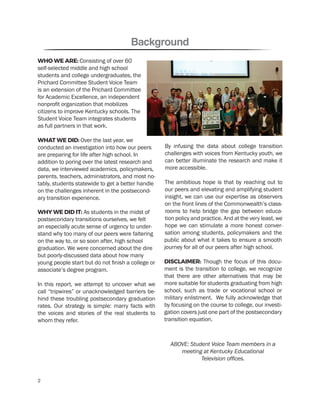
ABOVE: Student Voice Team members in a
meeting at Kentucky Educational
Television offices.
By infusing the data about college transition
challenges with voices from Kentucky youth, we
can better illuminate the research and make it
more accessible.
The ambitious hope is that by reaching out to
our peers and elevating and amplifying student
insight, we can use our expertise as observers
on the front lines of the Commonwealth’s class-
rooms to help bridge the gap between educa-
tion policy and practice. And at the very least, we
hope we can stimulate a more honest conver-
sation among students, policymakers and the
public about what it takes to ensure a smooth
journey for all of our peers after high school.
DISCLAIMER: Though the focus of this docu-
ment is the transition to college, we recognize
that there are other alternatives that may be
more suitable for students graduating from high
school, such as trade or vocational school or
military enlistment. We fully acknowledge that
by focusing on the course to college, our investi-
gation covers just one part of the postsecondary
transition equation.
2
and national economy
with a record-breaking,
well-educated, highly
skilled workforce.
But in fact, that is not
the case.
When we examined
similar indicators of
success in postsecond-
ary education, we found
the results discour-
aging, bordering on
abysmal.
In Kentucky’s public four-year institutions,
48.9% of college undergraduates finish their
degree in six years and 24.2% graduate in
four, meaning that Kentucky has the 13th
worst graduation rate amongst the states.
More unsettling realities lie in the Kentucky
Community and Technical College System
where just 12.8% of students earn an associ-
ates’ degree in three years.
What is happening between students’ high
school graduation day and — more than likely —
their college dropout day? What is contributing
to so many unsuccessful postsecondary transi-
tions?
For over a year now, members of the Prichard
Committee Student Voice Team’s Postsecond-
ary Project have investigated just these ques-
tions.
A high school diploma
is no longer the same
commodity it was half a
century ago.
High school graduates
are making slightly over
$30,000 a year while
those with a bachelor’s
degree earn twice as
much. Over the long
term, college-drop-
outs sacrifice nearly
$500,000 in lifetime
earnings. Unemploy-
ment among young
adults whose highest level of education is a
high school diploma is 17.5%, whereas a young
adult whose highest level of education is a
bachelor’s degree is only 7%. Furthermore, in
Kentucky, over 60% of new job openings and
90% of new jobs in growing industries with high
wages will require some postsecondary educa-
tion by the year 2020. It is strikingly clear that
for a student to be economically self-sufficient
beyond high school, a postsecondary education
is a prerequisite.
Fortunately, the Commonwealth’s college-going
landscape shows some important, positive de-
velopments. Kentucky’s high school graduation
rate now stands at 86.1%, and according to
the Kentucky Department of Education, 62.5%
of Kentucky’s 2014 high school students are
considered “college ready.” Most significantly,
more than 3 in 5 high school graduates are
enrolling in a postsecondary institution.
From these numbers alone, it would seem as
though Kentucky is on track to supply our local
Introduction
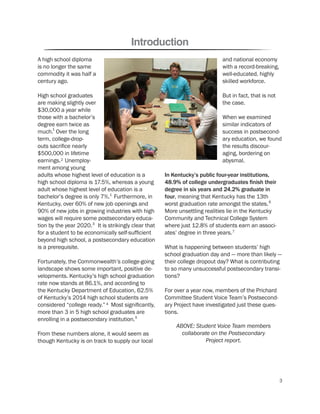
ABOVE: Student Voice Team members
collaborate on the Postsecondary
Project report.
1
2
1
3
4
5
6
7
3
The Tripwire Theme
After doing statistical research and having con-
versations with students, parents, educators,
policy experts, and others about the postsec-
ondary transition experience, we identified a
central theme: one that has to do with equality.
Two features students have virtually no control
over, their home zip code and their family’s
income, determine so much of what we call col-
lege success. And while the college admissions
process purports to be a meritocracy, these
indicators disproportionately predict access to
valuable resources and information that help
successful college graduates earn a degree
with manageable or no debt.
Some of the students we talked with, for exam-
ple, told us they needed to work for pay during
the school year and forgo the often expensive
extracurricular activities which would otherwise
make them more attractive to competitive post-
secondary admissions offices.
And then there were the students we spoke
with who came from families with no history
of college graduates, making the cultural leap
they were hoping to take that much more
difficult. We found too that some students
who were uncertain about whether they would
make it to the next level of education after high
school also had insufficient access to critical
information like whether and how to apply
for financial aid or what, besides academic
achievement, a person needs to thrive in a
college setting.
In this report, we are calling the inequalities
that thwart students from making successful
postsecondary education transitions “trip-
wires.” These are the little-discussed, powerful
obstacles that tend to sabotage students on
the way to a self-sufficient, thriving life after
high school. Specifically, we found these trip-
wires falling into three broad categories, ones
we are calling:
n The Birthright Lottery,
n Veiled College Costs, and
n College and Career Unreadiness
The tripwires we highlight in this report repre-
sent our attempt to raise the level of informed
discussion among people who most stand to
directly benefit from it — students and families.
In reviewing the stark statistics, poignant
voices and simple graphics we present in these
pages, consider what it would mean to have
more transparent conversations about them
not only in the public policy arena, but also in
our homes and in our schools.
4
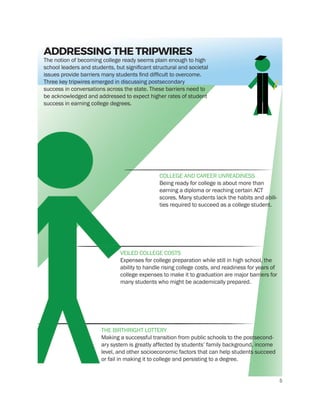
ADDRESSING THE TRIPWIRES
The notion of becoming college ready seems plain enough to high
school leaders and students, but significant structural and societal
issues provide barriers many students find difficult to overcome.
Three key tripwires emerged in discussing postsecondary
success in conversations across the state. These barriers need to
be acknowledged and addressed to expect higher rates of student
success in earning college degrees.
THE BIRTHRIGHT LOTTERY
Making a successful transition from public schools to the postsecond-
ary system is greatly affected by students’ family background, income
level, and other socioeconomic factors that can help students succeed
or fail in making it to college and persisting to a degree.
VEILED COLLEGE COSTS
Expenses for college preparation while still in high school, the
ability to handle rising college costs, and readiness for years of
college expenses to make it to graduation are major barriers for
many students who might be academically prepared.
COLLEGE AND CAREER UNREADINESS
Being ready for college is about more than
earning a diploma or reaching certain ACT
scores. Many students lack the habits and abili-
ties required to succeed as a college student.
5
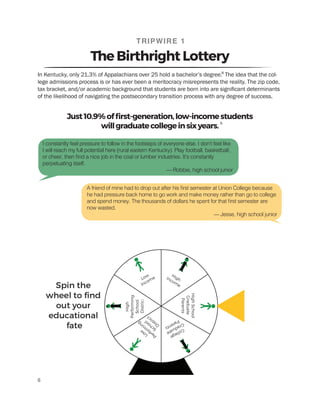
The Birthright Lottery
TRIPWIRE 1
Just10.9%offirst-generation,low-incomestudents
willgraduatecollegeinsixyears.
I constantly feel pressure to follow in the footsteps of everyone else. I don’t feel like
I will reach my full potential here (rural eastern Kentucky). Play football, basketball,
or cheer, then find a nice job in the coal or lumber industries. It’s constantly
perpetuating itself.
— Robbie, high school junior
A friend of mine had to drop out after his first semester at Union College because
he had pressure back home to go work and make money rather than go to college
and spend money. The thousands of dollars he spent for that first semester are
now wasted.
— Jesse, high school junior
In Kentucky, only 21.3% of Appalachians over 25 hold a bachelor’s degree. The idea that the col-
lege admissions process is or has ever been a meritocracy misrepresents the reality. The zip code,
tax bracket, and/or academic background that students are born into are significant determinants
of the likelihood of navigating the postsecondary transition process with any degree of success.
8
9
6
OUR TAKE
Even for those low-income students who do manage to take advantage of financial aid programs,
the difference between what they can get and what a postsecondary degree actually costs is typi-
cally many thousands of additional dollars. This is even more confounding when you consider what
Dr. Jim Ziliak, University of Kentucky professor of economics, told us: “There is a substantial mis-
match between the knowledge of how you finance college and the eligibility for assistance. This is
a real problem because a lot of these kids could afford to go to college, they just don’t know it.”
But there are at least a few proven solutions. Research shows that in Kentucky, access to services
like intensive academic advising and career counseling raise completion rates and shorten the
time students take to get a degree—approaches that help low-income students overcome both
financial and cultural barriers to success after high school.
The fact that these very programs are often facing challenges in Frankfort is disheartening. As an
informed, poor kid from Eastern Kentucky, I hope our policymakers will understand that budget
cuts will make it difficult to afford intensive student supports.
Surely when it comes to ensuring a successful transition after high school, there is more we can
do to support and encourage students with less in Kentucky.
— Amanda Jean Wahlstedt, Student Voice Team
My family has very little money, but I just scored a 23 on my ACT. Am I proud of that?
Definitely. No one in my family has gotten a score close to that high, but no one in my
family has ever gone to college, so I have a feeling that score will go to waste.
— Keegan, high school senior
I’ll be taking on college on my own. Neither of my parents nor siblings attended
college, and all my counselor does is scheduling and testing. I don’t know where to go.
— LeAnna, high school junior
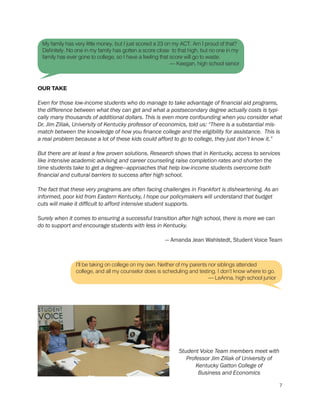
Student Voice Team members meet with
Professor Jim Ziliak of University of
Kentucky Gatton College of
Business and Economics
7
Veiled College Costs
TRIPWIRE 2
77%ofstudentsunder24yearsoldwhoaretopincomequartile
earnedacollegedegree,whereasonly9%oftheirpeerswhoare
inthebottomincomequartileearnedacollegedegree.
I’ve paid hundreds of dollars for ACT preparation, actually taking the ACT
multiple times, and sending my scores to colleges. I haven’t even begun to count
how much money I’ve spent on other miscellaneous ‘college prep’ type stuff.
— Mariah, high school senior
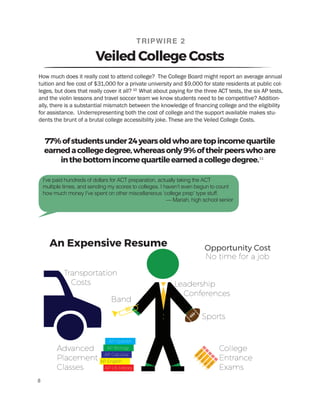
How much does it really cost to attend college? The College Board might report an average annual
tuition and fee cost of $31,000 for a private university and $9,000 for state residents at public col-
leges, but does that really cover it all? What about paying for the three ACT tests, the six AP tests,
and the violin lessons and travel soccer team we know students need to be competitive? Addition-
ally, there is a substantial mismatch between the knowledge of financing college and the eligibility
for assistance. Underrepresenting both the cost of college and the support available makes stu-
dents the brunt of a brutal college accessibility joke. These are the Veiled College Costs.
10
11
8
OUR TAKE
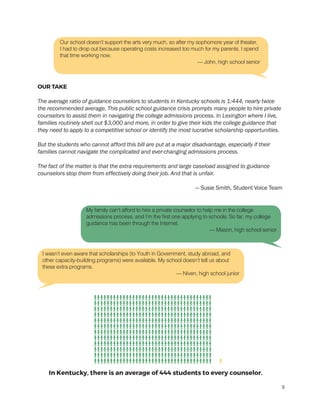
The average ratio of guidance counselors to students in Kentucky schools is 1:444, nearly twice
the recommended average. This public school guidance crisis prompts many people to hire private
counselors to assist them in navigating the college admissions process. In Lexington where I live,
families routinely shell out $3,000 and more, in order to give their kids the college guidance that
they need to apply to a competitive school or identify the most lucrative scholarship opportunities.
But the students who cannot afford this bill are put at a major disadvantage, especially if their
families cannot navigate the complicated and ever-changing admissions process.
	
The fact of the matter is that the extra requirements and large caseload assigned to guidance
counselors stop them from effectively doing their job. And that is unfair.
— Susie Smith, Student Voice Team
My family can’t afford to hire a private counselor to help me in the college
admissions process, and I’m the first one applying to schools. So far, my college
guidance has been through the Internet.
— Mason, high school senior
I wasn’t even aware that scholarships (to Youth in Government, study abroad, and
other capacity-building programs) were available. My school doesn’t tell us about
these extra programs.
— Niven, high school junior
Our school doesn’t support the arts very much, so after my sophomore year of theater,
I had to drop out because operating costs increased too much for my parents. I spend
that time working now.
— John, high school senior
9
College and Career Unreadiness
TRIPWIRE 3
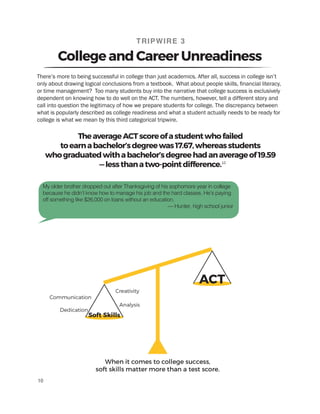
TheaverageACTscoreofastudentwhofailed
toearnabachelor’sdegreewas17.67,whereasstudents
whograduatedwithabachelor’sdegreehadanaverageof19.59
—lessthanatwo-pointdifference.
My older brother dropped out after Thanksgiving of his sophomore year in college
because he didn’t know how to manage his job and the hard classes. He’s paying
off something like $26,000 on loans without an education.
— Hunter, high school junior
There’s more to being successful in college than just academics. After all, success in college isn’t
only about drawing logical conclusions from a textbook. What about people skills, financial literacy,
or time management? Too many students buy into the narrative that college success is exclusively
dependent on knowing how to do well on the ACT. The numbers, however, tell a different story and
call into question the legitimacy of how we prepare students for college. The discrepancy between
what is popularly described as college readiness and what a student actually needs to be ready for
college is what we mean by this third categorical tripwire.
12
10
OUR TAKE
When it comes to postsecondary transitions, there seems to be a huge disconnect between middle
school expectations and reality. Research shows that 93% of middle school students report that
their goal is to attend college but only 44% of us enroll in college, and only 26% graduate with a
college diploma within six years of enrolling.
There is another reason why talking about our plans after high school may need to start earlier
than we want. Research shows that the decisions we make about what classes to take matter
even at our age. For example, if students do not pass key “gatekeeper courses” such as Algebra I
on time, it can be difficult to complete the full sequence of coursework needed for postsecondary
education, particularly in four-year colleges.
Are middle schoolers really too young to start thinking about these things?
— Ashton Bishop, Student Voice Team
I’m not convinced I really know what ‘college ready’ means. My high school has
made me believe college success comes to those who read the textbook, not
knowing how to learn and survive on your own.
— Zach, high school senior
I wasn’t identified as gifted when I was in third grade, and I feel like it really stunted
my growth. The label prevented me from tapping into a better environment to learn in.
— Sara, high school sophomore
I wish there were ways teachers could prove to me that my education means some-
thing, why geometry could help me in journalism. I look forward to the day I watch what
I learned in the classroom work in the community.
— Zoha, high school senior
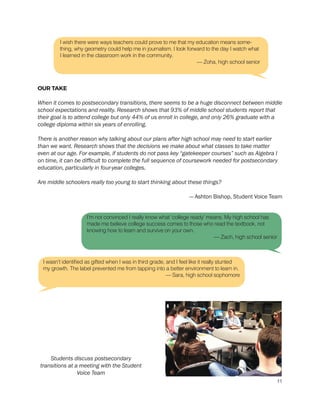
Students discuss postsecondary
transitions at a meeting with the Student
Voice Team
11
What’s Next
The Student Voice Team started this research
project for two reasons: [1] To raise the level
of informed discussion around postsecondary
transitions, and [2] To demonstrate ways stu-
dents can be integrated into the policymaking
process.
The hours of roundtables and interviews repre-
sent our attempt to capture authentic student
voice and bring the larger, but largely dull, data
to life. We wanted the content we produced to
be responsive to the research and stories we
collected and allow us to avoid imposing any
preconceived narratives about postsecondary
transitions.
Although our project grew out of an attempt
to understand why college dropout rates were
dangerously high, the research lent itself to an
equally strong understanding of what already
is working within the system to help students
make successful transitions.
Rarely do students enjoy the opportunity to ex-
perience and learn from peers outside of their
own classrooms, but our project team’s most
triumphant work involved seeing what it is like
to live and attend school in communities across
the state. In the midst of high school, applying
to and actually attending college, members of
our team were able to connect our own person-
al journeys with those of students elsewhere
to better appreciate the inequity that Kentucky
students are facing when it comes to making
Students should help discover solutions
POLICY BRIGHT SPOTS
While this report focuses on the support
gap between policy focusing on postsec-
ondary transitions and the students in
desperate need of assistance, there are
some initiatives within and beyond Ken-
tucky from which we can draw inspiration.
Here are just a few:
COLLEGE ADVISING CORPS: The
Corps works to increase the number of
low-income, first-generation college, and
underrepresented high school students
who enter and complete higher education.
The Corps uses a “near-peer” model, lever-
aging recent college graduates as coun-
selors to target populations most in need.
Find out more at www.advisingcorps.org.
DELAWARE COLLEGE BOARD
PARTNERSHIP: In 2013, the state of
Delaware joined forces with the College
Board and launched a program “to en-
sure high school students statewide are
best equipped for the college application
process.” As part of the work, the pro-
gram sent specialized information pack-
ets to low-income students who scored
well on the SAT. The packets include not
only explanations of the college admis-
sions process but also full application fee
waivers.
INDIVIDUAL LEARNING PLAN: The
ILP is a tool available to Kentucky middle
and high school students to help them
prepare themselves for the future. Among
other things, it aims to match students
with career tracks and goals based on
skills and interests and help them to
develop and maintain a resume. It can
also supplement personal guidance from
school counselors.
I found that this project did more than just
supply us with an idea of why students
may be dropping out; it helped us discover
what’s already working in the system.
— Meghana Kudrimoti,
Student Voice Team
12
smooth postsecondary transitions.
After taking a step back from the research and
seeing our work wholly, we see the broader mis-
sion of the Student Voice Team taking on even
more poignancy. All too often, we students are
excluded from the work of improving our schools.
From the lack of student representation on
school governance bodies to the limited or su-
perficial opportunities to work in partnership
with adults to improve our schools at the class-
room and systems level, it seems that we are
selling young people short. If we truly want to
realize the best possible education for all Ken-
tucky youth, that needs to change.
But we students have a responsibility too to be
partners in our own education and to help initi-
ate the conversations that demonstrate what is
possible when we more fully participate in mak-
ing our schools better. And ultimately, we stu-
dents also have to be the ones who help engage
other students in this very important work.
We hope this report, which focuses so explicitly
on a single education issue is just the beginning
of a more expansive dialogue around why, when
it comes to Kentucky schools, student voice
matters.
Students really are the missing component
in education policy. It takes the faces and
stories of students to fully grasp and begin to
solve these issues plaguing our system.
— Gentry Fitch,
Student Voice Team
As we talked with students, it really became
apparent we were applying to college twice:
once as the student who knows the ins
and outs of the college-going process but
also as the Eastern Kentucky student who
doesn’t have the same support.
— Eliza Jane Schaeffer,
Student Voice Team
MOVING FORWARD
Some questions worthy of more discussion:
Birthright Lottery: Thinking about Postsecondary Education
n What is most valuable to help students reach their educational goals?
n What types of divisions, if any, exist among college-bound students and non-college-bound
students in schools? Why do they exist?
Veiled Costs to College: Getting Ready for Postsecondary Education
n To what extent are programs like the Individual Learning Plan (ILP) used in schools? Do stu-
dents find them useful?
n How do students work with guidance counselors in schools? Do they find them approachable
and valuable to their education? What should students expect from a person in that position?
College/Career Unreadiness: Completing Postsecondary Education
n What types of skills make a college graduate successful? What can students do to ensure that
they acquire these skills? What about teachers and parents?
n What are non-academic skills our schools could be teaching to help students succeed in col-
lege?
13
The Postsecondary Project Team
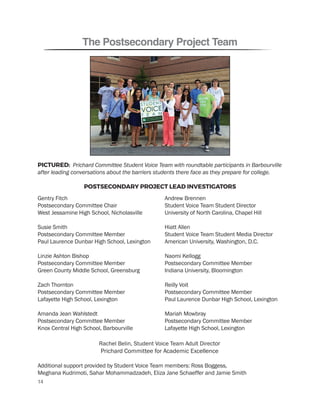
PICTURED: Prichard Committee Student Voice Team with roundtable participants in Barbourville
after leading conversations about the barriers students there face as they prepare for college.
POSTSECONDARY PROJECT LEAD INVESTIGATORS
Gentry Fitch
Postsecondary Committee Chair
West Jessamine High School, Nicholasville
Susie Smith
Postsecondary Committee Member
Paul Laurence Dunbar High School, Lexington
Linzie Ashton Bishop
Postsecondary Committee Member
Green County Middle School, Greensburg
Zach Thornton
Postsecondary Committee Member
Lafayette High School, Lexington
Amanda Jean Wahlstedt
Postsecondary Committee Member
Knox Central High School, Barbourville
Andrew Brennen
Student Voice Team Student Director
University of North Carolina, Chapel Hill
Hiatt Allen
Student Voice Team Student Media Director
American University, Washington, D.C.
Naomi Kellogg
Postsecondary Committee Member
Indiana University, Bloomington
Reilly Voit
Postsecondary Committee Member
Paul Laurence Dunbar High School, Lexington
Mariah Mowbray
Postsecondary Committee Member
Lafayette High School, Lexington
Additional support provided by Student Voice Team members: Ross Boggess,
Meghana Kudrimoti, Sahar Mohammadzadeh, Eliza Jane Schaeffer and Jamie Smith
14
Rachel Belin, Student Voice Team Adult Director
Prichard Committee for Academic Excellence
Acknowledgements
The Postsecondary Project is the result of a statewide collaborative effort for which we have many
people to thank.
We are especially grateful to Prichard Committee staff including Executive Director, Stu Silberman;
Executive Director Elect, Brigitte Blom Ramsey; Office Manager, Pam Shepherd; and Communica-
tions and Technology Director, Michelle Whitaker for reviewing our work and for providing critical
and supportive feedback.
We thank teacher leaders Ali Wright, Rachel Losch, Kerry Hancock, and Trish Shelton and the
Center for Teaching Quality for assisting us in the research and production of this project along
with broadening our perspectives and demonstrating what is possible when students and teachers
work together as full partners.
We extend deep gratitude to Kentucky Educational Television, and especially Lynda Thomas and
Jeff Gray, for granting us a wired, reliable space to meet regularly and for providing ongoing moral
and technical support.
We thank Lonnie Harp for professionally formatting this report for us.
We also thank the numerous adult experts who so generously shared their personal and profes-
sional insights with us:
Governor Steve Beshear
Congressman Brett Guthrie
Dr. Terry Holliday, Kentucky Department of Education Commissioner
Jason Bailey, Director, Kentucky Center for Economic Policy
Taylor Ballinger, Teach for America, Appalachia
Justin Bathon, University of Kentucky Center for Technology Leadership in Education
Brian Bishop, National Director for Teacher Fellowship Programs, Hope Street Group
Jaci Carfagno, Lexington Herald-Leader Editorial Board
Brad Clark, Kentucky State Fellow, Hope Street Group
Cory Curl, Senior Fellow, ACHIEVE
Luther Deaton, President and C.E.O. Central Bank
Colmon Elridge, Executive Assistant, Governor Steve Beshear
Linda France, Director, Next Generation Learning Partnerships, University of Kentucky
Trey Grayson, President, Northern Kentucky Chamber of Commerce
Rich Greissman, Assistant Provost (ret.), University of Kentucky
Bob Nesmith, Dean of Admissions and Financial Aid, Centre College
Amit Paley, Management Consultant, McKinsey & Company
Dr. Rebecca Simms, Director of Secondary Partnerships at Bluegrass Community and Technical College
Deanna Smith, Head Guidance Counselor, Paul Laurence Dunbar High School
15
Sources
1. U.S. Department of Education, National Center for Education Statistics. (2014). The Condition of Education
2014 (NCES 2014-083)
2. Greenstone, M., & Looney, A. (2013, June 7). Is Starting College and Not Finishing Really That Bad? Re-
trieved May 19, 2015.
3. Carnevale, A., Smith, N., & Strohl, J. (2013). Recovery: Job Growth and Education Requirements through
2020 (State Report). Washington, D.C.: Georgetown University, Georgetown Public Policy Institute, Center on Edu-
cation and the Workforce.
4. Kentucky Department of Education. (2014). SCHOOLS/DISTRICTS IMPROVE IN THIRD YEAR OF UNBRIDLED
LEARNING ASSESSMENTS AND ACCOUNTABILITY [Press release].
5. Kentucky Department of Education. (2011). Kentucky college-going rates increase to highest level recorded
[Press release].
6. Chronicle of Higher Education College Completion Project. (2013). Graduation Rates by States. Retrieved
Nov 16, 2014.
7. Kentucky Council on Postsecondary Education. (2014). Associate’s Graduation Rates 2009-10 to 2012-13.
Frankfort, KY.
8. Schwartz, J. (n.d.). Development and Progress of the Appalachian Higher Education Network: Executive
Summary. Retrieved Nov. 14, 2014.
9. Pell Institute. (2011). 6-YEAR DEGREE ATTAINMENT RATES FOR STUDENTS ENROLLED IN A POST-SECOND-
ARY INSTITUTION. Washington, D.C.
10. Baum, S., & Ma, J. (2013). Trends in College Pricing 2013. The College Board.
11. Korn, M. (2015, February 3). Big Gap in College Graduation Rates for Rich and Poor, Study Finds. Re-
trieved Feb. 14, 2015
12. Velez, E. (2014). America’s College Drop-Out Epidemic: Understanding the College Drop-Out Population.
Washington, D.C.: National Center for Analysis of Longitudinal Data in Education Research.
Ashley Spalding, Policy Analyst, Kentucky Center for Economic Policy
Chet Sygiel, Guidance Counselor, Jackson Independent Schools
Diana Taylor, Taylor-Gray Communications
Susan Perkins Weston, independent education consultant
James P. Ziliak, Director University of Kentucky’s Center for Poverty Research
And last, but most of all, we want to thank the scores of students from across the state who partici-
pated in our roundtable discussions and trusted us with remarkable candor and wisdom about the
postsecondary transition experience.
16
UNCOVERING THE
TRIPWIRES
TO POSTSECONDARY
SUCCESS
T H E P O S T S E C O N D A R Y P R O J E C T
271 West Short St. Suite 202 | Lexington, KY 40507
(859) 233-9849 x233 | studentvoiceteam@prichardcommittee.org
prichardcommittee.org/studentvoiceteam
@PCStuVoiceTeam
271 West Short St. Suite 202 | Lexington, KY 40507KY 40507KY

2015-SVT-Postsecondary-Project-Report-full copy

  • 1.
    UNCOVERING THE TRIPWIRES TO POSTSECONDARY SUCCESS TH E P O S T S E C O N D A R Y P R O J E C T J U N E 2 0 1 5
  • 2.
    This report wasunderwritten with a generous grant from the State Farm Youth Advisory Board
  • 3.
    “When you peekunder the surface and begin asking questions, graduating college isn’t so much an example of a ‘meritocracy’ as much as it is the symbol of perpetual inequality.” — Andrew, college freshman ON THE COVER: Photo reprinted by permission of Brian Snyder, Thomson Reuters
  • 4.
    Background WHO WE ARE:Consisting of over 60 self-selected middle and high school students and college undergraduates, the Prichard Committee Student Voice Team is an extension of the Prichard Committee for Academic Excellence, an independent nonprofit organization that mobilizes citizens to improve Kentucky schools. The Student Voice Team integrates students as full partners in that work. WHAT WE DID: Over the last year, we conducted an investigation into how our peers are preparing for life after high school. In addition to poring over the latest research and data, we interviewed academics, policymakers, parents, teachers, administrators, and most no- tably, students statewide to get a better handle on the challenges inherent in the postsecond- ary transition experience. WHY WE DID IT: As students in the midst of postsecondary transitions ourselves, we felt an especially acute sense of urgency to under- stand why too many of our peers were faltering on the way to, or so soon after, high school graduation. We were concerned about the dire but poorly-discussed data about how many young people start but do not finish a college or associate’s degree program. In this report, we attempt to uncover what we call “tripwires” or unacknowledged barriers be- hind these troubling postsecondary graduation rates. Our strategy is simple: marry facts with the voices and stories of the real students to whom they refer. ABOVE: Student Voice Team members in a meeting at Kentucky Educational Television offices. By infusing the data about college transition challenges with voices from Kentucky youth, we can better illuminate the research and make it more accessible. The ambitious hope is that by reaching out to our peers and elevating and amplifying student insight, we can use our expertise as observers on the front lines of the Commonwealth’s class- rooms to help bridge the gap between educa- tion policy and practice. And at the very least, we hope we can stimulate a more honest conver- sation among students, policymakers and the public about what it takes to ensure a smooth journey for all of our peers after high school. DISCLAIMER: Though the focus of this docu- ment is the transition to college, we recognize that there are other alternatives that may be more suitable for students graduating from high school, such as trade or vocational school or military enlistment. We fully acknowledge that by focusing on the course to college, our investi- gation covers just one part of the postsecondary transition equation. 2
  • 5.
    and national economy witha record-breaking, well-educated, highly skilled workforce. But in fact, that is not the case. When we examined similar indicators of success in postsecond- ary education, we found the results discour- aging, bordering on abysmal. In Kentucky’s public four-year institutions, 48.9% of college undergraduates finish their degree in six years and 24.2% graduate in four, meaning that Kentucky has the 13th worst graduation rate amongst the states. More unsettling realities lie in the Kentucky Community and Technical College System where just 12.8% of students earn an associ- ates’ degree in three years. What is happening between students’ high school graduation day and — more than likely — their college dropout day? What is contributing to so many unsuccessful postsecondary transi- tions? For over a year now, members of the Prichard Committee Student Voice Team’s Postsecond- ary Project have investigated just these ques- tions. A high school diploma is no longer the same commodity it was half a century ago. High school graduates are making slightly over $30,000 a year while those with a bachelor’s degree earn twice as much. Over the long term, college-drop- outs sacrifice nearly $500,000 in lifetime earnings. Unemploy- ment among young adults whose highest level of education is a high school diploma is 17.5%, whereas a young adult whose highest level of education is a bachelor’s degree is only 7%. Furthermore, in Kentucky, over 60% of new job openings and 90% of new jobs in growing industries with high wages will require some postsecondary educa- tion by the year 2020. It is strikingly clear that for a student to be economically self-sufficient beyond high school, a postsecondary education is a prerequisite. Fortunately, the Commonwealth’s college-going landscape shows some important, positive de- velopments. Kentucky’s high school graduation rate now stands at 86.1%, and according to the Kentucky Department of Education, 62.5% of Kentucky’s 2014 high school students are considered “college ready.” Most significantly, more than 3 in 5 high school graduates are enrolling in a postsecondary institution. From these numbers alone, it would seem as though Kentucky is on track to supply our local Introduction ABOVE: Student Voice Team members collaborate on the Postsecondary Project report. 1 2 1 3 4 5 6 7 3
  • 6.
    The Tripwire Theme Afterdoing statistical research and having con- versations with students, parents, educators, policy experts, and others about the postsec- ondary transition experience, we identified a central theme: one that has to do with equality. Two features students have virtually no control over, their home zip code and their family’s income, determine so much of what we call col- lege success. And while the college admissions process purports to be a meritocracy, these indicators disproportionately predict access to valuable resources and information that help successful college graduates earn a degree with manageable or no debt. Some of the students we talked with, for exam- ple, told us they needed to work for pay during the school year and forgo the often expensive extracurricular activities which would otherwise make them more attractive to competitive post- secondary admissions offices. And then there were the students we spoke with who came from families with no history of college graduates, making the cultural leap they were hoping to take that much more difficult. We found too that some students who were uncertain about whether they would make it to the next level of education after high school also had insufficient access to critical information like whether and how to apply for financial aid or what, besides academic achievement, a person needs to thrive in a college setting. In this report, we are calling the inequalities that thwart students from making successful postsecondary education transitions “trip- wires.” These are the little-discussed, powerful obstacles that tend to sabotage students on the way to a self-sufficient, thriving life after high school. Specifically, we found these trip- wires falling into three broad categories, ones we are calling: n The Birthright Lottery, n Veiled College Costs, and n College and Career Unreadiness The tripwires we highlight in this report repre- sent our attempt to raise the level of informed discussion among people who most stand to directly benefit from it — students and families. In reviewing the stark statistics, poignant voices and simple graphics we present in these pages, consider what it would mean to have more transparent conversations about them not only in the public policy arena, but also in our homes and in our schools. 4
  • 7.
    ADDRESSING THE TRIPWIRES Thenotion of becoming college ready seems plain enough to high school leaders and students, but significant structural and societal issues provide barriers many students find difficult to overcome. Three key tripwires emerged in discussing postsecondary success in conversations across the state. These barriers need to be acknowledged and addressed to expect higher rates of student success in earning college degrees. THE BIRTHRIGHT LOTTERY Making a successful transition from public schools to the postsecond- ary system is greatly affected by students’ family background, income level, and other socioeconomic factors that can help students succeed or fail in making it to college and persisting to a degree. VEILED COLLEGE COSTS Expenses for college preparation while still in high school, the ability to handle rising college costs, and readiness for years of college expenses to make it to graduation are major barriers for many students who might be academically prepared. COLLEGE AND CAREER UNREADINESS Being ready for college is about more than earning a diploma or reaching certain ACT scores. Many students lack the habits and abili- ties required to succeed as a college student. 5
  • 8.
    The Birthright Lottery TRIPWIRE1 Just10.9%offirst-generation,low-incomestudents willgraduatecollegeinsixyears. I constantly feel pressure to follow in the footsteps of everyone else. I don’t feel like I will reach my full potential here (rural eastern Kentucky). Play football, basketball, or cheer, then find a nice job in the coal or lumber industries. It’s constantly perpetuating itself. — Robbie, high school junior A friend of mine had to drop out after his first semester at Union College because he had pressure back home to go work and make money rather than go to college and spend money. The thousands of dollars he spent for that first semester are now wasted. — Jesse, high school junior In Kentucky, only 21.3% of Appalachians over 25 hold a bachelor’s degree. The idea that the col- lege admissions process is or has ever been a meritocracy misrepresents the reality. The zip code, tax bracket, and/or academic background that students are born into are significant determinants of the likelihood of navigating the postsecondary transition process with any degree of success. 8 9 6
  • 9.
    OUR TAKE Even forthose low-income students who do manage to take advantage of financial aid programs, the difference between what they can get and what a postsecondary degree actually costs is typi- cally many thousands of additional dollars. This is even more confounding when you consider what Dr. Jim Ziliak, University of Kentucky professor of economics, told us: “There is a substantial mis- match between the knowledge of how you finance college and the eligibility for assistance. This is a real problem because a lot of these kids could afford to go to college, they just don’t know it.” But there are at least a few proven solutions. Research shows that in Kentucky, access to services like intensive academic advising and career counseling raise completion rates and shorten the time students take to get a degree—approaches that help low-income students overcome both financial and cultural barriers to success after high school. The fact that these very programs are often facing challenges in Frankfort is disheartening. As an informed, poor kid from Eastern Kentucky, I hope our policymakers will understand that budget cuts will make it difficult to afford intensive student supports. Surely when it comes to ensuring a successful transition after high school, there is more we can do to support and encourage students with less in Kentucky. — Amanda Jean Wahlstedt, Student Voice Team My family has very little money, but I just scored a 23 on my ACT. Am I proud of that? Definitely. No one in my family has gotten a score close to that high, but no one in my family has ever gone to college, so I have a feeling that score will go to waste. — Keegan, high school senior I’ll be taking on college on my own. Neither of my parents nor siblings attended college, and all my counselor does is scheduling and testing. I don’t know where to go. — LeAnna, high school junior Student Voice Team members meet with Professor Jim Ziliak of University of Kentucky Gatton College of Business and Economics 7
  • 10.
    Veiled College Costs TRIPWIRE2 77%ofstudentsunder24yearsoldwhoaretopincomequartile earnedacollegedegree,whereasonly9%oftheirpeerswhoare inthebottomincomequartileearnedacollegedegree. I’ve paid hundreds of dollars for ACT preparation, actually taking the ACT multiple times, and sending my scores to colleges. I haven’t even begun to count how much money I’ve spent on other miscellaneous ‘college prep’ type stuff. — Mariah, high school senior How much does it really cost to attend college? The College Board might report an average annual tuition and fee cost of $31,000 for a private university and $9,000 for state residents at public col- leges, but does that really cover it all? What about paying for the three ACT tests, the six AP tests, and the violin lessons and travel soccer team we know students need to be competitive? Addition- ally, there is a substantial mismatch between the knowledge of financing college and the eligibility for assistance. Underrepresenting both the cost of college and the support available makes stu- dents the brunt of a brutal college accessibility joke. These are the Veiled College Costs. 10 11 8
  • 11.
    OUR TAKE The averageratio of guidance counselors to students in Kentucky schools is 1:444, nearly twice the recommended average. This public school guidance crisis prompts many people to hire private counselors to assist them in navigating the college admissions process. In Lexington where I live, families routinely shell out $3,000 and more, in order to give their kids the college guidance that they need to apply to a competitive school or identify the most lucrative scholarship opportunities. But the students who cannot afford this bill are put at a major disadvantage, especially if their families cannot navigate the complicated and ever-changing admissions process. The fact of the matter is that the extra requirements and large caseload assigned to guidance counselors stop them from effectively doing their job. And that is unfair. — Susie Smith, Student Voice Team My family can’t afford to hire a private counselor to help me in the college admissions process, and I’m the first one applying to schools. So far, my college guidance has been through the Internet. — Mason, high school senior I wasn’t even aware that scholarships (to Youth in Government, study abroad, and other capacity-building programs) were available. My school doesn’t tell us about these extra programs. — Niven, high school junior Our school doesn’t support the arts very much, so after my sophomore year of theater, I had to drop out because operating costs increased too much for my parents. I spend that time working now. — John, high school senior 9
  • 12.
    College and CareerUnreadiness TRIPWIRE 3 TheaverageACTscoreofastudentwhofailed toearnabachelor’sdegreewas17.67,whereasstudents whograduatedwithabachelor’sdegreehadanaverageof19.59 —lessthanatwo-pointdifference. My older brother dropped out after Thanksgiving of his sophomore year in college because he didn’t know how to manage his job and the hard classes. He’s paying off something like $26,000 on loans without an education. — Hunter, high school junior There’s more to being successful in college than just academics. After all, success in college isn’t only about drawing logical conclusions from a textbook. What about people skills, financial literacy, or time management? Too many students buy into the narrative that college success is exclusively dependent on knowing how to do well on the ACT. The numbers, however, tell a different story and call into question the legitimacy of how we prepare students for college. The discrepancy between what is popularly described as college readiness and what a student actually needs to be ready for college is what we mean by this third categorical tripwire. 12 10
  • 13.
    OUR TAKE When itcomes to postsecondary transitions, there seems to be a huge disconnect between middle school expectations and reality. Research shows that 93% of middle school students report that their goal is to attend college but only 44% of us enroll in college, and only 26% graduate with a college diploma within six years of enrolling. There is another reason why talking about our plans after high school may need to start earlier than we want. Research shows that the decisions we make about what classes to take matter even at our age. For example, if students do not pass key “gatekeeper courses” such as Algebra I on time, it can be difficult to complete the full sequence of coursework needed for postsecondary education, particularly in four-year colleges. Are middle schoolers really too young to start thinking about these things? — Ashton Bishop, Student Voice Team I’m not convinced I really know what ‘college ready’ means. My high school has made me believe college success comes to those who read the textbook, not knowing how to learn and survive on your own. — Zach, high school senior I wasn’t identified as gifted when I was in third grade, and I feel like it really stunted my growth. The label prevented me from tapping into a better environment to learn in. — Sara, high school sophomore I wish there were ways teachers could prove to me that my education means some- thing, why geometry could help me in journalism. I look forward to the day I watch what I learned in the classroom work in the community. — Zoha, high school senior Students discuss postsecondary transitions at a meeting with the Student Voice Team 11
  • 14.
    What’s Next The StudentVoice Team started this research project for two reasons: [1] To raise the level of informed discussion around postsecondary transitions, and [2] To demonstrate ways stu- dents can be integrated into the policymaking process. The hours of roundtables and interviews repre- sent our attempt to capture authentic student voice and bring the larger, but largely dull, data to life. We wanted the content we produced to be responsive to the research and stories we collected and allow us to avoid imposing any preconceived narratives about postsecondary transitions. Although our project grew out of an attempt to understand why college dropout rates were dangerously high, the research lent itself to an equally strong understanding of what already is working within the system to help students make successful transitions. Rarely do students enjoy the opportunity to ex- perience and learn from peers outside of their own classrooms, but our project team’s most triumphant work involved seeing what it is like to live and attend school in communities across the state. In the midst of high school, applying to and actually attending college, members of our team were able to connect our own person- al journeys with those of students elsewhere to better appreciate the inequity that Kentucky students are facing when it comes to making Students should help discover solutions POLICY BRIGHT SPOTS While this report focuses on the support gap between policy focusing on postsec- ondary transitions and the students in desperate need of assistance, there are some initiatives within and beyond Ken- tucky from which we can draw inspiration. Here are just a few: COLLEGE ADVISING CORPS: The Corps works to increase the number of low-income, first-generation college, and underrepresented high school students who enter and complete higher education. The Corps uses a “near-peer” model, lever- aging recent college graduates as coun- selors to target populations most in need. Find out more at www.advisingcorps.org. DELAWARE COLLEGE BOARD PARTNERSHIP: In 2013, the state of Delaware joined forces with the College Board and launched a program “to en- sure high school students statewide are best equipped for the college application process.” As part of the work, the pro- gram sent specialized information pack- ets to low-income students who scored well on the SAT. The packets include not only explanations of the college admis- sions process but also full application fee waivers. INDIVIDUAL LEARNING PLAN: The ILP is a tool available to Kentucky middle and high school students to help them prepare themselves for the future. Among other things, it aims to match students with career tracks and goals based on skills and interests and help them to develop and maintain a resume. It can also supplement personal guidance from school counselors. I found that this project did more than just supply us with an idea of why students may be dropping out; it helped us discover what’s already working in the system. — Meghana Kudrimoti, Student Voice Team 12
  • 15.
    smooth postsecondary transitions. Aftertaking a step back from the research and seeing our work wholly, we see the broader mis- sion of the Student Voice Team taking on even more poignancy. All too often, we students are excluded from the work of improving our schools. From the lack of student representation on school governance bodies to the limited or su- perficial opportunities to work in partnership with adults to improve our schools at the class- room and systems level, it seems that we are selling young people short. If we truly want to realize the best possible education for all Ken- tucky youth, that needs to change. But we students have a responsibility too to be partners in our own education and to help initi- ate the conversations that demonstrate what is possible when we more fully participate in mak- ing our schools better. And ultimately, we stu- dents also have to be the ones who help engage other students in this very important work. We hope this report, which focuses so explicitly on a single education issue is just the beginning of a more expansive dialogue around why, when it comes to Kentucky schools, student voice matters. Students really are the missing component in education policy. It takes the faces and stories of students to fully grasp and begin to solve these issues plaguing our system. — Gentry Fitch, Student Voice Team As we talked with students, it really became apparent we were applying to college twice: once as the student who knows the ins and outs of the college-going process but also as the Eastern Kentucky student who doesn’t have the same support. — Eliza Jane Schaeffer, Student Voice Team MOVING FORWARD Some questions worthy of more discussion: Birthright Lottery: Thinking about Postsecondary Education n What is most valuable to help students reach their educational goals? n What types of divisions, if any, exist among college-bound students and non-college-bound students in schools? Why do they exist? Veiled Costs to College: Getting Ready for Postsecondary Education n To what extent are programs like the Individual Learning Plan (ILP) used in schools? Do stu- dents find them useful? n How do students work with guidance counselors in schools? Do they find them approachable and valuable to their education? What should students expect from a person in that position? College/Career Unreadiness: Completing Postsecondary Education n What types of skills make a college graduate successful? What can students do to ensure that they acquire these skills? What about teachers and parents? n What are non-academic skills our schools could be teaching to help students succeed in col- lege? 13
  • 16.
    The Postsecondary ProjectTeam PICTURED: Prichard Committee Student Voice Team with roundtable participants in Barbourville after leading conversations about the barriers students there face as they prepare for college. POSTSECONDARY PROJECT LEAD INVESTIGATORS Gentry Fitch Postsecondary Committee Chair West Jessamine High School, Nicholasville Susie Smith Postsecondary Committee Member Paul Laurence Dunbar High School, Lexington Linzie Ashton Bishop Postsecondary Committee Member Green County Middle School, Greensburg Zach Thornton Postsecondary Committee Member Lafayette High School, Lexington Amanda Jean Wahlstedt Postsecondary Committee Member Knox Central High School, Barbourville Andrew Brennen Student Voice Team Student Director University of North Carolina, Chapel Hill Hiatt Allen Student Voice Team Student Media Director American University, Washington, D.C. Naomi Kellogg Postsecondary Committee Member Indiana University, Bloomington Reilly Voit Postsecondary Committee Member Paul Laurence Dunbar High School, Lexington Mariah Mowbray Postsecondary Committee Member Lafayette High School, Lexington Additional support provided by Student Voice Team members: Ross Boggess, Meghana Kudrimoti, Sahar Mohammadzadeh, Eliza Jane Schaeffer and Jamie Smith 14 Rachel Belin, Student Voice Team Adult Director Prichard Committee for Academic Excellence
  • 17.
    Acknowledgements The Postsecondary Projectis the result of a statewide collaborative effort for which we have many people to thank. We are especially grateful to Prichard Committee staff including Executive Director, Stu Silberman; Executive Director Elect, Brigitte Blom Ramsey; Office Manager, Pam Shepherd; and Communica- tions and Technology Director, Michelle Whitaker for reviewing our work and for providing critical and supportive feedback. We thank teacher leaders Ali Wright, Rachel Losch, Kerry Hancock, and Trish Shelton and the Center for Teaching Quality for assisting us in the research and production of this project along with broadening our perspectives and demonstrating what is possible when students and teachers work together as full partners. We extend deep gratitude to Kentucky Educational Television, and especially Lynda Thomas and Jeff Gray, for granting us a wired, reliable space to meet regularly and for providing ongoing moral and technical support. We thank Lonnie Harp for professionally formatting this report for us. We also thank the numerous adult experts who so generously shared their personal and profes- sional insights with us: Governor Steve Beshear Congressman Brett Guthrie Dr. Terry Holliday, Kentucky Department of Education Commissioner Jason Bailey, Director, Kentucky Center for Economic Policy Taylor Ballinger, Teach for America, Appalachia Justin Bathon, University of Kentucky Center for Technology Leadership in Education Brian Bishop, National Director for Teacher Fellowship Programs, Hope Street Group Jaci Carfagno, Lexington Herald-Leader Editorial Board Brad Clark, Kentucky State Fellow, Hope Street Group Cory Curl, Senior Fellow, ACHIEVE Luther Deaton, President and C.E.O. Central Bank Colmon Elridge, Executive Assistant, Governor Steve Beshear Linda France, Director, Next Generation Learning Partnerships, University of Kentucky Trey Grayson, President, Northern Kentucky Chamber of Commerce Rich Greissman, Assistant Provost (ret.), University of Kentucky Bob Nesmith, Dean of Admissions and Financial Aid, Centre College Amit Paley, Management Consultant, McKinsey & Company Dr. Rebecca Simms, Director of Secondary Partnerships at Bluegrass Community and Technical College Deanna Smith, Head Guidance Counselor, Paul Laurence Dunbar High School 15
  • 18.
    Sources 1. U.S. Departmentof Education, National Center for Education Statistics. (2014). The Condition of Education 2014 (NCES 2014-083) 2. Greenstone, M., & Looney, A. (2013, June 7). Is Starting College and Not Finishing Really That Bad? Re- trieved May 19, 2015. 3. Carnevale, A., Smith, N., & Strohl, J. (2013). Recovery: Job Growth and Education Requirements through 2020 (State Report). Washington, D.C.: Georgetown University, Georgetown Public Policy Institute, Center on Edu- cation and the Workforce. 4. Kentucky Department of Education. (2014). SCHOOLS/DISTRICTS IMPROVE IN THIRD YEAR OF UNBRIDLED LEARNING ASSESSMENTS AND ACCOUNTABILITY [Press release]. 5. Kentucky Department of Education. (2011). Kentucky college-going rates increase to highest level recorded [Press release]. 6. Chronicle of Higher Education College Completion Project. (2013). Graduation Rates by States. Retrieved Nov 16, 2014. 7. Kentucky Council on Postsecondary Education. (2014). Associate’s Graduation Rates 2009-10 to 2012-13. Frankfort, KY. 8. Schwartz, J. (n.d.). Development and Progress of the Appalachian Higher Education Network: Executive Summary. Retrieved Nov. 14, 2014. 9. Pell Institute. (2011). 6-YEAR DEGREE ATTAINMENT RATES FOR STUDENTS ENROLLED IN A POST-SECOND- ARY INSTITUTION. Washington, D.C. 10. Baum, S., & Ma, J. (2013). Trends in College Pricing 2013. The College Board. 11. Korn, M. (2015, February 3). Big Gap in College Graduation Rates for Rich and Poor, Study Finds. Re- trieved Feb. 14, 2015 12. Velez, E. (2014). America’s College Drop-Out Epidemic: Understanding the College Drop-Out Population. Washington, D.C.: National Center for Analysis of Longitudinal Data in Education Research. Ashley Spalding, Policy Analyst, Kentucky Center for Economic Policy Chet Sygiel, Guidance Counselor, Jackson Independent Schools Diana Taylor, Taylor-Gray Communications Susan Perkins Weston, independent education consultant James P. Ziliak, Director University of Kentucky’s Center for Poverty Research And last, but most of all, we want to thank the scores of students from across the state who partici- pated in our roundtable discussions and trusted us with remarkable candor and wisdom about the postsecondary transition experience. 16
  • 20.
    UNCOVERING THE TRIPWIRES TO POSTSECONDARY SUCCESS TH E P O S T S E C O N D A R Y P R O J E C T 271 West Short St. Suite 202 | Lexington, KY 40507 (859) 233-9849 x233 | studentvoiceteam@prichardcommittee.org prichardcommittee.org/studentvoiceteam @PCStuVoiceTeam 271 West Short St. Suite 202 | Lexington, KY 40507KY 40507KY