Patron HM The Queen
Vice Patron HRH The Prince of Wales
President HRH The Duke of Kent
The Royal Institution
21 Albemarle Street, London W1S 4BS
Telephone +44 (0)20 7409 2992
Email ri@ri.ac.uk
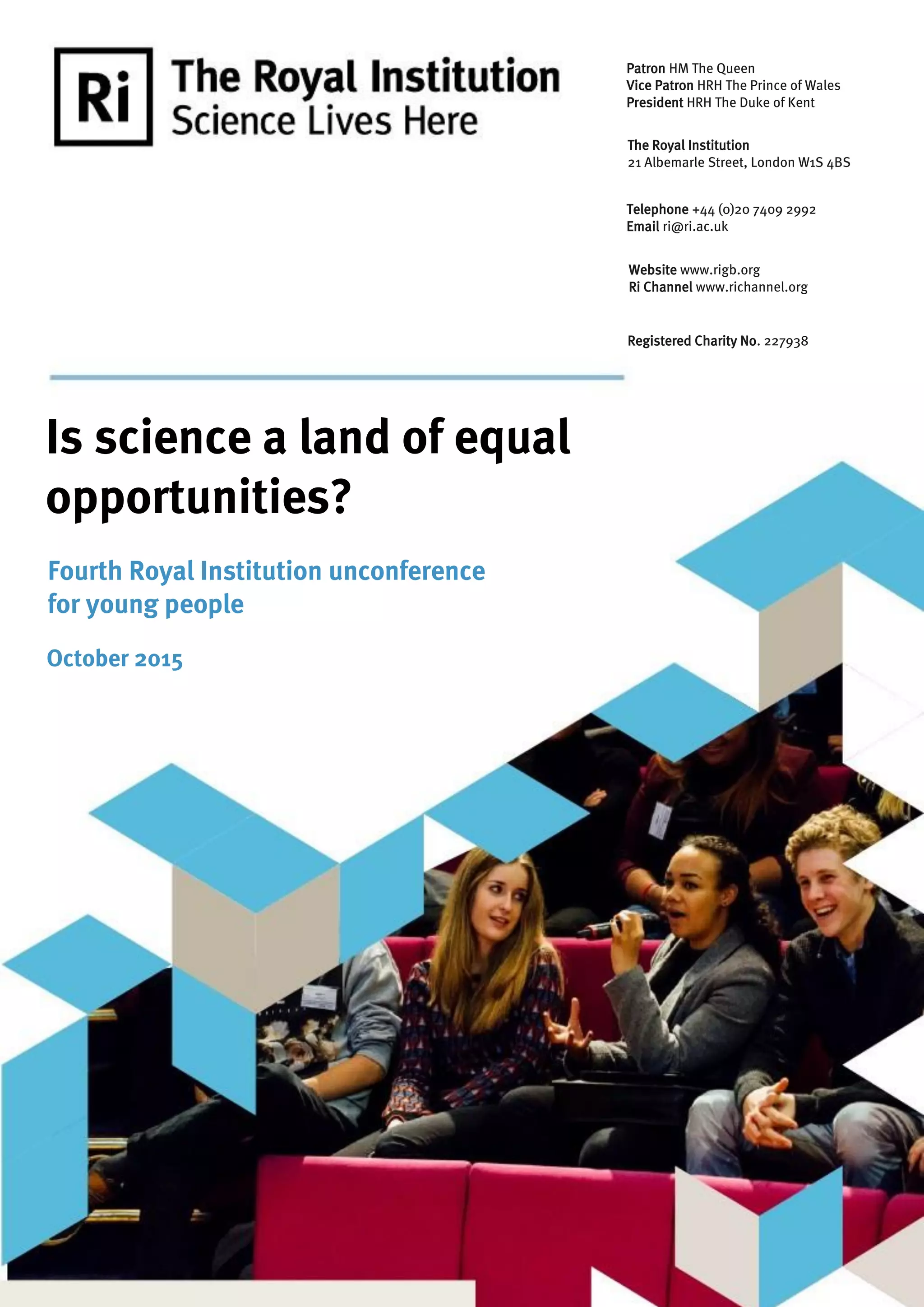
Is science a land of equal
opportunities?
Fourth Royal Institution unconference
for young people
October 2015
Website www.rigb.org
Ri Channel www.richannel.org
Registered Charity No. 227938
1 | P a g e © The Royal Institution 2015
Is science a land of equal opportunities?
Event overview
The Royal Institution unconference for young people gives a voice to secondary school students
(aged 15 – 18) to debate wider issues surrounding science and present their thoughts to policy
makers, practitioners and scientists. The format of the event enables young people to be
informed about key questions and evidence, but the emphasis is student led, with a definite
focus on capturing their thoughts, experiences and recommendations for instigating change.
The Royal Institution’s goal has always been to encourage people to think more deeply about the
wonders and applications of science. The Unconference allows the Royal Institution to extend
this philosophy to young students considering entering STEM careers, making them aware of
how STEM fits in with society, policy and culture, whilst also providing them with the opportunity
to have their say on how these relationships should evolve in the future.
This year we chose to focus on equality in science and what this means for students studying
STEM topics, their career choices and the role of STEM in society and culture. Participants were
asked to think about diversity at school and in STEM careers, what barriers there were to certain
individuals and whether or not diversity is important. The day was attended by 104 students
from 12 schools, 10 state and 2 private, from across Greater London and the surrounding area.
Students were invited by teachers and therefore self-selected as having shown an interest in
STEM.
Key themes
Over the course of the day, four themes emerged from students’ discussions:
1. The under representation of women in STEM, in particular physics and engineering.
2. The education system and its role in pushing students towards STEM.
3. The view of STEM across different cultures.
4. Why is diversity in STEM important?
2 | P a g e © The Royal Institution 2015
Event structure
Before the event, teachers were sent a series of survey questions (see appendix A) in order to
gauge students’ initial opinions on key areas. This allowed the event to be tailored towards the
issues that students believed were most relevant with regard to equal opportunities. The
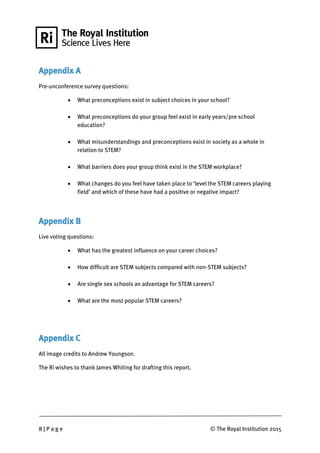
unconference commenced with a series of warm-up questions (see appendix B), which allowed
students to vote and observe the wider opinions across all school cohorts on a selection of
issues raised in their initial surveys.
Students were then introduced to two speakers who gave brief thoughts on the day’s themes in
order to open up discussion and encourage deep thinking. Dr Julie Moote from the Aspire2
organisation provided her insights into why some girls fail to pursue STEM subjects in school,
highlighting issues such as differential science capital between the working and middle classes
and the leaky pipeline analogy; the idea that students drop off the STEM career path at various
stages of development. Yvonne Baker shared with the students her experiences of having
worked as a woman in the male-dominated world of engineering. She suggested that the over
emphasis of barriers to women did more harm than good and gave the students a range of
questions to consider, such as what key actions need to be taken and are people willing to take
the current opportunities at present?
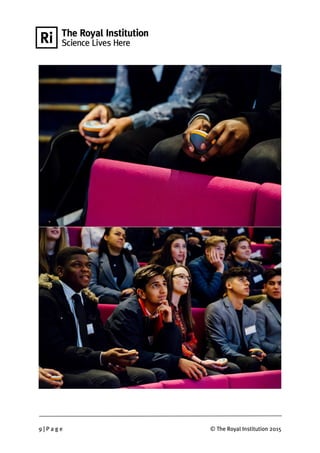
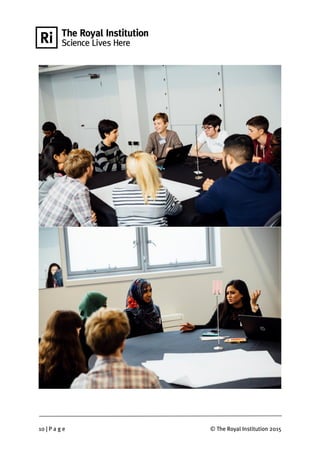
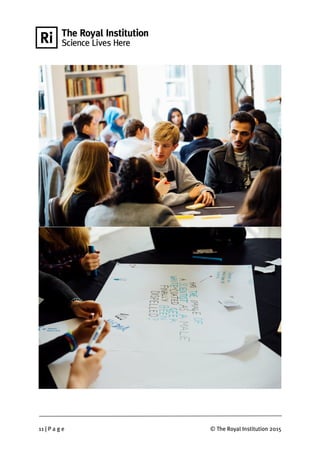
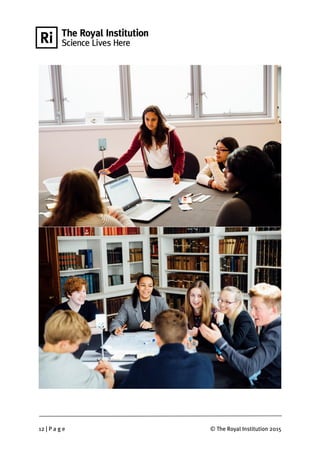
Students ended the morning session by breaking into discussion groups and addressing
questions devised from their survey responses. From these discussions, further questions were
generated by the students themselves, with each student engaging in three conversations with
different groups across the day. By the end of the event a total of around 40 student-driven
discussions had taken place on varying subjects surrounding STEM being a ‘level playing field’.
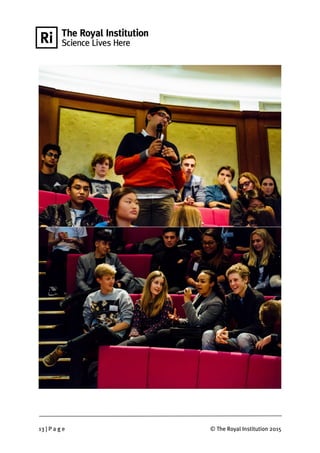
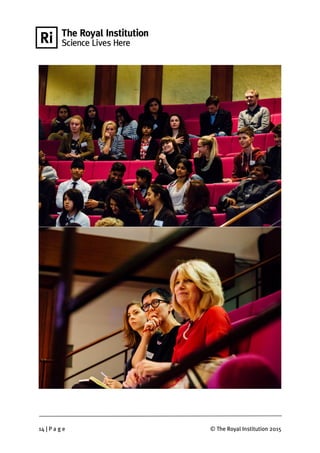
The day ended with students assembling together to discuss the emerging themes with a series
of panellists from across the STEM sector. This panel consisted of Nancy Wilkinson from the
Wellcome Trust, Jessica Rosin from the Institute of Physics and Professor Julia Buckingham, Vice
Chancellor of Brunel University.
Throughout the event, students were able to tweet using the #Riunconference twitter hashtag
and see their and other students’ insights appear on screens around the Ri. This process also
allowed the thoughts and opinions of delegates to be viewed worldwide on Twitter.
3 | P a g e © The Royal Institution 2015
Theme 1 – The under-representation of women in STEM
Delegates in these groups outlined a number of issues both with how STEM is pitched to girls in
school and what problems women face in STEM careers:
 Currently, efforts to encourage girls into STEM over-emphasise the barriers and
hardships of being in the minority, doing more harm than good.
 Likewise, there was an overall feeling that the prominence given to gender-
specific recruiting efforts for STEM subjects in schools was off-putting. Instead, a
level approach across genders was more appealing, with gender-specific efforts
being dropped.
 It was understood that the current gender-specific targeting was due to fewer
female role models in STEM, however with the current system deemed off-
putting, this rarity of female role models would persist.
 To address these issues, changing the opinions of the current and older
generations of STEM scientists is equally as important as encouraging young
girls into STEM; this has yet to be done.
 In addition, marketing STEM careers using stereotypically female angles, such as
beauty product development, are more patronising than anything else. Students
felt these suggested women can only succeed in feminine study areas.
Quote: Daniel, 15, Bishop Justice – “If women weren’t fearful of being in the minority, there
wouldn’t be a minority”
Twitter: @CharrJessica “Gender always gets brought up, it shouldn’t happen”
Twitter: @florianexxxx “@YvonneBaker “We sell engineering like a bad skin cream” I agree, from
personal experience”
Theme 2 – The education system and its role in pushing students
towards STEM
Whilst delegates largely felt that the feelings and drive of the individual were more important
than their experiences in education, there was still a general consensus that the structuring of
4 | P a g e © The Royal Institution 2015
the education system, in particular the timing and way in which A-level decisions were made,
had a large influence on people entering STEM careers:
 STEM subjects were viewed to be no more difficult than non-STEM subjects, and
generally students felt that willpower and enthusiasm were more important to
build a successful STEM career than academic achievement.
 Despite this, students felt schools pushed students towards subjects in which
they were more likely to attain higher grades, believing this to be an artefact of
schools chasing exam results.
 The way in which STEM is assessed, typically under examination, was viewed to
benefit those who performed well in exams generally, rather than those with a
passion for the subject. A more coursework centred approach was suggested as
a fairer alternative.
 Chasing exam results appeared to be a particular problem within private schools
compared with state schools, in light of there being a higher pressure to compete
with other private schools.
 The disparity in education opportunities between private and state schools was
highlighted as an issue, although in line with the general consensus it was
believed that opportunities, whilst more limited in state schools, were more
freely available. In comparison, some private students believed private school
opportunities were limited to the highest achievers.
 Overwhelmingly students felt unprepared when dropping subjects for A-levels,
believing there to be a dearth of available information regarding alternative
routes into careers and the flexibility of education. Students felt this led to doors
being closed to them for later career decisions.
 These issues are confounded by strict university entrance requirements and the
general ignorance of alternative qualifications such as BTEC and the
International Baccalaureate.
Quote: Sarah, Chelsea Academy – “I like science because it’s exam-based”
Quote: Jack, 18, Midkent College – “Teachers pigeon hole students into subjects based on
grades rather than personal choice”
5 | P a g e © The Royal Institution 2015
Quote: Jemima, 16, Virgo Fidelis Convent Senior School, “Schools pressure well achieving
students into subjects they’re good at, rather than one’s they’d choose themselves”
Twitter: @LukeM0rton – “A mixed science approach at post 16 will give greater opportunities
later in life”
Theme 3 – The view of STEM across different cultures
Culture emerged as a significant discussion point regarding participation in STEM. Facets of
British culture and differences between cultures were highlighted as important factors affecting
personal career decisions:
 Students felt the media has been too extreme in how it portrays people working
in STEM as typically male, elitists and social outcasts. The media should be
challenged on this and acknowledge its responsibility in informing public
opinion.
 Whilst the image of the male white-coated scientist is changing, the media is
only partly responsible and schools have an obligation to better inform students
on the range of people and ways in which science is done.
 Culturally, more economically developed countries have a higher emphasis on
STEM subjects due to higher education quality. In more economically deprived
countries, the 3 R’s (reading, writing and arithmetic) are emphasised above
STEM.
 These cultural differences filter down and influence students’ subject and career
decisions, driven by differences in science capital between cultures. For
example, Asian culture has high science capital due to traditionally increased job
security and higher salaries.
 Cultures with low science capital should be targeted with science capital
boosting programmes and activities to assist people from these backgrounds
into STEM.
Quote: Sagal, 16, Chelsea Academy – “Family influences are strong early on, then people make
their own views on careers later. However by that point some decisions have already been made
and doors are closed”
6 | P a g e © The Royal Institution 2015
Twitter: @Jomina – “I feel that the media should be aware of how their fictional characters affect
their audience and their views”
Twitter: @CharrJessica – “Yes they’re (STEM) important, but they’re not influenced on us as
much as the 3 R’s are!”
Theme 4 – Why is diversity in STEM important?
Students collected their thoughts from the day and discussed why the issues raised above were
a priority for people working in STEM to strive to improve.
 Equal rights are important for all work sectors and STEM has an obligation to
deliver them. Moreover, STEM compared with other sectors has a particular
problem with gender imbalance.
 Under-representation of certain demographics puts up barriers to those people,
making it harder for those individuals to pursue and succeed in certain careers.
 For example, less diverse working environments are more intimidating to those
not in the majority, preventing such individuals from reaching their full potential.
 Inequality in workplaces only works to promote traditional gender roles and
cultural stereotypes. As discussed above, students felt these were particular
drivers behind differential recruitment into STEM and unequal opportunities.
 Modern science is interdisciplinary and the way in which scientists are recruited
actively discourages variety and promotes a limited spectrum of subjects to be
studied at A-level. STEM research would benefit from promoting wider study prior
to university.
Quote: Chloe, 15, Walthamstow College – “Gender inequality is not just a problem for STEM, but
noticeably STEM is failing”.
Quote: Saba, 15, Walthamstow School for Girls – “Less diverse environments are more
intimidating to those not in the majority”.
Quote: Jack, 18, Midkent College – “Being from a certain background shouldn’t hold you back
from pursuing what you want to do”
Twitter: @LukeM0rton – “I agree we make choices too early and do not study enough variety,
science is inter-disciplinary in the 21C”
7 | P a g e © The Royal Institution 2015
Concluding remarks
The goals of the Unconference are to inform and inspire debate amongst young people on the
real world issues that face the STEM sector. The Unconference also aims to provide a listening
platform for which student’s ideas can be presented and shared with policy makers and
practitioners from across STEM. The 2015 Unconference prompted a range of discussions on the
various inequalities in opportunities and the reasonings behind these. Students drove debates
on equal opportunities in terms of gender, culture and financial background.
The issues raised should be of use to anyone who is interested in the thoughts and experiences
of young people studying STEM. Informal feedback from students on the day, as well as Twitter
comments, demonstrates that students relished the opportunity to discuss these themes, and
taking part in the Unconference opened their eyes to the wider issues surrounding STEM
careers.
Twitter: @piuna_0708 – “Enjoying the conversations and wide range of perspectives :)”
Twitter: @zakiarther – “hearing people's different opinions and experiences made me rethink
some of my ideas”
Twitter: @somegujxjxwkr – “Met some very cool people with very interesting views on whether
science does give equal opportunities to both genders :)”
Twitter: @SheWhoWritess – “#RiUnconference was really eye opening, had a great time”
For reference
A Storify article with tweets from participating delegates, outside observers and Ri staff using
the #RiUnconference hashtag can be found at https://storify.com/ri_science/l-o
8 | P a g e © The Royal Institution 2015
Appendix A
Pre-unconference survey questions:
 What preconceptions exist in subject choices in your school?
 What preconceptions do your group feel exist in early years/pre school
education?
 What misunderstandings and preconceptions exist in society as a whole in
relation to STEM?
 What barriers does your group think exist in the STEM workplace?
 What changes do you feel have taken place to ‘level the STEM careers playing
field’ and which of these have had a positive or negative impact?
Appendix B
Live voting questions:
 What has the greatest influence on your career choices?
 How difficult are STEM subjects compared with non-STEM subjects?
 Are single sex schools an advantage for STEM careers?
 What are the most popular STEM careers?
Appendix C
All image credits to Andrew Youngson.
The Ri wishes to thank James Whiting for drafting this report.
9 | P a g e © The Royal Institution 2015
10 | P a g e © The Royal Institution 2015
11 | P a g e © The Royal Institution 2015
12 | P a g e © The Royal Institution 2015
13 | P a g e © The Royal Institution 2015
14 | P a g e © The Royal Institution 2015

YP Unconference Report 2015

  • 1.
    Patron HM TheQueen Vice Patron HRH The Prince of Wales President HRH The Duke of Kent The Royal Institution 21 Albemarle Street, London W1S 4BS Telephone +44 (0)20 7409 2992 Email ri@ri.ac.uk Is science a land of equal opportunities? Fourth Royal Institution unconference for young people October 2015 Website www.rigb.org Ri Channel www.richannel.org Registered Charity No. 227938
  • 2.
    1 | Pa g e © The Royal Institution 2015 Is science a land of equal opportunities? Event overview The Royal Institution unconference for young people gives a voice to secondary school students (aged 15 – 18) to debate wider issues surrounding science and present their thoughts to policy makers, practitioners and scientists. The format of the event enables young people to be informed about key questions and evidence, but the emphasis is student led, with a definite focus on capturing their thoughts, experiences and recommendations for instigating change. The Royal Institution’s goal has always been to encourage people to think more deeply about the wonders and applications of science. The Unconference allows the Royal Institution to extend this philosophy to young students considering entering STEM careers, making them aware of how STEM fits in with society, policy and culture, whilst also providing them with the opportunity to have their say on how these relationships should evolve in the future. This year we chose to focus on equality in science and what this means for students studying STEM topics, their career choices and the role of STEM in society and culture. Participants were asked to think about diversity at school and in STEM careers, what barriers there were to certain individuals and whether or not diversity is important. The day was attended by 104 students from 12 schools, 10 state and 2 private, from across Greater London and the surrounding area. Students were invited by teachers and therefore self-selected as having shown an interest in STEM. Key themes Over the course of the day, four themes emerged from students’ discussions: 1. The under representation of women in STEM, in particular physics and engineering. 2. The education system and its role in pushing students towards STEM. 3. The view of STEM across different cultures. 4. Why is diversity in STEM important?
  • 3.
    2 | Pa g e © The Royal Institution 2015 Event structure Before the event, teachers were sent a series of survey questions (see appendix A) in order to gauge students’ initial opinions on key areas. This allowed the event to be tailored towards the issues that students believed were most relevant with regard to equal opportunities. The unconference commenced with a series of warm-up questions (see appendix B), which allowed students to vote and observe the wider opinions across all school cohorts on a selection of issues raised in their initial surveys. Students were then introduced to two speakers who gave brief thoughts on the day’s themes in order to open up discussion and encourage deep thinking. Dr Julie Moote from the Aspire2 organisation provided her insights into why some girls fail to pursue STEM subjects in school, highlighting issues such as differential science capital between the working and middle classes and the leaky pipeline analogy; the idea that students drop off the STEM career path at various stages of development. Yvonne Baker shared with the students her experiences of having worked as a woman in the male-dominated world of engineering. She suggested that the over emphasis of barriers to women did more harm than good and gave the students a range of questions to consider, such as what key actions need to be taken and are people willing to take the current opportunities at present? Students ended the morning session by breaking into discussion groups and addressing questions devised from their survey responses. From these discussions, further questions were generated by the students themselves, with each student engaging in three conversations with different groups across the day. By the end of the event a total of around 40 student-driven discussions had taken place on varying subjects surrounding STEM being a ‘level playing field’. The day ended with students assembling together to discuss the emerging themes with a series of panellists from across the STEM sector. This panel consisted of Nancy Wilkinson from the Wellcome Trust, Jessica Rosin from the Institute of Physics and Professor Julia Buckingham, Vice Chancellor of Brunel University. Throughout the event, students were able to tweet using the #Riunconference twitter hashtag and see their and other students’ insights appear on screens around the Ri. This process also allowed the thoughts and opinions of delegates to be viewed worldwide on Twitter.
  • 4.
    3 | Pa g e © The Royal Institution 2015 Theme 1 – The under-representation of women in STEM Delegates in these groups outlined a number of issues both with how STEM is pitched to girls in school and what problems women face in STEM careers:  Currently, efforts to encourage girls into STEM over-emphasise the barriers and hardships of being in the minority, doing more harm than good.  Likewise, there was an overall feeling that the prominence given to gender- specific recruiting efforts for STEM subjects in schools was off-putting. Instead, a level approach across genders was more appealing, with gender-specific efforts being dropped.  It was understood that the current gender-specific targeting was due to fewer female role models in STEM, however with the current system deemed off- putting, this rarity of female role models would persist.  To address these issues, changing the opinions of the current and older generations of STEM scientists is equally as important as encouraging young girls into STEM; this has yet to be done.  In addition, marketing STEM careers using stereotypically female angles, such as beauty product development, are more patronising than anything else. Students felt these suggested women can only succeed in feminine study areas. Quote: Daniel, 15, Bishop Justice – “If women weren’t fearful of being in the minority, there wouldn’t be a minority” Twitter: @CharrJessica “Gender always gets brought up, it shouldn’t happen” Twitter: @florianexxxx “@YvonneBaker “We sell engineering like a bad skin cream” I agree, from personal experience” Theme 2 – The education system and its role in pushing students towards STEM Whilst delegates largely felt that the feelings and drive of the individual were more important than their experiences in education, there was still a general consensus that the structuring of
  • 5.
    4 | Pa g e © The Royal Institution 2015 the education system, in particular the timing and way in which A-level decisions were made, had a large influence on people entering STEM careers:  STEM subjects were viewed to be no more difficult than non-STEM subjects, and generally students felt that willpower and enthusiasm were more important to build a successful STEM career than academic achievement.  Despite this, students felt schools pushed students towards subjects in which they were more likely to attain higher grades, believing this to be an artefact of schools chasing exam results.  The way in which STEM is assessed, typically under examination, was viewed to benefit those who performed well in exams generally, rather than those with a passion for the subject. A more coursework centred approach was suggested as a fairer alternative.  Chasing exam results appeared to be a particular problem within private schools compared with state schools, in light of there being a higher pressure to compete with other private schools.  The disparity in education opportunities between private and state schools was highlighted as an issue, although in line with the general consensus it was believed that opportunities, whilst more limited in state schools, were more freely available. In comparison, some private students believed private school opportunities were limited to the highest achievers.  Overwhelmingly students felt unprepared when dropping subjects for A-levels, believing there to be a dearth of available information regarding alternative routes into careers and the flexibility of education. Students felt this led to doors being closed to them for later career decisions.  These issues are confounded by strict university entrance requirements and the general ignorance of alternative qualifications such as BTEC and the International Baccalaureate. Quote: Sarah, Chelsea Academy – “I like science because it’s exam-based” Quote: Jack, 18, Midkent College – “Teachers pigeon hole students into subjects based on grades rather than personal choice”
  • 6.
    5 | Pa g e © The Royal Institution 2015 Quote: Jemima, 16, Virgo Fidelis Convent Senior School, “Schools pressure well achieving students into subjects they’re good at, rather than one’s they’d choose themselves” Twitter: @LukeM0rton – “A mixed science approach at post 16 will give greater opportunities later in life” Theme 3 – The view of STEM across different cultures Culture emerged as a significant discussion point regarding participation in STEM. Facets of British culture and differences between cultures were highlighted as important factors affecting personal career decisions:  Students felt the media has been too extreme in how it portrays people working in STEM as typically male, elitists and social outcasts. The media should be challenged on this and acknowledge its responsibility in informing public opinion.  Whilst the image of the male white-coated scientist is changing, the media is only partly responsible and schools have an obligation to better inform students on the range of people and ways in which science is done.  Culturally, more economically developed countries have a higher emphasis on STEM subjects due to higher education quality. In more economically deprived countries, the 3 R’s (reading, writing and arithmetic) are emphasised above STEM.  These cultural differences filter down and influence students’ subject and career decisions, driven by differences in science capital between cultures. For example, Asian culture has high science capital due to traditionally increased job security and higher salaries.  Cultures with low science capital should be targeted with science capital boosting programmes and activities to assist people from these backgrounds into STEM. Quote: Sagal, 16, Chelsea Academy – “Family influences are strong early on, then people make their own views on careers later. However by that point some decisions have already been made and doors are closed”
  • 7.
    6 | Pa g e © The Royal Institution 2015 Twitter: @Jomina – “I feel that the media should be aware of how their fictional characters affect their audience and their views” Twitter: @CharrJessica – “Yes they’re (STEM) important, but they’re not influenced on us as much as the 3 R’s are!” Theme 4 – Why is diversity in STEM important? Students collected their thoughts from the day and discussed why the issues raised above were a priority for people working in STEM to strive to improve.  Equal rights are important for all work sectors and STEM has an obligation to deliver them. Moreover, STEM compared with other sectors has a particular problem with gender imbalance.  Under-representation of certain demographics puts up barriers to those people, making it harder for those individuals to pursue and succeed in certain careers.  For example, less diverse working environments are more intimidating to those not in the majority, preventing such individuals from reaching their full potential.  Inequality in workplaces only works to promote traditional gender roles and cultural stereotypes. As discussed above, students felt these were particular drivers behind differential recruitment into STEM and unequal opportunities.  Modern science is interdisciplinary and the way in which scientists are recruited actively discourages variety and promotes a limited spectrum of subjects to be studied at A-level. STEM research would benefit from promoting wider study prior to university. Quote: Chloe, 15, Walthamstow College – “Gender inequality is not just a problem for STEM, but noticeably STEM is failing”. Quote: Saba, 15, Walthamstow School for Girls – “Less diverse environments are more intimidating to those not in the majority”. Quote: Jack, 18, Midkent College – “Being from a certain background shouldn’t hold you back from pursuing what you want to do” Twitter: @LukeM0rton – “I agree we make choices too early and do not study enough variety, science is inter-disciplinary in the 21C”
  • 8.
    7 | Pa g e © The Royal Institution 2015 Concluding remarks The goals of the Unconference are to inform and inspire debate amongst young people on the real world issues that face the STEM sector. The Unconference also aims to provide a listening platform for which student’s ideas can be presented and shared with policy makers and practitioners from across STEM. The 2015 Unconference prompted a range of discussions on the various inequalities in opportunities and the reasonings behind these. Students drove debates on equal opportunities in terms of gender, culture and financial background. The issues raised should be of use to anyone who is interested in the thoughts and experiences of young people studying STEM. Informal feedback from students on the day, as well as Twitter comments, demonstrates that students relished the opportunity to discuss these themes, and taking part in the Unconference opened their eyes to the wider issues surrounding STEM careers. Twitter: @piuna_0708 – “Enjoying the conversations and wide range of perspectives :)” Twitter: @zakiarther – “hearing people's different opinions and experiences made me rethink some of my ideas” Twitter: @somegujxjxwkr – “Met some very cool people with very interesting views on whether science does give equal opportunities to both genders :)” Twitter: @SheWhoWritess – “#RiUnconference was really eye opening, had a great time” For reference A Storify article with tweets from participating delegates, outside observers and Ri staff using the #RiUnconference hashtag can be found at https://storify.com/ri_science/l-o
  • 9.
    8 | Pa g e © The Royal Institution 2015 Appendix A Pre-unconference survey questions:  What preconceptions exist in subject choices in your school?  What preconceptions do your group feel exist in early years/pre school education?  What misunderstandings and preconceptions exist in society as a whole in relation to STEM?  What barriers does your group think exist in the STEM workplace?  What changes do you feel have taken place to ‘level the STEM careers playing field’ and which of these have had a positive or negative impact? Appendix B Live voting questions:  What has the greatest influence on your career choices?  How difficult are STEM subjects compared with non-STEM subjects?  Are single sex schools an advantage for STEM careers?  What are the most popular STEM careers? Appendix C All image credits to Andrew Youngson. The Ri wishes to thank James Whiting for drafting this report.
  • 10.
    9 | Pa g e © The Royal Institution 2015
  • 11.
    10 | Pa g e © The Royal Institution 2015
  • 12.
    11 | Pa g e © The Royal Institution 2015
  • 13.
    12 | Pa g e © The Royal Institution 2015
  • 14.
    13 | Pa g e © The Royal Institution 2015
  • 15.
    14 | Pa g e © The Royal Institution 2015