Recombinant Expression and
Purification of Serine Collagenases
from the Ae. aegypti Mosquito
Bharat Patel and Taylor McCann
Department of Chemistry
San Jose State University
May 9th, 2015
UCSC
ACS 27th Annual Undergraduate Research Symposium
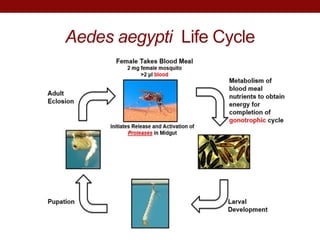
Aedes aegypti Life Cycle
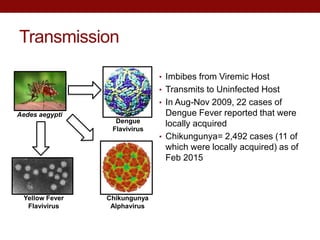
Transmission
• Imbibes from Viremic Host
• Transmits to Uninfected Host
• In Aug-Nov 2009, 22 cases of
Dengue Fever reported that were
locally acquired
• Chikungunya= 2,492 cases (11 of
which were locally acquired) as of
Feb 2015
Aedes aegypti
Dengue
Flavivirus
Yellow Fever
Flavivirus
Chikungunya
Alphavirus
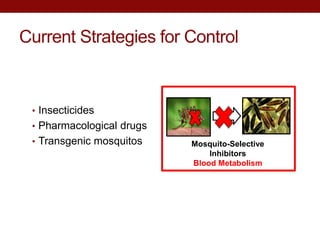
Current Strategies for Control
• Insecticides
• Pharmacological drugs
• Transgenic mosquitos Mosquito-Selective
Inhibitors
Blood Metabolism
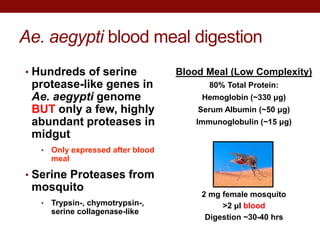
Ae. aegypti blood meal digestion
• Hundreds of serine
protease-like genes in
Ae. aegypti genome
BUT only a few, highly
abundant proteases in
midgut
• Only expressed after blood
meal
• Serine Proteases from
mosquito
• Trypsin-, chymotrypsin-,
serine collagenase-like
Blood Meal (Low Complexity)
80% Total Protein:
Hemoglobin (~330 μg)
Serum Albumin (~50 μg)
Immunoglobulin (~15 μg)
2 mg female mosquito
>2 μl blood
Digestion ~30-40 hrs
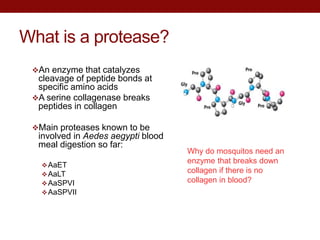
What is a protease?
An enzyme that catalyzes
cleavage of peptide bonds at
specific amino acids
A serine collagenase breaks
peptides in collagen
Main proteases known to be
involved in Aedes aegypti blood
meal digestion so far:
AaET
AaLT
AaSPVI
AaSPVII
Why do mosquitos need an
enzyme that breaks down
collagen if there is no
collagen in blood?
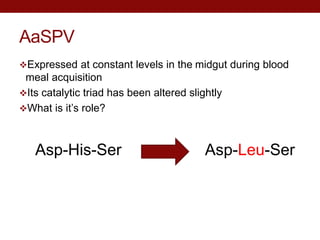
AaSPV
Expressed at constant levels in the midgut during blood
meal acquisition
Its catalytic triad has been altered slightly
What is it’s role?
Asp-His-Ser Asp-Leu-Ser
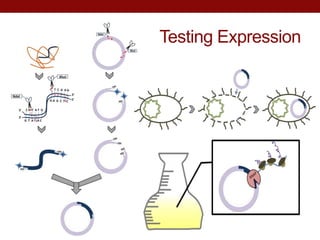
Testing Expression
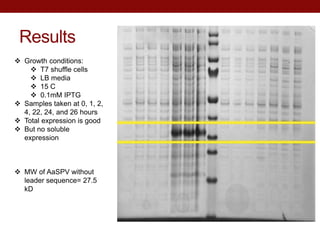
Results
 Growth conditions:
 T7 shuffle cells
 LB media
 15 C
 0.1mM IPTG
 Samples taken at 0, 1, 2,
4, 22, 24, and 26 hours
 Total expression is good
 But no soluble
expression
 MW of AaSPV without
leader sequence= 27.5
kD
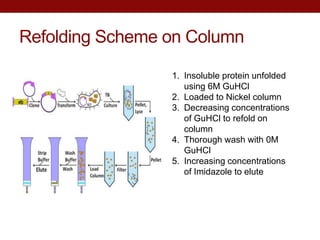
Refolding Scheme on Column
1. Insoluble protein unfolded
using 6M GuHCl
2. Loaded to Nickel column
3. Decreasing concentrations
of GuHCl to refold on
column
4. Thorough wash with 0M
GuHCl
5. Increasing concentrations
of Imidazole to elute
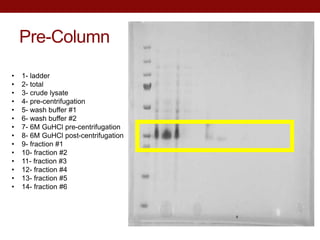
Pre-Column
• 1- ladder
• 2- total
• 3- crude lysate
• 4- pre-centrifugation
• 5- wash buffer #1
• 6- wash buffer #2
• 7- 6M GuHCl pre-centrifugation
• 8- 6M GuHCl post-centrifugation
• 9- fraction #1
• 10- fraction #2
• 11- fraction #3
• 12- fraction #4
• 13- fraction #5
• 14- fraction #6
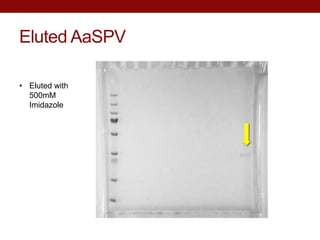
Eluted AaSPV
• Eluted with
500mM
Imidazole
AaLT-Zymogen
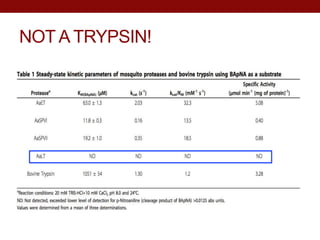
• NOT autocatalytic
• NOT a Trypsin
MW 2.5 5 10 20 76 (μg)
30
25
N-terminally
His6-tagged
AaLT: ~27.6 kDa
AaLT model
40% Sequence Identity
Heel fly Serine Collagenase
1.8Å resolution
AaLT-Mek Constructs?
• Bovine and mammalian trypsinogens depend on an
enterokinase to activate the enzyme
• DDDDK- Recognition sequence
NOT A TRYPSIN!
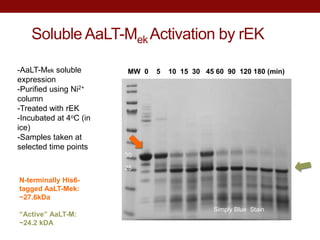
Soluble AaLT-Mek Activation by rEK
MW 0 5 10 15 30 45 60 90 120 180 (min)
Simply Blue Stain
30
25
-AaLT-Mek soluble
expression
-Purified using Ni2+
column
-Treated with rEK
-Incubated at 4oC (in
ice)
-Samples taken at
selected time points
N-terminally His6-
tagged AaLT-Mek:
~27.6kDa
“Active” AaLT-M:
~24.2 kDA
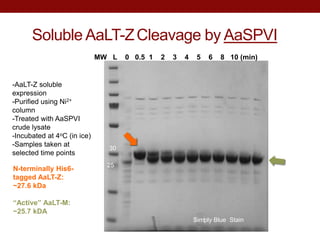
Soluble AaLT-ZCleavage by AaSPVI
-AaLT-Z soluble
expression
-Purified using Ni2+
column
-Treated with AaSPVI
crude lysate
-Incubated at 4oC (in ice)
-Samples taken at
selected time points
N-terminally His6-
tagged AaLT-Z:
~27.6 kDa
“Active” AaLT-M:
~25.7 kDA
MW L 0 0.5 1 2 3 4 5 6 8 10 (min)
Simply Blue Stain
30
25
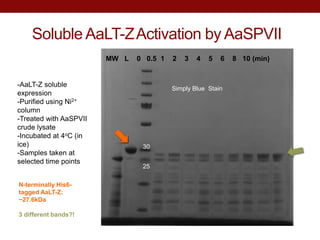
Soluble AaLT-ZActivation by AaSPVII
Simply Blue Stain
30
25
-AaLT-Z soluble
expression
-Purified using Ni2+
column
-Treated with AaSPVII
crude lysate
-Incubated at 4oC (in
ice)
-Samples taken at
selected time points
N-terminally His6-
tagged AaLT-Z:
~27.6kDa
3 different bands?!
MW L 0 0.5 1 2 3 4 5 6 8 10 (min)
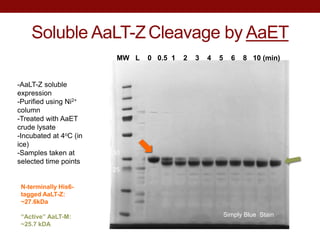
Soluble AaLT-ZCleavage by AaET
Simply Blue Stain
30
25
-AaLT-Z soluble
expression
-Purified using Ni2+
column
-Treated with AaET
crude lysate
-Incubated at 4oC (in
ice)
-Samples taken at
selected time points
N-terminally His6-
tagged AaLT-Z:
~27.6kDa
“Active” AaLT-M:
~25.7 kDA
MW L 0 0.5 1 2 3 4 5 6 8 10 (min)
Future Studies
• To determine the role of serine collagenases in blood
meal digestion
• To test specific substrates against our proteases and see
activity
Acknowledgements
AaET
Jamie Gallimore
Anh-Dai Nguyen
AaSPVI
Radhakrishna Patel
Eliza Vien
Tejpal Kang
AaSPVII
James Nguyen
AaLT
Jonathan Fong
Rascón Lab Members
Jennifer Le (JHA15)
Alexia Perryman
(AaSPV)
Justin Tran
(AaSPII/AaSPIV)
Joshua Garcia (AaSPI)
Mai Lee (AaSPV)
Olive Burata
(AaCHYMO)
Rachael Lucero
(AaCHYMO)
Diane Eilerts - MS
(AaSPIV)
Kamille Parungao
Jacob Hickey
Canaan Belete
Marina Dragovic
Dr. Alberto A. Rascón, Jr.
THANK
YOU!

2015 UCSC ACS Talk

  • 1.
    Recombinant Expression and Purificationof Serine Collagenases from the Ae. aegypti Mosquito Bharat Patel and Taylor McCann Department of Chemistry San Jose State University May 9th, 2015 UCSC ACS 27th Annual Undergraduate Research Symposium
  • 2.
  • 3.
    Transmission • Imbibes fromViremic Host • Transmits to Uninfected Host • In Aug-Nov 2009, 22 cases of Dengue Fever reported that were locally acquired • Chikungunya= 2,492 cases (11 of which were locally acquired) as of Feb 2015 Aedes aegypti Dengue Flavivirus Yellow Fever Flavivirus Chikungunya Alphavirus
  • 4.
    Current Strategies forControl • Insecticides • Pharmacological drugs • Transgenic mosquitos Mosquito-Selective Inhibitors Blood Metabolism
  • 5.
    Ae. aegypti bloodmeal digestion • Hundreds of serine protease-like genes in Ae. aegypti genome BUT only a few, highly abundant proteases in midgut • Only expressed after blood meal • Serine Proteases from mosquito • Trypsin-, chymotrypsin-, serine collagenase-like Blood Meal (Low Complexity) 80% Total Protein: Hemoglobin (~330 μg) Serum Albumin (~50 μg) Immunoglobulin (~15 μg) 2 mg female mosquito >2 μl blood Digestion ~30-40 hrs
  • 6.
    What is aprotease? An enzyme that catalyzes cleavage of peptide bonds at specific amino acids A serine collagenase breaks peptides in collagen Main proteases known to be involved in Aedes aegypti blood meal digestion so far: AaET AaLT AaSPVI AaSPVII Why do mosquitos need an enzyme that breaks down collagen if there is no collagen in blood?
  • 7.
    AaSPV Expressed at constantlevels in the midgut during blood meal acquisition Its catalytic triad has been altered slightly What is it’s role? Asp-His-Ser Asp-Leu-Ser
  • 8.
  • 9.
    Results  Growth conditions: T7 shuffle cells  LB media  15 C  0.1mM IPTG  Samples taken at 0, 1, 2, 4, 22, 24, and 26 hours  Total expression is good  But no soluble expression  MW of AaSPV without leader sequence= 27.5 kD
  • 10.
    Refolding Scheme onColumn 1. Insoluble protein unfolded using 6M GuHCl 2. Loaded to Nickel column 3. Decreasing concentrations of GuHCl to refold on column 4. Thorough wash with 0M GuHCl 5. Increasing concentrations of Imidazole to elute
  • 11.
    Pre-Column • 1- ladder •2- total • 3- crude lysate • 4- pre-centrifugation • 5- wash buffer #1 • 6- wash buffer #2 • 7- 6M GuHCl pre-centrifugation • 8- 6M GuHCl post-centrifugation • 9- fraction #1 • 10- fraction #2 • 11- fraction #3 • 12- fraction #4 • 13- fraction #5 • 14- fraction #6
  • 12.
    Eluted AaSPV • Elutedwith 500mM Imidazole
  • 13.
    AaLT-Zymogen • NOT autocatalytic •NOT a Trypsin MW 2.5 5 10 20 76 (μg) 30 25 N-terminally His6-tagged AaLT: ~27.6 kDa AaLT model 40% Sequence Identity Heel fly Serine Collagenase 1.8Å resolution
  • 14.
    AaLT-Mek Constructs? • Bovineand mammalian trypsinogens depend on an enterokinase to activate the enzyme • DDDDK- Recognition sequence
  • 15.
  • 16.
    Soluble AaLT-Mek Activationby rEK MW 0 5 10 15 30 45 60 90 120 180 (min) Simply Blue Stain 30 25 -AaLT-Mek soluble expression -Purified using Ni2+ column -Treated with rEK -Incubated at 4oC (in ice) -Samples taken at selected time points N-terminally His6- tagged AaLT-Mek: ~27.6kDa “Active” AaLT-M: ~24.2 kDA
  • 17.
    Soluble AaLT-ZCleavage byAaSPVI -AaLT-Z soluble expression -Purified using Ni2+ column -Treated with AaSPVI crude lysate -Incubated at 4oC (in ice) -Samples taken at selected time points N-terminally His6- tagged AaLT-Z: ~27.6 kDa “Active” AaLT-M: ~25.7 kDA MW L 0 0.5 1 2 3 4 5 6 8 10 (min) Simply Blue Stain 30 25
  • 18.
    Soluble AaLT-ZActivation byAaSPVII Simply Blue Stain 30 25 -AaLT-Z soluble expression -Purified using Ni2+ column -Treated with AaSPVII crude lysate -Incubated at 4oC (in ice) -Samples taken at selected time points N-terminally His6- tagged AaLT-Z: ~27.6kDa 3 different bands?! MW L 0 0.5 1 2 3 4 5 6 8 10 (min)
  • 19.
    Soluble AaLT-ZCleavage byAaET Simply Blue Stain 30 25 -AaLT-Z soluble expression -Purified using Ni2+ column -Treated with AaET crude lysate -Incubated at 4oC (in ice) -Samples taken at selected time points N-terminally His6- tagged AaLT-Z: ~27.6kDa “Active” AaLT-M: ~25.7 kDA MW L 0 0.5 1 2 3 4 5 6 8 10 (min)
  • 20.
    Future Studies • Todetermine the role of serine collagenases in blood meal digestion • To test specific substrates against our proteases and see activity
  • 21.
    Acknowledgements AaET Jamie Gallimore Anh-Dai Nguyen AaSPVI RadhakrishnaPatel Eliza Vien Tejpal Kang AaSPVII James Nguyen AaLT Jonathan Fong Rascón Lab Members Jennifer Le (JHA15) Alexia Perryman (AaSPV) Justin Tran (AaSPII/AaSPIV) Joshua Garcia (AaSPI) Mai Lee (AaSPV) Olive Burata (AaCHYMO) Rachael Lucero (AaCHYMO) Diane Eilerts - MS (AaSPIV) Kamille Parungao Jacob Hickey Canaan Belete Marina Dragovic Dr. Alberto A. Rascón, Jr. THANK YOU!

Editor's Notes

  • #2 http://www.bing.com/images/search?q=aedes+aegypti&view=detailv2&&&id=379FC1DB7C4280BECFE47B147EEA2969BE547620&selectedIndex=98&ccid=rcmOEMGv&simid=608020056584294058&thid=JN.WvD1scvh0QDXJIFjG0OJuA&ajaxhist=0
  • #3 The female Aedes aegypti mosquito must acquire a blood meal from a human host in order to obtain the proper nutrients required for completion of the gonotrophic cycle (so this gonotrophic cycle is the process of blood-feeding, egg maturation, and oviposition (or egg laying). Once she imbibes or drinks a blood meal, the release of midgut proteases are induced and released, which leads to the digestion of the blood meal proteins and the release of the required nutrients. After metabolizing the meal, the mosquito then lays her eggs near the surface of standing water, where she can lay between 100-200 eggs. The eggs can take between 2-7 days to hatch, but can survive up to 3 months or more without hatching in a stage called diapause. Once they hatch, they hatch into larvae, followed by a pupation stage, and after about 1-4 days they become adult mosquitoes. Once an adult, they immediately seek a mate and a blood meal, and the whole process can begin all over again.
  • #4 Now, this blood feeding behavior has facilitated the spread of blood-borne pathogens from the mosquito to humans. The Ae. aegypti mosquito is an efficient biological vector of the Dengue fever (flavivirus), Yellow fever (flavivirus) and Chikungunya (Alphavirus) viruses. The mosquito becomes infected when it takes a blood meal from a viremic host and once infected it can transmit the virus to the an uninfected human host. In the mosquito, the virus infects and replicates in the midgut cells, which then travel to the salivary glands. So, when she takes a blood meal, the virus is transferred from the salivary glands of the mosquito to the human host. It has been shown that the Ae. aegypti mosquito can take more than one blood meal before its first gonotrophic cycle, so you can see how this contributes to its role as an efficient biological vector of these human pathogens. HUMAN HOST (NOT ACTIVE)
  • #7 Not “signal sequence” they cleave after specific sites (i.e: trypsins prefer to cleave….)
  • #9 PCR to isolate SPV, clone into vector, plasmids inserted into T7 cells (know why important), growth experiments followed by SDS-PAGE to determine expression
  • #10 Surprising because t7 cells should help with oxidizing cytoplasm which will lead to better soluble expression
  • #11 http://2009.igem.org/wiki/images/thumb/d/dd/OldPurificationGraphic.png/500px-OldPurificationGraphic.png We unfolded the protein using GuHCl, loaded the protein onto the column which the exposed His-tag should chelate to the column, then we refolded using decreasing concentrations of GuHCl follwed by increasing concentrations of imidazole to elute the protein off the column
  • #13 FUTURe studies: we can repeat this again and repeat the purifcation steps again
  • #14 -Not autocatalytic like the previous three proteases (AaET, AaSPVI, and AaSPVII). -Was able to solubily express and purify the inactive form using a Ni2+ column. -Upon amino acid sequence analysis and modeling, the closest results similar was with the heel fly serine collogenase at 40%), which was weird because if you recall to biology, there is no collagen in the blood. Descirbe the gel: initial one pass Ni2+ purification (talk about the concentration from lower to the higher) Express soluble Homology modeling: takes the AA and compares the models with other hits. We expected the a trypsin like model
  • #15 We were able to solubally express this but back then, Graduate school: wasn’t able to express it solubally. So this allowed them to activate in vitro using the enterokinase construct (expressed insoluble and then was refolded using a similar scheme described by taylor and then activate it by EK) To determine this, we need to isolate and activate the protease. And since we don’t know what the activator is, we have turned to the soluble expression of the AaLT-Mek
  • #16 He was able to activate the enzyme and activity assays with all the proteases. Did not work with LT and baPNA under all of the conditions. Bapna is a trypsin substrate
  • #17 To determine this, we need to isolate and activate the protease. And since we don’t know what the activator is, we have turned to the soluble expression of the AaLT-Mek We treated mEK construct with rEK to see if we see a shift from the inactive to active form, but we are still trying to figure the correct substrates 1. COLLAGEN is OBVI!
  • #18 They are expressed during the same time points so we are hypothesizing that one of these (SPVI or SPVII) is the activato for the LT) In the beginning is the AaLT-Z but at the end of the gel it is “active”
  • #19 AaSPVII ? kDA In this case, same conditions, SPVII could just be digesting the LT
  • #20 Soluble AaLT-Mek Activation- We also tested the ??? kDA To our surprise, we saw that AaET was activating the LT like SPVI, and that weird because it is part of the early phase digestion.