© 2015 IBM Corporation
DCB-3094 Scaling Agile
Launching a SAFe Agile Release Train
using Rational Team Concert – Lesson Learned
Reedy Feggins, PMP
WW Solution Architect,
SAFe SPC, CSM
DevOps Continuous Delivery SME
1
Notices and Disclaimers
Copyright © 2015 by International Business Machines Corporation (IBM). No part of this document may be reproduced or
transmitted in any form without written permission from IBM.
U.S. Government Users Restricted Rights - Use, duplication or disclosure restricted by GSA ADP Schedule Contract with
IBM.
Information in these presentations (including information relating to products that have not yet been announced by IBM) has been
reviewed for accuracy as of the date of initial publication and could include unintentional technical or typographical errors. IBM
shall have no responsibility to update this information. THIS DOCUMENT IS DISTRIBUTED "AS IS" WITHOUT ANY
WARRANTY, EITHER EXPRESS OR IMPLIED. IN NO EVENT SHALL IBM BE LIABLE FOR ANY DAMAGE ARISING FROM
THE USE OF THIS INFORMATION, INCLUDING BUT NOT LIMITED TO, LOSS OF DATA, BUSINESS INTERRUPTION, LOSS
OF PROFIT OR LOSS OF OPPORTUNITY. IBM products and services are warranted according to the terms and conditions of
the agreements under which they are provided.
Any statements regarding IBM's future direction, intent or product plans are subject to change or withdrawal without
notice.
Performance data contained herein was generally obtained in a controlled, isolated environments. Customer examples are
presented as illustrations of how those customers have used IBM products and the results they may have achieved. Actual
performance, cost, savings or other results in other operating environments may vary.
References in this document to IBM products, programs, or services does not imply that IBM intends to make such products,
programs or services available in all countries in which IBM operates or does business.
Workshops, sessions and associated materials may have been prepared by independent session speakers, and do not
necessarily reflect the views of IBM. All materials and discussions are provided for informational purposes only, and are neither
intended to, nor shall constitute legal or other guidance or advice to any individual participant or their specific situation.
It is the customer’s responsibility to insure its own compliance with legal requirements and to obtain advice of competent legal
counsel as to the identification and interpretation of any relevant laws and regulatory requirements that may affect the customer’s
business and any actions the customer may need to take to comply with such laws. IBM does not provide legal advice or
represent or warrant that its services or products will ensure that the customer is in compliance with any law.
2
Notices and Disclaimers (con’t)
Information concerning non-IBM products was obtained from the suppliers of those products, their published
announcements or other publicly available sources. IBM has not tested those products in connection with this
publication and cannot confirm the accuracy of performance, compatibility or any other claims related to non-IBM
products. Questions on the capabilities of non-IBM products should be addressed to the suppliers of those products.
IBM does not warrant the quality of any third-party products, or the ability of any such third-party products to
interoperate with IBM’s products. IBM EXPRESSLY DISCLAIMS ALL WARRANTIES, EXPRESSED OR IMPLIED,
INCLUDING BUT NOT LIMITED TO, THE IMPLIED WARRANTIES OF MERCHANTABILITY AND FITNESS FOR A
PARTICULAR PURPOSE.
The provision of the information contained herein is not intended to, and does not, grant any right or license under any
IBM patents, copyrights, trademarks or other intellectual property right.
•IBM, the IBM logo, ibm.com, Bluemix, Blueworks Live, CICS, Clearcase, DOORS®, Enterprise Document
Management System™, Global Business Services ®, Global Technology Services ®, Information on Demand, ILOG,
Maximo®, MQIntegrator®, MQSeries®, Netcool®, OMEGAMON, OpenPower, PureAnalytics™, PureApplication®,
pureCluster™, PureCoverage®, PureData®, PureExperience®, PureFlex®, pureQuery®, pureScale®, PureSystems®,
QRadar®, Rational®, Rhapsody®, SoDA, SPSS, StoredIQ, Tivoli®, Trusteer®, urban{code}®, Watson, WebSphere®,
Worklight®, X-Force® and System z® Z/OS, are trademarks of International Business Machines Corporation,
registered in many jurisdictions worldwide. Other product and service names might be trademarks of IBM or other
companies. A current list of IBM trademarks is available on the Web at "Copyright and trademark information" at:
www.ibm.com/legal/copytrade.shtml.
What is Scaled Agile Framework
(SAFe)
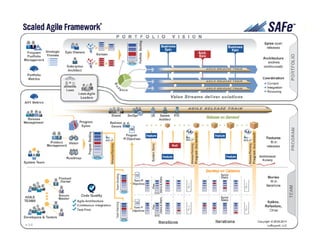
What is SAFe?
• A proven, publicly-facing framework for applying
Lean and Agile practices at enterprise scale
http://scaledagileframework.com/
Synchronizes
alignment,
collaboration and
delivery for large
numbers of teams
Synchronizes
alignment,
collaboration and
delivery for large
numbers of teams
CORE VALUES
1. Program Execution
2. Alignment
3. Code Quality
4. Transparency
4
Leffingwell et al. © 2014
Scaled Agile, Inc.
Framework Creator: Dean Leffingwell
Founder and CEO
ProQuo, Inc., Internet identity
Senior VP
Rational Software
Responsible for Rational Unified
Process (RUP) & Promulgation
of UML
Founder/CEO
Requisite, Inc.
Makers of RequisitePro
Founder/CEO
RELA, Inc.
Colorado MEDtech
Founder and CEO
ProQuo, Inc., Internet identity
Senior VP
Rational Software
Responsible for Rational Unified
Process (RUP) & Promulgation
of UML
Founder/CEO
Requisite, Inc.
Makers of RequisitePro
Founder/CEO
RELA, Inc.
Colorado MEDtech
5Leffingwell et al. © 2014
Scaled Agile, Inc.
Portfolio
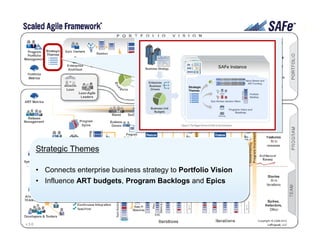
Strategic Themes
• Connects enterprise business strategy to Portfolio Vision
• Influence ART budgets, Program Backlogs and Epics
Strategic Themes
• Connects enterprise business strategy to Portfolio Vision
• Influence ART budgets, Program Backlogs and Epics
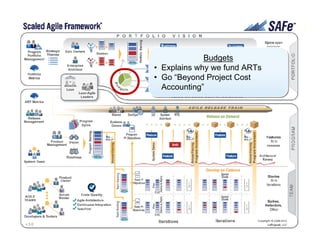
Budgets
• Explains why we fund ARTs
• Go “Beyond Project Cost
Accounting”
Budgets
• Explains why we fund ARTs
• Go “Beyond Project Cost
Accounting”
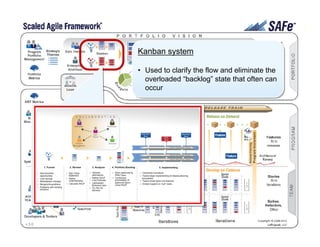
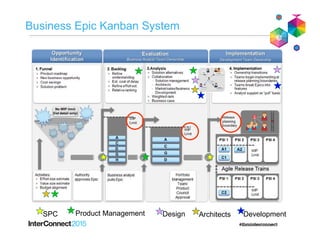
Kanban system
• Used to clarify the flow and eliminate the
overloaded “backlog” state that often can
occur
Kanban system
• Used to clarify the flow and eliminate the
overloaded “backlog” state that often can
occur
Business Epic Kanban System
SPC Product Management Design Architects Development
Leffingwell et al. © 2014
Scaled Agile, Inc.
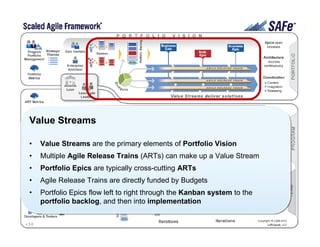
Value Streams
• Value Streams are the primary elements of Portfolio Vision
• Multiple Agile Release Trains (ARTs) can make up a Value Stream
• Portfolio Epics are typically cross-cutting ARTs
• Agile Release Trains are directly funded by Budgets
• Portfolio Epics flow left to right through the Kanban system to the
portfolio backlog, and then into implementation
Value Streams
• Value Streams are the primary elements of Portfolio Vision
• Multiple Agile Release Trains (ARTs) can make up a Value Stream
• Portfolio Epics are typically cross-cutting ARTs
• Agile Release Trains are directly funded by Budgets
• Portfolio Epics flow left to right through the Kanban system to the
portfolio backlog, and then into implementation
Portfolio Backlog NFRs
• NFRs may span across multiple
Value Streams and Release Trains
• Example: PCI Compliance
Portfolio Backlog NFRs
• NFRs may span across multiple
Value Streams and Release Trains
• Example: PCI Compliance
Coordination
• Required for Value Streams with multiple ARTs
• Often done at the Value Stream level
• Many large organization must “bundle” systems and
therefore cannot be evaluated at the Train level
Coordination
• Required for Value Streams with multiple ARTs
• Often done at the Value Stream level
• Many large organization must “bundle” systems and
therefore cannot be evaluated at the Train level
Lean-Agile Leaders
• Principles of Lean-Agile Leadership
• Role of Software Development Manager
described
Lean-Agile Leaders
• Principles of Lean-Agile Leadership
• Role of Software Development Manager
described
Metrics
• Split between Portfolio and ART
• New Portfolio Metrics for tracking
Epics
• ART metrics contain Program and
Team
Metrics
• Split between Portfolio and ART
• New Portfolio Metrics for tracking
Epics
• ART metrics contain Program and
Team
Program and Team
Agile Release Train
(ART)
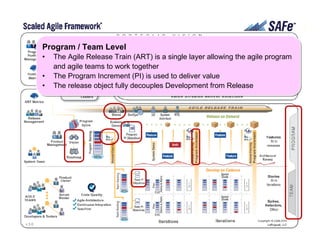
Program / Team Level
• The Agile Release Train (ART) is a single layer allowing the agile program
and agile teams to work together
• The Program Increment (PI) is used to deliver value
• The release object fully decouples Development from Release
Program / Team Level
• The Agile Release Train (ART) is a single layer allowing the agile program
and agile teams to work together
• The Program Increment (PI) is used to deliver value
• The release object fully decouples Development from Release
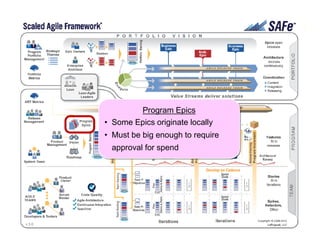
Program Epics
• Some Epics originate locally
• Must be big enough to require
approval for spend
Program Epics
• Some Epics originate locally
• Must be big enough to require
approval for spend
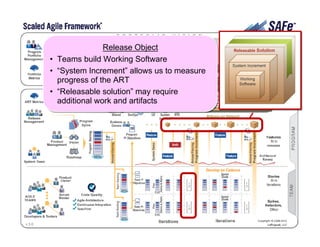
Release Object
• Teams build Working Software
• “System Increment” allows us to measure
progress of the ART
• “Releasable solution” may require
additional work and artifacts
Release Object
• Teams build Working Software
• “System Increment” allows us to measure
progress of the ART
• “Releasable solution” may require
additional work and artifacts
IP Sprint
•Validation (was Hardening) activities
are moved to the new Release Object
•If decoupled from Releases, IP sprints
provide more time for sharpening the
tools
•If not, Validation can still happen there
IP Sprint
•Validation (was Hardening) activities
are moved to the new Release Object
•If decoupled from Releases, IP sprints
provide more time for sharpening the
tools
•If not, Validation can still happen there
Code Quality
• “Agile Architecture
• Continuous Integration at the system level
• Test-First starts introduces the four quadrant Agile testing matrix
Code Quality
• “Agile Architecture
• Continuous Integration at the system level
• Test-First starts introduces the four quadrant Agile testing matrix
How IBM Support
SAFe
25
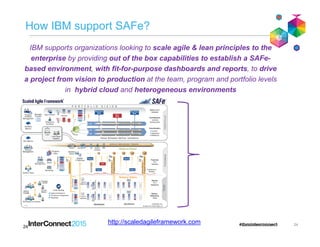
How IBM support SAFe?
IBM supports organizations looking to scale agile & lean principles to the
enterprise by providing out of the box capabilities to establish a SAFe-
based environment, with fit-for-purpose dashboards and reports, to drive
a project from vision to production at the team, program and portfolio levels
in hybrid cloud and heterogeneous environments
25
http://scaledagileframework.com
Leffingwell et al. © 2014
Scaled Agile, Inc.
26
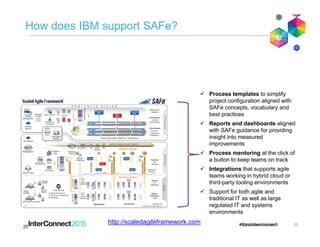
How does IBM support SAFe?
26
Process templates to simplify
project configuration aligned with
SAFe concepts, vocabulary and
best practices
Reports and dashboards aligned
with SAFe guidance for providing
insight into measured
improvements
Process mentoring at the click of
a button to keep teams on track
Integrations that supports agile
teams working in hybrid cloud or
third-party tooling environments
Support for both agile and
traditional IT as well as large
regulated IT and systems
environments
Leffingwell et al. © 2014
Scaled Agile, Inc.
27
IBM DevOps built on SAFe
27
SAFe
Market-leading process framework for scaling lean and across the
enterprise,
IBM DevOps Framework & Tooling
Supports the continuous delivery model through an open-standards-based
tooling platform
Steer Dev & Test Deploy Operate
Apply Lean & Agile Principles across the end-to-end DevOps lifecycle
28
IBM’s SAFe Support - RTC instances for SAFe
Portfolio, Programs and Teams
Program (RTC Project Area)
Rational Team Concert*
Programs (RTC Project Areas)
Rational Team Concert*
Portfolio and Program: Use Rational Team Concert, (or Rational CLM) solution to
address the needs for high quality and regulatory compliance
Rational Team Concert*
Agile Release Train (RTC Project Areas)
29
Lesson Learned
1
30
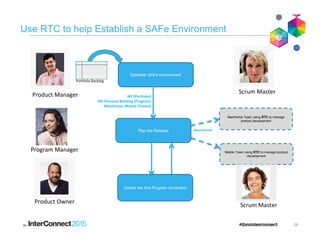
Establish SAFe environment
Plan the Release
Deliver the first Program Increment
JKE (Portfolio)
JKE Personal Banking (Program)
Mainframe, Mobile (Teams)
Use RTC to help Establish a SAFe Environment
30
Product Manager
Program Manager
Portfolio Backlog
Product Owner
Mobile Team using RTC to manage product
development
dependencies
Scrum Master
Scrum Master
Mainframe Team using RTC to manage
product development
31
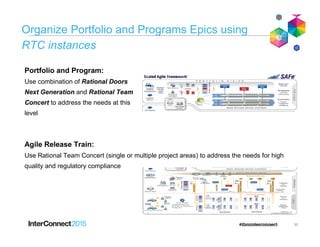
Organize Portfolio and Programs Epics using
RTC instances
Portfolio and Program:
Use combination of Rational Doors
Next Generation and Rational Team
Concert to address the needs at this
level
Agile Release Train:
Use Rational Team Concert (single or multiple project areas) to address the needs for high
quality and regulatory compliance
32
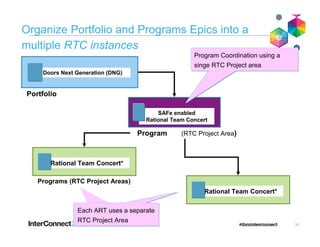
Organize Portfolio and Programs Epics into a
multiple RTC instances
Program (RTC Project Area)
SAFe enabled
Rational Team Concert
Programs (RTC Project Areas)
Rational Team Concert*
Program Coordination using a
singe RTC Project area
Portfolio
Doors Next Generation (DNG)
Each ART uses a separate
RTC Project Area
Each ART uses a separate
RTC Project Area
33
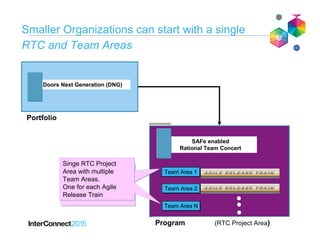
Smaller Organizations can start with a single
RTC and Team Areas
Program (RTC Project Area)
SAFe enabled
Rational Team Concert
Singe RTC Project
Area with multiple
Team Areas.
One for each Agile
Release Train
Portfolio
Doors Next Generation (DNG)
Team Area 1
Team Area 2
Team Area N
Singe RTC Project
Area with multiple
Team Areas.
One for each Agile
Release Train
34
Lesson Learned
2
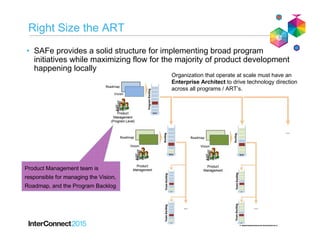
Right Size the ART
Product Management team is
responsible for managing the Vision,
Roadmap, and the Program Backlog
• SAFe provides a solid structure for implementing broad program
initiatives while maximizing flow for the majority of product development
happening locally
Organization that operate at
scale must have an
Enterprise Architect to
drive technology direction
across all programs / ART’s.
Leffingwell et al. © 2014
Scaled Agile, Inc.
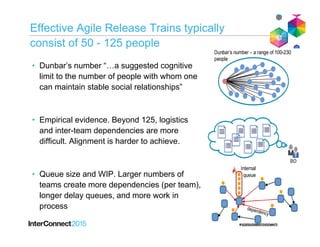
Effective Agile Release Trains typically
consist of 50 - 125 people
• Dunbar’s number “…a suggested cognitive
limit to the number of people with whom one
can maintain stable social relationships”
• Empirical evidence. Beyond 125, logistics
and inter-team dependencies are more
difficult. Alignment is harder to achieve.
• Queue size and WIP. Larger numbers of
teams create more dependencies (per team),
longer delay queues, and more work in
process
Leffingwell et al. © 2014
Scaled Agile, Inc.
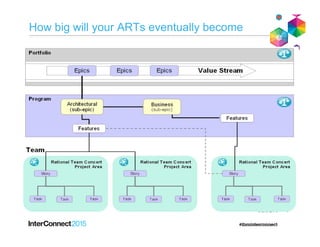
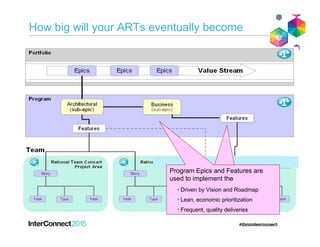
How big will your ARTs eventually become
Fast customer feedback
Fixed, reliable cadence
Program Epics and Features are
used to implement the
Driven by Vision and Roadmap
Lean, economic prioritization
Frequent, quality deliveries
39
Lesson Learned
3
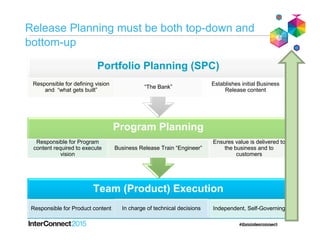
Team (Product) Execution
Responsible for Product content Independent, Self-Governing
Program Planning
Responsible for Program
content required to execute
vision
Business Release Train “Engineer”
Ensures value is delivered to
the business and to
customers
Portfolio Planning (SPC)
Responsible for defining vision
and “what gets built”
“The Bank”
Establishes initial Business
Release content
Release Planning must be both top-down and
bottom-up
In charge of technical decisions
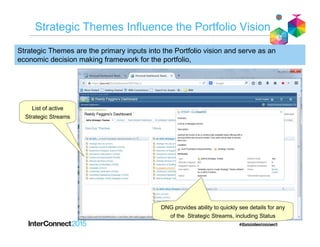
Strategic Themes Influence the Portfolio Vision
Strategic Themes are the primary inputs into the Portfolio vision and serve as an
economic decision making framework for the portfolio,
List of active
Strategic Streams
DNG provides ability to quickly see details for any
of the Strategic Streams, including Status
Create Business Needs
Use Kanban and WIP
limits to help evaluate
Business Needs
Identify initial set of Strategic Themes
Its often easier to first capture
and organize Business
Needs and later “reverse
engineer” the Strategic
Themes
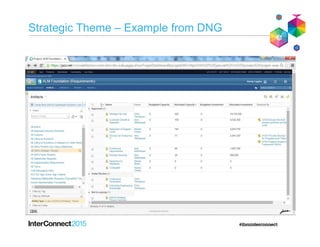
Strategic Theme – Example from DNG
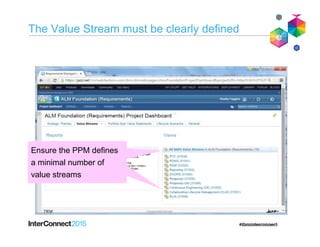
The Value Stream must be clearly defined
Ensure the PPM defines
a minimal number of
value streams
Ensure the PPM defines
a minimal number of
value streams
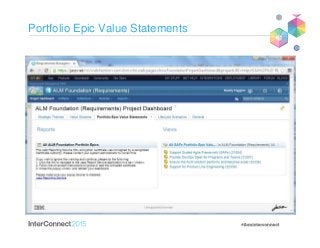
All SAFe Portfolio Epic Value Statements
Portfolio Epic Value Statements
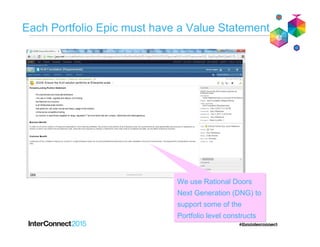
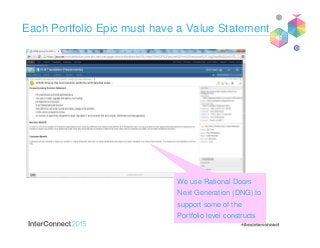
Each Portfolio Epic must have a Value Statement
We use Rational Doors
Next Generation (DNG) to
support some of the
Portfolio level constructs
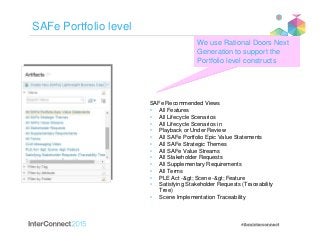
SAFe Portfolio level
SAFe Recommended Views
• All Features
• All Lifecycle Scenarios
• All Lifecycle Scenarios in
• Playback or Under Review
• All SAFe Portfolio Epic Value Statements
• All SAFe Strategic Themes
• All SAFe Value Streams
• All Stakeholder Requests
• All Supplementary Requirements
• All Terms
• PLE Act -> Scene -> Feature
• Satisfying Stakeholder Requests (Traceability
Tree)
• Scene Implementation Traceability
We use Rational Doors Next
Generation to support the
Portfolio level constructs
50
Lesson Learned
4
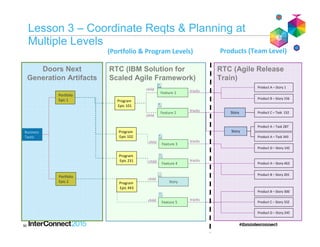
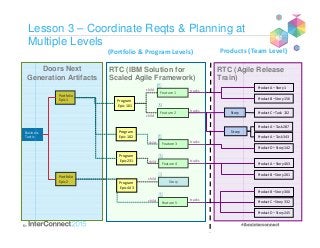
Lesson 3 – Coordinate Reqts & Planning at
Multiple Levels
(Portfolio & Program Levels)
Product A – Story 1
Product B – Story 156
Product C – Task 132
Product A – Task 287
Product A – Task 343
Product D – Story 142
Product A – Story 463
Product B – Story 201
Product B – Story 300
Product C – Story 332
Product D – Story 245
Business
Tactic
Portfolio
Epic 2
Portfolio
Epic 1
Story
Story
Feature 1
Feature 5
Feature 4
Feature 3
Story
Products (Team Level)
Feature 2
tracks
tracks
tracks
tracks
tracks
child
child
child
child
child
child
51
Doors Next
Generation Artifacts
RTC (IBM Solution for
Scaled Agile Framework)
RTC (Agile Release
Train)
Program
Epic 101
Program
Epic 102
Program
Epic 231
Program
Epic 443
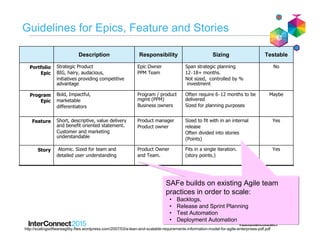
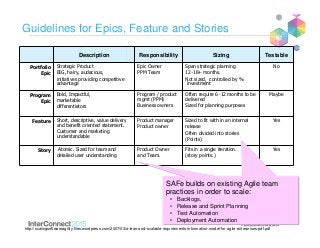
Guidelines for Epics, Feature and Stories
Description Responsibility Sizing Testable
Portfolio
Epic
Strategic Product
BIG, hairy, audacious,
initiatives providing competitive
advantage
Epic Owner
PPM Team
Span strategic planning
12‐18+ months.
Not sized, controlled by %
investment
No
Program
Epic
Bold, Impactful,
marketable
differentiators
Program / product
mgmt (PPM)
Business owners
Often require 6‐12 months to be
delivered
Sized for planning purposes
Maybe
Feature Short, descriptive, value delivery
and benefit oriented statement.
Customer and marketing
understandable
Product manager
Product owner
Sized to fit with in an internal
release
Often divided into stories
(Points)
Yes
Story Atomic. Sized for team and
detailed user understanding
Product Owner
and Team.
Fits in a single iteration.
(story points.)
Yes
http://scalingsoftwareagility.files.wordpress.com/2007/03/a-lean-and-scalable-requirements-information-model-for-agile-enterprises-pdf.pdf
SAFe builds on existing Agile team
practices in order to scale:
• Backlogs,
• Release and Sprint Planning
• Test Automation
• Deployment Automation
SAFe builds on existing Agile team
practices in order to scale:
• Backlogs,
• Release and Sprint Planning
• Test Automation
• Deployment Automation
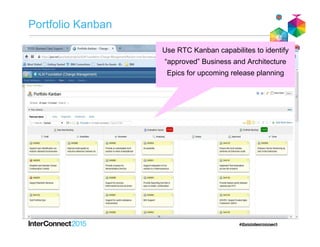
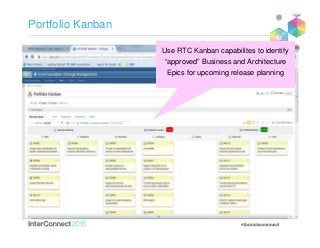
Portfolio Kanban
Use RTC Kanban capabilites to identify
“approved” Business and Architecture
Epics for upcoming release planning
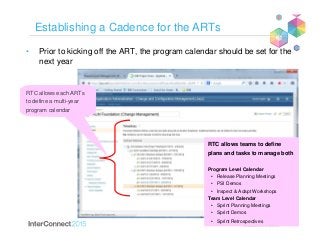
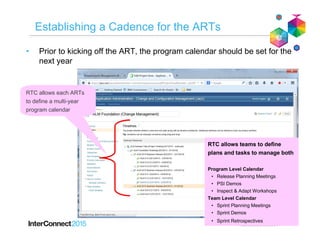
Establishing a Cadence for the ARTs
• Prior to kicking off the ART, the program calendar should be set for the
next year
RTC allows each ARTs
to define a multi-year
program calendar
RTC allows teams to define
plans and tasks to manage both
Program Level Calendar
• Release Planning Meetings
• PSI Demos
• Inspect & Adapt Workshops
Team Level Calendar
• Sprint Planning Meetings
• Sprint Demos
• Sprint Retrospectives
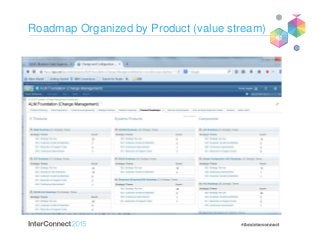
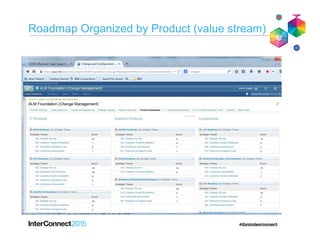
Roadmap Organized by Product (value stream)
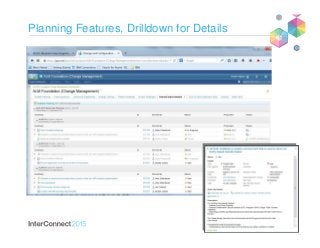
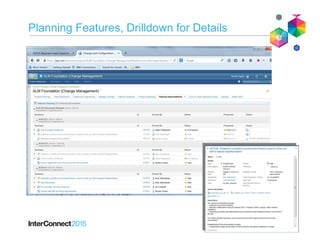
Planning Features, Drilldown for Details
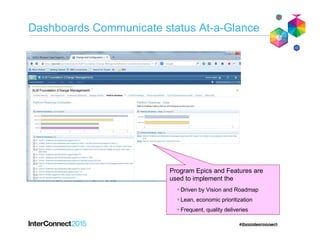
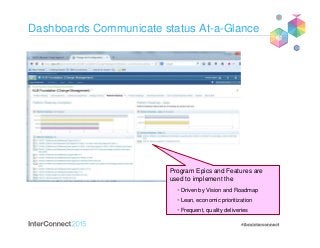
Dashboards Communicate status At-a-Glance
Program Epics and Features are
used to implement the
Driven by Vision and Roadmap
Lean, economic prioritization
Frequent, quality deliveries
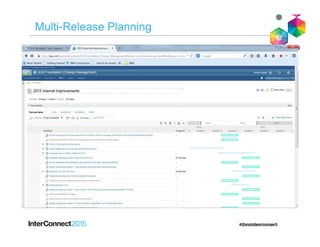
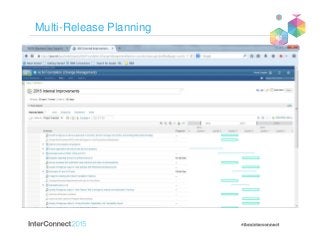
Multi-Release Planning
59
Lesson Learned
5
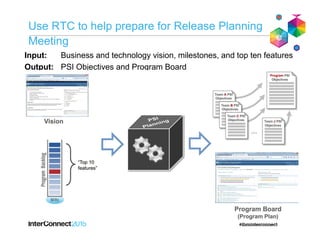
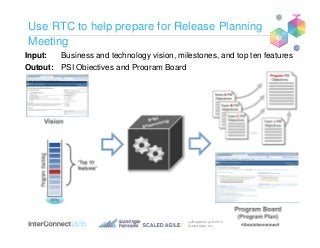
Use RTC to help prepare for Release Planning
Meeting
Input: Business and technology vision, milestones, and top ten features
Output: PSI Objectives and Program Board
Leffingwell et al. © 2014
Scaled Agile, Inc.
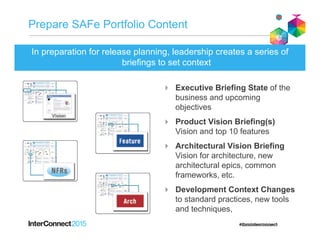
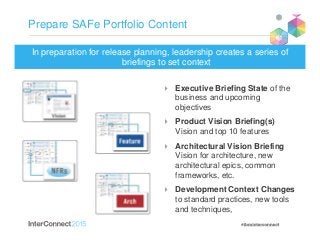
Prepare SAFe Portfolio Content
In preparation for release planning, leadership creates a series of
briefings to set context
Executive Briefing State of the
business and upcoming
objectives
Product Vision Briefing(s)
Vision and top 10 features
Architectural Vision Briefing
Vision for architecture, new
architectural epics, common
frameworks, etc.
Development Context Changes
to standard practices, new tools
and techniques,
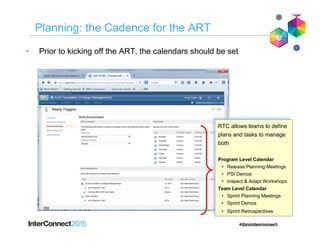
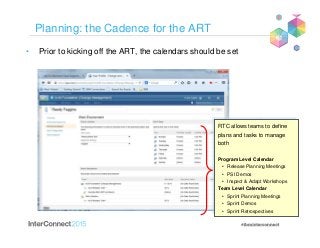
Planning: the Cadence for the ART
• Prior to kicking off the ART, the calendars should be set
RTC allows teams to define
plans and tasks to manage
both
Program Level Calendar
• Release Planning Meetings
• PSI Demos
• Inspect & Adapt Workshops
Team Level Calendar
• Sprint Planning Meetings
• Sprint Demos
• Sprint Retrospectives
RTC allows teams to define
plans and tasks to manage
both
Program Level Calendar
• Release Planning Meetings
• PSI Demos
• Inspect & Adapt Workshops
Team Level Calendar
• Sprint Planning Meetings
• Sprint Demos
• Sprint Retrospectives
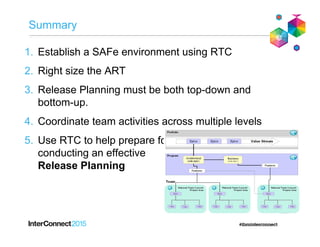
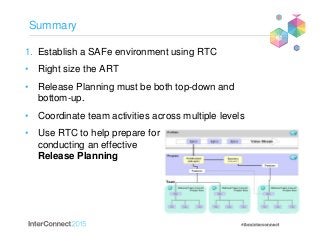
Summary
1. Establish a SAFe environment using RTC
• Right size the ART
• Release Planning must be both top-down and
bottom-up.
• Coordinate team activities across multiple levels
• Use RTC to help prepare for
conducting an effective
Release Planning
Questions?
Thank You
Your Feedback is
Important!
Access the InterConnect 2015
Conference CONNECT Attendee
Portal to complete your session
surveys from your smartphone,
laptop or conference kiosk.

#IBMInterConnect - DCB-3094 Scaling Agile - Launching an Agile Release Train using Rational Team Concert - #RTC - Lessons Learned

  • 1.
    © 2015 IBMCorporation DCB-3094 Scaling Agile Launching a SAFe Agile Release Train using Rational Team Concert – Lesson Learned Reedy Feggins, PMP WW Solution Architect, SAFe SPC, CSM DevOps Continuous Delivery SME
  • 2.
    1 Notices and Disclaimers Copyright© 2015 by International Business Machines Corporation (IBM). No part of this document may be reproduced or transmitted in any form without written permission from IBM. U.S. Government Users Restricted Rights - Use, duplication or disclosure restricted by GSA ADP Schedule Contract with IBM. Information in these presentations (including information relating to products that have not yet been announced by IBM) has been reviewed for accuracy as of the date of initial publication and could include unintentional technical or typographical errors. IBM shall have no responsibility to update this information. THIS DOCUMENT IS DISTRIBUTED "AS IS" WITHOUT ANY WARRANTY, EITHER EXPRESS OR IMPLIED. IN NO EVENT SHALL IBM BE LIABLE FOR ANY DAMAGE ARISING FROM THE USE OF THIS INFORMATION, INCLUDING BUT NOT LIMITED TO, LOSS OF DATA, BUSINESS INTERRUPTION, LOSS OF PROFIT OR LOSS OF OPPORTUNITY. IBM products and services are warranted according to the terms and conditions of the agreements under which they are provided. Any statements regarding IBM's future direction, intent or product plans are subject to change or withdrawal without notice. Performance data contained herein was generally obtained in a controlled, isolated environments. Customer examples are presented as illustrations of how those customers have used IBM products and the results they may have achieved. Actual performance, cost, savings or other results in other operating environments may vary. References in this document to IBM products, programs, or services does not imply that IBM intends to make such products, programs or services available in all countries in which IBM operates or does business. Workshops, sessions and associated materials may have been prepared by independent session speakers, and do not necessarily reflect the views of IBM. All materials and discussions are provided for informational purposes only, and are neither intended to, nor shall constitute legal or other guidance or advice to any individual participant or their specific situation. It is the customer’s responsibility to insure its own compliance with legal requirements and to obtain advice of competent legal counsel as to the identification and interpretation of any relevant laws and regulatory requirements that may affect the customer’s business and any actions the customer may need to take to comply with such laws. IBM does not provide legal advice or represent or warrant that its services or products will ensure that the customer is in compliance with any law.
  • 3.
    2 Notices and Disclaimers(con’t) Information concerning non-IBM products was obtained from the suppliers of those products, their published announcements or other publicly available sources. IBM has not tested those products in connection with this publication and cannot confirm the accuracy of performance, compatibility or any other claims related to non-IBM products. Questions on the capabilities of non-IBM products should be addressed to the suppliers of those products. IBM does not warrant the quality of any third-party products, or the ability of any such third-party products to interoperate with IBM’s products. IBM EXPRESSLY DISCLAIMS ALL WARRANTIES, EXPRESSED OR IMPLIED, INCLUDING BUT NOT LIMITED TO, THE IMPLIED WARRANTIES OF MERCHANTABILITY AND FITNESS FOR A PARTICULAR PURPOSE. The provision of the information contained herein is not intended to, and does not, grant any right or license under any IBM patents, copyrights, trademarks or other intellectual property right. •IBM, the IBM logo, ibm.com, Bluemix, Blueworks Live, CICS, Clearcase, DOORS®, Enterprise Document Management System™, Global Business Services ®, Global Technology Services ®, Information on Demand, ILOG, Maximo®, MQIntegrator®, MQSeries®, Netcool®, OMEGAMON, OpenPower, PureAnalytics™, PureApplication®, pureCluster™, PureCoverage®, PureData®, PureExperience®, PureFlex®, pureQuery®, pureScale®, PureSystems®, QRadar®, Rational®, Rhapsody®, SoDA, SPSS, StoredIQ, Tivoli®, Trusteer®, urban{code}®, Watson, WebSphere®, Worklight®, X-Force® and System z® Z/OS, are trademarks of International Business Machines Corporation, registered in many jurisdictions worldwide. Other product and service names might be trademarks of IBM or other companies. A current list of IBM trademarks is available on the Web at "Copyright and trademark information" at: www.ibm.com/legal/copytrade.shtml.
  • 4.
    What is ScaledAgile Framework (SAFe)
  • 5.
    What is SAFe? •A proven, publicly-facing framework for applying Lean and Agile practices at enterprise scale http://scaledagileframework.com/ Synchronizes alignment, collaboration and delivery for large numbers of teams Synchronizes alignment, collaboration and delivery for large numbers of teams CORE VALUES 1. Program Execution 2. Alignment 3. Code Quality 4. Transparency 4 Leffingwell et al. © 2014 Scaled Agile, Inc.
  • 6.
    Framework Creator: DeanLeffingwell Founder and CEO ProQuo, Inc., Internet identity Senior VP Rational Software Responsible for Rational Unified Process (RUP) & Promulgation of UML Founder/CEO Requisite, Inc. Makers of RequisitePro Founder/CEO RELA, Inc. Colorado MEDtech Founder and CEO ProQuo, Inc., Internet identity Senior VP Rational Software Responsible for Rational Unified Process (RUP) & Promulgation of UML Founder/CEO Requisite, Inc. Makers of RequisitePro Founder/CEO RELA, Inc. Colorado MEDtech 5Leffingwell et al. © 2014 Scaled Agile, Inc.
  • 7.
  • 10.
    Strategic Themes • Connectsenterprise business strategy to Portfolio Vision • Influence ART budgets, Program Backlogs and Epics Strategic Themes • Connects enterprise business strategy to Portfolio Vision • Influence ART budgets, Program Backlogs and Epics
  • 11.
    Budgets • Explains whywe fund ARTs • Go “Beyond Project Cost Accounting” Budgets • Explains why we fund ARTs • Go “Beyond Project Cost Accounting”
  • 12.
    Kanban system • Usedto clarify the flow and eliminate the overloaded “backlog” state that often can occur Kanban system • Used to clarify the flow and eliminate the overloaded “backlog” state that often can occur
  • 13.
    Business Epic KanbanSystem SPC Product Management Design Architects Development Leffingwell et al. © 2014 Scaled Agile, Inc.
  • 14.
    Value Streams • ValueStreams are the primary elements of Portfolio Vision • Multiple Agile Release Trains (ARTs) can make up a Value Stream • Portfolio Epics are typically cross-cutting ARTs • Agile Release Trains are directly funded by Budgets • Portfolio Epics flow left to right through the Kanban system to the portfolio backlog, and then into implementation Value Streams • Value Streams are the primary elements of Portfolio Vision • Multiple Agile Release Trains (ARTs) can make up a Value Stream • Portfolio Epics are typically cross-cutting ARTs • Agile Release Trains are directly funded by Budgets • Portfolio Epics flow left to right through the Kanban system to the portfolio backlog, and then into implementation
  • 15.
    Portfolio Backlog NFRs •NFRs may span across multiple Value Streams and Release Trains • Example: PCI Compliance Portfolio Backlog NFRs • NFRs may span across multiple Value Streams and Release Trains • Example: PCI Compliance
  • 16.
    Coordination • Required forValue Streams with multiple ARTs • Often done at the Value Stream level • Many large organization must “bundle” systems and therefore cannot be evaluated at the Train level Coordination • Required for Value Streams with multiple ARTs • Often done at the Value Stream level • Many large organization must “bundle” systems and therefore cannot be evaluated at the Train level
  • 17.
    Lean-Agile Leaders • Principlesof Lean-Agile Leadership • Role of Software Development Manager described Lean-Agile Leaders • Principles of Lean-Agile Leadership • Role of Software Development Manager described
  • 18.
    Metrics • Split betweenPortfolio and ART • New Portfolio Metrics for tracking Epics • ART metrics contain Program and Team Metrics • Split between Portfolio and ART • New Portfolio Metrics for tracking Epics • ART metrics contain Program and Team
  • 19.
    Program and Team AgileRelease Train (ART)
  • 20.
    Program / TeamLevel • The Agile Release Train (ART) is a single layer allowing the agile program and agile teams to work together • The Program Increment (PI) is used to deliver value • The release object fully decouples Development from Release Program / Team Level • The Agile Release Train (ART) is a single layer allowing the agile program and agile teams to work together • The Program Increment (PI) is used to deliver value • The release object fully decouples Development from Release
  • 21.
    Program Epics • SomeEpics originate locally • Must be big enough to require approval for spend Program Epics • Some Epics originate locally • Must be big enough to require approval for spend
  • 22.
    Release Object • Teamsbuild Working Software • “System Increment” allows us to measure progress of the ART • “Releasable solution” may require additional work and artifacts Release Object • Teams build Working Software • “System Increment” allows us to measure progress of the ART • “Releasable solution” may require additional work and artifacts
  • 23.
    IP Sprint •Validation (wasHardening) activities are moved to the new Release Object •If decoupled from Releases, IP sprints provide more time for sharpening the tools •If not, Validation can still happen there IP Sprint •Validation (was Hardening) activities are moved to the new Release Object •If decoupled from Releases, IP sprints provide more time for sharpening the tools •If not, Validation can still happen there
  • 24.
    Code Quality • “AgileArchitecture • Continuous Integration at the system level • Test-First starts introduces the four quadrant Agile testing matrix Code Quality • “Agile Architecture • Continuous Integration at the system level • Test-First starts introduces the four quadrant Agile testing matrix
  • 25.
  • 26.
    25 How IBM supportSAFe? IBM supports organizations looking to scale agile & lean principles to the enterprise by providing out of the box capabilities to establish a SAFe- based environment, with fit-for-purpose dashboards and reports, to drive a project from vision to production at the team, program and portfolio levels in hybrid cloud and heterogeneous environments 25 http://scaledagileframework.com Leffingwell et al. © 2014 Scaled Agile, Inc.
  • 27.
    26 How does IBMsupport SAFe? 26 Process templates to simplify project configuration aligned with SAFe concepts, vocabulary and best practices Reports and dashboards aligned with SAFe guidance for providing insight into measured improvements Process mentoring at the click of a button to keep teams on track Integrations that supports agile teams working in hybrid cloud or third-party tooling environments Support for both agile and traditional IT as well as large regulated IT and systems environments Leffingwell et al. © 2014 Scaled Agile, Inc.
  • 28.
    27 IBM DevOps builton SAFe 27 SAFe Market-leading process framework for scaling lean and across the enterprise, IBM DevOps Framework & Tooling Supports the continuous delivery model through an open-standards-based tooling platform Steer Dev & Test Deploy Operate Apply Lean & Agile Principles across the end-to-end DevOps lifecycle
  • 29.
    28 IBM’s SAFe Support- RTC instances for SAFe Portfolio, Programs and Teams Program (RTC Project Area) Rational Team Concert* Programs (RTC Project Areas) Rational Team Concert* Portfolio and Program: Use Rational Team Concert, (or Rational CLM) solution to address the needs for high quality and regulatory compliance Rational Team Concert* Rational Team Concert* Agile Release Train (RTC Project Areas)
  • 30.
  • 31.
    30 Establish SAFe environment Planthe Release Deliver the first Program Increment JKE (Portfolio) JKE Personal Banking (Program) Mainframe, Mobile (Teams) Use RTC to help Establish a SAFe Environment 30 Product Manager Program Manager Portfolio Backlog Product Owner Mobile Team using RTC to manage product development dependencies Scrum Master Scrum Master Mainframe Team using RTC to manage product development
  • 32.
    31 Organize Portfolio andPrograms Epics using RTC instances Portfolio and Program: Use combination of Rational Doors Next Generation and Rational Team Concert to address the needs at this level Agile Release Train: Use Rational Team Concert (single or multiple project areas) to address the needs for high quality and regulatory compliance
  • 33.
    32 Organize Portfolio andPrograms Epics into a multiple RTC instances Program (RTC Project Area) SAFe enabled Rational Team Concert Programs (RTC Project Areas) Rational Team Concert* Rational Team Concert* Program Coordination using a singe RTC Project area Portfolio Doors Next Generation (DNG) Each ART uses a separate RTC Project Area Each ART uses a separate RTC Project Area
  • 34.
    33 Smaller Organizations canstart with a single RTC and Team Areas Program (RTC Project Area) SAFe enabled Rational Team Concert Singe RTC Project Area with multiple Team Areas. One for each Agile Release Train Portfolio Doors Next Generation (DNG) Team Area 1 Team Area 2 Team Area N Singe RTC Project Area with multiple Team Areas. One for each Agile Release Train
  • 35.
  • 36.
    Right Size theART Product Management team is responsible for managing the Vision, Roadmap, and the Program Backlog • SAFe provides a solid structure for implementing broad program initiatives while maximizing flow for the majority of product development happening locally Organization that operate at scale must have an Enterprise Architect to drive technology direction across all programs / ART’s. Leffingwell et al. © 2014 Scaled Agile, Inc.
  • 37.
    Effective Agile ReleaseTrains typically consist of 50 - 125 people • Dunbar’s number “…a suggested cognitive limit to the number of people with whom one can maintain stable social relationships” • Empirical evidence. Beyond 125, logistics and inter-team dependencies are more difficult. Alignment is harder to achieve. • Queue size and WIP. Larger numbers of teams create more dependencies (per team), longer delay queues, and more work in process Leffingwell et al. © 2014 Scaled Agile, Inc.
  • 38.
    How big willyour ARTs eventually become
  • 39.
    How big willyour ARTs eventually become Fast customer feedback Fixed, reliable cadence Program Epics and Features are used to implement the Driven by Vision and Roadmap Lean, economic prioritization Frequent, quality deliveries
  • 40.
  • 41.
    Team (Product) Execution Responsiblefor Product content Independent, Self-Governing Program Planning Responsible for Program content required to execute vision Business Release Train “Engineer” Ensures value is delivered to the business and to customers Portfolio Planning (SPC) Responsible for defining vision and “what gets built” “The Bank” Establishes initial Business Release content Release Planning must be both top-down and bottom-up In charge of technical decisions
  • 42.
    Strategic Themes Influencethe Portfolio Vision Strategic Themes are the primary inputs into the Portfolio vision and serve as an economic decision making framework for the portfolio, List of active Strategic Streams DNG provides ability to quickly see details for any of the Strategic Streams, including Status
  • 43.
    Create Business Needs UseKanban and WIP limits to help evaluate Business Needs
  • 44.
    Identify initial setof Strategic Themes Its often easier to first capture and organize Business Needs and later “reverse engineer” the Strategic Themes
  • 45.
    Strategic Theme –Example from DNG
  • 46.
    The Value Streammust be clearly defined Ensure the PPM defines a minimal number of value streams Ensure the PPM defines a minimal number of value streams
  • 47.
    All SAFe PortfolioEpic Value Statements
  • 48.
  • 49.
    Each Portfolio Epicmust have a Value Statement We use Rational Doors Next Generation (DNG) to support some of the Portfolio level constructs
  • 50.
    SAFe Portfolio level SAFeRecommended Views • All Features • All Lifecycle Scenarios • All Lifecycle Scenarios in • Playback or Under Review • All SAFe Portfolio Epic Value Statements • All SAFe Strategic Themes • All SAFe Value Streams • All Stakeholder Requests • All Supplementary Requirements • All Terms • PLE Act -> Scene -> Feature • Satisfying Stakeholder Requests (Traceability Tree) • Scene Implementation Traceability We use Rational Doors Next Generation to support the Portfolio level constructs
  • 51.
  • 52.
    Lesson 3 –Coordinate Reqts & Planning at Multiple Levels (Portfolio & Program Levels) Product A – Story 1 Product B – Story 156 Product C – Task 132 Product A – Task 287 Product A – Task 343 Product D – Story 142 Product A – Story 463 Product B – Story 201 Product B – Story 300 Product C – Story 332 Product D – Story 245 Business Tactic Portfolio Epic 2 Portfolio Epic 1 Story Story Feature 1 Feature 5 Feature 4 Feature 3 Story Products (Team Level) Feature 2 tracks tracks tracks tracks tracks child child child child child child 51 Doors Next Generation Artifacts RTC (IBM Solution for Scaled Agile Framework) RTC (Agile Release Train) Program Epic 101 Program Epic 102 Program Epic 231 Program Epic 443
  • 53.
    Guidelines for Epics,Feature and Stories Description Responsibility Sizing Testable Portfolio Epic Strategic Product BIG, hairy, audacious, initiatives providing competitive advantage Epic Owner PPM Team Span strategic planning 12‐18+ months. Not sized, controlled by % investment No Program Epic Bold, Impactful, marketable differentiators Program / product mgmt (PPM) Business owners Often require 6‐12 months to be delivered Sized for planning purposes Maybe Feature Short, descriptive, value delivery and benefit oriented statement. Customer and marketing understandable Product manager Product owner Sized to fit with in an internal release Often divided into stories (Points) Yes Story Atomic. Sized for team and detailed user understanding Product Owner and Team. Fits in a single iteration. (story points.) Yes http://scalingsoftwareagility.files.wordpress.com/2007/03/a-lean-and-scalable-requirements-information-model-for-agile-enterprises-pdf.pdf SAFe builds on existing Agile team practices in order to scale: • Backlogs, • Release and Sprint Planning • Test Automation • Deployment Automation SAFe builds on existing Agile team practices in order to scale: • Backlogs, • Release and Sprint Planning • Test Automation • Deployment Automation
  • 54.
    Portfolio Kanban Use RTCKanban capabilites to identify “approved” Business and Architecture Epics for upcoming release planning
  • 55.
    Establishing a Cadencefor the ARTs • Prior to kicking off the ART, the program calendar should be set for the next year RTC allows each ARTs to define a multi-year program calendar RTC allows teams to define plans and tasks to manage both Program Level Calendar • Release Planning Meetings • PSI Demos • Inspect & Adapt Workshops Team Level Calendar • Sprint Planning Meetings • Sprint Demos • Sprint Retrospectives
  • 56.
    Roadmap Organized byProduct (value stream)
  • 57.
  • 58.
    Dashboards Communicate statusAt-a-Glance Program Epics and Features are used to implement the Driven by Vision and Roadmap Lean, economic prioritization Frequent, quality deliveries
  • 59.
  • 60.
  • 61.
    Use RTC tohelp prepare for Release Planning Meeting Input: Business and technology vision, milestones, and top ten features Output: PSI Objectives and Program Board Leffingwell et al. © 2014 Scaled Agile, Inc.
  • 62.
    Prepare SAFe PortfolioContent In preparation for release planning, leadership creates a series of briefings to set context Executive Briefing State of the business and upcoming objectives Product Vision Briefing(s) Vision and top 10 features Architectural Vision Briefing Vision for architecture, new architectural epics, common frameworks, etc. Development Context Changes to standard practices, new tools and techniques,
  • 63.
    Planning: the Cadencefor the ART • Prior to kicking off the ART, the calendars should be set RTC allows teams to define plans and tasks to manage both Program Level Calendar • Release Planning Meetings • PSI Demos • Inspect & Adapt Workshops Team Level Calendar • Sprint Planning Meetings • Sprint Demos • Sprint Retrospectives RTC allows teams to define plans and tasks to manage both Program Level Calendar • Release Planning Meetings • PSI Demos • Inspect & Adapt Workshops Team Level Calendar • Sprint Planning Meetings • Sprint Demos • Sprint Retrospectives
  • 64.
    Summary 1. Establish aSAFe environment using RTC • Right size the ART • Release Planning must be both top-down and bottom-up. • Coordinate team activities across multiple levels • Use RTC to help prepare for conducting an effective Release Planning
  • 65.
  • 66.
    Thank You Your Feedbackis Important! Access the InterConnect 2015 Conference CONNECT Attendee Portal to complete your session surveys from your smartphone, laptop or conference kiosk.