OCCUPATIONAL
MEDICINE AND
FITNESS FOR DUTY
BY
N. MICHAEL BADDAR, M.D., M.P.H.
SERVING HAMPTON ROADS
FOR OVER TWENTY FIVE
YEARS
□ I&O Medical Centers-Peninsula North 757-240-5580
Serving the City of Newport News and York County
□ I&O Medical Centers-Peninsula South 757-825-1100
Serving the Cities of Hampton and Newport News
□ I&O Medical Centers-Southside East 757-460-0700
Serving the cities of Virginia Beach and Norfolk
□ I&O Medical Centers-Southside West 757-487-9600
Serving the cities of Chesapeake, Portsmouth, and Suffolk
FITNESS FOR DUTY
JOEM-JOURNAL OF OCCUPATIONAL
AND ENVIRONMENTAL MEDICINE
ACOEM-AMERICAN COLLEGE OF
OCCUPATIONAL AND
ENVIRONMENTAL MEDICINE
FITNESS FOR DUTY-
SEPTEMBER 2015 ISSUE
□ ELECTROCARDIOGRAPHIC
RESPONSES DURING FIRE
SUPPRESSION AND
RECOVERYAMONG EXPERIENCED
FIREFIGHTERS
□ THE RELATIONSHIP BETWEEN BODY
MASS INDEX AND WORKERS’
COMPENSATION CLAIMS AND COSTS
FIREFIGHTERS
NFPA 1582
STANDARD ON COMPREHENSIVE
OCCUPATIONAL MEDICAL PROGRAM
FOR FIRE DEPARTMENTS
FITNESS FOR DUTY
□ STESS TESTING IN
FIREFIGHTERS/POLICE AND
WORKERS INVOLVED IN SAFETY
□ BMI IN DISABILITY AND WORKERS
COMPENSATION
□ SLEEP, SHIFTWORK, AND SLEEP
APNEA
□ POLYPHARMACIA AND HIPAA
FITNESS FOR DUTY
The Occupational Physician takes all
the relevant data and gives the
employee the mechanism to perform the
job safely while informing the employer
whether the employee has met those
goals without breaching confidentiality
STRESSS TESTING IN
FIREFIGHTERS/POLICE AND
WORKERS INVOLVED IN
SAFETY
□ WHY we should consider stress testing
□ WHAT are we really measuring
□ HOW do we go about measuring
□ WHERE can we use the information
WHY THE CONCERN
“Heart disease causes nearly half of
line-of-duty death among firefighters.
This epidemiological observation may be
related, in part, to high prevalence of
cardiovascular risk factors, including
obesity, metabolic syndrome, binge
drinking, and sleep deprivation.
-Salah Al-Zaiti, JOEM Sept. 2015
PREVALENCE OF
ABNORMALITIES
□ Exceeding age predicted maximum heart
rate – 52.4%
□ Significant tachycardia – 97.6%
□ Pathological ST segments – 26.2%
□ Heart rate variability – 52.4%
□ Prolonged QTc interval which indicates
abnormal repolarization and risk of
sudden death – 52.4%
CONCLUSIONS
“This study demonstrated that fire
suppression, independent from work
duration , induces prolonged tachycardia
and is associated with transient ECG
changes suggestive of myocardial
ischemia… among 25% to 50% of active
firefighters at low risk for CV disease.”
JOEM September 2015
FITNESS
□ A MET is defined as the resting
metabolic rate, that is, the amount of
oxygen consumed sitting in a chair
□ 2 METS requires twice the resting
metabolism and 3 METS requires three
times the resting metabolism
□ Housework can vary from 2 to 5 METS
□ Snow shoveling from 5 to 7 METS
FIREFIGHTING FITNESS
□ Estimated METs proposed from studies
for firefighting range from 9.6 to 14
□ Firefighters should be able to perform
above 12 METS without difficulty
□ Firefighters with cardio-respiratory
fitness below 12 should be started on a
program to improve fitness
FITNESS FOR DUTY
□ Is the employee the same as he/she was
when they were hired
□ Is the employee taking medication which
may impair their judgment
□ Do we have a system for identifying
potential problems before an incident
BMI AND WORKERS COMP
“Obesity was associated with
significantly greater workers’
compensation outcomes (COSTS) in this
population of statewide municipal
workers.”
-Chenoweth et al., Journal of
Occupational and Environmental
Medicine, Volume 57, Number 9
SHIFTWORK
□ Sleep disturbance
□ Occupational stress
□ Disruption of social life
□ Gastrointestinal disorders
OCCUPATIONAL
ACCIDENTS
□ Excessive daytime sleepiness and lack
of concentration impair work
performance
□ Sleep apnea (OSA) confers a two to
sevenfold increase in the risk of motor
vehicle accidents as compared to the
general population
SHIFT MALADAPTATION
SYNDROME
□ Sleep disturbance and chronic tiredness
□ 5 to 20% of shift workers
□ Alcohol or drug abuse usually related to
self-treatment of insomnia
□ Higher rates of accidents or near misses
□ Depression, personality changes
□ Exacerbation of existing disorders
PHASE DELAY
ADJUSTMENTS
□ It is generally more difficult to arise progressively earlier
than to delay awakening by an hour
□ Rotating forward from afternoon to nighttime shift is
easier than counter clockwise
□ Time recommended for a shift change would be at least
21 days before another rotation forward
□ Short cycle shifts (2-3 days) often more acceptable to
workers because of social and family life
BMI
“Health promotion and injury prevention
programs, policies, and incentives
should be provided to all employees.”
-Chenoweth et al.
WHY AN OCC DOC
□ PERSONNEL FILE
□ MEDICAL FILE
□ INTERMEDIARY THAT EXPLAINS AND
DISTILLS ON A NEED TO K NOW
BASIS
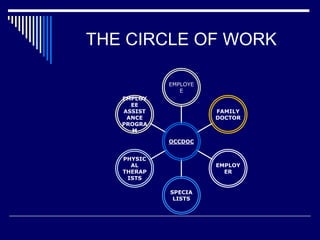
THE CIRCLE OF WORK
EMPLOY
EE
ASSIST
ANCE
PROGRA
M
PHYSIC
AL
THERAP
ISTS
SPECIA
LISTS
EMPLOY
ER
FAMILY
DOCTOR
EMPLOYE
E
OCCDOC
THE NEW OCC DOC
□ LIFESTYLE
□ EDUCATION
□ PREVENTION
□ PRIVACY
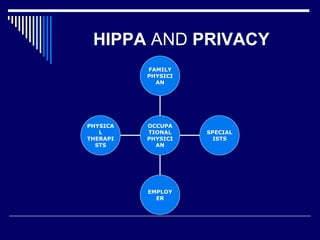
HIPPA AND PRIVACY
PHYSICA
L
THERAPI
STS
EMPLOY
ER
SPECIAL
ISTS
FAMILY
PHYSICI
AN
OCCUPA
TIONAL
PHYSICI
AN
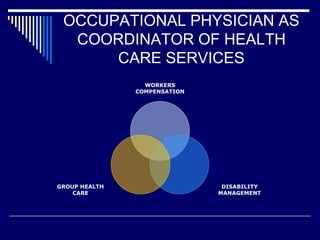
OCCUPATIONAL PHYSICIAN AS
COORDINATOR OF HEALTH
CARE SERVICES
WORKERS
COMPENSATION
DISABILITY
MANAGEMENT
GROUP HEALTH
CARE

2015 Fall Seminar Recap

  • 1.
    OCCUPATIONAL MEDICINE AND FITNESS FORDUTY BY N. MICHAEL BADDAR, M.D., M.P.H.
  • 2.
    SERVING HAMPTON ROADS FOROVER TWENTY FIVE YEARS □ I&O Medical Centers-Peninsula North 757-240-5580 Serving the City of Newport News and York County □ I&O Medical Centers-Peninsula South 757-825-1100 Serving the Cities of Hampton and Newport News □ I&O Medical Centers-Southside East 757-460-0700 Serving the cities of Virginia Beach and Norfolk □ I&O Medical Centers-Southside West 757-487-9600 Serving the cities of Chesapeake, Portsmouth, and Suffolk
  • 3.
    FITNESS FOR DUTY JOEM-JOURNALOF OCCUPATIONAL AND ENVIRONMENTAL MEDICINE ACOEM-AMERICAN COLLEGE OF OCCUPATIONAL AND ENVIRONMENTAL MEDICINE
  • 4.
    FITNESS FOR DUTY- SEPTEMBER2015 ISSUE □ ELECTROCARDIOGRAPHIC RESPONSES DURING FIRE SUPPRESSION AND RECOVERYAMONG EXPERIENCED FIREFIGHTERS □ THE RELATIONSHIP BETWEEN BODY MASS INDEX AND WORKERS’ COMPENSATION CLAIMS AND COSTS
  • 5.
    FIREFIGHTERS NFPA 1582 STANDARD ONCOMPREHENSIVE OCCUPATIONAL MEDICAL PROGRAM FOR FIRE DEPARTMENTS
  • 6.
    FITNESS FOR DUTY □STESS TESTING IN FIREFIGHTERS/POLICE AND WORKERS INVOLVED IN SAFETY □ BMI IN DISABILITY AND WORKERS COMPENSATION □ SLEEP, SHIFTWORK, AND SLEEP APNEA □ POLYPHARMACIA AND HIPAA
  • 7.
    FITNESS FOR DUTY TheOccupational Physician takes all the relevant data and gives the employee the mechanism to perform the job safely while informing the employer whether the employee has met those goals without breaching confidentiality
  • 8.
    STRESSS TESTING IN FIREFIGHTERS/POLICEAND WORKERS INVOLVED IN SAFETY □ WHY we should consider stress testing □ WHAT are we really measuring □ HOW do we go about measuring □ WHERE can we use the information
  • 9.
    WHY THE CONCERN “Heartdisease causes nearly half of line-of-duty death among firefighters. This epidemiological observation may be related, in part, to high prevalence of cardiovascular risk factors, including obesity, metabolic syndrome, binge drinking, and sleep deprivation. -Salah Al-Zaiti, JOEM Sept. 2015
  • 10.
    PREVALENCE OF ABNORMALITIES □ Exceedingage predicted maximum heart rate – 52.4% □ Significant tachycardia – 97.6% □ Pathological ST segments – 26.2% □ Heart rate variability – 52.4% □ Prolonged QTc interval which indicates abnormal repolarization and risk of sudden death – 52.4%
  • 11.
    CONCLUSIONS “This study demonstratedthat fire suppression, independent from work duration , induces prolonged tachycardia and is associated with transient ECG changes suggestive of myocardial ischemia… among 25% to 50% of active firefighters at low risk for CV disease.” JOEM September 2015
  • 12.
    FITNESS □ A METis defined as the resting metabolic rate, that is, the amount of oxygen consumed sitting in a chair □ 2 METS requires twice the resting metabolism and 3 METS requires three times the resting metabolism □ Housework can vary from 2 to 5 METS □ Snow shoveling from 5 to 7 METS
  • 13.
    FIREFIGHTING FITNESS □ EstimatedMETs proposed from studies for firefighting range from 9.6 to 14 □ Firefighters should be able to perform above 12 METS without difficulty □ Firefighters with cardio-respiratory fitness below 12 should be started on a program to improve fitness
  • 14.
    FITNESS FOR DUTY □Is the employee the same as he/she was when they were hired □ Is the employee taking medication which may impair their judgment □ Do we have a system for identifying potential problems before an incident
  • 15.
    BMI AND WORKERSCOMP “Obesity was associated with significantly greater workers’ compensation outcomes (COSTS) in this population of statewide municipal workers.” -Chenoweth et al., Journal of Occupational and Environmental Medicine, Volume 57, Number 9
  • 16.
    SHIFTWORK □ Sleep disturbance □Occupational stress □ Disruption of social life □ Gastrointestinal disorders
  • 17.
    OCCUPATIONAL ACCIDENTS □ Excessive daytimesleepiness and lack of concentration impair work performance □ Sleep apnea (OSA) confers a two to sevenfold increase in the risk of motor vehicle accidents as compared to the general population
  • 18.
    SHIFT MALADAPTATION SYNDROME □ Sleepdisturbance and chronic tiredness □ 5 to 20% of shift workers □ Alcohol or drug abuse usually related to self-treatment of insomnia □ Higher rates of accidents or near misses □ Depression, personality changes □ Exacerbation of existing disorders
  • 19.
    PHASE DELAY ADJUSTMENTS □ Itis generally more difficult to arise progressively earlier than to delay awakening by an hour □ Rotating forward from afternoon to nighttime shift is easier than counter clockwise □ Time recommended for a shift change would be at least 21 days before another rotation forward □ Short cycle shifts (2-3 days) often more acceptable to workers because of social and family life
  • 20.
    BMI “Health promotion andinjury prevention programs, policies, and incentives should be provided to all employees.” -Chenoweth et al.
  • 21.
    WHY AN OCCDOC □ PERSONNEL FILE □ MEDICAL FILE □ INTERMEDIARY THAT EXPLAINS AND DISTILLS ON A NEED TO K NOW BASIS
  • 22.
    THE CIRCLE OFWORK EMPLOY EE ASSIST ANCE PROGRA M PHYSIC AL THERAP ISTS SPECIA LISTS EMPLOY ER FAMILY DOCTOR EMPLOYE E OCCDOC
  • 23.
    THE NEW OCCDOC □ LIFESTYLE □ EDUCATION □ PREVENTION □ PRIVACY
  • 24.
  • 25.
    OCCUPATIONAL PHYSICIAN AS COORDINATOROF HEALTH CARE SERVICES WORKERS COMPENSATION DISABILITY MANAGEMENT GROUP HEALTH CARE