

Construire une application avec MongoDB
Introduction à MongoDB
Alain Hélaïli
@AlainHelaili

#MongoDBBasics

Tugdual Grall
@tgrall
Introduction
• A propos de la série de Webinaires
• Modèle de Donnée
• Modèle de Requête
• Montée en charge (Scalability)
• Disponibilité (Availability)

• Déploiement
• Performances
• Prochaine Session
2
A propos des Webinaires
• Série divisée en 2 sections
– Développement d‟Applications (4 parties)
•
•
•
•

Conception/Modèle de données
Interactions avec la base: requêtes et mises à jour
Indexation
Reporting

– Opérations/Administration (3 parties)
• Déploiement – Montée en charge et haute disponibilité
• Monitoring et performance
• Sauvegarde et Restauration

3
Application : Vue d’ensemble
• Système de Gestion de Contenus
– Utilise :
•
•
•
•
•
•

Opérateurs de requêtes et mise à jour
Framework d‟agrégation
Requêtes Géo-spatiales
Rapports pré-agrégés
Documents polymorphiques
Et plus…

• Une approche que vous pouvez utiliser dans vos
applications

4
Q&A
• Virtual Genius Bar
– Utilisez le Chat pour poser vos questions
– Réponses au fil de l‟eau et à la fin

5
MongoDB
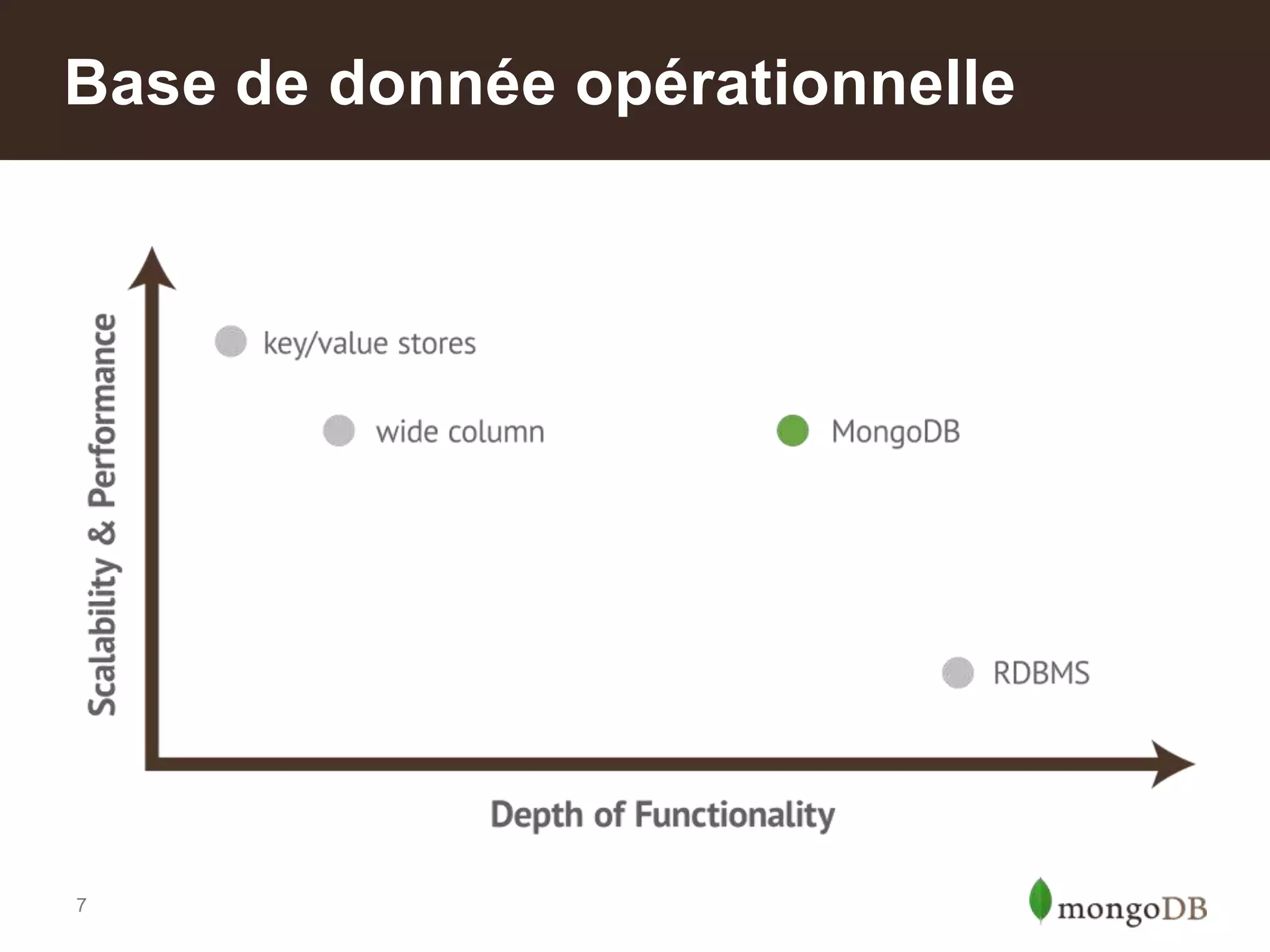
Base de donnée opérationnelle

7
Modèle de donnée Document
Document - Collections
Relationnel - Tables

8

{ first_name: „Paul‟,
surname: „Miller‟,
city: „London‟,
location: {
type: “Point”,
coordinates :
[-0.128, 51.507]
},
cars: [
{ model: „Bentley‟,
year: 1973,
value: 100000, … },
{ model: „Rolls Royce‟,
year: 1965,
value: 330000, … }
]
}
Document Model
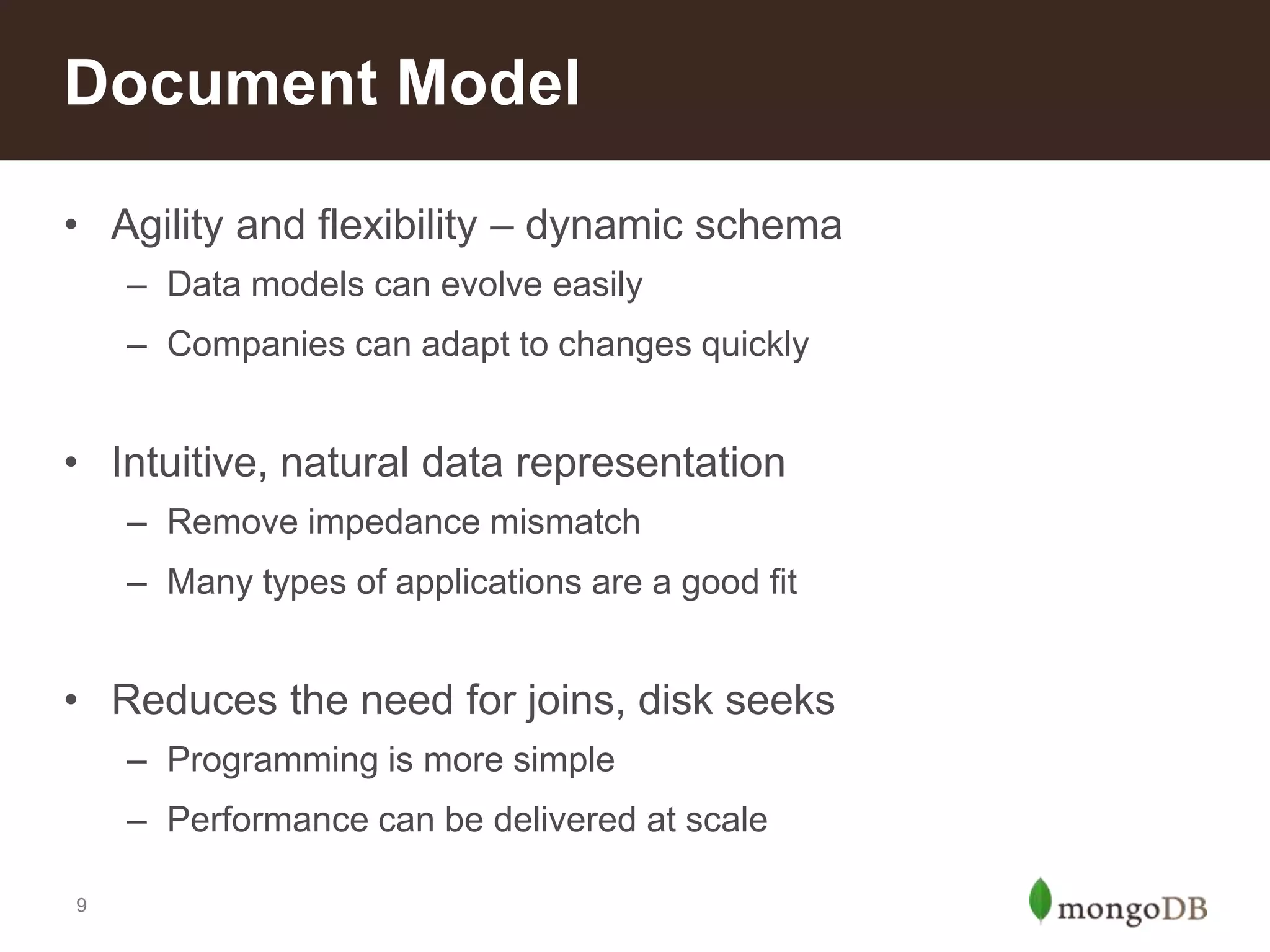
• Agility and flexibility – dynamic schema
– Data models can evolve easily
– Companies can adapt to changes quickly

• Intuitive, natural data representation
– Remove impedance mismatch
– Many types of applications are a good fit

• Reduces the need for joins, disk seeks
– Programming is more simple
– Performance can be delivered at scale
9
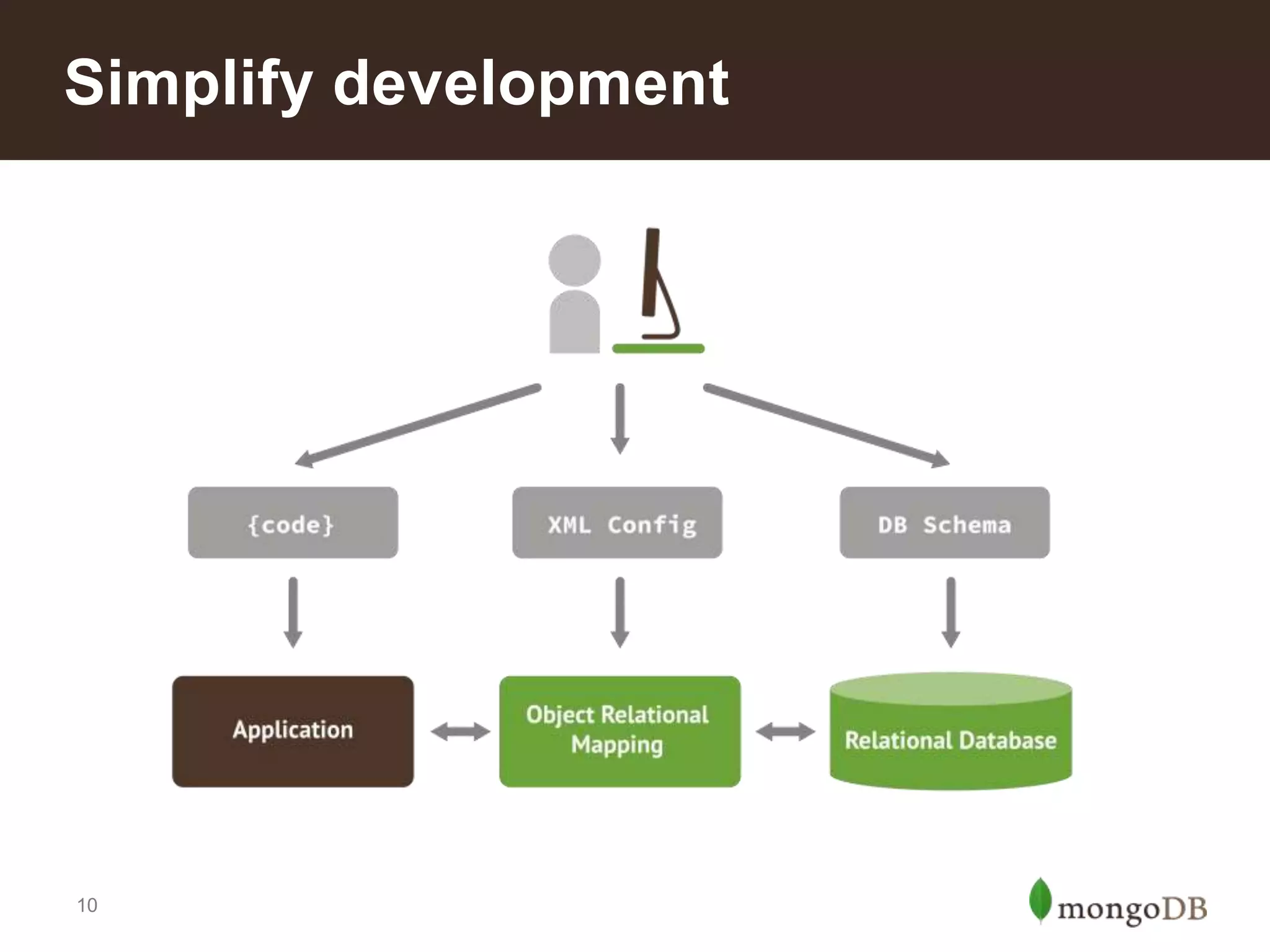
Simplify development

10
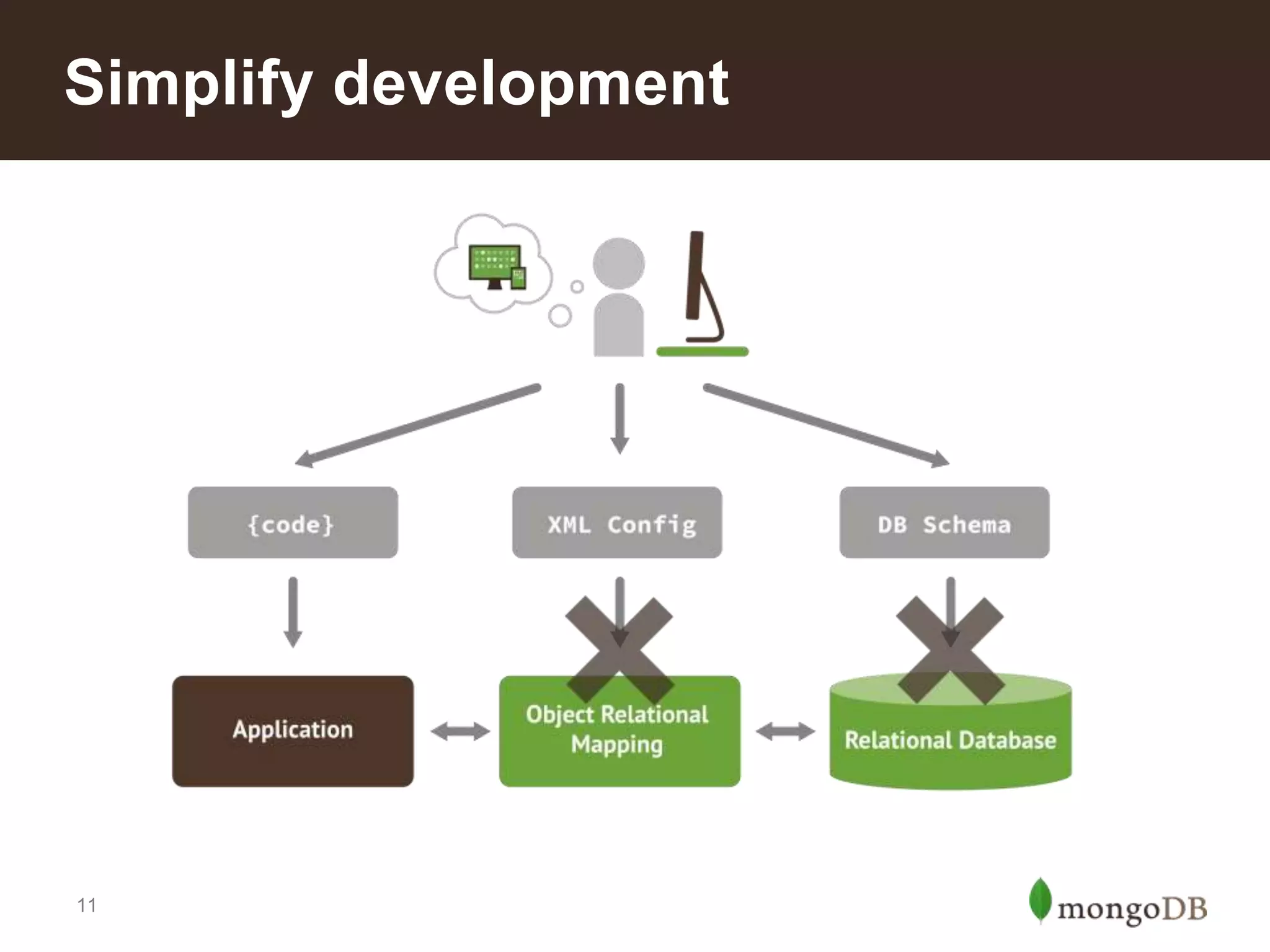
Simplify development

11
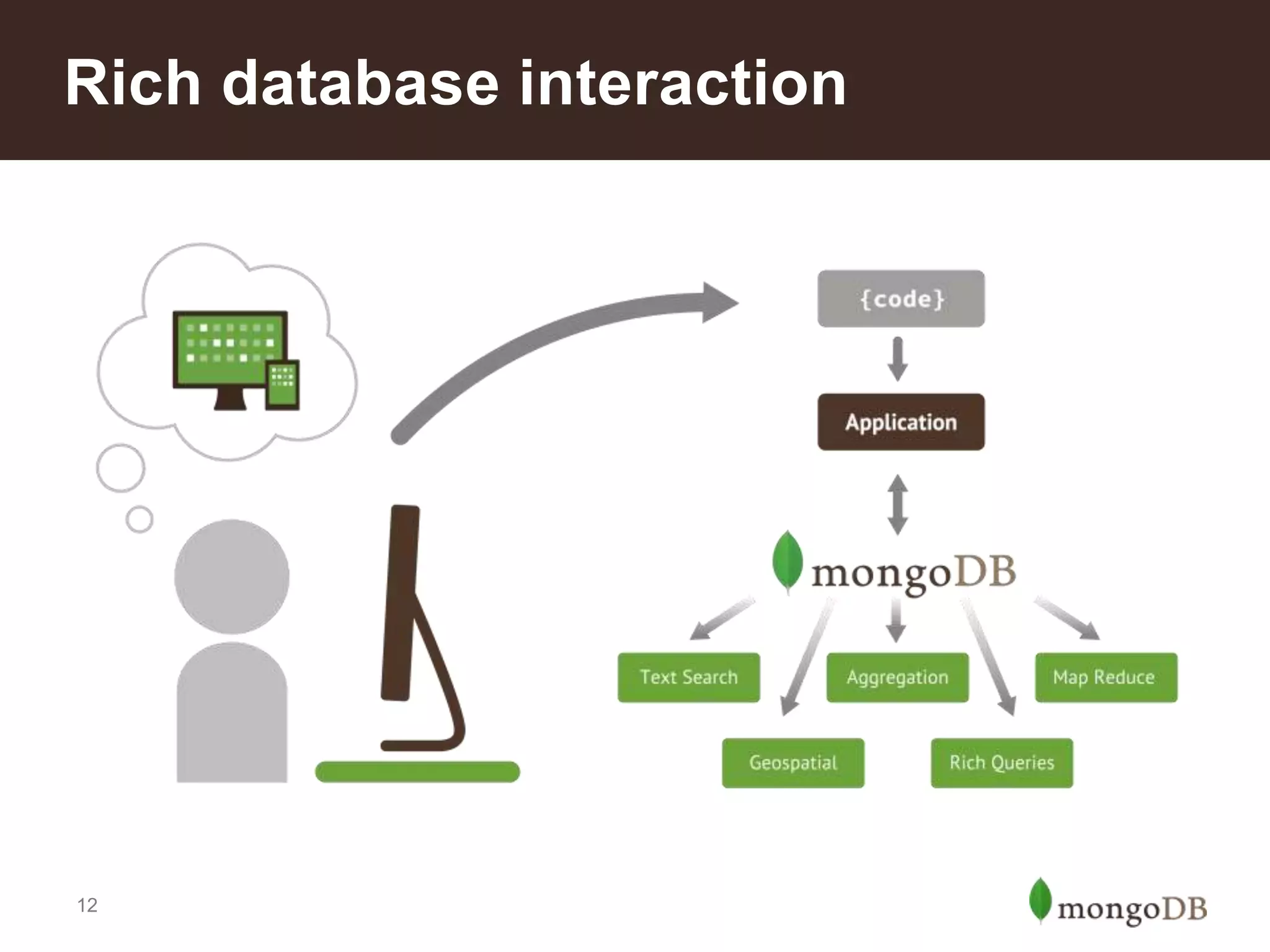
Rich database interaction

12
Query Model
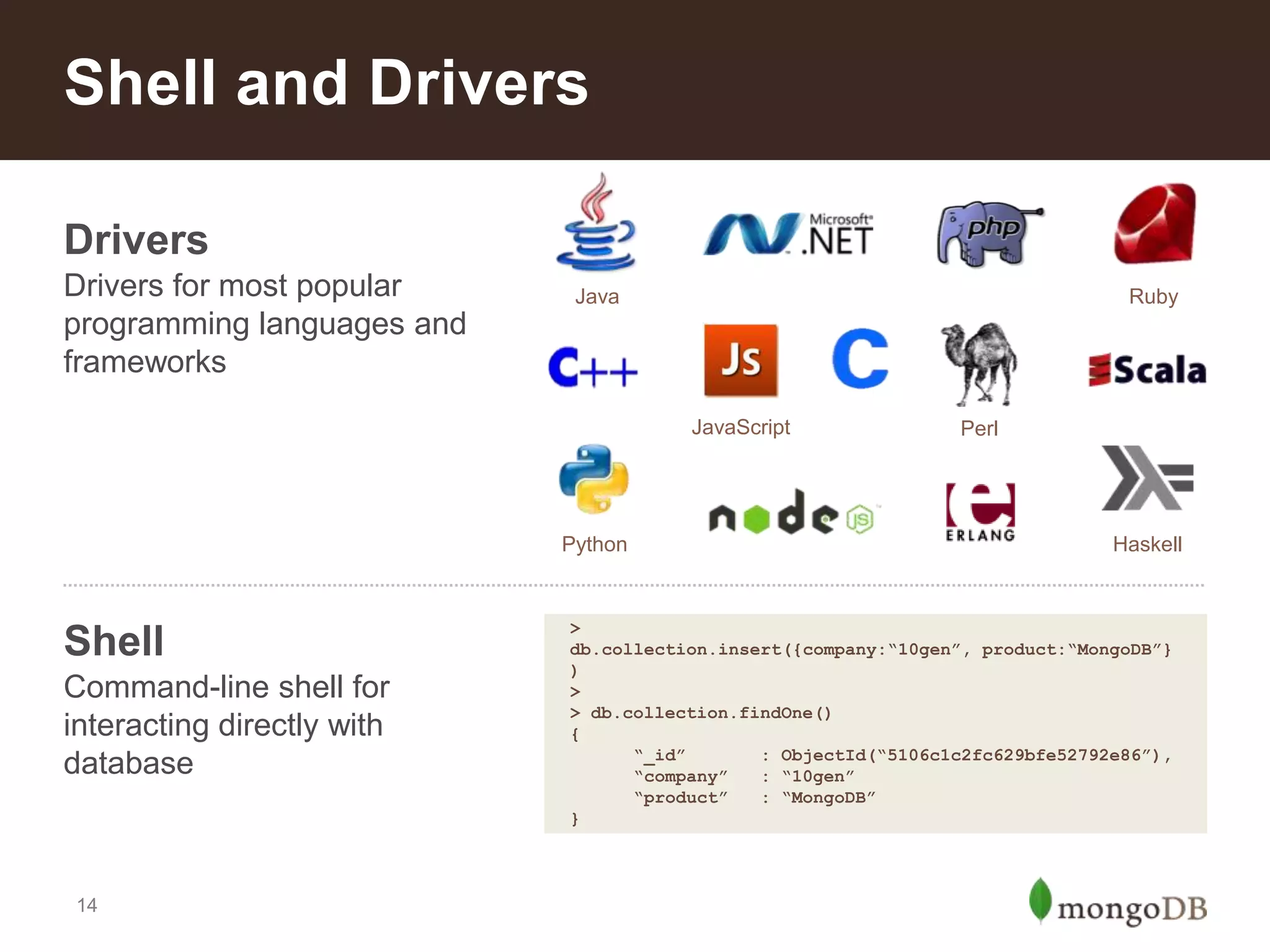
Shell and Drivers
Drivers
Drivers for most popular
programming languages and
frameworks

Java

Ruby

JavaScript

Python

Shell
Command-line shell for
interacting directly with
database

14

Perl

Haskell

>
db.collection.insert({company:“10gen”, product:“MongoDB”}
)
>
> db.collection.findOne()
{
“_id”
: ObjectId(“5106c1c2fc629bfe52792e86”),
“company”
: “10gen”
“product”
: “MongoDB”
}
MongoDB is full featured
Queries

• Find Paul’s cars
• Find everybody in London with a car
built between 1970 and 1980

Geospatial

• Find all of the car owners within 5km of
Trafalgar Sq.

Text Search

• Find all the cars described as having
leather seats

Aggregation

• Calculate the average value of Paul’s
car collection

Map Reduce

• What is the ownership pattern of colors
by geography over time? (is purple
trending up in China?)

15

{ first_name: „Paul‟,
surname: „Miller‟,
city: „London‟,
location: {
type: “Point”,
coordinates :
[-0.128, 51.507]
},
cars: [
{ model: „Bentley‟,
year: 1973,
value: 100000, … },
{ model: „Rolls Royce‟,
year: 1965,
value: 330000, … }
}
}
Query Example
Rich Queries

• Find Paul’s cars
• Find everybody in London with a car
built between 1970 and 1980

db.cars.find({
first_name: „Paul‟
})
db.cars.find({
city: „London‟,
”cars.year" : {
$gte : 1970,
$lte : 1980
}
})

16

{ first_name: „Paul‟,
surname: „Miller‟,
city: „London‟,
location: {
type: “Point”,
coordinates :
[-0.128, 51.507]
},
cars: [
{ model: „Bentley‟,
year: 1973,
value: 100000, … },
{ model: „Rolls Royce‟,
year: 1965,
value: 330000, … }
}
}
Geo Spatial Example
Geospatial

• Find all of the car owners within 5km of
Trafalgar Sq.

db.cars.find( {
location:
{ $near :
{ $geometry :
{
type: 'Point' ,
coordinates :
[-0.128, 51.507]
}
},
$maxDistance :5000
}
})

17

{ first_name: „Paul‟,
surname: „Miller‟,
city: „London‟,
location: {
type: “Point”,
coordinates :
[-0.128, 51.507]
},
cars: [
{ model: „Bentley‟,
year: 1973,
value: 100000, … },
{ model: „Rolls Royce‟,
year: 1965,
value: 330000, … }
}
}
Aggregation Framework Example
Aggregation

• Calculate the average value of Paul’s
car collection

db.cars.aggregate( [
{$match : {"first_name" : "Paul"}},
{$project : {"first_name":1,"cars":1}},
{$unwind : "$cars"},
{ $group : {_id:"$first_name",
average : {
$avg : "$cars.value"}}}
])
{ "_id" : "Paul", "average" : 215000 }

18

{ first_name: „Paul‟,
surname: „Miller‟,
city: „London‟,
location: {
type: “Point”,
coordinates :
[-0.128, 51.507]
},
cars: [
{ model: „Bentley‟,
year: 1973,
value: 100000, … },
{ model: „Rolls Royce‟,
year: 1965,
value: 330000, … }
}
}
Scalability
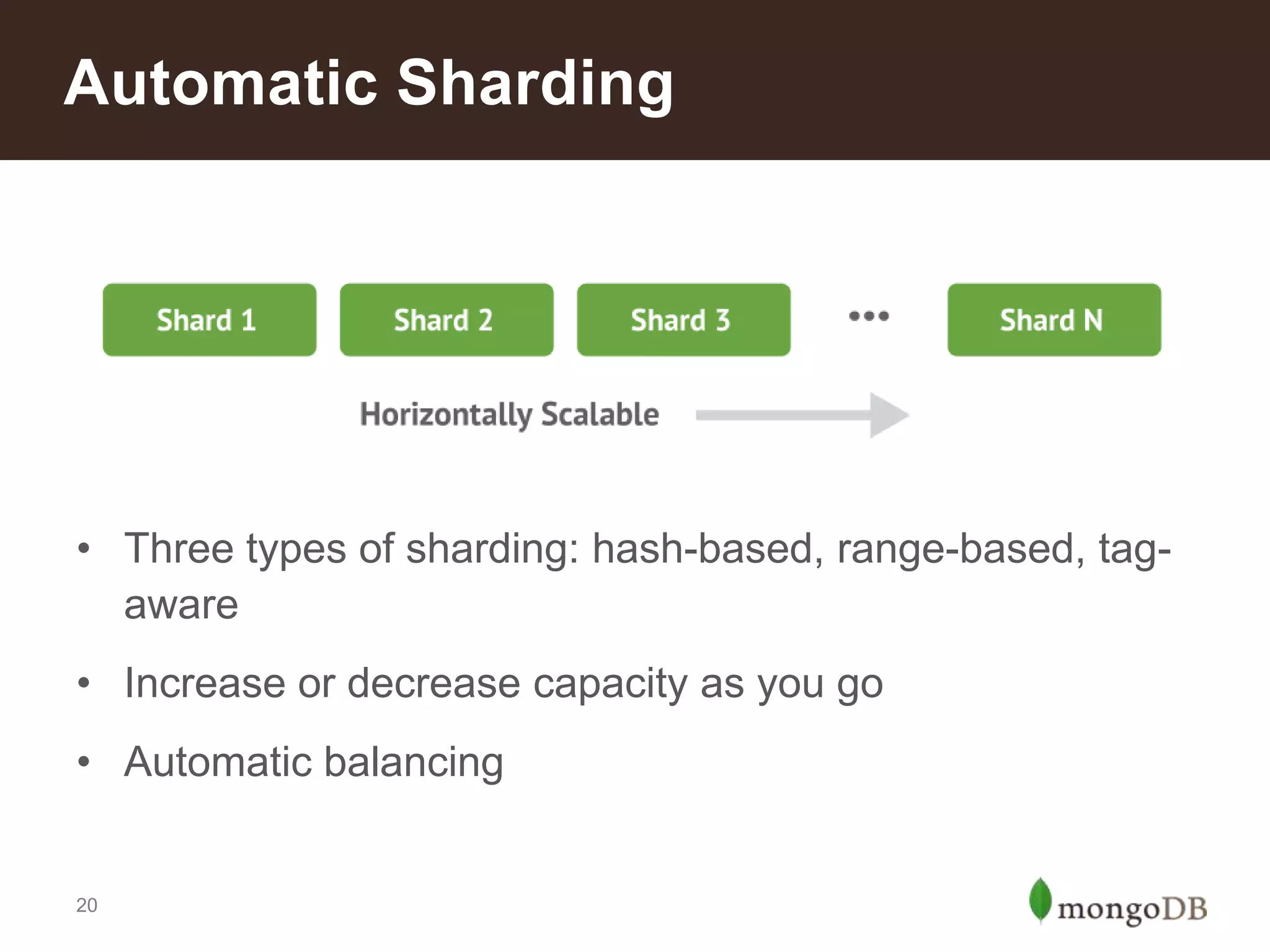
Automatic Sharding

• Three types of sharding: hash-based, range-based, tagaware
• Increase or decrease capacity as you go
• Automatic balancing

20
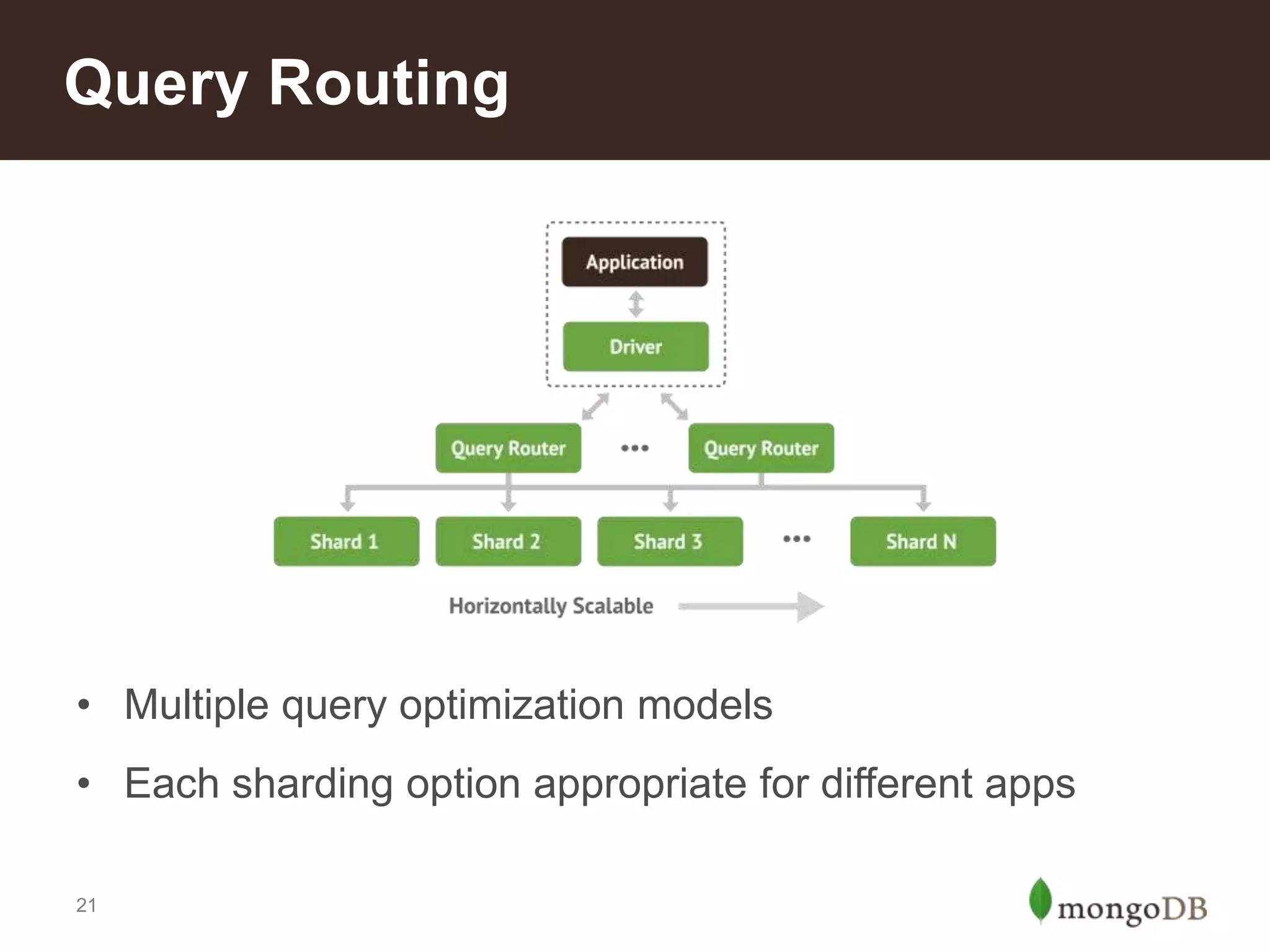
Query Routing

• Multiple query optimization models
• Each sharding option appropriate for different apps
21
Availability
Availability Considerations
• High Availability – Ensure application availability during
many types of failures
• Disaster Recovery – Address the RTO and RPO goals
for business continuity
• Maintenance – Perform upgrades and other maintenance
operations with no application downtime

23
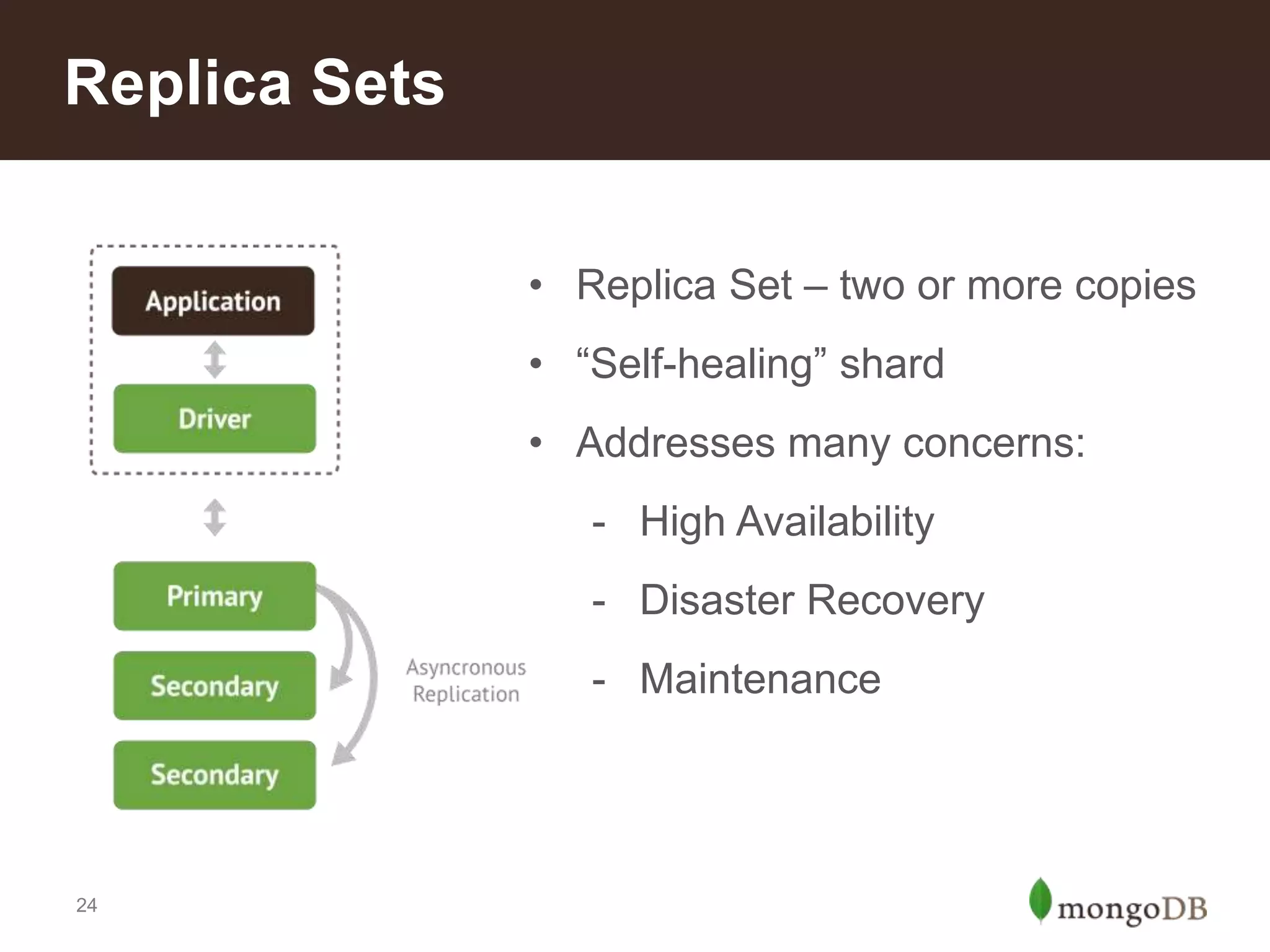
Replica Sets
• Replica Set – two or more copies
• “Self-healing” shard
• Addresses many concerns:
- High Availability
- Disaster Recovery
- Maintenance

24
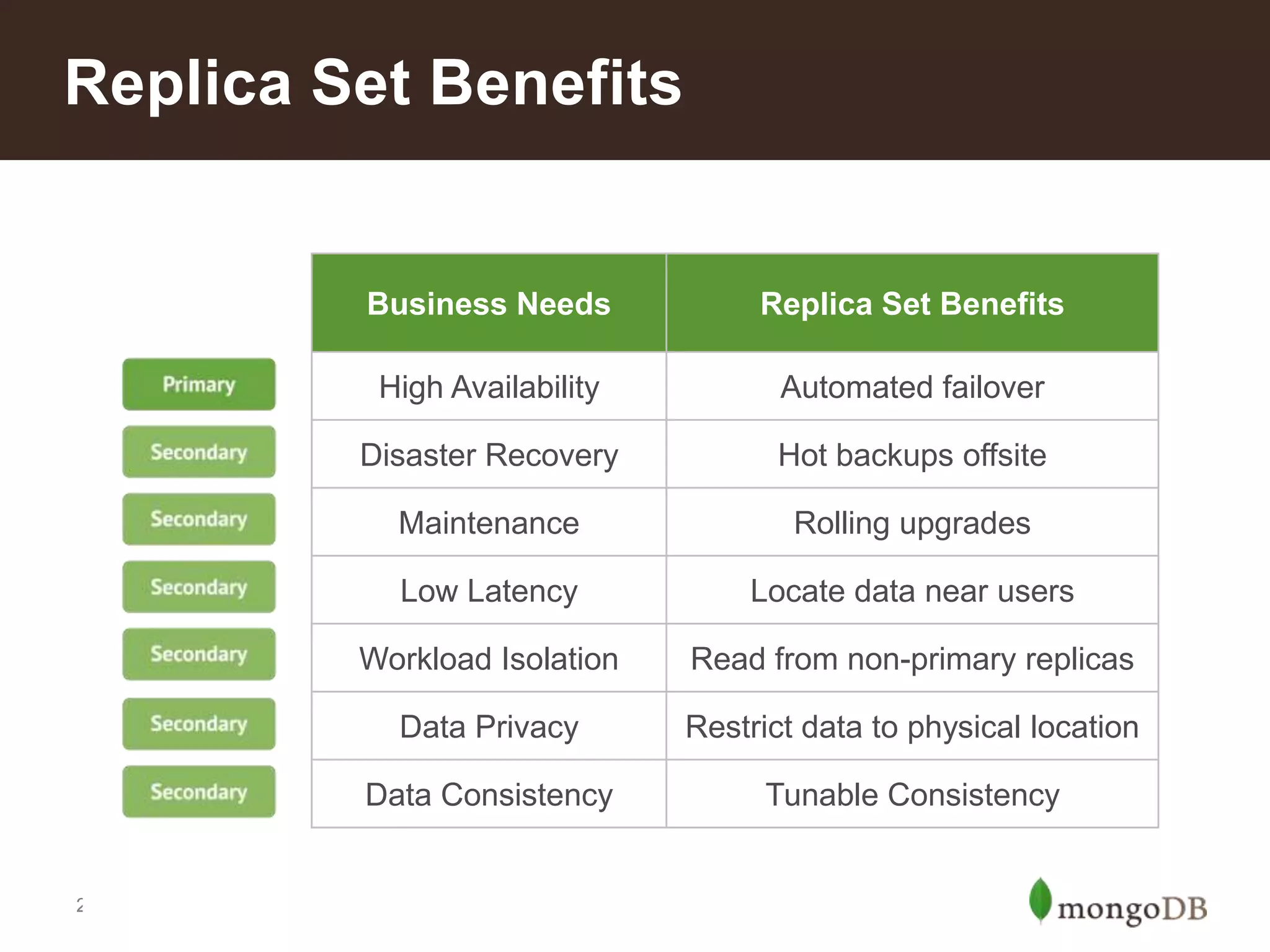
Replica Set Benefits

Business Needs

High Availability

Automated failover

Disaster Recovery

Hot backups offsite

Maintenance

Rolling upgrades

Low Latency

Locate data near users

Workload Isolation

Read from non-primary replicas

Data Privacy

Restrict data to physical location

Data Consistency

25

Replica Set Benefits

Tunable Consistency
Performance
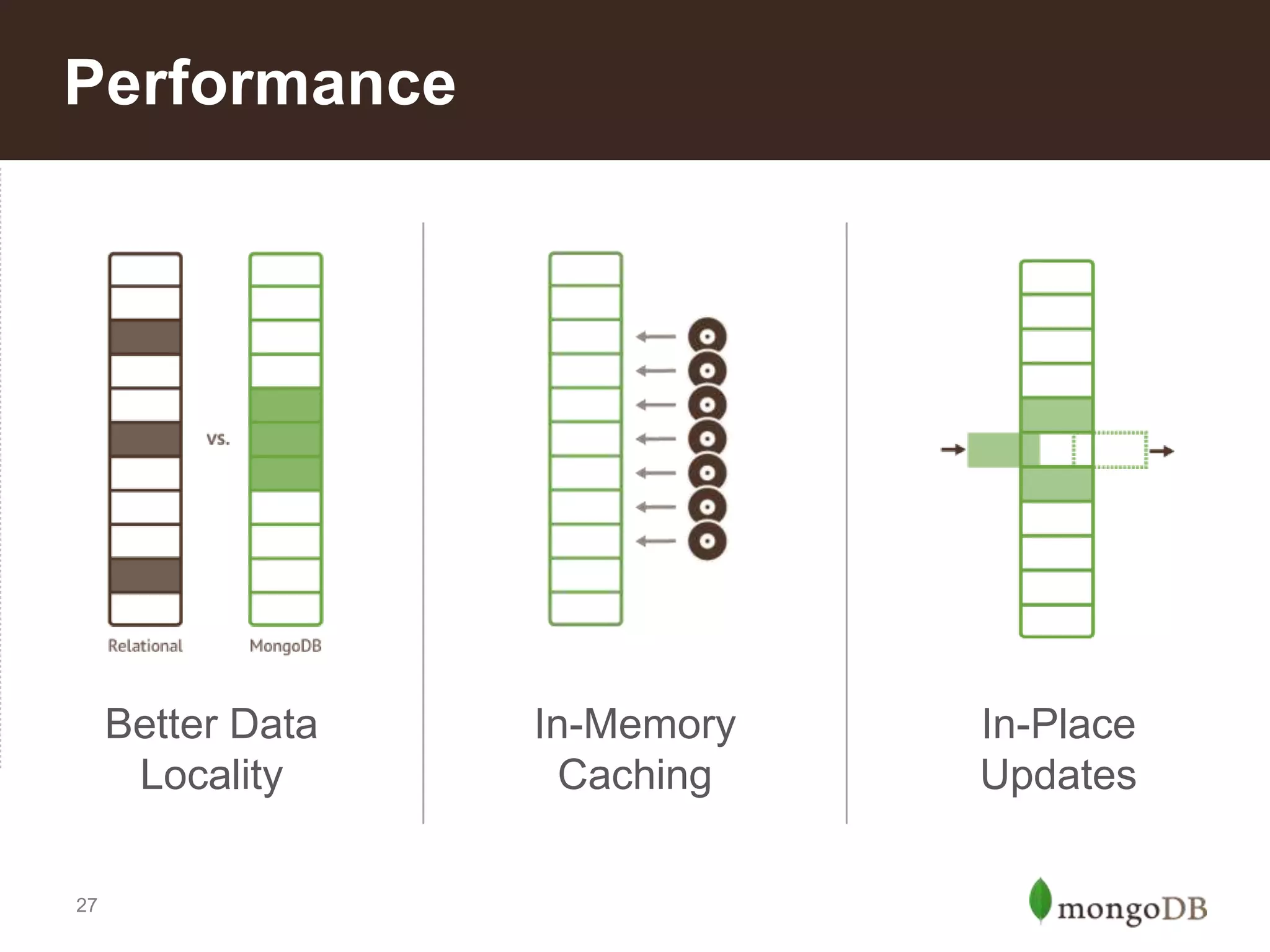
Performance

Better Data
Locality
27

In-Memory
Caching

In-Place
Updates
Conclusion
• Modèle Documentaire
– Simplifie le développement
– Simplifie la montée en charge horizontale (scale out)
– Améliore les performances

• MongoDB
– Base de donnée généraliste
– Haute disponibilité et tolérance aux pannes incluses
– Support de la montée en charge horizontale

28
La Semaine Prochaine – 12 Mars
• Alain Hélaïli & Tugdual Grall
– Schéma de données pour l‟application CMS
• Collections
• Options de conception

– Architecture de l‟application
• Technologies utilisées
• Interface REST
• Nous avons choisi Python pour cette application

– Code Exemple
29
Webinar : Premiers pas avec MongoDB - Back to Basics

Webinar : Premiers pas avec MongoDB - Back to Basics

  • 1.
    Construire une applicationavec MongoDB Introduction à MongoDB Alain Hélaïli @AlainHelaili #MongoDBBasics Tugdual Grall @tgrall
  • 2.
    Introduction • A proposde la série de Webinaires • Modèle de Donnée • Modèle de Requête • Montée en charge (Scalability) • Disponibilité (Availability) • Déploiement • Performances • Prochaine Session 2
  • 3.
    A propos desWebinaires • Série divisée en 2 sections – Développement d‟Applications (4 parties) • • • • Conception/Modèle de données Interactions avec la base: requêtes et mises à jour Indexation Reporting – Opérations/Administration (3 parties) • Déploiement – Montée en charge et haute disponibilité • Monitoring et performance • Sauvegarde et Restauration 3
  • 4.
    Application : Vued’ensemble • Système de Gestion de Contenus – Utilise : • • • • • • Opérateurs de requêtes et mise à jour Framework d‟agrégation Requêtes Géo-spatiales Rapports pré-agrégés Documents polymorphiques Et plus… • Une approche que vous pouvez utiliser dans vos applications 4
  • 5.
    Q&A • Virtual GeniusBar – Utilisez le Chat pour poser vos questions – Réponses au fil de l‟eau et à la fin 5
  • 6.
  • 7.
    Base de donnéeopérationnelle 7
  • 8.
    Modèle de donnéeDocument Document - Collections Relationnel - Tables 8 { first_name: „Paul‟, surname: „Miller‟, city: „London‟, location: { type: “Point”, coordinates : [-0.128, 51.507] }, cars: [ { model: „Bentley‟, year: 1973, value: 100000, … }, { model: „Rolls Royce‟, year: 1965, value: 330000, … } ] }
  • 9.
    Document Model • Agilityand flexibility – dynamic schema – Data models can evolve easily – Companies can adapt to changes quickly • Intuitive, natural data representation – Remove impedance mismatch – Many types of applications are a good fit • Reduces the need for joins, disk seeks – Programming is more simple – Performance can be delivered at scale 9
  • 10.
  • 11.
  • 12.
  • 13.
  • 14.
    Shell and Drivers Drivers Driversfor most popular programming languages and frameworks Java Ruby JavaScript Python Shell Command-line shell for interacting directly with database 14 Perl Haskell > db.collection.insert({company:“10gen”, product:“MongoDB”} ) > > db.collection.findOne() { “_id” : ObjectId(“5106c1c2fc629bfe52792e86”), “company” : “10gen” “product” : “MongoDB” }
  • 15.
    MongoDB is fullfeatured Queries • Find Paul’s cars • Find everybody in London with a car built between 1970 and 1980 Geospatial • Find all of the car owners within 5km of Trafalgar Sq. Text Search • Find all the cars described as having leather seats Aggregation • Calculate the average value of Paul’s car collection Map Reduce • What is the ownership pattern of colors by geography over time? (is purple trending up in China?) 15 { first_name: „Paul‟, surname: „Miller‟, city: „London‟, location: { type: “Point”, coordinates : [-0.128, 51.507] }, cars: [ { model: „Bentley‟, year: 1973, value: 100000, … }, { model: „Rolls Royce‟, year: 1965, value: 330000, … } } }
  • 16.
    Query Example Rich Queries •Find Paul’s cars • Find everybody in London with a car built between 1970 and 1980 db.cars.find({ first_name: „Paul‟ }) db.cars.find({ city: „London‟, ”cars.year" : { $gte : 1970, $lte : 1980 } }) 16 { first_name: „Paul‟, surname: „Miller‟, city: „London‟, location: { type: “Point”, coordinates : [-0.128, 51.507] }, cars: [ { model: „Bentley‟, year: 1973, value: 100000, … }, { model: „Rolls Royce‟, year: 1965, value: 330000, … } } }
  • 17.
    Geo Spatial Example Geospatial •Find all of the car owners within 5km of Trafalgar Sq. db.cars.find( { location: { $near : { $geometry : { type: 'Point' , coordinates : [-0.128, 51.507] } }, $maxDistance :5000 } }) 17 { first_name: „Paul‟, surname: „Miller‟, city: „London‟, location: { type: “Point”, coordinates : [-0.128, 51.507] }, cars: [ { model: „Bentley‟, year: 1973, value: 100000, … }, { model: „Rolls Royce‟, year: 1965, value: 330000, … } } }
  • 18.
    Aggregation Framework Example Aggregation •Calculate the average value of Paul’s car collection db.cars.aggregate( [ {$match : {"first_name" : "Paul"}}, {$project : {"first_name":1,"cars":1}}, {$unwind : "$cars"}, { $group : {_id:"$first_name", average : { $avg : "$cars.value"}}} ]) { "_id" : "Paul", "average" : 215000 } 18 { first_name: „Paul‟, surname: „Miller‟, city: „London‟, location: { type: “Point”, coordinates : [-0.128, 51.507] }, cars: [ { model: „Bentley‟, year: 1973, value: 100000, … }, { model: „Rolls Royce‟, year: 1965, value: 330000, … } } }
  • 19.
  • 20.
    Automatic Sharding • Threetypes of sharding: hash-based, range-based, tagaware • Increase or decrease capacity as you go • Automatic balancing 20
  • 21.
    Query Routing • Multiplequery optimization models • Each sharding option appropriate for different apps 21
  • 22.
  • 23.
    Availability Considerations • HighAvailability – Ensure application availability during many types of failures • Disaster Recovery – Address the RTO and RPO goals for business continuity • Maintenance – Perform upgrades and other maintenance operations with no application downtime 23
  • 24.
    Replica Sets • ReplicaSet – two or more copies • “Self-healing” shard • Addresses many concerns: - High Availability - Disaster Recovery - Maintenance 24
  • 25.
    Replica Set Benefits BusinessNeeds High Availability Automated failover Disaster Recovery Hot backups offsite Maintenance Rolling upgrades Low Latency Locate data near users Workload Isolation Read from non-primary replicas Data Privacy Restrict data to physical location Data Consistency 25 Replica Set Benefits Tunable Consistency
  • 26.
  • 27.
  • 28.
    Conclusion • Modèle Documentaire –Simplifie le développement – Simplifie la montée en charge horizontale (scale out) – Améliore les performances • MongoDB – Base de donnée généraliste – Haute disponibilité et tolérance aux pannes incluses – Support de la montée en charge horizontale 28
  • 29.
    La Semaine Prochaine– 12 Mars • Alain Hélaïli & Tugdual Grall – Schéma de données pour l‟application CMS • Collections • Options de conception – Architecture de l‟application • Technologies utilisées • Interface REST • Nous avons choisi Python pour cette application – Code Exemple 29