2013 Annual Report
Powering Ancillary Revenue for the
Global Passenger Travel Industry
www.guestlogix.com
Our growth strategy is rooted in processing
ancillary transactions within more travel
verticals, through more access points and
more touch points within the travel journey
and with broader, more dynamic content
to create sustainable ancillary revenue
streams for our customers.
Forward-Looking Statements
The information set forth in this document includes certain forward-looking statements that are based upon current expectations, which involve risks
and uncertainties associated with GuestLogix’ business and the environment in which the business operates. Any statements contained herein that
are not statements of historical facts may be deemed to be forward-looking, including those identified by the expressions “anticipate”, “believe”,
“plan”, “estimate”, “expect”, “intend”, and similar expressions to the extent they relate to the Company or its management. The forward-looking
statements are not historical facts, but reflect GuestLogix’ current expectations regarding future results or events. These forward-looking statements
are subject to a number of risks and uncertainties that could cause actual results or events to differ materially from current expectations, including the
matters discussed under “Risks and Uncertainties” in the Filing Statement filed on May 12, 2014 with the regulatory authorities. GuestLogix assumes
no obligation to update the forward-looking statements, or to update the reasons why actual results could differ from those reflected in the forward-
looking statements.
© 2014 GuestLogix Inc.
Letter From Your CEO: Transitioning to a Better Version of Ourselves
GuestLogix: By the Numbers
Financial Highlights
GuestLogix Leadership
User Group Heads Overseas
A New Look for a New Approach
Global Partnerships
A Look into Our Industry
Ancillaries in Travel: At the Height of Importance
Broadening Horizons: GuestLogix’ Growth Strategy
Shareholder Information
Management’s Discussion & Analysis
Financial Statements
Contents
4
6
8
10
11
12
13
16
18
20
22
24
58
4 / 2013 GuestLogix Annual Report
My Fellow Shareholders,
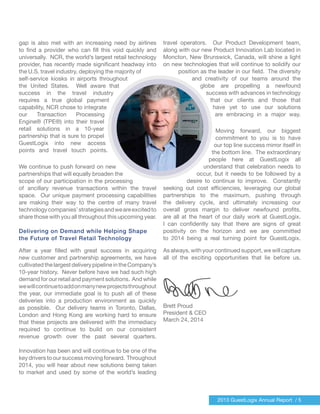
This was a year of significant change. When you
have had great success as a company – carving
out a niche, rapidly gaining market share, servicing
a growing industry and becoming a clear leader
in your field – continuing to do what we have
always done has poignantly become the inverse
to what was needed this past year at GuestLogix.
In all areas of life, change is often met with some
resistance, a bit of excitement, a lot of mystery –
but it has proven to be the cornerstone to a major
rejuvenation within GuestLogix. I could not be more
proud of how our global team has worked to remain
consistent in executing on our strengths and yet has
been equally successful in embracing evolution in
order for us to regain momentum over the past year.
It gives me great pleasure to be able to say that we are
back on a path of real growth. In 2013, we achieved
four consecutive quarters of revenue growth and
closed the year with a 28% year-over-year revenue
growth rate. We enter 2014 with the strongest balance
sheet and cash position that GuestLogix has achieved
since going public in 2007. The progress we have
made is rooted in our global team’s understanding
that in order to reshape our competitive advantage,
we must translate everything that what we’ve
achieved over the past year into sustained actions.
Along with our continued effort to grow our core
business of deploying flight attendant-driven retail
technologyonboardtheworld’slargesttraveloperators,
2013wastheyearthatwebegantoexpandourfocusand
move to a more holistic retail and payment approach.
As traditional retail technology has done throughout
recent history, GuestLogix is now being looked at to
open up new retail channels within the travel market
and deliver a single, certified solution to monetize all
travel touch points. This holistic retailing approach
required a holistic change within our business – one
that was met with great success throughout the year.
“Our global partnerships are allowing us to move
from being solely a hardware-based transaction
processor to more and more of a software-based
transaction processor, which will deliver greater
margins and ultimately higher shareholder value.”
- Brett Proud
Transitioning to a Better Version of Ourselves
As we enter this new era of broader reach across the
travel industry, we have chosen to not go it alone.
Partnerships are, and will remain, key to our
growth efforts and a new level of success within
the ancillary revenue market as a whole. At the
core of our business is the confidence that our
ability to support ancillary transactions across the
global passenger travel industry gives us a key
market differentiator that has been substantiated
by exceptional, long-term partnership deals.
Within the onboard space, we are seeing the desire
for airlines to put retail control into the hands of
passengers. Similar to the self-service trends seen in
traditional retail, providing the option for passenger’s
to choose to control their retail experience, is the key to
achieving sustainable growth in onboard ancillaries as
well as a heightened quality of passenger experience.
Long-term partnerships with inflight entertainment
and connectivity leaders Panasonic Avionics,
Thales Avionics and Global Eagle Entertainment, are
showing strong evidence that airlines are committed
to making the shift to self-service retailing in the air.
Our global partnerships are allowing us to move
from being solely a hardware-based transaction
processor to more and more of a software-based
transaction processor, which will deliver greater
margins and ultimately higher shareholder value.
Beyond the onboard space, there has been a large gap
in the market for a technology company to provide a
single platform for the management and distribution
of ancillaries across the entire travel journey. This
Letter From Your CEO
The most dangerous phrase in the language is, “But we’ve always done it this way.” – Grace Hopper
2013 GuestLogix Annual Report / 5
gap is also met with an increasing need by airlines
to find a provider who can fill this void quickly and
universally. NCR, the world’s largest retail technology
provider, has recently made significant headway into
the U.S. travel industry, deploying the majority of
self-service kiosks in airports throughout
the United States. Well aware that
success in the travel industry
requires a true global payment
capability, NCR chose to integrate
our Transaction Processing
Engine® (TPE®) into their travel
retail solutions in a 10-year
partnership that is sure to propel
GuestLogix into new access
points and travel touch points.
We continue to push forward on new
partnerships that will equally broaden the
scope of our participation in the processing
of ancillary revenue transactions within the travel
space. Our unique payment processing capabilities
are making their way to the centre of many travel
technologycompanies’strategiesandweareexcitedto
share those with you all throughout this upcoming year.
Delivering on Demand while Helping Shape
the Future of Travel Retail Technology
After a year filled with great success in acquiring
new customer and partnership agreements, we have
cultivatedthelargestdeliverypipelineintheCompany’s
10-year history. Never before have we had such high
demand for our retail and payment solutions. And while
wewillcontinuetoaddonmanynewprojectsthroughout
the year, our immediate goal is to push all of these
deliveries into a production environment as quickly
as possible. Our delivery teams in Toronto, Dallas,
London and Hong Kong are working hard to ensure
that these projects are delivered with the immediacy
required to continue to build on our consistent
revenue growth over the past several quarters.
Innovation has been and will continue to be one of the
keydriverstooursuccessmovingforward. Throughout
2014, you will hear about new solutions being taken
to market and used by some of the world’s leading
travel operators. Our Product Development team,
along with our new Product Innovation Lab located in
Moncton, New Brunswick, Canada, will shine a light
on new technologies that will continue to solidify our
position as the leader in our field. The diversity
and creativity of our teams around the
globe are propelling a newfound
success with advances in technology
that our clients and those that
have yet to use our solutions
are embracing in a major way.
Moving forward, our biggest
commitment to you is to have
our top line success mirror itself in
the bottom line. The extraordinary
people here at GuestLogix all
understand that celebration needs to
occur, but it needs to be followed by a
desire to continue to improve. Constantly
seeking out cost efficiencies, leveraging our global
partnerships to the maximum, pushing through
the delivery cycle, and ultimately increasing our
overall gross margin to deliver newfound profits,
are all at the heart of our daily work at GuestLogix.
I can confidently say that there are signs of great
positivity on the horizon and we are committed
to 2014 being a real turning point for GuestLogix.
As always, with your continued support, we will capture
all of the exciting opportunities that lie before us.
Brett Proud
President & CEO
March 24, 2014
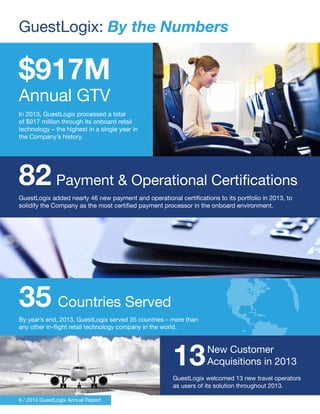
$917M
Annual GTV
In 2013, GuestLogix processed a total
of $917 million through its onboard retail
technology – the highest in a single year in
the Company’s history.
13
GuestLogix welcomed 13 new travel operators
as users of its solution throughout 2013.
82 Payment & Operational Certifications
GuestLogix added nearly 46 new payment and operational certifications to its portfolio in 2013, to
solidify the Company as the most certified payment processor in the onboard environment.
New Customer
Acquisitions in 2013
35 Countries Served
By year’s end, 2013, GuestLogix served 35 countries – more than
any other in-flight retail technology company in the world.
6 / 2013 GuestLogix Annual Report
GuestLogix: By the Numbers
+28%
GuestLogix Year-over-Year Growth in
Normalized Revenue
+39%
Growth in Market Capitalization
throughout 2013
85.7%
Year-over-Year Growth in
Software-Based Transactions
+107%	
GuestLogix Year-over-Year Growth in
Normalized EBITDA
2013 GuestLogix Annual Report / 7
Financial Highlights
8 / 2013 GuestLogix Annual Report
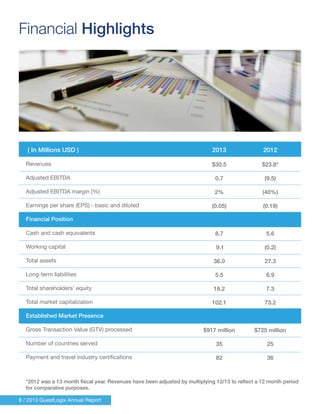
( In Millions USD )
Revenues
Adjusted EBITDA
Adjusted EBITDA margin (%)
Earnings per share (EPS) - basic and diluted
Financial Position
Cash and cash equivalents
Working capital
Total assets
Long-term liabilities
Total shareholders’ equity
Total market capitalization
Established Market Presence
Gross Transaction Value (GTV) processed
Number of countries served
Payment and travel industry certifications
2013
$30.5
0.7
2%
(0.05)
8.7
9.1
36.0
5.5
18.2
102.1
$917 million
35
82
2012
$23.8*
(9.5)
(40%)
(0.19)
5.6
(0.2)
27.3
6.9
7.3
73.2
$725 million
25
36
*2012 was a 13 month fiscal year. Revenues have been adjusted by multiplying 12/13 to reflect a 12 month period
for comparative purposes.
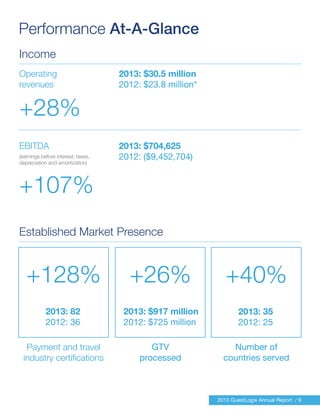
Performance At-A-Glance
Income
Established Market Presence
2013 GuestLogix Annual Report / 9
Operating
revenues
+28%
EBITDA
(earnings before interest, taxes,
depreciation and amortization)
+107%
2013: $30.5 million
2012: $23.8 million*
2013: $704,625
2012: ($9,452,704)
+40%
2013: 35
2012: 25
+26%
2013: $917 million
2012: $725 million
Number of
countries served
GTV
processed
+128%
2013: 82
2012: 36
Payment and travel
industry certifications
Leo Desrochersabc
Chairman of the Board
Mr. Desrochers brings more than 30 years
of airline and travel experience, and is a
former executive at Air Canada having
served as its EVP, Chief Operating Officer
and Chief Financial Officer.
a
Member of Audit Committee
b
Member of Compensation Committee
c
Member of Governance Committee
d
Member of Nomination Committee
Brett Proudd
Director
Mr. Proud is currently President & CEO of
GuestLogix Inc. Previously holding other
executive positions within GuestLogix as
well as Accenture, Mastech and Keane.
Jamie Halegouaabc
Director
Mr. Halegoua brings over 15 years of
financial and investment experience
currently serving as a portfolio manager
for Delaware Street Capital.
Resigned March 2014.
Ralph Richardiabc
Director
Mr. Richardi is a former executive at
American Airlines. Most recently, he led
the airline’s North American customer
service operations and Global Cargo
Division worldwide.
Tom Douramakoscd
Director
Mr. Douramakos co-founded and served
as President & CEO of GuestLogix
from 2002—2012. He also served as
Chairman of the Board from 2007—2012.
Chris Gardnerd
Director
Mr. Gardner brings more than 15 years
experience in business development and
the financial markets having been a portfolio
manager at B. Riley & Co, as well as
becoming a CFA charter holder in 2001.
10 / 2013 GuestLogix Annual Report
GuestLogix Leadership
Senior Management
Brett Proud
President & CEO
Patrick Leung
Chief Financial Officer
Patrick O’Neill
EVP, Global Operations
Ilia Kostov
EVP, Global Sales & Product Strategy
Andy Archer
SVP & GM, GuestLogix EMEA
Chris Gardner
SVP, Corporate Development
Craig Proud
SVP, Solution Architecture & Technology
Dan Thompson
SVP, Global Strategy & Investor Relations
David Leitch
SVP & GM, GuestLogix Asia Pacific
Kamal Singhee
SVP & GM, GuestLogix Americas
Keith Neville
SVP, Product Management & Sales Support
Nancy Love
SVP, Global Merchandising
Peter Nguyen
SVP, Legal Affairs & General Counsel
Ramez Hanna
SVP, Product Development
Robert Illston
SVP, Global Retail Operations
Steve Kuzmaski
SVP, Human Capital
Thomas Drohan
SVP & GM, Global Rail Division
2013 GuestLogix Annual Report / 11
Over 150 delegates descended upon the United Kingdom for the
5th Annual User Group Conference on October 3, 2014. Having
held the event for four consecutive years in Toronto, this was a
major accomplishment for GuestLogix and afforded customers
from Europe and the Middle East with some added convenience
to attend the conference. Remarkably, GuestLogix also saw the
highest attendance from other regions, including North America,
at the event.
Delegates were hosted at London’s Millennium Gloucester Hotel
for two full days of guest speakers, dozens of breakout sessions
and a gala event that took each attendee on a tour of London’s
biggest attractions and an evening of fine food and music.
Guest speakers included senior management from Thales
Avionics, NCR, Inflight Sales Group in Hong Kong and innovation
expert, Tim Dunne. Attendees responded overwhelmingly to the
value of this year’s conference, and GuestLogix is thrilled that the
event remains a vital part of enhancing the world’s top airline and
rail operators’ in-flight retail initiatives.
“Choosing to move the conference overseas was the absolute
right decision for this year’s conference,” said Dan Thompson,
SVP Marketing, Communications & Investor Relations.
“Providing a forum that cultivates true innovation and creativity
among those that normally are focused on competing in the same
space is something that we are proud to be able to facilitate
each year. It is a key component to evolving this industry and
provides immeasurable benefit to each and every organization
that participates.”
GuestLogix will continue to seek out new and exciting cities to
host its event every year.
(L – R) Manager of Events & Communications, Katie Kelly; SVP, Marketing & Communications, Dan
Thompson; President & CEO, Brett Proud; Canadian High Commission UK, Sanjay Purhoit.
Over 150 delegates congregate in the General Session in the Millenium Hotel ballroom to hear from
four guest speakers and GuestLogix executive management team throughout the two-day event.
Alaska Airlines beats out more than 80 travel operators to win the POSie Award for Highest
Revenue per Passenger for a Buy on Board program – this was Alaska’s 4th POSie award.
Delegates get a hands-on tour of GuestLogix’ Ancillary Insights™ platform – the industry’s only
comprehensive business intelligence platform designed for ancillary revenue performance management.
After 4 Years in Toronto, GuestLogix User
Group Moved Across the Pond to London, UK
12 / 2013 GuestLogix Annual Report
Company gives nod to past
while illustrating capabilities
across complete travel cycle and
providing focus for analytics,
merchandising and consultancy
business areas
Recently, GuestLogix unveiled new brand assets including new
logos, tagline, website and other communication tools to support
its growth efforts and reflect its broadened ability to support the
end-to-end travel experience. Along with a new corporate look,
the Company will adopt Powering Ancillary Revenue™ as its
tagline. The Company’s new website is now available at
www.guestlogix.com or by inputting the Company’s stock ticker
(gxi.to) into any browser.
“As a Company, we hold strong pride in our past, but are sharply
focused on the opportunities that lie before us. Our strategy
remains firm that GuestLogix’ ability to serve the passenger travel
industry goes well beyond the cabin,” said Brett Proud, President
& CEO of GuestLogix. “Our position as the clear market leader
in processing payments onboard continues to provide a solid
foundation for the business and will remain a strong focus at
GuestLogix. Moving forward, we are being called upon to play a
more holistic payments role in the retail efforts of the passenger
travel industry and these new brand assets and business units
signal that expansion.”
GuestLogix has spent the past 18 months working directly with
travel operators and building long-term global partnerships to
identify the advancing retailing needs within the passenger travel
industry. The Company has successfully positioned itself to be
the payment processor of choice through a variety of new access
points and touch points such as in-flight entertainment systems,
kiosks in the airport, retail solutions in airport lounges, and mobile
solutions at multiple touch points. As the travel retail industry
continues to mature, GuestLogix is shaping the way that travel
operators are able to interact and transact with their passengers.
“There has never been a moment in time when travel and retail
have been at more of a convergence than right now, and the
goal is to elevate the core attributes of the GuestLogix brand to
convey our extensive ability to serve the travel retail market,”
said Dan Thompson, SVP Marketing, Communications &
Investor Relations. “We are taking the steps to strengthen and
modernise how we represent ourselves in markets around the
world. Our clients, partners, employees and shareholders should
expect much more dynamic, interactive content and increased
accessibility to information as we continue to build out our new
website and new communication tools.”
As part of the Company’s rebrand, it has established three
distinct sub-brands to operate as concentrated business units
that cater to the key focus areas of travel operators and that
hold significant growth opportunities for the Company. These
units and offerings provide substantial market differentiators
and leverage GuestLogix’ unique industry expertise. Along
with the Company’s cornerstone solutions, its TPE®
and Global
Payment Gateway™, GuestLogix is now poised to drive increased
performance for itself and its customers.
Ancillary Insights™
The Ancillary Insights™ brand will encompass all elements of
GuestLogix’ Business Intelligence unit including its Analytics
platform and syndicated data initiatives. Ancillary Insights™
holds one of the most lucrative components of the GuestLogix
solution with its comprehensive business intelligence platform.
The Ancillary Insights™ division will expand its scope beyond
the onboard environment as it has been designed and developed
to provide a holistic view across a travel operator’s entire retail
program at all touchpoints in the travel journey.
OnTouch® Destination Merchandising
Though not a new brand to GuestLogix, the destination
merchandising unit has been given an update to give increased
focus on this growing part of the business. GuestLogix
now has active clients selling destination content via Flight
Attendants onboard the aircraft, onboard rail cars as well as at
off board touchpoints throughout the travel journey. Additional
deployments, including those through GuestLogix’ in-flight
entertainment partners, are expected throughout 2014. Now with
multiple access points and at multiple touchpoints, OnTouch®
Destination Merchandising is poised to drive strong growth in the
Company’s near-term results.
Travel RPM™ (Retail Performance Management)
The industry as a whole has indicated it is now ready to take their
current retail performance to the next level. As the industry’s
leader in onboard retail technology, GuestLogix is now able to
significantly leverage its expertise and employ best practices
found within the most extensive and diversified client base in the
industry. The division will offer a variety of consulting services
including on-site assessments in the areas of operational
processes, retail modeling and product benchmarking.
a new look for a new approach
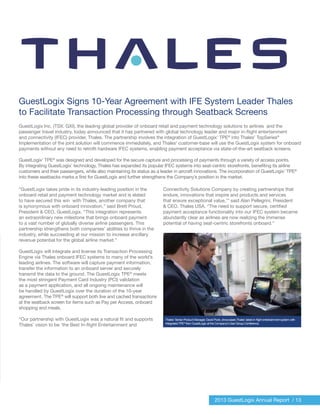
Thales’ Senior Product Manager, David Pook, showcases Thales’ latest in-flight entertainment system with
integrated TPE®
from GuestLogix at the Company’s User Group Conference.
2013 GuestLogix Annual Report / 13
GuestLogix Signs 10-Year Agreement with IFE System Leader Thales
to Facilitate Transaction Processing through Seatback Screens
GuestLogix Inc. (TSX: GXI), the leading global provider of onboard retail and payment technology solutions to airlines and the
passenger travel industry, today announced that it has partnered with global technology leader and major in-flight entertainment
and connectivity (IFEC) provider, Thales. The partnership involves the integration of GuestLogix’ TPE®
into Thales’ TopSeries®
Implementation of the joint solution will commence immediately, and Thales’ customer-base will use the GuestLogix system for onboard
payments without any need to retrofit hardware IFEC systems, enabling payment acceptance via state-of-the-art seatback screens.
GuestLogix’ TPE®
was designed and developed for the secure capture and processing of payments through a variety of access points.
By integrating GuestLogix’ technology, Thales has expanded its popular IFEC systems into seat-centric storefronts, benefiting its airline
customers and their passengers, while also maintaining its status as a leader in aircraft innovations. The incorporation of GuestLogix’ TPE®
into these seatbacks marks a first for GuestLogix and further strengthens the Company’s position in the market.
“GuestLogix takes pride in its industry-leading position in the
onboard retail and payment technology market and is elated
to have secured this win with Thales, another company that
is synonymous with onboard innovation,” said Brett Proud,
President & CEO, GuestLogix. “This integration represents
an extraordinary new milestone that brings onboard payment
to a vast number of globally diverse airline passengers. This
partnership strengthens both companies’ abilities to thrive in the
industry, while succeeding at our mission to increase ancillary
revenue potential for the global airline market.”
GuestLogix will integrate and license its Transaction Processing
Engine via Thales onboard IFEC systems to many of the world’s
leading airlines. The software will capture payment information,
transfer the information to an onboard server and securely
transmit the data to the ground. The GuestLogix TPE®
meets
the most stringent Payment Card Industry (PCI) validation
as a payment application, and all ongoing maintenance will
be handled by GuestLogix over the duration of the 10-year
agreement. The TPE®
will support both live and cached transactions
at the seatback screen for items such as Pay per Access, onboard
shopping and meals.
“Our partnership with GuestLogix was a natural fit and supports
Thales’ vision to be ‘the Best In-flight Entertainment and
Connectivity Solutions Company by creating partnerships that
endure, innovations that inspire and products and services
that ensure exceptional value,’” said Alan Pellegrini, President
& CEO, Thales USA. “The need to support secure, certified
payment acceptance functionality into our IFEC system became
abundantly clear as airlines are now realizing the immense
potential of having seat-centric storefronts onboard.”
14 / 2013 GuestLogix Annual Report
GuestLogix Inc.(TSX: GXI), the leading global provider of
onboard retail and payment technology solutions to airlines
and the passenger travel industry, today announced that
it has signed a ten-year agreement with NCR Corporation
(NYSE: NCR), the global leader in consumer transaction
technologies. The purpose of the relationship is to significantly
improve the way travelers are able to conduct transactions
through self-service airport kiosks and mobile applications.
NCR and GuestLogix will help airlines, which are
increasingly focused on driving ancillary revenue, by
facilitating transaction processing. The relationship
provides a comprehensive, secure and compliant means
for airlines to sell additional products and services at
multiple touch points throughout the travel journey,
improving the passenger experience.
Consumer and Traveler Preferences Lean to Self-Service
“GuestLogix has seen immense trending towards self-
service retailing preferences within the travel industry,
and we are proud of our ability to support NCR in its
continued efforts to lead this charge and enrich the way
that travel operators around the world are able to serve
their passengers,” said Brett Proud, GuestLogix president
& chief executive officer. “NCR has been the undisputed
leader in the evolution of the way that retailers interact and
transact with consumers. It is now ideally positioned to
completely transform the way travel operators interact and
transact with their passengers and GuestLogix is elated to
be such an integrated part of that strategy.”
Self-service technologies are now pervasive and are in
fact becoming the preferred means of transacting in the
average consumer’s daily life. According to a worldwide
consumer survey released in June 2013, Cisco Customer
Experience Report, 52 percent of consumers said that they
prefer self-checkout stations in order to avoid waiting in
lines and 61 percent of consumers said they would shop at
a fully automated self-service store1.
“The omni-commerce best practices that retailers have
adopted are now extending into many facets of the
travel industry,” says Tony Fernandez, vice president of
commercial and business development of the Americas
Region for NCR. “Customers at any point on the travel
journey are expecting digital solutions to save time and
add convenience.”
In April of 2013, NCR released the results of its annual
NCR Traveler Experience Survey, which revealed that 51
percent of travelers would be willing to pay a nominal fee
at a gate-side kiosk for priority boarding to avoid having to
check any bags at the last minute2. It also revealed that 77
percent of travelers experiencing cancellations and delays
would like the option to bypass agent assistance and book
their own alternate flights using a kiosk or mobile device3.
Global Solutions for the Worldwide Travel Industry
NCR Travel is building on a 130 year history in retailing
by focusing on cutting-edge retail and self-service
technologies that ease the travel experience for
passengers and increase revenue potential for travel
providers. NCR Travel delivers a range of self-service
technologies to airlines and other travel operators from
Latin America to China, and everywhere in between. NCR
uniquely supports a global retail marketplace solution,
allowing travel providers to manage a much more personal,
seamless ancillary shopping experience through a single,
comprehensive technology platform at all points in the
traveler lifecycle.
“Together with GuestLogix’ global transaction processing
capabilities, innovative software solutions and extensive
experience in the global passenger travel industry, we can
now enable our customers around the world to process
a wealth of ancillary services,” says Tyler Craig, vice
president and general manager of Travel at NCR. “This
includes baggage fees, seat upgrades, lounge access,
destination-based products and services, and much more,
in a secure and convenient way.”
As part of this agreement, GuestLogix brings 38 payment
certifications and more than 40 operational certifications,
both from a global and regional perspective, to ensure
secure, compliant payment processing.
According to IdeaWorks, airline ancillary revenue
represents a more than $36 billion opportunity per annum.
The world’s top 100 airports represent a cumulative
opportunity of more than 1.15 billion annual enplaned
passengers that either currently use mobile or kiosk
technology to check-in or spend more than one hour at the
gate allowing for ample time to access ancillary offerings
via self-service kiosks. This number is estimated to grow
more than 50% over the next three to five years. The top
100 airports have approximately 7,500 gates in total.
GuestLogix and NCR believe that this solution will easily
extend to rail and bus operators as well.
GuestLogix and NCR to Integrate Leading Technologies to Transform
Self-Service Retail throughout Global Travel Industry
2013 GuestLogix Annual Report / 15
GuestLogix Extends to Off Board Touch Points
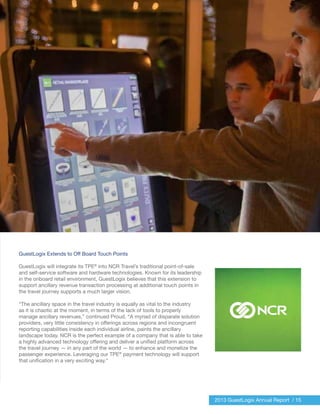
GuestLogix will integrate its TPE®
into NCR Travel’s traditional point-of-sale
and self-service software and hardware technologies. Known for its leadership
in the onboard retail environment, GuestLogix believes that this extension to
support ancillary revenue transaction processing at additional touch points in
the travel journey supports a much larger vision.
“The ancillary space in the travel industry is equally as vital to the industry
as it is chaotic at the moment, in terms of the lack of tools to properly
manage ancillary revenues,” continued Proud. “A myriad of disparate solution
providers, very little consistency in offerings across regions and incongruent
reporting capabilities inside each individual airline, paints the ancillary
landscape today. NCR is the perfect example of a company that is able to take
a highly advanced technology offering and deliver a unified platform across
the travel journey — in any part of the world — to enhance and monetize the
passenger experience. Leveraging our TPE®
payment technology will support
that unification in a very exciting way.”
16 / 2013 GuestLogix Annual Report
A LOOK INTO OUR INDUSTRY...
For the first time ever, the total
number of passengers in 2013
has exceeded 3 billion, and a
forecast of 3.3 billion for 2014.
IATA sites that the aviation industry
is responsible for an estimated 57
million jobs and over US$2.2 trillion
in economic activity.
Low cost carriers remain well
positioned through their ability
to capture a large percentage of
passenger demand, while legacy
carriers globally continue to operate
at razor thin margins on their base
ticket prices in order to compete.
The expanding market for
ancillary revenue has taken a step
forward by incorporating added
fees for baggage, early boarding,
preferred seating and in-flight
food, contributing to a total of
$36.1 billion.
With Latin Americas’ strong
CAGR at 4.5%, Brazil will
be able to firmly establish
themselves as the third-largest
domestic market (after U.S.
and China) with 122.3 million
passengers expected to be
carried out by 2017.
Asia Pacific passenger traffic is
forecasted to grow at a compound
annual growth rate of 5.7%,
reaching a total of 31.7% of global
passengers in 2017.
3 Billion
57
Million
+ $36.1
Billion
CAGR
+ 5.7%
1st
US
2nd
China
3rd
Brazil
2013 GuestLogix Annual Report / 17
With retail concessions making up 43% of ancillary
revenues at airports, there is a continued effort to grow this
figure as well as create a new and exciting shift in product
mix with new merchandising programs such as destination-
based content to passengers.
OFF BOARD PASSENGER TOUCH POINTS
ADJACENT PASSENGER TRAVEL
VERTICALS: THE RAIL INDUSTRY
THE PAYMENT INDUSTRY
THE COMPETITIVE LANDSCAPE
Due to the certainty of the European rail industries leading
market position, the increased demand for high-tech
product in this sector gives us reason to believe that the
innovative head start of the European rail industry can
certainly be retained over the next few years.
Guestlogix’ announcement to partner with Panasonic
Avionics and Thales, current leaders in IFE solutions,
further exemplifies not only the organizations current, but
future goals to dominate and lead as a key player in this
technological environment.
With the increasing consistency of smartphone and tablet
usage worldwide, research has proven that consumers
are also becoming significantly more comfortable making
payments and purchases directly from their mobile devices.
43%
18 / 2013 GuestLogix Annual Report
Ancillaries in Travel: At the Height of Importance
Analysts, industry experts and airlines themselves have
all gone on record signaling record-breaking profits in the
global airline industry in 2014. The central contributor?
Ancillaries Revenues. Whether it is baggage fees, the fee
to get a little extra legroom or a charge to watch an in-
flight movie, airlines have all moved — in some way — to a
pay-for-what-you-use model. And it is working.
In 2010, the airline industry earned $22.6 billion in ancillary
revenue, which equates to just over 4% of the industry’s
total revenue. In three short years, that number has nearly
doubled to $42.6 billion, according to Ancillary Revenue
experts at The IdeaWorks Company.
The International Air Transport Association (IATA) asserts
that ancillary revenues are key to the positive turnaround
seen in the global industry.
From IATA’s 2013 Industry Forecast Report: “Ancillary
revenues are a key driver of improved financial
performance. Worldwide ancillary revenues have risen to
an estimated $13/passenger. Airlines are underpinning
their profitability with innovative products and services.
On a per passenger basis, ancillary revenues are greater
than the $5.94/passenger profit that airlines are expected
to earn in 2014. Without ancillaries, the industry would be
making a loss from its core seat and cargo products.”
The chart associated with IATA’s forecast can be seen
below and illustrates that while base fares have increased
since 2008, they have really only reached comparable
levels to 2007 and have been flat from a year-over-year
perspective. Ancillaries on the other hand, have shown a
steady increase over the past six years and are projected
to continue this upward momentum.
No Longer a Nickel and Dime Story
There is no question that passengers once bemoaned
these new fees – even as the fees largely entered the
market at the same time that fares were being reduced.
But time heals. Passengers have certainly relented and
though some may pack lighter to avoid an extra baggage
charge or bring a chocolate bar onboard to avoid paying
for a snack in-flight, the nickels and dimes that were once
a point of contention have added up in a major way.
Take GuestLogix’ customer, Southwest Airlines, for
instance. The airline introduced the ability for passengers
to pay to board their flight early with their EarlyBird
program. In 2012, that program earned the airline $161
million or around $1.40 per passenger that flew onboard
Southwest.
Another GuestLogix customer, KLM Royal Dutch Airlines,
reported that in 2012 the airline earned $89.4 million in
seat upgrade fees for their economy comfort class. This
equates to $4.43 per passenger that flew on KLM.
Both examples show that a single ancillary program within
an airline can drastically change the financial position
of the airline. The EarlyBird program at Southwest is
an example of one that essentially drops straight to the
bottom line as there is no cost to the airline associated
with allowing select passengers to board first. In 2012,
Southwest posted a net income of $421 million for the
year. So this simple program that lets passengers choose
to pay to board the aircraft first represented 38% of the
airline’s total profitability for the year.
2013 GuestLogix Annual Report / 19
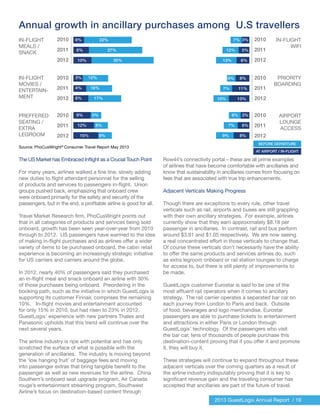
Annual growth in ancillary purchases among U.S travellers
The US Market has Embraced Inflight as a Crucial Touch Point
For many years, airlines walked a fine line, slowly adding
new duties to flight attendant personnel for the selling
of products and services to passengers in-flight. Union
groups pushed back, emphasizing that onboard crew
were onboard primarily for the safety and security of the
passengers, but in the end, a profitable airline is good for all.
Travel Market Research firm, PhoCusWright points out
that in all categories of products and services being sold
onboard, growth has been seen year-over-year from 2010
through to 2012. US passengers have warmed to the idea
of making in-flight purchases and as airlines offer a wider
variety of items to be purchased onboard, the cabin retail
experience is becoming an increasingly strategic initiative
for US carriers and carriers around the globe.
In 2012, nearly 40% of passengers said they purchased
an in-flight meal and snack onboard an airline with 30%
of those purchases being onboard. Preordering in the
booking path, such as the initiative in which GuestLogix is
supporting its customer Finnair, comprises the remaining
10%. In-flight movies and entertainment accounted
for only 15% in 2010, but had risen to 23% in 2012.
GuestLogix’ experience with new partners Thales and
Panasonic upholds that this trend will continue over the
next several years.
The airline industry is ripe with potential and has only
scratched the surface of what is possible with the
generation of ancillaries. The industry is moving beyond
the ‘low hanging fruit’ of baggage fees and moving
into passenger extras that bring tangible benefit to the
passenger as well as new revenues for the airline. China
Southern’s onboard seat upgrade program, Air Canada
rouge’s entertainment streaming program, Southwest
Airline’s focus on destination-based content through
Row44’s connectivity portal – these are all prime examples
of airlines that have become comfortable with ancillaries and
know that sustainability in ancillaries comes from focusing on
fees that are associated with true trip enhancements.
Adjacent Verticals Making Progress
Though there are exceptions to every rule, other travel
verticals such as rail, airports and buses are still grappling
with their own ancillary strategies. For example, airlines
currently show that they earn approximately $8.18 per
passenger in ancillaries. In contrast, rail and bus perform
around $3.91 and $1.05 respectively. We are now seeing
a real concentrated effort in those verticals to change that.
Of course these verticals don’t necessarily have the ability
to offer the same products and services airlines do, such
as extra legroom onboard or rail station lounges to charge
for access to, but there is still plenty of improvements to
be made.
GuestLogix customer Eurostar is said to be one of the
most affluent rail operators when it comes to ancillary
strategy. The rail carrier operates a separated bar car on
each journey from London to Paris and back. Outside
of food, beverages and logo merchandise, Eurostar
passengers are able to purchase tickets to entertainment
and attractions in either Paris or London through
GuestLogix’ technology. Of the passengers who visit
the bar car, tens of thousands of people purchase this
destination-content proving that if you offer it and promote
it, they will buy it.
These strategies will continue to expand throughout these
adjacent verticals over the coming quarters as a result of
the airline industry indisputably proving that it is key to
significant revenue gain and the traveling consumer has
accepted that ancillaries are part of the future of travel.
IN-FLIGHT
MEALS /
SNACK
2010
2011
2012
6%
8%
10%
3%
5%
6%
8%
11%
13%
3%
6%
8%
6%
7%
9%
BEFORE DEPARTURE
AT AIRPORT / IN-FLIGHT
5%
7%
10%
7%
12%
13%
3%
4%
6%
9%
12%
15%
5%
8%
9%
12%
16%
17%
22%
27%
30%
2010
2011
2012
2010
2011
2012
Source: PhoCusWright®
Consumer Travel Report May 2013
2010
2011
2012
2010
2011
2012
2010
2011
2012
IN-FLIGHT
WIFI
IN-FLIGHT
MOVIES /
ENTERTAIN-
MENT
PRIORITY
BOARDING
PREFFERED
SEATING /
EXTRA
LEGROOM
AIRPORT
LOUNGE
ACCESS
Broadening
Horizons
Looking outside the cabin
20 / 2013 GuestLogix Annual Report
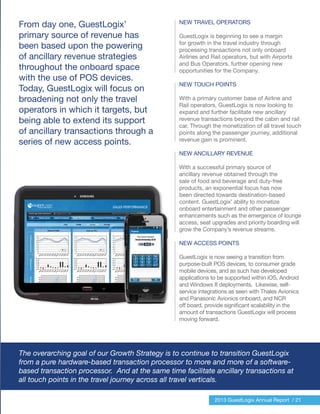
The overarching goal of our Growth Strategy is to continue to transition GuestLogix
from a pure hardware-based transaction processor to more and more of a software-
based transaction processor. And at the same time facilitate ancillary transactions at
all touch points in the travel journey across all travel verticals.
2013 GuestLogix Annual Report / 21
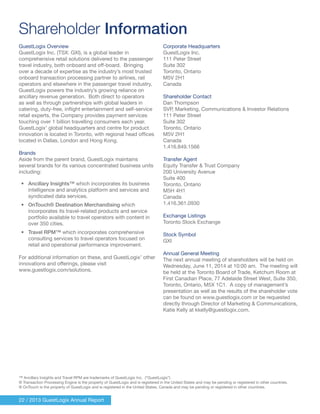
From day one, GuestLogix’
primary source of revenue has
been based upon the powering
of ancillary revenue strategies
throughout the onboard space
with the use of POS devices.
Today, GuestLogix will focus on
broadening not only the travel
operators in which it targets, but
being able to extend its support
of ancillary transactions through a
series of new access points.
NEW TRAVEL OPERATORS
GuestLogix is beginning to see a margin
for growth in the travel industry through
processing transactions not only onboard
Airlines and Rail operators, but with Airports
and Bus Operators, further opening new
opportunities for the Company.
NEW TOUCH POINTS
With a primary customer base of Airline and
Rail operators, GuestLogix is now looking to
expand and further facilitate new ancillary
revenue transactions beyond the cabin and rail
car. Through the monetization of all travel touch
points along the passenger journey, additional
revenue gain is prominent.
NEW ANCILLARY REVENUE
With a successful primary source of
ancillary revenue obtained through the
sale of food and beverage and duty-free
products, an exponential focus has now
been directed towards destination-based
content. GuestLogix’ ability to monetize
onboard entertainment and other passenger
enhancements such as the emergence of lounge
access, seat upgrades and priority boarding will
grow the Company’s revenue streams.
NEW ACCESS POINTS
GuestLogix is now seeing a transition from
purpose-built POS devices, to consumer grade
mobile devices, and as such has developed
applications to be supported within iOS, Android
and Windows 8 deployments. Likewise, self-
service integrations as seen with Thales Avionics
and Panasonic Avionics onboard, and NCR
off board, provide significant scalability in the
amount of transactions GuestLogix will process
moving forward.
Shareholder Information
22 / 2013 GuestLogix Annual Report
GuestLogix Overview
GuestLogix Inc. (TSX: GXI), is a global leader in
comprehensive retail solutions delivered to the passenger
travel industry, both onboard and off-board. Bringing
over a decade of expertise as the industry’s most trusted
onboard transaction processing partner to airlines, rail
operators and elsewhere in the passenger travel industry,
GuestLogix powers the industry’s growing reliance on
ancillary revenue generation. Both direct to operators
as well as through partnerships with global leaders in
catering, duty-free, inflight entertainment and self-service
retail experts, the Company provides payment services
touching over 1 billion travelling consumers each year.
GuestLogix’ global headquarters and centre for product
innovation is located in Toronto, with regional head offices
located in Dallas, London and Hong Kong.
Brands
Aside from the parent brand, GuestLogix maintains
several brands for its various concentrated business units
including:
•	 Ancillary Insights™ which incorporates its business
intelligence and analytics platform and services and
syndicated data services.
•	 OnTouch® Destination Merchandising which
incorporates its travel-related products and service
portfolio available to travel operators with content in
over 350 cities.
•	 Travel RPM™ which incorporates comprehensive
consulting services to travel operators focused on
retail and operational performance improvement.
For additional information on these, and GuestLogix’ other
innovations and offerings, please visit
www.guestlogix.com/solutions.
™ Ancillary Insights and Travel RPM are trademarks of GuestLogix Inc. (“GuestLogix”)
® Transaction Processing Engine is the property of GuestLogix and is registered in the United States and may be pending or registered in other countries.
® OnTouch is the property of GuestLogix and is registered in the United States, Canada and may be pending or registered in other countries.
Corporate Headquarters
GuestLogix Inc.
111 Peter Street
Suite 302
Toronto, Ontario
M5V 2H1
Canada
Shareholder Contact
Dan Thompson
SVP, Marketing, Communications & Investor Relations
111 Peter Street
Suite 302
Toronto, Ontario
M5V 2H1
Canada
1.416.849.1566
Transfer Agent
Equity Transfer & Trust Company
200 University Avenue
Suite 400
Toronto, Ontario
M5H 4H1
Canada
1.416.361.0930
Exchange Listings
Toronto Stock Exchange
Stock Symbol
GXI
Annual General Meeting
The next annual meeting of shareholders will be held on
Wednesday, June 11, 2014 at 10:00 am. The meeting will
be held at the Toronto Board of Trade, Ketchum Room at
First Canadian Place, 77 Adelaide Street West, Suite 350,
Toronto, Ontario, M5X 1C1. A copy of management’s
presentation as well as the results of the shareholder vote
can be found on www.guestlogix.com or be requested
directly through Director of Marketing & Communications,
Katie Kelly at kkelly@guestlogix.com.
Management’s Discussion & Analysis
Financial Statements
Management’s Discussion & Analysis
and Financial Statements
24
58


Management’s Discussion & Analysis
For	
  the	
  years	
  ended	
  December	
  31,	
  2013	
  and	
  2012	


MANAGEMENT’S DISCUSSION AND ANALYSIS
The	
  following	
  discussion	
  and	
  analysis	
  of	
  the	
  financial	
  condition	
  and	
  results	
  of	
  GuestLogix	
  Inc.	
  (also	
  referred	
  to	
  as	
  “we”,	
  
“our”,	
  “GuestLogix”	
  or	
  the	
  “Company”)	
  for	
  the	
  year	
  ended	
  December	
  31,	
  2013	
  should	
  be	
  read	
  in	
  conjunction	
  with	
  the	
  
Consolidated	
  Financial	
  Statements	
  and	
  accompanying	
  notes	
  for	
  such	
  period,	
  which	
  we	
  prepared	
  in	
  accordance	
  with	
  
International	
  Financial	
  Reporting	
  Standards	
  (“IFRS”).	
  The	
  discussion	
  and	
  analysis	
  in	
  this	
  MD&A	
  is	
  based	
  on	
  information	
  
available	
  to	
  management	
  as	
  of	
  March	
  24,	
  2014.	
  	
  The	
  consolidated	
  financial	
  statements	
  and	
  the	
  MD&A	
  have	
  been	
  
reviewed	
  by	
  the	
  Company’s	
  Audit	
  Committee	
  and	
  approved	
  by	
  its	
  Board	
  of	
  Directors.	


ADDITIONAL INFORMATION
Additional	
  information,	
  including	
  the	
  quarterly	
  and	
  annual	
  consolidated	
  financial	
  statements,	
  annual	
  information	
  form,	
  
management	
  proxy	
  circular	
  and	
  other	
  disclosure	
  documents	
  may	
  be	
  examined	
  by	
  accessing	
  the	
  SEDAR	
  website	
  at	
  
www.sedar.com.	


FORWARD LOOKING STATEMENTS
The	
  information	
  set	
  forth	
  in	
  this	
  MD&A	
  and	
  the	
  documents	
  incorporated	
  by	
  reference	
  contains	
  statements	
  concerning	
  
GuestLogix’	
  future	
  results,	
  future	
  performance,	
  intentions,	
  objectives,	
  plans	
  and	
  expectations	
  that	
  are,	
  or	
  may	
  be	
  
deemed	
  to	
  be,	
  forward-­‐looking	
  statements	
  including	
  the	
  Company’s	
  expectations	
  as	
  to	
  future	
  industry	
  demand,	
  the	
  
outlook	
  for	
  the	
  airline	
  and	
  rail	
  industry,	
  the	
  airline	
  and	
  rail	
  industry’s	
  move	
  towards	
  greater	
  ancillary	
  revenue,	
  customers’	
  
increasing	
  adoption	
  of	
  	
  mobile	
  payments,	
  the	
  adoption	
  of	
  new	
  payment	
  types	
  and	
  channels,	
  the	
  Company’s	
  increased	
  
growth	
  in	
  Asia	
  Pacific	
  and	
  the	
  Rail	
  Sector,	
  the	
  Company’s	
  sale	
  pipeline	
  and	
  the	
  Company’s	
  future	
  operating	
  expenses.	
  
These	
  statements	
  concerning	
  possible	
  or	
  assumed	
  future	
  results	
  of	
  operations	
  of	
  GuestLogix	
  are	
  preceded	
  by,	
  followed	
  
by	
  or	
  include	
  the	
  words	
  ‘believes’,	
  ‘expects’,	
  ‘anticipates’,	
  ‘estimates’,	
  ‘intends’,	
  ‘plans’,	
  ‘forecasts’,	
  or	
  similar	
  expressions.	
  
Forward-­‐looking	
  statements	
  are	
  not	
  guarantees	
  of	
  future	
  performance.	
  These	
  forward-­‐looking	
  statements	
  are	
  based	
  on	
  
current	
  expectations	
  that	
  involve	
  numerous	
  risks	
  and	
  uncertainties,	
  including,	
  but	
  not	
  limited	
  to,	
  those	
  identified	
  in	
  the	
  
Risk	
  Factors	
  section	
  of	
  the	
  annual	
  information	
  form	
  of	
  the	
  Company	
  filed	
  with	
  regulatory	
  authorities	
  on	
  March	
  24,	
  2014	
  
and	
  those	
  identified	
  in	
  the	
  Risk	
  Factors	
  section	
  of	
  this	
  MD&A.	
  	
  Assumptions	
  relating	
  to	
  the	
  foregoing	
  involve	
  judgments	
  
with	
  respect	
  to,	
  among	
  other	
  things,	
  future	
  economic,	
  competitive	
  and	
  market	
  conditions	
  and	
  future	
  business	
  decisions,	
  
all	
  of	
  which	
  are	
  difficult	
  or	
  impossible	
  to	
  predict	
  accurately	
  and	
  many	
  of	
  which	
  are	
  beyond	
  GuestLogix’	
  control.	
  Although	
  
GuestLogix	
  believes	
  that	
  the	
  assumptions	
  underlying	
  the	
  forward-­‐looking	
  statements	
  are	
  reasonable,	
  any	
  of	
  the	
  
assumptions	
  could	
  prove	
  inaccurate.	
  These	
  factors	
  should	
  be	
  considered	
  carefully,	
  and	
  readers	
  should	
  not	
  place	
  undue	
  
reliance	
  on	
  forward-­‐looking	
  statements.	
  	
  Except	
  as	
  required	
  by	
  law,	
  GuestLogix	
  has	
  no	
  intention	
  and	
  undertakes	
  no	
  
obligation	
  to	
  update	
  or	
  revise	
  any	
  forward-­‐looking	
  statements,	
  whether	
  written	
  or	
  oral	
  that	
  may	
  be	
  made	
  by	
  or	
  on	
  the	
  
Company's	
  behalf.	


24 / 2013 GuestLogix Annual Report


Major Partners
• Alpha	
  Flight	
  Services	
  
• Inflight	
  Sales	
  Group	
  
• Inflight	
  Services	
  
• Momentum	
  Services	
  	
  
• NCR	
  
• Panasonic	
  Avionics	
  
• Skytrac	
  
• Thales	
  
• The	
  Facilities	
  Partner	


Who	
  We	
  Are	
  
OUR COMPANY
Established	
  in	
  2002,	
  GuestLogix	
  is	
  a	
  global	
  leader	
  in	
  
comprehensive	
  retail	
  technology	
  targeted	
  to	
  the	
  
passenger	
  travel	
  industry	
  offering	
  a	
  diversified	
  portfolio	
  
of	
  hardware,	
  software,	
  content	
  and	
  professional	
  
services	
  to	
  travel	
  operators	
  across	
  the	
  globe.	
  	
  We	
  
primarily	
  operate	
  in	
  the	
  onboard	
  space	
  with	
  a	
  focus	
  on	
  
the	
  enablement	
  of	
  secure	
  transaction	
  processing	
  of	
  
ancillary	
  products	
  and	
  services	
  such	
  as	
  the	
  sale	
  of	
  food	
  
and	
  beverage,	
  duty	
  free	
  products,	
  onboard	
  
entertainment	
  (digital	
  content)	
  and	
  destination-­‐based	
  
content	
  to	
  passengers	
  and	
  travellers.	
  	
  Our	
  retail	
  
platform	
  has	
  been	
  selected	
  by	
  many	
  of	
  the	
  world’s	
  
leading	
  travel	
  operators	
  including	
  59	
  airlines	
  and	
  10	
  rail	
  
companies	
  who	
  cumulatively	
  service	
  more	
  than	
  1.14	
  
billion	
  passenger	
  trips	
  on	
  an	
  annual	
  basis.	
  	
  Our	
  customer	
  
and	
  partner	
  network	
  spans	
  35	
  countries	
  across	
  the	
  
Americas,	
  Europe,	
  Middle	
  East	
  and	
  Africa	
  (EMEA)	
  and	
  
Asia	
  Pacific.	
  	
  GuestLogix	
  processed	
  $917	
  million	
  (gross	
  
transaction	
  value)	
  in	
  2013.	


Our	
  global	
  headquarters	
  is	
  located	
  in	
  Toronto,	
  Canada	
  
and	
  we	
  have	
  regional	
  head	
  offices	
  located	
  in	
  Dallas	
  
(Texas),	
  serving	
  the	
  Americas;	
  Bracknell	
  just	
  outside	
  
London	
  (UK),	
  serving	
  Europe,	
  Middle	
  East	
  and	
  Africa;	
  
and	
  Hong	
  Kong,	
  serving	
  Asia	
  and	
  Oceania.	
  Logistics	
  
centers	
  are	
  situated	
  in	
  Toronto,	
  Dallas,	
  London	
  and	
  
Seoul.	
  In	
  Q4	
  2013,	
  we	
  announced	
  the	
  forthcoming	
  
establishment	
  of	
  our	
  Product	
  Innovation	
  Lab	
  for	
  
software	
  development	
  in	
  Moncton,	
  New	
  Brunswick.	


UNDERSTANDING OUR REVENUE STREAMS
The	
  Company’s	
  revenue	
  is	
  primarily	
  generated	
  by	
  
supporting	
  the	
  end-­‐to-­‐end	
  onboard	
  retail	
  technology	
  
requirements	
  of	
  leading	
  travel	
  operators.	
  	
  Our	
  customer	
  
engagements	
  are	
  either	
  directly	
  with	
  the	
  travel	
  operator	
  
itself,	
  with	
  its	
  primary	
  catering	
  or	
  duty-­‐free	
  provider,	
  or	
  
with	
  a	
  secondary	
  technology	
  partner	
  such	
  as	
  an	
  in-­‐flight	
  
entertainment	
  and	
  connectivity	
  provider.	
  	
  	
  We	
  charge	
  a	
  
per-­‐transaction	
  fee	
  for	
  the	
  use	
  of	
  our	
  software	
  in	
  the	
  
onboard	
  environment	
  –	
  whether	
  cash,	
  credit	
  card,	
  
loyalty	
  points	
  or	
  other	
  payment	
  means.	


We	
  categorize	
  our	
  revenue	
  streams	
  based	
  on	
  four	
  
distinct	
  stages	
  of	
  each	
  transaction.	
  	
  The	
  first	
  is	
  Capture,	
  
in	
  which	
  our	
  technology	
  is	
  used	
  to	
  input	
  and	
  encrypt	
  
sales	
  and	
  payment	
  data	
  for	
  transmission	
  either	
  in	
  real-­‐
time	
  or	
  in	
  batch	
  form	
  where	
  no	
  connectivity	
  is	
  available.	
  	
  
The	
  second	
  is	
  Authorize/Settle,	
  in	
  which	
  our	
  
technology	
  is	
  used	
  to	
  process	
  payments	
  through	
  our	
  
Global	
  Payment	
  Gateway	
  and	
  later	
  settle	
  those	
  
transactions	
  with	
  the	
  customer’s	
  Merchant	
  Account.	
  	
  
The	
  third	
  is	
  Reconcile,	
  in	
  which	
  our	
  technology	
  is	
  used	
  
to	
  manage	
  and	
  resolve	
  discrepancies	
  in	
  payments	
  
settled	
  with	
  inventory	
  depletions.	
  	
  	
  The	
  final	
  is	
  Analyze,	
  
in	
  which	
  our	
  technology	
  is	
  used	
  to	
  apply	
  comprehensive	
  
reporting	
  and	
  business	
  intelligence	
  tools	
  for	
  enhanced	
  
management	
  of	
  our	
  customers’	
  onboard	
  retail	
  
programs.
Major Customers
• Aer	
  Lingus	
  
• Air	
  Canada	
  
• Air	
  New	
  Zealand	
  
• Alaska	
  Airlines	
  
• American	
  Airlines	
  
• Cathay	
  Pacific	
  
• China	
  Southern	
  
• Dragonair	


• Etihad	
  Airways	
  
• Eurostar	
  
• Finnair	
  
• flybe	
  
• flydubai	
  
• Frontier	
  Airlines	
  
• Jet	
  Airways	
  
• KLM	
  	
  
• Malaysia	
  Airlines	
  
• Norwegian	
  	
  
• Qantas	
  Airways	
  
• Royal	
  Air	
  Maroc	
  
• Ryanair	
  
• SAS	
  
• Southwest	
  Airlines	
  
• Spring	
  Airlines	


• Sun	
  Country	
  
• Thalys	
  
• Thomson	
  	
  
• Transavia	
  
• TUIfly	
  
• United	
  Airlines	
  
• US	
  Airways	
  
• WestJet	


2013 GuestLogix Annual Report / 25


Our	
  Market	


The Passenger Travel Industry
A	
  Look	
  into	
  the	
  Global	
  Airline	
  Industry	
  
In	
  recent	
  years,	
  the	
  global	
  passenger	
  travel	
  industry	
  has	
  
seen	
  a	
  rapid	
  swell	
  in	
  the	
  growth	
  trends	
  of	
  passenger	
  
demand.	
  	
  For	
  the	
  first	
  time	
  ever,	
  2013	
  saw	
  total	
  
passenger	
  numbers	
  reach	
  3	
  billion	
  and	
  a	
  forecast	
  in	
  2014	
  
of	
  3.3	
  billion.	
  	
  As	
  the	
  industry	
  nears	
  the	
  point	
  when	
  the	
  
equivalent	
  to	
  half	
  the	
  world’s	
  population	
  rely	
  on	
  air	
  
travel	
  as	
  a	
  part	
  of	
  their	
  lives	
  within	
  a	
  given	
  year,	
  the	
  
industry	
  has	
  rallied	
  to	
  regain	
  financial	
  independence	
  and	
  
chart	
  the	
  course	
  to	
  true	
  profitability.	
  	
  The	
  International	
  
Air	
  Transport	
  Association	
  (IATA)	
  cites	
  that	
  the	
  aviation	
  
industry	
  is	
  responsible	
  for	
  close	
  to	
  57	
  million	
  jobs	
  and	
  
over	
  US$2.2	
  trillion	
  in	
  economic	
  activity.	


In	
  its	
  most	
  recent	
  estimates,	
  on	
  December	
  12,	
  2013,	
  
IATA	
  increased	
  its	
  profit	
  projection	
  from	
  its	
  September	
  
estimates	
  to	
  $12.9	
  billion.	
  	
  IATA	
  goes	
  on	
  to	
  state	
  that	
  its	
  
estimates	
  for	
  2014	
  are	
  an	
  improved	
  net	
  profit	
  of	
  $16.4	
  
billion.	
  	
  IATA	
  cites	
  lower	
  jet	
  fuel	
  prices	
  as	
  reason	
  for	
  the	
  
increase	
  to	
  its	
  original	
  estimates	
  as	
  well	
  as	
  
improvements	
  to	
  the	
  industry’s	
  structure	
  and	
  efficiency	
  
already	
  visible	
  in	
  quarterly	
  results	
  that	
  were	
  available	
  at	
  
the	
  end	
  of	
  2013.	
  	
  The	
  association	
  also	
  notes	
  that	
  
passenger	
  markets	
  continue	
  to	
  outperform	
  the	
  cargo	
  
business	
  which	
  remains	
  stagnant	
  both	
  on	
  volumes	
  as	
  
well	
  as	
  on	
  revenues.	


In	
  such	
  a	
  competitive	
  landscape,	
  the	
  industry	
  continues	
  
to	
  manage	
  ticket	
  fares	
  against	
  a	
  variety	
  of	
  different	
  
business	
  models.	
  	
  Low	
  cost	
  carriers	
  remain	
  well	
  
positioned	
  to	
  capture	
  a	
  large	
  percentage	
  of	
  passenger	
  
demand	
  and	
  thus	
  legacy	
  carriers	
  continue	
  to	
  operate	
  at	
  
razor	
  thin	
  margins	
  on	
  their	
  base	
  ticket	
  prices	
  in	
  order	
  to	
  
compete.	
  	
  The	
  remedy	
  across	
  most	
  geographies	
  has	
  
become	
  the	
  reliance	
  on	
  ancillary	
  revenue	
  strategies.	
  	
  
The	
  first	
  chapter	
  saw	
  carriers	
  unbundle	
  services	
  
previously	
  included	
  in	
  the	
  base	
  fare.	
  	
  Adding	
  to	
  the	
  
frequent	
  flyer	
  program	
  revenue	
  and	
  duty-­‐free	
  sales,	
  
airlines	
  began	
  charging	
  added	
  fees	
  for	
  baggage,	
  early	
  
boarding,	
  preferred	
  seating	
  and	
  in-­‐flight	
  food	
  and	
  
beverage	
  in	
  order	
  to	
  compensate	
  for	
  sunk	
  margins.	
  	
  
These	
  new	
  revenue	
  streams	
  contributed	
  a	
  total	
  of	
  $36.1	
  
billion	
  to	
  airline	
  revenues	
  in	
  2012,	
  an	
  increase	
  of	
  11.8%	
  
from	
  the	
  previous	
  year.	


Today,	
  airlines	
  are	
  shifting	
  focus	
  to	
  more	
  expansive	
  and	
  
dynamic	
  ancillary	
  programs.	
  	
  Ancillary	
  revenues	
  are	
  a	
  
key	
  driver	
  of	
  improved	
  financial	
  performance.	
  
Worldwide	
  ancillary	
  revenues	
  have	
  risen	
  to	
  an	
  estimated	
  
$13/passenger.	
  Airlines	
  are	
  underpinning	
  their	
  
profitability	
  with	
  innovative	
  products	
  and	
  services.	
  On	
  a	
  
per	
  passenger	
  basis,	
  ancillary	
  revenues	
  are	
  greater	
  than	
  
the	
  $5.94/passenger	
  profit	
  that	
  airlines	
  are	
  expected	
  to	
  
earn	
  in	
  2014.	
  Without	
  ancillaries,	
  the	
  industry	
  would	
  be	
  
making	
  a	
  loss	
  from	
  its	
  core	
  seat	
  and	
  cargo	
  products.	


The	
  two	
  regions	
  with	
  the	
  highest	
  growth	
  opportunity	
  
for	
  GuestLogix	
  are	
  showing	
  especially	
  lucrative	
  growth.	
  	
  
Asia	
  Pacific	
  passenger	
  traffic	
  is	
  forecasted	
  to	
  grow	
  at	
  a	
  
compound	
  annual	
  growth	
  rate	
  of	
  5.7%	
  reaching	
  a	
  total	
  
of	
  31.7%	
  of	
  global	
  passengers	
  in	
  2017.	
  	
  This	
  will	
  become	
  
the	
  largest	
  regional	
  market	
  for	
  air	
  transport	
  in	
  the	
  world	
  
above	
  North	
  America	
  and	
  Europe.	
  	
  In	
  particular,	
  by	
  that	
  
time	
  1	
  in	
  every	
  5	
  travelers	
  will	
  be	
  from	
  China	
  making	
  the	
  
Chinese	
  the	
  single	
  most	
  lucrative	
  demographic	
  in	
  the	
  
industry.	
  	
  More	
  specifically,	
  between	
  2012	
  and	
  2017,	
  
China	
  will	
  be	
  the	
  single	
  largest	
  driver	
  of	
  growth	
  in	
  the	
  
global	
  industry,	
  accounting	
  for	
  24%	
  of	
  all	
  new	
  
passengers	
  during	
  that	
  timeframe.	


Latin	
  America	
  will	
  also	
  see	
  a	
  strong	
  compound	
  annual	
  
growth	
  rate	
  (“CAGR”)	
  at	
  4.5%.	
  	
  Brazil	
  will	
  firmly	
  
establish	
  itself	
  as	
  the	
  third-­‐largest	
  domestic	
  market	
  
(after	
  the	
  US	
  and	
  China)	
  with	
  122.4	
  million	
  passengers	
  
expected	
  to	
  be	
  carried	
  by	
  2017.	
  	
  The	
  region	
  is	
  now	
  
performing	
  at	
  its	
  highest	
  rate	
  ever,	
  delivering	
  US$700	
  
million	
  in	
  profits	
  throughout	
  2013	
  and	
  increasing	
  to	
  
US$1.5	
  billion	
  in	
  2014.	
  	
  IATA	
  notes	
  that	
  the	
  region	
  is	
  
currently	
  burdened	
  with	
  antiquated	
  technology	
  and	
  
infrastructure	
  that	
  is	
  not	
  keeping	
  pace	
  with	
  the	
  
significant	
  growth	
  in	
  the	
  industry.	


High Growth in Asian Market
Asia	
  Pacific	
  passenger	
  traffic	
  is	
  forecasted	
  to	
  grow	
  at	
  
a	
  compound	
  annual	
  growth	
  rate	
  of	
  5.7%	
  reaching	
  a	
  
total	
  of	
  31.7%	
  of	
  global	
  passengers	
  in	
  2017.	
  
26 / 2013 GuestLogix Annual Report


Off	
  Board	
  Passenger	
  Touch	
  Points	
  
The	
  Airport	
  Council	
  International	
  (ACI)	
  in	
  Europe	
  cites	
  
that	
  60%	
  of	
  European	
  airports	
  are	
  losing	
  traffic	
  at	
  an	
  
annual	
  average	
  reduction	
  of	
  1%.	
  	
  Though	
  passenger	
  
traffic	
  within	
  the	
  airline	
  industry	
  continues	
  to	
  increase,	
  
competition	
  among	
  airports	
  has	
  created	
  a	
  trend	
  in	
  the	
  
dispersion	
  of	
  traffic	
  at	
  individual	
  airports,	
  thus	
  creating	
  a	
  
newly	
  sought	
  after	
  goal	
  of	
  ancillary	
  growth	
  in	
  the	
  airport	
  
space.	
  	
  	
  The	
  ACI	
  points	
  out	
  that	
  approximately	
  20%	
  of	
  
all	
  active	
  European	
  routes	
  are	
  subject	
  to	
  a	
  regular	
  route	
  
churn	
  by	
  airlines	
  which	
  both	
  opens	
  and	
  closes	
  these	
  
routes	
  on	
  an	
  annual	
  basis.	
  	
  Impact	
  on	
  business	
  is	
  severe,	
  
with	
  42.5%	
  of	
  Europe’s	
  airports	
  in	
  a	
  financial	
  loss	
  
position.	


This	
  phenomenon	
  has	
  turned	
  attention	
  away	
  from	
  
traffic	
  revenue	
  (landing	
  fees	
  and	
  passenger	
  taxes)	
  and	
  
over	
  to	
  commercial	
  revenue	
  (retailing	
  services).	
  	
  In	
  fact,	
  
in	
  2013	
  it	
  is	
  estimated	
  that	
  traffic	
  revenues	
  for	
  European	
  
airports	
  are	
  up	
  1%	
  while	
  commercial	
  revenues	
  are	
  up	
  
27%.	
  	
  With	
  retail	
  concessions	
  making	
  up	
  43%	
  of	
  ancillary	
  
revenues	
  at	
  airports,	
  there	
  is	
  a	
  continued	
  effort	
  to	
  grow	
  
this	
  figure	
  as	
  well	
  as	
  create	
  a	
  new	
  and	
  exciting	
  shift	
  in	
  
product	
  mix	
  with	
  new	
  merchandising	
  programs	
  such	
  as	
  
destination-­‐based	
  content	
  to	
  passengers.	


Both	
  airlines	
  and	
  airports	
  operate	
  ancillaries	
  within	
  the	
  
airport	
  space	
  and	
  are	
  considered	
  equally	
  valuable	
  
targets	
  for	
  GuestLogix.	
  	
  Gate	
  and	
  airline-­‐operated	
  
lounge	
  space	
  provide	
  substantial	
  ancillary	
  retailing	
  
opportunities	
  for	
  airlines	
  while	
  public	
  terminal	
  and	
  
concession	
  space	
  provide	
  the	
  same	
  for	
  airports.	
  	
  A	
  key	
  
channel	
  partner,	
  NCR,	
  has	
  a	
  substantial	
  foothold	
  in	
  the	
  
off	
  board	
  space	
  with	
  a	
  significant	
  market	
  share	
  in	
  check-­‐
in	
  kiosks.	
  	
  The	
  firm’s	
  aggressive	
  growth	
  objectives	
  
incorporates	
  GuestLogix	
  as	
  the	
  core	
  transaction	
  
processing	
  enabler	
  in	
  all	
  retail	
  solutions	
  that	
  NCR	
  will	
  
bring	
  to	
  both	
  airlines	
  and	
  airports	
  as	
  well	
  as	
  other	
  travel	
  
verticals.	


Adjacent	
  Passenger	
  Travel	
  Verticals:	
  The	
  Rail	
  
Industry	
  
The	
  global	
  rail	
  market	
  is	
  expected	
  to	
  see	
  steady	
  growth	
  
up	
  through	
  2017.	
  A	
  global	
  market	
  study	
  conducted	
  by	
  
Roland	
  Berger	
  Strategy	
  Consultants	
  for	
  the	
  Association	
  
of	
  the	
  European	
  Rail	
  Industry	
  (UNIFE)	
  highlighted	
  that	
  
those	
  regions	
  seeing	
  the	
  strongest	
  growth	
  are	
  the	
  
Middle	
  East,	
  Latin	
  America	
  and	
  Russia.	
  	
  Overall,	
  the	
  
global	
  rail	
  market	
  remains	
  stable	
  despite	
  any	
  economic	
  
downturn,	
  with	
  UNIFE	
  Director-­‐General,	
  Philippe	
  
Citroën	
  commenting	
  that	
  “the	
  world	
  market	
  has	
  grown	
  
by	
  3.2%	
  in	
  each	
  of	
  the	
  past	
  three	
  years	
  –a	
  remarkable	
  
achievement	
  considering	
  public	
  funds	
  are	
  less	
  
available."	
  
"The	
  major	
  markets	
  will	
  still	
  be	
  Europe	
  and	
  Asia,"	
  says	
  
Andreas	
  Schwilling,	
  Partner	
  at	
  Roland	
  Berger	
  Strategy	
  
Consultants	
  and	
  co-­‐author	
  of	
  the	
  study	
  referenced	
  
above.	
  "The	
  accessible	
  market	
  volume	
  in	
  Europe	
  will	
  
grow	
  by	
  more	
  than	
  2%	
  each	
  year.	
  Asia	
  will	
  stay	
  at	
  the	
  
high	
  level	
  it's	
  been	
  at	
  in	
  recent	
  years.	
  With	
  incoming	
  
orders	
  worth	
  EUR	
  45	
  billion	
  in	
  Europe	
  and	
  EUR	
  26	
  billion	
  
in	
  Asia,	
  these	
  two	
  regions	
  will	
  account	
  for	
  nearly	
  60%	
  of	
  
the	
  accessible	
  global	
  market	
  up	
  through	
  2017.	
  That's	
  
just	
  a	
  few	
  percentage	
  points	
  fewer	
  than	
  today."	


"Looking	
  at	
  the	
  quality	
  and	
  quantity	
  of	
  existing	
  and	
  
projected	
  orders,	
  the	
  European	
  rail	
  industry	
  is	
  certain	
  to	
  
retain	
  a	
  leading	
  market	
  position	
  against	
  other	
  
competitors,"	
  concludes	
  Citroën.	
  "The	
  increased	
  
demand	
  for	
  high-­‐tech	
  product	
  in	
  sectors	
  gives	
  us	
  reason	
  
to	
  believe	
  that	
  the	
  innovative	
  head	
  start	
  of	
  the	
  
European	
  rail	
  industry	
  can	
  certainly	
  be	
  retained	
  over	
  the	
  
next	
  few	
  years."	


With	
  retail	
  concessions	
  making	
  up	
  43%	
  of	
  
ancillary	
  revenues	
  at	
  airports,	
  there	
  is	
  a	
  
continued	
  effort	
  to	
  grow	
  this	
  figure.	


"The	
  increased	
  demand	
  for	
  high-­‐tech	
  product	
  
in	
  sectors	
  gives	
  us	
  reason	
  to	
  believe	
  that	
  the	
  
innovative	
  head	
  start	
  of	
  the	
  European	
  rail	
  
industry	
  can	
  certainly	
  be	
  retained	
  over	
  the	
  
next	
  few	
  years."	
  
~	
  UNIFE	
  Director-­‐General,	
  Philippe	
  Citroën	
  
2013 GuestLogix Annual Report / 27


The	
  Payment	
  Industry	
  
Research	
  firm	
  Gartner	
  projects	
  that	
  the	
  worldwide	
  
mobile	
  payment	
  gross	
  transaction	
  value	
  will	
  surpass	
  
US$235	
  billion	
  by	
  the	
  end	
  of	
  2013.	
  	
  An	
  IDC	
  research	
  
report	
  forecasts	
  that	
  number	
  will	
  move	
  to	
  over	
  $1	
  
trillion	
  by	
  2017.	
  	
  According	
  to	
  a	
  Nilson	
  report	
  released	
  
earlier	
  this	
  year,	
  47%	
  of	
  smartphone	
  owners	
  used	
  a	
  
native	
  shopping	
  application	
  in	
  2012	
  to	
  make	
  a	
  purchase.	
  
Additionally,	
  45	
  million	
  consumers	
  used	
  shopping	
  apps	
  
an	
  average	
  of	
  17	
  times	
  per	
  person	
  per	
  month.	
  	
  This	
  
growth	
  is	
  in	
  tandem	
  with	
  the	
  sharp	
  increases	
  in	
  the	
  
number	
  of	
  smartphone	
  and	
  tablet	
  users	
  worldwide.	
  	
  The	
  
region	
  with	
  the	
  highest	
  share	
  of	
  the	
  mobile	
  payment	
  
market	
  according	
  to	
  Gartner	
  is	
  Asia	
  Pacific	
  with	
  US$74	
  
billion	
  which	
  is	
  up	
  38%	
  from	
  last	
  year.	


The	
  importance	
  of	
  these	
  findings	
  is	
  that,	
  consumers	
  are	
  
becoming	
  significantly	
  more	
  comfortable	
  making	
  
payments	
  or	
  purchases	
  directly	
  from	
  their	
  mobile	
  
devices.	
  This	
  will	
  likely	
  translate	
  into	
  an	
  even	
  greater	
  
adoption	
  of	
  mobile	
  platforms	
  developed	
  for	
  payments	
  
in	
  mature	
  and	
  emerging	
  markets.	
  	
  As	
  a	
  result,	
  both	
  
shoppers	
  and	
  organizations	
  are	
  becoming	
  more	
  
confident	
  with	
  using	
  mobile	
  payment	
  as	
  a	
  preferred	
  
payment	
  method.	
  	
  With	
  such	
  an	
  ambitious	
  predicted	
  
adoption	
  rate,	
  industry	
  analysts	
  believe	
  that	
  enterprises	
  
are	
  at	
  a	
  critical	
  point	
  to	
  begin	
  the	
  preparation	
  to	
  support	
  
mobile	
  payments	
  in	
  the	
  future.	
  	
  In	
  particular,	
  they	
  stress	
  
that	
  CIOs	
  need	
  to	
  ensure	
  that	
  their	
  payments	
  systems	
  
have	
  the	
  capabilities	
  to	
  support	
  these	
  new	
  mobile	
  
platforms	
  without	
  disrupting	
  the	
  customer’s	
  experience.	


Compliance	
  requirements	
  and	
  regulatory	
  mandates	
  will	
  
also	
  undergo	
  changes	
  to	
  accommodate	
  the	
  newer	
  
payment	
  types	
  and	
  channels.	
  This	
  will	
  put	
  great	
  
pressure	
  on	
  banks,	
  financial	
  institutions	
  and	
  merchants	
  
to	
  remediate	
  their	
  systems	
  in	
  order	
  to	
  adhere	
  to	
  the	
  
new	
  regulations.	


The	
  Competitive	
  Landscape	
  
We	
  operate	
  in	
  a	
  fragmented	
  and	
  moderately	
  
competitive	
  environment	
  with	
  a	
  small	
  number	
  of	
  
onboard	
  retail	
  technology	
  providers	
  who	
  provide	


disparate	
  pieces	
  of	
  a	
  total	
  onboard	
  retail	
  solution.	
  We	
  
are	
  seeing	
  a	
  convergence	
  within	
  this	
  space,	
  however,	
  as	
  
ancillary	
  revenues	
  become	
  a	
  greater	
  focus	
  for	
  airlines,	
  
and	
  technology,	
  duty-­‐free	
  and	
  logistics	
  services	
  
providers	
  sense	
  the	
  growing	
  business	
  opportunity.	


New	
  entrants	
  to	
  the	
  industry	
  are	
  providing	
  additional	
  
solutions	
  such	
  as	
  advanced	
  In-­‐Flight	
  Entertainment	
  
System	
  (IFE)	
  and	
  air-­‐to-­‐ground	
  connectivity	
  which	
  can	
  
be	
  seen	
  as	
  disruptive	
  technologies.	
  These	
  new	
  entrants	
  
can	
  be	
  seen	
  as	
  a	
  threat	
  to	
  first-­‐generation	
  onboard	
  retail	
  
operations	
  as	
  they	
  are	
  able	
  to	
  support	
  a	
  self-­‐service	
  
retail	
  model,	
  enabling	
  passengers	
  to	
  drive	
  transactions	
  
through	
  seatback	
  screens	
  or	
  from	
  their	
  personal	
  
devices.	
  GuestLogix	
  is	
  well-­‐positioned	
  to	
  complement	
  
these	
  otherwise	
  competitive	
  solutions	
  and	
  integrate	
  our	
  
technologies	
  -­‐	
  in	
  particular	
  our	
  transaction	
  processing	
  
capabilities	
  -­‐	
  into	
  their	
  solutions	
  to	
  provide	
  a	
  more	
  
robust	
  and	
  comprehensive	
  total	
  solution.	
  Our	
  
announcements	
  to	
  partner	
  with	
  Panasonic	
  Avionics	
  and	
  
Thales,	
  who	
  are	
  leaders	
  in	
  IFE	
  solutions,	
  illustrate	
  that	
  
GuestLogix	
  expects	
  to	
  be	
  a	
  key	
  player	
  in	
  these	
  future	
  
technologies.	


Another	
  disruptive	
  technology	
  presence	
  is	
  the	
  use	
  of	
  
consumer	
  devices	
  such	
  as	
  smartphones	
  and	
  tablets	
  
onboard,	
  and	
  the	
  desire,	
  for	
  both	
  flight	
  attendants	
  and	
  
the	
  passengers,	
  to	
  utilize	
  these	
  devices	
  for	
  business	
  
interactions.	
  	
  Thus	
  far,	
  there	
  has	
  been	
  a	
  mixed	
  response	
  
amongst	
  the	
  GuestLogix	
  customer	
  base	
  in	
  the	
  adoption	
  
of	
  these	
  new	
  technologies.	
  	
  However,	
  we	
  have	
  been	
  
approached	
  by	
  some	
  of	
  our	
  customers	
  to	
  develop	
  
potential	
  solutions	
  in	
  this	
  area,	
  and	
  the	
  Company	
  sees	
  
this	
  as	
  a	
  lucrative	
  opportunity	
  to	
  meet	
  the	
  needs	
  of	
  
airlines	
  going	
  forward	
  and	
  will	
  play	
  an	
  integral	
  role	
  as	
  
this	
  trend	
  in	
  the	
  use	
  of	
  mobile	
  personal	
  devices	
  onboard	
  
progresses.	
  	
  To	
  date,	
  the	
  Company	
  has	
  successfully	
  
ported	
  comprehensive	
  retail	
  applications	
  for	
  crew	
  use	
  
including	
  the	
  integration	
  of	
  our	
  Transaction	
  Processing	
  
Engine®	
  (“TPE”)	
  for	
  iOS,	
  Android	
  OS	
  and	
  Windows	
  
Phone	
  OS.	
  We	
  continue	
  to	
  explore	
  this	
  extension	
  of	
  our	
  
solution	
  with	
  both	
  current	
  and	
  prospective	
  airline	
  and	
  
rail	
  customers.	


28 / 2013 GuestLogix Annual Report


How We Measure Our Business
Gross	
  Transaction	
  Value	
  
As	
  the	
  majority	
  of	
  our	
  revenues	
  are	
  earned	
  as	
  a	
  direct	
  result	
  of	
  the	
  transactions	
  processed	
  for	
  our	
  customers,	
  we	
  measure	
  
our	
  performance	
  based	
  on	
  the	
  total	
  Gross	
  Transaction	
  Value	
  (“GTV”)	
  of	
  all	
  transactions	
  that	
  we	
  process.	
  GTV	
  refers	
  to	
  the	
  
total	
  value	
  of	
  goods	
  and	
  services	
  processed	
  across	
  GuestLogix’	
  technology	
  platform	
  before	
  adjusting	
  for	
  promotions	
  and	
  
other	
  sales	
  discounts.	
  	
  GTV	
  decreased	
  slightly	
  in	
  the	
  fourth	
  quarter	
  from	
  $241	
  million	
  to	
  $227	
  million,	
  a	
  6%	
  decrease,	
  
primarily	
  due	
  to	
  the	
  ramping	
  down	
  of	
  a	
  certain	
  customer	
  as	
  it	
  transitioned	
  to	
  an	
  internal	
  solution.	
  	
  GTV	
  increased	
  by	
  26%	
  
from	
  $725	
  million	
  for	
  the	
  year,	
  to	
  $917	
  million	
  for	
  the	
  year	
  ended	
  December	
  31,	
  2013,	
  the	
  result	
  of	
  an	
  increase	
  in	
  
transaction	
  levels	
  and	
  a	
  full	
  year	
  of	
  transactions	
  with	
  the	
  former	
  Initium	
  Onboard	
  customers.	
  	
  There	
  are	
  a	
  number	
  of	
  
customers	
  that	
  are	
  in	
  the	
  process	
  of	
  deploying	
  our	
  solution	
  who	
  we	
  have	
  announced	
  this	
  past	
  year.	
  	
  As	
  the	
  roll-­‐out	
  of	
  our	
  
new	
  contracts	
  commence,	
  we	
  anticipate	
  that	
  GTV	
  will	
  increase	
  to	
  reflect	
  the	
  new	
  deployments.	


GTV	
  does	
  not	
  have	
  a	
  standardized	
  meaning	
  prescribed	
  by	
  IFRS	
  and	
  may	
  not	
  be	
  comparable	
  to	
  similar	
  measures	
  
presented	
  by	
  other	
  companies.	
  The	
  Company	
  believes	
  that	
  the	
  presentation	
  of	
  GTV	
  provides	
  useful	
  information	
  in	
  
measuring	
  the	
  financial	
  performance	
  and	
  financial	
  condition	
  of	
  the	
  Company.	


How We Grow Our Business
GuestLogix	
  remains	
  committed	
  to	
  the	
  growth	
  of	
  our	
  business.	
  	
  Key	
  to	
  the	
  success	
  of	
  GuestLogix	
  moving	
  forward	
  is	
  the	
  
transition	
  of	
  the	
  Company	
  beyond	
  pure	
  hardware-­‐based	
  transaction	
  processing	
  (transactions	
  reliant	
  on	
  GuestLogix	
  
provisioning	
  hardware)	
  to	
  more	
  of	
  a	
  software-­‐based	
  transaction	
  processor.	
  	
  As	
  the	
  majority	
  of	
  our	
  revenues	
  are	
  earned	
  by	
  
processing	
  transactions	
  for	
  our	
  customers,	
  our	
  growth	
  strategy	
  is	
  now	
  focused	
  on	
  the	
  following	
  three	
  key	
  growth	
  drivers:	
  
Increase	
  the	
  Number	
  of	
  Transactions	
  that	
  we	
  process	
  
We	
  will	
  continue	
  to	
  focus	
  our	
  efforts	
  to	
  penetrate	
  growth	
  markets	
  such	
  as	
  Asia	
  Pacific	
  and	
  the	
  Rail	
  sector,	
  adding	
  to	
  the	
  
number	
  of	
  transactions	
  that	
  we	
  process.	
  New	
  access	
  points	
  such	
  as	
  seatback	
  screens	
  via	
  IFE	
  providers	
  and	
  extensions	
  to	
  
other	
  touch	
  points	
  in	
  the	
  travel	
  journey	
  through	
  kiosks	
  and	
  mobile	
  solutions	
  will	
  also	
  work	
  to	
  increase	
  the	
  number	
  of	
  
transactions	
  that	
  we	
  process.	


Increase	
  the	
  Average	
  Transaction	
  Value	
  
As	
  the	
  industry	
  continues	
  to	
  evolve	
  its	
  onboard	
  merchandising	
  strategies	
  and	
  introduce	
  new	
  products	
  and	
  services	
  
onboard,	
  the	
  average	
  transaction	
  value	
  also	
  continues	
  to	
  rise.	
  GuestLogix	
  has	
  aggregated	
  destination-­‐based	
  content	
  via	
  
some	
  of	
  the	
  world’s	
  leading	
  leisure	
  brands	
  that	
  airlines	
  can	
  also	
  leverage	
  to	
  grow	
  their	
  merchandising	
  programs	
  onboard.	


Earn	
  More	
  Fees	
  per	
  Transaction	
  
As	
  previously	
  stated,	
  there	
  are	
  four	
  stages	
  within	
  the	
  processing	
  of	
  any	
  transaction:	
  Capture;	
  Authorize/Settle;	
  Reconcile;	
  
and	
  Analyze.	
  Our	
  customers	
  utilize	
  us	
  for	
  either	
  one	
  or	
  more	
  of	
  these	
  four	
  stages.	
  Most	
  of	
  our	
  customers	
  use	
  our	
  
Transaction	
  Processing	
  Engine	
  (Capture).	
  By	
  offering	
  additional	
  services	
  to	
  our	
  clients	
  such	
  as	
  our	
  Global	
  Payment	
  
Gateway	
  (Authorize/Settle)	
  and/or	
  our	
  OnTouch®	
  Analytics	
  platform	
  (Analyze),	
  GuestLogix	
  is	
  able	
  to	
  earn	
  more	
  fees	
  per	
  
transaction	
  that	
  we	
  process.	


Currently,	
  the	
  percentage	
  of	
  GuestLogix’	
  customers	
  using	
  the	
  Company’s	
  technology	
  across	
  the	
  4	
  transaction	
  stages	
  are	
  
as	
  follows:	


  Capture	


  Authorize/Settle	


  Reconcile	


  Analyze	


  94%	


  33%	


  1%	


  10%	


2013 GuestLogix Annual Report / 29


How We Will Succeed in Our Growth Efforts
GuestLogix	
  continues	
  to	
  push	
  forward	
  on	
  our	
  growth	
  
strategy	
  in	
  each	
  of	
  the	
  key	
  areas	
  listed	
  above.	
  	
  The	
  
acquisition	
  of	
  new	
  customer	
  accounts	
  remains	
  essential	
  
to	
  our	
  business	
  and	
  throughout	
  2013	
  we	
  delivered	
  well	
  
against	
  a	
  strong	
  sales	
  pipeline.	
  	
  We	
  continue	
  to	
  succeed	
  
in	
  new	
  client	
  acquisitions	
  through	
  direct	
  engagements	
  
with	
  the	
  travel	
  operators,	
  via	
  our	
  strong	
  relationships	
  
with	
  industry	
  caterers	
  and	
  duty-­‐free	
  providers.	
  	
  We	
  also	
  
still	
  hold	
  a	
  significant	
  amount	
  of	
  opportunity	
  by	
  
expanding	
  the	
  services	
  we	
  provide	
  to	
  our	
  current	
  client	
  
base.	
  	
  GuestLogix	
  has	
  identified	
  several	
  services	
  within	
  
our	
  portfolio	
  that	
  can	
  be	
  applied	
  to	
  existing	
  accounts	
  for	
  
net	
  new	
  revenue	
  gain.	
  	
  These	
  areas	
  of	
  growth	
  include,	
  
but	
  are	
  not	
  limited	
  to,	
  authorization	
  and	
  settlement	
  
services,	
  enhanced	
  logistics	
  management,	
  self-­‐service	
  
integration,	
  business	
  intelligence	
  capabilities	
  and	
  
consultancy	
  services.	
  	
  By	
  leveraging	
  our	
  current	
  account	
  
base,	
  GuestLogix	
  believes	
  it	
  will	
  continue	
  to	
  see	
  a	
  strong	
  
improvement	
  in	
  our	
  revenue	
  performance	
  going	
  
forward.	


2014	
  Growth	
  Strategy	
  
For	
  over	
  a	
  decade,	
  GuestLogix’	
  focus	
  has	
  been	
  on	
  powering	
  the	
  ancillary	
  revenue	
  strategies	
  of	
  primarily	
  airlines	
  in	
  the	
  
onboard	
  space	
  through	
  the	
  use	
  of	
  purpose-­‐built	
  POS	
  devices.	
  	
  The	
  initial	
  extension	
  of	
  our	
  services	
  was	
  to	
  adjacent	
  
verticals	
  such	
  as	
  Rail	
  Operators.	
  	
  Moving	
  forward,	
  GuestLogix	
  will	
  both	
  broaden	
  its	
  scope	
  of	
  travel	
  operators	
  while	
  at	
  the	
  
same	
  time,	
  deepen	
  its	
  scope	
  within	
  each	
  vertical	
  to	
  begin	
  to	
  process	
  ancillary	
  transactions	
  at	
  new	
  access	
  points	
  	
  
through	
  our	
  recently	
  established	
  partnerships	
  with	
  in-­‐flight	
  entertainment	
  and	
  connectivity	
  partners	
  (Panasonic	
  Avionics	
  
and	
  Thales)	
  and	
  off	
  board	
  travel	
  retail	
  technology	
  companies	
  such	
  as	
  NCR.	


1. New	
  Travel	
  Operators	
  –	
  GuestLogix	
  is	
  beginning	
  to	
  see	
  a	
  more	
  diverse	
  set	
  of	
  travel	
  operators	
  calling	
  for	
  its	
  
transaction	
  processing	
  capabilities	
  such	
  as	
  Airports	
  and	
  Bus	
  Operators.	
  	
  These	
  are	
  areas	
  that	
  GuestLogix	
  
currently	
  has	
  very	
  little	
  penetration	
  into	
  and	
  is	
  expected	
  to	
  open	
  up	
  net	
  new	
  opportunities	
  for	
  the	
  Company.	
  	
  
GuestLogix	
  believes	
  it	
  will	
  achieve	
  success	
  in	
  this	
  area	
  both	
  from	
  direct	
  relationships	
  with	
  the	
  operators	
  as	
  well	
  
as	
  through	
  our	
  partnership	
  with	
  NCR.	


2. New	
  Touch	
  Points	
  –	
  Our	
  core	
  customer	
  base	
  of	
  Airline	
  and	
  Rail	
  operators	
  are	
  now	
  looking	
  to	
  GuestLogix	
  to	
  
facilitate	
  ancillary	
  revenue	
  transactions	
  beyond	
  the	
  cabin	
  or	
  rail	
  car.	
  	
  	
  This	
  of	
  course	
  will	
  hold	
  true	
  to	
  Bus	
  
Operators	
  as	
  well.	
  	
  Monetizing	
  additional	
  points	
  in	
  the	
  travel	
  journey	
  is	
  expected	
  to	
  open	
  up	
  net	
  new	
  opportunity	
  
for	
  GuestLogix	
  that	
  it	
  anticipates	
  may	
  provide	
  incremental	
  revenue	
  gain	
  from	
  its	
  customers.	
  	
  GuestLogix	
  
believes	
  it	
  will	
  achieve	
  success	
  in	
  this	
  area	
  both	
  from	
  direct	
  relationships	
  with	
  the	
  operators	
  as	
  well	
  as	
  through	
  
our	
  partnership	
  with	
  NCR.	


3. New	
  Ancillary	
  Categories	
  –	
  The	
  majority	
  of	
  GuestLogix’	
  revenue	
  has	
  been	
  from	
  the	
  sale	
  of	
  food	
  and	
  beverage	
  
and	
  duty-­‐free	
  products	
  with	
  its	
  customers.	
  	
  	
  Travel	
  Operators	
  are	
  becoming	
  more	
  sophisticated	
  in	
  their	
  
merchandising	
  strategies	
  onboard	
  as	
  well	
  as	
  off	
  board.	
  	
  We	
  have	
  seen	
  a	
  real	
  focus	
  on	
  the	
  integration	
  of	
  
destination-­‐based	
  content	
  and	
  are	
  now	
  seeing	
  an	
  uptick	
  in	
  the	
  monetization	
  of	
  onboard	
  entertainment	
  offerings	
  
as	
  well	
  as	
  enhanced	
  passenger	
  services	
  such	
  as	
  lounge	
  access,	
  seat	
  upgrades	
  and	
  priority	
  boarding.	
  	
  GuestLogix	
  
believes	
  it	
  will	
  achieve	
  success	
  in	
  this	
  area	
  both	
  from	
  direct	
  relationships	
  with	
  the	
  operators	
  but	
  more	
  so	
  through	
  
its	
  key	
  channel	
  partnerships	
  with	
  Panasonic	
  Avionics,	
  Thales	
  and	
  NCR.	


4. New	
  Access	
  Points	
  –	
  GuestLogix	
  is	
  now	
  seeing	
  a	
  transition	
  from	
  its	
  purpose-­‐built	
  POS	
  devices	
  to	
  consumer-­‐
grade	
  mobile	
  POS	
  devices	
  used	
  by	
  Flight	
  Attendants	
  in-­‐flight.	
  	
  	
  GuestLogix	
  has	
  completed	
  the	
  development	
  of	
  
its	
  POS	
  applications	
  to	
  support	
  iOS,	
  Android	
  and	
  Windows	
  Phone	
  8	
  deployments.	
  	
  In	
  order	
  to	
  facilitate	
  
transactions	
  with	
  these	
  new	
  travel	
  operators,	
  at	
  these	
  new	
  touch	
  points	
  and	
  for	
  these	
  new	
  ancillary	
  categories,	
  
GuestLogix	
  has	
  successfully	
  transitioned	
  from	
  its	
  reliance	
  on	
  purpose-­‐built	
  POS	
  devices.	
  	
  Having	
  decoupled	
  our	
  
Transaction	
  Processing	
  Engine	
  and	
  integrating	
  it	
  into	
  Thales	
  and	
  NCR’s	
  core	
  technology	
  systems,	
  GuestLogix	
  
will	
  now	
  support	
  the	
  monetization	
  of	
  in-­‐flight	
  entertainment	
  systems,	
  passenger	
  devices	
  and	
  kiosks	
  through	
  
these	
  partnerships.	


The	
  overarching	
  goal	
  of	
  our	
  2014	
  Growth	
  Strategy	
  is	
  to	
  continue	
  to	
  transition	
  GuestLogix	
  from	
  a	
  pure	
  hardware-­‐based	
  
transaction	
  processor	
  to	
  a	
  software-­‐based	
  transaction	
  processor.	
  
30 / 2013 GuestLogix Annual Report


Achievements in 2013
2013	
  was	
  a	
  watershed	
  year	
  in	
  which	
  GuestLogix	
  entered	
  into	
  a	
  number	
  of	
  agreements	
  positioning	
  us	
  for	
  strong	
  growth.	


Increasing	
  the	
  Number	
  of	
  Transactions	
  that	
  we	
  process	
  
• Signed	
  major	
  10-­‐year	
  agreement	
  with	
  in-­‐flight	
  entertainment	
  leader,	
  Thales	
  Avionics	
  to	
  integrate	
  Company’s	
  
Transaction	
  Processing	
  Engine	
  in	
  support	
  of	
  self-­‐service	
  onboard	
  retail	
  programs	
  via	
  seatback	
  screens	
  
• Signed	
  multi-­‐year	
  agreement	
  with	
  European	
  airline,	
  Germania	
  to	
  provide	
  onboard	
  retail	
  technology	
  platform	
  
• Signed	
  4-­‐year	
  agreement	
  with	
  leading	
  Asia	
  Pacific	
  airline,	
  Cathay	
  Pacific	
  to	
  support	
  in-­‐flight	
  duty-­‐free	
  program	
  
as	
  well	
  as	
  pre-­‐orders	
  and	
  post-­‐flight	
  delivery	
  through	
  channel	
  partner,	
  Inflight	
  Sales	
  Group	
  
• Signed	
  first	
  customer	
  in	
  mainland	
  China,	
  Spring	
  Airlines,	
  in	
  multi-­‐year	
  agreement	
  to	
  support	
  the	
  Buy	
  on	
  Board	
  
and	
  Duty	
  Free	
  programs	
  of	
  the	
  carrier	
  
• Signed	
  Asia’s	
  largest	
  airline,	
  China	
  Southern	
  with	
  multi-­‐year	
  agreement	
  for	
  an	
  in-­‐flight	
  seat	
  upgrade	
  program	
  
• Signed	
  multi-­‐year	
  agreement	
  with	
  Canadian	
  flag-­‐carrier,	
  Air	
  Canada	
  to	
  monetize	
  in-­‐flight	
  entertainment	
  
systems	
  beginning	
  with	
  new	
  leisure	
  carrier,	
  Air	
  Canada	
  rouge	
  
• Signed	
  multi-­‐year	
  agreement	
  with	
  Canada’s	
  leisure	
  rail	
  carrier,	
  Rocky	
  Mountaineer	
  to	
  supply	
  both	
  onboard	
  retail	
  
technology	
  as	
  well	
  as	
  warehouse	
  management	
  system	
  
• Signed	
  major	
  10-­‐year	
  agreement	
  with	
  leading	
  retail	
  technology	
  firm,	
  NCR,	
  to	
  support	
  its	
  travel	
  division	
  by	
  
integrating	
  GuestLogix’	
  Transaction	
  Processing	
  Engine	
  into	
  several	
  self-­‐service	
  retail	
  solutions	
  including	
  kiosks	
  
and	
  consumer	
  mobile	
  applications	
  
• Renewed	
  Middle	
  Eastern	
  carrier,	
  flydubai	
  in	
  multi-­‐year	
  agreement	
  for	
  continued	
  use	
  of	
  onboard	
  retail	
  
technology	
  platform	
  
• Signed	
  multi-­‐year	
  partnership	
  with	
  Toronto-­‐based	
  airline,	
  Porter,	
  to	
  utilize	
  as	
  the	
  Company`s	
  showcase	
  /	
  
demonstration	
  center	
  for	
  next-­‐generation	
  technologies	


Increasing	
  the	
  Average	
  Transaction	
  Value	
  
• China	
  Southern	
  agreement	
  incorporates	
  GuestLogix’	
  seat	
  upgrade	
  auction	
  technology	
  which	
  significantly	
  
increases	
  the	
  average	
  transaction	
  value	
  for	
  that	
  customer	
  
• NCR	
   partnership	
   is	
   expected	
   to	
   increase	
   product	
   mix	
   potential	
   including	
   baggage	
   fees,	
   lounge	
   access,	
   seat	
  
upgrades	
  and	
  destination-­‐based	
  content	


Earning	
  More	
  Fees	
  per	
  Transaction	
  
• Agreement	
  with	
  China	
  Southern	
  includes	
  funds	
  reconciliation	
  and	
  Ancillary	
  Insights	
  platform	
  
• Momentum	
  Services	
  and	
  Eurostar	
  agreement	
  adds	
  Merchant	
  of	
  Record	
  services	
  to	
  current	
  agreement	
  	
  
• Agreement	
  with	
  Cathay	
  Pacific	
  includes	
  Ancillary	
  Insights	
  platform	
  
• Agreement	
  with	
  Rocky	
  Mountaineer	
  includes	
  funds	
  reconciliation	
  and	
  Ancillary	
  Insights	
  platform	
  
• NCR	
  partnership	
  includes	
  optional	
  upgrades	
  to	
  airlines	
  for	
  Ancillary	
  Insights	
  platform	


Strengthening	
  our	
  Operations	
  &	
  Finances	
  
• Successfully	
  completed	
  integration	
  of	
  major	
  acquisition,	
  Initium	
  Onboard	
  
• Closed	
  a	
  private	
  placement	
  in	
  September	
  raising	
  gross	
  proceeds	
  of	
  CAD$4	
  million	
  
• Arranged	
  a	
  CAD$2.3	
  million	
  lease	
  facility,	
  drawing	
  CAD$1.4	
  million	
  
• Closed	
  an	
  equity	
  offering	
  in	
  December	
  2013	
  raising	
  gross	
  proceeds	
  of	
  CAD$11.5	
  million	
  
• Arranged	
  a	
  $4	
  million	
  line	
  of	
  credit	
  with	
  a	
  Canadian	
  chartered	
  bank,	
  currently	
  undrawn	
   	
  
2013 GuestLogix Annual Report / 31


RESULTS OF OPERATIONS
The	
  table	
  below	
  sets	
  out	
  the	
  consolidated	
  statement	
  of	
  operations	
  and	
  comprehensive	
  loss	
  for	
  the	
  fourth	
  quarter	
  and	
  the	
  
12	
  months	
  ended	
  December	
  31,	
  2013	
  and	
  13	
  months	
  ended	
  December	
  31,	
  2012:	


(Selected	
  Data	
  is	
  U.S.	
  Dollars)	
  
3	
  months	
  ended	
  
December	
  31,	
  2013	
  
4	
  months	
  ended	
  
December	
  31,	
  2012	
  
12	
  months	
  ended	
  
December	
  31,	
  2013	
  
13	
  months	
  ended	
  
December	
  31,	
  2012	
  
REVENUE	
   	
  	
  $	


  8,322,732	


  $	


  8,210,616	
   	
  	
  $	


  30,513,422	


  $	


  25,771,704	
  	
  
OPERATING	
  EXPENSES	


  Cost	
  of	
  sales	


  2,820,597	


  1,383,945	


  6,388,509	


  4,409,492	


  Research	
  and	
  development	


  668,839	


  1,716,344	


  2,474,197	


  3,615,289	


  Customer	
  delivery	
  and	
  support	


  485,140	


  1,908,164	


  3,923,894	


  4,639,460	


  Infrastructure	
  support	


  1,407,917	


  2,498,672	


  5,267,212	


  6,377,935	


  Sales	
  and	
  marketing	


  1,489,329	


  1,834,092	


  4,683,071	


  5,443,887	


  General	
  and	
  administrative	


  2,038,771	


  3,537,923	


  7,071,914	


  8,013,967	


  Restructuring	
  charges	


  -­‐	


  2,062,019	


  -­‐	


  2,062,019	


  Amortization	
  of	
  intangible	
  assets	


  639,334	


  809,188	


  2,611,546	


  1,142,634	


  Depreciation	
  of	
  equipment	


  170,898	


  102,356	


  389,965	


  300,550	


  Stock-­‐based	
  compensation	


  106,946	


  351,214	


  577,302	


  677,071	
  	
  
9,827,772	
   16,203,916	
   33,387,610	
   36,682,304	


  (1,505,039)	


  (7,993,299)	


  (2,874,188)	


  (10,910,600)	
  
Other	
  (income)	
  expenses	


  Acquisition	
  costs	


  -­‐	


   662,359	


  -­‐	


   662,359	


  Change	
  in	
  fair	
  value	
  of	
  derivative	
  warrant	
  liability	


  364,367	
  	
   446,792	


  227,662	


  446,792	


  Foreign	
  exchange	
  gain	


  (255,201)	


  921,770	


  (721,806)	


  329,663	


  Interest	
  and	
  fees	


  310,978	


  92,721	


  993,031	


  208,074	


  Accretion	
  expense	


  50,153	


  52,003	


  421,450	


  52,003	


  470,296	


  2,175,645	


  920,337	


  1,698,891	


Net	
  loss	
  and	
  comprehensive	
  loss	
  for	
  the	
  period	


  $	


  (1,975,336)	


  $	
  	
  (10,168,946)	


  $	


  (3,794,525)	


  $	
  	
  	
  (12,609,491)	


Supplementary	
  Financial	
  Data	


Net	
  loss	
  per	
  common	
  share	


  Basic	
  and	
  diluted	


  $	


  (0.03)	


  $	


  (0.15)	


  $	


  (0.05)	


  $	


  (0.19)	
  
Weighted	
  average	
  number	
  of	
  common	
  shares	


  Basic	
  and	
  diluted	


78,297,413	


  67,427,065	


  78,297,413	


  67,427,065	


EBITDA
	
  1


  $	


  (587,861)	


  $	


  (7,392,852)	
   $	


  704,625	


  $	


  (9,452,704)	


1
EBITDA	
  is	
  a	
  financial	
  metric	
  used	
  by	
  many	
  investors	
  to	
  evaluate	
  companies	
  in	
  this	
  industry	
  on	
  the	
  basis	
  of	
  operating	
  results	
  and	
  the	
  ability	
  to	
  incur	
  and	
  service	
  debt.	
  	
  The	
  
Company	
  defines	
  EBITDA	
  and	
  sets	
  out	
  its	
  definition	
  and	
  reconciliation	
  below.	
  	
  EBITDA	
  does	
  not	
  have	
  a	
  standardized	
  meaning	
  prescribed	
  by	
  IFRS	
  and	
  may	
  not	
  be	
  comparable	
  
to	
  similar	
  measures	
  presented	
  by	
  other	
  companies.	
  	
  The	
  disclosure	
  of	
  EBITDA	
  is	
  not	
  intended	
  to	
  replace,	
  but	
  only	
  augment,	
  the	
  discussion	
  of	
  financial	
  results	
  from	
  operations	
  
or	
  cash	
  flows.	
   	
  
32 / 2013 GuestLogix Annual Report


RECONCILIATION OF NON-GAAP MEASURES
EBITDA	


The	
  Company	
  defines	
  EBITDA	
  as	
  earnings	
  before	
  interest,	
  taxes,	
  depreciation,	
  amortization,	
  foreign	
  exchange,	
  stock-­‐
based	
  compensation	
  and	
  change	
  in	
  fair	
  value	
  of	
  derivative	
  warrant	
  liability.	
  EBITDA	
  is	
  used	
  by	
  many	
  investors	
  to	
  evaluate	
  
companies	
  in	
  this	
  industry	
  on	
  the	
  basis	
  of	
  operating	
  results	
  and	
  the	
  ability	
  to	
  incur	
  and	
  service	
  debt.	
  EBITDA	
  does	
  not	
  
have	
  a	
  standardized	
  meaning	
  prescribed	
  by	
  GAAP	
  or	
  IFRS	
  and	
  may	
  not	
  be	
  comparable	
  to	
  similar	
  measures	
  presented	
  by	
  
other	
  companies.	
  The	
  disclosure	
  of	
  EBITDA	
  is	
  not	
  intended	
  to	
  replace,	
  but	
  only	
  augment,	
  the	
  discussion	
  of	
  financial	
  
results	
  from	
  operations	
  or	
  cash	
  flows.	


(Selected	
  Data	
  is	
  U.S.	
  Dollars)	
  
3	
  months	
  ended	
  
December	
  31,	
  2013	
  
4	
  months	
  ended	
  
December	
  31,	
  2012	
  
12	
  months	
  ended	
  
December	
  31,	
  2013	
  
13	
  months	
  ended	
  
December	
  31,	
  2012	
  
Net	
  Earnings	


  $	


  (1,975,336)	


  $	


  (10,168,946)	


  $	


  (3,794,525)	


  $	


  (12,609,491)	
  
Add	
  back:	


  Change	
  in	
  fair	
  value	
  of	
  derivative	
  warrant	
  liability	


  364,367	


  446,792	


  227,662	


  446,792	


  Foreign	
  exchange	
  (gain)	
  /	
  loss	


  (255,201)	


  921,770	


  (721,806)	


  329,663	


  Interest	
  and	
  fees	


  310,978	


  92,721	


  993,031	


  208,074	


  Accretion	
  expense	


  50,153	


  52,003	


  421,450	


  52,003	


  Amortization	
  of	
  intangible	
  assets	


  639,334	


  809,188	


  2,611,546	


  1,142,634	


  Depreciation	
  of	
  equipment	


  170,898	


  102,356	


  389,965	


  300,550	


  Stock-­‐based	
  compensation	


  106,946	


  351,214	


  577,302	


  677,071	
  	
  
EBITDA	


  $	


  (587,861)	


  $	


  (7,392,852)	


  $	


  704,625	


  $	


  (9,452,704)	
  
2013 GuestLogix Annual Report / 33


DISCUSSION OF OPERATIONS
REVENUE	


Revenue	
  for	
  Q4	
  increased	
  from	
  $8.2	
  million	
  to	
  $8.3	
  million,	
  a	
  1%	
  increase	
  from	
  the	
  prior	
  year’s	
  four	
  month	
  quarter.	
  	
  
Taking	
  into	
  account	
  the	
  4	
  month	
  period	
  in	
  2012,	
  the	
  increase	
  represented	
  35%	
  growth	
  from	
  the	
  prior	
  year.	
  	
  Q4’s	
  increase	
  
was	
  a	
  result,	
  in	
  part,	
  of	
  the	
  sale	
  of	
  handheld	
  devices	
  to	
  off-­‐board	
  touch	
  points	
  which	
  contributed	
  to	
  the	
  increase	
  over	
  the	
  
prior	
  period.	


For	
  the	
  year,	
  revenue	
  increased	
  from	
  $25.8	
  million	
  to	
  $30.5	
  million,	
  an	
  18%	
  increase	
  from	
  the	
  prior	
  year.	
  	
  This	
  represents	
  
an	
  adjusted	
  growth	
  rate	
  of	
  28%,	
  as	
  2012	
  was	
  a	
  13-­‐month	
  fiscal	
  year.	
  	
  The	
  increase	
  is	
  mainly	
  due	
  to	
  the	
  additional	
  revenue	
  
from	
  the	
  acquisition	
  of	
  Initium	
  Onboard	
  as	
  well	
  as	
  consulting	
  revenues	
  related	
  to	
  the	
  development	
  and	
  integration	
  of	
  our	
  
Transaction	
  Processing	
  Engine	
  (“TPE”)	
  with	
  one	
  of	
  our	
  customer’s	
  IFEC	
  (“In-­‐flight	
  Entertainment	
  and	
  Connectivity”)	
  
systems.	
  	
  In	
  addition,	
  sale	
  of	
  handheld	
  devices	
  to	
  carriers	
  in	
  Asia	
  Pacific	
  and	
  Europe	
  and	
  off-­‐board	
  touch	
  points	
  
contributed	
  to	
  the	
  increase	
  over	
  the	
  prior	
  period.	
  	
  In	
  addition,	
  the	
  revenue	
  in	
  the	
  prior	
  year	
  represents	
  13	
  months	
  as	
  a	
  
result	
  of	
  the	
  change	
  in	
  fiscal	
  year-­‐end	
  at	
  the	
  end	
  of	
  2012.
	
  
OPERATING	
  EXPENSES	


Cost	
  of	
  Sales	
  
Cost	
  of	
  sales	
  includes	
  cost	
  of	
  handheld	
  devices,	
  peripheral	
  equipment	
  and	
  accessories,	
  as	
  well	
  as	
  merchandise	
  costs	
  in	
  
transactions	
  in	
  which	
  the	
  Company	
  acts	
  as	
  a	
  principal.	


For	
  Q4	
  2013,	
  cost	
  of	
  sales	
  increased	
  from	
  $1.4	
  million	
  to	
  $2.8	
  million,	
  a	
  104%	
  increase	
  from	
  the	
  prior	
  year’s	
  4	
  month	
  
quarter.	
  	
  The	
  increase	
  in	
  the	
  quarter	
  was	
  due	
  to	
  the	
  costs	
  related	
  to	
  the	
  sale	
  of	
  handheld	
  devices	
  to	
  off-­‐board	
  touch	
  points	
  
and	
  the	
  recognition	
  of	
  costs	
  related	
  to	
  merchandise	
  sales.	


For	
  the	
  year,	
  cost	
  of	
  sales	
  increased	
  from	
  $4.4	
  million	
  to	
  $6.4	
  million,	
  a	
  45%	
  increase	
  from	
  the	
  prior	
  year.	
  	
  The	
  increase	
  is	
  
due	
  to	
  new	
  device	
  deployments	
  with	
  carriers	
  in	
  Asia	
  Pacific	
  and	
  Europe,	
  as	
  well	
  as	
  costs	
  of	
  sales	
  related	
  to	
  the	
  
merchandise	
  program	
  in	
  Europe	
  in	
  which	
  the	
  Company	
  is	
  acting	
  as	
  a	
  principal.	
  	
  Finally,	
  as	
  mentioned	
  above,	
  the	
  
Company	
  also	
  had	
  new	
  device	
  deployments	
  for	
  off-­‐board	
  touch	
  points.
	
  
Research	
  and	
  Development	
  
For	
  Q4	
  2013,	
  research	
  and	
  development	
  expense	
  decreased	
  from	
  $1.7	
  million	
  to	
  $0.7	
  million,	
  a	
  decrease	
  of	
  61%	
  from	
  the	
  
prior	
  year’s	
  4	
  month	
  quarter.	
  	
  Adjusting	
  for	
  the	
  four	
  month	
  period	
  in	
  2012,	
  the	
  change	
  would	
  have	
  represented	
  a	
  48%	
  
decrease	
  from	
  the	
  prior	
  quarter.	
  	
  For	
  the	
  year,	
  research	
  and	
  development	
  expense	
  decreased	
  from	
  $3.6	
  million	
  to	
  $2.5	
  
million,	
  a	
  decrease	
  of	
  32%	
  from	
  the	
  prior	
  year.	
  	
  The	
  decrease	
  for	
  the	
  year	
  is,	
  in	
  part,	
  due	
  to	
  the	
  result	
  of	
  the	
  13	
  month	
  
comparative	
  period	
  in	
  2012	
  compared	
  to	
  the	
  12	
  month	
  fiscal	
  year	
  in	
  2013.	
  	
  In	
  addition,	
  impacting	
  both	
  the	
  quarter	
  and	
  the	
  
year,	
  the	
  decrease	
  is	
  a	
  result	
  of	
  higher	
  expenses	
  reflected	
  in	
  2012	
  from	
  the	
  write-­‐off	
  of	
  certain	
  projects	
  in	
  2012	
  totaling	
  
approximately	
  $0.5	
  million.	
  	
  Adjusting	
  for	
  the	
  prior	
  year	
  write-­‐off	
  in	
  2012	
  as	
  well	
  as	
  the	
  difference	
  in	
  months	
  for	
  the	
  
comparative	
  period,	
  research	
  and	
  development	
  expenses	
  are	
  in	
  line	
  with	
  the	
  2012	
  expenses.	
  Personnel	
  costs	
  accounts	
  for	
  
72%	
  of	
  research	
  and	
  development	
  expenses	
  in	
  2013	
  (2012	
  –	
  60%).


Customer	
  Delivery	
  and	
  Support	
  
Customer	
  delivery	
  and	
  support	
  expenses	
  relate	
  to	
  placing	
  our	
  software	
  solution	
  into	
  production	
  at	
  the	
  client	
  site,	
  
including	
  development	
  and	
  software	
  change	
  orders.	


For	
  Q4	
  2013,	
  customer	
  delivery	
  and	
  support	
  expenses	
  decreased	
  from	
  $1.9	
  million	
  to	
  $0.5	
  million,	
  a	
  75%	
  decrease	
  from	
  
the	
  prior	
  year’s	
  four	
  month	
  quarter.	
  	
  Adjusting	
  for	
  the	
  4	
  month	
  period	
  in	
  2012,	
  the	
  change	
  would	
  have	
  represented	
  a	
  66%	
  
decrease	
  from	
  the	
  prior	
  quarter.	
  	
  The	
  decrease	
  in	
  the	
  quarter	
  relates	
  to	
  capitalization	
  of	
  certain	
  delivery	
  costs	
  incurred	
  for	
  
specific	
  projects	
  to	
  better	
  match	
  the	
  revenue	
  as	
  each	
  project	
  and	
  customer	
  solution	
  is	
  deployed.	
  	
  Projects	
  can	
  take	
  
between	
  3	
  months	
  for	
  a	
  simple	
  deployment	
  to	
  18	
  months	
  for	
  a	
  complex	
  deployment	
  requiring	
  newer	
  technology.	


34 / 2013 GuestLogix Annual Report


For	
  the	
  year,	
  customer	
  delivery	
  and	
  support	
  expenses	
  decreased	
  from	
  $4.6	
  million	
  to	
  $3.9	
  million,	
  a	
  15%	
  decrease	
  from	
  
prior	
  year.	
  	
  The	
  decrease	
  is,	
  in	
  part,	
  due	
  to	
  the	
  result	
  of	
  the	
  13	
  month	
  comparative	
  period	
  in	
  2012	
  compared	
  to	
  the	
  12	
  
month	
  fiscal	
  year	
  in	
  2013.	
  	
  In	
  addition,	
  the	
  decrease	
  relates	
  to	
  capitalization	
  of	
  certain	
  delivery	
  costs	
  incurred	
  for	
  specific	
  
projects	
  to	
  better	
  match	
  the	
  revenue	
  as	
  each	
  project	
  and	
  customer	
  solution	
  is	
  deployed.	
  	
  Personnel	
  costs	
  accounts	
  for	
  
60%	
  of	
  the	
  expenses	
  in	
  2013	
  (2012	
  –	
  93%).	


Infrastructure	
  Support	
  	
  
Infrastructure	
  support	
  costs	
  are	
  related	
  to	
  the	
  Company’s	
  information	
  technology	
  operations	
  and	
  handheld	
  device	
  
management.	


For	
  Q4	
  2013,	
  infrastructure	
  support	
  costs	
  decreased	
  from	
  $2.5	
  million	
  to	
  $1.4	
  million,	
  a	
  44%	
  reduction.	
  	
  Adjusting	
  for	
  the	
  
four	
  month	
  period	
  in	
  2012,	
  the	
  change	
  would	
  have	
  represented	
  a	
  25%	
  decrease	
  from	
  the	
  prior	
  quarter.	
  	
  The	
  decrease	
  is	
  
due	
  in	
  part	
  to	
  the	
  integration	
  of	
  the	
  Initium	
  Onboard	
  acquisition	
  over	
  the	
  course	
  of	
  2013.	


For	
  the	
  year,	
  infrastructure	
  support	
  costs	
  decreased	
  from	
  $6.4	
  million	
  to	
  $5.3	
  million,	
  a	
  17%	
  reduction.	
  	
  The	
  decrease	
  is,	
  in	
  
part,	
  due	
  to	
  the	
  result	
  of	
  the	
  13	
  month	
  comparative	
  period	
  in	
  2012	
  compared	
  to	
  the	
  12	
  month	
  fiscal	
  year	
  in	
  2013.	
  	
  In	
  
addition,	
  the	
  decrease	
  is	
  due	
  in	
  part	
  to	
  the	
  integration	
  of	
  the	
  Initium	
  Onboard	
  acquisition	
  over	
  the	
  course	
  of	
  2013.	
  	
  
Approximately	
  36%	
  of	
  infrastructure	
  costs	
  relate	
  to	
  processing,	
  hosting	
  and	
  handheld	
  device	
  management	
  in	
  2013	
  (2012	
  
–	
  33%).	
  	
  Personnel	
  costs	
  represents	
  28%	
  of	
  infrastructure	
  support	
  expenses	
  in	
  2013	
  (2012	
  –	
  34%).


Sales	
  and	
  Marketing	
  	
  
For	
  Q4	
  2013,	
  sales	
  and	
  marketing	
  expense	
  decreased	
  from	
  $1.8	
  million	
  to	
  $1.5	
  million,	
  a	
  19%	
  reduction.	
  	
  Adjusting	
  for	
  the	
  
four	
  month	
  period	
  in	
  2012,	
  the	
  change	
  would	
  have	
  represented	
  an	
  8%	
  increase	
  from	
  the	
  prior	
  quarter.	
  	
  For	
  the	
  year,	
  sales	
  
and	
  marketing	
  expense	
  decreased	
  from	
  $5.4	
  million	
  to	
  $4.7	
  million,	
  a	
  14%	
  reduction.	
  	
  The	
  decrease	
  is,	
  in	
  part,	
  due	
  to	
  the	
  
result	
  of	
  the	
  13	
  month	
  comparative	
  period	
  in	
  2012	
  compared	
  to	
  the	
  12	
  month	
  fiscal	
  year	
  in	
  2013.	
  	
  Affecting	
  both	
  the	
  
quarter	
  and	
  the	
  year,	
  cost	
  reductions	
  that	
  were	
  initiated	
  in	
  October	
  2012	
  were	
  realized	
  in	
  2013.	
  	
  Personnel	
  costs	
  
accounted	
  for	
  67%	
  of	
  the	
  expenses	
  in	
  2013	
  (2012	
  –	
  65%).	


General	
  and	
  Administrative	
  Expenses	
  
For	
  Q4	
  2013,	
  general	
  and	
  administrative	
  expenses	
  decreased	
  from	
  $3.5	
  million	
  to	
  $2.0	
  million,	
  a	
  42%	
  decrease.	
  	
  Adjusting	
  
for	
  the	
  four	
  month	
  period	
  in	
  2012,	
  the	
  change	
  would	
  have	
  represented	
  a	
  23%	
  decrease	
  from	
  the	
  prior	
  quarter.	
  	
  For	
  the	
  
year,	
  general	
  and	
  administrative	
  expenses	
  decreased	
  from	
  $8.0	
  million	
  to	
  $7.1	
  million,	
  a	
  12%	
  decrease.	
  	
  The	
  decrease	
  is,	
  
in	
  part,	
  due	
  to	
  the	
  result	
  of	
  the	
  13	
  month	
  comparative	
  period	
  in	
  2012	
  compared	
  to	
  the	
  12	
  month	
  fiscal	
  year	
  in	
  2013.	
  	
  
Affecting	
  both	
  the	
  quarter	
  and	
  the	
  year,	
  the	
  decrease	
  is	
  also	
  a	
  result	
  of	
  the	
  impact	
  from	
  the	
  comparative	
  period	
  in	
  2012	
  
when	
  the	
  Company	
  wrote	
  off	
  approximately	
  $1.1	
  million	
  of	
  uncollectible	
  accounts	
  receivable.	
  	
  Personnel	
  costs	
  accounted	
  
for	
  38%	
  of	
  the	
  expenses	
  in	
  2013	
  (2012	
  –	
  23%).
	
  
Amortization	
  of	
  Intangible	
  Assets	
  
For	
  Q4	
  2013,	
  amortization	
  of	
  intangible	
  assets	
  decreased	
  from	
  $0.8	
  million	
  to	
  $0.6	
  million,	
  a	
  21%	
  decrease.	
  	
  Adjusting	
  for	
  
the	
  four	
  month	
  period	
  in	
  2012,	
  the	
  change	
  would	
  have	
  resulted	
  in	
  an	
  5%	
  increase	
  from	
  the	
  prior	
  quarter.	
  	
  The	
  change	
  in	
  
the	
  quarter	
  is	
  minimal	
  as	
  the	
  amortization	
  of	
  the	
  acquired	
  customer	
  lists	
  and	
  acquired	
  technology	
  has	
  been	
  reflected	
  in	
  
both	
  the	
  current	
  quarter	
  and	
  the	
  comparable	
  quarter	
  in	
  2012.	


For	
  the	
  year,	
  amortization	
  of	
  intangible	
  assets	
  increased	
  from	
  $1.1	
  million	
  to	
  $2.6	
  million,	
  a	
  129%	
  increase.	
  The	
  increase	
  
relates	
  primarily	
  to	
  the	
  increased	
  amortization	
  resulting	
  from	
  the	
  acquired	
  customer	
  list	
  and	
  acquired	
  technology	
  in	
  the	
  
Initium	
  Onboard	
  acquisition	
  on	
  September	
  4,	
  2012	
  which	
  represents	
  approximately	
  $1.5	
  million	
  of	
  amortization	
  expense	
  
in	
  2013	
  compared	
  to	
  $0.5	
  million	
  in	
  2012.	


Depreciation	
  of	
  property	
  and	
  equipment	
  
For	
  Q4	
  2013,	
  depreciation	
  of	
  property	
  and	
  equipment	
  increased	
  from	
  $0.1	
  million	
  to	
  $0.2	
  million,	
  a	
  67%	
  increase.	
  	
  For	
  the	
  
year,	
  depreciation	
  of	
  property	
  and	
  equipment	
  increased	
  from	
  $0.3	
  million	
  to	
  $0.4	
  million,	
  a	
  30%	
  increase,	
  in	
  the	
  12	
  month	
  
period	
  ended	
  December	
  31,	
  2013	
  compared	
  to	
  the	
  13	
  month	
  period	
  ended	
  December	
  31,	
  2012.	
  	
  The	
  increase	
  for	
  both	
  the	
  
quarter	
  and	
  the	
  year	
  relates	
  primarily	
  to	
  additional	
  computer	
  equipment	
  purchased	
  in	
  2013.
2013 GuestLogix Annual Report / 35


Stock-­‐based	
  compensation	
  
Stock-­‐based	
  compensation	
  relates	
  to	
  our	
  stock	
  option	
  expense.	
  	
  For	
  Q4	
  2013,	
  stock-­‐based	
  compensation	
  expense	
  
decreased	
  from	
  0.4	
  million	
  to	
  0.1	
  million,	
  a	
  70%	
  decrease.	
  	
  Adjusting	
  for	
  the	
  four	
  month	
  period	
  in	
  2012,	
  the	
  change	
  would	
  
have	
  represented	
  a	
  59%	
  decrease	
  from	
  the	
  prior	
  quarter.	
  	
  For	
  the	
  year,	
  the	
  expense	
  decreased	
  from	
  $0.7	
  million	
  to	
  $0.6	
  
million,	
  a	
  15%	
  decrease,	
  in	
  the	
  12	
  month	
  period	
  ended	
  December	
  31,	
  2013	
  compared	
  to	
  the	
  13	
  month	
  period	
  ended	
  
December	
  31,	
  2012.	
  	
  The	
  decrease	
  is	
  primarily	
  the	
  result	
  of	
  fewer	
  grants	
  during	
  the	
  current	
  year	
  and	
  the	
  cancellation	
  of	
  
options	
  as	
  a	
  result	
  of	
  the	
  restructuring	
  that	
  took	
  place	
  in	
  the	
  fourth	
  quarter	
  of	
  2012.
	
  
OTHER	
  INCOME	
  AND	
  EXPENSES	


Change	
  in	
  Fair	
  Value	
  of	
  Derivative	
  Warrant	
  Liability	
  
For	
  Q4	
  2013,	
  the	
  Company	
  recognized	
  a	
  non-­‐cash	
  charge	
  on	
  the	
  revaluation	
  of	
  its	
  derivative	
  warrant	
  liability	
  of	
  $0.4	
  
million	
  due	
  to	
  the	
  increase	
  in	
  the	
  Company’s	
  share	
  price	
  from	
  September	
  30,	
  2103	
  to	
  December	
  31,	
  2013.	
  	
  For	
  the	
  year,	
  
the	
  Company	
  recognized	
  a	
  non-­‐cash	
  charge	
  on	
  the	
  revaluation	
  of	
  its	
  derivative	
  warrant	
  liability	
  of	
  $0.2	
  million	
  primarily	
  
due	
  to	
  the	
  increase	
  in	
  the	
  Company’s	
  share	
  price	
  from	
  December	
  31,	
  2012	
  to	
  December	
  31,	
  2013.	
  The	
  Company	
  will	
  
continue	
  to	
  recognize	
  gains	
  and	
  losses	
  at	
  the	
  end	
  of	
  each	
  reporting	
  period	
  based	
  on	
  the	
  change	
  and	
  volatility	
  of	
  its	
  share	
  
price	
  until	
  the	
  warrants	
  are	
  exercised	
  or	
  until	
  the	
  end	
  of	
  the	
  warrant	
  term.	
  In	
  periods	
  of	
  stock	
  price	
  appreciation,	
  a	
  loss	
  will	
  
be	
  incurred,	
  while	
  in	
  periods	
  of	
  stock	
  price	
  depreciation,	
  the	
  Company	
  will	
  recognize	
  gains.	
  	
  The	
  financial	
  accounting	
  
treatment	
  for	
  derivative	
  instruments	
  denominated	
  in	
  currencies	
  other	
  than	
  the	
  reporting	
  currency	
  is	
  dictated	
  by	
  IFRS.


Foreign	
  Exchange	
  Gains	
  and	
  Losses	
  
The	
  Company	
  reports	
  its	
  activities	
  in	
  U.S.	
  dollars,	
  which	
  is	
  its	
  functional	
  currency.	
  	
  However,	
  the	
  Company	
  conducts	
  a	
  
significant	
  portion	
  of	
  its	
  business	
  activities	
  in	
  other	
  currencies	
  including	
  Canadian	
  dollars,	
  Euros,	
  and	
  British	
  pounds	
  
sterling.	
  The	
  majority	
  of	
  the	
  Company’s	
  revenue	
  is	
  generated	
  in	
  U.S.	
  dollars	
  while	
  the	
  majority	
  of	
  its	
  expenses	
  are	
  
incurred	
  in	
  Canadian	
  dollars.	
  	
  The	
  Company’s	
  objective	
  in	
  managing	
  its	
  foreign	
  currency	
  risk	
  is	
  to	
  minimize	
  its	
  net	
  
exposures	
  to	
  foreign	
  currency	
  cash	
  flows	
  by	
  converting	
  foreign-­‐denominated	
  cash	
  balances	
  into	
  United	
  States	
  or	
  
Canadian	
  dollars	
  to	
  the	
  extent	
  practical.	
  	
  A	
  decrease	
  in	
  the	
  value	
  of	
  the	
  United	
  States	
  dollar	
  relative	
  to	
  these	
  foreign	
  
currencies	
  will	
  reduce	
  the	
  amount	
  of	
  reported	
  revenue	
  in	
  United	
  States	
  dollars.	
  	
  In	
  addition,	
  foreign	
  currency	
  net	
  
monetary	
  assets	
  and	
  liabilities	
  in	
  fully	
  integrated	
  foreign	
  operations	
  cause	
  a	
  foreign	
  exchange	
  gain	
  or	
  loss	
  where	
  the	
  
United	
  States	
  dollar	
  changes	
  against	
  these	
  currencies.	
  An	
  increase	
  in	
  the	
  value	
  of	
  the	
  United	
  States	
  dollar	
  relative	
  to	
  the	
  
foreign	
  currency	
  will	
  cause	
  a	
  foreign	
  exchange	
  loss	
  when	
  there	
  are	
  net	
  monetary	
  assets	
  and	
  foreign	
  exchange	
  gain	
  when	
  
there	
  are	
  net	
  monetary	
  liabilities.	


For	
  Q4	
  2013,	
  foreign	
  exchange	
  gains	
  were	
  $0.3	
  million	
  compared	
  to	
  a	
  loss	
  of	
  $0.9	
  million	
  for	
  the	
  prior	
  period	
  four	
  month	
  
quarter.	
  	
  For	
  the	
  year,	
  foreign	
  exchange	
  gains	
  were	
  $0.7	
  million	
  during	
  the	
  12	
  month	
  period	
  ended	
  December	
  31,	
  2013	
  
compared	
  to	
  a	
  loss	
  of	
  $0.3	
  million	
  during	
  the	
  13	
  month	
  period	
  ended	
  December	
  31,	
  2012.	
  The	
  gain	
  for	
  the	
  quarter	
  and	
  
year	
  was	
  primarily	
  driven	
  by	
  a	
  strengthened	
  U.S	
  dollar	
  against	
  the	
  Canadian	
  dollar	
  and	
  other	
  major	
  currencies	
  with	
  the	
  
bulk	
  of	
  the	
  gain	
  relating	
  to	
  the	
  revaluation	
  of	
  loans	
  and	
  borrowings	
  as	
  at	
  December	
  31,	
  2013.
	
  
Interest	
  and	
  Fees	
  and	
  Accretion	
  Expense	
  
In	
  November	
  2012,	
  the	
  Company	
  issued	
  promissory	
  notes	
  aggregating	
  $7.15	
  million	
  (CAD$7	
  million)	
  plus	
  associated	
  
warrants.	
  The	
  notes	
  originally	
  carried	
  an	
  interest	
  rate	
  of	
  12%	
  per	
  annum	
  and	
  were	
  due	
  and	
  payable	
  in	
  full	
  on	
  May	
  31,	
  
2014.	
  The	
  principal	
  amounts	
  owing	
  under	
  the	
  promissory	
  notes	
  are	
  offset	
  by	
  the	
  fair	
  value	
  of	
  the	
  warrants	
  in	
  the	
  amount	
  
of	
  $0.9	
  million,	
  with	
  the	
  debt	
  discount	
  being	
  expensed	
  at	
  an	
  effective	
  interest	
  rate	
  of	
  24.28%	
  over	
  the	
  term	
  of	
  the	
  
promissory	
  notes	
  to	
  maturity.	
  	
  During	
  the	
  year,	
  the	
  Company	
  recognized	
  $0.4	
  million	
  of	
  non-­‐cash	
  accretion	
  expense.	
  	
  In	
  
addition,	
  the	
  Company	
  recognized	
  $1.0	
  million	
  of	
  interest	
  expense	
  related	
  to	
  its	
  promissory	
  notes.	


On	
  July	
  18,	
  2013,	
  the	
  Company	
  announced	
  an	
  amendment	
  of	
  its	
  promissory	
  notes.	
  	
  Under	
  the	
  terms	
  of	
  the	
  amendment,	
  
the	
  maturity	
  date	
  of	
  certain	
  promissory	
  notes	
  totaling	
  CAD$5	
  million	
  (the	
  “Amended	
  Notes”)	
  will	
  be	
  extended	
  from	
  May	
  
31,	
  2014	
  to	
  July	
  1,	
  2015	
  and	
  the	
  interest	
  rate	
  on	
  the	
  Amended	
  Notes	
  will	
  be	
  reduced	
  from	
  12%	
  per	
  annum	
  to	
  9%	
  per	
  
annum	
  for	
  the	
  period	
  from	
  May	
  31,	
  2014	
  to	
  July	
  1,	
  2015.	
  In	
  addition,	
  the	
  expiry	
  term	
  of	
  2.5	
  million	
  warrants	
  associated	
  
with	
  the	
  Amended	
  Notes	
  (the	
  “Amended	
  Warrants”)	
  has	
  been	
  extended	
  from	
  November	
  30,	
  2014	
  to	
  November	
  30,	
  2015.	
  
The	
  exercise	
  price	
  on	
  the	
  Amended	
  Warrants	
  will	
  increase	
  from	
  CAD$0.80	
  to	
  CAD$0.81	
  per	
  Common	
  Share	
  of	
  the	
  
Company	
  for	
  the	
  period	
  from	
  December	
  1,	
  2014	
  to	
  November	
  30,	
  2015.	
  
36 / 2013 GuestLogix Annual Report


Income	
  Taxes	
  	
  
The	
  Company	
  has	
  a	
  number	
  of	
  tax	
  pools	
  to	
  reduce	
  future	
  years’	
  income	
  for	
  tax	
  purposes	
  including:	
  approximately	
  $10.6	
  
million	
  of	
  non-­‐capital	
  losses;	
  $7.6	
  million	
  of	
  unutilized	
  capital	
  cost	
  allowance;	
  and	
  $3.6	
  million	
  of	
  unused	
  scientific	
  
research	
  and	
  experimental	
  development	
  (“SRED”)	
  expenditures.	
  	
  In	
  addition,	
  the	
  Company	
  has	
  $0.5	
  million	
  of	
  SRED	
  
investment	
  tax	
  credits.	


LIQUIDITY AND CAPITAL RESOURCES
Historically,	
  we	
  have	
  financed	
  our	
  operations	
  and	
  met	
  our	
  capital	
  expenditure	
  requirements	
  primarily	
  through	
  cash	
  flows	
  
provided	
  from	
  operations	
  and	
  sales	
  of	
  debt	
  and	
  equity	
  securities.	
  	
  As	
  at	
  December	
  31,	
  2013,	
  we	
  had	
  $8.8	
  million	
  of	
  cash	
  
and	
  cash	
  equivalents,	
  loans	
  and	
  borrowings	
  of	
  $5.1	
  million,	
  and	
  capital	
  leases	
  of	
  $2.1	
  million.	
  	
  In	
  addition,	
  we	
  had	
  $4	
  
million	
  in	
  available	
  lines	
  of	
  credit.	


The	
  table	
  below	
  outlines	
  a	
  summary	
  of	
  cash	
  inflows	
  and	
  outflows	
  by	
  activity.	


As	
  at	
  December	
  31,	
  2013	
  and	
  December	
  31,	
  2012,	
  GuestLogix	
  had	
  cash	
  and	
  cash	
  equivalents	
  totaling	
  $8.8	
  million	
  and	
  $5.6	
  
million,	
  respectively.	
  As	
  at	
  December	
  31,	
  2012,	
  the	
  Company	
  had	
  restricted	
  cash	
  and	
  cash	
  equivalents	
  of	
  $1.0	
  million.	
  This	
  
balance	
  was	
  reduced	
  to	
  nil	
  in	
  Q1	
  2013	
  as	
  the	
  lessor	
  released	
  its	
  collateral	
  requirement.	
  
In	
  the	
  year	
  ended	
  December	
  31,	
  2013,	
  cash	
  used	
  in	
  operating	
  activities	
  increased	
  6%	
  compared	
  to	
  the	
  13	
  months	
  ended	
  
December	
  31,	
  2012.	
  Cash	
  used	
  in	
  operations	
  in	
  2013	
  was	
  the	
  result	
  of	
  the	
  net	
  loss	
  for	
  the	
  quarter	
  offset	
  by	
  add-­‐backs	
  of	
  
non-­‐cash	
  items	
  including	
  amortization	
  of	
  intangibles,	
  depreciation	
  of	
  equipment,	
  stock-­‐based	
  compensation,	
  and	
  
promissory	
  note	
  accretion	
  expense.	
  	
  In	
  the	
  period,	
  working	
  capital	
  requirements	
  increased	
  by	
  $6.1	
  million,	
  primarily	
  due	
  
to	
  an	
  increase	
  in	
  trade	
  and	
  other	
  receivables	
  of	
  $3.6	
  million	
  and	
  the	
  decrease	
  in	
  trades	
  payables	
  and	
  accrued	
  liabilities	
  of	
  
$1.6	
  million.	
  	
  The	
  decrease	
  in	
  trade	
  payables	
  and	
  accrued	
  liabilities	
  is	
  due	
  to	
  payments	
  of	
  $1.5	
  million	
  for	
  restructuring	
  
costs	
  in	
  2013.	


Cash	
  used	
  in	
  investing	
  activities	
  increased	
  from	
  $2.3	
  million	
  to	
  $3.7	
  million,	
  an	
  increase	
  of	
  59%	
  from	
  the	
  prior	
  year.	
  The	
  
increase	
  was	
  the	
  result	
  of	
  an	
  increase	
  in	
  deferred	
  development	
  costs,	
  an	
  increase	
  in	
  net	
  finance	
  receivables,	
  and	
  purchase	
  
of	
  fixed	
  assets,	
  offset	
  by	
  the	
  release	
  of	
  restricted	
  cash	
  of	
  $1.0	
  million	
  as	
  required	
  to	
  provide	
  collateral	
  security	
  against	
  
finance	
  leases.	


Cash	
  inflows	
  from	
  financing	
  activities	
  increased	
  from	
  $8.1	
  million	
  to	
  $13.3	
  million,	
  an	
  increase	
  of	
  64%.	
  This	
  was	
  primarily	
  
due	
  to	
  the	
  net	
  proceeds	
  from	
  issuance	
  of	
  capital	
  stock	
  totaling	
  $13.4	
  million,	
  net	
  of	
  issue	
  costs.	
  	
  In	
  addition,	
  the	
  Company	
  
paid	
  $2.1	
  million	
  of	
  its	
  promissory	
  notes.	


The	
  Company’s	
  objective	
  in	
  managing	
  capital	
  is	
  to	
  ensure	
  a	
  sufficient	
  liquidity	
  position	
  to	
  finance	
  and	
  secure	
  its	
  revenue	
  
growth	
  and	
  expansion	
  globally	
  and	
  to	
  finance	
  development	
  activities,	
  general	
  and	
  administration	
  expenses,	
  working	
  
capital	
  and	
  overall	
  capital	
  expenditures,	
  including	
  expenditures	
  to	
  acquire	
  hand-­‐held	
  devices.	
  The	
  Company	
  makes	
  every	
  
attempt	
  to	
  manage	
  its	
  liquidity	
  to	
  minimize	
  shareholder	
  dilution	
  when	
  possible.	


To	
  finance	
  its	
  activities,	
  the	
  Company	
  has	
  historically	
  followed	
  an	
  approach	
  that	
  relies	
  on	
  revenue	
  growth,	
  issuance	
  of	
  
common	
  shares	
  and	
  financing	
  through	
  capital	
  leases	
  and	
  term	
  debt.	
  In	
  addition,	
  GuestLogix’	
  principal	
  source	
  of	
  liquidity	
  
(Selected	
  Data	
  is	
  U.S.	
  Dollars)	
  
12	
  months	
  ended	
  
December	
  31,	
  2013	
  
13	
  months	
  ended	
  
December	
  31,	
  2012	
  
Cash	
  inflows	
  (outflows)	
  by	
  activity:	


Operating	
  activities	


  $	


  (6,435,744)	


  $	


  (6,051,491)	
  
Investing	
  activities	


  (3,664,883)	


  (2,306,975)	
  
Financing	
  activities	


  13,247,943	


  8,093,180	
  	
  
Net	
  cash	
  inflows	
  (outflows)	


  3,147,316	


  (265,286)	
  
Cash	
  and	
  cash	
  equivalents,	
  	
  beginning	
  of	
  period	


  5,622,694	


  5,887,980	


Cash	
  and	
  cash	
  equivalents,	
  end	
  of	
  period	


  $	


  8,770,010	


  $	


  5,622,694	


Cash	


  $	


  8,770,010	


  $	


  1,588,202	
  	
  
Short-­‐term	
  deposits	
  up	
  to	
  90	
  days	


  $	


  -­‐	


  $	


  4,034,492	
  	
  
2013 GuestLogix Annual Report / 37


going	
  forward	
  is	
  expected	
  to	
  be	
  cash	
  provided	
  from	
  operations,	
  debt	
  and	
  lease	
  financing	
  and	
  the	
  issuance	
  of	
  common	
  
shares	
  to	
  finance	
  hand-­‐held	
  devices	
  and	
  ongoing	
  development	
  initiatives.	
  	
  To	
  that	
  end,	
  on	
  December	
  23,	
  2013,	
  
GuestLogix	
  entered	
  into	
  a	
  loan	
  agreement	
  with	
  a	
  Canadian	
  chartered	
  bank	
  providing	
  a	
  $4	
  million	
  revolving	
  credit	
  facility	
  
based	
  on	
  trade	
  and	
  other	
  receivables.	
  	
  This	
  loan	
  agreement	
  is	
  secured	
  by	
  a	
  general	
  security	
  agreement	
  over	
  the	
  assets	
  of	
  
the	
  company	
  and	
  bears	
  interest	
  at	
  the	
  prime	
  rate	
  plus	
  2.5%	
  and	
  is	
  available	
  based	
  on	
  a	
  percentage	
  of	
  trade	
  accounts	
  
receivable.	
  	
  The	
  revolving	
  credit	
  facility	
  was	
  undrawn	
  at	
  the	
  end	
  of	
  the	
  year.	


The	
  Company’s	
  policy	
  on	
  dividends	
  is	
  to	
  retain	
  cash	
  to	
  keep	
  funds	
  available	
  to	
  finance	
  operations	
  and	
  growth.	
  	
  However,	
  
the	
  Board	
  of	
  Directors	
  may	
  choose	
  to	
  declare	
  a	
  dividend	
  if	
  warranted	
  in	
  the	
  future.	
  The	
  Company	
  is	
  not	
  subject	
  to	
  any	
  
externally	
  imposed	
  capital	
  requirements.	
  
SUMMARY OF UNAUDITED QUARTERLY RESULTS
The	
  table	
  below	
  provides	
  summarized	
  information	
  for	
  our	
  eight	
  most	
  recently	
  completed	
  quarters	
  ended	
  December	
  31,	
  
2013	
  as	
  prepared	
  in	
  accordance	
  with	
  IFRS.	
  The	
  information	
  has	
  been	
  derived	
  from	
  our	
  unaudited	
  condensed	
  interim	
  
financial	
  statements	
  and	
  includes	
  all	
  adjustments,	
  consisting	
  only	
  of	
  normal	
  recurring	
  adjustments,	
  necessary	
  for	
  a	
  fair	
  
presentation	
  of	
  information	
  presented.	
  All	
  financial	
  results	
  are	
  in	
  thousands,	
  unless	
  otherwise	
  stated,	
  with	
  the	
  exception	
  
of	
  per	
  share	
  amounts.	


COMMITMENTS AND CONTRACTUAL OBLIGATIONS
GuestLogix	
  is	
  committed	
  under	
  the	
  terms	
  of	
  an	
  operating	
  lease	
  for	
  its	
  premises	
  ending	
  on	
  December	
  31,	
  2022,	
  and	
  is	
  also	
  
committed	
  to	
  future	
  minimum	
  lease	
  payments	
  for	
  both	
  operating	
  and	
  finance	
  leases	
  on	
  property	
  and	
  equipment,	
  and	
  
finance	
  leases	
  on	
  its	
  handheld	
  point-­‐of-­‐sale	
  devices.	


   Total	
  
Less	
  than	
  
1	
  year	
  
1	
  –	
  3	
  years	
   4	
  –	
  5	
  years	
  
After	
  
5	
  years	


Lease	
  obligations:	


Finance	
  leases	
   $2,128,378	
   $1,109,873	
   $1,018,505	
   $	


  -­‐	
   $	


  -­‐	
  
Promissory	
  notes	


   $5,113,030	
   $	
  	
  	
  684,715	
   $4,428,315	
   $	


  -­‐	
   $	


  -­‐	
  
Operating	
  leases	
   $1,453,094	
   $	
  	
  	
  508,807	
   $	
  	
  	
  758,606	
   $178,230	
   $7,451	
  
Total	
  contractual	
  obligations	
   $8,694,502	
   $2,303,395	
   $6,205,426	
   $178,230	
   $7,451	


Management	
  is	
  of	
  the	
  opinion	
  that	
  existing	
  cash	
  flow	
  and	
  financing	
  provided	
  through	
  debt	
  and	
  lease	
  financing	
  provides	
  
GuestLogix	
  with	
  sufficient	
  resources	
  to	
  finance	
  ongoing	
  business	
  requirements	
  and	
  its	
  planned	
  capital	
  expenditure	
  
program	
  in	
  the	
  near	
  term.	


SEGMENTED INFORMATION AND CUSTOMER CONCENTRATION
We	
  manage	
  our	
  operations	
  in	
  one	
  business	
  segment,	
  which	
  is	
  providing	
  proprietary	
  transaction-­‐based	
  onboard	
  retail	
  
software	
  solutions	
  for	
  the	
  passenger	
  travel	
  industry.	
  All	
  significant	
  equipment	
  is	
  located	
  in	
  Canada.	
  During	
  the	
  year	
  
ended	
  December	
  31,	
  2013,	
  $16,305,209	
  of	
  the	
  Company’s	
  revenue	
  (13	
  months	
  December	
  31,	
  2012	
  -­‐	
  $18,719,598)	
  was	
  
derived	
  from	
  North	
  America,	
  while	
  the	
  remainder	
  of	
  $14,208,213	
  (13	
  months	
  December	
  31,	
  2012	
  -­‐	
  $7,052,106)	
  was	
  
derived	
  primarily	
  from	
  Europe,	
  the	
  Middle	
  East	
  and	
  Asia	
  Pacific.	


   2013	
   2012	
  
In	
  thousands	
   Q4	
   Q3	
   Q2	
   Q1	
   Q4	
  
(4	
  months)	
  
Q3	
   Q2	
   Q1	
  
Revenue	
   $	
  	
  8,323	
   $	
  	
  8,016	
   $	
  	
  7,175	
   $	
  	
  6,999	
   $	


  8,211	
   $	
  	
  5,899	
   $	
  	
  6,039	
   $	
  	
  5,623	
  
Net	
  Income	
  (Loss)	
   $(1,975)	
   $(1,012)	
   $	


  754	
   $(1,561)	
   $(10,169)	
   $(1,969)	
   $	
  	
  (528)	
   $	


  57	
  
Basic	
  &	
  Diluted	
  (Loss)	
  
Earnings	
  per	
  Share	
  
$	
  	
  (0.03)	
   $	
  	
  (0.01)	
   $	


  0.01	
   $	
  	
  (0.02)	
   $	


  (0.15)	
   $	
  	
  (0.03)	
   $	
  	
  (0.01)	
   $	


  0.00	
  
38 / 2013 GuestLogix Annual Report


BUSINESS COMBINATION
On	
  September	
  4,	
  2012,	
  the	
  Company	
  acquired	
  100%	
  of	
  the	
  outstanding	
  shares	
  of	
  Initium	
  Onboard,	
  a	
  United	
  Kingdom-­‐
based	
  provider	
  of	
  onboard	
  retail	
  technology	
  to	
  the	
  airline	
  and	
  rail	
  industries.	
  	
  Initium	
  Onboard	
  is	
  the	
  trading	
  name	
  for	
  
BOM	
  Merchant	
  Technologies	
  Limited,	
  a	
  subsidiary	
  of	
  the	
  BOM	
  Group	
  Holdings	
  Ltd.	
  The	
  acquisition	
  is	
  expected	
  to	
  
support	
  the	
  Company’s	
  growth	
  strategy	
  in	
  the	
  rail	
  industry	
  and	
  its	
  destination-­‐based	
  merchandising	
  programs	
  on	
  board.	


During	
  the	
  third	
  quarter	
  of	
  2013,	
  the	
  Company	
  finalized	
  the	
  purchase	
  price	
  allocation	
  of	
  the	
  Initium	
  Onboard	
  acquisition	
  
and	
  retrospectively	
  adjusted	
  the	
  preliminary	
  allocation	
  of	
  the	
  fair	
  value	
  of	
  assets	
  acquired	
  and	
  liabilities	
  that	
  had	
  been	
  
recognized	
  at	
  the	
  September	
  4,	
  2012	
  acquisition	
  date	
  to	
  reflect	
  new	
  information	
  obtained	
  about	
  facts	
  and	
  circumstances	
  
that	
  had	
  existed	
  as	
  at	
  acquisition	
  date	
  and	
  if	
  they	
  had	
  been	
  known,	
  would	
  have	
  had	
  an	
  impact	
  on	
  the	
  amounts	
  recognized	
  
at	
  that	
  date.	
  	
  
The	
  final	
  fair	
  value	
  allocation	
  of	
  assets	
  acquired	
  and	
  liabilities	
  recognized	
  is	
  as	
  follows,	
  based	
  on	
  the	
  purchase	
  price:	


   Preliminary	
  Allocation	
   Final	
  Allocation	
  
Accounts	
  receivable	


  $	


  896,133	


  $	


  896,133	
  
Inventory	
   60,153	
   60,153	
  
Equipment	
  	
   70,484	
   70,484	
  
Intangible	
  assets	
   26,108	
   26,108	
  
Bank	
  indebtedness	


   (167,264)	
   (167,264)	
  
Accounts	
  payable	
  and	
  accrued	
  liabilities	


   (3,678,323)	
   (3,678,323)	
  
Deferred	
  revenue	


   (1,710,723)	
   (1,710,723)	
  
Technology	
  and	
  intellectual	
  property	
   -­‐	
   3,576,389	
  
Customer	
  list	


   -­‐	
   2,591,520	
  
Goodwill	
  	
  	
   8,838,471	
   2,670,562	


  $	


  4,335,039	


  $	
  	
  	
  4,335,039	


Technology	
  and	
  intellectual	
  property	
  will	
  be	
  amortized	
  over	
  five	
  years	
  and	
  customer	
  list	
  will	
  be	
  amortized	
  over	
  three	
  
years,	
  which	
  is	
  the	
  estimated	
  useful	
  life.	


The	
  final	
  fair	
  value	
  allocation	
  of	
  assets	
  acquired	
  and	
  liabilities	
  recognized	
  resulted	
  in	
  the	
  retrospective	
  restatement	
  as	
  at	
  
December	
  31,	
  2012	
  of	
  intangible	
  assets	
  in	
  the	
  amount	
  of	
  $5,652,410,	
  reducing	
  goodwill	
  in	
  the	
  amount	
  of	
  $6,167,909	
  and	
  
increasing	
  the	
  amortization	
  of	
  intangible	
  assets,	
  net	
  loss,	
  and	
  deficit	
  in	
  the	
  amount	
  of	
  $515,499.	


CONTINGENCIES
The	
  Company	
  is	
  involved	
  in	
  certain	
  claims	
  and	
  litigation	
  arising	
  out	
  of	
  the	
  ordinary	
  course	
  and	
  conduct	
  of	
  business.	
  	
  
Management	
  assesses	
  such	
  claims	
  and,	
  if	
  they	
  are	
  considered	
  likely	
  to	
  result	
  in	
  a	
  loss	
  and	
  the	
  amount	
  of	
  the	
  loss	
  is	
  
quantifiable,	
  provisions	
  for	
  loss	
  are	
  made,	
  based	
  on	
  management’s	
  assessment	
  of	
  the	
  most	
  likely	
  outcome.	
  	
  Management	
  
does	
  not	
  provide	
  for	
  claims	
  for	
  which	
  the	
  outcome	
  is	
  not	
  determinable	
  or	
  claims	
  where	
  the	
  amount	
  of	
  the	
  loss	
  cannot	
  be	
  
reasonably	
  estimated.	


On	
  December	
  20,	
  2013,	
  the	
  International	
  Chamber	
  of	
  Commerce	
  notified	
  the	
  Company	
  that	
  a	
  former	
  customer	
  of	
  the	
  
Company	
  filed	
  a	
  Request	
  for	
  Arbitration	
  naming	
  the	
  Company	
  as	
  a	
  respondent.	
  The	
  Request	
  for	
  Arbitration	
  alleges,	
  among	
  
other	
  things,	
  breach	
  of	
  contract	
  and	
  claims	
  damages	
  as	
  a	
  result	
  of	
  the	
  alleged	
  breach.	
  Management	
  intends	
  to	
  challenge	
  the	
  
allegations	
  and	
  does	
  not	
  expect	
  any	
  adverse	
  impact	
  on	
  its	
  financial	
  results.	
  	
  As	
  such,	
  no	
  amounts	
  have	
  been	
  accrued	
  with	
  
respect	
  to	
  this	
  contingency.	


2013 GuestLogix Annual Report / 39


GUARANTEES
In	
  the	
  normal	
  course	
  of	
  business,	
  we	
  enter	
  into	
  a	
  variety	
  of	
  agreements	
  that	
  may	
  contain	
  features	
  that	
  meet	
  the	
  definition	
  of	
  
a	
  guarantee	
  under	
  IFRS.	


The	
  Company	
  has	
  entered	
  into	
  agreements	
  that	
  include	
  indemnities	
  in	
  favour	
  of	
  third	
  parties,	
  such	
  as	
  purchase	
  and	
  sale	
  
agreements,	
  confidentiality	
  agreements,	
  engagement	
  letters	
  with	
  advisors	
  and	
  consultants,	
  outsourcing	
  agreements,	
  
leasing	
  contracts,	
  information	
  technology	
  agreements	
  and	
  service	
  agreements.	
  	
  These	
  indemnification	
  agreements	
  may	
  
require	
  the	
  Company	
  to	
  compensate	
  counterparties	
  for	
  losses	
  incurred	
  by	
  the	
  counterparties	
  as	
  a	
  result	
  of	
  breaches	
  in	
  
representation	
  and	
  regulations	
  or	
  as	
  a	
  result	
  of	
  litigation	
  claims	
  or	
  statutory	
  sanctions	
  that	
  may	
  be	
  suffered	
  by	
  the	
  
counterparty	
  as	
  a	
  consequence	
  of	
  the	
  transaction.	
  	
  The	
  terms	
  of	
  these	
  indemnities	
  are	
  not	
  explicitly	
  defined	
  and	
  the	
  
maximum	
  amount	
  of	
  any	
  potential	
  reimbursement	
  cannot	
  be	
  reasonably	
  estimated.	


Indemnity	
  has	
  been	
  provided	
  to	
  all	
  directors	
  and	
  officers	
  of	
  the	
  Company	
  for	
  various	
  items	
  including,	
  but	
  not	
  limited	
  to,	
  all	
  
costs	
  to	
  settle	
  suits	
  or	
  actions	
  against	
  due	
  to	
  association	
  with	
  the	
  Company,	
  subject	
  to	
  certain	
  restrictions.	
  The	
  Company	
  has	
  
purchased	
  directors’	
  and	
  officers’	
  liability	
  insurance	
  to	
  mitigate	
  the	
  cost	
  of	
  any	
  potential	
  future	
  suits	
  or	
  actions.	
  The	
  term	
  of	
  
the	
  indemnification	
  is	
  not	
  specifically	
  defined,	
  but	
  is	
  limited	
  to	
  the	
  period	
  over	
  which	
  the	
  indemnified	
  party	
  served	
  as	
  a	
  
trustee,	
  director	
  or	
  officer	
  of	
  the	
  Company.	
  	
  The	
  maximum	
  amount	
  of	
  any	
  potential	
  future	
  payment	
  cannot	
  be	
  reasonably	
  
estimated.	


The	
  nature	
  of	
  these	
  indemnification	
  agreements	
  prevents	
  the	
  Company	
  from	
  making	
  a	
  reasonable	
  estimate	
  of	
  the	
  
maximum	
  exposure	
  due	
  to	
  the	
  difficulties	
  in	
  assessing	
  the	
  amount	
  of	
  liability,	
  which	
  stems	
  from	
  the	
  unpredictability	
  of	
  
future	
  events	
  and	
  the	
  unlimited	
  coverage	
  offered	
  to	
  counterparties.	
  	
  Historically,	
  the	
  Company	
  has	
  not	
  made	
  any	
  payments	
  
under	
  such	
  or	
  similar	
  indemnification	
  agreements	
  and	
  therefore	
  no	
  amount	
  has	
  been	
  recorded	
  in	
  the	
  consolidated	
  
statements	
  of	
  financial	
  position	
  with	
  respect	
  to	
  these	
  agreements.	


OUTSTANDING SHARES
We	
  have	
  an	
  unlimited	
  number	
  of	
  common	
  shares	
  authorized	
  for	
  issuance.	
  	
  As	
  at	
  February	
  28,	
  2014,	
  we	
  had	
  91,449,926	
  
common	
  shares	
  issued	
  and	
  outstanding.	
  	
  In	
  addition,	
  as	
  at	
  February	
  28,	
  2014,	
  we	
  had	
  8,502,576	
  stock	
  options	
  issued	
  and	
  
outstanding	
  with	
  exercise	
  prices	
  ranging	
  from	
  CAD$0.38	
  to	
  CAD$1.50	
  per	
  share	
  and	
  5,214,913	
  remaining	
  available	
  for	
  grant	
  
under	
  all	
  stock	
  options	
  plans.	
  	
  As	
  at	
  February	
  28,	
  2014,	
  there	
  were	
  3,650,000	
  share	
  purchase	
  warrants	
  outstanding.	


40 / 2013 GuestLogix Annual Report


SIGNIFICANT ACCOUNTING POLICIES
Our	
  consolidated	
  financial	
  statements	
  included	
  herein	
  and	
  accompanying	
  notes	
  are	
  prepared	
  in	
  accordance	
  with	
  IFRS.	
  
Preparing	
  financial	
  statements	
  requires	
  management	
  to	
  make	
  estimates	
  and	
  assumptions	
  that	
  affect	
  the	
  reported	
  
amounts	
  of	
  assets,	
  liabilities,	
  revenues	
  and	
  expenses.	
  These	
  estimates	
  and	
  assumptions	
  are	
  affected	
  by	
  management’s	
  
application	
  of	
  accounting	
  policies.	
  Estimates	
  are	
  deemed	
  critical	
  when	
  a	
  different	
  estimate	
  could	
  have	
  reasonably	
  been	
  
used	
  or	
  where	
  changes	
  in	
  the	
  estimates	
  are	
  reasonably	
  likely	
  to	
  occur	
  from	
  period	
  to	
  period	
  and	
  would	
  materially	
  impact	
  
our	
  financial	
  condition	
  or	
  results	
  of	
  operations.	
  Our	
  significant	
  accounting	
  policies	
  are	
  discussed	
  in	
  Note	
  2	
  to	
  the	
  fiscal	
  
2013	
  consolidated	
  financial	
  statements.	


Our	
  management	
  has	
  discussed	
  the	
  development,	
  selection	
  and	
  application	
  of	
  our	
  critical	
  accounting	
  policies	
  with	
  the	
  
audit	
  committee	
  of	
  the	
  board	
  of	
  directors.	
  In	
  addition,	
  the	
  board	
  of	
  directors	
  has	
  reviewed	
  the	
  accounting	
  policy	
  
disclosures	
  in	
  this	
  MD&A.	


Revenue	
  recognition	


Sales-­‐type	
  leases	
  
The	
  Company	
  makes	
  a	
  portion	
  of	
  its	
  sales	
  on	
  terms	
  approximating	
  sales-­‐type	
  lease	
  arrangements,	
  for	
  periods	
  ranging	
  
from	
  three	
  to	
  five	
  years.	
  As	
  the	
  terms	
  of	
  these	
  leases	
  transfer	
  substantially	
  all	
  the	
  risks	
  and	
  rewards	
  of	
  ownership	
  to	
  the	
  
lessee,	
  the	
  Company	
  recognizes	
  the	
  amounts	
  receivable	
  from	
  the	
  lessees	
  under	
  the	
  leases	
  as	
  receivables,	
  at	
  the	
  amount	
  
of	
  its	
  net	
  investment	
  in	
  the	
  leases,	
  and	
  allocates	
  finance	
  lease	
  income	
  to	
  accounting	
  periods	
  so	
  as	
  to	
  reflect	
  a	
  constant	
  
periodic	
  rate	
  of	
  return	
  on	
  that	
  net	
  investment.	
  At	
  inception	
  of	
  the	
  arrangement,	
  the	
  Company	
  recognizes	
  revenue	
  equal	
  
to	
  the	
  fair	
  value	
  of	
  the	
  delivered	
  items,	
  including	
  the	
  hardware,	
  while	
  revenue	
  equal	
  to	
  the	
  fair	
  value	
  of	
  undelivered	
  items,	
  
including	
  software,	
  hosting	
  and	
  services,	
  is	
  recognized	
  on	
  a	
  straight-­‐line	
  basis	
  over	
  the	
  term	
  of	
  the	
  arrangement.	


Hardware	
  sales	
  
The	
  Company	
  recognizes	
  revenue	
  from	
  sales	
  of	
  hardware	
  without	
  any	
  other	
  deliverables	
  when	
  the	
  hardware	
  is	
  delivered	
  
and	
  accepted	
  by	
  customers.	


Professional	
  services	
  and	
  software	
  hosting	
  and	
  support	
  services	


Revenue	
  from	
  software	
  hosting	
  services	
  is	
  usually	
  recognized	
  on	
  a	
  straight	
  line	
  basis	
  over	
  the	
  term	
  of	
  the	
  arrangement.	


Where	
  the	
  arrangement	
  is	
  based	
  on	
  an	
  hourly	
  rate,	
  the	
  Company	
  recognizes	
  revenue	
  from	
  carrying	
  out	
  professional	
  
services	
  as	
  it	
  performs	
  the	
  services,	
  based	
  on	
  the	
  agreed	
  hourly	
  rate.	
  	
  For	
  fixed	
  price	
  professional	
  services	
  contracts,	
  the	
  
Company	
  recognizes	
  revenue	
  on	
  a	
  proportional	
  performance	
  basis,	
  requiring	
  it	
  to	
  make	
  estimates	
  which	
  are	
  subject	
  to	
  
the	
  risks	
  and	
  uncertainties	
  inherent	
  in	
  projecting	
  future	
  events.	
  	
  A	
  number	
  of	
  internal	
  and	
  external	
  factors	
  can	
  influence	
  
these	
  estimates,	
  including	
  the	
  nature	
  of	
  the	
  services	
  being	
  performed,	
  the	
  complexity	
  of	
  the	
  customer’s	
  environment	
  and	
  
the	
  utilization	
  and	
  efficiency	
  of	
  GuestLogix’	
  professional	
  services	
  team.	
  	
  Recognized	
  revenues	
  are	
  subject	
  to	
  revisions	
  as	
  
the	
  contract	
  progresses	
  to	
  completion,	
  and	
  revisions	
  in	
  profit	
  estimates	
  are	
  charged	
  to	
  income	
  in	
  the	
  period	
  in	
  which	
  the	
  
facts	
  giving	
  rise	
  to	
  the	
  revision	
  become	
  known.	
  	
  If	
  the	
  outcome	
  of	
  the	
  transaction	
  cannot	
  be	
  estimated	
  reliably,	
  the	
  
Company	
  recognizes	
  revenue	
  only	
  to	
  the	
  extent	
  of	
  the	
  expenses	
  recognized	
  that	
  are	
  recoverable.	


Arrangements	
  with	
  multiple	
  deliverables	
  
Many	
  of	
  the	
  Company’s	
  arrangements	
  with	
  customers	
  include	
  multiple	
  items	
  such	
  as	
  hardware,	
  software,	
  hosting	
  and	
  
services,	
  which	
  are	
  delivered	
  at	
  varying	
  times.	
  In	
  these	
  cases,	
  the	
  Company	
  treats	
  the	
  delivered	
  items	
  as	
  separate	
  units	
  of	
  
accounting	
  if	
  they	
  have	
  value	
  to	
  the	
  customer	
  on	
  a	
  stand-­‐alone	
  basis	
  and,	
  where	
  the	
  arrangement	
  includes	
  a	
  general	
  right	
  
of	
  return	
  relative	
  to	
  the	
  delivered	
  item,	
  delivery	
  or	
  performance	
  of	
  undelivered	
  items	
  is	
  considered	
  probable	
  and	
  
substantially	
  in	
  the	
  Company’s	
  control.	
  The	
  Company	
  allocates	
  the	
  total	
  arrangement	
  consideration	
  to	
  all	
  deliverables	
  
using	
  its	
  best	
  estimate	
  of	
  their	
  selling	
  price,	
  since	
  vendor-­‐specific	
  objective	
  or	
  third-­‐party	
  evidence	
  of	
  the	
  selling	
  price	
  is	
  
generally	
  unavailable.	
  It	
  then	
  recognizes	
  revenue	
  on	
  the	
  different	
  deliverables	
  in	
  accordance	
  with	
  the	
  policies	
  set	
  out	
  
above.	


2013 GuestLogix Annual Report / 41


Merchandise	
  sales	
  
The	
  Company	
  enters	
  into	
  merchandising	
  agreements	
  with	
  customers	
  in	
  which	
  the	
  Company	
  provides	
  transaction	
  
processing	
  and	
  merchant	
  of	
  record	
  services	
  in	
  the	
  sale	
  of	
  food	
  and	
  beverage	
  items	
  and	
  destination-­‐based	
  attraction	
  
tickets	
  on-­‐board.	


When	
  deciding	
  the	
  most	
  appropriate	
  basis	
  for	
  presenting	
  revenue	
  or	
  direct	
  costs	
  of	
  revenue,	
  both	
  the	
  legal	
  form	
  and	
  
substance	
  of	
  the	
  agreement	
  between	
  the	
  Company	
  and	
  its	
  business	
  partners	
  are	
  reviewed	
  to	
  determine	
  each	
  party’s	
  
respective	
  role	
  in	
  the	
  transaction.	


This	
  determination	
  requires	
  the	
  exercise	
  of	
  judgment	
  and	
  management	
  usually	
  considers	
  whether:	
  	
  
• The	
  Company	
  has	
  primary	
  responsibility	
  for	
  providing	
  the	
  goods	
  and	
  services	
  to	
  the	
  customer	
  or	
  for	
  fulfilling	
  the	
  
orders;	
  	
  
• The	
  Company	
  has	
  inventory	
  risk	
  before	
  or	
  after	
  the	
  customer	
  order,	
  during	
  shipping	
  or	
  on	
  return;	
  	
  
• The	
  Company	
  has	
  discretion	
  in	
  establishing	
  prices	
  (directly	
  or	
  indirectly);	
  	
  
• The	
  Company	
  bears	
  the	
  customer’s	
  credit	
  risk	
  for	
  the	
  amount	
  receivable	
  from	
  the	
  customer;	
  	
  
• The	
  Company	
  modifies	
  the	
  product	
  or	
  performs	
  part	
  of	
  the	
  services;	
  	
  
• The	
  Company	
  has	
  discretion	
  in	
  selecting	
  the	
  supplier	
  used	
  to	
  fulfill	
  an	
  order;	
  or	
  	
  
• The	
  Company	
  is	
  involved	
  in	
  determining	
  product	
  or	
  service	
  specifications.	


Where	
  the	
  Company’s	
  role	
  in	
  a	
  transaction	
  is	
  that	
  of	
  a	
  principal,	
  the	
  Company	
  recognizes	
  revenue	
  on	
  a	
  gross	
  basis.	
  Under	
  
the	
  principal	
  revenue	
  model,	
  the	
  gross	
  value	
  of	
  the	
  transaction	
  billed	
  to	
  the	
  customer	
  is	
  recognized	
  as	
  revenue	
  by	
  the	
  
Company	
  and	
  the	
  costs	
  incurred	
  are	
  recognized	
  separately	
  as	
  direct	
  cost	
  of	
  principal	
  revenue.	
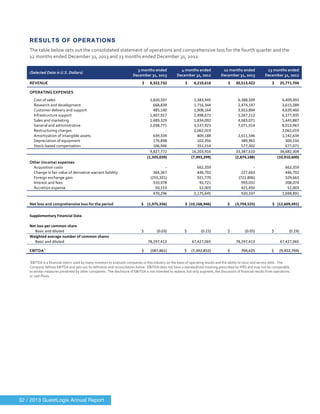
  Where	
  the	
  Company’s	
  role	
  
in	
  a	
  transaction	
  is	
  that	
  of	
  an	
  agent,	
  the	
  Company	
  recognizes	
  revenue	
  on	
  a	
  net	
  basis	
  with	
  revenue	
  representing	
  the	
  margin	
  
earned.	


Deferred	
  revenue	
  
Deferred	
  revenue	
  represents	
  amounts	
  received	
  or	
  receivable	
  from	
  customers	
  in	
  advance	
  of	
  recognizing	
  revenue	
  under	
  
the	
  criteria	
  described	
  above.	


Intangible	
  assets	
  	
  
Internally	
  generated	
  intangible	
  assets	
  
The	
  Company	
  recognizes	
  expenditure	
  on	
  research	
  activities	
  as	
  an	
  expense	
  in	
  the	
  year	
  in	
  which	
  it	
  incurs	
  the	
  expenditure.	
  It	
  
recognizes	
  an	
  internally-­‐generated	
  intangible	
  asset	
  arising	
  from	
  development	
  (or	
  from	
  the	
  development	
  phase	
  of	
  an	
  
internal	
  project)	
  if,	
  and	
  only	
  if,	
  all	
  of	
  the	
  following	
  have	
  been	
  demonstrated:	
  
• The	
  technical	
  feasibility	
  of	
  completing	
  the	
  intangible	
  asset	
  so	
  that	
  it	
  will	
  be	
  available	
  for	
  use	
  or	
  sale;	
  
• The	
  intention	
  to	
  complete	
  the	
  intangible	
  asset	
  and	
  use	
  or	
  sell	
  it;	
  
• The	
  ability	
  to	
  use	
  or	
  sell	
  the	
  intangible	
  asset;	
  
• How	
  the	
  intangible	
  asset	
  will	
  generate	
  probable	
  future	
  economic	
  benefits;	
  
• The	
  availability	
  of	
  adequate	
  technical,	
  financial	
  and	
  other	
  resources	
  to	
  complete	
  the	
  development	
  and	
  to	
  use	
  or	
  
sell	
  the	
  intangible	
  asset;	
  and	
  
• The	
  ability	
  to	
  measure	
  reliably	
  the	
  expenditure	
  attributable	
  to	
  the	
  intangible	
  asset	
  during	
  its	
  development.	


The	
  amount	
  initially	
  recognized	
  for	
  internally-­‐generated	
  intangible	
  assets	
  is	
  the	
  sum	
  of	
  the	
  expenditure	
  incurred	
  from	
  the	
  
date	
  when	
  the	
  intangible	
  asset	
  first	
  meets	
  these	
  recognition	
  criteria.	
  Where	
  no	
  internally-­‐generated	
  intangible	
  asset	
  can	
  
be	
  recognized,	
  the	
  Company	
  recognizes	
  development	
  expenditure	
  in	
  profit	
  or	
  loss	
  in	
  the	
  year	
  in	
  which	
  it	
  is	
  incurred.	
  
Subsequent	
  to	
  initial	
  recognition,	
  the	
  Company	
  reports	
  internally-­‐generated	
  intangible	
  assets	
  at	
  cost	
  less	
  accumulated	
  
amortization	
  and	
  accumulated	
  impairment	
  losses,	
  on	
  the	
  same	
  basis	
  as	
  any	
  intangible	
  assets	
  it	
  acquires	
  separately.	
  All	
  
research	
  and	
  development	
  costs	
  are	
  recorded	
  net	
  of	
  investment	
  tax	
  credits,	
  where	
  applicable.	


42 / 2013 GuestLogix Annual Report


Externally	
  acquired	
  intangible	
  assets	
  
Intangible	
  assets	
  are	
  measured	
  at	
  cost	
  less	
  accumulated	
  amortization	
  and	
  accumulated	
  impairment	
  losses,	
  if	
  any.	
  	
  
Intangible	
  assets	
  acquired	
  through	
  asset	
  acquisitions	
  or	
  business	
  combinations	
  are	
  initially	
  recognized	
  at	
  fair	
  value,	
  based	
  
on	
  an	
  allocation	
  of	
  the	
  purchase	
  price.	
  	
  The	
  intangible	
  assets	
  are	
  amortized	
  on	
  a	
  straight-­‐line	
  basis	
  over	
  their	
  estimated	
  
useful	
  lives.	
  	
  The	
  amortization	
  method,	
  estimated	
  useful	
  lives	
  and	
  residual	
  values	
  are	
  reviewed	
  each	
  financial	
  year-­‐end	
  or	
  
more	
  frequently	
  if	
  required,	
  and	
  are	
  adjusted	
  as	
  appropriate.	


Financial	
  instruments	
  
Financial	
  instruments	
  of	
  GuestLogix	
  consist	
  of	
  cash	
  and	
  cash	
  equivalents,	
  restricted	
  cash	
  and	
  cash	
  equivalents,	
  accounts	
  
receivable,	
  trade	
  and	
  other	
  payables,	
  loans	
  and	
  borrowings,	
  and	
  the	
  derivative	
  warrant	
  liability.	


Financial	
  assets	
  
All	
  financial	
  assets	
  are	
  recognized	
  and	
  derecognized	
  on	
  the	
  trade	
  date,	
  where	
  their	
  purchase	
  or	
  sale	
  are	
  under	
  a	
  contract	
  
whose	
  terms	
  require	
  delivering	
  the	
  financial	
  asset	
  within	
  the	
  timeframe	
  established	
  by	
  the	
  market	
  concerned,	
  and	
  are	
  
initially	
  measured	
  at	
  fair	
  value,	
  plus	
  transaction	
  costs,	
  except	
  for	
  financial	
  assets	
  classified	
  as	
  at	
  fair	
  value	
  through	
  profit	
  
or	
  loss,	
  which	
  are	
  initially	
  measured	
  at	
  fair	
  value.	
  Financial	
  assets	
  are	
  classified	
  into	
  the	
  following	
  specified	
  categories:	
  
financial	
  assets	
  at	
  fair	
  value	
  through	
  profit	
  or	
  loss	
  (“FVTPL”),	
  held-­‐to-­‐maturity	
  investments,	
  available-­‐for-­‐sale	
  (“AFS”)	
  
financial	
  assets,	
  including	
  cash	
  and	
  cash	
  equivalents,	
  and	
  loans	
  and	
  receivables.	
  The	
  classification	
  depends	
  on	
  the	
  nature	
  
and	
  purpose	
  of	
  the	
  financial	
  assets	
  and	
  is	
  determined	
  at	
  the	
  time	
  of	
  initial	
  recognition.	
  The	
  Company	
  does	
  not	
  currently	
  
have	
  any	
  financial	
  assets	
  in	
  the	
  held-­‐to-­‐maturity	
  or	
  available-­‐for-­‐sale	
  categories.	


Trade	
  receivables,	
  loans,	
  and	
  other	
  receivables	
  having	
  fixed	
  or	
  determinable	
  payments	
  and	
  not	
  quoted	
  in	
  an	
  active	
  
market	
  are	
  classified	
  as	
  loans	
  and	
  receivables.	
  Loans	
  and	
  receivables	
  are	
  measured	
  at	
  amortized	
  cost	
  using	
  the	
  effective	
  
interest	
  method,	
  less	
  any	
  impairment.	
  Interest	
  income	
  is	
  recognized	
  by	
  applying	
  the	
  effective	
  interest	
  rate,	
  except	
  for	
  
short-­‐term	
  receivables	
  for	
  which	
  recognizing	
  interest	
  would	
  be	
  immaterial.	


The	
  Company	
  assesses	
  financial	
  assets,	
  other	
  than	
  those	
  at	
  FVTPL,	
  for	
  indicators	
  of	
  impairment	
  at	
  the	
  end	
  of	
  each	
  
reporting	
  period.	
  Financial	
  assets	
  are	
  impaired	
  where	
  there	
  is	
  objective	
  evidence	
  that,	
  as	
  a	
  result	
  of	
  one	
  or	
  more	
  events	
  
that	
  occurred	
  after	
  initially	
  recognizing	
  the	
  financial	
  asset,	
  the	
  investment’s	
  estimated	
  future	
  cash	
  flows	
  have	
  been	
  
affected.	
  Objective	
  evidence	
  of	
  impairment	
  could	
  include	
  significant	
  financial	
  difficulty	
  of	
  the	
  issuer	
  or	
  counterparty,	
  
default	
  or	
  delinquency	
  in	
  interest	
  or	
  principal	
  payments,	
  or	
  it	
  becoming	
  probable	
  that	
  the	
  borrower	
  will	
  enter	
  bankruptcy	
  
or	
  financial	
  re-­‐organization.	


For	
  certain	
  categories	
  of	
  financial	
  asset,	
  such	
  as	
  trade	
  receivables,	
  assets	
  assessed	
  not	
  to	
  be	
  impaired	
  individually	
  are,	
  in	
  
addition,	
  assessed	
  for	
  impairment	
  on	
  a	
  collective	
  basis.	
  Objective	
  evidence	
  of	
  impairment	
  for	
  a	
  portfolio	
  of	
  receivables	
  
could	
  include	
  the	
  Company’s	
  past	
  experience	
  of	
  collecting	
  payments,	
  an	
  increase	
  in	
  the	
  number	
  of	
  delayed	
  payments	
  in	
  
the	
  portfolio	
  past	
  the	
  average	
  credit	
  period	
  of	
  45	
  days,	
  as	
  well	
  as	
  observable	
  changes	
  in	
  national	
  or	
  local	
  economic	
  
conditions	
  correlating	
  with	
  default	
  on	
  receivables.	


For	
  financial	
  assets	
  carried	
  at	
  amortized	
  cost,	
  the	
  amount	
  of	
  the	
  impairment	
  is	
  the	
  difference	
  between	
  the	
  asset’s	
  
carrying	
  amount	
  and	
  the	
  present	
  value	
  of	
  estimated	
  future	
  cash	
  flows,	
  discounted	
  at	
  the	
  financial	
  asset’s	
  original	
  
effective	
  interest	
  rate.	
  For	
  trade	
  receivables,	
  the	
  carrying	
  amount	
  is	
  reduced	
  through	
  an	
  allowance	
  account.	
  When	
  a	
  trade	
  
receivable	
  is	
  considered	
  uncollectible,	
  it	
  is	
  written	
  off	
  against	
  the	
  allowance	
  account,	
  and	
  subsequent	
  recoveries	
  of	
  
amounts	
  previously	
  written	
  off	
  are	
  credited	
  against	
  the	
  allowance	
  account.	
  Changes	
  in	
  the	
  carrying	
  amount	
  of	
  the	
  
allowance	
  account	
  are	
  recognized	
  in	
  profit	
  or	
  loss.	


The	
  Company	
  derecognizes	
  a	
  financial	
  asset	
  only	
  when	
  the	
  contractual	
  rights	
  to	
  the	
  cash	
  flows	
  from	
  the	
  asset	
  expire,	
  or	
  
when	
  it	
  transfers	
  the	
  financial	
  asset	
  and	
  substantially	
  all	
  the	
  risks	
  and	
  rewards	
  of	
  ownership	
  of	
  the	
  asset	
  to	
  another	
  entity.	


Financial	
  liabilities	
  
The	
  Company	
  classifies	
  financial	
  liabilities	
  as	
  either	
  financial	
  liabilities	
  at	
  FVTPL	
  or	
  other	
  financial	
  liabilities.	
  The	
  derivative	
  
warrant	
  liability	
  is	
  measured	
  at	
  FVTPL	
  while	
  other	
  financial	
  liabilities,	
  consisting	
  of	
  trade	
  and	
  other	
  payables	
  and	
  loans	
  
and	
  borrowings,	
  are	
  initially	
  measured	
  at	
  fair	
  value,	
  net	
  of	
  transaction	
  costs,	
  and	
  are	
  subsequently	
  measured	
  at	
  amortized	
  
cost	
  using	
  the	
  effective	
  interest	
  method,	
  recognizing	
  interest	
  expense	
  on	
  an	
  effective	
  yield	
  basis.	
  
2013 GuestLogix Annual Report / 43


Fair	
  value	
  hierarchy	
  
The	
  Company	
  classifies	
  and	
  discloses	
  fair	
  value	
  measurements	
  using	
  a	
  fair	
  value	
  hierarchy	
  that	
  reflects	
  the	
  significance	
  of	
  
the	
  inputs	
  used	
  in	
  making	
  the	
  measurements.	
  The	
  three	
  levels	
  of	
  the	
  fair	
  value	
  hierarchy	
  are:	
  
Level	
  1	
  –	
  valuation	
  based	
  on	
  quoted	
  prices	
  (unadjusted)	
  in	
  active	
  markets	
  for	
  identical	
  assets	
  and	
  liabilities;	
  	
  
Level	
  2	
  –	
  valuation	
  techniques	
  based	
  on	
  inputs	
  other	
  than	
  quoted	
  prices	
  included	
  in	
  Level	
  1	
  that	
  are	
  observable	
  
for	
  the	
  asset	
  or	
  liability,	
  either	
  directly	
  (i.e.,	
  as	
  prices)	
  or	
  indirectly	
  (i.e.,	
  derived	
  from	
  prices);	
  	
  
Level	
  3	
  –	
  valuation	
  techniques	
  using	
  inputs	
  for	
  the	
  asset	
  or	
  liability	
  that	
  are	
  not	
  based	
  on	
  observable	
  market	
  data	
  
(unobservable	
  inputs).	


The	
  Company’s	
  cash	
  and	
  cash	
  equivalents	
  are	
  measured	
  using	
  level	
  1	
  inputs	
  and	
  the	
  derivative	
  warrant	
  liability	
  is	
  
measured	
  using	
  level	
  3	
  inputs.	


Cash	
  and	
  cash	
  equivalents	
  
Cash	
  and	
  cash	
  equivalents	
  include	
  balances	
  with	
  banks	
  and	
  highly	
  liquid	
  instruments.	


Inventory	
  
The	
  Company’s	
  inventory	
  consists	
  of	
  hand-­‐held	
  devices	
  including	
  hand-­‐held	
  devices	
  awaiting	
  deployment	
  and	
  
replacement	
  parts	
  held	
  for	
  sale,	
  and	
  is	
  stated	
  at	
  the	
  lower	
  of	
  cost	
  and	
  net	
  realizable	
  value.	
  Net	
  realizable	
  value	
  represents	
  
the	
  estimated	
  selling	
  price	
  for	
  inventories	
  less	
  all	
  estimated	
  costs	
  of	
  completion	
  and	
  costs	
  necessary	
  to	
  make	
  the	
  sale.	


Property	
  and	
  equipment	
  
The	
  Company	
  records	
  equipment	
  at	
  cost	
  less	
  accumulated	
  depreciation	
  and	
  accumulated	
  impairment	
  losses.	
  	
  It	
  
recognizes	
  depreciation	
  to	
  write	
  off	
  the	
  cost	
  of	
  assets	
  less	
  their	
  residual	
  values	
  over	
  their	
  useful	
  lives,	
  using	
  the	
  following	
  
methods	
  and	
  rates:	
  	
  
Computer	
  equipment	


   Straight-­‐line	
   	
   3	
  years	
  
Furniture	
  and	
  fixtures	
   	
   	
   Straight-­‐line	
   	
   5	
  years	


The	
  Company	
  reviews	
  the	
  estimated	
  useful	
  lives,	
  residual	
  values	
  and	
  depreciation	
  method	
  at	
  each	
  year	
  end,	
  accounting	
  
for	
  the	
  effect	
  of	
  any	
  changes	
  in	
  estimate	
  on	
  a	
  prospective	
  basis.	
  The	
  gain	
  or	
  loss	
  arising	
  on	
  disposing	
  of	
  or	
  retiring	
  an	
  item	
  
of	
  property,	
  plant	
  and	
  equipment	
  is	
  determined	
  as	
  the	
  difference	
  between	
  the	
  sales	
  proceeds	
  and	
  the	
  asset’s	
  carrying	
  
amount	
  and	
  is	
  recognized	
  in	
  profit	
  or	
  loss.	


Impairment	
  of	
  long-­‐lived	
  assets	
  
At	
  the	
  end	
  of	
  each	
  reporting	
  period,	
  the	
  Company	
  reviews	
  the	
  carrying	
  amounts	
  of	
  its	
  tangible	
  assets	
  to	
  determine	
  
whether	
  there	
  is	
  any	
  indication	
  those	
  assets	
  have	
  suffered	
  an	
  impairment	
  loss.	
  If	
  any	
  such	
  indication	
  exists,	
  it	
  estimates	
  
the	
  asset’s	
  recoverable	
  amount	
  to	
  determine	
  the	
  extent	
  of	
  the	
  impairment	
  loss	
  (if	
  any).	
  Where	
  it	
  is	
  not	
  possible	
  to	
  
estimate	
  an	
  individual	
  asset’s	
  recoverable	
  amount,	
  the	
  Company	
  estimates	
  the	
  recoverable	
  amount	
  of	
  the	
  cash-­‐
generating	
  unit	
  (“CGU”)	
  to	
  which	
  the	
  asset	
  belongs.	
  Where	
  it	
  can	
  identify	
  a	
  reasonable	
  and	
  consistent	
  basis	
  of	
  allocation,	
  
it	
  also	
  allocates	
  corporate	
  assets	
  to	
  individual	
  CGU’s,	
  or	
  otherwise	
  allocates	
  them	
  to	
  the	
  smallest	
  group	
  of	
  CGU’s	
  for	
  
which	
  it	
  can	
  identify	
  a	
  reasonable	
  and	
  consistent	
  allocation	
  basis.	


Recoverable	
  amount	
  is	
  the	
  higher	
  of	
  fair	
  value	
  less	
  costs	
  to	
  sell	
  and	
  value	
  in	
  use.	
  In	
  assessing	
  value	
  in	
  use,	
  the	
  Company	
  
discounts	
  estimated	
  future	
  cash	
  flows	
  to	
  their	
  present	
  value	
  using	
  a	
  pre-­‐tax	
  discount	
  rate	
  reflecting	
  current	
  market	
  
assessments	
  of	
  the	
  time	
  value	
  of	
  money	
  and	
  the	
  risks	
  specific	
  to	
  the	
  asset	
  for	
  which	
  the	
  estimates	
  of	
  future	
  cash	
  flows	
  
have	
  not	
  been	
  adjusted.	


If	
  an	
  asset	
  or	
  CGU’s	
  recoverable	
  amount	
  is	
  estimated	
  to	
  be	
  less	
  than	
  its	
  carrying	
  amount,	
  the	
  carrying	
  amount	
  is	
  reduced	
  
to	
  its	
  recoverable	
  amount,	
  recognizing	
  an	
  impairment	
  loss	
  immediately	
  in	
  profit	
  or	
  loss.	
  During	
  the	
  year	
  ended	
  December	
  
31,	
  2013	
  the	
  Company	
  did	
  not	
  recognize	
  an	
  impairment	
  loss	
  (13	
  months	
  ended	
  December	
  31,	
  2012,	
  $1,296,270).	


Should	
  the	
  Company	
  record	
  an	
  impairment	
  loss	
  which	
  subsequently	
  reverses,	
  it	
  will	
  increase	
  the	
  carrying	
  amount	
  to	
  the	
  
revised	
  estimate	
  of	
  its	
  recoverable	
  amount,	
  by	
  recognizing	
  the	
  reversal	
  immediately	
  in	
  profit	
  or	
  loss,	
  without	
  exceeding	
  
the	
  carrying	
  amount	
  that	
  would	
  have	
  been	
  determined	
  if	
  it	
  had	
  not	
  recognized	
  an	
  impairment	
  loss	
  in	
  prior	
  years.	
  
44 / 2013 GuestLogix Annual Report


Deferred	
  taxes	
  
Deferred	
  tax	
  is	
  recognized	
  on	
  temporary	
  differences	
  between	
  the	
  carrying	
  amounts	
  of	
  assets	
  and	
  liabilities	
  in	
  the	
  
financial	
  statements	
  and	
  the	
  corresponding	
  tax	
  bases	
  used	
  in	
  the	
  computation	
  of	
  taxable	
  profit.	
  Deferred	
  tax	
  liabilities	
  
are	
  generally	
  recognized	
  for	
  all	
  taxable	
  temporary	
  differences.	
  Deferred	
  tax	
  assets	
  are	
  generally	
  recognized	
  for	
  all	
  
deductible	
  temporary	
  differences	
  to	
  the	
  extent	
  that	
  it	
  is	
  probable	
  that	
  taxable	
  profits	
  will	
  be	
  available	
  against	
  which	
  those	
  
deductible	
  temporary	
  differences	
  can	
  be	
  utilized.	


Such	
  deferred	
  tax	
  assets	
  and	
  liabilities	
  are	
  not	
  recognized	
  if	
  the	
  temporary	
  difference	
  arises	
  from	
  goodwill	
  or	
  from	
  the	
  
initial	
  recognition	
  (other	
  than	
  in	
  a	
  business	
  combination)	
  of	
  other	
  assets	
  and	
  liabilities	
  in	
  a	
  transaction	
  that	
  affects	
  neither	
  
the	
  taxable	
  profit	
  nor	
  the	
  accounting	
  profit.	


Deferred	
  tax	
  liabilities	
  are	
  recognized	
  for	
  taxable	
  temporary	
  differences	
  associated	
  with	
  investments	
  in	
  subsidiaries	
  and	
  
associates,	
  and	
  interests	
  in	
  joint	
  ventures,	
  except	
  where	
  the	
  Company	
  is	
  able	
  to	
  control	
  the	
  reversal	
  of	
  the	
  temporary	
  
difference	
  and	
  it	
  is	
  probable	
  that	
  the	
  temporary	
  difference	
  will	
  not	
  reverse	
  in	
  the	
  foreseeable	
  future.	
  Deferred	
  tax	
  assets	
  
arising	
  from	
  deductible	
  temporary	
  differences	
  associated	
  with	
  such	
  investments	
  and	
  interests	
  are	
  only	
  recognized	
  to	
  the	
  
extent	
  that	
  it	
  is	
  probable	
  that	
  there	
  will	
  be	
  sufficient	
  taxable	
  profits	
  against	
  which	
  to	
  utilize	
  the	
  benefits	
  of	
  the	
  temporary	
  
differences	
  and	
  they	
  are	
  expected	
  to	
  reverse	
  in	
  the	
  foreseeable	
  future.	


The	
  carrying	
  amount	
  of	
  deferred	
  tax	
  assets	
  is	
  reviewed	
  at	
  the	
  end	
  of	
  each	
  reporting	
  period	
  and	
  reduced	
  to	
  the	
  extent	
  that	
  
it	
  is	
  no	
  longer	
  probable	
  that	
  sufficient	
  taxable	
  profits	
  will	
  be	
  available	
  to	
  allow	
  all	
  or	
  part	
  of	
  the	
  asset	
  to	
  be	
  recovered.	


Deferred	
  tax	
  assets	
  and	
  liabilities	
  are	
  measured	
  at	
  the	
  tax	
  rates	
  that	
  are	
  expected	
  to	
  apply	
  in	
  the	
  period	
  in	
  which	
  the	
  
liability	
  is	
  settled	
  or	
  the	
  asset	
  realized,	
  based	
  on	
  tax	
  rates	
  (and	
  tax	
  laws)	
  that	
  have	
  been	
  enacted	
  or	
  substantively	
  enacted	
  
by	
  the	
  end	
  of	
  the	
  reporting	
  period.	
  The	
  measurement	
  of	
  deferred	
  tax	
  liabilities	
  and	
  assets	
  reflects	
  the	
  tax	
  consequences	
  
that	
  would	
  follow	
  from	
  the	
  manner	
  in	
  which	
  the	
  Company	
  expects,	
  at	
  the	
  end	
  of	
  the	
  reporting	
  period,	
  to	
  recover	
  or	
  settle	
  
the	
  carrying	
  amount	
  of	
  its	
  assets	
  and	
  liabilities.	


Deferred	
  tax	
  assets	
  and	
  liabilities	
  are	
  offset	
  when	
  there	
  is	
  a	
  legally	
  enforceable	
  right	
  to	
  offset	
  tax	
  assets	
  against	
  tax	
  
liabilities	
  and	
  when	
  they	
  relate	
  to	
  income	
  taxes	
  levied	
  by	
  the	
  same	
  taxation	
  authority	
  and	
  the	
  Company	
  intends	
  to	
  settle	
  
its	
  tax	
  assets	
  and	
  liabilities	
  on	
  a	
  net	
  basis.	


Stock-­‐based	
  compensation	
  
The	
  Company	
  measures	
  equity-­‐settled	
  share-­‐based	
  payments	
  to	
  employees	
  and	
  others	
  providing	
  similar	
  services	
  at	
  the	
  
fair	
  value	
  of	
  the	
  equity	
  instruments	
  at	
  the	
  grant	
  date.	
  The	
  fair	
  value	
  determined	
  at	
  the	
  grant	
  date	
  of	
  the	
  equity-­‐settled	
  
share-­‐based	
  payments	
  is	
  calculated	
  using	
  the	
  Black-­‐Scholes	
  option	
  valuation	
  model	
  and	
  is	
  expensed	
  on	
  a	
  graded	
  vesting	
  
basis	
  over	
  the	
  vesting	
  period,	
  based	
  on	
  the	
  Company’s	
  estimate	
  of	
  equity	
  instruments	
  that	
  will	
  eventually	
  vest,	
  and	
  is	
  
credited	
  to	
  other	
  paid-­‐in	
  capital.	
  At	
  the	
  end	
  of	
  each	
  reporting	
  period,	
  the	
  Company	
  revises	
  its	
  estimate	
  of	
  the	
  number	
  of	
  
equity	
  instruments	
  expected	
  to	
  vest.	
  The	
  impact	
  of	
  the	
  revision	
  of	
  the	
  original	
  estimates,	
  if	
  any,	
  is	
  recognized	
  in	
  profit	
  or	
  
loss	
  such	
  that	
  the	
  cumulative	
  expense	
  reflects	
  the	
  revised	
  estimate,	
  with	
  a	
  corresponding	
  adjustment	
  to	
  other	
  paid-­‐in	
  
capital.	
  When	
  options	
  are	
  exercised,	
  the	
  proceeds	
  together	
  with	
  the	
  amount	
  originally	
  credited	
  to	
  other	
  paid-­‐in	
  capital	
  
are	
  credited	
  to	
  share	
  capital.	


The	
  use	
  of	
  the	
  Black-­‐Scholes	
  model	
  requires	
  inputting	
  a	
  number	
  of	
  assumptions,	
  including	
  expected	
  dividend	
  yield,	
  
expected	
  stock	
  price	
  volatility,	
  forfeiture	
  rate,	
  expected	
  time	
  until	
  exercise	
  and	
  risk	
  free	
  interest	
  rate.	
  	
  Although	
  the	
  
assumptions	
  used	
  reflect	
  management’s	
  best	
  estimates,	
  they	
  involve	
  inherent	
  uncertainties	
  based	
  on	
  conditions	
  outside	
  
of	
  the	
  Company’s	
  control.	
  	
  If	
  other	
  assumptions	
  were	
  used,	
  stock-­‐based	
  compensation	
  could	
  be	
  significantly	
  impacted.	


Leases	
  
The	
  Company	
  classifies	
  a	
  lease	
  it	
  enters	
  into	
  as	
  a	
  lessee	
  as	
  a	
  finance	
  lease	
  whenever	
  the	
  terms	
  transfer	
  substantially	
  all	
  
the	
  risks	
  and	
  rewards	
  of	
  ownership	
  to	
  the	
  Company.	
  It	
  classifies	
  all	
  other	
  leases	
  as	
  operating	
  leases.	
  It	
  initially	
  recognizes	
  
assets	
  held	
  under	
  finance	
  leases	
  at	
  their	
  fair	
  value	
  at	
  the	
  inception	
  of	
  the	
  lease	
  or,	
  if	
  lower,	
  at	
  the	
  present	
  value	
  of	
  the	
  
minimum	
  lease	
  payments,	
  and	
  recognizes	
  the	
  corresponding	
  liability	
  to	
  the	
  lessor	
  as	
  a	
  finance	
  lease	
  obligation.	
  Lease	
  
payments	
  are	
  apportioned	
  between	
  finance	
  expenses	
  and	
  reduction	
  of	
  the	
  lease	
  obligation	
  so	
  as	
  to	
  achieve	
  a	
  constant	
  
rate	
  of	
  interest	
  on	
  the	
  remaining	
  balance	
  of	
  the	
  liability.	
  Finance	
  expenses	
  are	
  recognized	
  immediately	
  in	
  profit	
  or	
  loss.	
  
2013 GuestLogix Annual Report / 45


The	
  Company	
  recognizes	
  operating	
  lease	
  payments	
  as	
  an	
  expense	
  on	
  a	
  straight-­‐line	
  basis	
  over	
  the	
  lease	
  term,	
  except	
  
where	
  another	
  systematic	
  basis	
  better	
  represents	
  the	
  time	
  pattern	
  in	
  which	
  it	
  consumes	
  economic	
  benefits	
  from	
  the	
  
leased	
  asset.	


Provisions	
  
The	
  Company	
  recognizes	
  a	
  provision	
  when	
  it	
  has	
  a	
  present	
  obligation	
  (legal	
  or	
  constructive)	
  as	
  a	
  result	
  of	
  a	
  past	
  event,	
  it	
  
is	
  probable	
  it	
  will	
  be	
  required	
  to	
  settle	
  the	
  obligation,	
  and	
  it	
  can	
  make	
  a	
  reliable	
  estimate	
  of	
  the	
  amount	
  of	
  the	
  obligation.	
  
The	
  amount	
  it	
  recognizes	
  as	
  a	
  provision	
  is	
  the	
  best	
  estimate	
  of	
  the	
  consideration	
  required	
  to	
  settle	
  the	
  present	
  obligation	
  
at	
  the	
  end	
  of	
  the	
  reporting	
  period,	
  taking	
  into	
  account	
  the	
  risks	
  and	
  uncertainties	
  surrounding	
  the	
  obligation.	
  Where	
  a	
  
provision	
  is	
  measured	
  using	
  the	
  cash	
  flows	
  estimated	
  to	
  settle	
  the	
  present	
  obligation,	
  its	
  carrying	
  amount	
  is	
  the	
  present	
  
value	
  of	
  those	
  cash	
  flows.	


Restructuring	
  provisions	
  	
  
Restructuring	
  provisions	
  are	
  recognized	
  only	
  when	
  the	
  Company	
  has	
  an	
  actual	
  or	
  a	
  constructive	
  obligation.	
  The	
  Company	
  
has	
  a	
  constructive	
  obligation	
  when	
  a	
  detailed	
  formal	
  plan	
  identifies	
  the	
  business	
  or	
  part	
  of	
  the	
  business	
  location	
  and	
  
number	
  of	
  employees	
  affected	
  a	
  detailed	
  estimate	
  of	
  the	
  associated	
  costs	
  and	
  an	
  appropriate	
  concerned,	
  the	
  location	
  
and	
  number	
  of	
  employees	
  affected	
  a	
  detailed	
  estimate	
  of	
  the	
  associated	
  costs	
  and	
  an	
  appropriate	
  timeline.	


The	
  Company	
  incurs	
  restructuring	
  charges	
  relating	
  to	
  workforce	
  reductions	
  which	
  include	
  employee	
  severance	
  and	
  other	
  
employee	
  benefits.	
  The	
  recognition	
  of	
  these	
  charges	
  requires	
  Management	
  to	
  make	
  certain	
  judgments	
  and	
  estimates	
  
regarding	
  the	
  nature,	
  timing	
  and	
  amounts	
  associated	
  with	
  these	
  restructuring	
  plans.	
  Employee	
  termination	
  costs	
  are	
  
recognized	
  in	
  the	
  period	
  the	
  detailed	
  plans	
  are	
  approved	
  and	
  the	
  actions	
  have	
  either	
  commenced	
  or	
  have	
  been	
  
announced	
  to	
  the	
  employees.	
  	
  At	
  the	
  end	
  of	
  each	
  reporting	
  period,	
  the	
  remaining	
  balances	
  are	
  assessed	
  for	
  
appropriateness.	
  	
  Adjustments	
  to	
  the	
  recorded	
  amounts	
  may	
  be	
  required	
  to	
  reflect	
  actual	
  experience	
  or	
  changes	
  in	
  future	
  
estimates.	


Share	
  issue	
  costs	
  
The	
  Company	
  charges	
  incremental	
  costs	
  incurred	
  in	
  respect	
  of	
  raising	
  capital	
  against	
  the	
  equity	
  proceeds	
  raised,	
  
including	
  legal,	
  accounting,	
  agent	
  and	
  investment	
  bank	
  fees.	


Earnings	
  (loss)	
  per	
  share	
  
The	
  Company	
  computes	
  basic	
  earnings	
  (loss)	
  per	
  share	
  by	
  dividing	
  net	
  profit	
  (loss)	
  by	
  the	
  weighted	
  average	
  number	
  of	
  
common	
  shares	
  outstanding	
  for	
  the	
  period.	
  	
  Diluted	
  earnings	
  (loss)	
  per	
  share	
  reflects	
  the	
  potential	
  dilution	
  that	
  could	
  
occur	
  if	
  additional	
  common	
  shares	
  are	
  assumed	
  to	
  be	
  issued	
  under	
  securities	
  or	
  contracts	
  that	
  entitle	
  their	
  holders	
  to	
  
obtain	
  common	
  shares	
  in	
  the	
  future,	
  and	
  is	
  calculated	
  using	
  the	
  treasury	
  stock	
  method.	
  	
  In	
  periods	
  when	
  the	
  Company	
  
reports	
  a	
  net	
  loss,	
  the	
  effect	
  of	
  potential	
  issuances	
  of	
  shares	
  under	
  options	
  and	
  warrants	
  is	
  anti-­‐dilutive	
  and	
  therefore,	
  
basic	
  and	
  diluted	
  loss	
  per	
  share	
  are	
  the	
  same.	


Significant	
  judgments,	
  estimates	
  and	
  assumptions	
  
The	
  preparation	
  of	
  the	
  Company’s	
  consolidated	
  financial	
  statements	
  in	
  conformity	
  with	
  IFRS	
  requires	
  management	
  to	
  
make	
  judgments,	
  estimates	
  and	
  assumptions	
  that	
  affect	
  the	
  reported	
  amounts	
  of	
  assets	
  and	
  liabilities	
  and	
  disclosures	
  of	
  
contingent	
  assets	
  and	
  liabilities	
  at	
  the	
  date	
  of	
  the	
  financial	
  statements	
  and	
  the	
  reported	
  amounts	
  of	
  revenues	
  and	
  
expenses	
  during	
  the	
  reporting	
  period.	
  Estimates	
  and	
  assumptions	
  are	
  continually	
  evaluated	
  and	
  are	
  based	
  on	
  
management’s	
  experience	
  and	
  other	
  factors,	
  including	
  expectations	
  of	
  future	
  events	
  that	
  are	
  believed	
  to	
  be	
  reasonable	
  
under	
  the	
  circumstances.	
  Actual	
  results	
  could	
  differ	
  from	
  these	
  estimates.	


46 / 2013 GuestLogix Annual Report


The	
  areas	
  which	
  require	
  management	
  to	
  make	
  significant	
  judgments,	
  estimates	
  and	
  assumptions	
  in	
  determining	
  carrying	
  
values	
  include,	
  but	
  are	
  not	
  limited	
  to:	


Revenue	
  recognition	
  	
  
In	
  revenue	
  arrangements	
  including	
  more	
  than	
  one	
  deliverable,	
  the	
  deliverables	
  are	
  assigned	
  to	
  one	
  or	
  more	
  separate	
  
units	
  of	
  accounting	
  and	
  the	
  arrangement	
  consideration	
  is	
  allocated	
  to	
  each	
  unit	
  of	
  accounting	
  based	
  on	
  its	
  relative	
  fair	
  
value.	
  	
  Determining	
  the	
  fair	
  value	
  of	
  each	
  deliverable	
  can	
  require	
  complex	
  estimates	
  due	
  to	
  the	
  nature	
  of	
  the	
  goods	
  and	
  
services	
  provided.	
  	
  The	
  Company	
  generally	
  determines	
  the	
  fair	
  value	
  of	
  individual	
  elements	
  based	
  on	
  prices	
  at	
  which	
  the	
  
deliverable	
  is	
  regularly	
  sold	
  on	
  a	
  standalone	
  basis	
  after	
  considering	
  volume	
  discounts	
  where	
  appropriate.	


In	
  merchandising	
  agreements	
  with	
  customers	
  in	
  which	
  the	
  Company	
  provides	
  transaction	
  processing	
  and	
  merchant	
  of	
  
record	
  services	
  in	
  the	
  sale	
  of	
  food	
  and	
  beverage	
  items	
  and	
  destination-­‐based	
  attraction	
  tickets	
  on-­‐board,	
  revenue	
  is	
  
recognized	
  on	
  either	
  a	
  gross	
  or	
  net	
  basis,	
  depending	
  on	
  the	
  Company's	
  role	
  in	
  the	
  transaction	
  as	
  principal	
  or	
  as	
  agent.	


Due	
  to	
  the	
  complex	
  nature	
  of	
  these	
  transactions,	
  the	
  determination	
  of	
  whether	
  the	
  Company	
  acts	
  as	
  principal	
  or	
  agent	
  
requires	
  judgment	
  in	
  assessing	
  primary	
  responsibility,	
  the	
  level	
  of	
  inventory	
  risk	
  and	
  the	
  level	
  of	
  credit	
  risk,	
  among	
  other	
  
factors.	


Impairment	
  of	
  Goodwill	
  and	
  Other	
  Assets	
  	
  
Goodwill	
  is	
  tested	
  for	
  impairment	
  annually	
  or	
  more	
  frequently	
  if	
  there	
  is	
  an	
  indication	
  of	
  impairment.	
  The	
  carrying	
  value	
  
of	
  intangible	
  assets	
  with	
  definite	
  lives	
  and	
  property	
  and	
  equipment	
  is	
  reviewed	
  each	
  reporting	
  period	
  to	
  determine	
  
whether	
  there	
  is	
  any	
  indication	
  of	
  impairment.	
  If	
  the	
  carrying	
  amount	
  of	
  an	
  asset	
  exceeds	
  its	
  recoverable	
  amount,	
  the	
  
asset	
  is	
  impaired	
  and	
  an	
  impairment	
  loss	
  is	
  recognized	
  in	
  the	
  consolidated	
  statement	
  of	
  operations	
  and	
  comprehensive	
  
loss.	
  The	
  assessment	
  of	
  fair	
  values	
  requires	
  the	
  use	
  of	
  estimates	
  and	
  assumptions	
  related	
  to	
  future	
  operating	
  
performance,	
  future	
  capital	
  expenditures,	
  discount	
  rates	
  and	
  terminal	
  value.	
  	
  During	
  the	
  year	
  ended	
  December	
  31,	
  2013,	
  
the	
  Company	
  did	
  not	
  record	
  any	
  impairment	
  loss	
  (December	
  31,	
  2012	
  –	
  $1,296,270).	


Useful	
  Life	
  of	
  Equipment	
  and	
  Intangible	
  assets	
  	
  
Significant	
  judgment	
  is	
  involved	
  in	
  the	
  determination	
  of	
  useful	
  life	
  for	
  the	
  computation	
  of	
  depreciation	
  of	
  property	
  and	
  
equipment	
  and	
  amortization	
  of	
  intangible	
  assets.	
  No	
  assurance	
  can	
  be	
  given	
  that	
  actual	
  useful	
  lives	
  will	
  not	
  differ	
  
significantly	
  from	
  current	
  assumptions.	


Legal	
  Provisions	
  	
  
The	
  Company	
  assesses	
  the	
  provision	
  for	
  legal	
  or	
  constructive	
  obligations	
  at	
  each	
  reporting	
  period	
  or	
  when	
  new	
  material	
  
information	
  becomes	
  available.	
  	
  Legal	
  and	
  contractual	
  matters	
  are	
  subject	
  to	
  interpretation	
  and	
  the	
  Company	
  may	
  
engage	
  external	
  advisors	
  to	
  assist	
  with	
  periodic	
  assessments.	
  	
  To	
  the	
  extent	
  that	
  interpretation	
  of	
  legal	
  and	
  contractual	
  
matters	
  differ	
  significantly	
  from	
  estimates,	
  the	
  actual	
  judgments	
  and	
  settlement	
  amounts	
  may	
  vary	
  significantly	
  from	
  
management’s	
  estimates.	


Valuation	
  of	
  derivative	
  warrant	
  liability	
  	
  
The	
  Company	
  is	
  required	
  to	
  make	
  certain	
  estimates	
  when	
  determining	
  the	
  fair	
  value	
  of	
  the	
  derivative	
  warrant	
  liabilities	
  
issued	
  as	
  part	
  of	
  the	
  promissory	
  notes	
  issued	
  each	
  reporting	
  period.	
  These	
  estimates	
  affect	
  the	
  amount	
  recognized	
  as	
  
derivative	
  warrant	
  liabilities	
  in	
  the	
  consolidated	
  statement	
  of	
  financial	
  position	
  and	
  the	
  change	
  in	
  fair	
  value	
  of	
  derivative	
  
warrant	
  liabilities	
  in	
  the	
  consolidated	
  statement	
  of	
  comprehensive	
  (loss)	
  income.	


Valuation	
  of	
  intangible	
  assets	
  	
  
The	
  determination	
  of	
  estimated	
  fair	
  values	
  of	
  acquired	
  intangible	
  assets,	
  as	
  well	
  as	
  the	
  useful	
  economic	
  life	
  ascribed	
  to	
  
finite	
  lived	
  intangible	
  assets,	
  requires	
  the	
  use	
  of	
  significant	
  judgment.	
  The	
  use	
  of	
  different	
  estimates	
  and	
  assumptions	
  to	
  
those	
  used	
  by	
  the	
  Company	
  could	
  result	
  in	
  a	
  materially	
  different	
  valuation	
  of	
  acquired	
  intangible	
  assets,	
  which	
  could	
  have	
  
a	
  material	
  effect	
  on	
  the	
  Company’s	
  results	
  of	
  operations.	


2013 GuestLogix Annual Report / 47


BASIS OF MEASUREMENT AND PRESENTATION AND RECENTLY ISSUED
ACCOUNTING PRONOUNCEMENTS
Basis	
  of	
  measurement	
  and	
  presentation	
  
The	
  consolidated	
  financial	
  statements	
  have	
  been	
  prepared	
  under	
  the	
  historical	
  cost	
  convention,	
  as	
  modified	
  by	
  the	
  
revaluation	
  of	
  financial	
  assets	
  and	
  financial	
  liabilities	
  at	
  fair	
  value	
  through	
  profit	
  or	
  loss.	


Not	
  yet	
  effective	
  
IFRS	
  9	
  –	
  Financial	
  Instruments	
  was	
  issued	
  by	
  the	
  IASB	
  to	
  establish	
  principles	
  for	
  the	
  financial	
  reporting	
  of	
  financial	
  assets	
  
and	
  liabilities,	
  including	
  requirements	
  to	
  present	
  certain	
  information	
  relating	
  to	
  the	
  amounts,	
  timing,	
  and	
  uncertainty	
  of	
  
the	
  entity’s	
  future	
  cash	
  flows.	
  This	
  standard	
  is	
  mandatorily	
  effective	
  from	
  January	
  1,	
  2018,	
  with	
  earlier	
  application	
  
permitted.	
  	
  Management	
  has	
  not	
  yet	
  determined	
  the	
  potential	
  impact	
  the	
  adoption	
  of	
  IFRS	
  9	
  will	
  have	
  on	
  the	
  Company’s	
  
consolidated	
  financial	
  statements.	


Adopted	
  
As	
  of	
  January	
  1,	
  2013,	
  the	
  Company	
  adopted	
  the	
  new	
  and	
  amended	
  IFRS	
  pronouncements	
  in	
  accordance	
  with	
  the	
  
transitional	
  provisions	
  outlined	
  in	
  the	
  respective	
  standards.	
  The	
  Company	
  has	
  adopted	
  these	
  new	
  and	
  amended	
  
standards	
  without	
  any	
  significant	
  effect	
  on	
  its	
  financial	
  statements.	


IFRS	
  10	
  –	
  Consolidated	
  Financial	
  Statements	
  
IFRS	
  10	
  establishes	
  principles	
  for	
  the	
  presentation	
  and	
  preparation	
  of	
  consolidated	
  financial	
  statements	
  when	
  an	
  entity	
  
controls	
  one	
  or	
  more	
  other	
  entities.	
  IFRS	
  10	
  defines	
  the	
  principle	
  of	
  control	
  and	
  establishes	
  control	
  as	
  the	
  basis	
  for	
  
determining	
  which	
  entities	
  are	
  consolidated.	
  IFRS	
  10	
  sets	
  out	
  three	
  elements	
  of	
  control:	
  power	
  over	
  the	
  investee;	
  
exposure,	
  or	
  rights,	
  to	
  variable	
  returns	
  from	
  involvement	
  with	
  the	
  investee;	
  and	
  the	
  ability	
  to	
  use	
  power	
  over	
  the	
  investee	
  
to	
  affect	
  the	
  amount	
  of	
  the	
  investors’	
  return;	
  and	
  the	
  requirements	
  on	
  how	
  to	
  apply	
  the	
  control	
  principle.	
  IFRS	
  10	
  replaces	
  
SIC-­‐12,	
  Consolidation	
  –	
  Special	
  Purpose	
  Entities	
  and	
  parts	
  of	
  IAS	
  27,	
  Consolidated	
  and	
  Separate	
  Financial	
  Statements.	


IFRS	
  11	
  -­‐	
  Joint	
  Arrangements	
  
IFRS	
  11	
  requires	
  a	
  venturer	
  to	
  classify	
  its	
  interest	
  in	
  a	
  joint	
  arrangement	
  as	
  a	
  joint	
  venture	
  or	
  joint	
  operation.	
  Joint	
  
ventures	
  will	
  be	
  accounted	
  for	
  using	
  the	
  equity	
  method	
  of	
  accounting	
  whereas	
  for	
  a	
  joint	
  operation	
  the	
  venturer	
  will	
  
recognize	
  its	
  share	
  of	
  the	
  assets,	
  liabilities,	
  revenue	
  and	
  expenses	
  of	
  the	
  joint	
  operation.	
  IFRS	
  11	
  supersedes	
  IAS	
  31,	
  
Interests	
  in	
  Joint	
  Ventures,	
  and	
  SIC-­‐13,	
  Jointly	
  Controlled	
  Entities	
  –	
  Non-­‐monetary	
  Contributions	
  by	
  Venturers.	


IFRS	
  12	
  –	
  Disclosure	
  of	
  Interests	
  in	
  Other	
  Entities	
  
IFRS	
  12	
  establishes	
  disclosure	
  requirements	
  for	
  interests	
  in	
  other	
  entities,	
  including	
  subsidiaries,	
  joint	
  arrangements,	
  
associates,	
  and	
  special	
  purpose	
  vehicles.	


IFRS	
  13	
  -­‐	
  Fair	
  Value	
  Measurement	
  
IFRS	
  13	
  is	
  a	
  comprehensive	
  standard	
  for	
  fair	
  value	
  measurement	
  and	
  disclosure	
  requirements	
  for	
  use	
  across	
  all	
  IFRS	
  
standards.	
  The	
  new	
  standard	
  clarifies	
  that	
  fair	
  value	
  is	
  the	
  price	
  that	
  would	
  be	
  received	
  to	
  sell	
  an	
  asset,	
  or	
  paid	
  to	
  transfer	
  
a	
  liability	
  in	
  an	
  orderly	
  transaction	
  between	
  market	
  participants,	
  at	
  the	
  measurement	
  date.	
  It	
  also	
  establishes	
  additional	
  
disclosures	
  regarding	
  fair	
  value	
  measurements.	


48 / 2013 GuestLogix Annual Report


CONTROLS AND PROCEDURES
DISCLOSURE	
  CONTROLS	
  AND	
  PROCEDURES	
  (“DC&P”)	


DC&P	
  are	
  designed	
  to	
  provide	
  reasonable	
  assurance	
  that	
  all	
  relevant	
  information	
  is	
  gathered	
  and	
  reported	
  to	
  senior	
  
management	
  of	
  GuestLogix,	
  including	
  the	
  Chief	
  Executive	
  Officer	
  and	
  Chief	
  Financial	
  Officer,	
  on	
  a	
  timely	
  basis	
  so	
  that	
  
appropriate	
  decisions	
  can	
  be	
  made	
  regarding	
  public	
  disclosures.	
  The	
  Company’s	
  management,	
  including	
  the	
  President	
  
and	
  Chief	
  Executive	
  Officer	
  and	
  the	
  Chief	
  Financial	
  Officer,	
  are	
  responsible	
  for	
  establishing	
  and	
  maintaining	
  effective	
  
DC&P	
  for	
  the	
  Company	
  as	
  defined	
  in	
  National	
  Instrument	
  52-­‐109	
  Certification	
  of	
  Disclosure	
  in	
  Issuers’	
  Annual	
  and	
  Interim	
  
Filings.	
  	
  Management	
  has	
  concluded	
  that	
  as	
  of	
  December	
  31,	
  2013,	
  with	
  the	
  participation	
  of	
  the	
  CEO	
  and	
  CFO,	
  assessed	
  
the	
  effectiveness	
  of	
  the	
  Company’s	
  disclosure	
  controls	
  and	
  procedures	
  to	
  provide	
  reasonable	
  assurance	
  that	
  the	
  
information	
  required	
  to	
  be	
  disclosed	
  by	
  the	
  Company	
  in	
  reports	
  it	
  files	
  is	
  recorded,	
  processed,	
  summarized	
  and	
  reported	
  
within	
  the	
  appropriate	
  time	
  periods	
  were	
  effective.	


INTERNAL	
  CONTROL	
  OVER	
  FINANCIAL	
  REPORTING	
  (“ICFR”)	


The	
  Company’s	
  management,	
  including	
  the	
  President	
  and	
  Chief	
  Executive	
  Officer	
  and	
  the	
  Chief	
  Financial	
  Officer,	
  are	
  
responsible	
  for	
  establishing	
  and	
  maintaining	
  effective	
  ICFR	
  as	
  defined	
  in	
  National	
  Instrument	
  52-­‐109	
  Certification	
  of	
  
Disclosure	
  in	
  Issuers’	
  Annual	
  and	
  Interim	
  Filings.	
  	
  Because	
  of	
  its	
  inherent	
  limitations,	
  ICFR	
  may	
  have	
  material	
  weaknesses	
  
and	
  may	
  not	
  prevent	
  or	
  detect	
  misstatements.	
  	
  Also,	
  projections	
  of	
  any	
  evaluation	
  of	
  effectiveness	
  to	
  future	
  periods	
  are	
  
subject	
  to	
  the	
  risk	
  that	
  controls	
  may	
  become	
  inadequate	
  because	
  of	
  changes	
  in	
  conditions,	
  or	
  that	
  the	
  degree	
  of	
  
compliance	
  with	
  the	
  policies	
  or	
  procedures	
  may	
  deteriorate.	


The	
  design	
  and	
  operation	
  of	
  ICFR	
  is	
  intended	
  to	
  provide	
  reasonable	
  assurance	
  regarding	
  the	
  reliability	
  of	
  financial	
  
reporting	
  and	
  the	
  preparation	
  of	
  consolidated	
  financial	
  statements	
  for	
  external	
  purposes	
  in	
  accordance	
  with	
  applicable	
  
IFRS.	
  	
  ICFR	
  should	
  include	
  those	
  policies	
  and	
  procedures	
  that	
  establish	
  the	
  following:	
  
• maintenance	
  of	
  records	
  in	
  reasonable	
  detail,	
  that	
  accurately	
  and	
  fairly	
  reflects	
  the	
  transactions	
  and	
  dispositions	
  of	
  
assets;	
  
• reasonable	
  assurance	
  that	
  transactions	
  are	
  recorded	
  as	
  necessary	
  to	
  permit	
  preparation	
  of	
  consolidated	
  financial	
  
statements	
  in	
  accordance	
  with	
  applicable	
  generally	
  accepted	
  accounting	
  principles;	
  
• receipts	
  and	
  expenditures	
  are	
  only	
  being	
  made	
  in	
  accordance	
  with	
  authorizations	
  of	
  management	
  and	
  the	
  Board	
  of	
  
Directors;	
  and	
  
• reasonable	
  assurance	
  regarding	
  prevention	
  or	
  timely	
  detection	
  of	
  unauthorized	
  acquisition,	
  use	
  or	
  disposition	
  of	
  
assets	
  that	
  could	
  have	
  a	
  material	
  effect	
  on	
  the	
  consolidated	
  financial	
  statements.	


Management	
  has	
  concluded	
  that	
  as	
  of	
  December	
  31,	
  2013,	
  with	
  the	
  participation	
  of	
  the	
  CEO	
  and	
  CFO,	
  assessed	
  the	
  
effectiveness	
  of	
  the	
  Company’s	
  internal	
  controls	
  over	
  financial	
  reporting	
  and	
  concluded	
  that	
  as	
  at	
  December	
  31,	
  2013,	
  the	
  
Company’s	
  internal	
  control	
  over	
  financial	
  reporting	
  was	
  effective.	


COMPLEX	
  AND	
  NON-­‐ROUTINE	
  TRANSACTIONS	


As	
  required,	
  GuestLogix	
  records	
  complex	
  and	
  non-­‐routine	
  transactions.	
  	
  These	
  sometimes	
  are	
  extremely	
  technical	
  in	
  
nature	
  and	
  require	
  an	
  in-­‐depth	
  understanding	
  of	
  IFRS.	
  	
  GuestLogix’	
  accounting	
  staff	
  has	
  only	
  a	
  fair	
  and	
  reasonable	
  
knowledge	
  of	
  the	
  rules	
  related	
  to	
  IFRS	
  and	
  reporting	
  and	
  the	
  transactions	
  may	
  not	
  be	
  recorded	
  correctly,	
  potentially	
  
resulting	
  in	
  material	
  misstatement	
  of	
  the	
  consolidated	
  financial	
  statements	
  of	
  GuestLogix.	
  
To	
  address	
  this	
  risk,	
  the	
  GuestLogix	
  finance	
  staff	
  will	
  consult	
  with	
  its	
  third-­‐party	
  expert	
  advisors	
  as	
  needed	
  in	
  connection	
  
with	
  the	
  recording	
  and	
  reporting	
  of	
  complex	
  and	
  non-­‐routine	
  transactions.	
  	
  In	
  addition,	
  an	
  annual	
  audit	
  will	
  be	
  completed	
  
and	
  presented	
  to	
  the	
  Audit	
  Committee	
  of	
  GuestLogix	
  for	
  its	
  review	
  and	
  approval.	


2013 GuestLogix Annual Report / 49


CORPORATE	
  GOVERNANCE	


The	
  Company’s	
  Board	
  of	
  Directors	
  follows	
  accepted	
  corporate	
  governance	
  guidelines	
  for	
  public	
  companies	
  to	
  ensure	
  
transparency	
  and	
  accountability	
  to	
  its	
  shareholders.	


The	
  Audit	
  Committee	
  of	
  the	
  Company	
  fulfills	
  its	
  role	
  of	
  ensuring	
  the	
  integrity	
  of	
  the	
  reported	
  information	
  through	
  its	
  
review	
  of	
  the	
  interim	
  and	
  audited	
  annual	
  financial	
  statements	
  prior	
  to	
  their	
  submission	
  to	
  the	
  Board	
  of	
  Directors	
  for	
  
approval.	
  The	
  Audit	
  Committee	
  meets	
  with	
  management	
  and	
  the	
  external	
  auditors	
  of	
  the	
  Company	
  on	
  a	
  quarterly	
  basis	
  
to	
  review	
  the	
  financial	
  statements,	
  including	
  the	
  MD&A,	
  and	
  to	
  discuss	
  other	
  financial,	
  operating	
  and	
  internal	
  control	
  
matters.	


FINANCIAL RISK MANAGEMENT
Management	
  is	
  responsible	
  for	
  developing	
  and	
  monitoring	
  the	
  Company’s	
  risk	
  strategy.	


• We	
  have	
  identified	
  exposure	
  from	
  the	
  following	
  risks	
  as	
  a	
  result	
  of	
  our	
  use	
  of	
  financial	
  instruments:	
  
• credit	
  risk	
  
• liquidity	
  risk	
  
• market	
  risk	
  
• foreign	
  currency	
  risk	
  
• interest	
  rate	
  risk	


The	
  Company	
  establishes	
  an	
  allowance	
  for	
  doubtful	
  accounts	
  that	
  corresponds	
  to	
  the	
  specific	
  credit	
  risk	
  of	
  its	
  customers,	
  
historical	
  trends	
  and	
  economic	
  circumstances.	
  The	
  allowance	
  as	
  at	
  December	
  31,	
  2013	
  was	
  $508,728	
  (December	
  31,	
  2012	
  -­‐	
  
$632,656).	
  The	
  Company	
  reduced	
  its	
  allowance	
  by	
  $123,928	
  during	
  year	
  ended	
  December	
  31,	
  2013	
  (13	
  months	
  ended	
  
December	
  31,	
  2012	
  -­‐	
  $427,022)	
  representing	
  a	
  write-­‐down	
  of	
  certain	
  past	
  due	
  receivables	
  that	
  were	
  considered	
  to	
  be	
  at	
  
risk	
  and	
  perceived	
  not	
  to	
  be	
  fully	
  collectible.	


The	
  definition	
  of	
  amounts	
  that	
  are	
  past	
  due	
  is	
  determined	
  by	
  reference	
  to	
  terms	
  agreed	
  with	
  individual	
  customers.	
  	
  The	
  
Company	
  reviews	
  its	
  accounts	
  receivable	
  quarterly	
  and	
  reduces	
  amounts	
  to	
  their	
  expected	
  realizable	
  values	
  by	
  providing	
  
an	
  allowance	
  for	
  doubtful	
  accounts	
  when	
  the	
  account	
  may	
  not	
  be	
  fully	
  collectible.	
  Our	
  normal	
  terms	
  for	
  trade	
  receivables	
  
are	
  30	
  to	
  45	
  days.	
  	
  As	
  at	
  December	
  31,	
  2013	
  our	
  largest	
  5	
  customers	
  represented	
  61%	
  (December	
  31,	
  2012	
  -­‐	
  62%)	
  of	
  our	
  
trade	
  receivable	
  balance.	


Liquidity	
  risk	
  
The	
  Company	
  believes	
  that	
  at	
  the	
  present	
  time	
  it	
  does	
  not	
  face	
  significant	
  liquidity	
  risk	
  as	
  it	
  has	
  been	
  able	
  to	
  continue	
  to	
  
source	
  funding	
  for	
  its	
  point-­‐of-­‐sale	
  hand-­‐held	
  devices	
  and	
  its	
  development	
  initiatives	
  through	
  lease	
  and	
  debt	
  financing.	


Market	
  risk	


(a)	
   Interest	
  rate	


Cash	
  equivalents	
  and	
  restricted	
  cash	
  equivalents	
  are	
  invested	
  in	
  money	
  market	
  instruments	
  of	
  maturities	
  up	
  to	
  30	
  days.	
  	
  
Consequently,	
  GuestLogix	
  is	
  exposed	
  to	
  interest	
  rate	
  risk	
  as	
  a	
  result	
  of	
  holding	
  investments	
  of	
  varying	
  maturities.	
  	
  The	
  
fair	
  value	
  of	
  investments,	
  as	
  well	
  as	
  the	
  investment	
  income	
  derived	
  from	
  the	
  investment	
  portfolio,	
  will	
  fluctuate	
  with	
  
changes	
  in	
  prevailing	
  interest	
  rates.	
  	
  GuestLogix	
  does	
  not	
  use	
  interest	
  rate	
  derivative	
  financial	
  instruments	
  in	
  its	
  
investment	
  portfolio	
  but	
  periodically	
  invests	
  in	
  Canadian	
  Schedule	
  A	
  bank	
  instruments.	
  	
  The	
  Company	
  does	
  not	
  believe	
  
that	
  there	
  is	
  a	
  significant	
  interest	
  rate	
  risk,	
  due	
  to	
  the	
  short-­‐term	
  nature	
  of	
  its	
  investments.	


(b)	
   Foreign	
  exchange	


GuestLogix	
  is	
  exposed	
  to	
  foreign	
  exchange	
  risk	
  as	
  a	
  result	
  of	
  transactions	
  in	
  currencies	
  other	
  than	
  its	
  functional	
  currency	
  
of	
  the	
  U.S.	
  dollar.	
  The	
  majority	
  of	
  GuestLogix’	
  revenues	
  are	
  transacted	
  in	
  U.S.	
  Dollars,	
  Euros	
  and	
  Sterling.	
  	
  Purchases	
  of	
  
50 / 2013 GuestLogix Annual Report


equipment	
  required	
  to	
  deliver	
  on	
  GuestLogix’	
  contracts	
  are	
  primarily	
  transacted	
  in	
  U.S.	
  Dollars,	
  while	
  a	
  large	
  portion	
  of	
  
operating	
  expenses,	
  including	
  personnel	
  costs,	
  are	
  denominated	
  in	
  Canadian	
  dollars.	
  GuestLogix	
  does	
  not	
  currently	
  use	
  
derivative	
  instruments	
  to	
  hedge	
  against	
  foreign	
  exchange	
  risk.	


Sensitivity	
  analysis	
  
Based	
  on	
  management’s	
  knowledge	
  and	
  experience	
  of	
  the	
  finance	
  market,	
  the	
  Company	
  believes	
  the	
  following	
  
movements	
  are	
  “reasonably	
  possible”	
  over	
  a	
  six-­‐month	
  period.	


   Impact	
  on	
  net	
  income	
  
$	
  
Change	
  of	
  =+/-­‐	
  10%	
  in	
  CAD	
  $	
  foreign	
  exchange	
  rate	
   +/-­‐  121,000  
Change	
  of	
  =+/-­‐	
  10%	
  in	
  Euro	
  €	
  foreign	
  exchange	
  rate	
   +/-­‐  198,000  
Change	
  of	
  =+/-­‐	
  10%	
  in	
  GBP	
  £	
  foreign	
  exchange	
  rate	
   +/-­‐  456,000  


The	
  impact	
  on	
  net	
  income	
  (loss)	
  is	
  calculated	
  using	
  the	
  closing	
  balances	
  of	
  non-­‐US	
  dollar	
  denominated	
  monetary	
  assets	
  
and	
  liabilities	
  with	
  all	
  other	
  assumptions	
  held	
  constant.	
  The	
  above	
  results	
  arise	
  primarily	
  as	
  a	
  result	
  of	
  the	
  Company	
  
having	
  CAD	
  $,	
  Euro	
  €	
  and	
  GBP	
  £,	
  denominated	
  cash	
  and	
  cash	
  equivalents,	
  accounts	
  receivable,	
  accounts	
  payable	
  and	
  
accrued	
  liabilities,	
  and	
  capital	
  lease	
  obligations.	


Limitations	
  of	
  sensitivity	
  analysis	
  
The	
  above	
  table	
  demonstrates	
  the	
  effect	
  of	
  change	
  in	
  foreign	
  exchange	
  rates.	
  The	
  financial	
  position	
  of	
  the	
  Company	
  may	
  
vary	
  at	
  the	
  time	
  those	
  changes	
  in	
  foreign	
  exchange	
  rates	
  occur,	
  causing	
  the	
  impact	
  on	
  the	
  Company’s	
  results	
  to	
  differ	
  
from	
  that	
  shown	
  above.	


2013 GuestLogix Annual Report / 51


RISK FACTORS
Potential	
  investors	
  and	
  readers	
  should	
  carefully	
  consider	
  the	
  risk	
  and	
  uncertainties	
  factors	
  set	
  out	
  below,	
  as	
  well	
  as	
  those	
  
risks	
  outlined	
  in	
  our	
  Annual	
  Information	
  Form	
  dated	
  March	
  24,	
  2014	
  and	
  available	
  through	
  SEDAR	
  at	
  www.sedar.com	
  
which	
  are	
  incorporated	
  herein	
  by	
  reference,	
  to	
  which	
  our	
  business,	
  operations	
  and	
  financial	
  conditions	
  are	
  subject.	


The	
  risks	
  and	
  uncertainties	
  below	
  are	
  not	
  the	
  only	
  ones	
  facing	
  the	
  Company.	
  Additional	
  risks	
  and	
  uncertainties	
  not	
  presently	
  
known	
  to	
  the	
  Company	
  or	
  that	
  the	
  Company	
  currently	
  considers	
  immaterial	
  also	
  may	
  impair	
  its	
  business	
  operations	
  and	
  
cause	
  the	
  price	
  of	
  its	
  Common	
  Shares	
  to	
  decline.	
  If	
  any	
  of	
  the	
  following	
  risks	
  actually	
  occur,	
  the	
  Company’s	
  business	
  may	
  be	
  
harmed	
  and	
  its	
  financial	
  condition	
  and	
  results	
  of	
  operations	
  may	
  suffer	
  significantly.	
  In	
  that	
  event,	
  the	
  trading	
  price	
  of	
  its	
  
Common	
  Shares	
  could	
  decline,	
  and	
  an	
  investor	
  may	
  lose	
  all	
  or	
  part	
  of	
  his,	
  her	
  or	
  its	
  investment.	


An	
  investment	
  in	
  the	
  Company	
  may	
  not	
  be	
  suitable	
  for	
  all	
  recipients	
  of	
  this	
  document.	
  Potential	
  investors	
  are	
  therefore	
  
strongly	
  recommended	
  to	
  consult	
  an	
  independent	
  financial	
  adviser	
  who	
  specializes	
  in	
  advising	
  upon	
  the	
  acquisition	
  of	
  shares	
  
and	
  other	
  securities	
  before	
  making	
  a	
  decision	
  to	
  invest.	
  
The	
   Company	
   operates	
   in	
   a	
   dynamic,	
   rapidly	
   changing	
   global	
   environment	
   that	
   involves	
   risks	
   and	
   uncertainties.	
   	
   An	
  
investment	
  in	
  GuestLogix	
  Common	
  Shares	
  is	
  speculative	
  and	
  involves	
  a	
  high	
  degree	
  of	
  risk	
  and	
  uncertainty.	
  	
  Such	
  risks	
  
relate	
  to	
  and	
  include,	
  without	
  limitation:	
  	
  
• the	
  Company’s	
  ability	
  to	
  raise	
  financing	
  to	
  fund	
  our	
  growth	
  plans,	
  
• the	
  Company’s	
  ability	
  to	
  maintain	
  contract	
  renewals	
  rates,	
  
• the	
  Company’s	
  ability	
  to	
  expand	
  foreign	
  operations,	


• the	
  effects	
  of	
  economic	
  uncertainty,	
  
• the	
  Company’s	
  ability	
  to	
  respond	
  to	
  emerging	
  products	
  and	
  technology,	
  
• the	
  Company’s	
  exposure	
  to	
  credit	
  risk,	
  
• the	
  changes	
  in	
  foreign	
  exchange	
  and	
  interest	
  rates,	
  
• the	
  Company’s	
  dependence	
  on	
  distribution	
  channels,	
  	
  
• the	
  Company’s	
  ability	
  to	
  predict	
  the	
  rate	
  of	
  growth	
  and	
  profitability,	
  	
  
• the	
  Company’s	
  competition,	
  	
  
• the	
  Company’s	
  management	
  of	
  growth,	
  
• the	
  Company’s	
  liquidity	
  risk,	
  	
  
• the	
  Company’s	
  reliance	
  on	
  key	
  personnel,	
  
• the	
  Company’s	
  exposure	
  to	
  product	
  errors	
  and	
  third	
  party	
  mischief,	
  
• the	
  Company’s	
  exposure	
  to	
  litigation,	
  
• the	
  Company’s	
  exposure	
  to	
  interruptions	
  or	
  delays	
  in	
  service	
  from	
  our	
  third-­‐party	
  hosting	
  facilities,	
  
• the	
  Company’s	
  ability	
  to	
  license	
  and	
  enforce	
  intellectual	
  property,	
  
• the	
  protection	
  of	
  other	
  proprietary	
  rights,	
  
• the	
  Company’s	
  ability	
  to	
  engage	
  in	
  suitable	
  acquisitions,	
  and	
  
• the	
  fluctuation	
  of	
  quarterly	
  results	
  and	
  failure	
  to	
  meet	
  the	
  expectation	
  of	
  analysts	
  or	
  investors.	


In	
  addition	
  to	
  such	
  risks,	
  the	
  Company	
  is	
  subject	
  to	
  the	
  following	
  challenges:	
  	
  
• the	
  Company’s	
  ability	
  to	
  predict	
  whether	
  it	
  will	
  meet	
  internal	
  or	
  external	
  expectations,	
  	
  
• the	
  Company’s	
  ability	
  to	
  maintain	
  internal	
  controls,	
  and	
  	
  
• the	
  Company’s	
  limited	
  operating	
  history	
  and	
  evolving	
  business	
  model.	


52 / 2013 GuestLogix Annual Report


Financial	
  resources	
  
Historically	
  GuestLogix	
  has	
  not	
  had	
  a	
  history	
  of	
  positive	
  net	
  income	
  or	
  generating	
  positive	
  cash	
  flow.	
  The	
  Company’s	
  
financial	
  position	
  improved	
  significantly	
  in	
  2013	
  having	
  raised	
  over	
  CAD$15.5	
  million	
  through	
  the	
  issuance	
  of	
  Common	
  
Shares	
  through	
  two	
  separate	
  private	
  placement	
  financing	
  transactions	
  and	
  the	
  establishment	
  of	
  a	
  $4	
  million	
  revolving	
  
demand	
  credit	
  facility.	
  In	
  the	
  future,	
  the	
  Company	
  may	
  require	
  additional	
  funds	
  and	
  may	
  attempt	
  to	
  raise	
  additional	
  
funds	
  through	
  equity	
  or	
  debt	
  financings	
  or	
  from	
  other	
  sources.	
  Any	
  additional	
  equity	
  financing	
  may	
  be	
  dilutive	
  to	
  holders	
  
of	
  Common	
  Shares	
  and	
  any	
  debt	
  financing,	
  if	
  available,	
  may	
  require	
  restrictions	
  to	
  be	
  placed	
  on	
  any	
  future	
  financing	
  and	
  
on	
  operating	
  activities.	
  The	
  Company	
  may	
  be	
  unable	
  to	
  obtain	
  additional	
  financing	
  on	
  acceptable	
  terms	
  if	
  market	
  and	
  
economic	
  conditions,	
  our	
  financial	
  condition	
  or	
  operating	
  performance	
  or	
  investor	
  sentiment	
  are	
  unfavourable.	
  An	
  
inability	
  to	
  raise	
  further	
  funds	
  may	
  hinder	
  the	
  Company’s	
  ability	
  to	
  continue	
  to	
  grow	
  in	
  the	
  future.	


Contract	
  renewal	
  rates	
  
GuestLogix	
  generates	
  significant	
  recurring	
  revenue	
  from	
  existing	
  customers	
  who	
  are	
  under	
  contract	
  for	
  periods	
  ranging	
  
from	
   three	
   to	
   five	
   years.	
   	
   Our	
   customers’	
   renewal	
   rates	
   may	
   decline	
   or	
   fluctuate	
   as	
   a	
   result	
   of	
   a	
   number	
   of	
   factors,	
  
including	
  their	
  level	
  of	
  satisfaction	
  with	
  the	
  services	
  and	
  their	
  ability	
  to	
  continue	
  their	
  operations	
  and	
  spending	
  levels	
  or	
  in	
  
the	
  event	
  of	
  an	
  airline	
  merger.	
  	
  If	
  the	
  Company’s	
  existing	
  customers	
  do	
  not	
  renew	
  their	
  contracts,	
  GuestLogix’	
  revenue	
  
will	
  decline	
  and	
  the	
  Company’s	
  business	
  may	
  contract.	


Foreign	
  operations	
  
The	
  Company	
  intends	
  to	
  continue	
  to	
  pursue	
  international	
  market	
  growth	
  opportunities,	
  which	
  could	
  result	
  in	
  
international	
  sales	
  accounting	
  for	
  an	
  increasing	
  portion	
  of	
  the	
  Company’s	
  consolidated	
  revenues.	
  The	
  Company	
  intends	
  
to	
  commit	
  increased	
  resources	
  to	
  its	
  international	
  operations	
  as	
  well	
  as	
  to	
  related	
  sales	
  and	
  marketing	
  activities.	
  The	
  
Company	
  may	
  not	
  be	
  aware	
  of	
  all	
  the	
  factors	
  that	
  may	
  affect	
  its	
  business	
  in	
  foreign	
  jurisdictions.	
  The	
  Company	
  will	
  be	
  
subject	
  to	
  a	
  number	
  of	
  risks	
  associated	
  with	
  international	
  business	
  activities	
  that	
  may	
  increase	
  liability	
  or	
  costs,	
  lengthen	
  
sales	
  cycles	
  or	
  require	
  significant	
  management	
  attention.	
  International	
  operations	
  carry	
  certain	
  risks	
  and	
  associated	
  
costs,	
  such	
  as:	
  the	
  complexity	
  and	
  expense	
  of	
  administering	
  a	
  business	
  abroad;	
  complications	
  in	
  compliance	
  with	
  foreign	
  
laws,	
  and	
  unexpected	
  changes	
  in	
  legal	
  and	
  regulatory	
  restrictions	
  or	
  requirements;	
  international	
  import	
  and	
  export	
  
legislation;	
  trading	
  and	
  investment	
  policies;	
  foreign	
  currency	
  fluctuations;	
  exchange	
  controls;	
  tariffs	
  and	
  other	
  trade	
  
barriers;	
  difficulties	
  in	
  collecting	
  accounts	
  receivable;	
  potential	
  adverse	
  sales	
  and	
  use	
  tax	
  and	
  income	
  tax	
  consequences;	
  
uncertainties	
  of	
  laws	
  and	
  enforcement	
  relating	
  to	
  intellectual	
  property	
  and	
  privacy	
  rights;	
  unauthorized	
  copying	
  of	
  
software;	
  difficulty	
  in	
  managing	
  a	
  geographically	
  dispersed	
  workforce	
  in	
  compliance	
  with	
  diverse	
  local	
  laws	
  and	
  customs;	
  
and	
  other	
  factors	
  depending	
  upon	
  the	
  country	
  involved.	
  	
  There	
  can	
  be	
  no	
  assurance	
  that	
  the	
  Company	
  will	
  not	
  experience	
  
these	
  risks	
  in	
  the	
  future.	
  If	
  foreign	
  operations	
  expand	
  to	
  the	
  point	
  where	
  they	
  account	
  for	
  a	
  significant	
  portion	
  of	
  the	
  
Company’s	
  consolidated	
  revenues,	
  the	
  presence	
  of	
  such	
  risks	
  could	
  have	
  a	
  material	
  adverse	
  effect	
  on	
  the	
  Company’s	
  
business,	
  operating	
  results	
  and	
  financial	
  condition.	


Economic	
  uncertainty	
  
Many	
  of	
  the	
  Company’s	
  customers,	
  particularly	
  in	
  the	
  airline	
  industry,	
  are	
  being	
  affected	
  by	
  economic	
  conditions	
  
affecting	
  the	
  broader	
  market.	
  In	
  addition,	
  the	
  Company’s	
  current	
  concentration	
  within	
  the	
  airline	
  sector	
  exposes	
  us	
  to	
  the	
  
additional	
  risk	
  of	
  the	
  impact	
  of	
  volatile	
  jet	
  fuel	
  prices	
  on	
  airline	
  financial	
  performance	
  and	
  the	
  overall	
  passenger	
  traffic	
  
volumes	
  during	
  periods	
  of	
  high	
  jet	
  fuel	
  prices.	
  	
  The	
  airline	
  sector,	
  particularly	
  in	
  North	
  America	
  and	
  Europe	
  are	
  emerging	
  
from	
  a	
  period	
  of	
  significant	
  financial	
  weakness.	
  	
  This	
  may	
  lead	
  to	
  the	
  Company	
  having	
  difficulty	
  financing	
  its	
  transaction-­‐
based	
  business	
  model	
  in	
  the	
  future.	


Current	
   and	
   future	
   conditions	
   in	
   the	
   domestic	
   and	
   global	
   economies	
   remain	
   uncertain.	
   As	
   a	
   result,	
   it	
   is	
   difficult	
   to	
  
estimate	
  the	
  level	
  of	
  growth	
  or	
  contraction	
  for	
  the	
  economy	
  as	
  a	
  whole.	
  It	
  is	
  even	
  more	
  difficult	
  to	
  estimate	
  growth	
  or	
  
contraction	
   in	
   various	
   parts,	
   sectors	
   and	
   regions	
   of	
   the	
   economy,	
   including	
   the	
   markets	
   in	
   which	
   the	
   Company	
  
participates.	
   Because	
   significant	
   components	
   of	
   the	
   Company’s	
   budgeting	
   and	
   forecasting	
   are	
   dependent	
   upon	
  
estimates	
  of	
  growth	
  or	
  contraction	
  in	
  the	
  markets	
  we	
  serve	
  and	
  demand	
  for	
  our	
  products	
  and	
  services,	
  the	
  prevailing	
  
economic	
  uncertainties	
  render	
  estimates	
  of	
  future	
  income	
  and	
  expenditures	
  very	
  difficult	
  to	
  make.	
  Adverse	
  changes	
  may	
  
occur	
  as	
  a	
  result	
  of	
  soft	
  economic	
  conditions,	
  wavering	
  consumer	
  confidence,	
  unemployment,	
  declines	
  in	
  stock	
  markets,	
  
contraction	
  of	
  credit	
  availability,	
  declines	
  in	
  real	
  estate	
  values,	
  or	
  other	
  factors	
  affecting	
  economic	
  conditions	
  generally.	
  	
  
These	
  changes	
  may	
  negatively	
  affect	
  the	
  sales	
  of	
  the	
  Company’s	
  products	
  and	
  services.	
   	
  
2013 GuestLogix Annual Report / 53


Emerging	
  products	
  and	
  technology	
  
The	
  market	
  for	
  the	
  Company’s	
  products	
  is	
  still	
  emerging	
  and	
  consequently	
  the	
  continued	
  growth	
  and	
  demand	
  for,	
  and	
  
acceptance	
  of,	
  these	
  products	
  remains	
  uncertain.	
  In	
  addition,	
  other	
  emerging	
  technologies	
  and	
  products	
  may	
  impact	
  the	
  
acceptance	
  of	
  the	
  Company’s	
  products.	
  The	
  Company’s	
  continued	
  success	
  will	
  depend	
  upon	
  its	
  ability	
  to	
  keep	
  pace	
  with	
  
technological	
  and	
  marketplace	
  change	
  and	
  to	
  introduce,	
  on	
  a	
  timely	
  and	
  cost-­‐effective	
  basis,	
  new	
  and	
  enhanced	
  
products	
  that	
  satisfy	
  changing	
  customer	
  requirements	
  and	
  achieve	
  market	
  acceptance.	
  There	
  can	
  be	
  no	
  assurance	
  that	
  
the	
  Company	
  will	
  be	
  able	
  to	
  respond	
  effectively	
  to	
  changes	
  in	
  technology	
  or	
  customer	
  demands.	
  Moreover,	
  there	
  can	
  be	
  
no	
  assurance	
  that	
  the	
  Company’s	
  competitors	
  will	
  not	
  develop	
  competitive	
  products	
  or	
  that	
  any	
  such	
  products	
  will	
  not	
  
have	
  an	
  adverse	
  effect	
  on	
  the	
  Company’s	
  business,	
  financial	
  condition	
  or	
  results	
  of	
  operations.	


Credit	
  risk	
  
We	
  are	
  exposed	
  to	
  credit	
  risk	
  from	
  our	
  customers	
  and	
  banks.	
  	
  This	
  risk	
  is	
  as	
  a	
  result	
  of	
  a	
  counterparty	
  failing	
  to	
  settle	
  on	
  
its	
  obligations.	
  	
  Our	
  credit	
  risk	
  stems	
  from	
  cash	
  and	
  cash	
  equivalents	
  and	
  restricted	
  cash.	
  	
  We	
  mitigate	
  this	
  risk	
  by	
  
investing	
  in	
  short	
  term	
  deposits	
  and	
  only	
  dealing	
  with	
  major	
  international	
  banks.	
  The	
  majority	
  of	
  our	
  cash	
  and	
  cash	
  
equivalents	
  and	
  restricted	
  cash	
  are	
  held	
  in	
  Canada	
  with	
  a	
  Schedule	
  A	
  bank	
  as	
  at	
  December	
  31,	
  2013.	
  	
  In	
  addition,	
  in	
  certain	
  
cases,	
  we	
  mitigate	
  credit	
  risk	
  through	
  accounts	
  receivable	
  insurance.	


Market	
  risk	
  
This	
  risk	
  relates	
  to	
  financial	
  instruments	
  and	
  is	
  caused	
  by	
  changes	
  in	
  foreign	
  currency	
  rates	
  of	
  exchange	
  and	
  interest	
  
rates.	
  	
  The	
  Company’s	
  consolidated	
  financial	
  statements	
  are	
  expressed	
  in	
  United	
  States	
  dollars,	
  but	
  a	
  large	
  portion	
  of	
  our	
  
business	
  is	
  conducted	
  in	
  other	
  currencies.	
  	
  Today,	
  we	
  have	
  customers	
  and	
  suppliers	
  in	
  Canada,	
  the	
  United	
  States,	
  Europe,	
  
the	
  Middle	
  East,	
  and	
  Asia	
  who	
  transact	
  business	
  in	
  currencies	
  such	
  as	
  Sterling,	
  Euro,	
  Australian	
  dollars	
  and	
  Canadian	
  
dollars.	


Changes	
  in	
  the	
  exchange	
  rates	
  for	
  these	
  other	
  currencies	
  can	
  increase	
  or	
  decrease	
  our	
  revenues,	
  expenses,	
  earnings	
  and	
  
the	
  carrying	
  value	
  of	
  assets	
  or	
  liabilities	
  in	
  our	
  consolidated	
  balance	
  sheet.	
  	
  We	
  currently	
  do	
  not	
  use	
  derivative	
  
instruments	
  to	
  hedge	
  our	
  currency	
  exposure.	
  	
  However,	
  in	
  the	
  future,	
  we	
  may	
  establish	
  a	
  program	
  to	
  hedge	
  a	
  portion	
  of	
  
our	
  foreign	
  currency	
  exposure	
  with	
  the	
  objective	
  of	
  minimizing	
  the	
  impact	
  of	
  adverse	
  foreign	
  currency	
  exchange	
  
movements.	
  However,	
  even	
  if	
  we	
  develop	
  a	
  hedging	
  program,	
  it	
  may	
  not	
  hedge	
  entirely	
  the	
  exposure	
  related	
  to	
  any	
  one	
  
foreign	
  currency	
  and	
  we	
  may	
  not	
  hedge	
  our	
  exposure	
  at	
  all	
  with	
  respect	
  to	
  certain	
  foreign	
  currencies.	


Dependence	
  on	
  distribution	
  channels	
  
The	
  Company	
  also	
  depends	
  upon	
  its	
  ability	
  to	
  establish	
  and	
  develop	
  new	
  relationships	
  and	
  to	
  build	
  on	
  existing	
  
relationships	
  with	
  distribution	
  channel	
  partners.	
  We	
  currently	
  rely	
  and	
  expect	
  to	
  rely	
  upon	
  these	
  relationships	
  in	
  the	
  
future	
  to	
  sell	
  or	
  facilitate	
  the	
  sale	
  of	
  a	
  material	
  portion	
  of	
  our	
  products.	
  These	
  third	
  parties	
  may	
  provide	
  the	
  Company	
  with	
  
direct	
  or	
  indirect	
  customer	
  referrals	
  and	
  co-­‐operate	
  with	
  the	
  marketing	
  of	
  our	
  products.	
  We	
  cannot	
  provide	
  assurance	
  
that	
  we	
  will	
  be	
  successful	
  in	
  maintaining	
  or	
  advancing	
  our	
  relationships	
  with	
  them.	
  In	
  addition,	
  we	
  cannot	
  provide	
  
assurance	
  that	
  those	
  with	
  whom	
  we	
  currently	
  have	
  relationships	
  will	
  act	
  in	
  a	
  manner	
  that	
  will	
  promote	
  the	
  success	
  of	
  our	
  
products.	
  Some	
  channel	
  partners	
  also	
  sell	
  products	
  and	
  services	
  of	
  the	
  Company’s	
  competitors.	


Ability	
  to	
  predict	
  rate	
  of	
  growth	
  and	
  profitability	
  
The	
  Company	
  focuses	
  on	
  sales	
  growth	
  and	
  earnings	
  before	
  interest,	
  taxes,	
  depreciation	
  and	
  amortization	
  (“EBITDA”)
1
	
  
growth	
  as	
  its	
  key	
  performance	
  metrics.	
  However,	
  due	
  to	
  the	
  Company’s	
  evolving	
  business	
  model	
  and	
  the	
  unpredictability	
  
of	
  the	
  Company’s	
  emerging	
  category	
  of	
  onboard	
  retail,	
  we	
  may	
  not	
  be	
  able	
  to	
  accurately	
  forecast	
  the	
  rate	
  of	
  adoption	
  of	
  
our	
  services	
  and	
  new	
  products	
  and	
  hence	
  our	
  sales	
  growth.	
  The	
  Company	
  bases	
  its	
  current	
  and	
  future	
  expense	
  levels	
  and	
  
our	
  investment	
  plans	
  on	
  estimates	
  of	
  future	
  sales	
  growth.	
  The	
  Company	
  may	
  not	
  be	
  able	
  to	
  adjust	
  its	
  spending	
  quickly	
  
enough	
  if	
  the	
  rate	
  of	
  new	
  or	
  renewed	
  contracts	
  falls	
  short	
  of	
  its	
  expectations.	
  As	
  a	
  result,	
  the	
  Company’s	
  operating	
  results	
  
may	
  fluctuate	
  significantly	
  on	
  a	
  quarterly	
  basis.	
  In	
  addition,	
  the	
  Company’s	
  historic	
  sales	
  contract,	
  revenue	
  and	
  cash	
  flow	
  
growth	
  rates	
  may	
  not	
  be	
  sustainable	
  and	
  may	
  decline	
  in	
  the	
  future.	
  	
  Accordingly,	
  period-­‐to-­‐period	
  comparisons	
  of	
  the	
  
Company’s	
  operating	
  results	
  may	
  not	
  necessarily	
  be	
  a	
  meaningful	
  indicator	
  of	
  future	
  performance.	


54 / 2013 GuestLogix Annual Report


Competition	
  
It	
  is	
  possible	
  that	
  new	
  competitors	
  will	
  enter	
  the	
  marketplace	
  in	
  which	
  the	
  Company	
  is	
  currently	
  the	
  leader.	
  In	
  addition,	
  as	
  
the	
  Company	
  develops	
  new	
  services,	
  the	
  Company	
  may	
  begin	
  competing	
  against	
  companies	
  with	
  whom	
  it	
  did	
  not	
  
previously	
  compete.	
  Such	
  competitors	
  may	
  be	
  able	
  to	
  develop	
  and	
  expand	
  their	
  services	
  more	
  quickly,	
  adapt	
  more	
  
swiftly	
  to	
  new	
  or	
  emerging	
  technologies	
  and	
  changes	
  in	
  customer	
  requirements,	
  take	
  advantage	
  of	
  acquisition	
  and	
  other	
  
opportunities	
  more	
  readily,	
  and	
  devote	
  greater	
  resources	
  to	
  the	
  marketing	
  and	
  sale	
  of	
  their	
  services	
  and	
  products	
  than	
  
the	
  Company.	
  Accordingly,	
  the	
  entry	
  of	
  new	
  competitors	
  could	
  have	
  a	
  material	
  adverse	
  effect	
  on	
  the	
  Company’s	
  
business,	
  financial	
  condition	
  and	
  results	
  of	
  operations.	


Management	
  of	
  growth	
  
In	
  the	
  past	
  three	
  fiscal	
  years,	
  the	
  Company	
  has	
  continued	
  to	
  experience	
  revenue	
  growth	
  and	
  has	
  been	
  focused	
  on	
  
continuing	
  this	
  growth	
  trend	
  through	
  expansion	
  of	
  its	
  footprint	
  globally.	
  This	
  has	
  resulted	
  in	
  increasing	
  headcount	
  and	
  
operational	
  costs	
  to	
  generate	
  and	
  support	
  this	
  growing	
  customer	
  base,	
  which	
  has	
  placed,	
  and	
  will	
  continue	
  to	
  place,	
  to	
  
the	
  extent	
  that	
  the	
  Company	
  is	
  able	
  to	
  sustain	
  such	
  growth,	
  a	
  strain	
  on	
  its	
  management,	
  administrative,	
  operational	
  and	
  
financial	
  infrastructure.	
  The	
  Company	
  anticipates	
  that	
  further	
  growth	
  will	
  be	
  required	
  to	
  address	
  increases	
  in	
  the	
  
customer	
  base,	
  further	
  development	
  of	
  the	
  Company’s	
  goods	
  and	
  services,	
  as	
  well	
  as	
  strengthening	
  its	
  expansion	
  into	
  
new	
  geographies	
  and	
  markets.	
  	
  Further	
  growth	
  will	
  require	
  the	
  Company	
  to	
  continue	
  to	
  hire,	
  train	
  and	
  manage	
  new	
  
employees	
  as	
  needed.	
  If	
  new	
  hires	
  perform	
  poorly,	
  or	
  if	
  the	
  Company	
  is	
  unsuccessful	
  in	
  hiring,	
  training,	
  managing	
  and	
  
integrating	
  these	
  new	
  employees,	
  or	
  if	
  the	
  Company	
  is	
  not	
  successful	
  in	
  retaining	
  existing	
  employees,	
  the	
  Company’s	
  
business	
  may	
  be	
  harmed.	


Liquidity	
  risk	
  
This	
  is	
  the	
  risk	
  that	
  the	
  Company	
  will	
  be	
  unable	
  to	
  meet	
  its	
  obligations	
  as	
  they	
  come	
  due.	
  	
  We	
  believe	
  that	
  existing	
  cash	
  
and	
  cash	
  equivalents,	
  cash	
  from	
  operations	
  and	
  loan	
  or	
  lease	
  facilities	
  for	
  the	
  purchase	
  of	
  hand-­‐held	
  devices	
  will	
  be	
  
sufficient	
  to	
  support	
  its	
  ongoing	
  operations.	
  However,	
  there	
  can	
  be	
  no	
  assurance	
  that	
  such	
  sources	
  of	
  cash	
  will	
  be	
  
sufficient.	
  	
  If	
  the	
  Company’s	
  financial	
  performance	
  and	
  condition	
  deteriorate,	
  the	
  Company’s	
  ability	
  to	
  obtain	
  funding	
  
from	
  external	
  sources	
  may	
  be	
  restricted	
  which	
  could	
  impair	
  the	
  Company’s	
  capacity	
  to	
  grow	
  and	
  execute	
  its	
  business	
  
model.	


Reliance	
  on	
  key	
  personnel	
  
GuestLogix’	
  future	
  performance	
  depends	
  in	
  part	
  upon	
  attracting	
  and	
  retaining	
  key	
  technical,	
  sales	
  and	
  management	
  
personnel.	
  There	
  can	
  be	
  no	
  assurance	
  that	
  GuestLogix	
  can	
  retain	
  these	
  personnel	
  and	
  continue	
  to	
  recruit	
  the	
  required	
  
expertise.	
  	
  The	
  loss	
  of	
  key	
  employees	
  could	
  have	
  a	
  material	
  adverse	
  effect	
  on	
  GuestLogix’	
  business,	
  operating	
  results	
  and	
  
financial	
  condition.	


Product	
  errors	
  and	
  third	
  party	
  mischief	
  
The	
  software	
  technology	
  enabling	
  the	
  Company’s	
  services	
  is	
  complex	
  and	
  the	
  related	
  application	
  software	
  may	
  contain	
  
errors	
  or	
  defects,	
  especially	
  when	
  first	
  introduced	
  or	
  when	
  new	
  versions	
  are	
  released.	
  	
  Any	
  errors	
  that	
  are	
  discovered	
  after	
  
commercial	
  release	
  could	
  result	
  in	
  loss	
  of	
  revenues	
  or	
  delay	
  in	
  market	
  acceptance,	
  diversion	
  of	
  development	
  resources,	
  
damage	
  to	
  the	
  Company’s	
  reputation,	
  increased	
  service	
  and	
  warranty	
  costs	
  and	
  liability	
  claims.	
  In	
  addition,	
  it	
  is	
  possible	
  
that	
  the	
  Company’s	
  product	
  may	
  become	
  the	
  subject	
  of	
  a	
  third	
  party	
  attack	
  or	
  disruption,	
  whether	
  malicious	
  or	
  
otherwise.	
  This	
  could	
  adversely	
  affect	
  the	
  performance	
  of	
  the	
  Company’s	
  technology	
  and	
  could	
  have	
  a	
  material	
  adverse	
  
effect	
  on	
  the	
  Company’s	
  business,	
  operating	
  results	
  and	
  financial	
  condition.	


Litigation	
  
From	
  time	
  to	
  time	
  in	
  the	
  ordinary	
  course	
  of	
  its	
  business,	
  the	
  Company	
  may	
  become	
  involved	
  in	
  various	
  legal	
  proceedings,	
  
including	
  commercial,	
  employment	
  and	
  other	
  litigation	
  and	
  claims,	
  as	
  well	
  as	
  governmental	
  and	
  other	
  regulatory	
  
investigations	
  and	
  proceedings.	
  Such	
  matters	
  can	
  be	
  time-­‐consuming,	
  divert	
  management’s	
  attention	
  and	
  resources	
  and	
  
cause	
  the	
  Company	
  to	
  incur	
  significant	
  expenses.	
  Furthermore,	
  because	
  litigation	
  is	
  inherently	
  unpredictable,	
  the	
  results	
  
of	
  any	
  such	
  actions	
  may	
  have	
  a	
  material	
  adverse	
  effect	
  on	
  the	
  Company’s	
  business,	
  operating	
  results	
  or	
  financial	
  
condition.	
   	
  
2013 GuestLogix Annual Report / 55


Customer	
  concentration	
  
The	
  Company	
  is	
  exposed	
  to	
  customer	
  concentration	
  risk.	
  The	
  airline	
  industry	
  is	
  cyclical,	
  economically	
  sensitive	
  and	
  highly	
  
competitive.	
  Our	
  customers	
  are	
  affected	
  by	
  fuel	
  prices	
  and	
  shortages,	
  political	
  or	
  economic	
  instability,	
  terrorist	
  activities,	
  
changes	
  in	
  national	
  policy,	
  competitive	
  pressures,	
  labor	
  actions,	
  pilot	
  shortages,	
  insurance	
  costs,	
  recessions,	
  health	
  
concerns,	
  and	
  other	
  political	
  or	
  economic	
  events	
  adversely	
  affecting	
  the	
  world	
  or	
  regional	
  trading	
  markets.	
  	
  Our	
  
customers’	
  abilities	
  to	
  react	
  to	
  and	
  cope	
  with	
  the	
  volatile	
  competitive	
  environment	
  in	
  which	
  they	
  operate,	
  as	
  well	
  as	
  our	
  
own	
  competitive	
  environment,	
  will	
  likely	
  affect	
  our	
  revenues	
  and	
  income.	
  	
  As	
  at	
  December	
  31,	
  2013	
  our	
  five	
  (5)	
  largest	
  
customers	
  represented	
  43%	
  of	
  our	
  total	
  revenue.	
  	
  A	
  decline	
  in	
  sales	
  volumes	
  and/or	
  price	
  of	
  products	
  sold	
  to	
  any	
  one	
  of	
  
our	
  five	
  largest	
  customers	
  could	
  have	
  a	
  material	
  adverse	
  effect	
  on	
  the	
  business,	
  financial	
  condition	
  or	
  results	
  of	
  
operations	
  of	
  the	
  Company.	


Interruptions	
  or	
  delays	
  in	
  service	
  from	
  our	
  third-­‐party	
  hosting	
  facilities	
  
The	
  Company	
  currently	
  serves	
  its	
  customers	
  from	
  facilities	
  that	
  include	
  a	
  third-­‐party	
  hosting	
  facility.	
  	
  Damage	
  to,	
  or	
  
failure	
  of,	
  our	
  systems	
  generally	
  could	
  result	
  in	
  interruptions	
  in	
  our	
  service.	
  Interruptions	
  in	
  our	
  service	
  may	
  reduce	
  our	
  
revenue,	
  cause	
  us	
  to	
  issue	
  credits,	
  cause	
  customers	
  to	
  terminate	
  their	
  subscriptions	
  and	
  adversely	
  affect	
  our	
  renewal	
  
rates	
  and	
  our	
  ability	
  to	
  attract	
  new	
  customers.	
  The	
  Company’s	
  business	
  will	
  also	
  be	
  harmed	
  if	
  the	
  Company’s	
  customers	
  
and	
  potential	
  customers	
  believe	
  the	
  Company’s	
  service	
  is	
  unreliable.	


As	
  part	
  of	
  the	
  Company’s	
  current	
  disaster	
  recovery	
  arrangements,	
  redundant	
  hardware	
  is	
  deployed	
  where	
  possible	
  in	
  all	
  
production	
  customer	
  environments.	
  Production	
  data	
  is	
  backed	
  up	
  onto	
  encrypted	
  media	
  and	
  taken	
  offsite.	
  The	
  recovery	
  
procedures	
  and	
  encryption	
  keys	
  are	
  held	
  remotely	
  by	
  the	
  Company	
  employees,	
  so	
  that	
  the	
  systems	
  can	
  be	
  restored	
  in	
  the	
  
event	
  of	
  a	
  site-­‐wide	
  disaster.	
  Other	
  than	
  contractual	
  assurances	
  and	
  agreed-­‐to	
  controls,	
  the	
  Company	
  does	
  not	
  control	
  
the	
  operation	
  of	
  any	
  of	
  these	
  facilities,	
  and	
  they	
  are	
  vulnerable	
  to	
  damage	
  or	
  interruption	
  from	
  earthquakes,	
  floods,	
  fires,	
  
power	
  loss,	
  telecommunications	
  failures	
  and	
  similar	
  events.	
  They	
  may	
  also	
  be	
  subject	
  to	
  break-­‐ins,	
  sabotage,	
  intentional	
  
acts	
  of	
  vandalism	
  and	
  similar	
  misconduct.	
  Despite	
  precautions	
  taken	
  at	
  these	
  facilities,	
  the	
  occurrence	
  of	
  a	
  natural	
  
disaster	
  or	
  an	
  act	
  of	
  terrorism,	
  a	
  decision	
  to	
  close	
  the	
  facilities	
  without	
  adequate	
  notice	
  or	
  other	
  unanticipated	
  problems	
  
at	
  these	
  facilities	
  could	
  result	
  in	
  lengthy	
  interruptions	
  in	
  the	
  Company’s	
  service.	
  Even	
  with	
  these	
  disaster	
  recovery	
  
arrangements,	
  the	
  Company’s	
  service	
  could	
  be	
  interrupted.	
  	
  Such	
  interruption	
  could	
  adversely	
  affect	
  the	
  Company’s	
  
operations	
  and	
  financial	
  performance.	


Intellectual	
  property	
  licensing	
  and/or	
  enforcement	
  
The	
  Company’s	
  revenue,	
  cost	
  of	
  sales,	
  and	
  expenses	
  may	
  suffer	
  if	
  the	
  Company	
  cannot	
  continue	
  to	
  license	
  or	
  enforce	
  its	
  
intellectual	
  property	
  rights	
  or	
  if	
  third	
  parties	
  assert	
  that	
  the	
  Company	
  violates	
  their	
  intellectual	
  property	
  rights.	
  The	
  
Company	
  relies	
  upon	
  patent,	
  copyright,	
  trademark	
  and	
  trade	
  secret	
  laws	
  in	
  Canada	
  and	
  the	
  United	
  States	
  and	
  similar	
  
laws	
  in	
  other	
  countries,	
  and	
  agreements	
  with	
  employees,	
  customers,	
  suppliers	
  and	
  other	
  parties,	
  to	
  establish	
  and	
  
maintain	
  intellectual	
  property	
  rights	
  in	
  its	
  technology	
  platform.	
  However,	
  the	
  industry	
  in	
  which	
  the	
  Company	
  operates	
  
may	
  include	
  new	
  or	
  existing	
  entrants	
  that	
  own,	
  or	
  claim	
  to	
  own,	
  intellectual	
  property,	
  and	
  the	
  Company	
  has	
  received,	
  and	
  
may	
  receive	
  in	
  the	
  future,	
  assertions	
  and	
  claims	
  from	
  third	
  parties	
  that	
  the	
  Company’s	
  products	
  infringe	
  on	
  their	
  patents	
  
or	
  other	
  intellectual	
  property	
  rights.	
  Litigation	
  has	
  been	
  and	
  will	
  likely	
  continue	
  to	
  be	
  necessary	
  to	
  determine	
  the	
  scope,	
  
enforceability	
  and	
  validity	
  of	
  third-­‐party	
  proprietary	
  rights	
  or	
  to	
  establish	
  the	
  Company’s	
  proprietary	
  rights.	
  Any	
  of	
  the	
  
Company’s	
  direct	
  or	
  indirect	
  intellectual	
  property	
  rights	
  could	
  be	
  challenged,	
  invalidated	
  or	
  circumvented,	
  or	
  such	
  
intellectual	
  property	
  rights	
  may	
  not	
  be	
  sufficient	
  to	
  permit	
  the	
  Company	
  to	
  take	
  advantage	
  of	
  current	
  market	
  trends	
  or	
  
otherwise	
  to	
  provide	
  competitive	
  advantages,	
  which	
  could	
  result	
  in	
  costly	
  or	
  delayed	
  product	
  redesign	
  efforts,	
  
discontinuance	
  of	
  certain	
  product	
  offerings	
  or	
  other	
  competitive	
  harm.	
  Further,	
  the	
  laws	
  of	
  certain	
  countries	
  do	
  not	
  
protect	
  proprietary	
  rights	
  to	
  the	
  same	
  extent	
  as	
  the	
  laws	
  of	
  Canada	
  and	
  the	
  United	
  States.	
  Therefore,	
  in	
  certain	
  
jurisdictions	
  the	
  Company	
  may	
  be	
  unable	
  to	
  protect	
  its	
  proprietary	
  technology	
  adequately	
  against	
  unauthorized	
  third-­‐
party	
  copying	
  or	
  use,	
  which	
  could	
  adversely	
  affect	
  its	
  competitive	
  position.	
  Third	
  parties	
  also	
  may	
  claim	
  that	
  the	
  
Company	
  or	
  customers	
  or	
  partners	
  indemnified	
  by	
  the	
  Company	
  are	
  infringing	
  upon	
  their	
  intellectual	
  property	
  rights.	
  In	
  
recent	
  years,	
  individuals	
  and	
  groups	
  have	
  begun	
  purchasing	
  intellectual	
  property	
  assets	
  for	
  the	
  sole	
  purpose	
  of	
  making	
  
claims	
  of	
  infringement	
  and	
  attempting	
  to	
  extract	
  settlements	
  from	
  established	
  companies.	
  Even	
  if	
  management	
  believes	
  
that	
  the	
  claims	
  are	
  without	
  merit,	
  the	
  claims	
  can	
  be	
  time	
  consuming	
  and	
  costly	
  to	
  defend	
  and	
  divert	
  management’s	
  
attention	
  and	
  resources	
  away	
  from	
  the	
  business.	
  	
  Claims	
  of	
  intellectual	
  property	
  infringement	
  also	
  might	
  require	
  the	
  
Company	
  to	
  redesign	
  affected	
  products,	
  enter	
  into	
  costly	
  settlement	
  or	
  license	
  agreements	
  (if	
  such	
  licenses	
  can	
  be	
  
obtained	
  on	
  commercially	
  reasonable	
  terms,	
  or	
  at	
  all)	
  or	
  pay	
  costly	
  damage	
  awards,	
  or	
  face	
  a	
  temporary	
  or	
  permanent	
  
56 / 2013 GuestLogix Annual Report


injunction	
  prohibiting	
  the	
  marketing	
  or	
  selling	
  of	
  certain	
  of	
  the	
  Company’s	
  products,	
  which	
  could	
  result	
  in	
  the	
  Company’s	
  
business,	
  operating	
  results	
  and	
  financial	
  condition	
  being	
  materially	
  adversely	
  affected.	


Other	
  proprietary	
  rights	
  
The	
  Company	
  relies	
  on,	
  among	
  other	
  things,	
  copyrights,	
  trademarks,	
  trade	
  secrets,	
  confidentiality	
  procedures	
  and	
  
contractual	
  provisions	
  to	
  protect	
  its	
  proprietary	
  rights.	
  While	
  the	
  Company	
  enters	
  into	
  confidentiality	
  and	
  non-­‐disclosure	
  
agreements	
  with	
  its	
  employees,	
  consultants,	
  business	
  partners,	
  customers,	
  potential	
  customers	
  and	
  other	
  third	
  parties	
  
having	
  access	
  to	
  proprietary	
  and	
  confidential	
  information,	
  it	
  is	
  possible	
  that	
  the	
  following	
  may	
  occur:	
  some	
  or	
  all	
  of	
  its	
  
confidentiality	
  agreements	
  will	
  not	
  be	
  honored;	
  third	
  parties	
  will	
  independently	
  develop	
  equivalent	
  technology	
  or	
  
misappropriate	
  the	
  Company’s	
  technology	
  and/or	
  designs;	
  disputes	
  will	
  arise	
  with	
  the	
  Company’s	
  strategic	
  partners,	
  
customers	
  or	
  others	
  concerning	
  the	
  ownership	
  of	
  intellectual	
  property;	
  there	
  may	
  occur	
  an	
  unauthorized	
  disclosure	
  of	
  
source	
  code,	
  know-­‐how	
  or	
  trade	
  secrets,	
  or	
  contractual	
  provisions	
  may	
  not	
  be	
  enforced	
  in	
  foreign	
  jurisdictions.	
  There	
  can	
  
be	
  no	
  assurance	
  that	
  the	
  Company	
  will	
  be	
  successful	
  in	
  protecting	
  its	
  proprietary	
  rights.	


Acquisitions	
  
The	
  Company	
  may	
  engage	
  in	
  selective	
  acquisitions.	
  There	
  is	
  a	
  risk	
  that	
  it	
  will	
  not	
  be	
  able	
  to	
  identify	
  suitable	
  acquisition	
  
candidates	
  available	
  for	
  sale	
  at	
  reasonable	
  prices.	
  It	
  is	
  likely	
  to	
  face	
  competition	
  for	
  acquisition	
  candidates	
  from	
  other	
  
parties	
  including	
  those	
  that	
  have	
  substantially	
  greater	
  available	
  resources.	
  Acquisitions	
  may	
  involve	
  a	
  number	
  of	
  other	
  
risks,	
  including:	
  diversion	
  of	
  management’s	
  attention;	
  disruption	
  to	
  its	
  ongoing	
  business;	
  failure	
  to	
  retain	
  key	
  acquired	
  
personnel;	
  difficulties	
  in	
  integrating	
  acquired	
  operations,	
  technologies,	
  products	
  or	
  personnel;	
  unanticipated	
  expenses,	
  
events	
  or	
  circumstances;	
  assumption	
  of	
  disclosed	
  and	
  undisclosed	
  liabilities;	
  and	
  inappropriate	
  valuation	
  of	
  the	
  acquired	
  
in-­‐process	
  research	
  and	
  development.	
  In	
  addition,	
  if	
  the	
  Company	
  proceeds	
  with	
  an	
  acquisition,	
  its	
  available	
  cash	
  may	
  be	
  
used	
  to	
  complete	
  the	
  transaction,	
  diminishing	
  its	
  liquidity	
  and	
  capital	
  resources	
  or	
  shares	
  may	
  be	
  issued	
  which	
  could	
  
cause	
  significant	
  dilution	
  to	
  existing	
  shareholders.	


Fluctuation	
  of	
  quarterly	
  results	
  and	
  failure	
  to	
  meet	
  the	
  expectations	
  of	
  analysts	
  or	
  investors	
  
The	
  Company’s	
  quarterly	
  operating	
  results	
  are	
  likely	
  to	
  fluctuate,	
  and	
  if	
  the	
  Company	
  fails	
  to	
  meet	
  or	
  exceed	
  the	
  
expectations	
  of	
  securities	
  analysts	
  or	
  investors,	
  the	
  trading	
  price	
  of	
  the	
  Company’s	
  common	
  stock	
  could	
  decline.	
  	
  
Moreover,	
  the	
  stock	
  price	
  may	
  be	
  based	
  on	
  expectations	
  of	
  the	
  Company’s	
  future	
  performance	
  that	
  may	
  be	
  unrealistic	
  or	
  
that	
  may	
  not	
  be	
  met.	
  The	
  Company	
  believes	
  that	
  quarter-­‐to-­‐quarter	
  comparisons	
  of	
  the	
  Company’s	
  results	
  should	
  not	
  
necessarily	
  be	
  relied	
  upon	
  as	
  a	
  reliable	
  indicator	
  of	
  future	
  performance.	


The	
  trading	
  market	
  for	
  the	
  Company’s	
  common	
  stock	
  is	
  in	
  part	
  affected	
  by	
  the	
  research	
  and	
  reports	
  that	
  independent	
  
industry	
  or	
  financial	
  analysts	
  publish	
  about	
  the	
  Company	
  or	
  its	
  business.	
  The	
  Company	
  does	
  not	
  control	
  these	
  analysts.	
  If	
  
one	
  or	
  more	
  of	
  the	
  analysts	
  who	
  publish	
  reports	
  on	
  the	
  Company	
  were	
  to	
  downgrade	
  the	
  Company’s	
  stock	
  or	
  lower	
  
future	
  stock	
  price	
  targets	
  or	
  estimates	
  of	
  operating	
  results,	
  the	
  Company’s	
  stock	
  price	
  could	
  be	
  adversely	
  affected.	
  
Furthermore,	
  if	
  one	
  or	
  more	
  of	
  these	
  analysts	
  cease	
  coverage	
  of	
  the	
  Company,	
  the	
  Company	
  could	
  lose	
  visibility	
  in	
  the	
  
market,	
  which	
  in	
  turn	
  could	
  cause	
  the	
  Company’s	
  stock	
  price	
  to	
  decline.	
  
2013 GuestLogix Annual Report / 57
58 / 2013 GuestLogix Annual Report
Consolidated Financial Statements
(Expressed in U.S. Dollars)
GUESTLOGIX INC.
Year ended December 31, 2013 and
thirteen months ended December 31, 2012
2013 GuestLogix Annual Report / 59
MANAGEMENT’S RESPONSIBILITY
The accompanying consolidated financial statements have been prepared by management and
approved by the Board of Directors of GuestLogix Inc. (the ’Company’). Management is responsible
for the information and representations contained in these consolidated financial statements.
We maintain appropriate processes to ensure that we produce relevant and reliable financial
information. The consolidated financial statements have been prepared in accordance with
International Financial Reporting Standards. The significant accounting policies which management
believes are appropriate for the Company, are described in note 2 to the consolidated financial
statements.
The Board of Directors is responsible for reviewing and approving the consolidated financial
statements and overseeing management’s performance of its financial reporting responsibilities. The
Board of Directors appoint an Audit Committee of three independent Directors to review the
consolidated financial statements, as well as the adequacy of its internal controls, audit process and
financial reporting with management and with the external auditors. The Audit Committee reports to
the Board of Directors prior to the approval of the audited consolidated financial statements for
publication.
MNP LLP, our independent auditors appointed by shareholders at the last annual meeting have
audited the consolidated financial statements. Their report is presented below.
/s/ Brett Proud /s/ Patrick Leung
Chief Executive Officer Chief Financial Officer
Toronto, Canada
March 20, 2014
60 / 2013 GuestLogix Annual Report
ACCOUNTING › CONSULTING › TAX
701 EVANS AVENUE, 8
TH
FLOOR, TORONTO ON, M9C 1A3
P: 416.626.6000 F: 416.626.8650 MNP.ca
Independent Auditor's Report
To the Shareholders of GuestLogix Inc.
We have audited the accompanying consolidated financial statements of GuestLogix Inc., which comprise the
statement of financial position as at December 31, 2013, and the statements of operations and comprehensive
loss, changes in equity, and cash flows for the year then ended, and a summary of significant accounting policies
and other explanatory information.
Management's Responsibility for the Consolidated Financial Statements
Management is responsible for the preparation and fair presentation of these consolidated financial statements in
accordance with International Financial Reporting Standards and for such internal control as management
determines is necessary to enable the preparation of financial statements that are free from material misstatement,
whether due to fraud or error.
Auditor's Responsibility
Our responsibility is to express an opinion on these consolidated financial statements based on our audit. We
conducted our audit in accordance with Canadian generally accepted auditing standards. Those standards require
that we comply with ethical requirements and plan and perform the audit to obtain reasonable assurance about
whether the financial statements are free from material misstatement.
An audit involves performing procedures to obtain audit evidence about the amounts and disclosures in the
financial statements. The procedures selected depend on the auditor's judgment, including the assessment of the
risks of material misstatement of the financial statements, whether due to fraud or error. In making those risk
assessments, the auditor considers internal control relevant to the entity's preparation and fair presentation of the
financial statements in order to design audit procedures that are appropriate in the circumstances, but not for the
purpose of expressing an opinion on the effectiveness of the entity's internal control. An audit also includes
evaluating the appropriateness of accounting policies used and the reasonableness of accounting estimates made
by management, as well as evaluating the overall presentation of the financial statements.
We believe that the audit evidence we have obtained is sufficient and appropriate to provide a basis for our audit
opinion.
Opinion
In our opinion, the consolidated financial statements present fairly, in all material respects, the financial position of
GuestLogix Inc. as at December 31, 2013, and its financial performance and its cash flows for the year then ended
in accordance with International Financial Reporting Standards.
Other Matters
The consolidated financial statements as at December 31, 2012 and for the thirteen month period then ended were
audited by MSCM LLP of Toronto, Canada, prior to its merger with MNP LLP. MSCM LLP expressed an
unmodified opinion on those statements on March 27, 2013.
Chartered Professional Accountants
Licensed Public Accountants
Toronto, Ontario
March 20, 2014
2013 GuestLogix Annual Report / 61
GUESTLOGIX INC.
Consolidated Statements of Financial Position
Presented in U.S. dollars
December 31, December 31,
Note 2013 2012
(Recast note 8)
Assets
Current
Cash and cash equivalents 3 8,770,010$ 5,622,694$
Trade and other receivables 19 8,843,922 4,893,329
Inventories 861,260 489,847
Prepaid expenses 1,508,009 959,465
Current portion of net finance receivables 5 1,375,291 928,405
21,358,492 12,893,740
Restricted cash and cash equivalents 4 - 1,029,392
Net finance receivables 5 1,833,410 1,060,031
Property and equipment 6 937,833 611,677
Intangible assets 7 9,202,422 9,056,079
Goodwill 8 2,670,562 2,670,562
36,002,719$ 27,321,481$
Liabilities
Current
Trade and other payables 9 7,302,552$ 9,751,113$
Current portion of obligations under finance leases 10 1,109,873 662,781
Current portion of deferred revenue 11 1,643,834 1,315,472
Derivative warrant liability 13 1,555,569 1,327,907
Current portion of loans and borrowings 12 684,715 -
12,296,543 13,057,273
Deferred revenue 11 47,078 425,799
Loans and borrowings 12 4,428,315 6,321,177
Obligations under finance leases 10 1,018,505 173,212
5,493,898 6,920,188
Shareholders' Equity
Share capital 14 41,836,426 27,384,717
Other paid-in capital 3,521,684 3,144,078
Warrants - 166,532
Deficit (27,145,832) (23,351,307)
18,212,278 7,344,020
36,002,719$ 27,321,481$
Approved by the Board of Directors:
/s/ Brett Proud /s/ Ralph Richardi
Director Director
(The accompanying notes are an integral part of these consolidated financial statements)
62 / 2013 GuestLogix Annual Report
GUESTLOGIX INC.
Consolidated Statements of Operations and Comprehensive Loss
Presented in U.S. dollars
12 mths ended 13 mths ended
December 31, December 31,
Note 2013 2012
(Recast note 8)
Revenue 22 30,513,422$ 25,771,704$
Operating expenses
Cost of sales 6,388,509$ 4,409,492$
Research and development 17 2,474,197 3,615,289
Customer delivery and support 17 3,923,894 4,639,460
Infrastructure support 17 5,267,212 6,377,935
Sales and marketing 17 4,683,071 5,443,887
General and administrative 17 7,071,914 8,013,967
Restructuring charges 9 - 2,062,019
Amortization of intangible assets 2,611,546 1,142,634
Depreciation of property and equipment 389,965 300,550
Stock-based compensation 577,302 677,071
33,387,610 36,682,304
(2,874,188) (10,910,600)
Other (income) expenses
Acquisition costs 8 - 662,359
Change in fair value of derivative warrant liability 13 227,662 446,792
Foreign exchange (gain) loss (721,806) 329,663
Interest and fees 993,031 208,074
Accretion expense 12 421,450 52,003
920,337 1,698,891
Net loss and comprehensive loss for the period (3,794,525)$ (12,609,491)$
Net loss per common share
Basic and diluted 14 (0.05)$ (0.19)$
Weighted average number of common shares
Basic and diluted 14 78,297,413 67,427,065
(The accompanying notes are an integral part of these consolidated financial statements)
2013 GuestLogix Annual Report / 63
GUESTLOGIX INC.
Consolidated Statements of Changes in Equity
Year ended December 31, 2013 and thirteen months ended December 31, 2012
Presented in U.S. dollars
Number of Share Other Paid-In Shareholders'
Shares Capital Capital Equity
Balance, December 31, 2012 (Recast Note 8) 74,695,529 27,384,717$ 3,144,078$ 166,532$ (23,351,307)$ 7,344,020$
Stock-based compensation - - 577,302 - - 577,302
Exercise of stock options 1,264,461 892,888 (346,016) - - 546,872
Exercise of warrants 165,384 144,442 - (20,212) - 124,230
Expired warrants - - 146,320 (146,320) - -
Issuance of capital stock 14,928,100 13,414,379 - - - 13,414,379
Issued on acquisition of Initium Onboard 114,087 - - - - -
Net loss and comprehensive loss for the year - - - - (3,794,525) (3,794,525)
Balance, December 31, 2013 91,167,561 41,836,426$ 3,521,684$ -$ (27,145,832)$ 18,212,278$
Balance, November 30, 2011 64,287,390 22,009,215$ 2,538,964$ 166,532$ (10,741,816)$ 13,972,895$
Stock-based compensation - - 677,071 - - 677,071
Share purchase options exercised 120,469 128,280 (71,957) - - 56,323
Issued for cash, private placement 6,000,000 3,021,534 - - - 3,021,534
Issued on acquisition of Initium Onboard 4,287,670 2,225,688 - - - 2,225,688
Net loss and comprehensive loss for the period - - - - (12,609,491) (12,609,491)
Balance, December 31, 2012 (Recast Note 8) 74,695,529 27,384,717$ 3,144,078$ 166,532$ (23,351,307)$ 7,344,020$
(The accompanying notes are an integral part of these consolidated financial statements)
Warrants Deficit
64 / 2013 GuestLogix Annual Report
GUESTLOGIX INC.
Consolidated Statements of Cash Flows
Presented in U.S. dollars
12 mths ended 13 mths ended
December 31, December 31,
Note 2013 2012
(Recast note 8)
Cash provided by (used in):
Operating Activities
Net loss and comprehensive loss for the period (3,794,525)$ (12,609,491)$
Items not involving cash:
Depreciation of equipment 389,965 300,550
Amortization of intangible assets 2,611,546 1,142,634
Write-down of deferred development costs - 1,296,270
Stock-based compensation 577,302 677,071
Unrealized foreign exchange (721,806) (141,275)
Change in fair value of warrant liability 227,662 446,792
Accretion expense 421,450 -
Changes in non-cash operating working capital 16 (6,147,338) 2,835,958
(6,435,744) (6,051,491)
Investing Activities
Acquisition of Initium Onboard 8 - (2,083,648)
Acquisition of bank indebtedness - (167,264)
Decrease in restricted cash 4 1,029,392 (29,392)
(Increase) decrease in net finance receivables (1,220,265) 949,240
Additions to intangible assets (2,757,889) (920,837)
Purchase of fixed assets (716,121) (55,074)
(3,664,883) (2,306,975)
Financing Activities
Repayment of term loan - (479,557)
Proceeds from exercise of stock options and warrants 671,102 56,323
Proceeds from issuance of promissory notes - 7,153,540
Proceeds from issuance of capital stock, net of issue costs 13,414,379 3,021,534
Repayment of promissory note (2,129,922) -
Finance lease obligations proceeds (repayment) 1,292,384 (1,658,660)
13,247,943 8,093,180
Increase (decrease) in cash and cash equivalents 3,147,316 (265,286)
Cash and cash equivalents, beginning of period 5,622,694 5,887,980
Cash and cash equivalents, end of period 8,770,010$ 5,622,694$
Supplemental cash-flow information
Interest paid 345,680$ 145,588$
Supplemental disclosures relating to cash and cash equivalents
Cash 8,770,010$ 1,588,202$
Short-term investments up to 30 days -$ 4,034,492$
(The accompanying notes are an integral part of these consolidated financial statements)
	
  
2013 GuestLogix Annual Report / 65
GUESTLOGIX INC.
Notes to Consolidated Financial Statements
Year ended December 31, 2013 and thirteen months ended December 31, 2012
Presented in U.S. Dollars
GuestLogix Inc. (‘GuestLogix’ or ‘the Company’) is the global market leader in onboard store technology
and merchandising solutions, which enable airlines and other travel operators to manage onboard retail
environments and process ancillary revenue transactions in a secure and compliant manner. The
Company’s principal place of business is located at 111 Peter Street, Suite 302, Toronto, Ontario,
Canada, M5V 2H1.
1. Statement of Compliance
The Company has prepared these consolidated financial statements in accordance with
International Financial Reporting Standards (‘IFRS’) as issued by the International Accounting
Standards Board and with IFRS Interpretations Committee interpretations. These consolidated
financial statements reflect all normal and recurring adjustments which, in management’s opinion,
are necessary to fairly present all periods presented.
These consolidated financial statements were authorized for issuance by the Board of Directors on
March 19, 2014. Unless otherwise stated, all amounts are presented in U.S. dollars.
2. Significant accounting policies
Basis of measurement and presentation
The consolidated financial statements have been prepared under the historical cost convention, as
modified by the revaluation of financial assets and financial liabilities at fair value through profit or
loss.
Basis of consolidation
The consolidated financial statements incorporate the accounts of the Company, and the entities it
controls, its wholly-owned subsidiaries, GuestLogix USA Inc., GuestLogix Europe Limited,
GuestLogix Technologies Limited and GuestLogix Asia Pacific Limited.
The Company achieves control where it has the power to govern the financial and operating
policies of an entity so as to obtain benefits from its activities.
Where necessary, the Company makes adjustments to the subsidiaries’ financial statements to
bring their accounting policies in line with those used by the Company itself. All intra-group
transactions, balances, income and expenses are eliminated in full on consolidation.
Business combinations and goodwill
On the acquisition of a business, the acquisition method of accounting is used, whereby the
purchase consideration is allocated to the identifiable assets and liabilities on the basis of fair value
of the date of acquisition. Provisional fair values allocated at a reporting date are finalized as soon
as the relevant information is available, within a period not to exceed twelve months from the
acquisition date with retroactive restatement of the impact of adjustment to those provisional fair
values effective as at the acquisition date. Incremental costs related to acquisitions are expensed
as incurred.
66 / 2013 GuestLogix Annual Report
GUESTLOGIX INC.
Notes to Consolidated Financial Statements
Year ended December 31, 2013 and thirteen months ended December 31, 2012
Presented in U.S. Dollars
2. Significant accounting policies (continued)
When the cost of the acquisition exceeds the fair values of the identifiable net assets acquired, the
difference is recorded as goodwill. If the fair value attributable to GuestLogix’s share of the
identifiable net assets exceeds the cost of acquisition, the difference is recognized as a gain in the
consolidated statements of operation and comprehensive loss.
Goodwill is not amortized. The Company performs an impairment test for goodwill at each financial
year end and when events or changes in circumstances indicate that the related carrying amount
may not be recoverable. Goodwill is allocated to Cash Generating Units (‘CGU’s) for the purpose of
impairment testing. If the carrying amount of a CGU to which goodwill has been allocated exceeds
the recoverable amount, an impairment loss is recognized for the amount in excess. The
impairment loss is allocated first to reduce the carrying amount of goodwill allocated to the CGU to
$Nil and then to the other assets of the CGU based on the relative carrying amounts of those
assets. Impairment losses recognized for goodwill are not reversed in subsequent periods should
the value recover. Upon disposal or abandonment of a CGU, the carrying amount of goodwill
allocated to that CGU is derecognized and included in the calculation of the gain or loss on disposal
or abandonment.
Functional currency and change in functional currency
The consolidated financial statements are presented in U.S. dollars, which is the Company’s
functional currency. Transactions in currencies other than the U.S. dollar are recognized at the
rates of exchange prevailing at the dates of the transactions. At the end of each reporting period,
monetary items denominated in foreign currencies are retranslated at the rates prevailing at that
date. Non-monetary items measured in terms of historical cost in a foreign currency are not
retranslated.
Revenue recognition
Sales-type leases
The Company makes a portion of its sales on terms approximating sales-type lease arrangements,
for periods ranging from three to five years. As the terms of these leases transfer substantially all
the risks and rewards of ownership to the lessee, the Company recognizes the amounts receivable
from the lessees under the leases as receivables, at the amount of its net investment in the leases,
and allocates finance lease income to accounting periods so as to reflect a constant periodic rate of
return on that net investment. At inception of the arrangement, the Company recognizes revenue
equal to the fair value of the delivered items, including the hardware, while revenue equal to the fair
value of undelivered items, including software, hosting and services, is recognized on a straight-line
basis over the term of the arrangement.
2013 GuestLogix Annual Report / 67
GUESTLOGIX INC.
Notes to Consolidated Financial Statements
Year ended December 31, 2013 and thirteen months ended December 31, 2012
Presented in U.S. Dollars
2. Significant accounting policies (continued)
Revenue recognition – (continued)
Hardware sales
The Company recognizes revenue from sales of hardware without any other deliverables when the
hardware is delivered and accepted by customers.
Professional services and software hosting and support services
Revenue from software hosting services is usually recognized on a straight-line basis over the term
of the arrangement.
Where the arrangement is based on an hourly rate, the Company recognizes revenue from carrying
out professional services as it performs the services, based on the agreed hourly rate. For fixed
price professional services contracts, the Company recognizes revenue on a proportional
performance basis, requiring it to make estimates which are subject to the risks and uncertainties
inherent in projecting future events. A number of internal and external factors can influence these
estimates, including the nature of the services being performed, the complexity of the customer’s
environment and the utilization and efficiency of GuestLogix’ professional services team.
Recognized revenues are subject to revisions as the contract progresses to completion, and
revisions in profit estimates are charged to income in the period in which the facts giving rise to the
revision become known. If the outcome of the transaction cannot be estimated reliably, the
Company recognizes revenue only to the extent of the expenses recognized that are recoverable.
Arrangements with multiple deliverables
Many of the Company’s arrangements with customers include multiple items such as hardware,
software, hosting and services, which are delivered at varying times. In these cases, the Company
treats the delivered items as separate units of accounting if they have value to the customer on a
stand-alone basis and, where the arrangement includes a general right of return relative to the
delivered item, delivery or performance of undelivered items is considered probable and
substantially in the Company’s control. The Company allocates the total arrangement consideration
to all deliverables using its best estimate of their selling price, since vendor-specific objective or
third-party evidence of the selling price is generally unavailable. It then recognizes revenue on the
different deliverables in accordance with the policies set out above.
Merchandise Sales
The Company enters into merchandising agreements with customers in which the Company
provides transaction processing and merchant of record services in the sale of food and beverage
items and destination-based attraction tickets on-board.
When deciding the most appropriate basis for presenting revenue or direct costs of revenue, both
the legal form and substance of the agreement between the Company and its business partners are
reviewed to determine each party’s respective role in the transaction.
68 / 2013 GuestLogix Annual Report
GUESTLOGIX INC.
Notes to Consolidated Financial Statements
Year ended December 31, 2013 and thirteen months ended December 31, 2012
Presented in U.S. Dollars
2. Significant accounting policies (continued)
Revenue recognition – (continued)
Merchandise Sales (continued)
This determination requires the exercise of judgment and management usually considers whether:
• The Company has primary responsibility for providing the goods and services to the customer or
for fulfilling the orders;
• The Company has inventory risk before or after the customer order, during shipping or on return;
• The Company has discretion in establishing prices (directly or indirectly);
• The Company bears the customer’s credit risk for the amount receivable from the customer;
• The Company modifies the product or performs part of the services;
• The Company has discretion in selecting the supplier used to fulfill an order; or
• The Company is involved in determining product or service specifications.
Where the Company’s role in a transaction is that of a principal, the Company recognizes revenue
on a gross basis. Under the principal revenue model, the gross value of the transaction billed to the
customer is recognized as revenue by the Company and the costs incurred are recognized
separately as direct cost of principal revenue. Where the Company’s role in a transaction is that of
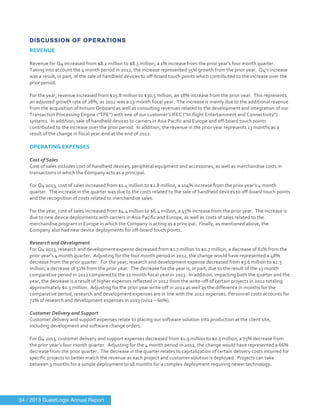
an agent, the Company recognizes revenue on a net basis with revenue representing the margin
earned.
Deferred revenue
Deferred revenue represents amounts received or receivable from customers in advance of
recognizing revenue under the criteria described above.
Intangible assets
Internally generated intangible assets
The Company recognizes expenditure on research activities as an expense in the year in which it
incurs the expenditure. It recognizes an internally-generated intangible asset arising from
development (or from the development phase of an internal project) if, and only if, all of the
following have been demonstrated:
• The technical feasibility of completing the intangible asset so that it will be available for use or
sale;
• The intention to complete the intangible asset and use or sell it;
• The ability to use or sell the intangible asset;
• How the intangible asset will generate probable future economic benefits;
• The availability of adequate technical, financial and other resources to complete the
development and to use or sell the intangible asset; and
• The ability to measure reliably the expenditure attributable to the intangible asset during its
development.
2013 GuestLogix Annual Report / 69
GUESTLOGIX INC.
Notes to Consolidated Financial Statements
Year ended December 31, 2013 and thirteen months ended December 31, 2012
Presented in U.S. Dollars
2. Significant accounting policies (continued)
Intangible assets (continued)
The amount initially recognized for internally-generated intangible assets is the sum of the
expenditure incurred from the date when the intangible asset first meets these recognition criteria.
Where no internally-generated intangible asset can be recognized, the Company recognizes
development expenditure in profit or loss in the year in which it is incurred. Subsequent to initial
recognition, the Company reports internally-generated intangible assets at cost less accumulated
amortization and accumulated impairment losses, on the same basis as any intangible assets it
acquires separately. All research and development costs are recorded net of investment tax credits,
where applicable.
Externally acquired intangible assets
Intangible assets are measured at cost less accumulated amortization and accumulated impairment
losses, if any. Intangible assets acquired through asset acquisitions or business combinations are
initially recognized at fair value, based on an allocation of the purchase price. The intangible assets
are amortized on a straight-line basis over their estimated useful lives. The amortization method,
estimated useful lives and residual values are reviewed each financial year-end or more frequently
if required, and are adjusted as appropriate.
Financial instruments
Financial instruments of GuestLogix consist of cash and cash equivalents, restricted cash and cash
equivalents, accounts receivable, trade and other payables, loans and borrowings, and the
derivative warrant liability.
Financial assets
All financial assets are recognized and derecognized on the trade date, where their purchase or
sale are under a contract whose terms require delivering the financial asset within the timeframe
established by the market concerned, and are initially measured at fair value, plus transaction
costs, except for financial assets classified as at fair value through profit or loss, which are initially
measured at fair value. Financial assets are classified into the following specified categories:
financial assets ‘at fair value through profit or loss’ (‘FVTPL’), ‘held-to-maturity’ investments,
‘available-for-sale’ (‘AFS’) financial assets, including cash and cash equivalents, and ‘loans and
receivables’. The classification depends on the nature and purpose of the financial assets and is
determined at the time of initial recognition. The Company does not currently have any financial
assets in the held-to-maturity or available-for-sale categories.
Trade receivables, loans, and other receivables having fixed or determinable payments and not
quoted in an active market are classified as ‘loans and receivables’. Loans and receivables are
measured at amortized cost using the effective interest method, less any impairment. Interest
income is recognized by applying the effective interest rate, except for short-term receivables for
which recognizing interest would be immaterial.
70 / 2013 GuestLogix Annual Report
GUESTLOGIX INC.
Notes to Consolidated Financial Statements
Year ended December 31, 2013 and thirteen months ended December 31, 2012
Presented in U.S. Dollars
2. Significant accounting policies (continued)
Financial instruments (continued)
Financial assets (continued)
The Company assesses financial assets, other than those at FVTPL, for indicators of impairment at
the end of each reporting period. Financial assets are impaired where there is objective evidence
that, as a result of one or more events that occurred after initially recognizing the financial asset,
the investment’s estimated future cash flows have been affected. Objective evidence of impairment
could include significant financial difficulty of the issuer or counterparty, default or delinquency in
interest or principal payments, or it becoming probable that the borrower will enter bankruptcy or
financial re-organization.
For certain categories of financial asset, such as trade receivables, assets assessed not to be
impaired individually are, in addition, assessed for impairment on a collective basis. Objective
evidence of impairment for a portfolio of receivables could include the Company’s past experience
of collecting payments, an increase in the number of delayed payments in the portfolio past the
average credit period of 45 days, as well as observable changes in national or local economic
conditions correlating with default on receivables.
For financial assets carried at amortized cost, the amount of the impairment is the difference
between the asset’s carrying amount and the present value of estimated future cash flows,
discounted at the financial asset’s original effective interest rate. For trade receivables, the carrying
amount is reduced through an allowance account. When a trade receivable is considered
uncollectible, it is written off against the allowance account, and subsequent recoveries of amounts
previously written off are credited against the allowance account. Changes in the carrying amount
of the allowance account are recognized in profit or loss.
The Company derecognizes a financial asset only when the contractual rights to the cash flows
from the asset expire, or when it transfers the financial asset and substantially all the risks and
rewards of ownership of the asset to another entity.
Financial liabilities
The Company classifies financial liabilities as either financial liabilities ‘at FVTPL’ or ‘other financial
liabilities’. The derivative warrant liability is measured at FVTPL while other financial liabilities,
consisting of trade and other payables and loans and borrowings, are initially measured at fair
value, net of transaction costs, and are subsequently measured at amortized cost using the
effective interest method, recognizing interest expense on an effective yield basis.
Fair value hierarchy
The Company classifies and discloses fair value measurements using a fair value hierarchy that
reflects the significance of the inputs used in making the measurements. The three levels of the fair
value hierarchy are:
2013 GuestLogix Annual Report / 71
GUESTLOGIX INC.
Notes to Consolidated Financial Statements
Year ended December 31, 2013 and thirteen months ended December 31, 2012
Presented in U.S. Dollars
2. Significant accounting policies (continued)
Financial instruments (continued)
Fair value hierarchy (continued)
Level 1 – valuation based on quoted prices (unadjusted) in active markets for identical assets and
liabilities;
Level 2 – valuation techniques based on inputs other than quoted prices included in Level 1 that
are observable for the asset or liability, either directly (i.e., as prices) or indirectly (i.e.,
derived from prices); and
Level 3 – valuation techniques using inputs for the asset or liability that are not based on
observable market data (unobservable inputs).
The Company’s cash and cash equivalents are measured using level 1 inputs and the derivative
warrant liability is measured using level 3 inputs.
Cash and cash equivalents
Cash and cash equivalents include balances with banks and highly liquid instruments.
Inventory
The Company’s inventory consists of hand-held devices including hand-held devices awaiting
deployment and replacement parts held-for-sale, and is stated at the lower of cost and net
realizable value. Net realizable value represents the estimated selling price for inventories less all
estimated costs of completion and costs necessary to make the sale.
Property and equipment
The Company records equipment at cost less accumulated depreciation and accumulated
impairment losses. It recognizes depreciation to write off the cost of assets less their residual
values over their useful lives, using the following methods and rates:
Computer equipment Straight-line 3 years
Furniture and fixtures Straight-line 5 years
The Company reviews the estimated useful lives, residual values and depreciation method at each
year end, accounting for the effect of any changes in estimate on a prospective basis. The gain or
loss arising on disposing of or retiring an item of property, plant and equipment is determined as the
difference between the sales proceeds and the asset’s carrying amount and is recognized in profit
or loss.
72 / 2013 GuestLogix Annual Report
GUESTLOGIX INC.
Notes to Consolidated Financial Statements
Year ended December 31, 2013 and thirteen months ended December 31, 2012
Presented in U.S. Dollars
2. Significant accounting policies (continued)
Impairment of long-lived assets
At the end of each reporting period, the Company reviews the carrying amounts of its tangible and
intangible assets to determine whether there is any indication those assets have suffered an
impairment loss. If any such indication exists, it estimates the asset’s recoverable amount to
determine the extent of the impairment loss (if any). Where it is not possible to estimate an
individual asset’s recoverable amount, the Company estimates the recoverable amount of the cash-
generating unit (‘CGU’) to which the asset belongs. Where it can identify a reasonable and
consistent basis of allocation, it also allocates corporate assets to individual CGU’s, or otherwise
allocates them to the smallest group of CGU’s for which it can identify a reasonable and consistent
allocation basis.
Recoverable amount is the higher of fair value less costs to sell and value in use. In assessing
value in use, the Company discounts estimated future cash flows to their present value using a pre-
tax discount rate reflecting current market assessments of the time value of money and the risks
specific to the asset for which the estimates of future cash flows have not been adjusted.
If an asset or CGU’s recoverable amount is estimated to be less than its carrying amount, the
carrying amount is reduced to its recoverable amount, recognizing an impairment loss immediately
in profit or loss. During the year ended December 31, 2013, the Company did not recognize an
impairment loss (13 months ended December 31, 2012, $1,296,270, see note 7).
Should the Company record an impairment loss which subsequently reverses, it will increase the
carrying amount to the revised estimate of its recoverable amount, by recognizing the reversal
immediately in profit or loss, without exceeding the carrying amount that would have been
determined if it had not recognized an impairment loss in prior years.
Deferred taxes
Deferred tax is recognized on temporary differences between the carrying amounts of assets and
liabilities in the financial statements and the corresponding tax bases used in the computation of
taxable profit. Deferred tax liabilities are generally recognized for all taxable temporary differences.
Deferred tax assets are generally recognized for all deductible temporary differences to the extent
that it is probable that taxable profits will be available against which those deductible temporary
differences can be utilized.
Such deferred tax assets and liabilities are not recognized if the temporary difference arises from
goodwill or from the initial recognition (other than in a business combination) of other assets and
liabilities in a transaction that affects neither the taxable profit nor the accounting profit.
Deferred tax liabilities are recognized for taxable temporary differences associated with investments
in subsidiaries and associates, and interests in joint ventures, except where the Company is able to
control the reversal of the temporary difference and it is probable that the temporary difference will
not reverse in the foreseeable future. Deferred tax assets arising from deductible temporary
differences associated with such investments and interests are only recognized to the extent that it
is probable that there will be sufficient taxable profits against which to utilize the benefits of the
temporary differences and they are expected to reverse in the foreseeable future.
2013 GuestLogix Annual Report / 73
GUESTLOGIX INC.
Notes to Consolidated Financial Statements
Year ended December 31, 2013 and thirteen months ended December 31, 2012
Presented in U.S. Dollars
2. Significant accounting policies (continued)
Deferred taxes (continued)
The carrying amount of deferred tax assets is reviewed at the end of each reporting period and
reduced to the extent that it is no longer probable that sufficient taxable profits will be available to
allow all or part of the asset to be recovered.
Deferred tax assets and liabilities are measured at the tax rates that are expected to apply in the
period in which the liability is settled or the asset realized, based on tax rates (and tax laws) that
have been enacted or substantively enacted by the end of the reporting period. The measurement
of deferred tax liabilities and assets reflects the tax consequences that would follow from the
manner in which the Company expects, at the end of the reporting period, to recover or settle the
carrying amount of its assets and liabilities.
Deferred tax assets and liabilities are offset when there is a legally enforceable right to offset tax
assets against tax liabilities and when they relate to income taxes levied by the same taxation
authority and the Company intends to settle its tax assets and liabilities on a net basis.
Stock-based compensation
The Company measures equity-settled share-based payments to employees and others providing
similar services at the fair value of the equity instruments at the grant date. The fair value
determined at the grant date of the equity-settled share-based payments is calculated using the
Black-Scholes option valuation model and is expensed on a graded vesting basis over the vesting
period, based on the Company’s estimate of equity instruments that will eventually vest, and is
credited to other paid-in capital. At the end of each reporting period, the Company revises its
estimate of the number of equity instruments expected to vest. The impact of the revision of the
original estimates, if any, is recognized in profit or loss such that the cumulative expense reflects
the revised estimate, with a corresponding adjustment to other paid-in capital. When options are
exercised, the proceeds together with the amount originally credited to other paid-in capital are
credited to share capital.
The use of the Black-Scholes model requires inputting a number of assumptions, including
expected dividend yield, expected stock price volatility, forfeiture rate, expected time until exercise
and risk free interest rate. Although the assumptions used reflect management’s best estimates,
they involve inherent uncertainties based on conditions outside of the Company’s control. If other
assumptions were used, stock-based compensation could be significantly impacted.
Leases
The Company classifies a lease it enters into as a lessee as a finance lease whenever the terms
transfer substantially all the risks and rewards of ownership to the Company. It classifies all other
leases as operating leases. It initially recognizes assets held under finance leases at their fair value
at the inception of the lease or, if lower, at the present value of the minimum lease payments, and
recognizes the corresponding liability to the lessor as a finance lease obligation. Lease payments
are apportioned between finance expenses and reduction of the lease obligation so as to achieve a
constant rate of interest on the remaining balance of the liability. Finance expenses are recognized
immediately in profit or loss. The Company recognizes operating lease payments as an expense on
a straight-line basis over the lease term, except where another systematic basis better represents
the time pattern in which it consumes economic benefits from the leased asset.
74 / 2013 GuestLogix Annual Report
GUESTLOGIX INC.
Notes to Consolidated Financial Statements
Year ended December 31, 2013 and thirteen months ended December 31, 2012
Presented in U.S. Dollars
2. Significant accounting policies (continued)
Provisions
The Company recognizes a provision when it has a present obligation (legal or constructive) as a
result of a past event, it is probable it will be required to settle the obligation, and it can make a
reliable estimate of the amount of the obligation. The amount it recognizes as a provision is the best
estimate of the consideration required to settle the present obligation at the end of the reporting
period, taking into account the risks and uncertainties surrounding the obligation. Where a provision
is measured using the cash flows estimated to settle the present obligation, its carrying amount is
the present value of those cash flows.
Restructuring provisions
Restructuring provisions are recognized only when the Company has an actual or a constructive
obligation. The Company has a constructive obligation when a detailed formal plan identifies the
business or part of the business concerned, the location and number of employees affected a
detailed estimate of the associated costs and an appropriate timeline.
The Company incurs restructuring charges relating to workforce reductions which include employee
severance and other employee benefits. The recognition of these charges requires management to
make certain judgments and estimates regarding the nature, timing and amounts associated with
these restructuring plans. Employee termination costs are recognized in the period the detailed
plans are approved and the actions have either commenced or have been announced to the
employees. At the end of each reporting period, the remaining balances are assessed for
appropriateness. Adjustments to the recorded amounts may be required to reflect actual
experience or changes in future estimates. Note 9 to these consolidated financial statements
outlines total restructuring charges incurred during the fourth quarter of 2012 as well as the related
provision as at December 31, 2012.
Share issue costs
The Company charges incremental costs incurred in respect of raising capital against the equity
proceeds raised, including legal, accounting, agent and investment bank fees.
Earnings (loss) per share
The Company computes basic earnings (loss) per share by dividing net profit (loss) by the weighted
average number of common shares outstanding for the period. Diluted earnings (loss) per share
reflects the potential dilution that could occur if additional common shares are assumed to be
issued under securities or contracts that entitle their holders to obtain common shares in the future,
and is calculated using the treasury stock method. In periods when the Company reports a net
loss, the effect of potential issuances of shares under options and warrants is anti-dilutive and
therefore, basic and diluted loss per share are the same.
2013 GuestLogix Annual Report / 75
GUESTLOGIX INC.
Notes to Consolidated Financial Statements
Year ended December 31, 2013 and thirteen months ended December 31, 2012
Presented in U.S. Dollars
2. Significant accounting policies (continued)
Significant judgments, estimates and assumptions
The preparation of the Company’s consolidated financial statements in conformity with IFRS
requires management to make judgments, estimates and assumptions that affect the reported
amounts of assets and liabilities and disclosures of contingent assets and liabilities at the date of
the financial statements and the reported amounts of revenues and expenses during the reporting
period. Estimates and assumptions are continually evaluated and are based on management’s
experience and other factors, including expectations of future events that are believed to be
reasonable under the circumstances. Actual results could differ from these estimates.
The areas which require management to make significant judgments, estimates and assumptions in
determining carrying values include, but are not limited to:
Revenue recognition
In revenue arrangements including more than one deliverable, the deliverables are assigned to one
or more separate units of accounting and the arrangement consideration is allocated to each unit of
accounting based on its relative fair value. Determining the fair value of each deliverable can
require complex estimates due to the nature of the goods and services provided. The Company
generally determines the fair value of individual elements based on prices at which the deliverable
is regularly sold on a standalone basis after considering volume discounts where appropriate.
In merchandising agreements with customers in which the Company provides transaction
processing and merchant of record services in the sale of food and beverage items and destination-
based attraction tickets on-board, revenue is recognized on either a gross or net basis, depending
on the Company's role in the transaction as principal or as agent. Due to the complex nature of
these transactions, the determination of whether the Company acts as principal or agent requires
judgment in assessing primary responsibility, the level of inventory risk and the level of credit risk,
among other factors.
Impairment of goodwill and other assets
Goodwill is tested for impairment annually or more frequently if there is an indication of impairment.
The carrying value of intangible assets with definite lives and property and equipment is reviewed
each reporting period to determine whether there is any indication of impairment. If the carrying
amount of an asset exceeds its recoverable amount, the asset is impaired and an impairment loss
is recognized in the consolidated statement of operations and comprehensive loss. The
assessment of fair values requires the use of estimates and assumptions related to future operating
performance, future capital expenditures, discount rates and terminal value. During the year ended
December 31, 2013, the Company did not record any impairment loss (December 31, 2012 –
$1,296,270).
76 / 2013 GuestLogix Annual Report
GUESTLOGIX INC.
Notes to Consolidated Financial Statements
Year ended December 31, 2013 and thirteen months ended December 31, 2012
Presented in U.S. Dollars
2. Significant accounting policies (continued)
Significant judgments, estimates and assumptions (continued)
Useful life of equipment and intangible assets
Significant judgment is involved in the determination of useful life for the computation of
depreciation of property and equipment and amortization of intangible assets. No assurance can be
given that actual useful lives will not differ significantly from current assumptions.
Legal provisions
The Company assesses the provision for legal or constructive obligations at each reporting period
or when new material information becomes available. Legal and contractual matters are subject to
interpretation and the Company may engage external advisors to assist with periodic assessments.
To the extent that interpretation of legal and contractual matters differ significantly from estimates,
the actual judgments and settlement amounts may vary significantly from management’s estimates.
Valuation of derivative warrant liability
The Company is required to make certain estimates when determining the fair value of the
derivative warrant liabilities issued as part of the promissory notes issued each reporting period.
These estimates affect the amount recognized as derivative warrant liabilities in the consolidated
statement of financial position and the change in fair value of derivative warrant liabilities in the
consolidated statement of operation and comprehensive loss.
Valuation of intangible assets
The determination of estimated fair values of acquired intangible assets, as well as the useful
economic life ascribed to finite lived intangible assets, requires the use of significant judgment. The
use of different estimates and assumptions to those used by the Company could result in a
materially different valuation of acquired intangible assets, which could have a material effect on the
Company’s results of operations.
Recently issued accounting pronouncements:
Not yet effective
IFRS 9 – Financial Instruments
IFRS 9 – Financial Instruments was issued by the IASB to establish principles for the financial
reporting of financial assets and liabilities, including requirements to present certain information
relating to the amounts, timing, and uncertainty of the entity’s future cash flows. This standard is
mandatorily effective from January 1, 2018, with earlier application permitted. Management has not
yet determined the potential impact the adoption of IFRS 9 will have on the Company’s
consolidated financial statements.
2013 GuestLogix Annual Report / 77
GUESTLOGIX INC.
Notes to Consolidated Financial Statements
Year ended December 31, 2013 and thirteen months ended December 31, 2012
Presented in U.S. Dollars
2. Significant accounting policies (continued)
Recently issued accounting pronouncements:
Adopted
As of January 1, 2013, the Company adopted the new and amended IFRS pronouncements in
accordance with the transitional provisions outlined in the respective standards. The Company has
adopted these new and amended standards without any significant effect on its consolidated
financial statements.
IFRS 10 – Consolidated Financial Statements
IFRS 10 establishes principles for the presentation and preparation of consolidated financial
statements when an entity controls one or more other entities. IFRS 10 defines the principle of
control and establishes control as the basis for determining which entities are consolidated. IFRS
10 sets out three elements of control: power over the investee; exposure, or rights, to variable
returns from involvement with the investee; and the ability to use power over the investee to affect
the amount of the investors’ return; and the requirements on how to apply the control principle.
IFRS 10 replaces SIC-12, Consolidation – Special Purpose Entities and parts of IAS 27,
Consolidated and Separate Financial Statements.
IFRS 11 - Joint Arrangements
IFRS 11 requires a venturer to classify its interest in a joint arrangement as a joint venture or joint
operation. Joint ventures will be accounted for using the equity method of accounting whereas for a
joint operation the venturer will recognize its share of the assets, liabilities, revenue and expenses
of the joint operation. IFRS 11 supersedes IAS 31, Interests in Joint Ventures, and SIC-13, Jointly
Controlled Entities – Non-monetary Contributions by Venturers.
IFRS 12 – Disclosure of Interests in Other Entities
IFRS 12 establishes disclosure requirements for interests in other entities, including subsidiaries,
joint arrangements, associates, and special purpose vehicles.
IFRS 13 - Fair Value Measurement
IFRS 13 is a comprehensive standard for fair value measurement and disclosure requirements for
use across all IFRS standards. The new standard clarifies that fair value is the price that would be
received to sell an asset, or paid to transfer a liability in an orderly transaction between market
participants, at the measurement date. It also establishes additional disclosures regarding fair value
measurements.
Reclassification
Certain prior period comparative figures have been reclassified to conform to the current year’s
presentation.
78 / 2013 GuestLogix Annual Report
GUESTLOGIX INC.
Notes to Consolidated Financial Statements
Year ended December 31, 2013 and thirteen months ended December 31, 2012
Presented in U.S. Dollars
3. Cash and cash equivalents
The Company considers all highly liquid instruments with maturities of up to 30 days at the time of
issuance to be cash equivalents. Cash and cash equivalents include:
December 31,
2013
December 31,
2012
Cash $ 8,770,010 $ 1,588,202
Short-term deposits - 4,034,492
$ 8,770,010 $ 5,622,694
4. Restricted cash and cash equivalents
As at December 31, 2013, the Company had no restricted cash and cash equivalents (December
31, 2012 - $1,029,392). During the year, a lessor released its collateral requirement against certain
finance leases, which was previously required and which the Company had fulfilled through
purchases of short-term money market instruments.
5. Investments in sales type leases
Amounts owing under sales-type leases entered into through the Company’s multiple element
arrangements are recorded as net finance receivables. Future minimum payments receivable under
these multiple element arrangements are as follows:
December 31,
2013
December 31,
2012
2013
2014
2015
2016
2017
2018
$ -
1,507,586
1,021,884
747,057
96,604
70,327
$ 1,058,576
796,802
317,735
15,009
-
-
3,443,458 2,188,122
Less amount representing unearned
finance income (at 5.1% to 10.6%) 234,757 199,686
Less current portion
3,208,701
1,375,291
1,988,436
928,405
$ 1,833,410 $ 1,060,031
2013 GuestLogix Annual Report / 79
GUESTLOGIX INC.
Notes to Consolidated Financial Statements
Year ended December 31, 2013 and thirteen months ended December 31, 2012
Presented in U.S. Dollars
5. Investments in sales type leases (continued)
The gross investment in the leases and the present value of minimum lease payments receivable
are as follows:
Gross investment
in leases
Present value of
minimum lease payments
December 31, December 31, December 31, December 31,
2013 2012 2013 2012
Less than one year $ 1,507,586 $ 1,058,576 $ 1,375,291 $ 928,405
One to four years 1,935,872 1,129,546 1,833,410 1,060,031
$ 3,443,458 $ 2,188,122 $ 3,208,701 $ 1,988,436
6. Property and Equipment
Computer
Equipment
Furniture and
Fixtures Total
Cost
Balance, December 1, 2011 $ 383,686 $ 671,929 $1,055,615
Additions 241,159 - 241,159
Balance, December 31, 2012 624,845 671,929 1,296,774
Balance, January 1, 2013 624,845 671,929 1,296,774
Additions 568,333 147,788 716,121
Balance, December 31, 2013 1,193,178 819,717 2,012,895
Accumulated Depreciation
Balance, December 1, 2011 128,290 256,257 384,547
Depreciation 137,918 162,632 300,550
Balance, December 31, 2012 266,208 418,889 685,097
Balance, January 1, 2013 266,208 418,889 685,097
Depreciation 310,806 79,159 389,965
Balance, December 31, 2013 $ 577,014 $ 498,048 $1,075,062
Carrying Amounts
December 31, 2012 $ 358,637 $ 253,040 $ 611,677
December 31, 2013 $ 616,164 $ 321,669 $ 937,833
80 / 2013 GuestLogix Annual Report
GUESTLOGIX INC.
Notes to Consolidated Financial Statements
Year ended December 31, 2013 and thirteen months ended December 31, 2012
Presented in U.S. Dollars
7. Intangible assets
The Company’s intangible assets consist of identifiable intangible assets acquired in a business
combination, software development costs related to the OnTouch Analytics platform, OnTouch
Content platform, and Global Payment Services, as well as the cost of licenses to certify its point-of-
sale hand-held devices, primarily for its European clients.
In 2011, the Company deployed its OnTouch Analytics platform and transferred related software
development costs from deferred development costs to intangible assets. Amortization of the
OnTouch Analytics platform is provided for over a five year period.
On September 1, 2012, the Company deployed its OnTouch Content platform and transferred
related software development costs from deferred development costs to intangible assets.
Amortization of the OnTouch Content platform is provided for over a five year period.
Global Payment Services was launched on August 31, 2012, and related software development
costs were transferred from prepaid expenses to intangible assets. Amortization of Global Payment
Services is over a five year period.
Licenses for device certifications are amortized over the life of the license which range from 1 to 3
years.
The Company’s acquired customer list and technology are a result of the acquisition of Initium
Onboard (see note 8). Identifiable intangible assets acquired in a business combination are
recognized separately from goodwill if they meet the definition of intangible asset and if their fair
value can be measured reliably. The cost of these intangible assets equals their acquisition-date
fair value. After initial recognition, identifiable intangible assets acquired in a business combination
are recognized at cost less accumulated amortization, if they are amortizable, and less
accumulated impairment losses.
Deferred development costs consist of internal and third party labour costs of personnel directly
engaged in software development activities and other costs directly attributable to the Company’s
platform enhancements. GuestLogix only defers development costs when technical feasibility has
been established and the Company is expected to generate future economic benefits from the
asset. During the 13 months ended December 31, 2012 the Company wrote off $1,296,270 of
deferred development costs relating to Destination Deals and Mobile Concierge projects. These
projects were terminated due to lack of interest from the Company’s clients as well as
management’s decision to narrow its focus in product development.
December 31, 2013 Cost
Accumulated
amortization
Net book
value
OnTouch Analytics $ 355,233 $ 181,418 $ 173,815
OnTouch Content 3,167,778 1,123,166 2,044,612
Global Payment Services 226,132 46,170 179,962
Licenses – device certifications 641,969 555,959 86,010
Acquired customer list (note 8) 2,591,520 1,116,450 1,475,070
Acquired technology (note 8) 3,576,389 953,703 2,622,686
Deferred development costs 2,620,267 - 2,620,267
Total intangible assets $13,179,288 $ 3,976,866 $9,202,422
2013 GuestLogix Annual Report / 81
GUESTLOGIX INC.
Notes to Consolidated Financial Statements
Year ended December 31, 2013 and thirteen months ended December 31, 2012
Presented in U.S. Dollars
7. Intangible assets (continued)
December 31, 2012 Cost
Accumulated
amortization
Net book
value
OnTouch Analytics $ 355,233 $ 112,868 $ 242,365
OnTouch Content 3,167,778 369,574 2,798,204
Global Payment Services 226,132 23,566 202,566
Licenses – device certifications 504,347 343,813 160,534
Acquired customer list (note 8) 2,591,520 277,073 2,314,447
Acquired technology (note 8) 3,576,389 238,426 3,337,963
Total intangible assets $ 10,421,399 $ 1,365,320 $ 9,056,079
8. Business Combination
On September 4, 2012, the Company acquired 100% of the outstanding shares of Initium Onboard,
a United Kingdom-based provider of onboard retail technology to the airline and rail industries.
Initium Onboard is the trading name for BOM Merchant Technologies Limited, a subsidiary of the
BOM Group Holdings Ltd. The acquisition is expected to support the Company’s growth strategy in
the rail industry and its destination-based merchandising programs on board.
During the third quarter of 2013, the Company finalized the purchase price allocation of the Initium
Onboard acquisition and retrospectively adjusted the preliminary allocation of the fair value of
assets acquired and liabilities that had been recognized at the September 4, 2012 acquisition date
to reflect new information obtained about facts and circumstances that had existed as at acquisition
date and if they had been known, would have had an impact on the amounts recognized at that
date.
The final fair value allocation of assets acquired and liabilities recognized is as follows, based on
the purchase price:
Preliminary Final
Allocation Allocation
Accounts receivable $ 896,133 $ 896,133
Inventory 60,153 60,153
Equipment 70,484 70,484
Intangible assets 26,108 26,108
Bank indebtedness (167,264) (167,264)
Accounts payable and accrued liabilities (3,678,323) (3,678,323)
Deferred revenue (1,710,723) (1,710,723)
Technology and intellectual property - 3,576,389
Customer list - 2,591,520
Goodwill 8,838,471 2,670,562
$ 4,335,039 $ 4,335,039
Technology and intellectual property will be amortized over five years and the customer list will be
amortized over three years, which are the estimated useful lives.
82 / 2013 GuestLogix Annual Report
GUESTLOGIX INC.
Notes to Consolidated Financial Statements
Year ended December 31, 2013 and thirteen months ended December 31, 2012
Presented in U.S. Dollars
8. Business Combination (continued)
The final fair value allocation of assets acquired and liabilities recognized resulted in the
retrospective restatement as at December 31, 2012 of intangible assets in the amount of
$5,652,410, reducing goodwill in the amount of $6,167,909 increasing the amortization of intangible
assets, net loss for the period and deficit in the amount of $515,499.
9. Restructuring charges
During the fourth quarter of 2012, the Company incurred $2,062,019 of restructuring charges due
primarily to a workforce reduction aimed at reducing overhead costs, rationalizing the reporting
structure, and allowing for synergies in operations. The decision was made by executive
management and approved by the Company’s Board of Directors in October 2012. The estimated
restructuring costs primarily included severance of employees and other restructuring expenses
such as costs to consolidate offices as well as provisions for legal fees and claims which have been
asserted against the Company. Office consolidation costs are expected to be incurred to the end of
the term of the respective office leases.
As at December 31, 2013, the items the Company included in its trade and other payables were as
follows:
Estimated restructuring costs $ 2,062,019
Paid during 2012 (186,636)
Balance, December 31, 2012 $ 1,875,383
Paid during 2013 (1,543,445)
Balance, December 31, 2013 $ 331,938
10. Obligations under finance leases
From time to time the Company purchases hand-held, point-of-sale devices which in turn are
bundled with its proprietary software, hosting and services and are leased to customers. These
devices are then sold under sales-type lease arrangements to customers under a multiple element
revenue arrangement, as described in note 2.
The following is a schedule of future minimum lease payments for equipment under finance leases:
December 31, December 31,
2013 2012
2013 $ - $ 692,856
2014 1,261,001 121,600
2015 854,996 53,574
2016 189,454 5,076
2,305,451 873,106
Less amount representing interest
(at 4.4% to 12.2%) 177,073 37,113
2,128,378 835,993
Less current portion 1,109,873 662,781
$ 1,018,505 $ 173,212
2013 GuestLogix Annual Report / 83
GUESTLOGIX INC.
Notes to Consolidated Financial Statements
Year ended December 31, 2013 and thirteen months ended December 31, 2012
Presented in U.S. Dollars
10. Obligations under finance leases (continued)
Interest expense related to these obligations for the year ended December 31, 2013 amounted to
$101,473 (13 months ended December 31, 2012 - $123,102).
At December 31, 2013, the Corporation is the applicant on a standby letter of credit in the amount
of $690,000 (December 31, 2012 - $1,029,392) in favour of a third party financing company for
certain obligations under finance leases. This standby letter of credit expires on September 30,
2015.
11. Deferred revenue
Deferred revenue comprises primarily of equipment sales, license, and service revenue, and is
recognized on a monthly basis over the terms of the corresponding contractual arrangements which
range from one to three years.
Deferred revenue reported as at December 31, 2013 was $1,690,912 (December 31, 2012 -
$1,741,271), with current and long-term portions of $1,643,834 and $47,078 respectively
(December 31, 2012 - $1,315,472 and $425,799).
12. Loans and borrowings
a) Promissory notes
In November 2012, the Company issued promissory notes aggregating $7,153,540 (CAD$7 million)
plus associated warrants. The notes carried an interest rate of 12% per annum and were due and
payable in full on May 31, 2014. The principal amounts owing under the promissory notes are
discounted by the fair value of the warrants initially valued at $855,411, with the debt discount being
expensed at an effective interest rate of 24.28% over the term of the promissory notes to maturity.
The warrants have an exercise price of CAD$0.80 per common share and are exercisable at any
time up until November 30, 2014. (See note 13)
In July 2013, the Company amended the maturity date of its promissory notes totaling
CAD$5 million. The amendment extended the maturity date from May 31, 2014 to July 1, 2015 and
the interest rate on the amended promissory notes reduced from 12% per annum to 9% per cent
per annum for the period from May 31, 2014 to July 1, 2015. The amendment of the promissory
notes has been accounted for as a modification of debt with the debt discount being expensed over
the extended term of the promissory notes at a revised effective interest rate of 15.72%.
In addition, the expiry term of the 2,500,000 warrants associated with the amended promissory
notes was extended from November 30, 2014 to November 30, 2015. The exercise price on the
Amended Warrants was increased from CAD$0.80 to CAD$0.81 per Common Share of the
Company for the period from December 1, 2014 to November 30, 2015.
In December 2013, the Company paid a portion of the promissory notes prior to maturity date. The
principal and interest paid totalled $2,129,922 (CAD$2,244,000).
December 31,
2013
December 31,
2012
Promissory note $ 5,113,030 $ 6,321,177
Less: current portion plus interest 684,715 -
$ 4,428,315 $ 6,321,177
84 / 2013 GuestLogix Annual Report
GUESTLOGIX INC.
Notes to Consolidated Financial Statements
Year ended December 31, 2013 and thirteen months ended December 31, 2012
Presented in U.S. Dollars
12. Loans and borrowings (continued)
a) Promissory notes (continued)
Accretion related to these obligations for the year ended December 31, 2013 was $421,450 (13
months ended December 31, 2012 - $52,003).
b) Credit facility
In December 2013, the Company obtained a secured credit facility with a Canadian chartered bank
in an amount of up to $4 million. The facility is secured by a general security agreement over the
assets of the Company and bears interest at the prime rate plus 2.5% and is available based on a
percentage of trade accounts receivable and investment tax credits receivable, the “Borrowing
Base”. The Company must maintain at all times a minimum unrestricted cash and equivalent
balance held at the bank of $1 million and a tangible net worth of $2.6 million. As of December 31,
2013, the Company had not used the facility and was in compliance with all of its covenants.
13. Derivative warrant liability
Warrants issued with an exercise price denominated in a foreign currency are accounted for as a
derivative liability, measured at fair value with subsequent changes in fair value accounted for
through profit and loss.
The following is a summary of the derivative warrant liability as at December 31, 2013 and
December 31, 2012 and changes during years ended December 31, 2013 and December 31, 2012:
December 31,
2013
December 31,
2012
Number of
Warrants Amount
Number of
Warrants Amount
Exercise price of CAD$0.80
expiring November 30, 2014 (i)
Exercise price of CAD$0.81
expiring November 30, 2015 (i)
Exercise price of CAD$0.45
expiring September 4, 2015 (ii)
1,000,000
2,500,000
150,000
$ 350,361
1,106,581
98,627
1,000,000
2,500,000
150,000
$ 353,935
884,300
89,672
3,650,000 $1,555,569 3,650,000 $1,327,907
(i) Warrants issued and outstanding in conjunction with CAD$7 million in promissory notes issued
on November 30, 2012 totalled 3,500,000. The warrants had an exercise price of CAD$0.80
and an expiring date of November 30, 2014. The warrants were initially valued at $855,411
using the Black-Scholes option pricing model with the following assumptions: Term – 2 years;
Volatility – 60.6%; Interest rate – 1.1%.
2013 GuestLogix Annual Report / 85
GUESTLOGIX INC.
Notes to Consolidated Financial Statements
Year ended December 31, 2013 and thirteen months ended December 31, 2012
Presented in U.S. Dollars
13. Derivative warrant liability (continued)
In July 2013, the expiry term of the 2,500,000 warrants associated with the amended
promissory notes (see note 12) was extended from November 30, 2014 to November 30,
2015. The exercise price on the Amended Warrants was increased from CAD$0.80 to
CAD$0.81 per Common Share of the Company for the period from December 1, 2014 to
November 30, 2015.
The warrants are revalued at each reporting period and the change in the fair value was
recognized in the consolidated statements of operations and comprehensive loss for the year
ended December 31, 2013, $218,705 (2012 - $382,824). The warrants were revalued using
the Black-Scholes option pricing model with the following assumptions: Term – 0.9 years;
Volatility – 43.9%; Interest rate – 1.0% and Term – 1.9 years; Volatility – 54.4%; Interest rate –
1.0%.
(ii) Warrants issued and outstanding in relation to the acquisition of Initium Onboard totalled
150,000. The warrants have an exercise price of CAD$0.45 and expire on September 4,
2015. The warrants were initially valued at $25,704 using the Black-Scholes option pricing
model with the following assumptions: Term – 3 years; Volatility – 50.5%; Interest rate – 1.2%.
The warrants are revalued at each reporting period and the change in the fair value was
recognized in the consolidated statements of operations and comprehensive loss for the year
ended December 31, 2013, $8,957 (2012 - $63,968). The warrants were revalued using the
Black-Scholes option pricing model with the following assumptions: Term – 1.7 years; Volatility
– 55.3%; Interest rate – 1.0%.
14. Share capital
(a) Authorized share capital consists of an unlimited number of voting common shares.
(b) Issued and outstanding share capital:
Number of
common
shares Amount
Balance, November 30, 2011 64,287,390 $ 22,009,215
Issuance of shares on exercise of options
Issuance of shares for cash consideration
Issuance on acquisition of Initium Onboard
120,469
6,000,000
4,287,670
128,280
3,021,534
2,225,688
Balance, December 31, 2012 74,695,529 $ 27,384,717
Issuance of shares for cash consideration (i)
Issuance of shares for cash consideration (ii)
Issuance of shares on exercise of options (iii)
Issuance of shares on exercise of warrants (iv)
Issuance on acquisition of Initium Onboard (v)
4,472,300
10,455,800
1,264,461
165,384
114,087
3,512,649
9,901,730
892,888
144,442
-
Balance, December 31, 2013 91,167,561 $ 41,836,426
86 / 2013 GuestLogix Annual Report
GUESTLOGIX INC.
Notes to Consolidated Financial Statements
Year ended December 31, 2013 and thirteen months ended December 31, 2012
Presented in U.S. Dollars
14. Share capital (continued)
(b) Issued and outstanding share capital: (continued)
(i) On September 11, 2013, the Company issued 4,472,300 common shares for gross
proceeds of $3,893,853 (CAD$4,025,070) in a private placement. The Company
incurred share issue costs including commissions and legal fees of $381,204 in
connection with this share issuance.
(ii) On December 4, 2013, the Company issued 10,455,800 common shares for gross
proceeds of $10,787,144 (CAD$11,501,380) in an equity financing deal. The Company
incurred share issue costs including commissions, legal fees and listing fees of
$885,414 (CAD$944,058) in connection with this share issuance.
(iii) During the year ended December 31, 2013, the Company issued 1,264,461 common
shares upon the exercise of options for total consideration of $546,872. The value
relating to these options previously attributed to other paid-in capital, $346,016, was
reallocated to share capital.
(iv) During the year ended December 31, 2013, the Company issued 165,384 common
shares upon the exercise of warrants for total consideration of $124,230. The value
relating to these warrants previously attributed to other paid-in capital, $20,212, was
reallocated to share capital.
(v) During the year ended December 31, 2013, the Company issued 114,087 common
shares in relation to the September 4, 2012 acquisition of GuestLogix Technologies
Limited (formerly, BOM Merchant Technologies Ltd). The shares were issued based on
the achievement of certain performance conditions and were part of the purchase
consideration in the business combination (Note 8), measured at fair value.
(c) Stock options:
The Company has established a stock option plan (the ‘Plan’) to encourage ownership of the
Company's common shares by its key officers, directors, employees and selected consultants. The
Plan provides for an amount up to 15% of the outstanding common shares of the Company to be
reserved for issuance. The number of shares reserved for issuance under the Plan as at December
31, 2013 was 13,675,134 common shares with provision that the Board of Directors has the right
from time to time to increase such number subject to the approval of shareholders of the Company.
Options under the Plan vest over various periods from the date of the granting of the option. All
options granted under the Plan that have not been exercised within ten years of the grant will
expire, subject to earlier termination if the optionee ceases to be an officer, director, employee or
consultant of the Company.
The fair value of options granted was estimated on the date of the grant using the Black-Scholes
option-pricing model, resulting in the weighted average fair value of options granted in the year
ended December 31, 2013 of $0.40 (13 months ended December 31, 2012 - $0.28), with the
following weighted average assumptions:
2013 GuestLogix Annual Report / 87
GUESTLOGIX INC.
Notes to Consolidated Financial Statements
Year ended December 31, 2013 and thirteen months ended December 31, 2012
Presented in U.S. Dollars
14. Share capital (continued)
(c) Stock options: (continued)
2013 2012
Risk-free rate of return 1.48% 0.81%
Expected volatility 74.4% 70.2%
Dividend yield NIL% NIL%
Average expected life of the options 4.4 years 4.1 years
The following is a summary of the stock options outstanding and the weighted average exercise
price, as at December 31, 2013 and 2012:
Number of Options
Outstanding
Weighted Average
Exercise Price
Outstanding, December 1, 2011 4,817,525 $ 0.86
Granted 7,027,553 0.54
Exercised (120,468) 0.47
Cancelled (2,744,140) 0.64
Outstanding, December 31, 2012 8,980,470 $ 0.63
Granted 5,551,645 0.88
Exercised (1,264,461) 0.48
Cancelled (3,457,736) 0.60
Outstanding, December 31, 2013 9,809,918 $ 0.75
Exercisable December 31, 2013 2,325,041 $ 0.77
The Company recognized $577,302 of stock-based compensation expense related to vested stock
options granted to employees, officers, directors and consultants during the year ended December
31, 2013 (13 months ended December 31, 2012 - $677,071).
The weighted average share price at the date of exercise for share options exercised in 2013 was
$0.96 (2012 - $0.94)
The weighted average remaining contractual life and weighted average exercise price of options
outstanding and of options exercisable as at December 31, 2013 are as follows:
Options Outstanding Options Exercisable
Weighted Weighted Weighted
Average Average Average
Range of Number Exercise Contractual Number Exercise
Exercise Price Outstanding Price Life Exercisable Price
$0.38-0.64 3,037,798 0.52 4.90 years 979,831 0.53
$0.65-0.94 4,476,994 0.90 5.85 years 516,095 0.77
$0.95-1.50 2,295,126 1.03 3.50 years 829,115 1.07
9,809,918 0.79 5.13 years 2,325,041 0.77
88 / 2013 GuestLogix Annual Report
GUESTLOGIX INC.
Notes to Consolidated Financial Statements
Year ended December 31, 2013 and thirteen months ended December 31, 2012
Presented in U.S. Dollars
14. Share capital (continued)
(d) Warrants:
The following is a summary of outstanding warrants as at December 31, 2013 and December 31,
2012 and changes during years ended December 31, 2013 and December 31, 2012:
December 31,
2013
December 31,
2012
Number of
Warrants Amount
Number of
Warrants Amount
Exercise price of $0.726 expiring
August 16, 2013 to October 1, 2013 (i) - $ - 727,047 $ 79,321
Exercise price of $0.907 expiring
August 16, 2013 to October 1, 2013 (i) - - 540,480 87,211
- $ - 1,267,527 $ 166,532
(i) Warrants issued and outstanding in conjunction with $653,626 in convertible loans in 2006
totalled 1,267,527. The warrants have exercise prices of $0.726 and $0.907 per share
and had original expiry dates between August 16, 2011 and October 1, 2011. In July 2011,
the Company extended the expiry of 1,267,527 exercisable warrants by an additional two
years, with new expiry dates ranging from August 16, 2013 to October 1, 2013.
During the year 165,384 exercisable warrants were exercised (2012 - Nil) and 1,102,143
exercisable warrants had expired (2012 – Nil).
(e) (Loss) earnings per share:
The following table sets forth the computation of basic and diluted (loss) earnings per share for the
fiscal years ended December 31, 2013 and December 31, 2012:
12 months ended
December 31,
2013
13 months ended
December 31,
2012
Numerator:
Net loss attributable to common
shareholders - basic and diluted $ (3,794,525) $(12,609,491)
2013 GuestLogix Annual Report / 89
GUESTLOGIX INC.
Notes to Consolidated Financial Statements
Year ended December 31, 2013 and thirteen months ended December 31, 2012
Presented in U.S. Dollars
14. Share capital (continued)
(e) (Loss) earnings per share: (continued)
12 months ended
December 31,
2013
13 months ended
December 31,
2012
Denominator
Weighted average common shares
outstanding - basic and diluted
Effect of dilutive securities:
Stock options
Warrants
78,297,413
-
-
67,427,065
-
-
Weighted average common shares
outstanding - basic and diluted 78,297,413 67,427,065
Basic and diluted loss per share $ (0.05) $ (0.19)
15. Income taxes
The reconciliation of the combined Canadian federal and provincial statutory income tax rate on the
net loss for the year ended December 31, 2013 and 13 months ended December 31, 2012 is as
follows:
2013 2012
Loss before recovery of income taxes $ (3,794,525) $ (12,609,491)
	
   	
  Expected income tax recovery $ (1,005,550) $ (3,404,563)
Difference in foreign tax rates 56,880 2,100
Tax rate changes and other adjustments (848,670) (27,260)
Non-deductible expenses (98,490) 341,865
Recognition of losses on acquisition of
subsidiary
- (951,140)
Change in tax benefits not recognized 1,895,830 4,038,998
Income tax recovery reflected in consolidated
statements of operations and
comprehensive loss
$ - $ -
The 2013 statutory tax rate of 26.5% differs from the 2012 statutory tax rate of 26.65% because of
the reduction in federal and provincial substantively enacted tax rates.
90 / 2013 GuestLogix Annual Report
GUESTLOGIX INC.
Notes to Consolidated Financial Statements
Year ended December 31, 2013 and thirteen months ended December 31, 2012
Presented in U.S. Dollars
15. Income taxes (continued)
Deferred tax
The following table summarizes the components of deferred tax:
December 31,
2013
December 31,
2012
Deferred Tax Assets
Non-capital losses carried forward $ 1,252,070 $ -
Deferred Tax Liabilities
Property and equipment (3,810) -
Intangible assets (1,248,260) -
Net deferred tax liabilities $ - $ -
Unrecognized deferred tax assets
Deferred taxes are provided as a result of temporary differences that arise due to the differences
between the income tax values and the carrying amount of assets and liabilities. Deferred tax
assets have not been recognized in respect of the following deductible temporary differences:
December 31,
2013
December 31,
2012
Non-capital losses carried forward $ 10,587,520 $ 16,671,370
Share issuance costs 971,850 221,090
SR&ED ITC 516,130 1,704,590
Net capital losses carried forward 9,960 10,190
Property and equipment
and intangible assets 7,552,700 4,437,100
SR&ED Pool 3,563,470 3,346,670
Reserve for doubtful debts 508,730 -
Transitional tax credit 70,760 280
The Canadian and U.S. non-capital loss carry forwards expire between 2027 and 2033. Share
issue and financing costs amortize between 2014 and 2017. Investment tax credits expire from
2029 to 2033. The net capital loss carry forward may be carried forward indefinitely, but can only be
used to reduce capital gains. The remaining deductible temporary differences may be carried
forward indefinitely. Deferred tax assets have not been recognized in respect of these items
because it is not probable that future taxable profit will be available against which the group can
utilize the benefits therefrom.
2013 GuestLogix Annual Report / 91
GUESTLOGIX INC.
Notes to Consolidated Financial Statements
Year ended December 31, 2013 and thirteen months ended December 31, 2012
Presented in U.S. Dollars
16. Changes in non-cash operating working capital
2013 2012
Accounts receivable $ (3,615,034) $ 1,658,768
Inventory (371,413) 296,948
Prepaid expenses (548,544) (301,592)
Trade payables and accrued liabilities (1,561,988) 2,330,682
Deferred revenue (50,359) (1,148,848)
$ (6,147,338) $ 2,835,958
17. Operating expenditures
Customer
12 months ended Research and delivery and Infrastructure Sales and General and
December 31, 2013 development support support marketing administrative Total
Personnel expenditures $ 1,784,165 $ 2,353,809 $ 1,467,794 $ 3,117,073 $ 2,721,510 $ 11,444,351
Bad debt write-off - - - - 148,016 148,016
Third party processing and
hosting - - 1,891,212 - - 1,891,212
Professional fees 248,335 1,391,943 84,961 311,985 835,921 2,873,145
Other expenditures 441,697 178,142 1,823,245 1,254,013 3,366,467 7,063,564
Total $ 2,474,197 $ 3,923,894 $ 5,267,212 $ 4,683,071 $ 7,071,914 $ 23,420,288
Customer
13 months ended Research and delivery and Infrastructure Sales and General and
December 31, 2012 development support support marketing administrative Total
Personnel expenditures $ 2,162,268 $ 4,334,126 $ 2,156,420 $ 3,526,542 $ 1,863,650 $ 14,043,006
Deferred development cost
impairment loss 492,386 140,083 10,683 1,040 652,078 1,296,270
Bad debt write-off - - - - 1,066,397 1,066,397
Third party processing and
hosting - - 2,136,066 - - 2,136,066
Professional fees - - - - 2,926,886 2,926,886
Other expenditures 960,635 165,251 2,074,766 1,916,305 1,504,956 6,621,913
Total $ 3,615,289 $ 4,639,460 $ 6,377,935 $ 5,443,887 $ 8,013,967 $ 28,090,538
18. Related party transactions
Compensation of key management personnel
Key management personnel are comprised of the Company’s directors and executive officers. The
remuneration of key management personnel during the year ended December 31, 2013 and 13
months ended December 31, 2012 were as follows:
92 / 2013 GuestLogix Annual Report
GUESTLOGIX INC.
Notes to Consolidated Financial Statements
Year ended December 31, 2013 and thirteen months ended December 31, 2012
Presented in U.S. Dollars
18. Related party transactions (continued)
Compensation of key management personnel (continued)
2013 2012
Salaries and employee benefits
Share-based payments
$ 1,272,997
251,024
$ 1,296,391
244,188
Termination payments and benefits 247,774 830,977
$ 1,771,795 $ 2,371,556
19. Financial instruments
Financial instruments of GuestLogix consist of cash and cash equivalents, restricted cash and cash
equivalents, accounts receivable, accounts payable and accrued liabilities, loans and borrowings,
and the derivative warrant liability. There are no significant differences between the carrying
amounts of the items reported on the consolidated statements of financial position and their
estimated fair values. The Company’s risk exposures and their impact on the Company’s financial
instruments are summarized below:
Credit risk
The Company establishes an allowance for doubtful accounts that corresponds to the specific credit
risk of its customers, historical trends and economic circumstances. The allowance as at December
31, 2013 was $508,728 (December 31, 2012 - $632,656). The Company reduced its allowance by
$123,928 during year ended December 31, 2013 (13 months ended December 31, 2012 -
$427,022) representing a write-down of certain past due receivables that were considered to be at
risk and perceived not to be fully collectible.
The definition of amounts that are past due is determined by reference to terms agreed with
individual customers. The Company reviews its accounts receivable quarterly and reduces
amounts to their expected realizable values by providing an allowance for doubtful accounts when
the account may not be fully collectible. Our normal terms for trade receivables are 30 to 45 days.
As at December 31, 2013 our largest 5 customers represented 61% (December 31, 2012 - 62%) of
our trade receivable balance.
Liquidity risk
Although the Company has negative operating cash flows of $6,435,744 for the year ended
December 31, 2013 (December 31, 2012 - $6,051,491), the Company believes that at the present
time it does not face significant liquidity risk as it has been able to continue to source funding for its
point-of-sale hand-held devices and its development initiatives through lease and debt financing.
2013 GuestLogix Annual Report / 93
GUESTLOGIX INC.
Notes to Consolidated Financial Statements
Year ended December 31, 2013 and thirteen months ended December 31, 2012
Presented in U.S. Dollars
19. Financial instruments (continued
Market risk
(a) Interest rate
Cash equivalents and restricted cash equivalents are invested in money market instruments of
maturities up to 30 days. Consequently, GuestLogix is exposed to interest rate risk as a result of
holding investments of varying maturities. The fair value of investments, as well as the investment
income derived from the investment portfolio, will fluctuate with changes in prevailing interest rates.
GuestLogix does not use interest rate derivative financial instruments in its investment portfolio but
periodically invests in Canadian Schedule A bank instruments. The Company does not believe that
there is a significant interest rate risk, due to the short-term nature of its investments.
(b) Foreign exchange
GuestLogix is exposed to foreign exchange risk as a result of transactions in currencies other than
its functional currency of the U.S. dollar. The majority of GuestLogix’ revenues are transacted in
U.S. Dollars, Euros and Sterling. Purchases of equipment required to deliver on GuestLogix’
contracts are primarily transacted in U.S. Dollars, while a large portion of operating expenses,
including personnel costs, are denominated in Canadian dollars. GuestLogix does not currently use
derivative instruments to hedge against foreign exchange risk.
Sensitivity analysis
Based on management’s knowledge and experience of the finance market, the Company believes
the following movements are ‘reasonably possible’ over a six-month period.
Impact on net income
$
Change of =+/- 10% in CAD $ foreign exchange rate +/- 121,000
Change of =+/- 10% in Euro € foreign exchange rate +/- 198,000
Change of =+/- 10% in GBP £ foreign exchange rate +/- 456,000
The impact on net income (loss) is calculated using the closing balances of non-US dollar
denominated monetary assets and liabilities with all other assumptions held constant. The above
results arise primarily as a result of the Company having CAD $, Euro € and GBP £, denominated
cash and cash equivalents, accounts receivable, accounts payable and accrued liabilities, and
capital lease obligations.
Limitations of sensitivity analysis
The above table demonstrates the effect of change in foreign exchange rates. The financial position
of the Company may vary at the time those changes in foreign exchange rates occur, causing the
impact on the Company’s results to differ from that shown above.
94 / 2013 GuestLogix Annual Report
GUESTLOGIX INC.
Notes to Consolidated Financial Statements
Year ended December 31, 2013 and thirteen months ended December 31, 2012
Presented in U.S. Dollars
20. Guarantees
In the normal course of business, the Company enters into agreements that meet the definition of a
guarantee.
Indemnity has been provided to all directors and officers of the Company for various items including,
but not limited to, all costs to settle suits or actions against due to association with the Company,
subject to certain restrictions. The Company has purchased directors’ and officers’ liability insurance
to mitigate the cost of any potential future suits or actions. The term of the indemnification is not
specifically defined, but is limited to the period over which the indemnified party served as a trustee,
director or officer of the Company. The maximum amount of any potential future payment cannot be
reasonably estimated.
In the normal course of business, the Company has entered into agreements that include
indemnities in favour of third parties, such as purchase and sale agreements, confidentiality
agreements, engagement letters with advisors and consultants, outsourcing agreements, leasing
contracts, information technology agreements and service agreements. These indemnification
agreements may require the Company to compensate counterparties for losses incurred by the
counterparties as a result of breaches in representation and regulations or as a result of litigation
claims or statutory sanctions that may be suffered by the counterparty as a consequence of the
transaction. The terms of these indemnities are not explicitly defined and the maximum amount of
any potential reimbursement cannot be reasonably estimated.
The nature of these indemnification agreements prevents the Company from making a reasonable
estimate of the maximum exposure due to the difficulties in assessing the amount of liability, which
stems from the unpredictability of future events and the unlimited coverage offered to
counterparties. Historically, the Company has not made any payments under such or similar
indemnification agreements and therefore no amount has been recorded in the consolidated
statements of financial position with respect to these agreements.
21. Commitments
Future minimum lease payments for the premises and computer equipment operating leases,
exclusive of taxes and other operating costs, are as follows:
2014
2015
2016
2017
2018
2019
2020
$ 508,807
385,448
271,790
101,368
88,817
89,413
7,451
$1,453,094
2013 GuestLogix Annual Report / 95
GUESTLOGIX INC.
Notes to Consolidated Financial Statements
Year ended December 31, 2013 and thirteen months ended December 31, 2012
Presented in U.S. Dollars
22. Segmented information and customer concentration
The Company manages its operations in one business segment, which is providing proprietary
transaction-based onboard retail software solutions for the passenger travel industry. All significant
equipment is located in Canada. During the year ended December 31, 2013, $16,305,209 of the
Company’s revenue (13 months ended December 31, 2012 - $18,719,598) was derived from North
America, while the remainder of $14,208,213 (13 months ended December 31, 2012 - $7,052,106)
was derived primarily from Europe, the Middle East and Asia Pacific.
23. Capital management
Management defines capital as the Company’s shareholders’ equity. The Company’s objective in
managing capital is to ensure a sufficient liquidity position to finance and secure its revenue growth
and expansion globally and to finance development activities, general and administration expenses,
working capital and overall capital expenditures, especially expenditures to acquire capital assets
deployed. The Company makes every attempt to manage its liquidity to minimize shareholder
dilution when possible.
To finance its activities, the Company has historically followed an approach that relies on revenue
growth, issuance of common shares and financing through finance leases and term debt.
The capital management objectives for fiscal 2013 remained the same as those of the previous
fiscal year.
At December 31, 2013, cash and cash equivalents amounted to $8,770,010 (December 31, 2012 -
$5,622,694) and accounts receivable amounted to $8,843,922 (December 31, 2012 - $4,893,329).
GuestLogix’ principal source of liquidity going forward is expected to be cash provided from
operations, debt and lease financing and the issuance of common shares to finance the point-of-
sale hand-held devices and ongoing development initiatives.
The Company’s policy on dividends is to retain cash to keep funds available to finance operations
and growth. However, the Board of Directors may choose to declare a dividend if warranted in the
future.
The Company is not subject to any externally imposed capital requirements, except for restricted
cash and cash equivalents.
24. Contingencies
The Company is involved in certain claims and litigation arising out of the ordinary course and
conduct of business. Management assesses such claims and, if they are considered likely to result
in a loss and the amount of the loss is quantifiable, provisions for loss are made, based on
management’s assessment of the most likely outcome. Management does not provide for claims
for which the outcome is not determinable or claims where the amount of the loss cannot be
reasonably estimated.
On December 20, 2013, the International Chamber of Commerce notified the Company that a
former customer of the Company filed a Request for Arbitration naming the Company as a
respondent. The Request for Arbitration alleges, among other things, breach of contract and claims
damages as a result of the alleged breach. Management intends to challenge the allegations and
does not expect any adverse impact on its financial results. As such, no amounts have been
accrued with respect to this contingency.
About GuestLogix
GuestLogix Inc. (TSX: GXI), is a global leader in comprehensive retail solutions delivered to the passenger travel industry, both onboard and off-board.
Bringing over a decade of expertise as the industry’s most trusted onboard transaction processing partner to airlines, rail operators and elsewhere in
the passenger travel industry, GuestLogix powers the industry’s growing reliance on ancillary revenue generation. Both direct to operators as well as
through partnerships with global leaders in catering, duty-free, inflight entertainment and self-service retail experts, the Company provides the payment
services touching over 1 billion travelling consumers each year. GuestLogix’ global headquarters and centre for product innovation is located in
Toronto, with regional head offices located in Dallas, London and Hong Kong. More information is available at www.guestlogix.com.
GuestLogix, OnTouch, OBR Plus and Onboard Retail Solution are all registered trademarks of GuestLogix Inc. Any other brand names such as
Bluebird, Ingencio, iOS, Android, BlackBerry, Microsoft, etc., are all trademarks of their respective owners.
HEAD OFFICE
EMEA
AMERICAS
ASIA-PACIFIC
111 Peter Street, Suite 302, Toronto, ON M5V 2H1
Lily Hill House Road, Bracknell, Berkshire RG12 2Sj
Quorom Place, 4901 Quorum Drive, Suite 565, Dallas TX
1208-09, Tower 1-Grand Century Place, 193 Prince Edward Rd. W H.K
Tel: +1 416 642 0349
Tel: +44 1344 206 902
Tel: +214 302 8942
Tel: +65 6832 5502
SALES INQUIRIES
sales@guestlogix.com
PLEASE VISIT
www.guestlogix.com

2013_GXI_Annual_Report

  • 1.
    2013 Annual Report PoweringAncillary Revenue for the Global Passenger Travel Industry www.guestlogix.com
  • 2.
    Our growth strategyis rooted in processing ancillary transactions within more travel verticals, through more access points and more touch points within the travel journey and with broader, more dynamic content to create sustainable ancillary revenue streams for our customers. Forward-Looking Statements The information set forth in this document includes certain forward-looking statements that are based upon current expectations, which involve risks and uncertainties associated with GuestLogix’ business and the environment in which the business operates. Any statements contained herein that are not statements of historical facts may be deemed to be forward-looking, including those identified by the expressions “anticipate”, “believe”, “plan”, “estimate”, “expect”, “intend”, and similar expressions to the extent they relate to the Company or its management. The forward-looking statements are not historical facts, but reflect GuestLogix’ current expectations regarding future results or events. These forward-looking statements are subject to a number of risks and uncertainties that could cause actual results or events to differ materially from current expectations, including the matters discussed under “Risks and Uncertainties” in the Filing Statement filed on May 12, 2014 with the regulatory authorities. GuestLogix assumes no obligation to update the forward-looking statements, or to update the reasons why actual results could differ from those reflected in the forward- looking statements. © 2014 GuestLogix Inc.
  • 3.
    Letter From YourCEO: Transitioning to a Better Version of Ourselves GuestLogix: By the Numbers Financial Highlights GuestLogix Leadership User Group Heads Overseas A New Look for a New Approach Global Partnerships A Look into Our Industry Ancillaries in Travel: At the Height of Importance Broadening Horizons: GuestLogix’ Growth Strategy Shareholder Information Management’s Discussion & Analysis Financial Statements Contents 4 6 8 10 11 12 13 16 18 20 22 24 58
  • 4.
    4 / 2013GuestLogix Annual Report My Fellow Shareholders, This was a year of significant change. When you have had great success as a company – carving out a niche, rapidly gaining market share, servicing a growing industry and becoming a clear leader in your field – continuing to do what we have always done has poignantly become the inverse to what was needed this past year at GuestLogix. In all areas of life, change is often met with some resistance, a bit of excitement, a lot of mystery – but it has proven to be the cornerstone to a major rejuvenation within GuestLogix. I could not be more proud of how our global team has worked to remain consistent in executing on our strengths and yet has been equally successful in embracing evolution in order for us to regain momentum over the past year. It gives me great pleasure to be able to say that we are back on a path of real growth. In 2013, we achieved four consecutive quarters of revenue growth and closed the year with a 28% year-over-year revenue growth rate. We enter 2014 with the strongest balance sheet and cash position that GuestLogix has achieved since going public in 2007. The progress we have made is rooted in our global team’s understanding that in order to reshape our competitive advantage, we must translate everything that what we’ve achieved over the past year into sustained actions. Along with our continued effort to grow our core business of deploying flight attendant-driven retail technologyonboardtheworld’slargesttraveloperators, 2013wastheyearthatwebegantoexpandourfocusand move to a more holistic retail and payment approach. As traditional retail technology has done throughout recent history, GuestLogix is now being looked at to open up new retail channels within the travel market and deliver a single, certified solution to monetize all travel touch points. This holistic retailing approach required a holistic change within our business – one that was met with great success throughout the year. “Our global partnerships are allowing us to move from being solely a hardware-based transaction processor to more and more of a software-based transaction processor, which will deliver greater margins and ultimately higher shareholder value.” - Brett Proud Transitioning to a Better Version of Ourselves As we enter this new era of broader reach across the travel industry, we have chosen to not go it alone. Partnerships are, and will remain, key to our growth efforts and a new level of success within the ancillary revenue market as a whole. At the core of our business is the confidence that our ability to support ancillary transactions across the global passenger travel industry gives us a key market differentiator that has been substantiated by exceptional, long-term partnership deals. Within the onboard space, we are seeing the desire for airlines to put retail control into the hands of passengers. Similar to the self-service trends seen in traditional retail, providing the option for passenger’s to choose to control their retail experience, is the key to achieving sustainable growth in onboard ancillaries as well as a heightened quality of passenger experience. Long-term partnerships with inflight entertainment and connectivity leaders Panasonic Avionics, Thales Avionics and Global Eagle Entertainment, are showing strong evidence that airlines are committed to making the shift to self-service retailing in the air. Our global partnerships are allowing us to move from being solely a hardware-based transaction processor to more and more of a software-based transaction processor, which will deliver greater margins and ultimately higher shareholder value. Beyond the onboard space, there has been a large gap in the market for a technology company to provide a single platform for the management and distribution of ancillaries across the entire travel journey. This Letter From Your CEO The most dangerous phrase in the language is, “But we’ve always done it this way.” – Grace Hopper
  • 5.
    2013 GuestLogix AnnualReport / 5 gap is also met with an increasing need by airlines to find a provider who can fill this void quickly and universally. NCR, the world’s largest retail technology provider, has recently made significant headway into the U.S. travel industry, deploying the majority of self-service kiosks in airports throughout the United States. Well aware that success in the travel industry requires a true global payment capability, NCR chose to integrate our Transaction Processing Engine® (TPE®) into their travel retail solutions in a 10-year partnership that is sure to propel GuestLogix into new access points and travel touch points. We continue to push forward on new partnerships that will equally broaden the scope of our participation in the processing of ancillary revenue transactions within the travel space. Our unique payment processing capabilities are making their way to the centre of many travel technologycompanies’strategiesandweareexcitedto share those with you all throughout this upcoming year. Delivering on Demand while Helping Shape the Future of Travel Retail Technology After a year filled with great success in acquiring new customer and partnership agreements, we have cultivatedthelargestdeliverypipelineintheCompany’s 10-year history. Never before have we had such high demand for our retail and payment solutions. And while wewillcontinuetoaddonmanynewprojectsthroughout the year, our immediate goal is to push all of these deliveries into a production environment as quickly as possible. Our delivery teams in Toronto, Dallas, London and Hong Kong are working hard to ensure that these projects are delivered with the immediacy required to continue to build on our consistent revenue growth over the past several quarters. Innovation has been and will continue to be one of the keydriverstooursuccessmovingforward. Throughout 2014, you will hear about new solutions being taken to market and used by some of the world’s leading travel operators. Our Product Development team, along with our new Product Innovation Lab located in Moncton, New Brunswick, Canada, will shine a light on new technologies that will continue to solidify our position as the leader in our field. The diversity and creativity of our teams around the globe are propelling a newfound success with advances in technology that our clients and those that have yet to use our solutions are embracing in a major way. Moving forward, our biggest commitment to you is to have our top line success mirror itself in the bottom line. The extraordinary people here at GuestLogix all understand that celebration needs to occur, but it needs to be followed by a desire to continue to improve. Constantly seeking out cost efficiencies, leveraging our global partnerships to the maximum, pushing through the delivery cycle, and ultimately increasing our overall gross margin to deliver newfound profits, are all at the heart of our daily work at GuestLogix. I can confidently say that there are signs of great positivity on the horizon and we are committed to 2014 being a real turning point for GuestLogix. As always, with your continued support, we will capture all of the exciting opportunities that lie before us. Brett Proud President & CEO March 24, 2014
  • 6.
    $917M Annual GTV In 2013,GuestLogix processed a total of $917 million through its onboard retail technology – the highest in a single year in the Company’s history. 13 GuestLogix welcomed 13 new travel operators as users of its solution throughout 2013. 82 Payment & Operational Certifications GuestLogix added nearly 46 new payment and operational certifications to its portfolio in 2013, to solidify the Company as the most certified payment processor in the onboard environment. New Customer Acquisitions in 2013 35 Countries Served By year’s end, 2013, GuestLogix served 35 countries – more than any other in-flight retail technology company in the world. 6 / 2013 GuestLogix Annual Report GuestLogix: By the Numbers
  • 7.
    +28% GuestLogix Year-over-Year Growthin Normalized Revenue +39% Growth in Market Capitalization throughout 2013 85.7% Year-over-Year Growth in Software-Based Transactions +107% GuestLogix Year-over-Year Growth in Normalized EBITDA 2013 GuestLogix Annual Report / 7
  • 8.
    Financial Highlights 8 /2013 GuestLogix Annual Report ( In Millions USD ) Revenues Adjusted EBITDA Adjusted EBITDA margin (%) Earnings per share (EPS) - basic and diluted Financial Position Cash and cash equivalents Working capital Total assets Long-term liabilities Total shareholders’ equity Total market capitalization Established Market Presence Gross Transaction Value (GTV) processed Number of countries served Payment and travel industry certifications 2013 $30.5 0.7 2% (0.05) 8.7 9.1 36.0 5.5 18.2 102.1 $917 million 35 82 2012 $23.8* (9.5) (40%) (0.19) 5.6 (0.2) 27.3 6.9 7.3 73.2 $725 million 25 36 *2012 was a 13 month fiscal year. Revenues have been adjusted by multiplying 12/13 to reflect a 12 month period for comparative purposes.
  • 9.
    Performance At-A-Glance Income Established MarketPresence 2013 GuestLogix Annual Report / 9 Operating revenues +28% EBITDA (earnings before interest, taxes, depreciation and amortization) +107% 2013: $30.5 million 2012: $23.8 million* 2013: $704,625 2012: ($9,452,704) +40% 2013: 35 2012: 25 +26% 2013: $917 million 2012: $725 million Number of countries served GTV processed +128% 2013: 82 2012: 36 Payment and travel industry certifications
  • 10.
    Leo Desrochersabc Chairman ofthe Board Mr. Desrochers brings more than 30 years of airline and travel experience, and is a former executive at Air Canada having served as its EVP, Chief Operating Officer and Chief Financial Officer. a Member of Audit Committee b Member of Compensation Committee c Member of Governance Committee d Member of Nomination Committee Brett Proudd Director Mr. Proud is currently President & CEO of GuestLogix Inc. Previously holding other executive positions within GuestLogix as well as Accenture, Mastech and Keane. Jamie Halegouaabc Director Mr. Halegoua brings over 15 years of financial and investment experience currently serving as a portfolio manager for Delaware Street Capital. Resigned March 2014. Ralph Richardiabc Director Mr. Richardi is a former executive at American Airlines. Most recently, he led the airline’s North American customer service operations and Global Cargo Division worldwide. Tom Douramakoscd Director Mr. Douramakos co-founded and served as President & CEO of GuestLogix from 2002—2012. He also served as Chairman of the Board from 2007—2012. Chris Gardnerd Director Mr. Gardner brings more than 15 years experience in business development and the financial markets having been a portfolio manager at B. Riley & Co, as well as becoming a CFA charter holder in 2001. 10 / 2013 GuestLogix Annual Report GuestLogix Leadership Senior Management Brett Proud President & CEO Patrick Leung Chief Financial Officer Patrick O’Neill EVP, Global Operations Ilia Kostov EVP, Global Sales & Product Strategy Andy Archer SVP & GM, GuestLogix EMEA Chris Gardner SVP, Corporate Development Craig Proud SVP, Solution Architecture & Technology Dan Thompson SVP, Global Strategy & Investor Relations David Leitch SVP & GM, GuestLogix Asia Pacific Kamal Singhee SVP & GM, GuestLogix Americas Keith Neville SVP, Product Management & Sales Support Nancy Love SVP, Global Merchandising Peter Nguyen SVP, Legal Affairs & General Counsel Ramez Hanna SVP, Product Development Robert Illston SVP, Global Retail Operations Steve Kuzmaski SVP, Human Capital Thomas Drohan SVP & GM, Global Rail Division
  • 11.
    2013 GuestLogix AnnualReport / 11 Over 150 delegates descended upon the United Kingdom for the 5th Annual User Group Conference on October 3, 2014. Having held the event for four consecutive years in Toronto, this was a major accomplishment for GuestLogix and afforded customers from Europe and the Middle East with some added convenience to attend the conference. Remarkably, GuestLogix also saw the highest attendance from other regions, including North America, at the event. Delegates were hosted at London’s Millennium Gloucester Hotel for two full days of guest speakers, dozens of breakout sessions and a gala event that took each attendee on a tour of London’s biggest attractions and an evening of fine food and music. Guest speakers included senior management from Thales Avionics, NCR, Inflight Sales Group in Hong Kong and innovation expert, Tim Dunne. Attendees responded overwhelmingly to the value of this year’s conference, and GuestLogix is thrilled that the event remains a vital part of enhancing the world’s top airline and rail operators’ in-flight retail initiatives. “Choosing to move the conference overseas was the absolute right decision for this year’s conference,” said Dan Thompson, SVP Marketing, Communications & Investor Relations. “Providing a forum that cultivates true innovation and creativity among those that normally are focused on competing in the same space is something that we are proud to be able to facilitate each year. It is a key component to evolving this industry and provides immeasurable benefit to each and every organization that participates.” GuestLogix will continue to seek out new and exciting cities to host its event every year. (L – R) Manager of Events & Communications, Katie Kelly; SVP, Marketing & Communications, Dan Thompson; President & CEO, Brett Proud; Canadian High Commission UK, Sanjay Purhoit. Over 150 delegates congregate in the General Session in the Millenium Hotel ballroom to hear from four guest speakers and GuestLogix executive management team throughout the two-day event. Alaska Airlines beats out more than 80 travel operators to win the POSie Award for Highest Revenue per Passenger for a Buy on Board program – this was Alaska’s 4th POSie award. Delegates get a hands-on tour of GuestLogix’ Ancillary Insights™ platform – the industry’s only comprehensive business intelligence platform designed for ancillary revenue performance management. After 4 Years in Toronto, GuestLogix User Group Moved Across the Pond to London, UK
  • 12.
    12 / 2013GuestLogix Annual Report Company gives nod to past while illustrating capabilities across complete travel cycle and providing focus for analytics, merchandising and consultancy business areas Recently, GuestLogix unveiled new brand assets including new logos, tagline, website and other communication tools to support its growth efforts and reflect its broadened ability to support the end-to-end travel experience. Along with a new corporate look, the Company will adopt Powering Ancillary Revenue™ as its tagline. The Company’s new website is now available at www.guestlogix.com or by inputting the Company’s stock ticker (gxi.to) into any browser. “As a Company, we hold strong pride in our past, but are sharply focused on the opportunities that lie before us. Our strategy remains firm that GuestLogix’ ability to serve the passenger travel industry goes well beyond the cabin,” said Brett Proud, President & CEO of GuestLogix. “Our position as the clear market leader in processing payments onboard continues to provide a solid foundation for the business and will remain a strong focus at GuestLogix. Moving forward, we are being called upon to play a more holistic payments role in the retail efforts of the passenger travel industry and these new brand assets and business units signal that expansion.” GuestLogix has spent the past 18 months working directly with travel operators and building long-term global partnerships to identify the advancing retailing needs within the passenger travel industry. The Company has successfully positioned itself to be the payment processor of choice through a variety of new access points and touch points such as in-flight entertainment systems, kiosks in the airport, retail solutions in airport lounges, and mobile solutions at multiple touch points. As the travel retail industry continues to mature, GuestLogix is shaping the way that travel operators are able to interact and transact with their passengers. “There has never been a moment in time when travel and retail have been at more of a convergence than right now, and the goal is to elevate the core attributes of the GuestLogix brand to convey our extensive ability to serve the travel retail market,” said Dan Thompson, SVP Marketing, Communications & Investor Relations. “We are taking the steps to strengthen and modernise how we represent ourselves in markets around the world. Our clients, partners, employees and shareholders should expect much more dynamic, interactive content and increased accessibility to information as we continue to build out our new website and new communication tools.” As part of the Company’s rebrand, it has established three distinct sub-brands to operate as concentrated business units that cater to the key focus areas of travel operators and that hold significant growth opportunities for the Company. These units and offerings provide substantial market differentiators and leverage GuestLogix’ unique industry expertise. Along with the Company’s cornerstone solutions, its TPE® and Global Payment Gateway™, GuestLogix is now poised to drive increased performance for itself and its customers. Ancillary Insights™ The Ancillary Insights™ brand will encompass all elements of GuestLogix’ Business Intelligence unit including its Analytics platform and syndicated data initiatives. Ancillary Insights™ holds one of the most lucrative components of the GuestLogix solution with its comprehensive business intelligence platform. The Ancillary Insights™ division will expand its scope beyond the onboard environment as it has been designed and developed to provide a holistic view across a travel operator’s entire retail program at all touchpoints in the travel journey. OnTouch® Destination Merchandising Though not a new brand to GuestLogix, the destination merchandising unit has been given an update to give increased focus on this growing part of the business. GuestLogix now has active clients selling destination content via Flight Attendants onboard the aircraft, onboard rail cars as well as at off board touchpoints throughout the travel journey. Additional deployments, including those through GuestLogix’ in-flight entertainment partners, are expected throughout 2014. Now with multiple access points and at multiple touchpoints, OnTouch® Destination Merchandising is poised to drive strong growth in the Company’s near-term results. Travel RPM™ (Retail Performance Management) The industry as a whole has indicated it is now ready to take their current retail performance to the next level. As the industry’s leader in onboard retail technology, GuestLogix is now able to significantly leverage its expertise and employ best practices found within the most extensive and diversified client base in the industry. The division will offer a variety of consulting services including on-site assessments in the areas of operational processes, retail modeling and product benchmarking. a new look for a new approach
  • 13.
    Thales’ Senior ProductManager, David Pook, showcases Thales’ latest in-flight entertainment system with integrated TPE® from GuestLogix at the Company’s User Group Conference. 2013 GuestLogix Annual Report / 13 GuestLogix Signs 10-Year Agreement with IFE System Leader Thales to Facilitate Transaction Processing through Seatback Screens GuestLogix Inc. (TSX: GXI), the leading global provider of onboard retail and payment technology solutions to airlines and the passenger travel industry, today announced that it has partnered with global technology leader and major in-flight entertainment and connectivity (IFEC) provider, Thales. The partnership involves the integration of GuestLogix’ TPE® into Thales’ TopSeries® Implementation of the joint solution will commence immediately, and Thales’ customer-base will use the GuestLogix system for onboard payments without any need to retrofit hardware IFEC systems, enabling payment acceptance via state-of-the-art seatback screens. GuestLogix’ TPE® was designed and developed for the secure capture and processing of payments through a variety of access points. By integrating GuestLogix’ technology, Thales has expanded its popular IFEC systems into seat-centric storefronts, benefiting its airline customers and their passengers, while also maintaining its status as a leader in aircraft innovations. The incorporation of GuestLogix’ TPE® into these seatbacks marks a first for GuestLogix and further strengthens the Company’s position in the market. “GuestLogix takes pride in its industry-leading position in the onboard retail and payment technology market and is elated to have secured this win with Thales, another company that is synonymous with onboard innovation,” said Brett Proud, President & CEO, GuestLogix. “This integration represents an extraordinary new milestone that brings onboard payment to a vast number of globally diverse airline passengers. This partnership strengthens both companies’ abilities to thrive in the industry, while succeeding at our mission to increase ancillary revenue potential for the global airline market.” GuestLogix will integrate and license its Transaction Processing Engine via Thales onboard IFEC systems to many of the world’s leading airlines. The software will capture payment information, transfer the information to an onboard server and securely transmit the data to the ground. The GuestLogix TPE® meets the most stringent Payment Card Industry (PCI) validation as a payment application, and all ongoing maintenance will be handled by GuestLogix over the duration of the 10-year agreement. The TPE® will support both live and cached transactions at the seatback screen for items such as Pay per Access, onboard shopping and meals. “Our partnership with GuestLogix was a natural fit and supports Thales’ vision to be ‘the Best In-flight Entertainment and Connectivity Solutions Company by creating partnerships that endure, innovations that inspire and products and services that ensure exceptional value,’” said Alan Pellegrini, President & CEO, Thales USA. “The need to support secure, certified payment acceptance functionality into our IFEC system became abundantly clear as airlines are now realizing the immense potential of having seat-centric storefronts onboard.”
  • 14.
    14 / 2013GuestLogix Annual Report GuestLogix Inc.(TSX: GXI), the leading global provider of onboard retail and payment technology solutions to airlines and the passenger travel industry, today announced that it has signed a ten-year agreement with NCR Corporation (NYSE: NCR), the global leader in consumer transaction technologies. The purpose of the relationship is to significantly improve the way travelers are able to conduct transactions through self-service airport kiosks and mobile applications. NCR and GuestLogix will help airlines, which are increasingly focused on driving ancillary revenue, by facilitating transaction processing. The relationship provides a comprehensive, secure and compliant means for airlines to sell additional products and services at multiple touch points throughout the travel journey, improving the passenger experience. Consumer and Traveler Preferences Lean to Self-Service “GuestLogix has seen immense trending towards self- service retailing preferences within the travel industry, and we are proud of our ability to support NCR in its continued efforts to lead this charge and enrich the way that travel operators around the world are able to serve their passengers,” said Brett Proud, GuestLogix president & chief executive officer. “NCR has been the undisputed leader in the evolution of the way that retailers interact and transact with consumers. It is now ideally positioned to completely transform the way travel operators interact and transact with their passengers and GuestLogix is elated to be such an integrated part of that strategy.” Self-service technologies are now pervasive and are in fact becoming the preferred means of transacting in the average consumer’s daily life. According to a worldwide consumer survey released in June 2013, Cisco Customer Experience Report, 52 percent of consumers said that they prefer self-checkout stations in order to avoid waiting in lines and 61 percent of consumers said they would shop at a fully automated self-service store1. “The omni-commerce best practices that retailers have adopted are now extending into many facets of the travel industry,” says Tony Fernandez, vice president of commercial and business development of the Americas Region for NCR. “Customers at any point on the travel journey are expecting digital solutions to save time and add convenience.” In April of 2013, NCR released the results of its annual NCR Traveler Experience Survey, which revealed that 51 percent of travelers would be willing to pay a nominal fee at a gate-side kiosk for priority boarding to avoid having to check any bags at the last minute2. It also revealed that 77 percent of travelers experiencing cancellations and delays would like the option to bypass agent assistance and book their own alternate flights using a kiosk or mobile device3. Global Solutions for the Worldwide Travel Industry NCR Travel is building on a 130 year history in retailing by focusing on cutting-edge retail and self-service technologies that ease the travel experience for passengers and increase revenue potential for travel providers. NCR Travel delivers a range of self-service technologies to airlines and other travel operators from Latin America to China, and everywhere in between. NCR uniquely supports a global retail marketplace solution, allowing travel providers to manage a much more personal, seamless ancillary shopping experience through a single, comprehensive technology platform at all points in the traveler lifecycle. “Together with GuestLogix’ global transaction processing capabilities, innovative software solutions and extensive experience in the global passenger travel industry, we can now enable our customers around the world to process a wealth of ancillary services,” says Tyler Craig, vice president and general manager of Travel at NCR. “This includes baggage fees, seat upgrades, lounge access, destination-based products and services, and much more, in a secure and convenient way.” As part of this agreement, GuestLogix brings 38 payment certifications and more than 40 operational certifications, both from a global and regional perspective, to ensure secure, compliant payment processing. According to IdeaWorks, airline ancillary revenue represents a more than $36 billion opportunity per annum. The world’s top 100 airports represent a cumulative opportunity of more than 1.15 billion annual enplaned passengers that either currently use mobile or kiosk technology to check-in or spend more than one hour at the gate allowing for ample time to access ancillary offerings via self-service kiosks. This number is estimated to grow more than 50% over the next three to five years. The top 100 airports have approximately 7,500 gates in total. GuestLogix and NCR believe that this solution will easily extend to rail and bus operators as well. GuestLogix and NCR to Integrate Leading Technologies to Transform Self-Service Retail throughout Global Travel Industry
  • 15.
    2013 GuestLogix AnnualReport / 15 GuestLogix Extends to Off Board Touch Points GuestLogix will integrate its TPE® into NCR Travel’s traditional point-of-sale and self-service software and hardware technologies. Known for its leadership in the onboard retail environment, GuestLogix believes that this extension to support ancillary revenue transaction processing at additional touch points in the travel journey supports a much larger vision. “The ancillary space in the travel industry is equally as vital to the industry as it is chaotic at the moment, in terms of the lack of tools to properly manage ancillary revenues,” continued Proud. “A myriad of disparate solution providers, very little consistency in offerings across regions and incongruent reporting capabilities inside each individual airline, paints the ancillary landscape today. NCR is the perfect example of a company that is able to take a highly advanced technology offering and deliver a unified platform across the travel journey — in any part of the world — to enhance and monetize the passenger experience. Leveraging our TPE® payment technology will support that unification in a very exciting way.”
  • 16.
    16 / 2013GuestLogix Annual Report A LOOK INTO OUR INDUSTRY... For the first time ever, the total number of passengers in 2013 has exceeded 3 billion, and a forecast of 3.3 billion for 2014. IATA sites that the aviation industry is responsible for an estimated 57 million jobs and over US$2.2 trillion in economic activity. Low cost carriers remain well positioned through their ability to capture a large percentage of passenger demand, while legacy carriers globally continue to operate at razor thin margins on their base ticket prices in order to compete. The expanding market for ancillary revenue has taken a step forward by incorporating added fees for baggage, early boarding, preferred seating and in-flight food, contributing to a total of $36.1 billion. With Latin Americas’ strong CAGR at 4.5%, Brazil will be able to firmly establish themselves as the third-largest domestic market (after U.S. and China) with 122.3 million passengers expected to be carried out by 2017. Asia Pacific passenger traffic is forecasted to grow at a compound annual growth rate of 5.7%, reaching a total of 31.7% of global passengers in 2017. 3 Billion 57 Million + $36.1 Billion CAGR + 5.7% 1st US 2nd China 3rd Brazil
  • 17.
    2013 GuestLogix AnnualReport / 17 With retail concessions making up 43% of ancillary revenues at airports, there is a continued effort to grow this figure as well as create a new and exciting shift in product mix with new merchandising programs such as destination- based content to passengers. OFF BOARD PASSENGER TOUCH POINTS ADJACENT PASSENGER TRAVEL VERTICALS: THE RAIL INDUSTRY THE PAYMENT INDUSTRY THE COMPETITIVE LANDSCAPE Due to the certainty of the European rail industries leading market position, the increased demand for high-tech product in this sector gives us reason to believe that the innovative head start of the European rail industry can certainly be retained over the next few years. Guestlogix’ announcement to partner with Panasonic Avionics and Thales, current leaders in IFE solutions, further exemplifies not only the organizations current, but future goals to dominate and lead as a key player in this technological environment. With the increasing consistency of smartphone and tablet usage worldwide, research has proven that consumers are also becoming significantly more comfortable making payments and purchases directly from their mobile devices. 43%
  • 18.
    18 / 2013GuestLogix Annual Report Ancillaries in Travel: At the Height of Importance Analysts, industry experts and airlines themselves have all gone on record signaling record-breaking profits in the global airline industry in 2014. The central contributor? Ancillaries Revenues. Whether it is baggage fees, the fee to get a little extra legroom or a charge to watch an in- flight movie, airlines have all moved — in some way — to a pay-for-what-you-use model. And it is working. In 2010, the airline industry earned $22.6 billion in ancillary revenue, which equates to just over 4% of the industry’s total revenue. In three short years, that number has nearly doubled to $42.6 billion, according to Ancillary Revenue experts at The IdeaWorks Company. The International Air Transport Association (IATA) asserts that ancillary revenues are key to the positive turnaround seen in the global industry. From IATA’s 2013 Industry Forecast Report: “Ancillary revenues are a key driver of improved financial performance. Worldwide ancillary revenues have risen to an estimated $13/passenger. Airlines are underpinning their profitability with innovative products and services. On a per passenger basis, ancillary revenues are greater than the $5.94/passenger profit that airlines are expected to earn in 2014. Without ancillaries, the industry would be making a loss from its core seat and cargo products.” The chart associated with IATA’s forecast can be seen below and illustrates that while base fares have increased since 2008, they have really only reached comparable levels to 2007 and have been flat from a year-over-year perspective. Ancillaries on the other hand, have shown a steady increase over the past six years and are projected to continue this upward momentum. No Longer a Nickel and Dime Story There is no question that passengers once bemoaned these new fees – even as the fees largely entered the market at the same time that fares were being reduced. But time heals. Passengers have certainly relented and though some may pack lighter to avoid an extra baggage charge or bring a chocolate bar onboard to avoid paying for a snack in-flight, the nickels and dimes that were once a point of contention have added up in a major way. Take GuestLogix’ customer, Southwest Airlines, for instance. The airline introduced the ability for passengers to pay to board their flight early with their EarlyBird program. In 2012, that program earned the airline $161 million or around $1.40 per passenger that flew onboard Southwest. Another GuestLogix customer, KLM Royal Dutch Airlines, reported that in 2012 the airline earned $89.4 million in seat upgrade fees for their economy comfort class. This equates to $4.43 per passenger that flew on KLM. Both examples show that a single ancillary program within an airline can drastically change the financial position of the airline. The EarlyBird program at Southwest is an example of one that essentially drops straight to the bottom line as there is no cost to the airline associated with allowing select passengers to board first. In 2012, Southwest posted a net income of $421 million for the year. So this simple program that lets passengers choose to pay to board the aircraft first represented 38% of the airline’s total profitability for the year.
  • 19.
    2013 GuestLogix AnnualReport / 19 Annual growth in ancillary purchases among U.S travellers The US Market has Embraced Inflight as a Crucial Touch Point For many years, airlines walked a fine line, slowly adding new duties to flight attendant personnel for the selling of products and services to passengers in-flight. Union groups pushed back, emphasizing that onboard crew were onboard primarily for the safety and security of the passengers, but in the end, a profitable airline is good for all. Travel Market Research firm, PhoCusWright points out that in all categories of products and services being sold onboard, growth has been seen year-over-year from 2010 through to 2012. US passengers have warmed to the idea of making in-flight purchases and as airlines offer a wider variety of items to be purchased onboard, the cabin retail experience is becoming an increasingly strategic initiative for US carriers and carriers around the globe. In 2012, nearly 40% of passengers said they purchased an in-flight meal and snack onboard an airline with 30% of those purchases being onboard. Preordering in the booking path, such as the initiative in which GuestLogix is supporting its customer Finnair, comprises the remaining 10%. In-flight movies and entertainment accounted for only 15% in 2010, but had risen to 23% in 2012. GuestLogix’ experience with new partners Thales and Panasonic upholds that this trend will continue over the next several years. The airline industry is ripe with potential and has only scratched the surface of what is possible with the generation of ancillaries. The industry is moving beyond the ‘low hanging fruit’ of baggage fees and moving into passenger extras that bring tangible benefit to the passenger as well as new revenues for the airline. China Southern’s onboard seat upgrade program, Air Canada rouge’s entertainment streaming program, Southwest Airline’s focus on destination-based content through Row44’s connectivity portal – these are all prime examples of airlines that have become comfortable with ancillaries and know that sustainability in ancillaries comes from focusing on fees that are associated with true trip enhancements. Adjacent Verticals Making Progress Though there are exceptions to every rule, other travel verticals such as rail, airports and buses are still grappling with their own ancillary strategies. For example, airlines currently show that they earn approximately $8.18 per passenger in ancillaries. In contrast, rail and bus perform around $3.91 and $1.05 respectively. We are now seeing a real concentrated effort in those verticals to change that. Of course these verticals don’t necessarily have the ability to offer the same products and services airlines do, such as extra legroom onboard or rail station lounges to charge for access to, but there is still plenty of improvements to be made. GuestLogix customer Eurostar is said to be one of the most affluent rail operators when it comes to ancillary strategy. The rail carrier operates a separated bar car on each journey from London to Paris and back. Outside of food, beverages and logo merchandise, Eurostar passengers are able to purchase tickets to entertainment and attractions in either Paris or London through GuestLogix’ technology. Of the passengers who visit the bar car, tens of thousands of people purchase this destination-content proving that if you offer it and promote it, they will buy it. These strategies will continue to expand throughout these adjacent verticals over the coming quarters as a result of the airline industry indisputably proving that it is key to significant revenue gain and the traveling consumer has accepted that ancillaries are part of the future of travel. IN-FLIGHT MEALS / SNACK 2010 2011 2012 6% 8% 10% 3% 5% 6% 8% 11% 13% 3% 6% 8% 6% 7% 9% BEFORE DEPARTURE AT AIRPORT / IN-FLIGHT 5% 7% 10% 7% 12% 13% 3% 4% 6% 9% 12% 15% 5% 8% 9% 12% 16% 17% 22% 27% 30% 2010 2011 2012 2010 2011 2012 Source: PhoCusWright® Consumer Travel Report May 2013 2010 2011 2012 2010 2011 2012 2010 2011 2012 IN-FLIGHT WIFI IN-FLIGHT MOVIES / ENTERTAIN- MENT PRIORITY BOARDING PREFFERED SEATING / EXTRA LEGROOM AIRPORT LOUNGE ACCESS
  • 20.
    Broadening Horizons Looking outside thecabin 20 / 2013 GuestLogix Annual Report
  • 21.
    The overarching goalof our Growth Strategy is to continue to transition GuestLogix from a pure hardware-based transaction processor to more and more of a software- based transaction processor. And at the same time facilitate ancillary transactions at all touch points in the travel journey across all travel verticals. 2013 GuestLogix Annual Report / 21 From day one, GuestLogix’ primary source of revenue has been based upon the powering of ancillary revenue strategies throughout the onboard space with the use of POS devices. Today, GuestLogix will focus on broadening not only the travel operators in which it targets, but being able to extend its support of ancillary transactions through a series of new access points. NEW TRAVEL OPERATORS GuestLogix is beginning to see a margin for growth in the travel industry through processing transactions not only onboard Airlines and Rail operators, but with Airports and Bus Operators, further opening new opportunities for the Company. NEW TOUCH POINTS With a primary customer base of Airline and Rail operators, GuestLogix is now looking to expand and further facilitate new ancillary revenue transactions beyond the cabin and rail car. Through the monetization of all travel touch points along the passenger journey, additional revenue gain is prominent. NEW ANCILLARY REVENUE With a successful primary source of ancillary revenue obtained through the sale of food and beverage and duty-free products, an exponential focus has now been directed towards destination-based content. GuestLogix’ ability to monetize onboard entertainment and other passenger enhancements such as the emergence of lounge access, seat upgrades and priority boarding will grow the Company’s revenue streams. NEW ACCESS POINTS GuestLogix is now seeing a transition from purpose-built POS devices, to consumer grade mobile devices, and as such has developed applications to be supported within iOS, Android and Windows 8 deployments. Likewise, self- service integrations as seen with Thales Avionics and Panasonic Avionics onboard, and NCR off board, provide significant scalability in the amount of transactions GuestLogix will process moving forward.
  • 22.
    Shareholder Information 22 /2013 GuestLogix Annual Report GuestLogix Overview GuestLogix Inc. (TSX: GXI), is a global leader in comprehensive retail solutions delivered to the passenger travel industry, both onboard and off-board. Bringing over a decade of expertise as the industry’s most trusted onboard transaction processing partner to airlines, rail operators and elsewhere in the passenger travel industry, GuestLogix powers the industry’s growing reliance on ancillary revenue generation. Both direct to operators as well as through partnerships with global leaders in catering, duty-free, inflight entertainment and self-service retail experts, the Company provides payment services touching over 1 billion travelling consumers each year. GuestLogix’ global headquarters and centre for product innovation is located in Toronto, with regional head offices located in Dallas, London and Hong Kong. Brands Aside from the parent brand, GuestLogix maintains several brands for its various concentrated business units including: • Ancillary Insights™ which incorporates its business intelligence and analytics platform and services and syndicated data services. • OnTouch® Destination Merchandising which incorporates its travel-related products and service portfolio available to travel operators with content in over 350 cities. • Travel RPM™ which incorporates comprehensive consulting services to travel operators focused on retail and operational performance improvement. For additional information on these, and GuestLogix’ other innovations and offerings, please visit www.guestlogix.com/solutions. ™ Ancillary Insights and Travel RPM are trademarks of GuestLogix Inc. (“GuestLogix”) ® Transaction Processing Engine is the property of GuestLogix and is registered in the United States and may be pending or registered in other countries. ® OnTouch is the property of GuestLogix and is registered in the United States, Canada and may be pending or registered in other countries. Corporate Headquarters GuestLogix Inc. 111 Peter Street Suite 302 Toronto, Ontario M5V 2H1 Canada Shareholder Contact Dan Thompson SVP, Marketing, Communications & Investor Relations 111 Peter Street Suite 302 Toronto, Ontario M5V 2H1 Canada 1.416.849.1566 Transfer Agent Equity Transfer & Trust Company 200 University Avenue Suite 400 Toronto, Ontario M5H 4H1 Canada 1.416.361.0930 Exchange Listings Toronto Stock Exchange Stock Symbol GXI Annual General Meeting The next annual meeting of shareholders will be held on Wednesday, June 11, 2014 at 10:00 am. The meeting will be held at the Toronto Board of Trade, Ketchum Room at First Canadian Place, 77 Adelaide Street West, Suite 350, Toronto, Ontario, M5X 1C1. A copy of management’s presentation as well as the results of the shareholder vote can be found on www.guestlogix.com or be requested directly through Director of Marketing & Communications, Katie Kelly at kkelly@guestlogix.com.
  • 23.
    Management’s Discussion &Analysis Financial Statements Management’s Discussion & Analysis and Financial Statements 24 58
  • 24.
        Management’s Discussion& Analysis For  the  years  ended  December  31,  2013  and  2012     MANAGEMENT’S DISCUSSION AND ANALYSIS The  following  discussion  and  analysis  of  the  financial  condition  and  results  of  GuestLogix  Inc.  (also  referred  to  as  “we”,   “our”,  “GuestLogix”  or  the  “Company”)  for  the  year  ended  December  31,  2013  should  be  read  in  conjunction  with  the   Consolidated  Financial  Statements  and  accompanying  notes  for  such  period,  which  we  prepared  in  accordance  with   International  Financial  Reporting  Standards  (“IFRS”).  The  discussion  and  analysis  in  this  MD&A  is  based  on  information   available  to  management  as  of  March  24,  2014.    The  consolidated  financial  statements  and  the  MD&A  have  been   reviewed  by  the  Company’s  Audit  Committee  and  approved  by  its  Board  of  Directors.     ADDITIONAL INFORMATION Additional  information,  including  the  quarterly  and  annual  consolidated  financial  statements,  annual  information  form,   management  proxy  circular  and  other  disclosure  documents  may  be  examined  by  accessing  the  SEDAR  website  at   www.sedar.com.     FORWARD LOOKING STATEMENTS The  information  set  forth  in  this  MD&A  and  the  documents  incorporated  by  reference  contains  statements  concerning   GuestLogix’  future  results,  future  performance,  intentions,  objectives,  plans  and  expectations  that  are,  or  may  be   deemed  to  be,  forward-­‐looking  statements  including  the  Company’s  expectations  as  to  future  industry  demand,  the   outlook  for  the  airline  and  rail  industry,  the  airline  and  rail  industry’s  move  towards  greater  ancillary  revenue,  customers’   increasing  adoption  of    mobile  payments,  the  adoption  of  new  payment  types  and  channels,  the  Company’s  increased   growth  in  Asia  Pacific  and  the  Rail  Sector,  the  Company’s  sale  pipeline  and  the  Company’s  future  operating  expenses.   These  statements  concerning  possible  or  assumed  future  results  of  operations  of  GuestLogix  are  preceded  by,  followed   by  or  include  the  words  ‘believes’,  ‘expects’,  ‘anticipates’,  ‘estimates’,  ‘intends’,  ‘plans’,  ‘forecasts’,  or  similar  expressions.   Forward-­‐looking  statements  are  not  guarantees  of  future  performance.  These  forward-­‐looking  statements  are  based  on   current  expectations  that  involve  numerous  risks  and  uncertainties,  including,  but  not  limited  to,  those  identified  in  the   Risk  Factors  section  of  the  annual  information  form  of  the  Company  filed  with  regulatory  authorities  on  March  24,  2014   and  those  identified  in  the  Risk  Factors  section  of  this  MD&A.    Assumptions  relating  to  the  foregoing  involve  judgments   with  respect  to,  among  other  things,  future  economic,  competitive  and  market  conditions  and  future  business  decisions,   all  of  which  are  difficult  or  impossible  to  predict  accurately  and  many  of  which  are  beyond  GuestLogix’  control.  Although   GuestLogix  believes  that  the  assumptions  underlying  the  forward-­‐looking  statements  are  reasonable,  any  of  the   assumptions  could  prove  inaccurate.  These  factors  should  be  considered  carefully,  and  readers  should  not  place  undue   reliance  on  forward-­‐looking  statements.    Except  as  required  by  law,  GuestLogix  has  no  intention  and  undertakes  no   obligation  to  update  or  revise  any  forward-­‐looking  statements,  whether  written  or  oral  that  may  be  made  by  or  on  the   Company's  behalf.           24 / 2013 GuestLogix Annual Report
  • 25.
        Major Partners •Alpha  Flight  Services   • Inflight  Sales  Group   • Inflight  Services   • Momentum  Services     • NCR   • Panasonic  Avionics   • Skytrac   • Thales   • The  Facilities  Partner     Who  We  Are   OUR COMPANY Established  in  2002,  GuestLogix  is  a  global  leader  in   comprehensive  retail  technology  targeted  to  the   passenger  travel  industry  offering  a  diversified  portfolio   of  hardware,  software,  content  and  professional   services  to  travel  operators  across  the  globe.    We   primarily  operate  in  the  onboard  space  with  a  focus  on   the  enablement  of  secure  transaction  processing  of   ancillary  products  and  services  such  as  the  sale  of  food   and  beverage,  duty  free  products,  onboard   entertainment  (digital  content)  and  destination-­‐based   content  to  passengers  and  travellers.    Our  retail   platform  has  been  selected  by  many  of  the  world’s   leading  travel  operators  including  59  airlines  and  10  rail   companies  who  cumulatively  service  more  than  1.14   billion  passenger  trips  on  an  annual  basis.    Our  customer   and  partner  network  spans  35  countries  across  the   Americas,  Europe,  Middle  East  and  Africa  (EMEA)  and   Asia  Pacific.    GuestLogix  processed  $917  million  (gross   transaction  value)  in  2013.     Our  global  headquarters  is  located  in  Toronto,  Canada   and  we  have  regional  head  offices  located  in  Dallas   (Texas),  serving  the  Americas;  Bracknell  just  outside   London  (UK),  serving  Europe,  Middle  East  and  Africa;   and  Hong  Kong,  serving  Asia  and  Oceania.  Logistics   centers  are  situated  in  Toronto,  Dallas,  London  and   Seoul.  In  Q4  2013,  we  announced  the  forthcoming   establishment  of  our  Product  Innovation  Lab  for   software  development  in  Moncton,  New  Brunswick.     UNDERSTANDING OUR REVENUE STREAMS The  Company’s  revenue  is  primarily  generated  by   supporting  the  end-­‐to-­‐end  onboard  retail  technology   requirements  of  leading  travel  operators.    Our  customer   engagements  are  either  directly  with  the  travel  operator   itself,  with  its  primary  catering  or  duty-­‐free  provider,  or   with  a  secondary  technology  partner  such  as  an  in-­‐flight   entertainment  and  connectivity  provider.      We  charge  a   per-­‐transaction  fee  for  the  use  of  our  software  in  the   onboard  environment  –  whether  cash,  credit  card,   loyalty  points  or  other  payment  means.     We  categorize  our  revenue  streams  based  on  four   distinct  stages  of  each  transaction.    The  first  is  Capture,   in  which  our  technology  is  used  to  input  and  encrypt   sales  and  payment  data  for  transmission  either  in  real-­‐ time  or  in  batch  form  where  no  connectivity  is  available.     The  second  is  Authorize/Settle,  in  which  our   technology  is  used  to  process  payments  through  our   Global  Payment  Gateway  and  later  settle  those   transactions  with  the  customer’s  Merchant  Account.     The  third  is  Reconcile,  in  which  our  technology  is  used   to  manage  and  resolve  discrepancies  in  payments   settled  with  inventory  depletions.      The  final  is  Analyze,   in  which  our  technology  is  used  to  apply  comprehensive   reporting  and  business  intelligence  tools  for  enhanced   management  of  our  customers’  onboard  retail   programs. Major Customers • Aer  Lingus   • Air  Canada   • Air  New  Zealand   • Alaska  Airlines   • American  Airlines   • Cathay  Pacific   • China  Southern   • Dragonair       • Etihad  Airways   • Eurostar   • Finnair   • flybe   • flydubai   • Frontier  Airlines   • Jet  Airways   • KLM     • Malaysia  Airlines   • Norwegian     • Qantas  Airways   • Royal  Air  Maroc   • Ryanair   • SAS   • Southwest  Airlines   • Spring  Airlines     • Sun  Country   • Thalys   • Thomson     • Transavia   • TUIfly   • United  Airlines   • US  Airways   • WestJet     2013 GuestLogix Annual Report / 25
  • 26.
        Our  Market     The Passenger Travel Industry A  Look  into  the  Global  Airline  Industry   In  recent  years,  the  global  passenger  travel  industry  has   seen  a  rapid  swell  in  the  growth  trends  of  passenger   demand.    For  the  first  time  ever,  2013  saw  total   passenger  numbers  reach  3  billion  and  a  forecast  in  2014   of  3.3  billion.    As  the  industry  nears  the  point  when  the   equivalent  to  half  the  world’s  population  rely  on  air   travel  as  a  part  of  their  lives  within  a  given  year,  the   industry  has  rallied  to  regain  financial  independence  and   chart  the  course  to  true  profitability.    The  International   Air  Transport  Association  (IATA)  cites  that  the  aviation   industry  is  responsible  for  close  to  57  million  jobs  and   over  US$2.2  trillion  in  economic  activity.         In  its  most  recent  estimates,  on  December  12,  2013,   IATA  increased  its  profit  projection  from  its  September   estimates  to  $12.9  billion.    IATA  goes  on  to  state  that  its   estimates  for  2014  are  an  improved  net  profit  of  $16.4   billion.    IATA  cites  lower  jet  fuel  prices  as  reason  for  the   increase  to  its  original  estimates  as  well  as   improvements  to  the  industry’s  structure  and  efficiency   already  visible  in  quarterly  results  that  were  available  at   the  end  of  2013.    The  association  also  notes  that   passenger  markets  continue  to  outperform  the  cargo   business  which  remains  stagnant  both  on  volumes  as   well  as  on  revenues.     In  such  a  competitive  landscape,  the  industry  continues   to  manage  ticket  fares  against  a  variety  of  different   business  models.    Low  cost  carriers  remain  well   positioned  to  capture  a  large  percentage  of  passenger   demand  and  thus  legacy  carriers  continue  to  operate  at   razor  thin  margins  on  their  base  ticket  prices  in  order  to   compete.    The  remedy  across  most  geographies  has   become  the  reliance  on  ancillary  revenue  strategies.     The  first  chapter  saw  carriers  unbundle  services   previously  included  in  the  base  fare.    Adding  to  the   frequent  flyer  program  revenue  and  duty-­‐free  sales,   airlines  began  charging  added  fees  for  baggage,  early   boarding,  preferred  seating  and  in-­‐flight  food  and   beverage  in  order  to  compensate  for  sunk  margins.     These  new  revenue  streams  contributed  a  total  of  $36.1   billion  to  airline  revenues  in  2012,  an  increase  of  11.8%   from  the  previous  year.     Today,  airlines  are  shifting  focus  to  more  expansive  and   dynamic  ancillary  programs.    Ancillary  revenues  are  a   key  driver  of  improved  financial  performance.   Worldwide  ancillary  revenues  have  risen  to  an  estimated   $13/passenger.  Airlines  are  underpinning  their   profitability  with  innovative  products  and  services.  On  a   per  passenger  basis,  ancillary  revenues  are  greater  than   the  $5.94/passenger  profit  that  airlines  are  expected  to   earn  in  2014.  Without  ancillaries,  the  industry  would  be   making  a  loss  from  its  core  seat  and  cargo  products.       The  two  regions  with  the  highest  growth  opportunity   for  GuestLogix  are  showing  especially  lucrative  growth.     Asia  Pacific  passenger  traffic  is  forecasted  to  grow  at  a   compound  annual  growth  rate  of  5.7%  reaching  a  total   of  31.7%  of  global  passengers  in  2017.    This  will  become   the  largest  regional  market  for  air  transport  in  the  world   above  North  America  and  Europe.    In  particular,  by  that   time  1  in  every  5  travelers  will  be  from  China  making  the   Chinese  the  single  most  lucrative  demographic  in  the   industry.    More  specifically,  between  2012  and  2017,   China  will  be  the  single  largest  driver  of  growth  in  the   global  industry,  accounting  for  24%  of  all  new   passengers  during  that  timeframe.       Latin  America  will  also  see  a  strong  compound  annual   growth  rate  (“CAGR”)  at  4.5%.    Brazil  will  firmly   establish  itself  as  the  third-­‐largest  domestic  market   (after  the  US  and  China)  with  122.4  million  passengers   expected  to  be  carried  by  2017.    The  region  is  now   performing  at  its  highest  rate  ever,  delivering  US$700   million  in  profits  throughout  2013  and  increasing  to   US$1.5  billion  in  2014.    IATA  notes  that  the  region  is   currently  burdened  with  antiquated  technology  and   infrastructure  that  is  not  keeping  pace  with  the   significant  growth  in  the  industry.       High Growth in Asian Market Asia  Pacific  passenger  traffic  is  forecasted  to  grow  at   a  compound  annual  growth  rate  of  5.7%  reaching  a   total  of  31.7%  of  global  passengers  in  2017.   26 / 2013 GuestLogix Annual Report
  • 27.
          Off  Board  Passenger  Touch  Points   The  Airport  Council  International  (ACI)  in  Europe  cites   that  60%  of  European  airports  are  losing  traffic  at  an   annual  average  reduction  of  1%.    Though  passenger   traffic  within  the  airline  industry  continues  to  increase,   competition  among  airports  has  created  a  trend  in  the   dispersion  of  traffic  at  individual  airports,  thus  creating  a   newly  sought  after  goal  of  ancillary  growth  in  the  airport   space.      The  ACI  points  out  that  approximately  20%  of   all  active  European  routes  are  subject  to  a  regular  route   churn  by  airlines  which  both  opens  and  closes  these   routes  on  an  annual  basis.    Impact  on  business  is  severe,   with  42.5%  of  Europe’s  airports  in  a  financial  loss   position.         This  phenomenon  has  turned  attention  away  from   traffic  revenue  (landing  fees  and  passenger  taxes)  and   over  to  commercial  revenue  (retailing  services).    In  fact,   in  2013  it  is  estimated  that  traffic  revenues  for  European   airports  are  up  1%  while  commercial  revenues  are  up   27%.    With  retail  concessions  making  up  43%  of  ancillary   revenues  at  airports,  there  is  a  continued  effort  to  grow   this  figure  as  well  as  create  a  new  and  exciting  shift  in   product  mix  with  new  merchandising  programs  such  as   destination-­‐based  content  to  passengers.     Both  airlines  and  airports  operate  ancillaries  within  the   airport  space  and  are  considered  equally  valuable   targets  for  GuestLogix.    Gate  and  airline-­‐operated   lounge  space  provide  substantial  ancillary  retailing   opportunities  for  airlines  while  public  terminal  and   concession  space  provide  the  same  for  airports.    A  key   channel  partner,  NCR,  has  a  substantial  foothold  in  the   off  board  space  with  a  significant  market  share  in  check-­‐ in  kiosks.    The  firm’s  aggressive  growth  objectives   incorporates  GuestLogix  as  the  core  transaction   processing  enabler  in  all  retail  solutions  that  NCR  will   bring  to  both  airlines  and  airports  as  well  as  other  travel   verticals.       Adjacent  Passenger  Travel  Verticals:  The  Rail   Industry   The  global  rail  market  is  expected  to  see  steady  growth   up  through  2017.  A  global  market  study  conducted  by   Roland  Berger  Strategy  Consultants  for  the  Association   of  the  European  Rail  Industry  (UNIFE)  highlighted  that   those  regions  seeing  the  strongest  growth  are  the   Middle  East,  Latin  America  and  Russia.    Overall,  the   global  rail  market  remains  stable  despite  any  economic   downturn,  with  UNIFE  Director-­‐General,  Philippe   Citroën  commenting  that  “the  world  market  has  grown   by  3.2%  in  each  of  the  past  three  years  –a  remarkable   achievement  considering  public  funds  are  less   available."   "The  major  markets  will  still  be  Europe  and  Asia,"  says   Andreas  Schwilling,  Partner  at  Roland  Berger  Strategy   Consultants  and  co-­‐author  of  the  study  referenced   above.  "The  accessible  market  volume  in  Europe  will   grow  by  more  than  2%  each  year.  Asia  will  stay  at  the   high  level  it's  been  at  in  recent  years.  With  incoming   orders  worth  EUR  45  billion  in  Europe  and  EUR  26  billion   in  Asia,  these  two  regions  will  account  for  nearly  60%  of   the  accessible  global  market  up  through  2017.  That's   just  a  few  percentage  points  fewer  than  today."     "Looking  at  the  quality  and  quantity  of  existing  and   projected  orders,  the  European  rail  industry  is  certain  to   retain  a  leading  market  position  against  other   competitors,"  concludes  Citroën.  "The  increased   demand  for  high-­‐tech  product  in  sectors  gives  us  reason   to  believe  that  the  innovative  head  start  of  the   European  rail  industry  can  certainly  be  retained  over  the   next  few  years."             With  retail  concessions  making  up  43%  of   ancillary  revenues  at  airports,  there  is  a   continued  effort  to  grow  this  figure.         "The  increased  demand  for  high-­‐tech  product   in  sectors  gives  us  reason  to  believe  that  the   innovative  head  start  of  the  European  rail   industry  can  certainly  be  retained  over  the   next  few  years."   ~  UNIFE  Director-­‐General,  Philippe  Citroën   2013 GuestLogix Annual Report / 27
  • 28.
        The  Payment  Industry   Research  firm  Gartner  projects  that  the  worldwide   mobile  payment  gross  transaction  value  will  surpass   US$235  billion  by  the  end  of  2013.    An  IDC  research   report  forecasts  that  number  will  move  to  over  $1   trillion  by  2017.    According  to  a  Nilson  report  released   earlier  this  year,  47%  of  smartphone  owners  used  a   native  shopping  application  in  2012  to  make  a  purchase.   Additionally,  45  million  consumers  used  shopping  apps   an  average  of  17  times  per  person  per  month.    This   growth  is  in  tandem  with  the  sharp  increases  in  the   number  of  smartphone  and  tablet  users  worldwide.    The   region  with  the  highest  share  of  the  mobile  payment   market  according  to  Gartner  is  Asia  Pacific  with  US$74   billion  which  is  up  38%  from  last  year.     The  importance  of  these  findings  is  that,  consumers  are   becoming  significantly  more  comfortable  making   payments  or  purchases  directly  from  their  mobile   devices.  This  will  likely  translate  into  an  even  greater   adoption  of  mobile  platforms  developed  for  payments   in  mature  and  emerging  markets.    As  a  result,  both   shoppers  and  organizations  are  becoming  more   confident  with  using  mobile  payment  as  a  preferred   payment  method.    With  such  an  ambitious  predicted   adoption  rate,  industry  analysts  believe  that  enterprises   are  at  a  critical  point  to  begin  the  preparation  to  support   mobile  payments  in  the  future.    In  particular,  they  stress   that  CIOs  need  to  ensure  that  their  payments  systems   have  the  capabilities  to  support  these  new  mobile   platforms  without  disrupting  the  customer’s  experience.       Compliance  requirements  and  regulatory  mandates  will   also  undergo  changes  to  accommodate  the  newer   payment  types  and  channels.  This  will  put  great   pressure  on  banks,  financial  institutions  and  merchants   to  remediate  their  systems  in  order  to  adhere  to  the   new  regulations.         The  Competitive  Landscape   We  operate  in  a  fragmented  and  moderately   competitive  environment  with  a  small  number  of   onboard  retail  technology  providers  who  provide       disparate  pieces  of  a  total  onboard  retail  solution.  We   are  seeing  a  convergence  within  this  space,  however,  as   ancillary  revenues  become  a  greater  focus  for  airlines,   and  technology,  duty-­‐free  and  logistics  services   providers  sense  the  growing  business  opportunity.     New  entrants  to  the  industry  are  providing  additional   solutions  such  as  advanced  In-­‐Flight  Entertainment   System  (IFE)  and  air-­‐to-­‐ground  connectivity  which  can   be  seen  as  disruptive  technologies.  These  new  entrants   can  be  seen  as  a  threat  to  first-­‐generation  onboard  retail   operations  as  they  are  able  to  support  a  self-­‐service   retail  model,  enabling  passengers  to  drive  transactions   through  seatback  screens  or  from  their  personal   devices.  GuestLogix  is  well-­‐positioned  to  complement   these  otherwise  competitive  solutions  and  integrate  our   technologies  -­‐  in  particular  our  transaction  processing   capabilities  -­‐  into  their  solutions  to  provide  a  more   robust  and  comprehensive  total  solution.  Our   announcements  to  partner  with  Panasonic  Avionics  and   Thales,  who  are  leaders  in  IFE  solutions,  illustrate  that   GuestLogix  expects  to  be  a  key  player  in  these  future   technologies.       Another  disruptive  technology  presence  is  the  use  of   consumer  devices  such  as  smartphones  and  tablets   onboard,  and  the  desire,  for  both  flight  attendants  and   the  passengers,  to  utilize  these  devices  for  business   interactions.    Thus  far,  there  has  been  a  mixed  response   amongst  the  GuestLogix  customer  base  in  the  adoption   of  these  new  technologies.    However,  we  have  been   approached  by  some  of  our  customers  to  develop   potential  solutions  in  this  area,  and  the  Company  sees   this  as  a  lucrative  opportunity  to  meet  the  needs  of   airlines  going  forward  and  will  play  an  integral  role  as   this  trend  in  the  use  of  mobile  personal  devices  onboard   progresses.    To  date,  the  Company  has  successfully   ported  comprehensive  retail  applications  for  crew  use   including  the  integration  of  our  Transaction  Processing   Engine®  (“TPE”)  for  iOS,  Android  OS  and  Windows   Phone  OS.  We  continue  to  explore  this  extension  of  our   solution  with  both  current  and  prospective  airline  and   rail  customers.       28 / 2013 GuestLogix Annual Report
  • 29.
        How WeMeasure Our Business Gross  Transaction  Value   As  the  majority  of  our  revenues  are  earned  as  a  direct  result  of  the  transactions  processed  for  our  customers,  we  measure   our  performance  based  on  the  total  Gross  Transaction  Value  (“GTV”)  of  all  transactions  that  we  process.  GTV  refers  to  the   total  value  of  goods  and  services  processed  across  GuestLogix’  technology  platform  before  adjusting  for  promotions  and   other  sales  discounts.    GTV  decreased  slightly  in  the  fourth  quarter  from  $241  million  to  $227  million,  a  6%  decrease,   primarily  due  to  the  ramping  down  of  a  certain  customer  as  it  transitioned  to  an  internal  solution.    GTV  increased  by  26%   from  $725  million  for  the  year,  to  $917  million  for  the  year  ended  December  31,  2013,  the  result  of  an  increase  in   transaction  levels  and  a  full  year  of  transactions  with  the  former  Initium  Onboard  customers.    There  are  a  number  of   customers  that  are  in  the  process  of  deploying  our  solution  who  we  have  announced  this  past  year.    As  the  roll-­‐out  of  our   new  contracts  commence,  we  anticipate  that  GTV  will  increase  to  reflect  the  new  deployments.     GTV  does  not  have  a  standardized  meaning  prescribed  by  IFRS  and  may  not  be  comparable  to  similar  measures   presented  by  other  companies.  The  Company  believes  that  the  presentation  of  GTV  provides  useful  information  in   measuring  the  financial  performance  and  financial  condition  of  the  Company.     How We Grow Our Business GuestLogix  remains  committed  to  the  growth  of  our  business.    Key  to  the  success  of  GuestLogix  moving  forward  is  the   transition  of  the  Company  beyond  pure  hardware-­‐based  transaction  processing  (transactions  reliant  on  GuestLogix   provisioning  hardware)  to  more  of  a  software-­‐based  transaction  processor.    As  the  majority  of  our  revenues  are  earned  by   processing  transactions  for  our  customers,  our  growth  strategy  is  now  focused  on  the  following  three  key  growth  drivers:   Increase  the  Number  of  Transactions  that  we  process   We  will  continue  to  focus  our  efforts  to  penetrate  growth  markets  such  as  Asia  Pacific  and  the  Rail  sector,  adding  to  the   number  of  transactions  that  we  process.  New  access  points  such  as  seatback  screens  via  IFE  providers  and  extensions  to   other  touch  points  in  the  travel  journey  through  kiosks  and  mobile  solutions  will  also  work  to  increase  the  number  of   transactions  that  we  process.     Increase  the  Average  Transaction  Value   As  the  industry  continues  to  evolve  its  onboard  merchandising  strategies  and  introduce  new  products  and  services   onboard,  the  average  transaction  value  also  continues  to  rise.  GuestLogix  has  aggregated  destination-­‐based  content  via   some  of  the  world’s  leading  leisure  brands  that  airlines  can  also  leverage  to  grow  their  merchandising  programs  onboard.     Earn  More  Fees  per  Transaction   As  previously  stated,  there  are  four  stages  within  the  processing  of  any  transaction:  Capture;  Authorize/Settle;  Reconcile;   and  Analyze.  Our  customers  utilize  us  for  either  one  or  more  of  these  four  stages.  Most  of  our  customers  use  our   Transaction  Processing  Engine  (Capture).  By  offering  additional  services  to  our  clients  such  as  our  Global  Payment   Gateway  (Authorize/Settle)  and/or  our  OnTouch®  Analytics  platform  (Analyze),  GuestLogix  is  able  to  earn  more  fees  per   transaction  that  we  process.     Currently,  the  percentage  of  GuestLogix’  customers  using  the  Company’s  technology  across  the  4  transaction  stages  are   as  follows:                        Capture                                  Authorize/Settle                            Reconcile                            Analyze              94%                                                                                      33%                                                      1%              10%     2013 GuestLogix Annual Report / 29
  • 30.
        How WeWill Succeed in Our Growth Efforts GuestLogix  continues  to  push  forward  on  our  growth   strategy  in  each  of  the  key  areas  listed  above.    The   acquisition  of  new  customer  accounts  remains  essential   to  our  business  and  throughout  2013  we  delivered  well   against  a  strong  sales  pipeline.    We  continue  to  succeed   in  new  client  acquisitions  through  direct  engagements   with  the  travel  operators,  via  our  strong  relationships   with  industry  caterers  and  duty-­‐free  providers.    We  also   still  hold  a  significant  amount  of  opportunity  by   expanding  the  services  we  provide  to  our  current  client   base.    GuestLogix  has  identified  several  services  within   our  portfolio  that  can  be  applied  to  existing  accounts  for   net  new  revenue  gain.    These  areas  of  growth  include,   but  are  not  limited  to,  authorization  and  settlement   services,  enhanced  logistics  management,  self-­‐service   integration,  business  intelligence  capabilities  and   consultancy  services.    By  leveraging  our  current  account   base,  GuestLogix  believes  it  will  continue  to  see  a  strong   improvement  in  our  revenue  performance  going   forward.         2014  Growth  Strategy   For  over  a  decade,  GuestLogix’  focus  has  been  on  powering  the  ancillary  revenue  strategies  of  primarily  airlines  in  the   onboard  space  through  the  use  of  purpose-­‐built  POS  devices.    The  initial  extension  of  our  services  was  to  adjacent   verticals  such  as  Rail  Operators.    Moving  forward,  GuestLogix  will  both  broaden  its  scope  of  travel  operators  while  at  the   same  time,  deepen  its  scope  within  each  vertical  to  begin  to  process  ancillary  transactions  at  new  access  points     through  our  recently  established  partnerships  with  in-­‐flight  entertainment  and  connectivity  partners  (Panasonic  Avionics   and  Thales)  and  off  board  travel  retail  technology  companies  such  as  NCR.     1. New  Travel  Operators  –  GuestLogix  is  beginning  to  see  a  more  diverse  set  of  travel  operators  calling  for  its   transaction  processing  capabilities  such  as  Airports  and  Bus  Operators.    These  are  areas  that  GuestLogix   currently  has  very  little  penetration  into  and  is  expected  to  open  up  net  new  opportunities  for  the  Company.     GuestLogix  believes  it  will  achieve  success  in  this  area  both  from  direct  relationships  with  the  operators  as  well   as  through  our  partnership  with  NCR.     2. New  Touch  Points  –  Our  core  customer  base  of  Airline  and  Rail  operators  are  now  looking  to  GuestLogix  to   facilitate  ancillary  revenue  transactions  beyond  the  cabin  or  rail  car.      This  of  course  will  hold  true  to  Bus   Operators  as  well.    Monetizing  additional  points  in  the  travel  journey  is  expected  to  open  up  net  new  opportunity   for  GuestLogix  that  it  anticipates  may  provide  incremental  revenue  gain  from  its  customers.    GuestLogix   believes  it  will  achieve  success  in  this  area  both  from  direct  relationships  with  the  operators  as  well  as  through   our  partnership  with  NCR.     3. New  Ancillary  Categories  –  The  majority  of  GuestLogix’  revenue  has  been  from  the  sale  of  food  and  beverage   and  duty-­‐free  products  with  its  customers.      Travel  Operators  are  becoming  more  sophisticated  in  their   merchandising  strategies  onboard  as  well  as  off  board.    We  have  seen  a  real  focus  on  the  integration  of   destination-­‐based  content  and  are  now  seeing  an  uptick  in  the  monetization  of  onboard  entertainment  offerings   as  well  as  enhanced  passenger  services  such  as  lounge  access,  seat  upgrades  and  priority  boarding.    GuestLogix   believes  it  will  achieve  success  in  this  area  both  from  direct  relationships  with  the  operators  but  more  so  through   its  key  channel  partnerships  with  Panasonic  Avionics,  Thales  and  NCR.     4. New  Access  Points  –  GuestLogix  is  now  seeing  a  transition  from  its  purpose-­‐built  POS  devices  to  consumer-­‐ grade  mobile  POS  devices  used  by  Flight  Attendants  in-­‐flight.      GuestLogix  has  completed  the  development  of   its  POS  applications  to  support  iOS,  Android  and  Windows  Phone  8  deployments.    In  order  to  facilitate   transactions  with  these  new  travel  operators,  at  these  new  touch  points  and  for  these  new  ancillary  categories,   GuestLogix  has  successfully  transitioned  from  its  reliance  on  purpose-­‐built  POS  devices.    Having  decoupled  our   Transaction  Processing  Engine  and  integrating  it  into  Thales  and  NCR’s  core  technology  systems,  GuestLogix   will  now  support  the  monetization  of  in-­‐flight  entertainment  systems,  passenger  devices  and  kiosks  through   these  partnerships.     The  overarching  goal  of  our  2014  Growth  Strategy  is  to  continue  to  transition  GuestLogix  from  a  pure  hardware-­‐based   transaction  processor  to  a  software-­‐based  transaction  processor.   30 / 2013 GuestLogix Annual Report
  • 31.
        Achievements in2013 2013  was  a  watershed  year  in  which  GuestLogix  entered  into  a  number  of  agreements  positioning  us  for  strong  growth.     Increasing  the  Number  of  Transactions  that  we  process   • Signed  major  10-­‐year  agreement  with  in-­‐flight  entertainment  leader,  Thales  Avionics  to  integrate  Company’s   Transaction  Processing  Engine  in  support  of  self-­‐service  onboard  retail  programs  via  seatback  screens   • Signed  multi-­‐year  agreement  with  European  airline,  Germania  to  provide  onboard  retail  technology  platform   • Signed  4-­‐year  agreement  with  leading  Asia  Pacific  airline,  Cathay  Pacific  to  support  in-­‐flight  duty-­‐free  program   as  well  as  pre-­‐orders  and  post-­‐flight  delivery  through  channel  partner,  Inflight  Sales  Group   • Signed  first  customer  in  mainland  China,  Spring  Airlines,  in  multi-­‐year  agreement  to  support  the  Buy  on  Board   and  Duty  Free  programs  of  the  carrier   • Signed  Asia’s  largest  airline,  China  Southern  with  multi-­‐year  agreement  for  an  in-­‐flight  seat  upgrade  program   • Signed  multi-­‐year  agreement  with  Canadian  flag-­‐carrier,  Air  Canada  to  monetize  in-­‐flight  entertainment   systems  beginning  with  new  leisure  carrier,  Air  Canada  rouge   • Signed  multi-­‐year  agreement  with  Canada’s  leisure  rail  carrier,  Rocky  Mountaineer  to  supply  both  onboard  retail   technology  as  well  as  warehouse  management  system   • Signed  major  10-­‐year  agreement  with  leading  retail  technology  firm,  NCR,  to  support  its  travel  division  by   integrating  GuestLogix’  Transaction  Processing  Engine  into  several  self-­‐service  retail  solutions  including  kiosks   and  consumer  mobile  applications   • Renewed  Middle  Eastern  carrier,  flydubai  in  multi-­‐year  agreement  for  continued  use  of  onboard  retail   technology  platform   • Signed  multi-­‐year  partnership  with  Toronto-­‐based  airline,  Porter,  to  utilize  as  the  Company`s  showcase  /   demonstration  center  for  next-­‐generation  technologies       Increasing  the  Average  Transaction  Value   • China  Southern  agreement  incorporates  GuestLogix’  seat  upgrade  auction  technology  which  significantly   increases  the  average  transaction  value  for  that  customer   • NCR   partnership   is   expected   to   increase   product   mix   potential   including   baggage   fees,   lounge   access,   seat   upgrades  and  destination-­‐based  content     Earning  More  Fees  per  Transaction   • Agreement  with  China  Southern  includes  funds  reconciliation  and  Ancillary  Insights  platform   • Momentum  Services  and  Eurostar  agreement  adds  Merchant  of  Record  services  to  current  agreement     • Agreement  with  Cathay  Pacific  includes  Ancillary  Insights  platform   • Agreement  with  Rocky  Mountaineer  includes  funds  reconciliation  and  Ancillary  Insights  platform   • NCR  partnership  includes  optional  upgrades  to  airlines  for  Ancillary  Insights  platform     Strengthening  our  Operations  &  Finances   • Successfully  completed  integration  of  major  acquisition,  Initium  Onboard   • Closed  a  private  placement  in  September  raising  gross  proceeds  of  CAD$4  million   • Arranged  a  CAD$2.3  million  lease  facility,  drawing  CAD$1.4  million   • Closed  an  equity  offering  in  December  2013  raising  gross  proceeds  of  CAD$11.5  million   • Arranged  a  $4  million  line  of  credit  with  a  Canadian  chartered  bank,  currently  undrawn     2013 GuestLogix Annual Report / 31
  • 32.
        RESULTS OFOPERATIONS The  table  below  sets  out  the  consolidated  statement  of  operations  and  comprehensive  loss  for  the  fourth  quarter  and  the   12  months  ended  December  31,  2013  and  13  months  ended  December  31,  2012:     (Selected  Data  is  U.S.  Dollars)   3  months  ended   December  31,  2013   4  months  ended   December  31,  2012   12  months  ended   December  31,  2013   13  months  ended   December  31,  2012   REVENUE      $            8,322,732        $              8,210,616      $            30,513,422          $            25,771,704     OPERATING  EXPENSES                    Cost  of  sales                            2,820,597                              1,383,945                              6,388,509                              4,409,492              Research  and  development                                    668,839                                1,716,344                                2,474,197                                3,615,289              Customer  delivery  and  support                                    485,140                                1,908,164                                3,923,894                                4,639,460              Infrastructure  support                              1,407,917                                2,498,672                                5,267,212                                6,377,935              Sales  and  marketing                                1,489,329                                1,834,092                                4,683,071                                5,443,887              General  and  administrative                                2,038,771                                3,537,923                                7,071,914                                8,013,967              Restructuring  charges                                                        -­‐                                    2,062,019                                                          -­‐                                    2,062,019              Amortization  of  intangible  assets                                    639,334                                      809,188                                2,611,546                                1,142,634              Depreciation  of  equipment                                    170,898                                      102,356                                      389,965                                      300,550              Stock-­‐based  compensation                                    106,946                                      351,214                                      577,302                                      677,071     9,827,772   16,203,916   33,387,610   36,682,304                  (1,505,039)                  (7,993,299)                (2,874,188)            (10,910,600)   Other  (income)  expenses                    Acquisition  costs                                                        -­‐         662,359                                                              -­‐         662,359              Change  in  fair  value  of  derivative  warrant  liability                                    364,367     446,792                                          227,662                                      446,792              Foreign  exchange  gain                                  (255,201)                                    921,770                                    (721,806)                                    329,663              Interest  and  fees                                      310,978                                          92,721                                      993,031                                      208,074              Accretion  expense                                        50,153                                          52,003                                      421,450                                          52,003                                        470,296                                2,175,645                                      920,337                                1,698,891       Net  loss  and  comprehensive  loss  for  the  period              $        (1,975,336)                  $    (10,168,946)          $            (3,794,525)            $      (12,609,491)     Supplementary  Financial  Data     Net  loss  per  common  share              Basic  and  diluted          $                            (0.03)          $                              (0.15)        $                                (0.05)        $                                (0.19)   Weighted  average  number  of  common  shares              Basic  and  diluted                                                   78,297,413                          67,427,065                            78,297,413                            67,427,065     EBITDA  1              $              (587,861)            $          (7,392,852)   $                        704,625          $            (9,452,704)     1 EBITDA  is  a  financial  metric  used  by  many  investors  to  evaluate  companies  in  this  industry  on  the  basis  of  operating  results  and  the  ability  to  incur  and  service  debt.    The   Company  defines  EBITDA  and  sets  out  its  definition  and  reconciliation  below.    EBITDA  does  not  have  a  standardized  meaning  prescribed  by  IFRS  and  may  not  be  comparable   to  similar  measures  presented  by  other  companies.    The  disclosure  of  EBITDA  is  not  intended  to  replace,  but  only  augment,  the  discussion  of  financial  results  from  operations   or  cash  flows.     32 / 2013 GuestLogix Annual Report
  • 33.
          RECONCILIATIONOF NON-GAAP MEASURES EBITDA     The  Company  defines  EBITDA  as  earnings  before  interest,  taxes,  depreciation,  amortization,  foreign  exchange,  stock-­‐ based  compensation  and  change  in  fair  value  of  derivative  warrant  liability.  EBITDA  is  used  by  many  investors  to  evaluate   companies  in  this  industry  on  the  basis  of  operating  results  and  the  ability  to  incur  and  service  debt.  EBITDA  does  not   have  a  standardized  meaning  prescribed  by  GAAP  or  IFRS  and  may  not  be  comparable  to  similar  measures  presented  by   other  companies.  The  disclosure  of  EBITDA  is  not  intended  to  replace,  but  only  augment,  the  discussion  of  financial   results  from  operations  or  cash  flows.       (Selected  Data  is  U.S.  Dollars)   3  months  ended   December  31,  2013   4  months  ended   December  31,  2012   12  months  ended   December  31,  2013   13  months  ended   December  31,  2012   Net  Earnings            $          (1,975,336)            $          (10,168,946)            $          (3,794,525)        $          (12,609,491)   Add  back:                      Change  in  fair  value  of  derivative  warrant  liability                                  364,367                                          446,792                                          227,662                                      446,792                Foreign  exchange  (gain)  /  loss                                  (255,201)                                    921,770                                    (721,806)                                    329,663                Interest  and  fees                                      310,978                                          92,721                                      993,031                                      208,074                Accretion  expense                                        50,153                                          52,003                                      421,450                                          52,003                Amortization  of  intangible  assets                                    639,334                                      809,188                                2,611,546                                1,142,634                Depreciation  of  equipment                                    170,898                                      102,356                                      389,965                                      300,550                Stock-­‐based  compensation                                    106,946                                      351,214                                      577,302                                      677,071     EBITDA          $                  (587,861)        $              (7,392,852)        $                      704,625        $              (9,452,704)   2013 GuestLogix Annual Report / 33
  • 34.
        DISCUSSION OFOPERATIONS REVENUE     Revenue  for  Q4  increased  from  $8.2  million  to  $8.3  million,  a  1%  increase  from  the  prior  year’s  four  month  quarter.     Taking  into  account  the  4  month  period  in  2012,  the  increase  represented  35%  growth  from  the  prior  year.    Q4’s  increase   was  a  result,  in  part,  of  the  sale  of  handheld  devices  to  off-­‐board  touch  points  which  contributed  to  the  increase  over  the   prior  period.         For  the  year,  revenue  increased  from  $25.8  million  to  $30.5  million,  an  18%  increase  from  the  prior  year.    This  represents   an  adjusted  growth  rate  of  28%,  as  2012  was  a  13-­‐month  fiscal  year.    The  increase  is  mainly  due  to  the  additional  revenue   from  the  acquisition  of  Initium  Onboard  as  well  as  consulting  revenues  related  to  the  development  and  integration  of  our   Transaction  Processing  Engine  (“TPE”)  with  one  of  our  customer’s  IFEC  (“In-­‐flight  Entertainment  and  Connectivity”)   systems.    In  addition,  sale  of  handheld  devices  to  carriers  in  Asia  Pacific  and  Europe  and  off-­‐board  touch  points   contributed  to  the  increase  over  the  prior  period.    In  addition,  the  revenue  in  the  prior  year  represents  13  months  as  a   result  of  the  change  in  fiscal  year-­‐end  at  the  end  of  2012.   OPERATING  EXPENSES     Cost  of  Sales   Cost  of  sales  includes  cost  of  handheld  devices,  peripheral  equipment  and  accessories,  as  well  as  merchandise  costs  in   transactions  in  which  the  Company  acts  as  a  principal.       For  Q4  2013,  cost  of  sales  increased  from  $1.4  million  to  $2.8  million,  a  104%  increase  from  the  prior  year’s  4  month   quarter.    The  increase  in  the  quarter  was  due  to  the  costs  related  to  the  sale  of  handheld  devices  to  off-­‐board  touch  points   and  the  recognition  of  costs  related  to  merchandise  sales.     For  the  year,  cost  of  sales  increased  from  $4.4  million  to  $6.4  million,  a  45%  increase  from  the  prior  year.    The  increase  is   due  to  new  device  deployments  with  carriers  in  Asia  Pacific  and  Europe,  as  well  as  costs  of  sales  related  to  the   merchandise  program  in  Europe  in  which  the  Company  is  acting  as  a  principal.    Finally,  as  mentioned  above,  the   Company  also  had  new  device  deployments  for  off-­‐board  touch  points.   Research  and  Development   For  Q4  2013,  research  and  development  expense  decreased  from  $1.7  million  to  $0.7  million,  a  decrease  of  61%  from  the   prior  year’s  4  month  quarter.    Adjusting  for  the  four  month  period  in  2012,  the  change  would  have  represented  a  48%   decrease  from  the  prior  quarter.    For  the  year,  research  and  development  expense  decreased  from  $3.6  million  to  $2.5   million,  a  decrease  of  32%  from  the  prior  year.    The  decrease  for  the  year  is,  in  part,  due  to  the  result  of  the  13  month   comparative  period  in  2012  compared  to  the  12  month  fiscal  year  in  2013.    In  addition,  impacting  both  the  quarter  and  the   year,  the  decrease  is  a  result  of  higher  expenses  reflected  in  2012  from  the  write-­‐off  of  certain  projects  in  2012  totaling   approximately  $0.5  million.    Adjusting  for  the  prior  year  write-­‐off  in  2012  as  well  as  the  difference  in  months  for  the   comparative  period,  research  and  development  expenses  are  in  line  with  the  2012  expenses.  Personnel  costs  accounts  for   72%  of  research  and  development  expenses  in  2013  (2012  –  60%).       Customer  Delivery  and  Support   Customer  delivery  and  support  expenses  relate  to  placing  our  software  solution  into  production  at  the  client  site,   including  development  and  software  change  orders.       For  Q4  2013,  customer  delivery  and  support  expenses  decreased  from  $1.9  million  to  $0.5  million,  a  75%  decrease  from   the  prior  year’s  four  month  quarter.    Adjusting  for  the  4  month  period  in  2012,  the  change  would  have  represented  a  66%   decrease  from  the  prior  quarter.    The  decrease  in  the  quarter  relates  to  capitalization  of  certain  delivery  costs  incurred  for   specific  projects  to  better  match  the  revenue  as  each  project  and  customer  solution  is  deployed.    Projects  can  take   between  3  months  for  a  simple  deployment  to  18  months  for  a  complex  deployment  requiring  newer  technology.       34 / 2013 GuestLogix Annual Report
  • 35.
        For  the  year,  customer  delivery  and  support  expenses  decreased  from  $4.6  million  to  $3.9  million,  a  15%  decrease  from   prior  year.    The  decrease  is,  in  part,  due  to  the  result  of  the  13  month  comparative  period  in  2012  compared  to  the  12   month  fiscal  year  in  2013.    In  addition,  the  decrease  relates  to  capitalization  of  certain  delivery  costs  incurred  for  specific   projects  to  better  match  the  revenue  as  each  project  and  customer  solution  is  deployed.    Personnel  costs  accounts  for   60%  of  the  expenses  in  2013  (2012  –  93%).     Infrastructure  Support     Infrastructure  support  costs  are  related  to  the  Company’s  information  technology  operations  and  handheld  device   management.     For  Q4  2013,  infrastructure  support  costs  decreased  from  $2.5  million  to  $1.4  million,  a  44%  reduction.    Adjusting  for  the   four  month  period  in  2012,  the  change  would  have  represented  a  25%  decrease  from  the  prior  quarter.    The  decrease  is   due  in  part  to  the  integration  of  the  Initium  Onboard  acquisition  over  the  course  of  2013.     For  the  year,  infrastructure  support  costs  decreased  from  $6.4  million  to  $5.3  million,  a  17%  reduction.    The  decrease  is,  in   part,  due  to  the  result  of  the  13  month  comparative  period  in  2012  compared  to  the  12  month  fiscal  year  in  2013.    In   addition,  the  decrease  is  due  in  part  to  the  integration  of  the  Initium  Onboard  acquisition  over  the  course  of  2013.     Approximately  36%  of  infrastructure  costs  relate  to  processing,  hosting  and  handheld  device  management  in  2013  (2012   –  33%).    Personnel  costs  represents  28%  of  infrastructure  support  expenses  in  2013  (2012  –  34%).     Sales  and  Marketing     For  Q4  2013,  sales  and  marketing  expense  decreased  from  $1.8  million  to  $1.5  million,  a  19%  reduction.    Adjusting  for  the   four  month  period  in  2012,  the  change  would  have  represented  an  8%  increase  from  the  prior  quarter.    For  the  year,  sales   and  marketing  expense  decreased  from  $5.4  million  to  $4.7  million,  a  14%  reduction.    The  decrease  is,  in  part,  due  to  the   result  of  the  13  month  comparative  period  in  2012  compared  to  the  12  month  fiscal  year  in  2013.    Affecting  both  the   quarter  and  the  year,  cost  reductions  that  were  initiated  in  October  2012  were  realized  in  2013.    Personnel  costs   accounted  for  67%  of  the  expenses  in  2013  (2012  –  65%).       General  and  Administrative  Expenses   For  Q4  2013,  general  and  administrative  expenses  decreased  from  $3.5  million  to  $2.0  million,  a  42%  decrease.    Adjusting   for  the  four  month  period  in  2012,  the  change  would  have  represented  a  23%  decrease  from  the  prior  quarter.    For  the   year,  general  and  administrative  expenses  decreased  from  $8.0  million  to  $7.1  million,  a  12%  decrease.    The  decrease  is,   in  part,  due  to  the  result  of  the  13  month  comparative  period  in  2012  compared  to  the  12  month  fiscal  year  in  2013.     Affecting  both  the  quarter  and  the  year,  the  decrease  is  also  a  result  of  the  impact  from  the  comparative  period  in  2012   when  the  Company  wrote  off  approximately  $1.1  million  of  uncollectible  accounts  receivable.    Personnel  costs  accounted   for  38%  of  the  expenses  in  2013  (2012  –  23%).   Amortization  of  Intangible  Assets   For  Q4  2013,  amortization  of  intangible  assets  decreased  from  $0.8  million  to  $0.6  million,  a  21%  decrease.    Adjusting  for   the  four  month  period  in  2012,  the  change  would  have  resulted  in  an  5%  increase  from  the  prior  quarter.    The  change  in   the  quarter  is  minimal  as  the  amortization  of  the  acquired  customer  lists  and  acquired  technology  has  been  reflected  in   both  the  current  quarter  and  the  comparable  quarter  in  2012.     For  the  year,  amortization  of  intangible  assets  increased  from  $1.1  million  to  $2.6  million,  a  129%  increase.  The  increase   relates  primarily  to  the  increased  amortization  resulting  from  the  acquired  customer  list  and  acquired  technology  in  the   Initium  Onboard  acquisition  on  September  4,  2012  which  represents  approximately  $1.5  million  of  amortization  expense   in  2013  compared  to  $0.5  million  in  2012.     Depreciation  of  property  and  equipment   For  Q4  2013,  depreciation  of  property  and  equipment  increased  from  $0.1  million  to  $0.2  million,  a  67%  increase.    For  the   year,  depreciation  of  property  and  equipment  increased  from  $0.3  million  to  $0.4  million,  a  30%  increase,  in  the  12  month   period  ended  December  31,  2013  compared  to  the  13  month  period  ended  December  31,  2012.    The  increase  for  both  the   quarter  and  the  year  relates  primarily  to  additional  computer  equipment  purchased  in  2013. 2013 GuestLogix Annual Report / 35
  • 36.
        Stock-­‐based  compensation   Stock-­‐based  compensation  relates  to  our  stock  option  expense.    For  Q4  2013,  stock-­‐based  compensation  expense   decreased  from  0.4  million  to  0.1  million,  a  70%  decrease.    Adjusting  for  the  four  month  period  in  2012,  the  change  would   have  represented  a  59%  decrease  from  the  prior  quarter.    For  the  year,  the  expense  decreased  from  $0.7  million  to  $0.6   million,  a  15%  decrease,  in  the  12  month  period  ended  December  31,  2013  compared  to  the  13  month  period  ended   December  31,  2012.    The  decrease  is  primarily  the  result  of  fewer  grants  during  the  current  year  and  the  cancellation  of   options  as  a  result  of  the  restructuring  that  took  place  in  the  fourth  quarter  of  2012.   OTHER  INCOME  AND  EXPENSES     Change  in  Fair  Value  of  Derivative  Warrant  Liability   For  Q4  2013,  the  Company  recognized  a  non-­‐cash  charge  on  the  revaluation  of  its  derivative  warrant  liability  of  $0.4   million  due  to  the  increase  in  the  Company’s  share  price  from  September  30,  2103  to  December  31,  2013.    For  the  year,   the  Company  recognized  a  non-­‐cash  charge  on  the  revaluation  of  its  derivative  warrant  liability  of  $0.2  million  primarily   due  to  the  increase  in  the  Company’s  share  price  from  December  31,  2012  to  December  31,  2013.  The  Company  will   continue  to  recognize  gains  and  losses  at  the  end  of  each  reporting  period  based  on  the  change  and  volatility  of  its  share   price  until  the  warrants  are  exercised  or  until  the  end  of  the  warrant  term.  In  periods  of  stock  price  appreciation,  a  loss  will   be  incurred,  while  in  periods  of  stock  price  depreciation,  the  Company  will  recognize  gains.    The  financial  accounting   treatment  for  derivative  instruments  denominated  in  currencies  other  than  the  reporting  currency  is  dictated  by  IFRS.     Foreign  Exchange  Gains  and  Losses   The  Company  reports  its  activities  in  U.S.  dollars,  which  is  its  functional  currency.    However,  the  Company  conducts  a   significant  portion  of  its  business  activities  in  other  currencies  including  Canadian  dollars,  Euros,  and  British  pounds   sterling.  The  majority  of  the  Company’s  revenue  is  generated  in  U.S.  dollars  while  the  majority  of  its  expenses  are   incurred  in  Canadian  dollars.    The  Company’s  objective  in  managing  its  foreign  currency  risk  is  to  minimize  its  net   exposures  to  foreign  currency  cash  flows  by  converting  foreign-­‐denominated  cash  balances  into  United  States  or   Canadian  dollars  to  the  extent  practical.    A  decrease  in  the  value  of  the  United  States  dollar  relative  to  these  foreign   currencies  will  reduce  the  amount  of  reported  revenue  in  United  States  dollars.    In  addition,  foreign  currency  net   monetary  assets  and  liabilities  in  fully  integrated  foreign  operations  cause  a  foreign  exchange  gain  or  loss  where  the   United  States  dollar  changes  against  these  currencies.  An  increase  in  the  value  of  the  United  States  dollar  relative  to  the   foreign  currency  will  cause  a  foreign  exchange  loss  when  there  are  net  monetary  assets  and  foreign  exchange  gain  when   there  are  net  monetary  liabilities.     For  Q4  2013,  foreign  exchange  gains  were  $0.3  million  compared  to  a  loss  of  $0.9  million  for  the  prior  period  four  month   quarter.    For  the  year,  foreign  exchange  gains  were  $0.7  million  during  the  12  month  period  ended  December  31,  2013   compared  to  a  loss  of  $0.3  million  during  the  13  month  period  ended  December  31,  2012.  The  gain  for  the  quarter  and   year  was  primarily  driven  by  a  strengthened  U.S  dollar  against  the  Canadian  dollar  and  other  major  currencies  with  the   bulk  of  the  gain  relating  to  the  revaluation  of  loans  and  borrowings  as  at  December  31,  2013.   Interest  and  Fees  and  Accretion  Expense   In  November  2012,  the  Company  issued  promissory  notes  aggregating  $7.15  million  (CAD$7  million)  plus  associated   warrants.  The  notes  originally  carried  an  interest  rate  of  12%  per  annum  and  were  due  and  payable  in  full  on  May  31,   2014.  The  principal  amounts  owing  under  the  promissory  notes  are  offset  by  the  fair  value  of  the  warrants  in  the  amount   of  $0.9  million,  with  the  debt  discount  being  expensed  at  an  effective  interest  rate  of  24.28%  over  the  term  of  the   promissory  notes  to  maturity.    During  the  year,  the  Company  recognized  $0.4  million  of  non-­‐cash  accretion  expense.    In   addition,  the  Company  recognized  $1.0  million  of  interest  expense  related  to  its  promissory  notes.     On  July  18,  2013,  the  Company  announced  an  amendment  of  its  promissory  notes.    Under  the  terms  of  the  amendment,   the  maturity  date  of  certain  promissory  notes  totaling  CAD$5  million  (the  “Amended  Notes”)  will  be  extended  from  May   31,  2014  to  July  1,  2015  and  the  interest  rate  on  the  Amended  Notes  will  be  reduced  from  12%  per  annum  to  9%  per   annum  for  the  period  from  May  31,  2014  to  July  1,  2015.  In  addition,  the  expiry  term  of  2.5  million  warrants  associated   with  the  Amended  Notes  (the  “Amended  Warrants”)  has  been  extended  from  November  30,  2014  to  November  30,  2015.   The  exercise  price  on  the  Amended  Warrants  will  increase  from  CAD$0.80  to  CAD$0.81  per  Common  Share  of  the   Company  for  the  period  from  December  1,  2014  to  November  30,  2015.   36 / 2013 GuestLogix Annual Report
  • 37.
          Income  Taxes     The  Company  has  a  number  of  tax  pools  to  reduce  future  years’  income  for  tax  purposes  including:  approximately  $10.6   million  of  non-­‐capital  losses;  $7.6  million  of  unutilized  capital  cost  allowance;  and  $3.6  million  of  unused  scientific   research  and  experimental  development  (“SRED”)  expenditures.    In  addition,  the  Company  has  $0.5  million  of  SRED   investment  tax  credits.     LIQUIDITY AND CAPITAL RESOURCES Historically,  we  have  financed  our  operations  and  met  our  capital  expenditure  requirements  primarily  through  cash  flows   provided  from  operations  and  sales  of  debt  and  equity  securities.    As  at  December  31,  2013,  we  had  $8.8  million  of  cash   and  cash  equivalents,  loans  and  borrowings  of  $5.1  million,  and  capital  leases  of  $2.1  million.    In  addition,  we  had  $4   million  in  available  lines  of  credit.     The  table  below  outlines  a  summary  of  cash  inflows  and  outflows  by  activity.       As  at  December  31,  2013  and  December  31,  2012,  GuestLogix  had  cash  and  cash  equivalents  totaling  $8.8  million  and  $5.6   million,  respectively.  As  at  December  31,  2012,  the  Company  had  restricted  cash  and  cash  equivalents  of  $1.0  million.  This   balance  was  reduced  to  nil  in  Q1  2013  as  the  lessor  released  its  collateral  requirement.   In  the  year  ended  December  31,  2013,  cash  used  in  operating  activities  increased  6%  compared  to  the  13  months  ended   December  31,  2012.  Cash  used  in  operations  in  2013  was  the  result  of  the  net  loss  for  the  quarter  offset  by  add-­‐backs  of   non-­‐cash  items  including  amortization  of  intangibles,  depreciation  of  equipment,  stock-­‐based  compensation,  and   promissory  note  accretion  expense.    In  the  period,  working  capital  requirements  increased  by  $6.1  million,  primarily  due   to  an  increase  in  trade  and  other  receivables  of  $3.6  million  and  the  decrease  in  trades  payables  and  accrued  liabilities  of   $1.6  million.    The  decrease  in  trade  payables  and  accrued  liabilities  is  due  to  payments  of  $1.5  million  for  restructuring   costs  in  2013.     Cash  used  in  investing  activities  increased  from  $2.3  million  to  $3.7  million,  an  increase  of  59%  from  the  prior  year.  The   increase  was  the  result  of  an  increase  in  deferred  development  costs,  an  increase  in  net  finance  receivables,  and  purchase   of  fixed  assets,  offset  by  the  release  of  restricted  cash  of  $1.0  million  as  required  to  provide  collateral  security  against   finance  leases.     Cash  inflows  from  financing  activities  increased  from  $8.1  million  to  $13.3  million,  an  increase  of  64%.  This  was  primarily   due  to  the  net  proceeds  from  issuance  of  capital  stock  totaling  $13.4  million,  net  of  issue  costs.    In  addition,  the  Company   paid  $2.1  million  of  its  promissory  notes.     The  Company’s  objective  in  managing  capital  is  to  ensure  a  sufficient  liquidity  position  to  finance  and  secure  its  revenue   growth  and  expansion  globally  and  to  finance  development  activities,  general  and  administration  expenses,  working   capital  and  overall  capital  expenditures,  including  expenditures  to  acquire  hand-­‐held  devices.  The  Company  makes  every   attempt  to  manage  its  liquidity  to  minimize  shareholder  dilution  when  possible.     To  finance  its  activities,  the  Company  has  historically  followed  an  approach  that  relies  on  revenue  growth,  issuance  of   common  shares  and  financing  through  capital  leases  and  term  debt.  In  addition,  GuestLogix’  principal  source  of  liquidity   (Selected  Data  is  U.S.  Dollars)   12  months  ended   December  31,  2013   13  months  ended   December  31,  2012   Cash  inflows  (outflows)  by  activity:       Operating  activities            $          (6,435,744)            $          (6,051,491)   Investing  activities                            (3,664,883)                            (2,306,975)   Financing  activities                          13,247,943                                8,093,180     Net  cash  inflows  (outflows)                              3,147,316                                    (265,286)   Cash  and  cash  equivalents,    beginning  of  period                              5,622,694                                5,887,980           Cash  and  cash  equivalents,  end  of  period          $              8,770,010          $              5,622,694         Cash            $              8,770,010              $              1,588,202     Short-­‐term  deposits  up  to  90  days            $                                                -­‐              $              4,034,492     2013 GuestLogix Annual Report / 37
  • 38.
        going  forward  is  expected  to  be  cash  provided  from  operations,  debt  and  lease  financing  and  the  issuance  of  common   shares  to  finance  hand-­‐held  devices  and  ongoing  development  initiatives.    To  that  end,  on  December  23,  2013,   GuestLogix  entered  into  a  loan  agreement  with  a  Canadian  chartered  bank  providing  a  $4  million  revolving  credit  facility   based  on  trade  and  other  receivables.    This  loan  agreement  is  secured  by  a  general  security  agreement  over  the  assets  of   the  company  and  bears  interest  at  the  prime  rate  plus  2.5%  and  is  available  based  on  a  percentage  of  trade  accounts   receivable.    The  revolving  credit  facility  was  undrawn  at  the  end  of  the  year.     The  Company’s  policy  on  dividends  is  to  retain  cash  to  keep  funds  available  to  finance  operations  and  growth.    However,   the  Board  of  Directors  may  choose  to  declare  a  dividend  if  warranted  in  the  future.  The  Company  is  not  subject  to  any   externally  imposed  capital  requirements.   SUMMARY OF UNAUDITED QUARTERLY RESULTS The  table  below  provides  summarized  information  for  our  eight  most  recently  completed  quarters  ended  December  31,   2013  as  prepared  in  accordance  with  IFRS.  The  information  has  been  derived  from  our  unaudited  condensed  interim   financial  statements  and  includes  all  adjustments,  consisting  only  of  normal  recurring  adjustments,  necessary  for  a  fair   presentation  of  information  presented.  All  financial  results  are  in  thousands,  unless  otherwise  stated,  with  the  exception   of  per  share  amounts.     COMMITMENTS AND CONTRACTUAL OBLIGATIONS GuestLogix  is  committed  under  the  terms  of  an  operating  lease  for  its  premises  ending  on  December  31,  2022,  and  is  also   committed  to  future  minimum  lease  payments  for  both  operating  and  finance  leases  on  property  and  equipment,  and   finance  leases  on  its  handheld  point-­‐of-­‐sale  devices.       Total   Less  than   1  year   1  –  3  years   4  –  5  years   After   5  years               Lease  obligations:             Finance  leases   $2,128,378   $1,109,873   $1,018,505   $                          -­‐   $                -­‐   Promissory  notes                                                                               $5,113,030   $      684,715   $4,428,315   $                          -­‐   $                -­‐   Operating  leases   $1,453,094   $      508,807   $      758,606   $178,230   $7,451   Total  contractual  obligations   $8,694,502   $2,303,395   $6,205,426   $178,230   $7,451     Management  is  of  the  opinion  that  existing  cash  flow  and  financing  provided  through  debt  and  lease  financing  provides   GuestLogix  with  sufficient  resources  to  finance  ongoing  business  requirements  and  its  planned  capital  expenditure   program  in  the  near  term.     SEGMENTED INFORMATION AND CUSTOMER CONCENTRATION We  manage  our  operations  in  one  business  segment,  which  is  providing  proprietary  transaction-­‐based  onboard  retail   software  solutions  for  the  passenger  travel  industry.  All  significant  equipment  is  located  in  Canada.  During  the  year   ended  December  31,  2013,  $16,305,209  of  the  Company’s  revenue  (13  months  December  31,  2012  -­‐  $18,719,598)  was   derived  from  North  America,  while  the  remainder  of  $14,208,213  (13  months  December  31,  2012  -­‐  $7,052,106)  was   derived  primarily  from  Europe,  the  Middle  East  and  Asia  Pacific.         2013   2012   In  thousands   Q4   Q3   Q2   Q1   Q4   (4  months)   Q3   Q2   Q1   Revenue   $    8,323   $    8,016   $    7,175   $    6,999   $          8,211   $    5,899   $    6,039   $    5,623   Net  Income  (Loss)   $(1,975)   $(1,012)   $          754   $(1,561)   $(10,169)   $(1,969)   $    (528)   $              57   Basic  &  Diluted  (Loss)   Earnings  per  Share   $    (0.03)   $    (0.01)   $        0.01   $    (0.02)   $        (0.15)   $    (0.03)   $    (0.01)   $        0.00   38 / 2013 GuestLogix Annual Report
  • 39.
        BUSINESS COMBINATION On  September  4,  2012,  the  Company  acquired  100%  of  the  outstanding  shares  of  Initium  Onboard,  a  United  Kingdom-­‐ based  provider  of  onboard  retail  technology  to  the  airline  and  rail  industries.    Initium  Onboard  is  the  trading  name  for   BOM  Merchant  Technologies  Limited,  a  subsidiary  of  the  BOM  Group  Holdings  Ltd.  The  acquisition  is  expected  to   support  the  Company’s  growth  strategy  in  the  rail  industry  and  its  destination-­‐based  merchandising  programs  on  board.       During  the  third  quarter  of  2013,  the  Company  finalized  the  purchase  price  allocation  of  the  Initium  Onboard  acquisition   and  retrospectively  adjusted  the  preliminary  allocation  of  the  fair  value  of  assets  acquired  and  liabilities  that  had  been   recognized  at  the  September  4,  2012  acquisition  date  to  reflect  new  information  obtained  about  facts  and  circumstances   that  had  existed  as  at  acquisition  date  and  if  they  had  been  known,  would  have  had  an  impact  on  the  amounts  recognized   at  that  date.     The  final  fair  value  allocation  of  assets  acquired  and  liabilities  recognized  is  as  follows,  based  on  the  purchase  price:       Preliminary  Allocation   Final  Allocation   Accounts  receivable            $              896,133          $              896,133   Inventory   60,153   60,153   Equipment     70,484   70,484   Intangible  assets   26,108   26,108   Bank  indebtedness                                                                                                                     (167,264)   (167,264)   Accounts  payable  and  accrued  liabilities                                             (3,678,323)   (3,678,323)   Deferred  revenue                                                                                                                     (1,710,723)   (1,710,723)   Technology  and  intellectual  property   -­‐   3,576,389   Customer  list                                                                                                                                                 -­‐   2,591,520   Goodwill       8,838,471   2,670,562            $        4,335,039        $      4,335,039       Technology  and  intellectual  property  will  be  amortized  over  five  years  and  customer  list  will  be  amortized  over  three   years,  which  is  the  estimated  useful  life.       The  final  fair  value  allocation  of  assets  acquired  and  liabilities  recognized  resulted  in  the  retrospective  restatement  as  at   December  31,  2012  of  intangible  assets  in  the  amount  of  $5,652,410,  reducing  goodwill  in  the  amount  of  $6,167,909  and   increasing  the  amortization  of  intangible  assets,  net  loss,  and  deficit  in  the  amount  of  $515,499.     CONTINGENCIES The  Company  is  involved  in  certain  claims  and  litigation  arising  out  of  the  ordinary  course  and  conduct  of  business.     Management  assesses  such  claims  and,  if  they  are  considered  likely  to  result  in  a  loss  and  the  amount  of  the  loss  is   quantifiable,  provisions  for  loss  are  made,  based  on  management’s  assessment  of  the  most  likely  outcome.    Management   does  not  provide  for  claims  for  which  the  outcome  is  not  determinable  or  claims  where  the  amount  of  the  loss  cannot  be   reasonably  estimated.     On  December  20,  2013,  the  International  Chamber  of  Commerce  notified  the  Company  that  a  former  customer  of  the   Company  filed  a  Request  for  Arbitration  naming  the  Company  as  a  respondent.  The  Request  for  Arbitration  alleges,  among   other  things,  breach  of  contract  and  claims  damages  as  a  result  of  the  alleged  breach.  Management  intends  to  challenge  the   allegations  and  does  not  expect  any  adverse  impact  on  its  financial  results.    As  such,  no  amounts  have  been  accrued  with   respect  to  this  contingency.         2013 GuestLogix Annual Report / 39
  • 40.
        GUARANTEES In  the  normal  course  of  business,  we  enter  into  a  variety  of  agreements  that  may  contain  features  that  meet  the  definition  of   a  guarantee  under  IFRS.     The  Company  has  entered  into  agreements  that  include  indemnities  in  favour  of  third  parties,  such  as  purchase  and  sale   agreements,  confidentiality  agreements,  engagement  letters  with  advisors  and  consultants,  outsourcing  agreements,   leasing  contracts,  information  technology  agreements  and  service  agreements.    These  indemnification  agreements  may   require  the  Company  to  compensate  counterparties  for  losses  incurred  by  the  counterparties  as  a  result  of  breaches  in   representation  and  regulations  or  as  a  result  of  litigation  claims  or  statutory  sanctions  that  may  be  suffered  by  the   counterparty  as  a  consequence  of  the  transaction.    The  terms  of  these  indemnities  are  not  explicitly  defined  and  the   maximum  amount  of  any  potential  reimbursement  cannot  be  reasonably  estimated.       Indemnity  has  been  provided  to  all  directors  and  officers  of  the  Company  for  various  items  including,  but  not  limited  to,  all   costs  to  settle  suits  or  actions  against  due  to  association  with  the  Company,  subject  to  certain  restrictions.  The  Company  has   purchased  directors’  and  officers’  liability  insurance  to  mitigate  the  cost  of  any  potential  future  suits  or  actions.  The  term  of   the  indemnification  is  not  specifically  defined,  but  is  limited  to  the  period  over  which  the  indemnified  party  served  as  a   trustee,  director  or  officer  of  the  Company.    The  maximum  amount  of  any  potential  future  payment  cannot  be  reasonably   estimated.     The  nature  of  these  indemnification  agreements  prevents  the  Company  from  making  a  reasonable  estimate  of  the   maximum  exposure  due  to  the  difficulties  in  assessing  the  amount  of  liability,  which  stems  from  the  unpredictability  of   future  events  and  the  unlimited  coverage  offered  to  counterparties.    Historically,  the  Company  has  not  made  any  payments   under  such  or  similar  indemnification  agreements  and  therefore  no  amount  has  been  recorded  in  the  consolidated   statements  of  financial  position  with  respect  to  these  agreements.     OUTSTANDING SHARES We  have  an  unlimited  number  of  common  shares  authorized  for  issuance.    As  at  February  28,  2014,  we  had  91,449,926   common  shares  issued  and  outstanding.    In  addition,  as  at  February  28,  2014,  we  had  8,502,576  stock  options  issued  and   outstanding  with  exercise  prices  ranging  from  CAD$0.38  to  CAD$1.50  per  share  and  5,214,913  remaining  available  for  grant   under  all  stock  options  plans.    As  at  February  28,  2014,  there  were  3,650,000  share  purchase  warrants  outstanding.     40 / 2013 GuestLogix Annual Report
  • 41.
        SIGNIFICANT ACCOUNTINGPOLICIES Our  consolidated  financial  statements  included  herein  and  accompanying  notes  are  prepared  in  accordance  with  IFRS.   Preparing  financial  statements  requires  management  to  make  estimates  and  assumptions  that  affect  the  reported   amounts  of  assets,  liabilities,  revenues  and  expenses.  These  estimates  and  assumptions  are  affected  by  management’s   application  of  accounting  policies.  Estimates  are  deemed  critical  when  a  different  estimate  could  have  reasonably  been   used  or  where  changes  in  the  estimates  are  reasonably  likely  to  occur  from  period  to  period  and  would  materially  impact   our  financial  condition  or  results  of  operations.  Our  significant  accounting  policies  are  discussed  in  Note  2  to  the  fiscal   2013  consolidated  financial  statements.     Our  management  has  discussed  the  development,  selection  and  application  of  our  critical  accounting  policies  with  the   audit  committee  of  the  board  of  directors.  In  addition,  the  board  of  directors  has  reviewed  the  accounting  policy   disclosures  in  this  MD&A.     Revenue  recognition     Sales-­‐type  leases   The  Company  makes  a  portion  of  its  sales  on  terms  approximating  sales-­‐type  lease  arrangements,  for  periods  ranging   from  three  to  five  years.  As  the  terms  of  these  leases  transfer  substantially  all  the  risks  and  rewards  of  ownership  to  the   lessee,  the  Company  recognizes  the  amounts  receivable  from  the  lessees  under  the  leases  as  receivables,  at  the  amount   of  its  net  investment  in  the  leases,  and  allocates  finance  lease  income  to  accounting  periods  so  as  to  reflect  a  constant   periodic  rate  of  return  on  that  net  investment.  At  inception  of  the  arrangement,  the  Company  recognizes  revenue  equal   to  the  fair  value  of  the  delivered  items,  including  the  hardware,  while  revenue  equal  to  the  fair  value  of  undelivered  items,   including  software,  hosting  and  services,  is  recognized  on  a  straight-­‐line  basis  over  the  term  of  the  arrangement.     Hardware  sales   The  Company  recognizes  revenue  from  sales  of  hardware  without  any  other  deliverables  when  the  hardware  is  delivered   and  accepted  by  customers.     Professional  services  and  software  hosting  and  support  services       Revenue  from  software  hosting  services  is  usually  recognized  on  a  straight  line  basis  over  the  term  of  the  arrangement.     Where  the  arrangement  is  based  on  an  hourly  rate,  the  Company  recognizes  revenue  from  carrying  out  professional   services  as  it  performs  the  services,  based  on  the  agreed  hourly  rate.    For  fixed  price  professional  services  contracts,  the   Company  recognizes  revenue  on  a  proportional  performance  basis,  requiring  it  to  make  estimates  which  are  subject  to   the  risks  and  uncertainties  inherent  in  projecting  future  events.    A  number  of  internal  and  external  factors  can  influence   these  estimates,  including  the  nature  of  the  services  being  performed,  the  complexity  of  the  customer’s  environment  and   the  utilization  and  efficiency  of  GuestLogix’  professional  services  team.    Recognized  revenues  are  subject  to  revisions  as   the  contract  progresses  to  completion,  and  revisions  in  profit  estimates  are  charged  to  income  in  the  period  in  which  the   facts  giving  rise  to  the  revision  become  known.    If  the  outcome  of  the  transaction  cannot  be  estimated  reliably,  the   Company  recognizes  revenue  only  to  the  extent  of  the  expenses  recognized  that  are  recoverable.     Arrangements  with  multiple  deliverables   Many  of  the  Company’s  arrangements  with  customers  include  multiple  items  such  as  hardware,  software,  hosting  and   services,  which  are  delivered  at  varying  times.  In  these  cases,  the  Company  treats  the  delivered  items  as  separate  units  of   accounting  if  they  have  value  to  the  customer  on  a  stand-­‐alone  basis  and,  where  the  arrangement  includes  a  general  right   of  return  relative  to  the  delivered  item,  delivery  or  performance  of  undelivered  items  is  considered  probable  and   substantially  in  the  Company’s  control.  The  Company  allocates  the  total  arrangement  consideration  to  all  deliverables   using  its  best  estimate  of  their  selling  price,  since  vendor-­‐specific  objective  or  third-­‐party  evidence  of  the  selling  price  is   generally  unavailable.  It  then  recognizes  revenue  on  the  different  deliverables  in  accordance  with  the  policies  set  out   above.         2013 GuestLogix Annual Report / 41
  • 42.
        Merchandise  sales   The  Company  enters  into  merchandising  agreements  with  customers  in  which  the  Company  provides  transaction   processing  and  merchant  of  record  services  in  the  sale  of  food  and  beverage  items  and  destination-­‐based  attraction   tickets  on-­‐board.     When  deciding  the  most  appropriate  basis  for  presenting  revenue  or  direct  costs  of  revenue,  both  the  legal  form  and   substance  of  the  agreement  between  the  Company  and  its  business  partners  are  reviewed  to  determine  each  party’s   respective  role  in  the  transaction.     This  determination  requires  the  exercise  of  judgment  and  management  usually  considers  whether:     • The  Company  has  primary  responsibility  for  providing  the  goods  and  services  to  the  customer  or  for  fulfilling  the   orders;     • The  Company  has  inventory  risk  before  or  after  the  customer  order,  during  shipping  or  on  return;     • The  Company  has  discretion  in  establishing  prices  (directly  or  indirectly);     • The  Company  bears  the  customer’s  credit  risk  for  the  amount  receivable  from  the  customer;     • The  Company  modifies  the  product  or  performs  part  of  the  services;     • The  Company  has  discretion  in  selecting  the  supplier  used  to  fulfill  an  order;  or     • The  Company  is  involved  in  determining  product  or  service  specifications.       Where  the  Company’s  role  in  a  transaction  is  that  of  a  principal,  the  Company  recognizes  revenue  on  a  gross  basis.  Under   the  principal  revenue  model,  the  gross  value  of  the  transaction  billed  to  the  customer  is  recognized  as  revenue  by  the   Company  and  the  costs  incurred  are  recognized  separately  as  direct  cost  of  principal  revenue.  Where  the  Company’s  role   in  a  transaction  is  that  of  an  agent,  the  Company  recognizes  revenue  on  a  net  basis  with  revenue  representing  the  margin   earned.     Deferred  revenue   Deferred  revenue  represents  amounts  received  or  receivable  from  customers  in  advance  of  recognizing  revenue  under   the  criteria  described  above.     Intangible  assets     Internally  generated  intangible  assets   The  Company  recognizes  expenditure  on  research  activities  as  an  expense  in  the  year  in  which  it  incurs  the  expenditure.  It   recognizes  an  internally-­‐generated  intangible  asset  arising  from  development  (or  from  the  development  phase  of  an   internal  project)  if,  and  only  if,  all  of  the  following  have  been  demonstrated:   • The  technical  feasibility  of  completing  the  intangible  asset  so  that  it  will  be  available  for  use  or  sale;   • The  intention  to  complete  the  intangible  asset  and  use  or  sell  it;   • The  ability  to  use  or  sell  the  intangible  asset;   • How  the  intangible  asset  will  generate  probable  future  economic  benefits;   • The  availability  of  adequate  technical,  financial  and  other  resources  to  complete  the  development  and  to  use  or   sell  the  intangible  asset;  and   • The  ability  to  measure  reliably  the  expenditure  attributable  to  the  intangible  asset  during  its  development.     The  amount  initially  recognized  for  internally-­‐generated  intangible  assets  is  the  sum  of  the  expenditure  incurred  from  the   date  when  the  intangible  asset  first  meets  these  recognition  criteria.  Where  no  internally-­‐generated  intangible  asset  can   be  recognized,  the  Company  recognizes  development  expenditure  in  profit  or  loss  in  the  year  in  which  it  is  incurred.   Subsequent  to  initial  recognition,  the  Company  reports  internally-­‐generated  intangible  assets  at  cost  less  accumulated   amortization  and  accumulated  impairment  losses,  on  the  same  basis  as  any  intangible  assets  it  acquires  separately.  All   research  and  development  costs  are  recorded  net  of  investment  tax  credits,  where  applicable.         42 / 2013 GuestLogix Annual Report
  • 43.
        Externally  acquired  intangible  assets   Intangible  assets  are  measured  at  cost  less  accumulated  amortization  and  accumulated  impairment  losses,  if  any.     Intangible  assets  acquired  through  asset  acquisitions  or  business  combinations  are  initially  recognized  at  fair  value,  based   on  an  allocation  of  the  purchase  price.    The  intangible  assets  are  amortized  on  a  straight-­‐line  basis  over  their  estimated   useful  lives.    The  amortization  method,  estimated  useful  lives  and  residual  values  are  reviewed  each  financial  year-­‐end  or   more  frequently  if  required,  and  are  adjusted  as  appropriate.     Financial  instruments   Financial  instruments  of  GuestLogix  consist  of  cash  and  cash  equivalents,  restricted  cash  and  cash  equivalents,  accounts   receivable,  trade  and  other  payables,  loans  and  borrowings,  and  the  derivative  warrant  liability.     Financial  assets   All  financial  assets  are  recognized  and  derecognized  on  the  trade  date,  where  their  purchase  or  sale  are  under  a  contract   whose  terms  require  delivering  the  financial  asset  within  the  timeframe  established  by  the  market  concerned,  and  are   initially  measured  at  fair  value,  plus  transaction  costs,  except  for  financial  assets  classified  as  at  fair  value  through  profit   or  loss,  which  are  initially  measured  at  fair  value.  Financial  assets  are  classified  into  the  following  specified  categories:   financial  assets  at  fair  value  through  profit  or  loss  (“FVTPL”),  held-­‐to-­‐maturity  investments,  available-­‐for-­‐sale  (“AFS”)   financial  assets,  including  cash  and  cash  equivalents,  and  loans  and  receivables.  The  classification  depends  on  the  nature   and  purpose  of  the  financial  assets  and  is  determined  at  the  time  of  initial  recognition.  The  Company  does  not  currently   have  any  financial  assets  in  the  held-­‐to-­‐maturity  or  available-­‐for-­‐sale  categories.     Trade  receivables,  loans,  and  other  receivables  having  fixed  or  determinable  payments  and  not  quoted  in  an  active   market  are  classified  as  loans  and  receivables.  Loans  and  receivables  are  measured  at  amortized  cost  using  the  effective   interest  method,  less  any  impairment.  Interest  income  is  recognized  by  applying  the  effective  interest  rate,  except  for   short-­‐term  receivables  for  which  recognizing  interest  would  be  immaterial.     The  Company  assesses  financial  assets,  other  than  those  at  FVTPL,  for  indicators  of  impairment  at  the  end  of  each   reporting  period.  Financial  assets  are  impaired  where  there  is  objective  evidence  that,  as  a  result  of  one  or  more  events   that  occurred  after  initially  recognizing  the  financial  asset,  the  investment’s  estimated  future  cash  flows  have  been   affected.  Objective  evidence  of  impairment  could  include  significant  financial  difficulty  of  the  issuer  or  counterparty,   default  or  delinquency  in  interest  or  principal  payments,  or  it  becoming  probable  that  the  borrower  will  enter  bankruptcy   or  financial  re-­‐organization.     For  certain  categories  of  financial  asset,  such  as  trade  receivables,  assets  assessed  not  to  be  impaired  individually  are,  in   addition,  assessed  for  impairment  on  a  collective  basis.  Objective  evidence  of  impairment  for  a  portfolio  of  receivables   could  include  the  Company’s  past  experience  of  collecting  payments,  an  increase  in  the  number  of  delayed  payments  in   the  portfolio  past  the  average  credit  period  of  45  days,  as  well  as  observable  changes  in  national  or  local  economic   conditions  correlating  with  default  on  receivables.     For  financial  assets  carried  at  amortized  cost,  the  amount  of  the  impairment  is  the  difference  between  the  asset’s   carrying  amount  and  the  present  value  of  estimated  future  cash  flows,  discounted  at  the  financial  asset’s  original   effective  interest  rate.  For  trade  receivables,  the  carrying  amount  is  reduced  through  an  allowance  account.  When  a  trade   receivable  is  considered  uncollectible,  it  is  written  off  against  the  allowance  account,  and  subsequent  recoveries  of   amounts  previously  written  off  are  credited  against  the  allowance  account.  Changes  in  the  carrying  amount  of  the   allowance  account  are  recognized  in  profit  or  loss.       The  Company  derecognizes  a  financial  asset  only  when  the  contractual  rights  to  the  cash  flows  from  the  asset  expire,  or   when  it  transfers  the  financial  asset  and  substantially  all  the  risks  and  rewards  of  ownership  of  the  asset  to  another  entity.     Financial  liabilities   The  Company  classifies  financial  liabilities  as  either  financial  liabilities  at  FVTPL  or  other  financial  liabilities.  The  derivative   warrant  liability  is  measured  at  FVTPL  while  other  financial  liabilities,  consisting  of  trade  and  other  payables  and  loans   and  borrowings,  are  initially  measured  at  fair  value,  net  of  transaction  costs,  and  are  subsequently  measured  at  amortized   cost  using  the  effective  interest  method,  recognizing  interest  expense  on  an  effective  yield  basis.   2013 GuestLogix Annual Report / 43
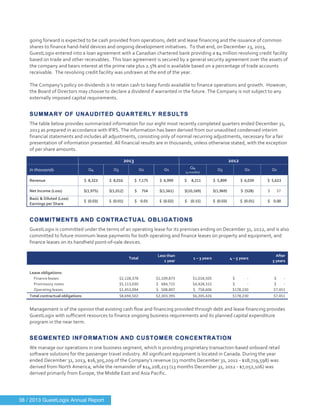
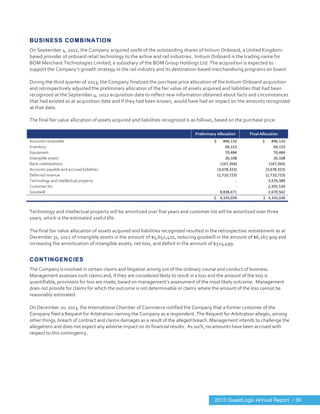
  • 44.
          Fair  value  hierarchy   The  Company  classifies  and  discloses  fair  value  measurements  using  a  fair  value  hierarchy  that  reflects  the  significance  of   the  inputs  used  in  making  the  measurements.  The  three  levels  of  the  fair  value  hierarchy  are:   Level  1  –  valuation  based  on  quoted  prices  (unadjusted)  in  active  markets  for  identical  assets  and  liabilities;     Level  2  –  valuation  techniques  based  on  inputs  other  than  quoted  prices  included  in  Level  1  that  are  observable   for  the  asset  or  liability,  either  directly  (i.e.,  as  prices)  or  indirectly  (i.e.,  derived  from  prices);     Level  3  –  valuation  techniques  using  inputs  for  the  asset  or  liability  that  are  not  based  on  observable  market  data   (unobservable  inputs).     The  Company’s  cash  and  cash  equivalents  are  measured  using  level  1  inputs  and  the  derivative  warrant  liability  is   measured  using  level  3  inputs.     Cash  and  cash  equivalents   Cash  and  cash  equivalents  include  balances  with  banks  and  highly  liquid  instruments.     Inventory   The  Company’s  inventory  consists  of  hand-­‐held  devices  including  hand-­‐held  devices  awaiting  deployment  and   replacement  parts  held  for  sale,  and  is  stated  at  the  lower  of  cost  and  net  realizable  value.  Net  realizable  value  represents   the  estimated  selling  price  for  inventories  less  all  estimated  costs  of  completion  and  costs  necessary  to  make  the  sale.     Property  and  equipment   The  Company  records  equipment  at  cost  less  accumulated  depreciation  and  accumulated  impairment  losses.    It   recognizes  depreciation  to  write  off  the  cost  of  assets  less  their  residual  values  over  their  useful  lives,  using  the  following   methods  and  rates:     Computer  equipment         Straight-­‐line     3  years   Furniture  and  fixtures       Straight-­‐line     5  years     The  Company  reviews  the  estimated  useful  lives,  residual  values  and  depreciation  method  at  each  year  end,  accounting   for  the  effect  of  any  changes  in  estimate  on  a  prospective  basis.  The  gain  or  loss  arising  on  disposing  of  or  retiring  an  item   of  property,  plant  and  equipment  is  determined  as  the  difference  between  the  sales  proceeds  and  the  asset’s  carrying   amount  and  is  recognized  in  profit  or  loss.     Impairment  of  long-­‐lived  assets   At  the  end  of  each  reporting  period,  the  Company  reviews  the  carrying  amounts  of  its  tangible  assets  to  determine   whether  there  is  any  indication  those  assets  have  suffered  an  impairment  loss.  If  any  such  indication  exists,  it  estimates   the  asset’s  recoverable  amount  to  determine  the  extent  of  the  impairment  loss  (if  any).  Where  it  is  not  possible  to   estimate  an  individual  asset’s  recoverable  amount,  the  Company  estimates  the  recoverable  amount  of  the  cash-­‐ generating  unit  (“CGU”)  to  which  the  asset  belongs.  Where  it  can  identify  a  reasonable  and  consistent  basis  of  allocation,   it  also  allocates  corporate  assets  to  individual  CGU’s,  or  otherwise  allocates  them  to  the  smallest  group  of  CGU’s  for   which  it  can  identify  a  reasonable  and  consistent  allocation  basis.     Recoverable  amount  is  the  higher  of  fair  value  less  costs  to  sell  and  value  in  use.  In  assessing  value  in  use,  the  Company   discounts  estimated  future  cash  flows  to  their  present  value  using  a  pre-­‐tax  discount  rate  reflecting  current  market   assessments  of  the  time  value  of  money  and  the  risks  specific  to  the  asset  for  which  the  estimates  of  future  cash  flows   have  not  been  adjusted.     If  an  asset  or  CGU’s  recoverable  amount  is  estimated  to  be  less  than  its  carrying  amount,  the  carrying  amount  is  reduced   to  its  recoverable  amount,  recognizing  an  impairment  loss  immediately  in  profit  or  loss.  During  the  year  ended  December   31,  2013  the  Company  did  not  recognize  an  impairment  loss  (13  months  ended  December  31,  2012,  $1,296,270).     Should  the  Company  record  an  impairment  loss  which  subsequently  reverses,  it  will  increase  the  carrying  amount  to  the   revised  estimate  of  its  recoverable  amount,  by  recognizing  the  reversal  immediately  in  profit  or  loss,  without  exceeding   the  carrying  amount  that  would  have  been  determined  if  it  had  not  recognized  an  impairment  loss  in  prior  years.   44 / 2013 GuestLogix Annual Report
  • 45.
        Deferred  taxes   Deferred  tax  is  recognized  on  temporary  differences  between  the  carrying  amounts  of  assets  and  liabilities  in  the   financial  statements  and  the  corresponding  tax  bases  used  in  the  computation  of  taxable  profit.  Deferred  tax  liabilities   are  generally  recognized  for  all  taxable  temporary  differences.  Deferred  tax  assets  are  generally  recognized  for  all   deductible  temporary  differences  to  the  extent  that  it  is  probable  that  taxable  profits  will  be  available  against  which  those   deductible  temporary  differences  can  be  utilized.     Such  deferred  tax  assets  and  liabilities  are  not  recognized  if  the  temporary  difference  arises  from  goodwill  or  from  the   initial  recognition  (other  than  in  a  business  combination)  of  other  assets  and  liabilities  in  a  transaction  that  affects  neither   the  taxable  profit  nor  the  accounting  profit.     Deferred  tax  liabilities  are  recognized  for  taxable  temporary  differences  associated  with  investments  in  subsidiaries  and   associates,  and  interests  in  joint  ventures,  except  where  the  Company  is  able  to  control  the  reversal  of  the  temporary   difference  and  it  is  probable  that  the  temporary  difference  will  not  reverse  in  the  foreseeable  future.  Deferred  tax  assets   arising  from  deductible  temporary  differences  associated  with  such  investments  and  interests  are  only  recognized  to  the   extent  that  it  is  probable  that  there  will  be  sufficient  taxable  profits  against  which  to  utilize  the  benefits  of  the  temporary   differences  and  they  are  expected  to  reverse  in  the  foreseeable  future.     The  carrying  amount  of  deferred  tax  assets  is  reviewed  at  the  end  of  each  reporting  period  and  reduced  to  the  extent  that   it  is  no  longer  probable  that  sufficient  taxable  profits  will  be  available  to  allow  all  or  part  of  the  asset  to  be  recovered.     Deferred  tax  assets  and  liabilities  are  measured  at  the  tax  rates  that  are  expected  to  apply  in  the  period  in  which  the   liability  is  settled  or  the  asset  realized,  based  on  tax  rates  (and  tax  laws)  that  have  been  enacted  or  substantively  enacted   by  the  end  of  the  reporting  period.  The  measurement  of  deferred  tax  liabilities  and  assets  reflects  the  tax  consequences   that  would  follow  from  the  manner  in  which  the  Company  expects,  at  the  end  of  the  reporting  period,  to  recover  or  settle   the  carrying  amount  of  its  assets  and  liabilities.     Deferred  tax  assets  and  liabilities  are  offset  when  there  is  a  legally  enforceable  right  to  offset  tax  assets  against  tax   liabilities  and  when  they  relate  to  income  taxes  levied  by  the  same  taxation  authority  and  the  Company  intends  to  settle   its  tax  assets  and  liabilities  on  a  net  basis.     Stock-­‐based  compensation   The  Company  measures  equity-­‐settled  share-­‐based  payments  to  employees  and  others  providing  similar  services  at  the   fair  value  of  the  equity  instruments  at  the  grant  date.  The  fair  value  determined  at  the  grant  date  of  the  equity-­‐settled   share-­‐based  payments  is  calculated  using  the  Black-­‐Scholes  option  valuation  model  and  is  expensed  on  a  graded  vesting   basis  over  the  vesting  period,  based  on  the  Company’s  estimate  of  equity  instruments  that  will  eventually  vest,  and  is   credited  to  other  paid-­‐in  capital.  At  the  end  of  each  reporting  period,  the  Company  revises  its  estimate  of  the  number  of   equity  instruments  expected  to  vest.  The  impact  of  the  revision  of  the  original  estimates,  if  any,  is  recognized  in  profit  or   loss  such  that  the  cumulative  expense  reflects  the  revised  estimate,  with  a  corresponding  adjustment  to  other  paid-­‐in   capital.  When  options  are  exercised,  the  proceeds  together  with  the  amount  originally  credited  to  other  paid-­‐in  capital   are  credited  to  share  capital.     The  use  of  the  Black-­‐Scholes  model  requires  inputting  a  number  of  assumptions,  including  expected  dividend  yield,   expected  stock  price  volatility,  forfeiture  rate,  expected  time  until  exercise  and  risk  free  interest  rate.    Although  the   assumptions  used  reflect  management’s  best  estimates,  they  involve  inherent  uncertainties  based  on  conditions  outside   of  the  Company’s  control.    If  other  assumptions  were  used,  stock-­‐based  compensation  could  be  significantly  impacted.       Leases   The  Company  classifies  a  lease  it  enters  into  as  a  lessee  as  a  finance  lease  whenever  the  terms  transfer  substantially  all   the  risks  and  rewards  of  ownership  to  the  Company.  It  classifies  all  other  leases  as  operating  leases.  It  initially  recognizes   assets  held  under  finance  leases  at  their  fair  value  at  the  inception  of  the  lease  or,  if  lower,  at  the  present  value  of  the   minimum  lease  payments,  and  recognizes  the  corresponding  liability  to  the  lessor  as  a  finance  lease  obligation.  Lease   payments  are  apportioned  between  finance  expenses  and  reduction  of  the  lease  obligation  so  as  to  achieve  a  constant   rate  of  interest  on  the  remaining  balance  of  the  liability.  Finance  expenses  are  recognized  immediately  in  profit  or  loss.   2013 GuestLogix Annual Report / 45
  • 46.
        The  Company  recognizes  operating  lease  payments  as  an  expense  on  a  straight-­‐line  basis  over  the  lease  term,  except   where  another  systematic  basis  better  represents  the  time  pattern  in  which  it  consumes  economic  benefits  from  the   leased  asset.     Provisions   The  Company  recognizes  a  provision  when  it  has  a  present  obligation  (legal  or  constructive)  as  a  result  of  a  past  event,  it   is  probable  it  will  be  required  to  settle  the  obligation,  and  it  can  make  a  reliable  estimate  of  the  amount  of  the  obligation.   The  amount  it  recognizes  as  a  provision  is  the  best  estimate  of  the  consideration  required  to  settle  the  present  obligation   at  the  end  of  the  reporting  period,  taking  into  account  the  risks  and  uncertainties  surrounding  the  obligation.  Where  a   provision  is  measured  using  the  cash  flows  estimated  to  settle  the  present  obligation,  its  carrying  amount  is  the  present   value  of  those  cash  flows.     Restructuring  provisions     Restructuring  provisions  are  recognized  only  when  the  Company  has  an  actual  or  a  constructive  obligation.  The  Company   has  a  constructive  obligation  when  a  detailed  formal  plan  identifies  the  business  or  part  of  the  business  location  and   number  of  employees  affected  a  detailed  estimate  of  the  associated  costs  and  an  appropriate  concerned,  the  location   and  number  of  employees  affected  a  detailed  estimate  of  the  associated  costs  and  an  appropriate  timeline.     The  Company  incurs  restructuring  charges  relating  to  workforce  reductions  which  include  employee  severance  and  other   employee  benefits.  The  recognition  of  these  charges  requires  Management  to  make  certain  judgments  and  estimates   regarding  the  nature,  timing  and  amounts  associated  with  these  restructuring  plans.  Employee  termination  costs  are   recognized  in  the  period  the  detailed  plans  are  approved  and  the  actions  have  either  commenced  or  have  been   announced  to  the  employees.    At  the  end  of  each  reporting  period,  the  remaining  balances  are  assessed  for   appropriateness.    Adjustments  to  the  recorded  amounts  may  be  required  to  reflect  actual  experience  or  changes  in  future   estimates.     Share  issue  costs   The  Company  charges  incremental  costs  incurred  in  respect  of  raising  capital  against  the  equity  proceeds  raised,   including  legal,  accounting,  agent  and  investment  bank  fees.     Earnings  (loss)  per  share   The  Company  computes  basic  earnings  (loss)  per  share  by  dividing  net  profit  (loss)  by  the  weighted  average  number  of   common  shares  outstanding  for  the  period.    Diluted  earnings  (loss)  per  share  reflects  the  potential  dilution  that  could   occur  if  additional  common  shares  are  assumed  to  be  issued  under  securities  or  contracts  that  entitle  their  holders  to   obtain  common  shares  in  the  future,  and  is  calculated  using  the  treasury  stock  method.    In  periods  when  the  Company   reports  a  net  loss,  the  effect  of  potential  issuances  of  shares  under  options  and  warrants  is  anti-­‐dilutive  and  therefore,   basic  and  diluted  loss  per  share  are  the  same.     Significant  judgments,  estimates  and  assumptions   The  preparation  of  the  Company’s  consolidated  financial  statements  in  conformity  with  IFRS  requires  management  to   make  judgments,  estimates  and  assumptions  that  affect  the  reported  amounts  of  assets  and  liabilities  and  disclosures  of   contingent  assets  and  liabilities  at  the  date  of  the  financial  statements  and  the  reported  amounts  of  revenues  and   expenses  during  the  reporting  period.  Estimates  and  assumptions  are  continually  evaluated  and  are  based  on   management’s  experience  and  other  factors,  including  expectations  of  future  events  that  are  believed  to  be  reasonable   under  the  circumstances.  Actual  results  could  differ  from  these  estimates.         46 / 2013 GuestLogix Annual Report
  • 47.
        The  areas  which  require  management  to  make  significant  judgments,  estimates  and  assumptions  in  determining  carrying   values  include,  but  are  not  limited  to:     Revenue  recognition     In  revenue  arrangements  including  more  than  one  deliverable,  the  deliverables  are  assigned  to  one  or  more  separate   units  of  accounting  and  the  arrangement  consideration  is  allocated  to  each  unit  of  accounting  based  on  its  relative  fair   value.    Determining  the  fair  value  of  each  deliverable  can  require  complex  estimates  due  to  the  nature  of  the  goods  and   services  provided.    The  Company  generally  determines  the  fair  value  of  individual  elements  based  on  prices  at  which  the   deliverable  is  regularly  sold  on  a  standalone  basis  after  considering  volume  discounts  where  appropriate.     In  merchandising  agreements  with  customers  in  which  the  Company  provides  transaction  processing  and  merchant  of   record  services  in  the  sale  of  food  and  beverage  items  and  destination-­‐based  attraction  tickets  on-­‐board,  revenue  is   recognized  on  either  a  gross  or  net  basis,  depending  on  the  Company's  role  in  the  transaction  as  principal  or  as  agent.       Due  to  the  complex  nature  of  these  transactions,  the  determination  of  whether  the  Company  acts  as  principal  or  agent   requires  judgment  in  assessing  primary  responsibility,  the  level  of  inventory  risk  and  the  level  of  credit  risk,  among  other   factors.     Impairment  of  Goodwill  and  Other  Assets     Goodwill  is  tested  for  impairment  annually  or  more  frequently  if  there  is  an  indication  of  impairment.  The  carrying  value   of  intangible  assets  with  definite  lives  and  property  and  equipment  is  reviewed  each  reporting  period  to  determine   whether  there  is  any  indication  of  impairment.  If  the  carrying  amount  of  an  asset  exceeds  its  recoverable  amount,  the   asset  is  impaired  and  an  impairment  loss  is  recognized  in  the  consolidated  statement  of  operations  and  comprehensive   loss.  The  assessment  of  fair  values  requires  the  use  of  estimates  and  assumptions  related  to  future  operating   performance,  future  capital  expenditures,  discount  rates  and  terminal  value.    During  the  year  ended  December  31,  2013,   the  Company  did  not  record  any  impairment  loss  (December  31,  2012  –  $1,296,270).     Useful  Life  of  Equipment  and  Intangible  assets     Significant  judgment  is  involved  in  the  determination  of  useful  life  for  the  computation  of  depreciation  of  property  and   equipment  and  amortization  of  intangible  assets.  No  assurance  can  be  given  that  actual  useful  lives  will  not  differ   significantly  from  current  assumptions.       Legal  Provisions     The  Company  assesses  the  provision  for  legal  or  constructive  obligations  at  each  reporting  period  or  when  new  material   information  becomes  available.    Legal  and  contractual  matters  are  subject  to  interpretation  and  the  Company  may   engage  external  advisors  to  assist  with  periodic  assessments.    To  the  extent  that  interpretation  of  legal  and  contractual   matters  differ  significantly  from  estimates,  the  actual  judgments  and  settlement  amounts  may  vary  significantly  from   management’s  estimates.     Valuation  of  derivative  warrant  liability     The  Company  is  required  to  make  certain  estimates  when  determining  the  fair  value  of  the  derivative  warrant  liabilities   issued  as  part  of  the  promissory  notes  issued  each  reporting  period.  These  estimates  affect  the  amount  recognized  as   derivative  warrant  liabilities  in  the  consolidated  statement  of  financial  position  and  the  change  in  fair  value  of  derivative   warrant  liabilities  in  the  consolidated  statement  of  comprehensive  (loss)  income.     Valuation  of  intangible  assets     The  determination  of  estimated  fair  values  of  acquired  intangible  assets,  as  well  as  the  useful  economic  life  ascribed  to   finite  lived  intangible  assets,  requires  the  use  of  significant  judgment.  The  use  of  different  estimates  and  assumptions  to   those  used  by  the  Company  could  result  in  a  materially  different  valuation  of  acquired  intangible  assets,  which  could  have   a  material  effect  on  the  Company’s  results  of  operations.     2013 GuestLogix Annual Report / 47
  • 48.
        BASIS OFMEASUREMENT AND PRESENTATION AND RECENTLY ISSUED ACCOUNTING PRONOUNCEMENTS Basis  of  measurement  and  presentation   The  consolidated  financial  statements  have  been  prepared  under  the  historical  cost  convention,  as  modified  by  the   revaluation  of  financial  assets  and  financial  liabilities  at  fair  value  through  profit  or  loss.     Not  yet  effective   IFRS  9  –  Financial  Instruments  was  issued  by  the  IASB  to  establish  principles  for  the  financial  reporting  of  financial  assets   and  liabilities,  including  requirements  to  present  certain  information  relating  to  the  amounts,  timing,  and  uncertainty  of   the  entity’s  future  cash  flows.  This  standard  is  mandatorily  effective  from  January  1,  2018,  with  earlier  application   permitted.    Management  has  not  yet  determined  the  potential  impact  the  adoption  of  IFRS  9  will  have  on  the  Company’s   consolidated  financial  statements.     Adopted   As  of  January  1,  2013,  the  Company  adopted  the  new  and  amended  IFRS  pronouncements  in  accordance  with  the   transitional  provisions  outlined  in  the  respective  standards.  The  Company  has  adopted  these  new  and  amended   standards  without  any  significant  effect  on  its  financial  statements.     IFRS  10  –  Consolidated  Financial  Statements   IFRS  10  establishes  principles  for  the  presentation  and  preparation  of  consolidated  financial  statements  when  an  entity   controls  one  or  more  other  entities.  IFRS  10  defines  the  principle  of  control  and  establishes  control  as  the  basis  for   determining  which  entities  are  consolidated.  IFRS  10  sets  out  three  elements  of  control:  power  over  the  investee;   exposure,  or  rights,  to  variable  returns  from  involvement  with  the  investee;  and  the  ability  to  use  power  over  the  investee   to  affect  the  amount  of  the  investors’  return;  and  the  requirements  on  how  to  apply  the  control  principle.  IFRS  10  replaces   SIC-­‐12,  Consolidation  –  Special  Purpose  Entities  and  parts  of  IAS  27,  Consolidated  and  Separate  Financial  Statements.     IFRS  11  -­‐  Joint  Arrangements   IFRS  11  requires  a  venturer  to  classify  its  interest  in  a  joint  arrangement  as  a  joint  venture  or  joint  operation.  Joint   ventures  will  be  accounted  for  using  the  equity  method  of  accounting  whereas  for  a  joint  operation  the  venturer  will   recognize  its  share  of  the  assets,  liabilities,  revenue  and  expenses  of  the  joint  operation.  IFRS  11  supersedes  IAS  31,   Interests  in  Joint  Ventures,  and  SIC-­‐13,  Jointly  Controlled  Entities  –  Non-­‐monetary  Contributions  by  Venturers.     IFRS  12  –  Disclosure  of  Interests  in  Other  Entities   IFRS  12  establishes  disclosure  requirements  for  interests  in  other  entities,  including  subsidiaries,  joint  arrangements,   associates,  and  special  purpose  vehicles.     IFRS  13  -­‐  Fair  Value  Measurement   IFRS  13  is  a  comprehensive  standard  for  fair  value  measurement  and  disclosure  requirements  for  use  across  all  IFRS   standards.  The  new  standard  clarifies  that  fair  value  is  the  price  that  would  be  received  to  sell  an  asset,  or  paid  to  transfer   a  liability  in  an  orderly  transaction  between  market  participants,  at  the  measurement  date.  It  also  establishes  additional   disclosures  regarding  fair  value  measurements.       48 / 2013 GuestLogix Annual Report
  • 49.
        CONTROLS ANDPROCEDURES DISCLOSURE  CONTROLS  AND  PROCEDURES  (“DC&P”)     DC&P  are  designed  to  provide  reasonable  assurance  that  all  relevant  information  is  gathered  and  reported  to  senior   management  of  GuestLogix,  including  the  Chief  Executive  Officer  and  Chief  Financial  Officer,  on  a  timely  basis  so  that   appropriate  decisions  can  be  made  regarding  public  disclosures.  The  Company’s  management,  including  the  President   and  Chief  Executive  Officer  and  the  Chief  Financial  Officer,  are  responsible  for  establishing  and  maintaining  effective   DC&P  for  the  Company  as  defined  in  National  Instrument  52-­‐109  Certification  of  Disclosure  in  Issuers’  Annual  and  Interim   Filings.    Management  has  concluded  that  as  of  December  31,  2013,  with  the  participation  of  the  CEO  and  CFO,  assessed   the  effectiveness  of  the  Company’s  disclosure  controls  and  procedures  to  provide  reasonable  assurance  that  the   information  required  to  be  disclosed  by  the  Company  in  reports  it  files  is  recorded,  processed,  summarized  and  reported   within  the  appropriate  time  periods  were  effective.     INTERNAL  CONTROL  OVER  FINANCIAL  REPORTING  (“ICFR”)     The  Company’s  management,  including  the  President  and  Chief  Executive  Officer  and  the  Chief  Financial  Officer,  are   responsible  for  establishing  and  maintaining  effective  ICFR  as  defined  in  National  Instrument  52-­‐109  Certification  of   Disclosure  in  Issuers’  Annual  and  Interim  Filings.    Because  of  its  inherent  limitations,  ICFR  may  have  material  weaknesses   and  may  not  prevent  or  detect  misstatements.    Also,  projections  of  any  evaluation  of  effectiveness  to  future  periods  are   subject  to  the  risk  that  controls  may  become  inadequate  because  of  changes  in  conditions,  or  that  the  degree  of   compliance  with  the  policies  or  procedures  may  deteriorate.     The  design  and  operation  of  ICFR  is  intended  to  provide  reasonable  assurance  regarding  the  reliability  of  financial   reporting  and  the  preparation  of  consolidated  financial  statements  for  external  purposes  in  accordance  with  applicable   IFRS.    ICFR  should  include  those  policies  and  procedures  that  establish  the  following:   • maintenance  of  records  in  reasonable  detail,  that  accurately  and  fairly  reflects  the  transactions  and  dispositions  of   assets;   • reasonable  assurance  that  transactions  are  recorded  as  necessary  to  permit  preparation  of  consolidated  financial   statements  in  accordance  with  applicable  generally  accepted  accounting  principles;   • receipts  and  expenditures  are  only  being  made  in  accordance  with  authorizations  of  management  and  the  Board  of   Directors;  and   • reasonable  assurance  regarding  prevention  or  timely  detection  of  unauthorized  acquisition,  use  or  disposition  of   assets  that  could  have  a  material  effect  on  the  consolidated  financial  statements.     Management  has  concluded  that  as  of  December  31,  2013,  with  the  participation  of  the  CEO  and  CFO,  assessed  the   effectiveness  of  the  Company’s  internal  controls  over  financial  reporting  and  concluded  that  as  at  December  31,  2013,  the   Company’s  internal  control  over  financial  reporting  was  effective.     COMPLEX  AND  NON-­‐ROUTINE  TRANSACTIONS     As  required,  GuestLogix  records  complex  and  non-­‐routine  transactions.    These  sometimes  are  extremely  technical  in   nature  and  require  an  in-­‐depth  understanding  of  IFRS.    GuestLogix’  accounting  staff  has  only  a  fair  and  reasonable   knowledge  of  the  rules  related  to  IFRS  and  reporting  and  the  transactions  may  not  be  recorded  correctly,  potentially   resulting  in  material  misstatement  of  the  consolidated  financial  statements  of  GuestLogix.   To  address  this  risk,  the  GuestLogix  finance  staff  will  consult  with  its  third-­‐party  expert  advisors  as  needed  in  connection   with  the  recording  and  reporting  of  complex  and  non-­‐routine  transactions.    In  addition,  an  annual  audit  will  be  completed   and  presented  to  the  Audit  Committee  of  GuestLogix  for  its  review  and  approval.                 2013 GuestLogix Annual Report / 49
  • 50.
        CORPORATE  GOVERNANCE     The  Company’s  Board  of  Directors  follows  accepted  corporate  governance  guidelines  for  public  companies  to  ensure   transparency  and  accountability  to  its  shareholders.     The  Audit  Committee  of  the  Company  fulfills  its  role  of  ensuring  the  integrity  of  the  reported  information  through  its   review  of  the  interim  and  audited  annual  financial  statements  prior  to  their  submission  to  the  Board  of  Directors  for   approval.  The  Audit  Committee  meets  with  management  and  the  external  auditors  of  the  Company  on  a  quarterly  basis   to  review  the  financial  statements,  including  the  MD&A,  and  to  discuss  other  financial,  operating  and  internal  control   matters.     FINANCIAL RISK MANAGEMENT Management  is  responsible  for  developing  and  monitoring  the  Company’s  risk  strategy.     • We  have  identified  exposure  from  the  following  risks  as  a  result  of  our  use  of  financial  instruments:   • credit  risk   • liquidity  risk   • market  risk   • foreign  currency  risk   • interest  rate  risk     The  Company  establishes  an  allowance  for  doubtful  accounts  that  corresponds  to  the  specific  credit  risk  of  its  customers,   historical  trends  and  economic  circumstances.  The  allowance  as  at  December  31,  2013  was  $508,728  (December  31,  2012  -­‐   $632,656).  The  Company  reduced  its  allowance  by  $123,928  during  year  ended  December  31,  2013  (13  months  ended   December  31,  2012  -­‐  $427,022)  representing  a  write-­‐down  of  certain  past  due  receivables  that  were  considered  to  be  at   risk  and  perceived  not  to  be  fully  collectible.     The  definition  of  amounts  that  are  past  due  is  determined  by  reference  to  terms  agreed  with  individual  customers.    The   Company  reviews  its  accounts  receivable  quarterly  and  reduces  amounts  to  their  expected  realizable  values  by  providing   an  allowance  for  doubtful  accounts  when  the  account  may  not  be  fully  collectible.  Our  normal  terms  for  trade  receivables   are  30  to  45  days.    As  at  December  31,  2013  our  largest  5  customers  represented  61%  (December  31,  2012  -­‐  62%)  of  our   trade  receivable  balance.     Liquidity  risk   The  Company  believes  that  at  the  present  time  it  does  not  face  significant  liquidity  risk  as  it  has  been  able  to  continue  to   source  funding  for  its  point-­‐of-­‐sale  hand-­‐held  devices  and  its  development  initiatives  through  lease  and  debt  financing.     Market  risk     (a)   Interest  rate     Cash  equivalents  and  restricted  cash  equivalents  are  invested  in  money  market  instruments  of  maturities  up  to  30  days.     Consequently,  GuestLogix  is  exposed  to  interest  rate  risk  as  a  result  of  holding  investments  of  varying  maturities.    The   fair  value  of  investments,  as  well  as  the  investment  income  derived  from  the  investment  portfolio,  will  fluctuate  with   changes  in  prevailing  interest  rates.    GuestLogix  does  not  use  interest  rate  derivative  financial  instruments  in  its   investment  portfolio  but  periodically  invests  in  Canadian  Schedule  A  bank  instruments.    The  Company  does  not  believe   that  there  is  a  significant  interest  rate  risk,  due  to  the  short-­‐term  nature  of  its  investments.     (b)   Foreign  exchange     GuestLogix  is  exposed  to  foreign  exchange  risk  as  a  result  of  transactions  in  currencies  other  than  its  functional  currency   of  the  U.S.  dollar.  The  majority  of  GuestLogix’  revenues  are  transacted  in  U.S.  Dollars,  Euros  and  Sterling.    Purchases  of   50 / 2013 GuestLogix Annual Report
  • 51.
        equipment  required  to  deliver  on  GuestLogix’  contracts  are  primarily  transacted  in  U.S.  Dollars,  while  a  large  portion  of   operating  expenses,  including  personnel  costs,  are  denominated  in  Canadian  dollars.  GuestLogix  does  not  currently  use   derivative  instruments  to  hedge  against  foreign  exchange  risk.     Sensitivity  analysis   Based  on  management’s  knowledge  and  experience  of  the  finance  market,  the  Company  believes  the  following   movements  are  “reasonably  possible”  over  a  six-­‐month  period.       Impact  on  net  income   $   Change  of  =+/-­‐  10%  in  CAD  $  foreign  exchange  rate   +/-­‐  121,000   Change  of  =+/-­‐  10%  in  Euro  €  foreign  exchange  rate   +/-­‐  198,000   Change  of  =+/-­‐  10%  in  GBP  £  foreign  exchange  rate   +/-­‐  456,000       The  impact  on  net  income  (loss)  is  calculated  using  the  closing  balances  of  non-­‐US  dollar  denominated  monetary  assets   and  liabilities  with  all  other  assumptions  held  constant.  The  above  results  arise  primarily  as  a  result  of  the  Company   having  CAD  $,  Euro  €  and  GBP  £,  denominated  cash  and  cash  equivalents,  accounts  receivable,  accounts  payable  and   accrued  liabilities,  and  capital  lease  obligations.         Limitations  of  sensitivity  analysis   The  above  table  demonstrates  the  effect  of  change  in  foreign  exchange  rates.  The  financial  position  of  the  Company  may   vary  at  the  time  those  changes  in  foreign  exchange  rates  occur,  causing  the  impact  on  the  Company’s  results  to  differ   from  that  shown  above.       2013 GuestLogix Annual Report / 51
  • 52.
        RISK FACTORS Potential  investors  and  readers  should  carefully  consider  the  risk  and  uncertainties  factors  set  out  below,  as  well  as  those   risks  outlined  in  our  Annual  Information  Form  dated  March  24,  2014  and  available  through  SEDAR  at  www.sedar.com   which  are  incorporated  herein  by  reference,  to  which  our  business,  operations  and  financial  conditions  are  subject.     The  risks  and  uncertainties  below  are  not  the  only  ones  facing  the  Company.  Additional  risks  and  uncertainties  not  presently   known  to  the  Company  or  that  the  Company  currently  considers  immaterial  also  may  impair  its  business  operations  and   cause  the  price  of  its  Common  Shares  to  decline.  If  any  of  the  following  risks  actually  occur,  the  Company’s  business  may  be   harmed  and  its  financial  condition  and  results  of  operations  may  suffer  significantly.  In  that  event,  the  trading  price  of  its   Common  Shares  could  decline,  and  an  investor  may  lose  all  or  part  of  his,  her  or  its  investment.     An  investment  in  the  Company  may  not  be  suitable  for  all  recipients  of  this  document.  Potential  investors  are  therefore   strongly  recommended  to  consult  an  independent  financial  adviser  who  specializes  in  advising  upon  the  acquisition  of  shares   and  other  securities  before  making  a  decision  to  invest.   The   Company   operates   in   a   dynamic,   rapidly   changing   global   environment   that   involves   risks   and   uncertainties.     An   investment  in  GuestLogix  Common  Shares  is  speculative  and  involves  a  high  degree  of  risk  and  uncertainty.    Such  risks   relate  to  and  include,  without  limitation:     • the  Company’s  ability  to  raise  financing  to  fund  our  growth  plans,   • the  Company’s  ability  to  maintain  contract  renewals  rates,   • the  Company’s  ability  to  expand  foreign  operations,       • the  effects  of  economic  uncertainty,   • the  Company’s  ability  to  respond  to  emerging  products  and  technology,   • the  Company’s  exposure  to  credit  risk,   • the  changes  in  foreign  exchange  and  interest  rates,   • the  Company’s  dependence  on  distribution  channels,     • the  Company’s  ability  to  predict  the  rate  of  growth  and  profitability,     • the  Company’s  competition,     • the  Company’s  management  of  growth,   • the  Company’s  liquidity  risk,     • the  Company’s  reliance  on  key  personnel,   • the  Company’s  exposure  to  product  errors  and  third  party  mischief,   • the  Company’s  exposure  to  litigation,   • the  Company’s  exposure  to  interruptions  or  delays  in  service  from  our  third-­‐party  hosting  facilities,   • the  Company’s  ability  to  license  and  enforce  intellectual  property,   • the  protection  of  other  proprietary  rights,   • the  Company’s  ability  to  engage  in  suitable  acquisitions,  and   • the  fluctuation  of  quarterly  results  and  failure  to  meet  the  expectation  of  analysts  or  investors.     In  addition  to  such  risks,  the  Company  is  subject  to  the  following  challenges:     • the  Company’s  ability  to  predict  whether  it  will  meet  internal  or  external  expectations,     • the  Company’s  ability  to  maintain  internal  controls,  and     • the  Company’s  limited  operating  history  and  evolving  business  model.           52 / 2013 GuestLogix Annual Report
  • 53.
        Financial  resources   Historically  GuestLogix  has  not  had  a  history  of  positive  net  income  or  generating  positive  cash  flow.  The  Company’s   financial  position  improved  significantly  in  2013  having  raised  over  CAD$15.5  million  through  the  issuance  of  Common   Shares  through  two  separate  private  placement  financing  transactions  and  the  establishment  of  a  $4  million  revolving   demand  credit  facility.  In  the  future,  the  Company  may  require  additional  funds  and  may  attempt  to  raise  additional   funds  through  equity  or  debt  financings  or  from  other  sources.  Any  additional  equity  financing  may  be  dilutive  to  holders   of  Common  Shares  and  any  debt  financing,  if  available,  may  require  restrictions  to  be  placed  on  any  future  financing  and   on  operating  activities.  The  Company  may  be  unable  to  obtain  additional  financing  on  acceptable  terms  if  market  and   economic  conditions,  our  financial  condition  or  operating  performance  or  investor  sentiment  are  unfavourable.  An   inability  to  raise  further  funds  may  hinder  the  Company’s  ability  to  continue  to  grow  in  the  future.     Contract  renewal  rates   GuestLogix  generates  significant  recurring  revenue  from  existing  customers  who  are  under  contract  for  periods  ranging   from   three   to   five   years.     Our   customers’   renewal   rates   may   decline   or   fluctuate   as   a   result   of   a   number   of   factors,   including  their  level  of  satisfaction  with  the  services  and  their  ability  to  continue  their  operations  and  spending  levels  or  in   the  event  of  an  airline  merger.    If  the  Company’s  existing  customers  do  not  renew  their  contracts,  GuestLogix’  revenue   will  decline  and  the  Company’s  business  may  contract.     Foreign  operations   The  Company  intends  to  continue  to  pursue  international  market  growth  opportunities,  which  could  result  in   international  sales  accounting  for  an  increasing  portion  of  the  Company’s  consolidated  revenues.  The  Company  intends   to  commit  increased  resources  to  its  international  operations  as  well  as  to  related  sales  and  marketing  activities.  The   Company  may  not  be  aware  of  all  the  factors  that  may  affect  its  business  in  foreign  jurisdictions.  The  Company  will  be   subject  to  a  number  of  risks  associated  with  international  business  activities  that  may  increase  liability  or  costs,  lengthen   sales  cycles  or  require  significant  management  attention.  International  operations  carry  certain  risks  and  associated   costs,  such  as:  the  complexity  and  expense  of  administering  a  business  abroad;  complications  in  compliance  with  foreign   laws,  and  unexpected  changes  in  legal  and  regulatory  restrictions  or  requirements;  international  import  and  export   legislation;  trading  and  investment  policies;  foreign  currency  fluctuations;  exchange  controls;  tariffs  and  other  trade   barriers;  difficulties  in  collecting  accounts  receivable;  potential  adverse  sales  and  use  tax  and  income  tax  consequences;   uncertainties  of  laws  and  enforcement  relating  to  intellectual  property  and  privacy  rights;  unauthorized  copying  of   software;  difficulty  in  managing  a  geographically  dispersed  workforce  in  compliance  with  diverse  local  laws  and  customs;   and  other  factors  depending  upon  the  country  involved.    There  can  be  no  assurance  that  the  Company  will  not  experience   these  risks  in  the  future.  If  foreign  operations  expand  to  the  point  where  they  account  for  a  significant  portion  of  the   Company’s  consolidated  revenues,  the  presence  of  such  risks  could  have  a  material  adverse  effect  on  the  Company’s   business,  operating  results  and  financial  condition.     Economic  uncertainty   Many  of  the  Company’s  customers,  particularly  in  the  airline  industry,  are  being  affected  by  economic  conditions   affecting  the  broader  market.  In  addition,  the  Company’s  current  concentration  within  the  airline  sector  exposes  us  to  the   additional  risk  of  the  impact  of  volatile  jet  fuel  prices  on  airline  financial  performance  and  the  overall  passenger  traffic   volumes  during  periods  of  high  jet  fuel  prices.    The  airline  sector,  particularly  in  North  America  and  Europe  are  emerging   from  a  period  of  significant  financial  weakness.    This  may  lead  to  the  Company  having  difficulty  financing  its  transaction-­‐ based  business  model  in  the  future.     Current   and   future   conditions   in   the   domestic   and   global   economies   remain   uncertain.   As   a   result,   it   is   difficult   to   estimate  the  level  of  growth  or  contraction  for  the  economy  as  a  whole.  It  is  even  more  difficult  to  estimate  growth  or   contraction   in   various   parts,   sectors   and   regions   of   the   economy,   including   the   markets   in   which   the   Company   participates.   Because   significant   components   of   the   Company’s   budgeting   and   forecasting   are   dependent   upon   estimates  of  growth  or  contraction  in  the  markets  we  serve  and  demand  for  our  products  and  services,  the  prevailing   economic  uncertainties  render  estimates  of  future  income  and  expenditures  very  difficult  to  make.  Adverse  changes  may   occur  as  a  result  of  soft  economic  conditions,  wavering  consumer  confidence,  unemployment,  declines  in  stock  markets,   contraction  of  credit  availability,  declines  in  real  estate  values,  or  other  factors  affecting  economic  conditions  generally.     These  changes  may  negatively  affect  the  sales  of  the  Company’s  products  and  services.     2013 GuestLogix Annual Report / 53
  • 54.
        Emerging  products  and  technology   The  market  for  the  Company’s  products  is  still  emerging  and  consequently  the  continued  growth  and  demand  for,  and   acceptance  of,  these  products  remains  uncertain.  In  addition,  other  emerging  technologies  and  products  may  impact  the   acceptance  of  the  Company’s  products.  The  Company’s  continued  success  will  depend  upon  its  ability  to  keep  pace  with   technological  and  marketplace  change  and  to  introduce,  on  a  timely  and  cost-­‐effective  basis,  new  and  enhanced   products  that  satisfy  changing  customer  requirements  and  achieve  market  acceptance.  There  can  be  no  assurance  that   the  Company  will  be  able  to  respond  effectively  to  changes  in  technology  or  customer  demands.  Moreover,  there  can  be   no  assurance  that  the  Company’s  competitors  will  not  develop  competitive  products  or  that  any  such  products  will  not   have  an  adverse  effect  on  the  Company’s  business,  financial  condition  or  results  of  operations.     Credit  risk   We  are  exposed  to  credit  risk  from  our  customers  and  banks.    This  risk  is  as  a  result  of  a  counterparty  failing  to  settle  on   its  obligations.    Our  credit  risk  stems  from  cash  and  cash  equivalents  and  restricted  cash.    We  mitigate  this  risk  by   investing  in  short  term  deposits  and  only  dealing  with  major  international  banks.  The  majority  of  our  cash  and  cash   equivalents  and  restricted  cash  are  held  in  Canada  with  a  Schedule  A  bank  as  at  December  31,  2013.    In  addition,  in  certain   cases,  we  mitigate  credit  risk  through  accounts  receivable  insurance.     Market  risk   This  risk  relates  to  financial  instruments  and  is  caused  by  changes  in  foreign  currency  rates  of  exchange  and  interest   rates.    The  Company’s  consolidated  financial  statements  are  expressed  in  United  States  dollars,  but  a  large  portion  of  our   business  is  conducted  in  other  currencies.    Today,  we  have  customers  and  suppliers  in  Canada,  the  United  States,  Europe,   the  Middle  East,  and  Asia  who  transact  business  in  currencies  such  as  Sterling,  Euro,  Australian  dollars  and  Canadian   dollars.     Changes  in  the  exchange  rates  for  these  other  currencies  can  increase  or  decrease  our  revenues,  expenses,  earnings  and   the  carrying  value  of  assets  or  liabilities  in  our  consolidated  balance  sheet.    We  currently  do  not  use  derivative   instruments  to  hedge  our  currency  exposure.    However,  in  the  future,  we  may  establish  a  program  to  hedge  a  portion  of   our  foreign  currency  exposure  with  the  objective  of  minimizing  the  impact  of  adverse  foreign  currency  exchange   movements.  However,  even  if  we  develop  a  hedging  program,  it  may  not  hedge  entirely  the  exposure  related  to  any  one   foreign  currency  and  we  may  not  hedge  our  exposure  at  all  with  respect  to  certain  foreign  currencies.     Dependence  on  distribution  channels   The  Company  also  depends  upon  its  ability  to  establish  and  develop  new  relationships  and  to  build  on  existing   relationships  with  distribution  channel  partners.  We  currently  rely  and  expect  to  rely  upon  these  relationships  in  the   future  to  sell  or  facilitate  the  sale  of  a  material  portion  of  our  products.  These  third  parties  may  provide  the  Company  with   direct  or  indirect  customer  referrals  and  co-­‐operate  with  the  marketing  of  our  products.  We  cannot  provide  assurance   that  we  will  be  successful  in  maintaining  or  advancing  our  relationships  with  them.  In  addition,  we  cannot  provide   assurance  that  those  with  whom  we  currently  have  relationships  will  act  in  a  manner  that  will  promote  the  success  of  our   products.  Some  channel  partners  also  sell  products  and  services  of  the  Company’s  competitors.     Ability  to  predict  rate  of  growth  and  profitability   The  Company  focuses  on  sales  growth  and  earnings  before  interest,  taxes,  depreciation  and  amortization  (“EBITDA”) 1   growth  as  its  key  performance  metrics.  However,  due  to  the  Company’s  evolving  business  model  and  the  unpredictability   of  the  Company’s  emerging  category  of  onboard  retail,  we  may  not  be  able  to  accurately  forecast  the  rate  of  adoption  of   our  services  and  new  products  and  hence  our  sales  growth.  The  Company  bases  its  current  and  future  expense  levels  and   our  investment  plans  on  estimates  of  future  sales  growth.  The  Company  may  not  be  able  to  adjust  its  spending  quickly   enough  if  the  rate  of  new  or  renewed  contracts  falls  short  of  its  expectations.  As  a  result,  the  Company’s  operating  results   may  fluctuate  significantly  on  a  quarterly  basis.  In  addition,  the  Company’s  historic  sales  contract,  revenue  and  cash  flow   growth  rates  may  not  be  sustainable  and  may  decline  in  the  future.    Accordingly,  period-­‐to-­‐period  comparisons  of  the   Company’s  operating  results  may  not  necessarily  be  a  meaningful  indicator  of  future  performance.           54 / 2013 GuestLogix Annual Report
  • 55.
        Competition   It  is  possible  that  new  competitors  will  enter  the  marketplace  in  which  the  Company  is  currently  the  leader.  In  addition,  as   the  Company  develops  new  services,  the  Company  may  begin  competing  against  companies  with  whom  it  did  not   previously  compete.  Such  competitors  may  be  able  to  develop  and  expand  their  services  more  quickly,  adapt  more   swiftly  to  new  or  emerging  technologies  and  changes  in  customer  requirements,  take  advantage  of  acquisition  and  other   opportunities  more  readily,  and  devote  greater  resources  to  the  marketing  and  sale  of  their  services  and  products  than   the  Company.  Accordingly,  the  entry  of  new  competitors  could  have  a  material  adverse  effect  on  the  Company’s   business,  financial  condition  and  results  of  operations.     Management  of  growth   In  the  past  three  fiscal  years,  the  Company  has  continued  to  experience  revenue  growth  and  has  been  focused  on   continuing  this  growth  trend  through  expansion  of  its  footprint  globally.  This  has  resulted  in  increasing  headcount  and   operational  costs  to  generate  and  support  this  growing  customer  base,  which  has  placed,  and  will  continue  to  place,  to   the  extent  that  the  Company  is  able  to  sustain  such  growth,  a  strain  on  its  management,  administrative,  operational  and   financial  infrastructure.  The  Company  anticipates  that  further  growth  will  be  required  to  address  increases  in  the   customer  base,  further  development  of  the  Company’s  goods  and  services,  as  well  as  strengthening  its  expansion  into   new  geographies  and  markets.    Further  growth  will  require  the  Company  to  continue  to  hire,  train  and  manage  new   employees  as  needed.  If  new  hires  perform  poorly,  or  if  the  Company  is  unsuccessful  in  hiring,  training,  managing  and   integrating  these  new  employees,  or  if  the  Company  is  not  successful  in  retaining  existing  employees,  the  Company’s   business  may  be  harmed.     Liquidity  risk   This  is  the  risk  that  the  Company  will  be  unable  to  meet  its  obligations  as  they  come  due.    We  believe  that  existing  cash   and  cash  equivalents,  cash  from  operations  and  loan  or  lease  facilities  for  the  purchase  of  hand-­‐held  devices  will  be   sufficient  to  support  its  ongoing  operations.  However,  there  can  be  no  assurance  that  such  sources  of  cash  will  be   sufficient.    If  the  Company’s  financial  performance  and  condition  deteriorate,  the  Company’s  ability  to  obtain  funding   from  external  sources  may  be  restricted  which  could  impair  the  Company’s  capacity  to  grow  and  execute  its  business   model.       Reliance  on  key  personnel   GuestLogix’  future  performance  depends  in  part  upon  attracting  and  retaining  key  technical,  sales  and  management   personnel.  There  can  be  no  assurance  that  GuestLogix  can  retain  these  personnel  and  continue  to  recruit  the  required   expertise.    The  loss  of  key  employees  could  have  a  material  adverse  effect  on  GuestLogix’  business,  operating  results  and   financial  condition.     Product  errors  and  third  party  mischief   The  software  technology  enabling  the  Company’s  services  is  complex  and  the  related  application  software  may  contain   errors  or  defects,  especially  when  first  introduced  or  when  new  versions  are  released.    Any  errors  that  are  discovered  after   commercial  release  could  result  in  loss  of  revenues  or  delay  in  market  acceptance,  diversion  of  development  resources,   damage  to  the  Company’s  reputation,  increased  service  and  warranty  costs  and  liability  claims.  In  addition,  it  is  possible   that  the  Company’s  product  may  become  the  subject  of  a  third  party  attack  or  disruption,  whether  malicious  or   otherwise.  This  could  adversely  affect  the  performance  of  the  Company’s  technology  and  could  have  a  material  adverse   effect  on  the  Company’s  business,  operating  results  and  financial  condition.     Litigation   From  time  to  time  in  the  ordinary  course  of  its  business,  the  Company  may  become  involved  in  various  legal  proceedings,   including  commercial,  employment  and  other  litigation  and  claims,  as  well  as  governmental  and  other  regulatory   investigations  and  proceedings.  Such  matters  can  be  time-­‐consuming,  divert  management’s  attention  and  resources  and   cause  the  Company  to  incur  significant  expenses.  Furthermore,  because  litigation  is  inherently  unpredictable,  the  results   of  any  such  actions  may  have  a  material  adverse  effect  on  the  Company’s  business,  operating  results  or  financial   condition.     2013 GuestLogix Annual Report / 55
  • 56.
        Customer  concentration   The  Company  is  exposed  to  customer  concentration  risk.  The  airline  industry  is  cyclical,  economically  sensitive  and  highly   competitive.  Our  customers  are  affected  by  fuel  prices  and  shortages,  political  or  economic  instability,  terrorist  activities,   changes  in  national  policy,  competitive  pressures,  labor  actions,  pilot  shortages,  insurance  costs,  recessions,  health   concerns,  and  other  political  or  economic  events  adversely  affecting  the  world  or  regional  trading  markets.    Our   customers’  abilities  to  react  to  and  cope  with  the  volatile  competitive  environment  in  which  they  operate,  as  well  as  our   own  competitive  environment,  will  likely  affect  our  revenues  and  income.    As  at  December  31,  2013  our  five  (5)  largest   customers  represented  43%  of  our  total  revenue.    A  decline  in  sales  volumes  and/or  price  of  products  sold  to  any  one  of   our  five  largest  customers  could  have  a  material  adverse  effect  on  the  business,  financial  condition  or  results  of   operations  of  the  Company.         Interruptions  or  delays  in  service  from  our  third-­‐party  hosting  facilities   The  Company  currently  serves  its  customers  from  facilities  that  include  a  third-­‐party  hosting  facility.    Damage  to,  or   failure  of,  our  systems  generally  could  result  in  interruptions  in  our  service.  Interruptions  in  our  service  may  reduce  our   revenue,  cause  us  to  issue  credits,  cause  customers  to  terminate  their  subscriptions  and  adversely  affect  our  renewal   rates  and  our  ability  to  attract  new  customers.  The  Company’s  business  will  also  be  harmed  if  the  Company’s  customers   and  potential  customers  believe  the  Company’s  service  is  unreliable.     As  part  of  the  Company’s  current  disaster  recovery  arrangements,  redundant  hardware  is  deployed  where  possible  in  all   production  customer  environments.  Production  data  is  backed  up  onto  encrypted  media  and  taken  offsite.  The  recovery   procedures  and  encryption  keys  are  held  remotely  by  the  Company  employees,  so  that  the  systems  can  be  restored  in  the   event  of  a  site-­‐wide  disaster.  Other  than  contractual  assurances  and  agreed-­‐to  controls,  the  Company  does  not  control   the  operation  of  any  of  these  facilities,  and  they  are  vulnerable  to  damage  or  interruption  from  earthquakes,  floods,  fires,   power  loss,  telecommunications  failures  and  similar  events.  They  may  also  be  subject  to  break-­‐ins,  sabotage,  intentional   acts  of  vandalism  and  similar  misconduct.  Despite  precautions  taken  at  these  facilities,  the  occurrence  of  a  natural   disaster  or  an  act  of  terrorism,  a  decision  to  close  the  facilities  without  adequate  notice  or  other  unanticipated  problems   at  these  facilities  could  result  in  lengthy  interruptions  in  the  Company’s  service.  Even  with  these  disaster  recovery   arrangements,  the  Company’s  service  could  be  interrupted.    Such  interruption  could  adversely  affect  the  Company’s   operations  and  financial  performance.     Intellectual  property  licensing  and/or  enforcement   The  Company’s  revenue,  cost  of  sales,  and  expenses  may  suffer  if  the  Company  cannot  continue  to  license  or  enforce  its   intellectual  property  rights  or  if  third  parties  assert  that  the  Company  violates  their  intellectual  property  rights.  The   Company  relies  upon  patent,  copyright,  trademark  and  trade  secret  laws  in  Canada  and  the  United  States  and  similar   laws  in  other  countries,  and  agreements  with  employees,  customers,  suppliers  and  other  parties,  to  establish  and   maintain  intellectual  property  rights  in  its  technology  platform.  However,  the  industry  in  which  the  Company  operates   may  include  new  or  existing  entrants  that  own,  or  claim  to  own,  intellectual  property,  and  the  Company  has  received,  and   may  receive  in  the  future,  assertions  and  claims  from  third  parties  that  the  Company’s  products  infringe  on  their  patents   or  other  intellectual  property  rights.  Litigation  has  been  and  will  likely  continue  to  be  necessary  to  determine  the  scope,   enforceability  and  validity  of  third-­‐party  proprietary  rights  or  to  establish  the  Company’s  proprietary  rights.  Any  of  the   Company’s  direct  or  indirect  intellectual  property  rights  could  be  challenged,  invalidated  or  circumvented,  or  such   intellectual  property  rights  may  not  be  sufficient  to  permit  the  Company  to  take  advantage  of  current  market  trends  or   otherwise  to  provide  competitive  advantages,  which  could  result  in  costly  or  delayed  product  redesign  efforts,   discontinuance  of  certain  product  offerings  or  other  competitive  harm.  Further,  the  laws  of  certain  countries  do  not   protect  proprietary  rights  to  the  same  extent  as  the  laws  of  Canada  and  the  United  States.  Therefore,  in  certain   jurisdictions  the  Company  may  be  unable  to  protect  its  proprietary  technology  adequately  against  unauthorized  third-­‐ party  copying  or  use,  which  could  adversely  affect  its  competitive  position.  Third  parties  also  may  claim  that  the   Company  or  customers  or  partners  indemnified  by  the  Company  are  infringing  upon  their  intellectual  property  rights.  In   recent  years,  individuals  and  groups  have  begun  purchasing  intellectual  property  assets  for  the  sole  purpose  of  making   claims  of  infringement  and  attempting  to  extract  settlements  from  established  companies.  Even  if  management  believes   that  the  claims  are  without  merit,  the  claims  can  be  time  consuming  and  costly  to  defend  and  divert  management’s   attention  and  resources  away  from  the  business.    Claims  of  intellectual  property  infringement  also  might  require  the   Company  to  redesign  affected  products,  enter  into  costly  settlement  or  license  agreements  (if  such  licenses  can  be   obtained  on  commercially  reasonable  terms,  or  at  all)  or  pay  costly  damage  awards,  or  face  a  temporary  or  permanent   56 / 2013 GuestLogix Annual Report
  • 57.
        injunction  prohibiting  the  marketing  or  selling  of  certain  of  the  Company’s  products,  which  could  result  in  the  Company’s   business,  operating  results  and  financial  condition  being  materially  adversely  affected.     Other  proprietary  rights   The  Company  relies  on,  among  other  things,  copyrights,  trademarks,  trade  secrets,  confidentiality  procedures  and   contractual  provisions  to  protect  its  proprietary  rights.  While  the  Company  enters  into  confidentiality  and  non-­‐disclosure   agreements  with  its  employees,  consultants,  business  partners,  customers,  potential  customers  and  other  third  parties   having  access  to  proprietary  and  confidential  information,  it  is  possible  that  the  following  may  occur:  some  or  all  of  its   confidentiality  agreements  will  not  be  honored;  third  parties  will  independently  develop  equivalent  technology  or   misappropriate  the  Company’s  technology  and/or  designs;  disputes  will  arise  with  the  Company’s  strategic  partners,   customers  or  others  concerning  the  ownership  of  intellectual  property;  there  may  occur  an  unauthorized  disclosure  of   source  code,  know-­‐how  or  trade  secrets,  or  contractual  provisions  may  not  be  enforced  in  foreign  jurisdictions.  There  can   be  no  assurance  that  the  Company  will  be  successful  in  protecting  its  proprietary  rights.     Acquisitions   The  Company  may  engage  in  selective  acquisitions.  There  is  a  risk  that  it  will  not  be  able  to  identify  suitable  acquisition   candidates  available  for  sale  at  reasonable  prices.  It  is  likely  to  face  competition  for  acquisition  candidates  from  other   parties  including  those  that  have  substantially  greater  available  resources.  Acquisitions  may  involve  a  number  of  other   risks,  including:  diversion  of  management’s  attention;  disruption  to  its  ongoing  business;  failure  to  retain  key  acquired   personnel;  difficulties  in  integrating  acquired  operations,  technologies,  products  or  personnel;  unanticipated  expenses,   events  or  circumstances;  assumption  of  disclosed  and  undisclosed  liabilities;  and  inappropriate  valuation  of  the  acquired   in-­‐process  research  and  development.  In  addition,  if  the  Company  proceeds  with  an  acquisition,  its  available  cash  may  be   used  to  complete  the  transaction,  diminishing  its  liquidity  and  capital  resources  or  shares  may  be  issued  which  could   cause  significant  dilution  to  existing  shareholders.     Fluctuation  of  quarterly  results  and  failure  to  meet  the  expectations  of  analysts  or  investors   The  Company’s  quarterly  operating  results  are  likely  to  fluctuate,  and  if  the  Company  fails  to  meet  or  exceed  the   expectations  of  securities  analysts  or  investors,  the  trading  price  of  the  Company’s  common  stock  could  decline.     Moreover,  the  stock  price  may  be  based  on  expectations  of  the  Company’s  future  performance  that  may  be  unrealistic  or   that  may  not  be  met.  The  Company  believes  that  quarter-­‐to-­‐quarter  comparisons  of  the  Company’s  results  should  not   necessarily  be  relied  upon  as  a  reliable  indicator  of  future  performance.     The  trading  market  for  the  Company’s  common  stock  is  in  part  affected  by  the  research  and  reports  that  independent   industry  or  financial  analysts  publish  about  the  Company  or  its  business.  The  Company  does  not  control  these  analysts.  If   one  or  more  of  the  analysts  who  publish  reports  on  the  Company  were  to  downgrade  the  Company’s  stock  or  lower   future  stock  price  targets  or  estimates  of  operating  results,  the  Company’s  stock  price  could  be  adversely  affected.   Furthermore,  if  one  or  more  of  these  analysts  cease  coverage  of  the  Company,  the  Company  could  lose  visibility  in  the   market,  which  in  turn  could  cause  the  Company’s  stock  price  to  decline.   2013 GuestLogix Annual Report / 57
  • 58.
    58 / 2013GuestLogix Annual Report Consolidated Financial Statements (Expressed in U.S. Dollars) GUESTLOGIX INC. Year ended December 31, 2013 and thirteen months ended December 31, 2012
  • 59.
    2013 GuestLogix AnnualReport / 59 MANAGEMENT’S RESPONSIBILITY The accompanying consolidated financial statements have been prepared by management and approved by the Board of Directors of GuestLogix Inc. (the ’Company’). Management is responsible for the information and representations contained in these consolidated financial statements. We maintain appropriate processes to ensure that we produce relevant and reliable financial information. The consolidated financial statements have been prepared in accordance with International Financial Reporting Standards. The significant accounting policies which management believes are appropriate for the Company, are described in note 2 to the consolidated financial statements. The Board of Directors is responsible for reviewing and approving the consolidated financial statements and overseeing management’s performance of its financial reporting responsibilities. The Board of Directors appoint an Audit Committee of three independent Directors to review the consolidated financial statements, as well as the adequacy of its internal controls, audit process and financial reporting with management and with the external auditors. The Audit Committee reports to the Board of Directors prior to the approval of the audited consolidated financial statements for publication. MNP LLP, our independent auditors appointed by shareholders at the last annual meeting have audited the consolidated financial statements. Their report is presented below. /s/ Brett Proud /s/ Patrick Leung Chief Executive Officer Chief Financial Officer Toronto, Canada March 20, 2014
  • 60.
    60 / 2013GuestLogix Annual Report ACCOUNTING › CONSULTING › TAX 701 EVANS AVENUE, 8 TH FLOOR, TORONTO ON, M9C 1A3 P: 416.626.6000 F: 416.626.8650 MNP.ca Independent Auditor's Report To the Shareholders of GuestLogix Inc. We have audited the accompanying consolidated financial statements of GuestLogix Inc., which comprise the statement of financial position as at December 31, 2013, and the statements of operations and comprehensive loss, changes in equity, and cash flows for the year then ended, and a summary of significant accounting policies and other explanatory information. Management's Responsibility for the Consolidated Financial Statements Management is responsible for the preparation and fair presentation of these consolidated financial statements in accordance with International Financial Reporting Standards and for such internal control as management determines is necessary to enable the preparation of financial statements that are free from material misstatement, whether due to fraud or error. Auditor's Responsibility Our responsibility is to express an opinion on these consolidated financial statements based on our audit. We conducted our audit in accordance with Canadian generally accepted auditing standards. Those standards require that we comply with ethical requirements and plan and perform the audit to obtain reasonable assurance about whether the financial statements are free from material misstatement. An audit involves performing procedures to obtain audit evidence about the amounts and disclosures in the financial statements. The procedures selected depend on the auditor's judgment, including the assessment of the risks of material misstatement of the financial statements, whether due to fraud or error. In making those risk assessments, the auditor considers internal control relevant to the entity's preparation and fair presentation of the financial statements in order to design audit procedures that are appropriate in the circumstances, but not for the purpose of expressing an opinion on the effectiveness of the entity's internal control. An audit also includes evaluating the appropriateness of accounting policies used and the reasonableness of accounting estimates made by management, as well as evaluating the overall presentation of the financial statements. We believe that the audit evidence we have obtained is sufficient and appropriate to provide a basis for our audit opinion. Opinion In our opinion, the consolidated financial statements present fairly, in all material respects, the financial position of GuestLogix Inc. as at December 31, 2013, and its financial performance and its cash flows for the year then ended in accordance with International Financial Reporting Standards. Other Matters The consolidated financial statements as at December 31, 2012 and for the thirteen month period then ended were audited by MSCM LLP of Toronto, Canada, prior to its merger with MNP LLP. MSCM LLP expressed an unmodified opinion on those statements on March 27, 2013. Chartered Professional Accountants Licensed Public Accountants Toronto, Ontario March 20, 2014
  • 61.
    2013 GuestLogix AnnualReport / 61 GUESTLOGIX INC. Consolidated Statements of Financial Position Presented in U.S. dollars December 31, December 31, Note 2013 2012 (Recast note 8) Assets Current Cash and cash equivalents 3 8,770,010$ 5,622,694$ Trade and other receivables 19 8,843,922 4,893,329 Inventories 861,260 489,847 Prepaid expenses 1,508,009 959,465 Current portion of net finance receivables 5 1,375,291 928,405 21,358,492 12,893,740 Restricted cash and cash equivalents 4 - 1,029,392 Net finance receivables 5 1,833,410 1,060,031 Property and equipment 6 937,833 611,677 Intangible assets 7 9,202,422 9,056,079 Goodwill 8 2,670,562 2,670,562 36,002,719$ 27,321,481$ Liabilities Current Trade and other payables 9 7,302,552$ 9,751,113$ Current portion of obligations under finance leases 10 1,109,873 662,781 Current portion of deferred revenue 11 1,643,834 1,315,472 Derivative warrant liability 13 1,555,569 1,327,907 Current portion of loans and borrowings 12 684,715 - 12,296,543 13,057,273 Deferred revenue 11 47,078 425,799 Loans and borrowings 12 4,428,315 6,321,177 Obligations under finance leases 10 1,018,505 173,212 5,493,898 6,920,188 Shareholders' Equity Share capital 14 41,836,426 27,384,717 Other paid-in capital 3,521,684 3,144,078 Warrants - 166,532 Deficit (27,145,832) (23,351,307) 18,212,278 7,344,020 36,002,719$ 27,321,481$ Approved by the Board of Directors: /s/ Brett Proud /s/ Ralph Richardi Director Director (The accompanying notes are an integral part of these consolidated financial statements)
  • 62.
    62 / 2013GuestLogix Annual Report GUESTLOGIX INC. Consolidated Statements of Operations and Comprehensive Loss Presented in U.S. dollars 12 mths ended 13 mths ended December 31, December 31, Note 2013 2012 (Recast note 8) Revenue 22 30,513,422$ 25,771,704$ Operating expenses Cost of sales 6,388,509$ 4,409,492$ Research and development 17 2,474,197 3,615,289 Customer delivery and support 17 3,923,894 4,639,460 Infrastructure support 17 5,267,212 6,377,935 Sales and marketing 17 4,683,071 5,443,887 General and administrative 17 7,071,914 8,013,967 Restructuring charges 9 - 2,062,019 Amortization of intangible assets 2,611,546 1,142,634 Depreciation of property and equipment 389,965 300,550 Stock-based compensation 577,302 677,071 33,387,610 36,682,304 (2,874,188) (10,910,600) Other (income) expenses Acquisition costs 8 - 662,359 Change in fair value of derivative warrant liability 13 227,662 446,792 Foreign exchange (gain) loss (721,806) 329,663 Interest and fees 993,031 208,074 Accretion expense 12 421,450 52,003 920,337 1,698,891 Net loss and comprehensive loss for the period (3,794,525)$ (12,609,491)$ Net loss per common share Basic and diluted 14 (0.05)$ (0.19)$ Weighted average number of common shares Basic and diluted 14 78,297,413 67,427,065 (The accompanying notes are an integral part of these consolidated financial statements)
  • 63.
    2013 GuestLogix AnnualReport / 63 GUESTLOGIX INC. Consolidated Statements of Changes in Equity Year ended December 31, 2013 and thirteen months ended December 31, 2012 Presented in U.S. dollars Number of Share Other Paid-In Shareholders' Shares Capital Capital Equity Balance, December 31, 2012 (Recast Note 8) 74,695,529 27,384,717$ 3,144,078$ 166,532$ (23,351,307)$ 7,344,020$ Stock-based compensation - - 577,302 - - 577,302 Exercise of stock options 1,264,461 892,888 (346,016) - - 546,872 Exercise of warrants 165,384 144,442 - (20,212) - 124,230 Expired warrants - - 146,320 (146,320) - - Issuance of capital stock 14,928,100 13,414,379 - - - 13,414,379 Issued on acquisition of Initium Onboard 114,087 - - - - - Net loss and comprehensive loss for the year - - - - (3,794,525) (3,794,525) Balance, December 31, 2013 91,167,561 41,836,426$ 3,521,684$ -$ (27,145,832)$ 18,212,278$ Balance, November 30, 2011 64,287,390 22,009,215$ 2,538,964$ 166,532$ (10,741,816)$ 13,972,895$ Stock-based compensation - - 677,071 - - 677,071 Share purchase options exercised 120,469 128,280 (71,957) - - 56,323 Issued for cash, private placement 6,000,000 3,021,534 - - - 3,021,534 Issued on acquisition of Initium Onboard 4,287,670 2,225,688 - - - 2,225,688 Net loss and comprehensive loss for the period - - - - (12,609,491) (12,609,491) Balance, December 31, 2012 (Recast Note 8) 74,695,529 27,384,717$ 3,144,078$ 166,532$ (23,351,307)$ 7,344,020$ (The accompanying notes are an integral part of these consolidated financial statements) Warrants Deficit
  • 64.
    64 / 2013GuestLogix Annual Report GUESTLOGIX INC. Consolidated Statements of Cash Flows Presented in U.S. dollars 12 mths ended 13 mths ended December 31, December 31, Note 2013 2012 (Recast note 8) Cash provided by (used in): Operating Activities Net loss and comprehensive loss for the period (3,794,525)$ (12,609,491)$ Items not involving cash: Depreciation of equipment 389,965 300,550 Amortization of intangible assets 2,611,546 1,142,634 Write-down of deferred development costs - 1,296,270 Stock-based compensation 577,302 677,071 Unrealized foreign exchange (721,806) (141,275) Change in fair value of warrant liability 227,662 446,792 Accretion expense 421,450 - Changes in non-cash operating working capital 16 (6,147,338) 2,835,958 (6,435,744) (6,051,491) Investing Activities Acquisition of Initium Onboard 8 - (2,083,648) Acquisition of bank indebtedness - (167,264) Decrease in restricted cash 4 1,029,392 (29,392) (Increase) decrease in net finance receivables (1,220,265) 949,240 Additions to intangible assets (2,757,889) (920,837) Purchase of fixed assets (716,121) (55,074) (3,664,883) (2,306,975) Financing Activities Repayment of term loan - (479,557) Proceeds from exercise of stock options and warrants 671,102 56,323 Proceeds from issuance of promissory notes - 7,153,540 Proceeds from issuance of capital stock, net of issue costs 13,414,379 3,021,534 Repayment of promissory note (2,129,922) - Finance lease obligations proceeds (repayment) 1,292,384 (1,658,660) 13,247,943 8,093,180 Increase (decrease) in cash and cash equivalents 3,147,316 (265,286) Cash and cash equivalents, beginning of period 5,622,694 5,887,980 Cash and cash equivalents, end of period 8,770,010$ 5,622,694$ Supplemental cash-flow information Interest paid 345,680$ 145,588$ Supplemental disclosures relating to cash and cash equivalents Cash 8,770,010$ 1,588,202$ Short-term investments up to 30 days -$ 4,034,492$ (The accompanying notes are an integral part of these consolidated financial statements)  
  • 65.
    2013 GuestLogix AnnualReport / 65 GUESTLOGIX INC. Notes to Consolidated Financial Statements Year ended December 31, 2013 and thirteen months ended December 31, 2012 Presented in U.S. Dollars GuestLogix Inc. (‘GuestLogix’ or ‘the Company’) is the global market leader in onboard store technology and merchandising solutions, which enable airlines and other travel operators to manage onboard retail environments and process ancillary revenue transactions in a secure and compliant manner. The Company’s principal place of business is located at 111 Peter Street, Suite 302, Toronto, Ontario, Canada, M5V 2H1. 1. Statement of Compliance The Company has prepared these consolidated financial statements in accordance with International Financial Reporting Standards (‘IFRS’) as issued by the International Accounting Standards Board and with IFRS Interpretations Committee interpretations. These consolidated financial statements reflect all normal and recurring adjustments which, in management’s opinion, are necessary to fairly present all periods presented. These consolidated financial statements were authorized for issuance by the Board of Directors on March 19, 2014. Unless otherwise stated, all amounts are presented in U.S. dollars. 2. Significant accounting policies Basis of measurement and presentation The consolidated financial statements have been prepared under the historical cost convention, as modified by the revaluation of financial assets and financial liabilities at fair value through profit or loss. Basis of consolidation The consolidated financial statements incorporate the accounts of the Company, and the entities it controls, its wholly-owned subsidiaries, GuestLogix USA Inc., GuestLogix Europe Limited, GuestLogix Technologies Limited and GuestLogix Asia Pacific Limited. The Company achieves control where it has the power to govern the financial and operating policies of an entity so as to obtain benefits from its activities. Where necessary, the Company makes adjustments to the subsidiaries’ financial statements to bring their accounting policies in line with those used by the Company itself. All intra-group transactions, balances, income and expenses are eliminated in full on consolidation. Business combinations and goodwill On the acquisition of a business, the acquisition method of accounting is used, whereby the purchase consideration is allocated to the identifiable assets and liabilities on the basis of fair value of the date of acquisition. Provisional fair values allocated at a reporting date are finalized as soon as the relevant information is available, within a period not to exceed twelve months from the acquisition date with retroactive restatement of the impact of adjustment to those provisional fair values effective as at the acquisition date. Incremental costs related to acquisitions are expensed as incurred.
  • 66.
    66 / 2013GuestLogix Annual Report GUESTLOGIX INC. Notes to Consolidated Financial Statements Year ended December 31, 2013 and thirteen months ended December 31, 2012 Presented in U.S. Dollars 2. Significant accounting policies (continued) When the cost of the acquisition exceeds the fair values of the identifiable net assets acquired, the difference is recorded as goodwill. If the fair value attributable to GuestLogix’s share of the identifiable net assets exceeds the cost of acquisition, the difference is recognized as a gain in the consolidated statements of operation and comprehensive loss. Goodwill is not amortized. The Company performs an impairment test for goodwill at each financial year end and when events or changes in circumstances indicate that the related carrying amount may not be recoverable. Goodwill is allocated to Cash Generating Units (‘CGU’s) for the purpose of impairment testing. If the carrying amount of a CGU to which goodwill has been allocated exceeds the recoverable amount, an impairment loss is recognized for the amount in excess. The impairment loss is allocated first to reduce the carrying amount of goodwill allocated to the CGU to $Nil and then to the other assets of the CGU based on the relative carrying amounts of those assets. Impairment losses recognized for goodwill are not reversed in subsequent periods should the value recover. Upon disposal or abandonment of a CGU, the carrying amount of goodwill allocated to that CGU is derecognized and included in the calculation of the gain or loss on disposal or abandonment. Functional currency and change in functional currency The consolidated financial statements are presented in U.S. dollars, which is the Company’s functional currency. Transactions in currencies other than the U.S. dollar are recognized at the rates of exchange prevailing at the dates of the transactions. At the end of each reporting period, monetary items denominated in foreign currencies are retranslated at the rates prevailing at that date. Non-monetary items measured in terms of historical cost in a foreign currency are not retranslated. Revenue recognition Sales-type leases The Company makes a portion of its sales on terms approximating sales-type lease arrangements, for periods ranging from three to five years. As the terms of these leases transfer substantially all the risks and rewards of ownership to the lessee, the Company recognizes the amounts receivable from the lessees under the leases as receivables, at the amount of its net investment in the leases, and allocates finance lease income to accounting periods so as to reflect a constant periodic rate of return on that net investment. At inception of the arrangement, the Company recognizes revenue equal to the fair value of the delivered items, including the hardware, while revenue equal to the fair value of undelivered items, including software, hosting and services, is recognized on a straight-line basis over the term of the arrangement.
  • 67.
    2013 GuestLogix AnnualReport / 67 GUESTLOGIX INC. Notes to Consolidated Financial Statements Year ended December 31, 2013 and thirteen months ended December 31, 2012 Presented in U.S. Dollars 2. Significant accounting policies (continued) Revenue recognition – (continued) Hardware sales The Company recognizes revenue from sales of hardware without any other deliverables when the hardware is delivered and accepted by customers. Professional services and software hosting and support services Revenue from software hosting services is usually recognized on a straight-line basis over the term of the arrangement. Where the arrangement is based on an hourly rate, the Company recognizes revenue from carrying out professional services as it performs the services, based on the agreed hourly rate. For fixed price professional services contracts, the Company recognizes revenue on a proportional performance basis, requiring it to make estimates which are subject to the risks and uncertainties inherent in projecting future events. A number of internal and external factors can influence these estimates, including the nature of the services being performed, the complexity of the customer’s environment and the utilization and efficiency of GuestLogix’ professional services team. Recognized revenues are subject to revisions as the contract progresses to completion, and revisions in profit estimates are charged to income in the period in which the facts giving rise to the revision become known. If the outcome of the transaction cannot be estimated reliably, the Company recognizes revenue only to the extent of the expenses recognized that are recoverable. Arrangements with multiple deliverables Many of the Company’s arrangements with customers include multiple items such as hardware, software, hosting and services, which are delivered at varying times. In these cases, the Company treats the delivered items as separate units of accounting if they have value to the customer on a stand-alone basis and, where the arrangement includes a general right of return relative to the delivered item, delivery or performance of undelivered items is considered probable and substantially in the Company’s control. The Company allocates the total arrangement consideration to all deliverables using its best estimate of their selling price, since vendor-specific objective or third-party evidence of the selling price is generally unavailable. It then recognizes revenue on the different deliverables in accordance with the policies set out above. Merchandise Sales The Company enters into merchandising agreements with customers in which the Company provides transaction processing and merchant of record services in the sale of food and beverage items and destination-based attraction tickets on-board. When deciding the most appropriate basis for presenting revenue or direct costs of revenue, both the legal form and substance of the agreement between the Company and its business partners are reviewed to determine each party’s respective role in the transaction.
  • 68.
    68 / 2013GuestLogix Annual Report GUESTLOGIX INC. Notes to Consolidated Financial Statements Year ended December 31, 2013 and thirteen months ended December 31, 2012 Presented in U.S. Dollars 2. Significant accounting policies (continued) Revenue recognition – (continued) Merchandise Sales (continued) This determination requires the exercise of judgment and management usually considers whether: • The Company has primary responsibility for providing the goods and services to the customer or for fulfilling the orders; • The Company has inventory risk before or after the customer order, during shipping or on return; • The Company has discretion in establishing prices (directly or indirectly); • The Company bears the customer’s credit risk for the amount receivable from the customer; • The Company modifies the product or performs part of the services; • The Company has discretion in selecting the supplier used to fulfill an order; or • The Company is involved in determining product or service specifications. Where the Company’s role in a transaction is that of a principal, the Company recognizes revenue on a gross basis. Under the principal revenue model, the gross value of the transaction billed to the customer is recognized as revenue by the Company and the costs incurred are recognized separately as direct cost of principal revenue. Where the Company’s role in a transaction is that of an agent, the Company recognizes revenue on a net basis with revenue representing the margin earned. Deferred revenue Deferred revenue represents amounts received or receivable from customers in advance of recognizing revenue under the criteria described above. Intangible assets Internally generated intangible assets The Company recognizes expenditure on research activities as an expense in the year in which it incurs the expenditure. It recognizes an internally-generated intangible asset arising from development (or from the development phase of an internal project) if, and only if, all of the following have been demonstrated: • The technical feasibility of completing the intangible asset so that it will be available for use or sale; • The intention to complete the intangible asset and use or sell it; • The ability to use or sell the intangible asset; • How the intangible asset will generate probable future economic benefits; • The availability of adequate technical, financial and other resources to complete the development and to use or sell the intangible asset; and • The ability to measure reliably the expenditure attributable to the intangible asset during its development.
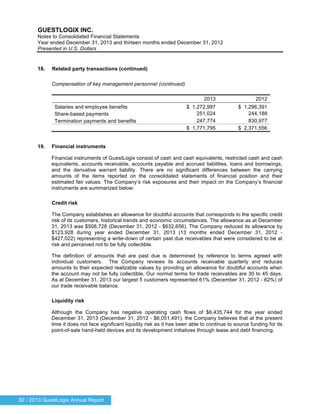
  • 69.
    2013 GuestLogix AnnualReport / 69 GUESTLOGIX INC. Notes to Consolidated Financial Statements Year ended December 31, 2013 and thirteen months ended December 31, 2012 Presented in U.S. Dollars 2. Significant accounting policies (continued) Intangible assets (continued) The amount initially recognized for internally-generated intangible assets is the sum of the expenditure incurred from the date when the intangible asset first meets these recognition criteria. Where no internally-generated intangible asset can be recognized, the Company recognizes development expenditure in profit or loss in the year in which it is incurred. Subsequent to initial recognition, the Company reports internally-generated intangible assets at cost less accumulated amortization and accumulated impairment losses, on the same basis as any intangible assets it acquires separately. All research and development costs are recorded net of investment tax credits, where applicable. Externally acquired intangible assets Intangible assets are measured at cost less accumulated amortization and accumulated impairment losses, if any. Intangible assets acquired through asset acquisitions or business combinations are initially recognized at fair value, based on an allocation of the purchase price. The intangible assets are amortized on a straight-line basis over their estimated useful lives. The amortization method, estimated useful lives and residual values are reviewed each financial year-end or more frequently if required, and are adjusted as appropriate. Financial instruments Financial instruments of GuestLogix consist of cash and cash equivalents, restricted cash and cash equivalents, accounts receivable, trade and other payables, loans and borrowings, and the derivative warrant liability. Financial assets All financial assets are recognized and derecognized on the trade date, where their purchase or sale are under a contract whose terms require delivering the financial asset within the timeframe established by the market concerned, and are initially measured at fair value, plus transaction costs, except for financial assets classified as at fair value through profit or loss, which are initially measured at fair value. Financial assets are classified into the following specified categories: financial assets ‘at fair value through profit or loss’ (‘FVTPL’), ‘held-to-maturity’ investments, ‘available-for-sale’ (‘AFS’) financial assets, including cash and cash equivalents, and ‘loans and receivables’. The classification depends on the nature and purpose of the financial assets and is determined at the time of initial recognition. The Company does not currently have any financial assets in the held-to-maturity or available-for-sale categories. Trade receivables, loans, and other receivables having fixed or determinable payments and not quoted in an active market are classified as ‘loans and receivables’. Loans and receivables are measured at amortized cost using the effective interest method, less any impairment. Interest income is recognized by applying the effective interest rate, except for short-term receivables for which recognizing interest would be immaterial.
  • 70.
    70 / 2013GuestLogix Annual Report GUESTLOGIX INC. Notes to Consolidated Financial Statements Year ended December 31, 2013 and thirteen months ended December 31, 2012 Presented in U.S. Dollars 2. Significant accounting policies (continued) Financial instruments (continued) Financial assets (continued) The Company assesses financial assets, other than those at FVTPL, for indicators of impairment at the end of each reporting period. Financial assets are impaired where there is objective evidence that, as a result of one or more events that occurred after initially recognizing the financial asset, the investment’s estimated future cash flows have been affected. Objective evidence of impairment could include significant financial difficulty of the issuer or counterparty, default or delinquency in interest or principal payments, or it becoming probable that the borrower will enter bankruptcy or financial re-organization. For certain categories of financial asset, such as trade receivables, assets assessed not to be impaired individually are, in addition, assessed for impairment on a collective basis. Objective evidence of impairment for a portfolio of receivables could include the Company’s past experience of collecting payments, an increase in the number of delayed payments in the portfolio past the average credit period of 45 days, as well as observable changes in national or local economic conditions correlating with default on receivables. For financial assets carried at amortized cost, the amount of the impairment is the difference between the asset’s carrying amount and the present value of estimated future cash flows, discounted at the financial asset’s original effective interest rate. For trade receivables, the carrying amount is reduced through an allowance account. When a trade receivable is considered uncollectible, it is written off against the allowance account, and subsequent recoveries of amounts previously written off are credited against the allowance account. Changes in the carrying amount of the allowance account are recognized in profit or loss. The Company derecognizes a financial asset only when the contractual rights to the cash flows from the asset expire, or when it transfers the financial asset and substantially all the risks and rewards of ownership of the asset to another entity. Financial liabilities The Company classifies financial liabilities as either financial liabilities ‘at FVTPL’ or ‘other financial liabilities’. The derivative warrant liability is measured at FVTPL while other financial liabilities, consisting of trade and other payables and loans and borrowings, are initially measured at fair value, net of transaction costs, and are subsequently measured at amortized cost using the effective interest method, recognizing interest expense on an effective yield basis. Fair value hierarchy The Company classifies and discloses fair value measurements using a fair value hierarchy that reflects the significance of the inputs used in making the measurements. The three levels of the fair value hierarchy are:
  • 71.
    2013 GuestLogix AnnualReport / 71 GUESTLOGIX INC. Notes to Consolidated Financial Statements Year ended December 31, 2013 and thirteen months ended December 31, 2012 Presented in U.S. Dollars 2. Significant accounting policies (continued) Financial instruments (continued) Fair value hierarchy (continued) Level 1 – valuation based on quoted prices (unadjusted) in active markets for identical assets and liabilities; Level 2 – valuation techniques based on inputs other than quoted prices included in Level 1 that are observable for the asset or liability, either directly (i.e., as prices) or indirectly (i.e., derived from prices); and Level 3 – valuation techniques using inputs for the asset or liability that are not based on observable market data (unobservable inputs). The Company’s cash and cash equivalents are measured using level 1 inputs and the derivative warrant liability is measured using level 3 inputs. Cash and cash equivalents Cash and cash equivalents include balances with banks and highly liquid instruments. Inventory The Company’s inventory consists of hand-held devices including hand-held devices awaiting deployment and replacement parts held-for-sale, and is stated at the lower of cost and net realizable value. Net realizable value represents the estimated selling price for inventories less all estimated costs of completion and costs necessary to make the sale. Property and equipment The Company records equipment at cost less accumulated depreciation and accumulated impairment losses. It recognizes depreciation to write off the cost of assets less their residual values over their useful lives, using the following methods and rates: Computer equipment Straight-line 3 years Furniture and fixtures Straight-line 5 years The Company reviews the estimated useful lives, residual values and depreciation method at each year end, accounting for the effect of any changes in estimate on a prospective basis. The gain or loss arising on disposing of or retiring an item of property, plant and equipment is determined as the difference between the sales proceeds and the asset’s carrying amount and is recognized in profit or loss.
  • 72.
    72 / 2013GuestLogix Annual Report GUESTLOGIX INC. Notes to Consolidated Financial Statements Year ended December 31, 2013 and thirteen months ended December 31, 2012 Presented in U.S. Dollars 2. Significant accounting policies (continued) Impairment of long-lived assets At the end of each reporting period, the Company reviews the carrying amounts of its tangible and intangible assets to determine whether there is any indication those assets have suffered an impairment loss. If any such indication exists, it estimates the asset’s recoverable amount to determine the extent of the impairment loss (if any). Where it is not possible to estimate an individual asset’s recoverable amount, the Company estimates the recoverable amount of the cash- generating unit (‘CGU’) to which the asset belongs. Where it can identify a reasonable and consistent basis of allocation, it also allocates corporate assets to individual CGU’s, or otherwise allocates them to the smallest group of CGU’s for which it can identify a reasonable and consistent allocation basis. Recoverable amount is the higher of fair value less costs to sell and value in use. In assessing value in use, the Company discounts estimated future cash flows to their present value using a pre- tax discount rate reflecting current market assessments of the time value of money and the risks specific to the asset for which the estimates of future cash flows have not been adjusted. If an asset or CGU’s recoverable amount is estimated to be less than its carrying amount, the carrying amount is reduced to its recoverable amount, recognizing an impairment loss immediately in profit or loss. During the year ended December 31, 2013, the Company did not recognize an impairment loss (13 months ended December 31, 2012, $1,296,270, see note 7). Should the Company record an impairment loss which subsequently reverses, it will increase the carrying amount to the revised estimate of its recoverable amount, by recognizing the reversal immediately in profit or loss, without exceeding the carrying amount that would have been determined if it had not recognized an impairment loss in prior years. Deferred taxes Deferred tax is recognized on temporary differences between the carrying amounts of assets and liabilities in the financial statements and the corresponding tax bases used in the computation of taxable profit. Deferred tax liabilities are generally recognized for all taxable temporary differences. Deferred tax assets are generally recognized for all deductible temporary differences to the extent that it is probable that taxable profits will be available against which those deductible temporary differences can be utilized. Such deferred tax assets and liabilities are not recognized if the temporary difference arises from goodwill or from the initial recognition (other than in a business combination) of other assets and liabilities in a transaction that affects neither the taxable profit nor the accounting profit. Deferred tax liabilities are recognized for taxable temporary differences associated with investments in subsidiaries and associates, and interests in joint ventures, except where the Company is able to control the reversal of the temporary difference and it is probable that the temporary difference will not reverse in the foreseeable future. Deferred tax assets arising from deductible temporary differences associated with such investments and interests are only recognized to the extent that it is probable that there will be sufficient taxable profits against which to utilize the benefits of the temporary differences and they are expected to reverse in the foreseeable future.
  • 73.
    2013 GuestLogix AnnualReport / 73 GUESTLOGIX INC. Notes to Consolidated Financial Statements Year ended December 31, 2013 and thirteen months ended December 31, 2012 Presented in U.S. Dollars 2. Significant accounting policies (continued) Deferred taxes (continued) The carrying amount of deferred tax assets is reviewed at the end of each reporting period and reduced to the extent that it is no longer probable that sufficient taxable profits will be available to allow all or part of the asset to be recovered. Deferred tax assets and liabilities are measured at the tax rates that are expected to apply in the period in which the liability is settled or the asset realized, based on tax rates (and tax laws) that have been enacted or substantively enacted by the end of the reporting period. The measurement of deferred tax liabilities and assets reflects the tax consequences that would follow from the manner in which the Company expects, at the end of the reporting period, to recover or settle the carrying amount of its assets and liabilities. Deferred tax assets and liabilities are offset when there is a legally enforceable right to offset tax assets against tax liabilities and when they relate to income taxes levied by the same taxation authority and the Company intends to settle its tax assets and liabilities on a net basis. Stock-based compensation The Company measures equity-settled share-based payments to employees and others providing similar services at the fair value of the equity instruments at the grant date. The fair value determined at the grant date of the equity-settled share-based payments is calculated using the Black-Scholes option valuation model and is expensed on a graded vesting basis over the vesting period, based on the Company’s estimate of equity instruments that will eventually vest, and is credited to other paid-in capital. At the end of each reporting period, the Company revises its estimate of the number of equity instruments expected to vest. The impact of the revision of the original estimates, if any, is recognized in profit or loss such that the cumulative expense reflects the revised estimate, with a corresponding adjustment to other paid-in capital. When options are exercised, the proceeds together with the amount originally credited to other paid-in capital are credited to share capital. The use of the Black-Scholes model requires inputting a number of assumptions, including expected dividend yield, expected stock price volatility, forfeiture rate, expected time until exercise and risk free interest rate. Although the assumptions used reflect management’s best estimates, they involve inherent uncertainties based on conditions outside of the Company’s control. If other assumptions were used, stock-based compensation could be significantly impacted. Leases The Company classifies a lease it enters into as a lessee as a finance lease whenever the terms transfer substantially all the risks and rewards of ownership to the Company. It classifies all other leases as operating leases. It initially recognizes assets held under finance leases at their fair value at the inception of the lease or, if lower, at the present value of the minimum lease payments, and recognizes the corresponding liability to the lessor as a finance lease obligation. Lease payments are apportioned between finance expenses and reduction of the lease obligation so as to achieve a constant rate of interest on the remaining balance of the liability. Finance expenses are recognized immediately in profit or loss. The Company recognizes operating lease payments as an expense on a straight-line basis over the lease term, except where another systematic basis better represents the time pattern in which it consumes economic benefits from the leased asset.
  • 74.
    74 / 2013GuestLogix Annual Report GUESTLOGIX INC. Notes to Consolidated Financial Statements Year ended December 31, 2013 and thirteen months ended December 31, 2012 Presented in U.S. Dollars 2. Significant accounting policies (continued) Provisions The Company recognizes a provision when it has a present obligation (legal or constructive) as a result of a past event, it is probable it will be required to settle the obligation, and it can make a reliable estimate of the amount of the obligation. The amount it recognizes as a provision is the best estimate of the consideration required to settle the present obligation at the end of the reporting period, taking into account the risks and uncertainties surrounding the obligation. Where a provision is measured using the cash flows estimated to settle the present obligation, its carrying amount is the present value of those cash flows. Restructuring provisions Restructuring provisions are recognized only when the Company has an actual or a constructive obligation. The Company has a constructive obligation when a detailed formal plan identifies the business or part of the business concerned, the location and number of employees affected a detailed estimate of the associated costs and an appropriate timeline. The Company incurs restructuring charges relating to workforce reductions which include employee severance and other employee benefits. The recognition of these charges requires management to make certain judgments and estimates regarding the nature, timing and amounts associated with these restructuring plans. Employee termination costs are recognized in the period the detailed plans are approved and the actions have either commenced or have been announced to the employees. At the end of each reporting period, the remaining balances are assessed for appropriateness. Adjustments to the recorded amounts may be required to reflect actual experience or changes in future estimates. Note 9 to these consolidated financial statements outlines total restructuring charges incurred during the fourth quarter of 2012 as well as the related provision as at December 31, 2012. Share issue costs The Company charges incremental costs incurred in respect of raising capital against the equity proceeds raised, including legal, accounting, agent and investment bank fees. Earnings (loss) per share The Company computes basic earnings (loss) per share by dividing net profit (loss) by the weighted average number of common shares outstanding for the period. Diluted earnings (loss) per share reflects the potential dilution that could occur if additional common shares are assumed to be issued under securities or contracts that entitle their holders to obtain common shares in the future, and is calculated using the treasury stock method. In periods when the Company reports a net loss, the effect of potential issuances of shares under options and warrants is anti-dilutive and therefore, basic and diluted loss per share are the same.
  • 75.
    2013 GuestLogix AnnualReport / 75 GUESTLOGIX INC. Notes to Consolidated Financial Statements Year ended December 31, 2013 and thirteen months ended December 31, 2012 Presented in U.S. Dollars 2. Significant accounting policies (continued) Significant judgments, estimates and assumptions The preparation of the Company’s consolidated financial statements in conformity with IFRS requires management to make judgments, estimates and assumptions that affect the reported amounts of assets and liabilities and disclosures of contingent assets and liabilities at the date of the financial statements and the reported amounts of revenues and expenses during the reporting period. Estimates and assumptions are continually evaluated and are based on management’s experience and other factors, including expectations of future events that are believed to be reasonable under the circumstances. Actual results could differ from these estimates. The areas which require management to make significant judgments, estimates and assumptions in determining carrying values include, but are not limited to: Revenue recognition In revenue arrangements including more than one deliverable, the deliverables are assigned to one or more separate units of accounting and the arrangement consideration is allocated to each unit of accounting based on its relative fair value. Determining the fair value of each deliverable can require complex estimates due to the nature of the goods and services provided. The Company generally determines the fair value of individual elements based on prices at which the deliverable is regularly sold on a standalone basis after considering volume discounts where appropriate. In merchandising agreements with customers in which the Company provides transaction processing and merchant of record services in the sale of food and beverage items and destination- based attraction tickets on-board, revenue is recognized on either a gross or net basis, depending on the Company's role in the transaction as principal or as agent. Due to the complex nature of these transactions, the determination of whether the Company acts as principal or agent requires judgment in assessing primary responsibility, the level of inventory risk and the level of credit risk, among other factors. Impairment of goodwill and other assets Goodwill is tested for impairment annually or more frequently if there is an indication of impairment. The carrying value of intangible assets with definite lives and property and equipment is reviewed each reporting period to determine whether there is any indication of impairment. If the carrying amount of an asset exceeds its recoverable amount, the asset is impaired and an impairment loss is recognized in the consolidated statement of operations and comprehensive loss. The assessment of fair values requires the use of estimates and assumptions related to future operating performance, future capital expenditures, discount rates and terminal value. During the year ended December 31, 2013, the Company did not record any impairment loss (December 31, 2012 – $1,296,270).
  • 76.
    76 / 2013GuestLogix Annual Report GUESTLOGIX INC. Notes to Consolidated Financial Statements Year ended December 31, 2013 and thirteen months ended December 31, 2012 Presented in U.S. Dollars 2. Significant accounting policies (continued) Significant judgments, estimates and assumptions (continued) Useful life of equipment and intangible assets Significant judgment is involved in the determination of useful life for the computation of depreciation of property and equipment and amortization of intangible assets. No assurance can be given that actual useful lives will not differ significantly from current assumptions. Legal provisions The Company assesses the provision for legal or constructive obligations at each reporting period or when new material information becomes available. Legal and contractual matters are subject to interpretation and the Company may engage external advisors to assist with periodic assessments. To the extent that interpretation of legal and contractual matters differ significantly from estimates, the actual judgments and settlement amounts may vary significantly from management’s estimates. Valuation of derivative warrant liability The Company is required to make certain estimates when determining the fair value of the derivative warrant liabilities issued as part of the promissory notes issued each reporting period. These estimates affect the amount recognized as derivative warrant liabilities in the consolidated statement of financial position and the change in fair value of derivative warrant liabilities in the consolidated statement of operation and comprehensive loss. Valuation of intangible assets The determination of estimated fair values of acquired intangible assets, as well as the useful economic life ascribed to finite lived intangible assets, requires the use of significant judgment. The use of different estimates and assumptions to those used by the Company could result in a materially different valuation of acquired intangible assets, which could have a material effect on the Company’s results of operations. Recently issued accounting pronouncements: Not yet effective IFRS 9 – Financial Instruments IFRS 9 – Financial Instruments was issued by the IASB to establish principles for the financial reporting of financial assets and liabilities, including requirements to present certain information relating to the amounts, timing, and uncertainty of the entity’s future cash flows. This standard is mandatorily effective from January 1, 2018, with earlier application permitted. Management has not yet determined the potential impact the adoption of IFRS 9 will have on the Company’s consolidated financial statements.
  • 77.
    2013 GuestLogix AnnualReport / 77 GUESTLOGIX INC. Notes to Consolidated Financial Statements Year ended December 31, 2013 and thirteen months ended December 31, 2012 Presented in U.S. Dollars 2. Significant accounting policies (continued) Recently issued accounting pronouncements: Adopted As of January 1, 2013, the Company adopted the new and amended IFRS pronouncements in accordance with the transitional provisions outlined in the respective standards. The Company has adopted these new and amended standards without any significant effect on its consolidated financial statements. IFRS 10 – Consolidated Financial Statements IFRS 10 establishes principles for the presentation and preparation of consolidated financial statements when an entity controls one or more other entities. IFRS 10 defines the principle of control and establishes control as the basis for determining which entities are consolidated. IFRS 10 sets out three elements of control: power over the investee; exposure, or rights, to variable returns from involvement with the investee; and the ability to use power over the investee to affect the amount of the investors’ return; and the requirements on how to apply the control principle. IFRS 10 replaces SIC-12, Consolidation – Special Purpose Entities and parts of IAS 27, Consolidated and Separate Financial Statements. IFRS 11 - Joint Arrangements IFRS 11 requires a venturer to classify its interest in a joint arrangement as a joint venture or joint operation. Joint ventures will be accounted for using the equity method of accounting whereas for a joint operation the venturer will recognize its share of the assets, liabilities, revenue and expenses of the joint operation. IFRS 11 supersedes IAS 31, Interests in Joint Ventures, and SIC-13, Jointly Controlled Entities – Non-monetary Contributions by Venturers. IFRS 12 – Disclosure of Interests in Other Entities IFRS 12 establishes disclosure requirements for interests in other entities, including subsidiaries, joint arrangements, associates, and special purpose vehicles. IFRS 13 - Fair Value Measurement IFRS 13 is a comprehensive standard for fair value measurement and disclosure requirements for use across all IFRS standards. The new standard clarifies that fair value is the price that would be received to sell an asset, or paid to transfer a liability in an orderly transaction between market participants, at the measurement date. It also establishes additional disclosures regarding fair value measurements. Reclassification Certain prior period comparative figures have been reclassified to conform to the current year’s presentation.
  • 78.
    78 / 2013GuestLogix Annual Report GUESTLOGIX INC. Notes to Consolidated Financial Statements Year ended December 31, 2013 and thirteen months ended December 31, 2012 Presented in U.S. Dollars 3. Cash and cash equivalents The Company considers all highly liquid instruments with maturities of up to 30 days at the time of issuance to be cash equivalents. Cash and cash equivalents include: December 31, 2013 December 31, 2012 Cash $ 8,770,010 $ 1,588,202 Short-term deposits - 4,034,492 $ 8,770,010 $ 5,622,694 4. Restricted cash and cash equivalents As at December 31, 2013, the Company had no restricted cash and cash equivalents (December 31, 2012 - $1,029,392). During the year, a lessor released its collateral requirement against certain finance leases, which was previously required and which the Company had fulfilled through purchases of short-term money market instruments. 5. Investments in sales type leases Amounts owing under sales-type leases entered into through the Company’s multiple element arrangements are recorded as net finance receivables. Future minimum payments receivable under these multiple element arrangements are as follows: December 31, 2013 December 31, 2012 2013 2014 2015 2016 2017 2018 $ - 1,507,586 1,021,884 747,057 96,604 70,327 $ 1,058,576 796,802 317,735 15,009 - - 3,443,458 2,188,122 Less amount representing unearned finance income (at 5.1% to 10.6%) 234,757 199,686 Less current portion 3,208,701 1,375,291 1,988,436 928,405 $ 1,833,410 $ 1,060,031
  • 79.
    2013 GuestLogix AnnualReport / 79 GUESTLOGIX INC. Notes to Consolidated Financial Statements Year ended December 31, 2013 and thirteen months ended December 31, 2012 Presented in U.S. Dollars 5. Investments in sales type leases (continued) The gross investment in the leases and the present value of minimum lease payments receivable are as follows: Gross investment in leases Present value of minimum lease payments December 31, December 31, December 31, December 31, 2013 2012 2013 2012 Less than one year $ 1,507,586 $ 1,058,576 $ 1,375,291 $ 928,405 One to four years 1,935,872 1,129,546 1,833,410 1,060,031 $ 3,443,458 $ 2,188,122 $ 3,208,701 $ 1,988,436 6. Property and Equipment Computer Equipment Furniture and Fixtures Total Cost Balance, December 1, 2011 $ 383,686 $ 671,929 $1,055,615 Additions 241,159 - 241,159 Balance, December 31, 2012 624,845 671,929 1,296,774 Balance, January 1, 2013 624,845 671,929 1,296,774 Additions 568,333 147,788 716,121 Balance, December 31, 2013 1,193,178 819,717 2,012,895 Accumulated Depreciation Balance, December 1, 2011 128,290 256,257 384,547 Depreciation 137,918 162,632 300,550 Balance, December 31, 2012 266,208 418,889 685,097 Balance, January 1, 2013 266,208 418,889 685,097 Depreciation 310,806 79,159 389,965 Balance, December 31, 2013 $ 577,014 $ 498,048 $1,075,062 Carrying Amounts December 31, 2012 $ 358,637 $ 253,040 $ 611,677 December 31, 2013 $ 616,164 $ 321,669 $ 937,833
  • 80.
    80 / 2013GuestLogix Annual Report GUESTLOGIX INC. Notes to Consolidated Financial Statements Year ended December 31, 2013 and thirteen months ended December 31, 2012 Presented in U.S. Dollars 7. Intangible assets The Company’s intangible assets consist of identifiable intangible assets acquired in a business combination, software development costs related to the OnTouch Analytics platform, OnTouch Content platform, and Global Payment Services, as well as the cost of licenses to certify its point-of- sale hand-held devices, primarily for its European clients. In 2011, the Company deployed its OnTouch Analytics platform and transferred related software development costs from deferred development costs to intangible assets. Amortization of the OnTouch Analytics platform is provided for over a five year period. On September 1, 2012, the Company deployed its OnTouch Content platform and transferred related software development costs from deferred development costs to intangible assets. Amortization of the OnTouch Content platform is provided for over a five year period. Global Payment Services was launched on August 31, 2012, and related software development costs were transferred from prepaid expenses to intangible assets. Amortization of Global Payment Services is over a five year period. Licenses for device certifications are amortized over the life of the license which range from 1 to 3 years. The Company’s acquired customer list and technology are a result of the acquisition of Initium Onboard (see note 8). Identifiable intangible assets acquired in a business combination are recognized separately from goodwill if they meet the definition of intangible asset and if their fair value can be measured reliably. The cost of these intangible assets equals their acquisition-date fair value. After initial recognition, identifiable intangible assets acquired in a business combination are recognized at cost less accumulated amortization, if they are amortizable, and less accumulated impairment losses. Deferred development costs consist of internal and third party labour costs of personnel directly engaged in software development activities and other costs directly attributable to the Company’s platform enhancements. GuestLogix only defers development costs when technical feasibility has been established and the Company is expected to generate future economic benefits from the asset. During the 13 months ended December 31, 2012 the Company wrote off $1,296,270 of deferred development costs relating to Destination Deals and Mobile Concierge projects. These projects were terminated due to lack of interest from the Company’s clients as well as management’s decision to narrow its focus in product development. December 31, 2013 Cost Accumulated amortization Net book value OnTouch Analytics $ 355,233 $ 181,418 $ 173,815 OnTouch Content 3,167,778 1,123,166 2,044,612 Global Payment Services 226,132 46,170 179,962 Licenses – device certifications 641,969 555,959 86,010 Acquired customer list (note 8) 2,591,520 1,116,450 1,475,070 Acquired technology (note 8) 3,576,389 953,703 2,622,686 Deferred development costs 2,620,267 - 2,620,267 Total intangible assets $13,179,288 $ 3,976,866 $9,202,422
  • 81.
    2013 GuestLogix AnnualReport / 81 GUESTLOGIX INC. Notes to Consolidated Financial Statements Year ended December 31, 2013 and thirteen months ended December 31, 2012 Presented in U.S. Dollars 7. Intangible assets (continued) December 31, 2012 Cost Accumulated amortization Net book value OnTouch Analytics $ 355,233 $ 112,868 $ 242,365 OnTouch Content 3,167,778 369,574 2,798,204 Global Payment Services 226,132 23,566 202,566 Licenses – device certifications 504,347 343,813 160,534 Acquired customer list (note 8) 2,591,520 277,073 2,314,447 Acquired technology (note 8) 3,576,389 238,426 3,337,963 Total intangible assets $ 10,421,399 $ 1,365,320 $ 9,056,079 8. Business Combination On September 4, 2012, the Company acquired 100% of the outstanding shares of Initium Onboard, a United Kingdom-based provider of onboard retail technology to the airline and rail industries. Initium Onboard is the trading name for BOM Merchant Technologies Limited, a subsidiary of the BOM Group Holdings Ltd. The acquisition is expected to support the Company’s growth strategy in the rail industry and its destination-based merchandising programs on board. During the third quarter of 2013, the Company finalized the purchase price allocation of the Initium Onboard acquisition and retrospectively adjusted the preliminary allocation of the fair value of assets acquired and liabilities that had been recognized at the September 4, 2012 acquisition date to reflect new information obtained about facts and circumstances that had existed as at acquisition date and if they had been known, would have had an impact on the amounts recognized at that date. The final fair value allocation of assets acquired and liabilities recognized is as follows, based on the purchase price: Preliminary Final Allocation Allocation Accounts receivable $ 896,133 $ 896,133 Inventory 60,153 60,153 Equipment 70,484 70,484 Intangible assets 26,108 26,108 Bank indebtedness (167,264) (167,264) Accounts payable and accrued liabilities (3,678,323) (3,678,323) Deferred revenue (1,710,723) (1,710,723) Technology and intellectual property - 3,576,389 Customer list - 2,591,520 Goodwill 8,838,471 2,670,562 $ 4,335,039 $ 4,335,039 Technology and intellectual property will be amortized over five years and the customer list will be amortized over three years, which are the estimated useful lives.
  • 82.
    82 / 2013GuestLogix Annual Report GUESTLOGIX INC. Notes to Consolidated Financial Statements Year ended December 31, 2013 and thirteen months ended December 31, 2012 Presented in U.S. Dollars 8. Business Combination (continued) The final fair value allocation of assets acquired and liabilities recognized resulted in the retrospective restatement as at December 31, 2012 of intangible assets in the amount of $5,652,410, reducing goodwill in the amount of $6,167,909 increasing the amortization of intangible assets, net loss for the period and deficit in the amount of $515,499. 9. Restructuring charges During the fourth quarter of 2012, the Company incurred $2,062,019 of restructuring charges due primarily to a workforce reduction aimed at reducing overhead costs, rationalizing the reporting structure, and allowing for synergies in operations. The decision was made by executive management and approved by the Company’s Board of Directors in October 2012. The estimated restructuring costs primarily included severance of employees and other restructuring expenses such as costs to consolidate offices as well as provisions for legal fees and claims which have been asserted against the Company. Office consolidation costs are expected to be incurred to the end of the term of the respective office leases. As at December 31, 2013, the items the Company included in its trade and other payables were as follows: Estimated restructuring costs $ 2,062,019 Paid during 2012 (186,636) Balance, December 31, 2012 $ 1,875,383 Paid during 2013 (1,543,445) Balance, December 31, 2013 $ 331,938 10. Obligations under finance leases From time to time the Company purchases hand-held, point-of-sale devices which in turn are bundled with its proprietary software, hosting and services and are leased to customers. These devices are then sold under sales-type lease arrangements to customers under a multiple element revenue arrangement, as described in note 2. The following is a schedule of future minimum lease payments for equipment under finance leases: December 31, December 31, 2013 2012 2013 $ - $ 692,856 2014 1,261,001 121,600 2015 854,996 53,574 2016 189,454 5,076 2,305,451 873,106 Less amount representing interest (at 4.4% to 12.2%) 177,073 37,113 2,128,378 835,993 Less current portion 1,109,873 662,781 $ 1,018,505 $ 173,212
  • 83.
    2013 GuestLogix AnnualReport / 83 GUESTLOGIX INC. Notes to Consolidated Financial Statements Year ended December 31, 2013 and thirteen months ended December 31, 2012 Presented in U.S. Dollars 10. Obligations under finance leases (continued) Interest expense related to these obligations for the year ended December 31, 2013 amounted to $101,473 (13 months ended December 31, 2012 - $123,102). At December 31, 2013, the Corporation is the applicant on a standby letter of credit in the amount of $690,000 (December 31, 2012 - $1,029,392) in favour of a third party financing company for certain obligations under finance leases. This standby letter of credit expires on September 30, 2015. 11. Deferred revenue Deferred revenue comprises primarily of equipment sales, license, and service revenue, and is recognized on a monthly basis over the terms of the corresponding contractual arrangements which range from one to three years. Deferred revenue reported as at December 31, 2013 was $1,690,912 (December 31, 2012 - $1,741,271), with current and long-term portions of $1,643,834 and $47,078 respectively (December 31, 2012 - $1,315,472 and $425,799). 12. Loans and borrowings a) Promissory notes In November 2012, the Company issued promissory notes aggregating $7,153,540 (CAD$7 million) plus associated warrants. The notes carried an interest rate of 12% per annum and were due and payable in full on May 31, 2014. The principal amounts owing under the promissory notes are discounted by the fair value of the warrants initially valued at $855,411, with the debt discount being expensed at an effective interest rate of 24.28% over the term of the promissory notes to maturity. The warrants have an exercise price of CAD$0.80 per common share and are exercisable at any time up until November 30, 2014. (See note 13) In July 2013, the Company amended the maturity date of its promissory notes totaling CAD$5 million. The amendment extended the maturity date from May 31, 2014 to July 1, 2015 and the interest rate on the amended promissory notes reduced from 12% per annum to 9% per cent per annum for the period from May 31, 2014 to July 1, 2015. The amendment of the promissory notes has been accounted for as a modification of debt with the debt discount being expensed over the extended term of the promissory notes at a revised effective interest rate of 15.72%. In addition, the expiry term of the 2,500,000 warrants associated with the amended promissory notes was extended from November 30, 2014 to November 30, 2015. The exercise price on the Amended Warrants was increased from CAD$0.80 to CAD$0.81 per Common Share of the Company for the period from December 1, 2014 to November 30, 2015. In December 2013, the Company paid a portion of the promissory notes prior to maturity date. The principal and interest paid totalled $2,129,922 (CAD$2,244,000). December 31, 2013 December 31, 2012 Promissory note $ 5,113,030 $ 6,321,177 Less: current portion plus interest 684,715 - $ 4,428,315 $ 6,321,177
  • 84.
    84 / 2013GuestLogix Annual Report GUESTLOGIX INC. Notes to Consolidated Financial Statements Year ended December 31, 2013 and thirteen months ended December 31, 2012 Presented in U.S. Dollars 12. Loans and borrowings (continued) a) Promissory notes (continued) Accretion related to these obligations for the year ended December 31, 2013 was $421,450 (13 months ended December 31, 2012 - $52,003). b) Credit facility In December 2013, the Company obtained a secured credit facility with a Canadian chartered bank in an amount of up to $4 million. The facility is secured by a general security agreement over the assets of the Company and bears interest at the prime rate plus 2.5% and is available based on a percentage of trade accounts receivable and investment tax credits receivable, the “Borrowing Base”. The Company must maintain at all times a minimum unrestricted cash and equivalent balance held at the bank of $1 million and a tangible net worth of $2.6 million. As of December 31, 2013, the Company had not used the facility and was in compliance with all of its covenants. 13. Derivative warrant liability Warrants issued with an exercise price denominated in a foreign currency are accounted for as a derivative liability, measured at fair value with subsequent changes in fair value accounted for through profit and loss. The following is a summary of the derivative warrant liability as at December 31, 2013 and December 31, 2012 and changes during years ended December 31, 2013 and December 31, 2012: December 31, 2013 December 31, 2012 Number of Warrants Amount Number of Warrants Amount Exercise price of CAD$0.80 expiring November 30, 2014 (i) Exercise price of CAD$0.81 expiring November 30, 2015 (i) Exercise price of CAD$0.45 expiring September 4, 2015 (ii) 1,000,000 2,500,000 150,000 $ 350,361 1,106,581 98,627 1,000,000 2,500,000 150,000 $ 353,935 884,300 89,672 3,650,000 $1,555,569 3,650,000 $1,327,907 (i) Warrants issued and outstanding in conjunction with CAD$7 million in promissory notes issued on November 30, 2012 totalled 3,500,000. The warrants had an exercise price of CAD$0.80 and an expiring date of November 30, 2014. The warrants were initially valued at $855,411 using the Black-Scholes option pricing model with the following assumptions: Term – 2 years; Volatility – 60.6%; Interest rate – 1.1%.
  • 85.
    2013 GuestLogix AnnualReport / 85 GUESTLOGIX INC. Notes to Consolidated Financial Statements Year ended December 31, 2013 and thirteen months ended December 31, 2012 Presented in U.S. Dollars 13. Derivative warrant liability (continued) In July 2013, the expiry term of the 2,500,000 warrants associated with the amended promissory notes (see note 12) was extended from November 30, 2014 to November 30, 2015. The exercise price on the Amended Warrants was increased from CAD$0.80 to CAD$0.81 per Common Share of the Company for the period from December 1, 2014 to November 30, 2015. The warrants are revalued at each reporting period and the change in the fair value was recognized in the consolidated statements of operations and comprehensive loss for the year ended December 31, 2013, $218,705 (2012 - $382,824). The warrants were revalued using the Black-Scholes option pricing model with the following assumptions: Term – 0.9 years; Volatility – 43.9%; Interest rate – 1.0% and Term – 1.9 years; Volatility – 54.4%; Interest rate – 1.0%. (ii) Warrants issued and outstanding in relation to the acquisition of Initium Onboard totalled 150,000. The warrants have an exercise price of CAD$0.45 and expire on September 4, 2015. The warrants were initially valued at $25,704 using the Black-Scholes option pricing model with the following assumptions: Term – 3 years; Volatility – 50.5%; Interest rate – 1.2%. The warrants are revalued at each reporting period and the change in the fair value was recognized in the consolidated statements of operations and comprehensive loss for the year ended December 31, 2013, $8,957 (2012 - $63,968). The warrants were revalued using the Black-Scholes option pricing model with the following assumptions: Term – 1.7 years; Volatility – 55.3%; Interest rate – 1.0%. 14. Share capital (a) Authorized share capital consists of an unlimited number of voting common shares. (b) Issued and outstanding share capital: Number of common shares Amount Balance, November 30, 2011 64,287,390 $ 22,009,215 Issuance of shares on exercise of options Issuance of shares for cash consideration Issuance on acquisition of Initium Onboard 120,469 6,000,000 4,287,670 128,280 3,021,534 2,225,688 Balance, December 31, 2012 74,695,529 $ 27,384,717 Issuance of shares for cash consideration (i) Issuance of shares for cash consideration (ii) Issuance of shares on exercise of options (iii) Issuance of shares on exercise of warrants (iv) Issuance on acquisition of Initium Onboard (v) 4,472,300 10,455,800 1,264,461 165,384 114,087 3,512,649 9,901,730 892,888 144,442 - Balance, December 31, 2013 91,167,561 $ 41,836,426
  • 86.
    86 / 2013GuestLogix Annual Report GUESTLOGIX INC. Notes to Consolidated Financial Statements Year ended December 31, 2013 and thirteen months ended December 31, 2012 Presented in U.S. Dollars 14. Share capital (continued) (b) Issued and outstanding share capital: (continued) (i) On September 11, 2013, the Company issued 4,472,300 common shares for gross proceeds of $3,893,853 (CAD$4,025,070) in a private placement. The Company incurred share issue costs including commissions and legal fees of $381,204 in connection with this share issuance. (ii) On December 4, 2013, the Company issued 10,455,800 common shares for gross proceeds of $10,787,144 (CAD$11,501,380) in an equity financing deal. The Company incurred share issue costs including commissions, legal fees and listing fees of $885,414 (CAD$944,058) in connection with this share issuance. (iii) During the year ended December 31, 2013, the Company issued 1,264,461 common shares upon the exercise of options for total consideration of $546,872. The value relating to these options previously attributed to other paid-in capital, $346,016, was reallocated to share capital. (iv) During the year ended December 31, 2013, the Company issued 165,384 common shares upon the exercise of warrants for total consideration of $124,230. The value relating to these warrants previously attributed to other paid-in capital, $20,212, was reallocated to share capital. (v) During the year ended December 31, 2013, the Company issued 114,087 common shares in relation to the September 4, 2012 acquisition of GuestLogix Technologies Limited (formerly, BOM Merchant Technologies Ltd). The shares were issued based on the achievement of certain performance conditions and were part of the purchase consideration in the business combination (Note 8), measured at fair value. (c) Stock options: The Company has established a stock option plan (the ‘Plan’) to encourage ownership of the Company's common shares by its key officers, directors, employees and selected consultants. The Plan provides for an amount up to 15% of the outstanding common shares of the Company to be reserved for issuance. The number of shares reserved for issuance under the Plan as at December 31, 2013 was 13,675,134 common shares with provision that the Board of Directors has the right from time to time to increase such number subject to the approval of shareholders of the Company. Options under the Plan vest over various periods from the date of the granting of the option. All options granted under the Plan that have not been exercised within ten years of the grant will expire, subject to earlier termination if the optionee ceases to be an officer, director, employee or consultant of the Company. The fair value of options granted was estimated on the date of the grant using the Black-Scholes option-pricing model, resulting in the weighted average fair value of options granted in the year ended December 31, 2013 of $0.40 (13 months ended December 31, 2012 - $0.28), with the following weighted average assumptions:
  • 87.
    2013 GuestLogix AnnualReport / 87 GUESTLOGIX INC. Notes to Consolidated Financial Statements Year ended December 31, 2013 and thirteen months ended December 31, 2012 Presented in U.S. Dollars 14. Share capital (continued) (c) Stock options: (continued) 2013 2012 Risk-free rate of return 1.48% 0.81% Expected volatility 74.4% 70.2% Dividend yield NIL% NIL% Average expected life of the options 4.4 years 4.1 years The following is a summary of the stock options outstanding and the weighted average exercise price, as at December 31, 2013 and 2012: Number of Options Outstanding Weighted Average Exercise Price Outstanding, December 1, 2011 4,817,525 $ 0.86 Granted 7,027,553 0.54 Exercised (120,468) 0.47 Cancelled (2,744,140) 0.64 Outstanding, December 31, 2012 8,980,470 $ 0.63 Granted 5,551,645 0.88 Exercised (1,264,461) 0.48 Cancelled (3,457,736) 0.60 Outstanding, December 31, 2013 9,809,918 $ 0.75 Exercisable December 31, 2013 2,325,041 $ 0.77 The Company recognized $577,302 of stock-based compensation expense related to vested stock options granted to employees, officers, directors and consultants during the year ended December 31, 2013 (13 months ended December 31, 2012 - $677,071). The weighted average share price at the date of exercise for share options exercised in 2013 was $0.96 (2012 - $0.94) The weighted average remaining contractual life and weighted average exercise price of options outstanding and of options exercisable as at December 31, 2013 are as follows: Options Outstanding Options Exercisable Weighted Weighted Weighted Average Average Average Range of Number Exercise Contractual Number Exercise Exercise Price Outstanding Price Life Exercisable Price $0.38-0.64 3,037,798 0.52 4.90 years 979,831 0.53 $0.65-0.94 4,476,994 0.90 5.85 years 516,095 0.77 $0.95-1.50 2,295,126 1.03 3.50 years 829,115 1.07 9,809,918 0.79 5.13 years 2,325,041 0.77
  • 88.
    88 / 2013GuestLogix Annual Report GUESTLOGIX INC. Notes to Consolidated Financial Statements Year ended December 31, 2013 and thirteen months ended December 31, 2012 Presented in U.S. Dollars 14. Share capital (continued) (d) Warrants: The following is a summary of outstanding warrants as at December 31, 2013 and December 31, 2012 and changes during years ended December 31, 2013 and December 31, 2012: December 31, 2013 December 31, 2012 Number of Warrants Amount Number of Warrants Amount Exercise price of $0.726 expiring August 16, 2013 to October 1, 2013 (i) - $ - 727,047 $ 79,321 Exercise price of $0.907 expiring August 16, 2013 to October 1, 2013 (i) - - 540,480 87,211 - $ - 1,267,527 $ 166,532 (i) Warrants issued and outstanding in conjunction with $653,626 in convertible loans in 2006 totalled 1,267,527. The warrants have exercise prices of $0.726 and $0.907 per share and had original expiry dates between August 16, 2011 and October 1, 2011. In July 2011, the Company extended the expiry of 1,267,527 exercisable warrants by an additional two years, with new expiry dates ranging from August 16, 2013 to October 1, 2013. During the year 165,384 exercisable warrants were exercised (2012 - Nil) and 1,102,143 exercisable warrants had expired (2012 – Nil). (e) (Loss) earnings per share: The following table sets forth the computation of basic and diluted (loss) earnings per share for the fiscal years ended December 31, 2013 and December 31, 2012: 12 months ended December 31, 2013 13 months ended December 31, 2012 Numerator: Net loss attributable to common shareholders - basic and diluted $ (3,794,525) $(12,609,491)
  • 89.
    2013 GuestLogix AnnualReport / 89 GUESTLOGIX INC. Notes to Consolidated Financial Statements Year ended December 31, 2013 and thirteen months ended December 31, 2012 Presented in U.S. Dollars 14. Share capital (continued) (e) (Loss) earnings per share: (continued) 12 months ended December 31, 2013 13 months ended December 31, 2012 Denominator Weighted average common shares outstanding - basic and diluted Effect of dilutive securities: Stock options Warrants 78,297,413 - - 67,427,065 - - Weighted average common shares outstanding - basic and diluted 78,297,413 67,427,065 Basic and diluted loss per share $ (0.05) $ (0.19) 15. Income taxes The reconciliation of the combined Canadian federal and provincial statutory income tax rate on the net loss for the year ended December 31, 2013 and 13 months ended December 31, 2012 is as follows: 2013 2012 Loss before recovery of income taxes $ (3,794,525) $ (12,609,491)    Expected income tax recovery $ (1,005,550) $ (3,404,563) Difference in foreign tax rates 56,880 2,100 Tax rate changes and other adjustments (848,670) (27,260) Non-deductible expenses (98,490) 341,865 Recognition of losses on acquisition of subsidiary - (951,140) Change in tax benefits not recognized 1,895,830 4,038,998 Income tax recovery reflected in consolidated statements of operations and comprehensive loss $ - $ - The 2013 statutory tax rate of 26.5% differs from the 2012 statutory tax rate of 26.65% because of the reduction in federal and provincial substantively enacted tax rates.
  • 90.
    90 / 2013GuestLogix Annual Report GUESTLOGIX INC. Notes to Consolidated Financial Statements Year ended December 31, 2013 and thirteen months ended December 31, 2012 Presented in U.S. Dollars 15. Income taxes (continued) Deferred tax The following table summarizes the components of deferred tax: December 31, 2013 December 31, 2012 Deferred Tax Assets Non-capital losses carried forward $ 1,252,070 $ - Deferred Tax Liabilities Property and equipment (3,810) - Intangible assets (1,248,260) - Net deferred tax liabilities $ - $ - Unrecognized deferred tax assets Deferred taxes are provided as a result of temporary differences that arise due to the differences between the income tax values and the carrying amount of assets and liabilities. Deferred tax assets have not been recognized in respect of the following deductible temporary differences: December 31, 2013 December 31, 2012 Non-capital losses carried forward $ 10,587,520 $ 16,671,370 Share issuance costs 971,850 221,090 SR&ED ITC 516,130 1,704,590 Net capital losses carried forward 9,960 10,190 Property and equipment and intangible assets 7,552,700 4,437,100 SR&ED Pool 3,563,470 3,346,670 Reserve for doubtful debts 508,730 - Transitional tax credit 70,760 280 The Canadian and U.S. non-capital loss carry forwards expire between 2027 and 2033. Share issue and financing costs amortize between 2014 and 2017. Investment tax credits expire from 2029 to 2033. The net capital loss carry forward may be carried forward indefinitely, but can only be used to reduce capital gains. The remaining deductible temporary differences may be carried forward indefinitely. Deferred tax assets have not been recognized in respect of these items because it is not probable that future taxable profit will be available against which the group can utilize the benefits therefrom.
  • 91.
    2013 GuestLogix AnnualReport / 91 GUESTLOGIX INC. Notes to Consolidated Financial Statements Year ended December 31, 2013 and thirteen months ended December 31, 2012 Presented in U.S. Dollars 16. Changes in non-cash operating working capital 2013 2012 Accounts receivable $ (3,615,034) $ 1,658,768 Inventory (371,413) 296,948 Prepaid expenses (548,544) (301,592) Trade payables and accrued liabilities (1,561,988) 2,330,682 Deferred revenue (50,359) (1,148,848) $ (6,147,338) $ 2,835,958 17. Operating expenditures Customer 12 months ended Research and delivery and Infrastructure Sales and General and December 31, 2013 development support support marketing administrative Total Personnel expenditures $ 1,784,165 $ 2,353,809 $ 1,467,794 $ 3,117,073 $ 2,721,510 $ 11,444,351 Bad debt write-off - - - - 148,016 148,016 Third party processing and hosting - - 1,891,212 - - 1,891,212 Professional fees 248,335 1,391,943 84,961 311,985 835,921 2,873,145 Other expenditures 441,697 178,142 1,823,245 1,254,013 3,366,467 7,063,564 Total $ 2,474,197 $ 3,923,894 $ 5,267,212 $ 4,683,071 $ 7,071,914 $ 23,420,288 Customer 13 months ended Research and delivery and Infrastructure Sales and General and December 31, 2012 development support support marketing administrative Total Personnel expenditures $ 2,162,268 $ 4,334,126 $ 2,156,420 $ 3,526,542 $ 1,863,650 $ 14,043,006 Deferred development cost impairment loss 492,386 140,083 10,683 1,040 652,078 1,296,270 Bad debt write-off - - - - 1,066,397 1,066,397 Third party processing and hosting - - 2,136,066 - - 2,136,066 Professional fees - - - - 2,926,886 2,926,886 Other expenditures 960,635 165,251 2,074,766 1,916,305 1,504,956 6,621,913 Total $ 3,615,289 $ 4,639,460 $ 6,377,935 $ 5,443,887 $ 8,013,967 $ 28,090,538 18. Related party transactions Compensation of key management personnel Key management personnel are comprised of the Company’s directors and executive officers. The remuneration of key management personnel during the year ended December 31, 2013 and 13 months ended December 31, 2012 were as follows:
  • 92.
    92 / 2013GuestLogix Annual Report GUESTLOGIX INC. Notes to Consolidated Financial Statements Year ended December 31, 2013 and thirteen months ended December 31, 2012 Presented in U.S. Dollars 18. Related party transactions (continued) Compensation of key management personnel (continued) 2013 2012 Salaries and employee benefits Share-based payments $ 1,272,997 251,024 $ 1,296,391 244,188 Termination payments and benefits 247,774 830,977 $ 1,771,795 $ 2,371,556 19. Financial instruments Financial instruments of GuestLogix consist of cash and cash equivalents, restricted cash and cash equivalents, accounts receivable, accounts payable and accrued liabilities, loans and borrowings, and the derivative warrant liability. There are no significant differences between the carrying amounts of the items reported on the consolidated statements of financial position and their estimated fair values. The Company’s risk exposures and their impact on the Company’s financial instruments are summarized below: Credit risk The Company establishes an allowance for doubtful accounts that corresponds to the specific credit risk of its customers, historical trends and economic circumstances. The allowance as at December 31, 2013 was $508,728 (December 31, 2012 - $632,656). The Company reduced its allowance by $123,928 during year ended December 31, 2013 (13 months ended December 31, 2012 - $427,022) representing a write-down of certain past due receivables that were considered to be at risk and perceived not to be fully collectible. The definition of amounts that are past due is determined by reference to terms agreed with individual customers. The Company reviews its accounts receivable quarterly and reduces amounts to their expected realizable values by providing an allowance for doubtful accounts when the account may not be fully collectible. Our normal terms for trade receivables are 30 to 45 days. As at December 31, 2013 our largest 5 customers represented 61% (December 31, 2012 - 62%) of our trade receivable balance. Liquidity risk Although the Company has negative operating cash flows of $6,435,744 for the year ended December 31, 2013 (December 31, 2012 - $6,051,491), the Company believes that at the present time it does not face significant liquidity risk as it has been able to continue to source funding for its point-of-sale hand-held devices and its development initiatives through lease and debt financing.
  • 93.
    2013 GuestLogix AnnualReport / 93 GUESTLOGIX INC. Notes to Consolidated Financial Statements Year ended December 31, 2013 and thirteen months ended December 31, 2012 Presented in U.S. Dollars 19. Financial instruments (continued Market risk (a) Interest rate Cash equivalents and restricted cash equivalents are invested in money market instruments of maturities up to 30 days. Consequently, GuestLogix is exposed to interest rate risk as a result of holding investments of varying maturities. The fair value of investments, as well as the investment income derived from the investment portfolio, will fluctuate with changes in prevailing interest rates. GuestLogix does not use interest rate derivative financial instruments in its investment portfolio but periodically invests in Canadian Schedule A bank instruments. The Company does not believe that there is a significant interest rate risk, due to the short-term nature of its investments. (b) Foreign exchange GuestLogix is exposed to foreign exchange risk as a result of transactions in currencies other than its functional currency of the U.S. dollar. The majority of GuestLogix’ revenues are transacted in U.S. Dollars, Euros and Sterling. Purchases of equipment required to deliver on GuestLogix’ contracts are primarily transacted in U.S. Dollars, while a large portion of operating expenses, including personnel costs, are denominated in Canadian dollars. GuestLogix does not currently use derivative instruments to hedge against foreign exchange risk. Sensitivity analysis Based on management’s knowledge and experience of the finance market, the Company believes the following movements are ‘reasonably possible’ over a six-month period. Impact on net income $ Change of =+/- 10% in CAD $ foreign exchange rate +/- 121,000 Change of =+/- 10% in Euro € foreign exchange rate +/- 198,000 Change of =+/- 10% in GBP £ foreign exchange rate +/- 456,000 The impact on net income (loss) is calculated using the closing balances of non-US dollar denominated monetary assets and liabilities with all other assumptions held constant. The above results arise primarily as a result of the Company having CAD $, Euro € and GBP £, denominated cash and cash equivalents, accounts receivable, accounts payable and accrued liabilities, and capital lease obligations. Limitations of sensitivity analysis The above table demonstrates the effect of change in foreign exchange rates. The financial position of the Company may vary at the time those changes in foreign exchange rates occur, causing the impact on the Company’s results to differ from that shown above.
  • 94.
    94 / 2013GuestLogix Annual Report GUESTLOGIX INC. Notes to Consolidated Financial Statements Year ended December 31, 2013 and thirteen months ended December 31, 2012 Presented in U.S. Dollars 20. Guarantees In the normal course of business, the Company enters into agreements that meet the definition of a guarantee. Indemnity has been provided to all directors and officers of the Company for various items including, but not limited to, all costs to settle suits or actions against due to association with the Company, subject to certain restrictions. The Company has purchased directors’ and officers’ liability insurance to mitigate the cost of any potential future suits or actions. The term of the indemnification is not specifically defined, but is limited to the period over which the indemnified party served as a trustee, director or officer of the Company. The maximum amount of any potential future payment cannot be reasonably estimated. In the normal course of business, the Company has entered into agreements that include indemnities in favour of third parties, such as purchase and sale agreements, confidentiality agreements, engagement letters with advisors and consultants, outsourcing agreements, leasing contracts, information technology agreements and service agreements. These indemnification agreements may require the Company to compensate counterparties for losses incurred by the counterparties as a result of breaches in representation and regulations or as a result of litigation claims or statutory sanctions that may be suffered by the counterparty as a consequence of the transaction. The terms of these indemnities are not explicitly defined and the maximum amount of any potential reimbursement cannot be reasonably estimated. The nature of these indemnification agreements prevents the Company from making a reasonable estimate of the maximum exposure due to the difficulties in assessing the amount of liability, which stems from the unpredictability of future events and the unlimited coverage offered to counterparties. Historically, the Company has not made any payments under such or similar indemnification agreements and therefore no amount has been recorded in the consolidated statements of financial position with respect to these agreements. 21. Commitments Future minimum lease payments for the premises and computer equipment operating leases, exclusive of taxes and other operating costs, are as follows: 2014 2015 2016 2017 2018 2019 2020 $ 508,807 385,448 271,790 101,368 88,817 89,413 7,451 $1,453,094
  • 95.
    2013 GuestLogix AnnualReport / 95 GUESTLOGIX INC. Notes to Consolidated Financial Statements Year ended December 31, 2013 and thirteen months ended December 31, 2012 Presented in U.S. Dollars 22. Segmented information and customer concentration The Company manages its operations in one business segment, which is providing proprietary transaction-based onboard retail software solutions for the passenger travel industry. All significant equipment is located in Canada. During the year ended December 31, 2013, $16,305,209 of the Company’s revenue (13 months ended December 31, 2012 - $18,719,598) was derived from North America, while the remainder of $14,208,213 (13 months ended December 31, 2012 - $7,052,106) was derived primarily from Europe, the Middle East and Asia Pacific. 23. Capital management Management defines capital as the Company’s shareholders’ equity. The Company’s objective in managing capital is to ensure a sufficient liquidity position to finance and secure its revenue growth and expansion globally and to finance development activities, general and administration expenses, working capital and overall capital expenditures, especially expenditures to acquire capital assets deployed. The Company makes every attempt to manage its liquidity to minimize shareholder dilution when possible. To finance its activities, the Company has historically followed an approach that relies on revenue growth, issuance of common shares and financing through finance leases and term debt. The capital management objectives for fiscal 2013 remained the same as those of the previous fiscal year. At December 31, 2013, cash and cash equivalents amounted to $8,770,010 (December 31, 2012 - $5,622,694) and accounts receivable amounted to $8,843,922 (December 31, 2012 - $4,893,329). GuestLogix’ principal source of liquidity going forward is expected to be cash provided from operations, debt and lease financing and the issuance of common shares to finance the point-of- sale hand-held devices and ongoing development initiatives. The Company’s policy on dividends is to retain cash to keep funds available to finance operations and growth. However, the Board of Directors may choose to declare a dividend if warranted in the future. The Company is not subject to any externally imposed capital requirements, except for restricted cash and cash equivalents. 24. Contingencies The Company is involved in certain claims and litigation arising out of the ordinary course and conduct of business. Management assesses such claims and, if they are considered likely to result in a loss and the amount of the loss is quantifiable, provisions for loss are made, based on management’s assessment of the most likely outcome. Management does not provide for claims for which the outcome is not determinable or claims where the amount of the loss cannot be reasonably estimated. On December 20, 2013, the International Chamber of Commerce notified the Company that a former customer of the Company filed a Request for Arbitration naming the Company as a respondent. The Request for Arbitration alleges, among other things, breach of contract and claims damages as a result of the alleged breach. Management intends to challenge the allegations and does not expect any adverse impact on its financial results. As such, no amounts have been accrued with respect to this contingency.
  • 96.
    About GuestLogix GuestLogix Inc.(TSX: GXI), is a global leader in comprehensive retail solutions delivered to the passenger travel industry, both onboard and off-board. Bringing over a decade of expertise as the industry’s most trusted onboard transaction processing partner to airlines, rail operators and elsewhere in the passenger travel industry, GuestLogix powers the industry’s growing reliance on ancillary revenue generation. Both direct to operators as well as through partnerships with global leaders in catering, duty-free, inflight entertainment and self-service retail experts, the Company provides the payment services touching over 1 billion travelling consumers each year. GuestLogix’ global headquarters and centre for product innovation is located in Toronto, with regional head offices located in Dallas, London and Hong Kong. More information is available at www.guestlogix.com. GuestLogix, OnTouch, OBR Plus and Onboard Retail Solution are all registered trademarks of GuestLogix Inc. Any other brand names such as Bluebird, Ingencio, iOS, Android, BlackBerry, Microsoft, etc., are all trademarks of their respective owners. HEAD OFFICE EMEA AMERICAS ASIA-PACIFIC 111 Peter Street, Suite 302, Toronto, ON M5V 2H1 Lily Hill House Road, Bracknell, Berkshire RG12 2Sj Quorom Place, 4901 Quorum Drive, Suite 565, Dallas TX 1208-09, Tower 1-Grand Century Place, 193 Prince Edward Rd. W H.K Tel: +1 416 642 0349 Tel: +44 1344 206 902 Tel: +214 302 8942 Tel: +65 6832 5502 SALES INQUIRIES sales@guestlogix.com PLEASE VISIT www.guestlogix.com