Hospitality 2015
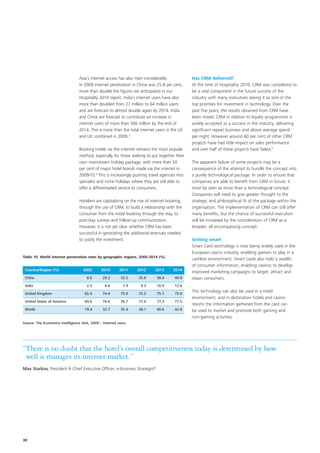
Game changers
or spectators?
Contents


Foreword                                                        1

Executive summary                                               2

The hospitality industry                                        5

Emerging markets – Time for a shift of emphasis                 6

Demographic drivers of change – Targeting                      13
the boomers and emerging middle classes

Brand – Differentiate to survive                               21

Technology – Time to play catch up                             28

Human capital – A post-recessionary strategy for talent        35

Sustainability – Taking a 360 degree view                      41

Planning for the unpredictable – Exogenous events and cycles   48

The interdependent industry                                    55

Flying high after the recession – How aviation trends          56
will shape hospitality

Hotels and restaurants – A tasty combination or a              60
recipe for failure?

Hotels and online travel agents – From confrontation           65
to collaboration

Cruising to success – Lessons to be learned                    70

Hotels and gaming after the storm – Prospects                  75
and opportunities

Acknowledgments                                                80

The Tourism, Hospitality and Leisure team                      81

Contributors                                                   82

About us                                                       83

Sources                                                        84
Foreword


Welcome to Hospitality 2015!

Following the success of Hospitality 2010, published almost five years
ago and the feedback we received from you, we wanted to see if our
predictions were accurate, and explore once again the trends which
we believe will shape the hotel industry in the future.
Once again Deloitte dedicated a team of professionals who have spent the past year creating a vision supported by
research, analysis and structured interviews with industry leaders.

We are pleased to report that our predictions back in 2010 were on point. The value of brand to the consumer, the
growth of emerging markets, the importance of consumer-facing technology and the sourcing, development and
retention of human capital have led to success and differentiation in the marketplace.

As we look to 2015, we have extended our focus to sustainability, exogenous events and cycles, and have reached
out to our industry experts in the sectors which make up the wider travel experience to ensure that we do not lose
sight of the impact on our industry from those sectors’ success or failure.

The combination of global economic uncertainty and the resultant impact on the consumer means that, as an industry,
action is needed to respond to the new world order. More than ever before, the consumer will be value-conscious
irrespective of segment. Simply put, the opportunity is to be a game changer or a spectator. Which will you be?

We hope you find this executive summary from the full report useful and we look forward to any feedback you may
have, and the opportunity to discuss our recommendations and findings with you in more detail. The full report is
available online at www.deloitte.co.uk/hospitality2015. Finally I and the rest of the tourism, hospitality and leisure
editorial team below, would like to conclude by thanking all those who contributed to the report.

We hope you enjoy reading this report.

Best regards,


Alex Kyriakidis
Global Managing Director
Tourism, Hospitality & Leisure


Adam Weissenberg             Marvin Rust               Nick van Marken           Tim Steel                Robert Bryant              Kevin Haimes
Vice Chairman,               Hospitality Global        Global Managing           Lead Audit Partner       Global Lead Partner,       Director
US Leader                    Managing Partner          Partner, Corporate                                 Consulting
                             & Lead Tax Partner        Finance


Emma Kenny                   Philippa Graves           Celine Fenech             Nicole Bell              Grace Huang
Senior Manager               Global Marketing          Research Manager          US Senior Sector         US Marketing
                             Manager                                             Specialist               Manager


                                                                                                    Hospitality 2015 Game changers or spectators?   1
Executive summary


The next five years will herald the era of a consumer-led brand
focus for the hospitality industry. Consumers are changing faster
than ever before in both attitude and behaviours.
             Engaging the new consumer                                    Indeed the Indian Government has identified a shortage
             The hospitality industry, traditionally more focused on      of 150,000 hotel rooms, with most of the under-supply
             the physical product, is waking up to a consumer who is      in the budget sector.3 Understanding the desires and
             demanding consistent delivery of the brand promise           motivations of the Chinese and Indian traveller will be
             and, in the upscale to luxury segments, the experiential     fundamental to success in these markets.
             dimension will define a successful brand as much as the
             finer points of product design.                              While the growth in these emerging markets is
                                                                          significant, this should not distract from the absolute size
             By the end of 2009, consumer demand had largely              of the mature markets. It is forecast that the share of
             stabilised and occupancy rates are starting to recover in    global tourism GDP will shift by less than five per cent
             2010. We expect that 2011 will show a stronger,              from mature hospitality markets to emerging markets
             sustained recovery. Despite this optimistic outlook, as      by 2015.4
             economic conditions continue to remain uncertain and
             governments face an uphill battle to pay off their huge      The name of the game
             deficits, value-conscious consumers will remain a key        Faced with these new patterns of consumer behaviour,
             feature in the post-recessionary landscape across all        the most successful brands in 2015 will be those that
             segments of the market.                                      are able to most efficiently engage with consumers
                                                                          and clearly differentiate their offering from their
             Which way now?                                               competitors. Delivering their brand experience
             As consumer demand recovers it will be reshaped by           consistently and at a transparent price point will be
             two key demographic trends. In established markets           vital to success.
             such as the UK and US, the rise of the affluent, time-rich
             and travel-hungry Baby Boomer generation – aged from         At the upper-end of the market, brand will be the core
             45 to 64 – will evolve and grow. By 2015 in the US           driver of growth as markets become saturated. In the
             alone, boomers are expected to control 60 per cent of        mid-market and budget-end of the market where
             the nation’s wealth, and accounting for 40 per cent of       differentiation is harder to achieve however, brands must
             spending.1 With more time for leisure as they approach       focus on implementing consistently simpler but more
             retirement, spending can be expected to be more              compelling brand promises, and combine value with
             focused around travel.                                       experience to entice consumers. Here, the benefit of
                                                                          loyalty programme will continue to be a key
             In emerging markets such as India and China however,         differentiator for the consumer.
             there will be a significant rise of the middle classes,
             generating an increase in demand for both business and       The new ‘Lifestyle’ brands will be an increasing force in
             leisure travel. Gross Domestic Product (GDP) per capita in   the market, continuing their growth in both number and
             China is forecast to more than double between 2010           scale to 2015. Their ability to achieve a strong revenue
             and 2015 providing the population with greater               per available room (revPAR) often with relatively low
             disposable income to spend on hospitality, while India is    conversion costs, will appeal to operators and owners
             forecast to have 50 million outbound tourists by the end     alike.
             of the decade. Each is a potentially huge feeder market.2
                                                                          Key to the brand promise is the talent delivering it.
             While much of the development until recently has             However average staff turnover in the industry is still
             focused on the upscale and luxury market, the greatest       at 31 per cent.5 With staff costs accounting for 45 per
             potential in these markets lies in the growth of branded     cent of operating expenses and the strong correlation
             mid-market and budget product aimed primarily at the         between staff retention and guest satisfaction, operators
             domestic traveller.                                          need to consider how best to recruit, reward and retain
                                                                          talent to ensure consistent guest satisfaction.6


2
The world online
There are currently more than 1.5 billion people around
the globe with access to the internet. With this forecast
to increase by around 50 per cent by 2015, operators
need to embrace the world online and ensure they
deliver their brand through multiple (and ever-changing)
channels.7

The social media frenzy has taken the world by storm
the last few years. By 2015 this will become truly
integrated in the travel and hospitality decision-making
process, representing both threats and opportunities for
the industry. The transparency of social media can
highlight any inconsistencies between the brand pledge
and its execution across geographic boundaries.
Websites such as TripAdvisor are often the new
customers first point of call. Whilst this represents a real
challenge for brand owners, it also offers unparalleled
opportunities for consumer feedback and opens new
channels of communication between the brand and its
customers.
                                                               While growth in the luxury market is expected to
                                                               recover, the drivers and shape of this market will
As social media websites expand and access to the
                                                               inevitably have been changed by the extended
internet and online distribution channels becomes more
                                                               recession. Luxury hotel brands may become more
accessible, a new breed of confident, empowered and
                                                               dependent on a core wealthy clientele who are
savvy travellers is emerging. Gone are the days when
                                                               relatively immune to economic volatility and we are
everyone walks into a high-street travel agent and flicks
                                                               likely to see a shift away from the conspicuous
through brochures to book their flights and hotel as a
                                                               consumption of the late-1990s. Continued scrutiny of
package in one transaction. Savvy consumers are now
                                                               corporate travel budgets and the need for large off-site
‘unbundling’ the whole booking experience, self-
                                                               meetings also seems likely to be here for some time.
booking directly with suppliers or through new channels
such as network carrier websites. In recent years, online
                                                               Consumers are increasingly environmentally aware,
consumers have also become increasingly value-
                                                               which will present further challenges for the industry.
conscious, with the internet providing unlimited scope
                                                               By 2015, regulatory, economic and stakeholder
for price comparison and greater transparency of the
                                                               pressures are likely to create a virtuous circle that will
guest experience on a global scale.
                                                               begin to shape new expectations amongst both leisure
                                                               and business consumers. Few will be prepared to pay a
The use of technology is also changing and this needs
                                                               premium for green hotels but values-plus-value is likely
to be addressed throughout the consumer’s journey.
                                                               to become a growing consumer mantra.
Mobile technology will increasingly be at the heart of
the consumer-brand interaction and offers a plethora of
                                                               Alongside these known challenges and risks, the
opportunities for customisation, communication,
                                                               industry also has to manage the impact of the
promotion and loyalty. However, the overall spend on
                                                               unknown. Economic uncertainty, volatile oil prices,
technology in the sector still lags behind other sectors.
                                                               fluctuating exchange rates and variable demand present
                                                               ongoing challenges to owners, operators and investors
A numbers game
                                                               alike. Events such as terrorism, pandemics and natural
It is no surprise that the trend towards choosing value-
                                                               disasters result in sudden shifts in demand. While these
for-money products has accelerated during the
                                                               are impossible to predict, they need to be expected and
recession as discretionary leisure and business travel
                                                               planned for.
budgets have been cut. The luxury hotel market and
associated industries such as gaming and premium air
travel have been hit particularly hard. On the flip side,
low cost air travel and products with clear value-for-
money appeal such as all-inclusive cruises or resort-
based holidays have remained relatively resilient.

                                                                                                       Hospitality 2015 Game changers or spectators?   3
The game-changer’s agenda                                   • Enhance in-room technologies as consumer
    To be ahead of the game in 2015 and beyond,                   expectations continue to be raised across all
    companies who are able to understand and meet                 segments. As the budget/economy segment
    the needs of these new consumers will be the true             incorporates features once considered the preserve
    game-changers. To be one of them, companies need              solely of the luxury hotel, the upscale guest will seek
    to ensure that they are able to respond creatively to         further innovation not available in the mass market.
    new consumer behaviours and trends.                           However, technology for its own sake and ‘gimmicks’
                                                                  can prove costly and damaging to the brand.
    So, what are the new rules of the game?                       Ultimately, the customer will determine what the
                                                                  hotel room of the future will look like. Hoteliers
    The consumer                                                  should try and keep it simple to use.

    • Global budget hotel brands will emerge as                 The business
      operators re-focus emerging market strategies on
      shortages in that segment. Game changers will             • Invest in talent management. Engage employees
      move quickly to take advantage of faster economic           with the brand and deliver consistent standards of
      growth prospects and supply shortages in emerging           customer service across global portfolios. Develop
      markets, exploiting the potential for domestic travel       innovative talent programmes and re-design operating
      whilst building international brand recognition             models to effectively execute the talent strategy.
      amongst outbound tourists.
                                                                • Develop an environmentally responsible brand
    • A ‘game-changing’ approach to loyalty                       and embed a 360-degree view of sustainability
      programmes will be seen across all segments.                within the business model. Price, quality, brand and
      Many upscale guests prefer recognition to reward,           convenience will continue to drive consumer
      and a direct emotional appeal and the need to feel          spending, but sustainability will increasingly be part
      ‘special’ can drive loyalty. However, the focus of          of the decision-making process.
      guests in the mid-market and budget segments will
      remain on value and rewards offered. Operators may        • Develop better integrated IT systems and shared
      need to get use to price promiscuity.                       services. Upgrade or replace creaking core legacy
                                                                  systems; upgrade to ‘self-healing’ technology.
    • Understand different generational needs and
      values. The boomers are a key segment and should          • Develop and invest in research and development
      be targeted with ‘experiential’ life-enhancing              (R&D). The industry needs to adopt more of an R&D
      products, designed to appeal to their ‘forever young’       focus to have a chance of staying ahead of their
      attitudes.                                                  consumer’s needs and desires.

    • Consider ‘Lifestyle’ brand opportunities. If done         • Invest in reinforcing data security. Ensure that the
      well this segment can deliver a strong return on            organisation has taken all the necessary safeguards to
      investment. However, the challenge is to keep               protect guests and the reputation of the brand.
      Lifestyle brands current and relevant.
                                                                • Yield management tools will be developed and
    • Embrace rather than resist the influence of social          extended to improve cost management. Review
      media. Engage consumers in a dialogue that builds           costs and free-up working capital through
      awareness and community, increases web traffic and          improvements in operational efficiency. Implement
      search rankings, and draws in potential new guests.         cost management systems driven by Artificial
                                                                  Intelligence-based technology.
    • Develop a multi-channel approach with increasing
      use of mobile smart phone technology. Developing          • Minimise the shocks of unpredictable events.
      this capacity will enable hoteliers to create a greater     Best practice in a crisis includes organisational
      degree of loyalty, by ensuring their services fit the       re-structuring, business continuity planning, flexible
      quick response needs of today’s ‘on-the-move’               pricing, loyalty and customer care. Reconfigure each
      consumer.                                                   crisis as an opportunity to reinforce brand values and
                                                                  enhance the consumer relationship. Prepare for the
                                                                  Black Swan.8


4
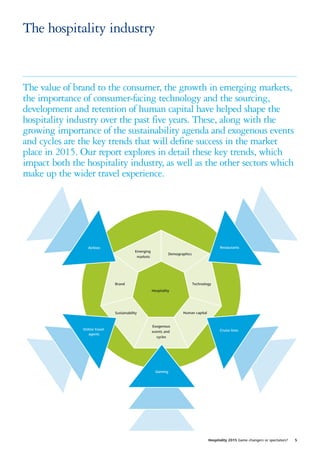
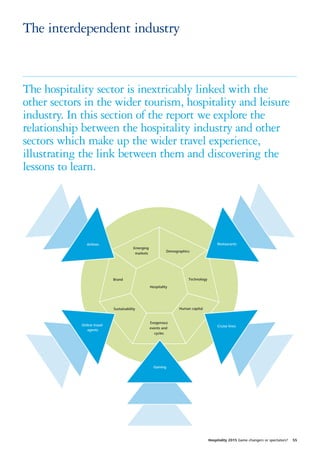
The hospitality industry


The value of brand to the consumer, the growth in emerging markets,
the importance of consumer-facing technology and the sourcing,
development and retention of human capital have helped shape the
hospitality industry over the past five years. These, along with the
growing importance of the sustainability agenda and exogenous events
and cycles are the key trends that will define success in the market
place in 2015. Our report explores in detail these key trends, which
impact both the hospitality industry, as well as the other sectors which
make up the wider travel experience.


                   Airlines                                                                   Restaurants
                                            Emerging
                                                                 Demographics
                                             markets


                                Brand                                           Technology
                                                       Hospitality


                                Sustainability                          Human capital


                                                       Exogenous
                Online travel                                                                 Cruise lines
                                                       events and
                   agents
                                                          cycles


                                                         Gaming


                                                                                        Hospitality 2015 Game changers or spectators?   5
Emerging markets
Time for a shift of emphasis


Over the past five years, most brands have focused their emerging
market expansion plans on the upscale and luxury sectors, targeting
international business and leisure travellers.
                                                                                 There is now a risk of over-supply of upscale product.
    Key findings                                                                 Many brands have failed to cater for the significant
                                                                                 number of domestic travellers within highly populated
    • By 2015, China and India will each have absolute year-on-year tourism      emerging markets.
      growth equal to or greater than the UK, France or Japan.
                                                                                 The emphasis needs to shift towards mid-market and
    • Penetration of the domestic travel markets in China and India will yield   budget product, catering for the growing middle classes.
      the greatest long-term returns for international brands.                   In Hospitality 2010 we highlighted an increasing
                                                                                 demand for mid-market and limited service product.
    • Local brands still dominate emerging market mid-market and budget          The recession has made this need even more acute, and
      sectors.                                                                   supply is lagging behind demand. In times of financial
                                                                                 turmoil, catering for the more budget conscious
    • Across India the government has identified a shortage of around
                                                                                 traveller has a stabilising effect and counteracts falling
      150,000 rooms, with most of the under-supply occuring in the budget
                                                                                 occupancy and revPAR at the upper end of the market.
      sector.

    • Both China and India are at risk of an over-supply of luxury hotels in
      key tourism cities, at least in the short term.
                                                                                 “Half of humanity is middle class …
                                                                                  That middle class needs hotels.”
                                                                                 Frits van Paasschen, President and Chief Executive
                                                                                 Officer, Starwood Hotels & Resorts Worldwide, Inc1


6
China and India to dominate emerging markets
Travel and hospitality industries are expanding rapidly in   “It is the domestic traveller who is the key driver of
a number of emerging economies across the globe.
Countries with a forecasted average annual industry
                                                              sustainable hospitality growth in many of the largest
growth rate from 2009 to 2015 of five per cent or             hospitality markets.”
more include the BRIC nations – Brazil, Russia, India and
China2 – and certain countries in South East Asia, the       Jean-Claude Baumgarten, President & Chief Executive Officer, World Travel
Gulf States, North Africa and the West African coastline.    & Tourism Council
This compares to forecasted growth rates of around
two to three per cent in more mature markets (the US,
                                                             Most international hospitality groups have launched
UK, France and Japan). However, with the key
                                                             expansion programmes into the key emerging markets,
exceptions of China and India, these emerging markets
                                                             not only to cater for western tourists and business
are unlikely to become truly significant on a global
                                                             travellers, but also to build brand recognition and loyalty
scale, despite their hospitality industries showing rapid
                                                             among the local populace who are expected to be one
relative growth.
                                                             of the largest groups of outbound tourists across the
                                                             globe. The most significant expansion programmes are
By 2015, China and India will each have absolute
                                                             in China and India with all of the major operators taking
year-on-year industry growth comparable to or greater
                                                             their signature brands into these countries.
than the UK, France or Japan. By 2019, Chinese
absolute industry growth is forecast to exceed that
                                                             To date, these programmes have largely concentrated
of the US.3
                                                             on establishing upper-midscale to luxury hotels in
                                                             destination resorts and Tier I cities such as Mumbai and
Emerging markets present hospitality groups with
                                                             Beijing. However even the most ambitious expansion
significant opportunities but they also offer unique
                                                             programmes can be counted in the tens, rather than
challenges. This is particularly the case in India, where
                                                             hundreds, of hotels.
hospitality is lagging behind the Chinese market which
opened up earlier and presents fewer hurdles for new
entrants. Despite this, many brands that have already
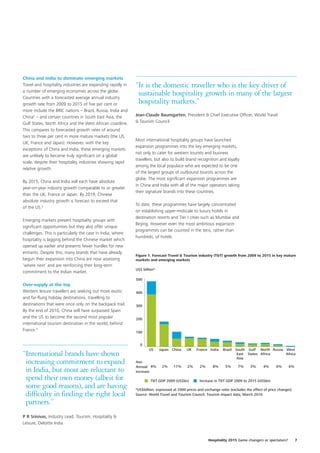
                                                             Figure 1. Forecast Travel & Tourism industry (T&T) growth from 2009 to 2015 in key mature
begun their expansion into China are now assessing           markets and emerging markets
‘where next’ and are reinforcing their long-term
                                                             US$ billion*
commitment to the Indian market.
                                                             500
Over-supply at the top
Western leisure travellers are seeking out more exotic       400
and far-flung holiday destinations, travelling to
destinations that were once only on the backpack trail.      300
By the end of 2010, China will have surpassed Spain
and the US to become the second most popular                 200
international tourism destination in the world, behind
France.4                                                     100


                                                               0
                                                                     US     Japan China     UK    France India    Brazil South Gulf North Russia West
“International brands have shown                                                                                          East States Africa
                                                                                                                          Asia
                                                                                                                                                 Africa

 increasing commitment to expand                             Ave.
                                                             Annual 4%       2%     11%     2%      2%     8%      5%      7%     3%      4%      6%      6%
 in India, but most are reluctant to                         Increase
 spend their own money (albeit for                                    T&T GDP 2009 (US$bn)         Increase in T&T GDP 2009 to 2015 (US$bn)
 some good reasons), and are having                          *US$billion, expressed at 2000 prices and exchange rates (excludes the effect of price changes)
 difficulty in finding the right local                       Source: World Travel and Tourism Council, Tourism impact data, March 2010

 partners.”
P R Srinivas, Industry Lead, Tourism, Hospitality &
Leisure, Deloitte India


                                                                                                         Hospitality 2015 Game changers or spectators?         7
As international hospitality groups vie for market share at       Local brands dominate lower-end product in
    the top end, cities with established tourism markets such         emerging markets
    as Shanghai and Beijing are at risk of an over-supply of          Local brands dominate hotel development in the lower-
    luxury hotels. With even mid-market brands taking                 midscale and budget sectors and are expanding more
    advantage of low construction and employment costs to             aggressively into Tier II and Tier III cities, such as
    ‘trade up’ to five star facilities and levels of service, there   Nanjing and Zhenzhou in China or Chennai and Surat
    is a growing lack of product differentiation.                     in India. Whilst margins may be tighter, given the scale
                                                                      of the domestic markets the opportunity for lucrative
    Domestic market potential                                         returns cannot be ignored.
    The steady increase in demand from western travellers
    is supporting the hospitality industry in emerging                One of the most significant impacts of the recession for
    markets, however it is not the key driver. By focusing            the hospitality industry in India and China has been a
    their strategies on the business and international leisure        marked shift away from the luxury sector as cost-
    travellers, hospitality groups are ignoring the largest           conscious international leisure travellers have tightened
    market segment: the domestic traveller.                           their belts and businesses have cut back on long-haul
                                                                      travel and downgraded their executive travel options.
    Chinese and Indian domestic traveller numbers far                 It has yet to be seen whether the long-term impact of
    exceed their international arrivals: India has over 563           this will be a rebasing of prices at the upper end of the
    million domestic travellers,5 compared to inbound                 market, a more permanent structural shift towards the
    arrivals of five million;6 in China there are 1.9 billion         lower end of the market or merely a short term impact.
    domestic travellers7 compared to inbound arrivals of              However, coupled with the surge in domestic travel due
    52 million.8                                                      to the growing middle classes in emerging markets, this
                                                                      is fuelling demand for lower-midscale, budget and even
    These domestic travellers are the most important factor           ultra-budget hotels.
    in the expansion of the emerging hospitality markets.
    The increase in their numbers and spending power is               Some international brands already have a presence in
    being driven by the strength of underlying economic               the mid-market and budget sectors; the main players in
    development and prosperity in China and India.                    China are InterContinental Hotels Group’s (IHG) Holiday
    One effect of this is a rise in business travel; whilst the US    Inn Hotels & Resorts and Holiday Inn Express, Accor’s
    business travel market is expected to stagnate over               ibis hotels and Wyndham Hotel Group’s Super 8.
    the next five years, growing at 0.3 per cent per year,            However these international mid-market and budget
    China’s business travel spending will grow 6.5 per                brands pale into insignificance in comparison with the
    cent annually to 2013.9 More importantly, economic                local Chinese budget brands. Home Inns Hotels, Jin
    development coupled with a rapidly growing population             Jiang Hotels, Green Tree Inns and 7 Days Inn each have
    results in the proliferation of the ‘middle classes’.10 In        between 300-500 hotels currently, with expansion plans
    China, rising disposable income amongst the local                 in the hundreds of hotels.
    populace has led to a greater appetite for travel, with the
    greatest impact being felt in domestic and inter-regional         In contrast, even domestic budget brands remain
    tourism markets.                                                  relatively undeveloped in India. The Sarovar Group and
                                                                      Indian Hotels have launched their own budget brands,
    However, this rising disposable income is relative and            Hometel and Ginger, with plans to have eight hotels12
    far from equivalent to a traditional western perception           and 30 hotels13 open by the end of 2010 respectively.
    of a ‘middle class’ income. Middle classes in the                 Budget hotel group Tune Hotels.com has announced
    emerging markets need to be offered competitively                 plans to build a presence in India of around 70 hotels
    priced hospitality, tempting them away from the                   within the next seven years.14
    unbranded guesthouses that currently have the lion’s
    share of the market.                                              There remains significant capacity for branded product in
                                                                      emerging markets, particularly at the lower-end. Across
    Their growing desire to adopt more westernised                    the BRIC countries, the number of branded rooms
    standards of living – and holidaying – offers significant         increased from 29 per cent of total rooms in 2004 to
    potential for the domestic and inter-regional tourism             35 per cent at the end of 2009 and is projected to rise
    markets. Premier Inn, the UK budget hotel operator                to 44 per cent if current pipeline projects are included.15
    which has begun a modest expansion into India,                    This remains significantly behind the US and UK markets,
    expects their clientele base in India to be 9:1 in favour         where branded rooms are forecasted to make up 68 per
    of domestic travellers.11                                         cent and 60 per cent of the total supply respectively.

8
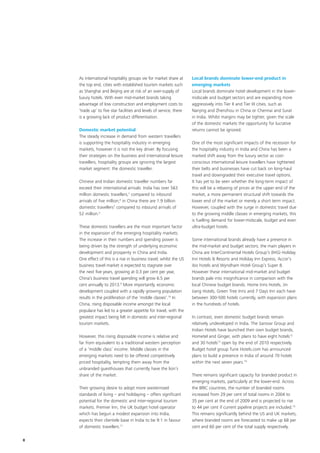
Future supply shortages                                         Figure 2. Percentage of branded rooms across China and India from 2004 to current day
                                                                (including pipeline)
Looking to the future, the Chinese market continues to
grow at a faster rate than its room supply, despite the         China: 2004                         China: 2010 + pipeline             US: 2010 + pipeline
surge of rooms that became available in anticipation of                                                                                        2%
                                                                                 4%                            8%
the 2008 Olympic Games. However, the impact of                          12%
                                                                                                                                        23%
investment decisions made during the economic                        4%                                20%                                                32%
downturn in 2008 and 2009 is likely to limit supply                  5%
growth in 2010 and beyond. This may lead to a shortfall                                                                   58%
                                                                                                       8%
of supply in future years, particularly in the mid-market                             74%                                                28%
                                                                                                          6%                                             15%
to budget sectors, as the market continues to expand.

India’s pipeline has proved more resilient than the             India: 2004                         India: 2010 + pipeline             UK: 2010 + pipeline
global average, partly due to development in                                                                                                  3%
                                                                              13%                            13%
anticipation of the 2010 Commonwealth Games.
                                                                                                                                        21%
As a result of this resilience, there is a risk that elements        16%
of the Indian hotel market may move into over-supply,                                                                     43%                             40%

at least in the short term. The majority of the current                                 59%         29%
                                                                     10%
Indian pipeline relates to upscale and luxury product in                                                                               19%
Tier I – and to some extent Tier II – cities. Industry               2%                                        11%                                 16%
analysts are already starting to question the economic                                                               4%

viability of incremental top end hotels in core cities such          Unbranded        Budget/Economy         Mid-market      Upscale      Luxury
as Delhi, Mumbai and Bangalore,16 until demand
ultimately catches up with supply in the medium term.           Source: World Travel and Tourism Council, Tourism impact data, March 2010; STR Global data,
                                                                February 2010

Nevertheless, across India as a whole, India’s tourism
secretary has referred to a shortage of around 150,000          Figure 3. Rooms growth compared to T&T industry growth from 2005-2010
rooms17 and a serious under-supply of rooms of an               %
adequate standard even in Tier I cities. The majority of
                                                                10
that shortage is in the budget, economy and mid-
                                                                 8
market sectors which currently have limited pipelines.
                                                                 6

Barriers to entry                                                4

Local infrastructure                                             2
The development and upgrade of infrastructure within             0
emerging markets has long proved an obstacle to the
                                                                -2
development of country-wide tourism, with a potential                   Brazil        China       India          Russia         UK           US           Japan

impact on both the international inbound market and                    Average annual rooms growth           Average annual T&T GDP growth
the domestic market. The importance of adequate
                                                                Source: World Travel and Tourism Council, Tourism impact data, March 2010; STR Global data,
infrastructure is finally being recognised and most             February 2010
governments are now implementing plans to develop
key transportation links, including air and road.
                                                                Figure 4. Rooms growth compared to T&T industry growth from 2010-2012
China is already known for its impressive infrastructure,       %
in which a further US$2.7 trillion is expected to be            10
invested over the coming decade.18 Although poor
                                                                 8
infrastructure has historically been a major issue in
                                                                 6
India, the government is now promoting infrastructure
development as one of its priorities. India has only             4

around 60 airports currently capable of handling                 2
commercial air passengers but the country has a target           0
to more than double the number of major international           -2
                                                                        Brazil        China       India          Russia         UK           US           Japan
and regional hubs by 2020.19 Current estimates are that
infrastructure investment of almost US$1.7 trillion will               Average annual rooms growth           Average annual T&T GDP growth
be required in the ten years to 2020.20
                                                                Source: World Travel and Tourism Council, Tourism impact data, March 2010; STR Global data,
                                                                February 2010


                                                                                                             Hospitality 2015 Game changers or spectators?        9
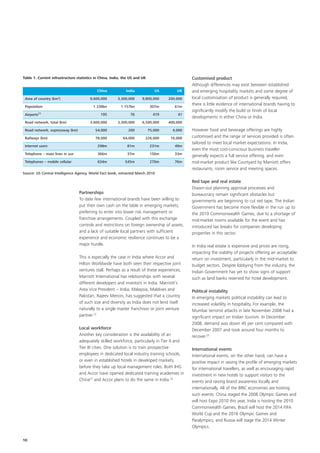
Table 1. Current infrastructure statistics in China, India, the US and UK                      Customised product
                                                                                               Although differences may exist between established
                                            China            India             US        UK    and emerging hospitality markets and some degree of
                    2
 Area of country (km )                 9,600,000        3,300,000     9,800,000      200,000   local customisation of product is generally required,
                                                                                               there is little evidence of international brands having to
 Population                              1.338bn          1.157bn            307m       61m
                                                                                               significantly modify the build or finish of local
 Airports21                                   195              76             419        41
                                                                                               developments in either China or India.
 Road network, total (km)              3,600,000        3,300,000     6,500,000      400,000

 Road network, expressway (km)             54,000             200           75,000     4,000   However food and beverage offerings are highly
 Railways (km)                             78,000          64,000       226,000       16,000   customised and the range of services provided is often
                                                                                               tailored to meet local market expectations. In India,
 Internet users                             298m             81m             231m       49m
                                                                                               even the most cost-conscious business traveller
 Telephone – main lines in use              366m             37m             150m       33m
                                                                                               generally expects a full service offering, and even
 Telephones – mobile cellular               634m            545m             270m       76m    mid-market product like Courtyard by Marriott offers
                                                                                               restaurants, room service and meeting spaces.
Source: US Central Intelligence Agency, World Fact book, extracted March 2010

                                                                                               Red tape and real estate
                                                                                               Drawn-out planning approval processes and
                                 Partnerships                                                  bureaucracy remain significant obstacles but
                                 To date few international brands have been willing to         governments are beginning to cut red tape. The Indian
                                 put their own cash on the table in emerging markets,          Government has become more flexible in the run up to
                                 preferring to enter into lower risk management or             the 2010 Commonwealth Games, due to a shortage of
                                 franchise arrangements. Coupled with this exchange            mid-market rooms available for the event and has
                                 controls and restrictions on foreign ownership of assets,     introduced tax breaks for companies developing
                                 and a lack of suitable local partners with sufficient         properties in this sector.
                                 experience and economic resilience continues to be a
                                 major hurdle.                                                 In India real estate is expensive and prices are rising,
                                                                                               impacting the viability of projects offering an acceptable
                                 This is especially the case in India where Accor and          return on investment, particularly in the mid-market to
                                 Hilton Worldwide have both seen their respective joint        budget sectors. Despite lobbying from the industry, the
                                 ventures stall. Perhaps as a result of these experiences,     Indian Government has yet to show signs of support
                                 Marriott International has relationships with several         such as land banks reserved for hotel development.
                                 different developers and investors in India. Marriott’s
                                 Area Vice President – India, Malaysia, Maldives and           Political instability
                                 Pakistan, Rajeev Menon, has suggested that a country          In emerging markets political instability can lead to
                                 of such size and diversity as India does not lend itself      increased volatility in hospitality. For example, the
                                 naturally to a single master franchisor or joint venture      Mumbai terrorist attacks in late November 2008 had a
                                 partner.22                                                    significant impact on Indian tourism. In December
                                                                                               2008, demand was down 45 per cent compared with
                                 Local workforce                                               December 2007 and took around four months to
                                 Another key consideration is the availability of an           recover.25
                                 adequately skilled workforce, particularly in Tier II and
                                 Tier III cities. One solution is to train prospective         International events
                                 employees in dedicated local industry training schools,       International events, on the other hand, can have a
                                 or even in established hotels in developed markets,           positive impact in raising the profile of emerging markets
                                 before they take up local management roles. Both IHG          for international travellers, as well as encouraging rapid
                                 and Accor have opened dedicated training academies in         investment in new hotels to support visitors to the
                                 China23 and Accor plans to do the same in India.24            events and raising brand awareness locally and
                                                                                               internationally. All of the BRIC economies are hosting
                                                                                               such events: China staged the 2008 Olympic Games and
                                                                                               will host Expo 2010 this year, India is hosting the 2010
                                                                                               Commonwealth Games, Brazil will host the 2014 FIFA
                                                                                               World Cup and the 2016 Olympic Games and
                                                                                               Paralympics, and Russia will stage the 2014 Winter
                                                                                               Olympics.

10
However, such events tend to have a localised beneficial
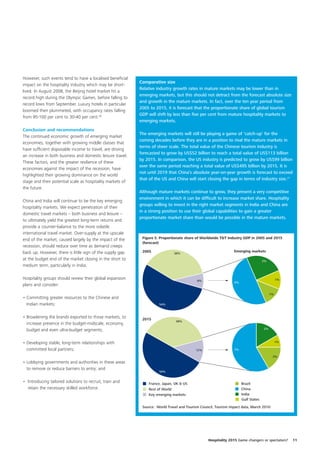
                                                            Comparative size
impact on the hospitality industry which may be short-
                                                            Relative industry growth rates in mature markets may be lower than in
lived. In August 2008, the Beijing hotel market hit a
                                                            emerging markets, but this should not detract from the forecast absolute size
record high during the Olympic Games, before falling to
                                                            and growth in the mature markets. In fact, over the ten year period from
record lows from September. Luxury hotels in particular
                                                            2005 to 2015, it is forecast that the proportionate share of global tourism
boomed then plummeted, with occupancy rates falling
                                                            GDP will shift by less than five per cent from mature hospitality markets to
from 95-100 per cent to 30-40 per cent.26
                                                            emerging markets.
Conclusion and recommendations
                                                            The emerging markets will still be playing a game of ‘catch-up’ for the
The continued economic growth of emerging market
                                                            coming decades before they are in a position to rival the mature markets in
economies, together with growing middle classes that
                                                            terms of sheer scale. The total value of the Chinese tourism industry is
have sufficient disposable income to travel, are driving
                                                            forecasted to grow by US$52 billion to reach a total value of US$113 billion
an increase in both business and domestic leisure travel.
                                                            by 2015. In comparison, the US industry is predicted to grow by US$99 billion
These factors, and the greater resilience of these
                                                            over the same period reaching a total value of US$495 billion by 2015. It is
economies against the impact of the recession, have
                                                            not until 2019 that China’s absolute year-on-year growth is forecast to exceed
highlighted their growing dominance on the world
                                                            that of the US and China will start closing the gap in terms of industry size.27
stage and their potential scale as hospitality markets of
the future.
                                                            Although mature markets continue to grow, they present a very competitive
                                                            environment in which it can be difficult to increase market share. Hospitality
China and India will continue to be the key emerging
                                                            groups willing to invest in the right market segments in India and China are
hospitality markets. We expect penetration of their
                                                            in a strong position to use their global capabilities to gain a greater
domestic travel markets – both business and leisure –
                                                            proportionate market share than would be possible in the mature markets.
to ultimately yield the greatest long-term returns and
provide a counter-balance to the more volatile
international travel market. Over-supply at the upscale
end of the market, caused largely by the impact of the       Figure 5. Proportionate share of Worldwide T&T Industry GDP in 2005 and 2015
                                                             (forecast)
recession, should reduce over time as demand creeps
back up. However, there is little sign of the supply gap     2005                                                Emerging markets
                                                                               38%
at the budget end of the market closing in the short to                                                                             2%
medium term, particularly in India.

Hospitality groups should review their global expansion                                     8%                                                1%
                                                                                                                 4%
plans and consider:

                                                                                                                                         1%
• Committing greater resources to the Chinese and
  Indian markets;                                                     54%


• Broadening the brands exported to those markets, to        2015
                                                                                38%
  increase presence in the budget-midscale, economy,
  budget and even ultra-budget segments;                                                                                            2%


• Developing stable, long-term relationships with                                                                                             1%

  committed local partners;                                                                12%                   7%

                                                                                                                                          2%
• Lobbying governments and authorities in these areas
  to remove or reduce barriers to entry; and
                                                                      50%


• Introducing tailored solutions to recruit, train and          France, Japan, UK & US                                Brazil
  retain the necessary skilled workforce.                       Rest of World                                         China
                                                                Key emerging markets                                  India
                                                                                                                      Gulf States

                                                             Source: World Travel and Tourism Council, Tourism impact data, March 2010


                                                                                                  Hospitality 2015 Game changers or spectators?    11
Spotlight on the Gulf States
                                  Supply of upscale and luxury hotels and resorts in the Gulf States has continued to increase at a
                                  significant rate even during the recession, accounting for 62 per cent of the current pipeline
                                  (75,000 rooms).28 However growth in visitor numbers has slowed in Dubai. The Dubai Government
                                  set a target of 15 million annual visitors by 2010, but more recent forecasts estimate 10 million
                                  visitors. With the emergence of new destinations such as Abu Dhabi and Qatar, the Gulf States will
                                  continue to see rapid development to 2015, although this is likely to be at a slower pace than in
                                  the past five years. Whilst still ‘emerging’, they will mature in due course but will never have the
                                  domestic market to rival China and India in terms of sheer scale of opportunity.

                                  Even the Gulf States are seeing an increasing demand for budget product. The Dubai based firm
                                  Layia Hospitality is setting up a new low cost hotel brand called Day & Night Hotels, with plans for
                                  15 properties across the Middle East. The largest UK budget chain Premier Inn also has plans to
                                  expand in the region. The Gulf States also provide the greatest evidence of product localisation,
                                  with alcohol-free hotels and women-only floors.


 Spotlight on Russia
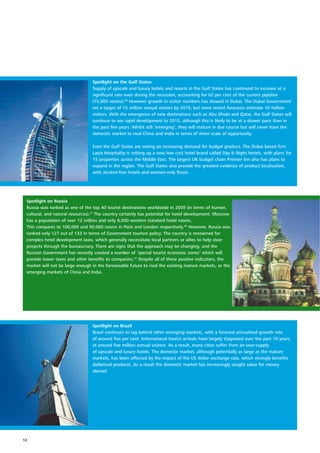
 Russia was ranked as one of the top 40 tourist destinations worldwide in 2009 (in terms of human,
 cultural, and natural resources).29 The country certainly has potential for hotel development: Moscow
 has a population of over 12 million and only 6,000 western standard hotel rooms.
 This compares to 100,000 and 90,000 rooms in Paris and London respectively.30 However, Russia was
 ranked only 127 out of 133 in terms of Government tourism policy. The country is renowned for
 complex hotel development laws, which generally necessitate local partners or allies to help steer
 projects through the bureaucracy. There are signs that the approach may be changing, and the
 Russian Government has recently created a number of ‘special tourist economic zones’ which will
 provide lower taxes and other benefits to companies.31 Despite all of these positive indicators, the
 market will not be large enough in the foreseeable future to rival the existing mature markets, or the
 emerging markets of China and India.


                                  Spotlight on Brazil
                                  Brazil continues to lag behind other emerging markets, with a forecast annualised growth rate
                                  of around five per cent. International tourist arrivals have largely stagnated over the past 10 years,
                                  at around five million annual visitors. As a result, many cities suffer from an over-supply
                                  of upscale and luxury hotels. The domestic market, although potentially as large as the mature
                                  markets, has been affected by the impact of the US dollar exchange rate, which strongly benefits
                                  dollarised products. As a result the domestic market has increasingly sought value for money
                                  abroad.


12
Demographic drivers of change
Targeting the boomers and emerging
middle classes


In 2015 and beyond there will be two key demographic drivers of
change in the industry, creating new patterns of travel demand in the
west and important new source markets in the east.
                                                                         The ageing of the Baby Boomer generation – aged
 Key findings                                                            from 45 to 64 – and their gradual transition into
                                                                         retirement will shape new forms of travel and open
 • By 2015 US Baby Boomers are forecast to own 60 per cent of the        new opportunities catering for a relatively affluent and
   nation’s wealth and account for 40 per cent of spending.              time-rich generation. The emerging middle classes of
                                                                         China and India will also create ripples of change far
 • The key to attracting boomers is appealing to their ‘forever young’   into the future as their travel patterns evolve from
   attitude and desire for experiential travel.                          domestic to regional and then international.


 • Chinese GDP per head is forecast to more than double between 2010     In Hospitality 2010, we examined how attitudes and
   and 2015. Personal and business travel is expected to grow 73 per     lifestyles differed between generational segments and
   cent in the same period.                                              the impact these differences were having on travel
                                                                         patterns. The ‘one size fits all’ approach to business had
 • India is forecast to have 50 million outbound tourists by 2020.       become redundant. Five years later, and the industry
                                                                         has become more advanced in the way it relates to
                                                                         consumers.


                                                                                  Hospitality 2015 Game changers or spectators?   13
Market segmentation by generational characteristics has          These segments will remain important but we expect
     become a catalyst for a smarter approach to business             the boomers to have the greatest impact on the
     with multiple benefits. For example, Visit Britain’s             industry. Between 1995 and 2008, the number of
     marketing strategy for 2010-2013 identifies the                  inbound visitors to Britain aged over 55 increased by
     Generation Y – under 30 years old – as a target market.          92 per cent, compared to 41 per cent growth for
     Through the contemporary and quirky ‘Dynamic Britain’            tourists under the age of 55.1
     campaign, the tourism agency plans to attract these
     visitors several times during their lives and aims to            The boomer generation spans those born over an
     change popular brand perceptions of the UK.                      18 year period – between 1946 and 1964 – and the
                                                                      older part of this segment is only just reaching
     Segmentation is also influencing innovation in product           retirement age. The boomers will therefore be a source
     development, branding, sales strategies and operations.          market for the global tourism industry for several
     Wyndham Hotel Group is strengthening its brand                   decades and will have most impact when the latter
     positioning to attract Generation X – aged from 30 to            part of the group retires around 2024.
     44. The company has introduced Generation X friendly
     functional design and technology including single                The ageing population is a global phenomenon with
     serving coffeemakers, Mp3 player clock radios with               almost all nations experiencing growth in the number
     ‘WynTunes’ playlists and educational video game                  of older residents. However, most developed nations
     systems in family suites. The ‘Be Well’ tag line is used to      have higher percentages of older people than do the
     align the brand with wellness, a value highly regarded           majority of developing countries.2 This is largely because
     by Generation X, and the ’The Fields and Sun’ healthy            fertility rates in the developed world have fallen
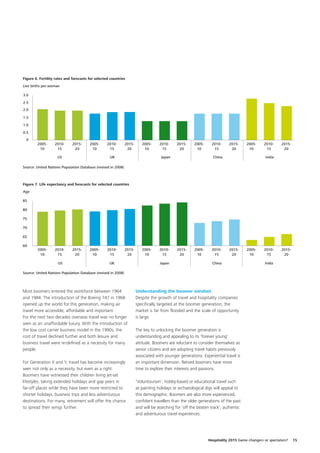
     breakfast programme is also aligned with this theme,             persistently below the replacement rate of 2.1 live
     providing consistent messaging to its target audience.           births per woman since the 1970s. As Figure 6
                                                                      indicates, all selected countries apart from India and the
     Boomers to have most impact                                      US currently have fertility rates below the replacement
     Four generations dominate the population structure in            rate. Looking ahead to 2015, US fertility rates are
     most developed countries. Between now and 2015, all              expected to fall to 2.0, leaving India as the only country
     of these segments will travel more and will provide              to have fertility rates above the replacement rate until
     significant opportunity for the industry.                        2020 at least.

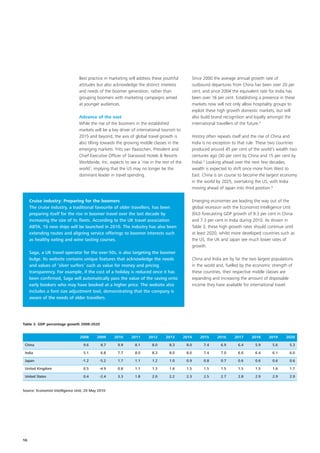
                                                                      As the proportion of older people increases they are
                                                                      also living longer, a trend which should continue until at
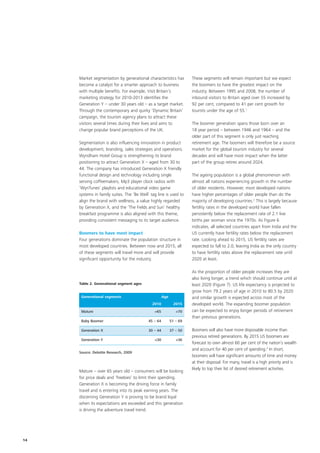
     Table 2. Generational segment ages                               least 2020 (Figure 7). US life expectancy is projected to
                                                                      grow from 79.2 years of age in 2010 to 80.5 by 2020
      Generational segments                           Age             and similar growth is expected across most of the
                                              2010            2015    developed world. The expanding boomer population
      Mature                                   >65             >70    can be expected to enjoy longer periods of retirement
                                                                      than previous generations.
      Baby Boomer                           45 – 64         51 – 69

      Generation X                          30 – 44         37 – 50   Boomers will also have more disposable income than
                                                                      previous retired generations. By 2015 US boomers are
      Generation Y                             <30             <36
                                                                      forecast to own almost 60 per cent of the nation’s wealth
                                                                      and account for 40 per cent of spending.3 In short,
     Source: Deloitte Research, 2009
                                                                      boomers will have significant amounts of time and money
                                                                      at their disposal. For many, travel is a high priority and is
                                                                      likely to top their list of desired retirement activities.
     Mature – over 65 years old – consumers will be looking
     for price deals and ‘freebies’ to limit their spending.
     Generation X is becoming the driving force in family
     travel and is entering into its peak earning years. The
     discerning Generation Y is proving to be brand loyal
     when its expectations are exceeded and this generation
     is driving the adventure travel trend.


14
Figure 6. Fertility rates and forecasts for selected countries
Live births per woman

3.0
2.5
2.0

1.5
1.0
0.5
  0
        2005-      2010-     2015-      2005-      2010-       2015-      2005-     2010-     2015-     2005-    2010-     2015-     2005-     2010-     2015-
         10         15        20         10         15          20         10        15        20        10       15        20        10        15        20

                    US                              UK                               Japan                        China                         India

Source: United Nations Population Database (revised in 2008)


Figure 7. Life expectancy and forecasts for selected countries
Age

85

80

75

70

65

60
        2005-      2010-      2015-     2005-      2010-       2015-      2005-     2010-     2015-     2005-    2010-     2015-     2005-     2010-     2015-
         10         15         20        10         15          20         10        15        20        10       15        20        10        15        20

                     US                             UK                              Japan                         China                         India

Source: United Nations Population Database (revised in 2008)


Most boomers entered the workforce between 1964                        Understanding the boomer mindset
and 1984. The introduction of the Boeing 747 in 1968                   Despite the growth of travel and hospitality companies
opened up the world for this generation, making air                    specifically targeted at the boomer generation, the
travel more accessible, affordable and important.                      market is far from flooded and the scale of opportunity
For the next two decades overseas travel was no longer                 is large.
seen as an unaffordable luxury. With the introduction of
the low cost carrier business model in the 1990s, the                  The key to unlocking the boomer generation is
cost of travel declined further and both leisure and                   understanding and appealing to its ‘forever young’
business travel were re-defined as a necessity for many                attitude. Boomers are reluctant to consider themselves as
people.                                                                senior citizens and are adopting travel habits previously
                                                                       associated with younger generations. Experiential travel is
For Generation X and Y, travel has become increasingly                 an important dimension. Retired boomers have more
seen not only as a necessity, but even as a right.                     time to explore their interests and passions.
Boomers have witnessed their children living jet-set
lifestyles, taking extended holidays and gap years in                  ‘Voluntourism’, hobby-based or educational travel such
far-off places while they have been more restricted to                 as painting holidays or archaeological digs will appeal to
shorter holidays, business trips and less adventurous                  this demographic. Boomers are also more experienced,
destinations. For many, retirement will offer the chance               confident travellers than the older generations of the past
to spread their wings further.                                         and will be searching for ‘off the beaten track’, authentic
                                                                       and adventurous travel experiences.


                                                                                                                Hospitality 2015 Game changers or spectators?    15
Best practice in marketing will address these youthful             Since 2000 the average annual growth rate of
                                attitudes but also acknowledge the distinct interests              outbound departures from China has been over 20 per
                                and needs of the boomer generation, rather than                    cent, and since 2004 the equivalent rate for India has
                                grouping boomers with marketing campaigns aimed                    been over 16 per cent. Establishing a presence in these
                                at younger audiences.                                              markets now will not only allow hospitality groups to
                                                                                                   exploit these high growth domestic markets, but will
                                Advance of the east                                                also build brand recognition and loyalty amongst the
                                While the rise of the boomers in the established                   international travellers of the future.4
                                markets will be a key driver of international tourism to
                                2015 and beyond, the axis of global travel growth is               History often repeats itself and the rise of China and
                                also tilting towards the growing middle classes in the             India is no exception to that rule. These two countries
                                emerging markets. Frits van Paasschen, President and               produced around 45 per cent of the world’s wealth two
                                Chief Executive Officer of Starwood Hotels & Resorts               centuries ago (30 per cent by China and 15 per cent by
                                Worldwide, Inc, expects to see a ‘rise in the rest of the          India).5 Looking ahead over the next few decades,
                                world’, implying that the US may no longer be the                  wealth is expected to shift once more from West to
                                dominant leader in travel spending.                                East. China is on course to become the largest economy
                                                                                                   in the world by 2025, overtaking the US, with India
                                                                                                   moving ahead of Japan into third position.6

     Cruise industry: Preparing for the boomers                                                    Emerging economies are leading the way out of the
     The cruise industry, a traditional favourite of older travellers, has been                    global recession with the Economist Intelligence Unit
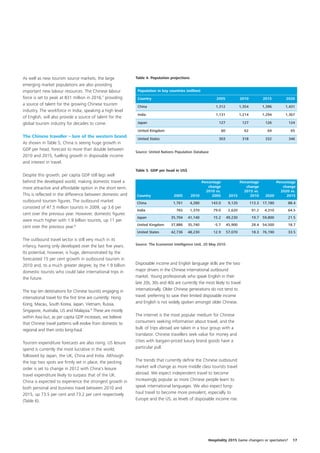
     preparing itself for the rise in boomer travel over the last decade by                        (EIU) forecasting GDP growth of 9.3 per cent in China
     increasing the size of its fleets. According to the UK travel association                     and 7.3 per cent in India during 2010. As shown in
     ABTA, 16 new ships will be launched in 2010. The industry has also been                       Table 3, these high growth rates should continue until
     extending routes and aligning service offerings to boomer interests such                      at least 2020, whilst more developed countries such as
     as healthy eating and wine tasting courses.                                                   the US, the UK and Japan see much lower rates of
                                                                                                   growth.
     Saga, a UK travel operator for the over-50s, is also targeting the boomer
     bulge. Its website contains unique features that acknowledge the needs                        China and India are by far the two largest populations
     and values of ‘silver surfers’ such as value for money and pricing                            in the world and, fuelled by the economic strength of
     transparency. For example, if the cost of a holiday is reduced once it has                    these countries, their respective middle classes are
     been confirmed, Saga will automatically pass the value of the saving onto                     expanding and increasing the amount of disposable
     early bookers who may have booked at a higher price. The website also                         income they have available for international travel.
     includes a font size adjustment tool, demonstrating that the company is
     aware of the needs of older travellers.


Table 3. GDP percentage growth 2008-2020


                                 2008      2009    2010      2011     2012      2013        2014       2015     2016     2017     2018      2019     2020

 China                             9.6       8.7     9.9       8.1      8.0       8.3        8.0         7.4      6.9      6.4      5.9       5.6      5.3

 India                             5.1       6.8     7.7       8.0      8.3       8.0        8.0         7.4      7.0      6.6      6.4       6.1      6.0

 Japan                            -1.2      -5.2     1.7       1.1      1.2       1.0        0.9         0.8      0.7      0.6      0.6       0.6      0.6

 United Kingdom                    0.5      -4.9     0.8       1.1      1.3       1.6        1.5         1.5      1.5      1.5      1.5       1.6      1.7

 United States                     0.4      -2.4     3.3       1.8      2.0       2.2        2.3         2.5      2.7      2.8      2.9       2.9      2.9


Source: Economist Intelligence Unit, 20 May 2010


16
As well as new tourism source markets, the large              Table 4. Population projections
emerging market populations are also providing
important new labour resources. The Chinese labour             Population in key countries (million)
force is set to peak at 831 million in 2016,7 providing        Country                                       2005                2010            2015       2020
a source of talent for the growing Chinese tourism
                                                               China                                         1,312               1,354           1,396     1,431
industry. The workforce in India, speaking a high level
                                                               India                                         1,131               1,214           1,294     1,367
of English, will also provide a source of talent for the
global tourism industry for decades to come.                   Japan                                           127                127             126        124

                                                               United Kingdom                                      60              62              64         65
The Chinese traveller – lure of the western brand              United States                                   303                318             332        346
As shown in Table 5, China is seeing huge growth in
GDP per head, forecast to more than double between
                                                              Source: United Nations Population Database
2010 and 2015, fuelling growth in disposable income
and interest in travel.
                                                              Table 5. GDP per head in US$
Despite this growth, per capita GDP still lags well
behind the developed world, making domestic travel a                                                 Percentage               Percentage               Percentage
more attractive and affordable option in the short term.                                                 change                   change                   change
                                                                                                       2010 vs.                 2015 vs.                 2020 vs.
This is reflected in the difference between domestic and      Country               2005        2010       2005          2015       2010          2020       2015
outbound tourism figures. The outbound market                 China                1,761        4,280      143.0         9,120           113.3 17,180        88.4
consisted of 47.5 million tourists in 2009, up 3.6 per
                                                              India                  765        1,370       79.0         2,620            91.2    4,310      64.5
cent over the previous year. However, domestic figures
                                                              Japan               35,704     41,140         15.2        49,230            19.7 59,800        21.5
were much higher with 1.9 billion tourists, up 11 per
                                                              United Kingdom      37,886     35,740         -5.7        45,900            28.4 54,500        18.7
cent over the previous year.8
                                                              United States       42,736     48,230         12.9        57,070            18.3 76,190        33.5

The outbound travel sector is still very much in its
                                                              Source: The Economist Intelligence Unit, 20 May 2010
infancy, having only developed over the last five years.
Its potential, however, is huge, demonstrated by the
forecasted 15 per cent growth in outbound tourism in
2010 and, to a much greater degree, by the 1.9 billion        Disposable income and English language skills are the two
domestic tourists who could take international trips in       major drivers in the Chinese international outbound
the future.                                                   market. Young professionals who speak English in their
                                                              late 20s, 30s and 40s are currently the most likely to travel
The top ten destinations for Chinese tourists engaging in     internationally. Older Chinese generations do not tend to
international travel for the first time are currently: Hong   travel, preferring to save their limited disposable income
Kong, Macau, South Korea, Japan, Vietnam, Russia,             and English is not widely spoken amongst older Chinese.
Singapore, Australia, US and Malaysia.9 These are mostly
within Asia but, as per capita GDP increases, we believe      The internet is the most popular medium for Chinese
that Chinese travel patterns will evolve from domestic to     consumers seeking information about travel, and the
regional and then onto long-haul.                             bulk of trips abroad are taken in a tour group with a
                                                              translator. Chinese travellers seek value for money and
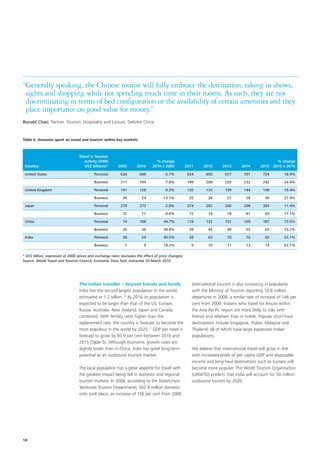
Tourism expenditure forecasts are also rising. US leisure     cities with bargain-priced luxury brand goods have a
spend is currently the most lucrative in the world,           particular pull.
followed by Japan, the UK, China and India. Although
the top two spots are firmly set in place, the pecking        The trends that currently define the Chinese outbound
order is set to change in 2012 with China’s leisure           market will change as more middle class tourists travel
travel expenditure likely to surpass that of the UK.          abroad. We expect independent travel to become
China is expected to experience the strongest growth in       increasingly popular as more Chinese people learn to
both personal and business travel between 2010 and            speak international languages. We also expect long-
2015, up 73.5 per cent and 73.2 per cent respectively         haul travel to become more prevalent, especially to
(Table 6).                                                    Europe and the US, as levels of disposable income rise.


                                                                                                        Hospitality 2015 Game changers or spectators?          17
“Generally speaking, the Chinese tourist will fully embrace the destination, taking in shows,
 sights and shopping while not spending much time in their rooms. As such, they are not
 discriminating in terms of bed configuration or the availability of certain amenities and they
 place importance on good value for money.”
Ronald Chao, Partner, Tourism, Hospitality and Leisure, Deloitte China


Table 6. Amounts spent on travel and tourism within key markets


                                  Travel & Tourism
                                     activity (2000                             % change                                                             % change
 Country                             US$ billions)*      2005        2010     2010 v 2005           2011     2012      2013       2014      2015   2015 v 2010

 United States                             Personal        626        609             -2.7%          624      650        677       701       724         18.9%

                                           Business        211        194             -7.8%          199      209        220       232       242         24.4%

 United Kingdom                            Personal        141        128             -9.3%          130      135        139       144       149         16.4%

                                           Business         28          24          -13.7%            25       26         27        28        30         21.9%

 Japan                                     Personal        279        273             -2.0%          274      282        290       298       304         11.4%

                                           Business         72          71            -0.6%           72       74         78        81        83         17.1%

 China                                     Personal         74        108            44.7%           118      133        151       169       187         73.5%

                                           Business         26          36           38.8%            39       44         49        55        62         73.2%

 India                                     Personal         38          54           40.5%            58       63         70        76        82         53.1%

                                           Business           7          9           18.3%             9       10         11        13        14         63.1%

* US$ billion, expressed at 2000 prices and exchange rates (excludes the effect of price changes)
Source: World Travel and Tourism Council, Economic Data Tool, extracted 20 March 2010


                                  The Indian traveller – beyond friends and family                     International tourism is also increasing in popularity
                                  India has the second largest population in the world,                with the Ministry of Tourism reporting 10.8 million
                                  estimated at 1.2 billion.10 By 2016 its population is                departures in 2008, a similar rate of increase of 146 per
                                  expected to be larger than that of the US, Europe,                   cent from 2000. Indians who travel for leisure within
                                  Russia, Australia, New Zealand, Japan and Canada                     the Asia-Pacific region are more likely to stay with
                                  combined. With fertility rates higher than the                       friends and relatives than in hotels. Popular short-haul
                                  replacement rate, the country is forecast to become the              destinations include Singapore, Dubai, Malaysia and
                                  most populous in the world by 2025.11 GDP per head is                Thailand, all of which have large expatriate Indian
                                  forecast to grow by 93.9 per cent between 2010 and                   populations.
                                  2015 (Table 5). Although economic growth rates are
                                  slightly lower than in China, India has great long-term              We believe that international travel will grow in line
                                  potential as an outbound tourism market.                             with increased levels of per capita GDP and disposable
                                                                                                       income and long-haul destinations such as Europe will
                                  The local population has a great appetite for travel with            become more popular. The World Tourism Organisation
                                  the greatest impact being felt in domestic and regional              (UNWTO) predicts that India will account for 50 million
                                  tourism markets. In 2008, according to the State/Union               outbound tourists by 2020.
                                  Territories Tourism Departments, 562.9 million domestic
                                  visits took place, an increase of 156 per cent from 2000.


18
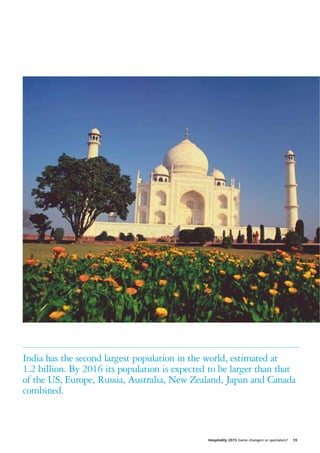
India has the second largest population in the world, estimated at
1.2 billion. By 2016 its population is expected to be larger than that
of the US, Europe, Russia, Australia, New Zealand, Japan and Canada
combined.


                                               Hospitality 2015 Game changers or spectators?   19
As interest in travel increases, we also expect Indian        Operators should also acknowledge the distinct and
     leisure tourists to begin travelling to destinations for      diverse interests and needs of the boomer generation,
     reasons other than to visit friends and relatives and         and offer a wide variety of options and opportunities
     therefore stay in more hotels.                                for self-confident boomers to self-determine and
                                                                   customise their travel and hospitality experiences.
     To prepare for the increase in Indian tourists,
     hospitality operators should consider the factors that        Hospitality groups should see their growing presence in
     influence Indian travellers in their destination selection,   emerging markets as an opportunity to build brand
     as set out by UNWTO. These include: safety and                recognition and loyalty amongst the international
     security; variety of things to do and see; the overall        travellers of the future. For Chinese and Indian middle
     image of the holiday destination; good tourist                class travellers, value for money is the key and their
     facilities and infrastructure; and ease of obtaining          interest in western consumer brands and fully engaging
     visas.                                                        with the destination are of more importance than specific
                                                                   in-room products and services. Specific cultural, dietary
     Difficulty obtaining visas is one of the main obstacles       and language requirements also need to be considered.
     to growth in Indian outbound tourism. If the
     application process is convoluted then Indian travellers      Hospitality operators who understand the drives and
     will be tempted to choose other destinations.                 needs of these growing demographics will reap the
     Hospitality operators who want to attract Indian guests       rewards and become the future leaders in global tourism.
     should also address vegetarian and Halaal dietary
     needs.

     Conclusion and recommendations
     The global population is evolving and the pockets of
     disposable income available for travel are shifting.
     Affluent baby boomers in the western world are
     moving into retirement, living longer and are hungry for
     travel experiences. The middle classes in emerging
     markets are expanding and most of the new entrants
     will come from China and India. Despite disposable
     income lagging behind the current developed world,
     international tourism from these two source markets
     will accelerate over the next few years.

     Products and services should be targeted to the attitude
     of ‘agelessness’ and interest in experiential travel shown
     by the boomers, appealing to their sense of adventure,
     independent spirit and desire to explore off the beaten
     tourist track.


20
Brand
Differentiate to survive


Over the next five years, the importance of brand to guest choice is
likely to differ widely across different segments. Social media will also
present new challenges for brand consistency and open up new forms
of dialogue with the consumer.
                                                                         Brand perception is more often influenced by
 Key findings                                                            experience than by product. It is therefore likely to have
                                                                         a strong, growing influence over consumer choice at
 • Brand is likely to become a more important choice factor for luxury   the upper end of the market and a smaller, declining
   travellers as key locations become increasingly saturated.            role in the large mass-market, more product-driven
                                                                         segments.
 • By 2015, mass market Lifestyle brands will increase both in number
   and scale.                                                            Many of the well established brands have experienced
                                                                         the most rapid growth in their history over the past five
 • Lifestyle brands will achieve strong revPAR with relatively low       years, and several have undergone multi-million dollar
   conversion costs.                                                     re-launches. New types of brand have emerged, notably
                                                                         the ‘Lifestyle’ brand, pioneered on a relatively large
 • Social media offers opportunities to build brand awareness and        scale, such as ‘W’ hotels from Starwood. We have also
   community, but can highlight brand inconsistency which could be       seen the increasing influence of macro external factors
   detrimental.                                                          on brand development, in particular the green
                                                                         movement.


                                                                                  Hospitality 2015 Game changers or spectators?   21
However, the industry remains fragmented with a high         Brand and the luxury traveller
                           percentage of unbranded properties in all segments.          Brand is likely to become a more important factor in the
                           Brand should continue to play an increasing role in the      choice of luxury travellers as key locations become
                           short, medium and long term future, but with clear           increasingly saturated with top end hotels.
                           variations. This has important implications for brand
                           owners who need to make careful investment decisions         Most major operators have more than one mass market
                           in the continuing harsh economic climate.                    brand in their portfolio but only one luxury brand.
                                                                                        At the top end of the market, greater brand
                           Within the mass market, consumers are primarily              differentiation is required to entice consumers.
                           interested in the key aspects of a good stay: a              Few operators want to risk cannibalising their own
                           comfortable bed, a clean bedroom, an adequate and            customer base by creating another competing brand.
                           functioning bathroom, basic in-room technology and
                           basic food and beverage. This is illustrated by research     Location is frequently cited as the main reason for
                           conducted by Mintel in 2009 on the UK Budget Hotel           selecting a hotel for both business and leisure purposes.
                           sector. This research showed that price and location         When it comes to luxury brands, however, key gateway
                           were the dominant factors with 74 per cent and 47 per        locations2 are already reaching saturation. Of the
                           cent of respondents citing them accordingly and brand        29 key locations we considered, there is an average of
                           did not receive enough responses to make the top 10.         5.6 luxury hotels in each location, with some cities
                           Most telling was a quote from a 25-34 year old ABC1          having more than 10 competing luxury hotel brands.3
                           female – “I don’t have a favourite brand, would
                           generally go with the cheapest.”1 The ‘softer’ brand         According to STR Global figures, the average growth in
                           attributes such as decor, type of bathroom amenities         new luxury hotel developments in Europe has been flat
                           and service style are often of less value to the consumer    between 2004 and 2009, and we expect this trend to
                           and can have less impact on hotel choice.                    continue over the next five years. North America
                                                                                        continues to invest in a large number of luxury hotel
                           By contrast, at the top end of the market, consumers are     developments, its growth more than double of its nearest
                           drawn by the brand attributes of the hotel and feel an       competitor Asia. It has achieved this via significant
                           emotional connection with the brand that supersedes their    growth – upwards of an average of four per cent per
                           functional requirements. In these segments, the ‘softer’     year between 2004-2009 – in six key cities: Atlanta,
                           brand attributes have significant and growing value to the   Boston, Chicago, Dallas, San Francisco and Washington
                           consumer and have a large impact on hotel choice.            DC.4 As the Chinese, Indian and Russian economies grow
                                                                                        and their major cities attract more visitors, luxury hotel
                                                                                        brands may fight for space in these markets too.

                                                                                        As the market becomes increasingly saturated, luxury
“We see VENU as a natural extension of                                                  hotels will need to differentiate themselves from their
 the Jumeirah brand that will enable us                                                 competitors even more than in the past. Brands that
                                                                                        can offer something truly unique or compelling are
 to expand into new markets while                                                       likely to win market share and the ability to innovate
                                                                                        will be crucial for success.
 maintaining our core focus on operating
 luxury hotels. VENU is designed to                                                     The websites of many top end hotel chains are currently
                                                                                        difficult to distinguish from one another, with frequent
 deliver a compelling contemporary                                                      repetition of the words ‘luxury’ and ‘experience’ and
                                                                                        relatively similar messaging. We believe that much
 lifestyle experience offering ‘local soul’.                                            greater differentiation will be needed over the next five
 This can be successfully delivered in                                                  years to capture the loyalty of the luxury traveller.

 sufficient scale to ensure a strong
 business proposition for owners across
 the globe.”
Gerald Lawless, Executive Chairman, Jumeirah Group


22
Apart from differentiation, consistency remains a
     Sample of luxury hotel website statements                   challenge for luxury brands. A positive experience can
                                                                 influence consumers to seek out the same brand when
     The Dorchester Collection                                   travelling to a new location; a negative experience can
     Vision: The ultimate hotel management                       stop them going back to the same brand. Experience
     company, with a passion for excellence and                  generally outweighs reputation or brand promise.
     innovation, honouring the individuality and
     heritage of its iconic hotels.                              Consumers who have experienced something positive
                                                                 once at the top end of the market expect to find the
     Mission (for Guests): We genuinely value our
                                                                 same quality whenever and wherever in the world they
     guests, who long to return, knowing they are
                                                                 stay with the same brand. Over the next five years,
     in hotels that respect the authenticity of their
                                                                 luxury brands will have to deliver this consistency in an
     location, are ‘the places to be’ and where
                                                                 ever more competitive and saturated marketplace.
     they receive precious and exceptional
     experiences, while their privacy is respected.
                                                                 Lifestyle brands and the mass market
                                                                 By 2015, mass market ‘Lifestyle’ brands will increase
     The Luxury Collection
                                                                 both in number and in scale by providing a
     Life is a collection of experiences. Let us be
                                                                 differentiated offering to consumers and sufficient
     your guide.
                                                                 financial returns to owners and operators.
     Waldorf Astoria
     Unrivaled experiences. Located in exclusive                 Lifestyle brands focus on a specific experience, style or
     travel destinations, our luxury hotels offer a              image rather than functionality. They often have basic
     world of possibilities that combine local                   services at a property level, tend to be smaller in scale –
     flavour with global sophistication.                         in terms of room number – and try to create an
                                                                 emotional connection with their guests.
     Taj Hotels Resorts and Palaces
     For the world’s most discerning travellers                  Many of the current Lifestyle brands are positioned
     seeking authentic experiences given that                    within the mass market. Operators have been able to
     luxury is a way of life to which they are                   introduce such brands without the risk of cannibalising
     accustomed … each Taj hotel reinterprets                    their existing mass market offer, because of the highly
     the tradition of hospitality in a refreshingly              differentiated, experiential appeal of Lifestyle hotels.
     modern way to create unique experiences                     The challenge these brands face is to expand their
     and lifelong memories.                                      portfolios in order to gain economies of scale without
                                                                 damaging their boutique appeal.

Source: Deloitte Research, March 2010


Table 7. Total number of branded luxury hotels in the largest cities*


 1                 2                3                 4                  5              6                8                  9               10+
 Osaka             Houston          Madrid            Atlanta            Chicago        Bangkok          Mumbai             San Francisco   New York (11)
 Sao Paulo         Taipei           Melbourne         Dallas             Kuala Lumpur   Boston           Washington DC      Singapore       Paris (11)
                                    Seoul             Moscow             Milan          Hong Kong                                           London (17)
                                    Toronto           Philadelphia       Sydney         Los Angeles
                                                                                        New Delhi
                                                                                        Tokyo


Source: Deloitte Research, December 2009
*See Research Approach on page 27 for sample of luxury brands analysed


                                                                                                          Hospitality 2015 Game changers or spectators?     23
The past five years have seen rapid growth in the            Lifestyle – business potential
     number of Lifestyle brands, as the biggest operators         Although global penetration is extremely low outside
     have entered the market and committed themselves to          of the Americas and there are only three dominant
     ambitious roll-out plans. Following its launch of the        Lifestyle brands, this pattern is consistent with the
     W Hotels Worldwide brand, Starwood has added Aloft           development of a relatively immature sector. The ‘big
     Hotels and Element to its Lifestyle portfolio; IHG has       three’ – W, Hyatt Place, Indigo – are moving closer to
     launched Hotel Indigo; Marriott has introduced Edition;      the scale of some of the smaller mass market brands,
     Hyatt Hotels Corporation has launched Andaz Hotels;          an indication that they can also match their economic
     whilst Hilton has suffered a false start with Denizen        viability.
     Hotels. Most recently Jumeirah Group have announced
     the forthcoming launch of its new five star lifestyle        The Lifestyle sector has consistently outperformed the
     brand, VENU, targeting the traveller ‘seeking a              mass market in the Americas in terms of revPAR by over
     sophisticated immersion in the destination’.                 25 per cent since 2003.6 The real difference comes in
                                                                  the Average Daily Rate (ADR) between the two sectors
     Our research across 118 cities worldwide shows that          rather than occupancy, in which they are broadly similar.
     only 26 per cent of them currently have a Lifestyle
     hotel. Within the Americas however, 78 per cent of           It might seem that the financial benefit of these higher
     cities already have a Lifestyle hotel, compared to nine      rates could be diluted by higher development costs within
     per cent in Europe and five per cent in Asia-Pacific.        the Lifestyle brands. These costs are necessary to create a
                                                                  special sense of the ‘boutique’ demanded of these hotels.
     The largest Lifestyle brands are W with 26 properties,       However, discussions with one of the largest Lifestyle
     Hyatt Place Hotels with 20 properties and Hotel Indigo       branded operators regarding the development of its
     with 15 properties, and together these account for           Lifestyle brand suggest that these fears are unfounded.
     76 per cent of all Lifestyle hotels. These figures compare   This operator confirms a significant revPAR increase for its
     unfavourably with the largest traditional brands which       Lifestyle brand above its other mass market brands, but
     typically have around 100-200 properties across our          also reports that conversion costs for its Lifestyle property
     sample cities. For example, there are 140 Marriott,          are relatively low. A major factor in these lower
     109 Sheraton Hotels & Resorts, 222 Holiday Inn Hotels        development costs is the limited service nature of a brand
     & Resorts and 177 Hilton properties.5                        that does not require, for example, multiple and expensive
                                                                  food and beverage outlets.
     However, given their relatively immature development,
     the Lifestyle brands compare favourably with other           This particular operator plans to address the scale issue
     smaller mass market brands, which typically have             by opening multiple of their Lifestyle properties in the
     around 50-100 properties. For example, there are             same gateway city, each having no more than
     84 Residence Inns, 45 Four Points by Sheraton Hotels         120 rooms. It has adopted a franchise model to enable
     and 57 Doubletree Hotels by Hilton properties across         rapid roll-out of the brand by appealing to owners of
     the sample cities.                                           underperforming traditional branded properties.

                                                                  Our research indicates that consumers are reacting
                                                                  positively to the brand positioning of Lifestyle hotels
                                                                  and are prepared to pay higher rates. These brands
                                                                  have clear potential to achieve critical scale. The next
                                                                  five years will see the current Lifestyle brands
                                                                  significantly increase their scale and see many new
                                                                  brands entering the market.

                                                                  Social media – challenge and opportunity
                                                                  The increasing use of online social media will shine a
                                                                  spotlight on how successfully and how consistently
                                                                  operators fulfil their brand promise. Proactive operators
                                                                  will benefit from this communications revolution; those
                                                                  slower to adapt may see their brands pilloried in the full
                                                                  glare of the online public arena.


24
Tools such as Facebook, TripAdvisor and Twitter play             Figure 8. Spread of hotel ratings by region for a midscale
                                                                 hotel brand
an increasingly important part in the traveller’s
pre-departure research. As many as one in five travellers        5.0
are now using these sites prior to departure, while up to
one in ten travellers are actually contributing to the sites.7
                                                                 4.5

Social media offers enormous opportunities to build
brand awareness and community, but also poses
                                                                 4.0
difficult challenges for the industry. The growth of social
media is making it harder than ever to achieve a
consistent brand message.                                        3.5

Wide ratings variance
Building a strong core business based on consistent              3.0
execution can be the springboard to successful                               Europe           Americas               Asia
geographic expansion and even product diversification.
                                                                       Low     Medium         High
However this very expansion, and the diverse
management models involved, can make the goal of                 Source: Deloitte Research, 2009
consistent brand execution difficult to achieve. Social
media is now exacerbating this problem, introducing far
                                                                 Table 8. Top 10 hotels by grade and location in London (random sample)
greater transparency into the consumer experience of
hotels across the globe, and illuminating inconsistencies
                                                                  Number                    Grade and Location                                Score out of 5
across the brand portfolio.
                                                                  1                         Upscale, city centre                                        4.78
Research using TripAdvisor hotel ratings, based on a              2                         Upscale, city centre                                        4.41
sample of 30 hotels around the world for one leading
                                                                  3                         Upscale, business district                                  4.37
midscale hotel brand, showed that weighted average
guest ratings varied from 3.27 to 4.53 out of five                4                         Midscale, airport                                           4.30
(Figure 8). This wide variance shows how social media             5                         Upscale, business district                                  4.24
can highlight consumer perceptions of brand
                                                                  6                         Economy, commercial district                                4.21
inconsistency.
                                                                  7                         Upscale, city centre                                        4.20
There appears to be little correlation between hotel              8                         Upscale, city centre                                        4.16
scale and weighted average rating. Further research,
                                                                  9                         Upscale, city centre                                        4.13
based on a random sample of hotels in London,
showed that one midscale airport hotel and two                    10                        Economy, city centre                                        4.09
economy hotels appeared in the top ten, ahead of
some upscale hotels in more recognised tourist                   Source: Deloitte Research and social media sites, 2009
locations (Table 8).

This suggests that social media can work in favour of
midscale and budget hotels, where initial consumer                     The power of social media was demonstrated in July 2009 by musician
expectations may be lower. Hotels that manage to                       Dave Carroll’s campaign which included a YouTube video, ‘United Breaks
exceed these expectations can sometimes surpass                        Guitars’ that has been viewed over seven million times. This extreme
upscale hotels in the rankings, where initial expectations             example of a company not meeting the customer’s expected level of
are likely to be higher.                                               service should act as a warning for the industry.


“You define customer satisfaction when the guest becomes so satisfied
 with the brand that they become part of our sales force.”
David Kong, President and Chief Executive Officer, Best Western International

                                                                                                            Hospitality 2015 Game changers or spectators?   25
Consumers own the brand
     In the past travellers often relied upon brochures or
     guidebooks, sometimes only to have their expectations
     and perceptions dashed. Now the experience of previous
     guests can be read in forensic – and sometimes lurid –
     detail.

     This has led to a decline of traditional brand ‘authority’,
     with the views of fellow consumers now often regarded
     as more reliable than company marketing messages. In
     the new marketing landscape it is the consumer who
     owns the brand.

     Inconsistent (or consistently bad) consumer experiences
     will inevitably dilute the integrity of the brand message
     and will have an impact on future brand choice and
     loyalty. When future brand choice is put in doubt this is
     no longer just a marketing issue. It becomes a problem
     for the board. Starwood’s Sheraton brand, for example,
     is making strides to enhance brand consistency by
     removing hotels from their portfolio that do not meet
     their new brand standards. The brand’s multi-billion
     dollar revitalisation effort has resulted in an all-time high
     for guest satisfaction scores which is translating into
     growth of market share.8

     Operators have been seeking consumer feedback through
     traditional means for many years. Social media sites may
     generate reams of unsolicited opinion, but hoteliers
     should not ignore the potential of this highly public
     feedback mechanism. For example, a demonstration of
     swift, appropriate recompense from hotel management in
     the event of a problem can turn a potential PR disaster
     into a sign of proactive hotel management.

     The practice of asking employees to add personal
     ratings in order to improve the standing of a hotel,
     on the other hand, should be firmly avoided.
     Consumers will see through this and any resulting
     negative publicity can make a potentially bad situation
     even worse, damaging the rest of the brand.

     Whilst online social media has the power to
     permanently damage the brand, we believe that it can
     also enhance the brand by allowing hoteliers to open a
     dialogue with consumers and form a greater bond with
     them. This dialogue, if handled correctly, will lead to
     increased loyalty and market share. Social media drives
     greater transparency and puts the onus on hoteliers to
     fulfil their brand promise consistently. Negative
     experiences can be communicated quickly to a large
     audience but, happily, so can positive experiences.
     Hoteliers must look carefully at how best to harness the
     power of social media or lose out.


26
Conclusion and recommendations
The importance of brand in the luxury segment will          *Research Approach
continue to grow in an increasingly saturated               Our approach focused on the analysis of hotel properties in 118 cities
marketplace. This will be reinforced by the need to         across the globe: 45 in Europe, 4 in the Middle East and Africa, 32 in the
respond to consumer desire for experiences rather than      Americas and 37 in Asia-Pacific. The selection of the cities was based on
hard products. To be successful brands will need to         a categorisation using both travel flows and economic importance.
differentiate themselves more clearly within the market
and deliver their branded experience consistently across    Our research includes data from Luxury, Mass Market and Lifestyle
their portfolios.                                           brands in these 118 cities, and our sample sets were as follows:

We expect brand to play less of a role in the large mass    • Luxury: The Luxury Collection, St Regis, Wyndham Grand Collection,
market segment. However, the success of Lifestyle             Waldorf Astoria Hotels & Resorts, Sofitel Luxury Hotels, Fairmont,
hotels demonstrates that brand can still sometimes have       Shangri-La, Four Seasons, Taj Hotels Resorts & Palaces, Jumeirah, Park
a significant impact within the mass market and we            Hyatt, Kempinksi, Mandarin Oriental.
expect the Lifestyle brand success story to continue.
This success has been built on a very brand-led,            • Mass Market: Marriott Hotels & Resorts, Residence Inn, Courtyard,
experiential approach and brand is unlikely to have the       Crowne Plaza, Holiday Inn, Express by Holiday Inn, Sheraton, Four
same effect within the traditional mass market where          Points, Ramada, Wingate by Wyndham, Baymont Inn & Suites, Howard
hotels are typically product and location led. This trend     Johnson, Hilton, Doubletree, Hilton Garden Inn, Embassy Suites,
will pose serious challenges to the major brand owners        Pullman Hotels & Resorts, Novotel, Mercure, Suitehotel, Hyatt Regency,
as they seek to gain market share from their                  Clarion, Quality, Cambria Suites, Radisson Hotels & Resorts, Park Plaza
competitors, perhaps increasing the importance of             Hotels & Resorts, Park Inn, Scandic.
other factors such as the hotel’s loyalty programme on
guest choice in this segment.                               • Lifestyle: W Hotels, Aloft, Element, Hotel Indigo, Andaz, Hyatt Place,
                                                              Hotel Missoni, NYLO, Edition, Miraval.
The growth of social media in the last five years has
been staggering and will continue to grow up to 2015        Location data was sourced from the websites of the above brands in
and beyond. This new form of feedback is good news          December 2009, and pipeline and performance data was supplied by
for consumers and offers both threats and opportunities     STR Global in January 2010.
for operators. The transparency of social media will
highlight any inconsistencies in the delivery of the        For our research on social media we surveyed hotel reviews on
brand, and will provide a quick and enriching               TripAdvisor. For the research into consistency, 30 hotels were selected at
communication channel between the brand and its             random for one mass market hotel brand from our sample set, ten in
consumers. The most successful brands will be those         each of the Europe, Americas and Asia-Pacific regions. Their weighted
that embrace and learn to harness social media rather       average rating score was then calculated based on the number of
than underestimate or fight against its influence.          people rating the hotel Excellent, Very Good, Average, Poor or Terrible.
                                                            The expectation management research was carried out by taking a
                                                            second random sample of 30 hotels, this time in London. The top ten
                                                            hotels based on weighted average rating were selected, and their
                                                            location and grade ascertained. All the TripAdvisor data was taken in
                                                            mid-December 2009.


We expect brand to play less of a role in the large mass market
segment. However, the success of Lifestyle hotels demonstrates that
brand can still sometimes have a significant impact within the mass
market.


                                                                                             Hospitality 2015 Game changers or spectators?   27
Technology
Time to play catch up


In Hospitality 2010 we concluded that technology investment in the
industry was significantly lagging behind other sectors. Five years on,
the picture has not improved. Technology spending has declined as a
percentage of revenue and investment has often failed to deliver the
efficiencies or returns that were promised.
                                                                                  To be successful in 2015, the industry needs to address
     Key findings                                                                 these problems. The key areas of technological
                                                                                  development are likely to be online booking and mobile
     • Technology spend is still behind other sectors and is forecast to remain   technology, Customer Relationship Management (CRM),
       so in the coming years.                                                    smart card technology, online social networking, data
                                                                                  security, Artificial Intelligence (AI), self-healing
     • Artificial Intelligence-based technologies will be used to forecast food   technology and in-room product innovation.
       and beverage demand more accurately as pressure grows for better
       cost control and reduced waste.

     • Operators will need to replace creaking core legacy systems and new
       systems will use self-healing technology.

     • In-room product innovation will continue, but consumers, not hotels,
       will define the future technologies they require.


28
Technology spend clearly needs to increase across the
“The problem with technology is                                 industry and Table 9 shows that the spend is forecast to
                                                                stay behind the majority of other industry sectors over
 that because its development is                                the coming few years. The key challenges facing Chief
 evolving so quickly, there is a                                Executive Officers (CEO), Chief Information Officers
 danger of spending a lot of money                              (CIO), board members and investors are justifying the
 on new technologies only for it                                required investment, and assessing how technology
                                                                affects return on investment and share price.2 Over the
 to be insignificant or outdated in                             next five years, the focus on budgetary constraints will
 a few years.”                                                  mean that investment in technology will need to prove
Laurence Geller, Chief Executive Officer, Strategic             a tangible return through revenue generation or cost
Hotels Capital                                                  savings.

                                                                However choosing not to invest carries a significant risk.
Justifying investment                                           If companies opt to lengthen the lifecycle of IT systems
Technology spend in the sector has risen in absolute            in order to reduce costs in the short term, by 2015
terms since 2005 with a compound annual growth rate             there may be a large number of owners and operators
of approximately 5.7 per cent from 2005 to 2008.1               with ageing legacy core systems that may no longer be
This is broadly in line with retail as a whole and is           fit for purpose.
ahead of the airline sector, which has suffered a difficult
few years. However, as the sector was progressing from          Online booking growth
a low base, there is still some way to go to catch up           As online usage has soared over the last decade the
over the coming years.                                          internet has become a vital outlet for all retailers.
                                                                Internet users have risen globally from 957 million in
                                                                2005 to 1,536 million in 2009.


Table 9. Growth in IT spend from 2009 to 2013 (%)


                                                                                                                                                  Forecast
                                                                                                                                                    CAGR*
 Sector (%)                                                    2009              2010             2011              2012             2013     2008 to 2013

 Restaurants and hotels                                         -6.8               3.5              0.6               3.5              4.2                 0.9

 Agriculture, Mining and Construction                           -8.1               2.4              3.6               3.5              3.4                 0.9

 Communications                                                 -5.6               3.3              4.0               4.5              4.5                 2.1

 Manufacturing                                                 -12.0               2.3              3.1               3.8              3.6                 0.0

 Education                                                      -4.2               3.0              3.3               3.8              4.0                 1.9

 Financial Services                                             -7.0               3.5              3.9               4.6              4.9                 1.9

 Healthcare                                                     -3.8               4.1              4.6               5.0              5.7                 3.1

 Local and Regional Government                                  -3.8               3.1              2.8               3.3              3.6                 1.8

 National and International Government                          -2.0               4.6              3.8               4.1              4.2                 2.9

 Process Manufacturing                                          -7.1               2.3              3.2               3.5              3.4                 1.0

 Retail Trade                                                   -6.5               2.4              3.5               4.2              4.3                 1.5

 Services                                                       -4.3               3.2              3.0               3.7              4.0                 1.9

 Transportation                                                 -8.3               3.2              3.7               4.2              4.3                 1.3

 Utilities                                                      -6.2               3.5              3.2               3.9              4.1                 1.6

 Wholesale Trade                                                -5.6               2.2              2.7               3.0              2.8                 1.0

 Weighted Average                                               -6.3               3.2              3.5               4.1              4.2                 1.7


Source: Gartner – Forecast Enterprise IT Spending by Industry Markets, Worldwide, 2007-2013, 4Q09 Update
*Compound Annual Growth Rate (CAGR)


                                                                                                           Hospitality 2015 Game changers or spectators?    29
Asia’s internet access has also risen considerably.           Has CRM delivered?
                                 In 2009 internet penetration in China was 25.8 per cent,      At the time of Hospitality 2010, CRM was considered to
                                 more than double the figures we anticipated in our            be a vital component in the future success of the
                                 Hospitality 2010 report. India’s internet users have also     industry with many executives seeing it as one of the
                                 more than doubled from 27 million to 64 million users         top priorities for investment in technology. Over the
                                 and are forecast to almost double again by 2014. India        past five years, the results obtained from CRM have
                                 and China are forecast to contribute an increase in           been mixed. CRM in relation to loyalty programmes is
                                 internet users of more than 300 million by the end of         widely accepted as a success in the industry, delivering
                                 2014. This is more than the total internet users in the US    significant repeat business and above average spend
                                 and UK combined in 2009.3                                     per night. However around 60 per cent of other CRM
                                                                                               projects have had little impact on sales performance
                                 Booking hotels via the internet remains the most popular      and over half of these projects have failed.5
                                 method, especially for those seeking to put together their
                                 own mainstream holiday package, with more than 50             The apparent failure of some projects may be a
                                 per cent of major hotel brands made via the internet in       consequence of the attempt to bundle the concept into
                                 2009/10.4 This is increasingly pushing travel agencies into   a purely technological package. In order to ensure that
                                 specialist and niche holidays where they are still able to    companies are able to benefit from CRM in future, it
                                 offer a differentiated service to consumers.                  must be seen as more than a technological concept.
                                                                                               Companies will need to give greater thought to the
                                 Hoteliers are capitalising on the rise of internet booking,   strategic and philosophical fit of the package within the
                                 through the use of CRM, to build a relationship with the      organisation. The implementation of CRM can still offer
                                 consumer from the initial booking through the stay, to        many benefits, but the chance of successful execution
                                 post-stay surveys and follow-up communication.                will be increased by the consideration of CRM as a
                                 However, it is not yet clear whether CRM has been             broader, all encompassing concept.
                                 successful in generating the additional revenues needed
                                 to justify the investment.                                    Getting smart
                                                                                               Smart Card technology is now being widely used in the
                                                                                               European casino industry, enabling gamers to play in a
Table 10. World internet penetration rates by geographic regions, 2005-2014 (%)
                                                                                               cashless environment. Smart cards also hold a wealth
                                                                                               of consumer information, enabling casinos to develop
 Country/Region (%)                 2005       2010       2011    2012      2013       2014
                                                                                               improved marketing campaigns to target, attract and
 China                                8.6       29.2      32.5     35.6      38.4      40.8    retain consumers.
 India                                2.5        6.6        7.9     9.3      10.9      12.6

 United Kingdom                      65.4       74.4      75.0     75.5      75.7      75.9
                                                                                               This technology can also be used in a hotel
                                                                                               environment, and in destination hotels and casino
 United States of America            69.6       76.6      76.7     77.0      77.3      77.5
                                                                                               resorts the information gathered from the card can
 World                               19.4       32.7      35.4     38.1      40.6      42.8    be used to market and promote both gaming and
                                                                                               non-gaming activities.
Source: The Economist Intelligence Unit, 2009 – Internet users


“There is no doubt that the hotel’s overall competitiveness today is determined by how
 well it manages its internet market.”
Max Starkov, President & Chief Executive Officer, e-Business Strategist 6


30
Hotels embrace mobile world
Coda Research estimates that 74 million Americans will            Airlines continue to lead the way in
have video technology built into their phones, by 2015,           technology:
up from 15 million in 2009, and 78 million will be able
to access mobile banking via their phone.7 These figures          • Online check-in from mobile devices.
reaffirm the importance of communicating with
tomorrow’s consumers via mobile technology.                       • Selecting seats and in-flight meals online.

Within the industry, mobile technology is now being               • Printing own boarding cards.
used to reach those travellers who are ‘switched on’ at
all times. We believe that access to consumers by this            • Selecting baggage options online.
method will grow significantly by 2015.
                                                                  Most of this was established technology for
Hilton is among those operators that have embraced                airlines when we issued our Hospitality 2010
the mobile world by launching an iPhone application to            report five years ago and yet hotels still do
enable guests to manage their bookings. Within a week             not offer similar services to guests.
of the launch the Hilton application had been
downloaded more than 6,000 times.8 By developing a
service of this kind, hoteliers are able to foster a greater
degree of loyalty, ensuring that their services fit the        Social networking revolution
consumer’s needs more than the offerings of their              Concepts of traditional advertising are no longer
competitors.                                                   applicable in the global online marketplace. The focus
                                                               is now on ‘brand communications’ rather than
Hotels must ensure their websites are mobile-friendly          advertising. Marketing has moved through a number of
in order to maximise the benefits of mobile technology.        phases over time and is now entering a new era where
When Marriott launched a version of its website built          companies no longer own their brands anymore, the
for smart phones, it reported sales in excess of               consumer owns the brand, and the consumer decides
US$1.25 million through the site in the first 100 days.9       whether companies are communicating correctly or not.
                                                               Hotels need to understand this changing landscape if
Additional mobile services, already implemented by             they are to survive and thrive in the new marketing era.
some hotels, include interactive maps/GPS, reward
programmes for quick mobile bookers, confirmation              The technological channels through which operators
texts and pre-arrival texts. These ideas could be              communicate their brand to consumers are also
stretched further to encourage greater loyalty and             changing. The focus is on social networking across the
ensure that hotels are providing the best possible service     internet, on sites such as Facebook.
for their guests. This could be done via post-stay surveys
and promotional texts between visits. Further individual
customisation may be possible via mobile phones,
enabling guests to text through specific requests.             “Networking will be the second
                                                                most popular online activity by
                                                                2012. It will overtake shopping
                                                                and surpass communications like
                                                                email. So hoteliers have no choice
                                                                but to understand the channel
                                                                quickly or be left behind.”
                                                               Aleck Schleider, Vice President of Media Strategy and
                                                               Services, TravelCLICK10


                                                                                                     Hospitality 2015 Game changers or spectators?   31
Facebook has over 400 million active users,11               Hotel operators are already required to comply with
     highlighting the potential reach and impact that            local data privacy legislation, for example, the UK Data
     businesses can tap into. A hotel can alter its entire       Protection Act. They must also meet data security
     image by embracing this new concept. The pod hotel in       standards such as the Payment Card Industry Data
     New York targets single travellers and encourages them      Security Standard that sets out the minimum standard
     to contact one another via their online social network.     for all organisations that process, store or transmit
     According to the company, the social network has            payment card details.
     contributed to a 400 per cent revenue increase.12
                                                                 Hotels must be clear about their responsibilities and
     Research carried out by the UK media regulator Ofcom        ensure that internal controls and procedures are
     in the first quarter of 2009 demonstrates that social       followed to ensure they have taken all necessary
     media is now far from being the preserve of young           safeguards to protect their guests. This area is
     adults, but is a growing phenomenon amongst older           becoming increasingly complex and onerous as
     age groups. Half of those aged 15-24 used social            technologies advance. The industry needs to ensure it
     networking sites, however usage by those aged 25-34         does not lag behind other sectors, otherwise operators
     increased to 46 per cent – from 40 per cent in 2008 –       run the risk of suffering serious damage to their brand
     and usage by the 35-54 age group increased to 35 per        and losing the confidence of the consumer.
     cent – from 28 per cent. Social media is now part of
     the mainstream.13                                           Back office systems
                                                                 Operators have focused in the past on maximising
     Securing the data                                           revenue through yield management systems, but the
     As hotel bookings move increasingly online, via PC and      focus in the future will shift towards cost efficiencies,
     mobile device, data security must be a top priority.        particularly in food and beverage.
     In recent years a number of information security
     breaches have become front page news. Most                  Sustainability is moving up the hospitality agenda.
     industries have been affected by these incidents in both    All businesses are coming under mounting pressure to
     the private and public sectors. Security incidents can be   consider the environment in their everyday activities.
     a result of basic human error, organised crime or high-     Reaffirming the United Nations (UN) message in
     tech intrusion attacks but the overall consequences are     February 2009, calling for a ‘food wastage revolution’,14
     the same: loss of reputation, direct financial impact and   the recent Copenhagen Climate Change conference has
     regulatory fines.                                           placed an even greater emphasis on the importance of
                                                                 addressing these matters.
     Data security is an increasingly important consideration
     for the industry since many hotels process and store        In the US alone, food waste contributed over 30 million
     large amounts of personal information, making them          tons – 12.1 per cent – of the total US municipal solid
     prime targets for data theft and fraud.                     waste in 2005 and this has continued to rise, both in
                                                                 absolute and percentage terms since then.15
     The risk of data breach in hospitality is often greater
     than other industries due to trends such as online          By 2015, AI-based technologies will be used to forecast
     booking, wireless broadband, multiple communication         food and beverage demand with a higher degree of
     channels, the integration of multiple customer service      accuracy, enabling hoteliers to reduce food wastage
     technologies and centralised reservation systems. Hotel     and manage labour costs more efficiently. The Pan
     operators are often reliant on a wide range of third        Pacific hotel in San Francisco was reported to be on
     parties to deliver cost savings, improved agility and a     track “to save four per cent in costs in the first year of
     high quality of service to consumers. Operators             using this AI technology.”16
     frequently need to share sensitive data and resources
     with other companies, extending the traditional             Over the next five years we also predict a significant
     boundaries of the organisation and becoming                 increase in the role of ‘self-healing’ technology across
     dependent on third party controls to protect consumer       the industry.
     data.


32
Integration of back office systems is now improving and      By 2015, we expect hotel rooms to include features
addressing the previous problems associated with too         such as alarm clocks to wake up guests by increasing
many data interfaces. However, as companies become           the light in the room, rather than emitting a noise,
more technologically complex, the risk of technical          giving a calmer start to the day. Floors may have built in
problems occurring becomes ever greater. Self-healing        sensors to light the way for guests, to avoid the
technology uses a dynamic platform to constantly             midnight stumble to the bathroom.
monitor hotel systems for problems and fixes them
before they start to affect other systems.17 This reduces    Televisions may work via voice recognition to answer
the risk of technological failure and is likely to save      any questions guests may have, avoiding the obligatory
significant sums for hotel operators.                        call to reception to find out what time breakfast is
                                                             served. Instead of keys, doors may be unlocked via
Technology is always noticed most when it fails and          mobile phone interface. All rooms are likely to be fitted
operators must aim for seamless, invisible systems and       with iPod docks, broadband, laptop docking and
pre-emptive problem solving. David Kantrud, Senior           universal phone chargers to make the stay as
Vice President of Development, Multi-systems Inc.,           comfortable and as functional as possible.
sums this up: “The thing about technology is that many
hotel employees don’t realise they have it, and if the       Guests should be able to text or email their exact
employees don’t notice it, the guests won’t notice it        preferences in advance through their mobile device so
and that is our ultimate goal. If this kind of pre-emptive   that rooms are set up to their requirements upon
action is taken, theoretically it should enable travellers   arrival. They could be able to request a room on their
to have a glitch-free stay and guests are likely to leave    preferred floor, temperature and lighting set to their
pleased with their choice of accommodation.”18               required specification, music chosen for a particular
                                                             ambience, a cold drink waiting and perhaps even a hot
Hotel room of the future                                     bath already run for them.
In Hospitality 2010, we predicted that many of the
features considered as luxury items at the time would        Other innovations may take a little longer, such as
become standard in many budget hotel rooms. As early         windows that turn into televisions at the touch of
as 2007, the budget UK operator Travelodge rolled out        a button; beds that rock guests to sleep; or multi-
flat screen digital TVs and wireless broadband across its    functional pillows with built-in speakers and wireless
hotel network.19 As these features become the ‘norm’         capability so guests can make that midnight conference
in all hotels, the luxury market continues to seek in-       call without having to find their phone.
room technological innovations to enhance the guest
experience and further differentiate its offering from the   The question remains, of course, do consumers really
mass market.                                                 want all this? Do the majority of guests simply require a
                                                             room that enables them to feel at home when they are
                                                             away from home and one that can also function as an
                                                             office space when necessary? All other ‘add-ons’ may
                                                             simply be surplus to requirement. Ultimately, of course,
                                                             the consumer will decide.


                                                                                                     Hospitality 2015 Game changers or spectators?   33
Conclusion and recommendations
     Keeping up with technology is no longer an optional
     decision for the industry; technology and the business
     are inseparable.20 To be successful in 2015, hospitality
     companies must invest in technology. However the
     assessment of projected returns on that investment will
     need to be more rigorous than ever.

     In a context of budgetary constraint, tangible returns
     through both revenue generation and cost savings will
     need to be virtually guaranteed before investment is
     committed.

     Operators will need to upgrade or replace creaking core
     legacy systems. New systems should use
     self-healing technology as a matter of course.
     Cost management systems in food and beverage should
     become commonplace by 2015, driven by the need to
     make cost savings and pressure to reduce food waste
     as sustainability becomes embedded in the industry.
     Many solutions will be driven by AI technology.

     The battle to drive bookings through proprietary
     websites will continue, but all major operators will also
     develop applications and websites for mobile devices as
     consumers increasingly rely on their Smart Phones.
     At the same time, as hotel bookings move increasingly
     online, regulation and risk to brand reputation will force
     operators to raise their game on data security.

     Online social networking will become more mainstream
     as a marketing tool, building brand awareness and
     attachment, via a sense of community and delivering
     new guest connections. Finally, in-room product
     innovation will continue, but consumers – the owners
     of the brand – will define the future technologies they
     require.


34
Human capital
A post-recessionary strategy for talent


High employee turnover continues to plague the industry, impeding
company competitiveness and brand consistency. Many operators lack
robust strategic plans to retain their critical employees and many are
unprepared for the intensification of staff turnover that is likely to
accompany economic recovery.
                                                                             The recession has temporarily slowed down the rate of
 Key findings                                                                staff turnover, with less hiring and fewer job transitions,
                                                                             but the turnover rate is expected to increase rapidly as
 • An average hotelier spends 45 per cent of operating expenses and          the economy begins to pick up. For example the
   33 per cent of revenues on labour costs while employee turnover in        average labour turnover for the UK hospitality industry
   the industry is as high as 31 per cent.                                   is around 30 per cent,1 and 31 per cent in the US.2
                                                                             Those rates represent nearly twice the average rate for
 • High employee engagement correlates to high levels of customer            all other sectors.
   satisfaction, customer retention, corporate performance and brand
   consistency.

 • Operators need to rethink their talent strategies prior to entering new
   markets, identifying where to source the right talent, perhaps from
   outside the industry.

 • As well as developing an effective talent management plan, companies
   need to rethink their operating model to effectively execute business
   talent strategy.


                                                                                      Hospitality 2015 Game changers or spectators?   35
Hoteliers are likely to face a ‘resume tsunami’ as new   The cost of employee turnover
                                    job opportunities abound.3 Companies with robust         The value of human capital in the industry is self-
                                    talent management programmes will be well positioned     evident. The average hotelier spends approximately
                                    to benefit from recovery over the next five years,       45 per cent of operating expenses and 33 per cent of
                                    particularly as global companies expand into new         revenues on labour costs, namely employee
                                    markets and face new consumer segments.                  compensation and benefits. This figure increases with
                                                                                             hotel size: larger hotels with US$20 million or more in
                                                                                             payroll related costs spent up to 49 per cent of
Figure 9. True cost of turnover                                                              operating expenses on labour in 2008.4 These costs
                                                   3%                                        have decreased slightly during the recession but remain
                                                                                             the single largest expense faced by operators.

                                                          20%
                                                                                             Despite these significant levels of labour spend,
                                                                                             employee turnover in the industry continues to remain
                                                                                             high. This combination of high labour spend and high
                                                                                             turnover is costly for the industry. For many employers
                              52%
                                                              11%                            the cost of turnover of an employee, in particular a
                                                                                             critical employee, can be between 100 and 200 per
                                                                                             cent of the total remuneration of that employee.5

                                                        14%
                                                                                             The estimates vary by type of employee, but turnover
                                                                                             costs generally fall into five categories: pre-departure
                                                                                             costs, recruitment, selection, onboarding/training and
     Pre-departure                  Recruiting                  Selection
                                                                                             loss of productivity.
     Orientation & training         Productivity loss

Source: Tracey and Kruse, How to Keep Your “Stars” from Defecting During Tough Times,
4th Annual National HR in Hospitality Conference and Expo, Feb 22-24, 2010


Hoteliers are likely to face
a ‘resume tsunami’ as new
job opportunities abound.


36
Engaged employees and brand consistency
High employee turnover not only incurs costs but also          “It is easy to copy the ‘hardware’ but not so easy to
directly affects the maintenance of brand consistency
that is crucial for success in today’s industry. Retention
                                                                copy the ‘software’, which is our talent and our
rates are closely associated with the morale of                 experience in this field; knowing what the customer
employees and their loyalty to the brand. Customer              wants.”
service is a key element of brand experience, and             Sheldon Adelson, Chairman & Chief Executive Officer, Las Vegas Sands Corporation9
committed employees represent the brand in a better
and more consistent fashion. Companies with low
retention rates find it harder to develop brand loyalty       Emerging market challenges
amongst employees who are likely to deliver                   As companies expand into new and emerging global
inconsistent customer service experiences.                    markets they also face new regulatory and talent
                                                              sourcing challenges.
Employees with longer tenures and higher degrees of
brand loyalty are more likely to possess competencies         Labour laws vary widely and limit a company’s ability to
that enable long-term brand consistency. Marriott and         operate. In Macau, for example, casino resorts can only
Four Seasons, for example, have maintained lower              hire local residents as dealers. With multiple mega-
levels of turnover and higher consistency of their brand      resorts opening over the coming years and a population
globally. Marriott continues to invest in innovative talent   of only 510,000, talent shortage is a serious issue.
practices and consistently appears in Fortune
magazine’s list of 100 best places to work in the US, as      Asian markets also lack the traditional sourcing venues
well as BusinessWeek’s top 100 places to launch a             and well defined talent pipelines found in the US and
career, with 35 per cent of staff who start at the            Europe, where graduates of hotel management
company remaining there after five years.6                    programmes follow a more structured career path.

Research consistently shows that high employee                In these more established markets talent ‘poaching’ is
engagement is correlated with customer satisfaction,          also a common practice, particularly in concentrated
customer retention and corporate performance.7                tourism locations such as Las Vegas, where industry
Many companies are shifting their focus from a                salary raises are often standard and uniform. Employees
property-centric to a customer-centric viewpoint.             often go to competitors to gain larger raises, thereby
A sustained focus on employee engagement and                  exacerbating an already difficult high turnover problem.
retention is a key driver for customer satisfaction,
directly impacts the bottom line and offers companies a       In emerging markets, however, hoteliers face a different
competitive advantage.                                        set of problems. Many global operators will need to
                                                              rethink their talent sourcing strategies prior to entering
                                                              new markets, firstly defining their critical workforce
                                                              needs and then identifying where and how to source
   The impact of employee engagement8                         the right talent, perhaps even looking outside the
   At Marriott strong performance is driven by                industry.
   employee engagement. Higher employee
   engagement has meant 12 per cent higher                    Varying standards across different geographies and
   revenue per compensation dollar, and nine                  properties, coupled with high turnover rates, also make
   per cent higher house profit margin. In                    it hard to maintain brand consistency and customer
   addition, effective employee engagement                    service across new markets. Companies will need to
   means nine per cent of guests are less likely              establish new and innovative approaches to talent
   to experience problems and 11 per cent are                 management in these markets, designed to align the
   more likely to return to a Marriott property.              workforce with the strategic goals of the company,
                                                              reduce staff turnover and enhance the brand and
                                                              customer experience.


                                                                                                      Hospitality 2015 Game changers or spectators?   37
Figure 10. Top barriers to retaining employees: Today vs. 12 months after recession ends                  Creating a talent management plan
                                                                                                          As the global economy recovers and companies return
            Lack of compensation                                                               44%        to pre-recessionary hiring levels, they are likely to face a
                        increases                                          27%                            ‘resume tsunami.’
                                                                              30%
               Excessive workload
                                                                    21%                                   A Deloitte survey of global talent trends shows that
       Lack of adequate bonus or                                             28%                          many companies lack robust strategic plans to retain
          other financial incentive                                        25%
                                                                                                          their critical employees and are unprepared for the
                                                                            28%                           increase in employee turnover. Many employers are
               Lack of job security
                                                          15%
                                                                                                          simply unaware of the pent-up demand for talent
           Lack of career progress                                  21%
                                                                                                          currently building within the industry.10
                                                                     22%
 Inadequate or reduction benefits                         14%
        (i.e. health and pensions)                      13%                                               The survey also shows that many employers are
                                                         14%
                                                                                                          concerned about losing their top talent.11 As the
     New opportunities in market
                                                                                         39%              economic recovery accelerates, hiring will increase but
               Dissatisfaction with                     13%                                               voluntary turnover will also rise as opportunities for top
            supervisor or manager                        14%                                              talent will open up. Companies can proactively manage
                                                       11%                                                this problem via innovative talent management
       Lack of challenge in the job
                                                             15%                                          practices that help them to retain their critical
                                                   10%                                                    employees.
        Lack of trust in leadership
                                                     12%
         Poor employee treatment                  8%
                during downturn
                                                                                                          As an initial step, many companies need to conduct an
                                                  8%
                                                          Biggest retention barrier today:                analysis of their assets and liabilities when it comes to
                                                  8%
                  Too much travel                         Lack of compensation increases (44%)            attracting and retaining key employees, including a
                                                  8%
                                                                                                          catalogue of retention barriers. These barriers can vary
 Declining perception of company                  8%      Biggest retention barrier 12 months
                                                  8%      after recession:                                depending on the state of the economy and the
             Lack of training and             7%
                                                          New opportunities in the market (39%)           market. During a recession, compensation and
       development opportunities                9%                                                        incentives are the key barriers to retention, but in a
                                              7%                                                          growing economy, new job opportunities become the
Lack of flexible work arrangements
                                                9%                                                        driving force of staff turnover.
          Limitations due to new             6%
government regulations (e.g. TARP)         4%                                                             Once the relevant retention hurdles have been
                      Don’t know              7%                                                          identified and an initial assessment of the current state
                                               8%
                                                                                                          of talent has been carried out, an appropriate
                                      0           10           20           30       40              50   management plan can be developed combining
                                          Today         12 months after recession ends                    elements of strategy, solutions, catalysts, and
                                                                                                          infrastructure that could be part of the overall approach
Source: Deloitte Study “Managing talent in a turbulent economy; clearing the hurdles to
                                                                                                          to talent management.
recovery,” July 2009

                                                                                                          Business needs and strategy should determine the talent
                                                                                                          agenda. Companies need to consider how their
                                                                                                          workforce needs will change in the years ahead, what
                                                                                                          kinds of people they will need and by when they will
                                                                                                          need them, where in the world they will come from
                                                                                                          and how progress will be measured.


38
Every investment in developing a solution should be          Figure 11. Operating Model Considerations: Decision making – Global, local, and joint
                                                             decision rights12
directly tied to the elements of company strategy. Some
solutions will be focused on talent issues like employee
                                                                                                          Global                Decision rights
recruitment or career development. Others will be
focused on work issues: the what, when, where and
                                                                                                                                List of functions performed by the
how of work.                                                                      Global                                        organisation and its allocation in
                                                                                                                                terms of decision responsibility
Companies may also have to implement new
                                                                                                                                Decision level can be:


                                                                                                             Issues/Decisions
infrastructure in order to facilitate the talent solutions                                                                      • Global: Decisions made by
they require. Some of this infrastructure may already be                           Joint                                          corporative structure
                                                                                                                                  (Steering Committee, CEO or VPs)
in place, but hoteliers may need to upgrade their
                                                                                                                                  or management teams. They are
systems and even their culture in relation to areas such                                                                          centralised, impact every
as technology, HR service delivery and diversity.                                                                                 location/property within the
                                                                                                                                  group.
Improvements should be focused on delivering the
                                                                                  Local
specific solutions necessary to support the strategy.                                                                           • Joint: Decisions made by
                                                                                                                                  location/property in partnership
                                                                                                                                  with corporative structure or
Rethinking the operating model
                                                                                                                                  management teams that affect
However, an effective talent management plan alone is                           Decisions                                         each property separately.
                                                                                                        Property –
unlikely to be enough to achieve optimum competitive                                                     specific
                                                                                                                                • Local: Decisions made locally,
positioning. Many companies will need to redesign their                                                                           directly affecting only involved
global operating model: the blueprint that connects                                                                               property.
their strategic vision with their detailed functional        Source: Deloitte Research, 2009
business processes. This operating model provides the
critical link that translates the higher level vision into
specific people, processes, technology and                   A global Chief Financial Officer (CFO) who provides
organisational detail.                                       direct reports with performance feedback and rewards
                                                             around the world may face different evaluation criteria,
The operating model is tightly linked to talent because      compensation review schedules and merit percentages,
employees execute their duties within the context of         depending on the location. This inconsistency can
the organisational infrastructure. Employee performance      inhibit successful team-building, limit employee
largely depends on reporting relationships and the           engagement and ultimately contribute to increased
policies and procedures that exist in different              inefficiency.
geographical locations.
                                                             Back office operations in the hospitality industry have
Since many hospitality companies tend to be property-        traditionally suffered from underinvestment, notably IT
centric organisations, practices may not be consistent       but also functions such as HR and Finance. Many HR
across multiple locations. This is a frequent factor in      functions focus more on customer-facing talent
decentralised organisations where local managers make        initiatives, but they often lack sufficient focus to
local decisions that may or may not be consistent with       manage global talent for IT, HR and Finance.
the corporate strategy. This can be true even if
corporate policies are standardised throughout the           Many companies need to rethink their operating model
globe.                                                       in order to address the issues affecting corporate
                                                             property relationships as well as front and back office
In these decentralised organisations there is often          interactions. For many companies this will involve
inefficiency in operations and back office functions,        reassigning roles, responsibilities and accountability as
such as HR, IT, Finance and Shared Services. This            well as customer service delivery models. This will also
inefficiency has become an issue for US companies            involve considerations such as the centralisation or
expanding into Asia, where local leadership teams            decentralisation of operations and decision making and
define local talent management practices such as             aligning the talent strategy with the organisational
performance appraisal and rewards that may be in             structure.
conflict with the corporate talent management
approach.12


                                                                                                      Hospitality 2015 Game changers or spectators?              39
Conclusions and recommendations
     As executives continue to face changing market
     conditions and strategic choices over the next five years
     they will need to proactively evaluate their talent
     management programmes and consider how talent fits
     into their overall business strategy. As the global
     economy recovers, companies are likely to face an
     increase in employee turnover and a ‘flight risk’ of top
     talent.

     Companies will need to develop innovative talent
     programmes and solutions aimed at reducing employee
     turnover as well as attracting and retaining top talent.
     These programmes must be integrated globally and
     executed consistently, as employee engagement will be
     a significant driver for employees to become living
     examples of the brand.

     Many hospitality companies will also need to redesign
     their operating models and organisational structures to
     align roles, responsibilities, accountability, and authority
     for effective execution and decision making. This is of
     particular importance for organisations evaluating
     centralisation versus decentralisation issues as well as
     property versus corporate relationships.


40
Sustainability
Taking a 360-degree view


Sustainability will become a defining issue for the industry in 2015
and beyond. Rising populations and increasingly scarce resources will
provide a challenging business environment in which sustainability
will need to be embedded within all facets of the industry, rather than
regarded as a standalone issue.
                                                                              Operators must keep pace with changing social views,
 Key findings                                                                 business norms and government regulation in order to
                                                                              adapt quickly to the changing expectations of
 • Sustainability is increasingly seen as a prominent factor in hospitality   stakeholders. Hospitality is a discretionary purchase,
   decision making, but is not yet fully embedded in business thinking.       as highlighted by its volatility in the recent recession.
                                                                              By 2015, the consumption of goods and services seen
 • The key challenge faced by the industry in 2015 will be the adaptation     as environmentally irresponsible is likely to be
   of the existing asset base, which will be expensive and disruptive.        challenged by new social norms. Luxury items that fall
                                                                              into this category risk being seen as increasingly
 • Regulatory, economic and stakeholder pressure will drive sustainability    unacceptable.
   in the industry, creating a virtuous circle that will see social and
   business norms change with surprising speed.                               “Current global consumption patterns are
                                                                              unsustainable … it is becoming apparent that
 • 95 per cent of business travellers surveyed believe the hotel industry     efficiency gains and technological advances alone will
   should be undertaking ‘green’ initiatives.                                 not be sufficient to bring global consumption to a
                                                                              sustainable level: changes will also be required to
                                                                              consumer lifestyles, including the ways in which
                                                                              consumers choose and use products and services.”
                                                                              Sustainable Consumption Facts and Trends from a
                                                                              Business Perspective, World Business Council for
                                                                              Sustainable Development, 2008.

                                                                                       Hospitality 2015 Game changers or spectators?   41
By 2015 we are likely to have reached a tipping point.           Today’s consumers see sustainability as desirable but
                                   Those who have not kept pace may struggle to effect              not yet as a key driver of activity and, as with
                                   change across their businesses and their competitive             government, there is often a clear gap between what
                                   positioning and profitability may be adversely impacted.         people say and what they do or buy. However we are
                                   Operators need to develop business models that                   in the midst of a significant cultural shift. At the start of
                                   incorporate a 360-degree view of sustainability,                 the last decade there was little consumer recognition,
                                   embedding environmental responsibility at the core.              yet a recent survey1 by Deloitte found that in most
                                                                                                    countries 30 per cent of consumers now buy with
                                   The bigger picture – convergence of agendas                      sustainability in mind and a further 30 per cent are
                                   Over the past five years sustainability has risen up             aware of the issue.
                                   political, consumer and business agendas faster than
                                   any other issue.                                                 In 2015 the cornerstones of consumer choice will
                                                                                                    remain similar to those of the last decade. Price, quality,
                                   Sustainability is now an accepted dynamic in the                 brand and convenience will continue to drive consumer
                                   socioeconomic and political environment of the                   spending, but sustainability will also play an increasing
                                   21st century, although it remains the subject of much            role in determining consumer preferences long before
                                   debate and there is still often a gap between what               the point of consumption.
                                   governments say and what they do.
                                                                                                    In the business world sustainability is already changing
                                   In 2015 the cornerstones of political debate are likely to       the commercial landscape. Business, in the main, has
                                   remain similar to those of the post war period:                  not led this change but must be responsive to it.
                                   economy, health, justice, defence and social welfare will        The hospitality industry may not be able to counteract
                                   maintain their dominance of the agenda. However                  the structural effect of limited natural resources or the
                                   future policy will also actively consider the implications       increasing cost of energy supply. However, a reluctance
                                   of sustainability far more than in the past, seeking to          to acknowledge those issues and to address their long
                                   change both corporate and individual behaviour.                  term consequences may increasingly be seen as a failure
                                                                                                    to adapt to new commercial realities.

Figure 12. Building towards a tipping point                                                         In 2015 the cornerstones of business decision making
     An emerging social norm
                                                                                                    are likely to remain similar to those of the last decade,
        of environmental                                                                            but sustainability will also be built into the market
         consciousness                                                             Public policy,   within which those decisions are made. Sustainability
                                                                                    regulation
                                                                                   and market
                                                                                                    will become the ‘business norm’ and increasingly be
                                                                                   intervention     seen as part of a ‘license to operate’.
                               l
                            cia
                          So


                                                                                                    Sustainability is a social issue that impacts us all
                                                                      Politica


                                                                                                    collectively. By 2015, shifting consumer and voter
                                          Sustainability                                            attitudes will have continued their current trajectory,
                                                                               l


                                             agenda
                                                                                                    forcing governments and political parties to address the
                                                                                                    socio-economic landscape and ‘real’ market in which
                                                                                                    businesses operate. We believe that the convergence of
                                                                                                    political, consumer and business agendas around
                                                                                                    sustainability will be a major historical landmark in the
                                      Busin
                                           ess                                                      development of our society.


                               Response to regulation, new business
                                    norms and resource focus
                                                                                                    “IHG views sustainability as a
                                                                                                     business issue and it is core to the
                                                                                                     company’s five year strategic plan.”
                                                                                                    David Jerome, Senior Vice President, Social Corporate
                                                                                                    Responsibility, InterContinental Hotels Group


42
Growing importance in hospitality                                Sustainability initiatives currently range from operational
Sustainability has been important in the hospitality             changes such as linen and towel re-use programmes,
industry for some time. The broader tourism sector               energy management projects or using green cleaners to
contributed an estimated five per cent of total global           development initiatives such as pursuing green building
CO2 emissions in 2005.2 Although air travel was the              certifications like LEED.
largest component of this, accounting for 40 per cent
of tourism emissions, accommodation also made a                  Our interviews with hospitality executives confirm that
significant contribution with 21 per cent.                       sustainability is no longer considered primarily as a
                                                                 marketing issue and is now increasingly seen as a
Hospitality is vulnerable to water shortages, relies             prominent factor in decision making, although it is yet
heavily on built assets, consumes significant amounts of         to be fully embedded into business thinking. By 2015
electricity and, generally speaking, is an item on which         we expect sustainability to become a business
spending is discretionary. These factors ensure that             imperative, requiring companies to educate their
hospitality will be significantly impacted by sustainability     organisation on the changing consumer and regulatory
issues in the future.                                            environment and to derive strategies to maximise their
                                                                 market position.
Sustainability began to gather momentum as a
mainstream competitive issue in 2006, with the launch
of the environmentally conscious luxury brand ‘1’ by
Barry Sternlicht, Chief Executive Officer and Chairman of        “Sustainability is one of our top five
Starwood Capital Group. Since then, almost all major
hotel chains have launched some form of
                                                                  strategic priorities because it
environmental sustainability programme.                           impacts our business and reflects
                                                                  our core values.”
This trend is not just visible in the west; hotels in India
                                                                 Faith Taylor, Corporate Vice President, Sustainability &
and China are also catching on. In India, ITC Limited’s
                                                                 Innovation, Wyndham Worldwide
new luxury hotel in Bengaluru was awarded the US
Green Building Council’s Leadership on Energy and
Environmental Design (LEED) platinum rating, making it
the first hotel in India to achieve the highest rating for
green buildings.3


Table 11. Sustainability trends at major hospitality companies


                                           Publicly announced                  Target summary
                                           sustainability targets?

                                                                                Five year reduction targets (energy, waste, water, and CO2 emissions) from
 Hilton                                    Yes
                                                                                direct operations.

                                                                                Three-year energy reduction targets per available room night and plans to
 IHG                                       Yes
                                                                                launch ‘Green Engage’ programme in 100% of owned and managed facilities.

                                                                                Ten-year energy and water consumption reduction targets per available room
 Marriott                                  Yes
                                                                                Established green building targets and implementing green-sourcing programmes.

                                                                                No formally announced targets – however the company has launched the
 Starwood                                  No
                                                                                Element brand which incorporates the LEED construction standards.

                                                                                Defined sustainability strategy and identified core focus areas. In-process of
 Wyndham                                   No (In-Progress)
                                                                                establishing sustainability targets.


Source: Based on information on company websites and Deloitte interviews


                                                                                                            Hospitality 2015 Game changers or spectators?        43
Sustainability drivers for hospitality
                                                                                               Just a ten per cent reduction in energy
                                                                                               consumption would have the same financial
 1. Hospitality is an asset-heavy sector with a large environmental footprint
                                                                                               effect as increasing the ADR by US$0.60 in
    Hotels rely on a wide range of natural resource inputs and generate
                                                                                               limited-service hotels and by US$2.00 in full-
    significant waste through their lifecycle. Once built, buildings are expected
                                                                                               service hotels.7
    to last for decades and major retrofits can be expensive.4 Since existing
    buildings contribute almost 80 per cent of the carbon emissions in some
    large cities5 through their energy use, there is significant risk of economic
    cost and negative media publicity as marketplace concern around climate
                                                                                            Given the importance of these features for resort
    change grows. As consumer attitudes and public policy continue to change
                                                                                            guests, such reductions may have an impact on revPAR.
    the sector will not be able to hide.
                                                                                            However, improving water efficiency can also lower a
                                                                                            hotel’s sewage bill, which is sometimes even larger than
 2. Regulatory changes and commodity prices will impact the bottom line
                                                                                            the cost of water.
    Reliance on scarce resources such as water, electricity, and natural gas for
    building operations exposes the industry to commodity risks and falling
                                                                                            As input prices rise, the industry is exposed to
    margins as prices rise. Planned and pending regulation around the globe
                                                                                            commodity risks and margin reductions, so hoteliers will
    targeted at increased efficiency and putting a ‘price’ on carbon will further
                                                                                            need to focus on operational efficiency. Modifying
    impact the industry. For example, in the UK, the CRC Energy efficiency
                                                                                            existing properties is expensive and, in the short term,
    scheme will see hotel brands required to participate in a new cap and trade
                                                                                            we expect the industry to focus on efficiency initiatives
    scheme aimed at reducing carbon emissions and creating a market
                                                                                            primarily on new construction and major retrofits.
    mechanism to facilitate this. A public league table will also explicitly
    measure performance and seek to influence consumer attitudes.
    Sustainability will become a driver of improved profitability as the
    regulatory landscape evolves and resource prices increase.
                                                                                            “Technological improvements have
 3. Marketplace awareness of environmental sustainability is growing                         progressed so quickly that it is
    Recent studies by Deloitte indicate a growing consumer preference for green              possible to save money and protect
    hotels. Rating agencies are recognising this growing trend and plan to
    introduce EcoRating of hotels in 2010. Current consumer behaviour suggests
                                                                                             the environment – so I am
    that location and price remain the most important selection criteria and                 optimistic for the future.”
    guests will only select a green hotel if all other things are equal. However            Laurence Geller, Chief Executive Officer,
    this is changing. In the next five years sustainability will increasingly become        Strategic Hotels Capital
    the norm and part of consumer expectations. Strategy and operations that
    are considered environmentally irresponsible will negatively impact
    stakeholder decision making from investors through to consumers.                        Operational efficiency has always been central to
    As consumer attitudes continue to change, expectations that influence                   effective hotel management but sustainability is
    choice and inform perceptions about product and brand will also change.                 refocusing attention on this area and raising the bar for
                                                                                            new builds. The City Center development in Las Vegas,
                                                                                            one of the largest single site hospitality projects ever
                                                                                            completed, has sustainable practices at its core, with
                             Economic drivers of sustainability
                                                                                            Gold LEED certification and operational focus in this
                             In the US an average hotel spends about US$2,196 per
                                                                                            area.
                             available room in energy costs, representing six per cent of
                             all operating costs.6 The Energy Information Administration
                                                                                            The key challenge that the industry will face in 2015
                             expects most fuel prices to continue rising in 2010 and
                                                                                            and beyond is the adaptation of the existing hospitality
                             beyond. These prices will increase further with forthcoming
                                                                                            asset base, which will be expensive and disruptive.
                             CO2 regulations, making energy efficiency an important
                                                                                            Companies that do not address this may find
                             issue for hotel operators.
                                                                                            themselves displaced by new assets and large operators
                                                                                            will need to watch this dynamic carefully. A weak
                             Water is an additional concern for many luxury hotels.
                                                                                            portfolio from the perspective of sustainability is likely
                             As water resources become more constrained,
                                                                                            to have an increasingly detrimental impact on brand
                             governments will begin charging higher rates or limiting
                                                                                            perception and profitability.
                             water use at commercial properties. Water use
                             reductions will limit a hotel’s ability to use fresh water
                             for landscaping, spas and swimming pools.


44
Structural changes take time to implement and some            Regulations are not just limited to energy efficiency.
operators may fail to keep pace if they do not address        The UN has described the global situation surrounding
these changes proactively. Additional value should be         water availability as ‘a disaster in the making’.
generated though enhanced efficiency, shared services         Legislative actions are being considered to address this
and sustainable supply chains. Current portfolios             problem. Some US states, facing more immediate
present an opportunity for system-wide sustainability         concerns, have taken water scarcity issues to the courts.
that can differentiate businesses from their competitors      Construction recommendations related to water
right across the operating model from distribution to         conservation are also emerging in large cities like
asset management. However, without action, these              Mumbai, where voluntary use of dual-flush Water
portfolios will quickly become a burden.                      Closet (WC) and grey water recycling systems9 is
                                                              becoming more common.
Emerging regulations
Regulation will continue to be an important initiator
of change and driver of momentum in business
sustainability between now and 2015. This is                  “New property development by 2015 will increasingly
particularly evident in the hospitality sector.
                                                               be impacted by regulations and codes requiring
The building sector accounts for 30-40 per cent of             buildings to be built more sustainably. It is already
global energy use, according to the UN Environment             happening in Europe.”
Programme’s Sustainable Construction and Building
                                                              Faith Taylor, Corporate Vice President, Sustainability & Innovation, Wyndham Worldwide
Initiative (SBCI).8 In larger cities, such as New York,
buildings represent 80 per cent of green house gas
emissions. There is increasing consensus among
                                                              We expect the pace of regulation to increase in the
scientists and regulators that climate change cannot be
                                                              future. We believe the industry needs to be more
addressed without stricter new building construction
                                                              proactive in helping to shape these regulations, not to
and retrofit programs.
                                                              minimise their impact, but to help educate regulators
                                                              and ensure that sensible, balanced actions are taken.
Governments around the world are using both ‘carrot’
                                                              Given the lifespan of most hotel properties and current
and ‘stick’ approaches to improve building efficiency.
                                                              and pending regulation, it is in the best interest of
US and European governments offer a variety of lower
                                                              developers and operators to consider sustainable
cost financing, tax credits and tax deductions for
                                                              design, construction, and operation principles in any
sustainable development. While none of these
                                                              new development or major retrofit project in order to
incentives are specifically targeted at the hospitality
                                                              avoid future penalties and future retrofitting costs.
sector, many would apply.

                                                              Changing social norms
In cities like San Francisco, pursuing a LEED certification
                                                              Marketplace awareness of the environmental challenge
can expedite site plan permits. Carbon taxes and cap
                                                              is increasing and an overwhelming majority of
and trade schemes are in place for energy intensive
                                                              consumers express concern about environmental
industries already and, across Europe, plans are in place
                                                              sustainability. According to a survey by Deloitte of US
for these to be extended to ‘normal’ business
                                                              business travellers, 95 per cent of respondents believe
operations. The UK Carbon Reduction Commitment
                                                              the hotel industry should be undertaking ‘green’
(CRC) energy efficiency scheme, which came into force
                                                              initiatives.
in April 2010, is an example of this. For hotels this will
lead to brand owners becoming responsible for carbon
                                                              While consumers express interest in sustainability, this
reduction, not just at their managed hotels but at the
                                                              interest does not necessarily translate into purchasing
franchise properties as well.
                                                              decisions which may result in a price premium or
                                                              significantly higher occupancy rates for ‘green hotels’.
                                                              Such hotels have enjoyed increasing media publicity
                                                              which helps to lower marketing costs and generate
                                                              awareness. However green hotels cater for only a niche
                                                              segment of socially conscious and upwardly mobile
                                                              consumers who seek out sustainable properties and
                                                              demand higher standards of themselves and the
                                                              companies they do business with.


                                                                                                     Hospitality 2015 Game changers or spectators?   45
In the short term, whilst brands and operators will have
“Carbon reporting will become increasingly regulated                                      to balance sustainability against other competing
                                                                                          initiatives aimed at gaining market share, sacrificing
 by Governments. This will allow consumers to make                                        environmental responsibility should be avoided.
 more informed decisions.”                                                                As social norms change and attitudes towards
Faith Taylor, Corporate Vice President, Sustainability & Innovation, Wyndham Worldwide    sustainability become more acute, brands and
                                                                                          properties will need to operate within redefined
                                                                                          boundaries in relation to sustainability. Resistance to this
                              Consumer awareness of and interest in sustainability is     change may generate short term savings, but it poses
                              rising, but this will not be the primary driver of          significant risks of longer term damage to product and
                              sustainability in 2015. The definition of sustainability    brand, coupled with higher adaptation costs.
                              remains unclear to many consumers today and, whilst
                              they are ‘conceptually aligned’, they are sceptical about   Starwood’s mid-market Element brand, which
                              sustainability’s direct impact on them as individuals.      incorporates LEED construction into the brand
                                                                                          standards, recognises this dichotomy. LEED certified
                              Regulatory, economic and stakeholder pressure will          buildings improve efficiency and lower operational
                              drive changes in the industry, creating a virtuous circle   costs, allowing the hotels to maintain price
                              that will see social and business norms change with         competitiveness while catering for consumer interest in
                              surprising speed.                                           green hotels and capturing niche market share. Markets
                                                                                          such as this will remain niche, but they can be used to
                              Operators who fail to keep pace with this change will       develop sustainability practices and business models
                              not only incur additional regulatory costs but, in the      that can be applied across the broader business in due
                              longer term, risk losing a ‘missed generation’ in terms     course. This helps to position companies for the future
                              of consumer recognition of sustainability performance.      whilst recognising the needs of the existing business.
                              The majority of consumers may not require a ‘green’
                              hotel as such, but will increasingly prefer brands that     Stakeholder influence
                              are environmentally responsible, requiring sustainability   Although consumer preference and willingness to pay
                              to be embraced throughout the organisation. As this         for environmental features remain unclear, brands and
                              expectation becomes the norm it will be a defining          operators cannot ignore the need to communicate
                              factor in suppressing those brands that are seen as less    progress on sustainability. Stakeholders, including
                              environmentally responsible.                                corporate travel departments, government and tour
                                                                                          operators, influence consumer hotel purchases and will
                              Over time we believe consumer preferences will start to     increasingly do so.
                              drive sustainable consumption, not through a premium
                              on sustainability but through a reluctance to consume       Companies across all industries are now developing
                              in a way that is considered to be environmentally           internal sustainability targets and asking hotels about
                              irresponsible. This dynamic has already emerged in          their sustainability performance as part of the sourcing
                              other sectors, notably car sales where 4X4’s have seen      process for business travel. This trend will continue to
                              negative sentiment in many markets for this very            grow as companies seek to measure, report and
                              reason, having in many cases previously been seen as        improve their sustainability performance in response to
                              aspirational.                                               government, consumer, and other stakeholder
                                                                                          demands. As the availability of environmentally-friendly
                                                                                          hotels increases, companies are likely to direct their
                                                                                          employees to these preferred hotels, provided they
                                                                                          meet other important criteria related to quality, location
                                                                                          and price. Similarly, governments in the US and Europe
                                                                                          are already beginning to consider sustainability
                                                                                          purchasing policies.10


46
Tour operators are also beginning to realise that
sustainability and climate change have the potential to
impact some key tourist destinations around the globe,
directly affecting their revenue streams. Tour operators
are developing sustainability targets to minimise their
impact during excursions. Hotels that rely on large tour
groups may have to demonstrate their commitment to
improving efficiency and lowering their environmental
impact in order to be considered as preferred
properties.

Conclusion and recommendations
The pace of change will differ across the globe but we
are approaching a tipping point. The largest opportunity
and challenge today lies within the existing estates that
dominate the hospitality sector in the developed world.
It is here that the pace of change will be fastest and the
need for change greatest. Initiated by regulation and
changing stakeholder attitudes, by 2015 the political,
business and consumer sustainability agendas will have
converged on the hospitality industry.

Looking further ahead, by 2030 the hospitality
landscape will be unrecognisable compared to that of
today and sustainability will be one of the pervasive
                                                             Figure 13. Embedding sustainability – A 360-degree view
drivers of change. Technology, people, business models,
physical assets, operational practices and financial
efficiency will all need to be harnessed to address the
long term sustainability challenge from a 360-degree                                                  Environmental

perspective.

Industry leaders today are engaged with the
sustainability agenda but few recognise the
                                                                                                                  Business
transformational impact it will have on the way                                                 Marketing
                                                                                                                  strategy
hospitality is provided and consumed. Those who keep
pace and effect change, embedding sustainability across
their businesses from strategy to operations, from brand                      Human capital                                     Brand
value to asset management, will be prominently                                 • Training                                       values
                                                                               • Efficiency
positioned. Those who fail to do so risk finding
themselves lost in the landscape of 2015 and beyond.
                                                                                 Geographical                                  Production
                                                                                  footprint                                   specification


                                                                                                   Asset
                                                                                                management       Operations
                                                                                         • New development
                                                                                         • Retrofit/Adaptation


                                                                                                       Sustainability


                                                             Source: Deloitte Research


                                                                                                         Hospitality 2015 Game changers or spectators?   47
Planning for the unpredictable
Exogenous events and cycles


The key to surviving unpredictable shocks and minimising their
impact is to establish appropriate responses, protocols and risk
management programmes in advance. Businesses also need to
capitalise on the new opportunities that may present themselves in
challenging times.
                                                                                    Many aspects of a hospitality business can be planned
     Key findings                                                                   and many contingencies foreseen and prepared for, but
                                                                                    the industry will always be susceptible to financial and
     • During the recent recession, hotel demand fell four times faster than        operational impact from unpredictable exogenous
       GDP, the most dramatic fall over the past century.                           events and cycles.


     • In 2009 revPAR fell 17 per cent and 2010 is expected to be a year of         These impacts can be large, such as the recent
       stabilisation and fragile growth with recovery more firmly underway by       recession, affecting revPAR on a global scale and
       2011.                                                                        reducing average occupancy to historic lows. They can
                                                                                    also be on a smaller scale such as the impact of a
     • The supply/demand gap is expected to ease in 2010 and improve over           terrorist attack, a natural disaster or a major health
       the next five years.                                                         scare on travel to a specific destination.


     • If sudden crisis events are seen as isolated, recovery tends to be
       quicker and patterns of commerce remain relatively normal.

     • Best practice in a crisis includes organisational re-structuring, business
       continuity planning, flexible pricing, loyalty and customer care.


48
According to the International Monetary Fund, the           Figure 14. Economic cycles – impact of recession
recent economic crisis represented “by far the deepest
                                                            revPAR % change
global recession since the Great Depression.” A US
housing bubble inflated by sub-prime mortgage lending         30

quickly spread into a liquidity crisis across the global
financial system. Coupled with high oil prices and            20
fluctuations in exchange rates, this has had an
overwhelming impact on the hospitality industry.
                                                              10
Hospitality is heavily affected by economic uncertainty
as consumers rely on discretionary spending to meet
                                                               0
their travel needs. Unemployment in the world’s
51 largest economies increased from 8.1 per cent in
2007 to 9.3 per cent in 2009.1 Credit markets dried up        -10
and real estate prices fell. As a result, global consumer
confidence moved from 97 index points in the first half
                                                             -20
of 2007 to a low of 77 index points in the first half of
2009, rebounding partially to 86 index points during
the second half of 2009.                                     -30


Consumer spending has become more conservative
                                                             -40
with the highest savings rates seen for decades.                     97     98      99    00      01     02     03    04    05     06     07    08       09
Travel spending was one of the first things that
consumers and businesses cut back on as the global                                                          Year
economy went into recession. During 2008 the US
                                                                      Asia Pacific        Europe        Europe (€)    Middle East        North America
hospitality industry posted an eight per cent decline in
pre-tax profits.2 The average length of stay is down and
                                                            Source: STR Global & Smith Travel Research Inc. Year-to-December 2009 results
many travellers are opting for cheaper room categories.
Now that consumers are looking for more value in their
spending, the industry needs to be creative in order
to build up lost demand.


                                                                                                         Hospitality 2015 Game changers or spectators?    49
Figure 15. Global supply and demand                                                            Legacy of over-supply
                                                                                               A major problem faced by the industry is that supply is
Rooms (actual annual, millions)
                                                                                               currently greater than demand and the gap has been
4,000                                                                                          growing since 2007. Current levels of supply were
                                                                                               created by aggressive construction prior to the
3,500                                                                                          recession, continuing well into 2008 and 2009.
                                                                                               Demand is driven by a number of economic factors,
3,000                                                                                          such as unemployment, consumer confidence and
                                                                                               GDP growth. During the recession demand fell much
                                                                                               more sharply than supply, creating a large imbalance.
2,500
                                                                                               Figure 15 illustrates the gap between supply and
                                                                                               demand on a global basis.
2,000
            2003         2004          2005       2006        2007         2008        2009
                                                                                               According to Starwood Hotels & Resorts Worldwide,
            Supply      Demand                                                                 President and Chief Executive Officer, Frits van
Source: STR Global and Smith Travel Research Inc (STR), January 2010
                                                                                               Paasschen, “today there is still supply coming online
                                                                                               that was planned prior to the current meltdown,”
                                                                                               however “there are very few new projects being
Figure 16. Total US room supply and demand                                                     announced so supply will fall off in 2011.” The current
                                                                                               lack of credit for construction will also help to slow
% change
                                                                                               down supply growth.
6
                                                                                               This mismatch in supply and demand will benefit
5
                                                                                               consumers in the short term, keeping average hotel
4                                                                                              rates down. Suppliers will have to battle for market
                                                                                        2.9%
3                                                                                              share over the next five years until consumption catches
                                                                                               up. As seen in Figure 16, after the recessions of 1991
2
                                                                                               and 2001, supply gradually declined for a number of
1                                                                                              years. Demand, on the other hand, grew sharply after a
0                                                                                              steep drop.

-1
                                                                                               We believe that the current supply/demand gap will
-2                                                                                             begin easing as early as late 2010 and improve over the
                         -1.1%                                                                 next five years, as was the case in prior recessions.
-3
                                                                       -4.8%
-4                                                                                             Aftermath and recovery
                                                                                      -4.3%
-5                                                                                             The current recession has had an unprecedented impact
                                                                                               on the industry and we are in uncharted waters in
-6
                                                                                               terms of being able to accurately predict a recovery.
-7
     1989     1991    1993      1995   1997   1999    2001     2003     2005   2007    2009    The EIU expects the UK economy to grow only slightly
                                                                                               over the next two years by 0.7 per cent in 2010 and
            Supply      Demand
                                                                                               0.8 per cent in 2011. The US economy is expected to
Source: STR, 12 months moving average (1989 to April 2009)                                     grow 2.5 per cent this year and 1.4 per cent in 2011.
                                                                                               Japanese GDP is forecast to grow 1.4 per cent in 2010
                                                                                               and 1.0 per cent next year.

                                                                                               This modest shape of anticipated recovery in the major
                                                                                               developed economies contrasts sharply with EIU
                                                                                               expectations for the emerging markets. Growth in the
                                                                                               region of eight to nine per cent is forecast annually for
                                                                                               China up to 2015, and growth of seven to eight per
                                                                                               cent is forecast annually for India over the same period.


50
Demand for hotels overall has fallen four times faster       Figure 17. US demand vs. GDP (millions)
                                                                                                                                                 Recession
than GDP during the recession, the most dramatic
                                                             150
fall seen over the past century. The correlation between
                                                                                                                         Recession
GDP and hotel demand has been approximately one-to-
                                                             140
one since the early 1900s, until now. Following previous
                                                                                 Recession
recessions, the industry has been able to return to and
exceed prior levels of performance. This time the            130
recovery is likely to be slower and longer than in the
past because of the dramatic shift in the correlation.       120


Overall revPAR was down by 17 per cent in 2009.              110
We expect 2010 to be a year of stabilisation and fragile
growth with recovery more firmly underway by 2011.           100
Steep declines in occupancy and revPAR are beginning               1987   1989     1991      1993   1995   1997   1999    2001   2003   2005   2007   2009
to level out or even show positive growth in some
                                                                      Real GDP            Room nights sold     (1987 = 100)
regions, but there is a long way to go if we are to
return to the heights of 2007.                                Source: STR & US Bureau of Economic Analysis, January 2010


STR Global data for February 2010 showed revPAR
for the Americas down two per cent year-on-year;             Luxury hotels are generally hardest hit during recessions
European revPAR rose 11.9 per cent; revPAR in                as consumers choose less expensive hotels and spend
Asia-Pacific climbed sharply by 21.6 per cent; and           less during their stay. During the recession of the early
the Middle East/Africa region grew by 3.6 per cent.          2000s, US revPAR for luxury hotels declined by
These trends are positive but performances are               40 per cent,4 but following that recession, luxury was
recovering from a low base and will take some time           the quickest sector to recover. According to Frits van
to reach and surpass pre-recessionary levels.                Paasschen; “Rumours of luxury’s demise during the
                                                             financial crisis were greatly exaggerated. The meltdown
Two key sectors have been particularly hit by the            of luxury is more due to perception than actual income
recession: business and luxury travel.                       effect.” He described the impact on luxury as; “short
                                                             term … and it will come back again. Luxury is
The recession has caused companies to sharply reduce         fundamental to the human experience.”
their travel budgets, seek cost saving alternatives and
find more economical ways to travel. US business travel
declined approximately eight per cent in 2008 and a
further ten per cent in 2009.3 This decline is partly a
result of increased public scrutiny, described as ‘the AIG
effect’, following the criticism of the insurance giant in
2008 for spending freely on travel and entertainment
while the economy was in turmoil. Business travel is
unlikely to recover until sustained economic growth is
restored.


                                                                                                           Hospitality 2015 Game changers or spectators?     51
Terror, medical threats and natural disasters                   As these cases demonstrate, organisations exposed to
                                The ebb and flow of the industry is affected not just by        the epicentre of a major event bear the brunt of the
                                unpredictable economic cycles, but by unforeseen                impact. However this can also work to the advantage
                                events such as terrorism, medical threats and natural           of others.
                                disasters, which can also play a part in determining
                                supply and demand. The past 12 months have seen                 Consumer travel decisions are affected by a number of
                                further examples.                                               factors including cost, economic conditions, a mix of
                                                                                                personal, regional and global health concerns, security
                                The earthquake in Port-au-Prince in January 2010                issues and the weather. Each of these factors affects the
                                delivered a devastating blow to Haiti’s tourism industry,       level of demand and lead booking times to varying
                                just as it was showing signs of recovering from a series        degrees, based on the severity of the factor and the
                                of political, social and natural crises and was achieving       perception of impact in the consumer’s mind.
                                enough stability to attract visitors again. This was
                                followed in February by an earthquake in Chile. The US          Research conducted by the UK trade magazine Travel
                                State Department has advised Americans to avoid                 Trade Gazette found that more than half (54 per cent)
                                travelling to Chile, although tourism infrastructure has        of consumers said that incidents such as the ETA
                                been relatively unscathed.                                      bombing campaign in Spain or swine flu made no
                                                                                                difference to where they booked their holidays.
                                The emergence of swine flu in Mexico in April 2009
                                spread internationally with unprecedented speed. In
                                previous cases, flu viruses needed more than six months
                                to travel as widely as the new strain spread in its first six   “As always, when one country is
                                weeks. Swine flu had an immediate impact on the                  suffering, other countries take
                                travel and hospitality industry. When news of the virus          advantage to improve their own
                                broke, investors wiped US$5 billion off the value of
                                leading US airlines within ten minutes of the
                                                                                                 situation, and swine flu has been
                                announcement of a public health emergency. Those                 no exception. While Mexico was
                                carriers most heavily exposed to Mexico suffered                 losing its place as a tourist
                                double-digit losses.                                             destination, neighbouring
                                Similar large scale losses were experienced during the
                                                                                                 countries were benefiting.”
                                Iceland volcano ash cloud which spread through Europe           Gabriel Escarrer Jaume, Co-Vice Chairman and
                                in April 2010. Airlines estimated losing some £130              Chief Executive Officer, Sol Meliá Hotel Group
                                million a day with TUI reporting that daily costs ran at
                                about £5 million.5                                              However, 41 per cent said they would definitely avoid
                                                                                                or consider avoiding a destination with a terrorist or
                                                                                                medical threat. This indicates the significant potential
Figure 18. Mexico revPAR and bookings lead time
                                                                                                for disruption posed by terrorism and health scares.
% change

20                                                                                              Analysis of specific events and their impact on hotels in
10                                                                                              the markets affected, shows that if the incident is seen
  0                                                                                             as isolated, recovery tends to be quicker and patterns of
-10
                                                                                                commerce remain relatively normal. Following the
                                                                                                Madrid and London bombings, bookings and lead times
-20
                                                                                                dipped slightly, but then recovered within 30-45 days.6
-30
-40
                                                                                                In the case of the swine flu pandemic, the immediate
-50                                                                                             impact was dramatic. On 24 April 2009 Mexican
-60                                                                                             occupancy was at 58.8 per cent. By 10 May 2009
-70                                                                                             occupancy had dropped to its lowest point of 14.6 per
       Q1         Q2          Q3         Q4         Q1         Q2         Q3          Q4
      2008       2008        2008       2008       2009       2009       2009        2009       cent. Lead times fell by 34 per cent and revPAR fell by
                                                                                                almost 70 per cent at the height of the outbreak but
        revPAR                City bookings lead time
                                                                                                performance also continued to be affected for many
Source: STR and TravelCLICK, January 2010                                                       months. The global recession also exacerbated the
                                                                                                impact of swine flu.7

52
Expecting the unexpected – what can be done?                 Booking policies must also remain flexible: for example
Faced with unexpected events, how should operators           cancellation policies that encourage advanced
respond? When demand suddenly plummets one of the            bookings, length of stay restrictions, differentiating
most drastic actions is to cut rates to encourage an         rates, up-selling and offering last minute deals.
increase in occupancy. Some hotels in Mexico even            Approaches such as these can be the keys to securing
offered free holidays to tourists who had caught swine       revenue and finding new markets.
flu in their resorts in a bid to restore confidence in the
destination.                                                 Hilton has restructured its global organisation to drive
                                                             efficiencies and be more effective. It has restructured
This radical approach has had mixed success in localised     the senior management team and brought in new
events, but is an insufficient strategy for a global         talent. IHG is also in the process of integrating the
economic crisis, shown by the fact that global revPAR        group into one organisation following an internal
has not yet recovered to reach the levels seen in            restructure. Both Hilton and IHG have also found that
2007/08.                                                     reviewing their operating models and management
                                                             agreements has led to improved relationships with their
Andrew Cosslett, Chief Executive Officer of                  owners and franchisees.
InterContinental Hotels Group argues that efficiency
and effectiveness are the best responses to the current      Business continuity planning
economic crisis: recognising that customers come first       For sudden disruptions such as terrorist attacks, natural
and that brand standards remain paramount. For IHG,          disasters and medical events, the impact of high levels
its employee engagement and guest satisfaction scores        of staff absenteeism on the continuity of business-
have gone up, proving there are still benefits to be had     critical activities is a key challenge for business planning.
in an economic crisis.
                                                             The cross-training of employees is an important
Many management tools are brought into sharper focus         component of ensuring continuity. Marriott follows the
during uncertain times. These may include cutting staff      ‘Spirit to Serve’ philosophy, where employees are cross-
and non-essential spend to counter the drop in               trained and involve themselves wherever necessary to
bookings, adopting a flexible approach to capital            keep the business going as normal. It is also important
spending, accurate forecasting and using resources           to be fully aware of what skills employees have, so that
already paid for.                                            they can be transferred to other areas of the business.


                                                                                                       Hospitality 2015 Game changers or spectators?   53
Figure 19. Business continuity planning


                                                                                1
                  8
                                                                                    What practical actions do we need to
                      What mitigation steps can we take                             take now across our organisation?
                      at all stages?


                  7
                      What contingency arrangements                                      2
                      can we share with partners and                                         What are the next steps and the
                      competitors?                                                           associated actions?
                                                                    Business
                                                                   continuity
                  6                                                 planning                 3
                      How and what do we communicate
                      with our staff and customers?                                              What is the implementation
                                                                                                 timeline?


                                 5                                              4
                                     Who are our key third parties and              What are the anticipated costs and
                                     what arrangements do they have?                budget requirements?


     Source: Deloitte Research


     Operators should consider the impact of the crisis on                Operators will have to manage their exposure to these
     critical suppliers; knowing whether they also have plans             risks through future cycles. Success will be measured by
     in place and what their level of commitment is to                    effective crisis management and emerging from the
     maintaining critical supplies. This is especially the case in        event with the reputation of the brand intact. Operators
     a time of economic difficulty when the impact of a                   can also capitalise on the opportunities that these cycles
     further disaster may tip suppliers, who are already in               may bring. The overall goal for companies is to survive
     financial distress, into administration. In this event,              the impact, to contain costs and work to drive
     contingency plans will be needed.                                    efficiency, and gain ground on competitors by winning
                                                                          market share.
     The diagram above highlights some of the key questions
     that need to be asked in preparing for an unforeseen                 Appropriate actions will vary according to the scale and
     event. Practical actions could mean reallocating people              impact of the event. Successful responses will typically
     to deal with high levels of staff absenteeism and                    include: organisational re-structuring; business
     ensuring the continuity of business-critical operations.             continuity planning; the implementation of a clear and
     They could also mean taking steps to identify alternative            flexible pricing policy; strengthening loyalty schemes;
     sources of revenue, such as the transportation of                    offering extras to entice guests; adding value rather
     medical equipment, or the provision of beds for                      than lowering rates; and reaffirming customer care.
     hospitalisation in the event of a medical emergency.
                                                                          Properly managed, a crisis can be reconfigured as an
     Conclusion and recommendations                                       opportunity to reinforce brand values and enhance the
     History shows that unexpected events are also recurring              consumer relationship. Forward thinkers, cautious
     events. Terrorism, pandemics and natural disasters do                optimists and operators who embrace a progressive
     not follow any predictable patterns, but they appear to              philosophy will be well positioned. Those who innovate
     be inevitable nonetheless. Likewise, economic                        in a crisis are likely to benefit most from the ensuing
     recessions have come and gone throughout history and                 recovery.
     will undoubtedly recur in the future.


54
The interdependent industry


The hospitality sector is inextricably linked with the
other sectors in the wider tourism, hospitality and leisure
industry. In this section of the report we explore the
relationship between the hospitality industry and other
sectors which make up the wider travel experience,
illustrating the link between them and discovering the
lessons to learn.


                Airlines                                                                   Restaurants
                                         Emerging
                                                              Demographics
                                          markets


                             Brand                                       Technology

                                                    Hospitality


                             Sustainability                         Human capital


                                                    Exogenous
             Online travel                                                                 Cruise lines
                                                    events and
                agents
                                                       cycles


                                                      Gaming


                                                                                      Hospitality 2015 Game changers or spectators?   55
Flying high after the recession
How aviation trends will shape hospitality


As we have seen many times, the aviation industry is susceptible to
external shocks. Whether it be terrorist attacks, pandemic flu or even
volcanic eruptions. However, the long-term performance of the
industry is closely linked to the growth in global GDP and, despite
any short term problems we would expect the industry to continue to
recover as the global economy picks up after the recent financial crisis
in the west.

56
Figure 20 illustrates the interdependency of the global      Figure 20. Global revPAR versus global RPK*
hotel and aviation sectors with key Key Performance          % change
Indicators (KPIs) for the the two industries tracking each
                                                              50
other closely over the last ten years. Therefore, the
expected return of the global aviation sector to long         40
term growth is a positive indicator for hoteliers.            30

                                                              20
For the year to 31 July 2009, the International Air
                                                              10
Transport Association (IATA) recorded a global drop of
3.8 per cent1 in capacity and 6.8 per cent2 in volume         10
compared with the previous year. All regions, with the         0
exception of the Middle East, recorded a reduction in
                                                             -10
volumes with the largest reduction recorded in
Asia-Pacific.                                                -20

                                                             -30
Despite this short term correction, the airline industry           Jan 01   Jan 02   Jan 03   Jan 04   Jan 05   Jan 06   Jan 07   Jan 08   Jan 09   Jan 10

should regain momentum in tandem with global                          revPAR          RPK
economic recovery. In this section we discuss the likely
                                                             *Revenue Passenger kilometres (RPK)
future developments for the various regions, business        Source: STR Global and IATA
models and routes to market and the impact of these
developments on hospitality.
                                                             More aircraft are forecast to be delivered to Asian
Regional prospects                                           airlines than to European and Middle Eastern airlines
North America remains the largest and most mature            combined4 over the next ten years. The aircraft
aviation market in the world and is likely to be so in       delivered to Asian airlines are also likely to be larger:
2015. During this period, traffic growth is expected to      Asian airlines are expected to take delivery of 41 per
come primarily from international traffic, with domestic     cent of very large aircraft – super-jumbo class. The
traffic remaining relatively stable.3                        North American market is expected to take delivery of
                                                             the largest number of smaller, single aisle aircraft.5
The Asian domestic market is growing rapidly. Chinese
domestic scheduled air traffic has tripled and Indian        In the longer term, technological development may
domestic scheduled air traffic has doubled over the past     diminish the importance of hub airports as consumers
ten years. Rapid economic growth in this region should       prefer point-to-point routes. However, the significant
drive further demand for both business and leisure air       cost savings which are currently achieved by routing
travel.                                                      traffic through major hubs should continue to favour
                                                             the Middle East’s strategic position until 2015.
The European market will continue to be characterised        Substantial investment is also being made to transform
by growing traffic with Asia and the Middle East as well     the region into a major business and leisure destination,
as intra-regional traffic. The impact of the inclusion of    as well as a transit point.
aviation within the CO2 emissions trading scheme is not
yet clear and this may dampen growth in the sector.          Network consolidation
                                                             Network carriers have faced difficult market conditions
The Middle East will continue to act as a key regional       in the last five years. These have included the loss of
hub between Asia, Africa and Europe. Significant             economy traffic to low cost carriers, an extremely
available capital in the region is driving long term         volatile fuel price and the legacy of social welfare costs.
investment and airport expansion is more politically
acceptable here than in Europe.                              Network carriers have become increasingly focused on
                                                             premium travel, which is far more volatile than
                                                             economy travel. This poses significant challenges in a
                                                             business requiring substantial long term capital
                                                             investment in aircraft as well as in product and brand
                                                             differentiation.


                                                                                                       Hospitality 2015 Game changers or spectators?    57
These conditions have triggered the start of regional            Low cost developments
     consolidation, particularly within Europe where,                 The low cost model originated in North America and
     following the BA and Iberia tie-up, three major airlines         has also been extremely successful in Europe over the
     are emerging. This process is expected to continue as            last ten years. The ability of these carriers to significantly
     legacy network carriers in Europe disappear and the              reduce the cost of aviation has been a significant driver
     anticipated consolidation among US network carriers              of overall growth in the size of the air travel market.
     takes place.
                                                                      The low cost model has proved remarkably resilient in
     Airlines are positioning themselves for the coming               Europe through the recession with continued growth in
     global consolidation, likely to be made possible by the          passenger numbers and revenues, driven by an
     relaxation of ownership rules between territories,               increasingly mobile population throughout the
     despite the failure to achieve this in the second round          European Union. The European low cost market has not
     of US-EU Open Skies negotiations.                                yet reached saturation, particularly in Spain, Italy and
                                                                      France where there is considerable scope for further
     At some point this process is likely to allow foreign            market penetration.
     ownership of major airlines. Global consolidation should
     provide considerable cost and revenue synergies for              The European market remains far more fragmented
     major carriers and allow the industry to move towards            than in North America. In Europe 60 per cent of low
     sustained profitability for the first time in its history. The   cost traffic is carried by 30 airlines, whereas in North
     current three global alliances are a step towards this           America four airlines have 95 per cent of the market
     consolidation and are likely to presage the future shape         share. The European market is likely to see
     of the industry.                                                 consolidation in the next five years as Northern
                                                                      European markets become saturated.

                                                                      Asian low cost carriers have seen rapid development in
                                                                      recent years with 19 per cent more traffic in 2008 than
                                                                      in 2007. Budget airlines now account for 14 per cent of
                                                                      total aviation market share in domestic Asian markets
                                                                      and 62 per cent market share in Associations of the
                                                                      organisation of Southeast Asian Nations (ASEAN)
                                                                      markets.6

                                                                      Despite this growth, the Chinese and Japanese
                                                                      domestic markets continue to be dominated by legacy
                                                                      carriers. Low cost airlines should continue to expand
                                                                      significantly in the Asian market up to 2015, fuelled by
                                                                      fast economic growth. Low cost growth could be far
                                                                      more substantial if the Chinese or Japanese markets
                                                                      were to open up further.

                                                                      Low cost carriers have primarily focused on short haul
                                                                      routes but they are likely to develop longer haul services
                                                                      over the next five years, driven by passenger growth
                                                                      between regions and the opening up of international
                                                                      markets. The development of cheaper, smaller long haul
                                                                      aircraft should also make longer point-to-point routes
                                                                      more viable.

                                                                      Low cost carriers are used increasingly by business
                                                                      travellers for short haul trips. In Europe, the recession
                                                                      has accelerated a structural change in business travel
                                                                      away from short haul premium services and short haul
                                                                      business flights are now seen as more ‘routine’.


58
The low cost carriers have led the field in developing        Implications for hospitality
ancillary revenues to allow them to reduce the price of       The hospitality industry is likely to change rapidly to
their flights. However, network carriers are also             reflect the changing regional balance in global aviation.
developing their ancillary revenues and facing the            Substantial additional volume will be required to
challenge of doing so in a way that does not damage           provide accommodation for the increase in domestic
the differentiation of their existing product. These          and intra-regional travellers in Asia, particularly in the
revenues come from a number of sources including seat         under-developed midscale and economy segments.
allocation, inflight services, shopping and advertising,
related travel products – hotels, car hire, travel            Hotels in Europe and North America will need to
insurance – and airport lounges. In 2010 airlines are         focus on the increasing number of travellers from the
anticipated to generate US$58 billion7 in ancillary           Middle East and Asia, who are likely to have an impact
revenues, 12 per cent of total airlines revenues.             on the cultural aspect of services such as food and
                                                              entertainment.
Changing routes to market
Aviation distribution has been through major changes in       Global consolidation amongst the network carriers is
the last decade and airline websites have become              likely to have a significant impact on the premium end
increasingly important distribution channels. For low         of the hospitality industry. Major regional and global
cost carriers the website provides the majority of their      hotel operators will be able to form agreements with
distribution. For network carriers, global distribution       the major airline alliances and consolidated carriers to
systems retain a significant proportion of their overall      drive vertical revenue, benefiting both parties.
sales as corporate clients continue to book their travel
through these systems.                                        Network carriers are likely to use their websites to
                                                              promote their brands, using product unbundling to
Websites have given airlines significant control to           differentiate their offerings and selling products from
unbundle their products and to change their offerings         third party providers that are in line with the host carrier
quickly. They have allowed low cost carriers to generate      brands. Premium hotel chains will be able to form
additional sources of revenue and enabled network             alliances with major airlines to attract particular market
carriers to differentiate their products. They have also      segments.
become increasingly important for attracting traffic as
consumers have booked flights directly rather than            As corporate travel budgets remain under scrutiny,
through intermediaries.                                       some low cost business fliers may seek hotels with a
                                                              similar ethos: smart, modern accommodation at low
The large volumes of traffic that airlines are able to        cost with extras, that have historically been included in
attract to their websites have enabled them to act as         the basic price, stripped out and offered for an
distributors for other products such as hotels and car        additional charge to those who require them.
rentals. Websites have also removed the commissions
historically paid by airlines to third party distributors.    However, there is no clear-cut relationship between
                                                              budget airline and budget hotel usage. A significant
The global distribution systems have traditionally acted      segment of budget airline passengers are affluent
as aggregators, not only for airline tickets but also for     travellers who use these carriers for commuting to and
these other products. However they have not provided          from their holiday homes and luxury hotels for weekend
the ability to unbundle services and provide differentiated   breaks. This is likely to remain the case.
products. All the major global distribution systems are
currently tackling this challenge and developing their        Finally, hotel chains operating at the economy end of
systems to provide this functionality.                        the market may no longer be able to source their
                                                              customers primarily through the global distribution
Over the period to 2015, low cost carriers are likely to      systems and may have to sign distribution agreements
continue unbundling their products to generate                with major low cost airlines. Managing the relationships
additional revenue and developing their websites to           with multiple airlines may increase the complexity of
provide the full range of third party products travellers     distribution for these hotels.
are likely to require.


                                                                                                       Hospitality 2015 Game changers or spectators?   59
Hotels and restaurants
A tasty combination or a recipe for failure?


Familiar restaurant and café brands, from Gordon Ramsay and Joel
Robuchon to Dunkin’ Donuts and Costa Coffee, are a growing
presence in hotels around the world; and new partnerships are still
being forged even in the midst of economic crisis.


60
Pierre Gagnaire has recently made his US debut with                Some recent data highlighted that operators regularly
Twist in the Mandarin Oriental Las Vegas; Guy Grossi               experienced a return on investment from food and
opened a Grossi Trattoria at Bangkok’s InterContinental            beverage operations 50 per cent lower than that
Hotel in September 2009 and Heston Blumenthal                      achieved on rooms.1
announced a new restaurant in the London Mandarin
Oriental Hotel, which opened in May 2010.                          Consumers have also become more sophisticated in
                                                                   their dining out habits, influenced by celebrity chef and
In this section, we discuss the motivation for such                cookery programmes on our television screens.
partnerships, the key lessons learnt by hoteliers and              Restaurants have been forced to raise their game to
restaurateurs and how restaurants may evolve in the hotel          meet consumer demands and brands across all parts of
market over the next few years.                                    the eating out spectrum, from fine dining to fast food,
                                                                   have to be better than ever. Hotel catering, however,
Drivers of partnership                                             has lagged behind the overall market, as illustrated by
Hotel restaurant co-branding is not a new concept, but             the UK example in Figure 21.
was started by Victor Bergen in the 1930s who established
fast food restaurants within highway hotels in the US.             UK hotel catering has underperformed compared to
More recently, however, such partnerships have                     other dining out sectors. Between 2001 and 2007,
proliferated. The appeal of restaurant brands – including          hotel catering Compound Annual Growth Rate (CAGR)
celebrity chefs – in hotels has two key drivers.                   was 2.3 per cent compared to 4.4 per cent for all
                                                                   restaurants. Hotel catering has also been badly affected
Food and beverage revenues in hotels have been                     by the recession. Between 2007 and 2008 the category
generally sluggish when compared with the core                     shrank by four per cent compared to growth of one per
business of hospitality.                                           cent in the restaurant sector overall.2


Figure 21. UK restaurant market by category

£ million

25,000                                                                                                                                  CAGR        Growth
                                                                                                                                    2001-2007    2007-2008

                                                                                                            Total                        4.4%          1.0%
20,000
                                                                                                               Roadside                  2.3%         -0.6%

15,000
                                                                                                               In-store                  4.0%         0.6%


10,000                                                                                                         Ethnic restaurants        2.6%         0.5%


                                                                                                               Restaurant meals          5.2%         0.5%
 5,000

                                                                                                               Hotel catering            2.3%         -4.0%

      0
            2001        2002        2003       2004         2005        2006       2007        2008            Pub catering              6.0%         4.5%

Note: Hotel catering includes drinks revenue
Source: Mintel July 2009


                                                                                                           Hospitality 2015 Game changers or spectators?   61
Partnerships across the spectrum
Most high profile partnerships are those in the fine dining/celebrity chef category but, as our selection of UK and US partnerships in Table 12
demonstrates, restaurant brands exist in hotels right across the quality spectrum.


Table 12. Examples of restaurant brands located within hotels in the UK and US

UK


 Hotel operator                         Restaurant brand/operator                Comments/details of particular hotels


 Claridges, London
                                        Gordon Ramsay                            Gordon Ramsay restaurants are also located in other parts of the world.
 Marriott, London


                                                                                 Other Gary Rhodes restaurants include Rhodes Twentyfour in Tower 42,
 The Cumberland Hotel, London           Gary Rhodes
                                                                                 London, cruise ships and others.


 Premier Inn                            Table Table, Brewers Fayre, Beefeater    Hotel and restaurants are owned by Whitbread and regularly sited together.


                                                                                 Travelodge and Marstons announced a plan to co-locate in October 2009
 Travelodge                             Marstons
                                                                                 following a trial in Somerset.


US


 Hotel operator                         Restaurant brand/operator                Comments/details of particular hotels


                                                                                 Florida, opened in 2009.
 Best Western Hotel                     Beef O’Brady
                                                                                 Beef O’Brady is actively looking for further hotel partnerships.


                                                                                 There is another Hakkasan in West London, not located
 Fontainebleau Resort, Miami            Hakkasan, Alan Yau
                                                                                 in a hotel.


 The London NYC
                                        Gordon Ramsay                            Gordon Ramsay restaurants in other parts of the world.
 The London West Hollywood


 Marriott                               TGI Fridays                              Chicago, Indianapolis, Ontario (Canada) and others.


 MGM Grand Hotel & Casino, Las Vegas
                                        Joel Robuchon                            Joel Robuchon has other restaurants around the world.
 Four Seasons Hotel, New York


                                                                                 Vongerichten signed a deal (in 2006) with Starwood to open restaurants in
 Starwood Hotels & Resorts              Jean-Georges Vongerichten
                                                                                 its hotels. Private equity backing from Catterton Partners.


Source: Deloitte Research 2010


62
Other food outlets opening in hotels include Dunkin’
Donuts, which has entered the market in Great Wolf
Lodge resort in North Carolina and has plans to roll-out        “We’ve considered such an option on
through other large hotels and resorts in the US.                numerous occasions and remain
Earlier this year in the UK, Costa Coffee also teamed up         interested. It is key that we are seen as
with Hilton which will roll-out Costa Cafés in 60 of its
hotels. Costa, owned by Whitbread, is already located in         a restaurant in our own right, however,
another Whitbread subsidiary, Premier Travel Inn.                and not as the hotel’s restaurant. Ease of
The vast majority of hotel restaurants, however, are still       access for all our customers and not just
internally operated and in-house brands are being created
by some hotel chains. Although there is plenty of evidence       the hotel’s guests is of paramount
of outsourcing it still only affects a small section of the
market.
                                                                 importance.”
                                                                Rainer Becker, Owner, Zuma Restaurant
Some other hotel brands are innovating around food and
beverage. For example, the UK based Hotel du Vin, owned
by MWB Group, has changed its emphasis from                     Table 13. Potential benefits of hotelier restaurateur partnership
accommodation to bistro food and fine wine, challenging
the traditional image of an in-house hotel restaurant.           Hotel operator benefits                         Restaurant operator benefits


Mutual benefits                                                  Freedom to focus on the core business           Cost effective way to expand restaurant
                                                                 of rooms.                                       portfolio.
As Table 13 shows, there are numerous potential
benefits for both parties if the venture is successful           Fixed income stream, low risk (increase in      Access to a building or part of town not
and if lessons are learned from previous partnerships.           revenue).                                       normally available.
A number of key issues need to be considered and
resolved in order to realise these potential benefits.           Competitive edge.                               Built-in customer base from the hotel customers.


Brands should share consistent values and should be              A well known restaurant brand increases
                                                                                                                 Possible to diversify portfolio.
                                                                 restaurant covers.
focused on the same target consumers. The arrangement
also needs to be financially attractive to both parties,         Operational efficiencies from restaurant may
striking an equitable balance and motivating both of             reduce operating costs.
them from the start. The most attractive financial
structure will be dependent on individual circumstances
                                                                Source: Deloitte Research 2010
but typical structures used are outlined in Table 14.

The restaurant must be both attractive to guests and            Table 14. Contract structures
accessible to non-guests. Non-guests are a core customer
group for a hotel restaurant. Desirable or essential features
                                                                 Structure                                       Description
include a separate entrance to the restaurant or a dedicated
desk for the restaurant separate from the hotel.                                                                 • Restaurant operation is outsourced for a fixed
                                                                 Management contract                               fee.
                                                                                                                 • Operator has limited risk and control.
Zuma, the Japanese restaurant chain with seven successful
                                                                                                                 • Operator pays a fixed fee for use of the brand.
outlets worldwide has yet to locate in hotels but owner
                                                                                                                 • Operator is required to work within restrictions
Rainer Becker does not rule it out.                              Royalty fee (franchise)
                                                                                                                   to keep restaurant within brand guidelines.
                                                                                                                 • Potential financial help with restaurant setup.
                                                                                                                 • Both parties invest in the venture and share the
                                                                 Profit share/joint venture
                                                                                                                   risk and reward.

                                                                                                                 • Option giving most autonomy to the
                                                                 Lease (full outsourcing)                          restaurant.
                                                                                                                 • Restaurant has most of the risk and reward.


                                                                Source: Deloitte Research 2010


                                                                                                              Hospitality 2015 Game changers or spectators?      63
Other considerations such as hotel guest restaurant special   New ventures
     offers, priority booking and dress codes need to be           Even under difficult operating conditions some
     established in advance.                                       restaurateurs seem dissatisfied with the general success
                                                                   of hotel partnerships and are keen to go one step
     Hotels also need to consider whether the market in            further. D&D London operates 30 restaurants in major
     which they operate is appropriate for such a partnership.     cities around the world. The group recently announced
     Not every location globally needs this solution. There are    its entry into the London hotel market with plans for an
     numerous regions and countries where the hotel brand is       80-bedroom boutique hotel in the heart of the city,
     ‘king’ and the hotel’s own restaurant is the ‘must visit’     leapfrogging the hotel restaurant niche altogether.
     eating out destination. To use an old adage … ’If it ain’t    The successful Corbin and King partnership, which is
     broke, don’t fix it.’                                         behind London’s iconic Wolseley restaurant, also has
                                                                   plans to establish a boutique hotel.
     Successes and failures
     A significant number of these partnerships now exist          Evidence of this trend can also be seen in the US.
     and, with new collaborations emerging all the time, it        Thomas Keller has recently had a planning application
     appears that a degree of success is being achieved.           approved for a luxury 20 room inn opposite his French
     However tangible data on investment returns for such          Laundry restaurant in Yountville. Whether this business
     ventures is limited and can be masked by the type of          plan will be a success remains to be seen but there
     deal struck between hotel and restaurateur.                   appears to be little shortage of contenders willing to try.

     Failures are also apparent and finding a good partner is      Overall, the next five years are likely to see many more
     not in itself a guarantee of success. Brian Turner’s          openings and new ventures. The future of hotelier/
     restaurant in the Millennium Hotel London and his grills      restaurateur partnerships continues to make sense.
     in the Copthorne Hotels in Birmingham and Slough-
     Windsor were closed during 2008-9. In the US, the
     Boston Park Plaza hotel and Towers severed its
     relationship with Todd English and his Bonfire                “It’s a compelling proposition for
     Steakhouse in August 2009.
                                                                    the hotel operator. Not only does
     Hotel restaurants have been hit by the recession.              the hotel have an additional
     A reduction in both the number of hotel guests and the         attraction for residents but we
     number of people dining out has contributed to some            bring additional footfall from
     of these high profile failures. Despite this, partnerships
     are still being formed because they establish a point of
                                                                    non-residents, who may well be
     difference for hotel operators and enable them to              guests of the future.”
     attract more guests.                                          Caroline Teeling, Gary Rhodes Management


64
Hotels and online travel agents
From confrontation to collaboration


Hotel operators and online travel agents (OTAs) have often been in
competition in recent years. Yet, they often share common strategic
aims and by 2015 we are likely to see a more collaborative approach
to achieving common benefits.


                                              Hospitality 2015 Game changers or spectators?   65
Figure 22. Advertising and marketing spend as a percentage of revenue, OTAs vs Hotel           The debate
companies
                                                                                               The relationship between the OTAs and hotel operators
%                                                                                              has been the subject of wide debate in the industry
                                                                                               since IHG’s fraught negotiations with Expedia in 2004.
40
                                                                                               The issue resurfaced at the end of 2009 after stalled
35                                                                                             negotiations between Expedia and Choice Hotels over
30
                                                                                               renewal of a distribution agreement came publicly
                                                                                               to light.
25

20                                                                                             Hotel operators are concerned about losing control over
                                                                                               inventory and pricing to OTAs. Hoteliers can also feel
15
                                                                                               there is pressure to enter into long term contracts
10
                                                                                               without exit clauses at rates that they believe are not
 5                                                                                             always commercial. OTAs, on the other hand, seek rate
                                                                                               and inventory parity for their own customers who, they
 0
      Expedia         Orbitz        Priceline       Marriot      Hilton     InterContinental   believe, trust them to provide the best price available.
                                                 International   Hotels       Hotels Group

       2004        2005        2006           2007       2008
                                                                                               In the current economic context hotel operators are
                                                                                               also concerned that OTAs are capitalising on the decline
Source: US Securities and Exchange Commission & Annual Reports                                 in occupancy. This happened after 9/11 when shell-
                                                                                               shocked hotel companies released inventory to OTAs,
                                                                                               which was then sold on at significant mark-ups.
                               Table 15. Market share by region
                                                                                               Early investment by OTAs in technology and significant
                                                                                               marketing spend was effective in selling rooms to help
                                Market share by region                      US     Europe
                                (In terms of 2008 gross bookings)           %          %       struggling hotel companies.
                                Expedia                                   37.8         20.1
                                                                                               Since then, hotel companies have invested in developing
                                Orbitz                                    23.9          5.0
                                                                                               and marketing their own websites. Some hotel
                                Travelocity                               20.7          8.6    companies like Marriott are even imitating OTAs by
                                Priceline                                  8.1         12.8    offering flights and car hire online. Given the current
                                Other                                      9.5       53.50     market conditions, both travel companies and hotel
                                                                                               operators are increasingly advertising both online and
                                Total                                     100          100
                                                                                               offline to attract consumers directly.

                                OTA share of overall online bookings                     %

                                2006                                                    42

                                2007                                                    40

                                2008(e)                                                 39

                                2009(e)                                                 39

                                2010(e)                                                 39


                               Source: Expedia Q3 FY09 – Company Overview
                               (e) estimate


66
Value of visibility                                         Figure 23. Average reservations per treatment and per cent increase when being displayed
A recent study by Cornell University tested the             or not on the OTA website

‘billboard effect’ enjoyed by a hotel operator as a         Number of reservations per treatment                                                       %
result of its property being listed on an OTA website.
The research concluded that these operators not only        60                                                                                         30
                                                                                                                                       26.0%
receive additional bookings via the OTA channel, but
                                                            50                                                                                         25
also increase the number of reservations made through
their own website and hotel booking system, ranging         40                                                                                         20
between 7.5 and 26 per cent, as well as a slight                                                                14.1%
                                                            30                                                                                         15
increase in the ADR for these properties.
                                                            20                                 9.1%                                                    10
                                                                         7.5%
Whilst limited in depth, the study does indicate that
hotel companies need to be aware of the total impact        10                                                                                          5

on bookings and revenue of their exposure to different       0                                                                                          0
distribution channels including OTAs.                              Branded hotel 1      Branded hotel 2      Branded hotel 3     Independent hotel


Hotel companies, OTAs and tour operators share                     Display on        Display off
common strategic aims that would be better furthered
by working together. Many travel and hospitality            Source: “The Billboard Effect: Online Travel Agent Impact on Non-OTR Reservation Volume”
                                                            Cornell Hospitality Report
companies are seeking to secure a foothold in emerging
markets, to lower the cost of customer acquisition and
transactions, to maximise asset utilisation, to build a     Acquisition may provide a more appropriate model and
quality brand and to offer differentiated, exclusive        an immediate footprint in a new market. Expedia has
products to their customers.                                demonstrated this with the acquisition of Kuxun in
                                                            China and Venere in Europe. The latter acquisition
Finding common ground in emerging markets                   provided Expedia with an agency model more
Emerging markets offer clear mutual benefits for both       appropriate for the higher number of independent
OTAs and hotel operators. Most international hospitality    hotels in Europe.
groups have launched expansion programmes into
these markets, particularly China and India. OTAs are       Using technology to match supply with demand
also seeking to expand their geographical reach and         Travel companies need to attract consumers through
forge a global identity.                                    effective technology and the right products and pricing.
                                                            Booking online is becoming easier, faster and enhanced
In the case of Expedia, it does not want to be              through online payment facilities and through improved
considered a US company that is international;              website design, content and new applications for smart
it wants to be considered international by all.             phones. OTAs need to match suppliers with demand.
Dara Khosrowshahi, President and Chief Executive            Consumers increasingly expect OTAs to know their
Officer of Expedia Inc. says the company’s strategy is      preferences and tastes, and to customise packages that
“to work with strong local partners” to gain credibility    suit their individual needs. Future technology will focus
in the emerging markets and to provide additional           on customer segmentation, offering consumers more
revenues to those partners by expanding their               relevant product options.
distribution.
                                                            Dara Khosrowshahi says that “Expedia has gone beyond
Hotel operators and OTAs face a similar set of challenges   being an online travel agent to being an online travel
in emerging markets including different regulatory          company through its advertising and media businesses.
environments, different currencies, fluctuating exchange    Its technology needs to recognise its consumers and to
rates and changing consumer behaviour. OTAs,                provide them with the products they want quickly and
particularly those from the US, need to adapt their         effectively.”
business models as they expand into new markets.


                                                                                                      Hospitality 2015 Game changers or spectators?    67
Figure 24. Mobile internet penetration by market                                                     Hospitality companies and OTAs are both trying to
                                                                                                     entice consumers to buy hotel rooms. OTAs can be a
     %
20
                                                                                                     trusted source of additional revenue to hotel companies
                                                                                                     through their understanding of consumer behaviour
18       18.2
                                                                                                     and the ability of their technology to match suppliers
                  16.9
16                         16.0                                                                      and consumers.

14
                                  13.5   13.2                                                        Internet search engines such as Bing and Google have
12                                               12.4                                                also been exploring ways of expanding their reach and
                                                             11.9
                                                                                                     the travel sector is one of the avenues they are
10
                                                                    9.6                              considering. For instance, Google is testing a new
 8                                                                                                   feature within Google Map which allows a user to
                                                                             7.1
 6                                                                                                   search for hotels in a region and, based on the date
                                                                                                     and the number of nights entered, can check the prices
 4                                                                                  4.3
                                                                                                     of hotels based on advertised prices from sponsored
 2                                                                                            2.2    results. It is therefore vital for OTAs to protect their
                                                                                                     market share by investing in technology that will keep
 0
                                                                                                     them ahead of new entrants.
         US       UK     Canada France   Italy   Spain   Russia Germany China      Brazil    India

Source: Nielsen Mobile                                                                               Online consumer behaviour and travel industry
                                                                                                     technology now includes an increasingly important
                                                                                                     mobile dynamic. In the US nearly 50 million mobile
Table 16. Top 10 travel mobile sites and applications gauged by unique monthly visitors in the US    subscribers access the internet via mobile devices on a
                                                                                                     monthly basis. The US mobile internet audience grew
                                                 October             October                         74 per cent between February 2007 and February
                                                    2008                2009                         2009. According to Nielsen the US has the highest
                                                   ‘000s               ‘000s         % Growth
                                                                                                     penetration for mobile internet adoption, with just over
 1. Travelocity                                      955                  1,263              32.3    18 per cent in the first quarter of 2009, followed by the
                                                                                                     UK with almost 17 per cent.
 2. Expedia                                        1,201                  1,258               4.7
                                                                                                     Hospitality companies are also entering the mobile
 3. Priceline                                        860                  1,200              39.5    market with applications (apps) for smart phones such
                                                                                                     as Hilton’s iPhone app or the ’Best Western to Go’ app,
 4. Orbitz                                           904                  1,120              23.9    allowing consumers to book hotel rooms via their
                                                                                                     mobile phones. It is the OTAs, however, who are
 5. Delta Airlines                                   827                   995               20.3    currently leading the battle for the mobile consumer
                                                                                                     as Table 16 demonstrates.
 6. American Airlines                                633                   982               55.1


 7. Southwest Airlines                               934                   956                2.4


 8. Hotels.com                                          NA                 725                NA


 9. Continental Airlines                             539                   669               24.1

                                                                                            43.2%
 10. United Airlines                                 387                   554


Source: Nielsen Mobile


68
Cutting the cost of booking                                   Table 17. Gross bookings comparison of the big four OTAs: 2006-2008 (US$ million)
OTAs have aggressively focused on hotels to provide a
higher share of their revenues as the commission from                                                          2006              2007               2008
selling flights has declined, and they have tried to           Expedia                                       16,883             19,632            21,268
attract consumers by reducing the cost of booking as           Priceline                                      3,320              5,061             7,400
much as possible.
                                                               Orbitz                                         9,780             10,791            10,808

For example, Expedia stopped charging additional fees          Travelocity                                   10,100             10,495            10,567

for all phone bookings in November 2009. The company           TOTAL Big Four                                40,083            45,979             50,043
claimed to be the only major OTA to offer a fee-free
service to consumers, a service for which others charge       Source: Deutsche Bank Report – Rising Above Industry Turbulence – Expedia company report
up to US$25 per transaction. This move is expected to         (20 July 2009)

give Expedia an advantage over airlines who typically
still charge a fee for phone bookings. The company also
removed all online air and cruise booking fees earlier in     Trusted partners?
2009, as well as virtually all fees for changes and           By 2015 we expect to see the development of a more
cancellations.                                                collaborative approach. Hospitality companies can take
                                                              advantage of large OTA investment in technology and
Travelocity and Orbitz responded to Expedia’s move            marketing to achieve common benefits for both,
by removing fees on services such as hotel bookings,          through growing market share, reduction in consumer
cancellations and amendments made via their websites.         acquisition costs and sharing costs of promotions.
This will undoubtedly put pressure on OTAs to invest in
reducing their own transaction costs.                         OTAs want to be seen as the partner to hotel
                                                              companies, offering a channel for additional leisure and
OTA corporate travel potential                                corporate business that those hotel companies would
OTAs have attracted business travel demand in a               not otherwise have attracted. The main challenge the
relatively unstructured way, with bookings tending to         OTAs face is to become trusted partners for a wide
come from small and medium-sized enterprises that do          range of hospitality suppliers.
not use traditional Travel Management Companies
(TMCs) such as Carlson Wagonlit and BCD Travel.

Sabre led the way in targeting the corporate traveller
with the launch of its policy-led online booking tool
GetThere in 1999. Expedia acquired the French based
TMC Egencia in 2004 and later the Canadian TMC
Synergi, signalling its intention to create a global online
brand for the corporate market.

The challenge for larger OTAs who are seeking to
provide a global corporate booking platform is to
provide a wider range of hotels in secondary locations,
particularly in parts of the world where hotel chains do
not dominate.


                                                                                                       Hospitality 2015 Game changers or spectators?     69
Cruising to success
Lessons to be learned


The cruise industry has nothing but growth plans for the foreseeable
future and still has huge scope for further expansion. An estimated
17.5 million cruise holidays were taken worldwide in 2008,
accounting for just 1.9 per cent of all international tourists.1


70
In the next few years the industry is expected to add        According to a recent study,2 conducted by Cruise Lines
additional capacity of 61,800 berths. If these new ships     International Association (CLIA), the median age of
are an indicator of future expansion, the industry is        cruisers was 46, falling from 49 previously, with an
likely to experience 25 per cent growth, gaining a           average household income of around US$40,000.
further 4.5 million annual passengers by 2015.
                                                             Cruising caters to groups of all ages and has gradually
Focus of expansion                                           extended its appeal to younger markets and multi-
The next three years will witness the maiden voyages of      generational family units in recent years. Nevertheless,
some of the largest and most luxurious ships ever to sail    the progress of the baby boomer population into
the seas, many of which will debut in the Caribbean,         retirement offers significant opportunities for a sector
the world’s most popular cruising destination.               with a traditionally strong appeal to a middle-aged
                                                             market.
As supply in the Caribbean increases, the focus of
industry expansion will turn towards new ports of call in    Figure 25. Global summary statistics for the North American
both existing and emerging markets. Recent years have        Cruise Industry, 2005-2008

already seen an increase in cruise travel around the         million
Mediterranean and Alaska. As new destinations also
                                                             14
emerge in the United Arab Emirates, Chile, and                          10        10        10        10
                                                                                                    12.6           1013.1    10
                                                             12                     12.0
Malaysia, all with access to commercial ports, the                 11.2
industry will be able to redeploy some of its more           10
mature and smaller ships to these newer markets.
                                                              8

Cuba offers another significant opportunity for               6
expansion. If this market opens up, the cruise industry is    4
likely to invest in the infrastructure needed to allow
cruises to dock and provide access to a destination that      2
                                                                          103.3%           103.9%          105.5%           104.2%
has so far proved elusive.                                    0

                                                                        2005           2006              2007          2008
Key source markets
                                                                       Cruise passengers (in millions)
Cruise operators are targeting consumers in three key                  Capacity utilisation* (%)
source markets. North America is the number one
cruising market with 13.1 million passengers in 2008         Summary “The Contribution of the North American Cruise
(Figure 25). This market is mature, but continues to         Industry to the US Economy in 2008
                                                             *Capacity is based on double occupancy
provide opportunity for growth due to the large              Source: Business Research and Economic Advisors Executive
number of people who have not yet taken a cruise.

Europe is the second largest source market, though
significantly smaller than North America with 4.4 million
passengers in 2008 (Figure 26), just under one third of
whom were from the UK. The European market is
expected to show significant growth in volume as the
industry heads into 2015.

The Asian source market is also expected to grow
significantly in terms of percentages, as the market
becomes more consumer driven, offering new
opportunities for industry expansion over the next
five years.


                                                                                                                Hospitality 2015 Game changers or spectators?   71
Figure 26. European cruise market by country, 2005-2008                                                           The value-focused consumer
                                                                                                                  The industry offers one of the best holiday value
       Other                                                                                                      propositions available and is currently benefiting from
         10          10          10          10         10          10
                                                                                                                  providing continued quality service to the value-focused
                                                                                                                  consumer.
     Portugal

                                                                                                                  A key strength of cruising, and its relative resilience in
      Austria                                                                                                     difficult economic times, lies in its appeal to the value-
                                                                                                                  oriented consumer. According to the European Cruise
                                                                                                                  Council, the European sector achieved 12 per cent
Switzerland                                                                                                       passenger growth in 2009, with all European countries
                                                                                                                  reporting an increase, despite an overall downturn in
     Benelux                                                                                                      the travel industry.

                                                                                                                  The cruise industry benefits from a large number of
Scandinavia                                                                                                       home ports of call that are easily accessible by car,
                                                                                                                  and can significantly reduce the cost associated with
                                                                                                                  air travel.
      France

                                                                                                                  The all-inclusive model is at the heart of the value for
       Spain                                                                                                      money appeal of cruise holidays; enabling consumers to
                                                                                                                  budget in advance and exercise greater control over
                                                                                                                  their holiday spend, while also allowing consumers the
         Italy
                                                                                                                  ability to travel to exotic destinations. Over the years,
                                                                                                                  the all-inclusive model has been tailored to meet the
     Germany                                                                                                      expectations of its consumers, exemplifying the
                                                                                                                  industry’s constant focus on adding value for its
                                                                                                                  consumers. Some cruise lines are developing a hybrid
          UK
                                                                                                                  model, offering guests the option of dining in their
                                                                                                                  restaurant of choice for a small fee. These additional
                 0         150    300        450       600      750       900      1,050   1,200    1,300 1,500   options provide a wide range of flexibility and
                                                      Passengers (000s)                                           opportunities for consumers.
                     2008             2007            2006            2005

                                                                                                                  The success of the all-inclusive cruise model mirrors
Source: European Cruise Council, statistics and markets 2008                                                      that of land-based holiday resorts. According to Mintel
                                                                                                                  in April 2009, the number of land-based all-inclusive
                                                                                                                  holidays taken abroad by UK residents grew by an
Figure 27. Shipbuilding summary – Supply
                                                                                                                  estimated 32 per cent over the previous five years.
Passenger capacity (000s)

450
            10        10          10          10         10         10                                            Over the next five years many travellers are likely to
440                                                                                                14,226         remain highly price-sensitive in the post-recessionary
                                                                                                                  environment. However the overall quality of the
430                                                                                                435,710
                                                                         18,712                                   product, services and amenities included will also
420
                                                                                                                  continue to form part of the value appeal of cruise
410                                          28,886                      416,998                                  holidays therefore the industry will continue to put
400
                                                                                                                  emphasis on quality for consumers.
390
380              388,112                 388,112
370
                  2009                       2010                         2011                      2012
                                                             Year

           Existing ships        New ships

Source: Cruisemarketwatch.com/blog1/growth/


72
Tailoring the product                                           Figure 28. Total worldwide cruise capacity at the end of
Cruising offers a variety of locations and a diversity of       2009 (000s)

experiential holiday styles, from pampering to adventure        250
                                                                        10        10         10    10        10       10
travel, to suit a variety of markets and consumers.
Travellers can visit multiple destinations without the          200
inconvenience and increased cost of air travel and enjoy
the amenities and on-board activities while travelling.         150


Cruise operators constantly seek to understand their            100
consumer interests, desires and habits in order to tailor
products to meet their consumers’ expectations.                  50
The industry’s focus is twofold, first to attract new
guests and secondly to keep existing guests. New                  0
guests are enticed by amenities such as water features,                      North America            Rest of the world
spas, fitness facilities, rock climbing walls; these
                                                                Source: Cruisemarketwatch.com/blog1/#capacity –
amenities are key influencers in attracting first time          Passenger Capacity
cruisers. Repeat guests are influenced by the quality of
the overall onboard experience, driven by the quality of
service provided by the crew as well as the onboard             Unique advantages
activities. The success of the industry lies in understanding   Mobility allows the cruise industry to redeploy ships to
these needs and providing a carefully differentiated            new or existing destinations, adapting to changing
cruising experience unique to each brand and to                 demand or external factors such as natural disasters,
each ship.                                                      pandemics, increases in fuel cost or market saturation.

In recent years, the industry has tailored its products by      This mobility gives cruising a unique advantage.
offering more itineraries and options, providing new            For example, a hotel must evacuate its guests following
experiences for both new and repeat consumers:                  a hurricane warning, whilst a cruise line can simply
                                                                re-route its ships. Such changes may be costly and
• New vessels;                    • Basketball courts;          operationally challenging but, in most cases, guest
• New itineraries;                • Bowling alleys;             activities are not interrupted.
• Casinos;                        • Ice skating rinks;
• Onboard entertainment;          • Outdoor theatre;            The service received onboard a ship is the industry’s
• Internet cafes and Wi-Fi;       • Rock-climbing walls;        second greatest competitive advantage, and a key
• Multiple themed                 • Surfing pools;              reason to attracting repeat guests. The industry employs
  restaurants;                    • Volleyball courts; and      people from a wide range of nationalities whose
• Health and fitness              • Multi-room ‘villas’.        cultures have a tendency to provide higher levels of
  facilities;                                                   service to consumers. The overall experience and higher
• Expansive spas;                                               level of service provided by a diverse crew is a key
                                                                differentiator for the industry and clearly is a model that
                                                                can be deployed in the hospitality sector.


                                                                                                         Hospitality 2015 Game changers or spectators?   73
Land and sea                                                      Success factors
                                    According to a study,3 80 per cent of passengers agreed           The cruise market has expanded quickly in recent years
                                    that cruise holidays were a good way to sample                    and proved more resilient than most travel sectors
                                    destinations they might wish to visit again in the future.        through the recession. Projected capacity increases over
                                    Further research showed that 38 per cent of passengers            the next few years are expected to drive further
                                    had returned to destinations for a land-based holiday             passenger growth. This growth, including the industry’s
                                    after first visiting by cruise. These findings suggest            expansion into emerging markets, should also result in
                                    significant opportunities for the hospitality industry to         the need for additional rooms and opportunity for the
                                    target cruise consumers.                                          hospitality industry.

                                    The two sectors already work together via ‘Land and               Three success factors associated with cruising are of
                                    Sea’ packages. Hotels situated close to ports often               particular relevance to hospitality:
                                    partner with cruise lines and offer discounted rates,
                                    allowing consumers to park their vehicles in hotel car            Value and quality are the most important of
                                    parks during the cruise and encouraging them to stay in           these factors. The cruise industry constantly seeks
                                    the destination prior to embarkation.                             to understand the expectations of its guests.
                                                                                                      This understanding provides the industry with the
                                                                                                      knowledge required to develop a product and
Figure 29. Total worldwide cruise capacity at the end of 2009, capacity – 388,112/Ships 241           upgrade/make changes to existing products to satisfy
                                         34,683                                                       and cater to their guests’ expectations. Hotels too can
                                                              55,148
                                  5923                                                                build this factor into their business model; by ensuring
                               7,153
                            10,174                                                                    that hotels are catering to the specific consumers they
                                                                       6,120
                                                                                                      seek to attract, while continuing to provide value. Value
                        23,521                                             15,976
                                                                                                      and quality are interrelated and the key to the sectors
                                                                                                      success is in ensuring that each sector understands and
                      29,334                                                 38,770                   adapts to what their target market perceives to be
                                                                                                      value. The definition of value depends on each target
                       9,489                                                                          market’s specific desires, needs and expectations, so the
                                                                                                      industry must focus on understanding their respective
                         19,522
                                                                       34,668                         consumers.
                                                                  5,441
                                    59,899                    21,019                                  The core all-inclusive model offers a clear
                                                     11,553
                                                                                                      value-for-money concept that has an enhanced appeal
     Carnival Cruise Lines (A)       Iberio Cruises (A)                   Pullmantur                  in a post-recessionary world of continuing economic
     Cunard Line Ltd (A)             Holland America Line (A)             Norwegian Cruise Line       uncertainty. Hotels can also target this need, either
     P&O Cruises (A)                 MSC Cruises                          Regent Seven Seas Cruises   through the further development of fully all-inclusive
     Princess Cruises (A)            Royal Caribbean (B)                  Hurtigruten                 options or by expanding the range of facilities and
     Costa Cruise Lines (A)          Thomson                              Louis Cruise Lines          services within the packages they currently offer.
     Crystal Cruise
     Other, including: Azamara (B), Disney Cruise Line, Silversea Cruise, Saga Cruises,               The experiential style of cruising with its emphasis on
     All leisure holidays, Ocean Village1 (A), Seabourn Cruise Line (A), AIDA (A),
     Celebrity Cruises (B), Fred Olsen Cruise Lines, Hapag-Lloyd, Imperial Majesty
                                                                                                      physical, cultural, educational, wellness and
                                                                                                      entertainment activity also resonates with current travel
(A) A subsidiary of Carnival Corporation Plc. and subsidiaries
                                                                                                      trends. This applies to all generations but has a particular
(B) A subsidiary of Royal Caribbean International and subsidiaries
Source: Cruisemarketwatch.com/blog1/#capacity – Passenger Capacity                                    appeal to the affluent and travel-hungry baby boomer
                                                                                                      generation. Hotels can benefit by developing diverse and
                                                                                                      rich lifestyle experiences beyond a bed for the night and
                                                                                                      a meal. A cruise is an experience and each cruising
                                                                                                      experience is different from the next. Hotels can also
                                                                                                      appeal to consumers by differentiating themselves and
                                                                                                      providing the ‘hotel’ experience that the specific
                                                                                                      consumers expect. By providing such value and quality,
                                                                                                      each sector can expand their market share in a highly
                                                                                                      competitive market.


74
Hotels and gaming after the storm
Prospects and opportunities


Before the recent crisis, many people believed the gaming industry
was recession-proof, citing performance data from the last two
economic downturns in 2001-2002 and 1990-1991 as evidence of its
invincibility. That notion has now been firmly dispelled.


                                             Hospitality 2015 Game changers or spectators?   75
Operators in key markets such as Las Vegas, Atlantic          Casinos generally represent the bulk of gaming
     City, the UK, Macau and local casinos across the world        company earnings in these resorts, but non-gaming
     have reported significant declines in gaming revenue          amenities support the overall gaming experience and
     across the board as consumers have cut back on                contribute significantly to revenue. In recent years,
     discretionary spending. Gavin Isaacs, Executive Vice          destination resorts in markets such as Las Vegas have
     President and Chief Operating Officer of Bally                generated up to half of their revenue from non-gaming
     Technologies, confirms that demand is down this past          sources. Casinos offer free or discounted amenities such
     year and says that, “purchasing has been affected by          as dinners, tickets to shows and even hotel rooms in
     the economic environment.”                                    order to attract visitors and encourage gaming.

     Shares in Sands China, which operates Las Vegas Sands’        Post-recessionary landscape
     three casinos in Macau, fell 15 per cent in November          Before the recession, destination casino resorts enjoyed
     2009 amid concerns over the health of the local               a decade of solid growth with ample credit available,
     market.1                                                      enabling the construction of large capital projects.
                                                                   At the time of writing this report, recently completed
     In the UK the impact of the recession has been                developments in Las Vegas and Macau include the
     exacerbated by the smoking ban, increased gaming              Encore at Wynn Las Vegas, MGM MIRAGE’s City Center
     taxation rates, and a reduction in the number of              in Las Vegas and the Sands Macau.
     gaming machines permitted in casinos. Research
     published in July 2009 showed that almost a quarter of        Many companies were left stranded, facing liquidity
     UK gamblers had cut back on gambling with a further           problems and high debt levels as the pool of available
     16 per cent planning to cut back in the near future.2         credit dried up in the recession. For example, several
                                                                   hotel and casino companies declared bankruptcy during
     In Las Vegas revenues have been in decline since the          2009, at the peak of the liquidity crisis. While some of
     economy began to slow down in late 2007. Both                 the lucky few were snapped up by opportunistic
     occupancy and ADR have fallen, and the impact has             bargain hunters, across the whole length of the Las
     been exacerbated by the large increase in room supply         Vegas strip, there are half-finished construction sites
     and convention facilities developed in the city during        which may never open their doors.3
     the boom years.
                                                                   Credit problems have slowed down construction
     Gaming categories                                             globally. The Las Vegas Sands hotel and casino resort
     The global gaming industry can be divided into two            was due to open in Singapore in January 2010, but this
     main categories, virtual gaming and bricks and mortar.        was delayed and opened in April as subcontractors
     The virtual category includes internet, mobile and            struggled to secure short-term credit. Overall, billions
     interactive gaming. Bricks and mortar includes casinos,       of dollars have been lost as developments have stalled
     betting shops, lotteries, cruise gaming and all private       or been cancelled altogether.
     gambling.
                                                                   The gaming industry experienced a rapid increase of
     This analysis focuses primarily on destination casinos        hotel rooms during the boom years, and this over-
     that are integrated with hotels in resorts such as Las        supply has now become a liability. However, Las Vegas
     Vegas, Atlantic City and Macau. The hotel and casino          casino resorts are likely to aggressively market its room
     relationship is crucial in this sector because, in order to   supply and new convention facilities in their city to
     lure travelling high rollers, casinos need to offer           bring new businesses to the strip as the world emerges
     luxurious and extravagant hotel suites.                       from recession. This will be in direct competition with
                                                                   other large hotel chains that rely on convention
                                                                   business as a key revenue stream.


76
Over the next five years we expect to see lower returns          Harrah’s aims to take advantage of this trend and has
on casino hotel room ADR and also lower discretionary            appointed former PartyGaming Chief Executive Officer,
spend in hotels. Companies are likely to focus on cost           Mitch Garber, as the head of its new online gaming
cutting to maintain profit margins.                              division, Harrah’s Interactive Entertainment (HIE). HIE
                                                                 will explore the use of online and interactive gaming
We expect to see some new developments completed                 technologies to effectively broaden its global reach.
by 2015, but we also expect these to be on a smaller             Additionally, HIE will help cultivate and grow Harrah’s
scale and less lavish than many of the developments              existing customer base.
completed in the last decade.

The regulatory environment presents a complex matrix
of requirements from state jurisdictions, Tribal Gaming          “We believe that online gaming in the US will be
Regulators and international bodies. Mark Lipparelli, of
the Nevada Gaming Control Board, believes the varying
                                                                  legal in some form in the near future. The key issues
requirements across jurisdictions create challenges for           that need to be addressed are the taxation system and
companies who seek to lower the cost of innovation                deciding who will have responsibility for regulating
and also for the operators who strive for more                    the market.”
consistency in their IT infrastructure, marketing and
audit procedures. The regulatory complexity from                 Patti Hart, President & Chief Executive Officer, International Game Technology (IGT)
market-to-market also may serve to impede progress in
system and gaming functionality.

The recession may, however, spawn further gaming                 “We expect to see internet gaming, particularly poker,
expansion within the US. Some US state legislators and            expand in the US over the next five years. The
governors see legalised gaming revenues as a means to
shore-up their deteriorating tax bases. Some states are
                                                                  domestic licensing of entities or individuals formerly
considering proposals to add casinos or expand their              or currently engaged in internet wagering in foreign
current gaming structures. The situation is fluid in many         markets will be one of a series of seminal issues in
states where legislation, amendments and support can              legalisation and a major challenge for US based
change quickly.
                                                                  entities structuring business relationships.”
Online expansion
                                                                 Mark Lippavelli, Member, Nevada Gaming Control Board
The key to future success will be to identify new growth
areas and revenue streams. Online gaming is likely to be
a key area of expansion.

Online gaming was growing significantly before the               “We certainly view online gaming, and online poker
passing of the Unlawful Internet Gambling Enforcement             specifically, as an increasingly important component
Act in the US in September 2006. This Act prohibited              of growth in our company. We believe that our
the transfer of funds from a financial institution to an
illegal internet gambling site. As a result, all listed online
                                                                  brands, customer relationships, and capabilities of
gaming companies such as PartyGaming Plc and                      HIE give us permission to compete and win in
Sportingbet Plc have withdrawn from the US market.                this area.”
                                                                 Jonathan Halkyard, Chief Financial Officer, Harrah's Entertainment Inc
There are now signs that online gaming may be
legalised in the US. In May 2009 the US Congressman
Barney Frank introduced a bill to overturn the gambling
aspects of the Act.


                                                                                                        Hospitality 2015 Game changers or spectators?   77
Major operators now see online gaming as a way to
     encourage people to visit their destination hotels and
     casino resorts. Casino table games can be intimidating
     if the customer does not know the rules of the game.
     If potential gamers can practice online they may
     subsequently visit a bricks and mortar casino to
     experience this form of gaming ‘in the flesh’.

     International gaming companies may be attracted by
     the lower capital investment required to set up online
     gaming sites, especially in view of current liquidity
     problems. The rising popularity of wireless internet
     devices such as the iPhone and Blackberry will also offer
     consumers more opportunities to gamble online.

     Technology and the consumer experience
     The bricks and mortar casino industry continues to
     introduce new technologies to improve the overall
     consumer experience. The Smart Card is already being
     widely used in casinos in Europe and is beginning to
     gain prominence in America.4 Smart Card technology
     will enable gamblers to play many games in a cashless
     environment. More importantly the card will hold
     individual consumer information, including betting
     patterns, allowing casinos to develop marketing
     campaigns to better target, attract and retain
     consumers.

     This technology can also be used in a hotel to simplify
     and speed-up payment methods at all outlets/points of
     sale within a hotel. This would represent an
     improvement from the key card and signature method
     currently used in many hotels. In destination hotels and
     casino resorts the information gathered from the card
     can be used to market and promote both gaming and
     non-gaming activities to guests on a real-time basis.


78
Emerging market potential
“The future of the gaming                                        Emerging markets are likely to be a key area of
                                                                 potential growth for the leading global companies as
 experience will be dependent on                                 government deregulation of gaming continues.
 social networking and social media
 channels. The consumer or video                                 Deregulation has led to significant growth in gaming
 game player will crave increased                                income in Macau over the past few years. The Chinese
                                                                 resort has followed the Las Vegas model, incorporating
 communications with interactive                                 gaming, fine dining, Broadway-style shows and other
 gaming technology that simulates                                high-end entertainment. Macau surpassed Las Vegas in
 reality and delivers more choices                               terms of gaming revenue in 2006. Leading global
 and preferences.”                                               companies, such as Harrah’s, MGM Mirage, Wynn
                                                                 Resorts and Las Vegas Sands, have acquired licenses
Gavin Isaacs, Executive Vice President & Chief                   and developed casino resorts in Macau, highlighting
Operating Officer, Bally Technologies                            their ambition to expand into emerging international
                                                                 markets.

The use of ‘gaming personalisation’ software is also likely to   Other Asian countries, notably Singapore, South Korea,
become an important influence on the future of the               Vietnam and Cambodia, have followed Macau’s
industry. The ability to customise and make changes to the       example by deregulating gaming. Their governments
games on the casino floor should ultimately decrease the         see legalised gaming as a way to increase tax revenues
number of machines needed. This should reduce the need           and to drive increased spending on tourism and
for excess real estate and help to streamline costs, a key       hospitality. Destination resort casinos are under
focus for companies over the next five years.                    construction in these areas.

Demographics change the game                                     However, the impact of global recession has affected
The recession may help to change consumer                        the pace of growth in the Asian gaming markets. Las
demographics in the gaming industry. The luxury market,          Vegas Sands has halted two expansion projects at the
accounting for most of the inventory on the Las Vegas            Venetian, and Hong Kong’s Galaxy Entertainment has
strip, has been one of the hardest hit segments.                 postponed the opening of its new Cotai casino and
                                                                 resort until early 2011. The problem of raising finance
According to Patti Hart, Chief Executive Officer of IGT,         to embark on new projects is likely to hinder further
consumer discretionary spending is now being reset and           growth in the short term.
the luxury end of the business may continue to
struggle. She believes that people will continue to              Mixed picture ahead
spend on entertainment but will spend less, creating a           The gaming industry environment is likely to remain
new, more budget-focused consumer. Several high end              challenging for some time. The completion of the
hotels in Las Vegas are cutting room rates to boost              Cosmopolitan Resort & Casino may be the final major
occupancy and engage with this emerging audience.                development to be completed on the Las Vegas strip
                                                                 for some years to come, and further expansion in other
Social media is also shaping the gaming landscape and            domestic and international jurisdictions are also likely to
the consumer experience. Generation Y has grown up               be delayed.
with innovative gaming technology and the ability to
connect through tools such as Facebook and Twitter.              New opportunities do still exist. Deregulation will
This generation is drawn to gaming experiences with a            continue to open up emerging markets despite the
focus on personalisation and interaction.                        impact of the recession. Internet gaming is likely to be
                                                                 a key area with the potential for growth both online
Many gamers are adapting to advances in technology.              and via bricks and mortar casinos, as companies seek to
But others may resist these changes and remain nostalgic         encourage visitors to their casino resorts by cross-selling
for more traditional forms of gaming. Companies will             promotions to online gamers.
need to balance the preferences of different consumers.


                                                                                                          Hospitality 2015 Game changers or spectators?   79
Acknowledgments


        We would like to thank the following people who gave us some time to interview them after our preliminary
        research, and who provided us with their comments and thoughts:


        Gavin Isaacs                                              Gerald Lawless
        Executive Vice President and Chief Operating              Executive Chairman, Jumeirah Group
        Officer, Bally Technologies Inc
                                                                  Pat Ford
        David Kong                                                President, Lodging Econometrics
        President and Chief Executive Officer,
        Best Western International                                Carl Berquist
                                                                  Executive Vice President and Chief Financial Officer,
        Hubert Joly                                               Marriott International
        President and Chief Executive Officer, Carlson
                                                                  Mark Lipparelli
        Gerald R. Cahill                                          Member, Nevada Gaming Control Board
        President and Chief Executive Officer,
        Carnival Cruise Lines                                     James O’Donnell
                                                                  Vice President of Strategic Development,
        Steve Rudnitsky                                           RockResorts & Vail Resorts
        President and Chief Executive Officer, Dolce Hotels
                                                                  Gabriel Escarrer Jaume
        Michael Adler                                             Vice Chairman and Chief Executive Officer,
        Chief Financial Officer, Expedia Inc                      Sol Meliá Hotel Group

        Dara Khosrowshahi                                         Frits van Paasschen
        Chief Executive Officer, Expedia Inc                      President and Chief Executive Officer,
                                                                  Starwood Hotels & Resorts Worldwide Inc
        Caroline Teeling
        Gary Rhodes Management                                    Laurence Geller
                                                                  Chief Executive Officer, Strategic Hotel Capital
        Jonathan Halkyard
        Chief Financial Officer, Harrah's Entertainment Inc       John Valletta
                                                                  President, Super 8 Worldwide Inc
        Ian Carter
        Global Operations, Hilton Worldwide                       Jean-Claude Baumgarten
                                                                  President and Chief Executive Officer,
        Christopher Nassetta                                      World Travel and Tourism Council
        President and Chief Executive Officer,
        Hilton Worldwide                                          Keith Pierce
                                                                  President, Brand Operations, The Americas,
        Patti Hart                                                Wyndham Hotel Group
        President and Chief Executive Officer,
        International Game Technology (IGT)                       Faith Taylor
                                                                  Corporate Vice President Sustainability and
        Andrew Cosslett                                           Innovation, Wyndham Worldwide
        Chief Executive Officer, InterContinental Hotels Group
                                                                  Rainer Becker
        David Jerome                                              Owner, Zuma Restaurant
        Senior Vice President for Corporate Responsibility,
        InterContinental Hotels Group


80
The Tourism, Hospitality and Leisure team


Deloitte editorial team           Nick van Marken
Alex Kyriakidis                   Global Managing Partner,
Global Managing Director          Corporate Finance
+44 20 7007 0865                  +44 20 7007 3354
akyriakidis@deloitte.co.uk        nvanmarken@deloitte.co.uk

Kevin Haimes                      Tim Steel
Director                          UK Lead Partner Audit
+44 20 7007 0212                  +44 20 7007 0898
khaimes@deloitte.co.uk            tdsteel@deloitte.co.uk

Emma Kenny                        Nicole Bell
Senior Manager                    US Senior Sector Specialist
+44 20 7007 7599                  +1 312 486 3484
ekenny@deloitte.co.uk             nibell@deloitte.com

Philippa Graves                   Grace Huang
Global Marketing Manager          US Marketing Manager
+44 20 7007 2273                  +1 212 436 7462
pgraves@deloitte.co.uk            grachuang@deloitte.com

Celine Fenech                     We would also like to thank Deloitte leaders from
Research Manager                  across the globe for their input:
+44 20 7303 2064
cfenech@deloitte.co.uk            • Ronald Chao, Partner
                                    Deloitte China
Deloitte executive committee
                                  • Martin Hills, Partner
Adam Weissenberg                    Deloitte Hong Kong
Vice Chairman, US Leader
aweissenberg@deloitte.com         • P R Srinivas, Industry Lead
+1 973 602 6789                     Deloitte India

Robert Bryant
Global Lead Partner, Consulting
+44 20 7007 2981
rmbryant@deloitte.co.uk

Marvin Rust
Global Managing Partner,
Hospitality & Lead Tax Partner
+44 20 7007 2125
mrust@deloitte.co.uk


                                                                        Hospitality 2015 Game changers or spectators?   81
Contributors


         We would like to further thank the following authors for their time in developing this report:


         Emerging markets – Time for a shift of emphasis              Flying high after the recession – How aviation
         • Marvin Rust                                                trends will shape hospitality
         • Adam Jobson                                                • Graham Pickett
         • Sarah Foreman                                              • Terrance Kurtenbach
         • Nandita Patel                                              • Charles Morelli

         Demographic drivers of change – Targeting the                Hotels and restaurants – A tasty combination or
         Boomers and emerging middle classes                          a recipe for failure?
         • Alex Kyriakidis                                            • Jon Lake
         • Jessica Jahns                                              • Rachel Tate
         • Laura Baxter
                                                                      Hotels and online travel agents – From
         Brand – Differentiate to survive                             confrontation to collaboration
         • Robert Bryant                                              • Deborah Griffin
         • Mike Tansey                                                • Jaco du Plessis
         • Nikki Devins
         • Simon Nordon                                               Cruising to success – Lessons to be learned
                                                                      • John Zamora
         Technology – Time to play catch up                           • Isabelle Rodriguez
         • Adam Weissenberg
         • Kevin Haimes                                               Hotels and gaming after the storm – Prospects
         • Nicole Bell                                                and opportunities
         • Lizzie Starkie                                             • Jeffrey Ortwein
                                                                      • Karen Potts
         Human capital – A post-recessionary strategy                 • David Watson
         for talent                                                   • Grace Huang
         • Sharafat (Shaz) Khan
         • Aaron Gutnick
         • Rachel Jean Meredith

         Sustainability – Taking a 360 degree view
         • Rod Millott
         • Simon Oaten
         • Amisha Parekh

         Planning for the unpredictable – Exogenous                   Contact us
         events and cycles                                            For further information about this report,
         • Guy Langford                                               please contact:
         • Ronell Koch                                                Philippa Graves
         • Geza Lendvai-Lintner                                       +44 (0) 20 7007 2273
                                                                      pgraves@deloitte.co.uk


82
About us


Deloitte                                                     • Owners, operators, developers and investors and
Deloitte is one of the world’s leading professional            work with most of the world’s leading companies in
services organisations with more than 169,000 people           each of these categories, as well as fast developing
in over 140 countries worldwide. Our member firms              branded hotel groups domestically and internationally.
serve over half of the world’s largest companies, as well
as large national enterprises, public institutions, and      In the US we work with:
successful, fast-growing global growth companies.
                                                             • 50% of the Fortune 500 Hotels, Casinos & Resorts,
We have assembled a dedicated team to serve the                and over 40% of the Fortune 1000 Hotels, Casinos &
Tourism, Hospitality and Leisure (THL) sector across the       Resorts.
globe, providing a range of integrated services including
Audit, Tax, Consulting and Corporate Finance. Deloitte       • 25% of the Fortune 500 Food Service Companies and
is recognised as one of the leading advisors to the THL        30% of the Fortune 1000 Food Service Companies.
industry, with unrivalled knowledge of both the industry
and the business issues facing individual clients.           • 25% of the Restaurant Power Players.

We act for owners, operators, developers and investors       In the US, we also provide attest services to:
and our global network of local offices and strong
presence in emerging markets, provides our clients with      • 100% of the Fortune 500 Hotels, Casinos & Resorts
exceptional analysis and a unique perspective of the           and over 85% of the Fortune 1000 Hotels, Casinos &
hospitality market during these challenging times.             Resorts.
We provide an outstanding service with a focus on
creating value for our clients, enabling them to make        • 100% of the Fortune 500 Food Service Companies
informed decisions to maximise their opportunities.            and 90% of the Fortune 1000 Food Service
                                                               Companies.
Our practice has long standing relationships with all
major players in the industry. Each client relationship is   • Over 85% of the Restaurant Power Players 3.
led through a lead client service partner to ensure we
provide maximum value to our clients.                        www.deloitte.co.uk/tourismhospitalityleisure

In the UK we work with:

• All five of the global hospitality companies and seven
  out of ten of the world’s largest hospitality
  companies.

• Five out of the six THL companies in the FTSE100 and
  19 of the 25 THL companies in the FTSE350.

• Most of the world’s leading online distributors, tour
  operators and agents, and all the travel companies in
  the FTSE350. Deloitte is a leading advisor on specific
  travel related issues such as TOMS (Tour Operators’
  Margin Scheme) and bonding.

• The majority of the hotel companies in the FTSE350
  and the overwhelming majority of the branded
  hospitality companies in the UK.


                                                                                                     Hospitality 2015 Game changers or spectators?   83
Sources


          Executive summary                                                   24. ExpressHospitality.com, “Accor Hospitality confident of
          1. McKinsey Global Institute (MGI), ‘Serving Aging Baby                 India market”, June 2009
             Boomers’. November 2007                                          25. Hotel News Now, “Jakarta: Mumbai bombings offer
          2. World Tourism Organisational (UNWTO)                                 glimpse of recovery trends”, August 2009
          3. Reuters India “India needs 150,000 hotel rooms in 3 years        26. China.org.cn, “Top end hotels hit hardest by downturn”,
             – tourism secy, April 2009                                           February 2009
          4. World Travel and Tourism Council, Tourism impact data,           27. World Travel and Tourism Council, Tourism impact data,
             March 2010                                                           March 2010 (figures in year 2000 US$)
          5. hotelnewsresource.com/article45401How_To_ Maintain_              28. Arabianbusiness.com – ‘Nearly 30,000 Dubai Hotel rooms
             A_Happy_And_Motivated_Team___By_Caroline_Cooper.html                 in pipeline’
             and Compforce.typepad.com/compensation_force/2009/09/            29. World Economic Forum, “Travel & Tourism Competitiveness
             2009-turnover-rates-by-industry.html                                 Report 2009”, 2009
          6. Hospitality Trends, “Health Care Legislation – Which Hotels      30. Hotel News Now, “Russia: Risks, room shortage and greet
             Might Get Sick?” November 2009                                       developers”, June 2009
          7. The Economic Intelligence Unit 2009 – Internet Users             31. Deloitte Executive Report: The magazine for the Tourism,
          8. The Black Swan, Nouriel Roubini Author Nassim                        Hospitality and Leisure Industry, “Solving the Russian
             Nicholas Taleb                                                       riddle”, Summer/Autumn 2008

          Emerging markets – Time for a shift of emphasis                     Demographic drivers of change – Targeting the Boomers
          1. Bloomberg Business Week, “Behind Starwood’s Hotel                and emerging middle classes
              Expansion in China”, August 2009                                1. Visit Britain, Foresight Issue 76. February 2010. Data from
          2. References to China are to mainland China and exclude                the International Passenger Survey.
              Hong Kong and Macau                                             2. US Census Bureau & National Institute on Aging.
          3. World Travel and Tourism Council, Tourism impact data,               An Aging World: 2008. Issued June 2009. The ageing
              March 2010                                                          population is a global phenomenon with almost all nations
          4. UNWTO World Tourism Barometer, April 2010                            experiencing growth in the number of older residents.
          5. Ministry of Tourism, Government of India, July 2009                  However, most developed nations have higher percentages
          6. Hotel News Now, “India: Emerging fundamentals fuel                   of older people than do the majority of developing
              investor interest”, June 2009                                       countries.
          7. China National Tourism Administration, “CNTA Releases the        3. McKinsey Global Institute (MGI), ‘Serving Aging Baby
              2009 Annual Report on Tourism Economy Operation”,                   Boomers’. November 2007
              11 January 2010                                                 4. World Tourism Organisation and European Travel
          8. World Travel and Tourism Council, Tourism impact data,               Commission, “The Chinese Outbound Travel Market with
              March 2010                                                          Special Insight into the Image of Europe as a Destination”,
          9. Hotel News Now, “Business travel in China, Japan poised              2008 & World Tourism Organisation and European Travel
              for growth: US market stagnates”, August 2009                       Commission, “The Indian Outbound Travel Market with
          10. The Economist, “The new middle classes – Burgeoning                 Special Insight into the Image of Europe as a Destination”,
              bourgeoisie”, February 2009: “[The middle classes] begin at         2009
              roughly the point where people have a third of their            5. National Intelligence Council (NIC), ‘Global Trends 2025:
              income left for discretionary spending after providing for          A Transformed World’. November 2008
              basic food and shelter …”                                           http://www.dni.gov/nic/PDF_2025/2025_Global_Trends_
          11. ExpressHospitality.com, “Premiering in the mid-market”,             Final_Report.pdf
              October 2009                                                    6. Capital Economics as of 11 February 2010
          12. Sarovarhotels.com                                               7. US Census Bureau News. ‘China’s Population to Peak at
          13. Realestatechannel.com, “Move Over, Motel 6 – This China             1.4 Billion Around 2026’.15 December 2009
              Chain Has Everybody Beat”, March 2009                               http://www.census.gov/Press-Release/www/releases/
          14. New Straits Times, “Tune Hotels to be in India”,                    archives/international_population/014499.html.
              January 2010                                                        China National Tourism Administration (CNTA) ’China
          15. STR Global data, September 2009                                     National Tourism Administration Releases the 2009 Annual
          16. Hotel News Now, “India: Emerging fundamentals fuel                  Report on Tourism Economy Operation’. 11 January 2010.
              investor interest”, June 2009; Business-standard.com,               http://en.cnta.gov.cn/html/2010-1/2010-1-11-14-7-74560.html
              “Bangalore may face oversupply of luxury rooms”,                8. China National Tourism Administration (CNTA) ’China
              November 2009                                                       National Tourism Administration Releases the 2009 Annual
          17. Reuters India “India needs 150,000 hotel rooms in 3 years           Report on Tourism Economy Operation’. 11 January 2010
              – tourism secy, April 2009                                      9. China National Tourism Administration (CNTA) ‘CNTA
          18. Hotel News Now, “China: stringent policies prolong                  Releases Tourism-related Economic Operation Data for
              development process”, June 2009                                     February 2009’, 25 March 2009
          19. Airport International, “India Unveils Huge Airport                  http://en.cnta.gov.cn/html/2009-3/2009-3-25-14-48-
              Development Plans”, February 2008                                   14525.html
          20. Goldman Sachs, January 2010                                     10. United Nations (UN) Population Database (revised in 2008)
          21. Number of airports with paved runways over 2437m in             11. US Census Bureau News. ‘China’s Population to Peak at
              length                                                              1.4 Billion Around 2026’.15 December 2009
          22. Hotel News Now, “Marriott bullish on India”, January 2010           http://www.census.gov/Press-Release/www/releases/
          23. IHG Press Release, “IHG Academy doubles presence in                 archives/international_population/014499.html
              China with addition of 10 new hospitality training facilities
              in eastern China”, July 2008; Accor Services Press Release,
              “The Creation of Accor's First Training Centre in China”,
              April 2009


84
Brand – Differentiate to survive                                    Sustainability – Taking a 360 degree view
1 Mintel Budget Hotels, UK – August 2009                            1. GMA/Deloitte Study, Finding Green in today’s shoppers
2 Hotelnewsresource.com                                             2. UNWTO et al, 2007
3 Deloitte Research, 2009                                           3. Environmentalleader.com/2009/12/28/asian-hotels-join-
4 Deloitte Research, 2009                                               green-hotel-craze/
5 Deloitte Research, 2009                                           4. Solveclimate.com/blog/20090910/how-green-retrofits-
6 STR Global, January 2010                                              could-save-world
7 Deloitte Research, 2009. Data gathered from 118 of the            5. New York City’s “Mayor’s Office of Operations Office of
   largest global cities.                                               Long-Term Planning and Sustainability” commissioned a
8 Hospitalitynet.org/news/4046495.search?query=brand                    study of greenhouse gas emissions in the City in 2007.
   +consistency+hotel)                                                  The resulting report, “Inventory of New York City
                                                                        Greenhouse Gas Emissions,” estimated that energy
                                                                        consumption by buildings contributed 79% of the City’s
Technology – Time to play catch up                                      overall greenhouse gas emissions.
1. Gartner – Forecast Enterprise IT Spending by Industry            6. Energystar.gov/ia/business/challenge/learn_more/Hotel.pdf
    Markets, Worldwide, 2007 – 2013, 4Q09 Update.                   7. Energy Star Hospitality, EPA 2010
2. Hospitalitynet.org/news/400309                                       (www.energystar.gov/hospitality)
3. The Economist Intelligence Unit, 2009 – Internet users.          8. Unep.org/Documents.Multilingual/Default.asp?
4. Travelclick: Hotel bookings by channel.                              DocumentID=502&ArticleID=5545&l=en
5. Pedron, ‘What lies behind the Concept of Customer                9. Mcgm.gov.in/irj/portal/anonymous?Navigation Target
    Relationship Management? Discussing the Essence of CRM              =navurl://efaeedb576051c4801b79169755aac83
    through a Phenomenological Approach,’ BAR,                      10. Epa.gov/epp/pubs/relatedfed.htm#c
    (2009, Vol.6 pp.34-49)
6. Hotelnewsnow.com/articles.aspx?ArticleID=1632                    Planning for the unpredictable – Exogenous events
7. Realwire.com                                                     and cycles
8. Hotelnewsnow.com/article 2295                                    1. Economist Intelligence Unit – Intelligencequarterly.com/
9. Mobilemarketer.com/article2358                                      2010/02/world-economy-growth-without-jobs/
10. Hospitalitynet.org/news154000320/4042058                        2. American Hotel and Lodging Association –
11. Facebook.com/press/info.php?statistics                             Hospitalitynet.org/file/152003970.pdf;
12. Mediapost.com/article 96849                                        http://www.hospitalitynet.org/organization/17001120.search
13. UK media regulator Ofcom, 1st quarter of 2009                      ?query=american+hotel+and+lodging+association+2008+pre
14. Businessgreen.com                                               3. HIS Global InsightNbta.org/Lists/Resource%20Library/
15. US Environmental Protection Agency – Municipal Solid               Business%20Travel%20Report%209.15.09.pdf
    Waste Generation, Recycling and Disposal in the United          4. Analysis provided by STR.
    States.                                                         5. News.bbc.co.uk/1/hi/business/8628951.stm
16. Businessgreen.com                                               6. Analysis provided by TravelCLICK. Flying high after the
17. Microsoft.com/industry/hospitality/businessvalue/                  recession: how aviation trends will shape hospitality.
    toptrendsarticles.mspx                                          7. Analysis provided by STR.
18. Loading Magazine, ‘Heal Thyself,’ October 2008
19. Travelodge.co.uk                                                Flying high after the recession – How aviation trends will
20. Ray C Wood, Bob Brotherturn, ‘Handbook of management            shape hospitality
    Hospitality’ (Sage).                                            1. IATA Fact sheet: Industry statistics September 2009
                                                                    2. IATA Fact sheet: Industry statistics September 2009
Human Capital – A post-recessionary strategy for talent             3. Boeing current market outlook 2009-28
1. Hotelnewsresource.com/article45401How_To_                        4. Airbus market forecast 2009
    Maintain_A_Happy_And_Motivated_Team___By_Caroline_              5. Airbus market forecast 2009
    Cooper.html                                                     6. Airbus market forecast 2009
2. Compforce.typepad.com/compensation_force/2009                    7. IATA forecast
    /09/2009-turnover-rates-by-industry.html
3. Deloitte study, “Managing talent in a turbulent economy;         Hotels and restaurants – A tasty combination or a recipe
    where are you on the recovery curve?” January, 2010             for failure?
4. Hospitality Trends, “Health Care Legislation –                   1. PKF Report, caterersearch.com, 2001
    Which Hotels Might Get Sick?” November 2009                     2. Mintel 2009, Hotel Catering.
5. Deloitte study, Managing talent in a turbulent economy;
    Clearing the hurdles to recovery, July 2009                     Cruising to success – Lessons to be learned
6. Money.cnn.com/magazines/fortune/bestcompanies/                   1. UNWTO World Tourism Barometer, Volume 7, No. 2,
    2010/;&Businessweek.com/careers/first_jobs/2009/34.htm             June 2009 Unwto.org/facts/eng/pdf/barometer/
7. Dickson, Donna, Fostering employee engagement:                      UNWTO_Barom09_2_en_excerpt.pdf
    A critical competency for hospitality industry managers, 2008   2. 2008 Cruise market profile study, CLIA.
8. H&LA Human Resources Committee, 2007; see also Weisz, T,         3. 2008 Cruise market profile study, CLIA.
    “How How Recognition Improves Employee Engagement at
    Marriott,” 4th Annual National HR in Hospitality Conference     Hotels and gaming after the storm – Prospects and
    and Expo, Feb 22-24, 2010                                       opportunities
9. Las Vegas Sands Corp. at Deutsche Bank Hospitality &             1. FT.com/
    Gaming Conference, March 3rd 2010                               2. Mintel Report – Gambling Review, Leisure Intelligence,
10. Tracey B, Kruse J, “How to Keep Your “Stars” from                  July 2009
    Defecting During Tough Times,” 4th Annual National HR in        3. Ibid.
    Hospitality Conference and Expo, Feb 22-24, 2010                4. Igwb.com
11. Ibid.
12. Ibid.
13. Based on Deloitte client experiences.


                                                                                                               Hospitality 2015 Game changers or spectators?   85
Deloitte refers to one or more of Deloitte Touche Tohmatsu (‘DTT’), a Swiss Verein, and its network of member firms, each of
which is a legally separate and independent entity. Please see www.deloitte.co.uk/about for a detailed description of the legal
structure of DTT and its member firms.

Deloitte LLP is the United Kingdom member firm of DTT.

This publication has been written in general terms and therefore cannot be relied on to cover specific situations; application of the
principles set out will depend upon the particular circumstances involved and we recommend that you obtain professional advice
before acting or refraining from acting on any of the contents of this publication. Deloitte LLP would be pleased to advise readers
on how to apply the principles set out in this publication to their specific circumstances. Deloitte LLP accepts no duty of care or
liability for any loss occasioned to any person acting or refraining from action as a result of any material in this publication.

© 2010 Deloitte LLP. All rights reserved.

Deloitte LLP is a limited liability partnership registered in England and Wales with registered number OC303675 and its registered
office at 2 New Street Square, London EC4A 3BZ, United Kingdom. Tel: +44 (0) 20 7936 3000 Fax: +44 (0) 20 7583 1198.

Designed and produced by The Creative Studio at Deloitte, London. 4297A

Member of Deloitte Touche Tohmatsu

Deloitte hospitality2015v2

  • 1.
  • 2.
    Contents Foreword 1 Executive summary 2 The hospitality industry 5 Emerging markets – Time for a shift of emphasis 6 Demographic drivers of change – Targeting 13 the boomers and emerging middle classes Brand – Differentiate to survive 21 Technology – Time to play catch up 28 Human capital – A post-recessionary strategy for talent 35 Sustainability – Taking a 360 degree view 41 Planning for the unpredictable – Exogenous events and cycles 48 The interdependent industry 55 Flying high after the recession – How aviation trends 56 will shape hospitality Hotels and restaurants – A tasty combination or a 60 recipe for failure? Hotels and online travel agents – From confrontation 65 to collaboration Cruising to success – Lessons to be learned 70 Hotels and gaming after the storm – Prospects 75 and opportunities Acknowledgments 80 The Tourism, Hospitality and Leisure team 81 Contributors 82 About us 83 Sources 84
  • 3.
    Foreword Welcome to Hospitality2015! Following the success of Hospitality 2010, published almost five years ago and the feedback we received from you, we wanted to see if our predictions were accurate, and explore once again the trends which we believe will shape the hotel industry in the future. Once again Deloitte dedicated a team of professionals who have spent the past year creating a vision supported by research, analysis and structured interviews with industry leaders. We are pleased to report that our predictions back in 2010 were on point. The value of brand to the consumer, the growth of emerging markets, the importance of consumer-facing technology and the sourcing, development and retention of human capital have led to success and differentiation in the marketplace. As we look to 2015, we have extended our focus to sustainability, exogenous events and cycles, and have reached out to our industry experts in the sectors which make up the wider travel experience to ensure that we do not lose sight of the impact on our industry from those sectors’ success or failure. The combination of global economic uncertainty and the resultant impact on the consumer means that, as an industry, action is needed to respond to the new world order. More than ever before, the consumer will be value-conscious irrespective of segment. Simply put, the opportunity is to be a game changer or a spectator. Which will you be? We hope you find this executive summary from the full report useful and we look forward to any feedback you may have, and the opportunity to discuss our recommendations and findings with you in more detail. The full report is available online at www.deloitte.co.uk/hospitality2015. Finally I and the rest of the tourism, hospitality and leisure editorial team below, would like to conclude by thanking all those who contributed to the report. We hope you enjoy reading this report. Best regards, Alex Kyriakidis Global Managing Director Tourism, Hospitality & Leisure Adam Weissenberg Marvin Rust Nick van Marken Tim Steel Robert Bryant Kevin Haimes Vice Chairman, Hospitality Global Global Managing Lead Audit Partner Global Lead Partner, Director US Leader Managing Partner Partner, Corporate Consulting & Lead Tax Partner Finance Emma Kenny Philippa Graves Celine Fenech Nicole Bell Grace Huang Senior Manager Global Marketing Research Manager US Senior Sector US Marketing Manager Specialist Manager Hospitality 2015 Game changers or spectators? 1
  • 4.
    Executive summary The nextfive years will herald the era of a consumer-led brand focus for the hospitality industry. Consumers are changing faster than ever before in both attitude and behaviours. Engaging the new consumer Indeed the Indian Government has identified a shortage The hospitality industry, traditionally more focused on of 150,000 hotel rooms, with most of the under-supply the physical product, is waking up to a consumer who is in the budget sector.3 Understanding the desires and demanding consistent delivery of the brand promise motivations of the Chinese and Indian traveller will be and, in the upscale to luxury segments, the experiential fundamental to success in these markets. dimension will define a successful brand as much as the finer points of product design. While the growth in these emerging markets is significant, this should not distract from the absolute size By the end of 2009, consumer demand had largely of the mature markets. It is forecast that the share of stabilised and occupancy rates are starting to recover in global tourism GDP will shift by less than five per cent 2010. We expect that 2011 will show a stronger, from mature hospitality markets to emerging markets sustained recovery. Despite this optimistic outlook, as by 2015.4 economic conditions continue to remain uncertain and governments face an uphill battle to pay off their huge The name of the game deficits, value-conscious consumers will remain a key Faced with these new patterns of consumer behaviour, feature in the post-recessionary landscape across all the most successful brands in 2015 will be those that segments of the market. are able to most efficiently engage with consumers and clearly differentiate their offering from their Which way now? competitors. Delivering their brand experience As consumer demand recovers it will be reshaped by consistently and at a transparent price point will be two key demographic trends. In established markets vital to success. such as the UK and US, the rise of the affluent, time-rich and travel-hungry Baby Boomer generation – aged from At the upper-end of the market, brand will be the core 45 to 64 – will evolve and grow. By 2015 in the US driver of growth as markets become saturated. In the alone, boomers are expected to control 60 per cent of mid-market and budget-end of the market where the nation’s wealth, and accounting for 40 per cent of differentiation is harder to achieve however, brands must spending.1 With more time for leisure as they approach focus on implementing consistently simpler but more retirement, spending can be expected to be more compelling brand promises, and combine value with focused around travel. experience to entice consumers. Here, the benefit of loyalty programme will continue to be a key In emerging markets such as India and China however, differentiator for the consumer. there will be a significant rise of the middle classes, generating an increase in demand for both business and The new ‘Lifestyle’ brands will be an increasing force in leisure travel. Gross Domestic Product (GDP) per capita in the market, continuing their growth in both number and China is forecast to more than double between 2010 scale to 2015. Their ability to achieve a strong revenue and 2015 providing the population with greater per available room (revPAR) often with relatively low disposable income to spend on hospitality, while India is conversion costs, will appeal to operators and owners forecast to have 50 million outbound tourists by the end alike. of the decade. Each is a potentially huge feeder market.2 Key to the brand promise is the talent delivering it. While much of the development until recently has However average staff turnover in the industry is still focused on the upscale and luxury market, the greatest at 31 per cent.5 With staff costs accounting for 45 per potential in these markets lies in the growth of branded cent of operating expenses and the strong correlation mid-market and budget product aimed primarily at the between staff retention and guest satisfaction, operators domestic traveller. need to consider how best to recruit, reward and retain talent to ensure consistent guest satisfaction.6 2
  • 5.
    The world online Thereare currently more than 1.5 billion people around the globe with access to the internet. With this forecast to increase by around 50 per cent by 2015, operators need to embrace the world online and ensure they deliver their brand through multiple (and ever-changing) channels.7 The social media frenzy has taken the world by storm the last few years. By 2015 this will become truly integrated in the travel and hospitality decision-making process, representing both threats and opportunities for the industry. The transparency of social media can highlight any inconsistencies between the brand pledge and its execution across geographic boundaries. Websites such as TripAdvisor are often the new customers first point of call. Whilst this represents a real challenge for brand owners, it also offers unparalleled opportunities for consumer feedback and opens new channels of communication between the brand and its customers. While growth in the luxury market is expected to recover, the drivers and shape of this market will As social media websites expand and access to the inevitably have been changed by the extended internet and online distribution channels becomes more recession. Luxury hotel brands may become more accessible, a new breed of confident, empowered and dependent on a core wealthy clientele who are savvy travellers is emerging. Gone are the days when relatively immune to economic volatility and we are everyone walks into a high-street travel agent and flicks likely to see a shift away from the conspicuous through brochures to book their flights and hotel as a consumption of the late-1990s. Continued scrutiny of package in one transaction. Savvy consumers are now corporate travel budgets and the need for large off-site ‘unbundling’ the whole booking experience, self- meetings also seems likely to be here for some time. booking directly with suppliers or through new channels such as network carrier websites. In recent years, online Consumers are increasingly environmentally aware, consumers have also become increasingly value- which will present further challenges for the industry. conscious, with the internet providing unlimited scope By 2015, regulatory, economic and stakeholder for price comparison and greater transparency of the pressures are likely to create a virtuous circle that will guest experience on a global scale. begin to shape new expectations amongst both leisure and business consumers. Few will be prepared to pay a The use of technology is also changing and this needs premium for green hotels but values-plus-value is likely to be addressed throughout the consumer’s journey. to become a growing consumer mantra. Mobile technology will increasingly be at the heart of the consumer-brand interaction and offers a plethora of Alongside these known challenges and risks, the opportunities for customisation, communication, industry also has to manage the impact of the promotion and loyalty. However, the overall spend on unknown. Economic uncertainty, volatile oil prices, technology in the sector still lags behind other sectors. fluctuating exchange rates and variable demand present ongoing challenges to owners, operators and investors A numbers game alike. Events such as terrorism, pandemics and natural It is no surprise that the trend towards choosing value- disasters result in sudden shifts in demand. While these for-money products has accelerated during the are impossible to predict, they need to be expected and recession as discretionary leisure and business travel planned for. budgets have been cut. The luxury hotel market and associated industries such as gaming and premium air travel have been hit particularly hard. On the flip side, low cost air travel and products with clear value-for- money appeal such as all-inclusive cruises or resort- based holidays have remained relatively resilient. Hospitality 2015 Game changers or spectators? 3
  • 6.
    The game-changer’s agenda • Enhance in-room technologies as consumer To be ahead of the game in 2015 and beyond, expectations continue to be raised across all companies who are able to understand and meet segments. As the budget/economy segment the needs of these new consumers will be the true incorporates features once considered the preserve game-changers. To be one of them, companies need solely of the luxury hotel, the upscale guest will seek to ensure that they are able to respond creatively to further innovation not available in the mass market. new consumer behaviours and trends. However, technology for its own sake and ‘gimmicks’ can prove costly and damaging to the brand. So, what are the new rules of the game? Ultimately, the customer will determine what the hotel room of the future will look like. Hoteliers The consumer should try and keep it simple to use. • Global budget hotel brands will emerge as The business operators re-focus emerging market strategies on shortages in that segment. Game changers will • Invest in talent management. Engage employees move quickly to take advantage of faster economic with the brand and deliver consistent standards of growth prospects and supply shortages in emerging customer service across global portfolios. Develop markets, exploiting the potential for domestic travel innovative talent programmes and re-design operating whilst building international brand recognition models to effectively execute the talent strategy. amongst outbound tourists. • Develop an environmentally responsible brand • A ‘game-changing’ approach to loyalty and embed a 360-degree view of sustainability programmes will be seen across all segments. within the business model. Price, quality, brand and Many upscale guests prefer recognition to reward, convenience will continue to drive consumer and a direct emotional appeal and the need to feel spending, but sustainability will increasingly be part ‘special’ can drive loyalty. However, the focus of of the decision-making process. guests in the mid-market and budget segments will remain on value and rewards offered. Operators may • Develop better integrated IT systems and shared need to get use to price promiscuity. services. Upgrade or replace creaking core legacy systems; upgrade to ‘self-healing’ technology. • Understand different generational needs and values. The boomers are a key segment and should • Develop and invest in research and development be targeted with ‘experiential’ life-enhancing (R&D). The industry needs to adopt more of an R&D products, designed to appeal to their ‘forever young’ focus to have a chance of staying ahead of their attitudes. consumer’s needs and desires. • Consider ‘Lifestyle’ brand opportunities. If done • Invest in reinforcing data security. Ensure that the well this segment can deliver a strong return on organisation has taken all the necessary safeguards to investment. However, the challenge is to keep protect guests and the reputation of the brand. Lifestyle brands current and relevant. • Yield management tools will be developed and • Embrace rather than resist the influence of social extended to improve cost management. Review media. Engage consumers in a dialogue that builds costs and free-up working capital through awareness and community, increases web traffic and improvements in operational efficiency. Implement search rankings, and draws in potential new guests. cost management systems driven by Artificial Intelligence-based technology. • Develop a multi-channel approach with increasing use of mobile smart phone technology. Developing • Minimise the shocks of unpredictable events. this capacity will enable hoteliers to create a greater Best practice in a crisis includes organisational degree of loyalty, by ensuring their services fit the re-structuring, business continuity planning, flexible quick response needs of today’s ‘on-the-move’ pricing, loyalty and customer care. Reconfigure each consumer. crisis as an opportunity to reinforce brand values and enhance the consumer relationship. Prepare for the Black Swan.8 4
  • 7.
    The hospitality industry Thevalue of brand to the consumer, the growth in emerging markets, the importance of consumer-facing technology and the sourcing, development and retention of human capital have helped shape the hospitality industry over the past five years. These, along with the growing importance of the sustainability agenda and exogenous events and cycles are the key trends that will define success in the market place in 2015. Our report explores in detail these key trends, which impact both the hospitality industry, as well as the other sectors which make up the wider travel experience. Airlines Restaurants Emerging Demographics markets Brand Technology Hospitality Sustainability Human capital Exogenous Online travel Cruise lines events and agents cycles Gaming Hospitality 2015 Game changers or spectators? 5
  • 8.
    Emerging markets Time fora shift of emphasis Over the past five years, most brands have focused their emerging market expansion plans on the upscale and luxury sectors, targeting international business and leisure travellers. There is now a risk of over-supply of upscale product. Key findings Many brands have failed to cater for the significant number of domestic travellers within highly populated • By 2015, China and India will each have absolute year-on-year tourism emerging markets. growth equal to or greater than the UK, France or Japan. The emphasis needs to shift towards mid-market and • Penetration of the domestic travel markets in China and India will yield budget product, catering for the growing middle classes. the greatest long-term returns for international brands. In Hospitality 2010 we highlighted an increasing demand for mid-market and limited service product. • Local brands still dominate emerging market mid-market and budget The recession has made this need even more acute, and sectors. supply is lagging behind demand. In times of financial turmoil, catering for the more budget conscious • Across India the government has identified a shortage of around traveller has a stabilising effect and counteracts falling 150,000 rooms, with most of the under-supply occuring in the budget occupancy and revPAR at the upper end of the market. sector. • Both China and India are at risk of an over-supply of luxury hotels in key tourism cities, at least in the short term. “Half of humanity is middle class … That middle class needs hotels.” Frits van Paasschen, President and Chief Executive Officer, Starwood Hotels & Resorts Worldwide, Inc1 6
  • 9.
    China and Indiato dominate emerging markets Travel and hospitality industries are expanding rapidly in “It is the domestic traveller who is the key driver of a number of emerging economies across the globe. Countries with a forecasted average annual industry sustainable hospitality growth in many of the largest growth rate from 2009 to 2015 of five per cent or hospitality markets.” more include the BRIC nations – Brazil, Russia, India and China2 – and certain countries in South East Asia, the Jean-Claude Baumgarten, President & Chief Executive Officer, World Travel Gulf States, North Africa and the West African coastline. & Tourism Council This compares to forecasted growth rates of around two to three per cent in more mature markets (the US, Most international hospitality groups have launched UK, France and Japan). However, with the key expansion programmes into the key emerging markets, exceptions of China and India, these emerging markets not only to cater for western tourists and business are unlikely to become truly significant on a global travellers, but also to build brand recognition and loyalty scale, despite their hospitality industries showing rapid among the local populace who are expected to be one relative growth. of the largest groups of outbound tourists across the globe. The most significant expansion programmes are By 2015, China and India will each have absolute in China and India with all of the major operators taking year-on-year industry growth comparable to or greater their signature brands into these countries. than the UK, France or Japan. By 2019, Chinese absolute industry growth is forecast to exceed that To date, these programmes have largely concentrated of the US.3 on establishing upper-midscale to luxury hotels in destination resorts and Tier I cities such as Mumbai and Emerging markets present hospitality groups with Beijing. However even the most ambitious expansion significant opportunities but they also offer unique programmes can be counted in the tens, rather than challenges. This is particularly the case in India, where hundreds, of hotels. hospitality is lagging behind the Chinese market which opened up earlier and presents fewer hurdles for new entrants. Despite this, many brands that have already Figure 1. Forecast Travel & Tourism industry (T&T) growth from 2009 to 2015 in key mature begun their expansion into China are now assessing markets and emerging markets ‘where next’ and are reinforcing their long-term US$ billion* commitment to the Indian market. 500 Over-supply at the top Western leisure travellers are seeking out more exotic 400 and far-flung holiday destinations, travelling to destinations that were once only on the backpack trail. 300 By the end of 2010, China will have surpassed Spain and the US to become the second most popular 200 international tourism destination in the world, behind France.4 100 0 US Japan China UK France India Brazil South Gulf North Russia West “International brands have shown East States Africa Asia Africa increasing commitment to expand Ave. Annual 4% 2% 11% 2% 2% 8% 5% 7% 3% 4% 6% 6% in India, but most are reluctant to Increase spend their own money (albeit for T&T GDP 2009 (US$bn) Increase in T&T GDP 2009 to 2015 (US$bn) some good reasons), and are having *US$billion, expressed at 2000 prices and exchange rates (excludes the effect of price changes) difficulty in finding the right local Source: World Travel and Tourism Council, Tourism impact data, March 2010 partners.” P R Srinivas, Industry Lead, Tourism, Hospitality & Leisure, Deloitte India Hospitality 2015 Game changers or spectators? 7
  • 10.
    As international hospitalitygroups vie for market share at Local brands dominate lower-end product in the top end, cities with established tourism markets such emerging markets as Shanghai and Beijing are at risk of an over-supply of Local brands dominate hotel development in the lower- luxury hotels. With even mid-market brands taking midscale and budget sectors and are expanding more advantage of low construction and employment costs to aggressively into Tier II and Tier III cities, such as ‘trade up’ to five star facilities and levels of service, there Nanjing and Zhenzhou in China or Chennai and Surat is a growing lack of product differentiation. in India. Whilst margins may be tighter, given the scale of the domestic markets the opportunity for lucrative Domestic market potential returns cannot be ignored. The steady increase in demand from western travellers is supporting the hospitality industry in emerging One of the most significant impacts of the recession for markets, however it is not the key driver. By focusing the hospitality industry in India and China has been a their strategies on the business and international leisure marked shift away from the luxury sector as cost- travellers, hospitality groups are ignoring the largest conscious international leisure travellers have tightened market segment: the domestic traveller. their belts and businesses have cut back on long-haul travel and downgraded their executive travel options. Chinese and Indian domestic traveller numbers far It has yet to be seen whether the long-term impact of exceed their international arrivals: India has over 563 this will be a rebasing of prices at the upper end of the million domestic travellers,5 compared to inbound market, a more permanent structural shift towards the arrivals of five million;6 in China there are 1.9 billion lower end of the market or merely a short term impact. domestic travellers7 compared to inbound arrivals of However, coupled with the surge in domestic travel due 52 million.8 to the growing middle classes in emerging markets, this is fuelling demand for lower-midscale, budget and even These domestic travellers are the most important factor ultra-budget hotels. in the expansion of the emerging hospitality markets. The increase in their numbers and spending power is Some international brands already have a presence in being driven by the strength of underlying economic the mid-market and budget sectors; the main players in development and prosperity in China and India. China are InterContinental Hotels Group’s (IHG) Holiday One effect of this is a rise in business travel; whilst the US Inn Hotels & Resorts and Holiday Inn Express, Accor’s business travel market is expected to stagnate over ibis hotels and Wyndham Hotel Group’s Super 8. the next five years, growing at 0.3 per cent per year, However these international mid-market and budget China’s business travel spending will grow 6.5 per brands pale into insignificance in comparison with the cent annually to 2013.9 More importantly, economic local Chinese budget brands. Home Inns Hotels, Jin development coupled with a rapidly growing population Jiang Hotels, Green Tree Inns and 7 Days Inn each have results in the proliferation of the ‘middle classes’.10 In between 300-500 hotels currently, with expansion plans China, rising disposable income amongst the local in the hundreds of hotels. populace has led to a greater appetite for travel, with the greatest impact being felt in domestic and inter-regional In contrast, even domestic budget brands remain tourism markets. relatively undeveloped in India. The Sarovar Group and Indian Hotels have launched their own budget brands, However, this rising disposable income is relative and Hometel and Ginger, with plans to have eight hotels12 far from equivalent to a traditional western perception and 30 hotels13 open by the end of 2010 respectively. of a ‘middle class’ income. Middle classes in the Budget hotel group Tune Hotels.com has announced emerging markets need to be offered competitively plans to build a presence in India of around 70 hotels priced hospitality, tempting them away from the within the next seven years.14 unbranded guesthouses that currently have the lion’s share of the market. There remains significant capacity for branded product in emerging markets, particularly at the lower-end. Across Their growing desire to adopt more westernised the BRIC countries, the number of branded rooms standards of living – and holidaying – offers significant increased from 29 per cent of total rooms in 2004 to potential for the domestic and inter-regional tourism 35 per cent at the end of 2009 and is projected to rise markets. Premier Inn, the UK budget hotel operator to 44 per cent if current pipeline projects are included.15 which has begun a modest expansion into India, This remains significantly behind the US and UK markets, expects their clientele base in India to be 9:1 in favour where branded rooms are forecasted to make up 68 per of domestic travellers.11 cent and 60 per cent of the total supply respectively. 8
  • 11.
    Future supply shortages Figure 2. Percentage of branded rooms across China and India from 2004 to current day (including pipeline) Looking to the future, the Chinese market continues to grow at a faster rate than its room supply, despite the China: 2004 China: 2010 + pipeline US: 2010 + pipeline surge of rooms that became available in anticipation of 2% 4% 8% the 2008 Olympic Games. However, the impact of 12% 23% investment decisions made during the economic 4% 20% 32% downturn in 2008 and 2009 is likely to limit supply 5% growth in 2010 and beyond. This may lead to a shortfall 58% 8% of supply in future years, particularly in the mid-market 74% 28% 6% 15% to budget sectors, as the market continues to expand. India’s pipeline has proved more resilient than the India: 2004 India: 2010 + pipeline UK: 2010 + pipeline global average, partly due to development in 3% 13% 13% anticipation of the 2010 Commonwealth Games. 21% As a result of this resilience, there is a risk that elements 16% of the Indian hotel market may move into over-supply, 43% 40% at least in the short term. The majority of the current 59% 29% 10% Indian pipeline relates to upscale and luxury product in 19% Tier I – and to some extent Tier II – cities. Industry 2% 11% 16% analysts are already starting to question the economic 4% viability of incremental top end hotels in core cities such Unbranded Budget/Economy Mid-market Upscale Luxury as Delhi, Mumbai and Bangalore,16 until demand ultimately catches up with supply in the medium term. Source: World Travel and Tourism Council, Tourism impact data, March 2010; STR Global data, February 2010 Nevertheless, across India as a whole, India’s tourism secretary has referred to a shortage of around 150,000 Figure 3. Rooms growth compared to T&T industry growth from 2005-2010 rooms17 and a serious under-supply of rooms of an % adequate standard even in Tier I cities. The majority of 10 that shortage is in the budget, economy and mid- 8 market sectors which currently have limited pipelines. 6 Barriers to entry 4 Local infrastructure 2 The development and upgrade of infrastructure within 0 emerging markets has long proved an obstacle to the -2 development of country-wide tourism, with a potential Brazil China India Russia UK US Japan impact on both the international inbound market and Average annual rooms growth Average annual T&T GDP growth the domestic market. The importance of adequate Source: World Travel and Tourism Council, Tourism impact data, March 2010; STR Global data, infrastructure is finally being recognised and most February 2010 governments are now implementing plans to develop key transportation links, including air and road. Figure 4. Rooms growth compared to T&T industry growth from 2010-2012 China is already known for its impressive infrastructure, % in which a further US$2.7 trillion is expected to be 10 invested over the coming decade.18 Although poor 8 infrastructure has historically been a major issue in 6 India, the government is now promoting infrastructure development as one of its priorities. India has only 4 around 60 airports currently capable of handling 2 commercial air passengers but the country has a target 0 to more than double the number of major international -2 Brazil China India Russia UK US Japan and regional hubs by 2020.19 Current estimates are that infrastructure investment of almost US$1.7 trillion will Average annual rooms growth Average annual T&T GDP growth be required in the ten years to 2020.20 Source: World Travel and Tourism Council, Tourism impact data, March 2010; STR Global data, February 2010 Hospitality 2015 Game changers or spectators? 9
  • 12.
    Table 1. Currentinfrastructure statistics in China, India, the US and UK Customised product Although differences may exist between established China India US UK and emerging hospitality markets and some degree of 2 Area of country (km ) 9,600,000 3,300,000 9,800,000 200,000 local customisation of product is generally required, there is little evidence of international brands having to Population 1.338bn 1.157bn 307m 61m significantly modify the build or finish of local Airports21 195 76 419 41 developments in either China or India. Road network, total (km) 3,600,000 3,300,000 6,500,000 400,000 Road network, expressway (km) 54,000 200 75,000 4,000 However food and beverage offerings are highly Railways (km) 78,000 64,000 226,000 16,000 customised and the range of services provided is often tailored to meet local market expectations. In India, Internet users 298m 81m 231m 49m even the most cost-conscious business traveller Telephone – main lines in use 366m 37m 150m 33m generally expects a full service offering, and even Telephones – mobile cellular 634m 545m 270m 76m mid-market product like Courtyard by Marriott offers restaurants, room service and meeting spaces. Source: US Central Intelligence Agency, World Fact book, extracted March 2010 Red tape and real estate Drawn-out planning approval processes and Partnerships bureaucracy remain significant obstacles but To date few international brands have been willing to governments are beginning to cut red tape. The Indian put their own cash on the table in emerging markets, Government has become more flexible in the run up to preferring to enter into lower risk management or the 2010 Commonwealth Games, due to a shortage of franchise arrangements. Coupled with this exchange mid-market rooms available for the event and has controls and restrictions on foreign ownership of assets, introduced tax breaks for companies developing and a lack of suitable local partners with sufficient properties in this sector. experience and economic resilience continues to be a major hurdle. In India real estate is expensive and prices are rising, impacting the viability of projects offering an acceptable This is especially the case in India where Accor and return on investment, particularly in the mid-market to Hilton Worldwide have both seen their respective joint budget sectors. Despite lobbying from the industry, the ventures stall. Perhaps as a result of these experiences, Indian Government has yet to show signs of support Marriott International has relationships with several such as land banks reserved for hotel development. different developers and investors in India. Marriott’s Area Vice President – India, Malaysia, Maldives and Political instability Pakistan, Rajeev Menon, has suggested that a country In emerging markets political instability can lead to of such size and diversity as India does not lend itself increased volatility in hospitality. For example, the naturally to a single master franchisor or joint venture Mumbai terrorist attacks in late November 2008 had a partner.22 significant impact on Indian tourism. In December 2008, demand was down 45 per cent compared with Local workforce December 2007 and took around four months to Another key consideration is the availability of an recover.25 adequately skilled workforce, particularly in Tier II and Tier III cities. One solution is to train prospective International events employees in dedicated local industry training schools, International events, on the other hand, can have a or even in established hotels in developed markets, positive impact in raising the profile of emerging markets before they take up local management roles. Both IHG for international travellers, as well as encouraging rapid and Accor have opened dedicated training academies in investment in new hotels to support visitors to the China23 and Accor plans to do the same in India.24 events and raising brand awareness locally and internationally. All of the BRIC economies are hosting such events: China staged the 2008 Olympic Games and will host Expo 2010 this year, India is hosting the 2010 Commonwealth Games, Brazil will host the 2014 FIFA World Cup and the 2016 Olympic Games and Paralympics, and Russia will stage the 2014 Winter Olympics. 10
  • 13.
    However, such eventstend to have a localised beneficial Comparative size impact on the hospitality industry which may be short- Relative industry growth rates in mature markets may be lower than in lived. In August 2008, the Beijing hotel market hit a emerging markets, but this should not detract from the forecast absolute size record high during the Olympic Games, before falling to and growth in the mature markets. In fact, over the ten year period from record lows from September. Luxury hotels in particular 2005 to 2015, it is forecast that the proportionate share of global tourism boomed then plummeted, with occupancy rates falling GDP will shift by less than five per cent from mature hospitality markets to from 95-100 per cent to 30-40 per cent.26 emerging markets. Conclusion and recommendations The emerging markets will still be playing a game of ‘catch-up’ for the The continued economic growth of emerging market coming decades before they are in a position to rival the mature markets in economies, together with growing middle classes that terms of sheer scale. The total value of the Chinese tourism industry is have sufficient disposable income to travel, are driving forecasted to grow by US$52 billion to reach a total value of US$113 billion an increase in both business and domestic leisure travel. by 2015. In comparison, the US industry is predicted to grow by US$99 billion These factors, and the greater resilience of these over the same period reaching a total value of US$495 billion by 2015. It is economies against the impact of the recession, have not until 2019 that China’s absolute year-on-year growth is forecast to exceed highlighted their growing dominance on the world that of the US and China will start closing the gap in terms of industry size.27 stage and their potential scale as hospitality markets of the future. Although mature markets continue to grow, they present a very competitive environment in which it can be difficult to increase market share. Hospitality China and India will continue to be the key emerging groups willing to invest in the right market segments in India and China are hospitality markets. We expect penetration of their in a strong position to use their global capabilities to gain a greater domestic travel markets – both business and leisure – proportionate market share than would be possible in the mature markets. to ultimately yield the greatest long-term returns and provide a counter-balance to the more volatile international travel market. Over-supply at the upscale end of the market, caused largely by the impact of the Figure 5. Proportionate share of Worldwide T&T Industry GDP in 2005 and 2015 (forecast) recession, should reduce over time as demand creeps back up. However, there is little sign of the supply gap 2005 Emerging markets 38% at the budget end of the market closing in the short to 2% medium term, particularly in India. Hospitality groups should review their global expansion 8% 1% 4% plans and consider: 1% • Committing greater resources to the Chinese and Indian markets; 54% • Broadening the brands exported to those markets, to 2015 38% increase presence in the budget-midscale, economy, budget and even ultra-budget segments; 2% • Developing stable, long-term relationships with 1% committed local partners; 12% 7% 2% • Lobbying governments and authorities in these areas to remove or reduce barriers to entry; and 50% • Introducing tailored solutions to recruit, train and France, Japan, UK & US Brazil retain the necessary skilled workforce. Rest of World China Key emerging markets India Gulf States Source: World Travel and Tourism Council, Tourism impact data, March 2010 Hospitality 2015 Game changers or spectators? 11
  • 14.
    Spotlight on theGulf States Supply of upscale and luxury hotels and resorts in the Gulf States has continued to increase at a significant rate even during the recession, accounting for 62 per cent of the current pipeline (75,000 rooms).28 However growth in visitor numbers has slowed in Dubai. The Dubai Government set a target of 15 million annual visitors by 2010, but more recent forecasts estimate 10 million visitors. With the emergence of new destinations such as Abu Dhabi and Qatar, the Gulf States will continue to see rapid development to 2015, although this is likely to be at a slower pace than in the past five years. Whilst still ‘emerging’, they will mature in due course but will never have the domestic market to rival China and India in terms of sheer scale of opportunity. Even the Gulf States are seeing an increasing demand for budget product. The Dubai based firm Layia Hospitality is setting up a new low cost hotel brand called Day & Night Hotels, with plans for 15 properties across the Middle East. The largest UK budget chain Premier Inn also has plans to expand in the region. The Gulf States also provide the greatest evidence of product localisation, with alcohol-free hotels and women-only floors. Spotlight on Russia Russia was ranked as one of the top 40 tourist destinations worldwide in 2009 (in terms of human, cultural, and natural resources).29 The country certainly has potential for hotel development: Moscow has a population of over 12 million and only 6,000 western standard hotel rooms. This compares to 100,000 and 90,000 rooms in Paris and London respectively.30 However, Russia was ranked only 127 out of 133 in terms of Government tourism policy. The country is renowned for complex hotel development laws, which generally necessitate local partners or allies to help steer projects through the bureaucracy. There are signs that the approach may be changing, and the Russian Government has recently created a number of ‘special tourist economic zones’ which will provide lower taxes and other benefits to companies.31 Despite all of these positive indicators, the market will not be large enough in the foreseeable future to rival the existing mature markets, or the emerging markets of China and India. Spotlight on Brazil Brazil continues to lag behind other emerging markets, with a forecast annualised growth rate of around five per cent. International tourist arrivals have largely stagnated over the past 10 years, at around five million annual visitors. As a result, many cities suffer from an over-supply of upscale and luxury hotels. The domestic market, although potentially as large as the mature markets, has been affected by the impact of the US dollar exchange rate, which strongly benefits dollarised products. As a result the domestic market has increasingly sought value for money abroad. 12
  • 15.
    Demographic drivers ofchange Targeting the boomers and emerging middle classes In 2015 and beyond there will be two key demographic drivers of change in the industry, creating new patterns of travel demand in the west and important new source markets in the east. The ageing of the Baby Boomer generation – aged Key findings from 45 to 64 – and their gradual transition into retirement will shape new forms of travel and open • By 2015 US Baby Boomers are forecast to own 60 per cent of the new opportunities catering for a relatively affluent and nation’s wealth and account for 40 per cent of spending. time-rich generation. The emerging middle classes of China and India will also create ripples of change far • The key to attracting boomers is appealing to their ‘forever young’ into the future as their travel patterns evolve from attitude and desire for experiential travel. domestic to regional and then international. • Chinese GDP per head is forecast to more than double between 2010 In Hospitality 2010, we examined how attitudes and and 2015. Personal and business travel is expected to grow 73 per lifestyles differed between generational segments and cent in the same period. the impact these differences were having on travel patterns. The ‘one size fits all’ approach to business had • India is forecast to have 50 million outbound tourists by 2020. become redundant. Five years later, and the industry has become more advanced in the way it relates to consumers. Hospitality 2015 Game changers or spectators? 13
  • 16.
    Market segmentation bygenerational characteristics has These segments will remain important but we expect become a catalyst for a smarter approach to business the boomers to have the greatest impact on the with multiple benefits. For example, Visit Britain’s industry. Between 1995 and 2008, the number of marketing strategy for 2010-2013 identifies the inbound visitors to Britain aged over 55 increased by Generation Y – under 30 years old – as a target market. 92 per cent, compared to 41 per cent growth for Through the contemporary and quirky ‘Dynamic Britain’ tourists under the age of 55.1 campaign, the tourism agency plans to attract these visitors several times during their lives and aims to The boomer generation spans those born over an change popular brand perceptions of the UK. 18 year period – between 1946 and 1964 – and the older part of this segment is only just reaching Segmentation is also influencing innovation in product retirement age. The boomers will therefore be a source development, branding, sales strategies and operations. market for the global tourism industry for several Wyndham Hotel Group is strengthening its brand decades and will have most impact when the latter positioning to attract Generation X – aged from 30 to part of the group retires around 2024. 44. The company has introduced Generation X friendly functional design and technology including single The ageing population is a global phenomenon with serving coffeemakers, Mp3 player clock radios with almost all nations experiencing growth in the number ‘WynTunes’ playlists and educational video game of older residents. However, most developed nations systems in family suites. The ‘Be Well’ tag line is used to have higher percentages of older people than do the align the brand with wellness, a value highly regarded majority of developing countries.2 This is largely because by Generation X, and the ’The Fields and Sun’ healthy fertility rates in the developed world have fallen breakfast programme is also aligned with this theme, persistently below the replacement rate of 2.1 live providing consistent messaging to its target audience. births per woman since the 1970s. As Figure 6 indicates, all selected countries apart from India and the Boomers to have most impact US currently have fertility rates below the replacement Four generations dominate the population structure in rate. Looking ahead to 2015, US fertility rates are most developed countries. Between now and 2015, all expected to fall to 2.0, leaving India as the only country of these segments will travel more and will provide to have fertility rates above the replacement rate until significant opportunity for the industry. 2020 at least. As the proportion of older people increases they are also living longer, a trend which should continue until at Table 2. Generational segment ages least 2020 (Figure 7). US life expectancy is projected to grow from 79.2 years of age in 2010 to 80.5 by 2020 Generational segments Age and similar growth is expected across most of the 2010 2015 developed world. The expanding boomer population Mature >65 >70 can be expected to enjoy longer periods of retirement than previous generations. Baby Boomer 45 – 64 51 – 69 Generation X 30 – 44 37 – 50 Boomers will also have more disposable income than previous retired generations. By 2015 US boomers are Generation Y <30 <36 forecast to own almost 60 per cent of the nation’s wealth and account for 40 per cent of spending.3 In short, Source: Deloitte Research, 2009 boomers will have significant amounts of time and money at their disposal. For many, travel is a high priority and is likely to top their list of desired retirement activities. Mature – over 65 years old – consumers will be looking for price deals and ‘freebies’ to limit their spending. Generation X is becoming the driving force in family travel and is entering into its peak earning years. The discerning Generation Y is proving to be brand loyal when its expectations are exceeded and this generation is driving the adventure travel trend. 14
  • 17.
    Figure 6. Fertilityrates and forecasts for selected countries Live births per woman 3.0 2.5 2.0 1.5 1.0 0.5 0 2005- 2010- 2015- 2005- 2010- 2015- 2005- 2010- 2015- 2005- 2010- 2015- 2005- 2010- 2015- 10 15 20 10 15 20 10 15 20 10 15 20 10 15 20 US UK Japan China India Source: United Nations Population Database (revised in 2008) Figure 7. Life expectancy and forecasts for selected countries Age 85 80 75 70 65 60 2005- 2010- 2015- 2005- 2010- 2015- 2005- 2010- 2015- 2005- 2010- 2015- 2005- 2010- 2015- 10 15 20 10 15 20 10 15 20 10 15 20 10 15 20 US UK Japan China India Source: United Nations Population Database (revised in 2008) Most boomers entered the workforce between 1964 Understanding the boomer mindset and 1984. The introduction of the Boeing 747 in 1968 Despite the growth of travel and hospitality companies opened up the world for this generation, making air specifically targeted at the boomer generation, the travel more accessible, affordable and important. market is far from flooded and the scale of opportunity For the next two decades overseas travel was no longer is large. seen as an unaffordable luxury. With the introduction of the low cost carrier business model in the 1990s, the The key to unlocking the boomer generation is cost of travel declined further and both leisure and understanding and appealing to its ‘forever young’ business travel were re-defined as a necessity for many attitude. Boomers are reluctant to consider themselves as people. senior citizens and are adopting travel habits previously associated with younger generations. Experiential travel is For Generation X and Y, travel has become increasingly an important dimension. Retired boomers have more seen not only as a necessity, but even as a right. time to explore their interests and passions. Boomers have witnessed their children living jet-set lifestyles, taking extended holidays and gap years in ‘Voluntourism’, hobby-based or educational travel such far-off places while they have been more restricted to as painting holidays or archaeological digs will appeal to shorter holidays, business trips and less adventurous this demographic. Boomers are also more experienced, destinations. For many, retirement will offer the chance confident travellers than the older generations of the past to spread their wings further. and will be searching for ‘off the beaten track’, authentic and adventurous travel experiences. Hospitality 2015 Game changers or spectators? 15
  • 18.
    Best practice inmarketing will address these youthful Since 2000 the average annual growth rate of attitudes but also acknowledge the distinct interests outbound departures from China has been over 20 per and needs of the boomer generation, rather than cent, and since 2004 the equivalent rate for India has grouping boomers with marketing campaigns aimed been over 16 per cent. Establishing a presence in these at younger audiences. markets now will not only allow hospitality groups to exploit these high growth domestic markets, but will Advance of the east also build brand recognition and loyalty amongst the While the rise of the boomers in the established international travellers of the future.4 markets will be a key driver of international tourism to 2015 and beyond, the axis of global travel growth is History often repeats itself and the rise of China and also tilting towards the growing middle classes in the India is no exception to that rule. These two countries emerging markets. Frits van Paasschen, President and produced around 45 per cent of the world’s wealth two Chief Executive Officer of Starwood Hotels & Resorts centuries ago (30 per cent by China and 15 per cent by Worldwide, Inc, expects to see a ‘rise in the rest of the India).5 Looking ahead over the next few decades, world’, implying that the US may no longer be the wealth is expected to shift once more from West to dominant leader in travel spending. East. China is on course to become the largest economy in the world by 2025, overtaking the US, with India moving ahead of Japan into third position.6 Cruise industry: Preparing for the boomers Emerging economies are leading the way out of the The cruise industry, a traditional favourite of older travellers, has been global recession with the Economist Intelligence Unit preparing itself for the rise in boomer travel over the last decade by (EIU) forecasting GDP growth of 9.3 per cent in China increasing the size of its fleets. According to the UK travel association and 7.3 per cent in India during 2010. As shown in ABTA, 16 new ships will be launched in 2010. The industry has also been Table 3, these high growth rates should continue until extending routes and aligning service offerings to boomer interests such at least 2020, whilst more developed countries such as as healthy eating and wine tasting courses. the US, the UK and Japan see much lower rates of growth. Saga, a UK travel operator for the over-50s, is also targeting the boomer bulge. Its website contains unique features that acknowledge the needs China and India are by far the two largest populations and values of ‘silver surfers’ such as value for money and pricing in the world and, fuelled by the economic strength of transparency. For example, if the cost of a holiday is reduced once it has these countries, their respective middle classes are been confirmed, Saga will automatically pass the value of the saving onto expanding and increasing the amount of disposable early bookers who may have booked at a higher price. The website also income they have available for international travel. includes a font size adjustment tool, demonstrating that the company is aware of the needs of older travellers. Table 3. GDP percentage growth 2008-2020 2008 2009 2010 2011 2012 2013 2014 2015 2016 2017 2018 2019 2020 China 9.6 8.7 9.9 8.1 8.0 8.3 8.0 7.4 6.9 6.4 5.9 5.6 5.3 India 5.1 6.8 7.7 8.0 8.3 8.0 8.0 7.4 7.0 6.6 6.4 6.1 6.0 Japan -1.2 -5.2 1.7 1.1 1.2 1.0 0.9 0.8 0.7 0.6 0.6 0.6 0.6 United Kingdom 0.5 -4.9 0.8 1.1 1.3 1.6 1.5 1.5 1.5 1.5 1.5 1.6 1.7 United States 0.4 -2.4 3.3 1.8 2.0 2.2 2.3 2.5 2.7 2.8 2.9 2.9 2.9 Source: Economist Intelligence Unit, 20 May 2010 16
  • 19.
    As well asnew tourism source markets, the large Table 4. Population projections emerging market populations are also providing important new labour resources. The Chinese labour Population in key countries (million) force is set to peak at 831 million in 2016,7 providing Country 2005 2010 2015 2020 a source of talent for the growing Chinese tourism China 1,312 1,354 1,396 1,431 industry. The workforce in India, speaking a high level India 1,131 1,214 1,294 1,367 of English, will also provide a source of talent for the global tourism industry for decades to come. Japan 127 127 126 124 United Kingdom 60 62 64 65 The Chinese traveller – lure of the western brand United States 303 318 332 346 As shown in Table 5, China is seeing huge growth in GDP per head, forecast to more than double between Source: United Nations Population Database 2010 and 2015, fuelling growth in disposable income and interest in travel. Table 5. GDP per head in US$ Despite this growth, per capita GDP still lags well behind the developed world, making domestic travel a Percentage Percentage Percentage more attractive and affordable option in the short term. change change change 2010 vs. 2015 vs. 2020 vs. This is reflected in the difference between domestic and Country 2005 2010 2005 2015 2010 2020 2015 outbound tourism figures. The outbound market China 1,761 4,280 143.0 9,120 113.3 17,180 88.4 consisted of 47.5 million tourists in 2009, up 3.6 per India 765 1,370 79.0 2,620 91.2 4,310 64.5 cent over the previous year. However, domestic figures Japan 35,704 41,140 15.2 49,230 19.7 59,800 21.5 were much higher with 1.9 billion tourists, up 11 per United Kingdom 37,886 35,740 -5.7 45,900 28.4 54,500 18.7 cent over the previous year.8 United States 42,736 48,230 12.9 57,070 18.3 76,190 33.5 The outbound travel sector is still very much in its Source: The Economist Intelligence Unit, 20 May 2010 infancy, having only developed over the last five years. Its potential, however, is huge, demonstrated by the forecasted 15 per cent growth in outbound tourism in 2010 and, to a much greater degree, by the 1.9 billion Disposable income and English language skills are the two domestic tourists who could take international trips in major drivers in the Chinese international outbound the future. market. Young professionals who speak English in their late 20s, 30s and 40s are currently the most likely to travel The top ten destinations for Chinese tourists engaging in internationally. Older Chinese generations do not tend to international travel for the first time are currently: Hong travel, preferring to save their limited disposable income Kong, Macau, South Korea, Japan, Vietnam, Russia, and English is not widely spoken amongst older Chinese. Singapore, Australia, US and Malaysia.9 These are mostly within Asia but, as per capita GDP increases, we believe The internet is the most popular medium for Chinese that Chinese travel patterns will evolve from domestic to consumers seeking information about travel, and the regional and then onto long-haul. bulk of trips abroad are taken in a tour group with a translator. Chinese travellers seek value for money and Tourism expenditure forecasts are also rising. US leisure cities with bargain-priced luxury brand goods have a spend is currently the most lucrative in the world, particular pull. followed by Japan, the UK, China and India. Although the top two spots are firmly set in place, the pecking The trends that currently define the Chinese outbound order is set to change in 2012 with China’s leisure market will change as more middle class tourists travel travel expenditure likely to surpass that of the UK. abroad. We expect independent travel to become China is expected to experience the strongest growth in increasingly popular as more Chinese people learn to both personal and business travel between 2010 and speak international languages. We also expect long- 2015, up 73.5 per cent and 73.2 per cent respectively haul travel to become more prevalent, especially to (Table 6). Europe and the US, as levels of disposable income rise. Hospitality 2015 Game changers or spectators? 17
  • 20.
    “Generally speaking, theChinese tourist will fully embrace the destination, taking in shows, sights and shopping while not spending much time in their rooms. As such, they are not discriminating in terms of bed configuration or the availability of certain amenities and they place importance on good value for money.” Ronald Chao, Partner, Tourism, Hospitality and Leisure, Deloitte China Table 6. Amounts spent on travel and tourism within key markets Travel & Tourism activity (2000 % change % change Country US$ billions)* 2005 2010 2010 v 2005 2011 2012 2013 2014 2015 2015 v 2010 United States Personal 626 609 -2.7% 624 650 677 701 724 18.9% Business 211 194 -7.8% 199 209 220 232 242 24.4% United Kingdom Personal 141 128 -9.3% 130 135 139 144 149 16.4% Business 28 24 -13.7% 25 26 27 28 30 21.9% Japan Personal 279 273 -2.0% 274 282 290 298 304 11.4% Business 72 71 -0.6% 72 74 78 81 83 17.1% China Personal 74 108 44.7% 118 133 151 169 187 73.5% Business 26 36 38.8% 39 44 49 55 62 73.2% India Personal 38 54 40.5% 58 63 70 76 82 53.1% Business 7 9 18.3% 9 10 11 13 14 63.1% * US$ billion, expressed at 2000 prices and exchange rates (excludes the effect of price changes) Source: World Travel and Tourism Council, Economic Data Tool, extracted 20 March 2010 The Indian traveller – beyond friends and family International tourism is also increasing in popularity India has the second largest population in the world, with the Ministry of Tourism reporting 10.8 million estimated at 1.2 billion.10 By 2016 its population is departures in 2008, a similar rate of increase of 146 per expected to be larger than that of the US, Europe, cent from 2000. Indians who travel for leisure within Russia, Australia, New Zealand, Japan and Canada the Asia-Pacific region are more likely to stay with combined. With fertility rates higher than the friends and relatives than in hotels. Popular short-haul replacement rate, the country is forecast to become the destinations include Singapore, Dubai, Malaysia and most populous in the world by 2025.11 GDP per head is Thailand, all of which have large expatriate Indian forecast to grow by 93.9 per cent between 2010 and populations. 2015 (Table 5). Although economic growth rates are slightly lower than in China, India has great long-term We believe that international travel will grow in line potential as an outbound tourism market. with increased levels of per capita GDP and disposable income and long-haul destinations such as Europe will The local population has a great appetite for travel with become more popular. The World Tourism Organisation the greatest impact being felt in domestic and regional (UNWTO) predicts that India will account for 50 million tourism markets. In 2008, according to the State/Union outbound tourists by 2020. Territories Tourism Departments, 562.9 million domestic visits took place, an increase of 156 per cent from 2000. 18
  • 21.
    India has thesecond largest population in the world, estimated at 1.2 billion. By 2016 its population is expected to be larger than that of the US, Europe, Russia, Australia, New Zealand, Japan and Canada combined. Hospitality 2015 Game changers or spectators? 19
  • 22.
    As interest intravel increases, we also expect Indian Operators should also acknowledge the distinct and leisure tourists to begin travelling to destinations for diverse interests and needs of the boomer generation, reasons other than to visit friends and relatives and and offer a wide variety of options and opportunities therefore stay in more hotels. for self-confident boomers to self-determine and customise their travel and hospitality experiences. To prepare for the increase in Indian tourists, hospitality operators should consider the factors that Hospitality groups should see their growing presence in influence Indian travellers in their destination selection, emerging markets as an opportunity to build brand as set out by UNWTO. These include: safety and recognition and loyalty amongst the international security; variety of things to do and see; the overall travellers of the future. For Chinese and Indian middle image of the holiday destination; good tourist class travellers, value for money is the key and their facilities and infrastructure; and ease of obtaining interest in western consumer brands and fully engaging visas. with the destination are of more importance than specific in-room products and services. Specific cultural, dietary Difficulty obtaining visas is one of the main obstacles and language requirements also need to be considered. to growth in Indian outbound tourism. If the application process is convoluted then Indian travellers Hospitality operators who understand the drives and will be tempted to choose other destinations. needs of these growing demographics will reap the Hospitality operators who want to attract Indian guests rewards and become the future leaders in global tourism. should also address vegetarian and Halaal dietary needs. Conclusion and recommendations The global population is evolving and the pockets of disposable income available for travel are shifting. Affluent baby boomers in the western world are moving into retirement, living longer and are hungry for travel experiences. The middle classes in emerging markets are expanding and most of the new entrants will come from China and India. Despite disposable income lagging behind the current developed world, international tourism from these two source markets will accelerate over the next few years. Products and services should be targeted to the attitude of ‘agelessness’ and interest in experiential travel shown by the boomers, appealing to their sense of adventure, independent spirit and desire to explore off the beaten tourist track. 20
  • 23.
    Brand Differentiate to survive Overthe next five years, the importance of brand to guest choice is likely to differ widely across different segments. Social media will also present new challenges for brand consistency and open up new forms of dialogue with the consumer. Brand perception is more often influenced by Key findings experience than by product. It is therefore likely to have a strong, growing influence over consumer choice at • Brand is likely to become a more important choice factor for luxury the upper end of the market and a smaller, declining travellers as key locations become increasingly saturated. role in the large mass-market, more product-driven segments. • By 2015, mass market Lifestyle brands will increase both in number and scale. Many of the well established brands have experienced the most rapid growth in their history over the past five • Lifestyle brands will achieve strong revPAR with relatively low years, and several have undergone multi-million dollar conversion costs. re-launches. New types of brand have emerged, notably the ‘Lifestyle’ brand, pioneered on a relatively large • Social media offers opportunities to build brand awareness and scale, such as ‘W’ hotels from Starwood. We have also community, but can highlight brand inconsistency which could be seen the increasing influence of macro external factors detrimental. on brand development, in particular the green movement. Hospitality 2015 Game changers or spectators? 21
  • 24.
    However, the industryremains fragmented with a high Brand and the luxury traveller percentage of unbranded properties in all segments. Brand is likely to become a more important factor in the Brand should continue to play an increasing role in the choice of luxury travellers as key locations become short, medium and long term future, but with clear increasingly saturated with top end hotels. variations. This has important implications for brand owners who need to make careful investment decisions Most major operators have more than one mass market in the continuing harsh economic climate. brand in their portfolio but only one luxury brand. At the top end of the market, greater brand Within the mass market, consumers are primarily differentiation is required to entice consumers. interested in the key aspects of a good stay: a Few operators want to risk cannibalising their own comfortable bed, a clean bedroom, an adequate and customer base by creating another competing brand. functioning bathroom, basic in-room technology and basic food and beverage. This is illustrated by research Location is frequently cited as the main reason for conducted by Mintel in 2009 on the UK Budget Hotel selecting a hotel for both business and leisure purposes. sector. This research showed that price and location When it comes to luxury brands, however, key gateway were the dominant factors with 74 per cent and 47 per locations2 are already reaching saturation. Of the cent of respondents citing them accordingly and brand 29 key locations we considered, there is an average of did not receive enough responses to make the top 10. 5.6 luxury hotels in each location, with some cities Most telling was a quote from a 25-34 year old ABC1 having more than 10 competing luxury hotel brands.3 female – “I don’t have a favourite brand, would generally go with the cheapest.”1 The ‘softer’ brand According to STR Global figures, the average growth in attributes such as decor, type of bathroom amenities new luxury hotel developments in Europe has been flat and service style are often of less value to the consumer between 2004 and 2009, and we expect this trend to and can have less impact on hotel choice. continue over the next five years. North America continues to invest in a large number of luxury hotel By contrast, at the top end of the market, consumers are developments, its growth more than double of its nearest drawn by the brand attributes of the hotel and feel an competitor Asia. It has achieved this via significant emotional connection with the brand that supersedes their growth – upwards of an average of four per cent per functional requirements. In these segments, the ‘softer’ year between 2004-2009 – in six key cities: Atlanta, brand attributes have significant and growing value to the Boston, Chicago, Dallas, San Francisco and Washington consumer and have a large impact on hotel choice. DC.4 As the Chinese, Indian and Russian economies grow and their major cities attract more visitors, luxury hotel brands may fight for space in these markets too. As the market becomes increasingly saturated, luxury “We see VENU as a natural extension of hotels will need to differentiate themselves from their the Jumeirah brand that will enable us competitors even more than in the past. Brands that can offer something truly unique or compelling are to expand into new markets while likely to win market share and the ability to innovate will be crucial for success. maintaining our core focus on operating luxury hotels. VENU is designed to The websites of many top end hotel chains are currently difficult to distinguish from one another, with frequent deliver a compelling contemporary repetition of the words ‘luxury’ and ‘experience’ and relatively similar messaging. We believe that much lifestyle experience offering ‘local soul’. greater differentiation will be needed over the next five This can be successfully delivered in years to capture the loyalty of the luxury traveller. sufficient scale to ensure a strong business proposition for owners across the globe.” Gerald Lawless, Executive Chairman, Jumeirah Group 22
  • 25.
    Apart from differentiation,consistency remains a Sample of luxury hotel website statements challenge for luxury brands. A positive experience can influence consumers to seek out the same brand when The Dorchester Collection travelling to a new location; a negative experience can Vision: The ultimate hotel management stop them going back to the same brand. Experience company, with a passion for excellence and generally outweighs reputation or brand promise. innovation, honouring the individuality and heritage of its iconic hotels. Consumers who have experienced something positive once at the top end of the market expect to find the Mission (for Guests): We genuinely value our same quality whenever and wherever in the world they guests, who long to return, knowing they are stay with the same brand. Over the next five years, in hotels that respect the authenticity of their luxury brands will have to deliver this consistency in an location, are ‘the places to be’ and where ever more competitive and saturated marketplace. they receive precious and exceptional experiences, while their privacy is respected. Lifestyle brands and the mass market By 2015, mass market ‘Lifestyle’ brands will increase The Luxury Collection both in number and in scale by providing a Life is a collection of experiences. Let us be differentiated offering to consumers and sufficient your guide. financial returns to owners and operators. Waldorf Astoria Unrivaled experiences. Located in exclusive Lifestyle brands focus on a specific experience, style or travel destinations, our luxury hotels offer a image rather than functionality. They often have basic world of possibilities that combine local services at a property level, tend to be smaller in scale – flavour with global sophistication. in terms of room number – and try to create an emotional connection with their guests. Taj Hotels Resorts and Palaces For the world’s most discerning travellers Many of the current Lifestyle brands are positioned seeking authentic experiences given that within the mass market. Operators have been able to luxury is a way of life to which they are introduce such brands without the risk of cannibalising accustomed … each Taj hotel reinterprets their existing mass market offer, because of the highly the tradition of hospitality in a refreshingly differentiated, experiential appeal of Lifestyle hotels. modern way to create unique experiences The challenge these brands face is to expand their and lifelong memories. portfolios in order to gain economies of scale without damaging their boutique appeal. Source: Deloitte Research, March 2010 Table 7. Total number of branded luxury hotels in the largest cities* 1 2 3 4 5 6 8 9 10+ Osaka Houston Madrid Atlanta Chicago Bangkok Mumbai San Francisco New York (11) Sao Paulo Taipei Melbourne Dallas Kuala Lumpur Boston Washington DC Singapore Paris (11) Seoul Moscow Milan Hong Kong London (17) Toronto Philadelphia Sydney Los Angeles New Delhi Tokyo Source: Deloitte Research, December 2009 *See Research Approach on page 27 for sample of luxury brands analysed Hospitality 2015 Game changers or spectators? 23
  • 26.
    The past fiveyears have seen rapid growth in the Lifestyle – business potential number of Lifestyle brands, as the biggest operators Although global penetration is extremely low outside have entered the market and committed themselves to of the Americas and there are only three dominant ambitious roll-out plans. Following its launch of the Lifestyle brands, this pattern is consistent with the W Hotels Worldwide brand, Starwood has added Aloft development of a relatively immature sector. The ‘big Hotels and Element to its Lifestyle portfolio; IHG has three’ – W, Hyatt Place, Indigo – are moving closer to launched Hotel Indigo; Marriott has introduced Edition; the scale of some of the smaller mass market brands, Hyatt Hotels Corporation has launched Andaz Hotels; an indication that they can also match their economic whilst Hilton has suffered a false start with Denizen viability. Hotels. Most recently Jumeirah Group have announced the forthcoming launch of its new five star lifestyle The Lifestyle sector has consistently outperformed the brand, VENU, targeting the traveller ‘seeking a mass market in the Americas in terms of revPAR by over sophisticated immersion in the destination’. 25 per cent since 2003.6 The real difference comes in the Average Daily Rate (ADR) between the two sectors Our research across 118 cities worldwide shows that rather than occupancy, in which they are broadly similar. only 26 per cent of them currently have a Lifestyle hotel. Within the Americas however, 78 per cent of It might seem that the financial benefit of these higher cities already have a Lifestyle hotel, compared to nine rates could be diluted by higher development costs within per cent in Europe and five per cent in Asia-Pacific. the Lifestyle brands. These costs are necessary to create a special sense of the ‘boutique’ demanded of these hotels. The largest Lifestyle brands are W with 26 properties, However, discussions with one of the largest Lifestyle Hyatt Place Hotels with 20 properties and Hotel Indigo branded operators regarding the development of its with 15 properties, and together these account for Lifestyle brand suggest that these fears are unfounded. 76 per cent of all Lifestyle hotels. These figures compare This operator confirms a significant revPAR increase for its unfavourably with the largest traditional brands which Lifestyle brand above its other mass market brands, but typically have around 100-200 properties across our also reports that conversion costs for its Lifestyle property sample cities. For example, there are 140 Marriott, are relatively low. A major factor in these lower 109 Sheraton Hotels & Resorts, 222 Holiday Inn Hotels development costs is the limited service nature of a brand & Resorts and 177 Hilton properties.5 that does not require, for example, multiple and expensive food and beverage outlets. However, given their relatively immature development, the Lifestyle brands compare favourably with other This particular operator plans to address the scale issue smaller mass market brands, which typically have by opening multiple of their Lifestyle properties in the around 50-100 properties. For example, there are same gateway city, each having no more than 84 Residence Inns, 45 Four Points by Sheraton Hotels 120 rooms. It has adopted a franchise model to enable and 57 Doubletree Hotels by Hilton properties across rapid roll-out of the brand by appealing to owners of the sample cities. underperforming traditional branded properties. Our research indicates that consumers are reacting positively to the brand positioning of Lifestyle hotels and are prepared to pay higher rates. These brands have clear potential to achieve critical scale. The next five years will see the current Lifestyle brands significantly increase their scale and see many new brands entering the market. Social media – challenge and opportunity The increasing use of online social media will shine a spotlight on how successfully and how consistently operators fulfil their brand promise. Proactive operators will benefit from this communications revolution; those slower to adapt may see their brands pilloried in the full glare of the online public arena. 24
  • 27.
    Tools such asFacebook, TripAdvisor and Twitter play Figure 8. Spread of hotel ratings by region for a midscale hotel brand an increasingly important part in the traveller’s pre-departure research. As many as one in five travellers 5.0 are now using these sites prior to departure, while up to one in ten travellers are actually contributing to the sites.7 4.5 Social media offers enormous opportunities to build brand awareness and community, but also poses 4.0 difficult challenges for the industry. The growth of social media is making it harder than ever to achieve a consistent brand message. 3.5 Wide ratings variance Building a strong core business based on consistent 3.0 execution can be the springboard to successful Europe Americas Asia geographic expansion and even product diversification. Low Medium High However this very expansion, and the diverse management models involved, can make the goal of Source: Deloitte Research, 2009 consistent brand execution difficult to achieve. Social media is now exacerbating this problem, introducing far Table 8. Top 10 hotels by grade and location in London (random sample) greater transparency into the consumer experience of hotels across the globe, and illuminating inconsistencies Number Grade and Location Score out of 5 across the brand portfolio. 1 Upscale, city centre 4.78 Research using TripAdvisor hotel ratings, based on a 2 Upscale, city centre 4.41 sample of 30 hotels around the world for one leading 3 Upscale, business district 4.37 midscale hotel brand, showed that weighted average guest ratings varied from 3.27 to 4.53 out of five 4 Midscale, airport 4.30 (Figure 8). This wide variance shows how social media 5 Upscale, business district 4.24 can highlight consumer perceptions of brand 6 Economy, commercial district 4.21 inconsistency. 7 Upscale, city centre 4.20 There appears to be little correlation between hotel 8 Upscale, city centre 4.16 scale and weighted average rating. Further research, 9 Upscale, city centre 4.13 based on a random sample of hotels in London, showed that one midscale airport hotel and two 10 Economy, city centre 4.09 economy hotels appeared in the top ten, ahead of some upscale hotels in more recognised tourist Source: Deloitte Research and social media sites, 2009 locations (Table 8). This suggests that social media can work in favour of midscale and budget hotels, where initial consumer The power of social media was demonstrated in July 2009 by musician expectations may be lower. Hotels that manage to Dave Carroll’s campaign which included a YouTube video, ‘United Breaks exceed these expectations can sometimes surpass Guitars’ that has been viewed over seven million times. This extreme upscale hotels in the rankings, where initial expectations example of a company not meeting the customer’s expected level of are likely to be higher. service should act as a warning for the industry. “You define customer satisfaction when the guest becomes so satisfied with the brand that they become part of our sales force.” David Kong, President and Chief Executive Officer, Best Western International Hospitality 2015 Game changers or spectators? 25
  • 28.
    Consumers own thebrand In the past travellers often relied upon brochures or guidebooks, sometimes only to have their expectations and perceptions dashed. Now the experience of previous guests can be read in forensic – and sometimes lurid – detail. This has led to a decline of traditional brand ‘authority’, with the views of fellow consumers now often regarded as more reliable than company marketing messages. In the new marketing landscape it is the consumer who owns the brand. Inconsistent (or consistently bad) consumer experiences will inevitably dilute the integrity of the brand message and will have an impact on future brand choice and loyalty. When future brand choice is put in doubt this is no longer just a marketing issue. It becomes a problem for the board. Starwood’s Sheraton brand, for example, is making strides to enhance brand consistency by removing hotels from their portfolio that do not meet their new brand standards. The brand’s multi-billion dollar revitalisation effort has resulted in an all-time high for guest satisfaction scores which is translating into growth of market share.8 Operators have been seeking consumer feedback through traditional means for many years. Social media sites may generate reams of unsolicited opinion, but hoteliers should not ignore the potential of this highly public feedback mechanism. For example, a demonstration of swift, appropriate recompense from hotel management in the event of a problem can turn a potential PR disaster into a sign of proactive hotel management. The practice of asking employees to add personal ratings in order to improve the standing of a hotel, on the other hand, should be firmly avoided. Consumers will see through this and any resulting negative publicity can make a potentially bad situation even worse, damaging the rest of the brand. Whilst online social media has the power to permanently damage the brand, we believe that it can also enhance the brand by allowing hoteliers to open a dialogue with consumers and form a greater bond with them. This dialogue, if handled correctly, will lead to increased loyalty and market share. Social media drives greater transparency and puts the onus on hoteliers to fulfil their brand promise consistently. Negative experiences can be communicated quickly to a large audience but, happily, so can positive experiences. Hoteliers must look carefully at how best to harness the power of social media or lose out. 26
  • 29.
    Conclusion and recommendations Theimportance of brand in the luxury segment will *Research Approach continue to grow in an increasingly saturated Our approach focused on the analysis of hotel properties in 118 cities marketplace. This will be reinforced by the need to across the globe: 45 in Europe, 4 in the Middle East and Africa, 32 in the respond to consumer desire for experiences rather than Americas and 37 in Asia-Pacific. The selection of the cities was based on hard products. To be successful brands will need to a categorisation using both travel flows and economic importance. differentiate themselves more clearly within the market and deliver their branded experience consistently across Our research includes data from Luxury, Mass Market and Lifestyle their portfolios. brands in these 118 cities, and our sample sets were as follows: We expect brand to play less of a role in the large mass • Luxury: The Luxury Collection, St Regis, Wyndham Grand Collection, market segment. However, the success of Lifestyle Waldorf Astoria Hotels & Resorts, Sofitel Luxury Hotels, Fairmont, hotels demonstrates that brand can still sometimes have Shangri-La, Four Seasons, Taj Hotels Resorts & Palaces, Jumeirah, Park a significant impact within the mass market and we Hyatt, Kempinksi, Mandarin Oriental. expect the Lifestyle brand success story to continue. This success has been built on a very brand-led, • Mass Market: Marriott Hotels & Resorts, Residence Inn, Courtyard, experiential approach and brand is unlikely to have the Crowne Plaza, Holiday Inn, Express by Holiday Inn, Sheraton, Four same effect within the traditional mass market where Points, Ramada, Wingate by Wyndham, Baymont Inn & Suites, Howard hotels are typically product and location led. This trend Johnson, Hilton, Doubletree, Hilton Garden Inn, Embassy Suites, will pose serious challenges to the major brand owners Pullman Hotels & Resorts, Novotel, Mercure, Suitehotel, Hyatt Regency, as they seek to gain market share from their Clarion, Quality, Cambria Suites, Radisson Hotels & Resorts, Park Plaza competitors, perhaps increasing the importance of Hotels & Resorts, Park Inn, Scandic. other factors such as the hotel’s loyalty programme on guest choice in this segment. • Lifestyle: W Hotels, Aloft, Element, Hotel Indigo, Andaz, Hyatt Place, Hotel Missoni, NYLO, Edition, Miraval. The growth of social media in the last five years has been staggering and will continue to grow up to 2015 Location data was sourced from the websites of the above brands in and beyond. This new form of feedback is good news December 2009, and pipeline and performance data was supplied by for consumers and offers both threats and opportunities STR Global in January 2010. for operators. The transparency of social media will highlight any inconsistencies in the delivery of the For our research on social media we surveyed hotel reviews on brand, and will provide a quick and enriching TripAdvisor. For the research into consistency, 30 hotels were selected at communication channel between the brand and its random for one mass market hotel brand from our sample set, ten in consumers. The most successful brands will be those each of the Europe, Americas and Asia-Pacific regions. Their weighted that embrace and learn to harness social media rather average rating score was then calculated based on the number of than underestimate or fight against its influence. people rating the hotel Excellent, Very Good, Average, Poor or Terrible. The expectation management research was carried out by taking a second random sample of 30 hotels, this time in London. The top ten hotels based on weighted average rating were selected, and their location and grade ascertained. All the TripAdvisor data was taken in mid-December 2009. We expect brand to play less of a role in the large mass market segment. However, the success of Lifestyle hotels demonstrates that brand can still sometimes have a significant impact within the mass market. Hospitality 2015 Game changers or spectators? 27
  • 30.
    Technology Time to playcatch up In Hospitality 2010 we concluded that technology investment in the industry was significantly lagging behind other sectors. Five years on, the picture has not improved. Technology spending has declined as a percentage of revenue and investment has often failed to deliver the efficiencies or returns that were promised. To be successful in 2015, the industry needs to address Key findings these problems. The key areas of technological development are likely to be online booking and mobile • Technology spend is still behind other sectors and is forecast to remain technology, Customer Relationship Management (CRM), so in the coming years. smart card technology, online social networking, data security, Artificial Intelligence (AI), self-healing • Artificial Intelligence-based technologies will be used to forecast food technology and in-room product innovation. and beverage demand more accurately as pressure grows for better cost control and reduced waste. • Operators will need to replace creaking core legacy systems and new systems will use self-healing technology. • In-room product innovation will continue, but consumers, not hotels, will define the future technologies they require. 28
  • 31.
    Technology spend clearlyneeds to increase across the “The problem with technology is industry and Table 9 shows that the spend is forecast to stay behind the majority of other industry sectors over that because its development is the coming few years. The key challenges facing Chief evolving so quickly, there is a Executive Officers (CEO), Chief Information Officers danger of spending a lot of money (CIO), board members and investors are justifying the on new technologies only for it required investment, and assessing how technology affects return on investment and share price.2 Over the to be insignificant or outdated in next five years, the focus on budgetary constraints will a few years.” mean that investment in technology will need to prove Laurence Geller, Chief Executive Officer, Strategic a tangible return through revenue generation or cost Hotels Capital savings. However choosing not to invest carries a significant risk. Justifying investment If companies opt to lengthen the lifecycle of IT systems Technology spend in the sector has risen in absolute in order to reduce costs in the short term, by 2015 terms since 2005 with a compound annual growth rate there may be a large number of owners and operators of approximately 5.7 per cent from 2005 to 2008.1 with ageing legacy core systems that may no longer be This is broadly in line with retail as a whole and is fit for purpose. ahead of the airline sector, which has suffered a difficult few years. However, as the sector was progressing from Online booking growth a low base, there is still some way to go to catch up As online usage has soared over the last decade the over the coming years. internet has become a vital outlet for all retailers. Internet users have risen globally from 957 million in 2005 to 1,536 million in 2009. Table 9. Growth in IT spend from 2009 to 2013 (%) Forecast CAGR* Sector (%) 2009 2010 2011 2012 2013 2008 to 2013 Restaurants and hotels -6.8 3.5 0.6 3.5 4.2 0.9 Agriculture, Mining and Construction -8.1 2.4 3.6 3.5 3.4 0.9 Communications -5.6 3.3 4.0 4.5 4.5 2.1 Manufacturing -12.0 2.3 3.1 3.8 3.6 0.0 Education -4.2 3.0 3.3 3.8 4.0 1.9 Financial Services -7.0 3.5 3.9 4.6 4.9 1.9 Healthcare -3.8 4.1 4.6 5.0 5.7 3.1 Local and Regional Government -3.8 3.1 2.8 3.3 3.6 1.8 National and International Government -2.0 4.6 3.8 4.1 4.2 2.9 Process Manufacturing -7.1 2.3 3.2 3.5 3.4 1.0 Retail Trade -6.5 2.4 3.5 4.2 4.3 1.5 Services -4.3 3.2 3.0 3.7 4.0 1.9 Transportation -8.3 3.2 3.7 4.2 4.3 1.3 Utilities -6.2 3.5 3.2 3.9 4.1 1.6 Wholesale Trade -5.6 2.2 2.7 3.0 2.8 1.0 Weighted Average -6.3 3.2 3.5 4.1 4.2 1.7 Source: Gartner – Forecast Enterprise IT Spending by Industry Markets, Worldwide, 2007-2013, 4Q09 Update *Compound Annual Growth Rate (CAGR) Hospitality 2015 Game changers or spectators? 29
  • 32.
    Asia’s internet accesshas also risen considerably. Has CRM delivered? In 2009 internet penetration in China was 25.8 per cent, At the time of Hospitality 2010, CRM was considered to more than double the figures we anticipated in our be a vital component in the future success of the Hospitality 2010 report. India’s internet users have also industry with many executives seeing it as one of the more than doubled from 27 million to 64 million users top priorities for investment in technology. Over the and are forecast to almost double again by 2014. India past five years, the results obtained from CRM have and China are forecast to contribute an increase in been mixed. CRM in relation to loyalty programmes is internet users of more than 300 million by the end of widely accepted as a success in the industry, delivering 2014. This is more than the total internet users in the US significant repeat business and above average spend and UK combined in 2009.3 per night. However around 60 per cent of other CRM projects have had little impact on sales performance Booking hotels via the internet remains the most popular and over half of these projects have failed.5 method, especially for those seeking to put together their own mainstream holiday package, with more than 50 The apparent failure of some projects may be a per cent of major hotel brands made via the internet in consequence of the attempt to bundle the concept into 2009/10.4 This is increasingly pushing travel agencies into a purely technological package. In order to ensure that specialist and niche holidays where they are still able to companies are able to benefit from CRM in future, it offer a differentiated service to consumers. must be seen as more than a technological concept. Companies will need to give greater thought to the Hoteliers are capitalising on the rise of internet booking, strategic and philosophical fit of the package within the through the use of CRM, to build a relationship with the organisation. The implementation of CRM can still offer consumer from the initial booking through the stay, to many benefits, but the chance of successful execution post-stay surveys and follow-up communication. will be increased by the consideration of CRM as a However, it is not yet clear whether CRM has been broader, all encompassing concept. successful in generating the additional revenues needed to justify the investment. Getting smart Smart Card technology is now being widely used in the European casino industry, enabling gamers to play in a Table 10. World internet penetration rates by geographic regions, 2005-2014 (%) cashless environment. Smart cards also hold a wealth of consumer information, enabling casinos to develop Country/Region (%) 2005 2010 2011 2012 2013 2014 improved marketing campaigns to target, attract and China 8.6 29.2 32.5 35.6 38.4 40.8 retain consumers. India 2.5 6.6 7.9 9.3 10.9 12.6 United Kingdom 65.4 74.4 75.0 75.5 75.7 75.9 This technology can also be used in a hotel environment, and in destination hotels and casino United States of America 69.6 76.6 76.7 77.0 77.3 77.5 resorts the information gathered from the card can World 19.4 32.7 35.4 38.1 40.6 42.8 be used to market and promote both gaming and non-gaming activities. Source: The Economist Intelligence Unit, 2009 – Internet users “There is no doubt that the hotel’s overall competitiveness today is determined by how well it manages its internet market.” Max Starkov, President & Chief Executive Officer, e-Business Strategist 6 30
  • 33.
    Hotels embrace mobileworld Coda Research estimates that 74 million Americans will Airlines continue to lead the way in have video technology built into their phones, by 2015, technology: up from 15 million in 2009, and 78 million will be able to access mobile banking via their phone.7 These figures • Online check-in from mobile devices. reaffirm the importance of communicating with tomorrow’s consumers via mobile technology. • Selecting seats and in-flight meals online. Within the industry, mobile technology is now being • Printing own boarding cards. used to reach those travellers who are ‘switched on’ at all times. We believe that access to consumers by this • Selecting baggage options online. method will grow significantly by 2015. Most of this was established technology for Hilton is among those operators that have embraced airlines when we issued our Hospitality 2010 the mobile world by launching an iPhone application to report five years ago and yet hotels still do enable guests to manage their bookings. Within a week not offer similar services to guests. of the launch the Hilton application had been downloaded more than 6,000 times.8 By developing a service of this kind, hoteliers are able to foster a greater degree of loyalty, ensuring that their services fit the Social networking revolution consumer’s needs more than the offerings of their Concepts of traditional advertising are no longer competitors. applicable in the global online marketplace. The focus is now on ‘brand communications’ rather than Hotels must ensure their websites are mobile-friendly advertising. Marketing has moved through a number of in order to maximise the benefits of mobile technology. phases over time and is now entering a new era where When Marriott launched a version of its website built companies no longer own their brands anymore, the for smart phones, it reported sales in excess of consumer owns the brand, and the consumer decides US$1.25 million through the site in the first 100 days.9 whether companies are communicating correctly or not. Hotels need to understand this changing landscape if Additional mobile services, already implemented by they are to survive and thrive in the new marketing era. some hotels, include interactive maps/GPS, reward programmes for quick mobile bookers, confirmation The technological channels through which operators texts and pre-arrival texts. These ideas could be communicate their brand to consumers are also stretched further to encourage greater loyalty and changing. The focus is on social networking across the ensure that hotels are providing the best possible service internet, on sites such as Facebook. for their guests. This could be done via post-stay surveys and promotional texts between visits. Further individual customisation may be possible via mobile phones, enabling guests to text through specific requests. “Networking will be the second most popular online activity by 2012. It will overtake shopping and surpass communications like email. So hoteliers have no choice but to understand the channel quickly or be left behind.” Aleck Schleider, Vice President of Media Strategy and Services, TravelCLICK10 Hospitality 2015 Game changers or spectators? 31
  • 34.
    Facebook has over400 million active users,11 Hotel operators are already required to comply with highlighting the potential reach and impact that local data privacy legislation, for example, the UK Data businesses can tap into. A hotel can alter its entire Protection Act. They must also meet data security image by embracing this new concept. The pod hotel in standards such as the Payment Card Industry Data New York targets single travellers and encourages them Security Standard that sets out the minimum standard to contact one another via their online social network. for all organisations that process, store or transmit According to the company, the social network has payment card details. contributed to a 400 per cent revenue increase.12 Hotels must be clear about their responsibilities and Research carried out by the UK media regulator Ofcom ensure that internal controls and procedures are in the first quarter of 2009 demonstrates that social followed to ensure they have taken all necessary media is now far from being the preserve of young safeguards to protect their guests. This area is adults, but is a growing phenomenon amongst older becoming increasingly complex and onerous as age groups. Half of those aged 15-24 used social technologies advance. The industry needs to ensure it networking sites, however usage by those aged 25-34 does not lag behind other sectors, otherwise operators increased to 46 per cent – from 40 per cent in 2008 – run the risk of suffering serious damage to their brand and usage by the 35-54 age group increased to 35 per and losing the confidence of the consumer. cent – from 28 per cent. Social media is now part of the mainstream.13 Back office systems Operators have focused in the past on maximising Securing the data revenue through yield management systems, but the As hotel bookings move increasingly online, via PC and focus in the future will shift towards cost efficiencies, mobile device, data security must be a top priority. particularly in food and beverage. In recent years a number of information security breaches have become front page news. Most Sustainability is moving up the hospitality agenda. industries have been affected by these incidents in both All businesses are coming under mounting pressure to the private and public sectors. Security incidents can be consider the environment in their everyday activities. a result of basic human error, organised crime or high- Reaffirming the United Nations (UN) message in tech intrusion attacks but the overall consequences are February 2009, calling for a ‘food wastage revolution’,14 the same: loss of reputation, direct financial impact and the recent Copenhagen Climate Change conference has regulatory fines. placed an even greater emphasis on the importance of addressing these matters. Data security is an increasingly important consideration for the industry since many hotels process and store In the US alone, food waste contributed over 30 million large amounts of personal information, making them tons – 12.1 per cent – of the total US municipal solid prime targets for data theft and fraud. waste in 2005 and this has continued to rise, both in absolute and percentage terms since then.15 The risk of data breach in hospitality is often greater than other industries due to trends such as online By 2015, AI-based technologies will be used to forecast booking, wireless broadband, multiple communication food and beverage demand with a higher degree of channels, the integration of multiple customer service accuracy, enabling hoteliers to reduce food wastage technologies and centralised reservation systems. Hotel and manage labour costs more efficiently. The Pan operators are often reliant on a wide range of third Pacific hotel in San Francisco was reported to be on parties to deliver cost savings, improved agility and a track “to save four per cent in costs in the first year of high quality of service to consumers. Operators using this AI technology.”16 frequently need to share sensitive data and resources with other companies, extending the traditional Over the next five years we also predict a significant boundaries of the organisation and becoming increase in the role of ‘self-healing’ technology across dependent on third party controls to protect consumer the industry. data. 32
  • 35.
    Integration of backoffice systems is now improving and By 2015, we expect hotel rooms to include features addressing the previous problems associated with too such as alarm clocks to wake up guests by increasing many data interfaces. However, as companies become the light in the room, rather than emitting a noise, more technologically complex, the risk of technical giving a calmer start to the day. Floors may have built in problems occurring becomes ever greater. Self-healing sensors to light the way for guests, to avoid the technology uses a dynamic platform to constantly midnight stumble to the bathroom. monitor hotel systems for problems and fixes them before they start to affect other systems.17 This reduces Televisions may work via voice recognition to answer the risk of technological failure and is likely to save any questions guests may have, avoiding the obligatory significant sums for hotel operators. call to reception to find out what time breakfast is served. Instead of keys, doors may be unlocked via Technology is always noticed most when it fails and mobile phone interface. All rooms are likely to be fitted operators must aim for seamless, invisible systems and with iPod docks, broadband, laptop docking and pre-emptive problem solving. David Kantrud, Senior universal phone chargers to make the stay as Vice President of Development, Multi-systems Inc., comfortable and as functional as possible. sums this up: “The thing about technology is that many hotel employees don’t realise they have it, and if the Guests should be able to text or email their exact employees don’t notice it, the guests won’t notice it preferences in advance through their mobile device so and that is our ultimate goal. If this kind of pre-emptive that rooms are set up to their requirements upon action is taken, theoretically it should enable travellers arrival. They could be able to request a room on their to have a glitch-free stay and guests are likely to leave preferred floor, temperature and lighting set to their pleased with their choice of accommodation.”18 required specification, music chosen for a particular ambience, a cold drink waiting and perhaps even a hot Hotel room of the future bath already run for them. In Hospitality 2010, we predicted that many of the features considered as luxury items at the time would Other innovations may take a little longer, such as become standard in many budget hotel rooms. As early windows that turn into televisions at the touch of as 2007, the budget UK operator Travelodge rolled out a button; beds that rock guests to sleep; or multi- flat screen digital TVs and wireless broadband across its functional pillows with built-in speakers and wireless hotel network.19 As these features become the ‘norm’ capability so guests can make that midnight conference in all hotels, the luxury market continues to seek in- call without having to find their phone. room technological innovations to enhance the guest experience and further differentiate its offering from the The question remains, of course, do consumers really mass market. want all this? Do the majority of guests simply require a room that enables them to feel at home when they are away from home and one that can also function as an office space when necessary? All other ‘add-ons’ may simply be surplus to requirement. Ultimately, of course, the consumer will decide. Hospitality 2015 Game changers or spectators? 33
  • 36.
    Conclusion and recommendations Keeping up with technology is no longer an optional decision for the industry; technology and the business are inseparable.20 To be successful in 2015, hospitality companies must invest in technology. However the assessment of projected returns on that investment will need to be more rigorous than ever. In a context of budgetary constraint, tangible returns through both revenue generation and cost savings will need to be virtually guaranteed before investment is committed. Operators will need to upgrade or replace creaking core legacy systems. New systems should use self-healing technology as a matter of course. Cost management systems in food and beverage should become commonplace by 2015, driven by the need to make cost savings and pressure to reduce food waste as sustainability becomes embedded in the industry. Many solutions will be driven by AI technology. The battle to drive bookings through proprietary websites will continue, but all major operators will also develop applications and websites for mobile devices as consumers increasingly rely on their Smart Phones. At the same time, as hotel bookings move increasingly online, regulation and risk to brand reputation will force operators to raise their game on data security. Online social networking will become more mainstream as a marketing tool, building brand awareness and attachment, via a sense of community and delivering new guest connections. Finally, in-room product innovation will continue, but consumers – the owners of the brand – will define the future technologies they require. 34
  • 37.
    Human capital A post-recessionarystrategy for talent High employee turnover continues to plague the industry, impeding company competitiveness and brand consistency. Many operators lack robust strategic plans to retain their critical employees and many are unprepared for the intensification of staff turnover that is likely to accompany economic recovery. The recession has temporarily slowed down the rate of Key findings staff turnover, with less hiring and fewer job transitions, but the turnover rate is expected to increase rapidly as • An average hotelier spends 45 per cent of operating expenses and the economy begins to pick up. For example the 33 per cent of revenues on labour costs while employee turnover in average labour turnover for the UK hospitality industry the industry is as high as 31 per cent. is around 30 per cent,1 and 31 per cent in the US.2 Those rates represent nearly twice the average rate for • High employee engagement correlates to high levels of customer all other sectors. satisfaction, customer retention, corporate performance and brand consistency. • Operators need to rethink their talent strategies prior to entering new markets, identifying where to source the right talent, perhaps from outside the industry. • As well as developing an effective talent management plan, companies need to rethink their operating model to effectively execute business talent strategy. Hospitality 2015 Game changers or spectators? 35
  • 38.
    Hoteliers are likelyto face a ‘resume tsunami’ as new The cost of employee turnover job opportunities abound.3 Companies with robust The value of human capital in the industry is self- talent management programmes will be well positioned evident. The average hotelier spends approximately to benefit from recovery over the next five years, 45 per cent of operating expenses and 33 per cent of particularly as global companies expand into new revenues on labour costs, namely employee markets and face new consumer segments. compensation and benefits. This figure increases with hotel size: larger hotels with US$20 million or more in payroll related costs spent up to 49 per cent of Figure 9. True cost of turnover operating expenses on labour in 2008.4 These costs 3% have decreased slightly during the recession but remain the single largest expense faced by operators. 20% Despite these significant levels of labour spend, employee turnover in the industry continues to remain high. This combination of high labour spend and high turnover is costly for the industry. For many employers 52% 11% the cost of turnover of an employee, in particular a critical employee, can be between 100 and 200 per cent of the total remuneration of that employee.5 14% The estimates vary by type of employee, but turnover costs generally fall into five categories: pre-departure costs, recruitment, selection, onboarding/training and Pre-departure Recruiting Selection loss of productivity. Orientation & training Productivity loss Source: Tracey and Kruse, How to Keep Your “Stars” from Defecting During Tough Times, 4th Annual National HR in Hospitality Conference and Expo, Feb 22-24, 2010 Hoteliers are likely to face a ‘resume tsunami’ as new job opportunities abound. 36
  • 39.
    Engaged employees andbrand consistency High employee turnover not only incurs costs but also “It is easy to copy the ‘hardware’ but not so easy to directly affects the maintenance of brand consistency that is crucial for success in today’s industry. Retention copy the ‘software’, which is our talent and our rates are closely associated with the morale of experience in this field; knowing what the customer employees and their loyalty to the brand. Customer wants.” service is a key element of brand experience, and Sheldon Adelson, Chairman & Chief Executive Officer, Las Vegas Sands Corporation9 committed employees represent the brand in a better and more consistent fashion. Companies with low retention rates find it harder to develop brand loyalty Emerging market challenges amongst employees who are likely to deliver As companies expand into new and emerging global inconsistent customer service experiences. markets they also face new regulatory and talent sourcing challenges. Employees with longer tenures and higher degrees of brand loyalty are more likely to possess competencies Labour laws vary widely and limit a company’s ability to that enable long-term brand consistency. Marriott and operate. In Macau, for example, casino resorts can only Four Seasons, for example, have maintained lower hire local residents as dealers. With multiple mega- levels of turnover and higher consistency of their brand resorts opening over the coming years and a population globally. Marriott continues to invest in innovative talent of only 510,000, talent shortage is a serious issue. practices and consistently appears in Fortune magazine’s list of 100 best places to work in the US, as Asian markets also lack the traditional sourcing venues well as BusinessWeek’s top 100 places to launch a and well defined talent pipelines found in the US and career, with 35 per cent of staff who start at the Europe, where graduates of hotel management company remaining there after five years.6 programmes follow a more structured career path. Research consistently shows that high employee In these more established markets talent ‘poaching’ is engagement is correlated with customer satisfaction, also a common practice, particularly in concentrated customer retention and corporate performance.7 tourism locations such as Las Vegas, where industry Many companies are shifting their focus from a salary raises are often standard and uniform. Employees property-centric to a customer-centric viewpoint. often go to competitors to gain larger raises, thereby A sustained focus on employee engagement and exacerbating an already difficult high turnover problem. retention is a key driver for customer satisfaction, directly impacts the bottom line and offers companies a In emerging markets, however, hoteliers face a different competitive advantage. set of problems. Many global operators will need to rethink their talent sourcing strategies prior to entering new markets, firstly defining their critical workforce needs and then identifying where and how to source The impact of employee engagement8 the right talent, perhaps even looking outside the At Marriott strong performance is driven by industry. employee engagement. Higher employee engagement has meant 12 per cent higher Varying standards across different geographies and revenue per compensation dollar, and nine properties, coupled with high turnover rates, also make per cent higher house profit margin. In it hard to maintain brand consistency and customer addition, effective employee engagement service across new markets. Companies will need to means nine per cent of guests are less likely establish new and innovative approaches to talent to experience problems and 11 per cent are management in these markets, designed to align the more likely to return to a Marriott property. workforce with the strategic goals of the company, reduce staff turnover and enhance the brand and customer experience. Hospitality 2015 Game changers or spectators? 37
  • 40.
    Figure 10. Topbarriers to retaining employees: Today vs. 12 months after recession ends Creating a talent management plan As the global economy recovers and companies return Lack of compensation 44% to pre-recessionary hiring levels, they are likely to face a increases 27% ‘resume tsunami.’ 30% Excessive workload 21% A Deloitte survey of global talent trends shows that Lack of adequate bonus or 28% many companies lack robust strategic plans to retain other financial incentive 25% their critical employees and are unprepared for the 28% increase in employee turnover. Many employers are Lack of job security 15% simply unaware of the pent-up demand for talent Lack of career progress 21% currently building within the industry.10 22% Inadequate or reduction benefits 14% (i.e. health and pensions) 13% The survey also shows that many employers are 14% concerned about losing their top talent.11 As the New opportunities in market 39% economic recovery accelerates, hiring will increase but Dissatisfaction with 13% voluntary turnover will also rise as opportunities for top supervisor or manager 14% talent will open up. Companies can proactively manage 11% this problem via innovative talent management Lack of challenge in the job 15% practices that help them to retain their critical 10% employees. Lack of trust in leadership 12% Poor employee treatment 8% during downturn As an initial step, many companies need to conduct an 8% Biggest retention barrier today: analysis of their assets and liabilities when it comes to 8% Too much travel Lack of compensation increases (44%) attracting and retaining key employees, including a 8% catalogue of retention barriers. These barriers can vary Declining perception of company 8% Biggest retention barrier 12 months 8% after recession: depending on the state of the economy and the Lack of training and 7% New opportunities in the market (39%) market. During a recession, compensation and development opportunities 9% incentives are the key barriers to retention, but in a 7% growing economy, new job opportunities become the Lack of flexible work arrangements 9% driving force of staff turnover. Limitations due to new 6% government regulations (e.g. TARP) 4% Once the relevant retention hurdles have been Don’t know 7% identified and an initial assessment of the current state 8% of talent has been carried out, an appropriate 0 10 20 30 40 50 management plan can be developed combining Today 12 months after recession ends elements of strategy, solutions, catalysts, and infrastructure that could be part of the overall approach Source: Deloitte Study “Managing talent in a turbulent economy; clearing the hurdles to to talent management. recovery,” July 2009 Business needs and strategy should determine the talent agenda. Companies need to consider how their workforce needs will change in the years ahead, what kinds of people they will need and by when they will need them, where in the world they will come from and how progress will be measured. 38
  • 41.
    Every investment indeveloping a solution should be Figure 11. Operating Model Considerations: Decision making – Global, local, and joint decision rights12 directly tied to the elements of company strategy. Some solutions will be focused on talent issues like employee Global Decision rights recruitment or career development. Others will be focused on work issues: the what, when, where and List of functions performed by the how of work. Global organisation and its allocation in terms of decision responsibility Companies may also have to implement new Decision level can be: Issues/Decisions infrastructure in order to facilitate the talent solutions • Global: Decisions made by they require. Some of this infrastructure may already be Joint corporative structure (Steering Committee, CEO or VPs) in place, but hoteliers may need to upgrade their or management teams. They are systems and even their culture in relation to areas such centralised, impact every as technology, HR service delivery and diversity. location/property within the group. Improvements should be focused on delivering the Local specific solutions necessary to support the strategy. • Joint: Decisions made by location/property in partnership with corporative structure or Rethinking the operating model management teams that affect However, an effective talent management plan alone is Decisions each property separately. Property – unlikely to be enough to achieve optimum competitive specific • Local: Decisions made locally, positioning. Many companies will need to redesign their directly affecting only involved global operating model: the blueprint that connects property. their strategic vision with their detailed functional Source: Deloitte Research, 2009 business processes. This operating model provides the critical link that translates the higher level vision into specific people, processes, technology and A global Chief Financial Officer (CFO) who provides organisational detail. direct reports with performance feedback and rewards around the world may face different evaluation criteria, The operating model is tightly linked to talent because compensation review schedules and merit percentages, employees execute their duties within the context of depending on the location. This inconsistency can the organisational infrastructure. Employee performance inhibit successful team-building, limit employee largely depends on reporting relationships and the engagement and ultimately contribute to increased policies and procedures that exist in different inefficiency. geographical locations. Back office operations in the hospitality industry have Since many hospitality companies tend to be property- traditionally suffered from underinvestment, notably IT centric organisations, practices may not be consistent but also functions such as HR and Finance. Many HR across multiple locations. This is a frequent factor in functions focus more on customer-facing talent decentralised organisations where local managers make initiatives, but they often lack sufficient focus to local decisions that may or may not be consistent with manage global talent for IT, HR and Finance. the corporate strategy. This can be true even if corporate policies are standardised throughout the Many companies need to rethink their operating model globe. in order to address the issues affecting corporate property relationships as well as front and back office In these decentralised organisations there is often interactions. For many companies this will involve inefficiency in operations and back office functions, reassigning roles, responsibilities and accountability as such as HR, IT, Finance and Shared Services. This well as customer service delivery models. This will also inefficiency has become an issue for US companies involve considerations such as the centralisation or expanding into Asia, where local leadership teams decentralisation of operations and decision making and define local talent management practices such as aligning the talent strategy with the organisational performance appraisal and rewards that may be in structure. conflict with the corporate talent management approach.12 Hospitality 2015 Game changers or spectators? 39
  • 42.
    Conclusions and recommendations As executives continue to face changing market conditions and strategic choices over the next five years they will need to proactively evaluate their talent management programmes and consider how talent fits into their overall business strategy. As the global economy recovers, companies are likely to face an increase in employee turnover and a ‘flight risk’ of top talent. Companies will need to develop innovative talent programmes and solutions aimed at reducing employee turnover as well as attracting and retaining top talent. These programmes must be integrated globally and executed consistently, as employee engagement will be a significant driver for employees to become living examples of the brand. Many hospitality companies will also need to redesign their operating models and organisational structures to align roles, responsibilities, accountability, and authority for effective execution and decision making. This is of particular importance for organisations evaluating centralisation versus decentralisation issues as well as property versus corporate relationships. 40
  • 43.
    Sustainability Taking a 360-degreeview Sustainability will become a defining issue for the industry in 2015 and beyond. Rising populations and increasingly scarce resources will provide a challenging business environment in which sustainability will need to be embedded within all facets of the industry, rather than regarded as a standalone issue. Operators must keep pace with changing social views, Key findings business norms and government regulation in order to adapt quickly to the changing expectations of • Sustainability is increasingly seen as a prominent factor in hospitality stakeholders. Hospitality is a discretionary purchase, decision making, but is not yet fully embedded in business thinking. as highlighted by its volatility in the recent recession. By 2015, the consumption of goods and services seen • The key challenge faced by the industry in 2015 will be the adaptation as environmentally irresponsible is likely to be of the existing asset base, which will be expensive and disruptive. challenged by new social norms. Luxury items that fall into this category risk being seen as increasingly • Regulatory, economic and stakeholder pressure will drive sustainability unacceptable. in the industry, creating a virtuous circle that will see social and business norms change with surprising speed. “Current global consumption patterns are unsustainable … it is becoming apparent that • 95 per cent of business travellers surveyed believe the hotel industry efficiency gains and technological advances alone will should be undertaking ‘green’ initiatives. not be sufficient to bring global consumption to a sustainable level: changes will also be required to consumer lifestyles, including the ways in which consumers choose and use products and services.” Sustainable Consumption Facts and Trends from a Business Perspective, World Business Council for Sustainable Development, 2008. Hospitality 2015 Game changers or spectators? 41
  • 44.
    By 2015 weare likely to have reached a tipping point. Today’s consumers see sustainability as desirable but Those who have not kept pace may struggle to effect not yet as a key driver of activity and, as with change across their businesses and their competitive government, there is often a clear gap between what positioning and profitability may be adversely impacted. people say and what they do or buy. However we are Operators need to develop business models that in the midst of a significant cultural shift. At the start of incorporate a 360-degree view of sustainability, the last decade there was little consumer recognition, embedding environmental responsibility at the core. yet a recent survey1 by Deloitte found that in most countries 30 per cent of consumers now buy with The bigger picture – convergence of agendas sustainability in mind and a further 30 per cent are Over the past five years sustainability has risen up aware of the issue. political, consumer and business agendas faster than any other issue. In 2015 the cornerstones of consumer choice will remain similar to those of the last decade. Price, quality, Sustainability is now an accepted dynamic in the brand and convenience will continue to drive consumer socioeconomic and political environment of the spending, but sustainability will also play an increasing 21st century, although it remains the subject of much role in determining consumer preferences long before debate and there is still often a gap between what the point of consumption. governments say and what they do. In the business world sustainability is already changing In 2015 the cornerstones of political debate are likely to the commercial landscape. Business, in the main, has remain similar to those of the post war period: not led this change but must be responsive to it. economy, health, justice, defence and social welfare will The hospitality industry may not be able to counteract maintain their dominance of the agenda. However the structural effect of limited natural resources or the future policy will also actively consider the implications increasing cost of energy supply. However, a reluctance of sustainability far more than in the past, seeking to to acknowledge those issues and to address their long change both corporate and individual behaviour. term consequences may increasingly be seen as a failure to adapt to new commercial realities. Figure 12. Building towards a tipping point In 2015 the cornerstones of business decision making An emerging social norm are likely to remain similar to those of the last decade, of environmental but sustainability will also be built into the market consciousness Public policy, within which those decisions are made. Sustainability regulation and market will become the ‘business norm’ and increasingly be intervention seen as part of a ‘license to operate’. l cia So Sustainability is a social issue that impacts us all Politica collectively. By 2015, shifting consumer and voter Sustainability attitudes will have continued their current trajectory, l agenda forcing governments and political parties to address the socio-economic landscape and ‘real’ market in which businesses operate. We believe that the convergence of political, consumer and business agendas around sustainability will be a major historical landmark in the Busin ess development of our society. Response to regulation, new business norms and resource focus “IHG views sustainability as a business issue and it is core to the company’s five year strategic plan.” David Jerome, Senior Vice President, Social Corporate Responsibility, InterContinental Hotels Group 42
  • 45.
    Growing importance inhospitality Sustainability initiatives currently range from operational Sustainability has been important in the hospitality changes such as linen and towel re-use programmes, industry for some time. The broader tourism sector energy management projects or using green cleaners to contributed an estimated five per cent of total global development initiatives such as pursuing green building CO2 emissions in 2005.2 Although air travel was the certifications like LEED. largest component of this, accounting for 40 per cent of tourism emissions, accommodation also made a Our interviews with hospitality executives confirm that significant contribution with 21 per cent. sustainability is no longer considered primarily as a marketing issue and is now increasingly seen as a Hospitality is vulnerable to water shortages, relies prominent factor in decision making, although it is yet heavily on built assets, consumes significant amounts of to be fully embedded into business thinking. By 2015 electricity and, generally speaking, is an item on which we expect sustainability to become a business spending is discretionary. These factors ensure that imperative, requiring companies to educate their hospitality will be significantly impacted by sustainability organisation on the changing consumer and regulatory issues in the future. environment and to derive strategies to maximise their market position. Sustainability began to gather momentum as a mainstream competitive issue in 2006, with the launch of the environmentally conscious luxury brand ‘1’ by Barry Sternlicht, Chief Executive Officer and Chairman of “Sustainability is one of our top five Starwood Capital Group. Since then, almost all major hotel chains have launched some form of strategic priorities because it environmental sustainability programme. impacts our business and reflects our core values.” This trend is not just visible in the west; hotels in India Faith Taylor, Corporate Vice President, Sustainability & and China are also catching on. In India, ITC Limited’s Innovation, Wyndham Worldwide new luxury hotel in Bengaluru was awarded the US Green Building Council’s Leadership on Energy and Environmental Design (LEED) platinum rating, making it the first hotel in India to achieve the highest rating for green buildings.3 Table 11. Sustainability trends at major hospitality companies Publicly announced Target summary sustainability targets? Five year reduction targets (energy, waste, water, and CO2 emissions) from Hilton Yes direct operations. Three-year energy reduction targets per available room night and plans to IHG Yes launch ‘Green Engage’ programme in 100% of owned and managed facilities. Ten-year energy and water consumption reduction targets per available room Marriott Yes Established green building targets and implementing green-sourcing programmes. No formally announced targets – however the company has launched the Starwood No Element brand which incorporates the LEED construction standards. Defined sustainability strategy and identified core focus areas. In-process of Wyndham No (In-Progress) establishing sustainability targets. Source: Based on information on company websites and Deloitte interviews Hospitality 2015 Game changers or spectators? 43
  • 46.
    Sustainability drivers forhospitality Just a ten per cent reduction in energy consumption would have the same financial 1. Hospitality is an asset-heavy sector with a large environmental footprint effect as increasing the ADR by US$0.60 in Hotels rely on a wide range of natural resource inputs and generate limited-service hotels and by US$2.00 in full- significant waste through their lifecycle. Once built, buildings are expected service hotels.7 to last for decades and major retrofits can be expensive.4 Since existing buildings contribute almost 80 per cent of the carbon emissions in some large cities5 through their energy use, there is significant risk of economic cost and negative media publicity as marketplace concern around climate Given the importance of these features for resort change grows. As consumer attitudes and public policy continue to change guests, such reductions may have an impact on revPAR. the sector will not be able to hide. However, improving water efficiency can also lower a hotel’s sewage bill, which is sometimes even larger than 2. Regulatory changes and commodity prices will impact the bottom line the cost of water. Reliance on scarce resources such as water, electricity, and natural gas for building operations exposes the industry to commodity risks and falling As input prices rise, the industry is exposed to margins as prices rise. Planned and pending regulation around the globe commodity risks and margin reductions, so hoteliers will targeted at increased efficiency and putting a ‘price’ on carbon will further need to focus on operational efficiency. Modifying impact the industry. For example, in the UK, the CRC Energy efficiency existing properties is expensive and, in the short term, scheme will see hotel brands required to participate in a new cap and trade we expect the industry to focus on efficiency initiatives scheme aimed at reducing carbon emissions and creating a market primarily on new construction and major retrofits. mechanism to facilitate this. A public league table will also explicitly measure performance and seek to influence consumer attitudes. Sustainability will become a driver of improved profitability as the regulatory landscape evolves and resource prices increase. “Technological improvements have 3. Marketplace awareness of environmental sustainability is growing progressed so quickly that it is Recent studies by Deloitte indicate a growing consumer preference for green possible to save money and protect hotels. Rating agencies are recognising this growing trend and plan to introduce EcoRating of hotels in 2010. Current consumer behaviour suggests the environment – so I am that location and price remain the most important selection criteria and optimistic for the future.” guests will only select a green hotel if all other things are equal. However Laurence Geller, Chief Executive Officer, this is changing. In the next five years sustainability will increasingly become Strategic Hotels Capital the norm and part of consumer expectations. Strategy and operations that are considered environmentally irresponsible will negatively impact stakeholder decision making from investors through to consumers. Operational efficiency has always been central to As consumer attitudes continue to change, expectations that influence effective hotel management but sustainability is choice and inform perceptions about product and brand will also change. refocusing attention on this area and raising the bar for new builds. The City Center development in Las Vegas, one of the largest single site hospitality projects ever completed, has sustainable practices at its core, with Economic drivers of sustainability Gold LEED certification and operational focus in this In the US an average hotel spends about US$2,196 per area. available room in energy costs, representing six per cent of all operating costs.6 The Energy Information Administration The key challenge that the industry will face in 2015 expects most fuel prices to continue rising in 2010 and and beyond is the adaptation of the existing hospitality beyond. These prices will increase further with forthcoming asset base, which will be expensive and disruptive. CO2 regulations, making energy efficiency an important Companies that do not address this may find issue for hotel operators. themselves displaced by new assets and large operators will need to watch this dynamic carefully. A weak Water is an additional concern for many luxury hotels. portfolio from the perspective of sustainability is likely As water resources become more constrained, to have an increasingly detrimental impact on brand governments will begin charging higher rates or limiting perception and profitability. water use at commercial properties. Water use reductions will limit a hotel’s ability to use fresh water for landscaping, spas and swimming pools. 44
  • 47.
    Structural changes taketime to implement and some Regulations are not just limited to energy efficiency. operators may fail to keep pace if they do not address The UN has described the global situation surrounding these changes proactively. Additional value should be water availability as ‘a disaster in the making’. generated though enhanced efficiency, shared services Legislative actions are being considered to address this and sustainable supply chains. Current portfolios problem. Some US states, facing more immediate present an opportunity for system-wide sustainability concerns, have taken water scarcity issues to the courts. that can differentiate businesses from their competitors Construction recommendations related to water right across the operating model from distribution to conservation are also emerging in large cities like asset management. However, without action, these Mumbai, where voluntary use of dual-flush Water portfolios will quickly become a burden. Closet (WC) and grey water recycling systems9 is becoming more common. Emerging regulations Regulation will continue to be an important initiator of change and driver of momentum in business sustainability between now and 2015. This is “New property development by 2015 will increasingly particularly evident in the hospitality sector. be impacted by regulations and codes requiring The building sector accounts for 30-40 per cent of buildings to be built more sustainably. It is already global energy use, according to the UN Environment happening in Europe.” Programme’s Sustainable Construction and Building Faith Taylor, Corporate Vice President, Sustainability & Innovation, Wyndham Worldwide Initiative (SBCI).8 In larger cities, such as New York, buildings represent 80 per cent of green house gas emissions. There is increasing consensus among We expect the pace of regulation to increase in the scientists and regulators that climate change cannot be future. We believe the industry needs to be more addressed without stricter new building construction proactive in helping to shape these regulations, not to and retrofit programs. minimise their impact, but to help educate regulators and ensure that sensible, balanced actions are taken. Governments around the world are using both ‘carrot’ Given the lifespan of most hotel properties and current and ‘stick’ approaches to improve building efficiency. and pending regulation, it is in the best interest of US and European governments offer a variety of lower developers and operators to consider sustainable cost financing, tax credits and tax deductions for design, construction, and operation principles in any sustainable development. While none of these new development or major retrofit project in order to incentives are specifically targeted at the hospitality avoid future penalties and future retrofitting costs. sector, many would apply. Changing social norms In cities like San Francisco, pursuing a LEED certification Marketplace awareness of the environmental challenge can expedite site plan permits. Carbon taxes and cap is increasing and an overwhelming majority of and trade schemes are in place for energy intensive consumers express concern about environmental industries already and, across Europe, plans are in place sustainability. According to a survey by Deloitte of US for these to be extended to ‘normal’ business business travellers, 95 per cent of respondents believe operations. The UK Carbon Reduction Commitment the hotel industry should be undertaking ‘green’ (CRC) energy efficiency scheme, which came into force initiatives. in April 2010, is an example of this. For hotels this will lead to brand owners becoming responsible for carbon While consumers express interest in sustainability, this reduction, not just at their managed hotels but at the interest does not necessarily translate into purchasing franchise properties as well. decisions which may result in a price premium or significantly higher occupancy rates for ‘green hotels’. Such hotels have enjoyed increasing media publicity which helps to lower marketing costs and generate awareness. However green hotels cater for only a niche segment of socially conscious and upwardly mobile consumers who seek out sustainable properties and demand higher standards of themselves and the companies they do business with. Hospitality 2015 Game changers or spectators? 45
  • 48.
    In the shortterm, whilst brands and operators will have “Carbon reporting will become increasingly regulated to balance sustainability against other competing initiatives aimed at gaining market share, sacrificing by Governments. This will allow consumers to make environmental responsibility should be avoided. more informed decisions.” As social norms change and attitudes towards Faith Taylor, Corporate Vice President, Sustainability & Innovation, Wyndham Worldwide sustainability become more acute, brands and properties will need to operate within redefined boundaries in relation to sustainability. Resistance to this Consumer awareness of and interest in sustainability is change may generate short term savings, but it poses rising, but this will not be the primary driver of significant risks of longer term damage to product and sustainability in 2015. The definition of sustainability brand, coupled with higher adaptation costs. remains unclear to many consumers today and, whilst they are ‘conceptually aligned’, they are sceptical about Starwood’s mid-market Element brand, which sustainability’s direct impact on them as individuals. incorporates LEED construction into the brand standards, recognises this dichotomy. LEED certified Regulatory, economic and stakeholder pressure will buildings improve efficiency and lower operational drive changes in the industry, creating a virtuous circle costs, allowing the hotels to maintain price that will see social and business norms change with competitiveness while catering for consumer interest in surprising speed. green hotels and capturing niche market share. Markets such as this will remain niche, but they can be used to Operators who fail to keep pace with this change will develop sustainability practices and business models not only incur additional regulatory costs but, in the that can be applied across the broader business in due longer term, risk losing a ‘missed generation’ in terms course. This helps to position companies for the future of consumer recognition of sustainability performance. whilst recognising the needs of the existing business. The majority of consumers may not require a ‘green’ hotel as such, but will increasingly prefer brands that Stakeholder influence are environmentally responsible, requiring sustainability Although consumer preference and willingness to pay to be embraced throughout the organisation. As this for environmental features remain unclear, brands and expectation becomes the norm it will be a defining operators cannot ignore the need to communicate factor in suppressing those brands that are seen as less progress on sustainability. Stakeholders, including environmentally responsible. corporate travel departments, government and tour operators, influence consumer hotel purchases and will Over time we believe consumer preferences will start to increasingly do so. drive sustainable consumption, not through a premium on sustainability but through a reluctance to consume Companies across all industries are now developing in a way that is considered to be environmentally internal sustainability targets and asking hotels about irresponsible. This dynamic has already emerged in their sustainability performance as part of the sourcing other sectors, notably car sales where 4X4’s have seen process for business travel. This trend will continue to negative sentiment in many markets for this very grow as companies seek to measure, report and reason, having in many cases previously been seen as improve their sustainability performance in response to aspirational. government, consumer, and other stakeholder demands. As the availability of environmentally-friendly hotels increases, companies are likely to direct their employees to these preferred hotels, provided they meet other important criteria related to quality, location and price. Similarly, governments in the US and Europe are already beginning to consider sustainability purchasing policies.10 46
  • 49.
    Tour operators arealso beginning to realise that sustainability and climate change have the potential to impact some key tourist destinations around the globe, directly affecting their revenue streams. Tour operators are developing sustainability targets to minimise their impact during excursions. Hotels that rely on large tour groups may have to demonstrate their commitment to improving efficiency and lowering their environmental impact in order to be considered as preferred properties. Conclusion and recommendations The pace of change will differ across the globe but we are approaching a tipping point. The largest opportunity and challenge today lies within the existing estates that dominate the hospitality sector in the developed world. It is here that the pace of change will be fastest and the need for change greatest. Initiated by regulation and changing stakeholder attitudes, by 2015 the political, business and consumer sustainability agendas will have converged on the hospitality industry. Looking further ahead, by 2030 the hospitality landscape will be unrecognisable compared to that of today and sustainability will be one of the pervasive Figure 13. Embedding sustainability – A 360-degree view drivers of change. Technology, people, business models, physical assets, operational practices and financial efficiency will all need to be harnessed to address the long term sustainability challenge from a 360-degree Environmental perspective. Industry leaders today are engaged with the sustainability agenda but few recognise the Business transformational impact it will have on the way Marketing strategy hospitality is provided and consumed. Those who keep pace and effect change, embedding sustainability across their businesses from strategy to operations, from brand Human capital Brand value to asset management, will be prominently • Training values • Efficiency positioned. Those who fail to do so risk finding themselves lost in the landscape of 2015 and beyond. Geographical Production footprint specification Asset management Operations • New development • Retrofit/Adaptation Sustainability Source: Deloitte Research Hospitality 2015 Game changers or spectators? 47
  • 50.
    Planning for theunpredictable Exogenous events and cycles The key to surviving unpredictable shocks and minimising their impact is to establish appropriate responses, protocols and risk management programmes in advance. Businesses also need to capitalise on the new opportunities that may present themselves in challenging times. Many aspects of a hospitality business can be planned Key findings and many contingencies foreseen and prepared for, but the industry will always be susceptible to financial and • During the recent recession, hotel demand fell four times faster than operational impact from unpredictable exogenous GDP, the most dramatic fall over the past century. events and cycles. • In 2009 revPAR fell 17 per cent and 2010 is expected to be a year of These impacts can be large, such as the recent stabilisation and fragile growth with recovery more firmly underway by recession, affecting revPAR on a global scale and 2011. reducing average occupancy to historic lows. They can also be on a smaller scale such as the impact of a • The supply/demand gap is expected to ease in 2010 and improve over terrorist attack, a natural disaster or a major health the next five years. scare on travel to a specific destination. • If sudden crisis events are seen as isolated, recovery tends to be quicker and patterns of commerce remain relatively normal. • Best practice in a crisis includes organisational re-structuring, business continuity planning, flexible pricing, loyalty and customer care. 48
  • 51.
    According to theInternational Monetary Fund, the Figure 14. Economic cycles – impact of recession recent economic crisis represented “by far the deepest revPAR % change global recession since the Great Depression.” A US housing bubble inflated by sub-prime mortgage lending 30 quickly spread into a liquidity crisis across the global financial system. Coupled with high oil prices and 20 fluctuations in exchange rates, this has had an overwhelming impact on the hospitality industry. 10 Hospitality is heavily affected by economic uncertainty as consumers rely on discretionary spending to meet 0 their travel needs. Unemployment in the world’s 51 largest economies increased from 8.1 per cent in 2007 to 9.3 per cent in 2009.1 Credit markets dried up -10 and real estate prices fell. As a result, global consumer confidence moved from 97 index points in the first half -20 of 2007 to a low of 77 index points in the first half of 2009, rebounding partially to 86 index points during the second half of 2009. -30 Consumer spending has become more conservative -40 with the highest savings rates seen for decades. 97 98 99 00 01 02 03 04 05 06 07 08 09 Travel spending was one of the first things that consumers and businesses cut back on as the global Year economy went into recession. During 2008 the US Asia Pacific Europe Europe (€) Middle East North America hospitality industry posted an eight per cent decline in pre-tax profits.2 The average length of stay is down and Source: STR Global & Smith Travel Research Inc. Year-to-December 2009 results many travellers are opting for cheaper room categories. Now that consumers are looking for more value in their spending, the industry needs to be creative in order to build up lost demand. Hospitality 2015 Game changers or spectators? 49
  • 52.
    Figure 15. Globalsupply and demand Legacy of over-supply A major problem faced by the industry is that supply is Rooms (actual annual, millions) currently greater than demand and the gap has been 4,000 growing since 2007. Current levels of supply were created by aggressive construction prior to the 3,500 recession, continuing well into 2008 and 2009. Demand is driven by a number of economic factors, 3,000 such as unemployment, consumer confidence and GDP growth. During the recession demand fell much more sharply than supply, creating a large imbalance. 2,500 Figure 15 illustrates the gap between supply and demand on a global basis. 2,000 2003 2004 2005 2006 2007 2008 2009 According to Starwood Hotels & Resorts Worldwide, Supply Demand President and Chief Executive Officer, Frits van Source: STR Global and Smith Travel Research Inc (STR), January 2010 Paasschen, “today there is still supply coming online that was planned prior to the current meltdown,” however “there are very few new projects being Figure 16. Total US room supply and demand announced so supply will fall off in 2011.” The current lack of credit for construction will also help to slow % change down supply growth. 6 This mismatch in supply and demand will benefit 5 consumers in the short term, keeping average hotel 4 rates down. Suppliers will have to battle for market 2.9% 3 share over the next five years until consumption catches up. As seen in Figure 16, after the recessions of 1991 2 and 2001, supply gradually declined for a number of 1 years. Demand, on the other hand, grew sharply after a 0 steep drop. -1 We believe that the current supply/demand gap will -2 begin easing as early as late 2010 and improve over the -1.1% next five years, as was the case in prior recessions. -3 -4.8% -4 Aftermath and recovery -4.3% -5 The current recession has had an unprecedented impact on the industry and we are in uncharted waters in -6 terms of being able to accurately predict a recovery. -7 1989 1991 1993 1995 1997 1999 2001 2003 2005 2007 2009 The EIU expects the UK economy to grow only slightly over the next two years by 0.7 per cent in 2010 and Supply Demand 0.8 per cent in 2011. The US economy is expected to Source: STR, 12 months moving average (1989 to April 2009) grow 2.5 per cent this year and 1.4 per cent in 2011. Japanese GDP is forecast to grow 1.4 per cent in 2010 and 1.0 per cent next year. This modest shape of anticipated recovery in the major developed economies contrasts sharply with EIU expectations for the emerging markets. Growth in the region of eight to nine per cent is forecast annually for China up to 2015, and growth of seven to eight per cent is forecast annually for India over the same period. 50
  • 53.
    Demand for hotelsoverall has fallen four times faster Figure 17. US demand vs. GDP (millions) Recession than GDP during the recession, the most dramatic 150 fall seen over the past century. The correlation between Recession GDP and hotel demand has been approximately one-to- 140 one since the early 1900s, until now. Following previous Recession recessions, the industry has been able to return to and exceed prior levels of performance. This time the 130 recovery is likely to be slower and longer than in the past because of the dramatic shift in the correlation. 120 Overall revPAR was down by 17 per cent in 2009. 110 We expect 2010 to be a year of stabilisation and fragile growth with recovery more firmly underway by 2011. 100 Steep declines in occupancy and revPAR are beginning 1987 1989 1991 1993 1995 1997 1999 2001 2003 2005 2007 2009 to level out or even show positive growth in some Real GDP Room nights sold (1987 = 100) regions, but there is a long way to go if we are to return to the heights of 2007. Source: STR & US Bureau of Economic Analysis, January 2010 STR Global data for February 2010 showed revPAR for the Americas down two per cent year-on-year; Luxury hotels are generally hardest hit during recessions European revPAR rose 11.9 per cent; revPAR in as consumers choose less expensive hotels and spend Asia-Pacific climbed sharply by 21.6 per cent; and less during their stay. During the recession of the early the Middle East/Africa region grew by 3.6 per cent. 2000s, US revPAR for luxury hotels declined by These trends are positive but performances are 40 per cent,4 but following that recession, luxury was recovering from a low base and will take some time the quickest sector to recover. According to Frits van to reach and surpass pre-recessionary levels. Paasschen; “Rumours of luxury’s demise during the financial crisis were greatly exaggerated. The meltdown Two key sectors have been particularly hit by the of luxury is more due to perception than actual income recession: business and luxury travel. effect.” He described the impact on luxury as; “short term … and it will come back again. Luxury is The recession has caused companies to sharply reduce fundamental to the human experience.” their travel budgets, seek cost saving alternatives and find more economical ways to travel. US business travel declined approximately eight per cent in 2008 and a further ten per cent in 2009.3 This decline is partly a result of increased public scrutiny, described as ‘the AIG effect’, following the criticism of the insurance giant in 2008 for spending freely on travel and entertainment while the economy was in turmoil. Business travel is unlikely to recover until sustained economic growth is restored. Hospitality 2015 Game changers or spectators? 51
  • 54.
    Terror, medical threatsand natural disasters As these cases demonstrate, organisations exposed to The ebb and flow of the industry is affected not just by the epicentre of a major event bear the brunt of the unpredictable economic cycles, but by unforeseen impact. However this can also work to the advantage events such as terrorism, medical threats and natural of others. disasters, which can also play a part in determining supply and demand. The past 12 months have seen Consumer travel decisions are affected by a number of further examples. factors including cost, economic conditions, a mix of personal, regional and global health concerns, security The earthquake in Port-au-Prince in January 2010 issues and the weather. Each of these factors affects the delivered a devastating blow to Haiti’s tourism industry, level of demand and lead booking times to varying just as it was showing signs of recovering from a series degrees, based on the severity of the factor and the of political, social and natural crises and was achieving perception of impact in the consumer’s mind. enough stability to attract visitors again. This was followed in February by an earthquake in Chile. The US Research conducted by the UK trade magazine Travel State Department has advised Americans to avoid Trade Gazette found that more than half (54 per cent) travelling to Chile, although tourism infrastructure has of consumers said that incidents such as the ETA been relatively unscathed. bombing campaign in Spain or swine flu made no difference to where they booked their holidays. The emergence of swine flu in Mexico in April 2009 spread internationally with unprecedented speed. In previous cases, flu viruses needed more than six months to travel as widely as the new strain spread in its first six “As always, when one country is weeks. Swine flu had an immediate impact on the suffering, other countries take travel and hospitality industry. When news of the virus advantage to improve their own broke, investors wiped US$5 billion off the value of leading US airlines within ten minutes of the situation, and swine flu has been announcement of a public health emergency. Those no exception. While Mexico was carriers most heavily exposed to Mexico suffered losing its place as a tourist double-digit losses. destination, neighbouring Similar large scale losses were experienced during the countries were benefiting.” Iceland volcano ash cloud which spread through Europe Gabriel Escarrer Jaume, Co-Vice Chairman and in April 2010. Airlines estimated losing some £130 Chief Executive Officer, Sol Meliá Hotel Group million a day with TUI reporting that daily costs ran at about £5 million.5 However, 41 per cent said they would definitely avoid or consider avoiding a destination with a terrorist or medical threat. This indicates the significant potential Figure 18. Mexico revPAR and bookings lead time for disruption posed by terrorism and health scares. % change 20 Analysis of specific events and their impact on hotels in 10 the markets affected, shows that if the incident is seen 0 as isolated, recovery tends to be quicker and patterns of -10 commerce remain relatively normal. Following the Madrid and London bombings, bookings and lead times -20 dipped slightly, but then recovered within 30-45 days.6 -30 -40 In the case of the swine flu pandemic, the immediate -50 impact was dramatic. On 24 April 2009 Mexican -60 occupancy was at 58.8 per cent. By 10 May 2009 -70 occupancy had dropped to its lowest point of 14.6 per Q1 Q2 Q3 Q4 Q1 Q2 Q3 Q4 2008 2008 2008 2008 2009 2009 2009 2009 cent. Lead times fell by 34 per cent and revPAR fell by almost 70 per cent at the height of the outbreak but revPAR City bookings lead time performance also continued to be affected for many Source: STR and TravelCLICK, January 2010 months. The global recession also exacerbated the impact of swine flu.7 52
  • 55.
    Expecting the unexpected– what can be done? Booking policies must also remain flexible: for example Faced with unexpected events, how should operators cancellation policies that encourage advanced respond? When demand suddenly plummets one of the bookings, length of stay restrictions, differentiating most drastic actions is to cut rates to encourage an rates, up-selling and offering last minute deals. increase in occupancy. Some hotels in Mexico even Approaches such as these can be the keys to securing offered free holidays to tourists who had caught swine revenue and finding new markets. flu in their resorts in a bid to restore confidence in the destination. Hilton has restructured its global organisation to drive efficiencies and be more effective. It has restructured This radical approach has had mixed success in localised the senior management team and brought in new events, but is an insufficient strategy for a global talent. IHG is also in the process of integrating the economic crisis, shown by the fact that global revPAR group into one organisation following an internal has not yet recovered to reach the levels seen in restructure. Both Hilton and IHG have also found that 2007/08. reviewing their operating models and management agreements has led to improved relationships with their Andrew Cosslett, Chief Executive Officer of owners and franchisees. InterContinental Hotels Group argues that efficiency and effectiveness are the best responses to the current Business continuity planning economic crisis: recognising that customers come first For sudden disruptions such as terrorist attacks, natural and that brand standards remain paramount. For IHG, disasters and medical events, the impact of high levels its employee engagement and guest satisfaction scores of staff absenteeism on the continuity of business- have gone up, proving there are still benefits to be had critical activities is a key challenge for business planning. in an economic crisis. The cross-training of employees is an important Many management tools are brought into sharper focus component of ensuring continuity. Marriott follows the during uncertain times. These may include cutting staff ‘Spirit to Serve’ philosophy, where employees are cross- and non-essential spend to counter the drop in trained and involve themselves wherever necessary to bookings, adopting a flexible approach to capital keep the business going as normal. It is also important spending, accurate forecasting and using resources to be fully aware of what skills employees have, so that already paid for. they can be transferred to other areas of the business. Hospitality 2015 Game changers or spectators? 53
  • 56.
    Figure 19. Businesscontinuity planning 1 8 What practical actions do we need to What mitigation steps can we take take now across our organisation? at all stages? 7 What contingency arrangements 2 can we share with partners and What are the next steps and the competitors? associated actions? Business continuity 6 planning 3 How and what do we communicate with our staff and customers? What is the implementation timeline? 5 4 Who are our key third parties and What are the anticipated costs and what arrangements do they have? budget requirements? Source: Deloitte Research Operators should consider the impact of the crisis on Operators will have to manage their exposure to these critical suppliers; knowing whether they also have plans risks through future cycles. Success will be measured by in place and what their level of commitment is to effective crisis management and emerging from the maintaining critical supplies. This is especially the case in event with the reputation of the brand intact. Operators a time of economic difficulty when the impact of a can also capitalise on the opportunities that these cycles further disaster may tip suppliers, who are already in may bring. The overall goal for companies is to survive financial distress, into administration. In this event, the impact, to contain costs and work to drive contingency plans will be needed. efficiency, and gain ground on competitors by winning market share. The diagram above highlights some of the key questions that need to be asked in preparing for an unforeseen Appropriate actions will vary according to the scale and event. Practical actions could mean reallocating people impact of the event. Successful responses will typically to deal with high levels of staff absenteeism and include: organisational re-structuring; business ensuring the continuity of business-critical operations. continuity planning; the implementation of a clear and They could also mean taking steps to identify alternative flexible pricing policy; strengthening loyalty schemes; sources of revenue, such as the transportation of offering extras to entice guests; adding value rather medical equipment, or the provision of beds for than lowering rates; and reaffirming customer care. hospitalisation in the event of a medical emergency. Properly managed, a crisis can be reconfigured as an Conclusion and recommendations opportunity to reinforce brand values and enhance the History shows that unexpected events are also recurring consumer relationship. Forward thinkers, cautious events. Terrorism, pandemics and natural disasters do optimists and operators who embrace a progressive not follow any predictable patterns, but they appear to philosophy will be well positioned. Those who innovate be inevitable nonetheless. Likewise, economic in a crisis are likely to benefit most from the ensuing recessions have come and gone throughout history and recovery. will undoubtedly recur in the future. 54
  • 57.
    The interdependent industry Thehospitality sector is inextricably linked with the other sectors in the wider tourism, hospitality and leisure industry. In this section of the report we explore the relationship between the hospitality industry and other sectors which make up the wider travel experience, illustrating the link between them and discovering the lessons to learn. Airlines Restaurants Emerging Demographics markets Brand Technology Hospitality Sustainability Human capital Exogenous Online travel Cruise lines events and agents cycles Gaming Hospitality 2015 Game changers or spectators? 55
  • 58.
    Flying high afterthe recession How aviation trends will shape hospitality As we have seen many times, the aviation industry is susceptible to external shocks. Whether it be terrorist attacks, pandemic flu or even volcanic eruptions. However, the long-term performance of the industry is closely linked to the growth in global GDP and, despite any short term problems we would expect the industry to continue to recover as the global economy picks up after the recent financial crisis in the west. 56
  • 59.
    Figure 20 illustratesthe interdependency of the global Figure 20. Global revPAR versus global RPK* hotel and aviation sectors with key Key Performance % change Indicators (KPIs) for the the two industries tracking each 50 other closely over the last ten years. Therefore, the expected return of the global aviation sector to long 40 term growth is a positive indicator for hoteliers. 30 20 For the year to 31 July 2009, the International Air 10 Transport Association (IATA) recorded a global drop of 3.8 per cent1 in capacity and 6.8 per cent2 in volume 10 compared with the previous year. All regions, with the 0 exception of the Middle East, recorded a reduction in -10 volumes with the largest reduction recorded in Asia-Pacific. -20 -30 Despite this short term correction, the airline industry Jan 01 Jan 02 Jan 03 Jan 04 Jan 05 Jan 06 Jan 07 Jan 08 Jan 09 Jan 10 should regain momentum in tandem with global revPAR RPK economic recovery. In this section we discuss the likely *Revenue Passenger kilometres (RPK) future developments for the various regions, business Source: STR Global and IATA models and routes to market and the impact of these developments on hospitality. More aircraft are forecast to be delivered to Asian Regional prospects airlines than to European and Middle Eastern airlines North America remains the largest and most mature combined4 over the next ten years. The aircraft aviation market in the world and is likely to be so in delivered to Asian airlines are also likely to be larger: 2015. During this period, traffic growth is expected to Asian airlines are expected to take delivery of 41 per come primarily from international traffic, with domestic cent of very large aircraft – super-jumbo class. The traffic remaining relatively stable.3 North American market is expected to take delivery of the largest number of smaller, single aisle aircraft.5 The Asian domestic market is growing rapidly. Chinese domestic scheduled air traffic has tripled and Indian In the longer term, technological development may domestic scheduled air traffic has doubled over the past diminish the importance of hub airports as consumers ten years. Rapid economic growth in this region should prefer point-to-point routes. However, the significant drive further demand for both business and leisure air cost savings which are currently achieved by routing travel. traffic through major hubs should continue to favour the Middle East’s strategic position until 2015. The European market will continue to be characterised Substantial investment is also being made to transform by growing traffic with Asia and the Middle East as well the region into a major business and leisure destination, as intra-regional traffic. The impact of the inclusion of as well as a transit point. aviation within the CO2 emissions trading scheme is not yet clear and this may dampen growth in the sector. Network consolidation Network carriers have faced difficult market conditions The Middle East will continue to act as a key regional in the last five years. These have included the loss of hub between Asia, Africa and Europe. Significant economy traffic to low cost carriers, an extremely available capital in the region is driving long term volatile fuel price and the legacy of social welfare costs. investment and airport expansion is more politically acceptable here than in Europe. Network carriers have become increasingly focused on premium travel, which is far more volatile than economy travel. This poses significant challenges in a business requiring substantial long term capital investment in aircraft as well as in product and brand differentiation. Hospitality 2015 Game changers or spectators? 57
  • 60.
    These conditions havetriggered the start of regional Low cost developments consolidation, particularly within Europe where, The low cost model originated in North America and following the BA and Iberia tie-up, three major airlines has also been extremely successful in Europe over the are emerging. This process is expected to continue as last ten years. The ability of these carriers to significantly legacy network carriers in Europe disappear and the reduce the cost of aviation has been a significant driver anticipated consolidation among US network carriers of overall growth in the size of the air travel market. takes place. The low cost model has proved remarkably resilient in Airlines are positioning themselves for the coming Europe through the recession with continued growth in global consolidation, likely to be made possible by the passenger numbers and revenues, driven by an relaxation of ownership rules between territories, increasingly mobile population throughout the despite the failure to achieve this in the second round European Union. The European low cost market has not of US-EU Open Skies negotiations. yet reached saturation, particularly in Spain, Italy and France where there is considerable scope for further At some point this process is likely to allow foreign market penetration. ownership of major airlines. Global consolidation should provide considerable cost and revenue synergies for The European market remains far more fragmented major carriers and allow the industry to move towards than in North America. In Europe 60 per cent of low sustained profitability for the first time in its history. The cost traffic is carried by 30 airlines, whereas in North current three global alliances are a step towards this America four airlines have 95 per cent of the market consolidation and are likely to presage the future shape share. The European market is likely to see of the industry. consolidation in the next five years as Northern European markets become saturated. Asian low cost carriers have seen rapid development in recent years with 19 per cent more traffic in 2008 than in 2007. Budget airlines now account for 14 per cent of total aviation market share in domestic Asian markets and 62 per cent market share in Associations of the organisation of Southeast Asian Nations (ASEAN) markets.6 Despite this growth, the Chinese and Japanese domestic markets continue to be dominated by legacy carriers. Low cost airlines should continue to expand significantly in the Asian market up to 2015, fuelled by fast economic growth. Low cost growth could be far more substantial if the Chinese or Japanese markets were to open up further. Low cost carriers have primarily focused on short haul routes but they are likely to develop longer haul services over the next five years, driven by passenger growth between regions and the opening up of international markets. The development of cheaper, smaller long haul aircraft should also make longer point-to-point routes more viable. Low cost carriers are used increasingly by business travellers for short haul trips. In Europe, the recession has accelerated a structural change in business travel away from short haul premium services and short haul business flights are now seen as more ‘routine’. 58
  • 61.
    The low costcarriers have led the field in developing Implications for hospitality ancillary revenues to allow them to reduce the price of The hospitality industry is likely to change rapidly to their flights. However, network carriers are also reflect the changing regional balance in global aviation. developing their ancillary revenues and facing the Substantial additional volume will be required to challenge of doing so in a way that does not damage provide accommodation for the increase in domestic the differentiation of their existing product. These and intra-regional travellers in Asia, particularly in the revenues come from a number of sources including seat under-developed midscale and economy segments. allocation, inflight services, shopping and advertising, related travel products – hotels, car hire, travel Hotels in Europe and North America will need to insurance – and airport lounges. In 2010 airlines are focus on the increasing number of travellers from the anticipated to generate US$58 billion7 in ancillary Middle East and Asia, who are likely to have an impact revenues, 12 per cent of total airlines revenues. on the cultural aspect of services such as food and entertainment. Changing routes to market Aviation distribution has been through major changes in Global consolidation amongst the network carriers is the last decade and airline websites have become likely to have a significant impact on the premium end increasingly important distribution channels. For low of the hospitality industry. Major regional and global cost carriers the website provides the majority of their hotel operators will be able to form agreements with distribution. For network carriers, global distribution the major airline alliances and consolidated carriers to systems retain a significant proportion of their overall drive vertical revenue, benefiting both parties. sales as corporate clients continue to book their travel through these systems. Network carriers are likely to use their websites to promote their brands, using product unbundling to Websites have given airlines significant control to differentiate their offerings and selling products from unbundle their products and to change their offerings third party providers that are in line with the host carrier quickly. They have allowed low cost carriers to generate brands. Premium hotel chains will be able to form additional sources of revenue and enabled network alliances with major airlines to attract particular market carriers to differentiate their products. They have also segments. become increasingly important for attracting traffic as consumers have booked flights directly rather than As corporate travel budgets remain under scrutiny, through intermediaries. some low cost business fliers may seek hotels with a similar ethos: smart, modern accommodation at low The large volumes of traffic that airlines are able to cost with extras, that have historically been included in attract to their websites have enabled them to act as the basic price, stripped out and offered for an distributors for other products such as hotels and car additional charge to those who require them. rentals. Websites have also removed the commissions historically paid by airlines to third party distributors. However, there is no clear-cut relationship between budget airline and budget hotel usage. A significant The global distribution systems have traditionally acted segment of budget airline passengers are affluent as aggregators, not only for airline tickets but also for travellers who use these carriers for commuting to and these other products. However they have not provided from their holiday homes and luxury hotels for weekend the ability to unbundle services and provide differentiated breaks. This is likely to remain the case. products. All the major global distribution systems are currently tackling this challenge and developing their Finally, hotel chains operating at the economy end of systems to provide this functionality. the market may no longer be able to source their customers primarily through the global distribution Over the period to 2015, low cost carriers are likely to systems and may have to sign distribution agreements continue unbundling their products to generate with major low cost airlines. Managing the relationships additional revenue and developing their websites to with multiple airlines may increase the complexity of provide the full range of third party products travellers distribution for these hotels. are likely to require. Hospitality 2015 Game changers or spectators? 59
  • 62.
    Hotels and restaurants Atasty combination or a recipe for failure? Familiar restaurant and café brands, from Gordon Ramsay and Joel Robuchon to Dunkin’ Donuts and Costa Coffee, are a growing presence in hotels around the world; and new partnerships are still being forged even in the midst of economic crisis. 60
  • 63.
    Pierre Gagnaire hasrecently made his US debut with Some recent data highlighted that operators regularly Twist in the Mandarin Oriental Las Vegas; Guy Grossi experienced a return on investment from food and opened a Grossi Trattoria at Bangkok’s InterContinental beverage operations 50 per cent lower than that Hotel in September 2009 and Heston Blumenthal achieved on rooms.1 announced a new restaurant in the London Mandarin Oriental Hotel, which opened in May 2010. Consumers have also become more sophisticated in their dining out habits, influenced by celebrity chef and In this section, we discuss the motivation for such cookery programmes on our television screens. partnerships, the key lessons learnt by hoteliers and Restaurants have been forced to raise their game to restaurateurs and how restaurants may evolve in the hotel meet consumer demands and brands across all parts of market over the next few years. the eating out spectrum, from fine dining to fast food, have to be better than ever. Hotel catering, however, Drivers of partnership has lagged behind the overall market, as illustrated by Hotel restaurant co-branding is not a new concept, but the UK example in Figure 21. was started by Victor Bergen in the 1930s who established fast food restaurants within highway hotels in the US. UK hotel catering has underperformed compared to More recently, however, such partnerships have other dining out sectors. Between 2001 and 2007, proliferated. The appeal of restaurant brands – including hotel catering Compound Annual Growth Rate (CAGR) celebrity chefs – in hotels has two key drivers. was 2.3 per cent compared to 4.4 per cent for all restaurants. Hotel catering has also been badly affected Food and beverage revenues in hotels have been by the recession. Between 2007 and 2008 the category generally sluggish when compared with the core shrank by four per cent compared to growth of one per business of hospitality. cent in the restaurant sector overall.2 Figure 21. UK restaurant market by category £ million 25,000 CAGR Growth 2001-2007 2007-2008 Total 4.4% 1.0% 20,000 Roadside 2.3% -0.6% 15,000 In-store 4.0% 0.6% 10,000 Ethnic restaurants 2.6% 0.5% Restaurant meals 5.2% 0.5% 5,000 Hotel catering 2.3% -4.0% 0 2001 2002 2003 2004 2005 2006 2007 2008 Pub catering 6.0% 4.5% Note: Hotel catering includes drinks revenue Source: Mintel July 2009 Hospitality 2015 Game changers or spectators? 61
  • 64.
    Partnerships across thespectrum Most high profile partnerships are those in the fine dining/celebrity chef category but, as our selection of UK and US partnerships in Table 12 demonstrates, restaurant brands exist in hotels right across the quality spectrum. Table 12. Examples of restaurant brands located within hotels in the UK and US UK Hotel operator Restaurant brand/operator Comments/details of particular hotels Claridges, London Gordon Ramsay Gordon Ramsay restaurants are also located in other parts of the world. Marriott, London Other Gary Rhodes restaurants include Rhodes Twentyfour in Tower 42, The Cumberland Hotel, London Gary Rhodes London, cruise ships and others. Premier Inn Table Table, Brewers Fayre, Beefeater Hotel and restaurants are owned by Whitbread and regularly sited together. Travelodge and Marstons announced a plan to co-locate in October 2009 Travelodge Marstons following a trial in Somerset. US Hotel operator Restaurant brand/operator Comments/details of particular hotels Florida, opened in 2009. Best Western Hotel Beef O’Brady Beef O’Brady is actively looking for further hotel partnerships. There is another Hakkasan in West London, not located Fontainebleau Resort, Miami Hakkasan, Alan Yau in a hotel. The London NYC Gordon Ramsay Gordon Ramsay restaurants in other parts of the world. The London West Hollywood Marriott TGI Fridays Chicago, Indianapolis, Ontario (Canada) and others. MGM Grand Hotel & Casino, Las Vegas Joel Robuchon Joel Robuchon has other restaurants around the world. Four Seasons Hotel, New York Vongerichten signed a deal (in 2006) with Starwood to open restaurants in Starwood Hotels & Resorts Jean-Georges Vongerichten its hotels. Private equity backing from Catterton Partners. Source: Deloitte Research 2010 62
  • 65.
    Other food outletsopening in hotels include Dunkin’ Donuts, which has entered the market in Great Wolf Lodge resort in North Carolina and has plans to roll-out “We’ve considered such an option on through other large hotels and resorts in the US. numerous occasions and remain Earlier this year in the UK, Costa Coffee also teamed up interested. It is key that we are seen as with Hilton which will roll-out Costa Cafés in 60 of its hotels. Costa, owned by Whitbread, is already located in a restaurant in our own right, however, another Whitbread subsidiary, Premier Travel Inn. and not as the hotel’s restaurant. Ease of The vast majority of hotel restaurants, however, are still access for all our customers and not just internally operated and in-house brands are being created by some hotel chains. Although there is plenty of evidence the hotel’s guests is of paramount of outsourcing it still only affects a small section of the market. importance.” Rainer Becker, Owner, Zuma Restaurant Some other hotel brands are innovating around food and beverage. For example, the UK based Hotel du Vin, owned by MWB Group, has changed its emphasis from Table 13. Potential benefits of hotelier restaurateur partnership accommodation to bistro food and fine wine, challenging the traditional image of an in-house hotel restaurant. Hotel operator benefits Restaurant operator benefits Mutual benefits Freedom to focus on the core business Cost effective way to expand restaurant of rooms. portfolio. As Table 13 shows, there are numerous potential benefits for both parties if the venture is successful Fixed income stream, low risk (increase in Access to a building or part of town not and if lessons are learned from previous partnerships. revenue). normally available. A number of key issues need to be considered and resolved in order to realise these potential benefits. Competitive edge. Built-in customer base from the hotel customers. Brands should share consistent values and should be A well known restaurant brand increases Possible to diversify portfolio. restaurant covers. focused on the same target consumers. The arrangement also needs to be financially attractive to both parties, Operational efficiencies from restaurant may striking an equitable balance and motivating both of reduce operating costs. them from the start. The most attractive financial structure will be dependent on individual circumstances Source: Deloitte Research 2010 but typical structures used are outlined in Table 14. The restaurant must be both attractive to guests and Table 14. Contract structures accessible to non-guests. Non-guests are a core customer group for a hotel restaurant. Desirable or essential features Structure Description include a separate entrance to the restaurant or a dedicated desk for the restaurant separate from the hotel. • Restaurant operation is outsourced for a fixed Management contract fee. • Operator has limited risk and control. Zuma, the Japanese restaurant chain with seven successful • Operator pays a fixed fee for use of the brand. outlets worldwide has yet to locate in hotels but owner • Operator is required to work within restrictions Rainer Becker does not rule it out. Royalty fee (franchise) to keep restaurant within brand guidelines. • Potential financial help with restaurant setup. • Both parties invest in the venture and share the Profit share/joint venture risk and reward. • Option giving most autonomy to the Lease (full outsourcing) restaurant. • Restaurant has most of the risk and reward. Source: Deloitte Research 2010 Hospitality 2015 Game changers or spectators? 63
  • 66.
    Other considerations suchas hotel guest restaurant special New ventures offers, priority booking and dress codes need to be Even under difficult operating conditions some established in advance. restaurateurs seem dissatisfied with the general success of hotel partnerships and are keen to go one step Hotels also need to consider whether the market in further. D&D London operates 30 restaurants in major which they operate is appropriate for such a partnership. cities around the world. The group recently announced Not every location globally needs this solution. There are its entry into the London hotel market with plans for an numerous regions and countries where the hotel brand is 80-bedroom boutique hotel in the heart of the city, ‘king’ and the hotel’s own restaurant is the ‘must visit’ leapfrogging the hotel restaurant niche altogether. eating out destination. To use an old adage … ’If it ain’t The successful Corbin and King partnership, which is broke, don’t fix it.’ behind London’s iconic Wolseley restaurant, also has plans to establish a boutique hotel. Successes and failures A significant number of these partnerships now exist Evidence of this trend can also be seen in the US. and, with new collaborations emerging all the time, it Thomas Keller has recently had a planning application appears that a degree of success is being achieved. approved for a luxury 20 room inn opposite his French However tangible data on investment returns for such Laundry restaurant in Yountville. Whether this business ventures is limited and can be masked by the type of plan will be a success remains to be seen but there deal struck between hotel and restaurateur. appears to be little shortage of contenders willing to try. Failures are also apparent and finding a good partner is Overall, the next five years are likely to see many more not in itself a guarantee of success. Brian Turner’s openings and new ventures. The future of hotelier/ restaurant in the Millennium Hotel London and his grills restaurateur partnerships continues to make sense. in the Copthorne Hotels in Birmingham and Slough- Windsor were closed during 2008-9. In the US, the Boston Park Plaza hotel and Towers severed its relationship with Todd English and his Bonfire “It’s a compelling proposition for Steakhouse in August 2009. the hotel operator. Not only does Hotel restaurants have been hit by the recession. the hotel have an additional A reduction in both the number of hotel guests and the attraction for residents but we number of people dining out has contributed to some bring additional footfall from of these high profile failures. Despite this, partnerships are still being formed because they establish a point of non-residents, who may well be difference for hotel operators and enable them to guests of the future.” attract more guests. Caroline Teeling, Gary Rhodes Management 64
  • 67.
    Hotels and onlinetravel agents From confrontation to collaboration Hotel operators and online travel agents (OTAs) have often been in competition in recent years. Yet, they often share common strategic aims and by 2015 we are likely to see a more collaborative approach to achieving common benefits. Hospitality 2015 Game changers or spectators? 65
  • 68.
    Figure 22. Advertisingand marketing spend as a percentage of revenue, OTAs vs Hotel The debate companies The relationship between the OTAs and hotel operators % has been the subject of wide debate in the industry since IHG’s fraught negotiations with Expedia in 2004. 40 The issue resurfaced at the end of 2009 after stalled 35 negotiations between Expedia and Choice Hotels over 30 renewal of a distribution agreement came publicly to light. 25 20 Hotel operators are concerned about losing control over inventory and pricing to OTAs. Hoteliers can also feel 15 there is pressure to enter into long term contracts 10 without exit clauses at rates that they believe are not 5 always commercial. OTAs, on the other hand, seek rate and inventory parity for their own customers who, they 0 Expedia Orbitz Priceline Marriot Hilton InterContinental believe, trust them to provide the best price available. International Hotels Hotels Group 2004 2005 2006 2007 2008 In the current economic context hotel operators are also concerned that OTAs are capitalising on the decline Source: US Securities and Exchange Commission & Annual Reports in occupancy. This happened after 9/11 when shell- shocked hotel companies released inventory to OTAs, which was then sold on at significant mark-ups. Table 15. Market share by region Early investment by OTAs in technology and significant marketing spend was effective in selling rooms to help Market share by region US Europe (In terms of 2008 gross bookings) % % struggling hotel companies. Expedia 37.8 20.1 Since then, hotel companies have invested in developing Orbitz 23.9 5.0 and marketing their own websites. Some hotel Travelocity 20.7 8.6 companies like Marriott are even imitating OTAs by Priceline 8.1 12.8 offering flights and car hire online. Given the current Other 9.5 53.50 market conditions, both travel companies and hotel operators are increasingly advertising both online and Total 100 100 offline to attract consumers directly. OTA share of overall online bookings % 2006 42 2007 40 2008(e) 39 2009(e) 39 2010(e) 39 Source: Expedia Q3 FY09 – Company Overview (e) estimate 66
  • 69.
    Value of visibility Figure 23. Average reservations per treatment and per cent increase when being displayed A recent study by Cornell University tested the or not on the OTA website ‘billboard effect’ enjoyed by a hotel operator as a Number of reservations per treatment % result of its property being listed on an OTA website. The research concluded that these operators not only 60 30 26.0% receive additional bookings via the OTA channel, but 50 25 also increase the number of reservations made through their own website and hotel booking system, ranging 40 20 between 7.5 and 26 per cent, as well as a slight 14.1% 30 15 increase in the ADR for these properties. 20 9.1% 10 7.5% Whilst limited in depth, the study does indicate that hotel companies need to be aware of the total impact 10 5 on bookings and revenue of their exposure to different 0 0 distribution channels including OTAs. Branded hotel 1 Branded hotel 2 Branded hotel 3 Independent hotel Hotel companies, OTAs and tour operators share Display on Display off common strategic aims that would be better furthered by working together. Many travel and hospitality Source: “The Billboard Effect: Online Travel Agent Impact on Non-OTR Reservation Volume” Cornell Hospitality Report companies are seeking to secure a foothold in emerging markets, to lower the cost of customer acquisition and transactions, to maximise asset utilisation, to build a Acquisition may provide a more appropriate model and quality brand and to offer differentiated, exclusive an immediate footprint in a new market. Expedia has products to their customers. demonstrated this with the acquisition of Kuxun in China and Venere in Europe. The latter acquisition Finding common ground in emerging markets provided Expedia with an agency model more Emerging markets offer clear mutual benefits for both appropriate for the higher number of independent OTAs and hotel operators. Most international hospitality hotels in Europe. groups have launched expansion programmes into these markets, particularly China and India. OTAs are Using technology to match supply with demand also seeking to expand their geographical reach and Travel companies need to attract consumers through forge a global identity. effective technology and the right products and pricing. Booking online is becoming easier, faster and enhanced In the case of Expedia, it does not want to be through online payment facilities and through improved considered a US company that is international; website design, content and new applications for smart it wants to be considered international by all. phones. OTAs need to match suppliers with demand. Dara Khosrowshahi, President and Chief Executive Consumers increasingly expect OTAs to know their Officer of Expedia Inc. says the company’s strategy is preferences and tastes, and to customise packages that “to work with strong local partners” to gain credibility suit their individual needs. Future technology will focus in the emerging markets and to provide additional on customer segmentation, offering consumers more revenues to those partners by expanding their relevant product options. distribution. Dara Khosrowshahi says that “Expedia has gone beyond Hotel operators and OTAs face a similar set of challenges being an online travel agent to being an online travel in emerging markets including different regulatory company through its advertising and media businesses. environments, different currencies, fluctuating exchange Its technology needs to recognise its consumers and to rates and changing consumer behaviour. OTAs, provide them with the products they want quickly and particularly those from the US, need to adapt their effectively.” business models as they expand into new markets. Hospitality 2015 Game changers or spectators? 67
  • 70.
    Figure 24. Mobileinternet penetration by market Hospitality companies and OTAs are both trying to entice consumers to buy hotel rooms. OTAs can be a % 20 trusted source of additional revenue to hotel companies through their understanding of consumer behaviour 18 18.2 and the ability of their technology to match suppliers 16.9 16 16.0 and consumers. 14 13.5 13.2 Internet search engines such as Bing and Google have 12 12.4 also been exploring ways of expanding their reach and 11.9 the travel sector is one of the avenues they are 10 9.6 considering. For instance, Google is testing a new 8 feature within Google Map which allows a user to 7.1 6 search for hotels in a region and, based on the date and the number of nights entered, can check the prices 4 4.3 of hotels based on advertised prices from sponsored 2 2.2 results. It is therefore vital for OTAs to protect their market share by investing in technology that will keep 0 them ahead of new entrants. US UK Canada France Italy Spain Russia Germany China Brazil India Source: Nielsen Mobile Online consumer behaviour and travel industry technology now includes an increasingly important mobile dynamic. In the US nearly 50 million mobile Table 16. Top 10 travel mobile sites and applications gauged by unique monthly visitors in the US subscribers access the internet via mobile devices on a monthly basis. The US mobile internet audience grew October October 74 per cent between February 2007 and February 2008 2009 2009. According to Nielsen the US has the highest ‘000s ‘000s % Growth penetration for mobile internet adoption, with just over 1. Travelocity 955 1,263 32.3 18 per cent in the first quarter of 2009, followed by the UK with almost 17 per cent. 2. Expedia 1,201 1,258 4.7 Hospitality companies are also entering the mobile 3. Priceline 860 1,200 39.5 market with applications (apps) for smart phones such as Hilton’s iPhone app or the ’Best Western to Go’ app, 4. Orbitz 904 1,120 23.9 allowing consumers to book hotel rooms via their mobile phones. It is the OTAs, however, who are 5. Delta Airlines 827 995 20.3 currently leading the battle for the mobile consumer as Table 16 demonstrates. 6. American Airlines 633 982 55.1 7. Southwest Airlines 934 956 2.4 8. Hotels.com NA 725 NA 9. Continental Airlines 539 669 24.1 43.2% 10. United Airlines 387 554 Source: Nielsen Mobile 68
  • 71.
    Cutting the costof booking Table 17. Gross bookings comparison of the big four OTAs: 2006-2008 (US$ million) OTAs have aggressively focused on hotels to provide a higher share of their revenues as the commission from 2006 2007 2008 selling flights has declined, and they have tried to Expedia 16,883 19,632 21,268 attract consumers by reducing the cost of booking as Priceline 3,320 5,061 7,400 much as possible. Orbitz 9,780 10,791 10,808 For example, Expedia stopped charging additional fees Travelocity 10,100 10,495 10,567 for all phone bookings in November 2009. The company TOTAL Big Four 40,083 45,979 50,043 claimed to be the only major OTA to offer a fee-free service to consumers, a service for which others charge Source: Deutsche Bank Report – Rising Above Industry Turbulence – Expedia company report up to US$25 per transaction. This move is expected to (20 July 2009) give Expedia an advantage over airlines who typically still charge a fee for phone bookings. The company also removed all online air and cruise booking fees earlier in Trusted partners? 2009, as well as virtually all fees for changes and By 2015 we expect to see the development of a more cancellations. collaborative approach. Hospitality companies can take advantage of large OTA investment in technology and Travelocity and Orbitz responded to Expedia’s move marketing to achieve common benefits for both, by removing fees on services such as hotel bookings, through growing market share, reduction in consumer cancellations and amendments made via their websites. acquisition costs and sharing costs of promotions. This will undoubtedly put pressure on OTAs to invest in reducing their own transaction costs. OTAs want to be seen as the partner to hotel companies, offering a channel for additional leisure and OTA corporate travel potential corporate business that those hotel companies would OTAs have attracted business travel demand in a not otherwise have attracted. The main challenge the relatively unstructured way, with bookings tending to OTAs face is to become trusted partners for a wide come from small and medium-sized enterprises that do range of hospitality suppliers. not use traditional Travel Management Companies (TMCs) such as Carlson Wagonlit and BCD Travel. Sabre led the way in targeting the corporate traveller with the launch of its policy-led online booking tool GetThere in 1999. Expedia acquired the French based TMC Egencia in 2004 and later the Canadian TMC Synergi, signalling its intention to create a global online brand for the corporate market. The challenge for larger OTAs who are seeking to provide a global corporate booking platform is to provide a wider range of hotels in secondary locations, particularly in parts of the world where hotel chains do not dominate. Hospitality 2015 Game changers or spectators? 69
  • 72.
    Cruising to success Lessonsto be learned The cruise industry has nothing but growth plans for the foreseeable future and still has huge scope for further expansion. An estimated 17.5 million cruise holidays were taken worldwide in 2008, accounting for just 1.9 per cent of all international tourists.1 70
  • 73.
    In the nextfew years the industry is expected to add According to a recent study,2 conducted by Cruise Lines additional capacity of 61,800 berths. If these new ships International Association (CLIA), the median age of are an indicator of future expansion, the industry is cruisers was 46, falling from 49 previously, with an likely to experience 25 per cent growth, gaining a average household income of around US$40,000. further 4.5 million annual passengers by 2015. Cruising caters to groups of all ages and has gradually Focus of expansion extended its appeal to younger markets and multi- The next three years will witness the maiden voyages of generational family units in recent years. Nevertheless, some of the largest and most luxurious ships ever to sail the progress of the baby boomer population into the seas, many of which will debut in the Caribbean, retirement offers significant opportunities for a sector the world’s most popular cruising destination. with a traditionally strong appeal to a middle-aged market. As supply in the Caribbean increases, the focus of industry expansion will turn towards new ports of call in Figure 25. Global summary statistics for the North American both existing and emerging markets. Recent years have Cruise Industry, 2005-2008 already seen an increase in cruise travel around the million Mediterranean and Alaska. As new destinations also 14 emerge in the United Arab Emirates, Chile, and 10 10 10 10 12.6 1013.1 10 12 12.0 Malaysia, all with access to commercial ports, the 11.2 industry will be able to redeploy some of its more 10 mature and smaller ships to these newer markets. 8 Cuba offers another significant opportunity for 6 expansion. If this market opens up, the cruise industry is 4 likely to invest in the infrastructure needed to allow cruises to dock and provide access to a destination that 2 103.3% 103.9% 105.5% 104.2% has so far proved elusive. 0 2005 2006 2007 2008 Key source markets Cruise passengers (in millions) Cruise operators are targeting consumers in three key Capacity utilisation* (%) source markets. North America is the number one cruising market with 13.1 million passengers in 2008 Summary “The Contribution of the North American Cruise (Figure 25). This market is mature, but continues to Industry to the US Economy in 2008 *Capacity is based on double occupancy provide opportunity for growth due to the large Source: Business Research and Economic Advisors Executive number of people who have not yet taken a cruise. Europe is the second largest source market, though significantly smaller than North America with 4.4 million passengers in 2008 (Figure 26), just under one third of whom were from the UK. The European market is expected to show significant growth in volume as the industry heads into 2015. The Asian source market is also expected to grow significantly in terms of percentages, as the market becomes more consumer driven, offering new opportunities for industry expansion over the next five years. Hospitality 2015 Game changers or spectators? 71
  • 74.
    Figure 26. Europeancruise market by country, 2005-2008 The value-focused consumer The industry offers one of the best holiday value Other propositions available and is currently benefiting from 10 10 10 10 10 10 providing continued quality service to the value-focused consumer. Portugal A key strength of cruising, and its relative resilience in Austria difficult economic times, lies in its appeal to the value- oriented consumer. According to the European Cruise Council, the European sector achieved 12 per cent Switzerland passenger growth in 2009, with all European countries reporting an increase, despite an overall downturn in Benelux the travel industry. The cruise industry benefits from a large number of Scandinavia home ports of call that are easily accessible by car, and can significantly reduce the cost associated with air travel. France The all-inclusive model is at the heart of the value for Spain money appeal of cruise holidays; enabling consumers to budget in advance and exercise greater control over their holiday spend, while also allowing consumers the Italy ability to travel to exotic destinations. Over the years, the all-inclusive model has been tailored to meet the Germany expectations of its consumers, exemplifying the industry’s constant focus on adding value for its consumers. Some cruise lines are developing a hybrid UK model, offering guests the option of dining in their restaurant of choice for a small fee. These additional 0 150 300 450 600 750 900 1,050 1,200 1,300 1,500 options provide a wide range of flexibility and Passengers (000s) opportunities for consumers. 2008 2007 2006 2005 The success of the all-inclusive cruise model mirrors Source: European Cruise Council, statistics and markets 2008 that of land-based holiday resorts. According to Mintel in April 2009, the number of land-based all-inclusive holidays taken abroad by UK residents grew by an Figure 27. Shipbuilding summary – Supply estimated 32 per cent over the previous five years. Passenger capacity (000s) 450 10 10 10 10 10 10 Over the next five years many travellers are likely to 440 14,226 remain highly price-sensitive in the post-recessionary environment. However the overall quality of the 430 435,710 18,712 product, services and amenities included will also 420 continue to form part of the value appeal of cruise 410 28,886 416,998 holidays therefore the industry will continue to put 400 emphasis on quality for consumers. 390 380 388,112 388,112 370 2009 2010 2011 2012 Year Existing ships New ships Source: Cruisemarketwatch.com/blog1/growth/ 72
  • 75.
    Tailoring the product Figure 28. Total worldwide cruise capacity at the end of Cruising offers a variety of locations and a diversity of 2009 (000s) experiential holiday styles, from pampering to adventure 250 10 10 10 10 10 10 travel, to suit a variety of markets and consumers. Travellers can visit multiple destinations without the 200 inconvenience and increased cost of air travel and enjoy the amenities and on-board activities while travelling. 150 Cruise operators constantly seek to understand their 100 consumer interests, desires and habits in order to tailor products to meet their consumers’ expectations. 50 The industry’s focus is twofold, first to attract new guests and secondly to keep existing guests. New 0 guests are enticed by amenities such as water features, North America Rest of the world spas, fitness facilities, rock climbing walls; these Source: Cruisemarketwatch.com/blog1/#capacity – amenities are key influencers in attracting first time Passenger Capacity cruisers. Repeat guests are influenced by the quality of the overall onboard experience, driven by the quality of service provided by the crew as well as the onboard Unique advantages activities. The success of the industry lies in understanding Mobility allows the cruise industry to redeploy ships to these needs and providing a carefully differentiated new or existing destinations, adapting to changing cruising experience unique to each brand and to demand or external factors such as natural disasters, each ship. pandemics, increases in fuel cost or market saturation. In recent years, the industry has tailored its products by This mobility gives cruising a unique advantage. offering more itineraries and options, providing new For example, a hotel must evacuate its guests following experiences for both new and repeat consumers: a hurricane warning, whilst a cruise line can simply re-route its ships. Such changes may be costly and • New vessels; • Basketball courts; operationally challenging but, in most cases, guest • New itineraries; • Bowling alleys; activities are not interrupted. • Casinos; • Ice skating rinks; • Onboard entertainment; • Outdoor theatre; The service received onboard a ship is the industry’s • Internet cafes and Wi-Fi; • Rock-climbing walls; second greatest competitive advantage, and a key • Multiple themed • Surfing pools; reason to attracting repeat guests. The industry employs restaurants; • Volleyball courts; and people from a wide range of nationalities whose • Health and fitness • Multi-room ‘villas’. cultures have a tendency to provide higher levels of facilities; service to consumers. The overall experience and higher • Expansive spas; level of service provided by a diverse crew is a key differentiator for the industry and clearly is a model that can be deployed in the hospitality sector. Hospitality 2015 Game changers or spectators? 73
  • 76.
    Land and sea Success factors According to a study,3 80 per cent of passengers agreed The cruise market has expanded quickly in recent years that cruise holidays were a good way to sample and proved more resilient than most travel sectors destinations they might wish to visit again in the future. through the recession. Projected capacity increases over Further research showed that 38 per cent of passengers the next few years are expected to drive further had returned to destinations for a land-based holiday passenger growth. This growth, including the industry’s after first visiting by cruise. These findings suggest expansion into emerging markets, should also result in significant opportunities for the hospitality industry to the need for additional rooms and opportunity for the target cruise consumers. hospitality industry. The two sectors already work together via ‘Land and Three success factors associated with cruising are of Sea’ packages. Hotels situated close to ports often particular relevance to hospitality: partner with cruise lines and offer discounted rates, allowing consumers to park their vehicles in hotel car Value and quality are the most important of parks during the cruise and encouraging them to stay in these factors. The cruise industry constantly seeks the destination prior to embarkation. to understand the expectations of its guests. This understanding provides the industry with the knowledge required to develop a product and Figure 29. Total worldwide cruise capacity at the end of 2009, capacity – 388,112/Ships 241 upgrade/make changes to existing products to satisfy 34,683 and cater to their guests’ expectations. Hotels too can 55,148 5923 build this factor into their business model; by ensuring 7,153 10,174 that hotels are catering to the specific consumers they 6,120 seek to attract, while continuing to provide value. Value 23,521 15,976 and quality are interrelated and the key to the sectors success is in ensuring that each sector understands and 29,334 38,770 adapts to what their target market perceives to be value. The definition of value depends on each target 9,489 market’s specific desires, needs and expectations, so the industry must focus on understanding their respective 19,522 34,668 consumers. 5,441 59,899 21,019 The core all-inclusive model offers a clear 11,553 value-for-money concept that has an enhanced appeal Carnival Cruise Lines (A) Iberio Cruises (A) Pullmantur in a post-recessionary world of continuing economic Cunard Line Ltd (A) Holland America Line (A) Norwegian Cruise Line uncertainty. Hotels can also target this need, either P&O Cruises (A) MSC Cruises Regent Seven Seas Cruises through the further development of fully all-inclusive Princess Cruises (A) Royal Caribbean (B) Hurtigruten options or by expanding the range of facilities and Costa Cruise Lines (A) Thomson Louis Cruise Lines services within the packages they currently offer. Crystal Cruise Other, including: Azamara (B), Disney Cruise Line, Silversea Cruise, Saga Cruises, The experiential style of cruising with its emphasis on All leisure holidays, Ocean Village1 (A), Seabourn Cruise Line (A), AIDA (A), Celebrity Cruises (B), Fred Olsen Cruise Lines, Hapag-Lloyd, Imperial Majesty physical, cultural, educational, wellness and entertainment activity also resonates with current travel (A) A subsidiary of Carnival Corporation Plc. and subsidiaries trends. This applies to all generations but has a particular (B) A subsidiary of Royal Caribbean International and subsidiaries Source: Cruisemarketwatch.com/blog1/#capacity – Passenger Capacity appeal to the affluent and travel-hungry baby boomer generation. Hotels can benefit by developing diverse and rich lifestyle experiences beyond a bed for the night and a meal. A cruise is an experience and each cruising experience is different from the next. Hotels can also appeal to consumers by differentiating themselves and providing the ‘hotel’ experience that the specific consumers expect. By providing such value and quality, each sector can expand their market share in a highly competitive market. 74
  • 77.
    Hotels and gamingafter the storm Prospects and opportunities Before the recent crisis, many people believed the gaming industry was recession-proof, citing performance data from the last two economic downturns in 2001-2002 and 1990-1991 as evidence of its invincibility. That notion has now been firmly dispelled. Hospitality 2015 Game changers or spectators? 75
  • 78.
    Operators in keymarkets such as Las Vegas, Atlantic Casinos generally represent the bulk of gaming City, the UK, Macau and local casinos across the world company earnings in these resorts, but non-gaming have reported significant declines in gaming revenue amenities support the overall gaming experience and across the board as consumers have cut back on contribute significantly to revenue. In recent years, discretionary spending. Gavin Isaacs, Executive Vice destination resorts in markets such as Las Vegas have President and Chief Operating Officer of Bally generated up to half of their revenue from non-gaming Technologies, confirms that demand is down this past sources. Casinos offer free or discounted amenities such year and says that, “purchasing has been affected by as dinners, tickets to shows and even hotel rooms in the economic environment.” order to attract visitors and encourage gaming. Shares in Sands China, which operates Las Vegas Sands’ Post-recessionary landscape three casinos in Macau, fell 15 per cent in November Before the recession, destination casino resorts enjoyed 2009 amid concerns over the health of the local a decade of solid growth with ample credit available, market.1 enabling the construction of large capital projects. At the time of writing this report, recently completed In the UK the impact of the recession has been developments in Las Vegas and Macau include the exacerbated by the smoking ban, increased gaming Encore at Wynn Las Vegas, MGM MIRAGE’s City Center taxation rates, and a reduction in the number of in Las Vegas and the Sands Macau. gaming machines permitted in casinos. Research published in July 2009 showed that almost a quarter of Many companies were left stranded, facing liquidity UK gamblers had cut back on gambling with a further problems and high debt levels as the pool of available 16 per cent planning to cut back in the near future.2 credit dried up in the recession. For example, several hotel and casino companies declared bankruptcy during In Las Vegas revenues have been in decline since the 2009, at the peak of the liquidity crisis. While some of economy began to slow down in late 2007. Both the lucky few were snapped up by opportunistic occupancy and ADR have fallen, and the impact has bargain hunters, across the whole length of the Las been exacerbated by the large increase in room supply Vegas strip, there are half-finished construction sites and convention facilities developed in the city during which may never open their doors.3 the boom years. Credit problems have slowed down construction Gaming categories globally. The Las Vegas Sands hotel and casino resort The global gaming industry can be divided into two was due to open in Singapore in January 2010, but this main categories, virtual gaming and bricks and mortar. was delayed and opened in April as subcontractors The virtual category includes internet, mobile and struggled to secure short-term credit. Overall, billions interactive gaming. Bricks and mortar includes casinos, of dollars have been lost as developments have stalled betting shops, lotteries, cruise gaming and all private or been cancelled altogether. gambling. The gaming industry experienced a rapid increase of This analysis focuses primarily on destination casinos hotel rooms during the boom years, and this over- that are integrated with hotels in resorts such as Las supply has now become a liability. However, Las Vegas Vegas, Atlantic City and Macau. The hotel and casino casino resorts are likely to aggressively market its room relationship is crucial in this sector because, in order to supply and new convention facilities in their city to lure travelling high rollers, casinos need to offer bring new businesses to the strip as the world emerges luxurious and extravagant hotel suites. from recession. This will be in direct competition with other large hotel chains that rely on convention business as a key revenue stream. 76
  • 79.
    Over the nextfive years we expect to see lower returns Harrah’s aims to take advantage of this trend and has on casino hotel room ADR and also lower discretionary appointed former PartyGaming Chief Executive Officer, spend in hotels. Companies are likely to focus on cost Mitch Garber, as the head of its new online gaming cutting to maintain profit margins. division, Harrah’s Interactive Entertainment (HIE). HIE will explore the use of online and interactive gaming We expect to see some new developments completed technologies to effectively broaden its global reach. by 2015, but we also expect these to be on a smaller Additionally, HIE will help cultivate and grow Harrah’s scale and less lavish than many of the developments existing customer base. completed in the last decade. The regulatory environment presents a complex matrix of requirements from state jurisdictions, Tribal Gaming “We believe that online gaming in the US will be Regulators and international bodies. Mark Lipparelli, of the Nevada Gaming Control Board, believes the varying legal in some form in the near future. The key issues requirements across jurisdictions create challenges for that need to be addressed are the taxation system and companies who seek to lower the cost of innovation deciding who will have responsibility for regulating and also for the operators who strive for more the market.” consistency in their IT infrastructure, marketing and audit procedures. The regulatory complexity from Patti Hart, President & Chief Executive Officer, International Game Technology (IGT) market-to-market also may serve to impede progress in system and gaming functionality. The recession may, however, spawn further gaming “We expect to see internet gaming, particularly poker, expansion within the US. Some US state legislators and expand in the US over the next five years. The governors see legalised gaming revenues as a means to shore-up their deteriorating tax bases. Some states are domestic licensing of entities or individuals formerly considering proposals to add casinos or expand their or currently engaged in internet wagering in foreign current gaming structures. The situation is fluid in many markets will be one of a series of seminal issues in states where legislation, amendments and support can legalisation and a major challenge for US based change quickly. entities structuring business relationships.” Online expansion Mark Lippavelli, Member, Nevada Gaming Control Board The key to future success will be to identify new growth areas and revenue streams. Online gaming is likely to be a key area of expansion. Online gaming was growing significantly before the “We certainly view online gaming, and online poker passing of the Unlawful Internet Gambling Enforcement specifically, as an increasingly important component Act in the US in September 2006. This Act prohibited of growth in our company. We believe that our the transfer of funds from a financial institution to an illegal internet gambling site. As a result, all listed online brands, customer relationships, and capabilities of gaming companies such as PartyGaming Plc and HIE give us permission to compete and win in Sportingbet Plc have withdrawn from the US market. this area.” Jonathan Halkyard, Chief Financial Officer, Harrah's Entertainment Inc There are now signs that online gaming may be legalised in the US. In May 2009 the US Congressman Barney Frank introduced a bill to overturn the gambling aspects of the Act. Hospitality 2015 Game changers or spectators? 77
  • 80.
    Major operators nowsee online gaming as a way to encourage people to visit their destination hotels and casino resorts. Casino table games can be intimidating if the customer does not know the rules of the game. If potential gamers can practice online they may subsequently visit a bricks and mortar casino to experience this form of gaming ‘in the flesh’. International gaming companies may be attracted by the lower capital investment required to set up online gaming sites, especially in view of current liquidity problems. The rising popularity of wireless internet devices such as the iPhone and Blackberry will also offer consumers more opportunities to gamble online. Technology and the consumer experience The bricks and mortar casino industry continues to introduce new technologies to improve the overall consumer experience. The Smart Card is already being widely used in casinos in Europe and is beginning to gain prominence in America.4 Smart Card technology will enable gamblers to play many games in a cashless environment. More importantly the card will hold individual consumer information, including betting patterns, allowing casinos to develop marketing campaigns to better target, attract and retain consumers. This technology can also be used in a hotel to simplify and speed-up payment methods at all outlets/points of sale within a hotel. This would represent an improvement from the key card and signature method currently used in many hotels. In destination hotels and casino resorts the information gathered from the card can be used to market and promote both gaming and non-gaming activities to guests on a real-time basis. 78
  • 81.
    Emerging market potential “Thefuture of the gaming Emerging markets are likely to be a key area of potential growth for the leading global companies as experience will be dependent on government deregulation of gaming continues. social networking and social media channels. The consumer or video Deregulation has led to significant growth in gaming game player will crave increased income in Macau over the past few years. The Chinese resort has followed the Las Vegas model, incorporating communications with interactive gaming, fine dining, Broadway-style shows and other gaming technology that simulates high-end entertainment. Macau surpassed Las Vegas in reality and delivers more choices terms of gaming revenue in 2006. Leading global and preferences.” companies, such as Harrah’s, MGM Mirage, Wynn Resorts and Las Vegas Sands, have acquired licenses Gavin Isaacs, Executive Vice President & Chief and developed casino resorts in Macau, highlighting Operating Officer, Bally Technologies their ambition to expand into emerging international markets. The use of ‘gaming personalisation’ software is also likely to Other Asian countries, notably Singapore, South Korea, become an important influence on the future of the Vietnam and Cambodia, have followed Macau’s industry. The ability to customise and make changes to the example by deregulating gaming. Their governments games on the casino floor should ultimately decrease the see legalised gaming as a way to increase tax revenues number of machines needed. This should reduce the need and to drive increased spending on tourism and for excess real estate and help to streamline costs, a key hospitality. Destination resort casinos are under focus for companies over the next five years. construction in these areas. Demographics change the game However, the impact of global recession has affected The recession may help to change consumer the pace of growth in the Asian gaming markets. Las demographics in the gaming industry. The luxury market, Vegas Sands has halted two expansion projects at the accounting for most of the inventory on the Las Vegas Venetian, and Hong Kong’s Galaxy Entertainment has strip, has been one of the hardest hit segments. postponed the opening of its new Cotai casino and resort until early 2011. The problem of raising finance According to Patti Hart, Chief Executive Officer of IGT, to embark on new projects is likely to hinder further consumer discretionary spending is now being reset and growth in the short term. the luxury end of the business may continue to struggle. She believes that people will continue to Mixed picture ahead spend on entertainment but will spend less, creating a The gaming industry environment is likely to remain new, more budget-focused consumer. Several high end challenging for some time. The completion of the hotels in Las Vegas are cutting room rates to boost Cosmopolitan Resort & Casino may be the final major occupancy and engage with this emerging audience. development to be completed on the Las Vegas strip for some years to come, and further expansion in other Social media is also shaping the gaming landscape and domestic and international jurisdictions are also likely to the consumer experience. Generation Y has grown up be delayed. with innovative gaming technology and the ability to connect through tools such as Facebook and Twitter. New opportunities do still exist. Deregulation will This generation is drawn to gaming experiences with a continue to open up emerging markets despite the focus on personalisation and interaction. impact of the recession. Internet gaming is likely to be a key area with the potential for growth both online Many gamers are adapting to advances in technology. and via bricks and mortar casinos, as companies seek to But others may resist these changes and remain nostalgic encourage visitors to their casino resorts by cross-selling for more traditional forms of gaming. Companies will promotions to online gamers. need to balance the preferences of different consumers. Hospitality 2015 Game changers or spectators? 79
  • 82.
    Acknowledgments We would like to thank the following people who gave us some time to interview them after our preliminary research, and who provided us with their comments and thoughts: Gavin Isaacs Gerald Lawless Executive Vice President and Chief Operating Executive Chairman, Jumeirah Group Officer, Bally Technologies Inc Pat Ford David Kong President, Lodging Econometrics President and Chief Executive Officer, Best Western International Carl Berquist Executive Vice President and Chief Financial Officer, Hubert Joly Marriott International President and Chief Executive Officer, Carlson Mark Lipparelli Gerald R. Cahill Member, Nevada Gaming Control Board President and Chief Executive Officer, Carnival Cruise Lines James O’Donnell Vice President of Strategic Development, Steve Rudnitsky RockResorts & Vail Resorts President and Chief Executive Officer, Dolce Hotels Gabriel Escarrer Jaume Michael Adler Vice Chairman and Chief Executive Officer, Chief Financial Officer, Expedia Inc Sol Meliá Hotel Group Dara Khosrowshahi Frits van Paasschen Chief Executive Officer, Expedia Inc President and Chief Executive Officer, Starwood Hotels & Resorts Worldwide Inc Caroline Teeling Gary Rhodes Management Laurence Geller Chief Executive Officer, Strategic Hotel Capital Jonathan Halkyard Chief Financial Officer, Harrah's Entertainment Inc John Valletta President, Super 8 Worldwide Inc Ian Carter Global Operations, Hilton Worldwide Jean-Claude Baumgarten President and Chief Executive Officer, Christopher Nassetta World Travel and Tourism Council President and Chief Executive Officer, Hilton Worldwide Keith Pierce President, Brand Operations, The Americas, Patti Hart Wyndham Hotel Group President and Chief Executive Officer, International Game Technology (IGT) Faith Taylor Corporate Vice President Sustainability and Andrew Cosslett Innovation, Wyndham Worldwide Chief Executive Officer, InterContinental Hotels Group Rainer Becker David Jerome Owner, Zuma Restaurant Senior Vice President for Corporate Responsibility, InterContinental Hotels Group 80
  • 83.
    The Tourism, Hospitalityand Leisure team Deloitte editorial team Nick van Marken Alex Kyriakidis Global Managing Partner, Global Managing Director Corporate Finance +44 20 7007 0865 +44 20 7007 3354 akyriakidis@deloitte.co.uk nvanmarken@deloitte.co.uk Kevin Haimes Tim Steel Director UK Lead Partner Audit +44 20 7007 0212 +44 20 7007 0898 khaimes@deloitte.co.uk tdsteel@deloitte.co.uk Emma Kenny Nicole Bell Senior Manager US Senior Sector Specialist +44 20 7007 7599 +1 312 486 3484 ekenny@deloitte.co.uk nibell@deloitte.com Philippa Graves Grace Huang Global Marketing Manager US Marketing Manager +44 20 7007 2273 +1 212 436 7462 pgraves@deloitte.co.uk grachuang@deloitte.com Celine Fenech We would also like to thank Deloitte leaders from Research Manager across the globe for their input: +44 20 7303 2064 cfenech@deloitte.co.uk • Ronald Chao, Partner Deloitte China Deloitte executive committee • Martin Hills, Partner Adam Weissenberg Deloitte Hong Kong Vice Chairman, US Leader aweissenberg@deloitte.com • P R Srinivas, Industry Lead +1 973 602 6789 Deloitte India Robert Bryant Global Lead Partner, Consulting +44 20 7007 2981 rmbryant@deloitte.co.uk Marvin Rust Global Managing Partner, Hospitality & Lead Tax Partner +44 20 7007 2125 mrust@deloitte.co.uk Hospitality 2015 Game changers or spectators? 81
  • 84.
    Contributors We would like to further thank the following authors for their time in developing this report: Emerging markets – Time for a shift of emphasis Flying high after the recession – How aviation • Marvin Rust trends will shape hospitality • Adam Jobson • Graham Pickett • Sarah Foreman • Terrance Kurtenbach • Nandita Patel • Charles Morelli Demographic drivers of change – Targeting the Hotels and restaurants – A tasty combination or Boomers and emerging middle classes a recipe for failure? • Alex Kyriakidis • Jon Lake • Jessica Jahns • Rachel Tate • Laura Baxter Hotels and online travel agents – From Brand – Differentiate to survive confrontation to collaboration • Robert Bryant • Deborah Griffin • Mike Tansey • Jaco du Plessis • Nikki Devins • Simon Nordon Cruising to success – Lessons to be learned • John Zamora Technology – Time to play catch up • Isabelle Rodriguez • Adam Weissenberg • Kevin Haimes Hotels and gaming after the storm – Prospects • Nicole Bell and opportunities • Lizzie Starkie • Jeffrey Ortwein • Karen Potts Human capital – A post-recessionary strategy • David Watson for talent • Grace Huang • Sharafat (Shaz) Khan • Aaron Gutnick • Rachel Jean Meredith Sustainability – Taking a 360 degree view • Rod Millott • Simon Oaten • Amisha Parekh Planning for the unpredictable – Exogenous Contact us events and cycles For further information about this report, • Guy Langford please contact: • Ronell Koch Philippa Graves • Geza Lendvai-Lintner +44 (0) 20 7007 2273 pgraves@deloitte.co.uk 82
  • 85.
    About us Deloitte • Owners, operators, developers and investors and Deloitte is one of the world’s leading professional work with most of the world’s leading companies in services organisations with more than 169,000 people each of these categories, as well as fast developing in over 140 countries worldwide. Our member firms branded hotel groups domestically and internationally. serve over half of the world’s largest companies, as well as large national enterprises, public institutions, and In the US we work with: successful, fast-growing global growth companies. • 50% of the Fortune 500 Hotels, Casinos & Resorts, We have assembled a dedicated team to serve the and over 40% of the Fortune 1000 Hotels, Casinos & Tourism, Hospitality and Leisure (THL) sector across the Resorts. globe, providing a range of integrated services including Audit, Tax, Consulting and Corporate Finance. Deloitte • 25% of the Fortune 500 Food Service Companies and is recognised as one of the leading advisors to the THL 30% of the Fortune 1000 Food Service Companies. industry, with unrivalled knowledge of both the industry and the business issues facing individual clients. • 25% of the Restaurant Power Players. We act for owners, operators, developers and investors In the US, we also provide attest services to: and our global network of local offices and strong presence in emerging markets, provides our clients with • 100% of the Fortune 500 Hotels, Casinos & Resorts exceptional analysis and a unique perspective of the and over 85% of the Fortune 1000 Hotels, Casinos & hospitality market during these challenging times. Resorts. We provide an outstanding service with a focus on creating value for our clients, enabling them to make • 100% of the Fortune 500 Food Service Companies informed decisions to maximise their opportunities. and 90% of the Fortune 1000 Food Service Companies. Our practice has long standing relationships with all major players in the industry. Each client relationship is • Over 85% of the Restaurant Power Players 3. led through a lead client service partner to ensure we provide maximum value to our clients. www.deloitte.co.uk/tourismhospitalityleisure In the UK we work with: • All five of the global hospitality companies and seven out of ten of the world’s largest hospitality companies. • Five out of the six THL companies in the FTSE100 and 19 of the 25 THL companies in the FTSE350. • Most of the world’s leading online distributors, tour operators and agents, and all the travel companies in the FTSE350. Deloitte is a leading advisor on specific travel related issues such as TOMS (Tour Operators’ Margin Scheme) and bonding. • The majority of the hotel companies in the FTSE350 and the overwhelming majority of the branded hospitality companies in the UK. Hospitality 2015 Game changers or spectators? 83
  • 86.
    Sources Executive summary 24. ExpressHospitality.com, “Accor Hospitality confident of 1. McKinsey Global Institute (MGI), ‘Serving Aging Baby India market”, June 2009 Boomers’. November 2007 25. Hotel News Now, “Jakarta: Mumbai bombings offer 2. World Tourism Organisational (UNWTO) glimpse of recovery trends”, August 2009 3. Reuters India “India needs 150,000 hotel rooms in 3 years 26. China.org.cn, “Top end hotels hit hardest by downturn”, – tourism secy, April 2009 February 2009 4. World Travel and Tourism Council, Tourism impact data, 27. World Travel and Tourism Council, Tourism impact data, March 2010 March 2010 (figures in year 2000 US$) 5. hotelnewsresource.com/article45401How_To_ Maintain_ 28. Arabianbusiness.com – ‘Nearly 30,000 Dubai Hotel rooms A_Happy_And_Motivated_Team___By_Caroline_Cooper.html in pipeline’ and Compforce.typepad.com/compensation_force/2009/09/ 29. World Economic Forum, “Travel & Tourism Competitiveness 2009-turnover-rates-by-industry.html Report 2009”, 2009 6. Hospitality Trends, “Health Care Legislation – Which Hotels 30. Hotel News Now, “Russia: Risks, room shortage and greet Might Get Sick?” November 2009 developers”, June 2009 7. The Economic Intelligence Unit 2009 – Internet Users 31. Deloitte Executive Report: The magazine for the Tourism, 8. The Black Swan, Nouriel Roubini Author Nassim Hospitality and Leisure Industry, “Solving the Russian Nicholas Taleb riddle”, Summer/Autumn 2008 Emerging markets – Time for a shift of emphasis Demographic drivers of change – Targeting the Boomers 1. Bloomberg Business Week, “Behind Starwood’s Hotel and emerging middle classes Expansion in China”, August 2009 1. Visit Britain, Foresight Issue 76. February 2010. Data from 2. References to China are to mainland China and exclude the International Passenger Survey. Hong Kong and Macau 2. US Census Bureau & National Institute on Aging. 3. World Travel and Tourism Council, Tourism impact data, An Aging World: 2008. Issued June 2009. The ageing March 2010 population is a global phenomenon with almost all nations 4. UNWTO World Tourism Barometer, April 2010 experiencing growth in the number of older residents. 5. Ministry of Tourism, Government of India, July 2009 However, most developed nations have higher percentages 6. Hotel News Now, “India: Emerging fundamentals fuel of older people than do the majority of developing investor interest”, June 2009 countries. 7. China National Tourism Administration, “CNTA Releases the 3. McKinsey Global Institute (MGI), ‘Serving Aging Baby 2009 Annual Report on Tourism Economy Operation”, Boomers’. November 2007 11 January 2010 4. World Tourism Organisation and European Travel 8. World Travel and Tourism Council, Tourism impact data, Commission, “The Chinese Outbound Travel Market with March 2010 Special Insight into the Image of Europe as a Destination”, 9. Hotel News Now, “Business travel in China, Japan poised 2008 & World Tourism Organisation and European Travel for growth: US market stagnates”, August 2009 Commission, “The Indian Outbound Travel Market with 10. The Economist, “The new middle classes – Burgeoning Special Insight into the Image of Europe as a Destination”, bourgeoisie”, February 2009: “[The middle classes] begin at 2009 roughly the point where people have a third of their 5. National Intelligence Council (NIC), ‘Global Trends 2025: income left for discretionary spending after providing for A Transformed World’. November 2008 basic food and shelter …” http://www.dni.gov/nic/PDF_2025/2025_Global_Trends_ 11. ExpressHospitality.com, “Premiering in the mid-market”, Final_Report.pdf October 2009 6. Capital Economics as of 11 February 2010 12. Sarovarhotels.com 7. US Census Bureau News. ‘China’s Population to Peak at 13. Realestatechannel.com, “Move Over, Motel 6 – This China 1.4 Billion Around 2026’.15 December 2009 Chain Has Everybody Beat”, March 2009 http://www.census.gov/Press-Release/www/releases/ 14. New Straits Times, “Tune Hotels to be in India”, archives/international_population/014499.html. January 2010 China National Tourism Administration (CNTA) ’China 15. STR Global data, September 2009 National Tourism Administration Releases the 2009 Annual 16. Hotel News Now, “India: Emerging fundamentals fuel Report on Tourism Economy Operation’. 11 January 2010. investor interest”, June 2009; Business-standard.com, http://en.cnta.gov.cn/html/2010-1/2010-1-11-14-7-74560.html “Bangalore may face oversupply of luxury rooms”, 8. China National Tourism Administration (CNTA) ’China November 2009 National Tourism Administration Releases the 2009 Annual 17. Reuters India “India needs 150,000 hotel rooms in 3 years Report on Tourism Economy Operation’. 11 January 2010 – tourism secy, April 2009 9. China National Tourism Administration (CNTA) ‘CNTA 18. Hotel News Now, “China: stringent policies prolong Releases Tourism-related Economic Operation Data for development process”, June 2009 February 2009’, 25 March 2009 19. Airport International, “India Unveils Huge Airport http://en.cnta.gov.cn/html/2009-3/2009-3-25-14-48- Development Plans”, February 2008 14525.html 20. Goldman Sachs, January 2010 10. United Nations (UN) Population Database (revised in 2008) 21. Number of airports with paved runways over 2437m in 11. US Census Bureau News. ‘China’s Population to Peak at length 1.4 Billion Around 2026’.15 December 2009 22. Hotel News Now, “Marriott bullish on India”, January 2010 http://www.census.gov/Press-Release/www/releases/ 23. IHG Press Release, “IHG Academy doubles presence in archives/international_population/014499.html China with addition of 10 new hospitality training facilities in eastern China”, July 2008; Accor Services Press Release, “The Creation of Accor's First Training Centre in China”, April 2009 84
  • 87.
    Brand – Differentiateto survive Sustainability – Taking a 360 degree view 1 Mintel Budget Hotels, UK – August 2009 1. GMA/Deloitte Study, Finding Green in today’s shoppers 2 Hotelnewsresource.com 2. UNWTO et al, 2007 3 Deloitte Research, 2009 3. Environmentalleader.com/2009/12/28/asian-hotels-join- 4 Deloitte Research, 2009 green-hotel-craze/ 5 Deloitte Research, 2009 4. Solveclimate.com/blog/20090910/how-green-retrofits- 6 STR Global, January 2010 could-save-world 7 Deloitte Research, 2009. Data gathered from 118 of the 5. New York City’s “Mayor’s Office of Operations Office of largest global cities. Long-Term Planning and Sustainability” commissioned a 8 Hospitalitynet.org/news/4046495.search?query=brand study of greenhouse gas emissions in the City in 2007. +consistency+hotel) The resulting report, “Inventory of New York City Greenhouse Gas Emissions,” estimated that energy consumption by buildings contributed 79% of the City’s Technology – Time to play catch up overall greenhouse gas emissions. 1. Gartner – Forecast Enterprise IT Spending by Industry 6. Energystar.gov/ia/business/challenge/learn_more/Hotel.pdf Markets, Worldwide, 2007 – 2013, 4Q09 Update. 7. Energy Star Hospitality, EPA 2010 2. Hospitalitynet.org/news/400309 (www.energystar.gov/hospitality) 3. The Economist Intelligence Unit, 2009 – Internet users. 8. Unep.org/Documents.Multilingual/Default.asp? 4. Travelclick: Hotel bookings by channel. DocumentID=502&ArticleID=5545&l=en 5. Pedron, ‘What lies behind the Concept of Customer 9. Mcgm.gov.in/irj/portal/anonymous?Navigation Target Relationship Management? Discussing the Essence of CRM =navurl://efaeedb576051c4801b79169755aac83 through a Phenomenological Approach,’ BAR, 10. Epa.gov/epp/pubs/relatedfed.htm#c (2009, Vol.6 pp.34-49) 6. Hotelnewsnow.com/articles.aspx?ArticleID=1632 Planning for the unpredictable – Exogenous events 7. Realwire.com and cycles 8. Hotelnewsnow.com/article 2295 1. Economist Intelligence Unit – Intelligencequarterly.com/ 9. Mobilemarketer.com/article2358 2010/02/world-economy-growth-without-jobs/ 10. Hospitalitynet.org/news154000320/4042058 2. American Hotel and Lodging Association – 11. Facebook.com/press/info.php?statistics Hospitalitynet.org/file/152003970.pdf; 12. Mediapost.com/article 96849 http://www.hospitalitynet.org/organization/17001120.search 13. UK media regulator Ofcom, 1st quarter of 2009 ?query=american+hotel+and+lodging+association+2008+pre 14. Businessgreen.com 3. HIS Global InsightNbta.org/Lists/Resource%20Library/ 15. US Environmental Protection Agency – Municipal Solid Business%20Travel%20Report%209.15.09.pdf Waste Generation, Recycling and Disposal in the United 4. Analysis provided by STR. States. 5. News.bbc.co.uk/1/hi/business/8628951.stm 16. Businessgreen.com 6. Analysis provided by TravelCLICK. Flying high after the 17. Microsoft.com/industry/hospitality/businessvalue/ recession: how aviation trends will shape hospitality. toptrendsarticles.mspx 7. Analysis provided by STR. 18. Loading Magazine, ‘Heal Thyself,’ October 2008 19. Travelodge.co.uk Flying high after the recession – How aviation trends will 20. Ray C Wood, Bob Brotherturn, ‘Handbook of management shape hospitality Hospitality’ (Sage). 1. IATA Fact sheet: Industry statistics September 2009 2. IATA Fact sheet: Industry statistics September 2009 Human Capital – A post-recessionary strategy for talent 3. Boeing current market outlook 2009-28 1. Hotelnewsresource.com/article45401How_To_ 4. Airbus market forecast 2009 Maintain_A_Happy_And_Motivated_Team___By_Caroline_ 5. Airbus market forecast 2009 Cooper.html 6. Airbus market forecast 2009 2. Compforce.typepad.com/compensation_force/2009 7. IATA forecast /09/2009-turnover-rates-by-industry.html 3. Deloitte study, “Managing talent in a turbulent economy; Hotels and restaurants – A tasty combination or a recipe where are you on the recovery curve?” January, 2010 for failure? 4. Hospitality Trends, “Health Care Legislation – 1. PKF Report, caterersearch.com, 2001 Which Hotels Might Get Sick?” November 2009 2. Mintel 2009, Hotel Catering. 5. Deloitte study, Managing talent in a turbulent economy; Clearing the hurdles to recovery, July 2009 Cruising to success – Lessons to be learned 6. Money.cnn.com/magazines/fortune/bestcompanies/ 1. UNWTO World Tourism Barometer, Volume 7, No. 2, 2010/;&Businessweek.com/careers/first_jobs/2009/34.htm June 2009 Unwto.org/facts/eng/pdf/barometer/ 7. Dickson, Donna, Fostering employee engagement: UNWTO_Barom09_2_en_excerpt.pdf A critical competency for hospitality industry managers, 2008 2. 2008 Cruise market profile study, CLIA. 8. H&LA Human Resources Committee, 2007; see also Weisz, T, 3. 2008 Cruise market profile study, CLIA. “How How Recognition Improves Employee Engagement at Marriott,” 4th Annual National HR in Hospitality Conference Hotels and gaming after the storm – Prospects and and Expo, Feb 22-24, 2010 opportunities 9. Las Vegas Sands Corp. at Deutsche Bank Hospitality & 1. FT.com/ Gaming Conference, March 3rd 2010 2. Mintel Report – Gambling Review, Leisure Intelligence, 10. Tracey B, Kruse J, “How to Keep Your “Stars” from July 2009 Defecting During Tough Times,” 4th Annual National HR in 3. Ibid. Hospitality Conference and Expo, Feb 22-24, 2010 4. Igwb.com 11. Ibid. 12. Ibid. 13. Based on Deloitte client experiences. Hospitality 2015 Game changers or spectators? 85
  • 88.
    Deloitte refers toone or more of Deloitte Touche Tohmatsu (‘DTT’), a Swiss Verein, and its network of member firms, each of which is a legally separate and independent entity. Please see www.deloitte.co.uk/about for a detailed description of the legal structure of DTT and its member firms. Deloitte LLP is the United Kingdom member firm of DTT. This publication has been written in general terms and therefore cannot be relied on to cover specific situations; application of the principles set out will depend upon the particular circumstances involved and we recommend that you obtain professional advice before acting or refraining from acting on any of the contents of this publication. Deloitte LLP would be pleased to advise readers on how to apply the principles set out in this publication to their specific circumstances. Deloitte LLP accepts no duty of care or liability for any loss occasioned to any person acting or refraining from action as a result of any material in this publication. © 2010 Deloitte LLP. All rights reserved. Deloitte LLP is a limited liability partnership registered in England and Wales with registered number OC303675 and its registered office at 2 New Street Square, London EC4A 3BZ, United Kingdom. Tel: +44 (0) 20 7936 3000 Fax: +44 (0) 20 7583 1198. Designed and produced by The Creative Studio at Deloitte, London. 4297A Member of Deloitte Touche Tohmatsu