Paving the Road to Higher Education:
The Ohio Reach Campus Model
May 13, 2013
Simone G. Polk, AVP, Student Services
Mary K. Deedrick, Director, Student Support Services
Felix E. Torres, Graduate Assistant, SAHE &
Friendship Food Pantry Coordinator
Wright State University, Dayton, Ohio
Supporting Foster Youth Reaching for Higher Education
Paving the Road to Higher Education:
The Ohio Reach Campus Model
• Today’s Learning Outcomes:
– Share the Ohio Reach Campus Model
– Share a “Pathway Model” to Higher Education
– Share steps for Successful Transition to
Higher Education
– Share information about the Wright State
University Independent Scholars Network &
Support Services available at WSU
Supporting Foster Youth Reaching for Higher Education
Essential Resources
• It’s My Life: Postsecondary Education & Training –
A resource for child welfare professionals.
(Casey Family Programs)
• Support SUCCESS: Improving higher education outcomes
for students from foster care (A framework for program
enhancement 2010. (Casey Family Programs)
• Research Brief: Building a Campus Support Network for
Students Emerging from Foster Care, Education Advisory
Board, June 10, 2009. (Casey Family Programs)
• Providing Effective Financial Aid Assistance to Students
from Foster Care & Unaccompanied Homeless Youth: A
Key to Higher Education Access & Success. (Version 2.0)
(Casey Family Programs)
http://www.casey.org/resources/publications/directory/subject/Education_post.html
Supporting Foster Youth Reaching for Higher Education
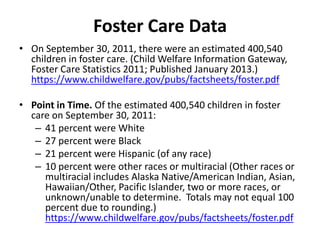
• On September 30, 2011, there were an estimated 400,540
children in foster care. (Child Welfare Information Gateway,
Foster Care Statistics 2011; Published January 2013.)
https://www.childwelfare.gov/pubs/factsheets/foster.pdf
• Point in Time. Of the estimated 400,540 children in foster
care on September 30, 2011:
– 41 percent were White
– 27 percent were Black
– 21 percent were Hispanic (of any race)
– 10 percent were other races or multiracial (Other races or
multiracial includes Alaska Native/American Indian, Asian,
Hawaiian/Other, Pacific Islander, two or more races, or
unknown/unable to determine. Totals may not equal 100
percent due to rounding.)
https://www.childwelfare.gov/pubs/factsheets/foster.pdf
Foster Care Data
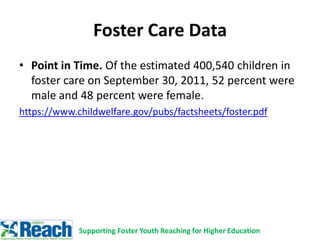
• Point in Time. Of the estimated 400,540 children in
foster care on September 30, 2011, 52 percent were
male and 48 percent were female.
https://www.childwelfare.gov/pubs/factsheets/foster.pdf
Foster Care Data
Supporting Foster Youth Reaching for Higher Education
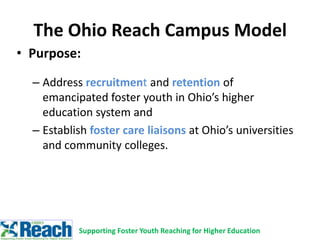
• Purpose:
– Address recruitment and retention of
emancipated foster youth in Ohio’s higher
education system and
– Establish foster care liaisons at Ohio’s universities
and community colleges.
The Ohio Reach Campus Model
Supporting Foster Youth Reaching for Higher Education
Foster Youth & College Retention
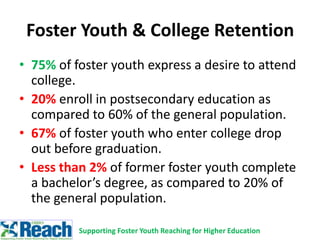
• 75% of foster youth express a desire to attend
college.
• 20% enroll in postsecondary education as
compared to 60% of the general population.
• 67% of foster youth who enter college drop
out before graduation.
• Less than 2% of former foster youth complete
a bachelor’s degree, as compared to 20% of
the general population.
Supporting Foster Youth Reaching for Higher Education
Barriers to College
• Cost to Attend College
• Navigating the Bureaucracy of Processes
• Lack of Continuity of High School Education
• College Preparatory Courses
• Academic Readiness & Preparedness
• Lack of Family Support
• First Generation Students
• Higher Education’s Unawareness of Needs
• Students’ Unawareness of Support/Resources
• Single Parents Providing Support to Relatives
Supporting Foster Youth Reaching for Higher Education
FAFSA
• “Independent Student”*
– Student who is an orphan, in foster care or ward
of the court, at anytime when the student was 13
years of age or older; or
– Student who is an emancipated minor or is in legal
guardianship as determined by the court in their
state of legal residence; or
– Applicant is verified as an unaccompanied youth
who is homeless or a risk of homelessness and
self-supporting
Supporting Foster Youth Reaching for Higher Education
*All Financial Aid Resources Available: ETV, Foster Care to Success, Need Based College
Funds, Private Funds etc.
Access to College
• Do students see and hear messaging that
college is a possibility?
• Do students know about your campus services
and support?
• Do you invite students and their caregivers to
campus for a tour and meet & greet?
Supporting Foster Youth Reaching for Higher Education
Retention in College
• Mentoring/Study Coaches
• On-Campus Employment
• Support Services & Resources
• Utilization of Services & Resources to Meet
Needs
• Attending Classes/Completion of Work
• Engagement in the University Community
• Living on Campus Year Round
Supporting Foster Youth Reaching for Higher Education
Who Are Campus Liaisons?
• They are the “Hub” on the Wheel!
• Generally, a FTE staff “point-person!”
• Generally in Student Affairs!
• Students need a “trusted staff person” who has
primary responsibility to identify them and
consistently provide guidance in navigating higher
education.
Appendix B: Supporting Success: Improving Higher Education Outcomes for Youth from
Foster Care.
Supporting Foster Youth Reaching for Higher Education
Do You Want to Be A Campus Liaison?
• Are you familiar with the needs of foster youth who
transition to higher education?
• Are you willing & able to advocate for support throughout
your university/college community?
• Do you have knowledge of available resources available
within the university/college & ability to network
effectively?
• Do you have demonstrated communication skills and the
ability/capacity to interact with students from diverse
backgrounds?
Research Brief: Building a Campus Support Network for Students Emerging from Foster Care,
Education Advisory Board, Washington, DC, June 10, 2009
Supporting Foster Youth Reaching for Higher Education
What Do Campus Liaisons Do?
• Provide support, guidance and assistance to students
on a daily basis
• Collaborate with Child Welfare partners to recruit
foster youth to apply to your university/college &
identify college students with foster care backgrounds
• Educate campus colleagues about issues challenging
foster youth on campus
• Post an Ohio Reach symbol at your office and/or add
Foster Care Liaison to your business cards
Research Brief: Building a Campus Support Network for Students Emerging from Foster Care,
Education Advisory Board, Washington, DC, June 10, 2009
Supporting Foster Youth Reaching for Higher Education
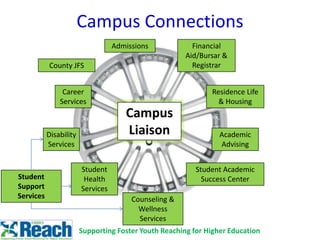
Campus Connections
Supporting Foster Youth Reaching for Higher Education
Campus
Liaison
Financial
Aid/Bursar &
Registrar
Admissions
Career
Services
Residence Life
& Housing
Disability
Services
Counseling &
Wellness
Services
Student Academic
Success Center
Academic
Advising
Student
Support
Services
Student
Health
Services
County JFS
• Differences Between High School & College:
– Academic
– Financial
– Personal/Self-Management
Campus Connections
• Wright State University Resources:
• Student Support Services
• Counseling & Wellness Services
• Office of Disability Services
• Student Academic Success Center/Tutoring Services
• Independent Scholars Network
Collaboration Opportunities!
• Collaborate with Child Welfare professionals
to identify prospective and current students
• Collaborate with Child Welfare and
Community Colleges to Educate Regarding
Community Resources
• Create an Advisory Board or Committee of
Advocates
• Include & Celebrate Students Whenever
Possible!
Supporting Foster Youth Reaching for Higher Education
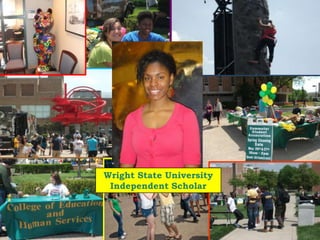
Wright State University
Independent Scholar
Wright State University’s
Independent Scholars Network
Mission
The Wright State University Independent Scholars
Network exists to provide resources and services
which enhance the academic and social-cultural
experiences of a student who emancipates from
foster care into higher education.
Vision
Wright State University will be known as a national
model for transforming the lives of Independent
Scholars as they prepare to participate in and
engage with diverse and global communities
around the world.
Value
Students
We value students and will carefully identify services and support to match
individual needs.
Achievement
We value achievement and recognize that students are unique and will rise to
meet and exceed standards of excellence on an individual basis.
Engagement
We value engaging students at every level of their higher education academic
experience.
Wright State University’s
Independent Scholars Network
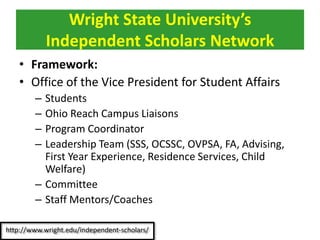
• Framework:
• Office of the Vice President for Student Affairs
– Students
– Ohio Reach Campus Liaisons
– Program Coordinator
– Leadership Team (SSS, OCSSC, OVPSA, FA, Advising,
First Year Experience, Residence Services, Child
Welfare)
– Committee
– Staff Mentors/Coaches
Wright State University’s
Independent Scholars Network
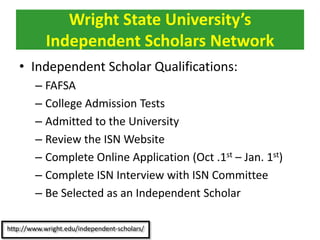
• Independent Scholar Qualifications:
– FAFSA
– College Admission Tests
– Admitted to the University
– Review the ISN Website
– Complete Online Application (Oct .1st – Jan. 1st)
– Complete ISN Interview with ISN Committee
– Be Selected as an Independent Scholar
Wright State University’s
Independent Scholars Network
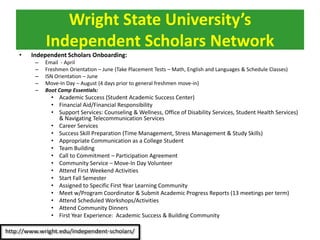
• Independent Scholars Onboarding:
– Email - April
– Freshmen Orientation – June (Take Placement Tests – Math, English and Languages & Schedule Classes)
– ISN Orientation – June
– Move-In Day – August (4 days prior to general freshmen move-in)
– Boot Camp Essentials:
• Academic Success (Student Academic Success Center)
• Financial Aid/Financial Responsibility
• Support Services: Counseling & Wellness, Office of Disability Services, Student Health Services)
& Navigating Telecommunication Services
• Career Services
• Success Skill Preparation (Time Management, Stress Management & Study Skills)
• Appropriate Communication as a College Student
• Team Building
• Call to Commitment – Participation Agreement
• Community Service – Move-In Day Volunteer
• Attend First Weekend Activities
• Start Fall Semester
• Assigned to Specific First Year Learning Community
• Meet w/Program Coordinator & Submit Academic Progress Reports (13 meetings per term)
• Attend Scheduled Workshops/Activities
• Attend Community Dinners
• First Year Experience: Academic Success & Building Community
Wright State University’s
Independent Scholars Network
• Expected Outcomes:
– Reinforce & Support Academic Success
– Bridge Campus & Community Connections
– Build Social Cultural Awareness
– Enhance Leadership Potential
– Prepare for Career/Employment
– Prepare for Post Baccalaureate Study
Wright State University’s
Independent Scholars Network
• Ohio Reach’s Purpose:
– Addresses
recruitment and
retention of
emancipated foster
youth in Ohio’s higher
education system and
– Establish foster care
liaisons at Ohio’s
universities and
community colleges.
Wright State University’s
Independent Scholars Network
• Wright State University’s
Independent Scholars Network:
• Actively recruits prospective
students through collaborative
networks
• Provides initiatives, services and
resources to enhance
retention/persistence
• Has 2 foster care liaisons and a
host of advocacy partners who
are committed to changing the
experience for former foster
youth in higher education at WSU
WSU Friendship Food Pantry
History
• Identified Need & Connected with the DFB
• Received initial financial support from WSU
• Added an AmeriCorps Vista Employee
• Volunteer & Donation Supported
• Graduate Student Coordinator
• Collaborated with Student Support Services
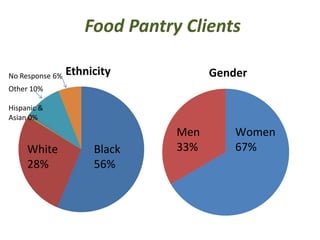
Food Pantry Clients
Ethnicity
Black
56%
White
28%
Gender
Women
67%
Men
33%
No Response 6%
Other 10%
Hispanic &
Asian 0%
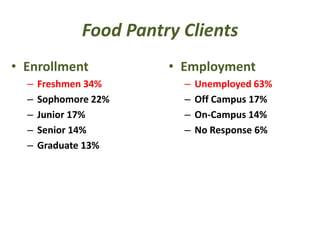
Food Pantry Clients
• Enrollment
– Freshmen 34%
– Sophomore 22%
– Junior 17%
– Senior 14%
– Graduate 13%
• Employment
– Unemployed 63%
– Off Campus 17%
– On-Campus 14%
– No Response 6%
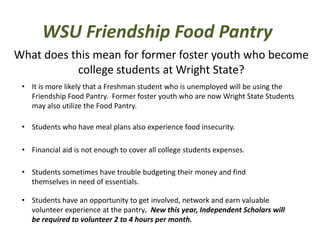
WSU Friendship Food Pantry
What does this mean for former foster youth who become
college students at Wright State?
• It is more likely that a Freshman student who is unemployed will be using the
Friendship Food Pantry. Former foster youth who are now Wright State Students
may also utilize the Food Pantry.
• Students who have meal plans also experience food insecurity.
• Financial aid is not enough to cover all college students expenses.
• Students sometimes have trouble budgeting their money and find
themselves in need of essentials.
• Students have an opportunity to get involved, network and earn valuable
volunteer experience at the pantry. New this year, Independent Scholars will
be required to volunteer 2 to 4 hours per month.
Questions?

2013 ohio reach campus model

  • 1.
    Paving the Roadto Higher Education: The Ohio Reach Campus Model May 13, 2013 Simone G. Polk, AVP, Student Services Mary K. Deedrick, Director, Student Support Services Felix E. Torres, Graduate Assistant, SAHE & Friendship Food Pantry Coordinator Wright State University, Dayton, Ohio Supporting Foster Youth Reaching for Higher Education
  • 2.
    Paving the Roadto Higher Education: The Ohio Reach Campus Model • Today’s Learning Outcomes: – Share the Ohio Reach Campus Model – Share a “Pathway Model” to Higher Education – Share steps for Successful Transition to Higher Education – Share information about the Wright State University Independent Scholars Network & Support Services available at WSU Supporting Foster Youth Reaching for Higher Education
  • 3.
    Essential Resources • It’sMy Life: Postsecondary Education & Training – A resource for child welfare professionals. (Casey Family Programs) • Support SUCCESS: Improving higher education outcomes for students from foster care (A framework for program enhancement 2010. (Casey Family Programs) • Research Brief: Building a Campus Support Network for Students Emerging from Foster Care, Education Advisory Board, June 10, 2009. (Casey Family Programs) • Providing Effective Financial Aid Assistance to Students from Foster Care & Unaccompanied Homeless Youth: A Key to Higher Education Access & Success. (Version 2.0) (Casey Family Programs) http://www.casey.org/resources/publications/directory/subject/Education_post.html Supporting Foster Youth Reaching for Higher Education
  • 4.
    • On September30, 2011, there were an estimated 400,540 children in foster care. (Child Welfare Information Gateway, Foster Care Statistics 2011; Published January 2013.) https://www.childwelfare.gov/pubs/factsheets/foster.pdf • Point in Time. Of the estimated 400,540 children in foster care on September 30, 2011: – 41 percent were White – 27 percent were Black – 21 percent were Hispanic (of any race) – 10 percent were other races or multiracial (Other races or multiracial includes Alaska Native/American Indian, Asian, Hawaiian/Other, Pacific Islander, two or more races, or unknown/unable to determine. Totals may not equal 100 percent due to rounding.) https://www.childwelfare.gov/pubs/factsheets/foster.pdf Foster Care Data
  • 5.
    • Point inTime. Of the estimated 400,540 children in foster care on September 30, 2011, 52 percent were male and 48 percent were female. https://www.childwelfare.gov/pubs/factsheets/foster.pdf Foster Care Data Supporting Foster Youth Reaching for Higher Education
  • 6.
    • Purpose: – Addressrecruitment and retention of emancipated foster youth in Ohio’s higher education system and – Establish foster care liaisons at Ohio’s universities and community colleges. The Ohio Reach Campus Model Supporting Foster Youth Reaching for Higher Education
  • 7.
    Foster Youth &College Retention • 75% of foster youth express a desire to attend college. • 20% enroll in postsecondary education as compared to 60% of the general population. • 67% of foster youth who enter college drop out before graduation. • Less than 2% of former foster youth complete a bachelor’s degree, as compared to 20% of the general population. Supporting Foster Youth Reaching for Higher Education
  • 8.
    Barriers to College •Cost to Attend College • Navigating the Bureaucracy of Processes • Lack of Continuity of High School Education • College Preparatory Courses • Academic Readiness & Preparedness • Lack of Family Support • First Generation Students • Higher Education’s Unawareness of Needs • Students’ Unawareness of Support/Resources • Single Parents Providing Support to Relatives Supporting Foster Youth Reaching for Higher Education
  • 9.
    FAFSA • “Independent Student”* –Student who is an orphan, in foster care or ward of the court, at anytime when the student was 13 years of age or older; or – Student who is an emancipated minor or is in legal guardianship as determined by the court in their state of legal residence; or – Applicant is verified as an unaccompanied youth who is homeless or a risk of homelessness and self-supporting Supporting Foster Youth Reaching for Higher Education *All Financial Aid Resources Available: ETV, Foster Care to Success, Need Based College Funds, Private Funds etc.
  • 10.
    Access to College •Do students see and hear messaging that college is a possibility? • Do students know about your campus services and support? • Do you invite students and their caregivers to campus for a tour and meet & greet? Supporting Foster Youth Reaching for Higher Education
  • 11.
    Retention in College •Mentoring/Study Coaches • On-Campus Employment • Support Services & Resources • Utilization of Services & Resources to Meet Needs • Attending Classes/Completion of Work • Engagement in the University Community • Living on Campus Year Round Supporting Foster Youth Reaching for Higher Education
  • 12.
    Who Are CampusLiaisons? • They are the “Hub” on the Wheel! • Generally, a FTE staff “point-person!” • Generally in Student Affairs! • Students need a “trusted staff person” who has primary responsibility to identify them and consistently provide guidance in navigating higher education. Appendix B: Supporting Success: Improving Higher Education Outcomes for Youth from Foster Care. Supporting Foster Youth Reaching for Higher Education
  • 13.
    Do You Wantto Be A Campus Liaison? • Are you familiar with the needs of foster youth who transition to higher education? • Are you willing & able to advocate for support throughout your university/college community? • Do you have knowledge of available resources available within the university/college & ability to network effectively? • Do you have demonstrated communication skills and the ability/capacity to interact with students from diverse backgrounds? Research Brief: Building a Campus Support Network for Students Emerging from Foster Care, Education Advisory Board, Washington, DC, June 10, 2009 Supporting Foster Youth Reaching for Higher Education
  • 14.
    What Do CampusLiaisons Do? • Provide support, guidance and assistance to students on a daily basis • Collaborate with Child Welfare partners to recruit foster youth to apply to your university/college & identify college students with foster care backgrounds • Educate campus colleagues about issues challenging foster youth on campus • Post an Ohio Reach symbol at your office and/or add Foster Care Liaison to your business cards Research Brief: Building a Campus Support Network for Students Emerging from Foster Care, Education Advisory Board, Washington, DC, June 10, 2009 Supporting Foster Youth Reaching for Higher Education
  • 15.
    Campus Connections Supporting FosterYouth Reaching for Higher Education Campus Liaison Financial Aid/Bursar & Registrar Admissions Career Services Residence Life & Housing Disability Services Counseling & Wellness Services Student Academic Success Center Academic Advising Student Support Services Student Health Services County JFS
  • 16.
    • Differences BetweenHigh School & College: – Academic – Financial – Personal/Self-Management Campus Connections • Wright State University Resources: • Student Support Services • Counseling & Wellness Services • Office of Disability Services • Student Academic Success Center/Tutoring Services • Independent Scholars Network
  • 17.
    Collaboration Opportunities! • Collaboratewith Child Welfare professionals to identify prospective and current students • Collaborate with Child Welfare and Community Colleges to Educate Regarding Community Resources • Create an Advisory Board or Committee of Advocates • Include & Celebrate Students Whenever Possible! Supporting Foster Youth Reaching for Higher Education
  • 18.
  • 19.
    Wright State University’s IndependentScholars Network Mission The Wright State University Independent Scholars Network exists to provide resources and services which enhance the academic and social-cultural experiences of a student who emancipates from foster care into higher education. Vision Wright State University will be known as a national model for transforming the lives of Independent Scholars as they prepare to participate in and engage with diverse and global communities around the world.
  • 20.
    Value Students We value studentsand will carefully identify services and support to match individual needs. Achievement We value achievement and recognize that students are unique and will rise to meet and exceed standards of excellence on an individual basis. Engagement We value engaging students at every level of their higher education academic experience. Wright State University’s Independent Scholars Network
  • 21.
    • Framework: • Officeof the Vice President for Student Affairs – Students – Ohio Reach Campus Liaisons – Program Coordinator – Leadership Team (SSS, OCSSC, OVPSA, FA, Advising, First Year Experience, Residence Services, Child Welfare) – Committee – Staff Mentors/Coaches Wright State University’s Independent Scholars Network
  • 22.
    • Independent ScholarQualifications: – FAFSA – College Admission Tests – Admitted to the University – Review the ISN Website – Complete Online Application (Oct .1st – Jan. 1st) – Complete ISN Interview with ISN Committee – Be Selected as an Independent Scholar Wright State University’s Independent Scholars Network
  • 23.
    • Independent ScholarsOnboarding: – Email - April – Freshmen Orientation – June (Take Placement Tests – Math, English and Languages & Schedule Classes) – ISN Orientation – June – Move-In Day – August (4 days prior to general freshmen move-in) – Boot Camp Essentials: • Academic Success (Student Academic Success Center) • Financial Aid/Financial Responsibility • Support Services: Counseling & Wellness, Office of Disability Services, Student Health Services) & Navigating Telecommunication Services • Career Services • Success Skill Preparation (Time Management, Stress Management & Study Skills) • Appropriate Communication as a College Student • Team Building • Call to Commitment – Participation Agreement • Community Service – Move-In Day Volunteer • Attend First Weekend Activities • Start Fall Semester • Assigned to Specific First Year Learning Community • Meet w/Program Coordinator & Submit Academic Progress Reports (13 meetings per term) • Attend Scheduled Workshops/Activities • Attend Community Dinners • First Year Experience: Academic Success & Building Community Wright State University’s Independent Scholars Network
  • 24.
    • Expected Outcomes: –Reinforce & Support Academic Success – Bridge Campus & Community Connections – Build Social Cultural Awareness – Enhance Leadership Potential – Prepare for Career/Employment – Prepare for Post Baccalaureate Study Wright State University’s Independent Scholars Network
  • 25.
    • Ohio Reach’sPurpose: – Addresses recruitment and retention of emancipated foster youth in Ohio’s higher education system and – Establish foster care liaisons at Ohio’s universities and community colleges. Wright State University’s Independent Scholars Network • Wright State University’s Independent Scholars Network: • Actively recruits prospective students through collaborative networks • Provides initiatives, services and resources to enhance retention/persistence • Has 2 foster care liaisons and a host of advocacy partners who are committed to changing the experience for former foster youth in higher education at WSU
  • 26.
    WSU Friendship FoodPantry History • Identified Need & Connected with the DFB • Received initial financial support from WSU • Added an AmeriCorps Vista Employee • Volunteer & Donation Supported • Graduate Student Coordinator • Collaborated with Student Support Services
  • 27.
  • 28.
    Food Pantry Clients •Enrollment – Freshmen 34% – Sophomore 22% – Junior 17% – Senior 14% – Graduate 13% • Employment – Unemployed 63% – Off Campus 17% – On-Campus 14% – No Response 6%
  • 29.
    WSU Friendship FoodPantry What does this mean for former foster youth who become college students at Wright State? • It is more likely that a Freshman student who is unemployed will be using the Friendship Food Pantry. Former foster youth who are now Wright State Students may also utilize the Food Pantry. • Students who have meal plans also experience food insecurity. • Financial aid is not enough to cover all college students expenses. • Students sometimes have trouble budgeting their money and find themselves in need of essentials. • Students have an opportunity to get involved, network and earn valuable volunteer experience at the pantry. New this year, Independent Scholars will be required to volunteer 2 to 4 hours per month.
  • 30.

Editor's Notes

  • #17 Katie D. Slide
  • #27 Introduce myself. Identify the need by demonstrating food insecurity on campus -Conducting surveys was the method utilized at WSU. Two surveys done - resulted in 50 % of students have experienced food insecurity at one point during higher education. Connecting with the DFB provided the foundation of how the food pantry is currently operating. They provide guidelines and regulate how food should be handled. By completing the surveys it may it easier to propose a need of a financial contribution from the university that will help kick start the food pantry. Additionally, the food pantry needed to be staffed, WSU was able to secure an Americorp Vista employee. Since Vista employee are not permanent, WSU had to find a way to staff someone for the food pantry after the Vista employee was gone and they did this by creating a Graduate Student Coordinator position. Given that a Graduate Student works at a part time basis, it is important that efforts to promote volunteerism at the food pantry are met. Many students, staff and faculty are or have volunteered at the food pantry. With the help of volunteers we have been able to connect the community with the food pantry by creating donation opportunities of necessary items to maintain the food pantry stocked. Finally, to expand the food pantry services, we have decided to collaborate with student support services. Student Support Services has the capabilities to access the food pantry at any time providing an efficient service to our student population.
  • #28 The ethnicity pie chart demonstrates a strong African American participation, Caucasian following and other ethnicities as a small sample. The gender pie chart is indicative of a strong women participation. These two pie charts are helpful tools to meet the needs of this specific population.
  • #29 Users of the pantry are predominantly Freshman and Sophomore. Coincides with the students adjustment period of becoming an adult and the challenges that involves. Also, A high amount of users have indicated not being employed. Very significant amount and we have taken some first steps to meet this situation by having information of career services events at the food pantry.
  • #30 Independent Scholar Network students volunteer as a part of their first year experience to assist them with developing communication skills, interacting with other students, building work ethic, team work experience and build their resume!