Protecting Your Business: Who’s
Profit is it Anyway?
Fraud Prevention for Business
Owners


               “Providing businesses the prescription for enhanced profit”
Alan Greggo CPP, CFE
• Consultant


• Author


• Senior Loss Prevention Leadership
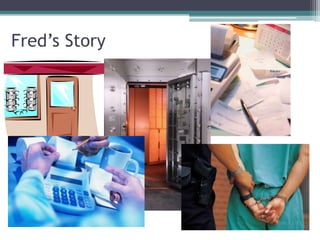
Fred’s Story
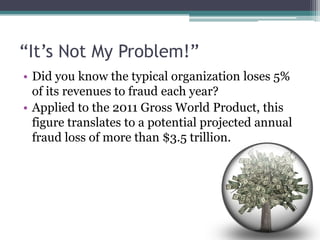
“It’s Not My Problem!”
• Did you know the typical organization loses 5%
  of its revenues to fraud each year?
• Applied to the 2011 Gross World Product, this
  figure translates to a potential projected annual
  fraud loss of more than $3.5 trillion.
“It’s Not My Problem…Is It?”
• The median loss caused by occupation fraud
  cases in the ACFE study titled the “Report to the
  Nations”, was $140,000 and 1/5th of reported
  cases caused losses of at least $1 million!
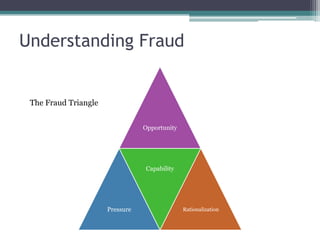
Understanding Fraud


 The Fraud Triangle


                                 Opportunity


                                 Capability


                      Pressure                 Rationalization
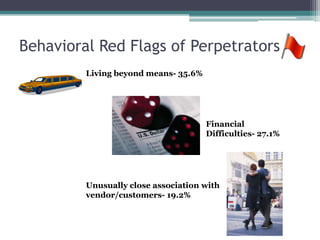
Behavioral Red Flags of Perpetrators
         Living beyond means- 35.6%


                                      Financial
                                      Difficulties- 27.1%


         Unusually close association with
         vendor/customers- 19.2%
Behavioral Red Flags of Perpetrators

                     Control Issues, Unwillingness to
                     share duties- 18.2%


Divorce/family problems-
14.8%


                           Wheeler-Dealer
                           Attitude- 14.8%
Behavioral Red Flags of Perpetrators
                   Irritability, suspiciousness
                   or defensiveness- 12.6%


                                         Addiction problems- 8.4%


   Past Employment- related problems- 8.1%
Behavioral Red Flags of Perpetrators
            Complained about inadequate pay-7.9%


                               Refusal to take vacations- 6.5%


    Excessive pressure within the organization-
    6.5%
Oh-My!! I’ve seen these!

• Red flags by themselves don’t mean an employee
  is making a bad choice about your business.
• When you start to see patterns forming or
  multiple red flags, ensure your fraud controls
  are being adhered to and watch for unusual
  behavior.
• Don’t confront an employee head on without
  evidence of wrong doing; get help from an expert
  investigator.
Most employees want to do well
• Be aware of Goal Incongruence
• Which is: Management setting lofty targets and
  goals and expect the employee to achieve them
  at all cost. The employee feels their future, their
  job is on the line.
• Employees want to succeed and please their
  manager and the company.
• If the outcome looks hopeless, the employee
  starts to rationalize (see fraud triangle).
CFE/ Investigator Wisdom: For FREE
• People only comply with rules they
  think are fair!
CFE/ Investigator Wisdom: For FREE
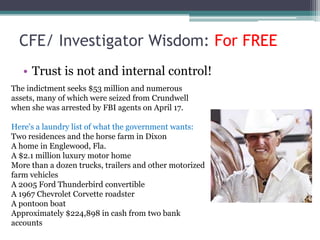
   • Trust is not and internal control!
The indictment seeks $53 million and numerous
assets, many of which were seized from Crundwell
when she was arrested by FBI agents on April 17.

Here's a laundry list of what the government wants:
Two residences and the horse farm in Dixon
A home in Englewood, Fla.
A $2.1 million luxury motor home
More than a dozen trucks, trailers and other motorized
farm vehicles
A 2005 Ford Thunderbird convertible
A 1967 Chevrolet Corvette roadster
A pontoon boat
Approximately $224,898 in cash from two bank
accounts
CFE/ Investigator Wisdom: For FREE
• Anytime you change a system, people will always
  change their behavior; What’s possible?


• If you want people to do the right
  thing you have to make it
  personal.
Protecting Your Business- Physical
Controls
• Pre-employment background checks
• Policies on dishonest and unethical behavior
• Supported from top management?
• Business Abuse Hotline; anonymous way to
  report suspected violations of the ethics and
  anti-fraud policies
• Restricted access to areas containing sensitive
  documents
• Maintain a system for providing an audit trail
Protecting Your Business-Physical
Controls
• Restricted access to computer systems
  (accounting software, inventory, and payroll)
• Restrict access to areas with high value assets
  (shipping, receiving, storerooms, and cash)
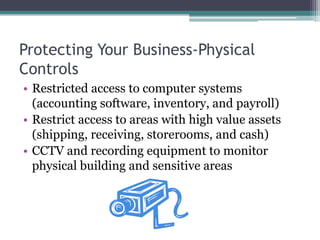
• CCTV and recording equipment to monitor
  physical building and sensitive areas
Protecting Your Business-Physical
Controls
• Conduct random, unannounced audits of
  inventory, cash, expense, purchasing, billing, etc.
  by internal or external auditors
• Prompt investigations of reported incidents of
  fraud
• Educate employees about the importance of
  ethics and anti-fraud programs
Active social networkers


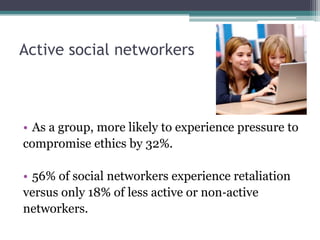
• As a group, more likely to experience pressure to
compromise ethics by 32%.

• 56% of social networkers experience retaliation
versus only 18% of less active or non‐active
networkers.
Top 5 IT Security Best Practices for
Small Merchants
• Understand sensitive data, where it is and who is
  responsible for its protection.

• Avoid storing sensitive data; if required to do so, secure
  it.

• Protect perimeters with firewalls.

• Fortify interiors with people, procedures and technology.

• Get to know service providers and their level of PCI
  compliance.
*From a white paper published by payment security and compliance solutions provider ControlScan
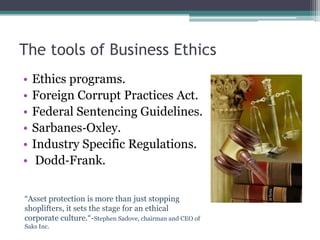
The tools of Business Ethics
•   Ethics programs.
•   Foreign Corrupt Practices Act.
•   Federal Sentencing Guidelines.
•   Sarbanes‐Oxley.
•   Industry Specific Regulations.
•    Dodd‐Frank.

“Asset protection is more than just stopping
shoplifters, it sets the stage for an ethical
corporate culture.“-Stephen Sadove, chairman and CEO of
Saks Inc.
7 Principles of Business Ethics

•   Be Trustful.
•   Keep an open mind.
•   Meet obligations.
•   Have clear documents.
•   Become community involved.
•   Maintain accounting control.
•   Be respectful.
Questions?


Alan Greggo
Easy Risk Assessment- 11 questions to consider
 about your business:
 http://profitrxllc.com/pages/RiskAssessment

Phone: (513) 236-2642

2012 protecting your business

  • 1.
    Protecting Your Business:Who’s Profit is it Anyway? Fraud Prevention for Business Owners “Providing businesses the prescription for enhanced profit”
  • 2.
    Alan Greggo CPP,CFE • Consultant • Author • Senior Loss Prevention Leadership
  • 3.
  • 4.
    “It’s Not MyProblem!” • Did you know the typical organization loses 5% of its revenues to fraud each year? • Applied to the 2011 Gross World Product, this figure translates to a potential projected annual fraud loss of more than $3.5 trillion.
  • 5.
    “It’s Not MyProblem…Is It?” • The median loss caused by occupation fraud cases in the ACFE study titled the “Report to the Nations”, was $140,000 and 1/5th of reported cases caused losses of at least $1 million!
  • 6.
    Understanding Fraud TheFraud Triangle Opportunity Capability Pressure Rationalization
  • 7.
    Behavioral Red Flagsof Perpetrators Living beyond means- 35.6% Financial Difficulties- 27.1% Unusually close association with vendor/customers- 19.2%
  • 8.
    Behavioral Red Flagsof Perpetrators Control Issues, Unwillingness to share duties- 18.2% Divorce/family problems- 14.8% Wheeler-Dealer Attitude- 14.8%
  • 9.
    Behavioral Red Flagsof Perpetrators Irritability, suspiciousness or defensiveness- 12.6% Addiction problems- 8.4% Past Employment- related problems- 8.1%
  • 10.
    Behavioral Red Flagsof Perpetrators Complained about inadequate pay-7.9% Refusal to take vacations- 6.5% Excessive pressure within the organization- 6.5%
  • 11.
    Oh-My!! I’ve seenthese! • Red flags by themselves don’t mean an employee is making a bad choice about your business. • When you start to see patterns forming or multiple red flags, ensure your fraud controls are being adhered to and watch for unusual behavior. • Don’t confront an employee head on without evidence of wrong doing; get help from an expert investigator.
  • 12.
    Most employees wantto do well • Be aware of Goal Incongruence • Which is: Management setting lofty targets and goals and expect the employee to achieve them at all cost. The employee feels their future, their job is on the line. • Employees want to succeed and please their manager and the company. • If the outcome looks hopeless, the employee starts to rationalize (see fraud triangle).
  • 13.
    CFE/ Investigator Wisdom:For FREE • People only comply with rules they think are fair!
  • 14.
    CFE/ Investigator Wisdom:For FREE • Trust is not and internal control! The indictment seeks $53 million and numerous assets, many of which were seized from Crundwell when she was arrested by FBI agents on April 17. Here's a laundry list of what the government wants: Two residences and the horse farm in Dixon A home in Englewood, Fla. A $2.1 million luxury motor home More than a dozen trucks, trailers and other motorized farm vehicles A 2005 Ford Thunderbird convertible A 1967 Chevrolet Corvette roadster A pontoon boat Approximately $224,898 in cash from two bank accounts
  • 15.
    CFE/ Investigator Wisdom:For FREE • Anytime you change a system, people will always change their behavior; What’s possible? • If you want people to do the right thing you have to make it personal.
  • 16.
    Protecting Your Business-Physical Controls • Pre-employment background checks • Policies on dishonest and unethical behavior • Supported from top management? • Business Abuse Hotline; anonymous way to report suspected violations of the ethics and anti-fraud policies • Restricted access to areas containing sensitive documents • Maintain a system for providing an audit trail
  • 17.
    Protecting Your Business-Physical Controls •Restricted access to computer systems (accounting software, inventory, and payroll) • Restrict access to areas with high value assets (shipping, receiving, storerooms, and cash) • CCTV and recording equipment to monitor physical building and sensitive areas
  • 18.
    Protecting Your Business-Physical Controls •Conduct random, unannounced audits of inventory, cash, expense, purchasing, billing, etc. by internal or external auditors • Prompt investigations of reported incidents of fraud • Educate employees about the importance of ethics and anti-fraud programs
  • 19.
    Active social networkers •As a group, more likely to experience pressure to compromise ethics by 32%. • 56% of social networkers experience retaliation versus only 18% of less active or non‐active networkers.
  • 20.
    Top 5 ITSecurity Best Practices for Small Merchants • Understand sensitive data, where it is and who is responsible for its protection. • Avoid storing sensitive data; if required to do so, secure it. • Protect perimeters with firewalls. • Fortify interiors with people, procedures and technology. • Get to know service providers and their level of PCI compliance. *From a white paper published by payment security and compliance solutions provider ControlScan
  • 21.
    The tools ofBusiness Ethics • Ethics programs. • Foreign Corrupt Practices Act. • Federal Sentencing Guidelines. • Sarbanes‐Oxley. • Industry Specific Regulations. • Dodd‐Frank. “Asset protection is more than just stopping shoplifters, it sets the stage for an ethical corporate culture.“-Stephen Sadove, chairman and CEO of Saks Inc.
  • 22.
    7 Principles ofBusiness Ethics • Be Trustful. • Keep an open mind. • Meet obligations. • Have clear documents. • Become community involved. • Maintain accounting control. • Be respectful.
  • 23.
    Questions? Alan Greggo Easy RiskAssessment- 11 questions to consider about your business: http://profitrxllc.com/pages/RiskAssessment Phone: (513) 236-2642

Editor's Notes

  • #17 Do you conduct pre-employment background checks?Are there policies that address dishonest and unethical behavior?Are they supported by top management?Does the organization provide an anonymous way to report suspected violations of the ethics and anti-fraud policies?Does the organization restrict access to areas containing sensitive documents (such as invoices, receipts, journals, ledgers, and checks) and maintain a system for providing an audit trail of access?