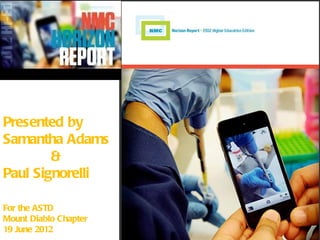
Presented by
Samantha Adams
        &
Paul Signorelli

For the ASTD
Mount Diablo Chapter
19 June 2012
New M ed ia C onsortium :
   Horizon Proj ect


                               2012 K-12 Edition


                            2011 Museum Edition
Horizon Report: M ethod ology
                         “The technol
                                    ogies feat ed in each
                                             ur
                      edit of t NM Hor Repor ar
                          ion he C izon              t e
                           embedded wit a cont
                                       hin       empor y
                                                       ar
                          cont t r ect t r it of
                             ext hat efl s he eal ies
                       t t bot in t spher of higher
                        he ime, h he           e
                        educat and in t word atl ge.”
                              ion       he l ar
Horizon Report:
Key Trend s And C hallenges
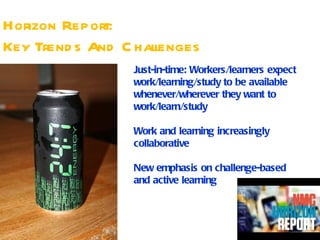
                 Just-in-time: Workers/learners expect
                 work/learning/study to be available
                 whenever/wherever they want to
                 work/learn/study

                 Work and learning increasingly
                 collaborative

                 New emphasis on challenge-based
                 and active learning
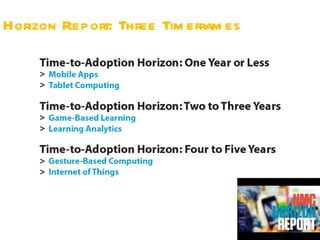
Horizon Report: Three Tim efram es
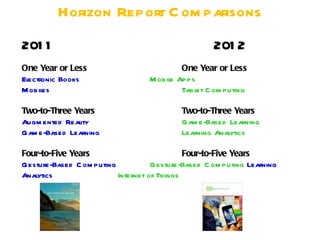
Horizon Report C om parisons
201 1                                               201 2
One Year or Less                           One Year or Less
El
 ectronic Books                    M obil Apps
                                        e
M obil
     es                                    Tabl C om puting
                                               et

Two-to-Three Years                         Two-to-Three Years
Augm ented Reality                         Gam e-Based Learning
Gam e-Based Learning                       Learning Anal
                                                       ytics

Four-to-Five Years                           Four-to-Five Years
Gesture-Based C om puting           Gesture-Based C om puting Learning
Analytics                 Internet of Things
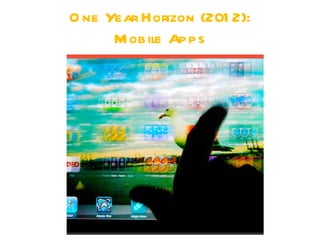
O ne Year Horizon (201 2):
      M obile Apps
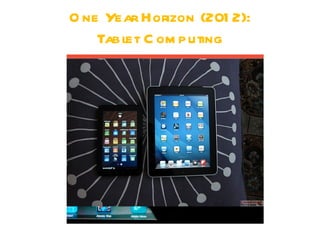
O ne Year Horizon (201 2):
    Tablet C om puting
Two-to-Three Year Horizon (201 3-1 4):
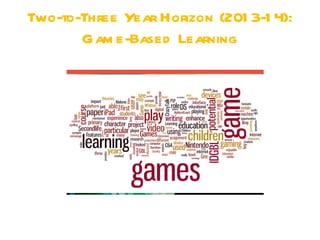
       Gam e-Based Learning
Two-to-Three Year Horizon (201 3-1 4):
         Learning Analytics
Four-to-Five Year Horizon (201 5-1 6):
     Gesture-Based C om puting
Four-to-Five Year Horizon (201 5-1 6):
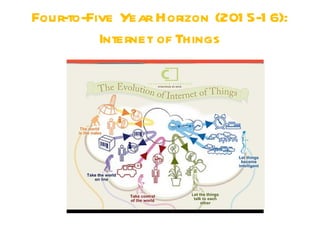
          Internet of Things
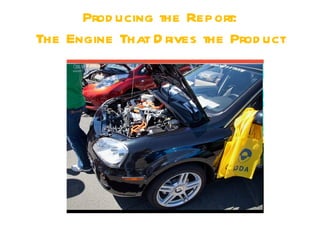
Prod ucing the Report:
The Engine That D rives the Prod uct
C ollaboration and Learning:
       The Intersection
C ollaboration and Learning:
       C rowd sourcing
C ollaboration and Learning:
      Build ing Together
C ollaboration and Learning:
          C reativity
C ollaboration & Learning: The Report
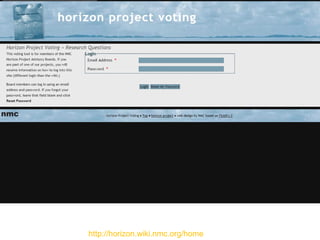
http://horizon.wiki.nmc.org/home
M eeting/ ollaborating in the 21 st C entury:
         C
                            An Ad d end um
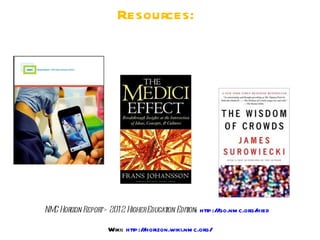
Resources:


NM Hor Repor > 201 2 HigherEducat Edit http:/ go.nm c.org/
  C izon    t                   ion ion:     /            hied

                 Wiki: http:/ horizon.wiki.nm c.org/
                             /
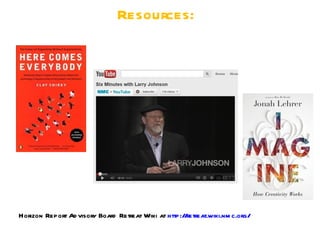
Resources:


Horizon Report Ad visory Board Retreat Wiki at http:/ retreat.wiki.nm c.org/
                                                     /
Questions & Comments
For More Information

                                                        Sam antha Ad am s,
         Paul Signorel & Associates
                       li                        New M ed ia C onsortium D irector of
            1 032 Irving St., #51 4                      C om m unications
          San Francisco, C A 941 22                        51 2.445.4200
                 41 5.681 .5224                        sam antha@ nm c.org
          paul@ paul   signorelli.com                  http:/ www.nm c.org
                                                             /
           http://paulsignorell i.com                  Twitter: @ NM C org
           Twitter: @ paul  signorel li


http://buil ingcreativebrid ges.word press.com
          d
C red its & Acknowled gm ents
                                                    (Images taken from lickr.com unless otherwise noted):


Gl obe and books: From DianeCordell’s photostream at
http:/ www.flickr.com /
       /               photos/ m cord ell 3254589348/
                                d         /              sizes/ / photostream /
                                                                m in/
24/ From Master_Shake_Signal’s photostream at
    4:
http:/ www.flickr.com /
       /               photos/  them astershakesignal/ 5365201 08/   sizes/ / photostream /
                                                                           m in/
Mobile Apps: From NMC Horizon Report > 2012 HiEd Edition at
http:/ www.nm c.org/
       /              publications/ horizon-report-201 2-higher-ed -ed ition
Tablets: From Gadjo_Cardenas_Sevilla’s photostream at http:/ www.flickr.com /
                                                                       /               photos/ j 51 625291 32/
                                                                                              gad o/              sizes/ / photostream /
                                                                                                                        m in/
Gam e-Based Learning: From TJMWatson’s photostream at
http:/ www.flickr.com /
       /               photos/  tessawatson/ 5677232026/    sizes// photostream /
                                                                  l in/
N ew Measurem ent Train: From Jovike’s photostream at http:/ www.flickr.com /
                                                                    /                photos/vk/
                                                                                            j 3941 031 80/  sizes/ / photostream /
                                                                                                                  m in/
Gesture-Based C om puting: From NMC Horizon Report > 2012 HiEd Edition at
http:/ www.nm c.org/
       /              publications/ horizon-report-201 2-higher-ed -ed ition
Internet of Things: From Casaleggio_Associati’s photostream at
http:/ www.flickr.com /
       /               photos/  casaleggio_ associati/543651 5880/    sizes/ / photostream /
                                                                            m in/
Engine of a C od a Electric C ar: From Robert_Couse-Baker’s photostream at
http://www.flickr.com/photos/29233640@N07/6954339178/sizes/m/in/photostream D iving: From JRandallC’s photostream at
http:/ www.flickr.com /
       /               photos/rand al 3629481 295/
                                j     lc/              sizes/ / photostream /
                                                              m in/
Encounters: From DemosD’s photostream at http:/ www.flickr.com /
                                                       /                   photos/ eym os/
                                                                                  d       27681 4991 1 /sizes/ / photostream /
                                                                                                              m in/

Q uestion Marks: From Valerie Everett’s photostream at
http:/ www.flickr.com /
      /                photos/valeriebb/3006348550/sizes/ / photostream /
                                                         m in/
Projects & Links from the 2012 Horizon Report:
 Evernote: http://evernote.com/

 iBooks Author: http://www.apple.com/ibooks-author/

 Drew University’s Wall Street Semester program:
 http://www.drew.edu/news/2011/11/17/ipad-makes-wall-street-debut

 St. Edward’s University Global Social Problems:
 http://academic.stedwards.edu/globalsocialproblems/tag/global-social-probl

 Ikariam: http://en.ikariam.com/

 Collaborative Assessment Platform for Practical Skills at Amrita
 University: http://go.nmc.org/rhymf

 Virtual Autopsy Table: http://go.nmc.org/edaic

 The El Paso Health Sciences Center at Texas Tech University RFID
 System: http://go.nmc.org/qulqx

2012-06-19--Horizon Report, Technology, and Learning

  • 1.
    Presented by Samantha Adams & Paul Signorelli For the ASTD Mount Diablo Chapter 19 June 2012
  • 2.
    New M edia C onsortium : Horizon Proj ect 2012 K-12 Edition 2011 Museum Edition
  • 3.
    Horizon Report: Method ology “The technol ogies feat ed in each ur edit of t NM Hor Repor ar ion he C izon t e embedded wit a cont hin empor y ar cont t r ect t r it of ext hat efl s he eal ies t t bot in t spher of higher he ime, h he e educat and in t word atl ge.” ion he l ar
  • 4.
    Horizon Report: Key Trends And C hallenges Just-in-time: Workers/learners expect work/learning/study to be available whenever/wherever they want to work/learn/study Work and learning increasingly collaborative New emphasis on challenge-based and active learning
  • 5.
  • 6.
    Horizon Report Com parisons 201 1 201 2 One Year or Less One Year or Less El ectronic Books M obil Apps e M obil es Tabl C om puting et Two-to-Three Years Two-to-Three Years Augm ented Reality Gam e-Based Learning Gam e-Based Learning Learning Anal ytics Four-to-Five Years Four-to-Five Years Gesture-Based C om puting Gesture-Based C om puting Learning Analytics Internet of Things
  • 7.
    O ne YearHorizon (201 2): M obile Apps
  • 8.
    O ne YearHorizon (201 2): Tablet C om puting
  • 9.
    Two-to-Three Year Horizon(201 3-1 4): Gam e-Based Learning
  • 10.
    Two-to-Three Year Horizon(201 3-1 4): Learning Analytics
  • 11.
    Four-to-Five Year Horizon(201 5-1 6): Gesture-Based C om puting
  • 12.
    Four-to-Five Year Horizon(201 5-1 6): Internet of Things
  • 13.
    Prod ucing theReport: The Engine That D rives the Prod uct
  • 14.
    C ollaboration andLearning: The Intersection
  • 15.
    C ollaboration andLearning: C rowd sourcing
  • 16.
    C ollaboration andLearning: Build ing Together
  • 17.
    C ollaboration andLearning: C reativity
  • 18.
    C ollaboration &Learning: The Report
  • 19.
  • 20.
  • 21.
  • 22.
  • 23.
  • 24.
  • 25.
  • 26.
    M eeting/ ollaboratingin the 21 st C entury: C An Ad d end um
  • 27.
    Resources: NM Hor Repor> 201 2 HigherEducat Edit http:/ go.nm c.org/ C izon t ion ion: / hied Wiki: http:/ horizon.wiki.nm c.org/ /
  • 28.
    Resources: Horizon Report Advisory Board Retreat Wiki at http:/ retreat.wiki.nm c.org/ /
  • 30.
  • 31.
    For More Information Sam antha Ad am s, Paul Signorel & Associates li New M ed ia C onsortium D irector of 1 032 Irving St., #51 4 C om m unications San Francisco, C A 941 22 51 2.445.4200 41 5.681 .5224 sam antha@ nm c.org paul@ paul signorelli.com http:/ www.nm c.org / http://paulsignorell i.com Twitter: @ NM C org Twitter: @ paul signorel li http://buil ingcreativebrid ges.word press.com d
  • 32.
    C red its& Acknowled gm ents (Images taken from lickr.com unless otherwise noted): Gl obe and books: From DianeCordell’s photostream at http:/ www.flickr.com / / photos/ m cord ell 3254589348/ d / sizes/ / photostream / m in/ 24/ From Master_Shake_Signal’s photostream at 4: http:/ www.flickr.com / / photos/ them astershakesignal/ 5365201 08/ sizes/ / photostream / m in/ Mobile Apps: From NMC Horizon Report > 2012 HiEd Edition at http:/ www.nm c.org/ / publications/ horizon-report-201 2-higher-ed -ed ition Tablets: From Gadjo_Cardenas_Sevilla’s photostream at http:/ www.flickr.com / / photos/ j 51 625291 32/ gad o/ sizes/ / photostream / m in/ Gam e-Based Learning: From TJMWatson’s photostream at http:/ www.flickr.com / / photos/ tessawatson/ 5677232026/ sizes// photostream / l in/ N ew Measurem ent Train: From Jovike’s photostream at http:/ www.flickr.com / / photos/vk/ j 3941 031 80/ sizes/ / photostream / m in/ Gesture-Based C om puting: From NMC Horizon Report > 2012 HiEd Edition at http:/ www.nm c.org/ / publications/ horizon-report-201 2-higher-ed -ed ition Internet of Things: From Casaleggio_Associati’s photostream at http:/ www.flickr.com / / photos/ casaleggio_ associati/543651 5880/ sizes/ / photostream / m in/ Engine of a C od a Electric C ar: From Robert_Couse-Baker’s photostream at http://www.flickr.com/photos/29233640@N07/6954339178/sizes/m/in/photostream D iving: From JRandallC’s photostream at http:/ www.flickr.com / / photos/rand al 3629481 295/ j lc/ sizes/ / photostream / m in/ Encounters: From DemosD’s photostream at http:/ www.flickr.com / / photos/ eym os/ d 27681 4991 1 /sizes/ / photostream / m in/ Q uestion Marks: From Valerie Everett’s photostream at http:/ www.flickr.com / / photos/valeriebb/3006348550/sizes/ / photostream / m in/
  • 33.
    Projects & Linksfrom the 2012 Horizon Report: Evernote: http://evernote.com/ iBooks Author: http://www.apple.com/ibooks-author/ Drew University’s Wall Street Semester program: http://www.drew.edu/news/2011/11/17/ipad-makes-wall-street-debut St. Edward’s University Global Social Problems: http://academic.stedwards.edu/globalsocialproblems/tag/global-social-probl Ikariam: http://en.ikariam.com/ Collaborative Assessment Platform for Practical Skills at Amrita University: http://go.nmc.org/rhymf Virtual Autopsy Table: http://go.nmc.org/edaic The El Paso Health Sciences Center at Texas Tech University RFID System: http://go.nmc.org/qulqx

Editor's Notes

  • #2 As you can already see, this isn ’t going to be your normal presentation on tech trends. We’re using a wonderful new collaborative tech tool (Google+ Hangouts) to review tech tools in training-teaching-learning and see how online collaboration can produce highly respected and effective learning objects like the New Media Consortium’s Horizon Report.   Samantha and I are going to take you on a very quick and circular journey that starts with what ’s currently happening with people, technology, and learning; goes behind the scenes to see how reports like this are produced; and brings us back to our starting point by encouraging you, at every possible moment, to think about how what we’re all discussing can be applied in your own training-teaching-learning efforts.   The obvious anchor for our time together is the 2012 Higher Education edition of the New Media Consortium ’s Horizon Report series, so let’s start with a brief description of what the report is, how it is produced, and what it shows for 2012.
  • #3 From the Horizon Report: The internationally recognized NMC Horizon Report series and regional NMC Technology Outlooks are part of the NMC Horizon Project, a comprehensive research venture established in 2002 that identifies and describes emerging technologies likely to have a large impact over the coming five years in education around the globe. This volume, the NMC Horizon Report: 2012 Higher Education Edition, was again produced in a collaborative effort with the EDUCAUSE Learning Initiative, an EDUCAUSE Program, and examines emerging technologies for their potential impact on teaching, learning, and creative inquiry within the higher education environment.
  • #4 A well-facilitated wiki—which we ’re going to explore a bit during the second half of our time together this evening—brings together advisory board members from around the world to collaborate, discuss, learn, and complete the actions that produce Horizon reports throughout the year. This same process can easily be adapted by any of us interested in using it in our own training-teaching-learning efforts.
  • #5 The 2012 Higher Ed Horizon Report continues the practice of listing key learning trends and challenges, including those highlighted on this slide. It certainly doesn ’t take much thought for all of us to see that these are game-changing trends in terms of how we deliver effective learning to those relying on us. The full list of six trends and five significant challenges are included in more detail on the initial pages of the current report.
  • #6 From the Horizon Report: Each of the three global editions of the NMC Horizon Report — higher education, primary and secondary education, and museum education — highlights six emerging technologies or practices that are likely to enter mainstream use with their focus sectors within three adoption horizons over the next five years.
  • #7 For those of you who joined us for the Horizon Report review last year, here ’s the refresher course. It ’s interesting to note the continuity from one year to the next—which is not always the case, particularly since technology changes so quickly and unexpected slowdowns can delay the projected diffusion of a particular technology from one year to the next.
  • #8 From the Horizon Report: There is a revolution that is taking place in software development that parallels the changes in recent years in the music, publishing, and retail industries. Mass market is giving way to niche market, and with it, the era of highly priced large suites of integrated software is giving way to a new view of what software should be. Smartphones including the iPhone and Android have redefined what we mean by mobile computing, and in the past three to four years, the small, often simple, low cost software extensions to these devices — apps — have become a hotbed of development. New tools are free or sell for as little as 99 cents, and anyone can be a developer. A popular app can see millions of downloads in a short time, and that potential market has spawned a flood of creativity that is instantly apparent in the extensive collections available in the app stores — themselves a new way of delivering software that reduces distribution and marketing costs significantly. Apple ’s app store opened in July 2008; Google ’s followed in October of that year. Since then, simple but useful apps have found their way into almost every form of human endeavor.
  • #9 From the Horizon Report: In the past year, advances in tablet computers have captured the imagination of educators around the world. Led by the incredible success of the iPad, which in the fourth quarter of 2011 was selling at the rate of more than 3 million units a month, other similar devices such as the Samsung Galaxy and Sony ’s Tablet S have also begun to enter this rapidly growing new market. In the process, tablets (a form that is distinct from tablet PCs) have come to be viewed as not just a new category of mobile devices, but indeed a new technology in its own right — one that blends features of laptops, smartphones, and earlier tablet computers with always-connected Internet, and thousands of apps with which to personalize the experience. As these new devices have become more used and understood, it is clear that they are independent and distinct from other mobile devices such as smartphones, e-readers, or tablet PCs. With significantly larger screens and richer gestured-based interfaces than their smartphone predecessors, they are ideal tools for sharing content, videos, images, and presentations because they are easy for anyone to use, visually compelling, and highly portable.
  • #10 From the Horizon Report: Game-based learning has gained considerable traction since 2003, when James Gee began to describe the impact of game play on cognitive development. Since then, research, and interest in, the potential of gaming on learning has exploded, as has the diversity of games themselves, with the emergence of serious games as a genre, the proliferation of gaming platforms, and the evolution of games on mobile devices. Developers and researchers are working in every area of game-based learning, including games that are goal-oriented; social game environments; non-digital games that are easy to construct and play; games developed expressly for education; and commercial games that lend themselves to refining team and group skills. Role-playing, collaborative problem solving, and other forms of simulated experiences are recognized for having
  • #11 From the Horizon Report: Learning analytics refers to the interpretation of a wide range of data produced by and gathered on behalf of students in order to assess academic progress, predict future performance, and spot potential issues. Data are collected from explicit student actions, such as completing assignments and taking exams, and from tacit actions, including online social interactions, extracurricular activities, posts on discussion forums, and other activities that are not directly assessed as part of the student ’s educational progress. The goal of learning analytics is to enable teachers and schools to tailor educational opportunities to each student ’s level of need and ability in close-to-real time. Learning analytics promises to harness the power of advances in data mining, interpretation, and modeling to improve understandings of teaching and learning, and to tailor education to individual students more effectively. Still in its early stages, learning analytics responds to calls for accountability on campuses and aims to leverage the vast amount of data produced by students in academic activities.
  • #12 From the Horizon Report: It is already common to interact with a new class of devices entirely by using natural movements and gestures. The Microsoft Surface, Apple ’s iOS devices (iPad, iPhone and iPod Touch), and other gesture-based systems accept input in the form of taps, swipes, and other ways of touching. The Nintendo Wii and Microsoft ’s Kinect system extend that to hand and arm motions, or body movement. These are the first in a growing array of alternative input devices that allow computers to recognize and interpret natural physical gestures as a means of control. Gesture-based computing allows users to engage in virtual activities with motions and movements similar to what they would use in the real world, manipulating content intuitively. The idea that simple gestures and natural, comfortable motions can be used to control computers is opening the way to a host of input devices that look and feel very different from the keyboard and mouse — and that are increasingly enabling our devices to infer meaning from the movements and gestures we make.
  • #13 From the Horizon Report: The Internet of Things has become a sort of shorthand for network-aware smart objects that connect the physical world with the world of information. A smart object has four key attributes: it is small, and thus easy to attach to almost anything; it has a unique identifier; it has a small store of data or information; and it has a way to communicate that information to an external device on demand. The Internet of Things extends that concept by using TCP/IP as the means to convey the information, thus making objects addressable (and findable) on the Internet. Objects that carry information with them have long been used for the monitoring of sensitive equipment or materials, point-of-sale purchases, passport tracking, inventory management, identification, and similar applications. Smart objects are the next generation of those technologies — they “know” about a certain kind of information, such as cost, age, temperature, color, pressure, or humidity — and can pass that information along easily and instantly. They can be used to digitally manage physical objects, monitor their status, track them throughout their lifespan, alert someone when they are in danger of being damaged or spoiled — or even to annotate them with descriptions, instructions, warranties, tutorials, photographs, connections to other objects, and any other kind of contextual information imaginable. The Internet of Things would allow easy access to these data.
  • #14 If this were just about the tech trends that are affecting learners who are on their way into our workplaces, we ’d be done. But there’s obviously an even more intriguing story to be told, and that requires that we go under the hood a bit, so let’s begin by taking a brief step back to some sources that are not cited in the report, but certainly provide the sort of broad foundations needed to produce a report/learning objective like the one we’ve just reviewed. And these resources we’re about to briefly review can also be foundations for much of what we do in our own training-teaching-learning.
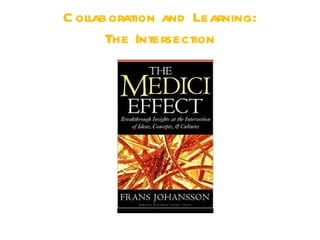
  • #15 Frans Johansson ’s wonderful book describes how when people from different backgrounds briefly come together—for example, Johansson’s starting point—a group of merchant marines who share ideas in a Greek tavern before parting and disseminating the results of their conversations with others all over the world. Through these encounters, magic happens.
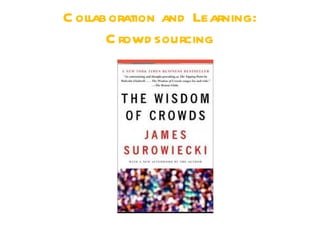
  • #16 James Surowiecki ’s fascinating book time and time again reminds us that when you start with a diverse enough group of the right people—no groupthink here, mind you—they produce more reliable results than any individual member of a group consistently produces. The archetypal story here is the one about James Galton going to a county fair in 1906, watching people try to guess the weight of an ox, combining the nearly 800 different guesses submitted, and documenting that the mean of all those guesses was far more accurate than any individual ’s guess had been—just one pound away from the actual weight of 1,198 pounds.  
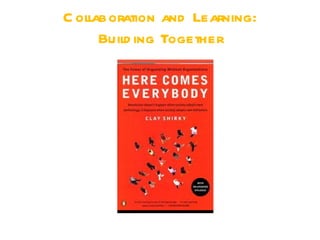
  • #17 Shirky ’s book builds upon The Wisdom of Crowds by exploring how collaboration produces magnificent—and highly accurate—resources like Wikipedia.
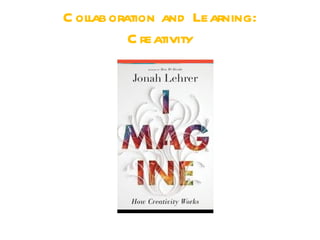
  • #18 Jonah Lehrer ’s recently released book, among other things, documents how creativity is fostered by online projects such as InnoCentive, where experts apply their expertise to areas in which they don’t normally work and, by bringing an outsider’s point of view, solve problems that don’t come from those well-versed in the field in which the problem is embedded.
  • #19 So, what does all of that have to do with the consistently inspiring results we find in the annual Horizon Reports? Everything, as it turns out.   There ’s a deliberate attempt to avoid inbred thinking here; our New Media Consortium colleagues attempt to change at least a third of the Horizon Report Advisory Board each year so a new flow of ideas is an integral part of the process. Think about how much more lively our ASTD chapters and our worksites would be if we made a conscious attempt to balance continuity with change so we could build upon the strengths of continuity while diving into new pools of thought to find new ideas on a regular basis.
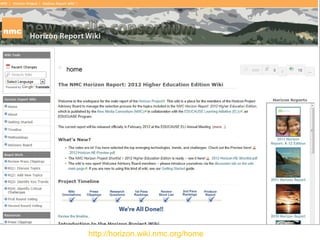
  • #20 Let ’s get down to the mechanics and, at each step, keep our eyes and thoughts on how we could apply this in our own settings. Step one: It ’s tremendously well organized, as you can see from this partial screenshot. Navigation flows smoothly from those tabs on the left-hand side of the screen, and the home page tells members and guests what the site is designed to accomplish.
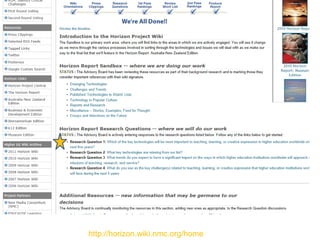
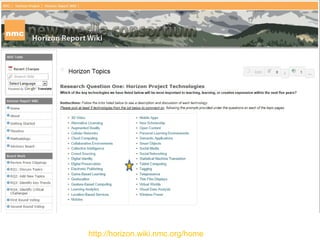
  • #21 Step two: If we move further down that home page, we see live links that let anyone—non-members as well as members—see what ’s happening in the Horizon Report Sandbox . The item to the right of the gold star on this screenshot takes us to the entire list of technologies that Advisory Board members were able to review during the initial phases of the process of narrowing things down to those final six technologies we reviewed with you during the first part of this presentation. Clicking on the highlighted text next to Research Question 1 takes us to the list.
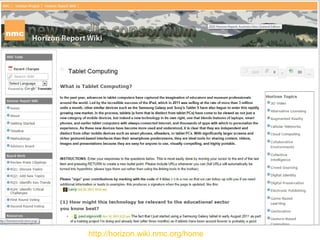
  • #22 Step three: Here ’s where it becomes really interesting both from the point of view of Advisory Board members and from any of you who are thinking about creating a wiki or other online collaborative tool that has far more than one use. For Board members, this is the playing field. We chose as few or as many of the topics as we had time to explore—the wiki facilitators suggested we attempt to explore at least five—and then dove in. For guests to the site, this gives a snapshot of technologies worth exploring. It also creates a rudimentary knowledge repository in that what Advisory Board members added to each topic became immediately available to anyone visiting the sight. There was no need for interested parties to wait for the final report if they wanted to see what was under consideration. Let ’s follow the Tablet Computing link to see how this developed.
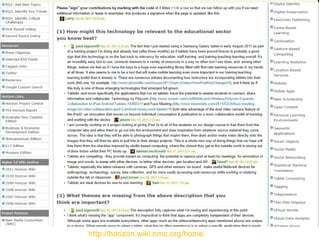
  • #23 Step four: Members and guests can see a clear definition of the technology under discussion. They also retain those easy-to-use navigation buttons in the left-hand column and can jump to other topics through the links on the right-hand side. Those who are logged in with their member IDs can actually begin responding to the facilitators ’ questions as we see here (at the bottom of the screen) and in the next screenshot.
  • #24 Step five: Those tiny thumbnail images spread throughout the text indicate different participants ’ responses, so members can engage in asynchronous conversations and non-members can follow those discussions—along with live links to other resourced embedded in some of those responses throughout the wiki.
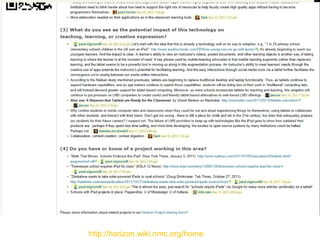
  • #25 Step six: This is far from a theoretical exercise. Contributors discuss real impacts of the technology on teaching, learning, or creative expression and provide links to sites that show existing projects that are already putting the technology to use. Again, you can see that this is not just a discussion board; it ’s a knowledge repository under construction, and it’s available to anyone with Internet access.
  • #26 Step seven: Quickly jumping ahead here—after discussions about the tech tools, key trends, and critical challenges have been completed, we move into two rounds of voting. Round one focuses on narrowing the tech tools down to a manageable level through a ranking system, and round two asks us to approach that reduced list in a different way—eliminating one item from each horizon (rather than again selecting what we think is most significant). The resulting data is reviewed by New Media Consortium staff, and that ’s where Samantha settles into the enviable role of working on the final report that all of you eventually see.
  • #27 All of this raises an interesting question that I ’ve been discussing with colleagues as a result of having worked online with other Advisory Board members long before meeting them face to face at an Advisory Board retreat in January 2012: What does it mean, given all the tools and other resources we have, to actually “meet” someone? Is it the first time we see someone face to face? Is it the first time we encounter a person anywhere, regardless of whether it’s in a virtual setting, face-to-face, by phone, or an any other way imaginable? Can we “meet” people through Google Docs and Dropbox sharing without needing the substantial levels of time and commitment required for a well-facilitated wiki? There is no easy and obvious answer to this one, but I ’m coming, more and more, to think that face-to-face contact—while still wonderful and viscerally rewarding—no longer defines the significant moment of first encounter in our onsite-online world that so strongly fosters collaborative efforts. And if we’re all struggling to come to terms with this change in practices and vocabulary, pause and think for a moment about where our learners are: behind us, with us, or far ahead of us? Maybe that’s a challenge for next year’s Horizon Report Advisory Board to consider. It certainly takes us back to what we saw earlier this evening in our trends and challenges: An expectation that work/learning/study is expected to be available 24/7 and that collaboration is increasingly a key element of all we do. Let ’s pause for a few minutes so we can answer any questions you have, then we’ll finish up with a few resources and final info about the New Media Consortium, the Horizon Report Advisory Board, and how you can become involved.
  • #28 If you ’re viewing this later in Slide Show mode, you can click on any of these images—and the ones on the next slide—to get to excerpts for the books and to the Horizon Report site itself for a downloadable copy of the 2012 Higher Education edition.
  • #29 NMC CEO Larry Johnson ’s presentation at the Horizon Report Advisory Board Retreat in January 2012 is a trainer-teacher-learner’s dream in terms of content and levels of engagement. You ’ll find it at http://www.youtube.com/watch?v=3aVwQDBUIlM&feature=relmfu.
  • #30 From the 2012 Horizon Report: The NMC (New Media Consortium) is an international community of experts in educational technology — from the practitioners who work with new technologies on campuses everyday; to the visionaries who are shaping the future of learning at think tanks, labs, and research centers; to its staff and board of directors; to the advisory boards and others helping the NMC conduct cutting edge research. > The NMC helps its members stay at the leading edge of emerging technology. > The key interest of the NMC community is in technologies and applications that make learning more relevant and more engaging. > As a community, we engage in research that catalyzes discussion, we convene people around new ideas, and we build communities and networks that encourage exploration and experimentation. We help our hundreds of member universities, colleges, museums, and organizations drive innovation across their campuses. > Find out more about how you can join the NMC at go.nmc.org/join