Ms. Robinson 2011-2012 Course Syllabus
Room 108 srobinson@sonoranacademy.org
11th Grade American Literature
Officially, this course will . . .
. . . focus on the study of American literature where students will not
only become aware of the great, controversial, and beautiful ideas contained
in America’s literary history, but also examine the interactions between the
writers’ purpose, subjects, and audience expectations. Assignments will
consist of expository, personal, and persuasive writing, oral expression,
vocabulary development, and research and analysis. Most writing assignments
and projects will involve an exploration and analysis of rhetorical and
linguistic choices as well as literary, cultural, and historical topics
germane to American literature from the Puritan to the Post-Modern Era.
More specifically, it will . . .
. . . expose you to a broad spectrum of American literature, thought,
art, politics, religion, philosophy, etc., in order to gain a greater
understanding of the English language and American cultural history.
In addition to an intense examination of the rhetoric of American
Literature, students will be expected to summarize, analyze, and evaluate the
literature covered in written journals, essays, reports, projects, and oral
presentations.
We’ll be reading . . .
The Scarlet Letter
The Crucible
The Great Gatsby
The Jungle
Their Eyes Were Watching God
This list may change throughout the year, so while purchasing your own
copies is a fantastic idea, you may want to wait until we get to that unit to
be certain we’re going to read them.
Another great idea is to get your parents to read along with you. Not
only do they have their own ideas and experiences associated with the stories
we’ll be exploring, but then they won’t have to ask you what you did at
school every day!
How to impress me:
Be Real. The world is full of people who are pretending to be something
they’re not. No matter why they’re doing it--to impress someone, to
anger someone, to soothe someone, to hurt someone--they all have one
thing in common: they’re doing it for someone else. I want to see you
being yourself, not someone you think others want you to be (and, being
the Master Communicator I am, I can tell the difference!). Be honest
with yourself, and people will be honest with you.
Be Here. I know you have things on your mind that can distract you from
school, because I have things on my mind that distract me from work.
I’m asking you to let this class be a break from those things. Leave
them on the table beside the door. Believe me, they’ll be waiting for
you there when you leave!
Try. You know that line in Star Wars, “Do or do not, there is no try,” that
Yoda delivers to Luke on Dagoba? It’s not true. Yoda was a powerful old
gremlin who lived in a swamp all by himself where he didn’t have to
help anyone. All we can do, as humans, is try. Even if you have serious
doubts as to your ability, you have to try.
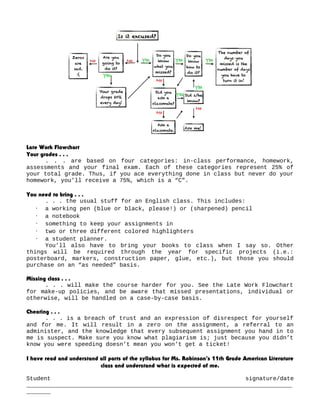
Late Work Flowchart
Your grades . . .
. . . are based on four categories: in-class performance, homework,
assessments and your final exam. Each of these categories represent 25% of
your total grade. Thus, if you ace everything done in class but never do your
homework, you’ll receive a 75%, which is a “C”.
You need to bring . . .
. . . the usual stuff for an English class. This includes:
· a working pen (blue or black, please!) or (sharpened) pencil
· a notebook
· something to keep your assignments in
· two or three different colored highlighters
· a student planner.
You’ll also have to bring your books to class when I say so. Other
things will be required through the year for specific projects (i.e.:
posterboard, markers, construction paper, glue, etc.), but those you should
purchase on an “as needed” basis.
Missing class . . .
. . . will make the course harder for you. See the Late Work Flowchart
for make-up policies, and be aware that missed presentations, individual or
otherwise, will be handled on a case-by-case basis.
Cheating . . .
. . . is a breach of trust and an expression of disrespect for yourself
and for me. It will result in a zero on the assignment, a referral to an
administer, and the knowledge that every subsequent assignment you hand in to
me is suspect. Make sure you know what plagiarism is; just because you didn’t
know you were speeding doesn’t mean you won’t get a ticket!
I have read and understand all parts of the syllabus for Ms. Robinson’s 11th Grade American Literature
class and understand what is expected of me.
Student signature/date
_____________________________________________________________________________
_______
Parent signature/date
_____________________________________________________________________________
________

2011-2012 AmLit Syllabus

  • 1.
    Ms. Robinson 2011-2012Course Syllabus Room 108 srobinson@sonoranacademy.org 11th Grade American Literature Officially, this course will . . . . . . focus on the study of American literature where students will not only become aware of the great, controversial, and beautiful ideas contained in America’s literary history, but also examine the interactions between the writers’ purpose, subjects, and audience expectations. Assignments will consist of expository, personal, and persuasive writing, oral expression, vocabulary development, and research and analysis. Most writing assignments and projects will involve an exploration and analysis of rhetorical and linguistic choices as well as literary, cultural, and historical topics germane to American literature from the Puritan to the Post-Modern Era. More specifically, it will . . . . . . expose you to a broad spectrum of American literature, thought, art, politics, religion, philosophy, etc., in order to gain a greater understanding of the English language and American cultural history. In addition to an intense examination of the rhetoric of American Literature, students will be expected to summarize, analyze, and evaluate the literature covered in written journals, essays, reports, projects, and oral presentations. We’ll be reading . . . The Scarlet Letter The Crucible The Great Gatsby The Jungle Their Eyes Were Watching God This list may change throughout the year, so while purchasing your own copies is a fantastic idea, you may want to wait until we get to that unit to be certain we’re going to read them. Another great idea is to get your parents to read along with you. Not only do they have their own ideas and experiences associated with the stories we’ll be exploring, but then they won’t have to ask you what you did at school every day! How to impress me: Be Real. The world is full of people who are pretending to be something they’re not. No matter why they’re doing it--to impress someone, to anger someone, to soothe someone, to hurt someone--they all have one thing in common: they’re doing it for someone else. I want to see you being yourself, not someone you think others want you to be (and, being the Master Communicator I am, I can tell the difference!). Be honest with yourself, and people will be honest with you. Be Here. I know you have things on your mind that can distract you from school, because I have things on my mind that distract me from work. I’m asking you to let this class be a break from those things. Leave them on the table beside the door. Believe me, they’ll be waiting for you there when you leave! Try. You know that line in Star Wars, “Do or do not, there is no try,” that Yoda delivers to Luke on Dagoba? It’s not true. Yoda was a powerful old gremlin who lived in a swamp all by himself where he didn’t have to
  • 2.
    help anyone. Allwe can do, as humans, is try. Even if you have serious doubts as to your ability, you have to try.
  • 3.
    Late Work Flowchart Yourgrades . . . . . . are based on four categories: in-class performance, homework, assessments and your final exam. Each of these categories represent 25% of your total grade. Thus, if you ace everything done in class but never do your homework, you’ll receive a 75%, which is a “C”. You need to bring . . . . . . the usual stuff for an English class. This includes: · a working pen (blue or black, please!) or (sharpened) pencil · a notebook · something to keep your assignments in · two or three different colored highlighters · a student planner. You’ll also have to bring your books to class when I say so. Other things will be required through the year for specific projects (i.e.: posterboard, markers, construction paper, glue, etc.), but those you should purchase on an “as needed” basis. Missing class . . . . . . will make the course harder for you. See the Late Work Flowchart for make-up policies, and be aware that missed presentations, individual or otherwise, will be handled on a case-by-case basis. Cheating . . . . . . is a breach of trust and an expression of disrespect for yourself and for me. It will result in a zero on the assignment, a referral to an administer, and the knowledge that every subsequent assignment you hand in to me is suspect. Make sure you know what plagiarism is; just because you didn’t know you were speeding doesn’t mean you won’t get a ticket! I have read and understand all parts of the syllabus for Ms. Robinson’s 11th Grade American Literature class and understand what is expected of me. Student signature/date _____________________________________________________________________________ _______
  • 4.