SPAN 101
Primer día del curso
Introducción
•Me llamo David Jons.
•¿Cómo te llamas?
•Mucho gusto.
• (abre la página de asistencia)
Actividad
• Presentación a dos personas:
• E1: ¡Hola! Me llamo Ana, ¿Cómo te
llamas?
• E1: Me llamo Felipe. Mucho gusto.
• E2: Encantado/a.
• E1: Igualmente.
¡Conversación básica!
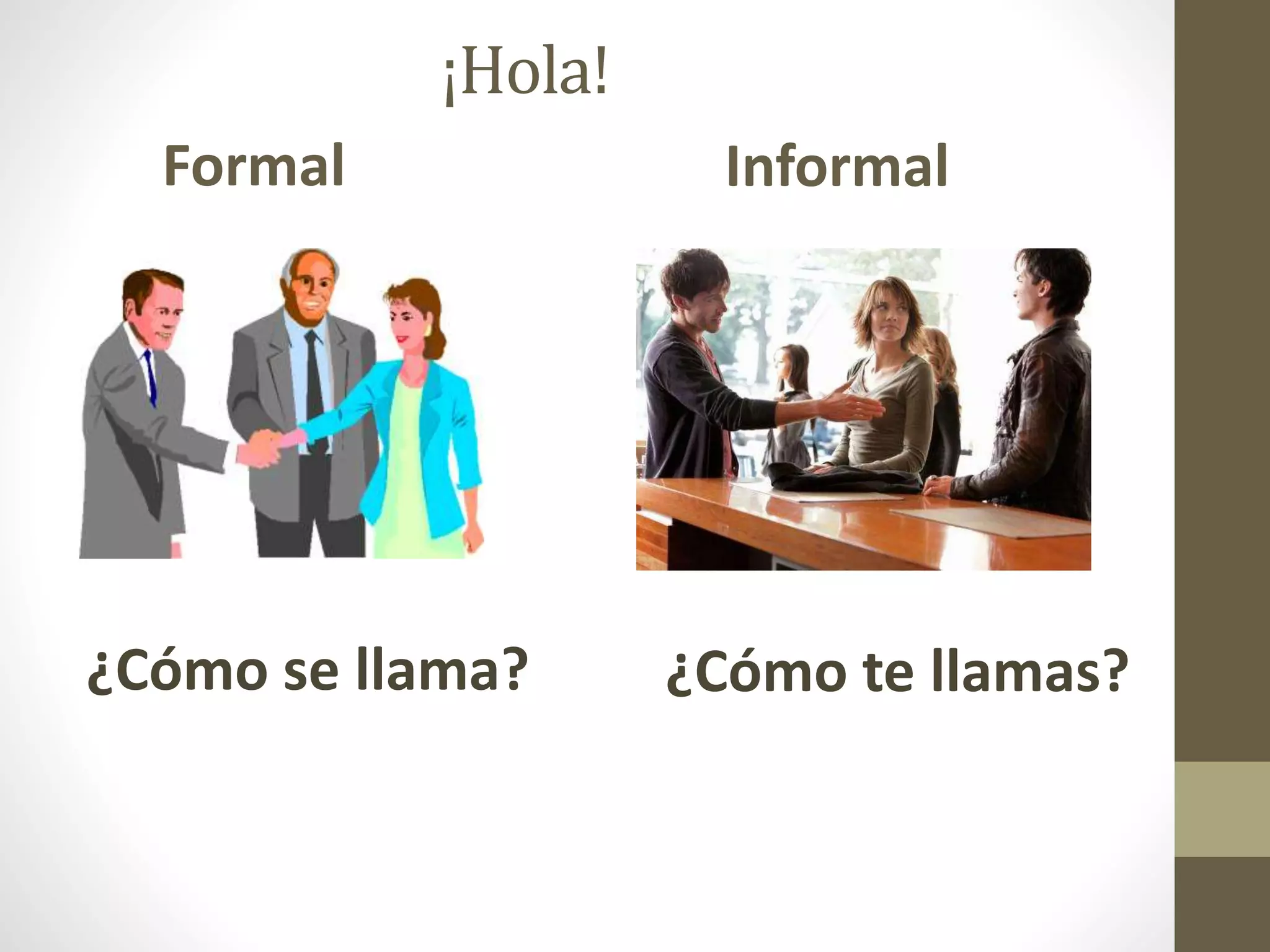
¡Hola!
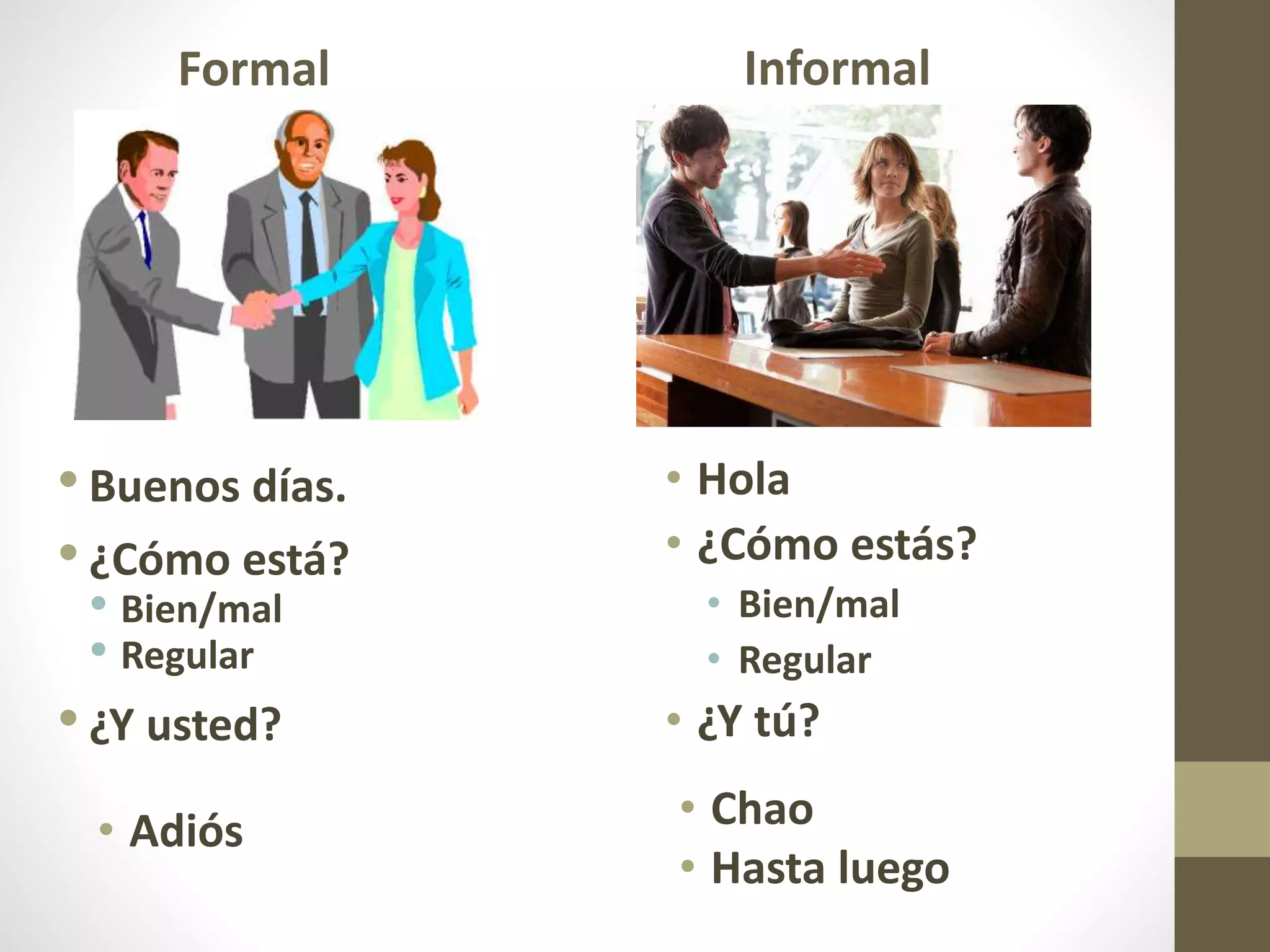
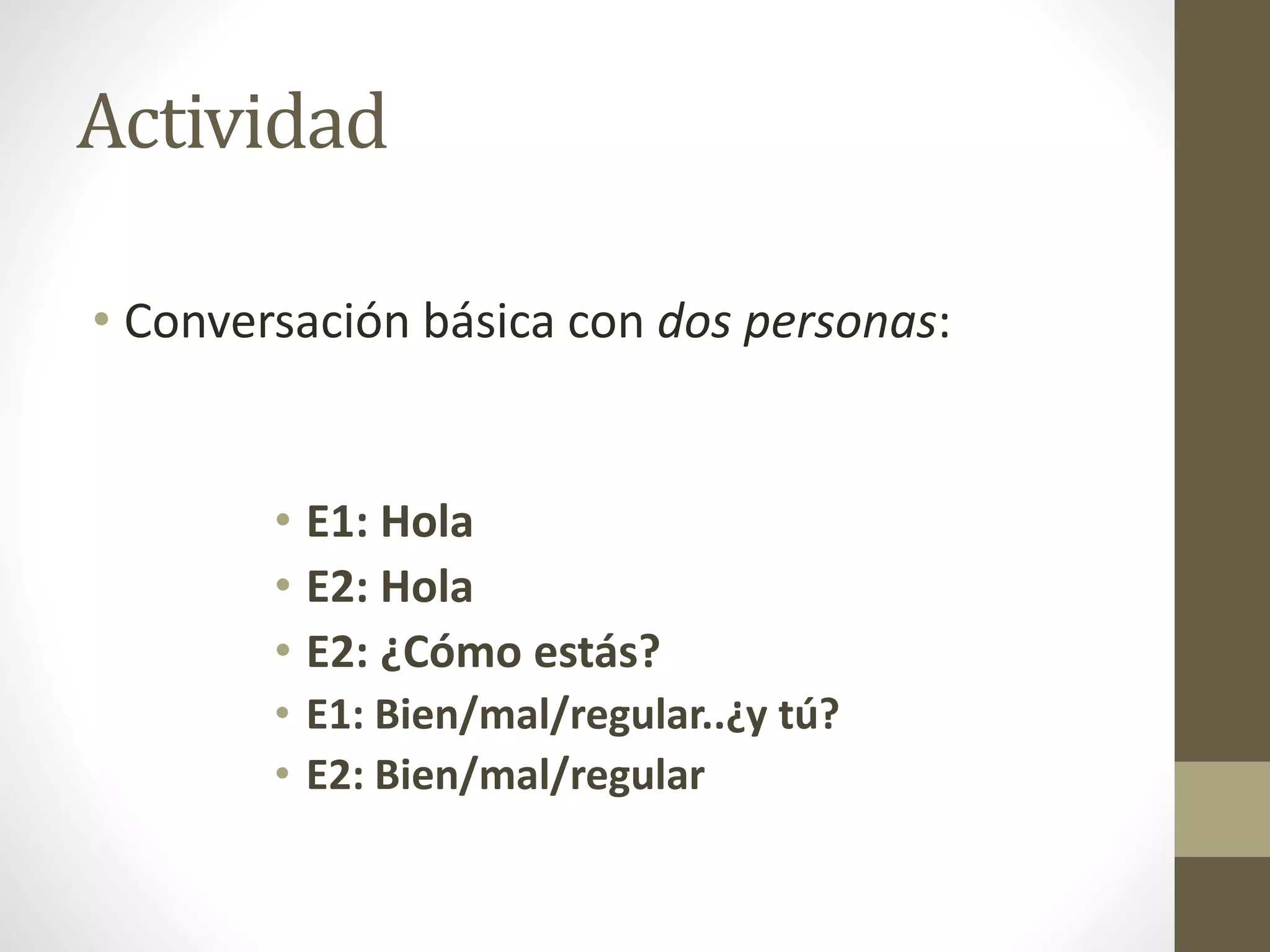
Formal
¿Cómo te llamas?
Informal
¿Cómo se llama?
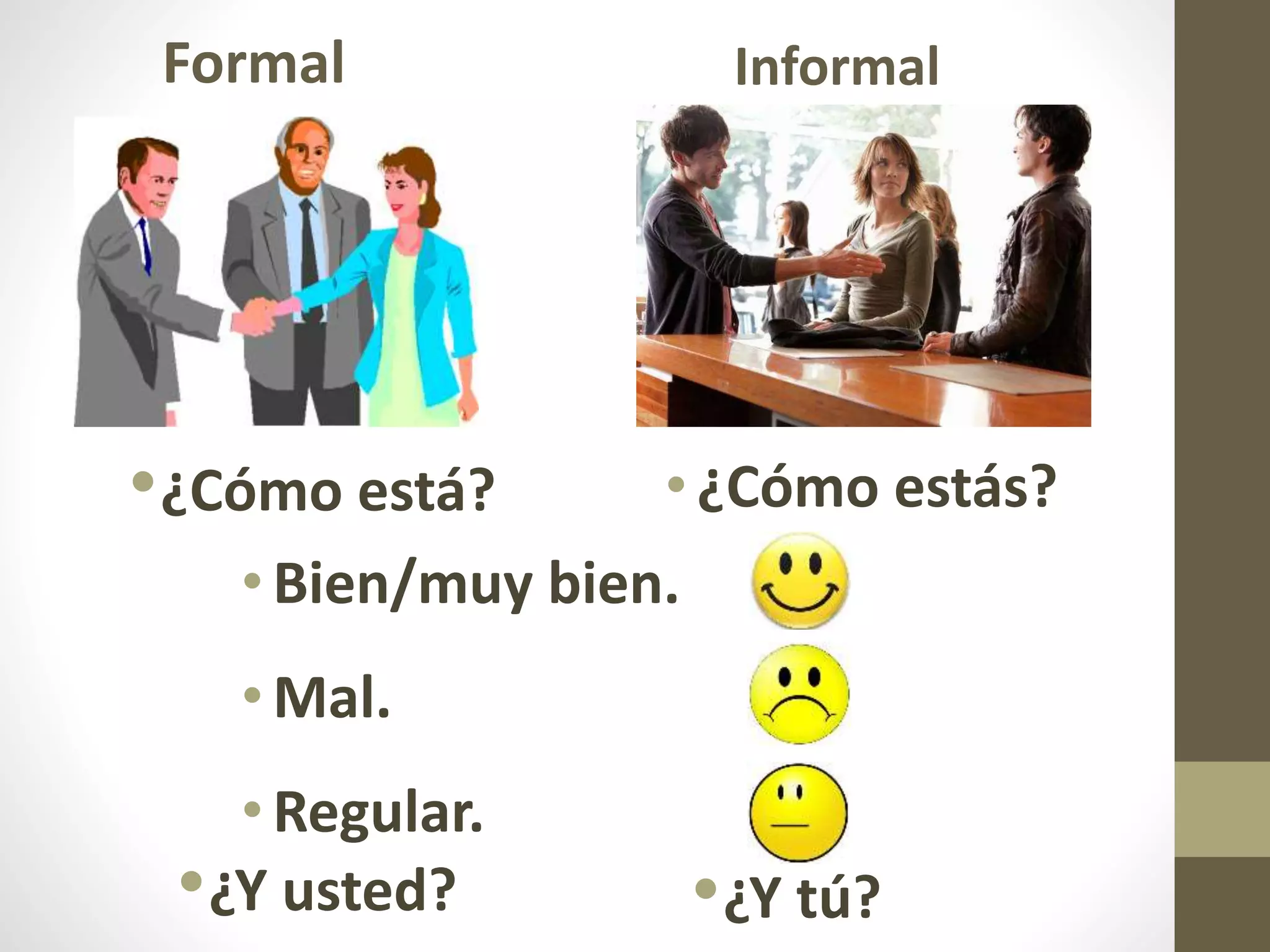
Formal
•¿Cómo estás?
Informal
•Bien/muy bien.
•Mal.
•Regular.
•¿Cómo está?
•¿Y usted? •¿Y tú?
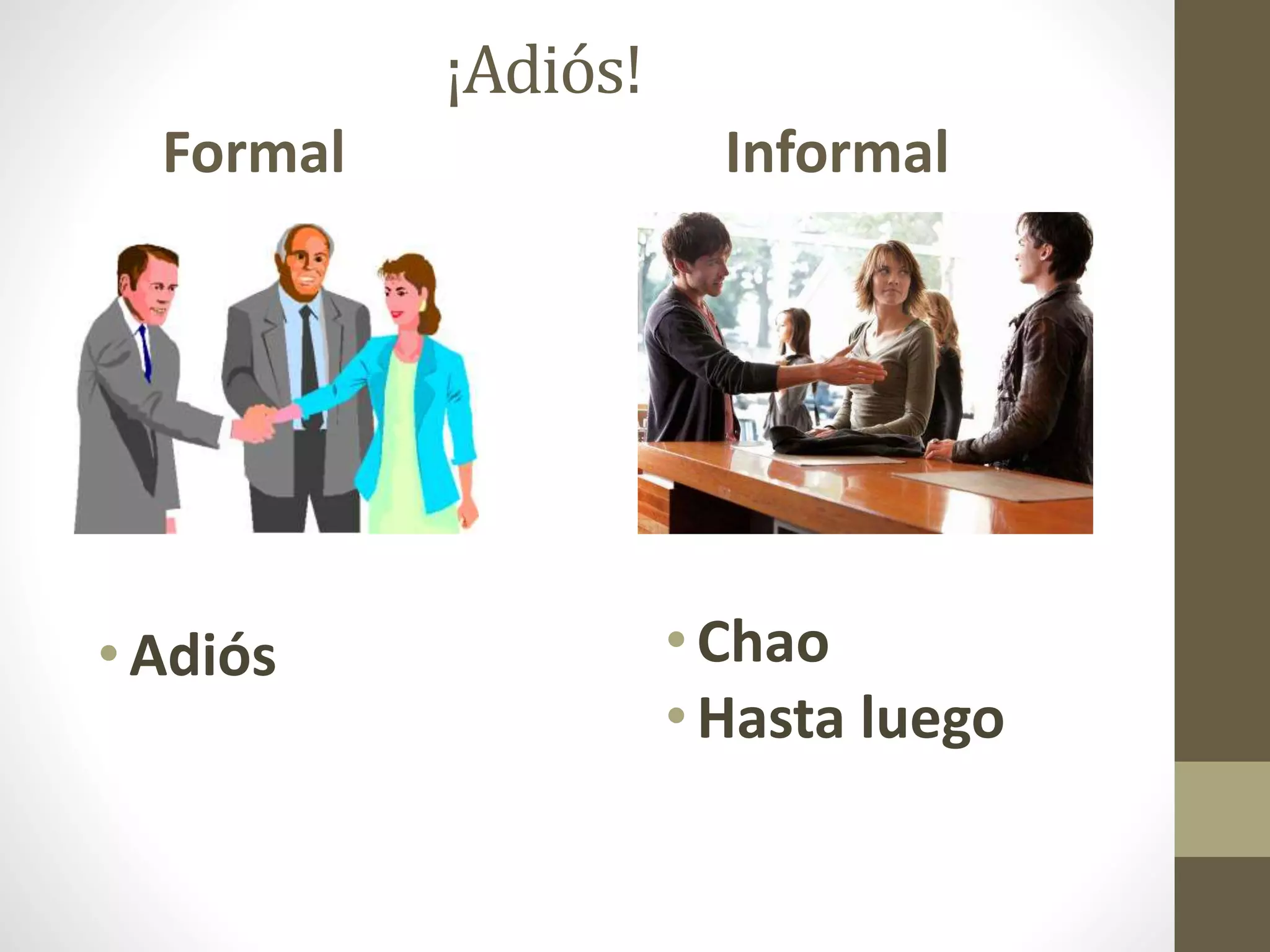
¡Adiós!
Formal
•Chao
•Hasta luego
Informal
•Adiós
La conversación completa
Formal
• Hola
• ¿Cómo estás?
• Bien/mal
• Regular
• ¿Y tú?
Informal
• Chao
• Hasta luego
•Buenos días.
•¿Cómo está?
• Bien/mal
• Regular
•¿Y usted?
• Adiós
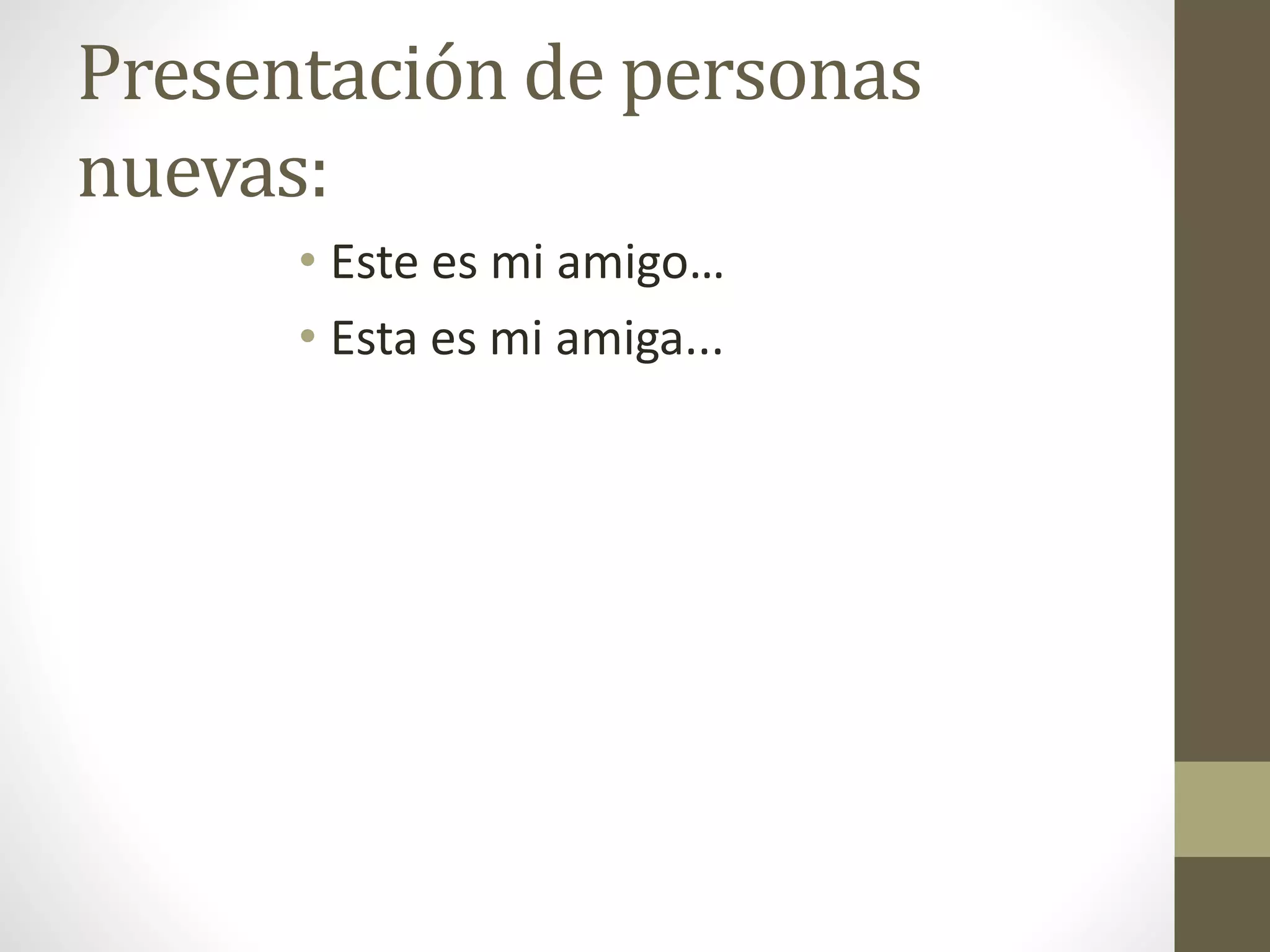
Actividad
• Conversación básica con dos personas:
• E1: Hola
• E2: Hola
• E2: ¿Cómo estás?
• E1: Bien/mal/regular..¿y tú?
• E2: Bien/mal/regular
Presentación de personas
nuevas:
• Este es mi amigo…
• Esta es mi amiga...
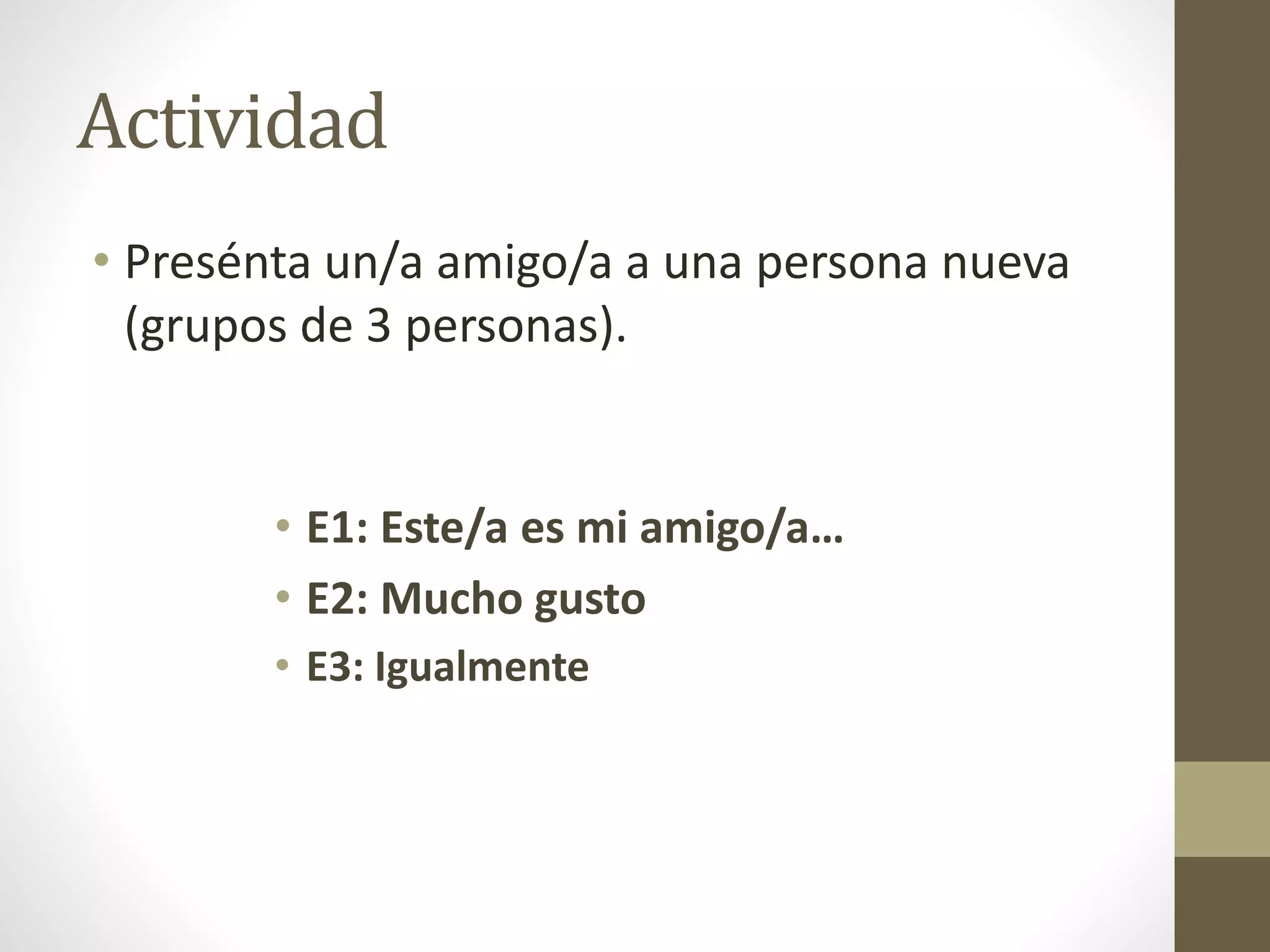
Actividad
• Presénta un/a amigo/a a una persona nueva
(grupos de 3 personas).
• E1: Este/a es mi amigo/a…
• E2: Mucho gusto
• E3: Igualmente
¿Bien?
¡el alfabeto!
• a
• b
• c
• d
• e
• f
• g
• h
• i
• j
• k
• l
• m
• n
• ñ
• o
• p
• q
• r
• s
• t
• u
• v
• w
• x
• y
• z
• Grupos de dos – practica la pronunciación:
• 1. IBM
• 2. CNN
• 3. CD
• 4. MTV
• 5. MCI
• 6. UPS
• 7. WWW
• 8. ESPN
• 9. CBS
• 10. NBC
• Presentación de personas:
• ¿Cómo te llamas?
• Me llamo Alejandro
• ¿Cómo se escribe?
• A – l – e – j – a – n – d – r – o
¿Bien?
Course objectives
• Greet, say goodbye, and introduce someone.
• Express dates, tell time, and describe the weather.
• Describe people, places and things with details.
• Express emotions and conditions.
• Ask and answer questions.
• Describe activities and daily routines.
• Share information about the college experience, including courses,
academic departments, the classroom, and college activities.
• Express likes and dislikes.
• Describe food, meals, and food culture.
• Share information about the Spanish language and where it is spoken.
• Talk about Spain in terms of products, practices, and perspectives.
• Share information about student life in Hispanic countries and
compare cultural similarities.
• Present information about Hispanic influences in the US.
• Share information about free-time activities in Hispanic countries and
identify cultural similarities.
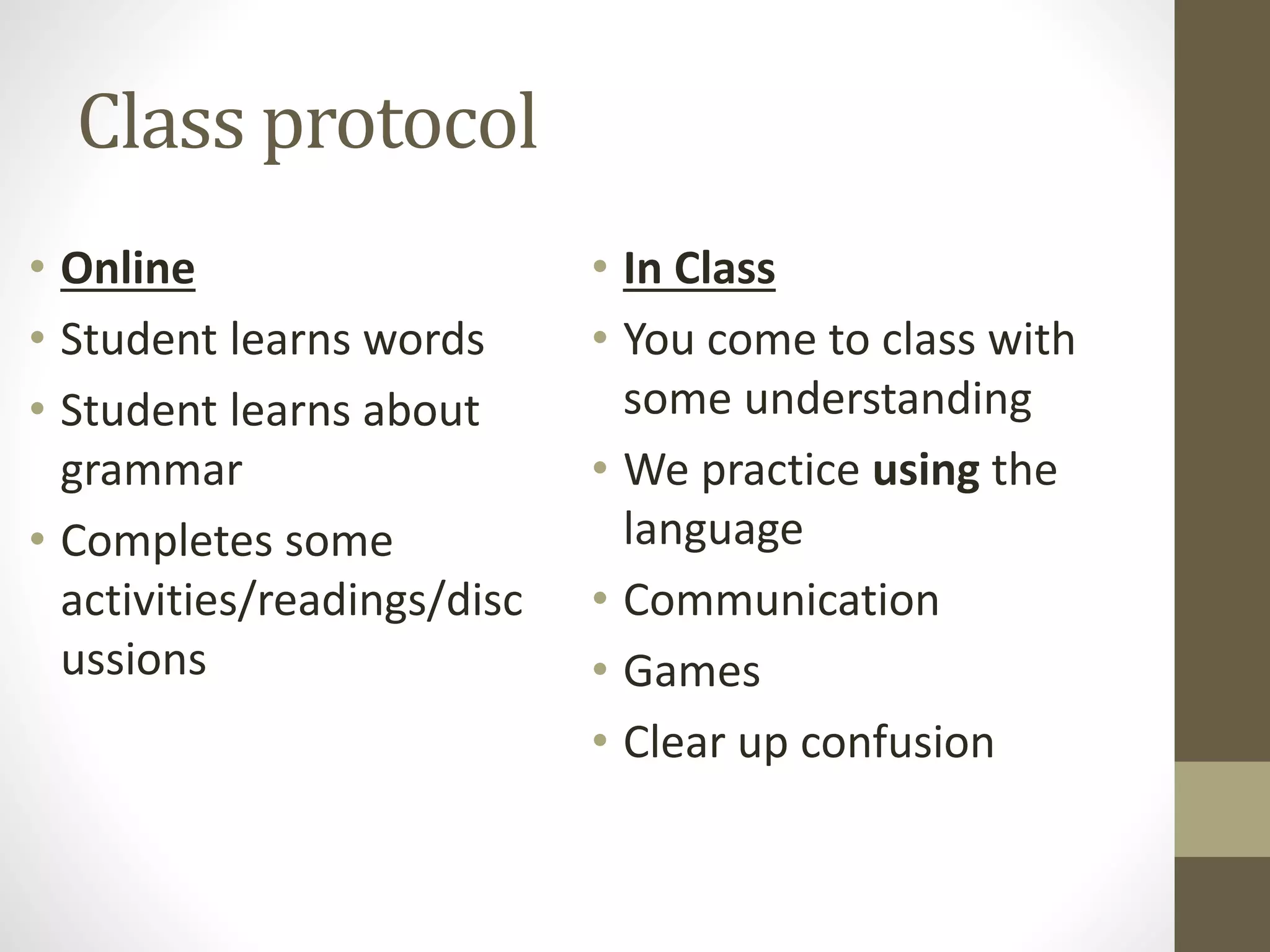
Class protocol
• Online
• Student learns words
• Student learns about
grammar
• Completes some
activities/readings/disc
ussions
• In Class
• You come to class with
some understanding
• We practice using the
language
• Communication
• Games
• Clear up confusion
Grammar/Vocab Learning
• MySpanishLab
• Lexicubes (we’ll start next week)
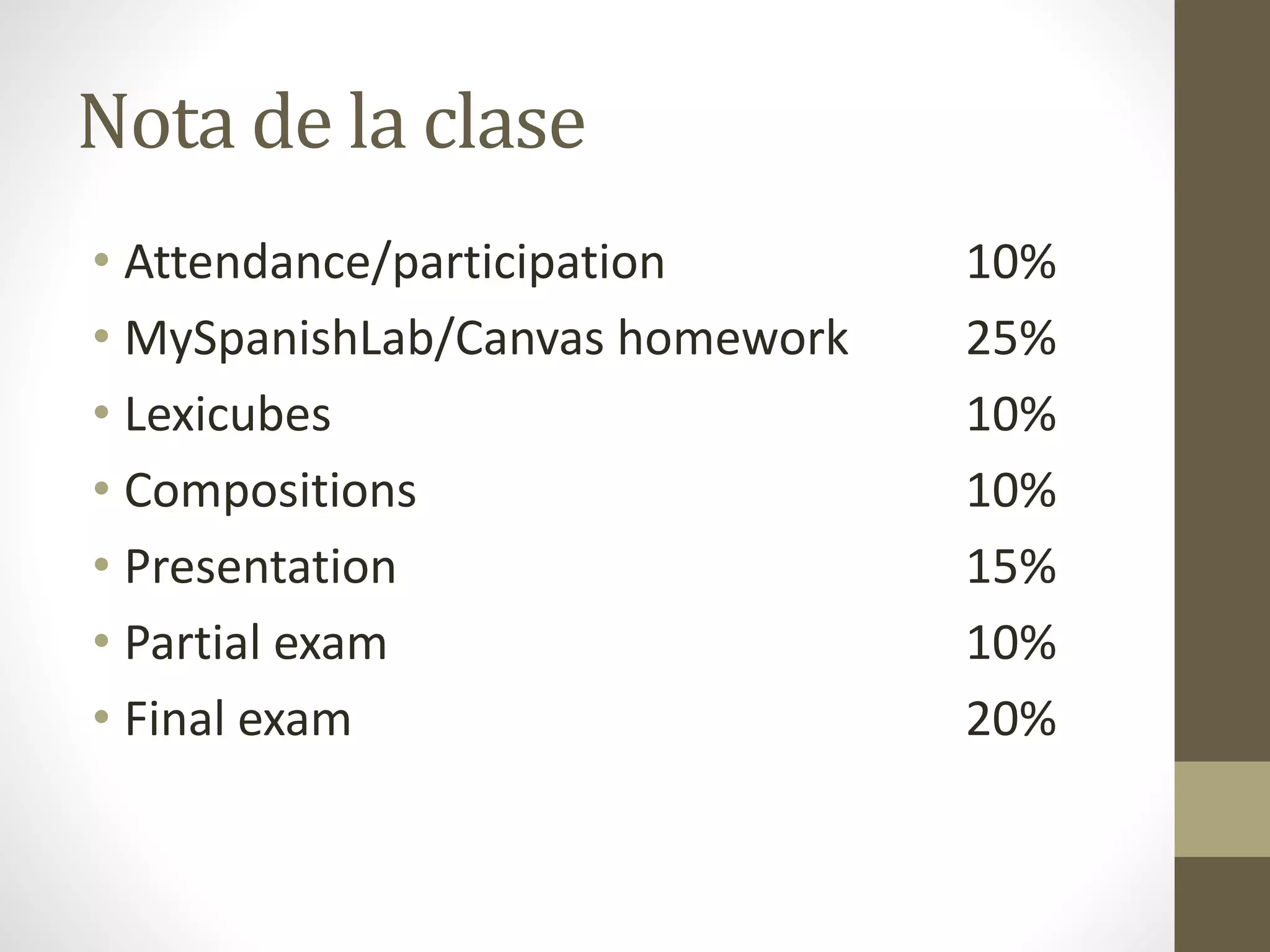
Nota de la clase
• Attendance/participation 10%
• MySpanishLab/Canvas homework 25%
• Lexicubes 10%
• Compositions 10%
• Presentation 15%
• Partial exam 10%
• Final exam 20%
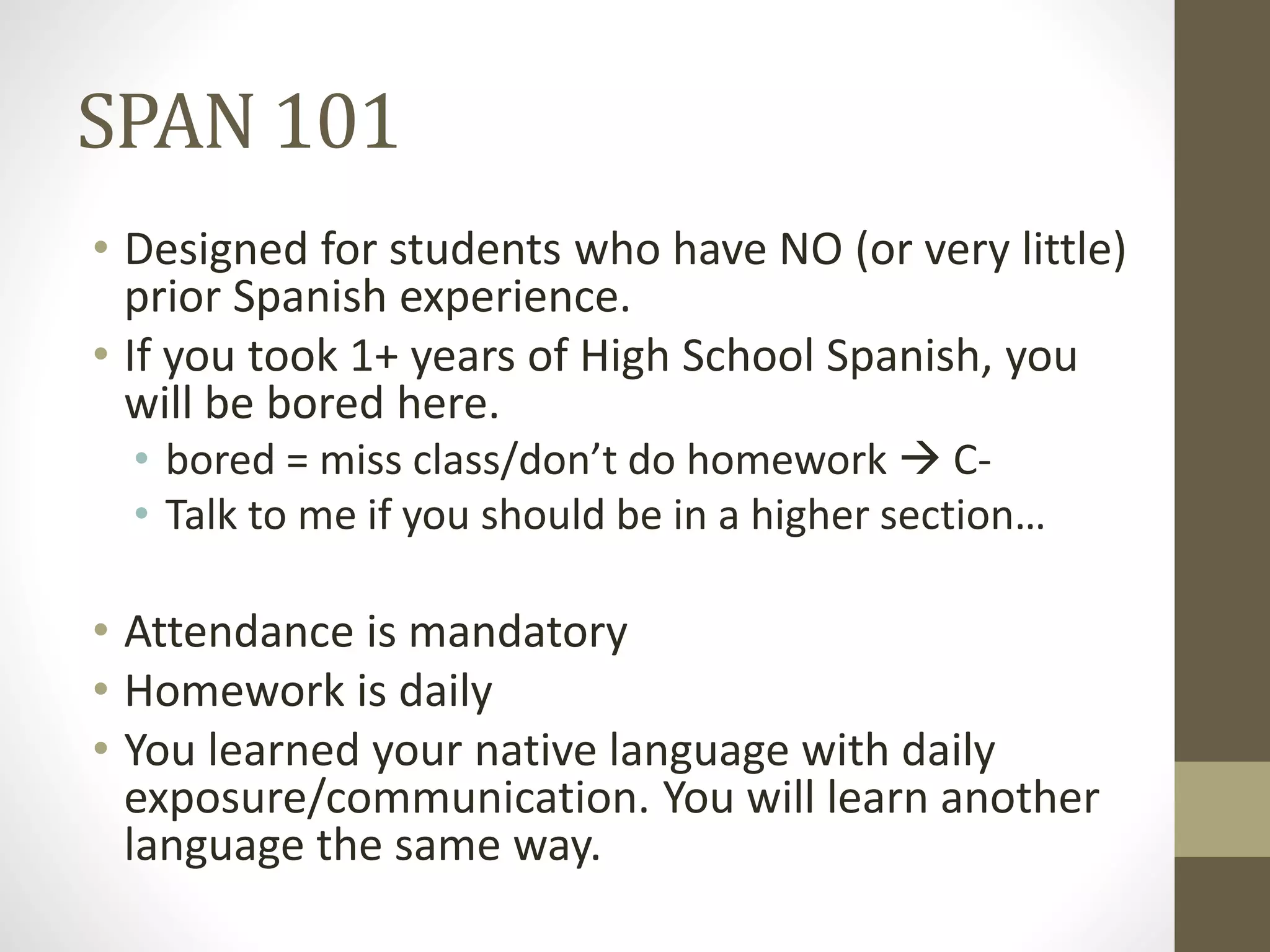
SPAN 101
• Designed for students who have NO (or very little)
prior Spanish experience.
• If you took 1+ years of High School Spanish, you
will be bored here.
• bored = miss class/don’t do homework  C-
• Talk to me if you should be in a higher section…
• Attendance is mandatory
• Homework is daily
• You learned your native language with daily
exposure/communication. You will learn another
language the same way.
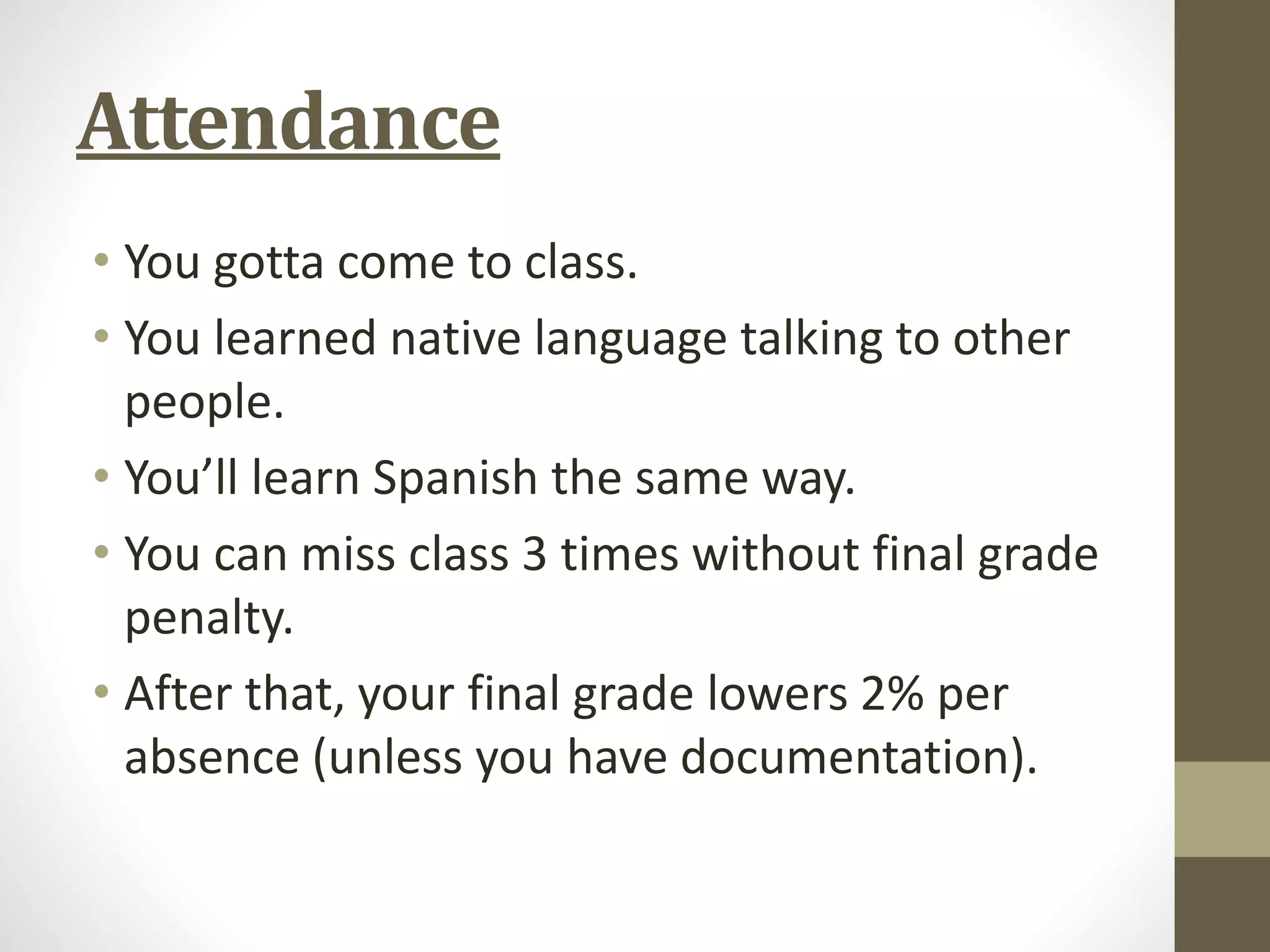
Attendance
• You gotta come to class.
• You learned native language talking to other
people.
• You’ll learn Spanish the same way.
• You can miss class 3 times without final grade
penalty.
• After that, your final grade lowers 2% per
absence (unless you have documentation).
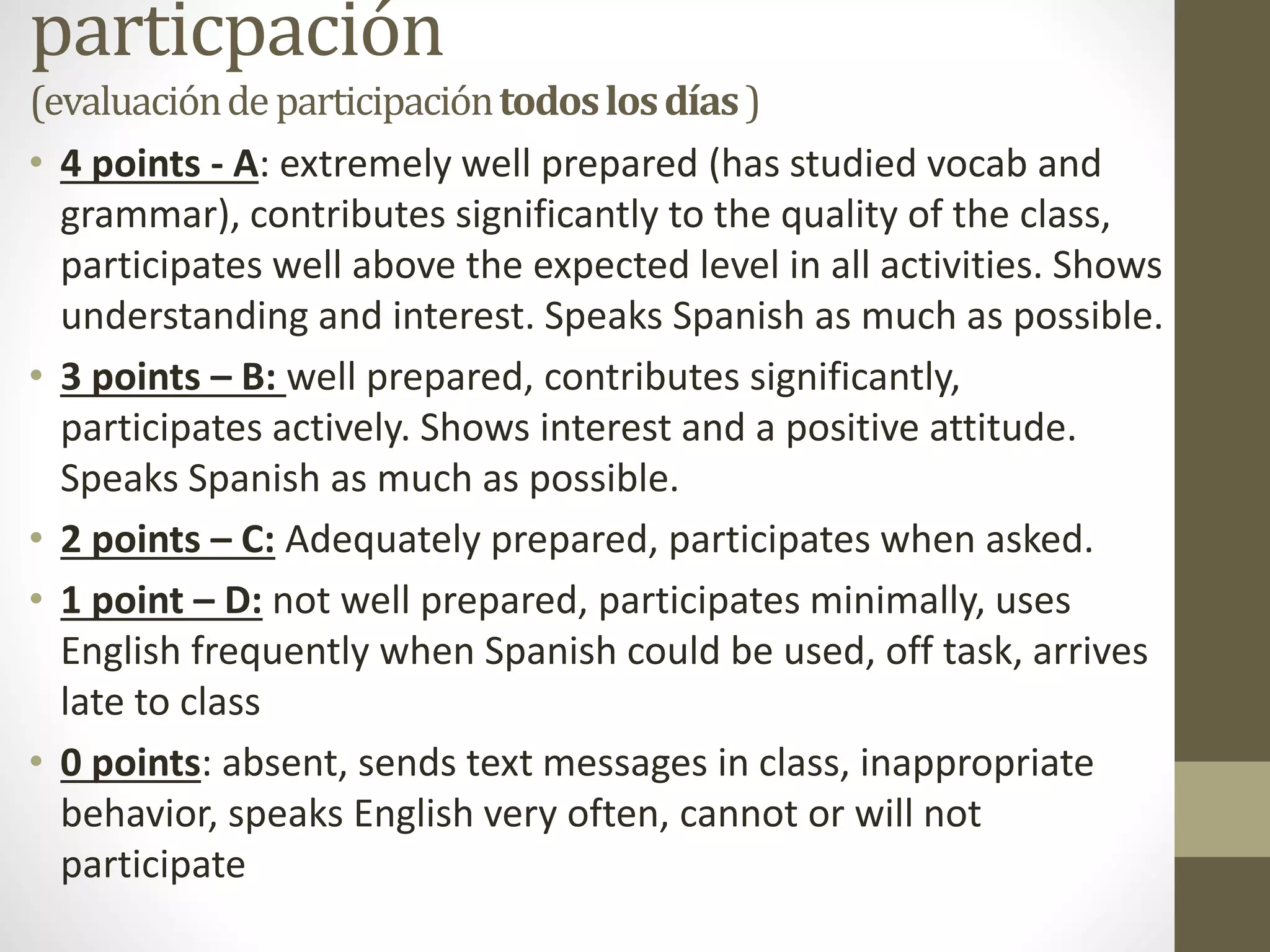
particpación
(evaluacióndeparticipacióntodoslosdías)
• 4 points - A: extremely well prepared (has studied vocab and
grammar), contributes significantly to the quality of the class,
participates well above the expected level in all activities. Shows
understanding and interest. Speaks Spanish as much as possible.
• 3 points – B: well prepared, contributes significantly,
participates actively. Shows interest and a positive attitude.
Speaks Spanish as much as possible.
• 2 points – C: Adequately prepared, participates when asked.
• 1 point – D: not well prepared, participates minimally, uses
English frequently when Spanish could be used, off task, arrives
late to class
• 0 points: absent, sends text messages in class, inappropriate
behavior, speaks English very often, cannot or will not
participate
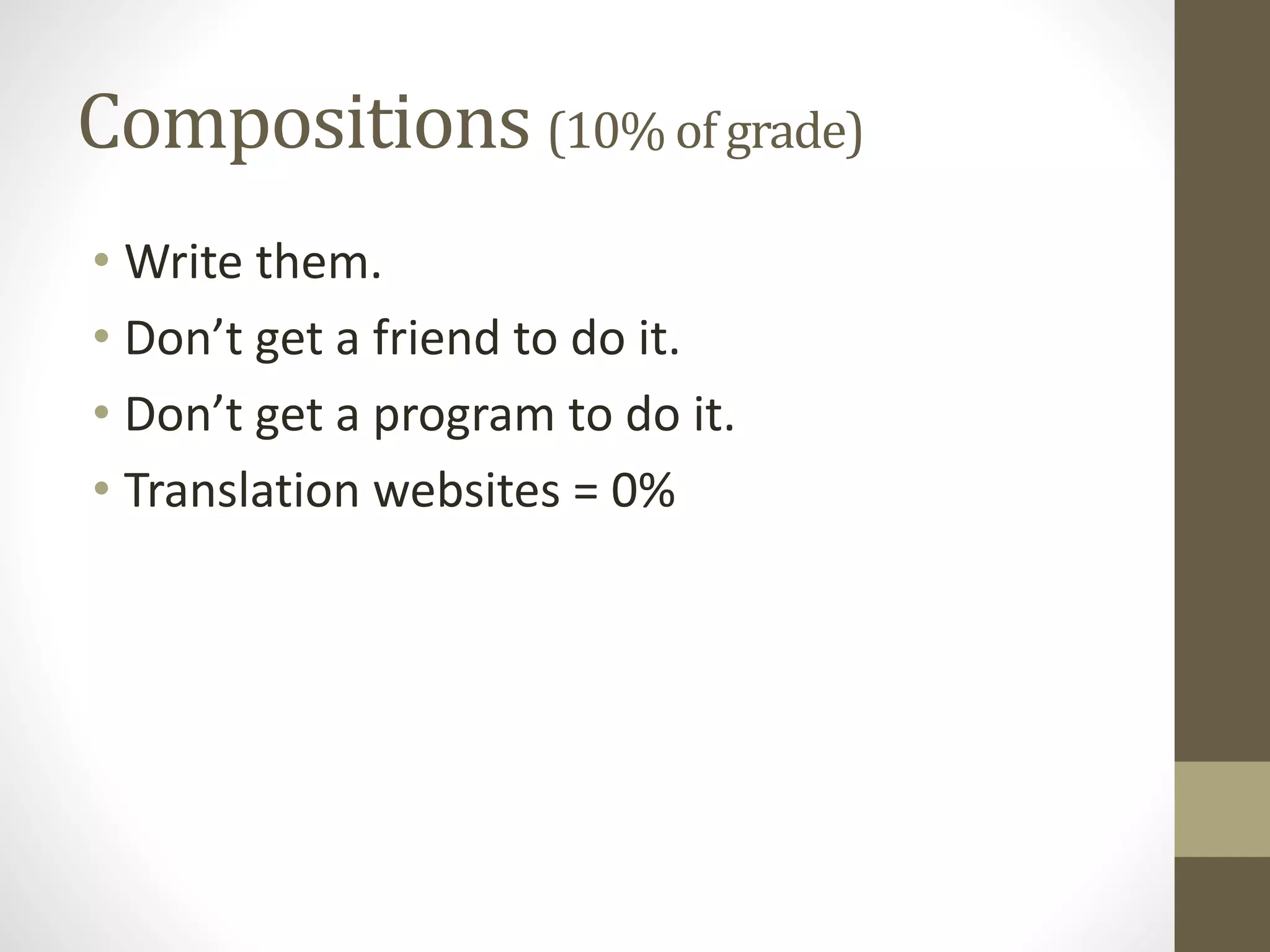
Compositions (10% of grade)
• Write them.
• Don’t get a friend to do it.
• Don’t get a program to do it.
• Translation websites = 0%
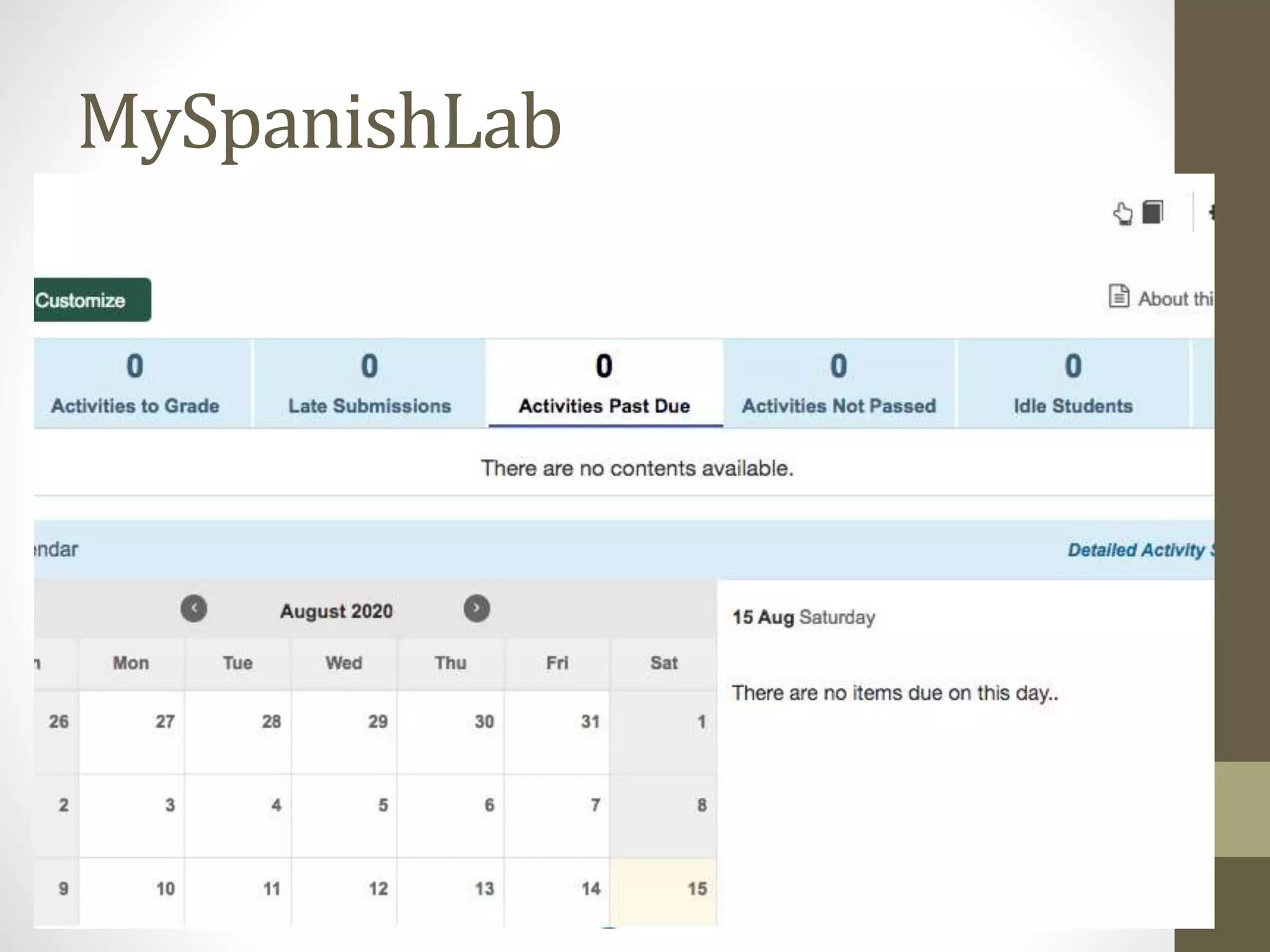
MySpanishLab
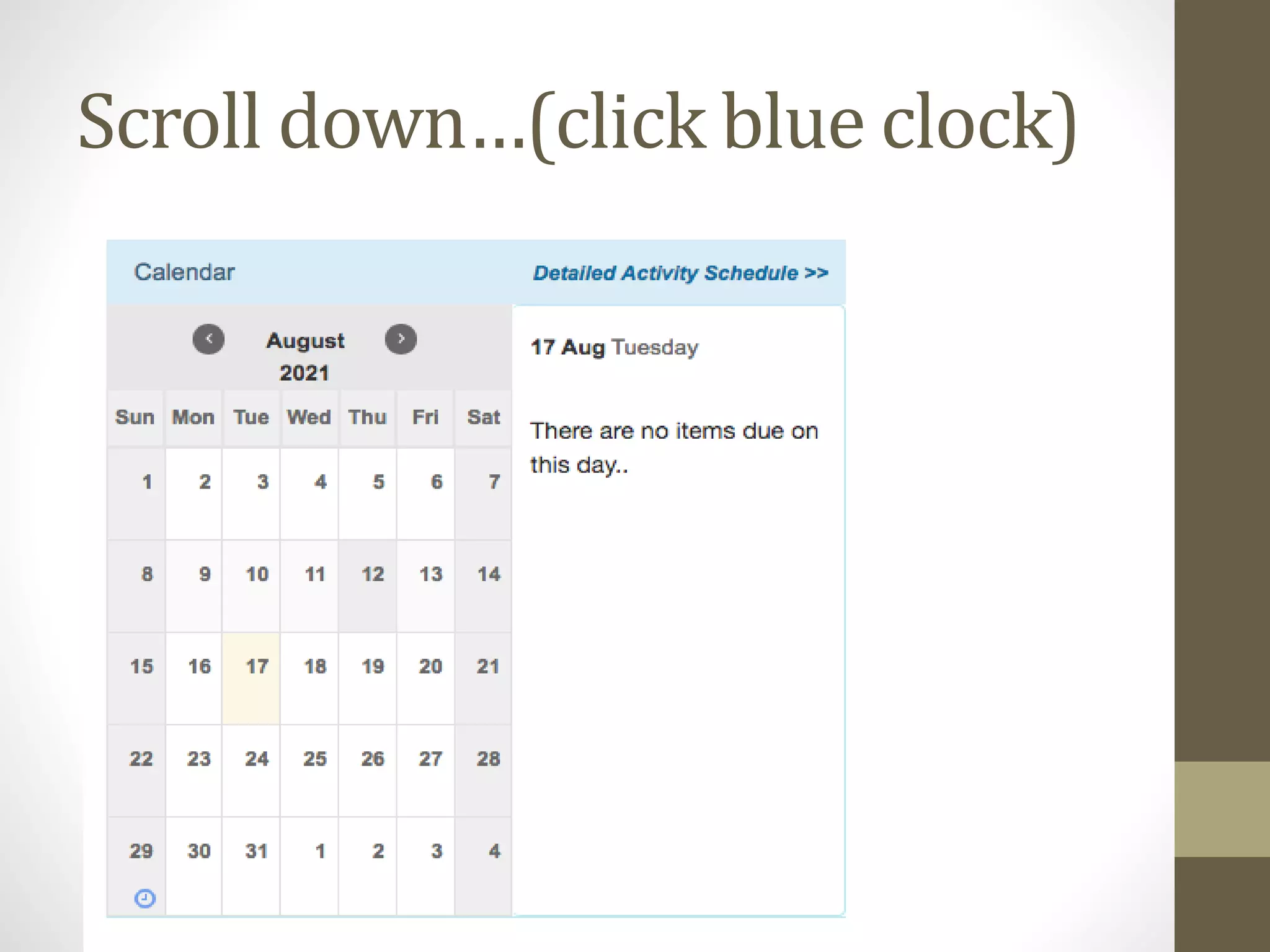
Scroll down…(click blue clock)
¿Cómo están?
• ¿nerviosos?
• ¿emocionados?
• ¿tranquilos?
¿Qué hay en el salón de clase?
• El vocabulario de la página 10
• Estudia las cosas.
• ¿Quién tiene…?

Span101.primer día

  • 1.
    SPAN 101 Primer díadel curso Introducción
  • 2.
    •Me llamo DavidJons. •¿Cómo te llamas? •Mucho gusto. • (abre la página de asistencia)
  • 3.
    Actividad • Presentación ados personas: • E1: ¡Hola! Me llamo Ana, ¿Cómo te llamas? • E1: Me llamo Felipe. Mucho gusto. • E2: Encantado/a. • E1: Igualmente.
  • 4.
  • 5.
  • 6.
  • 7.
  • 8.
  • 9.
    Formal • Hola • ¿Cómoestás? • Bien/mal • Regular • ¿Y tú? Informal • Chao • Hasta luego •Buenos días. •¿Cómo está? • Bien/mal • Regular •¿Y usted? • Adiós
  • 10.
    Actividad • Conversación básicacon dos personas: • E1: Hola • E2: Hola • E2: ¿Cómo estás? • E1: Bien/mal/regular..¿y tú? • E2: Bien/mal/regular
  • 11.
    Presentación de personas nuevas: •Este es mi amigo… • Esta es mi amiga...
  • 12.
    Actividad • Presénta un/aamigo/a a una persona nueva (grupos de 3 personas). • E1: Este/a es mi amigo/a… • E2: Mucho gusto • E3: Igualmente
  • 13.
  • 14.
    ¡el alfabeto! • a •b • c • d • e • f • g • h • i • j • k • l • m • n • ñ • o • p • q • r • s • t • u • v • w • x • y • z
  • 15.
    • Grupos dedos – practica la pronunciación: • 1. IBM • 2. CNN • 3. CD • 4. MTV • 5. MCI • 6. UPS • 7. WWW • 8. ESPN • 9. CBS • 10. NBC
  • 16.
    • Presentación depersonas: • ¿Cómo te llamas? • Me llamo Alejandro • ¿Cómo se escribe? • A – l – e – j – a – n – d – r – o
  • 17.
  • 18.
    Course objectives • Greet,say goodbye, and introduce someone. • Express dates, tell time, and describe the weather. • Describe people, places and things with details. • Express emotions and conditions. • Ask and answer questions. • Describe activities and daily routines. • Share information about the college experience, including courses, academic departments, the classroom, and college activities. • Express likes and dislikes. • Describe food, meals, and food culture. • Share information about the Spanish language and where it is spoken. • Talk about Spain in terms of products, practices, and perspectives. • Share information about student life in Hispanic countries and compare cultural similarities. • Present information about Hispanic influences in the US. • Share information about free-time activities in Hispanic countries and identify cultural similarities.
  • 19.
    Class protocol • Online •Student learns words • Student learns about grammar • Completes some activities/readings/disc ussions • In Class • You come to class with some understanding • We practice using the language • Communication • Games • Clear up confusion
  • 20.
    Grammar/Vocab Learning • MySpanishLab •Lexicubes (we’ll start next week)
  • 21.
    Nota de laclase • Attendance/participation 10% • MySpanishLab/Canvas homework 25% • Lexicubes 10% • Compositions 10% • Presentation 15% • Partial exam 10% • Final exam 20%
  • 22.
    SPAN 101 • Designedfor students who have NO (or very little) prior Spanish experience. • If you took 1+ years of High School Spanish, you will be bored here. • bored = miss class/don’t do homework  C- • Talk to me if you should be in a higher section… • Attendance is mandatory • Homework is daily • You learned your native language with daily exposure/communication. You will learn another language the same way.
  • 23.
    Attendance • You gottacome to class. • You learned native language talking to other people. • You’ll learn Spanish the same way. • You can miss class 3 times without final grade penalty. • After that, your final grade lowers 2% per absence (unless you have documentation).
  • 24.
    particpación (evaluacióndeparticipacióntodoslosdías) • 4 points- A: extremely well prepared (has studied vocab and grammar), contributes significantly to the quality of the class, participates well above the expected level in all activities. Shows understanding and interest. Speaks Spanish as much as possible. • 3 points – B: well prepared, contributes significantly, participates actively. Shows interest and a positive attitude. Speaks Spanish as much as possible. • 2 points – C: Adequately prepared, participates when asked. • 1 point – D: not well prepared, participates minimally, uses English frequently when Spanish could be used, off task, arrives late to class • 0 points: absent, sends text messages in class, inappropriate behavior, speaks English very often, cannot or will not participate
  • 25.
    Compositions (10% ofgrade) • Write them. • Don’t get a friend to do it. • Don’t get a program to do it. • Translation websites = 0%
  • 26.
  • 27.
  • 28.
    ¿Cómo están? • ¿nerviosos? •¿emocionados? • ¿tranquilos?
  • 29.
    ¿Qué hay enel salón de clase? • El vocabulario de la página 10 • Estudia las cosas. • ¿Quién tiene…?