What are FLEGT VPAs?
They are Voluntary
Partnership Agreements.
They are legally binding
bilateral trade
agreements which set out
the commitments and
action that the EU and
timber exporting
countries will take to
tackle illegal logging.
LoggingOff is a joint initiative by NGOs from European and timber-producing countries
involved in or monitoring the implementation of the EU FLEGT Action Plan, and specifically
the implementation of the Voluntary Partnership Agreements
Basics
• The VPA process is undertaken by two parties: the EU on behalf
of all its Member States and the country government of the
timber exporting (and producing) country.
• VPAs set out the commitments and action of both parties to
tackle illegal logging, including measures to increase
participation of rightsholders and non-state stakeholders;
recognise communities’ rights to the land; and address
corruption
• VPAs are required to have the buy-in of national
stakeholders, including NGOs, local communities, indigenous
peoples, and the timber industry
Context
• Other elements of this plan
include :
(1) Government Procurement
Policies
(2) Financial due diligence
(3) Illegal timber regulation
For more information on FLEGT, see:
What is FLEGT
VPAs are the central plank of the EU’s Action Plan to
address the illegal timber trade: the Forest Law
Enforcement, Governance and Trade (FLEGT) Action Plan.
Objectives
The EU Council Conclusions on FLEGT (2003/C 268/01) note that the VPAs
must, among others, “instigate forest sector governance reforms, more
specifically they should:
• strengthen land tenure and access rights especially for
marginalised, rural communities and indigenous peoples;
• strengthen effective participation of all stakeholders, notably of non-
state actors and indigenous peoples, in policy-making and
implementation;
• increase transparency in association with forest exploitation
operations, including through the introduction of independent
monitoring;
• reduce corruption in association with the award of forest
exploitations concessions, and the harvesting and trade in timber”.
To achieve these objectives...
• all social, environmental and economic issues
linked to forest use must be discussed, and
failures addressed
• weaknesses and injustices in the laws must be
identified, and changes proposed through a
process that involves all stakeholders
• legal requirements must apply to all timber
products and all exports, not just timber destined
for the EU market
• transparency and accountability must be
improved through monitoring, reporting and
public access to information
VPA Elements
A VPA includes three main elements:
a) Defining legality, or deciding which laws will be enforced for
the purpose of the agreement
b) Developing a Legality Assurance System (LAS) (including
timber tracking, government legality controls, and systems
to verify the legality of the timber)
c) Independent audits of the whole system, to ensure
credibility of the export licenses.
• The legality definition outlines the set of laws that will be
enforced and monitored in the context of the FLEGT agreement
• ‘Legality’ is based on the laws and
procedures of the timber
producing country in question,
and must include laws addressing
social, environmental and
economic issues
• The definition must be developed through extensive
participation of all stakeholders and rightsholders
Defining legality
The LAS is the main tool for guaranteeing legality. It consists of:
• The "legality grid": A matrix which outlines the laws, verifiers
and indicators used to monitor enforcement of laws
• Chain of custody: The wood tracing system which ensures only
timber verified as legal will be exported or sold. Verified and
unverified timber should be kept separate
• Verification of legal compliance: The way the government or
third party verifies no illegally sourced timber enters the chain
of custody.
• Licensing: A FLEGT licence is issued to timber verified as
legal, and this allows it to be shipped to the EU
Legality assurance system
Independent audit
• is a compulsory
element of a VPA
• all agreed VPAs
include annexes
defining the ToR for
the audits
• its role is to check
the system works
Independent Monitoring/Observation
• is not an integral part of the VPA
• in Cameroon and the Rep of Congo, the
need for an independent monitor/
observer is part of the VPA agreement
• This monitor/observer checks
malfunctions in forest law enforcement
and provides information to the
independent auditor. The role is often
played by NGOs
An independent auditor is hired to ensure the system is working. Their
terms of reference (ToR) are defined in an annex to the VPA.
Independent audits can also be complemented by independent
monitoring/observation, providing information on governance failures.
Independent audits
What does a VPA look like?
A VPA is composed of a set of articles outlining the
basic principles of the agreement, the ‘main
text’, and a set of annexes.
The number of annexes can vary between
different VPAs, but together they should cover
issues such as which laws will be monitored for
the purpose of the agreement , and how technical
systems of verification and traceability will work
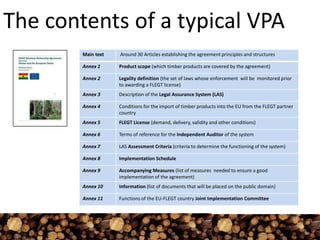
The contents of a typical VPA
Main text Around 30 Articles establishing the agreement principles and structures
Annex 1 Product scope (which timber products are covered by the agreement)
Annex 2 Legality definition (the set of laws whose enforcement will be monitored prior
to awarding a FLEGT license)
Annex 3 Description of the Legal Assurance System (LAS)
Annex 4 Conditions for the import of timber products into the EU from the FLEGT partner
country
Annex 5 FLEGT License (demand, delivery, validity and other conditions)
Annex 6 Terms of reference for the Independent Auditor of the system
Annex 7 LAS Assessment Criteria (criteria to determine the functioning of the system)
Annex 8 Implementation Schedule
Annex 9 Accompanying Measures (list of measures needed to ensure a good
implementation of the agreement)
Annex 10 Information (list of documents that will be placed on the public domain)
Annex 11 Functions of the EU-FLEGT country Joint Implementation Committee
How is a VPA agreed?
• Pre-negotiation starts when a timber producing country shows
interest in starting a VPA. During this time, both parties explore the
interests and constraints of engaging in such a process
• VPA negotiations follow. During negotiations both parties aim to
reach an agreement on the key elements of the VPA, including the
legality assurance system (LAS) and any other measures that will
have to be in place for the implementation
• Initialling of the VPA signifies the end of negotiations and often
includes a ceremony between the EU and timber exporter
• This is followed by the ratification process
When is a VPA legally binding?
• A VPA only enters into force once both parties have ratified.
• The process of ratification has so far taken from several months to
over a year, but during that time, parties can start developing the
agreed LAS
• FLEGT licences will not be given until the VPA has been ratified and
the elements of the LAS put in place. From that moment
onwards, only FLEGT timber can be exported from the partner
country to the EU market
For more information on the negotiation and ratification process, see
www.fern.org/ratification
Both parties enter into VPA negotiations voluntarily, but a signed VPA
commits both parties to only trade legal timber.
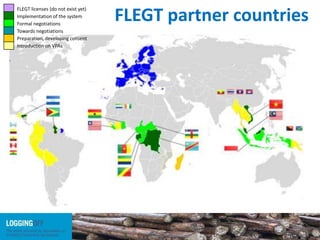
FLEGT partner countries
FLEGT licenses (do not exist yet)
Implementation of the system
Formal negotiations
Towards negotiations
Preparation, developing consent
Introduction on VPAs
Challenges of VPA negotiations
• Proper stakeholder involvement
Involving everyone with a right/stake on forest use is essential to
define challenges and support for the resulting VPA as well as to
ensure its legitimacy. Identifying interests and ways of getting the
right people to input in the negotiation is complex, and slows down
the process.
• Enough time
There is a very thin line between maintaining interest and allowing
time for effective participation.
• The will to reach a consensus
All sides must be willing to make concessions and reach a consensus.
VPAs are a big investment,
but they…
• Strengthen cooperation: Government, civil society and the private
sector see the advantage of working together
• Increase capacity: Providing space for rights/stakeholders to
participate in political processes improves civil society’s capacity to
be involved in the decisions that affect them
• Help improve governance: VPAs create the framework for rights/
stakeholders to discuss complex issues, get to the bottom of forest
governance problems and come up with solutions
• Define joint producer - consumer action: VPAs combine trade and
development perspectives. They aim to address problems first and
provide funding second
VPA implementation:
policy into practice
• How do we continue to ensure participation during the
development and monitoring of the systems?
• How do we maintain the momentum
There could easily be a drop in energy after intensive
negotiations.
• Keeping focused on governance reform
Funding will come alongside implementation, it may be
difficult to ensure that actions focus on governance reform
and not just establishing traceability systems
If you would like further
information about the FLEGT
action plan and how it is being
implemented, please contact
Rudi Kohnert or Saskia Ozinga
t +32 (0)496 205500
e iola@fern.org
e saskia@fern.org
You will also find more
information about FLEGT VPAs
and other related issues at
www.loggingoff.info
LOGGINGOFF is a joint initiative by NGOs from European and timber-producing
countries involved in or monitoring the implementation of the EU FLEGT Action
Plan, and specifically the implementation of the Voluntary Partnership Agreements.
LOGGINGOFF
Online
resource for
information
on VPAs

What are FLEGT VPAs

  • 1.
    What are FLEGTVPAs? They are Voluntary Partnership Agreements. They are legally binding bilateral trade agreements which set out the commitments and action that the EU and timber exporting countries will take to tackle illegal logging. LoggingOff is a joint initiative by NGOs from European and timber-producing countries involved in or monitoring the implementation of the EU FLEGT Action Plan, and specifically the implementation of the Voluntary Partnership Agreements
  • 2.
    Basics • The VPAprocess is undertaken by two parties: the EU on behalf of all its Member States and the country government of the timber exporting (and producing) country. • VPAs set out the commitments and action of both parties to tackle illegal logging, including measures to increase participation of rightsholders and non-state stakeholders; recognise communities’ rights to the land; and address corruption • VPAs are required to have the buy-in of national stakeholders, including NGOs, local communities, indigenous peoples, and the timber industry
  • 3.
    Context • Other elementsof this plan include : (1) Government Procurement Policies (2) Financial due diligence (3) Illegal timber regulation For more information on FLEGT, see: What is FLEGT VPAs are the central plank of the EU’s Action Plan to address the illegal timber trade: the Forest Law Enforcement, Governance and Trade (FLEGT) Action Plan.
  • 4.
    Objectives The EU CouncilConclusions on FLEGT (2003/C 268/01) note that the VPAs must, among others, “instigate forest sector governance reforms, more specifically they should: • strengthen land tenure and access rights especially for marginalised, rural communities and indigenous peoples; • strengthen effective participation of all stakeholders, notably of non- state actors and indigenous peoples, in policy-making and implementation; • increase transparency in association with forest exploitation operations, including through the introduction of independent monitoring; • reduce corruption in association with the award of forest exploitations concessions, and the harvesting and trade in timber”.
  • 5.
    To achieve theseobjectives... • all social, environmental and economic issues linked to forest use must be discussed, and failures addressed • weaknesses and injustices in the laws must be identified, and changes proposed through a process that involves all stakeholders • legal requirements must apply to all timber products and all exports, not just timber destined for the EU market • transparency and accountability must be improved through monitoring, reporting and public access to information
  • 6.
    VPA Elements A VPAincludes three main elements: a) Defining legality, or deciding which laws will be enforced for the purpose of the agreement b) Developing a Legality Assurance System (LAS) (including timber tracking, government legality controls, and systems to verify the legality of the timber) c) Independent audits of the whole system, to ensure credibility of the export licenses.
  • 7.
    • The legalitydefinition outlines the set of laws that will be enforced and monitored in the context of the FLEGT agreement • ‘Legality’ is based on the laws and procedures of the timber producing country in question, and must include laws addressing social, environmental and economic issues • The definition must be developed through extensive participation of all stakeholders and rightsholders Defining legality
  • 8.
    The LAS isthe main tool for guaranteeing legality. It consists of: • The "legality grid": A matrix which outlines the laws, verifiers and indicators used to monitor enforcement of laws • Chain of custody: The wood tracing system which ensures only timber verified as legal will be exported or sold. Verified and unverified timber should be kept separate • Verification of legal compliance: The way the government or third party verifies no illegally sourced timber enters the chain of custody. • Licensing: A FLEGT licence is issued to timber verified as legal, and this allows it to be shipped to the EU Legality assurance system
  • 9.
    Independent audit • isa compulsory element of a VPA • all agreed VPAs include annexes defining the ToR for the audits • its role is to check the system works Independent Monitoring/Observation • is not an integral part of the VPA • in Cameroon and the Rep of Congo, the need for an independent monitor/ observer is part of the VPA agreement • This monitor/observer checks malfunctions in forest law enforcement and provides information to the independent auditor. The role is often played by NGOs An independent auditor is hired to ensure the system is working. Their terms of reference (ToR) are defined in an annex to the VPA. Independent audits can also be complemented by independent monitoring/observation, providing information on governance failures. Independent audits
  • 10.
    What does aVPA look like? A VPA is composed of a set of articles outlining the basic principles of the agreement, the ‘main text’, and a set of annexes. The number of annexes can vary between different VPAs, but together they should cover issues such as which laws will be monitored for the purpose of the agreement , and how technical systems of verification and traceability will work
  • 11.
    The contents ofa typical VPA Main text Around 30 Articles establishing the agreement principles and structures Annex 1 Product scope (which timber products are covered by the agreement) Annex 2 Legality definition (the set of laws whose enforcement will be monitored prior to awarding a FLEGT license) Annex 3 Description of the Legal Assurance System (LAS) Annex 4 Conditions for the import of timber products into the EU from the FLEGT partner country Annex 5 FLEGT License (demand, delivery, validity and other conditions) Annex 6 Terms of reference for the Independent Auditor of the system Annex 7 LAS Assessment Criteria (criteria to determine the functioning of the system) Annex 8 Implementation Schedule Annex 9 Accompanying Measures (list of measures needed to ensure a good implementation of the agreement) Annex 10 Information (list of documents that will be placed on the public domain) Annex 11 Functions of the EU-FLEGT country Joint Implementation Committee
  • 12.
    How is aVPA agreed? • Pre-negotiation starts when a timber producing country shows interest in starting a VPA. During this time, both parties explore the interests and constraints of engaging in such a process • VPA negotiations follow. During negotiations both parties aim to reach an agreement on the key elements of the VPA, including the legality assurance system (LAS) and any other measures that will have to be in place for the implementation • Initialling of the VPA signifies the end of negotiations and often includes a ceremony between the EU and timber exporter • This is followed by the ratification process
  • 13.
    When is aVPA legally binding? • A VPA only enters into force once both parties have ratified. • The process of ratification has so far taken from several months to over a year, but during that time, parties can start developing the agreed LAS • FLEGT licences will not be given until the VPA has been ratified and the elements of the LAS put in place. From that moment onwards, only FLEGT timber can be exported from the partner country to the EU market For more information on the negotiation and ratification process, see www.fern.org/ratification Both parties enter into VPA negotiations voluntarily, but a signed VPA commits both parties to only trade legal timber.
  • 14.
    FLEGT partner countries FLEGTlicenses (do not exist yet) Implementation of the system Formal negotiations Towards negotiations Preparation, developing consent Introduction on VPAs
  • 15.
    Challenges of VPAnegotiations • Proper stakeholder involvement Involving everyone with a right/stake on forest use is essential to define challenges and support for the resulting VPA as well as to ensure its legitimacy. Identifying interests and ways of getting the right people to input in the negotiation is complex, and slows down the process. • Enough time There is a very thin line between maintaining interest and allowing time for effective participation. • The will to reach a consensus All sides must be willing to make concessions and reach a consensus.
  • 16.
    VPAs are abig investment, but they… • Strengthen cooperation: Government, civil society and the private sector see the advantage of working together • Increase capacity: Providing space for rights/stakeholders to participate in political processes improves civil society’s capacity to be involved in the decisions that affect them • Help improve governance: VPAs create the framework for rights/ stakeholders to discuss complex issues, get to the bottom of forest governance problems and come up with solutions • Define joint producer - consumer action: VPAs combine trade and development perspectives. They aim to address problems first and provide funding second
  • 17.
    VPA implementation: policy intopractice • How do we continue to ensure participation during the development and monitoring of the systems? • How do we maintain the momentum There could easily be a drop in energy after intensive negotiations. • Keeping focused on governance reform Funding will come alongside implementation, it may be difficult to ensure that actions focus on governance reform and not just establishing traceability systems
  • 18.
    If you wouldlike further information about the FLEGT action plan and how it is being implemented, please contact Rudi Kohnert or Saskia Ozinga t +32 (0)496 205500 e iola@fern.org e saskia@fern.org You will also find more information about FLEGT VPAs and other related issues at www.loggingoff.info LOGGINGOFF is a joint initiative by NGOs from European and timber-producing countries involved in or monitoring the implementation of the EU FLEGT Action Plan, and specifically the implementation of the Voluntary Partnership Agreements. LOGGINGOFF Online resource for information on VPAs