Approaches to Timber Legality 
Assurance 
Concepts and 
Lessons Learnt 
4th Sub-regional TLAS Workshop 
Andy Roby 
Vientiane, October 2014
The Presentation 
1.The Origins of FLEGT 
2.Legality Assurance 
3.VPAs – some basics 
4.Lessons learnt
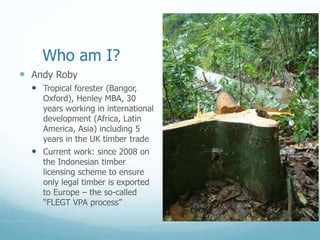
Who am I? 
 Andy Roby 
 Tropical forester (Bangor, 
Oxford), Henley MBA, 30 
years working in international 
development (Africa, Latin 
America, Asia) including 5 
years in the UK timber trade 
 Current work: since 2008 on 
the Indonesian timber 
licensing scheme to ensure 
only legal timber is exported 
to Europe – the so-called 
“FLEGT VPA process”
1. Illegal Logging: 
The nature of the challenge 
 Multiple forms – illegal logging can involve forestry, environmental, 
economic and social infractions 
 No single definition – legality is defined in accordance with national 
legislation 
 Many scales – from small to industrial or large scale 
 Many perpetrators – from local communities to highest level of 
government 
 Many agencies contribute to enforcement – police, customs, forest 
rangers, border guards, etc. 
 Interaction between illegal timber and other trafficking 
 Consumers remain largely unaware that what they are buying may 
be illegal
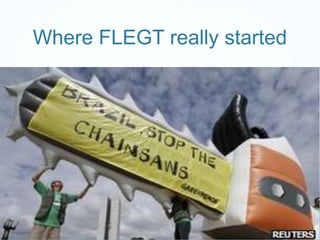
Where FLEGT really started
Timber legality – a personal 
journey 
• Pre-1998: See No Evil, Hear No Evil, Speak No Evil 
• G8 Birmingham meeting: “illegal logging, corruption” 
brought the G8 Action Plan on Forests 
• Danish and UK 2000 timber procurement policy 
established the market factor as a driver 
• Bali 2001 Declaration - the partnership between 
consumers and producers 
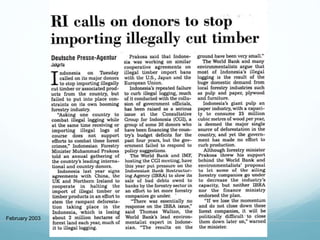
• In 2003 Indonesian Forestry Minister Prakosa’s 
challenge - “stop buying our illegal timber”
February 2003
The story continued…. 
• Greenpeace “Partners in Crime” campaign 2003 
• targeted the UK government 
• hit the trade 
• the trade responded 
• And then we started to understand the power of the market 
• In 2003 the EU took the East Asia FLEG process, added the “T” and 
the FLEGT Action Plan started up 
• In Indonesia civil society started work on a legality definition 
• UK, NL and Belgium traders joined together to do the Timber Trade 
Action Plan; cleaning up supply chains in response to the Greenpeace 
campaign 
• FLEGT Regulation in 2005 gave us the VPA and in 2007 the first 
countries agreed to start negotiations
FLEGT Concepts 
• Timber legality definitions; 
• Timber legality systems; 
• Independent Monitoring 
• Credibility 
• Something for everyone 
• The importance of the market driving the process 
• If one constituency doesn’t want it, it won’t work 
• Legality assurance….
2. Legality Assurance 
• The confidence that what you are buying is legal and will 
not 
• ruin your reputation 
• keep you up at night 
• cost you a fine or 
• put you in jail 
• But what is legal timber? 
and 
• How do you know if the timber is legal?
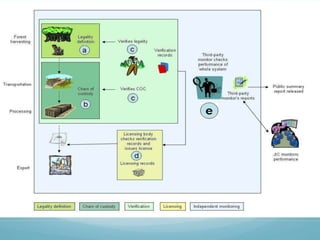
VPAs require a Timber Legality Assurance 
System or TLAS 
1. Timber Legality definition (country specific). – what does 
legal timber look like 
2. Supply chain control system (traceability system) – making 
sure no illegal timber gets into your products 
3. Verification System (both supply chain & legality). – making 
sure the systems are working properly 
4. Timber Licensing (Issuance of FLEGT Licenses) – the bit 
that EU customs will check when the shipments come in 
5. Independent Audit of the entire TLAS – for credibility and to 
make sure the whole VPA is working well.
1a) Key Elements of the Legality 
Definition 
• Key bits of national legislation – these tell 
you the timber is legal 
• Derived from a multi-stakeholder process 
with wide consensus
1b) Legality Definition 
Every legality definition should cover: 
i. rights to harvest; 
ii. forest management including - 
 community rights and welfare; 
 environmental legislation; 
 labour, health & safety policies; 
iii. taxes, import–export duties, royalties and fees; 
iv. respect for tenure and use rights; 
v. trade and export procedures.
2a) Supply Chain Control System 
Routinely ensures the integrity of 
timber product flows from A) the stump 
or the point of import to B) the point of 
export by using traceability verification 
methods.
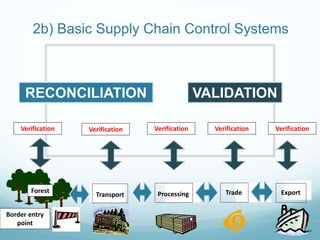
2b) Basic Supply Chain Control Systems 
RECONCILIATION 
Transport Forest Processing Export 
Border entry 
point 
VALIDATION 
Verification Verification Verification Verification 
Trade 
Verification
3a) Verification System 
1. Verification system ensures compliance with – 
i. the elements of the Legality Definition, and 
ii. the supply chain control system. 
2. Verification is a systematic process based on 
documented procedures and protocols defining 
methodologies, frequencies and different 
people/administrations involved for cross-checking and 
verifying compliance. 
3. Essentially defining the “who, what, when, where & 
how”
3b) Verification System 
4. Extends beyond verification checklists & includes entire 
administration, execution of the system, resources 
needed, non-compliances as well as complaint 
procedures (others). 
5. Approaches to verification: 
i. Shipment-based: Compliance verified per 
consignment. 
ii. Operator-based: Operator’s internal control systems 
verified periodically to ensure compliance with LD. 
iii. Hybrid systems: possibility exists.
4) Licensing 
1. Definition : licenses issued on the basis of evidence of legal 
compliance provided by verification systems. 
2. Under the FLEGT regime, one FLEGT License should be issued for 
each shipment exported to the EU. 
3. Issued by Licensing Authority (independent from verification 
body/agency) established / assigned in VPA partner country. 
4. Before “going live”, TLAS will be assessed independently against 
preset criteria provided in a specific VPA annex. 
5. Once FLEGT Licensing system is operational in a VPA country, EU 
border control agencies will only allow shipments of timber products 
(covered by the VPA) from that Country if they are covered by 
FLEGT licenses.
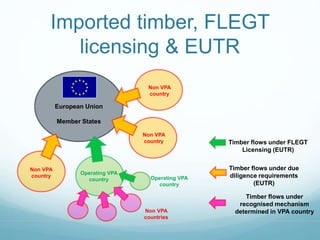
Imported timber, FLEGT 
licensing & EUTR 
European Union 
Member States 
Operating VPA 
country 
Non VPA 
country 
Non VPA 
country 
Non VPA 
country 
Operating VPA 
country 
Non VPA 
countries 
Timber flows under FLEGT 
Licensing (EUTR) 
Timber flows under due 
diligence requirements 
(EUTR) 
Timber flows under 
recognised mechanism 
determined in VPA country
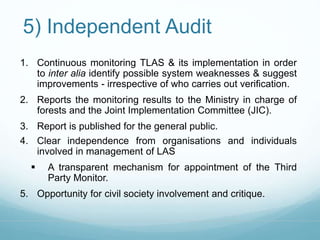
5) Independent Audit 
1. Continuous monitoring TLAS & its implementation in order 
to inter alia identify possible system weaknesses & suggest 
improvements - irrespective of who carries out verification. 
2. Reports the monitoring results to the Ministry in charge of 
forests and the Joint Implementation Committee (JIC). 
3. Report is published for the general public. 
4. Clear independence from organisations and individuals 
involved in management of LAS 
 A transparent mechanism for appointment of the Third 
Party Monitor. 
5. Opportunity for civil society involvement and critique.
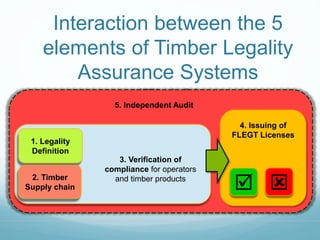
Interaction between the 5 
elements of Timber Legality 
Assurance Systems 
(TLAS) 5. Independent Audit 
3. Verification of 
compliance for operators 
and timber products 
1. Legality 
Definition 
2. Timber 
Supply chain 
4. Issuing of 
FLEGT Licenses 
 
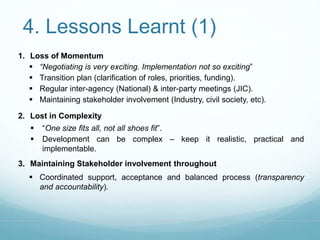
4. Lessons Learnt (1) 
1. Loss of Momentum 
 “Negotiating is very exciting. Implementation not so exciting” 
 Transition plan (clarification of roles, priorities, funding). 
 Regular inter-agency (National) & inter-party meetings (JIC). 
 Maintaining stakeholder involvement (Industry, civil society, etc). 
2. Lost in Complexity 
 “One size fits all, not all shoes fit”. 
 Development can be complex – keep it realistic, practical and 
implementable. 
3. Maintaining Stakeholder involvement throughout 
 Coordinated support, acceptance and balanced process (transparency 
and accountability).
4. Lessons Learnt (2) 
4. Losing sight or focus 
 Prioritising one aspect (i.e traceability) & neglecting adequate in 
parallel processes needed for VPA implementation. 
 Uneven capacities to address the different activities. 
 Too much focus on tools and technology. 
 Shifting attention and dividing resources to other sector initiatives. 
5. Capacity Building & Resources 
 More complexity means higher costs. 
 Funding options (sustainability of implementation). 
 Introduce new requirements : steep learning curve for all actors. 
6. Dealing with contemporary issues 
 Domestic markets, imports, timber in transit and more...
Concluding Remarks 
FLEGT licensed timber is the goal but many useful governance reforms 
come along the way 
The market is key – without the private sector would not have got 
interested….. 
It takes time, so you need intermediate benefits to keep stakeholders 
engaged 
VPA’s may not be the only answer but they are a powerful tool 
It’s a big job and it’s complicated but there are big rewards 
Civil society inputs crucial for credibility and restoring trust/belief
Thank You

04. andy roby on concepts and lessons

  • 1.
    Approaches to TimberLegality Assurance Concepts and Lessons Learnt 4th Sub-regional TLAS Workshop Andy Roby Vientiane, October 2014
  • 2.
    The Presentation 1.TheOrigins of FLEGT 2.Legality Assurance 3.VPAs – some basics 4.Lessons learnt
  • 3.
    Who am I?  Andy Roby  Tropical forester (Bangor, Oxford), Henley MBA, 30 years working in international development (Africa, Latin America, Asia) including 5 years in the UK timber trade  Current work: since 2008 on the Indonesian timber licensing scheme to ensure only legal timber is exported to Europe – the so-called “FLEGT VPA process”
  • 4.
    1. Illegal Logging: The nature of the challenge  Multiple forms – illegal logging can involve forestry, environmental, economic and social infractions  No single definition – legality is defined in accordance with national legislation  Many scales – from small to industrial or large scale  Many perpetrators – from local communities to highest level of government  Many agencies contribute to enforcement – police, customs, forest rangers, border guards, etc.  Interaction between illegal timber and other trafficking  Consumers remain largely unaware that what they are buying may be illegal
  • 5.
  • 6.
    Timber legality –a personal journey • Pre-1998: See No Evil, Hear No Evil, Speak No Evil • G8 Birmingham meeting: “illegal logging, corruption” brought the G8 Action Plan on Forests • Danish and UK 2000 timber procurement policy established the market factor as a driver • Bali 2001 Declaration - the partnership between consumers and producers • In 2003 Indonesian Forestry Minister Prakosa’s challenge - “stop buying our illegal timber”
  • 7.
  • 8.
    The story continued…. • Greenpeace “Partners in Crime” campaign 2003 • targeted the UK government • hit the trade • the trade responded • And then we started to understand the power of the market • In 2003 the EU took the East Asia FLEG process, added the “T” and the FLEGT Action Plan started up • In Indonesia civil society started work on a legality definition • UK, NL and Belgium traders joined together to do the Timber Trade Action Plan; cleaning up supply chains in response to the Greenpeace campaign • FLEGT Regulation in 2005 gave us the VPA and in 2007 the first countries agreed to start negotiations
  • 9.
    FLEGT Concepts •Timber legality definitions; • Timber legality systems; • Independent Monitoring • Credibility • Something for everyone • The importance of the market driving the process • If one constituency doesn’t want it, it won’t work • Legality assurance….
  • 10.
    2. Legality Assurance • The confidence that what you are buying is legal and will not • ruin your reputation • keep you up at night • cost you a fine or • put you in jail • But what is legal timber? and • How do you know if the timber is legal?
  • 11.
    VPAs require aTimber Legality Assurance System or TLAS 1. Timber Legality definition (country specific). – what does legal timber look like 2. Supply chain control system (traceability system) – making sure no illegal timber gets into your products 3. Verification System (both supply chain & legality). – making sure the systems are working properly 4. Timber Licensing (Issuance of FLEGT Licenses) – the bit that EU customs will check when the shipments come in 5. Independent Audit of the entire TLAS – for credibility and to make sure the whole VPA is working well.
  • 12.
    1a) Key Elementsof the Legality Definition • Key bits of national legislation – these tell you the timber is legal • Derived from a multi-stakeholder process with wide consensus
  • 13.
    1b) Legality Definition Every legality definition should cover: i. rights to harvest; ii. forest management including -  community rights and welfare;  environmental legislation;  labour, health & safety policies; iii. taxes, import–export duties, royalties and fees; iv. respect for tenure and use rights; v. trade and export procedures.
  • 14.
    2a) Supply ChainControl System Routinely ensures the integrity of timber product flows from A) the stump or the point of import to B) the point of export by using traceability verification methods.
  • 15.
    2b) Basic SupplyChain Control Systems RECONCILIATION Transport Forest Processing Export Border entry point VALIDATION Verification Verification Verification Verification Trade Verification
  • 16.
    3a) Verification System 1. Verification system ensures compliance with – i. the elements of the Legality Definition, and ii. the supply chain control system. 2. Verification is a systematic process based on documented procedures and protocols defining methodologies, frequencies and different people/administrations involved for cross-checking and verifying compliance. 3. Essentially defining the “who, what, when, where & how”
  • 17.
    3b) Verification System 4. Extends beyond verification checklists & includes entire administration, execution of the system, resources needed, non-compliances as well as complaint procedures (others). 5. Approaches to verification: i. Shipment-based: Compliance verified per consignment. ii. Operator-based: Operator’s internal control systems verified periodically to ensure compliance with LD. iii. Hybrid systems: possibility exists.
  • 18.
    4) Licensing 1.Definition : licenses issued on the basis of evidence of legal compliance provided by verification systems. 2. Under the FLEGT regime, one FLEGT License should be issued for each shipment exported to the EU. 3. Issued by Licensing Authority (independent from verification body/agency) established / assigned in VPA partner country. 4. Before “going live”, TLAS will be assessed independently against preset criteria provided in a specific VPA annex. 5. Once FLEGT Licensing system is operational in a VPA country, EU border control agencies will only allow shipments of timber products (covered by the VPA) from that Country if they are covered by FLEGT licenses.
  • 19.
    Imported timber, FLEGT licensing & EUTR European Union Member States Operating VPA country Non VPA country Non VPA country Non VPA country Operating VPA country Non VPA countries Timber flows under FLEGT Licensing (EUTR) Timber flows under due diligence requirements (EUTR) Timber flows under recognised mechanism determined in VPA country
  • 20.
    5) Independent Audit 1. Continuous monitoring TLAS & its implementation in order to inter alia identify possible system weaknesses & suggest improvements - irrespective of who carries out verification. 2. Reports the monitoring results to the Ministry in charge of forests and the Joint Implementation Committee (JIC). 3. Report is published for the general public. 4. Clear independence from organisations and individuals involved in management of LAS  A transparent mechanism for appointment of the Third Party Monitor. 5. Opportunity for civil society involvement and critique.
  • 21.
    Interaction between the5 elements of Timber Legality Assurance Systems (TLAS) 5. Independent Audit 3. Verification of compliance for operators and timber products 1. Legality Definition 2. Timber Supply chain 4. Issuing of FLEGT Licenses  
  • 23.
    4. Lessons Learnt(1) 1. Loss of Momentum  “Negotiating is very exciting. Implementation not so exciting”  Transition plan (clarification of roles, priorities, funding).  Regular inter-agency (National) & inter-party meetings (JIC).  Maintaining stakeholder involvement (Industry, civil society, etc). 2. Lost in Complexity  “One size fits all, not all shoes fit”.  Development can be complex – keep it realistic, practical and implementable. 3. Maintaining Stakeholder involvement throughout  Coordinated support, acceptance and balanced process (transparency and accountability).
  • 24.
    4. Lessons Learnt(2) 4. Losing sight or focus  Prioritising one aspect (i.e traceability) & neglecting adequate in parallel processes needed for VPA implementation.  Uneven capacities to address the different activities.  Too much focus on tools and technology.  Shifting attention and dividing resources to other sector initiatives. 5. Capacity Building & Resources  More complexity means higher costs.  Funding options (sustainability of implementation).  Introduce new requirements : steep learning curve for all actors. 6. Dealing with contemporary issues  Domestic markets, imports, timber in transit and more...
  • 25.
    Concluding Remarks FLEGTlicensed timber is the goal but many useful governance reforms come along the way The market is key – without the private sector would not have got interested….. It takes time, so you need intermediate benefits to keep stakeholders engaged VPA’s may not be the only answer but they are a powerful tool It’s a big job and it’s complicated but there are big rewards Civil society inputs crucial for credibility and restoring trust/belief
  • 26.