Between news, networks and news desks – processes of change in the journalistic news production Vinzenz Wyss  Future Workshop 2011:  Media Change as a Chance and as a Challenge  May 8/9, 2011  USI – Università della Svizzera italiana, Lugano
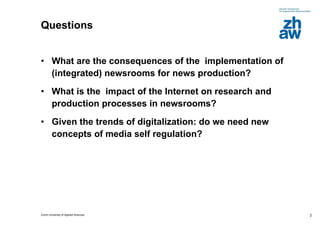
Questions What are the consequences of the  implementation of  (integrated) newsrooms for news production? What is the  impact of the Internet on research and production processes in newsrooms? Given the trends of digitalization: do we need new concepts of media self regulation?
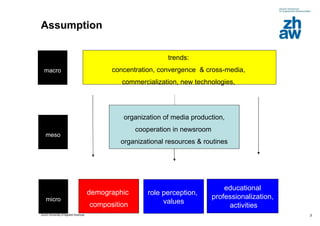
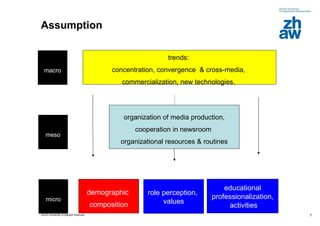
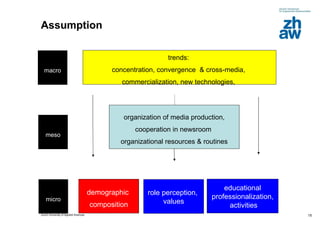
Assumption role perception,  values educational professionalization,  activities trends:  concentration, convergence  & cross-media,  commercialization, new technologies,  macro meso micro demographic  composition organization of media production, cooperation in newsroom  organizational resources & routines
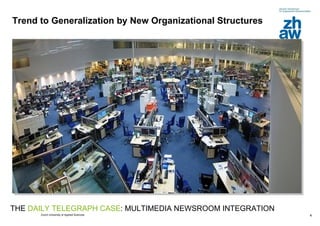
Trend to Generalization by New Organizational Structures THE  DAILY TELEGRAPH CASE : MULTIMEDIA NEWSROOM INTEGRATION
Conflicting goals Improve quality by inicreased  cooperation   Potential to  reduce  editorial  costs  by synergy Problems:  Difficulty to  coordinate    Resistance  of the journalistst Scale of the merging is  considerable
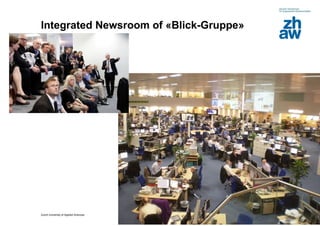
Integrated Newsroom of «Blick-Gruppe»
Assumption role perception,  values educational professionalization,  activities trends:  concentration, convergence  & cross-media,  commercialization, new technologies,  macro meso micro demographic  composition organization of media production, cooperation in newsroom  organizational resources & routines
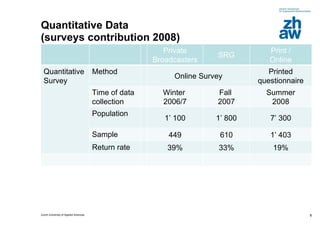
Quantitative Data  (surveys contribution 2008) Private Broadcasters SRG Print / Online Quantitative Survey Method Online Survey Printed questionnaire Time of data collection Winter  2006/7 Fall  2007 Summer 2008 Population 1’ 100 1’ 800 7’ 300 Sample 449 610 1’ 403 Return rate 39% 33% 19%
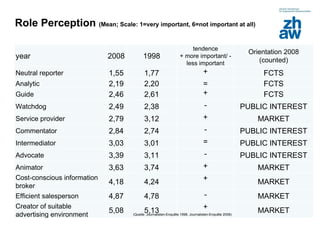
Role Perception  (Mean; Scale: 1=very important, 6=not important at all) (Quelle: Journalisten-Enquête 1998, Journalisten-Enquête 2008) year 2008 1998 tendence + more important/ - less important Orientation 2008 (counted) Neutral reporter  1,55 1,77 + FCTS Analytic  2,19 2,20 = FCTS Guide  2,46 2,61 + FCTS Watchdog  2,49 2,38 - PUBLIC INTEREST Service provider  2,79 3,12 + MARKET Commentator  2,84 2,74 - PUBLIC INTEREST Intermediator  3,03 3,01 = PUBLIC INTEREST Advocate  3,39 3,11 - PUBLIC INTEREST Animator  3,63 3,74 + MARKET Cost-conscious information broker  4,18 4,24 + MARKET Efficient salesperson  4,87 4,78 - MARKET Creator of suitable advertising environment 5,08 5,13 + MARKET
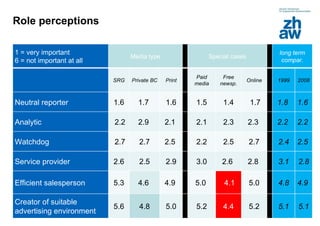
Role perceptions 1 = very important 6 = not important at all Media type   Special cases   long term compar.   SRG Private BC Print   Paid media Free newsp. Online   1999 2008 Neutral reporter  1.6 1.7  1.6   1.5 1.4   1.7   1.8  1.6  Analytic   2.2 2.9  2.1    2.1 2.3 2.3    2.2  2.2  Watchdog    2.7 2.7 2.5    2.2 2.5 2.7   2.4 2.5  Service provider  2.6 2.5 2.9   3.0 2.6  2.8    3.1 2.8 Efficient salesperson  5.3 4.6  4.9    5.0    4.1 5.0   4.8 4.9  Creator of suitable advertising environment 5.6 4.8 5.0 5.2 4.4 5.2 5.1 5.1
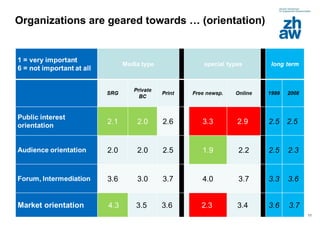
Organizations are geared towards … (orientation)
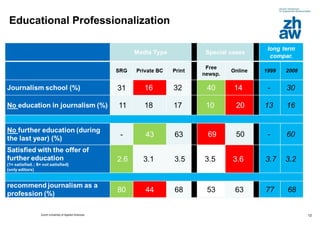
Educational Professionalization
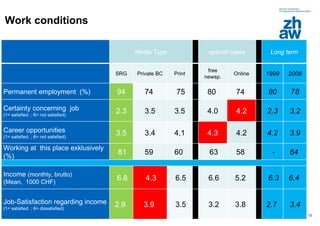
Work conditions   Media Type   special cases   Long term   SRG Private BC Print   free newsp. Online   1999 2008 Permanent employment  (%) 94 74    75   80  74    80 78 Certainty concerning  job (1= satisfied. ; 6= not satisfied) 2.3 3.5 3.5 4.0 4.2 2,3 3,2 Career opportunities  (1= satisfied. ; 6= not satisfied) 3.5 3.4 4,1 4.3 4.2 4.2 3.9 Working at  this place exklusively (%)   81 59  60      63 58      - 64  Income  (monthly, brutto) (Mean,  1000 CHF)   6.8   4.3   6.5     6.6 5.2      6.3 6.4  Job-Satisfaction regarding income (1= satisfied. ; 6= dissatisfied) 2.9  3.9    3.5     3.2 3.8    2.7  3.4
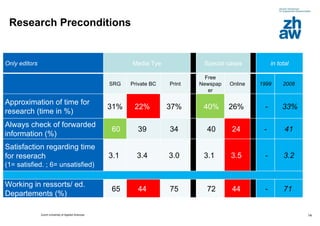
Research Preconditions Only editors Media Tye   Special cases   in total   SRG Private BC Print   Free Newspaper Online   1999 2008 Approximation of time for research (time in %) 31% 22%  37%      40% 26%      -   33% Always check of forwarded information (%)   60 39  34      40 24    - 41 Satisfaction regarding time for reserach (1= satisfied. ; 6= unsatisfied) 3.1  3.4  3.0    3.1  3.5      - 3.2 Working in ressorts/ ed. Departements (%)   65 44  75      72 44      - 71 
Assumption role perception,  values educational professionalization,  activities trends:  concentration, convergence  & cross-media,  commercialization, new technologies,  macro meso micro demographic  composition organization of media production, cooperation in newsroom  organizational resources & routines
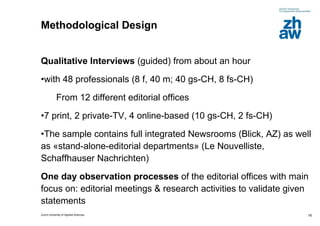
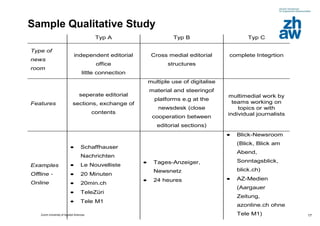
Methodological Design  Qualitative Interviews  (guided) from about an hour  with 48 professionals (8 f, 40 m; 40 gs-CH, 8 fs-CH) From 12 different editorial offices  7 print, 2 private-TV, 4 online-based (10 gs-CH, 2 fs-CH) The sample contains full integrated Newsrooms (Blick, AZ) as well as «stand-alone-editorial departments» (Le Nouvelliste, Schaffhauser Nachrichten) One day observation processes  of the editorial offices with main focus on: editorial meetings & research activities to validate given statements
Sample  Qualitative Study
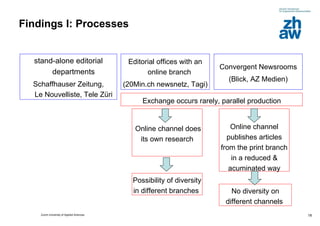
Findings I: Processes stand-alone editorial departments Schaffhauser Zeitung, Le Nouvelliste, Tele Züri Online channel does its own research Exchange occurs rarely, parallel production Editorial offices with an online branch  (20Min.ch newsnetz, Tagi) Convergent Newsrooms (Blick, AZ Medien) Online channel publishes articles from the print branch in a reduced & acuminated way Possibility of diversity in different branches  No diversity on different channels
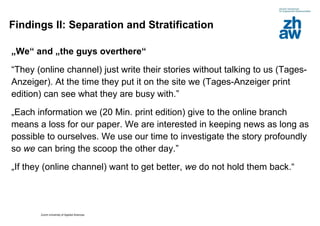
Findings II: Separation and Stratification „ We“ and „the guys overthere“ “ They (online channel) just write their stories without talking to us (Tages-Anzeiger). At the time they put it on the site we (Tages-Anzeiger print edition) can see what they are busy with.”  „ Each information we (20 Min. print edition) give to the online branch means a loss for our paper. We are interested in keeping news as long as possible to ourselves. We use our time to investigate the story profoundly so  we  can bring the scoop the other day.”   „ If they (online channel) want to get better,  we  do not hold them back.“
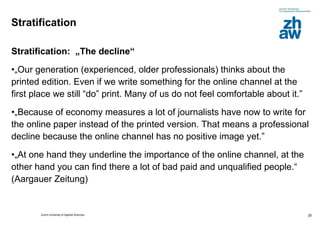
Stratification Stratification:  „The decline“  „ Our generation (experienced, older professionals) thinks about the printed edition. Even if we write something for the online channel at the first place we still “do” print. Many of us do not feel comfortable about it.”  „ Because of economy measures a lot of journalists have now to write for the online paper instead of the printed version. That means a professional decline because the online channel has no positive image yet.” „ At one hand they underline the importance of the online channel, at the other hand you can find there a lot of bad paid and unqualified people.“ (Aargauer Zeitung)
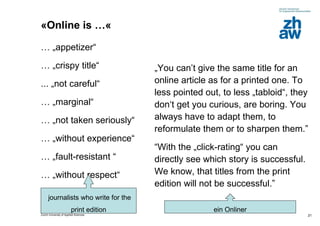
« Online is …« … „ appetizer“ … „ crispy title“ ... „not careful“  … „ marginal“  … „ not taken seriously“ … „ without experience“ … „ fault-resistant “ … „ without respect“ … „ embarrassing“ „ You can’t give the same title for an online article as for a printed one. To less pointed out, to less „tabloid“, they don‘t get you curious, are boring. You always have to adapt them, to reformulate them or to sharpen them.” “ With the „click-rating“ you can directly see which story is successful. We know, that titles from the print edition will not be successful.” journalists who write for the print edition ein Onliner
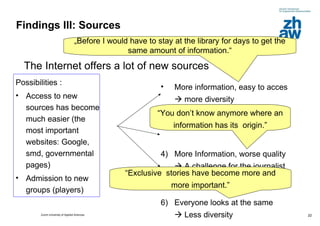
Findings III: Sources The Internet offers a lot of new sources  Possibilities : Access to new sources has become much easier (the most important websites: Google, smd, governmental pages) Admission to new groups (players) More information, easy to acces    more diversity  More Information, worse quality    A challenge for the journalist  Everyone looks at the same   Less diversity  „ Before I would have to stay at the library for days to get the same amount of information.“ “ You don’t know anymore where an information has its  origin.” “ Exclusive  stories have become more and more important.”
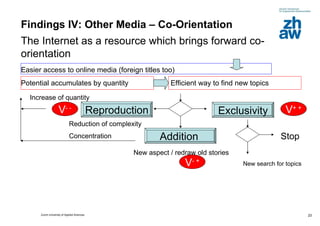
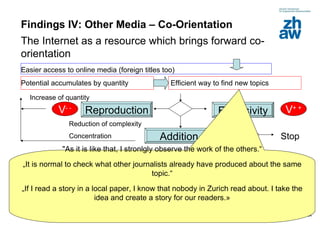
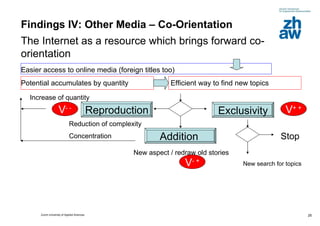
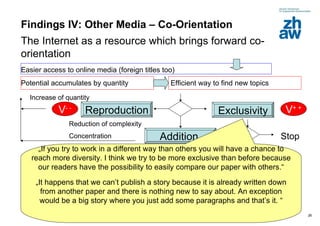
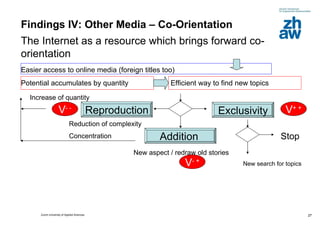
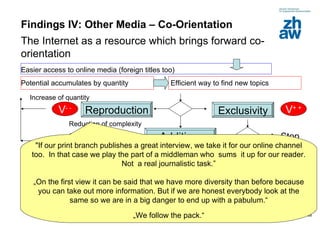
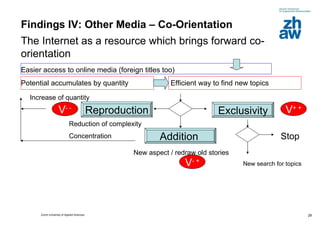
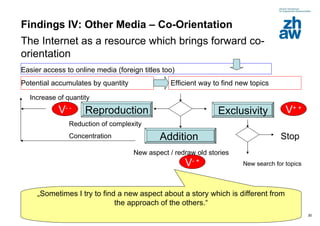
Findings IV: Other Media – Co-Orientation The Internet as a resource which brings forward co-orientation Easier access to online media (foreign titles too) Efficient way to find new topics Potential accumulates by quantity  Exclusivity V + + Reproduction Addition  V - + V - - Reduction of complexity Concentration New  aspect / redraw old stories  Increase of quantity  Stop New search for topics
Findings IV: Other Media – Co-Orientation The Internet as a resource which brings forward co-orientation Easier access to online media (foreign titles too) Efficient way to find new topics Potential accumulates by quantity  Exclusivity V + + Reproduction Addition  V - + V - - Reduction of complexity Concentration New  aspect / redraw old stories  Increase of quantity  Stop New search for topics "As it is like that, I stronlgly observe the work of the others.“ „ It is normal to check what other journalists already have produced about the same topic.“ „ If I read a story in a local paper, I know that nobody in Zurich read about. I take the idea and create a story for our readers.»
Findings IV: Other Media – Co-Orientation The Internet as a resource which brings forward co-orientation Easier access to online media (foreign titles too) Efficient way to find new topics Potential accumulates by quantity  Exclusivity V + + Reproduction Addition  V - + V - - Reduction of complexity Concentration New  aspect / redraw old stories  Increase of quantity  Stop New search for topics
Findings IV: Other Media – Co-Orientation The Internet as a resource which brings forward co-orientation Easier access to online media (foreign titles too) Efficient way to find new topics Potential accumulates by quantity  Exclusivity V + + Reproduction Addition  V - + V - - Reduction of complexity Concentration New  aspect / redraw old stories  Increase of quantity  Stop New search for topics „ If you try to work in a different way than others you will have a chance to reach more diversity. I think we try to be more exclusive than before because our readers have the possibility to easily compare our paper with others.“ „ It happens that we can’t publish a story because it is already written down from another paper and there is nothing new to say about. An exception would be a big story where you just add some paragraphs and that’s it. “
Findings IV: Other Media – Co-Orientation The Internet as a resource which brings forward co-orientation Easier access to online media (foreign titles too) Efficient way to find new topics Potential accumulates by quantity  Exclusivity V + + Reproduction Addition  V - + V - - Reduction of complexity Concentration New  aspect / redraw old stories  Increase of quantity  Stop New search for topics
Findings IV: Other Media – Co-Orientation The Internet as a resource which brings forward co-orientation Easier access to online media (foreign titles too) Efficient way to find new topics Potential accumulates by quantity  Exclusivity V + + Reproduction Addition  V - + V - - Reduction of complexity Concentration New  aspect / redraw old stories  Increase of quantity  Stop New search for topics „ « "If our print branch publishes a great interview, we take it for our online channel too.  In that case we play the part of a middleman who  sums  it up for our reader. Not  a real journalistic task.” „On the first view it can be said that we have more diversity than before because you can take out more information. But if we are honest everybody look at the same so we are in a big danger to end up with a pabulum.“ „ We follow the pack.“
Findings IV: Other Media – Co-Orientation The Internet as a resource which brings forward co-orientation Easier access to online media (foreign titles too) Efficient way to find new topics Potential accumulates by quantity  Exclusivity V + + Reproduction Addition  V - + V - - Reduction of complexity Concentration New  aspect / redraw old stories  Increase of quantity  Stop New search for topics
Findings IV: Other Media – Co-Orientation The Internet as a resource which brings forward co-orientation Easier access to online media (foreign titles too) Efficient way to find new topics Potential accumulates by quantity  Exclusivity V + + Reproduction Addition  V - + V - - Reduction of complexity Concentration New  aspect / redraw old stories  Increase of quantity  Stop New search for topics „ Sometimes I try to find a new aspect about a story which is different from the approach of the others.“
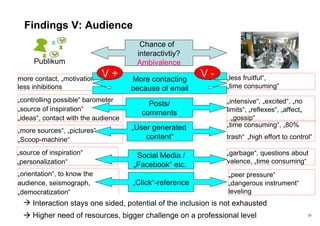
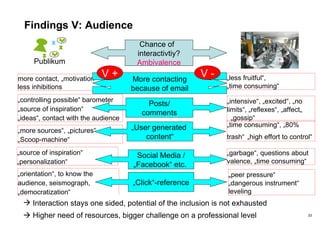
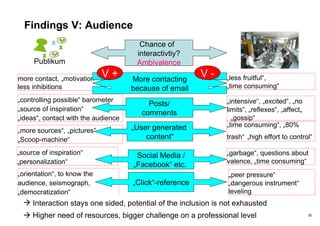
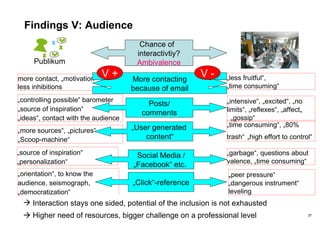
Findings V: Audience „ orientation“, to know the audience, seismograph,  „democratization“ „ source of inspiration“ „personalization“ „ more sources“, „pictures“ „Scoop-machine“ more contact, „motivation“  less inhibitions  „ controlling possible“ barometer „source of inspiration“ „ideas“, contact with the audience Chance of  interactivtiy? Ambivalence More contacting because of email Posts/ comments „ Click“-reference Social Media / „Facebook“ etc.  „ less fruitful“, „time consuming“ „ User generated  content“ „ intensive“, „excited“, „no limits“, „reflexes“, „affect„  „gossip“  V + V - „ garbage“, questions about valence, „time consuming“ Interaction stays one sided, potential of the inclusion is not exhausted   Higher need of resources, bigger challenge on a professional level „ peer pressure“ „dangerous instrument“ leveling „ time consuming“, „80% trash“   „high effort to control“ Publikum
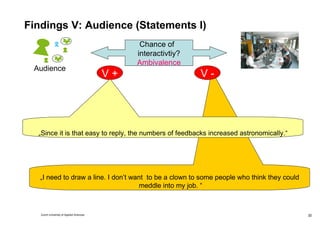
Findings V: Audience (Statements I) „ I  need to draw a line. I don’t want  to be a clown to some people who think they could  meddle into my job. “ Chance of  interactivtiy? Ambivalence V + V - „ Since it is that easy to reply, the numbers of feedbacks increased astronomically.“ Audience
Findings V: Audience „ orientation“, to know the audience, seismograph,  „democratization“ „ source of inspiration“ „personalization“ „ more sources“, „pictures“ „Scoop-machine“ more contact, „motivation“  less inhibitions  „ controlling possible“ barometer „source of inspiration“ „ideas“, contact with the audience Chance of  interactivtiy? Ambivalence More contacting because of email Posts/ comments „ Click“-reference Social Media / „Facebook“ etc.  „ less fruitful“, „time consuming“ „ User generated  content“ „ intensive“, „excited“, „no limits“, „reflexes“, „affect„  „gossip“  V + V - „ garbage“, questions about valence, „time consuming“ Interaction stays one sided, potential of the inclusion is not exhausted   Higher need of resources, bigger challenge on a professional level „ peer pressure“ „dangerous instrument“ leveling „ time consuming“, „80% trash“   „high effort to control“ Publikum
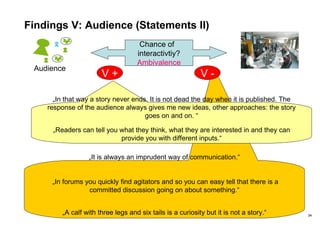
Findings V: Audience (Statements II) „ It is always an imprudent way of communication.“  „In forums you quickly find agitators and so you can easy tell that there is a committed discussion going on about something.“ „ A calf with three legs and six tails is a curiosity but it is not a story.“ Chance of  interactivtiy? Ambivalence V + V - „ In that way a story never ends. It is not dead the day when it is published. The response of the audience always gives me new ideas, other approaches: the story goes on and on. “ „ Readers can tell you what they think, what they are interested in and they can provide you with different inputs.“ Audience
Findings V: Audience „ orientation“, to know the audience, seismograph,  „democratization“ „ source of inspiration“ „personalization“ „ more sources“, „pictures“ „Scoop-machine“ more contact, „motivation“  less inhibitions  „ controlling possible“ barometer „source of inspiration“ „ideas“, contact with the audience Chance of  interactivtiy? Ambivalence More contacting because of email Posts/ comments „ Click“-reference Social Media / „Facebook“ etc.  „ less fruitful“, „time consuming“ „ User generated  content“ „ intensive“, „excited“, „no limits“, „reflexes“, „affect„  „gossip“  V + V - „ garbage“, questions about valence, „time consuming“ Interaction stays one sided, potential of the inclusion is not exhausted   Higher need of resources, bigger challenge on a professional level „ peer pressure“ „dangerous instrument“ leveling „ time consuming“, „80% trash“   „high effort to control“ Publikum
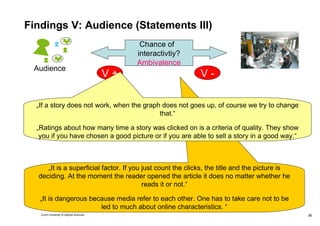
Findings V: Audience (Statements III) „ It is a superficial factor. If you just count the clicks, the title and the picture is deciding. At the moment the reader opened the article it does no matter whether he reads it or not.“ „ It is dangerous because media refer to each other. One has to take care not to be led to much about online characteristics. “ Chance of  interactivtiy? Ambivalence V + V - „ If a story does not work, when the graph does not goes up, of course we try to change that.“ „ Ratings about how many time a story was clicked on is a criteria of quality. They show you if you have chosen a good picture or if you are able to sell a story in a good way.“ Audience
Findings V: Audience „ orientation“, to know the audience, seismograph,  „democratization“ „ source of inspiration“ „personalization“ „ more sources“, „pictures“ „Scoop-machine“ more contact, „motivation“  less inhibitions  „ controlling possible“ barometer „source of inspiration“ „ideas“, contact with the audience Chance of  interactivtiy? Ambivalence More contacting because of email Posts/ comments „ Click“-reference Social Media / „Facebook“ etc.  „ less fruitful“, „time consuming“ „ User generated  content“ „ intensive“, „excited“, „no limits“, „reflexes“, „affect„  „gossip“  V + V - „ garbage“, questions about valence, „time consuming“ Interaction stays one sided, potential of the inclusion is not exhausted   Higher need of resources, bigger challenge on a professional level „ peer pressure“ „dangerous instrument“ leveling „ time consuming“, „80% trash“   „high effort to control“ Publikum
Conclusion I Norms:   There is no change about norms:  one adheres to professional standards.  Actuality and exclusivity become more and more important.  Profound approach has lost its importance. Processes: Editorial organization is very stable,  innovation is rare Sources:   easier access to gather information does not automatically lead to more diversity.  Economic pressure is stronger than new possibilities.  Advancement: access to official documents easier Contacting new actors has become faster.
Conclusion II Other Media – Co-Orientation: News value “Public Issue” / “Publicity” gains in importance News value “Exclusivity” / „Variation“ stays a rare exhausted potential    spiral movement Lack of resources (time, knowledge) forces co-orientation  (reference: online-media) Lack of resources forces pseudo diversity (enrichment of selected stories) Audience:   Interaction with the audience stays rather one sided  The technical and social potential for inclusion of the audience is not used Time consuming instruments require more resources and requirements to “professionality” / professional standards
Between news, networks and news desks – processes of change in the journalistic news production Vinzenz Wyss  Future Workshop 2011:  Media Change as a Chance and as a Challenge  May 8/9, 2011  USI – Università della Svizzera italiana, Lugano

2011 05 09_saxer_stiftung

  • 1.
    Between news, networksand news desks – processes of change in the journalistic news production Vinzenz Wyss Future Workshop 2011: Media Change as a Chance and as a Challenge May 8/9, 2011 USI – Università della Svizzera italiana, Lugano
  • 2.
    Questions What arethe consequences of the implementation of (integrated) newsrooms for news production? What is the impact of the Internet on research and production processes in newsrooms? Given the trends of digitalization: do we need new concepts of media self regulation?
  • 3.
    Assumption role perception, values educational professionalization, activities trends: concentration, convergence & cross-media, commercialization, new technologies, macro meso micro demographic composition organization of media production, cooperation in newsroom organizational resources & routines
  • 4.
    Trend to Generalizationby New Organizational Structures THE DAILY TELEGRAPH CASE : MULTIMEDIA NEWSROOM INTEGRATION
  • 5.
    Conflicting goals Improvequality by inicreased cooperation Potential to reduce editorial costs by synergy Problems: Difficulty to coordinate   Resistance of the journalistst Scale of the merging is considerable
  • 6.
    Integrated Newsroom of«Blick-Gruppe»
  • 7.
    Assumption role perception, values educational professionalization, activities trends: concentration, convergence & cross-media, commercialization, new technologies, macro meso micro demographic composition organization of media production, cooperation in newsroom organizational resources & routines
  • 8.
    Quantitative Data (surveys contribution 2008) Private Broadcasters SRG Print / Online Quantitative Survey Method Online Survey Printed questionnaire Time of data collection Winter 2006/7 Fall 2007 Summer 2008 Population 1’ 100 1’ 800 7’ 300 Sample 449 610 1’ 403 Return rate 39% 33% 19%
  • 9.
    Role Perception (Mean; Scale: 1=very important, 6=not important at all) (Quelle: Journalisten-Enquête 1998, Journalisten-Enquête 2008) year 2008 1998 tendence + more important/ - less important Orientation 2008 (counted) Neutral reporter 1,55 1,77 + FCTS Analytic 2,19 2,20 = FCTS Guide 2,46 2,61 + FCTS Watchdog 2,49 2,38 - PUBLIC INTEREST Service provider 2,79 3,12 + MARKET Commentator 2,84 2,74 - PUBLIC INTEREST Intermediator 3,03 3,01 = PUBLIC INTEREST Advocate 3,39 3,11 - PUBLIC INTEREST Animator 3,63 3,74 + MARKET Cost-conscious information broker 4,18 4,24 + MARKET Efficient salesperson 4,87 4,78 - MARKET Creator of suitable advertising environment 5,08 5,13 + MARKET
  • 10.
    Role perceptions 1= very important 6 = not important at all Media type   Special cases   long term compar.   SRG Private BC Print   Paid media Free newsp. Online   1999 2008 Neutral reporter 1.6 1.7  1.6   1.5 1.4   1.7   1.8  1.6  Analytic   2.2 2.9  2.1    2.1 2.3 2.3    2.2  2.2  Watchdog   2.7 2.7 2.5    2.2 2.5 2.7   2.4 2.5  Service provider 2.6 2.5 2.9   3.0 2.6  2.8    3.1 2.8 Efficient salesperson 5.3 4.6  4.9    5.0    4.1 5.0   4.8 4.9  Creator of suitable advertising environment 5.6 4.8 5.0 5.2 4.4 5.2 5.1 5.1
  • 11.
    Organizations are gearedtowards … (orientation)
  • 12.
  • 13.
    Work conditions  Media Type   special cases   Long term   SRG Private BC Print   free newsp. Online   1999 2008 Permanent employment (%) 94 74    75   80  74    80 78 Certainty concerning job (1= satisfied. ; 6= not satisfied) 2.3 3.5 3.5 4.0 4.2 2,3 3,2 Career opportunities (1= satisfied. ; 6= not satisfied) 3.5 3.4 4,1 4.3 4.2 4.2 3.9 Working at this place exklusively (%)   81 59  60      63 58      - 64  Income (monthly, brutto) (Mean, 1000 CHF)   6.8   4.3   6.5     6.6 5.2      6.3 6.4  Job-Satisfaction regarding income (1= satisfied. ; 6= dissatisfied) 2.9  3.9    3.5     3.2 3.8    2.7  3.4
  • 14.
    Research Preconditions Onlyeditors Media Tye   Special cases   in total   SRG Private BC Print   Free Newspaper Online   1999 2008 Approximation of time for research (time in %) 31% 22%  37%      40% 26%      -   33% Always check of forwarded information (%)   60 39  34      40 24    - 41 Satisfaction regarding time for reserach (1= satisfied. ; 6= unsatisfied) 3.1  3.4  3.0    3.1  3.5      - 3.2 Working in ressorts/ ed. Departements (%)   65 44  75      72 44      - 71 
  • 15.
    Assumption role perception, values educational professionalization, activities trends: concentration, convergence & cross-media, commercialization, new technologies, macro meso micro demographic composition organization of media production, cooperation in newsroom organizational resources & routines
  • 16.
    Methodological Design Qualitative Interviews (guided) from about an hour with 48 professionals (8 f, 40 m; 40 gs-CH, 8 fs-CH) From 12 different editorial offices 7 print, 2 private-TV, 4 online-based (10 gs-CH, 2 fs-CH) The sample contains full integrated Newsrooms (Blick, AZ) as well as «stand-alone-editorial departments» (Le Nouvelliste, Schaffhauser Nachrichten) One day observation processes of the editorial offices with main focus on: editorial meetings & research activities to validate given statements
  • 17.
  • 18.
    Findings I: Processesstand-alone editorial departments Schaffhauser Zeitung, Le Nouvelliste, Tele Züri Online channel does its own research Exchange occurs rarely, parallel production Editorial offices with an online branch (20Min.ch newsnetz, Tagi) Convergent Newsrooms (Blick, AZ Medien) Online channel publishes articles from the print branch in a reduced & acuminated way Possibility of diversity in different branches No diversity on different channels
  • 19.
    Findings II: Separationand Stratification „ We“ and „the guys overthere“ “ They (online channel) just write their stories without talking to us (Tages-Anzeiger). At the time they put it on the site we (Tages-Anzeiger print edition) can see what they are busy with.” „ Each information we (20 Min. print edition) give to the online branch means a loss for our paper. We are interested in keeping news as long as possible to ourselves. We use our time to investigate the story profoundly so we can bring the scoop the other day.” „ If they (online channel) want to get better, we do not hold them back.“
  • 20.
    Stratification Stratification: „The decline“ „ Our generation (experienced, older professionals) thinks about the printed edition. Even if we write something for the online channel at the first place we still “do” print. Many of us do not feel comfortable about it.” „ Because of economy measures a lot of journalists have now to write for the online paper instead of the printed version. That means a professional decline because the online channel has no positive image yet.” „ At one hand they underline the importance of the online channel, at the other hand you can find there a lot of bad paid and unqualified people.“ (Aargauer Zeitung)
  • 21.
    « Online is…« … „ appetizer“ … „ crispy title“ ... „not careful“ … „ marginal“ … „ not taken seriously“ … „ without experience“ … „ fault-resistant “ … „ without respect“ … „ embarrassing“ „ You can’t give the same title for an online article as for a printed one. To less pointed out, to less „tabloid“, they don‘t get you curious, are boring. You always have to adapt them, to reformulate them or to sharpen them.” “ With the „click-rating“ you can directly see which story is successful. We know, that titles from the print edition will not be successful.” journalists who write for the print edition ein Onliner
  • 22.
    Findings III: SourcesThe Internet offers a lot of new sources Possibilities : Access to new sources has become much easier (the most important websites: Google, smd, governmental pages) Admission to new groups (players) More information, easy to acces  more diversity More Information, worse quality  A challenge for the journalist Everyone looks at the same  Less diversity „ Before I would have to stay at the library for days to get the same amount of information.“ “ You don’t know anymore where an information has its origin.” “ Exclusive stories have become more and more important.”
  • 23.
    Findings IV: OtherMedia – Co-Orientation The Internet as a resource which brings forward co-orientation Easier access to online media (foreign titles too) Efficient way to find new topics Potential accumulates by quantity Exclusivity V + + Reproduction Addition V - + V - - Reduction of complexity Concentration New aspect / redraw old stories Increase of quantity Stop New search for topics
  • 24.
    Findings IV: OtherMedia – Co-Orientation The Internet as a resource which brings forward co-orientation Easier access to online media (foreign titles too) Efficient way to find new topics Potential accumulates by quantity Exclusivity V + + Reproduction Addition V - + V - - Reduction of complexity Concentration New aspect / redraw old stories Increase of quantity Stop New search for topics "As it is like that, I stronlgly observe the work of the others.“ „ It is normal to check what other journalists already have produced about the same topic.“ „ If I read a story in a local paper, I know that nobody in Zurich read about. I take the idea and create a story for our readers.»
  • 25.
    Findings IV: OtherMedia – Co-Orientation The Internet as a resource which brings forward co-orientation Easier access to online media (foreign titles too) Efficient way to find new topics Potential accumulates by quantity Exclusivity V + + Reproduction Addition V - + V - - Reduction of complexity Concentration New aspect / redraw old stories Increase of quantity Stop New search for topics
  • 26.
    Findings IV: OtherMedia – Co-Orientation The Internet as a resource which brings forward co-orientation Easier access to online media (foreign titles too) Efficient way to find new topics Potential accumulates by quantity Exclusivity V + + Reproduction Addition V - + V - - Reduction of complexity Concentration New aspect / redraw old stories Increase of quantity Stop New search for topics „ If you try to work in a different way than others you will have a chance to reach more diversity. I think we try to be more exclusive than before because our readers have the possibility to easily compare our paper with others.“ „ It happens that we can’t publish a story because it is already written down from another paper and there is nothing new to say about. An exception would be a big story where you just add some paragraphs and that’s it. “
  • 27.
    Findings IV: OtherMedia – Co-Orientation The Internet as a resource which brings forward co-orientation Easier access to online media (foreign titles too) Efficient way to find new topics Potential accumulates by quantity Exclusivity V + + Reproduction Addition V - + V - - Reduction of complexity Concentration New aspect / redraw old stories Increase of quantity Stop New search for topics
  • 28.
    Findings IV: OtherMedia – Co-Orientation The Internet as a resource which brings forward co-orientation Easier access to online media (foreign titles too) Efficient way to find new topics Potential accumulates by quantity Exclusivity V + + Reproduction Addition V - + V - - Reduction of complexity Concentration New aspect / redraw old stories Increase of quantity Stop New search for topics „ « "If our print branch publishes a great interview, we take it for our online channel too. In that case we play the part of a middleman who sums it up for our reader. Not a real journalistic task.” „On the first view it can be said that we have more diversity than before because you can take out more information. But if we are honest everybody look at the same so we are in a big danger to end up with a pabulum.“ „ We follow the pack.“
  • 29.
    Findings IV: OtherMedia – Co-Orientation The Internet as a resource which brings forward co-orientation Easier access to online media (foreign titles too) Efficient way to find new topics Potential accumulates by quantity Exclusivity V + + Reproduction Addition V - + V - - Reduction of complexity Concentration New aspect / redraw old stories Increase of quantity Stop New search for topics
  • 30.
    Findings IV: OtherMedia – Co-Orientation The Internet as a resource which brings forward co-orientation Easier access to online media (foreign titles too) Efficient way to find new topics Potential accumulates by quantity Exclusivity V + + Reproduction Addition V - + V - - Reduction of complexity Concentration New aspect / redraw old stories Increase of quantity Stop New search for topics „ Sometimes I try to find a new aspect about a story which is different from the approach of the others.“
  • 31.
    Findings V: Audience„ orientation“, to know the audience, seismograph, „democratization“ „ source of inspiration“ „personalization“ „ more sources“, „pictures“ „Scoop-machine“ more contact, „motivation“ less inhibitions „ controlling possible“ barometer „source of inspiration“ „ideas“, contact with the audience Chance of interactivtiy? Ambivalence More contacting because of email Posts/ comments „ Click“-reference Social Media / „Facebook“ etc. „ less fruitful“, „time consuming“ „ User generated content“ „ intensive“, „excited“, „no limits“, „reflexes“, „affect„ „gossip“ V + V - „ garbage“, questions about valence, „time consuming“ Interaction stays one sided, potential of the inclusion is not exhausted  Higher need of resources, bigger challenge on a professional level „ peer pressure“ „dangerous instrument“ leveling „ time consuming“, „80% trash“ „high effort to control“ Publikum
  • 32.
    Findings V: Audience(Statements I) „ I need to draw a line. I don’t want to be a clown to some people who think they could meddle into my job. “ Chance of interactivtiy? Ambivalence V + V - „ Since it is that easy to reply, the numbers of feedbacks increased astronomically.“ Audience
  • 33.
    Findings V: Audience„ orientation“, to know the audience, seismograph, „democratization“ „ source of inspiration“ „personalization“ „ more sources“, „pictures“ „Scoop-machine“ more contact, „motivation“ less inhibitions „ controlling possible“ barometer „source of inspiration“ „ideas“, contact with the audience Chance of interactivtiy? Ambivalence More contacting because of email Posts/ comments „ Click“-reference Social Media / „Facebook“ etc. „ less fruitful“, „time consuming“ „ User generated content“ „ intensive“, „excited“, „no limits“, „reflexes“, „affect„ „gossip“ V + V - „ garbage“, questions about valence, „time consuming“ Interaction stays one sided, potential of the inclusion is not exhausted  Higher need of resources, bigger challenge on a professional level „ peer pressure“ „dangerous instrument“ leveling „ time consuming“, „80% trash“ „high effort to control“ Publikum
  • 34.
    Findings V: Audience(Statements II) „ It is always an imprudent way of communication.“ „In forums you quickly find agitators and so you can easy tell that there is a committed discussion going on about something.“ „ A calf with three legs and six tails is a curiosity but it is not a story.“ Chance of interactivtiy? Ambivalence V + V - „ In that way a story never ends. It is not dead the day when it is published. The response of the audience always gives me new ideas, other approaches: the story goes on and on. “ „ Readers can tell you what they think, what they are interested in and they can provide you with different inputs.“ Audience
  • 35.
    Findings V: Audience„ orientation“, to know the audience, seismograph, „democratization“ „ source of inspiration“ „personalization“ „ more sources“, „pictures“ „Scoop-machine“ more contact, „motivation“ less inhibitions „ controlling possible“ barometer „source of inspiration“ „ideas“, contact with the audience Chance of interactivtiy? Ambivalence More contacting because of email Posts/ comments „ Click“-reference Social Media / „Facebook“ etc. „ less fruitful“, „time consuming“ „ User generated content“ „ intensive“, „excited“, „no limits“, „reflexes“, „affect„ „gossip“ V + V - „ garbage“, questions about valence, „time consuming“ Interaction stays one sided, potential of the inclusion is not exhausted  Higher need of resources, bigger challenge on a professional level „ peer pressure“ „dangerous instrument“ leveling „ time consuming“, „80% trash“ „high effort to control“ Publikum
  • 36.
    Findings V: Audience(Statements III) „ It is a superficial factor. If you just count the clicks, the title and the picture is deciding. At the moment the reader opened the article it does no matter whether he reads it or not.“ „ It is dangerous because media refer to each other. One has to take care not to be led to much about online characteristics. “ Chance of interactivtiy? Ambivalence V + V - „ If a story does not work, when the graph does not goes up, of course we try to change that.“ „ Ratings about how many time a story was clicked on is a criteria of quality. They show you if you have chosen a good picture or if you are able to sell a story in a good way.“ Audience
  • 37.
    Findings V: Audience„ orientation“, to know the audience, seismograph, „democratization“ „ source of inspiration“ „personalization“ „ more sources“, „pictures“ „Scoop-machine“ more contact, „motivation“ less inhibitions „ controlling possible“ barometer „source of inspiration“ „ideas“, contact with the audience Chance of interactivtiy? Ambivalence More contacting because of email Posts/ comments „ Click“-reference Social Media / „Facebook“ etc. „ less fruitful“, „time consuming“ „ User generated content“ „ intensive“, „excited“, „no limits“, „reflexes“, „affect„ „gossip“ V + V - „ garbage“, questions about valence, „time consuming“ Interaction stays one sided, potential of the inclusion is not exhausted  Higher need of resources, bigger challenge on a professional level „ peer pressure“ „dangerous instrument“ leveling „ time consuming“, „80% trash“ „high effort to control“ Publikum
  • 38.
    Conclusion I Norms: There is no change about norms: one adheres to professional standards. Actuality and exclusivity become more and more important. Profound approach has lost its importance. Processes: Editorial organization is very stable, innovation is rare Sources: easier access to gather information does not automatically lead to more diversity. Economic pressure is stronger than new possibilities. Advancement: access to official documents easier Contacting new actors has become faster.
  • 39.
    Conclusion II OtherMedia – Co-Orientation: News value “Public Issue” / “Publicity” gains in importance News value “Exclusivity” / „Variation“ stays a rare exhausted potential  spiral movement Lack of resources (time, knowledge) forces co-orientation (reference: online-media) Lack of resources forces pseudo diversity (enrichment of selected stories) Audience: Interaction with the audience stays rather one sided The technical and social potential for inclusion of the audience is not used Time consuming instruments require more resources and requirements to “professionality” / professional standards
  • 40.
    Between news, networksand news desks – processes of change in the journalistic news production Vinzenz Wyss Future Workshop 2011: Media Change as a Chance and as a Challenge May 8/9, 2011 USI – Università della Svizzera italiana, Lugano

Editor's Notes