Earthster Core OntologyA core domain ontology for Life Cycle Assessment
IntroductionsEarthster is a project, led by Greg Norris, to provide free open source solutions supporting Life Cycle Analysis – that is evaluating the environmental and social impacts of products. Brian McBride is a consultant, ontologist, developer and general dogsbody who has worked on semantic web technologies since 2000.  He was co-chair of the RDFCore WG in W3C and the initiating developer of the Jena Java library.Epimorphics is a Semantic Web startup based in  the UK specialising in Linked Open Data. http://www.earthster.org/http://www.epimorphics.com/
MenuA little bit about LCAWhy semantic web?A fragment of ECOA sense of the restThe ECO-systemA little bit on methodERF – an applicationWrapupSeason to taste with questions and discussion anytime
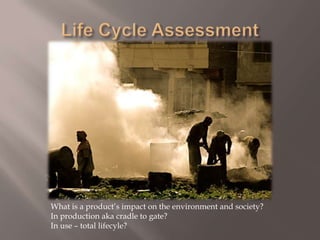
Life Cycle AssessmentWhat is a product’s impact on the environment and society?In production aka cradle to gate?In use – total lifecyle?
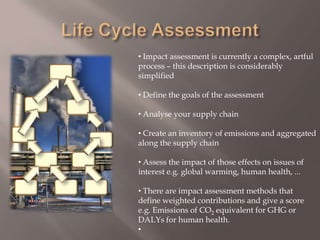
Life Cycle AssessmentImpact assessment is currently a complex, artful process – this description is considerably simplified
Define the goals of the assessment
Analyse your supply chain
 Create an inventory of emissions and aggregated along the supply chain
 Assess the impact of those effects on issues of interest e.g. global warming, human health, ...
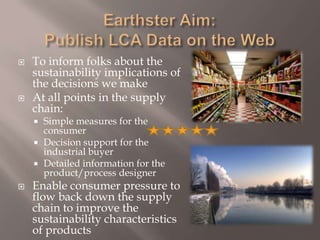
There are impact assessment methods that define weighted contributions and give a score e.g. Emissions of CO2equivalent for GHG or  DALYs for human health.Earthster Aim:Publish LCA Data on the WebTo inform folks about the sustainability implications of the decisions we makeAt all points in the supply chain:Simple measures for the consumer Decision support for the industrial buyerDetailed information for the product/process designerEnable consumer pressure to flow back down the supply chain to improve the sustainability characteristics of products
Why Semantic Web?EffectsPublish the data on the web makes it most freely available – and that is what the semantic web is forLinking to other data sources – that is what Linked Open Data is forFind an alternative pesticide that targets the same class of organismLink to Good Relations dataOperationsInteroperabilityHarmonize competing systems by defining a common conceptual modelHarmonize competing vocabularies by defining common reference dataLCA research is ongoing – the data required is changing over timeFinding the best available data
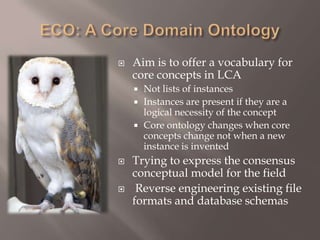
ECO: A Core Domain OntologyAim is to offer a vocabulary for core concepts in LCANot lists of instancesInstances are present if they are a logical necessity of the conceptCore ontology changes when core concepts change not when a new instance is inventedTrying to express the consensus conceptual model for the field Reverse engineering existing file formats and database schemas
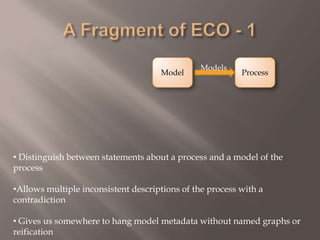
A Fragment of ECO - 1ProcessModelModels Distinguish between statements about a process and a model of the process
Allows multiple inconsistent descriptions of the process with a contradiction
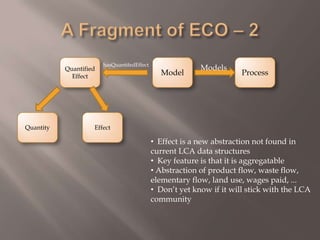
 Gives us somewhere to hang model metadata without named graphs or reificationA Fragment of ECO – 2ProcessModelQuantified EffecthasQuantifedEffectModelsQuantityEffect  Effect is a new abstraction not found in current LCA data structures
 Key feature is that it is aggregatable
Abstraction of product flow, waste flow, elementary flow, land use, wages paid, ...
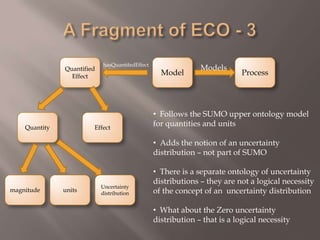
 Don’t yet know if it will stick with the LCA community A Fragment of ECO - 3ProcessModelQuantified EffecthasQuantifedEffectModels  Follows the SUMO upper ontology model for quantities and units
  Adds the notion of an uncertainty distribution – not part of SUMO
  There is a separate ontology of uncertainty distributions – they are not a logical necessity of the concept of an  uncertainty distribution
  What about the Zero uncertainty distribution – that is a logical necessityQuantityEffectmagnitudeunitsUncertainty distribution
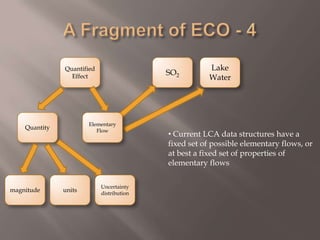
A Fragment of ECO - 4LakeWaterSO2Quantified EffectQuantityElementary FlowCurrent LCA data structures have a fixed set of possible elementary flows, or at best a fixed set of properties of elementary flowsmagnitudeunitsUncertainty distribution
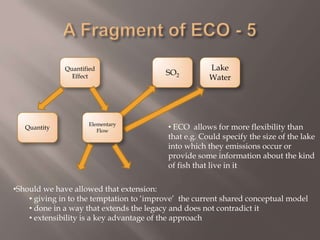
A Fragment of ECO - 5LakeWaterSO2Quantified EffectQuantityElementary FlowECO  allows for more flexibility than that e.g. Could specify the size of the lake into which they emissions occur or provide some information about the kind of fish that live in it
Should we have allowed that extension:
 giving in to the temptation to ‘improve’  the current shared conceptual model
 done in a way that extends the legacy and does not contradict it

20100427 Earthster Core Ontology

  • 1.
    Earthster Core OntologyAcore domain ontology for Life Cycle Assessment
  • 2.
    IntroductionsEarthster is aproject, led by Greg Norris, to provide free open source solutions supporting Life Cycle Analysis – that is evaluating the environmental and social impacts of products. Brian McBride is a consultant, ontologist, developer and general dogsbody who has worked on semantic web technologies since 2000. He was co-chair of the RDFCore WG in W3C and the initiating developer of the Jena Java library.Epimorphics is a Semantic Web startup based in the UK specialising in Linked Open Data. http://www.earthster.org/http://www.epimorphics.com/
  • 3.
    MenuA little bitabout LCAWhy semantic web?A fragment of ECOA sense of the restThe ECO-systemA little bit on methodERF – an applicationWrapupSeason to taste with questions and discussion anytime
  • 4.
    Life Cycle AssessmentWhatis a product’s impact on the environment and society?In production aka cradle to gate?In use – total lifecyle?
  • 5.
    Life Cycle AssessmentImpactassessment is currently a complex, artful process – this description is considerably simplified
  • 6.
    Define the goalsof the assessment
  • 7.
  • 8.
    Create aninventory of emissions and aggregated along the supply chain
  • 9.
    Assess theimpact of those effects on issues of interest e.g. global warming, human health, ...
  • 10.
    There are impactassessment methods that define weighted contributions and give a score e.g. Emissions of CO2equivalent for GHG or DALYs for human health.Earthster Aim:Publish LCA Data on the WebTo inform folks about the sustainability implications of the decisions we makeAt all points in the supply chain:Simple measures for the consumer Decision support for the industrial buyerDetailed information for the product/process designerEnable consumer pressure to flow back down the supply chain to improve the sustainability characteristics of products
  • 11.
    Why Semantic Web?EffectsPublishthe data on the web makes it most freely available – and that is what the semantic web is forLinking to other data sources – that is what Linked Open Data is forFind an alternative pesticide that targets the same class of organismLink to Good Relations dataOperationsInteroperabilityHarmonize competing systems by defining a common conceptual modelHarmonize competing vocabularies by defining common reference dataLCA research is ongoing – the data required is changing over timeFinding the best available data
  • 12.
    ECO: A CoreDomain OntologyAim is to offer a vocabulary for core concepts in LCANot lists of instancesInstances are present if they are a logical necessity of the conceptCore ontology changes when core concepts change not when a new instance is inventedTrying to express the consensus conceptual model for the field Reverse engineering existing file formats and database schemas
  • 13.
    A Fragment ofECO - 1ProcessModelModels Distinguish between statements about a process and a model of the process
  • 14.
    Allows multiple inconsistentdescriptions of the process with a contradiction
  • 15.
    Gives ussomewhere to hang model metadata without named graphs or reificationA Fragment of ECO – 2ProcessModelQuantified EffecthasQuantifedEffectModelsQuantityEffect Effect is a new abstraction not found in current LCA data structures
  • 16.
    Key featureis that it is aggregatable
  • 17.
    Abstraction of productflow, waste flow, elementary flow, land use, wages paid, ...
  • 18.
    Don’t yetknow if it will stick with the LCA community A Fragment of ECO - 3ProcessModelQuantified EffecthasQuantifedEffectModels Follows the SUMO upper ontology model for quantities and units
  • 19.
    Addsthe notion of an uncertainty distribution – not part of SUMO
  • 20.
    Thereis a separate ontology of uncertainty distributions – they are not a logical necessity of the concept of an uncertainty distribution
  • 21.
    Whatabout the Zero uncertainty distribution – that is a logical necessityQuantityEffectmagnitudeunitsUncertainty distribution
  • 22.
    A Fragment ofECO - 4LakeWaterSO2Quantified EffectQuantityElementary FlowCurrent LCA data structures have a fixed set of possible elementary flows, or at best a fixed set of properties of elementary flowsmagnitudeunitsUncertainty distribution
  • 23.
    A Fragment ofECO - 5LakeWaterSO2Quantified EffectQuantityElementary FlowECO allows for more flexibility than that e.g. Could specify the size of the lake into which they emissions occur or provide some information about the kind of fish that live in it
  • 24.
    Should we haveallowed that extension:
  • 25.
    giving into the temptation to ‘improve’ the current shared conceptual model
  • 26.
    done ina way that extends the legacy and does not contradict it