SO, YOU WANT TO BE AN ENGINEER? SUMMER 2010 ISU EEOB & CBIRC RET & ACTS PRESENTATIONS
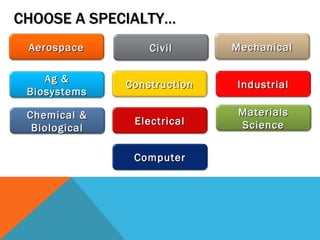
CHOOSE A SPECIALTY… Aerospace Ag & Biosystems Construction Industrial Chemical & Biological Electrical Computer Materials Science Civil Mechanical
MECHANICAL ENGINEERING GROUP MEMBERS:  LANCE MAFFIN, TRACY PEARSON, ELLA SPEIGEL & ERIC HALL
Research, design, develop, manufacture, and test tools, engines, machines, and other mechanical devices It is the branch of engineering that involves the production and usage of heat and mechanical power for the design, production, and operation of machines and tools. It is one of the oldest and broadest engineering disciplines. Mechanical engineering  applies the principles of physics and materials science for analysis, design, manufacturing, and maintenance of mechanical systems.  NATURE OF THE WORK Tracy P.
College of Engineering: Mechanical Engineering Students learn to create and build machines, devices, and systems that perform useful services. Mechanical engineers are typically involved with such activities as:  generation, distribution, and use of energy development and application of manufacturing systems and processes automation and control of mechanical and thermal systems design of various products for consumer and commercial markets SPECIALIZED TRAINING Ella S.
Mechanical engineering students : study the principles of motion, energy, and force, in the classroom and in some of Iowa State's laboratories. have access to the Visualization Lab, the C4 and C6 virtual reality environments, and the laser lab. Mechanical engineering education prepares the students for a  wide range of careers, including: Product research and development Design Product manufacturing, testing, quality assurance, marketing,  operation, and management.
STUDENT TYPE/PRE-COLLEGE TRAINING Minimum High School Course Requirements for Admission to Iowa State University English/Language Arts  -  4 years Mathematics  -  3 years Including one year each of algebra, geometry, and advanced algebra. Science  -  3 years, including 1 year each of 2 of the following:  biology, chemistry & physics Social Studies  -  2 years Additional entrance requirements for the Colleges of Engineering and Liberal Arts and Sciences  – All of the above, plus two years of a single foreign language.
Mechanical engineers held about 239,000 jobs in 2008, second only to civil engineers 6% job growth over the next 8-10 years, which is slower than the average for all occupations Emerging new areas of growth for mechanical engineers include biotechnology, nanotechnology and materials science. M.E.s are in demand because a ME degree can be used as a springboard into virtually any other branch of engineering The median income of a ME is $74,900. EMPLOYMENT Eric H.
The following are two examples of grants awarded to mechanical engineers. Developing microfluidic human liver model (miniature human liver bioreactor) to study viral infection and alcohol effects on the liver.  Explore new composite nano-manufacturing methods to enhance mechanical integrity of biopolymers using functionalized nanodiamond and to investigate a new micro porous structure which will assist in bioactive reagent delivery in surgical devices. CURRENT RESEARCH Lance M.
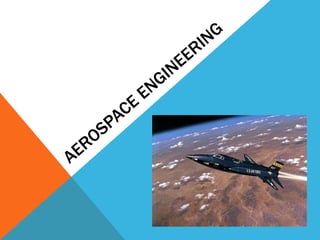
AEROSPACE ENGINEERING
THE NATURE OF THE WORK Aerospace engineers are involved on all aspects of aeronautics (aircraft) or astronautics (spacecraft) They design, develop, and test aircraft, spacecraft, and missiles and supervise the manufacture of these products They often specialize in one of many areas such as aerodynamics, propulsion, flight mechanics, orbital mechanics, fluids, structures, guidance & control, and computation
SPECIALIZED TRAINING Basic Training Required BA in aerospace engineering (advanced mathematics classes, basic engineering courses and aerospace engineering classes) Specialized Training Within the Field propulsion, guidance systems, structural design, navigation systems, instrumentation and communication, aerodynamics, thermodynamics and celestial mechanics
Pre-College training Students should pursue an academically challenging course Load 4 years of English / language arts 2 years of a foreign language 3 (but preferably 4) years of science 2 years social studies Preferably 4 years of math  Student Type/Pre-College Training Personal Attributes Students should have a keen interest in aircraft and flight Technology Analytical / logical Detail oriented Inquisitive Creative Good interpersonal skills (you will most likely work as part of a team)
Employment Outlook:  Employment expected to grow about as fast as all other engineering occupations through 2015.  Salaries:  In 2009 the median income was $79,000.  Federal Government: $79,200 Search and navigation equipment: $75,880 Aircraft, parts and components: $76,890 Guided missiles, space vehicles and parts: &74,180 EMPLOYMENT!!
CURRENT RESEARCH  The study of fluid-structure interaction problems that include, mainly the detrimental effects of wind on civil and mechanical structures, and the environment, and a wide range of aerospace-related research. ISU researchers have considerable expertise in developing Thermal Barrier Coating systems to protect turbine superalloys from high temperatures gases and oxidation.  Recent developments are an aluminum (Al) coating embedded in the superalloy that reduced the weight, and a new bond coat material that significantly enhances the life of the TBC system .
AG & BIOSYSTEMS ENGINEERING
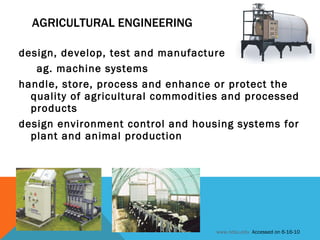
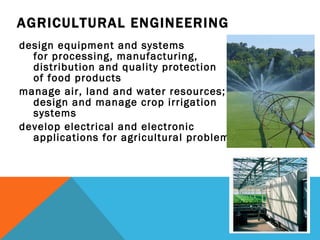
AGRICULTURAL ENGINEERING design, develop, test and manufacture  ag. machine systems handle, store, process and enhance or protect the quality of agricultural commodities and processed products design environment control and housing systems for plant and animal production www.ndsu.edu   Accessed on 6-16-10
AGRICULTURAL ENGINEERING design equipment and systems  for processing, manufacturing,  distribution and quality protection  of food products manage air, land and water resources; design and manage crop irrigation  systems develop electrical and electronic  applications for agricultural problems
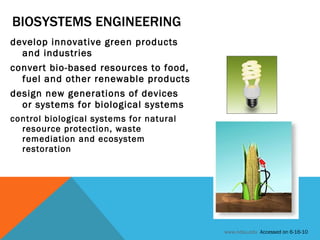
BIOSYSTEMS ENGINEERING develop innovative green products and industries  convert bio-based resources to food, fuel and other renewable products design new generations of devices or systems for biological systems control biological systems for natural resource protection, waste remediation and ecosystem restoration www.ndsu.edu   Accessed on 6-16-10
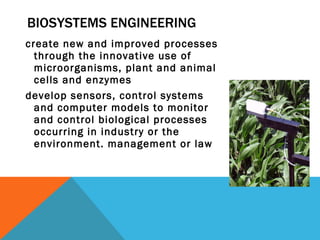
BIOSYSTEMS ENGINEERING create new and improved processes through the innovative use of microorganisms, plant and animal cells and enzymes  develop sensors, control systems and computer models to monitor and control biological processes occurring in industry or the environment. management or law
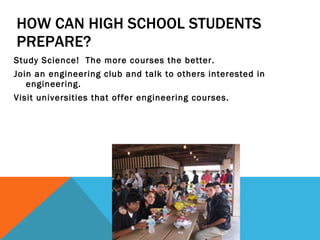
HOW CAN HIGH SCHOOL STUDENTS PREPARE? Study Science!  The more courses the better. Join an engineering club and talk to others interested in engineering. Visit universities that offer engineering courses.
AGRICULTURAL AND  BIOSYSTEMS  ENGINEERING DEGREES Degrees are offered in bachelor's, master's and PhD programs throughout the U.S
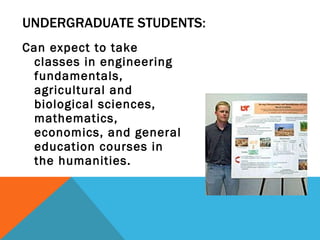
UNDERGRADUATE STUDENTS: Can expect to take classes in engineering fundamentals, agricultural and biological sciences, mathematics, economics, and general education courses in the humanities.
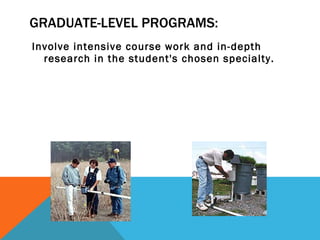
GRADUATE-LEVEL PROGRAMS: Involve intensive course work and in-depth research in the student's chosen specialty.
EMPLOYMENT  Position titles of graduates include:  design engineer test engineer project engineer plant engineer quality control engineer process engineer energy adviser consulting engineer  environmental engineer Starting salaries range from $42,000 to $62,000 per year.  -North Dakota State University
BIOSYSTEMS ENGINEERING FORMERLY KNOWN AS JOURNAL OF AGRICULTURAL ENGINEERING RESEARCH Collision-free inverse kinematics of the redundant seven-link manipulator used in a cucumber picking robot  Modelling water pollution by leached soluble phosphorus, part 2: Simulation of effects of manure management Vis/NIR spectroscopy and chemometrics for the prediction of soluble solids content and acidity (pH) of kiwifruit
CHEMICAL AND BIOLOGICAL ENGINEERING LIFE AND THE CHEMICALS INVOLVED IN OUR LIVES
The Nature of the Work Chemical application of physical sciences and math to turning raw materials into more useful forms. Also often involved in manufacturing processes related to chemicals. Biological Or bioengineering, application of engineering principles to biological or medical problems. Can overlap with biomedical engineering. Source: Wikipedia
TRAINING IN CHEM AND BIOCHEM  Excellent skills in math, chemistry and physics are a start Undergraduate and graduate coursework in an area of interest provide the knowledge to begin applying principles of engineering. ie. Body systems knowledge for design of life support technology
STUDENT TYPE/PRE-COLLEGE TRAINING Persistence, curiosity, complex problem-solving skills, and excellent laboratory skills Admissions requirements for undergraduate engineering schools include a solid background in mathematics (algebra, geometry, trigonometry, and calculus) and science (biology, chemistry, and physics), with courses in English, social studies, and humanities. Source: Sciencebuddies.org
EMPLOYMENT  Biological Engineering Medical device manufacturers Pharmaceutical companies Medical Research Institutions Agricultural Industry Chemical Engineering Food Industry Petroleum and renewable resources Process control Pharmaceutical companies Production
CURRENT RESEARCH  Chemical- from ACS Industrial & Engineering Chemistry Research http://pubs.acs.org/doi/abs/10.1021/ie801542g http://pubs.acs.org/doi/abs/10.1021/ie8019032 Biological- from Journal of Biological Engineering http://www.jbioleng.org/content/4/1/6 http://www.jbioleng.org/content/4/1/5
CIVIL ENGINEERING MS INQUIRY GROUP A KARA CHRISTENSEN KELLY EARL AMANDA KITE DALE KLINGENBERG ADAM PUDERBAUGH
THE NATURE OF THE WORK Design and planning of: Bridges Tunnels Harbors Highways Water and Sewage systems Other buildings Employed by: All levels of government Construction companies Engineering/Architectural firms Also independently employed
SPECIALIZED TRAINING Civil engineering is a very broad category and can be broken down into several specialized areas of engineering.  They include: Structural  Construction Hydraulics Sanitary Environmental Transportation Soil Mechanics
STUDENT TYPE/PRE-COLLEGE TRAINING The type of student that fits this major is one that enjoys: Math Physics Science combination of all communicating and working as a group    Some helpful pre-college tips: Taking advanced classes in  many high level math, science, and physics classes Attend summer camps for pre-engineering Be involved in clubs to help work on problem solving skills
EMPLOYMENT  Monitoring, guiding, devising, and designing -Building of roads -Girders -Bridges -Airports -Tunnels  -Dams -Water & sewage systems  Civil engineering is  one of the oldest disciplines of engineering contains a variety of specialties like structural, water related, environmental, architectural, transportation and geo-technical engineering Administrative or supervisory jobs are held by many civil engineers while others work in devising, composing, constructing, researching and teaching jobs. Civil engineers usually work near major industrial and commercial centers, often at construction sites.  Some projects are situated in remote areas or in foreign countries. In some jobs, civil engineers move from place to place to work on different projects.
CURRENT RESEARCH  Smart materials and  structures    Infrastructure reliability  and biomechanics    Remote sensing applications    River restoration  GIS modeling               Micromechanics of granular materials Water treatment processes  Membrane processes Desalination      Waste containment and management  Water and energy balance measurements      
COMPUTER ENGINEERING GROUP MEMBERS CAROLYN CARTER MIKE LAZERE JOSH MANGLER BRIAN ROBISON REBECCA STEINLAGE
NATURE OF THE WORK Computer Engineer (Software) Develop, test and evaluate the software that are installed on our computers. Computers games, Business applications, Security, Video Source: Education-Portal.com Computer Engineer (Hardware) Design and manufacture computers. Creates the main PC and its associated components such as chips, circuit boards, systems, modems. Source : Collegesurfin g.com  eHow.com
SPECIALIZED TRAINING Sound background in math and sciences Course work including: Algorithems Computer networking Robotics Operating systems Analog electronics Digital electronics EMPLOYERS LOOK FOR Relevant programming skills Degrees in computer science, physical science, mathematics. Keeping up to date with current information.  Continuing Ed! UNDERGRAD STUDIES
Students in high school should be strong in math and science 4 yrs - through trigonometry and advanced math 3 yrs – science including biology, chemistry and physics Students have an interest in computer hardware and software and take classes if available. STUDENT TYPE/PRE-COLLEGE TRAINING
Core skills can be applied to nearly any organization in a variety of ways. Design : create the software for new, innovative products Development : improve existing items, advance artificial intelligence Quality Control : analyze factory output, evade problems improve efficiency Architect : makes computers smaller and more powerful EMPLOYMENT
Research in computer engineering includes several different areas, but three prevalent areas are: Computer architecture Design of the structure of a computer system, including internal performance as well as the hardware Software systems Designing software of good quality, low cost, easy maintenance and materials that are replicable Intelligent systems “ Artificial intelligence” for robotics, neural networks (parallel processing of information) CURRENT RESEARCH
CONSTRUCTION ENGINEERING “ PAVING THE WAY”
THE NATURE OF THE WORK Plan, design, and manage construction of large structures 4 primary areas: Building:  Roads, waterways, & railways Mechanical Electrical
SPECIALIZED TRAINING STEM-focused prerequisites Undergraduate focus Emphasis on construction process skills Graduate focus Emphasis on management and design of construction projects Post Graduate Focus Emphasis on design
STUDENT TYPE/PRE-COLLEGE TRAINING Strong visual-spatial learners Courses geared toward math, physics, and chemistry/chemical properties.
EMPLOYMENT  Construction Project Management Architectural design Construction economics and logistics Electrical Engineering Military Applications etc.
CURRENT RESEARCH  Fuel Cell Powered Locomotive Design of Renewable Energy Generators
REFERENCES http://www.ccee.iastate.edu/academics/undergrad-construction.html www.universities.com/.../ Bachelor_degrees_in_Construction_Engineering_Technology_Technician.html http://www.cecer.army.mil/td/tips/index.cfm http://web.mit.edu/research/topic/architecture.html#labs
ELECTRICAL ENGINEERING KARL GOLDSMITH NICK HAYES KIM KULT PEG CONLON ANSON BONTE
THE NATURE OF THE WORK Field of engineering dealing with electricity, electromagnetism, and electronics. This includes large-scale electrical systems.  It may include electronic engineering which also includes smaller scale systems such as computers.
SPECIALIZED TRAINING This profession requires at least a bachelor’s degree.  Master’s and Doctorate’s can also be earned. Specialized can be earned in such topics as microelectronics, electromagnetism, instrumentation, telecommunications and so on.
STUDENT TYPE/PRE-COLLEGE TRAINING Mathematics -- 4 years, including trigonometry and precalculus  Science -- 3 years, including chemistry and physics A good team member with organizational ability, integrity, ambition, and communication skills. A high degree of analytical skill and the ability to handle abstract models of physical phenomena.
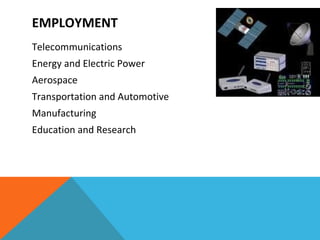
EMPLOYMENT  Telecommunications Energy and Electric Power Aerospace Transportation and Automotive Manufacturing Education and Research
CURRENT RESEARCH  There are several areas of research involving electrical engineering, including biomedical, nanotechnology, communication and signal processing, computers, systems and controls, electromagnetics, electronics and power engineering.
SOURCES http://en.wikipedia.org/wiki/Electrical_engineering http://www.ece.iastate.edu/academics/ee-undergraduate-major.html http://www.careercornerstone.org/pdf/ee/eleceng.pdf http://www.ieeeusa.org/careers/yourcareer.html
INDUSTRIAL ENGINEERING MAUREEN GRIFFIN, ALICIA SCHILLER, KYLE WEIS, SPENCER MESICK, BERNIE HERMANSON
Industrial Engineers determine the best way to build a better mouse trap and market that mouse trap once it is built.  They find ways that are better, faster, smarter, easier and safer so their company makes a good profit, are efficient and safer.  They find ways to help keep employees satisfied and safe with their work. The next time you wait in a long line for that roller coaster ride or to get processed for Access Plus Payroll Deposit you can blame the industrial engineer for not doing their job!   http://www.sciencebuddies.org/science-fair-projects/science-engineering-careers/MatlSci_industrialengineer_c001.shtml NATURE OF THE WORK
Specialized Training for an I.E. chemistry, physics, materials science  calculus, differential equations, statistics, advanced mathematics/computation   engineering mechanics & design,  computer science, circuits/electronics ergonomics/safety, stochastics   management systems theory, economics   International credits
engineering and business combined together industrial engineers uses technology, people, and information to improve productivity, enhance quality, manage resources-in short, and to make things better Pre-College Training – excels in math, science, business and computer classes STUDENT TYPE/PRE-COLLEGE TRAINING
EMPLOYMENT In 2008 engineers held 1.6 million jobs, with industrial engineers holding 214,800 of those jobs    3 rd  highest Engineers are employed in every state, in small and large cities and in rural areas.  Industrial engineers are expected to have employment growth of 14 percent over the projections decade, faster than average for all occupations.   It’s expected that firms will turn to industrial engineers to develop more efficient processes and reduce costs, delays, and waste.   Source = http://www.bls.gov/oco/ocos027.htm#emply
Main Areas of current research: Human Factors- Occupational Ergonomics, Assistive Technologies, Safety Engineering Manufacturing-rapid manufacturing of 3Dbulk structural nanomaterials Operations Research-Computer aided design Productions System-Robotics; design, monitor, and control of complex systems CURRENT RESEARCH
MATERIALS SCIENCE ENGINEERING
Materials science is an interdisciplinary field involving the properties of matter and its applications to various areas of science and engineering. This science investigates the relationship between the structure of materials at atomic or molecular scales and their macroscopic properties. Nanoscience or nanotechnology has propelled materials science to the forefront of exploration by many universities as of late.  NATURE OF THE WORK
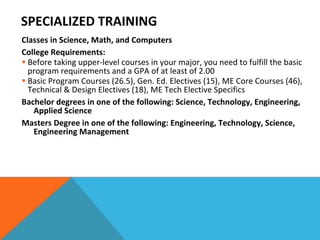
SPECIALIZED TRAINING Classes in Science, Math, and Computers College Requirements: Before taking upper-level courses in your major, you need to fulfill the basic program requirements and a GPA of at least of 2.00 Basic Program Courses (26.5), Gen. Ed. Electives (15), ME Core Courses (46), Technical & Design Electives (18), ME Tech Elective Specifics Bachelor degrees in one of the following: Science, Technology, Engineering, Applied Science Masters Degree in one of the following: Engineering, Technology, Science, Engineering Management
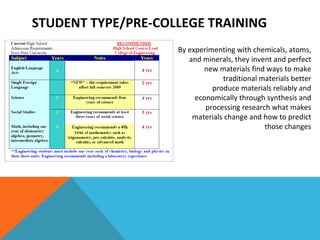
STUDENT TYPE/PRE-COLLEGE TRAINING By experimenting with chemicals, atoms, and minerals, they invent and perfect new materials find ways to make traditional materials better produce materials reliably and economically through synthesis and processing research what makes materials change and how to predict those changes
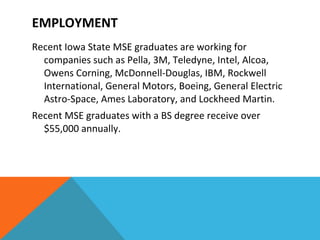
Recent Iowa State MSE graduates are working for companies such as Pella, 3M, Teledyne, Intel, Alcoa, Owens Corning, McDonnell-Douglas, IBM, Rockwell International, General Motors, Boeing, General Electric Astro-Space, Ames Laboratory, and Lockheed Martin.  Recent MSE graduates with a BS degree receive over $55,000 annually.  EMPLOYMENT
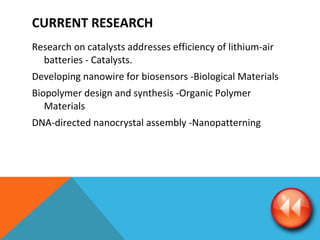
Research on catalysts addresses efficiency of lithium-air batteries - Catalysts. Developing nanowire for biosensors -Biological Materials Biopolymer design and synthesis -Organic Polymer Materials DNA-directed nanocrystal assembly -Nanopatterning CURRENT RESEARCH

2010 engineering compilation v2

  • 1.
    SO, YOU WANTTO BE AN ENGINEER? SUMMER 2010 ISU EEOB & CBIRC RET & ACTS PRESENTATIONS
  • 2.
    CHOOSE A SPECIALTY…Aerospace Ag & Biosystems Construction Industrial Chemical & Biological Electrical Computer Materials Science Civil Mechanical
  • 3.
    MECHANICAL ENGINEERING GROUPMEMBERS: LANCE MAFFIN, TRACY PEARSON, ELLA SPEIGEL & ERIC HALL
  • 4.
    Research, design, develop,manufacture, and test tools, engines, machines, and other mechanical devices It is the branch of engineering that involves the production and usage of heat and mechanical power for the design, production, and operation of machines and tools. It is one of the oldest and broadest engineering disciplines. Mechanical engineering applies the principles of physics and materials science for analysis, design, manufacturing, and maintenance of mechanical systems. NATURE OF THE WORK Tracy P.
  • 5.
    College of Engineering:Mechanical Engineering Students learn to create and build machines, devices, and systems that perform useful services. Mechanical engineers are typically involved with such activities as: generation, distribution, and use of energy development and application of manufacturing systems and processes automation and control of mechanical and thermal systems design of various products for consumer and commercial markets SPECIALIZED TRAINING Ella S.
  • 6.
    Mechanical engineering students: study the principles of motion, energy, and force, in the classroom and in some of Iowa State's laboratories. have access to the Visualization Lab, the C4 and C6 virtual reality environments, and the laser lab. Mechanical engineering education prepares the students for a wide range of careers, including: Product research and development Design Product manufacturing, testing, quality assurance, marketing, operation, and management.
  • 7.
    STUDENT TYPE/PRE-COLLEGE TRAININGMinimum High School Course Requirements for Admission to Iowa State University English/Language Arts - 4 years Mathematics - 3 years Including one year each of algebra, geometry, and advanced algebra. Science - 3 years, including 1 year each of 2 of the following: biology, chemistry & physics Social Studies - 2 years Additional entrance requirements for the Colleges of Engineering and Liberal Arts and Sciences – All of the above, plus two years of a single foreign language.
  • 8.
    Mechanical engineers heldabout 239,000 jobs in 2008, second only to civil engineers 6% job growth over the next 8-10 years, which is slower than the average for all occupations Emerging new areas of growth for mechanical engineers include biotechnology, nanotechnology and materials science. M.E.s are in demand because a ME degree can be used as a springboard into virtually any other branch of engineering The median income of a ME is $74,900. EMPLOYMENT Eric H.
  • 9.
    The following aretwo examples of grants awarded to mechanical engineers. Developing microfluidic human liver model (miniature human liver bioreactor) to study viral infection and alcohol effects on the liver. Explore new composite nano-manufacturing methods to enhance mechanical integrity of biopolymers using functionalized nanodiamond and to investigate a new micro porous structure which will assist in bioactive reagent delivery in surgical devices. CURRENT RESEARCH Lance M.
  • 10.
  • 11.
    THE NATURE OFTHE WORK Aerospace engineers are involved on all aspects of aeronautics (aircraft) or astronautics (spacecraft) They design, develop, and test aircraft, spacecraft, and missiles and supervise the manufacture of these products They often specialize in one of many areas such as aerodynamics, propulsion, flight mechanics, orbital mechanics, fluids, structures, guidance & control, and computation
  • 12.
    SPECIALIZED TRAINING BasicTraining Required BA in aerospace engineering (advanced mathematics classes, basic engineering courses and aerospace engineering classes) Specialized Training Within the Field propulsion, guidance systems, structural design, navigation systems, instrumentation and communication, aerodynamics, thermodynamics and celestial mechanics
  • 13.
    Pre-College training Studentsshould pursue an academically challenging course Load 4 years of English / language arts 2 years of a foreign language 3 (but preferably 4) years of science 2 years social studies Preferably 4 years of math Student Type/Pre-College Training Personal Attributes Students should have a keen interest in aircraft and flight Technology Analytical / logical Detail oriented Inquisitive Creative Good interpersonal skills (you will most likely work as part of a team)
  • 14.
    Employment Outlook: Employment expected to grow about as fast as all other engineering occupations through 2015. Salaries: In 2009 the median income was $79,000. Federal Government: $79,200 Search and navigation equipment: $75,880 Aircraft, parts and components: $76,890 Guided missiles, space vehicles and parts: &74,180 EMPLOYMENT!!
  • 15.
    CURRENT RESEARCH The study of fluid-structure interaction problems that include, mainly the detrimental effects of wind on civil and mechanical structures, and the environment, and a wide range of aerospace-related research. ISU researchers have considerable expertise in developing Thermal Barrier Coating systems to protect turbine superalloys from high temperatures gases and oxidation.  Recent developments are an aluminum (Al) coating embedded in the superalloy that reduced the weight, and a new bond coat material that significantly enhances the life of the TBC system .
  • 16.
    AG & BIOSYSTEMSENGINEERING
  • 17.
    AGRICULTURAL ENGINEERING design,develop, test and manufacture ag. machine systems handle, store, process and enhance or protect the quality of agricultural commodities and processed products design environment control and housing systems for plant and animal production www.ndsu.edu Accessed on 6-16-10
  • 18.
    AGRICULTURAL ENGINEERING designequipment and systems for processing, manufacturing, distribution and quality protection of food products manage air, land and water resources; design and manage crop irrigation systems develop electrical and electronic applications for agricultural problems
  • 19.
    BIOSYSTEMS ENGINEERING developinnovative green products and industries convert bio-based resources to food, fuel and other renewable products design new generations of devices or systems for biological systems control biological systems for natural resource protection, waste remediation and ecosystem restoration www.ndsu.edu Accessed on 6-16-10
  • 20.
    BIOSYSTEMS ENGINEERING createnew and improved processes through the innovative use of microorganisms, plant and animal cells and enzymes develop sensors, control systems and computer models to monitor and control biological processes occurring in industry or the environment. management or law
  • 21.
    HOW CAN HIGHSCHOOL STUDENTS PREPARE? Study Science! The more courses the better. Join an engineering club and talk to others interested in engineering. Visit universities that offer engineering courses.
  • 22.
    AGRICULTURAL AND BIOSYSTEMS ENGINEERING DEGREES Degrees are offered in bachelor's, master's and PhD programs throughout the U.S
  • 23.
    UNDERGRADUATE STUDENTS: Canexpect to take classes in engineering fundamentals, agricultural and biological sciences, mathematics, economics, and general education courses in the humanities.
  • 24.
    GRADUATE-LEVEL PROGRAMS: Involveintensive course work and in-depth research in the student's chosen specialty.
  • 25.
    EMPLOYMENT Positiontitles of graduates include: design engineer test engineer project engineer plant engineer quality control engineer process engineer energy adviser consulting engineer environmental engineer Starting salaries range from $42,000 to $62,000 per year. -North Dakota State University
  • 26.
    BIOSYSTEMS ENGINEERING FORMERLYKNOWN AS JOURNAL OF AGRICULTURAL ENGINEERING RESEARCH Collision-free inverse kinematics of the redundant seven-link manipulator used in a cucumber picking robot Modelling water pollution by leached soluble phosphorus, part 2: Simulation of effects of manure management Vis/NIR spectroscopy and chemometrics for the prediction of soluble solids content and acidity (pH) of kiwifruit
  • 27.
    CHEMICAL AND BIOLOGICALENGINEERING LIFE AND THE CHEMICALS INVOLVED IN OUR LIVES
  • 28.
    The Nature ofthe Work Chemical application of physical sciences and math to turning raw materials into more useful forms. Also often involved in manufacturing processes related to chemicals. Biological Or bioengineering, application of engineering principles to biological or medical problems. Can overlap with biomedical engineering. Source: Wikipedia
  • 29.
    TRAINING IN CHEMAND BIOCHEM Excellent skills in math, chemistry and physics are a start Undergraduate and graduate coursework in an area of interest provide the knowledge to begin applying principles of engineering. ie. Body systems knowledge for design of life support technology
  • 30.
    STUDENT TYPE/PRE-COLLEGE TRAININGPersistence, curiosity, complex problem-solving skills, and excellent laboratory skills Admissions requirements for undergraduate engineering schools include a solid background in mathematics (algebra, geometry, trigonometry, and calculus) and science (biology, chemistry, and physics), with courses in English, social studies, and humanities. Source: Sciencebuddies.org
  • 31.
    EMPLOYMENT BiologicalEngineering Medical device manufacturers Pharmaceutical companies Medical Research Institutions Agricultural Industry Chemical Engineering Food Industry Petroleum and renewable resources Process control Pharmaceutical companies Production
  • 32.
    CURRENT RESEARCH Chemical- from ACS Industrial & Engineering Chemistry Research http://pubs.acs.org/doi/abs/10.1021/ie801542g http://pubs.acs.org/doi/abs/10.1021/ie8019032 Biological- from Journal of Biological Engineering http://www.jbioleng.org/content/4/1/6 http://www.jbioleng.org/content/4/1/5
  • 33.
    CIVIL ENGINEERING MSINQUIRY GROUP A KARA CHRISTENSEN KELLY EARL AMANDA KITE DALE KLINGENBERG ADAM PUDERBAUGH
  • 34.
    THE NATURE OFTHE WORK Design and planning of: Bridges Tunnels Harbors Highways Water and Sewage systems Other buildings Employed by: All levels of government Construction companies Engineering/Architectural firms Also independently employed
  • 35.
    SPECIALIZED TRAINING Civilengineering is a very broad category and can be broken down into several specialized areas of engineering. They include: Structural Construction Hydraulics Sanitary Environmental Transportation Soil Mechanics
  • 36.
    STUDENT TYPE/PRE-COLLEGE TRAININGThe type of student that fits this major is one that enjoys: Math Physics Science combination of all communicating and working as a group   Some helpful pre-college tips: Taking advanced classes in  many high level math, science, and physics classes Attend summer camps for pre-engineering Be involved in clubs to help work on problem solving skills
  • 37.
    EMPLOYMENT Monitoring,guiding, devising, and designing -Building of roads -Girders -Bridges -Airports -Tunnels -Dams -Water & sewage systems Civil engineering is one of the oldest disciplines of engineering contains a variety of specialties like structural, water related, environmental, architectural, transportation and geo-technical engineering Administrative or supervisory jobs are held by many civil engineers while others work in devising, composing, constructing, researching and teaching jobs. Civil engineers usually work near major industrial and commercial centers, often at construction sites. Some projects are situated in remote areas or in foreign countries. In some jobs, civil engineers move from place to place to work on different projects.
  • 38.
    CURRENT RESEARCH Smart materials and structures   Infrastructure reliability and biomechanics   Remote sensing applications   River restoration GIS modeling               Micromechanics of granular materials Water treatment processes Membrane processes Desalination     Waste containment and management Water and energy balance measurements      
  • 39.
    COMPUTER ENGINEERING GROUPMEMBERS CAROLYN CARTER MIKE LAZERE JOSH MANGLER BRIAN ROBISON REBECCA STEINLAGE
  • 40.
    NATURE OF THEWORK Computer Engineer (Software) Develop, test and evaluate the software that are installed on our computers. Computers games, Business applications, Security, Video Source: Education-Portal.com Computer Engineer (Hardware) Design and manufacture computers. Creates the main PC and its associated components such as chips, circuit boards, systems, modems. Source : Collegesurfin g.com eHow.com
  • 41.
    SPECIALIZED TRAINING Soundbackground in math and sciences Course work including: Algorithems Computer networking Robotics Operating systems Analog electronics Digital electronics EMPLOYERS LOOK FOR Relevant programming skills Degrees in computer science, physical science, mathematics. Keeping up to date with current information. Continuing Ed! UNDERGRAD STUDIES
  • 42.
    Students in highschool should be strong in math and science 4 yrs - through trigonometry and advanced math 3 yrs – science including biology, chemistry and physics Students have an interest in computer hardware and software and take classes if available. STUDENT TYPE/PRE-COLLEGE TRAINING
  • 43.
    Core skills canbe applied to nearly any organization in a variety of ways. Design : create the software for new, innovative products Development : improve existing items, advance artificial intelligence Quality Control : analyze factory output, evade problems improve efficiency Architect : makes computers smaller and more powerful EMPLOYMENT
  • 44.
    Research in computerengineering includes several different areas, but three prevalent areas are: Computer architecture Design of the structure of a computer system, including internal performance as well as the hardware Software systems Designing software of good quality, low cost, easy maintenance and materials that are replicable Intelligent systems “ Artificial intelligence” for robotics, neural networks (parallel processing of information) CURRENT RESEARCH
  • 45.
  • 46.
    THE NATURE OFTHE WORK Plan, design, and manage construction of large structures 4 primary areas: Building: Roads, waterways, & railways Mechanical Electrical
  • 47.
    SPECIALIZED TRAINING STEM-focusedprerequisites Undergraduate focus Emphasis on construction process skills Graduate focus Emphasis on management and design of construction projects Post Graduate Focus Emphasis on design
  • 48.
    STUDENT TYPE/PRE-COLLEGE TRAININGStrong visual-spatial learners Courses geared toward math, physics, and chemistry/chemical properties.
  • 49.
    EMPLOYMENT ConstructionProject Management Architectural design Construction economics and logistics Electrical Engineering Military Applications etc.
  • 50.
    CURRENT RESEARCH Fuel Cell Powered Locomotive Design of Renewable Energy Generators
  • 51.
    REFERENCES http://www.ccee.iastate.edu/academics/undergrad-construction.html www.universities.com/.../Bachelor_degrees_in_Construction_Engineering_Technology_Technician.html http://www.cecer.army.mil/td/tips/index.cfm http://web.mit.edu/research/topic/architecture.html#labs
  • 52.
    ELECTRICAL ENGINEERING KARLGOLDSMITH NICK HAYES KIM KULT PEG CONLON ANSON BONTE
  • 53.
    THE NATURE OFTHE WORK Field of engineering dealing with electricity, electromagnetism, and electronics. This includes large-scale electrical systems. It may include electronic engineering which also includes smaller scale systems such as computers.
  • 54.
    SPECIALIZED TRAINING Thisprofession requires at least a bachelor’s degree. Master’s and Doctorate’s can also be earned. Specialized can be earned in such topics as microelectronics, electromagnetism, instrumentation, telecommunications and so on.
  • 55.
    STUDENT TYPE/PRE-COLLEGE TRAININGMathematics -- 4 years, including trigonometry and precalculus Science -- 3 years, including chemistry and physics A good team member with organizational ability, integrity, ambition, and communication skills. A high degree of analytical skill and the ability to handle abstract models of physical phenomena.
  • 56.
    EMPLOYMENT TelecommunicationsEnergy and Electric Power Aerospace Transportation and Automotive Manufacturing Education and Research
  • 57.
    CURRENT RESEARCH There are several areas of research involving electrical engineering, including biomedical, nanotechnology, communication and signal processing, computers, systems and controls, electromagnetics, electronics and power engineering.

  • 58.
    SOURCES http://en.wikipedia.org/wiki/Electrical_engineering http://www.ece.iastate.edu/academics/ee-undergraduate-major.htmlhttp://www.careercornerstone.org/pdf/ee/eleceng.pdf http://www.ieeeusa.org/careers/yourcareer.html
  • 59.
    INDUSTRIAL ENGINEERING MAUREENGRIFFIN, ALICIA SCHILLER, KYLE WEIS, SPENCER MESICK, BERNIE HERMANSON
  • 60.
    Industrial Engineers determinethe best way to build a better mouse trap and market that mouse trap once it is built. They find ways that are better, faster, smarter, easier and safer so their company makes a good profit, are efficient and safer. They find ways to help keep employees satisfied and safe with their work. The next time you wait in a long line for that roller coaster ride or to get processed for Access Plus Payroll Deposit you can blame the industrial engineer for not doing their job! http://www.sciencebuddies.org/science-fair-projects/science-engineering-careers/MatlSci_industrialengineer_c001.shtml NATURE OF THE WORK
  • 61.
    Specialized Training foran I.E. chemistry, physics, materials science calculus, differential equations, statistics, advanced mathematics/computation engineering mechanics & design, computer science, circuits/electronics ergonomics/safety, stochastics management systems theory, economics International credits
  • 62.
    engineering and businesscombined together industrial engineers uses technology, people, and information to improve productivity, enhance quality, manage resources-in short, and to make things better Pre-College Training – excels in math, science, business and computer classes STUDENT TYPE/PRE-COLLEGE TRAINING
  • 63.
    EMPLOYMENT In 2008engineers held 1.6 million jobs, with industrial engineers holding 214,800 of those jobs  3 rd highest Engineers are employed in every state, in small and large cities and in rural areas. Industrial engineers are expected to have employment growth of 14 percent over the projections decade, faster than average for all occupations. It’s expected that firms will turn to industrial engineers to develop more efficient processes and reduce costs, delays, and waste. Source = http://www.bls.gov/oco/ocos027.htm#emply
  • 64.
    Main Areas ofcurrent research: Human Factors- Occupational Ergonomics, Assistive Technologies, Safety Engineering Manufacturing-rapid manufacturing of 3Dbulk structural nanomaterials Operations Research-Computer aided design Productions System-Robotics; design, monitor, and control of complex systems CURRENT RESEARCH
  • 65.
  • 66.
    Materials science isan interdisciplinary field involving the properties of matter and its applications to various areas of science and engineering. This science investigates the relationship between the structure of materials at atomic or molecular scales and their macroscopic properties. Nanoscience or nanotechnology has propelled materials science to the forefront of exploration by many universities as of late. NATURE OF THE WORK
  • 67.
    SPECIALIZED TRAINING Classesin Science, Math, and Computers College Requirements: Before taking upper-level courses in your major, you need to fulfill the basic program requirements and a GPA of at least of 2.00 Basic Program Courses (26.5), Gen. Ed. Electives (15), ME Core Courses (46), Technical & Design Electives (18), ME Tech Elective Specifics Bachelor degrees in one of the following: Science, Technology, Engineering, Applied Science Masters Degree in one of the following: Engineering, Technology, Science, Engineering Management
  • 68.
    STUDENT TYPE/PRE-COLLEGE TRAININGBy experimenting with chemicals, atoms, and minerals, they invent and perfect new materials find ways to make traditional materials better produce materials reliably and economically through synthesis and processing research what makes materials change and how to predict those changes
  • 69.
    Recent Iowa StateMSE graduates are working for companies such as Pella, 3M, Teledyne, Intel, Alcoa, Owens Corning, McDonnell-Douglas, IBM, Rockwell International, General Motors, Boeing, General Electric Astro-Space, Ames Laboratory, and Lockheed Martin. Recent MSE graduates with a BS degree receive over $55,000 annually. EMPLOYMENT
  • 70.
    Research on catalystsaddresses efficiency of lithium-air batteries - Catalysts. Developing nanowire for biosensors -Biological Materials Biopolymer design and synthesis -Organic Polymer Materials DNA-directed nanocrystal assembly -Nanopatterning CURRENT RESEARCH

Editor's Notes

  • #4 Eric Hall, Lance Maffin, Tracy Pearson, Ella Speigel
  • #5 Tracy Pearson
  • #6 Ella Speigel
  • #7 Ella Speigel
  • #8 Ella Speigel
  • #9 Eric Hall Sources: US Bureau of Labor website http://www.bls.gov/oco/ocos027.htm
  • #10 Lance Maffin Source: wikipedia.com
  • #18 design engineer, test engineer, project engineer, plant engineer, quality control engineer, process engineer, energy adviser, consulting engineer and environmental engineer
  • #27 Here are some titles of papers published in a recent issue of Biosystems Engineering
  • #47   The variety of actual 'jobs' is too large to list. It could include anything from advance design of the structure, to economics of the structure, to safety concerns and human traffic patterns within the structures.
  • #48 Undergraduates build a base knowledge of the properties of materials used, methods and applications of construction techniques, as well as physics and chemistry courses geared towards construction. Graduate students continue developing skills beyond construction and into project management and design Post-graduate students research new applications of STEM concepts associated with construction, the economics associated with construction, and advanced design.
  • #49 Students most likely to succeed in this area are STEM students. People strong in the basics of math and science. People who can think sequentially while also thinking and planning what needs to happen in the future. Likely people who have an understanding or at least an interest in what people want and need.
  • #50 Employment opportunities in this field are too many to list but include control of construction projects, including design, materials, scheduling of work and materials, management, economics, safety, advance site planning and selection, budgets, building codes, etc.
  • #51 The nation's first switch locomotive powered by a fuel cell holds promise for both enhancing energy security at military bases and providing an emergency power supply during disaster response. Research being conducted by US Army Corps of Engineers. MIT has several ongoing research projects associated with improving structures that harness energy from wind, solar rays, and natural water motion.
  • #55 Instrumentation engineering deals with the design of devices to measure physical quantities such as pressure, flow and temperature. (wikipedia)