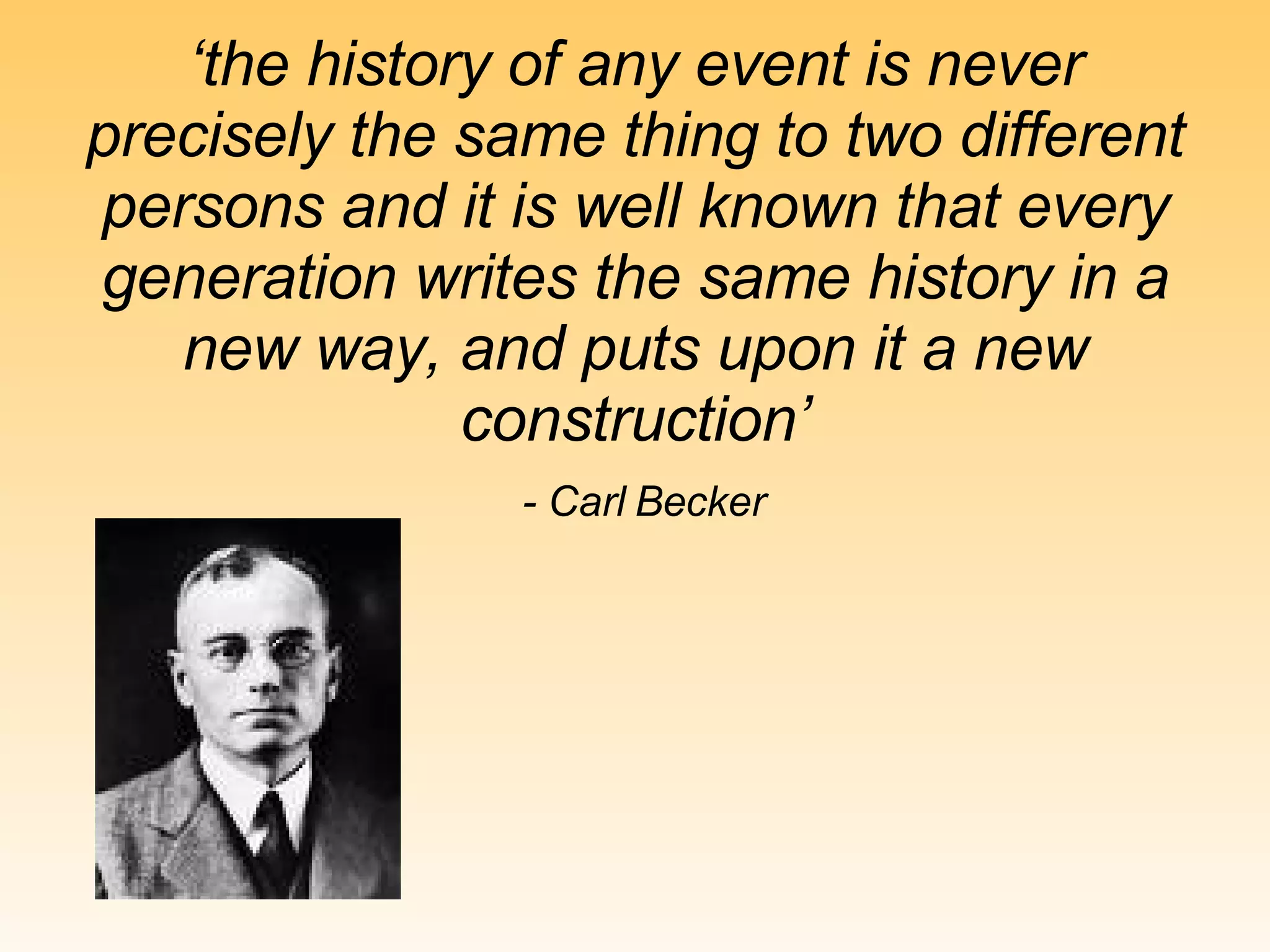
‘ the history of any event is never precisely the same thing to two different persons and it is well known that every generation writes the same history in a new way, and puts upon it a new construction’ - Carl Becker
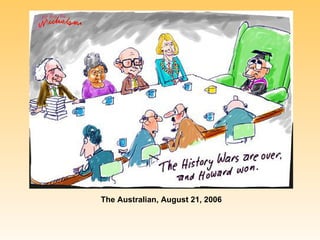
The Australian, August 21, 2006
Aim To  evaluate  the ideas and  processes  used by historians to  produce  history and to apply what they have learned  to enquire  into areas of historical interest with increasing  independence
Objectives - Learn about Significant historiographical ideas and processes Design, undertake and communicate historical inquiry
Objectives - appreciate The way history has been recorded over time The value of history for critical interpretation of the contemporary world The contribution of historical studies towards lifelong learning
Part 1: What is History 60% time Case study & source book Who are the historians? What are the aims and purposes of history? How has history been constructed and recorded over time? Why have approaches to history changed over time?
Part II: History Project 40%  Due strictly by END OF TERM 2 Developing a proposal for a historical investigation  – Due by end of 2006!
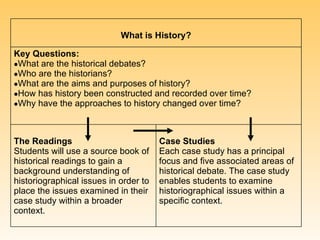
Case Studies Each case study has a principal focus and five associated areas of historical debate. The case study enables students to examine historiographical issues within a specific context. The Readings Students will use a source book of historical readings to gain a background understanding of historiographical issues in order to place the issues examined in their case study within a broader context. Key Questions: What are the historical debates? Who are the historians? What are the aims and purposes of history? How has history been constructed and recorded over time? Why have the approaches to history changed over time? What is History?
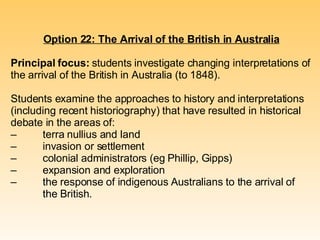
Option 22: The Arrival of the British in Australia Principal focus:  students investigate changing interpretations of the arrival of the British in Australia (to 1848). Students examine the approaches to history and interpretations (including recent historiography) that have resulted in historical debate in the areas of: – terra nullius and land – invasion or settlement – colonial administrators (eg Phillip, Gipps) – expansion and exploration – the response of indigenous Australians to the arrival of  the British.
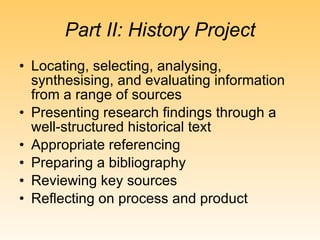
Part II: History Project Locating, selecting, analysing, synthesising, and evaluating information from a range of sources Presenting research findings through a well-structured historical text Appropriate referencing Preparing a bibliography Reviewing key sources Reflecting on process and product
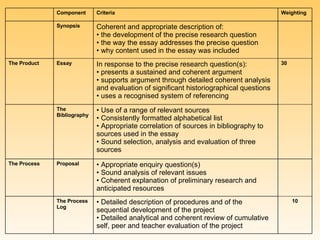
History Project Assessment Criteria 10 •  Detailed description of procedures and of the sequential development of the project •  Detailed analytical and coherent review of cumulative self, peer and teacher evaluation of the project The Process Log •  Appropriate enquiry question(s)  •  Sound analysis of relevant issues •  Coherent explanation of preliminary research and anticipated resources Proposal The Process •  Use of a range of relevant sources •  Consistently formatted alphabetical list •  Appropriate correlation of sources in bibliography to sources used in the essay •  Sound selection, analysis and evaluation of three sources The Bibliography 30 In response to the precise research question(s): •  presents a sustained and coherent argument •  supports argument through detailed coherent analysis and evaluation of significant historiographical questions •  uses a recognised system of referencing Essay The Product Coherent and appropriate description of: •  the development of the precise research question •  the way the essay addresses the precise question •  why content used in the essay was included Synopsis Weighting Criteria Component
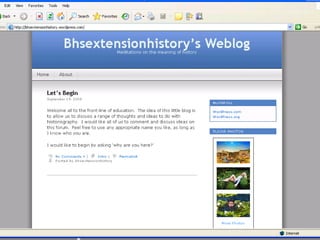
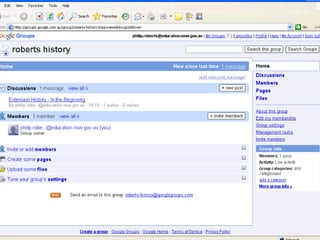
Support The Blog http:// bhsextensionhistory.wordpress.com / The Google Group http:// groups.google.com.au/group/roberts -history Weekly Podcast for ‘content areas’. U Wollongong – 12 Nov (wed) HTA / Macq U. 6 Dec (sat) Other lectures next year…


2009 BHS History Extension Intro

  • 1.
    ‘ the historyof any event is never precisely the same thing to two different persons and it is well known that every generation writes the same history in a new way, and puts upon it a new construction’ - Carl Becker
  • 2.
  • 3.
    Aim To evaluate the ideas and processes used by historians to produce history and to apply what they have learned to enquire into areas of historical interest with increasing independence
  • 4.
    Objectives - Learnabout Significant historiographical ideas and processes Design, undertake and communicate historical inquiry
  • 5.
    Objectives - appreciateThe way history has been recorded over time The value of history for critical interpretation of the contemporary world The contribution of historical studies towards lifelong learning
  • 6.
    Part 1: Whatis History 60% time Case study & source book Who are the historians? What are the aims and purposes of history? How has history been constructed and recorded over time? Why have approaches to history changed over time?
  • 7.
    Part II: HistoryProject 40% Due strictly by END OF TERM 2 Developing a proposal for a historical investigation – Due by end of 2006!
  • 8.
    Case Studies Eachcase study has a principal focus and five associated areas of historical debate. The case study enables students to examine historiographical issues within a specific context. The Readings Students will use a source book of historical readings to gain a background understanding of historiographical issues in order to place the issues examined in their case study within a broader context. Key Questions: What are the historical debates? Who are the historians? What are the aims and purposes of history? How has history been constructed and recorded over time? Why have the approaches to history changed over time? What is History?
  • 9.
    Option 22: TheArrival of the British in Australia Principal focus: students investigate changing interpretations of the arrival of the British in Australia (to 1848). Students examine the approaches to history and interpretations (including recent historiography) that have resulted in historical debate in the areas of: – terra nullius and land – invasion or settlement – colonial administrators (eg Phillip, Gipps) – expansion and exploration – the response of indigenous Australians to the arrival of the British.
  • 10.
    Part II: HistoryProject Locating, selecting, analysing, synthesising, and evaluating information from a range of sources Presenting research findings through a well-structured historical text Appropriate referencing Preparing a bibliography Reviewing key sources Reflecting on process and product
  • 11.
    History Project AssessmentCriteria 10 • Detailed description of procedures and of the sequential development of the project • Detailed analytical and coherent review of cumulative self, peer and teacher evaluation of the project The Process Log • Appropriate enquiry question(s) • Sound analysis of relevant issues • Coherent explanation of preliminary research and anticipated resources Proposal The Process • Use of a range of relevant sources • Consistently formatted alphabetical list • Appropriate correlation of sources in bibliography to sources used in the essay • Sound selection, analysis and evaluation of three sources The Bibliography 30 In response to the precise research question(s): • presents a sustained and coherent argument • supports argument through detailed coherent analysis and evaluation of significant historiographical questions • uses a recognised system of referencing Essay The Product Coherent and appropriate description of: • the development of the precise research question • the way the essay addresses the precise question • why content used in the essay was included Synopsis Weighting Criteria Component
  • 12.
    Support The Bloghttp:// bhsextensionhistory.wordpress.com / The Google Group http:// groups.google.com.au/group/roberts -history Weekly Podcast for ‘content areas’. U Wollongong – 12 Nov (wed) HTA / Macq U. 6 Dec (sat) Other lectures next year…
  • 13.
  • 14.