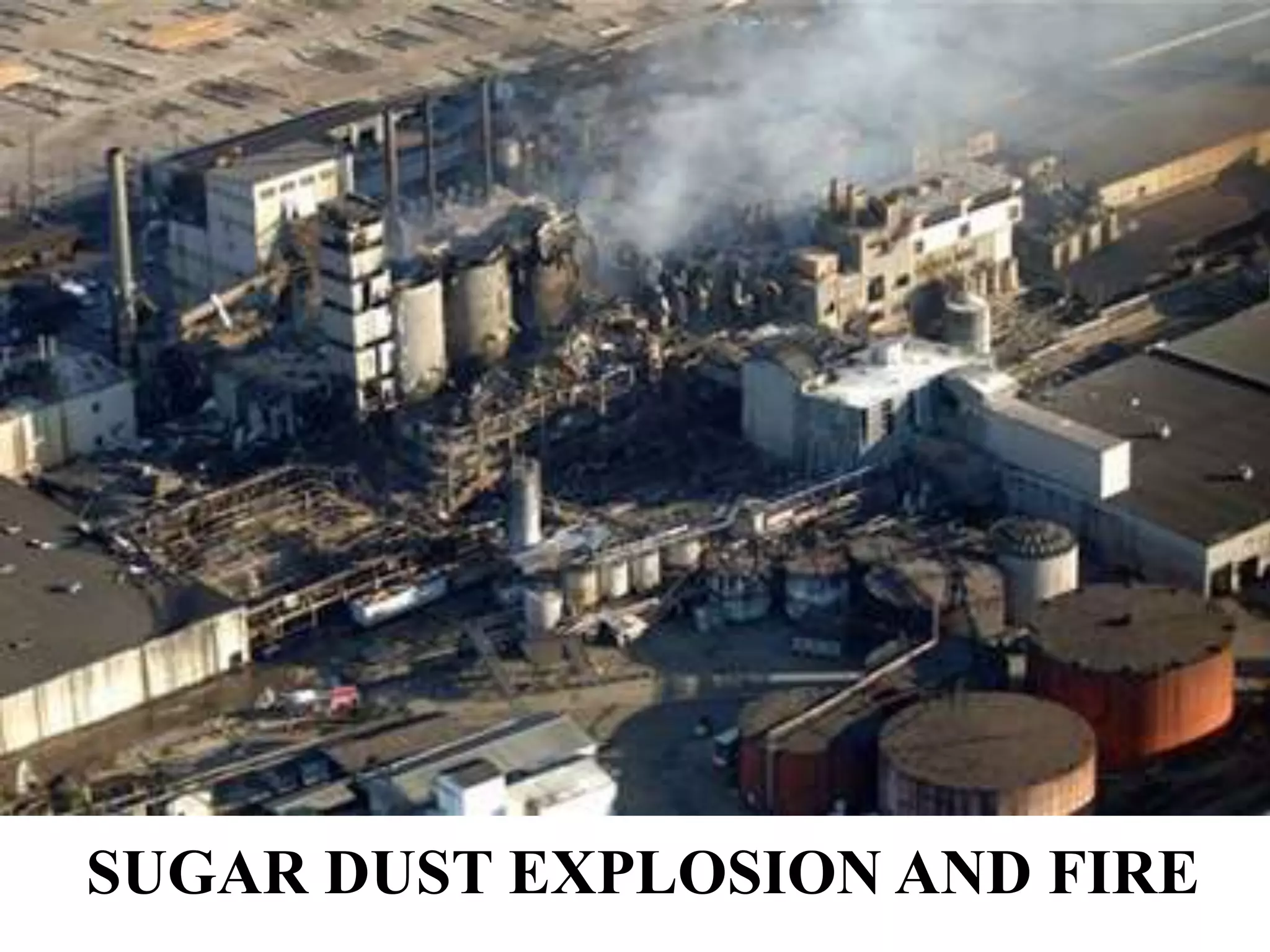
SUGAR DUST EXPLOSION AND FIRE
Outline
1)Risk assessment Shakarim Irmukhametov
2) Background information and chronology Saken Sagadiyev
3) Root causes and circumstances Aidyn Myltykbayev
4) Consequences and effects Rassul Bairamkulov
5) Accident Biography Sanzhar Askaruly
6) Lessons learned Zhaksylyk Kazykenov
RISK ASSESSMENT
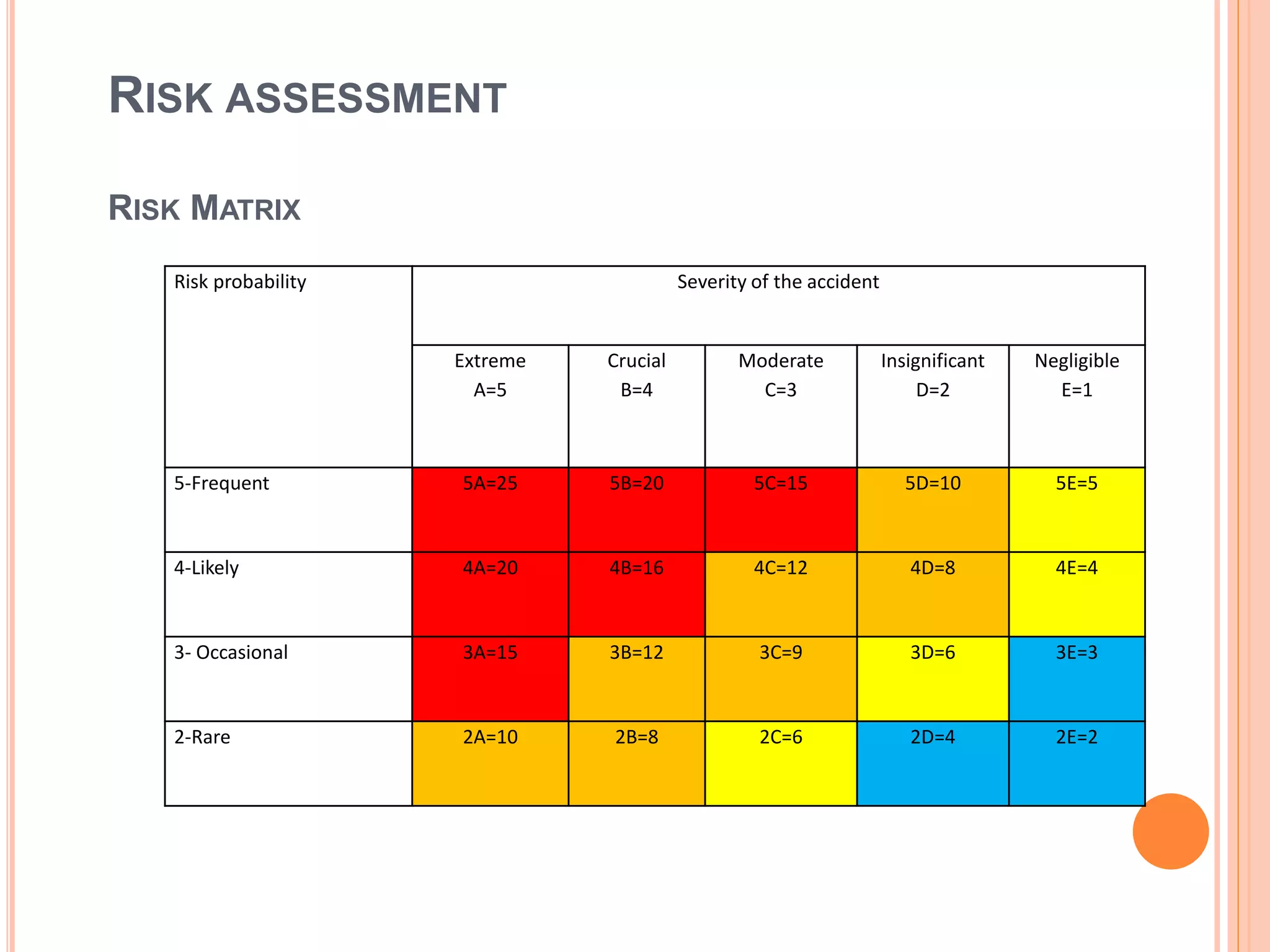
RISK MATRIX
Risk probability Severity of the accident
Extreme
A=5
Crucial
B=4
Moderate
C=3
Insignificant
D=2
Negligible
E=1
5-Frequent 5A=25 5B=20 5C=15 5D=10 5E=5
4-Likely 4A=20 4B=16 4C=12 4D=8 4E=4
3- Occasional 3A=15 3B=12 3C=9 3D=6 3E=3
2-Rare 2A=10 2B=8 2C=6 2D=4 2E=2
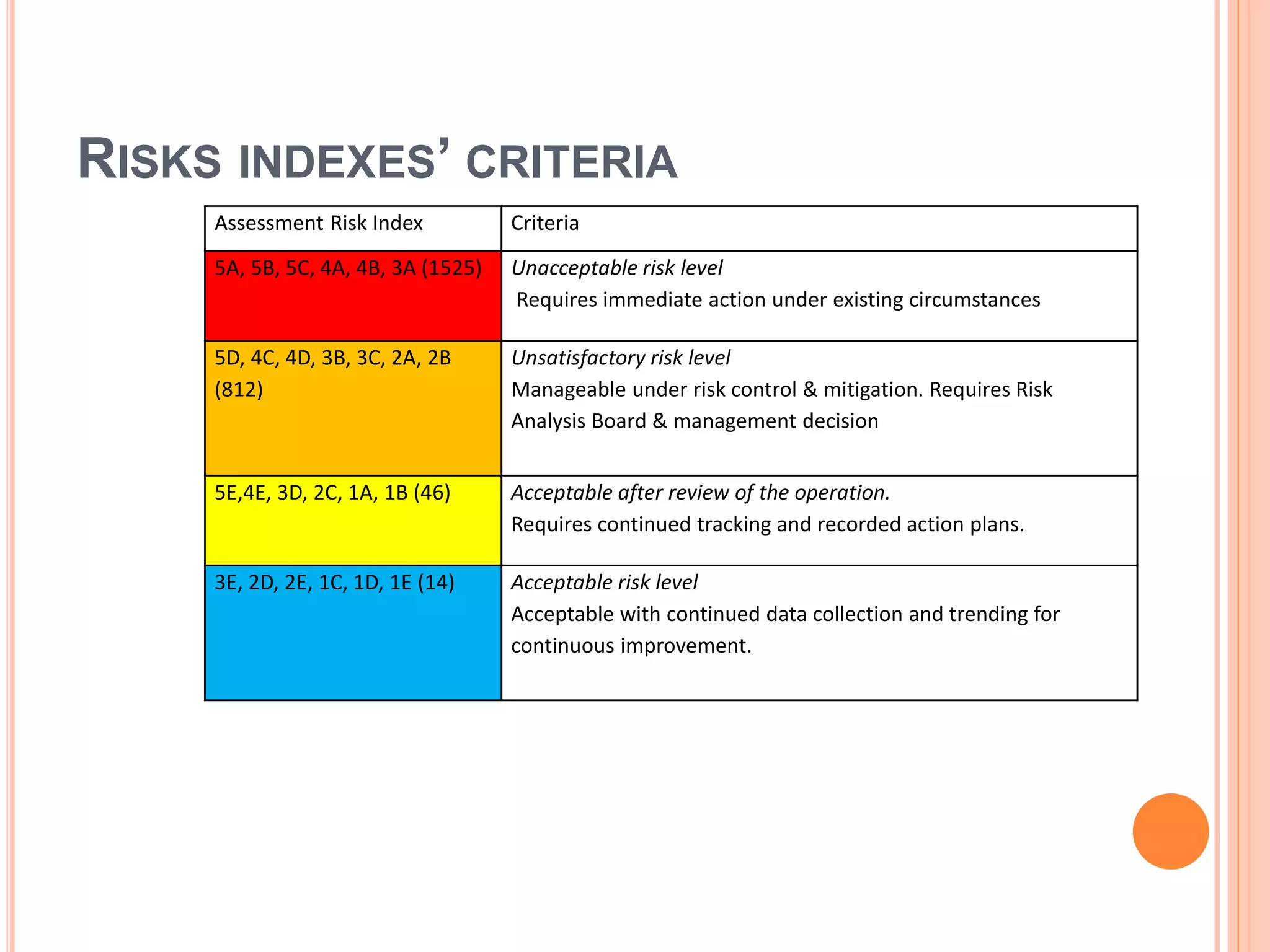
RISKS INDEXES’ CRITERIA
Assessment Risk Index Criteria
5A, 5B, 5C, 4A, 4B, 3A (1525) Unacceptable risk level
Requires immediate action under existing circumstances
5D, 4C, 4D, 3B, 3C, 2A, 2B
(812)
Unsatisfactory risk level
Manageable under risk control & mitigation. Requires Risk
Analysis Board & management decision
5E,4E, 3D, 2C, 1A, 1B (46) Acceptable after review of the operation.
Requires continued tracking and recorded action plans.
3E, 2D, 2E, 1C, 1D, 1E (14) Acceptable risk level
Acceptable with continued data collection and trending for
continuous improvement.
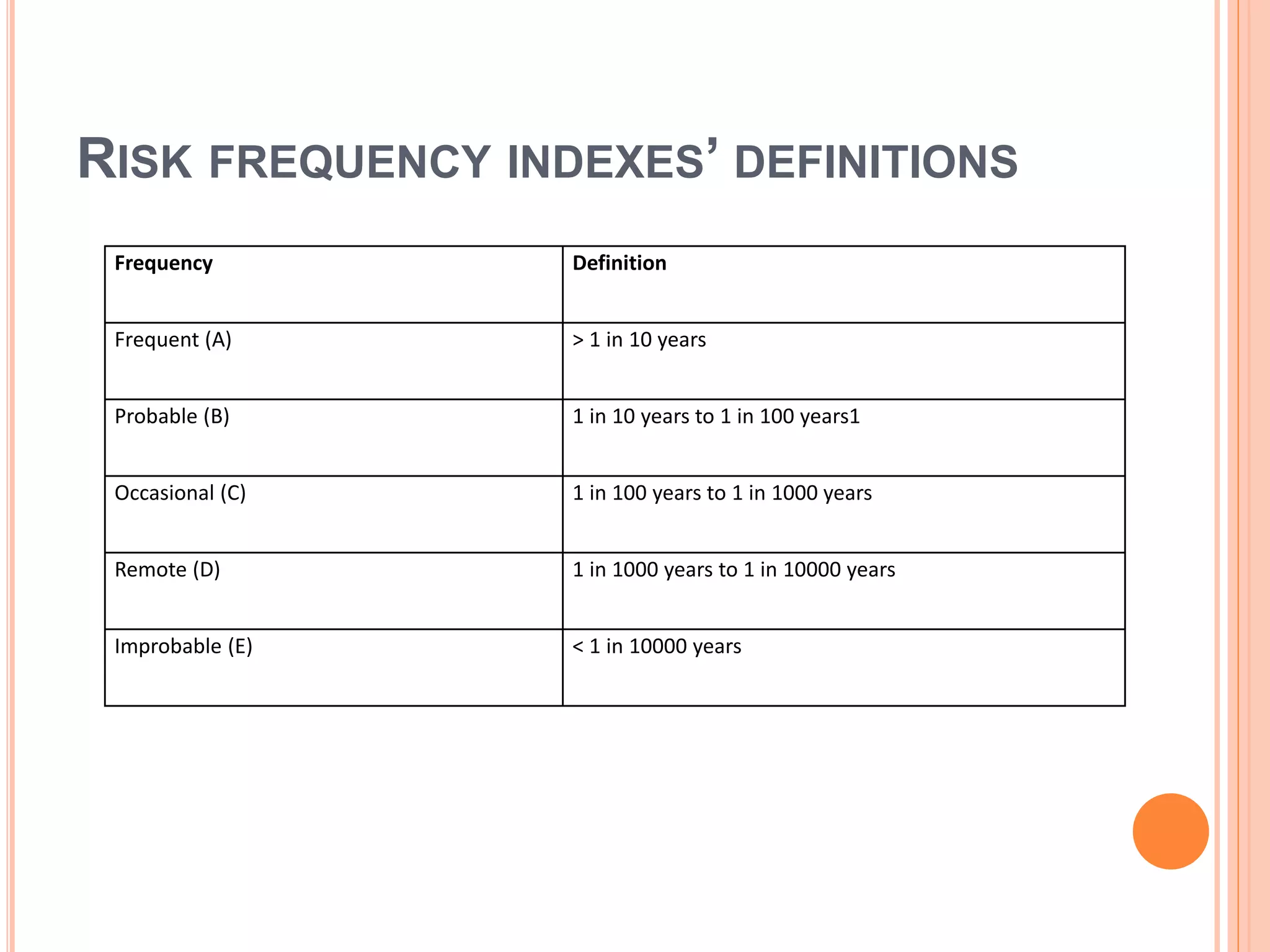
RISK FREQUENCY INDEXES’ DEFINITIONS
Frequency Definition
Frequent (A) > 1 in 10 years
Probable (B) 1 in 10 years to 1 in 100 years1
Occasional (C) 1 in 100 years to 1 in 1000 years
Remote (D) 1 in 1000 years to 1 in 10000 years
Improbable (E) < 1 in 10000 years
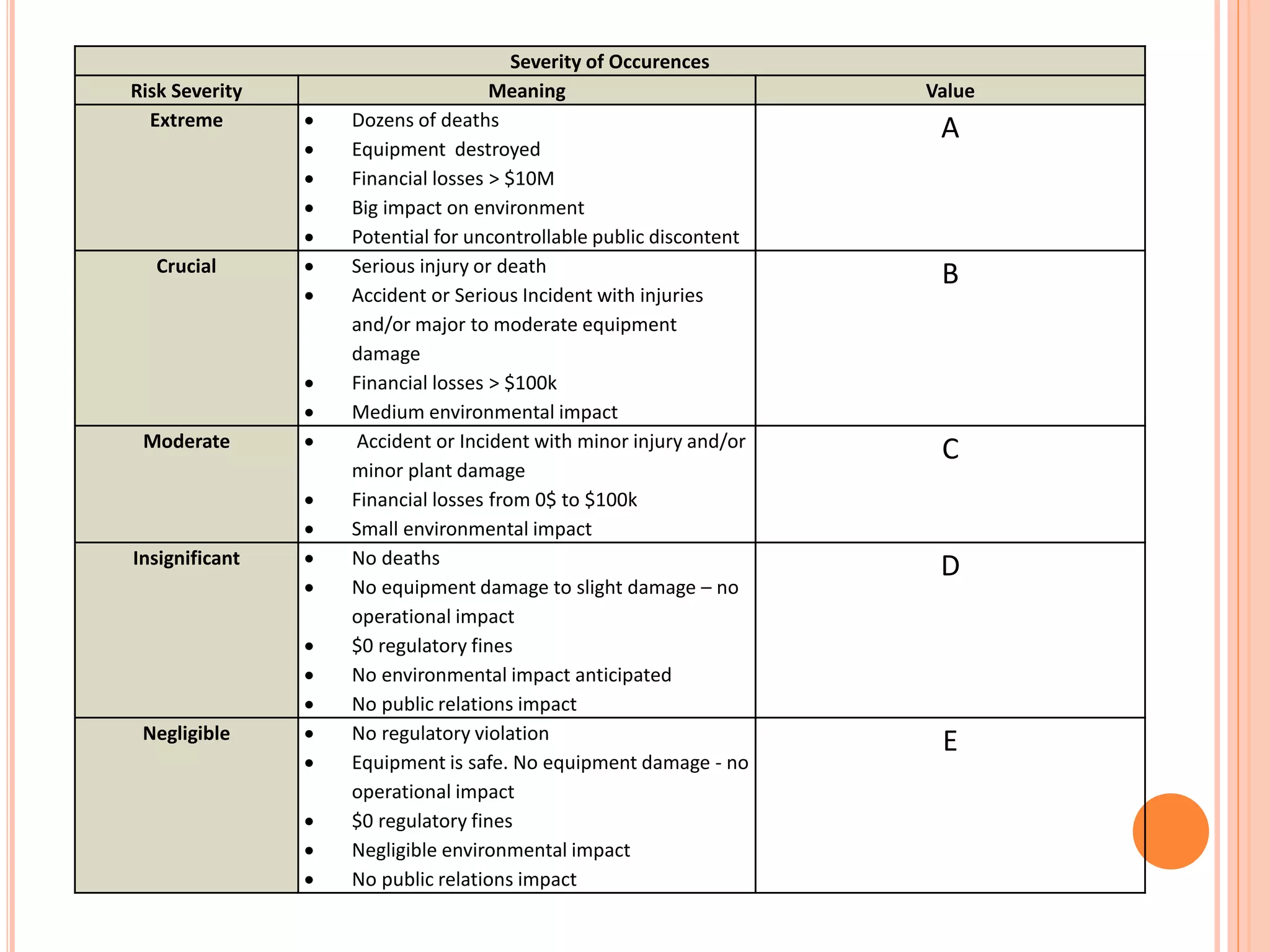
Severity of Occurences
Risk Severity Meaning Value
Extreme  Dozens of deaths
 Equipment destroyed
 Financial losses > $10M
 Big impact on environment
 Potential for uncontrollable public discontent
A
Crucial  Serious injury or death
 Accident or Serious Incident with injuries
and/or major to moderate equipment
damage
 Financial losses > $100k
 Medium environmental impact
B
Moderate  Accident or Incident with minor injury and/or
minor plant damage
 Financial losses from 0$ to $100k
 Small environmental impact
C
Insignificant  No deaths
 No equipment damage to slight damage – no
operational impact
 $0 regulatory fines
 No environmental impact anticipated
 No public relations impact
D
Negligible  No regulatory violation
 Equipment is safe. No equipment damage - no
operational impact
 $0 regulatory fines
 Negligible environmental impact
 No public relations impact
E
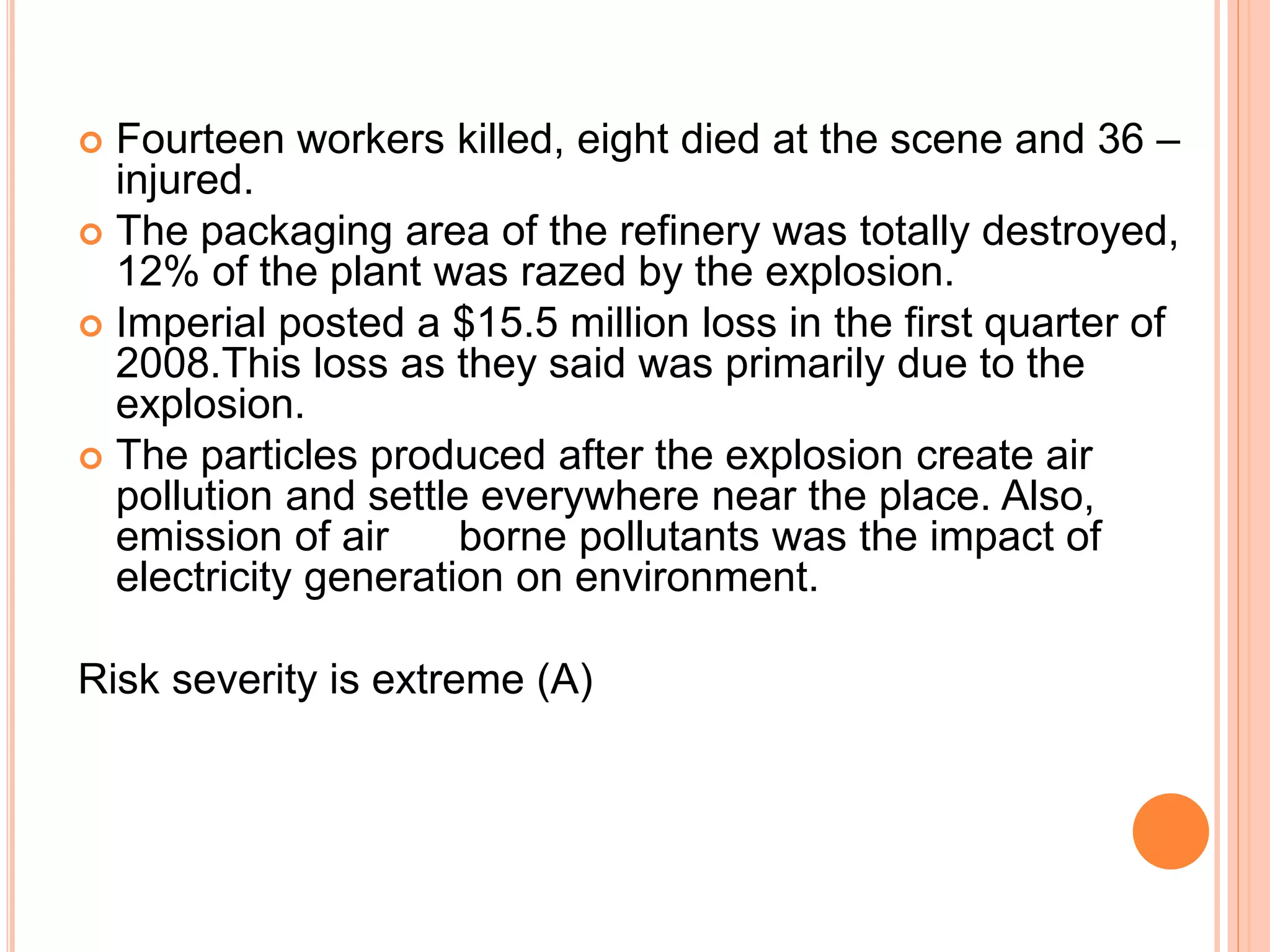
 Fourteen workers killed, eight died at the scene and 36 –
injured.
 The packaging area of the refinery was totally destroyed,
12% of the plant was razed by the explosion.
 Imperial posted a $15.5 million loss in the first quarter of
2008.This loss as they said was primarily due to the
explosion.
 The particles produced after the explosion create air
pollution and settle everywhere near the place. Also,
emission of air borne pollutants was the impact of
electricity generation on environment.
Risk severity is extreme (A)
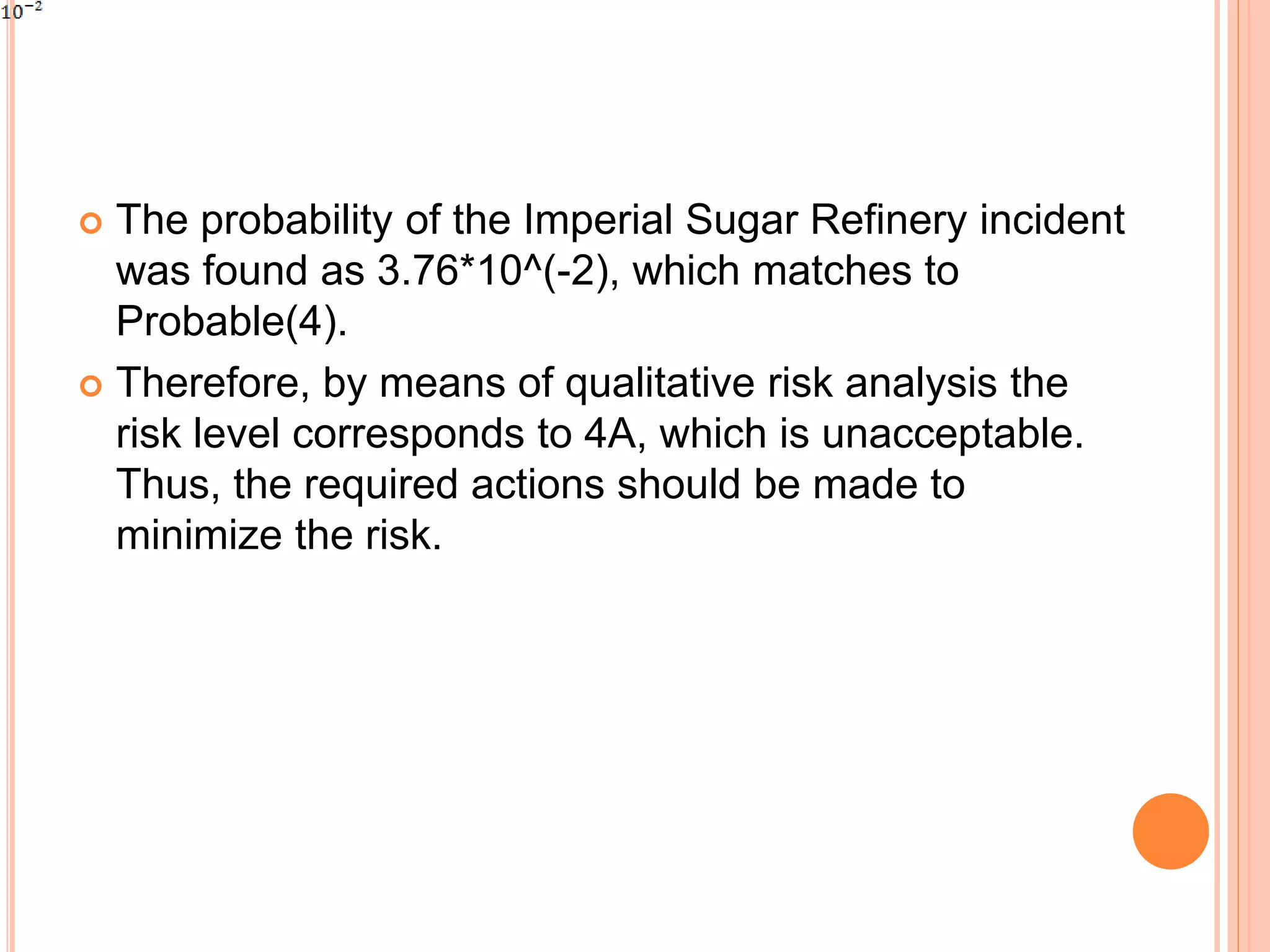
 The probability of the Imperial Sugar Refinery incident
was found as 3.76*10^(-2), which matches to
Probable(4).
 Therefore, by means of qualitative risk analysis the
risk level corresponds to 4A, which is unacceptable.
Thus, the required actions should be made to
minimize the risk.
BACKGROUND INFORMATION AND
CHRONOLOGY
• The Imperial Sugar Company began operations in
1917
• One of the largest sugar refining and packaging
facilities in the US.
• Granulated sugar was stored in silos
• Conveyed to packing buildings where it was packaged
for distribution.
BACKGROUND INFORMATION AND
CHRONOLOGY
 Sugar spilled onto floor throughout the work area
 Particles that became airborne
 Dust collection system was undersized and
disrepair
 conveyor was enclosed with stainless steel panels
BACKGROUND INFORMATION AND
CHRONOLOGY
 The dust accumulated until to explosive
concentrations inside the enclosure.
 Dust in the building was ignited by advancing fire
balls.
 No power to much the interior lighting.
 8 workers died at the scene, 6 more died later at
regional burn center. Dozens of others were injured.
Root causes and circumstances
1) Inadequate equipment
Root causes and circumstances
1) Inadequate equipment
2) Not appropriate housekeeping of the factory
3) Overheated bearing
4) First dust explosion
5) Inadequate emergency evacuation plan
Root causes and circumstances
1) Inadequate equipment
2) Not appropriate housekeeping of the factory
3) Overheated bearing
4) First dust explosion
5) Inadequate emergency evacuation plan
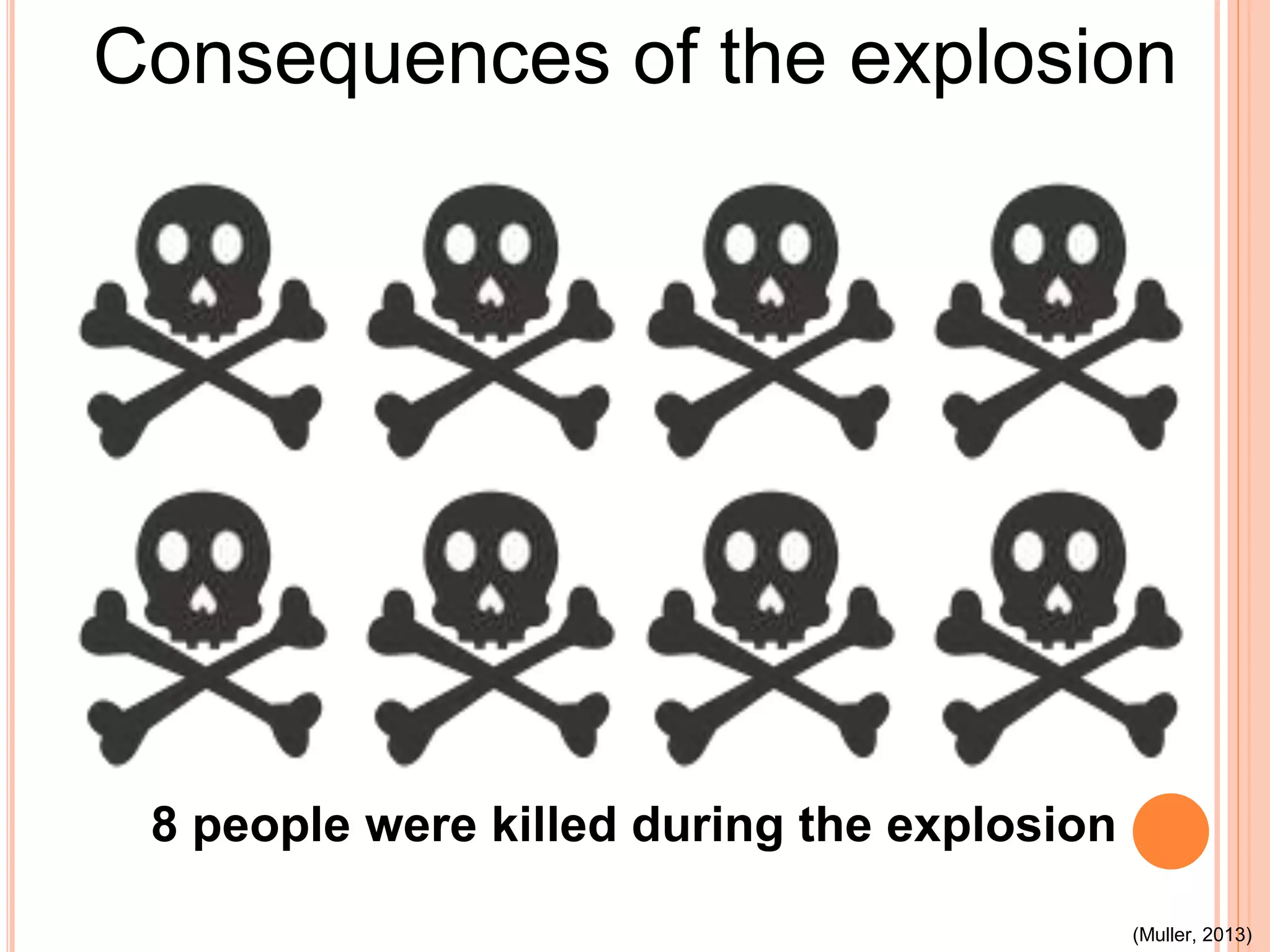
8 people were killed during the explosion
Consequences of the explosion
(Muller, 2013)
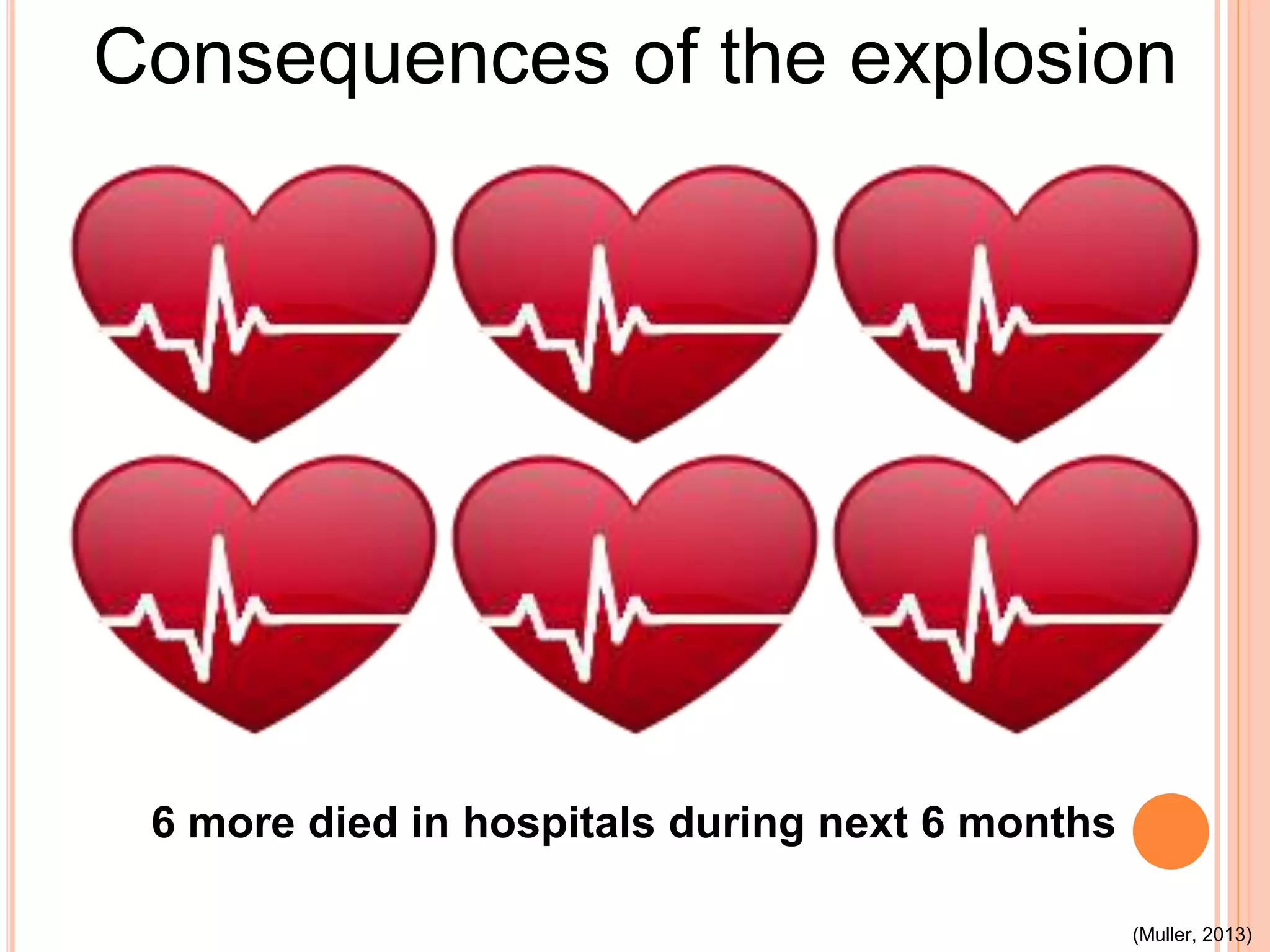
6 more died in hospitals during next 6 months
Consequences of the explosion
(Muller, 2013)
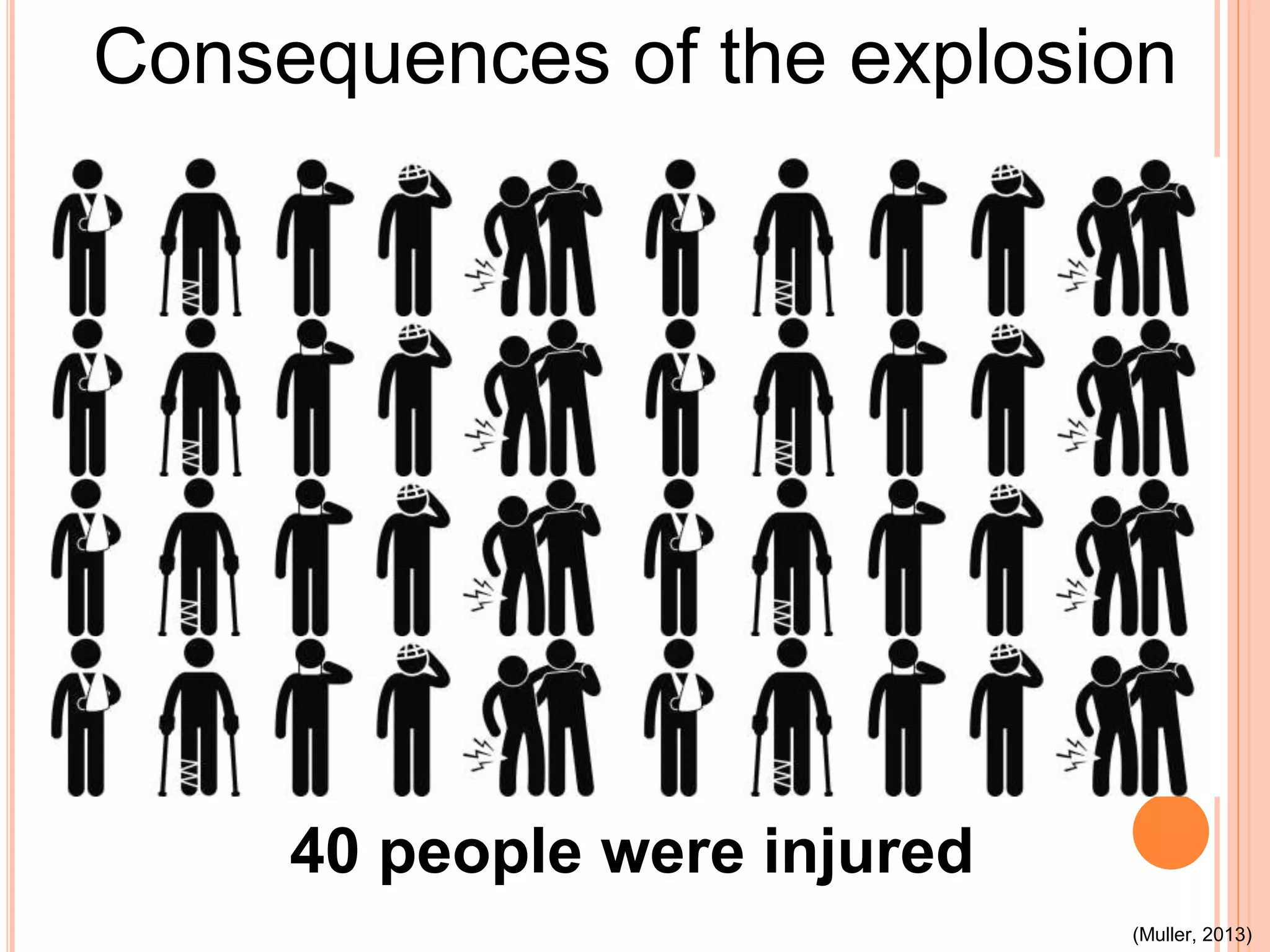
40 people were injured
Consequences of the explosion
(Muller, 2013)
Consequences of the explosion
A total of $914,000
was raised during the fundraising
campaigns
Population
response
(Muller, 2013)
Consequences of the explosion
124 safety violations were found
on both Imperial Sugar Plants:
large concentrations of small
explosive sugar dust particles were
present at the electric equipment
and working areas
(Seward, 2013)
Consequences of the explosion
Violations were
known and
accepted by the
company
management
(OSHA, 2008; CSB cited in Dewan, 2009)
Accident was
called “entirely
preventable”
Consequences of the explosion
Lawsuits
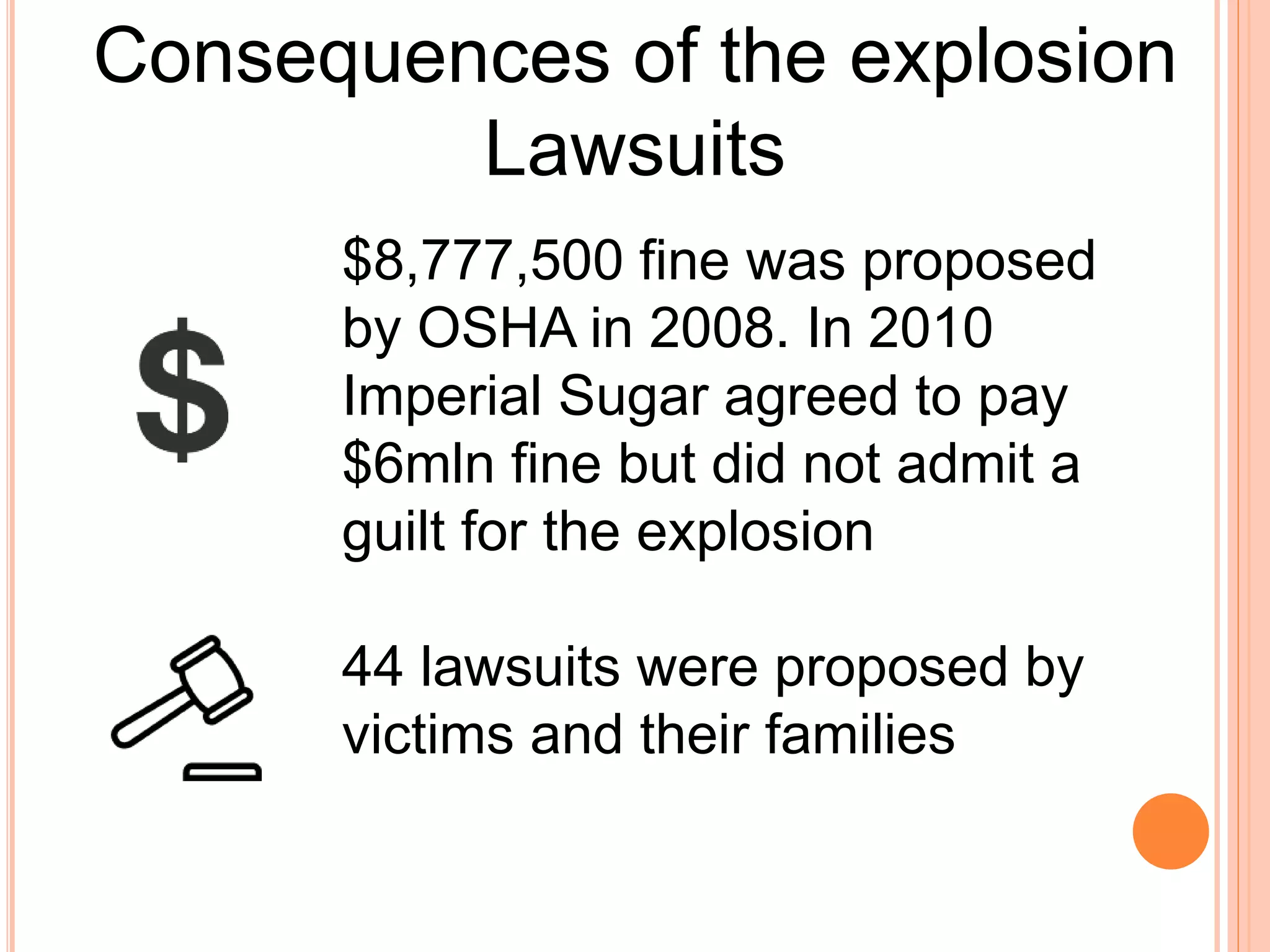
$8,777,500 fine was proposed
by OSHA in 2008. In 2010
Imperial Sugar agreed to pay
$6mln fine but did not admit a
guilt for the explosion
44 lawsuits were proposed by
victims and their families
Consequences of the explosion
Economic effects
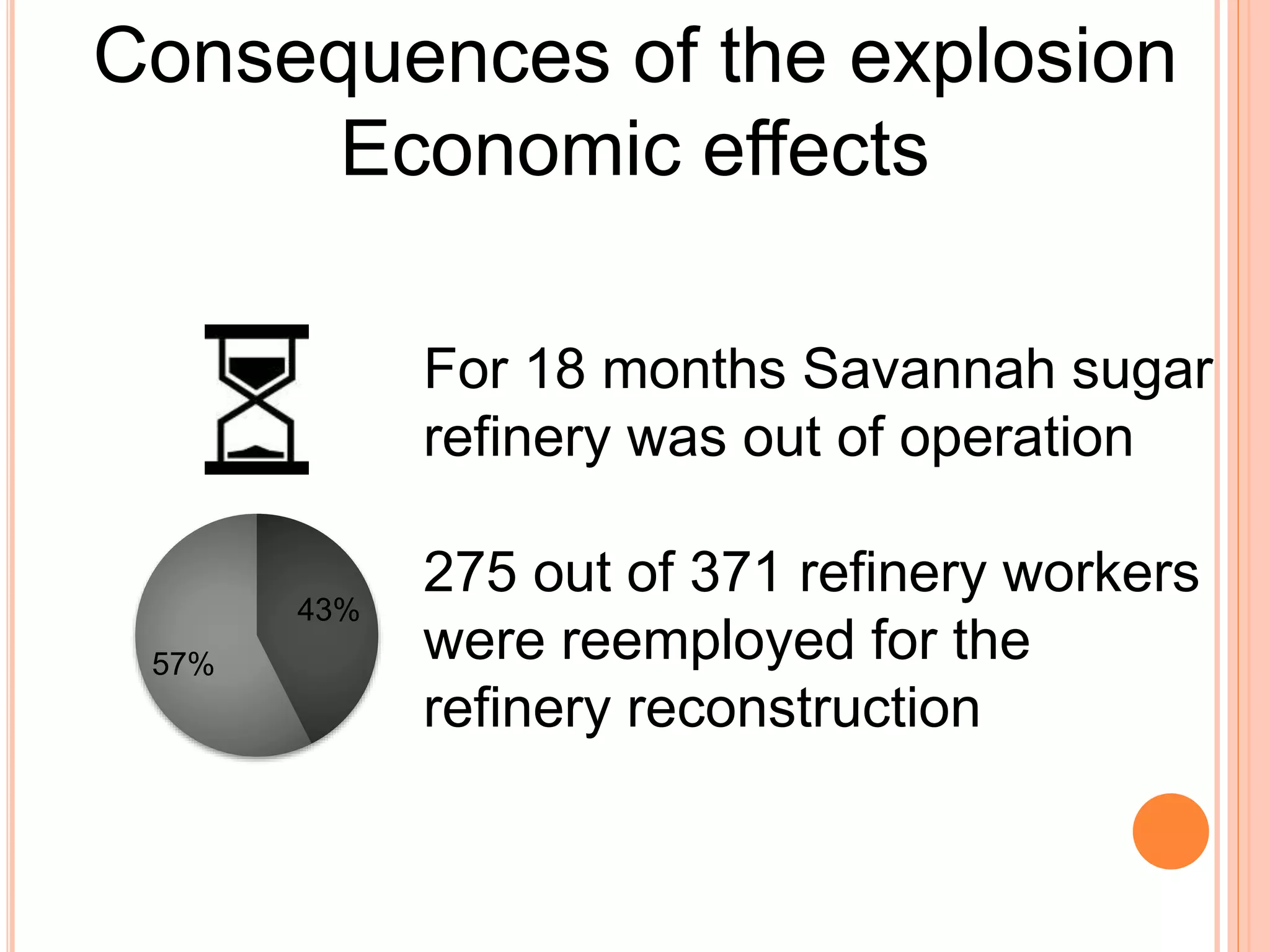
For 18 months Savannah sugar
refinery was out of operation
275 out of 371 refinery workers
were reemployed for the
refinery reconstruction
43%
57%
Consequences of the explosion
Economic effects
In 2nd quarter of 2008 financial
losses comprised $15.5mln
Revenue drop comprised 32%
By the end of 2008 financial
losses comprised $60mln
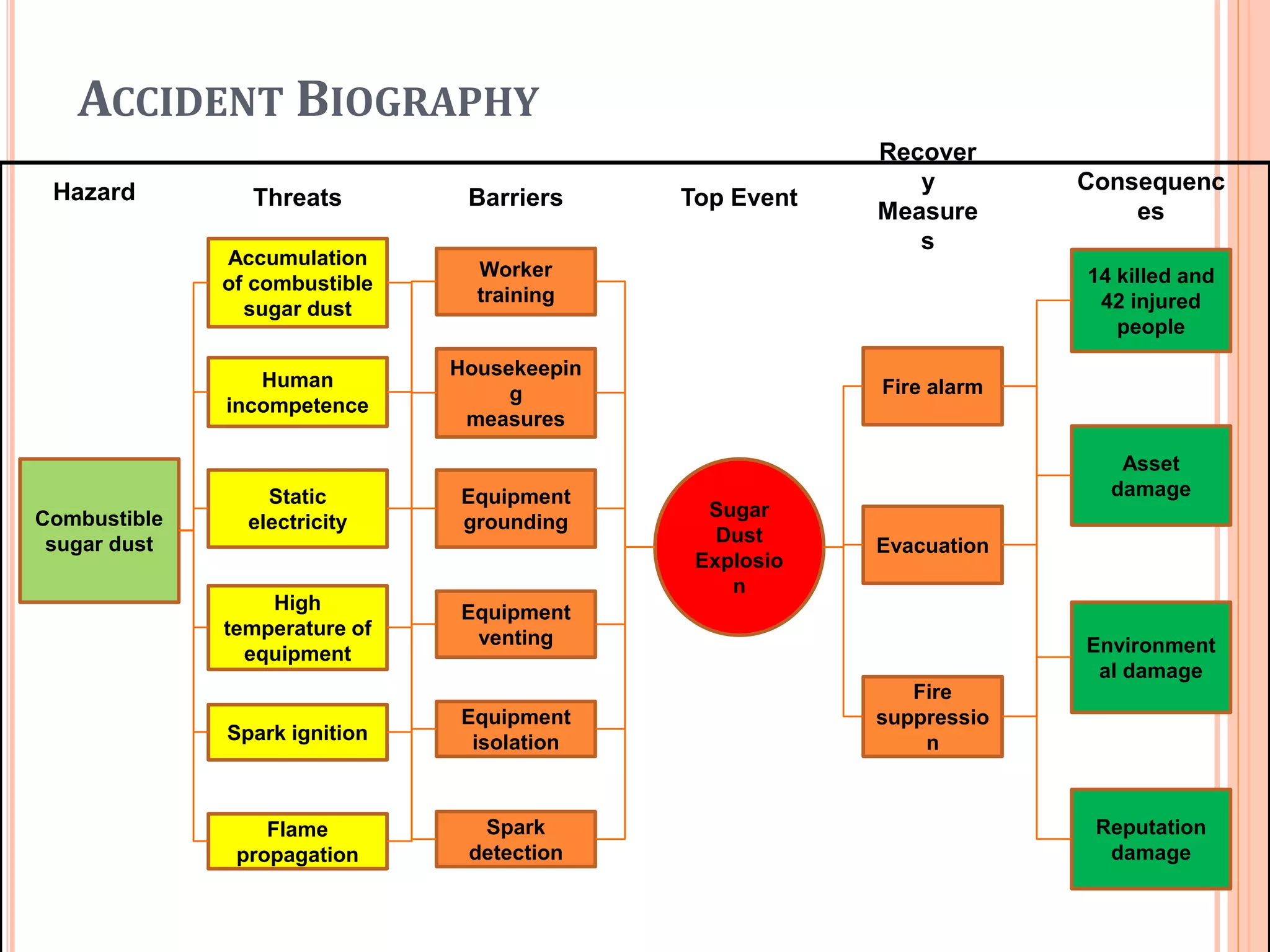
ACCIDENT BIOGRAPHY
Threats
Accumulation
of combustible
sugar dust
Evacuation
High
temperature of
equipment
Flame
propagation
Spark ignition
Equipment
isolation
Equipment
venting
Equipment
grounding
Worker
training
Sugar
Dust
Explosio
n
Static
electricity
Fire alarm
Fire
suppressio
n
14 killed and
42 injured
people
Hazard Barriers Top Event
Recover
y
Measure
s
Consequenc
es
Spark
detection
Housekeepin
g
measures
Asset
damage
Environment
al damage
Reputation
damage
Human
incompetence
Combustible
sugar dust
ACTIONS TAKEN:
1
• Another sugar refinery, situated in Louisiana was closed after six weeks since Port
Wentworth accident. Occupational safety and health administration fined Imperial
Company $36000 for safety legislation violations (Chapman, Dan. 2008).
2
• Cleanup and demolition of the refinery parts, that were impossible to salvage, planned.
The decision of rebuilding was taken on April 18, 2008. The demolition procedure of
sugar silos started on June 24, 2008 with a wrecking ball (Chapman, Dan. 2008). By
summer of 2009, replacement of packaging buildings and new sugar silos were planned
to be completed (“Ga. sugar refinery demolishing blasted silos”).
3
• In a period of month, occupational safety and health administration sent a letter to 30000
employees working in similar facilities, informing of the dust explosion, fearing their
unawareness. Also, OSHA later introduced Combustible Dust Explosion and Fire
Prevention Act of 2008, which aim was to introduce regulations and to reduce the risk of
dust explosions (Testimonial record, 2008).
LESSONS LEARNED
 Control combustible dust accumulation quantity
 Improvement of training of operating personnel
 Emergency planning should be well-organized
 Improvement of communication between different
agencies and workers
 Own safety standards should be applied
Conclusion
Reference list
Bauerlein V., 2010. Imperial Sugar to Pay Fines in Deadly Georgia Explosion
Case. [Online] Wall Street Journal. Retrieved March 22, 2014 from
http://goo.gl/I9kzxg
Csb.gov, 2009. Imperial Sugar Company Dust Explosion and Fire –
Investigations | the U.S. Chemical Safety Board [online]. Retrieved March 20,
2014 from
http://www.csb.gov/assets/1/19/imperial_sugar_report_final_updated.pdf
Dewan S., 2009. Report Cites Lack of Precautions in 2008 Sugar Plant Fire.
[Online] The New York Times. Retrieved March 24, 2014 http://goo.gl/bEcgoU
Skutch J., 2010. Appellate court rejects pre-trial appeal in Imperial Sugar case
[Online]. SavannahNow. Retrieved March 23, 2014 from http://goo.gl/K95Xww
Sugar Company Ignored Explosion Hazards, Investigation Concludes, 2009.
Retrieved March 20, 2014 from http://www.foreffectivegov.org/node/10428
Seward C., 2013. No criminal charges for Imperial Sugar in deadly blast.
[Online] The Atlanta Journal-Constitution. Retrieved March 25, 2014 from
http://goo.gl/Vphh36
http://www.youtube.com/watch?v=Jg7mLSG-Yws
Thank you for attention !!!

2008_Imperial Sugar_Refinery_Explosion_Pr.pptx

  • 1.
  • 3.
    Outline 1)Risk assessment ShakarimIrmukhametov 2) Background information and chronology Saken Sagadiyev 3) Root causes and circumstances Aidyn Myltykbayev 4) Consequences and effects Rassul Bairamkulov 5) Accident Biography Sanzhar Askaruly 6) Lessons learned Zhaksylyk Kazykenov
  • 4.
    RISK ASSESSMENT RISK MATRIX Riskprobability Severity of the accident Extreme A=5 Crucial B=4 Moderate C=3 Insignificant D=2 Negligible E=1 5-Frequent 5A=25 5B=20 5C=15 5D=10 5E=5 4-Likely 4A=20 4B=16 4C=12 4D=8 4E=4 3- Occasional 3A=15 3B=12 3C=9 3D=6 3E=3 2-Rare 2A=10 2B=8 2C=6 2D=4 2E=2
  • 5.
    RISKS INDEXES’ CRITERIA AssessmentRisk Index Criteria 5A, 5B, 5C, 4A, 4B, 3A (1525) Unacceptable risk level Requires immediate action under existing circumstances 5D, 4C, 4D, 3B, 3C, 2A, 2B (812) Unsatisfactory risk level Manageable under risk control & mitigation. Requires Risk Analysis Board & management decision 5E,4E, 3D, 2C, 1A, 1B (46) Acceptable after review of the operation. Requires continued tracking and recorded action plans. 3E, 2D, 2E, 1C, 1D, 1E (14) Acceptable risk level Acceptable with continued data collection and trending for continuous improvement.
  • 6.
    RISK FREQUENCY INDEXES’DEFINITIONS Frequency Definition Frequent (A) > 1 in 10 years Probable (B) 1 in 10 years to 1 in 100 years1 Occasional (C) 1 in 100 years to 1 in 1000 years Remote (D) 1 in 1000 years to 1 in 10000 years Improbable (E) < 1 in 10000 years
  • 7.
    Severity of Occurences RiskSeverity Meaning Value Extreme  Dozens of deaths  Equipment destroyed  Financial losses > $10M  Big impact on environment  Potential for uncontrollable public discontent A Crucial  Serious injury or death  Accident or Serious Incident with injuries and/or major to moderate equipment damage  Financial losses > $100k  Medium environmental impact B Moderate  Accident or Incident with minor injury and/or minor plant damage  Financial losses from 0$ to $100k  Small environmental impact C Insignificant  No deaths  No equipment damage to slight damage – no operational impact  $0 regulatory fines  No environmental impact anticipated  No public relations impact D Negligible  No regulatory violation  Equipment is safe. No equipment damage - no operational impact  $0 regulatory fines  Negligible environmental impact  No public relations impact E
  • 8.
     Fourteen workerskilled, eight died at the scene and 36 – injured.  The packaging area of the refinery was totally destroyed, 12% of the plant was razed by the explosion.  Imperial posted a $15.5 million loss in the first quarter of 2008.This loss as they said was primarily due to the explosion.  The particles produced after the explosion create air pollution and settle everywhere near the place. Also, emission of air borne pollutants was the impact of electricity generation on environment. Risk severity is extreme (A)
  • 9.
     The probabilityof the Imperial Sugar Refinery incident was found as 3.76*10^(-2), which matches to Probable(4).  Therefore, by means of qualitative risk analysis the risk level corresponds to 4A, which is unacceptable. Thus, the required actions should be made to minimize the risk.
  • 10.
    BACKGROUND INFORMATION AND CHRONOLOGY •The Imperial Sugar Company began operations in 1917 • One of the largest sugar refining and packaging facilities in the US. • Granulated sugar was stored in silos • Conveyed to packing buildings where it was packaged for distribution.
  • 11.
    BACKGROUND INFORMATION AND CHRONOLOGY Sugar spilled onto floor throughout the work area  Particles that became airborne  Dust collection system was undersized and disrepair  conveyor was enclosed with stainless steel panels
  • 12.
    BACKGROUND INFORMATION AND CHRONOLOGY The dust accumulated until to explosive concentrations inside the enclosure.  Dust in the building was ignited by advancing fire balls.  No power to much the interior lighting.  8 workers died at the scene, 6 more died later at regional burn center. Dozens of others were injured.
  • 13.
    Root causes andcircumstances 1) Inadequate equipment
  • 15.
    Root causes andcircumstances 1) Inadequate equipment 2) Not appropriate housekeeping of the factory 3) Overheated bearing 4) First dust explosion 5) Inadequate emergency evacuation plan
  • 17.
    Root causes andcircumstances 1) Inadequate equipment 2) Not appropriate housekeeping of the factory 3) Overheated bearing 4) First dust explosion 5) Inadequate emergency evacuation plan
  • 20.
    8 people werekilled during the explosion Consequences of the explosion (Muller, 2013)
  • 21.
    6 more diedin hospitals during next 6 months Consequences of the explosion (Muller, 2013)
  • 22.
    40 people wereinjured Consequences of the explosion (Muller, 2013)
  • 23.
    Consequences of theexplosion A total of $914,000 was raised during the fundraising campaigns Population response (Muller, 2013)
  • 24.
  • 25.
    Consequences of theexplosion 124 safety violations were found on both Imperial Sugar Plants: large concentrations of small explosive sugar dust particles were present at the electric equipment and working areas (Seward, 2013)
  • 26.
    Consequences of theexplosion Violations were known and accepted by the company management (OSHA, 2008; CSB cited in Dewan, 2009) Accident was called “entirely preventable”
  • 27.
    Consequences of theexplosion Lawsuits $8,777,500 fine was proposed by OSHA in 2008. In 2010 Imperial Sugar agreed to pay $6mln fine but did not admit a guilt for the explosion 44 lawsuits were proposed by victims and their families
  • 28.
    Consequences of theexplosion Economic effects For 18 months Savannah sugar refinery was out of operation 275 out of 371 refinery workers were reemployed for the refinery reconstruction 43% 57%
  • 29.
    Consequences of theexplosion Economic effects In 2nd quarter of 2008 financial losses comprised $15.5mln Revenue drop comprised 32% By the end of 2008 financial losses comprised $60mln
  • 30.
    ACCIDENT BIOGRAPHY Threats Accumulation of combustible sugardust Evacuation High temperature of equipment Flame propagation Spark ignition Equipment isolation Equipment venting Equipment grounding Worker training Sugar Dust Explosio n Static electricity Fire alarm Fire suppressio n 14 killed and 42 injured people Hazard Barriers Top Event Recover y Measure s Consequenc es Spark detection Housekeepin g measures Asset damage Environment al damage Reputation damage Human incompetence Combustible sugar dust
  • 31.
    ACTIONS TAKEN: 1 • Anothersugar refinery, situated in Louisiana was closed after six weeks since Port Wentworth accident. Occupational safety and health administration fined Imperial Company $36000 for safety legislation violations (Chapman, Dan. 2008). 2 • Cleanup and demolition of the refinery parts, that were impossible to salvage, planned. The decision of rebuilding was taken on April 18, 2008. The demolition procedure of sugar silos started on June 24, 2008 with a wrecking ball (Chapman, Dan. 2008). By summer of 2009, replacement of packaging buildings and new sugar silos were planned to be completed (“Ga. sugar refinery demolishing blasted silos”). 3 • In a period of month, occupational safety and health administration sent a letter to 30000 employees working in similar facilities, informing of the dust explosion, fearing their unawareness. Also, OSHA later introduced Combustible Dust Explosion and Fire Prevention Act of 2008, which aim was to introduce regulations and to reduce the risk of dust explosions (Testimonial record, 2008).
  • 32.
    LESSONS LEARNED  Controlcombustible dust accumulation quantity  Improvement of training of operating personnel  Emergency planning should be well-organized  Improvement of communication between different agencies and workers  Own safety standards should be applied
  • 33.
  • 34.
    Reference list Bauerlein V.,2010. Imperial Sugar to Pay Fines in Deadly Georgia Explosion Case. [Online] Wall Street Journal. Retrieved March 22, 2014 from http://goo.gl/I9kzxg Csb.gov, 2009. Imperial Sugar Company Dust Explosion and Fire – Investigations | the U.S. Chemical Safety Board [online]. Retrieved March 20, 2014 from http://www.csb.gov/assets/1/19/imperial_sugar_report_final_updated.pdf Dewan S., 2009. Report Cites Lack of Precautions in 2008 Sugar Plant Fire. [Online] The New York Times. Retrieved March 24, 2014 http://goo.gl/bEcgoU Skutch J., 2010. Appellate court rejects pre-trial appeal in Imperial Sugar case [Online]. SavannahNow. Retrieved March 23, 2014 from http://goo.gl/K95Xww Sugar Company Ignored Explosion Hazards, Investigation Concludes, 2009. Retrieved March 20, 2014 from http://www.foreffectivegov.org/node/10428 Seward C., 2013. No criminal charges for Imperial Sugar in deadly blast. [Online] The Atlanta Journal-Constitution. Retrieved March 25, 2014 from http://goo.gl/Vphh36 http://www.youtube.com/watch?v=Jg7mLSG-Yws
  • 35.
    Thank you forattention !!!