2008 Annual Report
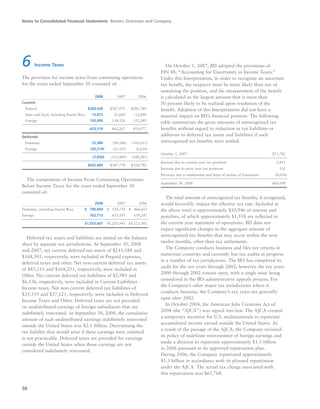
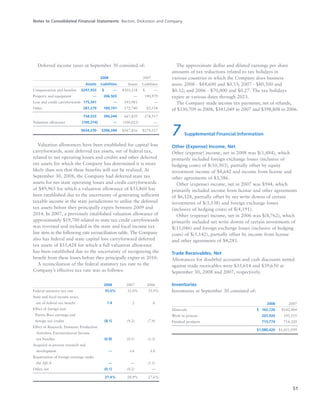
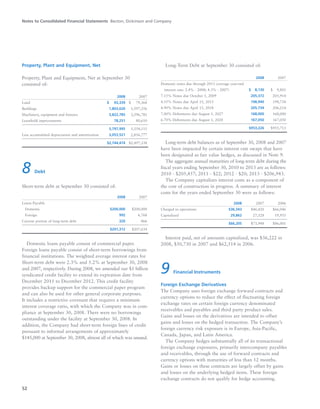
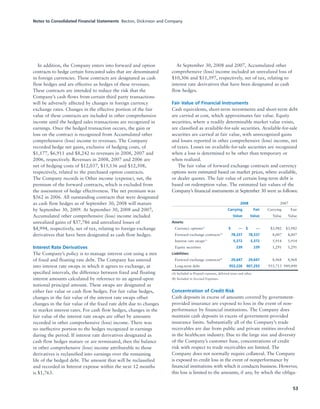
Helping all people live healthy lives
Financial Highlights
Thousands of dollars, except per share amounts 2008 2007 Change
Operating results
Revenues $7,155,910 $6,359,708 12.5%
Income from continuing operations $1,127,918 $0,856,167 31.7%
Diluted earnings per share,
from continuing operations 4.46 3.36 32.7%
Dividends per common share 1.14 .98 16.3%
BD is a leading global medical technology company that
develops, manufactures and sells medical devices, instrument
systems and reagents. The Company is dedicated to improving
people's health throughout the world. BD is focused on
improving drug delivery, enhancing the quality and speed
of diagnosing infectious diseases and cancers, and advancing
research, discovery and production of new drugs and vaccines.
BD's capabilities are instrumental in combating many of the
world's most pressing diseases. Founded in 1897 and
headquartered in Franklin Lakes, New Jersey, BD employs
approximately 28,000 people in approximately 50 countries
throughout the world. The Company serves healthcare
institutions, life science researchers, clinical laboratories,
the pharmaceutical industry and the general public.
For more information, please visit www.bd.com.
BD Medical B
P
•
•
•
•
•
•
•
•
•
•
At a Glance
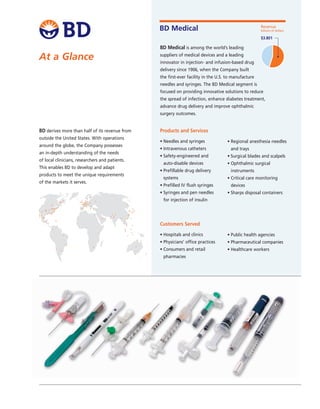
Products and Services
• Needles and syringes
• Intravenous catheters
• Safety-engineered and
auto-disable devices
• Prefillable drug delivery
• systems
• Prefilled IV flush syringes
• Syringes and pen needles
• for injection of insulin
• Regional anesthesia needles
• and trays
• Surgical blades and scalpels
• Ophthalmic surgical
• instruments
• Critical care monitoring
• devices
• Sharps disposal containers
C
•
•
•
•
•
Customers Served
• Hospitals and clinics
• Physicians’ office practices
• Consumers and retail
• pharmacies
• Public health agencies
• Pharmaceutical companies
• Healthcare workers
BD derives more than half of its revenue from
outside the United States. With operations
around the globe, the Company possesses
an in-depth understanding of the needs
of local clinicians, researchers and patients.
This enables BD to develop and adapt
products to meet the unique requirements
of the markets it serves.
Revenue
billions of dollars
$3.801
BD Medical is among the world’s leading
suppliers of medical devices and a leading
innovator in injection- and infusion-based drug
delivery since 1906, when the Company built
the first-ever facility in the U.S. to manufacture
needles and syringes. The BD Medical segment is
focused on providing innovative solutions to reduce
the spread of infection, enhance diabetes treatment,
advance drug delivery and improve ophthalmic
surgery outcomes.
B
o
tr
w
a
h
T
o
so
p
BD BiosciencesBD Diagnostics
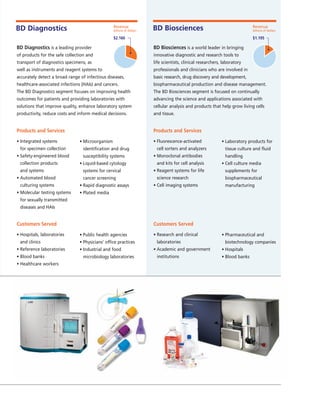
Products and Services
• Integrated systems
• for specimen collection
• Safety-engineered blood
• collection products
• and systems
• Automated blood
• culturing systems
• Molecular testing systems
• for sexually transmitted
• diseases and HAIs
• Microorganism
• identification and drug
• susceptibility systems
• Liquid-based cytology
• systems for cervical
• cancer screening
• Rapid diagnostic assays
• Plated media
Products and Services
• Fluorescence-activated
• cell sorters and analyzers
• Monoclonal antibodies
• and kits for cell analysis
• Reagent systems for life
• science research
• Cell imaging systems
• Laboratory products for
• tissue culture and fluid
• handling
• Cell culture media
• supplements for
• biopharmaceutical
• manufacturing
Customers Served
• Hospitals, laboratories
• and clinics
• Reference laboratories
• Blood banks
• Healthcare workers
• Public health agencies
• Physicians’ office practices
• Industrial and food
• microbiology laboratories
Customers Served
• Research and clinical
• laboratories
• Academic and government
• institutions
• Pharmaceutical and
• biotechnology companies
• Hospitals
• Blood banks
Revenue
billions of dollars
$1.195
Revenue
billions of dollars
$2.160
BD Diagnostics is a leading provider
of products for the safe collection and
transport of diagnostics specimens, as
well as instruments and reagent systems to
accurately detect a broad range of infectious diseases,
healthcare-associated infections (HAIs) and cancers.
The BD Diagnostics segment focuses on improving health
outcomes for patients and providing laboratories with
solutions that improve quality, enhance laboratory system
productivity, reduce costs and inform medical decisions.
BD Biosciences is a world leader in bringing
innovative diagnostic and research tools to
life scientists, clinical researchers, laboratory
professionals and clinicians who are involved in
basic research, drug discovery and development,
biopharmaceutical production and disease management.
The BD Biosciences segment is focused on continually
advancing the science and applications associated with
cellular analysis and products that help grow living cells
and tissue.
Fiscal 2008 was a year in which our Company
capitalized upon exciting opportunities and
exceeded our operational and strategic goals
for the eighth straight year.
We invested nearly $1 billion in new capital investments
and R&D, and we returned over $700 million of
cash flow to shareholders ($450 million in share
repurchases and $279 million in dividends). In
November 2008, our Board of Directors voted to
increase the annual dividend by 15.8 percent to
$1.32. This marks the 36th consecutive year of
dividend increases for the Company.
We enter fiscal 2009 with a dedicated, enthusiastic
senior executive team, and we are well prepared to
continue our journey to greatness while pursuing
our purpose of “Helping all people live healthy lives.”
Our strategy is to serve the world’s population as a
global leader in developing and applying technologies
to solve emerging, important, sometimes
underappreciated and fundamental healthcare
problems with discipline and committed service
to our customers and shareholders. We do so by:
• Enabling the discovery and development of
medical therapies, facilitating faster and more
accurate diagnosis to accelerate and improve the
treatment of disease, and providing unique and
affordable devices to deliver drugs and vaccines
in developed and developing markets;
• Leveraging and expanding our deep expertise and
distinctive capabilities across our device and life
science businesses; and,
• Building upon trusted relationships across the
global healthcare community as a partner of
choice to customers, governments, payors and
other companies.
This strategy focuses on four specific areas of
healthcare:
• Reducing the spread of infection, which includes
healthcare worker safety and patient safety;
• Advancing global health, which includes HIV/AIDS,
tuberculosis and safe immunization;
• Enhancing therapy, which includes research,
production, drug delivery and companion
diagnostics; and,
• Improving disease management, which includes
cancer, diabetes, infectious diseases, and accurate
and reproducible specimen management.
Our strategy is designed to increase sustainable
revenue growth through innovation. We will also
continue to drive operating effectiveness and
productivity. This, in turn, will enable us to increase
our investments in innovation to further fuel our
growth. This strategy rewards both customers and
shareholders and furthers our goal of being a “great
company” – one that achieves great performance for
customers and shareholders, makes great contributions
to society and is a great place to work.
In this report, you will read stories about how
implementing our strategy is helping to meet
healthcare needs across the healthcare continuum –
and saving and improving lives worldwide –
and at the same time creating lasting value for
our shareholders.
2008 Annual Report 1
To Our Shareholders
John R. Considine Edward J. Ludwig
Vice Chairman and Chairman, President and
Chief Financial Officer Chief Executive Officer
2 BD
Great performance
We are pleased to note that this year BD moved
up 12 places on the FORTUNE 500 list to number
380 in revenue rank and 46 places to number 83
in Total Return to Investors (1997 – 2007).
Since October 1, 2008 – the beginning of our
fiscal year 2009 – the economy has sharply declined.
From October 1 through November 14, the S&P 500
Index declined 25 percent and the S&P Health Care
Equipment Index declined nearly 24 percent, while
BD’s stock price declined 15.6 percent. However,
when we look at investments in the healthcare sector
generally and BD in particular over the long term,
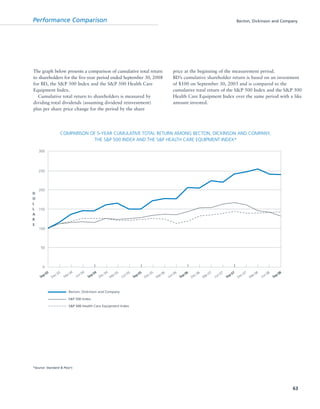
the returns are quite favorable. BD’s results are
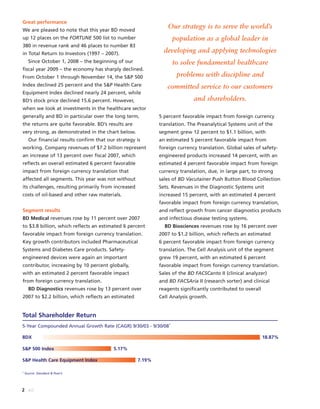
very strong, as demonstrated in the chart below.
Our financial results confirm that our strategy is
working. Company revenues of $7.2 billion represent
an increase of 13 percent over fiscal 2007, which
reflects an overall estimated 6 percent favorable
impact from foreign currency translation that
affected all segments. This year was not without
its challenges, resulting primarily from increased
costs of oil-based and other raw materials.
Segment results
BD Medical revenues rose by 11 percent over 2007
to $3.8 billion, which reflects an estimated 6 percent
favorable impact from foreign currency translation.
Key growth contributors included Pharmaceutical
Systems and Diabetes Care products. Safety-
engineered devices were again an important
contributor, increasing by 10 percent globally,
with an estimated 2 percent favorable impact
from foreign currency translation.
BD Diagnostics revenues rose by 13 percent over
2007 to $2.2 billion, which reflects an estimated
5 percent favorable impact from foreign currency
translation. The Preanalytical Systems unit of the
segment grew 12 percent to $1.1 billion, with
an estimated 5 percent favorable impact from
foreign currency translation. Global sales of safety-
engineered products increased 14 percent, with an
estimated 4 percent favorable impact from foreign
currency translation, due, in large part, to strong
sales of BD Vacutainer Push Button Blood Collection
Sets. Revenues in the Diagnostic Systems unit
increased 15 percent, with an estimated 4 percent
favorable impact from foreign currency translation,
and reflect growth from cancer diagnostics products
and infectious disease testing systems.
BD Biosciences revenues rose by 16 percent over
2007 to $1.2 billion, which reflects an estimated
6 percent favorable impact from foreign currency
translation. The Cell Analysis unit of the segment
grew 19 percent, with an estimated 6 percent
favorable impact from foreign currency translation.
Sales of the BD FACSCanto II (clinical analyzer)
and BD FACSAria II (research sorter) and clinical
reagents significantly contributed to overall
Cell Analysis growth.
Total Shareholder Return
18.87%
5.17%
7.19%
5-Year Compounded Annual Growth Rate (CAGR) 9/30/03 - 9/30/08*
* Source: Standard & Poor’s
Our strategy is to serve the world’s
population as a global leader in
developing and applying technologies
to solve fundamental healthcare
problems with discipline and
committed service to our customers
and shareholders.
BDX
S&P 500 Index
S&P Health Care Equipment Index
2008 Annual Report 3
Corporate social responsibility
We have successfully driven our performance for
the benefit of our shareholders while, at the same
time, fulfilling our commitments to the broader
communities in which we live and work.
In recognition of our contributions and social
responsibility, BD was selected for the third
consecutive year as a member of the Dow Jones
Sustainability World Index – perhaps the premier
recognition for companies in the area of
sustainability and corporate social responsibility.
BD was also selected for the fourth consecutive
year as a member of the Dow Jones Sustainability
North America Index. For the second consecutive
year, BD was named one of the “World’s Most
Ethical Companies“ by Ethisphere magazine –
the only medical technology company selected.
Strengthening capabilities
BD strives to be a great place to work and to recruit,
develop and retain the best talent. Our leadership
development process assesses talent, strengthens
succession planning and further develops managers
and emerging leaders.
After the close of fiscal 2008, we announced two
significant executive appointments. First, we announced
the promotion of Vincent A. Forlenza to the position
of President, effective January 1, 2009. Vince has
experience in all three of BD’s business segments,
including leading BD Biosciences and BD Diagnostics,
and his management of our technology and planning
capabilities will provide a good foundation for his
new position. We and the BD Board are confident
that Vince has the ideal blend of experience and
vision to play an even greater role in achieving our
strategic goals.
Additionally, David Elkins became our new Executive
Vice President and Chief Financial Officer, effective
December 1, 2008. He is succeeding John Considine,
who will continue to serve as Vice Chairman in an
executive officer capacity. David joined us from
AstraZeneca, where he most recently served as
Office of the Chief Executive Officer
Front row, left to right: Gary M. Cohen, Executive Vice President; John R. Considine, Vice Chairman and
Chief Financial Officer. Back row, left to right: Vincent A. Forlenza, Executive Vice President;
William A. Kozy, Executive Vice President; Edward J. Ludwig, Chairman, President and Chief Executive Officer;
and A. John Hanson, Executive Vice President.
4 BD
CFO of its $13 billion North American pharmaceutical
business.
Closing reflections
These are challenging times indeed. The global
economy is in the midst of a slowdown resulting from
the credit crisis and, while we cannot predict the
length or severity of this slowdown, we can say this:
• Together with our Board, we have reviewed our
financial position and credit market exposures,
and we believe we are well prepared for these
economic times. Our balance sheet is strong,
our cash flow is healthy and we see little risk to
our ability to fund our operations or plan for
future growth; and,
• We will continue to respond to the current
economic conditions with the same commitment,
responsibility, prudence and transparency that
have characterized the management of our
business for many years.
To be sure, few, if any, industries will be immune
from the current economic difficulties. However,
whatever the challenges, we are confident that,
through discipline and hard work, BD will emerge even
stronger while continuing to reward our shareholders
and delight our customers, undeterred in our
purpose of “Helping all people live healthy lives.”
In closing, we would like to take this opportunity
to again thank our more than 28,000 dedicated,
talented BD associates who come to work each day
committed to our shareholders and eager to help all
people live healthy lives!
Edward J. Ludwig John R. Considine
Chairman, President and Vice Chairman and
Chief Executive Officer Chief Financial Officer
Development Committee
Front row, left to right: A. John Hanson, Executive Vice President; Gary M. Cohen, Executive Vice President;
Edward J. Ludwig, Chairman, President and Chief Executive Officer; Scott P. Bruder, M.D., Ph.D., Senior Vice President
and Chief Technology Officer; and David T. Durack, M.D., Senior Vice President, Corporate Medical Affairs.
Back row, left to right: Jeffrey S. Sherman, Senior Vice President and General Counsel; Vincent A. Forlenza, Executive Vice
President; Patricia B. Shrader, Senior Vice President, Corporate Regulatory and External Affairs; William A. Kozy,
Executive Vice President; John R. Considine, Vice Chairman and Chief Financial Officer; Donna M. Boles, Senior Vice President,
Human Resources.
Helping all people
live healthy lives
To further our purpose of
“Helping all people live
healthy lives,” we actively
look for opportunities to
lend an experienced hand
and our resources to meet
healthcare needs around
the world…
Lending a
Helping Hand
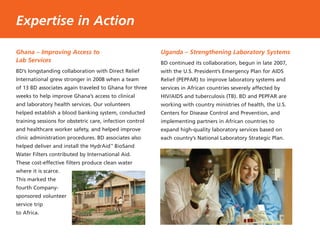
Ghana – Improving Access to
Lab Services
BD’s longstanding collaboration with Direct Relief
International grew stronger in 2008 when a team
of 13 BD associates again traveled to Ghana for three
weeks to help improve Ghana’s access to clinical
and laboratory health services. Our volunteers
helped establish a blood banking system, conducted
training sessions for obstetric care, infection control
and healthcare worker safety, and helped improve
clinic administration procedures. BD associates also
helped deliver and install the HydrAid™
BioSand
Water Filters contributed by International Aid.
These cost-effective filters produce clean water
where it is scarce.
This marked the
fourth Company-
sponsored volunteer
service trip
to Africa.
Uganda – Strengthening Laboratory Systems
BD continued its collaboration, begun in late 2007,
with the U.S. President’s Emergency Plan for AIDS
Relief (PEPFAR) to improve laboratory systems and
services in African countries severely affected by
HIV/AIDS and tuberculosis (TB). BD and PEPFAR are
working with country ministries of health, the U.S.
Centers for Disease Control and Prevention, and
implementing partners in African countries to
expand high-quality laboratory services based on
each country’s National Laboratory Strategic Plan.
Expertise in Action
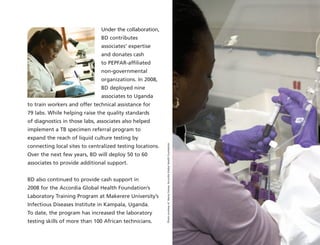
Under the collaboration,
BD contributes
associates’ expertise
and donates cash
to PEPFAR-affiliated
non-governmental
organizations. In 2008,
BD deployed nine
associates to Uganda
to train workers and offer technical assistance for
79 labs. While helping raise the quality standards
of diagnostics in those labs, associates also helped
implement a TB specimen referral program to
expand the reach of liquid culture testing by
connecting local sites to centralized testing locations.
Over the next few years, BD will deploy 50 to 60
associates to provide additional support.
BD also continued to provide cash support in
2008 for the Accordia Global Health Foundation’s
Laboratory Training Program at Makerere University’s
Infectious Diseases Institute in Kampala, Uganda.
To date, the program has increased the laboratory
testing skills of more than 100 African technicians.
PhotocourtesyofNancyFarese,AccordiaGlobalHealthFoundation
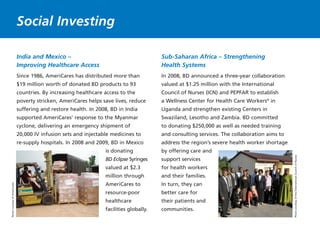
India and Mexico –
Improving Healthcare Access
Since 1986, AmeriCares has distributed more than
$19 million worth of donated BD products to 93
countries. By increasing healthcare access to the
poverty stricken, AmeriCares helps save lives, reduce
suffering and restore health. In 2008, BD in India
supported AmeriCares’ response to the Myanmar
cyclone, delivering an emergency shipment of
20,000 IV infusion sets and injectable medicines to
re-supply hospitals. In 2008 and 2009, BD in Mexico
is donating
BD Eclipse Syringes
valued at $2.3
million through
AmeriCares to
resource-poor
healthcare
facilities globally.
Sub-Saharan Africa – Strengthening
Health Systems
In 2008, BD announced a three-year collaboration
valued at $1.25 million with the International
Council of Nurses (ICN) and PEPFAR to establish
a Wellness Center for Health Care Workers®
in
Uganda and strengthen existing Centers in
Swaziland, Lesotho and Zambia. BD committed
to donating $250,000 as well as needed training
and consulting services. The collaboration aims to
address the region’s severe health worker shortage
by offering care and
support services
for health workers
and their families.
In turn, they can
better care for
their patients and
communities.
Social Investing
PhotocourtesyoftheInternationalCouncilofNurses
PhotocourtesyofAmeriCares
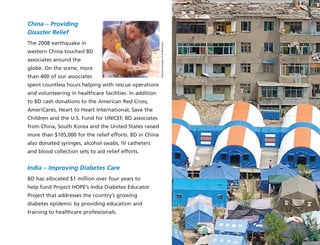
China – Providing
Disaster Relief
The 2008 earthquake in
western China touched BD
associates around the
globe. On the scene, more
than 400 of our associates
spent countless hours helping with rescue operations
and volunteering in healthcare facilities. In addition
to BD cash donations to the American Red Cross,
AmeriCares, Heart to Heart International, Save the
Children and the U.S. Fund for UNICEF, BD associates
from China, South Korea and the United States raised
more than $105,000 for the relief efforts. BD in China
also donated syringes, alcohol swabs, IV catheters
and blood collection sets to aid relief efforts.
India – Improving Diabetes Care
BD has allocated $1 million over four years to
help fund Project HOPE’s India Diabetes Educator
Project that addresses the country’s growing
diabetes epidemic by providing education and
training to healthcare professionals.
PhotoscourtesyofAmeriCares
New Jersey –
Helping the Less Fortunate
Eva’s Village is a social service agency in Paterson,
New Jersey, with a mission to feed the hungry, shelter
the homeless, treat the addicted and provide medical
care to the poor. Eva’s Village recently renovated
an old building into a housing and rehabilitation
facility for single mothers and their children.
BD funded a
bedroom in
the facility
and matched
donations
raised by our
associates, who
also helped
furnish the room
with decorations
to make it more
comfortable.
Spain – Lifting the Spirits of
Young Cancer Patients
BD associates in Spain donated $15,500 to support
summer camps for children with cancer, organized
by the local cancer foundation in Lerida, Spain.
Located in Spain’s Catalonia region, the summer
camps are designed to host more than 100 children,
aged six to15, affected by cancer.
UK – Supporting Cancer Research
A group of BD associates in Oxford participated in a
10K charity run, raising £1,120 for cancer research.
With 285,000 new cases of cancer diagnosed each
year in the UK, the
donation will go toward
helping researchers
identify ways to better
understand, prevent,
diagnose and treat
malignancies.
Community Involvement
PhotocourtesyofEva'sVillage
California –
Raising Awareness of Blood Cancers
Our associates
in San Jose,
California, raised
more than $53,000,
including Company
match, in two months
for The Leukemia
& Lymphoma
Society’s®
Light
The Night®
Walk, a two-mile walk held throughout
North America to raise funds for lifesaving blood
cancer research. A group of 90 BD associates, family
members and friends participated. Associates also
raised money through bake sales, a farmer’s market
and a craft fair.
Puerto Rico – Helping Senior Citizens
Continuing a holiday tradition, BD associates in Cayey,
Puerto Rico, visited seniors at a local care facility,
to deliver gift baskets and a new television, and
share traditional holiday songs with the residents.
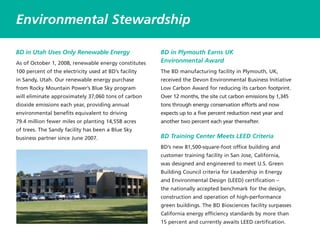
BD in Utah Uses Only Renewable Energy
As of October 1, 2008, renewable energy constitutes
100 percent of the electricity used at BD’s facility
in Sandy, Utah. Our renewable energy purchase
from Rocky Mountain Power’s Blue Sky program
will eliminate approximately 37,060 tons of carbon
dioxide emissions each year, providing annual
environmental benefits equivalent to driving
79.4 million fewer miles or planting 14,558 acres
of trees. The Sandy facility has been a Blue Sky
business partner since June 2007.
BD in Plymouth Earns UK
Environmental Award
The BD manufacturing facility in Plymouth, UK,
received the Devon Environmental Business Initiative
Low Carbon Award for reducing its carbon footprint.
Over 12 months, the site cut carbon emissions by 1,345
tons through energy conservation efforts and now
expects up to a five percent reduction next year and
another two percent each year thereafter.
BD Training Center Meets LEED Criteria
BD’s new 81,500-square-foot office building and
customer training facility in San Jose, California,
was designed and engineered to meet U.S. Green
Building Council criteria for Leadership in Energy
and Environmental Design (LEED) certification –
the nationally accepted benchmark for the design,
construction and operation of high-performance
green buildings. The BD Biosciences facility surpasses
California energy efficiency standards by more than
15 percent and currently awaits LEED certification.
Environmental Stewardship
2008 Annual Report 5
Bringing research tools, diagnostics and drug delivery systems
to scientists, clinicians and patients in need is a huge challenge.
BD addresses this challenge head-on by applying technologies and
expertise to solve problems at critical stops along the healthcare
continuum. In doing so, the Company stays focused on fulfilling its
corporate purpose and passion: “Helping all people live healthy lives.”
Discovery and Development
Strengthening basic and pharmaceutical research with
state-of-the-art tools and analytical technologies to bolster
scientific understanding.
Diagnosis
Improving the quality of in vitro diagnostic testing with
innovative sample collection products and enhancing the
detection, diagnosis and management of infectious disease,
healthcare-associated infections and cancer through
advanced diagnostic platforms and assays.
Delivery
Helping ensure the safe and effective delivery of medicines
and vaccines through unique and affordable drug delivery
systems in both developed and developing markets.
Meeting important,
underappreciated healthcare needs
6 BD
Exciting advances in biomedical science – driven by understanding of
the human genome and cell biology – are leading to unprecedented
changes and opportunities for life scientists from government and
academic laboratories to pharmaceutical and biotechnology companies.
Translating this knowledge into future therapies, however, will be tied
in large part to the availability of new analytical technologies and
bioprocessing tools. BD helps improve the efficiency and quality of
life science research by offering a powerful and growing portfolio
of tools that focuses on cell analysis in the “age of biology.”
Transforming cellular analysis
BD is a pioneer and leader in the field of flow cytometry for
cellular analysis. The Company’s instrument portfolio includes the
BD FACSAria II System, the platform of choice in research labs around
the world performing a broad range of cell sorting applications.
To meet the specific needs of today’s life science researchers working
with advanced applications, BD now offers the BD Influx Cell Sorter,
which became part of BD’s product portfolio through the 2008
acquisition of Cytopeia. An open, configurable cell-sorting platform
that can be optimized for research, application and environmental
requirements, the BD Influx System is especially suited for bioprocessing,
cell therapy research, marine biology and stem cell research.
Flow cytometry is a powerful platform and an important tool in stem
cell research. BD’s expertise in hematopoietic stem cell research is
driving ongoing development of other tools that optimize workflow,
standardize procedures and streamline experiments. This expanding
portfolio of state-of-the-art research instruments and tools reflects BD’s
position as a world leader in applying innovative tools and expertise to
solve complex research problems. These solutions may ultimately help
life scientists discover new lifesaving and life-improving therapies.
Advancing research efficiency
The high cost of drugs – a key issue for patients and entire economies –
can be attributed to a big increase in R&D and clinical trials costs.
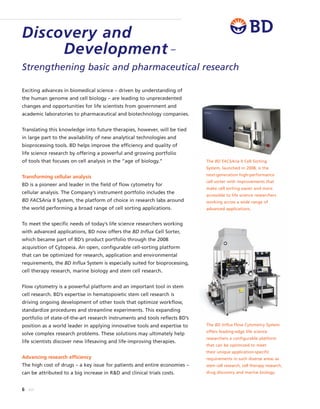
The BD Influx Flow Cytometry System
offers leading-edge life science
researchers a configurable platform
that can be optimized to meet
their unique application-specific
requirements in such diverse areas as
stem cell research, cell therapy research,
drug discovery and marine biology.
Discovery and
Development –
Strengthening basic and pharmaceutical research
The BD FACSAria II Cell Sorting
System, launched in 2008, is the
next-generation high-performance
cell sorter with improvements that
make cell sorting easier and more
accessible to life science researchers
working across a wide range of
advanced applications.
2008 Annual Report 7
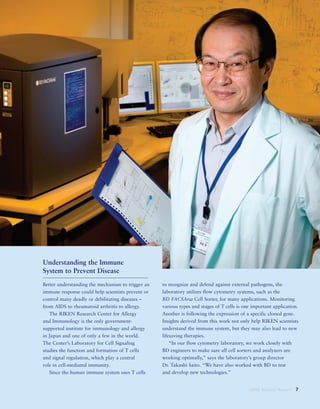
Understanding the Immune
System to Prevent Disease
Better understanding the mechanism to trigger an
immune response could help scientists prevent or
control many deadly or debilitating diseases –
from AIDS to rheumatoid arthritis to allergy.
The RIKEN Research Center for Allergy
and Immunology is the only government-
supported institute for immunology and allergy
in Japan and one of only a few in the world.
The Center’s Laboratory for Cell Signaling
studies the function and formation of T cells
and signal regulation, which play a central
role in cell-mediated immunity.
Since the human immune system uses T cells
to recognize and defend against external pathogens, the
laboratory utilizes flow cytometry systems, such as the
BD FACSAria Cell Sorter, for many applications. Monitoring
various types and stages of T cells is one important application.
Another is following the expression of a specific cloned gene.
Insights derived from this work not only help RIKEN scientists
understand the immune system, but they may also lead to new
lifesaving therapies.
“In our flow cytometry laboratory, we work closely with
BD engineers to make sure all cell sorters and analyzers are
working optimally,” says the laboratory’s group director
Dr. Takashi Saito. “We have also worked with BD to test
and develop new technologies.”
8 BD
BD provides a growing portfolio of reagents for cellular characterization
and sorting that, when coupled with BD’s advanced flow cytometry
platforms, helps improve the efficiency and productivity of drug and
vaccine research and development.
A case in point is BD Phosflow Reagents, used by scientists to understand
and analyze how a particular drug under development can lessen the
effects of disease by inhibiting critical cell signaling pathways. With
BD Phosflow Reagents, scientists can analyze the phosphorylation state
of multiple proteins in a single cell to help enhance the discovery of
new pharmaceutical therapies.
BD is also expanding its line of drug metabolism and toxicity assays
for pharmaceutical, biotechnology and contract research organizations.
The Company’s high-quality tests quickly help researchers determine
the risks of potential drugs long before they reach patients.
An important part of cellular research is creating a laboratory
environment for cells to grow that more closely resembles
the one they encounter inside the body. BD serves as a premium
supplier of advanced cell surfaces and coatings. Through acquisitions
and internal development, BD has expanded its portfolio and
strengthened its position as a leading provider of defined
surfaces used in drug discovery, academic research and cell
therapy development.
Enhancing production of biological medicines
Beyond the research lab, makers of biopharmaceuticals,
bioengineered vaccines and stem cell therapies struggle to produce
new medicines efficiently. BD helps customers meet this challenge
by increasing their production yields with safer cell culture products
and services. In fact, cell culture media supplements from BD’s
Advanced Bioprocessing product platform are currently used
in the manufacture of more than 30 marketed biological medicines.
To help further enhance the safety of biological medicines, BD plans
to manufacture cell culture media supplements in a state-of-the-art,
dedicated animal-free/antibiotic-free facility in Miami, Florida. This
new AF2
Facility also will expand the Company’s product portfolio
to include chemically defined basal cell culture media. As a result,
BD will offer customers a complete solution: yield-enhancing, fully
supplemented, easy-to-use cell culture media that meet or exceed
current regulatory requirements.
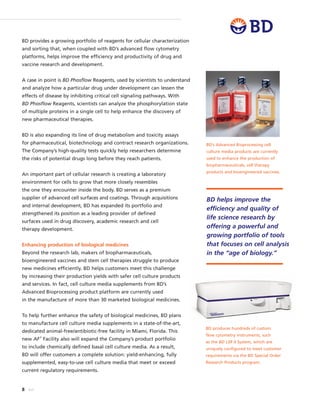
BD’s Advanced Bioprocessing cell
culture media products are currently
used to enhance the production of
biopharmaceuticals, cell therapy
products and bioengineered vaccines.
BD produces hundreds of custom
flow cytometry instruments, such
as the BD LSR II System, which are
uniquely configured to meet customer
requirements via the BD Special Order
Research Products program.
BD helps improve the
efficiency and quality of
life science research by
offering a powerful and
growing portfolio of tools
that focuses on cell analysis
in the ‘‘age of biology.’’
2008 Annual Report 9
BD Recognized for Value Creation, Ethics and Sustainability
BD’s reputation continues to grow in the
corporate community, medical technology
industry and global health arena for creating
sustainable value for stakeholders as well as
for providing leadership, resources and expertise
to meet social and healthcare challenges
around the world. Following are several
examples of corporate honors and recognitions
that BD received in fiscal year 2008.
Dow Jones Sustainability World Index
BD was selected for the third consecutive
year as a component of the Dow Jones
Sustainability World Index, widely considered
the premier socially responsible investing index.
BD’s inclusion was based on an annual evaluation
of sustainability leadership across the world.
The assessment examined corporate economic,
environmental and social performance, with a
strong focus on long-term shareholder value.
Selection as a component of the index puts
BD in the top 10 percent of healthcare
sector companies in terms of sustainability
leadership. BD also remained on the Dow Jones
Sustainability North America Index for the
fourth consecutive year.
FTSE4Good
Since 2003, BD has been
listed as a member of
FTSE4Good, a UK-based
index series that measures the performance
of companies against globally recognized
corporate responsibility standards. Areas of
evaluation include environmental sustainability,
stakeholder relationships, human rights,
supply chain labor standards and anti-bribery
activities. Each year, a committee of independent
practitioners in socially responsible investing
and corporate social responsibility reviews
the indices to ensure they accurately reflect
current best practices.
World’s Most Ethical Companies
For the second consecutive year, BD was
named one of the “World’s Most Ethical
Companies” by Ethisphere magazine, which
analyzed more
than 10,000
companies to
determine the
100 finalists.
All companies
were measured against seven categories:
corporate citizenship and responsibility; corporate
governance; innovation that contributes to
public well-being; executive leadership and
tone; industry leadership; legal, regulatory
and reputation track record; and internal
systems and ethics/compliance programs.
FORTUNE’s “America’s Most Admired
Companies®
”
BD was again named one of “America’s
Most Admired Companies” by FORTUNE
magazine, ranking fourth in the Medical
Products and Equipment category. This year,
the Medical Products and Equipment category
expanded to include Precision Equipment,
adding more companies to the comparison
group than in previous years. In key attributes
of reputation, BD ranked among the top
three in social responsibility, quality of
management, use of corporate assets and
long-term investment.
Dow Jones
Sustainability Indexes
Member 2008/09
FTSE4Good
10 BD
On the Front Lines of
Ovarian Cancer Screening
Nearly 200,000 women worldwide are diagnosed
with ovarian cancer each year; most will die from
the disease. Detecting ovarian cancer has been
difficult because affected women often have no
symptoms or vague symptoms and seek medical care
only after the disease has reached an advanced stage.
For more than 20 years, the Ovarian Cancer
Screening Centre, part of the Institute for Women’s
Health, University College London, has conducted
research to improve outcomes, including the
development of new biomarkers for early detection,
diagnosis and identification of inherited genetic
alterations that can predict which women are at risk.
“We have an exciting opportunity to evaluate biomarker
assays developed by BD to advance early detection, using
our sample banks and clinical research facilities,” says
Professor Ian Jacobs, who directs the Institute and the
Centre. “This collaboration has great potential to speed
up the translation of research ideas into clinical practice,
which is a key goal of our work.”
Dr. Jacobs expects that within 10 years, ovarian cancer
screenings will be standard care, like breast and cervical
cancer screenings today. “I think we’ll use a panel of
circulating biomarkers of the type that we’re working
on with BD, along with ultrasound and other new
sophisticated imaging techniques.”
2008 Annual Report 11
Early and accurate diagnosis of disease is essential to high-quality,
cost-effective patient care. As a pioneer and leader in sample collection,
microbiology and flow cytometry, BD has long provided innovative
technologies and solutions to help clinicians detect, diagnose and
monitor a host of infections and infectious diseases, such as HIV/AIDS,
tuberculosis (TB) and sexually transmitted diseases. Through internal
development, strategic acquisitions and collaborations, BD has
increased its value to clinical laboratories worldwide by providing
new technologies to improve the detection of cancer and molecular
assays that rapidly detect potentially lethal “superbugs,” such as
methicillin-resistant Staphylococcus aureus (MRSA).
Safe sample collection
Achieving an accurate diagnosis first depends on safe and stable
specimen collection. Since launching the first evacuated blood
collection tube in 1949, BD has developed a full portfolio of sample
collection products that includes the BD Vacutainer Push Button
Blood Collection Set. This innovative product not only makes blood
collection easier, it also helps reduce healthcare worker exposure
to needlesticks.
Reducing the spread of infection
Leveraging the Company’s expertise in microbiology and molecular
diagnostics, BD has built and acquired capabilities to address the
growing problem of healthcare-associated infections (HAIs) caused
by increasingly drug-resistant bacteria. These infections pose a serious
threat to patients in the very places they go for medical care.
BD now offers a growing portfolio of diagnostic technologies that
help infection control specialists prevent and manage the spread of
HAIs. These products range from BD BBL CHROMagar MRSA Plated
Media to molecular tests that provide results in less than two hours,
such as the BD GeneOhm MRSA Assay.
In 2008, the Company expanded its menu of BD GeneOhm assays
to test for HAI-causing organisms. BD achieved CE marking in
Europe this year for a rapid molecular assay to detect toxigenic
Clostridium difficile, a dangerous bacterium that can infect the colon.
Diagnosis –
Enhancing care through improved detection
and management of disease
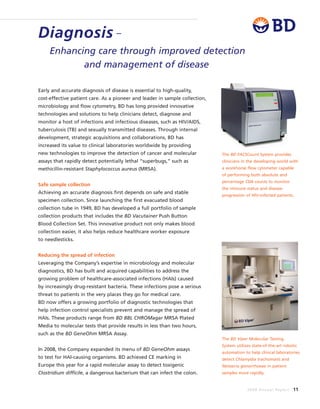
The BD Viper Molecular Testing
System utilizes state-of-the-art robotic
automation to help clinical laboratories
detect Chlamydia trachomatis and
Neisseria gonorrhoeae in patient
samples more rapidly.
The BD FACSCount System provides
clinicians in the developing world with
a workhorse flow cytometer capable
of performing both absolute and
percentage CD4 counts to monitor
the immune status and disease
progression of HIV-infected patients.
12 BD
A definitive diagnosis of this potentially life-threatening infection
enables clinicians to prescribe appropriate treatment to patients and
reduce the risk of spreading the infection to others.
Improving global health
Infectious diseases take a staggering human and economic toll,
especially in the developing world. With diagnostics and medical
treatment difficult to come by, millions of people with HIV/AIDS
and TB are not receiving the care they need when they need it.
BD is applying its expertise and innovative technologies to address
this crisis in many regions around the globe, including Africa,
China, India, Eastern Europe and Latin America.
The World Health Organization (WHO) estimates that 9 million new
cases of active TB and approximately 2 million TB deaths occur annually.
The BD BACTEC MGIT 960 System is the test of choice in many developing
countries because it is the only automated liquid culture system for
high-volume mycobacterial growth and detection as well as drug
susceptibility testing. It provides faster results that may help improve
patient care. In fact, the WHO recently endorsed the use of liquid
culture systems for TB diagnosis in high-burden countries.
Enhancing cancer detection and diagnosis
Results in the fight against cancer have been mixed. On the one hand,
expensive new therapies often prove to prolong survival by months,
not years. On the other, five-year survival rates improve dramatically
for most cancers detected in Stages I and II. This reality places an even
greater importance on developing new assays that detect and diagnose
cancer earlier. Hence, BD is actively expanding its offerings and capabilities
in these areas for detecting and diagnosing solid tumors as well as
leukemias and lymphomas.
Cervical cancer claims the lives of more than 300,000 women globally
every year, and more than 470,000 women are diagnosed annually.
BD earned U.S. FDA approval in 2008 for the new BD FocalPoint GS
Imaging System, which offers significant improvements in both disease
detection and lab productivity to locate abnormal, often precancerous,
cervical cells quickly.
BD is also developing proprietary biomarkers to enhance the early
detection of cervical, ovarian and breast cancers. The Company aims to
provide advanced oncology products that will enable biomarker-guided
diagnoses to drive better clinical decisions that could enable better
patient outcomes.
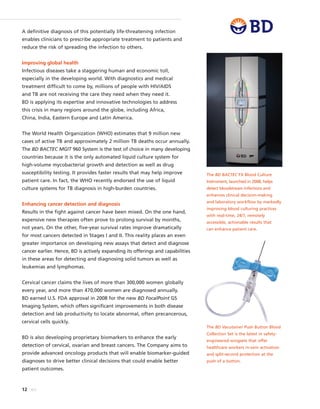
The BD Vacutainer Push Button Blood
Collection Set is the latest in safety-
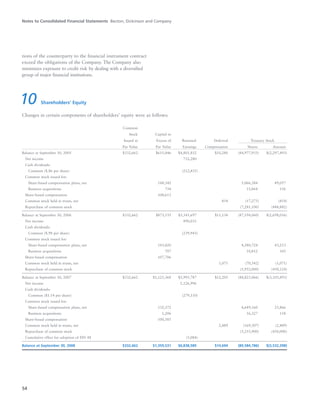
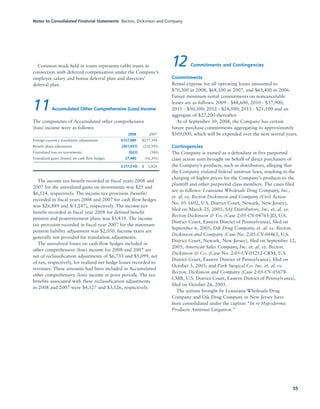
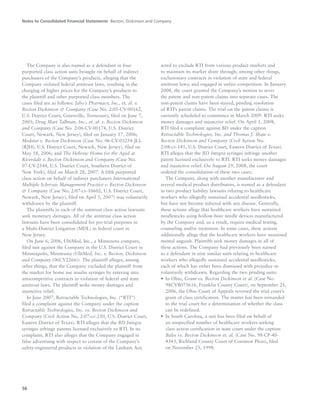
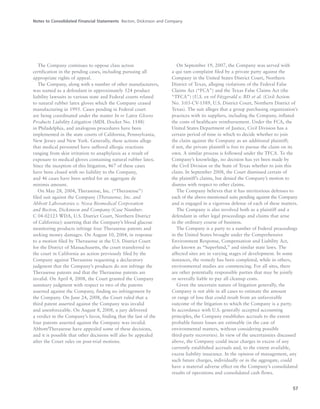
engineered wingsets that offer
healthcare workers in-vein activation
and split-second protection at the
push of a button.
The BD BACTEC FX Blood Culture
Instrument, launched in 2008, helps
detect bloodstream infections and
enhances clinical decision-making
and laboratory workflow by markedly
improving blood culturing practices
with real-time, 24/7, remotely
accessible, actionable results that
can enhance patient care.
2008 Annual Report 13
Expanding Manufacturing Capacity to Meet Demand
BD made strategic investments in 2008 to
increase manufacturing capacity to help meet
growing worldwide demand for its innovative
technologies and products. Below are just a
few examples of expansion projects BD
undertook or completed this year. Each
demonstrates the Company’s commitment to
providing customers with high-quality
products that enhance the discovery
and development of new medicines,
the detection and diagnosis of
infections and disease, and the safe
and effective delivery of medicines.
Miami, Florida –
Enabling discovery and
development
BD announced plans
to open a dedicated
animal-free/antibiotic-
free AF2
Facility for
the production of cell
culture media and supplements
by late 2009. This new $53 million
facility will serve the needs of
pharmaceutical and biotechnology
companies that require high-
performance cell culture media
products for the production of
biological medicines, vaccines
and stem cell therapies. With
stringent raw materials controls
and product segregation that
are designed to eliminate the risk of
contamination associated with cell culture
media from facilities using animal-origin
components, the AF2
Facility will set a
new standard for safety and quality.
Québec, Canada – Improving detection
and diagnosis
BD opened a new $34 million manufacturing
facility in Québec to help meet anticipated
global demand for BD GeneOhm molecular
assays. The BD GeneOhm MRSA Assay – now
used in more than 400 hospitals in the U.S.,
Canada, Europe and
Asia-Pacific – is the
primary product
manufactured in this
facility. In addition,
the Québec facility is
currently producing
BD GeneOhm assays
for the detection of
methicillin-sensitive Staphylococcus aureus,
vancomycin-resistant enterococci, Clostridium
difficile and Group B streptococci.
Tatabánya, Hungary –
Enhancing drug delivery
BD announced a C100
million capital investment
project to build a state-
of-the-art prefillable
syringe manufacturing
facility in Tatabánya,
Hungary, which is
expected to open in
2010. The new high-
volume manufacturing
facility will help BD meet
the growing worldwide demand for prefillable
syringes that are sold to pharmaceutical
companies. The prefilled syringe format
has been found to reduce the potential for
medication error and contamination.
New facilities in Canada, Florida and
Hungary reflect BD’s commitment to meet
the need for innovative, high-quality
products in the discovery and development,
diagnosis and delivery phases of the
healthcare continuum.
=
The need to diagnose and treat patients quickly and effectively in
hospitals and clinics is matched by the need to deliver those treatments
with minimal risks to both patients and healthcare providers. BD offers
a comprehensive line of innovative injection and infusion devices that
effectively deliver lifesaving therapies and vaccines, while reducing the
risk of needlestick injury or other incidents that may spread infection.
Reducing the spread of infection
Needlestick injuries, which expose healthcare workers to such dangerous
pathogens as hepatitis C and HIV, are a serious occupational hazard. For
two decades, BD has been a pioneer and world leader in developing
advanced safety-engineered delivery systems designed to protect
healthcare workers and patients from exposures to bloodborne pathogens.
One of BD’s innovative solutions is the BD Nexiva Closed IV Catheter
System. This simple, all-in-one product is designed to increase first-stick
success and reduce blood exposure to clinicians through its innovative
blood containment system. This product is often coupled with the
BD Q-Syte Luer Access Split-Septum Device, which helps reduce the
risk of catheter-related bloodstream infections (CRBSIs). Studies
indicate that split-septum needleless access systems have 64 percent
to 70 percent lower CRBSI rates than mechanical valves.
The Company also developed the BD Venflon Pro Safety IV Catheter
for the clinical environment in Europe. Its unique features are designed
to help protect healthcare workers from needlestick injuries and
blood splatter that can occur during the IV cannulation process.
Such safety-engineered products are needed in healthcare institutions
across Europe, where an estimated 1 million needlesticks occur
every year.
Delivering medicines more effectively
In demanding clinical environments, it is critical to minimize the risk
of medical errors, preserve the supply of vaccines and medicines, and
reduce the time it takes to prepare treatments. When compared with
single- and multi-dose vials, prefilled syringes address these concerns
for the benefit of both patients and providers.
Delivery –
Designing devices for safe and effective
injections and infusions
14 BD
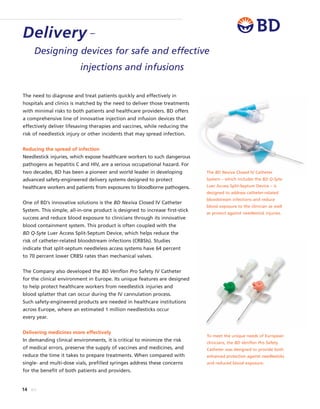
To meet the unique needs of European
clinicians, the BD Venflon Pro Safety
Catheter was designed to provide both
enhanced protection against needlesticks
and reduced blood exposure.
The BD Nexiva Closed IV Catheter
System – which includes the BD Q-Syte
Luer Access Split-Septum Device – is
designed to address catheter-related
bloodstream infections and reduce
blood exposure to the clinician as well
as protect against needlestick injuries.
2008 Annual Report 15
Getting to Zero: Catheter-related
Bloodstream Infections in the ICU
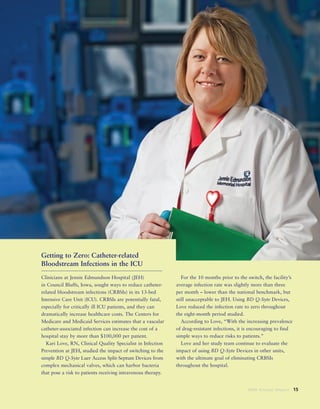
Clinicians at Jennie Edmundson Hospital (JEH)
in Council Bluffs, Iowa, sought ways to reduce catheter-
related bloodstream infections (CRBSIs) in its 13-bed
Intensive Care Unit (ICU). CRBSIs are potentially fatal,
especially for critically ill ICU patients, and they can
dramatically increase healthcare costs. The Centers for
Medicare and Medicaid Services estimates that a vascular
catheter-associated infection can increase the cost of a
hospital stay by more than $100,000 per patient.
Kari Love, RN, Clinical Quality Specialist in Infection
Prevention at JEH, studied the impact of switching to the
simple BD Q-Syte Luer Access Split-Septum Devices from
complex mechanical valves, which can harbor bacteria
that pose a risk to patients receiving intravenous therapy.
For the 10 months prior to the switch, the facility’s
average infection rate was slightly more than three
per month – lower than the national benchmark, but
still unacceptable to JEH. Using BD Q-Syte Devices,
Love reduced the infection rate to zero throughout
the eight-month period studied.
According to Love, “With the increasing prevalence
of drug-resistant infections, it is encouraging to find
simple ways to reduce risks to patients.”
Love and her study team continue to evaluate the
impact of using BD Q-Syte Devices in other units,
with the ultimate goal of eliminating CRBSIs
throughout the hospital.
16 BD
BD SoloMed Reuse Prevention Syringes
are designed to meet the needs of
healthcare workers in emerging and
developing countries by employing
safety features to help reduce
needlesticks and syringe reuse.
BD Hypak SCF Glass Prefillable Syringes
are the worldwide standard, offering
pharmaceutical companies and clinicians
a drug delivery system that may improve
dosing accuracy and helps reduce the
risk of medication errors.
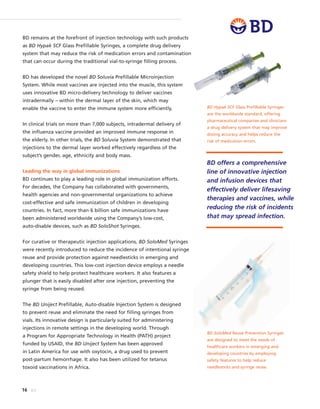
BD remains at the forefront of injection technology with such products
as BD Hypak SCF Glass Prefillable Syringes, a complete drug delivery
system that may reduce the risk of medication errors and contamination
that can occur during the traditional vial-to-syringe filling process.
BD has developed the novel BD Soluvia Prefillable Microinjection
System. While most vaccines are injected into the muscle, this system
uses innovative BD micro-delivery technology to deliver vaccines
intradermally – within the dermal layer of the skin, which may
enable the vaccine to enter the immune system more efficiently.
In clinical trials on more than 7,000 subjects, intradermal delivery of
the influenza vaccine provided an improved immune response in
the elderly. In other trials, the BD Soluvia System demonstrated that
injections to the dermal layer worked effectively regardless of the
subject’s gender, age, ethnicity and body mass.
Leading the way in global immunizations
BD continues to play a leading role in global immunization efforts.
For decades, the Company has collaborated with governments,
health agencies and non-governmental organizations to achieve
cost-effective and safe immunization of children in developing
countries. In fact, more than 6 billion safe immunizations have
been administered worldwide using the Company’s low-cost,
auto-disable devices, such as BD SoloShot Syringes.
For curative or therapeutic injection applications, BD SoloMed Syringes
were recently introduced to reduce the incidence of intentional syringe
reuse and provide protection against needlesticks in emerging and
developing countries. This low-cost injection device employs a needle
safety shield to help protect healthcare workers. It also features a
plunger that is easily disabled after one injection, preventing the
syringe from being reused.
The BD Uniject Prefillable, Auto-disable Injection System is designed
to prevent reuse and eliminate the need for filling syringes from
vials. Its innovative design is particularly suited for administering
injections in remote settings in the developing world. Through
a Program for Appropriate Technology in Health (PATH) project
funded by USAID, the BD Uniject System has been approved
in Latin America for use with oxytocin, a drug used to prevent
post-partum hemorrhage. It also has been utilized for tetanus
toxoid vaccinations in Africa.
BD offers a comprehensive
line of innovative injection
and infusion devices that
effectively deliver lifesaving
therapies and vaccines, while
reducing the risk of incidents
that may spread infection.
17
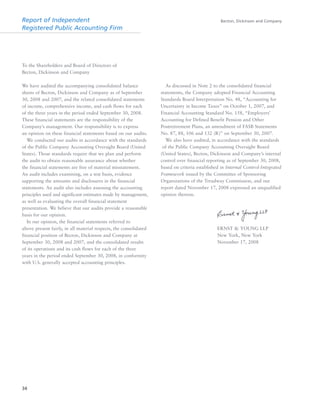
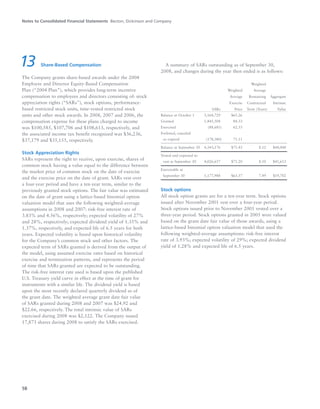
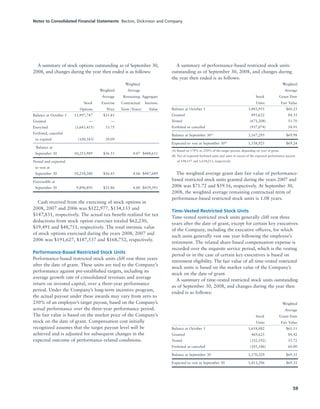
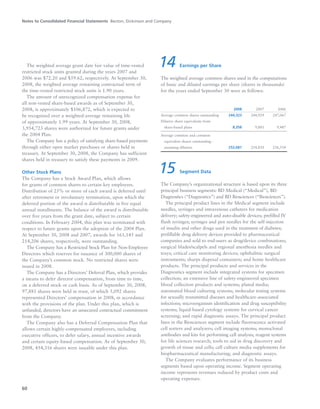
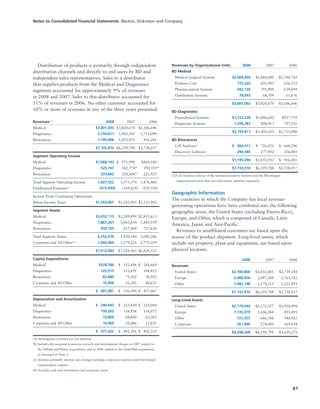
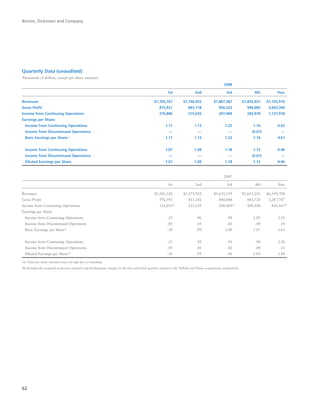
Financials Becton, Dickinson and Company
Table of Contents
Ten-Year Summary of Selected Financial Data . . . . . . . . . . . . . . . . . . . . . . . . . . . . . . . . . . . . . . 18
Financial Review . . . . . . . . . . . . . . . . . . . . . . . . . . . . . . . . . . . . . . . . . . . . . . . . . . . . . . . . . . . . 20
Reports of Management . . . . . . . . . . . . . . . . . . . . . . . . . . . . . . . . . . . . . . . . . . . . . . . . . . . . . . . 33
Reports of Independent Registered Public Accounting Firm . . . . . . . . . . . . . . . . . . . . . . . . . . . 34
Consolidated Statements of Income . . . . . . . . . . . . . . . . . . . . . . . . . . . . . . . . . . . . . . . . . . . . . . 36
Consolidated Statements of Comprehensive Income . . . . . . . . . . . . . . . . . . . . . . . . . . . . . . . . . . 37
Consolidated Balance Sheets . . . . . . . . . . . . . . . . . . . . . . . . . . . . . . . . . . . . . . . . . . . . . . . . . . . 38
Consolidated Statements of Cash Flows . . . . . . . . . . . . . . . . . . . . . . . . . . . . . . . . . . . . . . . . . . . 39
Notes to Consolidated Financial Statements . . . . . . . . . . . . . . . . . . . . . . . . . . . . . . . . . . . . . . . 40
Quarterly Data (unaudited) . . . . . . . . . . . . . . . . . . . . . . . . . . . . . . . . . . . . . . . . . . . . . . . . . . . . 62
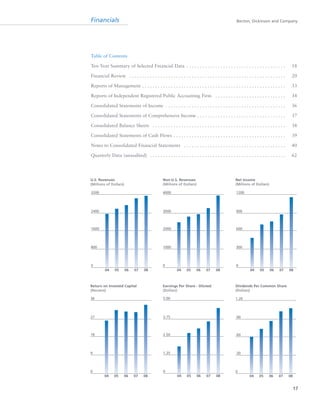
U.S. Revenues
(Millions of Dollars)
Return on Invested Capital
(Percent)
36
27
18
9
0
04 05 06 07 08
1.20
.90
.60
.30
0
5.00
3.75
2.50
1.25
0
04 05 06 07 08
3200
2400
1600
800
0
04 05 06 07 08
4000
3000
2000
1000
0
04 05 06 07 08
1200
900
600
300
0
04 05 06 07 08
Net Income
(Millions of Dollars)
Dividends Per Common Share
(Dollars)
Non-U.S. Revenues
(Millions of Dollars)
Earnings Per Share - Diluted
(Dollars)
04 05 06 07 08
Summary Becton, Dickinson and Company
18
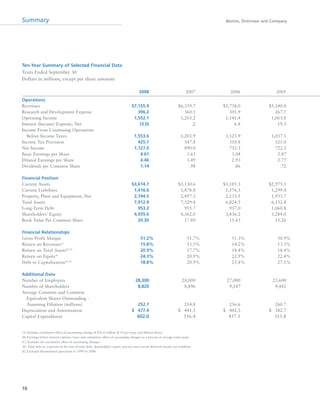
Ten-Year Summary of Selected Financial Data
Years Ended September 30
Dollars in millions, except per share amounts
2008 2007 2006 2005
Operations
Revenues $7,155.9 $6,359.7 $5,738.0 $5,340.8
Research and Development Expense 396.2 360.1 301.9 267.7
Operating Income 1,552.1 1,203.2 1,141.4 1,063.8
Interest (Income) Expense, Net (3.0) .2 6.8 19.3
Income From Continuing Operations
Before Income Taxes 1,553.6 1,203.9 1,125.9 1,037.5
Income Tax Provision 425.7 347.8 310.8 325.0
Net Income 1,127.0 890.0 752.3 722.3
Basic Earnings per Share 4.61 3.63 3.04 2.87
Diluted Earnings per Share 4.46 3.49 2.93 2.77
Dividends per Common Share 1.14 .98 .86 .72
Financial Position
Current Assets $3,614.7 $3,130.6 $3,185.3 $2,975.3
Current Liabilities 1,416.6 1,478.8 1,576.3 1,299.4
Property, Plant and Equipment, Net 2,744.5 2,497.3 2,133.5 1,933.7
Total Assets 7,912.9 7,329.4 6,824.5 6,132.8
Long-Term Debt 953.2 955.7 957.0 1,060.8
Shareholders’ Equity 4,935.6 4,362.0 3,836.2 3,284.0
Book Value Per Common Share 20.30 17.89 15.63 13.26
Financial Relationships
Gross Profit Margin 51.2% 51.7% 51.3% 50.9%
Return on Revenues(E)
15.8% 13.5% 14.2% 13.3%
Return on Total Assets(B) (E)
20.9% 17.7% 18.4% 18.4%
Return on Equity(E)
24.3% 20.9% 22.9% 22.4%
Debt to Capitalization(D) (E)
18.8% 20.9% 25.8% 27.1%
Additional Data
Number of Employees 28,300 28,000 27,000 25,600
Number of Shareholders 8,820 8,896 9,147 9,442
Average Common and Common
Equivalent Shares Outstanding -
Assuming Dilution (millions) 252.7 254.8 256.6 260.7
Depreciation and Amortization $0,477.4 $0,441.3 $0,402.3 $0,382.7
Capital Expenditures 602.0 556.4 457.1 315.8
(A) Includes cumulative effect of accounting change of $36.8 million ($.14 per basic and diluted share).
(B) Earnings before interest expense, taxes and cumulative effect of accounting changes as a percent of average total assets.
(C) Excludes the cumulative effect of accounting changes.
(D) Total debt as a percent of the sum of total debt, shareholders’ equity and net non-current deferred income tax liabilities.
(E) Excludes discontinued operations in 1999 to 2008.
Becton, Dickinson and Company
19
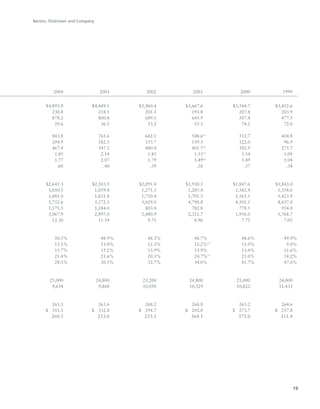
2004 2003 2002 2001 2000 1999
$4,893.9 $4,449.1 $3,960.4 $3,667.6 $3,544.7 $3,412.6
230.8 218.5 201.1 193.8 207.8 203.9
878.2 800.8 689.1 645.9 507.4 477.3
29.6 36.5 33.2 55.3 74.2 72.0
843.8 761.6 642.1 548.6(A)
512.7 404.8
204.9 182.1 153.7 139.3 122.0 96.9
467.4 547.1 480.0 401.7(A)
392.9 275.7
1.85 2.14 1.85 1.55(A)
1.54 1.09
1.77 2.07 1.79 1.49(A)
1.49 1.04
.60 .40 .39 .38 .37 .34
$2,641.3 $2,503.5 $2,091.4 $1,930.1 $1,847.6 $1,843.0
1,050.1 1,059.4 1,271.5 1,285.4 1,382.4 1,358.6
1,881.0 1,831.8 1,750.4 1,701.3 1,565.5 1,423.9
5,752.6 5,572.3 5,029.0 4,790.8 4,505.1 4,437.0
1,171.5 1,184.0 803.0 782.8 778.5 954.0
3,067.9 2,897.0 2,480.9 2,321.7 1,956.0 1,768.7
12.30 11.54 9.71 8.96 7.72 7.05
50.5% 48.9% 48.3% 48.7% 48.6% 49.9%
13.1% 13.0% 12.3% 12.2%(C)
11.0% 9.0%
15.7% 15.2% 13.9% 13.9% 13.4% 11.6%
21.4% 21.6% 20.3% 20.7%(C)
21.0% 18.2%
28.1% 30.5% 32.7% 34.0% 41.7% 47.6%
25,000 24,800 25,200 24,800 25,000 24,000
9,654 9,868 10,050 10,329 10,822 11,433
263.3 263.6 268.2 268.8 263.2 264.6
$ 351.1 $ 332.8 $ 294.7 $ 292.0 $ 273.7 $ 257.8
260.5 253.0 253.5 364.1 371.0 311.4
Financial Review Becton, Dickinson and Company
20
Company Overview
Becton, Dickinson and Company (“BD”) is a medical technology
company engaged principally in the development, manufacture
and sale of a broad range of medical supplies, devices,
laboratory equipment and diagnostic products used by
healthcare institutions, life science researchers, clinical
laboratories, industry and the general public. Our business
consists of three worldwide business segments – BD Medical
(“Medical”), BD Diagnostics (“Diagnostics”) and BD Biosciences
(“Biosciences”). Our products are marketed in the United
States and internationally through independent distribution
channels and directly to end-users by BD and independent sales
representatives. References to years throughout this discussion
relate to our fiscal years, which end on September 30.
BD management operates the business consistent with the
following core strategies:
• To increase revenue growth by focusing on products that
deliver greater benefits to patients, healthcare workers
and researchers;
• To improve operating effectiveness and balance sheet
productivity; and,
• To strengthen organizational and associate capabilities
in the ever-changing healthcare environment.
Our efforts to increase revenues are focused on four specific
areas of healthcare:
• Reducing the spread of infection
• Advancing global health
• Enhancing therapy
• Improving disease management
In assessing the outcomes of these strategies and BD’s
financial condition and operating performance, management
generally reviews quarterly forecast data, monthly actual
results, segment sales and other similar information. We
also consider trends related to certain key financial data,
including gross profit margin, selling and administrative
expense, investment in research and development, return
on invested capital, and cash flows.
The results of our strategies are reflected in our fiscal
2008 financial and operational performance. Worldwide
revenues in 2008 of $7.2 billion increased 13% from the
prior year and reflected volume increases of approximately
7%, an estimated increase due to favorable foreign currency
translation of 6%, and price decreases of less than 1%. U.S.
revenues increased 5% to $3.2 billion. International revenues
increased 19% to $4.0 billion with an estimated 11 percentage
points of such growth coming from the favorable impact
of foreign currency translation. Recently, worldwide
currency markets have experienced extreme volatility.
Our financial projections for 2009 discussed below are based
on the foreign exchange rates in early November 2008 when
we established our fiscal year budget. Fluctuations in these rates
during 2009 may affect these projections. For a discussion of
the financial impact of exchange rate fluctuations and the
ways and extent to which we attempt to mitigate such
impact, see “Financial Instrument Market Risk” below.
Consistent with our strategy to provide products that deliver
greater benefits to healthcare workers, and recognizing the
issues surrounding sharps-related injuries, BD has developed
a wide array of safety-engineered devices that are designed to
reduce the incidence of needlestick injuries and exposure to
bloodborne pathogens. These products are offered through
our Medical and Diagnostics segments. Sales in the United
States of safety-engineered devices grew 5% to $1.036 billion
in 2008, from $987 million in 2007. International sales of
safety-engineered devices grew 29% to $534 million in 2008
from $414 million in 2007, with an estimated 11 percentage
points of such growth coming from the favorable impact of
foreign currency translation. In 2009, we expect sales of safety-
engineered devices to increase about 5 to 6% in the United States,
and 11 to 12% internationally, after taking into account an
estimated unfavorable foreign exchange impact of about 9%.
Our anticipated revenue growth over the next three years
is expected to come from business growth and expansion
among all segments and regions of the world, and the
development in each business segment of new products
and services that provide increased benefits to patients,
healthcare workers and researchers. Our ability to sustain
our long-term growth will depend on a number of factors,
including our ability to expand our core business (including
geographical expansion), develop innovative new products
with higher gross profit margins across our business seg-
ments, and continue to improve operating efficiency and
organizational effectiveness. Numerous factors can affect our
ability to achieve these goals including, without limitation,
economic conditions in the United States and elsewhere,
increased competition and healthcare cost containment
initiatives. In this regard, we note that President-elect Barack
Obama made healthcare reform a central part of his
presidential campaign. However, no predictions can be made
as to what, if any, reforms may be instituted or their poten-
tial effect on BD.
We believe several important factors relating to our
business tend to limit the impact on BD of potential economic
or political events in countries in which we do business,
including the effects of possible healthcare system reforms.
For example, since many of our products are used in essential
medical care, demand for such products has historically tended
not to be significantly affected by economic fluctuations.
21
The international nature of our business and our ability to
meet the needs of the worldwide healthcare industry with
cost-effective and innovative products has also historically
served to limit the impact of economic downturns in
particular regions. However, world financial markets have
recently experienced extreme disruption and economic
conditions in the United States and abroad have significantly
worsened. Accordingly, no assurance can be given that the
current worldwide economic downturn (or future economic
downturns) will not have a material adverse effect on our
access to credit markets or the demand for our products
and services or otherwise adversely affect our business.
Results of Continuing Operations
Medical Segment
Medical revenues in 2008 of $3.8 billion increased $380 million,
or 11%, over 2007, which includes an estimated impact of
favorable foreign currency translation of 6 percentage points.
The following is a summary of revenues by organizational unit:
Estimated
Foreign
Total Exchange
(millions of dollars) 2008 2007 Change Impact
Medical Surgical Systems $2,005 $1,864 8% 4%
Pharmaceutical Systems 942 792 19% 10%
Diabetes Care 775 696 11% 5%
Ophthalmic Systems 79 69 15% 7%
Total Revenues $3,801 $3,421 11% 6%
Medical revenues reflected the growth of the Pharmaceutical
Systems and Diabetes Care units, primarily outside of the
United States, and the continued global conversion to safety-
engineered products. The Pharmaceutical Systems unit grew
by 19%, driven by growth in Europe and Asia-Pacific offset
by lower growth in the United States when compared to
fiscal 2007, which reflected very high growth to support
customer product launches. Revenue growth in the Diabetes
Care unit of 11% was driven primarily by double-digit
growth in all regions outside of the United States. Revenue
in the Medical Surgical Systems unit was primarily driven
by growth in safety-engineered products and prefilled flush
syringes. Sales of safety-engineered products increased 3%
in the United States and 38% internationally. For 2009, we
expect the full-year revenue growth for the Medical Segment
to be flat to 1%, after taking into account an estimated
unfavorable foreign exchange impact of about 5%.
Medical operating income was $1.1 billion, or 28.1% of
Medical revenues, in 2008, as compared with $1.0 billion,
or 28.4%, of revenues in 2007. Operating income as a
percentage of revenues reflects declines in gross margin from
increased costs of raw materials, inventory write-offs and
declines in sales of products that have higher overall gross
profit margins. These items more than offset favorable
manufacturing efficiencies and controls on selling and
administrative expenses. Selling and administrative expense
as a percent of Medical revenues in 2008 declined to
17.9% of revenues from 18.9% of revenues in 2007,
primarily due to tight spending controls. Research and
development expenses in 2008 increased $8.0 million,
or 7%, reflecting continued investment in the development
of new products and platforms.
Diagnostics Segment
Diagnostics revenues in 2008 of $2.2 billion increased $255
million, or 13%, over 2007, which reflected an estimated
favorable impact of foreign currency translation of about
5 percentage points.
The following is a summary of revenues by organizational unit:
Estimated
Foreign
Total Exchange
(millions of dollars) 2008 2007 Change Impact
Preanalytical Systems $1,124 $1,007 12% 5%
Diagnostic Systems 1,036 898 15% 4%
Total Revenues $2,160 $1,905 13% 5%
Revenue growth in the Preanalytical Systems unit was driven
by the continued conversion to safety-engineered products.
Sales of safety-engineered products reflected growth of 7%
in the United States, driven by BD Vacutainer Push Button
Blood Collection Set conversion activity, and 25% interna-
tionally. The Diagnostics Systems unit experienced growth
in worldwide sales of its automated diagnostic platforms,
including the molecular BD ProbeTec, BD Viper and
BD Affirm systems, along with solid growth of its BD BACTEC
blood culture and TB systems and the BD Phoenix ID/AST
platform. In addition, revenues from TriPath grew $31 million
to $119 million and from GeneOhm grew $21 million to
$42 million in 2008. For 2009, we expect full year revenue
growth for the Diagnostics Segment to be about 2 to 3%,
after taking into account an estimated unfavorable foreign
exchange impact of about 4%.
Financial Review Becton, Dickinson and Company
22
Diagnostics operating income was $526 million, or
24.3% of Diagnostics revenues in 2008, compared with
$343 million, or 18.0% of revenues in 2007. Segment
operating income reflects the in-process research and
development charges of $115 million in 2007 related to the
TriPath acquisition. The Diagnostics Segment experienced a
slight improvement in gross profit margin from sales growth
of products that have higher overall gross profit margins, in
particular, safety-engineered products and the BD ProbeTec
and BD Viper systems, and favorable foreign exchange.
These improvements were slightly offset by manufacturing
start-up costs and increases in raw material costs. See
further discussion on gross profit margin below. Selling and
administrative expense as a percent of Diagnostics revenues
in 2008 was 22.0% compared with 22.4% in 2007 primarily
due to tight spending controls. Research and development
expense increased $16 million, or 14%, reflecting continued
investment in the development of new products and platforms
with particular emphasis on our molecular platforms.
Biosciences Segment
Biosciences revenues in 2008 of $1.2 billion increased
$161 million, or 16%, over 2007, which reflected an
estimated impact of favorable foreign currency translation
of 6 percentage points.
The following is a summary of revenues by organizational unit:
Estimated
Foreign
Total Exchange
(millions of dollars) 2008 2007 Change Impact
Cell Analysis $0,901 $0,756 19% 6%
Discovery Labware 295 278 6% 5%
Total Revenues * $1,195 $1,034 16% 6%
* Amounts may not add due to rounding.
Revenue growth in the Cell Analysis unit reflected strong
sales of instruments and flow cytometry reagents, driven
by increased demand for research instruments and clinical
reagents. Revenue growth in the Discovery Labware unit
reflects reduced sales to a major bionutrients customer
compared with 2007. For 2009, we expect the full year
revenue growth for the Biosciences Segment to be about
3 to 4%, after taking into account an estimated unfavorable
foreign exchange impact of about 5%.
Biosciences operating income was $334 million, or 27.9%
of Biosciences revenues in 2008, compared with $259 million,
or 25.0% in 2007. Segment operating income in 2007
included an in-process research and development charge of
$7 million relating to the Plasso acquisition. The increase in
operating income, as a percentage of revenues, reflects gross
profit improvement from relatively higher sales growth of
products that have higher overall gross profit margins and
the favorable impact of foreign currency translation. See
further discussion on gross profit margin below. Selling and
administrative expense as a percent of Biosciences revenues in
2008 was 23.0% as compared with 24.0% in 2007, primarily
due to tight spending controls. Research and development
expense in 2008 increased $11 million, or 15%, reflecting
spending on new product development and advanced technology.
Geographic Revenues
Revenues in the United States in 2008 of $3.2 billion
increased 5%. U.S. sales of safety-engineered devices grew
5% to $1.036 billion in 2008. Overall, growth was also led
by increased sales of immunocytometry instruments and
reagents, diabetes care products and infectious disease
testing systems.
Revenues outside the United States in 2008 increased 19%
to $4.0 billion, reflecting an estimated impact of favorable
foreign currency translation of 11 percentage points. Growth
was led by solid sales in Europe and certain Asia-Pacific
countries in 2008. International sales of safety-engineered
devices were approximately $534 million in 2008, compared
with $414 million in 2007.
Gross Profit Margin
Gross profit margin decreased to 51.2% in 2008, from
51.7% in 2007. Gross profit margin in the current year as
compared with the prior year reflected an estimated 0.7%
unfavorable impact resulting from increased costs of raw
materials (primarily resins) and manufacturing start-up
costs, and an estimated 0.1% favorable impact of foreign
currency translation. Increased sales of products with
relatively higher margins and productivity gains were
partially offset by, among other things, asset write-offs,
resulting in an estimated net favorable impact of 0.1%.
We expect gross profit margin in 2009 to increase by about
40 to 60 basis points compared with 2008, reflecting an
expected increase in sales of products with higher overall gross
profit margins, productivity gains and the impact of select
price increases, partially offset by continued start-up costs and the
expected costs associated with a long-term manufacturing
cost reduction program we anticipate initiating in 2009.
Financial Review Becton, Dickinson and Company
23
Operating Expenses
Selling and administrative expense was $1.7 billion, or
24.0% of revenues, in 2008 compared with $1.6 billion,
or 25.2% of revenues in 2007. The increase in aggregate
expenses for 2008 reflect an unfavorable foreign exchange
impact of $80 million, increases in base spending of
$24 million, and expenses of $9 million associated with
TriPath, which was acquired in December 2006. Selling
and administrative expense as a percentage of revenues is
expected to decrease by about 80 to 100 basis points for 2009.
Research and development (“R&D”) expense in 2008
was $396 million, or 5.5% of revenues, compared with
$360 million, or 5.7% of revenues, in 2007. The increase in
R&D expenditures includes spending for new programs in
each of our segments, as previously discussed. R&D expense
is expected to increase about 9 to 10%, or about 50 basis
points as a percentage of revenues, for 2009.
Operating Income
Operating margin in 2008 was 21.7% of revenues, compared
with 18.9% in 2007. Operating income of $1.2 billion in
2007 reflected $122 million of acquired in-process R&D
charges, as further discussed above, which lowered 2007
operating margin by 190 basis points. We expect operating
margin to increase about 100 basis points in 2009.
Non-Operating Expense and Income
Interest expense was $36 million in 2008, compared with
$46 million in 2007, reflecting a decline in interest rates.
Interest income was $39 million in 2008, compared with
$46 million in 2007. The favorable impact of higher investment
levels was more than offset by investment losses in assets we
hold to offset liabilities related to our deferred compensation
plan. The related reduction in the deferred compensation
liability was recorded as a reduction in selling and
administrative expenses.
Income Taxes
The effective tax rate in 2008 was 27.4% compared with
the 2007 rate of 28.9%. The 2007 rate reflected the non-
deductibility of the acquired in-process R&D charges of
$122 million, which was partially offset by the impact
of approximately 0.3% resulting from the retroactive
reinstatement of the research and experimentation tax
credit. In 2009, we expect our effective tax rate to be
about 27.5%.
Income and Diluted Earnings per Share from
Continuing Operations
Income from continuing operations and diluted earnings per
share from continuing operations in 2008 were $1.1 billion
and $4.46, respectively. Income from continuing operations
and diluted earnings per share from continuing operations
in 2007 were $856 million and $3.36, respectively. The
acquired in-process R&D charges decreased income from
continuing operations and diluted earnings per share from
continuing operations in 2007 by $122 million and by
$.48, respectively.
Financial Instrument Market Risk
We selectively use financial instruments to manage the impact
of foreign exchange rate and interest rate fluctuations on
earnings. The counterparties to these contracts are highly
rated financial institutions. We do not enter into financial
instruments for trading or speculative purposes.
We have foreign currency exposures throughout Europe,
Asia-Pacific, Canada, Japan and Latin America. We face
transactional currency exposures that arise when we enter
into transactions in non-hyperinflationary countries, generally
on an intercompany basis, that are denominated in currencies
other than our functional currency. We hedge substantially all
such foreign exchange exposures primarily through the use
of forward contracts and currency options. We also face
currency exposure that arises from translating the results of
our worldwide operations to the U.S. dollar at exchange
rates that have fluctuated from the beginning of a reporting
period. To partially protect against adverse foreign exchange
rate movements, we purchase option and forward contracts
to hedge certain forecasted sales that are denominated in
foreign currencies. Gains or losses on our derivative
instruments are largely offset by the gains or losses on the
underlying hedged transactions. For foreign currency
derivative instruments, market risk is determined by
calculating the impact on fair value of an assumed change
in foreign exchange rates relative to the U.S. dollar. Fair
values were estimated based on market prices, when
available, or dealer quotes. The reduction in fair value of
our purchased option contracts is limited to the option’s fair
value. With respect to the derivative instruments outstanding
at September 30, 2008, a 10% appreciation of the U.S.
dollar over a one-year period would increase pre-tax
earnings by $91 million, while a 10% depreciation of the
U.S. dollar would decrease pre-tax earnings by $91 million.
Financial Review Becton, Dickinson and Company
24
Comparatively, considering our derivative instruments
outstanding at September 30, 2007, a 10% appreciation of
the U.S. dollar over a one-year period would have increased
pre-tax earnings by $52 million, while a 10% depreciation
of the U.S. dollar would have decreased pre-tax earnings by
$10 million. These calculations do not reflect the impact of
exchange gains or losses on the underlying positions that would
substantially offset the results of the derivative instruments.
Our primary interest rate exposure results from changes in
short-term U.S. dollar interest rates. Our debt and interest-
bearing investments at September 30, 2008, are substantially
all U.S. dollar-denominated. Therefore, transaction and
translation exposure relating to such instruments is minimal.
When managing interest rate exposures, we strive to achieve
an appropriate balance between fixed and floating rate
instruments. We may enter into interest rate swaps to help
maintain this balance and manage debt and interest-bearing
investments in tandem, since these items have an offsetting
impact on interest rate exposure. For interest rate derivative
instruments, market risk is determined by calculating the
impact to fair value of an assumed change in interest rates
across all maturities. Fair values are estimated based on
dealer quotes. A change in interest rates on short-term debt
and interest-bearing investments is assumed to impact earn-
ings and cash flow, but not fair value because of the short
maturities of these instruments. A change in interest rates
on long-term debt is assumed to impact fair value but not
earnings or cash flow because the interest on such obligations
is fixed. Based on our overall interest rate exposure at
September 30, 2008 and 2007, a change of 10% in interest
rates would not have a material effect on our earnings or
cash flows over a one-year period. An increase of 10% in
interest rates would decrease the fair value of our long-term
debt and interest rate swaps at September 30, 2008 and 2007
by approximately $35 million and $37 million, respectively.
A 10% decrease in interest rates would increase the fair value
of our long-term debt and interest rate swaps at September 30,
2008 and 2007 by approximately $39 million and
$41 million, respectively.
Liquidity and Capital Resources
Cash generated from operations, along with available cash
and cash equivalents, is expected to be sufficient to fund
our normal operating needs, including capital expenditures,
cash dividends and common stock repurchases in 2009. In
the latter portion of 2008, particularly in the fourth quarter,
global financial markets were characterized by extreme
volatility and illiquidity. Despite these adverse conditions,
we were able to reissue $200 million of commercial paper
that was outstanding during this period. BD believes that it
will continue to have access to the U.S. commercial paper
market, which should be adequate to fund any short-term
borrowing requirements. As discussed further below, we
also have a $1 billion unused committed bank credit facility
that provides backup support for our commercial paper
program and could be drawn down if necessary.
Net Cash Flows from Continuing Operating Activities
Net cash provided by continuing operating activities in 2008
of $1.7 billion increased $452 million over 2007. The increase
in cash provided by changes in operating assets and liabilities
reflects improvements in accounts receivable and inventory.
Net cash provided by continuing operating activities was
reduced by a $75 million discretionary cash contribution
to the U.S. pension plan in September 2008. An additional
discretionary cash contribution of $75 million was made
to the U.S. pension plan in October 2008. We expect to
generate about $1.8 billion of net cash provided by
continuing operating activities in 2009.
Net Cash Flows from Continuing Investing Activities
Net cash used for continuing investing activities in 2008
was $783 million, compared with $1.0 billion in 2007.
Acquisitions of businesses represented the net cash paid
for the Cytopeia acquisition in 2008 and for the TriPath
acquisition in 2007. See Note 3 for further discussion on
acquisitions. Capital expenditures were $602 million in
2008, compared with $556 million in 2007. Medical capital
spending of $379 million and Diagnostics capital spending
of $124 million in 2008 related primarily to various capacity
expansions. Biosciences capital spending of $83 million
in 2008 included spending on manufacturing capacity
expansions. In 2009, capital expenditures are expected to
be about $650 million, reflecting investments in various
manufacturing capacity and facility expansions.
Financial Review Becton, Dickinson and Company
25
Net Cash Flows from Continuing Financing Activities
Net cash used for financing activities was $586 million in 2008,
as compared with $726 million in 2007, and included the
repurchase of shares of our common stock for approximately
$450 million in both years. At September 30, 2008, approxi-
mately 5.9 million common shares remained available for
purchase under a July 2007 Board of Directors’ (the “Board”)
authorization to repurchase up to 10 million common shares.
The Board authorized an additional repurchase program for
10 million shares in November 2008. We currently expect
that cash used to repurchase common shares in 2009 will
be about $450 million. Total debt was $1.2 billion at both
September 30, 2008 and 2007. Short-term debt decreased to
17% of total debt at year-end, from 18% at the end of 2007.
Floating rate debt was 35% of total debt at the end of 2008
and 36% at the end of 2007. Our weighted average cost of
total debt at the end of 2008 was 4.9%, down from 5.7%
at the end of 2007. Debt-to-capitalization at year-end
improved to 18.8% from 20.9% last year. Issuance of
common stock is net of cash outflows resulting from share
repurchases to satisfy minimum tax withholding on
share-based compensation vested or exercised.
We have in place a commercial paper borrowing program
that is available to meet our short-term financing needs,
including working capital requirements. Borrowings out-
standing under this program were $200 million at September
30, 2008. During the first quarter of 2008, we amended our
syndicated credit facility to extend the expiration date from
December 2011 to December 2012. This credit facility
provides backup support for our commercial paper program
and can also be used for other general corporate purposes.
This credit facility includes a single financial covenant that
requires BD to maintain an interest expense coverage ratio
(ratio of earnings before income taxes, depreciation and
amortization to interest expense) of not less than 5-to-1 for
the most recent four consecutive fiscal quarters. On the last
eight measurement dates, this ratio had ranged from 17-to-1
to 31-to-1. There were no borrowings outstanding under this
facility at September 30, 2008. In addition, we have informal
lines of credit outside the United States.
In July 2008, Standard and Poor’s upgraded our long-term
debt rating to “AA-” from “A+” and our commercial paper
rating to “A-1+” from “A-1.” At September 30, 2008, our
Moody’s long-term debt rating is “A2” and our commercial
paper rating was “P-1.” The outlook from both agencies
was “stable.” Given the availability of the various credit
facilities and our strong credit ratings, we continue to have
confidence in our ability to refinance maturing short-term
and long-term debt, as well as to incur substantial additional
debt, if required.
BD’s ability to generate cash flow from operations, issue
debt, enter into other financing arrangements and attract
long-term capital on acceptable terms could be adversely
affected in the event there was a material decline in the
demand for BD’s products, deterioration in BD’s key
financial ratios or credit ratings or other significantly
unfavorable changes in conditions. While a deterioration
in the Company’s credit ratings would increase the costs
associated with maintaining and borrowing under its existing
credit arrangements, such a downgrade would not affect the
Company’s ability to draw on these credit facilities, nor
would it result in an acceleration of the scheduled maturities
of any outstanding debt. The Company believes that given
its strong debt ratings, its conservative financial management
policies, its ability to generate strong cash flow and the
non-cyclical, geographically diversified nature of its businesses,
the Company would have access to additional short-term
and long-term capital should the need arise.
Contractual Obligations
In the normal course of business, we enter into contracts
and commitments that obligate us to make payments in the
future. The table below sets forth BD’s significant contractual
obligations and related scheduled payments:
2010 to 2012 to 2014 and
(millions of dollars) Total 2009 2011 2013 Thereafter
Short-term debt $0,201 $201 $0— $0— $0—
Long-term debt(A)
1,536 52 288 288 908
Operating leases 190 49 68 46 27
Purchase obligations(B)
505 315 184 6 —
Income tax audit
settlements(D)
70 13 — — 57
Total(C)
$2,502 $630 $540 $340 $992
(A)Long-term debt obligations include expected principal and interest obligations, including
interest rate swaps. The interest rate forward curve at September 30, 2008 was used to
compute the amount of the contractual obligation for variable rate debt instruments
and swaps.
(B) Purchase obligations are for purchases made in the normal course of business to meet
operational and capital requirements.
(C)Required funding obligations for 2009 relating to pension and other postretirement
benefit plans are not expected to be material.
(D)Other than amounts anticipated to be settled in 2009, we cannot accurately forecast
the timing of payments related to our FIN 48 liabilities. Accordingly, the remaining
amount of $57 million is reflected as payable in 2014 and thereafter.
Financial Review Becton, Dickinson and Company
26
2007 Compared With 2006
Worldwide revenues in 2007 of $6.4 billion increased
11% from the prior year and reflected volume increases of
approximately 8%, an estimated increase due to favorable
foreign currency translation of 3%, and price increases
of less than 1%.
Medical Segment
Medical revenues in 2007 of $3.4 billion increased $314 million,
or 10%, over 2006, which includes an estimated impact of
favorable foreign currency translation of 3 percentage points.
The following is a summary of revenues by organizational
unit:
Estimated
Foreign
Total Exchange
(millions of dollars) 2007 2006 Change Impact
Medical Surgical Systems $1,864 $1,749 7% 2%
Diabetes Care 696 657 6% 2%
Pharmaceutical Systems 792 640 24% 6%
Ophthalmic Systems 69 62 11% 4%
Total Revenues * $3,421 $3,107 10% 3%
* Amounts may not add due to rounding.
Medical revenues reflect the growth of the Pharmaceutical
Systems unit and the continued global conversion to safety-
engineered products. The Pharmaceutical Systems unit grew
by 24% in 2007, reflecting the increased use of prefillable
syringes by pharmaceutical companies to market new vaccines
and bio-tech drugs, especially in the United States. Revenue
growth in the Medical Surgical Systems unit in 2007 was primarily
driven by the growth in safety-engineered products and
prefilled flush syringes. Sales of safety-engineered products
increased 6% in the United States and 29% internationally.
Medical operating income was $972 million, or 28.4% of
Medical revenues, in 2007, as compared with $864 million,
or 27.8% in 2006. The increase in operating income as a
percentage of revenues reflects gross margin improvement
from increased sales of products that have higher overall
gross profit margins, in particular, safety-engineered
products and pen needles, as well as favorable manufacturing
efficiencies associated with higher volumes and increased
leverage on selling and administrative expenses. These
improvements were slightly offset by manufacturing
start-up costs. See further discussion on gross profit
margin below. Selling and administrative expense as
a percent of Medical revenues in 2007 declined to
18.9% of revenues from 19.6% of revenues in 2006,
primarily due to tight expense controls over base spending.
Research and development expenses in 2007 increased
$16 million, or 17%, reflecting continued investment in the
development of new products and platforms, and included
investments in additional resources to enhance our product
development process.
Diagnostics Segment
Diagnostics revenues in 2007 of $1.9 billion increased
$190 million, or 11%, over 2006, which reflected an
estimated favorable impact of foreign currency translation
of about 2 percentage points.
The following is a summary of revenues by organizational
unit:
Estimated
Foreign
Total Exchange
(millions of dollars) 2007 2006 Change Impact
Preanalytical Systems $1,007 $0,928 9% 3%
Diagnostic Systems 898 787 14% 2%
Total Revenues $1,905 $1,715 11% 2%
Revenue growth in the Preanalytical Systems unit in 2007
was driven by the continued conversion to safety-engineered
products, which accounted for sales of $718 million as
compared with $627 million in the prior year. Sales of
safety-engineered products in 2007 reflected growth of 9% in
the United States, which benefited from BD Vacutainer Push
Button Blood Collection Set conversion activity, and 25%
internationally. The Diagnostics Systems unit experienced
solid worldwide sales of its automated diagnostic platforms,
including the molecular BD ProbeTec and BD Viper systems,
along with solid growth of its BD BACTEC blood culture
and TB systems and the BD Phoenix ID/AST platform.
In addition, the Diagnostic Systems revenue growth includes
$88 million of revenues from TriPath and $13 million of
incremental revenues from GeneOhm. Sales of flu diagnostic
tests declined $36 million in fiscal 2007 compared with
2006, primarily due to relatively mild flu seasons in both
the United States and Japan and the termination of our
supply arrangement with our Japanese supplier.
Financial Review Becton, Dickinson and Company
27
Diagnostics operating income was $343 million, or
18.0% of Diagnostics revenues in 2007, compared with
$390 million, or 22.8% in 2006. Segment operating income
reflects the in-process research and development charges of
$115 million in 2007 related to the TriPath acquisition and
$53 million in 2006 related to the GeneOhm acquisition.
The Diagnostics Segment experienced a slight improvement
in gross profit margin from sales growth of products that
have higher overall gross profit margins, in particular,
safety-engineered products and the BD ProbeTec system.
These improvements were slightly offset by manufacturing
start-up costs. See further discussion on gross profit margin
below. Selling and administrative expense as a percent of
Diagnostics revenues in 2007 was higher than the comparable
amount in 2006 primarily due to the impact of TriPath and
GeneOhm. Research and development expense increased
$33 million, or 39%, reflecting new spending associated
with these two acquisitions and overall increased investment
in new product development.
Biosciences Segment
Biosciences revenues in 2007 of $1.0 billion increased
$118 million, or 13%, over 2006, which reflected an
estimated impact of favorable foreign currency translation
of 3 percentage points.
The following is a summary of revenues by organizational
unit:
Estimated
Foreign
Total Exchange
(millions of dollars) 2007 2006 Change Impact
Immunocytometry Systems $0,588 $503 17% 3%
Discovery Labware 278 256 9% 2%
Pharmingen 168 157 7% 2%
Total Revenues $1,034 $916 13% 3%
Revenue growth in the Immunocytometry Systems unit in
2007 reflects strong sales of instruments and flow cytometry
reagents, driven by increased demand for research analyzers
and clinical reagents. Revenue growth in the Discovery
Labware unit in 2007 reflects strong sales of bionutrients
and overall market growth.
Biosciences operating income was $259 million, or 25.0%
of Biosciences revenues in 2007, compared with $222 million,
or 24.2%, in 2006. Segment operating income includes an
in-process research and development charge of $7 million in
2007. The increase in operating income, as a percentage of
revenues, reflects gross profit improvement from relatively
higher sales growth of products that have higher overall
gross profit margins and the favorable impact of foreign
currency translation. These improvements were offset by
manufacturing start-up costs. See further discussion on gross
profit margin below. Selling and administrative expense as
a percentage of Biosciences revenues was 24.0% versus
25.3% in 2006. Higher sales and continued tight expense
control were the key contributors to the increased expense
leverage. Research and development expense in 2007
increased $7 million, or 9.0%, reflecting spending on new
product development and advanced technology, particularly
in the Immunocytometry Systems unit.
Geographic Revenues
Revenues in the United States in 2007 of $3.0 billion
increased 11%. U.S. sales of safety-engineered devices
were approximately $987 million in 2007, compared
with $920 million in 2006. Growth was also led by strong
sales of prefilled flush syringes, prefillable syringes and
immunocytometry instruments and reagents. U.S. revenue
growth also included $88 million of revenues from TriPath.
Revenues outside the United States in 2007 increased 11%
to $3.3 billion, reflecting an estimated impact of favorable
foreign currency translation of 5 percentage points. Growth
was led by solid sales in our European, Asia-Pacific and
Canadian regions in 2007. International sales of safety-
engineered devices were approximately $414 million in
2007, compared with $329 million in 2006.
Gross Profit Margin
Gross profit margin was 51.7% in 2007, compared with
51.3% in 2006. Gross profit margin in 2007 as compared
with 2006 reflected an estimated 0.6% improvement
relating to increased sales of products with relatively higher
margins as well as productivity gains. These improvements
were partially offset by an estimated 0.2% impact from
manufacturing start-up costs.
Financial Review Becton, Dickinson and Company
28
Operating Expenses
Selling and administrative expense was $1.6 billion in 2007
compared with $1.4 billion in 2006, or 25.2% of revenues
in both years. Aggregate expenses for 2007 reflect base
spending increases of $62 million and expenses of $40 million
associated with the GeneOhm and TriPath operations.
Increases in selling and administrative expense in 2007 also
reflected the absence of proceeds from insurance settlements
of $17 million received in 2006 in connection with our
previously-owned latex glove business, as well as an
unfavorable foreign exchange impact of $35 million.
Research and development expense in 2007 was
$360 million, or 5.7% of revenues, compared with
$302 million, or 5.3% of revenues, in 2006. The increase
in R&D expenditures includes spending for new programs
in each of our segments, as previously discussed.
Non-Operating Expense and Income
Interest expense was $46 million in 2007, compared with
$66 million in 2006. The decrease reflected lower debt
and higher levels of capitalized interest. Interest income
was $46 million in 2007, compared with $59 million in
2006, resulting from lower cash balances.
Income Taxes
The effective tax rate in 2007 was 28.9% compared with
the 2006 rate of 27.6%. The 2007 rate reflected the non-
deductibility of the acquired in-process R&D charges of
$122 million, which were partially offset by the impact
of approximately 0.3% resulting from the retroactive
reinstatement of the research and experimentation tax
credit. The 2006 rate reflected the non-deductibility of the
acquired in-process R&D charge of $53 million, as well as
the impact relating to the proceeds received from insurance
settlements of approximately 0.2%.
Income and Diluted Earnings per Share from
Continuing Operations
Income from continuing operations and diluted earnings per
share from continuing operations in 2007 were $856 million
and $3.36, respectively. The acquired in-process R&D
charges decreased income from continuing operations and
diluted earnings per share from continuing operations in the
aggregate by $122 million and by $.48, respectively, in 2007.
Income from continuing operations and diluted earnings per
share from continuing operations in 2006 were $815 million
and $3.18, respectively. The acquired in-process R&D charge
decreased income from continuing operations and diluted
earnings per share from continuing operations by $53 million
and by $.21, respectively, in 2006.
Discontinued Operations
In September 2006, the Company announced a plan to
exit the blood glucose monitoring market. The Company
recorded a pre-tax charge of $63 million in connection with
its decision to exit the BGM product line. During the first
quarter of 2007, the Company received an unsolicited offer
for the purchase of the BGM product line. In December
2006, the Company sold the product line for $20 million.
Following the sale, prior period Consolidated Statements
of Income and Cash Flows were restated to separately
present the results of the BGM product line as discontinued
operations. See Note 3 of the Notes to Consolidated
Financial Statements for additional discussion.
Liquidity and Capital Resources
Net Cash Flows from Continuing Operating Activities
Net cash provided by continuing operating activities was
$1.2 billion in 2007, compared with $1.1 billion in 2006.
Net Cash Flows from Continuing Investing Activities
Net cash used for continuing investing activities in 2007
was $1.0 billion, compared with $784 million in 2006.
Acquisitions of businesses of $340 million in 2007
represented the net cash paid for the TriPath acquisition.
Capital expenditures were $556 million in 2007, compared
with $457 million in 2006. Medical capital spending of
$353 million and Diagnostics capital spending of
$114 million in 2007 related primarily to various capacity
expansions. Biosciences capital spending of $73 million
in 2007 included spending on manufacturing capacity
expansions.
Net Cash Flows from Continuing Financing Activities
Net cash used for financing activities was $726 million
in 2007, as compared with $342 million in 2006, and
included the repurchase of shares of our common stock for
approximately $450 million, compared with approximately
$449 million in 2006. Total debt at September 30, 2007,
was $1.2 billion compared with $1.4 billion at September 30,
2006. Short-term debt decreased to 18% of total debt at
year-end, from 31% at the end of 2006. Floating rate debt
was 36% of total debt at the end of 2007 and 46% at the
end of 2006. Our weighted average cost of total debt at the
end of 2007 was 5.7%, up from 5.5% at the end of 2006.
Debt-to-capitalization at year-end improved to 20.9%
from 25.8% last year.
Financial Review Becton, Dickinson and Company
29
Critical Accounting Policies
The preparation of the consolidated financial statements
requires management to use estimates and assumptions that
affect the reported amounts of assets, liabilities, revenues and
expenses, as well as the disclosure of contingent assets and
liabilities at the date of the consolidated financial statements.
Some of those judgments can be subjective and complex and,
consequently, actual results could differ from those estimates.
Management bases its estimates and judgments on historical
experience and on various other factors that are believed to
be reasonable under the circumstances, the results of which
form the basis for making judgments about the carrying
values of assets and liabilities that are not readily apparent
from other sources. For any given estimate or assumption
made by management, it is possible that other people applying
reasonable judgment to the same facts and circumstances
could develop different estimates. Actual results that differ
from management’s estimates could have an unfavorable
effect on our consolidated financial statements. Management
believes the following critical accounting policies reflect
the more significant judgments and estimates used in the
preparation of the consolidated financial statements.
Revenue Recognition
Revenue from product sales is recognized when title and
risk of loss pass to the customer. We recognize revenue for
certain instruments sold from the Biosciences segment upon
installation at a customer’s site, as installation of these
instruments is considered a significant post-delivery obligation.
For certain sales arrangements, primarily in the U.S., with
multiple deliverables, revenue and cost of products sold are
recognized at the completion of each deliverable: shipment,
installation and training, in accordance with Emerging Issues
Task Force Issue No. 00-21, “Revenue Arrangements with
Multiple Deliverables.” These sales agreements are divided
into separate units of accounting. Revenue is recognized
upon the completion of each deliverable based on the
relative fair values of items delivered. Fair values are
generally determined based on sales of the individual
deliverables to other third parties.
BD’s domestic businesses sell products primarily to
distributors who resell the products to end-user customers.
We provide rebates to distributors that sell to end-user
customers at prices determined under a contract between
BD and the end-user customer. Provisions for rebates, as
well as sales discounts and returns, are accounted for as
a reduction of revenues when revenue is recognized.
Impairment of Assets
Pursuant to SFAS No. 142, “Goodwill and Other Intangible
Assets,” goodwill and indefinite-lived intangible assets are
subject to impairment reviews at least annually, or whenever
indicators of impairment arise. Intangible assets other than
goodwill and indefinite-lived intangible assets and other
long-lived assets are reviewed for impairment in accordance
with SFAS No. 144, “Accounting for the Impairment or
Disposal of Long-Lived Assets.” Impairment reviews are
based on a cash flow approach that requires significant
management judgment with respect to future volume,
revenue and expense growth rates, changes in working
capital use, appropriate discount rates and other assumptions
and estimates. The estimates and assumptions used are
consistent with BD’s business plans. The use of alternative
estimates and assumptions could increase or decrease the
estimated fair value of the asset, and potentially result in
different impacts to BD’s results of operations. Actual results
may differ from management’s estimates.
Investments
We hold equity interests in companies having operations
or technology in areas within or adjacent to BD’s strategic
focus. For some of these companies that are publicly traded,
market prices are available. However, for those companies
that are not publicly traded, fair value is difficult to determine.
We write down an investment when management believes an
investment has experienced a decline in value that is other
than temporary. Future adverse changes in market conditions
or poor operating results of the underlying investments could
result in an inability to recover the carrying value of the
investments, thereby possibly requiring impairment charges
in the future.
Tax Valuation Allowances
BD maintains valuation allowances where it is more likely
than not that all or a portion of a deferred tax asset will not
be realized. Changes in valuation allowances are included
in our tax provision in the period of change. In determining
whether a valuation allowance is warranted, management
evaluates factors such as prior earnings history, expected
future earnings, carry back and carry forward periods, and
tax strategies that could potentially enhance the likelihood
of realization of a deferred tax asset.
Financial Review Becton, Dickinson and Company
30
Contingencies
We are involved, both as a plaintiff and a defendant, in
various legal proceedings that arise in the ordinary course
of business, including, without limitation, product liability,
antitrust and environmental matters, as further discussed
in Note 12 of the Notes to Consolidated Financial
Statements. We assess the likelihood of any adverse
judgments or outcomes to these matters as well as
potential ranges of probable losses. In accordance with
U.S. generally accepted accounting principles, we establish
accruals to the extent probable future losses are estimable
(in the case of environmental matters, without considering
possible third-party recoveries). A determination of the
amount of accruals, if any, for these contingencies is made
after careful analysis of each individual issue and, when
appropriate, is developed after consultation with outside
counsel. The accruals may change in the future due to new
developments in each matter or changes in our strategy
in dealing with these matters.
Given the uncertain nature of litigation generally, we
are not able in all cases to estimate the amount or range
of loss that could result from an unfavorable outcome of
the litigation to which we are a party. In view of these
uncertainties, we could incur charges in excess of any
currently established accruals and, to the extent available,
excess liability insurance. Accordingly, in the opinion of
management, any such future charges, individually or in
the aggregate, could have a material adverse effect on
BD’s consolidated results of operations and consolidated
net cash flows.
Benefit Plans
We have significant net pension and other postretirement
benefit costs that are measured using actuarial valuations.
Pension benefit costs include assumptions for the discount
rate and expected return on plan assets. Other postretirement
benefit plan costs include assumptions for the discount rate
and healthcare cost trend rates. These assumptions have a
significant effect on the amounts reported. In addition to the
analysis below, see Note 5 of the Notes to Consolidated
Financial Statements for additional discussion.
The discount rate is selected each year based on investment
grade bonds and other factors as of the measurement
date (September 30). For the U.S. pension plan, we used
a discount rate of 8.00% as of September 30, 2008, which
was based on an actuarially-determined, company-specific
yield curve. The rate selected is used to measure liabilities
as of the measurement date and for calculating the following
year’s pension expense. The expected long-term rate of return
on plan assets assumption, although reviewed each year,
is changed less frequently due to the long-term nature of
the assumption. This assumption does not impact the
measurement of assets or liabilities as of the measurement
date; rather, it is used only in the calculation of pension
expense. To determine the expected long-term rate of return
on pension plan assets, we consider many factors, including
our historical assumptions compared with actual results;
benchmark data; expected returns on various plan asset
classes, as well as current and expected asset allocations.
At September 30, 2008, we used a long-term expected rate
of return on plan assets assumption of 8.00% for the
U.S. pension plan. We believe our discount rate and expected
long-term rate of return on plan assets assumptions are
appropriate based upon the above factors.
Sensitivity to changes in key assumptions for our U.S.
pension and other postretirement plans are as follows:
• Discount rate – A change of plus (minus) 25 basis points,
with other assumptions held constant, would have an
estimated $5 million favorable (unfavorable) impact on
the total U.S. net pension and other postretirement
benefit plan cost.
• Expected return on plan assets – A change of plus (minus)
25 basis points, with other assumptions held constant,
would have an estimated $2 million favorable (unfavorable)
impact on U.S. pension plan cost.
Share-Based Compensation
Compensation cost relating to share-based payment
transactions is recognized in net income using a fair value
measurement method, in accordance with SFAS No. 123(R).
SFAS No. 123(R) requires all share-based payments to
employees, including grants of employee stock options, to
be recognized in the statement of operations as compensation
expense (based on their fair values) over the vesting period
of the awards. We determine the fair value of certain
share-based awards using a lattice-based binomial option
valuation model that incorporates certain assumptions,
such as the risk-free interest rate, expected volatility,
expected dividend yield and expected life of the options.
See Note 13 of the Notes to Consolidated Financial
Statements for additional discussion.
Financial Review Becton, Dickinson and Company
31
Cautionary Statement Regarding
Forward-Looking Statements
BD and its representatives may from time-to-time make
certain forward-looking statements in publicly released
materials, both written and oral, including statements
contained in this report and filings with the Securities
and Exchange Commission and in our other reports to
shareholders. Forward-looking statements may be identified
by the use of words such as “plan,” “expect,” “believe,”
“intend,” “will,” “anticipate,” “estimate” and other words
of similar meaning in conjunction with, among other things,
discussions of future operations and financial performance,
as well as our strategy for growth, product development,
regulatory approvals, market position and expenditures.
All statements that address operating performance or events
or developments that we expect or anticipate will occur
in the future – including statements relating to volume
growth, sales and earnings per share growth, cash flows or
uses, and statements expressing views about future operating
results – are forward-looking statements.
Forward-looking statements are based on current
expectations of future events. The forward-looking
statements are, and will be, based on management’s
then-current views and assumptions regarding future
events and operating performance, and speak only as of
their dates. Investors should realize that if underlying
assumptions prove inaccurate or unknown risks or
uncertainties materialize, actual results could vary
materially from our expectations and projections. Investors
are therefore cautioned not to place undue reliance on any
forward-looking statements. Furthermore, we undertake
no obligation to update or revise any forward-looking
statements whether as a result of new information, future
events and developments or otherwise.
We are in the midst of a global economic slowdown and,
although we do not currently anticipate any significant
weakening of demand for our products, this could change
depending on the severity and duration of the slowdown.
In addition, the following are some important factors that
could cause our actual results to differ from our expectations
in any forward-looking statements:
• Regional, national and foreign economic factors, including
inflation, deflation and fluctuations in interest rates and
foreign currency exchange rates and the potential effect
of such fluctuations on revenues, expenses and resulting
margins, as well as competition in certain markets.
• Instability in the global financial markets and the
potential adverse effect on liquidity and capital resources
for BD or its customers and suppliers, the cost of
operating our business, or the demand for our products
and services.
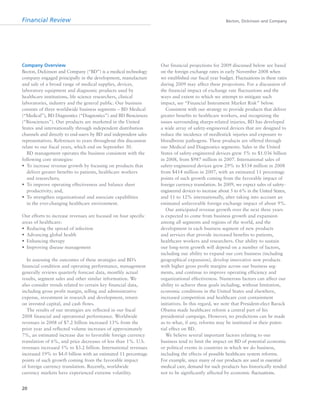
• Fluctuations in the cost and availability of oil-based
resins and other raw materials, as well as certain
sub-assemblies and finished goods, and the ability to
maintain favorable supplier arrangements and relationships
(particularly with respect to sole-source suppliers) and
the potential adverse effects of any disruption in the
availability of such items.
• We operate in a highly competitive environment.
New product introductions by our current or future
competitors (for example, new forms of drug delivery)
could adversely affect our ability to compete in the global
market. Patents attained by competitors, particularly as
patents on our products expire, may also adversely
impact our competitive position. Certain competitors
have established manufacturing sites or have contracted
with suppliers in low-cost manufacturing locations as a
means to lower their costs. New entrants may also appear.
• We sell certain products to pharmaceutical companies
that are used to manufacture, or are sold with, products
by such companies. As a result, fluctuations in demand
for the products of these pharmaceutical companies
could adversely affect our operating results.
• Changes in domestic and foreign healthcare industry
practices and regulations resulting in increased pricing
pressures, including the continued consolidation among
healthcare providers; trends toward managed care and
healthcare cost containment; and government laws and
regulations relating to sales and promotion, reimbursement
and pricing generally.
• The effects, if any, of governmental and media activities
regarding the business practices of group purchasing
organizations, which negotiate product prices on behalf
of their member hospitals with BD and other suppliers.
• Our ability to obtain the anticipated benefits of
restructuring programs, if any, that we may undertake.
• Our ability to implement the upgrade of our enterprise
resource planning system. Any delays or deficiencies in
the design and implementation of our upgrade could
adversely affect our business.
Financial Review Becton, Dickinson and Company
32
• Adoption of, or changes in, government laws and
regulations affecting domestic and foreign operations,
including those relating to trade, monetary and fiscal
policies, taxation, environmental matters, sales practices,
price controls, licensing and regulatory approval of new
products, regulatory requirements for products in the
postmarketing phase, or changes in enforcement practices
with respect to any such laws and regulations. In particular,
environmental laws, particularly with respect to the
emission of greenhouse gases, are becoming more stringent
throughout the world, which may increase our costs of
operations or necessitate changes in our manufacturing
plants or processes.
• Fluctuations in U.S. and international governmental
funding and policies for life sciences research.
• Difficulties inherent in product development, including
the potential inability to successfully continue technological
innovation, complete clinical trials, obtain regulatory
approvals in the United States and abroad, obtain coverage
and adequate reimbursement for new products, or gain
and maintain market approval of products, as well as
the possibility of encountering infringement claims by
competitors with respect to patent or other intellectual
property rights, all of which can preclude or delay
commercialization of a product.
• Pending and potential litigation or other proceedings
adverse to BD, including antitrust claims, product liability
claims, patent infringement claims and the availability or
collectibility of insurance relating to such claims.
• The effects, if any, of adverse media exposure or other
publicity regarding BD’s business or operations.
• Our ability to achieve the projected level or mix of
product sales. Our earnings forecasts are generated based
on such projected volumes and sales of many product
types, some of which are more profitable than others.
• The effect of market fluctuations on the value of assets
in BD’s pension plans and the possibility that BD may
need to make additional contributions to the plans as
a result of any decline in the value of such assets.
• Our ability to effect infrastructure enhancements and
incorporate new systems technologies into our operations.
• Product efficacy or safety concerns resulting in product
recalls, regulatory action on the part of the U.S. Food
and Drug Administration (or foreign counterparts) or
declining sales.
• Economic and political conditions in international
markets, including civil unrest, terrorist activity,
governmental changes, restrictions on the ability to
transfer capital across borders and expropriation of
assets by a government.
• The effects of natural disasters, including hurricanes or
pandemic diseases, on our ability to manufacture our
products, particularly where production of a product line
is concentrated in one or more plants, or on our ability
to source components from suppliers that are needed for
such manufacturing.
• Our ability to penetrate developing and emerging markets,
which also depends on economic and political conditions,
and how well we are able to acquire or form strategic
business alliances with local companies and make
necessary infrastructure enhancements to production
facilities, distribution networks, sales equipment and
technology.
• The impact of business combinations, including
acquisitions and divestitures, both internally on
BD and externally on the healthcare industry.
• Issuance of new or revised accounting standards
by the Financial Accounting Standards Board or the
Securities and Exchange Commission.
The foregoing list sets forth many, but not all, of the
factors that could impact our ability to achieve results
described in any forward-looking statements. Investors
should understand that it is not possible to predict or
identify all such factors and should not consider this
list to be a complete statement of all potential risks
and uncertainties.
Financial Review Becton, Dickinson and Company
Reports of Management Becton, Dickinson and Company
33
Management’s Responsibilities
The following financial statements have been prepared by
management in conformity with U.S. generally accepted
accounting principles and include, where required, amounts
based on the best estimates and judgments of management.
The integrity and objectivity of data in the financial
statements and elsewhere in this Annual Report are the
responsibility of management.
In fulfilling its responsibilities for the integrity of the
data presented and to safeguard the Company’s assets,
management employs a system of internal accounting
controls designed to provide reasonable assurance, at
appropriate cost, that the Company’s assets are protected and
that transactions are appropriately authorized, recorded and
summarized. This system of control is supported by
the selection of qualified personnel, by organizational
assignments that provide appropriate delegation of authority
and division of responsibilities, and by the dissemination
of written policies and procedures. This control structure is
further reinforced by a program of internal audits, including
a policy that requires responsive action by management.
The Board of Directors monitors the internal control
system, including internal accounting and financial reporting
controls, through its Audit Committee, which consists of
six independent Directors. The Audit Committee meets
periodically with the independent registered public accounting
firm, the internal auditors and management to review the
work of each and to satisfy itself that they are properly
discharging their responsibilities. The independent registered
public accounting firm and the internal auditors have full
and free access to the Audit Committee and meet with its
members, with and without management present, to discuss
the scope and results of their audits including internal
control, auditing and financial reporting matters.
Management’s Report on Internal Control
Over Financial Reporting
Management is responsible for establishing and maintaining
adequate internal control over financial reporting, as
defined in Rule 13a-15(f) under the Securities Act of 1934.
Management conducted an assessment of the effectiveness
of internal control over financial reporting based on the
criteria established in Internal Control-Integrated Framework
issued by the Committee of Sponsoring Organizations
of the Treadway Commission (COSO). Based on this
assessment and those criteria, management concluded
that internal control over financial reporting was effective
as of September 30, 2008.
The financial statements and internal control over financial
reporting have been audited by Ernst & Young LLP, an
independent registered public accounting firm. Ernst & Young’s
reports with respect to fairness of the presentation of the
statements, and the effectiveness of internal control over
financial reporting, are included herein.
Edward J. Ludwig John R. Considine William A. Tozzi
Chairman, President and Vice Chairman and Vice President -
Chief Executive Officer Chief Financial Officer Finance
Report of Independent
Registered Public Accounting Firm
Becton, Dickinson and Company
34
To the Shareholders and Board of Directors of
Becton, Dickinson and Company
We have audited the accompanying consolidated balance
sheets of Becton, Dickinson and Company as of September
30, 2008 and 2007, and the related consolidated statements
of income, comprehensive income, and cash flows for each
of the three years in the period ended September 30, 2008.
These financial statements are the responsibility of the
Company’s management. Our responsibility is to express
an opinion on these financial statements based on our audits.
We conducted our audits in accordance with the standards
of the Public Company Accounting Oversight Board (United
States). Those standards require that we plan and perform
the audit to obtain reasonable assurance about whether
the financial statements are free of material misstatement.
An audit includes examining, on a test basis, evidence
supporting the amounts and disclosures in the financial
statements. An audit also includes assessing the accounting
principles used and significant estimates made by management,
as well as evaluating the overall financial statement
presentation. We believe that our audits provide a reasonable
basis for our opinion.
In our opinion, the financial statements referred to
above present fairly, in all material respects, the consolidated
financial position of Becton, Dickinson and Company at
September 30, 2008 and 2007, and the consolidated results
of its operations and its cash flows for each of the three
years in the period ended September 30, 2008, in conformity
with U.S. generally accepted accounting principles.
As discussed in Note 2 to the consolidated financial
statements, the Company adopted Financial Accounting
Standards Board Interpretation No. 48, “Accounting for
Uncertainty in Income Taxes” on October 1, 2007, and
Financial Accounting Standard No. 158, “Employers’
Accounting for Defined Benefit Pension and Other
Postretirement Plans, an amendment of FASB Statements
No. 87, 88, 106 and 132 (R)” on September 30, 2007.
We also have audited, in accordance with the standards
of the Public Company Accounting Oversight Board
(United States), Becton, Dickinson and Company’s internal
control over financial reporting as of September 30, 2008,
based on criteria established in Internal Control-Integrated
Framework issued by the Committee of Sponsoring
Organizations of the Treadway Commission, and our
report dated November 17, 2008 expressed an unqualified
opinion thereon.
ERNST & YOUNG LLP
New York, New York
November 17, 2008
Becton, Dickinson and Company
35
To the Shareholders and Board of Directors of
Becton, Dickinson and Company
We have audited Becton, Dickinson and Company’s internal
control over financial reporting as of September 30, 2008,
based on criteria established in Internal Control-Integrated
Framework issued by the Committee of Sponsoring
Organizations of the Treadway Commission (the COSO
criteria). Becton, Dickinson and Company’s management
is responsible for maintaining effective internal control over
financial reporting, and for its assessment of the effectiveness
of internal control over financial reporting included in the
accompanying Management’s Report on Internal Control
Over Financial Reporting. Our responsibility is to express
an opinion on the company’s internal control over financial
reporting based on our audit.
We conducted our audit in accordance with the standards
of the Public Company Accounting Oversight Board (United
States). Those standards require that we plan and perform
the audit to obtain reasonable assurance about whether
effective internal control over financial reporting was
maintained in all material respects. Our audit included
obtaining an understanding of internal control over financial
reporting, assessing the risk that a material weakness exists,
testing and evaluating the design and operating effectiveness
of internal control based on the assessed risk, and performing
such other procedures as we considered necessary in the
circumstances. We believe that our audit provides a
reasonable basis for our opinion.
A company’s internal control over financial reporting is a
process designed to provide reasonable assurance regarding
the reliability of financial reporting and the preparation of
financial statements for external purposes in accordance
with generally accepted accounting principles. A company’s
internal control over financial reporting includes those
policies and procedures that (1) pertain to the maintenance
of records that, in reasonable detail, accurately and fairly
reflect the transactions and dispositions of the assets of the
company; (2) provide reasonable assurance that transactions
are recorded as necessary to permit preparation of financial
statements in accordance with generally accepted accounting
principles, and that receipts and expenditures of the company
are being made only in accordance with authorizations of
management and directors of the company; and (3) provide
reasonable assurance regarding prevention or timely detection
of unauthorized acquisition, use, or disposition of the
company’s assets that could have a material effect on the
financial statements.
Because of its inherent limitations, internal control over
financial reporting may not prevent or detect misstatements.
Also, projections of any evaluation of effectiveness to future
periods are subject to the risk that controls may become
inadequate because of changes in conditions, or that the degree
of compliance with the policies or procedures may deteriorate.
In our opinion, Becton, Dickinson and Company
maintained, in all material respects, effective internal control
over financial reporting as of September 30, 2008, based
on the COSO criteria.
We also have audited, in accordance with the standards
of the Public Company Accounting Oversight Board
(United States), the consolidated balance sheets of
Becton, Dickinson and Company as of September 30, 2008
and 2007, and the related consolidated statements of income,
comprehensive income, and cash flows for each of the
three years in the period ended September 30, 2008 of
Becton, Dickinson and Company, and our report dated
November 17, 2008 expressed an unqualified opinion thereon.
ERNST & YOUNG LLP
New York, New York
November 17, 2008
Report of Independent
Registered Public Accounting Firm
Financial Statements Becton, Dickinson and Company
36
Consolidated Statements of Income
Years Ended September 30
Thousands of dollars, except per share amounts
2008 2007 2006
Operations
Revenues $7,155,910 $6,359,708 $5,738,017
Cost of products sold 3,492,561 3,071,921 2,793,265
Selling and administrative expense 1,715,045 1,602,404 1,448,166
Research and development expense 396,238 360,050 301,872
Acquired in-process research and development — 122,133 53,300
Total Operating Costs and Expenses 5,603,844 5,156,508 4,596,603
Operating Income 1,552,066 1,203,200 1,141,414
Interest expense (36,343) (46,420) (66,046)
Interest income 39,368 46,221 59,296
Other (expense) income, net (1,484) 944 (8,762)
Income From Continuing Operations
Before Income Taxes 1,553,607 1,203,945 1,125,902
Income tax provision 425,689 347,778 310,792
Income from Continuing Operations 1,127,918 856,167 815,110
(Loss) income from Discontinued Operations
Net of income tax (benefit) provision of
$(567), $15,242 and $(32,823) (922) 33,866 (62,830)
Net Income $1,126,996 $0,890,033 $0,752,280
Basic Earnings per Share
Income from Continuing Operations $0000,4.62 $0000,3.50 $0000,3.30
Income (loss) from Discontinued Operations $0000,0,— $0000,0.14 $0000,(0.25)
Basic Earnings per Share(A)
$0000,4.61 $0000,3.63 $0000,3.04
Diluted Earnings per Share
Income from Continuing Operations $0000,4.46 $0000,3.36 $0000,3.18
Income (loss) from Discontinued Operations $0000,0,— $0000,0.13 $0000,(0.24)
Diluted Earnings per Share(A)
$0000,4.46 $0000,3.49 $0000,2.93
(A)
Total per share amounts may not add due to rounding.
See notes to consolidated financial statements
Financial Statements Becton, Dickinson and Company
37
Consolidated Statements of Comprehensive Income
Years Ended September 30
Thousands of dollars
2008 2007 2006
Net Income $1,126,996 $0,890,033 $752,280
Other Comprehensive (Loss) Income, Net of Tax
Foreign currency translation adjustments (80,305) 250,411 77,396
Minimum pension liability adjustment — 3,159 77,086
Defined benefit pension and postretirement plans (42,862) — —
Unrealized (loss) gain on investments, net of amounts recognized (42) (10,643) 1,212
Unrealized gain (loss) on cash flow hedges, net of amounts realized 43,871 (2,596) (1,307)
Other Comprehensive (Loss) Income, Net of Tax (79,338) 240,331 154,387
Comprehensive Income $1,047,658 $1,130,364 $906,667
See notes to consolidated financial statements
Financial Statements Becton, Dickinson and Company
38
Consolidated Balance Sheets
September 30
Thousands of dollars, except per share amounts and numbers of shares
2008 2007
Assets
Current Assets
Cash and equivalents $0,830,477 $0,511,482
Short-term investments 199,942 158,040
Trade receivables, net 1,079,051 1,083,152
Inventories 1,080,426 1,051,959
Prepaid expenses, deferred taxes and other 424,779 325,933
Total Current Assets 3,614,675 3,130,566
Property, Plant and Equipment, Net 2,744,474 2,497,338
Goodwill 625,768 621,414
Core and Developed Technology, Net 348,531 374,779
Other Intangibles, Net 89,675 95,938
Capitalized Software, Net 133,486 142,738
Other 356,334 466,592
Total Assets $7,912,943 $7,329,365
Liabilities
Current Liabilities
Short-term debt $0,201,312 $0,207,634
Accounts payable 260,882 266,993
Accrued expenses 519,117 481,429
Salaries, wages and related items 406,379 435,854
Income taxes 28,889 86,899
Total Current Liabilities 1,416,579 1,478,809
Long-Term Debt 953,226 955,713
Long-Term Employee Benefit Obligations 464,982 444,874
Deferred Income Taxes and Other 142,588 88,012
Commitments and Contingencies — —
Shareholders’ Equity
Common stock - $1 par value: authorized - 640,000,000 shares;
issued-332,662,160 shares in 2008 and 2007 332,662 332,662
Capital in excess of par value 1,359,531 1,125,368
Retained earnings 6,838,589 5,995,787
Deferred compensation 14,694 12,205
Common stock in treasury - at cost – 89,584,786 shares in 2008
and 88,825,066 shares in 2007 (3,532,398) (3,105,893)
Accumulated other comprehensive (loss) income (77,510) 1,828
Total Shareholders’ Equity 4,935,568 4,361,957
Total Liabilities and Shareholders’ Equity $7,912,943 $7,329,365
See notes to consolidated financial statements
Financial Statements Becton, Dickinson and Company
39
Consolidated Statements of Cash Flows
Years Ended September 30
Thousands of dollars
2008 2007 2006
Operating Activities
Net income $1,126,996 $890,033 $0,752,280
Loss (income) from discontinued operations, net 922 (33,866) 62,830
Income from continuing operations, net 1,127,918 856,167 815,110
Adjustments to income from continuing operations to derive net cash
provided by continuing operating activities, net of amounts acquired:
Depreciation and amortization 477,422 441,341 402,332
Share-based compensation 100,585 107,706 108,613
Deferred income taxes 80,088 (115,489) (108,285)
Acquired in-process research and development — 122,133 53,300
Change in operating assets and liabilities:
Trade receivables, net (1,927) (117,048) (19,977)
Inventories (43,617) (126,863) (99,505)
Prepaid expenses, deferred taxes and other (29,967) (24,965) (122,496)
Accounts payable, income taxes and other liabilities (11,776) 102,996 100,636
Pension obligation (56,083) (22,119) (64,971)
Other, net 45,355 12,189 39,416
Net Cash Provided by Continuing Operating Activities 1,687,998 1,236,048 1,104,173
Investing Activities
Capital expenditures (601,981) (556,394) (457,067)
Capitalized software (49,306) (22,334) (22,454)
Change in short-term investments (46,321) (30,167) (18,633)
Purchases of long-term investments (5,666) (3,881) (9,672)
Acquisitions of businesses, net of cash acquired (41,259) (339,528) (231,464)
Proceeds from discontinued operations — 19,971 —
Other, net (38,491) (85,922) (44,656)
Net Cash Used for Continuing Investing Activities (783,024) (1,018,255) (783,946)
Financing Activities
Change in short-term debt (5,938) (121,102) 121,563
Payments of debt (1,114) (100,790) (828)
Repurchase of common stock (450,001) (450,124) (448,882)
Issuance of common stock 85,396 130,679 147,796
Excess tax benefit from payments under share-based compensation plans 64,335 55,118 50,609
Dividends paid (278,506) (239,810) (212,431)
Net Cash Used for Continuing Financing Activities (585,828) (726,029) (342,173)
Discontinued Operations:
Net cash (used for) provided by operating activities (899) 4,388 (27,773)
Net cash used for investing activities — — (2,580)
Net cash used for financing activities — — —
Net Cash (Used for) Provided by Discontinued Operations (899) 4,388 (30,353)
Effect of exchange rate changes on cash and equivalents 748 15,041 9,698
Net Increase (Decrease) in Cash and Equivalents 318,995 (488,807) (42,601)
Opening Cash and Equivalents 511,482 1,000,289 1,042,890
Closing Cash and Equivalents $0,830,477 $511,482 $1,000,289
See notes to consolidated financial statements
Notes to Consolidated Financial Statements Becton, Dickinson and Company
40
1 Summary of Significant Accounting Policies
Principles of Consolidation
The consolidated financial statements include the accounts
of Becton, Dickinson and Company and its majority-owned
subsidiaries (the “Company”) after the elimination of
intercompany transactions. The Company has no material
interests in variable interest entities.
Cash Equivalents
Cash equivalents consist of all highly liquid investments with
a maturity of three months or less at time of purchase.
Short-Term Investments
Short-term investments consist of time deposits with
maturities greater than three months and less than one
year when purchased.
Inventories
Inventories are stated at the lower of first-in, first-out cost
or market.
Property, Plant and Equipment
Property, plant and equipment are stated at cost, less
accumulated depreciation and amortization. Depreciation
and amortization are principally provided on the straight-line
basis over estimated useful lives, which range from 20 to
45 years for buildings, four to 10 years for machinery and
equipment and two to 17 years for leasehold improvements.
Depreciation and amortization expense was $305,510,
$280,357 and $262,956 in fiscal 2008, 2007 and 2006,
respectively.
Goodwill and Other Intangible Assets
Goodwill is reviewed annually for impairment in accordance
with Statement of Financial Accounting Standards (“SFAS”)
No. 142, “Goodwill and Other Intangible Assets.” In
reviewing goodwill for impairment, potential impairment
is identified by comparing the fair value of a reporting unit,
estimated using an income approach, with its carrying value.
Core and developed technology is amortized over periods
ranging from 15 to 20 years, using the straight-line method.
Both goodwill and core and developed technology arise
from acquisitions. Other intangibles with finite useful lives,
which include patents, are amortized over periods principally
ranging from two to 40 years, using the straight-line method.
These intangibles, including core and developed technology,
are periodically reviewed when impairment indicators are
present to assess recoverability from future operations using
undiscounted cash flows in accordance with SFAS No. 144,
“Accounting for the Impairment or Disposal of Long-Lived
Assets.” To the extent carrying value exceeds the undiscounted
cash flows, an impairment loss is recognized in operating
results based upon the excess of the carrying value over fair
value. Other intangibles also include certain trademarks that
are considered to have indefinite lives, as they are expected
to generate cash flows indefinitely, and are reviewed annually
for impairment.
Capitalized Software
Capitalized software, including costs for software developed
or obtained for internal use is stated at cost, less accumulated
amortization. Amortization expense is principally provided
on the straight-line basis over estimated useful lives, which
do not exceed 10 years. Amortization expense was $56,652,
$66,386 and $66,037 for 2008, 2007 and 2006, respectively.
Foreign Currency Translation
Generally, the net assets of foreign operations are translated
into U.S. dollars using current exchange rates. The U.S.
dollar results that arise from such translation, as well as
exchange gains and losses on intercompany balances of a
long-term investment nature, are included in the foreign
currency translation adjustments in Accumulated other
comprehensive (loss) income.
Revenue Recognition
Revenue from product sales is recognized when title and risk
of loss pass to the customer. The Company recognizes revenue
for certain instruments sold from the Biosciences segment
upon installation at a customer’s site, as installation of these
instruments is considered a significant post-delivery obligation.
For certain sales arrangements, primarily in the U.S., with
multiple deliverables, revenue and cost of products sold are
recognized at the completion of each deliverable: shipment,
installation and training, in accordance with Emerging Issues
Task Force Issue No. 00-21, “Revenue Arrangements with
Multiple Deliverables.” These sales agreements are divided into
separate units of accounting. Revenue is recognized upon the
completion of each deliverable based on the relative fair values
of items delivered. Fair values are generally determined based
on sales of the individual deliverables to other third parties.
Thousands of dollars, except per share amounts and
numbers of shares
Notes to Consolidated Financial Statements Becton, Dickinson and Company
41
The Company’s domestic businesses sell products primarily
to distributors who resell the products to end-user customers.
Rebates are provided to distributors that sell to end-user
customers at prices determined under a contract between
the Company and the end-user customer. Provisions for
rebates, as well as sales discounts and returns, are accounted
for as a reduction of revenues when revenue is recognized.
Shipping and Handling Costs
Shipping and handling costs are included in Selling and
administrative expense. Shipping expense was $276,370,
$243,263 and $219,788 in 2008, 2007 and 2006, respectively.
Derivative Financial Instruments
In accordance with SFAS No. 133, “Accounting for
Derivative Instruments and Hedging Activities,” as amended,
all derivatives are recorded in the balance sheet at fair value
and changes in fair value are recognized currently in earnings
unless specific hedge accounting criteria are met.
Derivative financial instruments are utilized by the Company
in the management of its foreign currency and interest
rate exposures. The Company hedges its foreign currency
exposures by entering into offsetting forward exchange
contracts and currency options when it deems appropriate.
The Company utilizes interest rate swaps and forward rate
agreements to manage its exposure to fluctuating interest
rates. The Company does not use derivative financial
instruments for trading or speculative purposes.
Any deferred gains or losses associated with derivative
instruments, which on infrequent occasions may be terminated
prior to maturity, are recognized in income in the period in
which the underlying hedged transaction is recognized. In
the event a designated hedged item is sold, extinguished or
matures prior to the termination of the related derivative
instrument, such instrument would be closed and the
resultant gain or loss would be recognized in income.
Income Taxes
United States income taxes are not provided on undistributed
earnings of foreign subsidiaries where such undistributed
earnings are indefinitely reinvested outside the United
States. Deferred taxes are provided for earnings of foreign
subsidiaries when those earnings are not considered
indefinitely reinvested. Income taxes are provided and tax
credits are recognized based on tax laws enacted at the
dates of the financial statements.
The Company maintains valuation allowances where it
is more likely than not that all or a portion of a deferred tax
asset will not be realized. Changes in valuation allowances
are included in our tax provision in the period of change.
In determining whether a valuation allowance is warranted,
management evaluates factors such as prior earnings history,
expected future earnings, carry back and carry forward
periods and tax strategies that could potentially enhance
the likelihood of the realization of a deferred tax asset.
Earnings per Share
Basic earnings per share are computed based on the weighted
average number of common shares outstanding. Diluted
earnings per share reflect the potential dilution that could
occur if securities or other contracts to issue common stock
were exercised or converted into common stock.
Use of Estimates
The preparation of financial statements in conformity with
U.S. generally accepted accounting principles requires
management to make estimates and assumptions. These
estimates or assumptions affect reported assets, liabilities,
revenues and expenses as reflected in the consolidated financial
statements. Actual results could differ from these estimates.
Share-Based Compensation
The Company accounts for all share-based compensation
under SFAS No. 123 (revised 2004) – “Share-Based
Payment” (“SFAS No. 123(R)”). This statement requires
the recognition of the fair value of share-based compensation
in net income. Compensation expense is recognized on a
straight-line basis over the requisite service period, which
is generally the vesting period.
Notes to Consolidated Financial Statements Becton, Dickinson and Company
42
2 Accounting Changes
On October 1, 2007, the Company adopted Financial Accounting
Standards Board Interpretation No. 48 “Accounting for
Uncertainty in Income Taxes, an interpretation of FASB
Statement No. 109” (“FIN 48”). FIN 48 provides guidance
for the financial statement recognition and measurement of
a tax position taken or expected to be taken in a tax return.
As a result of the implementation of FIN 48, the Company
recognized a $5,083 increase in its existing liability for
uncertain tax positions, with a corresponding decrease
to the October 1, 2007 retained earnings balance. The
Company also reclassified the total amount of unrecognized
tax benefits of $71,782 from a current liability account
(Accrued expenses) to a non-current liability account
(Deferred Income Taxes and Other) on the Consolidated
Balance Sheets, in accordance with FIN 48 as of October 1,
2007. If the Company were to recognize the unrecognized
tax benefits, the effective tax rate would be favorably
impacted. The Company does not anticipate any significant
changes over the next 12 months to the amount of
unrecognized tax benefits.
The Company includes interest and penalties associated
with unrecognized tax benefits as a component of the Income
tax provision on the Consolidated Statements of Income.
As of October 1, 2007, accrued interest and penalties related
to unrecognized tax benefits, included in the total amount,
were $9,388.
The Company conducts business and files tax returns in
numerous countries and currently has tax audits in progress
in a number of tax jurisdictions. The U.S. Internal Revenue
Service (“IRS”) has completed its audit for the tax years
through 2002; however, the tax years 2000 through 2002
remain open, with a single issue being considered in the IRS
administrative appeals process. For the Company’s other
major tax jurisdictions where it conducts business, the
Company’s tax years are generally open after 2002.
In September 2006, the Financial Accounting Standards
Board (the “FASB”) issued SFAS No. 158, “Employers’
Accounting for Defined Benefit Pension and Other
Postretirement Plans, an amendment of FASB Statements
No. 87, 88, 106 and 132(R)” (“SFAS No. 158”). SFAS
No. 158 requires the Company to recognize the overfunded
or underfunded status of a defined benefit postretirement
plan as an asset or liability in its Consolidated Balance Sheet
and to recognize changes in the funded status in the year in
which the changes occur through comprehensive income.
SFAS No. 158 also requires the funded status of a plan to
be measured as of the balance sheet date and provides for
additional disclosure requirements. The Company adopted
SFAS No. 158 on September 30, 2007. SFAS No. 158 did
not change the measurement date of the Company’s plans
as the plans are measured at its fiscal year-end. See Note 5
regarding the Company’s adoption of SFAS No. 158.
In March 2005, the FASB issued Interpretation No. 47
“Accounting for Conditional Asset Retirement Obligations”
(“FIN 47”). FIN 47 clarifies that the term “conditional asset
retirement obligation” as used in SFAS No. 143, “Accounting
for Asset Retirement Obligations” refers to a legal obligation
to perform an asset retirement activity in which the timing
and/or method of settlement are conditional on a future
event that may or may not be within the control of the
Company. Accordingly, the Company is required to recognize
a liability for the fair value of a conditional asset retirement
obligation if the fair value can be reasonably estimated. The
Company adopted this interpretation in the fourth quarter
of 2006. The adoption of FIN 47 did not have a material
impact on BD’s consolidated financial statements.
Adoption of New Accounting Standard
In September 2006, the FASB issued SFAS No. 157, “Fair
Value Measurements” (“SFAS No. 157”). SFAS No. 157
defines fair value, establishes a framework for measuring
fair value in GAAP, and expands disclosures about fair value
measurements. This Statement is effective for the Company
beginning October 1, 2008, and applies to interim periods.
The Company does not anticipate the implementation of
this Statement will be material to the consolidated financial
position or results of operations.
In February 2007, the FASB issued SFAS No. 159,
“The Fair Value Option for Financial Assets and Financial
Liabilities” (“SFAS No. 159”). SFAS No. 159 permits entities
to choose to measure many financial instruments and certain
other items at fair value. Under SFAS No. 159, the decision
to measure items as fair value is made at specified election
dates on an instrument-by-instrument basis and is irrevocable.
Entities electing the fair value option are required to recognize
changes in fair value in earnings and to expense upfront costs
and fees associated with the item for which the fair value
option is elected. This Statement would be effective for the
Company, if adopted, beginning October 1, 2008; however,
the Company does not anticipate adopting this Statement.
Notes to Consolidated Financial Statements Becton, Dickinson and Company
43
3 Acquisitions and Divestitures
Cytopeia
On May 12, 2008, the Company acquired 100% of the
outstanding stock of Cytopeia, Inc., a privately-held
corporation that develops and markets advanced flow
cytometry cell sorting instruments. The acquisition advances
the Company’s position in rapidly emerging areas of
cell-based research, such as cell therapy research, stem cell
research, drug discovery and development, and marine
biology. The acquisition was accounted for under the purchase
method of accounting and the results of operations of
Cytopeia were included in the Biosciences segment’s results
as of the acquisition date. Pro forma information was not
provided as the acquisition did not have a material effect on
the Company’s consolidated results. The purchase price was
$42,914 in cash, including transaction costs. Cash assumed
as of the valuation date was $1,655. The purchase price was
allocated based upon the fair values of the assets and liabilities
acquired. The allocation is based upon the information
available as of September 30, 2008 and may be adjusted
should further information become available. Additional
information that may become subsequently available
includes, but is not limited to, changes in the value of
deferred tax assets and liabilities. The purchase price
allocation resulted in a deferred tax asset of $4,290, core
and developed technology of $20,000, deferred tax liabilities
of $7,904, primarily associated with core and developed
technology; and other net assets of $3,713, primarily
consisting of accounts receivable and inventory. Core and
developed technology will be amortized on a straight-line
basis over its estimated useful life of approximately 15 years.
The excess of the purchase price over the fair value of the
assets acquired of $22,815 was recorded as goodwill. The
primary item that generated goodwill is the value of the
Company’s access to new technologies and capabilities
related to cell therapy research. No portion of this goodwill
is expected to be deductible for tax purposes.
TriPath
On December 20, 2006, the Company acquired the outstanding
shares (approximately 93.8%) of TriPath Imaging, Inc.
(“TriPath”) which it did not previously own. TriPath develops,
manufactures, markets and sells innovative solutions to
improve the clinical management of cancer, including detection,
diagnosis, staging and treatment. The acquisition advances
the Company’s position in cancer diagnostics. The
acquisition was accounted for under the purchase method
of accounting and the results of operations of TriPath were
included in the Company’s results as of the acquisition date.
Pro forma information was not provided as the acquisition
did not have a material effect on the Company’s consolidated
results. The purchase price was $361,883 in cash, including
transaction costs and other consideration. The purchase price
was allocated based upon the fair values of the assets and
liabilities acquired. The allocation of the purchase price
resulted in deferred tax assets of $75,261 primarily consisting
of net operating loss carry-forwards and credits; core and
developed technology of $135,097; deferred tax liabilities
of $52,662 primarily associated with other intangible assets;
and other net assets of $56,736 consisting primarily of cash
and trade receivables. Core and developed technology will
be amortized on a straight-line basis over its estimated useful
life of approximately 15 years. The excess of the purchase
price over the fair value of the assets acquired of $32,712
was recorded as goodwill. The primary items that generated
goodwill are the value of expanded product opportunities
in oncology that are aligned with and complement ongoing
research programs at the Company. The goodwill was
allocated to the Diagnostics segment and is not deductible
for tax purposes. As a result of settling a preacquisition legal
contingency in the fourth quarter of 2007, the Company
received an upfront cash payment of $7,167. The effects of
this payment, as well as other minor purchase accounting
adjustments, are reflected in the purchase price allocation
detailed above.
In connection with the acquisition, the Company also
incurred a non-deductible charge of $114,739 for acquired
in-process research and development. This charge, based
on fair value, is associated with three projects: molecular
Pap test, breast staging, and ovarian cancer tests. These
projects had not yet reached technological feasibility and
did not have alternative future use at the acquisition date.
The portion of the charge allocated to each of these projects
was $75,992, $18,764 and $19,983, respectively.
The molecular Pap test uses proprietary molecular
biomarkers and reagents that are intended to allow for
the primary screening of cervical cancer. The addition of
biomarkers is intended to improve sensitivity to allow the
clinician to find disease more reliably. In February 2008,
the Company ceased activities on the clinical trial for this
product. The Company presently anticipates having a molecular
Pap test commercially available both in the U.S. and outside
the U.S. in fiscal year 2012, assuming successful completion
of new clinical trials and attainment of approval from FDA.
The breast cancer project, using proprietary biomarkers
and reagents, is intended to aid in disease discovery in its
earliest stages. Tests developed in this program will also
be run on the multiplex testing platform discussed below.
Notes to Consolidated Financial Statements Becton, Dickinson and Company
44
Since the acquisition, the Company changed the focus in this
program from staging assay development to screening assay
development. The Company anticipates having a breast
assay both in the U.S. and outside the U.S. in fiscal year
2013, assuming successful completion of clinical trials
and attainment of approval from FDA.
The ovarian cancer project, using proprietary biomarkers
and reagents in a multiplex format, is intended to allow for
earlier stage detection of cancer. Information the Company
expects to obtain from tests developed in this project should
allow clinicians to begin treatment sooner, which should lead
to improved outcomes overall. In addition, the Company
signed a development and supply agreement for a multiplex
testing platform to allow for the simultaneous testing of
multiple markers from a small volume of serum. The Company
anticipates having an ovarian monitoring test commercially
available in the U.S. in fiscal year 2010, assuming successful
completion of clinical trials and attainment of approval
from FDA. Screening tests are expected to be commercially
available approximately two years thereafter.
The fair values of these projects were determined based
upon the present value of projected cash flows utilizing an
income approach reflecting the appropriate risk-adjusted
discount rate based on the applicable technological and
commercial risk of each project. These cash flows also took
into account the income and expenses associated with the
further development and commercialization of the underlying
products. The range of discount rates assigned to the projects
was 22 to 30 percent and gave consideration to the underlying
risk relative to the developed technology, the overall commercial
and technical risk, and the probabilities of success for each
of the projects. The ongoing activity associated with each
of these projects is not expected to be material to the
Company’s research and development expense.
Plasso
On May 4, 2007, the Company acquired all of the outstanding
shares of Plasso Technology, Ltd. (“Plasso”), a privately-held
company that is developing the next generation of surface-
critical research tools utilizing functional coating technology
for applications in glycomics and cell culture, for $10,425
in cash including transaction costs. In connection with the
acquisition, the Company incurred a non-deductible charge
of $7,394 for acquired in-process research and development
associated with Plasso’s technology, for which, at the acquisition
date, technological feasibility had not been established and
no alternative future use existed. Because Plasso was a
development stage company that had not commenced its
planned principal operations, the transaction was accounted
for as an acquisition of assets rather than as a business
combination and, therefore, goodwill was not recorded.
GeneOhm
On February 14, 2006, the Company acquired all the
outstanding stock of GeneOhm Sciences, Inc. (“GeneOhm”),
a company that develops molecular diagnostic testing for
the rapid detection of bacterial organisms, including those
known to cause healthcare-associated infections. The
acquisition provides the Company with expanded entry into
the emerging field of healthcare-associated infections. The
acquisition was accounted for under the purchase method of
accounting and the results of operations of GeneOhm were
included in the Company’s results as of the acquisition date.
Pro forma information was not provided as the acquisition
did not have a material effect on the Company’s consolidated
results. The purchase price consisted of an up-front cash
payment of $232,542, including transaction costs. The
purchase price was allocated based upon the fair values
of the assets and liabilities acquired. The allocation of the
purchase price resulted in deferred tax assets of $32,423
consisting of net operating loss carry forwards and credits;
other intangible assets, primarily core and developed
technology, of $91,043; deferred tax liabilities of $29,626
associated with other intangible assets, and other net assets
of $3,750. Core and developed technology will be amortized
on a straight-line basis over its estimated useful life of
approximately 15 years. The excess of the purchase price
over the fair value of the assets acquired of $81,652 was
recorded as goodwill. The primary items that generated
goodwill are the value of synergies in microbiology research
and the expansion of product offerings in molecular diagnostics.
The goodwill was allocated to the Diagnostics segment and
is not deductible for tax purposes. In connection with the
acquisition, the Company also incurred a non-deductible
charge of $53,300 for acquired in-process research and
development. This charge, based on fair value, is associated
with several products that have not reached technological
feasibility and do not have alternative future use at the
acquisition date. The fair value of each product was determined
based upon the present value of projected cash flows utilizing
an income approach reflecting the appropriate risk-adjusted
discount rate based on the applicable technological and
commercial risk of each product. These cash flows took into
account the income and expenses associated with the further
development and commercialization of the underlying products.
The ongoing activity associated with each of these products is
not material to the Company’s research and development expense.
Notes to Consolidated Financial Statements Becton, Dickinson and Company
45
BGM
On September 28, 2006, the Company announced a plan
to exit the blood glucose monitoring (“BGM”) market.
In accordance with the plan, distribution of the BD Logic
Blood Glucose Monitor was immediately discontinued.
BD continued to distribute test strips for its customers
through December 2007. The decision to exit the BGM
market was made following an evaluation of the future
outlook for the product line. The Company recorded a
pre-tax charge of $63,414 in 2006 in connection with its
decision to exit the BGM product line. This charge consisted
of $5,352 related to estimated customer sales returns, $31,602
related to the write-off of inventory and related purchase
commitments, $14,052 related to long-lived asset write-downs,
and $12,408 related to severance and other exit costs.
During the first quarter of fiscal 2007, the Company
received an unsolicited offer for the purchase of the BGM
product line. On December 11, 2006, the Company sold the
product line for $19,971 and recognized a pre-tax gain on
sale of $15,226. During 2007, adjustments of $9,319 were
made to reduce sales returns and other accruals related
to obligations that remained with the Company upon
divestiture of the product line. Additionally, the Company
received a payment of $4,675, which represented the
resolution of a contingency with a former supplier.
Following the sale, the Company’s prior period Consolidated
Statements of Income and Cash Flows and related disclosures
have been restated to separately present the results of the
BGM product line as discontinued operations.
Other
In August 2005, the Company completed the sale of the
Clontech unit of the Biosciences segment for $62,100 and
recognized a gain on sale of $13,336 ($28,533 after taxes).
Clontech’s results of operations were reported as discontinued
operations in 2006 in the accompanying Consolidated
Statements of Income and Cash Flows.
Results of discontinued operations for the years ended
September 30 were as follows:
2008 2007 2006
Revenues $2,587 $33,086 $(96,811
(Loss) income from discontinued
operations before income taxes (1,489) 49,108 (95,653)(A)
Income tax benefit (provision) 567 (15,242) 32,823
(Loss) income from discontinued
operations, net $0(922) $33,866 $(62,830)(A)
(A) Includes post-closing charges of $4,708 ($3,311 after taxes) related to the divestiture
of Clontech.
4 Other Intangible Assets
Other intangible assets at September 30 consisted of:
2008 2007
Gross Gross
Carrying Accumulated Carrying Accumulated
Amount Amortization Amount Amortization
Amortized intangible
assets
Core and developed
technology $548,974 $200,443 $548,995 $174,216
Patents, trademarks,
and other 297,321 216,697 289,920 203,037
$846,295 $417,140 $838,915 $377,253
Unamortized intangible
assets
Trademarks $009,051 $009,055
Intangible amortization expense was $54,217, $46,607
and $34,843 in 2008, 2007 and 2006, respectively. The
estimated aggregate amortization expense for the fiscal
years ending September 30, 2009 to 2013 are as follows:
2009 – $51,900; 2010 – $50,000; 2011 – $48,100;
2012 – $45,200; 2013 – $43,800.
5 Benefit Plans
The Company has defined benefit pension plans covering
substantially all of its employees in the United States and
certain foreign locations. The Company also provides certain
postretirement healthcare and life insurance benefits to
qualifying domestic retirees. Postretirement healthcare and
life insurance benefit plans in foreign countries are not
material. The measurement date used for the Company’s
employee benefit plans is September 30.
During 2007, the Company redesigned its U.S. pension
plans to provide for a cash benefit formula by offering a
one-time, irrevocable election to existing employees to
change to this provision and mandating all new employees
hired after April 1, 2007 to participate in the new formula.
The Company also amended its other postretirement benefits
plan to provide that new hires, as of April 1, 2007 or later,
will no longer be eligible for company subsidized benefits.
These amendments did not have a material impact on the
net pension and postretirement cost of the Company in 2007.
Net pension cost attributable to foreign plans included in
the preceding table was $20,072, $21,156 and $18,639 in
2008, 2007 and 2006, respectively.
Effective September 30, 2007, the Company adopted
the recognition and disclosure provisions of SFAS
No. 158, which requires the Company to recognize on
a prospective basis the funded status of its pension and
other postretirement benefit plans in the Consolidated
Balance Sheet with a corresponding adjustment to
Accumulated other comprehensive (loss) income. The
incremental effect of adopting SFAS No. 158 was a
$209,695 reduction in Shareholders’ Equity, net of
deferred taxes as of September 30, 2007.
Notes to Consolidated Financial Statements Becton, Dickinson and Company
46
Net pension and other postretirement cost for the years ended September 30 included the following components:
Pension Plans Other Postretirement Benefits
2008 2007 2006 2008 2007 2006
Service cost $66,440 $69,869 $74,111 $04,648 $04,386 $04,164
Interest cost 81,939 75,728 71,997 14,906 14,608 14,873
Expected return on plan assets (97,218) (88,527) (80,063) — — —
Amortization of prior service cost (1,066) 348 309 (6,232) (6,233) (6,233)
Amortization of loss 8,256 17,507 27,932 3,962 5,795 7,127
Amortization of net obligation (112) (92) (70) — — —
Settlements 602 — — — — —
$58,841 $74,833 $94,216 $17,284 $18,556 $19,931
Notes to Consolidated Financial Statements Becton, Dickinson and Company
47
The change in benefit obligation, change in fair value of plan assets, funded status and amounts recognized in the
Consolidated Balance Sheets for these plans were as follows:
Pension Plans Other Postretirement Benefits
2008 2007 2008 2007
Change in benefit obligation:
Beginning obligation $1,394,430 $1,384,667 $(245,971 $(255,726
Service cost 66,440 69,869 4,648 4,386
Interest cost 81,939 75,728 14,906 14,608
Plan amendments — (16,586) — —
Benefits paid (71,517) (97,671) (22,303) (25,411)
Actuarial gain (181,968) (63,519) (47,605) (11,818)
Other, includes translation (16,868) 41,942 5,629 8,480
Benefit obligation at September 30 $1,272,456 $1,394,430 $(201,246 $(245,971
Change in fair value of plan assets:
Beginning fair value $1,296,169 $1,124,565 $00000,— $00000,—
Actual return on plan assets (224,777) 138,446 — —
Employer contribution 114,924 96,952 — —
Benefits paid (71,517) (97,671) — —
Other, includes translation (14,833) 33,877 — —
Plan assets at September 30 $1,099,966 $1,296,169 $00000,— $00000,—
Funded Status at September 30:
Unfunded benefit obligation $0(172,490) $00(98,261) $(201,246) $(245,971)
Amounts recognized in the Consolidated
Balance Sheets at September 30:
Other $00002,841 $00032,710 $00000 — $00000,—
Salaries, wages and related items (5,006) (2,668) (19,427) (20,067)
Long-term Employee Benefit Obligations (170,325) (128,303) (181,819) (225,904)
Net amount recognized $0(172,490) $00(98,261) $(201,246) $(245,971)
Amounts recognized in Accumulated other comprehensive
(loss) income before income taxes at September 30:
Net transition obligation $00000951 $00001,156 $000,(243) $00000,—
Prior service credit 9,018 10,086 456 6,688
Net actuarial loss (359,793) (238,144) (9,992) (62,194)
Net amount recognized $0(349,824) $0(226,902) $00(9,779) $0(55,506)
Notes to Consolidated Financial Statements Becton, Dickinson and Company
48
Foreign pension plan assets at fair value included in the
preceding table were $303,146 and $359,291 at September 30,
2008 and 2007, respectively. The foreign pension plan pro-
jected benefit obligations were $417,344 and $430,265
at September 30, 2008 and 2007, respectively.
The projected benefit obligation, accumulated benefit
obligation and fair value of plan assets for the pension plans
with accumulated benefit obligations in excess of plan assets
were $260,253, $227,820 and $135,442, respectively as of
September 30, 2008, and $96,723, $76,398 and $14,685,
respectively as of September 30, 2007.
The estimated net actuarial loss and prior service credit
for pension benefits that will be amortized from Accumulated
other comprehensive (loss) income into net pension costs
over the next fiscal year are expected to be $17,905 and
$1,093, respectively. The estimated net actuarial gain and
prior service credit for other postretirement benefits that will
be amortized from Accumulated other comprehensive (loss)
income into net other postretirement costs over the next
fiscal year are expected to be $131 and $463, respectively.
The weighted average assumptions used in determining
pension plan information were as follows:
2008 2007 2006
Net Cost
Discount rate:
U.S. plans(A)
6.35% 5.95% 5.50%
Foreign plans 5.32 4.65 4.19
Expected return on plan assets:
U.S. plans(A)
8.00 8.00 8.00
Foreign plans 6.42 6.42 6.02
Rate of compensation increase:
U.S. plans(A)
4.50 4.50 4.25
Foreign plans 3.45 3.08 2.92
Benefit Obligation
Discount rate:
U.S. plans(A)
8.00 6.35 5.95
Foreign plans 5.98 5.32 4.65
Rate of compensation increase:
U.S. plans(A)
4.50 4.50 4.50
Foreign plans 3.56 3.45 3.08
(A) Also used to determine other postretirement and postemployment benefit plan information.
At September 30, 2008 the assumed healthcare trend rates
were 8% pre and post age 65, gradually decreasing to an
ultimate rate of 5% beginning in 2015. At September 30,
2007 the corresponding assumed healthcare trend rates were
9% pre and post age 65, gradually decreasing to an ultimate
rate of 5% beginning in 2012. A one percentage point
increase in assumed healthcare cost trend rates in each year
would increase the accumulated postretirement benefit
obligation as of September 30, 2008 by $10,943 and the
aggregate of the service cost and interest cost components
of 2008 annual expense by $762. A one percentage point
decrease in the assumed healthcare cost trend rates in each
year would decrease the accumulated postretirement benefit
obligation as of September 30, 2008 by $10,073 and the
aggregate of the 2008 service cost and interest cost by $667.
Expected Funding
The Company’s funding policy for its defined benefit pension
plans is to contribute amounts sufficient to meet legal funding
requirements, plus any additional amounts that may be
appropriate considering the funded status of the plans, tax
consequences, the cash flow generated by the Company and
other factors. While the Company will not be required to
fund any of its pension plans in 2009, the Company made
a discretionary contribution to its U.S. pension plan in
October 2008 of $75,000.
Expected benefit payments are as follows:
Other
Pension Postretirement
Plans Benefits
2009 $105,137 $019,427
2010 77,257 19,714
2011 82,588 19,870
2012 89,884 20,019
2013 95,246 20,178
2014-2018 607,818 101,109
Expected receipts of the subsidy under the Medicare
Prescription Drug Improvement and Modernization Act
of 2003, which are not reflected in the expected other
postretirement benefit payments included in the preceding
table, are as follows: 2009, $2,372; 2010, $2,480; 2011,
$2,574; 2012, $2,646; 2013, $2,695; 2014-2018, $13,314.
Notes to Consolidated Financial Statements Becton, Dickinson and Company
49
The Company’s asset allocations for its defined benefit
pension plans at September 30 were as follows:
2008 2007
Equity securities 55.1% 64.5%
Debt securities 35.7 33.1
Other (primarily cash) 9.2 2.4
100.0% 100.0%
Investment Strategy
The Company’s investment objective is to achieve superior
returns on plan assets, subject to a prudent level of portfolio
risk, for the purpose of enhancing the security of benefits for
participants. The Company’s investments include a broad
range of equity and fixed-income securities. These investments
are diversified in terms of domestic and international equity
securities, short-term and long-term securities, growth and
value styles, as well as small and large capitalization stocks.
The Company’s target allocation percentages are as follows:
equity securities (58% - 69%); fixed-income securities (31%
- 39%); and cash (0% - 3%). Equity securities are held for
their expected high return and excess return over inflation.
Fixed-income securities are held for diversification relative
to equities. The plans may also hold cash to meet liquidity
requirements. Due to short-term fluctuations in market
conditions, allocation percentages may temporarily deviate
from these target allocation percentages before a rebalancing
occurs. Investment risks and returns are measured and
monitored on an on-going basis through annual liability
measurements and quarterly investment portfolio reviews
to determine whether the asset allocation targets continue
to represent an appropriate balance of expected risk and
reward. The Company is in the process of determining the
optimal deployment of its discretionary contributions of
$75,000 made in both September and October 2008.
The expected rate of return on plan assets is based upon
expectations of long-term average rates of return to be achieved
by the underlying investment portfolios. In establishing
this assumption, the Company considers many factors,
including historical assumptions compared with actual
results; benchmark data; expected returns on various
plan asset classes, as well as current and expected
asset allocations.
Postemployment Benefits
The Company utilizes a service-based approach in applying
SFAS No. 112, “Employers’ Accounting for Postemployment
Benefits – an amendment of FASB Statements No. 5 and 43,”
for most of its postemployment benefits. This approach
recognizes that actuarial gains and losses may result from
experience that differs from baseline assumptions.
Postemployment benefit costs for the years ended
September 30 included the following components:
2008 2007 2006
Service cost $11,276 $10,449 $10,148
Interest cost 5,643 5,116 4,946
Amortization of prior service cost 159 1,654 1,654
Amortization of loss 6,686 6,895 8,548
$23,764 $24,114 $25,296
The unfunded status of the postemployment benefit
plans, which are not funded, was $76,286 and $101,514
at September 30, 2008 and 2007, respectively. The amounts
recognized in Accumulated other comprehensive (loss)
income before income taxes for the net actuarial loss was
$26,014 and $57,110 at September 30, 2008 and 2007,
respectively. The estimated net actuarial loss that will be
amortized from the Accumulated other comprehensive
(loss) income into postemployment benefit cost over the
next fiscal year is $2,627.
Savings Incentive Plan
The Company has a voluntary defined contribution plan
(“Savings Incentive Plan”) covering eligible employees in
the United States. In connection with the redesign of the
U.S. pension and postretirement benefit plans, effective
July 1, 2007, the Company amended its Savings Incentive
Plan increasing the amount of the Company matching
contribution for eligible employees to 75% of employees’
contributions, up to a maximum of 4.5% of each employee’s
eligible compensation. Prior to that date, the Company
matched 50% of employees’ contributions, up to a maximum
of 3% of each employee’s salary. The cost of the Savings
Incentive Plan was $31,526 in 2008, $21,878 in 2007
and $16,626 in 2006. The Company guarantees employees’
contributions to the fixed income fund of the Savings
Incentive Plan, which consists of diversified money market
instruments. The amount guaranteed was $175,344 at
September 30, 2008.
Notes to Consolidated Financial Statements Becton, Dickinson and Company
50
6 Income Taxes
The provision for income taxes from continuing operations
for the years ended September 30 consisted of:
2008 2007 2006
Current:
Federal $269,638 $307,072 $281,784
State and local, including Puerto Rico 13,872 21,669 12,004
Foreign 150,009 134,526 125,289
433,519 463,267 419,077
Deferred:
Domestic 12,384 (94,306) (101,651)
Foreign (20,214) (21,183) (6,634)
(7,830) (115,489) (108,285)
$425,689 $347,778 $310,792
The components of Income From Continuing Operations
Before Income Taxes for the years ended September 30
consisted of:
2008 2007 2006
Domestic, including Puerto Rico $0,790,894 $0,550,750 $0,466,655
Foreign 762,713 653,195 659,247
$1,553,607 $1,203,945 $1,125,902
Deferred tax assets and liabilities are netted on the balance
sheet by separate tax jurisdictions. At September 30, 2008
and 2007, net current deferred tax assets of $211,188 and
$168,305, respectively, were included in Prepaid expenses,
deferred taxes and other. Net non-current deferred tax assets
of $85,311 and $168,251, respectively, were included in
Other. Net current deferred tax liabilities of $2,985 and
$6,136, respectively, were included in Current Liabilities -
Income taxes. Net non-current deferred tax liabilities of
$35,519 and $37,121, respectively, were included in Deferred
Income Taxes and Other. Deferred taxes are not provided
on undistributed earnings of foreign subsidiaries that are
indefinitely reinvested. At September 30, 2008, the cumulative
amount of such undistributed earnings indefinitely reinvested
outside the United States was $2.1 billion. Determining the
tax liability that would arise if these earnings were remitted
is not practicable. Deferred taxes are provided for earnings
outside the United States when those earnings are not
considered indefinitely reinvested.
On October 1, 2007, BD adopted the provisions of
FIN 48, “Accounting for Uncertainty in Income Taxes.”
Under this Interpretation, in order to recognize an uncertain
tax benefit, the taxpayer must be more likely than not of
sustaining the position, and the measurement of the benefit
is calculated as the largest amount that is more than
50 percent likely to be realized upon resolution of the
benefit. Adoption of this Interpretation did not have a
material impact on BD’s financial position. The following
table summarizes the gross amounts of unrecognized tax
benefits without regard to reduction in tax liabilities or
additions to deferred tax assets and liabilities if such
unrecognized tax benefits were settled:
October 1, 2007 $71,782
Increase due to current year tax positions 5,411
Increase due to prior year tax positions 535
Decrease due to settlements and lapse of statute of limitations (8,030)
September 30, 2008 $69,698
The total amount of unrecognized tax benefits, if recognized,
would favorably impact the effective tax rate. Included in
the above total is approximately $10,946 of interest and
penalties, of which approximately $1,558 are reflected in
the current year statement of operations. BD does not
expect significant changes in the aggregate amount of
unrecognized tax benefits that may occur within the next
twelve months, other than tax settlements.
The Company conducts business and files tax returns in
numerous countries and currently has tax audits in progress
in a number of tax jurisdictions. The IRS has completed its
audit for the tax years through 2002; however, the tax years
2000 through 2002 remain open, with a single issue being
considered in the IRS administrative appeals process. For
the Company’s other major tax jurisdictions where it
conducts business, the Company’s tax years are generally
open after 2002.
In October 2004, the American Jobs Creations Act of
2004 (the “AJCA”) was signed into law. The AJCA created
a temporary incentive for U.S. multinationals to repatriate
accumulated income earned outside the United States. As
a result of the passage of the AJCA, the Company revisited
its policy of indefinite reinvestment of foreign earnings and
made a decision to repatriate approximately $1.3 billion
in 2006 pursuant to its approved repatriation plan.
During 2006, the Company repatriated approximately
$1.3 billion in accordance with its planned repatriation
under the AJCA. The actual tax charge associated with
this repatriation was $65,768.
Notes to Consolidated Financial Statements Becton, Dickinson and Company
51
Deferred income taxes at September 30 consisted of:
2008 2007
Assets Liabilities Assets Liabilities
Compensation and benefits $297,933 $0000,— $301,118 $0000,—
Property and equipment — 206,503 — 190,979
Loss and credit carryforwards 175,341 — 193,981 —
Other 281,279 189,741 172,740 83,538
754,553 396,244 667,839 274,517
Valuation allowance (100,314) — (100,023) —
$654,239 $396,244 $567,816 $274,517
Valuation allowances have been established for capital loss
carryforwards, state deferred tax assets, net of federal tax,
related to net operating losses and credits and other deferred
tax assets for which the Company has determined it is more
likely than not that these benefits will not be realized. At
September 30, 2008, the Company had deferred state tax
assets for net state operating losses and credit carryforwards
of $49,965 for which a valuation allowance of $33,860 has
been established due to the uncertainty of generating sufficient
taxable income in the state jurisdictions to utilize the deferred
tax assets before they principally expire between 2009 and
2014. In 2007, a previously established valuation allowance of
approximately $19,700 related to state tax credit carryforwards
was reversed and included in the state and local income tax
line item in the following rate reconciliation table. The Company
also has federal and state capital loss carryforward deferred
tax assets of $51,428 for which a full valuation allowance
has been established due to the uncertainty of recognizing the
benefit from these losses before they principally expire in 2010.
A reconciliation of the federal statutory tax rate to the
Company’s effective tax rate was as follows:
2008 2007 2006
Federal statutory tax rate 35.0% 35.0% 35.0%
State and local income taxes,
net of federal tax benefit 1.4 .2 .6
Effect of foreign and
Puerto Rico earnings and
foreign tax credits (8.1) (9.2) (7.4)
Effect of Research, Domestic Production
Activities, Extraterritorial Income
tax benefits (0.8) (0.5) (1.3)
Acquired in-process research and
development — 3.6 1.8
Repatriation of foreign earnings under
the AJCA — — (1.1)
Other, net (0.1) (0.2) —
27.4% 28.9% 27.6%
The approximate dollar and diluted earnings per share
amounts of tax reductions related to tax holidays in
various countries in which the Company does business
were: 2008 - $84,600 and $0.33; 2007 - $80,300 and
$0.32; and 2006 - $70,000 and $0.27. The tax holidays
expire at various dates through 2023.
The Company made income tax payments, net of refunds,
of $330,709 in 2008, $345,049 in 2007 and $398,808 in 2006.
7 Supplemental Financial Information
Other (Expense) Income, Net
Other (expense) income, net in 2008 was $(1,484), which
primarily included foreign exchange losses (inclusive of
hedging costs) of $(10,303), partially offset by equity
investment income of $4,642 and income from license and
other agreements of $3,386.
Other (expense) income, net in 2007 was $944, which
primarily included income from license and other agreements
of $6,128, partially offset by net write downs of certain
investments of $(5,538) and foreign exchange losses
(inclusive of hedging costs) of $(4,191).
Other (expense) income, net in 2006 was $(8,762), which
primarily included net write downs of certain investments of
$(11,046) and foreign exchange losses (inclusive of hedging
costs) of $(5,142), partially offset by income from license
and other agreements of $4,281.
Trade Receivables, Net
Allowances for doubtful accounts and cash discounts netted
against trade receivables were $35,614 and $39,650 at
September 30, 2008 and 2007, respectively.
Inventories
Inventories at September 30 consisted of:
2008 2007
Materials $0,162,726 $142,484
Work in process 203,926 195,155
Finished products 713,774 714,320
$1,080,426 $1,051,959
Notes to Consolidated Financial Statements Becton, Dickinson and Company
52
Property, Plant and Equipment, Net
Property, Plant and Equipment, Net at September 30
consisted of:
2008 2007
Land $00,93,339 $00,79,368
Buildings 1,803,620 1,597,356
Machinery, equipment and fixtures 3,822,785 3,596,781
Leasehold improvements 78,251 80,610
5,797,995 5,354,115
Less accumulated depreciation and amortization 3,053,521 2,856,777
$2,744,474 $2,497,338
8 Debt
Short-term debt at September 30 consisted of:
2008 2007
Loans Payable
Domestic $200,000 $200,000
Foreign 992 6,768
Current portion of long-term debt 320 866
$201,312 $207,634
Domestic loans payable consist of commercial paper.
Foreign loans payable consist of short-term borrowings from
financial institutions. The weighted average interest rates for
Short-term debt were 2.3% and 5.2% at September 30, 2008
and 2007, respectively. During 2008, we amended our $1 billion
syndicated credit facility to extend its expiration date from
December 2011 to December 2012. This credit facility
provides backup support for the commercial paper program
and can also be used for other general corporate purposes.
It includes a restrictive covenant that requires a minimum
interest coverage ratio, with which the Company was in com-
pliance at September 30, 2008. There were no borrowings
outstanding under the facility at September 30, 2008. In
addition, the Company had short-term foreign lines of credit
pursuant to informal arrangements of approximately
$145,000 at September 30, 2008, almost all of which was unused.
Long-Term Debt at September 30 consisted of:
2008 2007
Domestic notes due through 2013 (average year-end
interest rate: 2.4% - 2008; 4.3% - 2007) $008,130 $009,801
7.15% Notes due October 1, 2009 205,372 205,914
4.55% Notes due April 15, 2013 198,940 198,734
4.90% Notes due April 15, 2018 205,734 206,214
7.00% Debentures due August 1, 2027 168,000 168,000
6.70% Debentures due August 1, 2028 167,050 167,050
$953,226 $955,713
Long-term debt balances as of September 30, 2008 and 2007
have been impacted by certain interest rate swaps that have
been designated as fair value hedges, as discussed in Note 9.
The aggregate annual maturities of long-term debt during the
fiscal years ending September 30, 2010 to 2013 are as follows:
2010 - $205,457; 2011 - $22; 2012 - $20; 2013 - $206,943.
The Company capitalizes interest costs as a component of
the cost of construction in progress. A summary of interest
costs for the years ended September 30 were as follows:
2008 2007 2006
Charged to operations $36,343 $46,420 $66,046
Capitalized 29,862 27,528 19,955
$66,205 $73,948 $86,001
Interest paid, net of amounts capitalized, was $36,222 in
2008, $50,730 in 2007 and $62,514 in 2006.
9 Financial Instruments
Foreign Exchange Derivatives
The Company uses foreign exchange forward contracts and
currency options to reduce the effect of fluctuating foreign
exchange rates on certain foreign currency denominated
receivables and payables and third party product sales.
Gains and losses on the derivatives are intended to offset
gains and losses on the hedged transaction. The Company’s
foreign currency risk exposure is in Europe, Asia-Pacific,
Canada, Japan, and Latin America.
The Company hedges substantially all of its transactional
foreign exchange exposures, primarily intercompany payables
and receivables, through the use of forward contracts and
currency options with maturities of less than 12 months.
Gains or losses on these contracts are largely offset by gains
and losses on the underlying hedged items. These foreign
exchange contracts do not qualify for hedge accounting.
Notes to Consolidated Financial Statements Becton, Dickinson and Company
53
In addition, the Company enters into forward and option
contracts to hedge certain forecasted sales that are denominated
in foreign currencies. These contracts are designated as cash
flow hedges and are effective as hedges of these revenues.
These contracts are intended to reduce the risk that the
Company’s cash flows from certain third party transactions
will be adversely affected by changes in foreign currency
exchange rates. Changes in the effective portion of the fair
value of these contracts are included in other comprehensive
income until the hedged sales transactions are recognized in
earnings. Once the hedged transaction occurs, the gain or
loss on the contract is recognized from Accumulated other
comprehensive (loss) income to revenues. The Company
recorded hedge net gains, exclusive of hedging costs, of
$1,177, $6,911 and $8,242 to revenues in 2008, 2007 and
2006, respectively. Revenues in 2008, 2007 and 2006 are
net of hedging costs of $12,037, $15,136 and $12,508,
respectively, related to the purchased option contracts.
The Company records in Other income (expense), net, the
premium of the forward contracts, which is excluded from
the assessment of hedge effectiveness. The net premium was
$562 in 2006. All outstanding contracts that were designated
as cash flow hedges as of September 30, 2008 will mature
by September 30, 2009. At September 30, 2008 and 2007,
Accumulated other comprehensive (loss) income included
unrealized gains of $37,786 and unrealized losses of
$4,994, respectively, net of tax, relating to foreign exchange
derivatives that have been designated as cash flow hedges.
Interest Rate Derivatives
The Company’s policy is to manage interest cost using a mix
of fixed and floating rate debt. The Company has entered
into interest rate swaps in which it agrees to exchange, at
specified intervals, the difference between fixed and floating
interest amounts calculated by reference to an agreed-upon
notional principal amount. These swaps are designated as
either fair value or cash flow hedges. For fair value hedges,
changes in the fair value of the interest rate swaps offset
changes in the fair value of the fixed rate debt due to changes
in market interest rates. For cash flow hedges, changes in the
fair value of the interest rate swaps are offset by amounts
recorded in other comprehensive (loss) income. There was
no ineffective portion to the hedges recognized in earnings
during the period. If interest rate derivatives designated as
cash flow hedges mature or are terminated, then the balance
in other comprehensive (loss) income attributable to those
derivatives is reclassified into earnings over the remaining
life of the hedged debt. The amount that will be reclassified
and recorded in Interest expense within the next 12 months
is $1,763.
At September 30, 2008 and 2007, Accumulated other
comprehensive (loss) income included an unrealized loss of
$10,306 and $11,397, respectively, net of tax, relating to
interest rate derivatives that have been designated as cash
flow hedges.
Fair Value of Financial Instruments
Cash equivalents, short-term investments and short-term debt
are carried at cost, which approximates fair value. Equity
securities, where a readily determinable market value exists,
are classified as available-for-sale securities. Available-for-sale
securities are carried at fair value, with unrecognized gains
and losses reported in other comprehensive (loss) income, net
of taxes. Losses on available-for-sale securities are recognized
when a loss is determined to be other than temporary or
when realized.
The fair value of forward exchange contracts and currency
options were estimated based on market prices, where available,
or dealer quotes. The fair value of certain long-term debt is
based on redemption value. The estimated fair values of the
Company’s financial instruments at September 30 were as follows:
2008 2007
Carrying Fair Carrying Fair
Value Value Value Value
Assets:
Currency options(A)
$0000— $0000— $3,982 $3,982
Forward exchange contracts(A)
78,337 78,337 8,007 8,007
Interest rate swaps(A)
5,372 5,372 5,914 5,914
Equity securities 239 239 1,291 1,291
Liabilities:
Forward exchange contracts(B)
29,647 29,647 8,968 8,968
Long-term debt 953,226 907,293 955,713 949,490
(A) Included in Prepaid expenses, deferred taxes and other.
(B) Included in Accrued Expenses.
Concentration of Credit Risk
Cash deposits in excess of amounts covered by government-
provided insurance are exposed to loss in the event of non-
performance by financial institutions. The Company does
maintain cash deposits in excess of government-provided
insurance limits. Substantially all of the Company’s trade
receivables are due from public and private entities involved
in the healthcare industry. Due to the large size and diversity
of the Company’s customer base, concentrations of credit
risk with respect to trade receivables are limited. The
Company does not normally require collateral. The Company
is exposed to credit loss in the event of nonperformance by
financial institutions with which it conducts business. However,
this loss is limited to the amounts, if any, by which the obliga-
Notes to Consolidated Financial Statements Becton, Dickinson and Company
54
10 Shareholders’ Equity
Changes in certain components of shareholders’ equity were as follows:
Common
Stock Capital in
Issued at Excess of Retained Deferred Treasury Stock
Par Value Par Value Earnings Compensation Shares Amount
Balance at September 30, 2005 $332,662 $615,846 $4,805,852 $10,280 (84,977,933) $(2,297,493)
Net income 752,280
Cash dividends:
Common ($.86 per share) (212,435)
Common stock issued for:
Share-based compensation plans, net 148,342 5,066,384 49,057
Business acquisitions 734 15,864 156
Share-based compensation 108,613
Common stock held in trusts, net 854 (17,275) (854)
Repurchase of common stock (7,281,100) (448,882)
Balance at September 30, 2006 $332,662 $873,535 $5,345,697 $11,134 (87,194,060) $(2,698,016)
Net income 890,033
Cash dividends:
Common ($.98 per share) (239,943)
Common stock issued for:
Share-based compensation plans, net 143,420 4,380,724 43,213
Business acquisitions 707 10,812 105
Share-based compensation 107,706
Common stock held in trusts, net 1,071 (70,542) (1,071)
Repurchase of common stock (5,952,000) (450,124)
Balance at September 30, 2007 $332,662 $1,125,368 $5,995,787 $12,205 (88,825,066) $(3,105,893)
Net income 1,126,996
Cash dividends:
Common ($1.14 per share) (279,110)
Common stock issued for:
Share-based compensation plans, net 132,372 4,649,160 25,866
Business acquisitions 1,206 16,327 118
Share-based compensation 100,585
Common stock held in trusts, net 2,489 (169,307) (2,489)
Repurchase of common stock (5,255,900) (450,000)
Cumulative effect for adoption of FIN 48 (5,084)
Balance at September 30, 2008 $332,662 $1,359,531 $6,838,589 $14,694 (89,584,786) $(3,532,398)
tions of the counterparty to the financial instrument contract
exceed the obligations of the Company. The Company also
minimizes exposure to credit risk by dealing with a diversified
group of major financial institutions.
Notes to Consolidated Financial Statements Becton, Dickinson and Company
55
Common stock held in trusts represents rabbi trusts in
connection with deferred compensation under the Company’s
employee salary and bonus deferral plan and directors’
deferral plan.
11Accumulated Other Comprehensive (Loss) Income
The components of Accumulated other comprehensive
(loss) income were as follows:
2008 2007
Foreign currency translation adjustments $157,089 $237,394
Benefit plans adjustment (261,457) (218,595)
Unrealized loss on investments (622) (580)
Unrealized gains (losses) on cash flow hedges 27,480 (16,391)
$ (77,510) $001,828
The income tax benefit recorded in fiscal years 2008 and
2007 for the unrealized gains on investments was $25 and
$6,524, respectively. The income tax provision (benefit)
recorded in fiscal years 2008 and 2007 for cash flow hedges
was $26,889 and $(1,247), respectively. The income tax
benefit recorded in fiscal year 2008 for defined benefit
pension and postretirement plans was $3,439. The income
tax provision recorded in fiscal year 2007 for the minimum
pension liability adjustment was $2,050. Income taxes are
generally not provided for translation adjustments.
The unrealized losses on cash flow hedges included in
other comprehensive (loss) income for 2008 and 2007 are
net of reclassification adjustments of $6,733 and $5,099, net
of tax, respectively, for realized net hedge losses recorded to
revenues. These amounts had been included in Accumulated
other comprehensive (loss) income in prior periods. The tax
benefits associated with these reclassification adjustments
in 2008 and 2007 were $4,127 and $3,126, respectively.
12 Commitments and Contingencies
Commitments
Rental expense for all operating leases amounted to
$70,300 in 2008, $68,100 in 2007, and $63,400 in 2006.
Future minimum rental commitments on noncancelable
leases are as follows: 2009 - $48,600; 2010 - $37,900;
2011 - $30,300; 2012 - $24,500; 2013 - $21,100 and an
aggregate of $27,200 thereafter.
As of September 30, 2008, the Company has certain
future purchase commitments aggregating to approximately
$505,000, which will be expended over the next several years.
Contingencies
The Company is named as a defendant in five purported
class action suits brought on behalf of direct purchasers of
the Company’s products, such as distributors, alleging that
the Company violated federal antitrust laws, resulting in the
charging of higher prices for the Company’s products to the
plaintiff and other purported class members. The cases filed
are as follows: Louisiana Wholesale Drug Company, Inc.,
et. al. vs. Becton Dickinson and Company (Civil Action
No. 05-1602, U.S. District Court, Newark, New Jersey),
filed on March 25, 2005; SAJ Distributors, Inc. et. al. vs.
Becton Dickinson & Co. (Case 2:05-CV-04763-JD, U.S.
District Court, Eastern District of Pennsylvania), filed on
September 6, 2005; Dik Drug Company, et. al. vs. Becton,
Dickinson and Company (Case No. 2:05-CV-04465, U.S.
District Court, Newark, New Jersey), filed on September 12,
2005; American Sales Company, Inc. et. al. vs. Becton,
Dickinson & Co. (Case No. 2:05-CV-05212-CRM, U.S.
District Court, Eastern District of Pennsylvania), filed on
October 3, 2005; and Park Surgical Co. Inc. et. al. vs.
Becton, Dickinson and Company (Case 2:05-CV-05678-
CMR, U.S. District Court, Eastern District of Pennsylvania),
filed on October 26, 2005.
The actions brought by Louisiana Wholesale Drug
Company and Dik Drug Company in New Jersey have
been consolidated under the caption “In re Hypodermic
Products Antitrust Litigation.”
Notes to Consolidated Financial Statements Becton, Dickinson and Company
56
The Company is also named as a defendant in four
purported class action suits brought on behalf of indirect
purchasers of the Company’s products, alleging that the
Company violated federal antitrust laws, resulting in the
charging of higher prices for the Company’s products to
the plaintiff and other purported class members. The
cases filed are as follows: Jabo’s Pharmacy, Inc., et. al. v.
Becton Dickinson & Company (Case No. 2:05-CV-00162,
U.S. District Court, Greenville, Tennessee), filed on June 7,
2005; Drug Mart Tallman, Inc., et. al. v. Becton Dickinson
and Company (Case No. 2:06-CV-00174, U.S. District
Court, Newark, New Jersey), filed on January 17, 2006;
Medstar v. Becton Dickinson (Case No. 06-CV-03258-JLL
(RJH), U.S. District Court, Newark, New Jersey), filed on
May 18, 2006; and The Hebrew Home for the Aged at
Riverdale v. Becton Dickinson and Company (Case No.
07-CV-2544, U.S. District Court, Southern District of
New York), filed on March 28, 2007. A fifth purported
class action on behalf of indirect purchasers International
Multiple Sclerosis Management Practice v. Becton Dickinson
& Company (Case No. 2:07-cv-10602, U.S. District Court,
Newark, New Jersey), filed on April 5, 2007) was voluntarily
withdrawn by the plaintiff.
The plaintiffs in each of the antitrust class action lawsuits
seek monetary damages. All of the antitrust class action
lawsuits have been consolidated for pre-trial purposes in
a Multi-District Litigation (MDL) in federal court in
New Jersey.
On June 6, 2006, UltiMed, Inc., a Minnesota company,
filed suit against the Company in the U.S. District Court in
Minneapolis, Minnesota (UltiMed, Inc. v. Becton, Dickinson
and Company (06CV2266)). The plaintiff alleges, among
other things, that the Company excluded the plaintiff from
the market for home use insulin syringes by entering into
anticompetitive contracts in violation of federal and state
antitrust laws. The plaintiff seeks money damages and
injunctive relief.
In June 2007, Retractable Technologies, Inc. (“RTI”)
filed a complaint against the Company under the caption
Retractable Technologies, Inc. vs. Becton Dickinson and
Company (Civil Action No. 2:07-cv-250, U.S. District Court,
Eastern District of Texas). RTI alleges that the BD Integra
syringes infringe patents licensed exclusively to RTI. In its
complaint, RTI also alleges that the Company engaged in
false advertising with respect to certain of the Company’s
safety-engineered products in violation of the Lanham Act;
acted to exclude RTI from various product markets and
to maintain its market share through, among other things,
exclusionary contracts in violation of state and federal
antitrust laws; and engaged in unfair competition. In January
2008, the court granted the Company’s motion to sever
the patent and non-patent claims into separate cases. The
non-patent claims have been stayed, pending resolution
of RTI’s patent claims. The trial on the patent claims is
currently scheduled to commence in March 2009. RTI seeks
money damages and injunctive relief. On April 1, 2008,
RTI filed a complaint against BD under the caption
Retractable Technologies, Inc. and Thomas J. Shaw v.
Becton Dickinson and Company (Civil Action No.
2:08-cv-141, U.S. District Court, Eastern District of Texas).
RTI alleges that the BD Integra syringes infringe another
patent licensed exclusively to RTI. RTI seeks money damages
and injunctive relief. On August 29, 2008, the court
ordered the consolidation of these two cases.
The Company, along with another manufacturer and
several medical product distributors, is named as a defendant
in two product liability lawsuits relating to healthcare
workers who allegedly sustained accidental needlesticks,
but have not become infected with any disease. Generally,
these actions allege that healthcare workers have sustained
needlesticks using hollow-bore needle devices manufactured
by the Company and, as a result, require medical testing,
counseling and/or treatment. In some cases, these actions
additionally allege that the healthcare workers have sustained
mental anguish. Plaintiffs seek money damages in all of
these actions. The Company had previously been named
as a defendant in nine similar suits relating to healthcare
workers who allegedly sustained accidental needlesticks,
each of which has either been dismissed with prejudice or
voluntarily withdrawn. Regarding the two pending suits:
• In Ohio, Grant vs. Becton Dickinson et al. (Case No.
98CVB075616, Franklin County Court), on September 21,
2006, the Ohio Court of Appeals reversed the trial court’s
grant of class certification. The matter has been remanded
to the trial court for a determination of whether the class
can be redefined.
• In South Carolina, a suit has been filed on behalf of
an unspecified number of healthcare workers seeking
class action certification in state court under the caption
Bales vs. Becton Dickinson et. al. (Case No. 98-CP-40-
4343, Richland County Court of Common Pleas), filed
on November 25, 1998.
Notes to Consolidated Financial Statements Becton, Dickinson and Company
57
The Company continues to oppose class action
certification in the pending cases, including pursuing all
appropriate rights of appeal.
The Company, along with a number of other manufacturers,
was named as a defendant in approximately 524 product
liability lawsuits in various state and Federal courts related
to natural rubber latex gloves which the Company ceased
manufacturing in 1995. Cases pending in Federal court
are being coordinated under the matter In re Latex Gloves
Products Liability Litigation (MDL Docket No. 1148)
in Philadelphia, and analogous procedures have been
implemented in the state courts of California, Pennsylvania,
New Jersey and New York. Generally, these actions allege
that medical personnel have suffered allergic reactions
ranging from skin irritation to anaphylaxis as a result of
exposure to medical gloves containing natural rubber latex.
Since the inception of this litigation, 467 of these cases
have been closed with no liability to the Company,
and 46 cases have been settled for an aggregate de
minimis amount.
On May 28, 2004, Therasense, Inc. (“Therasense”)
filed suit against the Company (Therasense, Inc. and
Abbott Laboratories v. Nova Biomedical Corporation
and Becton, Dickinson and Company (Case Number:
C 04-02123 WDA, U.S. District Court, Northern District
of California)) asserting that the Company’s blood glucose
monitoring products infringe four Therasense patents and
seeking money damages. On August 10, 2004, in response
to a motion filed by Therasense in the U.S. District Court
for the District of Massachusetts, the court transferred to
the court in California an action previously filed by the
Company against Therasense requesting a declaratory
judgment that the Company’s products do not infringe the
Therasense patents and that the Therasense patents are
invalid. On April 4, 2008, the Court granted the Company
summary judgment with respect to two of the patents
asserted against the Company, finding no infringement by
the Company. On June 24, 2008, the Court ruled that a
third patent asserted against the Company was invalid
and unenforceable. On August 8, 2008, a jury delivered
a verdict in the Company’s favor, finding that the last of the
four patents asserted against the Company was invalid.
Abbott/Therasense have appealed some of these decisions,
and it is possible that other decisions will also be appealed
after the Court rules on post-trial motions.
On September 19, 2007, the Company was served with
a qui tam complaint filed by a private party against the
Company in the United States District Court, Northern
District of Texas, alleging violations of the Federal False
Claims Act (“FCA”) and the Texas False Claims Act (the
“TFCA”) (U.S. ex rel Fitzgerald v. BD et al. (Civil Action
No. 3:03-CV-1589, U.S. District Court, Northern District of
Texas). The suit alleges that a group purchasing organization’s
practices with its suppliers, including the Company, inflated
the costs of healthcare reimbursement. Under the FCA, the
United States Department of Justice, Civil Division has a
certain period of time in which to decide whether to join
the claim against the Company as an additional plaintiff;
if not, the private plaintiff is free to pursue the claim on its
own. A similar process is followed under the TFCA. To the
Company’s knowledge, no decision has yet been made by
the Civil Division or the State of Texas whether to join this
claim. In September 2008, the Court dismissed certain of
the plaintiff’s claims, but denied the Company’s motion to
dismiss with respect to other claims.
The Company believes that it has meritorious defenses to
each of the above-mentioned suits pending against the Company
and is engaged in a vigorous defense of each of these matters.
The Company is also involved both as a plaintiff and a
defendant in other legal proceedings and claims that arise
in the ordinary course of business.
The Company is a party to a number of Federal proceedings
in the United States brought under the Comprehensive
Environment Response, Compensation and Liability Act,
also known as “Superfund,” and similar state laws. The
affected sites are in varying stages of development. In some
instances, the remedy has been completed, while in others,
environmental studies are commencing. For all sites, there
are other potentially responsible parties that may be jointly
or severally liable to pay all cleanup costs.
Given the uncertain nature of litigation generally, the
Company is not able in all cases to estimate the amount
or range of loss that could result from an unfavorable
outcome of the litigation to which the Company is a party.
In accordance with U.S. generally accepted accounting
principles, the Company establishes accruals to the extent
probable future losses are estimable (in the case of
environmental matters, without considering possible
third-party recoveries). In view of the uncertainties discussed
above, the Company could incur charges in excess of any
currently established accruals and, to the extent available,
excess liability insurance. In the opinion of management, any
such future charges, individually or in the aggregate, could
have a material adverse effect on the Company’s consolidated
results of operations and consolidated cash flows.
Notes to Consolidated Financial Statements Becton, Dickinson and Company
58
13 Share-Based Compensation
The Company grants share-based awards under the 2004
Employee and Director Equity-Based Compensation
Plan (“2004 Plan”), which provides long-term incentive
compensation to employees and directors consisting of: stock
appreciation rights (“SARs”), stock options, performance-
based restricted stock units, time-vested restricted stock
units and other stock awards. In 2008, 2007 and 2006, the
compensation expense for these plans charged to income
was $100,585, $107,706 and $108,613, respectively, and
the associated income tax benefit recognized was $36,236,
$37,179 and $35,155, respectively.
Stock Appreciation Rights
SARs represent the right to receive, upon exercise, shares of
common stock having a value equal to the difference between
the market price of common stock on the date of exercise
and the exercise price on the date of grant. SARs vest over
a four-year period and have a ten-year term, similar to the
previously granted stock options. The fair value was estimated
on the date of grant using a lattice-based binomial option
valuation model that uses the following weighted-average
assumptions in 2008 and 2007: risk-free interest rate of
3.83% and 4.56%, respectively; expected volatility of 27%
and 28%, respectively; expected dividend yield of 1.35% and
1.37%, respectively, and expected life of 6.5 years for both
years. Expected volatility is based upon historical volatility
for the Company’s common stock and other factors. The
expected term of SARs granted is derived from the output of
the model, using assumed exercise rates based on historical
exercise and termination patterns, and represents the period
of time that SARs granted are expected to be outstanding.
The risk-free interest rate used is based upon the published
U.S. Treasury yield curve in effect at the time of grant for
instruments with a similar life. The dividend yield is based
upon the most recently declared quarterly dividend as of
the grant date. The weighted average grant date fair value
of SARs granted during 2008 and 2007 was $24.92 and
$22.66, respectively. The total intrinsic value of SARs
exercised during 2008 was $2,122. The Company issued
17,873 shares during 2008 to satisfy the SARs exercised.
A summary of SARs outstanding as of September 30,
2008, and changes during the year then ended is as follows:
Weighted
Weighted Average
Average Remaining Aggregate
Exercise Contractual Intrinsic
SARs Price Term (Years) Value
Balance at October 1 3,164,729 $65.26
Granted 1,445,508 84.33
Exercised (88,681) 62.33
Forfeited, canceled
or expired (178,380) 71.11
Balance at September 30 4,343,176 $71.43 8.12 $44,048
Vested and expected to
vest at September 30 4,026,657 $71.20 8.10 $41,613
Exercisable at
September 30 1,177,988 $63.57 7.49 $19,702
Stock options
All stock option grants are for a ten-year term. Stock options
issued after November 2001 vest over a four-year period.
Stock options issued prior to November 2001 vested over a
three-year period. Stock options granted in 2005 were valued
based on the grant date fair value of those awards, using a
lattice-based binomial option valuation model that used the
following weighted-average assumptions: risk-free interest
rate of 3.93%; expected volatility of 29%; expected dividend
yield of 1.28% and expected life of 6.5 years.
Notes to Consolidated Financial Statements Becton, Dickinson and Company
59
A summary of stock options outstanding as of September 30,
2008, and changes during the year then ended is as follows:
Weighted
Weighted Average
Average Remaining Aggregate
Stock Exercise Contractual Intrinsic
Options Price Term (Years) Value
Balance at October 1 13,997,747 $35.81
Granted — —
Exercised (3,643,415) 33.75
Forfeited, canceled
or expired (100,343) 39.09
Balance at
September 30 10,253,989 $36.51 4.07 $448,611
Vested and expected
to vest at
September 30 10,218,280 $36.45 4.06 $447,689
Exercisable at
September 30 9,896,895 $35.86 4.00 $439,395
Cash received from the exercising of stock options in
2008, 2007 and 2006 was $122,977, $134,133 and
$147,831, respectively. The actual tax benefit realized for tax
deductions from stock option exercises totaled $62,230,
$59,491 and $48,751, respectively. The total intrinsic value
of stock options exercised during the years 2008, 2007 and
2006 was $191,627, $187,537 and $168,752, respectively.
Performance-Based Restricted Stock Units
Performance-based restricted stock units cliff vest three years
after the date of grant. These units are tied to the Company’s
performance against pre-established targets, including its
average growth rate of consolidated revenues and average
return on invested capital, over a three-year performance
period. Under the Company’s long-term incentive program,
the actual payout under these awards may vary from zero to
250% of an employee’s target payout, based on the Company’s
actual performance over the three-year performance period.
The fair value is based on the market price of the Company’s
stock on the date of grant. Compensation cost initially
recognized assumes that the target payout level will be
achieved and is adjusted for subsequent changes in the
expected outcome of performance-related conditions.
A summary of performance-based restricted stock units
outstanding as of September 30, 2008, and changes during
the year then ended is as follows:
Weighted
Average
Stock Grant Date
Units Fair Value
Balance at October 1 3,883,955 $60.23
Granted 891,622 84.33
Vested (671,208) 53.70
Forfeited or canceled (937,074) 54.91
Balance at September 30(A)
3,167,295 $69.98
Expected to vest at September 30(B)
1,338,925 $69.24
(A) Based on 170% to 250% of the target payout, depending on year of grant.
(B) Net of expected forfeited units and units in excess of the expected performance payout
of 194,157 and 1,634,213, respectively.
The weighted average grant date fair value of performance-
based restricted stock units granted during the years 2007 and
2006 was $71.72 and $59.16, respectively. At September 30,
2008, the weighted average remaining contractual term of
performance-based restricted stock units is 1.08 years.
Time-Vested Restricted Stock Units
Time-vested restricted stock units generally cliff vest three
years after the date of grant, except for certain key executives
of the Company, including the executive officers, for which
such units generally vest one year following the employee’s
retirement. The related share-based compensation expense is
recorded over the requisite service period, which is the vesting
period or in the case of certain key executives is based on
retirement eligibility. The fair value of all time-vested restricted
stock units is based on the market value of the Company’s
stock on the date of grant.
A summary of time-vested restricted stock units outstanding
as of September 30, 2008, and changes during the year then
ended is as follows:
Weighted
Average
Stock Grant Date
Units Fair Value
Balance at October 1 1,618,082 $61.11
Granted 469,625 84.42
Vested (332,192) 55.72
Forfeited or canceled (185,186) 60.00
Balance at September 30 1,570,329 $69.35
Expected to vest at September 30 1,413,296 $69.35
Notes to Consolidated Financial Statements Becton, Dickinson and Company
60
The weighted average grant date fair value of time-vested
restricted stock units granted during the years 2007 and
2006 was $72.20 and $59.62, respectively. At September 30,
2008, the weighted average remaining contractual term of
the time-vested restricted stock units is 1.90 years.
The amount of unrecognized compensation expense for
all non-vested share-based awards as of September 30,
2008, is approximately $106,872, which is expected to
be recognized over a weighted-average remaining life
of approximately 1.99 years. At September 30, 2008,
3,954,723 shares were authorized for future grants under
the 2004 Plan.
The Company has a policy of satisfying share-based payments
through either open market purchases or shares held in
treasury. At September 30, 2008, the Company has sufficient
shares held in treasury to satisfy these payments in 2009.
Other Stock Plans
The Company has a Stock Award Plan, which allows
for grants of common shares to certain key employees.
Distribution of 25% or more of each award is deferred until
after retirement or involuntary termination, upon which the
deferred portion of the award is distributable in five equal
annual installments. The balance of the award is distributable
over five years from the grant date, subject to certain
conditions. In February 2004, this plan was terminated with
respect to future grants upon the adoption of the 2004 Plan.
At September 30, 2008 and 2007, awards for 161,145 and
214,206 shares, respectively, were outstanding.
The Company has a Restricted Stock Plan for Non-Employee
Directors which reserves for issuance of 300,000 shares of
the Company’s common stock. No restricted shares were
issued in 2008.
The Company has a Directors’ Deferral Plan, which provides
a means to defer director compensation, from time to time,
on a deferred stock or cash basis. As of September 30, 2008,
97,881 shares were held in trust, of which 5,092 shares
represented Directors’ compensation in 2008, in accordance
with the provisions of the plan. Under this plan, which is
unfunded, directors have an unsecured contractual commitment
from the Company.
The Company also has a Deferred Compensation Plan that
allows certain highly-compensated employees, including
executive officers, to defer salary, annual incentive awards
and certain equity-based compensation. As of September 30,
2008, 454,316 shares were issuable under this plan.
14 Earnings per Share
The weighted average common shares used in the computations
of basic and diluted earnings per share (shares in thousands)
for the years ended September 30 were as follows:
2008 2007 2006
Average common shares outstanding 244,323 244,929 247,067
Dilutive share equivalents from
share-based plans 8,358 9,881 9,487
Average common and common
equivalent shares outstanding -
assuming dilution 252,681 254,810 256,554
15 Segment Data
The Company’s organizational structure is based upon its three
principal business segments: BD Medical (“Medical”), BD
Diagnostics (“Diagnostics”) and BD Biosciences (“Biosciences”).
The principal product lines in the Medical segment include
needles, syringes and intravenous catheters for medication
delivery; safety-engineered and auto-disable devices; prefilled IV
flush syringes; syringes and pen needles for the self-injection
of insulin and other drugs used in the treatment of diabetes;
prefillable drug delivery devices provided to pharmaceutical
companies and sold to end-users as drug/device combinations;
surgical blades/scalpels and regional anesthesia needles and
trays; critical care monitoring devices; ophthalmic surgical
instruments; sharps disposal containers; and home healthcare
products. The principal products and services in the
Diagnostics segment include integrated systems for specimen
collection; an extensive line of safety-engineered specimen
blood collection products and systems; plated media;
automated blood culturing systems; molecular testing systems
for sexually transmitted diseases and healthcare-associated
infections; microorganism identification and drug susceptibility
systems; liquid-based cytology systems for cervical cancer
screening; and rapid diagnostic assays. The principal product
lines in the Biosciences segment include fluorescence activated
cell sorters and analyzers; cell imaging systems; monoclonal
antibodies and kits for performing cell analysis; reagent systems
for life sciences research; tools to aid in drug discovery and
growth of tissue and cells; cell culture media supplements for
biopharmaceutical manufacturing; and diagnostic assays.
The Company evaluates performance of its business
segments based upon operating income. Segment operating
income represents revenues reduced by product costs and
operating expenses.
Notes to Consolidated Financial Statements Becton, Dickinson and Company
61
Distribution of products is primarily through independent
distribution channels and directly to end-users by BD and
independent sales representatives. Sales to a distributor
that supplies products from the Medical and Diagnostics
segments accounted for approximately 9% of revenues
in 2008 and 2007. Sales to this distributor accounted for
11% of revenues in 2006. No other customer accounted for
10% or more of revenues in any of the three years presented.
Revenues(A)
2008 2007 2006
Medical $3,801,003 $3,420,670 $3,106,646
Diagnostics 2,159,811 1,905,105 1,715,090
Biosciences 1,195,096 1,033,933 916,281
$7,155,910 $6,359,708 $5,738,017
Segment Operating Income
Medical $1,068,143 $0,971,990 $864,180
Diagnostics 525,747 342,778(B)
390,355(B)
Biosciences 333,662 258,806(B)
221,925
Total Segment Operating Income 1,927,552 1,573,574 1,476,460
Unallocated Expenses(C)
(373,945) (369,629) (350,558)
Income From Continuing Operations
Before Income Taxes $1,553,607 $1,203,945 $1,125,902
Segment Assets
Medical $3,432,113 $3,289,490 $2,835,613
Diagnostics 1,887,261 1,843,654 1,485,959
Biosciences 933,105 817,000 727,634
Total Segment Assets 6,252,479 5,950,144 5,049,206
Corporate and All Other(D)
1,660,464 1,379,221 1,775,319
$7,912,943 $7,329,365 $6,824,525
Capital Expenditures
Medical $378,786 $0,352,696 $0,268,669
Diagnostics 123,915 113,691 104,815
Biosciences 82,880 73,502 38,952
Corporate and All Other 16,400 16,505 44,631
$0,601,981 $0,556,394 $0,457,067
Depreciation and Amortization
Medical $0,240,442 $0,223,430 $0,210,044
Diagnostics 150,202 138,936 116,072
Biosciences 75,809 68,889 63,383
Corporate and All Other 10,969 10,086 12,833
$0,477,422 $0,441,341 $0,402,332
(A) Intersegment revenues are not material.
(B) Includes the acquired in-process research and development charges in 2007 related to
the TriPath and Plasso acquisitions, and in 2006 related to the GeneOhm acquisition,
as discussed in Note 3.
(C) Includes primarily interest, net; foreign exchange; corporate expenses and share-based
compensation expense.
(D) Includes cash and investments and corporate assets.
Revenues by Organizational Units 2008 2007 2006
BD Medical
Medical Surgical Systems $2,004,854 $1,864,080 $1,748,743
Diabetes Care 775,320 695,981 656,533
Pharmaceutical Systems 942,136 791,900 639,694
Ophthalmic Systems 78,693 68,709 61,676
$3,801,003 $3,420,670 $3,106,646
BD Diagnostics
Preanalytical Systems $1,123,528 $1,006,692 $927,759
Diagnostic Systems 1,036,283 898,413 787,331
$2,159,811 $1,905,105 $1,715,090
BD Biosciences
Cell Analysis(A)
$0,900,511 $0,756,031 $0,660,196
Discovery Labware 294,585 277,902 256,085
$1,195,096 $1,033,933 $0,916,281
$7,155,910 $6,359,708 $5,738,017
(A)Cell Analysis consists of the Immunocytometry Systems and the Pharmingen
organizational units that were previously reported separately.
Geographic Information
The countries in which the Company has local revenue-
generating operations have been combined into the following
geographic areas: the United States (including Puerto Rico),
Europe, and Other, which is composed of Canada, Latin
America, Japan and Asia-Pacific.
Revenues to unaffiliated customers are based upon the
source of the product shipment. Long-lived assets, which
include net property, plant and equipment, are based upon
physical location.
2008 2007 2006
Revenues
United States $3,184,806 $3,033,005 $2,739,344
Europe 2,488,956 2,047,388 1,762,782
Other 1,482,148 1,279,315 1,235,891
$7,155,910 $6,359,708 $5,738,017
Long-Lived Assets
United States $2,179,544 $2,172,327 $1,934,994
Europe 1,135,379 1,106,284 893,495
Other 721,355 646,188 540,925
Corporate 261,990 274,000 269,858
$4,298,268 $4,198,799 $3,639,272
Becton, Dickinson and Company
62
Quarterly Data (unaudited)
Thousands of dollars, except per share amounts
2008
1st 2nd 3rd 4th Year
Revenues $1,705,767 $1,746,925 $1,867,587 $1,835,631 $7,155,910
Gross Profit 875,921 893,118 950,225 944,085 3,663,349
Income from Continuing Operations 270,896 275,635 297,409 283,978 1,127,918
Earnings per Share:
Income from Continuing Operations 1.11 1.13 1.22 1.16 4.62
Income from Discontinued Operations — — — (0.01) —
Basic Earnings per Share(A)
1.11 1.13 1.22 1.16 4.61
Income from Continuing Operations 1.07 1.09 1.18 1.13 4.46
Income from Discontinued Operations — — — (0.01) —
Diluted Earnings per Share 1.07 1.09 1.18 1.12 4.46
2007
1st 2nd 3rd 4th Year
Revenues $1,501,526 $1,575,922 $1,631,159 $1,651,101 $6,359,708
Gross Profit 792,593 811,382 840,088 843,724 3,287,787
Income from Continuing Operations 131,051(B)
235,539 240,469(B)
249,108 856,167(B)
Earnings per Share:
Income from Continuing Operations .53 .96 .98 1.02 3.50
Income from Discontinued Operations .05 .03 .02 .04 .14
Basic Earnings per Share(A)
.58 .99 1.00 1.07 3.63
Income from Continuing Operations .51 .92 .95 .98 3.36
Income from Discontinued Operations .05 .03 .02 .04 .13
Diluted Earnings per Share(A)
.56 .95 .96 1.03 3.49
(A) Total per share amounts may not add due to rounding.
(B) Includes the acquired in-process research and development charges in the first and third quarters related to the TriPath and Plasso acquisitions, respectively.
Performance Comparison Becton, Dickinson and Company
63
The graph below presents a comparison of cumulative total return
to shareholders for the five-year period ended September 30, 2008
for BD, the S&P 500 Index and the S&P 500 Health Care
Equipment Index.
Cumulative total return to shareholders is measured by
dividing total dividends (assuming dividend reinvestment)
plus per share price change for the period by the share
price at the beginning of the measurement period.
BD’s cumulative shareholder return is based on an investment
of $100 on September 30, 2003 and is compared to the
cumulative total return of the S&P 500 Index and the S&P 500
Health Care Equipment Index over the same period with a like
amount invested.
COMPARISON OF 5-YEAR CUMULATIVE TOTAL RETURN AMONG BECTON, DICKINSON AND COMPANY,
THE S&P 500 INDEX AND THE S&P HEALTH CARE EQUIPMENT INDEX*
*Source: Standard & Poor’s
64
Corporate Information Becton, Dickinson and Company
Annual Meeting
1:00 p.m.
Tuesday, February 3, 2009
Hilton Short Hills
41 John F. Kennedy Parkway
Short Hills, NJ 07078
This annual report is not a solicitation of proxies.
Direct Stock Purchase Plan
The Direct Stock Purchase Plan established through Computershare
Trust Company, N.A., enhances the services provided to existing
shareholders and facilitates initial investments in BD shares. Plan
documentation and additional information may be obtained by
calling Computershare Trust Company, N.A., at 1-877-498-8861, or
by accessing the “Buy Shares” feature located within the Investor
Centre of Computershare’s website at www.computershare.com.
NYSE Symbol
BDX
On February 19, 2008, Edward J. Ludwig, Chairman, President
and Chief Executive Officer, submitted to the NYSE the Written
Affirmation required by the rules of the NYSE certifying that
he was not aware of any violations by BD of NYSE Corporate
Governance listing standards.
The certifications of Mr. Ludwig and John R. Considine,
Vice Chairman and Chief Financial Officer, made pursuant
to Section 302 of the Sarbanes-Oxley Act of 2002 regarding the
quality of BD’s public disclosure, have been filed as exhibits
to the Company’s 2008 Annual Report on Form 10-K.
Transfer Agent and Registrar
Computershare Trust Company, N.A.
250 Royall Street
Canton, MA 02021
Phone: 1-877-498-8861
International: 1-781-575-2726
Internet: www.computershare.com
Shareholder Information
At November 5, 2008, BD had 8,793 shareholders of record.
BD’s Statement of Corporate Governance Principles, BD’s Business
Conduct and Compliance Guide, the charters of BD’s Committees
of the Board of Directors, BD’s reports and statements filed with
or furnished to the Securities and Exchange Commission and other
information are posted on BD’s website at www.bd.com/investors/.
Shareholders may receive, without charge, printed copies of
these documents, including BD’s 2008 Annual Report on Form 10-K,
by contacting:
Investor Relations
BD
1 Becton Drive
Franklin Lakes, NJ 07417-1880
Phone: 1-800-284-6845
Internet: www.bd.com
Independent Auditors
Ernst & Young LLP
5 Times Square
New York, NY 10036-6530
Phone: 1-212-773-3000
Internet: www.ey.com
The trademarks indicated by italics are property of, or licensed to,
Becton, Dickinson and Company, its subsidiaries or related companies.
All other brands are trademarks of their respective owners.
Certain BD Biosciences products are intended for research use only, and
not for use in diagnostic or therapeutic procedures. ©2008 BD
Common Stock Prices and Dividends (per common share)
By Quarter 2008
High Low Dividends
First $85.30 $80.30 $0.285
Second 92.34 84.03 0.285
Third 89.40 77.93 0.285
Fourth 88.49 78.71 0.285
By Quarter 2007
High Low Dividends
First $73.79 $68.81 $0.245
Second 78.14 69.85 0.245
Third 80.87 73.65 0.245
Fourth 82.61 74.24 0.245
Board of Directors
Corporate Officers
Left to right: Marshall O. Larsen; Edward F. DeGraan; Adel A.F. Mahmoud, M.D., Ph.D.; John R. Considine (seated); Claire M. Fraser-Liggett,
Ph.D.; Basil L. Anderson; Gary A. Mecklenburg; Edward J. Ludwig; Henry P. Becton, Jr.; Alfred Sommer, M.D., M.H.S.; Willard J. Overlock, Jr.
(seated); Bertram L. Scott; Cathy E. Minehan; and James F. Orr.
Edward J. Ludwig
Chairman, President and
Chief Executive Officer
Richard K. Berman
Vice President and Treasurer
Donna M. Boles
Senior Vice President – Human Resources
Mark H. Borofsky
Vice President – Taxes
James R. Brown
Vice President – Quality Management
Scott P. Bruder, M.D., Ph.D.
Senior Vice President and
Chief Technology Officer
Gary M. Cohen
Executive Vice President
John R. Considine
Vice Chairman and
Chief Financial Officer
Jean-Marc Dageville
President – Western Europe
David T. Durack, M.D.
Senior Vice President –
Corporate Medical Affairs
David V. Elkins
Executive Vice President and
Chief Financial Officer
(effective December 1, 2008)
Vincent A. Forlenza
Executive Vice President
(President, effective January 1, 2009)
A. John Hanson
Executive Vice President
David W. Highet
Vice President and
Chief Intellectual Property Counsel
William A. Kozy
Executive Vice President
Dean J. Paranicas
Vice President, Corporate Secretary
and Public Policy
Carmelo Sanz de Barros
President – Latin America
Jeffrey S. Sherman
Senior Vice President and
General Counsel
Patricia B. Shrader
Senior Vice President, Corporate
Regulatory and External Affairs
William A. Tozzi
Vice President – Finance
Basil L. Anderson1,4
Retired Vice Chairman – Staples, Inc.
Henry P. Becton, Jr.2,4,5
Vice Chairman and former President –
WGBH Educational Foundation
John R. Considine
Vice Chairman and
Chief Financial Officer – BD
Edward F. DeGraan2,4,5
Retired Vice Chairman – Gillette
Procter & Gamble Company
Claire M. Fraser-Liggett, Ph.D.3,6
Director – Institute of Genome Sciences,
University of Maryland School of Medicine
Marshall O. Larsen1,2
Chairman, President and Chief Executive
Officer – Goodrich Corporation
Edward J. Ludwig5
Chairman, President and
Chief Executive Officer – BD
Adel A. F. Mahmoud, M.D., Ph.D.3,6
Professor, Department of Molecular
Biology and the Woodrow Wilson School
of Public and International Affairs –
Princeton University
Gary A. Mecklenburg1,3,4
Retired President and
Chief Executive Officer –
Northwestern Memorial HealthCare
Cathy E. Minehan1,3
Retired President and Chief Executive
Officer – Federal Reserve Bank of Boston
James F. Orr1,2,5,6
Retired Chairman and Chief Executive
Officer – Convergys Corporation
Willard J. Overlock, Jr.2,5,6
Retired Partner – Goldman, Sachs & Co.
Bertram L. Scott1,3,4
Executive Vice President – TIAA-CREF
Alfred Sommer, M.D., M.H.S.3,5,6
Professor of International Health,
Epidemiology and Ophthalmology –
Johns Hopkins University Medical School
and Bloomberg School of Public Health
Committees appointed by the Board of Directors
1- Audit Committee
2- Compensation and Benefits Committee
3- Corporate and Scientific Affairs Committee
4- Corporate Governance and Nominating Committee
5- Executive Committee
6- Finance Committee
1 Becton Drive
Franklin Lakes, NJ 07417
www.bd.com
BD and BD logo are trademarks of Becton, Dickinson and Company. ©2008 BD.
10%
Cert no. SGS-COC-3028

2008AR

  • 1.
    2008 Annual Report Helpingall people live healthy lives
  • 2.
    Financial Highlights Thousands ofdollars, except per share amounts 2008 2007 Change Operating results Revenues $7,155,910 $6,359,708 12.5% Income from continuing operations $1,127,918 $0,856,167 31.7% Diluted earnings per share, from continuing operations 4.46 3.36 32.7% Dividends per common share 1.14 .98 16.3% BD is a leading global medical technology company that develops, manufactures and sells medical devices, instrument systems and reagents. The Company is dedicated to improving people's health throughout the world. BD is focused on improving drug delivery, enhancing the quality and speed of diagnosing infectious diseases and cancers, and advancing research, discovery and production of new drugs and vaccines. BD's capabilities are instrumental in combating many of the world's most pressing diseases. Founded in 1897 and headquartered in Franklin Lakes, New Jersey, BD employs approximately 28,000 people in approximately 50 countries throughout the world. The Company serves healthcare institutions, life science researchers, clinical laboratories, the pharmaceutical industry and the general public. For more information, please visit www.bd.com.
  • 3.
    BD Medical B P • • • • • • • • • • Ata Glance Products and Services • Needles and syringes • Intravenous catheters • Safety-engineered and auto-disable devices • Prefillable drug delivery • systems • Prefilled IV flush syringes • Syringes and pen needles • for injection of insulin • Regional anesthesia needles • and trays • Surgical blades and scalpels • Ophthalmic surgical • instruments • Critical care monitoring • devices • Sharps disposal containers C • • • • • Customers Served • Hospitals and clinics • Physicians’ office practices • Consumers and retail • pharmacies • Public health agencies • Pharmaceutical companies • Healthcare workers BD derives more than half of its revenue from outside the United States. With operations around the globe, the Company possesses an in-depth understanding of the needs of local clinicians, researchers and patients. This enables BD to develop and adapt products to meet the unique requirements of the markets it serves. Revenue billions of dollars $3.801 BD Medical is among the world’s leading suppliers of medical devices and a leading innovator in injection- and infusion-based drug delivery since 1906, when the Company built the first-ever facility in the U.S. to manufacture needles and syringes. The BD Medical segment is focused on providing innovative solutions to reduce the spread of infection, enhance diabetes treatment, advance drug delivery and improve ophthalmic surgery outcomes. B o tr w a h T o so p
  • 4.
    BD BiosciencesBD Diagnostics Productsand Services • Integrated systems • for specimen collection • Safety-engineered blood • collection products • and systems • Automated blood • culturing systems • Molecular testing systems • for sexually transmitted • diseases and HAIs • Microorganism • identification and drug • susceptibility systems • Liquid-based cytology • systems for cervical • cancer screening • Rapid diagnostic assays • Plated media Products and Services • Fluorescence-activated • cell sorters and analyzers • Monoclonal antibodies • and kits for cell analysis • Reagent systems for life • science research • Cell imaging systems • Laboratory products for • tissue culture and fluid • handling • Cell culture media • supplements for • biopharmaceutical • manufacturing Customers Served • Hospitals, laboratories • and clinics • Reference laboratories • Blood banks • Healthcare workers • Public health agencies • Physicians’ office practices • Industrial and food • microbiology laboratories Customers Served • Research and clinical • laboratories • Academic and government • institutions • Pharmaceutical and • biotechnology companies • Hospitals • Blood banks Revenue billions of dollars $1.195 Revenue billions of dollars $2.160 BD Diagnostics is a leading provider of products for the safe collection and transport of diagnostics specimens, as well as instruments and reagent systems to accurately detect a broad range of infectious diseases, healthcare-associated infections (HAIs) and cancers. The BD Diagnostics segment focuses on improving health outcomes for patients and providing laboratories with solutions that improve quality, enhance laboratory system productivity, reduce costs and inform medical decisions. BD Biosciences is a world leader in bringing innovative diagnostic and research tools to life scientists, clinical researchers, laboratory professionals and clinicians who are involved in basic research, drug discovery and development, biopharmaceutical production and disease management. The BD Biosciences segment is focused on continually advancing the science and applications associated with cellular analysis and products that help grow living cells and tissue.
  • 5.
    Fiscal 2008 wasa year in which our Company capitalized upon exciting opportunities and exceeded our operational and strategic goals for the eighth straight year. We invested nearly $1 billion in new capital investments and R&D, and we returned over $700 million of cash flow to shareholders ($450 million in share repurchases and $279 million in dividends). In November 2008, our Board of Directors voted to increase the annual dividend by 15.8 percent to $1.32. This marks the 36th consecutive year of dividend increases for the Company. We enter fiscal 2009 with a dedicated, enthusiastic senior executive team, and we are well prepared to continue our journey to greatness while pursuing our purpose of “Helping all people live healthy lives.” Our strategy is to serve the world’s population as a global leader in developing and applying technologies to solve emerging, important, sometimes underappreciated and fundamental healthcare problems with discipline and committed service to our customers and shareholders. We do so by: • Enabling the discovery and development of medical therapies, facilitating faster and more accurate diagnosis to accelerate and improve the treatment of disease, and providing unique and affordable devices to deliver drugs and vaccines in developed and developing markets; • Leveraging and expanding our deep expertise and distinctive capabilities across our device and life science businesses; and, • Building upon trusted relationships across the global healthcare community as a partner of choice to customers, governments, payors and other companies. This strategy focuses on four specific areas of healthcare: • Reducing the spread of infection, which includes healthcare worker safety and patient safety; • Advancing global health, which includes HIV/AIDS, tuberculosis and safe immunization; • Enhancing therapy, which includes research, production, drug delivery and companion diagnostics; and, • Improving disease management, which includes cancer, diabetes, infectious diseases, and accurate and reproducible specimen management. Our strategy is designed to increase sustainable revenue growth through innovation. We will also continue to drive operating effectiveness and productivity. This, in turn, will enable us to increase our investments in innovation to further fuel our growth. This strategy rewards both customers and shareholders and furthers our goal of being a “great company” – one that achieves great performance for customers and shareholders, makes great contributions to society and is a great place to work. In this report, you will read stories about how implementing our strategy is helping to meet healthcare needs across the healthcare continuum – and saving and improving lives worldwide – and at the same time creating lasting value for our shareholders. 2008 Annual Report 1 To Our Shareholders John R. Considine Edward J. Ludwig Vice Chairman and Chairman, President and Chief Financial Officer Chief Executive Officer
  • 6.
    2 BD Great performance Weare pleased to note that this year BD moved up 12 places on the FORTUNE 500 list to number 380 in revenue rank and 46 places to number 83 in Total Return to Investors (1997 – 2007). Since October 1, 2008 – the beginning of our fiscal year 2009 – the economy has sharply declined. From October 1 through November 14, the S&P 500 Index declined 25 percent and the S&P Health Care Equipment Index declined nearly 24 percent, while BD’s stock price declined 15.6 percent. However, when we look at investments in the healthcare sector generally and BD in particular over the long term, the returns are quite favorable. BD’s results are very strong, as demonstrated in the chart below. Our financial results confirm that our strategy is working. Company revenues of $7.2 billion represent an increase of 13 percent over fiscal 2007, which reflects an overall estimated 6 percent favorable impact from foreign currency translation that affected all segments. This year was not without its challenges, resulting primarily from increased costs of oil-based and other raw materials. Segment results BD Medical revenues rose by 11 percent over 2007 to $3.8 billion, which reflects an estimated 6 percent favorable impact from foreign currency translation. Key growth contributors included Pharmaceutical Systems and Diabetes Care products. Safety- engineered devices were again an important contributor, increasing by 10 percent globally, with an estimated 2 percent favorable impact from foreign currency translation. BD Diagnostics revenues rose by 13 percent over 2007 to $2.2 billion, which reflects an estimated 5 percent favorable impact from foreign currency translation. The Preanalytical Systems unit of the segment grew 12 percent to $1.1 billion, with an estimated 5 percent favorable impact from foreign currency translation. Global sales of safety- engineered products increased 14 percent, with an estimated 4 percent favorable impact from foreign currency translation, due, in large part, to strong sales of BD Vacutainer Push Button Blood Collection Sets. Revenues in the Diagnostic Systems unit increased 15 percent, with an estimated 4 percent favorable impact from foreign currency translation, and reflect growth from cancer diagnostics products and infectious disease testing systems. BD Biosciences revenues rose by 16 percent over 2007 to $1.2 billion, which reflects an estimated 6 percent favorable impact from foreign currency translation. The Cell Analysis unit of the segment grew 19 percent, with an estimated 6 percent favorable impact from foreign currency translation. Sales of the BD FACSCanto II (clinical analyzer) and BD FACSAria II (research sorter) and clinical reagents significantly contributed to overall Cell Analysis growth. Total Shareholder Return 18.87% 5.17% 7.19% 5-Year Compounded Annual Growth Rate (CAGR) 9/30/03 - 9/30/08* * Source: Standard & Poor’s Our strategy is to serve the world’s population as a global leader in developing and applying technologies to solve fundamental healthcare problems with discipline and committed service to our customers and shareholders. BDX S&P 500 Index S&P Health Care Equipment Index
  • 7.
    2008 Annual Report3 Corporate social responsibility We have successfully driven our performance for the benefit of our shareholders while, at the same time, fulfilling our commitments to the broader communities in which we live and work. In recognition of our contributions and social responsibility, BD was selected for the third consecutive year as a member of the Dow Jones Sustainability World Index – perhaps the premier recognition for companies in the area of sustainability and corporate social responsibility. BD was also selected for the fourth consecutive year as a member of the Dow Jones Sustainability North America Index. For the second consecutive year, BD was named one of the “World’s Most Ethical Companies“ by Ethisphere magazine – the only medical technology company selected. Strengthening capabilities BD strives to be a great place to work and to recruit, develop and retain the best talent. Our leadership development process assesses talent, strengthens succession planning and further develops managers and emerging leaders. After the close of fiscal 2008, we announced two significant executive appointments. First, we announced the promotion of Vincent A. Forlenza to the position of President, effective January 1, 2009. Vince has experience in all three of BD’s business segments, including leading BD Biosciences and BD Diagnostics, and his management of our technology and planning capabilities will provide a good foundation for his new position. We and the BD Board are confident that Vince has the ideal blend of experience and vision to play an even greater role in achieving our strategic goals. Additionally, David Elkins became our new Executive Vice President and Chief Financial Officer, effective December 1, 2008. He is succeeding John Considine, who will continue to serve as Vice Chairman in an executive officer capacity. David joined us from AstraZeneca, where he most recently served as Office of the Chief Executive Officer Front row, left to right: Gary M. Cohen, Executive Vice President; John R. Considine, Vice Chairman and Chief Financial Officer. Back row, left to right: Vincent A. Forlenza, Executive Vice President; William A. Kozy, Executive Vice President; Edward J. Ludwig, Chairman, President and Chief Executive Officer; and A. John Hanson, Executive Vice President.
  • 8.
    4 BD CFO ofits $13 billion North American pharmaceutical business. Closing reflections These are challenging times indeed. The global economy is in the midst of a slowdown resulting from the credit crisis and, while we cannot predict the length or severity of this slowdown, we can say this: • Together with our Board, we have reviewed our financial position and credit market exposures, and we believe we are well prepared for these economic times. Our balance sheet is strong, our cash flow is healthy and we see little risk to our ability to fund our operations or plan for future growth; and, • We will continue to respond to the current economic conditions with the same commitment, responsibility, prudence and transparency that have characterized the management of our business for many years. To be sure, few, if any, industries will be immune from the current economic difficulties. However, whatever the challenges, we are confident that, through discipline and hard work, BD will emerge even stronger while continuing to reward our shareholders and delight our customers, undeterred in our purpose of “Helping all people live healthy lives.” In closing, we would like to take this opportunity to again thank our more than 28,000 dedicated, talented BD associates who come to work each day committed to our shareholders and eager to help all people live healthy lives! Edward J. Ludwig John R. Considine Chairman, President and Vice Chairman and Chief Executive Officer Chief Financial Officer Development Committee Front row, left to right: A. John Hanson, Executive Vice President; Gary M. Cohen, Executive Vice President; Edward J. Ludwig, Chairman, President and Chief Executive Officer; Scott P. Bruder, M.D., Ph.D., Senior Vice President and Chief Technology Officer; and David T. Durack, M.D., Senior Vice President, Corporate Medical Affairs. Back row, left to right: Jeffrey S. Sherman, Senior Vice President and General Counsel; Vincent A. Forlenza, Executive Vice President; Patricia B. Shrader, Senior Vice President, Corporate Regulatory and External Affairs; William A. Kozy, Executive Vice President; John R. Considine, Vice Chairman and Chief Financial Officer; Donna M. Boles, Senior Vice President, Human Resources.
  • 9.
    Helping all people livehealthy lives To further our purpose of “Helping all people live healthy lives,” we actively look for opportunities to lend an experienced hand and our resources to meet healthcare needs around the world… Lending a Helping Hand
  • 10.
    Ghana – ImprovingAccess to Lab Services BD’s longstanding collaboration with Direct Relief International grew stronger in 2008 when a team of 13 BD associates again traveled to Ghana for three weeks to help improve Ghana’s access to clinical and laboratory health services. Our volunteers helped establish a blood banking system, conducted training sessions for obstetric care, infection control and healthcare worker safety, and helped improve clinic administration procedures. BD associates also helped deliver and install the HydrAid™ BioSand Water Filters contributed by International Aid. These cost-effective filters produce clean water where it is scarce. This marked the fourth Company- sponsored volunteer service trip to Africa. Uganda – Strengthening Laboratory Systems BD continued its collaboration, begun in late 2007, with the U.S. President’s Emergency Plan for AIDS Relief (PEPFAR) to improve laboratory systems and services in African countries severely affected by HIV/AIDS and tuberculosis (TB). BD and PEPFAR are working with country ministries of health, the U.S. Centers for Disease Control and Prevention, and implementing partners in African countries to expand high-quality laboratory services based on each country’s National Laboratory Strategic Plan. Expertise in Action
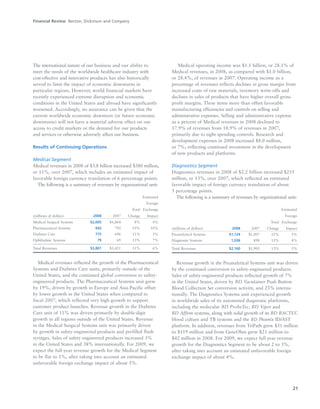
  • 11.
    Under the collaboration, BDcontributes associates’ expertise and donates cash to PEPFAR-affiliated non-governmental organizations. In 2008, BD deployed nine associates to Uganda to train workers and offer technical assistance for 79 labs. While helping raise the quality standards of diagnostics in those labs, associates also helped implement a TB specimen referral program to expand the reach of liquid culture testing by connecting local sites to centralized testing locations. Over the next few years, BD will deploy 50 to 60 associates to provide additional support. BD also continued to provide cash support in 2008 for the Accordia Global Health Foundation’s Laboratory Training Program at Makerere University’s Infectious Diseases Institute in Kampala, Uganda. To date, the program has increased the laboratory testing skills of more than 100 African technicians. PhotocourtesyofNancyFarese,AccordiaGlobalHealthFoundation
  • 12.
    India and Mexico– Improving Healthcare Access Since 1986, AmeriCares has distributed more than $19 million worth of donated BD products to 93 countries. By increasing healthcare access to the poverty stricken, AmeriCares helps save lives, reduce suffering and restore health. In 2008, BD in India supported AmeriCares’ response to the Myanmar cyclone, delivering an emergency shipment of 20,000 IV infusion sets and injectable medicines to re-supply hospitals. In 2008 and 2009, BD in Mexico is donating BD Eclipse Syringes valued at $2.3 million through AmeriCares to resource-poor healthcare facilities globally. Sub-Saharan Africa – Strengthening Health Systems In 2008, BD announced a three-year collaboration valued at $1.25 million with the International Council of Nurses (ICN) and PEPFAR to establish a Wellness Center for Health Care Workers® in Uganda and strengthen existing Centers in Swaziland, Lesotho and Zambia. BD committed to donating $250,000 as well as needed training and consulting services. The collaboration aims to address the region’s severe health worker shortage by offering care and support services for health workers and their families. In turn, they can better care for their patients and communities. Social Investing PhotocourtesyoftheInternationalCouncilofNurses PhotocourtesyofAmeriCares
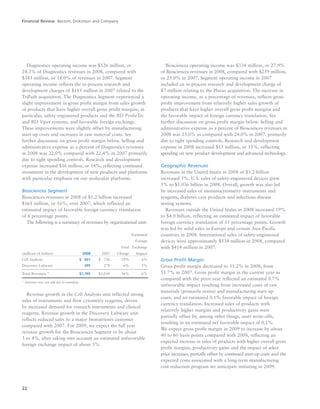
  • 13.
    China – Providing DisasterRelief The 2008 earthquake in western China touched BD associates around the globe. On the scene, more than 400 of our associates spent countless hours helping with rescue operations and volunteering in healthcare facilities. In addition to BD cash donations to the American Red Cross, AmeriCares, Heart to Heart International, Save the Children and the U.S. Fund for UNICEF, BD associates from China, South Korea and the United States raised more than $105,000 for the relief efforts. BD in China also donated syringes, alcohol swabs, IV catheters and blood collection sets to aid relief efforts. India – Improving Diabetes Care BD has allocated $1 million over four years to help fund Project HOPE’s India Diabetes Educator Project that addresses the country’s growing diabetes epidemic by providing education and training to healthcare professionals. PhotoscourtesyofAmeriCares
  • 14.
    New Jersey – Helpingthe Less Fortunate Eva’s Village is a social service agency in Paterson, New Jersey, with a mission to feed the hungry, shelter the homeless, treat the addicted and provide medical care to the poor. Eva’s Village recently renovated an old building into a housing and rehabilitation facility for single mothers and their children. BD funded a bedroom in the facility and matched donations raised by our associates, who also helped furnish the room with decorations to make it more comfortable. Spain – Lifting the Spirits of Young Cancer Patients BD associates in Spain donated $15,500 to support summer camps for children with cancer, organized by the local cancer foundation in Lerida, Spain. Located in Spain’s Catalonia region, the summer camps are designed to host more than 100 children, aged six to15, affected by cancer. UK – Supporting Cancer Research A group of BD associates in Oxford participated in a 10K charity run, raising £1,120 for cancer research. With 285,000 new cases of cancer diagnosed each year in the UK, the donation will go toward helping researchers identify ways to better understand, prevent, diagnose and treat malignancies. Community Involvement PhotocourtesyofEva'sVillage
  • 15.
    California – Raising Awarenessof Blood Cancers Our associates in San Jose, California, raised more than $53,000, including Company match, in two months for The Leukemia & Lymphoma Society’s® Light The Night® Walk, a two-mile walk held throughout North America to raise funds for lifesaving blood cancer research. A group of 90 BD associates, family members and friends participated. Associates also raised money through bake sales, a farmer’s market and a craft fair. Puerto Rico – Helping Senior Citizens Continuing a holiday tradition, BD associates in Cayey, Puerto Rico, visited seniors at a local care facility, to deliver gift baskets and a new television, and share traditional holiday songs with the residents.
  • 16.
    BD in UtahUses Only Renewable Energy As of October 1, 2008, renewable energy constitutes 100 percent of the electricity used at BD’s facility in Sandy, Utah. Our renewable energy purchase from Rocky Mountain Power’s Blue Sky program will eliminate approximately 37,060 tons of carbon dioxide emissions each year, providing annual environmental benefits equivalent to driving 79.4 million fewer miles or planting 14,558 acres of trees. The Sandy facility has been a Blue Sky business partner since June 2007. BD in Plymouth Earns UK Environmental Award The BD manufacturing facility in Plymouth, UK, received the Devon Environmental Business Initiative Low Carbon Award for reducing its carbon footprint. Over 12 months, the site cut carbon emissions by 1,345 tons through energy conservation efforts and now expects up to a five percent reduction next year and another two percent each year thereafter. BD Training Center Meets LEED Criteria BD’s new 81,500-square-foot office building and customer training facility in San Jose, California, was designed and engineered to meet U.S. Green Building Council criteria for Leadership in Energy and Environmental Design (LEED) certification – the nationally accepted benchmark for the design, construction and operation of high-performance green buildings. The BD Biosciences facility surpasses California energy efficiency standards by more than 15 percent and currently awaits LEED certification. Environmental Stewardship
  • 17.
    2008 Annual Report5 Bringing research tools, diagnostics and drug delivery systems to scientists, clinicians and patients in need is a huge challenge. BD addresses this challenge head-on by applying technologies and expertise to solve problems at critical stops along the healthcare continuum. In doing so, the Company stays focused on fulfilling its corporate purpose and passion: “Helping all people live healthy lives.” Discovery and Development Strengthening basic and pharmaceutical research with state-of-the-art tools and analytical technologies to bolster scientific understanding. Diagnosis Improving the quality of in vitro diagnostic testing with innovative sample collection products and enhancing the detection, diagnosis and management of infectious disease, healthcare-associated infections and cancer through advanced diagnostic platforms and assays. Delivery Helping ensure the safe and effective delivery of medicines and vaccines through unique and affordable drug delivery systems in both developed and developing markets. Meeting important, underappreciated healthcare needs
  • 18.
    6 BD Exciting advancesin biomedical science – driven by understanding of the human genome and cell biology – are leading to unprecedented changes and opportunities for life scientists from government and academic laboratories to pharmaceutical and biotechnology companies. Translating this knowledge into future therapies, however, will be tied in large part to the availability of new analytical technologies and bioprocessing tools. BD helps improve the efficiency and quality of life science research by offering a powerful and growing portfolio of tools that focuses on cell analysis in the “age of biology.” Transforming cellular analysis BD is a pioneer and leader in the field of flow cytometry for cellular analysis. The Company’s instrument portfolio includes the BD FACSAria II System, the platform of choice in research labs around the world performing a broad range of cell sorting applications. To meet the specific needs of today’s life science researchers working with advanced applications, BD now offers the BD Influx Cell Sorter, which became part of BD’s product portfolio through the 2008 acquisition of Cytopeia. An open, configurable cell-sorting platform that can be optimized for research, application and environmental requirements, the BD Influx System is especially suited for bioprocessing, cell therapy research, marine biology and stem cell research. Flow cytometry is a powerful platform and an important tool in stem cell research. BD’s expertise in hematopoietic stem cell research is driving ongoing development of other tools that optimize workflow, standardize procedures and streamline experiments. This expanding portfolio of state-of-the-art research instruments and tools reflects BD’s position as a world leader in applying innovative tools and expertise to solve complex research problems. These solutions may ultimately help life scientists discover new lifesaving and life-improving therapies. Advancing research efficiency The high cost of drugs – a key issue for patients and entire economies – can be attributed to a big increase in R&D and clinical trials costs. The BD Influx Flow Cytometry System offers leading-edge life science researchers a configurable platform that can be optimized to meet their unique application-specific requirements in such diverse areas as stem cell research, cell therapy research, drug discovery and marine biology. Discovery and Development – Strengthening basic and pharmaceutical research The BD FACSAria II Cell Sorting System, launched in 2008, is the next-generation high-performance cell sorter with improvements that make cell sorting easier and more accessible to life science researchers working across a wide range of advanced applications.
  • 19.
    2008 Annual Report7 Understanding the Immune System to Prevent Disease Better understanding the mechanism to trigger an immune response could help scientists prevent or control many deadly or debilitating diseases – from AIDS to rheumatoid arthritis to allergy. The RIKEN Research Center for Allergy and Immunology is the only government- supported institute for immunology and allergy in Japan and one of only a few in the world. The Center’s Laboratory for Cell Signaling studies the function and formation of T cells and signal regulation, which play a central role in cell-mediated immunity. Since the human immune system uses T cells to recognize and defend against external pathogens, the laboratory utilizes flow cytometry systems, such as the BD FACSAria Cell Sorter, for many applications. Monitoring various types and stages of T cells is one important application. Another is following the expression of a specific cloned gene. Insights derived from this work not only help RIKEN scientists understand the immune system, but they may also lead to new lifesaving therapies. “In our flow cytometry laboratory, we work closely with BD engineers to make sure all cell sorters and analyzers are working optimally,” says the laboratory’s group director Dr. Takashi Saito. “We have also worked with BD to test and develop new technologies.”
  • 20.
    8 BD BD providesa growing portfolio of reagents for cellular characterization and sorting that, when coupled with BD’s advanced flow cytometry platforms, helps improve the efficiency and productivity of drug and vaccine research and development. A case in point is BD Phosflow Reagents, used by scientists to understand and analyze how a particular drug under development can lessen the effects of disease by inhibiting critical cell signaling pathways. With BD Phosflow Reagents, scientists can analyze the phosphorylation state of multiple proteins in a single cell to help enhance the discovery of new pharmaceutical therapies. BD is also expanding its line of drug metabolism and toxicity assays for pharmaceutical, biotechnology and contract research organizations. The Company’s high-quality tests quickly help researchers determine the risks of potential drugs long before they reach patients. An important part of cellular research is creating a laboratory environment for cells to grow that more closely resembles the one they encounter inside the body. BD serves as a premium supplier of advanced cell surfaces and coatings. Through acquisitions and internal development, BD has expanded its portfolio and strengthened its position as a leading provider of defined surfaces used in drug discovery, academic research and cell therapy development. Enhancing production of biological medicines Beyond the research lab, makers of biopharmaceuticals, bioengineered vaccines and stem cell therapies struggle to produce new medicines efficiently. BD helps customers meet this challenge by increasing their production yields with safer cell culture products and services. In fact, cell culture media supplements from BD’s Advanced Bioprocessing product platform are currently used in the manufacture of more than 30 marketed biological medicines. To help further enhance the safety of biological medicines, BD plans to manufacture cell culture media supplements in a state-of-the-art, dedicated animal-free/antibiotic-free facility in Miami, Florida. This new AF2 Facility also will expand the Company’s product portfolio to include chemically defined basal cell culture media. As a result, BD will offer customers a complete solution: yield-enhancing, fully supplemented, easy-to-use cell culture media that meet or exceed current regulatory requirements. BD’s Advanced Bioprocessing cell culture media products are currently used to enhance the production of biopharmaceuticals, cell therapy products and bioengineered vaccines. BD produces hundreds of custom flow cytometry instruments, such as the BD LSR II System, which are uniquely configured to meet customer requirements via the BD Special Order Research Products program. BD helps improve the efficiency and quality of life science research by offering a powerful and growing portfolio of tools that focuses on cell analysis in the ‘‘age of biology.’’
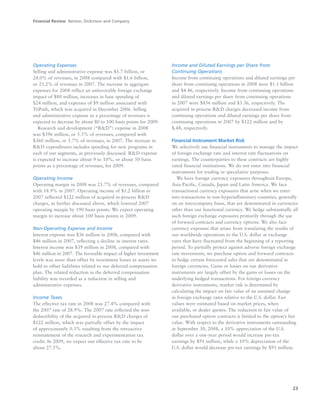
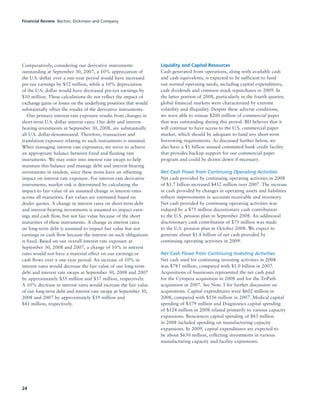
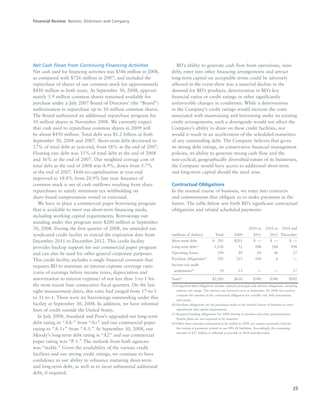
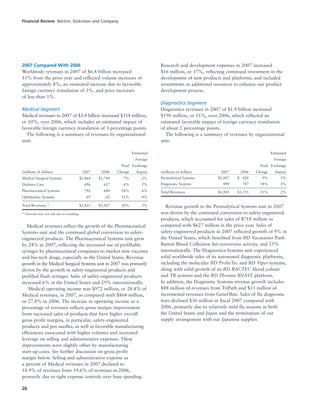
  • 21.
    2008 Annual Report9 BD Recognized for Value Creation, Ethics and Sustainability BD’s reputation continues to grow in the corporate community, medical technology industry and global health arena for creating sustainable value for stakeholders as well as for providing leadership, resources and expertise to meet social and healthcare challenges around the world. Following are several examples of corporate honors and recognitions that BD received in fiscal year 2008. Dow Jones Sustainability World Index BD was selected for the third consecutive year as a component of the Dow Jones Sustainability World Index, widely considered the premier socially responsible investing index. BD’s inclusion was based on an annual evaluation of sustainability leadership across the world. The assessment examined corporate economic, environmental and social performance, with a strong focus on long-term shareholder value. Selection as a component of the index puts BD in the top 10 percent of healthcare sector companies in terms of sustainability leadership. BD also remained on the Dow Jones Sustainability North America Index for the fourth consecutive year. FTSE4Good Since 2003, BD has been listed as a member of FTSE4Good, a UK-based index series that measures the performance of companies against globally recognized corporate responsibility standards. Areas of evaluation include environmental sustainability, stakeholder relationships, human rights, supply chain labor standards and anti-bribery activities. Each year, a committee of independent practitioners in socially responsible investing and corporate social responsibility reviews the indices to ensure they accurately reflect current best practices. World’s Most Ethical Companies For the second consecutive year, BD was named one of the “World’s Most Ethical Companies” by Ethisphere magazine, which analyzed more than 10,000 companies to determine the 100 finalists. All companies were measured against seven categories: corporate citizenship and responsibility; corporate governance; innovation that contributes to public well-being; executive leadership and tone; industry leadership; legal, regulatory and reputation track record; and internal systems and ethics/compliance programs. FORTUNE’s “America’s Most Admired Companies® ” BD was again named one of “America’s Most Admired Companies” by FORTUNE magazine, ranking fourth in the Medical Products and Equipment category. This year, the Medical Products and Equipment category expanded to include Precision Equipment, adding more companies to the comparison group than in previous years. In key attributes of reputation, BD ranked among the top three in social responsibility, quality of management, use of corporate assets and long-term investment. Dow Jones Sustainability Indexes Member 2008/09 FTSE4Good
  • 22.
    10 BD On theFront Lines of Ovarian Cancer Screening Nearly 200,000 women worldwide are diagnosed with ovarian cancer each year; most will die from the disease. Detecting ovarian cancer has been difficult because affected women often have no symptoms or vague symptoms and seek medical care only after the disease has reached an advanced stage. For more than 20 years, the Ovarian Cancer Screening Centre, part of the Institute for Women’s Health, University College London, has conducted research to improve outcomes, including the development of new biomarkers for early detection, diagnosis and identification of inherited genetic alterations that can predict which women are at risk. “We have an exciting opportunity to evaluate biomarker assays developed by BD to advance early detection, using our sample banks and clinical research facilities,” says Professor Ian Jacobs, who directs the Institute and the Centre. “This collaboration has great potential to speed up the translation of research ideas into clinical practice, which is a key goal of our work.” Dr. Jacobs expects that within 10 years, ovarian cancer screenings will be standard care, like breast and cervical cancer screenings today. “I think we’ll use a panel of circulating biomarkers of the type that we’re working on with BD, along with ultrasound and other new sophisticated imaging techniques.”
  • 23.
    2008 Annual Report11 Early and accurate diagnosis of disease is essential to high-quality, cost-effective patient care. As a pioneer and leader in sample collection, microbiology and flow cytometry, BD has long provided innovative technologies and solutions to help clinicians detect, diagnose and monitor a host of infections and infectious diseases, such as HIV/AIDS, tuberculosis (TB) and sexually transmitted diseases. Through internal development, strategic acquisitions and collaborations, BD has increased its value to clinical laboratories worldwide by providing new technologies to improve the detection of cancer and molecular assays that rapidly detect potentially lethal “superbugs,” such as methicillin-resistant Staphylococcus aureus (MRSA). Safe sample collection Achieving an accurate diagnosis first depends on safe and stable specimen collection. Since launching the first evacuated blood collection tube in 1949, BD has developed a full portfolio of sample collection products that includes the BD Vacutainer Push Button Blood Collection Set. This innovative product not only makes blood collection easier, it also helps reduce healthcare worker exposure to needlesticks. Reducing the spread of infection Leveraging the Company’s expertise in microbiology and molecular diagnostics, BD has built and acquired capabilities to address the growing problem of healthcare-associated infections (HAIs) caused by increasingly drug-resistant bacteria. These infections pose a serious threat to patients in the very places they go for medical care. BD now offers a growing portfolio of diagnostic technologies that help infection control specialists prevent and manage the spread of HAIs. These products range from BD BBL CHROMagar MRSA Plated Media to molecular tests that provide results in less than two hours, such as the BD GeneOhm MRSA Assay. In 2008, the Company expanded its menu of BD GeneOhm assays to test for HAI-causing organisms. BD achieved CE marking in Europe this year for a rapid molecular assay to detect toxigenic Clostridium difficile, a dangerous bacterium that can infect the colon. Diagnosis – Enhancing care through improved detection and management of disease The BD Viper Molecular Testing System utilizes state-of-the-art robotic automation to help clinical laboratories detect Chlamydia trachomatis and Neisseria gonorrhoeae in patient samples more rapidly. The BD FACSCount System provides clinicians in the developing world with a workhorse flow cytometer capable of performing both absolute and percentage CD4 counts to monitor the immune status and disease progression of HIV-infected patients.
  • 24.
    12 BD A definitivediagnosis of this potentially life-threatening infection enables clinicians to prescribe appropriate treatment to patients and reduce the risk of spreading the infection to others. Improving global health Infectious diseases take a staggering human and economic toll, especially in the developing world. With diagnostics and medical treatment difficult to come by, millions of people with HIV/AIDS and TB are not receiving the care they need when they need it. BD is applying its expertise and innovative technologies to address this crisis in many regions around the globe, including Africa, China, India, Eastern Europe and Latin America. The World Health Organization (WHO) estimates that 9 million new cases of active TB and approximately 2 million TB deaths occur annually. The BD BACTEC MGIT 960 System is the test of choice in many developing countries because it is the only automated liquid culture system for high-volume mycobacterial growth and detection as well as drug susceptibility testing. It provides faster results that may help improve patient care. In fact, the WHO recently endorsed the use of liquid culture systems for TB diagnosis in high-burden countries. Enhancing cancer detection and diagnosis Results in the fight against cancer have been mixed. On the one hand, expensive new therapies often prove to prolong survival by months, not years. On the other, five-year survival rates improve dramatically for most cancers detected in Stages I and II. This reality places an even greater importance on developing new assays that detect and diagnose cancer earlier. Hence, BD is actively expanding its offerings and capabilities in these areas for detecting and diagnosing solid tumors as well as leukemias and lymphomas. Cervical cancer claims the lives of more than 300,000 women globally every year, and more than 470,000 women are diagnosed annually. BD earned U.S. FDA approval in 2008 for the new BD FocalPoint GS Imaging System, which offers significant improvements in both disease detection and lab productivity to locate abnormal, often precancerous, cervical cells quickly. BD is also developing proprietary biomarkers to enhance the early detection of cervical, ovarian and breast cancers. The Company aims to provide advanced oncology products that will enable biomarker-guided diagnoses to drive better clinical decisions that could enable better patient outcomes. The BD Vacutainer Push Button Blood Collection Set is the latest in safety- engineered wingsets that offer healthcare workers in-vein activation and split-second protection at the push of a button. The BD BACTEC FX Blood Culture Instrument, launched in 2008, helps detect bloodstream infections and enhances clinical decision-making and laboratory workflow by markedly improving blood culturing practices with real-time, 24/7, remotely accessible, actionable results that can enhance patient care.
  • 25.
    2008 Annual Report13 Expanding Manufacturing Capacity to Meet Demand BD made strategic investments in 2008 to increase manufacturing capacity to help meet growing worldwide demand for its innovative technologies and products. Below are just a few examples of expansion projects BD undertook or completed this year. Each demonstrates the Company’s commitment to providing customers with high-quality products that enhance the discovery and development of new medicines, the detection and diagnosis of infections and disease, and the safe and effective delivery of medicines. Miami, Florida – Enabling discovery and development BD announced plans to open a dedicated animal-free/antibiotic- free AF2 Facility for the production of cell culture media and supplements by late 2009. This new $53 million facility will serve the needs of pharmaceutical and biotechnology companies that require high- performance cell culture media products for the production of biological medicines, vaccines and stem cell therapies. With stringent raw materials controls and product segregation that are designed to eliminate the risk of contamination associated with cell culture media from facilities using animal-origin components, the AF2 Facility will set a new standard for safety and quality. Québec, Canada – Improving detection and diagnosis BD opened a new $34 million manufacturing facility in Québec to help meet anticipated global demand for BD GeneOhm molecular assays. The BD GeneOhm MRSA Assay – now used in more than 400 hospitals in the U.S., Canada, Europe and Asia-Pacific – is the primary product manufactured in this facility. In addition, the Québec facility is currently producing BD GeneOhm assays for the detection of methicillin-sensitive Staphylococcus aureus, vancomycin-resistant enterococci, Clostridium difficile and Group B streptococci. Tatabánya, Hungary – Enhancing drug delivery BD announced a C100 million capital investment project to build a state- of-the-art prefillable syringe manufacturing facility in Tatabánya, Hungary, which is expected to open in 2010. The new high- volume manufacturing facility will help BD meet the growing worldwide demand for prefillable syringes that are sold to pharmaceutical companies. The prefilled syringe format has been found to reduce the potential for medication error and contamination. New facilities in Canada, Florida and Hungary reflect BD’s commitment to meet the need for innovative, high-quality products in the discovery and development, diagnosis and delivery phases of the healthcare continuum. =
  • 26.
    The need todiagnose and treat patients quickly and effectively in hospitals and clinics is matched by the need to deliver those treatments with minimal risks to both patients and healthcare providers. BD offers a comprehensive line of innovative injection and infusion devices that effectively deliver lifesaving therapies and vaccines, while reducing the risk of needlestick injury or other incidents that may spread infection. Reducing the spread of infection Needlestick injuries, which expose healthcare workers to such dangerous pathogens as hepatitis C and HIV, are a serious occupational hazard. For two decades, BD has been a pioneer and world leader in developing advanced safety-engineered delivery systems designed to protect healthcare workers and patients from exposures to bloodborne pathogens. One of BD’s innovative solutions is the BD Nexiva Closed IV Catheter System. This simple, all-in-one product is designed to increase first-stick success and reduce blood exposure to clinicians through its innovative blood containment system. This product is often coupled with the BD Q-Syte Luer Access Split-Septum Device, which helps reduce the risk of catheter-related bloodstream infections (CRBSIs). Studies indicate that split-septum needleless access systems have 64 percent to 70 percent lower CRBSI rates than mechanical valves. The Company also developed the BD Venflon Pro Safety IV Catheter for the clinical environment in Europe. Its unique features are designed to help protect healthcare workers from needlestick injuries and blood splatter that can occur during the IV cannulation process. Such safety-engineered products are needed in healthcare institutions across Europe, where an estimated 1 million needlesticks occur every year. Delivering medicines more effectively In demanding clinical environments, it is critical to minimize the risk of medical errors, preserve the supply of vaccines and medicines, and reduce the time it takes to prepare treatments. When compared with single- and multi-dose vials, prefilled syringes address these concerns for the benefit of both patients and providers. Delivery – Designing devices for safe and effective injections and infusions 14 BD To meet the unique needs of European clinicians, the BD Venflon Pro Safety Catheter was designed to provide both enhanced protection against needlesticks and reduced blood exposure. The BD Nexiva Closed IV Catheter System – which includes the BD Q-Syte Luer Access Split-Septum Device – is designed to address catheter-related bloodstream infections and reduce blood exposure to the clinician as well as protect against needlestick injuries.
  • 27.
    2008 Annual Report15 Getting to Zero: Catheter-related Bloodstream Infections in the ICU Clinicians at Jennie Edmundson Hospital (JEH) in Council Bluffs, Iowa, sought ways to reduce catheter- related bloodstream infections (CRBSIs) in its 13-bed Intensive Care Unit (ICU). CRBSIs are potentially fatal, especially for critically ill ICU patients, and they can dramatically increase healthcare costs. The Centers for Medicare and Medicaid Services estimates that a vascular catheter-associated infection can increase the cost of a hospital stay by more than $100,000 per patient. Kari Love, RN, Clinical Quality Specialist in Infection Prevention at JEH, studied the impact of switching to the simple BD Q-Syte Luer Access Split-Septum Devices from complex mechanical valves, which can harbor bacteria that pose a risk to patients receiving intravenous therapy. For the 10 months prior to the switch, the facility’s average infection rate was slightly more than three per month – lower than the national benchmark, but still unacceptable to JEH. Using BD Q-Syte Devices, Love reduced the infection rate to zero throughout the eight-month period studied. According to Love, “With the increasing prevalence of drug-resistant infections, it is encouraging to find simple ways to reduce risks to patients.” Love and her study team continue to evaluate the impact of using BD Q-Syte Devices in other units, with the ultimate goal of eliminating CRBSIs throughout the hospital.
  • 28.
    16 BD BD SoloMedReuse Prevention Syringes are designed to meet the needs of healthcare workers in emerging and developing countries by employing safety features to help reduce needlesticks and syringe reuse. BD Hypak SCF Glass Prefillable Syringes are the worldwide standard, offering pharmaceutical companies and clinicians a drug delivery system that may improve dosing accuracy and helps reduce the risk of medication errors. BD remains at the forefront of injection technology with such products as BD Hypak SCF Glass Prefillable Syringes, a complete drug delivery system that may reduce the risk of medication errors and contamination that can occur during the traditional vial-to-syringe filling process. BD has developed the novel BD Soluvia Prefillable Microinjection System. While most vaccines are injected into the muscle, this system uses innovative BD micro-delivery technology to deliver vaccines intradermally – within the dermal layer of the skin, which may enable the vaccine to enter the immune system more efficiently. In clinical trials on more than 7,000 subjects, intradermal delivery of the influenza vaccine provided an improved immune response in the elderly. In other trials, the BD Soluvia System demonstrated that injections to the dermal layer worked effectively regardless of the subject’s gender, age, ethnicity and body mass. Leading the way in global immunizations BD continues to play a leading role in global immunization efforts. For decades, the Company has collaborated with governments, health agencies and non-governmental organizations to achieve cost-effective and safe immunization of children in developing countries. In fact, more than 6 billion safe immunizations have been administered worldwide using the Company’s low-cost, auto-disable devices, such as BD SoloShot Syringes. For curative or therapeutic injection applications, BD SoloMed Syringes were recently introduced to reduce the incidence of intentional syringe reuse and provide protection against needlesticks in emerging and developing countries. This low-cost injection device employs a needle safety shield to help protect healthcare workers. It also features a plunger that is easily disabled after one injection, preventing the syringe from being reused. The BD Uniject Prefillable, Auto-disable Injection System is designed to prevent reuse and eliminate the need for filling syringes from vials. Its innovative design is particularly suited for administering injections in remote settings in the developing world. Through a Program for Appropriate Technology in Health (PATH) project funded by USAID, the BD Uniject System has been approved in Latin America for use with oxytocin, a drug used to prevent post-partum hemorrhage. It also has been utilized for tetanus toxoid vaccinations in Africa. BD offers a comprehensive line of innovative injection and infusion devices that effectively deliver lifesaving therapies and vaccines, while reducing the risk of incidents that may spread infection.
  • 29.
    17 Financials Becton, Dickinsonand Company Table of Contents Ten-Year Summary of Selected Financial Data . . . . . . . . . . . . . . . . . . . . . . . . . . . . . . . . . . . . . . 18 Financial Review . . . . . . . . . . . . . . . . . . . . . . . . . . . . . . . . . . . . . . . . . . . . . . . . . . . . . . . . . . . . 20 Reports of Management . . . . . . . . . . . . . . . . . . . . . . . . . . . . . . . . . . . . . . . . . . . . . . . . . . . . . . . 33 Reports of Independent Registered Public Accounting Firm . . . . . . . . . . . . . . . . . . . . . . . . . . . 34 Consolidated Statements of Income . . . . . . . . . . . . . . . . . . . . . . . . . . . . . . . . . . . . . . . . . . . . . . 36 Consolidated Statements of Comprehensive Income . . . . . . . . . . . . . . . . . . . . . . . . . . . . . . . . . . 37 Consolidated Balance Sheets . . . . . . . . . . . . . . . . . . . . . . . . . . . . . . . . . . . . . . . . . . . . . . . . . . . 38 Consolidated Statements of Cash Flows . . . . . . . . . . . . . . . . . . . . . . . . . . . . . . . . . . . . . . . . . . . 39 Notes to Consolidated Financial Statements . . . . . . . . . . . . . . . . . . . . . . . . . . . . . . . . . . . . . . . 40 Quarterly Data (unaudited) . . . . . . . . . . . . . . . . . . . . . . . . . . . . . . . . . . . . . . . . . . . . . . . . . . . . 62 U.S. Revenues (Millions of Dollars) Return on Invested Capital (Percent) 36 27 18 9 0 04 05 06 07 08 1.20 .90 .60 .30 0 5.00 3.75 2.50 1.25 0 04 05 06 07 08 3200 2400 1600 800 0 04 05 06 07 08 4000 3000 2000 1000 0 04 05 06 07 08 1200 900 600 300 0 04 05 06 07 08 Net Income (Millions of Dollars) Dividends Per Common Share (Dollars) Non-U.S. Revenues (Millions of Dollars) Earnings Per Share - Diluted (Dollars) 04 05 06 07 08
  • 30.
    Summary Becton, Dickinsonand Company 18 Ten-Year Summary of Selected Financial Data Years Ended September 30 Dollars in millions, except per share amounts 2008 2007 2006 2005 Operations Revenues $7,155.9 $6,359.7 $5,738.0 $5,340.8 Research and Development Expense 396.2 360.1 301.9 267.7 Operating Income 1,552.1 1,203.2 1,141.4 1,063.8 Interest (Income) Expense, Net (3.0) .2 6.8 19.3 Income From Continuing Operations Before Income Taxes 1,553.6 1,203.9 1,125.9 1,037.5 Income Tax Provision 425.7 347.8 310.8 325.0 Net Income 1,127.0 890.0 752.3 722.3 Basic Earnings per Share 4.61 3.63 3.04 2.87 Diluted Earnings per Share 4.46 3.49 2.93 2.77 Dividends per Common Share 1.14 .98 .86 .72 Financial Position Current Assets $3,614.7 $3,130.6 $3,185.3 $2,975.3 Current Liabilities 1,416.6 1,478.8 1,576.3 1,299.4 Property, Plant and Equipment, Net 2,744.5 2,497.3 2,133.5 1,933.7 Total Assets 7,912.9 7,329.4 6,824.5 6,132.8 Long-Term Debt 953.2 955.7 957.0 1,060.8 Shareholders’ Equity 4,935.6 4,362.0 3,836.2 3,284.0 Book Value Per Common Share 20.30 17.89 15.63 13.26 Financial Relationships Gross Profit Margin 51.2% 51.7% 51.3% 50.9% Return on Revenues(E) 15.8% 13.5% 14.2% 13.3% Return on Total Assets(B) (E) 20.9% 17.7% 18.4% 18.4% Return on Equity(E) 24.3% 20.9% 22.9% 22.4% Debt to Capitalization(D) (E) 18.8% 20.9% 25.8% 27.1% Additional Data Number of Employees 28,300 28,000 27,000 25,600 Number of Shareholders 8,820 8,896 9,147 9,442 Average Common and Common Equivalent Shares Outstanding - Assuming Dilution (millions) 252.7 254.8 256.6 260.7 Depreciation and Amortization $0,477.4 $0,441.3 $0,402.3 $0,382.7 Capital Expenditures 602.0 556.4 457.1 315.8 (A) Includes cumulative effect of accounting change of $36.8 million ($.14 per basic and diluted share). (B) Earnings before interest expense, taxes and cumulative effect of accounting changes as a percent of average total assets. (C) Excludes the cumulative effect of accounting changes. (D) Total debt as a percent of the sum of total debt, shareholders’ equity and net non-current deferred income tax liabilities. (E) Excludes discontinued operations in 1999 to 2008.
  • 31.
    Becton, Dickinson andCompany 19 2004 2003 2002 2001 2000 1999 $4,893.9 $4,449.1 $3,960.4 $3,667.6 $3,544.7 $3,412.6 230.8 218.5 201.1 193.8 207.8 203.9 878.2 800.8 689.1 645.9 507.4 477.3 29.6 36.5 33.2 55.3 74.2 72.0 843.8 761.6 642.1 548.6(A) 512.7 404.8 204.9 182.1 153.7 139.3 122.0 96.9 467.4 547.1 480.0 401.7(A) 392.9 275.7 1.85 2.14 1.85 1.55(A) 1.54 1.09 1.77 2.07 1.79 1.49(A) 1.49 1.04 .60 .40 .39 .38 .37 .34 $2,641.3 $2,503.5 $2,091.4 $1,930.1 $1,847.6 $1,843.0 1,050.1 1,059.4 1,271.5 1,285.4 1,382.4 1,358.6 1,881.0 1,831.8 1,750.4 1,701.3 1,565.5 1,423.9 5,752.6 5,572.3 5,029.0 4,790.8 4,505.1 4,437.0 1,171.5 1,184.0 803.0 782.8 778.5 954.0 3,067.9 2,897.0 2,480.9 2,321.7 1,956.0 1,768.7 12.30 11.54 9.71 8.96 7.72 7.05 50.5% 48.9% 48.3% 48.7% 48.6% 49.9% 13.1% 13.0% 12.3% 12.2%(C) 11.0% 9.0% 15.7% 15.2% 13.9% 13.9% 13.4% 11.6% 21.4% 21.6% 20.3% 20.7%(C) 21.0% 18.2% 28.1% 30.5% 32.7% 34.0% 41.7% 47.6% 25,000 24,800 25,200 24,800 25,000 24,000 9,654 9,868 10,050 10,329 10,822 11,433 263.3 263.6 268.2 268.8 263.2 264.6 $ 351.1 $ 332.8 $ 294.7 $ 292.0 $ 273.7 $ 257.8 260.5 253.0 253.5 364.1 371.0 311.4
  • 32.
    Financial Review Becton,Dickinson and Company 20 Company Overview Becton, Dickinson and Company (“BD”) is a medical technology company engaged principally in the development, manufacture and sale of a broad range of medical supplies, devices, laboratory equipment and diagnostic products used by healthcare institutions, life science researchers, clinical laboratories, industry and the general public. Our business consists of three worldwide business segments – BD Medical (“Medical”), BD Diagnostics (“Diagnostics”) and BD Biosciences (“Biosciences”). Our products are marketed in the United States and internationally through independent distribution channels and directly to end-users by BD and independent sales representatives. References to years throughout this discussion relate to our fiscal years, which end on September 30. BD management operates the business consistent with the following core strategies: • To increase revenue growth by focusing on products that deliver greater benefits to patients, healthcare workers and researchers; • To improve operating effectiveness and balance sheet productivity; and, • To strengthen organizational and associate capabilities in the ever-changing healthcare environment. Our efforts to increase revenues are focused on four specific areas of healthcare: • Reducing the spread of infection • Advancing global health • Enhancing therapy • Improving disease management In assessing the outcomes of these strategies and BD’s financial condition and operating performance, management generally reviews quarterly forecast data, monthly actual results, segment sales and other similar information. We also consider trends related to certain key financial data, including gross profit margin, selling and administrative expense, investment in research and development, return on invested capital, and cash flows. The results of our strategies are reflected in our fiscal 2008 financial and operational performance. Worldwide revenues in 2008 of $7.2 billion increased 13% from the prior year and reflected volume increases of approximately 7%, an estimated increase due to favorable foreign currency translation of 6%, and price decreases of less than 1%. U.S. revenues increased 5% to $3.2 billion. International revenues increased 19% to $4.0 billion with an estimated 11 percentage points of such growth coming from the favorable impact of foreign currency translation. Recently, worldwide currency markets have experienced extreme volatility. Our financial projections for 2009 discussed below are based on the foreign exchange rates in early November 2008 when we established our fiscal year budget. Fluctuations in these rates during 2009 may affect these projections. For a discussion of the financial impact of exchange rate fluctuations and the ways and extent to which we attempt to mitigate such impact, see “Financial Instrument Market Risk” below. Consistent with our strategy to provide products that deliver greater benefits to healthcare workers, and recognizing the issues surrounding sharps-related injuries, BD has developed a wide array of safety-engineered devices that are designed to reduce the incidence of needlestick injuries and exposure to bloodborne pathogens. These products are offered through our Medical and Diagnostics segments. Sales in the United States of safety-engineered devices grew 5% to $1.036 billion in 2008, from $987 million in 2007. International sales of safety-engineered devices grew 29% to $534 million in 2008 from $414 million in 2007, with an estimated 11 percentage points of such growth coming from the favorable impact of foreign currency translation. In 2009, we expect sales of safety- engineered devices to increase about 5 to 6% in the United States, and 11 to 12% internationally, after taking into account an estimated unfavorable foreign exchange impact of about 9%. Our anticipated revenue growth over the next three years is expected to come from business growth and expansion among all segments and regions of the world, and the development in each business segment of new products and services that provide increased benefits to patients, healthcare workers and researchers. Our ability to sustain our long-term growth will depend on a number of factors, including our ability to expand our core business (including geographical expansion), develop innovative new products with higher gross profit margins across our business seg- ments, and continue to improve operating efficiency and organizational effectiveness. Numerous factors can affect our ability to achieve these goals including, without limitation, economic conditions in the United States and elsewhere, increased competition and healthcare cost containment initiatives. In this regard, we note that President-elect Barack Obama made healthcare reform a central part of his presidential campaign. However, no predictions can be made as to what, if any, reforms may be instituted or their poten- tial effect on BD. We believe several important factors relating to our business tend to limit the impact on BD of potential economic or political events in countries in which we do business, including the effects of possible healthcare system reforms. For example, since many of our products are used in essential medical care, demand for such products has historically tended not to be significantly affected by economic fluctuations.
  • 33.
    21 The international natureof our business and our ability to meet the needs of the worldwide healthcare industry with cost-effective and innovative products has also historically served to limit the impact of economic downturns in particular regions. However, world financial markets have recently experienced extreme disruption and economic conditions in the United States and abroad have significantly worsened. Accordingly, no assurance can be given that the current worldwide economic downturn (or future economic downturns) will not have a material adverse effect on our access to credit markets or the demand for our products and services or otherwise adversely affect our business. Results of Continuing Operations Medical Segment Medical revenues in 2008 of $3.8 billion increased $380 million, or 11%, over 2007, which includes an estimated impact of favorable foreign currency translation of 6 percentage points. The following is a summary of revenues by organizational unit: Estimated Foreign Total Exchange (millions of dollars) 2008 2007 Change Impact Medical Surgical Systems $2,005 $1,864 8% 4% Pharmaceutical Systems 942 792 19% 10% Diabetes Care 775 696 11% 5% Ophthalmic Systems 79 69 15% 7% Total Revenues $3,801 $3,421 11% 6% Medical revenues reflected the growth of the Pharmaceutical Systems and Diabetes Care units, primarily outside of the United States, and the continued global conversion to safety- engineered products. The Pharmaceutical Systems unit grew by 19%, driven by growth in Europe and Asia-Pacific offset by lower growth in the United States when compared to fiscal 2007, which reflected very high growth to support customer product launches. Revenue growth in the Diabetes Care unit of 11% was driven primarily by double-digit growth in all regions outside of the United States. Revenue in the Medical Surgical Systems unit was primarily driven by growth in safety-engineered products and prefilled flush syringes. Sales of safety-engineered products increased 3% in the United States and 38% internationally. For 2009, we expect the full-year revenue growth for the Medical Segment to be flat to 1%, after taking into account an estimated unfavorable foreign exchange impact of about 5%. Medical operating income was $1.1 billion, or 28.1% of Medical revenues, in 2008, as compared with $1.0 billion, or 28.4%, of revenues in 2007. Operating income as a percentage of revenues reflects declines in gross margin from increased costs of raw materials, inventory write-offs and declines in sales of products that have higher overall gross profit margins. These items more than offset favorable manufacturing efficiencies and controls on selling and administrative expenses. Selling and administrative expense as a percent of Medical revenues in 2008 declined to 17.9% of revenues from 18.9% of revenues in 2007, primarily due to tight spending controls. Research and development expenses in 2008 increased $8.0 million, or 7%, reflecting continued investment in the development of new products and platforms. Diagnostics Segment Diagnostics revenues in 2008 of $2.2 billion increased $255 million, or 13%, over 2007, which reflected an estimated favorable impact of foreign currency translation of about 5 percentage points. The following is a summary of revenues by organizational unit: Estimated Foreign Total Exchange (millions of dollars) 2008 2007 Change Impact Preanalytical Systems $1,124 $1,007 12% 5% Diagnostic Systems 1,036 898 15% 4% Total Revenues $2,160 $1,905 13% 5% Revenue growth in the Preanalytical Systems unit was driven by the continued conversion to safety-engineered products. Sales of safety-engineered products reflected growth of 7% in the United States, driven by BD Vacutainer Push Button Blood Collection Set conversion activity, and 25% interna- tionally. The Diagnostics Systems unit experienced growth in worldwide sales of its automated diagnostic platforms, including the molecular BD ProbeTec, BD Viper and BD Affirm systems, along with solid growth of its BD BACTEC blood culture and TB systems and the BD Phoenix ID/AST platform. In addition, revenues from TriPath grew $31 million to $119 million and from GeneOhm grew $21 million to $42 million in 2008. For 2009, we expect full year revenue growth for the Diagnostics Segment to be about 2 to 3%, after taking into account an estimated unfavorable foreign exchange impact of about 4%. Financial Review Becton, Dickinson and Company
  • 34.
    22 Diagnostics operating incomewas $526 million, or 24.3% of Diagnostics revenues in 2008, compared with $343 million, or 18.0% of revenues in 2007. Segment operating income reflects the in-process research and development charges of $115 million in 2007 related to the TriPath acquisition. The Diagnostics Segment experienced a slight improvement in gross profit margin from sales growth of products that have higher overall gross profit margins, in particular, safety-engineered products and the BD ProbeTec and BD Viper systems, and favorable foreign exchange. These improvements were slightly offset by manufacturing start-up costs and increases in raw material costs. See further discussion on gross profit margin below. Selling and administrative expense as a percent of Diagnostics revenues in 2008 was 22.0% compared with 22.4% in 2007 primarily due to tight spending controls. Research and development expense increased $16 million, or 14%, reflecting continued investment in the development of new products and platforms with particular emphasis on our molecular platforms. Biosciences Segment Biosciences revenues in 2008 of $1.2 billion increased $161 million, or 16%, over 2007, which reflected an estimated impact of favorable foreign currency translation of 6 percentage points. The following is a summary of revenues by organizational unit: Estimated Foreign Total Exchange (millions of dollars) 2008 2007 Change Impact Cell Analysis $0,901 $0,756 19% 6% Discovery Labware 295 278 6% 5% Total Revenues * $1,195 $1,034 16% 6% * Amounts may not add due to rounding. Revenue growth in the Cell Analysis unit reflected strong sales of instruments and flow cytometry reagents, driven by increased demand for research instruments and clinical reagents. Revenue growth in the Discovery Labware unit reflects reduced sales to a major bionutrients customer compared with 2007. For 2009, we expect the full year revenue growth for the Biosciences Segment to be about 3 to 4%, after taking into account an estimated unfavorable foreign exchange impact of about 5%. Biosciences operating income was $334 million, or 27.9% of Biosciences revenues in 2008, compared with $259 million, or 25.0% in 2007. Segment operating income in 2007 included an in-process research and development charge of $7 million relating to the Plasso acquisition. The increase in operating income, as a percentage of revenues, reflects gross profit improvement from relatively higher sales growth of products that have higher overall gross profit margins and the favorable impact of foreign currency translation. See further discussion on gross profit margin below. Selling and administrative expense as a percent of Biosciences revenues in 2008 was 23.0% as compared with 24.0% in 2007, primarily due to tight spending controls. Research and development expense in 2008 increased $11 million, or 15%, reflecting spending on new product development and advanced technology. Geographic Revenues Revenues in the United States in 2008 of $3.2 billion increased 5%. U.S. sales of safety-engineered devices grew 5% to $1.036 billion in 2008. Overall, growth was also led by increased sales of immunocytometry instruments and reagents, diabetes care products and infectious disease testing systems. Revenues outside the United States in 2008 increased 19% to $4.0 billion, reflecting an estimated impact of favorable foreign currency translation of 11 percentage points. Growth was led by solid sales in Europe and certain Asia-Pacific countries in 2008. International sales of safety-engineered devices were approximately $534 million in 2008, compared with $414 million in 2007. Gross Profit Margin Gross profit margin decreased to 51.2% in 2008, from 51.7% in 2007. Gross profit margin in the current year as compared with the prior year reflected an estimated 0.7% unfavorable impact resulting from increased costs of raw materials (primarily resins) and manufacturing start-up costs, and an estimated 0.1% favorable impact of foreign currency translation. Increased sales of products with relatively higher margins and productivity gains were partially offset by, among other things, asset write-offs, resulting in an estimated net favorable impact of 0.1%. We expect gross profit margin in 2009 to increase by about 40 to 60 basis points compared with 2008, reflecting an expected increase in sales of products with higher overall gross profit margins, productivity gains and the impact of select price increases, partially offset by continued start-up costs and the expected costs associated with a long-term manufacturing cost reduction program we anticipate initiating in 2009. Financial Review Becton, Dickinson and Company
  • 35.
    23 Operating Expenses Selling andadministrative expense was $1.7 billion, or 24.0% of revenues, in 2008 compared with $1.6 billion, or 25.2% of revenues in 2007. The increase in aggregate expenses for 2008 reflect an unfavorable foreign exchange impact of $80 million, increases in base spending of $24 million, and expenses of $9 million associated with TriPath, which was acquired in December 2006. Selling and administrative expense as a percentage of revenues is expected to decrease by about 80 to 100 basis points for 2009. Research and development (“R&D”) expense in 2008 was $396 million, or 5.5% of revenues, compared with $360 million, or 5.7% of revenues, in 2007. The increase in R&D expenditures includes spending for new programs in each of our segments, as previously discussed. R&D expense is expected to increase about 9 to 10%, or about 50 basis points as a percentage of revenues, for 2009. Operating Income Operating margin in 2008 was 21.7% of revenues, compared with 18.9% in 2007. Operating income of $1.2 billion in 2007 reflected $122 million of acquired in-process R&D charges, as further discussed above, which lowered 2007 operating margin by 190 basis points. We expect operating margin to increase about 100 basis points in 2009. Non-Operating Expense and Income Interest expense was $36 million in 2008, compared with $46 million in 2007, reflecting a decline in interest rates. Interest income was $39 million in 2008, compared with $46 million in 2007. The favorable impact of higher investment levels was more than offset by investment losses in assets we hold to offset liabilities related to our deferred compensation plan. The related reduction in the deferred compensation liability was recorded as a reduction in selling and administrative expenses. Income Taxes The effective tax rate in 2008 was 27.4% compared with the 2007 rate of 28.9%. The 2007 rate reflected the non- deductibility of the acquired in-process R&D charges of $122 million, which was partially offset by the impact of approximately 0.3% resulting from the retroactive reinstatement of the research and experimentation tax credit. In 2009, we expect our effective tax rate to be about 27.5%. Income and Diluted Earnings per Share from Continuing Operations Income from continuing operations and diluted earnings per share from continuing operations in 2008 were $1.1 billion and $4.46, respectively. Income from continuing operations and diluted earnings per share from continuing operations in 2007 were $856 million and $3.36, respectively. The acquired in-process R&D charges decreased income from continuing operations and diluted earnings per share from continuing operations in 2007 by $122 million and by $.48, respectively. Financial Instrument Market Risk We selectively use financial instruments to manage the impact of foreign exchange rate and interest rate fluctuations on earnings. The counterparties to these contracts are highly rated financial institutions. We do not enter into financial instruments for trading or speculative purposes. We have foreign currency exposures throughout Europe, Asia-Pacific, Canada, Japan and Latin America. We face transactional currency exposures that arise when we enter into transactions in non-hyperinflationary countries, generally on an intercompany basis, that are denominated in currencies other than our functional currency. We hedge substantially all such foreign exchange exposures primarily through the use of forward contracts and currency options. We also face currency exposure that arises from translating the results of our worldwide operations to the U.S. dollar at exchange rates that have fluctuated from the beginning of a reporting period. To partially protect against adverse foreign exchange rate movements, we purchase option and forward contracts to hedge certain forecasted sales that are denominated in foreign currencies. Gains or losses on our derivative instruments are largely offset by the gains or losses on the underlying hedged transactions. For foreign currency derivative instruments, market risk is determined by calculating the impact on fair value of an assumed change in foreign exchange rates relative to the U.S. dollar. Fair values were estimated based on market prices, when available, or dealer quotes. The reduction in fair value of our purchased option contracts is limited to the option’s fair value. With respect to the derivative instruments outstanding at September 30, 2008, a 10% appreciation of the U.S. dollar over a one-year period would increase pre-tax earnings by $91 million, while a 10% depreciation of the U.S. dollar would decrease pre-tax earnings by $91 million. Financial Review Becton, Dickinson and Company
  • 36.
    24 Comparatively, considering ourderivative instruments outstanding at September 30, 2007, a 10% appreciation of the U.S. dollar over a one-year period would have increased pre-tax earnings by $52 million, while a 10% depreciation of the U.S. dollar would have decreased pre-tax earnings by $10 million. These calculations do not reflect the impact of exchange gains or losses on the underlying positions that would substantially offset the results of the derivative instruments. Our primary interest rate exposure results from changes in short-term U.S. dollar interest rates. Our debt and interest- bearing investments at September 30, 2008, are substantially all U.S. dollar-denominated. Therefore, transaction and translation exposure relating to such instruments is minimal. When managing interest rate exposures, we strive to achieve an appropriate balance between fixed and floating rate instruments. We may enter into interest rate swaps to help maintain this balance and manage debt and interest-bearing investments in tandem, since these items have an offsetting impact on interest rate exposure. For interest rate derivative instruments, market risk is determined by calculating the impact to fair value of an assumed change in interest rates across all maturities. Fair values are estimated based on dealer quotes. A change in interest rates on short-term debt and interest-bearing investments is assumed to impact earn- ings and cash flow, but not fair value because of the short maturities of these instruments. A change in interest rates on long-term debt is assumed to impact fair value but not earnings or cash flow because the interest on such obligations is fixed. Based on our overall interest rate exposure at September 30, 2008 and 2007, a change of 10% in interest rates would not have a material effect on our earnings or cash flows over a one-year period. An increase of 10% in interest rates would decrease the fair value of our long-term debt and interest rate swaps at September 30, 2008 and 2007 by approximately $35 million and $37 million, respectively. A 10% decrease in interest rates would increase the fair value of our long-term debt and interest rate swaps at September 30, 2008 and 2007 by approximately $39 million and $41 million, respectively. Liquidity and Capital Resources Cash generated from operations, along with available cash and cash equivalents, is expected to be sufficient to fund our normal operating needs, including capital expenditures, cash dividends and common stock repurchases in 2009. In the latter portion of 2008, particularly in the fourth quarter, global financial markets were characterized by extreme volatility and illiquidity. Despite these adverse conditions, we were able to reissue $200 million of commercial paper that was outstanding during this period. BD believes that it will continue to have access to the U.S. commercial paper market, which should be adequate to fund any short-term borrowing requirements. As discussed further below, we also have a $1 billion unused committed bank credit facility that provides backup support for our commercial paper program and could be drawn down if necessary. Net Cash Flows from Continuing Operating Activities Net cash provided by continuing operating activities in 2008 of $1.7 billion increased $452 million over 2007. The increase in cash provided by changes in operating assets and liabilities reflects improvements in accounts receivable and inventory. Net cash provided by continuing operating activities was reduced by a $75 million discretionary cash contribution to the U.S. pension plan in September 2008. An additional discretionary cash contribution of $75 million was made to the U.S. pension plan in October 2008. We expect to generate about $1.8 billion of net cash provided by continuing operating activities in 2009. Net Cash Flows from Continuing Investing Activities Net cash used for continuing investing activities in 2008 was $783 million, compared with $1.0 billion in 2007. Acquisitions of businesses represented the net cash paid for the Cytopeia acquisition in 2008 and for the TriPath acquisition in 2007. See Note 3 for further discussion on acquisitions. Capital expenditures were $602 million in 2008, compared with $556 million in 2007. Medical capital spending of $379 million and Diagnostics capital spending of $124 million in 2008 related primarily to various capacity expansions. Biosciences capital spending of $83 million in 2008 included spending on manufacturing capacity expansions. In 2009, capital expenditures are expected to be about $650 million, reflecting investments in various manufacturing capacity and facility expansions. Financial Review Becton, Dickinson and Company
  • 37.
    25 Net Cash Flowsfrom Continuing Financing Activities Net cash used for financing activities was $586 million in 2008, as compared with $726 million in 2007, and included the repurchase of shares of our common stock for approximately $450 million in both years. At September 30, 2008, approxi- mately 5.9 million common shares remained available for purchase under a July 2007 Board of Directors’ (the “Board”) authorization to repurchase up to 10 million common shares. The Board authorized an additional repurchase program for 10 million shares in November 2008. We currently expect that cash used to repurchase common shares in 2009 will be about $450 million. Total debt was $1.2 billion at both September 30, 2008 and 2007. Short-term debt decreased to 17% of total debt at year-end, from 18% at the end of 2007. Floating rate debt was 35% of total debt at the end of 2008 and 36% at the end of 2007. Our weighted average cost of total debt at the end of 2008 was 4.9%, down from 5.7% at the end of 2007. Debt-to-capitalization at year-end improved to 18.8% from 20.9% last year. Issuance of common stock is net of cash outflows resulting from share repurchases to satisfy minimum tax withholding on share-based compensation vested or exercised. We have in place a commercial paper borrowing program that is available to meet our short-term financing needs, including working capital requirements. Borrowings out- standing under this program were $200 million at September 30, 2008. During the first quarter of 2008, we amended our syndicated credit facility to extend the expiration date from December 2011 to December 2012. This credit facility provides backup support for our commercial paper program and can also be used for other general corporate purposes. This credit facility includes a single financial covenant that requires BD to maintain an interest expense coverage ratio (ratio of earnings before income taxes, depreciation and amortization to interest expense) of not less than 5-to-1 for the most recent four consecutive fiscal quarters. On the last eight measurement dates, this ratio had ranged from 17-to-1 to 31-to-1. There were no borrowings outstanding under this facility at September 30, 2008. In addition, we have informal lines of credit outside the United States. In July 2008, Standard and Poor’s upgraded our long-term debt rating to “AA-” from “A+” and our commercial paper rating to “A-1+” from “A-1.” At September 30, 2008, our Moody’s long-term debt rating is “A2” and our commercial paper rating was “P-1.” The outlook from both agencies was “stable.” Given the availability of the various credit facilities and our strong credit ratings, we continue to have confidence in our ability to refinance maturing short-term and long-term debt, as well as to incur substantial additional debt, if required. BD’s ability to generate cash flow from operations, issue debt, enter into other financing arrangements and attract long-term capital on acceptable terms could be adversely affected in the event there was a material decline in the demand for BD’s products, deterioration in BD’s key financial ratios or credit ratings or other significantly unfavorable changes in conditions. While a deterioration in the Company’s credit ratings would increase the costs associated with maintaining and borrowing under its existing credit arrangements, such a downgrade would not affect the Company’s ability to draw on these credit facilities, nor would it result in an acceleration of the scheduled maturities of any outstanding debt. The Company believes that given its strong debt ratings, its conservative financial management policies, its ability to generate strong cash flow and the non-cyclical, geographically diversified nature of its businesses, the Company would have access to additional short-term and long-term capital should the need arise. Contractual Obligations In the normal course of business, we enter into contracts and commitments that obligate us to make payments in the future. The table below sets forth BD’s significant contractual obligations and related scheduled payments: 2010 to 2012 to 2014 and (millions of dollars) Total 2009 2011 2013 Thereafter Short-term debt $0,201 $201 $0— $0— $0— Long-term debt(A) 1,536 52 288 288 908 Operating leases 190 49 68 46 27 Purchase obligations(B) 505 315 184 6 — Income tax audit settlements(D) 70 13 — — 57 Total(C) $2,502 $630 $540 $340 $992 (A)Long-term debt obligations include expected principal and interest obligations, including interest rate swaps. The interest rate forward curve at September 30, 2008 was used to compute the amount of the contractual obligation for variable rate debt instruments and swaps. (B) Purchase obligations are for purchases made in the normal course of business to meet operational and capital requirements. (C)Required funding obligations for 2009 relating to pension and other postretirement benefit plans are not expected to be material. (D)Other than amounts anticipated to be settled in 2009, we cannot accurately forecast the timing of payments related to our FIN 48 liabilities. Accordingly, the remaining amount of $57 million is reflected as payable in 2014 and thereafter. Financial Review Becton, Dickinson and Company
  • 38.
    26 2007 Compared With2006 Worldwide revenues in 2007 of $6.4 billion increased 11% from the prior year and reflected volume increases of approximately 8%, an estimated increase due to favorable foreign currency translation of 3%, and price increases of less than 1%. Medical Segment Medical revenues in 2007 of $3.4 billion increased $314 million, or 10%, over 2006, which includes an estimated impact of favorable foreign currency translation of 3 percentage points. The following is a summary of revenues by organizational unit: Estimated Foreign Total Exchange (millions of dollars) 2007 2006 Change Impact Medical Surgical Systems $1,864 $1,749 7% 2% Diabetes Care 696 657 6% 2% Pharmaceutical Systems 792 640 24% 6% Ophthalmic Systems 69 62 11% 4% Total Revenues * $3,421 $3,107 10% 3% * Amounts may not add due to rounding. Medical revenues reflect the growth of the Pharmaceutical Systems unit and the continued global conversion to safety- engineered products. The Pharmaceutical Systems unit grew by 24% in 2007, reflecting the increased use of prefillable syringes by pharmaceutical companies to market new vaccines and bio-tech drugs, especially in the United States. Revenue growth in the Medical Surgical Systems unit in 2007 was primarily driven by the growth in safety-engineered products and prefilled flush syringes. Sales of safety-engineered products increased 6% in the United States and 29% internationally. Medical operating income was $972 million, or 28.4% of Medical revenues, in 2007, as compared with $864 million, or 27.8% in 2006. The increase in operating income as a percentage of revenues reflects gross margin improvement from increased sales of products that have higher overall gross profit margins, in particular, safety-engineered products and pen needles, as well as favorable manufacturing efficiencies associated with higher volumes and increased leverage on selling and administrative expenses. These improvements were slightly offset by manufacturing start-up costs. See further discussion on gross profit margin below. Selling and administrative expense as a percent of Medical revenues in 2007 declined to 18.9% of revenues from 19.6% of revenues in 2006, primarily due to tight expense controls over base spending. Research and development expenses in 2007 increased $16 million, or 17%, reflecting continued investment in the development of new products and platforms, and included investments in additional resources to enhance our product development process. Diagnostics Segment Diagnostics revenues in 2007 of $1.9 billion increased $190 million, or 11%, over 2006, which reflected an estimated favorable impact of foreign currency translation of about 2 percentage points. The following is a summary of revenues by organizational unit: Estimated Foreign Total Exchange (millions of dollars) 2007 2006 Change Impact Preanalytical Systems $1,007 $0,928 9% 3% Diagnostic Systems 898 787 14% 2% Total Revenues $1,905 $1,715 11% 2% Revenue growth in the Preanalytical Systems unit in 2007 was driven by the continued conversion to safety-engineered products, which accounted for sales of $718 million as compared with $627 million in the prior year. Sales of safety-engineered products in 2007 reflected growth of 9% in the United States, which benefited from BD Vacutainer Push Button Blood Collection Set conversion activity, and 25% internationally. The Diagnostics Systems unit experienced solid worldwide sales of its automated diagnostic platforms, including the molecular BD ProbeTec and BD Viper systems, along with solid growth of its BD BACTEC blood culture and TB systems and the BD Phoenix ID/AST platform. In addition, the Diagnostic Systems revenue growth includes $88 million of revenues from TriPath and $13 million of incremental revenues from GeneOhm. Sales of flu diagnostic tests declined $36 million in fiscal 2007 compared with 2006, primarily due to relatively mild flu seasons in both the United States and Japan and the termination of our supply arrangement with our Japanese supplier. Financial Review Becton, Dickinson and Company
  • 39.
    27 Diagnostics operating incomewas $343 million, or 18.0% of Diagnostics revenues in 2007, compared with $390 million, or 22.8% in 2006. Segment operating income reflects the in-process research and development charges of $115 million in 2007 related to the TriPath acquisition and $53 million in 2006 related to the GeneOhm acquisition. The Diagnostics Segment experienced a slight improvement in gross profit margin from sales growth of products that have higher overall gross profit margins, in particular, safety-engineered products and the BD ProbeTec system. These improvements were slightly offset by manufacturing start-up costs. See further discussion on gross profit margin below. Selling and administrative expense as a percent of Diagnostics revenues in 2007 was higher than the comparable amount in 2006 primarily due to the impact of TriPath and GeneOhm. Research and development expense increased $33 million, or 39%, reflecting new spending associated with these two acquisitions and overall increased investment in new product development. Biosciences Segment Biosciences revenues in 2007 of $1.0 billion increased $118 million, or 13%, over 2006, which reflected an estimated impact of favorable foreign currency translation of 3 percentage points. The following is a summary of revenues by organizational unit: Estimated Foreign Total Exchange (millions of dollars) 2007 2006 Change Impact Immunocytometry Systems $0,588 $503 17% 3% Discovery Labware 278 256 9% 2% Pharmingen 168 157 7% 2% Total Revenues $1,034 $916 13% 3% Revenue growth in the Immunocytometry Systems unit in 2007 reflects strong sales of instruments and flow cytometry reagents, driven by increased demand for research analyzers and clinical reagents. Revenue growth in the Discovery Labware unit in 2007 reflects strong sales of bionutrients and overall market growth. Biosciences operating income was $259 million, or 25.0% of Biosciences revenues in 2007, compared with $222 million, or 24.2%, in 2006. Segment operating income includes an in-process research and development charge of $7 million in 2007. The increase in operating income, as a percentage of revenues, reflects gross profit improvement from relatively higher sales growth of products that have higher overall gross profit margins and the favorable impact of foreign currency translation. These improvements were offset by manufacturing start-up costs. See further discussion on gross profit margin below. Selling and administrative expense as a percentage of Biosciences revenues was 24.0% versus 25.3% in 2006. Higher sales and continued tight expense control were the key contributors to the increased expense leverage. Research and development expense in 2007 increased $7 million, or 9.0%, reflecting spending on new product development and advanced technology, particularly in the Immunocytometry Systems unit. Geographic Revenues Revenues in the United States in 2007 of $3.0 billion increased 11%. U.S. sales of safety-engineered devices were approximately $987 million in 2007, compared with $920 million in 2006. Growth was also led by strong sales of prefilled flush syringes, prefillable syringes and immunocytometry instruments and reagents. U.S. revenue growth also included $88 million of revenues from TriPath. Revenues outside the United States in 2007 increased 11% to $3.3 billion, reflecting an estimated impact of favorable foreign currency translation of 5 percentage points. Growth was led by solid sales in our European, Asia-Pacific and Canadian regions in 2007. International sales of safety- engineered devices were approximately $414 million in 2007, compared with $329 million in 2006. Gross Profit Margin Gross profit margin was 51.7% in 2007, compared with 51.3% in 2006. Gross profit margin in 2007 as compared with 2006 reflected an estimated 0.6% improvement relating to increased sales of products with relatively higher margins as well as productivity gains. These improvements were partially offset by an estimated 0.2% impact from manufacturing start-up costs. Financial Review Becton, Dickinson and Company
  • 40.
    28 Operating Expenses Selling andadministrative expense was $1.6 billion in 2007 compared with $1.4 billion in 2006, or 25.2% of revenues in both years. Aggregate expenses for 2007 reflect base spending increases of $62 million and expenses of $40 million associated with the GeneOhm and TriPath operations. Increases in selling and administrative expense in 2007 also reflected the absence of proceeds from insurance settlements of $17 million received in 2006 in connection with our previously-owned latex glove business, as well as an unfavorable foreign exchange impact of $35 million. Research and development expense in 2007 was $360 million, or 5.7% of revenues, compared with $302 million, or 5.3% of revenues, in 2006. The increase in R&D expenditures includes spending for new programs in each of our segments, as previously discussed. Non-Operating Expense and Income Interest expense was $46 million in 2007, compared with $66 million in 2006. The decrease reflected lower debt and higher levels of capitalized interest. Interest income was $46 million in 2007, compared with $59 million in 2006, resulting from lower cash balances. Income Taxes The effective tax rate in 2007 was 28.9% compared with the 2006 rate of 27.6%. The 2007 rate reflected the non- deductibility of the acquired in-process R&D charges of $122 million, which were partially offset by the impact of approximately 0.3% resulting from the retroactive reinstatement of the research and experimentation tax credit. The 2006 rate reflected the non-deductibility of the acquired in-process R&D charge of $53 million, as well as the impact relating to the proceeds received from insurance settlements of approximately 0.2%. Income and Diluted Earnings per Share from Continuing Operations Income from continuing operations and diluted earnings per share from continuing operations in 2007 were $856 million and $3.36, respectively. The acquired in-process R&D charges decreased income from continuing operations and diluted earnings per share from continuing operations in the aggregate by $122 million and by $.48, respectively, in 2007. Income from continuing operations and diluted earnings per share from continuing operations in 2006 were $815 million and $3.18, respectively. The acquired in-process R&D charge decreased income from continuing operations and diluted earnings per share from continuing operations by $53 million and by $.21, respectively, in 2006. Discontinued Operations In September 2006, the Company announced a plan to exit the blood glucose monitoring market. The Company recorded a pre-tax charge of $63 million in connection with its decision to exit the BGM product line. During the first quarter of 2007, the Company received an unsolicited offer for the purchase of the BGM product line. In December 2006, the Company sold the product line for $20 million. Following the sale, prior period Consolidated Statements of Income and Cash Flows were restated to separately present the results of the BGM product line as discontinued operations. See Note 3 of the Notes to Consolidated Financial Statements for additional discussion. Liquidity and Capital Resources Net Cash Flows from Continuing Operating Activities Net cash provided by continuing operating activities was $1.2 billion in 2007, compared with $1.1 billion in 2006. Net Cash Flows from Continuing Investing Activities Net cash used for continuing investing activities in 2007 was $1.0 billion, compared with $784 million in 2006. Acquisitions of businesses of $340 million in 2007 represented the net cash paid for the TriPath acquisition. Capital expenditures were $556 million in 2007, compared with $457 million in 2006. Medical capital spending of $353 million and Diagnostics capital spending of $114 million in 2007 related primarily to various capacity expansions. Biosciences capital spending of $73 million in 2007 included spending on manufacturing capacity expansions. Net Cash Flows from Continuing Financing Activities Net cash used for financing activities was $726 million in 2007, as compared with $342 million in 2006, and included the repurchase of shares of our common stock for approximately $450 million, compared with approximately $449 million in 2006. Total debt at September 30, 2007, was $1.2 billion compared with $1.4 billion at September 30, 2006. Short-term debt decreased to 18% of total debt at year-end, from 31% at the end of 2006. Floating rate debt was 36% of total debt at the end of 2007 and 46% at the end of 2006. Our weighted average cost of total debt at the end of 2007 was 5.7%, up from 5.5% at the end of 2006. Debt-to-capitalization at year-end improved to 20.9% from 25.8% last year. Financial Review Becton, Dickinson and Company
  • 41.
    29 Critical Accounting Policies Thepreparation of the consolidated financial statements requires management to use estimates and assumptions that affect the reported amounts of assets, liabilities, revenues and expenses, as well as the disclosure of contingent assets and liabilities at the date of the consolidated financial statements. Some of those judgments can be subjective and complex and, consequently, actual results could differ from those estimates. Management bases its estimates and judgments on historical experience and on various other factors that are believed to be reasonable under the circumstances, the results of which form the basis for making judgments about the carrying values of assets and liabilities that are not readily apparent from other sources. For any given estimate or assumption made by management, it is possible that other people applying reasonable judgment to the same facts and circumstances could develop different estimates. Actual results that differ from management’s estimates could have an unfavorable effect on our consolidated financial statements. Management believes the following critical accounting policies reflect the more significant judgments and estimates used in the preparation of the consolidated financial statements. Revenue Recognition Revenue from product sales is recognized when title and risk of loss pass to the customer. We recognize revenue for certain instruments sold from the Biosciences segment upon installation at a customer’s site, as installation of these instruments is considered a significant post-delivery obligation. For certain sales arrangements, primarily in the U.S., with multiple deliverables, revenue and cost of products sold are recognized at the completion of each deliverable: shipment, installation and training, in accordance with Emerging Issues Task Force Issue No. 00-21, “Revenue Arrangements with Multiple Deliverables.” These sales agreements are divided into separate units of accounting. Revenue is recognized upon the completion of each deliverable based on the relative fair values of items delivered. Fair values are generally determined based on sales of the individual deliverables to other third parties. BD’s domestic businesses sell products primarily to distributors who resell the products to end-user customers. We provide rebates to distributors that sell to end-user customers at prices determined under a contract between BD and the end-user customer. Provisions for rebates, as well as sales discounts and returns, are accounted for as a reduction of revenues when revenue is recognized. Impairment of Assets Pursuant to SFAS No. 142, “Goodwill and Other Intangible Assets,” goodwill and indefinite-lived intangible assets are subject to impairment reviews at least annually, or whenever indicators of impairment arise. Intangible assets other than goodwill and indefinite-lived intangible assets and other long-lived assets are reviewed for impairment in accordance with SFAS No. 144, “Accounting for the Impairment or Disposal of Long-Lived Assets.” Impairment reviews are based on a cash flow approach that requires significant management judgment with respect to future volume, revenue and expense growth rates, changes in working capital use, appropriate discount rates and other assumptions and estimates. The estimates and assumptions used are consistent with BD’s business plans. The use of alternative estimates and assumptions could increase or decrease the estimated fair value of the asset, and potentially result in different impacts to BD’s results of operations. Actual results may differ from management’s estimates. Investments We hold equity interests in companies having operations or technology in areas within or adjacent to BD’s strategic focus. For some of these companies that are publicly traded, market prices are available. However, for those companies that are not publicly traded, fair value is difficult to determine. We write down an investment when management believes an investment has experienced a decline in value that is other than temporary. Future adverse changes in market conditions or poor operating results of the underlying investments could result in an inability to recover the carrying value of the investments, thereby possibly requiring impairment charges in the future. Tax Valuation Allowances BD maintains valuation allowances where it is more likely than not that all or a portion of a deferred tax asset will not be realized. Changes in valuation allowances are included in our tax provision in the period of change. In determining whether a valuation allowance is warranted, management evaluates factors such as prior earnings history, expected future earnings, carry back and carry forward periods, and tax strategies that could potentially enhance the likelihood of realization of a deferred tax asset. Financial Review Becton, Dickinson and Company
  • 42.
    30 Contingencies We are involved,both as a plaintiff and a defendant, in various legal proceedings that arise in the ordinary course of business, including, without limitation, product liability, antitrust and environmental matters, as further discussed in Note 12 of the Notes to Consolidated Financial Statements. We assess the likelihood of any adverse judgments or outcomes to these matters as well as potential ranges of probable losses. In accordance with U.S. generally accepted accounting principles, we establish accruals to the extent probable future losses are estimable (in the case of environmental matters, without considering possible third-party recoveries). A determination of the amount of accruals, if any, for these contingencies is made after careful analysis of each individual issue and, when appropriate, is developed after consultation with outside counsel. The accruals may change in the future due to new developments in each matter or changes in our strategy in dealing with these matters. Given the uncertain nature of litigation generally, we are not able in all cases to estimate the amount or range of loss that could result from an unfavorable outcome of the litigation to which we are a party. In view of these uncertainties, we could incur charges in excess of any currently established accruals and, to the extent available, excess liability insurance. Accordingly, in the opinion of management, any such future charges, individually or in the aggregate, could have a material adverse effect on BD’s consolidated results of operations and consolidated net cash flows. Benefit Plans We have significant net pension and other postretirement benefit costs that are measured using actuarial valuations. Pension benefit costs include assumptions for the discount rate and expected return on plan assets. Other postretirement benefit plan costs include assumptions for the discount rate and healthcare cost trend rates. These assumptions have a significant effect on the amounts reported. In addition to the analysis below, see Note 5 of the Notes to Consolidated Financial Statements for additional discussion. The discount rate is selected each year based on investment grade bonds and other factors as of the measurement date (September 30). For the U.S. pension plan, we used a discount rate of 8.00% as of September 30, 2008, which was based on an actuarially-determined, company-specific yield curve. The rate selected is used to measure liabilities as of the measurement date and for calculating the following year’s pension expense. The expected long-term rate of return on plan assets assumption, although reviewed each year, is changed less frequently due to the long-term nature of the assumption. This assumption does not impact the measurement of assets or liabilities as of the measurement date; rather, it is used only in the calculation of pension expense. To determine the expected long-term rate of return on pension plan assets, we consider many factors, including our historical assumptions compared with actual results; benchmark data; expected returns on various plan asset classes, as well as current and expected asset allocations. At September 30, 2008, we used a long-term expected rate of return on plan assets assumption of 8.00% for the U.S. pension plan. We believe our discount rate and expected long-term rate of return on plan assets assumptions are appropriate based upon the above factors. Sensitivity to changes in key assumptions for our U.S. pension and other postretirement plans are as follows: • Discount rate – A change of plus (minus) 25 basis points, with other assumptions held constant, would have an estimated $5 million favorable (unfavorable) impact on the total U.S. net pension and other postretirement benefit plan cost. • Expected return on plan assets – A change of plus (minus) 25 basis points, with other assumptions held constant, would have an estimated $2 million favorable (unfavorable) impact on U.S. pension plan cost. Share-Based Compensation Compensation cost relating to share-based payment transactions is recognized in net income using a fair value measurement method, in accordance with SFAS No. 123(R). SFAS No. 123(R) requires all share-based payments to employees, including grants of employee stock options, to be recognized in the statement of operations as compensation expense (based on their fair values) over the vesting period of the awards. We determine the fair value of certain share-based awards using a lattice-based binomial option valuation model that incorporates certain assumptions, such as the risk-free interest rate, expected volatility, expected dividend yield and expected life of the options. See Note 13 of the Notes to Consolidated Financial Statements for additional discussion. Financial Review Becton, Dickinson and Company
  • 43.
    31 Cautionary Statement Regarding Forward-LookingStatements BD and its representatives may from time-to-time make certain forward-looking statements in publicly released materials, both written and oral, including statements contained in this report and filings with the Securities and Exchange Commission and in our other reports to shareholders. Forward-looking statements may be identified by the use of words such as “plan,” “expect,” “believe,” “intend,” “will,” “anticipate,” “estimate” and other words of similar meaning in conjunction with, among other things, discussions of future operations and financial performance, as well as our strategy for growth, product development, regulatory approvals, market position and expenditures. All statements that address operating performance or events or developments that we expect or anticipate will occur in the future – including statements relating to volume growth, sales and earnings per share growth, cash flows or uses, and statements expressing views about future operating results – are forward-looking statements. Forward-looking statements are based on current expectations of future events. The forward-looking statements are, and will be, based on management’s then-current views and assumptions regarding future events and operating performance, and speak only as of their dates. Investors should realize that if underlying assumptions prove inaccurate or unknown risks or uncertainties materialize, actual results could vary materially from our expectations and projections. Investors are therefore cautioned not to place undue reliance on any forward-looking statements. Furthermore, we undertake no obligation to update or revise any forward-looking statements whether as a result of new information, future events and developments or otherwise. We are in the midst of a global economic slowdown and, although we do not currently anticipate any significant weakening of demand for our products, this could change depending on the severity and duration of the slowdown. In addition, the following are some important factors that could cause our actual results to differ from our expectations in any forward-looking statements: • Regional, national and foreign economic factors, including inflation, deflation and fluctuations in interest rates and foreign currency exchange rates and the potential effect of such fluctuations on revenues, expenses and resulting margins, as well as competition in certain markets. • Instability in the global financial markets and the potential adverse effect on liquidity and capital resources for BD or its customers and suppliers, the cost of operating our business, or the demand for our products and services. • Fluctuations in the cost and availability of oil-based resins and other raw materials, as well as certain sub-assemblies and finished goods, and the ability to maintain favorable supplier arrangements and relationships (particularly with respect to sole-source suppliers) and the potential adverse effects of any disruption in the availability of such items. • We operate in a highly competitive environment. New product introductions by our current or future competitors (for example, new forms of drug delivery) could adversely affect our ability to compete in the global market. Patents attained by competitors, particularly as patents on our products expire, may also adversely impact our competitive position. Certain competitors have established manufacturing sites or have contracted with suppliers in low-cost manufacturing locations as a means to lower their costs. New entrants may also appear. • We sell certain products to pharmaceutical companies that are used to manufacture, or are sold with, products by such companies. As a result, fluctuations in demand for the products of these pharmaceutical companies could adversely affect our operating results. • Changes in domestic and foreign healthcare industry practices and regulations resulting in increased pricing pressures, including the continued consolidation among healthcare providers; trends toward managed care and healthcare cost containment; and government laws and regulations relating to sales and promotion, reimbursement and pricing generally. • The effects, if any, of governmental and media activities regarding the business practices of group purchasing organizations, which negotiate product prices on behalf of their member hospitals with BD and other suppliers. • Our ability to obtain the anticipated benefits of restructuring programs, if any, that we may undertake. • Our ability to implement the upgrade of our enterprise resource planning system. Any delays or deficiencies in the design and implementation of our upgrade could adversely affect our business. Financial Review Becton, Dickinson and Company
  • 44.
    32 • Adoption of,or changes in, government laws and regulations affecting domestic and foreign operations, including those relating to trade, monetary and fiscal policies, taxation, environmental matters, sales practices, price controls, licensing and regulatory approval of new products, regulatory requirements for products in the postmarketing phase, or changes in enforcement practices with respect to any such laws and regulations. In particular, environmental laws, particularly with respect to the emission of greenhouse gases, are becoming more stringent throughout the world, which may increase our costs of operations or necessitate changes in our manufacturing plants or processes. • Fluctuations in U.S. and international governmental funding and policies for life sciences research. • Difficulties inherent in product development, including the potential inability to successfully continue technological innovation, complete clinical trials, obtain regulatory approvals in the United States and abroad, obtain coverage and adequate reimbursement for new products, or gain and maintain market approval of products, as well as the possibility of encountering infringement claims by competitors with respect to patent or other intellectual property rights, all of which can preclude or delay commercialization of a product. • Pending and potential litigation or other proceedings adverse to BD, including antitrust claims, product liability claims, patent infringement claims and the availability or collectibility of insurance relating to such claims. • The effects, if any, of adverse media exposure or other publicity regarding BD’s business or operations. • Our ability to achieve the projected level or mix of product sales. Our earnings forecasts are generated based on such projected volumes and sales of many product types, some of which are more profitable than others. • The effect of market fluctuations on the value of assets in BD’s pension plans and the possibility that BD may need to make additional contributions to the plans as a result of any decline in the value of such assets. • Our ability to effect infrastructure enhancements and incorporate new systems technologies into our operations. • Product efficacy or safety concerns resulting in product recalls, regulatory action on the part of the U.S. Food and Drug Administration (or foreign counterparts) or declining sales. • Economic and political conditions in international markets, including civil unrest, terrorist activity, governmental changes, restrictions on the ability to transfer capital across borders and expropriation of assets by a government. • The effects of natural disasters, including hurricanes or pandemic diseases, on our ability to manufacture our products, particularly where production of a product line is concentrated in one or more plants, or on our ability to source components from suppliers that are needed for such manufacturing. • Our ability to penetrate developing and emerging markets, which also depends on economic and political conditions, and how well we are able to acquire or form strategic business alliances with local companies and make necessary infrastructure enhancements to production facilities, distribution networks, sales equipment and technology. • The impact of business combinations, including acquisitions and divestitures, both internally on BD and externally on the healthcare industry. • Issuance of new or revised accounting standards by the Financial Accounting Standards Board or the Securities and Exchange Commission. The foregoing list sets forth many, but not all, of the factors that could impact our ability to achieve results described in any forward-looking statements. Investors should understand that it is not possible to predict or identify all such factors and should not consider this list to be a complete statement of all potential risks and uncertainties. Financial Review Becton, Dickinson and Company
  • 45.
    Reports of ManagementBecton, Dickinson and Company 33 Management’s Responsibilities The following financial statements have been prepared by management in conformity with U.S. generally accepted accounting principles and include, where required, amounts based on the best estimates and judgments of management. The integrity and objectivity of data in the financial statements and elsewhere in this Annual Report are the responsibility of management. In fulfilling its responsibilities for the integrity of the data presented and to safeguard the Company’s assets, management employs a system of internal accounting controls designed to provide reasonable assurance, at appropriate cost, that the Company’s assets are protected and that transactions are appropriately authorized, recorded and summarized. This system of control is supported by the selection of qualified personnel, by organizational assignments that provide appropriate delegation of authority and division of responsibilities, and by the dissemination of written policies and procedures. This control structure is further reinforced by a program of internal audits, including a policy that requires responsive action by management. The Board of Directors monitors the internal control system, including internal accounting and financial reporting controls, through its Audit Committee, which consists of six independent Directors. The Audit Committee meets periodically with the independent registered public accounting firm, the internal auditors and management to review the work of each and to satisfy itself that they are properly discharging their responsibilities. The independent registered public accounting firm and the internal auditors have full and free access to the Audit Committee and meet with its members, with and without management present, to discuss the scope and results of their audits including internal control, auditing and financial reporting matters. Management’s Report on Internal Control Over Financial Reporting Management is responsible for establishing and maintaining adequate internal control over financial reporting, as defined in Rule 13a-15(f) under the Securities Act of 1934. Management conducted an assessment of the effectiveness of internal control over financial reporting based on the criteria established in Internal Control-Integrated Framework issued by the Committee of Sponsoring Organizations of the Treadway Commission (COSO). Based on this assessment and those criteria, management concluded that internal control over financial reporting was effective as of September 30, 2008. The financial statements and internal control over financial reporting have been audited by Ernst & Young LLP, an independent registered public accounting firm. Ernst & Young’s reports with respect to fairness of the presentation of the statements, and the effectiveness of internal control over financial reporting, are included herein. Edward J. Ludwig John R. Considine William A. Tozzi Chairman, President and Vice Chairman and Vice President - Chief Executive Officer Chief Financial Officer Finance
  • 46.
    Report of Independent RegisteredPublic Accounting Firm Becton, Dickinson and Company 34 To the Shareholders and Board of Directors of Becton, Dickinson and Company We have audited the accompanying consolidated balance sheets of Becton, Dickinson and Company as of September 30, 2008 and 2007, and the related consolidated statements of income, comprehensive income, and cash flows for each of the three years in the period ended September 30, 2008. These financial statements are the responsibility of the Company’s management. Our responsibility is to express an opinion on these financial statements based on our audits. We conducted our audits in accordance with the standards of the Public Company Accounting Oversight Board (United States). Those standards require that we plan and perform the audit to obtain reasonable assurance about whether the financial statements are free of material misstatement. An audit includes examining, on a test basis, evidence supporting the amounts and disclosures in the financial statements. An audit also includes assessing the accounting principles used and significant estimates made by management, as well as evaluating the overall financial statement presentation. We believe that our audits provide a reasonable basis for our opinion. In our opinion, the financial statements referred to above present fairly, in all material respects, the consolidated financial position of Becton, Dickinson and Company at September 30, 2008 and 2007, and the consolidated results of its operations and its cash flows for each of the three years in the period ended September 30, 2008, in conformity with U.S. generally accepted accounting principles. As discussed in Note 2 to the consolidated financial statements, the Company adopted Financial Accounting Standards Board Interpretation No. 48, “Accounting for Uncertainty in Income Taxes” on October 1, 2007, and Financial Accounting Standard No. 158, “Employers’ Accounting for Defined Benefit Pension and Other Postretirement Plans, an amendment of FASB Statements No. 87, 88, 106 and 132 (R)” on September 30, 2007. We also have audited, in accordance with the standards of the Public Company Accounting Oversight Board (United States), Becton, Dickinson and Company’s internal control over financial reporting as of September 30, 2008, based on criteria established in Internal Control-Integrated Framework issued by the Committee of Sponsoring Organizations of the Treadway Commission, and our report dated November 17, 2008 expressed an unqualified opinion thereon. ERNST & YOUNG LLP New York, New York November 17, 2008
  • 47.
    Becton, Dickinson andCompany 35 To the Shareholders and Board of Directors of Becton, Dickinson and Company We have audited Becton, Dickinson and Company’s internal control over financial reporting as of September 30, 2008, based on criteria established in Internal Control-Integrated Framework issued by the Committee of Sponsoring Organizations of the Treadway Commission (the COSO criteria). Becton, Dickinson and Company’s management is responsible for maintaining effective internal control over financial reporting, and for its assessment of the effectiveness of internal control over financial reporting included in the accompanying Management’s Report on Internal Control Over Financial Reporting. Our responsibility is to express an opinion on the company’s internal control over financial reporting based on our audit. We conducted our audit in accordance with the standards of the Public Company Accounting Oversight Board (United States). Those standards require that we plan and perform the audit to obtain reasonable assurance about whether effective internal control over financial reporting was maintained in all material respects. Our audit included obtaining an understanding of internal control over financial reporting, assessing the risk that a material weakness exists, testing and evaluating the design and operating effectiveness of internal control based on the assessed risk, and performing such other procedures as we considered necessary in the circumstances. We believe that our audit provides a reasonable basis for our opinion. A company’s internal control over financial reporting is a process designed to provide reasonable assurance regarding the reliability of financial reporting and the preparation of financial statements for external purposes in accordance with generally accepted accounting principles. A company’s internal control over financial reporting includes those policies and procedures that (1) pertain to the maintenance of records that, in reasonable detail, accurately and fairly reflect the transactions and dispositions of the assets of the company; (2) provide reasonable assurance that transactions are recorded as necessary to permit preparation of financial statements in accordance with generally accepted accounting principles, and that receipts and expenditures of the company are being made only in accordance with authorizations of management and directors of the company; and (3) provide reasonable assurance regarding prevention or timely detection of unauthorized acquisition, use, or disposition of the company’s assets that could have a material effect on the financial statements. Because of its inherent limitations, internal control over financial reporting may not prevent or detect misstatements. Also, projections of any evaluation of effectiveness to future periods are subject to the risk that controls may become inadequate because of changes in conditions, or that the degree of compliance with the policies or procedures may deteriorate. In our opinion, Becton, Dickinson and Company maintained, in all material respects, effective internal control over financial reporting as of September 30, 2008, based on the COSO criteria. We also have audited, in accordance with the standards of the Public Company Accounting Oversight Board (United States), the consolidated balance sheets of Becton, Dickinson and Company as of September 30, 2008 and 2007, and the related consolidated statements of income, comprehensive income, and cash flows for each of the three years in the period ended September 30, 2008 of Becton, Dickinson and Company, and our report dated November 17, 2008 expressed an unqualified opinion thereon. ERNST & YOUNG LLP New York, New York November 17, 2008 Report of Independent Registered Public Accounting Firm
  • 48.
    Financial Statements Becton,Dickinson and Company 36 Consolidated Statements of Income Years Ended September 30 Thousands of dollars, except per share amounts 2008 2007 2006 Operations Revenues $7,155,910 $6,359,708 $5,738,017 Cost of products sold 3,492,561 3,071,921 2,793,265 Selling and administrative expense 1,715,045 1,602,404 1,448,166 Research and development expense 396,238 360,050 301,872 Acquired in-process research and development — 122,133 53,300 Total Operating Costs and Expenses 5,603,844 5,156,508 4,596,603 Operating Income 1,552,066 1,203,200 1,141,414 Interest expense (36,343) (46,420) (66,046) Interest income 39,368 46,221 59,296 Other (expense) income, net (1,484) 944 (8,762) Income From Continuing Operations Before Income Taxes 1,553,607 1,203,945 1,125,902 Income tax provision 425,689 347,778 310,792 Income from Continuing Operations 1,127,918 856,167 815,110 (Loss) income from Discontinued Operations Net of income tax (benefit) provision of $(567), $15,242 and $(32,823) (922) 33,866 (62,830) Net Income $1,126,996 $0,890,033 $0,752,280 Basic Earnings per Share Income from Continuing Operations $0000,4.62 $0000,3.50 $0000,3.30 Income (loss) from Discontinued Operations $0000,0,— $0000,0.14 $0000,(0.25) Basic Earnings per Share(A) $0000,4.61 $0000,3.63 $0000,3.04 Diluted Earnings per Share Income from Continuing Operations $0000,4.46 $0000,3.36 $0000,3.18 Income (loss) from Discontinued Operations $0000,0,— $0000,0.13 $0000,(0.24) Diluted Earnings per Share(A) $0000,4.46 $0000,3.49 $0000,2.93 (A) Total per share amounts may not add due to rounding. See notes to consolidated financial statements
  • 49.
    Financial Statements Becton,Dickinson and Company 37 Consolidated Statements of Comprehensive Income Years Ended September 30 Thousands of dollars 2008 2007 2006 Net Income $1,126,996 $0,890,033 $752,280 Other Comprehensive (Loss) Income, Net of Tax Foreign currency translation adjustments (80,305) 250,411 77,396 Minimum pension liability adjustment — 3,159 77,086 Defined benefit pension and postretirement plans (42,862) — — Unrealized (loss) gain on investments, net of amounts recognized (42) (10,643) 1,212 Unrealized gain (loss) on cash flow hedges, net of amounts realized 43,871 (2,596) (1,307) Other Comprehensive (Loss) Income, Net of Tax (79,338) 240,331 154,387 Comprehensive Income $1,047,658 $1,130,364 $906,667 See notes to consolidated financial statements
  • 50.
    Financial Statements Becton,Dickinson and Company 38 Consolidated Balance Sheets September 30 Thousands of dollars, except per share amounts and numbers of shares 2008 2007 Assets Current Assets Cash and equivalents $0,830,477 $0,511,482 Short-term investments 199,942 158,040 Trade receivables, net 1,079,051 1,083,152 Inventories 1,080,426 1,051,959 Prepaid expenses, deferred taxes and other 424,779 325,933 Total Current Assets 3,614,675 3,130,566 Property, Plant and Equipment, Net 2,744,474 2,497,338 Goodwill 625,768 621,414 Core and Developed Technology, Net 348,531 374,779 Other Intangibles, Net 89,675 95,938 Capitalized Software, Net 133,486 142,738 Other 356,334 466,592 Total Assets $7,912,943 $7,329,365 Liabilities Current Liabilities Short-term debt $0,201,312 $0,207,634 Accounts payable 260,882 266,993 Accrued expenses 519,117 481,429 Salaries, wages and related items 406,379 435,854 Income taxes 28,889 86,899 Total Current Liabilities 1,416,579 1,478,809 Long-Term Debt 953,226 955,713 Long-Term Employee Benefit Obligations 464,982 444,874 Deferred Income Taxes and Other 142,588 88,012 Commitments and Contingencies — — Shareholders’ Equity Common stock - $1 par value: authorized - 640,000,000 shares; issued-332,662,160 shares in 2008 and 2007 332,662 332,662 Capital in excess of par value 1,359,531 1,125,368 Retained earnings 6,838,589 5,995,787 Deferred compensation 14,694 12,205 Common stock in treasury - at cost – 89,584,786 shares in 2008 and 88,825,066 shares in 2007 (3,532,398) (3,105,893) Accumulated other comprehensive (loss) income (77,510) 1,828 Total Shareholders’ Equity 4,935,568 4,361,957 Total Liabilities and Shareholders’ Equity $7,912,943 $7,329,365 See notes to consolidated financial statements
  • 51.
    Financial Statements Becton,Dickinson and Company 39 Consolidated Statements of Cash Flows Years Ended September 30 Thousands of dollars 2008 2007 2006 Operating Activities Net income $1,126,996 $890,033 $0,752,280 Loss (income) from discontinued operations, net 922 (33,866) 62,830 Income from continuing operations, net 1,127,918 856,167 815,110 Adjustments to income from continuing operations to derive net cash provided by continuing operating activities, net of amounts acquired: Depreciation and amortization 477,422 441,341 402,332 Share-based compensation 100,585 107,706 108,613 Deferred income taxes 80,088 (115,489) (108,285) Acquired in-process research and development — 122,133 53,300 Change in operating assets and liabilities: Trade receivables, net (1,927) (117,048) (19,977) Inventories (43,617) (126,863) (99,505) Prepaid expenses, deferred taxes and other (29,967) (24,965) (122,496) Accounts payable, income taxes and other liabilities (11,776) 102,996 100,636 Pension obligation (56,083) (22,119) (64,971) Other, net 45,355 12,189 39,416 Net Cash Provided by Continuing Operating Activities 1,687,998 1,236,048 1,104,173 Investing Activities Capital expenditures (601,981) (556,394) (457,067) Capitalized software (49,306) (22,334) (22,454) Change in short-term investments (46,321) (30,167) (18,633) Purchases of long-term investments (5,666) (3,881) (9,672) Acquisitions of businesses, net of cash acquired (41,259) (339,528) (231,464) Proceeds from discontinued operations — 19,971 — Other, net (38,491) (85,922) (44,656) Net Cash Used for Continuing Investing Activities (783,024) (1,018,255) (783,946) Financing Activities Change in short-term debt (5,938) (121,102) 121,563 Payments of debt (1,114) (100,790) (828) Repurchase of common stock (450,001) (450,124) (448,882) Issuance of common stock 85,396 130,679 147,796 Excess tax benefit from payments under share-based compensation plans 64,335 55,118 50,609 Dividends paid (278,506) (239,810) (212,431) Net Cash Used for Continuing Financing Activities (585,828) (726,029) (342,173) Discontinued Operations: Net cash (used for) provided by operating activities (899) 4,388 (27,773) Net cash used for investing activities — — (2,580) Net cash used for financing activities — — — Net Cash (Used for) Provided by Discontinued Operations (899) 4,388 (30,353) Effect of exchange rate changes on cash and equivalents 748 15,041 9,698 Net Increase (Decrease) in Cash and Equivalents 318,995 (488,807) (42,601) Opening Cash and Equivalents 511,482 1,000,289 1,042,890 Closing Cash and Equivalents $0,830,477 $511,482 $1,000,289 See notes to consolidated financial statements
  • 52.
    Notes to ConsolidatedFinancial Statements Becton, Dickinson and Company 40 1 Summary of Significant Accounting Policies Principles of Consolidation The consolidated financial statements include the accounts of Becton, Dickinson and Company and its majority-owned subsidiaries (the “Company”) after the elimination of intercompany transactions. The Company has no material interests in variable interest entities. Cash Equivalents Cash equivalents consist of all highly liquid investments with a maturity of three months or less at time of purchase. Short-Term Investments Short-term investments consist of time deposits with maturities greater than three months and less than one year when purchased. Inventories Inventories are stated at the lower of first-in, first-out cost or market. Property, Plant and Equipment Property, plant and equipment are stated at cost, less accumulated depreciation and amortization. Depreciation and amortization are principally provided on the straight-line basis over estimated useful lives, which range from 20 to 45 years for buildings, four to 10 years for machinery and equipment and two to 17 years for leasehold improvements. Depreciation and amortization expense was $305,510, $280,357 and $262,956 in fiscal 2008, 2007 and 2006, respectively. Goodwill and Other Intangible Assets Goodwill is reviewed annually for impairment in accordance with Statement of Financial Accounting Standards (“SFAS”) No. 142, “Goodwill and Other Intangible Assets.” In reviewing goodwill for impairment, potential impairment is identified by comparing the fair value of a reporting unit, estimated using an income approach, with its carrying value. Core and developed technology is amortized over periods ranging from 15 to 20 years, using the straight-line method. Both goodwill and core and developed technology arise from acquisitions. Other intangibles with finite useful lives, which include patents, are amortized over periods principally ranging from two to 40 years, using the straight-line method. These intangibles, including core and developed technology, are periodically reviewed when impairment indicators are present to assess recoverability from future operations using undiscounted cash flows in accordance with SFAS No. 144, “Accounting for the Impairment or Disposal of Long-Lived Assets.” To the extent carrying value exceeds the undiscounted cash flows, an impairment loss is recognized in operating results based upon the excess of the carrying value over fair value. Other intangibles also include certain trademarks that are considered to have indefinite lives, as they are expected to generate cash flows indefinitely, and are reviewed annually for impairment. Capitalized Software Capitalized software, including costs for software developed or obtained for internal use is stated at cost, less accumulated amortization. Amortization expense is principally provided on the straight-line basis over estimated useful lives, which do not exceed 10 years. Amortization expense was $56,652, $66,386 and $66,037 for 2008, 2007 and 2006, respectively. Foreign Currency Translation Generally, the net assets of foreign operations are translated into U.S. dollars using current exchange rates. The U.S. dollar results that arise from such translation, as well as exchange gains and losses on intercompany balances of a long-term investment nature, are included in the foreign currency translation adjustments in Accumulated other comprehensive (loss) income. Revenue Recognition Revenue from product sales is recognized when title and risk of loss pass to the customer. The Company recognizes revenue for certain instruments sold from the Biosciences segment upon installation at a customer’s site, as installation of these instruments is considered a significant post-delivery obligation. For certain sales arrangements, primarily in the U.S., with multiple deliverables, revenue and cost of products sold are recognized at the completion of each deliverable: shipment, installation and training, in accordance with Emerging Issues Task Force Issue No. 00-21, “Revenue Arrangements with Multiple Deliverables.” These sales agreements are divided into separate units of accounting. Revenue is recognized upon the completion of each deliverable based on the relative fair values of items delivered. Fair values are generally determined based on sales of the individual deliverables to other third parties. Thousands of dollars, except per share amounts and numbers of shares
  • 53.
    Notes to ConsolidatedFinancial Statements Becton, Dickinson and Company 41 The Company’s domestic businesses sell products primarily to distributors who resell the products to end-user customers. Rebates are provided to distributors that sell to end-user customers at prices determined under a contract between the Company and the end-user customer. Provisions for rebates, as well as sales discounts and returns, are accounted for as a reduction of revenues when revenue is recognized. Shipping and Handling Costs Shipping and handling costs are included in Selling and administrative expense. Shipping expense was $276,370, $243,263 and $219,788 in 2008, 2007 and 2006, respectively. Derivative Financial Instruments In accordance with SFAS No. 133, “Accounting for Derivative Instruments and Hedging Activities,” as amended, all derivatives are recorded in the balance sheet at fair value and changes in fair value are recognized currently in earnings unless specific hedge accounting criteria are met. Derivative financial instruments are utilized by the Company in the management of its foreign currency and interest rate exposures. The Company hedges its foreign currency exposures by entering into offsetting forward exchange contracts and currency options when it deems appropriate. The Company utilizes interest rate swaps and forward rate agreements to manage its exposure to fluctuating interest rates. The Company does not use derivative financial instruments for trading or speculative purposes. Any deferred gains or losses associated with derivative instruments, which on infrequent occasions may be terminated prior to maturity, are recognized in income in the period in which the underlying hedged transaction is recognized. In the event a designated hedged item is sold, extinguished or matures prior to the termination of the related derivative instrument, such instrument would be closed and the resultant gain or loss would be recognized in income. Income Taxes United States income taxes are not provided on undistributed earnings of foreign subsidiaries where such undistributed earnings are indefinitely reinvested outside the United States. Deferred taxes are provided for earnings of foreign subsidiaries when those earnings are not considered indefinitely reinvested. Income taxes are provided and tax credits are recognized based on tax laws enacted at the dates of the financial statements. The Company maintains valuation allowances where it is more likely than not that all or a portion of a deferred tax asset will not be realized. Changes in valuation allowances are included in our tax provision in the period of change. In determining whether a valuation allowance is warranted, management evaluates factors such as prior earnings history, expected future earnings, carry back and carry forward periods and tax strategies that could potentially enhance the likelihood of the realization of a deferred tax asset. Earnings per Share Basic earnings per share are computed based on the weighted average number of common shares outstanding. Diluted earnings per share reflect the potential dilution that could occur if securities or other contracts to issue common stock were exercised or converted into common stock. Use of Estimates The preparation of financial statements in conformity with U.S. generally accepted accounting principles requires management to make estimates and assumptions. These estimates or assumptions affect reported assets, liabilities, revenues and expenses as reflected in the consolidated financial statements. Actual results could differ from these estimates. Share-Based Compensation The Company accounts for all share-based compensation under SFAS No. 123 (revised 2004) – “Share-Based Payment” (“SFAS No. 123(R)”). This statement requires the recognition of the fair value of share-based compensation in net income. Compensation expense is recognized on a straight-line basis over the requisite service period, which is generally the vesting period.
  • 54.
    Notes to ConsolidatedFinancial Statements Becton, Dickinson and Company 42 2 Accounting Changes On October 1, 2007, the Company adopted Financial Accounting Standards Board Interpretation No. 48 “Accounting for Uncertainty in Income Taxes, an interpretation of FASB Statement No. 109” (“FIN 48”). FIN 48 provides guidance for the financial statement recognition and measurement of a tax position taken or expected to be taken in a tax return. As a result of the implementation of FIN 48, the Company recognized a $5,083 increase in its existing liability for uncertain tax positions, with a corresponding decrease to the October 1, 2007 retained earnings balance. The Company also reclassified the total amount of unrecognized tax benefits of $71,782 from a current liability account (Accrued expenses) to a non-current liability account (Deferred Income Taxes and Other) on the Consolidated Balance Sheets, in accordance with FIN 48 as of October 1, 2007. If the Company were to recognize the unrecognized tax benefits, the effective tax rate would be favorably impacted. The Company does not anticipate any significant changes over the next 12 months to the amount of unrecognized tax benefits. The Company includes interest and penalties associated with unrecognized tax benefits as a component of the Income tax provision on the Consolidated Statements of Income. As of October 1, 2007, accrued interest and penalties related to unrecognized tax benefits, included in the total amount, were $9,388. The Company conducts business and files tax returns in numerous countries and currently has tax audits in progress in a number of tax jurisdictions. The U.S. Internal Revenue Service (“IRS”) has completed its audit for the tax years through 2002; however, the tax years 2000 through 2002 remain open, with a single issue being considered in the IRS administrative appeals process. For the Company’s other major tax jurisdictions where it conducts business, the Company’s tax years are generally open after 2002. In September 2006, the Financial Accounting Standards Board (the “FASB”) issued SFAS No. 158, “Employers’ Accounting for Defined Benefit Pension and Other Postretirement Plans, an amendment of FASB Statements No. 87, 88, 106 and 132(R)” (“SFAS No. 158”). SFAS No. 158 requires the Company to recognize the overfunded or underfunded status of a defined benefit postretirement plan as an asset or liability in its Consolidated Balance Sheet and to recognize changes in the funded status in the year in which the changes occur through comprehensive income. SFAS No. 158 also requires the funded status of a plan to be measured as of the balance sheet date and provides for additional disclosure requirements. The Company adopted SFAS No. 158 on September 30, 2007. SFAS No. 158 did not change the measurement date of the Company’s plans as the plans are measured at its fiscal year-end. See Note 5 regarding the Company’s adoption of SFAS No. 158. In March 2005, the FASB issued Interpretation No. 47 “Accounting for Conditional Asset Retirement Obligations” (“FIN 47”). FIN 47 clarifies that the term “conditional asset retirement obligation” as used in SFAS No. 143, “Accounting for Asset Retirement Obligations” refers to a legal obligation to perform an asset retirement activity in which the timing and/or method of settlement are conditional on a future event that may or may not be within the control of the Company. Accordingly, the Company is required to recognize a liability for the fair value of a conditional asset retirement obligation if the fair value can be reasonably estimated. The Company adopted this interpretation in the fourth quarter of 2006. The adoption of FIN 47 did not have a material impact on BD’s consolidated financial statements. Adoption of New Accounting Standard In September 2006, the FASB issued SFAS No. 157, “Fair Value Measurements” (“SFAS No. 157”). SFAS No. 157 defines fair value, establishes a framework for measuring fair value in GAAP, and expands disclosures about fair value measurements. This Statement is effective for the Company beginning October 1, 2008, and applies to interim periods. The Company does not anticipate the implementation of this Statement will be material to the consolidated financial position or results of operations. In February 2007, the FASB issued SFAS No. 159, “The Fair Value Option for Financial Assets and Financial Liabilities” (“SFAS No. 159”). SFAS No. 159 permits entities to choose to measure many financial instruments and certain other items at fair value. Under SFAS No. 159, the decision to measure items as fair value is made at specified election dates on an instrument-by-instrument basis and is irrevocable. Entities electing the fair value option are required to recognize changes in fair value in earnings and to expense upfront costs and fees associated with the item for which the fair value option is elected. This Statement would be effective for the Company, if adopted, beginning October 1, 2008; however, the Company does not anticipate adopting this Statement.
  • 55.
    Notes to ConsolidatedFinancial Statements Becton, Dickinson and Company 43 3 Acquisitions and Divestitures Cytopeia On May 12, 2008, the Company acquired 100% of the outstanding stock of Cytopeia, Inc., a privately-held corporation that develops and markets advanced flow cytometry cell sorting instruments. The acquisition advances the Company’s position in rapidly emerging areas of cell-based research, such as cell therapy research, stem cell research, drug discovery and development, and marine biology. The acquisition was accounted for under the purchase method of accounting and the results of operations of Cytopeia were included in the Biosciences segment’s results as of the acquisition date. Pro forma information was not provided as the acquisition did not have a material effect on the Company’s consolidated results. The purchase price was $42,914 in cash, including transaction costs. Cash assumed as of the valuation date was $1,655. The purchase price was allocated based upon the fair values of the assets and liabilities acquired. The allocation is based upon the information available as of September 30, 2008 and may be adjusted should further information become available. Additional information that may become subsequently available includes, but is not limited to, changes in the value of deferred tax assets and liabilities. The purchase price allocation resulted in a deferred tax asset of $4,290, core and developed technology of $20,000, deferred tax liabilities of $7,904, primarily associated with core and developed technology; and other net assets of $3,713, primarily consisting of accounts receivable and inventory. Core and developed technology will be amortized on a straight-line basis over its estimated useful life of approximately 15 years. The excess of the purchase price over the fair value of the assets acquired of $22,815 was recorded as goodwill. The primary item that generated goodwill is the value of the Company’s access to new technologies and capabilities related to cell therapy research. No portion of this goodwill is expected to be deductible for tax purposes. TriPath On December 20, 2006, the Company acquired the outstanding shares (approximately 93.8%) of TriPath Imaging, Inc. (“TriPath”) which it did not previously own. TriPath develops, manufactures, markets and sells innovative solutions to improve the clinical management of cancer, including detection, diagnosis, staging and treatment. The acquisition advances the Company’s position in cancer diagnostics. The acquisition was accounted for under the purchase method of accounting and the results of operations of TriPath were included in the Company’s results as of the acquisition date. Pro forma information was not provided as the acquisition did not have a material effect on the Company’s consolidated results. The purchase price was $361,883 in cash, including transaction costs and other consideration. The purchase price was allocated based upon the fair values of the assets and liabilities acquired. The allocation of the purchase price resulted in deferred tax assets of $75,261 primarily consisting of net operating loss carry-forwards and credits; core and developed technology of $135,097; deferred tax liabilities of $52,662 primarily associated with other intangible assets; and other net assets of $56,736 consisting primarily of cash and trade receivables. Core and developed technology will be amortized on a straight-line basis over its estimated useful life of approximately 15 years. The excess of the purchase price over the fair value of the assets acquired of $32,712 was recorded as goodwill. The primary items that generated goodwill are the value of expanded product opportunities in oncology that are aligned with and complement ongoing research programs at the Company. The goodwill was allocated to the Diagnostics segment and is not deductible for tax purposes. As a result of settling a preacquisition legal contingency in the fourth quarter of 2007, the Company received an upfront cash payment of $7,167. The effects of this payment, as well as other minor purchase accounting adjustments, are reflected in the purchase price allocation detailed above. In connection with the acquisition, the Company also incurred a non-deductible charge of $114,739 for acquired in-process research and development. This charge, based on fair value, is associated with three projects: molecular Pap test, breast staging, and ovarian cancer tests. These projects had not yet reached technological feasibility and did not have alternative future use at the acquisition date. The portion of the charge allocated to each of these projects was $75,992, $18,764 and $19,983, respectively. The molecular Pap test uses proprietary molecular biomarkers and reagents that are intended to allow for the primary screening of cervical cancer. The addition of biomarkers is intended to improve sensitivity to allow the clinician to find disease more reliably. In February 2008, the Company ceased activities on the clinical trial for this product. The Company presently anticipates having a molecular Pap test commercially available both in the U.S. and outside the U.S. in fiscal year 2012, assuming successful completion of new clinical trials and attainment of approval from FDA. The breast cancer project, using proprietary biomarkers and reagents, is intended to aid in disease discovery in its earliest stages. Tests developed in this program will also be run on the multiplex testing platform discussed below.
  • 56.
    Notes to ConsolidatedFinancial Statements Becton, Dickinson and Company 44 Since the acquisition, the Company changed the focus in this program from staging assay development to screening assay development. The Company anticipates having a breast assay both in the U.S. and outside the U.S. in fiscal year 2013, assuming successful completion of clinical trials and attainment of approval from FDA. The ovarian cancer project, using proprietary biomarkers and reagents in a multiplex format, is intended to allow for earlier stage detection of cancer. Information the Company expects to obtain from tests developed in this project should allow clinicians to begin treatment sooner, which should lead to improved outcomes overall. In addition, the Company signed a development and supply agreement for a multiplex testing platform to allow for the simultaneous testing of multiple markers from a small volume of serum. The Company anticipates having an ovarian monitoring test commercially available in the U.S. in fiscal year 2010, assuming successful completion of clinical trials and attainment of approval from FDA. Screening tests are expected to be commercially available approximately two years thereafter. The fair values of these projects were determined based upon the present value of projected cash flows utilizing an income approach reflecting the appropriate risk-adjusted discount rate based on the applicable technological and commercial risk of each project. These cash flows also took into account the income and expenses associated with the further development and commercialization of the underlying products. The range of discount rates assigned to the projects was 22 to 30 percent and gave consideration to the underlying risk relative to the developed technology, the overall commercial and technical risk, and the probabilities of success for each of the projects. The ongoing activity associated with each of these projects is not expected to be material to the Company’s research and development expense. Plasso On May 4, 2007, the Company acquired all of the outstanding shares of Plasso Technology, Ltd. (“Plasso”), a privately-held company that is developing the next generation of surface- critical research tools utilizing functional coating technology for applications in glycomics and cell culture, for $10,425 in cash including transaction costs. In connection with the acquisition, the Company incurred a non-deductible charge of $7,394 for acquired in-process research and development associated with Plasso’s technology, for which, at the acquisition date, technological feasibility had not been established and no alternative future use existed. Because Plasso was a development stage company that had not commenced its planned principal operations, the transaction was accounted for as an acquisition of assets rather than as a business combination and, therefore, goodwill was not recorded. GeneOhm On February 14, 2006, the Company acquired all the outstanding stock of GeneOhm Sciences, Inc. (“GeneOhm”), a company that develops molecular diagnostic testing for the rapid detection of bacterial organisms, including those known to cause healthcare-associated infections. The acquisition provides the Company with expanded entry into the emerging field of healthcare-associated infections. The acquisition was accounted for under the purchase method of accounting and the results of operations of GeneOhm were included in the Company’s results as of the acquisition date. Pro forma information was not provided as the acquisition did not have a material effect on the Company’s consolidated results. The purchase price consisted of an up-front cash payment of $232,542, including transaction costs. The purchase price was allocated based upon the fair values of the assets and liabilities acquired. The allocation of the purchase price resulted in deferred tax assets of $32,423 consisting of net operating loss carry forwards and credits; other intangible assets, primarily core and developed technology, of $91,043; deferred tax liabilities of $29,626 associated with other intangible assets, and other net assets of $3,750. Core and developed technology will be amortized on a straight-line basis over its estimated useful life of approximately 15 years. The excess of the purchase price over the fair value of the assets acquired of $81,652 was recorded as goodwill. The primary items that generated goodwill are the value of synergies in microbiology research and the expansion of product offerings in molecular diagnostics. The goodwill was allocated to the Diagnostics segment and is not deductible for tax purposes. In connection with the acquisition, the Company also incurred a non-deductible charge of $53,300 for acquired in-process research and development. This charge, based on fair value, is associated with several products that have not reached technological feasibility and do not have alternative future use at the acquisition date. The fair value of each product was determined based upon the present value of projected cash flows utilizing an income approach reflecting the appropriate risk-adjusted discount rate based on the applicable technological and commercial risk of each product. These cash flows took into account the income and expenses associated with the further development and commercialization of the underlying products. The ongoing activity associated with each of these products is not material to the Company’s research and development expense.
  • 57.
    Notes to ConsolidatedFinancial Statements Becton, Dickinson and Company 45 BGM On September 28, 2006, the Company announced a plan to exit the blood glucose monitoring (“BGM”) market. In accordance with the plan, distribution of the BD Logic Blood Glucose Monitor was immediately discontinued. BD continued to distribute test strips for its customers through December 2007. The decision to exit the BGM market was made following an evaluation of the future outlook for the product line. The Company recorded a pre-tax charge of $63,414 in 2006 in connection with its decision to exit the BGM product line. This charge consisted of $5,352 related to estimated customer sales returns, $31,602 related to the write-off of inventory and related purchase commitments, $14,052 related to long-lived asset write-downs, and $12,408 related to severance and other exit costs. During the first quarter of fiscal 2007, the Company received an unsolicited offer for the purchase of the BGM product line. On December 11, 2006, the Company sold the product line for $19,971 and recognized a pre-tax gain on sale of $15,226. During 2007, adjustments of $9,319 were made to reduce sales returns and other accruals related to obligations that remained with the Company upon divestiture of the product line. Additionally, the Company received a payment of $4,675, which represented the resolution of a contingency with a former supplier. Following the sale, the Company’s prior period Consolidated Statements of Income and Cash Flows and related disclosures have been restated to separately present the results of the BGM product line as discontinued operations. Other In August 2005, the Company completed the sale of the Clontech unit of the Biosciences segment for $62,100 and recognized a gain on sale of $13,336 ($28,533 after taxes). Clontech’s results of operations were reported as discontinued operations in 2006 in the accompanying Consolidated Statements of Income and Cash Flows. Results of discontinued operations for the years ended September 30 were as follows: 2008 2007 2006 Revenues $2,587 $33,086 $(96,811 (Loss) income from discontinued operations before income taxes (1,489) 49,108 (95,653)(A) Income tax benefit (provision) 567 (15,242) 32,823 (Loss) income from discontinued operations, net $0(922) $33,866 $(62,830)(A) (A) Includes post-closing charges of $4,708 ($3,311 after taxes) related to the divestiture of Clontech. 4 Other Intangible Assets Other intangible assets at September 30 consisted of: 2008 2007 Gross Gross Carrying Accumulated Carrying Accumulated Amount Amortization Amount Amortization Amortized intangible assets Core and developed technology $548,974 $200,443 $548,995 $174,216 Patents, trademarks, and other 297,321 216,697 289,920 203,037 $846,295 $417,140 $838,915 $377,253 Unamortized intangible assets Trademarks $009,051 $009,055 Intangible amortization expense was $54,217, $46,607 and $34,843 in 2008, 2007 and 2006, respectively. The estimated aggregate amortization expense for the fiscal years ending September 30, 2009 to 2013 are as follows: 2009 – $51,900; 2010 – $50,000; 2011 – $48,100; 2012 – $45,200; 2013 – $43,800. 5 Benefit Plans The Company has defined benefit pension plans covering substantially all of its employees in the United States and certain foreign locations. The Company also provides certain postretirement healthcare and life insurance benefits to qualifying domestic retirees. Postretirement healthcare and life insurance benefit plans in foreign countries are not material. The measurement date used for the Company’s employee benefit plans is September 30. During 2007, the Company redesigned its U.S. pension plans to provide for a cash benefit formula by offering a one-time, irrevocable election to existing employees to change to this provision and mandating all new employees hired after April 1, 2007 to participate in the new formula. The Company also amended its other postretirement benefits plan to provide that new hires, as of April 1, 2007 or later, will no longer be eligible for company subsidized benefits. These amendments did not have a material impact on the net pension and postretirement cost of the Company in 2007.
  • 58.
    Net pension costattributable to foreign plans included in the preceding table was $20,072, $21,156 and $18,639 in 2008, 2007 and 2006, respectively. Effective September 30, 2007, the Company adopted the recognition and disclosure provisions of SFAS No. 158, which requires the Company to recognize on a prospective basis the funded status of its pension and other postretirement benefit plans in the Consolidated Balance Sheet with a corresponding adjustment to Accumulated other comprehensive (loss) income. The incremental effect of adopting SFAS No. 158 was a $209,695 reduction in Shareholders’ Equity, net of deferred taxes as of September 30, 2007. Notes to Consolidated Financial Statements Becton, Dickinson and Company 46 Net pension and other postretirement cost for the years ended September 30 included the following components: Pension Plans Other Postretirement Benefits 2008 2007 2006 2008 2007 2006 Service cost $66,440 $69,869 $74,111 $04,648 $04,386 $04,164 Interest cost 81,939 75,728 71,997 14,906 14,608 14,873 Expected return on plan assets (97,218) (88,527) (80,063) — — — Amortization of prior service cost (1,066) 348 309 (6,232) (6,233) (6,233) Amortization of loss 8,256 17,507 27,932 3,962 5,795 7,127 Amortization of net obligation (112) (92) (70) — — — Settlements 602 — — — — — $58,841 $74,833 $94,216 $17,284 $18,556 $19,931
  • 59.
    Notes to ConsolidatedFinancial Statements Becton, Dickinson and Company 47 The change in benefit obligation, change in fair value of plan assets, funded status and amounts recognized in the Consolidated Balance Sheets for these plans were as follows: Pension Plans Other Postretirement Benefits 2008 2007 2008 2007 Change in benefit obligation: Beginning obligation $1,394,430 $1,384,667 $(245,971 $(255,726 Service cost 66,440 69,869 4,648 4,386 Interest cost 81,939 75,728 14,906 14,608 Plan amendments — (16,586) — — Benefits paid (71,517) (97,671) (22,303) (25,411) Actuarial gain (181,968) (63,519) (47,605) (11,818) Other, includes translation (16,868) 41,942 5,629 8,480 Benefit obligation at September 30 $1,272,456 $1,394,430 $(201,246 $(245,971 Change in fair value of plan assets: Beginning fair value $1,296,169 $1,124,565 $00000,— $00000,— Actual return on plan assets (224,777) 138,446 — — Employer contribution 114,924 96,952 — — Benefits paid (71,517) (97,671) — — Other, includes translation (14,833) 33,877 — — Plan assets at September 30 $1,099,966 $1,296,169 $00000,— $00000,— Funded Status at September 30: Unfunded benefit obligation $0(172,490) $00(98,261) $(201,246) $(245,971) Amounts recognized in the Consolidated Balance Sheets at September 30: Other $00002,841 $00032,710 $00000 — $00000,— Salaries, wages and related items (5,006) (2,668) (19,427) (20,067) Long-term Employee Benefit Obligations (170,325) (128,303) (181,819) (225,904) Net amount recognized $0(172,490) $00(98,261) $(201,246) $(245,971) Amounts recognized in Accumulated other comprehensive (loss) income before income taxes at September 30: Net transition obligation $00000951 $00001,156 $000,(243) $00000,— Prior service credit 9,018 10,086 456 6,688 Net actuarial loss (359,793) (238,144) (9,992) (62,194) Net amount recognized $0(349,824) $0(226,902) $00(9,779) $0(55,506)
  • 60.
    Notes to ConsolidatedFinancial Statements Becton, Dickinson and Company 48 Foreign pension plan assets at fair value included in the preceding table were $303,146 and $359,291 at September 30, 2008 and 2007, respectively. The foreign pension plan pro- jected benefit obligations were $417,344 and $430,265 at September 30, 2008 and 2007, respectively. The projected benefit obligation, accumulated benefit obligation and fair value of plan assets for the pension plans with accumulated benefit obligations in excess of plan assets were $260,253, $227,820 and $135,442, respectively as of September 30, 2008, and $96,723, $76,398 and $14,685, respectively as of September 30, 2007. The estimated net actuarial loss and prior service credit for pension benefits that will be amortized from Accumulated other comprehensive (loss) income into net pension costs over the next fiscal year are expected to be $17,905 and $1,093, respectively. The estimated net actuarial gain and prior service credit for other postretirement benefits that will be amortized from Accumulated other comprehensive (loss) income into net other postretirement costs over the next fiscal year are expected to be $131 and $463, respectively. The weighted average assumptions used in determining pension plan information were as follows: 2008 2007 2006 Net Cost Discount rate: U.S. plans(A) 6.35% 5.95% 5.50% Foreign plans 5.32 4.65 4.19 Expected return on plan assets: U.S. plans(A) 8.00 8.00 8.00 Foreign plans 6.42 6.42 6.02 Rate of compensation increase: U.S. plans(A) 4.50 4.50 4.25 Foreign plans 3.45 3.08 2.92 Benefit Obligation Discount rate: U.S. plans(A) 8.00 6.35 5.95 Foreign plans 5.98 5.32 4.65 Rate of compensation increase: U.S. plans(A) 4.50 4.50 4.50 Foreign plans 3.56 3.45 3.08 (A) Also used to determine other postretirement and postemployment benefit plan information. At September 30, 2008 the assumed healthcare trend rates were 8% pre and post age 65, gradually decreasing to an ultimate rate of 5% beginning in 2015. At September 30, 2007 the corresponding assumed healthcare trend rates were 9% pre and post age 65, gradually decreasing to an ultimate rate of 5% beginning in 2012. A one percentage point increase in assumed healthcare cost trend rates in each year would increase the accumulated postretirement benefit obligation as of September 30, 2008 by $10,943 and the aggregate of the service cost and interest cost components of 2008 annual expense by $762. A one percentage point decrease in the assumed healthcare cost trend rates in each year would decrease the accumulated postretirement benefit obligation as of September 30, 2008 by $10,073 and the aggregate of the 2008 service cost and interest cost by $667. Expected Funding The Company’s funding policy for its defined benefit pension plans is to contribute amounts sufficient to meet legal funding requirements, plus any additional amounts that may be appropriate considering the funded status of the plans, tax consequences, the cash flow generated by the Company and other factors. While the Company will not be required to fund any of its pension plans in 2009, the Company made a discretionary contribution to its U.S. pension plan in October 2008 of $75,000. Expected benefit payments are as follows: Other Pension Postretirement Plans Benefits 2009 $105,137 $019,427 2010 77,257 19,714 2011 82,588 19,870 2012 89,884 20,019 2013 95,246 20,178 2014-2018 607,818 101,109 Expected receipts of the subsidy under the Medicare Prescription Drug Improvement and Modernization Act of 2003, which are not reflected in the expected other postretirement benefit payments included in the preceding table, are as follows: 2009, $2,372; 2010, $2,480; 2011, $2,574; 2012, $2,646; 2013, $2,695; 2014-2018, $13,314.
  • 61.
    Notes to ConsolidatedFinancial Statements Becton, Dickinson and Company 49 The Company’s asset allocations for its defined benefit pension plans at September 30 were as follows: 2008 2007 Equity securities 55.1% 64.5% Debt securities 35.7 33.1 Other (primarily cash) 9.2 2.4 100.0% 100.0% Investment Strategy The Company’s investment objective is to achieve superior returns on plan assets, subject to a prudent level of portfolio risk, for the purpose of enhancing the security of benefits for participants. The Company’s investments include a broad range of equity and fixed-income securities. These investments are diversified in terms of domestic and international equity securities, short-term and long-term securities, growth and value styles, as well as small and large capitalization stocks. The Company’s target allocation percentages are as follows: equity securities (58% - 69%); fixed-income securities (31% - 39%); and cash (0% - 3%). Equity securities are held for their expected high return and excess return over inflation. Fixed-income securities are held for diversification relative to equities. The plans may also hold cash to meet liquidity requirements. Due to short-term fluctuations in market conditions, allocation percentages may temporarily deviate from these target allocation percentages before a rebalancing occurs. Investment risks and returns are measured and monitored on an on-going basis through annual liability measurements and quarterly investment portfolio reviews to determine whether the asset allocation targets continue to represent an appropriate balance of expected risk and reward. The Company is in the process of determining the optimal deployment of its discretionary contributions of $75,000 made in both September and October 2008. The expected rate of return on plan assets is based upon expectations of long-term average rates of return to be achieved by the underlying investment portfolios. In establishing this assumption, the Company considers many factors, including historical assumptions compared with actual results; benchmark data; expected returns on various plan asset classes, as well as current and expected asset allocations. Postemployment Benefits The Company utilizes a service-based approach in applying SFAS No. 112, “Employers’ Accounting for Postemployment Benefits – an amendment of FASB Statements No. 5 and 43,” for most of its postemployment benefits. This approach recognizes that actuarial gains and losses may result from experience that differs from baseline assumptions. Postemployment benefit costs for the years ended September 30 included the following components: 2008 2007 2006 Service cost $11,276 $10,449 $10,148 Interest cost 5,643 5,116 4,946 Amortization of prior service cost 159 1,654 1,654 Amortization of loss 6,686 6,895 8,548 $23,764 $24,114 $25,296 The unfunded status of the postemployment benefit plans, which are not funded, was $76,286 and $101,514 at September 30, 2008 and 2007, respectively. The amounts recognized in Accumulated other comprehensive (loss) income before income taxes for the net actuarial loss was $26,014 and $57,110 at September 30, 2008 and 2007, respectively. The estimated net actuarial loss that will be amortized from the Accumulated other comprehensive (loss) income into postemployment benefit cost over the next fiscal year is $2,627. Savings Incentive Plan The Company has a voluntary defined contribution plan (“Savings Incentive Plan”) covering eligible employees in the United States. In connection with the redesign of the U.S. pension and postretirement benefit plans, effective July 1, 2007, the Company amended its Savings Incentive Plan increasing the amount of the Company matching contribution for eligible employees to 75% of employees’ contributions, up to a maximum of 4.5% of each employee’s eligible compensation. Prior to that date, the Company matched 50% of employees’ contributions, up to a maximum of 3% of each employee’s salary. The cost of the Savings Incentive Plan was $31,526 in 2008, $21,878 in 2007 and $16,626 in 2006. The Company guarantees employees’ contributions to the fixed income fund of the Savings Incentive Plan, which consists of diversified money market instruments. The amount guaranteed was $175,344 at September 30, 2008.
  • 62.
    Notes to ConsolidatedFinancial Statements Becton, Dickinson and Company 50 6 Income Taxes The provision for income taxes from continuing operations for the years ended September 30 consisted of: 2008 2007 2006 Current: Federal $269,638 $307,072 $281,784 State and local, including Puerto Rico 13,872 21,669 12,004 Foreign 150,009 134,526 125,289 433,519 463,267 419,077 Deferred: Domestic 12,384 (94,306) (101,651) Foreign (20,214) (21,183) (6,634) (7,830) (115,489) (108,285) $425,689 $347,778 $310,792 The components of Income From Continuing Operations Before Income Taxes for the years ended September 30 consisted of: 2008 2007 2006 Domestic, including Puerto Rico $0,790,894 $0,550,750 $0,466,655 Foreign 762,713 653,195 659,247 $1,553,607 $1,203,945 $1,125,902 Deferred tax assets and liabilities are netted on the balance sheet by separate tax jurisdictions. At September 30, 2008 and 2007, net current deferred tax assets of $211,188 and $168,305, respectively, were included in Prepaid expenses, deferred taxes and other. Net non-current deferred tax assets of $85,311 and $168,251, respectively, were included in Other. Net current deferred tax liabilities of $2,985 and $6,136, respectively, were included in Current Liabilities - Income taxes. Net non-current deferred tax liabilities of $35,519 and $37,121, respectively, were included in Deferred Income Taxes and Other. Deferred taxes are not provided on undistributed earnings of foreign subsidiaries that are indefinitely reinvested. At September 30, 2008, the cumulative amount of such undistributed earnings indefinitely reinvested outside the United States was $2.1 billion. Determining the tax liability that would arise if these earnings were remitted is not practicable. Deferred taxes are provided for earnings outside the United States when those earnings are not considered indefinitely reinvested. On October 1, 2007, BD adopted the provisions of FIN 48, “Accounting for Uncertainty in Income Taxes.” Under this Interpretation, in order to recognize an uncertain tax benefit, the taxpayer must be more likely than not of sustaining the position, and the measurement of the benefit is calculated as the largest amount that is more than 50 percent likely to be realized upon resolution of the benefit. Adoption of this Interpretation did not have a material impact on BD’s financial position. The following table summarizes the gross amounts of unrecognized tax benefits without regard to reduction in tax liabilities or additions to deferred tax assets and liabilities if such unrecognized tax benefits were settled: October 1, 2007 $71,782 Increase due to current year tax positions 5,411 Increase due to prior year tax positions 535 Decrease due to settlements and lapse of statute of limitations (8,030) September 30, 2008 $69,698 The total amount of unrecognized tax benefits, if recognized, would favorably impact the effective tax rate. Included in the above total is approximately $10,946 of interest and penalties, of which approximately $1,558 are reflected in the current year statement of operations. BD does not expect significant changes in the aggregate amount of unrecognized tax benefits that may occur within the next twelve months, other than tax settlements. The Company conducts business and files tax returns in numerous countries and currently has tax audits in progress in a number of tax jurisdictions. The IRS has completed its audit for the tax years through 2002; however, the tax years 2000 through 2002 remain open, with a single issue being considered in the IRS administrative appeals process. For the Company’s other major tax jurisdictions where it conducts business, the Company’s tax years are generally open after 2002. In October 2004, the American Jobs Creations Act of 2004 (the “AJCA”) was signed into law. The AJCA created a temporary incentive for U.S. multinationals to repatriate accumulated income earned outside the United States. As a result of the passage of the AJCA, the Company revisited its policy of indefinite reinvestment of foreign earnings and made a decision to repatriate approximately $1.3 billion in 2006 pursuant to its approved repatriation plan. During 2006, the Company repatriated approximately $1.3 billion in accordance with its planned repatriation under the AJCA. The actual tax charge associated with this repatriation was $65,768.
  • 63.
    Notes to ConsolidatedFinancial Statements Becton, Dickinson and Company 51 Deferred income taxes at September 30 consisted of: 2008 2007 Assets Liabilities Assets Liabilities Compensation and benefits $297,933 $0000,— $301,118 $0000,— Property and equipment — 206,503 — 190,979 Loss and credit carryforwards 175,341 — 193,981 — Other 281,279 189,741 172,740 83,538 754,553 396,244 667,839 274,517 Valuation allowance (100,314) — (100,023) — $654,239 $396,244 $567,816 $274,517 Valuation allowances have been established for capital loss carryforwards, state deferred tax assets, net of federal tax, related to net operating losses and credits and other deferred tax assets for which the Company has determined it is more likely than not that these benefits will not be realized. At September 30, 2008, the Company had deferred state tax assets for net state operating losses and credit carryforwards of $49,965 for which a valuation allowance of $33,860 has been established due to the uncertainty of generating sufficient taxable income in the state jurisdictions to utilize the deferred tax assets before they principally expire between 2009 and 2014. In 2007, a previously established valuation allowance of approximately $19,700 related to state tax credit carryforwards was reversed and included in the state and local income tax line item in the following rate reconciliation table. The Company also has federal and state capital loss carryforward deferred tax assets of $51,428 for which a full valuation allowance has been established due to the uncertainty of recognizing the benefit from these losses before they principally expire in 2010. A reconciliation of the federal statutory tax rate to the Company’s effective tax rate was as follows: 2008 2007 2006 Federal statutory tax rate 35.0% 35.0% 35.0% State and local income taxes, net of federal tax benefit 1.4 .2 .6 Effect of foreign and Puerto Rico earnings and foreign tax credits (8.1) (9.2) (7.4) Effect of Research, Domestic Production Activities, Extraterritorial Income tax benefits (0.8) (0.5) (1.3) Acquired in-process research and development — 3.6 1.8 Repatriation of foreign earnings under the AJCA — — (1.1) Other, net (0.1) (0.2) — 27.4% 28.9% 27.6% The approximate dollar and diluted earnings per share amounts of tax reductions related to tax holidays in various countries in which the Company does business were: 2008 - $84,600 and $0.33; 2007 - $80,300 and $0.32; and 2006 - $70,000 and $0.27. The tax holidays expire at various dates through 2023. The Company made income tax payments, net of refunds, of $330,709 in 2008, $345,049 in 2007 and $398,808 in 2006. 7 Supplemental Financial Information Other (Expense) Income, Net Other (expense) income, net in 2008 was $(1,484), which primarily included foreign exchange losses (inclusive of hedging costs) of $(10,303), partially offset by equity investment income of $4,642 and income from license and other agreements of $3,386. Other (expense) income, net in 2007 was $944, which primarily included income from license and other agreements of $6,128, partially offset by net write downs of certain investments of $(5,538) and foreign exchange losses (inclusive of hedging costs) of $(4,191). Other (expense) income, net in 2006 was $(8,762), which primarily included net write downs of certain investments of $(11,046) and foreign exchange losses (inclusive of hedging costs) of $(5,142), partially offset by income from license and other agreements of $4,281. Trade Receivables, Net Allowances for doubtful accounts and cash discounts netted against trade receivables were $35,614 and $39,650 at September 30, 2008 and 2007, respectively. Inventories Inventories at September 30 consisted of: 2008 2007 Materials $0,162,726 $142,484 Work in process 203,926 195,155 Finished products 713,774 714,320 $1,080,426 $1,051,959
  • 64.
    Notes to ConsolidatedFinancial Statements Becton, Dickinson and Company 52 Property, Plant and Equipment, Net Property, Plant and Equipment, Net at September 30 consisted of: 2008 2007 Land $00,93,339 $00,79,368 Buildings 1,803,620 1,597,356 Machinery, equipment and fixtures 3,822,785 3,596,781 Leasehold improvements 78,251 80,610 5,797,995 5,354,115 Less accumulated depreciation and amortization 3,053,521 2,856,777 $2,744,474 $2,497,338 8 Debt Short-term debt at September 30 consisted of: 2008 2007 Loans Payable Domestic $200,000 $200,000 Foreign 992 6,768 Current portion of long-term debt 320 866 $201,312 $207,634 Domestic loans payable consist of commercial paper. Foreign loans payable consist of short-term borrowings from financial institutions. The weighted average interest rates for Short-term debt were 2.3% and 5.2% at September 30, 2008 and 2007, respectively. During 2008, we amended our $1 billion syndicated credit facility to extend its expiration date from December 2011 to December 2012. This credit facility provides backup support for the commercial paper program and can also be used for other general corporate purposes. It includes a restrictive covenant that requires a minimum interest coverage ratio, with which the Company was in com- pliance at September 30, 2008. There were no borrowings outstanding under the facility at September 30, 2008. In addition, the Company had short-term foreign lines of credit pursuant to informal arrangements of approximately $145,000 at September 30, 2008, almost all of which was unused. Long-Term Debt at September 30 consisted of: 2008 2007 Domestic notes due through 2013 (average year-end interest rate: 2.4% - 2008; 4.3% - 2007) $008,130 $009,801 7.15% Notes due October 1, 2009 205,372 205,914 4.55% Notes due April 15, 2013 198,940 198,734 4.90% Notes due April 15, 2018 205,734 206,214 7.00% Debentures due August 1, 2027 168,000 168,000 6.70% Debentures due August 1, 2028 167,050 167,050 $953,226 $955,713 Long-term debt balances as of September 30, 2008 and 2007 have been impacted by certain interest rate swaps that have been designated as fair value hedges, as discussed in Note 9. The aggregate annual maturities of long-term debt during the fiscal years ending September 30, 2010 to 2013 are as follows: 2010 - $205,457; 2011 - $22; 2012 - $20; 2013 - $206,943. The Company capitalizes interest costs as a component of the cost of construction in progress. A summary of interest costs for the years ended September 30 were as follows: 2008 2007 2006 Charged to operations $36,343 $46,420 $66,046 Capitalized 29,862 27,528 19,955 $66,205 $73,948 $86,001 Interest paid, net of amounts capitalized, was $36,222 in 2008, $50,730 in 2007 and $62,514 in 2006. 9 Financial Instruments Foreign Exchange Derivatives The Company uses foreign exchange forward contracts and currency options to reduce the effect of fluctuating foreign exchange rates on certain foreign currency denominated receivables and payables and third party product sales. Gains and losses on the derivatives are intended to offset gains and losses on the hedged transaction. The Company’s foreign currency risk exposure is in Europe, Asia-Pacific, Canada, Japan, and Latin America. The Company hedges substantially all of its transactional foreign exchange exposures, primarily intercompany payables and receivables, through the use of forward contracts and currency options with maturities of less than 12 months. Gains or losses on these contracts are largely offset by gains and losses on the underlying hedged items. These foreign exchange contracts do not qualify for hedge accounting.
  • 65.
    Notes to ConsolidatedFinancial Statements Becton, Dickinson and Company 53 In addition, the Company enters into forward and option contracts to hedge certain forecasted sales that are denominated in foreign currencies. These contracts are designated as cash flow hedges and are effective as hedges of these revenues. These contracts are intended to reduce the risk that the Company’s cash flows from certain third party transactions will be adversely affected by changes in foreign currency exchange rates. Changes in the effective portion of the fair value of these contracts are included in other comprehensive income until the hedged sales transactions are recognized in earnings. Once the hedged transaction occurs, the gain or loss on the contract is recognized from Accumulated other comprehensive (loss) income to revenues. The Company recorded hedge net gains, exclusive of hedging costs, of $1,177, $6,911 and $8,242 to revenues in 2008, 2007 and 2006, respectively. Revenues in 2008, 2007 and 2006 are net of hedging costs of $12,037, $15,136 and $12,508, respectively, related to the purchased option contracts. The Company records in Other income (expense), net, the premium of the forward contracts, which is excluded from the assessment of hedge effectiveness. The net premium was $562 in 2006. All outstanding contracts that were designated as cash flow hedges as of September 30, 2008 will mature by September 30, 2009. At September 30, 2008 and 2007, Accumulated other comprehensive (loss) income included unrealized gains of $37,786 and unrealized losses of $4,994, respectively, net of tax, relating to foreign exchange derivatives that have been designated as cash flow hedges. Interest Rate Derivatives The Company’s policy is to manage interest cost using a mix of fixed and floating rate debt. The Company has entered into interest rate swaps in which it agrees to exchange, at specified intervals, the difference between fixed and floating interest amounts calculated by reference to an agreed-upon notional principal amount. These swaps are designated as either fair value or cash flow hedges. For fair value hedges, changes in the fair value of the interest rate swaps offset changes in the fair value of the fixed rate debt due to changes in market interest rates. For cash flow hedges, changes in the fair value of the interest rate swaps are offset by amounts recorded in other comprehensive (loss) income. There was no ineffective portion to the hedges recognized in earnings during the period. If interest rate derivatives designated as cash flow hedges mature or are terminated, then the balance in other comprehensive (loss) income attributable to those derivatives is reclassified into earnings over the remaining life of the hedged debt. The amount that will be reclassified and recorded in Interest expense within the next 12 months is $1,763. At September 30, 2008 and 2007, Accumulated other comprehensive (loss) income included an unrealized loss of $10,306 and $11,397, respectively, net of tax, relating to interest rate derivatives that have been designated as cash flow hedges. Fair Value of Financial Instruments Cash equivalents, short-term investments and short-term debt are carried at cost, which approximates fair value. Equity securities, where a readily determinable market value exists, are classified as available-for-sale securities. Available-for-sale securities are carried at fair value, with unrecognized gains and losses reported in other comprehensive (loss) income, net of taxes. Losses on available-for-sale securities are recognized when a loss is determined to be other than temporary or when realized. The fair value of forward exchange contracts and currency options were estimated based on market prices, where available, or dealer quotes. The fair value of certain long-term debt is based on redemption value. The estimated fair values of the Company’s financial instruments at September 30 were as follows: 2008 2007 Carrying Fair Carrying Fair Value Value Value Value Assets: Currency options(A) $0000— $0000— $3,982 $3,982 Forward exchange contracts(A) 78,337 78,337 8,007 8,007 Interest rate swaps(A) 5,372 5,372 5,914 5,914 Equity securities 239 239 1,291 1,291 Liabilities: Forward exchange contracts(B) 29,647 29,647 8,968 8,968 Long-term debt 953,226 907,293 955,713 949,490 (A) Included in Prepaid expenses, deferred taxes and other. (B) Included in Accrued Expenses. Concentration of Credit Risk Cash deposits in excess of amounts covered by government- provided insurance are exposed to loss in the event of non- performance by financial institutions. The Company does maintain cash deposits in excess of government-provided insurance limits. Substantially all of the Company’s trade receivables are due from public and private entities involved in the healthcare industry. Due to the large size and diversity of the Company’s customer base, concentrations of credit risk with respect to trade receivables are limited. The Company does not normally require collateral. The Company is exposed to credit loss in the event of nonperformance by financial institutions with which it conducts business. However, this loss is limited to the amounts, if any, by which the obliga-
  • 66.
    Notes to ConsolidatedFinancial Statements Becton, Dickinson and Company 54 10 Shareholders’ Equity Changes in certain components of shareholders’ equity were as follows: Common Stock Capital in Issued at Excess of Retained Deferred Treasury Stock Par Value Par Value Earnings Compensation Shares Amount Balance at September 30, 2005 $332,662 $615,846 $4,805,852 $10,280 (84,977,933) $(2,297,493) Net income 752,280 Cash dividends: Common ($.86 per share) (212,435) Common stock issued for: Share-based compensation plans, net 148,342 5,066,384 49,057 Business acquisitions 734 15,864 156 Share-based compensation 108,613 Common stock held in trusts, net 854 (17,275) (854) Repurchase of common stock (7,281,100) (448,882) Balance at September 30, 2006 $332,662 $873,535 $5,345,697 $11,134 (87,194,060) $(2,698,016) Net income 890,033 Cash dividends: Common ($.98 per share) (239,943) Common stock issued for: Share-based compensation plans, net 143,420 4,380,724 43,213 Business acquisitions 707 10,812 105 Share-based compensation 107,706 Common stock held in trusts, net 1,071 (70,542) (1,071) Repurchase of common stock (5,952,000) (450,124) Balance at September 30, 2007 $332,662 $1,125,368 $5,995,787 $12,205 (88,825,066) $(3,105,893) Net income 1,126,996 Cash dividends: Common ($1.14 per share) (279,110) Common stock issued for: Share-based compensation plans, net 132,372 4,649,160 25,866 Business acquisitions 1,206 16,327 118 Share-based compensation 100,585 Common stock held in trusts, net 2,489 (169,307) (2,489) Repurchase of common stock (5,255,900) (450,000) Cumulative effect for adoption of FIN 48 (5,084) Balance at September 30, 2008 $332,662 $1,359,531 $6,838,589 $14,694 (89,584,786) $(3,532,398) tions of the counterparty to the financial instrument contract exceed the obligations of the Company. The Company also minimizes exposure to credit risk by dealing with a diversified group of major financial institutions.
  • 67.
    Notes to ConsolidatedFinancial Statements Becton, Dickinson and Company 55 Common stock held in trusts represents rabbi trusts in connection with deferred compensation under the Company’s employee salary and bonus deferral plan and directors’ deferral plan. 11Accumulated Other Comprehensive (Loss) Income The components of Accumulated other comprehensive (loss) income were as follows: 2008 2007 Foreign currency translation adjustments $157,089 $237,394 Benefit plans adjustment (261,457) (218,595) Unrealized loss on investments (622) (580) Unrealized gains (losses) on cash flow hedges 27,480 (16,391) $ (77,510) $001,828 The income tax benefit recorded in fiscal years 2008 and 2007 for the unrealized gains on investments was $25 and $6,524, respectively. The income tax provision (benefit) recorded in fiscal years 2008 and 2007 for cash flow hedges was $26,889 and $(1,247), respectively. The income tax benefit recorded in fiscal year 2008 for defined benefit pension and postretirement plans was $3,439. The income tax provision recorded in fiscal year 2007 for the minimum pension liability adjustment was $2,050. Income taxes are generally not provided for translation adjustments. The unrealized losses on cash flow hedges included in other comprehensive (loss) income for 2008 and 2007 are net of reclassification adjustments of $6,733 and $5,099, net of tax, respectively, for realized net hedge losses recorded to revenues. These amounts had been included in Accumulated other comprehensive (loss) income in prior periods. The tax benefits associated with these reclassification adjustments in 2008 and 2007 were $4,127 and $3,126, respectively. 12 Commitments and Contingencies Commitments Rental expense for all operating leases amounted to $70,300 in 2008, $68,100 in 2007, and $63,400 in 2006. Future minimum rental commitments on noncancelable leases are as follows: 2009 - $48,600; 2010 - $37,900; 2011 - $30,300; 2012 - $24,500; 2013 - $21,100 and an aggregate of $27,200 thereafter. As of September 30, 2008, the Company has certain future purchase commitments aggregating to approximately $505,000, which will be expended over the next several years. Contingencies The Company is named as a defendant in five purported class action suits brought on behalf of direct purchasers of the Company’s products, such as distributors, alleging that the Company violated federal antitrust laws, resulting in the charging of higher prices for the Company’s products to the plaintiff and other purported class members. The cases filed are as follows: Louisiana Wholesale Drug Company, Inc., et. al. vs. Becton Dickinson and Company (Civil Action No. 05-1602, U.S. District Court, Newark, New Jersey), filed on March 25, 2005; SAJ Distributors, Inc. et. al. vs. Becton Dickinson & Co. (Case 2:05-CV-04763-JD, U.S. District Court, Eastern District of Pennsylvania), filed on September 6, 2005; Dik Drug Company, et. al. vs. Becton, Dickinson and Company (Case No. 2:05-CV-04465, U.S. District Court, Newark, New Jersey), filed on September 12, 2005; American Sales Company, Inc. et. al. vs. Becton, Dickinson & Co. (Case No. 2:05-CV-05212-CRM, U.S. District Court, Eastern District of Pennsylvania), filed on October 3, 2005; and Park Surgical Co. Inc. et. al. vs. Becton, Dickinson and Company (Case 2:05-CV-05678- CMR, U.S. District Court, Eastern District of Pennsylvania), filed on October 26, 2005. The actions brought by Louisiana Wholesale Drug Company and Dik Drug Company in New Jersey have been consolidated under the caption “In re Hypodermic Products Antitrust Litigation.”
  • 68.
    Notes to ConsolidatedFinancial Statements Becton, Dickinson and Company 56 The Company is also named as a defendant in four purported class action suits brought on behalf of indirect purchasers of the Company’s products, alleging that the Company violated federal antitrust laws, resulting in the charging of higher prices for the Company’s products to the plaintiff and other purported class members. The cases filed are as follows: Jabo’s Pharmacy, Inc., et. al. v. Becton Dickinson & Company (Case No. 2:05-CV-00162, U.S. District Court, Greenville, Tennessee), filed on June 7, 2005; Drug Mart Tallman, Inc., et. al. v. Becton Dickinson and Company (Case No. 2:06-CV-00174, U.S. District Court, Newark, New Jersey), filed on January 17, 2006; Medstar v. Becton Dickinson (Case No. 06-CV-03258-JLL (RJH), U.S. District Court, Newark, New Jersey), filed on May 18, 2006; and The Hebrew Home for the Aged at Riverdale v. Becton Dickinson and Company (Case No. 07-CV-2544, U.S. District Court, Southern District of New York), filed on March 28, 2007. A fifth purported class action on behalf of indirect purchasers International Multiple Sclerosis Management Practice v. Becton Dickinson & Company (Case No. 2:07-cv-10602, U.S. District Court, Newark, New Jersey), filed on April 5, 2007) was voluntarily withdrawn by the plaintiff. The plaintiffs in each of the antitrust class action lawsuits seek monetary damages. All of the antitrust class action lawsuits have been consolidated for pre-trial purposes in a Multi-District Litigation (MDL) in federal court in New Jersey. On June 6, 2006, UltiMed, Inc., a Minnesota company, filed suit against the Company in the U.S. District Court in Minneapolis, Minnesota (UltiMed, Inc. v. Becton, Dickinson and Company (06CV2266)). The plaintiff alleges, among other things, that the Company excluded the plaintiff from the market for home use insulin syringes by entering into anticompetitive contracts in violation of federal and state antitrust laws. The plaintiff seeks money damages and injunctive relief. In June 2007, Retractable Technologies, Inc. (“RTI”) filed a complaint against the Company under the caption Retractable Technologies, Inc. vs. Becton Dickinson and Company (Civil Action No. 2:07-cv-250, U.S. District Court, Eastern District of Texas). RTI alleges that the BD Integra syringes infringe patents licensed exclusively to RTI. In its complaint, RTI also alleges that the Company engaged in false advertising with respect to certain of the Company’s safety-engineered products in violation of the Lanham Act; acted to exclude RTI from various product markets and to maintain its market share through, among other things, exclusionary contracts in violation of state and federal antitrust laws; and engaged in unfair competition. In January 2008, the court granted the Company’s motion to sever the patent and non-patent claims into separate cases. The non-patent claims have been stayed, pending resolution of RTI’s patent claims. The trial on the patent claims is currently scheduled to commence in March 2009. RTI seeks money damages and injunctive relief. On April 1, 2008, RTI filed a complaint against BD under the caption Retractable Technologies, Inc. and Thomas J. Shaw v. Becton Dickinson and Company (Civil Action No. 2:08-cv-141, U.S. District Court, Eastern District of Texas). RTI alleges that the BD Integra syringes infringe another patent licensed exclusively to RTI. RTI seeks money damages and injunctive relief. On August 29, 2008, the court ordered the consolidation of these two cases. The Company, along with another manufacturer and several medical product distributors, is named as a defendant in two product liability lawsuits relating to healthcare workers who allegedly sustained accidental needlesticks, but have not become infected with any disease. Generally, these actions allege that healthcare workers have sustained needlesticks using hollow-bore needle devices manufactured by the Company and, as a result, require medical testing, counseling and/or treatment. In some cases, these actions additionally allege that the healthcare workers have sustained mental anguish. Plaintiffs seek money damages in all of these actions. The Company had previously been named as a defendant in nine similar suits relating to healthcare workers who allegedly sustained accidental needlesticks, each of which has either been dismissed with prejudice or voluntarily withdrawn. Regarding the two pending suits: • In Ohio, Grant vs. Becton Dickinson et al. (Case No. 98CVB075616, Franklin County Court), on September 21, 2006, the Ohio Court of Appeals reversed the trial court’s grant of class certification. The matter has been remanded to the trial court for a determination of whether the class can be redefined. • In South Carolina, a suit has been filed on behalf of an unspecified number of healthcare workers seeking class action certification in state court under the caption Bales vs. Becton Dickinson et. al. (Case No. 98-CP-40- 4343, Richland County Court of Common Pleas), filed on November 25, 1998.
  • 69.
    Notes to ConsolidatedFinancial Statements Becton, Dickinson and Company 57 The Company continues to oppose class action certification in the pending cases, including pursuing all appropriate rights of appeal. The Company, along with a number of other manufacturers, was named as a defendant in approximately 524 product liability lawsuits in various state and Federal courts related to natural rubber latex gloves which the Company ceased manufacturing in 1995. Cases pending in Federal court are being coordinated under the matter In re Latex Gloves Products Liability Litigation (MDL Docket No. 1148) in Philadelphia, and analogous procedures have been implemented in the state courts of California, Pennsylvania, New Jersey and New York. Generally, these actions allege that medical personnel have suffered allergic reactions ranging from skin irritation to anaphylaxis as a result of exposure to medical gloves containing natural rubber latex. Since the inception of this litigation, 467 of these cases have been closed with no liability to the Company, and 46 cases have been settled for an aggregate de minimis amount. On May 28, 2004, Therasense, Inc. (“Therasense”) filed suit against the Company (Therasense, Inc. and Abbott Laboratories v. Nova Biomedical Corporation and Becton, Dickinson and Company (Case Number: C 04-02123 WDA, U.S. District Court, Northern District of California)) asserting that the Company’s blood glucose monitoring products infringe four Therasense patents and seeking money damages. On August 10, 2004, in response to a motion filed by Therasense in the U.S. District Court for the District of Massachusetts, the court transferred to the court in California an action previously filed by the Company against Therasense requesting a declaratory judgment that the Company’s products do not infringe the Therasense patents and that the Therasense patents are invalid. On April 4, 2008, the Court granted the Company summary judgment with respect to two of the patents asserted against the Company, finding no infringement by the Company. On June 24, 2008, the Court ruled that a third patent asserted against the Company was invalid and unenforceable. On August 8, 2008, a jury delivered a verdict in the Company’s favor, finding that the last of the four patents asserted against the Company was invalid. Abbott/Therasense have appealed some of these decisions, and it is possible that other decisions will also be appealed after the Court rules on post-trial motions. On September 19, 2007, the Company was served with a qui tam complaint filed by a private party against the Company in the United States District Court, Northern District of Texas, alleging violations of the Federal False Claims Act (“FCA”) and the Texas False Claims Act (the “TFCA”) (U.S. ex rel Fitzgerald v. BD et al. (Civil Action No. 3:03-CV-1589, U.S. District Court, Northern District of Texas). The suit alleges that a group purchasing organization’s practices with its suppliers, including the Company, inflated the costs of healthcare reimbursement. Under the FCA, the United States Department of Justice, Civil Division has a certain period of time in which to decide whether to join the claim against the Company as an additional plaintiff; if not, the private plaintiff is free to pursue the claim on its own. A similar process is followed under the TFCA. To the Company’s knowledge, no decision has yet been made by the Civil Division or the State of Texas whether to join this claim. In September 2008, the Court dismissed certain of the plaintiff’s claims, but denied the Company’s motion to dismiss with respect to other claims. The Company believes that it has meritorious defenses to each of the above-mentioned suits pending against the Company and is engaged in a vigorous defense of each of these matters. The Company is also involved both as a plaintiff and a defendant in other legal proceedings and claims that arise in the ordinary course of business. The Company is a party to a number of Federal proceedings in the United States brought under the Comprehensive Environment Response, Compensation and Liability Act, also known as “Superfund,” and similar state laws. The affected sites are in varying stages of development. In some instances, the remedy has been completed, while in others, environmental studies are commencing. For all sites, there are other potentially responsible parties that may be jointly or severally liable to pay all cleanup costs. Given the uncertain nature of litigation generally, the Company is not able in all cases to estimate the amount or range of loss that could result from an unfavorable outcome of the litigation to which the Company is a party. In accordance with U.S. generally accepted accounting principles, the Company establishes accruals to the extent probable future losses are estimable (in the case of environmental matters, without considering possible third-party recoveries). In view of the uncertainties discussed above, the Company could incur charges in excess of any currently established accruals and, to the extent available, excess liability insurance. In the opinion of management, any such future charges, individually or in the aggregate, could have a material adverse effect on the Company’s consolidated results of operations and consolidated cash flows.
  • 70.
    Notes to ConsolidatedFinancial Statements Becton, Dickinson and Company 58 13 Share-Based Compensation The Company grants share-based awards under the 2004 Employee and Director Equity-Based Compensation Plan (“2004 Plan”), which provides long-term incentive compensation to employees and directors consisting of: stock appreciation rights (“SARs”), stock options, performance- based restricted stock units, time-vested restricted stock units and other stock awards. In 2008, 2007 and 2006, the compensation expense for these plans charged to income was $100,585, $107,706 and $108,613, respectively, and the associated income tax benefit recognized was $36,236, $37,179 and $35,155, respectively. Stock Appreciation Rights SARs represent the right to receive, upon exercise, shares of common stock having a value equal to the difference between the market price of common stock on the date of exercise and the exercise price on the date of grant. SARs vest over a four-year period and have a ten-year term, similar to the previously granted stock options. The fair value was estimated on the date of grant using a lattice-based binomial option valuation model that uses the following weighted-average assumptions in 2008 and 2007: risk-free interest rate of 3.83% and 4.56%, respectively; expected volatility of 27% and 28%, respectively; expected dividend yield of 1.35% and 1.37%, respectively, and expected life of 6.5 years for both years. Expected volatility is based upon historical volatility for the Company’s common stock and other factors. The expected term of SARs granted is derived from the output of the model, using assumed exercise rates based on historical exercise and termination patterns, and represents the period of time that SARs granted are expected to be outstanding. The risk-free interest rate used is based upon the published U.S. Treasury yield curve in effect at the time of grant for instruments with a similar life. The dividend yield is based upon the most recently declared quarterly dividend as of the grant date. The weighted average grant date fair value of SARs granted during 2008 and 2007 was $24.92 and $22.66, respectively. The total intrinsic value of SARs exercised during 2008 was $2,122. The Company issued 17,873 shares during 2008 to satisfy the SARs exercised. A summary of SARs outstanding as of September 30, 2008, and changes during the year then ended is as follows: Weighted Weighted Average Average Remaining Aggregate Exercise Contractual Intrinsic SARs Price Term (Years) Value Balance at October 1 3,164,729 $65.26 Granted 1,445,508 84.33 Exercised (88,681) 62.33 Forfeited, canceled or expired (178,380) 71.11 Balance at September 30 4,343,176 $71.43 8.12 $44,048 Vested and expected to vest at September 30 4,026,657 $71.20 8.10 $41,613 Exercisable at September 30 1,177,988 $63.57 7.49 $19,702 Stock options All stock option grants are for a ten-year term. Stock options issued after November 2001 vest over a four-year period. Stock options issued prior to November 2001 vested over a three-year period. Stock options granted in 2005 were valued based on the grant date fair value of those awards, using a lattice-based binomial option valuation model that used the following weighted-average assumptions: risk-free interest rate of 3.93%; expected volatility of 29%; expected dividend yield of 1.28% and expected life of 6.5 years.
  • 71.
    Notes to ConsolidatedFinancial Statements Becton, Dickinson and Company 59 A summary of stock options outstanding as of September 30, 2008, and changes during the year then ended is as follows: Weighted Weighted Average Average Remaining Aggregate Stock Exercise Contractual Intrinsic Options Price Term (Years) Value Balance at October 1 13,997,747 $35.81 Granted — — Exercised (3,643,415) 33.75 Forfeited, canceled or expired (100,343) 39.09 Balance at September 30 10,253,989 $36.51 4.07 $448,611 Vested and expected to vest at September 30 10,218,280 $36.45 4.06 $447,689 Exercisable at September 30 9,896,895 $35.86 4.00 $439,395 Cash received from the exercising of stock options in 2008, 2007 and 2006 was $122,977, $134,133 and $147,831, respectively. The actual tax benefit realized for tax deductions from stock option exercises totaled $62,230, $59,491 and $48,751, respectively. The total intrinsic value of stock options exercised during the years 2008, 2007 and 2006 was $191,627, $187,537 and $168,752, respectively. Performance-Based Restricted Stock Units Performance-based restricted stock units cliff vest three years after the date of grant. These units are tied to the Company’s performance against pre-established targets, including its average growth rate of consolidated revenues and average return on invested capital, over a three-year performance period. Under the Company’s long-term incentive program, the actual payout under these awards may vary from zero to 250% of an employee’s target payout, based on the Company’s actual performance over the three-year performance period. The fair value is based on the market price of the Company’s stock on the date of grant. Compensation cost initially recognized assumes that the target payout level will be achieved and is adjusted for subsequent changes in the expected outcome of performance-related conditions. A summary of performance-based restricted stock units outstanding as of September 30, 2008, and changes during the year then ended is as follows: Weighted Average Stock Grant Date Units Fair Value Balance at October 1 3,883,955 $60.23 Granted 891,622 84.33 Vested (671,208) 53.70 Forfeited or canceled (937,074) 54.91 Balance at September 30(A) 3,167,295 $69.98 Expected to vest at September 30(B) 1,338,925 $69.24 (A) Based on 170% to 250% of the target payout, depending on year of grant. (B) Net of expected forfeited units and units in excess of the expected performance payout of 194,157 and 1,634,213, respectively. The weighted average grant date fair value of performance- based restricted stock units granted during the years 2007 and 2006 was $71.72 and $59.16, respectively. At September 30, 2008, the weighted average remaining contractual term of performance-based restricted stock units is 1.08 years. Time-Vested Restricted Stock Units Time-vested restricted stock units generally cliff vest three years after the date of grant, except for certain key executives of the Company, including the executive officers, for which such units generally vest one year following the employee’s retirement. The related share-based compensation expense is recorded over the requisite service period, which is the vesting period or in the case of certain key executives is based on retirement eligibility. The fair value of all time-vested restricted stock units is based on the market value of the Company’s stock on the date of grant. A summary of time-vested restricted stock units outstanding as of September 30, 2008, and changes during the year then ended is as follows: Weighted Average Stock Grant Date Units Fair Value Balance at October 1 1,618,082 $61.11 Granted 469,625 84.42 Vested (332,192) 55.72 Forfeited or canceled (185,186) 60.00 Balance at September 30 1,570,329 $69.35 Expected to vest at September 30 1,413,296 $69.35
  • 72.
    Notes to ConsolidatedFinancial Statements Becton, Dickinson and Company 60 The weighted average grant date fair value of time-vested restricted stock units granted during the years 2007 and 2006 was $72.20 and $59.62, respectively. At September 30, 2008, the weighted average remaining contractual term of the time-vested restricted stock units is 1.90 years. The amount of unrecognized compensation expense for all non-vested share-based awards as of September 30, 2008, is approximately $106,872, which is expected to be recognized over a weighted-average remaining life of approximately 1.99 years. At September 30, 2008, 3,954,723 shares were authorized for future grants under the 2004 Plan. The Company has a policy of satisfying share-based payments through either open market purchases or shares held in treasury. At September 30, 2008, the Company has sufficient shares held in treasury to satisfy these payments in 2009. Other Stock Plans The Company has a Stock Award Plan, which allows for grants of common shares to certain key employees. Distribution of 25% or more of each award is deferred until after retirement or involuntary termination, upon which the deferred portion of the award is distributable in five equal annual installments. The balance of the award is distributable over five years from the grant date, subject to certain conditions. In February 2004, this plan was terminated with respect to future grants upon the adoption of the 2004 Plan. At September 30, 2008 and 2007, awards for 161,145 and 214,206 shares, respectively, were outstanding. The Company has a Restricted Stock Plan for Non-Employee Directors which reserves for issuance of 300,000 shares of the Company’s common stock. No restricted shares were issued in 2008. The Company has a Directors’ Deferral Plan, which provides a means to defer director compensation, from time to time, on a deferred stock or cash basis. As of September 30, 2008, 97,881 shares were held in trust, of which 5,092 shares represented Directors’ compensation in 2008, in accordance with the provisions of the plan. Under this plan, which is unfunded, directors have an unsecured contractual commitment from the Company. The Company also has a Deferred Compensation Plan that allows certain highly-compensated employees, including executive officers, to defer salary, annual incentive awards and certain equity-based compensation. As of September 30, 2008, 454,316 shares were issuable under this plan. 14 Earnings per Share The weighted average common shares used in the computations of basic and diluted earnings per share (shares in thousands) for the years ended September 30 were as follows: 2008 2007 2006 Average common shares outstanding 244,323 244,929 247,067 Dilutive share equivalents from share-based plans 8,358 9,881 9,487 Average common and common equivalent shares outstanding - assuming dilution 252,681 254,810 256,554 15 Segment Data The Company’s organizational structure is based upon its three principal business segments: BD Medical (“Medical”), BD Diagnostics (“Diagnostics”) and BD Biosciences (“Biosciences”). The principal product lines in the Medical segment include needles, syringes and intravenous catheters for medication delivery; safety-engineered and auto-disable devices; prefilled IV flush syringes; syringes and pen needles for the self-injection of insulin and other drugs used in the treatment of diabetes; prefillable drug delivery devices provided to pharmaceutical companies and sold to end-users as drug/device combinations; surgical blades/scalpels and regional anesthesia needles and trays; critical care monitoring devices; ophthalmic surgical instruments; sharps disposal containers; and home healthcare products. The principal products and services in the Diagnostics segment include integrated systems for specimen collection; an extensive line of safety-engineered specimen blood collection products and systems; plated media; automated blood culturing systems; molecular testing systems for sexually transmitted diseases and healthcare-associated infections; microorganism identification and drug susceptibility systems; liquid-based cytology systems for cervical cancer screening; and rapid diagnostic assays. The principal product lines in the Biosciences segment include fluorescence activated cell sorters and analyzers; cell imaging systems; monoclonal antibodies and kits for performing cell analysis; reagent systems for life sciences research; tools to aid in drug discovery and growth of tissue and cells; cell culture media supplements for biopharmaceutical manufacturing; and diagnostic assays. The Company evaluates performance of its business segments based upon operating income. Segment operating income represents revenues reduced by product costs and operating expenses.
  • 73.
    Notes to ConsolidatedFinancial Statements Becton, Dickinson and Company 61 Distribution of products is primarily through independent distribution channels and directly to end-users by BD and independent sales representatives. Sales to a distributor that supplies products from the Medical and Diagnostics segments accounted for approximately 9% of revenues in 2008 and 2007. Sales to this distributor accounted for 11% of revenues in 2006. No other customer accounted for 10% or more of revenues in any of the three years presented. Revenues(A) 2008 2007 2006 Medical $3,801,003 $3,420,670 $3,106,646 Diagnostics 2,159,811 1,905,105 1,715,090 Biosciences 1,195,096 1,033,933 916,281 $7,155,910 $6,359,708 $5,738,017 Segment Operating Income Medical $1,068,143 $0,971,990 $864,180 Diagnostics 525,747 342,778(B) 390,355(B) Biosciences 333,662 258,806(B) 221,925 Total Segment Operating Income 1,927,552 1,573,574 1,476,460 Unallocated Expenses(C) (373,945) (369,629) (350,558) Income From Continuing Operations Before Income Taxes $1,553,607 $1,203,945 $1,125,902 Segment Assets Medical $3,432,113 $3,289,490 $2,835,613 Diagnostics 1,887,261 1,843,654 1,485,959 Biosciences 933,105 817,000 727,634 Total Segment Assets 6,252,479 5,950,144 5,049,206 Corporate and All Other(D) 1,660,464 1,379,221 1,775,319 $7,912,943 $7,329,365 $6,824,525 Capital Expenditures Medical $378,786 $0,352,696 $0,268,669 Diagnostics 123,915 113,691 104,815 Biosciences 82,880 73,502 38,952 Corporate and All Other 16,400 16,505 44,631 $0,601,981 $0,556,394 $0,457,067 Depreciation and Amortization Medical $0,240,442 $0,223,430 $0,210,044 Diagnostics 150,202 138,936 116,072 Biosciences 75,809 68,889 63,383 Corporate and All Other 10,969 10,086 12,833 $0,477,422 $0,441,341 $0,402,332 (A) Intersegment revenues are not material. (B) Includes the acquired in-process research and development charges in 2007 related to the TriPath and Plasso acquisitions, and in 2006 related to the GeneOhm acquisition, as discussed in Note 3. (C) Includes primarily interest, net; foreign exchange; corporate expenses and share-based compensation expense. (D) Includes cash and investments and corporate assets. Revenues by Organizational Units 2008 2007 2006 BD Medical Medical Surgical Systems $2,004,854 $1,864,080 $1,748,743 Diabetes Care 775,320 695,981 656,533 Pharmaceutical Systems 942,136 791,900 639,694 Ophthalmic Systems 78,693 68,709 61,676 $3,801,003 $3,420,670 $3,106,646 BD Diagnostics Preanalytical Systems $1,123,528 $1,006,692 $927,759 Diagnostic Systems 1,036,283 898,413 787,331 $2,159,811 $1,905,105 $1,715,090 BD Biosciences Cell Analysis(A) $0,900,511 $0,756,031 $0,660,196 Discovery Labware 294,585 277,902 256,085 $1,195,096 $1,033,933 $0,916,281 $7,155,910 $6,359,708 $5,738,017 (A)Cell Analysis consists of the Immunocytometry Systems and the Pharmingen organizational units that were previously reported separately. Geographic Information The countries in which the Company has local revenue- generating operations have been combined into the following geographic areas: the United States (including Puerto Rico), Europe, and Other, which is composed of Canada, Latin America, Japan and Asia-Pacific. Revenues to unaffiliated customers are based upon the source of the product shipment. Long-lived assets, which include net property, plant and equipment, are based upon physical location. 2008 2007 2006 Revenues United States $3,184,806 $3,033,005 $2,739,344 Europe 2,488,956 2,047,388 1,762,782 Other 1,482,148 1,279,315 1,235,891 $7,155,910 $6,359,708 $5,738,017 Long-Lived Assets United States $2,179,544 $2,172,327 $1,934,994 Europe 1,135,379 1,106,284 893,495 Other 721,355 646,188 540,925 Corporate 261,990 274,000 269,858 $4,298,268 $4,198,799 $3,639,272
  • 74.
    Becton, Dickinson andCompany 62 Quarterly Data (unaudited) Thousands of dollars, except per share amounts 2008 1st 2nd 3rd 4th Year Revenues $1,705,767 $1,746,925 $1,867,587 $1,835,631 $7,155,910 Gross Profit 875,921 893,118 950,225 944,085 3,663,349 Income from Continuing Operations 270,896 275,635 297,409 283,978 1,127,918 Earnings per Share: Income from Continuing Operations 1.11 1.13 1.22 1.16 4.62 Income from Discontinued Operations — — — (0.01) — Basic Earnings per Share(A) 1.11 1.13 1.22 1.16 4.61 Income from Continuing Operations 1.07 1.09 1.18 1.13 4.46 Income from Discontinued Operations — — — (0.01) — Diluted Earnings per Share 1.07 1.09 1.18 1.12 4.46 2007 1st 2nd 3rd 4th Year Revenues $1,501,526 $1,575,922 $1,631,159 $1,651,101 $6,359,708 Gross Profit 792,593 811,382 840,088 843,724 3,287,787 Income from Continuing Operations 131,051(B) 235,539 240,469(B) 249,108 856,167(B) Earnings per Share: Income from Continuing Operations .53 .96 .98 1.02 3.50 Income from Discontinued Operations .05 .03 .02 .04 .14 Basic Earnings per Share(A) .58 .99 1.00 1.07 3.63 Income from Continuing Operations .51 .92 .95 .98 3.36 Income from Discontinued Operations .05 .03 .02 .04 .13 Diluted Earnings per Share(A) .56 .95 .96 1.03 3.49 (A) Total per share amounts may not add due to rounding. (B) Includes the acquired in-process research and development charges in the first and third quarters related to the TriPath and Plasso acquisitions, respectively.
  • 75.
    Performance Comparison Becton,Dickinson and Company 63 The graph below presents a comparison of cumulative total return to shareholders for the five-year period ended September 30, 2008 for BD, the S&P 500 Index and the S&P 500 Health Care Equipment Index. Cumulative total return to shareholders is measured by dividing total dividends (assuming dividend reinvestment) plus per share price change for the period by the share price at the beginning of the measurement period. BD’s cumulative shareholder return is based on an investment of $100 on September 30, 2003 and is compared to the cumulative total return of the S&P 500 Index and the S&P 500 Health Care Equipment Index over the same period with a like amount invested. COMPARISON OF 5-YEAR CUMULATIVE TOTAL RETURN AMONG BECTON, DICKINSON AND COMPANY, THE S&P 500 INDEX AND THE S&P HEALTH CARE EQUIPMENT INDEX* *Source: Standard & Poor’s
  • 76.
    64 Corporate Information Becton,Dickinson and Company Annual Meeting 1:00 p.m. Tuesday, February 3, 2009 Hilton Short Hills 41 John F. Kennedy Parkway Short Hills, NJ 07078 This annual report is not a solicitation of proxies. Direct Stock Purchase Plan The Direct Stock Purchase Plan established through Computershare Trust Company, N.A., enhances the services provided to existing shareholders and facilitates initial investments in BD shares. Plan documentation and additional information may be obtained by calling Computershare Trust Company, N.A., at 1-877-498-8861, or by accessing the “Buy Shares” feature located within the Investor Centre of Computershare’s website at www.computershare.com. NYSE Symbol BDX On February 19, 2008, Edward J. Ludwig, Chairman, President and Chief Executive Officer, submitted to the NYSE the Written Affirmation required by the rules of the NYSE certifying that he was not aware of any violations by BD of NYSE Corporate Governance listing standards. The certifications of Mr. Ludwig and John R. Considine, Vice Chairman and Chief Financial Officer, made pursuant to Section 302 of the Sarbanes-Oxley Act of 2002 regarding the quality of BD’s public disclosure, have been filed as exhibits to the Company’s 2008 Annual Report on Form 10-K. Transfer Agent and Registrar Computershare Trust Company, N.A. 250 Royall Street Canton, MA 02021 Phone: 1-877-498-8861 International: 1-781-575-2726 Internet: www.computershare.com Shareholder Information At November 5, 2008, BD had 8,793 shareholders of record. BD’s Statement of Corporate Governance Principles, BD’s Business Conduct and Compliance Guide, the charters of BD’s Committees of the Board of Directors, BD’s reports and statements filed with or furnished to the Securities and Exchange Commission and other information are posted on BD’s website at www.bd.com/investors/. Shareholders may receive, without charge, printed copies of these documents, including BD’s 2008 Annual Report on Form 10-K, by contacting: Investor Relations BD 1 Becton Drive Franklin Lakes, NJ 07417-1880 Phone: 1-800-284-6845 Internet: www.bd.com Independent Auditors Ernst & Young LLP 5 Times Square New York, NY 10036-6530 Phone: 1-212-773-3000 Internet: www.ey.com The trademarks indicated by italics are property of, or licensed to, Becton, Dickinson and Company, its subsidiaries or related companies. All other brands are trademarks of their respective owners. Certain BD Biosciences products are intended for research use only, and not for use in diagnostic or therapeutic procedures. ©2008 BD Common Stock Prices and Dividends (per common share) By Quarter 2008 High Low Dividends First $85.30 $80.30 $0.285 Second 92.34 84.03 0.285 Third 89.40 77.93 0.285 Fourth 88.49 78.71 0.285 By Quarter 2007 High Low Dividends First $73.79 $68.81 $0.245 Second 78.14 69.85 0.245 Third 80.87 73.65 0.245 Fourth 82.61 74.24 0.245
  • 77.
    Board of Directors CorporateOfficers Left to right: Marshall O. Larsen; Edward F. DeGraan; Adel A.F. Mahmoud, M.D., Ph.D.; John R. Considine (seated); Claire M. Fraser-Liggett, Ph.D.; Basil L. Anderson; Gary A. Mecklenburg; Edward J. Ludwig; Henry P. Becton, Jr.; Alfred Sommer, M.D., M.H.S.; Willard J. Overlock, Jr. (seated); Bertram L. Scott; Cathy E. Minehan; and James F. Orr. Edward J. Ludwig Chairman, President and Chief Executive Officer Richard K. Berman Vice President and Treasurer Donna M. Boles Senior Vice President – Human Resources Mark H. Borofsky Vice President – Taxes James R. Brown Vice President – Quality Management Scott P. Bruder, M.D., Ph.D. Senior Vice President and Chief Technology Officer Gary M. Cohen Executive Vice President John R. Considine Vice Chairman and Chief Financial Officer Jean-Marc Dageville President – Western Europe David T. Durack, M.D. Senior Vice President – Corporate Medical Affairs David V. Elkins Executive Vice President and Chief Financial Officer (effective December 1, 2008) Vincent A. Forlenza Executive Vice President (President, effective January 1, 2009) A. John Hanson Executive Vice President David W. Highet Vice President and Chief Intellectual Property Counsel William A. Kozy Executive Vice President Dean J. Paranicas Vice President, Corporate Secretary and Public Policy Carmelo Sanz de Barros President – Latin America Jeffrey S. Sherman Senior Vice President and General Counsel Patricia B. Shrader Senior Vice President, Corporate Regulatory and External Affairs William A. Tozzi Vice President – Finance Basil L. Anderson1,4 Retired Vice Chairman – Staples, Inc. Henry P. Becton, Jr.2,4,5 Vice Chairman and former President – WGBH Educational Foundation John R. Considine Vice Chairman and Chief Financial Officer – BD Edward F. DeGraan2,4,5 Retired Vice Chairman – Gillette Procter & Gamble Company Claire M. Fraser-Liggett, Ph.D.3,6 Director – Institute of Genome Sciences, University of Maryland School of Medicine Marshall O. Larsen1,2 Chairman, President and Chief Executive Officer – Goodrich Corporation Edward J. Ludwig5 Chairman, President and Chief Executive Officer – BD Adel A. F. Mahmoud, M.D., Ph.D.3,6 Professor, Department of Molecular Biology and the Woodrow Wilson School of Public and International Affairs – Princeton University Gary A. Mecklenburg1,3,4 Retired President and Chief Executive Officer – Northwestern Memorial HealthCare Cathy E. Minehan1,3 Retired President and Chief Executive Officer – Federal Reserve Bank of Boston James F. Orr1,2,5,6 Retired Chairman and Chief Executive Officer – Convergys Corporation Willard J. Overlock, Jr.2,5,6 Retired Partner – Goldman, Sachs & Co. Bertram L. Scott1,3,4 Executive Vice President – TIAA-CREF Alfred Sommer, M.D., M.H.S.3,5,6 Professor of International Health, Epidemiology and Ophthalmology – Johns Hopkins University Medical School and Bloomberg School of Public Health Committees appointed by the Board of Directors 1- Audit Committee 2- Compensation and Benefits Committee 3- Corporate and Scientific Affairs Committee 4- Corporate Governance and Nominating Committee 5- Executive Committee 6- Finance Committee
  • 78.
    1 Becton Drive FranklinLakes, NJ 07417 www.bd.com BD and BD logo are trademarks of Becton, Dickinson and Company. ©2008 BD. 10% Cert no. SGS-COC-3028