2008
Annual Toronto Region
Innovation Gauge
2 Executive Summary
 4 Introduction
 6 At A Glance
 8 Who We Are
18 What We Offer
27 How We Are Performing
32 Conclusion
34 ATRIG Advisory Council
36 Appendix 1 – Selection of Comparator Regions
43 Appendix 2 – Methodology/Data Sources
53 Appendix 3 – Selected Sector Profiles
58 Appendix 4 – List of Acronyms
59 Endnotes
TABLE OF CONTENTS
EXECUTIVE
                                              SUMMARY


1
2008 Annual Toronto Region Innovation Gauge
WHAT WE OFFER
                                                                                                                  The Toronto Region is particularly strong in a critically
                                                                                                                  important area that facilitates innovation – education in
                                                                                                                  the 25-34 age range. Its high and growing overall levels
                                                                                                                  of post-secondary and post-graduate residents include
                                                                                                                  Business, Science and Technology master’s and doctoral
                                                                                                                  graduates ready to become the next generation of
                                                                                                                  managers and entrepreneurs. The region would benefit
                                              The Toronto Region has an innovative research base with
                                                                                                                  from even more post-secondary graduates and post-
                                              a highly-educated and growing population that benefits
                                                                                                                  graduate degree holders (master's and doctorates) as
                                                                                        - Albert Szent-Gyorgyi,


                                              from a diversified manufacturing base and other major
                                                                                                                  well as initiatives to encourage entry to these programs
                                                            Hungarian Biochemist, 1937 Nobel Prize for Medicine


                                              advantages compared to its competition – that’s the
                                                                                                                  for even larger numbers of students.
                                              good news.
                                                                                                                  The scale of R&D funding from private sources in the
                                              However, the Toronto Region faces some significant
                                                                                                                  United States is much higher than in Canada, although
                                              challenges to meeting its full potential to become one
                                                                                                                  collaborative private/public sector funding for R&D
                                              of the top research capitals in the world. The obstacles
                                                                                                                  in the Toronto Region universities is increasing.
                                              to be overcome include the need for even more post-
                                                                                                                  Unfortunately, the region performs relatively poorly
                                              graduate students, stronger governmental support for
                                                                                                                  compared to other regions in government funding for
                                              research and development, more private sector R&D,
                                                                                                                  R&D in the sciences, engineering and health related
                                              and greater focus on knowledge and technology transfer.
                                                                                                                  areas, and in private sector R&D. It would benefit from
                                              That’s the conclusion reached from a review of the Toronto          more R&D investment from governments which would


                                                                                                                  HOW WE ARE PERFORMING
                                              Region’s research and innovation system conducted by the            lead to its R&D facilities and human resources becoming
                                              EXECUTIVE SUMMARY


                                              Toronto Region Research Alliance (TRRA).                            stronger, and its universities building a base upon which
                                              The second edition of the Toronto Region Research                   their capacity to train graduate students and attract
                                              Alliance’s Annual Toronto Region Innovation Gauge                   R&D-intense industries as partners.
                                              “Research is to see what everybody else


                                              (ATRIG) analyzes the current strengths and weaknesses
                                               has seen, and to think what nobody


                                              of the region relative to other regions with strong
                                               else has thought.”


                                              research bases, like Silicon Valley in California and               The Toronto Region is publishing more and increasing
                                              Massachusetts, and to more comparable research                      its numbers of licenses, inventions and patents. These
                                              centres, like the Research Triangle in North Carolina,              commercialization and knowledge transfer mechanisms
                                              Montreal, Illinois and Michigan.                                    are tangible proof that the region’s universities are
                                              These findings will help key decision makers in                     transferring their R&D to the marketplace. But the region


                                              WHO WE ARE                                                          IN SUMMARY
                                              government, industry and post-secondary education                   is not matching the competition. It is not performing
                                              better understand how the Toronto Region can grow and               as well as many of its comparator regions in terms of
                                              prosper by focusing attention on building a stronger                relative impact – where it publishes and how much
                                              research base that will benefit us all.                             it commercializes.


                                              The population of the Toronto Region is growing rapidly,            The Toronto Region has a strong foundation – a large and
                                              fueled by an influx of skilled, educated immigrants from            highly-educated population, diverse industries and high
                                              around the world. The region’s economy benefits from                employment rates, for instance – upon which it can build
                                              diverse industrial sectors outside its traditional                  to improve its performance. But to compete successfully
                                              manufacturing base (including “fast” companies with                 to become a truly innovative research base will require
                                              strong potential for growth), solid employment levels,              significantly more sustained efforts – and a collaborative
                                              superior wages and healthy household income. Its                    approach between government, industry and the post-
                                              high use of wireless communication is a sign of a                   secondary education sector.
                                              technologically-connected and progressive society.
2008 Annual Toronto Region Innovation Gauge


                   2
INTRODUCTION


3
2008 Annual Toronto Region Innovation Gauge
The Toronto Region Research Alliance (TRRA) launched
                                              the Annual Toronto Region Innovation Gauge (ATRIG) last          TORONTO REGION PROFILE
                                              year provide an accurate diagnosis
                                              of the current strengths and weaknesses of the                   The Toronto Region, at the western end of Lake
                                              region’s innovation system relative to key international         Ontario, consists of Durham, Halton, Hamilton,
                                              competitor regions.                                              Guelph, Peel, Toronto, Waterloo, Wellington
                                                                                                               and York. Over seven million people live in the
                                              We believe that an annual analysis of the region’s               Toronto Region, making it the fourth largest
                                              innovation performance, based on a range of                      urban area in North America after New York,
                                              internationally-accepted performance indicators,                 Los Angeles and Chicago.
                                              is helpful to sustain and enhance the Toronto Region’s
                                              innovation performance. For the purpose of this report           The Toronto Region GDP is $328 billion,
                                              we have used the same definition of innovation adopted           accounting for 22% of Canada’s GDP. The region
                                              by The Conference Board of Canada, “the ability to turn          has a wide range of industrial sectors with
                                              knowledge into new and improved goods and services.”1            strong employment, including Manufacturing
                                                                                                               (529,000), Professional and Scientific services
                                              We hope that the Innovation Gauge will become an                 (326,000), and Finance, Insurance and Real
                                              increasingly comprehensive measure of the region’s               Estate services (317,000).
                                              comparative innovation performance, and will help
                                              decision-makers undertake the changes needed to move             The Toronto Region workforce is well-educated,
                                              the Toronto Region into the top R&D and innovation-              highly-skilled and growing: every year, 75,000
                                              based economies in the world.                                    university and college graduates and 47,000
                                                                                                               immigrants enter a very skilled workforce of
                                              The format of ATRIG 2007 was an important first step.            more than 1.8 million.
                                              In consultation with the ATRIG Advisory Council, we
                                              INTRODUCTION


                                              modeled its approach on the Index of the Massachusetts           The region is attractive to immigrants. Forty-five
                                              Innovation Economy (MA Index) developed by the                   percent of recent immigrants to Canada choose
                                              Massachusetts Technology Collaborative (MTC).                    to live in the Toronto Region. In addition, 60%
                                                                                                               of these newcomers have at least one university
                                              While the MA Index offered a rigorous and comprehensive          degree, which contributes to the region’s highly-
                                              framework for measuring innovation performance, we               educated workforce.
                                              found that the Toronto Region lacked data routinely
                                              captured and available in the United States on numerous          The Toronto Region is Canada’s largest centre
                                              innovation indicators – for the country as a whole and for       for research and education, and is home to 9
                                              the comparative regions in particular. With input from the       universities, 8 colleges, and 12 research hospitals.
                                              ATRIG Advisory Council, we addressed these challenges
                                              in the 2008 report by selecting comparator regions and
                                              indicators more relevant to the Toronto Region. An
                                              understanding of the drivers of the economies of these       We will continue to adapt the indicators we use for future
                                              regions and what makes them strong will yield important      Innovation Gauge releases as the region continues to
                                              information and useful models for the Toronto Region.        build on its capacity to monitor and assess the key
                                                                                                           elements of the innovation system.
2008 Annual Toronto Region Innovation Gauge


                   4
ATRIG brings a Toronto Region voice to the growing
chorus of organizations actively working to focus public     HOW ATRIG SELECTED THIS YEAR’S
attention on critical innovation issues and their            COMPARATOR REGIONS
relationship to our future competitiveness and prosperity.
                                                             This report compares the Toronto Region to
Reports alone, however, will not produce the changes         Illinois, Massachusetts, Michigan, Montreal,
needed to strengthen the region’s innovation performance.    North Carolina’s Research Triangle and
ATRIG is the first step in a broader process of informing,   California’s Silicon Valley.
engaging and building consensus among the Toronto
Region innovation system stakeholders. Together, this        We selected these comparator regions or states
impressive group of innovation stakeholders can help         because they are similar in character, size,
shape the development of effective strategies, policies      economic base or other attributes to the Toronto
and programs to address the region’s weaknesses and          Region, or because they have economies – or


SPECIAL THANKS
capitalize on its strengths.                                 attributes which make them strong research-
                                                             driven economies – to which we aspire. All
TRRA invites readers to participate in this process and we   have significant R&D and strong innovation
welcome feedback. Please email us at info@trra.ca            indicators, including many that show positive
                                                             trends over time.
                                                             In most cases ATRIG indicators are presented
TRRA is grateful for the assistance and guidance             per 100,000 population in order to provide an
provided by the members of our ATRIG Advisory Council        accurate picture of the scale of the various
(please see our acknowledgements, on page 34, for            indicators in the Toronto Region relative to
a list of members). We look forward to their continued       these comparator regions. For more information
participation and advice as we adapt and enhance ATRIG       about the comparator regions, please refer to
in future years.                                             Appendix 1.


                                                                                                                2008 Annual Toronto Region Innovation Gauge


                                                                                                                                   5
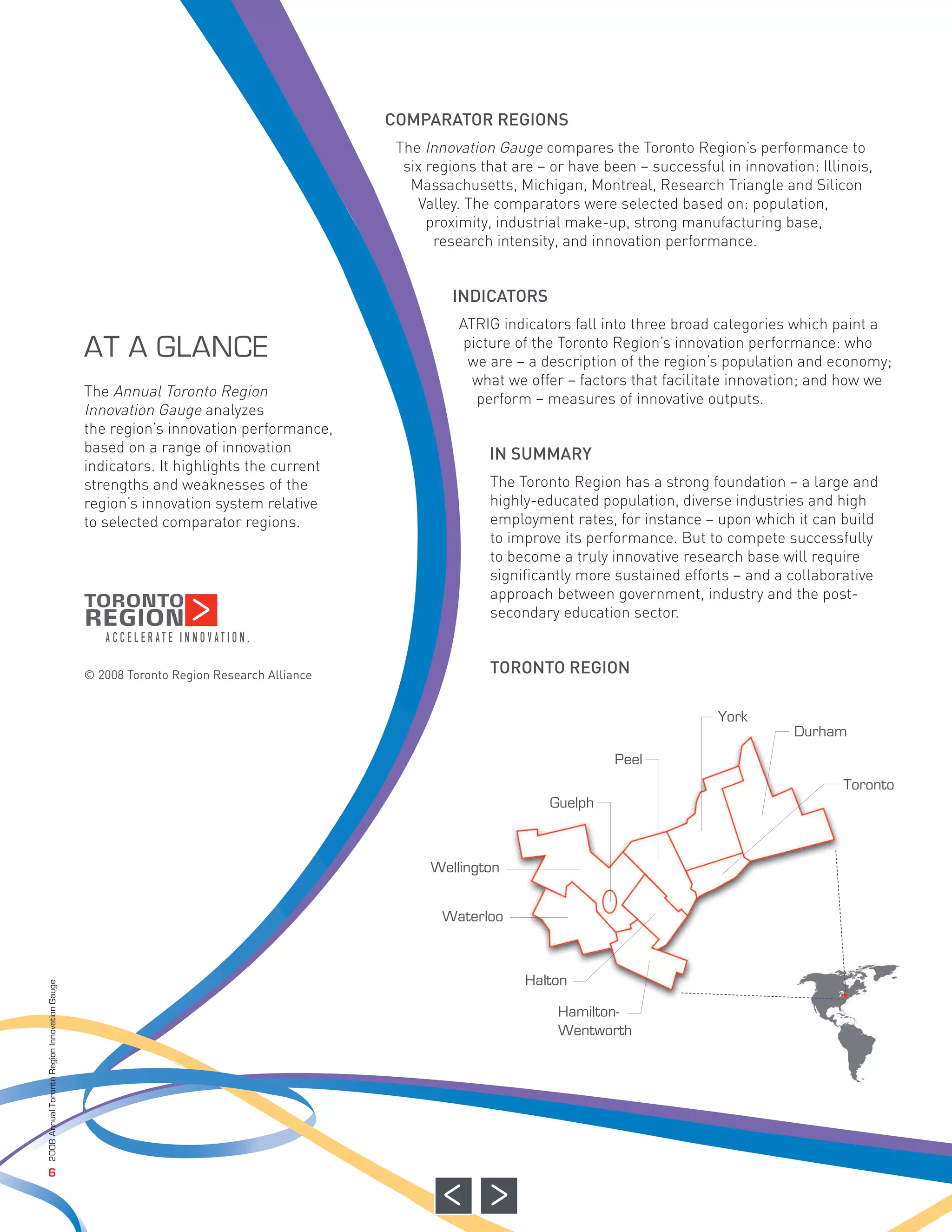
COMPARATOR REGIONS
                                                                                         The Innovation Gauge compares the Toronto Region’s performance to
                                                                                          six regions that are – or have been – successful in innovation: Illinois,
                                                                                           Massachusetts, Michigan, Montreal, Research Triangle and Silicon
                                                                                            Valley. The comparators were selected based on: population,
                                                                                              proximity, industrial make-up, strong manufacturing base,
                                                                                               research intensity, and innovation performance.


                                                                                                 INDICATORS
                                                                                                  ATRIG indicators fall into three broad categories which paint a
                                                                                                   picture of the Toronto Region’s innovation performance: who
                                                                                                    we are – a description of the region’s population and economy;
                                              The Annual Toronto Region
                                                                                                    what we offer – factors that facilitate innovation; and how we
                                              Innovation Gauge analyzes
                                                                                                     perform – measures of innovative outputs.


                                                                                                       IN SUMMARY
                                              the region’s innovation performance,
                                              based on a range of innovation
                                              indicators. It highlights the current
                                              strengths and weaknesses of the                          The Toronto Region has a strong foundation – a large and
                                              region’s innovation system relative                      highly-educated population, diverse industries and high
                                              to selected comparator regions.                          employment rates, for instance – upon which it can build
                                                                                                       to improve its performance. But to compete successfully
                                                                                                       to become a truly innovative research base will require
                                                                                                       significantly more sustained efforts – and a collaborative
                                                                                                       approach between government, industry and the post-
                                                                                                       secondary education sector.


                                              © 2008 Toronto Region Research Alliance                  TORONTO REGION
                                              AT A GLANCE


                                                                                                                                          York
                                                                                                                                                      Durham
                                                                                                                          Peel
                                                                                                                                                              Toronto
                                                                                                                Guelph


                                                                                              Wellington


                                                                                                Waterloo


                                                                                                             Halton
2008 Annual Toronto Region Innovation Gauge


                                                                                                                  Hamilton-
                                                                                                                  Wentworth


                   6
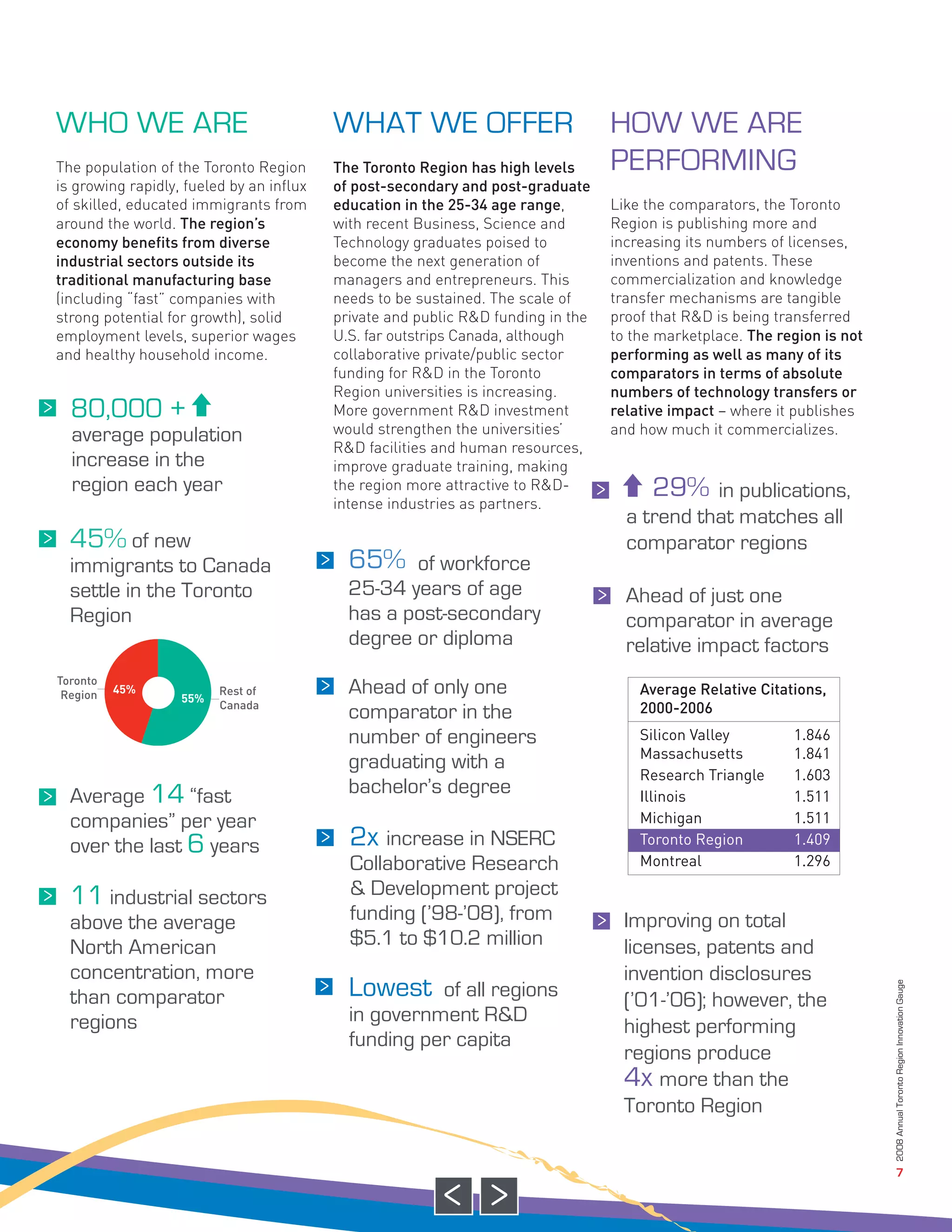
The population of the Toronto Region      The Toronto Region has high levels
is growing rapidly, fueled by an influx   of post-secondary and post-graduate
of skilled, educated immigrants from      education in the 25-34 age range,       Like the comparators, the Toronto
around the world. The region’s            with recent Business, Science and       Region is publishing more and
economy benefits from diverse             Technology graduates poised to          increasing its numbers of licenses,
industrial sectors outside its            become the next generation of           inventions and patents. These
traditional manufacturing base            managers and entrepreneurs. This        commercialization and knowledge
(including “fast” companies with          needs to be sustained. The scale of     transfer mechanisms are tangible
strong potential for growth), solid       private and public R&D funding in the   proof that R&D is being transferred
employment levels, superior wages         U.S. far outstrips Canada, although     to the marketplace. The region is not
and healthy household income.             collaborative private/public sector     performing as well as many of its
                                          funding for R&D in the Toronto          comparators in terms of absolute
                                          Region universities is increasing.      numbers of technology transfers or
                                          More government R&D investment          relative impact – where it publishes
                                          would strengthen the universities’      and how much it commercializes.
                                          R&D facilities and human resources,
                                          improve graduate training, making
                                          the region more attractive to R&D-
                                          intense industries as partners.
WHO WE ARE                                WHAT WE OFFER                           HOW WE ARE
                                                                                  PERFORMING


                                                                                      Average Relative Citations,
                                                                                      2000-2006
                                                                                      Silicon Valley        1.846
                                                                                      Massachusetts         1.841
                                                                                      Research Triangle     1.603
                                                                                      Illinois              1.511
Toronto
 Region   45%            Rest of


                                                                                      Michigan              1.511
                   55%
                         Canada


                                                                                      Toronto Region        1.409
                                                                                      Montreal              1.296
  80,000 +
  average population
  increase in the
  region each year                                                                      29%   in publications,
                                                                                    a trend that matches all
  45% of new                                                                        comparator regions
  immigrants to Canada                      65%    of workforce
  settle in the Toronto                     25-34 years of age                      Ahead of just one
  Region                                    has a post-secondary                    comparator in average
                                            degree or diploma                       relative impact factors
                                            Ahead of only one
                                            comparator in the
                                            number of engineers
                                            graduating with a
  Average 14 “fast                          bachelor’s degree
  companies” per year
  over the last 6 years                     2x increase in NSERC
                                            Collaborative Research
  11 industrial sectors                     & Development project
  above the average                         funding (’98-’08), from                Improving on total
  North American                            $5.1 to $10.2 million                  licenses, patents and
  concentration, more                                                              invention disclosures
  than comparator                           Lowest    of all regions               (’01-’06); however, the
                                                                                                                          2008 Annual Toronto Region Innovation Gauge


  regions                                   in government R&D
                                                                                   highest performing
                                            funding per capita
                                                                                   regions produce
                                                                                   4x more than the
                                                                                   Toronto Region

                                                                                                                                             7
8
2008 Annual Toronto Region Innovation Gauge


                                              WHO WE ARE
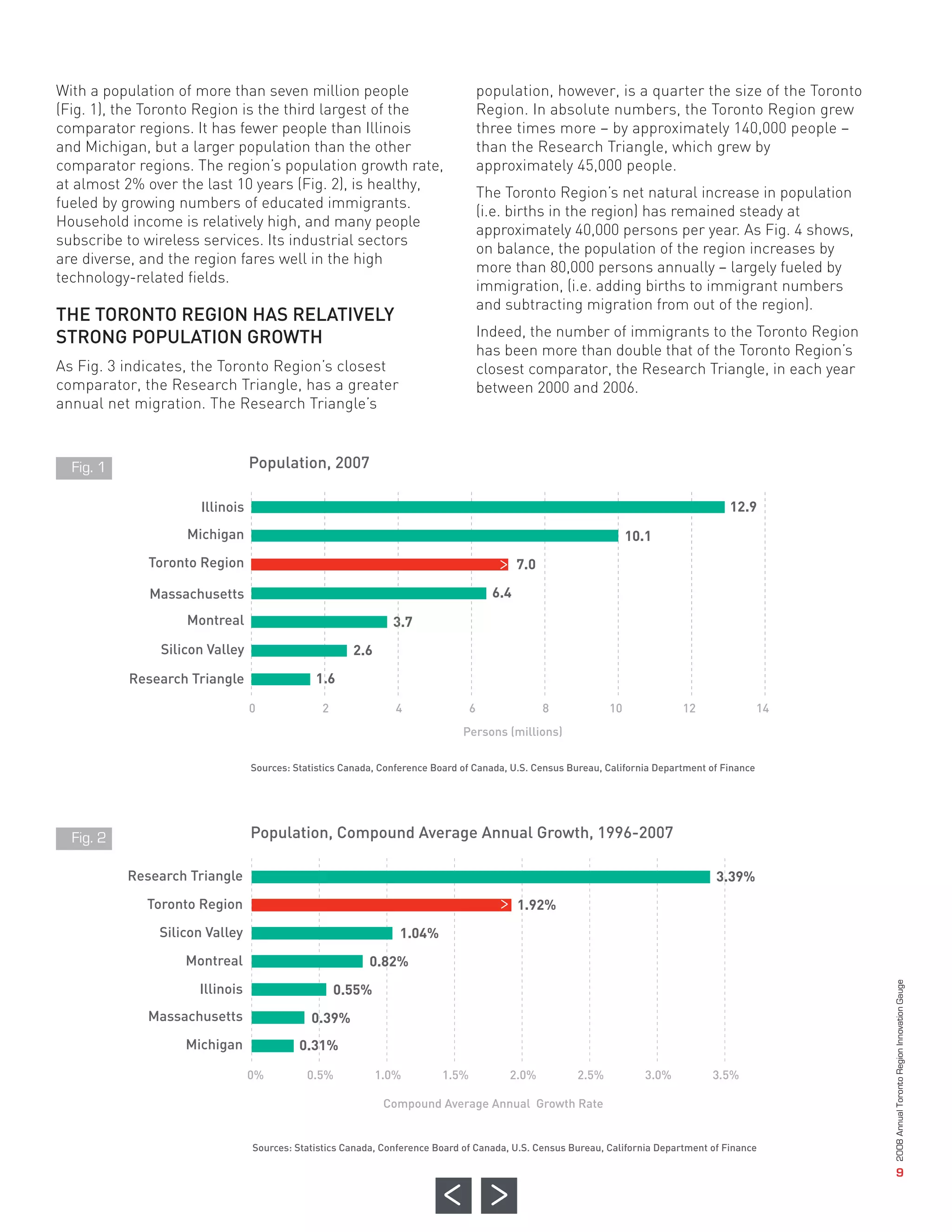
With a population of more than seven million people                                population, however, is a quarter the size of the Toronto
(Fig. 1), the Toronto Region is the third largest of the                           Region. In absolute numbers, the Toronto Region grew
comparator regions. It has fewer people than Illinois                              three times more – by approximately 140,000 people –
and Michigan, but a larger population than the other                               than the Research Triangle, which grew by
comparator regions. The region’s population growth rate,                           approximately 45,000 people.
at almost 2% over the last 10 years (Fig. 2), is healthy,
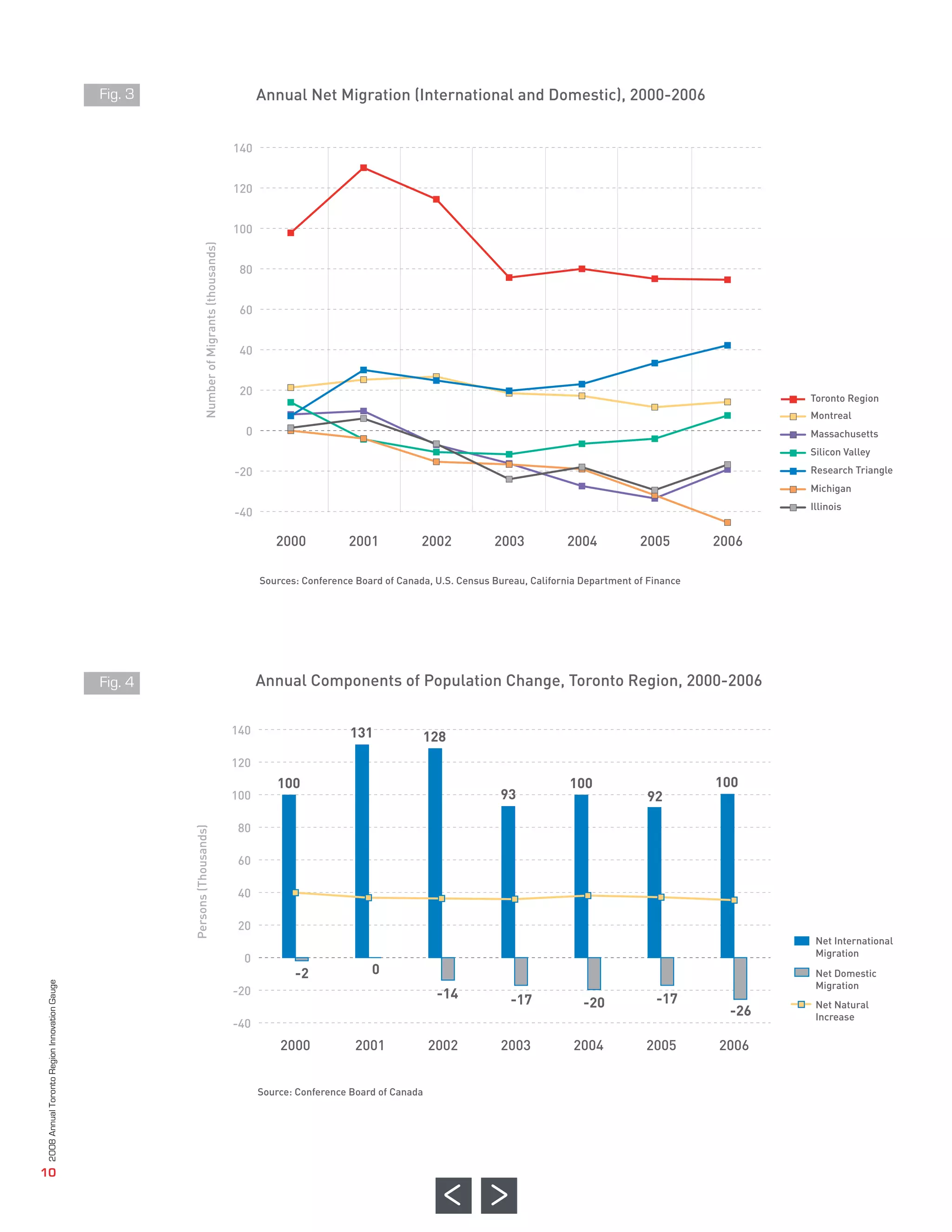
                                                                                   The Toronto Region’s net natural increase in population
fueled by growing numbers of educated immigrants.
                                                                                   (i.e. births in the region) has remained steady at


THE TORONTO REGION HAS RELATIVELY
Household income is relatively high, and many people
                                                                                   approximately 40,000 persons per year. As Fig. 4 shows,


STRONG POPULATION GROWTH
subscribe to wireless services. Its industrial sectors
                                                                                   on balance, the population of the region increases by
are diverse, and the region fares well in the high
                                                                                   more than 80,000 persons annually – largely fueled by
technology-related fields.
                                                                                   immigration, (i.e. adding births to immigrant numbers
                                                                                   and subtracting migration from out of the region).
                                                                                   Indeed, the number of immigrants to the Toronto Region
                                                                                   has been more than double that of the Toronto Region’s
As Fig. 3 indicates, the Toronto Region’s closest                                  closest comparator, the Research Triangle, in each year
comparator, the Research Triangle, has a greater                                   between 2000 and 2006.
annual net migration. The Research Triangle’s


                                Population, 2007

                     Illinois                                                                                                         12.9
                   Michigan                                                                                      10.1
              Toronto Region                                                               7.0

              Massachusetts                                                          6.4
                   Montreal                                   3.7
               Silicon Valley                        2.6

           Research Triangle                 1.6


                                Population, Compound Average Annual Growth, 1996-2007
                                0              2               4               6                 8          10              12                 14
                                                                             Persons (millions)


           Research Triangle                                                                                                       3.39%
                                Sources: Statistics Canada, Conference Board of Canada, U.S. Census Bureau, California Department of Finance
  Fig. 1


             Toronto Region                                                                1.92%
               Silicon Valley                                  1.04%
                   Montreal                              0.82%
                     Illinois                      0.55%
              Massachusetts                 0.39%
                   Michigan               0.31%

                                0%          0.5%           1.0%         1.5%           2.0%          2.5%           3.0%          3.5%

                                                            Compound Average Annual Growth Rate
  Fig. 2


                                Sources: Statistics Canada, Conference Board of Canada, U.S. Census Bureau, California Department of Finance
                                                                                                                                                    2008 Annual Toronto Region Innovation Gauge


                                                                                                                                                                       9
Annual Net Migration (International and Domestic), 2000-2006


                                                                       140


                                                                       120


                                                                       100


                                                                        80


                                                                        60


                                                                        40


                                                                        20


                                                                         0
                                                                                                                                                                                 Toronto Region
                                                              Fig. 3


                                                                       -20


                                                                                2000           2001            2002           2003           2004            2005        2006
                                                                                                                                                                                 Montreal
                                                                                                                                                                                 Massachusetts


                                                                       -40
                                                                                                                                                                                 Silicon Valley
                                                                                                                                                                                 Research Triangle


                                                                             Annual Components of Population Change, Toronto Region, 2000-2006
                                                                                                                                                                                 Michigan
                                                                                                                                                                                 Illinois
Number of Migrants (thousands)


                                                                             Sources: Conference Board of Canada, U.S. Census Bureau, California Department of Finance


                                                                                                131            128


                                                                                 100                                                          100                        100
                                                                                                                               93
                                                                       140


                                                                                                                                                              92
                                                                       120

                                                                       100

                                                                       80

                                                                       60

                                                                       40


                                                                                    -2              0
                                                                       20


                                                                                                                   -14            -17                           -17
                                                                                                                                                 -20
                                                                                                                                                                           -26
                                                                        0


                                                                                 2000            2001             2002         2003            2004           2005       2006
                                                                       -20
                                                                                                                                                                                  Net International
                                                                                                                                                                                  Migration


                                                                       -40
                                                                                                                                                                                  Net Domestic
                                                                                                                                                                                  Migration
                                                              Fig. 4


                                                                                                                                                                                  Net Natural
                                                                                                                                                                                  Increase


                                                                             Source: Conference Board of Canada
Persons (Thousands)
                2008 Annual Toronto Region Innovation Gauge


                   10
MOST IMMIGRANTS ENTER THE REGION AS
                       HIGHLY-EDUCATED WORKERS
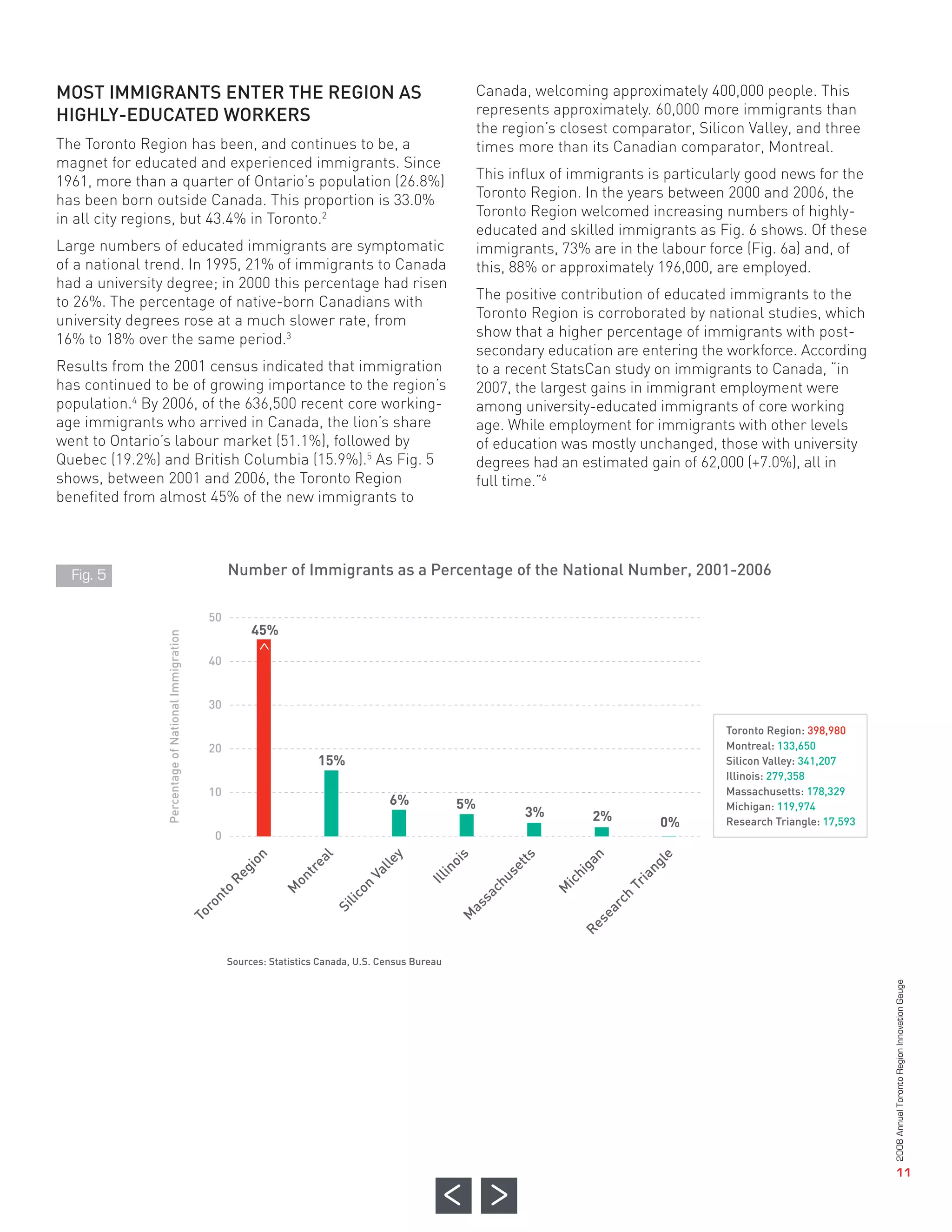
                                                                                                        Canada, welcoming approximately 400,000 people. This
                                                                                                        represents approximately. 60,000 more immigrants than
                                                                                                        the region’s closest comparator, Silicon Valley, and three
                       The Toronto Region has been, and continues to be, a                              times more than its Canadian comparator, Montreal.
                       magnet for educated and experienced immigrants. Since
                       1961, more than a quarter of Ontario’s population (26.8%)                        This influx of immigrants is particularly good news for the
                       has been born outside Canada. This proportion is 33.0%                           Toronto Region. In the years between 2000 and 2006, the
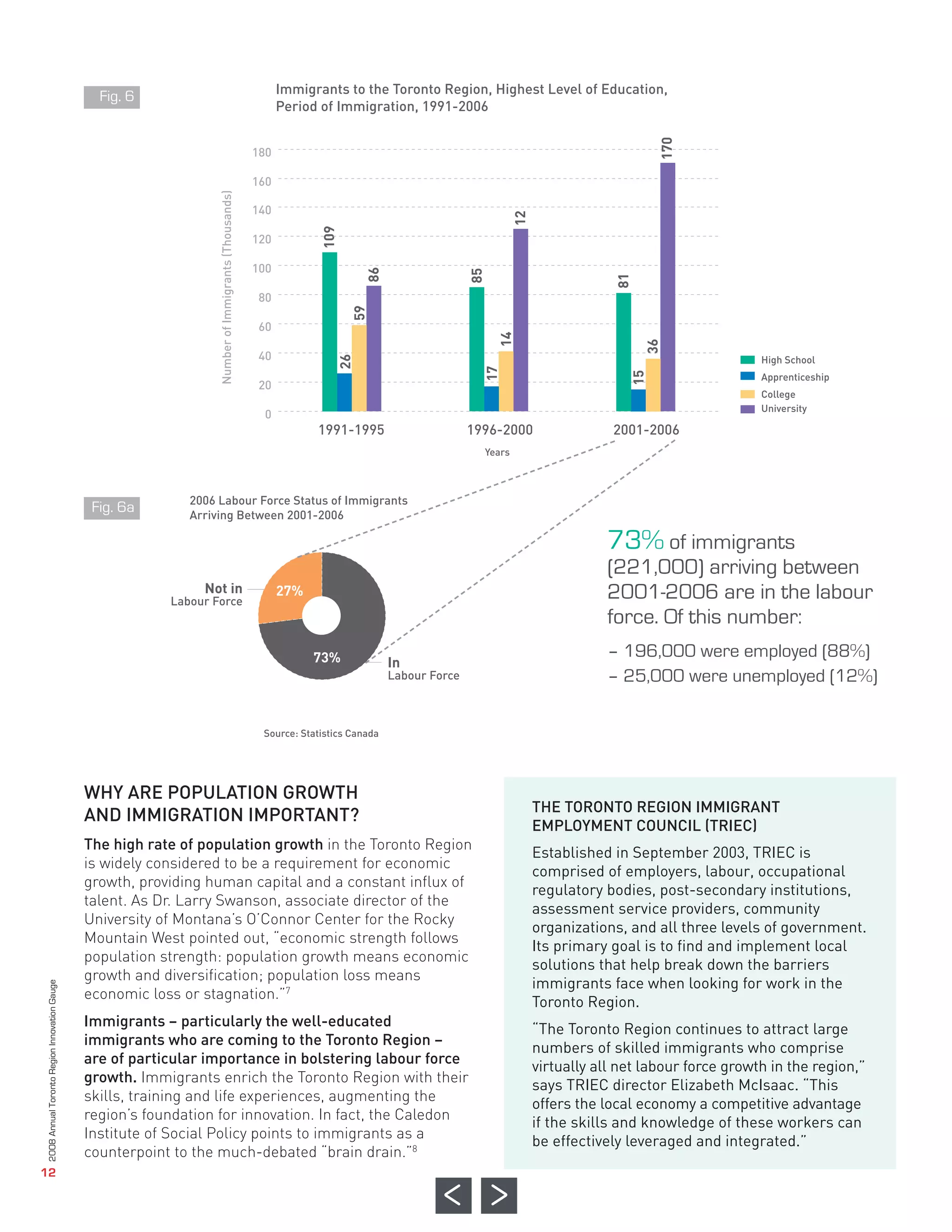
                       in all city regions, but 43.4% in Toronto.2                                      Toronto Region welcomed increasing numbers of highly-
                                                                                                        educated and skilled immigrants as Fig. 6 shows. Of these
                       Large numbers of educated immigrants are symptomatic                             immigrants, 73% are in the labour force (Fig. 6a) and, of
                       of a national trend. In 1995, 21% of immigrants to Canada                        this, 88% or approximately 196,000, are employed.
                       had a university degree; in 2000 this percentage had risen
                       to 26%. The percentage of native-born Canadians with                             The positive contribution of educated immigrants to the
                       university degrees rose at a much slower rate, from                              Toronto Region is corroborated by national studies, which
                       16% to 18% over the same period.3                                                show that a higher percentage of immigrants with post-
                                                                                                        secondary education are entering the workforce. According
                       Results from the 2001 census indicated that immigration                          to a recent StatsCan study on immigrants to Canada, “in
                       has continued to be of growing importance to the region’s                        2007, the largest gains in immigrant employment were
                       population.4 By 2006, of the 636,500 recent core working-                        among university-educated immigrants of core working
                       age immigrants who arrived in Canada, the lion’s share                           age. While employment for immigrants with other levels
                       went to Ontario’s labour market (51.1%), followed by                             of education was mostly unchanged, those with university
                       Quebec (19.2%) and British Columbia (15.9%).5 As Fig. 5                          degrees had an estimated gain of 62,000 (+7.0%), all in
                       shows, between 2001 and 2006, the Toronto Region                                 full time.”6
                       benefited from almost 45% of the new immigrants to


                                                  Number of Immigrants as a Percentage of the National Number, 2001-2006


                                                       45%
                                             50


                                             40


                                                                     15%
                                             30


                                                                                    6%             5%
                                                                                                               3%
                                             20


                                                                                                                         2%        0%
                                                                                                                                             Toronto Region: 398,980
                                                                                                                                             Montreal: 133,650


                                             10
                                                                                                                                             Silicon Valley: 341,207
                                                                                                                                             Illinois: 279,358
                                                                                                                                             Massachusetts: 178,329


                                              0
                                                                                                                                             Michigan: 119,974
                                                                                                                                             Research Triangle: 17,593
                         Fig. 5
Percentage of National Immigration


                                                  Sources: Statistics Canada, U.S. Census Bureau
 n


         al


                y


                  is


                         tts


                                  n


                                            le
             lle
     o


                                     a
                       o


                                             ng
      re


                                  ig
  gi


                       se
                    in
           Va
       t


                                  h
Re


                                           ia
    on


                Ill


                      hu


                               ic


                                        Tr
            on


                              M
    M
      o


                         c
                      sa
    nt


                                        h
         lic


                                     rc
  ro


                    as
        Si


                                      a
To


                   M


                                    se
                                  Re


                                                                                                                                                                         2008 Annual Toronto Region Innovation Gauge


                                                                                                                                                                                            11
Immigrants to the Toronto Region, Highest Level of Education,
                                                                                               Period of Immigration, 1991-2006


                                                                                         180

                                                                                         160

                                                                                         140

                                                                                         120

                                                                                         100

                                                                                         80

                                                                                         60

                                                                                         40


                                                                                                     1991-1995                       1996-2000             2001-2006
                                                                                         20

                                                                                          0
                                                                                                                                                                                   High School
                                                                                                                                                                                   Apprenticeship
                                                                                                                                                                                   College
                                                                Fig. 6


                                                                                                                                                                                   University


                                                                             2006 Labour Force Status of Immigrants                                        2
                                                                             Arriving Between 2001-2006
                                                                                                                                       Years


                                                                               Not in          27%


                                                                                170


                                                              WHY ARE POPULATION GROWTH
Number of Immigrants (Thousands)


                                                                                                     73%              In
                                                                          Labour Force


                                                              AND IMMIGRATION IMPORTANT?
                                                              12
  109


      86


              85


                                                                         81


                                                                                                                      Labour Force


                                                                                                                                               THE TORONTO REGION IMMIGRANT
     59


                                                                                                                                               EMPLOYMENT COUNCIL (TRIEC)
                                14


                                                                             36


                                                              The high rate of population growth in the Toronto Region
                                                                                                                                               Established in September 2003, TRIEC is
    26


                                                              is widely considered to be a requirement for economic
                17


                                                                                                                                               comprised of employers, labour, occupational
                                                                           15


                                                              growth, providing human capital and a constant influx of
                                                                                                                                               regulatory bodies, post-secondary institutions,
                                                              talent. As Dr. Larry Swanson, associate director of the
                                                                                                                                               assessment service providers, community
                                                                                          Source: Statistics Canada


                                                              University of Montana’s O’Connor Center for the Rocky
                                                                                                                                               organizations, and all three levels of government.
                                                              Mountain West pointed out, “economic strength follows
                                                                                                                                               Its primary goal is to find and implement local
                                                              population strength: population growth means economic
                                                                                                                                               solutions that help break down the barriers
                                                              growth and diversification; population loss means
                                                                                                                                               immigrants face when looking for work in the
                                                               Fig. 6a


                                                              economic loss or stagnation.”7
                                                                                                                                               Toronto Region.
                                                                                                                                                          73% of immigrants


                                                              Immigrants – particularly the well-educated
                                                                                                                                               “The Toronto Region continues to attract large
                                                                                                                                                          (221,000) arriving between


                                                              immigrants who are coming to the Toronto Region –
                                                                                                                                               numbers of skilled immigrants who comprise
                                                              are of particular importance in bolstering labour force
                                                                                                                                                          2001-2006 are in the labour


                                                                                                                                               virtually all net labour force growth in the region,”
                                                              growth. Immigrants enrich the Toronto Region with their
                                                                                                                                               says TRIEC director Elizabeth McIsaac. “This
                                                                                                                                                          force. Of this number:


                                                              skills, training and life experiences, augmenting the
                                                                                                                                               offers the local economy a competitive advantage
                                                              region’s foundation for innovation. In fact, the Caledon
                                                                                                                                               if the skills and knowledge of these workers can
                                                                                                                                                          – 196,000 were employed (88%)


                                                              Institute of Social Policy points to immigrants as a
                                                                                                                                               be effectively leveraged and integrated.”
                                                              counterpoint to the much-debated “brain drain.”8
                                                                                                                                                          – 25,000 were unemployed (12%)
                2008 Annual Toronto Region Innovation Gauge


                   12
Immigrants also add what one researcher calls “knowledge
           spillover,” the learning and transfer of knowledge between                                       ENCOURAGING IMMIGRATION OF SKILLED AND
           individuals and firms that precedes innovation.                                                  EDUCATED WORKERS
           “Innovations occur when individuals with high degrees                                            • Ontario now has an uncapped number of work
           of existing creativity or knowledge make new and novel                                             permits available to foreign workers. For intra-
           combinations of this knowledge with new insights observed                                          company transfers, the process is fast and
           or learned through spillovers,” say Brian Knudsen, Richard                                         straightforward: transferees can quickly obtain
           Florida, Gary Gates, and Kevin Stolarick in Urban Density,                                         a work permit for up to seven years.
           Creativity, and Innovation. They go on to point out that such                                      (www.cic.investinontario.com/bi)
           spillovers occur “when one individual’s creativity is
           transferred to another individual or firm. These creative                                        • Ontario’s Provincial Nominee Program, an
           spillovers are in part believed to arise due to frequent                                           expedited permanent resident visa program,
           face-to-face interactions and communication                                                        allows employers to permanently recruit high-
           between individuals.”9                                                                             end research staff and other workers within
                                                                                                              defined occupations.
           Is the Toronto Region taking full advantage of this                                                (www.ontarioimmigration.ca/english/pnp.asp)
           latent potential?
                                                                                                            • The 2007 federal budget created a Foreign
           Recognition of immigrants’ credentials has been a                                                  Credential Recognition office (which has,
           stumbling block in the past. According to data from                                                however, so far limited itself to giving referrals
           Status of Women Canada, just over half of foreign-trained                                          to appropriate provincial offices).*
           professionals are working in professions or trades three
           years after immigrating.10 In addition, the human capital                                        • In November 2007, Ottawa announced
           of increasing number of immigrants from eastern                                                    expanded foreign credential referral services
           Europe, south, east and west Asia and Africa who are                                               in India and China that offer orientation


           EMPLOYMENT IN KEY INDUSTRIAL
           now arriving (rising from 35% in 1981 to 72% in 2001)                                              sessions for potential immigrants.*


           SECTORS IS STRONG
           “may initially be less transferable due to potential issues
           regarding language, cultural differences, education
           quality, and possibly discrimination.”11


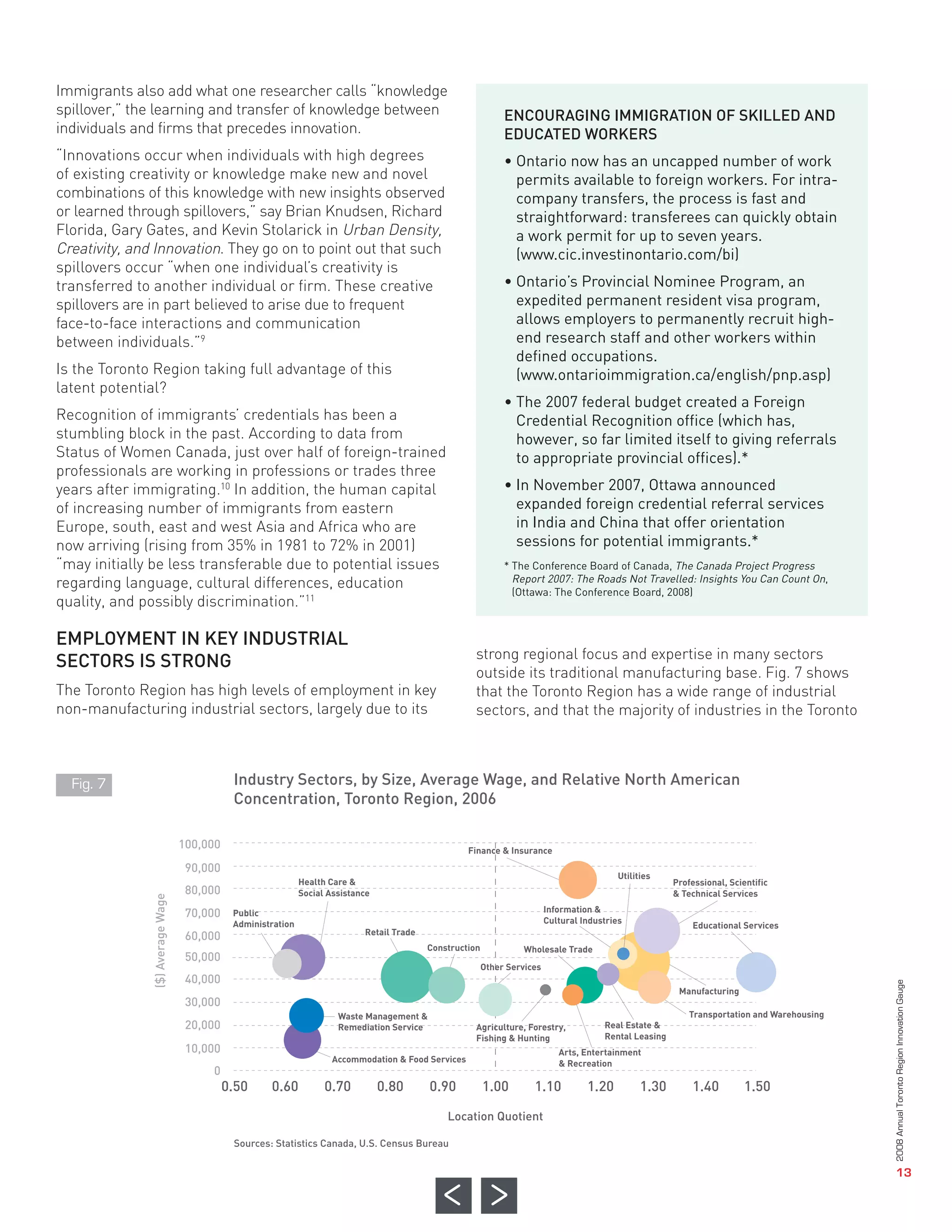
                                                                                                   strong regional focus and expertise in many sectors
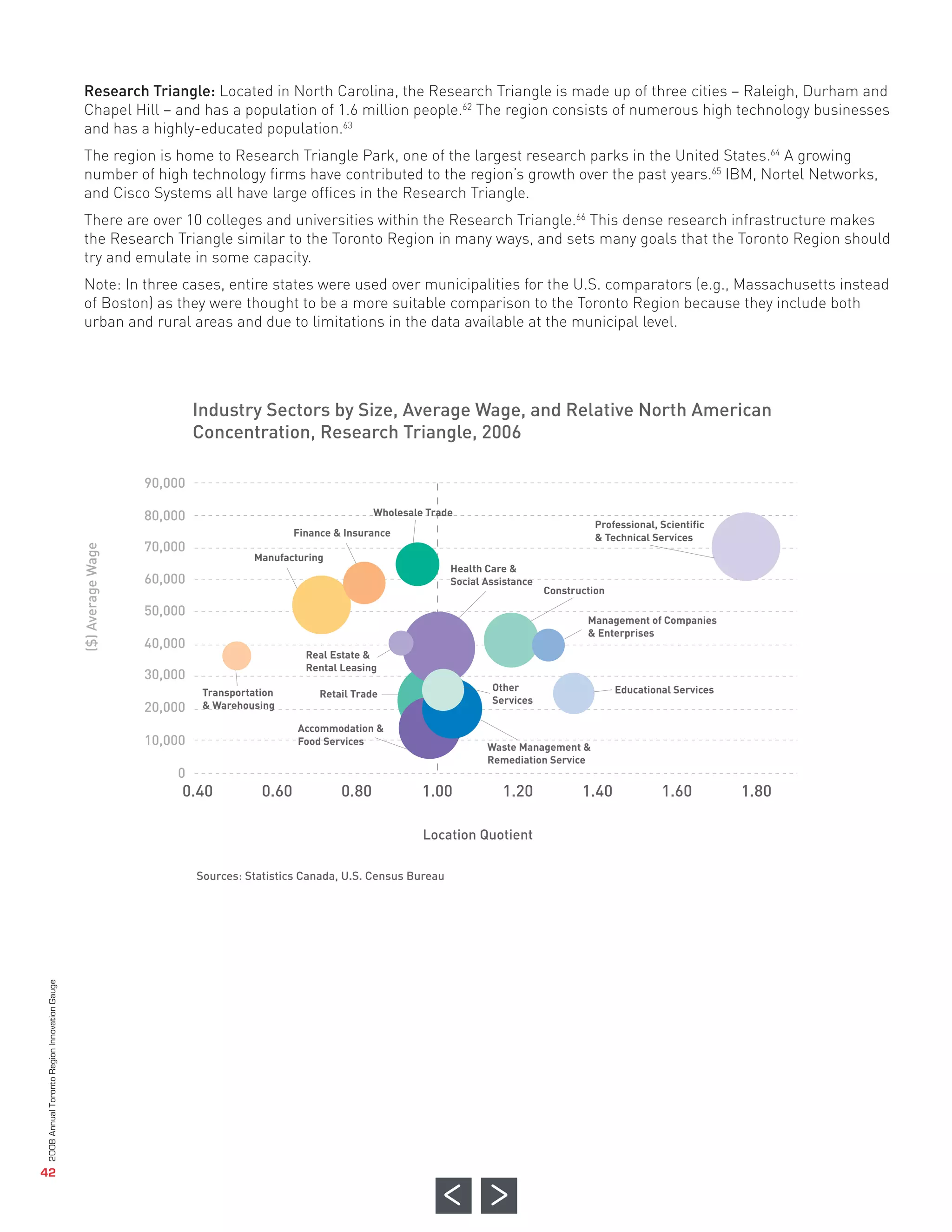
                                                                                                   outside its traditional manufacturing base. Fig. 7 shows
           The Toronto Region has high levels of employment in key                                 that the Toronto Region has a wide range of industrial
           non-manufacturing industrial sectors, largely due to its
                                                                                                            * The Conference Board of Canada, The Canada Project Progress


                                                                                                   sectors, and that the majority of industries in the Toronto
                                                                                                              Report 2007: The Roads Not Travelled: Insights You Can Count On,
                                                                                                              (Ottawa: The Conference Board, 2008)


                                         Industry Sectors, by Size, Average Wage, and Relative North American
                                         Concentration, Toronto Region, 2006

                              100,000
                               90,000
                               80,000
                               70,000
                               60,000
                                                                                                  Finance & Insurance


                               50,000
                                                                                                                                          Utilities


                               40,000
                                                          Health Care &                                                                                Professional, Scientific
                                                          Social Assistance                                                                            & Technical Services


                               30,000
                                         Public                                                                         Information &
                                                                                                                        Cultural Industries


                                        0.50     0.60           0.70          0.80       0.90          1.00        1.10           1.20          1.30       1.40         1.50
                                         Administration                                                                                                    Educational Services


                               20,000
                                                                         Retail Trade
                                                                                        Construction            Wholesale Trade


                               10,000
                                                                                                       Other Services


                                   0
                                                                                                                                                        Manufacturing

                                                                   Waste Management &                                                                      Transportation and Warehousing


                                                                                            Location Quotient
                                                                   Remediation Service             Agriculture, Forestry,             Real Estate &
                                                                                                   Fishing & Hunting                  Rental Leasing
                                                                                                                           Arts, Entertainment
             Fig. 7


                                                                  Accommodation & Food Services                            & Recreation


                                         Sources: Statistics Canada, U.S. Census Bureau
($) Average Wage


                                                                                                                                                                                            2008 Annual Toronto Region Innovation Gauge


                                                                                                                                                                                                               13
Region are performing better than in the rest of Canada.
                                              The X-axis of this graph shows its Location Quotient (LQ) –
                                              the employment concentration of industry clusters in the
                                              Toronto Region compared to the same industry clusters
                                              across North America. Industries with a LQ of one are
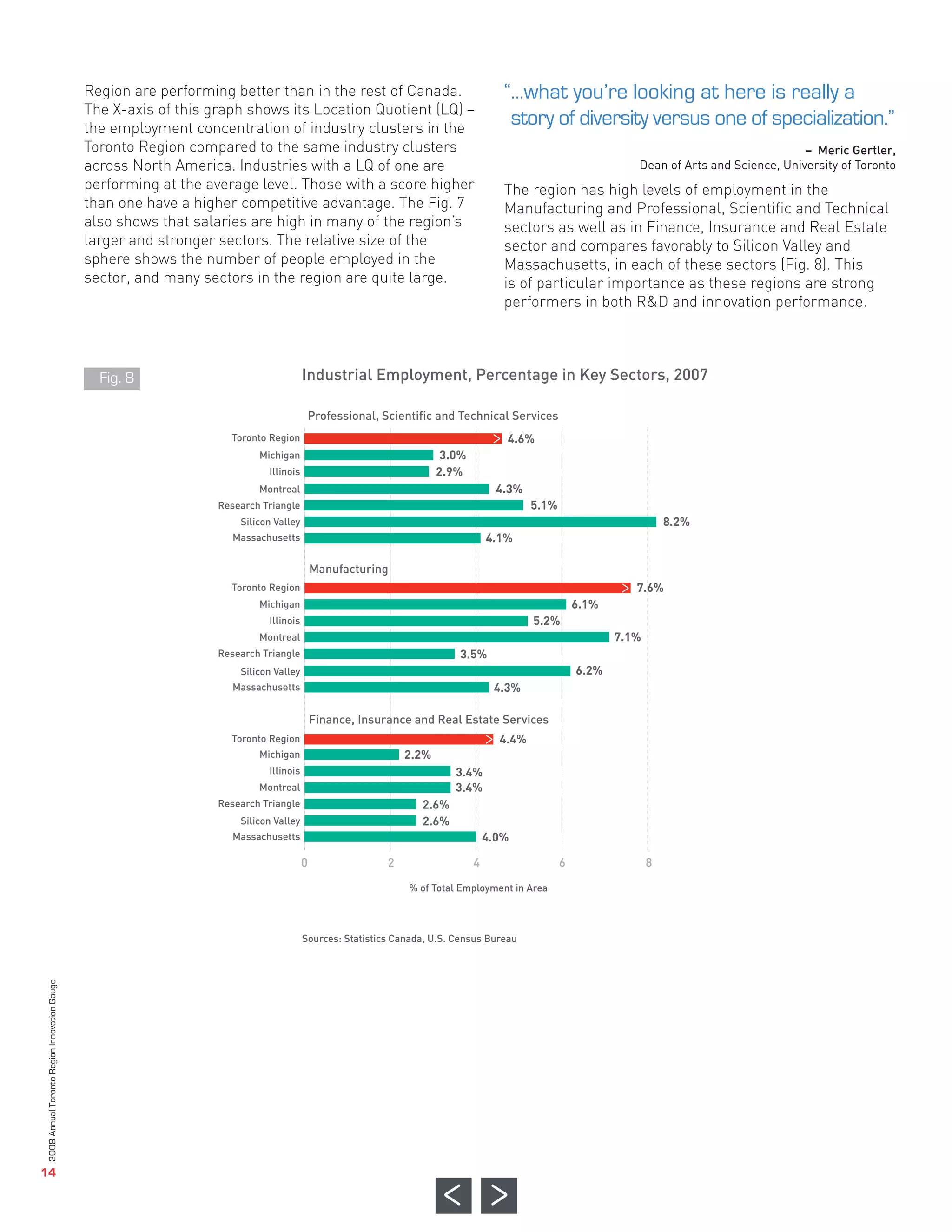
                                              performing at the average level. Those with a score higher                           The region has high levels of employment in the
                                              than one have a higher competitive advantage. The Fig. 7                             Manufacturing and Professional, Scientific and Technical
                                              also shows that salaries are high in many of the region’s                            sectors as well as in Finance, Insurance and Real Estate
                                              larger and stronger sectors. The relative size of the                                sector and compares favorably to Silicon Valley and
                                                                                                                                                                                            – Meric Gertler,


                                              sphere shows the number of people employed in the                                    Massachusetts, in each of these sectors (Fig. 8). This
                                                                                                                                                              Dean of Arts and Science, University of Toronto


                                              sector, and many sectors in the region are quite large.                              is of particular importance as these regions are strong
                                                                                                                                   performers in both R&D and innovation performance.


                                                                                       Industrial Employment, Percentage in Key Sectors, 2007

                                                                                        Professional, Scientific and Technical Services
                                                                                                                                   4.6%
                                                                                                                                   “…what you’re looking at here is really a


                                                                                                                     3.0%
                                                                                                                    2.9%
                                                                                                                                    story of diversity versus one of specialization.”


                                                                                                                                  4.3%
                                                                    Toronto Region


                                                                                                                                         5.1%
                                                                          Michigan


                                                                                                                                                                      8.2%
                                                                            Illinois


                                                                                                                                4.1%
                                                                          Montreal


                                                                                           Manufacturing
                                                                  Research Triangle
                                                                      Silicon Valley


                                                                                                                                                              7.6%
                                                                     Massachusetts


                                                                                                                                                    6.1%
                                                                                                                                         5.2%
                                                                                                                                                           7.1%
                                                                    Toronto Region


                                                                                                                        3.5%
                                                                          Michigan


                                                                                                                                                    6.2%
                                                                            Illinois


                                                                                                                                 4.3%
                                                                          Montreal
                                                                  Research Triangle


                                                                                           Finance, Insurance and Real Estate Services
                                                                      Silicon Valley


                                                                                                                                  4.4%
                                                Fig. 8


                                                                     Massachusetts


                                                                                                             2.2%
                                                                                                                       3.4%
                                                                                                                       3.4%
                                                                    Toronto Region


                                                                                                                2.6%
                                                                          Michigan


                                                                                                                2.6%
                                                                            Illinois


                                                                                                                                4.0%
                                                                          Montreal


                                                                                       0                 2                  4                   6                 8
                                                                  Research Triangle
                                                                      Silicon Valley
                                                                     Massachusetts


                                                                                                             % of Total Employment in Area


                                                                                       Sources: Statistics Canada, U.S. Census Bureau
2008 Annual Toronto Region Innovation Gauge


   14
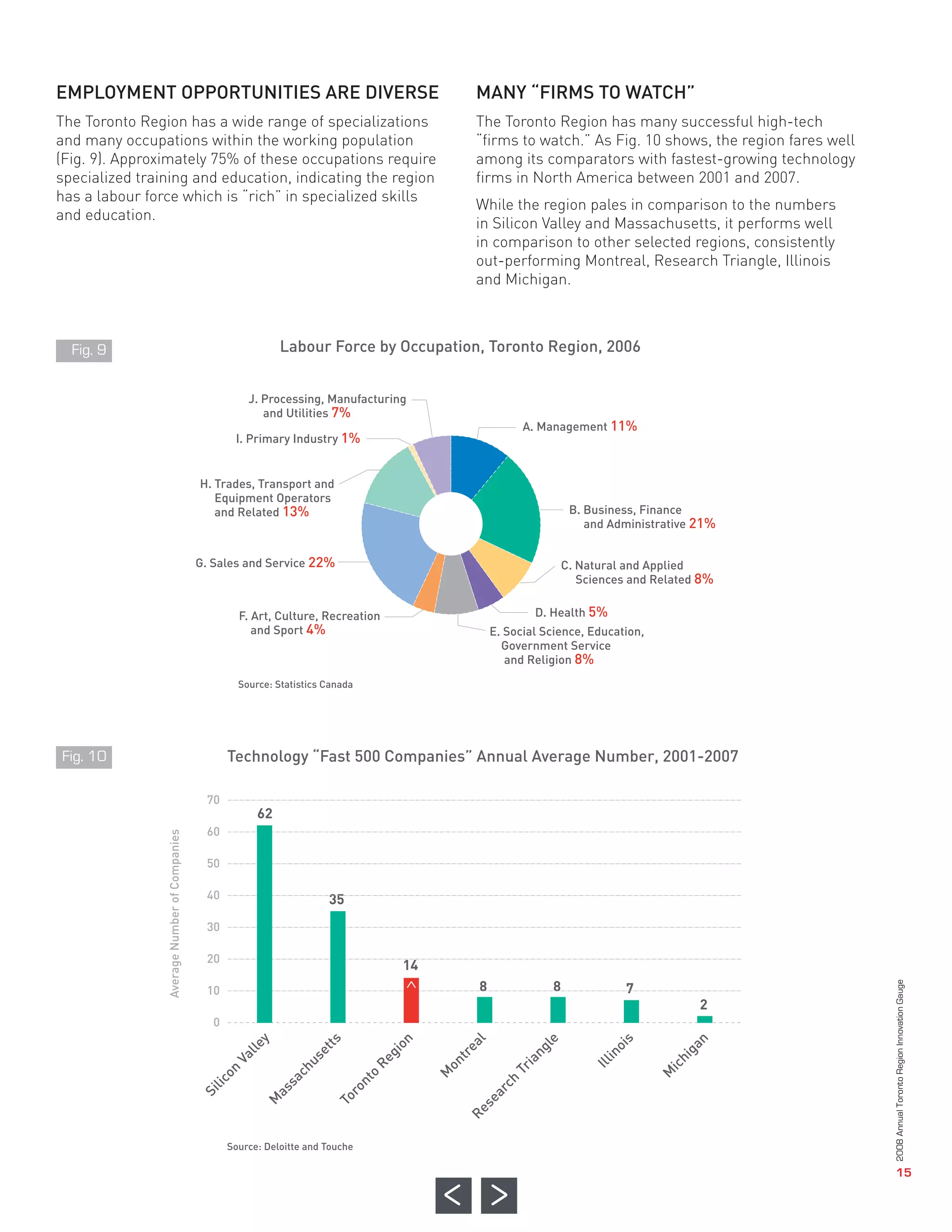
EMPLOYMENT OPPORTUNITIES ARE DIVERSE                            MANY “FIRMS TO WATCH”
                  The Toronto Region has a wide range of specializations          The Toronto Region has many successful high-tech
                  and many occupations within the working population              “firms to watch.” As Fig. 10 shows, the region fares well
                  (Fig. 9). Approximately 75% of these occupations require        among its comparators with fastest-growing technology
                  specialized training and education, indicating the region       firms in North America between 2001 and 2007.
                  has a labour force which is “rich” in specialized skills
                                                                                  While the region pales in comparison to the numbers
                  and education.
                                                                                  in Silicon Valley and Massachusetts, it performs well
                                                                                  in comparison to other selected regions, consistently
                                                                                  out-performing Montreal, Research Triangle, Illinois
                                                                                  and Michigan.


                                                        Labour Force by Occupation, Toronto Region, 2006


                                                    and Utilities 7%
                                                                                            A. Management 11%
                                              I. Primary Industry 1%
                                                 J. Processing, Manufacturing


                                          and Related 13%
                                                                                                         and Administrative 21%
                                       H. Trades, Transport and


                                      G. Sales and Service 22%
                                          Equipment Operators
                                                                                                      B. Business, Finance


                                                                                                        Sciences and Related 8%

                                                                                              D. Health 5%
                                                  and Sport 4%
                                                                                                     C. Natural and Applied


                                                                                         and Religion 8%
                                               F. Art, Culture, Recreation


                                             Technology “Fast 500 Companies” Annual Average Number, 2001-2007
                                                                                      E. Social Science, Education,
                                                                                        Government Service
                    Fig. 9


                                                   62
                                               Source: Statistics Canada


                                        70

                                        60


                                                                  35
                                        50

                                        40


                                                                             14
                                                                                  8              8              7
                                        30


                                                                                                                            2
                                        20

                                        10

                                         0
                   Fig. 10


                                             Source: Deloitte and Touche
Average Number of Companies


                                                                                                                                              2008 Annual Toronto Region Innovation Gauge
  y


      ts


             on


                 al


                        e


                                  is


                                                n
le


                      gl


                                             ga
                                  o
     et


               re
           gi
   l


                               in
                       n
Va


                                           hi
         us


                 t
         Re


                    ia
              on


                              Ill


                                         ic
                  Tr
       ch
   on


                                        M
             M
             o
    sa


           nt


                   h
lic


                 rc
         ro
  as
Si


                   a
      To
  M


                 se
               Re


                                                                                                                                                                 15
Median Household Income, Constant 2006 USD, 2000 and 2006


                                                                            80


                                                                            60


                                                                            40


                                                                            20


                                                     WHY IS A DIVERSE ECONOMY IMPORTANT?                                             WHY IS HOUSEHOLD INCOME IMPORTANT?
                                                                                                                                                                                       2000
                                                                                                                                                                                       2006
                                                     Fig. 11


                                                     Diversity in the Toronto Region industry and multiple                           Good household income is a sign of overall economic
   78.8


                                                     employment sectors has contributed to stronger                                  prosperity and can act as an indicator of innovation.


                                                                                                                                     WIRELESS SUBSCRIBER RATE IS HIGH
73.3


                                                     population growth than in areas that are heavily reliant                        The Toronto Region ranks high in this category, likely


                                                                                                                                     ACROSS THE REGION
                                                     on a manufacturing base. Furthermore, the region’s                              due to its diverse industrial sectors, relatively low
                                                                                 Sources: Statistics Canada, U.S. Census Bureau, U.S. Department of Labor-Bureau of Labor Statistics


                                                     diverse areas of specialization add economic stability.                         unemployment rate, and the consistent growth in
                                                     Because the Toronto Region is not dependent upon one                            its economy since the early 1990s.
   56.2


                                                             54.4


                                                                                    53.6
  53.4


                                                     sector, its economy may not be as vulnerable when one
      50.5
($) Thousands


                         50.3
     49.3


                                                          49.3
                        48.8


                                                                                 47.1
                                                     sector is suffering, because others are available to
                                                     support the economy.
                                                                       38.9


                                                     HOUSEHOLD INCOME GROWTH IS HEALTHY
                                                                     34.9


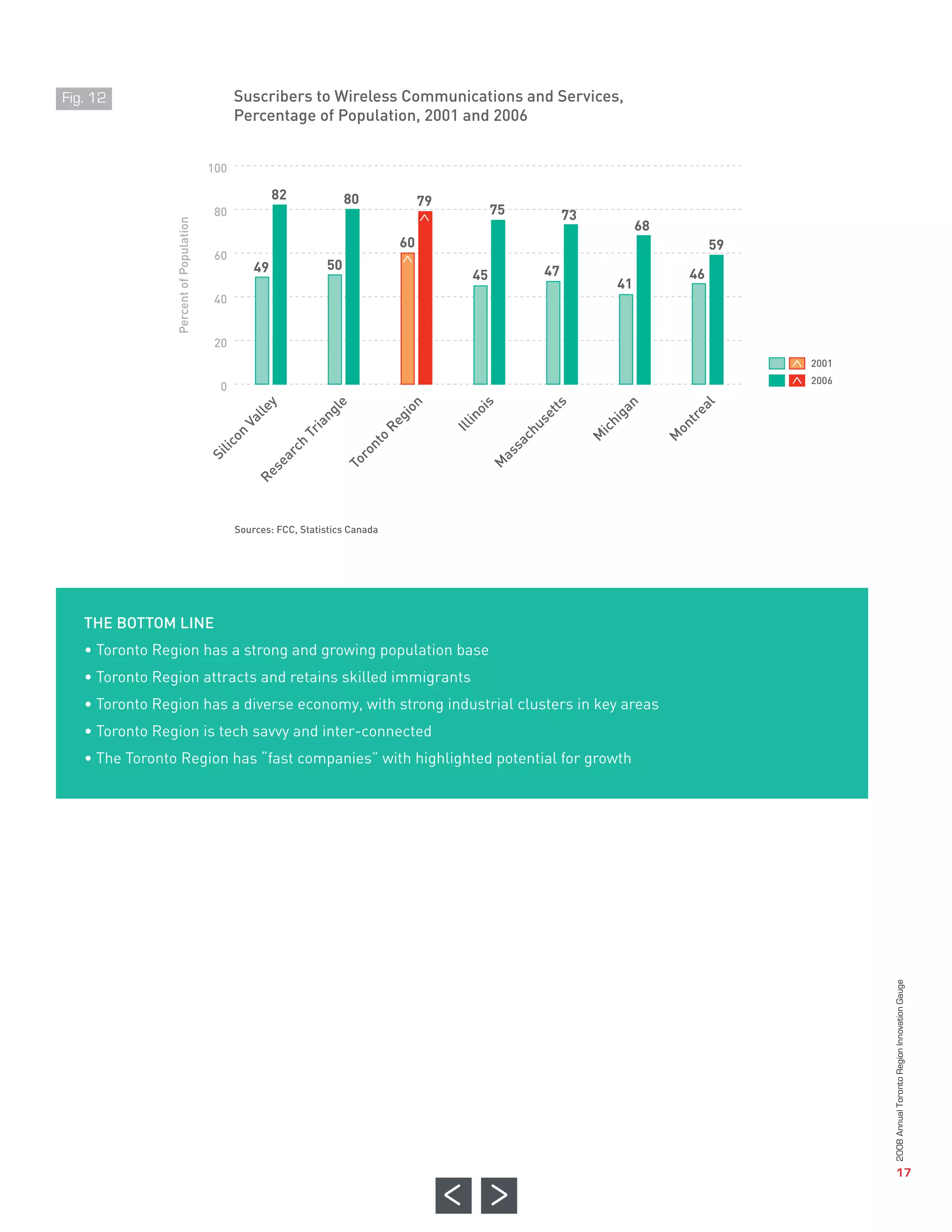
                                                     Many strong industrial sectors indicate that the Toronto                        The Toronto Region is keeping up with or is on par with
                                                     Region is doing an excellent job of maintaining and                             the comparator regions with respect to number of
                                                     growing non-manufacturing related industries and                                subscribers to wireless communications and services
                                                     supplying the human capital required for these jobs.                            (Fig. 12). Since 2001, however, the region has fallen
                                                                                                                                     behind relative to its comparators. In 2001, the Toronto


                                                                                                                                     WHY IS WIRELESS SUBSCRIPTION IMPORTANT?
     y


       ts


     on


                                 le


                                                          is


                                                                      al


                                                                                   n


                                                                                                                                     Region had the highest number of subscribers, with a
  lle


                                                                                 ga
                                                         no
           ng
    et


                                                                    re
      gi
Va


                                                                              hi
  us


                                                                     t
                                                           i
    Re


         ia


                                                                                                                                     10% advantage over its closest comparators, Silicon
                                                                  on
                                                       Ill


                                                                            ic


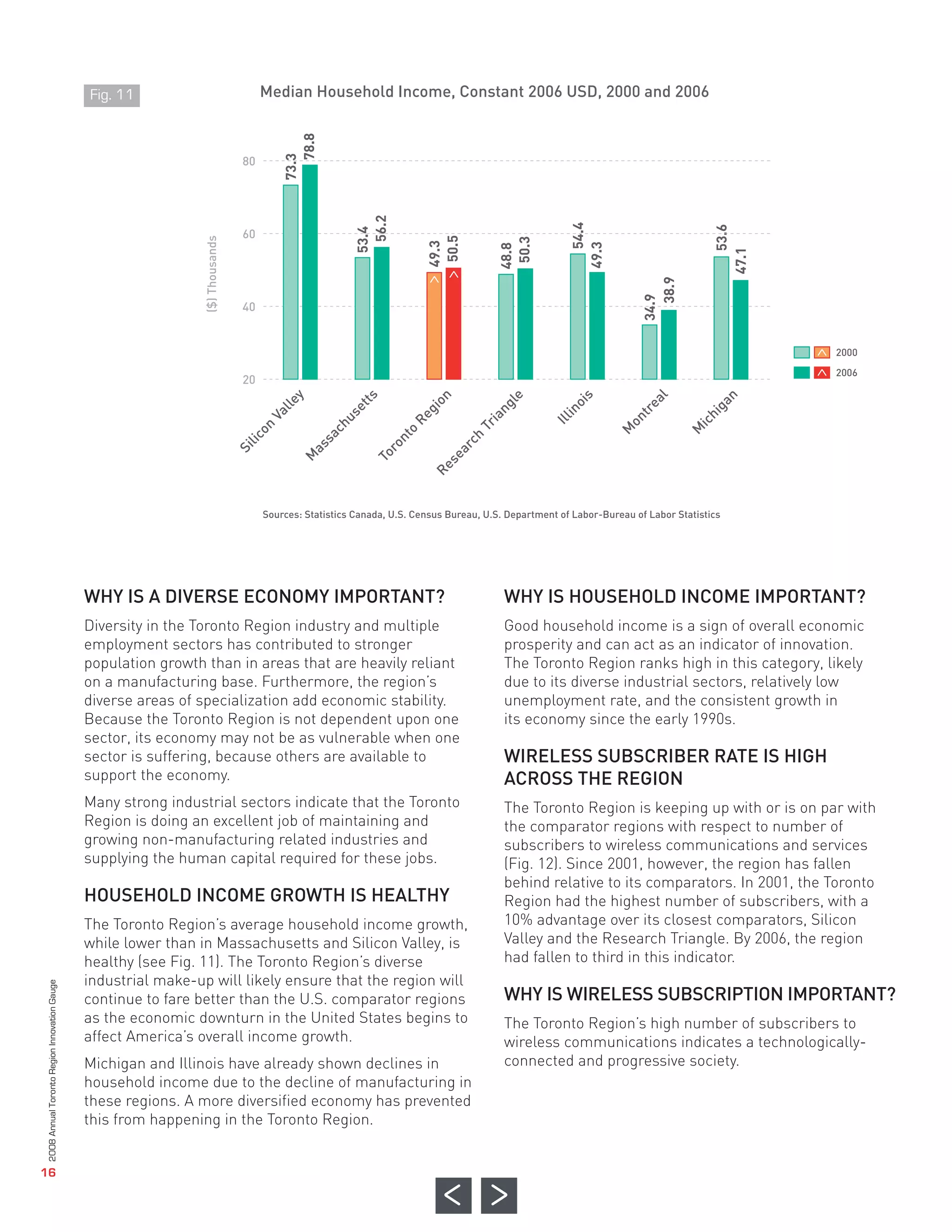
                                                     The Toronto Region’s average household income growth,
      Tr
     ch
   on


                                                                           M
                                                                 M
    to
   sa


                                                                                                                                     Valley and the Research Triangle. By 2006, the region
         ch
lic


         n


                                                     while lower than in Massachusetts and Silicon Valley, is
      ro
 as


       ar
Si


   To


                                                                                                                                     had fallen to third in this indicator.
M


     se


                                                     healthy (see Fig. 11). The Toronto Region’s diverse
     Re


                                                     industrial make-up will likely ensure that the region will
                                                     continue to fare better than the U.S. comparator regions
                                                     as the economic downturn in the United States begins to                         The Toronto Region’s high number of subscribers to
                                                     affect America’s overall income growth.                                         wireless communications indicates a technologically-
                                                     Michigan and Illinois have already shown declines in                            connected and progressive society.
                                                     household income due to the decline of manufacturing in
                                                     these regions. A more diversified economy has prevented
                                                     this from happening in the Toronto Region.
       2008 Annual Toronto Region Innovation Gauge


          16
Suscribers to Wireless Communications and Services,
                                         Percentage of Population, 2001 and 2006


                                                  82             80             79
                                                                                          75        73
                                                                                                              68
                                   100


                                                                           60                                           59
                                             49             50                                 47
                                                                                     45                            46
                                    80


                                                                                                         41
                                    60


                                    40


                                    20


                                    0
                                                                                                                             2001
                                                                                                                             2006
              Fig. 12


                 THE BOTTOM LINE
                 • Toronto Region has a strong and growing population base
                 • Toronto Region attracts and retains skilled immigrants
                 • Toronto Region has a diverse economy, with strong industrial clusters in key areas
                                         Sources: FCC, Statistics Canada
Percent of Population


                 • Toronto Region is tech savvy and inter-connected
                 • The Toronto Region has “fast companies” with highlighted potential for growth
     y


    le


        on


            s


                   tts


                             n


                                           al
  lle


            oi


                           ga
        ng


                                         re
         gi


                 se
           in
Va


                           hi


                                       t
       Re
      ia


                                    on
           Ill


               hu


                         ic
   Tr
   on


                        M


                                   M
      to


                  c
               sa
     ch
lic


           n
        ro


             as
   ar
Si


     To


            M
 se
Re


                                                                                                                                    2008 Annual Toronto Region Innovation Gauge


                                                                                                                                                       17
18
 2008 Annual Toronto Region Innovation Gauge


                                               WHAT WE OFFER
Educated residents and funding for Research &                                While the region does not perform well in terms of
              Development (R&D) are essential for innovation.                              overall numbers of citizens with post-graduate and
              The Toronto Region has much to offer in these areas.                         professional degrees in the total workforce compared to
              The region has high and growing overall numbers                              the selected comparators in the U.S., there has been a
              of residents with post-secondary and post-graduate                           2% overall increase in this measure (an increase of more
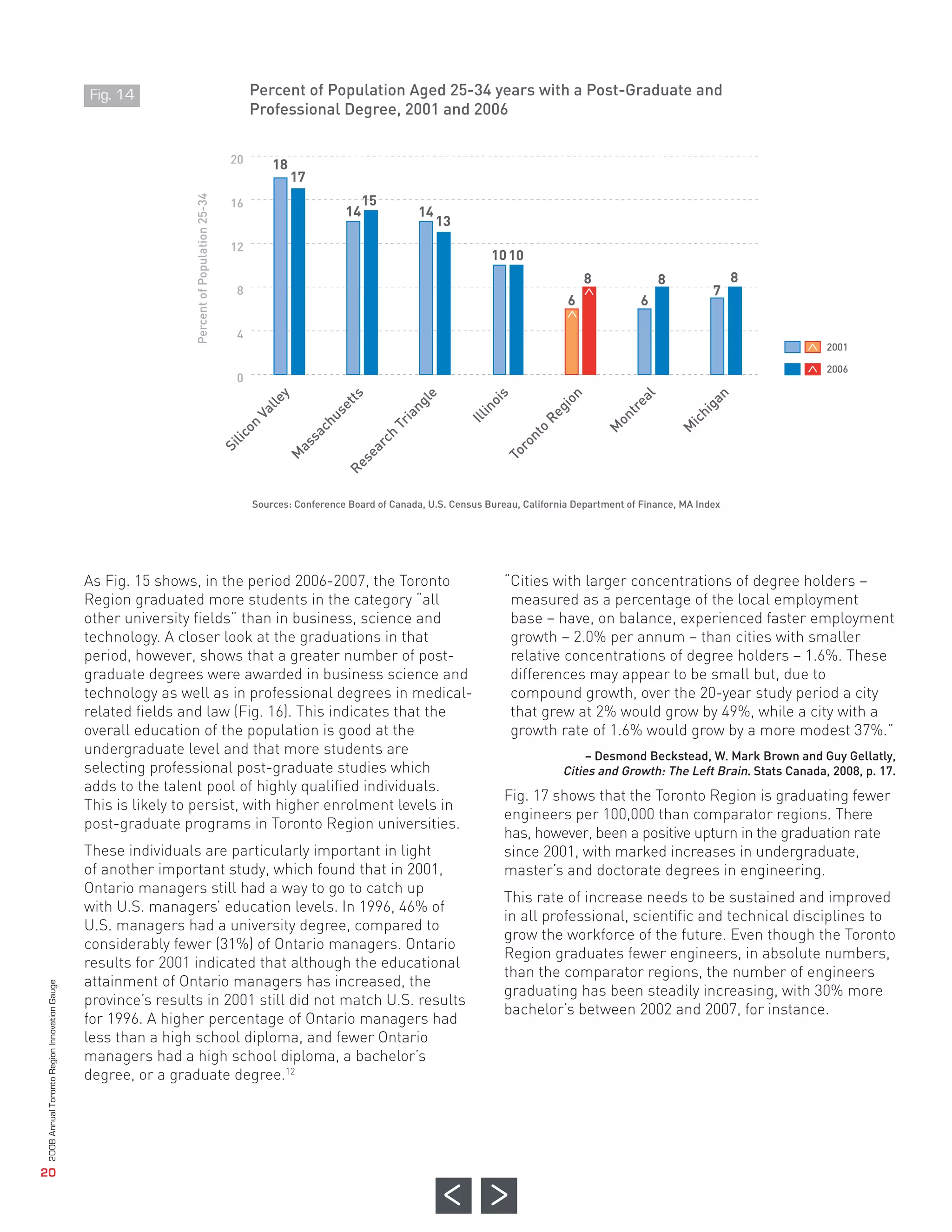
              degrees. In addition, both government and private sector                     than 17,000 people) since 2001 (Fig. 14). Only Montreal
              support for R&D in the region has increased, including                       has enjoyed comparable growth. Indeed, the dramatic
              collaborative R&D delivered by universities and colleges.                    increase in post-graduate and professional degrees


              HIGH AND GROWING LEVELS OF
                                                                                           between 2001 and 2006 shows a healthy positive trend


              POST-SECONDARY EDUCATION
                                                                                           that many of the comparators have failed to replicate.
                                                                                           Some of the U.S. comparators experienced a decline
                                                                                           in this category, and many showed very small growth.
                                                                                           More Business, Science and Technology master’s and
                                                                                           doctorate graduates are ready to become the next
                                                                                           generation of managers and professionals.
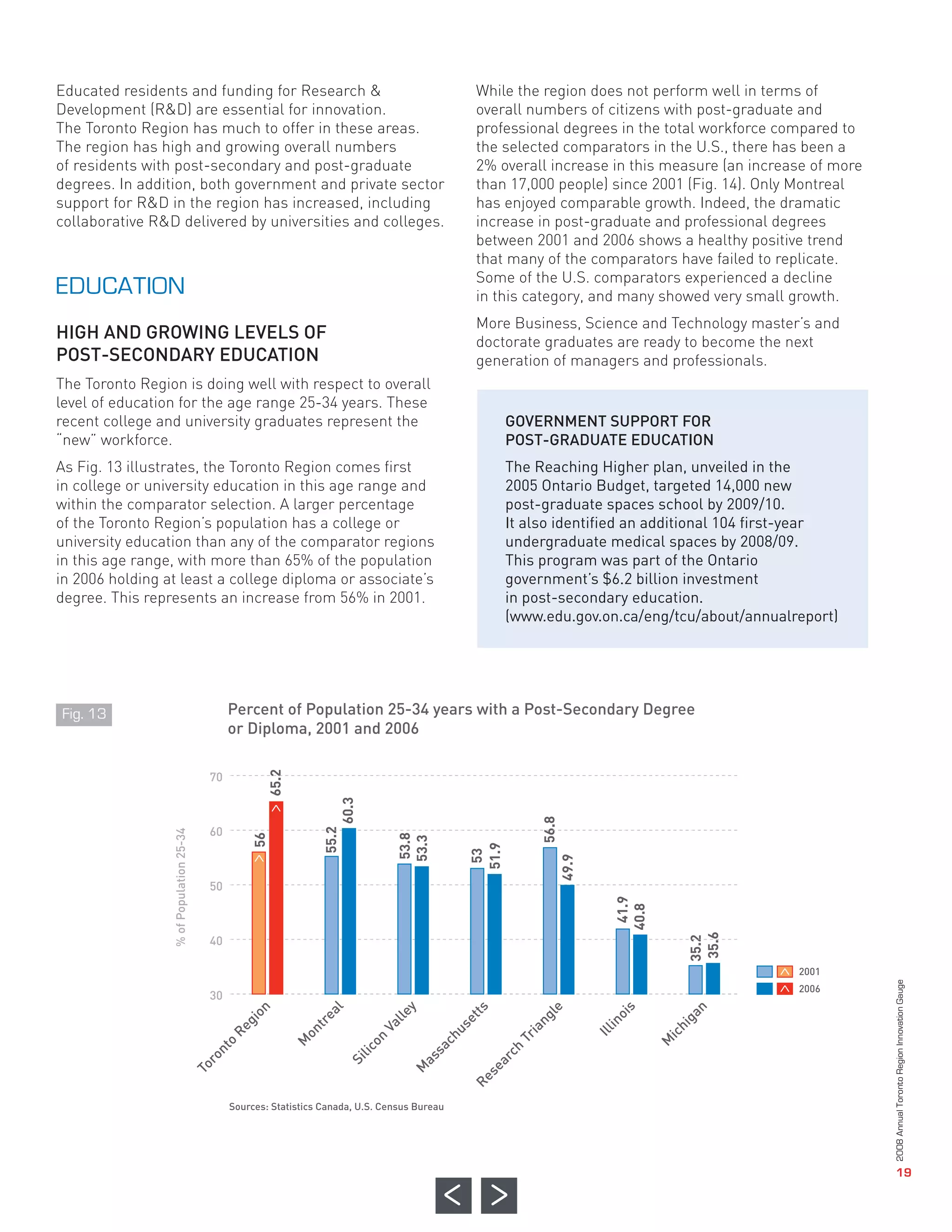
              The Toronto Region is doing well with respect to overall
              level of education for the age range 25-34 years. These
              recent college and university graduates represent the                            GOVERNMENT SUPPORT FOR
              “new” workforce.                                                                 POST-GRADUATE EDUCATION
              As Fig. 13 illustrates, the Toronto Region comes first                           The Reaching Higher plan, unveiled in the
              in college or university education in this age range and                         2005 Ontario Budget, targeted 14,000 new
              within the comparator selection. A larger percentage                             post-graduate spaces school by 2009/10.
              of the Toronto Region’s population has a college or                              It also identified an additional 104 first-year
              university education than any of the comparator regions                          undergraduate medical spaces by 2008/09.
              in this age range, with more than 65% of the population                          This program was part of the Ontario
              in 2006 holding at least a college diploma or associate’s                        government’s $6.2 billion investment
              degree. This represents an increase from 56% in 2001.                            in post-secondary education.
                                                                                               (www.edu.gov.on.ca/eng/tcu/about/annualreport)


                                          Percent of Population 25-34 years with a Post-Secondary Degree
                                          or Diploma, 2001 and 2006
              EDUCATION


                                     70


                                     60


                                     50


                                     40


                                     30
                                                                                                                                         2001
                                                                                                                                         2006
              Fig. 13
 65.2


                                          Sources: Statistics Canada, U.S. Census Bureau
     60.3


                   56.8
    55.2
% of Population 25-34


56


        53.8
        53.3


            51.9
             53


                        49.9


                               41.9
                              40.8


                                           35.6
                                           35.2


                                                                                                                                                      2008 Annual Toronto Region Innovation Gauge
n


      al


          y


             tts


                    e


                              is


                                           n
        le


                  gl
io


                                             a
                               o
   re


                                          ig
           se
          l


                            in
   g


                    n
       Va
      t


                                        h
Re


                 ia
   on


                          Ill
                  u


                                     ic
               Tr
               ch
         on


                                    M
  M
      o


            sa
    nt


                  ch
      lic
  ro


          as


                ar
     Si
To


         M


              se
            Re


                                                                                                                                                                         19
Percent of Population Aged 25-34 years with a Post-Graduate and
                                                                                        Professional Degree, 2001 and 2006


                                                                                            18
                                                                                                 17
                                                                                                                15
                                                                                                           14              14
                                                                                                                                13
                                                                                   20


                                                                                                                                          10 10
                                                                                   16


                                                                                                                                                              8               8               8
                                                                                                                                                                                         7
                                                                                                                                                          6               6
                                                                                   12


                                                                                    8


                                                                                    4


                                                                                    0
                                                                                                                                                                                                         2001

                                                                                                                                                                                                         2006
                                                             Fig. 14


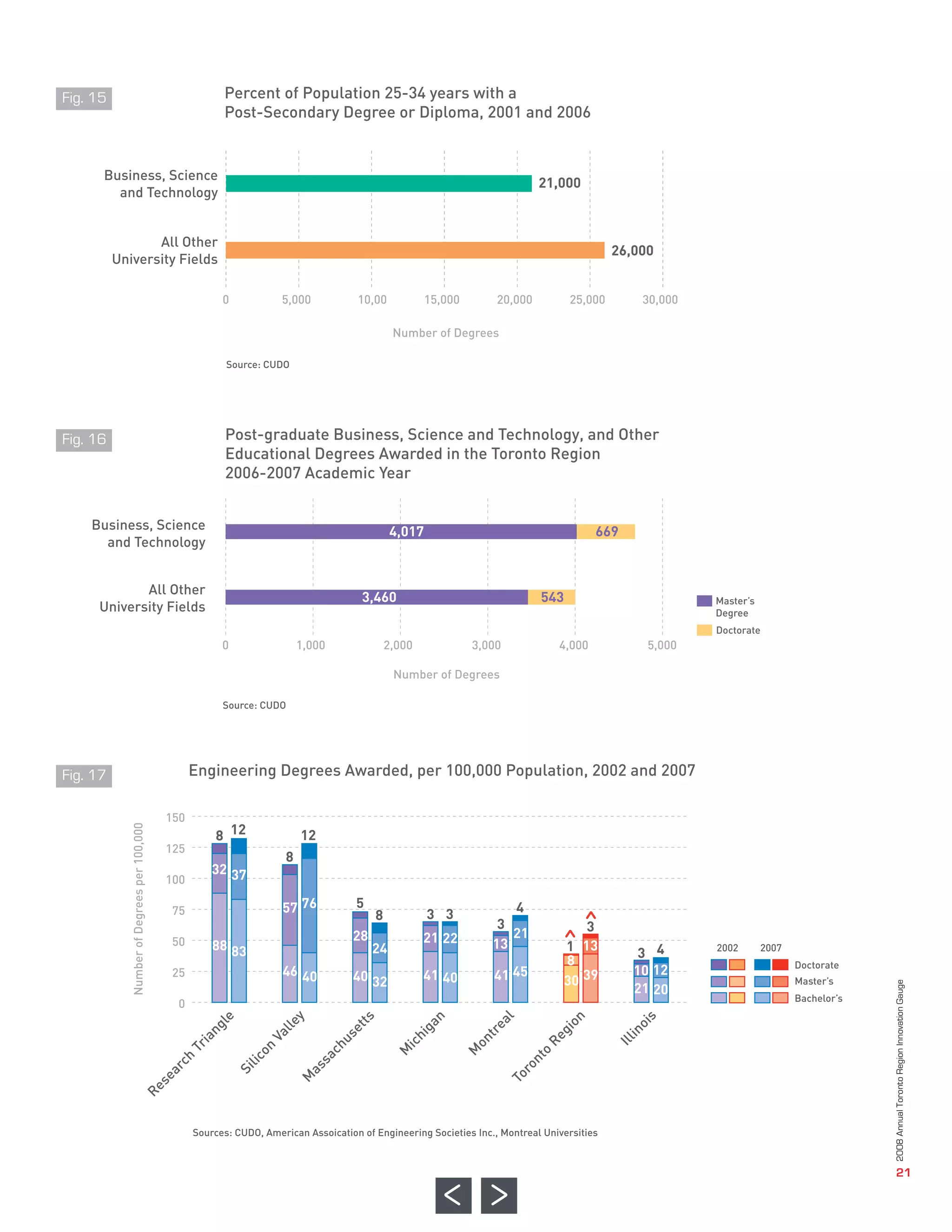
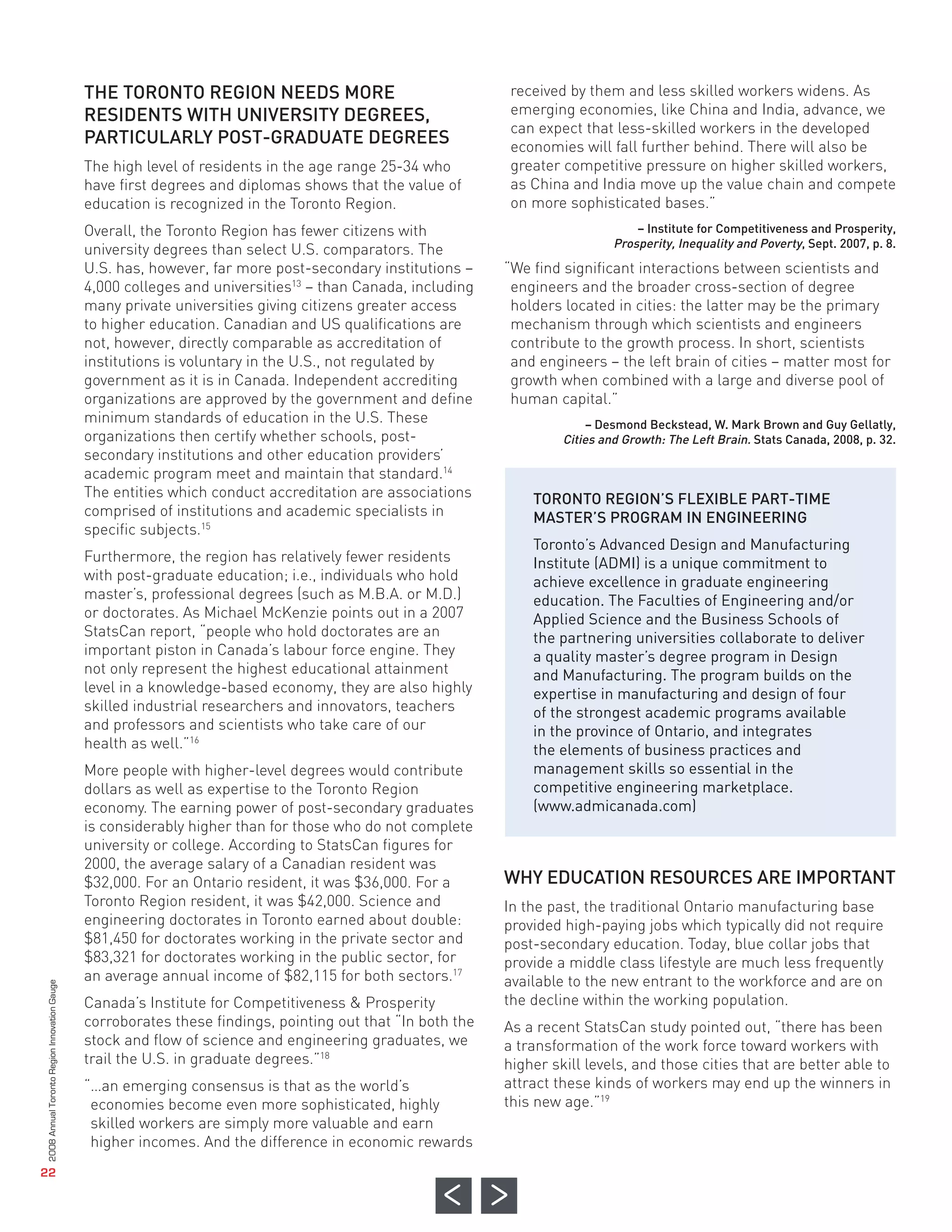
                                                             As Fig. 15 shows, in the period 2006-2007, the Toronto                          “Cities with larger concentrations of degree holders –
                                                             Region graduated more students in the category “all                              measured as a percentage of the local employment
                                                             other university fields” than in business, science and                           base – have, on balance, experienced faster employment
                                                             technology. A closer look at the graduations in that                             growth – 2.0% per annum – than cities with smaller
                                                             period, however, shows that a greater number of post-                            relative concentrations of degree holders – 1.6%. These
                                                             graduate degrees were awarded in business science and                            differences may appear to be small but, due to
                                                                                        Sources: Conference Board of Canada, U.S. Census Bureau, California Department of Finance, MA Index


                                                             technology as well as in professional degrees in medical-                        compound growth, over the 20-year study period a city
Percent of Population 25-34


                                                             related fields and law (Fig. 16). This indicates that the                        that grew at 2% would grow by 49%, while a city with a
                                                             overall education of the population is good at the                               growth rate of 1.6% would grow by a more modest 37%.”
                                                             undergraduate level and that more students are
                                                             selecting professional post-graduate studies which
                                                             adds to the talent pool of highly qualified individuals.
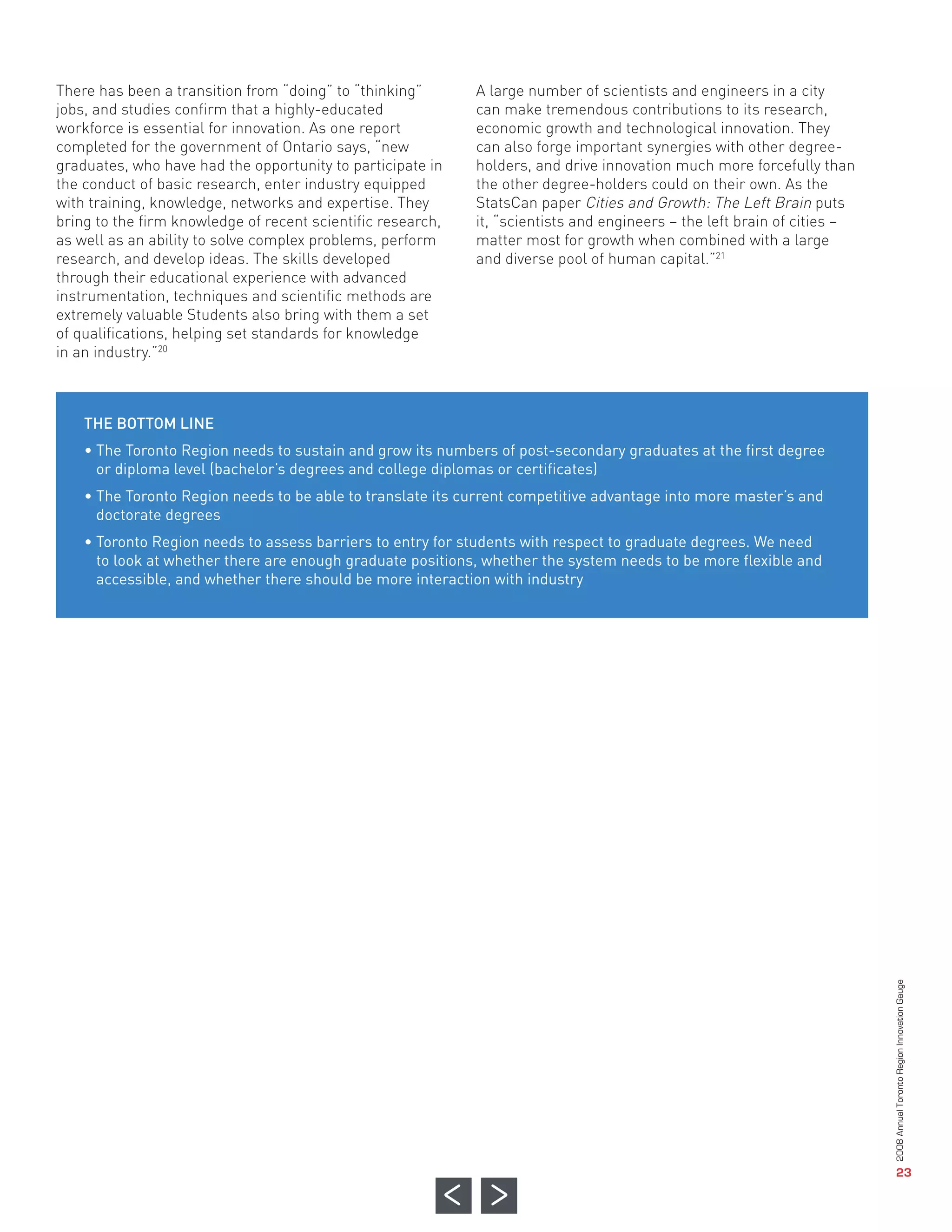
                                                                                                                                             Fig. 17 shows that the Toronto Region is graduating fewer
                                                             This is likely to persist, with higher enrolment levels in
                                                                                                                                             engineers per 100,000 than comparator regions. There
                                                             post-graduate programs in Toronto Region universities.
                                                                                                                                             has, however, been a positive upturn in the graduation rate
                                                             These individuals are particularly important in light                           since 2001, with marked increases in undergraduate,
                                                                                                                                                             – Desmond Beckstead, W. Mark Brown and Guy Gellatly,
                                                                                                                                                         Cities and Growth: The Left Brain. Stats Canada, 2008, p. 17.


                                                             of another important study, which found that in 2001,                           master’s and doctorate degrees in engineering.
                                                             Ontario managers still had a way to go to catch up
                                                                                                                                             This rate of increase needs to be sustained and improved
     y


         ts


          le


               is


                                                                  on


                                                                            al


                                                                                          n
  lle


                                                                                        ga
              no
             ng
      et


                                                                          re


                                                             with U.S. managers’ education levels. In 1996, 46% of
                                                               gi
Va


                                                                                     hi
    us


                                                                           t


                                                                                                                                             in all professional, scientific and technical disciplines to
                 i


                                                             Re
           ia


                                                                        on
             Ill


                                                                                   ic
        Tr


                                                             U.S. managers had a university degree, compared to
      ch
   on


                                                                                  M
                                                                       M
                                                             to


                                                                                                                                             grow the workforce of the future. Even though the Toronto
    sa


          ch
lic


                                              n


                                                             considerably fewer (31%) of Ontario managers. Ontario
                                           ro
  as


        ar
Si


                                                                                                                                             Region graduates fewer engineers, in absolute numbers,
                                        To
 M


      se


                                                             results for 2001 indicated that although the educational
     Re


                                                                                                                                             than the comparator regions, the number of engineers
                                                             attainment of Ontario managers has increased, the
                                                                                                                                             graduating has been steadily increasing, with 30% more
                                                             province’s results in 2001 still did not match U.S. results
                                                                                                                                             bachelor’s between 2002 and 2007, for instance.
                                                             for 1996. A higher percentage of Ontario managers had
                                                             less than a high school diploma, and fewer Ontario
                                                             managers had a high school diploma, a bachelor’s
                                                             degree, or a graduate degree.12
               2008 Annual Toronto Region Innovation Gauge


                  20
Percent of Population 25-34 years with a
                                                     Post-Secondary Degree or Diploma, 2001 and 2006


                             Business, Science
                                                                                                                          21,000
                               and Technology


                                        All Other
                                                                                                                                          26,000
                                 University Fields

                                                     0            5,000           10,00            15,000        20,000         25,000        30,000


                                                      Post-graduate Business, Science and Technology, and Other
                                                      Educational Degrees Awarded in the Toronto Region
                                                                                           Number of Degrees


                                                      2006-2007 Academic Year
                                                      Source: CUDO


                           Business, Science                                               4,017                                      669
                       Fig. 15


                             and Technology


                                   All Other
                                                                                   3,460                                  543
                            University Fields


                                               Engineering Degrees Awarded, per 100,000 Population, 2002 and 2007
                                                     0                 1,000              2,000             3,000             4,000            5,000
                                                                                                                                                       Master’s


                                                                                           Number of Degrees
                                                                                                                                                       Degree
                                                                                                                                                       Doctorate


                                                   8 12                12
                                                     Source: CUDO


                                                                   8
                                                   32 37
                       Fig. 16


                                         150


                                                                  57 76           5                                4
                                                                                                   3 3
                                         125


                                                                                      8
                                                                                                                 3                3
                                                                                 28               21 22            21
                                                                                                                13
                                         100


                                                   88 83                              24                                       1 13           3 4
                                                                                                                               8
                                                                  46 40                                         41 45                        10 12
                                                                                 40 32            41 40                        30 39
                                          75


                                                                                                                                             21 20
                                          50

                                          25

                                           0
                                                                                                                                                       2002       2007
                                                                                                                                                                         Doctorate
                                                                                                                                                                         Master’s
                                                                                                                                                                         Bachelor’s
                       Fig. 17


                                               Sources: CUDO, American Assoication of Engineering Societies Inc., Montreal Universities
Number of Degrees per 100,000


                                                                                                                                                                                      2008 Annual Toronto Region Innovation Gauge
 le


          y


           ts


                     n


                       al


                               on


                                               is
       lle


                   ga


                                                o
ng


          et


                     re


                             gi


                                             in
     Va


                 hi
             us


                       t


                           Re
  ia


                    on


                                         Ill
               ic
Tr


           ch
      on


              M


                   M


                             o
         sa


                           nt
      ch


   lic


                         ro
       as
    ar


  Si


                      To
       M
  se
Re


                                                                                                                                                                                                         21
THE TORONTO REGION NEEDS MORE
                                              RESIDENTS WITH UNIVERSITY DEGREES,
                                              PARTICULARLY POST-GRADUATE DEGREES
                                                                                                             received by them and less skilled workers widens. As
                                                                                                             emerging economies, like China and India, advance, we
                                                                                                             can expect that less-skilled workers in the developed
                                                                                                             economies will fall further behind. There will also be
                                              The high level of residents in the age range 25-34 who         greater competitive pressure on higher skilled workers,
                                              have first degrees and diplomas shows that the value of        as China and India move up the value chain and compete
                                              education is recognized in the Toronto Region.                 on more sophisticated bases.”
                                              Overall, the Toronto Region has fewer citizens with
                                              university degrees than select U.S. comparators. The
                                              U.S. has, however, far more post-secondary institutions –     “We find significant interactions between scientists and
                                              4,000 colleges and universities13 – than Canada, including     engineers and the broader cross-section of degree
                                              many private universities giving citizens greater access       holders located in cities: the latter may be the primary
                                              to higher education. Canadian and US qualifications are        mechanism through which scientists and engineers
                                                                                                                                  – Institute for Competitiveness and Prosperity,
                                                                                                                              Prosperity, Inequality and Poverty, Sept. 2007, p. 8.


                                              not, however, directly comparable as accreditation of          contribute to the growth process. In short, scientists

                                              institutions is voluntary in the U.S., not regulated by        and engineers – the left brain of cities – matter most for
                                              government as it is in Canada. Independent accrediting         growth when combined with a large and diverse pool of
                                              organizations are approved by the government and define        human capital.”
                                              minimum standards of education in the U.S. These
                                              organizations then certify whether schools, post-
                                              secondary institutions and other education providers’
                                              academic program meet and maintain that standard.14
                                              The entities which conduct accreditation are associations         TORONTO REGION’S FLEXIBLE PART-TIME
                                              comprised of institutions and academic specialists in             MASTER’S PROGRAM IN ENGINEERING
                                                                                                                         – Desmond Beckstead, W. Mark Brown and Guy Gellatly,


                                              specific subjects.15
                                                                                                                     Cities and Growth: The Left Brain. Stats Canada, 2008, p. 32.


                                                                                                                Toronto’s Advanced Design and Manufacturing
                                              Furthermore, the region has relatively fewer residents            Institute (ADMI) is a unique commitment to
                                              with post-graduate education; i.e., individuals who hold          achieve excellence in graduate engineering
                                              master’s, professional degrees (such as M.B.A. or M.D.)           education. The Faculties of Engineering and/or
                                              or doctorates. As Michael McKenzie points out in a 2007           Applied Science and the Business Schools of
                                              StatsCan report, “people who hold doctorates are an               the partnering universities collaborate to deliver
                                              important piston in Canada’s labour force engine. They            a quality master’s degree program in Design
                                              not only represent the highest educational attainment             and Manufacturing. The program builds on the
                                              level in a knowledge-based economy, they are also highly          expertise in manufacturing and design of four
                                              skilled industrial researchers and innovators, teachers           of the strongest academic programs available
                                              and professors and scientists who take care of our                in the province of Ontario, and integrates
                                              health as well.”16                                                the elements of business practices and
                                              More people with higher-level degrees would contribute            management skills so essential in the


                                                                                                            WHY EDUCATION RESOURCES ARE IMPORTANT
                                              dollars as well as expertise to the Toronto Region                competitive engineering marketplace.
                                              economy. The earning power of post-secondary graduates            (www.admicanada.com)
                                              is considerably higher than for those who do not complete
                                              university or college. According to StatsCan figures for
                                              2000, the average salary of a Canadian resident was
                                              $32,000. For an Ontario resident, it was $36,000. For a
                                              Toronto Region resident, it was $42,000. Science and          In the past, the traditional Ontario manufacturing base
                                              engineering doctorates in Toronto earned about double:        provided high-paying jobs which typically did not require
                                              $81,450 for doctorates working in the private sector and      post-secondary education. Today, blue collar jobs that
                                              $83,321 for doctorates working in the public sector, for      provide a middle class lifestyle are much less frequently
                                              an average annual income of $82,115 for both sectors.17       available to the new entrant to the workforce and are on
                                              Canada’s Institute for Competitiveness & Prosperity           the decline within the working population.
                                              corroborates these findings, pointing out that “In both the   As a recent StatsCan study pointed out, “there has been
                                              stock and flow of science and engineering graduates, we       a transformation of the work force toward workers with
                                              trail the U.S. in graduate degrees.”18                        higher skill levels, and those cities that are better able to
                                              “…an emerging consensus is that as the world’s                attract these kinds of workers may end up the winners in
                                               economies become even more sophisticated, highly             this new age.”19
                                               skilled workers are simply more valuable and earn
                                               higher incomes. And the difference in economic rewards
2008 Annual Toronto Region Innovation Gauge


   22
There has been a transition from “doing” to “thinking”       A large number of scientists and engineers in a city
jobs, and studies confirm that a highly-educated             can make tremendous contributions to its research,
workforce is essential for innovation. As one report         economic growth and technological innovation. They
completed for the government of Ontario says, “new           can also forge important synergies with other degree-
graduates, who have had the opportunity to participate in    holders, and drive innovation much more forcefully than
the conduct of basic research, enter industry equipped       the other degree-holders could on their own. As the
with training, knowledge, networks and expertise. They       StatsCan paper Cities and Growth: The Left Brain puts
bring to the firm knowledge of recent scientific research,   it, “scientists and engineers – the left brain of cities –
as well as an ability to solve complex problems, perform     matter most for growth when combined with a large
research, and develop ideas. The skills developed            and diverse pool of human capital.”21
through their educational experience with advanced
instrumentation, techniques and scientific methods are
extremely valuable Students also bring with them a set
of qualifications, helping set standards for knowledge
in an industry.”20


    THE BOTTOM LINE
    • The Toronto Region needs to sustain and grow its numbers of post-secondary graduates at the first degree
      or diploma level (bachelor’s degrees and college diplomas or certificates)
    • The Toronto Region needs to be able to translate its current competitive advantage into more master’s and
      doctorate degrees
    • Toronto Region needs to assess barriers to entry for students with respect to graduate degrees. We need
      to look at whether there are enough graduate positions, whether the system needs to be more flexible and
      accessible, and whether there should be more interaction with industry


                                                                                                                          2008 Annual Toronto Region Innovation Gauge


                                                                                                                                             23
educational resources available at Canadian post-
                                                                                                                     secondary institutions and to train students in essential
                                                                                                                     technical skills required by industry.25
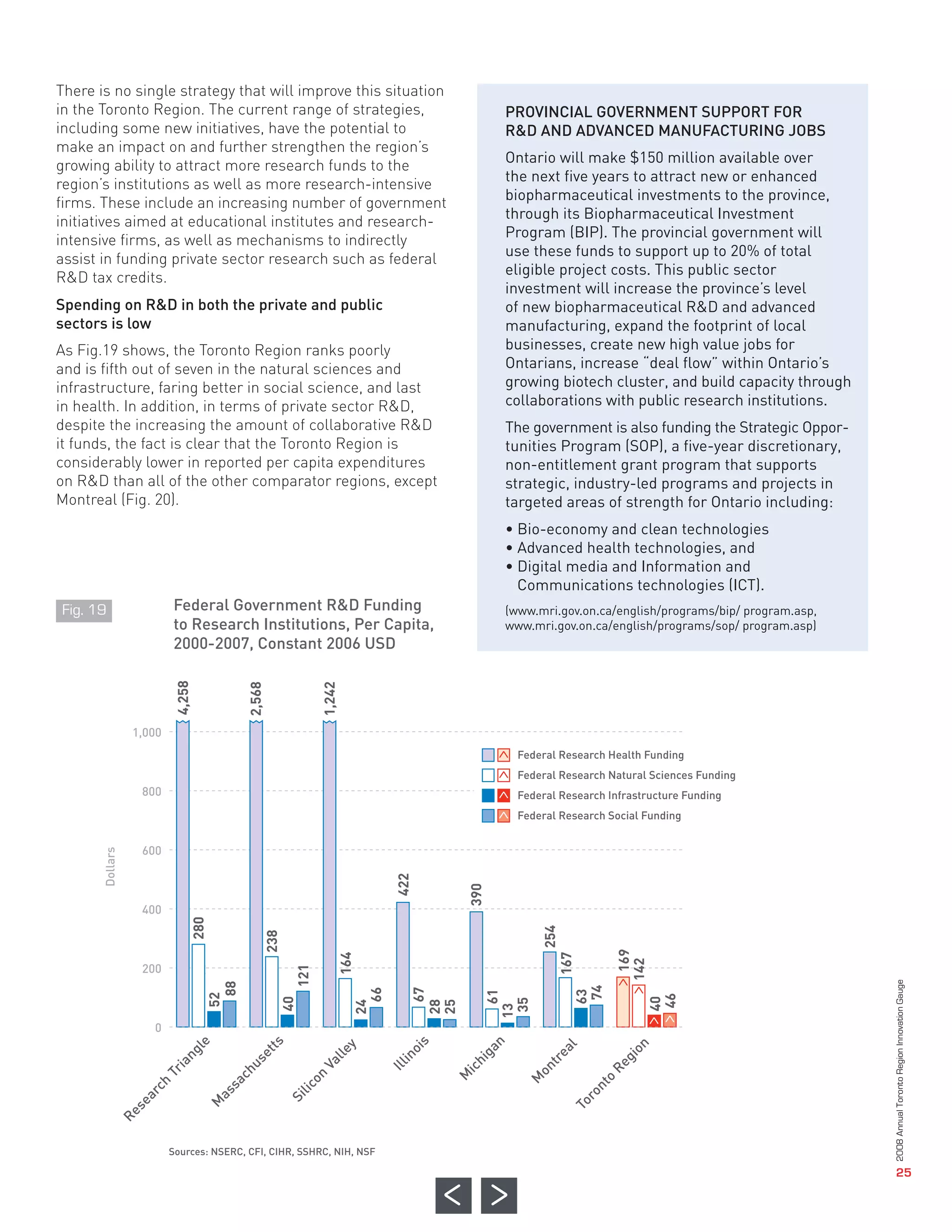
                                                 Research & Development (R&D) funding includes support               The scale of available government assistance and funding
                                                 from the private sector, support from the public sector as          for R&D in the U.S. is much higher than in Canada
                                                 well as joint support from both, in collaboration with one          (Fig. 19). Within Canada, Greater Montreal receives
                                                 another. Research and development provides knowledge                more R&D funding per capita than the Toronto Region.
                                                 and technologies for transfer to the market and funding
                                                 here is important to ensure sufficient supply of these.
                                                 Private sector support for R&D in the Toronto Region is                  THE DIFFERENCE BETWEEN CANADIAN AND
                                                 increasing. In fact, by international G8 standards, Canada               U.S. GOVERNMENT SUPPORT OF PRIVATE
                                                 as a whole does well: the private sector funds more than                 SECTOR R&D
                                                 10% of university research.22                                            The Canadian and U.S. governments take a
                                                 Research conducted at universities, whether at a basic                   significantly different approach to supporting
                                                 level or in partnership with industry is fundamental to the              private sector R&D. According to 2004 data, in
                                                 development of a competitive R&D infrastructure and,                     Canada, government spends about 0.18% of GDP
                                                 hence, innovation within Canada.23                                       whereas governments in the U.S. spend about
                                                                                                                          0.26% of GDP on such support. The countries
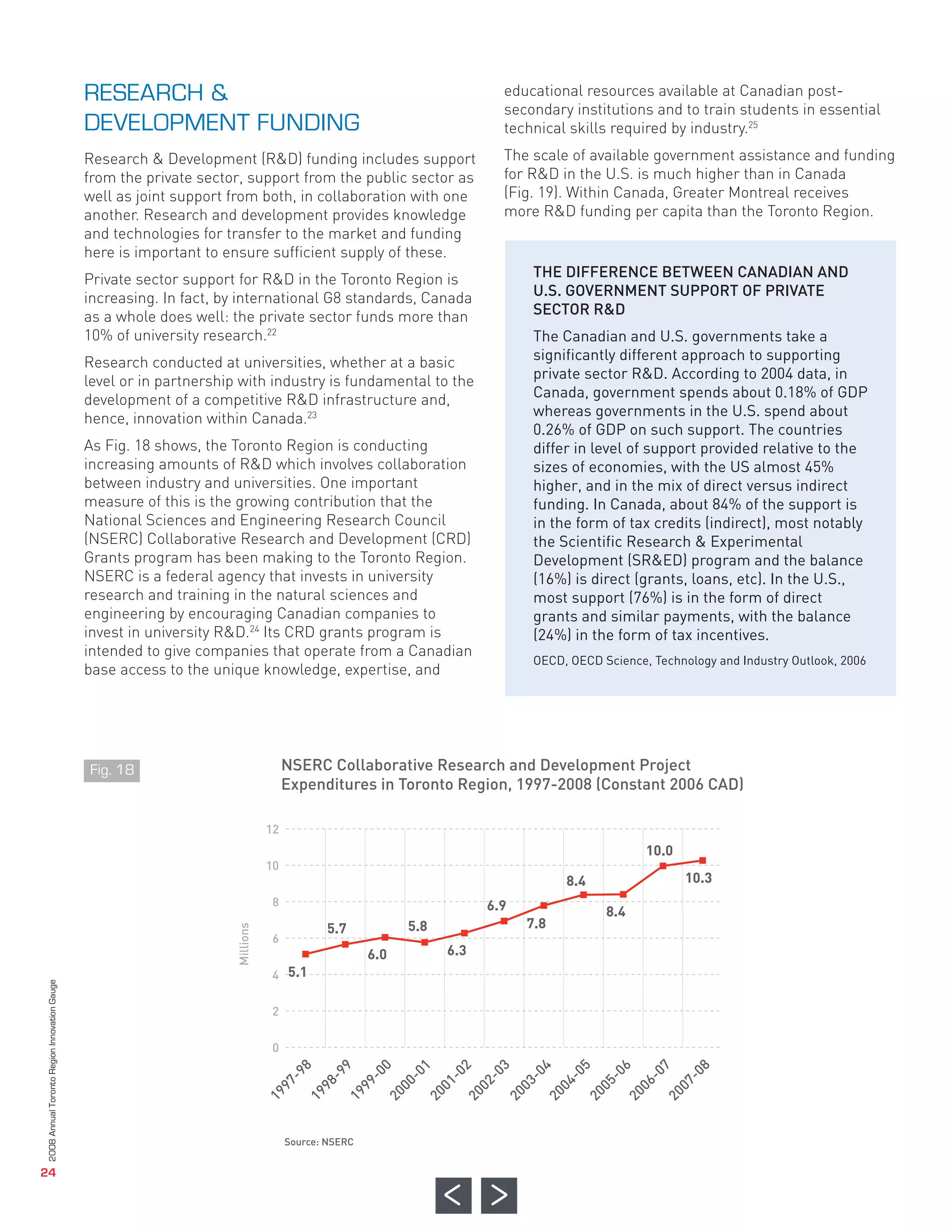
                                                 As Fig. 18 shows, the Toronto Region is conducting                       differ in level of support provided relative to the
                                                 increasing amounts of R&D which involves collaboration                   sizes of economies, with the US almost 45%
                                                 between industry and universities. One important                         higher, and in the mix of direct versus indirect
                                                 measure of this is the growing contribution that the                     funding. In Canada, about 84% of the support is
                                                 National Sciences and Engineering Research Council                       in the form of tax credits (indirect), most notably
                                                 (NSERC) Collaborative Research and Development (CRD)                     the Scientific Research & Experimental
                                                 Grants program has been making to the Toronto Region.                    Development (SR&ED) program and the balance
                                                 RESEARCH &


                                                 NSERC is a federal agency that invests in university                     (16%) is direct (grants, loans, etc). In the U.S.,
                                                 DEVELOPMENT FUNDING


                                                 research and training in the natural sciences and                        most support (76%) is in the form of direct
                                                 engineering by encouraging Canadian companies to                         grants and similar payments, with the balance
                                                 invest in university R&D.24 Its CRD grants program is                    (24%) in the form of tax incentives.
                                                 intended to give companies that operate from a Canadian
                                                 base access to the unique knowledge, expertise, and


                                                                                 NSERC Collaborative Research and Development Project
                                                                                                                          OECD, OECD Science, Technology and Industry Outlook, 2006


                                                                                 Expenditures in Toronto Region, 1997-2008 (Constant 2006 CAD)


                                                                                                                                             10.0

                                                                                                                               8.4                  10.3
                                                                            12


                                                                                                                   6.9                8.4
                                                                                        5.7            5.8               7.8
                                                                            10


                                                                                                 6.0         6.3
                                                                             8


                                                                             4 5.1
                                                                             6


                                                                             2

                                                                             0
                                                 Fig. 18


                                                                                 Source: NSERC
Millions
   2008 Annual Toronto Region Innovation Gauge


   8

   9

    0

         1

          2

         3

          4

          5

          6

          7

          8
-9

-9

 -0

      -0

       -0

      -0

       -0

       -0

       -0

       -0

       -0
97

98

 99

    00

    01

    02

    03

    04

    05

    06

    07
19

19

19

 20

 20

 20

 20

 20

 20

 20

 20


      24
There is no single strategy that will improve this situation
      in the Toronto Region. The current range of strategies,         PROVINCIAL GOVERNMENT SUPPORT FOR
      including some new initiatives, have the potential to           R&D AND ADVANCED MANUFACTURING JOBS
      make an impact on and further strengthen the region’s
                                                                      Ontario will make $150 million available over
      growing ability to attract more research funds to the
      region’s institutions as well as more research-intensive        the next five years to attract new or enhanced
      firms. These include an increasing number of government         biopharmaceutical investments to the province,
                                                                      through its Biopharmaceutical Investment
      initiatives aimed at educational institutes and research-
                                                                      Program (BIP). The provincial government will
      intensive firms, as well as mechanisms to indirectly
      assist in funding private sector research such as federal       use these funds to support up to 20% of total
                                                                      eligible project costs. This public sector
      R&D tax credits.
                                                                      investment will increase the province’s level
      Spending on R&D in both the private and public                  of new biopharmaceutical R&D and advanced
      sectors is low                                                  manufacturing, expand the footprint of local
      As Fig.19 shows, the Toronto Region ranks poorly                businesses, create new high value jobs for
      and is fifth out of seven in the natural sciences and           Ontarians, increase “deal flow” within Ontario’s
      infrastructure, faring better in social science, and last       growing biotech cluster, and build capacity through
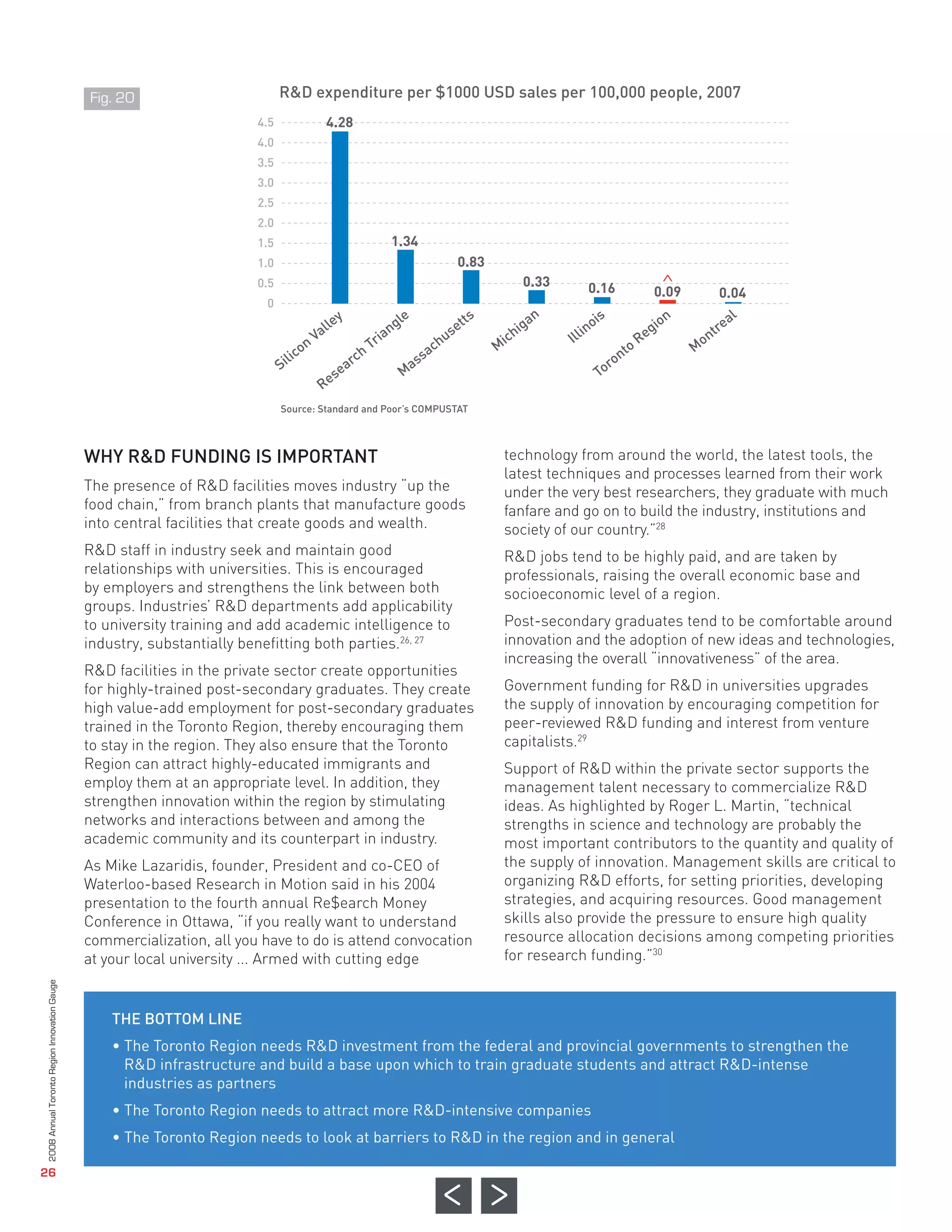
      in health. In addition, in terms of private sector R&D,         collaborations with public research institutions.
      despite the increasing the amount of collaborative R&D          The government is also funding the Strategic Oppor-
      it funds, the fact is clear that the Toronto Region is          tunities Program (SOP), a five-year discretionary,
      considerably lower in reported per capita expenditures          non-entitlement grant program that supports
      on R&D than all of the other comparator regions, except         strategic, industry-led programs and projects in
      Montreal (Fig. 20).                                             targeted areas of strength for Ontario including:
                                                                      • Bio-economy and clean technologies
                                                                      • Advanced health technologies, and
                                                                      • Digital media and Information and

                         Federal Government R&D Funding
                                                                        Communications technologies (ICT).

                         to Research Institutions, Per Capita,
                         2000-2007, Constant 2006 USD
                                                                      (www.mri.gov.on.ca/english/programs/bip/ program.asp,
                                                                      www.mri.gov.on.ca/english/programs/sop/ program.asp)


                 1,000
                                                                        Federal Research Health Funding


                   800
                                                                        Federal Research Natural Sciences Funding
                                                                        Federal Research Infrastructure Funding
                                                                        Federal Research Social Funding


                   600


                   400


                   200
      Fig. 19


                     0
4,258


  2,568


   1,242


                         Sources: NSERC, CFI, CIHR, SSHRC, NIH, NSF
Dollars


    422


     390
 280


           254
  238


                          169
   164


                167


                         142
 280


  121


                                                                                                                              2008 Annual Toronto Region Innovation Gauge
  88


                 74
      67
     66


       61


                63
 52


                              46
                              40
  40


      35
    28
    25
   24


     13
       le


  ts


    is


     n


                         on
        y


              al
          ga
     lle


           o
     ng


  et


            re
        in


                       gi
        hi
   us


   Va
   ia


            t


                     Re
    Ill


         on
      ic
Tr


 ch


     on


     M


        M


                       o
   sa
      ch


                     nt
  lic
 as
    ar


                   ro
  Si
 M
  se


                To
Re


                                                                                                                                                 25
R&D expenditure per $1000 USD sales per 100,000 people, 2007
                                                                        4.5                4.28
                                                                        4.0
                                                                        3.5


                                                                                                                 1.34
                                                                        3.0


                                                                                                                                           0.83
                                                                        2.5


                                                                                                                                                          0.33            0.16
                                                                        2.0


                                                                                                                                                                                                0.09              0.04
                                                                        1.5


                                              WHY R&D FUNDING IS IMPORTANT
                                                                                               le
                                                                                                 y
                                                                                                                      gl
                                                                                                                        e                    ts              a   n               is              io
                                                                                                                                                                                                    n               al
                                                                                           l                                               et             ig              in
                                                                                                                                                                             o
                                                                                                                                                                                                                 tre
                                                                        1.0


                                                                                        Va                     ia
                                                                                                                  n                    s
                                                                                                                                                      ich            Il l                     eg            on
                                                                                   on                       Tr                      hu                                                      R
                                                                                                                                  ac              M                                    to               M
                                                                        0.5


                                                                                lic                     h
                                                                              Si                      rc                    as
                                                                                                                              s                                                     on
                                                                                                  a                                                                               or
                                                                         0


                                                                                                se                     M                                                         T
                                                                                         Re


                                                                                                                                                  technology from around the world, the latest tools, the
                                                                                                                                                  latest techniques and processes learned from their work
                                              The presence of R&D facilities moves industry “up the                                               under the very best researchers, they graduate with much
                                              food chain,” from branch plants that manufacture goods                                              fanfare and go on to build the industry, institutions and
                                              into central facilities that create goods and wealth.                                               society of our country.”28
                                              R&D staff in industry seek and maintain good                                                        R&D jobs tend to be highly paid, and are taken by
                                              relationships with universities. This is encouraged                                                 professionals, raising the overall economic base and
                                              Fig. 20


                                                                              Source: Standard and Poor’s COMPUSTAT


                                              by employers and strengthens the link between both                                                  socioeconomic level of a region.
                                              groups. Industries’ R&D departments add applicability
                                              to university training and add academic intelligence to                                             Post-secondary graduates tend to be comfortable around
                                              industry, substantially benefitting both parties.26, 27                                             innovation and the adoption of new ideas and technologies,
                                                                                                                                                  increasing the overall “innovativeness” of the area.
                                              R&D facilities in the private sector create opportunities
                                              for highly-trained post-secondary graduates. They create                                            Government funding for R&D in universities upgrades
                                              high value-add employment for post-secondary graduates                                              the supply of innovation by encouraging competition for
                                              trained in the Toronto Region, thereby encouraging them                                             peer-reviewed R&D funding and interest from venture
                                              to stay in the region. They also ensure that the Toronto                                            capitalists.29
                                              Region can attract highly-educated immigrants and                                                   Support of R&D within the private sector supports the
                                              employ them at an appropriate level. In addition, they                                              management talent necessary to commercialize R&D
                                              strengthen innovation within the region by stimulating                                              ideas. As highlighted by Roger L. Martin, “technical
                                              networks and interactions between and among the                                                     strengths in science and technology are probably the
                                              academic community and its counterpart in industry.                                                 most important contributors to the quantity and quality of
                                              As Mike Lazaridis, founder, President and co-CEO of                                                 the supply of innovation. Management skills are critical to
                                              Waterloo-based Research in Motion said in his 2004                                                  organizing R&D efforts, for setting priorities, developing
                                              presentation to the fourth annual Re$earch Money                                                    strategies, and acquiring resources. Good management
                                              Conference in Ottawa, “if you really want to understand                                             skills also provide the pressure to ensure high quality
                                              commercialization, all you have to do is attend convocation                                         resource allocation decisions among competing priorities
                                              at your local university ... Armed with cutting edge                                                for research funding.”30


                                                  THE BOTTOM LINE
                                                  • The Toronto Region needs R&D investment from the federal and provincial governments to strengthen the
                                                    R&D infrastructure and build a base upon which to train graduate students and attract R&D-intense
                                                    industries as partners
                                                  • The Toronto Region needs to attract more R&D-intensive companies
                                                  • The Toronto Region needs to look at barriers to R&D in the region and in general
2008 Annual Toronto Region Innovation Gauge


   26
PERFORMING
                                               HOW WE ARE

 2008 Annual Toronto Region Innovation Gauge


27
$205 MILLION IN NEW VENTURE CAPITAL FOR
                                                           The Conference Board of Canada report Innovation
                                                                                                                                INNOVATIVE, HIGH-GROWTH COMPANIES
                                                           Overview (2008) states “Innovation is the ability to turn
                                                           knowledge into new and improved goods and services.”                 In June 2008, the Ontario government and
                                                           ATRIG looked at the quantitative measures of the Toronto             leading institutional investors launched the new
                                                           Region’s commercialization and knowledge transfer                    $205-million Ontario Venture Capital Fund to
                                                           mechanisms – the publications, invention disclosures,                strengthen the province’s venture capital sector
                                                           patent applications, patents granted and licenses. In the            to support growing innovation. TD Capital Private
                                                           Toronto Region our institutions are important as they are            Equity Investors is the fund manager. Other
                                                           the main producers of these outputs and these provide                leading intuitional partners include: OMERS
                                                           tangible evidence that the region’s R&D is being transferred         Capital Partners, RBC Capital Partners, Manulife
                                                           from the region’s research institutions to the market.               Financial, Business Development Bank of
                                                                                                                                Canada, TD Bank Financial Group, and the
                                                           Knowledge transfer in the Toronto Region is improving
                                                                                                                                Government of Ontario.
                                                           The Toronto Region is performing well with respect to
                                                                                                                                The Ontario Venture Capital Fund will invest
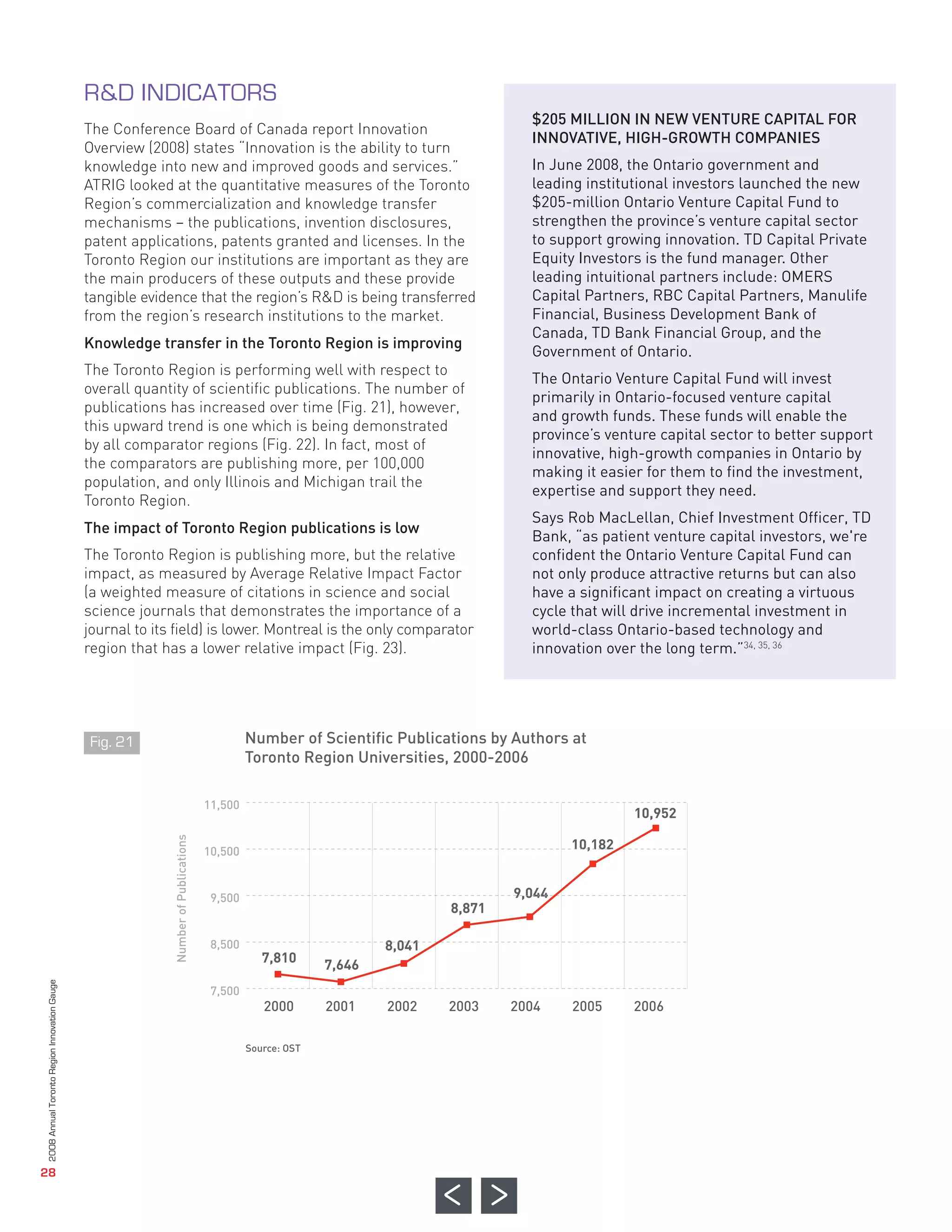
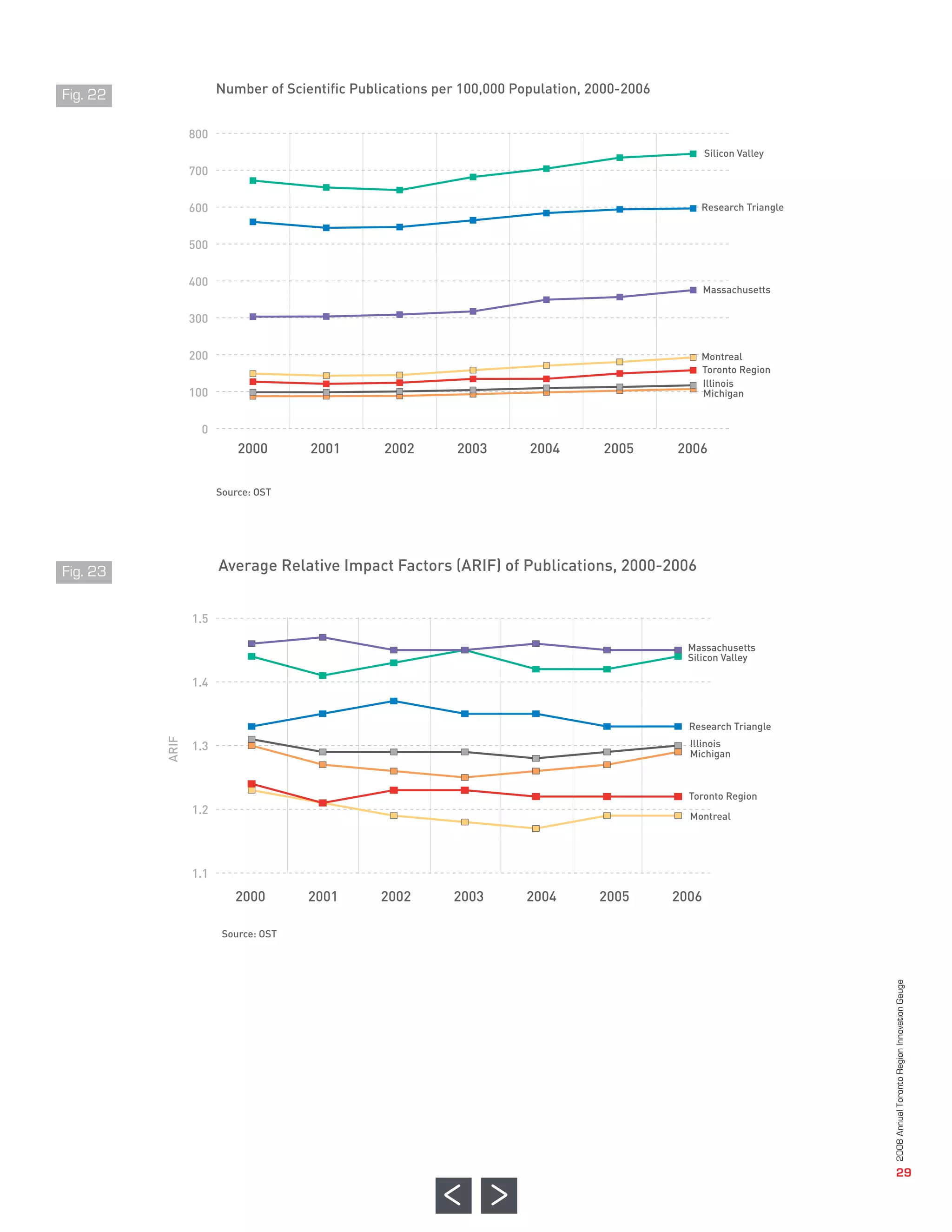
                                                           overall quantity of scientific publications. The number of
                                                                                                                                primarily in Ontario-focused venture capital
                                                           publications has increased over time (Fig. 21), however,
                                                                                                                                and growth funds. These funds will enable the
                                                           this upward trend is one which is being demonstrated
                                                                                                                                province’s venture capital sector to better support
                                                           by all comparator regions (Fig. 22). In fact, most of
                                                                                                                                innovative, high-growth companies in Ontario by
                                                           the comparators are publishing more, per 100,000
                                                                                                                                making it easier for them to find the investment,
                                                           population, and only Illinois and Michigan trail the
                                                                                                                                expertise and support they need.
                                                           Toronto Region.
                                                                                                                                Says Rob MacLellan, Chief Investment Officer, TD
                                                           The impact of Toronto Region publications is low
                                                                                                                                Bank, “as patient venture capital investors, we're
                                                           The Toronto Region is publishing more, but the relative              confident the Ontario Venture Capital Fund can
                                                           R&D INDICATORS


                                                           impact, as measured by Average Relative Impact Factor                not only produce attractive returns but can also
                                                           (a weighted measure of citations in science and social               have a significant impact on creating a virtuous
                                                           science journals that demonstrates the importance of a               cycle that will drive incremental investment in
                                                           journal to its field) is lower. Montreal is the only comparator      world-class Ontario-based technology and
                                                           region that has a lower relative impact (Fig. 23).                   innovation over the long term.”34, 35, 36


                                                                                       Number of Scientific Publications by Authors at
                                                                                       Toronto Region Universities, 2000-2006


                                                                                                                                               10,952

                                                                                                                                      10,182
                                                                              11,500


                                                                                                                              9,044
                                                                                                                      8,871
                                                                              10,500


                                                                                                             8,041
                                                                                          7,810
                                                                               9,500


                                                                                                     7,646

                                                                                          2000       2001    2002    2003     2004    2005     2006
                                                                               8,500


                                                                               7,500
                                                           Fig. 21


                                                                                       Source: OST
Number of Publications
             2008 Annual Toronto Region Innovation Gauge


                28
Number of Scientific Publications per 100,000 Population, 2000-2006


            800


            700


            600
                                                                                               Silicon Valley


            500
                                                                                            Research Triangle


            400


            300
                                                                                               Massachusetts


            200


                      2000       2001      2002        2003       2004       2005       2006
            100
                                                                                            Montreal


             0


                  Average Relative Impact Factors (ARIF) of Publications, 2000-2006
                                                                                            Toronto Region
                                                                                            Illinois
                                                                                            Michigan
  Fig. 22


                  Source: OST


            1.5


            1.4
                                                                                          Massachusetts
                                                                                          Silicon Valley


            1.3
                                                                                          Research Triangle
                                                                                          Illinois


            1.2
                                                                                          Michigan


                     2000        2001      2002       2003       2004        2005       2006
                                                                                          Toronto Region


            1.1
                                                                                          Montreal
  Fig. 23


                   Source: OST
ARIF


                                                                                                                2008 Annual Toronto Region Innovation Gauge


                                                                                                                                   29
Relative citations show the same pattern (Fig. 24). This
                                              indicator shows the average number of times papers                                    MARS INNOVATION TO ACCELERATE
                                              from Toronto Region academics are referenced by other                                 COMMERCIALIZATION
                                              academics, providing an indication of the relevance of the
                                                                                                                                    MaRS Innovation is one of 11 new federally-supported
                                              work as determined by academic peers.
                                                                                                                                    Centres of Excellence for Commercialization and
                                              The Toronto Region’s relative impact – where we                                       Research (CECRs) announced in February 2008.
                                              publish and how much we commercialize – is low,                                       MaRS Innovation is a joint venture between the
                                              but, is increasing.                                                                   MaRS Centre, University of Toronto and Toronto’s
                                              In terms of the identification, protection and transfer                               research hospitals to offer global industry a one
                                              of intellectual property, the total licenses, discoveries,                            stop linkage into the Toronto research engine.
                                              patents and inventions from Toronto Region universities                               The partnership received $14.9 million in federal
                                              and research hospitals between 2001 and 2006 has                                      CECR funding over five years to accelerate the
                                              almost doubled (Fig. 25). No other comparator region                                  commercialization of promising research from
                                              has increased so dramatically. While the Toronto Region                               its member institutions. Joint teams from MaRS
                                              performs relatively poorly on technology commercialization                            Innovation and each institution will work with
                                              (as measured in patents granted and licensing revenue)                                researchers to identify discoveries that can be used
                                              in comparison to Silicon Valley and Massachusetts, the                                as the basis for new companies or used by existing
                                              region’s performance is, however, comparable to Illinois,                             companies. MaRS Innovation will focus on delivering
                                              Michigan, the Research Triangle and Montreal.                                         the best of Toronto’s innovations in a timely, effective
                                                                                                                                    and industry focused manner. www.marsdd.com


                                                                               Average Relative Citations (ARC), 2000-2006

                                                            Silicon Valley                                                                                                          1.846
                                                           Massachusetts                                                                                                            1.841
                                                        Research Triangle                                                                       1.603
                                                                   Illinois                                                    1.511
                                                                Michigan                                                       1.511
                                                          Toronto Region                                        1.409
                                                                Montreal                 1.296

                                                                              1.25             1.35               1.45             1.55            1.65          1.75           1.85


                                                                               Total Licenses, Patents (Applications and Issued), and Invention
                                                                                                                                   ARC


                                                                               Disclosures, Universities and Hospitals, per 100,000 Population, 2001

                                                             Silicon Valley                                                                                                   168
                                                                                                                                                          132
                                                                                                                         64
                                                                               Source: OST


                                                        Research Triangle                                                     77
                                                           Massachusetts                                           58
                                              Fig. 24


                                                                                                           43
                                                                 Montreal                13
                                                                                         13
                                                           Toronto Region                13
                                                                                     7
                                                                   Illinois            12
                                                                                     8
                                                                 Michigan             9
                                                                                     7
                                                                              0           20          40          60          80          100      120     140          160     180
                                                                                                                                                                                            2006
                                                                                                                                                                                            2001
                                              Fig. 25


                                                                               Source: AUTM
2008 Annual Toronto Region Innovation Gauge


   30
R&D indicators encourage collaboration and networking
                                                                by publicizing work currently underway. As the MIT study
                                                                also points out, in addition to education, universities also
                                                                play an important indirect role in serving as a “public
Transferring research to the market in the form of              space for ongoing local conversations about the future
publication or intellectual property allows universities        direction of technologies and markets. The importance
to realize their potential as economic drivers. Research        of the public space role of the university and its
papers developed in universities that result in patents         contribution to local innovation performance is
and licenses translate academic discoveries into                often underestimated.”33
innovative approaches and tangible products which
eventually make their way to the market.                        A large number of patents, publications and licenses
                                                                indicates not only research excellence, but also innovation
One study completed in 2006 for the University of Toronto’s     capacity, the ability to transfer research to the market.
Centre for International Studies Program on Globalization
and Regional Innovation Systems put together a number           The number of patents, publications and licenses
of conclusions from various researchers about the               communicate the status of the Toronto Region’s R&D
importance of this knowledge transfer:                          compared to that of the rest of the world.

• University research is important to local firms not just      The number of disclosures, patents and licenses
  for the transfer of knowledge generated through the           communicate the relevance of the Toronto Region’s
  university’s own research activities, but also as a conduit   research activities to the market.
  enabling firms to access knowledge from the “global
  pipelines” of international academic research networks.
• Universities serve as attractors of talent from                   THE ONTARIO CENTRE OF EXCELLENCE (OCE)
  elsewhere that contributes to the “thickness” of the              CENTRE FOR THE COMMERCIALIZATION OF
  local labour market.                                              RESEARCH (CCR)
WHY ARE THE OUTPUTS OF R&D


• Universities often function as “good community                    The Centre for the Commercialization of
  players” rather than “ivory towers” insulated from their          Research (CCR), led by The Ontario Centres
IMPORTANT?


  community. They facilitate local linkages and networks,           of Excellence, will help ensure that new
  and serve as “anchors of creativity” that sustain the             technologies developed by Canada’s outstanding
  virtuous cycle of talent attraction and retention.31              research universities reach the global
                                                                    marketplace. Its initial focus will be on
Another study, completed for the Massachusetts Institute
                                                                    commercializing new technology discoveries
of Technology, points out that universities play an
                                                                    related to the environment, natural resources and
important role in helping attract new human, knowledge
                                                                    energy, health and related life sciences, and
and financial resources from elsewhere. In addition, “they
                                                                    digital media. CCR will also develop technical and
can help to adapt knowledge originating elsewhere to
                                                                    managerial talent nationally, to more effectively
local conditions. They can help to integrate previously
                                                                    commercialize technology.38 www.oce-ontario.org
separate areas of technological activity. They can help to
unlock and redirect knowledge that is already present in
the region but not being put to productive use.”32


    THE BOTTOM LINE
    • The Toronto Region has a strong foundation – a large and highly-educated population, diverse industries and
      high employment rates – upon which it can build to improve its performance
    • The Toronto Region has the programs and initiatives in place to strengthen its capacity and drivers for
      commercialization
    • The Toronto Region’s performance with respect to R&D outputs is relatively weak; the region needs to
      continue focusing on this area
                                                                                                                               2008 Annual Toronto Region Innovation Gauge


                                                                                                                                                  31
32
 2008 Annual Toronto Region Innovation Gauge


                                               CONCLUSION
The Toronto Region has a strong foundation – a large and    OPPORTUNITIES FOR IMPROVEMENT
educated population and diverse industries, among other
pillars of strength. Even though the Toronto Region is      • More R&D investment in the Toronto Region from the
publishing more, and issuing more patents and licenses,       public and private sectors
it is important to build on these strengths through more    • Better public recognition for the R&D strengths and


TORONTO REGION STRENGTHS
private and public sector investment in R&D. These            other related “attributes” in the region, as well as a
initiatives will ensure that the Toronto Region starts        better understanding of the strengths we have.
producing and reaches its potential for innovation.


The Toronto Region is strong in the “feeders”
for innovation:                                             Future TRRA reports will focus in on specific areas of
• Population growth                                         research that indicate how the Toronto Region is doing in
                                                            innovation in addition to comparing the Toronto Region to
• Positive immigration                                      others. TRRA will be sharing:
• Attraction of skilled and educated immigrants             • The results of our study on the Toronto Region’s labour
• Strong key industrial sectors including sectors outside     force
  manufacturing, which have high levels of employment       • Our research and initial findings on networks within the
• Good postsecondary education levels in society and          advanced manufacturing labour market


IMPROVEMENTS “IN THE WORKS”
  strong growth in level of educational attainment          • A look on the products of innovation in the Toronto
• A growing number of licenses, patents and inventions        Region – influences on and increases in our
  from its universities and hospitals.                        performance with respect to patents, research papers
                                                              and licenses
                                                            • An in-depth look at key areas of immigration in the
The Toronto Region is taking measures to improve              Toronto Region as well as effectively immigrants are
some of its weaker areas – graduate education and             being integrated and engaged
commercialization:                                          • A look at how the Toronto region compares with respect
• Large increases in the enrolment numbers of                 to copyright materials, an aspect of innovation not
  students to graduate programs at the master’s and           considered in ATRIG this year.
  doctorate level
                                                            COMING UP IN FUTURE


• Federal initiatives and provincial programs to
  encourage the discovery process and increase output
                                                            TRRA REPORTS


  of innovations from our institutions
• Provincial programs to encourage companies to hire
  staff in high-value jobs.


                                                                                                                         2008 Annual Toronto Region Innovation Gauge


                                                                                                                                            33
Mr. Michael Benedict                                  Mr. John Tennant
                                              Principal, MCB Strategies Inc.                        CEO
                                                                                                    Canada’s Technology Triangle Inc.
                                              Mr. Charles Davis
                                              Edward S. Rogers Sr. Research Chair in Media          Dr. David Wolfe
                                              Management and Entrepreneurship                       Co-Director, Program on Globalization and Regional


                                                                                                    PRIMARY AUTHOR
                                              Ryerson University                                    Innovation Systems
                                                                                                    University of Toronto
                                              Dr. Paul Genest
                                              President & CEO
                                              Council of Ontario Universities
                                              Mr. John Hoicka
                                              Senior Research and Policy Advisor                    Dr. Karen Sievewright


                                                                                                    RESEARCH ASSISTANTS
                                              Colleges Ontario                                      Director, Research
                                              Ms. Elizabeth McIsaac                                 TRRA
                                              Executive Director
                                              TRIEC
                                              Mr. James Milway
                                              Executive Director                                    Bettina Cheung
                                              Institute for Competitiveness and Prosperity          Odila Duru
                                              Martin Prosperity Institute                           Alex Hunt
                                              Ms. Avvey Peters                                      Richard Liang
                                              ATRIG ADVISORY COUNCIL


                                              Executive Director, Communications                    Michael Wolfe
                                              & Government Relations                                Andrew Wong
                                              Communitech
                                              Mr. Shahrokh Shahabi-Azad
                                              Senior Economist, Innovation and Corporate Policy
                                              Branch, Ministry of Research and Innovation
                                              Ms. José Sigouin
                                              Research and Information Analysis
                                              University of Toronto
                                              Ms. Natasha Tang Kai
                                              Senior Advisor, Performance Measurement and Results
                                              Ministry of Research and Innovation
2008 Annual Toronto Region Innovation Gauge


   34
ENDNOTES
                                               APPENDICES &


 2008 Annual Toronto Region Innovation Gauge


35
Six regions were chosen against which to compare the Toronto Region’s performance. These regions are – or have been
                                              – successful in areas similar to the Toronto Region, and many represent the best in their respective areas of success.

                                              The following criteria were considered when choosing the comparators:
                                              Population: While the spread in population of our comparators is quite large (1.6 to 12.9 million), the Toronto Region
                                              comes fairly close to the average at 7 million. Regions with too small or too large a population were excluded.
                                              Proximity: Geographically close regions with similar natural attributes were selected as these have similar economic
                                              and infrastructural influences.

                                              Industrial make-up: The selected regions have a similar range of industries and employment levels within
                                              these industries.
                                              Strong manufacturing base: While the Toronto Region historically has had a very strong manufacturing base, the
                                              sector has experienced recent declines. Due to the significance of this industry, certain other regions strong in
                                              manufacturing were selected to compare to the Toronto Region.
                                              Research intensity: Research and innovation are key contributors to the new knowledge-based economy. The Toronto
                                              Region, therefore, is compared to other research-intensive areas.
                                              Model regions: Regions which present models that the Toronto Region could aspire to become were selected. The
                                              comparator regions are all considered to be successful in one aspect or another. For example, Silicon Valley performs very
                                              well in certain indicators and, even though it is not realistic that the Toronto Region performs on par or better than this
                                              area, it is still useful to see where the Toronto Region ranks in relation to successful regions.
                                              APPENDIX 1 – SELECTION OF COMPARATOR REGIONS
2008 Annual Toronto Region Innovation Gauge


   36
COMPARATOR REGIONS
               Illinois: Illinois has a strong economy and is geographically close to the Toronto Region. These similarities warrant
               its inclusion in the 2008 report. The state is located just south of Lake Michigan, and has a population of 12.9 million
               people.46 In 2006, the gross state product in Illinois was $589 billion US dollars. Much of the state’s economic success
               occurs in Chicago, a major financial and high technology city.47
               Chicago has high employment in information technology industries,48 with manufacturing also playing an important, but
               declining, role in the city’s economy. The city is an important financial centre, and home to three major financial exchanges.
               Many large organizations and businesses are headquartered in Chicago, including a number of Fortune 500 companies.


                                 Industry Sectors by Size, Average Wage, and Relative North American
               Illinois is a R&D centre and nine universities are located in the state. The University of Chicago and Northwestern


                                 Concentration, Illinois, 2006
               University perform extremely well in various school rankings.49


                       110,000
                       100,000
                        90,000
                        80,000
                        70,000
                        60,000
                                                               Utilities
                                                                                                                                        Finance & Insurance


                        50,000
                                                                                            Professional, Scientific
                                                                                            & Technical Services


                        40,000
                                                   Information &
                                                   Cultural Industries
                                                                                                                               Wholesale Trade


                        30,000
                                                                                     Health Care &                     Manufacturing


                              0.75        0.80          0.85      0.90          0.95          1.00        1.05          1.10       1.15          1.20     1.25
                                                                 Real Estate &


                        20,000
                                                                                     Social Assistance
                                                                 Rental Leasing


                        10,000
                             0
                                   Construction                       Retail Trade

                                                                                                                                  Transportation &
                                                                                                                                  Warehousing


                                                                                      Location Quotient
                                                        Educational                          Other Services
                                  Arts, Entertainment
                                                        Services
                                  & Recreation                                                                         Waste Management &
                                                                                        Accommodation &
                                                                                                                       Remediation Service
                                                                                        Food Services


                                 Sources: Statistics Canada, U.S. Census Bureau
($) Average Wage


                                                                                                                                                                 2008 Annual Toronto Region Innovation Gauge


                                                                                                                                                                                    37
Massachusetts: Massachusetts is a successful state, with a gross state product of $338 billion US dollars. At 6.4 million
                                                           people, it is very similar in size to the Toronto Region.50 Massachusetts has transitioned from a manufacturing
                                                           economy,51 to one that is a centre of higher education, biotechnology and finance.
                                                           Massachusetts is in the northeastern United States. Boston is the major urban centre in the state and is a major
                                                           component of the Massachusetts economy. The state is a R&D-intensive area, supported by many universities and colleges.
                                                           The Greater Boston area has over 40 colleges and universities, a number of which are highly-respected and ranked.
                                                           Massachusetts is an ideal comparator for the Toronto Region, as its proximity and population allow for similar


                                                                             Industry Sectors by Size, Average Wage, and Relative North American
                                                           conditions. The state is also an important model, having successfully transformed its economy to take advantage of


                                                                             Concentration, Massachusetts, 2006
                                                           new technologies and research.


                                                                  110,000
                                                                  100,000
                                                                    90,000
                                                                    80,000
                                                                    70,000
                                                                                                           Finance & Insurance
                                                                                                                                          Professional, Scientific


                                                                    60,000
                                                                                                                                          & Technical Services

                                                                                      Utilities


                                                                    50,000
                                                                                                   Wholesale Trade                                         Management of Companies & Enterprises


                                                                    40,000
                                                                                     Manufacturing


                                                                    30,000
                                                                             Construction                      Real Estate &


                                                                         0.50               0.75        1.00              1.25           1.50              1.75         2.00           2.25        2.50
                                                                    20,000
                                                                                                               Rental Leasing
                                                                                                                                         Information &


                                                                    10,000
                                                                                                                                         Cultural Industries
                                                                                                   Other Services


                                                                         0
                                                                                                                                     Health Care &
                                                                             Transportation                                          Social Assistance
                                                                             & Warehousing


                                                                                                                                   Location Quotient
                                                                                                                                     Arts, Entertainment                    Educational Services
                                                                                                                    Retail Trade
                                                                                                                                     & Recreation
                                                                             Waste Management             Accommodation
                                                                             & Remediation Service        & Food Services


                                                                               Sources: Statistics Canada, U.S. Census Bureau
($) Average Wage
             2008 Annual Toronto Region Innovation Gauge


                38
Michigan: Similar to Illinois, Michigan is good comparator region. It is close to the Toronto Region and is known for its
               strong manufacturing base. The state is just east of Lake Michigan, which composes the bulk of its enormous shoreline.52
               Michigan’s population is 10.1 million, and its largest city is Detroit, with a population of just over 900 000 people.53, 54
               While best known for its automotive industry, the state has diversified lately, partly in response to the decline
               manufacturing has experienced. The economy now includes information technology and life sciences industries,55
               and has increased R&D expenditures in these areas.56, 57 Michigan is home to the Michigan Life Sciences Corridor


                                 Industry Sectors by Size, Average Wage, and Relative North American
               (a $1 billion biotech initiative),58 and has a number of large research institutions.


                                 Concentration, Michigan, 2006

                       100,000
                        90,000

                        80,000

                        70,000

                        60,000
                        50,000
                                                          Finance & Insurance                               Professional, Scientific
                                                                                              Utilities
                                                                                                            & Technical Services


                        40,000
                                            Information &                                                                         Management of
                                            Cultural Industries         Wholesale Trade                                           Companies & Enterprises


                        30,000
                                                                                                                           Manufacturing
                                                                                   Health Care &
                                  Construction


                              0.60         0.70         0.80           0.90        1.00           1.10            1.20        1.30         1.40        1.50
                        20,000
                                                                                   Social Assistance

                                                                                                                Waste Management &


                        10,000
                                                                  Real Estate &                                 Remediation Service
                                                                  Rental Leasing


                             0
                                  Transportation
                                  & Warehousing      Arts, Entertainment


                                                                                   Location Quotient
                                                     & Recreation
                                                                                                 Retail Trade
                                                          Accommodation                   Other Services
                                                          & Food Services


                                 Sources: Statistics Canada, U.S. Census Bureau
($) Average Wage


                                                                                                                                                              2008 Annual Toronto Region Innovation Gauge


                                                                                                                                                                                 39
Montreal: Montreal is the second largest census metropolitan area (CMA) in Canada,39 with a population of just over
                                                           3.5 million people. The CMA includes the island of Montreal and a number of densely-populated suburbs.
                                                           In 2007, Montreal’s GDP was $123 billion40 and the region has industrial strengths in aerospace, electronics,
                                                           pharmaceuticals, software engineering, finance and higher education.41
                                                           Many research facilities and agencies are located in the Montreal CMA, including the Canadian Space Agency and the
                                                           National Research Council.42, 43 There are 11 universities and 12 public colleges located in the region, making the region
                                                           the second-highest ratio of students per capita in North America 44, 45 Montreal conducts and receives significant
                                                           research and research dollars as is shown in exhibits 19 and 22.


                                                                          Industry Sectors by Size, Average Wage, and Relative North American
                                                           Montreal was selected as the only Canadian comparator in the 2008 Innovation Gauge because of its strong research


                                                                          Concentration, Montreal, 2006
                                                           focus, proximity to the Toronto Region, and its successful economy.


                                                                70,000

                                                                60,000

                                                                50,000
                                                                                              Finance & Insurance


                                                                40,000
                                                                                                                                           Professional, Scientific
                                                                                                                                           & Technical Services           Transportation &


                                                                30,000
                                                                                                                                                                          Warehousing
                                                                                                                               Manufacturing
                                                                          Health Care &
                                                                          Social Assistance          Retail Trade


                                                                20,000
                                                                                                                    Real Estate &
                                                                                                                    Rental and Leasing


                                                                         0.70        0.80          0.90             1.00          1.10         1.20           1.30            1.40           1.50
                                                                10,000
                                                                                                                                                                                              Utilities
                                                                                                                                                                      Information &


                                                                     0
                                                                                                                                                                      Cultural Industries

                                                                                                                                                       Arts, Entertainment
                                                                             Construction                                                              & Recreation


                                                                                                                              Location Quotient
                                                                                                           Other Services
                                                                                                                                    Wholesale Trade


                                                                          Sources: Statistics Canada, U.S. Census Bureau
($) Average Wage
             2008 Annual Toronto Region Innovation Gauge


                40
Silicon Valley: Silicon Valley is located in the southern part of the San Francisco Bay Area. The region has a population
               of 2.6 million people, and is commonly recognized as one of the most successful regions in North America.59
               Silicon Valley is a leader in high technology with thousands of related companies operating within its boundaries. The
               region also has a high number of Fortune 1000 companies.60 Silicon Valley attracts a large number of engineers and
               venture capital.
               There are five universities within Silicon Valley, with Carnegie Melon and Stanford being amongst them. Because of
               this, and the nature of the businesses and research in Silicon Valley, the population is highly-educated and the region


                                 Industry Sectors by Size, Average Wage, and Relative North American
               attracts a large amount of public research funding.61 Often the pinnacle in North American innovation, research, and


                                 Concentration, Silicon Valley, 2006
               development, Silicon Valley represents a compelling story for the possibilities provided through innovation.


                      180,000

                      160,000

                      140,000

                      120,000
                                                                                                              Management of


                      100,000
                                                                                                              Companies & Enterprises


                        80,000
                                                           Manufacturing

                                                                                            Wholesale Trade                               Information &


                        60,000
                                  Finance & Insurance
                                                                                                                                          Cultural Industries


                        40,000


                             0.50           0.75           1.00           1.25        1.50           1.75           2.00         2.25           2.50        2.75
                                                Construction                           Transportation &
                                                                                       Warehousing


                        20,000
                                 Health Care &
                                 Social Assistance
                                                                         Educational Services


                             0
                                                                           Real Estate &
                                                                           Rental Leasing                                  Professional, Scientific
                                                                                                                           & Technical Services
                                                                      Waste Management &


                                                                                     Location Quotient
                                 Other                                Remediation Service
                                 Services
                                                                                            Arts, Entertainment
                                                               Accommodation                & Recreation
                                 Retail Trade                  & Food Services


                                 Sources: Statistics Canada, U.S. Census Bureau
($) Average Wage


                                                                                                                                                                   2008 Annual Toronto Region Innovation Gauge


                                                                                                                                                                                      41
Research Triangle: Located in North Carolina, the Research Triangle is made up of three cities – Raleigh, Durham and
                                                           Chapel Hill – and has a population of 1.6 million people.62 The region consists of numerous high technology businesses
                                                           and has a highly-educated population.63
                                                           The region is home to Research Triangle Park, one of the largest research parks in the United States.64 A growing
                                                           number of high technology firms have contributed to the region’s growth over the past years.65 IBM, Nortel Networks,
                                                           and Cisco Systems all have large offices in the Research Triangle.
                                                           There are over 10 colleges and universities within the Research Triangle.66 This dense research infrastructure makes
                                                           the Research Triangle similar to the Toronto Region in many ways, and sets many goals that the Toronto Region should
                                                           try and emulate in some capacity.
                                                           Note: In three cases, entire states were used over municipalities for the U.S. comparators (e.g., Massachusetts instead
                                                           of Boston) as they were thought to be a more suitable comparison to the Toronto Region because they include both


                                                                            Industry Sectors by Size, Average Wage, and Relative North American
                                                           urban and rural areas and due to limitations in the data available at the municipal level.


                                                                            Concentration, Research Triangle, 2006

                                                                   90,000

                                                                   80,000

                                                                   70,000

                                                                   60,000

                                                                   50,000
                                                                                                               Wholesale Trade
                                                                                                                                                           Professional, Scientific


                                                                   40,000
                                                                                               Finance & Insurance                                         & Technical Services
                                                                                      Manufacturing


                                                                   30,000
                                                                                                                             Health Care &
                                                                                                                             Social Assistance
                                                                                                                                                 Construction


                                                                   20,000


                                                                         0.40           0.60            0.80            1.00           1.20             1.40             1.60          1.80
                                                                                                                                                         Management of Companies


                                                                   10,000
                                                                                                                                                         & Enterprises

                                                                                                 Real Estate &


                                                                        0
                                                                                                 Rental Leasing

                                                                             Transportation                                          Other                      Educational Services
                                                                                                    Retail Trade
                                                                             & Warehousing                                           Services


                                                                                                                        Location Quotient
                                                                                               Accommodation &
                                                                                               Food Services
                                                                                                                                    Waste Management &
                                                                                                                                    Remediation Service


                                                                            Sources: Statistics Canada, U.S. Census Bureau
($) Average Wage
             2008 Annual Toronto Region Innovation Gauge


                42
DEFINITION OF REGIONS
Toronto Region (TR): Unless otherwise stated, the Toronto Region data is calculated by using five Census Metropolitan
Areas (CMA): Guelph, Hamilton, Kitchener, Oshawa and Toronto.
Montreal (MTL): Unless otherwise stated, Montreal is defined as the Statistics Canada CMA.
Research Triangle (RT): Unless otherwise stated, the RT is defined as the micropolitan area of Raleigh-Carey-Dunn.
Silicon Valley (SV): Unless otherwise stated, SV is defined as the counties Santa Clara and San Mateo.
Illinois (IL): IL refers to the state of Illinois.


                                 ( # of 1years ) -1
Massachusetts (MA): MA refers to the state of Massachusetts.


          (                     )
Michigan (MI): MI refers to the state of Michigan.


Fig. 1 – Population, 2007
The data was found from population surveys from the US Census Bureau, the California Department of Finance,
Statistics Canada, and additional data from the Conference Board of Canada.
Sources
Silicon Valley:
http://www.dof.ca.gov/HTML/DEMOGRAP/ReportsPapers/Estimates/E2/documents/E-2%20Report.xls
http://www.dof.ca.gov/HTML/DEMOGRAP/ReportsPapers/Estimates/E6/E6-90-00/documents/E-6_90-00.xls
APPENDIX 2 – METHODOLOGY/DATA SOURCES


Toronto Region:
Conference Board - Population - TR - 1996-2012 - Nov 2007 (private purchased data) *does not include Guelph
Montreal:
http://cansim2.statcan.ca/cgi-
win/cnsmcgi.exe?Lang=E&RootDir=CII/&ResultTemplate=CII/CII___&Array_Pick=1&ArrayId=0510034
U.S. Comparator States:
http://www.censU.S..gov/popest/states/tables/NST-EST2007-01.xls
http://www.censU.S..gov/popest/metro/files/2007/CSA-EST2007-alldata.csv
http://www.censU.S..gov/popest/archives/1990s/ST-99-03.txt


Fig. 2 – Population, Compound Average Annual Growth, 1996-2007
The population data from Figure 1 was used to calculate the compound annual growth rate from 1996-2007. The
formula was:


CAGR =         Ending Value
              Beginning Value

Sources
Silicon Valley:
http://www.dof.ca.gov/HTML/DEMOGRAP/ReportsPapers/Estimates/E2/documents/E-2%20Report.xls
http://www.dof.ca.gov/HTML/DEMOGRAP/ReportsPapers/Estimates/E6/E6-90-00/documents/E-6_90-00.xls
Toronto Region: *does not include Guelph
Conference Board - Population - TR - 1996-2012 - Nov 2007 (private purchased data)
                                                                                                                        2008 Annual Toronto Region Innovation Gauge


                                                                                                                                           43
Montreal:
                                              http://cansim2.statcan.ca/cgi-
                                              win/cnsmcgi.exe?Lang=E&RootDir=CII/&ResultTemplate=CII/CII___&Array_Pick=1&ArrayId=0510034
                                              U.S. Comparator States:
                                              http://www.censU.S..gov/popest/states/tables/NST-EST2007-01.xls
                                              http://www.censU.S..gov/popest/metro/files/2007/CSA-EST2007-alldata.csv
                                              http://www.censU.S..gov/popest/archives/1990s/ST-99-03.txt


                                              Fig. 3 – Annual Net Migration (International and Domestic), 2000-2006
                                              For the U.S. states and the RT the data was taken from the U.S. intercensal estimates. The data for SV came from the
                                              California Department of Finance. Both the Toronto Region data and the Montreal data are from the Conference Board
                                              of Canada. For the Toronto Region and Montreal, the net domestic migration was calculated by adding the net
                                              interprovincial migration with the net intercity migration. The net migration was calculated by adding the net
                                              international migration, the net interprovincial migration, and the net intercity migration.
                                              Sources
                                              Toronto Region:
                                              Conference Board - Population - TR - 1996-2012 - Nov 2007 (private purchased data)
                                              Montreal:
                                              Conference Board – Demograhpics – TR, Van, Mtl, Cgy – 1995-2010 (private purchased data)
                                              U.S. Comparator States:
                                              http://www.censU.S..gov/popest/states/tables/NST-EST2007-01.xls
                                              http://www.censU.S..gov/popest/metro/files/2007/CSA-EST2007-alldata.csv
                                              http://www.censU.S..gov/popest/archives/1990s/ST-99-03.txt
                                              Research Triangle:
                                              http://www.censU.S..gov/popest/archives/1990s/co-99-08/99C8_37.txt
                                              http://www.censU.S..gov/popest/metro/files/2007/CBSA-EST2007-alldata.csv
                                              http://www.censU.S..gov/popest/metro/files/2007/CSA-EST2007-alldata.csv
                                              Silicon Valley:
                                              http://www.dof.ca.gov/HTML/DEMOGRAP/ReportsPapers/Estimates/E2/documents/E-2%20Report.xls


                                              Fig. 4 – Annual Components of Population Change, Toronto Region 2000-2006
                                              The Toronto Region data is from the Conference Board of Canada. For the Toronto Region, the net domestic migration
                                              was calculated by adding the net interprovincial migration with the net intercity migration. The net migration was
                                              calculated by adding the net international migration, the net interprovincial migration, and the net intercity migration.
                                              Source
                                              Toronto Region:
                                              Conference Board - Population - TR - 1996-2012 - Nov 2007 (private purchased data)


                                              Fig. 5 – Number of Immigrants as a Percentage of the National Number, 2001-2006
                                              The number of immigrants in was summed for each of ATRIG Comparitor regions between 2001-2006. This number
                                              was then calculated as a percent of the total national number of immigrants.
2008 Annual Toronto Region Innovation Gauge


   44
Sources
Toronto Region & Montreal:
http://www12.statcan.ca/english/censU.S.06/data/topics/RetrieveProductTable.cfm?Temporal=2006&PID=93716&GID=8
37928&METH=1&APATH=3&PTYPE=88971&THEME=72&AID=&FREE=0&FOCU.S.=&VID=0&GC=99&GK=NA&RL=0&d1=
5&d2=6&d3=0&d4=0
U.S. Comparator States:
http://www.dhs.gov/xlibrary/assets/statistics/yearbook/2006/table04.xls
Research Triangle & Silicon Valley:
http://www.dhs.gov/xlibrary/assets/statistics/yearbook/2006/table05.xls


Fig. 6 – Immigrants to the Toronto Region, Highest Level of Education, Period of Immigration, 1991-2006
The TR data is from Statistics Canada. For the TR, the number of immigrants at different education levels was summed
from 1991-2006 at 5 year intervals. They were separated by highest level of reported education, high school,
apprenticeship, college, and university, as seen in the charts, and then graphed to show the trend over 3 time periods.
For the year 2006, this chart includes only the immigration numbers from January 2006 to May 16, 2006.
Source
Toronto Region:
http://www12.statcan.ca/english/censU.S.06/data/topics/RetrieveProductTable.cfm?Temporal=2006&PID=93716&GID=8
37928&METH=1&APATH=3&PTYPE=88971&THEME=72&AID=&FREE=0&FOCU.S.=&VID=0&GC=99&GK=NA&RL=0&d1=
5&d2=6&d3=0&d4=0


Fig. 7 – Industry Sectors by Size, Average Wage and Relative North American Concentration, Toronto Region, 2006
The data was taken from the U.S. Census Bureau and Statistics Canada. To make the NAICS codes comparable across
Canada and the United States, NAICS 99 (industry unclassified) was removed for the U.S. comparators, as this data does
not exist for the Canadian comparators. Also, the U.S. NAICS code 42 was changed to 41 to match the Canadian NAICS,
both of which are for ‘wholesale trade.’
As Statistics Canada does not provide data on the average wage for particular NAICS codes, this was estimated using
the following method. The average wage for Montreal and the TR was calculated by summing the number of employees
in each North American Occupation Classification (NOC) sub code from each CMA into each major NOC code. Secondly,
the average wages of each NOC sub code was used to calculate the average wages for the major NOC codes for each
CMA. The average wage for each major NOC code for each NAICS code was then calculated using a weighted average
based on the number of employees. Finally, the average wage for each NOC code for each NAICS code was weighted by
the number of employees in the corresponding NOC code and then summed.
Sources
Toronto Region and Montreal:
http://cansim2.statcan.ca/cgi-
win/cnsmcgi.exe?Lang=E&RootDir=CII/&ResultTemplate=CII/CII___&Array_Pick=1&ArrayId=2020107
http://www12.statcan.ca/english/censU.S.06/data/topics/RetrieveProductTable.cfm?ALEVEL=3&APATH=3&CATNO=97-
559-XCB2006023&DETAIL=0&DIM=&DS=99&FL=0&FREE=0&GAL=&GC=99&GK=NA&GRP=0&IPS=97-559-XCB2006023
&METH=0&ORDER=&PID=92116&PTYPE=88971&RL=0&S=1&ShowAll=&StartRow=&SUB=&Temporal=2006&Theme=7
4&VID=&VNAMEE=&VNAMEF=
Canada:
http://www12.statcan.ca/english/censU.S.06/data/highlights/labour/Table602.cfm?Lang=E&T=602&GH=4&SC=1&SO=9
9&O=A
United States:
http://factfinder.censU.S..gov/servlet/GQRTable?_bm=y&-geo_id=01000U.S.&-ds_name=CB0600A1&-_lang=en
                                                                                                                          2008 Annual Toronto Region Innovation Gauge


                                                                                                                                             45
Research Triangle:
                                              http://factfinder.censU.S..gov/servlet/GQRTable?_bm=y&-ds_name=CB0600A1&-geo_id=31000U.S.20380&-_lang=en
                                              http://factfinder.censU.S..gov/servlet/GQRTable?_bm=y&-ds_name=CB0600A1&-geo_id=31000U.S.20500&-_lang=en
                                              http://factfinder.censU.S..gov/servlet/GQRTable?_bm=y&-ds_name=CB0600A1&-geo_id=31000U.S.39580&-_lang=en
                                              Silicon Valley:
                                              http://factfinder.censU.S..gov/servlet/GQRTable?_bm=y&-ds_name=CB0600A1&-geo_id=05000U.S.06081&-_lang=en
                                              http://factfinder.censU.S..gov/servlet/GQRTable?_bm=y&-ds_name=CB0600A1&-geo_id=05000U.S.06085&-_lang=en
                                              Massachusetts:
                                              http://factfinder.censU.S..gov/servlet/GQRTable?_bm=y&-ds_name=CB0600A1&-geo_id=04000U.S.25&-_lang=en
                                              Michigan:
                                              http://factfinder.censU.S..gov/servlet/GQRTable?_bm=y&-ds_name=CB0600A1&-geo_id=04000U.S.26&-_lang=en
                                              Illinois:
                                              http://factfinder.censU.S..gov/servlet/GQRTable?_bm=y&-ds_name=CB0600A1&-geo_id=04000U.S.17&-_lang=en


                                              Fig. 8 – Industrial Employment, Percentage in Key Sectors, 2007
                                              The data was taken from the U.S. Census Bureau and Statistics Canada. To make the NAICS codes comparable across
                                              Canada and the United States, NAICS 99 (industry unclassified) was removed for the U.S. comparators, as this data
                                              does not exist for the Canadian comparators. Also, the U.S. NAICS code 42 was changed to 41 to match the Canadian
                                              NAICS, both of which are for ‘wholesale trade.’
                                              As Statistics Canada does not provide data on the average wage for particular NAICS codes, this was estimated using
                                              the following method. The average wage for Montreal and the TR was calculated by summing the number of employees
                                              in each North American Occupation Classification (NOC) sub code from each CMA into each major NOC code. Secondly,
                                              the average wages of each NOC sub code was used to calculate the average wages for the major NOC codes for each
                                              CMA. The average wage for each major NOC code for each NAICS code was then calculated using a weighted average
                                              based on the number of employees. Finally, the average wage for each NOC code for each NAICS code was weighted by
                                              the number of employees in the corresponding NOC code and then summed.
                                              Sources
                                              Toronto Region and Montreal:
                                              http://cansim2.statcan.ca/cgi-
                                              win/cnsmcgi.exe?Lang=E&RootDir=CII/&ResultTemplate=CII/CII___&Array_Pick=1&ArrayId=2020107
                                              http://www12.statcan.ca/english/censU.S.06/data/topics/RetrieveProductTable.cfm?ALEVEL=3&APATH=3&CATNO=97-
                                              559-XCB2006023&DETAIL=0&DIM=&DS=99&FL=0&FREE=0&GAL=&GC=99&GK=NA&GRP=0&IPS=97-559-XCB2006023
                                              &METH=0&ORDER=&PID=92116&PTYPE=88971&RL=0&S=1&ShowAll=&StartRow=&SUB=&Temporal=2006&Theme=7
                                              4&VID=&VNAMEE=&VNAMEF=
                                              Canada:
                                              http://www12.statcan.ca/english/censU.S.06/data/highlights/labour/Table602.cfm?Lang=E&T=602&GH=4&SC=1&SO=9
                                              9&O=A
                                              United States:
                                              http://factfinder.censU.S..gov/servlet/GQRTable?_bm=y&-geo_id=01000U.S.&-ds_name=CB0600A1&-_lang=en
                                              Research Triangle:
                                              http://factfinder.censU.S..gov/servlet/GQRTable?_bm=y&-ds_name=CB0600A1&-geo_id=31000U.S.20380&-_lang=en
                                              http://factfinder.censU.S..gov/servlet/GQRTable?_bm=y&-ds_name=CB0600A1&-geo_id=31000U.S.20500&-_lang=en
                                              http://factfinder.censU.S..gov/servlet/GQRTable?_bm=y&-ds_name=CB0600A1&-geo_id=31000U.S.39580&-_lang=en
2008 Annual Toronto Region Innovation Gauge


   46
Silicon Valley:
http://factfinder.censU.S..gov/servlet/GQRTable?_bm=y&-ds_name=CB0600A1&-geo_id=05000U.S.06081&-_lang=en
http://factfinder.censU.S..gov/servlet/GQRTable?_bm=y&-ds_name=CB0600A1&-geo_id=05000U.S.06085&-_lang=en
Massachusetts:
http://factfinder.censU.S..gov/servlet/GQRTable?_bm=y&-ds_name=CB0600A1&-geo_id=04000U.S.25&-_lang=en
Michigan:
http://factfinder.censU.S..gov/servlet/GQRTable?_bm=y&-ds_name=CB0600A1&-geo_id=04000U.S.26&-_lang=en
Illinois:
http://factfinder.censU.S..gov/servlet/GQRTable?_bm=y&-ds_name=CB0600A1&-geo_id=04000U.S.17&-_lang=en


Fig. 9 – Labour Force by Occupation, Toronto Region, 2006
The data is from Statistics Canada. The minor NOC codes within each major NOC code were summed for each
comparator region.
Source
http://www12.statcan.ca/english/censU.S.06/data/topics/RetrieveProductTable.cfm?ALEVEL=3&APATH=3&CATNO=97-
559-XCB2006023&DETAIL=0&DIM=&DS=99&FL=0&FREE=0&GAL=&GC=99&GK=NA&GRP=0&IPS=97-559-XCB2006023
&METH=0&ORDER=&PID=92116&PTYPE=88971&RL=0&S=1&ShowAll=&StartRow=&SUB=&Temporal=2006&Theme=7
4&VID=&VNAMEE=&VNAMEF=


Fig. 10 – Technology “Fast 500 Companies”, Annual Average Number, 2001-2007
The data was taken from the Deloitte and Touche annual list of technology fast 500 companies in North America
from 2001 to 2007. The number for each year was added, then divided by 7 to derive the average annual number over
the period.
Sources
http://www.deloitte.com/dtt/section_node/0,1042,sid%253D56072,00.html
Deloitte – Technology Fast 500 – 2001
Deloitte – Technology Fast 500 – 2002
Deloitte – Technology Fast 500 – 2003
Deloitte – Technology Fast 500 – 2004
Deloitte – Technology Fast 500 – 2005
Deloitte – Technology Fast 500 – 2006
Deloitte – Technology Fast 500 – 2007


Fig. 11 – Median Household Income, Constant 2006 USD, 2000 and 2006
The data was taken from Statistics Canada, the U.S. Census. Bureau, and the U.S. Department of Labour. The three
year median income was found for the TR and all of the Comparators. These numbers were then converted into
constant 2005 dollars, which were then converted into 2006 dollars using the GDP/CPI Index. Finally, the TR and
Montreal data was converted to U.S. dollars using the Organisation for Economic Development’s (OECD) purchasing
power parity (PPP) numbers.
Sources
Toronto Region:
2000 Median Income: Statistics Canada - CANSIM 2020411
2006 Median Income: OECD - Purchasing Power Parities Data
http://www.oecd.org/document/47/0,3343,en_2649_34347_36202863_1_1_1_1,00.html#ppp
                                                                                                                    2008 Annual Toronto Region Innovation Gauge


                                                                                                                                       47
Montreal:
                                              2000 Median Income: Statistics Canada - CANSIM 3800056
                                              2006 Median Income: OECD - Purchasing Power Parities Data
                                              http://www.oecd.org/document/47/0,3343,en_2649_34347_36202863_1_1_1_1,00.html#ppp
                                              Massachusetts, Illinois and Michigan
                                              2000 Median Income and 2006 Median Income: US Census Bureau - Current Population Survey
                                              http://www.census.gov/hhes/www/income/histinc/h08b.html


                                              Silicon Valley:
                                              2000 Median Income: Census 2000- The number was taken off an interactive map for theSanta Clara and San Mateo
                                              Counties. Because the information was not available before Census 2000, this number was weighted by population and
                                              taken as the median household income for that 3 year average.
                                              Link: http://factfinder.census.gov/servlet/ThematicMapFramesetServlet?_bm=y&-_MapEvent=zoom&-errMsg=&-
                                              _useSS=N&-_dBy=040&-redoLog=false&-_zoomLevel=10&-tm_name=DEC_2000_SF3_U_M00024&-tm_config=|b=50|l
                                              =en|t=403|zf=0.0|ms=thm_def|dw=1.9557697048764706E7|dh=1.4455689123E7|dt=gov.census.aff.domain.map.LSRMap
                                              Extent|if=gif|cx=-
                                              1159354.4733499996|cy=7122022.5|zl=10|pz=10|bo=|bl=|ft=350:349:335:389:388:332:331|fl=403:381:204:380:369:379:368
                                              |g=01000US|ds=DEC_2000_SF3_U|sb=50|tud=false|db=040|mn=9243|mx=82929|cc=1|cm=1|cn=5|cb=|um=Dollars|pr=0|
                                              th=DEC_2000_SF3_U_M00024|sf=N|sg=&-PANEL_ID=tm_result&-_pageY=&-_lang=en&-geo_id=01000US&-
                                              _pageX=&-_mapY=&-_mapX=&-_latitude=&-_pan=&-ds_name=DEC_2000_SF3_U&-_longitude=&-_changeMap=Identi
                                              fy#?416,218
                                              2006 Median Household Income: US Census Bureau - American Community Survey
                                              http://factfinder.census.gov/servlet/DatasetMainPageServlet?_program=ACS&_submenuId=datasets_2&_lang=en


                                              Research Triangle:
                                              2000 Median Income: Census 2000- The number was taken off an interactive map for the Raleigh-Dunn-Chapel Hill
                                              Metropolitan area Because the information was not available before Census 2000, this number was taken as the
                                              median household income for that 3 year average.
                                              Link: http://factfinder.census.gov/servlet/ThematicMapFramesetServlet?_bm=y&-_MapEvent=zoom&-errMsg=&-
                                              _useSS=N&-_dBy=040&-redoLog=false&-_zoomLevel=10&-tm_name=DEC_2000_SF3_U_M00024&-tm_config=|b=50|l
                                              =en|t=403|zf=0.0|ms=thm_def|dw=1.9557697048764706E7|dh=1.4455689123E7|dt=gov.census.aff.domain.map.LSRMap
                                              Extent|if=gif|cx=-
                                              1159354.4733499996|cy=7122022.5|zl=10|pz=10|bo=|bl=|ft=350:349:335:389:388:332:331|fl=403:381:204:380:369:379:368
                                              |g=01000US|ds=DEC_2000_SF3_U|sb=50|tud=false|db=040|mn=9243|mx=82929|cc=1|cm=1|cn=5|cb=|um=Dollars|pr=0|
                                              th=DEC_2000_SF3_U_M00024|sf=N|sg=&-PANEL_ID=tm_result&-_pageY=&-_lang=en&-geo_id=01000US&-
                                              _pageX=&-_mapY=&-_mapX=&-_latitude=&-_pan=&-ds_name=DEC_2000_SF3_U&-_longitude=&-_changeMap=Identi
                                              fy#?416,218
                                              2006 Median Household Income: US Census Bureau
                                              http://factfinder.census.gov/servlet/STTable?_bm=y&-context=st&-qr_name=ACS_2006_EST_G00_S1901&-
                                              ds_name=ACS_2006_EST_G00_&-CONTEXT=st&-tree_id=306&-keyword=Durham&-redoLog=false&-_caller=geoselect
                                              &-geo_id=31000US20380&-format=&-_lang=en
                                              http://factfinder.census.gov/servlet/STTable?_bm=y&-context=st&-qr_name=ACS_2006_EST_G00_S1901&-
                                              ds_name=ACS_2006_EST_G00_&-CONTEXT=st&-tree_id=306&-keyword=Durham&-redoLog=false&-_caller=geoselect
                                              &-geo_id=31000US20500&-format=&-_lang=en
                                              http://factfinder.census.gov/servlet/STTable?_bm=y&-context=st&-qr_name=ACS_2006_EST_G00_S1901&-
                                              ds_name=ACS_2006_EST_G00_&-CONTEXT=st&-tree_id=306&-keyword=Durham&-redoLog=false&-_caller=geoselect
                                              &-geo_id=31000US39580&-format=&-_lang=en
2008 Annual Toronto Region Innovation Gauge


   48
Fig. 12 – Subscribers to Communications and Services, Percentage of Population, 2001 and 2006
The data is from the Federal Communications Commission (FCC) and Statistics Canada. The population numbers from
Fig. 1 were used to calculate percentages.
Sources
U.S. Comparator Regions:
2006 FCC Report
http://hraunfoss.fcc.gov/edocs_public/attachmatch/FCC-08-28A1.pdf
2004,5 FCC Report
http://hraunfoss.fcc.gov/edocs_public/attachmatch/FCC-06-142A1.pdf
2002,3 FCC Report
http://hraunfoss.fcc.gov/edocs_public/attachmatch/FCC-04-216A1.pdf
2001 FCC Report;
http://hraunfoss.fcc.gov/edocs_public/attachmatch/FCC-02-179A1.pdf
Canada – Toronto Region & Montreal:
http://cansim2.statcan.ca/cgi-
win/cnsmcgi.pgm?regtkt=&C2Sub=&ARRAYID=2030020&C2DB=&VEC=&LANG=E&SrchVer=&ChunkSize=&SDDSLOC=
&ROOTDIR=CII/&RESULTTEMPLATE=CII/CII_PICK&ARRAY_PICK=1&SDDSID=&SDDSDESC=
(subscription required)


Fig. 13 – Percent of Population 25-34 Years with a Post-Secondary Degree or Diploma, 2001 and 2006
The TR data is from Statistics Canada’s Education Attainment data and the U.S. Census Bureau American Community
Survey. The percentages were calculated using the population numbers from Fig. 1.
Sources
U.S. Comparator Regions:
http://factfinder.census.gov/servlet/DatasetMainPageServlet?_program=ACS&_submenuId=datasets_2&_lang=enEleva
tors
B15001. SEX BY AGE BY EDUCATIONAL ATTAINMENT FOR THE POPULATION 18 YEARS AND OVER - Universe:
POPULATION 18 YEARS AND OVER
B15002. SEX BY EDUCATIONAL ATTAINMENT FOR THE POPULATION 25 YEARS AND OVER - Universe: POPULATION 25
YEARS AND OVER
Canada – Toronto Region & Montreal:
http://www12.statcan.ca/english/census06/data/topics/RetrieveProductTable.cfm?TPL=RETR&ALEVEL=3&APATH=3&C
ATNO=&DETAIL=0&DIM=&DS=99&FL=0&FREE=0&GAL=0&GC=99&GK=NA&GRP=1&IPS=&METH=0&ORDER=1&PID=9
3609&PTYPE=88971&RL=0&S=1&ShowAll=No&StartRow=1&SUB=0&Temporal=2006&Theme=75&VID=0&VNAMEE=&V
NAMEF=


Fig. 14 – Percent of Population Aged 25-34 with a Post-Graduate or Professional Degree, 2001 and 2006
The data is from Statistics Canada and the U.S. Census. Bureau. The percentages were calculated using the population
numbers from Fig. 1. Professional degrees include medicine, dentistry, veterinary medicine and optometry.
Sources
U.S. Comparator Regions:
http://factfinder.census.gov/servlet/DatasetMainPageServlet?_program=ACS&_submenuId=datasets_2&_lang=enEleva
tors
                                                                                                                       2008 Annual Toronto Region Innovation Gauge


                                                                                                                                          49
B15001. SEX BY AGE BY EDUCATIONAL ATTAINMENT FOR THE POPULATION 18 YEARS AND OVER - Universe:
                                              POPULATION 18 YEARS AND OVER
                                              B15002. SEX BY EDUCATIONAL ATTAINMENT FOR THE POPULATION 25 YEARS AND OVER - Universe: POPULATION 25
                                              YEARS AND OVER
                                              Canada – Toronto Region & Montreal:
                                              http://www12.statcan.ca/english/census06/data/topics/RetrieveProductTable.cfm?TPL=RETR&ALEVEL=3&APATH=3&C
                                              ATNO=&DETAIL=0&DIM=&DS=99&FL=0&FREE=0&GAL=0&GC=99&GK=NA&GRP=1&IPS=&METH=0&ORDER=1&PID=9
                                              3609&PTYPE=88971&RL=0&S=1&ShowAll=No&StartRow=1&SUB=0&Temporal=2006&Theme=75&VID=0&VNAMEE=&V
                                              NAMEF=


                                              Fig. 15 – Percent of Population 25-34 Years with a Post-Secondary Degree or Diploma, 2001 and 2006
                                              All of the data was obtained from Common University Data Ontario (CUDO).
                                              Source
                                              Toronto Region:
                                              http://www.cou.on.ca/_bin/relatedSites/cudo.cfm


                                              Fig. 16 – Business, Science and Technology, and Other Education Degrees Awarded in the Toronto Region, 2006-2007
                                              Academic Year
                                              All of the data was obtained from Common University Data Ontario (CUDO).
                                              Source
                                              Toronto Region:
                                              http://www.cou.on.ca/_bin/relatedSites/cudo.cfm


                                              Fig. 17 – Engineering Degrees Awarded per 100,000 Population, 2002 and 2007
                                              The data for the U.S. comparator regions was obtained from the Engineering Workforce Commission of the American
                                              Association of Engineering Societies, Inc. (AAES) in their publication ‘Engineering & Technology Degrees’. The data for
                                              the TR is from CUDO, and the data for Montreal was obtained by contacting each University individually and obtaining
                                              data. Totals were divided by the population numbers from Fig. 1.
                                              Source
                                              U.S. Comparator Regions:
                                              “Engineering & Technology Degrees” (publication purchased from the AAES)
                                              Toronto Region:
                                              CUDO (Common University Data Ontario) http://www.cou.on.ca/_bin/relatedSites/cudo.cfm


                                              Fig. 18 – NSERC Collaborative Research and Development Project Funding in the Toronto Region, 1997-2008
                                              (Constant 2006 CAD)
                                              The data was obtained from the Natural Sciences and Engineering Research Council (NSERC) published grant reports
                                              and the NSERC searchable database. It was then summed for each year.
                                              Sources
                                              Toronto Region 2007:
                                              http://www.nserc.gc.ca/about/disclosure_grants/grants_report_oct-dec-07_e.pdf
                                              http://www.nserc.gc.ca/about/disclosure_grants/grants_report_july-sept2007_e.pdf
                                              http://www.nserc.gc.ca/about/disclosure_grants/grants_reports_apr-july2007_e.pdf
                                              http://www.nserc.gc.ca/about/disclosure_grants/grants_report_jan-mar2007_e.pdf
2008 Annual Toronto Region Innovation Gauge


   50
Toronto Region prior to 2007:
http://www.nserc.gc.ca/about/stats/2004-2005/en/tables/FF04-05E.xls


Fig. 19 – Federal Government R&D Funding to Research Institutions, per capita, 2000-2007, Constant 2006 USD
The data for the TR and Montreal was obtained from NSERC, the Canadian Institute of Health Research (CIHR), the
Canadian Foundation for Innovation (CFI) and, the Social Sciences and Humanities Research Council (SSHRC). The data
for the US comparators was obtained from the National Science Foundation (NSF) and the National Institutes of Health
(NIH). The values were converted to standard 2006 dollars. The data for the TR and Montreal was then converted to
2006 USD using the Consumer Price Index (CPI).
Sources
Toronto Region & Montreal:
http://www.nserc.gc.ca/about/disclosure_grants/grants_report_oct-dec-07_e.pdf
http://www.nserc.gc.ca/about/disclosure_grants/grants_report_july-sept2007_e.pdf
http://www.nserc.gc.ca/about/disclosure_grants/grants_reports_apr-july2007_e.pdf
http://www.nserc.gc.ca/about/disclosure_grants/grants_report_jan-mar2007_e.pdf
http://www.nserc.gc.ca/about/stats/2004-2005/en/tables/FF04-05E.xls
http://webapps.cihr-irsc.gc.ca/funding/Search?p_language=E&p_version=CIHR
http://www.outil.ost.uqam.ca/CRSH/RechProj.aspx?vLangue=Anglais or
http://www.sshrc.ca/web/about/stats/tables_e.asp
http://www.innovation.ca/projects/CFIawards100608.xls
U.S. Comparator Regions:
http://report.nih.gov/award/trends/State_Congressional/StateOverview.cfm
http://www.nsf.gov/awardsearch/tab.do?dispatch=4


Fig. 20 – Private R&D expenditure per $1000 USD sales per 100,000 people, 2007
The data was purchased from Standard & Poor’s Compustat. Then total R&D expenditure for each comparator and the
Toronto Region was divided into the total sales. This number was then multiplied by 1000 to give the R&D expenditure
per $1000 in sales figure. Finally, this number was divided by the total population for each region, and then multiplied
by 100 000 which gives the private R&D expenditure per $1000 sales per 100 000 people.
Source
www.compustat.com (private purchased data from compustat)


Fig. 21 – Number of Scientific Publications by Authors at Toronto Region Universities, 2000-2006
The data was purchased from the Observatoire des Sciences et des Techniques (OST).
Source
OST - Patents and Publications - TR, MTL, SV, RT, MA, MI, IL - 2000-2006 (private purchased data)


Fig. 22 – Number of Scientific Publications per 100,000 Population, 2000-2006
The data was purchased from the Observatoire des Sciences et des Techniques (OST).
Source
OST - Patents and Publications - TR, MTL, SV, RT, MA, MI, IL - 2000-2006 (private purchased data)
                                                                                                                           2008 Annual Toronto Region Innovation Gauge


                                                                                                                                              51
Fig. 23 – Average Relative Impact Factors (ARIF) of Publications 2000-2006
                                              The data was purchased from the Observatoire des Sciences et des Techniques (OST).
                                              Source
                                              OST - Patents and Publications – TR, MTL, SV, RT, MA, MI, IL - 2000-2006 (private purchased data)


                                              Fig. 24 – Average Relative Citations (ARC), 2000-2006
                                              The data was purchased from the Observatoire des Sciences et des Techniques (OST).
                                              Source
                                              OST - Patents and Publications - TR, MTL, SV, RT, MA, MI, IL - 2000-2006 (private purchased data)


                                              Fig. 25 – Total Licenses, Patents (Applications and Issued), and Invention Disclosures, Universities and Hospitals per
                                              100 000 Population, 2001 and 2006
                                              The data is from the Association of University Technology Mangers (AUTM) Licensing Survey. The universities and
                                              institutions belonging to each region were identified and their data was summed.
                                              Source
                                              2006 Licensing Survey- http://www.autm.net/about/dsp.pubDetail2.cfm?pid=41
2008 Annual Toronto Region Innovation Gauge


   52
INTRODUCTION
               The Toronto Region benefits from a diverse economy with
               expertise and strength in a wide range of economic sectors.
               Within this broad range of industries, the Toronto Region is
               home to numerous world-ranked clusters of R&D.
               The Boston Consulting Group (BCG) worked with TRRA to
               determine where the region’s research and development
               strengths lie. This effort identified over 30 research-intensive
APPENDIX 3 – SELECTED SECTOR PROFILES


               clusters in which the Toronto Region has developed a critical
               mass of research, development and business capacity. The top
               R&D clusters are defined using six key attributes: specialized
               labour, anchor companies, leading customers, suppliers and
               infrastructure, public sector R&D, and supportive public policies.
               In this section, we profile two research-intensive clusters – Water
               Technologies and Risk, Fraud, IT Security & Cryptography – which
               are both topical and pertinent to the regional economy. Public
               health issues and growing scientific interest in the environment,
               coupled with the Toronto Region’s proximity to the Great Lakes,
               have resulted in a high concentration of water-related research
               and business activity in the region. The Toronto Region is the
               second largest financial services centre in North America and
               also is home to several universities with exceptionally strong
               computer science, engineering and mathematical expertise and
               programs. It is not surprising, therefore, that a vibrant Risk,
               Fraud, IT Security and Cryptography cluster has emerged.
                                                                                     2008 Annual Toronto Region Innovation Gauge


                                                                                                        53
THE TORONTO REGION IS….                                        • Producing a growing highly-educated and highly skilled
                                                                                                               workforce in this field:
                                              • The site of a strong Fraud, Risk, IT Security &
                                                Cryptography cluster, and which provides important            – 11,200 university graduates (all levels) in computer
                                                support to the region’s financial services sector               science, physical science, engineering and
                                                (This cluster is the second largest financial centre            mathematics in 2006, 18% more than in 2005
                                                in North America)                                             – 2,225 technology graduates from colleges/institutes
                                              • A growing hub of more than 100 companies that provide           of technology in 2006, 70% more than in 2005
                                                IT security products and services, including industry
                                                leaders such as: Bioscript, Certicom Co., Cisco Systems
                                                Canada, Digital Cement, Diversinet, IBM Canada, L-1            Growing Number Of Graduates, 2005-2006
                                                Identity Solutions, Lorex technology Inc., McAfee
                                                Canada, Microsoft Canada, Open Text Corporation,
                                                Pharma Algorithms, Route1 Inc., SAP Canada,
                                                Symantec Canada, Teranet,Thomson Reuters, and
                                                Visual Defence
                                              • The location of a sophisticated customer base that
                                                includes major financial institutions (e.g., Royal Bank of
                                                Canada, Manulife Financial, and Toronto Stock Exchange),
                                                   COMPUTER FRAUD, RISK, IT SECURITY & CRYPTOGRAPHY


                                                and corporations such as Pitney Bowes, Alcatel-Lucent,
                                                Research in Motion, Xerox Canada, and COM DEV
                                                   IN THE TORONTO REGION


                                              • Home to the University of Toronto and the University of
                                                Waterloo which are ranked among the top 10
                                                universities in North America to publish articles related


                                                                                                             WORLD CLASS INDEPENDENT RESEARCH
                                                to IT security and cryptography


                                                                                                             AND EDUCATION
                                              Top 10 Publishers (North America) on Computer Fraud,
                                              Risk and Security and Cryptography by University from
                                              2000-2007
                                                                                                                                                              – Dan Fortin, President,


                                                                                                             • Toronto Region universities are a hub of research
                                                                                                                                                                     IBM Canada Ltd.


                                                                                                               excellence recognized by the National Science and
                                                                                                               Engineering Research Council (NSERC):
                                                Harvard University                               213
                                                University of Texas                              182


                                                                                                              – $1.7 million (40% of all NSERC funding in 2006/07)
                                                Institution                    Number of publications


                                                                                                                went to the Toronto Region
                                                Stanford University                              157
                                                                                                                  4.6% COMPUTER ENGINEERING


                                                University of Washington                         132
                                                                                                                  11.6% COMPUTER SCIENCE


                                                University of Toronto                            116


                                                                                                              NSERC Funding* for IT Security and
                                                University of Waterloo                           115
                                                                                                                   31.0% MATHEMATICS


                                                                                                              Cryptography, Canada, 2007
                                                University of California,


                                                                                                                                          40%
                                                 Los Angeles                                     114
                                                Columbia University                              113
                                                                                                             “The Toronto Region is home to one of the


                                                                                                                             60%
                                                                                                                                                   Toronto
                                                University of Maryland                           113

                                                                                                                                                   Region
                                                                                                              largest and most productive concentrations


                                                University of Wisconsin                          113

                                                                                                                Rest of
                                                                                                              of research and development talent in the


                                                                                                                Canada
                                                                                                              world, and serves as a portal to all of North
                                                                                                              America’s major markets and institutions.”


                                              Source: ISI                                                                                 $1.7M
                                                                                                                                           CDN


                                                                                                              * Includes all grant and scholarship programs
2008 Annual Toronto Region Innovation Gauge


   54
WORLD CLASS INDEPENDENT RESEARCH
AND EDUCATION (CONTINUED)
 – 24 of 41 (59%) Canada Research Chairs and NSERC
   Researchers in Cryptography
                                                                    • Institute for Quantum Computing


 – 30 of 98 (31%) Canada Research Chairs and NSERC
                                                                    • Canadian Centre of Arts and Technology
                                                                    University of Waterloo


   Researchers in IT Security
                                                                    • Centre for Applied Cryptographic Research


 – 7 of 19 (37%) Canada Research Chairs in
                                                                    • Institute for Computer Research


   Computer Security
                                                                    • Centre for Computational Mathematics in Industry


• Toronto Region produces almost half of all IT security
                                                                      and Commerce


  and cryptography publications originating from
                                                                    • GigatoNanoelectronics (G2N) Centre


  Canadian universities, and 30% of all citations
                                                                    • Pattern Analysis and Machine Intelligence (PAMI)


• Over 40 computer science, engineering and
  mathematics programs are offered at Toronto Region
  universities and colleges/institutes
                                                                    • Fields Institute for Research in Mathematical Sciences
                                                                    • Centre for Applied Power Electronics


• Independent research institutes include: Perimeter
                                                                    University of Toronto


  Institute for Theoretical Physics and Guelph-Waterloo
                                                                    • Intelligent Transportation Systems (ITS) Centre


  Physics Institute
                                                                    • Testbed; Adaptive Technology Resource Centre
                                                                    • Emerging Communications Technology Institute
                                                                    • Knowledge Media and Design Institute
                                                                    • Nortel Institute for Telecommunications
                                                                    • Bell University Labs
                                                                    • Ontario Network on the Regional Innovation System


                                                                    • Centre for Emerging Device Technologies
                                                                    • Centre for the Effective Design of Structures
                                                                    McMaster University


                                                                    • Rogers Communication Centre
                                                                    • Institute for Innovation and Technology
                                                                    Ryerson University


                                                                    • Management (IITM)
                            – Bill Gates, Founder and Chairman,
                                                   Microsoft Inc.


                                                                    • Hacker Lab
                                                                    University of Ontario Institute of Technology
“…So just in terms of scale...and focus on
computer science, Waterloo stands out,
even on a global basis stands out very, very
well…There are many years where Waterloo
is the university we hired the most people
from of any in the world, and Waterloo has
always been in the top five every year…”


                                                                                                                               2008 Annual Toronto Region Innovation Gauge


                                                                                                                                                  55
THE TORONTO REGION IS…..                                     – University of Guelph: Canada Research Chair in Water
                                                                                                             Security Supply; Guelph Water Management Group;
                                              • Located on the shores of the Great Lakes – the world’s       Groundwater Contamination; Integrated Watershed
                                                largest fresh water source                                   Management
                                              • Home to over 400 companies providing water-related         – McMaster University: Water Resources and
                                                products and services, including globally-recognized         Hydrologic Modeling Laboratory; United Nations
                                                companies such as: GE Water & Processes                      University International Network on Water,
                                                Technologies (Zenon International); Pipeline Inspection      Environment and Health; Groundwater
                                                Company; Pathogen Detection Systems; Enwave Energy


                                              WORLD-LEADING RESEARCH AND EDUCATION
                                                                                                             Contamination; Great Lakes; Water Resource
                                                Corporation; Siemens Water; and Veolia Water                 management; Water Resource Public Policy
                                              • A focal point for water-related research in three key
                                                areas: drinking water, wastewater and source water
                                                                                                            Top Talent at Toronto Region Universities


                                              • Toronto Region universities received 30% ($11.4 million)
                                                of National Science and Engineering Research Council
                                                (NSERC) funding in 2006-07 for research in water-related
                                                                                                              • Canada Research Chair in Groundwater Remediation


                                                fields, including: drinking water, waste water and water
                                                                                                              • Canada Research Chair in Water Quality Protection
                                                                                                              University of Waterloo


                                                resource management, and aquatic ecosystems and species.
                                                  WATER TECHNOLOGIES IN THE TORONTO REGION:


                                                                                                              • Canada Research Chair in Quantitative Hydrogeology
                                                  AN IMPORTANT AND GROWING CLUSTER


                                               NSERC Funding* for Water Research, Canada, 2007
                                                                                                              • Canada Research Chair in Limnology (study of
                                                                                                                inland waters)
                                                                                                              • NSERC Industrial Research Chair in Water Treatment


                                               Toronto     30%
                                                Region
                                                                                   Rest of
                                                                                                              • Canada Research Chair in Water Management,


                                                                          70%
                                                                                   Canada
                                                                                                              • Canada Research Chair in Water Supply Security
                                                                                                              University of Guelph


                                                                                                              • NSERC Industrial Research Chair in Groundwater
                                                                                                                Contamination in Fractured Media
                                                                                                              • NSERC/University of Guelph Chair in Urban Systems
                                                                                                                Environmental Design
                                                           $11.4M


                                              • 38% of NSERC Industrial Research Chairs are awarded
                                                to Toronto Region researchers
                                                                                                              • Canada Research Chair in Interfacial Technologies
                                                                                                                (focus water purification)
                                               * Includes all grant and scholarship programs


                                              • Home to leading scientists and research programs:
                                                                                                              McMaster University


                                                                                                              • Canada Research Chair in Environment and Health


                                               – University of Waterloo: National Science and
                                                 Engineering Research Council Industrial Research
                                                                                                              • Canada Research Chair in Cold Regions Hydrology


                                                 Chair in Water Treatment; International Chair in
                                                 Water; University Consortium for Field Focused
                                                                                                              • NSERC Northern Research Chair in Present and Past
                                                                                                              Wilfrid Laurier University


                                                 Groundwater Contamination Research; Centre for
                                                                                                                Hydro-ecology of the Mackenzie Basin Deltas,


                                                 Advancement of Trenchless Technology
                                               – University of Toronto: National Science and
                                                                                                              • Canada Research Chair in Environmental Interfaces


                                                 Engineering Research Council Industrial Research
                                                                                                                and Biofilms
                                                                                                              Ryerson University


                                                 Chair in Drinking Water; Drinking Water Research
                                                 Group; groundwater contamination;
                                                                                                              • Canada Research Chair in Aquatic Toxicology
                                                                                                              University of Ontario Institute of Technology


                                                                                                              • NSERC Industrial Research Chair in Drinking
                                                                                                                Water Research
                                                                                                              University of Toronto
2008 Annual Toronto Region Innovation Gauge


   56
BREADTH AND DEPTH OF WATER-RELATED RESEARCH IN TORONTO REGION UNIVERSITIES

 WASTE WATER                          DRINKING WATER                            SOURCE WATER

 Infrastructure and equipment –       New Treatment Technologies to             Software –
 Wells, Extraction, Water             deal with challenging pollutants          Pollutant/Contamination
 Management and Fluid Handling        (e.g. pharmaceuticals, etc)
                                                                                Modeling and Water Resource
                                      Buried Infrastructure – storage           Management
                                      and distribution
                                                                                Wetland Management
                                      Maintenance, replacement and
                                                                                Watershed Modeling
                                      new build
                                                                                Well Management
                                      Advanced Materials – membranes,
                                      removal technologies                      Transportation Impact – shipping,
                                                                                roadway runoff, etc.

 Advanced Materials – membranes, absorption technologies
 Emission Reduction – GHG and Odour
 Energy Conservation and Efficiency


                                      Sensor / Detector Technology
                                      Energy from waste biomass
                                      Biotechnology – pollutants, treatments,
                                      groundwater remediation
                                      11 Canada Research Chairs
                                      5 NSERC Industrial Research Chairs


                                                                                                                    2008 Annual Toronto Region Innovation Gauge


                                                                                                                                       57
AAES           American Association of Engineering Societies
                                              ADMI           Advanced Design and Manufacturing Institute
                                              ATRIG          Annual Toronto Region Innovation Gauge
                                              AUTM           The Association of University Technology Managers
                                              CCR            Centre for the Commercialization of Research
                                              CECRs          Centres of Excellence for Commercialization and Research
                                              CFI            Canada Foundation for Innovation
                                              CIHR           Canadian Institutes of Health Research
                                              CMA            Census Metropolitan Area
                                              CRD            Collaborative Research and Development
                                              CUDO           Common University Data Ontario
                                              FCC            Federal Communications Commission
                                              LC             Location Quotient
                                              MA Index       Index of the Massachusetts Innovation Economy
                                              MTC            Massachusetts Technology Collaborative
                                              APPENDIX 4 – LIST OF ACRONYMS


                                              NIH            National Institutes of Health
                                              NSERC          Natural Sciences and Engineering Research Council
                                              NSF            National Science Foundation
                                              OCE            Ontario Centres of Excellence
                                              OECD           Organisation for Economic Co-operation and Development
                                              OST            Observatoire des sciences et des technologies
                                              R&D            Research and Development
                                              SBIR           Small Business Innovation on Research
                                              SSHRC          Social Sciences and Humanities Research Council
                                              Stats Canada   Statistics Canada
                                              STTR           Small Business Technology Transfer


                                                             GEOGRAPHICAL REGIONS
                                              TRIEC          Toronto Region Immigrant Employment Council
                                              TRRA           Toronto Region Research Alliance


                                              TR             Toronto Region
                                              MTL            Montreal
                                              RT             Research Triangle
                                              SV             Silicon Valley
                                              IL             State of Illinois
                                              MA             State of Massachusetts
                                              MI             State of Michigan
2008 Annual Toronto Region Innovation Gauge


   58
The Conference Board of Canada, “Innovation Overview,”
     http://sso.conferenceboard.ca/hcp/overview/innovation-overview.aspx
     The Institute for Competitiveness and Prosperity, Missing 0pportunities: Ontario’s urban prosperity gap (Toronto:
     Institute for Competitiveness and Prosperity, 2003), p.26, www.competeprosper.ca/images/uploads/wp03.pdf
     The Institute for Competitiveness and Prosperity, Prosperity, Inequality and Poverty (Toronto: Institute for
     Competitiveness and Prosperity, 2007), p.36, www.competeprosper.ca/download.php?file=WP10.pdf
     See note 2.
     Statistics Canada, Canada’s Changing Labour Force, 2006 Census (Ottawa: Statistics Canada., 2008), p.30,
     www12.statcan.ca/english/census06/analysis/labour/pdf/97-559-XIE2006001.pdf
1


     Statistics Canada, The Immigrant Labour Force Analysis Series: The Canadian Immigrant Labour Market in 2007.
     (Ottawa: Statistics Canada, 2008), p.8, www.statcan.ca/english/freepub/71-606-XIE/71-606-XIE2008003.pdf
2


     Larry Swanson, “Montana on the Move: Summary of Statewide Roundtable 2004, March 6,”
     www.crmw.org/MontanaOnTheMove/data/March_6_Summary.pdf
3


     See note 2.
     Brian Knudsen et al., Urban Density, Creativity, and Innovation, (Creative Class, 2007), p.9,
4


     www.creativeclass.com/rfcgdb/articles/Urban_Density_Creativity_and_Innovation.pdf
5


     See note 2 at p.27.
     Garnett Picot and Arthur Sweetman quoted in The Institute for Competitiveness and Prosperity see note 2 at p.37.
6


     The Institute for Competitiveness and Prosperity, Reinventing Innovation and Commercialization Policy in Ontario,
ENDNOTES


     (Toronto: Institute for Competitiveness and Prosperity, 2004), p.40, http://204.15.35.174/images/uploads/wp06.pdf
7


     USA Study Guide, “Choosing a School: Choosing universities, schools, and colleges for international students,”
     www.usastudyguide.com/choosingschool.htm
8


     Ibid.
9


     U.S. Department of Education, “USNEI: Accreditation and Quality Assurance,”
     www.ed.gov/about/offices/list/ous/international/usnei/us/edlite-accreditation.html
10


     Michael McKenzie, Science and Engineering PhDs: A Canadian Portrait (Ottawa: Statistics Canada, 2007), p.3,
11


     www.statcan.ca/english/research/11-621-MIE/11-621-MIE2007063.pdf
12


     Ibid., at p.4.
     The Institute for Competitiveness and Prosperity, Reinventing Innovation and Commercialization Policy in Ontario
13


     (Toronto: Institute for Competitiveness and Prosperity, 2004), p.30, http://204.15.35.174/images/uploads/wp06.pdf
     Desmond Beckstead, W. Mark Brown and Guy Gellatly, Cities and Growth: The Left Brain of North American Cities:
14


     Scientists and Engineers and Urban Growth (Ottawa: Statistics Canada, 2008), p.8,
15


     www.statcan.ca/english/research/11-622-MIE/11-622-MIE2008017.pdf
     David A. Wolfe, Knowledge and Innovation: A Discussion Paper (Ontario, 2006), p.23,
16


     www.utoronto.ca/onris/research_review/WorkingPapers/WorkingDOCS/Working06/Wolfe06_Discussion.pdf
     See note 19 at p.32.
17


     Maryann P. Feldman and Ian Stewart, Knowledge transfer and innovation: a review of the policy relevant literature
18


     (Ontario, 2006), p.40
     Ibid., at p.2.
19


     Natural Sciences and Engineering Research Council, “About NSERC,” www.nserc.gc.ca/about/about_e.asp
     Natural Sciences and Engineering Research Council, “Collaborative Research and Development (CRD) Grants,”
     www.nserc.gc.ca/partners/indust/prog_profile_e.asp?pro=005
20


     Alice Lam, “Work Roles and Careers of R&D Scientists in Network Organizations,” Industrial Relations, 44, no. 2
     (2005), 242-275, http://papers.ssrn.com/sol3/papers.cfm?abstract_id=684328
21

22


23

24

25


26
                                                                                                                         2008 Annual Toronto Region Innovation Gauge


                                                                                                                                            59
The National Academies, “Industry-University Research Partnerships: What Are the Limits of Intimacy?,”
                                                   www7.nationalacademies.org/guirr/Industry_University_Partnerships_Limits.html
                                                   See note 20 at p.24.
                                                   Roger L. Martin and James B. Milway, Strengthening management for prosperity (Toronto: Institute for
                                                   Competitiveness and Prosperity, 2007), p.3,
                                                   www.competeprosper.ca/images/uploads/ManagementPaper_May07.pdf
                                                   Ibid., at p.5.
                                                   Allison Bramwell and David A. Wolfe, “Universities and Regional Economic Development: The Entrepreneurial
                                                   University of Waterloo” Research Policy (submitted).
                                              27


                                                   www.utoronto.ca/progris/pdf_files/UW%20and%20Regional%20Economic%20Development_rev15Feb06.pdf
                                                   Richard K. Lester, Universities, Innovation, and the Competitiveness of Local Economies: summary report from the
                                                   local innovation project (Massachusetts: Industrial Performance Center, Massachusetts Institute of Technology,
                                              28


                                                   2005), p.30, http://web.mit.edu/ipc/publications/pdf/05-010.pdf
                                              29


                                                   Ibid., at p.3.
                                                   Ontario Ministry of Research and Innovation, “Investing in the Jobs of the Future: $165-Million Fund To Attract
                                              30


                                                   Investment In High-Growth Companies,” www.mri.gov.on.ca/english/news/VCF111407.asp
                                              31


                                                   Ontario Ministry of Research and Innovation, “$205 million investment fund to grow jobs of the future: McGuinty
                                                   Government Partners with Top Investors To Launch Ontario Venture Capital Fund,”
                                                   www.mri.gov.on.ca/english/news/VClaunch061108.asp
                                                   “Ontario unveils $205-million venture fund,” The Ottawa Citizen, June 12, 2008.
                                              32


                                                   www.canada.com/ottawacitizen/news/bustech/story.html?id=5d015260-9069-447d-9d0e-a5eb5e9709f6
                                                   U.S. Small Business Administration, “SBIR and STTR Programs and Awards,” www.sba.gov/SBIR/indexsbir-sttr.html
                                              33


                                                   Networks of Centres of Excellence, “CCR – Centre for the Commercialization of Research,” www.nce-
                                              34


                                                   rce.gc.ca/cecrs/ccr_e.htm
                                                   Statistics Canada, Population and dwelling counts, for census metropolitan areas and census agglomerations, 2006
                                              35


                                                   and 2001 censuses. www12.statcan.ca/english/census06/data/popdwell/Table.cfm?T=201&S=3&O=D&RPP=150
                                                   Board of Trade of Metropolitan Montreal, “Gross Domestic Product (GDP) 2007,”
                                                   www.tableaudebordmontreal.com/indicateurs/activiteeconomique/pib.en.html
                                              36


                                                   Ministère des Finances Québec. Economic and Financial Profile of Québec 2008 (Québec: Ministère des Finances,
                                                   2008), p. 4-5, www.finances.gouv.qc.ca/documents/autres/en/AUTEN_profil2008.pdf
                                              37


                                                   Investissement Québec, “Canadian Space Agency”. www.investquebec.com/en/index.aspx?page=1821#1
                                              38


                                                   National Research Council Canada, “NRC Biotechnology Research Institute,” www.irb-bri.cnrc-
                                                   nrc.gc.ca/home/index_e.html
                                              39


                                                   Ministère des Finances Québec. Economic and Financial Profile of Québec 2006 (Québec: Ministère des Finances,
                                                   2006), p.5, www.finances.gouv.qc.ca/documents/Autres/en/pfq_2006.pdf
                                              40


                                                   Montreal International, “The College Network.,” www.montrealinternational.com/en/vivre/collegial.aspx
                                                   TRRA compilation based on U.S. Census, “Annual Population Estimates 2000 to 2007,”
                                              41


                                                   www.census.gov/popest/states/NST-ann-est.html
                                                   The United States Conference of Mayors, “U.S. Metro economies, gross metropolitan product and housing outlook:
                                              42


                                                   Key Findings,” www.usmayors.org/metroeconomies/0107/GMPreport_keyfindings.pdf
                                              43


                                                   Karen Chapple et al., “Gauging Metropolitan ‘High-Tech’ and ‘I-Tech’ ", Activity Economic Development Quarterly 18,
                                                   no. 1, (2004), 10-29,
                                              44


                                                   http://edq.sagepub.com/cgi/content/abstract/18/1/10?ijkey=50c44cb29d68315499a2aa3771131b328064bf28&keytyp
                                                   e2=tf_ipsecsha
                                              45


                                                   “America’s Best Colleges 2008: National Universities, Top School,”
                                                   http://colleges.usnews.rankingsandreviews.com/usnews/edu/college/rankings/brief/t1natudoc_brief.php
                                              46


                                                   U.S. Census, “State & Country QuickFacts: Massachusetts,” http://quickfacts.census.gov/qfd/states/25000.html
                                              47


                                              48


                                              49


                                              50
2008 Annual Toronto Region Innovation Gauge


   60
Government of Massachusetts, “Patrick-Murray Administration Highlights Growth In Robotics Sector,
     Manufacturing,”
     www.mass.gov/?pageID=elwdpressrelease&L=1&L0=Home&sid=Elwd&b=pressrelease&f=irobot&csid=Elwd
     U.S. Department of Commerce, “Ocean and Coastal Management in Michigan,”
     http://coastalmanagement.noaa.gov/mystate/mi.html
     U.S. Census, “State & Country QuickFacts: Michigan,” http://quickfacts.census.gov/qfd/states/26000.html
     U.S. Census, “Cities & towns - Places over 100,000: 2000 to 2007,” www.census.gov/popest/cities/SUB-EST2007.html
     MEDC, “Michigan: High Technology Focus,” http://ref.michigan.org/medc/hitechfocus/
     Richard J. Bennof, Data Brief: R&D Spending is Highly Concentrated in a Small Number of States. (Arlington:
51


     National Science Foundation, 2001) www.nsf.gov/statistics/databrf/nsf01320/sdb01320.htm
     MEDC, “Growth Industries,” www.michiganadvantage.org/Targeted-Initiatives/Life-Sciences/Default.aspx
52


     Ibid.
     TRRA compilation based on California Department of Finance, “California County Population Estimates and
53


     Components of Change by Year — July 1, 2000–2007,”
     www.dof.ca.gov/HTML/DEMOGRAP/ReportsPapers/Estimates/E2/E-2_2000-07.php
54


     “Fortune 1000,” http://money.cnn.com/magazines/fortune/fortune500/2008/full_list/
55


     2008 Index of Silicon Valley (San Jose, CA: Joint Venture, Silicon Valley Network, 2008).
56


     www.jointventure.org/publicatons/index/2008Index/2008%20Silicon%20Valley%20Index.pdf
     U.S. Census, “National population datasets,” www.census.gov/popest/datasets.html
57


     Research Triangle Region, “Why Research Triangle Region,” www.researchtriangle.org/pages.php?page_id=2
58


     “The Research Triangle Park,” www.rtp.org/main/
59


     Research Triangle Region, “Why Research Triangle Region,”
     www.researchtriangle.org/Why%20Research%20Triangle%20Region/
60


     Research Triangle Region, “Colleges & Universities,”
     www.researchtriangle.org/pages.php?page1=52&page2=79&page3=80&page_id=80
61


62

63

64

65


66


                                                                                                                        2008 Annual Toronto Region Innovation Gauge


                                                                                                                                           61
MaRS Centre, Heritage Building
101 College Street, Suite HL30
Toronto, ON M5G 1L7
Tel 416 673 6670
Fax 416 673 6671
Email info@trra.ca
Visit us a www.trra.ca

© 2008 Toronto Region Research Alliance

2008 Annual Toronto Region Innovation Gauge

  • 1.
  • 2.
    2 Executive Summary 4 Introduction 6 At A Glance 8 Who We Are 18 What We Offer 27 How We Are Performing 32 Conclusion 34 ATRIG Advisory Council 36 Appendix 1 – Selection of Comparator Regions 43 Appendix 2 – Methodology/Data Sources 53 Appendix 3 – Selected Sector Profiles 58 Appendix 4 – List of Acronyms 59 Endnotes TABLE OF CONTENTS
  • 3.
    EXECUTIVE SUMMARY 1 2008 Annual Toronto Region Innovation Gauge
  • 4.
    WHAT WE OFFER The Toronto Region is particularly strong in a critically important area that facilitates innovation – education in the 25-34 age range. Its high and growing overall levels of post-secondary and post-graduate residents include Business, Science and Technology master’s and doctoral graduates ready to become the next generation of managers and entrepreneurs. The region would benefit The Toronto Region has an innovative research base with from even more post-secondary graduates and post- a highly-educated and growing population that benefits graduate degree holders (master's and doctorates) as - Albert Szent-Gyorgyi, from a diversified manufacturing base and other major well as initiatives to encourage entry to these programs Hungarian Biochemist, 1937 Nobel Prize for Medicine advantages compared to its competition – that’s the for even larger numbers of students. good news. The scale of R&D funding from private sources in the However, the Toronto Region faces some significant United States is much higher than in Canada, although challenges to meeting its full potential to become one collaborative private/public sector funding for R&D of the top research capitals in the world. The obstacles in the Toronto Region universities is increasing. to be overcome include the need for even more post- Unfortunately, the region performs relatively poorly graduate students, stronger governmental support for compared to other regions in government funding for research and development, more private sector R&D, R&D in the sciences, engineering and health related and greater focus on knowledge and technology transfer. areas, and in private sector R&D. It would benefit from That’s the conclusion reached from a review of the Toronto more R&D investment from governments which would HOW WE ARE PERFORMING Region’s research and innovation system conducted by the lead to its R&D facilities and human resources becoming EXECUTIVE SUMMARY Toronto Region Research Alliance (TRRA). stronger, and its universities building a base upon which The second edition of the Toronto Region Research their capacity to train graduate students and attract Alliance’s Annual Toronto Region Innovation Gauge R&D-intense industries as partners. “Research is to see what everybody else (ATRIG) analyzes the current strengths and weaknesses has seen, and to think what nobody of the region relative to other regions with strong else has thought.” research bases, like Silicon Valley in California and The Toronto Region is publishing more and increasing Massachusetts, and to more comparable research its numbers of licenses, inventions and patents. These centres, like the Research Triangle in North Carolina, commercialization and knowledge transfer mechanisms Montreal, Illinois and Michigan. are tangible proof that the region’s universities are These findings will help key decision makers in transferring their R&D to the marketplace. But the region WHO WE ARE IN SUMMARY government, industry and post-secondary education is not matching the competition. It is not performing better understand how the Toronto Region can grow and as well as many of its comparator regions in terms of prosper by focusing attention on building a stronger relative impact – where it publishes and how much research base that will benefit us all. it commercializes. The population of the Toronto Region is growing rapidly, The Toronto Region has a strong foundation – a large and fueled by an influx of skilled, educated immigrants from highly-educated population, diverse industries and high around the world. The region’s economy benefits from employment rates, for instance – upon which it can build diverse industrial sectors outside its traditional to improve its performance. But to compete successfully manufacturing base (including “fast” companies with to become a truly innovative research base will require strong potential for growth), solid employment levels, significantly more sustained efforts – and a collaborative superior wages and healthy household income. Its approach between government, industry and the post- high use of wireless communication is a sign of a secondary education sector. technologically-connected and progressive society. 2008 Annual Toronto Region Innovation Gauge 2
  • 5.
    INTRODUCTION 3 2008 Annual TorontoRegion Innovation Gauge
  • 6.
    The Toronto RegionResearch Alliance (TRRA) launched the Annual Toronto Region Innovation Gauge (ATRIG) last TORONTO REGION PROFILE year provide an accurate diagnosis of the current strengths and weaknesses of the The Toronto Region, at the western end of Lake region’s innovation system relative to key international Ontario, consists of Durham, Halton, Hamilton, competitor regions. Guelph, Peel, Toronto, Waterloo, Wellington and York. Over seven million people live in the We believe that an annual analysis of the region’s Toronto Region, making it the fourth largest innovation performance, based on a range of urban area in North America after New York, internationally-accepted performance indicators, Los Angeles and Chicago. is helpful to sustain and enhance the Toronto Region’s innovation performance. For the purpose of this report The Toronto Region GDP is $328 billion, we have used the same definition of innovation adopted accounting for 22% of Canada’s GDP. The region by The Conference Board of Canada, “the ability to turn has a wide range of industrial sectors with knowledge into new and improved goods and services.”1 strong employment, including Manufacturing (529,000), Professional and Scientific services We hope that the Innovation Gauge will become an (326,000), and Finance, Insurance and Real increasingly comprehensive measure of the region’s Estate services (317,000). comparative innovation performance, and will help decision-makers undertake the changes needed to move The Toronto Region workforce is well-educated, the Toronto Region into the top R&D and innovation- highly-skilled and growing: every year, 75,000 based economies in the world. university and college graduates and 47,000 immigrants enter a very skilled workforce of The format of ATRIG 2007 was an important first step. more than 1.8 million. In consultation with the ATRIG Advisory Council, we INTRODUCTION modeled its approach on the Index of the Massachusetts The region is attractive to immigrants. Forty-five Innovation Economy (MA Index) developed by the percent of recent immigrants to Canada choose Massachusetts Technology Collaborative (MTC). to live in the Toronto Region. In addition, 60% of these newcomers have at least one university While the MA Index offered a rigorous and comprehensive degree, which contributes to the region’s highly- framework for measuring innovation performance, we educated workforce. found that the Toronto Region lacked data routinely captured and available in the United States on numerous The Toronto Region is Canada’s largest centre innovation indicators – for the country as a whole and for for research and education, and is home to 9 the comparative regions in particular. With input from the universities, 8 colleges, and 12 research hospitals. ATRIG Advisory Council, we addressed these challenges in the 2008 report by selecting comparator regions and indicators more relevant to the Toronto Region. An understanding of the drivers of the economies of these We will continue to adapt the indicators we use for future regions and what makes them strong will yield important Innovation Gauge releases as the region continues to information and useful models for the Toronto Region. build on its capacity to monitor and assess the key elements of the innovation system. 2008 Annual Toronto Region Innovation Gauge 4
  • 7.
    ATRIG brings aToronto Region voice to the growing chorus of organizations actively working to focus public HOW ATRIG SELECTED THIS YEAR’S attention on critical innovation issues and their COMPARATOR REGIONS relationship to our future competitiveness and prosperity. This report compares the Toronto Region to Reports alone, however, will not produce the changes Illinois, Massachusetts, Michigan, Montreal, needed to strengthen the region’s innovation performance. North Carolina’s Research Triangle and ATRIG is the first step in a broader process of informing, California’s Silicon Valley. engaging and building consensus among the Toronto Region innovation system stakeholders. Together, this We selected these comparator regions or states impressive group of innovation stakeholders can help because they are similar in character, size, shape the development of effective strategies, policies economic base or other attributes to the Toronto and programs to address the region’s weaknesses and Region, or because they have economies – or SPECIAL THANKS capitalize on its strengths. attributes which make them strong research- driven economies – to which we aspire. All TRRA invites readers to participate in this process and we have significant R&D and strong innovation welcome feedback. Please email us at info@trra.ca indicators, including many that show positive trends over time. In most cases ATRIG indicators are presented TRRA is grateful for the assistance and guidance per 100,000 population in order to provide an provided by the members of our ATRIG Advisory Council accurate picture of the scale of the various (please see our acknowledgements, on page 34, for indicators in the Toronto Region relative to a list of members). We look forward to their continued these comparator regions. For more information participation and advice as we adapt and enhance ATRIG about the comparator regions, please refer to in future years. Appendix 1. 2008 Annual Toronto Region Innovation Gauge 5
  • 8.
    COMPARATOR REGIONS The Innovation Gauge compares the Toronto Region’s performance to six regions that are – or have been – successful in innovation: Illinois, Massachusetts, Michigan, Montreal, Research Triangle and Silicon Valley. The comparators were selected based on: population, proximity, industrial make-up, strong manufacturing base, research intensity, and innovation performance. INDICATORS ATRIG indicators fall into three broad categories which paint a picture of the Toronto Region’s innovation performance: who we are – a description of the region’s population and economy; The Annual Toronto Region what we offer – factors that facilitate innovation; and how we Innovation Gauge analyzes perform – measures of innovative outputs. IN SUMMARY the region’s innovation performance, based on a range of innovation indicators. It highlights the current strengths and weaknesses of the The Toronto Region has a strong foundation – a large and region’s innovation system relative highly-educated population, diverse industries and high to selected comparator regions. employment rates, for instance – upon which it can build to improve its performance. But to compete successfully to become a truly innovative research base will require significantly more sustained efforts – and a collaborative approach between government, industry and the post- secondary education sector. © 2008 Toronto Region Research Alliance TORONTO REGION AT A GLANCE York Durham Peel Toronto Guelph Wellington Waterloo Halton 2008 Annual Toronto Region Innovation Gauge Hamilton- Wentworth 6
  • 9.
    The population ofthe Toronto Region The Toronto Region has high levels is growing rapidly, fueled by an influx of post-secondary and post-graduate of skilled, educated immigrants from education in the 25-34 age range, Like the comparators, the Toronto around the world. The region’s with recent Business, Science and Region is publishing more and economy benefits from diverse Technology graduates poised to increasing its numbers of licenses, industrial sectors outside its become the next generation of inventions and patents. These traditional manufacturing base managers and entrepreneurs. This commercialization and knowledge (including “fast” companies with needs to be sustained. The scale of transfer mechanisms are tangible strong potential for growth), solid private and public R&D funding in the proof that R&D is being transferred employment levels, superior wages U.S. far outstrips Canada, although to the marketplace. The region is not and healthy household income. collaborative private/public sector performing as well as many of its funding for R&D in the Toronto comparators in terms of absolute Region universities is increasing. numbers of technology transfers or More government R&D investment relative impact – where it publishes would strengthen the universities’ and how much it commercializes. R&D facilities and human resources, improve graduate training, making the region more attractive to R&D- intense industries as partners. WHO WE ARE WHAT WE OFFER HOW WE ARE PERFORMING Average Relative Citations, 2000-2006 Silicon Valley 1.846 Massachusetts 1.841 Research Triangle 1.603 Illinois 1.511 Toronto Region 45% Rest of Michigan 1.511 55% Canada Toronto Region 1.409 Montreal 1.296 80,000 + average population increase in the region each year 29% in publications, a trend that matches all 45% of new comparator regions immigrants to Canada 65% of workforce settle in the Toronto 25-34 years of age Ahead of just one Region has a post-secondary comparator in average degree or diploma relative impact factors Ahead of only one comparator in the number of engineers graduating with a Average 14 “fast bachelor’s degree companies” per year over the last 6 years 2x increase in NSERC Collaborative Research 11 industrial sectors & Development project above the average funding (’98-’08), from Improving on total North American $5.1 to $10.2 million licenses, patents and concentration, more invention disclosures than comparator Lowest of all regions (’01-’06); however, the 2008 Annual Toronto Region Innovation Gauge regions in government R&D highest performing funding per capita regions produce 4x more than the Toronto Region 7
  • 10.
    8 2008 Annual TorontoRegion Innovation Gauge WHO WE ARE
  • 11.
    With a populationof more than seven million people population, however, is a quarter the size of the Toronto (Fig. 1), the Toronto Region is the third largest of the Region. In absolute numbers, the Toronto Region grew comparator regions. It has fewer people than Illinois three times more – by approximately 140,000 people – and Michigan, but a larger population than the other than the Research Triangle, which grew by comparator regions. The region’s population growth rate, approximately 45,000 people. at almost 2% over the last 10 years (Fig. 2), is healthy, The Toronto Region’s net natural increase in population fueled by growing numbers of educated immigrants. (i.e. births in the region) has remained steady at THE TORONTO REGION HAS RELATIVELY Household income is relatively high, and many people approximately 40,000 persons per year. As Fig. 4 shows, STRONG POPULATION GROWTH subscribe to wireless services. Its industrial sectors on balance, the population of the region increases by are diverse, and the region fares well in the high more than 80,000 persons annually – largely fueled by technology-related fields. immigration, (i.e. adding births to immigrant numbers and subtracting migration from out of the region). Indeed, the number of immigrants to the Toronto Region has been more than double that of the Toronto Region’s As Fig. 3 indicates, the Toronto Region’s closest closest comparator, the Research Triangle, in each year comparator, the Research Triangle, has a greater between 2000 and 2006. annual net migration. The Research Triangle’s Population, 2007 Illinois 12.9 Michigan 10.1 Toronto Region 7.0 Massachusetts 6.4 Montreal 3.7 Silicon Valley 2.6 Research Triangle 1.6 Population, Compound Average Annual Growth, 1996-2007 0 2 4 6 8 10 12 14 Persons (millions) Research Triangle 3.39% Sources: Statistics Canada, Conference Board of Canada, U.S. Census Bureau, California Department of Finance Fig. 1 Toronto Region 1.92% Silicon Valley 1.04% Montreal 0.82% Illinois 0.55% Massachusetts 0.39% Michigan 0.31% 0% 0.5% 1.0% 1.5% 2.0% 2.5% 3.0% 3.5% Compound Average Annual Growth Rate Fig. 2 Sources: Statistics Canada, Conference Board of Canada, U.S. Census Bureau, California Department of Finance 2008 Annual Toronto Region Innovation Gauge 9
  • 12.
    Annual Net Migration(International and Domestic), 2000-2006 140 120 100 80 60 40 20 0 Toronto Region Fig. 3 -20 2000 2001 2002 2003 2004 2005 2006 Montreal Massachusetts -40 Silicon Valley Research Triangle Annual Components of Population Change, Toronto Region, 2000-2006 Michigan Illinois Number of Migrants (thousands) Sources: Conference Board of Canada, U.S. Census Bureau, California Department of Finance 131 128 100 100 100 93 140 92 120 100 80 60 40 -2 0 20 -14 -17 -17 -20 -26 0 2000 2001 2002 2003 2004 2005 2006 -20 Net International Migration -40 Net Domestic Migration Fig. 4 Net Natural Increase Source: Conference Board of Canada Persons (Thousands) 2008 Annual Toronto Region Innovation Gauge 10
  • 13.
    MOST IMMIGRANTS ENTERTHE REGION AS HIGHLY-EDUCATED WORKERS Canada, welcoming approximately 400,000 people. This represents approximately. 60,000 more immigrants than the region’s closest comparator, Silicon Valley, and three The Toronto Region has been, and continues to be, a times more than its Canadian comparator, Montreal. magnet for educated and experienced immigrants. Since 1961, more than a quarter of Ontario’s population (26.8%) This influx of immigrants is particularly good news for the has been born outside Canada. This proportion is 33.0% Toronto Region. In the years between 2000 and 2006, the in all city regions, but 43.4% in Toronto.2 Toronto Region welcomed increasing numbers of highly- educated and skilled immigrants as Fig. 6 shows. Of these Large numbers of educated immigrants are symptomatic immigrants, 73% are in the labour force (Fig. 6a) and, of of a national trend. In 1995, 21% of immigrants to Canada this, 88% or approximately 196,000, are employed. had a university degree; in 2000 this percentage had risen to 26%. The percentage of native-born Canadians with The positive contribution of educated immigrants to the university degrees rose at a much slower rate, from Toronto Region is corroborated by national studies, which 16% to 18% over the same period.3 show that a higher percentage of immigrants with post- secondary education are entering the workforce. According Results from the 2001 census indicated that immigration to a recent StatsCan study on immigrants to Canada, “in has continued to be of growing importance to the region’s 2007, the largest gains in immigrant employment were population.4 By 2006, of the 636,500 recent core working- among university-educated immigrants of core working age immigrants who arrived in Canada, the lion’s share age. While employment for immigrants with other levels went to Ontario’s labour market (51.1%), followed by of education was mostly unchanged, those with university Quebec (19.2%) and British Columbia (15.9%).5 As Fig. 5 degrees had an estimated gain of 62,000 (+7.0%), all in shows, between 2001 and 2006, the Toronto Region full time.”6 benefited from almost 45% of the new immigrants to Number of Immigrants as a Percentage of the National Number, 2001-2006 45% 50 40 15% 30 6% 5% 3% 20 2% 0% Toronto Region: 398,980 Montreal: 133,650 10 Silicon Valley: 341,207 Illinois: 279,358 Massachusetts: 178,329 0 Michigan: 119,974 Research Triangle: 17,593 Fig. 5 Percentage of National Immigration Sources: Statistics Canada, U.S. Census Bureau n al y is tts n le lle o a o ng re ig gi se in Va t h Re ia on Ill hu ic Tr on M M o c sa nt h lic rc ro as Si a To M se Re 2008 Annual Toronto Region Innovation Gauge 11
  • 14.
    Immigrants to theToronto Region, Highest Level of Education, Period of Immigration, 1991-2006 180 160 140 120 100 80 60 40 1991-1995 1996-2000 2001-2006 20 0 High School Apprenticeship College Fig. 6 University 2006 Labour Force Status of Immigrants 2 Arriving Between 2001-2006 Years Not in 27% 170 WHY ARE POPULATION GROWTH Number of Immigrants (Thousands) 73% In Labour Force AND IMMIGRATION IMPORTANT? 12 109 86 85 81 Labour Force THE TORONTO REGION IMMIGRANT 59 EMPLOYMENT COUNCIL (TRIEC) 14 36 The high rate of population growth in the Toronto Region Established in September 2003, TRIEC is 26 is widely considered to be a requirement for economic 17 comprised of employers, labour, occupational 15 growth, providing human capital and a constant influx of regulatory bodies, post-secondary institutions, talent. As Dr. Larry Swanson, associate director of the assessment service providers, community Source: Statistics Canada University of Montana’s O’Connor Center for the Rocky organizations, and all three levels of government. Mountain West pointed out, “economic strength follows Its primary goal is to find and implement local population strength: population growth means economic solutions that help break down the barriers growth and diversification; population loss means immigrants face when looking for work in the Fig. 6a economic loss or stagnation.”7 Toronto Region. 73% of immigrants Immigrants – particularly the well-educated “The Toronto Region continues to attract large (221,000) arriving between immigrants who are coming to the Toronto Region – numbers of skilled immigrants who comprise are of particular importance in bolstering labour force 2001-2006 are in the labour virtually all net labour force growth in the region,” growth. Immigrants enrich the Toronto Region with their says TRIEC director Elizabeth McIsaac. “This force. Of this number: skills, training and life experiences, augmenting the offers the local economy a competitive advantage region’s foundation for innovation. In fact, the Caledon if the skills and knowledge of these workers can – 196,000 were employed (88%) Institute of Social Policy points to immigrants as a be effectively leveraged and integrated.” counterpoint to the much-debated “brain drain.”8 – 25,000 were unemployed (12%) 2008 Annual Toronto Region Innovation Gauge 12
  • 15.
    Immigrants also addwhat one researcher calls “knowledge spillover,” the learning and transfer of knowledge between ENCOURAGING IMMIGRATION OF SKILLED AND individuals and firms that precedes innovation. EDUCATED WORKERS “Innovations occur when individuals with high degrees • Ontario now has an uncapped number of work of existing creativity or knowledge make new and novel permits available to foreign workers. For intra- combinations of this knowledge with new insights observed company transfers, the process is fast and or learned through spillovers,” say Brian Knudsen, Richard straightforward: transferees can quickly obtain Florida, Gary Gates, and Kevin Stolarick in Urban Density, a work permit for up to seven years. Creativity, and Innovation. They go on to point out that such (www.cic.investinontario.com/bi) spillovers occur “when one individual’s creativity is transferred to another individual or firm. These creative • Ontario’s Provincial Nominee Program, an spillovers are in part believed to arise due to frequent expedited permanent resident visa program, face-to-face interactions and communication allows employers to permanently recruit high- between individuals.”9 end research staff and other workers within defined occupations. Is the Toronto Region taking full advantage of this (www.ontarioimmigration.ca/english/pnp.asp) latent potential? • The 2007 federal budget created a Foreign Recognition of immigrants’ credentials has been a Credential Recognition office (which has, stumbling block in the past. According to data from however, so far limited itself to giving referrals Status of Women Canada, just over half of foreign-trained to appropriate provincial offices).* professionals are working in professions or trades three years after immigrating.10 In addition, the human capital • In November 2007, Ottawa announced of increasing number of immigrants from eastern expanded foreign credential referral services Europe, south, east and west Asia and Africa who are in India and China that offer orientation EMPLOYMENT IN KEY INDUSTRIAL now arriving (rising from 35% in 1981 to 72% in 2001) sessions for potential immigrants.* SECTORS IS STRONG “may initially be less transferable due to potential issues regarding language, cultural differences, education quality, and possibly discrimination.”11 strong regional focus and expertise in many sectors outside its traditional manufacturing base. Fig. 7 shows The Toronto Region has high levels of employment in key that the Toronto Region has a wide range of industrial non-manufacturing industrial sectors, largely due to its * The Conference Board of Canada, The Canada Project Progress sectors, and that the majority of industries in the Toronto Report 2007: The Roads Not Travelled: Insights You Can Count On, (Ottawa: The Conference Board, 2008) Industry Sectors, by Size, Average Wage, and Relative North American Concentration, Toronto Region, 2006 100,000 90,000 80,000 70,000 60,000 Finance & Insurance 50,000 Utilities 40,000 Health Care & Professional, Scientific Social Assistance & Technical Services 30,000 Public Information & Cultural Industries 0.50 0.60 0.70 0.80 0.90 1.00 1.10 1.20 1.30 1.40 1.50 Administration Educational Services 20,000 Retail Trade Construction Wholesale Trade 10,000 Other Services 0 Manufacturing Waste Management & Transportation and Warehousing Location Quotient Remediation Service Agriculture, Forestry, Real Estate & Fishing & Hunting Rental Leasing Arts, Entertainment Fig. 7 Accommodation & Food Services & Recreation Sources: Statistics Canada, U.S. Census Bureau ($) Average Wage 2008 Annual Toronto Region Innovation Gauge 13
  • 16.
    Region are performingbetter than in the rest of Canada. The X-axis of this graph shows its Location Quotient (LQ) – the employment concentration of industry clusters in the Toronto Region compared to the same industry clusters across North America. Industries with a LQ of one are performing at the average level. Those with a score higher The region has high levels of employment in the than one have a higher competitive advantage. The Fig. 7 Manufacturing and Professional, Scientific and Technical also shows that salaries are high in many of the region’s sectors as well as in Finance, Insurance and Real Estate larger and stronger sectors. The relative size of the sector and compares favorably to Silicon Valley and – Meric Gertler, sphere shows the number of people employed in the Massachusetts, in each of these sectors (Fig. 8). This Dean of Arts and Science, University of Toronto sector, and many sectors in the region are quite large. is of particular importance as these regions are strong performers in both R&D and innovation performance. Industrial Employment, Percentage in Key Sectors, 2007 Professional, Scientific and Technical Services 4.6% “…what you’re looking at here is really a 3.0% 2.9% story of diversity versus one of specialization.” 4.3% Toronto Region 5.1% Michigan 8.2% Illinois 4.1% Montreal Manufacturing Research Triangle Silicon Valley 7.6% Massachusetts 6.1% 5.2% 7.1% Toronto Region 3.5% Michigan 6.2% Illinois 4.3% Montreal Research Triangle Finance, Insurance and Real Estate Services Silicon Valley 4.4% Fig. 8 Massachusetts 2.2% 3.4% 3.4% Toronto Region 2.6% Michigan 2.6% Illinois 4.0% Montreal 0 2 4 6 8 Research Triangle Silicon Valley Massachusetts % of Total Employment in Area Sources: Statistics Canada, U.S. Census Bureau 2008 Annual Toronto Region Innovation Gauge 14
  • 17.
    EMPLOYMENT OPPORTUNITIES AREDIVERSE MANY “FIRMS TO WATCH” The Toronto Region has a wide range of specializations The Toronto Region has many successful high-tech and many occupations within the working population “firms to watch.” As Fig. 10 shows, the region fares well (Fig. 9). Approximately 75% of these occupations require among its comparators with fastest-growing technology specialized training and education, indicating the region firms in North America between 2001 and 2007. has a labour force which is “rich” in specialized skills While the region pales in comparison to the numbers and education. in Silicon Valley and Massachusetts, it performs well in comparison to other selected regions, consistently out-performing Montreal, Research Triangle, Illinois and Michigan. Labour Force by Occupation, Toronto Region, 2006 and Utilities 7% A. Management 11% I. Primary Industry 1% J. Processing, Manufacturing and Related 13% and Administrative 21% H. Trades, Transport and G. Sales and Service 22% Equipment Operators B. Business, Finance Sciences and Related 8% D. Health 5% and Sport 4% C. Natural and Applied and Religion 8% F. Art, Culture, Recreation Technology “Fast 500 Companies” Annual Average Number, 2001-2007 E. Social Science, Education, Government Service Fig. 9 62 Source: Statistics Canada 70 60 35 50 40 14 8 8 7 30 2 20 10 0 Fig. 10 Source: Deloitte and Touche Average Number of Companies 2008 Annual Toronto Region Innovation Gauge y ts on al e is n le gl ga o et re gi l in n Va hi us t Re ia on Ill ic Tr ch on M M o sa nt h lic rc ro as Si a To M se Re 15
  • 18.
    Median Household Income,Constant 2006 USD, 2000 and 2006 80 60 40 20 WHY IS A DIVERSE ECONOMY IMPORTANT? WHY IS HOUSEHOLD INCOME IMPORTANT? 2000 2006 Fig. 11 Diversity in the Toronto Region industry and multiple Good household income is a sign of overall economic 78.8 employment sectors has contributed to stronger prosperity and can act as an indicator of innovation. WIRELESS SUBSCRIBER RATE IS HIGH 73.3 population growth than in areas that are heavily reliant The Toronto Region ranks high in this category, likely ACROSS THE REGION on a manufacturing base. Furthermore, the region’s due to its diverse industrial sectors, relatively low Sources: Statistics Canada, U.S. Census Bureau, U.S. Department of Labor-Bureau of Labor Statistics diverse areas of specialization add economic stability. unemployment rate, and the consistent growth in Because the Toronto Region is not dependent upon one its economy since the early 1990s. 56.2 54.4 53.6 53.4 sector, its economy may not be as vulnerable when one 50.5 ($) Thousands 50.3 49.3 49.3 48.8 47.1 sector is suffering, because others are available to support the economy. 38.9 HOUSEHOLD INCOME GROWTH IS HEALTHY 34.9 Many strong industrial sectors indicate that the Toronto The Toronto Region is keeping up with or is on par with Region is doing an excellent job of maintaining and the comparator regions with respect to number of growing non-manufacturing related industries and subscribers to wireless communications and services supplying the human capital required for these jobs. (Fig. 12). Since 2001, however, the region has fallen behind relative to its comparators. In 2001, the Toronto WHY IS WIRELESS SUBSCRIPTION IMPORTANT? y ts on le is al n Region had the highest number of subscribers, with a lle ga no ng et re gi Va hi us t i Re ia 10% advantage over its closest comparators, Silicon on Ill ic The Toronto Region’s average household income growth, Tr ch on M M to sa Valley and the Research Triangle. By 2006, the region ch lic n while lower than in Massachusetts and Silicon Valley, is ro as ar Si To had fallen to third in this indicator. M se healthy (see Fig. 11). The Toronto Region’s diverse Re industrial make-up will likely ensure that the region will continue to fare better than the U.S. comparator regions as the economic downturn in the United States begins to The Toronto Region’s high number of subscribers to affect America’s overall income growth. wireless communications indicates a technologically- Michigan and Illinois have already shown declines in connected and progressive society. household income due to the decline of manufacturing in these regions. A more diversified economy has prevented this from happening in the Toronto Region. 2008 Annual Toronto Region Innovation Gauge 16
  • 19.
    Suscribers to WirelessCommunications and Services, Percentage of Population, 2001 and 2006 82 80 79 75 73 68 100 60 59 49 50 47 45 46 80 41 60 40 20 0 2001 2006 Fig. 12 THE BOTTOM LINE • Toronto Region has a strong and growing population base • Toronto Region attracts and retains skilled immigrants • Toronto Region has a diverse economy, with strong industrial clusters in key areas Sources: FCC, Statistics Canada Percent of Population • Toronto Region is tech savvy and inter-connected • The Toronto Region has “fast companies” with highlighted potential for growth y le on s tts n al lle oi ga ng re gi se in Va hi t Re ia on Ill hu ic Tr on M M to c sa ch lic n ro as ar Si To M se Re 2008 Annual Toronto Region Innovation Gauge 17
  • 20.
    18 2008 AnnualToronto Region Innovation Gauge WHAT WE OFFER
  • 21.
    Educated residents andfunding for Research & While the region does not perform well in terms of Development (R&D) are essential for innovation. overall numbers of citizens with post-graduate and The Toronto Region has much to offer in these areas. professional degrees in the total workforce compared to The region has high and growing overall numbers the selected comparators in the U.S., there has been a of residents with post-secondary and post-graduate 2% overall increase in this measure (an increase of more degrees. In addition, both government and private sector than 17,000 people) since 2001 (Fig. 14). Only Montreal support for R&D in the region has increased, including has enjoyed comparable growth. Indeed, the dramatic collaborative R&D delivered by universities and colleges. increase in post-graduate and professional degrees HIGH AND GROWING LEVELS OF between 2001 and 2006 shows a healthy positive trend POST-SECONDARY EDUCATION that many of the comparators have failed to replicate. Some of the U.S. comparators experienced a decline in this category, and many showed very small growth. More Business, Science and Technology master’s and doctorate graduates are ready to become the next generation of managers and professionals. The Toronto Region is doing well with respect to overall level of education for the age range 25-34 years. These recent college and university graduates represent the GOVERNMENT SUPPORT FOR “new” workforce. POST-GRADUATE EDUCATION As Fig. 13 illustrates, the Toronto Region comes first The Reaching Higher plan, unveiled in the in college or university education in this age range and 2005 Ontario Budget, targeted 14,000 new within the comparator selection. A larger percentage post-graduate spaces school by 2009/10. of the Toronto Region’s population has a college or It also identified an additional 104 first-year university education than any of the comparator regions undergraduate medical spaces by 2008/09. in this age range, with more than 65% of the population This program was part of the Ontario in 2006 holding at least a college diploma or associate’s government’s $6.2 billion investment degree. This represents an increase from 56% in 2001. in post-secondary education. (www.edu.gov.on.ca/eng/tcu/about/annualreport) Percent of Population 25-34 years with a Post-Secondary Degree or Diploma, 2001 and 2006 EDUCATION 70 60 50 40 30 2001 2006 Fig. 13 65.2 Sources: Statistics Canada, U.S. Census Bureau 60.3 56.8 55.2 % of Population 25-34 56 53.8 53.3 51.9 53 49.9 41.9 40.8 35.6 35.2 2008 Annual Toronto Region Innovation Gauge n al y tts e is n le gl io a o re ig se l in g n Va t h Re ia on Ill u ic Tr ch on M M o sa nt ch lic ro as ar Si To M se Re 19
  • 22.
    Percent of PopulationAged 25-34 years with a Post-Graduate and Professional Degree, 2001 and 2006 18 17 15 14 14 13 20 10 10 16 8 8 8 7 6 6 12 8 4 0 2001 2006 Fig. 14 As Fig. 15 shows, in the period 2006-2007, the Toronto “Cities with larger concentrations of degree holders – Region graduated more students in the category “all measured as a percentage of the local employment other university fields” than in business, science and base – have, on balance, experienced faster employment technology. A closer look at the graduations in that growth – 2.0% per annum – than cities with smaller period, however, shows that a greater number of post- relative concentrations of degree holders – 1.6%. These graduate degrees were awarded in business science and differences may appear to be small but, due to Sources: Conference Board of Canada, U.S. Census Bureau, California Department of Finance, MA Index technology as well as in professional degrees in medical- compound growth, over the 20-year study period a city Percent of Population 25-34 related fields and law (Fig. 16). This indicates that the that grew at 2% would grow by 49%, while a city with a overall education of the population is good at the growth rate of 1.6% would grow by a more modest 37%.” undergraduate level and that more students are selecting professional post-graduate studies which adds to the talent pool of highly qualified individuals. Fig. 17 shows that the Toronto Region is graduating fewer This is likely to persist, with higher enrolment levels in engineers per 100,000 than comparator regions. There post-graduate programs in Toronto Region universities. has, however, been a positive upturn in the graduation rate These individuals are particularly important in light since 2001, with marked increases in undergraduate, – Desmond Beckstead, W. Mark Brown and Guy Gellatly, Cities and Growth: The Left Brain. Stats Canada, 2008, p. 17. of another important study, which found that in 2001, master’s and doctorate degrees in engineering. Ontario managers still had a way to go to catch up This rate of increase needs to be sustained and improved y ts le is on al n lle ga no ng et re with U.S. managers’ education levels. In 1996, 46% of gi Va hi us t in all professional, scientific and technical disciplines to i Re ia on Ill ic Tr U.S. managers had a university degree, compared to ch on M M to grow the workforce of the future. Even though the Toronto sa ch lic n considerably fewer (31%) of Ontario managers. Ontario ro as ar Si Region graduates fewer engineers, in absolute numbers, To M se results for 2001 indicated that although the educational Re than the comparator regions, the number of engineers attainment of Ontario managers has increased, the graduating has been steadily increasing, with 30% more province’s results in 2001 still did not match U.S. results bachelor’s between 2002 and 2007, for instance. for 1996. A higher percentage of Ontario managers had less than a high school diploma, and fewer Ontario managers had a high school diploma, a bachelor’s degree, or a graduate degree.12 2008 Annual Toronto Region Innovation Gauge 20
  • 23.
    Percent of Population25-34 years with a Post-Secondary Degree or Diploma, 2001 and 2006 Business, Science 21,000 and Technology All Other 26,000 University Fields 0 5,000 10,00 15,000 20,000 25,000 30,000 Post-graduate Business, Science and Technology, and Other Educational Degrees Awarded in the Toronto Region Number of Degrees 2006-2007 Academic Year Source: CUDO Business, Science 4,017 669 Fig. 15 and Technology All Other 3,460 543 University Fields Engineering Degrees Awarded, per 100,000 Population, 2002 and 2007 0 1,000 2,000 3,000 4,000 5,000 Master’s Number of Degrees Degree Doctorate 8 12 12 Source: CUDO 8 32 37 Fig. 16 150 57 76 5 4 3 3 125 8 3 3 28 21 22 21 13 100 88 83 24 1 13 3 4 8 46 40 41 45 10 12 40 32 41 40 30 39 75 21 20 50 25 0 2002 2007 Doctorate Master’s Bachelor’s Fig. 17 Sources: CUDO, American Assoication of Engineering Societies Inc., Montreal Universities Number of Degrees per 100,000 2008 Annual Toronto Region Innovation Gauge le y ts n al on is lle ga o ng et re gi in Va hi us t Re ia on Ill ic Tr ch on M M o sa nt ch lic ro as ar Si To M se Re 21
  • 24.
    THE TORONTO REGIONNEEDS MORE RESIDENTS WITH UNIVERSITY DEGREES, PARTICULARLY POST-GRADUATE DEGREES received by them and less skilled workers widens. As emerging economies, like China and India, advance, we can expect that less-skilled workers in the developed economies will fall further behind. There will also be The high level of residents in the age range 25-34 who greater competitive pressure on higher skilled workers, have first degrees and diplomas shows that the value of as China and India move up the value chain and compete education is recognized in the Toronto Region. on more sophisticated bases.” Overall, the Toronto Region has fewer citizens with university degrees than select U.S. comparators. The U.S. has, however, far more post-secondary institutions – “We find significant interactions between scientists and 4,000 colleges and universities13 – than Canada, including engineers and the broader cross-section of degree many private universities giving citizens greater access holders located in cities: the latter may be the primary to higher education. Canadian and US qualifications are mechanism through which scientists and engineers – Institute for Competitiveness and Prosperity, Prosperity, Inequality and Poverty, Sept. 2007, p. 8. not, however, directly comparable as accreditation of contribute to the growth process. In short, scientists institutions is voluntary in the U.S., not regulated by and engineers – the left brain of cities – matter most for government as it is in Canada. Independent accrediting growth when combined with a large and diverse pool of organizations are approved by the government and define human capital.” minimum standards of education in the U.S. These organizations then certify whether schools, post- secondary institutions and other education providers’ academic program meet and maintain that standard.14 The entities which conduct accreditation are associations TORONTO REGION’S FLEXIBLE PART-TIME comprised of institutions and academic specialists in MASTER’S PROGRAM IN ENGINEERING – Desmond Beckstead, W. Mark Brown and Guy Gellatly, specific subjects.15 Cities and Growth: The Left Brain. Stats Canada, 2008, p. 32. Toronto’s Advanced Design and Manufacturing Furthermore, the region has relatively fewer residents Institute (ADMI) is a unique commitment to with post-graduate education; i.e., individuals who hold achieve excellence in graduate engineering master’s, professional degrees (such as M.B.A. or M.D.) education. The Faculties of Engineering and/or or doctorates. As Michael McKenzie points out in a 2007 Applied Science and the Business Schools of StatsCan report, “people who hold doctorates are an the partnering universities collaborate to deliver important piston in Canada’s labour force engine. They a quality master’s degree program in Design not only represent the highest educational attainment and Manufacturing. The program builds on the level in a knowledge-based economy, they are also highly expertise in manufacturing and design of four skilled industrial researchers and innovators, teachers of the strongest academic programs available and professors and scientists who take care of our in the province of Ontario, and integrates health as well.”16 the elements of business practices and More people with higher-level degrees would contribute management skills so essential in the WHY EDUCATION RESOURCES ARE IMPORTANT dollars as well as expertise to the Toronto Region competitive engineering marketplace. economy. The earning power of post-secondary graduates (www.admicanada.com) is considerably higher than for those who do not complete university or college. According to StatsCan figures for 2000, the average salary of a Canadian resident was $32,000. For an Ontario resident, it was $36,000. For a Toronto Region resident, it was $42,000. Science and In the past, the traditional Ontario manufacturing base engineering doctorates in Toronto earned about double: provided high-paying jobs which typically did not require $81,450 for doctorates working in the private sector and post-secondary education. Today, blue collar jobs that $83,321 for doctorates working in the public sector, for provide a middle class lifestyle are much less frequently an average annual income of $82,115 for both sectors.17 available to the new entrant to the workforce and are on Canada’s Institute for Competitiveness & Prosperity the decline within the working population. corroborates these findings, pointing out that “In both the As a recent StatsCan study pointed out, “there has been stock and flow of science and engineering graduates, we a transformation of the work force toward workers with trail the U.S. in graduate degrees.”18 higher skill levels, and those cities that are better able to “…an emerging consensus is that as the world’s attract these kinds of workers may end up the winners in economies become even more sophisticated, highly this new age.”19 skilled workers are simply more valuable and earn higher incomes. And the difference in economic rewards 2008 Annual Toronto Region Innovation Gauge 22
  • 25.
    There has beena transition from “doing” to “thinking” A large number of scientists and engineers in a city jobs, and studies confirm that a highly-educated can make tremendous contributions to its research, workforce is essential for innovation. As one report economic growth and technological innovation. They completed for the government of Ontario says, “new can also forge important synergies with other degree- graduates, who have had the opportunity to participate in holders, and drive innovation much more forcefully than the conduct of basic research, enter industry equipped the other degree-holders could on their own. As the with training, knowledge, networks and expertise. They StatsCan paper Cities and Growth: The Left Brain puts bring to the firm knowledge of recent scientific research, it, “scientists and engineers – the left brain of cities – as well as an ability to solve complex problems, perform matter most for growth when combined with a large research, and develop ideas. The skills developed and diverse pool of human capital.”21 through their educational experience with advanced instrumentation, techniques and scientific methods are extremely valuable Students also bring with them a set of qualifications, helping set standards for knowledge in an industry.”20 THE BOTTOM LINE • The Toronto Region needs to sustain and grow its numbers of post-secondary graduates at the first degree or diploma level (bachelor’s degrees and college diplomas or certificates) • The Toronto Region needs to be able to translate its current competitive advantage into more master’s and doctorate degrees • Toronto Region needs to assess barriers to entry for students with respect to graduate degrees. We need to look at whether there are enough graduate positions, whether the system needs to be more flexible and accessible, and whether there should be more interaction with industry 2008 Annual Toronto Region Innovation Gauge 23
  • 26.
    educational resources availableat Canadian post- secondary institutions and to train students in essential technical skills required by industry.25 Research & Development (R&D) funding includes support The scale of available government assistance and funding from the private sector, support from the public sector as for R&D in the U.S. is much higher than in Canada well as joint support from both, in collaboration with one (Fig. 19). Within Canada, Greater Montreal receives another. Research and development provides knowledge more R&D funding per capita than the Toronto Region. and technologies for transfer to the market and funding here is important to ensure sufficient supply of these. Private sector support for R&D in the Toronto Region is THE DIFFERENCE BETWEEN CANADIAN AND increasing. In fact, by international G8 standards, Canada U.S. GOVERNMENT SUPPORT OF PRIVATE as a whole does well: the private sector funds more than SECTOR R&D 10% of university research.22 The Canadian and U.S. governments take a Research conducted at universities, whether at a basic significantly different approach to supporting level or in partnership with industry is fundamental to the private sector R&D. According to 2004 data, in development of a competitive R&D infrastructure and, Canada, government spends about 0.18% of GDP hence, innovation within Canada.23 whereas governments in the U.S. spend about 0.26% of GDP on such support. The countries As Fig. 18 shows, the Toronto Region is conducting differ in level of support provided relative to the increasing amounts of R&D which involves collaboration sizes of economies, with the US almost 45% between industry and universities. One important higher, and in the mix of direct versus indirect measure of this is the growing contribution that the funding. In Canada, about 84% of the support is National Sciences and Engineering Research Council in the form of tax credits (indirect), most notably (NSERC) Collaborative Research and Development (CRD) the Scientific Research & Experimental Grants program has been making to the Toronto Region. Development (SR&ED) program and the balance RESEARCH & NSERC is a federal agency that invests in university (16%) is direct (grants, loans, etc). In the U.S., DEVELOPMENT FUNDING research and training in the natural sciences and most support (76%) is in the form of direct engineering by encouraging Canadian companies to grants and similar payments, with the balance invest in university R&D.24 Its CRD grants program is (24%) in the form of tax incentives. intended to give companies that operate from a Canadian base access to the unique knowledge, expertise, and NSERC Collaborative Research and Development Project OECD, OECD Science, Technology and Industry Outlook, 2006 Expenditures in Toronto Region, 1997-2008 (Constant 2006 CAD) 10.0 8.4 10.3 12 6.9 8.4 5.7 5.8 7.8 10 6.0 6.3 8 4 5.1 6 2 0 Fig. 18 Source: NSERC Millions 2008 Annual Toronto Region Innovation Gauge 8 9 0 1 2 3 4 5 6 7 8 -9 -9 -0 -0 -0 -0 -0 -0 -0 -0 -0 97 98 99 00 01 02 03 04 05 06 07 19 19 19 20 20 20 20 20 20 20 20 24
  • 27.
    There is nosingle strategy that will improve this situation in the Toronto Region. The current range of strategies, PROVINCIAL GOVERNMENT SUPPORT FOR including some new initiatives, have the potential to R&D AND ADVANCED MANUFACTURING JOBS make an impact on and further strengthen the region’s Ontario will make $150 million available over growing ability to attract more research funds to the region’s institutions as well as more research-intensive the next five years to attract new or enhanced firms. These include an increasing number of government biopharmaceutical investments to the province, through its Biopharmaceutical Investment initiatives aimed at educational institutes and research- Program (BIP). The provincial government will intensive firms, as well as mechanisms to indirectly assist in funding private sector research such as federal use these funds to support up to 20% of total eligible project costs. This public sector R&D tax credits. investment will increase the province’s level Spending on R&D in both the private and public of new biopharmaceutical R&D and advanced sectors is low manufacturing, expand the footprint of local As Fig.19 shows, the Toronto Region ranks poorly businesses, create new high value jobs for and is fifth out of seven in the natural sciences and Ontarians, increase “deal flow” within Ontario’s infrastructure, faring better in social science, and last growing biotech cluster, and build capacity through in health. In addition, in terms of private sector R&D, collaborations with public research institutions. despite the increasing the amount of collaborative R&D The government is also funding the Strategic Oppor- it funds, the fact is clear that the Toronto Region is tunities Program (SOP), a five-year discretionary, considerably lower in reported per capita expenditures non-entitlement grant program that supports on R&D than all of the other comparator regions, except strategic, industry-led programs and projects in Montreal (Fig. 20). targeted areas of strength for Ontario including: • Bio-economy and clean technologies • Advanced health technologies, and • Digital media and Information and Federal Government R&D Funding Communications technologies (ICT). to Research Institutions, Per Capita, 2000-2007, Constant 2006 USD (www.mri.gov.on.ca/english/programs/bip/ program.asp, www.mri.gov.on.ca/english/programs/sop/ program.asp) 1,000 Federal Research Health Funding 800 Federal Research Natural Sciences Funding Federal Research Infrastructure Funding Federal Research Social Funding 600 400 200 Fig. 19 0 4,258 2,568 1,242 Sources: NSERC, CFI, CIHR, SSHRC, NIH, NSF Dollars 422 390 280 254 238 169 164 167 142 280 121 2008 Annual Toronto Region Innovation Gauge 88 74 67 66 61 63 52 46 40 40 35 28 25 24 13 le ts is n on y al ga lle o ng et re in gi hi us Va ia t Re Ill on ic Tr ch on M M o sa ch nt lic as ar ro Si M se To Re 25
  • 28.
    R&D expenditure per$1000 USD sales per 100,000 people, 2007 4.5 4.28 4.0 3.5 1.34 3.0 0.83 2.5 0.33 0.16 2.0 0.09 0.04 1.5 WHY R&D FUNDING IS IMPORTANT le y gl e ts a n is io n al l et ig in o tre 1.0 Va ia n s ich Il l eg on on Tr hu R ac M to M 0.5 lic h Si rc as s on a or 0 se M T Re technology from around the world, the latest tools, the latest techniques and processes learned from their work The presence of R&D facilities moves industry “up the under the very best researchers, they graduate with much food chain,” from branch plants that manufacture goods fanfare and go on to build the industry, institutions and into central facilities that create goods and wealth. society of our country.”28 R&D staff in industry seek and maintain good R&D jobs tend to be highly paid, and are taken by relationships with universities. This is encouraged professionals, raising the overall economic base and Fig. 20 Source: Standard and Poor’s COMPUSTAT by employers and strengthens the link between both socioeconomic level of a region. groups. Industries’ R&D departments add applicability to university training and add academic intelligence to Post-secondary graduates tend to be comfortable around industry, substantially benefitting both parties.26, 27 innovation and the adoption of new ideas and technologies, increasing the overall “innovativeness” of the area. R&D facilities in the private sector create opportunities for highly-trained post-secondary graduates. They create Government funding for R&D in universities upgrades high value-add employment for post-secondary graduates the supply of innovation by encouraging competition for trained in the Toronto Region, thereby encouraging them peer-reviewed R&D funding and interest from venture to stay in the region. They also ensure that the Toronto capitalists.29 Region can attract highly-educated immigrants and Support of R&D within the private sector supports the employ them at an appropriate level. In addition, they management talent necessary to commercialize R&D strengthen innovation within the region by stimulating ideas. As highlighted by Roger L. Martin, “technical networks and interactions between and among the strengths in science and technology are probably the academic community and its counterpart in industry. most important contributors to the quantity and quality of As Mike Lazaridis, founder, President and co-CEO of the supply of innovation. Management skills are critical to Waterloo-based Research in Motion said in his 2004 organizing R&D efforts, for setting priorities, developing presentation to the fourth annual Re$earch Money strategies, and acquiring resources. Good management Conference in Ottawa, “if you really want to understand skills also provide the pressure to ensure high quality commercialization, all you have to do is attend convocation resource allocation decisions among competing priorities at your local university ... Armed with cutting edge for research funding.”30 THE BOTTOM LINE • The Toronto Region needs R&D investment from the federal and provincial governments to strengthen the R&D infrastructure and build a base upon which to train graduate students and attract R&D-intense industries as partners • The Toronto Region needs to attract more R&D-intensive companies • The Toronto Region needs to look at barriers to R&D in the region and in general 2008 Annual Toronto Region Innovation Gauge 26
  • 29.
    PERFORMING HOW WE ARE 2008 Annual Toronto Region Innovation Gauge 27
  • 30.
    $205 MILLION INNEW VENTURE CAPITAL FOR The Conference Board of Canada report Innovation INNOVATIVE, HIGH-GROWTH COMPANIES Overview (2008) states “Innovation is the ability to turn knowledge into new and improved goods and services.” In June 2008, the Ontario government and ATRIG looked at the quantitative measures of the Toronto leading institutional investors launched the new Region’s commercialization and knowledge transfer $205-million Ontario Venture Capital Fund to mechanisms – the publications, invention disclosures, strengthen the province’s venture capital sector patent applications, patents granted and licenses. In the to support growing innovation. TD Capital Private Toronto Region our institutions are important as they are Equity Investors is the fund manager. Other the main producers of these outputs and these provide leading intuitional partners include: OMERS tangible evidence that the region’s R&D is being transferred Capital Partners, RBC Capital Partners, Manulife from the region’s research institutions to the market. Financial, Business Development Bank of Canada, TD Bank Financial Group, and the Knowledge transfer in the Toronto Region is improving Government of Ontario. The Toronto Region is performing well with respect to The Ontario Venture Capital Fund will invest overall quantity of scientific publications. The number of primarily in Ontario-focused venture capital publications has increased over time (Fig. 21), however, and growth funds. These funds will enable the this upward trend is one which is being demonstrated province’s venture capital sector to better support by all comparator regions (Fig. 22). In fact, most of innovative, high-growth companies in Ontario by the comparators are publishing more, per 100,000 making it easier for them to find the investment, population, and only Illinois and Michigan trail the expertise and support they need. Toronto Region. Says Rob MacLellan, Chief Investment Officer, TD The impact of Toronto Region publications is low Bank, “as patient venture capital investors, we're The Toronto Region is publishing more, but the relative confident the Ontario Venture Capital Fund can R&D INDICATORS impact, as measured by Average Relative Impact Factor not only produce attractive returns but can also (a weighted measure of citations in science and social have a significant impact on creating a virtuous science journals that demonstrates the importance of a cycle that will drive incremental investment in journal to its field) is lower. Montreal is the only comparator world-class Ontario-based technology and region that has a lower relative impact (Fig. 23). innovation over the long term.”34, 35, 36 Number of Scientific Publications by Authors at Toronto Region Universities, 2000-2006 10,952 10,182 11,500 9,044 8,871 10,500 8,041 7,810 9,500 7,646 2000 2001 2002 2003 2004 2005 2006 8,500 7,500 Fig. 21 Source: OST Number of Publications 2008 Annual Toronto Region Innovation Gauge 28
  • 31.
    Number of ScientificPublications per 100,000 Population, 2000-2006 800 700 600 Silicon Valley 500 Research Triangle 400 300 Massachusetts 200 2000 2001 2002 2003 2004 2005 2006 100 Montreal 0 Average Relative Impact Factors (ARIF) of Publications, 2000-2006 Toronto Region Illinois Michigan Fig. 22 Source: OST 1.5 1.4 Massachusetts Silicon Valley 1.3 Research Triangle Illinois 1.2 Michigan 2000 2001 2002 2003 2004 2005 2006 Toronto Region 1.1 Montreal Fig. 23 Source: OST ARIF 2008 Annual Toronto Region Innovation Gauge 29
  • 32.
    Relative citations showthe same pattern (Fig. 24). This indicator shows the average number of times papers MARS INNOVATION TO ACCELERATE from Toronto Region academics are referenced by other COMMERCIALIZATION academics, providing an indication of the relevance of the MaRS Innovation is one of 11 new federally-supported work as determined by academic peers. Centres of Excellence for Commercialization and The Toronto Region’s relative impact – where we Research (CECRs) announced in February 2008. publish and how much we commercialize – is low, MaRS Innovation is a joint venture between the but, is increasing. MaRS Centre, University of Toronto and Toronto’s In terms of the identification, protection and transfer research hospitals to offer global industry a one of intellectual property, the total licenses, discoveries, stop linkage into the Toronto research engine. patents and inventions from Toronto Region universities The partnership received $14.9 million in federal and research hospitals between 2001 and 2006 has CECR funding over five years to accelerate the almost doubled (Fig. 25). No other comparator region commercialization of promising research from has increased so dramatically. While the Toronto Region its member institutions. Joint teams from MaRS performs relatively poorly on technology commercialization Innovation and each institution will work with (as measured in patents granted and licensing revenue) researchers to identify discoveries that can be used in comparison to Silicon Valley and Massachusetts, the as the basis for new companies or used by existing region’s performance is, however, comparable to Illinois, companies. MaRS Innovation will focus on delivering Michigan, the Research Triangle and Montreal. the best of Toronto’s innovations in a timely, effective and industry focused manner. www.marsdd.com Average Relative Citations (ARC), 2000-2006 Silicon Valley 1.846 Massachusetts 1.841 Research Triangle 1.603 Illinois 1.511 Michigan 1.511 Toronto Region 1.409 Montreal 1.296 1.25 1.35 1.45 1.55 1.65 1.75 1.85 Total Licenses, Patents (Applications and Issued), and Invention ARC Disclosures, Universities and Hospitals, per 100,000 Population, 2001 Silicon Valley 168 132 64 Source: OST Research Triangle 77 Massachusetts 58 Fig. 24 43 Montreal 13 13 Toronto Region 13 7 Illinois 12 8 Michigan 9 7 0 20 40 60 80 100 120 140 160 180 2006 2001 Fig. 25 Source: AUTM 2008 Annual Toronto Region Innovation Gauge 30
  • 33.
    R&D indicators encouragecollaboration and networking by publicizing work currently underway. As the MIT study also points out, in addition to education, universities also play an important indirect role in serving as a “public Transferring research to the market in the form of space for ongoing local conversations about the future publication or intellectual property allows universities direction of technologies and markets. The importance to realize their potential as economic drivers. Research of the public space role of the university and its papers developed in universities that result in patents contribution to local innovation performance is and licenses translate academic discoveries into often underestimated.”33 innovative approaches and tangible products which eventually make their way to the market. A large number of patents, publications and licenses indicates not only research excellence, but also innovation One study completed in 2006 for the University of Toronto’s capacity, the ability to transfer research to the market. Centre for International Studies Program on Globalization and Regional Innovation Systems put together a number The number of patents, publications and licenses of conclusions from various researchers about the communicate the status of the Toronto Region’s R&D importance of this knowledge transfer: compared to that of the rest of the world. • University research is important to local firms not just The number of disclosures, patents and licenses for the transfer of knowledge generated through the communicate the relevance of the Toronto Region’s university’s own research activities, but also as a conduit research activities to the market. enabling firms to access knowledge from the “global pipelines” of international academic research networks. • Universities serve as attractors of talent from THE ONTARIO CENTRE OF EXCELLENCE (OCE) elsewhere that contributes to the “thickness” of the CENTRE FOR THE COMMERCIALIZATION OF local labour market. RESEARCH (CCR) WHY ARE THE OUTPUTS OF R&D • Universities often function as “good community The Centre for the Commercialization of players” rather than “ivory towers” insulated from their Research (CCR), led by The Ontario Centres IMPORTANT? community. They facilitate local linkages and networks, of Excellence, will help ensure that new and serve as “anchors of creativity” that sustain the technologies developed by Canada’s outstanding virtuous cycle of talent attraction and retention.31 research universities reach the global marketplace. Its initial focus will be on Another study, completed for the Massachusetts Institute commercializing new technology discoveries of Technology, points out that universities play an related to the environment, natural resources and important role in helping attract new human, knowledge energy, health and related life sciences, and and financial resources from elsewhere. In addition, “they digital media. CCR will also develop technical and can help to adapt knowledge originating elsewhere to managerial talent nationally, to more effectively local conditions. They can help to integrate previously commercialize technology.38 www.oce-ontario.org separate areas of technological activity. They can help to unlock and redirect knowledge that is already present in the region but not being put to productive use.”32 THE BOTTOM LINE • The Toronto Region has a strong foundation – a large and highly-educated population, diverse industries and high employment rates – upon which it can build to improve its performance • The Toronto Region has the programs and initiatives in place to strengthen its capacity and drivers for commercialization • The Toronto Region’s performance with respect to R&D outputs is relatively weak; the region needs to continue focusing on this area 2008 Annual Toronto Region Innovation Gauge 31
  • 34.
    32 2008 AnnualToronto Region Innovation Gauge CONCLUSION
  • 35.
    The Toronto Regionhas a strong foundation – a large and OPPORTUNITIES FOR IMPROVEMENT educated population and diverse industries, among other pillars of strength. Even though the Toronto Region is • More R&D investment in the Toronto Region from the publishing more, and issuing more patents and licenses, public and private sectors it is important to build on these strengths through more • Better public recognition for the R&D strengths and TORONTO REGION STRENGTHS private and public sector investment in R&D. These other related “attributes” in the region, as well as a initiatives will ensure that the Toronto Region starts better understanding of the strengths we have. producing and reaches its potential for innovation. The Toronto Region is strong in the “feeders” for innovation: Future TRRA reports will focus in on specific areas of • Population growth research that indicate how the Toronto Region is doing in innovation in addition to comparing the Toronto Region to • Positive immigration others. TRRA will be sharing: • Attraction of skilled and educated immigrants • The results of our study on the Toronto Region’s labour • Strong key industrial sectors including sectors outside force manufacturing, which have high levels of employment • Our research and initial findings on networks within the • Good postsecondary education levels in society and advanced manufacturing labour market IMPROVEMENTS “IN THE WORKS” strong growth in level of educational attainment • A look on the products of innovation in the Toronto • A growing number of licenses, patents and inventions Region – influences on and increases in our from its universities and hospitals. performance with respect to patents, research papers and licenses • An in-depth look at key areas of immigration in the The Toronto Region is taking measures to improve Toronto Region as well as effectively immigrants are some of its weaker areas – graduate education and being integrated and engaged commercialization: • A look at how the Toronto region compares with respect • Large increases in the enrolment numbers of to copyright materials, an aspect of innovation not students to graduate programs at the master’s and considered in ATRIG this year. doctorate level COMING UP IN FUTURE • Federal initiatives and provincial programs to encourage the discovery process and increase output TRRA REPORTS of innovations from our institutions • Provincial programs to encourage companies to hire staff in high-value jobs. 2008 Annual Toronto Region Innovation Gauge 33
  • 36.
    Mr. Michael Benedict Mr. John Tennant Principal, MCB Strategies Inc. CEO Canada’s Technology Triangle Inc. Mr. Charles Davis Edward S. Rogers Sr. Research Chair in Media Dr. David Wolfe Management and Entrepreneurship Co-Director, Program on Globalization and Regional PRIMARY AUTHOR Ryerson University Innovation Systems University of Toronto Dr. Paul Genest President & CEO Council of Ontario Universities Mr. John Hoicka Senior Research and Policy Advisor Dr. Karen Sievewright RESEARCH ASSISTANTS Colleges Ontario Director, Research Ms. Elizabeth McIsaac TRRA Executive Director TRIEC Mr. James Milway Executive Director Bettina Cheung Institute for Competitiveness and Prosperity Odila Duru Martin Prosperity Institute Alex Hunt Ms. Avvey Peters Richard Liang ATRIG ADVISORY COUNCIL Executive Director, Communications Michael Wolfe & Government Relations Andrew Wong Communitech Mr. Shahrokh Shahabi-Azad Senior Economist, Innovation and Corporate Policy Branch, Ministry of Research and Innovation Ms. José Sigouin Research and Information Analysis University of Toronto Ms. Natasha Tang Kai Senior Advisor, Performance Measurement and Results Ministry of Research and Innovation 2008 Annual Toronto Region Innovation Gauge 34
  • 37.
    ENDNOTES APPENDICES & 2008 Annual Toronto Region Innovation Gauge 35
  • 38.
    Six regions werechosen against which to compare the Toronto Region’s performance. These regions are – or have been – successful in areas similar to the Toronto Region, and many represent the best in their respective areas of success. The following criteria were considered when choosing the comparators: Population: While the spread in population of our comparators is quite large (1.6 to 12.9 million), the Toronto Region comes fairly close to the average at 7 million. Regions with too small or too large a population were excluded. Proximity: Geographically close regions with similar natural attributes were selected as these have similar economic and infrastructural influences. Industrial make-up: The selected regions have a similar range of industries and employment levels within these industries. Strong manufacturing base: While the Toronto Region historically has had a very strong manufacturing base, the sector has experienced recent declines. Due to the significance of this industry, certain other regions strong in manufacturing were selected to compare to the Toronto Region. Research intensity: Research and innovation are key contributors to the new knowledge-based economy. The Toronto Region, therefore, is compared to other research-intensive areas. Model regions: Regions which present models that the Toronto Region could aspire to become were selected. The comparator regions are all considered to be successful in one aspect or another. For example, Silicon Valley performs very well in certain indicators and, even though it is not realistic that the Toronto Region performs on par or better than this area, it is still useful to see where the Toronto Region ranks in relation to successful regions. APPENDIX 1 – SELECTION OF COMPARATOR REGIONS 2008 Annual Toronto Region Innovation Gauge 36
  • 39.
    COMPARATOR REGIONS Illinois: Illinois has a strong economy and is geographically close to the Toronto Region. These similarities warrant its inclusion in the 2008 report. The state is located just south of Lake Michigan, and has a population of 12.9 million people.46 In 2006, the gross state product in Illinois was $589 billion US dollars. Much of the state’s economic success occurs in Chicago, a major financial and high technology city.47 Chicago has high employment in information technology industries,48 with manufacturing also playing an important, but declining, role in the city’s economy. The city is an important financial centre, and home to three major financial exchanges. Many large organizations and businesses are headquartered in Chicago, including a number of Fortune 500 companies. Industry Sectors by Size, Average Wage, and Relative North American Illinois is a R&D centre and nine universities are located in the state. The University of Chicago and Northwestern Concentration, Illinois, 2006 University perform extremely well in various school rankings.49 110,000 100,000 90,000 80,000 70,000 60,000 Utilities Finance & Insurance 50,000 Professional, Scientific & Technical Services 40,000 Information & Cultural Industries Wholesale Trade 30,000 Health Care & Manufacturing 0.75 0.80 0.85 0.90 0.95 1.00 1.05 1.10 1.15 1.20 1.25 Real Estate & 20,000 Social Assistance Rental Leasing 10,000 0 Construction Retail Trade Transportation & Warehousing Location Quotient Educational Other Services Arts, Entertainment Services & Recreation Waste Management & Accommodation & Remediation Service Food Services Sources: Statistics Canada, U.S. Census Bureau ($) Average Wage 2008 Annual Toronto Region Innovation Gauge 37
  • 40.
    Massachusetts: Massachusetts isa successful state, with a gross state product of $338 billion US dollars. At 6.4 million people, it is very similar in size to the Toronto Region.50 Massachusetts has transitioned from a manufacturing economy,51 to one that is a centre of higher education, biotechnology and finance. Massachusetts is in the northeastern United States. Boston is the major urban centre in the state and is a major component of the Massachusetts economy. The state is a R&D-intensive area, supported by many universities and colleges. The Greater Boston area has over 40 colleges and universities, a number of which are highly-respected and ranked. Massachusetts is an ideal comparator for the Toronto Region, as its proximity and population allow for similar Industry Sectors by Size, Average Wage, and Relative North American conditions. The state is also an important model, having successfully transformed its economy to take advantage of Concentration, Massachusetts, 2006 new technologies and research. 110,000 100,000 90,000 80,000 70,000 Finance & Insurance Professional, Scientific 60,000 & Technical Services Utilities 50,000 Wholesale Trade Management of Companies & Enterprises 40,000 Manufacturing 30,000 Construction Real Estate & 0.50 0.75 1.00 1.25 1.50 1.75 2.00 2.25 2.50 20,000 Rental Leasing Information & 10,000 Cultural Industries Other Services 0 Health Care & Transportation Social Assistance & Warehousing Location Quotient Arts, Entertainment Educational Services Retail Trade & Recreation Waste Management Accommodation & Remediation Service & Food Services Sources: Statistics Canada, U.S. Census Bureau ($) Average Wage 2008 Annual Toronto Region Innovation Gauge 38
  • 41.
    Michigan: Similar toIllinois, Michigan is good comparator region. It is close to the Toronto Region and is known for its strong manufacturing base. The state is just east of Lake Michigan, which composes the bulk of its enormous shoreline.52 Michigan’s population is 10.1 million, and its largest city is Detroit, with a population of just over 900 000 people.53, 54 While best known for its automotive industry, the state has diversified lately, partly in response to the decline manufacturing has experienced. The economy now includes information technology and life sciences industries,55 and has increased R&D expenditures in these areas.56, 57 Michigan is home to the Michigan Life Sciences Corridor Industry Sectors by Size, Average Wage, and Relative North American (a $1 billion biotech initiative),58 and has a number of large research institutions. Concentration, Michigan, 2006 100,000 90,000 80,000 70,000 60,000 50,000 Finance & Insurance Professional, Scientific Utilities & Technical Services 40,000 Information & Management of Cultural Industries Wholesale Trade Companies & Enterprises 30,000 Manufacturing Health Care & Construction 0.60 0.70 0.80 0.90 1.00 1.10 1.20 1.30 1.40 1.50 20,000 Social Assistance Waste Management & 10,000 Real Estate & Remediation Service Rental Leasing 0 Transportation & Warehousing Arts, Entertainment Location Quotient & Recreation Retail Trade Accommodation Other Services & Food Services Sources: Statistics Canada, U.S. Census Bureau ($) Average Wage 2008 Annual Toronto Region Innovation Gauge 39
  • 42.
    Montreal: Montreal isthe second largest census metropolitan area (CMA) in Canada,39 with a population of just over 3.5 million people. The CMA includes the island of Montreal and a number of densely-populated suburbs. In 2007, Montreal’s GDP was $123 billion40 and the region has industrial strengths in aerospace, electronics, pharmaceuticals, software engineering, finance and higher education.41 Many research facilities and agencies are located in the Montreal CMA, including the Canadian Space Agency and the National Research Council.42, 43 There are 11 universities and 12 public colleges located in the region, making the region the second-highest ratio of students per capita in North America 44, 45 Montreal conducts and receives significant research and research dollars as is shown in exhibits 19 and 22. Industry Sectors by Size, Average Wage, and Relative North American Montreal was selected as the only Canadian comparator in the 2008 Innovation Gauge because of its strong research Concentration, Montreal, 2006 focus, proximity to the Toronto Region, and its successful economy. 70,000 60,000 50,000 Finance & Insurance 40,000 Professional, Scientific & Technical Services Transportation & 30,000 Warehousing Manufacturing Health Care & Social Assistance Retail Trade 20,000 Real Estate & Rental and Leasing 0.70 0.80 0.90 1.00 1.10 1.20 1.30 1.40 1.50 10,000 Utilities Information & 0 Cultural Industries Arts, Entertainment Construction & Recreation Location Quotient Other Services Wholesale Trade Sources: Statistics Canada, U.S. Census Bureau ($) Average Wage 2008 Annual Toronto Region Innovation Gauge 40
  • 43.
    Silicon Valley: SiliconValley is located in the southern part of the San Francisco Bay Area. The region has a population of 2.6 million people, and is commonly recognized as one of the most successful regions in North America.59 Silicon Valley is a leader in high technology with thousands of related companies operating within its boundaries. The region also has a high number of Fortune 1000 companies.60 Silicon Valley attracts a large number of engineers and venture capital. There are five universities within Silicon Valley, with Carnegie Melon and Stanford being amongst them. Because of this, and the nature of the businesses and research in Silicon Valley, the population is highly-educated and the region Industry Sectors by Size, Average Wage, and Relative North American attracts a large amount of public research funding.61 Often the pinnacle in North American innovation, research, and Concentration, Silicon Valley, 2006 development, Silicon Valley represents a compelling story for the possibilities provided through innovation. 180,000 160,000 140,000 120,000 Management of 100,000 Companies & Enterprises 80,000 Manufacturing Wholesale Trade Information & 60,000 Finance & Insurance Cultural Industries 40,000 0.50 0.75 1.00 1.25 1.50 1.75 2.00 2.25 2.50 2.75 Construction Transportation & Warehousing 20,000 Health Care & Social Assistance Educational Services 0 Real Estate & Rental Leasing Professional, Scientific & Technical Services Waste Management & Location Quotient Other Remediation Service Services Arts, Entertainment Accommodation & Recreation Retail Trade & Food Services Sources: Statistics Canada, U.S. Census Bureau ($) Average Wage 2008 Annual Toronto Region Innovation Gauge 41
  • 44.
    Research Triangle: Locatedin North Carolina, the Research Triangle is made up of three cities – Raleigh, Durham and Chapel Hill – and has a population of 1.6 million people.62 The region consists of numerous high technology businesses and has a highly-educated population.63 The region is home to Research Triangle Park, one of the largest research parks in the United States.64 A growing number of high technology firms have contributed to the region’s growth over the past years.65 IBM, Nortel Networks, and Cisco Systems all have large offices in the Research Triangle. There are over 10 colleges and universities within the Research Triangle.66 This dense research infrastructure makes the Research Triangle similar to the Toronto Region in many ways, and sets many goals that the Toronto Region should try and emulate in some capacity. Note: In three cases, entire states were used over municipalities for the U.S. comparators (e.g., Massachusetts instead of Boston) as they were thought to be a more suitable comparison to the Toronto Region because they include both Industry Sectors by Size, Average Wage, and Relative North American urban and rural areas and due to limitations in the data available at the municipal level. Concentration, Research Triangle, 2006 90,000 80,000 70,000 60,000 50,000 Wholesale Trade Professional, Scientific 40,000 Finance & Insurance & Technical Services Manufacturing 30,000 Health Care & Social Assistance Construction 20,000 0.40 0.60 0.80 1.00 1.20 1.40 1.60 1.80 Management of Companies 10,000 & Enterprises Real Estate & 0 Rental Leasing Transportation Other Educational Services Retail Trade & Warehousing Services Location Quotient Accommodation & Food Services Waste Management & Remediation Service Sources: Statistics Canada, U.S. Census Bureau ($) Average Wage 2008 Annual Toronto Region Innovation Gauge 42
  • 45.
    DEFINITION OF REGIONS TorontoRegion (TR): Unless otherwise stated, the Toronto Region data is calculated by using five Census Metropolitan Areas (CMA): Guelph, Hamilton, Kitchener, Oshawa and Toronto. Montreal (MTL): Unless otherwise stated, Montreal is defined as the Statistics Canada CMA. Research Triangle (RT): Unless otherwise stated, the RT is defined as the micropolitan area of Raleigh-Carey-Dunn. Silicon Valley (SV): Unless otherwise stated, SV is defined as the counties Santa Clara and San Mateo. Illinois (IL): IL refers to the state of Illinois. ( # of 1years ) -1 Massachusetts (MA): MA refers to the state of Massachusetts. ( ) Michigan (MI): MI refers to the state of Michigan. Fig. 1 – Population, 2007 The data was found from population surveys from the US Census Bureau, the California Department of Finance, Statistics Canada, and additional data from the Conference Board of Canada. Sources Silicon Valley: http://www.dof.ca.gov/HTML/DEMOGRAP/ReportsPapers/Estimates/E2/documents/E-2%20Report.xls http://www.dof.ca.gov/HTML/DEMOGRAP/ReportsPapers/Estimates/E6/E6-90-00/documents/E-6_90-00.xls APPENDIX 2 – METHODOLOGY/DATA SOURCES Toronto Region: Conference Board - Population - TR - 1996-2012 - Nov 2007 (private purchased data) *does not include Guelph Montreal: http://cansim2.statcan.ca/cgi- win/cnsmcgi.exe?Lang=E&RootDir=CII/&ResultTemplate=CII/CII___&Array_Pick=1&ArrayId=0510034 U.S. Comparator States: http://www.censU.S..gov/popest/states/tables/NST-EST2007-01.xls http://www.censU.S..gov/popest/metro/files/2007/CSA-EST2007-alldata.csv http://www.censU.S..gov/popest/archives/1990s/ST-99-03.txt Fig. 2 – Population, Compound Average Annual Growth, 1996-2007 The population data from Figure 1 was used to calculate the compound annual growth rate from 1996-2007. The formula was: CAGR = Ending Value Beginning Value Sources Silicon Valley: http://www.dof.ca.gov/HTML/DEMOGRAP/ReportsPapers/Estimates/E2/documents/E-2%20Report.xls http://www.dof.ca.gov/HTML/DEMOGRAP/ReportsPapers/Estimates/E6/E6-90-00/documents/E-6_90-00.xls Toronto Region: *does not include Guelph Conference Board - Population - TR - 1996-2012 - Nov 2007 (private purchased data) 2008 Annual Toronto Region Innovation Gauge 43
  • 46.
    Montreal: http://cansim2.statcan.ca/cgi- win/cnsmcgi.exe?Lang=E&RootDir=CII/&ResultTemplate=CII/CII___&Array_Pick=1&ArrayId=0510034 U.S. Comparator States: http://www.censU.S..gov/popest/states/tables/NST-EST2007-01.xls http://www.censU.S..gov/popest/metro/files/2007/CSA-EST2007-alldata.csv http://www.censU.S..gov/popest/archives/1990s/ST-99-03.txt Fig. 3 – Annual Net Migration (International and Domestic), 2000-2006 For the U.S. states and the RT the data was taken from the U.S. intercensal estimates. The data for SV came from the California Department of Finance. Both the Toronto Region data and the Montreal data are from the Conference Board of Canada. For the Toronto Region and Montreal, the net domestic migration was calculated by adding the net interprovincial migration with the net intercity migration. The net migration was calculated by adding the net international migration, the net interprovincial migration, and the net intercity migration. Sources Toronto Region: Conference Board - Population - TR - 1996-2012 - Nov 2007 (private purchased data) Montreal: Conference Board – Demograhpics – TR, Van, Mtl, Cgy – 1995-2010 (private purchased data) U.S. Comparator States: http://www.censU.S..gov/popest/states/tables/NST-EST2007-01.xls http://www.censU.S..gov/popest/metro/files/2007/CSA-EST2007-alldata.csv http://www.censU.S..gov/popest/archives/1990s/ST-99-03.txt Research Triangle: http://www.censU.S..gov/popest/archives/1990s/co-99-08/99C8_37.txt http://www.censU.S..gov/popest/metro/files/2007/CBSA-EST2007-alldata.csv http://www.censU.S..gov/popest/metro/files/2007/CSA-EST2007-alldata.csv Silicon Valley: http://www.dof.ca.gov/HTML/DEMOGRAP/ReportsPapers/Estimates/E2/documents/E-2%20Report.xls Fig. 4 – Annual Components of Population Change, Toronto Region 2000-2006 The Toronto Region data is from the Conference Board of Canada. For the Toronto Region, the net domestic migration was calculated by adding the net interprovincial migration with the net intercity migration. The net migration was calculated by adding the net international migration, the net interprovincial migration, and the net intercity migration. Source Toronto Region: Conference Board - Population - TR - 1996-2012 - Nov 2007 (private purchased data) Fig. 5 – Number of Immigrants as a Percentage of the National Number, 2001-2006 The number of immigrants in was summed for each of ATRIG Comparitor regions between 2001-2006. This number was then calculated as a percent of the total national number of immigrants. 2008 Annual Toronto Region Innovation Gauge 44
  • 47.
    Sources Toronto Region &Montreal: http://www12.statcan.ca/english/censU.S.06/data/topics/RetrieveProductTable.cfm?Temporal=2006&PID=93716&GID=8 37928&METH=1&APATH=3&PTYPE=88971&THEME=72&AID=&FREE=0&FOCU.S.=&VID=0&GC=99&GK=NA&RL=0&d1= 5&d2=6&d3=0&d4=0 U.S. Comparator States: http://www.dhs.gov/xlibrary/assets/statistics/yearbook/2006/table04.xls Research Triangle & Silicon Valley: http://www.dhs.gov/xlibrary/assets/statistics/yearbook/2006/table05.xls Fig. 6 – Immigrants to the Toronto Region, Highest Level of Education, Period of Immigration, 1991-2006 The TR data is from Statistics Canada. For the TR, the number of immigrants at different education levels was summed from 1991-2006 at 5 year intervals. They were separated by highest level of reported education, high school, apprenticeship, college, and university, as seen in the charts, and then graphed to show the trend over 3 time periods. For the year 2006, this chart includes only the immigration numbers from January 2006 to May 16, 2006. Source Toronto Region: http://www12.statcan.ca/english/censU.S.06/data/topics/RetrieveProductTable.cfm?Temporal=2006&PID=93716&GID=8 37928&METH=1&APATH=3&PTYPE=88971&THEME=72&AID=&FREE=0&FOCU.S.=&VID=0&GC=99&GK=NA&RL=0&d1= 5&d2=6&d3=0&d4=0 Fig. 7 – Industry Sectors by Size, Average Wage and Relative North American Concentration, Toronto Region, 2006 The data was taken from the U.S. Census Bureau and Statistics Canada. To make the NAICS codes comparable across Canada and the United States, NAICS 99 (industry unclassified) was removed for the U.S. comparators, as this data does not exist for the Canadian comparators. Also, the U.S. NAICS code 42 was changed to 41 to match the Canadian NAICS, both of which are for ‘wholesale trade.’ As Statistics Canada does not provide data on the average wage for particular NAICS codes, this was estimated using the following method. The average wage for Montreal and the TR was calculated by summing the number of employees in each North American Occupation Classification (NOC) sub code from each CMA into each major NOC code. Secondly, the average wages of each NOC sub code was used to calculate the average wages for the major NOC codes for each CMA. The average wage for each major NOC code for each NAICS code was then calculated using a weighted average based on the number of employees. Finally, the average wage for each NOC code for each NAICS code was weighted by the number of employees in the corresponding NOC code and then summed. Sources Toronto Region and Montreal: http://cansim2.statcan.ca/cgi- win/cnsmcgi.exe?Lang=E&RootDir=CII/&ResultTemplate=CII/CII___&Array_Pick=1&ArrayId=2020107 http://www12.statcan.ca/english/censU.S.06/data/topics/RetrieveProductTable.cfm?ALEVEL=3&APATH=3&CATNO=97- 559-XCB2006023&DETAIL=0&DIM=&DS=99&FL=0&FREE=0&GAL=&GC=99&GK=NA&GRP=0&IPS=97-559-XCB2006023 &METH=0&ORDER=&PID=92116&PTYPE=88971&RL=0&S=1&ShowAll=&StartRow=&SUB=&Temporal=2006&Theme=7 4&VID=&VNAMEE=&VNAMEF= Canada: http://www12.statcan.ca/english/censU.S.06/data/highlights/labour/Table602.cfm?Lang=E&T=602&GH=4&SC=1&SO=9 9&O=A United States: http://factfinder.censU.S..gov/servlet/GQRTable?_bm=y&-geo_id=01000U.S.&-ds_name=CB0600A1&-_lang=en 2008 Annual Toronto Region Innovation Gauge 45
  • 48.
    Research Triangle: http://factfinder.censU.S..gov/servlet/GQRTable?_bm=y&-ds_name=CB0600A1&-geo_id=31000U.S.20380&-_lang=en http://factfinder.censU.S..gov/servlet/GQRTable?_bm=y&-ds_name=CB0600A1&-geo_id=31000U.S.20500&-_lang=en http://factfinder.censU.S..gov/servlet/GQRTable?_bm=y&-ds_name=CB0600A1&-geo_id=31000U.S.39580&-_lang=en Silicon Valley: http://factfinder.censU.S..gov/servlet/GQRTable?_bm=y&-ds_name=CB0600A1&-geo_id=05000U.S.06081&-_lang=en http://factfinder.censU.S..gov/servlet/GQRTable?_bm=y&-ds_name=CB0600A1&-geo_id=05000U.S.06085&-_lang=en Massachusetts: http://factfinder.censU.S..gov/servlet/GQRTable?_bm=y&-ds_name=CB0600A1&-geo_id=04000U.S.25&-_lang=en Michigan: http://factfinder.censU.S..gov/servlet/GQRTable?_bm=y&-ds_name=CB0600A1&-geo_id=04000U.S.26&-_lang=en Illinois: http://factfinder.censU.S..gov/servlet/GQRTable?_bm=y&-ds_name=CB0600A1&-geo_id=04000U.S.17&-_lang=en Fig. 8 – Industrial Employment, Percentage in Key Sectors, 2007 The data was taken from the U.S. Census Bureau and Statistics Canada. To make the NAICS codes comparable across Canada and the United States, NAICS 99 (industry unclassified) was removed for the U.S. comparators, as this data does not exist for the Canadian comparators. Also, the U.S. NAICS code 42 was changed to 41 to match the Canadian NAICS, both of which are for ‘wholesale trade.’ As Statistics Canada does not provide data on the average wage for particular NAICS codes, this was estimated using the following method. The average wage for Montreal and the TR was calculated by summing the number of employees in each North American Occupation Classification (NOC) sub code from each CMA into each major NOC code. Secondly, the average wages of each NOC sub code was used to calculate the average wages for the major NOC codes for each CMA. The average wage for each major NOC code for each NAICS code was then calculated using a weighted average based on the number of employees. Finally, the average wage for each NOC code for each NAICS code was weighted by the number of employees in the corresponding NOC code and then summed. Sources Toronto Region and Montreal: http://cansim2.statcan.ca/cgi- win/cnsmcgi.exe?Lang=E&RootDir=CII/&ResultTemplate=CII/CII___&Array_Pick=1&ArrayId=2020107 http://www12.statcan.ca/english/censU.S.06/data/topics/RetrieveProductTable.cfm?ALEVEL=3&APATH=3&CATNO=97- 559-XCB2006023&DETAIL=0&DIM=&DS=99&FL=0&FREE=0&GAL=&GC=99&GK=NA&GRP=0&IPS=97-559-XCB2006023 &METH=0&ORDER=&PID=92116&PTYPE=88971&RL=0&S=1&ShowAll=&StartRow=&SUB=&Temporal=2006&Theme=7 4&VID=&VNAMEE=&VNAMEF= Canada: http://www12.statcan.ca/english/censU.S.06/data/highlights/labour/Table602.cfm?Lang=E&T=602&GH=4&SC=1&SO=9 9&O=A United States: http://factfinder.censU.S..gov/servlet/GQRTable?_bm=y&-geo_id=01000U.S.&-ds_name=CB0600A1&-_lang=en Research Triangle: http://factfinder.censU.S..gov/servlet/GQRTable?_bm=y&-ds_name=CB0600A1&-geo_id=31000U.S.20380&-_lang=en http://factfinder.censU.S..gov/servlet/GQRTable?_bm=y&-ds_name=CB0600A1&-geo_id=31000U.S.20500&-_lang=en http://factfinder.censU.S..gov/servlet/GQRTable?_bm=y&-ds_name=CB0600A1&-geo_id=31000U.S.39580&-_lang=en 2008 Annual Toronto Region Innovation Gauge 46
  • 49.
    Silicon Valley: http://factfinder.censU.S..gov/servlet/GQRTable?_bm=y&-ds_name=CB0600A1&-geo_id=05000U.S.06081&-_lang=en http://factfinder.censU.S..gov/servlet/GQRTable?_bm=y&-ds_name=CB0600A1&-geo_id=05000U.S.06085&-_lang=en Massachusetts: http://factfinder.censU.S..gov/servlet/GQRTable?_bm=y&-ds_name=CB0600A1&-geo_id=04000U.S.25&-_lang=en Michigan: http://factfinder.censU.S..gov/servlet/GQRTable?_bm=y&-ds_name=CB0600A1&-geo_id=04000U.S.26&-_lang=en Illinois: http://factfinder.censU.S..gov/servlet/GQRTable?_bm=y&-ds_name=CB0600A1&-geo_id=04000U.S.17&-_lang=en Fig. 9– Labour Force by Occupation, Toronto Region, 2006 The data is from Statistics Canada. The minor NOC codes within each major NOC code were summed for each comparator region. Source http://www12.statcan.ca/english/censU.S.06/data/topics/RetrieveProductTable.cfm?ALEVEL=3&APATH=3&CATNO=97- 559-XCB2006023&DETAIL=0&DIM=&DS=99&FL=0&FREE=0&GAL=&GC=99&GK=NA&GRP=0&IPS=97-559-XCB2006023 &METH=0&ORDER=&PID=92116&PTYPE=88971&RL=0&S=1&ShowAll=&StartRow=&SUB=&Temporal=2006&Theme=7 4&VID=&VNAMEE=&VNAMEF= Fig. 10 – Technology “Fast 500 Companies”, Annual Average Number, 2001-2007 The data was taken from the Deloitte and Touche annual list of technology fast 500 companies in North America from 2001 to 2007. The number for each year was added, then divided by 7 to derive the average annual number over the period. Sources http://www.deloitte.com/dtt/section_node/0,1042,sid%253D56072,00.html Deloitte – Technology Fast 500 – 2001 Deloitte – Technology Fast 500 – 2002 Deloitte – Technology Fast 500 – 2003 Deloitte – Technology Fast 500 – 2004 Deloitte – Technology Fast 500 – 2005 Deloitte – Technology Fast 500 – 2006 Deloitte – Technology Fast 500 – 2007 Fig. 11 – Median Household Income, Constant 2006 USD, 2000 and 2006 The data was taken from Statistics Canada, the U.S. Census. Bureau, and the U.S. Department of Labour. The three year median income was found for the TR and all of the Comparators. These numbers were then converted into constant 2005 dollars, which were then converted into 2006 dollars using the GDP/CPI Index. Finally, the TR and Montreal data was converted to U.S. dollars using the Organisation for Economic Development’s (OECD) purchasing power parity (PPP) numbers. Sources Toronto Region: 2000 Median Income: Statistics Canada - CANSIM 2020411 2006 Median Income: OECD - Purchasing Power Parities Data http://www.oecd.org/document/47/0,3343,en_2649_34347_36202863_1_1_1_1,00.html#ppp 2008 Annual Toronto Region Innovation Gauge 47
  • 50.
    Montreal: 2000 Median Income: Statistics Canada - CANSIM 3800056 2006 Median Income: OECD - Purchasing Power Parities Data http://www.oecd.org/document/47/0,3343,en_2649_34347_36202863_1_1_1_1,00.html#ppp Massachusetts, Illinois and Michigan 2000 Median Income and 2006 Median Income: US Census Bureau - Current Population Survey http://www.census.gov/hhes/www/income/histinc/h08b.html Silicon Valley: 2000 Median Income: Census 2000- The number was taken off an interactive map for theSanta Clara and San Mateo Counties. Because the information was not available before Census 2000, this number was weighted by population and taken as the median household income for that 3 year average. Link: http://factfinder.census.gov/servlet/ThematicMapFramesetServlet?_bm=y&-_MapEvent=zoom&-errMsg=&- _useSS=N&-_dBy=040&-redoLog=false&-_zoomLevel=10&-tm_name=DEC_2000_SF3_U_M00024&-tm_config=|b=50|l =en|t=403|zf=0.0|ms=thm_def|dw=1.9557697048764706E7|dh=1.4455689123E7|dt=gov.census.aff.domain.map.LSRMap Extent|if=gif|cx=- 1159354.4733499996|cy=7122022.5|zl=10|pz=10|bo=|bl=|ft=350:349:335:389:388:332:331|fl=403:381:204:380:369:379:368 |g=01000US|ds=DEC_2000_SF3_U|sb=50|tud=false|db=040|mn=9243|mx=82929|cc=1|cm=1|cn=5|cb=|um=Dollars|pr=0| th=DEC_2000_SF3_U_M00024|sf=N|sg=&-PANEL_ID=tm_result&-_pageY=&-_lang=en&-geo_id=01000US&- _pageX=&-_mapY=&-_mapX=&-_latitude=&-_pan=&-ds_name=DEC_2000_SF3_U&-_longitude=&-_changeMap=Identi fy#?416,218 2006 Median Household Income: US Census Bureau - American Community Survey http://factfinder.census.gov/servlet/DatasetMainPageServlet?_program=ACS&_submenuId=datasets_2&_lang=en Research Triangle: 2000 Median Income: Census 2000- The number was taken off an interactive map for the Raleigh-Dunn-Chapel Hill Metropolitan area Because the information was not available before Census 2000, this number was taken as the median household income for that 3 year average. Link: http://factfinder.census.gov/servlet/ThematicMapFramesetServlet?_bm=y&-_MapEvent=zoom&-errMsg=&- _useSS=N&-_dBy=040&-redoLog=false&-_zoomLevel=10&-tm_name=DEC_2000_SF3_U_M00024&-tm_config=|b=50|l =en|t=403|zf=0.0|ms=thm_def|dw=1.9557697048764706E7|dh=1.4455689123E7|dt=gov.census.aff.domain.map.LSRMap Extent|if=gif|cx=- 1159354.4733499996|cy=7122022.5|zl=10|pz=10|bo=|bl=|ft=350:349:335:389:388:332:331|fl=403:381:204:380:369:379:368 |g=01000US|ds=DEC_2000_SF3_U|sb=50|tud=false|db=040|mn=9243|mx=82929|cc=1|cm=1|cn=5|cb=|um=Dollars|pr=0| th=DEC_2000_SF3_U_M00024|sf=N|sg=&-PANEL_ID=tm_result&-_pageY=&-_lang=en&-geo_id=01000US&- _pageX=&-_mapY=&-_mapX=&-_latitude=&-_pan=&-ds_name=DEC_2000_SF3_U&-_longitude=&-_changeMap=Identi fy#?416,218 2006 Median Household Income: US Census Bureau http://factfinder.census.gov/servlet/STTable?_bm=y&-context=st&-qr_name=ACS_2006_EST_G00_S1901&- ds_name=ACS_2006_EST_G00_&-CONTEXT=st&-tree_id=306&-keyword=Durham&-redoLog=false&-_caller=geoselect &-geo_id=31000US20380&-format=&-_lang=en http://factfinder.census.gov/servlet/STTable?_bm=y&-context=st&-qr_name=ACS_2006_EST_G00_S1901&- ds_name=ACS_2006_EST_G00_&-CONTEXT=st&-tree_id=306&-keyword=Durham&-redoLog=false&-_caller=geoselect &-geo_id=31000US20500&-format=&-_lang=en http://factfinder.census.gov/servlet/STTable?_bm=y&-context=st&-qr_name=ACS_2006_EST_G00_S1901&- ds_name=ACS_2006_EST_G00_&-CONTEXT=st&-tree_id=306&-keyword=Durham&-redoLog=false&-_caller=geoselect &-geo_id=31000US39580&-format=&-_lang=en 2008 Annual Toronto Region Innovation Gauge 48
  • 51.
    Fig. 12 –Subscribers to Communications and Services, Percentage of Population, 2001 and 2006 The data is from the Federal Communications Commission (FCC) and Statistics Canada. The population numbers from Fig. 1 were used to calculate percentages. Sources U.S. Comparator Regions: 2006 FCC Report http://hraunfoss.fcc.gov/edocs_public/attachmatch/FCC-08-28A1.pdf 2004,5 FCC Report http://hraunfoss.fcc.gov/edocs_public/attachmatch/FCC-06-142A1.pdf 2002,3 FCC Report http://hraunfoss.fcc.gov/edocs_public/attachmatch/FCC-04-216A1.pdf 2001 FCC Report; http://hraunfoss.fcc.gov/edocs_public/attachmatch/FCC-02-179A1.pdf Canada – Toronto Region & Montreal: http://cansim2.statcan.ca/cgi- win/cnsmcgi.pgm?regtkt=&C2Sub=&ARRAYID=2030020&C2DB=&VEC=&LANG=E&SrchVer=&ChunkSize=&SDDSLOC= &ROOTDIR=CII/&RESULTTEMPLATE=CII/CII_PICK&ARRAY_PICK=1&SDDSID=&SDDSDESC= (subscription required) Fig. 13 – Percent of Population 25-34 Years with a Post-Secondary Degree or Diploma, 2001 and 2006 The TR data is from Statistics Canada’s Education Attainment data and the U.S. Census Bureau American Community Survey. The percentages were calculated using the population numbers from Fig. 1. Sources U.S. Comparator Regions: http://factfinder.census.gov/servlet/DatasetMainPageServlet?_program=ACS&_submenuId=datasets_2&_lang=enEleva tors B15001. SEX BY AGE BY EDUCATIONAL ATTAINMENT FOR THE POPULATION 18 YEARS AND OVER - Universe: POPULATION 18 YEARS AND OVER B15002. SEX BY EDUCATIONAL ATTAINMENT FOR THE POPULATION 25 YEARS AND OVER - Universe: POPULATION 25 YEARS AND OVER Canada – Toronto Region & Montreal: http://www12.statcan.ca/english/census06/data/topics/RetrieveProductTable.cfm?TPL=RETR&ALEVEL=3&APATH=3&C ATNO=&DETAIL=0&DIM=&DS=99&FL=0&FREE=0&GAL=0&GC=99&GK=NA&GRP=1&IPS=&METH=0&ORDER=1&PID=9 3609&PTYPE=88971&RL=0&S=1&ShowAll=No&StartRow=1&SUB=0&Temporal=2006&Theme=75&VID=0&VNAMEE=&V NAMEF= Fig. 14 – Percent of Population Aged 25-34 with a Post-Graduate or Professional Degree, 2001 and 2006 The data is from Statistics Canada and the U.S. Census. Bureau. The percentages were calculated using the population numbers from Fig. 1. Professional degrees include medicine, dentistry, veterinary medicine and optometry. Sources U.S. Comparator Regions: http://factfinder.census.gov/servlet/DatasetMainPageServlet?_program=ACS&_submenuId=datasets_2&_lang=enEleva tors 2008 Annual Toronto Region Innovation Gauge 49
  • 52.
    B15001. SEX BYAGE BY EDUCATIONAL ATTAINMENT FOR THE POPULATION 18 YEARS AND OVER - Universe: POPULATION 18 YEARS AND OVER B15002. SEX BY EDUCATIONAL ATTAINMENT FOR THE POPULATION 25 YEARS AND OVER - Universe: POPULATION 25 YEARS AND OVER Canada – Toronto Region & Montreal: http://www12.statcan.ca/english/census06/data/topics/RetrieveProductTable.cfm?TPL=RETR&ALEVEL=3&APATH=3&C ATNO=&DETAIL=0&DIM=&DS=99&FL=0&FREE=0&GAL=0&GC=99&GK=NA&GRP=1&IPS=&METH=0&ORDER=1&PID=9 3609&PTYPE=88971&RL=0&S=1&ShowAll=No&StartRow=1&SUB=0&Temporal=2006&Theme=75&VID=0&VNAMEE=&V NAMEF= Fig. 15 – Percent of Population 25-34 Years with a Post-Secondary Degree or Diploma, 2001 and 2006 All of the data was obtained from Common University Data Ontario (CUDO). Source Toronto Region: http://www.cou.on.ca/_bin/relatedSites/cudo.cfm Fig. 16 – Business, Science and Technology, and Other Education Degrees Awarded in the Toronto Region, 2006-2007 Academic Year All of the data was obtained from Common University Data Ontario (CUDO). Source Toronto Region: http://www.cou.on.ca/_bin/relatedSites/cudo.cfm Fig. 17 – Engineering Degrees Awarded per 100,000 Population, 2002 and 2007 The data for the U.S. comparator regions was obtained from the Engineering Workforce Commission of the American Association of Engineering Societies, Inc. (AAES) in their publication ‘Engineering & Technology Degrees’. The data for the TR is from CUDO, and the data for Montreal was obtained by contacting each University individually and obtaining data. Totals were divided by the population numbers from Fig. 1. Source U.S. Comparator Regions: “Engineering & Technology Degrees” (publication purchased from the AAES) Toronto Region: CUDO (Common University Data Ontario) http://www.cou.on.ca/_bin/relatedSites/cudo.cfm Fig. 18 – NSERC Collaborative Research and Development Project Funding in the Toronto Region, 1997-2008 (Constant 2006 CAD) The data was obtained from the Natural Sciences and Engineering Research Council (NSERC) published grant reports and the NSERC searchable database. It was then summed for each year. Sources Toronto Region 2007: http://www.nserc.gc.ca/about/disclosure_grants/grants_report_oct-dec-07_e.pdf http://www.nserc.gc.ca/about/disclosure_grants/grants_report_july-sept2007_e.pdf http://www.nserc.gc.ca/about/disclosure_grants/grants_reports_apr-july2007_e.pdf http://www.nserc.gc.ca/about/disclosure_grants/grants_report_jan-mar2007_e.pdf 2008 Annual Toronto Region Innovation Gauge 50
  • 53.
    Toronto Region priorto 2007: http://www.nserc.gc.ca/about/stats/2004-2005/en/tables/FF04-05E.xls Fig. 19 – Federal Government R&D Funding to Research Institutions, per capita, 2000-2007, Constant 2006 USD The data for the TR and Montreal was obtained from NSERC, the Canadian Institute of Health Research (CIHR), the Canadian Foundation for Innovation (CFI) and, the Social Sciences and Humanities Research Council (SSHRC). The data for the US comparators was obtained from the National Science Foundation (NSF) and the National Institutes of Health (NIH). The values were converted to standard 2006 dollars. The data for the TR and Montreal was then converted to 2006 USD using the Consumer Price Index (CPI). Sources Toronto Region & Montreal: http://www.nserc.gc.ca/about/disclosure_grants/grants_report_oct-dec-07_e.pdf http://www.nserc.gc.ca/about/disclosure_grants/grants_report_july-sept2007_e.pdf http://www.nserc.gc.ca/about/disclosure_grants/grants_reports_apr-july2007_e.pdf http://www.nserc.gc.ca/about/disclosure_grants/grants_report_jan-mar2007_e.pdf http://www.nserc.gc.ca/about/stats/2004-2005/en/tables/FF04-05E.xls http://webapps.cihr-irsc.gc.ca/funding/Search?p_language=E&p_version=CIHR http://www.outil.ost.uqam.ca/CRSH/RechProj.aspx?vLangue=Anglais or http://www.sshrc.ca/web/about/stats/tables_e.asp http://www.innovation.ca/projects/CFIawards100608.xls U.S. Comparator Regions: http://report.nih.gov/award/trends/State_Congressional/StateOverview.cfm http://www.nsf.gov/awardsearch/tab.do?dispatch=4 Fig. 20 – Private R&D expenditure per $1000 USD sales per 100,000 people, 2007 The data was purchased from Standard & Poor’s Compustat. Then total R&D expenditure for each comparator and the Toronto Region was divided into the total sales. This number was then multiplied by 1000 to give the R&D expenditure per $1000 in sales figure. Finally, this number was divided by the total population for each region, and then multiplied by 100 000 which gives the private R&D expenditure per $1000 sales per 100 000 people. Source www.compustat.com (private purchased data from compustat) Fig. 21 – Number of Scientific Publications by Authors at Toronto Region Universities, 2000-2006 The data was purchased from the Observatoire des Sciences et des Techniques (OST). Source OST - Patents and Publications - TR, MTL, SV, RT, MA, MI, IL - 2000-2006 (private purchased data) Fig. 22 – Number of Scientific Publications per 100,000 Population, 2000-2006 The data was purchased from the Observatoire des Sciences et des Techniques (OST). Source OST - Patents and Publications - TR, MTL, SV, RT, MA, MI, IL - 2000-2006 (private purchased data) 2008 Annual Toronto Region Innovation Gauge 51
  • 54.
    Fig. 23 –Average Relative Impact Factors (ARIF) of Publications 2000-2006 The data was purchased from the Observatoire des Sciences et des Techniques (OST). Source OST - Patents and Publications – TR, MTL, SV, RT, MA, MI, IL - 2000-2006 (private purchased data) Fig. 24 – Average Relative Citations (ARC), 2000-2006 The data was purchased from the Observatoire des Sciences et des Techniques (OST). Source OST - Patents and Publications - TR, MTL, SV, RT, MA, MI, IL - 2000-2006 (private purchased data) Fig. 25 – Total Licenses, Patents (Applications and Issued), and Invention Disclosures, Universities and Hospitals per 100 000 Population, 2001 and 2006 The data is from the Association of University Technology Mangers (AUTM) Licensing Survey. The universities and institutions belonging to each region were identified and their data was summed. Source 2006 Licensing Survey- http://www.autm.net/about/dsp.pubDetail2.cfm?pid=41 2008 Annual Toronto Region Innovation Gauge 52
  • 55.
    INTRODUCTION The Toronto Region benefits from a diverse economy with expertise and strength in a wide range of economic sectors. Within this broad range of industries, the Toronto Region is home to numerous world-ranked clusters of R&D. The Boston Consulting Group (BCG) worked with TRRA to determine where the region’s research and development strengths lie. This effort identified over 30 research-intensive APPENDIX 3 – SELECTED SECTOR PROFILES clusters in which the Toronto Region has developed a critical mass of research, development and business capacity. The top R&D clusters are defined using six key attributes: specialized labour, anchor companies, leading customers, suppliers and infrastructure, public sector R&D, and supportive public policies. In this section, we profile two research-intensive clusters – Water Technologies and Risk, Fraud, IT Security & Cryptography – which are both topical and pertinent to the regional economy. Public health issues and growing scientific interest in the environment, coupled with the Toronto Region’s proximity to the Great Lakes, have resulted in a high concentration of water-related research and business activity in the region. The Toronto Region is the second largest financial services centre in North America and also is home to several universities with exceptionally strong computer science, engineering and mathematical expertise and programs. It is not surprising, therefore, that a vibrant Risk, Fraud, IT Security and Cryptography cluster has emerged. 2008 Annual Toronto Region Innovation Gauge 53
  • 56.
    THE TORONTO REGIONIS…. • Producing a growing highly-educated and highly skilled workforce in this field: • The site of a strong Fraud, Risk, IT Security & Cryptography cluster, and which provides important – 11,200 university graduates (all levels) in computer support to the region’s financial services sector science, physical science, engineering and (This cluster is the second largest financial centre mathematics in 2006, 18% more than in 2005 in North America) – 2,225 technology graduates from colleges/institutes • A growing hub of more than 100 companies that provide of technology in 2006, 70% more than in 2005 IT security products and services, including industry leaders such as: Bioscript, Certicom Co., Cisco Systems Canada, Digital Cement, Diversinet, IBM Canada, L-1 Growing Number Of Graduates, 2005-2006 Identity Solutions, Lorex technology Inc., McAfee Canada, Microsoft Canada, Open Text Corporation, Pharma Algorithms, Route1 Inc., SAP Canada, Symantec Canada, Teranet,Thomson Reuters, and Visual Defence • The location of a sophisticated customer base that includes major financial institutions (e.g., Royal Bank of Canada, Manulife Financial, and Toronto Stock Exchange), COMPUTER FRAUD, RISK, IT SECURITY & CRYPTOGRAPHY and corporations such as Pitney Bowes, Alcatel-Lucent, Research in Motion, Xerox Canada, and COM DEV IN THE TORONTO REGION • Home to the University of Toronto and the University of Waterloo which are ranked among the top 10 universities in North America to publish articles related WORLD CLASS INDEPENDENT RESEARCH to IT security and cryptography AND EDUCATION Top 10 Publishers (North America) on Computer Fraud, Risk and Security and Cryptography by University from 2000-2007 – Dan Fortin, President, • Toronto Region universities are a hub of research IBM Canada Ltd. excellence recognized by the National Science and Engineering Research Council (NSERC): Harvard University 213 University of Texas 182 – $1.7 million (40% of all NSERC funding in 2006/07) Institution Number of publications went to the Toronto Region Stanford University 157 4.6% COMPUTER ENGINEERING University of Washington 132 11.6% COMPUTER SCIENCE University of Toronto 116 NSERC Funding* for IT Security and University of Waterloo 115 31.0% MATHEMATICS Cryptography, Canada, 2007 University of California, 40% Los Angeles 114 Columbia University 113 “The Toronto Region is home to one of the 60% Toronto University of Maryland 113 Region largest and most productive concentrations University of Wisconsin 113 Rest of of research and development talent in the Canada world, and serves as a portal to all of North America’s major markets and institutions.” Source: ISI $1.7M CDN * Includes all grant and scholarship programs 2008 Annual Toronto Region Innovation Gauge 54
  • 57.
    WORLD CLASS INDEPENDENTRESEARCH AND EDUCATION (CONTINUED) – 24 of 41 (59%) Canada Research Chairs and NSERC Researchers in Cryptography • Institute for Quantum Computing – 30 of 98 (31%) Canada Research Chairs and NSERC • Canadian Centre of Arts and Technology University of Waterloo Researchers in IT Security • Centre for Applied Cryptographic Research – 7 of 19 (37%) Canada Research Chairs in • Institute for Computer Research Computer Security • Centre for Computational Mathematics in Industry • Toronto Region produces almost half of all IT security and Commerce and cryptography publications originating from • GigatoNanoelectronics (G2N) Centre Canadian universities, and 30% of all citations • Pattern Analysis and Machine Intelligence (PAMI) • Over 40 computer science, engineering and mathematics programs are offered at Toronto Region universities and colleges/institutes • Fields Institute for Research in Mathematical Sciences • Centre for Applied Power Electronics • Independent research institutes include: Perimeter University of Toronto Institute for Theoretical Physics and Guelph-Waterloo • Intelligent Transportation Systems (ITS) Centre Physics Institute • Testbed; Adaptive Technology Resource Centre • Emerging Communications Technology Institute • Knowledge Media and Design Institute • Nortel Institute for Telecommunications • Bell University Labs • Ontario Network on the Regional Innovation System • Centre for Emerging Device Technologies • Centre for the Effective Design of Structures McMaster University • Rogers Communication Centre • Institute for Innovation and Technology Ryerson University • Management (IITM) – Bill Gates, Founder and Chairman, Microsoft Inc. • Hacker Lab University of Ontario Institute of Technology “…So just in terms of scale...and focus on computer science, Waterloo stands out, even on a global basis stands out very, very well…There are many years where Waterloo is the university we hired the most people from of any in the world, and Waterloo has always been in the top five every year…” 2008 Annual Toronto Region Innovation Gauge 55
  • 58.
    THE TORONTO REGIONIS….. – University of Guelph: Canada Research Chair in Water Security Supply; Guelph Water Management Group; • Located on the shores of the Great Lakes – the world’s Groundwater Contamination; Integrated Watershed largest fresh water source Management • Home to over 400 companies providing water-related – McMaster University: Water Resources and products and services, including globally-recognized Hydrologic Modeling Laboratory; United Nations companies such as: GE Water & Processes University International Network on Water, Technologies (Zenon International); Pipeline Inspection Environment and Health; Groundwater Company; Pathogen Detection Systems; Enwave Energy WORLD-LEADING RESEARCH AND EDUCATION Contamination; Great Lakes; Water Resource Corporation; Siemens Water; and Veolia Water management; Water Resource Public Policy • A focal point for water-related research in three key areas: drinking water, wastewater and source water Top Talent at Toronto Region Universities • Toronto Region universities received 30% ($11.4 million) of National Science and Engineering Research Council (NSERC) funding in 2006-07 for research in water-related • Canada Research Chair in Groundwater Remediation fields, including: drinking water, waste water and water • Canada Research Chair in Water Quality Protection University of Waterloo resource management, and aquatic ecosystems and species. WATER TECHNOLOGIES IN THE TORONTO REGION: • Canada Research Chair in Quantitative Hydrogeology AN IMPORTANT AND GROWING CLUSTER NSERC Funding* for Water Research, Canada, 2007 • Canada Research Chair in Limnology (study of inland waters) • NSERC Industrial Research Chair in Water Treatment Toronto 30% Region Rest of • Canada Research Chair in Water Management, 70% Canada • Canada Research Chair in Water Supply Security University of Guelph • NSERC Industrial Research Chair in Groundwater Contamination in Fractured Media • NSERC/University of Guelph Chair in Urban Systems Environmental Design $11.4M • 38% of NSERC Industrial Research Chairs are awarded to Toronto Region researchers • Canada Research Chair in Interfacial Technologies (focus water purification) * Includes all grant and scholarship programs • Home to leading scientists and research programs: McMaster University • Canada Research Chair in Environment and Health – University of Waterloo: National Science and Engineering Research Council Industrial Research • Canada Research Chair in Cold Regions Hydrology Chair in Water Treatment; International Chair in Water; University Consortium for Field Focused • NSERC Northern Research Chair in Present and Past Wilfrid Laurier University Groundwater Contamination Research; Centre for Hydro-ecology of the Mackenzie Basin Deltas, Advancement of Trenchless Technology – University of Toronto: National Science and • Canada Research Chair in Environmental Interfaces Engineering Research Council Industrial Research and Biofilms Ryerson University Chair in Drinking Water; Drinking Water Research Group; groundwater contamination; • Canada Research Chair in Aquatic Toxicology University of Ontario Institute of Technology • NSERC Industrial Research Chair in Drinking Water Research University of Toronto 2008 Annual Toronto Region Innovation Gauge 56
  • 59.
    BREADTH AND DEPTHOF WATER-RELATED RESEARCH IN TORONTO REGION UNIVERSITIES WASTE WATER DRINKING WATER SOURCE WATER Infrastructure and equipment – New Treatment Technologies to Software – Wells, Extraction, Water deal with challenging pollutants Pollutant/Contamination Management and Fluid Handling (e.g. pharmaceuticals, etc) Modeling and Water Resource Buried Infrastructure – storage Management and distribution Wetland Management Maintenance, replacement and Watershed Modeling new build Well Management Advanced Materials – membranes, removal technologies Transportation Impact – shipping, roadway runoff, etc. Advanced Materials – membranes, absorption technologies Emission Reduction – GHG and Odour Energy Conservation and Efficiency Sensor / Detector Technology Energy from waste biomass Biotechnology – pollutants, treatments, groundwater remediation 11 Canada Research Chairs 5 NSERC Industrial Research Chairs 2008 Annual Toronto Region Innovation Gauge 57
  • 60.
    AAES American Association of Engineering Societies ADMI Advanced Design and Manufacturing Institute ATRIG Annual Toronto Region Innovation Gauge AUTM The Association of University Technology Managers CCR Centre for the Commercialization of Research CECRs Centres of Excellence for Commercialization and Research CFI Canada Foundation for Innovation CIHR Canadian Institutes of Health Research CMA Census Metropolitan Area CRD Collaborative Research and Development CUDO Common University Data Ontario FCC Federal Communications Commission LC Location Quotient MA Index Index of the Massachusetts Innovation Economy MTC Massachusetts Technology Collaborative APPENDIX 4 – LIST OF ACRONYMS NIH National Institutes of Health NSERC Natural Sciences and Engineering Research Council NSF National Science Foundation OCE Ontario Centres of Excellence OECD Organisation for Economic Co-operation and Development OST Observatoire des sciences et des technologies R&D Research and Development SBIR Small Business Innovation on Research SSHRC Social Sciences and Humanities Research Council Stats Canada Statistics Canada STTR Small Business Technology Transfer GEOGRAPHICAL REGIONS TRIEC Toronto Region Immigrant Employment Council TRRA Toronto Region Research Alliance TR Toronto Region MTL Montreal RT Research Triangle SV Silicon Valley IL State of Illinois MA State of Massachusetts MI State of Michigan 2008 Annual Toronto Region Innovation Gauge 58
  • 61.
    The Conference Boardof Canada, “Innovation Overview,” http://sso.conferenceboard.ca/hcp/overview/innovation-overview.aspx The Institute for Competitiveness and Prosperity, Missing 0pportunities: Ontario’s urban prosperity gap (Toronto: Institute for Competitiveness and Prosperity, 2003), p.26, www.competeprosper.ca/images/uploads/wp03.pdf The Institute for Competitiveness and Prosperity, Prosperity, Inequality and Poverty (Toronto: Institute for Competitiveness and Prosperity, 2007), p.36, www.competeprosper.ca/download.php?file=WP10.pdf See note 2. Statistics Canada, Canada’s Changing Labour Force, 2006 Census (Ottawa: Statistics Canada., 2008), p.30, www12.statcan.ca/english/census06/analysis/labour/pdf/97-559-XIE2006001.pdf 1 Statistics Canada, The Immigrant Labour Force Analysis Series: The Canadian Immigrant Labour Market in 2007. (Ottawa: Statistics Canada, 2008), p.8, www.statcan.ca/english/freepub/71-606-XIE/71-606-XIE2008003.pdf 2 Larry Swanson, “Montana on the Move: Summary of Statewide Roundtable 2004, March 6,” www.crmw.org/MontanaOnTheMove/data/March_6_Summary.pdf 3 See note 2. Brian Knudsen et al., Urban Density, Creativity, and Innovation, (Creative Class, 2007), p.9, 4 www.creativeclass.com/rfcgdb/articles/Urban_Density_Creativity_and_Innovation.pdf 5 See note 2 at p.27. Garnett Picot and Arthur Sweetman quoted in The Institute for Competitiveness and Prosperity see note 2 at p.37. 6 The Institute for Competitiveness and Prosperity, Reinventing Innovation and Commercialization Policy in Ontario, ENDNOTES (Toronto: Institute for Competitiveness and Prosperity, 2004), p.40, http://204.15.35.174/images/uploads/wp06.pdf 7 USA Study Guide, “Choosing a School: Choosing universities, schools, and colleges for international students,” www.usastudyguide.com/choosingschool.htm 8 Ibid. 9 U.S. Department of Education, “USNEI: Accreditation and Quality Assurance,” www.ed.gov/about/offices/list/ous/international/usnei/us/edlite-accreditation.html 10 Michael McKenzie, Science and Engineering PhDs: A Canadian Portrait (Ottawa: Statistics Canada, 2007), p.3, 11 www.statcan.ca/english/research/11-621-MIE/11-621-MIE2007063.pdf 12 Ibid., at p.4. The Institute for Competitiveness and Prosperity, Reinventing Innovation and Commercialization Policy in Ontario 13 (Toronto: Institute for Competitiveness and Prosperity, 2004), p.30, http://204.15.35.174/images/uploads/wp06.pdf Desmond Beckstead, W. Mark Brown and Guy Gellatly, Cities and Growth: The Left Brain of North American Cities: 14 Scientists and Engineers and Urban Growth (Ottawa: Statistics Canada, 2008), p.8, 15 www.statcan.ca/english/research/11-622-MIE/11-622-MIE2008017.pdf David A. Wolfe, Knowledge and Innovation: A Discussion Paper (Ontario, 2006), p.23, 16 www.utoronto.ca/onris/research_review/WorkingPapers/WorkingDOCS/Working06/Wolfe06_Discussion.pdf See note 19 at p.32. 17 Maryann P. Feldman and Ian Stewart, Knowledge transfer and innovation: a review of the policy relevant literature 18 (Ontario, 2006), p.40 Ibid., at p.2. 19 Natural Sciences and Engineering Research Council, “About NSERC,” www.nserc.gc.ca/about/about_e.asp Natural Sciences and Engineering Research Council, “Collaborative Research and Development (CRD) Grants,” www.nserc.gc.ca/partners/indust/prog_profile_e.asp?pro=005 20 Alice Lam, “Work Roles and Careers of R&D Scientists in Network Organizations,” Industrial Relations, 44, no. 2 (2005), 242-275, http://papers.ssrn.com/sol3/papers.cfm?abstract_id=684328 21 22 23 24 25 26 2008 Annual Toronto Region Innovation Gauge 59
  • 62.
    The National Academies,“Industry-University Research Partnerships: What Are the Limits of Intimacy?,” www7.nationalacademies.org/guirr/Industry_University_Partnerships_Limits.html See note 20 at p.24. Roger L. Martin and James B. Milway, Strengthening management for prosperity (Toronto: Institute for Competitiveness and Prosperity, 2007), p.3, www.competeprosper.ca/images/uploads/ManagementPaper_May07.pdf Ibid., at p.5. Allison Bramwell and David A. Wolfe, “Universities and Regional Economic Development: The Entrepreneurial University of Waterloo” Research Policy (submitted). 27 www.utoronto.ca/progris/pdf_files/UW%20and%20Regional%20Economic%20Development_rev15Feb06.pdf Richard K. Lester, Universities, Innovation, and the Competitiveness of Local Economies: summary report from the local innovation project (Massachusetts: Industrial Performance Center, Massachusetts Institute of Technology, 28 2005), p.30, http://web.mit.edu/ipc/publications/pdf/05-010.pdf 29 Ibid., at p.3. Ontario Ministry of Research and Innovation, “Investing in the Jobs of the Future: $165-Million Fund To Attract 30 Investment In High-Growth Companies,” www.mri.gov.on.ca/english/news/VCF111407.asp 31 Ontario Ministry of Research and Innovation, “$205 million investment fund to grow jobs of the future: McGuinty Government Partners with Top Investors To Launch Ontario Venture Capital Fund,” www.mri.gov.on.ca/english/news/VClaunch061108.asp “Ontario unveils $205-million venture fund,” The Ottawa Citizen, June 12, 2008. 32 www.canada.com/ottawacitizen/news/bustech/story.html?id=5d015260-9069-447d-9d0e-a5eb5e9709f6 U.S. Small Business Administration, “SBIR and STTR Programs and Awards,” www.sba.gov/SBIR/indexsbir-sttr.html 33 Networks of Centres of Excellence, “CCR – Centre for the Commercialization of Research,” www.nce- 34 rce.gc.ca/cecrs/ccr_e.htm Statistics Canada, Population and dwelling counts, for census metropolitan areas and census agglomerations, 2006 35 and 2001 censuses. www12.statcan.ca/english/census06/data/popdwell/Table.cfm?T=201&S=3&O=D&RPP=150 Board of Trade of Metropolitan Montreal, “Gross Domestic Product (GDP) 2007,” www.tableaudebordmontreal.com/indicateurs/activiteeconomique/pib.en.html 36 Ministère des Finances Québec. Economic and Financial Profile of Québec 2008 (Québec: Ministère des Finances, 2008), p. 4-5, www.finances.gouv.qc.ca/documents/autres/en/AUTEN_profil2008.pdf 37 Investissement Québec, “Canadian Space Agency”. www.investquebec.com/en/index.aspx?page=1821#1 38 National Research Council Canada, “NRC Biotechnology Research Institute,” www.irb-bri.cnrc- nrc.gc.ca/home/index_e.html 39 Ministère des Finances Québec. Economic and Financial Profile of Québec 2006 (Québec: Ministère des Finances, 2006), p.5, www.finances.gouv.qc.ca/documents/Autres/en/pfq_2006.pdf 40 Montreal International, “The College Network.,” www.montrealinternational.com/en/vivre/collegial.aspx TRRA compilation based on U.S. Census, “Annual Population Estimates 2000 to 2007,” 41 www.census.gov/popest/states/NST-ann-est.html The United States Conference of Mayors, “U.S. Metro economies, gross metropolitan product and housing outlook: 42 Key Findings,” www.usmayors.org/metroeconomies/0107/GMPreport_keyfindings.pdf 43 Karen Chapple et al., “Gauging Metropolitan ‘High-Tech’ and ‘I-Tech’ ", Activity Economic Development Quarterly 18, no. 1, (2004), 10-29, 44 http://edq.sagepub.com/cgi/content/abstract/18/1/10?ijkey=50c44cb29d68315499a2aa3771131b328064bf28&keytyp e2=tf_ipsecsha 45 “America’s Best Colleges 2008: National Universities, Top School,” http://colleges.usnews.rankingsandreviews.com/usnews/edu/college/rankings/brief/t1natudoc_brief.php 46 U.S. Census, “State & Country QuickFacts: Massachusetts,” http://quickfacts.census.gov/qfd/states/25000.html 47 48 49 50 2008 Annual Toronto Region Innovation Gauge 60
  • 63.
    Government of Massachusetts,“Patrick-Murray Administration Highlights Growth In Robotics Sector, Manufacturing,” www.mass.gov/?pageID=elwdpressrelease&L=1&L0=Home&sid=Elwd&b=pressrelease&f=irobot&csid=Elwd U.S. Department of Commerce, “Ocean and Coastal Management in Michigan,” http://coastalmanagement.noaa.gov/mystate/mi.html U.S. Census, “State & Country QuickFacts: Michigan,” http://quickfacts.census.gov/qfd/states/26000.html U.S. Census, “Cities & towns - Places over 100,000: 2000 to 2007,” www.census.gov/popest/cities/SUB-EST2007.html MEDC, “Michigan: High Technology Focus,” http://ref.michigan.org/medc/hitechfocus/ Richard J. Bennof, Data Brief: R&D Spending is Highly Concentrated in a Small Number of States. (Arlington: 51 National Science Foundation, 2001) www.nsf.gov/statistics/databrf/nsf01320/sdb01320.htm MEDC, “Growth Industries,” www.michiganadvantage.org/Targeted-Initiatives/Life-Sciences/Default.aspx 52 Ibid. TRRA compilation based on California Department of Finance, “California County Population Estimates and 53 Components of Change by Year — July 1, 2000–2007,” www.dof.ca.gov/HTML/DEMOGRAP/ReportsPapers/Estimates/E2/E-2_2000-07.php 54 “Fortune 1000,” http://money.cnn.com/magazines/fortune/fortune500/2008/full_list/ 55 2008 Index of Silicon Valley (San Jose, CA: Joint Venture, Silicon Valley Network, 2008). 56 www.jointventure.org/publicatons/index/2008Index/2008%20Silicon%20Valley%20Index.pdf U.S. Census, “National population datasets,” www.census.gov/popest/datasets.html 57 Research Triangle Region, “Why Research Triangle Region,” www.researchtriangle.org/pages.php?page_id=2 58 “The Research Triangle Park,” www.rtp.org/main/ 59 Research Triangle Region, “Why Research Triangle Region,” www.researchtriangle.org/Why%20Research%20Triangle%20Region/ 60 Research Triangle Region, “Colleges & Universities,” www.researchtriangle.org/pages.php?page1=52&page2=79&page3=80&page_id=80 61 62 63 64 65 66 2008 Annual Toronto Region Innovation Gauge 61
  • 64.
    MaRS Centre, HeritageBuilding 101 College Street, Suite HL30 Toronto, ON M5G 1L7 Tel 416 673 6670 Fax 416 673 6671 Email info@trra.ca Visit us a www.trra.ca © 2008 Toronto Region Research Alliance