Context Sensitive Solutions
And Design Flexibility
Moderator: Joe J. Sanchez, PE. NMDOT
Chris Baca, P.E. PB
Carlos Padilla, P.E., LBG
NMDOT CSS Status
• Context Sensitive Solutions
– Transportation Solutions +
Community
• Integrated Transportation
Services
– Value Engineering
– Professional Services Contracting
– Environmental and Urban Design
What Makes NM a CSS DOT?
• FHWA CSS CRITERIA Level 4
– Level 4: Meets CSS/CSD Criteria
– (from the 2/27/2003 CSS/CSD Game Plan)
Criteria A - there is a written commitment or policy.
Criteria B - technical staff is trained in CSS approach,
both in field and central offices and across disciplines
(planning, environment, design, right-of-way,
operations, maintenance).
Criteria C - most projects are being implemented using
CSS approach, tools, and methodologies.
Criteria D - there is early, continuing, and iterative public
involvement throughout the project development
process.
Criteria E - interdisciplinary teams are involved in the
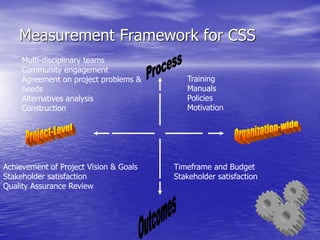
Measurement Framework for CSS
Multi-disciplinary teams
Community engagement
Agreement on project problems &
needs
Alternatives analysis
Construction
Training
Manuals
Policies
Motivation
Timeframe and Budget
Stakeholder satisfaction
Achievement of Project Vision & Goals
Stakeholder satisfaction
Quality Assurance Review
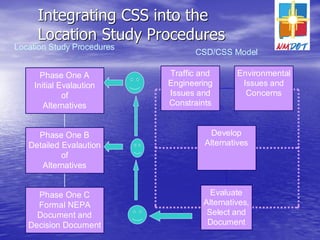
Integrating CSS into the
Location Study Procedures
Phase One C
Formal NEPA
Document and
Decision Document
Phase One B
Detailed Evalaution
of
Alternatives
Phase One A
Initial Evalaution
of
Alternatives
CSD/CSS Model
Traffic and
Engineering
Issues and
Constraints
Environmental
Issues and
Concerns
Evaluate
Alternatives,
Select and
Document
Develop
Alternatives
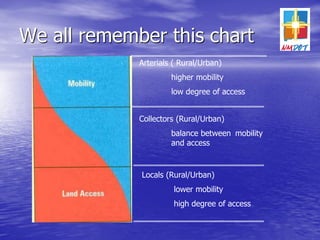
We all remember this chart
Arterials ( Rural/Urban)
higher mobility
low degree of access
Collectors (Rural/Urban)
balance between mobility
and access
Locals (Rural/Urban)
lower mobility
high degree of access
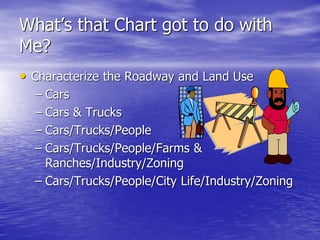
What’s that Chart got to do with
Me?
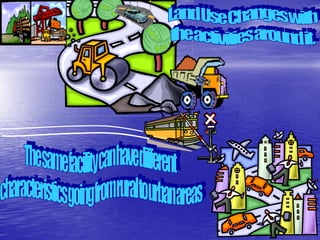
• Characterize the Roadway and Land Use
– Cars
– Cars & Trucks
– Cars/Trucks/People
– Cars/Trucks/People/Farms &
Ranches/Industry/Zoning
– Cars/Trucks/People/City Life/Industry/Zoning
Designing for the Facility
• Identify Design Controls
– Functional Classification
– Terrain
– Location ( Rural/Urban-mixed)
– Traffic Volume
– LOS
– Design Driver and Vehicle
• Speed
• Project Type
– New Construction
– Reconstruction of Existing
– 3R ( Resurfacing, Restoration, & Rehabilitation
Role of the Design Professional
• Develop safe, effective, creative alternatives
• Communicate Stakeholder concerns & issues for
Decision Makers
• Participate in the Project Decision Process
• Incorporate Public Input w/Env. Doc’s
• Document Project Decision’s
• Assure Community Issues are addressed
through the construction phase
Applying CSS in Terms of Design
And Flexibility
• Sustainability
– Adapt to Facility
– Resources ( Public/Agency)
– Community Traditions and Roles
Are we to smart for our own good?
• The Engineers Trap.
– We really want to help!
– We think we can solve everything!
– We think we can design a solution right away!
• Do our stakeholders really what us to help that
much?
– Stakeholders want to be heard!
– Stakeholders want to understand why we design the
way we do!
– This doesn’t mean giving up responsible engineering
charge!
Which brings us to the Question:
When is the right time for choosing
Higher or Lower Design Standards?
Chris, would
you like to fill
us in?

2005 Eng Conf CSS & Design Flex

  • 1.
    Context Sensitive Solutions AndDesign Flexibility Moderator: Joe J. Sanchez, PE. NMDOT Chris Baca, P.E. PB Carlos Padilla, P.E., LBG
  • 2.
    NMDOT CSS Status •Context Sensitive Solutions – Transportation Solutions + Community • Integrated Transportation Services – Value Engineering – Professional Services Contracting – Environmental and Urban Design
  • 3.
    What Makes NMa CSS DOT? • FHWA CSS CRITERIA Level 4 – Level 4: Meets CSS/CSD Criteria – (from the 2/27/2003 CSS/CSD Game Plan) Criteria A - there is a written commitment or policy. Criteria B - technical staff is trained in CSS approach, both in field and central offices and across disciplines (planning, environment, design, right-of-way, operations, maintenance). Criteria C - most projects are being implemented using CSS approach, tools, and methodologies. Criteria D - there is early, continuing, and iterative public involvement throughout the project development process. Criteria E - interdisciplinary teams are involved in the
  • 4.
    Measurement Framework forCSS Multi-disciplinary teams Community engagement Agreement on project problems & needs Alternatives analysis Construction Training Manuals Policies Motivation Timeframe and Budget Stakeholder satisfaction Achievement of Project Vision & Goals Stakeholder satisfaction Quality Assurance Review
  • 5.
    Integrating CSS intothe Location Study Procedures Location Study Procedures Phase One C Formal NEPA Document and Decision Document Phase One B Detailed Evalaution of Alternatives Phase One A Initial Evalaution of Alternatives CSD/CSS Model Traffic and Engineering Issues and Constraints Environmental Issues and Concerns Evaluate Alternatives, Select and Document Develop Alternatives
  • 6.
    We all rememberthis chart Arterials ( Rural/Urban) higher mobility low degree of access Collectors (Rural/Urban) balance between mobility and access Locals (Rural/Urban) lower mobility high degree of access
  • 7.
    What’s that Chartgot to do with Me? • Characterize the Roadway and Land Use – Cars – Cars & Trucks – Cars/Trucks/People – Cars/Trucks/People/Farms & Ranches/Industry/Zoning – Cars/Trucks/People/City Life/Industry/Zoning
  • 9.
    Designing for theFacility • Identify Design Controls – Functional Classification – Terrain – Location ( Rural/Urban-mixed) – Traffic Volume – LOS – Design Driver and Vehicle • Speed • Project Type – New Construction – Reconstruction of Existing – 3R ( Resurfacing, Restoration, & Rehabilitation
  • 10.
    Role of theDesign Professional • Develop safe, effective, creative alternatives • Communicate Stakeholder concerns & issues for Decision Makers • Participate in the Project Decision Process • Incorporate Public Input w/Env. Doc’s • Document Project Decision’s • Assure Community Issues are addressed through the construction phase
  • 11.
    Applying CSS inTerms of Design And Flexibility • Sustainability – Adapt to Facility – Resources ( Public/Agency) – Community Traditions and Roles
  • 12.
    Are we tosmart for our own good? • The Engineers Trap. – We really want to help! – We think we can solve everything! – We think we can design a solution right away! • Do our stakeholders really what us to help that much? – Stakeholders want to be heard! – Stakeholders want to understand why we design the way we do! – This doesn’t mean giving up responsible engineering charge!
  • 13.
    Which brings usto the Question: When is the right time for choosing Higher or Lower Design Standards? Chris, would you like to fill us in?