Washington D.C. by 2014
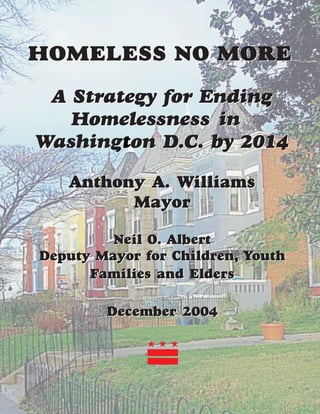
HOMELESS NO MORE
A Strategy for Ending
Homelessness in
Anthony A. Williams
Mayor
Neil O. Albert
Deputy Mayor for Children, Youth
Families and Elders
December 2004
HOMELESS NO MORE
A Strategy for Ending
Homelessness in
Anthony A. Williams
Mayor
Neil O. Albert
Deputy Mayor for Children, Youth
Families and Elders
December 2004
DCLONGRANGEPLANCOVER.pmd 12/16/2004, 10:37 AM1
Washington D.C. by 2014
Dear Stakeholders:
Washington, D.C. by the year 2014. At the top of this plan is a clear vision of what we
intend to do: "To improve the quality of life for all residents of the District of Columbia
by preventing and ending homelessness within ten years."
That vision means all of us have a stake in making this plan succeed. Ending the
social and economic scourge of homelessness - rather than just continuing to manage it -
will benefit not only those who suffer the problem personally, but will also improve the
quality of our neighborhoods and the experience of all residents and visitors.
A city that acts to make room inside for its most vulnerable citizens fits squarely
within our Comprehensive Plan and its vision for "growing an inclusive city." The 6,000
units of affordable housing called for in Homeless No More will be an important part of
creating new, inclusive communities that meet both the material and social needs of our
residents. Responsive mainstream city services wrapped around the new affordable hous-
ing will help people get housed, stay housed and thrive.
The plan recognizes that ten years from now some are likely to become homeless,
but no longer will they get stuck in that condition. Their crisis will be of short duration
and focused on rapid re-housing. We expect to accomplish much over the coming decade
by transforming lives, setting higher expectations of government and consumers, support-
ing these expectations by bettering our services, and helping homeless people move
beyond their current status to enjoy full status as contributing District citizens.
The plan is based on the recommendations of a broad spectrum of city and busi-
ness leaders, homeless service providers and advocates, philanthropic partners, and
homeless people who worked together over the past year to produce it. I thank them all for
their hard work, and I look forward to the work we shall do together to end homelessness.
Sincerely,
Anthony A. Williams
Mayor
ANTHONY A. WILLIAMS
MAYOR
DCLONGRANGEPLANCOVER.pmd 12/16/2004, 10:37 AM2
It is my pleasure to present Homeless No More, a plan to end homelessness in
GOVERNMENT OF THE DISTRICT OF COLUMBIA
Office of the Deputy Mayor for Children, Youth, Families and Elders
Neil O. Albert
Deputy Mayor
Dear Stakeholders:
Mayor Anthony Williams’ Homeless No More initiative presents a new beginning in how our city
approaches the difficult social and economic problem of ending homelessness. As Deputy Mayor directly
responsible for the city’s health and human services agencies, I already have begun to embrace a new set
of policies, establish new facilities and create new services that right now are improving the lives of
homeless people.
Along with my cluster agencies, I look forward to working closely with city and federal
colleagues in housing, economic development, education, employment, public safety and property
management to carry out the three central policy directives of this plan:
1. Increase our homeless prevention efforts using local and federal resources;
2. Develop and/or subsidize at least 6,000 new units of affordable, supportive permanent
housing by 2014; and
3. Actively coordinate mainstream social services for homeless Continuum of Care residents.
Even as this plan was being finalized and readied for publication, I am happy to report, several
initiatives were underway that already have improved the quality of our facilities and added new services
for protecting the lives of our homeless people:
• Hundreds of new beds were brought on line for the 2004-2005 winter season;
• The FY 2005 Continuum of Care budget was increased;
• The city’s first inpatient substance abuse treatment program for Latinos was opened in
partnership with Neighbors Consejo;
• Two outworn shelters have been replaced with two newly-renovated facilities that provide better
• A “housing first” program for chronically homeless adults was initiated in partnership with the
D.C. Housing Authority, issuing Section 8 vouchers for permanent housing;
• A dialogue with downtown business people and other stakeholders has been established to chart a
course for serving homeless people who frequent the downtown area;
• Major renovations have been undertaken at the Federal City Shelter; and
• Planning has begun for new permanent supportive housing at two sites.
Homeless No More is a blueprint for action. I look forward to working to improve the lives of
our homeless brothers and sisters, along with the broad spectrum of city and business leaders, service
providers and advocates, philanthropic partners and homeless people whose work is reflected in this plan.
Sincerely,
1350 Pennsylvania Avenue NW, Suite 303, Washington, D.C. 20004 (202) 727-8001
Neil Albert
accommodations enriched with on-site mainstream services;
Homeless No More
Homeless No More emerged out of more than a year’s work by Mayor Anthony A. Williams’ “Focus
Group on Access to Housing for Homeless and Very Low Income Persons” and its committees. The
Focus Group engaged a broad spectrum of city and business leaders, homeless providers and
advocates, and homeless people in planning discussions. Its recommendations became the basis of
further work by the Mayor’s Policy Academy Team (“the MPACT team”) that came together for
three days in Denver in October 2003 for the federally sponsored Policy Academy 5. On June 16,
2004 the Mayor issued a draft plan for public comment that recommended three long-term policies
to end homelessness.
1. Increase homeless prevention efforts within local and federal government.
2. Develop and/or subsidize at least 6,000 net additional units of affordable, supportive
permanent housing to meet the needs of the city’s homeless and other very low-income
persons at risk of homelessness.
3. Provide wraparound mainstream supportive services fully coordinated with Continuum of
Care programs and special needs housing.
District citizens who attended five public hearings – as well as written comments from homeless
providers, consumers and advocates – soundly endorsed the three basic objectives of this plan.
Mainstream public agencies and services will re-tool to work better for persons who are homeless.
Emergency shelters will be replaced by easy-access, rapid-exit “homeless assistance centers”
founded upon a new social contract. Those who can help themselves will take personal
responsibility for their self-sufficiency and be helped to achieve this through on-site, mainstream
case management, clinical, and employment services. For those who need ongoing support, the city
and its service delivery partners are committed to helping them achieve their highest level of self-
directed living. The city will offer “housing first” options to move individuals and families quickly
and directly to permanent housing where they will be supported by transitional, community-based
services until they are beyond their crisis. For those with serious disabilities and long histories of
homelessness, the District will offer “housing plus” options that provide immediate placement along
with a commitment of ongoing support for as long as necessary.
The Mayor will convene an Interagency Council on Homelessness to continue engaging providers,
advocates and the public at every step along the way of this plan’s further development.
Responsibilities inside District agencies, including annual and long-term budgets to achieve this
plan, will be hammered out at this table. The Interagency Council will create cross-systems
strategies within D.C. government to end homelessness and publish an annual report on how the
plan is progressing.
Transforming lives, establishing higher expectations, supporting these expectations with better services,
and helping homeless people move beyond their current status by making the end of homelessness our city’s
objective – these are the essentials of what this plan is all about.
Overview
1
Homeless No More
2
The Vision: To improve the quality of life for all
residents of the District of Columbia by preventing and
ending homelessness within ten years.
Mayor Anthony A. Williams has decided to move ahead,
beginning in FY 2005, with the task of ending
homelessness in Washington D.C. To do so, the city is
undertaking a two-fold strategy that will entail deep,
substantial and immediate initiatives to improve existing
services for homeless people while also launching long-
term initiatives that hold the promise of ending
homelessness as we now know it within 10 years. At the
end of the 10-year period there are still likely to be
people who experience homelessness, but their homeless
crisis will be of short duration and focused on rapid re-
housing. Homelessness as we now know it – with too
many individuals stuck in shelters or on the streets, too
many families seeking affordable housing through a
shelter system, and a shelter system set apart from
mainstream systems of community care and
neighborhood-level supports for people in crisis – will
be a thing of the past.
The city will respond effectively to its citizens who face a
homeless crisis, but no more will it offer individuals only
a bed in an overnight shelter or families an apartment or
congregate shelter where every other family is homeless.
Most importantly, the city will act to end altogether the
tragedy of disabled and vulnerable people living in the
streets or permanently in congregate shelters. The
facilities and beds that remain at the end of ten years will
be tightly woven into the mainstream safety net for
persons living in poverty, and they will be compatible in
design and operations with the neighborhoods in which
they are located.
The strategies and actions in this plan pay special
attention to ending “chronic homelessness” among long-
time homeless persons with disabilities, yet they also
point to major new resources of affordable housing for
working poor individuals and families and to a quality of
life that will make the District a more livable and
attractive city that works for people at all income levels.2
Ending the social and economic scourge of
homelessness over the next ten years will benefit not only
those who suffer this problem in their persons – helping
them to achieve a higher quality of life – but will
improve at the same time the quality of our
neighborhoods and the experience of our city's residents
as a whole. There will be benefits for everyone. From our
business communities to our residential neighborhoods,
all residents and visitors will enjoy a city that makes room
inside decent temporary lodgings and provides
permanent affordable housing for the poorest of its
poor.
Ending homelessness will not require ending poverty in its
entirety. The end of homelessness can be achieved
through a careful re-tooling and better use of our
mainstream public systems that help people in need. With
the full cooperation of nonprofit and faith-based
providers, business leaders, and others who are willing to
partner with city and federal government, ending
homelessness is something we can do.
Ending homelessness will involve identifying and
overcoming the economic, social and bureaucratic
barriers that have frustrated past attempts to bring the
homeless poor into not only our shelters and housing, but
into our communities where we live and work. It will
involve a dramatic increase in affordable housing - setting
a goal of supporting at least 6,000 net new units over ten
years – focused on preventing and ending homelessness.
These new units, coupled with sustained wraparound
supportive services from public systems of care, will
benefit about 2,000 adults and 500 families who face the
deepest challenges to independent living, people whose
homelessness is chronic and repetitive. Yet thousands of
others who suffer a temporary crisis and end up coming
to a homeless shelter also will benefit. At the entry level to
the homeless care system this plan proposes the
transformation of every shelter into a “homeless
assistance center” that will place a premium on getting
people rapidly re-housed, bringing on site the public
services that will help make their experience of being
homeless a short one and not to be repeated. Yet it also
proposes at least 1,000 affordable units for adults and
2,500 affordable units for families whose major problem
is extreme poverty; by doing so this plan will prevent
these persons from ever having to enter a homeless
shelter.
Over the past decade the city and homeless service
providers have learned a great deal about creating a
“Continuum of Care” for homeless people. That
experience yielded valuable lessons for the helping
professionals in our mainstream systems of care with
respect to serving people with multiple and deep needs.
It is now time to start moving beyond a specialized
Homeless No More:
A Strategy for Ending Homelessness in Washington, D.C. by 2014
“This plan – ‘Homeless No More’ – can work. I know it can.”
“You can only finish the race if you begin.”1
Homeless No More
3
Continuum of Care labeled “homeless people only” or else
run the risk of perpetuating “homeless” as a permanent
social status. Instead we will integrate and blend into our
mainstream agencies what we have learned from the
Continuum about what works to prevent and end
homelessness one person, one family at a time. The large
public systems that have to some extent been part of the
problem are absolutely essential to crafting the solution. This
plan creates the means to bring these systems to the planning
table to create a new system of community care that puts
living in shelters and on the streets behind us once and for all.
When there are no more men and women living in the streets
of Washington, D.C., when every chronically homeless
person has been housed, when every person or family facing
a housing crisis can find immediate help to stay in their home,
and when every person or family that does lose their home
can find a decent place to stay for a short while – in
neighborhoods all across the city – then homelessness as we
now know it will be ended and the objectives of this plan
will have been achieved.
Why Ten Years?
Ending homeless as we now know it can be done but will
not be done overnight, although some consumers engaged in
the public comment period for this plan understandably
asked why it should take so long. Not everything will take ten
years, and a good deal of what is in this plan is already
underway, but the conversion from a homeless “Continuum
of Care “ system to a system of community-based care
supported by mainstream public systems and their private
sector partners will be challenging. It will take some time
because the underlying conditions of poverty and disabilities
and housing costs that cause homelessness must be addressed,
because the housing objectives will require much more than
simply “pulling off the boards” from vacant housing, and
because the homeless system as it has been built over the past
20 years must be carefully deconstructed and rebuilt into a
new system to avoid additional hardships for consumers.
The task now is less about keeping what has been built to
ameliorate homelessness and more about taking creative steps
to end homelessness. Achieving the objectives of this plan will
require positive, forward looking leadership from District
government, empowered and aided by the cooperation of
business leaders, citizens, advocates and other stakeholders
who are endeavoring to end homelessness. As one leading
researcher on homelessness has noted, “two key factors
emerge as crucial in whether communities make progress on
these goals – a clear vision of where they want to go and
sustained leadership.”3
The Planning Process
On January 13, 2003 Mayor Williams convened a new
homeless policy planning group co-chaired by deputy mayors
responsible for the city's health and human services
Families and Elders or ODMCYFE) and its housing,
economic development and planning agencies. The Focus Group
on Access to Housing for Homeless and Very Low Income City Residents
recommendations both to improve the current homeless
Continuum of Care and to develop a plan to end
homelessness in Washington, D.C. within ten years.
Subcommittees of the Focus Group produced
comprehensive recommendations including: replacing
outworn shelters with new facilities; developing new
interagency approaches to delivering wraparound mainstream
services; and creating new public and private financing tools to
underwrite an increase in the stock of permanent affordable
housing for the homeless and low-income households at risk
of becoming homeless. A committee formed before the
Focus Group came into being also delivered
recommendations for reforming the legal framework of
homelessservices.
The recommendations of the Focus Group and its
committees are reflected in this 10-Year Strategy and Action
Steps. They were amplified and refined by the Mayor’s Policy
Academy Team (or “MPACT” team), under the leadership of
ODMCYFE, that came together in Denver on October 27-
29, 2003 for the federally sponsored Policy Academy 5. The
MPACT team established three basic goals for the District’s
10-year plan to end homelessness, which the Mayor has
accepted as the centerpiece policies of the city’s 10-year plan:4
1. Increase homeless prevention efforts within local
and federal government.
2. Develop and/or subsidize at least 6,000 units of
affordable, supportive permanent housing to meet
the needs of D.C.’s homeless and other very low-
income persons at risk of homelessness.
3. Provide wraparound mainstream supportive
services fully coordinated with Continuum of Care
programs and special needs housing.
In short, keep as many people as possible from becoming
homeless in the first place through direct prevention efforts
and increasing the supply of affordable housing, and enrich
the homeless Continuum at all levels with supportive services
that rapidly re-house persons with and without special needs,
changing the focus of the city’s efforts over time from a
“shelter first” to a “housing first” model that ends
homelessness.
agencies (the Office of the Deputy Mayor for Children, Youth,
(Focus Group) set about the task of developing
Homeless No More
4
these persons were literally homeless – i.e., on the streets, in
shelters or in transitional facilities. The District’s count included
(unlike all other COG jurisdictions) 194 families who were
listed by family central intake as doubled-up, eligible for shelter
because their situation put them at imminent risk of
homelessness, and seeking relief from the homeless system or
anywhere else they could find a route to permanent housing.5
the streets, a figure that grows to about 500 persons in the
2004 as permanently supported homeless who are living within
permanent supportive Continuum of Care housing whose
homelessness has ended but could easily re-occur without the
ongoing support.6
Over the last ten years, in response to such realities, the District
and many private agencies have created one of the largest
homeless Continuum of Care systems in the nation both to
relieve the immediate suffering of people without shelter and
help them with obtaining and keeping permanent housing.
There are currently enough public and private beds to shelter
or house about 8,875 persons, enough to serve 1-in-13 of all
District residents living in poverty. A HUD report to
Congress prepared by the University of Pennsylvania showed
that the District has a rate of homelessness and shelter usage
among single adults in poverty higher than New York City or
Philadelphia. Another HUD report showed that the District’s
Continuum has more Continuum of Care beds per persons
in poverty than other major cities such as Boston and San
Francisco.7
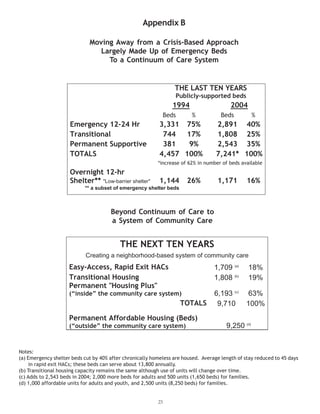
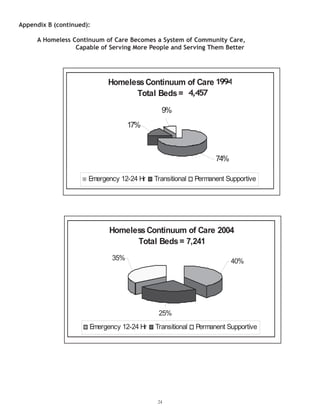
As displayed in the chart in Appendix B, the District’s publicly
supported homeless system has not only grown in size, adding
about 2,800 new beds since 1994, but has become more
diverse in its composition and now offers more beds and
services focused on ending homelessness one person, one
family at a time. Improvements to the Continuum have been
ongoing, and this 10-year plan includes strenuous new efforts
to continue making the Continuum and its facilities get better
from the entry level of emergency shelters to permanent
supportive housing.
On an annual basis District agencies spend over $25 million
on programs targeted to the homeless, HUD contributes
another $15 million in McKinney-Vento Act funding,
philanthropies contribute more than $5 million, and private
donations and faith-based programs contribute millions more.
Despite these investments of knowledge, energy, resources
and dollars, homelessness persists in the District and has
increased by about 10% since 2002 when including the
addition of more permanent supportive housing that has
become a larger component of the District’s Continuum of
Care. The problem at the emergency end of the
In order to achieve these goals, three implementation
strategies will guide the work of the District government
and the community-based organizations with which it
partners.
· Implementation Strategy A: Interdepartmental
coordination and cross-system policy
implementation.
· Implementation Strategy B: Community
education and community outreach to gain
support for the 10-year plan and the “housing
first” and “housing plus” approaches.
·
Contained within these implementation strategies as action
steps that comprise the initial agenda of the 10-year plan
are commitments to establish an Interagency Council on
Homelessness with appropriate authority to implement
the 10-Year Plan, finalize regulations that fully support
Continuum of Care programming and the specific
objectives of the plan, improve data collection and data
sharing to track the objectives and outcomes of the plan,
create interagency budgets each year that are focused on
ending homelessness, support local and regional discharge
policies to prevent homelessness, and much else.
During a 30-day period of public comment that began
with Mayor Williams releasing the draft plan on June 16,
there emerged solid endorsement of the plan’s policy
priorities from citizens, providers and consumers, along
with many helpful suggestions for improving the specifics
of the plan. The final plan reflects the public input in
general terms, with specific recommendations to be taken
up by the Interagency Council on Homelessness when
that body is convened.
The basic elements of this plan will guide city policy,
including the highest levels of city planning, so that the
housing needs of people who experience homelessness,
whether of short or long duration, and the social services
needs are married in a way that achieves the vision.
Current Conditions
In 2002 and 2003 an estimated 16,000–17,500 people,
our District neighbors, were homeless at some point
during the year (annually), and as many as 2,000 of these
are “chronically homeless” persons who lived either in
shelters or on the streets throughout the year. At the last
point-in-time enumeration undertaken on January 21,
2004 by the Metropolitan Washington Council of
Governments (COG), about 8,250 persons were counted
by public and private programs within the Washington,
D.C. homeless Continuum of Care. About 6,100 of
Implementation Strategy C: Advocacy for reduction
of federal and other barriers to delivering
and end homelessness.
services and housing that can prevent
It also included an estimated 315 persons who normally live on
warmer months. Another 2,150 persons were counted in
Homeless No More
5
Continuum, especially for families, has been
exacerbated lately by the rising cost of rental housing
and could get worse if the federal government
continues in the direction of reducing its commitment
to affordable housing. The D.C. Housing Authority
has on its waiting list for Housing Choice Vouchers
about 16,000 households who have claimed a
homeless preference, a figure which indicates that over
an extended period of time many households have
faced a homeless crisis and, although the vast majority
of these households are not currently homeless,
nevertheless their wait for a housing subsidy continues.8
To deal with such issues and get beyond this recurring
cycle of homelessness and seemingly endless allocation
of substantial resources to ends far less than
satisfactory, the Mayor is committing District
government to build a neighborhood-centered,
mainstream-funded, and housing-focused system to
end homelessness as we now know it in 10 years.
Policy Objective #1:
A Greater Focus on Prevention
The Action Steps in this Plan call for major new
efforts to prevent homelessness from within the
mainstream systems that provide services and housing
to those most at risk of losing their homes. More
emphasis will be placed on keeping people housed
when they face evictions and doing that in a smart way
that invests case management support along with cash
assistance so that the crisis is addressed and resolved.
Prevention efforts such as this will become ever more
closely interwoven with neighborhood-based helping
systems such as the Family Support Collaboratives
within the child welfare system and One-Stop Centers
that provide employment assistance.
As a first step toward increasing the emergency
assistance response of the city, ODMCYFE, which
oversees the city's human services, and the Community
Partnership for the Prevention of Homelessness, the
agency that manages the city's homeless Continuum of
Care, will convene by January 2005 a committee that
will conduct an environmental scan of all existing
public and private emergency assistance programs,
including the funds available to each and the most
recent data on households assisted. The committee will
make recommendations to the Interagency Council on
Homelessness with respect to a sufficiently resourced
Emergency Assistance program that assures that assisted
households will retain their housing and get the help they
need to avoid a repetition of the housing crisis. To prevent
homelessness among adults and unaccompanied youth, the
Plan calls for the convening of a “discharge planning task
force” made up of District and private agencies, including
mental health, public health, corrections, youth services, social
services and private for-profit managed care vendors, to
craft homeless prevention strategies through appropriate
discharge planning. Over a reasonable period of time all
public agencies will be required to develop “zero tolerance”
policies and procedures to assure that none of their
consumers exit to a homeless shelter or the street.
This work is underway. DMH Director Martha Knisley
convened the first meeting of the task force in September
2004 to lay out an agenda and identify staff within agencies
who can take up the task of meeting regularly until a
“Discharge Planning Policy” is developed for the Mayor’s
endorsement. In addition to the Community Partnership and
large shelter providers who often receive persons from
public and private institutions, the task force includes
representatives from the Department of Health’s Addiction
Prevention and Recovery Administration (APRA), the
Department of Employment Services with its lead role for
reintegrating ex-offenders and helping people find jobs,
Department of Corrections, Child and Family Services
Agency, Court Services and Offender Supervision Agency,
Unity Healthcare, and the Primary Care Association.
APRA, in addition to participating on the discharge planning
task force, has established a subcommittee of MPACT that is
taking on the development of additional homeless prevention
efforts for persons disabled by substance abuse. APRA plans
to increase its prevention efforts with hospitals and jails and to
replicate best practice models for step-down transitional
housing for persons exiting detox.
To prevent family homelessness, the Plan calls for the
Department of Human Services through its Income
Maintenance Administration and Family Services
Administration to craft a closer collaboration between the
homeless system and the welfare system. With over 70% of
all families applying for shelter already on TANF, and most all
other families eligible for TANF, the Income Maintenance
and TANF system has the potential to become a critical line
of defense to identify families facing a homeless crisis. The
family’s crisis can be assessed and resolved in the context of
the family’s responsibility, for those who are able, to move
from welfare to work. This activity will significantly add to
prevention efforts already in place that use HUD Emergency
Shelter Grant funds and the DC Emergency Assistance Fund
to provide rent and utility assistance to families facing eviction.
Policy Objective #2:
Housing is the Ke
Homeless No More
6
Greater Focus on PreventionPolicy
6,000 New Units of Affordable Housing
Based on the MPACT recommendation, this plan commits
the city to achieving the following housing objectives over
the next ten years:
1. Building and/or supporting at least 3,000
net new units of Single Room Occupancy
(SRO) or other modest, private and
affordable housing for adults, and allocating
up to 2,000 of these as supportive housing
for chronically homeless persons with
disabilities while 1,000 units can be used by
working poor adults or unaccompanied
youth without disabilities.
2. Building and/or supporting at least 3,000
net new units of affordable housing for
low-income families, and linking these with
community-based services for families both
with and without special needs, with 500 of
these to house families with long histories of
homelessness.
Homeless No More establishes permanent housing as the major
gap to be closed in the years ahead. The permanent housing
in this plan is designed both to end the homelessness of
some and prevent many other very poor people from
becoming homeless in the first place. Some of the new
units are planned to be “inside” a new system of
supportive housing with wraparound support services
for individuals and families who need ongoing “housing
plus” services to maintain stable housing. Other units are
planned to be “outside” the system of community care,
which simply means that they will be affordable housing
that ends or prevents the homelessness of extremely poor
persons at or below 20% of AMI. The plan calls for an
estimated 12,900 additional beds in permanent housing
for individuals and families to be added to the existing
2,543 beds in permanent supportive housing.9
Affordable housing is the key to ending homelessness, just
as it is critical to improving the lives of all low- and
moderate-income persons in the city. Thus this Plan’s
housing goals are directly related to its vision – to
improve the quality of life for all District residents.
Affordable housing emerged from the Mayor’s Citizens
Summit process as the #2 budget priority. The city’s
revised Comprehensive Plan for ensuring an inclusive city
recommends that affordable, supportive housing for special
needs populations be available across all eight
wards of the city. The Washington Interfaith Network
has acted to defend and to expand affordable housing.
Housing activists over the past several years have
recommended that the city seriously consider the
establishment of inclusionary zoning to promote
affordable housing and the reforming of the city’s rent
control law so that low-income tenants’ “right to first
refusal” is strengthened.
Clearly the housing affordability issue affects the whole city
and is the subject of much public policy debate. In 2003 it
took a $23.42 per hour wage (381% of the $6.15
minimum wage) for a District resident to afford a 2-BR
apartment. This “housing wage” figure increased by 22%
over the same figure for 2002 and at present a full-time
minimum wage worker can afford no more than $320
monthly for housing.10
For homeless people it is especially
hard to afford housing since homeless adults have a mean
income at 51% of the federal poverty rate and families
have a mean income at 46% of the poverty rate.11
In the
District homeless people are counted among the extremely
low income with an average income of about $7,734 or
about $645 monthly. Although about three quarters of
homeless people have some income either from
employment or entitlements, for most of them it is far less
than what is needed to afford a rental unit in the D.C.
market.12
For persons with disabilities who receive SSI
benefits, the average monthly benefit is $545, well below
the average rents for any 1-BR apartment in the District.13
As much as homelessness and affordable housing are
closely related, the solution to ending homelessness is
obscured when it is conflated with the affordable housing
problem in general. One researcher has estimated that the
universe of need for more affordable housing in the
District will require 3,600 units annually over the next two
decades.14
This estimate, however, is based on all
households with incomes below $50,000, a figure that is
five to six times higher than the extremely low incomes of
the homeless population.
Not all households who need a subsidy to make their
housing affordable are at risk of becoming homeless. The
D.C. Housing Authority list of over 50,000 households
awaiting affordable housing reveals only that these
households are qualified for some level of subsidy to bring
their housing cost down to 30% of their gross annual
income. The DCHA wait list figure does not isolate those
households at extremely low income who are at high risk
of homelessness. In fact, a household of one person can
have an income as high as $38,100 and still be eligible for a
Housing Choice Voucher, and a family household with
three persons (fairly typical of the average size of a
homeless family) can have an income as high as $48,950.15
Policy Objective #2:
Housing is the Key
community care, meaning that they will be permanent
Homeless No More
7
“Housing First” and “Housing Plus”
For the past year city leaders, the Community Partnership
and dozens of stakeholders have been looking at what
other cities are doing in terms of best practices,
formulating this plan and undertaking some of the first
steps toward ending homelessness in the District.
The key as noted above will be substantial new
production of affordable and supportive housing,
coupled with major new institutional strategies to
prevent homelessness. In fact these two goals will
converge as more affordable, supportive housing
becomes the best form of preventing the most
vulnerable persons from falling back into homelessness
and prevents extremely low-income working poor
persons from having to enter a shelter in the first place.
This plan moves the District away from its current
reliance on emergency shelters and toward a day when
it can offer "housing first" options to homeless people,
even to those who face the most serious challenges to
obtaining and keeping housing. Emergency shelter for
too many families with children, not to mention too
many adults and youth, has proven to be one of the
least effective, and even in some cases injurious, options
for dealing with the housing crisis. While there is room
for improvement in the conditions of emergency
shelters, and improvements to facilities and programs
are ongoing, the fact remains that the city can do much
better than offering emergency shelters. Therefore this
plan envisions that homeless people will move directly
to permanent housing and be supported by
community-based transitional services until they are
beyond crisis and not likely to need further assistance.
The "housing first" approach will coordinate well with
the city's investment in "strategic neighborhood target
areas" where the Mayor is supporting the development
of affordable housing and investments in small
businesses that provide living wage jobs. Many of
these are the same neighborhoods from which most
homeless families and adults come. Neighborhood-
based social services will become more and more the
backed up by the District’s mainstream health and
welfare agencies. The “housing first” approach will also
work well for families and able-bodied, able-minded
adults - men and women out of work and needing
jobs, the working poor, or persons in recovery and
needing just a little support. The targeted investments
in communities, nonprofit services, business
development and good jobs will end homelessness for
many adults.
Will 6,000 units be enough to end homelessness as we
now know it? How was this figure derived? What
makes it a plan to end homelessness? These questions
were raised by several who commented on the draft
plan.
The answer is that 6,000 net new units of affordable
housing will be a good start toward the desired
objectives of this plan. The challenge of meeting this
objective is one that deserves widespread support to
make it happen even if some think it may not be
enough. As one homeless provider stated in a written
comment, “You can only finish the race if you begin.”
These units will make a solid beginning.
Still, there is another way of understanding what 6,000
net new units of affordable housing can accomplish
when they are considered within the context of all
publicly-funded units and beds that will remain in 2014
as part of a new “system of community care” that will
replace a set-apart homeless Continuum of Care.
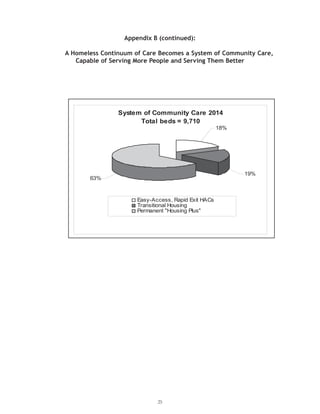
When the full context is understood, this plan projects
enough beds within a system of community-based
care and additional affordable housing that will shelter
an estimated 18,960 District citizens.16
This figure is
higher than the total annual count of persons who
used publicly funded homeless Continuum of Care
beds for the past five years and means that the planned
new system could serve almost 17% of all persons in
the District who are now living in poverty.17
It does
not include another 1,726 beds that are currently
operated by private agencies with no public funding.
If these private beds are factored in with the public
ones, the projected size of the public and private
system to serve homeless persons will shelter or house
over 18% of those persons living in poverty.
Since it is rare that the annual rate of homelessness
among people living in poverty exceeds 10% in large
urban areas, the MPACT team concluded that the new
system should be adequate to meet the needs.
Obviously, this will be a living plan and subject to
modification if the need is greater than anticipated,
but, 6,000 units makes a good beginning.
New York Avenue Homeless Assistance Center
safety net for families and adults in crisis. They will be
Homeless No More
8
None of this implies that persons with disabilities
will be limited to the “housing plus” option or may
only live where there is a “program,” since where
persons choose to live will never be determined solely
by their disability. It means only that housing plus
ongoing supportive services will be offered to them.
They may or may not accept services, but model
programs around the country have shown that most
persons with disabilities are willing to be engaged
with services as time goes by because they see an
improvement in their lives. The housing first option
will be available to support people with disabilities to
live where they choose – just as that is the case with
the DMH Chronic Homeless Initiative already
underway.
Reducing the number of chronically homeless adults
in shelters by housing them will have another benefit.
Over time the District will need fewer emergency
shelter beds. Just as in Columbus, Ohio – where the
Community Shelter Board discovered that about
half of all emergency shelter resources (measured as
“bednights’) are used by just 15% of homeless men,
so in the District the Community Partnership has
documented that about half of District emergency
beds used daily are occupied by 10%-15% of the
men and women who go through shelters on an
annual basis.18
When the chronically homeless are
housed instead of sheltered, the Homeless Assistance
Housing and Service Needs of Families with
Children, Youth and the Elderly
Respondents to the public comment draft of this plan
suggested that the District should convene a special
group to develop further its housing and service
objectives for families and children. Others
recommended that the plan include specific objectives
for unaccompanied homeless youth, including young
people who have aged out of foster care without stable
employment and housing, those who wander from
house to house and those who are known to the Child
and Family Service Agency to be at risk of
homelessness. Still others commented on the need to
improve shelters and implement better quality control
of programs and facilities now in service for these
populations even as a new system is being built. One
consumer activist put the point this way as she called
for re-training staff to adapt to the direction of this
plan: “We need staff to have a brand new outlook on
helping residents to get out of the system.”19
Homeless families: In response to community input on
families, this plan has grown to include many more
specifics about what will be done. Work on this issue
got underway when DHS Director Gilchrist convened a
group of MPACT members and family providers (the
Homeless No More Family Steering Committee) at the
end of October 2004 to begin developing further the
plan’s strategies and objectives for families with
children. Over time this group will become a standing
committee attached to the Interagency Council on
Homelessness.
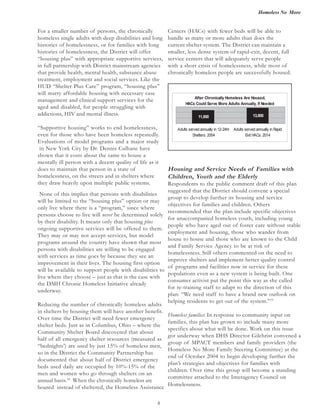
After Chronically Homeless Are Housed,
HACs Could Serve More Adults Annually, If Needed
11,850 13,800
Adults served annually in 12-24hr
Shelters: 2004
Adults served annually in Rapid
Exit HACs: 2014
For a smaller number of persons, the chronically
homeless single adults with deep disabilities and long
histories of homelessness, or for families with long
histories of homelessness, the District will offer
“housing plus” with appropriate supportive services,
in full partnership with District mainstream agencies
that provide health, mental health, substance abuse
treatment, employment and social services. Like the
HUD “Shelter Plus Care” program, “housing plus”
will marry affordable housing with necessary case
management and clinical support services for the
aged and disabled, for people struggling with
addictions, HIV and mental illness.
“Supportive housing” works to end homelessness,
even for those who have been homeless repeatedly.
Evaluations of model programs and a major study
in New York City by Dr. Dennis Culhane have
shown that it costs about the same to house a
mentally ill person with a decent quality of life as it
does to maintain that person in a state of
homelessness, on the streets and in shelters where
they draw heavily upon multiple public systems.
Centers (HACs) with fewer beds will be able to
handle as many or more adults than does the
current shelter system. The District can maintain a
smaller, less dense system of rapid-exit, decent, full
service centers that will adequately serve people
with a short crisis of homelessness, while most of
chronically homeless people are successfully housed.
Homeless No More
9
Homeless families with children have special needs, as
do their children. Given that there is a well-established
mainstream safety net for families, children and youth,
it can be said as a starting point for further discussion
that this plan envisions that solutions to homelessness
for families will come from patching the breaks in the
safety net. It will entail coordination with a variety of
mainstream initiatives to help families, including the
Children’s Investment Trust and the city’s Fatherhood
Initiative. Better collaboration among public and
private agencies that understand the needs of families
will go a long way toward preventing homelessness in
the first place. As Director Gilchrist stated at one of
the public hearings on the draft plan:
Families are a priority for me, because I don’t think
families should be in shelters. I think if we have resources,
we need to put them at the front end to do all that we can
to prevent families from…going into a disillusioned
atmosphere. We should do as much as we can at the front
end. If we look across the government and where our
money is being spent, we probably can do more if we
concentrated on keeping families in the homes where they
are.20
As noted above, for those families with children who
are already homeless or who may become homeless
there will be an expanded commitment to “housing
first” options. This will be augmented by a rapid-exit
program that helps families with their first month rent
and security deposit plus some tangible material needs
so they can spend less time in shelter. This will work
well for most families whose entry to the shelter
system has more to do with their extreme poverty.
This plan will create a system of community-based
care, prevention and housing – nearer to schools,
after-school programs and childcare – that supports
families to live where they would like to live to the
extent they can afford it.
For those families with long histories of homelessness
because of problems such as substance abuse and
mental illness, the city will still look to normal housing
units as the best option for meeting their need for
shelter, but will wrap around these units the
mainstream supportive services needed to stabilize the
family in this housing. For some such families this will
be an ongoing need and others will eventually move
beyond the need for support.
As a starting point, this plan calls for 500 of the 3,000
new family units to be service-enriched supportive
·
• Leasing of multi-family apartments to provide
permanent affordable housing for families.
• Conversion over time of family shelter
apartments to the “housing first’ model.
• Development of vacant and abandoned/hot
property units as affordable family placements.
• An initiative to provide incentives for small
building owners to renovate buildings and rent
to families holding a Housing Choice Voucher
(Section 8).
• Expansion of the “housing first” Community
Care Grant program and a deeper partnership
with the Family Support Collaborative Council
to access market-rate housing.
• Adapting the Community Care Grant program
to work with other kinds of public and private
family support agencies such as CFSA and
DCHA that will be able to access funds to
provide either time-limited or permanent
housing subsidies.
housing “inside” the new system of community
care while 2,500 affordable housing units for
families will simply be dedicated to ending and
preventing homelessness for very- and extremely-
low income families.
Short-term and long-term steps to house families
will include:
Gospel Rescue Ministries-Fulton House
Homeless No More
10
The Elderly:
Finally, there is a need to allocate some of the new
affordable housing to elderly homeless (55 years
and older). Some of these will be counted among
the chronically homeless who will need supportive
housing, while others are men and women beyond
their working years and on fixed incomes, yet not
disabled. One answer to such needs will be HUD
§202 housing dedicated to providing permanent
housing to elderly persons in homeless shelters and
transitional housing, while other units will be
developed by mainstream agencies serving the
mentally ill or persons with physical disabilities.
This plan calls for allocating 2,000 of the 3,000 new
units for individuals to chronically homeless persons
with serious disabilities. As a start, the plan calls for
at least 200 of the 1,000 other units for individuals
to be allocated to youth while 800 are allocated to
working poor and elderly adults without serious
mental or physical disabilities.
With the understanding that this is a living plan
subject to modification, but that the modifications
will be within the overall objective of at least 6,000
new affordable housing units, the table below
summarizes the projected distribution of the
housing units.
supportive housing for persons with disabling
conditions that are barriers to complete self-
sufficiency, all the rest can benefit very poor
persons without disabilities, undocumented
persons, and other groups to be determined. As
noted by the MPACT Team Coordinator at one of
the public hearings when speaking of how SRO
units and other housing first options will be
allocated or who they will serve: “A large part of
it will lie in the imaginations of the people who
choose to develop some of these facilities.”21
Planned Distribution of Housing Units
A.
Household Type
B.
Units to be
made
affordable
C.
Number of the units in
Column “B” to be
“supportive housing”
Chronically homeless adults, including
elderly
2,000 2,000
Working poor and elderly adults 800 0
Unaccompanied youth under 21 years old 200 0
Families with children 3,000 500
TOTALS 6,000 2,500
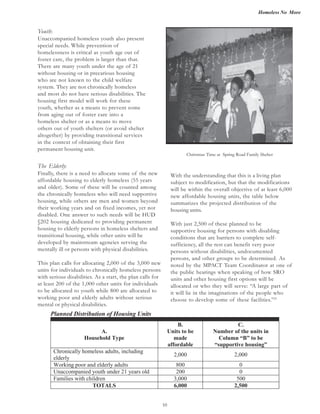
Christmas Time at Spring Road Family Shelter
Youth:
Unaccompanied homeless youth also present
special needs. While prevention of
homelessness is critical as youth age out of
foster care, the problem is larger than that.
There are many youth under the age of 21
without housing or in precarious housing
who are not known to the child welfare
system. They are not chronically homeless
and most do not have serious disabilities. The
housing first model will work for these
youth, whether as a means to prevent some
from aging out of foster care into a
homeless shelter or as a means to move
others out of youth shelters (or avoid shelter
altogether) by providing transitional services
in the context of obtaining their first
permanent housing unit.
With just 2,500 of these planned to be
Homeless No More
11
The city will consider the re-establishment of its
own rental subsidy program if funds can be
identified for that. Such a program would not only
allow the District to help those who may lose their
federal subsidy but could also extend help to
persons who are ineligible for federal subsidies
either because they lack American citizenship or
might otherwise be considered ineligible for federal
housing subsidies.
The city will focus its efforts on creating new
affordable rental housing, but in the context of the
self-sufficiency objectives that permeate this plan
the city will work to support programs that lead to
home ownership. There are good models already in
place like the D.C. Housing Authority's “Housing
Choice Voucher/Home Ownership Assistance
Program” that can be expanded, replicated or
adapted to work in concert with the new system of
community care.
To encourage the full participation of the nonprofit
housing developers and the philanthropic and
business communities who are interested in
supporting this plan, the Interagency Council on
Homelessness will ask the Mayor to convene
sometime in FY 2005 a “Special Needs Housing
Advocacy and Action to Preserve Affordable
Housing
An important component of the District’s success
in reaching a goal of a net increase of 6,000 units
over 10 years will be the actions of the federal
government, especially the ongoing support of
existing subsidized housing and increases to meet
the expanding need.
The plan’s success will require full funding of the
Housing Production Trust Fund (HPTF) to create a
stable and predictable funding stream that the
Department of Housing and Community
Development and nonprofit housing producers can
count on. The HPTF will be used to continue the
city’s efforts to prevent homelessness by preserving
the city’s project-based §8 housing and to
underwrite the substantial new affordable housing
production called for in this plan. The city has
prioritized the preservation of project-based §8
housing in the DHCD allocation of federal block
grants and Housing Production Trust Fund dollars;
in 2002 DHCD used block grant and HPTF funds
to rehabilitate and preserve 843 affordable
apartment units that had expiring §8 subsidies.22
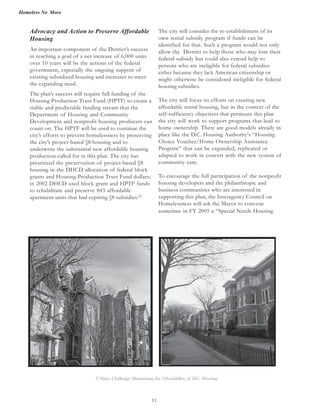
A Major Challenge: Maintaining the Affordability of D.C. Housing
Homeless No More
12
Summit.” The summit will involve top-level leaders
within the public and private entities that will be
essential partners in the production and
management of housing for chronically homeless
persons. A key purpose of the summit will be to
identify and overcome barriers that exist in public
and private financing of special needs housing.
Churches, synagogues and other faith-based
institutions that may have properties to develop will
be invited to join in this process.
The city cannot afford to lose any of its existing
stock of affordable housing and federal vouchers.
Losses in affordable units could happen if the FY
2005 budget for HUD goes forward. The Center
on Budget and Policy Priorities has estimated that
the Administration’s proposed cuts in authorization
for the Housing Choice Voucher Program (HCVP)
could result in the loss of 2,720 HCVs in the
District of Columbia by FY 2009. Other estimates
suggest the losses of HCVs could climb as high as
6,000 by FY 2014. Whether cuts actually occur in
FY 2005, it is clear that the important source of
rental subsidy will require dedicated advocacy to
protect and preserve.
In order for there to be a realistic chance of
achieving the proposed net increase in affordable
housing called for by this plan, the District
government and affordable housing and homeless
advocates will unite their voices in appealing to the
federal government both to maintain and to
increase subsidies for affordable housing. As
incoming President of the National League of
Cities in 2005, Mayor Williams will play an
important leadership role in asking that the League
include in its federal advocacy agenda this issue of
full funding for the HCVP.
In addition there are other advocacy steps and
actions that the city can take. For example, the city
used its influence with HUD to support community
activists working to preserve §8 housing in the
North Capitol neighborhood.23
The DC Housing
Authority’s Board is examining a way to cushion the
potential blow of losing millions from the HCVP
program by negotiating lower rents with some of
its landlords or setting a minimum rent while
working closely with other city agencies to help
families who cannot pay any rent stay housed.
Homeless No More
13
Financing Sources for Housing Objectives, Short and Long-Term
The city has made a start toward marshaling the resources it will take to achieve the housing objectives of this plan.
In addition, the city has ongoing efforts to improve household incomes through benefits and jobs so that most
homeless persons can pay some portion of the cost for the new permanent housing units that are to be created.
• The DC Housing Finance Agency has the
authority to issue bonds for financing either
large housing developments or a bundle of
smaller developments; this will be a possible
means to underwrite the costs of the housing in
this plan.
• The Fannie Mae Corporation, the AFL-CIO
Housing Trust, the Enterprise Foundation and
the Local Initiatives Support Corporation
(LISC) have expressed interest in supporting
projects that will create affordable supportive
housing and the city will encourage developers
to seek funding from these sources; the
Enterprise Foundation and LISC are willing to
help with pre-development financing.
• Over time the funds that currently go to
supporting emergency shelters will be redirected
to support a portion of rental costs and
services in permanent housing.
• DCHA is allocating 75 Housing Choice
Vouchers to dually diagnosed homeless
individuals in the city’s Chronic Homeless
Initiative. It will also work with the Community
Partnership to track annually the issuance of
HCVs to homeless families housed in
emergency shelters, exploring ways to improve
the assessment of which families have the
greatest need and how HCVs for families can
work in coordination with the objectives of this
plan.
• To help with improving the incomes available
for housing, DHS/IMA will maximize SSI
enrollment and ensuing benefits.
• The Housing Production Trust Fund (HPTF), tied
to a 15% share of real estate transactions and
recordation fees, is expected to yield $20-$40
million annually for affordable housing, with 40%
of the funds targeted to households with incomes
below 30% of Area Median Income. As noted
before, these funds are already being used to
preserve project-based §8 housing, which
conforms to the prevention objective of this plan.
•
proposals from developers for affordable special
needs housing by combining HPTF funds, CDBG
and HOME block grant funds, and the Low
Income Housing Tax Credit program; they also
encourage developers to seek competitive Section
811 funds for the disabled and Section 202 funds
for the elderly; and in some cases DHCD will be
a good source for the local match needed to
obtain these funds.
• The Department of Mental Health has committed
more than $15 million in capital funds for
development of supportive housing for persons
who are homeless and mentally ill or at risk of
homelessness.
• In neighborhoods undergoing vital commercial
redevelopment such as Ward 1 where the La Casa
Shelter is located, the city will endeavor to
capitalize on development to support the creation
of better shelters and supportive housing.
• The city will work with the National Capital
Revitalization Corporation to identify properties
for development or for sale that could support
the housing objectives of this plan.
•
of Annual Contribution Contracts as a means to
underwrite the production of SRO and other
housing units.
producing up to 6,000 units of affordable housing will become clearer as initial projects are funded and opened.
It is clear now that the effort need not entail all new construction since the District has more than 2,700 vacant
units of housing. The District funding sources listed above will leverage three to four times as much in private
financing.
ODMCYFE and DHCD collaborate to seek
The District and DCHA will explore the use
These are illustrative and not an exhaustive example of what is being and will be done. The total cost of
Homeless No More
14
Policy Objective #3:
Mainstream Services to Support the
New System
An Interagency Budget
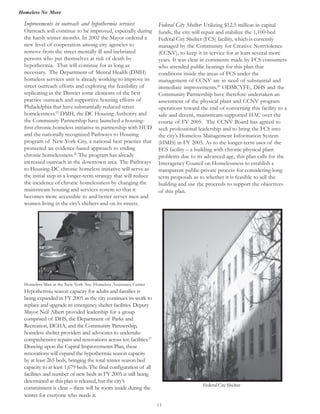
The District is committing itself with this plan to a
new way of doing business that will involve
collaboration between multiple layers of government,
its social services and housing agencies and its
economic development team. To move from
managing homelessness to ending it will take new
commitments of dollars and many other kinds of
resources. The public actions in time will leverage
substantial new private investment. Although the
budgets for FY 2005 have already been set, DHS and
all other departments providing services to homeless
people will seriously consider supplemental budget
requests to achieve the objectives of this plan. Once
the Interagency Council on Homelessness is convened
in early FY 2005, it will immediately take up the task
of formulating a FY 2006 interagency budget for
moving the plan forward.
Meeting Immediate Shelter and Housing
Needs
With 6,100 literally homeless persons in the District as
this plan is released, there is work of an immediate
nature that is underway to expand and improve the
shelter capacity of the Continuum of Care even as
this plan looks to a day when shelters as we now
know them will be a thing of the past. As the city
transitions to a new way to end homelessness that
over time becomes a system of community care, it
remains committed to supporting a homeless
Continuum of Care that currently offers 64% more
beds than it did a decade ago.
During FY 2004 the District government began
strengthening the existing system of services for
homeless people, especially those persons most
difficult to reach. The most striking example of that
was the opening of the New York Avenue HAC and
the commitments from mainstream District agencies
to bring housing, mental health, substance abuse
treatment, employment, physical health and veterans
services on site. That facility is also taking the lead on
a pilot program to offer rapid exit assistance to
working men who could leave shelter sooner with a
little cash assistance. That kind of work will continue
and be stepped up as the city enters FY 2005 and
other large shelters are converted to easy-access,
Replacement and/or upgrade of outworn shelters:
Among the first objectives of the plan will be the
replacement or renovation of outworn and obsolete
emergency shelters including all trailer-style shelters
that were once a stopgap measure but have been in
use for more than 15 years. Building upon the
recommendations of the Joint Committee,24
as
modified by subsequent discussions, the city will
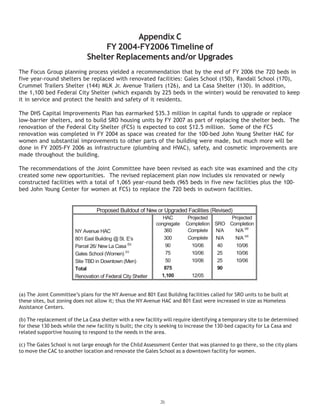
replace or upgrade five emergency shelters with 720
beds into either HACs or permanent supportive
housing. Some of the new facilities will include both
a HAC component and SRO-style units suitable for
providing temporary or long-term housing for
chronically homeless persons, creating a residential
setting around which mainstream supportive services
will be wrapped. Other new facilities will be SRO-
style permanent supportive housing with mainstream
services. The improvements in physical space will
help bring chronically homeless persons inside and
improved services will help them move beyond
shelters. Each HAC will have office spaces where
mainstream District services will be offered on site.
earmarked $35.3 million in capital funds to upgrade
and replace low-barrier shelters, as well as to build
270 SRO housing units by the end of FY 2007.
Appendix C provides an overview of the scheduled
upgrades and replacements.
Walking for Transitional Housing Corporation
The District's Capital Improvements Plan has
rapid-exit Homeless Assistance Centers.
Homeless No More
15
Improvements in outreach and hypothermia services:
Outreach will continue to be improved, especially during
the harsh winter months. In 2002 the Mayor ordered a
new level of cooperation among city agencies to
remove from the street mentally ill and inebriated
persons who put themselves at risk of death by
hypothermia. That will continue for as long as
necessary. The Department of Mental Health (DMH)
homeless services unit is already working to improve its
street outreach efforts and exploring the feasibility of
replicating in the District some elements of the best
practice outreach and supportive housing efforts of
Philadelphia that have substantially reduced street
homelessness.25
DMH, the DC Housing Authority and
the Community Partnership have launched a housing-
first chronic homeless initiative in partnership with HUD
and the nationally recognized Pathways to Housing
program of New York City, a national best practice that
pioneered an evidence-based approach to ending
chronic homelessness.26
The program has already
increased outreach in the downtown area. The Pathways
to Housing-DC chronic homeless initiative will serve as
the initial step in a longer-term strategy that will reduce
the incidence of chronic homelessness by changing the
mainstream housing and services system so that it
becomes more accessible to and better serves men and
Homeless Man at the New York Ave. Homeless Assistance Center
Hypothermia season capacity for adults and families is
being expanded in FY 2005 as the city continues its work to
replace and upgrade its emergency shelter facilities. Deputy
Mayor Neil Albert provided leadership for a group
comprised of DHS, the Department of Parks and
Recreation, DCHA, and the Community Partnership,
homeless shelter providers and advocates to undertake
comprehensive repairs and renovations across ten facilities.27
renovations will expand the hypothermia season capacity
by at least 265 beds, bringing the total winter season bed
capacity to at least 1,679 beds. The final configuration of all
facilities and number of new beds in FY 2005 is still being
determined as this plan is released, but the city’s
commitment is clear – there will be room inside during the
winter for everyone who needs it.
Federal City Shelter: Utilizing $12.5 million in capital
Federal City Shelter (FCS) facility, which is currently
managed by the Community for Creative Nonviolence
(CCNV), to keep it in service for at least several more
years. It was clear in comments made by FCS consumers
who attended public hearings for this plan that
conditions inside the areas of FCS under the
management of CCNV are in need of substantial and
immediate improvements.28
ODMCYFE, DHS and the
Community Partnership have therefore undertaken an
assessment of the physical plant and CCNV program
operations toward the end of converting this facility to a
safe and decent, mainstream-supported HAC over the
course of FY 2005. The CCNV Board has agreed to
seek professional leadership and to bring the FCS into
the city’s Homeless Management Information System
(HMIS) in FY 2005. As to the longer-term uses of the
FCS facility – a building with chronic physical plant
problems due to its advanced age, this plan calls for the
Interagency Council on Homelessness to establish a
transparent public-private process for considering long-
term proposals as to whether it is feasible to sell the
building and use the proceeds to support the objectives
of this plan.
Federal City Shelter
women living in the city’s shelters and on its streets.
Drawing upon the Capital Improvements Plan, these
funds, the city will repair and stabilize the 1,100-bed
Homeless No More
16
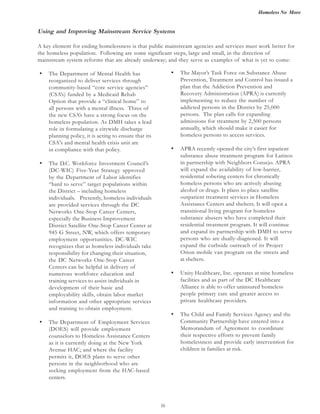
• The Department of Mental Health has
reorganized to deliver services through
community-based “core service agencies”
(CSA’s) funded by a Medicaid Rehab
Option that provide a “clinical home” to
all persons with a mental illness. Three of
the new CSA’s have a strong focus on the
homeless population. As DMH takes a lead
role in formulating a citywide discharge
planning policy, it is acting to ensure that its
in compliance with that policy.
• The D.C. Workforce Investment Council’s
(DC-WIC) Five-Year Strategy approved
by the Department of Labor identifies
“hard to serve” target populations within
the District – including homeless
individuals. Presently, homeless individuals
are provided services through the DC
Networks One-Stop Career Centers,
especially the Business Improvement
District Satellite One-Stop Career Center at
945 G Street, NW, which offers temporary
employment opportunities. DC-WIC
recognizes that as homeless individuals take
responsibility for changing their situation,
the DC Networks One-Stop Career
Centers can be helpful in delivery of
numerous workforce education and
training services to assist individuals in
development of their basic and
employability skills, obtain labor market
information and other appropriate services
and training to obtain employment.
• The Department of Employment Services
(DOES) will provide employment
counselors to Homeless Assistance Centers
as it is currently doing at the New York
Avenue HAC; and where the facility
permits it, DOES plans to serve other
persons in the neighborhood who are
seeking employment from the HAC-based
centers.
• The Mayor’s Task Force on Substance Abuse
Prevention, Treatment and Control has issued a
plan that the Addiction Prevention and
Recovery Administration (APRA) is currently
implementing to reduce the number of
addicted persons in the District by 25,000
persons. The plan calls for expanding
admissions for treatment by 2,500 persons
annually, which should make it easier for
homeless persons to access services.
• APRA recently opened the city’s first inpatient
substance abuse treatment program for Latinos
in partnership with Neighbors Consejo. APRA
will expand the availability of low-barrier,
residential sobering centers for chronically
homeless persons who are actively abusing
alcohol or drugs. It plans to place satellite
outpatient treatment services in Homeless
Assistance Centers and shelters. It will open a
transitional living program for homeless
substance abusers who have completed their
residential treatment program. It will continue
and expand its partnership with DMH to serve
persons who are dually-diagnosed. It will
expand the curbside outreach of its Project
Orion mobile van program on the streets and
at shelters.
• Unity Healthcare, Inc. operates at nine homeless
facilities and as part of the DC Healthcare
Alliance is able to offer uninsured homeless
people primary care and greater access to
private healthcare providers.
• The Child and Family Services Agency and the
Community Partnership have entered into a
Memorandum of Agreement to coordinate
their respective efforts to prevent family
homelessness and provide early intervention for
children in families at risk.
Using and Improving Mainstream Service Systems
A key element for ending homelessness is that public mainstream agencies and services must work better for
the homeless population. Following are some significant steps, large and small, in the direction of
mainstream system reforms that are already underway; and they serve as examples of what is yet to come:
CSA's and mental health crisis unit are
Homeless No More
17
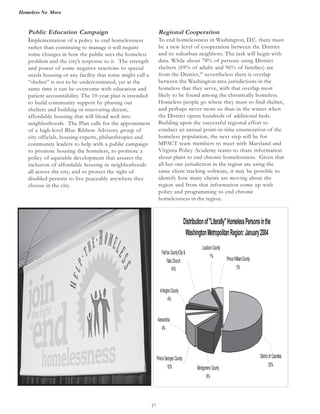
Public Education Campaign
Implementation of a policy to end homelessness
rather than continuing to manage it will require
some changes in how the public sees the homeless
problem and the city’s response to it. The strength
and power of some negative reactions to special
needs housing or any facility that some might call a
“shelter” is not to be underestimated, yet at the
same time it can be overcome with education and
patient accountability. The 10-year plan is intended
to build community support by phasing out
shelters and building or renovating decent,
affordable housing that will blend well into
neighborhoods. The Plan calls for the appointment
of a high-level Blue Ribbon Advisory group of
city officials, housing experts, philanthropies and
community leaders to help with a public campaign
to promote housing the homeless, to promote a
policy of equitable development that assures the
inclusion of affordable housing in neighborhoods
all across the city, and to protect the right of
disabled persons to live peaceably anywhere they
choose in the city.
Regional Cooperation
To end homelessness in Washington, D.C. there must
be a new level of cooperation between the District
and its suburban neighbors. The task will begin with
data. While about 78% of persons using District
shelters (69% of adults and 96% of families) are
from the District,29
nevertheless there is overlap
between the Washington area jurisdictions in the
homeless that they serve, with that overlap most
likely to be found among the chronically homeless.
Homeless people go where they must to find shelter,
and perhaps never more so than in the winter when
the District opens hundreds of additional beds.
Building upon the successful regional effort to
conduct an annual point-in-time enumeration of the
homeless population, the next step will be for
MPACT team members to meet with Maryland and
Virginia Policy Academy teams to share information
about plans to end chronic homelessness. Given that
all but one jurisdiction in the region are using the
same client tracking software, it may be possible to
identify how many clients are moving about the
region and from that information come up with
policy and programming to end chronic
homelessness in the region.
Distributionof"Literally"HomelessPersonsinthe
WashingtonMetropolitanRegion:January2004
DistrictofColumbia
53%
PrinceWilliamCounty
5%
LoudounCounty
1%
FairfaxCounty/City&
FallsChurch
14%
MontgomeryCounty
9%
Alexandria
4%
PrinceGeorgesCounty
10%
ArlingtonCounty
4%
Homeless No More
18
The action steps will be fine - tuned. The specific
responsibilities inside agencies and the processes
for constructing an annual and long-term budgeting
strategy will be hammered out.
More prevention, more affordable housing, and
effective delivery of mainstream services – all to the
point of ending homelessness – that is really all that
this plan is about. The proof of the plan will be in
the doing, and that is how District citizens should
judge it. It is meant to increase the means by which
we prevent people from falling into homelessness in
the first place. For those who are homeless or
become so, it is meant to create a more rapid exit
from the homeless system into permanent
affordable housing with the highest possible degree
of self-sufficiency. Along the way as people go
through the system, and for some with deep
disabilities that make independent living very
difficult, the plan is meant to marshal wraparound
supportive services that maximize and render
efficient what every public agency has to contribute
to ending homelessness.
Concluding that homelessness as we now know it
continuing to work around the margins of
improving a Continuum of Care is not good
enough. At the individual level and in terms of our
public and private systems of care, this plan calls
the District government and its partners to a day
when the city has “no more homeless” and the
quality of life for the formerly homeless and all our
citizens has been dramatically improved.
Next Steps
The efforts of the 10-Year Plan will be supported
by establishing within the first quarter of FY 2005
an Interagency Council on Homelessness to move
this plan forward, which in turn will continue to
engage providers, advocates and the public at
every step along the way. The Interagency
Council will establish a set of standing
committees to do the work called for in this plan.
The Interagency Council and its committees will
be open to broad representation and participation
by stakeholders, including people who are
and small homeless providers providing shelter,
housing and supportive services. The Interagency
Council will hold at least one public meeting
annually to report on the status of the 10-year
plan and to solicit comments from stakeholders
and citizens.
Although it contains many specifics, this plan
stands more as a guiding framework and
statement of policy direction than as a detailed
roadmap of how it will be achieved. The initial
Action Plan drafted by the MPACT team covers a
three-year period. Its action steps will require a
great deal of work to bear fruit and will need to
be modified and improved on an ongoing basis.
The Interagency Council will deal with the
necessities of creating cross systems strategies and
data-driven means to create and measure the
changes in how the city ends rather than just
manages homelessness. It will grapple with the
business of governing and the organizational
necessities of turning plans and action steps into
realities.
homeless, and a representative sample of large
will be with us always is not acceptable, and
19
Endnotes
1 Comments were made, respectively, by a formerly homeless person and a downtown outreach provider in
response to reviewing the draft plan during the public comment period. Written and verbal comments from about
100 participants were overwhelmingly supportive of the basic objectives and strategies of this plan.
2 Appendix A contains a glossary of terms such as "chronic homelessness" as they are used in this plan and generally
understood among practitioners who are formulating similar plans to end homelessness.
3 Dr. Martha Burt of the Urban Institute, article in Street Sense regarding her research into communities that have
committed to preventing homelessness and ending chronic homelessness.
4 Appendix D contains a list of names and organizational affiliations of the MPACT Team and Focus Group
members who contributed to the making of this 10-Year Plan.
5 The District has a serious problem with families who are doubled-up because of poverty, a problem that grew
between 1990 and 2000 according to the US Census, but doubled-up is not the same as homeless. The families on
the list at central intake are largely doubled-up and under stress to leave their current situation, yet they are a small
fraction of the 18.8% of District renters who live in overcrowded housing.
6 See the Glossary (Appendix A) for a fuller definition of "literally homeless" versus "permanently supported
homeless," a distinction necessary to track progress over time in ending "homelessness" as it is normally understood
by the public.
7 Evaluation of Continuums of Care for Homeless People - Final Report, prepared by the Urban Institute for the U.S.
Department of Housing and Urban Development: May 2002.
8 The 16,000 figure is almost three times the number of "literally homeless" who were counted on the street, in
shelters and transitional housing in January 2004, so it is clear that the DCHA list is including households that were
assigned a homeless preference sometime in the last several years. An important data collection task that lies ahead
for this plan will be to look at which households on the DCHA list are currently homeless.
10 Out of Reach 2003: America's Housing Wage Climbs, available online at www.nlihc.org
11 "Homelessness: Programs and the People They Serve - Findings of the National Survey of Homeless Assistance
Providers and Clients - Highlights," by the Interagency Council on the Homeless.
12 Source: The Community Partnership for the Prevention of Homelessness.
13 Priced Out in 2002, Technical Assistance Collaborative and Consortium for People with Disabilities.
14 "An Equitable Housing Strategy for the District of Columbia," Margery Austin Turner: The Urban Institute
Metropolitan Housing and Communities Center, Brief No.1, June 2004.
15 Source: www.dchousing.org
16 The 18,960 figure is the sum of 9,710 beds in the new system of community care and 9,250 beds in affordable
housing for extremely low-income persons; from the second table in Appendix B.
17 The 2003 American Community Survey from the US Census Bureau estimates 19.9% of the District's population
to be living below the poverty line, which comes to about 113,908 persons of the District's 572,400 total population.
The 18,960 beds in a new system of community care could thus address the affordable housing need of 16.6% of all
persons in poverty if the poor population does not increase dramatically over the next decade.
18 The data showing that a relatively fixed number of chronically homeless persons are using a disproportionate
amount of emergency shelter resources are well established in the literature and confirmed by the District's January
2004 point-in-time enumeration that showed 45% of adults in emergency shelters as homeless for more than a year.
19 The remark was made about all shelters for adults and families.
9 The 12,900 figure is derived from 3,000 beds/units for single adults plus an estimated 9,900 beds in family
units if average family size is 3.3 persons.
20
20 Yvonne Gilchrist, speaking at the Martin Luther King Jr. Public Library: June 29, 2004.
21 Lynn French, speaking at the public hearing held on June 21, 2004 at the Chevy Chase Community Center.
22 The Successful Revival of DC's Housing Production Trust Fund: D.C. Fiscal Policy Institute, February 24, 2003.
23 "HUD Pledges Help, Time For Tenants Downtown; Agency to Work to Save Low-Income Housing:" Washing-
ton Post, June 9, 2004, p.B1.
24 The "Joint Committee" (see Appendix D) was part of the Focus Group process; the committee met over the
course of several months to consider how to replace outworn shelters in an orderly fashion while maintaining or
increasing bed capacity.
25 "The City that Knows How, Philadelphia Effort Stems Tide of Homelessness, Can San Francisco Learn From
It?" -- The San Francisco Chronicle, June 13, 2004.
26 "Housing First, Consumer Choice, and Harm Reduction for Homeless Individuals With a Dual Diagnosis," Sam Tsemberis,
PhD, Leyla Gulcur, PhD and Maria Nakae, BA. American Journal of Public Health, Vol. 94, No.4: pp. 651-656, April 2004.
27 Facilities repaired or renovated are: the 801 East Building on the campus of St. Elizabeths Hospital, family units
at DC General, more units for families at DC Village, the Franklin School Shelter (including the John Young Shelter
for women), the New York Avenue HAC, the Federal City Shelter, Crummel Shelter, La Casa, Emery School
Shelter and the Blair School Shelter.
28 The Federal City Shelter includes 750 beds and 50 staff beds that are managed by CCNV; it also houses the
Open Door Shelter for women (126 beds), the John Young Shelter for women (100 beds), Clean and Sober Streets
(a 120-bed substance abuse recovery program), as well as D.C. Central Kitchen, Jobs for Homeless People and
Unity Healthcare clinic and infirmary.
29 Source: The Community Partnership's 2002 survey of 1,300 single adults and family heads of household in
emergency shelters.
Photos used in this publication were provided by the Coalition for the Homeless and
TheCommunityPartnershipforthe Preventionof Homelessness
November 2004 Fannie Mae Homeless Walkathon
21
AppendixA:
Glossary of Terms
Affordable Housing: Housing, either ownership or rental, for which a household will pay no more than 30
percent of its gross annual income.
Chronically homeless: (HUD definition): “An unaccompanied homeless individual with a disabling
condition who has either been continuously homeless for a year or more OR has had at least four (4)
episodes of homelessness in the past three (3) years.” Individuals who are in transitional housing or
permanent supportive housing programs are not considered chronically homeless even if they have been in
the program more than a year.
Continuum of Care: (HUD definition): A community plan to organize and deliver housing and services to
meet the specific needs of people who are homeless as they move to stable housing and maximum self-
sufficiency. It includes action steps to end homelessness and prevent a return to homelessness.
Emergency Shelter: (HUD definition): Any facility the primary purpose of which is to provide temporary
or transitional shelter for the homeless in general or for specific populations of the homeless.
Extremely low-income: is defined as at or below 30% of the area wide median income. For a single
person in Washington, D.C extremely low income is household income below $18,250; for a family of four
it is income below $26,100.
Homeless: (HUD definition)- (1) an individual who lacks a fixed, regular, and adequate nighttime
residence; and (2) an individual who has a primary nighttime residence that is - (A) a supervised publicly
or privately operated shelter designed to provide temporary living accommodations (including welfare
hotels, congregate shelters, and transitional housing for the mentally ill); (B) an institution that provides a
temporary residence for individuals intended to be institutionalized; or (C) a public or private place not
designed for, or ordinarily used as, a regular sleeping accommodation for human beings.
Housing first: (from the National Alliance to End Homelessness) A “housing first” approach rests on two
central premises: 1) Re-housing should be the central goal of our work with people experiencing
homelessness; and 2) Providing housing assistance and follow-up case management services after a family
or individual is housed can significantly reduce the time people spend in homelessness. Case management
ensures individuals and families have a source of income through employment and/or public benefits,
identifies service needs before the move into permanent housing, and works with families or adults after
the move into permanent housing to help solve problems that may arise that threaten their tenancy
including difficulties sustaining housing or interacting with the landlord and to connect families with
community-based services to meet long term support/service needs.
Housing plus: Refers to housing where residents are encouraged to accept support services necessary to
help them maintain their housing. The term is another way of referring to “permanent supportive
housing,” but puts the emphasis on “housing plus intensive service” for people with serious disabilities.
22
Literally Homeless vs. Permanently Supported Homeless: The term “literally homeless,” refers to
persons who have no home to call their own and one of the following describes their situation: a) they
have no shelter at all; b) they are in emergency shelters temporarily; c) they are in transitional housing
temporarily (usually no more than two years); or d) they are in precarious housing and at imminent risk
of losing it. The term “permanently supported homeless” refers to persons in “permanent supportive
housing” who are at risk of becoming homeless again without this housing because of extreme poverty or
serious mental and/or physical disabilities. The Metropolitan Washington Council of Government’s
homeless services committee developed these terms to track more accurately the number of “homeless”
once homeless but now are permanently housed with wraparound services, who are part of the solution.
Low-income is defined as at or below 80% of the area wide median income. For a single person in
Washington, D.C low income is household income below $39,950; for a family of four it is income below
$56,500.
Permanent Supportive Housing: (HUD definition): It is long-term, community-based housing that has
supportive services for homeless persons with disabilities. This type of supportive housing enables special
needs populations to live as independently as possible in a permanent setting. The supportive services may
be provided by the organization managing the housing or coordinated by the applicant and provided by
other public or private service agencies. Permanent housing can be provided in one structure or several
structures at one site or in multiple structures at scattered sites.
Point-in-Time Enumeration: This refers to a “snapshot” of the homeless population taken on a given
day, and is different than a longitudinal enumeration that counts the number of persons who experienced
being homeless for at least one day during an extended period (usually one year, or annually).
SRO: (HUD definition) — A residential property that includes multiple single room dwelling units. Each unit
is for occupancy by a single eligible individual. The unit need not, but may, contain food preparation or
sanitary facilities, or both.
Supportive services: (HUD): Services that assist homeless participants in the transition from the streets
or shelters into permanent or permanent supportive housing, and that assist persons with living
successfully in housing.
Transitional housing: (HUD) — A project that has as its purpose facilitating the movement of homeless
individuals and families to permanent housing within a reasonable amount of time (usually 24 months).
Very-low income is defined as at or below 50% of the area wide median income. For a single person in
Washington, D.C very low income is household income below $30,450; for a family of four it is income
below $43,500.
as the public largely understands that term to mean people on the street or with no place of their own,
who are part of the problem to be corrected, as contrasted to the number of persons who were
Beyond Continuum of Care to
a System of Community Care
23
Appendix B
Moving Away from a Crisis-Based Approach
Largely Made Up of Emergency Beds
To a Continuum of Care System
Notes:
(a) Emergency shelter beds cut by 40% after chronically homeless are housed. Average length of stay reduced to 45 days
in rapid exit HACs; these beds can serve about 13,800 annually.
(b) Transitional housing capacity remains the same although use of units will change over time.
(c) Adds to 2,543 beds in 2004; 2,000 more beds for adults and 500 units (1,650 beds) for families.
(d) 1,000 affordable units for adults and youth, and 2,500 units (8,250 beds) for families.
THE NEXT TEN YEARS
Creating a neighborhood-based system of community care
Easy-Access, Rapid Exit HACs 1,709 (a)
18%
Transitional Housing 1,808 (b)
19%
Permanent "Housing Plus"
(“inside” the community care system) 6,193 (c)
63%
TOTALS 9,710 100%
Permanent Affordable Housing (Beds)
(“outside” the community care system) 9,250 (d)
THE LAST TEN YEARS
Publicly-supported beds
1994 2004
Beds % Beds %
Emergency 12-24 Hr 3,331 75% 2,891 40%
Transitional 744 17% 1,808 25%
Permanent Supportive 381 9% 2,543 35%
TOTALS 4,457 100% 7,241* 100%
*increase of 62% in number of beds available
Overnight 12-hr
Shelter** "Low-barrier shelter" 1,144 26% 1,171 16%
** a subset of emergency shelter beds
24
Appendix B (continued):
A Homeless Continuum of Care Becomes a System of Community Care,
Capable of Serving More People and Serving Them Better
less Continuum of Care 1994
Total Beds = 4,457
74%
9%
%
24 Hr Transitional Permanent Supportive
HomelessContinuum of Care 2004
Total Beds= 7,241
25%
40%35%
Emergency 12-24 Hr Transitional Permanent Supportive
1994
4,457
74%
9%
17%
less Continuum of Care 1994
Total Beds = 4,457
%
HomelessContinuum of Care
Total Beds=
Emergency 12-24 Hr Transitional Permanent Supportive
Appendix B (continued):
A Homeless Continuum of Care Becomes a System of Community Care,
Capable of Serving More People and Serving Them Better
25
System of Community Care 2014
Total beds = 9,710
63%
18%
19%
Easy-Access, Rapid Exit HACs
Transitional Housing
Permanent "Housing Plus"
Proposed Buildout of New or Upgraded Facilities (Revised)
HAC
congregate
Projected
Completion SRO
Projected
Completion
NY Avenue HAC 360 Complete N/A N/A (a)
801 East Building @ St. E’s 300 Complete N/A N/A
(a)
Parcel 26/ New La Casa (b)
90 10/06 40 10/06
Gales School (Women)
(c)
75 10/06 25 10/06
Site TBD in Downtown (Men) 50 10/06 25 10/06
Total 875 90
Renovation of Federal City Shelter 1,100 12/05
26
Appendix C
FY 2004-FY2006 Timeline of
Shelter Replacements and/or Upgrades
The Focus Group planning process yielded a recommendation that by the end of FY 2006 the 720 beds in
five year-round shelters be replaced with renovated facilities: Gales School (150), Randall School (170),
the 1,100 bed Federal City Shelter (which expands by 225 beds in the winter) would be renovated to keep
it in service and protect the health and safety of it residents.
The DHS Capital Improvements Plan has earmarked $35.3 million in capital funds to upgrade or replace
low-barrier shelters, and to build SRO housing units by FY 2007 as part of replacing the shelter beds. The
renovation of the Federal City Shelter (FCS) is expected to cost $12.5 million. Some of the FCS
renovation was completed in FY 2004 as space was created for the 100-bed John Young Shelter HAC for
women and substantial improvements to other parts of the building were made, but much more will be
done in FY 2005-FY 2006 as infrastructure (plumbing and HVAC), safety, and cosmetic improvements are
made throughout the building.
The recommendations of the Joint Committee have been revised as each site was examined and the city
created some new opportunities. The revised replacement plan now includes six renovated or newly
bed John Young Center for women at FCS) to replace the 720 beds in outworn facilities.
(a) The Joint Committee’s plans for the NY Avenue and 801 East Building facilities called for SRO units to be built at
these sites, but zoning does not allow it; thus the NY Avenue HAC and 801 East were increased in size as Homeless
Assistance Centers.
(b) The replacement of the La Casa shelter with a new facility will require identifying a temporary site to be determined
for these 130 beds while the new facility is built; the city is seeking to increase the 130-bed capacity for La Casa and
related supportive housing to respond to the needs in the area.
(c) The Gales School is not large enough for the Child Assessment Center that was planned to go there, so the city plans
to move the CAC to another location and renovate the Gales School as a downtown facility for women.
Crummel Trailers Shelter (144) MLK Jr. Avenue Trailers (126), and La Casa Shelter (130). In addition,
constructed facilities with a total of 1,065 year-round beds (965 beds in five new facilities plus the 100-
Appendix D
Mayor’s Policy Academy Team (MPACT)
1. Lynn C. French, Team Coordinator: Senior Policy Advisor for Homeless and Special Needs Housing
Homelessness
3. Brenda Donald - Interim Director - Child and Family Services Agency
4. Michael Ferrell - Executive Director - Coalition for the Homeless
5. Yvonne Gilchrist - Director - Department of Human Services
6. Philip Holman - Chief of Policy, Government and External Affairs - DC Housing Authority
7. Gregory Irish - Director - Department of Employment Services
8. Stanley Jackson - Director - Department of Housing and Community Development
9. Robert Johnson - Senior Deputy Director for Substance Abuse - Department of Health
10. Vincent Keane - Executive Director - Unity Health Care, Inc.
11. Michael Kelly - Executive Director - DC Housing Authority
12. Marti Knisley - Director - Department of Mental Health
13. William Knox – Chief of Staff - DC Housing Authority
14. Ricardo Lyles - Acting Family Services Administrator - Department of Human Services
15. Sue A. Marshall - Executive Director - Community Partnership for the Prevention of Homelessness
16. Kerwin Miller - Director - Office of Veterans Affairs
17. Keith Mitchell - Director - Workforce Investment Council
18. Frances Priester - Department of Mental Health
19. Mary Lou Tietz - Executive Director - Community Family Life Services
21. Robert Trent - Chief of Staff – Department of Housing and Community Development
22. Bridgett Ware - HOPWA/HIV/AIDS Administration - Department of Health
23. Brian Wilbon - Director - Office of Medicaid Public Provider Reforms
Participants:
Focus Group on Access to Housing for Homeless
and Very Low Income City Residents
(Focus Group)
Financing and Production Committee
1. Stanley Jackson, Co-Chair – DC Department of Housing and Community Development
2. Charles Jones, Co-Chair – Fannie Mae
3. Leslie Carey – DC Housing Finance Agency
4. Jim Dickerson – Manna, Inc.
5. Wayne Dickson – Central Union Mission
6. David Erickson – Samaritan Inns
7. Lessie Powell Evans – Enterprise Foundation
8. Lynn C. French – Office of the Deputy Mayor for Children, Youth, Families and Elders
9. Jim Gibson – Center for Study of Social Policy
10. Masha Kogan – Fannie Mae
11. Michael Kelly – DC Housing Authority
12. Oramenta Newsome – Local Investment Support Collaborative
13. Ann Oliva – Community Partnership for the Prevention of Homelessness
14. David Pichette – Transitional Housing Corporation
15. Thomas Redmond – DC Housing Finance Agency
27
2. Dr. J. Stephen Cleghorn – Deputy Executive Director – Community Partnership for the Prevention of
20. Chapman Todd - Regional Director, Housing and Support Services - Catholic Charities
28
16. Marian Siegel – Housing Counseling Services
17. Deborah Stevenson – Enterprise Foundation
18. Bonnie E. Thomson – Victory Housing
19. Paul Weech – Fannie Mae
20. Stephanie Wiggins – AFL-CIO Investment Trust
Joint Committee – Transition and Housing Types, Sites, Locations, Uses
1. Robert Pohlman, Co-Chair – Coalition for Nonprofit Housing and Economic Development
2. Mary Lou Tietz, Co-Chair – Community Family Life Services
3. Scott Barkan – Office of the Deputy Mayor for Planning and Economic Development
4. Marnie Brady – Neighbors Consejo
5. Brian Carome – North Star Project
6. Dr. J. Stephen Cleghorn – Community Partnership for the Prevention of Homelessness
7. Linda Plitt Donaldson – So Others Might Eat
8. Robert Egger – DC Central Kitchen
9. Michael Ferrell – Coalition for the Homeless
10. Lynn C. French – Office of the Deputy Mayor for Children, Youth, Families and Elders
11. Patricia Mullahy Fugere – Washington Legal Clinic for the Homeless
12. Chet Gray – Downtown DC Business Improvement District
13. Fernando Lemos – MiCasa, Inc.
14. Mary Ann Luby – Washington Legal Clinic for the Homeless
15. Sue Marshall – Community Partnership for the Prevention of Homelessness
16. Gerald McCorkle – US Veterans Administration
17. Willa Morris – Community Council for the Homeless at Friendship Place
18. Cynthia Rowland – DC Central Kitchen
19. John Shetterly – New Hope Ministries
20. TJ Sutcliffe – So Others Might Eat
21. Bob Sweeney – DC Agenda
22. Chapman Todd – Catholic Charities
23. David Treadwell – Central Union Mission
24. Leslye Wooley – Salvation Army
Social and Support Services
1. Michael Ferrell, Co-Chair – Coalition for the Homeless
2. Martha Knisley, Co-Chair – DC Department of Mental Health
3. James Buford – DC Department of Health
4. Cornelle Chappelle – Community Partnership for the Prevention of Homelessness
5. Judith Dobbins – Covenant House
6. Linda Plitt Donaldson – So Others Might Eat
7. Lynn C. French – Office of the Deputy Mayor for Children, Youth, Families and Elders
8. Linda Kaufman – DC Department of Mental Health
9. Vincent Keane – Unity Health Care
10. Mary Ann Luby – Washington Legal Clinic for the Homeless
11. Ricardo Lyles – DC Department of Human Services
12. Willa Morris – Community Council for the Homeless at Friendship Place
14. James Parks – DC Department of Human Services
15. Nan Roman – National Alliance to End Homelessness
16. William Steward – APRA, DC Department of Health
17. TJ Sutcliffe – So Others Might Eat
18. Chapman Todd – Catholic Charities
19. Louvenia Williams – Edgewood-Brookland Family Support Collaborative
DCLONGRANGEPLANCOVER.pmd 12/16/2004, 10:37 AM3
13. Patty Mullahy Fugere – Washington Legal Clinic for the Homeless
HOMELESS NO MORE
John A. Wilson District Building
1350 Pennsylvania Avenue, NW
Washington, D.C. 2004
DCLONGRANGEPLANCOVER.pmd 12/16/2004, 10:38 AM4

2004 dc 10 year plan

  • 1.
    Washington D.C. by2014 HOMELESS NO MORE A Strategy for Ending Homelessness in Anthony A. Williams Mayor Neil O. Albert Deputy Mayor for Children, Youth Families and Elders December 2004 HOMELESS NO MORE A Strategy for Ending Homelessness in Anthony A. Williams Mayor Neil O. Albert Deputy Mayor for Children, Youth Families and Elders December 2004 DCLONGRANGEPLANCOVER.pmd 12/16/2004, 10:37 AM1 Washington D.C. by 2014
  • 2.
    Dear Stakeholders: Washington, D.C.by the year 2014. At the top of this plan is a clear vision of what we intend to do: "To improve the quality of life for all residents of the District of Columbia by preventing and ending homelessness within ten years." That vision means all of us have a stake in making this plan succeed. Ending the social and economic scourge of homelessness - rather than just continuing to manage it - will benefit not only those who suffer the problem personally, but will also improve the quality of our neighborhoods and the experience of all residents and visitors. A city that acts to make room inside for its most vulnerable citizens fits squarely within our Comprehensive Plan and its vision for "growing an inclusive city." The 6,000 units of affordable housing called for in Homeless No More will be an important part of creating new, inclusive communities that meet both the material and social needs of our residents. Responsive mainstream city services wrapped around the new affordable hous- ing will help people get housed, stay housed and thrive. The plan recognizes that ten years from now some are likely to become homeless, but no longer will they get stuck in that condition. Their crisis will be of short duration and focused on rapid re-housing. We expect to accomplish much over the coming decade by transforming lives, setting higher expectations of government and consumers, support- ing these expectations by bettering our services, and helping homeless people move beyond their current status to enjoy full status as contributing District citizens. The plan is based on the recommendations of a broad spectrum of city and busi- ness leaders, homeless service providers and advocates, philanthropic partners, and homeless people who worked together over the past year to produce it. I thank them all for their hard work, and I look forward to the work we shall do together to end homelessness. Sincerely, Anthony A. Williams Mayor ANTHONY A. WILLIAMS MAYOR DCLONGRANGEPLANCOVER.pmd 12/16/2004, 10:37 AM2 It is my pleasure to present Homeless No More, a plan to end homelessness in
  • 3.
    GOVERNMENT OF THEDISTRICT OF COLUMBIA Office of the Deputy Mayor for Children, Youth, Families and Elders Neil O. Albert Deputy Mayor Dear Stakeholders: Mayor Anthony Williams’ Homeless No More initiative presents a new beginning in how our city approaches the difficult social and economic problem of ending homelessness. As Deputy Mayor directly responsible for the city’s health and human services agencies, I already have begun to embrace a new set of policies, establish new facilities and create new services that right now are improving the lives of homeless people. Along with my cluster agencies, I look forward to working closely with city and federal colleagues in housing, economic development, education, employment, public safety and property management to carry out the three central policy directives of this plan: 1. Increase our homeless prevention efforts using local and federal resources; 2. Develop and/or subsidize at least 6,000 new units of affordable, supportive permanent housing by 2014; and 3. Actively coordinate mainstream social services for homeless Continuum of Care residents. Even as this plan was being finalized and readied for publication, I am happy to report, several initiatives were underway that already have improved the quality of our facilities and added new services for protecting the lives of our homeless people: • Hundreds of new beds were brought on line for the 2004-2005 winter season; • The FY 2005 Continuum of Care budget was increased; • The city’s first inpatient substance abuse treatment program for Latinos was opened in partnership with Neighbors Consejo; • Two outworn shelters have been replaced with two newly-renovated facilities that provide better • A “housing first” program for chronically homeless adults was initiated in partnership with the D.C. Housing Authority, issuing Section 8 vouchers for permanent housing; • A dialogue with downtown business people and other stakeholders has been established to chart a course for serving homeless people who frequent the downtown area; • Major renovations have been undertaken at the Federal City Shelter; and • Planning has begun for new permanent supportive housing at two sites. Homeless No More is a blueprint for action. I look forward to working to improve the lives of our homeless brothers and sisters, along with the broad spectrum of city and business leaders, service providers and advocates, philanthropic partners and homeless people whose work is reflected in this plan. Sincerely, 1350 Pennsylvania Avenue NW, Suite 303, Washington, D.C. 20004 (202) 727-8001 Neil Albert accommodations enriched with on-site mainstream services;
  • 4.
    Homeless No More HomelessNo More emerged out of more than a year’s work by Mayor Anthony A. Williams’ “Focus Group on Access to Housing for Homeless and Very Low Income Persons” and its committees. The Focus Group engaged a broad spectrum of city and business leaders, homeless providers and advocates, and homeless people in planning discussions. Its recommendations became the basis of further work by the Mayor’s Policy Academy Team (“the MPACT team”) that came together for three days in Denver in October 2003 for the federally sponsored Policy Academy 5. On June 16, 2004 the Mayor issued a draft plan for public comment that recommended three long-term policies to end homelessness. 1. Increase homeless prevention efforts within local and federal government. 2. Develop and/or subsidize at least 6,000 net additional units of affordable, supportive permanent housing to meet the needs of the city’s homeless and other very low-income persons at risk of homelessness. 3. Provide wraparound mainstream supportive services fully coordinated with Continuum of Care programs and special needs housing. District citizens who attended five public hearings – as well as written comments from homeless providers, consumers and advocates – soundly endorsed the three basic objectives of this plan. Mainstream public agencies and services will re-tool to work better for persons who are homeless. Emergency shelters will be replaced by easy-access, rapid-exit “homeless assistance centers” founded upon a new social contract. Those who can help themselves will take personal responsibility for their self-sufficiency and be helped to achieve this through on-site, mainstream case management, clinical, and employment services. For those who need ongoing support, the city and its service delivery partners are committed to helping them achieve their highest level of self- directed living. The city will offer “housing first” options to move individuals and families quickly and directly to permanent housing where they will be supported by transitional, community-based services until they are beyond their crisis. For those with serious disabilities and long histories of homelessness, the District will offer “housing plus” options that provide immediate placement along with a commitment of ongoing support for as long as necessary. The Mayor will convene an Interagency Council on Homelessness to continue engaging providers, advocates and the public at every step along the way of this plan’s further development. Responsibilities inside District agencies, including annual and long-term budgets to achieve this plan, will be hammered out at this table. The Interagency Council will create cross-systems strategies within D.C. government to end homelessness and publish an annual report on how the plan is progressing. Transforming lives, establishing higher expectations, supporting these expectations with better services, and helping homeless people move beyond their current status by making the end of homelessness our city’s objective – these are the essentials of what this plan is all about. Overview 1
  • 5.
    Homeless No More 2 TheVision: To improve the quality of life for all residents of the District of Columbia by preventing and ending homelessness within ten years. Mayor Anthony A. Williams has decided to move ahead, beginning in FY 2005, with the task of ending homelessness in Washington D.C. To do so, the city is undertaking a two-fold strategy that will entail deep, substantial and immediate initiatives to improve existing services for homeless people while also launching long- term initiatives that hold the promise of ending homelessness as we now know it within 10 years. At the end of the 10-year period there are still likely to be people who experience homelessness, but their homeless crisis will be of short duration and focused on rapid re- housing. Homelessness as we now know it – with too many individuals stuck in shelters or on the streets, too many families seeking affordable housing through a shelter system, and a shelter system set apart from mainstream systems of community care and neighborhood-level supports for people in crisis – will be a thing of the past. The city will respond effectively to its citizens who face a homeless crisis, but no more will it offer individuals only a bed in an overnight shelter or families an apartment or congregate shelter where every other family is homeless. Most importantly, the city will act to end altogether the tragedy of disabled and vulnerable people living in the streets or permanently in congregate shelters. The facilities and beds that remain at the end of ten years will be tightly woven into the mainstream safety net for persons living in poverty, and they will be compatible in design and operations with the neighborhoods in which they are located. The strategies and actions in this plan pay special attention to ending “chronic homelessness” among long- time homeless persons with disabilities, yet they also point to major new resources of affordable housing for working poor individuals and families and to a quality of life that will make the District a more livable and attractive city that works for people at all income levels.2 Ending the social and economic scourge of homelessness over the next ten years will benefit not only those who suffer this problem in their persons – helping them to achieve a higher quality of life – but will improve at the same time the quality of our neighborhoods and the experience of our city's residents as a whole. There will be benefits for everyone. From our business communities to our residential neighborhoods, all residents and visitors will enjoy a city that makes room inside decent temporary lodgings and provides permanent affordable housing for the poorest of its poor. Ending homelessness will not require ending poverty in its entirety. The end of homelessness can be achieved through a careful re-tooling and better use of our mainstream public systems that help people in need. With the full cooperation of nonprofit and faith-based providers, business leaders, and others who are willing to partner with city and federal government, ending homelessness is something we can do. Ending homelessness will involve identifying and overcoming the economic, social and bureaucratic barriers that have frustrated past attempts to bring the homeless poor into not only our shelters and housing, but into our communities where we live and work. It will involve a dramatic increase in affordable housing - setting a goal of supporting at least 6,000 net new units over ten years – focused on preventing and ending homelessness. These new units, coupled with sustained wraparound supportive services from public systems of care, will benefit about 2,000 adults and 500 families who face the deepest challenges to independent living, people whose homelessness is chronic and repetitive. Yet thousands of others who suffer a temporary crisis and end up coming to a homeless shelter also will benefit. At the entry level to the homeless care system this plan proposes the transformation of every shelter into a “homeless assistance center” that will place a premium on getting people rapidly re-housed, bringing on site the public services that will help make their experience of being homeless a short one and not to be repeated. Yet it also proposes at least 1,000 affordable units for adults and 2,500 affordable units for families whose major problem is extreme poverty; by doing so this plan will prevent these persons from ever having to enter a homeless shelter. Over the past decade the city and homeless service providers have learned a great deal about creating a “Continuum of Care” for homeless people. That experience yielded valuable lessons for the helping professionals in our mainstream systems of care with respect to serving people with multiple and deep needs. It is now time to start moving beyond a specialized Homeless No More: A Strategy for Ending Homelessness in Washington, D.C. by 2014 “This plan – ‘Homeless No More’ – can work. I know it can.” “You can only finish the race if you begin.”1
  • 6.
    Homeless No More 3 Continuumof Care labeled “homeless people only” or else run the risk of perpetuating “homeless” as a permanent social status. Instead we will integrate and blend into our mainstream agencies what we have learned from the Continuum about what works to prevent and end homelessness one person, one family at a time. The large public systems that have to some extent been part of the problem are absolutely essential to crafting the solution. This plan creates the means to bring these systems to the planning table to create a new system of community care that puts living in shelters and on the streets behind us once and for all. When there are no more men and women living in the streets of Washington, D.C., when every chronically homeless person has been housed, when every person or family facing a housing crisis can find immediate help to stay in their home, and when every person or family that does lose their home can find a decent place to stay for a short while – in neighborhoods all across the city – then homelessness as we now know it will be ended and the objectives of this plan will have been achieved. Why Ten Years? Ending homeless as we now know it can be done but will not be done overnight, although some consumers engaged in the public comment period for this plan understandably asked why it should take so long. Not everything will take ten years, and a good deal of what is in this plan is already underway, but the conversion from a homeless “Continuum of Care “ system to a system of community-based care supported by mainstream public systems and their private sector partners will be challenging. It will take some time because the underlying conditions of poverty and disabilities and housing costs that cause homelessness must be addressed, because the housing objectives will require much more than simply “pulling off the boards” from vacant housing, and because the homeless system as it has been built over the past 20 years must be carefully deconstructed and rebuilt into a new system to avoid additional hardships for consumers. The task now is less about keeping what has been built to ameliorate homelessness and more about taking creative steps to end homelessness. Achieving the objectives of this plan will require positive, forward looking leadership from District government, empowered and aided by the cooperation of business leaders, citizens, advocates and other stakeholders who are endeavoring to end homelessness. As one leading researcher on homelessness has noted, “two key factors emerge as crucial in whether communities make progress on these goals – a clear vision of where they want to go and sustained leadership.”3 The Planning Process On January 13, 2003 Mayor Williams convened a new homeless policy planning group co-chaired by deputy mayors responsible for the city's health and human services Families and Elders or ODMCYFE) and its housing, economic development and planning agencies. The Focus Group on Access to Housing for Homeless and Very Low Income City Residents recommendations both to improve the current homeless Continuum of Care and to develop a plan to end homelessness in Washington, D.C. within ten years. Subcommittees of the Focus Group produced comprehensive recommendations including: replacing outworn shelters with new facilities; developing new interagency approaches to delivering wraparound mainstream services; and creating new public and private financing tools to underwrite an increase in the stock of permanent affordable housing for the homeless and low-income households at risk of becoming homeless. A committee formed before the Focus Group came into being also delivered recommendations for reforming the legal framework of homelessservices. The recommendations of the Focus Group and its committees are reflected in this 10-Year Strategy and Action Steps. They were amplified and refined by the Mayor’s Policy Academy Team (or “MPACT” team), under the leadership of ODMCYFE, that came together in Denver on October 27- 29, 2003 for the federally sponsored Policy Academy 5. The MPACT team established three basic goals for the District’s 10-year plan to end homelessness, which the Mayor has accepted as the centerpiece policies of the city’s 10-year plan:4 1. Increase homeless prevention efforts within local and federal government. 2. Develop and/or subsidize at least 6,000 units of affordable, supportive permanent housing to meet the needs of D.C.’s homeless and other very low- income persons at risk of homelessness. 3. Provide wraparound mainstream supportive services fully coordinated with Continuum of Care programs and special needs housing. In short, keep as many people as possible from becoming homeless in the first place through direct prevention efforts and increasing the supply of affordable housing, and enrich the homeless Continuum at all levels with supportive services that rapidly re-house persons with and without special needs, changing the focus of the city’s efforts over time from a “shelter first” to a “housing first” model that ends homelessness. agencies (the Office of the Deputy Mayor for Children, Youth, (Focus Group) set about the task of developing
  • 7.
    Homeless No More 4 thesepersons were literally homeless – i.e., on the streets, in shelters or in transitional facilities. The District’s count included (unlike all other COG jurisdictions) 194 families who were listed by family central intake as doubled-up, eligible for shelter because their situation put them at imminent risk of homelessness, and seeking relief from the homeless system or anywhere else they could find a route to permanent housing.5 the streets, a figure that grows to about 500 persons in the 2004 as permanently supported homeless who are living within permanent supportive Continuum of Care housing whose homelessness has ended but could easily re-occur without the ongoing support.6 Over the last ten years, in response to such realities, the District and many private agencies have created one of the largest homeless Continuum of Care systems in the nation both to relieve the immediate suffering of people without shelter and help them with obtaining and keeping permanent housing. There are currently enough public and private beds to shelter or house about 8,875 persons, enough to serve 1-in-13 of all District residents living in poverty. A HUD report to Congress prepared by the University of Pennsylvania showed that the District has a rate of homelessness and shelter usage among single adults in poverty higher than New York City or Philadelphia. Another HUD report showed that the District’s Continuum has more Continuum of Care beds per persons in poverty than other major cities such as Boston and San Francisco.7 As displayed in the chart in Appendix B, the District’s publicly supported homeless system has not only grown in size, adding about 2,800 new beds since 1994, but has become more diverse in its composition and now offers more beds and services focused on ending homelessness one person, one family at a time. Improvements to the Continuum have been ongoing, and this 10-year plan includes strenuous new efforts to continue making the Continuum and its facilities get better from the entry level of emergency shelters to permanent supportive housing. On an annual basis District agencies spend over $25 million on programs targeted to the homeless, HUD contributes another $15 million in McKinney-Vento Act funding, philanthropies contribute more than $5 million, and private donations and faith-based programs contribute millions more. Despite these investments of knowledge, energy, resources and dollars, homelessness persists in the District and has increased by about 10% since 2002 when including the addition of more permanent supportive housing that has become a larger component of the District’s Continuum of Care. The problem at the emergency end of the In order to achieve these goals, three implementation strategies will guide the work of the District government and the community-based organizations with which it partners. · Implementation Strategy A: Interdepartmental coordination and cross-system policy implementation. · Implementation Strategy B: Community education and community outreach to gain support for the 10-year plan and the “housing first” and “housing plus” approaches. · Contained within these implementation strategies as action steps that comprise the initial agenda of the 10-year plan are commitments to establish an Interagency Council on Homelessness with appropriate authority to implement the 10-Year Plan, finalize regulations that fully support Continuum of Care programming and the specific objectives of the plan, improve data collection and data sharing to track the objectives and outcomes of the plan, create interagency budgets each year that are focused on ending homelessness, support local and regional discharge policies to prevent homelessness, and much else. During a 30-day period of public comment that began with Mayor Williams releasing the draft plan on June 16, there emerged solid endorsement of the plan’s policy priorities from citizens, providers and consumers, along with many helpful suggestions for improving the specifics of the plan. The final plan reflects the public input in general terms, with specific recommendations to be taken up by the Interagency Council on Homelessness when that body is convened. The basic elements of this plan will guide city policy, including the highest levels of city planning, so that the housing needs of people who experience homelessness, whether of short or long duration, and the social services needs are married in a way that achieves the vision. Current Conditions In 2002 and 2003 an estimated 16,000–17,500 people, our District neighbors, were homeless at some point during the year (annually), and as many as 2,000 of these are “chronically homeless” persons who lived either in shelters or on the streets throughout the year. At the last point-in-time enumeration undertaken on January 21, 2004 by the Metropolitan Washington Council of Governments (COG), about 8,250 persons were counted by public and private programs within the Washington, D.C. homeless Continuum of Care. About 6,100 of Implementation Strategy C: Advocacy for reduction of federal and other barriers to delivering and end homelessness. services and housing that can prevent It also included an estimated 315 persons who normally live on warmer months. Another 2,150 persons were counted in
  • 8.
    Homeless No More 5 Continuum,especially for families, has been exacerbated lately by the rising cost of rental housing and could get worse if the federal government continues in the direction of reducing its commitment to affordable housing. The D.C. Housing Authority has on its waiting list for Housing Choice Vouchers about 16,000 households who have claimed a homeless preference, a figure which indicates that over an extended period of time many households have faced a homeless crisis and, although the vast majority of these households are not currently homeless, nevertheless their wait for a housing subsidy continues.8 To deal with such issues and get beyond this recurring cycle of homelessness and seemingly endless allocation of substantial resources to ends far less than satisfactory, the Mayor is committing District government to build a neighborhood-centered, mainstream-funded, and housing-focused system to end homelessness as we now know it in 10 years. Policy Objective #1: A Greater Focus on Prevention The Action Steps in this Plan call for major new efforts to prevent homelessness from within the mainstream systems that provide services and housing to those most at risk of losing their homes. More emphasis will be placed on keeping people housed when they face evictions and doing that in a smart way that invests case management support along with cash assistance so that the crisis is addressed and resolved. Prevention efforts such as this will become ever more closely interwoven with neighborhood-based helping systems such as the Family Support Collaboratives within the child welfare system and One-Stop Centers that provide employment assistance. As a first step toward increasing the emergency assistance response of the city, ODMCYFE, which oversees the city's human services, and the Community Partnership for the Prevention of Homelessness, the agency that manages the city's homeless Continuum of Care, will convene by January 2005 a committee that will conduct an environmental scan of all existing public and private emergency assistance programs, including the funds available to each and the most recent data on households assisted. The committee will make recommendations to the Interagency Council on Homelessness with respect to a sufficiently resourced Emergency Assistance program that assures that assisted households will retain their housing and get the help they need to avoid a repetition of the housing crisis. To prevent homelessness among adults and unaccompanied youth, the Plan calls for the convening of a “discharge planning task force” made up of District and private agencies, including mental health, public health, corrections, youth services, social services and private for-profit managed care vendors, to craft homeless prevention strategies through appropriate discharge planning. Over a reasonable period of time all public agencies will be required to develop “zero tolerance” policies and procedures to assure that none of their consumers exit to a homeless shelter or the street. This work is underway. DMH Director Martha Knisley convened the first meeting of the task force in September 2004 to lay out an agenda and identify staff within agencies who can take up the task of meeting regularly until a “Discharge Planning Policy” is developed for the Mayor’s endorsement. In addition to the Community Partnership and large shelter providers who often receive persons from public and private institutions, the task force includes representatives from the Department of Health’s Addiction Prevention and Recovery Administration (APRA), the Department of Employment Services with its lead role for reintegrating ex-offenders and helping people find jobs, Department of Corrections, Child and Family Services Agency, Court Services and Offender Supervision Agency, Unity Healthcare, and the Primary Care Association. APRA, in addition to participating on the discharge planning task force, has established a subcommittee of MPACT that is taking on the development of additional homeless prevention efforts for persons disabled by substance abuse. APRA plans to increase its prevention efforts with hospitals and jails and to replicate best practice models for step-down transitional housing for persons exiting detox. To prevent family homelessness, the Plan calls for the Department of Human Services through its Income Maintenance Administration and Family Services Administration to craft a closer collaboration between the homeless system and the welfare system. With over 70% of all families applying for shelter already on TANF, and most all other families eligible for TANF, the Income Maintenance and TANF system has the potential to become a critical line of defense to identify families facing a homeless crisis. The family’s crisis can be assessed and resolved in the context of the family’s responsibility, for those who are able, to move from welfare to work. This activity will significantly add to prevention efforts already in place that use HUD Emergency Shelter Grant funds and the DC Emergency Assistance Fund to provide rent and utility assistance to families facing eviction. Policy Objective #2: Housing is the Ke
  • 9.
    Homeless No More 6 GreaterFocus on PreventionPolicy 6,000 New Units of Affordable Housing Based on the MPACT recommendation, this plan commits the city to achieving the following housing objectives over the next ten years: 1. Building and/or supporting at least 3,000 net new units of Single Room Occupancy (SRO) or other modest, private and affordable housing for adults, and allocating up to 2,000 of these as supportive housing for chronically homeless persons with disabilities while 1,000 units can be used by working poor adults or unaccompanied youth without disabilities. 2. Building and/or supporting at least 3,000 net new units of affordable housing for low-income families, and linking these with community-based services for families both with and without special needs, with 500 of these to house families with long histories of homelessness. Homeless No More establishes permanent housing as the major gap to be closed in the years ahead. The permanent housing in this plan is designed both to end the homelessness of some and prevent many other very poor people from becoming homeless in the first place. Some of the new units are planned to be “inside” a new system of supportive housing with wraparound support services for individuals and families who need ongoing “housing plus” services to maintain stable housing. Other units are planned to be “outside” the system of community care, which simply means that they will be affordable housing that ends or prevents the homelessness of extremely poor persons at or below 20% of AMI. The plan calls for an estimated 12,900 additional beds in permanent housing for individuals and families to be added to the existing 2,543 beds in permanent supportive housing.9 Affordable housing is the key to ending homelessness, just as it is critical to improving the lives of all low- and moderate-income persons in the city. Thus this Plan’s housing goals are directly related to its vision – to improve the quality of life for all District residents. Affordable housing emerged from the Mayor’s Citizens Summit process as the #2 budget priority. The city’s revised Comprehensive Plan for ensuring an inclusive city recommends that affordable, supportive housing for special needs populations be available across all eight wards of the city. The Washington Interfaith Network has acted to defend and to expand affordable housing. Housing activists over the past several years have recommended that the city seriously consider the establishment of inclusionary zoning to promote affordable housing and the reforming of the city’s rent control law so that low-income tenants’ “right to first refusal” is strengthened. Clearly the housing affordability issue affects the whole city and is the subject of much public policy debate. In 2003 it took a $23.42 per hour wage (381% of the $6.15 minimum wage) for a District resident to afford a 2-BR apartment. This “housing wage” figure increased by 22% over the same figure for 2002 and at present a full-time minimum wage worker can afford no more than $320 monthly for housing.10 For homeless people it is especially hard to afford housing since homeless adults have a mean income at 51% of the federal poverty rate and families have a mean income at 46% of the poverty rate.11 In the District homeless people are counted among the extremely low income with an average income of about $7,734 or about $645 monthly. Although about three quarters of homeless people have some income either from employment or entitlements, for most of them it is far less than what is needed to afford a rental unit in the D.C. market.12 For persons with disabilities who receive SSI benefits, the average monthly benefit is $545, well below the average rents for any 1-BR apartment in the District.13 As much as homelessness and affordable housing are closely related, the solution to ending homelessness is obscured when it is conflated with the affordable housing problem in general. One researcher has estimated that the universe of need for more affordable housing in the District will require 3,600 units annually over the next two decades.14 This estimate, however, is based on all households with incomes below $50,000, a figure that is five to six times higher than the extremely low incomes of the homeless population. Not all households who need a subsidy to make their housing affordable are at risk of becoming homeless. The D.C. Housing Authority list of over 50,000 households awaiting affordable housing reveals only that these households are qualified for some level of subsidy to bring their housing cost down to 30% of their gross annual income. The DCHA wait list figure does not isolate those households at extremely low income who are at high risk of homelessness. In fact, a household of one person can have an income as high as $38,100 and still be eligible for a Housing Choice Voucher, and a family household with three persons (fairly typical of the average size of a homeless family) can have an income as high as $48,950.15 Policy Objective #2: Housing is the Key community care, meaning that they will be permanent
  • 10.
    Homeless No More 7 “HousingFirst” and “Housing Plus” For the past year city leaders, the Community Partnership and dozens of stakeholders have been looking at what other cities are doing in terms of best practices, formulating this plan and undertaking some of the first steps toward ending homelessness in the District. The key as noted above will be substantial new production of affordable and supportive housing, coupled with major new institutional strategies to prevent homelessness. In fact these two goals will converge as more affordable, supportive housing becomes the best form of preventing the most vulnerable persons from falling back into homelessness and prevents extremely low-income working poor persons from having to enter a shelter in the first place. This plan moves the District away from its current reliance on emergency shelters and toward a day when it can offer "housing first" options to homeless people, even to those who face the most serious challenges to obtaining and keeping housing. Emergency shelter for too many families with children, not to mention too many adults and youth, has proven to be one of the least effective, and even in some cases injurious, options for dealing with the housing crisis. While there is room for improvement in the conditions of emergency shelters, and improvements to facilities and programs are ongoing, the fact remains that the city can do much better than offering emergency shelters. Therefore this plan envisions that homeless people will move directly to permanent housing and be supported by community-based transitional services until they are beyond crisis and not likely to need further assistance. The "housing first" approach will coordinate well with the city's investment in "strategic neighborhood target areas" where the Mayor is supporting the development of affordable housing and investments in small businesses that provide living wage jobs. Many of these are the same neighborhoods from which most homeless families and adults come. Neighborhood- based social services will become more and more the backed up by the District’s mainstream health and welfare agencies. The “housing first” approach will also work well for families and able-bodied, able-minded adults - men and women out of work and needing jobs, the working poor, or persons in recovery and needing just a little support. The targeted investments in communities, nonprofit services, business development and good jobs will end homelessness for many adults. Will 6,000 units be enough to end homelessness as we now know it? How was this figure derived? What makes it a plan to end homelessness? These questions were raised by several who commented on the draft plan. The answer is that 6,000 net new units of affordable housing will be a good start toward the desired objectives of this plan. The challenge of meeting this objective is one that deserves widespread support to make it happen even if some think it may not be enough. As one homeless provider stated in a written comment, “You can only finish the race if you begin.” These units will make a solid beginning. Still, there is another way of understanding what 6,000 net new units of affordable housing can accomplish when they are considered within the context of all publicly-funded units and beds that will remain in 2014 as part of a new “system of community care” that will replace a set-apart homeless Continuum of Care. When the full context is understood, this plan projects enough beds within a system of community-based care and additional affordable housing that will shelter an estimated 18,960 District citizens.16 This figure is higher than the total annual count of persons who used publicly funded homeless Continuum of Care beds for the past five years and means that the planned new system could serve almost 17% of all persons in the District who are now living in poverty.17 It does not include another 1,726 beds that are currently operated by private agencies with no public funding. If these private beds are factored in with the public ones, the projected size of the public and private system to serve homeless persons will shelter or house over 18% of those persons living in poverty. Since it is rare that the annual rate of homelessness among people living in poverty exceeds 10% in large urban areas, the MPACT team concluded that the new system should be adequate to meet the needs. Obviously, this will be a living plan and subject to modification if the need is greater than anticipated, but, 6,000 units makes a good beginning. New York Avenue Homeless Assistance Center safety net for families and adults in crisis. They will be
  • 11.
    Homeless No More 8 Noneof this implies that persons with disabilities will be limited to the “housing plus” option or may only live where there is a “program,” since where persons choose to live will never be determined solely by their disability. It means only that housing plus ongoing supportive services will be offered to them. They may or may not accept services, but model programs around the country have shown that most persons with disabilities are willing to be engaged with services as time goes by because they see an improvement in their lives. The housing first option will be available to support people with disabilities to live where they choose – just as that is the case with the DMH Chronic Homeless Initiative already underway. Reducing the number of chronically homeless adults in shelters by housing them will have another benefit. Over time the District will need fewer emergency shelter beds. Just as in Columbus, Ohio – where the Community Shelter Board discovered that about half of all emergency shelter resources (measured as “bednights’) are used by just 15% of homeless men, so in the District the Community Partnership has documented that about half of District emergency beds used daily are occupied by 10%-15% of the men and women who go through shelters on an annual basis.18 When the chronically homeless are housed instead of sheltered, the Homeless Assistance Housing and Service Needs of Families with Children, Youth and the Elderly Respondents to the public comment draft of this plan suggested that the District should convene a special group to develop further its housing and service objectives for families and children. Others recommended that the plan include specific objectives for unaccompanied homeless youth, including young people who have aged out of foster care without stable employment and housing, those who wander from house to house and those who are known to the Child and Family Service Agency to be at risk of homelessness. Still others commented on the need to improve shelters and implement better quality control of programs and facilities now in service for these populations even as a new system is being built. One consumer activist put the point this way as she called for re-training staff to adapt to the direction of this plan: “We need staff to have a brand new outlook on helping residents to get out of the system.”19 Homeless families: In response to community input on families, this plan has grown to include many more specifics about what will be done. Work on this issue got underway when DHS Director Gilchrist convened a group of MPACT members and family providers (the Homeless No More Family Steering Committee) at the end of October 2004 to begin developing further the plan’s strategies and objectives for families with children. Over time this group will become a standing committee attached to the Interagency Council on Homelessness. After Chronically Homeless Are Housed, HACs Could Serve More Adults Annually, If Needed 11,850 13,800 Adults served annually in 12-24hr Shelters: 2004 Adults served annually in Rapid Exit HACs: 2014 For a smaller number of persons, the chronically homeless single adults with deep disabilities and long histories of homelessness, or for families with long histories of homelessness, the District will offer “housing plus” with appropriate supportive services, in full partnership with District mainstream agencies that provide health, mental health, substance abuse treatment, employment and social services. Like the HUD “Shelter Plus Care” program, “housing plus” will marry affordable housing with necessary case management and clinical support services for the aged and disabled, for people struggling with addictions, HIV and mental illness. “Supportive housing” works to end homelessness, even for those who have been homeless repeatedly. Evaluations of model programs and a major study in New York City by Dr. Dennis Culhane have shown that it costs about the same to house a mentally ill person with a decent quality of life as it does to maintain that person in a state of homelessness, on the streets and in shelters where they draw heavily upon multiple public systems. Centers (HACs) with fewer beds will be able to handle as many or more adults than does the current shelter system. The District can maintain a smaller, less dense system of rapid-exit, decent, full service centers that will adequately serve people with a short crisis of homelessness, while most of chronically homeless people are successfully housed.
  • 12.
    Homeless No More 9 Homelessfamilies with children have special needs, as do their children. Given that there is a well-established mainstream safety net for families, children and youth, it can be said as a starting point for further discussion that this plan envisions that solutions to homelessness for families will come from patching the breaks in the safety net. It will entail coordination with a variety of mainstream initiatives to help families, including the Children’s Investment Trust and the city’s Fatherhood Initiative. Better collaboration among public and private agencies that understand the needs of families will go a long way toward preventing homelessness in the first place. As Director Gilchrist stated at one of the public hearings on the draft plan: Families are a priority for me, because I don’t think families should be in shelters. I think if we have resources, we need to put them at the front end to do all that we can to prevent families from…going into a disillusioned atmosphere. We should do as much as we can at the front end. If we look across the government and where our money is being spent, we probably can do more if we concentrated on keeping families in the homes where they are.20 As noted above, for those families with children who are already homeless or who may become homeless there will be an expanded commitment to “housing first” options. This will be augmented by a rapid-exit program that helps families with their first month rent and security deposit plus some tangible material needs so they can spend less time in shelter. This will work well for most families whose entry to the shelter system has more to do with their extreme poverty. This plan will create a system of community-based care, prevention and housing – nearer to schools, after-school programs and childcare – that supports families to live where they would like to live to the extent they can afford it. For those families with long histories of homelessness because of problems such as substance abuse and mental illness, the city will still look to normal housing units as the best option for meeting their need for shelter, but will wrap around these units the mainstream supportive services needed to stabilize the family in this housing. For some such families this will be an ongoing need and others will eventually move beyond the need for support. As a starting point, this plan calls for 500 of the 3,000 new family units to be service-enriched supportive · • Leasing of multi-family apartments to provide permanent affordable housing for families. • Conversion over time of family shelter apartments to the “housing first’ model. • Development of vacant and abandoned/hot property units as affordable family placements. • An initiative to provide incentives for small building owners to renovate buildings and rent to families holding a Housing Choice Voucher (Section 8). • Expansion of the “housing first” Community Care Grant program and a deeper partnership with the Family Support Collaborative Council to access market-rate housing. • Adapting the Community Care Grant program to work with other kinds of public and private family support agencies such as CFSA and DCHA that will be able to access funds to provide either time-limited or permanent housing subsidies. housing “inside” the new system of community care while 2,500 affordable housing units for families will simply be dedicated to ending and preventing homelessness for very- and extremely- low income families. Short-term and long-term steps to house families will include: Gospel Rescue Ministries-Fulton House
  • 13.
    Homeless No More 10 TheElderly: Finally, there is a need to allocate some of the new affordable housing to elderly homeless (55 years and older). Some of these will be counted among the chronically homeless who will need supportive housing, while others are men and women beyond their working years and on fixed incomes, yet not disabled. One answer to such needs will be HUD §202 housing dedicated to providing permanent housing to elderly persons in homeless shelters and transitional housing, while other units will be developed by mainstream agencies serving the mentally ill or persons with physical disabilities. This plan calls for allocating 2,000 of the 3,000 new units for individuals to chronically homeless persons with serious disabilities. As a start, the plan calls for at least 200 of the 1,000 other units for individuals to be allocated to youth while 800 are allocated to working poor and elderly adults without serious mental or physical disabilities. With the understanding that this is a living plan subject to modification, but that the modifications will be within the overall objective of at least 6,000 new affordable housing units, the table below summarizes the projected distribution of the housing units. supportive housing for persons with disabling conditions that are barriers to complete self- sufficiency, all the rest can benefit very poor persons without disabilities, undocumented persons, and other groups to be determined. As noted by the MPACT Team Coordinator at one of the public hearings when speaking of how SRO units and other housing first options will be allocated or who they will serve: “A large part of it will lie in the imaginations of the people who choose to develop some of these facilities.”21 Planned Distribution of Housing Units A. Household Type B. Units to be made affordable C. Number of the units in Column “B” to be “supportive housing” Chronically homeless adults, including elderly 2,000 2,000 Working poor and elderly adults 800 0 Unaccompanied youth under 21 years old 200 0 Families with children 3,000 500 TOTALS 6,000 2,500 Christmas Time at Spring Road Family Shelter Youth: Unaccompanied homeless youth also present special needs. While prevention of homelessness is critical as youth age out of foster care, the problem is larger than that. There are many youth under the age of 21 without housing or in precarious housing who are not known to the child welfare system. They are not chronically homeless and most do not have serious disabilities. The housing first model will work for these youth, whether as a means to prevent some from aging out of foster care into a homeless shelter or as a means to move others out of youth shelters (or avoid shelter altogether) by providing transitional services in the context of obtaining their first permanent housing unit. With just 2,500 of these planned to be
  • 14.
    Homeless No More 11 Thecity will consider the re-establishment of its own rental subsidy program if funds can be identified for that. Such a program would not only allow the District to help those who may lose their federal subsidy but could also extend help to persons who are ineligible for federal subsidies either because they lack American citizenship or might otherwise be considered ineligible for federal housing subsidies. The city will focus its efforts on creating new affordable rental housing, but in the context of the self-sufficiency objectives that permeate this plan the city will work to support programs that lead to home ownership. There are good models already in place like the D.C. Housing Authority's “Housing Choice Voucher/Home Ownership Assistance Program” that can be expanded, replicated or adapted to work in concert with the new system of community care. To encourage the full participation of the nonprofit housing developers and the philanthropic and business communities who are interested in supporting this plan, the Interagency Council on Homelessness will ask the Mayor to convene sometime in FY 2005 a “Special Needs Housing Advocacy and Action to Preserve Affordable Housing An important component of the District’s success in reaching a goal of a net increase of 6,000 units over 10 years will be the actions of the federal government, especially the ongoing support of existing subsidized housing and increases to meet the expanding need. The plan’s success will require full funding of the Housing Production Trust Fund (HPTF) to create a stable and predictable funding stream that the Department of Housing and Community Development and nonprofit housing producers can count on. The HPTF will be used to continue the city’s efforts to prevent homelessness by preserving the city’s project-based §8 housing and to underwrite the substantial new affordable housing production called for in this plan. The city has prioritized the preservation of project-based §8 housing in the DHCD allocation of federal block grants and Housing Production Trust Fund dollars; in 2002 DHCD used block grant and HPTF funds to rehabilitate and preserve 843 affordable apartment units that had expiring §8 subsidies.22 A Major Challenge: Maintaining the Affordability of D.C. Housing
  • 15.
    Homeless No More 12 Summit.”The summit will involve top-level leaders within the public and private entities that will be essential partners in the production and management of housing for chronically homeless persons. A key purpose of the summit will be to identify and overcome barriers that exist in public and private financing of special needs housing. Churches, synagogues and other faith-based institutions that may have properties to develop will be invited to join in this process. The city cannot afford to lose any of its existing stock of affordable housing and federal vouchers. Losses in affordable units could happen if the FY 2005 budget for HUD goes forward. The Center on Budget and Policy Priorities has estimated that the Administration’s proposed cuts in authorization for the Housing Choice Voucher Program (HCVP) could result in the loss of 2,720 HCVs in the District of Columbia by FY 2009. Other estimates suggest the losses of HCVs could climb as high as 6,000 by FY 2014. Whether cuts actually occur in FY 2005, it is clear that the important source of rental subsidy will require dedicated advocacy to protect and preserve. In order for there to be a realistic chance of achieving the proposed net increase in affordable housing called for by this plan, the District government and affordable housing and homeless advocates will unite their voices in appealing to the federal government both to maintain and to increase subsidies for affordable housing. As incoming President of the National League of Cities in 2005, Mayor Williams will play an important leadership role in asking that the League include in its federal advocacy agenda this issue of full funding for the HCVP. In addition there are other advocacy steps and actions that the city can take. For example, the city used its influence with HUD to support community activists working to preserve §8 housing in the North Capitol neighborhood.23 The DC Housing Authority’s Board is examining a way to cushion the potential blow of losing millions from the HCVP program by negotiating lower rents with some of its landlords or setting a minimum rent while working closely with other city agencies to help families who cannot pay any rent stay housed.
  • 16.
    Homeless No More 13 FinancingSources for Housing Objectives, Short and Long-Term The city has made a start toward marshaling the resources it will take to achieve the housing objectives of this plan. In addition, the city has ongoing efforts to improve household incomes through benefits and jobs so that most homeless persons can pay some portion of the cost for the new permanent housing units that are to be created. • The DC Housing Finance Agency has the authority to issue bonds for financing either large housing developments or a bundle of smaller developments; this will be a possible means to underwrite the costs of the housing in this plan. • The Fannie Mae Corporation, the AFL-CIO Housing Trust, the Enterprise Foundation and the Local Initiatives Support Corporation (LISC) have expressed interest in supporting projects that will create affordable supportive housing and the city will encourage developers to seek funding from these sources; the Enterprise Foundation and LISC are willing to help with pre-development financing. • Over time the funds that currently go to supporting emergency shelters will be redirected to support a portion of rental costs and services in permanent housing. • DCHA is allocating 75 Housing Choice Vouchers to dually diagnosed homeless individuals in the city’s Chronic Homeless Initiative. It will also work with the Community Partnership to track annually the issuance of HCVs to homeless families housed in emergency shelters, exploring ways to improve the assessment of which families have the greatest need and how HCVs for families can work in coordination with the objectives of this plan. • To help with improving the incomes available for housing, DHS/IMA will maximize SSI enrollment and ensuing benefits. • The Housing Production Trust Fund (HPTF), tied to a 15% share of real estate transactions and recordation fees, is expected to yield $20-$40 million annually for affordable housing, with 40% of the funds targeted to households with incomes below 30% of Area Median Income. As noted before, these funds are already being used to preserve project-based §8 housing, which conforms to the prevention objective of this plan. • proposals from developers for affordable special needs housing by combining HPTF funds, CDBG and HOME block grant funds, and the Low Income Housing Tax Credit program; they also encourage developers to seek competitive Section 811 funds for the disabled and Section 202 funds for the elderly; and in some cases DHCD will be a good source for the local match needed to obtain these funds. • The Department of Mental Health has committed more than $15 million in capital funds for development of supportive housing for persons who are homeless and mentally ill or at risk of homelessness. • In neighborhoods undergoing vital commercial redevelopment such as Ward 1 where the La Casa Shelter is located, the city will endeavor to capitalize on development to support the creation of better shelters and supportive housing. • The city will work with the National Capital Revitalization Corporation to identify properties for development or for sale that could support the housing objectives of this plan. • of Annual Contribution Contracts as a means to underwrite the production of SRO and other housing units. producing up to 6,000 units of affordable housing will become clearer as initial projects are funded and opened. It is clear now that the effort need not entail all new construction since the District has more than 2,700 vacant units of housing. The District funding sources listed above will leverage three to four times as much in private financing. ODMCYFE and DHCD collaborate to seek The District and DCHA will explore the use These are illustrative and not an exhaustive example of what is being and will be done. The total cost of
  • 17.
    Homeless No More 14 PolicyObjective #3: Mainstream Services to Support the New System An Interagency Budget The District is committing itself with this plan to a new way of doing business that will involve collaboration between multiple layers of government, its social services and housing agencies and its economic development team. To move from managing homelessness to ending it will take new commitments of dollars and many other kinds of resources. The public actions in time will leverage substantial new private investment. Although the budgets for FY 2005 have already been set, DHS and all other departments providing services to homeless people will seriously consider supplemental budget requests to achieve the objectives of this plan. Once the Interagency Council on Homelessness is convened in early FY 2005, it will immediately take up the task of formulating a FY 2006 interagency budget for moving the plan forward. Meeting Immediate Shelter and Housing Needs With 6,100 literally homeless persons in the District as this plan is released, there is work of an immediate nature that is underway to expand and improve the shelter capacity of the Continuum of Care even as this plan looks to a day when shelters as we now know them will be a thing of the past. As the city transitions to a new way to end homelessness that over time becomes a system of community care, it remains committed to supporting a homeless Continuum of Care that currently offers 64% more beds than it did a decade ago. During FY 2004 the District government began strengthening the existing system of services for homeless people, especially those persons most difficult to reach. The most striking example of that was the opening of the New York Avenue HAC and the commitments from mainstream District agencies to bring housing, mental health, substance abuse treatment, employment, physical health and veterans services on site. That facility is also taking the lead on a pilot program to offer rapid exit assistance to working men who could leave shelter sooner with a little cash assistance. That kind of work will continue and be stepped up as the city enters FY 2005 and other large shelters are converted to easy-access, Replacement and/or upgrade of outworn shelters: Among the first objectives of the plan will be the replacement or renovation of outworn and obsolete emergency shelters including all trailer-style shelters that were once a stopgap measure but have been in use for more than 15 years. Building upon the recommendations of the Joint Committee,24 as modified by subsequent discussions, the city will replace or upgrade five emergency shelters with 720 beds into either HACs or permanent supportive housing. Some of the new facilities will include both a HAC component and SRO-style units suitable for providing temporary or long-term housing for chronically homeless persons, creating a residential setting around which mainstream supportive services will be wrapped. Other new facilities will be SRO- style permanent supportive housing with mainstream services. The improvements in physical space will help bring chronically homeless persons inside and improved services will help them move beyond shelters. Each HAC will have office spaces where mainstream District services will be offered on site. earmarked $35.3 million in capital funds to upgrade and replace low-barrier shelters, as well as to build 270 SRO housing units by the end of FY 2007. Appendix C provides an overview of the scheduled upgrades and replacements. Walking for Transitional Housing Corporation The District's Capital Improvements Plan has rapid-exit Homeless Assistance Centers.
  • 18.
    Homeless No More 15 Improvementsin outreach and hypothermia services: Outreach will continue to be improved, especially during the harsh winter months. In 2002 the Mayor ordered a new level of cooperation among city agencies to remove from the street mentally ill and inebriated persons who put themselves at risk of death by hypothermia. That will continue for as long as necessary. The Department of Mental Health (DMH) homeless services unit is already working to improve its street outreach efforts and exploring the feasibility of replicating in the District some elements of the best practice outreach and supportive housing efforts of Philadelphia that have substantially reduced street homelessness.25 DMH, the DC Housing Authority and the Community Partnership have launched a housing- first chronic homeless initiative in partnership with HUD and the nationally recognized Pathways to Housing program of New York City, a national best practice that pioneered an evidence-based approach to ending chronic homelessness.26 The program has already increased outreach in the downtown area. The Pathways to Housing-DC chronic homeless initiative will serve as the initial step in a longer-term strategy that will reduce the incidence of chronic homelessness by changing the mainstream housing and services system so that it becomes more accessible to and better serves men and Homeless Man at the New York Ave. Homeless Assistance Center Hypothermia season capacity for adults and families is being expanded in FY 2005 as the city continues its work to replace and upgrade its emergency shelter facilities. Deputy Mayor Neil Albert provided leadership for a group comprised of DHS, the Department of Parks and Recreation, DCHA, and the Community Partnership, homeless shelter providers and advocates to undertake comprehensive repairs and renovations across ten facilities.27 renovations will expand the hypothermia season capacity by at least 265 beds, bringing the total winter season bed capacity to at least 1,679 beds. The final configuration of all facilities and number of new beds in FY 2005 is still being determined as this plan is released, but the city’s commitment is clear – there will be room inside during the winter for everyone who needs it. Federal City Shelter: Utilizing $12.5 million in capital Federal City Shelter (FCS) facility, which is currently managed by the Community for Creative Nonviolence (CCNV), to keep it in service for at least several more years. It was clear in comments made by FCS consumers who attended public hearings for this plan that conditions inside the areas of FCS under the management of CCNV are in need of substantial and immediate improvements.28 ODMCYFE, DHS and the Community Partnership have therefore undertaken an assessment of the physical plant and CCNV program operations toward the end of converting this facility to a safe and decent, mainstream-supported HAC over the course of FY 2005. The CCNV Board has agreed to seek professional leadership and to bring the FCS into the city’s Homeless Management Information System (HMIS) in FY 2005. As to the longer-term uses of the FCS facility – a building with chronic physical plant problems due to its advanced age, this plan calls for the Interagency Council on Homelessness to establish a transparent public-private process for considering long- term proposals as to whether it is feasible to sell the building and use the proceeds to support the objectives of this plan. Federal City Shelter women living in the city’s shelters and on its streets. Drawing upon the Capital Improvements Plan, these funds, the city will repair and stabilize the 1,100-bed
  • 19.
    Homeless No More 16 •The Department of Mental Health has reorganized to deliver services through community-based “core service agencies” (CSA’s) funded by a Medicaid Rehab Option that provide a “clinical home” to all persons with a mental illness. Three of the new CSA’s have a strong focus on the homeless population. As DMH takes a lead role in formulating a citywide discharge planning policy, it is acting to ensure that its in compliance with that policy. • The D.C. Workforce Investment Council’s (DC-WIC) Five-Year Strategy approved by the Department of Labor identifies “hard to serve” target populations within the District – including homeless individuals. Presently, homeless individuals are provided services through the DC Networks One-Stop Career Centers, especially the Business Improvement District Satellite One-Stop Career Center at 945 G Street, NW, which offers temporary employment opportunities. DC-WIC recognizes that as homeless individuals take responsibility for changing their situation, the DC Networks One-Stop Career Centers can be helpful in delivery of numerous workforce education and training services to assist individuals in development of their basic and employability skills, obtain labor market information and other appropriate services and training to obtain employment. • The Department of Employment Services (DOES) will provide employment counselors to Homeless Assistance Centers as it is currently doing at the New York Avenue HAC; and where the facility permits it, DOES plans to serve other persons in the neighborhood who are seeking employment from the HAC-based centers. • The Mayor’s Task Force on Substance Abuse Prevention, Treatment and Control has issued a plan that the Addiction Prevention and Recovery Administration (APRA) is currently implementing to reduce the number of addicted persons in the District by 25,000 persons. The plan calls for expanding admissions for treatment by 2,500 persons annually, which should make it easier for homeless persons to access services. • APRA recently opened the city’s first inpatient substance abuse treatment program for Latinos in partnership with Neighbors Consejo. APRA will expand the availability of low-barrier, residential sobering centers for chronically homeless persons who are actively abusing alcohol or drugs. It plans to place satellite outpatient treatment services in Homeless Assistance Centers and shelters. It will open a transitional living program for homeless substance abusers who have completed their residential treatment program. It will continue and expand its partnership with DMH to serve persons who are dually-diagnosed. It will expand the curbside outreach of its Project Orion mobile van program on the streets and at shelters. • Unity Healthcare, Inc. operates at nine homeless facilities and as part of the DC Healthcare Alliance is able to offer uninsured homeless people primary care and greater access to private healthcare providers. • The Child and Family Services Agency and the Community Partnership have entered into a Memorandum of Agreement to coordinate their respective efforts to prevent family homelessness and provide early intervention for children in families at risk. Using and Improving Mainstream Service Systems A key element for ending homelessness is that public mainstream agencies and services must work better for the homeless population. Following are some significant steps, large and small, in the direction of mainstream system reforms that are already underway; and they serve as examples of what is yet to come: CSA's and mental health crisis unit are
  • 20.
    Homeless No More 17 PublicEducation Campaign Implementation of a policy to end homelessness rather than continuing to manage it will require some changes in how the public sees the homeless problem and the city’s response to it. The strength and power of some negative reactions to special needs housing or any facility that some might call a “shelter” is not to be underestimated, yet at the same time it can be overcome with education and patient accountability. The 10-year plan is intended to build community support by phasing out shelters and building or renovating decent, affordable housing that will blend well into neighborhoods. The Plan calls for the appointment of a high-level Blue Ribbon Advisory group of city officials, housing experts, philanthropies and community leaders to help with a public campaign to promote housing the homeless, to promote a policy of equitable development that assures the inclusion of affordable housing in neighborhoods all across the city, and to protect the right of disabled persons to live peaceably anywhere they choose in the city. Regional Cooperation To end homelessness in Washington, D.C. there must be a new level of cooperation between the District and its suburban neighbors. The task will begin with data. While about 78% of persons using District shelters (69% of adults and 96% of families) are from the District,29 nevertheless there is overlap between the Washington area jurisdictions in the homeless that they serve, with that overlap most likely to be found among the chronically homeless. Homeless people go where they must to find shelter, and perhaps never more so than in the winter when the District opens hundreds of additional beds. Building upon the successful regional effort to conduct an annual point-in-time enumeration of the homeless population, the next step will be for MPACT team members to meet with Maryland and Virginia Policy Academy teams to share information about plans to end chronic homelessness. Given that all but one jurisdiction in the region are using the same client tracking software, it may be possible to identify how many clients are moving about the region and from that information come up with policy and programming to end chronic homelessness in the region. Distributionof"Literally"HomelessPersonsinthe WashingtonMetropolitanRegion:January2004 DistrictofColumbia 53% PrinceWilliamCounty 5% LoudounCounty 1% FairfaxCounty/City& FallsChurch 14% MontgomeryCounty 9% Alexandria 4% PrinceGeorgesCounty 10% ArlingtonCounty 4%
  • 21.
    Homeless No More 18 Theaction steps will be fine - tuned. The specific responsibilities inside agencies and the processes for constructing an annual and long-term budgeting strategy will be hammered out. More prevention, more affordable housing, and effective delivery of mainstream services – all to the point of ending homelessness – that is really all that this plan is about. The proof of the plan will be in the doing, and that is how District citizens should judge it. It is meant to increase the means by which we prevent people from falling into homelessness in the first place. For those who are homeless or become so, it is meant to create a more rapid exit from the homeless system into permanent affordable housing with the highest possible degree of self-sufficiency. Along the way as people go through the system, and for some with deep disabilities that make independent living very difficult, the plan is meant to marshal wraparound supportive services that maximize and render efficient what every public agency has to contribute to ending homelessness. Concluding that homelessness as we now know it continuing to work around the margins of improving a Continuum of Care is not good enough. At the individual level and in terms of our public and private systems of care, this plan calls the District government and its partners to a day when the city has “no more homeless” and the quality of life for the formerly homeless and all our citizens has been dramatically improved. Next Steps The efforts of the 10-Year Plan will be supported by establishing within the first quarter of FY 2005 an Interagency Council on Homelessness to move this plan forward, which in turn will continue to engage providers, advocates and the public at every step along the way. The Interagency Council will establish a set of standing committees to do the work called for in this plan. The Interagency Council and its committees will be open to broad representation and participation by stakeholders, including people who are and small homeless providers providing shelter, housing and supportive services. The Interagency Council will hold at least one public meeting annually to report on the status of the 10-year plan and to solicit comments from stakeholders and citizens. Although it contains many specifics, this plan stands more as a guiding framework and statement of policy direction than as a detailed roadmap of how it will be achieved. The initial Action Plan drafted by the MPACT team covers a three-year period. Its action steps will require a great deal of work to bear fruit and will need to be modified and improved on an ongoing basis. The Interagency Council will deal with the necessities of creating cross systems strategies and data-driven means to create and measure the changes in how the city ends rather than just manages homelessness. It will grapple with the business of governing and the organizational necessities of turning plans and action steps into realities. homeless, and a representative sample of large will be with us always is not acceptable, and
  • 22.
    19 Endnotes 1 Comments weremade, respectively, by a formerly homeless person and a downtown outreach provider in response to reviewing the draft plan during the public comment period. Written and verbal comments from about 100 participants were overwhelmingly supportive of the basic objectives and strategies of this plan. 2 Appendix A contains a glossary of terms such as "chronic homelessness" as they are used in this plan and generally understood among practitioners who are formulating similar plans to end homelessness. 3 Dr. Martha Burt of the Urban Institute, article in Street Sense regarding her research into communities that have committed to preventing homelessness and ending chronic homelessness. 4 Appendix D contains a list of names and organizational affiliations of the MPACT Team and Focus Group members who contributed to the making of this 10-Year Plan. 5 The District has a serious problem with families who are doubled-up because of poverty, a problem that grew between 1990 and 2000 according to the US Census, but doubled-up is not the same as homeless. The families on the list at central intake are largely doubled-up and under stress to leave their current situation, yet they are a small fraction of the 18.8% of District renters who live in overcrowded housing. 6 See the Glossary (Appendix A) for a fuller definition of "literally homeless" versus "permanently supported homeless," a distinction necessary to track progress over time in ending "homelessness" as it is normally understood by the public. 7 Evaluation of Continuums of Care for Homeless People - Final Report, prepared by the Urban Institute for the U.S. Department of Housing and Urban Development: May 2002. 8 The 16,000 figure is almost three times the number of "literally homeless" who were counted on the street, in shelters and transitional housing in January 2004, so it is clear that the DCHA list is including households that were assigned a homeless preference sometime in the last several years. An important data collection task that lies ahead for this plan will be to look at which households on the DCHA list are currently homeless. 10 Out of Reach 2003: America's Housing Wage Climbs, available online at www.nlihc.org 11 "Homelessness: Programs and the People They Serve - Findings of the National Survey of Homeless Assistance Providers and Clients - Highlights," by the Interagency Council on the Homeless. 12 Source: The Community Partnership for the Prevention of Homelessness. 13 Priced Out in 2002, Technical Assistance Collaborative and Consortium for People with Disabilities. 14 "An Equitable Housing Strategy for the District of Columbia," Margery Austin Turner: The Urban Institute Metropolitan Housing and Communities Center, Brief No.1, June 2004. 15 Source: www.dchousing.org 16 The 18,960 figure is the sum of 9,710 beds in the new system of community care and 9,250 beds in affordable housing for extremely low-income persons; from the second table in Appendix B. 17 The 2003 American Community Survey from the US Census Bureau estimates 19.9% of the District's population to be living below the poverty line, which comes to about 113,908 persons of the District's 572,400 total population. The 18,960 beds in a new system of community care could thus address the affordable housing need of 16.6% of all persons in poverty if the poor population does not increase dramatically over the next decade. 18 The data showing that a relatively fixed number of chronically homeless persons are using a disproportionate amount of emergency shelter resources are well established in the literature and confirmed by the District's January 2004 point-in-time enumeration that showed 45% of adults in emergency shelters as homeless for more than a year. 19 The remark was made about all shelters for adults and families. 9 The 12,900 figure is derived from 3,000 beds/units for single adults plus an estimated 9,900 beds in family units if average family size is 3.3 persons.
  • 23.
    20 20 Yvonne Gilchrist,speaking at the Martin Luther King Jr. Public Library: June 29, 2004. 21 Lynn French, speaking at the public hearing held on June 21, 2004 at the Chevy Chase Community Center. 22 The Successful Revival of DC's Housing Production Trust Fund: D.C. Fiscal Policy Institute, February 24, 2003. 23 "HUD Pledges Help, Time For Tenants Downtown; Agency to Work to Save Low-Income Housing:" Washing- ton Post, June 9, 2004, p.B1. 24 The "Joint Committee" (see Appendix D) was part of the Focus Group process; the committee met over the course of several months to consider how to replace outworn shelters in an orderly fashion while maintaining or increasing bed capacity. 25 "The City that Knows How, Philadelphia Effort Stems Tide of Homelessness, Can San Francisco Learn From It?" -- The San Francisco Chronicle, June 13, 2004. 26 "Housing First, Consumer Choice, and Harm Reduction for Homeless Individuals With a Dual Diagnosis," Sam Tsemberis, PhD, Leyla Gulcur, PhD and Maria Nakae, BA. American Journal of Public Health, Vol. 94, No.4: pp. 651-656, April 2004. 27 Facilities repaired or renovated are: the 801 East Building on the campus of St. Elizabeths Hospital, family units at DC General, more units for families at DC Village, the Franklin School Shelter (including the John Young Shelter for women), the New York Avenue HAC, the Federal City Shelter, Crummel Shelter, La Casa, Emery School Shelter and the Blair School Shelter. 28 The Federal City Shelter includes 750 beds and 50 staff beds that are managed by CCNV; it also houses the Open Door Shelter for women (126 beds), the John Young Shelter for women (100 beds), Clean and Sober Streets (a 120-bed substance abuse recovery program), as well as D.C. Central Kitchen, Jobs for Homeless People and Unity Healthcare clinic and infirmary. 29 Source: The Community Partnership's 2002 survey of 1,300 single adults and family heads of household in emergency shelters. Photos used in this publication were provided by the Coalition for the Homeless and TheCommunityPartnershipforthe Preventionof Homelessness November 2004 Fannie Mae Homeless Walkathon
  • 24.
    21 AppendixA: Glossary of Terms AffordableHousing: Housing, either ownership or rental, for which a household will pay no more than 30 percent of its gross annual income. Chronically homeless: (HUD definition): “An unaccompanied homeless individual with a disabling condition who has either been continuously homeless for a year or more OR has had at least four (4) episodes of homelessness in the past three (3) years.” Individuals who are in transitional housing or permanent supportive housing programs are not considered chronically homeless even if they have been in the program more than a year. Continuum of Care: (HUD definition): A community plan to organize and deliver housing and services to meet the specific needs of people who are homeless as they move to stable housing and maximum self- sufficiency. It includes action steps to end homelessness and prevent a return to homelessness. Emergency Shelter: (HUD definition): Any facility the primary purpose of which is to provide temporary or transitional shelter for the homeless in general or for specific populations of the homeless. Extremely low-income: is defined as at or below 30% of the area wide median income. For a single person in Washington, D.C extremely low income is household income below $18,250; for a family of four it is income below $26,100. Homeless: (HUD definition)- (1) an individual who lacks a fixed, regular, and adequate nighttime residence; and (2) an individual who has a primary nighttime residence that is - (A) a supervised publicly or privately operated shelter designed to provide temporary living accommodations (including welfare hotels, congregate shelters, and transitional housing for the mentally ill); (B) an institution that provides a temporary residence for individuals intended to be institutionalized; or (C) a public or private place not designed for, or ordinarily used as, a regular sleeping accommodation for human beings. Housing first: (from the National Alliance to End Homelessness) A “housing first” approach rests on two central premises: 1) Re-housing should be the central goal of our work with people experiencing homelessness; and 2) Providing housing assistance and follow-up case management services after a family or individual is housed can significantly reduce the time people spend in homelessness. Case management ensures individuals and families have a source of income through employment and/or public benefits, identifies service needs before the move into permanent housing, and works with families or adults after the move into permanent housing to help solve problems that may arise that threaten their tenancy including difficulties sustaining housing or interacting with the landlord and to connect families with community-based services to meet long term support/service needs. Housing plus: Refers to housing where residents are encouraged to accept support services necessary to help them maintain their housing. The term is another way of referring to “permanent supportive housing,” but puts the emphasis on “housing plus intensive service” for people with serious disabilities.
  • 25.
    22 Literally Homeless vs.Permanently Supported Homeless: The term “literally homeless,” refers to persons who have no home to call their own and one of the following describes their situation: a) they have no shelter at all; b) they are in emergency shelters temporarily; c) they are in transitional housing temporarily (usually no more than two years); or d) they are in precarious housing and at imminent risk of losing it. The term “permanently supported homeless” refers to persons in “permanent supportive housing” who are at risk of becoming homeless again without this housing because of extreme poverty or serious mental and/or physical disabilities. The Metropolitan Washington Council of Government’s homeless services committee developed these terms to track more accurately the number of “homeless” once homeless but now are permanently housed with wraparound services, who are part of the solution. Low-income is defined as at or below 80% of the area wide median income. For a single person in Washington, D.C low income is household income below $39,950; for a family of four it is income below $56,500. Permanent Supportive Housing: (HUD definition): It is long-term, community-based housing that has supportive services for homeless persons with disabilities. This type of supportive housing enables special needs populations to live as independently as possible in a permanent setting. The supportive services may be provided by the organization managing the housing or coordinated by the applicant and provided by other public or private service agencies. Permanent housing can be provided in one structure or several structures at one site or in multiple structures at scattered sites. Point-in-Time Enumeration: This refers to a “snapshot” of the homeless population taken on a given day, and is different than a longitudinal enumeration that counts the number of persons who experienced being homeless for at least one day during an extended period (usually one year, or annually). SRO: (HUD definition) — A residential property that includes multiple single room dwelling units. Each unit is for occupancy by a single eligible individual. The unit need not, but may, contain food preparation or sanitary facilities, or both. Supportive services: (HUD): Services that assist homeless participants in the transition from the streets or shelters into permanent or permanent supportive housing, and that assist persons with living successfully in housing. Transitional housing: (HUD) — A project that has as its purpose facilitating the movement of homeless individuals and families to permanent housing within a reasonable amount of time (usually 24 months). Very-low income is defined as at or below 50% of the area wide median income. For a single person in Washington, D.C very low income is household income below $30,450; for a family of four it is income below $43,500. as the public largely understands that term to mean people on the street or with no place of their own, who are part of the problem to be corrected, as contrasted to the number of persons who were
  • 26.
    Beyond Continuum ofCare to a System of Community Care 23 Appendix B Moving Away from a Crisis-Based Approach Largely Made Up of Emergency Beds To a Continuum of Care System Notes: (a) Emergency shelter beds cut by 40% after chronically homeless are housed. Average length of stay reduced to 45 days in rapid exit HACs; these beds can serve about 13,800 annually. (b) Transitional housing capacity remains the same although use of units will change over time. (c) Adds to 2,543 beds in 2004; 2,000 more beds for adults and 500 units (1,650 beds) for families. (d) 1,000 affordable units for adults and youth, and 2,500 units (8,250 beds) for families. THE NEXT TEN YEARS Creating a neighborhood-based system of community care Easy-Access, Rapid Exit HACs 1,709 (a) 18% Transitional Housing 1,808 (b) 19% Permanent "Housing Plus" (“inside” the community care system) 6,193 (c) 63% TOTALS 9,710 100% Permanent Affordable Housing (Beds) (“outside” the community care system) 9,250 (d) THE LAST TEN YEARS Publicly-supported beds 1994 2004 Beds % Beds % Emergency 12-24 Hr 3,331 75% 2,891 40% Transitional 744 17% 1,808 25% Permanent Supportive 381 9% 2,543 35% TOTALS 4,457 100% 7,241* 100% *increase of 62% in number of beds available Overnight 12-hr Shelter** "Low-barrier shelter" 1,144 26% 1,171 16% ** a subset of emergency shelter beds
  • 27.
    24 Appendix B (continued): AHomeless Continuum of Care Becomes a System of Community Care, Capable of Serving More People and Serving Them Better less Continuum of Care 1994 Total Beds = 4,457 74% 9% % 24 Hr Transitional Permanent Supportive HomelessContinuum of Care 2004 Total Beds= 7,241 25% 40%35% Emergency 12-24 Hr Transitional Permanent Supportive 1994 4,457 74% 9% 17% less Continuum of Care 1994 Total Beds = 4,457 % HomelessContinuum of Care Total Beds= Emergency 12-24 Hr Transitional Permanent Supportive
  • 28.
    Appendix B (continued): AHomeless Continuum of Care Becomes a System of Community Care, Capable of Serving More People and Serving Them Better 25 System of Community Care 2014 Total beds = 9,710 63% 18% 19% Easy-Access, Rapid Exit HACs Transitional Housing Permanent "Housing Plus"
  • 29.
    Proposed Buildout ofNew or Upgraded Facilities (Revised) HAC congregate Projected Completion SRO Projected Completion NY Avenue HAC 360 Complete N/A N/A (a) 801 East Building @ St. E’s 300 Complete N/A N/A (a) Parcel 26/ New La Casa (b) 90 10/06 40 10/06 Gales School (Women) (c) 75 10/06 25 10/06 Site TBD in Downtown (Men) 50 10/06 25 10/06 Total 875 90 Renovation of Federal City Shelter 1,100 12/05 26 Appendix C FY 2004-FY2006 Timeline of Shelter Replacements and/or Upgrades The Focus Group planning process yielded a recommendation that by the end of FY 2006 the 720 beds in five year-round shelters be replaced with renovated facilities: Gales School (150), Randall School (170), the 1,100 bed Federal City Shelter (which expands by 225 beds in the winter) would be renovated to keep it in service and protect the health and safety of it residents. The DHS Capital Improvements Plan has earmarked $35.3 million in capital funds to upgrade or replace low-barrier shelters, and to build SRO housing units by FY 2007 as part of replacing the shelter beds. The renovation of the Federal City Shelter (FCS) is expected to cost $12.5 million. Some of the FCS renovation was completed in FY 2004 as space was created for the 100-bed John Young Shelter HAC for women and substantial improvements to other parts of the building were made, but much more will be done in FY 2005-FY 2006 as infrastructure (plumbing and HVAC), safety, and cosmetic improvements are made throughout the building. The recommendations of the Joint Committee have been revised as each site was examined and the city created some new opportunities. The revised replacement plan now includes six renovated or newly bed John Young Center for women at FCS) to replace the 720 beds in outworn facilities. (a) The Joint Committee’s plans for the NY Avenue and 801 East Building facilities called for SRO units to be built at these sites, but zoning does not allow it; thus the NY Avenue HAC and 801 East were increased in size as Homeless Assistance Centers. (b) The replacement of the La Casa shelter with a new facility will require identifying a temporary site to be determined for these 130 beds while the new facility is built; the city is seeking to increase the 130-bed capacity for La Casa and related supportive housing to respond to the needs in the area. (c) The Gales School is not large enough for the Child Assessment Center that was planned to go there, so the city plans to move the CAC to another location and renovate the Gales School as a downtown facility for women. Crummel Trailers Shelter (144) MLK Jr. Avenue Trailers (126), and La Casa Shelter (130). In addition, constructed facilities with a total of 1,065 year-round beds (965 beds in five new facilities plus the 100-
  • 30.
    Appendix D Mayor’s PolicyAcademy Team (MPACT) 1. Lynn C. French, Team Coordinator: Senior Policy Advisor for Homeless and Special Needs Housing Homelessness 3. Brenda Donald - Interim Director - Child and Family Services Agency 4. Michael Ferrell - Executive Director - Coalition for the Homeless 5. Yvonne Gilchrist - Director - Department of Human Services 6. Philip Holman - Chief of Policy, Government and External Affairs - DC Housing Authority 7. Gregory Irish - Director - Department of Employment Services 8. Stanley Jackson - Director - Department of Housing and Community Development 9. Robert Johnson - Senior Deputy Director for Substance Abuse - Department of Health 10. Vincent Keane - Executive Director - Unity Health Care, Inc. 11. Michael Kelly - Executive Director - DC Housing Authority 12. Marti Knisley - Director - Department of Mental Health 13. William Knox – Chief of Staff - DC Housing Authority 14. Ricardo Lyles - Acting Family Services Administrator - Department of Human Services 15. Sue A. Marshall - Executive Director - Community Partnership for the Prevention of Homelessness 16. Kerwin Miller - Director - Office of Veterans Affairs 17. Keith Mitchell - Director - Workforce Investment Council 18. Frances Priester - Department of Mental Health 19. Mary Lou Tietz - Executive Director - Community Family Life Services 21. Robert Trent - Chief of Staff – Department of Housing and Community Development 22. Bridgett Ware - HOPWA/HIV/AIDS Administration - Department of Health 23. Brian Wilbon - Director - Office of Medicaid Public Provider Reforms Participants: Focus Group on Access to Housing for Homeless and Very Low Income City Residents (Focus Group) Financing and Production Committee 1. Stanley Jackson, Co-Chair – DC Department of Housing and Community Development 2. Charles Jones, Co-Chair – Fannie Mae 3. Leslie Carey – DC Housing Finance Agency 4. Jim Dickerson – Manna, Inc. 5. Wayne Dickson – Central Union Mission 6. David Erickson – Samaritan Inns 7. Lessie Powell Evans – Enterprise Foundation 8. Lynn C. French – Office of the Deputy Mayor for Children, Youth, Families and Elders 9. Jim Gibson – Center for Study of Social Policy 10. Masha Kogan – Fannie Mae 11. Michael Kelly – DC Housing Authority 12. Oramenta Newsome – Local Investment Support Collaborative 13. Ann Oliva – Community Partnership for the Prevention of Homelessness 14. David Pichette – Transitional Housing Corporation 15. Thomas Redmond – DC Housing Finance Agency 27 2. Dr. J. Stephen Cleghorn – Deputy Executive Director – Community Partnership for the Prevention of 20. Chapman Todd - Regional Director, Housing and Support Services - Catholic Charities
  • 31.
    28 16. Marian Siegel– Housing Counseling Services 17. Deborah Stevenson – Enterprise Foundation 18. Bonnie E. Thomson – Victory Housing 19. Paul Weech – Fannie Mae 20. Stephanie Wiggins – AFL-CIO Investment Trust Joint Committee – Transition and Housing Types, Sites, Locations, Uses 1. Robert Pohlman, Co-Chair – Coalition for Nonprofit Housing and Economic Development 2. Mary Lou Tietz, Co-Chair – Community Family Life Services 3. Scott Barkan – Office of the Deputy Mayor for Planning and Economic Development 4. Marnie Brady – Neighbors Consejo 5. Brian Carome – North Star Project 6. Dr. J. Stephen Cleghorn – Community Partnership for the Prevention of Homelessness 7. Linda Plitt Donaldson – So Others Might Eat 8. Robert Egger – DC Central Kitchen 9. Michael Ferrell – Coalition for the Homeless 10. Lynn C. French – Office of the Deputy Mayor for Children, Youth, Families and Elders 11. Patricia Mullahy Fugere – Washington Legal Clinic for the Homeless 12. Chet Gray – Downtown DC Business Improvement District 13. Fernando Lemos – MiCasa, Inc. 14. Mary Ann Luby – Washington Legal Clinic for the Homeless 15. Sue Marshall – Community Partnership for the Prevention of Homelessness 16. Gerald McCorkle – US Veterans Administration 17. Willa Morris – Community Council for the Homeless at Friendship Place 18. Cynthia Rowland – DC Central Kitchen 19. John Shetterly – New Hope Ministries 20. TJ Sutcliffe – So Others Might Eat 21. Bob Sweeney – DC Agenda 22. Chapman Todd – Catholic Charities 23. David Treadwell – Central Union Mission 24. Leslye Wooley – Salvation Army Social and Support Services 1. Michael Ferrell, Co-Chair – Coalition for the Homeless 2. Martha Knisley, Co-Chair – DC Department of Mental Health 3. James Buford – DC Department of Health 4. Cornelle Chappelle – Community Partnership for the Prevention of Homelessness 5. Judith Dobbins – Covenant House 6. Linda Plitt Donaldson – So Others Might Eat 7. Lynn C. French – Office of the Deputy Mayor for Children, Youth, Families and Elders 8. Linda Kaufman – DC Department of Mental Health 9. Vincent Keane – Unity Health Care 10. Mary Ann Luby – Washington Legal Clinic for the Homeless 11. Ricardo Lyles – DC Department of Human Services 12. Willa Morris – Community Council for the Homeless at Friendship Place 14. James Parks – DC Department of Human Services 15. Nan Roman – National Alliance to End Homelessness 16. William Steward – APRA, DC Department of Health 17. TJ Sutcliffe – So Others Might Eat 18. Chapman Todd – Catholic Charities 19. Louvenia Williams – Edgewood-Brookland Family Support Collaborative DCLONGRANGEPLANCOVER.pmd 12/16/2004, 10:37 AM3 13. Patty Mullahy Fugere – Washington Legal Clinic for the Homeless
  • 32.
    HOMELESS NO MORE JohnA. Wilson District Building 1350 Pennsylvania Avenue, NW Washington, D.C. 2004 DCLONGRANGEPLANCOVER.pmd 12/16/2004, 10:38 AM4