20 LAKH CRORE
STIMULUS PACKAGE
BY BHAGAVATH. M
INTRODUCTION
oThe mega Rs 20 lakh crore stimulus package announced on 12th May by PM Modi
includes previously announced measures to save the lockdown-battered economy, and
focuses on tax breaks for small businesses as well as incentives for domestic
manufacturing.
o. "This package, taken together with earlier announcements by the government during
COVID crisis and decisions taken by RBI, is to the tune of Rs 20 lakh crore, which is
equivalent to almost 10 per cent of India's GDP.“
oMost economic activity in the country had come to a standstill after the government
imposed a 21-day nationwide lockdown beginning March 25 to check the spread of
Covid-19.
oThe package, he said, will focus on land, labour, liquidity and laws. It will cater to
various sections, including cottage industry, MSMEs, labourers, middle class, and
industries.
OVERALL STIMULUS
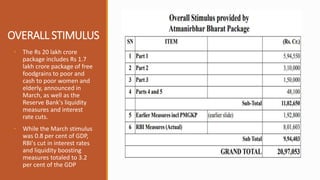
• The Rs 20 lakh crore
package includes Rs 1.7
lakh crore package of free
foodgrains to poor and
cash to poor women and
elderly, announced in
March, as well as the
Reserve Bank's liquidity
measures and interest
rate cuts.
• While the March stimulus
was 0.8 per cent of GDP,
RBI's cut in interest rates
and liquidity boosting
measures totaled to 3.2
per cent of the GDP
First tranche
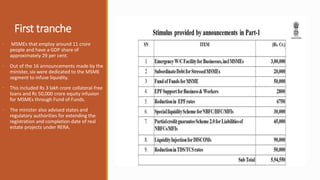
• MSMEs that employ around 11 crore
people and have a GDP share of
approximately 29 per cent.
• Out of the 16 announcements made by the
minister, six were dedicated to the MSME
segment to infuse liquidity.
• This included Rs 3 lakh crore collateral-free
loans and Rs 50,000 crore equity infusion
for MSMEs through Fund of Funds.
• The minister also advised states and
regulatory authorities for extending the
registration and completion date of real
estate projects under RERA.
Second tranche
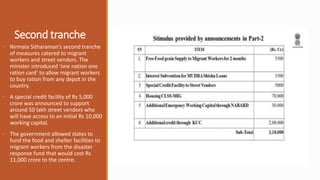
• Nirmala Sitharaman’s second tranche
of measures catered to migrant
workers and street vendors. The
minister introduced ‘one nation one
ration card’ to allow migrant workers
to buy ration from any depot in the
country.
• A special credit facility of Rs 5,000
crore was announced to support
around 50 lakh street vendors who
will have access to an initial Rs 10,000
working capital.
• The government allowed states to
fund the food and shelter facilities to
migrant workers from the disaster
response fund that would cost Rs
11,000 crore to the centre.
Third tranche
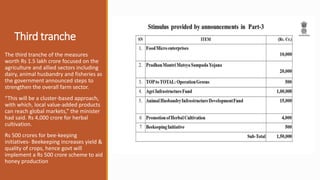
The third tranche of the measures
worth Rs 1.5 lakh crore focused on the
agriculture and allied sectors including
dairy, animal husbandry and fisheries as
the government announced steps to
strengthen the overall farm sector.
“This will be a cluster-based approach,
with which, local value-added products
can reach global markets,” the minister
had said. Rs 4,000 crore for herbal
cultivation.
Rs 500 crores for bee-keeping
initiatives- Beekeeping increases yield &
quality of crops, hence govt will
implement a Rs 500 crore scheme to aid
honey production
Fourth and Fifth
tranches
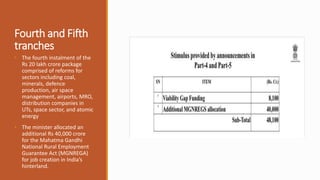
• The fourth instalment of the
Rs 20 lakh crore package
comprised of reforms for
sectors including coal,
minerals, defence
production, air space
management, airports, MRO,
distribution companies in
UTs, space sector, and atomic
energy
• The minister allocated an
additional Rs 40,000 crore
for the Mahatma Gandhi
National Rural Employment
Guarantee Act (MGNREGA)
for job creation in India’s
hinterland.
ACTUAL REVIEW IF THE PACKAGE
oEven though the announcements made are worth over Rs 20 lakh crore, the
actual cash outlay by the government this year and the impact on the fiscal
deficit will be far less.
oThis is because many of the government’s proposals are credit-focused or are
aimed at easing liquidity concerns for many affected sectors.
oIn some of these cases, any costs incurred will be initially covered through
banks or other financial institutions and thus not result in actual cash outgo by
the Centre.
oOther initiatives, particularly those made in Tranche 3, may only be ramped up
over an unknown period of time and therefore may not be fully relevant for the
fiscal deficit calculations this year.
ACTUAL REVIEW IF THE PACKAGE
oDecoding the package, one realised Rs 20 lakh crore wasn’t a fresh windfall for the public. It was
an aggregate of earlier monetary, fiscal and other policy measures already undertaken, along
with the current set of announcements.
oDisappointment began to creep in, once the numbers were analysed (which was a task even for
the experts), the middle-income group realised there was nothing substantial in it for them. In
fact, the entire stimulus looked like it was just an eyewash with loans and guarantees.
oWhere were the pay-outs that were actually supposed to make life easier. As hope turned to
dissatisfaction, the markets fell, the rupee depreciated and foreign investors exited in the next
few days.
oThe truth is that of the 10% of GDP stimulus that was announced as an economic relief package,
only 6.5% is attributable to the government, the balance going to the credit of the RBI under its
monetary policy measures
MY OPINION
oThe fact of the matter is that some of the reforms announced in this package are excellent. The
MSME liquidity provision is a huge plus. I do think perhaps could be done when it comes to
saving people and saving businesses in terms of writing cheques.
oA lot of problems happen at the state level. All the things are aimed at maintaining cash flow in
the economy. Making payments is one way, creating liquidity through government guarantees
and getting credit going is another.
oAt the same time, using up all your ammunition in one go when it's a long run is not a good
idea. The government has decided that it is a very good idea for the country to mobilise its
resources and deploy them to restart the economy.
oThe government has facilitated borrowing. But it is not doing the borrowing. That is for
businesses and individuals.
THANK YOU

20 lakh crore stimulus package

  • 1.
    20 LAKH CRORE STIMULUSPACKAGE BY BHAGAVATH. M
  • 2.
    INTRODUCTION oThe mega Rs20 lakh crore stimulus package announced on 12th May by PM Modi includes previously announced measures to save the lockdown-battered economy, and focuses on tax breaks for small businesses as well as incentives for domestic manufacturing. o. "This package, taken together with earlier announcements by the government during COVID crisis and decisions taken by RBI, is to the tune of Rs 20 lakh crore, which is equivalent to almost 10 per cent of India's GDP.“ oMost economic activity in the country had come to a standstill after the government imposed a 21-day nationwide lockdown beginning March 25 to check the spread of Covid-19. oThe package, he said, will focus on land, labour, liquidity and laws. It will cater to various sections, including cottage industry, MSMEs, labourers, middle class, and industries.
  • 3.
    OVERALL STIMULUS • TheRs 20 lakh crore package includes Rs 1.7 lakh crore package of free foodgrains to poor and cash to poor women and elderly, announced in March, as well as the Reserve Bank's liquidity measures and interest rate cuts. • While the March stimulus was 0.8 per cent of GDP, RBI's cut in interest rates and liquidity boosting measures totaled to 3.2 per cent of the GDP
  • 4.
    First tranche • MSMEsthat employ around 11 crore people and have a GDP share of approximately 29 per cent. • Out of the 16 announcements made by the minister, six were dedicated to the MSME segment to infuse liquidity. • This included Rs 3 lakh crore collateral-free loans and Rs 50,000 crore equity infusion for MSMEs through Fund of Funds. • The minister also advised states and regulatory authorities for extending the registration and completion date of real estate projects under RERA.
  • 5.
    Second tranche • NirmalaSitharaman’s second tranche of measures catered to migrant workers and street vendors. The minister introduced ‘one nation one ration card’ to allow migrant workers to buy ration from any depot in the country. • A special credit facility of Rs 5,000 crore was announced to support around 50 lakh street vendors who will have access to an initial Rs 10,000 working capital. • The government allowed states to fund the food and shelter facilities to migrant workers from the disaster response fund that would cost Rs 11,000 crore to the centre.
  • 6.
    Third tranche The thirdtranche of the measures worth Rs 1.5 lakh crore focused on the agriculture and allied sectors including dairy, animal husbandry and fisheries as the government announced steps to strengthen the overall farm sector. “This will be a cluster-based approach, with which, local value-added products can reach global markets,” the minister had said. Rs 4,000 crore for herbal cultivation. Rs 500 crores for bee-keeping initiatives- Beekeeping increases yield & quality of crops, hence govt will implement a Rs 500 crore scheme to aid honey production
  • 7.
    Fourth and Fifth tranches •The fourth instalment of the Rs 20 lakh crore package comprised of reforms for sectors including coal, minerals, defence production, air space management, airports, MRO, distribution companies in UTs, space sector, and atomic energy • The minister allocated an additional Rs 40,000 crore for the Mahatma Gandhi National Rural Employment Guarantee Act (MGNREGA) for job creation in India’s hinterland.
  • 8.
    ACTUAL REVIEW IFTHE PACKAGE oEven though the announcements made are worth over Rs 20 lakh crore, the actual cash outlay by the government this year and the impact on the fiscal deficit will be far less. oThis is because many of the government’s proposals are credit-focused or are aimed at easing liquidity concerns for many affected sectors. oIn some of these cases, any costs incurred will be initially covered through banks or other financial institutions and thus not result in actual cash outgo by the Centre. oOther initiatives, particularly those made in Tranche 3, may only be ramped up over an unknown period of time and therefore may not be fully relevant for the fiscal deficit calculations this year.
  • 9.
    ACTUAL REVIEW IFTHE PACKAGE oDecoding the package, one realised Rs 20 lakh crore wasn’t a fresh windfall for the public. It was an aggregate of earlier monetary, fiscal and other policy measures already undertaken, along with the current set of announcements. oDisappointment began to creep in, once the numbers were analysed (which was a task even for the experts), the middle-income group realised there was nothing substantial in it for them. In fact, the entire stimulus looked like it was just an eyewash with loans and guarantees. oWhere were the pay-outs that were actually supposed to make life easier. As hope turned to dissatisfaction, the markets fell, the rupee depreciated and foreign investors exited in the next few days. oThe truth is that of the 10% of GDP stimulus that was announced as an economic relief package, only 6.5% is attributable to the government, the balance going to the credit of the RBI under its monetary policy measures
  • 10.
    MY OPINION oThe factof the matter is that some of the reforms announced in this package are excellent. The MSME liquidity provision is a huge plus. I do think perhaps could be done when it comes to saving people and saving businesses in terms of writing cheques. oA lot of problems happen at the state level. All the things are aimed at maintaining cash flow in the economy. Making payments is one way, creating liquidity through government guarantees and getting credit going is another. oAt the same time, using up all your ammunition in one go when it's a long run is not a good idea. The government has decided that it is a very good idea for the country to mobilise its resources and deploy them to restart the economy. oThe government has facilitated borrowing. But it is not doing the borrowing. That is for businesses and individuals.
  • 11.