FINACIAL DERIAVTIVES
TOPIC :
INTRODUCTION
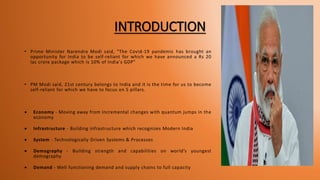
• Prime Minister Narendra Modi said, "The Covid-19 pandemic has brought an
opportunity for India to be self-reliant for which we have announced a Rs 20
lac crore package which is 10% of India's GDP"
• PM Modi said, 21st century belongs to India and it is the time for us to become
self-reliant for which we have to focus on 5 pillars.
 Economy - Moving away from incremental changes with quantum jumps in the
economy
 Infrastructure - Building infrastructure which recognizes Modern India
 System - Technologically Driven Systems & Processes
 Demography - Building strength and capabilities on world’s youngest
demography
 Demand - Well functioning demand and supply chains to full capacity
INTRODUCTION
• The world is going through a crisis because of the sheer suddenness and the unexpected pandemic that has happened
namely COVID-19.
• Every country’s government had their own approach towards saving their citizens from this deadly virus and stop it from
spreading extensively.
• The Indian Govt. had its own approach from preventing everyone from the spreading of this virus by introducing
Lockdown through which all of us are bound to quarantine ourselves at our homes.
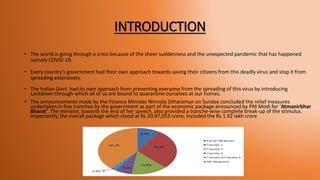
• The announcements made by the Finance Minister Nirmala Sitharaman on Sunday concluded the relief measures
undertaken in five tranches by the government as part of the economic package announced by PM Modi for ‘Atmanirbhar
Bharat’. The minister, towards the end of her speech, also provided a tranche-wise complete break-up of the stimulus.
Importantly, the overall package which stood at Rs 20,97,053 crore, included the Rs 1.92 lakh crore
FIRST TRANCHE
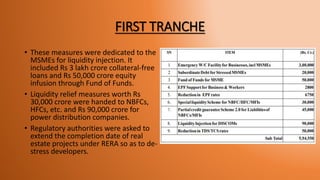
• These measures were dedicated to the
MSMEs for liquidity injection. It
included Rs 3 lakh crore collateral-free
loans and Rs 50,000 crore equity
infusion through Fund of Funds.
• Liquidity relief measures worth Rs
30,000 crore were handed to NBFCs,
HFCs, etc. and Rs 90,000 crore for
power distribution companies.
• Regulatory authorities were asked to
extend the completion date of real
estate projects under RERA so as to de-
stress developers.
SECOND TRANCHE
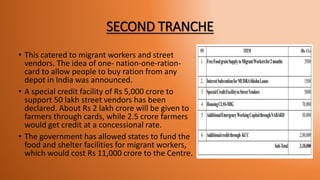
• This catered to migrant workers and street
vendors. The idea of one- nation-one-ration-
card to allow people to buy ration from any
depot in India was announced.
• A special credit facility of Rs 5,000 crore to
support 50 lakh street vendors has been
declared. About Rs 2 lakh crore will be given to
farmers through cards, while 2.5 crore farmers
would get credit at a concessional rate.
• The government has allowed states to fund the
food and shelter facilities for migrant workers,
which would cost Rs 11,000 crore to the Centre.
THIRD TRANCHE
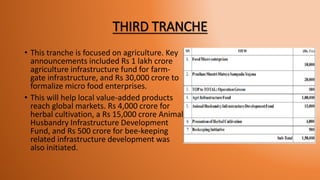
• This tranche is focused on agriculture. Key
announcements included Rs 1 lakh crore
agriculture infrastructure fund for farm-
gate infrastructure, and Rs 30,000 crore to
formalize micro food enterprises.
• This will help local value-added products
reach global markets. Rs 4,000 crore for
herbal cultivation, a Rs 15,000 crore Animal
Husbandry Infrastructure Development
Fund, and Rs 500 crore for bee-keeping
related infrastructure development was
also initiated.
FOURTH & FIFTH TRANCHES
• Easing utilization of the Indian air space to reduce air travel
cost, commercial mining in the coal sector, and privatizing
distribution companies in metros came up. There was an
announcement about private participation in the space sector.
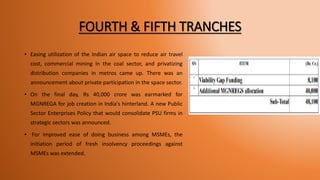
• On the final day, Rs 40,000 crore was earmarked for
MGNREGA for job creation in India's hinterland. A new Public
Sector Enterprises Policy that would consolidate PSU firms in
strategic sectors was announced.
• For improved ease of doing business among MSMEs, the
initiation period of fresh insolvency proceedings against
MSMEs was extended.
MY VIEWS
 Although the package is seeming to be beneficial for the betterment from healing the crisis we cannot deny
the fact that the govt. of India under Modi govt. has taken some HARSH steps also regarding the economy
of the country is concerned.
 For instance we cannot forget the fact that DEMONETISATION failed miserably and the country’s economy
is concerned.
 One can identify a number of sectors which didn’t find mention in the various measures. However, the
sector which really missed out was the “healthcare sector”. Though there has been an allocation of Rs
15,000 crore for health, India’s public healthcare spending is 3.6% of India’s GDP in 2016 as against
notably higher number for developed countries and 5%-9% for key developing countries. A long-term
solution to increase the public sector spending will have to be on the cards in the next budget for both
Centre and states.
 The unprecedented COVID-19 challenge was novel as a health crisis led to supply chain disruptions and
added to India’s lingering demand side concerns. Overall, the economic package has some bits for a wide
range of economic agents. The supply-side concerns do get a large share of measures (subject to
implementation) while the demand side issues to a great extent miss the bus.

DECODING ₹ 20 LAKH CRORE PACKAGE

  • 1.
  • 2.
    INTRODUCTION • Prime MinisterNarendra Modi said, "The Covid-19 pandemic has brought an opportunity for India to be self-reliant for which we have announced a Rs 20 lac crore package which is 10% of India's GDP" • PM Modi said, 21st century belongs to India and it is the time for us to become self-reliant for which we have to focus on 5 pillars.  Economy - Moving away from incremental changes with quantum jumps in the economy  Infrastructure - Building infrastructure which recognizes Modern India  System - Technologically Driven Systems & Processes  Demography - Building strength and capabilities on world’s youngest demography  Demand - Well functioning demand and supply chains to full capacity
  • 3.
    INTRODUCTION • The worldis going through a crisis because of the sheer suddenness and the unexpected pandemic that has happened namely COVID-19. • Every country’s government had their own approach towards saving their citizens from this deadly virus and stop it from spreading extensively. • The Indian Govt. had its own approach from preventing everyone from the spreading of this virus by introducing Lockdown through which all of us are bound to quarantine ourselves at our homes. • The announcements made by the Finance Minister Nirmala Sitharaman on Sunday concluded the relief measures undertaken in five tranches by the government as part of the economic package announced by PM Modi for ‘Atmanirbhar Bharat’. The minister, towards the end of her speech, also provided a tranche-wise complete break-up of the stimulus. Importantly, the overall package which stood at Rs 20,97,053 crore, included the Rs 1.92 lakh crore
  • 4.
    FIRST TRANCHE • Thesemeasures were dedicated to the MSMEs for liquidity injection. It included Rs 3 lakh crore collateral-free loans and Rs 50,000 crore equity infusion through Fund of Funds. • Liquidity relief measures worth Rs 30,000 crore were handed to NBFCs, HFCs, etc. and Rs 90,000 crore for power distribution companies. • Regulatory authorities were asked to extend the completion date of real estate projects under RERA so as to de- stress developers.
  • 5.
    SECOND TRANCHE • Thiscatered to migrant workers and street vendors. The idea of one- nation-one-ration- card to allow people to buy ration from any depot in India was announced. • A special credit facility of Rs 5,000 crore to support 50 lakh street vendors has been declared. About Rs 2 lakh crore will be given to farmers through cards, while 2.5 crore farmers would get credit at a concessional rate. • The government has allowed states to fund the food and shelter facilities for migrant workers, which would cost Rs 11,000 crore to the Centre.
  • 6.
    THIRD TRANCHE • Thistranche is focused on agriculture. Key announcements included Rs 1 lakh crore agriculture infrastructure fund for farm- gate infrastructure, and Rs 30,000 crore to formalize micro food enterprises. • This will help local value-added products reach global markets. Rs 4,000 crore for herbal cultivation, a Rs 15,000 crore Animal Husbandry Infrastructure Development Fund, and Rs 500 crore for bee-keeping related infrastructure development was also initiated.
  • 7.
    FOURTH & FIFTHTRANCHES • Easing utilization of the Indian air space to reduce air travel cost, commercial mining in the coal sector, and privatizing distribution companies in metros came up. There was an announcement about private participation in the space sector. • On the final day, Rs 40,000 crore was earmarked for MGNREGA for job creation in India's hinterland. A new Public Sector Enterprises Policy that would consolidate PSU firms in strategic sectors was announced. • For improved ease of doing business among MSMEs, the initiation period of fresh insolvency proceedings against MSMEs was extended.
  • 8.
    MY VIEWS  Althoughthe package is seeming to be beneficial for the betterment from healing the crisis we cannot deny the fact that the govt. of India under Modi govt. has taken some HARSH steps also regarding the economy of the country is concerned.  For instance we cannot forget the fact that DEMONETISATION failed miserably and the country’s economy is concerned.  One can identify a number of sectors which didn’t find mention in the various measures. However, the sector which really missed out was the “healthcare sector”. Though there has been an allocation of Rs 15,000 crore for health, India’s public healthcare spending is 3.6% of India’s GDP in 2016 as against notably higher number for developed countries and 5%-9% for key developing countries. A long-term solution to increase the public sector spending will have to be on the cards in the next budget for both Centre and states.  The unprecedented COVID-19 challenge was novel as a health crisis led to supply chain disruptions and added to India’s lingering demand side concerns. Overall, the economic package has some bits for a wide range of economic agents. The supply-side concerns do get a large share of measures (subject to implementation) while the demand side issues to a great extent miss the bus.