2. Prenatal development
Ms. Murthi Priyabhashini
Visiting Lecturer
BA (Hons) Psychology, University of Peradeniya
Dip. in Counselling
Licensed Psychologist (Pending)
• Child psychology knowldge helps us to understand the growth and
development process of children.
• Physical development is an essential and important part of child
development because it provides the basis for overall development of
the child. Therefore, growth monitoring should be done even before
the birth. Indicators of physical development such as weight and
height should be appropriate to the chronological age of the child.
Prenatal development
Learning Outcomes
• To understand the difference betwen growth and development.
• To understand prenatal development.
• To understand how prenatal development affect future development
of an individual.
• To define gross motor development and fine motor development.
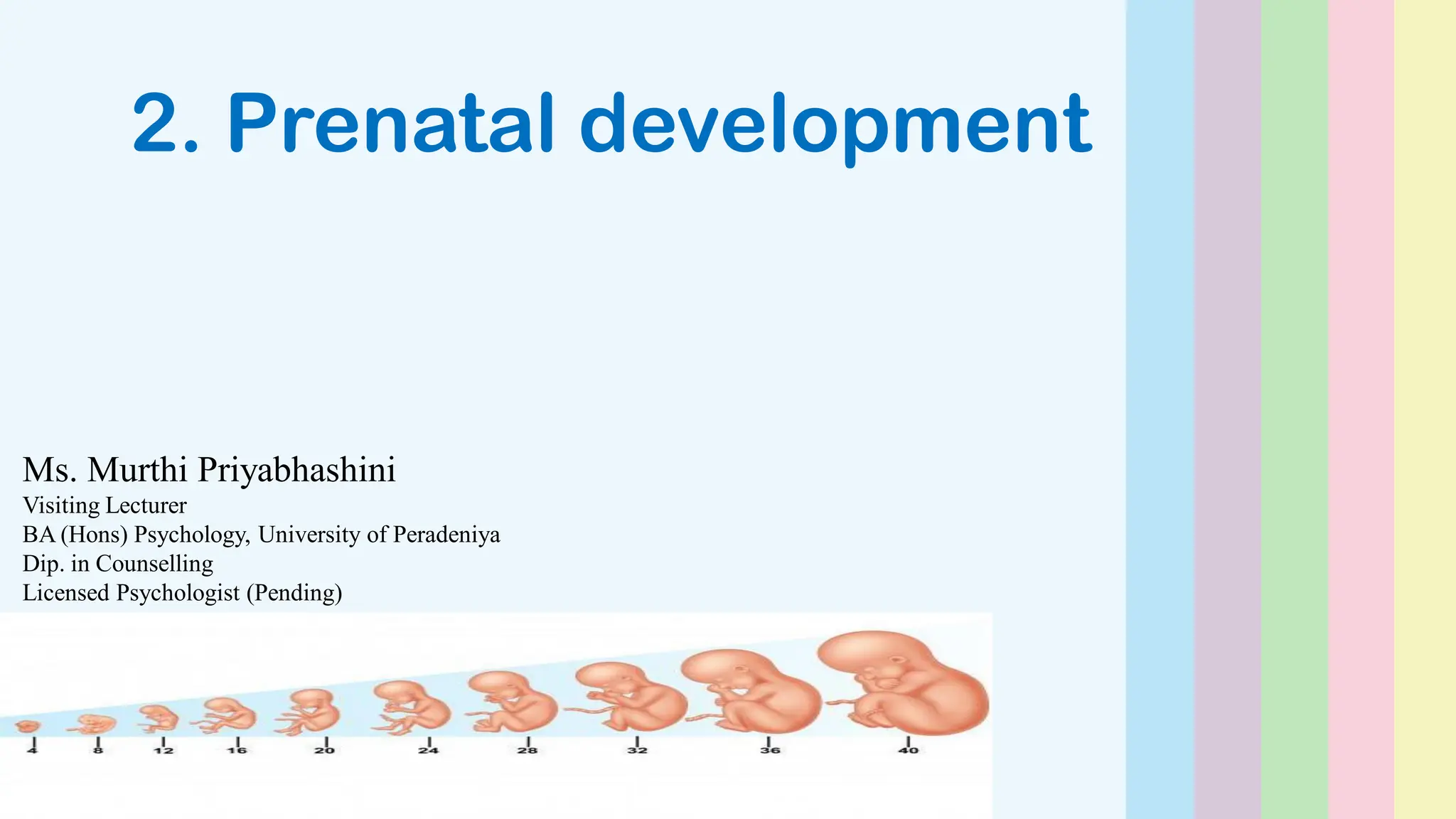
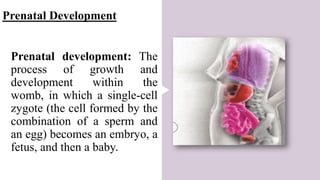
Prenatal development: The
process of growth and
development within the
womb, in which a single-cell
zygote (the cell formed by the
combination of a sperm and
an egg) becomes an embryo, a
fetus, and then a baby.
Prenatal Development
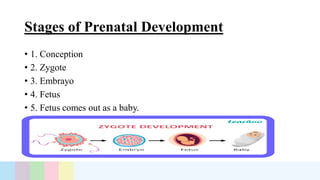
Stages of Prenatal Development
• 1. Conception
• 2. Zygote
• 3. Embrayo
• 4. Fetus
• 5. Fetus comes out as a baby.
1. Conception
1. Conception
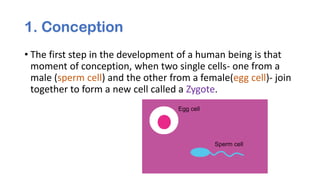
• The first step in the development of a human being is that
moment of conception, when two single cells- one from a
male (sperm cell) and the other from a female(egg cell)- join
together to form a new cell called a Zygote.
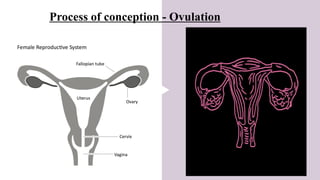
Process of conception - Ovulation
The process of conception
• Each month, one of a woman's two ovaries releases a mature egg in a
process known as ovulation. Ovulation occurs about two weeks after the
start of a woman's last menstrual period. The released egg travels into the
Fallopian tube, where it is fertilized by a single sperm.Each month, one of a
woman's two ovaries releases a mature egg in a process known as ovulation.
Ovulation occurs about two weeks after the start of a woman's last
menstrual period. The released egg travels into the Fallopian tube, where it
is fertilized by a single sperm.
• If a couple has intercourse during the crucial few days when the ovum is in
the fallopian tube, one of the millions of sperm ejaculated as part of each
male orgasm may travel the full distance through the women’s vagina,
cervix and uterus into the fallopian tube and penetrate the ovum. A child is
conceived.
2. ZYGOTE
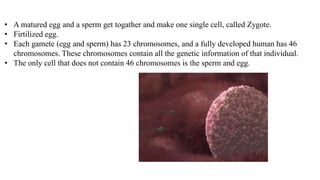
• A matured egg and a sperm get togather and make one single cell, called Zygote.
• Firtilized egg.
• Each gamete (egg and sperm) has 23 chromosomes, and a fully developed human has 46
chromosomes. These chromosomes contain all the genetic information of that individual.
• The only cell that does not contain 46 chromosomes is the sperm and egg.
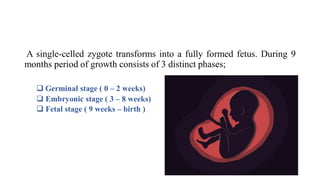
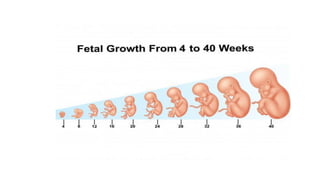
A single-celled zygote transforms into a fully formed fetus. During 9
months period of growth consists of 3 distinct phases;
 Germinal stage ( 0 – 2 weeks)
 Embryonic stage ( 3 – 8 weeks)
 Fetal stage ( 9 weeks – birth )
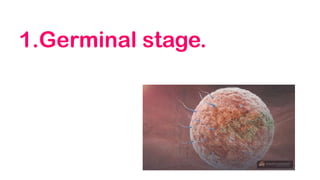
1.Germinal stage.
Germinal stage.
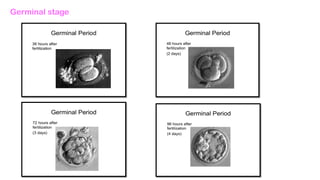
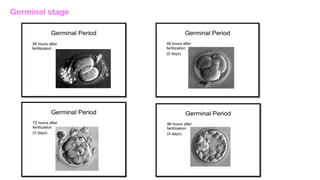
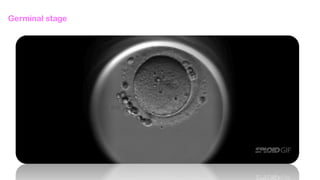
Within just a few hours after conception, the single-celled zygote begins
making a journey down the fallopian tube to the uterus where it will
begin the process of cell division and growth. Through the process of
mitosis, the zygote first divides into two cells, then into four, eight,
sixteen, and so on. A significant number of zygotes never progress
past this early part of cell division, with as many as half of all
zygote's surviving less than two weeks.
Germinal stage
As the cells multiply, they will also separate into two distinctive masses:
• the outer cells will eventually become the placenta while
• the inner cells will form the embryo.
• Cell division continues at a rapid rate and the cells then develop into
what is known as a blastocyst
Germinal stage - The Blastocyst
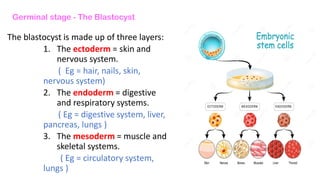
The blastocyst is made up of three layers:
1. The ectoderm = skin and
nervous system.
( Eg = hair, nails, skin,
nervous system)
2. The endoderm = digestive
and respiratory systems.
( Eg = digestive system, liver,
pancreas, lungs )
3. The mesoderm = muscle and
skeletal systems.
( Eg = circulatory system,
lungs )
Germinal stage - Implantation
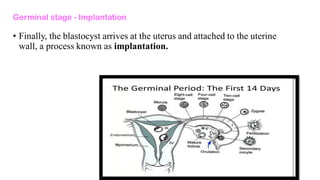
• Finally, the blastocyst arrives at the uterus and attached to the uterine
wall, a process known as implantation.
• Implantation occurs when the cells nestle into the uterine lining and
rupture tiny blood vessels. The connective web of blood vessels and
membranes that form between them will provide nourishment for the
developing being for the next nine months. Implantation is not always
an automatic and sure-fire process.
Germinal stage
Germinal stage
2.Embryonic stage.
Embryonic stage.
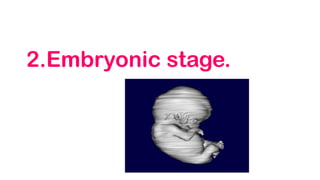
• At this point, the mass of cells is now known as an embryo. The
embryonic stage plays an important role in the development of the
brain.
Embryonic stage.
• Approximately 22 days after conception, the neural tube forms. This
tube will later develop into the central nervous system including the
spinal cord and brain.
Embryonic stage
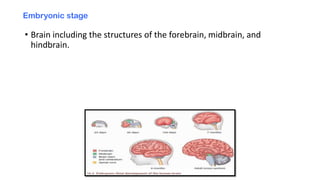
• Brain including the structures of the forebrain, midbrain, and
hindbrain. ​
• Around the fourth week, the head begins to form quickly followed by
the eyes, nose, ears, and mouth. The cardiovascular system is where
the earliest activity begins as the blood vessel that will become the
heart start to pulse.
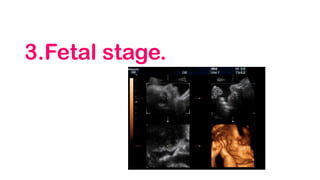
3.Fetal stage.
Fetal stage
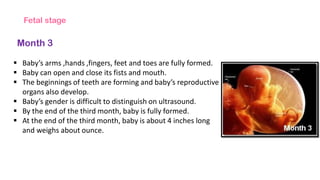
Month 3
 Baby’s arms ,hands ,fingers, feet and toes are fully formed.
 Baby can open and close its fists and mouth.
 The beginnings of teeth are forming and baby’s reproductive
organs also develop.
 Baby’s gender is difficult to distinguish on ultrasound.
 By the end of the third month, baby is fully formed.
 At the end of the third month, baby is about 4 inches long
and weighs about ounce.
Fetal stage
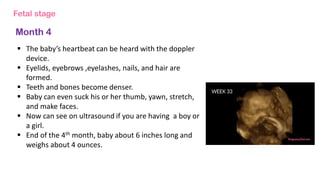
Month 4
 The baby’s heartbeat can be heard with the doppler
device.
 Eyelids, eyebrows ,eyelashes, nails, and hair are
formed.
 Teeth and bones become denser.
 Baby can even suck his or her thumb, yawn, stretch,
and make faces.
 Now can see on ultrasound if you are having a boy or
a girl.
 End of the 4th month, baby about 6 inches long and
weighs about 4 ounces.
Fetal stage
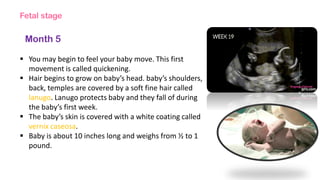
Month 5
 You may begin to feel your baby move. This first
movement is called quickening.
 Hair begins to grow on baby’s head. baby’s shoulders,
back, temples are covered by a soft fine hair called
lanugo. Lanugo protects baby and they fall of during
the baby’s first week.
 The baby’s skin is covered with a white coating called
vernix caseosa.
 Baby is about 10 inches long and weighs from ½ to 1
pound.
Fetal stage.
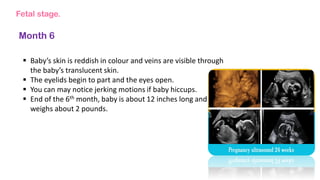
Month 6
 Baby’s skin is reddish in colour and veins are visible through
the baby’s translucent skin.
 The eyelids begin to part and the eyes open.
 You can may notice jerking motions if baby hiccups.
 End of the 6th month, baby is about 12 inches long and
weighs about 2 pounds.
Fetal stage.
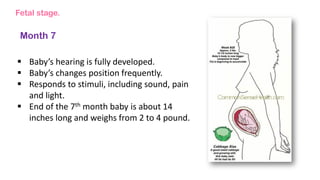
Month 7
 Baby’s hearing is fully developed.
 Baby’s changes position frequently.
 Responds to stimuli, including sound, pain
and light.
 End of the 7th month baby is about 14
inches long and weighs from 2 to 4 pound.
Fetal stage.
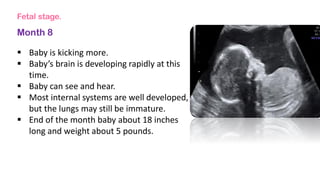
Month 8
 Baby is kicking more.
 Baby’s brain is developing rapidly at this
time.
 Baby can see and hear.
 Most internal systems are well developed,
but the lungs may still be immature.
 End of the month baby about 18 inches
long and weight about 5 pounds.
Fetal stage.
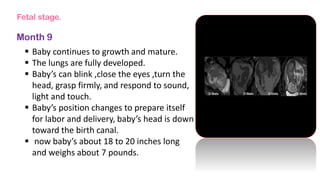
Month 9
 Baby continues to growth and mature.
 The lungs are fully developed.
 Baby’s can blink ,close the eyes ,turn the
head, grasp firmly, and respond to sound,
light and touch.
 Baby’s position changes to prepare itself
for labor and delivery, baby’s head is down
toward the birth canal.
 now baby’s about 18 to 20 inches long
and weighs about 7 pounds.
How the connection develop with the child and the world
• From the 6th month the baby is in the mother’s womb , the baby begins to respond
to external sounds by moving or increasing the pulse.
• By the 7th month, the baby’s hearing is well developed and during this time, the
mother or father tries to sing songs to talk to the baby in the womb ,and the baby in
the also struggling and responds to the outside world.
• In the 8th month, the baby’s vision is well developed and when a light from outside
touches the mother’s womb, it is visible to the baby. There the baby responds
outwardly by kicking and struggling. Also, when the mother’s womb is touched, the
baby in the womb feels the same touch.
• Thus, from the sixth month, little by little, the baby’s relationship with the outside
world develops well and in the 9th month, baby comes to the world and sees the
world.
Question, feedback or comments?
•Thank you

2. Pre-natal development in psychology ...

  • 1.
    2. Prenatal development Ms.Murthi Priyabhashini Visiting Lecturer BA (Hons) Psychology, University of Peradeniya Dip. in Counselling Licensed Psychologist (Pending)
  • 2.
    • Child psychologyknowldge helps us to understand the growth and development process of children. • Physical development is an essential and important part of child development because it provides the basis for overall development of the child. Therefore, growth monitoring should be done even before the birth. Indicators of physical development such as weight and height should be appropriate to the chronological age of the child.
  • 3.
  • 4.
    Learning Outcomes • Tounderstand the difference betwen growth and development. • To understand prenatal development. • To understand how prenatal development affect future development of an individual. • To define gross motor development and fine motor development.
  • 5.
    Prenatal development: The processof growth and development within the womb, in which a single-cell zygote (the cell formed by the combination of a sperm and an egg) becomes an embryo, a fetus, and then a baby. Prenatal Development
  • 6.
    Stages of PrenatalDevelopment • 1. Conception • 2. Zygote • 3. Embrayo • 4. Fetus • 5. Fetus comes out as a baby.
  • 7.
  • 8.
    1. Conception • Thefirst step in the development of a human being is that moment of conception, when two single cells- one from a male (sperm cell) and the other from a female(egg cell)- join together to form a new cell called a Zygote.
  • 9.
  • 10.
    The process ofconception • Each month, one of a woman's two ovaries releases a mature egg in a process known as ovulation. Ovulation occurs about two weeks after the start of a woman's last menstrual period. The released egg travels into the Fallopian tube, where it is fertilized by a single sperm.Each month, one of a woman's two ovaries releases a mature egg in a process known as ovulation. Ovulation occurs about two weeks after the start of a woman's last menstrual period. The released egg travels into the Fallopian tube, where it is fertilized by a single sperm. • If a couple has intercourse during the crucial few days when the ovum is in the fallopian tube, one of the millions of sperm ejaculated as part of each male orgasm may travel the full distance through the women’s vagina, cervix and uterus into the fallopian tube and penetrate the ovum. A child is conceived.
  • 11.
  • 12.
    • A maturedegg and a sperm get togather and make one single cell, called Zygote. • Firtilized egg. • Each gamete (egg and sperm) has 23 chromosomes, and a fully developed human has 46 chromosomes. These chromosomes contain all the genetic information of that individual. • The only cell that does not contain 46 chromosomes is the sperm and egg.
  • 13.
    A single-celled zygotetransforms into a fully formed fetus. During 9 months period of growth consists of 3 distinct phases;  Germinal stage ( 0 – 2 weeks)  Embryonic stage ( 3 – 8 weeks)  Fetal stage ( 9 weeks – birth )
  • 14.
  • 15.
    Germinal stage. Within justa few hours after conception, the single-celled zygote begins making a journey down the fallopian tube to the uterus where it will begin the process of cell division and growth. Through the process of mitosis, the zygote first divides into two cells, then into four, eight, sixteen, and so on. A significant number of zygotes never progress past this early part of cell division, with as many as half of all zygote's surviving less than two weeks.
  • 16.
  • 17.
    As the cellsmultiply, they will also separate into two distinctive masses: • the outer cells will eventually become the placenta while • the inner cells will form the embryo. • Cell division continues at a rapid rate and the cells then develop into what is known as a blastocyst
  • 18.
    Germinal stage -The Blastocyst The blastocyst is made up of three layers: 1. The ectoderm = skin and nervous system. ( Eg = hair, nails, skin, nervous system) 2. The endoderm = digestive and respiratory systems. ( Eg = digestive system, liver, pancreas, lungs ) 3. The mesoderm = muscle and skeletal systems. ( Eg = circulatory system, lungs )
  • 19.
    Germinal stage -Implantation • Finally, the blastocyst arrives at the uterus and attached to the uterine wall, a process known as implantation.
  • 20.
    • Implantation occurswhen the cells nestle into the uterine lining and rupture tiny blood vessels. The connective web of blood vessels and membranes that form between them will provide nourishment for the developing being for the next nine months. Implantation is not always an automatic and sure-fire process.
  • 21.
  • 22.
  • 23.
  • 24.
    Embryonic stage. • Atthis point, the mass of cells is now known as an embryo. The embryonic stage plays an important role in the development of the brain.
  • 25.
    Embryonic stage. • Approximately22 days after conception, the neural tube forms. This tube will later develop into the central nervous system including the spinal cord and brain.
  • 26.
    Embryonic stage • Brainincluding the structures of the forebrain, midbrain, and hindbrain. ​
  • 27.
    • Around thefourth week, the head begins to form quickly followed by the eyes, nose, ears, and mouth. The cardiovascular system is where the earliest activity begins as the blood vessel that will become the heart start to pulse.
  • 28.
  • 30.
    Fetal stage Month 3 Baby’s arms ,hands ,fingers, feet and toes are fully formed.  Baby can open and close its fists and mouth.  The beginnings of teeth are forming and baby’s reproductive organs also develop.  Baby’s gender is difficult to distinguish on ultrasound.  By the end of the third month, baby is fully formed.  At the end of the third month, baby is about 4 inches long and weighs about ounce.
  • 31.
    Fetal stage Month 4 The baby’s heartbeat can be heard with the doppler device.  Eyelids, eyebrows ,eyelashes, nails, and hair are formed.  Teeth and bones become denser.  Baby can even suck his or her thumb, yawn, stretch, and make faces.  Now can see on ultrasound if you are having a boy or a girl.  End of the 4th month, baby about 6 inches long and weighs about 4 ounces.
  • 32.
    Fetal stage Month 5 You may begin to feel your baby move. This first movement is called quickening.  Hair begins to grow on baby’s head. baby’s shoulders, back, temples are covered by a soft fine hair called lanugo. Lanugo protects baby and they fall of during the baby’s first week.  The baby’s skin is covered with a white coating called vernix caseosa.  Baby is about 10 inches long and weighs from ½ to 1 pound.
  • 33.
    Fetal stage. Month 6 Baby’s skin is reddish in colour and veins are visible through the baby’s translucent skin.  The eyelids begin to part and the eyes open.  You can may notice jerking motions if baby hiccups.  End of the 6th month, baby is about 12 inches long and weighs about 2 pounds.
  • 34.
    Fetal stage. Month 7 Baby’s hearing is fully developed.  Baby’s changes position frequently.  Responds to stimuli, including sound, pain and light.  End of the 7th month baby is about 14 inches long and weighs from 2 to 4 pound.
  • 35.
    Fetal stage. Month 8 Baby is kicking more.  Baby’s brain is developing rapidly at this time.  Baby can see and hear.  Most internal systems are well developed, but the lungs may still be immature.  End of the month baby about 18 inches long and weight about 5 pounds.
  • 36.
    Fetal stage. Month 9 Baby continues to growth and mature.  The lungs are fully developed.  Baby’s can blink ,close the eyes ,turn the head, grasp firmly, and respond to sound, light and touch.  Baby’s position changes to prepare itself for labor and delivery, baby’s head is down toward the birth canal.  now baby’s about 18 to 20 inches long and weighs about 7 pounds.
  • 38.
    How the connectiondevelop with the child and the world • From the 6th month the baby is in the mother’s womb , the baby begins to respond to external sounds by moving or increasing the pulse. • By the 7th month, the baby’s hearing is well developed and during this time, the mother or father tries to sing songs to talk to the baby in the womb ,and the baby in the also struggling and responds to the outside world. • In the 8th month, the baby’s vision is well developed and when a light from outside touches the mother’s womb, it is visible to the baby. There the baby responds outwardly by kicking and struggling. Also, when the mother’s womb is touched, the baby in the womb feels the same touch. • Thus, from the sixth month, little by little, the baby’s relationship with the outside world develops well and in the 9th month, baby comes to the world and sees the world.
  • 39.
    Question, feedback orcomments? •Thank you