标准化组织 ISO ISO:国际标准化组织 ( International Organization for Standardization ) OSI: 开放系统互联 ( open system interconnection ) 20 世纪 70 年代后期, ISO 创建 OSI 参考模型,希望不同供应商的网络能够相互协同工作,但迄今为止,这仍然是一个伟大的目标!
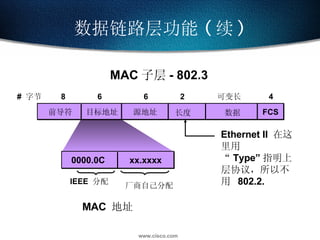
MAC 子层 MAC子层( media access control): 负责 MAC 寻址和定义介质访问控制方法 , 定义了如何在物理线路上传输 frame . MAC 子层一般的访问控制方式: 1. 争用式: FCFS ( first come first service) 2. 轮流式:访问时间可预见,不发生冲突;但是要有 Token 令牌 MAC 子层协议有: 802.3 802.5 FDDI ( fiber distributed data interface) 这三个 LAN 技术的不同在于帧结构和访问机制的不同
39.
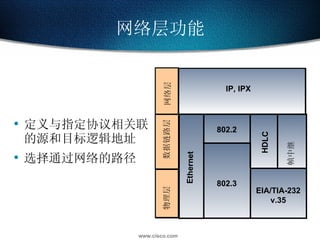
LLC 子层 LLC子层( logical link control): 为上层协议提供 SAP 服务访问点,并为数据加上控制信息,负责从逻辑上识别不同的协议类型. LLC 子层协议: 802.2 802.2 协议只在 LLC 子层,为以太网和令牌环网提供了通用功能
40.
SAP 服务访问点 SAP( Service Access Point 服务访问点): LLC 子层为了网络层的各种协议提供服务,而上层可能运行不同协议,为区分不同上层协议的数据,要采用服务访问点
数据链路层功能 ( 续) 数据 目标 SAP 源 SAP 数据 源地址 FCS 长度 目标地址 可变长 1 1 802.2 (SAP) MAC 子层 - 802.3 Ctrl 1 or 2 3 2 前导符 数据 目标 SAP AA 源 SAP AA 可变长 1 1 802.2 (SNAP) Ctrl 03 1 or 2 OR OUI ID 类型
43.
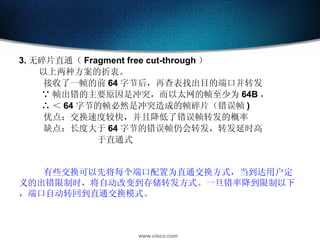
交换机和桥运行在链路层 1. 网络微分段 2. 交换机是 OSI 模型的第二层设备 , 在 OSI 参考模型的数据链路层(第二层)工作,交换机根据进入端口数据帧的 MAC 地址来过滤、转发或扩散该数据帧
路由器 1. 控制部件(CPU 、 RAM 、 IOS ) 2. 路由表 3. 协议软件 4. 网络接口( LAN 、 WAN 、 CONSOLE )
53.
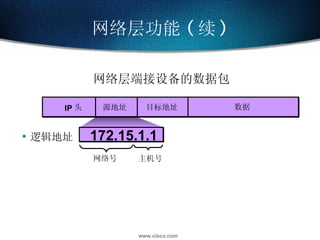
路由器工作原理 工作原理 采用存储转发的方法:接收并缓存 IP 数据分组,提取分组中的目的 IP 地址,然后查路由表决定转发路径。如果未查到,则丢弃该分组。 交换机也用查表的方法决定转发路径,但交换机的表是 “端口 -MAC 地址” 表,存放的是端口与目的 MAC 地址之间的关系,要用帧中的 MAC 地址查表; 而路由器中的路由表是 “端口 - 网络地址” 表,存放的是端口与目的网络地址之间的关系,故要从分组中提取 IP 地址,并解析出其中的网络地址部分来查表。
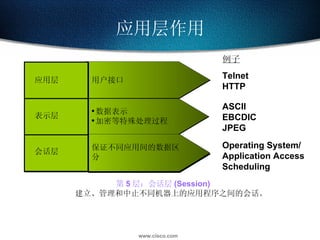
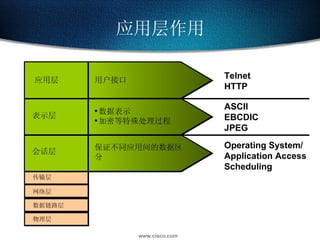
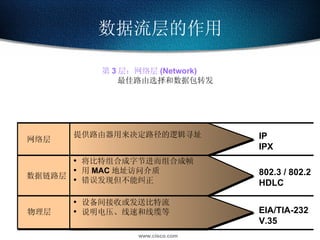
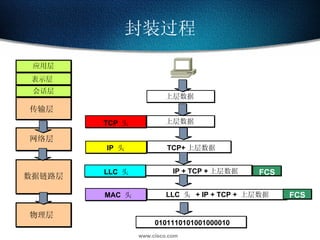
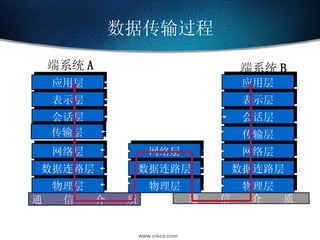
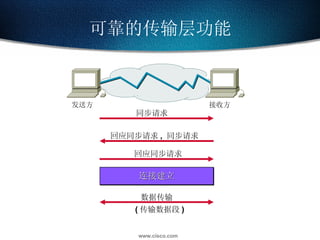
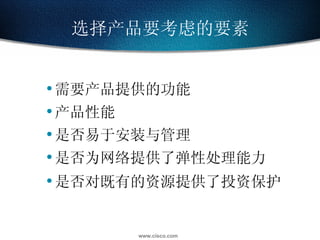
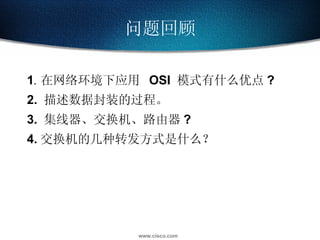
#2 Purpose: This chapter reviews general networking theory and introduces students to some of Cisco’s product line. Timing: This chapter takes approximately 1.5 hours to present. Note: This section has a product selection tool laboratory exercise at the end. Contents: Objectives—This section explains what the student will be able to do at the end of this chapter. Defining Network Components—This section displays where devices are placed in the network. Mapping Business Needs to a Hierarchical Model—This section describes the heirarchical model used in network design. OSI Model Overview—This section reviews the OSI model. Communicating Between Layers—This section describes encapsulation and de-encapsulation. Written Exercise 1—This section has a written exercise to test the students’ knowledge of the OSI model. Physical Layer Functions—This section describes the physical layer of the OSI Model. Data Link Layer Functions—This section describes the data link layer of the OSI Model. Network Layer Functions—This section describes the network layer of the OSI Model. Transport Layer Functions—This section describes the transport layer of the OSI Model.

































![[圣思园][Java SE]Network](https://cdn.slidesharecdn.com/ss_thumbnails/network-110811052126-phpapp02-thumbnail.jpg?width=640&height=640&fit=bounds)


