THE MODERN OLYMPIC GAMES
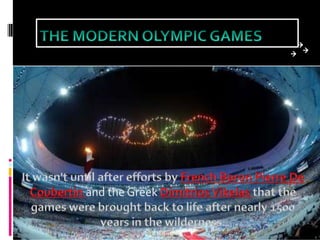
•Coubertin believed that
that could inspire a feeling
of unity and peace among the many nations of the world.
•In 1894 at an international congress, which was actually devised for the study of
amateur sports, he voiced his view on the revival of the Olympic Games, and was
delighted when the other countries participating in the congress agreed with him.
•The International Olympic Committee (IOC) was founded that year 1894.
•Held in Athens in 1896 at the Panatheniac Stadium, the games heralded a
welcomed return to the original beliefs and virtues of the ancient games. Probably
the biggest cheer of the 1896 Olympics was when a Greek Sheppard, Spiridon Louis,
was victorious in the most popular of all events, the marathon. The athletes from
the United States were also big winners in these games, winning 9 events.
•The Olympics have taken place every four years, since the first games in 1896.
•The Winter Olympic Games were introduced in 1924, and also took place every four
years. However, it wasn't until 1992 that it was decided that the Olympic and Winter
Olympic games would not take place in the same calendar year. The Winter Games
were moved forward two years to 1994, and would continue to take place at fouryear intervals.
•Since the first modern Olympic Games in Athens in 1896, the games have
continued to grow throughout the years and more and more nations have been
taking part, as well as more events being included.
The Olympic Movement

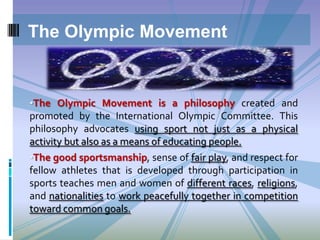
•The Olympic Movement is a philosophy created and

promoted by the International Olympic Committee. This
philosophy advocates using sport not just as a physical
activity but also as a means of educating people.
•The good sportsmanship, sense of fair play, and respect for
fellow athletes that is developed through participation in
sports teaches men and women of different races, religions,
and nationalities to work peacefully together in competition
toward common goals.
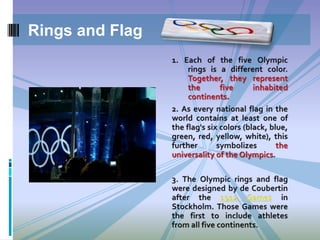
What do the Olympic rings mean?

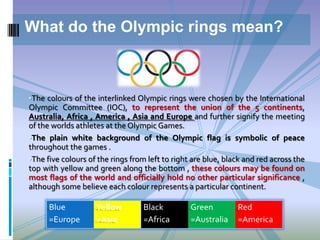
•The colours of the interlinked Olympic rings were chosen by the International

Olympic Committee (IOC), to represent the union of the 5 continents,
Australia, Africa , America , Asia and Europe and further signify the meeting
of the worlds athletes at the Olympic Games.
•The plain white background of the Olympic flag is symbolic of peace
throughout the games .
•The five colours of the rings from left to right are blue, black and red across the
top with yellow and green along the bottom , these colours may be found on
most flags of the world and officially hold no other particular significance ,
although some believe each colour represents a particular continent.

Blue
=Europe

Yellow
=Asia

Black
=Africa

Green
=Australia

Red
=America
Flame and Torch
Flame and Torch in Sydney 2000
The Olympic Oath
The Olympic Oath
Rings and Flag
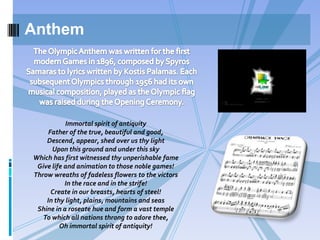
Anthem

Immortal spirit of antiquity
Father of the true, beautiful and good,
Descend, appear, shed over us thy light
Upon this ground and under this sky
Which has first witnessed thy unperishable fame
Give life and animation to those noble games!
Throw wreaths of fadeless flowers to the victors
In the race and in the strife!
Create in our breasts, hearts of steel!
In thy light, plains, mountains and seas
Shine in a roseate hue and form a vast temple
To which all nations throng to adore thee,
Oh immortal spirit of antiquity!
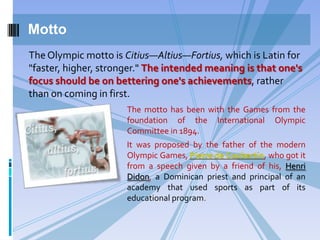
Motto
The Olympic motto is Citius—Altius—Fortius, which is Latin for
"faster, higher, stronger." The intended meaning is that one's
focus should be on bettering one's achievements, rather
than on coming in first.
The motto has been with the Games from the
foundation of the International Olympic
Committee in 1894.
It was proposed by the father of the modern
Olympic Games, Pierre de Coubertin, who got it
from a speech given by a friend of his, Henri
Didon, a Dominican priest and principal of an
academy that used sports as part of its
educational program.
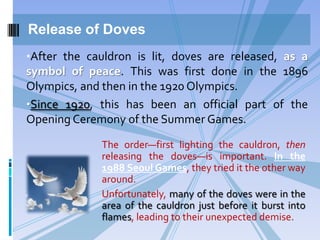
Release of Doves
•After the cauldron is lit, doves are released, as a
symbol of peace. This was first done in the 1896

Olympics, and then in the 1920 Olympics.
•Since 1920, this has been an official part of the
Opening Ceremony of the Summer Games.
The order—first lighting the cauldron, then
releasing the doves—is important. In the
1988 Seoul Games, they tried it the other way
around.
Unfortunately, many of the doves were in the
area of the cauldron just before it burst into
flames, leading to their unexpected demise.
What is the Olympic creed?
The Olympic creed was first stated in 1896
by the founder of the modern Olympic
games , Baron Pierre de Coubertin , the
words of the creed are as follows:

"The most important thing in the Olympic

Games is not to win but to take part, just as
the most important thing in life is not the
triumph but the struggle. The essential
thing is not to have conquered but to have
fought well."
The Victory Ceremony
At the Ancient Games, winners were presented with a simple olive tree
branch which was cut with a gold-handled knife from a wild olive tree. The
Greeks believed that the vitality of the sacred tree was transmitted to the
recipient through the branch.
At the Modern Games, Olympic medals are presented to the winning
athletes who stand on a dais at the completion of their event.
A GOLD medal is presented for first place, SILVER for second and BRONZE
for third. The host city is responsible for designing the medals within the
guidelines set by the IOC.

The national anthem of the winner is played as
each medalist’s national flag is raised.
Closing statement
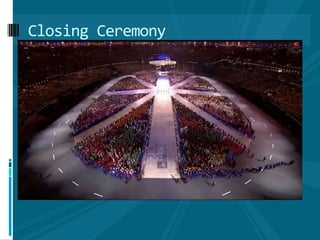
Closing Ceremony
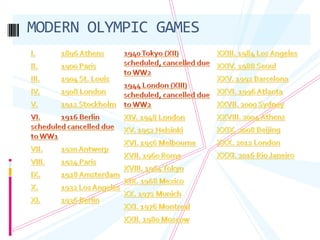
MODERN OLYMPIC GAMES
Olympics through the history

2. modern olympic games

  • 2.
    THE MODERN OLYMPICGAMES •Coubertin believed that that could inspire a feeling of unity and peace among the many nations of the world. •In 1894 at an international congress, which was actually devised for the study of amateur sports, he voiced his view on the revival of the Olympic Games, and was delighted when the other countries participating in the congress agreed with him. •The International Olympic Committee (IOC) was founded that year 1894. •Held in Athens in 1896 at the Panatheniac Stadium, the games heralded a welcomed return to the original beliefs and virtues of the ancient games. Probably the biggest cheer of the 1896 Olympics was when a Greek Sheppard, Spiridon Louis, was victorious in the most popular of all events, the marathon. The athletes from the United States were also big winners in these games, winning 9 events. •The Olympics have taken place every four years, since the first games in 1896. •The Winter Olympic Games were introduced in 1924, and also took place every four years. However, it wasn't until 1992 that it was decided that the Olympic and Winter Olympic games would not take place in the same calendar year. The Winter Games were moved forward two years to 1994, and would continue to take place at fouryear intervals. •Since the first modern Olympic Games in Athens in 1896, the games have continued to grow throughout the years and more and more nations have been taking part, as well as more events being included.
  • 3.
    The Olympic Movement •TheOlympic Movement is a philosophy created and promoted by the International Olympic Committee. This philosophy advocates using sport not just as a physical activity but also as a means of educating people. •The good sportsmanship, sense of fair play, and respect for fellow athletes that is developed through participation in sports teaches men and women of different races, religions, and nationalities to work peacefully together in competition toward common goals.
  • 4.
    What do theOlympic rings mean? •The colours of the interlinked Olympic rings were chosen by the International Olympic Committee (IOC), to represent the union of the 5 continents, Australia, Africa , America , Asia and Europe and further signify the meeting of the worlds athletes at the Olympic Games. •The plain white background of the Olympic flag is symbolic of peace throughout the games . •The five colours of the rings from left to right are blue, black and red across the top with yellow and green along the bottom , these colours may be found on most flags of the world and officially hold no other particular significance , although some believe each colour represents a particular continent. Blue =Europe Yellow =Asia Black =Africa Green =Australia Red =America
  • 5.
  • 6.
    Flame and Torchin Sydney 2000
  • 7.
  • 8.
  • 9.
  • 10.
    Anthem Immortal spirit ofantiquity Father of the true, beautiful and good, Descend, appear, shed over us thy light Upon this ground and under this sky Which has first witnessed thy unperishable fame Give life and animation to those noble games! Throw wreaths of fadeless flowers to the victors In the race and in the strife! Create in our breasts, hearts of steel! In thy light, plains, mountains and seas Shine in a roseate hue and form a vast temple To which all nations throng to adore thee, Oh immortal spirit of antiquity!
  • 11.
    Motto The Olympic mottois Citius—Altius—Fortius, which is Latin for "faster, higher, stronger." The intended meaning is that one's focus should be on bettering one's achievements, rather than on coming in first. The motto has been with the Games from the foundation of the International Olympic Committee in 1894. It was proposed by the father of the modern Olympic Games, Pierre de Coubertin, who got it from a speech given by a friend of his, Henri Didon, a Dominican priest and principal of an academy that used sports as part of its educational program.
  • 12.
    Release of Doves •Afterthe cauldron is lit, doves are released, as a symbol of peace. This was first done in the 1896 Olympics, and then in the 1920 Olympics. •Since 1920, this has been an official part of the Opening Ceremony of the Summer Games. The order—first lighting the cauldron, then releasing the doves—is important. In the 1988 Seoul Games, they tried it the other way around. Unfortunately, many of the doves were in the area of the cauldron just before it burst into flames, leading to their unexpected demise.
  • 13.
    What is theOlympic creed? The Olympic creed was first stated in 1896 by the founder of the modern Olympic games , Baron Pierre de Coubertin , the words of the creed are as follows: "The most important thing in the Olympic Games is not to win but to take part, just as the most important thing in life is not the triumph but the struggle. The essential thing is not to have conquered but to have fought well."
  • 14.
    The Victory Ceremony Atthe Ancient Games, winners were presented with a simple olive tree branch which was cut with a gold-handled knife from a wild olive tree. The Greeks believed that the vitality of the sacred tree was transmitted to the recipient through the branch. At the Modern Games, Olympic medals are presented to the winning athletes who stand on a dais at the completion of their event. A GOLD medal is presented for first place, SILVER for second and BRONZE for third. The host city is responsible for designing the medals within the guidelines set by the IOC. The national anthem of the winner is played as each medalist’s national flag is raised.
  • 15.
  • 16.
  • 17.
  • 18.