ENPI FLEG Program in Russia: Highlighting Implementation  CHALLENGES, RESULTS and IMPACTS Russia PСT:Marina Smetanina (WB)Elena Kulikova (WWF)Andrey Zaytsev (IUCN)
Russia’s Country Work Plan ComponentsImproving the FLEG regulatory and legal framework and its enforcement(IUCN, WB, WWF)
Improving  the FLEG planning and monitoring at the national, regional (local), and interagency levels (WB, WWF)
Causing specific FLEG actions to be implemented by lead Russian forest companies and their international trading partners (WWF)
Safeguarding the rights of local communities and small businesses to forest resource use (IUCN)
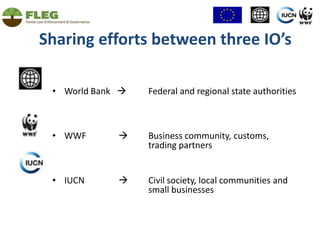
Increasing transparency of actions and raising the public awareness (IUCN,WWF) Sharing efforts between three IO’sWorld Bank      	Federal and regional state authorities
WWF 	  	Business community, customs, 				trading partners
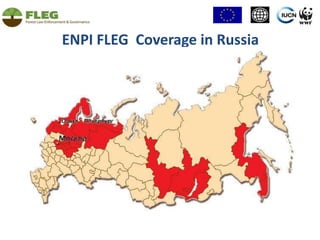
IUCN 	 	Civil society, local communities and 			small businesses    ENPI FLEG  Coverage in Russia
Anticipated ENPI FLEG PROGRAM RESULTS AREASIncreased awareness and commitment of key stakeholders on FLEGEffective national and regional FLEG action processes in placeIncreased national ownership and capacityImproved regional and sub-regional collaboration and knowledge sharingEffective engagement of key trading partnersContinuation of the formal official Europe-North Asia FLEG processSustainable forest management practices implemented5
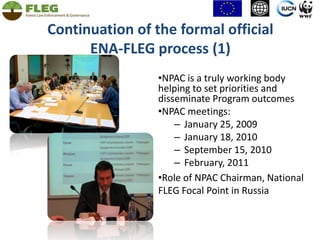
Continuation of the formal official ENA-FLEG process (1)NPAC is a truly working body helping to set priorities and disseminate Program outcomesNPAC meetings:January 25, 2009January 18, 2010September 15, 2010February, 2011Role of NPAC Chairman, National FLEG Focal Point in Russia
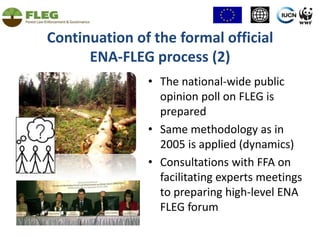
Continuation of the formal official ENA-FLEG process (2)The national-wide public opinion poll on FLEG is preparedSame methodology as in 2005 is applied (dynamics)Consultations with FFA on facilitating experts meetings to preparing high-level ENA FLEG forum
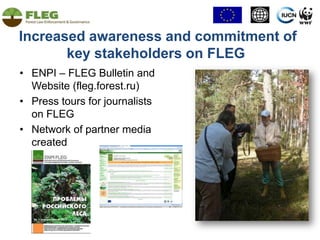
Increased awareness and commitment of key stakeholders on FLEG ENPI – FLEG Bulletin and Website (fleg.forest.ru)Press tours for journalists on FLEGNetwork of partner media created
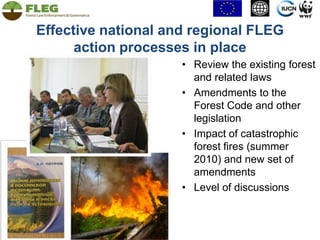
Effective national and regional FLEG action processes in placeReview the existing forest and related laws Amendments to the Forest Code and other legislationImpact of catastrophic forest fires (summer 2010) and new set of amendments Level of discussions
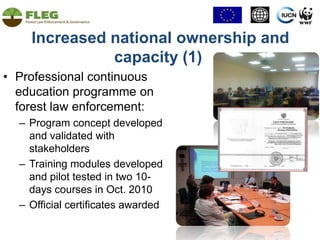
Increased national ownership and capacity (1) Professional continuous education programme on forest law enforcement:Program concept developed and validated with stakeholdersTraining modules developed and pilot tested in two 10-days courses in Oct. 2010Official certificates awarded
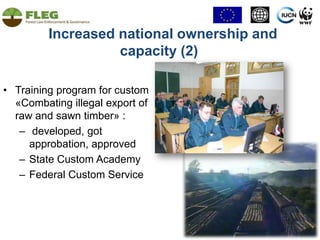
Increased national ownership and capacity (2)  Training program for custom «Combating illegal export of raw and sawn timber» : developed, got approbation, approvedState Custom AcademyFederal Custom Service
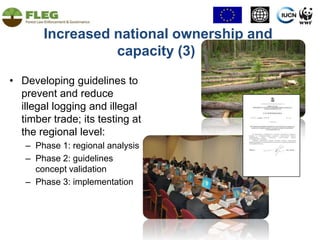
Increased national ownership and capacity (3) Developing guidelines to prevent and reduce illegal logging and illegal timber trade; its testing at the regional level:Phase 1: regional analysisPhase 2: guidelines concept validationPhase 3: implementation
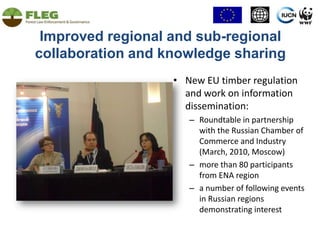
Improved regional and sub-regional collaboration and knowledge sharingNew EU timber regulation and work on information dissemination:Roundtable in partnership with the Russian Chamber of Commerce and Industry (March, 2010, Moscow)more than 80 participants from ENA regiona number of following events in Russian regions demonstrating interest
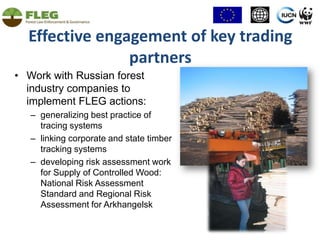
Effective engagement of key trading partnersWork with Russian forest industry companies to implement FLEG actions:generalizing best practice of tracing systemslinking corporate and state timber tracking systems developing risk assessment work for Supply of Controlled Wood: National Risk Assessment Standard and Regional Risk Assessment for Arkhangelsk

Russia jan18 2011 eng

  • 1.
    ENPI FLEG Programin Russia: Highlighting Implementation CHALLENGES, RESULTS and IMPACTS Russia PСT:Marina Smetanina (WB)Elena Kulikova (WWF)Andrey Zaytsev (IUCN)
  • 2.
    Russia’s Country WorkPlan ComponentsImproving the FLEG regulatory and legal framework and its enforcement(IUCN, WB, WWF)
  • 3.
    Improving theFLEG planning and monitoring at the national, regional (local), and interagency levels (WB, WWF)
  • 4.
    Causing specific FLEGactions to be implemented by lead Russian forest companies and their international trading partners (WWF)
  • 5.
    Safeguarding the rightsof local communities and small businesses to forest resource use (IUCN)
  • 6.
    Increasing transparency ofactions and raising the public awareness (IUCN,WWF) Sharing efforts between three IO’sWorld Bank  Federal and regional state authorities
  • 7.
    WWF  Business community, customs, trading partners
  • 8.
    IUCN  Civilsociety, local communities and small businesses ENPI FLEG Coverage in Russia
  • 9.
    Anticipated ENPI FLEGPROGRAM RESULTS AREASIncreased awareness and commitment of key stakeholders on FLEGEffective national and regional FLEG action processes in placeIncreased national ownership and capacityImproved regional and sub-regional collaboration and knowledge sharingEffective engagement of key trading partnersContinuation of the formal official Europe-North Asia FLEG processSustainable forest management practices implemented5
  • 10.
    Continuation of theformal official ENA-FLEG process (1)NPAC is a truly working body helping to set priorities and disseminate Program outcomesNPAC meetings:January 25, 2009January 18, 2010September 15, 2010February, 2011Role of NPAC Chairman, National FLEG Focal Point in Russia
  • 11.
    Continuation of theformal official ENA-FLEG process (2)The national-wide public opinion poll on FLEG is preparedSame methodology as in 2005 is applied (dynamics)Consultations with FFA on facilitating experts meetings to preparing high-level ENA FLEG forum
  • 12.
    Increased awareness andcommitment of key stakeholders on FLEG ENPI – FLEG Bulletin and Website (fleg.forest.ru)Press tours for journalists on FLEGNetwork of partner media created
  • 13.
    Effective national andregional FLEG action processes in placeReview the existing forest and related laws Amendments to the Forest Code and other legislationImpact of catastrophic forest fires (summer 2010) and new set of amendments Level of discussions
  • 14.
    Increased national ownershipand capacity (1) Professional continuous education programme on forest law enforcement:Program concept developed and validated with stakeholdersTraining modules developed and pilot tested in two 10-days courses in Oct. 2010Official certificates awarded
  • 15.
    Increased national ownershipand capacity (2)  Training program for custom «Combating illegal export of raw and sawn timber» : developed, got approbation, approvedState Custom AcademyFederal Custom Service
  • 16.
    Increased national ownershipand capacity (3) Developing guidelines to prevent and reduce illegal logging and illegal timber trade; its testing at the regional level:Phase 1: regional analysisPhase 2: guidelines concept validationPhase 3: implementation
  • 17.
    Improved regional andsub-regional collaboration and knowledge sharingNew EU timber regulation and work on information dissemination:Roundtable in partnership with the Russian Chamber of Commerce and Industry (March, 2010, Moscow)more than 80 participants from ENA regiona number of following events in Russian regions demonstrating interest
  • 18.
    Effective engagement ofkey trading partnersWork with Russian forest industry companies to implement FLEG actions:generalizing best practice of tracing systemslinking corporate and state timber tracking systems developing risk assessment work for Supply of Controlled Wood: National Risk Assessment Standard and Regional Risk Assessment for Arkhangelsk