Dictionaries
• A dictionaryin data structure is used to store the data in
the form of key-value pair.
• The dictionary in data structure has an attribute called
the key.
• The key is the attribute that helps us locate the data or
value in the memory.
• supports a wide variety of operations using a wide
variety of methods and functions.
• The keys are always unique within a dictionary.
• The values of the dictionary in the data structure may
or may not be unique.
• We can put heterogeneous type values inside the
dictionaries.
2.
Key attribute
A keyattribute of the dictionary in data structure follows rules.
•The key attribute of the dictionary data structure must be
unique and consist of a single element. The unique nature
helps us in faster and easy retrieval of the corresponding set
of values.
•As no duplicate keys are allowed in the dictionary data
structure, whenever a duplicate key is found, the last
assigned value is treated as the final key-value pair. So, if we
insert duplicate keys then our original data is lost.
•The key attribute is case sensitive hence "KEY" is not the
same as "key".
•The key attribute is immutable hence, we cannot have an
array or list as keys we can only have numbers, strings, etc,
as the key.
3.
Value attribute
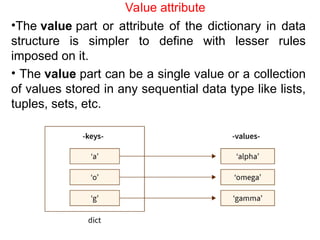
•The valuepart or attribute of the dictionary in data
structure is simpler to define with lesser rules
imposed on it.
• The value part can be a single value or a collection
of values stored in any sequential data type like lists,
tuples, sets, etc.
4.
Operations on Dictionaries
•DataInsertion: The data is only inserted into a dictionary
data structure when there is no such key-value pair already
existing in the dictionary. Now, if a key-value pair is already
inserted previously then the old key-value pair will be
overridden by the new key-value pair.
•Data updation: The value of any data element can be easily
updated. We first need to access the value using a key
attribute and then update the corresponding value(s).
•Data deletion or removal: We can also delete a key-value
pair in a dictionary by accessing the key attribute. We should
know that if a key is not present in the dictionary and we are
trying to delete the key value then an error is shown.
•Data verification: We can also verify or check where a
particular key exists in the dictionary or not.
•Keys: Return a collection of all the keys in the dictionary.
•Values: Return a collection of all the values in the dictionary.
5.
Types of Dictionaries
•Ordereddictionary.
•In an ordered dictionary, the relative order is
determined by comparison on keys.
•The order should be completely dependent on
the key.
•Unordered dictionary.
•In an unordered dictionary, no order relation is
assumed on keys.
•Only equality operation can be performed on the
keys.
6.
Types of Dictionaries
•Ordereddictionary.
•In an ordered dictionary, the relative order is determined
by comparison on keys.
•The order should be completely dependent on the key.
•Unordered dictionary.
•In an unordered dictionary, no order relation is assumed
on keys.
•Only equality operation can be performed on the keys.
7.
Implementation of Dictionaries
•Adictionary can be implemented in several
ways, such as
•Fixed length array.
•Linked lists.
•Skip lists
•Hashing
•Trees (BST, Balancing BSTs, Splay trees, Tries
etc.)
8.
Implementation of Dictionariesusing Array
•One approach is to use two arrays, one for
the keys and one for the values, where the
key at index i in the key array corresponds to
the value at index i in the value array.
•Variables used to implement Map in C
•This implementation uses two
arrays, keys and values, to store the key-value
pairs.
•The maximum number of elements in the map is
defined as MAX_SIZE.
•The size variable keeps track of the current
number of elements in the map.
9.
Implementation of Dictionariesusing Array contd…
•Functions used to implement Map in C
•The getIndex function searches for a key in
the keys array and returns its index if found, or -1
if not found.
•The insert function inserts a key-value pair into
the map. If the key already exists, it updates the
value.
•The get function returns the value of a key in the
map, or -1 if the key is not found.
•The printMap function prints all the key-value
pairs in the map.
10.
Advantages linear listrepresentation of a dictionary
•Simplicity: A linear list is simple and easy to implement.
•Dynamic Size: The list can grow or shrink as key-value
pairs are added or removed.
Disadvantages linear list representation of a
dictionary
•Search Time: The search time is linear in the worst
case, which can be inefficient for large numbers of
entries.
•Insertion Time: Similar to search, if the list is being kept
in sorted order, then finding the correct place to insert a
new key can take linear time.
•Deletion Time: Removing an entry requires a search
followed by a deletion, both of which can be inefficient in
a large list.