Skill: Historical Context
Social Studies for 10th EGB
Teacher: Mauricio Torres
Context
▪ A context is the circumstances under which something happens.
▪ Historical context includes values, beliefs, conditions and practices that were
common in the past.
▪ These can be very different than what they are today!

▪ So, to truly understand a historical event, you have to take it into
context!
▪ That way we will avoid judging what people in history did or said based on
present values alone.
▪ By doing so, we will be fair with the people that made history.
Practice
Muslim and European armies clashed back in 1191. The following account was
written by Baha’ ad-Din, an advisor to Saladin. He witnessed the battle. The
following passage is an account of the battle. Search for context and answer
the questions on the following slide.
Practice
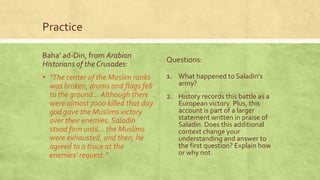
Baha’ ad-Din, from Arabian
Historians of the Crusades:

Questions:

▪ “The center of the Muslim ranks

1. What happened to Saladin’s

was broken, drums and flags fell
to the ground… Although there
were almost 7000 killed that day
god gave the Muslims victory
over their enemies. Saladin
stood firm until… the Muslims
were exhausted, and then, he
agreed to a truce at the
enemies’ request.”

army?

2. History records this battle as a

European victory. Plus, this
account is part of a larger
statement written in praise of
Saladin. Does this additional
context change your
understanding and answer to
the first question? Explain how
or why not.
Oral Practice
▪ Event:

List some situations or
events in history in
which the writer’s point
of view affects the
historical context by the
use of bias.

▪ Who wrote it?
▪ Where is the bias?
Bibliography
▪ Burstein, S. M., & Shek, R. (2012). World History (Teacher´s Edition)
(1st Edition ed.). (H. McDougal, Ed.) Orlando, Florida, US.: Houghton
Mifflin Harcourt Publishing Company.

▪ Images taken from www.google.com

2 1 historical context

  • 1.
    Skill: Historical Context SocialStudies for 10th EGB Teacher: Mauricio Torres
  • 2.
    Context ▪ A contextis the circumstances under which something happens. ▪ Historical context includes values, beliefs, conditions and practices that were common in the past. ▪ These can be very different than what they are today! ▪ So, to truly understand a historical event, you have to take it into context! ▪ That way we will avoid judging what people in history did or said based on present values alone. ▪ By doing so, we will be fair with the people that made history.
  • 4.
    Practice Muslim and Europeanarmies clashed back in 1191. The following account was written by Baha’ ad-Din, an advisor to Saladin. He witnessed the battle. The following passage is an account of the battle. Search for context and answer the questions on the following slide.
  • 5.
    Practice Baha’ ad-Din, fromArabian Historians of the Crusades: Questions: ▪ “The center of the Muslim ranks 1. What happened to Saladin’s was broken, drums and flags fell to the ground… Although there were almost 7000 killed that day god gave the Muslims victory over their enemies. Saladin stood firm until… the Muslims were exhausted, and then, he agreed to a truce at the enemies’ request.” army? 2. History records this battle as a European victory. Plus, this account is part of a larger statement written in praise of Saladin. Does this additional context change your understanding and answer to the first question? Explain how or why not.
  • 6.
    Oral Practice ▪ Event: Listsome situations or events in history in which the writer’s point of view affects the historical context by the use of bias. ▪ Who wrote it? ▪ Where is the bias?
  • 7.
    Bibliography ▪ Burstein, S.M., & Shek, R. (2012). World History (Teacher´s Edition) (1st Edition ed.). (H. McDougal, Ed.) Orlando, Florida, US.: Houghton Mifflin Harcourt Publishing Company. ▪ Images taken from www.google.com