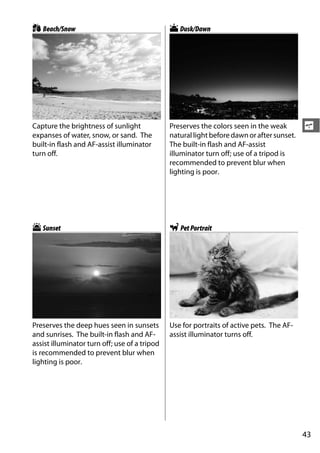
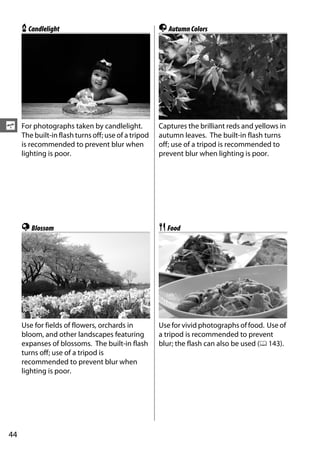
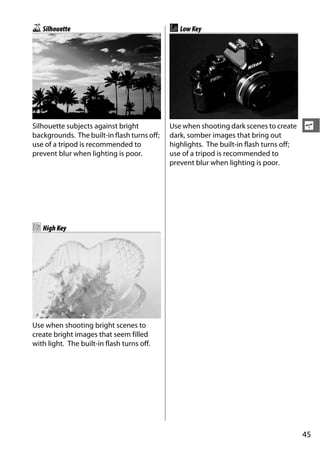
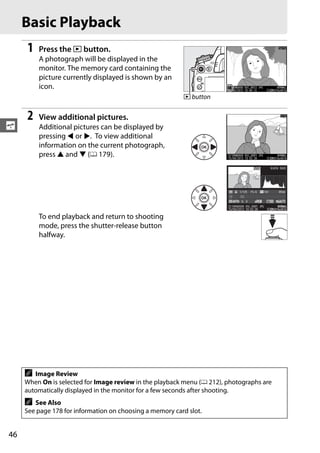
No reproduction in any form of this manual, in whole or in part (except for brief quotation
in critical articles or reviews), may be made without written authorization from NIKON
CORPORATION.


                                                                                                         DIGITAL CAMERA


                                                                                                    User's Manual


                                                                                               En


                                                             AMA14687      Printed in Europe
                                                                                  SB2G01(11)
                                                                                                                   En
                                                                               6MB15311-01
Thank you for your purchase of a Nikon single-lens reflex (SLR) digital camera. To get
the most from your camera, please be sure to read all instructions thoroughly and
keep them where they will be read by all who use the product.
Symbols and Conventions
To make it easier to find the information you need, the following symbols and
conventions are used:
       This icon marks cautions; information that should be read before use to
  D    prevent damage to the camera.

       This icon marks notes; information that should be read before using the
  A    camera.

 0     This icon marks references to other pages in this manual.

Menu items, options, and messages displayed in the camera monitor are shown in bold.

Camera Settings
The explanations in this manual assume that default settings are used.

Help
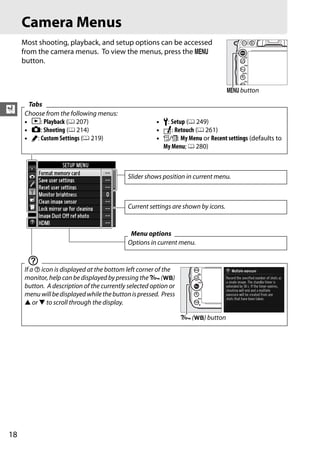
Use the camera’s on-board help feature for help on menu items and other topics. See page 18
for details.

Digitutor
“Digitutor”, a series of “watch and learn” manuals in movie form, is available from the following
website: http://www.nikondigitutor.com/index_eng.html
A For Your Safety
Before using the camera for the first time, read the safety instructions in “For Your Safety”
(0 xviii–xix).
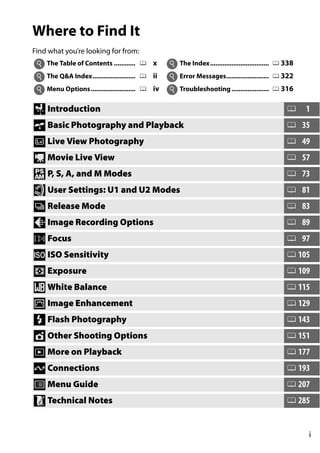
Where to Find It
Find what you’re looking for from:
 i The Table of Contents ............ 0 x       i The Index................................. 0 338
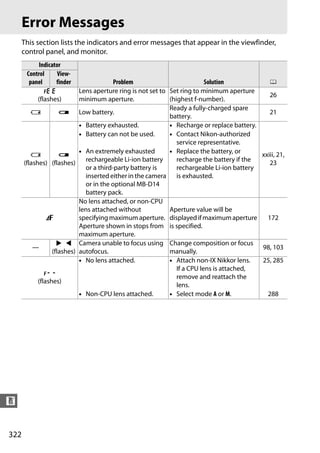
 i The Q&A Index........................ 0 ii   i Error Messages........................ 0 322
 i Menu Options......................... 0 iv   i Troubleshooting ..................... 0 316

X Introduction                                                                                 0     1
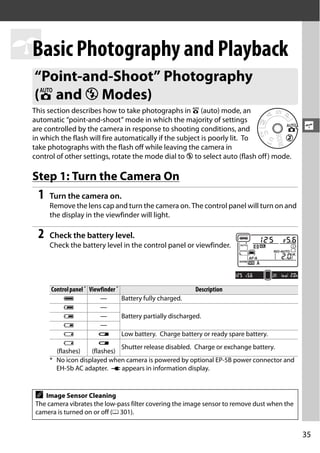
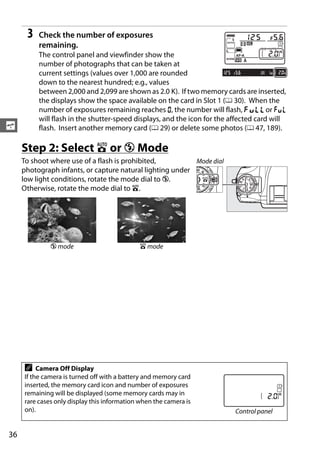
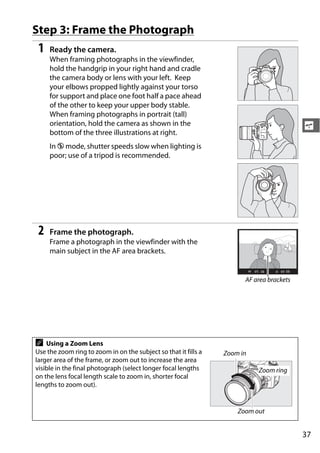
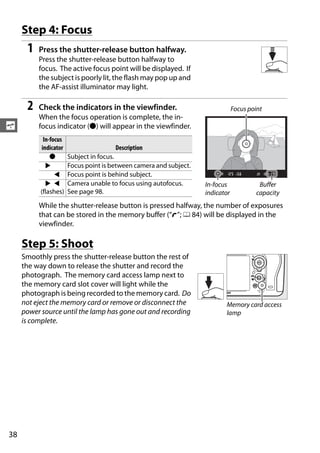
s Basic Photography and Playback                                                               0 35

x Live View Photography                                                                        0 49

y Movie Live View                                                                              0 57

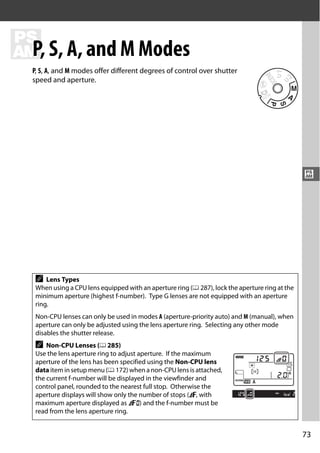
# P, S, A, and M Modes                                                                         0 73

$ User Settings: U1 and U2 Modes                                                               0 81

k Release Mode                                                                                 0 83

d Image Recording Options                                                                      0 89

N Focus                                                                                        0 97

S ISO Sensitivity                                                                              0 105

Z Exposure                                                                                     0 109

r White Balance                                                                                0 115

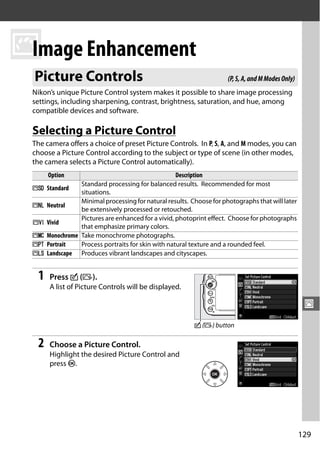
J Image Enhancement                                                                            0 129

l Flash Photography                                                                            0 143

t Other Shooting Options                                                                       0 151

I More on Playback                                                                             0 177

Q Connections                                                                                  0 193

U Menu Guide                                                                                   0 207

n Technical Notes                                                                              0 285


                                                                                                     i
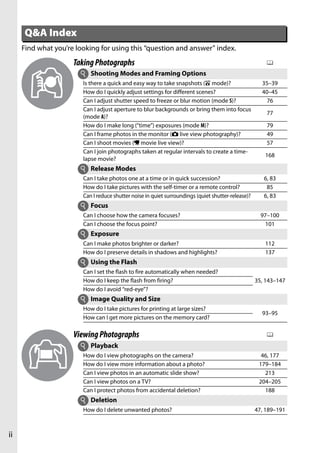
Q&A Index
     Find what you’re looking for using this “question and answer” index.
                     Taking Photographs                                                                 0
                       i   Shooting Modes and Framing Options
                        Is there a quick and easy way to take snapshots (i mode)?                     35–39
                        How do I quickly adjust settings for different scenes?                        40–45
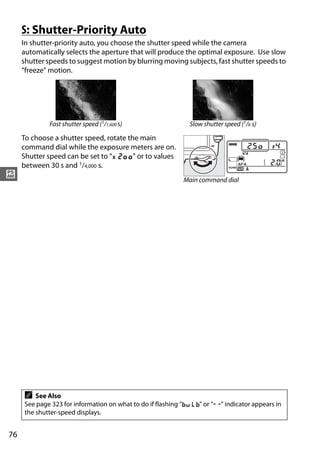
                        Can I adjust shutter speed to freeze or blur motion (mode S)?                   76
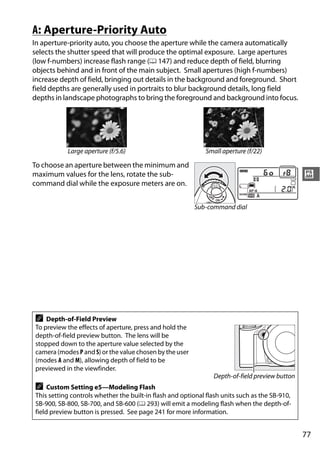
                        Can I adjust aperture to blur backgrounds or bring them into focus
                                                                                                        77
                        (mode A)?
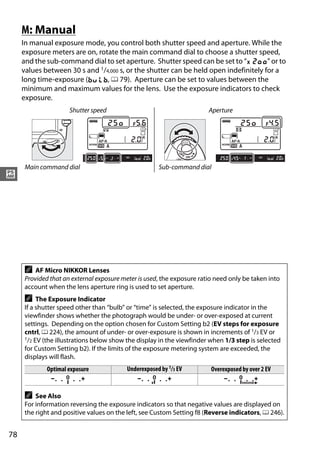
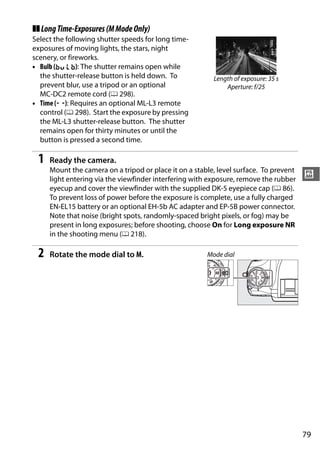
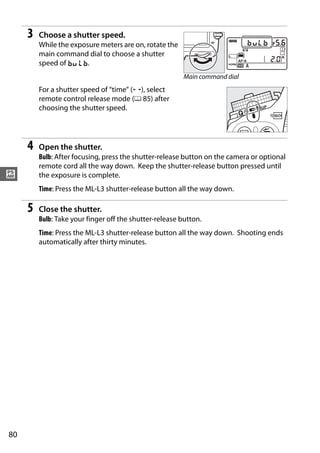
                        How do I make long (“time”) exposures (mode M)?                                 79
                        Can I frame photos in the monitor (C live view photography)?                    49
                        Can I shoot movies (1 movie live view)?                                         57
                        Can I join photographs taken at regular intervals to create a time-
                                                                                                       168
                        lapse movie?
                       i Release Modes
                        Can I take photos one at a time or in quick succession?                        6, 83
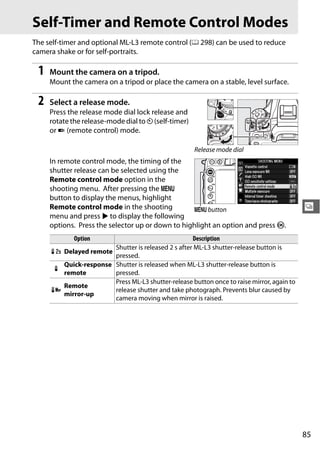
                        How do I take pictures with the self-timer or a remote control?                 85
                        Can I reduce shutter noise in quiet surroundings (quiet shutter-release)?      6, 83
                       i Focus
                        Can I choose how the camera focuses?                                          97–100
                        Can I choose the focus point?                                                  101
                       i Exposure
                        Can I make photos brighter or darker?                                          112
                        How do I preserve details in shadows and highlights?                           137
                       i Using the Flash
                        Can I set the flash to fire automatically when needed?
                        How do I keep the flash from firing?                                        35, 143–147
                        How do I avoid “red-eye”?
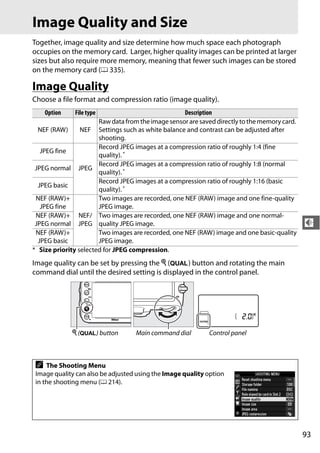
                       i Image Quality and Size
                        How do I take pictures for printing at large sizes?
                                                                                                      93–95
                        How can I get more pictures on the memory card?

                     Viewing Photographs                                                                0
                       i Playback
                        How do I view photographs on the camera?                                      46, 177
                        How do I view more information about a photo?                                179–184
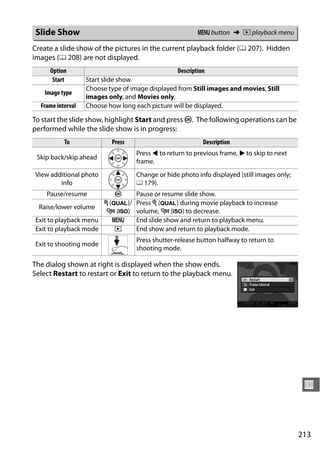
                        Can I view photos in an automatic slide show?                                  213
                        Can I view photos on a TV?                                                   204–205
                        Can I protect photos from accidental deletion?                                 188
                       i Deletion
                        How do I delete unwanted photos?                                            47, 189–191


ii
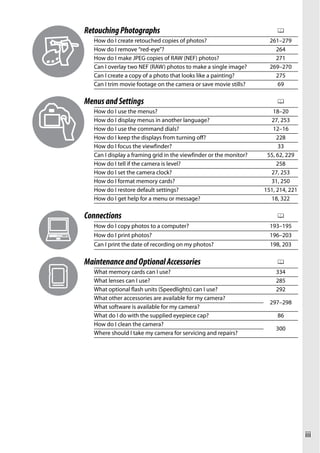
Retouching Photographs                                                   0
   How do I create retouched copies of photos?                        261–279
   How do I remove “red-eye”?                                           264
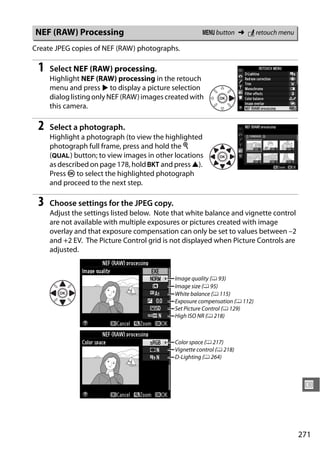
   How do I make JPEG copies of RAW (NEF) photos?                       271
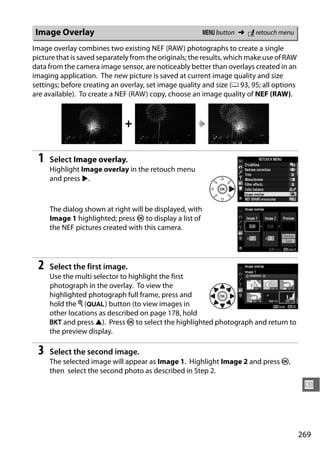
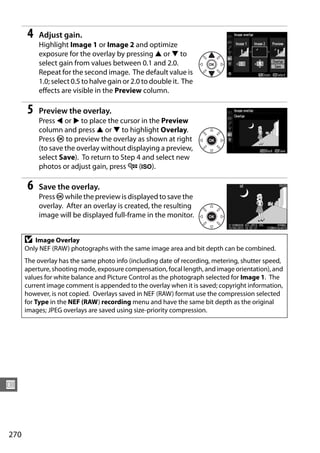
   Can I overlay two NEF (RAW) photos to make a single image?         269–270
   Can I create a copy of a photo that looks like a painting?           275
   Can I trim movie footage on the camera or save movie stills?          69

Menus and Settings                                                       0
   How do I use the menus?                                             18–20
   How do I display menus in another language?                        27, 253
   How do I use the command dials?                                     12–16
   How do I keep the displays from turning off?                          228
   How do I focus the viewfinder?                                        33
   Can I display a framing grid in the viewfinder or the monitor?    55, 62, 229
   How do I tell if the camera is level?                                 258
   How do I set the camera clock?                                     27, 253
   How do I format memory cards?                                      31, 250
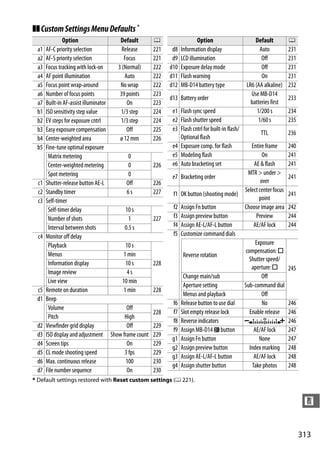
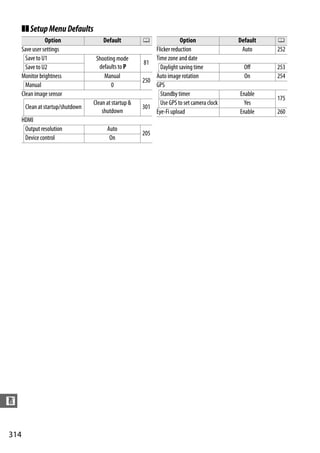
   How do I restore default settings?                               151, 214, 221
   How do I get help for a menu or message?                           18, 322

Connections                                                              0
   How do I copy photos to a computer?                                193–195
   How do I print photos?                                             196–203
   Can I print the date of recording on my photos?                    198, 203

Maintenance and Optional Accessories                                     0
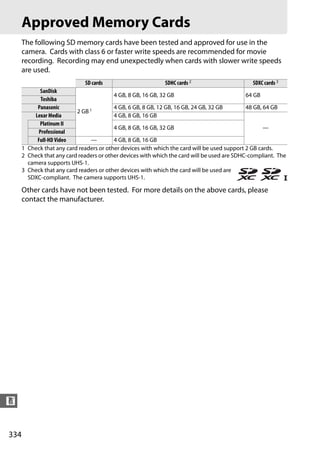
   What memory cards can I use?                                         334
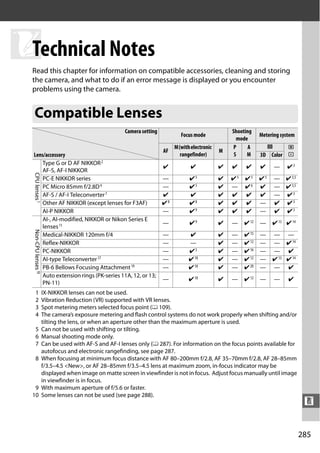
   What lenses can I use?                                               285
   What optional flash units (Speedlights) can I use?                   292
   What other accessories are available for my camera?
                                                                      297–298
   What software is available for my camera?
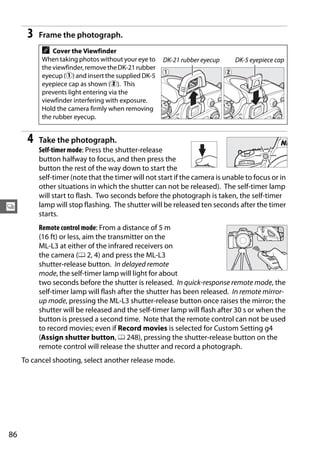
   What do I do with the supplied eyepiece cap?                          86
   How do I clean the camera?
                                                                        300
   Where should I take my camera for servicing and repairs?


                                                                                    iii
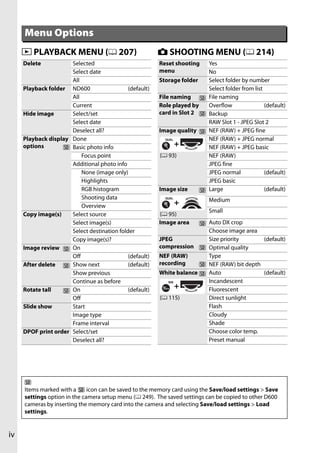
Menu Options
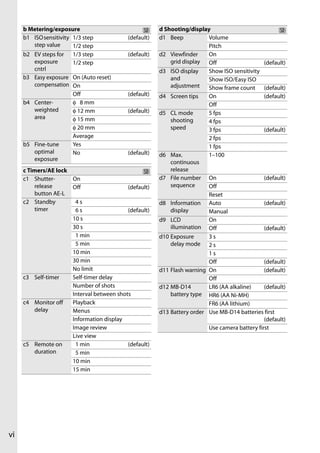
     D PLAYBACK MENU (0 207)                             C SHOOTING MENU (0 214)
     Delete           Selected                           Reset shooting    Yes
                      Select date                        menu              No
                      All                                Storage folder    Select folder by number
     Playback folder ND600                   (default)                     Select folder from list
                      All                                File naming       File naming
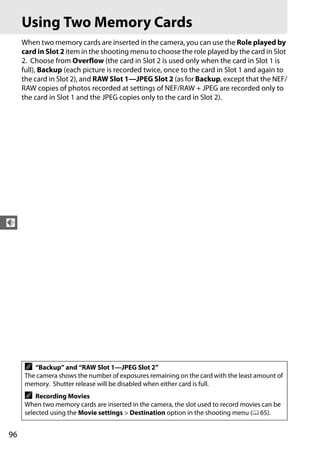
                      Current                            Role played by    Overflow                (default)
     Hide image       Select/set                         card in Slot 2    Backup
                      Select date                                          RAW Slot 1 - JPEG Slot 2
                      Deselect all?                      Image quality     NEF (RAW) + JPEG fine
     Playback display Done                                                 NEF (RAW) + JPEG normal
     options          Basic photo info                                     NEF (RAW) + JPEG basic
                          Focus point                    (0 93)            NEF (RAW)
                      Additional photo info                                JPEG fine
                          None (image only)                                JPEG normal             (default)
                          Highlights                                       JPEG basic
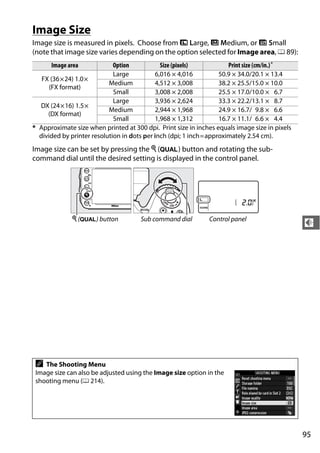
                          RGB histogram                  Image size        Large                   (default)
                          Shooting data                                    Medium
                          Overview
                                                                           Small
     Copy image(s)    Select source                      (0 95)
                      Select image(s)                    Image area        Auto DX crop
                      Select destination folder                            Choose image area
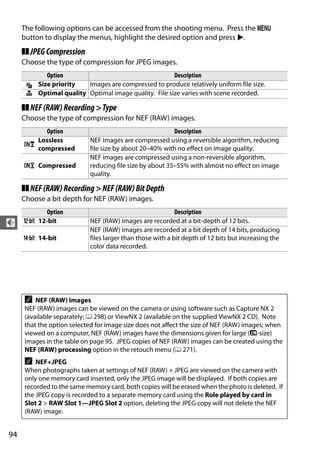
                      Copy image(s)?                     JPEG              Size priority       (default)
     Image review     On                                 compression       Optimal quality
                      Off                    (default)   NEF (RAW)         Type
     After delete     Show next              (default)   recording         NEF (RAW) bit depth
                      Show previous                      White balance     Auto                (default)
                      Continue as before                                   Incandescent
     Rotate tall      On                     (default)                     Fluorescent
                      Off                                (0 115)           Direct sunlight
     Slide show       Start                                                Flash
                      Image type                                           Cloudy
                      Frame interval                                       Shade
     DPOF print order Select/set                                           Choose color temp.
                      Deselect all?                                        Preset manual


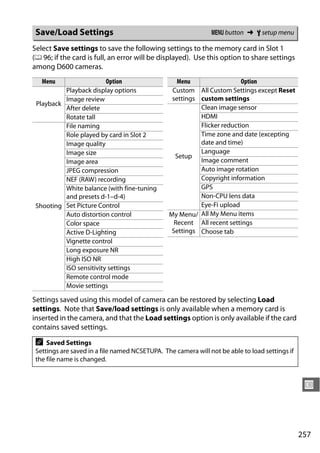
     Items marked with a      icon can be saved to the memory card using the Save/load settings > Save
     settings option in the camera setup menu (0 249). The saved settings can be copied to other D600
     cameras by inserting the memory card into the camera and selecting Save/load settings > Load
     settings.


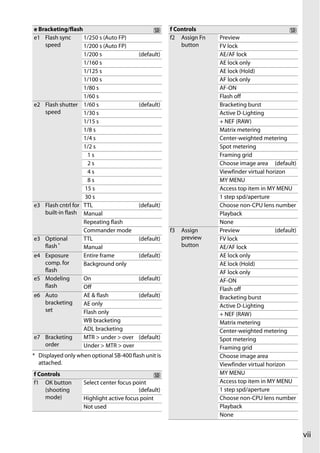
iv
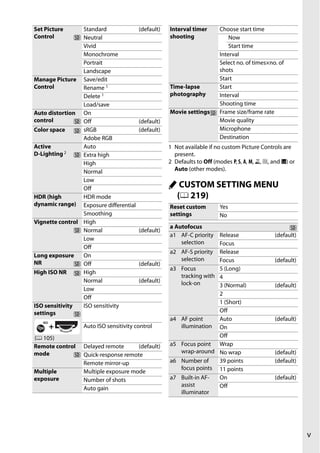
Set Picture      Standard              (default)   Interval timer       Choose start time
Control          Neutral                           shooting                 Now
                 Vivid                                                      Start time
                 Monochrome                                             Interval
                 Portrait                                               Select no. of times×no. of
                 Landscape                                              shots
Manage Picture Save/edit                                                Start
Control          Rename 1                          Time-lapse           Start
                 Delete 1                          photography          Interval
                 Load/save                                              Shooting time
Auto distortion On                                 Movie settings       Frame size/frame rate
control          Off                   (default)                        Movie quality
Color space      sRGB                  (default)                        Microphone
                 Adobe RGB                                              Destination
Active           Auto                              1 Not available if no custom Picture Controls are
D-Lighting 2     Extra high                          present.
                 High                              2 Defaults to Off (modes P, S, A, M, 1, 2, and 3) or
                 Normal                              Auto (other modes).
                 Low
                 Off                               A CUSTOM SETTING MENU
HDR (high        HDR mode                           (0 219)
dynamic range) Exposure differential               Reset custom         Yes
                 Smoothing                         settings             No
Vignette control High
                                                   a Autofocus
                 Normal                (default)
                                                   a1 AF-C priority Release                   (default)
                 Low
                                                       selection    Focus
                 Off
                                                   a2 AF-S priority Release
Long exposure    On
                                                      selection     Focus                     (default)
NR               Off                   (default)
                                                   a3 Focus         5 (Long)
High ISO NR      High
                                                      tracking with 4
                 Normal                (default)      lock-on       3 (Normal)                (default)
                 Low
                                                                    2
                 Off
                                                                    1 (Short)
ISO sensitivity  ISO sensitivity
settings                                                            Off
                                                   a4 AF point      Auto                      (default)
                 Auto ISO sensitivity control         illumination On
(0 105)                                                             Off
Remote control   Delayed remote      (default)     a5 Focus point Wrap
mode                                                  wrap-around No wrap                     (default)
                 Quick-response remote
                 Remote mirror-up                  a6 Number of     39 points                 (default)
                                                      focus points 11 points
Multiple         Multiple exposure mode
exposure         Number of shots                   a7 Built-in AF-  On                        (default)
                                                      assist        Off
                 Auto gain
                                                      illuminator


                                                                                                          v
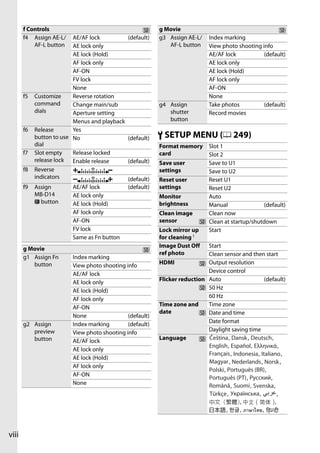
b Metering/exposure                                d Shooting/display
     b1 ISO sensitivity 1/3 step            (default)   d1 Beep           Volume
        step value      1/2 step                                          Pitch
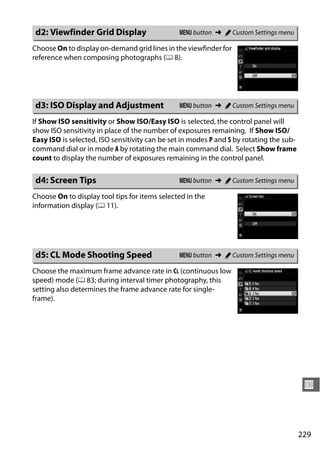
     b2 EV steps for 1/3 step               (default)   d2 Viewfinder     On
        exposure        1/2 step                            grid display Off                    (default)
        cntrl                                           d3 ISO display    Show ISO sensitivity
     b3 Easy exposure On (Auto reset)                       and           Show ISO/Easy ISO
        compensation On                                     adjustment    Show frame count (default)
                        Off                 (default)   d4 Screen tips    On                    (default)
     b4 Center-         φ 8 mm                                            Off
        weighted        φ 12 mm             (default)   d5 CL mode        5 fps
        area            φ 15 mm                             shooting      4 fps
                        φ 20 mm                             speed         3 fps                 (default)
                        Average                                           2 fps
     b5 Fine-tune       Yes                                               1 fps
        optimal         No                  (default)   d6 Max.           1–100
        exposure
                                                            continuous
     c Timers/AE lock                                       release
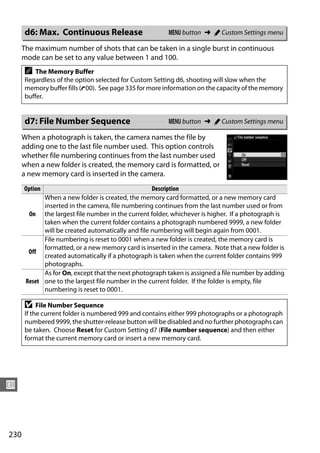
     c1 Shutter-      On                                d7 File number On                       (default)
         release      Off                  (default)        sequence      Off
         button AE-L                                                      Reset
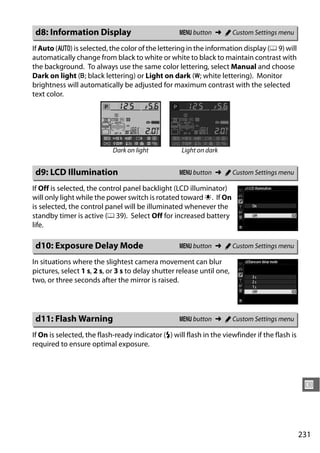
     c2 Standby        4s                               d8 Information Auto                     (default)
         timer         6s                  (default)        display       Manual
                      10 s                              d9 LCD            On
                      30 s                                  illumination Off                    (default)
                       1 min                            d10 Exposure      3s
                       5 min                                delay mode 2 s
                      10 min                                              1s
                      30 min                                              Off                   (default)
                      No limit                          d11 Flash warning On                    (default)
     c3 Self-timer    Self-timer delay                                    Off
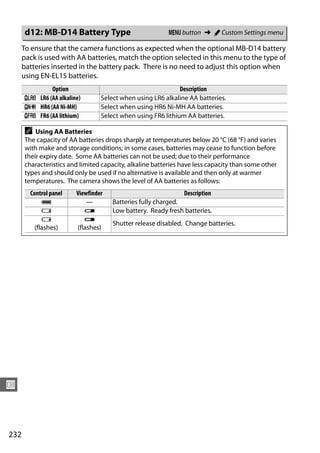
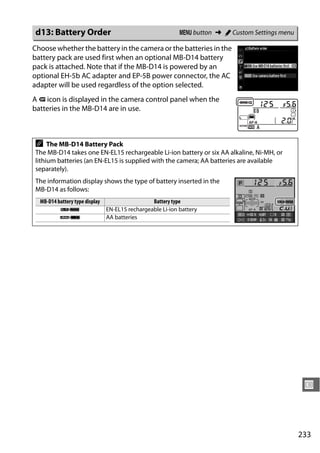
                      Number of shots                   d12 MB-D14        LR6 (AA alkaline)     (default)
                      Interval between shots                battery type HR6 (AA Ni-MH)
     c4 Monitor off   Playback                                            FR6 (AA lithium)
         delay        Menus                             d13 Battery order Use MB-D14 batteries first
                      Information display                                                       (default)
                      Image review                                        Use camera battery first
                      Live view
     c5 Remote on      1 min               (default)
         duration      5 min
                      10 min
                      15 min


vi
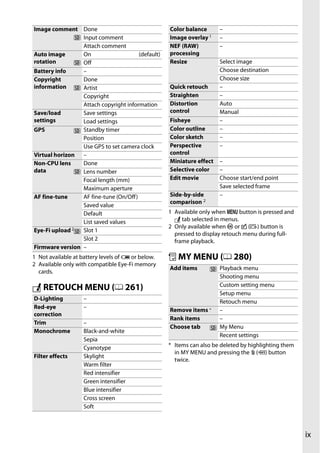
e Bracketing/flash                                    f Controls
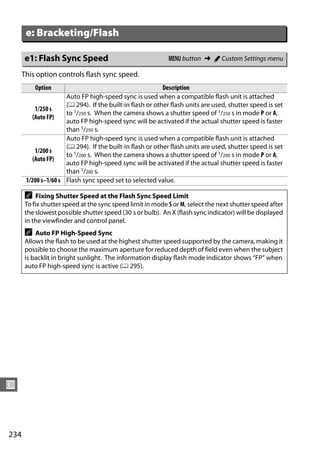
e1 Flash sync      1/250 s (Auto FP)                  f2 Assign Fn   Preview
    speed          1/200 s (Auto FP)                      button     FV lock
                   1/200 s                (default)                  AE/AF lock
                   1/160 s                                           AE lock only
                   1/125 s                                           AE lock (Hold)
                   1/100 s                                           AF lock only
                   1/80 s                                            AF-ON
                   1/60 s                                            Flash off
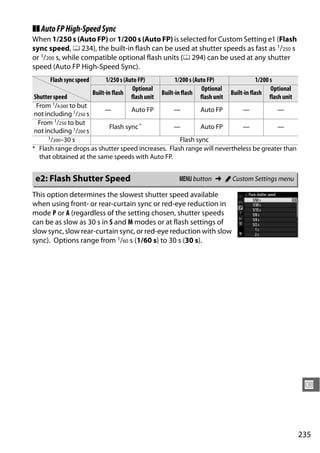
e2 Flash shutter 1/60 s                   (default)                  Bracketing burst
    speed          1/30 s                                            Active D-Lighting
                   1/15 s                                            + NEF (RAW)
                   1/8 s                                             Matrix metering
                   1/4 s                                             Center-weighted metering
                   1/2 s                                             Spot metering
                     1s                                              Framing grid
                     2s                                              Choose image area (default)
                     4s                                              Viewfinder virtual horizon
                     8s                                              MY MENU
                   15 s                                              Access top item in MY MENU
                   30 s                                              1 step spd/aperture
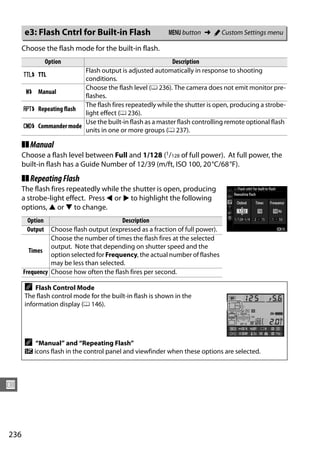
e3 Flash cntrl for TTL                    (default)                  Choose non-CPU lens number
    built-in flash Manual                                            Playback
                   Repeating flash                                   None
                   Commander mode                     f3   Assign    Preview               (default)
e3 Optional        TTL                    (default)        preview   FV lock
    flash *        Manual                                  button    AE/AF lock
e4 Exposure        Entire frame           (default)                  AE lock only
    comp. for      Background only                                   AE lock (Hold)
    flash                                                            AF lock only
e5 Modeling        On                     (default)                  AF-ON
    flash          Off                                               Flash off
e6 Auto            AE & flash             (default)                  Bracketing burst
    bracketing     AE only                                           Active D-Lighting
    set            Flash only                                        + NEF (RAW)
                   WB bracketing                                     Matrix metering
                   ADL bracketing                                    Center-weighted metering
e7 Bracketing      MTR > under > over     (default)                  Spot metering
    order          Under > MTR > over                                Framing grid
* Displayed only when optional SB-400 flash unit is                  Choose image area
  attached.                                                          Viewfinder virtual horizon
f Controls                                                           MY MENU
f1 OK button        Select center focus point                        Access top item in MY MENU
    (shooting                             (default)                  1 step spd/aperture
    mode)           Highlight active focus point                     Choose non-CPU lens number
                    Not used                                         Playback
                                                                     None


                                                                                                       vii
f Controls                                         g Movie
       f4 Assign AE-L/    AE/AF lock         (default)    g3 Assign AE-L/        Index marking
           AF-L button    AE lock only                       AF-L button         View photo shooting info
                          AE lock (Hold)                                         AE/AF lock           (default)
                          AF lock only                                           AE lock only
                          AF-ON                                                  AE lock (Hold)
                          FV lock                                                AF lock only
                          None                                                   AF-ON
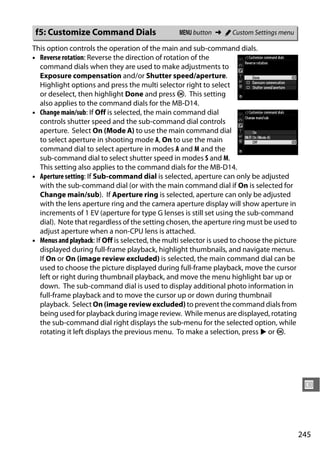
       f5   Customize     Reverse rotation                                       None
            command       Change main/sub                 g4 Assign              Take photos          (default)
            dials         Aperture setting                   shutter             Record movies
                          Menus and playback                 button
       f6   Release       Yes
            button to use No                 (default)    B SETUP MENU (0 249)
            dial                                          Format memory          Slot 1
       f7   Slot empty    Release locked                  card                   Slot 2
            release lock Enable release      (default)    Save user              Save to U1
       f8   Reverse                                       settings               Save to U2
            indicators                       (default)    Reset user             Reset U1
       f9   Assign       AE/AF lock           (default)   settings               Reset U2
            MB-D14       AE lock only                     Monitor                Auto
            4 button     AE lock (Hold)                   brightness             Manual                (default)
                         AF lock only                     Clean image            Clean now
                         AF-ON                            sensor                 Clean at startup/shutdown
                         FV lock                          Lock mirror up         Start
                         Same as Fn button                for cleaning 1
       g Movie                                            Image Dust Off    Start
                                                          ref photo         Clean sensor and then start
       g1 Assign Fn      Index marking
          button                                          HDMI              Output resolution
                         View photo shooting info
                                                                            Device control
                         AE/AF lock
                                                          Flicker reduction Auto                         (default)
                         AE lock only
                                                                            50 Hz
                         AE lock (Hold)
                                                                            60 Hz
                         AF lock only
                                                          Time zone and     Time zone
                         AF-ON
                                                          date              Date and time
                         None                 (default)
                                                                            Date format
       g2 Assign         Index marking        (default)
          preview                                                           Daylight saving time
                         View photo shooting info
          button                                          Language                     ,      ,              ,
                         AE/AF lock
                                                                                      ,          ,                 ,
                         AE lock only
                                                                                         ,         ,                  ,
                         AE lock (Hold)
                                                                                       ,              ,              ,
                         AF lock only
                                                                                  ,                       ,
                         AF-ON
                                                                                             ,              ,
                         None                                                            ,      ,              ,
                                                                                     ,              ,             ,
                                                                                           ,                    ,
                                                                                    ,      ,            ,


viii
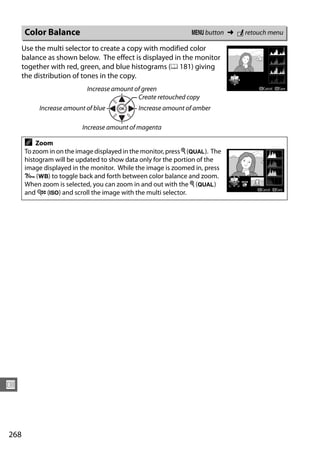
Image comment Done                                 Color balance      –
                 Input comment                     Image overlay 1    –
                 Attach comment                    NEF (RAW)          –
Auto image       On                    (default)   processing
rotation         Off                               Resize             Select image
Battery info     –                                                    Choose destination
Copyright        Done                                                 Choose size
information      Artist                            Quick retouch      –
                 Copyright                         Straighten         –
                 Attach copyright information      Distortion         Auto
Save/load        Save settings                     control            Manual
settings         Load settings                     Fisheye            –
GPS              Standby timer                     Color outline      –
                 Position                          Color sketch       –
                 Use GPS to set camera clock       Perspective        –
Virtual horizon –                                  control
Non-CPU lens     Done                              Miniature effect   –
data             Lens number                       Selective color    –
                 Focal length (mm)                 Edit movie         Choose start/end point
                 Maximum aperture                                     Save selected frame
AF fine-tune     AF fine-tune (On/Off)             Side-by-side       –
                                                   comparison 2
                 Saved value
                 Default                           1 Available only when G button is pressed and
                 List saved values                   N tab selected in menus.
                                                   2 Only available when J or c (b) button is
Eye-Fi upload 2  Slot 1
                                                     pressed to display retouch menu during full-
                 Slot 2                              frame playback.
Firmware version –
1 Not available at battery levels of J or below.   O MY MENU (0 280)
2 Available only with compatible Eye-Fi memory
                                                   Add items          Playback menu
  cards.
                                                                      Shooting menu
                                                                      Custom setting menu
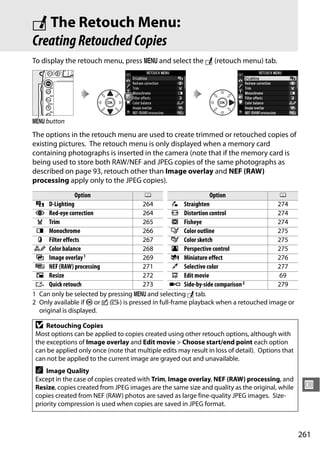
N RETOUCH MENU (0 261)
                                                                      Setup menu
D-Lighting         –
                                                                      Retouch menu
Red-eye            –                               Remove items *     –
correction
                                                   Rank items         –
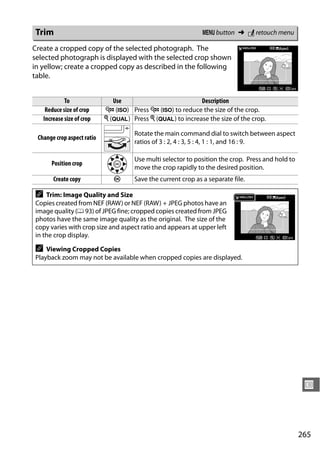
Trim               –
                                                   Choose tab         My Menu
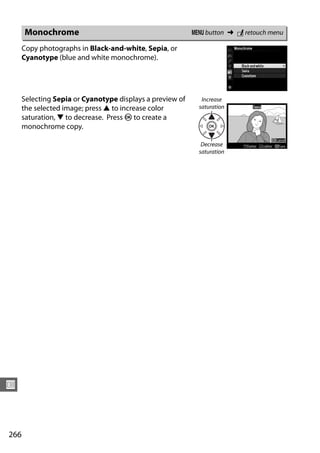
Monochrome         Black-and-white
                                                                      Recent settings
                   Sepia
                   Cyanotype                       * Items can also be deleted by highlighting them
                                                     in MY MENU and pressing the O (Q) button
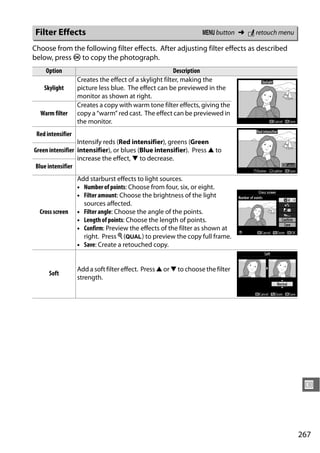
Filter effects     Skylight
                                                     twice.
                   Warm filter
                   Red intensifier
                   Green intensifier
                   Blue intensifier
                   Cross screen
                   Soft


                                                                                                      ix
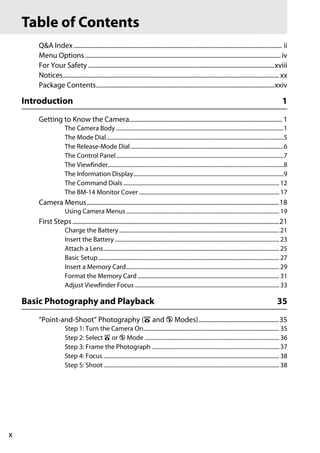
Table of Contents
        Q&A Index .................................................................................................................................... ii
        Menu Options ............................................................................................................................ iv
        For Your Safety ......................................................................................................................xviii
        Notices......................................................................................................................................... xx
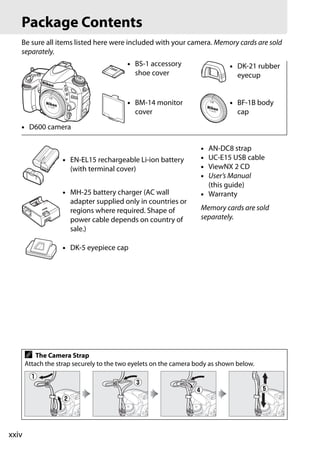
        Package Contents.................................................................................................................xxiv

    Introduction                                                                                                                                                 1
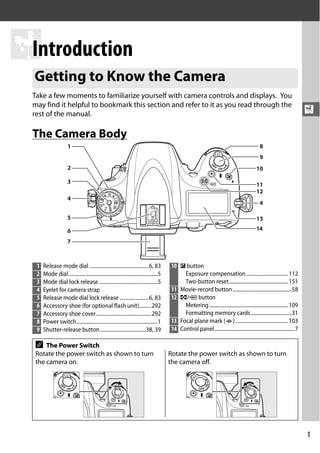
        Getting to Know the Camera................................................................................................. 1
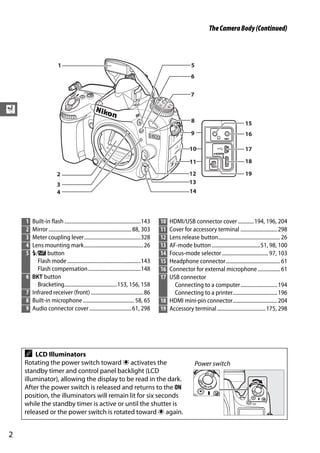
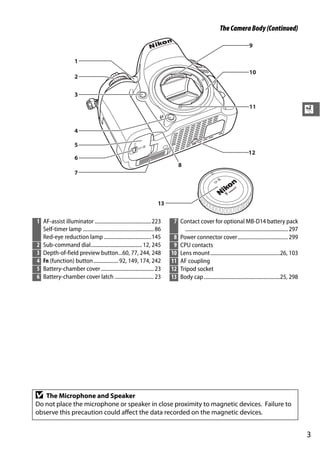
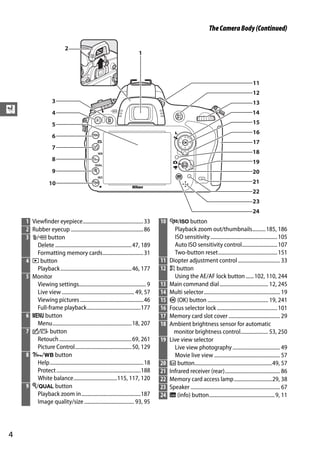
                       The Camera Body ......................................................................................................................1
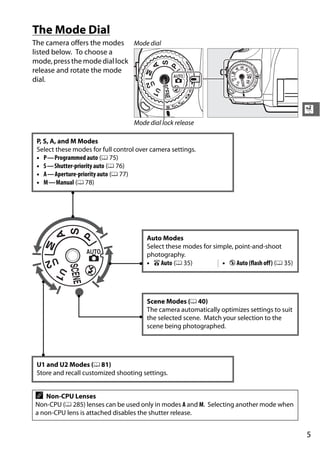
                       The Mode Dial.............................................................................................................................5
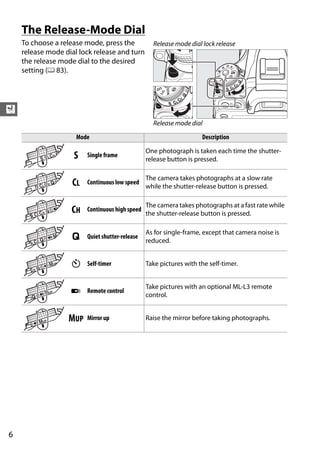
                       The Release-Mode Dial ............................................................................................................6
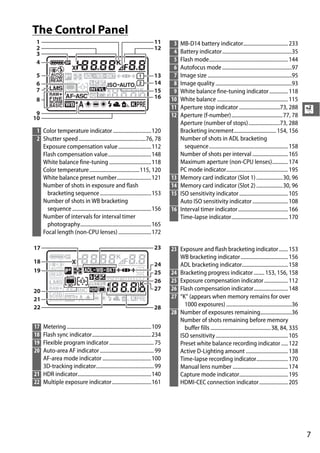
                       The Control Panel......................................................................................................................7
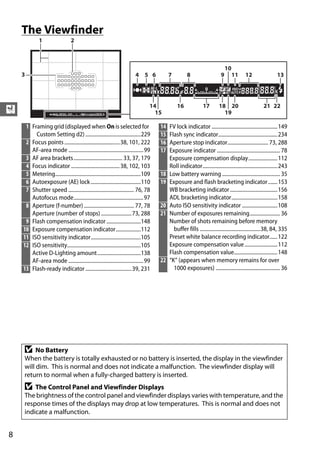
                       The Viewfinder............................................................................................................................8
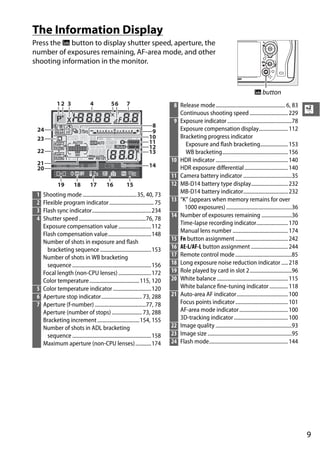
                       The Information Display..........................................................................................................9
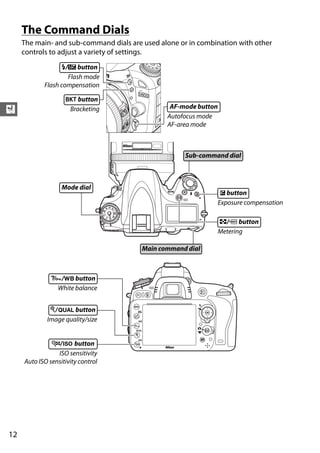
                       The Command Dials .............................................................................................................. 12
                       The BM-14 Monitor Cover ................................................................................................... 17
        Camera Menus..........................................................................................................................18
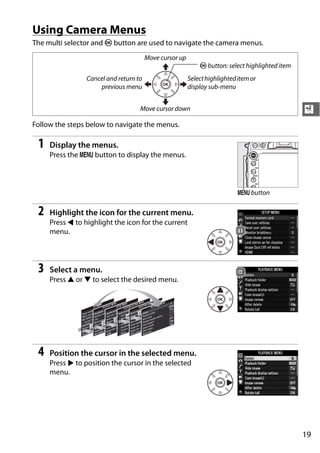
                       Using Camera Menus ............................................................................................................ 19
        First Steps ...................................................................................................................................21
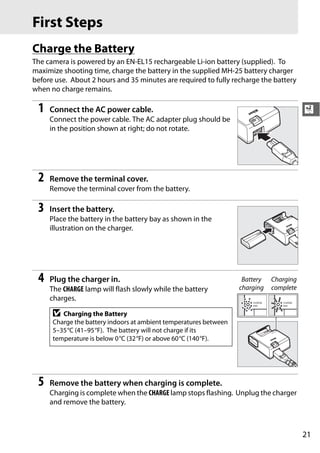
                       Charge the Battery ................................................................................................................. 21
                       Insert the Battery .................................................................................................................... 23
                       Attach a Lens............................................................................................................................ 25
                       Basic Setup................................................................................................................................ 27
                       Insert a Memory Card............................................................................................................ 29
                       Format the Memory Card .................................................................................................... 31
                       Adjust Viewfinder Focus ...................................................................................................... 33

    Basic Photography and Playback                                                                                                                            35
        “Point-and-Shoot” Photography (i and j Modes)...................................................35
                       Step 1: Turn the Camera On................................................................................................ 35
                       Step 2: Select i or j Mode ............................................................................................... 36
                       Step 3: Frame the Photograph .......................................................................................... 37
                       Step 4: Focus ............................................................................................................................ 38
                       Step 5: Shoot ............................................................................................................................ 38


x
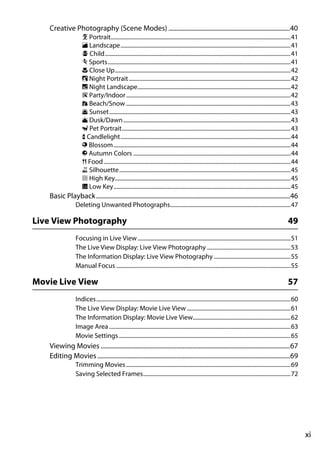
Creative Photography (Scene Modes) .............................................................................40
                     k Portrait...............................................................................................................................41
                     l Landscape........................................................................................................................41
                     p Child...................................................................................................................................41
                     m Sports.................................................................................................................................41
                     n Close Up............................................................................................................................42
                     o Night Portrait ..................................................................................................................42
                     r Night Landscape............................................................................................................42
                     s Party/Indoor ....................................................................................................................42
                     t Beach/Snow ....................................................................................................................43
                     u Sunset................................................................................................................................43
                     v Dusk/Dawn ......................................................................................................................43
                     w Pet Portrait.......................................................................................................................43
                     x Candlelight........................................................................................................................44
                     y Blossom.............................................................................................................................44
                     z Autumn Colors ...............................................................................................................44
                     0 Food....................................................................................................................................44
                     1 Silhouette.........................................................................................................................45
                     2 High Key............................................................................................................................45
                     3 Low Key.............................................................................................................................45
   Basic Playback ...........................................................................................................................46
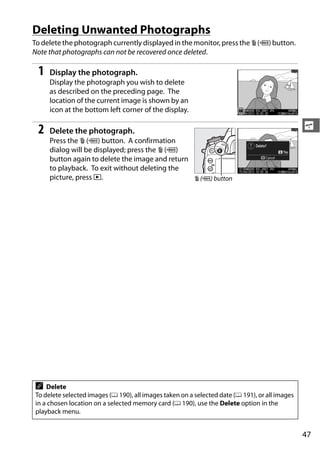
                 Deleting Unwanted Photographs.....................................................................................47

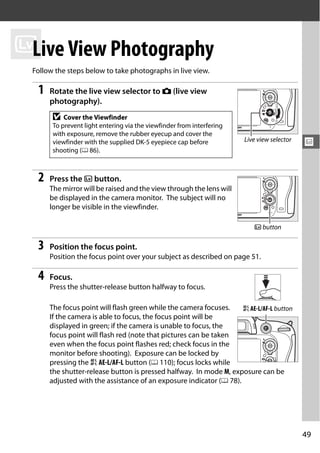
Live View Photography                                                                                                                                       49
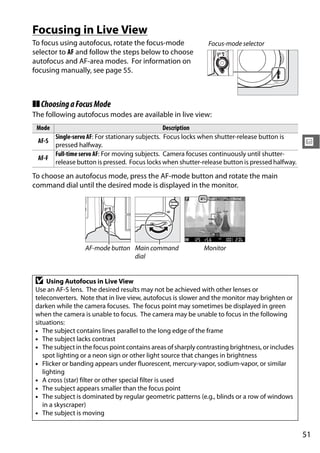
                 Focusing in Live View ............................................................................................................51
                 The Live View Display: Live View Photography ...........................................................53
                 The Information Display: Live View Photography ......................................................55
                 Manual Focus ...........................................................................................................................55

Movie Live View                                                                                                                                             57
                 Indices.........................................................................................................................................60
                 The Live View Display: Movie Live View .........................................................................61
                 The Information Display: Movie Live View.....................................................................62
                 Image Area ................................................................................................................................63
                 Movie Settings .........................................................................................................................65
   Viewing Movies ........................................................................................................................67
   Editing Movies ..........................................................................................................................69
                 Trimming Movies ....................................................................................................................69
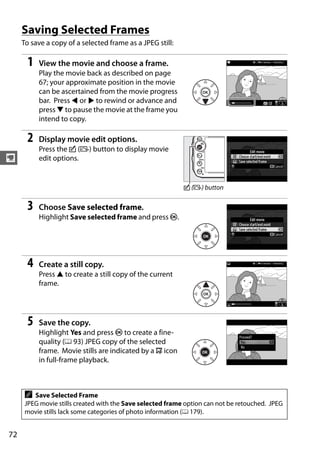
                 Saving Selected Frames........................................................................................................72


                                                                                                                                                                      xi
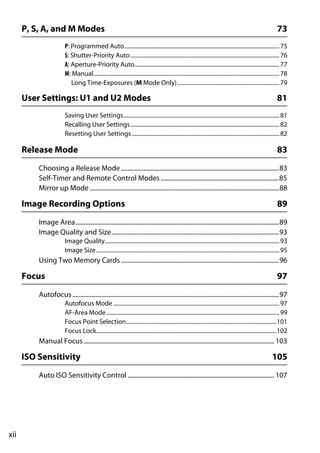
P, S, A, and M Modes                                                                                                                                      73
                        P: Programmed Auto ............................................................................................................. 75
                        S: Shutter-Priority Auto ......................................................................................................... 76
                        A: Aperture-Priority Auto...................................................................................................... 77
                        M: Manual................................................................................................................................... 78
                           Long Time-Exposures (M Mode Only)........................................................................ 79

      User Settings: U1 and U2 Modes                                                                                                                            81
                        Saving User Settings.............................................................................................................. 81
                        Recalling User Settings ......................................................................................................... 82
                        Resetting User Settings ........................................................................................................ 82

      Release Mode                                                                                                                                              83
          Choosing a Release Mode ....................................................................................................83
          Self-Timer and Remote Control Modes ...........................................................................85
          Mirror up Mode ........................................................................................................................88

      Image Recording Options                                                                                                                                   89
          Image Area.................................................................................................................................89
          Image Quality and Size..........................................................................................................93
                        Image Quality........................................................................................................................... 93
                        Image Size ................................................................................................................................. 95
          Using Two Memory Cards ....................................................................................................96

      Focus                                                                                                                                                     97
          Autofocus ...................................................................................................................................97
                        Autofocus Mode ..................................................................................................................... 97
                        AF-Area Mode.......................................................................................................................... 99
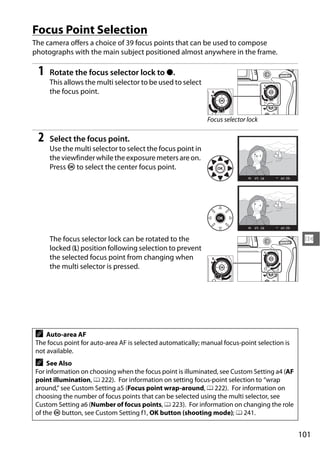
                        Focus Point Selection..........................................................................................................101
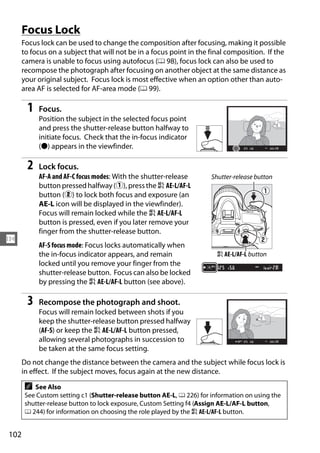
                        Focus Lock...............................................................................................................................102
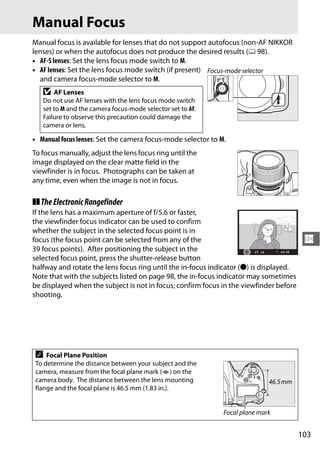
          Manual Focus ......................................................................................................................... 103

      ISO Sensitivity                                                                                                                                        105
          Auto ISO Sensitivity Control ............................................................................................. 107


xii
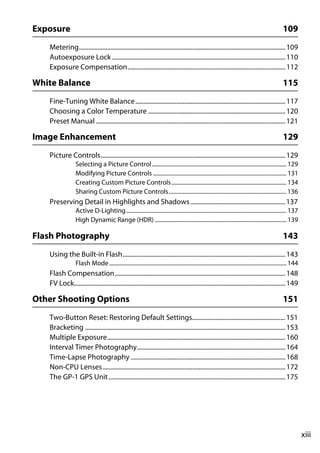
Exposure                                                                                                                                            109
   Metering................................................................................................................................... 109
   Autoexposure Lock .............................................................................................................. 110
   Exposure Compensation.................................................................................................... 112

White Balance                                                                                                                                       115
   Fine-Tuning White Balance ............................................................................................... 117
   Choosing a Color Temperature ....................................................................................... 120
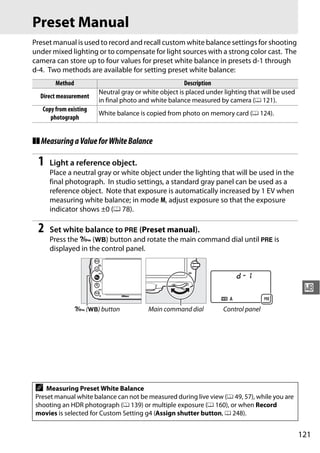
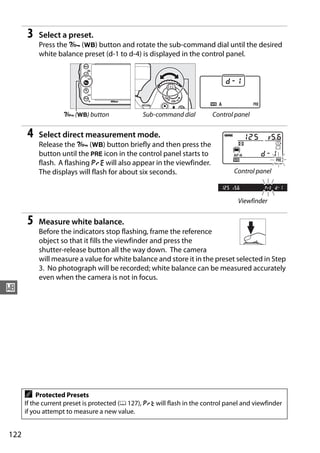
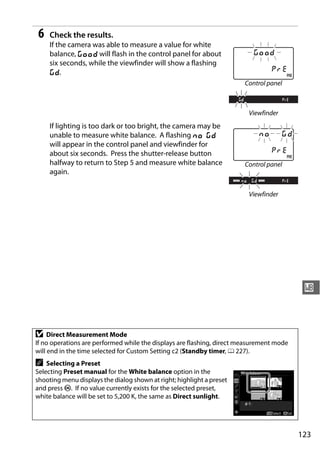
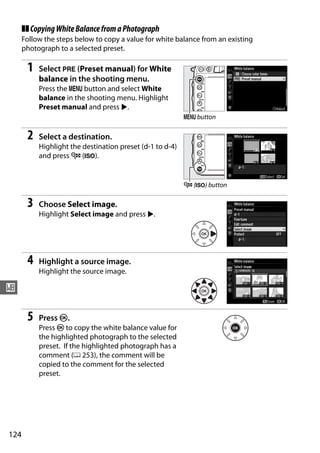
   Preset Manual ........................................................................................................................ 121

Image Enhancement                                                                                                                                   129
   Picture Controls..................................................................................................................... 129
                  Selecting a Picture Control............................................................................................... 129
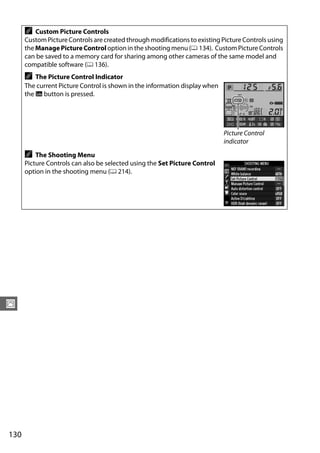
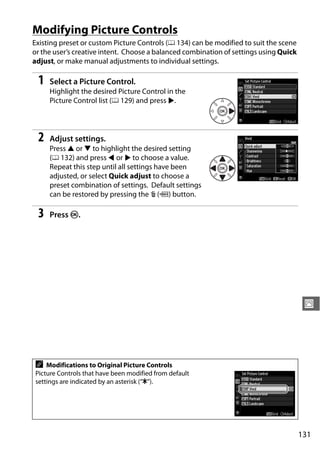
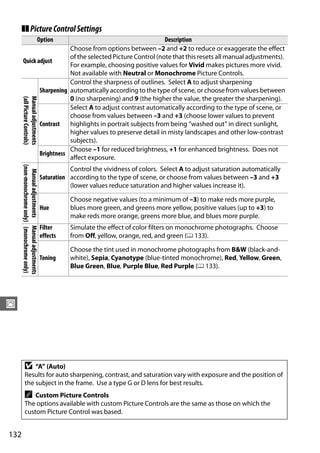
                  Modifying Picture Controls .............................................................................................. 131
                  Creating Custom Picture Controls ................................................................................. 134
                  Sharing Custom Picture Controls................................................................................... 136
   Preserving Detail in Highlights and Shadows ............................................................ 137
                  Active D-Lighting................................................................................................................. 137
                  High Dynamic Range (HDR) ............................................................................................. 139

Flash Photography                                                                                                                                   143
   Using the Built-in Flash....................................................................................................... 143
                  Flash Mode ............................................................................................................................. 144
   Flash Compensation............................................................................................................ 148
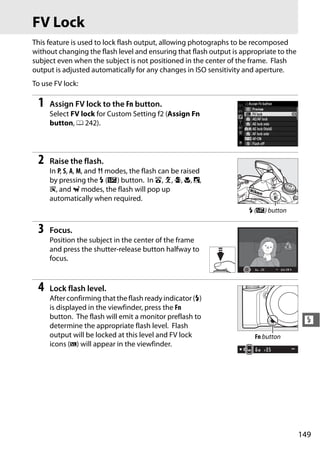
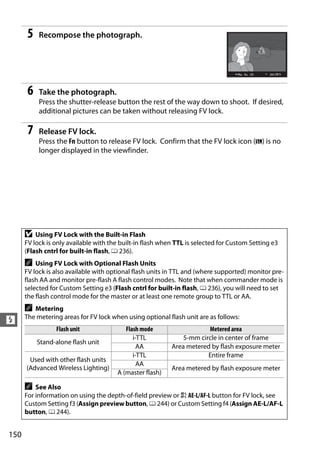
   FV Lock...................................................................................................................................... 149

Other Shooting Options                                                                                                                              151
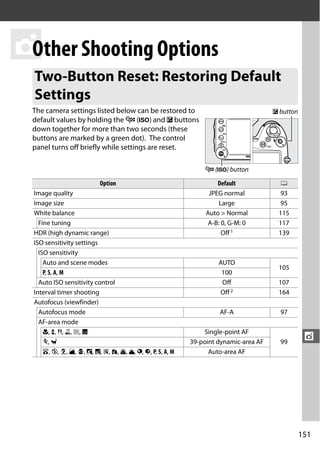
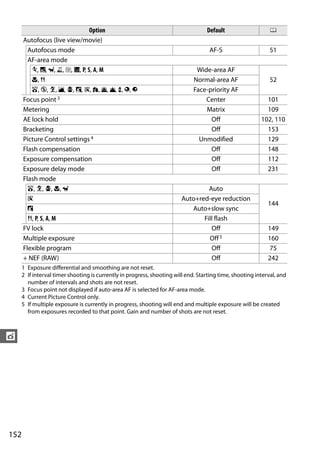
   Two-Button Reset: Restoring Default Settings........................................................... 151
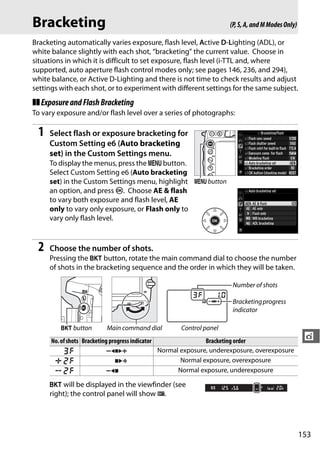
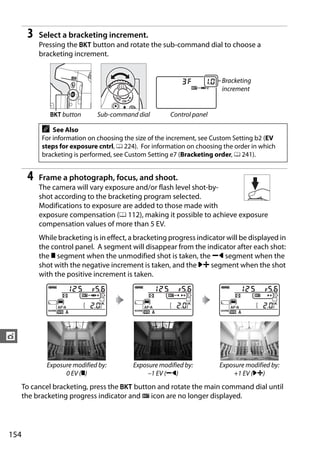
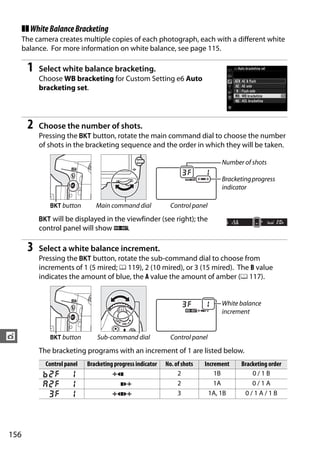
   Bracketing ............................................................................................................................... 153
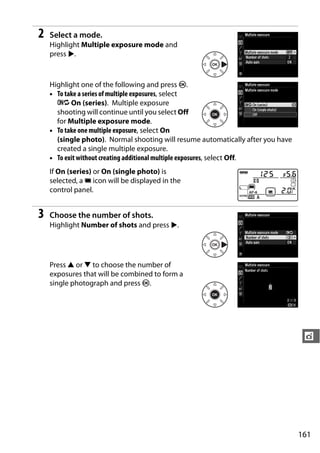
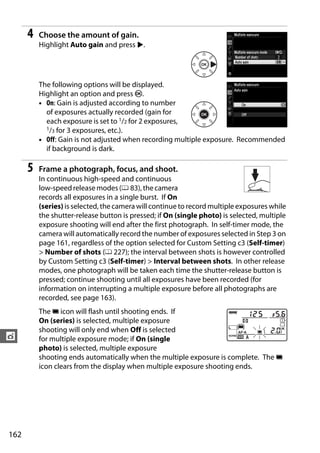
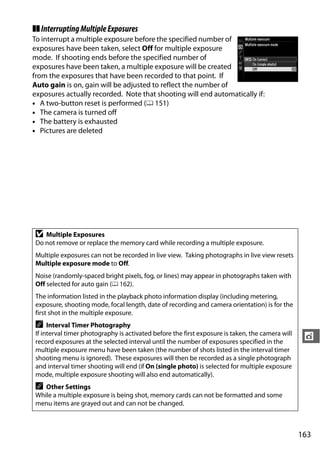
   Multiple Exposure................................................................................................................. 160
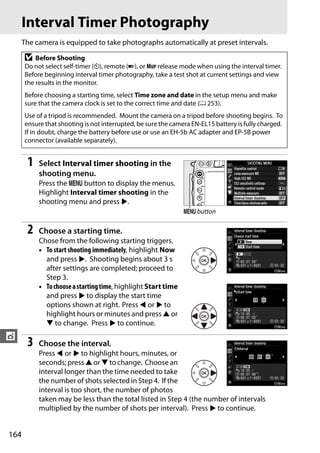
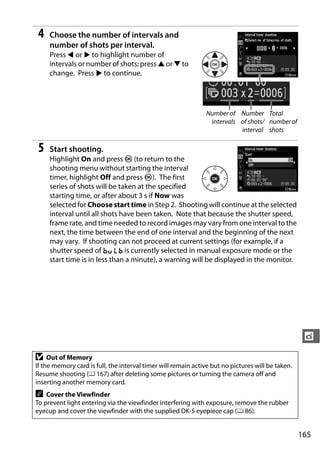
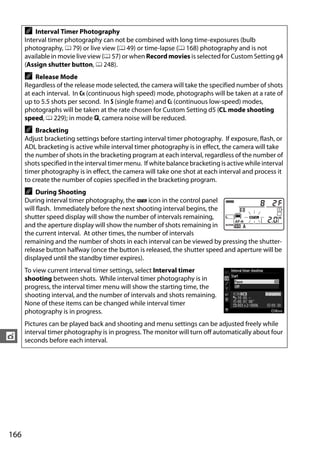
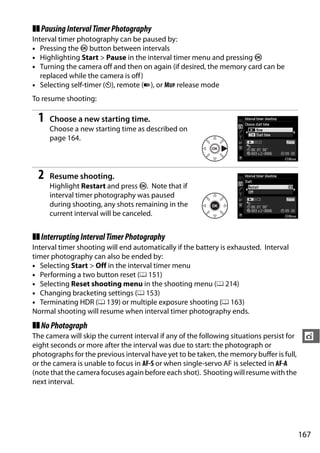
   Interval Timer Photography.............................................................................................. 164
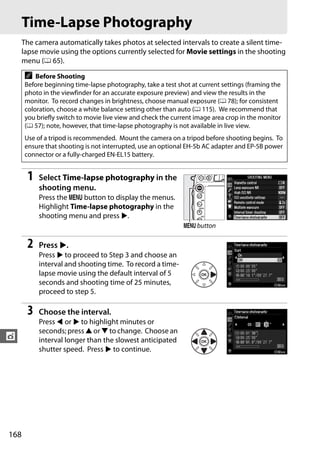
   Time-Lapse Photography .................................................................................................. 168
   Non-CPU Lenses.................................................................................................................... 172
   The GP-1 GPS Unit ................................................................................................................ 175


                                                                                                                                                                 xiii
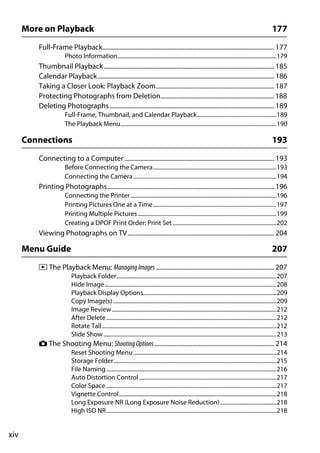
More on Playback                                                                                                                                   177
         Full-Frame Playback............................................................................................................. 177
                      Photo Information................................................................................................................179
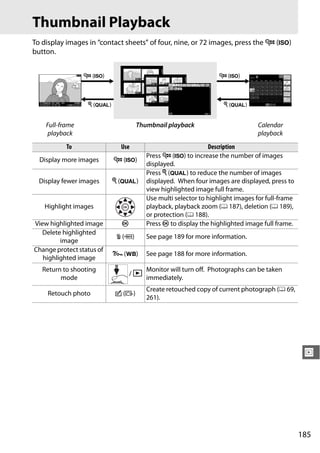
         Thumbnail Playback ............................................................................................................ 185
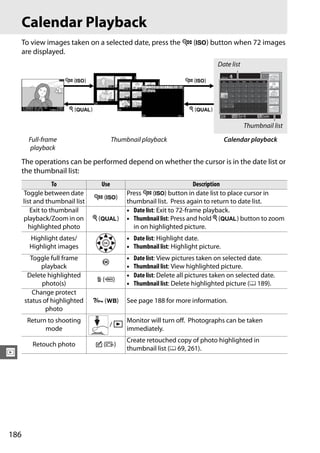
         Calendar Playback ................................................................................................................ 186
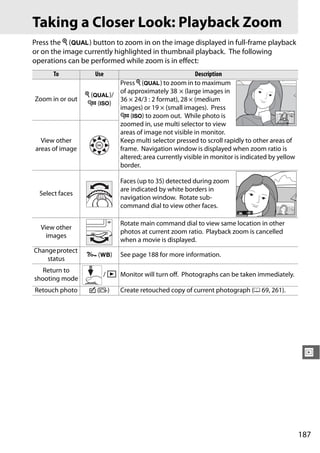
         Taking a Closer Look: Playback Zoom........................................................................... 187
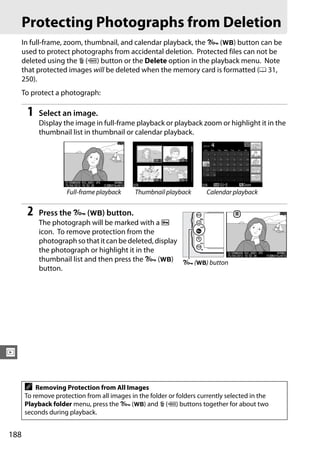
         Protecting Photographs from Deletion........................................................................ 188
         Deleting Photographs ........................................................................................................ 189
                      Full-Frame, Thumbnail, and Calendar Playback........................................................189
                      The Playback Menu..............................................................................................................190

      Connections                                                                                                                                        193
         Connecting to a Computer ............................................................................................... 193
                      Before Connecting the Camera.......................................................................................193
                      Connecting the Camera .....................................................................................................194
         Printing Photographs.......................................................................................................... 196
                      Connecting the Printer.......................................................................................................196
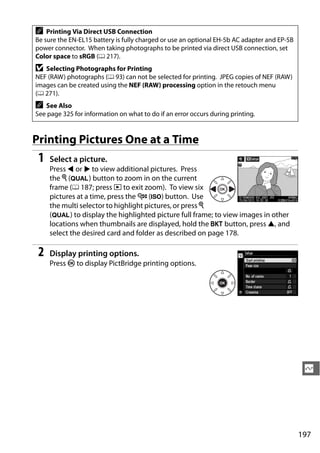
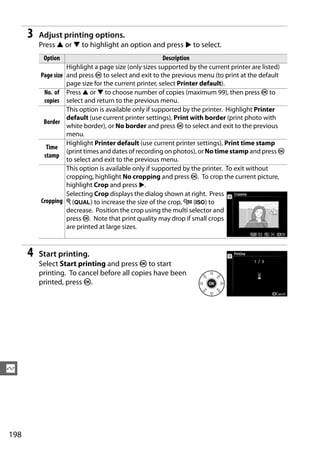
                      Printing Pictures One at a Time.......................................................................................197
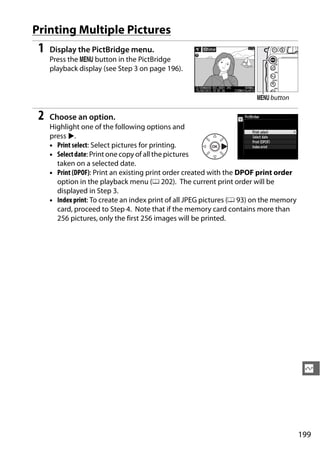
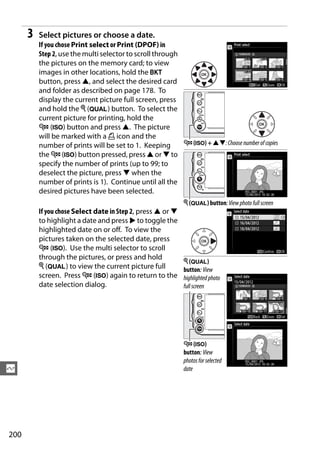
                      Printing Multiple Pictures..................................................................................................199
                      Creating a DPOF Print Order: Print Set .........................................................................202
         Viewing Photographs on TV............................................................................................. 204

      Menu Guide                                                                                                                                         207
         D The Playback Menu: Managing Images ........................................................................... 207
                          Playback Folder.................................................................................................................207
                          Hide Image .........................................................................................................................208
                          Playback Display Options..............................................................................................209
                          Copy Image(s) ...................................................................................................................209
                          Image Review ....................................................................................................................212
                          After Delete ........................................................................................................................212
                          Rotate Tall...........................................................................................................................212
                          Slide Show ..........................................................................................................................213
         C The Shooting Menu: Shooting Options ............................................................................ 214
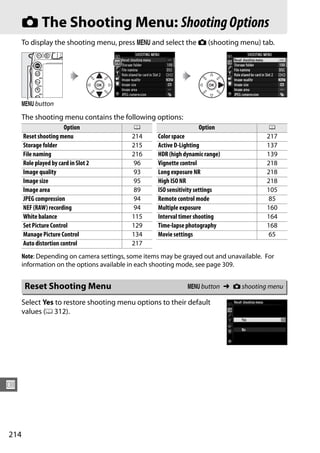
                          Reset Shooting Menu .....................................................................................................214
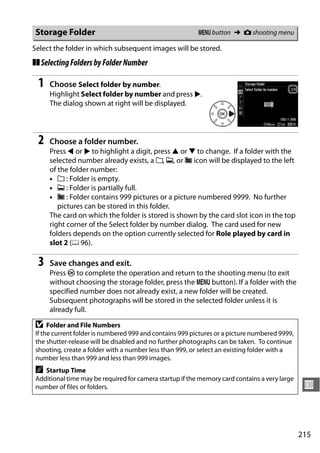
                          Storage Folder...................................................................................................................215
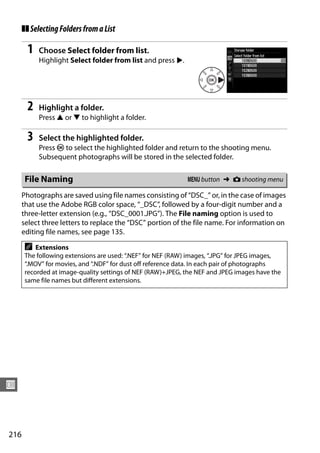
                          File Naming ........................................................................................................................216
                          Auto Distortion Control .................................................................................................217
                          Color Space ........................................................................................................................217
                          Vignette Control...............................................................................................................218
                          Long Exposure NR (Long Exposure Noise Reduction)........................................218
                          High ISO NR........................................................................................................................218


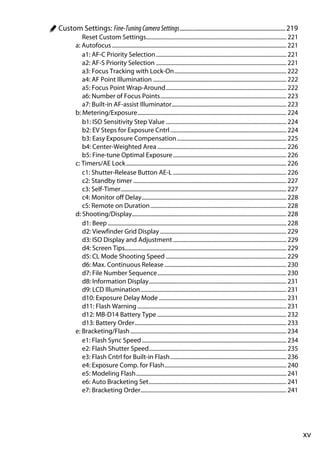
xiv
A Custom Settings: Fine-Tuning Camera Settings................................................................... 219
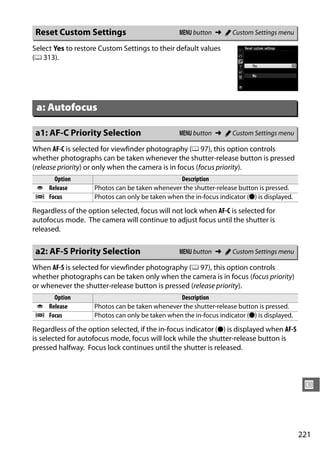
               Reset Custom Settings................................................................................................... 221
            a: Autofocus ........................................................................................................................... 221
               a1: AF-C Priority Selection ............................................................................................ 221
               a2: AF-S Priority Selection ............................................................................................ 221
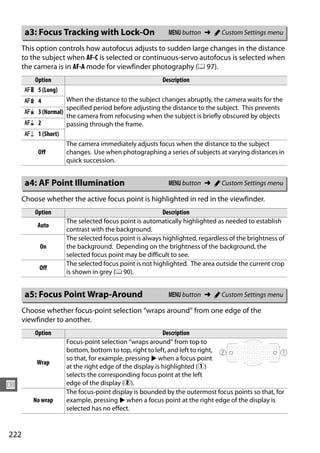
               a3: Focus Tracking with Lock-On............................................................................... 222
               a4: AF Point Illumination .............................................................................................. 222
               a5: Focus Point Wrap-Around..................................................................................... 222
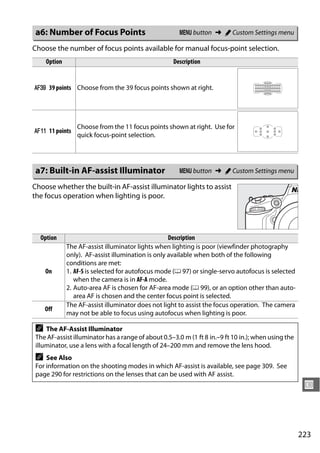
               a6: Number of Focus Points......................................................................................... 223
               a7: Built-in AF-assist Illuminator................................................................................. 223
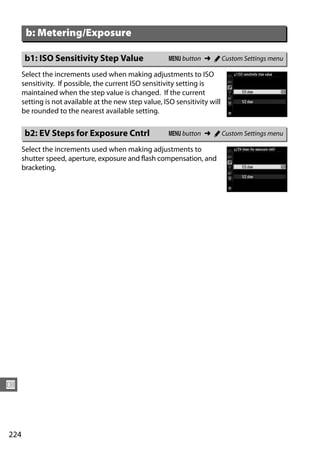
            b: Metering/Exposure......................................................................................................... 224
               b1: ISO Sensitivity Step Value ..................................................................................... 224
               b2: EV Steps for Exposure Cntrl .................................................................................. 224
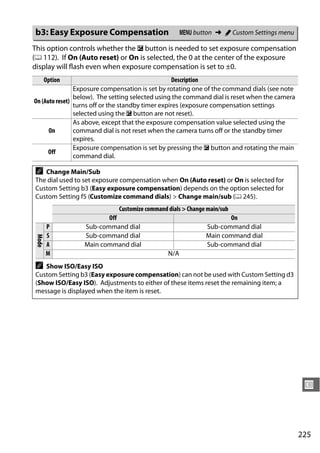
               b3: Easy Exposure Compensation ............................................................................. 225
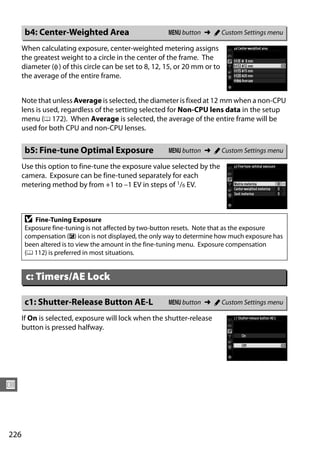
               b4: Center-Weighted Area ........................................................................................... 226
               b5: Fine-tune Optimal Exposure................................................................................ 226
            c: Timers/AE Lock ................................................................................................................. 226
               c1: Shutter-Release Button AE-L ................................................................................ 226
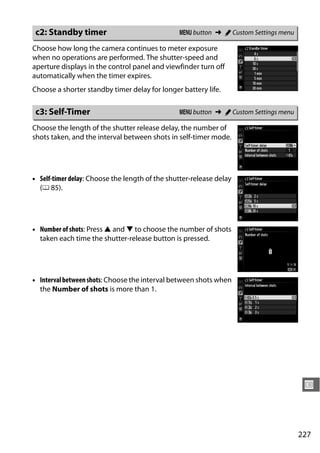
               c2: Standby timer ............................................................................................................ 227
               c3: Self-Timer..................................................................................................................... 227
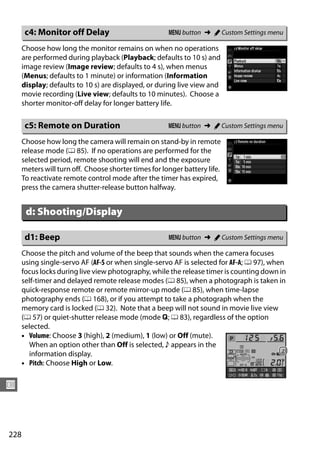
               c4: Monitor off Delay...................................................................................................... 228
               c5: Remote on Duration................................................................................................ 228
            d: Shooting/Display............................................................................................................. 228
               d1: Beep .............................................................................................................................. 228
               d2: Viewfinder Grid Display ......................................................................................... 229
               d3: ISO Display and Adjustment ................................................................................ 229
               d4: Screen Tips.................................................................................................................. 229
               d5: CL Mode Shooting Speed ..................................................................................... 229
               d6: Max. Continuous Release ...................................................................................... 230
               d7: File Number Sequence........................................................................................... 230
               d8: Information Display................................................................................................. 231
               d9: LCD Illumination....................................................................................................... 231
               d10: Exposure Delay Mode .......................................................................................... 231
               d11: Flash Warning ......................................................................................................... 231
               d12: MB-D14 Battery Type ........................................................................................... 232
               d13: Battery Order........................................................................................................... 233
            e: Bracketing/Flash .............................................................................................................. 234
               e1: Flash Sync Speed ...................................................................................................... 234
               e2: Flash Shutter Speed................................................................................................. 235
               e3: Flash Cntrl for Built-in Flash.................................................................................. 236
               e4: Exposure Comp. for Flash...................................................................................... 240
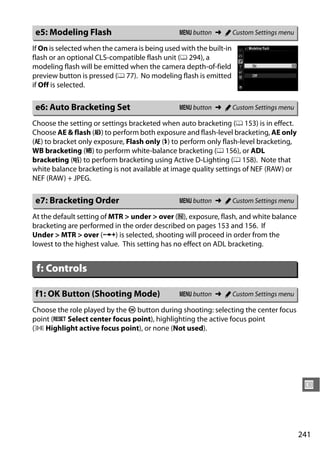
               e5: Modeling Flash.......................................................................................................... 241
               e6: Auto Bracketing Set................................................................................................. 241
               e7: Bracketing Order....................................................................................................... 241


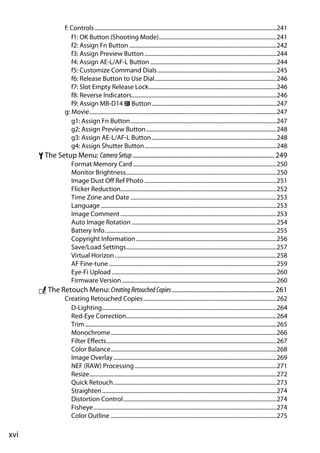
                                                                                                                                                             xv
f: Controls ................................................................................................................................241
                      f1: OK Button (Shooting Mode)...................................................................................241
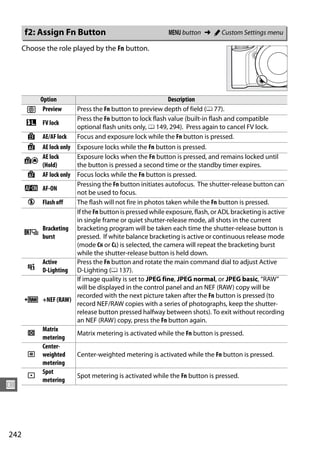
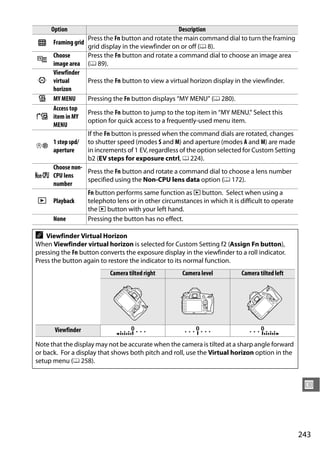
                      f2: Assign Fn Button ........................................................................................................242
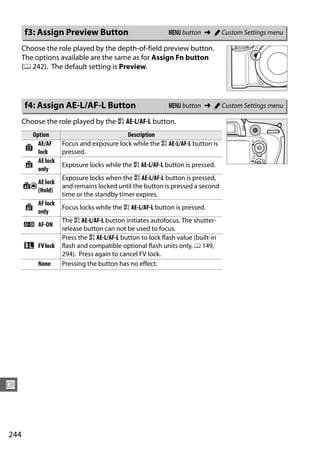
                      f3: Assign Preview Button .............................................................................................244
                      f4: Assign AE-L/AF-L Button .........................................................................................244
                      f5: Customize Command Dials ....................................................................................245
                      f6: Release Button to Use Dial......................................................................................246
                      f7: Slot Empty Release Lock..........................................................................................246
                      f8: Reverse Indicators......................................................................................................246
                      f9: Assign MB-D14 4 Button........................................................................................247
                   g: Movie....................................................................................................................................247
                      g1: Assign Fn Button.......................................................................................................247
                      g2: Assign Preview Button............................................................................................248
                      g3: Assign AE-L/AF-L Button ........................................................................................248
                      g4: Assign Shutter Button.............................................................................................248
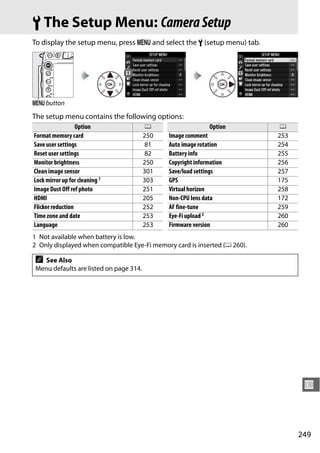
      B The Setup Menu: Camera Setup .......................................................................................... 249
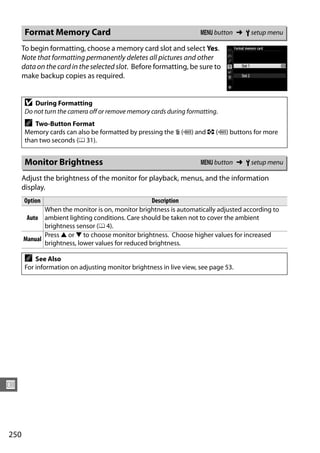
                       Format Memory Card .....................................................................................................250
                       Monitor Brightness..........................................................................................................250
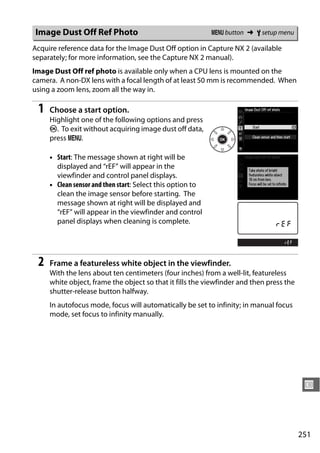
                       Image Dust Off Ref Photo .............................................................................................251
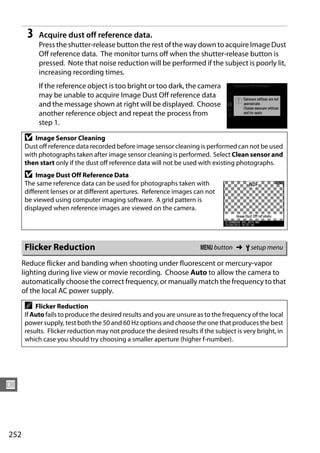
                       Flicker Reduction..............................................................................................................252
                       Time Zone and Date .......................................................................................................253
                       Language ............................................................................................................................253
                       Image Comment ..............................................................................................................253
                       Auto Image Rotation ......................................................................................................254
                       Battery Info.........................................................................................................................255
                       Copyright Information ...................................................................................................256
                       Save/Load Settings..........................................................................................................257
                       Virtual Horizon ..................................................................................................................258
                       AF Fine-tune ......................................................................................................................259
                       Eye-Fi Upload ....................................................................................................................260
                       Firmware Version .............................................................................................................260
      N The Retouch Menu: Creating Retouched Copies ................................................................. 261
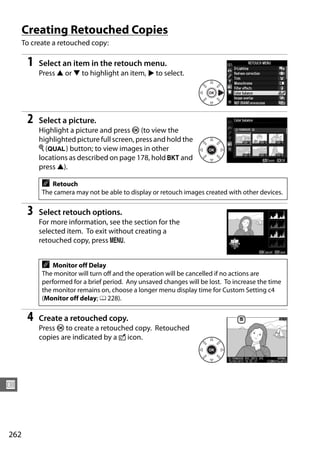
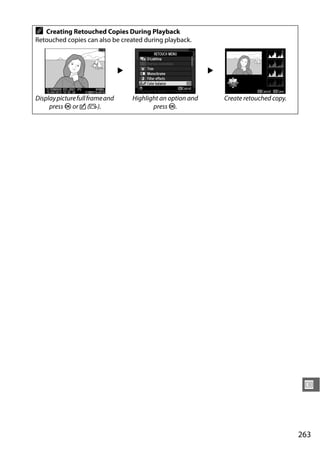
                   Creating Retouched Copies..............................................................................................262
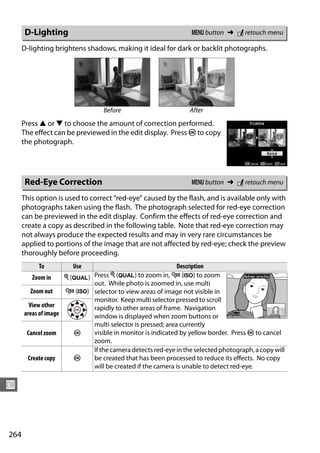
                     D-Lighting...........................................................................................................................264
                     Red-Eye Correction..........................................................................................................264
                     Trim .......................................................................................................................................265
                     Monochrome.....................................................................................................................266
                     Filter Effects........................................................................................................................267
                     Color Balance.....................................................................................................................268
                     Image Overlay ...................................................................................................................269
                     NEF (RAW) Processing ....................................................................................................271
                     Resize....................................................................................................................................272
                     Quick Retouch...................................................................................................................273
                     Straighten ...........................................................................................................................274
                     Distortion Control............................................................................................................274
                     Fisheye .................................................................................................................................274
                     Color Outline .....................................................................................................................275

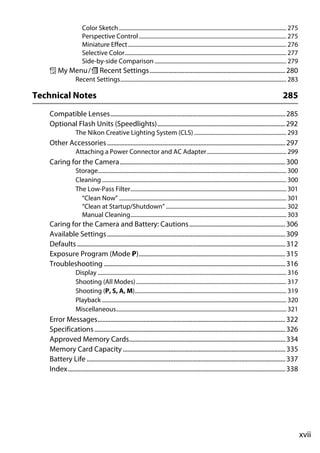
xvi
Color Sketch ...................................................................................................................... 275
                       Perspective Control ........................................................................................................ 275
                       Miniature Effect................................................................................................................ 276
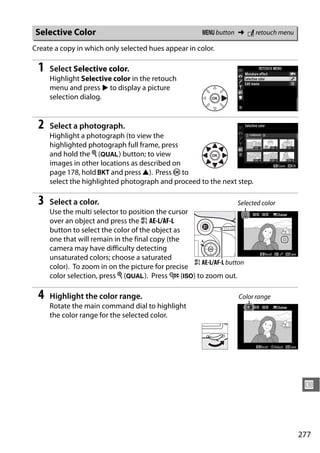
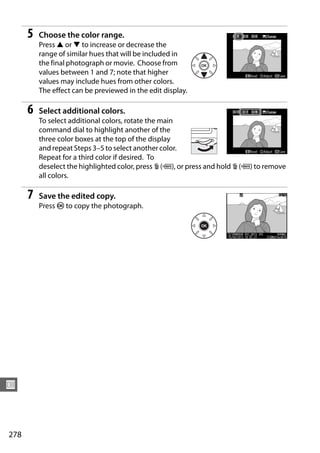
                       Selective Color.................................................................................................................. 277
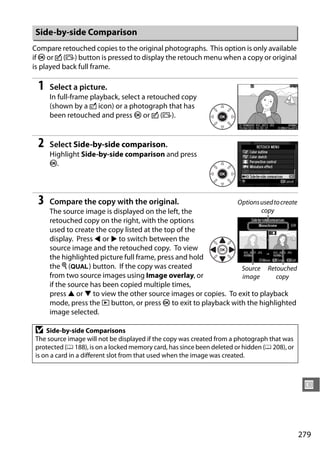
                       Side-by-side Comparison ............................................................................................. 279
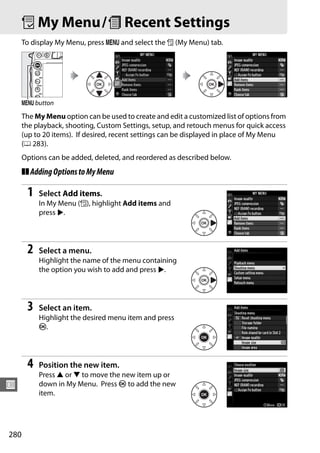
    O My Menu/m Recent Settings...................................................................................... 280
                   Recent Settings..................................................................................................................... 283

Technical Notes                                                                                                                                           285
    Compatible Lenses............................................................................................................... 285
    Optional Flash Units (Speedlights)................................................................................. 292
                   The Nikon Creative Lighting System (CLS) ................................................................. 293
    Other Accessories ................................................................................................................. 297
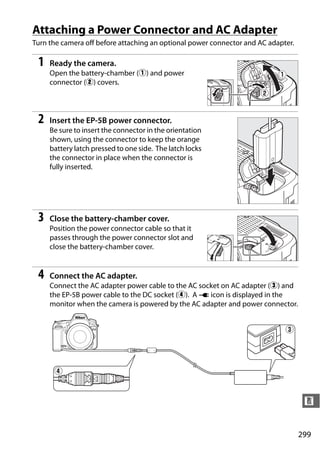
                   Attaching a Power Connector and AC Adapter ........................................................ 299
    Caring for the Camera......................................................................................................... 300
                   Storage..................................................................................................................................... 300
                   Cleaning .................................................................................................................................. 300
                   The Low-Pass Filter.............................................................................................................. 301
                     “Clean Now” ...................................................................................................................... 301
                     “Clean at Startup/Shutdown” ..................................................................................... 302
                     Manual Cleaning.............................................................................................................. 303
    Caring for the Camera and Battery: Cautions............................................................. 306
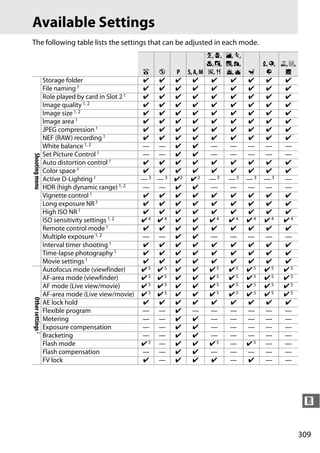
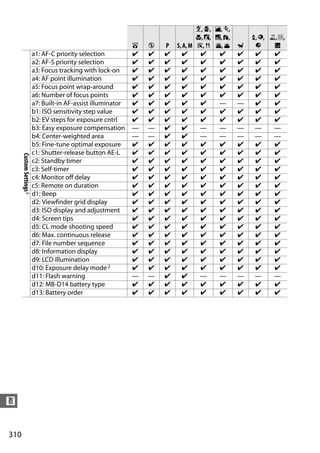
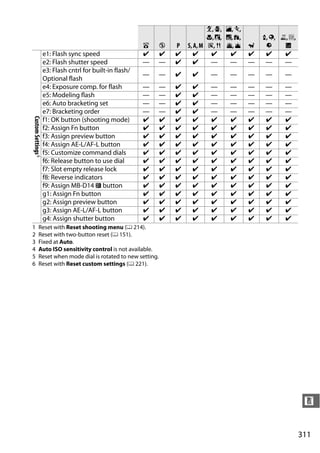
    Available Settings ................................................................................................................. 309
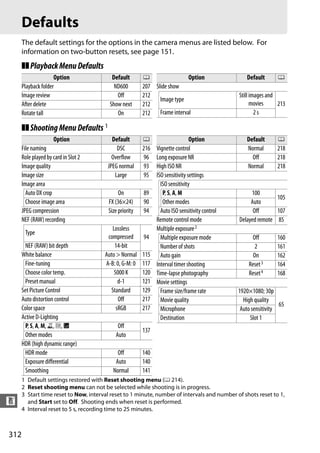
    Defaults .................................................................................................................................... 312
    Exposure Program (Mode P)............................................................................................. 315
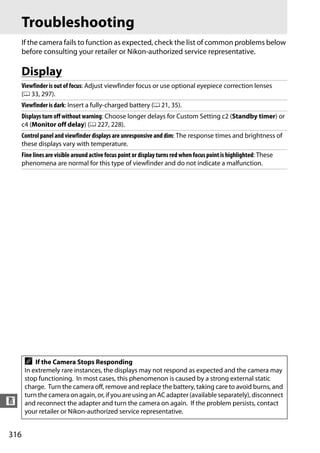
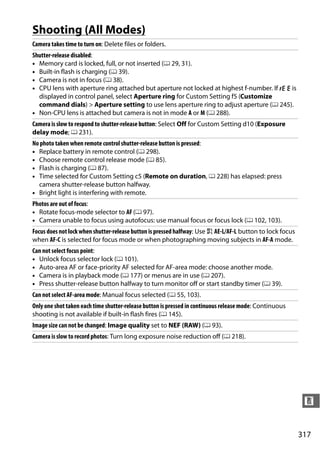
    Troubleshooting ................................................................................................................... 316
                   Display ..................................................................................................................................... 316
                   Shooting (All Modes) .......................................................................................................... 317
                   Shooting (P, S, A, M)........................................................................................................... 319
                   Playback .................................................................................................................................. 320
                   Miscellaneous........................................................................................................................ 321
    Error Messages....................................................................................................................... 322
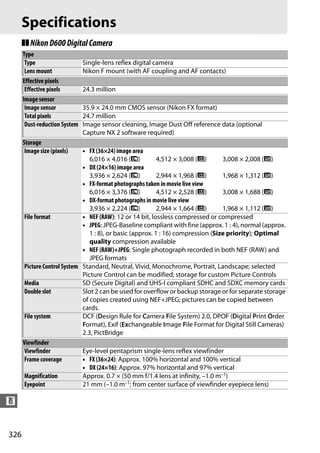
    Specifications ......................................................................................................................... 326
    Approved Memory Cards................................................................................................... 334
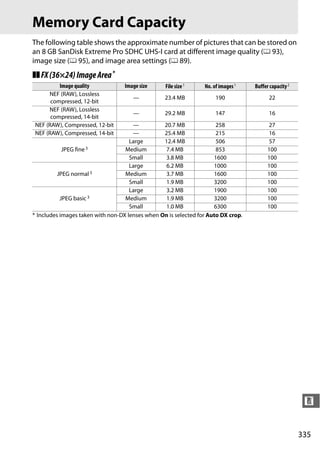
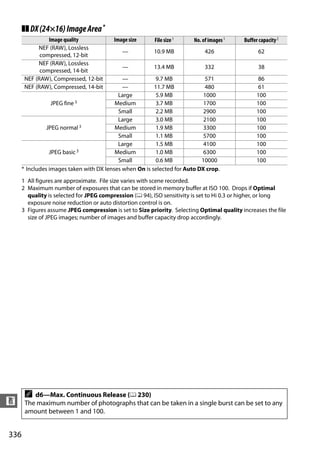
    Memory Card Capacity ....................................................................................................... 335
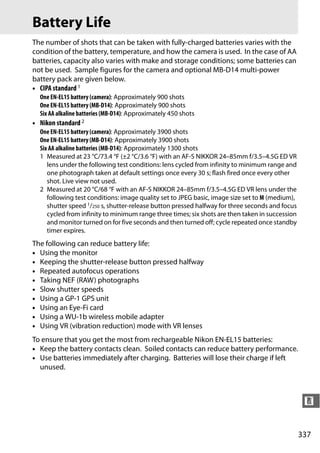
    Battery Life .............................................................................................................................. 337
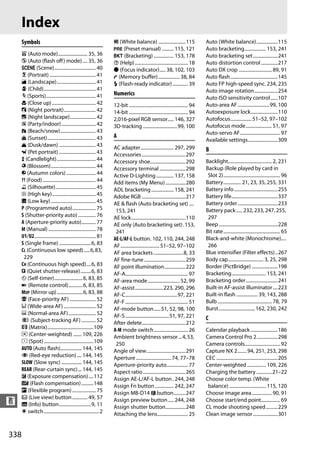
    Index.......................................................................................................................................... 338


                                                                                                                                                                       xvii
For Your Safety
    To prevent damage to your Nikon product or injury to yourself or to others, read the following
    safety precautions in their entirety before using this equipment. Keep these safety instructions
    where all those who use the product will read them.
    The consequences that could result from failure to observe the precautions listed in this
    section are indicated by the following symbol:

        A Nikon product. warnings. To prevent possible injury, read all warnings before using this
          This icon marks


    ❚❚ WARNINGS
    A Keep the sun out of the frame                      A Keep out of reach of children
          Keep the sun well out of the frame when            Failure to observe this precaution could
          shooting backlit subjects. Sunlight                result in injury. In addition, note that small
          focused into the camera when the sun is            parts constitute a chocking hazard. Should
          in or close to the frame could cause a fire.       a child swallow any part of this equipment,
                                                             consult a physician immediately.
    A Do not look at the sun through the viewfinder
          Viewing the sun or other strong light          A Do not disassemble
          source through the viewfinder could                Touching the product’s internal parts
          cause permanent visual impairment.                 could result in injury. In the event of
                                                             malfunction, the product should be
    A Using the viewfinder diopter adjustment control        repaired only by a qualified technician.
          When operating the viewfinder diopter
                                                             Should the product break open as the
          adjustment control with your eye to the
                                                             result of a fall or other accident, remove
          viewfinder, care should be taken not to
                                                             the battery and/or AC adapter and then
          put your finger in your eye accidentally.
                                                             take the product to a Nikon-authorized
    A Turn off immediately in the event of malfunction       service center for inspection.
          Should you notice smoke or an unusual
          smell coming from the equipment or AC          A Do not remain in contact with the camera,
                                                             battery, or charger for extended periods while
          adapter (available separately), unplug
                                                             the devices are on or in use
          the AC adapter and remove the battery
                                                             Parts of the device become hot. Leaving
          immediately, taking care to avoid burns.
                                                             the device in direct contact with the skin
          Continued operation could result in
                                                             for extended periods may result in low-
          injury. After removing the battery, take
                                                             temperature burns.
          the equipment to a Nikon-authorized
          service center for inspection.                 A Do not aim a flash at the operator of a motor
                                                             vehicle
    A Do not use in the presence of flammable gas            Failure to observe this precaution could
          Do not use electronic equipment in the
                                                             result in accidents.
          presence of flammable gas, as this could
          result in explosion or fire.                   A Avoid contact with liquid crystal
                                                             Should the monitor break, care should be
    A Do not place the strap around the neck of an           taken to avoid injury due to broken glass
          infant or child
                                                             and to prevent the liquid crystal from the
          Placing the camera strap around the neck
                                                             monitor touching the skin or entering
          of an infant or child could result in
                                                             the eyes or mouth.
          strangulation.

xviii
A Observe caution when using the flash            A Observe proper precautions when handling the
    • Using the camera with the flash in close        charger
      contact with the skin or other objects          • Keep dry. Failure to observe this
      could cause burns.                                precaution could result in fire or electric
    • Using the flash close to the subject’s            shock.
      eyes could cause temporary visual               • Dust on or near the metal parts of the
      impairment. Particular care should be             plug should be removed with a dry
      observed when photographing infants,              cloth. Continued use could result in fire.
      when the flash should be no less than           • Do not handle the power cable or go
      one meter (39 in.) from the subject.              near the charger during thunderstorms.
                                                        Failure to observe this precaution could
A Observe proper precautions when handling              result in electric shock.
    batteries
                                                      • Do not damage, modify, or forcibly tug
    Batteries may leak or explode if
                                                        or bend the power cable. Do not place
    improperly handled. Observe the
                                                        it under heavy objects or expose it to
    following precautions when handling
                                                        heat or flame. Should the insulation be
    batteries for use in this product:
                                                        damaged and the wires become
    • Use only batteries approved for use in
                                                        exposed, take the power cable to a
      this equipment.
                                                        Nikon-authorized service
    • Do not short or disassemble the battery.
                                                        representative for inspection. Failure to
    • Be sure the product is off before
                                                        observe this precaution could result in
      replacing the battery. If you are using
                                                        fire or electric shock.
      an AC adapter, be sure it is unplugged.
                                                      • Do not handle the plug or charger with
    • Do not attempt to insert the battery
                                                        wet hands. Failure to observe this
      upside down or backwards.
                                                        precaution could result in electric
    • Do not expose the battery to flame or to
                                                        shock.
      excessive heat.
                                                      • Do not use with travel converters or
    • Do not immerse in or expose to water.
                                                        adapters designed to convert from one
    • Replace the terminal cover when
                                                        voltage to another or with DC-to-AC
      transporting the battery. Do not
                                                        inverters. Failure to observe this
      transport or store the battery with metal
                                                        precaution could damage the product
      objects such as necklaces or hairpins.
                                                        or cause overheating or fire.
    • Batteries are prone to leakage when
      fully discharged. To avoid damage to        A Use appropriate cables
      the product, be sure to remove the              When connecting cables to the input and
      battery when no charge remains.                 output jacks, use only the cables
    • When the battery is not in use, attach          provided or sold by Nikon for the
      the terminal cover and store in a cool,         purpose to maintain compliance with
      dry place.                                      product regulations.
    • The battery may be hot immediately
      after use or when the product has been      A CD-ROMs
                                                      CD-ROMs containing software or
      used on battery power for an extended
                                                      manuals should not be played back on
      period. Before removing the battery
                                                      audio CD equipment. Playing CD-ROMs
      turn the camera off and allow the
                                                      on an audio CD player could cause
      battery to cool.
                                                      hearing loss or damage the equipment.
    • Discontinue use immediately should
      you notice any changes in the battery,
      such as discoloration or deformation.


                                                                                                      xix
Notices
     • No part of the manuals included with this       • Nikon will not be held liable for any
       product may be reproduced, transmitted,           damages resulting from the use of this
       transcribed, stored in a retrieval system, or     product.
       translated into any language in any form,       • While every effort has been made to
       by any means, without Nikon’s prior               ensure that the information in these
       written permission.                               manuals is accurate and complete, we
     • Nikon reserves the right to change the            would appreciate it were you to bring any
       specifications of the hardware and                errors or omissions to the attention of the
       software described in these manuals at            Nikon representative in your area (address
       any time and without prior notice.                provided separately).
     Notices for Customers in Canada
     CAUTION                                           ATTENTION
     This Class B digital apparatus complies with      Cet appareil numérique de la classe B est
     Canadian ICES-003.                                conforme à la norme NMB-003 du Canada.
     Notices for Customers in Europe
      CAUTION
      RISK OF EXPLOSION IF BATTERY IS REPLACED BY AN INCORRECT TYPE. DISPOSE OF USED
      BATTERIES ACCORDING TO THE INSTRUCTIONS.

     This symbol indicates that this                   This symbol on the battery
     product is to be collected                        indicates that the battery is to be
     separately.                                       collected separately.
     The following apply only to users in              The following apply only to users in
     European countries:                               European countries:
     • This product is designated for separate         • All batteries, whether marked with this
       collection at an appropriate collection           symbol or not, are designated for separate
       point. Do not dispose of as household             collection at an appropriate collection
       waste.                                            point. Do not dispose of as household
     • For more information, contact the retailer        waste.
       or the local authorities in charge of waste     • For more information, contact the retailer
       management.                                       or the local authorities in charge of waste
                                                         management.


xx
Notices for Customers in the U.S.A.
Power Cable
At voltages over AC 125 V (U.S.A. only): The power cable must be rated for the voltage in use, be at
least AWG no. 18 gauge, and have SVG insulation or better with a NEMA 6P-15 plug rated for
AC 250 V 15 A.
Federal Communications Commission (FCC) Radio Frequency Interference Statement
This equipment has been tested and found
to comply with the limits for a Class B digital
device, pursuant to Part 15 of the FCC rules.
These limits are designed to provide
reasonable protection against harmful                 CAUTIONS
interference in a residential installation. This      Modifications
equipment generates, uses, and can radiate            The FCC requires the user be notified that any
radio frequency energy and, if not installed          changes or modifications made to this device
and used in accordance with the instructions,         that are not expressly approved by Nikon
may cause harmful interference to radio               Corporation may void the user’s authority to
communications. However, there is no                  operate the equipment.
guarantee that interference will not occur in
a particular installation. If this equipment          Interface Cables
does cause harmful interference to radio or           Use the interface cables sold or provided by
television reception, which can be                    Nikon for your equipment. Using other
determined by turning the equipment off               interface cables may exceed the limits of
and on, the user is encouraged to try to              Class B Part 15 of the FCC rules.
correct the interference by one or more of          Notice for Customers in the State of California
the following measures:                             WARNING: Handling the cord on this product
• Reorient or relocate the receiving antenna.       may expose you to lead, a chemical known to
• Increase the separation between the               the State of California to cause birth defects
  equipment and receiver.                           or other reproductive harm. Wash hands
• Connect the equipment into an outlet on a         after handling.
  circuit different from that to which the
  receiver is connected.                            Nikon Inc., 1300 Walt Whitman Road,
• Consult the dealer or an experienced              Melville, New York 11747-3064, U.S.A.
  radio/television technician for help.             Tel.: 631-547-4200


                                                                                                       xxi
Notice Concerning Prohibition of Copying or Reproduction
       Note that simply being in possession of material that has been digitally copied or reproduced
       by means of a scanner, digital camera, or other device may be punishable by law.
       • Items prohibited by law from being copied or    • Cautions on certain copies and reproductions
         reproduced                                        The government has issued cautions on
         Do not copy or reproduce paper money,             copies or reproductions of securities issued
         coins, securities, government bonds, or           by private companies (shares, bills, checks,
         local government bonds, even if such              gift certificates, etc.), commuter passes, or
         copies or reproductions are stamped               coupon tickets, except when a minimum of
         “Sample.”                                         necessary copies are to be provided for
                                                           business use by a company. Also, do not
        The copying or reproduction of paper
                                                           copy or reproduce passports issued by the
        money, coins, or securities which are
                                                           government, licenses issued by public
        circulated in a foreign country is prohibited.
                                                           agencies and private groups, ID cards, and
        Unless the prior permission of the                 tickets, such as passes and meal coupons.
        government has been obtained, the
                                                         • Comply with copyright notices
        copying or reproduction of unused postage
                                                           The copying or reproduction of
        stamps or post cards issued by the
                                                           copyrighted creative works such as books,
        government is prohibited.
                                                           music, paintings, woodcuts, prints, maps,
        The copying or reproduction of stamps              drawings, movies, and photographs is
        issued by the government and of certified          governed by national and international
        documents stipulated by law is prohibited.         copyright laws. Do not use this product for
                                                           the purpose of making illegal copies or to
                                                           infringe copyright laws.
       Disposing of Data Storage Devices
       Please note that deleting images or formatting memory cards or other data storage devices
       does not completely erase the original image data. Deleted files can sometimes be recovered
       from discarded storage devices using commercially available software, potentially resulting in
       the malicious use of personal image data. Ensuring the privacy of such data is the user’s
       responsibility.
       Before discarding a data storage device or transferring ownership to another person, erase all
       data using commercial deletion software, or format the device and then completely refill it
       with images containing no private information (for example, pictures of empty sky). Be sure to
       also replace any pictures selected for preset manual (0 121). Care should be taken to avoid
       injury when physically destroying data storage devices.
       AVC Patent Portfolio License
       THIS PRODUCT IS LICENSED UNDER THE AVC PATENT PORTFOLIO LICENSE FOR THE PERSONAL AND NON-
       COMMERCIAL USE OF A CONSUMER TO (i) ENCODE VIDEO IN COMPLIANCE WITH THE AVC STANDARD (“AVC
       VIDEO”) AND/OR (ii) DECODE AVC VIDEO THAT WAS ENCODED BY A CONSUMER ENGAGED IN A PERSONAL AND
       NON-COMMERCIAL ACTIVITY AND/OR WAS OBTAINED FROM A VIDEO PROVIDER LICENSED TO PROVIDE AVC
       VIDEO. NO LICENSE IS GRANTED OR SHALL BE IMPLIED FOR ANY OTHER USE. ADDITIONAL INFORMATION MAY BE
       OBTAINED FROM MPEG LA, L.L.C. SEE http://www.mpegla.com


xxii
Use Only Nikon Brand Electronic Accessories
Nikon cameras are designed to the highest standards and include complex electronic circuitry.
Only Nikon brand electronic accessories (including chargers, batteries, AC adapters, and flash
accessories) certified by Nikon specifically for use with this Nikon digital camera are
engineered and proven to operate within the operational and safety requirements of this
electronic circuitry.
The use of non-Nikon electronic accessories could damage the camera and may
void your Nikon warranty. The use of third-party rechargeable Li-ion batteries not
bearing the Nikon holographic seal shown at right could interfere with normal
operation of the camera or result in the batteries overheating, igniting, rupturing, or leaking.
For more information about Nikon brand accessories, contact a local authorized Nikon dealer.


 D   Use Only Nikon Brand Accessories
 Only Nikon brand accessories certified by Nikon specifically for use with your Nikon digital
 camera are engineered and proven to operate within its operational and safety
 requirements. THE USE OF NON-NIKON ACCESSORIES COULD DAMAGE YOUR CAMERA AND MAY VOID YOUR
 NIKON WARRANTY.
 D   Servicing the Camera and Accessories
 The camera is a precision device and requires regular servicing. Nikon recommends that the
 camera be inspected by the original retailer or a Nikon-authorized service representative
 once every one to two years, and that it be serviced once every three to five years (note that
 fees apply to these services). Frequent inspection and servicing are particularly
 recommended if the camera is used professionally. Any accessories regularly used with the
 camera, such as lenses or optional flash units, should be included when the camera is
 inspected or serviced.
 A    Before Taking Important Pictures
 Before taking pictures on important occasions (such as at weddings or before taking the
 camera on a trip), take a test shot to ensure that the camera is functioning normally. Nikon
 will not be held liable for damages or lost profits that may result from product malfunction.
 A    Life-Long Learning
 As part of Nikon’s “Life-Long Learning” commitment to ongoing product support and
 education, continually-updated information is available on-line at the following sites:
 • For users in the U.S.A.: http://www.nikonusa.com/
 • For users in Europe and Africa: http://www.europe-nikon.com/support/
 • For users in Asia, Oceania, and the Middle East: http://www.nikon-asia.com/
 Visit these sites to keep up-to-date with the latest product information, tips, answers to
 frequently-asked questions (FAQs), and general advice on digital imaging and photography.
 Additional information may be available from the Nikon representative in your area. See the
 following URL for contact information: http://imaging.nikon.com/


                                                                                                   xxiii
Package Contents
   Be sure all items listed here were included with your camera. Memory cards are sold
   separately.
                                          • BS-1 accessory                   • DK-21 rubber
                                            shoe cover                         eyecup


                                          • BM-14 monitor                    • BF-1B body
                                            cover                              cap

   • D600 camera

                                                                   • AN-DC8 strap
                    • EN-EL15 rechargeable Li-ion battery          • UC-E15 USB cable
                      (with terminal cover)                        • ViewNX 2 CD
                                                                   • User’s Manual
                                                                     (this guide)
                    • MH-25 battery charger (AC wall               • Warranty
                      adapter supplied only in countries or
                      regions where required. Shape of             Memory cards are sold
                      power cable depends on country of            separately.
                      sale.)

                    • DK-5 eyepiece cap


       A   The Camera Strap
       Attach the strap securely to the two eyelets on the camera body as shown below.


xxiv
XIntroduction
  Getting to Know the Camera
  Take a few moments to familiarize yourself with camera controls and displays. You
  may find it helpful to bookmark this section and refer to it as you read through the
  rest of the manual.                                                                                                                                                     X

  The Camera Body


   1   Release mode dial .............................................6, 83              10 E button
   2   Mode dial....................................................................5         Exposure compensation................................ 112
   3   Mode dial lock release.............................................5                   Two-button reset............................................. 151
   4   Eyelet for camera strap                                                           11 Movie-record button .............................................58
   5   Release mode dial lock release ......................6, 83                        12 Z/Q button
   6   Accessory shoe (for optional flash unit).........292                                   Metering............................................................ 109
   7   Accessory shoe cover..........................................292                      Formatting memory cards ...............................31
   8   Power switch..............................................................1       13 Focal plane mark (E)........................................ 103
   9   Shutter-release button...................................38, 39                   14 Control panel.............................................................7

  A   The Power Switch
  Rotate the power switch as shown to turn                                              Rotate the power switch as shown to turn
  the camera on.                                                                        the camera off.


                                                                                                                                                                          1
The Camera Body (Continued)


X


    1   Built-in flash ..........................................................143     10 HDMI/USB connector cover ............ 194, 196, 204
    2   Mirror ............................................................... 88, 303   11 Cover for accessory terminal ............................ 298
    3   Meter coupling lever...........................................328               12 Lens release button............................................... 26
    4   Lens mounting mark............................................. 26               13 AF-mode button .....................................51, 98, 100
    5   M/Y button                                                                       14 Focus-mode selector ................................... 97, 103
          Flash mode ........................................................143         15 Headphone connector ......................................... 61
          Flash compensation........................................148                  16 Connector for external microphone ................. 61
    6   D button                                                                         17 USB connector
          Bracketing........................................153, 156, 158                     Connecting to a computer............................ 194
    7   Infrared receiver (front) ........................................ 86                 Connecting to a printer.................................. 196
    8   Built-in microphone ....................................... 58, 65               18 HDMI mini-pin connector.................................. 204
    9   Audio connector cover ................................ 61, 298                   19 Accessory terminal..................................... 175, 298


    A   LCD Illuminators
    Rotating the power switch toward D activates the                                                        Power switch
    standby timer and control panel backlight (LCD
    illuminator), allowing the display to be read in the dark.
    After the power switch is released and returns to the ON
    position, the illuminators will remain lit for six seconds
    while the standby timer is active or until the shutter is
    released or the power switch is rotated toward D again.


2
The Camera Body (Continued)


                                                                                                                                                                        X


1 AF-assist illuminator ...........................................223         7 Contact cover for optional MB-D14 battery pack
  Self-timer lamp ...................................................... 86        .............................................................................. 297
  Red-eye reduction lamp ....................................145               8 Power connector cover ...................................... 299
2 Sub-command dial....................................... 12, 245              9 CPU contacts
3 Depth-of-field preview button...60, 77, 244, 248                            10 Lens mount.....................................................26, 103
4 Fn (function) button................... 92, 149, 174, 242                   11 AF coupling
5 Battery-chamber cover ........................................ 23           12 Tripod socket
6 Battery-chamber cover latch .............................. 23               13 Body cap..........................................................25, 298


D  The Microphone and Speaker
Do not place the microphone or speaker in close proximity to magnetic devices. Failure to
observe this precaution could affect the data recorded on the magnetic devices.


                                                                                                                                                                        3
The Camera Body (Continued)


X


    1 Viewfinder eyepiece.............................................. 33               10 W/S button
    2 Rubber eyecup ....................................................... 86                Playback zoom out/thumbnails.......... 185, 186
    3 O/Q button                                                                              ISO sensitivity ................................................... 105
        Delete .......................................................... 47, 189             Auto ISO sensitivity control........................... 107
        Formatting memory cards............................... 31                             Two-button reset............................................. 151
    4 K button                                                                           11 Diopter adjustment control ................................ 33
        Playback ...................................................... 46, 177          12 A button
    5 Monitor                                                                                 Using the AE/AF lock button ...... 102, 110, 244
        Viewing settings................................................... 9            13 Main command dial..................................... 12, 245
        Live view ....................................................... 49, 57         14 Multi selector.......................................................... 19
        Viewing pictures ................................................ 46             15 J (OK) button .............................................. 19, 241
        Full-frame playback.........................................177                  16 Focus selector lock .............................................. 101
    6 G button                                                                           17 Memory card slot cover ....................................... 29
        Menu............................................................ 18, 207         18 Ambient brightness sensor for automatic
    7 c/b button                                                                              monitor brightness control..................... 53, 250
        Retouch ....................................................... 69, 261          19 Live view selector
        Picture Control........................................... 50, 129                    Live view photography .................................... 49
    8 L/U button                                                                              Movie live view .................................................. 57
        Help....................................................................... 18   20 a button...........................................................49, 57
        Protect ................................................................188      21 Infrared receiver (rear).......................................... 86
        White balance.................................115, 117, 120                      22 Memory card access lamp.............................29, 38
    9 X/T button                                                                         23 Speaker .................................................................... 67
        Playback zoom in.............................................187                 24 R (info) button.................................................. 9, 11
        Image quality/size ...................................... 93, 95


4
The Mode Dial
The camera offers the modes Mode dial
listed below. To choose a
mode, press the mode dial lock
release and rotate the mode
dial.


                                                                                                X
                                   Mode dial lock release

 P, S, A, and M Modes
 Select these modes for full control over camera settings.
 • P—Programmed auto (0 75)
 • S—Shutter-priority auto (0 76)
 • A—Aperture-priority auto (0 77)
 • M—Manual (0 78)


                                        Auto Modes
                                        Select these modes for simple, point-and-shoot
                                        photography.
                                        • i Auto (0 35)           • j Auto (flash off) (0 35)


                                        Scene Modes (0 40)
                                        The camera automatically optimizes settings to suit
                                        the selected scene. Match your selection to the
                                        scene being photographed.


 U1 and U2 Modes (0 81)
 Store and recall customized shooting settings.


A   Non-CPU Lenses
Non-CPU (0 285) lenses can be used only in modes A and M. Selecting another mode when
a non-CPU lens is attached disables the shutter release.


                                                                                                5
The Release-Mode Dial
    To choose a release mode, press the            Release mode dial lock release
    release mode dial lock release and turn
    the release mode dial to the desired
    setting (0 83).


X
                                                   Release mode dial

                     Mode                                            Description

                                                 One photograph is taken each time the shutter-
                    S    Single frame
                                                 release button is pressed.

                                                 The camera takes photographs at a slow rate
                    CL   Continuous low speed
                                                 while the shutter-release button is pressed.

                                                 The camera takes photographs at a fast rate while
                   CH    Continuous high speed
                                                 the shutter-release button is pressed.

                                                 As for single-frame, except that camera noise is
                    J    Quiet shutter-release
                                                 reduced.


                   E     Self-timer              Take pictures with the self-timer.


                                                 Take pictures with an optional ML-L3 remote
                   4     Remote control
                                                 control.


                  MUP    Mirror up               Raise the mirror before taking photographs.


6
The Control Panel
                                                                                   3   MB-D14 battery indicator.................................. 233
                                                                                   4   Battery indicator.....................................................35
                                                                                   5   Flash mode............................................................ 144
                                                                                   6   Autofocus mode .....................................................97
                                                                                   7   Image size ................................................................95
                                                                                   8   Image quality ..........................................................93
                                                                                   9   White balance fine-tuning indicator .............. 118
                                                                                  10   White balance ...................................................... 115
                                                                                  11   Aperture stop indicator ...............................73, 288
                                                                                  12   Aperture (f-number).......................................77, 78
                                                                                                                                                                       X
                                                                                       Aperture (number of stops)........................73, 288
 1 Color temperature indicator .............................120                        Bracketing increment................................ 154, 156
 2 Shutter speed ...................................................76, 78             Number of shots in ADL bracketing
   Exposure compensation value .........................112                              sequence............................................................ 158
   Flash compensation value.................................148                        Number of shots per interval ........................... 165
   White balance fine-tuning ................................118                       Maximum aperture (non-CPU lenses)............ 174
   Color temperature ......................................115, 120                    PC mode indicator............................................... 195
   White balance preset number..........................121                       13   Memory card indicator (Slot 1) ....................30, 96
   Number of shots in exposure and flash                                          14   Memory card indicator (Slot 2) ....................30, 96
     bracketing sequence .......................................153               15   ISO sensitivity indicator ..................................... 105
   Number of shots in WB bracketing                                                    Auto ISO sensitivity indicator ........................... 108
     sequence ............................................................156     16   Interval timer indicator ...................................... 166
   Number of intervals for interval timer                                              Time-lapse indicator........................................... 170
     photography......................................................165
   Focal length (non-CPU lenses) .........................172

                                                                                  23 Exposure and flash bracketing indicator....... 153
                                                                                     WB bracketing indicator .................................... 156
                                                                                     ADL bracketing indicator................................... 158
                                                                                  24 Bracketing progress indicator ........ 153, 156, 158
                                                                                  25 Exposure compensation indicator .................. 112
                                                                                  26 Flash compensation indicator.......................... 148
                                                                                  27 “K” (appears when memory remains for over
                                                                                       1000 exposures) ..................................................36
                                                                                  28 Number of exposures remaining........................36
                                                                                     Number of shots remaining before memory
17 Metering ................................................................109        buffer fills ..............................................38, 84, 335
18 Flash sync indicator.............................................234              ISO sensitivity....................................................... 105
19 Flexible program indicator .................................. 75                  Preset white balance recording indicator ..... 122
20 Auto-area AF indicator ......................................... 99               Active D-Lighting amount ................................ 138
   AF-area mode indicator .....................................100                   Time-lapse recording indicator........................ 170
   3D-tracking indicator............................................ 99              Manual lens number .......................................... 174
21 HDR indicator........................................................140          Capture mode indicator..................................... 195
22 Multiple exposure indicator..............................161                      HDMI-CEC connection indicator...................... 205


                                                                                                                                                                       7
The Viewfinder


X
     1 Framing grid (displayed when On is selected for                                14   FV lock indicator .................................................. 149
         Custom Setting d2) ..........................................229             15   Flash sync indicator............................................. 234
     2 Focus points .......................................... 38, 101, 222           16   Aperture stop indicator............................... 73, 288
       AF-area mode ......................................................... 99      17   Exposure indicator ................................................ 78
     3 AF area brackets..................................... 33, 37, 179                   Exposure compensation display...................... 112
     4 Focus indicator ..................................... 38, 102, 103                  Roll indicator......................................................... 243
     5 Metering.................................................................109   18   Low battery warning ............................................ 35
     6 Autoexposure (AE) lock ......................................110               19   Exposure and flash bracketing indicator ....... 153
     7 Shutter speed .................................................. 76, 78             WB bracketing indicator .................................... 156
       Autofocus mode..................................................... 97              ADL bracketing indicator................................... 158
     8 Aperture (f-number) ...................................... 77, 78              20   Auto ISO sensitivity indicator ........................... 108
       Aperture (number of stops) ....................... 73, 288                     21   Number of exposures remaining....................... 36
     9 Flash compensation indicator ..........................148                          Number of shots remaining before memory
    10 Exposure compensation indicator...................112                                 buffer fills ..............................................38, 84, 335
    11 ISO sensitivity indicator......................................105                  Preset white balance recording indicator...... 122
    12 ISO sensitivity........................................................105          Exposure compensation value .........................112
       Active D-Lighting amount.................................138                        Flash compensation value................................. 148
       AF-area mode ......................................................... 99      22   “K” (appears when memory remains for over
    13 Flash-ready indicator ................................... 39, 231                     1000 exposures) ................................................. 36


    D    No Battery
    When the battery is totally exhausted or no battery is inserted, the display in the viewfinder
    will dim. This is normal and does not indicate a malfunction. The viewfinder display will
    return to normal when a fully-charged battery is inserted.
    D   The Control Panel and Viewfinder Displays
    The brightness of the control panel and viewfinder displays varies with temperature, and the
    response times of the displays may drop at low temperatures. This is normal and does not
    indicate a malfunction.


8
The Information Display
Press the R button to display shutter speed, aperture, the
number of exposures remaining, AF-area mode, and other
shooting information in the monitor.


                                                                                                                                    R button
                                                                                 8 Release mode..................................................... 6, 83
                                                                                   Continuous shooting speed ............................. 229                     X
                                                                                 9 Exposure indicator .................................................78
                                                                                   Exposure compensation display...................... 112
                                                                                   Bracketing progress indicator
                                                                                     Exposure and flash bracketing..................... 153
                                                                                     WB bracketing.................................................. 156
                                                                                10 HDR indicator ....................................................... 140
                                                                                   HDR exposure differential ................................. 140
                                                                                11 Camera battery indicator .....................................35
                                                                                12 MB-D14 battery type display............................ 232
 1 Shooting mode .........................................35, 40, 73               MB-D14 battery indicator.................................. 232
 2 Flexible program indicator .................................. 75             13 “K” (appears when memory remains for over
                                                                                     1000 exposures) ..................................................36
 3 Flash sync indicator.............................................234
                                                                                14 Number of exposures remaining .......................36
 4 Shutter speed ...................................................76, 78
                                                                                   Time-lapse recording indicator........................ 170
   Exposure compensation value .........................112
                                                                                   Manual lens number .......................................... 174
   Flash compensation value.................................148
   Number of shots in exposure and flash                                        15 Fn button assignment ........................................ 242
     bracketing sequence .......................................153             16 AE-L/AF-L button assignment ............................ 244
   Number of shots in WB bracketing                                             17 Remote control mode ...........................................85
     sequence ............................................................156   18 Long exposure noise reduction indicator ..... 218
   Focal length (non-CPU lenses) .........................172                   19 Role played by card in slot 2................................96
   Color temperature ......................................115, 120             20 White balance ...................................................... 115
 5 Color temperature indicator .............................120                    White balance fine-tuning indicator .............. 118
 6 Aperture stop indicator............................... 73, 288               21 Auto-area AF indicator....................................... 100
 7 Aperture (f-number) .......................................77, 78               Focus points indicator........................................ 101
   Aperture (number of stops) ....................... 73, 288                      AF-area mode indicator ..................................... 100
   Bracketing increment ................................154, 155                   3D-tracking indicator ......................................... 100
   Number of shots in ADL bracketing                                            22 Image quality ..........................................................93
     sequence ............................................................158   23 Image size ................................................................95
   Maximum aperture (non-CPU lenses)............174                             24 Flash mode............................................................ 144


                                                                                                                                                                   9
32   ADL bracketing amount..................................... 138
X                                                                                        33   Multiple exposure indicator.............................. 162
                                                                                         34   “Beep” indicator ................................................... 228
                                                                                         35   Exposure compensation indicator .................. 112
                                                                                         36   Flash compensation indicator .......................... 148
                                                                                         37   FV lock indicator .................................................. 149
                                                                                         38   Interval timer indicator ...................................... 166
                                                                                              Time-lapse indicator........................................... 170
                                                                                         39   GPS connection indicator.................................. 175
                                                                                         40   Depth-of-field preview button assignment...... 244
                                                                                         41   Vignette control indicator ................................. 218
     25   Image area indicator ............................................. 90          42   Active D-Lighting indicator............................... 138
     26   Metering.................................................................109   43   High ISO noise reduction indicator................. 218
     27   Auto distortion control.......................................217              44   Movie settings........................................................ 65
     28   “Clock not set” indicator.............................. 28, 253                45   Autofocus mode .................................................... 97
     29   Image comment indicator.................................253                    46   Eye-Fi connection indicator .............................. 260
     30   Copyright information........................................256               47   ISO sensitivity indicator ..................................... 105
     31   Exposure and flash bracketing indicator .......153                                  ISO sensitivity ....................................................... 105
          WB bracketing indicator.....................................156                     Auto ISO sensitivity indicator ........................... 108
          ADL bracketing indicator ...................................158                48   Picture Control indicator.................................... 130


     A   Turning the Monitor Off
     To clear shooting information from the monitor, press the R button twice more or press the
     shutter-release button halfway. The monitor will turn off automatically if no operations are
     performed for about 10 seconds.
     A   See Also
     For information on choosing how long the monitor stays on, see Custom Setting c4
     (Monitor off delay, 0 228). For information on changing the color of the lettering in the
     information display, see Custom Setting d8 (Information display, 0 231).


10
❚❚ Changing Settings in the Information Display
To change settings for the items listed below, press the R
button in the information display. Highlight items using the
multi selector and press J to view options for the highlighted
item.

                                                                                                  R button
                                                 1   Movie settings.........................................................65
                                                 2   High ISO noise reduction .................................. 218             X
                                                 3   Active D-Lighting ................................................ 137
                                                 4   Vignette control................................................... 218
                                                 5   Depth-of-field preview button assignment ..... 244
                                                 6   Fn button assignment ........................................ 242
                                                 7   AE-L/AF-L button assignment ............................ 244
                                                 8   Remote control mode ...........................................85
                                                 9   Long exposure noise reduction ....................... 218
                                                10   Role played by card in Slot 2................................96


A   Tool Tips
A tool tip giving the name of the selected item appears in the
information display. Tool tips can be turned off using Custom
Setting d4 (Screen Tips; 0 229).


                                                                                                                                 11
The Command Dials
     The main- and sub-command dials are used alone or in combination with other
     controls to adjust a variety of settings.
                   M/Y button
                     Flash mode
            Flash compensation

                    D button
                                                 AF-mode button
X                   Bracketing
                                                Autofocus mode
                                                AF-area mode


                                                      Sub-command dial


                   Mode dial
                                                                E button
                                                               Exposure compensation

                                                               Z/Q button
                                                               Metering

                                         Main command dial


               L/U button
                White balance


              X/T button
             Image quality/size


               W/S button
                 ISO sensitivity
     Auto ISO sensitivity control


12
❚❚ Scene Mode
Choose a scene (h; 0 40).


                                 h mode Main command dial           Monitor

❚❚ Image Quality and Size
Set image quality (0 93).                                                         X
                                             +

                               X (T) button Main command dial     Control panel
Choose an image size (0 95).

                                             +

                               X (T) button Sub-command dial      Control panel

❚❚ Autofocus
Choose an autofocus mode
(0 98).
                                             +

                               AF-mode button Main command dial   Control panel
Choose an AF-area mode
(0 100).
                                             +

                               AF-mode button Sub-command dial    Control panel


                                                                                  13
❚❚ ISO Sensitivity
     Set ISO sensitivity (0 105).

                                                        +

                                        W (S) button Main command dial      Control panel
     Set auto ISO sensitivity control
     (0 107).
X                                                       +

                                        W (S) button Sub-command dial       Control panel

     ❚❚ Exposure
     Choose a combination of
     aperture and shutter speed
     (mode P; 0 75).


                                            Mode P      Main command dial   Control panel
     Choose a shutter speed (mode S
     or M; 0 76, 78).


                                          Mode S or M   Main command dial   Control panel
     Choose an aperture (mode A or
     M; 0 77, 78).


                                         Mode A or M    Sub-command dial    Control panel
     Choose a metering option
     (mode P, S, A, or M; 0 109).
                                                        +

                                        Z (Q) button Main command dial      Control panel


14
Set exposure compensation
(mode P, S, A, or M; 0 112).
                                                +

                                     E button   Main command dial   Control panel
Activate or cancel bracketing/
select number of shots in
bracketing sequence (mode P, S,                 +
A, or M; 0 153).                                                                    X
                                    D button    Main command dial   Control panel
Select bracketing increment
(mode P, S, A, or M; 0 154).
                                                +

                                    D button    Sub-command dial    Control panel

❚❚ White Balance
Choose a white balance option
(mode P, S, A, or M; 0 115).
                                                +

                                  L (U) button Main command dial    Control panel
Fine-tune white balance
(0 117), set color temperature
(0 120), or choose a white                      +
balance preset (0 121) in mode
P, S, A, or M.
                                  L (U) button Sub-command dial     Control panel


                                                                                    15
❚❚ Flash Settings
     Choose a flash mode (0 144).

                                                   +

                                       M (Y) button Main command dial   Control panel
     Set flash compensation (mode P,
     S, A, or M; 0 148).
X                                                  +

                                       M (Y) button Sub-command dial    Control panel


16
The BM-14 Monitor Cover
A clear plastic cover is provided with the camera to keep the
monitor clean and protect it when the camera is not in use. To
attach the cover, insert the projection on the top of the cover
into the matching indentation above the camera monitor (q)
and press the bottom of the cover until it clicks into place (w).


                                                                    X


To remove the cover, hold the camera firmly and pull the
bottom of the cover gently outwards as shown at right.


                                                                    17
Camera Menus
     Most shooting, playback, and setup options can be accessed
     from the camera menus. To view the menus, press the G
     button.


                                                                                   G button

      Tabs
X    Choose from the following menus:
     • D: Playback (0 207)                             • B: Setup (0 249)
     • C: Shooting (0 214)                             • N: Retouch (0 261)
     • A: Custom Settings (0 219)                      • O/m: My Menu or Recent settings (defaults to
                                                         My Menu; 0 280)


                                            Slider shows position in current menu.


                                            Current settings are shown by icons.


                                             Menu options
                                            Options in current menu.

      d
     If a d icon is displayed at the bottom left corner of the
     monitor, help can be displayed by pressing the L (U)
     button. A description of the currently selected option or
     menu will be displayed while the button is pressed. Press
     1 or 3 to scroll through the display.

                                                                 L (U) button


18
Using Camera Menus
The multi selector and J button are used to navigate the camera menus.
                                        Move cursor up
                                                             J button: select highlighted item
                 Cancel and return to                    Select highlighted item or
                     previous menu                       display sub-menu


                                    Move cursor down                                             X
Follow the steps below to navigate the menus.

 1   Display the menus.
     Press the G button to display the menus.


                                                                            G button

 2   Highlight the icon for the current menu.
     Press 4 to highlight the icon for the current
     menu.


 3   Select a menu.
     Press 1 or 3 to select the desired menu.


 4   Position the cursor in the selected menu.
     Press 2 to position the cursor in the selected
     menu.


                                                                                                 19
5   Highlight a menu item.
          Press 1 or 3 to highlight a menu item.


      6   Display options.
          Press 2 to display options for the selected menu
X         item.


      7   Highlight an option.
          Press 1 or 3 to highlight an option.


      8   Select the highlighted item.
          Press J to select the highlighted item. To exit
          without making a selection, press the G
          button.
     Note the following:
     • Menu items that are displayed in gray are not currently available.
     • While pressing 2 generally has the same effect as pressing J, there are some
       cases in which selection can only be made by pressing J.
     • To exit the menus and return to shooting mode, press the shutter-release button
       halfway (0 39).


20
First Steps
Charge the Battery
The camera is powered by an EN-EL15 rechargeable Li-ion battery (supplied). To
maximize shooting time, charge the battery in the supplied MH-25 battery charger
before use. About 2 hours and 35 minutes are required to fully recharge the battery
when no charge remains.

 1   Connect the AC power cable.                                                         X
     Connect the power cable. The AC adapter plug should be
     in the position shown at right; do not rotate.


 2   Remove the terminal cover.
     Remove the terminal cover from the battery.

 3   Insert the battery.
     Place the battery in the battery bay as shown in the
     illustration on the charger.


 4   Plug the charger in.                                           Battery   Charging
     The CHARGE lamp will flash slowly while the battery           charging   complete
     charges.

      D  Charging the Battery
      Charge the battery indoors at ambient temperatures between
      5–35°C (41–95°F). The battery will not charge if its
      temperature is below 0°C (32°F) or above 60°C (140°F).


 5   Remove the battery when charging is complete.
     Charging is complete when the CHARGE lamp stops flashing. Unplug the charger
     and remove the battery.


                                                                                         21
A   The AC Wall Adapter
     Depending on the country or region of purchase, an AC wall
     adapter may also be supplied with the charger. To use the adapter,
     insert it into the charger AC inlet (q). Slide the AC wall adapter
     latch in the direction shown (w) and rotate the adapter 90 ° to fix it
     in the position shown (e). Reverse these steps to remove the
     adapter.

                                                                              AC wall adapter
X                                                                                 latch


                                                                                     90 °


22
Insert the Battery
Before inserting the battery, rotate the power switch to OFF.

 D  Inserting and Removing Batteries
 Always turn the camera off before inserting or removing batteries.


 1    Open the battery-chamber cover.
      Unlatch (q) and open (w) the battery-chamber cover.
                                                                                      X


 2    Insert the battery.
      Insert the battery in the orientation shown (q), using the
      battery to keep the orange battery latch pressed to one
      side. The latch locks the battery in place when the battery
      is fully inserted (w).


                                                                      Battery latch

 3    Close the battery-chamber cover.


 A   Removing the Battery
 Turn the camera off and open the battery-chamber cover. Press the
 battery latch in the direction shown by the arrow to release the
 battery and then remove the battery by hand.


                                                                                      23
D   The Battery and Charger
     Read and follow the warnings and cautions on pages xviii–xix and 306–308 of this manual. Do
     not use the battery at ambient temperatures below 0°C/32°F or above 40°C/104°F; failure to
     observe this precaution could damage the battery or impair its performance. Capacity may
     be reduced and charging times may increase at battery temperatures from 0°C/32°F to
     15°C/59°F and from 45°C/113°F to 60°C/140°F.
     If the CHARGE lamp flashes quickly (about eight times a second) during charging, confirm that
     the temperature is in the correct range and then unplug the charger and remove and
     reinsert the battery. If the problem persists, cease use immediately and take battery and
X    charger to your retailer or a Nikon-authorized service representative.
     Do not short the charger terminals; failure to observe this precaution could result in
     overheating and damage to the charger. Do not move the charger or touch the battery
     during charging. Failure to observe this precaution could in very rare instances result in the
     charger showing that charging is complete when the battery is only partially charged.
     Remove and reinsert the battery to begin charging again. Battery capacity may temporarily
     drop if the battery is charged at low temperatures or used at a temperature below the
     temperature at which it was charged. If the battery is charged at a temperature below 5 °C
     (41 °F), the battery life indicator in the Battery info (0 255) display may show a temporary
     decrease.
     The battery may be hot immediately after use. Wait for the battery to cool before recharging.
     The supplied power cable and AC wall adapter are for use with the MH-25 only. Use the
     charger with compatible batteries only. Unplug when not in use.
     A marked drop in the time a fully charged battery retains its charge when used at room
     temperature indicates that it requires replacement. Purchase a new EN-EL15 battery.
     A    EN-EL15 Rechargeable Li-ion Batteries
     The supplied EN-EL15 shares information with compatible devices, enabling the camera to
     show battery charge state in six levels (0 35). The Battery info option in the setup menu
     details battery charge, battery life, and the number of pictures taken since the battery was
     last charged (0 255).


24
Attach a Lens
Care should be taken to prevent dust from entering the camera when the lens is
removed. The lens generally used in this manual for illustrative purposes is an AF-S
NIKKOR 24-120mm f/4G ED VR.
                                                   Focal length scale index

                                                   Mounting index
          Focal length scale
  Lens hood                                        CPU contacts (0 287)
                                                                                       X
              Lens cap
                                                          Rear lens cap

                                                   Focus mode switch (0 26, 103)


                                                   Vibration reduction ON/OFF switch
                               Zoom ring
                                                   Vibration reduction mode switch

                                                   Focus ring (0 55, 103)


 1   Turn the camera off.

 2   Remove the rear lens cap and the
     camera body cap.


                                                                                       25
3   Attach the lens.
          Keeping the mounting index on the lens aligned with the mounting index on
          the camera body, position the lens in the camera’s bayonet mount (q). Being
          careful not to press the lens-release button, rotate the lens counter-clockwise
          until it clicks into place (w).


X


          If the lens is equipped with an A-M or M/A-M mode
          switch, select A (autofocus) or M/A (autofocus with
          manual override).


     A   Detaching the Lens
     Be sure the camera is off when removing or exchanging lenses. To
     remove the lens, press and hold the lens release button (q) while
     turning the lens clockwise (w). After removing the lens, replace the
     lens caps and camera body cap.
     D   CPU Lenses with Aperture Rings
     In the case of CPU lenses equipped with an aperture ring (0 287),
     lock aperture at the minimum setting (highest f-number).
     A   Image Area
     The DX format image area is automatically selected when a DX lens is
     attached (0 89).


                                                                            Image area


26
Basic Setup
A language-selection dialog will be displayed the first time the camera is turned on.
Choose a language and set the time and date. Photographs can not be taken until
you have set the time and date.

 1   Turn the camera on.
     A language-selection dialog will be displayed.

 2   Select a language.                                                                 X
     Press 1 or 3 to highlight the desired language
     and press J.


 3   Choose a time zone.
     A time-zone selection dialog will be displayed.
     Press 4 or 2 to highlight the local time zone (the
     UTC field shows the difference between the
     selected time zone and Coordinated Universal
     Time, or UTC, in hours) and press J.

 4   Choose a date format.
     Press 1 or 3 to choose the order in which the
     year, month, and day will be displayed. Press J
     to proceed to the next step.


 5   Turn daylight saving time on or off.
     Daylight saving time options will be displayed.
     Daylight saving time is off by default; if daylight
     saving time is in effect in the local time zone,
     press 1 to highlight On and press J.

 6   Set the date and time.
     The dialog shown at right will be displayed. Press
     4 or 2 to select an item, 1 or 3 to change. Press
     J to set the clock and exit to shooting mode.


                                                                                        27
A  Setting the Clock
     Language and date/time settings can be changed at any time using the Language (0 253)
     and Time zone and date (0 253) options in the setup menu. The camera clock can also be
     synchronized with GPS devices (0 175).
     A    The Clock Battery
     The camera clock is powered by an independent, rechargeable power source, which is
     charged as necessary when the main battery is installed or the camera is powered by an
     optional EP-5B power connector and EH-5b AC adapter (0 297). Two days of charging will
     power the clock for about three months. If the camera displays a warning at startup stating
X    that the clock is not set and a B icon flashes in the information display, the clock battery
     is exhausted and the clock has been reset. Set the clock to the correct time and date.
     A  The Camera Clock
     The camera clock is less accurate than most watches and household clocks. Check the clock
     regularly against more accurate time pieces and reset as necessary.


28
Insert a Memory Card
The camera stores pictures on Secure Digital (SD) memory cards (available separately;
0 334). The camera has two memory card slots (Slot 1 and Slot 2); if you will be using
only one memory card, insert it in Slot 1 (0 30).

 1   Turn the camera off.
      A  Inserting and Removing Memory Cards
      Always turn the camera off before inserting or removing memory cards.
                                                                                                 X
 2   Open the card slot cover.
     Slide the card slot cover out (q) and open the card slot
     (w).


 3   Insert the memory card.
     Holding the memory card as shown at right, slide it in until
     it clicks into place. The memory card access lamp will light


                                                                                          16GB
     for a few seconds.

      D   Inserting Memory Cards
                                                                                        Front
      Inserting memory cards upside down or backwards could
      damage the camera or the card. Check to be sure the card is in       Memory card access
      the correct orientation. The card slot cover will not close if the   lamp
      card is not correctly inserted.

     Close the memory card slot cover. If this is the first time
     the memory card will be used in the camera or the card has
     been formatted in another device, format the card as
     described on page 31.


A   Removing Memory Cards
After confirming that the memory card access lamp is off, turn the
camera off, open the memory card slot cover, and press the card in to
                                                                                  16GB


eject it (q). The card can then be removed by hand (w).


                                                                                                 29
A    No Memory Card
     If the camera is turned off with a charged EN-EL15 battery and no
     memory card inserted, S will be displayed in the control panel
     and viewfinder.


     A     Using Two Memory Cards
     Slot 1 is for the main card; the card in slot 2 plays a backup or                  Slot 1
X    secondary role. If the default setting of Overflow is selected for Role
     played by card in Slot 2 (0 96) when two memory cards are
     inserted, the card in slot 2 will only be used when the card in slot 1 is
     full.


                                                                                          Slot 2
     The control panel shows the slot or slots that currently hold a
     memory card (the example at right shows the icons displayed when a
     card is inserted in each slot). If the memory card is full or locked or an
     error has occurred, the icon for the affected card will flash (0 324).
                                                                                    Control panel


                                                                                  Information display

     D   Memory Cards
     • Memory cards may be hot after use. Observe due caution when removing memory cards
       from the camera.
     • Turn the power off before inserting or removing memory cards. Do not remove memory
       cards from the camera, turn the camera off, or remove or disconnect the power source
       during formatting or while data are being recorded, deleted, or copied to a computer.
       Failure to observe these precautions could result in loss of data or in damage to the
       camera or card.
     • Do not touch the card terminals with your fingers or metal objects.
     • Do not bend, drop, or subject to strong physical shocks.
     • Do not apply force to the card casing. Failure to observe this precaution could damage
       the card.
     • Do not expose to water, heat, high levels of humidity, or direct sunlight.
     • Do not format memory cards in a computer.


30
Format the Memory Card
Memory cards must be formatted before first use or after being used or formatted in
other devices.

D  Formatting Memory Cards
Formatting memory cards permanently deletes any data they may contain. Be sure to copy any
photographs and other data you wish to keep to a computer before proceeding (0 193).


 1   Turn the camera on.                                                                     X
 2   Press the O (Q) and Z (Q) buttons.
     Hold the O (Q) and Z (Q) buttons down
     simultaneously until a flashing C (format)
     appears in the shutter-speed displays in the
     control panel and viewfinder. If two memory
     cards are inserted, the card in Slot 1 (0 30) will     O (Q) button Z (Q) button
     be selected; you can choose the card in Slot 2
     by rotating the main command dial. To exit
     without formatting the memory card, wait until
     C stops flashing (about six seconds) or press
     any button other than the O (Q) and Z (Q)
     buttons.


 3   Press the O (Q) and Z (Q) buttons again.
     Press the O (Q) and Z (Q) buttons together a second time while C is
     flashing to format the memory card. Do not remove the memory card or remove
     or disconnect the power source during formatting.
     When formatting is complete, the control panel and viewfinder will show the
     number of photographs that can be recorded at current settings.


                                                                                             31
A    The Write Protect Switch
     SD memory cards are equipped with a write protect


                                                                       B
                                                                    16G
     switch to prevent accidental loss of data. When this switch
     is in the “lock” position, the memory card can not be
     formatted and photos can not be deleted or recorded (a           Write-protect switch
     warning will be displayed in the monitor if you attempt to
     release the shutter). To unlock the memory card, slide the
     switch to the “write” position.
     A   See Also
X    See page 250 for information on formatting memory cards using the Format memory card
     option in the setup menu.


32
Adjust Viewfinder Focus
The camera is equipped with diopter adjustment to accommodate individual
differences in vision. Check that the display in the viewfinder is in focus before
framing pictures in the viewfinder.

  1   Turn the camera on.
      Remove the lens cap and turn the camera on.

  2   Focus the viewfinder.                                                                      X
      Rotate the diopter adjustment control until
      the AF area brackets are in sharp focus. When
      operating the diopter adjustment control with
      your eye to the viewfinder, be careful not to
      put your fingers or fingernails in your eye.


                                                                           AF area brackets


 A    Adjusting Viewfinder Focus
 If you are unable to focus the viewfinder as described above, select single-servo autofocus
 (AF-S; 0 97), single-point AF (0 99), and the center focus point (0 101), and then frame a
 high-contrast subject in the center focus point and press the shutter-release button halfway
 to focus the camera. With the camera in focus, use the diopter adjustment control to bring
 the subject into clear focus in the viewfinder. If necessary, viewfinder focus can be further
 adjusted using optional corrective lenses (0 297).


                                                                                                 33
X


34
s Photography and Playback
 Basic
  “Point-and-Shoot” Photography
  (i and j Modes)
  This section describes how to take photographs in i (auto) mode, an
  automatic “point-and-shoot” mode in which the majority of settings
  are controlled by the camera in response to shooting conditions, and                         s
  in which the flash will fire automatically if the subject is poorly lit. To
  take photographs with the flash off while leaving the camera in
  control of other settings, rotate the mode dial to j to select auto (flash off) mode.

  Step 1: Turn the Camera On
   1   Turn the camera on.
       Remove the lens cap and turn the camera on. The control panel will turn on and
       the display in the viewfinder will light.

   2   Check the battery level.
       Check the battery level in the control panel or viewfinder.


        Control panel * Viewfinder *                            Description
             L               —       Battery fully charged.
             K               —
             J               —       Battery partially discharged.
             I               —
             H              d        Low battery. Charge battery or ready spare battery.
             H              d
                                     Shutter release disabled. Charge or exchange battery.
          (flashes)      (flashes)
       * No icon displayed when camera is powered by optional EP-5B power connector and
          EH-5b AC adapter. V appears in information display.


   A  Image Sensor Cleaning
   The camera vibrates the low-pass filter covering the image sensor to remove dust when the
   camera is turned on or off (0 301).


                                                                                               35
3   Check the number of exposures
          remaining.
          The control panel and viewfinder show the
          number of photographs that can be taken at
          current settings (values over 1,000 are rounded
          down to the nearest hundred; e.g., values
          between 2,000 and 2,099 are shown as 2.0 K). If two memory cards are inserted,
          the displays show the space available on the card in Slot 1 (0 30). When the
          number of exposures remaining reaches A, the number will flash, n or j
          will flash in the shutter-speed displays, and the icon for the affected card will
s         flash. Insert another memory card (0 29) or delete some photos (0 47, 189).

     Step 2: Select i or j Mode
     To shoot where use of a flash is prohibited,          Mode dial
     photograph infants, or capture natural lighting under
     low light conditions, rotate the mode dial to j.
     Otherwise, rotate the mode dial to i.


              j mode                          i mode


     A    Camera Off Display
     If the camera is turned off with a battery and memory card
     inserted, the memory card icon and number of exposures
     remaining will be displayed (some memory cards may in
     rare cases only display this information when the camera is
     on).                                                                 Control panel


36
Step 3: Frame the Photograph
 1   Ready the camera.
     When framing photographs in the viewfinder,
     hold the handgrip in your right hand and cradle
     the camera body or lens with your left. Keep
     your elbows propped lightly against your torso
     for support and place one foot half a pace ahead
     of the other to keep your upper body stable.
     When framing photographs in portrait (tall)
     orientation, hold the camera as shown in the                                         s
     bottom of the three illustrations at right.
     In j mode, shutter speeds slow when lighting is
     poor; use of a tripod is recommended.


 2   Frame the photograph.
     Frame a photograph in the viewfinder with the
     main subject in the AF area brackets.


                                                                       AF area brackets


A   Using a Zoom Lens
Use the zoom ring to zoom in on the subject so that it fills a   Zoom in
larger area of the frame, or zoom out to increase the area
visible in the final photograph (select longer focal lengths               Zoom ring
on the lens focal length scale to zoom in, shorter focal
lengths to zoom out).


                                                                     Zoom out


                                                                                          37
Step 4: Focus
      1   Press the shutter-release button halfway.
          Press the shutter-release button halfway to
          focus. The active focus point will be displayed. If
          the subject is poorly lit, the flash may pop up and
          the AF-assist illuminator may light.

      2   Check the indicators in the viewfinder.                                Focus point
          When the focus operation is complete, the in-
s         focus indicator (I) will appear in the viewfinder.
             In-focus
            indicator                     Description
                I       Subject in focus.
              2 4       Focus point is between camera and subject.
              2 4       Focus point is behind subject.
              2 4       Camera unable to focus using autofocus.      In-focus              Buffer
           (flashes)    See page 98.                                 indicator            capacity
          While the shutter-release button is pressed halfway, the number of exposures
          that can be stored in the memory buffer (“t”; 0 84) will be displayed in the
          viewfinder.

     Step 5: Shoot
     Smoothly press the shutter-release button the rest of
     the way down to release the shutter and record the
     photograph. The memory card access lamp next to
     the memory card slot cover will light while the
     photograph is being recorded to the memory card. Do
     not eject the memory card or remove or disconnect the                  Memory card access
     power source until the lamp has gone out and recording                 lamp
     is complete.


38
A   The Shutter-Release Button
The camera has a two-stage shutter-release button. The camera focuses when the shutter-
release button is pressed halfway. To take the photograph, press the shutter-release button
the rest of the way down.


                                     Focus: press halfway        Shoot: press all the way down
A   The Standby Timer
The viewfinder and the control panel shutter speed and aperture displays will turn off if no
operations are performed for about 6 seconds, reducing the drain on the battery. Press the       s
shutter-release button halfway to reactivate the display. The length of time before the
standby timer expires automatically can be selected using Custom Setting c2 (Standby
timer, 0 227).


    Exposure meters on         Exposure meters off                        Exposure meters on
A    The Built-in Flash
If additional lighting is required for correct exposure in i mode, the
built-in flash will pop up automatically when the shutter-release
button is pressed halfway. If the flash is raised, photographs can only
be taken when the flash-ready indicator (M) is displayed. If the flash-
ready indicator is not displayed, the flash is charging; remove your
finger briefly from the shutter-release button and try again.


To save power when the flash is not in use, press it gently downward
until the latch clicks into place.


                                                                                                 39
Creative Photography (Scene Modes)
     The camera offers a choice of “scene” modes. Choosing a scene mode
     automatically optimizes settings to suit the selected scene, making
     creative photography as simple as selecting a mode, framing a picture,
     and shooting as described on pages 35–39.
     ❚❚ h Mode
     To view the currently selected scene, rotate the mode dial to h and press the R
     button. To choose another scene, rotate the main command dial.
           Mode dial
s


                                              Main command dial                    Monitor
                                                                             Night         Night
             Portrait   Landscape    Child      Sports       Close up       portrait     landscape

               k           l          p           m             n             o              r
           Party/indoor Beach/snow   Sunset   Dusk/dawn     Pet portrait   Candlelight   Blossom

               s           t          u           v            w               x             y
                         Autumn
                          colors     Food      Silhouette    High key       Low key

                           z          0           1             2             3


40
❚❚ Scene Modes
k Portrait                                   p Child


                                                                                         s
Use for portraits with soft, natural-        Use for snapshots of children. Clothing
looking skin tones. If the subject is far    and background details are vividly
from the background or a telephoto lens      rendered, while skin tones remain soft
is used, background details will be          and natural.
softened to lend the composition a
sense of depth.


l Landscape                                  m Sports


Use for vivid landscape shots in daylight.   Fast shutter speeds freeze motion for
The built-in flash and AF-assist             dynamic sports shots in which the main
illuminator turn off; use of a tripod is     subject stands out clearly. The built-in
recommended to prevent blur when             flash and AF-assist illuminator turn off.
lighting is poor.                            To take a sequence of shots, select
                                             continuous release mode (0 6, 83).


                                                                                         41
n Close Up                                    r Night Landscape


s    Use for close-up shots of flowers, insects,   Reduce noise and unnatural colors when
     and other small objects (a macro lens can     photographing night landscapes,
     be used to focus at very close ranges).       including street lighting and neon signs.
     Use of a tripod is recommended to             The built-in flash and AF-assist
     prevent blur.                                 illuminator turn off; use of a tripod is
                                                   recommended to prevent blur.


     o Night Portrait                              s Party/Indoor


     Use for a natural balance between the         Capture the effects of indoor
     main subject and the background in            background lighting. Use for parties and
     portraits taken under low light. Use of a     other indoor scenes.
     tripod is recommended to prevent blur
     when lighting is poor.


42
t Beach/Snow                                   v Dusk/Dawn


Capture the brightness of sunlight             Preserves the colors seen in the weak        s
expanses of water, snow, or sand. The          natural light before dawn or after sunset.
built-in flash and AF-assist illuminator       The built-in flash and AF-assist
turn off.                                      illuminator turn off; use of a tripod is
                                               recommended to prevent blur when
                                               lighting is poor.


u Sunset                                       w Pet Portrait


Preserves the deep hues seen in sunsets        Use for portraits of active pets. The AF-
and sunrises. The built-in flash and AF-       assist illuminator turns off.
assist illuminator turn off; use of a tripod
is recommended to prevent blur when
lighting is poor.


                                                                                            43
x Candlelight                                   z Autumn Colors


s    For photographs taken by candlelight.           Captures the brilliant reds and yellows in
     The built-in flash turns off; use of a tripod   autumn leaves. The built-in flash turns
     is recommended to prevent blur when             off; use of a tripod is recommended to
     lighting is poor.                               prevent blur when lighting is poor.


     y Blossom                                       0 Food


     Use for fields of flowers, orchards in          Use for vivid photographs of food. Use of
     bloom, and other landscapes featuring           a tripod is recommended to prevent
     expanses of blossoms. The built-in flash        blur; the flash can also be used (0 143).
     turns off; use of a tripod is
     recommended to prevent blur when
     lighting is poor.


44
1 Silhouette                                 3 Low Key


Silhouette subjects against bright           Use when shooting dark scenes to create     s
backgrounds. The built-in flash turns off;   dark, somber images that bring out
use of a tripod is recommended to            highlights. The built-in flash turns off;
prevent blur when lighting is poor.          use of a tripod is recommended to
                                             prevent blur when lighting is poor.


2 High Key


Use when shooting bright scenes to
create bright images that seem filled
with light. The built-in flash turns off.


                                                                                         45
Basic Playback
     1   Press the K button.
         A photograph will be displayed in the
         monitor. The memory card containing the
         picture currently displayed is shown by an
         icon.
                                                          K button


     2   View additional pictures.
s        Additional pictures can be displayed by
         pressing 4 or 2. To view additional
         information on the current photograph,
         press 1 and 3 (0 179).
                                                                                          1/ 12         NIKON D600


                                                                               1/ 125   F5. 6     100        85mm


                                                                                 0, 0
                                                                          100ND600 DSC_0001. JPG            N OR AL
                                                                                                              ORMAL
                                                                        15 / 04 / 2012 10: 02: 28        6016x4016

         To end playback and return to shooting
         mode, press the shutter-release button
         halfway.


     A  Image Review
     When On is selected for Image review in the playback menu (0 212), photographs are
     automatically displayed in the monitor for a few seconds after shooting.
     A  See Also
     See page 178 for information on choosing a memory card slot.


46
Deleting Unwanted Photographs
To delete the photograph currently displayed in the monitor, press the O (Q) button.
Note that photographs can not be recovered once deleted.

 1   Display the photograph.
     Display the photograph you wish to delete
     as described on the preceding page. The
     location of the current image is shown by an
     icon at the bottom left corner of the display.

 2   Delete the photograph.
                                                                                                s
     Press the O (Q) button. A confirmation
     dialog will be displayed; press the O (Q)
     button again to delete the image and return
     to playback. To exit without deleting the
     picture, press K.                           O (Q) button


A   Delete
To delete selected images (0 190), all images taken on a selected date (0 191), or all images
in a chosen location on a selected memory card (0 190), use the Delete option in the
playback menu.


                                                                                                47
s


48
x View Photography
 Live
 Follow the steps below to take photographs in live view.

  1   Rotate the live view selector to C (live view
      photography).
       D   Cover the Viewfinder
       To prevent light entering via the viewfinder from interfering
       with exposure, remove the rubber eyecup and cover the
                                                                       Live view selector
       viewfinder with the supplied DK-5 eyepiece cap before                                x
       shooting (0 86).


  2   Press the a button.
      The mirror will be raised and the view through the lens will
      be displayed in the camera monitor. The subject will no
      longer be visible in the viewfinder.

                                                                          a button

  3   Position the focus point.
      Position the focus point over your subject as described on page 51.

  4   Focus.
      Press the shutter-release button halfway to focus.

      The focus point will flash green while the camera focuses.    A AE-L/AF-L button
      If the camera is able to focus, the focus point will be
      displayed in green; if the camera is unable to focus, the
      focus point will flash red (note that pictures can be taken
      even when the focus point flashes red; check focus in the
      monitor before shooting). Exposure can be locked by
      pressing the A AE-L/AF-L button (0 110); focus locks while
      the shutter-release button is pressed halfway. In mode M, exposure can be
      adjusted with the assistance of an exposure indicator (0 78).


                                                                                            49
5   Take the picture.
         Press the shutter-release button the rest of the way down
         to shoot. The monitor will turn off.

     6   Exit live view mode.
         Press the a button to exit live view mode.


         D     Ending Live View
         Live view ends automatically if the lens is removed. Live view may also end
x        automatically to prevent damage to the camera’s internal circuits; exit live view when
         the camera is not in use. Note that the temperature of the camera’s internal circuits
         may rise and noise (bright spots, randomly-spaced bright pixels, or fog) may be
         displayed in the following instances (the camera may also become noticeably warm,
         but this does not indicate a malfunction):
         • The ambient temperature is high
         • The camera has been used for extended periods in live view or to record movies
         • The camera has been used in continuous release mode for extended periods
         If live view does not start when you press the a button, wait for the internal circuits to
         cool and then try again.
         A Choosing a Picture Control (P, S, A, and M Modes Only)
         Pressing c (b) during live view displays a list
         of Picture Controls. Highlight the desired
         Picture Control and press 2 to adjust Picture
         Control settings (0 129).


                                                            c (b) button

         A Movies
         Movie recording is not available during live view photography and pressing the
         movie-record button has no effect. Select movie live view (0 57) to shoot movies.


50
Focusing in Live View
To focus using autofocus, rotate the focus-mode               Focus-mode selector
selector to AF and follow the steps below to choose
autofocus and AF-area modes. For information on
focusing manually, see page 55.


❚❚ Choosing a Focus Mode
The following autofocus modes are available in live view:
 Mode                                             Description
        Single-servo AF: For stationary subjects. Focus locks when shutter-release button is
 AF-S
        pressed halfway.                                                                         x
        Full-time servo AF: For moving subjects. Camera focuses continuously until shutter-
 AF-F
        release button is pressed. Focus locks when shutter-release button is pressed halfway.

To choose an autofocus mode, press the AF-mode button and rotate the main
command dial until the desired mode is displayed in the monitor.


                  AF-mode button Main command                Monitor
                                 dial


D    Using Autofocus in Live View
Use an AF-S lens. The desired results may not be achieved with other lenses or
teleconverters. Note that in live view, autofocus is slower and the monitor may brighten or
darken while the camera focuses. The focus point may sometimes be displayed in green
when the camera is unable to focus. The camera may be unable to focus in the following
situations:
• The subject contains lines parallel to the long edge of the frame
• The subject lacks contrast
• The subject in the focus point contains areas of sharply contrasting brightness, or includes
   spot lighting or a neon sign or other light source that changes in brightness
• Flicker or banding appears under fluorescent, mercury-vapor, sodium-vapor, or similar
   lighting
• A cross (star) filter or other special filter is used
• The subject appears smaller than the focus point
• The subject is dominated by regular geometric patterns (e.g., blinds or a row of windows
   in a skyscraper)
• The subject is moving


                                                                                                 51
❚❚ Choosing an AF-Area Mode
     The following AF-area modes can be selected in live view:
      Mode                                              Description
             Face-priority AF: Use for portraits. The camera automatically detects and focuses on
             portrait subjects; the selected subject is indicated by a double yellow border (if
             multiple faces, up to a maximum of 35, are detected, the camera will focus on the
       !
             closest subject; to choose a different subject, use the multi selector). If the camera can
             no longer detect the subject (because, for example, the subject has turned to face
             away from the camera), the border will no longer be displayed.
             Wide-area AF: Use for hand-held shots of landscapes and other non-portrait subjects.
       $     Use the multi selector to move the focus point anywhere in the frame, or press J to
             position the focus point in the center of the frame.
             Normal-area AF: Use for pin-point focus on a selected spot in the frame. Use the multi
x      %     selector to move the focus point anywhere in the frame, or press J to position the
             focus point in the center of the frame. A tripod is recommended.
             Subject-tracking AF: Position the focus point over your subject and press J. The focus
             point will track the selected subject as it moves through the frame. To end tracking,
             press J again. Note that the camera may be unable to track subjects if they move
      &
             quickly, leave the frame or are obscured by other objects, change visibly in size, color,
             or brightness, or are too small, too large, too bright, too dark, or similar in color or
             brightness to the background.

     To choose an AF-area mode, press the AF-mode button and rotate the sub-command
     dial until the desired mode is displayed in the monitor.


                        AF-mode button      Sub-command             Monitor
                                                    dial


52
The Live View Display: Live View Photography
                                       er

                       q
                                                                           t


                                                                           y


                       w                                                   u
                                                                                                 x
          Item                                        Description                           0
                           The amount of time remaining before live view ends
q Time remaining                                                                            56
                           automatically. Displayed if shooting will end in 30 s or less.
w Guide                    A guide to the options available during live view photography.   —
e Autofocus mode           The current autofocus mode.                                      51
r AF-area mode             The current AF-area mode.                                        52
                           The current focus point. The display varies with the option
t Focus point                                                                               49
                           selected for AF-area mode.
                           Keeping the L (U) button pressed, press 1 or 3 to adjust
                           monitor brightness (note that monitor brightness has no
    Monitor brightness     effect on photographs taken with the camera). If A (auto) is
y                                                                                           —
    indicator              selected, the camera will automatically adjust brightness in
                           response to ambient lighting conditions as measured by the
                           ambient brightness sensor when the monitor is on (0 4).
                           Indicates whether the photograph would be under- or
u Exposure indicator                                                                        78
                           overexposed at current settings (mode M only).


                                                                                                 53
D   The Live View Display
     Although they will not appear in the final picture, jagged edges, color fringing, moire, and
     bright spots may appear in the monitor, while bright bands may appear in some areas with
     flashing signs and other intermittent light sources or if the subject is briefly illuminated by a
     strobe or other bright, momentary light source. In addition, distortion may occur if the
     camera is panned horizontally or an object moves at high speed through the frame. Flicker
     and banding visible in the monitor under fluorescent, mercury vapor, or sodium lamps can
     be reduced using Flicker reduction (0 252), although they may still be visible in the final
     photograph at some shutter speeds. When shooting in live view mode, avoid pointing the
     camera at the sun or other strong light sources. Failure to observe this precaution could
     result in damage to the camera’s internal circuitry.
     A  Exposure
     Depending on the scene, exposure may differ from that which would be obtained when live
x    view is not used. Metering in live view is adjusted to suit the live view display, producing
     photographs with exposure close to what is seen in the monitor. In P, S, A, and M modes,
     exposure can be adjusted by ±5 EV (0 112). Note that the effects of values over +3 EV or
     under –3 EV can not be previewed in the monitor.


54
The Information Display: Live View Photography
To hide or display indicators in the monitor during live view photography, press the
R button.
                       Information on           Information off


                                                                                        x

                       Virtual horizon          Framing guides
                           (0 258)


Manual Focus
To focus in manual focus mode (0 103), rotate the lens focus
ring until the subject is in focus.


To magnify the view in the monitor up to about 19 × for precise
focus, press the X (T) button. While the view through the
lens is zoomed in, a navigation window will appear in a gray
frame at the bottom right corner of the display. Use the multi
selector to scroll to areas of the frame not visible in the monitor
(available only if wide- or normal-area AF is selected for AF-      X (T) button
area mode), or press W (S) to zoom out.


                                                                    Navigation window


                                                                                        55
A   Non-CPU Lenses
     When using non-CPU lenses, be sure to enter the focal length and maximum aperture using
     the Non-CPU lens data option in the setup menu (0 172). Non-CPU lenses can be used
     only in A and M modes (0 73); aperture can be adjusted using the lens aperture ring.
     D   The Count Down Display
     A count down will be displayed 30 s before live view ends automatically (0 53; the timer
     turns red if live view is about to end to protect the internal circuits or, if an option other than
     No limit is selected for Custom Setting c4—Monitor off delay > Live view; 0 228—5 s
     before the monitor is due to turn off automatically). Depending on shooting conditions, the
     timer may appear immediately when live view is selected. Note that although the count
     down does not appear during playback, live view will still end automatically when the timer
     expires.

x A HDMI is attached to an HDMI video device during live
  If the camera
     view photography, the camera monitor will remain on and
     the video device will display the view through the lens as
     shown at right. If the device supports HDMI-CEC, select Off
     for the HDMI > Device control option in the setup menu
     (0 205) before shooting in live view.


56
y Live View
 Movie
 Movies can be recorded in live view.

  1   Rotate the live view selector to 1 (movie live view).


                                                                            Live view selector

  2   Press the a button.                                                                        y
      The mirror will be raised and the view through the lens will
      be displayed in the camera monitor as it would appear in
      the actual movie, modified for the effects of exposure. The
      subject will no longer be visible in the viewfinder.
                                                                               a button

       A The 0 Icon
       A 0 icon (0 61) indicates that movies can not be recorded.
       A  Before Recording
       Before recording, choose an aperture (modes A and M only, 0 77, 78); you can also
       choose a Picture Control (modes P, S, A, and M only, 0 129) or color space (0 217). In
       modes P, S, A, and M, white balance (0 115) can be set at any time by pressing the
       L (U) button and rotating the main command dial.


  3   Choose a focus mode (0 51).


  4   Choose an AF-area mode (0 52).


                                                                                                 57
5   Focus.
         Frame the opening shot and focus as described in Steps 3
         and 4 on pages 49 (for more information on focusing in
         movie live view, see page 51). Note that the number of
         subjects that can be detected in face-priority AF drops in movie live view.

          A  Exposure
          The following settings can be adjusted in movie live view:
                              Aperture       Shutter speed    ISO sensitivity   Exposure compensation
              P, S, A           —                 —                 —                     ✔
                 M              —                 ✔                 ✔                     —
          Other shooting
                                 —                —                —                     —
             modes
          In mode M, ISO sensitivity can be set to values between 100 and Hi 2 and shutter speed
y         to values between 1/25 s and 1/4,000 s (the slowest available shutter speed varies with
          the frame rate; 0 65). In other modes, shutter speed and ISO sensitivity are adjusted
          automatically. If the result is over- or under-exposed, exit and restart movie live view.


     6   Start recording.
         Press the movie-record button to start recording. A
         recording indicator and the time available are displayed
         in the monitor. Exposure is set using matrix metering and
         can be locked by pressing the A AE-L/AF-L button (0 110)
         or (in modes P, S, and A) altered by up to ±3 EV in steps of            Movie-record button
         1/3 EV using exposure compensation (0 112). In
                                                                                Recording indicator
         autofocus mode, focus can be locked by pressing the
         shutter-release button halfway.


                                                                                       Time remaining

          A   Audio
          The camera can record both video and sound; do not cover the microphone on the
          front of the camera during movie recording. Note that the built-in microphone may
          record sounds made by the lens during autofocus or vibration reduction.


58
7   End recording.
    Press the movie-record button again to end recording.
    Recording will end automatically when the maximum
    length is reached, or the memory card is full.


    A   Maximum Length
    The maximum length for individual movie files is 4 GB (for maximum recording times,
    see page 65); note that depending on memory card write speed, shooting may end
    before this length is reached (0 334).
    A    Taking Photographs
    To take a photograph while recording is in progress, press the shutter-release button
    all the way down (if desired, shooting information display can be assigned to the Fn,
    depth-of-field preview,or AE-L/AF-L button and the button used to display camera still
    photography settings before shooting; 0 247, 248). Movie recording will end (the              y
    footage recorded to that point will be saved) and the camera will return to live view.
    The photograph will be recorded at the current image area setting using a crop with
    an aspect ratio of 16 : 9. Photos will be taken with the flash off. Note that the exposure
    for photographs can not be previewed during movie live view; mode P, S, or A is
    recommended but accurate results can be achieved in mode M by using the Fn, depth-
    of-field preview, or AE-L/AF-L button (0 247, 248), using the button to display shooting
    information and checking the exposure indicator. Exposure compensation for the
    photograph can be set to values between –5 and +5 EV, but only values between –3
    and +3 can be previewed in the monitor (modes P, S, and A; 0 112).
    D   The Count-Down Display
    A count down will be displayed 30 s before live view ends automatically (0 53).
    Depending on shooting conditions, the timer may appear immediately when movie
    recording begins. Note that regardless of the amount of recording time available, live
    view will still end automatically when the timer expires. Wait for the internal circuits to
    cool before resuming movie recording.

8   Exit live view mode.
    Press the a button to exit live view mode.


                                                                                                  59
Indices
     If Index marking is selected for Custom Setting g1 (Assign Fn
     button, 0 247), g2 (Assign preview button, 0 248), or g3
     (Assign AE-L/AF-L button, 0 248), you can press the button
     during recording to add indices that can be used to locate
     frames during editing and playback (0 68). Up to 20 indices can
     be added to each movie.                                                                  Index


y


     A   See Also
     Frame size, microphone sensitivity, and card slot options are available in the Movie settings
     menu (0 65). Focus can be adjusted manually as described on page 55. The roles played by
     the J, Fn, depth-of-field preview, and A AE-L/AF-L buttons can be chosen using Custom
     Settings f1 (OK button (shooting mode); 0 241), g1 (Assign Fn button; 0 247), g2 (Assign
     preview button; 0 248), and g3 (Assign AE-L/AF-L button, 0 248), respectively (the last
     three options also allow you to lock exposure without having to keep a button pressed).
     Custom Setting g4 (Assign shutter button; 0 248) controls whether the shutter-release
     button can be used to start movie live view or to start and end movie recording.


60
The Live View Display: Movie Live View
                                                            ty
                    q


                    w
                    e

                    r
                                                                           u


                                                                           i


         Item                                       Description                              0    y
q “No movie” icon        Indicates that movies can not be recorded.                          —
w Headphone volume       Volume of audio output to headphones.                               62
e Microphone sensitivity Microphone sensitivity for movie recording.                         62
                         Sound level for audio recording. Displayed in red if level is too
                         high; adjust microphone sensitivity accordingly. Left (L) and
r Sound level            right (R) channel indicators appear when optional ME-1 or
                                                                                             62
                         other stereo microphone is used.
  Time remaining
t (movie live view)      The recording time available for movies.                            58

y Movie frame size       The frame size for movie recording.                                 65
  Monitor brightness
u indicator              A monitor brightness indicator.                                     62

i Guide                  A guide to the options available during movie live view.            62


A   Using an External Microphone
The optional ME-1 stereo microphone can be used to record sound in stereo or to avoid
recording lens noise caused by autofocus (0 298).
A   Headphones
Third-party headphones can be used. Note that high sound levels may result in high
volume; particular care should be taken when headphones are used.


                                                                                                  61
❚❚ Adjusting Settings in the Live View Display
     Microphone sensitivity, headphone volume, and monitor brightness can be adjusted
     as described below. Note that microphone sensitivity and headphone volume can
     not be adjusted during recording, and that brightness affects the monitor only
     (0 61); movies recorded with the camera are unaffected.

      1   Highlight a setting.
          Press and hold L (U) and press 4 or 2 to highlight
          the indicator for the desired setting.


                                                                        L (U) button


y     2   Adjust the highlighted setting.
          Keeping the L (U) button pressed, press 1 or 3 to
          adjust the highlighted setting.

     The Information Display: Movie Live View
     To hide or display indicators in the monitor during movie live view, press the R
     button.
                             Information on           Information off


                             Virtual horizon          Framing guides
                                 (0 258)


62
Image Area
Regardless of the option selected for Image area in the shooting menu (0 89), all
movies and photographs recorded in movie live view (0 57) have an aspect ratio of
16 : 9. Images recorded with On selected for Image area > Auto DX crop and a DX
lens attached use a DX-based movie format, as do images recorded with DX (24×16)
1.5× selected for Image area > Choose image area. An FX-based movie format is
used when FX (36 × 24) 1.0× is selected. A a icon is displayed when the DX-based
movie format is selected.


                                                                                                y


A  Movie Live View Photographs
The following table shows the size of photographs taken in movie live view:
      Image area              Option              Size (pixels)         Print size (cm/in.) *
                              Large             6,016 × 3,376        50.9 × 28.6/20.1 × 11.3
   FX-based format
                             Medium             4,512 × 2,528        38.2 × 21.4/15.0 × 8.4
  (35.5 × 20.0 mm)
                              Small             3,008 × 1,688        25.5 × 14.3/10.0 × 5.6
                              Large             3,936 × 2,224        33.3 × 18.8/13.1 × 7.4
  DX-based format
                             Medium             2,944 × 1,664        24.9 × 14.1/ 9.8 × 5.5
  (23.5 × 13.2 mm)
                              Small             1,968 × 1,112        16.7 × 9.4/ 6.6 × 3.7
* Approximate size when printed at 300 dpi. Print size in inches equals image size in pixels
  divided by printer resolution in dots per inch (dpi; 1 inch = approximately 2.54 cm).
Image quality is determined by the option selected for Image quality in the shooting menu
(0 93).


                                                                                                63
A    HDMI
      If the camera is connected to an HDMI device (0 204), the
      view through the lens will appear both in the camera monitor
      and on the HDMI device. The indicators that appear in the
      HDMI device during movie recording are shown at right. The
      camera monitor does not show the sound level or virtual
      horizon; indicators in the monitor and on the HDMI device
      can not be hidden or displayed using the R button. To use
      live view when the camera is connected to an HDMI-CEC device, select Off for HDMI >
      Device control in the setup menu (0 205).
      A   Remote Cords
      If Record movies is selected for Custom Setting g4 (Assign shutter button, 0 248), the
      shutter-release buttons on optional MC-DC2 remote cords (0 298) can be used to start
      movie live view and to start and end movie recording.

y D Recording Movies
  Flicker, banding, or distortion may be visible in the monitor and in the final movie under
      fluorescent, mercury vapor, or sodium lamps or if the camera is panned horizontally or an
      object moves at high speed through frame (for information on reducing flicker and banding,
      see Flicker reduction, 0 252). Jagged edges, color fringing, moiré, and bright spots may
      also appear. Bright bands may appear in some areas of the frame with flashing signs and
      other intermittent light sources or if the subject is briefly illuminated by a strobe or other
      bright, momentary light source. When recording movies, avoid pointing the camera at the
      sun or other strong light sources. Failure to observe this precaution could result in damage
      to the camera’s internal circuitry. Note that noise (randomly-spaced bright pixels, fog, or
      lines) and unexpected colors may appear if you zoom in on the view through the lens (0 55)
      during movie live view.
      Flash lighting can not be used during movie live view.
      Recording ends automatically if the lens is removed, the mode dial is rotated, or a remote
      control release mode is selected.
      Live view may end automatically to prevent damage to the camera’s internal circuits; exit live
      view when the camera is not in use. Note that the temperature of the camera’s internal
      circuits may rise and noise (bright spots, randomly-spaced bright pixels, or fog) may be
      displayed in the following instances (the camera may also become noticeably warm, but this
      does not indicate a malfunction):
      • The ambient temperature is high
      • The camera has been used for extended periods in live view or to record movies
      • The camera has been used in continuous release mode for extended periods
      If live view does not start when you press the a button, wait for the internal circuits to cool
      and then try again.


64
Movie Settings
Use the Movie settings option in the shooting menu to adjust the following settings.
• Frame size/frame rate, Movie quality: Choose from the following options:
                      Frame size/frame rate                 Movie quality
                                                                                  Maximum length
                                                       Maximum bit rate (Mbps)
               Frame size (pixels)    Frame rate *                             (★ high quality/Normal)
                                                       (★ high quality/Normal)
   o/1           1920 × 1080              30p
   p/2           1920 × 1080              25p
                                                                                        20 min./
   q/3           1920 × 1080              24p                   24/12
                                                                                       29 min. 59 s
   r/4           1280 × 720               60p
   s/5           1280 × 720               50p
   t/6           1280 × 720               30p                                          29 min. 59 s/
                                                                12/ 8
   u/7           1280 × 720               25p                                          29 min. 59 s
  * Listed value. Actual frame rates for 60p, 50p, 30p, 25p, and 24p are 59.94, 50, 29.97, 25, and 23.976
    fps respectively.                                                                                       y
• Microphone: Turn the built-in or optional ME-1 stereo microphones on or off or
  adjust microphone sensitivity. Choose Auto sensitivity to adjust sensitivity
  automatically, Microphone off to turn sound recording off; to select microphone
  sensitivity manually, select Manual sensitivity and choose a sensitivity.
• Destination: Choose the slot to which movies are recorded. The
  menu shows the time available on each card; recording ends
  automatically when no time remains.


                                                                                                            65
1   Select Movie settings.
         Press the G button to display the menus.
         Highlight Movie settings in the shooting
         menu and press 2.

                                                            G button


     2   Choose movie options.
         Highlight the desired item and press 2, then
         highlight an option and press J.


y


     D   Frame Size and Rate
     Frame size and rate affects the distribution and amount of noise (randomly-spaced bright
     pixels, fog, or bright spots).


66
Viewing Movies
Movies are indicated by a 1 icon in full-frame playback (0 177). Press J to start
playback.
      1 icon       Length                              Current position/total length


                                             Movie progress bar        Volume    Guide

The following operations can be performed:
      To           Use                                   Description
                                                                                                  y
    Pause                     Pause playback.

                              Resume playback when movie is paused or during rewind/
     Play           J
                              advance.
                              Speed increases with each press, from
                              2× to 4× to 8× to 16×; keep pressed to
   Rewind/                    skip to beginning or end of movie (first frame is indicated by h
   advance                    in top right corner of monitor, last frame by i). If playback is
                              paused, movie rewinds or advances one frame at a time; keep
                              pressed for continuous rewind or advance.

   Skip 10 s                  Rotate the main command dial to skip ahead or back 10 s.

  Skip ahead/                 Use sub-command dial to skip to next or previous index, or to
     back                     skip to the last or first frame if the movie contains no indices.
                X (T)/
Adjust volume          Press X (T) to increase volume, W (S) to decrease.
                 W (S)
  Trim movie     c (b) See page 69 for more information.

     Exit                /K Exit to full-frame playback.

   Return to                  Press the shutter-release button halfway to exit to shooting
shooting mode                 mode.


                                                                                                  67
A The p Icon
     Movies with indices (0 60) are indicated by a p icon in full-frame
     playback.


     A   The 2 Icon
     2 is displayed in full-frame and movie playback if the movie was
     recorded without sound.


y


68
Editing Movies
Trim footage to create edited copies of movies or save selected frames as JPEG stills.
          Option                                        Description
                           Create a copy from which the opening or closing footage has been
9 Choose start/end point
                           removed.
4 Save selected frame      Save a selected frame as a JPEG still.


Trimming Movies
To create trimmed copies of movies:

 1   Display a movie full frame.
     Press the K button to display pictures full
     frame in the monitor and press 4 and 2 to
     scroll through pictures until the movie you
                                                                                              y
     wish to edit is displayed.
                                                        K button

 2   Choose a starting or end point.
     Play the movie back as described on page
     67, pressing J to start and resume playback
     and 3 to pause and pressing 4 or 2 or
     rotating the main or sub-command dials to
     locate the desired frame (0 67). Your                             Movie progress bar
     approximate position in the movie can be
     ascertained from the movie progress bar.

 3   Display movie edit options.
     Press the c (b) button to display movie
     edit options.


                                                        c (b) button


                                                                                              69
4   Select Choose start/end point.
         Highlight Choose start/end point and press
         J.


         The dialog shown at right will be displayed;
         choose whether the current frame will be
         the starting or end point of the copy and
         press J.


     5   Delete frames.
         If the desired frame is not currently
y        displayed, press 4 or 2 to advance or
         rewind (to skip to 10 s ahead or back, rotate
         the main command dial; to skip to an index,
         or to the first or last frame if the movie    L (U) button
         contains no indices, rotate the sub-
         command dial). To switch the current selection from start point (w) to end point
         (x) or vice versa, press L (U).
         Once you have selected the start point and/
         or end point, press 1. All frames before the
         selected start point and after the selected
         end point will be removed from the copy.

     6   Save the copy.
         Highlight one of the following and press J:
         • Save as new file: Save the copy to a new file.
         • Overwrite existing file: Replace the original
           movie file with the edited copy.
         • Cancel: Return to Step 5.
         • Preview: Preview the copy.
         Edited copies are indicated by a 9 icon in full-frame playback.


70
A   Trimming Movies
Movies must be at least two seconds long. If a copy can not be created at the current
playback position, the current position will be displayed in red in Step 5 and no copy will be
created. The copy will not be saved if there is insufficient space available on the memory
card.
Copies have the same time and date of creation as the original.
A The Retouch Menu
Movies can also be edited using the Edit movie option in the retouch
menu (0 261).


                                                                                                 y


                                                                                                 71
Saving Selected Frames
     To save a copy of a selected frame as a JPEG still:

      1   View the movie and choose a frame.
          Play the movie back as described on page
          67; your approximate position in the movie
          can be ascertained from the movie progress
          bar. Press 4 or 2 to rewind or advance and
          press 3 to pause the movie at the frame you
          intend to copy.

      2   Display movie edit options.
          Press the c (b) button to display movie
y         edit options.


                                                            c (b) button

      3   Choose Save selected frame.
          Highlight Save selected frame and press J.


      4   Create a still copy.
          Press 1 to create a still copy of the current
          frame.


      5   Save the copy.
          Highlight Yes and press J to create a fine-
          quality (0 93) JPEG copy of the selected
          frame. Movie stills are indicated by a 9 icon
          in full-frame playback.


      A  Save Selected Frame
      JPEG movie stills created with the Save selected frame option can not be retouched. JPEG
      movie stills lack some categories of photo information (0 179).


72
# S, A, and M Modes
 P,
  P, S, A, and M modes offer different degrees of control over shutter
  speed and aperture.


                                                                                                 #


   A   Lens Types
   When using a CPU lens equipped with an aperture ring (0 287), lock the aperture ring at the
   minimum aperture (highest f-number). Type G lenses are not equipped with an aperture
   ring.
   Non-CPU lenses can only be used in modes A (aperture-priority auto) and M (manual), when
   aperture can only be adjusted using the lens aperture ring. Selecting any other mode
   disables the shutter release.
   A   Non-CPU Lenses (0 285)
   Use the lens aperture ring to adjust aperture. If the maximum
   aperture of the lens has been specified using the Non-CPU lens
   data item in setup menu (0 172) when a non-CPU lens is attached,
   the current f-number will be displayed in the viewfinder and
   control panel, rounded to the nearest full stop. Otherwise the
   aperture displays will show only the number of stops (F, with
   maximum aperture displayed as FA) and the f-number must be
   read from the lens aperture ring.


                                                                                                 73
A  Shutter Speed and Aperture
     Two of the chief factors in determining exposure are shutter speed and aperture. By slowing
     shutter speed while increasing aperture, or increasing shutter speed while reducing
     aperture, you can achieve different effects while keeping exposure constant. Fast shutter
     speeds and large apertures freeze moving objects and soften background details, while slow
     shutter speeds and small apertures blur moving objects and bring out background details.
                      Shutter speed                               Aperture


#
       Fast shutter speed     Slow shutter speed    Large aperture (f/5.6) Small aperture (f/22)
            (1/1,600 s)             (1/6 s)           (Remember, the higher the f-number, the
                                                               smaller the aperture.)


74
P: Programmed Auto
In this mode, the camera automatically adjusts shutter speed and aperture according
to a built-in program to ensure optimal exposure in most situations. This mode is
recommended for snapshots and other situations in which you want to leave the
camera in charge of shutter speed and aperture.


                                                                                               #


A    Flexible Program
In mode P, different combinations of shutter speed
and aperture can be selected by rotating the main
command dial while the exposure meters are on
(“flexible program”). Rotate the dial to the right for
large apertures (low f-numbers) that blur background
details or fast shutter speeds that “freeze” motion.    Main command dial
Rotate the dial to the left for small apertures (high
f-numbers) that increase depth of field or slow shutter speeds that blur motion. All
combinations produce the same exposure. While flexible program is in effect, a U indicator
appears in the control panel. To restore default shutter speed and aperture settings, rotate
the main command dial until the indicator is no longer displayed, choose another mode, or
turn the camera off.
A   See Also
See page 315 for information on the built-in exposure program. For information on
activating the exposure meters, see “The Standby Timer” on page 39.


                                                                                               75
S: Shutter-Priority Auto
     In shutter-priority auto, you choose the shutter speed while the camera
     automatically selects the aperture that will produce the optimal exposure. Use slow
     shutter speeds to suggest motion by blurring moving subjects, fast shutter speeds to
     “freeze” motion.


             Fast shutter speed (1/1,600 s)                 Slow shutter speed (1/6 s)

     To choose a shutter speed, rotate the main
     command dial while the exposure meters are on.
     Shutter speed can be set to “v” or to values
     between 30 s and 1/4,000 s.
#                                                         Main command dial


     A   See Also
     See page 323 for information on what to do if flashing “A” or “%” indicator appears in
     the shutter-speed displays.


76
A: Aperture-Priority Auto
In aperture-priority auto, you choose the aperture while the camera automatically
selects the shutter speed that will produce the optimal exposure. Large apertures
(low f-numbers) increase flash range (0 147) and reduce depth of field, blurring
objects behind and in front of the main subject. Small apertures (high f-numbers)
increase depth of field, bringing out details in the background and foreground. Short
field depths are generally used in portraits to blur background details, long field
depths in landscape photographs to bring the foreground and background into focus.


           Large aperture (f/5.6)                            Small aperture (f/22)

To choose an aperture between the minimum and
maximum values for the lens, rotate the sub-                                                    #
command dial while the exposure meters are on.


                                                         Sub-command dial


A   Depth-of-Field Preview
To preview the effects of aperture, press and hold the
depth-of-field preview button. The lens will be
stopped down to the aperture value selected by the
camera (modes P and S) or the value chosen by the user
(modes A and M), allowing depth of field to be
previewed in the viewfinder.
                                                                Depth-of-field preview button
A    Custom Setting e5—Modeling Flash
This setting controls whether the built-in flash and optional flash units such as the SB-910,
SB-900, SB-800, SB-700, and SB-600 (0 293) will emit a modeling flash when the depth-of-
field preview button is pressed. See page 241 for more information.


                                                                                                77
M: Manual
     In manual exposure mode, you control both shutter speed and aperture. While the
     exposure meters are on, rotate the main command dial to choose a shutter speed,
     and the sub-command dial to set aperture. Shutter speed can be set to “v” or to
     values between 30 s and 1/4,000 s, or the shutter can be held open indefinitely for a
     long time-exposure (A, 0 79). Aperture can be set to values between the
     minimum and maximum values for the lens. Use the exposure indicators to check
     exposure.
                     Shutter speed                                     Aperture


      Main command dial                              Sub-command dial
#


     A   AF Micro NIKKOR Lenses
     Provided that an external exposure meter is used, the exposure ratio need only be taken into
     account when the lens aperture ring is used to set aperture.
     A    The Exposure Indicator
     If a shutter speed other than “bulb” or “time” is selected, the exposure indicator in the
     viewfinder shows whether the photograph would be under- or over-exposed at current
     settings. Depending on the option chosen for Custom Setting b2 (EV steps for exposure
     cntrl, 0 224), the amount of under- or over-exposure is shown in increments of 1/3 EV or
     1/2 EV (the illustrations below show the display in the viewfinder when 1/3 step is selected

     for Custom Setting b2). If the limits of the exposure metering system are exceeded, the
     displays will flash.
             Optimal exposure            Underexposed by 1/3 EV         Overexposed by over 2 EV


     A   See Also
     For information reversing the exposure indicators so that negative values are displayed on
     the right and positive values on the left, see Custom Setting f8 (Reverse indicators, 0 246).


78
❚❚ Long Time-Exposures (M Mode Only)
Select the following shutter speeds for long time-
exposures of moving lights, the stars, night
scenery, or fireworks.
• Bulb (A): The shutter remains open while
  the shutter-release button is held down. To            Length of exposure: 35 s
  prevent blur, use a tripod or an optional                  Aperture: f/25
  MC-DC2 remote cord (0 298).
• Time (%): Requires an optional ML-L3 remote
  control (0 298). Start the exposure by pressing
  the ML-L3 shutter-release button. The shutter
  remains open for thirty minutes or until the
  button is pressed a second time.

 1   Ready the camera.
     Mount the camera on a tripod or place it on a stable, level surface. To prevent
     light entering via the viewfinder interfering with exposure, remove the rubber    #
     eyecup and cover the viewfinder with the supplied DK-5 eyepiece cap (0 86).
     To prevent loss of power before the exposure is complete, use a fully charged
     EN-EL15 battery or an optional EH-5b AC adapter and EP-5B power connector.
     Note that noise (bright spots, randomly-spaced bright pixels, or fog) may be
     present in long exposures; before shooting, choose On for Long exposure NR
     in the shooting menu (0 218).

 2   Rotate the mode dial to M.                        Mode dial


                                                                                       79
3   Choose a shutter speed.
         While the exposure meters are on, rotate the
         main command dial to choose a shutter
         speed of A.
                                                         Main command dial
         For a shutter speed of “time” (%), select
         remote control release mode (0 85) after
         choosing the shutter speed.


     4   Open the shutter.
         Bulb: After focusing, press the shutter-release button on the camera or optional
         remote cord all the way down. Keep the shutter-release button pressed until
#        the exposure is complete.
         Time: Press the ML-L3 shutter-release button all the way down.

     5   Close the shutter.
         Bulb: Take your finger off the shutter-release button.
         Time: Press the ML-L3 shutter-release button all the way down. Shooting ends
         automatically after thirty minutes.


80
$ Settings: U1 and U2 Modes
 User
  Assign frequently-used settings to the U1 and U2 positions on the mode dial.

  Saving User Settings
   1   Select a mode.                                    Mode dial
       Rotate the mode dial to the desired mode.


   2   Adjust settings.
       Make the desired adjustments to flexible program (mode P), shutter speed       $
       (modes S and M), aperture (modes A and M), exposure and flash compensation,
       flash mode, focus point, metering, autofocus and AF-area modes, bracketing,
       and settings in the shooting (0 214) and Custom Settings (0 219) menus (note
       that the camera will not store the options selected for Storage folder, File
       naming, Image area, Manage Picture Control, Multiple exposure, or
       Interval timer shooting).

   3   Select Save user settings.
       Press the G button to display the menus.
       Highlight Save user settings in the setup
       menu and press 2.

                                                     G button

   4   Select Save to U1 or Save to U2.
       Highlight Save to U1 or Save to U2 and
       press 2.


                                                                                      81
5   Save user settings.
           Highlight Save settings and press J to
           assign the settings selected in Steps 1 and 2
           to the mode dial position selected in Step 4.


     Recalling User Settings
     Simply rotate the mode dial to U1 to recall the          Mode dial
     settings assigned to Save to U1, or to U2 to recall
     the settings assigned to Save to U2.


     Resetting User Settings
     To reset settings for U1 or U2 to default values:
$
       1   Select Reset user settings.
           Press the G button to display the menus.
           Highlight Reset user settings in the setup
           menu and press 2.

                                                           G button

       2   Select Reset U1 or Reset U2.
           Highlight Reset U1 or Reset U2 and press 2.


       3   Reset user settings.
           Highlight Reset and press J.


82
k Mode
 Release
 Choosing a Release Mode
 To choose a release mode, press the release mode dial lock
 release and turn the release mode dial to the desired setting.


  Mode                                            Description
   S     Single frame: Camera takes one photograph each time shutter-release button is pressed.
         Continuous low speed: While shutter-release button is held down, camera records 1–5
   CL    frames per second. 1 Frame rate can be chosen using Custom Setting d5 (CL mode
         shooting speed, 0 229). Note that only one picture will be taken if the flash fires.
         Continuous high speed: While shutter-release button is held down, camera records up to
  CH     5.5 frames per second. 2 Note that only one picture will be taken if the flash fires.
         Quiet shutter-release: As for single frame, except that mirror does not click back into place   k
         while shutter-release button is fully pressed, allowing user to control timing of click
   J     made by mirror, which is also quieter than in single frame mode. In addition, beep
         does not sound regardless of setting selected for Custom Setting d1 (Beep; 0 228).
         Self-timer: Use self-timer for self-portraits or to reduce blurring caused by camera shake
  E      (0 85).
         Remote control: Shutter is controlled using shutter-release button on optional ML-L3
  4      remote control (0 85).
         Mirror up: Choose this mode to minimize camera shake in telephoto or close-up
 MUP     photography or in other situations in which the slightest camera movement can result
         in blurred photographs.
 1 Average frame rate with an EN-EL15 battery, continuous-servo AF, manual or shutter-priority
   auto exposure, a shutter speed of 1/200 s or faster, remaining settings other than Custom
   Setting d5 at default values, and memory remaining in memory buffer.
 2 Average frame rate with an EN-EL15 battery, continuous-servo AF, manual or shutter-priority
   auto exposure, a shutter speed of 1/200 s or faster, other settings at default values, and
   memory remaining in memory buffer.
 Frame rate drops at slow shutter speeds or very small apertures (high f-numbers),
 when vibration reduction (available with VR lenses) or auto ISO sensitivity control is
 on (0 105, 107), or when the battery is low.


                                                                                                         83
A   The Memory Buffer
     The camera is equipped with a memory buffer for temporary
     storage, allowing shooting to continue while photographs are
     being saved to the memory card. Up to 100 photographs can
     be taken in succession; note, however, that the frame rate will
     drop when the buffer is full (t00). The approximate number
     of images that can be stored in the buffer at current settings is
     shown in the exposure-count displays in the viewfinder and
     control panel while the shutter-release button is pressed. The illustration at right shows the
     display when space remains in the buffer for about 28 pictures.
     While photographs are being recorded to the memory card, the access lamp next to the
     memory card slot will light. Depending on shooting conditions and memory card
     performance, recording may take from a few seconds to a few minutes. Do not remove the
     memory card or remove or disconnect the power source until the access lamp has gone out. If
     the camera is switched off while data remain in the buffer, the power will not turn off until all
     images in the buffer have been recorded. If the battery is exhausted while images remain in
     the buffer, the shutter release will be disabled and the images transferred to the memory
     card.
     A    Live View
     If a continuous release mode is used during live view photography (0 49) or in movie live
     view (0 57), photographs will be displayed in place of the view through the lens while the
k    shutter-release button is pressed.
     A   See Also
     For information on choosing the maximum number of photographs that can be taken in a
     single burst, see Custom Setting d6 (Max. continuous release, 0 230). For information on
     the number of pictures that can be taken in a single burst, see page 335.


84
Self-Timer and Remote Control Modes
The self-timer and optional ML-L3 remote control (0 298) can be used to reduce
camera shake or for self-portraits.

 1   Mount the camera on a tripod.
     Mount the camera on a tripod or place the camera on a stable, level surface.

 2   Select a release mode.
     Press the release mode dial lock release and
     rotate the release-mode dial to E (self-timer)
     or 4 (remote control) mode.

                                                      Release mode dial
     In remote control mode, the timing of the
     shutter release can be selected using the
     Remote control mode option in the
     shooting menu. After pressing the G
     button to display the menus, highlight
     Remote control mode in the shooting           G button                               k
     menu and press 2 to display the following
     options. Press the selector up or down to highlight an option and press J.
             Option                                Description
                      Shutter is released 2 s after ML-L3 shutter-release button is
     % Delayed remote
                      pressed.
       Quick-response Shutter is released when ML-L3 shutter-release button is
     $
       remote         pressed.
                      Press ML-L3 shutter-release button once to raise mirror, again to
       Remote
     &                release shutter and take photograph. Prevents blur caused by
       mirror-up
                      camera moving when mirror is raised.


                                                                                          85
3   Frame the photograph.
           A   Cover the Viewfinder
           When taking photos without your eye to    DK-21 rubber eyecup     DK-5 eyepiece cap
           the viewfinder, remove the DK-21 rubber
           eyecup (q) and insert the supplied DK-5
           eyepiece cap as shown (w). This
           prevents light entering via the
           viewfinder interfering with exposure.
           Hold the camera firmly when removing
           the rubber eyecup.


      4   Take the photograph.
          Self-timer mode: Press the shutter-release
          button halfway to focus, and then press the
          button the rest of the way down to start the
          self-timer (note that the timer will not start if the camera is unable to focus or in
          other situations in which the shutter can not be released). The self-timer lamp
          will start to flash. Two seconds before the photograph is taken, the self-timer
k         lamp will stop flashing. The shutter will be released ten seconds after the timer
          starts.
          Remote control mode: From a distance of 5 m
          (16 ft) or less, aim the transmitter on the
          ML-L3 at either of the infrared receivers on
          the camera (0 2, 4) and press the ML-L3
          shutter-release button. In delayed remote
          mode, the self-timer lamp will light for about
          two seconds before the shutter is released. In quick-response remote mode, the
          self-timer lamp will flash after the shutter has been released. In remote mirror-
          up mode, pressing the ML-L3 shutter-release button once raises the mirror; the
          shutter will be released and the self-timer lamp will flash after 30 s or when the
          button is pressed a second time. Note that the remote control can not be used
          to record movies; even if Record movies is selected for Custom Setting g4
          (Assign shutter button, 0 248), pressing the shutter-release button on the
          remote control will release the shutter and record a photograph.
     To cancel shooting, select another release mode.


86
D  Before Using the Remote Control
Before using the remote control for the first time, remove the clear plastic battery-insulator
sheet.
D   Using the Built-in Flash
Before taking a photograph with the flash in P, S, A, M, or 0 modes, press the M (Y) button to
raise the flash and wait for the M indicator to be displayed in the viewfinder (0 143).
Shooting will be interrupted if the flash is raised while remote control mode is in effect or
after the self-timer has started. If the flash is required, the camera will only respond to the
ML-L3 shutter-release button once the flash has charged. In auto or scene modes in which
the flash pops up automatically, the flash will begin charging when remote control mode is
selected; once the flash is charged, it will automatically pop up and fire when required. Note
that only one photograph will be taken when the flash fires, regardless of the number of
exposures selected for Custom Setting c3 (Self-timer; 0 227).
In flash modes that support red-eye reduction, the red-eye reduction lamp will light for
about one second before the shutter is released. In delayed remote mode, the self-timer
lamp will light for two seconds, followed by the red-eye reduction lamp which light for one
second before the shutter is released.
A   Focusing in Remote Control Mode
The camera will not adjust focus in remote mirror-up mode or when continuous-servo
autofocus is selected; note however that if any autofocus mode is selected, you can focus by
pressing the camera shutter-release button halfway before shooting (pressing the button all       k
the way down will not release the shutter). If auto- or single-servo autofocus is selected or
the camera is in live view in delayed or quick-response remote mode, the camera will
automatically adjust focus before shooting; if the camera is unable to focus in viewfinder
photography, it will return to stand-by without releasing the shutter.
A  Remote Mirror-up Mode
Metering is not performed in remote mirror-up mode. Photos can not be framed in the
viewfinder while the mirror is raised.
A  A
Time (bulb) exposures can not be recorded using the self-timer. A fixed shutter speed will be
used if a speed of A is selected in mode M.
A   See Also
For information on choosing the duration of the self-timer, the number of shots taken, and
the interval between shots, see Custom Setting c3 (Self-timer; 0 227). For information on
choosing the length of time the camera will remain in stand-by mode waiting for a signal
from the remote control, see Custom Setting c5 (Remote on duration; 0 228). For
information on controlling the beeps that sound when the self-timer and remote control are
used, see Custom Setting d1 (Beep; 0 228).


                                                                                                  87
Mirror up Mode
     Choose this mode to minimize blurring caused by camera movement when the
     mirror is raised. Use of a tripod is recommended.

      1   Select mirror up mode.
          Press the release mode dial lock release and
          rotate the release mode dial to MUP.


                                                                  Release mode dial

      2   Raise the mirror.
          Frame the picture, focus, and then press the
          shutter-release button the rest of the way down
          to raise the mirror.

           D  Mirror Up
           While the mirror is raised, photos can not be framed in the viewfinder and autofocus
           and metering will not be performed.
k
      3   Take a picture.
          Press the shutter-release button all the way
          down again to take a picture. To prevent
          blurring caused by camera movement, press the
          shutter-release button smoothly, or use an optional remote cord (0 298). The
          mirror lowers when shooting ends.


     A   Mirror up Mode
     A picture will be taken automatically if no operations are performed for about 30 s after the
     mirror is raised.
     A   See Also
     For information on using the optional ML-L3 remote control for mirror-up photography, see
     page 85.


88
d Recording Options
 Image
  Image Area
 Choose the aspect ratio and angle of view (image area). Thanks to the camera’s FX
 format (35.9 × 24 mm) image sensor, you can choose from angles of view as wide as
 those supported by 35 mm (135) format film cameras, while automatically cropping
 pictures to the DX angle of view when using DX format lenses. See page 335 for
 information on the number of pictures that can be stored at different image area
 settings.
 ❚❚ Auto DX Crop
 Choose whether to automatically select a DX crop when a DX
 lens is attached.
   Option                             Description
            Camera automatically selects DX crop when DX lens is
    On      attached. If another lens is attached, the crop selected for
            Choose image area will be used.
    Off     Crop selected for Choose image area is used.
                                                                                             d


  A   DX Lenses
  DX lenses are designed for use with DX format cameras and have a smaller angle of view
  than lenses for 35mm format cameras. If Auto DX crop is off and FX (36×24) 1.0× (FX
  format) is selected for Choose image area when a DX lens is attached, the edges of the
  image may be eclipsed. This may not be apparent in the viewfinder, but when the images
  are played back you may notice a drop in resolution or that the edges of the picture are
  blacked out.


                                                                                             89
❚❚ Choose Image Area
     Choose the image area used when a non-DX lens is attached or
     a DX-lens is attached with Off selected for Auto DX crop
     (0 91).
           Option                              Description
                           Images are recorded in FX format using the full
       FX (36×24)
                           area of the image sensor (35.9 × 24.0 mm),
     c 1.0×                producing an angle of view equivalent to a
       (FX format)
                           NIKKOR lens on a 35 mm format camera.
                           An area at the center of the image sensor
       DX (24×16)
                           23.5 × 15.7 mm is used to record pictures in DX
     a 1.5×
                           format. To calculate the approximate focal length
       (DX format)
                           of the lens in 35mm format, multiply by 1.5.


                    FX format (36×24)                                DX format (24×16)
                          image circle                               image circle

                            FX format                                DX format


d


     A  Image Area
     The selected option is shown in the information display.


     A   The Viewfinder Display
     The DX format crop is shown at right; the area outside the crop can be
     viewed in gray when Off is selected for Custom Setting a4 (AF point
     illumination, 0 222).


                                                                                  DX format
     A  See Also
     See page 63 for information on the crops available in movie live view.


90
Image area can be set using the Image area option in the shooting menu or by
pressing a control and rotating a command dial.
❚❚ The Image Area Menu

 1   Select Image area in the shooting
     menu.
     Press G to display the menus. Highlight
     Image area in the shooting menu (0 214)
     and press 2.
                                                    G button


 2   Choose an option.
     Highlight Auto DX crop or Choose image
     area and press 2.


 3   Adjust settings.
     Choose an option and press J. The
     selected crop is displayed in the viewfinder                              d
     (0 90).


                                                                               91
❚❚ Camera Controls

      1   Assign image area selection to a camera control.
          Select Choose image area for a camera control in the Custom Settings menu
          (0 219). Image area selection can be assigned to the Fn button (Custom Setting
          f2, Assign Fn button, 0 242) or the depth-of-field preview button (Custom
          Setting f3, Assign preview button, 0 244).

      2   Use the selected control to choose an image area.
          The image area can be selected by pressing the
          selected button and rotating the main or sub-
          command dial until the desired crop is
          displayed in the viewfinder (0 90).

                                                                         Fn button Main command
                                                                                         dial

          The option currently selected for image area can
          be viewed by pressing the button to display the
          image area in the control panel, viewfinder, or
          information display. FX format is displayed as
d         “36 – 24” and DX format as “24 – 16”.


     D  Auto DX Crop
     The selected control can not be used to select image area when a DX lens is attached and
     Auto DX crop is on.
     A  Image Size
     Image size varies with the option selected for image area (0 95).


92
Image Quality and Size
Together, image quality and size determine how much space each photograph
occupies on the memory card. Larger, higher quality images can be printed at larger
sizes but also require more memory, meaning that fewer such images can be stored
on the memory card (0 335).

Image Quality
Choose a file format and compression ratio (image quality).
     Option   File type                             Description
                       Raw data from the image sensor are saved directly to the memory card.
  NEF (RAW)      NEF Settings such as white balance and contrast can be adjusted after
                       shooting.
                       Record JPEG images at a compression ratio of roughly 1:4 (fine
   JPEG fine
                       quality). *
                       Record JPEG images at a compression ratio of roughly 1:8 (normal
 JPEG normal JPEG
                       quality). *
                       Record JPEG images at a compression ratio of roughly 1:16 (basic
  JPEG basic
                       quality). *
 NEF (RAW)+            Two images are recorded, one NEF (RAW) image and one fine-quality
   JPEG fine           JPEG image.
 NEF (RAW)+ NEF/ Two images are recorded, one NEF (RAW) image and one normal-
 JPEG normal JPEG quality JPEG image.                                                          d
 NEF (RAW)+            Two images are recorded, one NEF (RAW) image and one basic-quality
  JPEG basic           JPEG image.
* Size priority selected for JPEG compression.
Image quality can be set by pressing the X (T) button and rotating the main
command dial until the desired setting is displayed in the control panel.


              X (T) button          Main command dial        Control panel


 A   The Shooting Menu
 Image quality can also be adjusted using the Image quality option
 in the shooting menu (0 214).


                                                                                               93
The following options can be accessed from the shooting menu. Press the G
     button to display the menus, highlight the desired option and press 2.
     ❚❚ JPEG Compression
     Choose the type of compression for JPEG images.
           Option                                     Description
      O Size priority   Images are compressed to produce relatively uniform file size.
      P Optimal quality Optimal image quality. File size varies with scene recorded.

     ❚❚ NEF (RAW) Recording > Type
     Choose the type of compression for NEF (RAW) images.
         Option                                          Description
       Lossless            NEF images are compressed using a reversible algorithm, reducing
     N
       compressed          file size by about 20–40% with no effect on image quality.
                           NEF images are compressed using a non-reversible algorithm,
     O Compressed          reducing file size by about 35–55% with almost no effect on image
                           quality.

     ❚❚ NEF (RAW) Recording > NEF (RAW) Bit Depth
     Choose a bit depth for NEF (RAW) images.
          Option                                           Description
d    q 12-bit              NEF (RAW) images are recorded at a bit-depth of 12 bits.
                           NEF (RAW) images are recorded at a bit depth of 14 bits, producing
     r 14-bit              files larger than those with a bit depth of 12 bits but increasing the
                           color data recorded.


     A   NEF (RAW) Images
     NEF (RAW) images can be viewed on the camera or using software such as Capture NX 2
     (available separately; 0 298) or ViewNX 2 (available on the supplied ViewNX 2 CD). Note
     that the option selected for image size does not affect the size of NEF (RAW) images; when
     viewed on a computer, NEF (RAW) images have the dimensions given for large (#-size)
     images in the table on page 95. JPEG copies of NEF (RAW) images can be created using the
     NEF (RAW) processing option in the retouch menu (0 271).
     A   NEF+JPEG
     When photographs taken at settings of NEF (RAW) + JPEG are viewed on the camera with
     only one memory card inserted, only the JPEG image will be displayed. If both copies are
     recorded to the same memory card, both copies will be erased when the photo is deleted. If
     the JPEG copy is recorded to a separate memory card using the Role played by card in
     Slot 2 > RAW Slot 1—JPEG Slot 2 option, deleting the JPEG copy will not delete the NEF
     (RAW) image.


94
Image Size
Image size is measured in pixels. Choose from # Large, $ Medium, or % Small
(note that image size varies depending on the option selected for Image area, 0 89):
      Image area             Option           Size (pixels)          Print size (cm/in.) *
                             Large          6,016 × 4,016         50.9 × 34.0/20.1 × 13.4
   FX (36×24) 1.0×
                           Medium           4,512 × 3,008         38.2 × 25.5/15.0 × 10.0
      (FX format)
                             Small          3,008 × 2,008         25.5 × 17.0/10.0 × 6.7
                             Large          3,936 × 2,624         33.3 × 22.2/13.1 × 8.7
  DX (24×16) 1.5×
                           Medium           2,944 × 1,968         24.9 × 16.7/ 9.8 × 6.6
     (DX format)
                             Small          1,968 × 1,312         16.7 × 11.1/ 6.6 × 4.4
* Approximate size when printed at 300 dpi. Print size in inches equals image size in pixels
  divided by printer resolution in dots per inch (dpi; 1 inch=approximately 2.54 cm).
Image size can be set by pressing the X (T) button and rotating the sub-
command dial until the desired setting is displayed in the control panel.


              X (T) button            Sub command dial        Control panel
                                                                                               d


 A  The Shooting Menu
 Image size can also be adjusted using the Image size option in the
 shooting menu (0 214).


                                                                                               95
Using Two Memory Cards
     When two memory cards are inserted in the camera, you can use the Role played by
     card in Slot 2 item in the shooting menu to choose the role played by the card in Slot
     2. Choose from Overflow (the card in Slot 2 is used only when the card in Slot 1 is
     full), Backup (each picture is recorded twice, once to the card in Slot 1 and again to
     the card in Slot 2), and RAW Slot 1—JPEG Slot 2 (as for Backup, except that the NEF/
     RAW copies of photos recorded at settings of NEF/RAW + JPEG are recorded only to
     the card in Slot 1 and the JPEG copies only to the card in Slot 2).


d


     A  “Backup” and “RAW Slot 1—JPEG Slot 2”
     The camera shows the number of exposures remaining on the card with the least amount of
     memory. Shutter release will be disabled when either card is full.
     A   Recording Movies
     When two memory cards are inserted in the camera, the slot used to record movies can be
     selected using the Movie settings > Destination option in the shooting menu (0 65).


96
NFocus
  This section describes the focus options available when photographs are framed in
  the viewfinder. Focus can be adjusted automatically (see below) or manually
  (0 103). The user can also select the focus point for automatic or manual focus
  (0 101) or use focus lock to focus to recompose photographs after focusing (0 102).


  Autofocus
  To use autofocus, rotate the focus-mode selector to AF. Focus-mode selector


  Autofocus Mode
  Choose from the following autofocus modes:
  Mode                                             Description
       Auto-servo AF: Camera automatically selects single-servo autofocus if subject is stationary,
  AF-A
       continuous-servo autofocus if subject is moving.
                                                                                                      N
       Single-servo AF: For stationary subjects. Focus locks when shutter-release button is pressed
  AF-S halfway. At default settings, shutter can only be released when in-focus indicator is
       displayed (focus priority; 0 221).
       Continuous-servo AF: For moving subjects. Camera focuses continuously while shutter-
       release button is pressed halfway; if subject moves, camera will engage predictive focus
  AF-C tracking (0 100) to predict final distance to subject and adjust focus as necessary. At
       default settings, shutter can be released whether or not subject is in focus (release
       priority; 0 221).


  A    Predictive Focus Tracking
  In AF-C mode or when continuous-servo autofocus is selected in AF-A mode, the camera will
  initiate predictive focus tracking if the subject moves toward or away from the camera while
  the shutter-release button is pressed halfway. This allows the camera to track focus while
  attempting to predict where the subject will be when the shutter is released.


                                                                                                      97
Autofocus mode can be selected by pressing the AF-
     mode button and rotating the main command dial
     until the desired setting is displayed in the viewfinder
     or control panel.

                                                                   AF-mode button Main command
                                                                                  dial


                      AF-A                                 AF-S                 AF-C


      A   Getting Good Results with Autofocus
      Autofocus does not perform well under the conditions listed below. The shutter release may
      be disabled if the camera is unable to focus under these conditions, or the in-focus indicator
      (I) may be displayed and the camera may sound a beep, allowing the shutter to be released
      even when the subject is not in focus. In these cases, focus manually (0 103) or use focus
      lock (0 102) to focus on another subject at the same distance and then recompose the
      photograph.
N                         There is little or no contrast                  The focus point contains
                          between the subject and the                     areas of sharply contrasting
                          background.                                     brightness.
                          Example: Subject is the same                    Example: Subject is half in
                          color as the background.                        the shade.
                          The focus point contains
                                                                          Background objects appear
                          objects at different distances
                                                                          larger than the subject.
                          from the camera.
                                                                          Example: A building is in the
                          Example: Subject is inside a
                                                                          frame behind the subject.
                          cage.
                                                                          The subject contains many
                          The subject is dominated by                     fine details.
                          regular geometric patterns.
                                                                          Example: A field of flowers or
                          Example: Blinds or a row of                     other subjects that are
                          windows in a skyscraper.                        small or lack variation in
                                                                          brightness.

      A   See Also
      For information on using focus priority in continuous-servo AF, see Custom Setting a1 (AF-C
      priority selection, 0 221). For information on using release priority in single-servo AF, see
      Custom Setting a2 (AF-S priority selection, 0 221). See page 51 for information on the
      autofocus options available in live view or during movie recording.


98
AF-Area Mode
Choose how the focus point for autofocus is selected.
• Single-point AF: Select the focus point as described on page 101; the camera will
  focus on the subject in the selected focus point only. Use with stationary subjects.
• Dynamic-area AF: Select the focus point as described on page 101. In AF-A and AF-C
  focus modes, the camera will focus based on information from surrounding focus
  points if the subject briefly leaves the selected point. The number of focus points
  varies with the mode selected:
  - 9-point dynamic-area AF: Choose when there is time to compose the photograph or
     when photographing subjects that are moving predictably (e.g., runners or race
     cars on a track).
  - 21-point dynamic-area AF: Choose when photographing subjects that are moving
     unpredictably (e.g., players at a football game).
  - 39-point dynamic-area AF: Choose when photographing subjects that are moving
     quickly and can not be easily framed in the viewfinder (e.g., birds).
• 3D-tracking: Select the focus point as described on page 101. In AF-A and AF-C focus
  modes, the camera will track subjects that leave the selected focus point and select
  new focus points as required. Use to quickly compose pictures with subjects that
  are moving erratically from side to side (e.g., tennis players). If the subject leaves
  viewfinder, remove your finger from the shutter-release button and recompose
  the photograph with the subject in the selected focus point.


                                                                                           N


• Auto-area AF: The camera automatically detects the subject and
  selects the focus point. If a type G or D lens is used (0 287),
  the camera can distinguish human subjects from the
  background for improved subject detection. The active focus
  points are highlighted briefly after the camera focuses; in AF-C
  mode or when continuous-servo autofocus is selected in AF-A
  mode, the main focus point remains highlighted after the
  other focus points have turned off.


                                                                                           99
AF-area mode can be selected by pressing
      the AF-mode button and rotating the sub-
      command dial until the desired setting is
      displayed in the viewfinder or control panel.

                                                                AF-mode button        Sub-command dial


                                                                  Control panel              Viewfinder


      A   3D-tracking
      When the shutter-release button is pressed halfway, the colors in the area surrounding the
      focus point are stored in the camera. Consequently 3D-tracking may not produce the
      desired results with subjects that are the same color as the background or that occupy a very
      small area of the frame.
N
      A  AF-Area Mode
      AF-area mode is shown in the control panel and viewfinder.
            AF-area mode       Control panel   Viewfinder        AF-area mode       Control panel   Viewfinder
                                                            39-point dynamic-area
          Single-point AF
                                                                     AF *

        9-point dynamic-area
                                                                 3D-tracking
                 AF *

       21-point dynamic-area
                                                                Auto-area AF
                AF *
      * Only active focus point is displayed in the viewfinder. Remaining focus points provide information to
        assist focus operation.
      A   Manual Focus
      Single-point AF is automatically selected when manual focus is used.
      A   See Also
      For information on adjusting how long the camera waits before refocusing when an object
      moves in front of the camera, see Custom Setting a3 (Focus tracking with lock-on, 0 222).
      See page 52 for information on the autofocus options available in live view or during movie
      recording.


100
Focus Point Selection
The camera offers a choice of 39 focus points that can be used to compose
photographs with the main subject positioned almost anywhere in the frame.

 1   Rotate the focus selector lock to ●.
     This allows the multi selector to be used to select
     the focus point.


                                                             Focus selector lock

 2   Select the focus point.
     Use the multi selector to select the focus point in
     the viewfinder while the exposure meters are on.
     Press J to select the center focus point.


     The focus selector lock can be rotated to the                                             N
     locked (L) position following selection to prevent
     the selected focus point from changing when
     the multi selector is pressed.


A   Auto-area AF
The focus point for auto-area AF is selected automatically; manual focus-point selection is
not available.
A   See Also
For information on choosing when the focus point is illuminated, see Custom Setting a4 (AF
point illumination, 0 222). For information on setting focus-point selection to “wrap
around,” see Custom Setting a5 (Focus point wrap-around, 0 222). For information on
choosing the number of focus points that can be selected using the multi selector, see
Custom Setting a6 (Number of focus points, 0 223). For information on changing the role
of the J button, see Custom Setting f1, OK button (shooting mode); 0 241.


                                                                                              101
Focus Lock
      Focus lock can be used to change the composition after focusing, making it possible
      to focus on a subject that will not be in a focus point in the final composition. If the
      camera is unable to focus using autofocus (0 98), focus lock can also be used to
      recompose the photograph after focusing on another object at the same distance as
      your original subject. Focus lock is most effective when an option other than auto-
      area AF is selected for AF-area mode (0 99).

       1   Focus.
           Position the subject in the selected focus point
           and press the shutter-release button halfway to
           initiate focus. Check that the in-focus indicator
           (I) appears in the viewfinder.

       2   Lock focus.
           AF-A and AF-C focus modes: With the shutter-release        Shutter-release button
           button pressed halfway (q), press the A AE-L/AF-L
           button (w) to lock both focus and exposure (an
           AE-L icon will be displayed in the viewfinder).
           Focus will remain locked while the A AE-L/AF-L
           button is pressed, even if you later remove your
           finger from the shutter-release button.
N          AF-S focus mode: Focus locks automatically when
           the in-focus indicator appears, and remain                   A AE-L/AF-L button
           locked until you remove your finger from the
           shutter-release button. Focus can also be locked
           by pressing the A AE-L/AF-L button (see above).

       3   Recompose the photograph and shoot.
           Focus will remain locked between shots if you
           keep the shutter-release button pressed halfway
           (AF-S) or keep the A AE-L/AF-L button pressed,
           allowing several photographs in succession to
           be taken at the same focus setting.
      Do not change the distance between the camera and the subject while focus lock is
      in effect. If the subject moves, focus again at the new distance.

       A  See Also
       See Custom setting c1 (Shutter-release button AE-L, 0 226) for information on using the
       shutter-release button to lock exposure, Custom Setting f4 (Assign AE-L/AF-L button,
       0 244) for information on choosing the role played by the A AE-L/AF-L button.


102
Manual Focus
Manual focus is available for lenses that do not support autofocus (non-AF NIKKOR
lenses) or when the autofocus does not produce the desired results (0 98).
• AF-S lenses: Set the lens focus mode switch to M.
• AF lenses: Set the lens focus mode switch (if present) Focus-mode selector
  and camera focus-mode selector to M.
   D   AF Lenses
   Do not use AF lenses with the lens focus mode switch
   set to M and the camera focus-mode selector set to AF.
   Failure to observe this precaution could damage the
   camera or lens.

• Manual focus lenses: Set the camera focus-mode selector to M.
To focus manually, adjust the lens focus ring until the
image displayed on the clear matte field in the
viewfinder is in focus. Photographs can be taken at
any time, even when the image is not in focus.

❚❚ The Electronic Rangefinder
If the lens has a maximum aperture of f/5.6 or faster,
the viewfinder focus indicator can be used to confirm
whether the subject in the selected focus point is in
focus (the focus point can be selected from any of the                                   N
39 focus points). After positioning the subject in the
selected focus point, press the shutter-release button
halfway and rotate the lens focus ring until the in-focus indicator (I) is displayed.
Note that with the subjects listed on page 98, the in-focus indicator may sometimes
be displayed when the subject is not in focus; confirm focus in the viewfinder before
shooting.


 A   Focal Plane Position
 To determine the distance between your subject and the
 camera, measure from the focal plane mark (E) on the
 camera body. The distance between the lens mounting                         46.5 mm
 flange and the focal plane is 46.5 mm (1.83 in.).


                                                              Focal plane mark


                                                                                        103
N


104
S Sensitivity
 ISO
  “ISO sensitivity” is the digital equivalent of film speed. Choose from settings that
  range from ISO 100 to ISO 6400 in steps equivalent to 1/3 EV. Settings of from about
  0.3 to 1 EV below ISO 100 and 0.3 to 2 EV above ISO 6400 are also available for special
  situations. Auto and scene modes also offer an AUTO option, which allows the camera
  to set ISO sensitivity automatically in response to lighting conditions. The higher the
  ISO sensitivity, the less light needed to make an exposure, allowing higher shutter
  speeds or smaller apertures.
  ISO sensitivity can be adjusted by
  pressing the W (S) button and
  rotating the main command dial until
  the desired setting is displayed in the
  control panel or viewfinder.
                                                    W (S) button Main command dial


                                                 Control panel          Viewfinder


                                                                                             S


                                                                                            105
A    AUTO
      If the mode dial is rotated to P, S, A, or M after AUTO is selected for ISO sensitivity in another
      mode, the ISO sensitivity last selected in P, S, A, or M mode will be restored.
      A   Hi 0.3–Hi 2
      The settings Hi 0.3 through Hi 2 correspond to ISO sensitivities 0.3–2 EV over ISO 6400 (ISO
      8000–25600 equivalent). Pictures taken at these settings are more likely to be subject to
      noise (randomly-spaced bright pixels, fog, or lines).
      A  Lo 0.3–Lo 1
      The settings Lo 0.3 through Lo 1 correspond to ISO sensitivities 0.3–1 EV below ISO 100 (ISO
      80–50 equivalent). Use for larger apertures when lighting is bright. Contrast is slightly
      higher than normal; in most cases, ISO sensitivities of ISO 100 or above are recommended.
      A   The Shooting Menu
      ISO sensitivity can also be adjusted using the ISO sensitivity
      settings option in the shooting menu (0 214).


      A   See Also
      For information on choosing the ISO sensitivity step size, see Custom Setting b1 (ISO
      sensitivity step value; 0 224). For information on displaying ISO sensitivity in the control
      panel or adjusting ISO sensitivity without using the W (S) button, see Custom Setting d3
      (ISO display and adjustment; 0 229). For information on using the High ISO NR option in
      the shooting menu to reduce noise at high ISO sensitivities, see page 218.


S


106
Auto ISO Sensitivity Control                                    (P, S, A, and M Modes Only)

If On is selected for ISO sensitivity settings > Auto ISO sensitivity control in the
shooting menu, ISO sensitivity will automatically be adjusted if optimal exposure can
not be achieved at the value selected by the user (ISO sensitivity is adjusted
appropriately when the flash is used).

 1   Select Auto ISO sensitivity control for
     ISO sensitivity settings in the shooting
     menu.
     To display the menus, press the G button.
     Select ISO sensitivity settings in the
     shooting menu, highlight Auto ISO         G button
     sensitivity control and press 2.

 2   Select On.
     Highlight On and press J (if Off is selected,
     ISO sensitivity will remain fixed at the value
     selected by the user).


 3   Adjust settings.
     The maximum value for auto ISO sensitivity
     can be selected using Maximum sensitivity
     (the minimum value for auto ISO sensitivity                                               S
     is automatically set to ISO 100; note that if
     the value selected for Maximum sensitivity
     is lower than the value currently selected for ISO sensitivity, the value selected
     for Maximum sensitivity will be used). In modes P and A, sensitivity will only
     be adjusted if underexposure would result at the shutter speed selected for
     Minimum shutter speed (1/2000–1 s, or Auto; in modes S and M, ISO sensitivity
     will be adjusted for optimal exposure at the shutter speed selected by the user).
     If Auto (available only with CPU lenses; equivalent to 1/30 s when a non-CPU
     lens is used) is selected, the camera will choose the minimum shutter speed
     based on the focal length of the lens (auto shutter-speed selection can be fine-
     tuned by highlighting Auto and pressing 2; for example, even faster values
     than those usually selected automatically by the camera can be used with
     telephoto lenses to reduce blur). Shutter speeds slower than the minimum
     value may be used if optimum exposure can not be achieved at the ISO
     sensitivity value selected for Maximum sensitivity. Press J to exit when
     settings are complete.


                                                                                              107
When On is selected, the viewfinder and
      control panel show ISO-AUTO. When
      sensitivity is altered from the value
      selected by the user, these indicators
                                                          Control panel             Viewfinder
      flash and the altered value is shown in
      viewfinder.


S
      A   Auto ISO Sensitivity Control
      Noise (randomly-spaced bright pixels, fog, or lines) is more likely at higher sensitivities. Use
      the High ISO NR option in the shooting menu to reduce noise (see page 218). When a flash
      is used, the value selected for Minimum shutter speed is ignored in favor of the option
      selected for Custom Setting e1 (Flash sync speed, 0 234). Note that ISO sensitivity may be
      raised automatically when auto ISO sensitivity control is used in combination with slow sync
      flash modes (available with the built-in flash and the optional flash units listed on page 293),
      possibly preventing the camera from selecting slow shutter speeds.
      A  Turning Auto ISO Sensitivity Control On or Off
      You can turn auto ISO sensitivity control on or off by
      pressing the W (S) button and rotating the sub-
      command dial. ISO-AUTO is displayed when auto ISO
      sensitivity control is on.


                                                                   W (S) button       Sub-command
                                                                                              dial


108
ZExposure
  Metering                                                               (P, S, A, and M Modes Only)
  Choose how the camera sets exposure in P, S, A, and M modes (in other modes, the
  camera selects the metering method automatically).
  Option                                           Description
         Matrix: Produces natural results in most situations. Camera meters a wide area of the
         frame and set exposure according to tone distribution, color, composition, and, with
         type G or D lenses (0 287), distance information (3D color matrix metering II; with
    a other CPU lenses, camera uses color matrix metering II, which does not include 3D
         distance information). With non-CPU lenses, camera uses color matrix metering if focal
         length and maximum aperture are specified using Non-CPU lens data option in setup
         menu (0 173); otherwise camera uses center-weighted metering.
         Center-weighted: Camera meters entire frame but assigns greatest weight to center area
         (if CPU lens is attached, size of area can be selected using Custom Setting b4, Center-
    Z weighted area, 0 226; if non-CPU lens is attached, area is 12 mm in diameter). Classic
         meter for portraits; recommended when using filters with an exposure factor (filter
         factor) over 1×. *
         Spot: Camera meters circle 4 mm (0.16 in.) in diameter (approximately 1.5% of frame).
         Circle is centered on current focus point, making it possible to meter off-center subjects
    b (if non-CPU lens is used or if auto-area AF is in effect, camera will meter center focus
         point). Ensures that subject will be correctly exposed, even when background is much
         brighter or darker. *
  * For improved precision with non-CPU lenses, specify lens focal length and maximum
    aperture in Non-CPU lens data menu (0 173).                                                         Z
  To choose a metering option, press the
  Z (Q) button and rotate the main
  command dial until the desired setting is
  displayed in the viewfinder and control
  panel.
                                                          Z (Q) button Main command dial
   A   See Also
   For information on making separate
   adjustments to optimal exposure for each
   metering method, see Custom Setting b5
   (Fine-tune optimal exposure, 0 226).
                                                      Control panel              Viewfinder


                                                                                                       109
Autoexposure Lock
      Use autoexposure lock to recompose photographs after using center-weighted
      metering and spot metering to meter exposure. Note that matrix metering will not
      produce the desired results.

       1   Lock exposure.                                        Shutter-release button
           Position the subject in the selected focus point
           and press the shutter-release button halfway.
           With the shutter-release button pressed halfway
           and the subject positioned in the focus point,
           press the A AE-L/AF-L button to lock focus and
           exposure (if you are using autofocus, confirm
           that the I in-focus indicator appears in the
           viewfinder).                                            A AE-L/AF-L button
           While exposure lock is in effect, an AE-L indicator
           will appear in the viewfinder.


       2   Recompose the photograph.
           Keeping the A AE-L/AF-L button pressed,
           recompose the photograph and shoot.
Z


110
A   Metered Area
In spot metering, exposure will be locked at the value metered in a 4-mm (0.16 in.) circle
centered on the selected focus point. In center-weighted metering, exposure will be locked
at the value metered in a 12-mm circle in the center of the viewfinder.
A  Adjusting Shutter Speed and Aperture
While exposure lock is in effect, the following settings can be adjusted without altering the
metered value for exposure:
     Mode                                       Setting
      P                    Shutter speed and aperture (flexible program; 0 75)
      S                                      Shutter speed
      A                                        Aperture
The new values can be confirmed in the viewfinder and control panel. Note that metering
can not be changed while exposure lock is in effect.
A   See Also
If On is selected for Custom Setting c1 (Shutter-release button AE-L, 0 226), exposure will
lock when the shutter-release button is pressed halfway. For information on changing the
role of the A AE-L/AF-L button, see Custom Setting f4 (Assign AE-L/AF-L button, 0 244).


                                                                                                 Z


                                                                                                111
Exposure Compensation                                                 (P, S, A, and M Modes Only)

      Exposure compensation is used to alter exposure from the value suggested by the
      camera, making pictures brighter or darker. It is most effective when used with
      center-weighted or spot metering (0 109). Choose from values between –5 EV
      (underexposure) and +5 EV (overexposure) in increments of 1/3 EV. In general,
      positive values make the subject brighter while negative values make it darker.


                 –1 EV                No exposure compensation                     +1 EV
      To choose a value for exposure compensation, press the E                               E button
      button and rotate the main command dial until the desired
      value is displayed in the control panel or viewfinder.


                                                                                 Main command dial

              ±0 EV                  –0.3 EV                +2.0 EV
        (E button pressed)
      At values other than ±0.0, the 0 at the center of the exposure
      indicators will flash (modes P, S, and A only) and a E icon will be
Z     displayed in the control panel and viewfinder after you release
      the E button. The current value for exposure compensation
      can be confirmed in the exposure indicator by pressing the E
      button.
      Normal exposure can be restored by setting exposure compensation to ±0. Exposure
      compensation is not reset when the camera is turned off.


112
A   Mode M
In mode M, exposure compensation affects only the exposure indicator; shutter speed and
aperture do not change.
A   Using a Flash
When a flash is used, exposure compensation affects both flash level and exposure, altering
the brightness of both the main subject and the background. Custom Setting e4 (Exposure
comp. for flash, 0 240) can be used to restrict the effects of exposure compensation to the
background only.
A   See Also
For information on choosing the size of the increments available for exposure
compensation, see Custom Setting b2 (EV steps for exposure cntrl, 0 224). For
information on making adjustments to exposure compensation without pressing the E
button, see Custom Setting b3 (Easy exposure compensation, 0 225). For information on
automatically varying exposure, flash level, white balance, or Active D-Lighting, see page
153.


                                                                                               Z


                                                                                              113
Z


114
r Balance
 White                                                                  (P, S, A, and M Modes Only)

 White balance ensures that colors are unaffected by the color of the light source. In
 modes other than P, S, A, and M, white balance is set automatically by the camera.
 Auto white balance is recommended for most light sources in P, S, A, and M modes, but
 other values can be selected if necessary according to the type of source:
             Option             Color temp. *                     Description
 v Auto                                   White balance is adjusted automatically. For best
                                 3,500–
   Normal                                 results, use type G or D lens. If built-in or optional
                                 8,000 K
   Keep warm lighting colors              flash fires, results are adjusted for flash.
 J Incandescent                  3,000 K Use under incandescent lighting.
 I Fluorescent                            Use with:
   Sodium-vapor lamps            2,700 K • Sodium-vapor lighting (found in sports venues).
   Warm-white fluorescent        3,000 K • Warm-white fluorescent lights.
   White fluorescent             3,700 K • White fluorescent lights.
   Cool-white fluorescent        4,200 K • Cool-white fluorescent lights.
   Day white fluorescent         5,000 K • Daylight white fluorescent lights.
   Daylight fluorescent          6,500 K • Daylight fluorescent lights.
                                          • High color temperature light sources (e.g.
       High temp. mercury-vapor  7,200 K
                                             mercury-vapor lamps).
  H Direct sunlight              5,200 K Use with subjects lit by direct sunlight.
   N Flash                       5,400 K Use with built-in or optional flash.
  G Cloudy                       6,000 K Use in daylight under overcast skies.
  M Shade                        8,000 K Use in daylight with subjects in the shade.
                                 2,500– Choose color temperature from list of values
  K Choose color temp.
                                10,000 K (0 120).
  L Preset manual                   —
                                          Use subject, light source, or existing photograph as         r
                                          reference for white balance (0 121).
 * All values are approximate and do not reflect fine-tuning (if applicable).
 White balance is set by pressing
 the L (U) button and rotating
 the main command dial until the
 desired setting is displayed in the
 control panel.
                                          L (U) button Main command            Control panel
                                                                dial


                                                                                                      115
A   The Shooting Menu
      White balance can also be adjusted using the White balance
      option in the shooting menu (0 214), which also can be used to
      fine-tune white balance (0 117) or measure a value for preset
      white balance (0 121). The Auto option in the White balance
      menu offers a choice of Normal and Keep warm lighting colors,
      which preserves the warm colors produced by incandescent
      lighting, while the I Fluorescent option can be used to select the
      light source from the bulb types.
      A   Studio Flash Lighting
      Auto white balance may not produce the desired results with large studio flash units. Use
      preset white balance or set white balance to Flash and use fine tuning to adjust white
      balance.
      A   Color Temperature
      The perceived color of a light source varies with the viewer and other conditions. Color
      temperature is an objective measure of the color of a light source, defined with reference to
      the temperature to which an object would have to be heated to radiate light in the same
      wavelengths. While light sources with a color temperature in the neighborhood of 5,000–
      5,500 K appear white, light sources with a lower color temperature, such as incandescent
      light bulbs, appear slightly yellow or red. Light sources with a higher color temperature
      appear tinged with blue. The camera white balance options are adapted to the following
      color temperatures:
      • I (sodium-vapor lamps): 2,700 K                 • H (direct sunlight): 5,200 K
      • J (incandescent)/                               • N (flash): 5,400 K
         I (warm-white fluorescent): 3,000 K            • G (cloudy): 6,000 K
      • I (white fluorescent): 3,700 K                  • I (daylight fluorescent): 6,500 K
      • I (cool-white fluorescent): 4,200 K             • I (high temp. mercury-vapor): 7,200 K
      • I (day white fluorescent): 5,000 K              • M (shade): 8,000 K
      A   See Also
      When WB bracketing is selected for Custom Setting e6 (Auto bracketing set, 0 241), the
r     camera will create several images each time the shutter is released. White balance will be
      varied with each image, “bracketing” the value currently selected for white balance (0 156).


116
Fine-Tuning White Balance
White balance can be “fine-tuned” to compensate for variations in the color of the
light source or to introduce a deliberate color cast into an image. White balance is
fine-tuned using the White balance option in the shooting menu or by pressing the
L (U) button and rotating the sub-command dial.
❚❚ The White Balance Menu

 1   Select a white balance option in the
     shooting menu.
     To display the menus, press the G button.
     Select White balance in the shooting menu,
     then highlight a white balance option and
     press 2. If an option other than Auto,          G button
     Fluorescent, Choose color temp., or Preset
     manual is selected, proceed to Step 2. If Auto, Fluorescent, or Choose color
     temp. is selected, highlight the desired setting and press 2. For information on
     fine-tuning preset white balance, see page 125.

 2   Fine tune white balance.
     Use the multi selector to fine-tune white
     balance. White balance can be fine-tuned
     on the amber (A)–blue (B) axis and the green
     (G)–magenta (M) axis. The horizontal
     (amber-blue) axis corresponds to color                      Coordinates
     temperature, with each increment                                     Adjustment
     equivalent to about 5 mired. The vertical
     (green-magenta) axis has the similar effects to the corresponding color
     compensation (CC) filters.
                                                                                         r
                 Increase green                  Green (G)


                                     Blue (B)                 Amber (A)


               Increase magenta
                                                Magenta (M)
                             Increase blue                      Increase amber


                                                                                        117
3   Press J.
           Press J to save settings and return to the
           shooting menu. If white balance has been
           fine-tuned, an asterisk (“E”) will be displayed
           in the control panel.


      ❚❚ The L (U) Button
      At settings other than K (Choose color temp.) and
      L (Preset manual), the L (U) button can be
      used to fine-tune white balance on the amber (A)–
      blue (B) axis (0 117; to fine-tune white balance when
      K or L is selected, use the shooting menu as
      described on page 117). Six settings in both           L (U) button Sub-command
      directions are available; each increment is equivalent                      dial
      to about 5 mired (0 119). Press the L (U) button
      and rotate the sub-command dial until the desired
      value is displayed in the control panel. Rotating the
      sub-command dial to the left increases the amount of
      amber (A). Rotating the sub-command dial to the              Control panel
      right increases the amount of blue (B). At settings
      other than 0, an asterisk (“E”) appears in the control
      panel.


r


118
A   White Balance Fine-Tuning
The colors on the fine-tuning axes are relative, not absolute. For example, moving the cursor
to B (blue) when a “warm” setting such as J (incandescent) is selected for white balance will
make photographs slightly “colder” but will not actually make them blue.
A   Color Temperature Fine-Tuning
When Choose color temp. is selected, you can view the
color temperature while fine-tuning white balance.


A   “Mired”
Any given change in color temperature produces a greater difference in color at low color
temperatures than it would at higher color temperatures. For example, a change of 1000 K
produces a much greater change in color at 3000 K than at 6000 K. Mired, calculated by
multiplying the inverse of the color temperature by 10 6, is a measure of color temperature
that takes such variation into account, and as such is the unit used in color-temperature
compensation filters. E.g.:
• 4000 K–3000 K (a difference of 1000 K)=83 mired
• 7000 K–6000 K (a difference of 1000 K)=24 mired


                                                                                                 r


                                                                                                119
Choosing a Color Temperature
      When K (Choose color temp.) is selected for white
      balance, color temperature can be selected by
      pressing the L (U) button and rotating the sub-
      command dial. The color temperature is displayed in
      the control panel.
                                                                   L (U) button Sub-command
                                                                                        dial


                                                                             Control panel


r


      D   Choose Color Temperature
      Note that the desired results will not be obtained with flash or fluorescent lighting. Choose
      N (Flash) or I (Fluorescent) for these sources. With other light sources, take a test shot to
      determine if the selected value is appropriate.
      A   The White Balance Menu
      Color temperature can also be selected in the white
      balance menu. Note that the color temperature with the
      L (U) button and the sub-command dial replaces the
      value selected in the white balance menu.


120
Preset Manual
Preset manual is used to record and recall custom white balance settings for shooting
under mixed lighting or to compensate for light sources with a strong color cast. The
camera can store up to four values for preset white balance in presets d-1 through
d-4. Two methods are available for setting preset white balance:
        Method                                         Description
                        Neutral gray or white object is placed under lighting that will be used
  Direct measurement
                        in final photo and white balance measured by camera (0 121).
   Copy from existing
                        White balance is copied from photo on memory card (0 124).
      photograph


❚❚ Measuring a Value for White Balance

 1   Light a reference object.
     Place a neutral gray or white object under the lighting that will be used in the
     final photograph. In studio settings, a standard gray panel can be used as a
     reference object. Note that exposure is automatically increased by 1 EV when
     measuring white balance; in mode M, adjust exposure so that the exposure
     indicator shows ±0 (0 78).

 2   Set white balance to L (Preset manual).
     Press the L (U) button and rotate the main command dial until L is
     displayed in the control panel.


                                                                                                   r
                 L (U) button            Main command dial           Control panel


A   Measuring Preset White Balance
Preset manual white balance can not be measured during live view (0 49, 57), while you are
shooting an HDR photograph (0 139) or multiple exposure (0 160), or when Record
movies is selected for Custom Setting g4 (Assign shutter button, 0 248).


                                                                                                  121
3    Select a preset.
           Press the L (U) button and rotate the sub-command dial until the desired
           white balance preset (d-1 to d-4) is displayed in the control panel.


                   L (U) button                 Sub-command dial         Control panel


      4    Select direct measurement mode.
           Release the L (U) button briefly and then press the
           button until the L icon in the control panel starts to
           flash. A flashing D will also appear in the viewfinder.
           The displays will flash for about six seconds.                       Control panel


                                                                                  Viewfinder


      5    Measure white balance.
           Before the indicators stop flashing, frame the reference
           object so that it fills the viewfinder and press the
           shutter-release button all the way down. The camera
           will measure a value for white balance and store it in the preset selected in Step
           3. No photograph will be recorded; white balance can be measured accurately
           even when the camera is not in focus.
r


      A    Protected Presets
      If the current preset is protected (0 127), 3 will flash in the control panel and viewfinder
      if you attempt to measure a new value.


122
6    Check the results.
     If the camera was able to measure a value for white
     balance, C will flash in the control panel for about
     six seconds, while the viewfinder will show a flashing
     a.
                                                                        Control panel


                                                                         Viewfinder
     If lighting is too dark or too bright, the camera may be
     unable to measure white balance. A flashing b a
     will appear in the control panel and viewfinder for
     about six seconds. Press the shutter-release button
     halfway to return to Step 5 and measure white balance              Control panel
     again.

                                                                         Viewfinder


                                                                                           r


D    Direct Measurement Mode
If no operations are performed while the displays are flashing, direct measurement mode
will end in the time selected for Custom Setting c2 (Standby timer, 0 227).
A   Selecting a Preset
Selecting Preset manual for the White balance option in the
shooting menu displays the dialog shown at right; highlight a preset
and press J. If no value currently exists for the selected preset,
white balance will be set to 5,200 K, the same as Direct sunlight.


                                                                                          123
❚❚ Copying White Balance from a Photograph
      Follow the steps below to copy a value for white balance from an existing
      photograph to a selected preset.

       1   Select L (Preset manual) for White
           balance in the shooting menu.
           Press the G button and select White
           balance in the shooting menu. Highlight
           Preset manual and press 2.
                                                           G button

       2   Select a destination.
           Highlight the destination preset (d-1 to d-4)
           and press W (S).


                                                           W (S) button

       3   Choose Select image.
           Highlight Select image and press 2.


       4   Highlight a source image.
           Highlight the source image.

r

       5   Press J.
           Press J to copy the white balance value for
           the highlighted photograph to the selected
           preset. If the highlighted photograph has a
           comment (0 253), the comment will be
           copied to the comment for the selected
           preset.


124
A   Choosing a Source Image
To view the image highlighted in Step 4 full frame,
press and hold the X (T) button.


                                                         X (T) button
To view images in other locations, hold the D
button and press 1. The dialog shown at right will be
displayed; select the desired card and folder (0 178).


                                                         D button
A   Choosing a White Balance Preset
Press 1 to highlight the current white balance preset
(d-1– d-4) and press 2 to select another preset.


A  Fine-Tuning Preset White Balance
The selected preset can be fine-tuned by selecting
Fine-tune and adjusting white balance as
described on page 117.


                                                                         r


                                                                        125
❚❚ Entering a Comment
      Follow the steps below to enter a descriptive comment of up to thirty-six characters
      for a selected white balance preset.

       1   Select L (Preset manual).
           Highlight Preset manual in the white
           balance menu and press 2.


       2   Select a preset.
           Highlight the desired preset and press
           W (S).


                                                         W (S) button

       3   Select Edit comment.
           Highlight Edit comment and press 2.


       4   Edit the comment.
           Edit the comment as described on page 135.


r


126
❚❚ Protecting a White Balance Preset
Follow the steps below to protect the selected white balance preset. Protected
presets can not be modified and the Fine-tune and Edit comment options can not
be used.

 1   Select L (Preset manual).
     Highlight Preset manual in the white
     balance menu and press 2.


 2   Select a preset.
     Highlight the desired preset and press
     W (S).


                                                W (S) button

 3   Select Protect.
     Highlight Protect and press 2.


 4   Select On.
     Highlight On and press J to protect the
     selected white balance preset. To remove
     protection, select Off.                                                      r


                                                                                 127
r


128
J Enhancement
 Image
 Picture Controls                                                   (P, S, A, and M Modes Only)
 Nikon’s unique Picture Control system makes it possible to share image processing
 settings, including sharpening, contrast, brightness, saturation, and hue, among
 compatible devices and software.

 Selecting a Picture Control
 The camera offers a choice of preset Picture Controls. In P, S, A, and M modes, you can
 choose a Picture Control according to the subject or type of scene (in other modes,
 the camera selects a Picture Control automatically).
       Option                                    Description
              Standard processing for balanced results. Recommended for most
 Q Standard
              situations.
              Minimal processing for natural results. Choose for photographs that will later
 R Neutral
              be extensively processed or retouched.
              Pictures are enhanced for a vivid, photoprint effect. Choose for photographs
 S Vivid
              that emphasize primary colors.
 T Monochrome Take monochrome photographs.
 e Portrait   Process portraits for skin with natural texture and a rounded feel.
 f Landscape Produces vibrant landscapes and cityscapes.


   1   Press c (b).
       A list of Picture Controls will be displayed.

                                                                                                   J
                                                        c (b) button

   2   Choose a Picture Control.
       Highlight the desired Picture Control and
       press J.


                                                                                                  129
A   Custom Picture Controls
      Custom Picture Controls are created through modifications to existing Picture Controls using
      the Manage Picture Control option in the shooting menu (0 134). Custom Picture Controls
      can be saved to a memory card for sharing among other cameras of the same model and
      compatible software (0 136).
      A   The Picture Control Indicator
      The current Picture Control is shown in the information display when
      the R button is pressed.


                                                                             Picture Control
                                                                             indicator
      A   The Shooting Menu
      Picture Controls can also be selected using the Set Picture Control
      option in the shooting menu (0 214).


J


130
Modifying Picture Controls
Existing preset or custom Picture Controls (0 134) can be modified to suit the scene
or the user’s creative intent. Choose a balanced combination of settings using Quick
adjust, or make manual adjustments to individual settings.

 1   Select a Picture Control.
     Highlight the desired Picture Control in the
     Picture Control list (0 129) and press 2.


 2   Adjust settings.
     Press 1 or 3 to highlight the desired setting
     (0 132) and press 4 or 2 to choose a value.
     Repeat this step until all settings have been
     adjusted, or select Quick adjust to choose a
     preset combination of settings. Default settings
     can be restored by pressing the O (Q) button.

 3   Press J.


                                                                                        J


A   Modifications to Original Picture Controls
Picture Controls that have been modified from default
settings are indicated by an asterisk (“E”).


                                                                                       131
❚❚ Picture Control Settings
                                                Option      Description
                         Choose from options between –2 and +2 to reduce or exaggerate the effect
                         of the selected Picture Control (note that this resets all manual adjustments).
       Quick adjust
                         For example, choosing positive values for Vivid makes pictures more vivid.
                         Not available with Neutral or Monochrome Picture Controls.
                         Control the sharpness of outlines. Select A to adjust sharpening
              Sharpening automatically according to the type of scene, or choose from values between
                         0 (no sharpening) and 9 (the higher the value, the greater the sharpening).
      Manual adjustments
      (all Picture Controls)


                         Select A to adjust contrast automatically according to the type of scene, or
                         choose from values between –3 and +3 (choose lower values to prevent
              Contrast   highlights in portrait subjects from being “washed out” in direct sunlight,
                         higher values to preserve detail in misty landscapes and other low-contrast
                         subjects).
                         Choose –1 for reduced brightness, +1 for enhanced brightness. Does not
              Brightness
                         affect exposure.
      (non-monochrome only) (monochrome only)


                                                           Control the vividness of colors. Select A to adjust saturation automatically
        Manual adjustments Manual adjustments


                                                Saturation according to the type of scene, or choose from values between –3 and +3
                                                           (lower values reduce saturation and higher values increase it).

                                                           Choose negative values (to a minimum of –3) to make reds more purple,
                                                Hue        blues more green, and greens more yellow, positive values (up to +3) to
                                                           make reds more orange, greens more blue, and blues more purple.
                                                Filter     Simulate the effect of color filters on monochrome photographs. Choose
                                                effects    from Off, yellow, orange, red, and green (0 133).

                                                           Choose the tint used in monochrome photographs from B&W (black-and-
                                                Toning     white), Sepia, Cyanotype (blue-tinted monochrome), Red, Yellow, Green,
                                                           Blue Green, Blue, Purple Blue, Red Purple (0 133).


J


           D   “A” (Auto)
           Results for auto sharpening, contrast, and saturation vary with exposure and the position of
           the subject in the frame. Use a type G or D lens for best results.
           A   Custom Picture Controls
           The options available with custom Picture Controls are the same as those on which the
           custom Picture Control was based.


132
A    The Picture Control Grid
Pressing the W (S) button in Step 2 on page 131 displays a Picture
Control grid showing the contrast and saturation for the selected
Picture Control in relation to the other Picture Controls (only contrast
is displayed when Monochrome is selected). Release the W (S)
button to return to the Picture Control menu.

The icons for Picture Controls that use auto contrast and saturation
are displayed in green in the Picture Control grid, and lines appear
parallel to the axes of the grid.


A   Previous Settings
The line under the value display in the Picture Control setting menu
indicates the previous value for the setting. Use this as a reference
when adjusting settings.

A  Filter Effects (Monochrome Only)
The options in this menu simulate the effect of color filters on monochrome photographs.
The following filter effects are available:
   Option                                  Description
 Y Yellow Enhances contrast. Can be used to tone down the brightness of the sky in
 O Orange landscape photographs. Orange produces more contrast than yellow, red
 R    Red more contrast than orange.
 G Green Softens skin tones. Can be used for portraits.
Note that the effects achieved with Filter effects are more pronounced than those
produced by physical glass filters.
A   Toning (Monochrome Only)
Pressing 3 when Toning is selected displays saturation options.
Press 4 or 2 to adjust saturation. Saturation control is not available
when B&W (black-and-white) is selected.                                                     J


                                                                                           133
Creating Custom Picture Controls
      The Picture Controls supplied with the camera can be modified and saved as custom
      Picture Controls.

       1   Select Manage Picture Control in the
           shooting menu.
           To display the menus, press the G button.
           Highlight Manage Picture Control in the
           shooting menu and press 2.
                                                         G button

       2   Select Save/edit.
           Highlight Save/edit and press 2.


       3   Select a Picture Control.
           Highlight an existing Picture Control and
           press 2, or press J to proceed to Step 5 to
           save a copy of the highlighted Picture
           Control without further modification.

       4   Edit the selected Picture Control.
           See page 132 for more information. To
           abandon any changes and start over from
           default settings, press the O (Q) button.
           Press J when settings are complete.
J
       5   Select a destination.
           Choose a destination for the custom Picture
           Control (C-1 through C-9) and press 2.


134
6    Name the Picture Control.
     The text-entry dialog shown at right will be                         Keyboard
     displayed. By default, new Picture Controls                          area
     are named by adding a two-digit number                               Name area
     (assigned automatically) to the name of the
     existing Picture Control; to use the default
     name, proceed to Step 7. To move the cursor in the name area, hold the
     W (S) button and press 4 or 2. To enter a new letter at the current cursor
     position, use the multi selector to highlight the desired character in the
     keyboard area and press J. To delete the character at the current cursor
     position, press the O (Q) button.
     Custom Picture Control names can be up to nineteen characters long. Any
     characters after the nineteenth will be deleted.

7    Press X (T).
     Press the X (T) button to save changes
     and exit. The new Picture Control will
     appear in the Picture Control list.

                                                          X (T) button


A   Manage Picture Control > Rename
Custom Picture Controls can be renamed at any time
using the Rename option in the Manage Picture
Control menu.                                                                                    J
A  Manage Picture Control > Delete
The Delete option in the Manage Picture Control
menu can be used to delete selected custom Picture
Controls when they are no longer needed.
A   The Original Picture Control Icon
The original preset Picture Control on which the                Original Picture Control icon
custom Picture Control is based is indicated by an icon
in the top right corner of the edit display.


                                                                                                135
Sharing Custom Picture Controls
      Custom Picture Controls created using the Picture Control Utility available with
      ViewNX 2 or optional software such as Capture NX 2 can be copied to a memory card
      and loaded into the camera, or custom Picture Controls created with the camera can
      be copied to the memory card to be used in other D600 cameras and software and
      then deleted when no longer needed.
      To copy custom Picture Controls to or from the
      memory card, or to delete custom Picture Controls
      from the memory card, highlight Load/save in the
      Manage Picture Control menu and press 2. The
      following options will be displayed:
      • Copy to camera: Copy custom Picture Controls from the
         memory card to custom Picture Controls C-1
         through C-9 on the camera and name them as
         desired.
      • Delete from card: Delete selected custom Picture
         Controls from the memory card. The confirmation
         dialog shown at right will be displayed before a
         Picture Control is deleted; to delete the selected
         Picture Control, highlight Yes and press J.
      • Copy to card: Copy a custom Picture Control (C-1
         through C-9) from the camera to a selected
         destination (1 through 99) on the memory card.


J


      A   Saving Custom Picture Controls
      Up to 99 custom Picture Controls can be stored on the memory card at any one time. The
      memory card can only be used to store user-created custom Picture Controls. The preset
      Picture Controls supplied with the camera (0 129) can not be copied to the memory card,
      renamed, or deleted.
      The options in the Manage Picture Control menu apply only to the memory card in Slot 1.
      Custom Picture Controls can not be deleted from or copied to or from the card in Slot 2.


136
Preserving Detail in Highlights and
Shadows
Active D-Lighting                                                (P, S, A, and M Modes Only)
Active D-Lighting preserves details in highlights and shadows, creating photographs
with natural contrast. Use for high contrast scenes, for example when
photographing brightly lit outdoor scenery through a door or window or taking
pictures of shaded subjects on a sunny day. It is most effective when used with
matrix metering (0 109).


               Active D-Lighting off             Active D-Lighting: Y Auto


                                                                                                J


D   “Active D-Lighting” Versus “D-Lighting”
The Active D-Lighting option in the shooting menu adjusts exposure before shooting to
optimize the dynamic range, while the D-Lighting option in the retouch menu optimizes
dynamic range in images after shooting.


                                                                                               137
To use Active D-Lighting:

       1   Select Active D-Lighting in the
           shooting menu.
           To display the menus, press the G button.
           Highlight Active D-Lighting in the shooting
           menu and press 2.
                                                                G button

       2   Choose an option.
           Highlight the desired option and press J.
           If Y Auto is selected, the camera will
           automatically adjust Active D-Lighting
           according to shooting conditions (in mode
           M, however, Y Auto is equivalent to
           Q Normal).


J


      D    Active D-Lighting
      Active D-Lighting can not be used with movies. Noise (randomly-spaced bright pixels, fog,
      or lines) may appear in photographs taken with Active D-Lighting. Uneven shading may be
      visible with some subjects. Active D-Lighting can not be used at ISO sensitivities of Hi 0.3 or
      above.
      A   See Also
      When ADL bracketing is selected for Custom Setting e6 (Auto bracketing set, 0 241), the
      camera varies Active D-Lighting over a series of shots (0 158). For information on using the
      Fn button and main command dial to select an Active D-Lighting option, see page 242.


138
High Dynamic Range (HDR)
Used with high-contrast subjects, High Dynamic Range (HDR) preserves details in
highlights and shadows by combining two shots taken at different exposures. HDR is
most effective when used with matrix metering (0 109; with other metering
methods and a non-CPU lens, an exposure differential of Auto is equivalent to about
2 EV). It can not be used to record NEF (RAW) images. Movie recording (0 57), flash
lighting, bracketing (0 153), multiple exposure (0 160), and time-lapse
photography (0 168) can not be used while HDR is in effect and a shutter speed of
A is not available.


                                +

      First exposure (darker)       Second exposure (brighter)   Combined HDR image


 1   Select HDR (high dynamic range).
     Press the G button to display the menus.
     Highlight HDR (high dynamic range) in
     the shooting menu and press 2.

                                                          G button


                                                                                       J


                                                                                      139
2   Select a mode.
          Highlight HDR mode and press 2.


          Highlight one of the following and press J.
          • To take a series of HDR photographs, select
            6 On (series). HDR shooting will
            continue until you select Off for HDR
            mode.
          • To take one HDR photograph, select On
            (single photo). Normal shooting will resume automatically after you have
            created a single HDR photograph.
          • To exit without creating additional HDR photographs, select Off.
          If On (series) or On (single photo) is selected, a k icon
          will be displayed in the control panel.


      3   Choose the exposure differential.
          To choose the difference in exposure
          between the two shots, highlight Exposure
          differential and press 2.

          The options shown at right will be
          displayed. Highlight an option and press J.
          Choose higher values for high-contrast
          subjects, but note that choosing a value
J         higher than required may not produce the
          desired results; if Auto is selected, the
          camera will automatically adjust exposure to suit the scene.


140
4   Choose the amount of smoothing.
    To choose how much the boundaries
    between the two images are smoothed,
    highlight Smoothing and press 2.

    The options shown at right will be
    displayed. Highlight an option and press J.
    Higher values produce a smoother
    composite image. Uneven shading may be
    visible with some subjects.

5   Frame a photograph, focus, and shoot.
    The camera takes two exposures when the shutter-release
    button is pressed all the way down. l k will be
    displayed in the control panel and l u in the
    viewfinder while the images are combined; no
    photographs can be taken until recording is complete.                 Control panel
    Regardless of the option currently selected for release
    mode, only one photograph will be taken each time the
    shutter-release button is pressed.
                                                                            Viewfinder

    If On (series) is selected, HDR will only turn off when Off is
    selected for HDR mode; if On (single photo) is selected, HDR turns off
    automatically after the photograph is taken. The k icon clears from the display
    when HDR shooting ends.


                                                                                              J


D   Framing HDR Photographs
The edges of the image will be cropped out. The desired results may not be achieved if the
camera or subject moves during shooting. Use of a tripod is recommended. Depending on
the scene, shadows may appear around bright objects or halos may appear around dark
objects; this effect can be reduced by adjusting the amount of smoothing.
A    Interval Timer Photography
If On (series) is selected for HDR mode before interval timer shooting begins, the camera
will continue to shoot HDR photographs at the selected interval (if On (single photo) is
selected, interval timer shooting will end after a single shot).


                                                                                             141
J


142
l Photography
 Flash
 Using the Built-in Flash
 The built-in flash has a Guide Number (GN) 12/39 (m/ft, ISO 100, 20 °C/68 °F) and
 provides coverage for the angle of view of 24 mm lens, or a 16 mm lens in DX format.
 It can be used not only when natural lighting is inadequate but to fill in shadows and
 backlit subjects or to add a catch light to the subject’s eyes.
 ❚❚ Using the Built-in Flash: i, k, p, n, o, s, and w Modes

   1   Choose a flash mode (0 144).

   2   Take pictures.
       The flash will pop up as required when the
       shutter-release button is pressed halfway, and fire
       when a photograph is taken. If the flash does not
       pop up automatically, DO NOT attempt to raise it by
       hand. Failure to observe this precaution could
       damage the flash.
 ❚❚ Using the Built-in Flash: P, S, A, M, and 0 Modes

   1   Raise the flash.
       Press the M (Y) button to raise the flash.

   2   Choose a flash mode (P, S, A, and M modes
       only; 0 144).
                                                                                                      l
   3   Take pictures.                                                               M (Y) button
       The flash will fire whenever a picture is taken.


  A   Metering
  Select matrix or center-weighted metering to activate i-TTL balanced fill-flash for digital SLR.
  Standard i-TTL flash for digital SLR is activated automatically when spot metering is selected.


                                                                                                     143
Flash Mode
      The flash modes available vary with shooting mode:
           i, k, p, n, s, w                            o                                            0
                                               Auto+slow sync+
            Auto                                                                       Fill flash
                                               red-eye reduction

            Auto+red-eye reduction             Auto+slow sync

       j    Off                           j    Off

                             P, A                                                    S, M

            Fill flash                                             Fill flash

            Red-eye reduction                                      Red-eye reduction

            Slow sync+red-eye reduction                            Rear-curtain sync

            Slow sync

            Rear curtain+slow sync *

      * S is displayed when setting is complete.

      To choose a flash mode, press the M (Y) button and rotate the main command dial
      until the desired setting is displayed in the control panel.


                         M (Y) button         Main command dial                 Control panel
l


      A   Lowering the Built-in Flash
      To save power when the flash is not in use, press it gently downward
      until the latch clicks into place.


144
A  Default Flash Modes
Default flash modes are shown below.
      Mode                   Default                       Mode                      Default
  i, k, p, n, w               Auto                           o                   Auto+slow sync
        s            Auto+red-eye reduction             0, P, S, A, M               Fill flash

A   Flash Modes
The flash modes listed on the previous page may combine one or more of the following
settings, as shown by the flash mode icon:
• AUTO (auto flash): When lighting is poor or subject is back lit, flash pops up automatically
  when shutter-release button is pressed halfway and fires as required.
• Y (red-eye reduction): Use for portraits. Red-eye reduction lamp lights before flash fires,
  reducing “red-eye.”
• j (off): Flash does not fire even when lighting is poor or subject is back-lit.
• SLOW (slow sync): Shutter speed slows automatically to capture background lighting at night
  or under low light. Use to include background lighting in portraits.
• REAR (rear-curtain sync): Flash fires just before shutter closes, creating a stream of light behind
  moving light sources (below at right). If this icon is not displayed, flash will fire as the
  shutter opens (front-curtain sync; the effect this produces with moving light sources is
  shown below at left).


                 Front-curtain sync                                     Rear-curtain sync

D    The Built-in Flash
Use with lenses with focal lengths in FX format of 24–300 mm (16–300 mm in DX format;
0 288). Remove lens hoods to prevent shadows. The flash has a minimum range of 0.6 m
(2 ft) and can not be used in the macro range of zoom lenses with a macro function. i-TTL
flash control can be used at ISO sensitivities between 100 and 6400. At values over 6400, the
desired results may not be achieved at some ranges or aperture settings.
If the flash fires in continuous release mode (0 83), only one picture will be taken each time
the shutter-release button is pressed.
                                                                                                         l
The shutter release may be briefly disabled to protect the flash after it has been used for
several consecutive shots. The flash can be used again after a short pause.


                                                                                                        145
A  Shutter Speeds Available with the Built-in Flash
      The following shutter speeds are available with the built-in flash.
                Mode                  Shutter speed                   Mode                  Shutter speed
      i, P *, A *, k, p, s, w          1/200–1/60 s                    S*                    1/200–30 s

                n, 0                  1/200–1/125 s                    M*                1/200–30 s, A

                  o                     1/200–1 s

      * Speeds as fast as 1/4,000 s are available with optional SB-910, SB-900, SB-800, SB-700, and SB-600 flash
        units when 1/250 s (Auto FP) or 1/200 s (Auto FP) is selected for Custom Setting e1 (Flash sync
        speed, 0 234). When 1/250 s (Auto FP) is selected, shutter speeds as fast as 1/250 s are available with
        the built-in flash.

      A   Flash Control Mode
      The camera supports the following i-TTL flash control modes:
      • i-TTL balanced fill-flash for digital SLR: Flash emits series of nearly invisible preflashes (monitor
        preflashes) immediately before main flash. Preflashes reflected from objects in all areas of
        frame are picked up by 2,016-pixel RGB sensor and are analyzed in combination with
        range information from matrix metering system to adjust flash output for natural balance
        between main subject and ambient background lighting. If type G or D lens is used,
        distance information is included when calculating flash output. Precision of calculation
        can be increased for non-CPU lenses by providing lens data (focal length and maximum
        aperture; see 0 172). Not available when spot metering is used.
      • Standard i-TTL flash for digital SLR: Flash output adjusted to bring lighting in frame to standard
        level; brightness of background is not taken into account. Recommended for shots in
        which main subject is emphasized at expense of background details, or when exposure
        compensation is used. Standard i-TTL flash for digital SLR is activated automatically when
        spot metering is selected.
      The flash control mode for the built-in flash can be selected using Custom Setting e3 (Flash
      cntrl for built-in flash, 0 236). The information display shows the flash control mode for
      the built-in flash as follows:
                                                         Flash sync                    Auto FP (0 234)

                       i-TTL                                                                  —

                     Manual                                                                   —
l
                 Repeating flash                                                              —

                Commander mode


146
A   Aperture, Sensitivity, and Flash Range
Flash range varies with sensitivity (ISO equivalency) and aperture.
                 Aperture at ISO equivalent of                             Range
  100      200      400       800 1600 3200         6400            m                  ft
  1.4       2       2.8        4      5.6      8     11          0.7–8.5      2ft 4in.–27ft 11in.
   2       2.8       4        5.6      8       11    16          0.6–6.0         2ft–19ft 8in.
  2.8       4       5.6        8      11       16    22          0.6–4.2         2ft–13ft 9in.
   4       5.6       8        11      16       22    32          0.6–3.0         2ft–9ft 10in.
  5.6       8        11       16      22       32    —           0.6–2.1         2ft–6ft 11in.
   8       11        16       22      32       —     —           0.6–1.5         2ft–4ft 11in.
  11       16        22       32      —        —     —           0.6–1.1          2ft–3ft 7in.
  16       22        32       —       —        —     —           0.6–0.8          2ft–2ft 7in.

The built-in flash has a minimum range of 0.6 m (2 ft).
In mode P, the maximum aperture (minimum f-number) is limited according to ISO
sensitivity, as shown below:
                                  Maximum aperture at ISO equivalent of:
     100              200           400          800             1600       3200         6400
     2.8              3.5            4            5               5.6        7.1          8
If the maximum aperture of the lens is smaller than given above, the maximum value for
aperture will be the maximum aperture of the lens.

A   See Also
See page 149 for information on locking flash value (FV) for a metered subject before
recomposing a photograph.
For information on auto FP high-speed sync and choosing a flash sync speed, see Custom
Setting e1 (Flash sync speed, 0 234). For information on choosing the slowest shutter
speed available when using the flash, see Custom Setting e2 (Flash shutter speed, 0 235).
For information on flash control and using the built-in flash in commander mode, see
Custom Setting e3 (Flash cntrl for built-in flash, 0 236).
See page 292 for information on using optional flash units.

                                                                                                     l


                                                                                                    147
Flash Compensation                                                      (P, S, A, and M Modes Only)

      Flash compensation is used to alter flash output by from –3EV to +1EV in increments
      of 1/3 EV, changing the brightness of the main subject relative to the background.
      Flash output can be increased to make the main subject appear brighter, or reduced
      to prevent unwanted highlights or reflections.
      Press the M (Y) button and rotate the sub-command
      dial until the desired value is displayed in the control
      panel. In general, choose positive values to make the
      main subject brighter, negative values to make it
      darker.
                                                                     M (Y) button        Sub-command
                                                                                                 dial
      At values other than ±0.0, a Y icon will be displayed
      in the control panel and viewfinder after you release
      the M (Y) button. The current value for flash
      compensation can be confirmed by pressing the
      M (Y) button.
      Normal flash output can be restored by setting flash                        ±0 EV
      compensation to ±0.0. Flash compensation is not                     (M (Y) button pressed)
      reset when the camera is turned off.
                                                                                   –0.3 EV


                                                                                   +1.0 EV


l A Optional Flash Units
       Flash compensation is also available with optional SB-910, SB-900, SB-800, SB-700, SB-600,
       SB-400, and SB-R200 flash units. The SB-910, SB-900, SB-800, SB-700, and SB-600 also allow
       flash compensation to be set using the controls on the flash unit; the value selected with the
       flash unit is added to the value selected with the camera.
       A   See Also
       For information on choosing the size of the increments available for flash compensation, see
       Custom Setting b2 (EV steps for exposure cntrl, 0 224). For information on choosing how
       flash and exposure compensation combine, see Custom Setting e4 (Exposure comp. for
       flash, 0 240). For information on automatically varying flash level over a series of shots, see
       page 153.


148
FV Lock
This feature is used to lock flash output, allowing photographs to be recomposed
without changing the flash level and ensuring that flash output is appropriate to the
subject even when the subject is not positioned in the center of the frame. Flash
output is adjusted automatically for any changes in ISO sensitivity and aperture.
To use FV lock:

 1   Assign FV lock to the Fn button.
     Select FV lock for Custom Setting f2 (Assign Fn
     button, 0 242).


 2   Raise the flash.
     In P, S, A, M, and 0 modes, the flash can be raised
     by pressing the M (Y) button. In i, k, p, n, o,
     s, and w modes, the flash will pop up
     automatically when required.
                                                                     M (Y) button

 3   Focus.
     Position the subject in the center of the frame
     and press the shutter-release button halfway to
     focus.


 4   Lock flash level.
     After confirming that the flash ready indicator (M)
     is displayed in the viewfinder, press the Fn
     button. The flash will emit a monitor preflash to
     determine the appropriate flash level. Flash
                                                                                         l
     output will be locked at this level and FV lock                   Fn button
     icons (e) will appear in the viewfinder.


                                                                                        149
5   Recompose the photograph.


       6   Take the photograph.
           Press the shutter-release button the rest of the way down to shoot. If desired,
           additional pictures can be taken without releasing FV lock.

       7   Release FV lock.
           Press the Fn button to release FV lock. Confirm that the FV lock icon (e) is no
           longer displayed in the viewfinder.


      D   Using FV Lock with the Built-in Flash
      FV lock is only available with the built-in flash when TTL is selected for Custom Setting e3
      (Flash cntrl for built-in flash, 0 236).
      A   Using FV Lock with Optional Flash Units
      FV lock is also available with optional flash units in TTL and (where supported) monitor pre-
      flash AA and monitor pre-flash A flash control modes. Note that when commander mode is
      selected for Custom Setting e3 (Flash cntrl for built-in flash, 0 236), you will need to set
      the flash control mode for the master or at least one remote group to TTL or AA.
      A  Metering
      The metering areas for FV lock when using optional flash unit are as follows:
l
                 Flash unit               Flash mode                   Metered area
                                             i-TTL             5-mm circle in center of frame
           Stand-alone flash unit
                                               AA          Area metered by flash exposure meter
                                             i-TTL                     Entire frame
       Used with other flash units
                                               AA
      (Advanced Wireless Lighting)                         Area metered by flash exposure meter
                                       A (master flash)

      A   See Also
      For information on using the depth-of-field preview or A AE-L/AF-L button for FV lock, see
      Custom Setting f3 (Assign preview button, 0 244) or Custom Setting f4 (Assign AE-L/AF-L
      button, 0 244).


150
t Shooting Options
 Other
  Two-Button Reset: Restoring Default
  Settings
 The camera settings listed below can be restored to                                 E button
 default values by holding the W (S) and E buttons
 down together for more than two seconds (these
 buttons are marked by a green dot). The control
 panel turns off briefly while settings are reset.

                                                              W (S) button

                          Option                                   Default             0
  Image quality                                                 JPEG normal            93
  Image size                                                        Large              95
  White balance                                                Auto > Normal          115
    Fine tuning                                                 A-B: 0, G-M: 0        117
  HDR (high dynamic range)                                           Off 1            139
  ISO sensitivity settings
    ISO sensitivity
      Auto and scene modes                                         AUTO
                                                                                      105
      P, S, A, M                                                    100
    Auto ISO sensitivity control                                    Off               107
  Interval timer shooting                                          Off 2              164
  Autofocus (viewfinder)
    Autofocus mode                                                  AF-A               97
    AF-area mode
      n, x, 0, 1, 2, 3                                        Single-point AF
      m, w                                                39-point dynamic-area AF     99
                                                                                                 t
      i, j, k, l, p, o, r, s, t, u, v, y, z, P, S, A, M         Auto-area AF


                                                                                                151
Option                                              Default                    0
      Autofocus (live view/movie)
        Autofocus mode                                                              AF-S                      51
        AF-area mode
         m, r, w, 1, 2, 3, P, S, A, M                                          Wide-area AF
         n, 0                                                                 Normal-area AF                  52
         i, j, k, l, p, o, s, t, u, v, x, y, z                                Face-priority AF
      Focus point 3                                                               Center                    101
      Metering                                                                    Matrix                    109
      AE lock hold                                                                  Off                   102, 110
      Bracketing                                                                    Off                     153
      Picture Control settings 4                                                Unmodified                  129
      Flash compensation                                                            Off                     148
      Exposure compensation                                                         Off                     112
      Exposure delay mode                                                           Off                     231
      Flash mode
        i, k, p, n, w                                                             Auto
        s                                                                Auto+red-eye reduction
                                                                                                             144
        o                                                                   Auto+slow sync
        0, P, S, A, M                                                           Fill flash
      FV lock                                                                      Off                       149
      Multiple exposure                                                           Off 5                      160
      Flexible program                                                             Off                        75
      + NEF (RAW)                                                                  Off                       242
      1 Exposure differential and smoothing are not reset.
      2 If interval timer shooting is currently in progress, shooting will end. Starting time, shooting interval, and
        number of intervals and shots are not reset.
      3 Focus point not displayed if auto-area AF is selected for AF-area mode.
      4 Current Picture Control only.
      5 If multiple exposure is currently in progress, shooting will end and multiple exposure will be created
        from exposures recorded to that point. Gain and number of shots are not reset.


t


152
Bracketing                                                                (P, S, A, and M Modes Only)

Bracketing automatically varies exposure, flash level, Active D-Lighting (ADL), or
white balance slightly with each shot, “bracketing” the current value. Choose in
situations in which it is difficult to set exposure, flash level (i-TTL and, where
supported, auto aperture flash control modes only; see pages 146, 236, and 294),
white balance, or Active D-Lighting and there is not time to check results and adjust
settings with each shot, or to experiment with different settings for the same subject.
❚❚ Exposure and Flash Bracketing
To vary exposure and/or flash level over a series of photographs:

 1   Select flash or exposure bracketing for
     Custom Setting e6 (Auto bracketing
     set) in the Custom Settings menu.
     To display the menus, press the G button.
     Select Custom Setting e6 (Auto bracketing
     set) in the Custom Settings menu, highlight G button
     an option, and press J. Choose AE & flash
     to vary both exposure and flash level, AE
     only to vary only exposure, or Flash only to
     vary only flash level.


 2   Choose the number of shots.
     Pressing the D button, rotate the main command dial to choose the number
     of shots in the bracketing sequence and the order in which they will be taken.

                                                                           Number of shots

                                                                           Bracketing progress
                                                                           indicator

          D button           Main command dial            Control panel
      No. of shots Bracketing progress indicator                  Bracketing order                       t
                                                   Normal exposure, underexposure, overexposure
                                                          Normal exposure, overexposure
                                                         Normal exposure, underexposure

     D will be displayed in the viewfinder (see
     right); the control panel will show M.


                                                                                                        153
3   Select a bracketing increment.
           Pressing the D button and rotate the sub-command dial to choose a
           bracketing increment.


                                                                         Bracketing
                                                                         increment


                D button      Sub-command dial          Control panel

            A   See Also
            For information on choosing the size of the increment, see Custom Setting b2 (EV
            steps for exposure cntrl, 0 224). For information on choosing the order in which
            bracketing is performed, see Custom Setting e7 (Bracketing order, 0 241).


       4   Frame a photograph, focus, and shoot.
           The camera will vary exposure and/or flash level shot-by-
           shot according to the bracketing program selected.
           Modifications to exposure are added to those made with
           exposure compensation (0 112), making it possible to achieve exposure
           compensation values of more than 5 EV.
           While bracketing is in effect, a bracketing progress indicator will be displayed in
           the control panel. A segment will disappear from the indicator after each shot:
           the y segment when the unmodified shot is taken, the z segment when the
           shot with the negative increment is taken, and the x segment when the shot
           with the positive increment is taken.


t

             Exposure modified by:         Exposure modified by:        Exposure modified by:
                   0 EV (y)                     –1 EV (z)                   +1 EV (x)
      To cancel bracketing, press the D button and rotate the main command dial until
      the bracketing progress indicator and M icon are no longer displayed.


154
A    Exposure and Flash Bracketing
In continuous low speed and continuous high speed release modes, shooting will pause
after the number of shots specified in the bracketing program have been taken. Shooting
will resume the next time the shutter-release button is pressed. In self-timer mode, the
camera will take the number of shots selected in Step 2 on page 153 each time the shutter-
release button is pressed, regardless of the option selected for Custom Setting c3 (Self-
timer) > Number of shots (0 227); the interval between shots is however controlled by
Custom Setting c3 (Self-timer) > Interval between shots. In other modes, one shot will be
taken each time the shutter-release button is pressed.
If the memory card fills before all shots in the sequence have been taken, shooting can be
resumed from the next shot in the sequence after the memory card has been replaced or
shots have been deleted to make room on the memory card. If the camera is turned off
before all shots in the sequence have been taken, bracketing will resume from the next shot
in the sequence when the camera is turned on.
A   Exposure Bracketing
The camera modifies exposure by varying shutter speed and aperture (mode P), aperture
(mode S), or shutter speed (modes A and M). If On is selected for ISO sensitivity settings >
Auto ISO sensitivity control (0 107) in modes P, S, and A, the camera will automatically vary
ISO sensitivity for optimum exposure when the limits of the camera exposure system are
exceeded; in mode M, the camera will first use auto ISO sensitivity control to bring exposure
as close as possible to the optimum and then bracket this exposure by varying shutter
speed.


                                                                                                 t


                                                                                                155
❚❚ White Balance Bracketing
      The camera creates multiple copies of each photograph, each with a different white
      balance. For more information on white balance, see page 115.

       1   Select white balance bracketing.
           Choose WB bracketing for Custom Setting e6 Auto
           bracketing set.


       2   Choose the number of shots.
           Pressing the D button, rotate the main command dial to choose the number
           of shots in the bracketing sequence and the order in which they will be taken.

                                                                                  Number of shots

                                                                                  Bracketing progress
                                                                                  indicator

              D button          Main command dial              Control panel
           D will be displayed in the viewfinder (see right); the
           control panel will show W.

       3   Select a white balance increment.
           Pressing the D button, rotate the sub-command dial to choose from
           increments of 1 (5 mired; 0 119), 2 (10 mired), or 3 (15 mired). The B value
           indicates the amount of blue, the A value the amount of amber (0 117).


                                                                                  White balance
                                                                                  increment


t             D button           Sub-command dial              Control panel
           The bracketing programs with an increment of 1 are listed below.
             Control panel   Bracketing progress indicator   No. of shots   Increment   Bracketing order
                                                                  2             1B          0/1B
                                                                  2             1A          0/1A
                                                                  3           1A, 1B     0/1A/1B


156
4   Frame a photograph, focus, and shoot.
     Each shot will be processed to create the number of
     copies specified in the bracketing program, and
     each copy will have a different white balance.
     Modifications to white balance are added to the
     white balance adjustment made with white
     balance fine-tuning.
     If the number of shots in the bracketing program is
     greater than the number of exposures remaining,
     n and the icon for the affected card will flash in
     the control panel, a flashing j icon will appear in
     the viewfinder as shown at right, and the shutter
     release will be disabled. Shooting can begin when
     a new memory card is inserted.
To cancel bracketing, press the D button and rotate the main command dial until
the bracketing progress indicator and W icon are no longer displayed.


A  White Balance Bracketing
White balance bracketing is not available at an image quality of NEF (RAW). Selecting NEF
(RAW), NEF (RAW)+JPEG fine, NEF (RAW)+JPEG normal, or NEF (RAW)+JPEG basic
cancels white balance bracketing.
                                                                                                   t
White balance bracketing affects only color temperature (the amber-blue axis in the white
balance fine-tuning display, 0 117). No adjustments are made on the green-magenta axis.
In self-timer mode (0 85), the number of copies specified in the white-balance program will
be created each time the shutter is released, regardless of the option selected for Custom
Setting c3 (Self-timer) > Number of shots (0 227).
If the camera is turned off while the memory card access lamp is lit, the camera will power off
only after all photographs in the sequence have been recorded.


                                                                                                  157
❚❚ ADL Bracketing
      The camera varies Active D-Lighting over a series of exposures. For more information
      on Active D-Lighting, see page 137.

       1   Select ADL bracketing.
           Choose ADL bracketing for Custom Setting e6 Auto
           bracketing set.


       2   Choose the number of shots.
           Pressing the D button, rotate the main command dial to choose the number
           of shots in the bracketing sequence. Choose two shots to take one photograph
           with Active D-Lighting off and another at the value currently selected for Active
           D-Lighting in the shooting menu (if Active D-Lighting is off, the second shot
           will be taken with Active D-Lighting set to Auto). Choose three shots to take a
           series of photographs with Active D-Lighting set to Off, Normal, and High.

                                                                      Number of shots

                                                                      Bracketing progress
                                                                      indicator

               D button      Main command dial        Control panel
           D will be displayed in the viewfinder (see right); the
           control panel will show d.


t


158
3   Frame a photograph, focus, and shoot.
     The camera will vary Active D-Lighting shot-by-shot
     according to the bracketing program selected. While
     bracketing is in effect, a bracketing progress indicator will
     be displayed in the control panel. A segment will
     disappear from the indicator after each shot: the y
     segment when the first shot is taken, the 0 segment when
     the second shot is taken, and the 1 segment when the
     third shot (if applicable) is taken.


To cancel bracketing, press the D button and rotate the main command dial until
the bracketing progress indicator and d icon are no longer displayed.


A    ADL Bracketing
In continuous low speed and continuous high speed release modes, shooting will pause
after the number of shots specified in the bracketing program have been taken. Shooting
will resume the next time the shutter-release button is pressed. In self-timer mode, the
camera will take the number of shots selected in Step 2 on page 158 each time the shutter-     t
release button is pressed, regardless of the option selected for Custom Setting c3 (Self-
timer) > Number of shots (0 227); the interval between shots is however controlled by
Custom Setting c3 (Self-timer) > Interval between shots. In other modes, one shot will be
taken each time the shutter-release button is pressed.
If the memory card fills before all shots in the sequence have been taken, shooting can be
resumed from the next shot in the sequence after the memory card has been replaced or
shots have been deleted to make room on the memory card. If the camera is turned off
before all shots in the sequence have been taken, bracketing will resume from the next shot
in the sequence when the camera is turned on.


                                                                                              159
Multiple Exposure                                                  (P, S, A, and M Modes Only)

      Follow the steps below to record a series of two or three exposures in a single
      photograph. Multiple exposures can make use of RAW data from the camera image
      sensor to produce colors noticeably superior to those in software-generated
      photographic overlays.
      ❚❚ Creating a Multiple Exposure
      Multiple exposures can not be recorded in live view. Exit live view before proceeding.
      Note that at default settings, shooting will end and a multiple exposure will be
      recorded automatically if no operations are performed for 30 s.

      A   Extended Recording Times
      For an interval between exposures of more than 30 s, extend the meter-off delay using
      Custom Setting c2 (Standby timer, 0 227). The maximum interval between exposures is
      30 s longer than the option selected for Custom Setting c2. If the monitor has turned off
      during playback or menu operations, shooting will end 30 s after the exposure meters turn
      off and a multiple exposure will be created from the exposures that have been recorded to
      that point.


       1   Select Multiple exposure in the
           shooting menu.
           Press the G button to display the menus.
           Highlight Multiple exposure in the
           shooting menu and press 2.
                                                             G button


t


160
2   Select a mode.
    Highlight Multiple exposure mode and
    press 2.


    Highlight one of the following and press J.
    • To take a series of multiple exposures, select
      6 On (series). Multiple exposure
      shooting will continue until you select Off
      for Multiple exposure mode.
    • To take one multiple exposure, select On
      (single photo). Normal shooting will resume automatically after you have
      created a single multiple exposure.
    • To exit without creating additional multiple exposures, select Off.
    If On (series) or On (single photo) is
    selected, a n icon will be displayed in the
    control panel.


3   Choose the number of shots.
    Highlight Number of shots and press 2.


    Press 1 or 3 to choose the number of
    exposures that will be combined to form a
    single photograph and press J.


                                                                                  t


                                                                                 161
4   Choose the amount of gain.
          Highlight Auto gain and press 2.


          The following options will be displayed.
          Highlight an option and press J.
          • On: Gain is adjusted according to number
            of exposures actually recorded (gain for
            each exposure is set to 1/2 for 2 exposures,
            1/3 for 3 exposures, etc.).

          • Off: Gain is not adjusted when recording multiple exposure. Recommended
            if background is dark.

      5   Frame a photograph, focus, and shoot.
          In continuous high-speed and continuous
          low-speed release modes (0 83), the camera
          records all exposures in a single burst. If On
          (series) is selected, the camera will continue to record multiple exposures while
          the shutter-release button is pressed; if On (single photo) is selected, multiple
          exposure shooting will end after the first photograph. In self-timer mode, the
          camera will automatically record the number of exposures selected in Step 3 on
          page 161, regardless of the option selected for Custom Setting c3 (Self-timer)
          > Number of shots (0 227); the interval between shots is however controlled
          by Custom Setting c3 (Self-timer) > Interval between shots. In other release
          modes, one photograph will be taken each time the shutter-release button is
          pressed; continue shooting until all exposures have been recorded (for
          information on interrupting a multiple exposure before all photographs are
          recorded, see page 163).
          The n icon will flash until shooting ends. If
          On (series) is selected, multiple exposure
          shooting will only end when Off is selected
t         for multiple exposure mode; if On (single
          photo) is selected, multiple exposure
          shooting ends automatically when the multiple exposure is complete. The n
          icon clears from the display when multiple exposure shooting ends.


162
❚❚ Interrupting Multiple Exposures
To interrupt a multiple exposure before the specified number of
exposures have been taken, select Off for multiple exposure
mode. If shooting ends before the specified number of
exposures have been taken, a multiple exposure will be created
from the exposures that have been recorded to that point. If
Auto gain is on, gain will be adjusted to reflect the number of
exposures actually recorded. Note that shooting will end automatically if:
• A two-button reset is performed (0 151)
• The camera is turned off
• The battery is exhausted
• Pictures are deleted


D  Multiple Exposures
Do not remove or replace the memory card while recording a multiple exposure.
Multiple exposures can not be recorded in live view. Taking photographs in live view resets
Multiple exposure mode to Off.
Noise (randomly-spaced bright pixels, fog, or lines) may appear in photographs taken with
Off selected for auto gain (0 162).
The information listed in the playback photo information display (including metering,
exposure, shooting mode, focal length, date of recording and camera orientation) is for the
first shot in the multiple exposure.
A    Interval Timer Photography
If interval timer photography is activated before the first exposure is taken, the camera will
record exposures at the selected interval until the number of exposures specified in the
                                                                                                  t
multiple exposure menu have been taken (the number of shots listed in the interval timer
shooting menu is ignored). These exposures will then be recorded as a single photograph
and interval timer shooting will end (if On (single photo) is selected for multiple exposure
mode, multiple exposure shooting will also end automatically).
A  Other Settings
While a multiple exposure is being shot, memory cards can not be formatted and some
menu items are grayed out and can not be changed.


                                                                                                 163
Interval Timer Photography
      The camera is equipped to take photographs automatically at preset intervals.

      D   Before Shooting
      Do not select self-timer (E), remote (4), or MUP release mode when using the interval timer.
      Before beginning interval timer photography, take a test shot at current settings and view
      the results in the monitor.
      Before choosing a starting time, select Time zone and date in the setup menu and make
      sure that the camera clock is set to the correct time and date (0 253).
      Use of a tripod is recommended. Mount the camera on a tripod before shooting begins. To
      ensure that shooting is not interrupted, be sure the camera EN-EL15 battery is fully charged.
      If in doubt, charge the battery before use or use an EH-5b AC adapter and EP-5B power
      connector (available separately).


       1   Select Interval timer shooting in the
           shooting menu.
           Press the G button to display the menus.
           Highlight Interval timer shooting in the
           shooting menu and press 2.
                                                               G button

       2   Choose a starting time.
           Chose from the following starting triggers.
           • To start shooting immediately, highlight Now
             and press 2. Shooting begins about 3 s
             after settings are completed; proceed to
             Step 3.
           • To choose a starting time, highlight Start time
             and press 2 to display the start time
             options shown at right. Press 4 or 2 to
             highlight hours or minutes and press 1 or
             3 to change. Press 2 to continue.
t
       3   Choose the interval.
           Press 4 or 2 to highlight hours, minutes, or
           seconds; press 1 or 3 to change. Choose an
           interval longer than the time needed to take
           the number of shots selected in Step 4. If the
           interval is too short, the number of photos
           taken may be less than the total listed in Step 4 (the number of intervals
           multiplied by the number of shots per interval). Press 2 to continue.


164
4   Choose the number of intervals and
     number of shots per interval.
     Press 4 or 2 to highlight number of
     intervals or number of shots; press 1 or 3 to
     change. Press 2 to continue.


                                                               Number of Number Total
                                                                intervals of shots/ number of
                                                                          interval shots

 5   Start shooting.
     Highlight On and press J (to return to the
     shooting menu without starting the interval
     timer, highlight Off and press J). The first
     series of shots will be taken at the specified
     starting time, or after about 3 s if Now was
     selected for Choose start time in Step 2. Shooting will continue at the selected
     interval until all shots have been taken. Note that because the shutter speed,
     frame rate, and time needed to record images may vary from one interval to the
     next, the time between the end of one interval and the beginning of the next
     may vary. If shooting can not proceed at current settings (for example, if a
     shutter speed of A is currently selected in manual exposure mode or the
     start time is in less than a minute), a warning will be displayed in the monitor.


                                                                                                    t
D    Out of Memory
If the memory card is full, the interval timer will remain active but no pictures will be taken.
Resume shooting (0 167) after deleting some pictures or turning the camera off and
inserting another memory card.
A   Cover the Viewfinder
To prevent light entering via the viewfinder interfering with exposure, remove the rubber
eyecup and cover the viewfinder with the supplied DK-5 eyepiece cap (0 86).


                                                                                                   165
A   Interval Timer Photography
      Interval timer photography can not be combined with long time-exposures (bulb
      photography, 0 79) or live view (0 49) or time-lapse (0 168) photography and is not
      available in movie live view (0 57) or when Record movies is selected for Custom Setting g4
      (Assign shutter button, 0 248).
      A   Release Mode
      Regardless of the release mode selected, the camera will take the specified number of shots
      at each interval. In CH (continuous high speed) mode, photographs will be taken at a rate of
      up to 5.5 shots per second. In S (single frame) and CL (continuous low-speed) modes,
      photographs will be taken at the rate chosen for Custom Setting d5 (CL mode shooting
      speed, 0 229); in mode J, camera noise will be reduced.
      A   Bracketing
      Adjust bracketing settings before starting interval timer photography. If exposure, flash, or
      ADL bracketing is active while interval timer photography is in effect, the camera will take
      the number of shots in the bracketing program at each interval, regardless of the number of
      shots specified in the interval timer menu. If white balance bracketing is active while interval
      timer photography is in effect, the camera will take one shot at each interval and process it
      to create the number of copies specified in the bracketing program.
      A    During Shooting
      During interval timer photography, the Q icon in the control panel
      will flash. Immediately before the next shooting interval begins, the
      shutter speed display will show the number of intervals remaining,
      and the aperture display will show the number of shots remaining in
      the current interval. At other times, the number of intervals
      remaining and the number of shots in each interval can be viewed by pressing the shutter-
      release button halfway (once the button is released, the shutter speed and aperture will be
      displayed until the standby timer expires).
      To view current interval timer settings, select Interval timer
      shooting between shots. While interval timer photography is in
      progress, the interval timer menu will show the starting time, the
      shooting interval, and the number of intervals and shots remaining.
      None of these items can be changed while interval timer
      photography is in progress.
      Pictures can be played back and shooting and menu settings can be adjusted freely while
      interval timer photography is in progress. The monitor will turn off automatically about four
t     seconds before each interval.


166
❚❚ Pausing Interval Timer Photography
Interval timer photography can be paused by:
• Pressing the J button between intervals
• Highlighting Start > Pause in the interval timer menu and pressing J
• Turning the camera off and then on again (if desired, the memory card can be
   replaced while the camera is off)
• Selecting self-timer (E), remote (4), or MUP release mode
To resume shooting:

 1   Choose a new starting time.
     Choose a new starting time as described on
     page 164.


 2   Resume shooting.
     Highlight Restart and press J. Note that if
     interval timer photography was paused
     during shooting, any shots remaining in the
     current interval will be canceled.


❚❚ Interrupting Interval Timer Photography
Interval timer shooting will end automatically if the battery is exhausted. Interval
timer photography can also be ended by:
• Selecting Start > Off in the interval timer menu
• Performing a two button reset (0 151)
• Selecting Reset shooting menu in the shooting menu (0 214)
• Changing bracketing settings (0 153)
• Terminating HDR (0 139) or multiple exposure shooting (0 163)
Normal shooting will resume when interval timer photography ends.
❚❚ No Photograph
The camera will skip the current interval if any of the following situations persist for    t
eight seconds or more after the interval was due to start: the photograph or
photographs for the previous interval have yet to be taken, the memory buffer is full,
or the camera is unable to focus in AF-S or when single-servo AF is selected in AF-A
(note that the camera focuses again before each shot). Shooting will resume with the
next interval.


                                                                                           167
Time-Lapse Photography
      The camera automatically takes photos at selected intervals to create a silent time-
      lapse movie using the options currently selected for Movie settings in the shooting
      menu (0 65).

      A   Before Shooting
      Before beginning time-lapse photography, take a test shot at current settings (framing the
      photo in the viewfinder for an accurate exposure preview) and view the results in the
      monitor. To record changes in brightness, choose manual exposure (0 78); for consistent
      coloration, choose a white balance setting other than auto (0 115). We recommend that
      you briefly switch to movie live view and check the current image area crop in the monitor
      (0 57); note, however, that time-lapse photography is not available in live view.
      Use of a tripod is recommended. Mount the camera on a tripod before shooting begins. To
      ensure that shooting is not interrupted, use an optional EH-5b AC adapter and EP-5B power
      connector or a fully-charged EN-EL15 battery.


       1   Select Time-lapse photography in the
           shooting menu.
           Press the G button to display the menus.
           Highlight Time-lapse photography in the
           shooting menu and press 2.
                                                             G button

       2   Press 2.
           Press 2 to proceed to Step 3 and choose an
           interval and shooting time. To record a time-
           lapse movie using the default interval of 5
           seconds and shooting time of 25 minutes,
           proceed to step 5.

       3   Choose the interval.
           Press 4 or 2 to highlight minutes or
           seconds; press 1 or 3 to change. Choose an
t          interval longer than the slowest anticipated
           shutter speed. Press 2 to continue.


168
4   Select the shooting time.
    Press 4 or 2 to highlight hours or minutes;
    press 1 or 3 to change. The maximum
    shooting time is 7 hours and 59 minutes.
    Press 2 to continue.

5   Start shooting.
    Highlight On and press J (to return to the
    shooting menu without starting time-lapse
    photography, highlight Off and press J).
    Time-lapse photography starts after 3 s. The
    camera takes photographs at the interval selected in Step 3 for the time
    selected in Step 4. The memory card access lamp lights while each shot is
    recorded; note that because shutter speed and the time needed to record the
    image to the memory card may vary from shot to shot, the interval between a
    shot being recorded and the start of the next shot may vary. Shooting will not
    begin if a time-lapse movie can not be recorded at current settings (for
    example, if the memory card is full, the interval or shooting time is zero, the
    interval is longer than the shooting time, or remote (4) release mode is
    selected).
    When complete, time-lapse movies are recorded to the memory card selected
    for Movie settings > Destination (0 65).


                                                                                       t


                                                                                      169
D   Time-Lapse Photography
      Time-lapse is not available in live view (0 49, 57), at a shutter speed of A (0 79), when
      bracketing (0 153), High Dynamic Range (HDR, 0 139), multiple exposure (0 160), or
      interval timer photography (0 164) is active.
      A   Release Mode
      Regardless of the release mode selected, the camera will take one shot at each interval. The
      self-timer can not be used. Time-lapse photography is not available in remote (4) release
      mode.
      A   Calculating the Length of the Final Movie
      The total number of frames in the final movie can be approximated      Length recorded/
      by dividing the shooting time by the interval and rounding up. The     maximum length
      length of the final movie can then be calculated by diving the
      number of shots by the frame rate selected for Movie settings >
      Frame size/frame rate. A 48 frame movie recorded at 1920 × 1080;
      24p, for example, will be about two seconds long. The maximum
      length for movies recorded using time-lapse photography is 20
      minutes.
                                                                             Memory card
      A   Cover the Viewfinder
                                                                             indicator
      To prevent light entering via the viewfinder interfering with
      exposure, remove the rubber eyecup and cover the viewfinder with                 Frame size/
      the supplied DK-5 eyepiece cap (0 86).                                            frame rate

      A   During Shooting
      During time-lapse photography, a Q icon will flash and the time-
      lapse recording indicator will be displayed in the control panel. The
      time remaining (in hours and minutes) appears in the shutter-speed
      display immediately before each frame is recorded. At other times,
      the time remaining can be viewed by pressing the shutter-release
      button halfway. Regardless of the option selected for Custom Setting c2 (Standby timer,
      0 227), the standby timer will not expire during shooting.
      To view current time-lapse photography settings, press the G
      button between shots. While time-lapse photography is in progress,
      the time-lapse photography menu will show the interval and the
      time remaining. These settings can not be changed while time-lapse
      photography is in progress, nor can pictures be played back or other
      menu settings adjusted.
t


170
❚❚ Interrupting Time-Lapse Photography
Time-lapse photography will end automatically if the battery is exhausted. The
following will also end time-lapse photography:
• Selecting Start > Off in the Time-lapse photography menu
• Pressing the J button between frames or immediately after a frame is recorded
• Turning the camera off
• Removing the lens
• Connecting a USB or HDMI cable
• Inserting a memory card into an empty slot
• Pressing the shutter-release button all the way down to take a photograph
• Selecting remote (4) release mode
• Selecting mode U1 or U2, or selecting another mode after starting time-lapse
   photography in mode U1 or U2
A movie will be created from the frames shot to the point where time-lapse
photography ended. Note that time-lapse photography will end and no movie will
be recorded if the power source is removed or disconnected or the destination
memory card is ejected.
❚❚ No Photograph
The camera will skip the current frame if it is unable to focus using single-servo
autofocus (AF-S or single-servo autofocus selected for AF-A; note that the camera
focuses again before each shot). Shooting will resume with the next frame.


                                                                                                    t
 A   Image Review
 The K button can not be used to view pictures while time-lapse photography is in progress,
 but the current frame will be displayed for a few seconds after each shot if On is selected for
 Image review in the playback menu (0 212). Other playback operations can not be
 performed while the frame is displayed.
 A   See Also
 For information on setting a beep to sound when time-lapse photography is complete, see
 Custom Setting d1 (Beep, 0 228).


                                                                                                   171
Non-CPU Lenses
      By specifying lens data (lens focal length and maximum aperture), the user can gain
      access to a variety of CPU lens functions when using a non-CPU lens.
      If the focal length of the lens is known:
      • Power zoom can be used with optional flash units (0 294)
      • Lens focal length is listed (with an asterisk) in the playback photo info display
      If the maximum aperture of the lens is known:
      • The aperture value is displayed in the control panel and viewfinder
      • Flash level is adjusted for changes in aperture if the flash unit supports AA (auto
          aperture) mode
      • Aperture is listed (with an asterisk) in the playback photo info display
      Specifying both the focal length and maximum aperture of the lens:
      • Enables color matrix metering (note that it may be necessary to use center-
        weighted or spot metering to achieve accurate results with some lenses, including
        Reflex-NIKKOR lenses)
      • Improves the precision of center-weighted and spot metering and i-TTL balanced
        fill-flash for digital SLR


t


172
The camera can store data for up to nine non-CPU lenses. To enter or edit data for a
non-CPU lens:

 1   Select Non-CPU lens data.
     Press the G button to display the menus.
     Highlight Non-CPU lens data in the setup
     menu and press 2.

                                                           G button

 2   Choose a lens number.
     Highlight Lens number and press 4 or 2 to
     choose a lens number between 1 and 9.


 3   Enter the focal length and aperture.
     Highlight Focal length (mm) or Maximum
     aperture and press 4 or 2 to edit the
     highlighted item. Focal length can be
     selected from values between 6 and
     4,000 mm, maximum aperture from values
     between f/1.2 and f/22.

      A    Focal Length Not Listed
      If the correct focal length is not listed, choose the closest value greater than the actual
      focal length of the lens.
      A   Teleconverters and Zoom Lenses
      The maximum aperture for teleconverters is the combined maximum aperture of the
      teleconverter and the lens. Note that lens data are not adjusted when non-CPU lenses
      are zoomed in or out. The data for different focal lengths can be entered as separate
      lens numbers, or the data for the lens can be edited to reflect the new values for lens
      focal length and maximum aperture each time zoom is adjusted.

                                                                                                     t
 4   Select Done.
     Highlight Done and press J. The specified
     focal length and aperture will be stored
     under the chosen lens number.


                                                                                                    173
To recall lens data when using a non-CPU lens:

       1   Assign non-CPU lens number selection to a camera control.
           Select Choose non-CPU lens number for Custom Setting f2 (Assign Fn
           button, 0 242) or Custom Setting f3 (Assign preview button, 0 244).

       2   Use the selected control to choose the lens number.
           Press the selected button and rotate the main command dial until the desired
           lens number is displayed in the control panel.
                                                       Focal length Maximum aperture


                                                                 Lens number
                      Fn button    Main command dial       Control panel


t


174
The GP-1 GPS Unit
The GP-1 GPS unit (available separately) can be connected to the camera’s accessory
terminal (0 298) using the cable supplied with the GP-1, allowing information on the
camera’s current position to be recorded when photographs are taken. Turn the
camera off before connecting the GP-1; for more information, see the GP-1 manual.
❚❚ Setup Menu Options
The GPS item in the setup menu contains the options listed below.
• Standby timer: Choose whether the exposure meters turn off automatically when the
  GP-1 is attached.
     Option                                   Description
           Exposure meters turn off automatically if no operations are performed for the
           time selected for Custom Setting c2 (Standby timer, 0 227; to allow the camera
   Enable time to acquire GPS data, the delay is extended by up to one minute after the
           exposure meters are activated or the camera is turned on). This reduces the drain
           on the battery.
   Disable Exposure meters do not turn off while the GP-1 is connected.
• Position: This item is only available if the GP-1 is connected, when it displays the
  current latitude, longitude, altitude, and Coordinated Universal Time (UTC) as
  reported by the GP-1.
• Use GPS to set camera clock: Select Yes to synchronize the camera clock with the time
  reported by the GPS device.


 A  Coordinated Universal Time (UTC)
 UTC data is provided by the GPS device and is independent of the camera clock.
 A The n Icon                                                                                   t
 Connection status is shown by the n icon:
 • n (static): Camera has established communication with GP-1.
   Photo information for pictures taken while this icon is displayed
   include an additional page of GPS data (0 183).
 • n (flashing): The GP-1 is searching for a signal. Pictures taken while
   the icon is flashing do not include GPS data.
 • No icon: No new GPS data have been received from the GP-1 for at
   least two seconds. Pictures taken when the n icon is not displayed do not include GPS
   data.


                                                                                               175
t


176
I on Playback
 More
 Full-Frame Playback
 To play photographs back, press the K button.
 The most recent photograph will be displayed in
 the monitor.


                                                              K button

                                                 Multi selector     Sub-command dial
        O (Q) button

            K button


          G button
        c (b) button
      L (U) button
      X (T) button
       W (S) button

                                                   J button          Main command dial


  A    Rotate Tall
  To display “tall” (portrait-orientation) photographs in
  tall orientation, select On for the Rotate tall option in
  the playback menu (0 212).

                                                                                                I
  A   Image Review
  When On is selected for Image review in the playback menu (0 212), photographs are
  automatically displayed in the monitor for about 4 s after shooting (because the camera is
  already in the correct orientation, images are not rotated automatically during image
  review). In continuous release mode, display begins when shooting ends, with the first
  photograph in the current series displayed.


                                                                                               177
To              Use                               Description
      View additional                 Press 2 to view photographs in order recorded, 4 to view
       photographs                    photographs in reverse order.

        View photo                    Press 1 or 3 to view information about current photograph
        information                   (0 179).
      View thumbnails     W (S)       See page 185 for more information.
         Zoom in on
                          X (T)       See page 187 for more information.
        photograph
                                      Confirmation dialog will be displayed. Press O (Q) again to
       Delete images       O (Q)
                                      delete photo.
      Change protect                  To protect image, or to remove protection from protected
                          L (U)
          status                      image, press L (U) (0 188).
          Return to                   Monitor will turn off. Photographs can be taken
                                /K
       shooting mode                  immediately.
                                 Create retouched copy of current photograph (0 261). If
      Retouch photo or
                         c (b)/J current picture is marked with 1 icon to show that it is a
         play movie
                                 movie, pressing J starts movie playback (0 67).


      A    Choosing a Memory Card Slot
      If two memory cards are inserted, you can select a card for
      playback by holding the D button and pressing 1 during full-
      frame or thumbnail playback. The dialog shown at right will be
      displayed; highlight the desired slot and press 2 to list the folders
      on the selected card, then highlight a folder and press J to view
      the pictures in the highlighted folder. The same procedure can be
      used when selecting pictures for operations in the playback           D button
      (0 207) and retouch (0 261) menus or when copying white
I     balance from an existing photograph (0 125).


      A   See Also
      For information on choosing how long the monitor will remain on when no operations are
      performed, see Custom Setting c4 (Monitor off delay, 0 228).


178
Photo Information
Photo information is superimposed on images displayed in full-frame playback.
Press 1 or 3 to cycle through photo information as shown below. Note that “image
only”, shooting data, RGB histograms, highlights, and overview data are only
displayed if corresponding option is selected for Playback display options (0 209).
GPS data are only displayed if a GPS device was used when the photo was taken.
                                     1/ 12                                                              1/ 12         NIKON D600

                                                                                                                                       L A T I T UD E           :N
                                                                                                                                                                : 3 5º 3 5. 9 7 1‘
                                                                                                                                       L ONG I T U D E          :E
                                                                                                                                                                : 1 3 9º 4 3. 6 9 6‘
                                                                                                                                       A L T I T UD E           : 3 5m
                                                                                             1/ 125   F5. 6     100        85mm        T I M E (U T C )         : 15 / 04 / 2012
                                                                                                                                                                : 01 : 15 : 00

                                                                                              0, 0
  100ND600 DSC_0001. JPG           N OR AL
                                     ORMAL                                            100ND600 DSC_0001. JPG              N OR AL
                                                                                                                            ORMAL
15 / 04 / 2012 10: 02: 28       6016x4016                                           15 / 04 / 2012 10: 02: 28          6016x4016    N I KON D600                                         100-1

  File information                           None (image only)                                 Overview                                             GPS data


                                    100-1
                                                                                                                                       M T R , S P D, A P .     : , 1 / 1 25 , F 5 . 6
                                                                                                                                       E X P . MO D E , I S O   : , 100
                                                                                                                                                                : 0. 0 , + 1 / 6
                                                                                                                                       F O C A L L E NG T H     : 8 5 mm
                                                                                                                                       L ENS                    : 85         / 1. 4
                                                                                                                                       A F / VR                 :S
                                                                                                                                       F L ASH T YP E           :
                                                               Highlights   100-1                                                      S Y N C MO D E           :
                                                                                                                                         ,                      :


RGB Highlights              Select R, G, B                     RGB                  Select R, G, B                                  N I KON D600                                         100-1

        Highlights                                                RGB histogram                                                          Shooting data


❚❚ File Information
                                                                                1        Protect status ................................................... 188
                                                       1/ 12                    2        Retouch indicator ........................................... 261
                                                                                3        Focus point 1, 2 .................................................. 101
                                                                                4        AF area brackets 1...............................................33
                                                                                5        Frame number/total number of frames
                                                                                6        Image quality ......................................................93
                                                                                7        Image size.............................................................95
                   100ND600 DSC_0001. JPG            N OR AL
                                                       ORMAL                    8        Image area 3 .........................................................89
                 15 / 04 / 2012 10: 02: 28        6016x4016
                                                                                         Time of recording .................................... 27, 253
                                                                                9
                                                                               10        Date of recording..................................... 27, 253
                                                                               11        Current card slot....................................... 46, 178
                                                                               12        Folder name...................................................... 215
                                                                               13        File name............................................................ 216
1 Displayed only if Focus point is selected for Playback display options (0 209).                                                                                                                 I
2 If photograph was taken using AF-S or with single-servo autofocus selected during AF-A, display shows
  point where focus first locked. If photograph was taken using AF-C or with continuous-servo autofocus
  selected during AF-A, focus point is only displayed if option other than auto-area AF was selected for AF-
  area mode and camera was able to focus.
3 Displayed in yellow if picture is in non-FX format (including DX-based movie format; 0 63, 89).


                                                                                                                                                                                                 179
❚❚ Highlights
                                                                   1 Image highlights 1
                                                100-1              2 Folder number—frame number 2 ............. 215
                                                                   3 Current channel 1


               RGB Highlights           Select R, G, B

      1 Flashing areas indicate highlights (areas that may be overexposed) for the
        current channel. Hold W (S) button and press 4 or 2 to cycle through
        channels as follows:
                    RGB               R                     G            B
              (all channels)        (red)                (green)       (blue)

                                                                                                  W (S) button
      2 Displayed in yellow if picture is in non-FX format (including DX-based movie format; 0 63, 89).


      ❚❚ RGB Histogram
                                                                   3 White balance .................................................. 115
                                                                        Color temperature....................................... 120
                                                                        White balance fine-tuning ....................... 117
                                                                        Preset manual ............................................... 121
                                                                   4   Current channel 1
               Highlights       100-1
                                                                   5   Histogram (RGB channel). In all histograms,
                                                                        horizontal axis gives pixel brightness,
                                                                        vertical axis number of pixels.
               RGB                      Select R, G, B
                                                                   6   Histogram (red channel)
       1 Image   highlights 1                                      7   Histogram (green channel)
       2 Folder number—frame number 2 ............. 215            8   Histogram (blue channel)
      1 Flashing areas indicate highlights (areas that may be overexposed) for the
        current channel. Hold W (S) button and press 4 or 2 to cycle through
        channels as follows:
                    RGB               R                     G            B
              (all channels)        (red)                (green)       (blue)
I                                  Highlight display off
                                                                                                  W (S) button
      2 Displayed in yellow if picture is in non-FX format (including DX-based movie format; 0 63, 89).


180
A   Playback Zoom
To zoom in on the photograph when the histogram is
displayed, press X (T). Use the X (T) and W (S)
buttons to zoom in and out and scroll the image with the
multi selector. The histogram will be updated to show only
the data for the portion of the image visible in the monitor.

A  Histograms
Camera histograms are intended as a guide only and may differ from those displayed in
imaging applications. Some sample histograms are shown below:
If the image contains objects with a wide range of
brightnesses, the distribution of tones will be relatively
even.
If the image is dark, tone distribution will be shifted to the
left.


If the image is bright, tone distribution will be shifted to
the right.


Increasing exposure compensation shifts the distribution of tones to the right, while
decreasing exposure compensation shifts the distribution to the left. Histograms can
provide a rough idea of overall exposure when bright ambient lighting makes it difficult to
see photographs in the monitor.


                                                                                               I


                                                                                              181
❚❚ Shooting Data
                                                                                        3 Exposure compensation............................... 112
                      M T R , S P D, A P .  : , 1 / 4 0 0 0 , F 2. 8                        Optimal exposure tuning 2 .......................... 226
                      E X P . MO D E , I S O: , H i 0. 3,
                                            : + 1. 3, +5 / 6                            4   Focal length ................................... 172, 288, 291
                      F O C A L L E N G T H : 8 5 mm
                      L ENS                 : 85                / 1. 4                  5   Lens data............................................................ 172
                      A F / VR              : S / VR -O n
                      F L ASH T YP E        : B u i l t - i n , C MD
                      S Y N C MO D E        : S L OW                                    6   Focus mode................................................ 97, 103
                        , : M : T T L , +3. 0 A : T T L , +3. 0                             Lens VR (vibration reduction) 3
                               B : ---            C : ---
                                                                                        7   Flash type..................................................143, 292
                  N I KON D600                                           100-1
                                                                                            Commander mode ......................................... 237
                                                                                        8   Flash mode........................................................ 144
                                                                                        9   Flash control .................................. 236, 294, 295
                      W H I T E B A L AN C E   : AU T O 1 , 0 , 0
                      CO L OR S P AC E         : s RGB                                      Flash compensation....................................... 148
                      P I C T UR E C T R L     : S T ANDARD
                        Q U I C K AD J U S T   :0                                      10   Camera name
                        S HA R P E N I NG      :3
                        C ON T R A S T         :0                                      11   Image area 4 .........................................................89
                        B R I GH T N E S S     :0
                        S A T U R A T I ON     :0                                      12   Folder number—frame number 4 ............. 215
                        HU E                   :0
                                                                                       13   White balance .................................................. 115
                                                                                              Color temperature....................................... 120
                  N I KON D600                                           100-1                White balance fine-tuning ....................... 117
                                                                                              Preset manual ............................................... 121
                      NO I S E R E D U C .     : H I I S O, N O R M                    14   Color space........................................................ 217
                      A C T . D - L I GH T .   : N O R MA L
                      HD R                     : A U T O, H I G H                      15   Picture Control................................................. 129
                      V I GN E T T E C T R L   : N O R MA L
                      R E T OU C H             : D - L I GH T I NG                     16   Quick adjust 5.................................................... 132
                                                 W ARM F I L T E R
                                                 C Y ANO T Y P E                            Original Picture Control 6 ............................. 135
                                                 TR I M
                      COMMENT                  : SPR I NG HAS COME .                   17   Sharpening........................................................ 132
                                                                                       18   Contrast.............................................................. 132
                  N I KON D600                                           100-1         19   Brightness.......................................................... 132
                                                                                       20   Saturation 7 ........................................................ 132
                                                                                            Filter effects 8 .................................................... 132
                      AR T I S T               : N I KON TARO
                                                                                       21   Hue 7 .................................................................... 132
                      CO P Y R I GHT           : N I K ON
                                                                                            Toning 8 ......................................................132, 133
                                                                                       22   High ISO noise reduction............................. 218
                                                                                            Long exposure noise reduction................. 218
                                                                                       23   Active D-Lighting............................................ 137
                                                                                       24   HDR exposure differential............................ 139
                  N I KON D600                                           100-1              HDR smoothing ............................................... 139
                                                                                       25   Vignette control............................................... 218
       1 Metering............................................................. 109
                                                                                       26   Retouch history ............................................... 261
         Shutter speed ......................................................74
         Aperture ................................................................74   27   Image comment.............................................. 253
I      2 Shooting mode .....................................35, 40, 73                 28   Name of photographer 9 .............................. 256
         ISO sensitivity 1 ................................................. 105       29   Copyright holder 9 .......................................... 256


182
1 Displayed in red if photo was taken with auto ISO sensitivity control on.
2 Displayed if Custom Setting b5 (Fine-tune optimal exposure, 0 226) has been set to a value other
  than zero for any metering method.
3 Displayed only if VR lens is attached.
4 Displayed in yellow if picture is in non-FX format (including DX-based movie format; 0 63, 89).
5 Standard, Vivid, Portrait, and Landscape Picture Controls only.
6 Neutral, Monochrome, and custom Picture Controls.
7 Not displayed with monochrome Picture Controls.
8 Monochrome Picture Controls only.
9 The fourth page of the shooting data is only displayed if copyright information was recorded with the
  photograph as described on page 256.


❚❚ GPS Data *
                                                             1   Latitude
                                                             2   Longitude
           L A T I T UD E     :N
                              : 3 5º 3 5. 9 7 1‘             3   Altitude
           L ONG I T U D E    :E
                              : 1 3 9º 4 3. 6 9 6‘           4   Coordinated Universal Time (UTC)
           A L T I T UD E     : 3 5m
           T I M E (U T C )   : 15 / 04 / 2012
                              : 01 : 15 : 00


        N I KON D600                                 100-1
* Data for movies are for start of recording.


                                                                                                           I


                                                                                                          183
❚❚ Overview Data

                                        1/ 12          NIKON D600


                                                                                                        1/ 4000 F2. 8    Hi 0. 3                   85mm
                                                                                                –1. 3       + 1. 0    SLOW
                             1/ 4000 F2. 8    Hi 0. 3          85mm
                                                                                                          0, 0
                     –1. 3       + 1. 0    SLOW
                              0, 0
                   100ND600 DSC_0001. JPG                    N OR AL
                                                               ORMAL
                 15 / 04 / 2012 10: 02: 28                6016x4016


       1   Frame number/total number of images                                          17 Aperture ................................................................74
       2   Protect status.................................................... 188       18 ISO sensitivity 2................................................. 105
       3   Camera name                                                                  19 Focal length ................................... 172, 288, 291
       4   Retouch indicator............................................ 261            20 GPS data indicator .......................................... 175
       5   Histogram showing the distribution of                                        21 Image comment indicator........................... 253
             tones in the image (0 181).                                                22 Active D-Lighting............................................ 137
       6   Image quality.......................................................93       23 Picture Control................................................. 129
       7   Image size .............................................................95   24 Color space........................................................ 217
       8   Image area 1..........................................................89     25 Flash mode........................................................ 144
       9   File name............................................................ 216    26 White balance .................................................. 115
      10   Time of recording..................................... 27, 253                    Color temperature....................................... 120
      11   Folder name ...................................................... 215            White balance fine-tuning ....................... 117
      12   Date of recording ..................................... 27, 253                   Preset manual ............................................... 121
      13   Current card slot ....................................... 46, 178            27 Flash compensation....................................... 148
                                                                                           Commander mode ......................................... 237
      14   Metering............................................................. 109
                                                                                        28 Exposure compensation............................... 112
      15   Shooting mode .....................................35, 40, 73
      16   Shutter speed ......................................................74
      1 Non-FX formats (including DX-based movie format) displayed in yellow (0 63, 89).
      2 Displayed in red if photo was taken with auto ISO sensitivity control on.


I


184
Thumbnail Playback
To display images in “contact sheets” of four, nine, or 72 images, press the W (S)
button.


                 W (S)                                          W (S)


                  X (T)                                          X (T)


    Full-frame                     Thumbnail playback                        Calendar
     playback                                                                playback
           To               Use                             Description
                                      Press W (S) to increase the number of images
  Display more images      W (S)
                                      displayed.
                                      Press X (T) to reduce the number of images
  Display fewer images     X (T)      displayed. When four images are displayed, press to
                                      view highlighted image full frame.
                                      Use multi selector to highlight images for full-frame
   Highlight images                   playback, playback zoom (0 187), deletion (0 189),
                                      or protection (0 188).
View highlighted image      J         Press J to display the highlighted image full frame.
   Delete highlighted
                           O (Q)      See page 189 for more information.
         image
Change protect status of
                           L (U)      See page 188 for more information.
   highlighted image
   Return to shooting                 Monitor will turn off. Photographs can be taken
                                /K
         mode                         immediately.
                                      Create retouched copy of current photograph (0 69,
    Retouch photo          c (b)
                                      261).


                                                                                               I


                                                                                              185
Calendar Playback
      To view images taken on a selected date, press the W (S) button when 72 images
      are displayed.
                                                                                Date list

                     W (S)                                         W (S)


                       X (T)                                         X (T)

                                                                                            Thumbnail list

        Full-frame                     Thumbnail playback                          Calendar playback
         playback

      The operations can be performed depend on whether the cursor is in the date list or
      the thumbnail list:
                  To             Use                                   Description
      Toggle between date                   Press W (S) button in date list to place cursor in
                                W (S)
      list and thumbnail list               thumbnail list. Press again to return to date list.
         Exit to thumbnail                  • Date list: Exit to 72-frame playback.
      playback/Zoom in on       X (T)       • Thumbnail list: Press and hold X (T) button to zoom
        highlighted photo                     in on highlighted picture.
        Highlight dates/                    • Date list: Highlight date.
        Highlight images                    • Thumbnail list: Highlight picture.
        Toggle full frame                   •   Date list: View pictures taken on selected date.
                                 J
            playback                        •   Thumbnail list: View highlighted picture.
       Delete highlighted                   •   Date list: Delete all pictures taken on selected date.
                                O (Q)
            photo(s)                        •   Thumbnail list: Delete highlighted picture (0 189).
         Change protect
      status of highlighted     L (U)       See page 188 for more information.
              photo
       Return to shooting                   Monitor will turn off. Photographs can be taken
                                     /K
             mode                           immediately.
                                            Create retouched copy of photo highlighted in
         Retouch photo          c (b)
                                            thumbnail list (0 69, 261).
I


186
Taking a Closer Look: Playback Zoom
Press the X (T) button to zoom in on the image displayed in full-frame playback
or on the image currently highlighted in thumbnail playback. The following
operations can be performed while zoom is in effect:
       To           Use                              Description
                        Press X (T) to zoom in to maximum
                        of approximately 38 × (large images in
                 X (T)/
Zoom in or out          36 × 24/3 : 2 format), 28 × (medium
                  W (S)
                        images) or 19 × (small images). Press
                        W (S) to zoom out. While photo is
                        zoomed in, use multi selector to view
                        areas of image not visible in monitor.
  View other            Keep multi selector pressed to scroll rapidly to other areas of
areas of image          frame. Navigation window is displayed when zoom ratio is
                        altered; area currently visible in monitor is indicated by yellow
                        border.

                             Faces (up to 35) detected during zoom
                             are indicated by white borders in
  Select faces
                             navigation window. Rotate sub-
                             command dial to view other faces.

                             Rotate main command dial to view same location in other
  View other
                             photos at current zoom ratio. Playback zoom is cancelled
    images
                             when a movie is displayed.
Change protect
                 L (U)       See page 188 for more information.
    status
   Return to
                       / K Monitor will turn off. Photographs can be taken immediately.
shooting mode
Retouch photo     c (b)      Create retouched copy of current photograph (0 69, 261).


                                                                                             I


                                                                                            187
Protecting Photographs from Deletion
      In full-frame, zoom, thumbnail, and calendar playback, the L (U) button can be
      used to protect photographs from accidental deletion. Protected files can not be
      deleted using the O (Q) button or the Delete option in the playback menu. Note
      that protected images will be deleted when the memory card is formatted (0 31,
      250).
      To protect a photograph:

       1   Select an image.
           Display the image in full-frame playback or playback zoom or highlight it in the
           thumbnail list in thumbnail or calendar playback.


                     Full-frame playback     Thumbnail playback       Calendar playback


       2   Press the L (U) button.
           The photograph will be marked with a P
           icon. To remove protection from the
           photograph so that it can be deleted, display
           the photograph or highlight it in the
           thumbnail list and then press the L (U) L (U) button
           button.


I


      A   Removing Protection from All Images
      To remove protection from all images in the folder or folders currently selected in the
      Playback folder menu, press the L (U) and O (Q) buttons together for about two
      seconds during playback.


188
Deleting Photographs
To delete the photograph displayed in full-frame playback or highlighted in the
thumbnail list, press the O (Q) button. To delete multiple selected photographs, all
photographs taken on a selected date, or all photographs in the current playback
folder, use the Delete option in the playback menu. Once deleted, photographs can
not be recovered. Note that pictures that are protected or hidden can not be deleted.

Full-Frame, Thumbnail, and Calendar Playback
Press the O (Q) button to delete the current photograph.

 1   Select an image.
     Display the image or highlight it in the thumbnail list in thumbnail or calendar
     playback.

 2   Press the O (Q) button.
     A confirmation dialog will be displayed.


     O (Q) button         Full-frame playback   Thumbnail playback     Calendar playback
                                                                        (thumbnail list)


 3   Press the O (Q) button again.
     To delete the photograph, press the O (Q) button. To exit
     without deleting the photograph, press the K button.


                                                                            O (Q) button


                                                                                            I
A  Calendar Playback
During calendar playback, you can delete all photographs taken on a selected date by
highlighting the date in the date list and pressing the O (Q) button (0 186).
A  See Also
The After delete option in the playback menu determines whether the next image or the
previous image is displayed after an image is deleted (0 212).


                                                                                           189
The Playback Menu
      The Delete option in the playback menu contains the following options. Note that
      depending on the number of images, some time may be required for deletion.
         Option                                       Description
      Q Selected    Delete selected pictures.
      n Select date Delete all pictures taken on a selected date (0 191).

                      Delete all pictures in the folder currently selected for
      R All           playback (0 207). If two cards are inserted, you can
                      select the card from which pictures will be deleted.


      ❚❚ Selected: Deleting Selected Photographs
       1   Choose Selected for the Delete option
           in the playback menu.
           Press the G button and select Delete in
           the playback menu. Highlight Selected and
           press 2.
                                                               G button

       2   Highlight a picture.
           Use the multi selector to highlight a picture
           (to view the highlighted picture full screen,
           press and hold the X (T) button; to view
           images in other locations, hold the D
           button, press 1, and select the desired card
           and folder as described on page 178).

       3   Select the highlighted picture.
           Press the W (S) button to select the
           highlighted picture. Selected pictures are
           marked by a O icon. Repeat steps 2 and 3 to
           select additional pictures; to deselect a
I          picture, highlight it and press W (S).      W (S) button


190
4   Press J to complete the operation.
     A confirmation dialog will be displayed;
     highlight Yes and press J.


❚❚ Select Date: Deleting Photographs Taken on a Selected Date
 1   Choose Select date.
     In the delete menu, highlight Select date
     and press 2.


 2   Highlight a date.
     Press 1 or 3 to highlight a date.


     To view the pictures taken on the
     highlighted date, press W (S). Use the
     multi selector to scroll through the pictures,
     or press and hold X (T) to view the
     current picture full screen. Press W (S) to
     return to the date list.                       W (S) button


 3   Select the highlighted date.
     Press 2 to select all pictures taken on the
     highlighted date. Selected dates are marked
     with a M icon. Repeat steps 2 and 3 to select
     additional dates; to deselect a date,
     highlight it and press 2.

 4   Press J to complete the operation.
                                                                    I
     A confirmation dialog will be displayed;
     highlight Yes and press J.


                                                                   191
I


192
QConnections
  Connecting to a Computer
  This section describes how to use the supplied UC-E15 USB cable to connect the
  camera to a computer.

  Before Connecting the Camera
  Before connecting the camera, install the software on the supplied ViewNX 2 CD. To
  ensure that data transfer is not interrupted, be sure the camera EN-EL15 battery is
  fully charged. If in doubt, charge the battery before use or use an EH-5b AC adapter
  and EP-5B power connector (available separately).
  ❚❚ Supplied Software
  ViewNX 2 includes a “Nikon Transfer 2” function for copying pictures from the camera
  to the computer, where ViewNX 2 can be used to view and print selected images or
  to edit photographs and movies. For more information, see ViewNX 2 online help.
  ❚❚ Supported Operating Systems
  The supplied software can be used with computers running the following operating
  systems:
  • Windows: Pre-installed versions of Windows 7 Home Basic/Home Premium/
    Professional/Enterprise/Ultimate (Service Pack 1), Windows Vista Home Basic/
    Home Premium/Business/Enterprise/ Ultimate (Service Pack 2), or 32-bit editions
    of Windows XP Home Edition/Professional (Service Pack 3). All installed programs
    may run as 32-bit applications in 64-bit editions of Windows 7 and Windows Vista.
    This application is not compatible with computers running 64-bit Windows XP.
  • Macintosh: Mac OS X (version 10.5.8, 10.6.8, or 10.7.2)
  See the websites listed on page xxiii for the latest information on supported
  operating systems.

  A   Connecting Cables
  Be sure the camera is off when connecting or disconnecting interface cables. Do not use
  force or attempt to insert the connectors at an angle. Close the camera connector cover
  when the connector is not in use.
                                                                                               Q
  D  During Transfer
  Do not turn the camera off or disconnect the USB cable while transfer is in progress.
  A   Windows
  To visit the Nikon website after installing ViewNX 2, select All Programs > Link to Nikon
  from the Windows start menu (Internet connection required).


                                                                                              193
Connecting the Camera
      Connect the camera using the supplied UC-E15 USB cable.

       1   Turn the camera off.

       2   Turn the computer on.
           Turn the computer on and wait for it to start up.

       3   Connect the USB cable.
           Connect the USB cable as shown.


            D   USB Hubs
            Connect the camera directly to the computer; do not connect the cable via a USB hub
            or keyboard.


       4   Turn the camera on.

       5   Start Nikon Transfer 2.
           If a message is displayed prompting you to choose a program, select
           Nikon Transfer 2.
            A    Windows 7
            If the following dialog is displayed, select Nikon Transfer 2 as described below.
            1 Under Import pictures and videos, click Change
                program. A program selection dialog will be
                displayed; select Import file using
                Nikon Transfer 2 and click OK.
            2 Double-click Import file.

Q


194
6    Click Start Transfer.
     At default settings, all the pictures on the memory card
     will be copied to the computer (for more information on
     using Nikon Transfer 2, start ViewNX 2 or Nikon Transfer 2
     and select ViewNX 2 Help from the Help menu).


                                                                             Start Transfer


7    Turn the camera off and disconnect the USB cable when transfer ends.
     Nikon Transfer 2 will close automatically when transfer is complete.


                                                                                               Q
A  Camera Control Pro 2
Camera Control Pro 2 software (available separately; 0 298) can be used to control the
camera from a computer. When Camera Control Pro 2 is used to capture photographs and
movies directly to the computer, the PC connection indicator (c) will appear in the control
panel.


                                                                                              195
Printing Photographs
      Selected JPEG images can be printed on a PictBridge printer (0 333) connected
      directly to the camera.

      Connecting the Printer
      Connect the camera using the supplied UC-E15 USB cable.

       1   Turn the camera off.

       2   Connect the USB cable.
           Turn the printer on and connect the USB cable as shown. Do not use force or
           attempt to insert the connectors at an angle.


            D  USB Hubs
            Connect the camera directly to the printer; do not connect the cable via a USB hub.


       3   Turn the camera on.
           A welcome screen will be displayed in the monitor, followed by a PictBridge
           playback display.


Q


196
A   Printing Via Direct USB Connection
Be sure the EN-EL15 battery is fully charged or use an optional EH-5b AC adapter and EP-5B
power connector. When taking photographs to be printed via direct USB connection, set
Color space to sRGB (0 217).
D  Selecting Photographs for Printing
NEF (RAW) photographs (0 93) can not be selected for printing. JPEG copies of NEF (RAW)
images can be created using the NEF (RAW) processing option in the retouch menu
(0 271).
A  See Also
See page 325 for information on what to do if an error occurs during printing.


Printing Pictures One at a Time
 1   Select a picture.
     Press 4 or 2 to view additional pictures. Press
     the X (T) button to zoom in on the current
     frame (0 187; press K to exit zoom). To view six
     pictures at a time, press the W (S) button. Use
     the multi selector to highlight pictures, or press X
     (T) to display the highlighted picture full frame; to view images in other
     locations when thumbnails are displayed, hold the D button, press 1, and
     select the desired card and folder as described on page 178.

 2   Display printing options.
     Press J to display PictBridge printing options.


                                                                                              Q


                                                                                             197
3   Adjust printing options.
          Press 1 or 3 to highlight an option and press 2 to select.
           Option                                       Description
                    Highlight a page size (only sizes supported by the current printer are listed)
          Page size and press J to select and exit to the previous menu (to print at the default
                    page size for the current printer, select Printer default).
           No. of Press 1 or 3 to choose number of copies (maximum 99), then press J to
           copies select and return to the previous menu.
                    This option is available only if supported by the printer. Highlight Printer
                    default (use current printer settings), Print with border (print photo with
           Border
                    white border), or No border and press J to select and exit to the previous
                    menu.
                    Highlight Printer default (use current printer settings), Print time stamp
            Time
                    (print times and dates of recording on photos), or No time stamp and press J
           stamp
                    to select and exit to the previous menu.
                    This option is available only if supported by the printer. To exit without
                    cropping, highlight No cropping and press J. To crop the current picture,
                    highlight Crop and press 2.
                    Selecting Crop displays the dialog shown at right. Press
          Cropping X (T) to increase the size of the crop, W (S) to
                    decrease. Position the crop using the multi selector and
                    press J. Note that print quality may drop if small crops
                    are printed at large sizes.


      4   Start printing.
          Select Start printing and press J to start
          printing. To cancel before all copies have been
          printed, press J.


Q


198
Printing Multiple Pictures
 1   Display the PictBridge menu.
     Press the G button in the PictBridge
     playback display (see Step 3 on page 196).


                                                                         G button

 2   Choose an option.
     Highlight one of the following options and
     press 2.
     • Print select: Select pictures for printing.
     • Select date: Print one copy of all the pictures
       taken on a selected date.
     • Print (DPOF): Print an existing print order created with the DPOF print order
       option in the playback menu (0 202). The current print order will be
       displayed in Step 3.
     • Index print: To create an index print of all JPEG pictures (0 93) on the memory
       card, proceed to Step 4. Note that if the memory card contains more than
       256 pictures, only the first 256 images will be printed.


                                                                                          Q


                                                                                         199
3   Select pictures or choose a date.
          If you chose Print select or Print (DPOF) in
          Step 2, use the multi selector to scroll through
          the pictures on the memory card; to view
          images in other locations, hold the D
          button, press 1, and select the desired card
          and folder as described on page 178. To
          display the current picture full screen, press
          and hold the X (T) button. To select the
          current picture for printing, hold the
          W (S) button and press 1. The picture
          will be marked with a Z icon and the
          number of prints will be set to 1. Keeping       W (S) + 13: Choose number of copies
          the W (S) button pressed, press 1 or 3 to
          specify the number of prints (up to 99; to
          deselect the picture, press 3 when the
          number of prints is 1). Continue until all the
          desired pictures have been selected.
                                                             X (T) button: View photo full screen
          If you chose Select date in Step 2, press 1 or 3
          to highlight a date and press 2 to toggle the
          highlighted date on or off. To view the
          pictures taken on the selected date, press
          W (S). Use the multi selector to scroll
          through the pictures, or press and hold
                                                             X (T)
          X (T) to view the current picture full             button: View
          screen. Press W (S) again to return to the         highlighted photo
          date selection dialog.                             full screen


                                                             W (S)
                                                             button: View
                                                             photos for selected
Q                                                            date


200
4   Display printing options.
    Press J to display PictBridge printing
    options.


5   Adjust printing options.
    Choose page size, border, and time stamp options as described on page 198 (a
    warning will be displayed if the selected page size is too small for an index
    print).

6   Start printing.
    Select Start printing and press J to start
    printing. To cancel before all copies have
    been printed, press J.


                                                                                     Q


                                                                                    201
Creating a DPOF Print Order: Print Set
      The DPOF print order option in the playback menu is used to create digital “print
      orders” for PictBridge-compatible printers and devices that support DPOF.

       1   Choose Select/set for the DPOF print
           order item in the playback menu.
           Press the G button and select DPOF print
           order in the playback menu. Highlight
           Select/set and press 2 (to remove all
           photographs from the print order, select G button
           Deselect all?).

       2   Select pictures.
           Use the multi selector to scroll through the
           pictures on the memory card (to view
           images in other locations, hold the D
           button and press 1). To display the current
           picture in full screen, press and hold the
           X (T) button. To select the current
           picture for printing, hold the W (S) button
           and press 1. The picture will be marked
           with a Z icon and the number of prints will
           be set to 1. Keeping the W (S) button
           pressed, press 1 or 3 to specify the number W (S) + 13: Choose number of copies
           of prints (up to 99; to deselect the picture,
           press 3 when the number of prints is 1).
           Continue until all the desired pictures have
           been selected.

                                                          X (T) button: View photo full screen


       3   Display imprint options.
           Press J to display data imprint options.


Q


202
4   Select imprint options.
     Highlight the following options and press 2
     to toggle the highlighted option on or off (to
     complete the print order without including
     this information, proceed to Step 5).
     • Print shooting data: Print shutter speed and
        aperture on all pictures in print order.
     • Print date: Print date of recording on all pictures in print order.

 5   Complete the print order.
     Highlight Done and press J to complete
     the print order.


D   DPOF Print Order
To print the current print order when the camera is connected to a PictBridge printer, select
Print (DPOF) in the PictBridge menu and follow the steps in “Printing Multiple Pictures” to
modify and print the current order (0 199). DPOF print date and shooting data options are
not supported when printing via direct USB connection; to print the date of recording on
photographs in the current print order, use the PictBridge Time stamp option.
The DPOF print order option can not be used if there is not enough space on the memory
card to store the print order.
NEF (RAW) photographs (0 93) can not be selected using this option. JPEG copies of NEF
                                                                                                 Q
(RAW) images can be created using the NEF (RAW) processing option in the retouch menu
(0 271).
Print orders may not print correctly if images are deleted using a computer or other device
after the print order is created.


                                                                                                203
Viewing Photographs on TV
      A type C mini-pin High-Definition Multimedia Interface (HDMI) cable (available
      separately from commercial sources) can be used to connect the camera to high-
      definition video devices.

       1   Turn the camera off.
           Always turn the camera off before connecting or disconnecting an HDMI cable.

       2   Connect the HDMI cable as shown.


            Connect to high-definition device
            (choose cable with connector for
                     HDMI device)

                                                                          Connect to camera


       3   Tune the device to the HDMI channel.

       4   Turn the camera on and press the K button.
           During playback, images will be displayed on the television screen.


      D   Close the Connector Cover
      Close the camera connector cover when the connectors are not in use. Foreign matter in the
      connectors can interfere with data transfer.
      A   Television Playback
      Use of an EH-5b AC adapter and EP-5B power connector (available separately) is
      recommended for extended playback. The TV will display images full screen if photo
      information is hidden during full-frame playback (0 179). Note that the edges may not be
Q     visible when photographs are viewed on a television screen.
      A   Audio
      Stereo sound recorded with optional ME-1 (0 298) stereo microphones plays in stereo when
      movies are viewed on HDMI devices using a camera connected via an HDMI cable (note that
      audio will not be played back over headphones connected to the camera). Volume can be
      adjusted using television controls; the camera controls can not be used.


204
❚❚ HDMI Options
The HDMI option in the setup menu (0 249) controls output resolution and can be
used to enable the camera for remote control from devices that support HDMI-CEC
(High-Definition Multimedia Interface–Consumer Electronics Control, a standard
that allows HDMI devices to be used to control peripherals to which they are
connected).
Output Resolution
Choose the format for images output to the HDMI device.
If Auto is selected, the camera will automatically select
the appropriate format. Regardless of the option
selected, Auto will be used for movie live view, movie
recording, and playback.
Device Control
If On is selected for HDMI >Device control in the setup
menu when the camera is connected to a television that
supports HDMI-CEC and both the camera and television
are on, the display shown at right will appear on the
television and the television remote can be used in place
of the camera multi selector and J button during full-
frame playback and slide shows. If Off is selected, the television remote can not be
used to control the camera.


A   HDMI and Live View
HDMI displays connected via an HDMI cable can be used for live view photography and
movie live view (0 49, 57). During movie live view and movie recording HDMI output is
adjusted according to the option selected for Movie settings > Frame size/frame rate in
the shooting menu (0 65). Note that some HDMI devices may not support the selected
setting; in this case, select 1080i (interlaced) for HDMI > Output resolution. Movies may
be output at a frame size smaller than that selected for Frame size/frame rate (0 65).
A   HDMI-CEC Devices
                                                                                             Q
When the camera is connected to an HDMI-CEC device, ) will appear in the control panel
in place of the number of exposures remaining.
A  Device Control
See the television manual for details.


                                                                                            205
Q


206
M Guide
 Menu
 D The Playback Menu: Managing Images
 To display the playback menu, press G and select the D (playback menu) tab.


 G button
 The playback menu contains the following options:
                  Option                   0                           Option                0
 Delete                                   190       Image review                            212
 Playback folder                          207       After delete                            212
 Hide image                               208       Rotate tall                             212
 Playback display options                 209       Slide show                              213
 Copy image(s)                            209       DPOF print order                        202

 A See Also
 Menu defaults are listed on page 312.


 Playback Folder                                               G button ➜ D playback menu

 Choose a folder for playback (0 177):
     Option                                             Description
 ND600          Pictures in all folders created with the D600 will be visible during playback.
 All            Pictures in all folders will be visible during playback.
 Current        Only pictures in the current folder will be visible during playback.


                                                                                                   U


                                                                                                  207
Hide Image                                                        G button ➜ D playback menu

      Hide or reveal pictures. Hidden pictures are visible only in the Hide image menu and
      can only be deleted by formatting the memory card.
          Option                                          Description
      Select/set      Hide or reveal selected pictures.
                      Selecting this option displays a list of dates. To hide all
                      pictures taken on a date, highlight the date and press 2.
      Select date     Selected dates are marked by a L; to reveal all pictures
                      taken on a selected date, highlight it and press 2. Press J
                      to complete the operation.
      Deselect all?   Reveal all pictures.

      D  Protected and Hidden Images
      Revealing a protected image will also remove protection from the image.

      Follow the steps below to hide or reveal selected pictures.

       1    Choose Select/set.
            Highlight Select/set and press 2.


       2    Select pictures.
            Use the multi selector to scroll through the
            pictures on the memory card (to view the
            highlighted picture full screen, press and
            hold the X (T) button; to view images in
            other locations as described on page 178,       W (S) button
            hold D and press 1) and press W (S) to
            select the current picture. Selected pictures are marked by a R icon; to deselect
            a picture, highlight it and press W (S) again. Continue until all the desired
            pictures have been selected.

       3    Press J.
            Press J to complete the operation.

U


208
Playback Display Options                               G button ➜ D playback menu

Choose the information available in the playback
photo information display (0 179). Press 1 or 3
to highlight an option, then press 2 to select the
option for the photo information display. A L
appears next to selected items; to deselect,
highlight and press 2. To return to the playback
menu, highlight Done and press J.


Copy Image(s)                                           G button ➜ D playback menu

Copy pictures from one memory card to another. This option is only available when
two memory cards are inserted in the camera.
              Option                                   Description
Select source               Choose card from which pictures will be copied.
Select image(s)             Select pictures to be copied.
Select destination folder   Select destination folder on remaining card.
Copy image(s)?              Copy selected pictures to specified destination.


 1    Choose Select source.
      Highlight Select source and press 2.


 2    Select the source card.
      Highlight the slot for the card containing the
      images to be copied and press J.


                                                                                      U


                                                                                     209
3   Choose Select image(s).
          Highlight Select image(s) and press 2.


      4   Select the source folder.
          Highlight the folder containing the images
          to be copied and press 2.


      5   Make the initial selection.
          Before going on to select or deselect
          individual images, you can mark all or all
          protected images in the folder for copying
          by choosing Select all images or Select
          protected images. To mark only
          individually selected images for copying,
          choose Deselect all before proceeding.

      6   Select additional images.
          Highlight pictures and press W (S) to
          select or deselect (to view the highlighted
          picture full screen, press and hold the
          X (T) button). Selected images are
          marked with a L. Press J to proceed to Step W (S) button
          7 when your selection is complete.

      7   Choose Select destination folder.
          Highlight Select destination folder and
          press 2.


U


210
8   Select a destination folder.
     To enter a folder number, choose Select
     folder by number, enter the number
     (0 215), and press J. If the folder with the
     selected number does not already exist, a
     new folder will be created.
     To choose from a list of existing folders,
     choose Select folder from list, highlight a
     folder, and press J.


 9   Copy the images.
     Highlight Copy image(s)? and press J.


     A confirmation dialog will be displayed;
     highlight Yes and press J. Press J again to
     exit when copying is complete.


D   Copying Images
Images will not be copied if there is insufficient space on the destination card. Be sure the
battery is fully charged before copying movies.
If the destination folder contains an image with the
same name as one of the images to be copied, a
confirmation dialog will be displayed. Select Replace
existing image to replace the image with the image to
be copied, or select Replace all to replace all existing
images with the same names without further
prompting. To continue without replacing the image,
select Skip, or select Cancel to exit without copying
any further images.
Protect status is copied with the images but print marking (0 202) is not. Hidden images
can not be copied.                                                                               U


                                                                                                211
Image Review                                                  G button ➜ D playback menu

      Choose whether pictures are automatically displayed in the
      monitor immediately after shooting. If Off is selected, pictures
      can only be displayed by pressing the K button.


      After Delete                                                  G button ➜ D playback menu

      Choose the picture displayed after an image is deleted.
                Option                                     Description
                           Display following picture. If deleted picture was last frame, previous
      S Show next
                           picture will be displayed.
                           Display previous picture. If deleted picture was first frame, following
      T Show previous
                           picture will be displayed.
                           If user was scrolling through pictures in order recorded, following
                           picture will be displayed as described for Show next. If user was
      U Continue as before
                           scrolling through pictures in reverse order, previous picture will be
                           displayed as described for Show previous.


      Rotate Tall                                                   G button ➜ D playback menu

      Choose whether to rotate “tall” (portrait-orientation) pictures
      for display during playback. Note that because the camera itself
      is already in the appropriate orientation during shooting,
      images are not rotated automatically during image review.


       Option                                             Description
                  “Tall” (portrait-orientation) pictures are automatically rotated for display in the
         On       camera monitor. Pictures taken with Off selected for Auto image rotation (0 254)
                  will be displayed in “wide” (landscape) orientation.
        Off       “Tall” (portrait-orientation) pictures are displayed in “wide” (landscape) orientation.


U


212
Slide Show                                                G button ➜ D playback menu

Create a slide show of the pictures in the current playback folder (0 207). Hidden
images (0 208) are not displayed.
     Option                                       Description
      Start        Start slide show.
                   Choose type of image displayed from Still images and movies, Still
    Image type
                   images only, and Movies only.
  Frame interval   Choose how long each picture will be displayed.

To start the slide show, highlight Start and press J. The following operations can be
performed while the slide show is in progress:
           To              Press                           Description
                                    Press 4 to return to previous frame, 2 to skip to next
 Skip back/skip ahead
                                    frame.
View additional photo               Change or hide photo info displayed (still images only;
        info                        0 179).
    Pause/resume          J         Pause or resume slide show.
                       X (T)/       Press X (T) during movie playback to increase
  Raise/lower volume
                        W (S)       volume, W (S) to decrease.
 Exit to playback menu    G         End slide show and return to playback menu.
 Exit to playback mode    K         End show and return to playback mode.
                                    Press shutter-release button halfway to return to
Exit to shooting mode
                                    shooting mode.

The dialog shown at right is displayed when the show ends.
Select Restart to restart or Exit to return to the playback menu.


                                                                                               U


                                                                                              213
C The Shooting Menu: Shooting Options
      To display the shooting menu, press G and select the C (shooting menu) tab.


      G button
      The shooting menu contains the following options:
                       Option               0                        Option              0
      Reset shooting menu                  214     Color space                          217
      Storage folder                       215     Active D-Lighting                    137
      File naming                          216     HDR (high dynamic range)             139
      Role played by card in Slot 2        96      Vignette control                     218
      Image quality                        93      Long exposure NR                     218
      Image size                           95      High ISO NR                          218
      Image area                           89      ISO sensitivity settings             105
      JPEG compression                     94      Remote control mode                  85
      NEF (RAW) recording                  94      Multiple exposure                    160
      White balance                        115     Interval timer shooting              164
      Set Picture Control                  129     Time-lapse photography               168
      Manage Picture Control               134     Movie settings                       65
      Auto distortion control              217
      Note: Depending on camera settings, some items may be grayed out and unavailable. For
      information on the options available in each shooting mode, see page 309.


       Reset Shooting Menu                                    G button ➜ C shooting menu

      Select Yes to restore shooting menu options to their default
      values (0 312).


U


214
Storage Folder                                           G button ➜ C shooting menu

Select the folder in which subsequent images will be stored.
❚❚ Selecting Folders by Folder Number

 1   Choose Select folder by number.
     Highlight Select folder by number and press 2.
     The dialog shown at right will be displayed.


 2   Choose a folder number.
     Press 4 or 2 to highlight a digit, press 1 or 3 to change. If a folder with the
     selected number already exists, a W, X, or Y icon will be displayed to the left
     of the folder number:
     • W : Folder is empty.
     • X : Folder is partially full.
     • Y : Folder contains 999 pictures or a picture numbered 9999. No further
        pictures can be stored in this folder.
     The card on which the folder is stored is shown by the card slot icon in the top
     right corner of the Select folder by number dialog. The card used for new
     folders depends on the option currently selected for Role played by card in
     slot 2 (0 96).

 3   Save changes and exit.
     Press J to complete the operation and return to the shooting menu (to exit
     without choosing the storage folder, press the G button). If a folder with the
     specified number does not already exist, a new folder will be created.
     Subsequent photographs will be stored in the selected folder unless it is
     already full.

D    Folder and File Numbers
If the current folder is numbered 999 and contains 999 pictures or a picture numbered 9999,
the shutter-release will be disabled and no further photographs can be taken. To continue
shooting, create a folder with a number less than 999, or select an existing folder with a
number less than 999 and less than 999 images.
A  Startup Time
Additional time may be required for camera startup if the memory card contains a very large
number of files or folders.                                                                    U


                                                                                              215
❚❚ Selecting Folders from a List

        1   Choose Select folder from list.
            Highlight Select folder from list and press 2.


        2   Highlight a folder.
            Press 1 or 3 to highlight a folder.

        3   Select the highlighted folder.
            Press J to select the highlighted folder and return to the shooting menu.
            Subsequent photographs will be stored in the selected folder.

       File Naming                                            G button ➜ C shooting menu

      Photographs are saved using file names consisting of “DSC_” or, in the case of images
      that use the Adobe RGB color space, “_DSC”, followed by a four-digit number and a
      three-letter extension (e.g., “DSC_0001.JPG”). The File naming option is used to
      select three letters to replace the “DSC” portion of the file name. For information on
      editing file names, see page 135.

       A   Extensions
       The following extensions are used: “.NEF” for NEF (RAW) images, “.JPG” for JPEG images,
       “.MOV” for movies, and “.NDF” for dust off reference data. In each pair of photographs
       recorded at image-quality settings of NEF (RAW)+JPEG, the NEF and JPEG images have the
       same file names but different extensions.


U


216
Auto Distortion Control                                    G button ➜ C shooting menu

Select On to reduce barrel distortion when shooting with wide-
angle lenses and to reduce pin-cushion distortion when
shooting with long lenses (note that the edges of the area
visible in the viewfinder may be cropped out of the final
photograph, and that the time needed to process photographs
before recording begins may increase). This option does not
apply to movies and is available only with type G and D lenses (PC, fisheye, and
certain other lenses excluded); results are not guaranteed with other lenses. Before
using auto distortion control with DX lenses, select On for Auto DX crop or choose an
image area of DX (24×16) 1.5× (0 90); selecting other options may result in heavily
cropped photographs or in photographs with severe peripheral distortion.

A   Retouch: Distortion Control
For information on creating copies of existing photographs with reduced barrel and pin-
cushion distortion, see page 274.


Color Space                                                 G button ➜ C shooting menu

The color space determines the gamut of colors available for color reproduction.
Choose sRGB for photographs that will be printed or used “as is,” with no further
modification. Adobe RGB has a wider color gamut and is recommended for images
that will be extensively processed or retouched after leaving the camera.

A   Color Space
Color spaces define the correspondence between colors and the numeric values that
represent them in a digital image file. The sRGB color space is widely used, while the Adobe
RGB color space is typically used in publishing and commercial printing. sRGB is
recommended when taking photographs that will be printed without modification or
viewed in applications that do not support color management, or when taking photographs
that will be printed with ExifPrint, the direct printing option on some household printers, or
kiosk printing or other commercial print services. Adobe RGB photographs can also be
printed using these options, but colors will not be as vivid.
JPEG photographs taken in the Adobe RGB color space are DCF compliant; applications and
printers that support DCF will select the correct color space automatically. If the application
or device does not support DCF, select the appropriate color space manually. For more
information, see the documentation provided with the application or device.
A   Nikon Software
ViewNX 2 (supplied) and Capture NX 2 (available separately) automatically select the correct
color space when opening photographs created with this camera.                                     U


                                                                                                  217
Vignette Control                                          G button ➜ C shooting menu

      “Vignetting” is a drop in brightness at the edges of a photograph. Vignette control
      reduces vignetting for type G and D lenses (DX and PC lenses excluded). Its effects
      vary from lens to lens and are most noticeable at maximum aperture. Choose from
      High, Normal, Low, and Off.

      A   Vignette Control
      Depending on the scene, shooting conditions, and type of lens, JPEG images may exhibit
      noise (fog) or variations in peripheral brightness, while custom Picture Controls and preset
      Picture Controls that have been modified from default settings may not produce the desired
      effect. Take test shots and view the results in the monitor. Vignette control does not apply
      to movies (0 57), multiple exposures (0 160), or DX-format images (0 89).


      Long Exposure NR
                                                                G button ➜ C shooting menu
      (Long Exposure Noise Reduction)
      If On is selected, photographs taken at shutter speeds slower
      than 1 s will be processed to reduce noise (bright spots,
      randomly-spaced bright pixels, or fog). The time required for
      processing roughly doubles; during processing, “l m”
      will flash in the shutter speed/aperture displays and pictures
      can not be taken (if the camera is turned off before
      processing is complete, the picture will be saved but noise
      reduction will not be performed). In continuous release
      mode, frame rates will slow and while photographs are being processed, the capacity
      of the memory buffer will drop. Long exposure noise reduction is not available
      during movie recording.


      High ISO NR                                               G button ➜ C shooting menu

      Photographs taken at high ISO sensitivities can be processed to reduce “noise.”
       Option                                      Description
        High Reduce noise (randomly-spaced bright pixels, lines, or fog), particularly in
       Normal photographs taken at high ISO sensitivities. Choose the amount of noise reduction
        Low   performed from High, Normal, and Low.
              Noise reduction is only performed at ISO sensitivities of ISO 2500 and higher. The
         Off  amount of noise reduction is less than the amount performed when Low is selected
              for High ISO NR.
U


218
A Custom Settings:
Fine-Tuning Camera Settings
To display the Custom Settings menu, press G and select the A (Custom Settings
menu) tab.


G button

Custom Settings are used to customize camera settings     Custom Setting groups
to suit individual preferences.


       Main menu


                          Reset custom
                          settings
                          (0 221)


                                                                                   U


                                                                                  219
The following Custom Settings are available:
                       Custom Setting           0                     Custom Setting           0
            Reset custom settings              221     d    Shooting/display
       a    Autofocus                                 d9    LCD illumination                  231
       a1   AF-C priority selection            221    d10   Exposure delay mode               231
       a2   AF-S priority selection            221    d11   Flash warning                     231
       a3   Focus tracking with lock-on        222    d12   MB-D14 battery type               232
       a4   AF point illumination              222    d13   Battery order                     233
       a5   Focus point wrap-around            222     e    Bracketing/flash
       a6   Number of focus points             223     e1   Flash sync speed                  234
       a7   Built-in AF-assist illuminator     223     e2   Flash shutter speed               235
       b    Metering/exposure                          e3   Flash cntrl for built-in flash    236
       b1   ISO sensitivity step value         224     e4   Exposure comp. for flash          240
       b2   EV steps for exposure cntrl        224     e5   Modeling flash                    241
       b3   Easy exposure compensation         225     e6   Auto bracketing set               241
       b4   Center-weighted area               226     e7   Bracketing order                  241
       b5   Fine-tune optimal exposure         226      f   Controls
        c   Timers/AE lock                             f1   OK button (shooting mode)         241
       c1   Shutter-release button AE-L        226     f2   Assign Fn button                  242
       c2   Standby timer                      227     f3   Assign preview button             244
       c3   Self-timer                         227     f4   Assign AE-L/AF-L button           244
       c4   Monitor off delay                  228     f5   Customize command dials           245
       c5   Remote on duration                 228     f6   Release button to use dial        246
       d    Shooting/display                           f7   Slot empty release lock           246
       d1   Beep                               228     f8   Reverse indicators                246
       d2   Viewfinder grid display            229     f9   Assign MB-D14 4 button            247
       d3   ISO display and adjustment         229     g    Movie
       d4   Screen tips                        229    g1    Assign Fn button                  247
       d5   CL mode shooting speed             229    g2    Assign preview button             248
       d6   Max. continuous release            230    g3    Assign AE-L/AF-L button           248
       d7   File number sequence               230    g4    Assign shutter button             248
       d8   Information display                231
      Note: Depending on camera settings, some items may be grayed out and unavailable. For
      information on the options available in each shooting mode, see page 309. If settings in the
      current bank have been modified from default values (0 313), an asterisk will be displayed
      adjacent to the altered settings in the second level of the Custom Settings menu.


U


220
Reset Custom Settings                            G button ➜ A Custom Settings menu

Select Yes to restore Custom Settings to their default values
(0 313).


 a: Autofocus

 a1: AF-C Priority Selection                      G button ➜ A Custom Settings menu

When AF-C is selected for viewfinder photography (0 97), this option controls
whether photographs can be taken whenever the shutter-release button is pressed
(release priority) or only when the camera is in focus (focus priority).
     Option                                      Description
 G Release          Photos can be taken whenever the shutter-release button is pressed.
 F Focus            Photos can only be taken when the in-focus indicator (I) is displayed.

Regardless of the option selected, focus will not lock when AF-C is selected for
autofocus mode. The camera will continue to adjust focus until the shutter is
released.

 a2: AF-S Priority Selection                      G button ➜ A Custom Settings menu

When AF-S is selected for viewfinder photography (0 97), this option controls
whether photographs can be taken only when the camera is in focus (focus priority)
or whenever the shutter-release button is pressed (release priority).
     Option                                      Description
 G Release          Photos can be taken whenever the shutter-release button is pressed.
 F Focus            Photos can only be taken when the in-focus indicator (I) is displayed.

Regardless of the option selected, if the in-focus indicator (I) is displayed when AF-S
is selected for autofocus mode, focus will lock while the shutter-release button is
pressed halfway. Focus lock continues until the shutter is released.


                                                                                              U


                                                                                             221
a3: Focus Tracking with Lock-On                    G button ➜ A Custom Settings menu

      This option controls how autofocus adjusts to sudden large changes in the distance
      to the subject when AF-C is selected or continuous-servo autofocus is selected when
      the camera is in AF-A mode for viewfinder photography (0 97).
       Option                                         Description
      C 5 (Long)
      ( 4          When the distance to the subject changes abruptly, the camera waits for the
                   specified period before adjusting the distance to the subject. This prevents
      D 3 (Normal)
                   the camera from refocusing when the subject is briefly obscured by objects
      ) 2          passing through the frame.
      E 1 (Short)
                   The camera immediately adjusts focus when the distance to the subject
        Off        changes. Use when photographing a series of subjects at varying distances in
                   quick succession.


      a4: AF Point Illumination                          G button ➜ A Custom Settings menu

      Choose whether the active focus point is highlighted in red in the viewfinder.
          Option                                       Description
                    The selected focus point is automatically highlighted as needed to establish
           Auto
                    contrast with the background.
                    The selected focus point is always highlighted, regardless of the brightness of
           On       the background. Depending on the brightness of the background, the
                    selected focus point may be difficult to see.
                    The selected focus point is not highlighted. The area outside the current crop
           Off
                    is shown in grey (0 90).


      a5: Focus Point Wrap-Around                        G button ➜ A Custom Settings menu

      Choose whether focus-point selection “wraps around” from one edge of the
      viewfinder to another.
          Option                                        Description
                    Focus-point selection “wraps around” from top to
                    bottom, bottom to top, right to left, and left to right, w                  q
                    so that, for example, pressing 2 when a focus point
          Wrap
                    at the right edge of the display is highlighted (q)
                    selects the corresponding focus point at the left
U                   edge of the display (w).
                    The focus-point display is bounded by the outermost focus points so that, for
         No wrap    example, pressing 2 when a focus point at the right edge of the display is
                    selected has no effect.


222
a6: Number of Focus Points                            G button ➜ A Custom Settings menu

Choose the number of focus points available for manual focus-point selection.
     Option                                         Description


# 39 points Choose from the 39 focus points shown at right.


                 Choose from the 11 focus points shown at right. Use for
A 11 points
                 quick focus-point selection.


 a7: Built-in AF-assist Illuminator                    G button ➜ A Custom Settings menu

Choose whether the built-in AF-assist illuminator lights to assist
the focus operation when lighting is poor.


  Option                                            Description
              The AF-assist illuminator lights when lighting is poor (viewfinder photography
              only). AF-assist illumination is only available when both of the following
              conditions are met:
     On       1. AF-S is selected for autofocus mode (0 97) or single-servo autofocus is selected
                 when the camera is in AF-A mode.
              2. Auto-area AF is chosen for AF-area mode (0 99), or an option other than auto-
                 area AF is chosen and the center focus point is selected.
              The AF-assist illuminator does not light to assist the focus operation. The camera
     Off
              may not be able to focus using autofocus when lighting is poor.

 A   The AF-Assist Illuminator
 The AF-assist illuminator has a range of about 0.5–3.0 m (1 ft 8 in.–9 ft 10 in.); when using the
 illuminator, use a lens with a focal length of 24–200 mm and remove the lens hood.
 A   See Also
 For information on the shooting modes in which AF-assist is available, see page 309. See
 page 290 for restrictions on the lenses that can be used with AF assist.
                                                                                                      U


                                                                                                     223
b: Metering/Exposure

       b1: ISO Sensitivity Step Value                   G button ➜ A Custom Settings menu

      Select the increments used when making adjustments to ISO
      sensitivity. If possible, the current ISO sensitivity setting is
      maintained when the step value is changed. If the current
      setting is not available at the new step value, ISO sensitivity will
      be rounded to the nearest available setting.

       b2: EV Steps for Exposure Cntrl                  G button ➜ A Custom Settings menu

      Select the increments used when making adjustments to
      shutter speed, aperture, exposure and flash compensation, and
      bracketing.


U


224
b3: Easy Exposure Compensation                     G button ➜ A Custom Settings menu

This option controls whether the E button is needed to set exposure compensation
(0 112). If On (Auto reset) or On is selected, the 0 at the center of the exposure
display will flash even when exposure compensation is set to ±0.
        Option                                      Description
                Exposure compensation is set by rotating one of the command dials (see note
                below). The setting selected using the command dial is reset when the camera
On (Auto reset)
                turns off or the standby timer expires (exposure compensation settings
                selected using the E button are not reset).
                As above, except that the exposure compensation value selected using the
      On        command dial is not reset when the camera turns off or the standby timer
                expires.
                Exposure compensation is set by pressing the E button and rotating the main
      Off
                command dial.

A  Change Main/Sub
The dial used to set exposure compensation when On (Auto reset) or On is selected for
Custom Setting b3 (Easy exposure compensation) depends on the option selected for
Custom Setting f5 (Customize command dials) > Change main/sub (0 245).
                            Customize command dials > Change main/sub
                        Off                                           On
        P        Sub-command dial                            Sub-command dial
        S        Sub-command dial                            Main command dial
 Mode


        A        Main command dial                           Sub-command dial
        M                                    N/A
A  Show ISO/Easy ISO
Custom Setting b3 (Easy exposure compensation) can not be used with Custom Setting d3
(Show ISO/Easy ISO). Adjustments to either of these items reset the remaining item; a
message is displayed when the item is reset.


                                                                                                U


                                                                                               225
b4: Center-Weighted Area                         G button ➜ A Custom Settings menu

      When calculating exposure, center-weighted metering assigns
      the greatest weight to a circle in the center of the frame. The
      diameter (φ ) of this circle can be set to 8, 12, 15, or 20 mm or to
      the average of the entire frame.


      Note that unless Average is selected, the diameter is fixed at 12 mm when a non-CPU
      lens is used, regardless of the setting selected for Non-CPU lens data in the setup
      menu (0 172). When Average is selected, the average of the entire frame will be
      used for both CPU and non-CPU lenses.

       b5: Fine-tune Optimal Exposure                   G button ➜ A Custom Settings menu

      Use this option to fine-tune the exposure value selected by the
      camera. Exposure can be fine-tuned separately for each
      metering method by from +1 to –1 EV in steps of 1/6 EV.


       D  Fine-Tuning Exposure
       Exposure fine-tuning is not affected by two-button resets. Note that as the exposure
       compensation (E) icon is not displayed, the only way to determine how much exposure has
       been altered is to view the amount in the fine-tuning menu. Exposure compensation
       (0 112) is preferred in most situations.


       c: Timers/AE Lock

       c1: Shutter-Release Button AE-L                  G button ➜ A Custom Settings menu

      If On is selected, exposure will lock when the shutter-release
      button is pressed halfway.


U


226
c2: Standby timer                              G button ➜ A Custom Settings menu

Choose how long the camera continues to meter exposure
when no operations are performed. The shutter-speed and
aperture displays in the control panel and viewfinder turn off
automatically when the timer expires.
Choose a shorter standby timer delay for longer battery life.

 c3: Self-Timer                                 G button ➜ A Custom Settings menu

Choose the length of the shutter release delay, the number of
shots taken, and the interval between shots in self-timer mode.


• Self-timer delay: Choose the length of the shutter-release delay
  (0 85).


• Number of shots: Press 1 and 3 to choose the number of shots
  taken each time the shutter-release button is pressed.


• Interval between shots: Choose the interval between shots when
  the Number of shots is more than 1.


                                                                                     U


                                                                                    227
c4: Monitor off Delay                           G button ➜ A Custom Settings menu

      Choose how long the monitor remains on when no operations
      are performed during playback (Playback; defaults to 10 s) and
      image review (Image review; defaults to 4 s), when menus
      (Menus; defaults to 1 minute) or information (Information
      display; defaults to 10 s) are displayed, or during live view and
      movie recording (Live view; defaults to 10 minutes). Choose a
      shorter monitor-off delay for longer battery life.

       c5: Remote on Duration                          G button ➜ A Custom Settings menu

      Choose how long the camera will remain on stand-by in remote
      release mode (0 85). If no operations are performed for the
      selected period, remote shooting will end and the exposure
      meters will turn off. Choose shorter times for longer battery life.
      To reactivate remote control mode after the timer has expired,
      press the camera shutter-release button halfway.


       d: Shooting/Display

       d1: Beep                                        G button ➜ A Custom Settings menu

      Choose the pitch and volume of the beep that sounds when the camera focuses
      using single-servo AF (AF-S or when single-servo AF is selected for AF-A; 0 97), when
      focus locks during live view photography, while the release timer is counting down in
      self-timer and delayed remote release modes (0 85), when a photograph is taken in
      quick-response remote or remote mirror-up mode (0 85), when time-lapse
      photography ends (0 168), or if you attempt to take a photograph when the
      memory card is locked (0 32). Note that a beep will not sound in movie live view
      (0 57) or quiet-shutter release mode (mode J; 0 83), regardless of the option
      selected.
      • Volume: Choose 3 (high), 2 (medium), 1 (low) or Off (mute).
        When an option other than Off is selected, c appears in the
        information display.
      • Pitch: Choose High or Low.


U


228
d2: Viewfinder Grid Display                    G button ➜ A Custom Settings menu

Choose On to display on-demand grid lines in the viewfinder for
reference when composing photographs (0 8).


d3: ISO Display and Adjustment                 G button ➜ A Custom Settings menu

If Show ISO sensitivity or Show ISO/Easy ISO is selected, the control panel will
show ISO sensitivity in place of the number of exposures remaining. If Show ISO/
Easy ISO is selected, ISO sensitivity can be set in modes P and S by rotating the sub-
command dial or in mode A by rotating the main command dial. Select Show frame
count to display the number of exposures remaining in the control panel.

d4: Screen Tips                                G button ➜ A Custom Settings menu

Choose On to display tool tips for items selected in the
information display (0 11).


d5: CL Mode Shooting Speed                     G button ➜ A Custom Settings menu

Choose the maximum frame advance rate in CL (continuous low
speed) mode (0 83; during interval timer photography, this
setting also determines the frame advance rate for single-
frame).


                                                                                          U


                                                                                         229
d6: Max. Continuous Release                       G button ➜ A Custom Settings menu

      The maximum number of shots that can be taken in a single burst in continuous
      mode can be set to any value between 1 and 100.
      A   The Memory Buffer
      Regardless of the option selected for Custom Setting d6, shooting will slow when the
      memory buffer fills (t00). See page 335 for more information on the capacity of the memory
      buffer.


      d7: File Number Sequence                          G button ➜ A Custom Settings menu

      When a photograph is taken, the camera names the file by
      adding one to the last file number used. This option controls
      whether file numbering continues from the last number used
      when a new folder is created, the memory card is formatted, or
      a new memory card is inserted in the camera.
      Option                                        Description
             When a new folder is created, the memory card formatted, or a new memory card
             inserted in the camera, file numbering continues from the last number used or from
        On the largest file number in the current folder, whichever is higher. If a photograph is
             taken when the current folder contains a photograph numbered 9999, a new folder
             will be created automatically and file numbering will begin again from 0001.
             File numbering is reset to 0001 when a new folder is created, the memory card is
             formatted, or a new memory card is inserted in the camera. Note that a new folder is
        Off
             created automatically if a photograph is taken when the current folder contains 999
             photographs.
             As for On, except that the next photograph taken is assigned a file number by adding
       Reset one to the largest file number in the current folder. If the folder is empty, file
             numbering is reset to 0001.

      D    File Number Sequence
      If the current folder is numbered 999 and contains either 999 photographs or a photograph
      numbered 9999, the shutter-release button will be disabled and no further photographs can
      be taken. Choose Reset for Custom Setting d7 (File number sequence) and then either
      format the current memory card or insert a new memory card.


U


230
d8: Information Display                           G button ➜ A Custom Settings menu

If Auto (v) is selected, the color of the lettering in the information display (0 9) will
automatically change from black to white or white to black to maintain contrast with
the background. To always use the same color lettering, select Manual and choose
Dark on light (w; black lettering) or Light on dark (x; white lettering). Monitor
brightness will automatically be adjusted for maximum contrast with the selected
text color.


                            Dark on light           Light on dark


 d9: LCD Illumination                              G button ➜ A Custom Settings menu

If Off is selected, the control panel backlight (LCD illuminator)
will only light while the power switch is rotated toward D. If On
is selected, the control panel will be illuminated whenever the
standby timer is active (0 39). Select Off for increased battery
life.

 d10: Exposure Delay Mode                          G button ➜ A Custom Settings menu

In situations where the slightest camera movement can blur
pictures, select 1 s, 2 s, or 3 s to delay shutter release until one,
two, or three seconds after the mirror is raised.


 d11: Flash Warning                                G button ➜ A Custom Settings menu

If On is selected, the flash-ready indicator (c) will flash in the viewfinder if the flash is
required to ensure optimal exposure.


                                                                                                 U


                                                                                                231
d12: MB-D14 Battery Type                            G button ➜ A Custom Settings menu

      To ensure that the camera functions as expected when the optional MB-D14 battery
      pack is used with AA batteries, match the option selected in this menu to the type of
      batteries inserted in the battery pack. There is no need to adjust this option when
      using EN-EL15 batteries.
             Option                                          Description
      1 LR6 (AA alkaline)        Select when using LR6 alkaline AA batteries.
      2 HR6 (AA Ni-MH)           Select when using HR6 Ni-MH AA batteries.
      3 FR6 (AA lithium)         Select when using FR6 lithium AA batteries.

      A   Using AA Batteries
      The capacity of AA batteries drops sharply at temperatures below 20 °C (68 °F) and varies
      with make and storage conditions; in some cases, batteries may cease to function before
      their expiry date. Some AA batteries can not be used; due to their performance
      characteristics and limited capacity, alkaline batteries have less capacity than some other
      types and should only be used if no alternative is available and then only at warmer
      temperatures. The camera shows the level of AA batteries as follows:
        Control panel   Viewfinder                            Description
             L              —        Batteries fully charged.
             H             d         Low battery. Ready fresh batteries.
             H             d
                                     Shutter release disabled. Change batteries.
          (flashes)     (flashes)


U


232
d13: Battery Order                                          G button ➜ A Custom Settings menu

Choose whether the battery in the camera or the batteries in the
battery pack are used first when an optional MB-D14 battery
pack is attached. Note that if the MB-D14 is powered by an
optional EH-5b AC adapter and EP-5B power connector, the AC
adapter will be used regardless of the option selected.
A s icon is displayed in the camera control panel when the
batteries in the MB-D14 are in use.


A    The MB-D14 Battery Pack
The MB-D14 takes one EN-EL15 rechargeable Li-ion battery or six AA alkaline, Ni-MH, or
lithium batteries (an EN-EL15 is supplied with the camera; AA batteries are available
separately).
The information display shows the type of battery inserted in the
MB-D14 as follows:
  MB-D14 battery type display                    Battery type
          $                     EN-EL15 rechargeable Li-ion battery
          w                     AA batteries


                                                                                                 U


                                                                                                233
e: Bracketing/Flash

      e1: Flash Sync Speed                                  G button ➜ A Custom Settings menu

      This option controls flash sync speed.
          Option                                           Description
                      Auto FP high-speed sync is used when a compatible flash unit is attached
                      (0 294). If the built-in flash or other flash units are used, shutter speed is set
           1/250 s
                      to 1/250 s. When the camera shows a shutter speed of 1/250 s in mode P or A,
          (Auto FP)
                      auto FP high-speed sync will be activated if the actual shutter speed is faster
                      than 1/250 s.
                      Auto FP high-speed sync is used when a compatible flash unit is attached
                      (0 294). If the built-in flash or other flash units are used, shutter speed is set
           1/200 s
                      to 1/200 s. When the camera shows a shutter speed of 1/200 s in mode P or A,
          (Auto FP)
                      auto FP high-speed sync will be activated if the actual shutter speed is faster
                      than 1/200 s.
       1/200 s–1/60 s Flash sync speed set to selected value.

      A    Fixing Shutter Speed at the Flash Sync Speed Limit
      To fix shutter speed at the sync speed limit in mode S or M, select the next shutter speed after
      the slowest possible shutter speed (30 s or bulb). An X (flash sync indicator) will be displayed
      in the viewfinder and control panel.
      A   Auto FP High-Speed Sync
      Allows the flash to be used at the highest shutter speed supported by the camera, making it
      possible to choose the maximum aperture for reduced depth of field even when the subject
      is backlit in bright sunlight. The information display flash mode indicator shows “FP” when
      auto FP high-speed sync is active (0 295).


U


234
❚❚ Auto FP High-Speed Sync
When 1/250 s (Auto FP) or 1/200 s (Auto FP) is selected for Custom Setting e1 (Flash
sync speed, 0 234), the built-in flash can be used at shutter speeds as fast as 1/250 s
or 1/200 s, while compatible optional flash units (0 294) can be used at any shutter
speed (Auto FP High-Speed Sync).
      Flash sync speed         1/250 s (Auto FP)             1/200 s (Auto FP)                   1/200 s
                                           Optional                      Optional                       Optional
                         Built-in flash                Built-in flash                Built-in flash
 Shutter speed                            flash unit                    flash unit                     flash unit
  From 1/4,000 to but
                          —        Auto FP        —         Auto FP       —           —
 not including 1/250 s
   From 1/250 to but
                           Flash sync *           —         Auto FP       —           —
 not including 1/200 s
      1/200–30 s                                    Flash sync
* Flash range drops as shutter speed increases. Flash range will nevertheless be greater than
   that obtained at the same speeds with Auto FP.


 e2: Flash Shutter Speed                                      G button ➜ A Custom Settings menu

This option determines the slowest shutter speed available
when using front- or rear-curtain sync or red-eye reduction in
mode P or A (regardless of the setting chosen, shutter speeds
can be as slow as 30 s in S and M modes or at flash settings of
slow sync, slow rear-curtain sync, or red-eye reduction with slow
sync). Options range from 1/60 s (1/60 s) to 30 s (30 s).


                                                                                                                     U


                                                                                                                    235
e3: Flash Cntrl for Built-in Flash                  G button ➜ A Custom Settings menu

      Choose the flash mode for the built-in flash.
                Option                                      Description
                           Flash output is adjusted automatically in response to shooting
      1    TTL
                           conditions.
                           Choose the flash level (0 236). The camera does not emit monitor pre-
       2   Manual
                           flashes.
                           The flash fires repeatedly while the shutter is open, producing a strobe-
      3    Repeating flash
                           light effect (0 236).
                           Use the built-in flash as a master flash controlling remote optional flash
      4    Commander mode
                           units in one or more groups (0 237).

      ❚❚ Manual
      Choose a flash level between Full and 1/128 (1/128 of full power). At full power, the
      built-in flash has a Guide Number of 12/39 (m/ft, ISO 100, 20°C/68°F).
      ❚❚ Repeating Flash
      The flash fires repeatedly while the shutter is open, producing
      a strobe-light effect. Press 4 or 2 to highlight the following
      options, 1 or 3 to change.
       Option                            Description
       Output   Choose flash output (expressed as a fraction of full power).
                Choose the number of times the flash fires at the selected
                output. Note that depending on shutter speed and the
        Times
                option selected for Frequency, the actual number of flashes
                may be less than selected.
      Frequency Choose how often the flash fires per second.

      A   Flash Control Mode
      The flash control mode for the built-in flash is shown in the
      information display (0 146).


      A  “Manual” and “Repeating Flash”
      Y icons flash in the control panel and viewfinder when these options are selected.


U


236
A  The SB-400
When an optional SB-400 flash unit is attached and turned on, Custom Setting e3 changes to
Optional flash, allowing the flash control mode for the SB-400 to be selected from TTL and
Manual (Repeating flash and Commander mode options are not available).
A  “Times“
The options available for Repeating Flash > Times are determined by flash output.
   Output         Options available for “Times”      Output     Options available for “Times”
     1/4                        2                     1/32               2–10, 15
     1/8                      2–5                     1/64           2–10, 15, 20, 25
    1/16                     2–10                    1/128       2–10, 15, 20, 25, 30, 35


❚❚ Commander Mode
Use the built-in flash as a master flash controlling one or more remote optional flash
units in up to two groups (A and B) using advanced wireless lighting (0 294).
Selecting this option displays the menu shown at right. Press 4
or 2 to highlight the following options, 1 or 3 to change.


 Option                                           Description
 Built-in
            Choose a flash mode for the built-in flash (commander flash).
  flash
         i-TTL mode. Choose flash compensation from values between +3.0 and –3.0 EV in
    TTL
         increments of 1/3 EV.
     M   Choose the flash level from values between 1/1 and 1/128 (1/128 of full power).
         The built-in flash does not fire, although remote flash units do. The built-in flash
    ––
         must be raised so that it can emit monitor pre-flashes.
 Group A Choose a flash mode for all flash units in group A.
         i-TTL mode. Choose flash compensation from values between +3.0 and –3.0 EV in
    TTL
         increments of 1/3 EV.
         Auto aperture (available only with compatible flash units; 0 294). Choose flash
    AA
         compensation from values between +3.0 and –3.0 EV in increments of 1/3 EV.
     M   Choose the flash level from values between 1/1 and 1/128 (1/128 of full power).
    – – The flash units in this group do not fire.
         Choose a flash mode for all flash units in group B. The options available are the
 Group B
         same as those listed for Group A, above.
         Choose from channels 1–4. All flash units in both groups must be set to the same
 Channel
         channel.
                                                                                                 U


                                                                                                237
Follow the steps below to take photographs in commander mode.

       1   Adjust settings for the built-in flash.
           Choose the flash control mode and output level for the
           built-in flash. Note that output level can not be adjusted
           in – – mode.


       2   Adjust settings for group A.
           Choose the flash control mode and output level for the
           flash units in group A.


       3   Adjust settings for group B.
           Choose the flash control mode and output level for the
           flash units in group B.


       4   Select the channel.


       5   Press J.


U


238
6   Compose the shot.
    Compose the shot and arrange the flash units as shown below. Note that the
    maximum distance at which the remote flash units can be placed may vary with
    shooting conditions.

                                   60 ° or less   5 m/15 ft or     Wireless remote sensors
                                                  less             on flash units should face
       10 m/33 ft or less    30 ° or less
                                                                   camera.
                                                     Camera
                                                     (built-in flash)
                            30 ° or less
                                                  5 m/15 ft or less
                                   60 ° or less


7   Configure the remote flash units.
    Turn all the remote flash units on, adjust group settings as desired, and set them
    to the channel selected in Step 4. See the flash unit instruction manuals for
    details.

8   Raise the built-in flash.
    Press the M (Y) button to raise the built-in flash. Note that even if – – is
    selected for Built-in flash>Mode, the built-in flash must be raised so that
    monitor preflashes will be emitted.

9   Frame the photograph, focus, and shoot.
    After confirming that the camera flash-ready light and the flash-ready lights for
    all other flash units are lit, frame the photograph, focus, and shoot. FV lock
    (0 149) can be used if desired.


                                                                                                 U


                                                                                                239
A    The Flash Sync Mode Display
      M does not appear in the control panel flash sync mode display when – – is selected for Built-
      in flash > Mode.
      A   Flash Compensation
      The flash compensation value selected with the M (Y) button and sub-command dial is
      added to the flash compensation values selected for the built-in flash, group A, and group B
      in the Commander mode menu. A Y icon is displayed in the control panel and viewfinder
      when a flash compensation value other than ±0 is selected for Built-in flash > TTL. The Y
      icon flashes when the built-in flash is in mode M.
      D   Commander Mode
      Position the sensor windows on the remote flash units to pick up the light from the built-in
      flash (particular care is required if the camera is not mounted on a tripod). Be sure that direct
      light or strong reflections from the remote flash units do not enter the camera lens (in TTL
      mode) or the photocells on the remote flash units (AA mode), as this may interfere with
      exposure. To prevent timing flashes emitted by the built-in flash from appearing in
      photographs taken at short range, choose low ISO sensitivities or small apertures (high
      f-numbers) or use an optional SG-3IR infrared panel for the built-in flash. An SG-3IR is
      required for best results with rear-curtain sync, which produces brighter timing flashes.
      After positioning the remote flash units, take a test shot and view the results in the camera
      monitor.
      Although there is no limit on the number of remote flash units that may be used, the
      practical maximum is three. With more than this number, the light emitted by the remote
      flash units will interfere with performance.


      e4: Exposure Comp. for Flash                          G button ➜ A Custom Settings menu

      Choose how the camera adjusts flash level when exposure compensation is used.
             Option                                    Description
                        Both flash level and exposure compensation are adjusted to modify
      YE Entire frame
                        exposure over the entire frame.
      E Background only Exposure compensation applies to background only.


U


240
e5: Modeling Flash                             G button ➜ A Custom Settings menu

If On is selected when the camera is being used with the built-in
flash or an optional CLS-compatible flash unit (0 294), a
modeling flash will be emitted when the camera depth-of-field
preview button is pressed (0 77). No modeling flash is emitted
if Off is selected.

e6: Auto Bracketing Set                        G button ➜ A Custom Settings menu

Choose the setting or settings bracketed when auto bracketing (0 153) is in effect.
Choose AE & flash (j) to perform both exposure and flash-level bracketing, AE only
(k) to bracket only exposure, Flash only (l) to perform only flash-level bracketing,
WB bracketing (m) to perform white-balance bracketing (0 156), or ADL
bracketing (y) to perform bracketing using Active D-Lighting (0 158). Note that
white balance bracketing is not available at image quality settings of NEF (RAW) or
NEF (RAW) + JPEG.

e7: Bracketing Order                           G button ➜ A Custom Settings menu

At the default setting of MTR > under > over (H), exposure, flash, and white balance
bracketing are performed in the order described on pages 153 and 156. If
Under > MTR > over (I) is selected, shooting will proceed in order from the
lowest to the highest value. This setting has no effect on ADL bracketing.


 f: Controls

f1: OK Button (Shooting Mode)                  G button ➜ A Custom Settings menu

Choose the role played by the J button during shooting: selecting the center focus
point (J Select center focus point), highlighting the active focus point
(K Highlight active focus point), or none (Not used).


                                                                                        U


                                                                                       241
f2: Assign Fn Button                                G button ➜ A Custom Settings menu

      Choose the role played by the Fn button.


           Option                                         Description
       q Preview        Press the Fn button to preview depth of field (0 77).
                        Press the Fn button to lock flash value (built-in flash and compatible
       r FV lock        optional flash units only, 0 149, 294). Press again to cancel FV lock.
       B AE/AF lock     Focus and exposure lock while the Fn button is pressed.
       C AE lock only Exposure locks while the Fn button is pressed.
            AE lock     Exposure locks when the Fn button is pressed, and remains locked until
      E (Hold)       the button is pressed a second time or the standby timer expires.
      F AF lock only Focus locks while the Fn button is pressed.
                       Pressing the Fn button initiates autofocus. The shutter-release button can
      A AF-ON          not be used to focus.
       s    Flash off  The flash will not fire in photos taken while the Fn button is pressed.
                       If the Fn button is pressed while exposure, flash, or ADL bracketing is active
                       in single frame or quiet shutter-release mode, all shots in the current
            Bracketing bracketing program will be taken each time the shutter-release button is
      t     burst      pressed. If white balance bracketing is active or continuous release mode
                       (mode CH or CL) is selected, the camera will repeat the bracketing burst
                       while the shutter-release button is held down.
            Active     Press the Fn button and rotate the main command dial to adjust Active
       y    D-Lighting D-Lighting (0 137).
                       If image quality is set to JPEG fine, JPEG normal, or JPEG basic, “RAW”
                       will be displayed in the control panel and an NEF (RAW) copy will be
                       recorded with the next picture taken after the Fn button is pressed (to
      e     +NEF (RAW)
                       record NEF/RAW copies with a series of photographs, keep the shutter-
                       release button pressed halfway between shots). To exit without recording
                       an NEF (RAW) copy, press the Fn button again.
            Matrix
       L    metering
                       Matrix metering is activated while the Fn button is pressed.
            Center-
       M    weighted   Center-weighted metering is activated while the Fn button is pressed.
            metering
            Spot
       N    metering
                       Spot metering is activated while the Fn button is pressed.
U


242
Option                                         Description
                   Press the Fn button and rotate the main command dial to turn the framing
9     Framing grid
                   grid display in the viewfinder on or off (0 8).
      Choose       Press the Fn button and rotate a command dial to choose an image area
5     image area (0 89).
      Viewfinder
m     virtual      Press the Fn button to view a virtual horizon display in the viewfinder.
      horizon
 n    MY MENU      Pressing the Fn button displays “MY MENU” (0 280).
      Access top
                   Press the Fn button to jump to the top item in “MY MENU.” Select this
6     item in MY
                   option for quick access to a frequently-used menu item.
      MENU
                   If the Fn button is pressed when the command dials are rotated, changes
      1 step spd/ to shutter speed (modes S and M) and aperture (modes A and M) are made
v     aperture     in increments of 1 EV, regardless of the option selected for Custom Setting
                   b2 (EV steps for exposure cntrl, 0 224).
      Choose non-
                   Press the Fn button and rotate a command dial to choose a lens number
w     CPU lens
                   specified using the Non-CPU lens data option (0 172).
      number
                   Fn button performs same function as K button. Select when using a
K     Playback     telephoto lens or in other circumstances in which it is difficult to operate
                   the K button with your left hand.
      None         Pressing the button has no effect.

A   Viewfinder Virtual Horizon
When Viewfinder virtual horizon is selected for Custom Setting f2 (Assign Fn button),
pressing the Fn button converts the exposure display in the viewfinder to a roll indicator.
Press the button again to restore the indicator to its normal function.
                           Camera tilted right       Camera level          Camera tilted left


       Viewfinder

Note that the display may not be accurate when the camera is tilted at a sharp angle forward
or back. For a display that shows both pitch and roll, use the Virtual horizon option in the
setup menu (0 258).


                                                                                                   U


                                                                                                  243
f3: Assign Preview Button                              G button ➜ A Custom Settings menu

      Choose the role played by the depth-of-field preview button.
      The options available are the same as for Assign Fn button
      (0 242). The default setting is Preview.


      f4: Assign AE-L/AF-L Button                            G button ➜ A Custom Settings menu

      Choose the role played by the A AE-L/AF-L button.
        Option                             Description
          AE/AF      Focus and exposure lock while the A AE-L/AF-L button is
       B lock        pressed.
          AE lock
       C only        Exposure locks while the A AE-L/AF-L button is pressed.
                     Exposure locks when the A AE-L/AF-L button is pressed,
           AE lock
      E (Hold)       and remains locked until the button is pressed a second
                     time or the standby timer expires.
           AF lock
       F only        Focus locks while the A AE-L/AF-L button is pressed.
                     The A AE-L/AF-L button initiates autofocus. The shutter-
      A AF-ON
                     release button can not be used to focus.
                     Press the A AE-L/AF-L button to lock flash value (built-in
      r FV lock      flash and compatible optional flash units only, 0 149,
                     294). Press again to cancel FV lock.
           None      Pressing the button has no effect.


U


244
f5: Customize Command Dials                      G button ➜ A Custom Settings menu

This option controls the operation of the main and sub-command dials.
• Reverse rotation: Reverse the direction of rotation of the
  command dials when they are used to make adjustments to
  Exposure compensation and/or Shutter speed/aperture.
  Highlight options and press the multi selector right to select
  or deselect, then highlight Done and press J. This setting
  also applies to the command dials for the MB-D14.
• Change main/sub: If Off is selected, the main command dial
  controls shutter speed and the sub-command dial controls
  aperture. Select On (Mode A) to use the main command dial
  to select aperture in shooting mode A, On to use the main
  command dial to select aperture in modes A and M and the
  sub-command dial to select shutter speed in modes S and M.
  This setting also applies to the command dials for the MB-D14.
• Aperture setting: If Sub-command dial is selected, aperture can only be adjusted
  with the sub-command dial (or with the main command dial if On is selected for
  Change main/sub). If Aperture ring is selected, aperture can only be adjusted
  with the lens aperture ring and the camera aperture display will show aperture in
  increments of 1 EV (aperture for type G lenses is still set using the sub-command
  dial). Note that regardless of the setting chosen, the aperture ring must be used to
  adjust aperture when a non-CPU lens is attached.
• Menus and playback: If Off is selected, the multi selector is used to choose the picture
  displayed during full-frame playback, highlight thumbnails, and navigate menus.
  If On or On (image review excluded) is selected, the main command dial can be
  used to choose the picture displayed during full-frame playback, move the cursor
  left or right during thumbnail playback, and move the menu highlight bar up or
  down. The sub-command dial is used to display additional photo information in
  full-frame playback and to move the cursor up or down during thumbnail
  playback. Select On (image review excluded) to prevent the command dials from
  being used for playback during image review. While menus are displayed, rotating
  the sub-command dial right displays the sub-menu for the selected option, while
  rotating it left displays the previous menu. To make a selection, press 2 or J.


                                                                                              U


                                                                                             245
f6: Release Button to Use Dial                 G button ➜ A Custom Settings menu

      Selecting Yes allows adjustments that are normally made by holding the E, M (Y),
      W (S), X (T), L (U), AF-mode, Z (Q), or D button and rotating a
      command dial to be made by rotating the command dial after the button is released
      (this also applies to the Fn and depth-of-field preview buttons if they have been
      assigned Active D-Lighting using Custom Setting f2, Assign Fn button, or Custom
      Setting f3, Assign preview button). Setting ends when any of the affected buttons
      is pressed again or the shutter-release button is pressed halfway. Except when No
      limit is selected for Custom Setting c2 Standby timer, setting will also end when the
      standby timer expires.

      f7: Slot Empty Release Lock                    G button ➜ A Custom Settings menu

      Selecting Enable release allows the shutter to be released when no memory card is
      inserted, although no pictures will be recorded (they will however be displayed in the
      monitor in demo mode). If Release locked is selected, the shutter-release button is
      only enabled when a memory card is inserted in the camera.

      f8: Reverse Indicators                         G button ➜ A Custom Settings menu

      If                  (W) is selected, the exposure indicators in the control panel,
      viewfinder, and information display are displayed with negative values on the left
      and positive values on the right. Select                 (V) to display positive
      values on the left and negative values on the right.


U


246
f9: Assign MB-D14 4 Button                         G button ➜ A Custom Settings menu

Choose the function assigned to the A AE-L/AF-L
button on the optional MB-D14 battery pack.


    Option                                         Description
 B AE/AF lock      Focus and exposure lock while the MB-D14 A AE-L/AF-L button is pressed.
 C AE lock only    Exposure locks while the MB-D14 A AE-L/AF-L button is pressed.
                   Exposure locks when the MB-D14 A AE-L/AF-L button is pressed, and
E AE lock (Hold)   remains locked until the button is pressed a second time or the standby
                   timer expires.
 F AF lock only    Focus locks while the MB-D14 A AE-L/AF-L button is pressed.
                   Pressing the MB-D14 A AE-L/AF-L button initiates autofocus. The shutter-
A AF-ON
                   release button can not be used to focus.
                   Press the MB-D14 A AE-L/AF-L button to lock flash value (built-in flash and
r FV lock          compatible optional flash units only, 0 149, 294). Press again to cancel
                   FV lock.
     Same as Fn    The MB-D14 A AE-L/AF-L button performs the function selected for
 G
     button        Custom Setting f2 (0 242).


 g: Movie

g1: Assign Fn Button                               G button ➜ A Custom Settings menu

Choose the role played by the Fn button during movie live view (the default option is
None).
      Option                                      Description
                 Press the button during movie recording to add an index at the current
r Index marking
                 position (0 60). Indices can be used when viewing and editing movies.
                 Press the button to display information on shutter speed, aperture, and
  View photo
s                other photo settings in place of movie recording information. Press again
  shooting info
                 to return to the movie recording display (0 59).
B AE/AF lock     Focus and exposure lock while the button is pressed.
C AE lock only   Exposure locks while the button is pressed.
                 Exposure locks when the button is pressed, and remains locked until the
E AE lock (Hold)
                 button is pressed a second time or the standby timer expires.
F AF lock only   Focus locks while the button is pressed.                                         U
                 Pressing the button initiates autofocus. The shutter-release button can
A AF-ON
                 not be used to focus.
  None           Pressing the button has no effect.


                                                                                                 247
g2: Assign Preview Button                          G button ➜ A Custom Settings menu

      Choose the role played by the depth-of-field preview button during movie live view.
      The options available are the same as for Assign Fn button (0 247), except that the
      default setting is Index marking.

      g3: Assign AE-L/AF-L Button                        G button ➜ A Custom Settings menu

      Choose the role played by the A AE-L/AF-L button during movie live view. The options
      available are the same as for Assign Fn button (0 247), except that the default
      setting is AE/AF lock.

      g4: Assign Shutter Button                          G button ➜ A Custom Settings menu

      Choose the role played by pressing the shutter-release button when 1 is selected
      with the live view selector.
            Option                                      Description
                       Press the shutter-release button all the way down to end movie recording
       C Take photos   and take a photograph with an aspect ratio of 16 : 9 (for information on
                       image size, see page 63).
                       Press the shutter-release button halfway to start movie live view. You can
                       then press the shutter-release button halfway to focus (autofocus mode
                       only) and press it all the way down to start or end recording. To end
                       movie live view, press the a button. The shutter-release button on an
                       optional remote cord (0 298) can be used to start movie live view and to
       1 Record movies start and end movie recording; the optional ML-L3 remote control,
                       however, can not be used to record movies. In remote control (4) mode,
                       pressing the shutter-release button halfway does not start movie live
                       view, while pressing the shutter-release button on the remote control
                       releases the shutter to record a photograph and does not start or end
                       movie recording.

      A   Record Movies
      When this option is selected, interval timer (0 164) is not available and the shutter-release
      button can not be used during movie live view to record photographs, measure preset white
      balance, or record image dust off reference data. Select Take photos to use these options.


U


248
B The Setup Menu: Camera Setup
To display the setup menu, press G and select the B (setup menu) tab.


G button
The setup menu contains the following options:
                  Option                  0                     Option      0
Format memory card                       250   Image comment               253
Save user settings                       81    Auto image rotation         254
Reset user settings                      82    Battery info                255
Monitor brightness                       250   Copyright information       256
Clean image sensor                       301   Save/load settings          257
Lock mirror up for cleaning 1            303   GPS                         175
Image Dust Off ref photo                 251   Virtual horizon             258
HDMI                                     205   Non-CPU lens data           172
Flicker reduction                        252   AF fine-tune                259
Time zone and date                       253   Eye-Fi upload 2             260
Language                                 253   Firmware version            260
1 Not available when battery is low.
2 Only displayed when compatible Eye-Fi memory card is inserted (0 260).

 A See Also
 Menu defaults are listed on page 314.


                                                                                  U


                                                                                 249
Format Memory Card                                            G button ➜ B setup menu

      To begin formatting, choose a memory card slot and select Yes.
      Note that formatting permanently deletes all pictures and other
      data on the card in the selected slot. Before formatting, be sure to
      make backup copies as required.


       D  During Formatting
       Do not turn the camera off or remove memory cards during formatting.
       A  Two-Button Format
       Memory cards can also be formatted by pressing the O (Q) and Z (Q) buttons for more
       than two seconds (0 31).


       Monitor Brightness                                            G button ➜ B setup menu

      Adjust the brightness of the monitor for playback, menus, and the information
      display.
      Option                                       Description
             When the monitor is on, monitor brightness is automatically adjusted according to
       Auto ambient lighting conditions. Care should be taken not to cover the ambient
             brightness sensor (0 4).
             Press 1 or 3 to choose monitor brightness. Choose higher values for increased
      Manual
             brightness, lower values for reduced brightness.

       A   See Also
       For information on adjusting monitor brightness in live view, see page 53.


U


250
Image Dust Off Ref Photo                                    G button ➜ B setup menu

Acquire reference data for the Image Dust Off option in Capture NX 2 (available
separately; for more information, see the Capture NX 2 manual).
Image Dust Off ref photo is available only when a CPU lens is mounted on the
camera. A non-DX lens with a focal length of at least 50 mm is recommended. When
using a zoom lens, zoom all the way in.

 1   Choose a start option.
     Highlight one of the following options and press
     J. To exit without acquiring image dust off data,
     press G.

     • Start: The message shown at right will be
       displayed and “rEF” will appear in the
       viewfinder and control panel displays.
     • Clean sensor and then start: Select this option to
       clean the image sensor before starting. The
       message shown at right will be displayed and
       “rEF” will appear in the viewfinder and control
       panel displays when cleaning is complete.


 2   Frame a featureless white object in the viewfinder.
     With the lens about ten centimeters (four inches) from a well-lit, featureless
     white object, frame the object so that it fills the viewfinder and then press the
     shutter-release button halfway.
     In autofocus mode, focus will automatically be set to infinity; in manual focus
     mode, set focus to infinity manually.


                                                                                          U


                                                                                         251
3   Acquire dust off reference data.
           Press the shutter-release button the rest of the way down to acquire Image Dust
           Off reference data. The monitor turns off when the shutter-release button is
           pressed. Note that noise reduction will be performed if the subject is poorly lit,
           increasing recording times.
           If the reference object is too bright or too dark, the camera
           may be unable to acquire Image Dust Off reference data
           and the message shown at right will be displayed. Choose
           another reference object and repeat the process from
           step 1.

      D   Image Sensor Cleaning
      Dust off reference data recorded before image sensor cleaning is performed can not be used
      with photographs taken after image sensor cleaning is performed. Select Clean sensor and
      then start only if the dust off reference data will not be used with existing photographs.
      D   Image Dust Off Reference Data
      The same reference data can be used for photographs taken with
      different lenses or at different apertures. Reference images can not
      be viewed using computer imaging software. A grid pattern is
      displayed when reference images are viewed on the camera.


      Flicker Reduction                                                G button ➜ B setup menu

      Reduce flicker and banding when shooting under fluorescent or mercury-vapor
      lighting during live view or movie recording. Choose Auto to allow the camera to
      automatically choose the correct frequency, or manually match the frequency to that
      of the local AC power supply.

      A   Flicker Reduction
      If Auto fails to produce the desired results and you are unsure as to the frequency of the local
      power supply, test both the 50 and 60 Hz options and choose the one that produces the best
      results. Flicker reduction may not produce the desired results if the subject is very bright, in
      which case you should try choosing a smaller aperture (higher f-number).


U


252
Time Zone and Date                                               G button ➜ B setup menu

Change time zones, set the camera clock, choose the date display order, and turn
daylight saving time on or off (0 27).
      Option                                          Description
                     Choose a time zone. The camera clock is automatically set to the time in
     Time zone
                     the new time zone.
                     Set the camera clock. If the clock is not set, a flashing B icon will appear
   Date and time
                     in the information display.
    Date format      Choose the order in which the day, month, and year are displayed.
                     Turn daylight saving time on or off. The camera clock will automatically be
Daylight saving time
                     advanced or set back one hour. The default setting is Off.


Language                                                         G button ➜ B setup menu

Choose a language for camera menus and messages.

Image Comment                                                    G button ➜ B setup menu

Add a comment to new photographs as they are taken. Comments can be viewed as
metadata in ViewNX 2 (supplied) or Capture NX 2 (available separately; 0 298). The
comment is also visible on the shooting data page in the photo information display
(0 182).
• Done: Save changes and return to the setup menu.
• Input comment: Input a comment as described on page 135. Comments can be
  up to 36 characters long.
• Attach comment: Select this option to attach the comment
  to all subsequent photographs. Attach comment can be
  turned on and off by highlighting it and pressing 2.


                                                                                                     U


                                                                                                    253
Auto Image Rotation                                             G button ➜ B setup menu

      Photographs taken while On is selected contain information on camera orientation,
      allowing them to be rotated automatically during playback (0 177) or when viewed
      in ViewNX 2 (supplied) or in Capture NX 2 (available separately; 0 298). The
      following orientations are recorded:


             Landscape (wide)              Camera rotated 90°             Camera rotated 90°
                orientation                   clockwise                   counter-clockwise
      Camera orientation is not recorded when Off is selected. Choose this option when
      panning or taking photographs with the lens pointing up or down.

      A   Rotate Tall
      To automatically rotate “tall” (portrait-orientation) photographs for display during playback,
      select On for the Rotate tall option in the playback menu (0 212).


U


254
Battery Info                                                    G button ➜ B setup menu

View information on the battery currently inserted in the
camera.


     Item                                           Description
    Charge       The current battery level expressed as a percentage.
                 The number of times the shutter has been released with the current battery
                 since the battery was last charged. Note that the camera may sometimes
  No. of shots
                 release the shutter without recording a photograph, for example when
                 measuring preset white balance.
                 A five-level display showing battery age. 0 (k) indicates that battery
                 performance is unimpaired, 4 (l) that the battery has reached the end of its
                 charging life and should be replaced. Note that batteries charged at
  Battery age
                 temperatures under about 5 °C (41 °F) may show a temporary drop in
                 charging life; the battery age display will however return to normal once the
                 battery has been recharged at a temperature of about 20 °C (68 °F) or higher.

A   The MB-D14 Battery Pack
The display for the MB-D14 battery pack is shown at right. If AA
batteries are used, the battery level will be shown by a battery level
icon; other items will not be displayed.


                                                                                                  U


                                                                                                 255
Copyright Information                                         G button ➜ B setup menu

      Add copyright information to new photographs as they are taken. Copyright
      information is included in the shooting data shown in the photo information display
      (0 182) and can be viewed as metadata in ViewNX 2 (supplied) or in Capture NX 2
      (available separately; 0 298).
      • Done: Save changes and return to the setup menu.
      • Artist: Enter a photographer name as described on page 135. Photographer
         names can be up to 36 characters long.
      • Copyright: Enter the name of the copyright holder as described on page 135.
         Copyright holder names can be up to 54 characters long.
      • Attach copyright information: Select this option to attach
         copyright information to all subsequent photographs.
         Attach copyright information can be turned on and off by
         highlighting it and pressing 2.


      D   Copyright Information
      To prevent unauthorized use of the artist or copyright holder names, make sure that Attach
      copyright information is not selected and that the Artist and Copyright fields are blank
      before lending or transferring the camera to another person. Nikon does not accept liability
      for any damages or disputes arising from the use of the Copyright information option.


U


256
Save/Load Settings                                            G button ➜ B setup menu

Select Save settings to save the following settings to the memory card in Slot 1
(0 96; if the card is full, an error will be displayed). Use this option to share settings
among D600 cameras.
   Menu                  Option                    Menu                  Option
          Playback display options               Custom All Custom Settings except Reset
          Image review                           settings custom settings
 Playback
          After delete                                    Clean image sensor
          Rotate tall                                     HDMI
          File naming                                     Flicker reduction
          Role played by card in Slot 2                   Time zone and date (excepting
          Image quality                                   date and time)
          Image size                                      Language
                                                  Setup
          Image area                                      Image comment
          JPEG compression                                Auto image rotation
          NEF (RAW) recording                             Copyright information
          White balance (with fine-tuning                 GPS
          and presets d-1–d-4)                            Non-CPU lens data
 Shooting Set Picture Control                             Eye-Fi upload
          Auto distortion control               My Menu/  All My Menu items
          Color space                             Recent All recent settings
          Active D-Lighting                      Settings Choose tab
          Vignette control
          Long exposure NR
          High ISO NR
          ISO sensitivity settings
          Remote control mode
          Movie settings

Settings saved using this model of camera can be restored by selecting Load
settings. Note that Save/load settings is only available when a memory card is
inserted in the camera, and that the Load settings option is only available if the card
contains saved settings.

 A   Saved Settings
 Settings are saved in a file named NCSETUPA. The camera will not be able to load settings if
 the file name is changed.


                                                                                                 U


                                                                                                257
Virtual Horizon                                                 G button ➜ B setup menu

      Display roll and pitch information based on information from the camera tilt sensor.
      If the camera is tilted neither left nor right, the roll reference line will turn green, while
      if the camera is tilted neither forward nor back, the pitch reference line will turn green
      and a dot will appear in the center of the display. Each division is equivalent to 5°.


                     Camera level           Camera tilted left or    Camera tilted forward
                                                  right                    or back

       D   Tilting the Camera
       The virtual horizon display is not accurate when the camera is tilted at a sharp angle forward
       or back. If the camera is unable to measure tilt, the amount of tilt will not be displayed.
       A   See Also
       For information on viewing a roll indicator in the viewfinder, see Custom Setting f2 (Assign
       Fn button; 0 242, 243). For information on displaying a virtual horizon in live view, see
       pages 55 and 62.


U


258
AF Fine-tune                                                        G button ➜ B setup menu

Fine-tune focus for up to 12 lens types. AF tuning is not recommended in most
situations and may interfere with normal focus; use only when required.
    Option                                         Description
 AF fine-tune • On: Turn AF tuning on.
   (On/Off)   • Off: Turn AF tuning off.
                                                                      Move focal
             Tune AF for the current lens (CPU lenses only).          point away       Current
             Press 1 or 3 to choose a value between +20 and           from camera.     value
 Saved value
             –20. Values for up to 12 lens types can be stored.
             Only one value can be stored for each type of lens.


               Choose the AF tuning value used when no
   Default     previously saved value exists for the current lens     Move focal      Previous
               (CPU lenses only).                                     point toward    value
                                                                      camera.
               List previously saved AF tuning values. To delete a lens from the list, highlight
               the desired lens and press O (Q). To change a lens identifier (for example, to
               choose an identifier that is the same as the last two digits of the lens serial
               number to distinguish it from other lenses of the same type in light of the fact
               that Saved value can be used with only one lens of each type), highlight the
  List saved   desired lens and press 2.
    values     The menu shown at right will be displayed; press 1 or 3
               to choose an identifier and press J to save changes and
               exit.


D  AF Tuning
The camera may be unable to focus at minimum range or at infinity when AF tuning is
applied.
D  Live View
Tuning is not applied to autofocus during in live view (0 53).
A  Saved Value
Only one value can be stored for each type of lens. If a teleconverter is used, separate values
can be stored for each combination of lens and teleconverter.
                                                                                                    U


                                                                                                   259
Eye-Fi Upload                                                   G button ➜ B setup menu

      This option is displayed only when an Eye-Fi memory card (available separately from
      third-party suppliers) is inserted in the camera. Choose Enable to upload
      photographs to a preselected destination. Note that pictures will not be uploaded if
      signal strength is insufficient.
      Observe all local laws concerning wireless devices and choose Disable where
      wireless devices are prohibited.
      When an Eye-Fi card is inserted, its status is indicated by an icon
      in the information display:
      • d: Eye-Fi upload disabled.
      • e: Eye-Fi upload enabled but no pictures available for upload.
      • f (static): Eye-Fi upload enabled; waiting to begin upload.
      • f (animated): Eye-Fi upload enabled; uploading data.
      • g: Error — camera can not control Eye-Fi card. If a flashing W appears in the
         control panel or viewfinder, refer to page 324; if this indicator is not flashing,
         pictures can be taken normally but you may be unable to change Eye-Fi settings.

      D   Eye-Fi Cards
      Eye-Fi cards may emit wireless signals when Disable is selected. If a warning is displayed in
      the monitor (0 324), turn the camera off and remove the card.
      See the manual provided with the Eye-Fi card, and direct any inquiries to the manufacturer.
      The camera can be used to turn Eye-Fi cards on and off, but may not support other Eye-Fi
      functions.
      A   Supported Eye-Fi Cards
      As of December 2011, the camera supports 8 GB SDHC Pro X2 Eye-Fi cards. Some cards may
      not be available in some countries or regions; consult the manufacturer for more
      information. Eye-Fi cards are for use only in the country of purchase. Be sure the Eye-Fi card
      firmware has been updated to the latest version.
      A  Using Eye-Fi Cards in Ad Hoc Mode
      Additional time may be required when connecting using Eye-Fi cards that support ad hoc
      mode. Set Custom Setting c2 (Standby timer, 0 227) to 30 s or longer.


      Firmware Version                                                G button ➜ B setup menu

      View the current camera firmware version.


U


260
N The Retouch Menu:
Creating Retouched Copies
To display the retouch menu, press G and select the N (retouch menu) tab.


G button
The options in the retouch menu are used to create trimmed or retouched copies of
existing pictures. The retouch menu is only displayed when a memory card
containing photographs is inserted in the camera (note that if the memory card is
being used to store both RAW/NEF and JPEG copies of the same photographs as
described on page 93, retouch other than Image overlay and NEF (RAW)
processing apply only to the JPEG copies).
                Option                  0                       Option               0
 i D-Lighting                          264         e Straighten                     274
 j Red-eye correction                  264        ( Distortion control              274
 k Trim                                265         ) Fisheye                        274
 l Monochrome                          266        f Color outline                   275
  m Filter effects                     267        g Color sketch                    275
 n Color balance                       268        h Perspective control             275
 o Image overlay 1                     269        i Miniature effect                276
 7 NEF (RAW) processing                271         u Selective color                277
 8 Resize                              272         9 Edit movie                      69
 & Quick retouch                       273       p Side-by-side comparison 2        279
1 Can only be selected by pressing G and selecting N tab.
2 Only available if J or c (b) is pressed in full-frame playback when a retouched image or
  original is displayed.

 D   Retouching Copies
 Most options can be applied to copies created using other retouch options, although with
 the exceptions of Image overlay and Edit movie > Choose start/end point each option
 can be applied only once (note that multiple edits may result in loss of detail). Options that
 can not be applied to the current image are grayed out and unavailable.
 A   Image Quality
 Except in the case of copies created with Trim, Image overlay, NEF (RAW) processing, and
 Resize, copies created from JPEG images are the same size and quality as the original, while      U
 copies created from NEF (RAW) photos are saved as large fine-quality JPEG images. Size-
 priority compression is used when copies are saved in JPEG format.


                                                                                                  261
Creating Retouched Copies
      To create a retouched copy:

       1   Select an item in the retouch menu.
           Press 1 or 3 to highlight an item, 2 to select.


       2   Select a picture.
           Highlight a picture and press J (to view the
           highlighted picture full screen, press and hold the
           X (T) button; to view images in other
           locations as described on page 178, hold D and
           press 1).

            A  Retouch
            The camera may not be able to display or retouch images created with other devices.

       3   Select retouch options.
           For more information, see the section for the
           selected item. To exit without creating a
           retouched copy, press G.


            A   Monitor off Delay
            The monitor will turn off and the operation will be cancelled if no actions are
            performed for a brief period. Any unsaved changes will be lost. To increase the time
            the monitor remains on, choose a longer menu display time for Custom Setting c4
            (Monitor off delay; 0 228).

       4   Create a retouched copy.
           Press J to create a retouched copy. Retouched
           copies are indicated by a o icon.


U


262
A  Creating Retouched Copies During Playback
Retouched copies can also be created during playback.


                                 2                             2


Display picture full frame and       Highlight an option and       Create retouched copy.
     press J or c (b).                      press J.


                                                                                             U


                                                                                            263
D-Lighting                                               G button ➜ N retouch menu

      D-lighting brightens shadows, making it ideal for dark or backlit photographs.


                                 Before                        After
      Press 1 or 3 to choose the amount of correction performed.
      The effect can be previewed in the edit display. Press J to copy
      the photograph.


       Red-Eye Correction                                       G button ➜ N retouch menu

      This option is used to correct “red-eye” caused by the flash, and is available only with
      photographs taken using the flash. The photograph selected for red-eye correction
      can be previewed in the edit display. Confirm the effects of red-eye correction and
      create a copy as described in the following table. Note that red-eye correction may
      not always produce the expected results and may in very rare circumstances be
      applied to portions of the image that are not affected by red-eye; check the preview
      thoroughly before proceeding.
           To           Use                                Description
         Zoom in     X (T) Press X (T) to zoom in, W (S) to zoom
                            out. While photo is zoomed in, use multi
         Zoom out    W (S) selector to view areas of image not visible in
                            monitor. Keep multi selector pressed to scroll
        View other          rapidly to other areas of frame. Navigation
      areas of image        window is displayed when zoom buttons or
                            multi selector is pressed; area currently
       Cancel zoom      J   visible in monitor is indicated by yellow border. Press J to cancel
                            zoom.
                            If the camera detects red-eye in the selected photograph, a copy will
       Create copy      J   be created that has been processed to reduce its effects. No copy
                            will be created if the camera is unable to detect red-eye.

U


264
Trim                                                          G button ➜ N retouch menu

Create a cropped copy of the selected photograph. The
selected photograph is displayed with the selected crop shown
in yellow; create a cropped copy as described in the following
table.


             To                Use                     Description
     Reduce size of crop    W (S) Press W (S) to reduce the size of the crop.
    Increase size of crop   X (T) Press X (T) to increase the size of the crop.

                                     Rotate the main command dial to switch between aspect
 Change crop aspect ratio
                                     ratios of 3 : 2, 4 : 3, 5 : 4, 1 : 1, and 16 : 9.

                                     Use multi selector to position the crop. Press and hold to
       Position crop
                                     move the crop rapidly to the desired position.
        Create copy            J     Save the current crop as a separate file.

A   Trim: Image Quality and Size
Copies created from NEF (RAW) or NEF (RAW) + JPEG photos have an
image quality (0 93) of JPEG fine; cropped copies created from JPEG
photos have the same image quality as the original. The size of the
copy varies with crop size and aspect ratio and appears at upper left
in the crop display.

A   Viewing Cropped Copies
Playback zoom may not be available when cropped copies are displayed.


                                                                                                   U


                                                                                                  265
Monochrome                                           G button ➜ N retouch menu

      Copy photographs in Black-and-white, Sepia, or
      Cyanotype (blue and white monochrome).


      Selecting Sepia or Cyanotype displays a preview of     Increase
      the selected image; press 1 to increase color         saturation
      saturation, 3 to decrease. Press J to create a
      monochrome copy.

                                                             Decrease
                                                            saturation


U


266
Filter Effects                                                    G button ➜ N retouch menu

Choose from the following filter effects. After adjusting filter effects as described
below, press J to copy the photograph.
     Option                                             Description
                   Creates the effect of a skylight filter, making the
    Skylight       picture less blue. The effect can be previewed in the
                   monitor as shown at right.
                   Creates a copy with warm tone filter effects, giving the
  Warm filter      copy a “warm” red cast. The effect can be previewed in
                   the monitor.
 Red intensifier
                  Intensify reds (Red intensifier), greens (Green
Green intensifier intensifier), or blues (Blue intensifier). Press 1 to
                  increase the effect, 3 to decrease.
 Blue intensifier
                   Add starburst effects to light sources.
                   • Number of points: Choose from four, six, or eight.
                   • Filter amount: Choose the brightness of the light
                     sources affected.
  Cross screen     • Filter angle: Choose the angle of the points.
                   • Length of points: Choose the length of points.
                   • Confirm: Preview the effects of the filter as shown at
                     right. Press X (T) to preview the copy full frame.
                   • Save: Create a retouched copy.


                   Add a soft filter effect. Press 1 or 3 to choose the filter
      Soft
                   strength.


                                                                                                U


                                                                                               267
Color Balance                                           G button ➜ N retouch menu

      Use the multi selector to create a copy with modified color
      balance as shown below. The effect is displayed in the monitor
      together with red, green, and blue histograms (0 181) giving
      the distribution of tones in the copy.
                           Increase amount of green
                                            Create retouched copy
           Increase amount of blue          Increase amount of amber

                         Increase amount of magenta

      A   Zoom
      To zoom in on the image displayed in the monitor, press X (T). The
      histogram will be updated to show data only for the portion of the
      image displayed in the monitor. While the image is zoomed in, press
      L (U) to toggle back and forth between color balance and zoom.
      When zoom is selected, you can zoom in and out with the X (T)
      and W (S) and scroll the image with the multi selector.


U


268
Image Overlay                                           G button ➜ N retouch menu

Image overlay combines two existing NEF (RAW) photographs to create a single
picture that is saved separately from the originals; the results, which make use of RAW
data from the camera image sensor, are noticeably better than overlays created in an
imaging application. The new picture is saved at current image quality and size
settings; before creating an overlay, set image quality and size (0 93, 95; all options
are available). To create a NEF (RAW) copy, choose an image quality of NEF (RAW).


                              +

 1   Select Image overlay.
     Highlight Image overlay in the retouch menu
     and press 2.


     The dialog shown at right will be displayed, with
     Image 1 highlighted; press J to display a list of
     the NEF pictures created with this camera.


 2   Select the first image.
     Use the multi selector to highlight the first
     photograph in the overlay. To view the
     highlighted photograph full frame, press and
     hold the X (T) button (to view images in
     other locations as described on page 178, hold
     D and press 1). Press J to select the highlighted photograph and return to
     the preview display.

 3   Select the second image.
     The selected image will appear as Image 1. Highlight Image 2 and press J,
     then select the second photo as described in Step 2.

                                                                                           U


                                                                                          269
4   Adjust gain.
          Highlight Image 1 or Image 2 and optimize
          exposure for the overlay by pressing 1 or 3 to
          select gain from values between 0.1 and 2.0.
          Repeat for the second image. The default value is
          1.0; select 0.5 to halve gain or 2.0 to double it. The
          effects are visible in the Preview column.

      5   Preview the overlay.
          Press 4 or 2 to place the cursor in the Preview
          column and press 1 or 3 to highlight Overlay.
          Press J to preview the overlay as shown at right
          (to save the overlay without displaying a preview,
          select Save). To return to Step 4 and select new
          photos or adjust gain, press W (S).

      6   Save the overlay.
          Press J while the preview is displayed to save the
          overlay. After an overlay is created, the resulting
          image will be displayed full-frame in the monitor.


      D  Image Overlay
      Only NEF (RAW) photographs with the same image area and bit depth can be combined.
      The overlay has the same photo info (including date of recording, metering, shutter speed,
      aperture, shooting mode, exposure compensation, focal length, and image orientation), and
      values for white balance and Picture Control as the photograph selected for Image 1. The
      current image comment is appended to the overlay when it is saved; copyright information,
      however, is not copied. Overlays saved in NEF (RAW) format use the compression selected
      for Type in the NEF (RAW) recording menu and have the same bit depth as the original
      images; JPEG overlays are saved using size-priority compression.


U


270
NEF (RAW) Processing                                   G button ➜ N retouch menu

Create JPEG copies of NEF (RAW) photographs.

 1   Select NEF (RAW) processing.
     Highlight NEF (RAW) processing in the retouch
     menu and press 2 to display a picture selection
     dialog listing only NEF (RAW) images created with
     this camera.

 2   Select a photograph.
     Highlight a photograph (to view the highlighted
     photograph full frame, press and hold the X
     (T) button; to view images in other locations
     as described on page 178, hold D and press 1).
     Press J to select the highlighted photograph
     and proceed to the next step.

 3   Choose settings for the JPEG copy.
     Adjust the settings listed below. Note that white balance and vignette control
     are not available with multiple exposures or pictures created with image
     overlay and that exposure compensation can only be set to values between –2
     and +2 EV. The Picture Control grid is not displayed when Picture Controls are
     adjusted.


                                            Image quality (0 93)
                                            Image size (0 95)
                                            White balance (0 115)
                                            Exposure compensation (0 112)
                                            Set Picture Control (0 129)
                                            High ISO NR (0 218)


                                            Color space (0 217)
                                            Vignette control (0 218)
                                            D-Lighting (0 264)


                                                                                       U


                                                                                      271
4   Copy the photograph.
           Highlight EXE and press J to create a JPEG copy
           of the selected photograph (to exit without
           copying the photograph, press the G button).


      Resize                                                G button ➜ N retouch menu

      Create small copies of selected photographs.

       1   Select Resize.
           To resize selected images, press G to display
           the menus and select Resize in the retouch
           menu.


       2   Choose a destination.
           If two memory cards are inserted, you can choose
           a destination for the resized copies by
           highlighting Choose destination and pressing 2
           (if only one card is inserted, proceed to Step 3).
           The menu shown at right will be displayed;
           highlight a card slot and press J.


       3   Choose a size.
           Highlight Choose size and press 2.


           The options shown at right will be displayed;
           highlight an option and press J.


U


272
4   Choose pictures.
     Highlight Select image and press 2.


     The dialog shown at right will be displayed;
     highlight pictures using the multi selector and
     press the W (S) button to select or deselect (to
     view the highlighted picture full screen, press and
     hold the X (T) button; to view images in
     other locations as described on page 178, hold
     D and press 1). Selected pictures are marked
     by a 8 icon. Press J when the selection is
     complete.

 5   Save the resized copies.
     A confirmation dialog will be displayed. Highlight Yes and
     press J to save the resized copies.


A   Viewing Resized Copies
Playback zoom may not be available when resized copies are displayed.
A  Image Quality
Copies created from NEF (RAW) or NEF (RAW) + JPEG photos have an image quality (0 93) of
JPEG fine; copies created from JPEG photos have the same image quality as the original.


Quick Retouch                                           G button ➜ N retouch menu

Create copies with enhanced saturation and contrast.
D-Lighting is applied as required to brighten dark or backlit
subjects.
Press 1 or 3 to choose the amount of enhancement. The effect
can be previewed in the edit display. Press J to copy the
photograph.


                                                                                            U


                                                                                           273
Straighten                                                  G button ➜ N retouch menu

      Create a straightened copy of the selected image. Press 2 to
      rotate the image clockwise by up to five degrees in increments
      of approximately 0.25 degrees, 4 to rotate it counterclockwise
      (the effect can be previewed in the edit display; note that edges
      of the image will be trimmed to create a square copy). Press J
      to copy the photograph, or press K to exit to playback without
      creating a copy.

      Distortion Control                                          G button ➜ N retouch menu

      Create copies with reduced peripheral distortion. Select Auto
      to let the camera correct distortion automatically and then
      make fine adjustments using the multi selector, or select
      Manual to reduce distortion manually (note that Auto is not
      available with photos taken using auto distortion control; see
      page 217). Press 2 to reduce barrel distortion, 4 to reduce pin-
      cushion distortion (the effect can be previewed in the edit display; note that greater
      amounts of distortion control result in more of the edges being cropped out). Press
      J to copy the photograph, or press K to exit to playback without creating a copy.
      Note that distortion control may heavily crop or distort the edges of copies created
      from photographs taken with DX lenses at an image area setting of FX (36×24) 1.0×.

      A  Auto
      Auto is for use only with pictures taken with type G and D lenses (PC, fisheye, and certain
      other lenses excluded). Results are not guaranteed with other lenses.


      Fisheye                                                     G button ➜ N retouch menu

      Create copies that appear to have been taken with a fisheye
      lens. Press 2 to increase the effect (this also increases the
      amount of that will be cropped out at the edges of the image),
      4 to reduce it. The effect can be previewed in the edit display.
      Press J to copy the photograph, or press K to exit to playback
      without creating a copy.


U


274
Color Outline                                         G button ➜ N retouch menu

Create an outline copy of a photograph to use as a base for
painting. The effect can be previewed in the edit display. Press
J to copy the photograph.


                 Before                   After


Color Sketch                                          G button ➜ N retouch menu

Create a copy of a photograph that resembles a sketch made
with colored pencils. Press 1 or 3 to highlight Vividness or
Outlines and press 4 or 2 to change. Vividness can be
increased to make colors more saturated, or decreased for a
washed-out, monochromatic effect, while outlines can be made
thicker or thinner. Thicker outlines makes colors more
saturated. The results can be previewed in the edit display. Press J to copy the
photograph, or press K to exit to playback without creating a copy.

Perspective Control                                   G button ➜ N retouch menu

Create copies that reduce the effects of perspective taken from
the base of a tall object. Use the multi selector to adjust
perspective (note that greater amounts of perspective control
result in more of the edges being cropped out). The results can
be previewed in the edit display. Press J to copy the
photograph, or press K to exit to playback without creating a
copy.


                                                                                    U
                            Before                  After


                                                                                   275
Miniature Effect                                             G button ➜ N retouch menu

      Create a copy that appears to be a photo of a diorama. Works best with photos taken
      from a high vantage point. The area that will be in focus in the copy is indicated by a
      yellow frame.
            To        Press                                    Description
         Choose
                     W (S) Press W (S) to choose orientation of area that is in focus.
       orientation


                              If area of effect is in wide orientation, press 1
                              or 3 to position frame showing area of copy
                              that will be in focus.

         Choose
                                                                                     Area in focus
         position

                              If area of effect is in tall orientation, press 4 or
                              2 to position frame showing area of copy
                              that will be in focus.


                              If area of effect is in wide orientation, press 4 or 2 to choose
                              height.
       Choose size
                              If area of effect is in tall orientation, press 1 or 3 to choose width.

      Preview copy X (T) Preview copy.
         Cancel       K  Exit to full-frame playback without creating copy.
       Create copy    J  Create copy.


U


276
Selective Color                                        G button ➜ N retouch menu

Create a copy in which only selected hues appear in color.

 1   Select Selective color.
     Highlight Selective color in the retouch
     menu and press 2 to display a picture
     selection dialog.


 2   Select a photograph.
     Highlight a photograph (to view the
     highlighted photograph full frame, press
     and hold the X (T) button; to view
     images in other locations as described on
     page 178, hold D and press 1). Press J to
     select the highlighted photograph and proceed to the next step.

 3   Select a color.                                              Selected color
     Use the multi selector to position the cursor
     over an object and press the A AE-L/AF-L
     button to select the color of the object as
     one that will remain in the final copy (the
     camera may have difficulty detecting
     unsaturated colors; choose a saturated
                                                   A AE-L/AF-L button
     color). To zoom in on the picture for precise
     color selection, press X (T). Press W (S) to zoom out.

 4   Highlight the color range.                                    Color range
     Rotate the main command dial to highlight
     the color range for the selected color.


                                                                                    U


                                                                                   277
5   Choose the color range.
          Press 1 or 3 to increase or decrease the
          range of similar hues that will be included in
          the final photograph or movie. Choose from
          values between 1 and 7; note that higher
          values may include hues from other colors.
          The effect can be previewed in the edit display.

      6   Select additional colors.
          To select additional colors, rotate the main
          command dial to highlight another of the
          three color boxes at the top of the display
          and repeat Steps 3–5 to select another color.
          Repeat for a third color if desired. To
          deselect the highlighted color, press O (Q), or press and hold O (Q) to remove
          all colors.

      7   Save the edited copy.
          Press J to copy the photograph.


U


278
Side-by-side Comparison
Compare retouched copies to the original photographs. This option is only available
if J or c (b) button is pressed to display the retouch menu when a copy or original
is played back full frame.

 1   Select a picture.
     In full-frame playback, select a retouched copy
     (shown by a o icon) or a photograph that has
     been retouched and press J or c (b).


 2   Select Side-by-side comparison.
     Highlight Side-by-side comparison and press
     J.


 3   Compare the copy with the original.                               Options used to create
     The source image is displayed on the left, the                     copy
     retouched copy on the right, with the options
     used to create the copy listed at the top of the
     display. Press 4 or 2 to switch between the
     source image and the retouched copy. To view
     the highlighted picture full frame, press and hold
     the X (T) button. If the copy was created                   Source Retouched
     from two source images using Image overlay, or              image       copy
     if the source has been copied multiple times,
     press 1 or 3 to view the other source images or copies. To exit to playback
     mode, press the K button, or press J to exit to playback with the highlighted
     image selected.

D   Side-by-side Comparisons
The source image will not be displayed if the copy was created from a photograph that was
protected (0 188), is on a locked memory card, has since been deleted or hidden (0 208), or
is on a card in a different slot from that used when the image was created.


                                                                                                 U


                                                                                                279
O My Menu/m Recent Settings
      To display My Menu, press G and select the O (My Menu) tab.


      G button
      The My Menu option can be used to create and edit a customized list of options from
      the playback, shooting, Custom Settings, setup, and retouch menus for quick access
      (up to 20 items). If desired, recent settings can be displayed in place of My Menu
      (0 283).
      Options can be added, deleted, and reordered as described below.
      ❚❚ Adding Options to My Menu

       1   Select Add items.
           In My Menu (O), highlight Add items and
           press 2.


       2   Select a menu.
           Highlight the name of the menu containing
           the option you wish to add and press 2.


       3   Select an item.
           Highlight the desired menu item and press
           J.


       4   Position the new item.
           Press 1 or 3 to move the new item up or
U          down in My Menu. Press J to add the new
           item.


280
5   Add more items.
     The items currently displayed in My Menu
     are indicated by a check mark. Items
     indicated by a V icon can not be selected.
     Repeat steps 1–4 to select additional items.
❚❚ Deleting Options from My Menu

 1   Select Remove items.
     In My Menu (O), highlight Remove items and press 2.

 2   Select items.
     Highlight items and press 2 to select or
     deselect. Selected items are indicated by a
     check mark.


 3   Select Done.
     Highlight Done and press J. A
     confirmation dialog will be displayed.


 4   Delete the selected items.
     Press J to delete the selected items.


A   Deleting Items in My Menu                                                                U
To delete the item currently highlighted in My Menu, press the O (Q) button. A
confirmation dialog will be displayed; press O (Q) again to remove the selected item from
My Menu.


                                                                                            281
❚❚ Reordering Options in My Menu

       1   Select Rank items.
           In My Menu (O), highlight Rank items and press 2.

       2   Select an item.
           Highlight the item you wish to move and
           press J.


       3   Position the item.
           Press 1 or 3 to move the item up or down
           in My Menu and press J. Repeat Steps 2–3
           to reposition additional items.


       4   Exit to My Menu.
           Press the G button to return to My Menu.


                                                      G button


U


282
Recent Settings
To display the twenty most recently used settings, select m Recent settings for
O My Menu > Choose tab.

 1   Select Choose tab.
     In My Menu (O), highlight Choose tab and
     press 2.


 2   Select m Recent settings.
     Highlight m Recent settings and press J.
     The name of the menu will change from “MY
     MENU” to “RECENT SETTINGS.”

Menu items will be added to the top of the recent settings menu as they are used. To
view My Menu again, select O My Menu for m Recent settings > Choose tab.


                                                                                             U
A   Removing Items from the Recent Settings Menu
To remove an item from the recent settings menu, highlight it and press the O (Q) button.
A confirmation dialog will be displayed; press O (Q) again to delete the selected item.


                                                                                            283
U


284
nTechnical Notes
  Read this chapter for information on compatible accessories, cleaning and storing
  the camera, and what to do if an error message is displayed or you encounter
  problems using the camera.


   Compatible Lenses
                                                       Camera setting                              Shooting
                                                                             Focus mode                        Metering system
                                                                                                     mode
                                                                          M (with electronic       P      A      L      M
                                                      AF                                       M
  Lens/accessory                                                             rangefinder)           S    M     3D Color N
      Type G or D AF NIKKOR    2
                                                      ✔                          ✔             ✔   ✔    ✔      ✔     —    ✔3
      AF-S, AF-I NIKKOR
  CPU lenses 1


      PC-E NIKKOR series                              —                          ✔5            ✔   ✔5   ✔5     ✔5    — ✔ 3,5
      PC Micro 85mm f/2.8D 4                          —                          ✔5            ✔   —    ✔6     ✔     — ✔ 3,5
      AF-S / AF-I Teleconverter 7                     ✔                          ✔             ✔   ✔    ✔      ✔     — ✔3
      Other AF NIKKOR (except lenses for F3AF)        ✔8                         ✔8            ✔   ✔    ✔      —     ✔ ✔3
      AI-P NIKKOR                                     —                          ✔9            ✔   ✔    ✔      —     ✔ ✔3
      AI-, AI-modified, NIKKOR or Nikon Series E
                                                      —                          ✔9            ✔   —    ✔ 12   —    ✔ 13 ✔ 14
      lenses 11
  Non-CPU lenses 10


      Medical-NIKKOR 120mm f/4                        —                         ✔              ✔   —    ✔ 15   —    — —
      Reflex-NIKKOR                                   —                         —              ✔   —    ✔ 12   —    — ✔ 14
      PC-NIKKOR                                       —                         ✔5             ✔   —    ✔ 16   —    — ✔
      AI-type Teleconverter 17                        —                         ✔ 18           ✔   —    ✔ 12   —    ✔ 13 ✔ 14
      PB-6 Bellows Focusing Attachment 19             —                         ✔ 18           ✔   —    ✔ 20   —    — ✔
      Auto extension rings (PK-series 11A, 12, or 13;
                                                      —                         ✔ 18           ✔   —    ✔ 12   —     —     ✔
      PN-11)
      1               IX-NIKKOR lenses can not be used.
      2               Vibration Reduction (VR) supported with VR lenses.
      3               Spot metering meters selected focus point (0 109).
      4               The camera’s exposure metering and flash control systems do not work properly when shifting and/or
                      tilting the lens, or when an aperture other than the maximum aperture is used.
      5               Can not be used with shifting or tilting.
      6               Manual shooting mode only.
      7               Can be used with AF-S and AF-I lenses only (0 287). For information on the focus points available for
                      autofocus and electronic rangefinding, see page 287.
      8               When focusing at minimum focus distance with AF 80–200mm f/2.8, AF 35–70mm f/2.8, AF 28–85mm
                      f/3.5–4.5 <New>, or AF 28–85mm f/3.5–4.5 lens at maximum zoom, in-focus indicator may be
                      displayed when image on matte screen in viewfinder is not in focus. Adjust focus manually until image
                      in viewfinder is in focus.
   9                  With maximum aperture of f/5.6 or faster.
  10                  Some lenses can not be used (see page 288).
                                                                                                                                  n


                                                                                                                                 285
11 Range of rotation for AI 80–200mm f/2.8 ED tripod mount is limited by camera body. Filters can not be
          exchanged while AI 200–400mm f/4 ED is mounted on camera.
      12 If maximum aperture is specified using Non-CPU lens data (0 172), aperture value will be displayed
          in viewfinder and control panel.
      13 Can be used only if lens focal length and maximum aperture are specified using Non-CPU lens data
          (0 172). Use spot or center-weighted metering if desired results are not achieved.
      14 For improved precision, specify lens focal length and maximum aperture using Non-CPU lens data
          (0 172).
      15 Can be used in manual mode M at shutter speeds slower than flash sync speed by one step or more.
      16 Exposure determined by presetting lens aperture. In mode A, preset aperture using lens aperture ring
          before performing AE lock and shifting lens. In mode M, preset aperture using lens aperture ring and
          determine exposure before shifting lens.
      17 Exposure compensation required when used with AI 28–85mm f/3.5–4.5, AI 35–105mm f/3.5–4.5, AI
          35–135mm f/3.5–4.5, or AF-S 80–200mm f/2.8D. See teleconverter manual for details.
      18 With maximum effective aperture of f/5.6 or faster.
      19 Requires PK-12 or PK-13 auto extension ring. PB-6D may be required depending on camera
          orientation.
      20 Use preset aperture. In mode A, set aperture using focusing attachment before determining exposure
          and taking photograph.
      • PF-4 Reprocopy Outfit requires PA-4 Camera Holder.
      • Noise in the form of horizontal lines may appear in movies taken with the following lenses at ISO
        sensitivities of 6400 or higher; use manual focus or focus lock.
        - AF-S Zoom Nikkor 24–85mm f/3.5–4.5G (IF)
        - AF-S DX Zoom-Nikkor 18–70mm f/3.5–4.5G IF-ED


n


286
A   Recognizing CPU and Type G and D Lenses
CPU lenses (particularly types G and D) are recommended, but note that IX-NIKKOR lenses
can not be used. CPU lenses can be identified by the presence of CPU contacts, type G and D
lenses by a letter on the lens barrel. Type G lenses are not equipped with a lens aperture ring.
            CPU contacts                                                    Aperture ring


              CPU lens                    Type G lens                   Type D lens

A  The AF-S/AF-I Teleconverter
The AF-S/AF-I teleconverter can be used with the following AF-S and AF-I lenses:
•   AF-S NIKKOR 70–200mm f/2.8G ED VR II         •   AF-S 300mm f/4D ED
•   AF-S VR 70–200mm f/2.8G ED                   •   AF-S NIKKOR 400mm f/2.8G ED VR
•   AF-S 80–200mm f/2.8D ED                      •   AF-S 400mm f/2.8D ED II
•   AF-S VR Micro-Nikkor 105mm f/2.8G IF-ED *    •   AF-S 400mm f/2.8D ED
•   AF-S NIKKOR 200mm f/2G ED VR II              •   AF-I 400mm f/2.8D ED
•   AF-S VR 200mm f/2G ED                        •   AF-S NIKKOR 500mm f/4G ED VR
•   AF-S NIKKOR 200–400mm f/4G ED VR II          •   AF-S 500mm f/4D ED II
•   AF-S VR 200–400mm f/4G ED                    •   AF-S 500mm f/4D ED
•   AF-S NIKKOR 300mm f/2.8G ED VR II            •   AF-I 500mm f/4D ED
•   AF-S VR 300mm f/2.8G ED                      •   AF-S NIKKOR 600mm f/4G ED VR
•   AF-S 300mm f/2.8D ED II                      •   AF-S 600mm f/4D ED II
•   AF-S 300mm f/2.8D ED                         •   AF-S 600mm f/4D ED
•   AF-I 300mm f/2.8D ED                         •   AF-I 600mm f/4D ED
* Autofocus not supported.

A    f/8 Autofocus Support
If the lens can be used with the AF-S/AF-I                                    TC-20E/
teleconverter and has a maximum aperture of f/4, TC-17E II                   TC-20E II/
the apparent aperture will drop by two stops to f/8                          TC-20E III
when the lens is used with a TC-20E/TC-20E II/
TC-20E III teleconverter, or by one-and-a-half stops to f/6.8 when the lens is used with a
TC-17E II. The focus points shown in the illustrations can be used for autofocus and
electronic rangefinding when an AF-S teleconverter is attached. When used with TC-20E/
TC-20E II/TC-20E III, focus data for focus points other than the center focus point are obtained
from line sensors. Single point AF is used when 3D-tracking or auto-area AF is selected for
AF-area mode (0 99); at maximum or combined apertures slower than f/5.6, the camera
may not be able to focus on dark or low-contrast subjects.


                                                                                                    n


                                                                                                   287
A  Lens f-number
      The f-number given in lens names is the maximum aperture of the lens.
      A    Compatible Non-CPU Lenses
      When using non-CPU lenses and accessories, rotate the camera mode dial to A or M and set
      aperture using the lens aperture ring. In other modes, the shutter-release is disabled. Non-
      CPU lens data (0 172) can be used to enable many of the features available with CPU
      lenses, including color matrix metering; if no data are provided, center-weighted metering
      will be used in place of color matrix metering, while if the maximum aperture is not
      provided, the camera aperture display will show the number of stops from maximum
      aperture and the actual aperture value must be read off the lens aperture ring.
      D  Incompatible Accessories and Non-CPU Lenses
      The following can NOT be used with the D600:
      • TC-16AS AF teleconverter                     • AF lenses for the F3AF (AF 80mm f/2.8, AF
      • Non-AI lenses                                  200mm f/3.5 ED, AF Teleconverter TC-16)
      • Lenses that require the AU-1 focusing unit   • PC 28mm f/4 (serial number 180900 or
        (400mm f/4.5, 600mm f/5.6, 800mm f/8,          earlier)
        1200mm f/11)                                 • PC 35mm f/2.8 (serial numbers 851001–
      • Fisheye (6mm f/5.6, 7.5mm f/5.6, 8mm f/8,      906200)
        OP 10mm f/5.6)                               • PC 35mm f/3.5 (old type)
      • 2.1cm f/4                                    • Reflex 1000mm f/6.3 (old type)
      • Extension Ring K2                            • Reflex 1000mm f/11 (serial numbers
      • 180–600mm f/8 ED (serial numbers               142361–143000)
        174041–174180)                               • Reflex 2000mm f/11 (serial numbers
      • 360–1200mm f/11 ED (serial numbers             200111–200310)
        174031–174127)
      • 200–600mm f/9.5 (serial numbers 280001–
        300490)
      A   The Built-in Flash
      The built-in flash can be used with CPU lenses with focal lengths of 24 mm (16 mm in DX
      format) to 300 mm, although in some cases the flash may be unable to entirely light the
      subject at some ranges or focal lengths due to shadows cast by the lens, while lenses that
      block the subject’s view of the red-eye reduction lamp may interfere with red-eye reduction.
      Remove lens hoods to prevent shadows. The flash has a minimum range of 0.6 m (2 ft) and
      can not be used in the macro range of macro zoom lenses. The flash may be unable to light
      the entire subject with the following lenses at ranges less than those given below:
                             Lens                     Zoom position   Minimum distance without vignetting
           AF-S DX NIKKOR 10–24mm f/3.5–4.5G ED        18–24 mm                No vignetting
      DX


                                                        18 mm                1.0 m/3 ft 3 in.
           AF-S DX Zoom-Nikkor 12–24mm f/4G IF-ED
                                                       20–24 mm                No vignetting


n


288
Lens                        Zoom position   Minimum distance without vignetting
                                                     20 mm                2.0 m/6 ft 7 in.
     AF-S DX Zoom-Nikkor 17–55mm f/2.8G IF-ED
                                                    24–55 mm              1.0 m/3 ft 3 in.
     AF-S DX NIKKOR 18–200mm f/3.5–5.6G ED VR II     18 mm                  1.0 m/3 ft 3 in.
DX


     AF-S DX VR Zoom-Nikkor 18–200mm f/3.5–5.6G
     IF-ED                                         24–200 mm                No vignetting
                                                     28 mm                 1.0 m/3 ft 3 in.
     AF-S DX NIKKOR 18–300mm f/3.5–5.6G ED VR
                                                   50–300 mm                No vignetting
     AF-S NIKKOR 16–35mm f/4G ED VR                  35 mm                 1.5 m/4 ft 11 in.
                                                     28 mm                 1.5 m/4 ft 11 in.
     AF-S Zoom-Nikkor 17–35mm f/2.8D IF-ED
                                                     35 mm                  No vignetting
                                                     24 mm                 1.0 m/3 ft 3 in.
     AF Zoom-Nikkor 18–35mm f/3.5–4.5D IF-ED
                                                   28–35 mm                 No vignetting
                                                     24 mm                 1.5 m/4 ft 11 in.
     AF Zoom-Nikkor 20–35mm f/2.8D IF                28 mm                 1.0 m/3 ft 3 in.
                                                     35 mm                  No vignetting
     AF-S NIKKOR 24mm f/1.4G ED                      24 mm                 1.0 m/3 ft 3 in.
                                                     35 mm                 1.5 m/4 ft 11 in.
     AF-S NIKKOR 24–70mm f/2.8G ED
                                                   50–70 mm                 No vignetting
FX


     AF-S VR Zoom-Nikkor 24–120mm f/3.5–5.6G         24 mm                 1.0 m/3 ft 3 in.
     IF-ED                                         35–120 mm                No vignetting
                                                     24 mm                 2.0 m/6 ft 7 in.
     AF-S NIKKOR 24–120mm f/4G ED VR                 28 mm                 1.0 m/3 ft 3 in.
                                                   50–120 mm                No vignetting
                                                     28 mm                 1.0 m/3 ft 3 in.
     AF-S Zoom-Nikkor 28–70mm f/2.8D IF-ED
                                                   50–70 mm                 No vignetting
                                                     28 mm                 1.5 m/4 ft 11 in.
     AF-S NIKKOR 28–300mm f/3.5–5.6G ED VR           35 mm                 1.0 m/3 ft 3 in.
                                                   50–300 mm                No vignetting
   PC-E NIKKOR 24mm f/3.5D ED *                      24 mm                 1.5 m/4 ft 11 in.
* When not shifted or tilted.

When used with the AF-S NIKKOR 14–24mm f/2.8G ED, the flash will be unable to light the
entire subject at all ranges.
The built-in flash can also be used with AI-S, AI-, AI-modified NIKKOR, Nikon Series E and non-
CPU lenses with a focal length of 24–300mm. AI 50–300mm f/4.5, modified AI 50–300mm
f/4.5, AI-S 50–300mm f/4.5 ED, and AI 50–300mm f/4.5 ED lenses must be used at a zoom
position of 70 mm or above. With AI-S and AI 25–50mm f/4 ED lenses, the ranges above
which vignetting will not occur are: 2.0 m (6 ft 7 in.) at a zoom position of 25 mm and 1.0 m
(3 ft 3 in.) at a zoom position of 28 mm; vignetting will not occur at zoom positions of 35 mm
or above.


                                                                                                          n


                                                                                                         289
D   AF-Assist Illumination
      AF-assist illumination is available with lenses with focal lengths of 24–200 mm. It can not
      however be used to assist the focus operation with the following lenses:
      • AF-S NIKKOR 200mm f/2G ED VR II                • AF-S NIKKOR 200–400mm f/4G ED VR II
      • AF-S VR Zoom-Nikkor 200–400mm f/4G             • AF-S NIKKOR 300mm f/2.8G ED VR II
        IF-ED
      At ranges under 0.7 m (2 ft 4 in.), the following lenses may block the AF-assist illuminator and
      interfere with autofocus when lighting is poor:
      • AF-S NIKKOR 16–35mm f/4G ED VR                   • AF Zoom Nikkor 24–120mm f/3.5–5.6D (IF)
      • AF-S Zoom-Nikkor 17–35mm f/2.8D IF-ED • AF-S NIKKOR 24–120mm f/4G ED VR
      • AF-S DX Zoom-Nikkor 17–55mm f/2.8G IF-ED • AF-S NIKKOR 28–300mm f/3.5–5.6G ED VR
      • AF-S DX VR Zoom-Nikkor 18–200mm                  • AF-S NIKKOR 35mm f/1.4G
         f/3.5–5.6G IF-ED                                • AF Zoom Micro Nikkor ED 70–180mm
      • AF Zoom-Nikkor 20–35mm f/2.8D IF                   f/4.5–5.6D
      • AF Zoom-Nikkor 24–85mm f/2.8–4D IF               • AF-S VR Micro-Nikkor 105mm f/2.8G IF-ED
      • AF-S NIKKOR 24–85mm f/3.5–4.5G ED VR
      At ranges under 1.0 m (3 ft 3 in.), the following lenses may block the AF-assist illuminator and
      interfere with autofocus when lighting is poor:
      • AF-S DX NIKKOR 18–200mm f/3.5–5.6G ED • AF-S Zoom-Nikkor 28–70mm f/2.8D IF-ED
         VR II                                           • AF Micro-Nikkor 200mm f/4D IF-ED
      • AF-S NIKKOR 24–70mm f/2.8G ED
      • AF-S VR Zoom-Nikkor 24–120mm f/3.5–5.6G
         IF-ED
      At ranges under 1.5 m (4 ft 11 in.), the following lenses may block the AF-assist illuminator
      and interfere with autofocus when lighting is poor:
      • AF-S NIKKOR 14–24mm f/2.8G ED                  • AF-S NIKKOR 70–200mm f/2.8G ED VR II
      • AF-S DX NIKKOR 18–300mm f/3.5–5.6G ED VR • AF Zoom-Nikkor 80–200mm f/2.8D ED
      • AF-S DX NIKKOR 55–300mm f/4.5–5.6G ED VR • AF-S Zoom-Nikkor 80–200mm f/2.8D IF-ED
      • AF-S VR Zoom-Nikkor 70–200mm f/2.8G
        IF-ED


n


290
A   Calculating Angle of View
The D600 can be used with Nikon lenses for 35mm (135) format cameras. If Auto DX crop is
on (0 90) and a 35mm format lens is attached, the angle of view will be the same as a frame
of 35mm film (35.9 × 24.0 mm); if a DX lens is attached, the angle of view will automatically
be adjusted to 23.5 × 15.7 mm (DX format).
If a 35 mm format lens is attached, the angle of view can be reduced by 1.5 × by turning Auto
DX crop off and selecting DX (24×16).
                                                FX (36×24) picture size (35.9 × 24.0 mm,
                                                    equivalent to 35mm format camera)


      Lens                                                              Picture diagonal

                                                DX (24×16) picture size (23.5 × 15.7 mm,
                                                       equivalent to DX format camera)
                                         Angle of view (FX (36×24); 35mm format)
                                             Angle of view (DX (24×16); DX format)

The DX (24×16) angle of view is about 1.5 times smaller than the 35mm format angle of
view. To calculate the focal length of lenses in 35mm format when DX (24×16) is selected,
multiply the focal length of the lens by about 1.5 (for example, the effective focal length of a
50mm lens in 35mm format would be 75 mm when DX (24×16) is selected).


                                                                                                    n


                                                                                                   291
Optional Flash Units (Speedlights)
      The camera supports the Nikon Creative Lighting System (CLS) and can be used with
      CLS-compatible flash units. Optional flash units can be attached directly to the
      camera accessory shoe as described below. The accessory shoe is equipped with a
      safety lock for flash units with a locking pin.

       1   Remove the accessory shoe cover.


       2   Mount the flash unit on the accessory shoe.
           See the manual provided with the flash unit for details.
           The built-in flash will not fire when an optional flash unit is
           attached.


      A  The AS-15 Sync Terminal Adapter
      When the AS-15 sync terminal adapter (available separately) is mounted on the camera
      accessory shoe, flash accessories can be connected via a sync terminal.
      D    Use Only Nikon Flash Accessories
      Use only Nikon flash units. Negative voltages or voltages over 250 V applied to the accessory
      shoe could not only prevent normal operation, but damage the sync circuitry of the camera
n     or flash. Before using a Nikon flash unit not listed in this section, contact a Nikon-authorized
      service representative for more information.


292
The Nikon Creative Lighting System (CLS)
Nikon’s advanced Creative Lighting System (CLS) offers improved communication
between the camera and compatible flash units for improved flash photography.
❚❚ CLS-Compatible Flash Units
The camera can be used with the following CLS-compatible flash units:
• The SB-910, SB-900, SB-800, SB-700, SB-600, SB-400, and SB-R200:
                Flash unit
  Feature                      SB-910 1    SB-900 1   SB-800      SB-700 1 SB-600      SB-400 2    SB-R200 3
                   ISO 100     34/111      34/111     38/125       28/92   30/98        21/69       10/33
   Guide No. 4
                   ISO 200     48/157      48/157     53/174      39/128   42/138       30/98       14/46
  1 If a color filter is attached to the SB-910, SB-900, or SB-700 when v or N (flash) is selected for white
    balance, the camera will automatically detect the filter and adjust white balance appropriately.
  2 Wireless flash control is not available with the SB-400.
  3 Controlled remotely with built-in flash in commander mode or using optional SB-910, SB-900,
    SB-800, or SB-700 flash unit or SU-800 wireless Speedlight commander.
  4 m/ft, 20 °C (68 °F), SB-910, SB-900, SB-800, SB-700, and SB-600 at 35 mm zoom head position; SB-910,
    SB-900, and SB-700 with standard illumination.

• SU-800 Wireless Speedlight Commander: When mounted on a CLS-compatible camera,
  the SU-800 can be used as a commander for remote SB-910, SB-900, SB-800,
  SB-700, SB-600, or SB-R200 flash units in up to three groups. The SU-800 itself is
  not equipped with a flash.


A   Guide Number
To calculate the range of the flash at full power, divide the Guide Number by the aperture.
For example, at ISO 100 the SB-800 has a Guide Number of 38 m or 125 ft (35 mm zoom head
position); its range at an aperture of f/5.6 is 38÷5.6 or about 6.8 meters (or in feet,
125÷5.6=approximately 23 ft 7 in.). For each twofold increase in ISO sensitivity, multiply the                  n
Guide Number by the square root of two (approximately 1.4).


                                                                                                               293
The following features are available with CLS-compatible flash units:
                                      Flash unit                                           Advanced Wireless Lighting
                                                                                   Master/commander             Remote
                                                     SB-910                      SB-910                 SB-910
                                                     SB-900                      SB-900                 SB-900 SB-700
      Flash mode/feature                             SB-800 SB-700 SB-600 SB-400 SB-800 SB-700 SU-800 1 SB-800 SB-600 SB-R200
      i-TTL i-TTL balanced fill-flash for digital SLR ✔ 2 ✔ 3 ✔ 2 ✔ 3              ✔      ✔       ✔       ✔        ✔     ✔
        AA Auto aperture                              ✔4      —      —      —     ✔5      —      ✔5       ✔5      —     —
        A Non-TTL auto                                ✔4      —      —      —     ✔5      —       —       ✔5      —     —
       GN Distance-priority manual                     ✔      ✔      —      —      —      —       —       —       —     —
        M Manual                                       ✔      ✔      ✔     ✔6      ✔      ✔       ✔       ✔        ✔     ✔
       RPT Repeating flash                             ✔      —      —      —      ✔      —       ✔       ✔        ✔    —
      Auto FP High-Speed Sync 7                        ✔      ✔      ✔      —      ✔      ✔       ✔       ✔        ✔     ✔
      FV lock                                          ✔      ✔      ✔      ✔      ✔      ✔       ✔       ✔        ✔     ✔
      AF-assist for multi-area AF 8                    ✔      ✔      ✔      —      ✔      ✔       ✔       —       —     —
      Flash Color Information Communication            ✔      ✔      ✔      ✔      ✔      ✔       —       —       —     —
      REAR Rear-curtain sync                           ✔      ✔      ✔      ✔      ✔      ✔       ✔       ✔        ✔     ✔
       Y Red-eye reduction                             ✔      ✔      ✔      ✔      ✔      ✔       —       —       —     —
      Power zoom                                       ✔      ✔      ✔      —      ✔      ✔       —       —       —     —
      1 Only available when SU-800 is used to control other flash units. The SU-800 itself is not equipped with a
         flash.
      2 Standard i-TTL flash for digital SLR is used with spot metering or when selected with flash unit.
      3 Standard i-TTL flash for digital SLR is used with spot metering.
      4 Selected with flash unit.
      5 Auto aperture (AA) is used regardless of mode selected with flash unit.
      6 Can be selected with camera.
      7 Select 1/250 s (Auto FP) or 1/200 s (Auto FP) for Custom Setting e1 (Flash sync speed, 0 234).
      8 CPU lens required.


       A   Auto Aperture/Non-TTL Auto
       Unless the focal length and maximum aperture are specified using the Non-CPU lens data
n      option in the setup menu, choosing auto aperture (AA) when a non-CPU lens is attached
       automatically selects non-TTL auto (A).


294
❚❚ Other Flash Units
The following flash units can be used in non-TTL auto and manual modes.
              Flash unit SB-80DX, SB-28DX, SB-28,                      SB-30, SB-27 2, SB-22S,   SB-23, SB-29 3,
Flash mode                   SB-26, SB-25, SB-24       SB-50DX 1    SB-22, SB-20, SB-16B, SB-15 SB-21B 3, SB-29S 3
   A Non-TTL auto                    ✔                    —                      ✔                    —
  M Manual                           ✔                    ✔                      ✔                     ✔
  G Repeating flash                  ✔                    —                     —                     —
 REAR Rear-curtain sync 4            ✔                    ✔                      ✔                     ✔
1 Select mode P, S, A, or M, lower built-in flash, and use optional flash unit only.
2 Flash mode is automatically set to TTL and shutter-release is disabled. Set flash unit to A (non-TTL auto
  flash).
3 Autofocus is available with AF-S VR Micro-Nikkor 105mm f/2.8G IF-ED and AF-S Micro NIKKOR 60mm
  f/2.8G ED lenses only.
4 Available when camera is used to select flash mode.


 A  Flash Control Mode
 The information display shows the flash control mode for optional flash units attached to the
 camera accessory shoe as follows:
                                                       Flash sync                      Auto FP (0 234)

                   i-TTL

            Auto aperture (AA)

          Non-TTL auto flash (A)

      Distance-priority manual (GN)

                  Manual

             Repeating flash                                                                  —

        Advanced wireless lighting                                                                                    n


                                                                                                                     295
D   Notes on Optional Flash Units
      Refer to the Speedlight manual for detailed instructions. If the flash unit supports CLS, refer
      to the section on CLS-compatible digital SLR cameras. The D600 is not included in the
      “digital SLR” category in the SB-80DX, SB-28DX, and SB-50DX manuals.
      If an optional flash unit is attached in shooting modes other than j, the flash will fire with
      every shot, even in modes in which the built-in flash can not be used. Note that optional
      flash units can not be used in movie live view (0 57) or while HDR is in effect (0 139).
      i-TTL flash control can be used at ISO sensitivities between 100 and 6400. At values over
      6400, the desired results may not be achieved at some ranges or aperture settings. If the
      flash-ready indicator flashes for about three seconds after a photograph is taken, the flash
      has fired at full power and the photograph may be underexposed.
      When an SC-series 17, 28, or 29 sync cable is used for off-camera flash photography, correct
      exposure may not be achieved in i-TTL mode. We recommend that you select standard i-TTL
      flash control. Take a test shot and view the results in the monitor.
      In i-TTL, use the flash panel or bounce adapter provided with the flash unit. Do not use other
      panels such as diffusion panels, as this may produce incorrect exposure.
      The SB-910, SB-900, SB-800, SB-700, SB-600, and SB-400 provide red-eye reduction, while the
      SB-910, SB-900, SB-800, SB-700, SB-600, and SU-800 provide AF-assist illumination with the
      following restrictions:
      • SB-910 and SB-900: AF-assist illumination is available
         with 17–135 mm AF lenses, however, autofocus is
         available only with the focus points shown at         17–19 mm  20–105 mm 106–135 mm
         right.
      • SB-800, SB-600, and SU-800: AF-assist illumination is
         available with 24–105 mm AF lenses, however,
         autofocus is available only with the focus points     24–34 mm   35–49 mm    50–105 mm
         shown at right.
      • SB-700: AF-assist illumination is available with 24–
         135 mm AF lenses, however, autofocus is
         available only with the focus points shown at                   24–135 mm
         right.
      In mode P, the maximum aperture (minimum f-number) is limited according to ISO
      sensitivity, as shown below:
                                  Maximum aperture at ISO equivalent of:
            100          200        400           800            1600       3200      6400
             4            5         5.6           7.1             8          10        11
      If the maximum aperture of the lens is smaller than given above, the maximum value for
      aperture will be the maximum aperture of the lens.


n


296
Other Accessories
At the time of writing, the following accessories were available for the D600.
              • Rechargeable Li-ion Battery EN-EL15 (0 21, 23): Additional EN-EL15 batteries are
                available from local retailers and Nikon-authorized service representatives.
              • Battery Charger MH-25 (0 21): Recharge EN-EL15 batteries.
              • Multi-Power Battery Pack MB-D14: The MB-D14 is equipped with a shutter-release
                button, A AE/AF lock button, multi selector, and main- and sub-command
                dials for improved operation when taking photographs in portrait (tall)
Power           orientation. When attaching the MB-D14, remove the camera MB-D14 contact
sources         cover.
              • Power Connector EP-5B, AC Adapter EH-5b: These accessories can be used to power
                the camera for extended periods (EH-5a and EH-5 AC adapters can also be
                used). The EP-5B is required to connect the camera to the EH-5b; see page 299
                for details. Note that when the camera is used with an MB-D14, the EP-5B must
                be inserted into the MB-D14, not the camera. Do not attempt to use the
                camera with power connectors inserted into both the camera and MB-D14.
              • Filters intended for special-effects photography may interfere with autofocus
                or the electronic rangefinder.
              • The D600 can not be used with linear polarizing filters. Use C-PL or C-PL II
                circular polarizing filters instead.
              • Use NC filters to protect the lens.
Filters
              • To prevent ghosting, use of a filter is not recommended when the subject is
                framed against a bright light, or when a bright light source is in the frame.
              • Center-weighted metering is recommended with filters with exposure factors
                (filter factors) over 1 × (Y44, Y48, Y52, O56, R60, X0, X1, C-PL, ND2S, ND4, ND4S,
                ND8, ND8S, ND400, A2, A12, B2, B8, B12). See the filter manual for details.
              • DK-20C Eyepiece Correction Lenses: Lenses are available with diopters of –5, –4, –3,
                –2, 0, +0.5, +1, +2, and +3 m–1 when the camera diopter adjustment control is
                in the neutral position (–1 m–1). Use eyepiece correction lenses only if the
                desired focus can not be achieved with the built in diopter adjustment control
                (–3 to +1 m–1). Test eyepiece correction lenses before purchase to ensure that
                the desired focus can be achieved. The rubber eyecup can not be used with
                eyepiece correction lenses.
              • Magnifying Eyepiece DK-21M: The DK-21M magnifies the view through the
Viewfinder
                viewfinder by approximately 1.17 × (50 mm f/1.4 lens at infinity; –1.0 m–1) for
eyepiece
                greater precision when framing.
accessories
              • Magnifier DG-2: The DG-2 magnifies the scene displayed in the center of the
                viewfinder for greater precision during focusing. Eyepiece adapter required
                (available separately).
              • Eyepiece Adapter DK-22: The DK-22 is used when attaching the DG-2 magnifier.
              • Right-Angle Viewing Attachment DR-6: The DR-6 attaches at a right angle to the
                viewfinder eyepiece, allowing the image in the viewfinder to be viewed at
                right angles to the lens (for example, from directly above when the camera is
                horizontal).
                                                                                                        n


                                                                                                       297
• Capture NX 2: A complete photo editing package with such advanced editing
                      features as selection control points and an auto retouch brush.
                    • Camera Control Pro 2: Control the camera remotely from a computer to record
                      movies and photographs and save photographs directly to the computer hard
                      disk.
      Software      Note: Use the latest versions of Nikon software; see the websites listed on page
                    xxiii for the latest information on supported operating systems. At default
                    settings, Nikon Message Center 2 will periodically check for updates to Nikon
                    software and firmware while you are logged in to an account on the computer
                    and the computer is connected to the Internet. A message is automatically
                    displayed when an update is found.
                    Body Cap BF-1B/Body Cap BF-1A: The body cap keeps the mirror, viewfinder screen,
      Body cap
                    and low-pass filter free of dust when a lens is not in place.
                    Wireless Remote Control ML-L3: The ML-L3 uses a 3 V CR2025 battery.


      Remote
      controls

                    Pressing the battery-chamber latch to the right (q), insert a fingernail into the
                    gap and open the battery chamber (w). Ensure that the battery is inserted in the
                    correct orientation (r).
                    The D600 is equipped with an accessory terminal for
                    MC-DC2 remote cords (0 79) and GP-1 GPS units (0 175),
      Accessory     which connect with the 4 mark on the connector
      terminal      aligned with the 2 next to the accessory terminal (close
      accessories   the camera connector cover when the terminal is not in
                    use).
      Microphones Stereo Microphone ME-1 (0 61)
      Wireless    Wireless Mobile Adapter WU-1b: Supports two-way communication between the
      mobile      camera and smart devices running the Wireless Mobile Adapter Utility.
      adapters


n


298
Attaching a Power Connector and AC Adapter
Turn the camera off before attaching an optional power connector and AC adapter.

 1   Ready the camera.
     Open the battery-chamber (q) and power
     connector (w) covers.


 2   Insert the EP-5B power connector.
     Be sure to insert the connector in the orientation
     shown, using the connector to keep the orange
     battery latch pressed to one side. The latch locks
     the connector in place when the connector is
     fully inserted.


 3   Close the battery-chamber cover.
     Position the power connector cable so that it
     passes through the power connector slot and
     close the battery-chamber cover.


 4   Connect the AC adapter.
     Connect the AC adapter power cable to the AC socket on AC adapter (e) and
     the EP-5B power cable to the DC socket (r). A V icon is displayed in the
     monitor when the camera is powered by the AC adapter and power connector.


                                                                                    n


                                                                                   299
Caring for the Camera
      Storage
      When the camera will not be used for an extended period, replace the monitor cover,
      remove the battery, and store the battery in a cool, dry area with the terminal cover
      in place. To prevent mold or mildew, store the camera in a dry, well-ventilated area.
      Do not store your camera with naphtha or camphor moth balls or in locations that:
      • are poorly ventilated or subject to humidities of over 60%
      • are next to equipment that produces strong electromagnetic fields, such as
         televisions or radios
      • are exposed to temperatures above 50 °C (122 °F) or below –10 °C (14 °F)

      Cleaning
                  Use a blower to remove dust and lint, then wipe gently with a soft, dry cloth. After
      Camera      using the camera at the beach or seaside, wipe off sand or salt with a cloth lightly
      body        dampened in distilled water and dry thoroughly. Important: Dust or other foreign
                  matter inside the camera may cause damage not covered under warranty.
                  These glass elements are easily damaged. Remove dust and lint with a blower. If
      Lens,
                  using an aerosol blower, keep the can vertical to prevent the discharge of liquid. To
      mirror, and
                  remove fingerprints and other stains, apply a small amount of lens cleaner to a soft
      viewfinder
                  cloth and clean with care.
                  Remove dust and lint with a blower. When removing fingerprints and other stains,
      Monitor     wipe the surface lightly with a soft cloth or chamois leather. Do not apply pressure,
                  as this could result in damage or malfunction.

      Do not use alcohol, thinner, or other volatile chemicals.


       D   Servicing the Camera and Accessories
       The camera is a precision device and requires regular servicing. Nikon recommends that the
       camera be inspected by the original retailer or Nikon-authorized service representative once
       every one to two years, and that it be serviced once every three to five years (note that fees
       apply to these services). Frequent inspection and servicing are particularly recommended if
       the camera is used professionally. Any accessories regularly used with the camera, such as
n      lenses or optional Speedlights, should be included when the camera is inspected or
       serviced.


300
The Low-Pass Filter
The image sensor that acts as the camera’s picture element is fitted with a low-pass
filter to prevent moiré. If you suspect that dirt or dust on the filter is appearing in
photographs, you can clean the filter using the Clean image sensor option in the
setup menu. The filter can be cleaned at any time using the Clean now option, or
cleaning can be performed automatically when the camera is turned on or off.
❚❚ “Clean Now”

 1   Select Clean image sensor in the setup
     menu.
     Press the G button to display the menus.
     Highlight Clean image sensor in the setup
     menu and press 2.
                                                       G button


 2   Select Clean now.
     The camera will check the image sensor and
     then begin cleaning. This process takes
     about 10 seconds; during this time, P
     flashes in the control panel and other
     operations can not be performed. Do not
     remove or disconnect the power source until
     cleaning is complete and P is no longer
     displayed.


 A  Place the Camera Base Down
 Image sensor cleaning is most effective when the camera is placed
 base down as shown at right.


                                                                                           n


                                                                                          301
❚❚ “Clean at Startup/Shutdown”
      Choose from the following options:
             Option                                     Description
                           The image sensor is automatically cleaned each time the camera is
      5 Clean at startup
                           turned on.
        Clean at           The image sensor is automatically cleaned during shutdown each time
      6
        shutdown           the camera is turned off.
        Clean at startup &
      7                    The image sensor is cleaned automatically at startup and at shutdown.
        shutdown
        Cleaning off       Automatic image sensor cleaning off.


       1   Select Clean at startup/shutdown.
           Display the Clean image sensor menu as
           described in Step 2 on the previous page.
           Highlight Clean at startup/shutdown and
           press 2.

       2   Select an option.
           Highlight an option and press J.


      D   Image Sensor Cleaning
      Using camera controls during startup interrupts image sensor cleaning. Image sensor
      cleaning may not be performed at startup if the flash is charging.
      Cleaning is performed by vibrating the low-pass filter. If dust can not be fully removed using
      the options in the Clean image sensor menu, clean the image sensor manually (0 303) or
      consult a Nikon-authorized service representative.
      If image sensor cleaning is performed several times in succession, image sensor cleaning
n     may be temporarily disabled to protect the camera’s internal circuitry. Cleaning can be
      performed again after a short wait.


302
❚❚ Manual Cleaning
If foreign matter can not be removed from the low-pass filter using the Clean image
sensor option in the setup menu (0 301), the filter can be cleaned manually as
described below. Note, however, that the filter is extremely delicate and easily
damaged. Nikon recommends that the filter be cleaned only by Nikon-authorized
service personnel.

 1   Charge the battery or connect an AC adapter.
     A reliable power source is required when inspecting or cleaning the low-pass
     filter. Turn the camera off and insert a fully-charged EN-EL15 battery or connect
     an optional EP-5B power connector and EH-5b AC adapter. The Lock mirror up
     for cleaning option is only available in the setup menu at battery levels over
     J.

 2   Remove the lens.
     Turn the camera off and remove the lens.

 3   Select Lock mirror up for cleaning.
     Turn the camera on and press the G
     button to display the menus. Highlight Lock
     mirror up for cleaning in the setup menu
     and press 2.
                                                    G button

 4   Press J.
     The message shown at right will be
     displayed in the monitor and a row of dashes
     will appear in the control panel and
     viewfinder. To restore normal operation
     without inspecting the low-pass filter, turn
     the camera off.


                                                                                          n


                                                                                         303
5   Raise the mirror.
          Press the shutter-release button all the way
          down. The mirror will be raised and the
          shutter curtain will open, revealing the low-
          pass filter. The display in the viewfinder will
          turn off and the row of dashes in the control panel will flash.

      6   Examine the low-pass filter.
          Holding the camera so that light falls on the low-pass filter,
          examine the filter for dust or lint. If no foreign objects are
          present, proceed to Step 8.


      7   Clean the filter.
          Remove any dust and lint from the filter with a blower. Do
          not use a blower-brush, as the bristles could damage the
          filter. Dirt that can not be removed with a blower can only
          be removed by Nikon-authorized service personnel.
          Under no circumstances should you touch or wipe the
          filter.

      8   Turn the camera off.
          The mirror will return to the down position and the shutter curtain will close.
          Replace the lens or body cap.


n


304
A     Use a Reliable Power Source
The shutter curtain is delicate and easily damaged. If the camera powers off while the mirror
is raised, the curtain will close automatically. To prevent damage to the curtain, observe the
following precautions:
• Do not turn the camera off or remove or disconnect the power source while the mirror is
    raised.
• If the battery runs low while the mirror is raised, a beep will sound and the self-timer lamp
    will flash to warn that the shutter curtain will close and the mirror will be lowered after
    about two minutes. End cleaning or inspection immediately.
D   Foreign Matter on the Low-Pass Filter
Nikon takes every possible precaution to prevent foreign matter from coming into contact
with the low-pass filter during production and shipping. The D600, however, is designed to
be used with interchangeable lenses, and foreign matter may enter the camera when lenses
are removed or exchanged. Once inside the camera, this foreign matter may adhere to the
low-pass filter, where it may appear in photographs taken under certain conditions. To
protect the camera when no lens is in place, be sure to replace the body cap provided with
the camera, being careful to first remove all dust and other foreign matter that may be
adhering to the body cap. Avoid exchanging lenses in dusty environments.
Should foreign matter find its way onto the low-pass filter, clean the filter as described
above, or have the filter cleaned by authorized Nikon service personnel. Photographs
affected by the presence of foreign matter on the filter can be retouched using Capture NX 2
(available separately; 0 298) or the clean image options available in some third-party
imaging applications.


                                                                                                   n


                                                                                                  305
Caring for the Camera and Battery:
      Cautions
      Do not drop: The product may malfunction if subjected to strong shocks or vibration.
      Keep dry: This product is not waterproof, and may malfunction if immersed in water or exposed
      to high levels of humidity. Rusting of the internal mechanism can cause irreparable damage.
      Avoid sudden changes in temperature: Sudden changes in temperature, such as those that occur
      when entering or leaving a heated building on a cold day, can cause condensation inside the
      device. To prevent condensation, place the device in a carrying case or plastic bag before
      exposing it to sudden changes in temperature.
      Keep away from strong magnetic fields: Do not use or store this device in the vicinity of equipment
      that generates strong electromagnetic radiation or magnetic fields. Strong static charges or
      the magnetic fields produced by equipment such as radio transmitters could interfere with the
      monitor, damage data stored on the memory card, or affect the product’s internal circuitry.
      Do not leave the lens pointed at the sun: Do not leave the lens pointed at the sun or other strong light
      source for an extended period. Intense light may cause the image sensor to deteriorate or
      produce a white blur effect in photographs.
      Turn the product off before removing or disconnecting the power source: Do not unplug the product or
      remove the battery while the product is on or while images are being recorded or deleted.
      Forcibly cutting power in these circumstances could result in loss of data or in damage to
      product memory or internal circuitry. To prevent an accidental interruption of power, avoid
      carrying the product from one location to another while the AC adapter is connected.
      Cleaning: When cleaning the camera body, use a blower to gently remove dust and lint, then
      wipe gently with a soft, dry cloth. After using the camera at the beach or seaside, wipe off any
      sand or salt using a cloth lightly dampened in pure water and then dry the camera thoroughly.
      In rare instances, static electricity may cause LCDs to light up or go dark. This does not indicate
      a malfunction, and the display will soon return to normal.
      The lens and mirror are easily damaged. Dust and lint should be gently removed with a blower.
      When using an aerosol blower, keep the can vertical to prevent discharge of liquid. To remove
      fingerprints and other stains from the lens, apply a small amount of lens cleaner to a soft cloth
      and wipe the lens carefully.
      See “The Low-Pass Filter” (0 301, 303) for information on cleaning the low-pass filter.
      Lens contacts: Keep the lens contacts clean.
      Do not touch the shutter curtain: The shutter curtain is extremely thin and easily damaged. Under
      no circumstances should you exert pressure on the curtain, poke it with cleaning tools, or
      subject it to powerful air currents from a blower. These actions could scratch, deform, or tear
      the curtain.


n


306
Storage: To prevent mold or mildew, store the camera in a dry, well-ventilated area. If you are
using an AC adapter, unplug the adapter to prevent fire. If the product will not be used for an
extended period, remove the battery to prevent leakage and store the camera in a plastic bag
containing a desiccant. Do not, however, store the camera case in a plastic bag, as this may
cause the material to deteriorate. Note that desiccant gradually loses its capacity to absorb
moisture and should be replaced at regular intervals.
To prevent mold or mildew, take the camera out of storage at least once a month. Turn the
camera on and release the shutter a few times before putting it away.
Store the battery in a cool, dry place. Replace the terminal cover before putting the battery
away.
Notes on the monitor: The monitor is constructed with extremely high precision; at least 99.99% of
pixels are effective, with no more than 0.01% being missing or defective. Hence while these
displays may contain pixels that are always lit (white, red, blue, or green) or always off (black),
this is not a malfunction and has no effect on images recorded with the device.
Images in the monitor may be difficult to see in a bright light.
Do not apply pressure to the monitor, as this could cause damage or malfunction. Dust or lint
on the monitor can be removed with a blower. Stains can be removed by wiping lightly with a
soft cloth or chamois leather. Should the monitor break, care should be taken to avoid injury
from broken glass and to prevent liquid crystal from the monitor touching the skin or entering
the eyes and mouth.
Replace the monitor cover when transporting the camera or leaving it unattended.
Batteries: Batteries may leak or explode if improperly handled. Observe the following
precautions when handling batteries:
• Use only batteries approved for use in this equipment.
• Do not expose the battery to flame or excessive heat.
• Keep the battery terminals clean.
• Turn the product off before replacing the battery.
• Remove the battery from the camera or charger when not in use and replace the terminal
  cover. These devices draw minute amounts of charge even when off and could draw the
  battery down to the point that it will no longer function. If the battery will not be used for
  some time, insert it in the camera and run it flat before removing it and storing it in a location
  with an ambient temperature of 15 to 25 °C (59 to 77 °F; avoid hot or extremely cold
  locations). Repeat this process at least once every six months.
• Turning the camera on or off repeatedly when the battery is fully discharged will shorten
  battery life. Batteries that have been fully discharged must be charged before use.
• The internal temperature of the battery may rise while the battery is in use. Attempting to
  charge the battery while the internal temperature is elevated will impair battery
  performance, and the battery may not charge or charge only partially. Wait for the battery
  to cool before charging.


                                                                                                        n


                                                                                                       307
• Continuing to charge the battery after it is fully charged can impair battery performance.
      • A marked drop in the time a fully charged battery retains its charge when used at room
        temperature indicates that it requires replacement. Purchase a new EN-EL15 battery.
      • Charge the battery before use. When taking photographs on important occasions, ready a
        spare EN-EL15 battery and keep it fully charged. Depending on your location, it may be
        difficult to purchase replacement batteries on short notice. Note that on cold days, the
        capacity of batteries tends to decrease. Be sure the battery is fully charged before taking
        photographs outside in cold weather. Keep a spare battery in a warm place and exchange
        the two as necessary. Once warmed, a cold battery may recover some of its charge.
      • Used batteries are a valuable resource; recycle in accord with local regulations.


n


308
Available Settings
The following table lists the settings that can be adjusted in each mode.
                                                                         k, p,   l, m,
                                                                         n, o,   r, t,        x, y, 1, 2,
                                                   i    j   P    S, A, M s, 0    u, v    w     z     3
                   Storage folder                  ✔    ✔   ✔      ✔      ✔       ✔      ✔     ✔     ✔
                   File naming 1                   ✔    ✔   ✔      ✔      ✔       ✔      ✔     ✔     ✔
                   Role played by card in Slot 2 1 ✔    ✔   ✔      ✔      ✔       ✔      ✔     ✔     ✔
                   Image quality 1, 2              ✔    ✔   ✔      ✔      ✔       ✔      ✔     ✔     ✔
                   Image size 1, 2                 ✔    ✔   ✔      ✔      ✔       ✔      ✔     ✔     ✔
                   Image area 1                    ✔    ✔   ✔      ✔      ✔       ✔      ✔     ✔     ✔
                   JPEG compression 1              ✔    ✔   ✔      ✔      ✔       ✔      ✔     ✔     ✔
                   NEF (RAW) recording 1           ✔    ✔   ✔      ✔      ✔       ✔      ✔     ✔     ✔
                   White balance 1, 2              —    — ✔        ✔      —       —      —     —     —
                   Set Picture Control 1           —    — ✔        ✔      —       —      —     —     —
Shooting menu


                   Auto distortion control 1       ✔    ✔   ✔      ✔      ✔       ✔      ✔     ✔     ✔
                   Color space 1                   ✔    ✔   ✔      ✔      ✔       ✔      ✔     ✔     ✔
                   Active D-Lighting 1             —3   — 3 ✔2    ✔2 —3          —3      —3   —3     —
                   HDR (high dynamic range) 1, 2   —    — ✔        ✔      —       —      —     —     —
                   Vignette control 1              ✔    ✔   ✔      ✔      ✔       ✔      ✔     ✔     ✔
                   Long exposure NR 1              ✔    ✔   ✔      ✔      ✔       ✔      ✔     ✔     ✔
                   High ISO NR 1                   ✔    ✔   ✔      ✔      ✔       ✔      ✔     ✔     ✔
                   ISO sensitivity settings 1, 2   ✔4   ✔4 ✔       ✔      ✔4      ✔4     ✔4    ✔4 ✔4
                   Remote control mode 1           ✔    ✔   ✔      ✔      ✔       ✔      ✔     ✔     ✔
                   Multiple exposure 1, 2          —    — ✔        ✔      —       —      —     —     —
                   Interval timer shooting 1       ✔    ✔   ✔      ✔      ✔       ✔      ✔     ✔     ✔
                   Time-lapse photography 1        ✔    ✔   ✔      ✔      ✔       ✔      ✔     ✔     ✔
                   Movie settings 1                ✔    ✔   ✔      ✔      ✔       ✔      ✔     ✔     ✔
                   Autofocus mode (viewfinder)     ✔5   ✔5 ✔       ✔      ✔5      ✔5     ✔5    ✔5 ✔5
                   AF-area mode (viewfinder)       ✔5   ✔5 ✔       ✔      ✔5      ✔5     ✔5    ✔5 ✔5
                   AF mode (Live view/movie)       ✔5   ✔5 ✔       ✔      ✔5      ✔5     ✔5    ✔5 ✔5
                   AF-area mode (Live view/movie) ✔ 5   ✔5 ✔       ✔      ✔5      ✔5     ✔5    ✔5 ✔5
Other settings 2


                   AE lock hold                    ✔    ✔   ✔      ✔      ✔       ✔      ✔     ✔     ✔
                   Flexible program                —    — ✔        —      —       —      —     —     —
                   Metering                        —    — ✔        ✔      —       —      —     —     —
                   Exposure compensation           —    — ✔        ✔      —       —      —     —     —
                   Bracketing                      —    — ✔        ✔      —       —      —     —     —
                   Flash mode                      ✔5   — ✔        ✔      ✔5      —      ✔5    —     —
                   Flash compensation              —    — ✔        ✔      —       —      —     —     —
                   FV lock                         ✔    — ✔        ✔      ✔       —      ✔     —     —


                                                                                                             n


                                                                                                            309
k, p, l, m,
                                                                                   n, o, r, t,       x, y, 1, 2,
                                                               i   j   P   S, A, M s, 0 u, v     w    z     3
                          a1: AF-C priority selection          ✔   ✔   ✔     ✔      ✔     ✔      ✔    ✔     ✔
                          a2: AF-S priority selection          ✔   ✔   ✔     ✔      ✔     ✔      ✔    ✔     ✔
                          a3: Focus tracking with lock-on      ✔   ✔   ✔     ✔      ✔     ✔      ✔    ✔     ✔
                          a4: AF point illumination            ✔   ✔   ✔     ✔      ✔     ✔      ✔    ✔     ✔
                          a5: Focus point wrap-around          ✔   ✔   ✔     ✔      ✔     ✔      ✔    ✔     ✔
                          a6: Number of focus points           ✔   ✔   ✔     ✔      ✔     ✔      ✔    ✔     ✔
                          a7: Built-in AF-assist illuminator   ✔   ✔   ✔     ✔      ✔     —      —    ✔     ✔
                          b1: ISO sensitivity step value       ✔   ✔   ✔     ✔      ✔     ✔      ✔    ✔     ✔
                          b2: EV steps for exposure cntrl      ✔   ✔   ✔     ✔      ✔     ✔      ✔    ✔     ✔
                          b3: Easy exposure compensation       —   —   ✔     ✔      —     —      —    —     —
                          b4: Center-weighted area             —   —   ✔     ✔      —     —      —    —     —
                          b5: Fine-tune optimal exposure       ✔   ✔   ✔     ✔      ✔     ✔      ✔    ✔     ✔
                          c1: Shutter-release button AE-L      ✔   ✔   ✔     ✔      ✔     ✔      ✔    ✔     ✔
      Custom Settings 6


                          c2: Standby timer                    ✔   ✔   ✔     ✔      ✔     ✔      ✔    ✔     ✔
                          c3: Self-timer                       ✔   ✔   ✔     ✔      ✔     ✔      ✔    ✔     ✔
                          c4: Monitor off delay                ✔   ✔   ✔     ✔      ✔     ✔      ✔    ✔     ✔
                          c5: Remote on duration               ✔   ✔   ✔     ✔      ✔     ✔      ✔    ✔     ✔
                          d1: Beep                             ✔   ✔   ✔     ✔      ✔     ✔      ✔    ✔     ✔
                          d2: Viewfinder grid display          ✔   ✔   ✔     ✔      ✔     ✔      ✔    ✔     ✔
                          d3: ISO display and adjustment       ✔   ✔   ✔     ✔      ✔     ✔      ✔    ✔     ✔
                          d4: Screen tips                      ✔   ✔   ✔     ✔      ✔     ✔      ✔    ✔     ✔
                          d5: CL mode shooting speed           ✔   ✔   ✔     ✔      ✔     ✔      ✔    ✔     ✔
                          d6: Max. continuous release          ✔   ✔   ✔     ✔      ✔     ✔      ✔    ✔     ✔
                          d7: File number sequence             ✔   ✔   ✔     ✔      ✔     ✔      ✔    ✔     ✔
                          d8: Information display              ✔   ✔   ✔     ✔      ✔     ✔      ✔    ✔     ✔
                          d9: LCD illumination                 ✔   ✔   ✔     ✔      ✔     ✔      ✔    ✔     ✔
                          d10: Exposure delay mode 2           ✔   ✔   ✔     ✔      ✔     ✔      ✔    ✔     ✔
                          d11: Flash warning                   —   —   ✔     ✔      —     —      —    —     —
                          d12: MB-D14 battery type             ✔   ✔   ✔     ✔      ✔     ✔      ✔    ✔     ✔
                          d13: Battery order                   ✔   ✔   ✔     ✔      ✔     ✔      ✔    ✔     ✔


n


310
k, p, l, m,
                                                                            n, o, r, t,       x, y, 1, 2,
                                                          i   j   P S, A, M s, 0 u, v     w    z     3
                    e1: Flash sync speed                  ✔   ✔   ✔   ✔      ✔     ✔      ✔    ✔     ✔
                    e2: Flash shutter speed               —   —   ✔   ✔      —     —      —    —     —
                    e3: Flash cntrl for built-in flash/
                                                          —   —   ✔    ✔     —     —      —   —      —
                    Optional flash
                    e4: Exposure comp. for flash          —   —   ✔    ✔     —     —      —   —      —
                    e5: Modeling flash                    —   —   ✔    ✔     —     —      —   —      —
                    e6: Auto bracketing set               —   —   ✔    ✔     —     —      —   —      —
                    e7: Bracketing order                  —   —   ✔    ✔     —     —      —   —      —
                                                          ✔   ✔   ✔    ✔     ✔     ✔      ✔   ✔      ✔
Custom Settings 6


                    f1: OK button (shooting mode)
                    f2: Assign Fn button                  ✔   ✔   ✔    ✔     ✔     ✔      ✔   ✔      ✔
                    f3: Assign preview button             ✔   ✔   ✔    ✔     ✔     ✔      ✔   ✔      ✔
                    f4: Assign AE-L/AF-L button           ✔   ✔   ✔    ✔     ✔     ✔      ✔   ✔      ✔
                    f5: Customize command dials           ✔   ✔   ✔    ✔     ✔     ✔      ✔   ✔      ✔
                    f6: Release button to use dial        ✔   ✔   ✔    ✔     ✔     ✔      ✔   ✔      ✔
                    f7: Slot empty release lock           ✔   ✔   ✔    ✔     ✔     ✔      ✔   ✔      ✔
                    f8: Reverse indicators                ✔   ✔   ✔    ✔     ✔     ✔      ✔   ✔      ✔
                    f9: Assign MB-D14 4 button            ✔   ✔   ✔    ✔     ✔     ✔      ✔   ✔      ✔
                    g1: Assign Fn button                  ✔   ✔   ✔    ✔     ✔     ✔      ✔   ✔      ✔
                    g2: Assign preview button             ✔   ✔   ✔    ✔     ✔     ✔      ✔   ✔      ✔
                    g3: Assign AE-L/AF-L button           ✔   ✔   ✔    ✔     ✔     ✔      ✔   ✔      ✔
                    g4: Assign shutter button             ✔   ✔   ✔    ✔     ✔     ✔      ✔   ✔      ✔
1           Reset with Reset shooting menu (0 214).
2           Reset with two-button reset (0 151).
3           Fixed at Auto.
4           Auto ISO sensitivity control is not available.
5           Reset when mode dial is rotated to new setting.
6           Reset with Reset custom settings (0 221).


                                                                                                             n


                                                                                                            311
Defaults
      The default settings for the options in the camera menus are listed below. For
      information on two-button resets, see page 151.
      ❚❚ Playback Menu Defaults
                     Option               Default        0                Option                   Default       0
      Playback folder                      ND600         207 Slide show
      Image review                          Off          212                                    Still images and
                                                               Image type
      After delete                       Show next       212                                          movies     213
      Rotate tall                           On           212 Frame interval                             2s

      ❚❚ Shooting Menu Defaults 1
                     Option               Default        0                      Option             Default       0
      File naming                           DSC          216   Vignette control                    Normal        218
      Role played by card in Slot 2       Overflow       96    Long exposure NR                      Off         218
      Image quality                     JPEG normal       93   High ISO NR                         Normal        218
      Image size                           Large         95    ISO sensitivity settings
      Image area                                                 ISO sensitivity
        Auto DX crop                          On         89       P, S, A, M                         100
                                                                                                               105
        Choose image area                FX (36×24)      90       Other modes                        Auto
      JPEG compression                   Size priority   94      Auto ISO sensitivity control         Off      107
      NEF (RAW) recording                                      Remote control mode              Delayed remote 85
                                          Lossless             Multiple exposure 2
       Type
                                        compressed       94      Multiple exposure mode              Off         160
       NEF (RAW) bit depth                 14-bit                Number of shots                       2         161
      White balance                    Auto > Normal     115     Auto gain                            On         162
       Fine-tuning                     A-B: 0, G-M: 0    117   Interval timer shooting              Reset 3      164
       Choose color temp.                  5000 K        120   Time-lapse photography               Reset 4      168
       Preset manual                         d-1         121   Movie settings
      Set Picture Control                Standard        129     Frame size/frame rate          1920×1080; 30p
      Auto distortion control                Off         217     Movie quality                    High quality
                                                                                                                  65
      Color space                           sRGB         217     Microphone                      Auto sensitivity
      Active D-Lighting                                          Destination                         Slot 1
       P, S, A, M, 1, 2, 3                   Off
                                                         137
       Other modes                          Auto
      HDR (high dynamic range)
       HDR mode                              Off         140
       Exposure differential                Auto         140
       Smoothing                           Normal        141
      1 Default settings restored with Reset shooting menu (0 214).
      2 Reset shooting menu can not be selected while shooting is in progress.
      3 Start time reset to Now, interval reset to 1 minute, number of intervals and number of shots reset to 1,
n       and Start set to Off. Shooting ends when reset is performed.
      4 Interval reset to 5 s, recording time to 25 minutes.


312
❚❚ Custom Settings Menu Defaults *
               Option                  Default       0                   Option                      Default         0
 a1    AF-C priority selection          Release      221    d8   Information display                   Auto          231
 a2    AF-S priority selection           Focus       221    d9   LCD illumination                       Off          231
 a3    Focus tracking with lock-on    3 (Normal)     222   d10   Exposure delay mode                    Off          231
 a4    AF point illumination             Auto        222   d11   Flash warning                          On           231
 a5    Focus point wrap-around         No wrap       222   d12   MB-D14 battery type             LR6 (AA alkaline)   232
 a6    Number of focus points          39 points     223                                           Use MB-D14
                                                           d13 Battery order                                         233
 a7    Built-in AF-assist illuminator     On         223                                           batteries first
 b1    ISO sensitivity step value      1/3 step      224    e1 Flash sync speed                       1/200 s        234
 b2    EV steps for exposure cntrl     1/3 step      224    e2 Flash shutter speed                    1/60 s         235
 b3    Easy exposure compensation         Off        225    e3 Flash cntrl for built-in flash/
                                                                                                       TTL           236
 b4    Center-weighted area            ø 12 mm       226       Optional flash
 b5    Fine-tune optimal exposure                           e4 Exposure comp. for flash        Entire frame          240
        Matrix metering                    0                e5 Modeling flash                        On              241
        Center-weighted metering           0         226    e6 Auto bracketing set               AE & flash          241
        Spot metering                      0                                                 MTR > under >
                                                            e7   Bracketing order                                    241
  c1   Shutter-release button AE-L        Off        226                                            over
  c2   Standby timer                       6s        227                                    Select center focus
                                                            f1   OK button (shooting mode)                           241
  c3   Self-timer                                                                                   point
        Self-timer delay                  10 s              f2   Assign Fn button           Choose image area        242
        Number of shots                    1         227    f3   Assign preview button            Preview            244
        Interval between shots           0.5 s              f4   Assign AE-L/AF-L button         AE/AF lock          244
  c4   Monitor off delay                                    f5   Customize command dials
        Playback                          10 s                                                    Exposure
                                                                                            compensation: U
        Menus                            1 min                    Reverse rotation
                                                                                              Shutter speed/
        Information display               10 s       228
                                                                                               aperture: U           245
        Image review                      4s
                                                                  Change main/sub                    Off
        Live view                       10 min
                                                                  Aperture setting          Sub-command dial
 c5    Remote on duration                1 min       228
                                                                  Menus and playback                 Off
 d1    Beep
                                                            f6   Release button to use dial          No              246
        Volume                            Off
                                                     228    f7   Slot empty release lock      Enable release         246
        Pitch                            High
                                                            f8   Reverse indicators                                  246
 d2    Viewfinder grid display            Off        229
                                                            f9   Assign MB-D14 4 button          AE/AF lock          247
 d3    ISO display and adjustment Show frame count   229
                                                            g1   Assign Fn button                   None             247
 d4    Screen tips                        On         229
                                                            g2   Assign preview button        Index marking          248
 d5    CL mode shooting speed            3 fps       229
                                                            g3   Assign AE-L/AF-L button         AE/AF lock          248
 d6    Max. continuous release            100        230
                                                            g4   Assign shutter button          Take photos          248
 d7    File number sequence               On         230
* Default settings restored with Reset custom settings (0 221).


                                                                                                                            n


                                                                                                                           313
❚❚ Setup Menu Defaults
                 Option                Default          0               Option              Default   0
      Save user settings                                    Flicker reduction                Auto     252
        Save to U1                  Shooting mode           Time zone and date
                                                         81
        Save to U2                   defaults to P            Daylight saving time            Off     253
      Monitor brightness               Manual               Auto image rotation               On      254
                                                        250
        Manual                            0                 GPS
      Clean image sensor                                      Standby timer                 Enable
                                                                                                      175
                                   Clean at startup &         Use GPS to set camera clock    Yes
       Clean at startup/shutdown                        301
                                       shutdown             Eye-Fi upload                   Enable    260
      HDMI
       Output resolution                 Auto
                                                        205
       Device control                     On


n


314
Exposure Program (Mode P)
The exposure program for mode P is shown in the following graph:
                      ISO 100; lens with maximum aperture of f/1.4 and minimum
                      aperture of f/16 (e.g., AF-S NIKKOR 50mm f/1.4G)
                               ]
                              V


                                                                                                                      10
                                                                                                                           11
                                                                                                                                12
                                 -5
                                      -4
                                             -3


                                                            -1
                            [E


                                                      -2


                                                                                                                                     13
                                                                  0


                                                                                          3


                                                                                                  5


                                                                                                                  9
                                                                          1


                                                                                              4


                                                                                                      6
                                                                                                          7
                                                                                                              8
                                                                                  2
                     f/1


                                                                                                                                     14
                     f/1.4


                                                                                                                                     16 15
                     f/2
          Aperture


                                                                                                                                        /3
                                                                                                                                        1
                                                                                                                                      16
                     f/2.8             f/1.4 − f/16


                                                                                                                                     17
                     f/4


                                                                                                                                     18
                     f/5.6


                                                                                                                                     19
                     f/8


                                                                                                                                     20
                     f/11


                                                                                                                                     21
                     f/16


                                                                                                                                     22
                     f/22


                                                                                                                                     23
                     f/32
                             30" 15" 8" 4"             2"    1"       2       4       8   15 30 60 125 250 500 1000 2000 4000 8000

                                                                 Shutter speed (seconds)
The maximum and minimum values for EV vary with ISO sensitivity; the above graph
assumes an ISO sensitivity of ISO 100 equivalent. When matrix metering is used,
values over 161/3 EV are reduced to 161/3 EV.


                                                                                                                                              n


                                                                                                                                             315
Troubleshooting
      If the camera fails to function as expected, check the list of common problems below
      before consulting your retailer or Nikon-authorized service representative.

      Display
      Viewfinder is out of focus: Adjust viewfinder focus or use optional eyepiece correction lenses
      (0 33, 297).
      Viewfinder is dark: Insert a fully-charged battery (0 21, 35).
      Displays turn off without warning: Choose longer delays for Custom Setting c2 (Standby timer) or
      c4 (Monitor off delay) (0 227, 228).
      Control panel and viewfinder displays are unresponsive and dim: The response times and brightness of
      these displays vary with temperature.
      Fine lines are visible around active focus point or display turns red when focus point is highlighted: These
      phenomena are normal for this type of viewfinder and do not indicate a malfunction.


       A   If the Camera Stops Responding
       In extremely rare instances, the displays may not respond as expected and the camera may
       stop functioning. In most cases, this phenomenon is caused by a strong external static
       charge. Turn the camera off, remove and replace the battery, taking care to avoid burns, and
       turn the camera on again, or, if you are using an AC adapter (available separately), disconnect
n      and reconnect the adapter and turn the camera on again. If the problem persists, contact
       your retailer or Nikon-authorized service representative.


316
Shooting (All Modes)
Camera takes time to turn on: Delete files or folders.
Shutter-release disabled:
• Memory card is locked, full, or not inserted (0 29, 31).
• Built-in flash is charging (0 39).
• Camera is not in focus (0 38).
• CPU lens with aperture ring attached but aperture not locked at highest f-number. If B is
  displayed in control panel, select Aperture ring for Custom Setting f5 (Customize
  command dials) > Aperture setting to use lens aperture ring to adjust aperture (0 245).
• Non-CPU lens is attached but camera is not in mode A or M (0 288).
Camera is slow to respond to shutter-release button: Select Off for Custom Setting d10 (Exposure
delay mode; 0 231).
No photo taken when remote control shutter-release button is pressed:
• Replace battery in remote control (0 298).
• Choose remote control release mode (0 85).
• Flash is charging (0 87).
• Time selected for Custom Setting c5 (Remote on duration, 0 228) has elapsed: press
  camera shutter-release button halfway.
• Bright light is interfering with remote.
Photos are out of focus:
• Rotate focus-mode selector to AF (0 97).
• Camera unable to focus using autofocus: use manual focus or focus lock (0 102, 103).
Focus does not lock when shutter-release button is pressed halfway: Use A AE-L/AF-L button to lock focus
when AF-C is selected for focus mode or when photographing moving subjects in AF-A mode.
Can not select focus point:
• Unlock focus selector lock (0 101).
• Auto-area AF or face-priority AF selected for AF-area mode: choose another mode.
• Camera is in playback mode (0 177) or menus are in use (0 207).
• Press shutter-release button halfway to turn monitor off or start standby timer (0 39).
Can not select AF-area mode: Manual focus selected (0 55, 103).
Only one shot taken each time shutter-release button is pressed in continuous release mode: Continuous
shooting is not available if built-in flash fires (0 145).
Image size can not be changed: Image quality set to NEF (RAW) (0 93).
Camera is slow to record photos: Turn long exposure noise reduction off (0 218).


                                                                                                            n


                                                                                                           317
Noise (bright spots, randomly-spaced bright pixels, fog, or lines) appear in photos:
      • Choose lower ISO sensitivity or use high ISO noise reduction (0 105, 218).
      • Shutter speed is slower than 1 s: use long exposure noise reduction (0 218).
      • Turn Active D-Lighting off to avoid heightening the effects of noise (0 137).
      AF-assist illuminator does not light:
      • AF-assist lamp does not light if AF-C is selected for autofocus mode (0 97) or if continuous-
         servo autofocus is selected when the camera is in AF-A mode. Choose AF-S. If an option other
         than auto-area AF is selected for AF-area mode, select center focus point (0 99, 101).
      • The camera is currently in live view or a movie is being recorded.
      • Off selected for Custom Setting a7 (Built-in AF-assist illuminator) (0 223).
      • Illuminator has turned off automatically. Illuminator may become hot with continued use;
         wait for lamp to cool down.
      Smudges appear in photographs: Clean front and rear lens elements. If problem persists, perform
      image sensor cleaning (0 301).
      Sound is not recorded with movies: Microphone off is selected for Movie settings > Microphone.
      The brightness of the image in the monitor differs from the exposure of photographs taken in live view:
      • Center-weighted or spot metering is selected (0 109).
      • The camera is in mode M.
      • The subject is too bright or too dark.
      • Active D-Lighting is in effect (0 137).
      • The photograph is a long time-exposure (0 79).
      • The flash is used (0 143).
      Flicker or banding appears during live view or movie recording: Choose an option for Flicker reduction
      that matches the frequency of the local AC power supply (0 252).
      Bright bands appear during live view or movie recording: A flashing sign, flash, or other light source with
      brief duration was used during live view or movie recording.
      Menu item can not be selected: Some options are not available in all modes.


n


318
Shooting (P, S, A, M)
Shutter-release disabled:
• Non-CPU lens is attached: rotate camera mode dial to A or M (0 288).
• Mode dial rotated to S after shutter speed of A selected in mode M: choose new shutter
  speed (0 76).
Full range of shutter speeds not available: Flash in use. Flash sync speed can be selected using
Custom Setting e1 (Flash sync speed); when using compatible flash units, choose 1/250 s
(Auto FP) or 1/200 s (Auto FP) for full range of shutter speeds (0 234).
Colors are unnatural:
• Adjust white balance to match light source (0 115).
• Adjust Set Picture Control settings (0 129).
Can not measure white balance: Subject is too dark or too bright (0 123).
Image can not be selected as source for preset white balance: Image was not created with D600 (0 124).
White balance bracketing unavailable:
• NEF (RAW) or NEF+JPEG image quality option selected for image quality (0 93).
• Multiple exposure mode is in effect (0 163).
Effects of Picture Control differ from image to image: A (auto) is selected for sharpening, contrast, or
saturation. For consistent results over a series of photos, choose another setting (0 132).
Metering can not be changed: Autoexposure lock or movie live view is in effect (0 57, 110).
Exposure compensation can not be used: Choose mode P, S, or A (0 75, 76, 77).
Noise (reddish areas or other artifacts) appears in long time-exposures: Enable long exposure noise
reduction (0 218).


                                                                                                            n


                                                                                                           319
Playback
      NEF (RAW) image is not played back: Photo was taken at image quality of NEF + JPEG (0 93).
      Can not view pictures recorded with other cameras: Pictures recorded with other makes of camera may
      not be displayed correctly.
      Message is displayed stating that no images are available for playback: Select All for Playback folder
      (0 207).
      “Tall” (portrait) orientation photos are displayed in “wide” (landscape) orientation:
      • Select On for Rotate tall (0 212).
      • Photo was taken with Off selected for Auto image rotation (0 254).
      • Camera was pointed up or down when photo was taken (0 254).
      • Photo is displayed in image review (0 212).
      Can not delete picture:
      • Picture is protected: remove protection (0 188).
      • Memory card is locked (0 32).
      Can not retouch picture: Photo can not be further edited with this camera (0 262).
      Can not change print order:
      • Memory card is full: delete pictures (0 36, 189).
      • Memory card is locked (0 32).
      Can not select photo for printing: Photo is in NEF (RAW) format. Create JPEG copy using NEF (RAW)
      processing or transfer to computer and print using ViewNX 2 (supplied) or Capture NX 2
      (available separately).
      Picture is not displayed on TV:
      • Choose correct video mode (0 65) or output resolution (0 205).
      • HDMI (0 204) cable is not correctly connected.
      Camera does not respond to remote control for HDMI-CEC television:
      • Select On for HDMI > Device control in the setup menu (0 205).
      • Adjust HDMI-CEC settings for the television as described in documentation provided with
        the device.
      Can not transfer photos to computer: OS not compatible with camera or transfer software. Use card
      reader to copy photos to computer (0 193).
      Photos are not displayed in Capture NX 2: Update to latest version (0 298).
      Image Dust Off option in Capture NX 2 does not have desired effect: Image sensor cleaning changes the
      position of dust on the low-pass filter. Dust off reference data recorded before image sensor
      cleaning is performed can not be used with photographs taken after image sensor cleaning is
      performed. Dust off reference data recorded after image sensor cleaning is performed can not
      be used with photographs taken before image sensor cleaning is performed (0 252).
      Computer displays NEF (RAW) images differently from camera: Third-party software does not display
      effects of Picture Controls, Active D-Lighting, or vignette control. Use ViewNX 2 (supplied) or
      optional Nikon software such as Capture NX 2 (available separately).

n


320
Miscellaneous
Date of recording is not correct: Set camera clock (0 27, 253).
Menu item can not be selected: Some options are not available at certain combinations of settings
or when no memory card is inserted. Note that Battery info option is not available when
camera is powered by an optional EP-5B power connector and EH-5b AC adapter (0 255).


                                                                                                     n


                                                                                                    321
Error Messages
      This section lists the indicators and error messages that appear in the viewfinder,
      control panel, and monitor.
            Indicator
       Control      View-
        panel      finder                Problem                           Solution            0
              B             Lens aperture ring is not set to Set ring to minimum aperture
                                                                                               26
           (flashes)        minimum aperture.                (highest f-number).
                                                             Ready a fully-charged spare
         H           d Low battery.                                                            21
                                                             battery.
                            • Battery exhausted.             • Recharge or replace battery.
                            • Battery can not be used.       • Contact Nikon-authorized
                                                                service representative.
                            • An extremely exhausted         • Replace the battery, or
         H           d                                                                      xxiii, 21,
                              rechargeable Li-ion battery       recharge the battery if the
      (flashes) (flashes)                                                                      23
                              or a third-party battery is       rechargeable Li-ion battery
                              inserted either in the camera is exhausted.
                              or in the optional MB-D14
                              battery pack.
                            No lens attached, or non-CPU
                            lens attached without            Aperture value will be
                F           specifying maximum aperture. displayed if maximum aperture        172
                            Aperture shown in stops from is specified.
                            maximum aperture.
                    2 4 Camera unable to focus using Change composition or focus
          —                                                                                 98, 103
                  (flashes) autofocus.                       manually.
                            • No lens attached.              • Attach non-IX Nikkor lens.   25, 285
                                                                If a CPU lens is attached,
               i
                                                                remove and reattach the
            (flashes)
                                                                lens.
                            • Non-CPU lens attached.         • Select mode A or M.            288


n


322
Indicator
 Control      View-
  panel      finder               Problem                            Solution                  0
                                                        • Use a lower ISO sensitivity         105
                                                        • In shooting mode:
                      Subject too bright; photo will      P Use optional ND filter            297
                      be overexposed.                     S Increase shutter speed             76
     (Exposure
                                                          A Choose a smaller aperture          77
   indicators and
                                                             (higher f-number)
 shutter speed or
                                                        • Use a higher ISO sensitivity        105
 aperture display
        flash)                                          • In shooting mode:
                      Subject too dark; photo will be P Use flash                             143
                      underexposed.                       S Lower shutter speed                76
                                                          A Choose a larger aperture           77
                                                             (lower f-number)
       A                                                Change shutter speed or select
                      A selected in mode S.                                                  76, 78
      (flashes)                                         mode M.
          %                                             Change shutter speed or select
                      % selected in mode S.                                                  76, 78
      (flashes)                                         mode M.
 P             k                                        Wait until processing is
                      Images are being processed.                                             —
(flashes) (flashes)                                     complete.
                      If indicator flashes for 3s after Check photo in monitor; if
                c
    —                 flash fires, photo may be         underexposed, adjust settings         177
            (flashes)
                      underexposed.                     and try again.
                      Memory insufficient to record • Reduce quality or size.                93, 95
 n             j further photos at current              • Delete photographs.                 189
(flashes) (flashes) settings, or camera has run out • Insert new memory card.                 29
                      of file or folder numbers.
                                                        Release shutter. If error persists
         O                                              or appears frequently, consult
                      Camera malfunction.                                                     —
      (flashes)                                         Nikon-authorized service
                                                        representative.


                                                                                                       n


                                                                                                      323
Indicator
                              Control
            Monitor            panel     Problem                             Solution              0
                                Camera cannot detect            Turn camera off and confirm
      No memory card.         S                                                                    29
                                memory card.                    that card is correctly inserted.
                                • Error accessing               • Use Nikon-approved card.        334
                                  memory card.                  • Check that contacts are          —
                                                                  clean. If card is damaged,
      This memory card
                                                                  contact retailer or Nikon-
      cannot be used.       W,
                                                                  authorized service
      Card may be             O
                                                                  representative.
      damaged.             (flashes)
                                         • Unable to create new • Delete files or insert new     29, 189
      Insert another card.
                                           folder.                memory card after copying
                                                                  important images to
                                                                  computer or other device.
                                                                • Check that Eye-Fi card           260
                                                                  firmware is up to date.
                              W,
                                         Camera can not control • Copy files on Eye-Fi card to 29, 31,
               g                O
                                         Eye-Fi card.             a computer or other device      193
                             (flashes)
                                                                  and format card, or insert
                                                                  new card.
      Memory card is          W,
                                         Memory card is locked
      locked. Slide lock to     X
                                         (write protected).
      “write” position.      (flashes)                             Slide card write-protect
                                                                                                   32
                              W,                                   switch to “write” position.
      Not available if                   Eye-Fi card is locked
                                O
      Eye-Fi card is locked.             (write protected).
                             (flashes)
      This card is not                   Memory card has not
                              [C]                                  Format memory card or insert
      formatted.                         been formatted for use in                              29, 31
                             (flashes)                             new memory card.
      Format the card.                   camera.
      Clock has been reset       —       Camera clock is not set. Set camera clock.             27, 253
      Failed to update
      flash unit firmware.
      Flash cannot be                    Firmware for flash unit
                                                                 Contact a Nikon-authorized
      used.                      —       mounted on camera was                                     —
                                                                 service representative.
      Contact a Nikon-                   not updated correctly.
      authorized service
      representative.
                                                                  Wait for the internal circuits
      Unable to start live               The internal temperature
                                —                                 to cool before resuming live     64
      view. Please wait.                 of the camera is high.
                                                                  view or movie recording.


n


324
Indicator
                       Control
      Monitor           panel             Problem                     Solution            0
                                                          Select folder containing
                                 No images on memory
Folder contains no                                        images from Playback folder
                         —       card or in folder(s)                                   29, 207
images.                                                   menu or insert memory card
                                 selected for playback.
                                                          containing images.
                                                          No images can be played
                                                          back until another folder has
All images are                   All photos in current
                         —                                been selected or Hide image    208
hidden.                          folder are hidden.
                                                          used to allow at least one
                                                          image to be displayed.
                          File has been created or
                          modified using a
Cannot display this                                  File can not be played back
                     —    computer or different                                           —
file.                                                on camera.
                          make of camera, or file is
                          corrupt.
                                                     Images created with other
Cannot select this        Selected image can not
                     —                               devices can not be                  262
file.                     be retouched.
                                                     retouched.
                                                     • Movies created with other          —
This movie cannot be      The selected movie can        devices can not be edited.
                     —
edited.                   not be edited.             • Movies must be at least            71
                                                        two seconds long.
                                                     Check printer. To resume,
Check printer.       —    Printer error.                                                 196 *
                                                     select Continue (if available).
                          Paper in printer is not of Insert paper of correct size
Check paper.         —                                                                   196 *
                          selected size.             and select Continue.
                          Paper is jammed in         Clear jam and select
Paper jam.           —                                                                   196 *
                          printer.                   Continue.
                                                     Insert paper of selected size
Out of paper.        —    Printer is out of paper.                                       196 *
                                                     and select Continue.
                                                     Check ink. To resume, select
Check ink supply.    —    Ink error.                                                     196 *
                                                     Continue.
                                                     Replace ink and select
Out of ink.          —    Printer is out of ink.                                         196 *
                                                     Continue.
* See printer manual for more information.


                                                                                                   n


                                                                                                  325
Specifications
      ❚❚ Nikon D600 Digital Camera
      Type
       Type                    Single-lens reflex digital camera
       Lens mount              Nikon F mount (with AF coupling and AF contacts)
      Effective pixels
       Effective pixels        24.3 million
      Image sensor
       Image sensor            35.9 × 24.0 mm CMOS sensor (Nikon FX format)
       Total pixels            24.7 million
       Dust-reduction System   Image sensor cleaning, Image Dust Off reference data (optional
                               Capture NX 2 software required)
      Storage
       Image size (pixels)    • FX (36×24) image area
                                 6,016 × 4,016 (#)          4,512 × 3,008 ($)      3,008 × 2,008 (%)
                              • DX (24×16) image area
                                 3,936 × 2,624 (#)          2,944 × 1,968 ($)      1,968 × 1,312 (%)
                              • FX-format photographs taken in movie live view
                                 6,016 × 3,376 (#)          4,512 × 2,528 ($)      3,008 × 1,688 (%)
                              • DX-format photographs in movie live view
                                 3,936 × 2,224 (#)          2,944 × 1,664 ($)      1,968 × 1,112 (%)
       File format            • NEF (RAW): 12 or 14 bit, lossless compressed or compressed
                              • JPEG: JPEG-Baseline compliant with fine (approx. 1 : 4), normal (approx.
                                 1 : 8), or basic (approx. 1 : 16) compression (Size priority); Optimal
                                 quality compression available
                              • NEF (RAW)+JPEG: Single photograph recorded in both NEF (RAW) and
                                 JPEG formats
       Picture Control System Standard, Neutral, Vivid, Monochrome, Portrait, Landscape; selected
                              Picture Control can be modified; storage for custom Picture Controls
       Media                  SD (Secure Digital) and UHS-I compliant SDHC and SDXC memory cards
       Double slot            Slot 2 can be used for overflow or backup storage or for separate storage
                              of copies created using NEF+JPEG; pictures can be copied between
                              cards.
       File system            DCF (Design Rule for Camera File System) 2.0, DPOF (Digital Print Order
                              Format), Exif (Exchangeable Image File Format for Digital Still Cameras)
                              2.3, PictBridge
      Viewfinder
       Viewfinder             Eye-level pentaprism single-lens reflex viewfinder
       Frame coverage         • FX (36×24): Approx. 100% horizontal and 100% vertical
                              • DX (24×16): Approx. 97% horizontal and 97% vertical
       Magnification          Approx. 0.7 × (50 mm f/1.4 lens at infinity, –1.0 m–1)
       Eyepoint               21 mm (–1.0 m–1; from center surface of viewfinder eyepiece lens)

n


326
Viewfinder
 Diopter adjustment     –3–+1 m–1
 Focusing screen        Type B BriteView Clear Matte Mark VIII screen with AF area brackets
                        (framing grid can be displayed)
 Reflex mirror          Quick return
 Depth-of-field preview Pressing depth-of-field preview button stops lens aperture down to
                        value selected by user (A and M modes) or by camera (other modes)
 Lens aperture          Instant return, electronically controlled
Lens
 Compatible lenses      Compatible with AF NIKKOR lenses, including type G and D lenses (some
                        restrictions apply to PC lenses) and DX lenses (using DX 24 × 16 1.5×
                        image area), AI-P NIKKOR lenses, and non-CPU AI lenses (A and M modes
                        only). IX NIKKOR lenses, lenses for the F3AF, and non-AI lenses can not be
                        used.
                      The electronic rangefinder can be used with lenses that have a
                      maximum aperture of f/5.6 or faster (the electronic rangefinder supports
                      the center 7 focus points with lenses that have a maximum aperture of
                      f/8 or faster and the center 33 focus points with lenses that have a
                      maximum aperture of f/6.8 or faster)
Shutter
 Type                 Electronically-controlled vertical-travel focal-plane shutter
 Speed                1/4000 –30 s in steps of 1/3 or 1/2 EV, bulb, time (requires optional ML-L3
                      remote control), X200
Flash sync speed      X= 1/200 s; synchronizes with shutter at 1/250 s or slower (flash range drops
                      at speeds between 1/200 and 1/250 s)
Release
Release mode           S (single frame), CL (continuous low speed), CH (continuous high speed),
                       J (quiet shutter-release), E (self-timer), 4 (remote control), MUP (mirror
                       up)
 Frame advance rate    1–5 fps (CL) or 5.5 fps (CH)
 Self-timer            2 s, 5 s, 10 s, 20 s; 1–9 exposures at intervals of 0.5, 1, 2, or 3 s
 Remote release modes Delayed remote, quick-response remote, remote mirror-up
Exposure
 Metering              TTL exposure metering using 2,016-pixel RGB sensor
 Metering method       • Matrix: 3D color matrix metering II (type G and D lenses); color matrix
                          metering II (other CPU lenses); color matrix metering available with
                          non-CPU lenses if user provides lens data
                       • Center-weighted: Weight of 75% given to 12 mm circle in center of frame.
                          Diameter of circle can be changed to 8, 15, or 20 mm, or weighting can
                          be based on average of entire frame (non-CPU lenses use 12-mm circle
                          or average of entire frame)
                       • Spot: Meters 4 mm circle (about 1.5% of frame) centered on selected
                          focus point (on center focus point when non-CPU lens is used)
 Range (ISO 100, f/1.4 • Matrix or center-weighted metering: 0–20 EV
 lens, 20 °C/68 °F)    • Spot metering: 2–20 EV                                                        n


                                                                                                      327
Exposure
       Exposure meter
                               Combined CPU and AI
       coupling
       Mode                  Auto (i auto; j auto (flash off)); scene (k portrait; l landscape; p child; m sports;
                             n close up; o night portrait; r night landscape; s party/indoor; t beach/snow; u sunset;
                             v dusk/dawn; w pet portrait; x candlelight; y blossom; z autumn colors; 0 food;
                             1 silhouette; 2 high key; 3 low key); programmed auto with flexible program
                             (P); shutter-priority auto (S); aperture-priority auto (A); manual (M); U1 (user
                             settings 1); U2 (user settings 2)
       Exposure compensation –5 – +5 EV in increments of 1/3 or 1/2 EV
       Exposure bracketing 2–3 frames in steps of 1/3, 1/2, 2/3, 1, 2, or 3 EV
       Flash bracketing      2–3 frames in steps of 1/3, 1/2, 2/3, 1, 2, or 3 EV
       White balance
                             2–3 frames in steps of 1, 2, or 3
       bracketing
       ADL bracketing        2 frames using selected value for one frame or 3 frames using preset
                             values for all frames
       Exposure lock         Luminosity locked at detected value with A AE-L/AF-L button
       ISO sensitivity       ISO 100 – 6400 in steps of 1/3 or 1/2 EV. Can also be set to approx. 0.3, 0.5,
       (Recommended          0.7, or 1 EV (ISO 50 equivalent) below ISO 100 or to approx. 0.3, 0.5, 0.7, 1,
       Exposure Index)       or 2 EV (ISO 25600 equivalent) above ISO 6400; auto ISO sensitivity
                             control available
       Active D-Lighting     Auto, Extra high, High, Normal, Low, Off
      Focus
       Autofocus             Nikon Multi-CAM 4800 autofocus sensor module with TTL phase
                             detection, fine-tuning, 39 focus points (including 9 cross-type sensors;
                             the center 33 points are available at apertures slower than f/5.6 and
                             faster than f/8, while the center 7 focus points are available at f/8), and
                             AF-assist illuminator (range approx. 0.5–3 m/1 ft 8 in.–9 ft 10 in.)
       Detection range       –1 – +19 EV (ISO 100, 20 °C/68 °F)
       Lens servo            • Autofocus (AF): Single-servo AF (AF-S); continuous-servo AF (AF-C); auto
                                 AF-S/AF-C selection (AF-A); predictive focus tracking activated
                                 automatically according to subject status
                             • Manual focus (M): Electronic rangefinder can be used
       Focus point           Can be selected from 39 or 11 focus points
       AF-area mode          Single-point AF; 9-, 21-, or 39-point dynamic-area AF, 3D-tracking,
                             auto-area AF
       Focus lock            Focus can be locked by pressing shutter-release button halfway (single-
                             servo AF) or by pressing A AE-L/AF-L button
      Flash
       Built-in flash        i, k, p, n, o, s, w: Auto flash with auto pop-up
                             P, S, A, M, 0: Manual pop-up with button release
       Guide Number          Approx. 12/39, 12/39 with manual flash (m/ft, ISO 100, 20 °C/68 °F)
       Flash control         TTL: i-TTL flash control using 2,016-pixel RGB sensor is available with
                             built-in flash and SB-910, SB-900, SB-800, SB-700, SB-600, or SB-400; i-TTL
                             balanced fill-flash for digital SLR is used with matrix and center-weighted
n                            metering, standard i-TTL flash for digital SLR with spot metering


328
Flash
 Flash mode              Auto, auto with red-eye reduction, auto slow sync, auto slow sync with
                         red-eye reduction, fill-flash, red-eye reduction, slow sync, slow sync with
                         red-eye reduction, rear-curtain with slow sync, rear-curtain sync, off;
                         Auto FP High-Speed Sync supported
 Flash compensation      –3 – +1 EV in increments of 1/3 or 1/2 EV
 Flash-ready indicator Lights when built-in flash or optional flash unit is fully charged; flashes
                         after flash is fired at full output
 Accessory shoe          ISO 518 hot-shoe with sync and data contacts and safety lock
 Nikon Creative Lighting Advanced Wireless Lighting supported with built-in flash, SB-910,
 System (CLS)            SB-900, SB-800, or SB-700 as a master flash and SB-600 or SB-R200 as
                         remotes, or SU-800 as commander; built-in flash can serve as master
                         flash in commander mode; Auto FP High-Speed Sync and modeling
                         illumination supported with all CLS-compatible flash units except
                         SB-400; Flash Color Information Communication and FV lock supported
                         with all CLS-compatible flash units
 Sync terminal           AS-15 sync terminal adapter (available separately)
White balance
 White balance           Auto (2 types), incandescent, fluorescent (7 types), direct sunlight, flash,
                         cloudy, shade, preset manual (up to 4 values can be stored), choose color
                         temperature (2500 K–10000 K), all with fine-tuning
Live view
 Modes                   Live view photography (still images), movie live view (movies)
 Lens servo              • Autofocus (AF): Single-servo AF (AF-S); full-time servo AF (AF-F)
                         • Manual focus (M)
 AF-area mode            Face-priority AF, wide-area AF, normal-area AF, subject-tracking AF
 Autofocus               Contrast-detect AF anywhere in frame (camera selects focus point
                         automatically when face-priority AF or subject-tracking AF is selected)
Movie
 Metering                TTL exposure metering using main image sensor
 Metering method         Matrix
 Frame size (pixels) and • 1,920 × 1,080; 30 p (progressive), 25 p, 24 p
 frame rate              • 1,280 × 720; 60 p, 50 p, 30 p, 25 p
                         Actual frame rates for 60 p, 50 p, 30 p, 25 p, and 24 p are 59.94, 50, 29.97,
                         25, and 23.976 fps respectively; options support both ★high and normal
                         image quality
 File format             MOV
 Video compression       H.264/MPEG-4 Advanced Video Coding
 Audio recording format Linear PCM
 Audio recording device Built-in monaural or external stereo microphone; sensitivity adjustable
 Other options           Index marking, time-lapse photography


                                                                                                          n


                                                                                                         329
Monitor
      Monitor                 8-cm/3.2-in., approx. 921k-dot (VGA), low-temperature polysilicon TFT
                              LCD with approx. 170 ° viewing angle, approx. 100% frame coverage, and
                              automatic monitor brightness control using ambient brightness sensor
      Playback
      Playback                Full-frame and thumbnail (4, 9, or 72 images or calendar) playback with
                              playback zoom, movie playback, photo and/or movie slide shows,
                              histogram display, highlights, photo information, GPS data display, and
                              auto image rotation
      Interface
       USB                    Hi-Speed USB
       HDMI output            Type C mini-pin HDMI connector
       Accessory terminal     Remote cord: MC-DC2 (available separately)
                              GPS unit: GP-1 (available separately)
       Audio input            Stereo mini-pin jack (3.5mm diameter; plug-in power supported)
       Audio output           Stereo mini-pin jack (3.5 mm diameter)
      Supported languages
       Supported languages    Arabic, Chinese (Simplified and Traditional), Czech, Danish, Dutch,
                              English, Finnish, French, German, Greek, Hindi, Hungarian, Indonesian,
                              Italian, Japanese, Korean, Norwegian, Polish, Portuguese (Portugal and
                              Brazil), Romanian, Russian, Spanish, Swedish, Thai, Turkish, Ukrainian
      Power source
       Battery                One rechargeable Li-ion EN-EL15 battery
       Battery pack           Optional MB-D14 multi-power battery pack with one rechargeable
                              Nikon EN-EL15 Li-ion battery or six AA alkaline, Ni-MH, or lithium
                              batteries
       AC adapter             EH-5b AC adapter; requires EP-5B power connector (available separately)
      Tripod socket
       Tripod socket          1/4 in. (ISO 1222)

      Dimensions/weight
       Dimensions (W × H × D) Approx. 141 × 113 × 82 mm (5.6 × 4.4 × 3.2 in.)
       Weight                 Approx. 850 g (1 lb 14.0 oz) with battery and memory card but without
                              body cap; approx. 760 g (1 lb 10.8 oz; camera body only)
      Operating environment
       Temperature            0–40 °C (+32–104 °F)
       Humidity               85% or less (no condensation)
      • Unless otherwise stated, all figures are for a camera with a fully-charged battery operating at an ambient
        temperature of 20 °C (68 °F).
      • Nikon reserves the right to change the specifications of the hardware and software described in this
        manual at any time and without prior notice. Nikon will not be held liable for damages that may result
        from any mistakes that this manual may contain.


n


330
MH-25 battery charger
Rated input
                        AC 120 V, 60 Hz, 0.2 A
(in North America)
Rated input
                        AC 100–240 V, 50/60 Hz, 0.23–0.12 A
(in other regions)
Rated output             DC 8.4 V/1.2 A
Supported batteries      Nikon EN-EL15 rechargeable Li-ion batteries
Charging time            Approx. 2 hours and 35 minutes at an ambient temperature of
                         25 °C (77 °F) when no charge remains
 Operating temperature 0–40 °C (+32–104 °F)
 Dimensions (W × H × D) Approx. 91.5 × 33.5 × 71 mm (3.6 × 1.3 × 2.8 in.), excluding projections
 Length of power cable Approx. 1.8 m/6 ft (U.S.A. and Canada) or 1.5 m/4.9 ft (other countries)
 Weight                  Approx. 110 g (3.9 oz), excluding power cable and AC wall adapter
EN-EL15 rechargeable Li-ion battery
 Type                    Rechargeable lithium-ion battery
 Rated capacity          7.0 V/1,900 mAh
 Operating temperature 0–40 °C (+32–104 °F)
 Dimensions (W × H × D) Approx. 40 × 56 × 20.5 mm (1.6 × 2.2 × 0.8 in.)
 Weight                  Approx. 88 g (3.1 oz), excluding terminal cover
Nikon reserves the right to change the specifications of the hardware and software described in this
manual at any time and without prior notice. Nikon will not be held liable for damages that may result from
any mistakes that this manual may contain.


                                                                                                               n


                                                                                                              331
ViewNX 2
                        Windows                                   Mac OS
      CPU               • Photographs/JPEG movies: Intel          • Photographs/JPEG movies: PowerPC
                          Celeron, Pentium 4, or Core series,       G4 (1 GHz or better), G5, Intel
                          1.6 GHz or better                         Core series, or Xeon series
                        • H.264 movies (playback): 3.0 GHz or     • H.264 movies (playback): PowerPC
                          better Pentium D; Intel Core i5 or        G5 Dual or Core Duo, 2 GHz or
                          better recommended when                   better; Intel Core i5 or better
                          viewing movies with a frame size          recommended when viewing
                          of 1,280 × 720 or more at a frame         movies with a frame size of
                          rate of 30 fps or above or movies         1,280 × 720 or more at a frame
                          with a frame size of 1,920 × 1,080        rate of 30 fps or above or
                          or more                                   movies with a frame size of
                        • H.264 movies (editing): 2.6 GHz or        1,920 × 1,080 or more
                          better Core 2 Duo                       • H.264 movies (editing): 2.6 GHz or
                                                                    better Core 2 Duo
                                                                  • GPU that supports QuickTime
                                                                    H.264 hardware acceleration
                                                                    recommended
      OS                Pre-installed versions of Windows 7
                        Home Basic/Home Premium/
                        Professional/Enterprise/Ultimate
                        (Service Pack 1), Windows Vista
                        Home Basic/Home Premium/
                        Business/Enterprise/Ultimate
                        (Service Pack 2), or 32-bit editions of
                                                                Mac OS X version 10.5.8, 10.6.8, or
                        Windows XP Home Edition/
                                                                10.7.2
                        Professional (Service Pack 3). All
                        installed programs may run as 32-bit
                        applications in 64-bit editions of
                        Windows 7 and Windows Vista. This
                        application is not compatible with
                        computers running 64-bit
                        Windows XP.
      RAM               • Windows 7/Windows Vista: 1 GB or
                           more (2 GB or more
                                                                512 MB or more (2 GB or more
                           recommended)
                                                                recommended)
                        • Windows XP: 512 MB or more (2 GB
                           or more recommended)
      Hard-disk space   A minimum of 500 MB available on the startup disk (1 GB or more
                        recommended)
      Monitor           Resolution: 1024×768 pixels (XGA) or Resolution: 1024×768 pixels (XGA) or
                                                                  more (1280 × 1024 pixels (SXGA) or
                        more (1280 × 1024 pixels (SXGA) or
                                                                 more recommended)
                        more recommended)
                                                                 Color: 24-bit color (millions of colors)
                        Color: 24-bit color (True Color) or more or more
n


332
❚❚ Supported Standards
• DCF Version 2.0: The Design Rule for Camera File Systems (DCF) is a standard widely
  used in the digital camera industry to ensure compatibility among different makes
  of camera.
• DPOF: Digital Print Order Format (DPOF) is an industry-wide standard that allows
  pictures to be printed from print orders stored on the memory card.
• Exif version 2.3: The camera supports Exif (Exchangeable Image File Format for
  Digital Still Cameras) version 2.3, a standard in which information stored with
  photographs is used for optimal color reproduction when the images are output
  on Exif-compliant printers.
• PictBridge: A standard developed through cooperation with the digital camera and
  printer industries, allowing photographs to be output directly to a printer without
  first transferring them to a computer.
• HDMI: High-Definition Multimedia Interface is a standard for multimedia interfaces
  used in consumer electronics and AV devices capable of transmitting audiovisual
  data and control signals to HDMI-compliant devices via a single cable connection.
Trademark Information
Macintosh, Mac OS, and QuickTime are registered trademarks of Apple Inc. in the United States
and/or other countries. Microsoft, Windows, and Windows Vista are either registered
trademarks, or trademarks of Microsoft Corporation in the United States and/or other
countries. PictBridge is a trademark. The SD, SDHC, and SDXC logos are trademarks of the
SD-3C, LLC. HDMI, the             logo and High-Definition Multimedia Interface are
trademarks or registered trademarks of HDMI Licensing LLC. All other trade names mentioned
in this manual or the other documentation provided with your Nikon product are trademarks
or registered trademarks of their respective holders.


                                                                                                 n


                                                                                                333
Approved Memory Cards
      The following SD memory cards have been tested and approved for use in the
      camera. Cards with class 6 or faster write speeds are recommended for movie
      recording. Recording may end unexpectedly when cards with slower write speeds
      are used.
                               SD cards                        SDHC cards 2                      SDXC cards 3
             SanDisk
                                          4 GB, 8 GB, 16 GB, 32 GB                            64 GB
             Toshiba
           Panasonic                      4 GB, 6 GB, 8 GB, 12 GB, 16 GB, 24 GB, 32 GB        48 GB, 64 GB
                           2 GB 1
          Lexar Media                     4 GB, 8 GB, 16 GB
            Platinum II
                                          4 GB, 8 GB, 16 GB, 32 GB                                   —
            Professional
           Full-HD Video         —        4 GB, 8 GB, 16 GB
      1 Check that any card readers or other devices with which the card will be used support 2 GB cards.
      2 Check that any card readers or other devices with which the card will be used are SDHC-compliant. The
        camera supports UHS-1.
      3 Check that any card readers or other devices with which the card will be used are
        SDXC-compliant. The camera supports UHS-1.

      Other cards have not been tested. For more details on the above cards, please
      contact the manufacturer.


n


334
Memory Card Capacity
The following table shows the approximate number of pictures that can be stored on
an 8 GB SanDisk Extreme Pro SDHC UHS-I card at different image quality (0 93),
image size (0 95), and image area settings (0 89).
❚❚ FX (36×24) Image Area *
          Image quality            Image size     File size 1    No. of images 1   Buffer capacity 2
      NEF (RAW), Lossless
                                      —           23.4 MB             190                22
       compressed, 12-bit
      NEF (RAW), Lossless
                                      —           29.2 MB             147                16
       compressed, 14-bit
 NEF (RAW), Compressed, 12-bit        —          20.7 MB              258                27
 NEF (RAW), Compressed, 14-bit        —          25.4 MB              215                16
                                     Large       12.4 MB              506                57
            JPEG fine 3            Medium         7.4 MB              853                100
                                     Small        3.8 MB             1600                100
                                     Large        6.2 MB             1000                100
          JPEG normal 3            Medium         3.7 MB             1600                100
                                     Small        1.9 MB             3200                100
                                     Large        3.2 MB             1900                100
           JPEG basic 3            Medium         1.9 MB             3200                100
                                     Small        1.0 MB             6300                100
* Includes images taken with non-DX lenses when On is selected for Auto DX crop.


                                                                                                        n


                                                                                                       335
❚❚ DX (24×16) Image Area *
                Image quality             Image size     File size 1     No. of images 1    Buffer capacity 2
            NEF (RAW), Lossless
                                             —           10.9 MB              426                 62
             compressed, 12-bit
            NEF (RAW), Lossless
                                             —           13.4 MB              332                 38
             compressed, 14-bit
       NEF (RAW), Compressed, 12-bit         —           9.7 MB              571                  86
       NEF (RAW), Compressed, 14-bit         —           11.7 MB             480                   61
                                           Large          5.9 MB            1000                  100
                  JPEG fine 3             Medium          3.7 MB            1700                  100
                                           Small         2.2 MB             2900                  100
                                           Large          3.0 MB            2100                  100
                JPEG normal 3             Medium          1.9 MB            3300                  100
                                           Small         1.1 MB             5700                  100
                                           Large          1.5 MB            4100                  100
                 JPEG basic 3             Medium          1.0 MB            6300                  100
                                           Small         0.6 MB            10000                  100
      * Includes images taken with DX lenses when On is selected for Auto DX crop.
      1 All figures are approximate. File size varies with scene recorded.
      2 Maximum number of exposures that can be stored in memory buffer at ISO 100. Drops if Optimal
        quality is selected for JPEG compression (0 94), ISO sensitivity is set to Hi 0.3 or higher, or long
        exposure noise reduction or auto distortion control is on.
      3 Figures assume JPEG compression is set to Size priority. Selecting Optimal quality increases the file
        size of JPEG images; number of images and buffer capacity drop accordingly.


       A  d6—Max. Continuous Release (0 230)
n      The maximum number of photographs that can be taken in a single burst can be set to any
       amount between 1 and 100.


336
Battery Life
The number of shots that can be taken with fully-charged batteries varies with the
condition of the battery, temperature, and how the camera is used. In the case of AA
batteries, capacity also varies with make and storage conditions; some batteries can
not be used. Sample figures for the camera and optional MB-D14 multi-power
battery pack are given below.
• CIPA standard 1
  One EN-EL15 battery (camera): Approximately 900 shots
  One EN-EL15 battery (MB-D14): Approximately 900 shots
  Six AA alkaline batteries (MB-D14): Approximately 450 shots
• Nikon standard 2
  One EN-EL15 battery (camera): Approximately 3900 shots
  One EN-EL15 battery (MB-D14): Approximately 3900 shots
  Six AA alkaline batteries (MB-D14): Approximately 1300 shots
  1 Measured at 23 °C/73.4 °F (±2 °C/3.6 °F) with an AF-S NIKKOR 24–85mm f/3.5–4.5G ED VR
     lens under the following test conditions: lens cycled from infinity to minimum range and
     one photograph taken at default settings once every 30 s; flash fired once every other
     shot. Live view not used.
  2 Measured at 20 °C/68 °F with an AF-S NIKKOR 24–85mm f/3.5–4.5G ED VR lens under the
     following test conditions: image quality set to JPEG basic, image size set to M (medium),
     shutter speed 1/250 s, shutter-release button pressed halfway for three seconds and focus
     cycled from infinity to minimum range three times; six shots are then taken in succession
     and monitor turned on for five seconds and then turned off; cycle repeated once standby
     timer expires.
The following can reduce battery life:
• Using the monitor
• Keeping the shutter-release button pressed halfway
• Repeated autofocus operations
• Taking NEF (RAW) photographs
• Slow shutter speeds
• Using a GP-1 GPS unit
• Using an Eye-Fi card
• Using a WU-1b wireless mobile adapter
• Using VR (vibration reduction) mode with VR lenses
To ensure that you get the most from rechargeable Nikon EN-EL15 batteries:
• Keep the battery contacts clean. Soiled contacts can reduce battery performance.
• Use batteries immediately after charging. Batteries will lose their charge if left
  unused.


                                                                                                  n


                                                                                                 337
Index
      Symbols                                                        m (White balance) .......................115                    Auto (White balance)..................115
                                                                     L (Preset manual) .......... 115, 121                           Auto bracketing.................. 153, 241
      i (Auto mode)......................... 35, 36                  D (Bracketing) ................. 153, 178                       Auto bracketing set.....................241
      j (Auto (flash off) mode) .... 35, 36                          d (Help)............................................. 18        Auto distortion control ..............217
      h (Scene)................................... 40                I (Focus indicator)..... 38, 102, 103                           Auto DX crop ............................ 89, 91
      k (Portrait) ....................................... 41        t (Memory buffer) .................. 38, 84                     Auto flash........................................145
      l (Landscape)................................. 41              N (Flash-ready indicator) ............. 39                      Auto FP high-speed sync. 234, 235
      p (Child)............................................ 41                                                                       Auto image rotation....................254
      m (Sports).......................................... 41        Numerics
                                                                                                                                     Auto ISO sensitivity control......107
      n (Close up) ..................................... 42          12-bit .................................................. 94    Auto-area AF...........................99, 100
      o (Night portrait)........................... 42               14-bit .................................................. 94    Autoexposure lock.......................110
      r (Night landscape)...................... 42                   2,016-pixel RGB sensor..... 146, 327                            Autofocus.................. 51–52, 97–102
      s (Party/indoor)............................. 42               3D-tracking .............................99, 100                Autofocus mode...................... 51, 97
      t (Beach/snow).............................. 43                                                                                Auto-servo AF.................................. 97
      u (Sunset)......................................... 43         A
                                                                                                                                     Available settings.........................309
      v (Dusk/dawn) ............................... 43               AC adapter............................ 297, 299
      w (Pet portrait) ............................... 43                                                                            B
                                                                     Accessories .....................................297
      x (Candlelight)................................. 44            Accessory shoe..............................292                 Backlight..................................... 2, 231
      y (Blossom)...................................... 44           Accessory terminal ......................298                    Backup (Role played by card in
      z (Autumn colors) ......................... 44                 Active D-Lighting ............... 137, 158                       Slot 2)................................................ 96
      0 (Food)............................................. 44       Add items (My Menu) .................280                        Battery............... 21, 23, 35, 255, 331
      1 (Silhouette).................................. 45            ADL bracketing ................... 158, 241                     Battery info.....................................255
      2 (High key)..................................... 45           Adobe RGB .....................................217              Battery life.......................................337
      3 (Low key) ...................................... 45          AE & flash (Auto bracketing set) ....                           Battery order..................................233
      P (Programmed auto).................... 75                      153, 241                                                       Battery pack ..... 232, 233, 247, 255,
      S (Shutter-priority auto) ............... 76                   AE lock..............................................110         297
      A (Aperture-priority auto)............ 77                      AE only (Auto bracketing set) .153,                             Beep ..................................................228
      M (Manual) ........................................ 78          241                                                            Bit rate ................................................ 65
      U1/U2.................................................... 81   AE-L/AF-L button. 102, 110, 244, 248                            Black-and-white (Monochrome)....
      S (Single frame) ...........................6, 83              AF................................. 51–52, 97–102                266
      CL (Continuous low speed) .....6, 83,                          AF area brackets .........................8, 33                 Blue intensifier (Filter effects) ..267
       229                                                           AF fine-tune ...................................259             Body cap.............................. 3, 25, 298
      CH (Continuous high speed)....6, 83                            AF point illumination..................222                      Border (PictBridge) ......................198
      J (Quiet shutter-release).........6, 83                        AF-A..................................................... 97    Bracketing............................. 153, 241
      E (Self-timer)........................6, 83, 85                AF-area mode........................... 52, 99                  Bracketing order...........................241
      4 (Remote control)............6, 83, 85                        AF-assist........................223, 290, 296                  Built-in AF-assist illuminator ....223
      MUP (Mirror up)......................6, 83, 88                 AF-C............................................97, 221         Built-in flash .................. 39, 143, 288
      ! (Face-priority AF) ...................... 52                 AF-F ..................................................... 51   Bulb .............................................. 78, 79
      $ (Wide-area AF) ........................... 52                AF-mode button......51, 52, 98, 100                             Burst...............................162, 230, 242
      % (Normal-area AF)....................... 52                   AF-S .....................................51, 97, 221
      & (Subject-tracking AF) ............ 52                                                                                        C
                                                                     After delete.....................................212
      a (Matrix).......................................109           A-M mode switch............................. 26                 Calendar playback .......................186
      Z (Center-weighted) ....... 109, 226                           Ambient brightness sensor ...4, 53,                             Camera Control Pro 2..................298
      b (Spot) ..........................................109          250                                                            Camera controls.............................. 92
      AUTO (Auto flash).................. 144, 145                   Angle of view.................................291               Capture NX 2........94, 251, 253, 298
      Y (Red-eye reduction).... 144, 145                             Aperture .............................. 74, 77–78               CEC ....................................................205
      SLOW (Slow sync) ................. 144, 145                    Aperture-priority auto.................. 77                     Center-weighted ................ 109, 226
      REAR (Rear-curtain sync)... 144, 145                           Aspect ratio ....................................265            Charging the battery .............21–22
      E (Exposure compensation) ....112                              Assign AE-L/AF-L button . 244, 248                              Choose color temp. (White
      Y (Flash compensation) ..........148                           Assign Fn button ................ 242, 247                       balance) ............................... 115, 120
      U (Flexible program) .................... 75                   Assign MB-D14 4 button..........247                             Choose image area................. 90, 91
      a (Live view) button ............. 49, 57
n     R (Info) button...........................9, 11
                                                                     Assign preview button..... 244, 248
                                                                     Assign shutter button.................248
                                                                                                                                     Choose start/end point................ 69
                                                                                                                                     CL mode shooting speed ..........229
      D switch...............................................2       Attaching the lens.......................... 25                 Clean image sensor .....................301


338
Clock .......................................... 27, 253       DPOF print order.......................... 202              Focus indicator..............38, 102, 103
Clock battery ....................................28           DX (24 × 16) 1.5 ×.....................63, 90               Focus lock ....................................... 102
Cloudy (White balance) ............. 115                       DX format....................................89, 90         Focus mode............................... 51, 97
CLS..................................................... 293   DX-based movie format............... 63                     Focus mode switch........ 25, 26, 103
Color balance................................. 268             Dynamic-area AF................... 99, 100                  Focus point......38, 52, 99, 101, 103,
Color outline .................................. 275           E                                                            222, 223
Color sketch ................................... 275                                                                       Focus point wrap-around ......... 222
Color space..................................... 217           Easy exposure compensation.. 225                            Focus tracking ........................ 97, 222
Color temperature .... 115, 116, 120                           Edit movie......................................... 69      Focus tracking with lock-on..... 222
Commander mode ...................... 237                      Electronic rangefinder................ 103                  Focusing screen............................ 327
Compatible lenses ....................... 285                  EV steps for exposure cntrl ....... 224                     Focus-mode selector ............. 51, 97
Compressed (Type) ........................94                   Exif............................................217, 333    Format memory card........... 31, 250
Computer........................................193            Exposure......................... 74, 109–113               Frame interval (Slide show)...... 213
Connector for external                                         Exposure bracketing..........153, 241                       Frame size/frame rate................... 65
 microphone.......................................2            Exposure comp. for flash........... 240                     Framing guides........................ 55, 62
Continuous high speed ........... 6, 83                        Exposure compensation............ 112                       Front-curtain sync........................145
Continuous low speed ....6, 83, 229                            Exposure delay mode................. 231                    Full-frame playback..................... 177
Continuous release mode....... 6, 83                           Exposure differential................... 140                Full-time servo AF .......................... 51
Continuous-servo AF........... 97, 221                         Exposure indicator......................... 78              FV lock.............................................. 149
Control panel......................................7           Exposure lock ................................110           FX (36 × 24) 1.0 ×............................ 90
Copy image(s) ............................... 209              Exposure meters.................... 39, 227                 FX format ................................... 89, 90
Copyright ...............................182, 256              Exposure program ....................... 315                FX-based movie format ............... 63
CPU contacts ................................. 287             External microphone..............61, 65                     G
CPU lens ................................... 26, 285           Eye-Fi upload................................. 260
Creative Lighting System .......... 293                                                                                    GP-1..........................................175, 298
                                                               F
Cross screen (Filter effects).......267                                                                                    GPS ...........................................175, 183
Custom Settings ........................... 219                Face-priority AF .............................. 52          GPS data .......................................... 183
Customize command dials .......245                             File naming..................................... 216        Green intensifier (Filter effects)......
Cyanotype (Monochrome) .......266                              File number sequence................ 230                     267
D                                                              Filter effects................. 132, 133, 267               H
                                                               Fine-tune optimal exposure .... 226
Date and time......................... 27, 253                 Fine-tuning white balance ....... 117                       H.264................................................. 329
Date format ............................. 27, 253              Firmware version.......................... 260              HDMI..........................56, 64, 204, 333
Daylight saving time............ 27, 253                       Fisheye ............................................. 274   HDMI mini-pin connector ..............2
DCF...........................................217, 333         Flash..... 39, 143, 144, 148, 149, 292                      HDMI-CEC ....................................... 205
Default settings 151, 214, 221, 312                            Flash (White balance) ................. 115                 Headphones ............................. 61, 62
Delayed remote (Remote control                                 Flash bracketing ..................153, 241                 Help..................................................... 18
 mode) ................................................85      Flash cntrl for built-in flash....... 236                   Hi (Sensitivity) ............................... 106
Delete........................................ 47, 189         Flash compensation.................... 148                  Hide image..................................... 208
Delete all images.......................... 190                Flash mode............................144, 145              High definition.....................204, 333
Delete current image........... 47, 189                        Flash only (Auto bracketing set)....                        High Dynamic Range (HDR)..... 139
Delete selected images ............. 190                        153, 241                                                   High ISO NR.................................... 218
Depth-of-field ..................................77            Flash range ..................................... 147       Highlights ..............................180, 209
Depth-of-field preview button .60,                             Flash ready indicator ..39, 149, 296                        Histogram .................... 180, 181, 209
 77, 241, 244, 248                                             Flash shutter speed ............146, 235                    I
Destination (Movie settings).......65                          Flash sync speed ....... 234, 235, 327
Device control (HDMI)................ 205                      Flash warning ................................231           Image area.............26, 63, 89, 91, 95
Digital Print Order Format ....... 199,                        Flexible program ............................ 75            Image comment........................... 253
 202, 333                                                      Flicker reduction .......................... 252            Image Dust Off ref photo .......... 251
Diopter adjustment control .......33,                          Fluorescent (White balance).... 115                         Image overlay................................ 269
 297                                                           Fn button ......92, 149, 174, 242, 247                      Image quality................................... 93
Direct sunlight (White balance).....                           f-number ........................... 73, 77, 288            Image review .............. 171, 177, 212
 115                                                           Focal length ..........................173, 291             Image size......................................... 95
Distortion control ........................ 274
D-Lighting ...................................... 264
                                                               Focal length scale .......................... 25
                                                               Focal length scale index .............. 25
                                                                                                                           Image type (Slide show)............ 213
                                                                                                                           Incandescent (White balance) 115
                                                                                                                                                                                           n
DPOF.............................. 199, 202, 333               Focal plane mark .......................... 103             Index marking ................. 60, 68, 247


                                                                                                                                                                                          339
Index print ......................................199          Minimum aperture ................. 26, 73                     Playback information........ 179, 209
      In-focus indicator ........ 38, 102, 103                       Minimum shutter speed............107                          Playback menu..............................207
      Information ............................... 9, 179             Mired ................................................119     Playback slot and folder.............178
      Information display ................ 9, 231                    Mirror..................................85, 88, 303           Playback zoom ..............................187
      Interval timer shooting ..............164                      Mirror up ................................6, 83, 88           Portrait (Set Picture Control)....129
      ISO display and adjustment .....229                            Mode dial .............................................5      Power connector ................ 297, 299
      ISO sensitivity ...................... 105, 107                Mode dial lock release.....................5                  Power switch.......................................1
      ISO sensitivity settings ...............107                    Modeling flash ..............................241              Predictive focus tracking ............. 97
      ISO sensitivity step value...........224                       Monitor .................... 46, 49, 177, 250                 Preset manual (White balance)......
      i-TTL................................143, 146, 237             Monitor brightness......................250                    115, 121
      J                                                              Monitor cover .................................. 17           Press the shutter-release button
                                                                     Monitor off delay..........................228                 all the way down ................... 38, 39
      JPEG .................................................... 93   Monitor pre-flash ............... 146, 149                    Press the shutter-release button
      JPEG basic ......................................... 93        Monochrome....................... 129, 266                     halfway...................................... 38, 39
      JPEG compression.......................... 94                  Movie live view ............ 57, 247–248                      Preview button ............ 77, 244, 248
      JPEG fine............................................ 93       Movie quality (Movie settings).. 65                           Print (DPOF)....................................199
      JPEG normal..................................... 93            Movie settings................................. 65            Print select ......................................199
                                                                     Movie-record button .................... 58                   Printing ............................................196
      L
                                                                     Movies............................. 57, 247–248               Programmed auto.......................... 75
      L (large) ....................................... 63, 95       Multiple exposure........................160                  Protecting photographs ............188
      Landscape (Set Picture Control) ....                           My Menu .........................................280          Q
       129                                                           N
      Language .................................27, 253                                                                            Quick retouch ................................273
      LCD illumination...................... 2, 231                  NEF (RAW)............... 93, 94, 216, 271                     Quick-response remote (Remote
      Lens ..................25–26, 172, 259, 285                    NEF (RAW) bit depth ..................... 94                   control mode)................................ 85
      Lens cap............................................. 25       NEF (RAW) processing ................271                      Quiet shutter-release ................6, 83
      Lens focus ring ................25, 55, 103                    NEF (RAW) recording .................... 94                   R
      Lens mount ........................ 3, 26, 103                 Neutral (Set Picture Control) ....129
      Live view.......................49–56, 57–64                   Nikon Transfer 2.................. 193, 194                   Rank items (My Menu)................282
      Live view photography ................ 49                      Non-CPU lens .............172, 285, 288                       RAW Slot 1 - JPEG Slot 2 (Role
      Live view selector.................... 49, 57                  Non-CPU lens data.......................172                    played by card in Slot 2)............. 96
      Lo (Sensitivity)...............................106             Normal-area AF............................... 52              Rear-curtain sync .........................145
      Lock mirror up for cleaning ......303                          Number of focus points .............223                       Recent settings .............................283
      Long exposure NR........................218                    Number of shots...........................337                 Red intensifier (Filter effects) ...267
      Lossless compressed (Type) ....... 94                          O                                                             Red-eye correction ......................264
      M                                                                                                                            Red-eye reduction ............. 144, 145
                                                                     OK button (shooting mode).....241                             Release button to use dial ........246
      M (medium) ............................... 63, 95              Optimal quality (JPEG                                         Release mode ..............................6, 83
      Main command dial ...................... 12                     compression) ................................. 94            Release mode dial......................6, 83
      Manage Picture Control.............134                         Optional flash ...................... 237, 292                Release mode dial lock release ...6,
      Manual ......................................78, 103           Output resolution (HDMI) .........205                          83
      Manual (Flash cntrl for built-in                               Overflow (Role played by card in                              Remote control .......... 6, 83, 85, 298
       flash)................................................236      Slot 2)................................................ 96   Remote control mode .................. 85
      Manual focus ..........................55, 103                 Overview data ...............................184              Remote cord ....................79, 88, 298
      Matrix ...............................................109      P                                                             Remote mirror-up (Remote
      Max. continuous release............230                                                                                        control mode)................................ 85
      Maximum aperture ..103, 147, 296                               Page size (PictBridge) .................198                   Remote on duration....................228
      Maximum sensitivity...................107                      Perspective control......................275                  Remove items (My Menu) .........281
      MB-D14 ...... 232, 233, 247, 255, 297                          Photo information ............. 179, 209                      Removing the lens from the
      MB-D14 battery type ..................232                      PictBridge.............................. 196, 333              camera.............................................. 26
      Memory buffer ......................... 38, 84                 Picture Controls .................. 129, 131                  Repeating flash .............................236
      Memory card 29, 31, 250, 334, 335                              Picture size......................................291         Reset ..............................151, 214, 221
      Memory card capacity................335                        Pitching............................................258       Reset custom settings ................221
n     Metering..........................................109
      Microphone....................3, 61, 62, 65
                                                                     Playback ...................................46, 177
                                                                     Playback display options...........209
                                                                                                                                   Reset shooting menu .................214
                                                                                                                                   Reset user settings......................... 82
      Miniature effect ............................276               Playback folder..............................207              Resize................................................272


340
Restoring default settings........ 151,                       Storage folder................................215
 214, 221, 312                                                Straighten ....................................... 274
Retouch menu .............................. 261               Sub-command dial........................ 12
Reverse indicators........................ 246                Subject-tracking AF....................... 52
RGB...........................................180, 217        T
Role played by card in Slot 2.......96
Rotate tall........................................212        Television ........................................ 204
S                                                             Thumbnail playback ................... 185
                                                              Time .................................................. 253
S (small)........................................63, 95       Time stamp (PictBridge) ............ 198
Save selected frame ................69, 72                    Time zone ................................ 27, 253
Save user settings ...........................81              Time zone and date.............. 27, 253
Save/load settings ....................... 257                Time-lapse photography .......... 168
Saving camera settings.............. 257                      Timer.......................................... 85, 164
Scene mode ......................................40           Toning .....................................132, 133
Screen tips ...................................... 229        Trim ................................................... 265
SD memory card..... 29, 31, 96, 334,                          Trimming movies ........................... 69
 335                                                          Tripod ....................................................3
Select date................... 191, 199, 208                  Two-button reset ......................... 151
Selective color............................... 277            Type D lens ............................285, 287
Self-timer ......................6, 83, 85, 227               Type G lens ............................285, 287
Sensitivity ..............................105, 107            U
Sepia (Monochrome).................. 266
Set Picture Control....................... 129                USB...........................................194, 196
Setup menu ................................... 249            USB cable ...............................194, 196
Shade (White balance)............... 115                      Use GPS to set camera clock .... 175
Shooting data................................ 182             User settings .................................... 81
Shooting menu............................. 214                UTC....................................27, 175, 183
Shutter speed............................76, 78
                                                              V
Shutter-priority auto......................76
Shutter-release button 38, 39, 102,                           Vibration reduction mode switch .
 110, 226, 248                                                 25
Shutter-release button AE-L .... 226                          Viewfinder ................. 8, 33, 297, 326
Side-by-side comparison .......... 279                        Viewfinder eyepiece ..................... 86
Single frame................................. 6, 83           Viewfinder eyepiece cap ............. 86
Single-point AF...................... 99, 100                 Viewfinder focus.................... 33, 297
Single-servo AF............... 51, 97, 221                    Viewfinder grid display .............. 229
Size ................................................63, 95   ViewNX 2................................193, 217
Size priority (JPEG compression)...                           Vignette control............................ 218
 94                                                           Virtual horizon .......55, 62, 243, 258
Skylight (Filter effects)................ 267                 Vivid (Set Picture Control)......... 129
Slide show ...................................... 213         Volume............................................... 67
Slot ...................................... 30, 96, 178
                                                              W
Slot empty release lock.............. 246
Slow sync ...............................144, 145             Warm filter (Filter effects).......... 267
Smoothing...................................... 141           WB ............................................115, 156
Soft (Filter effects)........................ 267             WB bracketing (Auto bracketing
Speaker............................................ 3, 4      set)..........................................156, 241
Speedlight ...................................... 292         White balance ......................115, 156
Spot................................................... 109   Wide-area AF ................................... 52
sRGB.................................................. 217    Wireless mobile adapter............ 298
Standard (Set Picture Control) 129
Standard i-TTL flash for digital SLR
 146
Standby timer................39, 175, 227
                                                                                                                              n
Start printing (PictBridge)198, 201


                                                                                                          a
                                                                                                                             341
No reproduction in any form of this manual, in whole or in part (except for brief quotation
in critical articles or reviews), may be made without written authorization from NIKON
CORPORATION.


                                                                                                         DIGITAL CAMERA


                                                                                                    User's Manual


                                                                                               En


                                                             AMA14687      Printed in Europe
                                                                                  SB2G01(11)
                                                                                                                   En
                                                                               6MB15311-01

D600 en

  • 1.
    No reproduction inany form of this manual, in whole or in part (except for brief quotation in critical articles or reviews), may be made without written authorization from NIKON CORPORATION. DIGITAL CAMERA User's Manual En AMA14687 Printed in Europe SB2G01(11) En 6MB15311-01
  • 2.
    Thank you foryour purchase of a Nikon single-lens reflex (SLR) digital camera. To get the most from your camera, please be sure to read all instructions thoroughly and keep them where they will be read by all who use the product. Symbols and Conventions To make it easier to find the information you need, the following symbols and conventions are used: This icon marks cautions; information that should be read before use to D prevent damage to the camera. This icon marks notes; information that should be read before using the A camera. 0 This icon marks references to other pages in this manual. Menu items, options, and messages displayed in the camera monitor are shown in bold. Camera Settings The explanations in this manual assume that default settings are used. Help Use the camera’s on-board help feature for help on menu items and other topics. See page 18 for details. Digitutor “Digitutor”, a series of “watch and learn” manuals in movie form, is available from the following website: http://www.nikondigitutor.com/index_eng.html A For Your Safety Before using the camera for the first time, read the safety instructions in “For Your Safety” (0 xviii–xix).
  • 3.
    Where to FindIt Find what you’re looking for from: i The Table of Contents ............ 0 x i The Index................................. 0 338 i The Q&A Index........................ 0 ii i Error Messages........................ 0 322 i Menu Options......................... 0 iv i Troubleshooting ..................... 0 316 X Introduction 0 1 s Basic Photography and Playback 0 35 x Live View Photography 0 49 y Movie Live View 0 57 # P, S, A, and M Modes 0 73 $ User Settings: U1 and U2 Modes 0 81 k Release Mode 0 83 d Image Recording Options 0 89 N Focus 0 97 S ISO Sensitivity 0 105 Z Exposure 0 109 r White Balance 0 115 J Image Enhancement 0 129 l Flash Photography 0 143 t Other Shooting Options 0 151 I More on Playback 0 177 Q Connections 0 193 U Menu Guide 0 207 n Technical Notes 0 285 i
  • 4.
    Q&A Index Find what you’re looking for using this “question and answer” index. Taking Photographs 0 i Shooting Modes and Framing Options Is there a quick and easy way to take snapshots (i mode)? 35–39 How do I quickly adjust settings for different scenes? 40–45 Can I adjust shutter speed to freeze or blur motion (mode S)? 76 Can I adjust aperture to blur backgrounds or bring them into focus 77 (mode A)? How do I make long (“time”) exposures (mode M)? 79 Can I frame photos in the monitor (C live view photography)? 49 Can I shoot movies (1 movie live view)? 57 Can I join photographs taken at regular intervals to create a time- 168 lapse movie? i Release Modes Can I take photos one at a time or in quick succession? 6, 83 How do I take pictures with the self-timer or a remote control? 85 Can I reduce shutter noise in quiet surroundings (quiet shutter-release)? 6, 83 i Focus Can I choose how the camera focuses? 97–100 Can I choose the focus point? 101 i Exposure Can I make photos brighter or darker? 112 How do I preserve details in shadows and highlights? 137 i Using the Flash Can I set the flash to fire automatically when needed? How do I keep the flash from firing? 35, 143–147 How do I avoid “red-eye”? i Image Quality and Size How do I take pictures for printing at large sizes? 93–95 How can I get more pictures on the memory card? Viewing Photographs 0 i Playback How do I view photographs on the camera? 46, 177 How do I view more information about a photo? 179–184 Can I view photos in an automatic slide show? 213 Can I view photos on a TV? 204–205 Can I protect photos from accidental deletion? 188 i Deletion How do I delete unwanted photos? 47, 189–191 ii
  • 5.
    Retouching Photographs 0 How do I create retouched copies of photos? 261–279 How do I remove “red-eye”? 264 How do I make JPEG copies of RAW (NEF) photos? 271 Can I overlay two NEF (RAW) photos to make a single image? 269–270 Can I create a copy of a photo that looks like a painting? 275 Can I trim movie footage on the camera or save movie stills? 69 Menus and Settings 0 How do I use the menus? 18–20 How do I display menus in another language? 27, 253 How do I use the command dials? 12–16 How do I keep the displays from turning off? 228 How do I focus the viewfinder? 33 Can I display a framing grid in the viewfinder or the monitor? 55, 62, 229 How do I tell if the camera is level? 258 How do I set the camera clock? 27, 253 How do I format memory cards? 31, 250 How do I restore default settings? 151, 214, 221 How do I get help for a menu or message? 18, 322 Connections 0 How do I copy photos to a computer? 193–195 How do I print photos? 196–203 Can I print the date of recording on my photos? 198, 203 Maintenance and Optional Accessories 0 What memory cards can I use? 334 What lenses can I use? 285 What optional flash units (Speedlights) can I use? 292 What other accessories are available for my camera? 297–298 What software is available for my camera? What do I do with the supplied eyepiece cap? 86 How do I clean the camera? 300 Where should I take my camera for servicing and repairs? iii
  • 6.
    Menu Options D PLAYBACK MENU (0 207) C SHOOTING MENU (0 214) Delete Selected Reset shooting Yes Select date menu No All Storage folder Select folder by number Playback folder ND600 (default) Select folder from list All File naming File naming Current Role played by Overflow (default) Hide image Select/set card in Slot 2 Backup Select date RAW Slot 1 - JPEG Slot 2 Deselect all? Image quality NEF (RAW) + JPEG fine Playback display Done NEF (RAW) + JPEG normal options Basic photo info NEF (RAW) + JPEG basic Focus point (0 93) NEF (RAW) Additional photo info JPEG fine None (image only) JPEG normal (default) Highlights JPEG basic RGB histogram Image size Large (default) Shooting data Medium Overview Small Copy image(s) Select source (0 95) Select image(s) Image area Auto DX crop Select destination folder Choose image area Copy image(s)? JPEG Size priority (default) Image review On compression Optimal quality Off (default) NEF (RAW) Type After delete Show next (default) recording NEF (RAW) bit depth Show previous White balance Auto (default) Continue as before Incandescent Rotate tall On (default) Fluorescent Off (0 115) Direct sunlight Slide show Start Flash Image type Cloudy Frame interval Shade DPOF print order Select/set Choose color temp. Deselect all? Preset manual Items marked with a icon can be saved to the memory card using the Save/load settings > Save settings option in the camera setup menu (0 249). The saved settings can be copied to other D600 cameras by inserting the memory card into the camera and selecting Save/load settings > Load settings. iv
  • 7.
    Set Picture Standard (default) Interval timer Choose start time Control Neutral shooting Now Vivid Start time Monochrome Interval Portrait Select no. of times×no. of Landscape shots Manage Picture Save/edit Start Control Rename 1 Time-lapse Start Delete 1 photography Interval Load/save Shooting time Auto distortion On Movie settings Frame size/frame rate control Off (default) Movie quality Color space sRGB (default) Microphone Adobe RGB Destination Active Auto 1 Not available if no custom Picture Controls are D-Lighting 2 Extra high present. High 2 Defaults to Off (modes P, S, A, M, 1, 2, and 3) or Normal Auto (other modes). Low Off A CUSTOM SETTING MENU HDR (high HDR mode (0 219) dynamic range) Exposure differential Reset custom Yes Smoothing settings No Vignette control High a Autofocus Normal (default) a1 AF-C priority Release (default) Low selection Focus Off a2 AF-S priority Release Long exposure On selection Focus (default) NR Off (default) a3 Focus 5 (Long) High ISO NR High tracking with 4 Normal (default) lock-on 3 (Normal) (default) Low 2 Off 1 (Short) ISO sensitivity ISO sensitivity settings Off a4 AF point Auto (default) Auto ISO sensitivity control illumination On (0 105) Off Remote control Delayed remote (default) a5 Focus point Wrap mode wrap-around No wrap (default) Quick-response remote Remote mirror-up a6 Number of 39 points (default) focus points 11 points Multiple Multiple exposure mode exposure Number of shots a7 Built-in AF- On (default) assist Off Auto gain illuminator v
  • 8.
    b Metering/exposure d Shooting/display b1 ISO sensitivity 1/3 step (default) d1 Beep Volume step value 1/2 step Pitch b2 EV steps for 1/3 step (default) d2 Viewfinder On exposure 1/2 step grid display Off (default) cntrl d3 ISO display Show ISO sensitivity b3 Easy exposure On (Auto reset) and Show ISO/Easy ISO compensation On adjustment Show frame count (default) Off (default) d4 Screen tips On (default) b4 Center- φ 8 mm Off weighted φ 12 mm (default) d5 CL mode 5 fps area φ 15 mm shooting 4 fps φ 20 mm speed 3 fps (default) Average 2 fps b5 Fine-tune Yes 1 fps optimal No (default) d6 Max. 1–100 exposure continuous c Timers/AE lock release c1 Shutter- On d7 File number On (default) release Off (default) sequence Off button AE-L Reset c2 Standby 4s d8 Information Auto (default) timer 6s (default) display Manual 10 s d9 LCD On 30 s illumination Off (default) 1 min d10 Exposure 3s 5 min delay mode 2 s 10 min 1s 30 min Off (default) No limit d11 Flash warning On (default) c3 Self-timer Self-timer delay Off Number of shots d12 MB-D14 LR6 (AA alkaline) (default) Interval between shots battery type HR6 (AA Ni-MH) c4 Monitor off Playback FR6 (AA lithium) delay Menus d13 Battery order Use MB-D14 batteries first Information display (default) Image review Use camera battery first Live view c5 Remote on 1 min (default) duration 5 min 10 min 15 min vi
  • 9.
    e Bracketing/flash f Controls e1 Flash sync 1/250 s (Auto FP) f2 Assign Fn Preview speed 1/200 s (Auto FP) button FV lock 1/200 s (default) AE/AF lock 1/160 s AE lock only 1/125 s AE lock (Hold) 1/100 s AF lock only 1/80 s AF-ON 1/60 s Flash off e2 Flash shutter 1/60 s (default) Bracketing burst speed 1/30 s Active D-Lighting 1/15 s + NEF (RAW) 1/8 s Matrix metering 1/4 s Center-weighted metering 1/2 s Spot metering 1s Framing grid 2s Choose image area (default) 4s Viewfinder virtual horizon 8s MY MENU 15 s Access top item in MY MENU 30 s 1 step spd/aperture e3 Flash cntrl for TTL (default) Choose non-CPU lens number built-in flash Manual Playback Repeating flash None Commander mode f3 Assign Preview (default) e3 Optional TTL (default) preview FV lock flash * Manual button AE/AF lock e4 Exposure Entire frame (default) AE lock only comp. for Background only AE lock (Hold) flash AF lock only e5 Modeling On (default) AF-ON flash Off Flash off e6 Auto AE & flash (default) Bracketing burst bracketing AE only Active D-Lighting set Flash only + NEF (RAW) WB bracketing Matrix metering ADL bracketing Center-weighted metering e7 Bracketing MTR > under > over (default) Spot metering order Under > MTR > over Framing grid * Displayed only when optional SB-400 flash unit is Choose image area attached. Viewfinder virtual horizon f Controls MY MENU f1 OK button Select center focus point Access top item in MY MENU (shooting (default) 1 step spd/aperture mode) Highlight active focus point Choose non-CPU lens number Not used Playback None vii
  • 10.
    f Controls g Movie f4 Assign AE-L/ AE/AF lock (default) g3 Assign AE-L/ Index marking AF-L button AE lock only AF-L button View photo shooting info AE lock (Hold) AE/AF lock (default) AF lock only AE lock only AF-ON AE lock (Hold) FV lock AF lock only None AF-ON f5 Customize Reverse rotation None command Change main/sub g4 Assign Take photos (default) dials Aperture setting shutter Record movies Menus and playback button f6 Release Yes button to use No (default) B SETUP MENU (0 249) dial Format memory Slot 1 f7 Slot empty Release locked card Slot 2 release lock Enable release (default) Save user Save to U1 f8 Reverse settings Save to U2 indicators (default) Reset user Reset U1 f9 Assign AE/AF lock (default) settings Reset U2 MB-D14 AE lock only Monitor Auto 4 button AE lock (Hold) brightness Manual (default) AF lock only Clean image Clean now AF-ON sensor Clean at startup/shutdown FV lock Lock mirror up Start Same as Fn button for cleaning 1 g Movie Image Dust Off Start ref photo Clean sensor and then start g1 Assign Fn Index marking button HDMI Output resolution View photo shooting info Device control AE/AF lock Flicker reduction Auto (default) AE lock only 50 Hz AE lock (Hold) 60 Hz AF lock only Time zone and Time zone AF-ON date Date and time None (default) Date format g2 Assign Index marking (default) preview Daylight saving time View photo shooting info button Language , , , AE/AF lock , , , AE lock only , , , AE lock (Hold) , , , AF lock only , , AF-ON , , None , , , , , , , , , , , viii
  • 11.
    Image comment Done Color balance – Input comment Image overlay 1 – Attach comment NEF (RAW) – Auto image On (default) processing rotation Off Resize Select image Battery info – Choose destination Copyright Done Choose size information Artist Quick retouch – Copyright Straighten – Attach copyright information Distortion Auto Save/load Save settings control Manual settings Load settings Fisheye – GPS Standby timer Color outline – Position Color sketch – Use GPS to set camera clock Perspective – Virtual horizon – control Non-CPU lens Done Miniature effect – data Lens number Selective color – Focal length (mm) Edit movie Choose start/end point Maximum aperture Save selected frame AF fine-tune AF fine-tune (On/Off) Side-by-side – comparison 2 Saved value Default 1 Available only when G button is pressed and List saved values N tab selected in menus. 2 Only available when J or c (b) button is Eye-Fi upload 2 Slot 1 pressed to display retouch menu during full- Slot 2 frame playback. Firmware version – 1 Not available at battery levels of J or below. O MY MENU (0 280) 2 Available only with compatible Eye-Fi memory Add items Playback menu cards. Shooting menu Custom setting menu N RETOUCH MENU (0 261) Setup menu D-Lighting – Retouch menu Red-eye – Remove items * – correction Rank items – Trim – Choose tab My Menu Monochrome Black-and-white Recent settings Sepia Cyanotype * Items can also be deleted by highlighting them in MY MENU and pressing the O (Q) button Filter effects Skylight twice. Warm filter Red intensifier Green intensifier Blue intensifier Cross screen Soft ix
  • 12.
    Table of Contents Q&A Index .................................................................................................................................... ii Menu Options ............................................................................................................................ iv For Your Safety ......................................................................................................................xviii Notices......................................................................................................................................... xx Package Contents.................................................................................................................xxiv Introduction 1 Getting to Know the Camera................................................................................................. 1 The Camera Body ......................................................................................................................1 The Mode Dial.............................................................................................................................5 The Release-Mode Dial ............................................................................................................6 The Control Panel......................................................................................................................7 The Viewfinder............................................................................................................................8 The Information Display..........................................................................................................9 The Command Dials .............................................................................................................. 12 The BM-14 Monitor Cover ................................................................................................... 17 Camera Menus..........................................................................................................................18 Using Camera Menus ............................................................................................................ 19 First Steps ...................................................................................................................................21 Charge the Battery ................................................................................................................. 21 Insert the Battery .................................................................................................................... 23 Attach a Lens............................................................................................................................ 25 Basic Setup................................................................................................................................ 27 Insert a Memory Card............................................................................................................ 29 Format the Memory Card .................................................................................................... 31 Adjust Viewfinder Focus ...................................................................................................... 33 Basic Photography and Playback 35 “Point-and-Shoot” Photography (i and j Modes)...................................................35 Step 1: Turn the Camera On................................................................................................ 35 Step 2: Select i or j Mode ............................................................................................... 36 Step 3: Frame the Photograph .......................................................................................... 37 Step 4: Focus ............................................................................................................................ 38 Step 5: Shoot ............................................................................................................................ 38 x
  • 13.
    Creative Photography (SceneModes) .............................................................................40 k Portrait...............................................................................................................................41 l Landscape........................................................................................................................41 p Child...................................................................................................................................41 m Sports.................................................................................................................................41 n Close Up............................................................................................................................42 o Night Portrait ..................................................................................................................42 r Night Landscape............................................................................................................42 s Party/Indoor ....................................................................................................................42 t Beach/Snow ....................................................................................................................43 u Sunset................................................................................................................................43 v Dusk/Dawn ......................................................................................................................43 w Pet Portrait.......................................................................................................................43 x Candlelight........................................................................................................................44 y Blossom.............................................................................................................................44 z Autumn Colors ...............................................................................................................44 0 Food....................................................................................................................................44 1 Silhouette.........................................................................................................................45 2 High Key............................................................................................................................45 3 Low Key.............................................................................................................................45 Basic Playback ...........................................................................................................................46 Deleting Unwanted Photographs.....................................................................................47 Live View Photography 49 Focusing in Live View ............................................................................................................51 The Live View Display: Live View Photography ...........................................................53 The Information Display: Live View Photography ......................................................55 Manual Focus ...........................................................................................................................55 Movie Live View 57 Indices.........................................................................................................................................60 The Live View Display: Movie Live View .........................................................................61 The Information Display: Movie Live View.....................................................................62 Image Area ................................................................................................................................63 Movie Settings .........................................................................................................................65 Viewing Movies ........................................................................................................................67 Editing Movies ..........................................................................................................................69 Trimming Movies ....................................................................................................................69 Saving Selected Frames........................................................................................................72 xi
  • 14.
    P, S, A,and M Modes 73 P: Programmed Auto ............................................................................................................. 75 S: Shutter-Priority Auto ......................................................................................................... 76 A: Aperture-Priority Auto...................................................................................................... 77 M: Manual................................................................................................................................... 78 Long Time-Exposures (M Mode Only)........................................................................ 79 User Settings: U1 and U2 Modes 81 Saving User Settings.............................................................................................................. 81 Recalling User Settings ......................................................................................................... 82 Resetting User Settings ........................................................................................................ 82 Release Mode 83 Choosing a Release Mode ....................................................................................................83 Self-Timer and Remote Control Modes ...........................................................................85 Mirror up Mode ........................................................................................................................88 Image Recording Options 89 Image Area.................................................................................................................................89 Image Quality and Size..........................................................................................................93 Image Quality........................................................................................................................... 93 Image Size ................................................................................................................................. 95 Using Two Memory Cards ....................................................................................................96 Focus 97 Autofocus ...................................................................................................................................97 Autofocus Mode ..................................................................................................................... 97 AF-Area Mode.......................................................................................................................... 99 Focus Point Selection..........................................................................................................101 Focus Lock...............................................................................................................................102 Manual Focus ......................................................................................................................... 103 ISO Sensitivity 105 Auto ISO Sensitivity Control ............................................................................................. 107 xii
  • 15.
    Exposure 109 Metering................................................................................................................................... 109 Autoexposure Lock .............................................................................................................. 110 Exposure Compensation.................................................................................................... 112 White Balance 115 Fine-Tuning White Balance ............................................................................................... 117 Choosing a Color Temperature ....................................................................................... 120 Preset Manual ........................................................................................................................ 121 Image Enhancement 129 Picture Controls..................................................................................................................... 129 Selecting a Picture Control............................................................................................... 129 Modifying Picture Controls .............................................................................................. 131 Creating Custom Picture Controls ................................................................................. 134 Sharing Custom Picture Controls................................................................................... 136 Preserving Detail in Highlights and Shadows ............................................................ 137 Active D-Lighting................................................................................................................. 137 High Dynamic Range (HDR) ............................................................................................. 139 Flash Photography 143 Using the Built-in Flash....................................................................................................... 143 Flash Mode ............................................................................................................................. 144 Flash Compensation............................................................................................................ 148 FV Lock...................................................................................................................................... 149 Other Shooting Options 151 Two-Button Reset: Restoring Default Settings........................................................... 151 Bracketing ............................................................................................................................... 153 Multiple Exposure................................................................................................................. 160 Interval Timer Photography.............................................................................................. 164 Time-Lapse Photography .................................................................................................. 168 Non-CPU Lenses.................................................................................................................... 172 The GP-1 GPS Unit ................................................................................................................ 175 xiii
  • 16.
    More on Playback 177 Full-Frame Playback............................................................................................................. 177 Photo Information................................................................................................................179 Thumbnail Playback ............................................................................................................ 185 Calendar Playback ................................................................................................................ 186 Taking a Closer Look: Playback Zoom........................................................................... 187 Protecting Photographs from Deletion........................................................................ 188 Deleting Photographs ........................................................................................................ 189 Full-Frame, Thumbnail, and Calendar Playback........................................................189 The Playback Menu..............................................................................................................190 Connections 193 Connecting to a Computer ............................................................................................... 193 Before Connecting the Camera.......................................................................................193 Connecting the Camera .....................................................................................................194 Printing Photographs.......................................................................................................... 196 Connecting the Printer.......................................................................................................196 Printing Pictures One at a Time.......................................................................................197 Printing Multiple Pictures..................................................................................................199 Creating a DPOF Print Order: Print Set .........................................................................202 Viewing Photographs on TV............................................................................................. 204 Menu Guide 207 D The Playback Menu: Managing Images ........................................................................... 207 Playback Folder.................................................................................................................207 Hide Image .........................................................................................................................208 Playback Display Options..............................................................................................209 Copy Image(s) ...................................................................................................................209 Image Review ....................................................................................................................212 After Delete ........................................................................................................................212 Rotate Tall...........................................................................................................................212 Slide Show ..........................................................................................................................213 C The Shooting Menu: Shooting Options ............................................................................ 214 Reset Shooting Menu .....................................................................................................214 Storage Folder...................................................................................................................215 File Naming ........................................................................................................................216 Auto Distortion Control .................................................................................................217 Color Space ........................................................................................................................217 Vignette Control...............................................................................................................218 Long Exposure NR (Long Exposure Noise Reduction)........................................218 High ISO NR........................................................................................................................218 xiv
  • 17.
    A Custom Settings:Fine-Tuning Camera Settings................................................................... 219 Reset Custom Settings................................................................................................... 221 a: Autofocus ........................................................................................................................... 221 a1: AF-C Priority Selection ............................................................................................ 221 a2: AF-S Priority Selection ............................................................................................ 221 a3: Focus Tracking with Lock-On............................................................................... 222 a4: AF Point Illumination .............................................................................................. 222 a5: Focus Point Wrap-Around..................................................................................... 222 a6: Number of Focus Points......................................................................................... 223 a7: Built-in AF-assist Illuminator................................................................................. 223 b: Metering/Exposure......................................................................................................... 224 b1: ISO Sensitivity Step Value ..................................................................................... 224 b2: EV Steps for Exposure Cntrl .................................................................................. 224 b3: Easy Exposure Compensation ............................................................................. 225 b4: Center-Weighted Area ........................................................................................... 226 b5: Fine-tune Optimal Exposure................................................................................ 226 c: Timers/AE Lock ................................................................................................................. 226 c1: Shutter-Release Button AE-L ................................................................................ 226 c2: Standby timer ............................................................................................................ 227 c3: Self-Timer..................................................................................................................... 227 c4: Monitor off Delay...................................................................................................... 228 c5: Remote on Duration................................................................................................ 228 d: Shooting/Display............................................................................................................. 228 d1: Beep .............................................................................................................................. 228 d2: Viewfinder Grid Display ......................................................................................... 229 d3: ISO Display and Adjustment ................................................................................ 229 d4: Screen Tips.................................................................................................................. 229 d5: CL Mode Shooting Speed ..................................................................................... 229 d6: Max. Continuous Release ...................................................................................... 230 d7: File Number Sequence........................................................................................... 230 d8: Information Display................................................................................................. 231 d9: LCD Illumination....................................................................................................... 231 d10: Exposure Delay Mode .......................................................................................... 231 d11: Flash Warning ......................................................................................................... 231 d12: MB-D14 Battery Type ........................................................................................... 232 d13: Battery Order........................................................................................................... 233 e: Bracketing/Flash .............................................................................................................. 234 e1: Flash Sync Speed ...................................................................................................... 234 e2: Flash Shutter Speed................................................................................................. 235 e3: Flash Cntrl for Built-in Flash.................................................................................. 236 e4: Exposure Comp. for Flash...................................................................................... 240 e5: Modeling Flash.......................................................................................................... 241 e6: Auto Bracketing Set................................................................................................. 241 e7: Bracketing Order....................................................................................................... 241 xv
  • 18.
    f: Controls ................................................................................................................................241 f1: OK Button (Shooting Mode)...................................................................................241 f2: Assign Fn Button ........................................................................................................242 f3: Assign Preview Button .............................................................................................244 f4: Assign AE-L/AF-L Button .........................................................................................244 f5: Customize Command Dials ....................................................................................245 f6: Release Button to Use Dial......................................................................................246 f7: Slot Empty Release Lock..........................................................................................246 f8: Reverse Indicators......................................................................................................246 f9: Assign MB-D14 4 Button........................................................................................247 g: Movie....................................................................................................................................247 g1: Assign Fn Button.......................................................................................................247 g2: Assign Preview Button............................................................................................248 g3: Assign AE-L/AF-L Button ........................................................................................248 g4: Assign Shutter Button.............................................................................................248 B The Setup Menu: Camera Setup .......................................................................................... 249 Format Memory Card .....................................................................................................250 Monitor Brightness..........................................................................................................250 Image Dust Off Ref Photo .............................................................................................251 Flicker Reduction..............................................................................................................252 Time Zone and Date .......................................................................................................253 Language ............................................................................................................................253 Image Comment ..............................................................................................................253 Auto Image Rotation ......................................................................................................254 Battery Info.........................................................................................................................255 Copyright Information ...................................................................................................256 Save/Load Settings..........................................................................................................257 Virtual Horizon ..................................................................................................................258 AF Fine-tune ......................................................................................................................259 Eye-Fi Upload ....................................................................................................................260 Firmware Version .............................................................................................................260 N The Retouch Menu: Creating Retouched Copies ................................................................. 261 Creating Retouched Copies..............................................................................................262 D-Lighting...........................................................................................................................264 Red-Eye Correction..........................................................................................................264 Trim .......................................................................................................................................265 Monochrome.....................................................................................................................266 Filter Effects........................................................................................................................267 Color Balance.....................................................................................................................268 Image Overlay ...................................................................................................................269 NEF (RAW) Processing ....................................................................................................271 Resize....................................................................................................................................272 Quick Retouch...................................................................................................................273 Straighten ...........................................................................................................................274 Distortion Control............................................................................................................274 Fisheye .................................................................................................................................274 Color Outline .....................................................................................................................275 xvi
  • 19.
    Color Sketch ......................................................................................................................275 Perspective Control ........................................................................................................ 275 Miniature Effect................................................................................................................ 276 Selective Color.................................................................................................................. 277 Side-by-side Comparison ............................................................................................. 279 O My Menu/m Recent Settings...................................................................................... 280 Recent Settings..................................................................................................................... 283 Technical Notes 285 Compatible Lenses............................................................................................................... 285 Optional Flash Units (Speedlights)................................................................................. 292 The Nikon Creative Lighting System (CLS) ................................................................. 293 Other Accessories ................................................................................................................. 297 Attaching a Power Connector and AC Adapter ........................................................ 299 Caring for the Camera......................................................................................................... 300 Storage..................................................................................................................................... 300 Cleaning .................................................................................................................................. 300 The Low-Pass Filter.............................................................................................................. 301 “Clean Now” ...................................................................................................................... 301 “Clean at Startup/Shutdown” ..................................................................................... 302 Manual Cleaning.............................................................................................................. 303 Caring for the Camera and Battery: Cautions............................................................. 306 Available Settings ................................................................................................................. 309 Defaults .................................................................................................................................... 312 Exposure Program (Mode P)............................................................................................. 315 Troubleshooting ................................................................................................................... 316 Display ..................................................................................................................................... 316 Shooting (All Modes) .......................................................................................................... 317 Shooting (P, S, A, M)........................................................................................................... 319 Playback .................................................................................................................................. 320 Miscellaneous........................................................................................................................ 321 Error Messages....................................................................................................................... 322 Specifications ......................................................................................................................... 326 Approved Memory Cards................................................................................................... 334 Memory Card Capacity ....................................................................................................... 335 Battery Life .............................................................................................................................. 337 Index.......................................................................................................................................... 338 xvii
  • 20.
    For Your Safety To prevent damage to your Nikon product or injury to yourself or to others, read the following safety precautions in their entirety before using this equipment. Keep these safety instructions where all those who use the product will read them. The consequences that could result from failure to observe the precautions listed in this section are indicated by the following symbol: A Nikon product. warnings. To prevent possible injury, read all warnings before using this This icon marks ❚❚ WARNINGS A Keep the sun out of the frame A Keep out of reach of children Keep the sun well out of the frame when Failure to observe this precaution could shooting backlit subjects. Sunlight result in injury. In addition, note that small focused into the camera when the sun is parts constitute a chocking hazard. Should in or close to the frame could cause a fire. a child swallow any part of this equipment, consult a physician immediately. A Do not look at the sun through the viewfinder Viewing the sun or other strong light A Do not disassemble source through the viewfinder could Touching the product’s internal parts cause permanent visual impairment. could result in injury. In the event of malfunction, the product should be A Using the viewfinder diopter adjustment control repaired only by a qualified technician. When operating the viewfinder diopter Should the product break open as the adjustment control with your eye to the result of a fall or other accident, remove viewfinder, care should be taken not to the battery and/or AC adapter and then put your finger in your eye accidentally. take the product to a Nikon-authorized A Turn off immediately in the event of malfunction service center for inspection. Should you notice smoke or an unusual smell coming from the equipment or AC A Do not remain in contact with the camera, battery, or charger for extended periods while adapter (available separately), unplug the devices are on or in use the AC adapter and remove the battery Parts of the device become hot. Leaving immediately, taking care to avoid burns. the device in direct contact with the skin Continued operation could result in for extended periods may result in low- injury. After removing the battery, take temperature burns. the equipment to a Nikon-authorized service center for inspection. A Do not aim a flash at the operator of a motor vehicle A Do not use in the presence of flammable gas Failure to observe this precaution could Do not use electronic equipment in the result in accidents. presence of flammable gas, as this could result in explosion or fire. A Avoid contact with liquid crystal Should the monitor break, care should be A Do not place the strap around the neck of an taken to avoid injury due to broken glass infant or child and to prevent the liquid crystal from the Placing the camera strap around the neck monitor touching the skin or entering of an infant or child could result in the eyes or mouth. strangulation. xviii
  • 21.
    A Observe cautionwhen using the flash A Observe proper precautions when handling the • Using the camera with the flash in close charger contact with the skin or other objects • Keep dry. Failure to observe this could cause burns. precaution could result in fire or electric • Using the flash close to the subject’s shock. eyes could cause temporary visual • Dust on or near the metal parts of the impairment. Particular care should be plug should be removed with a dry observed when photographing infants, cloth. Continued use could result in fire. when the flash should be no less than • Do not handle the power cable or go one meter (39 in.) from the subject. near the charger during thunderstorms. Failure to observe this precaution could A Observe proper precautions when handling result in electric shock. batteries • Do not damage, modify, or forcibly tug Batteries may leak or explode if or bend the power cable. Do not place improperly handled. Observe the it under heavy objects or expose it to following precautions when handling heat or flame. Should the insulation be batteries for use in this product: damaged and the wires become • Use only batteries approved for use in exposed, take the power cable to a this equipment. Nikon-authorized service • Do not short or disassemble the battery. representative for inspection. Failure to • Be sure the product is off before observe this precaution could result in replacing the battery. If you are using fire or electric shock. an AC adapter, be sure it is unplugged. • Do not handle the plug or charger with • Do not attempt to insert the battery wet hands. Failure to observe this upside down or backwards. precaution could result in electric • Do not expose the battery to flame or to shock. excessive heat. • Do not use with travel converters or • Do not immerse in or expose to water. adapters designed to convert from one • Replace the terminal cover when voltage to another or with DC-to-AC transporting the battery. Do not inverters. Failure to observe this transport or store the battery with metal precaution could damage the product objects such as necklaces or hairpins. or cause overheating or fire. • Batteries are prone to leakage when fully discharged. To avoid damage to A Use appropriate cables the product, be sure to remove the When connecting cables to the input and battery when no charge remains. output jacks, use only the cables • When the battery is not in use, attach provided or sold by Nikon for the the terminal cover and store in a cool, purpose to maintain compliance with dry place. product regulations. • The battery may be hot immediately after use or when the product has been A CD-ROMs CD-ROMs containing software or used on battery power for an extended manuals should not be played back on period. Before removing the battery audio CD equipment. Playing CD-ROMs turn the camera off and allow the on an audio CD player could cause battery to cool. hearing loss or damage the equipment. • Discontinue use immediately should you notice any changes in the battery, such as discoloration or deformation. xix
  • 22.
    Notices • No part of the manuals included with this • Nikon will not be held liable for any product may be reproduced, transmitted, damages resulting from the use of this transcribed, stored in a retrieval system, or product. translated into any language in any form, • While every effort has been made to by any means, without Nikon’s prior ensure that the information in these written permission. manuals is accurate and complete, we • Nikon reserves the right to change the would appreciate it were you to bring any specifications of the hardware and errors or omissions to the attention of the software described in these manuals at Nikon representative in your area (address any time and without prior notice. provided separately). Notices for Customers in Canada CAUTION ATTENTION This Class B digital apparatus complies with Cet appareil numérique de la classe B est Canadian ICES-003. conforme à la norme NMB-003 du Canada. Notices for Customers in Europe CAUTION RISK OF EXPLOSION IF BATTERY IS REPLACED BY AN INCORRECT TYPE. DISPOSE OF USED BATTERIES ACCORDING TO THE INSTRUCTIONS. This symbol indicates that this This symbol on the battery product is to be collected indicates that the battery is to be separately. collected separately. The following apply only to users in The following apply only to users in European countries: European countries: • This product is designated for separate • All batteries, whether marked with this collection at an appropriate collection symbol or not, are designated for separate point. Do not dispose of as household collection at an appropriate collection waste. point. Do not dispose of as household • For more information, contact the retailer waste. or the local authorities in charge of waste • For more information, contact the retailer management. or the local authorities in charge of waste management. xx
  • 23.
    Notices for Customersin the U.S.A. Power Cable At voltages over AC 125 V (U.S.A. only): The power cable must be rated for the voltage in use, be at least AWG no. 18 gauge, and have SVG insulation or better with a NEMA 6P-15 plug rated for AC 250 V 15 A. Federal Communications Commission (FCC) Radio Frequency Interference Statement This equipment has been tested and found to comply with the limits for a Class B digital device, pursuant to Part 15 of the FCC rules. These limits are designed to provide reasonable protection against harmful CAUTIONS interference in a residential installation. This Modifications equipment generates, uses, and can radiate The FCC requires the user be notified that any radio frequency energy and, if not installed changes or modifications made to this device and used in accordance with the instructions, that are not expressly approved by Nikon may cause harmful interference to radio Corporation may void the user’s authority to communications. However, there is no operate the equipment. guarantee that interference will not occur in a particular installation. If this equipment Interface Cables does cause harmful interference to radio or Use the interface cables sold or provided by television reception, which can be Nikon for your equipment. Using other determined by turning the equipment off interface cables may exceed the limits of and on, the user is encouraged to try to Class B Part 15 of the FCC rules. correct the interference by one or more of Notice for Customers in the State of California the following measures: WARNING: Handling the cord on this product • Reorient or relocate the receiving antenna. may expose you to lead, a chemical known to • Increase the separation between the the State of California to cause birth defects equipment and receiver. or other reproductive harm. Wash hands • Connect the equipment into an outlet on a after handling. circuit different from that to which the receiver is connected. Nikon Inc., 1300 Walt Whitman Road, • Consult the dealer or an experienced Melville, New York 11747-3064, U.S.A. radio/television technician for help. Tel.: 631-547-4200 xxi
  • 24.
    Notice Concerning Prohibitionof Copying or Reproduction Note that simply being in possession of material that has been digitally copied or reproduced by means of a scanner, digital camera, or other device may be punishable by law. • Items prohibited by law from being copied or • Cautions on certain copies and reproductions reproduced The government has issued cautions on Do not copy or reproduce paper money, copies or reproductions of securities issued coins, securities, government bonds, or by private companies (shares, bills, checks, local government bonds, even if such gift certificates, etc.), commuter passes, or copies or reproductions are stamped coupon tickets, except when a minimum of “Sample.” necessary copies are to be provided for business use by a company. Also, do not The copying or reproduction of paper copy or reproduce passports issued by the money, coins, or securities which are government, licenses issued by public circulated in a foreign country is prohibited. agencies and private groups, ID cards, and Unless the prior permission of the tickets, such as passes and meal coupons. government has been obtained, the • Comply with copyright notices copying or reproduction of unused postage The copying or reproduction of stamps or post cards issued by the copyrighted creative works such as books, government is prohibited. music, paintings, woodcuts, prints, maps, The copying or reproduction of stamps drawings, movies, and photographs is issued by the government and of certified governed by national and international documents stipulated by law is prohibited. copyright laws. Do not use this product for the purpose of making illegal copies or to infringe copyright laws. Disposing of Data Storage Devices Please note that deleting images or formatting memory cards or other data storage devices does not completely erase the original image data. Deleted files can sometimes be recovered from discarded storage devices using commercially available software, potentially resulting in the malicious use of personal image data. Ensuring the privacy of such data is the user’s responsibility. Before discarding a data storage device or transferring ownership to another person, erase all data using commercial deletion software, or format the device and then completely refill it with images containing no private information (for example, pictures of empty sky). Be sure to also replace any pictures selected for preset manual (0 121). Care should be taken to avoid injury when physically destroying data storage devices. AVC Patent Portfolio License THIS PRODUCT IS LICENSED UNDER THE AVC PATENT PORTFOLIO LICENSE FOR THE PERSONAL AND NON- COMMERCIAL USE OF A CONSUMER TO (i) ENCODE VIDEO IN COMPLIANCE WITH THE AVC STANDARD (“AVC VIDEO”) AND/OR (ii) DECODE AVC VIDEO THAT WAS ENCODED BY A CONSUMER ENGAGED IN A PERSONAL AND NON-COMMERCIAL ACTIVITY AND/OR WAS OBTAINED FROM A VIDEO PROVIDER LICENSED TO PROVIDE AVC VIDEO. NO LICENSE IS GRANTED OR SHALL BE IMPLIED FOR ANY OTHER USE. ADDITIONAL INFORMATION MAY BE OBTAINED FROM MPEG LA, L.L.C. SEE http://www.mpegla.com xxii
  • 25.
    Use Only NikonBrand Electronic Accessories Nikon cameras are designed to the highest standards and include complex electronic circuitry. Only Nikon brand electronic accessories (including chargers, batteries, AC adapters, and flash accessories) certified by Nikon specifically for use with this Nikon digital camera are engineered and proven to operate within the operational and safety requirements of this electronic circuitry. The use of non-Nikon electronic accessories could damage the camera and may void your Nikon warranty. The use of third-party rechargeable Li-ion batteries not bearing the Nikon holographic seal shown at right could interfere with normal operation of the camera or result in the batteries overheating, igniting, rupturing, or leaking. For more information about Nikon brand accessories, contact a local authorized Nikon dealer. D Use Only Nikon Brand Accessories Only Nikon brand accessories certified by Nikon specifically for use with your Nikon digital camera are engineered and proven to operate within its operational and safety requirements. THE USE OF NON-NIKON ACCESSORIES COULD DAMAGE YOUR CAMERA AND MAY VOID YOUR NIKON WARRANTY. D Servicing the Camera and Accessories The camera is a precision device and requires regular servicing. Nikon recommends that the camera be inspected by the original retailer or a Nikon-authorized service representative once every one to two years, and that it be serviced once every three to five years (note that fees apply to these services). Frequent inspection and servicing are particularly recommended if the camera is used professionally. Any accessories regularly used with the camera, such as lenses or optional flash units, should be included when the camera is inspected or serviced. A Before Taking Important Pictures Before taking pictures on important occasions (such as at weddings or before taking the camera on a trip), take a test shot to ensure that the camera is functioning normally. Nikon will not be held liable for damages or lost profits that may result from product malfunction. A Life-Long Learning As part of Nikon’s “Life-Long Learning” commitment to ongoing product support and education, continually-updated information is available on-line at the following sites: • For users in the U.S.A.: http://www.nikonusa.com/ • For users in Europe and Africa: http://www.europe-nikon.com/support/ • For users in Asia, Oceania, and the Middle East: http://www.nikon-asia.com/ Visit these sites to keep up-to-date with the latest product information, tips, answers to frequently-asked questions (FAQs), and general advice on digital imaging and photography. Additional information may be available from the Nikon representative in your area. See the following URL for contact information: http://imaging.nikon.com/ xxiii
  • 26.
    Package Contents Be sure all items listed here were included with your camera. Memory cards are sold separately. • BS-1 accessory • DK-21 rubber shoe cover eyecup • BM-14 monitor • BF-1B body cover cap • D600 camera • AN-DC8 strap • EN-EL15 rechargeable Li-ion battery • UC-E15 USB cable (with terminal cover) • ViewNX 2 CD • User’s Manual (this guide) • MH-25 battery charger (AC wall • Warranty adapter supplied only in countries or regions where required. Shape of Memory cards are sold power cable depends on country of separately. sale.) • DK-5 eyepiece cap A The Camera Strap Attach the strap securely to the two eyelets on the camera body as shown below. xxiv
  • 27.
    XIntroduction Gettingto Know the Camera Take a few moments to familiarize yourself with camera controls and displays. You may find it helpful to bookmark this section and refer to it as you read through the rest of the manual. X The Camera Body 1 Release mode dial .............................................6, 83 10 E button 2 Mode dial....................................................................5 Exposure compensation................................ 112 3 Mode dial lock release.............................................5 Two-button reset............................................. 151 4 Eyelet for camera strap 11 Movie-record button .............................................58 5 Release mode dial lock release ......................6, 83 12 Z/Q button 6 Accessory shoe (for optional flash unit).........292 Metering............................................................ 109 7 Accessory shoe cover..........................................292 Formatting memory cards ...............................31 8 Power switch..............................................................1 13 Focal plane mark (E)........................................ 103 9 Shutter-release button...................................38, 39 14 Control panel.............................................................7 A The Power Switch Rotate the power switch as shown to turn Rotate the power switch as shown to turn the camera on. the camera off. 1
  • 28.
    The Camera Body(Continued) X 1 Built-in flash ..........................................................143 10 HDMI/USB connector cover ............ 194, 196, 204 2 Mirror ............................................................... 88, 303 11 Cover for accessory terminal ............................ 298 3 Meter coupling lever...........................................328 12 Lens release button............................................... 26 4 Lens mounting mark............................................. 26 13 AF-mode button .....................................51, 98, 100 5 M/Y button 14 Focus-mode selector ................................... 97, 103 Flash mode ........................................................143 15 Headphone connector ......................................... 61 Flash compensation........................................148 16 Connector for external microphone ................. 61 6 D button 17 USB connector Bracketing........................................153, 156, 158 Connecting to a computer............................ 194 7 Infrared receiver (front) ........................................ 86 Connecting to a printer.................................. 196 8 Built-in microphone ....................................... 58, 65 18 HDMI mini-pin connector.................................. 204 9 Audio connector cover ................................ 61, 298 19 Accessory terminal..................................... 175, 298 A LCD Illuminators Rotating the power switch toward D activates the Power switch standby timer and control panel backlight (LCD illuminator), allowing the display to be read in the dark. After the power switch is released and returns to the ON position, the illuminators will remain lit for six seconds while the standby timer is active or until the shutter is released or the power switch is rotated toward D again. 2
  • 29.
    The Camera Body(Continued) X 1 AF-assist illuminator ...........................................223 7 Contact cover for optional MB-D14 battery pack Self-timer lamp ...................................................... 86 .............................................................................. 297 Red-eye reduction lamp ....................................145 8 Power connector cover ...................................... 299 2 Sub-command dial....................................... 12, 245 9 CPU contacts 3 Depth-of-field preview button...60, 77, 244, 248 10 Lens mount.....................................................26, 103 4 Fn (function) button................... 92, 149, 174, 242 11 AF coupling 5 Battery-chamber cover ........................................ 23 12 Tripod socket 6 Battery-chamber cover latch .............................. 23 13 Body cap..........................................................25, 298 D The Microphone and Speaker Do not place the microphone or speaker in close proximity to magnetic devices. Failure to observe this precaution could affect the data recorded on the magnetic devices. 3
  • 30.
    The Camera Body(Continued) X 1 Viewfinder eyepiece.............................................. 33 10 W/S button 2 Rubber eyecup ....................................................... 86 Playback zoom out/thumbnails.......... 185, 186 3 O/Q button ISO sensitivity ................................................... 105 Delete .......................................................... 47, 189 Auto ISO sensitivity control........................... 107 Formatting memory cards............................... 31 Two-button reset............................................. 151 4 K button 11 Diopter adjustment control ................................ 33 Playback ...................................................... 46, 177 12 A button 5 Monitor Using the AE/AF lock button ...... 102, 110, 244 Viewing settings................................................... 9 13 Main command dial..................................... 12, 245 Live view ....................................................... 49, 57 14 Multi selector.......................................................... 19 Viewing pictures ................................................ 46 15 J (OK) button .............................................. 19, 241 Full-frame playback.........................................177 16 Focus selector lock .............................................. 101 6 G button 17 Memory card slot cover ....................................... 29 Menu............................................................ 18, 207 18 Ambient brightness sensor for automatic 7 c/b button monitor brightness control..................... 53, 250 Retouch ....................................................... 69, 261 19 Live view selector Picture Control........................................... 50, 129 Live view photography .................................... 49 8 L/U button Movie live view .................................................. 57 Help....................................................................... 18 20 a button...........................................................49, 57 Protect ................................................................188 21 Infrared receiver (rear).......................................... 86 White balance.................................115, 117, 120 22 Memory card access lamp.............................29, 38 9 X/T button 23 Speaker .................................................................... 67 Playback zoom in.............................................187 24 R (info) button.................................................. 9, 11 Image quality/size ...................................... 93, 95 4
  • 31.
    The Mode Dial Thecamera offers the modes Mode dial listed below. To choose a mode, press the mode dial lock release and rotate the mode dial. X Mode dial lock release P, S, A, and M Modes Select these modes for full control over camera settings. • P—Programmed auto (0 75) • S—Shutter-priority auto (0 76) • A—Aperture-priority auto (0 77) • M—Manual (0 78) Auto Modes Select these modes for simple, point-and-shoot photography. • i Auto (0 35) • j Auto (flash off) (0 35) Scene Modes (0 40) The camera automatically optimizes settings to suit the selected scene. Match your selection to the scene being photographed. U1 and U2 Modes (0 81) Store and recall customized shooting settings. A Non-CPU Lenses Non-CPU (0 285) lenses can be used only in modes A and M. Selecting another mode when a non-CPU lens is attached disables the shutter release. 5
  • 32.
    The Release-Mode Dial To choose a release mode, press the Release mode dial lock release release mode dial lock release and turn the release mode dial to the desired setting (0 83). X Release mode dial Mode Description One photograph is taken each time the shutter- S Single frame release button is pressed. The camera takes photographs at a slow rate CL Continuous low speed while the shutter-release button is pressed. The camera takes photographs at a fast rate while CH Continuous high speed the shutter-release button is pressed. As for single-frame, except that camera noise is J Quiet shutter-release reduced. E Self-timer Take pictures with the self-timer. Take pictures with an optional ML-L3 remote 4 Remote control control. MUP Mirror up Raise the mirror before taking photographs. 6
  • 33.
    The Control Panel 3 MB-D14 battery indicator.................................. 233 4 Battery indicator.....................................................35 5 Flash mode............................................................ 144 6 Autofocus mode .....................................................97 7 Image size ................................................................95 8 Image quality ..........................................................93 9 White balance fine-tuning indicator .............. 118 10 White balance ...................................................... 115 11 Aperture stop indicator ...............................73, 288 12 Aperture (f-number).......................................77, 78 X Aperture (number of stops)........................73, 288 1 Color temperature indicator .............................120 Bracketing increment................................ 154, 156 2 Shutter speed ...................................................76, 78 Number of shots in ADL bracketing Exposure compensation value .........................112 sequence............................................................ 158 Flash compensation value.................................148 Number of shots per interval ........................... 165 White balance fine-tuning ................................118 Maximum aperture (non-CPU lenses)............ 174 Color temperature ......................................115, 120 PC mode indicator............................................... 195 White balance preset number..........................121 13 Memory card indicator (Slot 1) ....................30, 96 Number of shots in exposure and flash 14 Memory card indicator (Slot 2) ....................30, 96 bracketing sequence .......................................153 15 ISO sensitivity indicator ..................................... 105 Number of shots in WB bracketing Auto ISO sensitivity indicator ........................... 108 sequence ............................................................156 16 Interval timer indicator ...................................... 166 Number of intervals for interval timer Time-lapse indicator........................................... 170 photography......................................................165 Focal length (non-CPU lenses) .........................172 23 Exposure and flash bracketing indicator....... 153 WB bracketing indicator .................................... 156 ADL bracketing indicator................................... 158 24 Bracketing progress indicator ........ 153, 156, 158 25 Exposure compensation indicator .................. 112 26 Flash compensation indicator.......................... 148 27 “K” (appears when memory remains for over 1000 exposures) ..................................................36 28 Number of exposures remaining........................36 Number of shots remaining before memory 17 Metering ................................................................109 buffer fills ..............................................38, 84, 335 18 Flash sync indicator.............................................234 ISO sensitivity....................................................... 105 19 Flexible program indicator .................................. 75 Preset white balance recording indicator ..... 122 20 Auto-area AF indicator ......................................... 99 Active D-Lighting amount ................................ 138 AF-area mode indicator .....................................100 Time-lapse recording indicator........................ 170 3D-tracking indicator............................................ 99 Manual lens number .......................................... 174 21 HDR indicator........................................................140 Capture mode indicator..................................... 195 22 Multiple exposure indicator..............................161 HDMI-CEC connection indicator...................... 205 7
  • 34.
    The Viewfinder X 1 Framing grid (displayed when On is selected for 14 FV lock indicator .................................................. 149 Custom Setting d2) ..........................................229 15 Flash sync indicator............................................. 234 2 Focus points .......................................... 38, 101, 222 16 Aperture stop indicator............................... 73, 288 AF-area mode ......................................................... 99 17 Exposure indicator ................................................ 78 3 AF area brackets..................................... 33, 37, 179 Exposure compensation display...................... 112 4 Focus indicator ..................................... 38, 102, 103 Roll indicator......................................................... 243 5 Metering.................................................................109 18 Low battery warning ............................................ 35 6 Autoexposure (AE) lock ......................................110 19 Exposure and flash bracketing indicator ....... 153 7 Shutter speed .................................................. 76, 78 WB bracketing indicator .................................... 156 Autofocus mode..................................................... 97 ADL bracketing indicator................................... 158 8 Aperture (f-number) ...................................... 77, 78 20 Auto ISO sensitivity indicator ........................... 108 Aperture (number of stops) ....................... 73, 288 21 Number of exposures remaining....................... 36 9 Flash compensation indicator ..........................148 Number of shots remaining before memory 10 Exposure compensation indicator...................112 buffer fills ..............................................38, 84, 335 11 ISO sensitivity indicator......................................105 Preset white balance recording indicator...... 122 12 ISO sensitivity........................................................105 Exposure compensation value .........................112 Active D-Lighting amount.................................138 Flash compensation value................................. 148 AF-area mode ......................................................... 99 22 “K” (appears when memory remains for over 13 Flash-ready indicator ................................... 39, 231 1000 exposures) ................................................. 36 D No Battery When the battery is totally exhausted or no battery is inserted, the display in the viewfinder will dim. This is normal and does not indicate a malfunction. The viewfinder display will return to normal when a fully-charged battery is inserted. D The Control Panel and Viewfinder Displays The brightness of the control panel and viewfinder displays varies with temperature, and the response times of the displays may drop at low temperatures. This is normal and does not indicate a malfunction. 8
  • 35.
    The Information Display Pressthe R button to display shutter speed, aperture, the number of exposures remaining, AF-area mode, and other shooting information in the monitor. R button 8 Release mode..................................................... 6, 83 Continuous shooting speed ............................. 229 X 9 Exposure indicator .................................................78 Exposure compensation display...................... 112 Bracketing progress indicator Exposure and flash bracketing..................... 153 WB bracketing.................................................. 156 10 HDR indicator ....................................................... 140 HDR exposure differential ................................. 140 11 Camera battery indicator .....................................35 12 MB-D14 battery type display............................ 232 1 Shooting mode .........................................35, 40, 73 MB-D14 battery indicator.................................. 232 2 Flexible program indicator .................................. 75 13 “K” (appears when memory remains for over 1000 exposures) ..................................................36 3 Flash sync indicator.............................................234 14 Number of exposures remaining .......................36 4 Shutter speed ...................................................76, 78 Time-lapse recording indicator........................ 170 Exposure compensation value .........................112 Manual lens number .......................................... 174 Flash compensation value.................................148 Number of shots in exposure and flash 15 Fn button assignment ........................................ 242 bracketing sequence .......................................153 16 AE-L/AF-L button assignment ............................ 244 Number of shots in WB bracketing 17 Remote control mode ...........................................85 sequence ............................................................156 18 Long exposure noise reduction indicator ..... 218 Focal length (non-CPU lenses) .........................172 19 Role played by card in slot 2................................96 Color temperature ......................................115, 120 20 White balance ...................................................... 115 5 Color temperature indicator .............................120 White balance fine-tuning indicator .............. 118 6 Aperture stop indicator............................... 73, 288 21 Auto-area AF indicator....................................... 100 7 Aperture (f-number) .......................................77, 78 Focus points indicator........................................ 101 Aperture (number of stops) ....................... 73, 288 AF-area mode indicator ..................................... 100 Bracketing increment ................................154, 155 3D-tracking indicator ......................................... 100 Number of shots in ADL bracketing 22 Image quality ..........................................................93 sequence ............................................................158 23 Image size ................................................................95 Maximum aperture (non-CPU lenses)............174 24 Flash mode............................................................ 144 9
  • 36.
    32 ADL bracketing amount..................................... 138 X 33 Multiple exposure indicator.............................. 162 34 “Beep” indicator ................................................... 228 35 Exposure compensation indicator .................. 112 36 Flash compensation indicator .......................... 148 37 FV lock indicator .................................................. 149 38 Interval timer indicator ...................................... 166 Time-lapse indicator........................................... 170 39 GPS connection indicator.................................. 175 40 Depth-of-field preview button assignment...... 244 41 Vignette control indicator ................................. 218 25 Image area indicator ............................................. 90 42 Active D-Lighting indicator............................... 138 26 Metering.................................................................109 43 High ISO noise reduction indicator................. 218 27 Auto distortion control.......................................217 44 Movie settings........................................................ 65 28 “Clock not set” indicator.............................. 28, 253 45 Autofocus mode .................................................... 97 29 Image comment indicator.................................253 46 Eye-Fi connection indicator .............................. 260 30 Copyright information........................................256 47 ISO sensitivity indicator ..................................... 105 31 Exposure and flash bracketing indicator .......153 ISO sensitivity ....................................................... 105 WB bracketing indicator.....................................156 Auto ISO sensitivity indicator ........................... 108 ADL bracketing indicator ...................................158 48 Picture Control indicator.................................... 130 A Turning the Monitor Off To clear shooting information from the monitor, press the R button twice more or press the shutter-release button halfway. The monitor will turn off automatically if no operations are performed for about 10 seconds. A See Also For information on choosing how long the monitor stays on, see Custom Setting c4 (Monitor off delay, 0 228). For information on changing the color of the lettering in the information display, see Custom Setting d8 (Information display, 0 231). 10
  • 37.
    ❚❚ Changing Settingsin the Information Display To change settings for the items listed below, press the R button in the information display. Highlight items using the multi selector and press J to view options for the highlighted item. R button 1 Movie settings.........................................................65 2 High ISO noise reduction .................................. 218 X 3 Active D-Lighting ................................................ 137 4 Vignette control................................................... 218 5 Depth-of-field preview button assignment ..... 244 6 Fn button assignment ........................................ 242 7 AE-L/AF-L button assignment ............................ 244 8 Remote control mode ...........................................85 9 Long exposure noise reduction ....................... 218 10 Role played by card in Slot 2................................96 A Tool Tips A tool tip giving the name of the selected item appears in the information display. Tool tips can be turned off using Custom Setting d4 (Screen Tips; 0 229). 11
  • 38.
    The Command Dials The main- and sub-command dials are used alone or in combination with other controls to adjust a variety of settings. M/Y button Flash mode Flash compensation D button AF-mode button X Bracketing Autofocus mode AF-area mode Sub-command dial Mode dial E button Exposure compensation Z/Q button Metering Main command dial L/U button White balance X/T button Image quality/size W/S button ISO sensitivity Auto ISO sensitivity control 12
  • 39.
    ❚❚ Scene Mode Choosea scene (h; 0 40). h mode Main command dial Monitor ❚❚ Image Quality and Size Set image quality (0 93). X + X (T) button Main command dial Control panel Choose an image size (0 95). + X (T) button Sub-command dial Control panel ❚❚ Autofocus Choose an autofocus mode (0 98). + AF-mode button Main command dial Control panel Choose an AF-area mode (0 100). + AF-mode button Sub-command dial Control panel 13
  • 40.
    ❚❚ ISO Sensitivity Set ISO sensitivity (0 105). + W (S) button Main command dial Control panel Set auto ISO sensitivity control (0 107). X + W (S) button Sub-command dial Control panel ❚❚ Exposure Choose a combination of aperture and shutter speed (mode P; 0 75). Mode P Main command dial Control panel Choose a shutter speed (mode S or M; 0 76, 78). Mode S or M Main command dial Control panel Choose an aperture (mode A or M; 0 77, 78). Mode A or M Sub-command dial Control panel Choose a metering option (mode P, S, A, or M; 0 109). + Z (Q) button Main command dial Control panel 14
  • 41.
    Set exposure compensation (modeP, S, A, or M; 0 112). + E button Main command dial Control panel Activate or cancel bracketing/ select number of shots in bracketing sequence (mode P, S, + A, or M; 0 153). X D button Main command dial Control panel Select bracketing increment (mode P, S, A, or M; 0 154). + D button Sub-command dial Control panel ❚❚ White Balance Choose a white balance option (mode P, S, A, or M; 0 115). + L (U) button Main command dial Control panel Fine-tune white balance (0 117), set color temperature (0 120), or choose a white + balance preset (0 121) in mode P, S, A, or M. L (U) button Sub-command dial Control panel 15
  • 42.
    ❚❚ Flash Settings Choose a flash mode (0 144). + M (Y) button Main command dial Control panel Set flash compensation (mode P, S, A, or M; 0 148). X + M (Y) button Sub-command dial Control panel 16
  • 43.
    The BM-14 MonitorCover A clear plastic cover is provided with the camera to keep the monitor clean and protect it when the camera is not in use. To attach the cover, insert the projection on the top of the cover into the matching indentation above the camera monitor (q) and press the bottom of the cover until it clicks into place (w). X To remove the cover, hold the camera firmly and pull the bottom of the cover gently outwards as shown at right. 17
  • 44.
    Camera Menus Most shooting, playback, and setup options can be accessed from the camera menus. To view the menus, press the G button. G button Tabs X Choose from the following menus: • D: Playback (0 207) • B: Setup (0 249) • C: Shooting (0 214) • N: Retouch (0 261) • A: Custom Settings (0 219) • O/m: My Menu or Recent settings (defaults to My Menu; 0 280) Slider shows position in current menu. Current settings are shown by icons. Menu options Options in current menu. d If a d icon is displayed at the bottom left corner of the monitor, help can be displayed by pressing the L (U) button. A description of the currently selected option or menu will be displayed while the button is pressed. Press 1 or 3 to scroll through the display. L (U) button 18
  • 45.
    Using Camera Menus Themulti selector and J button are used to navigate the camera menus. Move cursor up J button: select highlighted item Cancel and return to Select highlighted item or previous menu display sub-menu Move cursor down X Follow the steps below to navigate the menus. 1 Display the menus. Press the G button to display the menus. G button 2 Highlight the icon for the current menu. Press 4 to highlight the icon for the current menu. 3 Select a menu. Press 1 or 3 to select the desired menu. 4 Position the cursor in the selected menu. Press 2 to position the cursor in the selected menu. 19
  • 46.
    5 Highlight a menu item. Press 1 or 3 to highlight a menu item. 6 Display options. Press 2 to display options for the selected menu X item. 7 Highlight an option. Press 1 or 3 to highlight an option. 8 Select the highlighted item. Press J to select the highlighted item. To exit without making a selection, press the G button. Note the following: • Menu items that are displayed in gray are not currently available. • While pressing 2 generally has the same effect as pressing J, there are some cases in which selection can only be made by pressing J. • To exit the menus and return to shooting mode, press the shutter-release button halfway (0 39). 20
  • 47.
    First Steps Charge theBattery The camera is powered by an EN-EL15 rechargeable Li-ion battery (supplied). To maximize shooting time, charge the battery in the supplied MH-25 battery charger before use. About 2 hours and 35 minutes are required to fully recharge the battery when no charge remains. 1 Connect the AC power cable. X Connect the power cable. The AC adapter plug should be in the position shown at right; do not rotate. 2 Remove the terminal cover. Remove the terminal cover from the battery. 3 Insert the battery. Place the battery in the battery bay as shown in the illustration on the charger. 4 Plug the charger in. Battery Charging The CHARGE lamp will flash slowly while the battery charging complete charges. D Charging the Battery Charge the battery indoors at ambient temperatures between 5–35°C (41–95°F). The battery will not charge if its temperature is below 0°C (32°F) or above 60°C (140°F). 5 Remove the battery when charging is complete. Charging is complete when the CHARGE lamp stops flashing. Unplug the charger and remove the battery. 21
  • 48.
    A The AC Wall Adapter Depending on the country or region of purchase, an AC wall adapter may also be supplied with the charger. To use the adapter, insert it into the charger AC inlet (q). Slide the AC wall adapter latch in the direction shown (w) and rotate the adapter 90 ° to fix it in the position shown (e). Reverse these steps to remove the adapter. AC wall adapter X latch 90 ° 22
  • 49.
    Insert the Battery Beforeinserting the battery, rotate the power switch to OFF. D Inserting and Removing Batteries Always turn the camera off before inserting or removing batteries. 1 Open the battery-chamber cover. Unlatch (q) and open (w) the battery-chamber cover. X 2 Insert the battery. Insert the battery in the orientation shown (q), using the battery to keep the orange battery latch pressed to one side. The latch locks the battery in place when the battery is fully inserted (w). Battery latch 3 Close the battery-chamber cover. A Removing the Battery Turn the camera off and open the battery-chamber cover. Press the battery latch in the direction shown by the arrow to release the battery and then remove the battery by hand. 23
  • 50.
    D The Battery and Charger Read and follow the warnings and cautions on pages xviii–xix and 306–308 of this manual. Do not use the battery at ambient temperatures below 0°C/32°F or above 40°C/104°F; failure to observe this precaution could damage the battery or impair its performance. Capacity may be reduced and charging times may increase at battery temperatures from 0°C/32°F to 15°C/59°F and from 45°C/113°F to 60°C/140°F. If the CHARGE lamp flashes quickly (about eight times a second) during charging, confirm that the temperature is in the correct range and then unplug the charger and remove and reinsert the battery. If the problem persists, cease use immediately and take battery and X charger to your retailer or a Nikon-authorized service representative. Do not short the charger terminals; failure to observe this precaution could result in overheating and damage to the charger. Do not move the charger or touch the battery during charging. Failure to observe this precaution could in very rare instances result in the charger showing that charging is complete when the battery is only partially charged. Remove and reinsert the battery to begin charging again. Battery capacity may temporarily drop if the battery is charged at low temperatures or used at a temperature below the temperature at which it was charged. If the battery is charged at a temperature below 5 °C (41 °F), the battery life indicator in the Battery info (0 255) display may show a temporary decrease. The battery may be hot immediately after use. Wait for the battery to cool before recharging. The supplied power cable and AC wall adapter are for use with the MH-25 only. Use the charger with compatible batteries only. Unplug when not in use. A marked drop in the time a fully charged battery retains its charge when used at room temperature indicates that it requires replacement. Purchase a new EN-EL15 battery. A EN-EL15 Rechargeable Li-ion Batteries The supplied EN-EL15 shares information with compatible devices, enabling the camera to show battery charge state in six levels (0 35). The Battery info option in the setup menu details battery charge, battery life, and the number of pictures taken since the battery was last charged (0 255). 24
  • 51.
    Attach a Lens Careshould be taken to prevent dust from entering the camera when the lens is removed. The lens generally used in this manual for illustrative purposes is an AF-S NIKKOR 24-120mm f/4G ED VR. Focal length scale index Mounting index Focal length scale Lens hood CPU contacts (0 287) X Lens cap Rear lens cap Focus mode switch (0 26, 103) Vibration reduction ON/OFF switch Zoom ring Vibration reduction mode switch Focus ring (0 55, 103) 1 Turn the camera off. 2 Remove the rear lens cap and the camera body cap. 25
  • 52.
    3 Attach the lens. Keeping the mounting index on the lens aligned with the mounting index on the camera body, position the lens in the camera’s bayonet mount (q). Being careful not to press the lens-release button, rotate the lens counter-clockwise until it clicks into place (w). X If the lens is equipped with an A-M or M/A-M mode switch, select A (autofocus) or M/A (autofocus with manual override). A Detaching the Lens Be sure the camera is off when removing or exchanging lenses. To remove the lens, press and hold the lens release button (q) while turning the lens clockwise (w). After removing the lens, replace the lens caps and camera body cap. D CPU Lenses with Aperture Rings In the case of CPU lenses equipped with an aperture ring (0 287), lock aperture at the minimum setting (highest f-number). A Image Area The DX format image area is automatically selected when a DX lens is attached (0 89). Image area 26
  • 53.
    Basic Setup A language-selectiondialog will be displayed the first time the camera is turned on. Choose a language and set the time and date. Photographs can not be taken until you have set the time and date. 1 Turn the camera on. A language-selection dialog will be displayed. 2 Select a language. X Press 1 or 3 to highlight the desired language and press J. 3 Choose a time zone. A time-zone selection dialog will be displayed. Press 4 or 2 to highlight the local time zone (the UTC field shows the difference between the selected time zone and Coordinated Universal Time, or UTC, in hours) and press J. 4 Choose a date format. Press 1 or 3 to choose the order in which the year, month, and day will be displayed. Press J to proceed to the next step. 5 Turn daylight saving time on or off. Daylight saving time options will be displayed. Daylight saving time is off by default; if daylight saving time is in effect in the local time zone, press 1 to highlight On and press J. 6 Set the date and time. The dialog shown at right will be displayed. Press 4 or 2 to select an item, 1 or 3 to change. Press J to set the clock and exit to shooting mode. 27
  • 54.
    A Settingthe Clock Language and date/time settings can be changed at any time using the Language (0 253) and Time zone and date (0 253) options in the setup menu. The camera clock can also be synchronized with GPS devices (0 175). A The Clock Battery The camera clock is powered by an independent, rechargeable power source, which is charged as necessary when the main battery is installed or the camera is powered by an optional EP-5B power connector and EH-5b AC adapter (0 297). Two days of charging will power the clock for about three months. If the camera displays a warning at startup stating X that the clock is not set and a B icon flashes in the information display, the clock battery is exhausted and the clock has been reset. Set the clock to the correct time and date. A The Camera Clock The camera clock is less accurate than most watches and household clocks. Check the clock regularly against more accurate time pieces and reset as necessary. 28
  • 55.
    Insert a MemoryCard The camera stores pictures on Secure Digital (SD) memory cards (available separately; 0 334). The camera has two memory card slots (Slot 1 and Slot 2); if you will be using only one memory card, insert it in Slot 1 (0 30). 1 Turn the camera off. A Inserting and Removing Memory Cards Always turn the camera off before inserting or removing memory cards. X 2 Open the card slot cover. Slide the card slot cover out (q) and open the card slot (w). 3 Insert the memory card. Holding the memory card as shown at right, slide it in until it clicks into place. The memory card access lamp will light 16GB for a few seconds. D Inserting Memory Cards Front Inserting memory cards upside down or backwards could damage the camera or the card. Check to be sure the card is in Memory card access the correct orientation. The card slot cover will not close if the lamp card is not correctly inserted. Close the memory card slot cover. If this is the first time the memory card will be used in the camera or the card has been formatted in another device, format the card as described on page 31. A Removing Memory Cards After confirming that the memory card access lamp is off, turn the camera off, open the memory card slot cover, and press the card in to 16GB eject it (q). The card can then be removed by hand (w). 29
  • 56.
    A No Memory Card If the camera is turned off with a charged EN-EL15 battery and no memory card inserted, S will be displayed in the control panel and viewfinder. A Using Two Memory Cards Slot 1 is for the main card; the card in slot 2 plays a backup or Slot 1 X secondary role. If the default setting of Overflow is selected for Role played by card in Slot 2 (0 96) when two memory cards are inserted, the card in slot 2 will only be used when the card in slot 1 is full. Slot 2 The control panel shows the slot or slots that currently hold a memory card (the example at right shows the icons displayed when a card is inserted in each slot). If the memory card is full or locked or an error has occurred, the icon for the affected card will flash (0 324). Control panel Information display D Memory Cards • Memory cards may be hot after use. Observe due caution when removing memory cards from the camera. • Turn the power off before inserting or removing memory cards. Do not remove memory cards from the camera, turn the camera off, or remove or disconnect the power source during formatting or while data are being recorded, deleted, or copied to a computer. Failure to observe these precautions could result in loss of data or in damage to the camera or card. • Do not touch the card terminals with your fingers or metal objects. • Do not bend, drop, or subject to strong physical shocks. • Do not apply force to the card casing. Failure to observe this precaution could damage the card. • Do not expose to water, heat, high levels of humidity, or direct sunlight. • Do not format memory cards in a computer. 30
  • 57.
    Format the MemoryCard Memory cards must be formatted before first use or after being used or formatted in other devices. D Formatting Memory Cards Formatting memory cards permanently deletes any data they may contain. Be sure to copy any photographs and other data you wish to keep to a computer before proceeding (0 193). 1 Turn the camera on. X 2 Press the O (Q) and Z (Q) buttons. Hold the O (Q) and Z (Q) buttons down simultaneously until a flashing C (format) appears in the shutter-speed displays in the control panel and viewfinder. If two memory cards are inserted, the card in Slot 1 (0 30) will O (Q) button Z (Q) button be selected; you can choose the card in Slot 2 by rotating the main command dial. To exit without formatting the memory card, wait until C stops flashing (about six seconds) or press any button other than the O (Q) and Z (Q) buttons. 3 Press the O (Q) and Z (Q) buttons again. Press the O (Q) and Z (Q) buttons together a second time while C is flashing to format the memory card. Do not remove the memory card or remove or disconnect the power source during formatting. When formatting is complete, the control panel and viewfinder will show the number of photographs that can be recorded at current settings. 31
  • 58.
    A The Write Protect Switch SD memory cards are equipped with a write protect B 16G switch to prevent accidental loss of data. When this switch is in the “lock” position, the memory card can not be formatted and photos can not be deleted or recorded (a Write-protect switch warning will be displayed in the monitor if you attempt to release the shutter). To unlock the memory card, slide the switch to the “write” position. A See Also X See page 250 for information on formatting memory cards using the Format memory card option in the setup menu. 32
  • 59.
    Adjust Viewfinder Focus Thecamera is equipped with diopter adjustment to accommodate individual differences in vision. Check that the display in the viewfinder is in focus before framing pictures in the viewfinder. 1 Turn the camera on. Remove the lens cap and turn the camera on. 2 Focus the viewfinder. X Rotate the diopter adjustment control until the AF area brackets are in sharp focus. When operating the diopter adjustment control with your eye to the viewfinder, be careful not to put your fingers or fingernails in your eye. AF area brackets A Adjusting Viewfinder Focus If you are unable to focus the viewfinder as described above, select single-servo autofocus (AF-S; 0 97), single-point AF (0 99), and the center focus point (0 101), and then frame a high-contrast subject in the center focus point and press the shutter-release button halfway to focus the camera. With the camera in focus, use the diopter adjustment control to bring the subject into clear focus in the viewfinder. If necessary, viewfinder focus can be further adjusted using optional corrective lenses (0 297). 33
  • 60.
  • 61.
    s Photography andPlayback Basic “Point-and-Shoot” Photography (i and j Modes) This section describes how to take photographs in i (auto) mode, an automatic “point-and-shoot” mode in which the majority of settings are controlled by the camera in response to shooting conditions, and s in which the flash will fire automatically if the subject is poorly lit. To take photographs with the flash off while leaving the camera in control of other settings, rotate the mode dial to j to select auto (flash off) mode. Step 1: Turn the Camera On 1 Turn the camera on. Remove the lens cap and turn the camera on. The control panel will turn on and the display in the viewfinder will light. 2 Check the battery level. Check the battery level in the control panel or viewfinder. Control panel * Viewfinder * Description L — Battery fully charged. K — J — Battery partially discharged. I — H d Low battery. Charge battery or ready spare battery. H d Shutter release disabled. Charge or exchange battery. (flashes) (flashes) * No icon displayed when camera is powered by optional EP-5B power connector and EH-5b AC adapter. V appears in information display. A Image Sensor Cleaning The camera vibrates the low-pass filter covering the image sensor to remove dust when the camera is turned on or off (0 301). 35
  • 62.
    3 Check the number of exposures remaining. The control panel and viewfinder show the number of photographs that can be taken at current settings (values over 1,000 are rounded down to the nearest hundred; e.g., values between 2,000 and 2,099 are shown as 2.0 K). If two memory cards are inserted, the displays show the space available on the card in Slot 1 (0 30). When the number of exposures remaining reaches A, the number will flash, n or j will flash in the shutter-speed displays, and the icon for the affected card will s flash. Insert another memory card (0 29) or delete some photos (0 47, 189). Step 2: Select i or j Mode To shoot where use of a flash is prohibited, Mode dial photograph infants, or capture natural lighting under low light conditions, rotate the mode dial to j. Otherwise, rotate the mode dial to i. j mode i mode A Camera Off Display If the camera is turned off with a battery and memory card inserted, the memory card icon and number of exposures remaining will be displayed (some memory cards may in rare cases only display this information when the camera is on). Control panel 36
  • 63.
    Step 3: Framethe Photograph 1 Ready the camera. When framing photographs in the viewfinder, hold the handgrip in your right hand and cradle the camera body or lens with your left. Keep your elbows propped lightly against your torso for support and place one foot half a pace ahead of the other to keep your upper body stable. When framing photographs in portrait (tall) orientation, hold the camera as shown in the s bottom of the three illustrations at right. In j mode, shutter speeds slow when lighting is poor; use of a tripod is recommended. 2 Frame the photograph. Frame a photograph in the viewfinder with the main subject in the AF area brackets. AF area brackets A Using a Zoom Lens Use the zoom ring to zoom in on the subject so that it fills a Zoom in larger area of the frame, or zoom out to increase the area visible in the final photograph (select longer focal lengths Zoom ring on the lens focal length scale to zoom in, shorter focal lengths to zoom out). Zoom out 37
  • 64.
    Step 4: Focus 1 Press the shutter-release button halfway. Press the shutter-release button halfway to focus. The active focus point will be displayed. If the subject is poorly lit, the flash may pop up and the AF-assist illuminator may light. 2 Check the indicators in the viewfinder. Focus point When the focus operation is complete, the in- s focus indicator (I) will appear in the viewfinder. In-focus indicator Description I Subject in focus. 2 4 Focus point is between camera and subject. 2 4 Focus point is behind subject. 2 4 Camera unable to focus using autofocus. In-focus Buffer (flashes) See page 98. indicator capacity While the shutter-release button is pressed halfway, the number of exposures that can be stored in the memory buffer (“t”; 0 84) will be displayed in the viewfinder. Step 5: Shoot Smoothly press the shutter-release button the rest of the way down to release the shutter and record the photograph. The memory card access lamp next to the memory card slot cover will light while the photograph is being recorded to the memory card. Do not eject the memory card or remove or disconnect the Memory card access power source until the lamp has gone out and recording lamp is complete. 38
  • 65.
    A The Shutter-Release Button The camera has a two-stage shutter-release button. The camera focuses when the shutter- release button is pressed halfway. To take the photograph, press the shutter-release button the rest of the way down. Focus: press halfway Shoot: press all the way down A The Standby Timer The viewfinder and the control panel shutter speed and aperture displays will turn off if no operations are performed for about 6 seconds, reducing the drain on the battery. Press the s shutter-release button halfway to reactivate the display. The length of time before the standby timer expires automatically can be selected using Custom Setting c2 (Standby timer, 0 227). Exposure meters on Exposure meters off Exposure meters on A The Built-in Flash If additional lighting is required for correct exposure in i mode, the built-in flash will pop up automatically when the shutter-release button is pressed halfway. If the flash is raised, photographs can only be taken when the flash-ready indicator (M) is displayed. If the flash- ready indicator is not displayed, the flash is charging; remove your finger briefly from the shutter-release button and try again. To save power when the flash is not in use, press it gently downward until the latch clicks into place. 39
  • 66.
    Creative Photography (SceneModes) The camera offers a choice of “scene” modes. Choosing a scene mode automatically optimizes settings to suit the selected scene, making creative photography as simple as selecting a mode, framing a picture, and shooting as described on pages 35–39. ❚❚ h Mode To view the currently selected scene, rotate the mode dial to h and press the R button. To choose another scene, rotate the main command dial. Mode dial s Main command dial Monitor Night Night Portrait Landscape Child Sports Close up portrait landscape k l p m n o r Party/indoor Beach/snow Sunset Dusk/dawn Pet portrait Candlelight Blossom s t u v w x y Autumn colors Food Silhouette High key Low key z 0 1 2 3 40
  • 67.
    ❚❚ Scene Modes kPortrait p Child s Use for portraits with soft, natural- Use for snapshots of children. Clothing looking skin tones. If the subject is far and background details are vividly from the background or a telephoto lens rendered, while skin tones remain soft is used, background details will be and natural. softened to lend the composition a sense of depth. l Landscape m Sports Use for vivid landscape shots in daylight. Fast shutter speeds freeze motion for The built-in flash and AF-assist dynamic sports shots in which the main illuminator turn off; use of a tripod is subject stands out clearly. The built-in recommended to prevent blur when flash and AF-assist illuminator turn off. lighting is poor. To take a sequence of shots, select continuous release mode (0 6, 83). 41
  • 68.
    n Close Up r Night Landscape s Use for close-up shots of flowers, insects, Reduce noise and unnatural colors when and other small objects (a macro lens can photographing night landscapes, be used to focus at very close ranges). including street lighting and neon signs. Use of a tripod is recommended to The built-in flash and AF-assist prevent blur. illuminator turn off; use of a tripod is recommended to prevent blur. o Night Portrait s Party/Indoor Use for a natural balance between the Capture the effects of indoor main subject and the background in background lighting. Use for parties and portraits taken under low light. Use of a other indoor scenes. tripod is recommended to prevent blur when lighting is poor. 42
  • 69.
    t Beach/Snow v Dusk/Dawn Capture the brightness of sunlight Preserves the colors seen in the weak s expanses of water, snow, or sand. The natural light before dawn or after sunset. built-in flash and AF-assist illuminator The built-in flash and AF-assist turn off. illuminator turn off; use of a tripod is recommended to prevent blur when lighting is poor. u Sunset w Pet Portrait Preserves the deep hues seen in sunsets Use for portraits of active pets. The AF- and sunrises. The built-in flash and AF- assist illuminator turns off. assist illuminator turn off; use of a tripod is recommended to prevent blur when lighting is poor. 43
  • 70.
    x Candlelight z Autumn Colors s For photographs taken by candlelight. Captures the brilliant reds and yellows in The built-in flash turns off; use of a tripod autumn leaves. The built-in flash turns is recommended to prevent blur when off; use of a tripod is recommended to lighting is poor. prevent blur when lighting is poor. y Blossom 0 Food Use for fields of flowers, orchards in Use for vivid photographs of food. Use of bloom, and other landscapes featuring a tripod is recommended to prevent expanses of blossoms. The built-in flash blur; the flash can also be used (0 143). turns off; use of a tripod is recommended to prevent blur when lighting is poor. 44
  • 71.
    1 Silhouette 3 Low Key Silhouette subjects against bright Use when shooting dark scenes to create s backgrounds. The built-in flash turns off; dark, somber images that bring out use of a tripod is recommended to highlights. The built-in flash turns off; prevent blur when lighting is poor. use of a tripod is recommended to prevent blur when lighting is poor. 2 High Key Use when shooting bright scenes to create bright images that seem filled with light. The built-in flash turns off. 45
  • 72.
    Basic Playback 1 Press the K button. A photograph will be displayed in the monitor. The memory card containing the picture currently displayed is shown by an icon. K button 2 View additional pictures. s Additional pictures can be displayed by pressing 4 or 2. To view additional information on the current photograph, press 1 and 3 (0 179). 1/ 12 NIKON D600 1/ 125 F5. 6 100 85mm 0, 0 100ND600 DSC_0001. JPG N OR AL ORMAL 15 / 04 / 2012 10: 02: 28 6016x4016 To end playback and return to shooting mode, press the shutter-release button halfway. A Image Review When On is selected for Image review in the playback menu (0 212), photographs are automatically displayed in the monitor for a few seconds after shooting. A See Also See page 178 for information on choosing a memory card slot. 46
  • 73.
    Deleting Unwanted Photographs Todelete the photograph currently displayed in the monitor, press the O (Q) button. Note that photographs can not be recovered once deleted. 1 Display the photograph. Display the photograph you wish to delete as described on the preceding page. The location of the current image is shown by an icon at the bottom left corner of the display. 2 Delete the photograph. s Press the O (Q) button. A confirmation dialog will be displayed; press the O (Q) button again to delete the image and return to playback. To exit without deleting the picture, press K. O (Q) button A Delete To delete selected images (0 190), all images taken on a selected date (0 191), or all images in a chosen location on a selected memory card (0 190), use the Delete option in the playback menu. 47
  • 74.
  • 75.
    x View Photography Live Follow the steps below to take photographs in live view. 1 Rotate the live view selector to C (live view photography). D Cover the Viewfinder To prevent light entering via the viewfinder from interfering with exposure, remove the rubber eyecup and cover the Live view selector viewfinder with the supplied DK-5 eyepiece cap before x shooting (0 86). 2 Press the a button. The mirror will be raised and the view through the lens will be displayed in the camera monitor. The subject will no longer be visible in the viewfinder. a button 3 Position the focus point. Position the focus point over your subject as described on page 51. 4 Focus. Press the shutter-release button halfway to focus. The focus point will flash green while the camera focuses. A AE-L/AF-L button If the camera is able to focus, the focus point will be displayed in green; if the camera is unable to focus, the focus point will flash red (note that pictures can be taken even when the focus point flashes red; check focus in the monitor before shooting). Exposure can be locked by pressing the A AE-L/AF-L button (0 110); focus locks while the shutter-release button is pressed halfway. In mode M, exposure can be adjusted with the assistance of an exposure indicator (0 78). 49
  • 76.
    5 Take the picture. Press the shutter-release button the rest of the way down to shoot. The monitor will turn off. 6 Exit live view mode. Press the a button to exit live view mode. D Ending Live View Live view ends automatically if the lens is removed. Live view may also end x automatically to prevent damage to the camera’s internal circuits; exit live view when the camera is not in use. Note that the temperature of the camera’s internal circuits may rise and noise (bright spots, randomly-spaced bright pixels, or fog) may be displayed in the following instances (the camera may also become noticeably warm, but this does not indicate a malfunction): • The ambient temperature is high • The camera has been used for extended periods in live view or to record movies • The camera has been used in continuous release mode for extended periods If live view does not start when you press the a button, wait for the internal circuits to cool and then try again. A Choosing a Picture Control (P, S, A, and M Modes Only) Pressing c (b) during live view displays a list of Picture Controls. Highlight the desired Picture Control and press 2 to adjust Picture Control settings (0 129). c (b) button A Movies Movie recording is not available during live view photography and pressing the movie-record button has no effect. Select movie live view (0 57) to shoot movies. 50
  • 77.
    Focusing in LiveView To focus using autofocus, rotate the focus-mode Focus-mode selector selector to AF and follow the steps below to choose autofocus and AF-area modes. For information on focusing manually, see page 55. ❚❚ Choosing a Focus Mode The following autofocus modes are available in live view: Mode Description Single-servo AF: For stationary subjects. Focus locks when shutter-release button is AF-S pressed halfway. x Full-time servo AF: For moving subjects. Camera focuses continuously until shutter- AF-F release button is pressed. Focus locks when shutter-release button is pressed halfway. To choose an autofocus mode, press the AF-mode button and rotate the main command dial until the desired mode is displayed in the monitor. AF-mode button Main command Monitor dial D Using Autofocus in Live View Use an AF-S lens. The desired results may not be achieved with other lenses or teleconverters. Note that in live view, autofocus is slower and the monitor may brighten or darken while the camera focuses. The focus point may sometimes be displayed in green when the camera is unable to focus. The camera may be unable to focus in the following situations: • The subject contains lines parallel to the long edge of the frame • The subject lacks contrast • The subject in the focus point contains areas of sharply contrasting brightness, or includes spot lighting or a neon sign or other light source that changes in brightness • Flicker or banding appears under fluorescent, mercury-vapor, sodium-vapor, or similar lighting • A cross (star) filter or other special filter is used • The subject appears smaller than the focus point • The subject is dominated by regular geometric patterns (e.g., blinds or a row of windows in a skyscraper) • The subject is moving 51
  • 78.
    ❚❚ Choosing anAF-Area Mode The following AF-area modes can be selected in live view: Mode Description Face-priority AF: Use for portraits. The camera automatically detects and focuses on portrait subjects; the selected subject is indicated by a double yellow border (if multiple faces, up to a maximum of 35, are detected, the camera will focus on the ! closest subject; to choose a different subject, use the multi selector). If the camera can no longer detect the subject (because, for example, the subject has turned to face away from the camera), the border will no longer be displayed. Wide-area AF: Use for hand-held shots of landscapes and other non-portrait subjects. $ Use the multi selector to move the focus point anywhere in the frame, or press J to position the focus point in the center of the frame. Normal-area AF: Use for pin-point focus on a selected spot in the frame. Use the multi x % selector to move the focus point anywhere in the frame, or press J to position the focus point in the center of the frame. A tripod is recommended. Subject-tracking AF: Position the focus point over your subject and press J. The focus point will track the selected subject as it moves through the frame. To end tracking, press J again. Note that the camera may be unable to track subjects if they move & quickly, leave the frame or are obscured by other objects, change visibly in size, color, or brightness, or are too small, too large, too bright, too dark, or similar in color or brightness to the background. To choose an AF-area mode, press the AF-mode button and rotate the sub-command dial until the desired mode is displayed in the monitor. AF-mode button Sub-command Monitor dial 52
  • 79.
    The Live ViewDisplay: Live View Photography er q t y w u x Item Description 0 The amount of time remaining before live view ends q Time remaining 56 automatically. Displayed if shooting will end in 30 s or less. w Guide A guide to the options available during live view photography. — e Autofocus mode The current autofocus mode. 51 r AF-area mode The current AF-area mode. 52 The current focus point. The display varies with the option t Focus point 49 selected for AF-area mode. Keeping the L (U) button pressed, press 1 or 3 to adjust monitor brightness (note that monitor brightness has no Monitor brightness effect on photographs taken with the camera). If A (auto) is y — indicator selected, the camera will automatically adjust brightness in response to ambient lighting conditions as measured by the ambient brightness sensor when the monitor is on (0 4). Indicates whether the photograph would be under- or u Exposure indicator 78 overexposed at current settings (mode M only). 53
  • 80.
    D The Live View Display Although they will not appear in the final picture, jagged edges, color fringing, moire, and bright spots may appear in the monitor, while bright bands may appear in some areas with flashing signs and other intermittent light sources or if the subject is briefly illuminated by a strobe or other bright, momentary light source. In addition, distortion may occur if the camera is panned horizontally or an object moves at high speed through the frame. Flicker and banding visible in the monitor under fluorescent, mercury vapor, or sodium lamps can be reduced using Flicker reduction (0 252), although they may still be visible in the final photograph at some shutter speeds. When shooting in live view mode, avoid pointing the camera at the sun or other strong light sources. Failure to observe this precaution could result in damage to the camera’s internal circuitry. A Exposure Depending on the scene, exposure may differ from that which would be obtained when live x view is not used. Metering in live view is adjusted to suit the live view display, producing photographs with exposure close to what is seen in the monitor. In P, S, A, and M modes, exposure can be adjusted by ±5 EV (0 112). Note that the effects of values over +3 EV or under –3 EV can not be previewed in the monitor. 54
  • 81.
    The Information Display:Live View Photography To hide or display indicators in the monitor during live view photography, press the R button. Information on Information off x Virtual horizon Framing guides (0 258) Manual Focus To focus in manual focus mode (0 103), rotate the lens focus ring until the subject is in focus. To magnify the view in the monitor up to about 19 × for precise focus, press the X (T) button. While the view through the lens is zoomed in, a navigation window will appear in a gray frame at the bottom right corner of the display. Use the multi selector to scroll to areas of the frame not visible in the monitor (available only if wide- or normal-area AF is selected for AF- X (T) button area mode), or press W (S) to zoom out. Navigation window 55
  • 82.
    A Non-CPU Lenses When using non-CPU lenses, be sure to enter the focal length and maximum aperture using the Non-CPU lens data option in the setup menu (0 172). Non-CPU lenses can be used only in A and M modes (0 73); aperture can be adjusted using the lens aperture ring. D The Count Down Display A count down will be displayed 30 s before live view ends automatically (0 53; the timer turns red if live view is about to end to protect the internal circuits or, if an option other than No limit is selected for Custom Setting c4—Monitor off delay > Live view; 0 228—5 s before the monitor is due to turn off automatically). Depending on shooting conditions, the timer may appear immediately when live view is selected. Note that although the count down does not appear during playback, live view will still end automatically when the timer expires. x A HDMI is attached to an HDMI video device during live If the camera view photography, the camera monitor will remain on and the video device will display the view through the lens as shown at right. If the device supports HDMI-CEC, select Off for the HDMI > Device control option in the setup menu (0 205) before shooting in live view. 56
  • 83.
    y Live View Movie Movies can be recorded in live view. 1 Rotate the live view selector to 1 (movie live view). Live view selector 2 Press the a button. y The mirror will be raised and the view through the lens will be displayed in the camera monitor as it would appear in the actual movie, modified for the effects of exposure. The subject will no longer be visible in the viewfinder. a button A The 0 Icon A 0 icon (0 61) indicates that movies can not be recorded. A Before Recording Before recording, choose an aperture (modes A and M only, 0 77, 78); you can also choose a Picture Control (modes P, S, A, and M only, 0 129) or color space (0 217). In modes P, S, A, and M, white balance (0 115) can be set at any time by pressing the L (U) button and rotating the main command dial. 3 Choose a focus mode (0 51). 4 Choose an AF-area mode (0 52). 57
  • 84.
    5 Focus. Frame the opening shot and focus as described in Steps 3 and 4 on pages 49 (for more information on focusing in movie live view, see page 51). Note that the number of subjects that can be detected in face-priority AF drops in movie live view. A Exposure The following settings can be adjusted in movie live view: Aperture Shutter speed ISO sensitivity Exposure compensation P, S, A — — — ✔ M — ✔ ✔ — Other shooting — — — — modes In mode M, ISO sensitivity can be set to values between 100 and Hi 2 and shutter speed y to values between 1/25 s and 1/4,000 s (the slowest available shutter speed varies with the frame rate; 0 65). In other modes, shutter speed and ISO sensitivity are adjusted automatically. If the result is over- or under-exposed, exit and restart movie live view. 6 Start recording. Press the movie-record button to start recording. A recording indicator and the time available are displayed in the monitor. Exposure is set using matrix metering and can be locked by pressing the A AE-L/AF-L button (0 110) or (in modes P, S, and A) altered by up to ±3 EV in steps of Movie-record button 1/3 EV using exposure compensation (0 112). In Recording indicator autofocus mode, focus can be locked by pressing the shutter-release button halfway. Time remaining A Audio The camera can record both video and sound; do not cover the microphone on the front of the camera during movie recording. Note that the built-in microphone may record sounds made by the lens during autofocus or vibration reduction. 58
  • 85.
    7 End recording. Press the movie-record button again to end recording. Recording will end automatically when the maximum length is reached, or the memory card is full. A Maximum Length The maximum length for individual movie files is 4 GB (for maximum recording times, see page 65); note that depending on memory card write speed, shooting may end before this length is reached (0 334). A Taking Photographs To take a photograph while recording is in progress, press the shutter-release button all the way down (if desired, shooting information display can be assigned to the Fn, depth-of-field preview,or AE-L/AF-L button and the button used to display camera still photography settings before shooting; 0 247, 248). Movie recording will end (the y footage recorded to that point will be saved) and the camera will return to live view. The photograph will be recorded at the current image area setting using a crop with an aspect ratio of 16 : 9. Photos will be taken with the flash off. Note that the exposure for photographs can not be previewed during movie live view; mode P, S, or A is recommended but accurate results can be achieved in mode M by using the Fn, depth- of-field preview, or AE-L/AF-L button (0 247, 248), using the button to display shooting information and checking the exposure indicator. Exposure compensation for the photograph can be set to values between –5 and +5 EV, but only values between –3 and +3 can be previewed in the monitor (modes P, S, and A; 0 112). D The Count-Down Display A count down will be displayed 30 s before live view ends automatically (0 53). Depending on shooting conditions, the timer may appear immediately when movie recording begins. Note that regardless of the amount of recording time available, live view will still end automatically when the timer expires. Wait for the internal circuits to cool before resuming movie recording. 8 Exit live view mode. Press the a button to exit live view mode. 59
  • 86.
    Indices If Index marking is selected for Custom Setting g1 (Assign Fn button, 0 247), g2 (Assign preview button, 0 248), or g3 (Assign AE-L/AF-L button, 0 248), you can press the button during recording to add indices that can be used to locate frames during editing and playback (0 68). Up to 20 indices can be added to each movie. Index y A See Also Frame size, microphone sensitivity, and card slot options are available in the Movie settings menu (0 65). Focus can be adjusted manually as described on page 55. The roles played by the J, Fn, depth-of-field preview, and A AE-L/AF-L buttons can be chosen using Custom Settings f1 (OK button (shooting mode); 0 241), g1 (Assign Fn button; 0 247), g2 (Assign preview button; 0 248), and g3 (Assign AE-L/AF-L button, 0 248), respectively (the last three options also allow you to lock exposure without having to keep a button pressed). Custom Setting g4 (Assign shutter button; 0 248) controls whether the shutter-release button can be used to start movie live view or to start and end movie recording. 60
  • 87.
    The Live ViewDisplay: Movie Live View ty q w e r u i Item Description 0 y q “No movie” icon Indicates that movies can not be recorded. — w Headphone volume Volume of audio output to headphones. 62 e Microphone sensitivity Microphone sensitivity for movie recording. 62 Sound level for audio recording. Displayed in red if level is too high; adjust microphone sensitivity accordingly. Left (L) and r Sound level right (R) channel indicators appear when optional ME-1 or 62 other stereo microphone is used. Time remaining t (movie live view) The recording time available for movies. 58 y Movie frame size The frame size for movie recording. 65 Monitor brightness u indicator A monitor brightness indicator. 62 i Guide A guide to the options available during movie live view. 62 A Using an External Microphone The optional ME-1 stereo microphone can be used to record sound in stereo or to avoid recording lens noise caused by autofocus (0 298). A Headphones Third-party headphones can be used. Note that high sound levels may result in high volume; particular care should be taken when headphones are used. 61
  • 88.
    ❚❚ Adjusting Settingsin the Live View Display Microphone sensitivity, headphone volume, and monitor brightness can be adjusted as described below. Note that microphone sensitivity and headphone volume can not be adjusted during recording, and that brightness affects the monitor only (0 61); movies recorded with the camera are unaffected. 1 Highlight a setting. Press and hold L (U) and press 4 or 2 to highlight the indicator for the desired setting. L (U) button y 2 Adjust the highlighted setting. Keeping the L (U) button pressed, press 1 or 3 to adjust the highlighted setting. The Information Display: Movie Live View To hide or display indicators in the monitor during movie live view, press the R button. Information on Information off Virtual horizon Framing guides (0 258) 62
  • 89.
    Image Area Regardless ofthe option selected for Image area in the shooting menu (0 89), all movies and photographs recorded in movie live view (0 57) have an aspect ratio of 16 : 9. Images recorded with On selected for Image area > Auto DX crop and a DX lens attached use a DX-based movie format, as do images recorded with DX (24×16) 1.5× selected for Image area > Choose image area. An FX-based movie format is used when FX (36 × 24) 1.0× is selected. A a icon is displayed when the DX-based movie format is selected. y A Movie Live View Photographs The following table shows the size of photographs taken in movie live view: Image area Option Size (pixels) Print size (cm/in.) * Large 6,016 × 3,376 50.9 × 28.6/20.1 × 11.3 FX-based format Medium 4,512 × 2,528 38.2 × 21.4/15.0 × 8.4 (35.5 × 20.0 mm) Small 3,008 × 1,688 25.5 × 14.3/10.0 × 5.6 Large 3,936 × 2,224 33.3 × 18.8/13.1 × 7.4 DX-based format Medium 2,944 × 1,664 24.9 × 14.1/ 9.8 × 5.5 (23.5 × 13.2 mm) Small 1,968 × 1,112 16.7 × 9.4/ 6.6 × 3.7 * Approximate size when printed at 300 dpi. Print size in inches equals image size in pixels divided by printer resolution in dots per inch (dpi; 1 inch = approximately 2.54 cm). Image quality is determined by the option selected for Image quality in the shooting menu (0 93). 63
  • 90.
    A HDMI If the camera is connected to an HDMI device (0 204), the view through the lens will appear both in the camera monitor and on the HDMI device. The indicators that appear in the HDMI device during movie recording are shown at right. The camera monitor does not show the sound level or virtual horizon; indicators in the monitor and on the HDMI device can not be hidden or displayed using the R button. To use live view when the camera is connected to an HDMI-CEC device, select Off for HDMI > Device control in the setup menu (0 205). A Remote Cords If Record movies is selected for Custom Setting g4 (Assign shutter button, 0 248), the shutter-release buttons on optional MC-DC2 remote cords (0 298) can be used to start movie live view and to start and end movie recording. y D Recording Movies Flicker, banding, or distortion may be visible in the monitor and in the final movie under fluorescent, mercury vapor, or sodium lamps or if the camera is panned horizontally or an object moves at high speed through frame (for information on reducing flicker and banding, see Flicker reduction, 0 252). Jagged edges, color fringing, moiré, and bright spots may also appear. Bright bands may appear in some areas of the frame with flashing signs and other intermittent light sources or if the subject is briefly illuminated by a strobe or other bright, momentary light source. When recording movies, avoid pointing the camera at the sun or other strong light sources. Failure to observe this precaution could result in damage to the camera’s internal circuitry. Note that noise (randomly-spaced bright pixels, fog, or lines) and unexpected colors may appear if you zoom in on the view through the lens (0 55) during movie live view. Flash lighting can not be used during movie live view. Recording ends automatically if the lens is removed, the mode dial is rotated, or a remote control release mode is selected. Live view may end automatically to prevent damage to the camera’s internal circuits; exit live view when the camera is not in use. Note that the temperature of the camera’s internal circuits may rise and noise (bright spots, randomly-spaced bright pixels, or fog) may be displayed in the following instances (the camera may also become noticeably warm, but this does not indicate a malfunction): • The ambient temperature is high • The camera has been used for extended periods in live view or to record movies • The camera has been used in continuous release mode for extended periods If live view does not start when you press the a button, wait for the internal circuits to cool and then try again. 64
  • 91.
    Movie Settings Use theMovie settings option in the shooting menu to adjust the following settings. • Frame size/frame rate, Movie quality: Choose from the following options: Frame size/frame rate Movie quality Maximum length Maximum bit rate (Mbps) Frame size (pixels) Frame rate * (★ high quality/Normal) (★ high quality/Normal) o/1 1920 × 1080 30p p/2 1920 × 1080 25p 20 min./ q/3 1920 × 1080 24p 24/12 29 min. 59 s r/4 1280 × 720 60p s/5 1280 × 720 50p t/6 1280 × 720 30p 29 min. 59 s/ 12/ 8 u/7 1280 × 720 25p 29 min. 59 s * Listed value. Actual frame rates for 60p, 50p, 30p, 25p, and 24p are 59.94, 50, 29.97, 25, and 23.976 fps respectively. y • Microphone: Turn the built-in or optional ME-1 stereo microphones on or off or adjust microphone sensitivity. Choose Auto sensitivity to adjust sensitivity automatically, Microphone off to turn sound recording off; to select microphone sensitivity manually, select Manual sensitivity and choose a sensitivity. • Destination: Choose the slot to which movies are recorded. The menu shows the time available on each card; recording ends automatically when no time remains. 65
  • 92.
    1 Select Movie settings. Press the G button to display the menus. Highlight Movie settings in the shooting menu and press 2. G button 2 Choose movie options. Highlight the desired item and press 2, then highlight an option and press J. y D Frame Size and Rate Frame size and rate affects the distribution and amount of noise (randomly-spaced bright pixels, fog, or bright spots). 66
  • 93.
    Viewing Movies Movies areindicated by a 1 icon in full-frame playback (0 177). Press J to start playback. 1 icon Length Current position/total length Movie progress bar Volume Guide The following operations can be performed: To Use Description y Pause Pause playback. Resume playback when movie is paused or during rewind/ Play J advance. Speed increases with each press, from 2× to 4× to 8× to 16×; keep pressed to Rewind/ skip to beginning or end of movie (first frame is indicated by h advance in top right corner of monitor, last frame by i). If playback is paused, movie rewinds or advances one frame at a time; keep pressed for continuous rewind or advance. Skip 10 s Rotate the main command dial to skip ahead or back 10 s. Skip ahead/ Use sub-command dial to skip to next or previous index, or to back skip to the last or first frame if the movie contains no indices. X (T)/ Adjust volume Press X (T) to increase volume, W (S) to decrease. W (S) Trim movie c (b) See page 69 for more information. Exit /K Exit to full-frame playback. Return to Press the shutter-release button halfway to exit to shooting shooting mode mode. 67
  • 94.
    A The pIcon Movies with indices (0 60) are indicated by a p icon in full-frame playback. A The 2 Icon 2 is displayed in full-frame and movie playback if the movie was recorded without sound. y 68
  • 95.
    Editing Movies Trim footageto create edited copies of movies or save selected frames as JPEG stills. Option Description Create a copy from which the opening or closing footage has been 9 Choose start/end point removed. 4 Save selected frame Save a selected frame as a JPEG still. Trimming Movies To create trimmed copies of movies: 1 Display a movie full frame. Press the K button to display pictures full frame in the monitor and press 4 and 2 to scroll through pictures until the movie you y wish to edit is displayed. K button 2 Choose a starting or end point. Play the movie back as described on page 67, pressing J to start and resume playback and 3 to pause and pressing 4 or 2 or rotating the main or sub-command dials to locate the desired frame (0 67). Your Movie progress bar approximate position in the movie can be ascertained from the movie progress bar. 3 Display movie edit options. Press the c (b) button to display movie edit options. c (b) button 69
  • 96.
    4 Select Choose start/end point. Highlight Choose start/end point and press J. The dialog shown at right will be displayed; choose whether the current frame will be the starting or end point of the copy and press J. 5 Delete frames. If the desired frame is not currently y displayed, press 4 or 2 to advance or rewind (to skip to 10 s ahead or back, rotate the main command dial; to skip to an index, or to the first or last frame if the movie L (U) button contains no indices, rotate the sub- command dial). To switch the current selection from start point (w) to end point (x) or vice versa, press L (U). Once you have selected the start point and/ or end point, press 1. All frames before the selected start point and after the selected end point will be removed from the copy. 6 Save the copy. Highlight one of the following and press J: • Save as new file: Save the copy to a new file. • Overwrite existing file: Replace the original movie file with the edited copy. • Cancel: Return to Step 5. • Preview: Preview the copy. Edited copies are indicated by a 9 icon in full-frame playback. 70
  • 97.
    A Trimming Movies Movies must be at least two seconds long. If a copy can not be created at the current playback position, the current position will be displayed in red in Step 5 and no copy will be created. The copy will not be saved if there is insufficient space available on the memory card. Copies have the same time and date of creation as the original. A The Retouch Menu Movies can also be edited using the Edit movie option in the retouch menu (0 261). y 71
  • 98.
    Saving Selected Frames To save a copy of a selected frame as a JPEG still: 1 View the movie and choose a frame. Play the movie back as described on page 67; your approximate position in the movie can be ascertained from the movie progress bar. Press 4 or 2 to rewind or advance and press 3 to pause the movie at the frame you intend to copy. 2 Display movie edit options. Press the c (b) button to display movie y edit options. c (b) button 3 Choose Save selected frame. Highlight Save selected frame and press J. 4 Create a still copy. Press 1 to create a still copy of the current frame. 5 Save the copy. Highlight Yes and press J to create a fine- quality (0 93) JPEG copy of the selected frame. Movie stills are indicated by a 9 icon in full-frame playback. A Save Selected Frame JPEG movie stills created with the Save selected frame option can not be retouched. JPEG movie stills lack some categories of photo information (0 179). 72
  • 99.
    # S, A,and M Modes P, P, S, A, and M modes offer different degrees of control over shutter speed and aperture. # A Lens Types When using a CPU lens equipped with an aperture ring (0 287), lock the aperture ring at the minimum aperture (highest f-number). Type G lenses are not equipped with an aperture ring. Non-CPU lenses can only be used in modes A (aperture-priority auto) and M (manual), when aperture can only be adjusted using the lens aperture ring. Selecting any other mode disables the shutter release. A Non-CPU Lenses (0 285) Use the lens aperture ring to adjust aperture. If the maximum aperture of the lens has been specified using the Non-CPU lens data item in setup menu (0 172) when a non-CPU lens is attached, the current f-number will be displayed in the viewfinder and control panel, rounded to the nearest full stop. Otherwise the aperture displays will show only the number of stops (F, with maximum aperture displayed as FA) and the f-number must be read from the lens aperture ring. 73
  • 100.
    A ShutterSpeed and Aperture Two of the chief factors in determining exposure are shutter speed and aperture. By slowing shutter speed while increasing aperture, or increasing shutter speed while reducing aperture, you can achieve different effects while keeping exposure constant. Fast shutter speeds and large apertures freeze moving objects and soften background details, while slow shutter speeds and small apertures blur moving objects and bring out background details. Shutter speed Aperture # Fast shutter speed Slow shutter speed Large aperture (f/5.6) Small aperture (f/22) (1/1,600 s) (1/6 s) (Remember, the higher the f-number, the smaller the aperture.) 74
  • 101.
    P: Programmed Auto Inthis mode, the camera automatically adjusts shutter speed and aperture according to a built-in program to ensure optimal exposure in most situations. This mode is recommended for snapshots and other situations in which you want to leave the camera in charge of shutter speed and aperture. # A Flexible Program In mode P, different combinations of shutter speed and aperture can be selected by rotating the main command dial while the exposure meters are on (“flexible program”). Rotate the dial to the right for large apertures (low f-numbers) that blur background details or fast shutter speeds that “freeze” motion. Main command dial Rotate the dial to the left for small apertures (high f-numbers) that increase depth of field or slow shutter speeds that blur motion. All combinations produce the same exposure. While flexible program is in effect, a U indicator appears in the control panel. To restore default shutter speed and aperture settings, rotate the main command dial until the indicator is no longer displayed, choose another mode, or turn the camera off. A See Also See page 315 for information on the built-in exposure program. For information on activating the exposure meters, see “The Standby Timer” on page 39. 75
  • 102.
    S: Shutter-Priority Auto In shutter-priority auto, you choose the shutter speed while the camera automatically selects the aperture that will produce the optimal exposure. Use slow shutter speeds to suggest motion by blurring moving subjects, fast shutter speeds to “freeze” motion. Fast shutter speed (1/1,600 s) Slow shutter speed (1/6 s) To choose a shutter speed, rotate the main command dial while the exposure meters are on. Shutter speed can be set to “v” or to values between 30 s and 1/4,000 s. # Main command dial A See Also See page 323 for information on what to do if flashing “A” or “%” indicator appears in the shutter-speed displays. 76
  • 103.
    A: Aperture-Priority Auto Inaperture-priority auto, you choose the aperture while the camera automatically selects the shutter speed that will produce the optimal exposure. Large apertures (low f-numbers) increase flash range (0 147) and reduce depth of field, blurring objects behind and in front of the main subject. Small apertures (high f-numbers) increase depth of field, bringing out details in the background and foreground. Short field depths are generally used in portraits to blur background details, long field depths in landscape photographs to bring the foreground and background into focus. Large aperture (f/5.6) Small aperture (f/22) To choose an aperture between the minimum and maximum values for the lens, rotate the sub- # command dial while the exposure meters are on. Sub-command dial A Depth-of-Field Preview To preview the effects of aperture, press and hold the depth-of-field preview button. The lens will be stopped down to the aperture value selected by the camera (modes P and S) or the value chosen by the user (modes A and M), allowing depth of field to be previewed in the viewfinder. Depth-of-field preview button A Custom Setting e5—Modeling Flash This setting controls whether the built-in flash and optional flash units such as the SB-910, SB-900, SB-800, SB-700, and SB-600 (0 293) will emit a modeling flash when the depth-of- field preview button is pressed. See page 241 for more information. 77
  • 104.
    M: Manual In manual exposure mode, you control both shutter speed and aperture. While the exposure meters are on, rotate the main command dial to choose a shutter speed, and the sub-command dial to set aperture. Shutter speed can be set to “v” or to values between 30 s and 1/4,000 s, or the shutter can be held open indefinitely for a long time-exposure (A, 0 79). Aperture can be set to values between the minimum and maximum values for the lens. Use the exposure indicators to check exposure. Shutter speed Aperture Main command dial Sub-command dial # A AF Micro NIKKOR Lenses Provided that an external exposure meter is used, the exposure ratio need only be taken into account when the lens aperture ring is used to set aperture. A The Exposure Indicator If a shutter speed other than “bulb” or “time” is selected, the exposure indicator in the viewfinder shows whether the photograph would be under- or over-exposed at current settings. Depending on the option chosen for Custom Setting b2 (EV steps for exposure cntrl, 0 224), the amount of under- or over-exposure is shown in increments of 1/3 EV or 1/2 EV (the illustrations below show the display in the viewfinder when 1/3 step is selected for Custom Setting b2). If the limits of the exposure metering system are exceeded, the displays will flash. Optimal exposure Underexposed by 1/3 EV Overexposed by over 2 EV A See Also For information reversing the exposure indicators so that negative values are displayed on the right and positive values on the left, see Custom Setting f8 (Reverse indicators, 0 246). 78
  • 105.
    ❚❚ Long Time-Exposures(M Mode Only) Select the following shutter speeds for long time- exposures of moving lights, the stars, night scenery, or fireworks. • Bulb (A): The shutter remains open while the shutter-release button is held down. To Length of exposure: 35 s prevent blur, use a tripod or an optional Aperture: f/25 MC-DC2 remote cord (0 298). • Time (%): Requires an optional ML-L3 remote control (0 298). Start the exposure by pressing the ML-L3 shutter-release button. The shutter remains open for thirty minutes or until the button is pressed a second time. 1 Ready the camera. Mount the camera on a tripod or place it on a stable, level surface. To prevent light entering via the viewfinder interfering with exposure, remove the rubber # eyecup and cover the viewfinder with the supplied DK-5 eyepiece cap (0 86). To prevent loss of power before the exposure is complete, use a fully charged EN-EL15 battery or an optional EH-5b AC adapter and EP-5B power connector. Note that noise (bright spots, randomly-spaced bright pixels, or fog) may be present in long exposures; before shooting, choose On for Long exposure NR in the shooting menu (0 218). 2 Rotate the mode dial to M. Mode dial 79
  • 106.
    3 Choose a shutter speed. While the exposure meters are on, rotate the main command dial to choose a shutter speed of A. Main command dial For a shutter speed of “time” (%), select remote control release mode (0 85) after choosing the shutter speed. 4 Open the shutter. Bulb: After focusing, press the shutter-release button on the camera or optional remote cord all the way down. Keep the shutter-release button pressed until # the exposure is complete. Time: Press the ML-L3 shutter-release button all the way down. 5 Close the shutter. Bulb: Take your finger off the shutter-release button. Time: Press the ML-L3 shutter-release button all the way down. Shooting ends automatically after thirty minutes. 80
  • 107.
    $ Settings: U1and U2 Modes User Assign frequently-used settings to the U1 and U2 positions on the mode dial. Saving User Settings 1 Select a mode. Mode dial Rotate the mode dial to the desired mode. 2 Adjust settings. Make the desired adjustments to flexible program (mode P), shutter speed $ (modes S and M), aperture (modes A and M), exposure and flash compensation, flash mode, focus point, metering, autofocus and AF-area modes, bracketing, and settings in the shooting (0 214) and Custom Settings (0 219) menus (note that the camera will not store the options selected for Storage folder, File naming, Image area, Manage Picture Control, Multiple exposure, or Interval timer shooting). 3 Select Save user settings. Press the G button to display the menus. Highlight Save user settings in the setup menu and press 2. G button 4 Select Save to U1 or Save to U2. Highlight Save to U1 or Save to U2 and press 2. 81
  • 108.
    5 Save user settings. Highlight Save settings and press J to assign the settings selected in Steps 1 and 2 to the mode dial position selected in Step 4. Recalling User Settings Simply rotate the mode dial to U1 to recall the Mode dial settings assigned to Save to U1, or to U2 to recall the settings assigned to Save to U2. Resetting User Settings To reset settings for U1 or U2 to default values: $ 1 Select Reset user settings. Press the G button to display the menus. Highlight Reset user settings in the setup menu and press 2. G button 2 Select Reset U1 or Reset U2. Highlight Reset U1 or Reset U2 and press 2. 3 Reset user settings. Highlight Reset and press J. 82
  • 109.
    k Mode Release Choosing a Release Mode To choose a release mode, press the release mode dial lock release and turn the release mode dial to the desired setting. Mode Description S Single frame: Camera takes one photograph each time shutter-release button is pressed. Continuous low speed: While shutter-release button is held down, camera records 1–5 CL frames per second. 1 Frame rate can be chosen using Custom Setting d5 (CL mode shooting speed, 0 229). Note that only one picture will be taken if the flash fires. Continuous high speed: While shutter-release button is held down, camera records up to CH 5.5 frames per second. 2 Note that only one picture will be taken if the flash fires. Quiet shutter-release: As for single frame, except that mirror does not click back into place k while shutter-release button is fully pressed, allowing user to control timing of click J made by mirror, which is also quieter than in single frame mode. In addition, beep does not sound regardless of setting selected for Custom Setting d1 (Beep; 0 228). Self-timer: Use self-timer for self-portraits or to reduce blurring caused by camera shake E (0 85). Remote control: Shutter is controlled using shutter-release button on optional ML-L3 4 remote control (0 85). Mirror up: Choose this mode to minimize camera shake in telephoto or close-up MUP photography or in other situations in which the slightest camera movement can result in blurred photographs. 1 Average frame rate with an EN-EL15 battery, continuous-servo AF, manual or shutter-priority auto exposure, a shutter speed of 1/200 s or faster, remaining settings other than Custom Setting d5 at default values, and memory remaining in memory buffer. 2 Average frame rate with an EN-EL15 battery, continuous-servo AF, manual or shutter-priority auto exposure, a shutter speed of 1/200 s or faster, other settings at default values, and memory remaining in memory buffer. Frame rate drops at slow shutter speeds or very small apertures (high f-numbers), when vibration reduction (available with VR lenses) or auto ISO sensitivity control is on (0 105, 107), or when the battery is low. 83
  • 110.
    A The Memory Buffer The camera is equipped with a memory buffer for temporary storage, allowing shooting to continue while photographs are being saved to the memory card. Up to 100 photographs can be taken in succession; note, however, that the frame rate will drop when the buffer is full (t00). The approximate number of images that can be stored in the buffer at current settings is shown in the exposure-count displays in the viewfinder and control panel while the shutter-release button is pressed. The illustration at right shows the display when space remains in the buffer for about 28 pictures. While photographs are being recorded to the memory card, the access lamp next to the memory card slot will light. Depending on shooting conditions and memory card performance, recording may take from a few seconds to a few minutes. Do not remove the memory card or remove or disconnect the power source until the access lamp has gone out. If the camera is switched off while data remain in the buffer, the power will not turn off until all images in the buffer have been recorded. If the battery is exhausted while images remain in the buffer, the shutter release will be disabled and the images transferred to the memory card. A Live View If a continuous release mode is used during live view photography (0 49) or in movie live view (0 57), photographs will be displayed in place of the view through the lens while the k shutter-release button is pressed. A See Also For information on choosing the maximum number of photographs that can be taken in a single burst, see Custom Setting d6 (Max. continuous release, 0 230). For information on the number of pictures that can be taken in a single burst, see page 335. 84
  • 111.
    Self-Timer and RemoteControl Modes The self-timer and optional ML-L3 remote control (0 298) can be used to reduce camera shake or for self-portraits. 1 Mount the camera on a tripod. Mount the camera on a tripod or place the camera on a stable, level surface. 2 Select a release mode. Press the release mode dial lock release and rotate the release-mode dial to E (self-timer) or 4 (remote control) mode. Release mode dial In remote control mode, the timing of the shutter release can be selected using the Remote control mode option in the shooting menu. After pressing the G button to display the menus, highlight Remote control mode in the shooting G button k menu and press 2 to display the following options. Press the selector up or down to highlight an option and press J. Option Description Shutter is released 2 s after ML-L3 shutter-release button is % Delayed remote pressed. Quick-response Shutter is released when ML-L3 shutter-release button is $ remote pressed. Press ML-L3 shutter-release button once to raise mirror, again to Remote & release shutter and take photograph. Prevents blur caused by mirror-up camera moving when mirror is raised. 85
  • 112.
    3 Frame the photograph. A Cover the Viewfinder When taking photos without your eye to DK-21 rubber eyecup DK-5 eyepiece cap the viewfinder, remove the DK-21 rubber eyecup (q) and insert the supplied DK-5 eyepiece cap as shown (w). This prevents light entering via the viewfinder interfering with exposure. Hold the camera firmly when removing the rubber eyecup. 4 Take the photograph. Self-timer mode: Press the shutter-release button halfway to focus, and then press the button the rest of the way down to start the self-timer (note that the timer will not start if the camera is unable to focus or in other situations in which the shutter can not be released). The self-timer lamp will start to flash. Two seconds before the photograph is taken, the self-timer k lamp will stop flashing. The shutter will be released ten seconds after the timer starts. Remote control mode: From a distance of 5 m (16 ft) or less, aim the transmitter on the ML-L3 at either of the infrared receivers on the camera (0 2, 4) and press the ML-L3 shutter-release button. In delayed remote mode, the self-timer lamp will light for about two seconds before the shutter is released. In quick-response remote mode, the self-timer lamp will flash after the shutter has been released. In remote mirror- up mode, pressing the ML-L3 shutter-release button once raises the mirror; the shutter will be released and the self-timer lamp will flash after 30 s or when the button is pressed a second time. Note that the remote control can not be used to record movies; even if Record movies is selected for Custom Setting g4 (Assign shutter button, 0 248), pressing the shutter-release button on the remote control will release the shutter and record a photograph. To cancel shooting, select another release mode. 86
  • 113.
    D BeforeUsing the Remote Control Before using the remote control for the first time, remove the clear plastic battery-insulator sheet. D Using the Built-in Flash Before taking a photograph with the flash in P, S, A, M, or 0 modes, press the M (Y) button to raise the flash and wait for the M indicator to be displayed in the viewfinder (0 143). Shooting will be interrupted if the flash is raised while remote control mode is in effect or after the self-timer has started. If the flash is required, the camera will only respond to the ML-L3 shutter-release button once the flash has charged. In auto or scene modes in which the flash pops up automatically, the flash will begin charging when remote control mode is selected; once the flash is charged, it will automatically pop up and fire when required. Note that only one photograph will be taken when the flash fires, regardless of the number of exposures selected for Custom Setting c3 (Self-timer; 0 227). In flash modes that support red-eye reduction, the red-eye reduction lamp will light for about one second before the shutter is released. In delayed remote mode, the self-timer lamp will light for two seconds, followed by the red-eye reduction lamp which light for one second before the shutter is released. A Focusing in Remote Control Mode The camera will not adjust focus in remote mirror-up mode or when continuous-servo autofocus is selected; note however that if any autofocus mode is selected, you can focus by pressing the camera shutter-release button halfway before shooting (pressing the button all k the way down will not release the shutter). If auto- or single-servo autofocus is selected or the camera is in live view in delayed or quick-response remote mode, the camera will automatically adjust focus before shooting; if the camera is unable to focus in viewfinder photography, it will return to stand-by without releasing the shutter. A Remote Mirror-up Mode Metering is not performed in remote mirror-up mode. Photos can not be framed in the viewfinder while the mirror is raised. A A Time (bulb) exposures can not be recorded using the self-timer. A fixed shutter speed will be used if a speed of A is selected in mode M. A See Also For information on choosing the duration of the self-timer, the number of shots taken, and the interval between shots, see Custom Setting c3 (Self-timer; 0 227). For information on choosing the length of time the camera will remain in stand-by mode waiting for a signal from the remote control, see Custom Setting c5 (Remote on duration; 0 228). For information on controlling the beeps that sound when the self-timer and remote control are used, see Custom Setting d1 (Beep; 0 228). 87
  • 114.
    Mirror up Mode Choose this mode to minimize blurring caused by camera movement when the mirror is raised. Use of a tripod is recommended. 1 Select mirror up mode. Press the release mode dial lock release and rotate the release mode dial to MUP. Release mode dial 2 Raise the mirror. Frame the picture, focus, and then press the shutter-release button the rest of the way down to raise the mirror. D Mirror Up While the mirror is raised, photos can not be framed in the viewfinder and autofocus and metering will not be performed. k 3 Take a picture. Press the shutter-release button all the way down again to take a picture. To prevent blurring caused by camera movement, press the shutter-release button smoothly, or use an optional remote cord (0 298). The mirror lowers when shooting ends. A Mirror up Mode A picture will be taken automatically if no operations are performed for about 30 s after the mirror is raised. A See Also For information on using the optional ML-L3 remote control for mirror-up photography, see page 85. 88
  • 115.
    d Recording Options Image Image Area Choose the aspect ratio and angle of view (image area). Thanks to the camera’s FX format (35.9 × 24 mm) image sensor, you can choose from angles of view as wide as those supported by 35 mm (135) format film cameras, while automatically cropping pictures to the DX angle of view when using DX format lenses. See page 335 for information on the number of pictures that can be stored at different image area settings. ❚❚ Auto DX Crop Choose whether to automatically select a DX crop when a DX lens is attached. Option Description Camera automatically selects DX crop when DX lens is On attached. If another lens is attached, the crop selected for Choose image area will be used. Off Crop selected for Choose image area is used. d A DX Lenses DX lenses are designed for use with DX format cameras and have a smaller angle of view than lenses for 35mm format cameras. If Auto DX crop is off and FX (36×24) 1.0× (FX format) is selected for Choose image area when a DX lens is attached, the edges of the image may be eclipsed. This may not be apparent in the viewfinder, but when the images are played back you may notice a drop in resolution or that the edges of the picture are blacked out. 89
  • 116.
    ❚❚ Choose ImageArea Choose the image area used when a non-DX lens is attached or a DX-lens is attached with Off selected for Auto DX crop (0 91). Option Description Images are recorded in FX format using the full FX (36×24) area of the image sensor (35.9 × 24.0 mm), c 1.0× producing an angle of view equivalent to a (FX format) NIKKOR lens on a 35 mm format camera. An area at the center of the image sensor DX (24×16) 23.5 × 15.7 mm is used to record pictures in DX a 1.5× format. To calculate the approximate focal length (DX format) of the lens in 35mm format, multiply by 1.5. FX format (36×24) DX format (24×16) image circle image circle FX format DX format d A Image Area The selected option is shown in the information display. A The Viewfinder Display The DX format crop is shown at right; the area outside the crop can be viewed in gray when Off is selected for Custom Setting a4 (AF point illumination, 0 222). DX format A See Also See page 63 for information on the crops available in movie live view. 90
  • 117.
    Image area canbe set using the Image area option in the shooting menu or by pressing a control and rotating a command dial. ❚❚ The Image Area Menu 1 Select Image area in the shooting menu. Press G to display the menus. Highlight Image area in the shooting menu (0 214) and press 2. G button 2 Choose an option. Highlight Auto DX crop or Choose image area and press 2. 3 Adjust settings. Choose an option and press J. The selected crop is displayed in the viewfinder d (0 90). 91
  • 118.
    ❚❚ Camera Controls 1 Assign image area selection to a camera control. Select Choose image area for a camera control in the Custom Settings menu (0 219). Image area selection can be assigned to the Fn button (Custom Setting f2, Assign Fn button, 0 242) or the depth-of-field preview button (Custom Setting f3, Assign preview button, 0 244). 2 Use the selected control to choose an image area. The image area can be selected by pressing the selected button and rotating the main or sub- command dial until the desired crop is displayed in the viewfinder (0 90). Fn button Main command dial The option currently selected for image area can be viewed by pressing the button to display the image area in the control panel, viewfinder, or information display. FX format is displayed as d “36 – 24” and DX format as “24 – 16”. D Auto DX Crop The selected control can not be used to select image area when a DX lens is attached and Auto DX crop is on. A Image Size Image size varies with the option selected for image area (0 95). 92
  • 119.
    Image Quality andSize Together, image quality and size determine how much space each photograph occupies on the memory card. Larger, higher quality images can be printed at larger sizes but also require more memory, meaning that fewer such images can be stored on the memory card (0 335). Image Quality Choose a file format and compression ratio (image quality). Option File type Description Raw data from the image sensor are saved directly to the memory card. NEF (RAW) NEF Settings such as white balance and contrast can be adjusted after shooting. Record JPEG images at a compression ratio of roughly 1:4 (fine JPEG fine quality). * Record JPEG images at a compression ratio of roughly 1:8 (normal JPEG normal JPEG quality). * Record JPEG images at a compression ratio of roughly 1:16 (basic JPEG basic quality). * NEF (RAW)+ Two images are recorded, one NEF (RAW) image and one fine-quality JPEG fine JPEG image. NEF (RAW)+ NEF/ Two images are recorded, one NEF (RAW) image and one normal- JPEG normal JPEG quality JPEG image. d NEF (RAW)+ Two images are recorded, one NEF (RAW) image and one basic-quality JPEG basic JPEG image. * Size priority selected for JPEG compression. Image quality can be set by pressing the X (T) button and rotating the main command dial until the desired setting is displayed in the control panel. X (T) button Main command dial Control panel A The Shooting Menu Image quality can also be adjusted using the Image quality option in the shooting menu (0 214). 93
  • 120.
    The following optionscan be accessed from the shooting menu. Press the G button to display the menus, highlight the desired option and press 2. ❚❚ JPEG Compression Choose the type of compression for JPEG images. Option Description O Size priority Images are compressed to produce relatively uniform file size. P Optimal quality Optimal image quality. File size varies with scene recorded. ❚❚ NEF (RAW) Recording > Type Choose the type of compression for NEF (RAW) images. Option Description Lossless NEF images are compressed using a reversible algorithm, reducing N compressed file size by about 20–40% with no effect on image quality. NEF images are compressed using a non-reversible algorithm, O Compressed reducing file size by about 35–55% with almost no effect on image quality. ❚❚ NEF (RAW) Recording > NEF (RAW) Bit Depth Choose a bit depth for NEF (RAW) images. Option Description d q 12-bit NEF (RAW) images are recorded at a bit-depth of 12 bits. NEF (RAW) images are recorded at a bit depth of 14 bits, producing r 14-bit files larger than those with a bit depth of 12 bits but increasing the color data recorded. A NEF (RAW) Images NEF (RAW) images can be viewed on the camera or using software such as Capture NX 2 (available separately; 0 298) or ViewNX 2 (available on the supplied ViewNX 2 CD). Note that the option selected for image size does not affect the size of NEF (RAW) images; when viewed on a computer, NEF (RAW) images have the dimensions given for large (#-size) images in the table on page 95. JPEG copies of NEF (RAW) images can be created using the NEF (RAW) processing option in the retouch menu (0 271). A NEF+JPEG When photographs taken at settings of NEF (RAW) + JPEG are viewed on the camera with only one memory card inserted, only the JPEG image will be displayed. If both copies are recorded to the same memory card, both copies will be erased when the photo is deleted. If the JPEG copy is recorded to a separate memory card using the Role played by card in Slot 2 > RAW Slot 1—JPEG Slot 2 option, deleting the JPEG copy will not delete the NEF (RAW) image. 94
  • 121.
    Image Size Image sizeis measured in pixels. Choose from # Large, $ Medium, or % Small (note that image size varies depending on the option selected for Image area, 0 89): Image area Option Size (pixels) Print size (cm/in.) * Large 6,016 × 4,016 50.9 × 34.0/20.1 × 13.4 FX (36×24) 1.0× Medium 4,512 × 3,008 38.2 × 25.5/15.0 × 10.0 (FX format) Small 3,008 × 2,008 25.5 × 17.0/10.0 × 6.7 Large 3,936 × 2,624 33.3 × 22.2/13.1 × 8.7 DX (24×16) 1.5× Medium 2,944 × 1,968 24.9 × 16.7/ 9.8 × 6.6 (DX format) Small 1,968 × 1,312 16.7 × 11.1/ 6.6 × 4.4 * Approximate size when printed at 300 dpi. Print size in inches equals image size in pixels divided by printer resolution in dots per inch (dpi; 1 inch=approximately 2.54 cm). Image size can be set by pressing the X (T) button and rotating the sub- command dial until the desired setting is displayed in the control panel. X (T) button Sub command dial Control panel d A The Shooting Menu Image size can also be adjusted using the Image size option in the shooting menu (0 214). 95
  • 122.
    Using Two MemoryCards When two memory cards are inserted in the camera, you can use the Role played by card in Slot 2 item in the shooting menu to choose the role played by the card in Slot 2. Choose from Overflow (the card in Slot 2 is used only when the card in Slot 1 is full), Backup (each picture is recorded twice, once to the card in Slot 1 and again to the card in Slot 2), and RAW Slot 1—JPEG Slot 2 (as for Backup, except that the NEF/ RAW copies of photos recorded at settings of NEF/RAW + JPEG are recorded only to the card in Slot 1 and the JPEG copies only to the card in Slot 2). d A “Backup” and “RAW Slot 1—JPEG Slot 2” The camera shows the number of exposures remaining on the card with the least amount of memory. Shutter release will be disabled when either card is full. A Recording Movies When two memory cards are inserted in the camera, the slot used to record movies can be selected using the Movie settings > Destination option in the shooting menu (0 65). 96
  • 123.
    NFocus Thissection describes the focus options available when photographs are framed in the viewfinder. Focus can be adjusted automatically (see below) or manually (0 103). The user can also select the focus point for automatic or manual focus (0 101) or use focus lock to focus to recompose photographs after focusing (0 102). Autofocus To use autofocus, rotate the focus-mode selector to AF. Focus-mode selector Autofocus Mode Choose from the following autofocus modes: Mode Description Auto-servo AF: Camera automatically selects single-servo autofocus if subject is stationary, AF-A continuous-servo autofocus if subject is moving. N Single-servo AF: For stationary subjects. Focus locks when shutter-release button is pressed AF-S halfway. At default settings, shutter can only be released when in-focus indicator is displayed (focus priority; 0 221). Continuous-servo AF: For moving subjects. Camera focuses continuously while shutter- release button is pressed halfway; if subject moves, camera will engage predictive focus AF-C tracking (0 100) to predict final distance to subject and adjust focus as necessary. At default settings, shutter can be released whether or not subject is in focus (release priority; 0 221). A Predictive Focus Tracking In AF-C mode or when continuous-servo autofocus is selected in AF-A mode, the camera will initiate predictive focus tracking if the subject moves toward or away from the camera while the shutter-release button is pressed halfway. This allows the camera to track focus while attempting to predict where the subject will be when the shutter is released. 97
  • 124.
    Autofocus mode canbe selected by pressing the AF- mode button and rotating the main command dial until the desired setting is displayed in the viewfinder or control panel. AF-mode button Main command dial AF-A AF-S AF-C A Getting Good Results with Autofocus Autofocus does not perform well under the conditions listed below. The shutter release may be disabled if the camera is unable to focus under these conditions, or the in-focus indicator (I) may be displayed and the camera may sound a beep, allowing the shutter to be released even when the subject is not in focus. In these cases, focus manually (0 103) or use focus lock (0 102) to focus on another subject at the same distance and then recompose the photograph. N There is little or no contrast The focus point contains between the subject and the areas of sharply contrasting background. brightness. Example: Subject is the same Example: Subject is half in color as the background. the shade. The focus point contains Background objects appear objects at different distances larger than the subject. from the camera. Example: A building is in the Example: Subject is inside a frame behind the subject. cage. The subject contains many The subject is dominated by fine details. regular geometric patterns. Example: A field of flowers or Example: Blinds or a row of other subjects that are windows in a skyscraper. small or lack variation in brightness. A See Also For information on using focus priority in continuous-servo AF, see Custom Setting a1 (AF-C priority selection, 0 221). For information on using release priority in single-servo AF, see Custom Setting a2 (AF-S priority selection, 0 221). See page 51 for information on the autofocus options available in live view or during movie recording. 98
  • 125.
    AF-Area Mode Choose howthe focus point for autofocus is selected. • Single-point AF: Select the focus point as described on page 101; the camera will focus on the subject in the selected focus point only. Use with stationary subjects. • Dynamic-area AF: Select the focus point as described on page 101. In AF-A and AF-C focus modes, the camera will focus based on information from surrounding focus points if the subject briefly leaves the selected point. The number of focus points varies with the mode selected: - 9-point dynamic-area AF: Choose when there is time to compose the photograph or when photographing subjects that are moving predictably (e.g., runners or race cars on a track). - 21-point dynamic-area AF: Choose when photographing subjects that are moving unpredictably (e.g., players at a football game). - 39-point dynamic-area AF: Choose when photographing subjects that are moving quickly and can not be easily framed in the viewfinder (e.g., birds). • 3D-tracking: Select the focus point as described on page 101. In AF-A and AF-C focus modes, the camera will track subjects that leave the selected focus point and select new focus points as required. Use to quickly compose pictures with subjects that are moving erratically from side to side (e.g., tennis players). If the subject leaves viewfinder, remove your finger from the shutter-release button and recompose the photograph with the subject in the selected focus point. N • Auto-area AF: The camera automatically detects the subject and selects the focus point. If a type G or D lens is used (0 287), the camera can distinguish human subjects from the background for improved subject detection. The active focus points are highlighted briefly after the camera focuses; in AF-C mode or when continuous-servo autofocus is selected in AF-A mode, the main focus point remains highlighted after the other focus points have turned off. 99
  • 126.
    AF-area mode canbe selected by pressing the AF-mode button and rotating the sub- command dial until the desired setting is displayed in the viewfinder or control panel. AF-mode button Sub-command dial Control panel Viewfinder A 3D-tracking When the shutter-release button is pressed halfway, the colors in the area surrounding the focus point are stored in the camera. Consequently 3D-tracking may not produce the desired results with subjects that are the same color as the background or that occupy a very small area of the frame. N A AF-Area Mode AF-area mode is shown in the control panel and viewfinder. AF-area mode Control panel Viewfinder AF-area mode Control panel Viewfinder 39-point dynamic-area Single-point AF AF * 9-point dynamic-area 3D-tracking AF * 21-point dynamic-area Auto-area AF AF * * Only active focus point is displayed in the viewfinder. Remaining focus points provide information to assist focus operation. A Manual Focus Single-point AF is automatically selected when manual focus is used. A See Also For information on adjusting how long the camera waits before refocusing when an object moves in front of the camera, see Custom Setting a3 (Focus tracking with lock-on, 0 222). See page 52 for information on the autofocus options available in live view or during movie recording. 100
  • 127.
    Focus Point Selection Thecamera offers a choice of 39 focus points that can be used to compose photographs with the main subject positioned almost anywhere in the frame. 1 Rotate the focus selector lock to ●. This allows the multi selector to be used to select the focus point. Focus selector lock 2 Select the focus point. Use the multi selector to select the focus point in the viewfinder while the exposure meters are on. Press J to select the center focus point. The focus selector lock can be rotated to the N locked (L) position following selection to prevent the selected focus point from changing when the multi selector is pressed. A Auto-area AF The focus point for auto-area AF is selected automatically; manual focus-point selection is not available. A See Also For information on choosing when the focus point is illuminated, see Custom Setting a4 (AF point illumination, 0 222). For information on setting focus-point selection to “wrap around,” see Custom Setting a5 (Focus point wrap-around, 0 222). For information on choosing the number of focus points that can be selected using the multi selector, see Custom Setting a6 (Number of focus points, 0 223). For information on changing the role of the J button, see Custom Setting f1, OK button (shooting mode); 0 241. 101
  • 128.
    Focus Lock Focus lock can be used to change the composition after focusing, making it possible to focus on a subject that will not be in a focus point in the final composition. If the camera is unable to focus using autofocus (0 98), focus lock can also be used to recompose the photograph after focusing on another object at the same distance as your original subject. Focus lock is most effective when an option other than auto- area AF is selected for AF-area mode (0 99). 1 Focus. Position the subject in the selected focus point and press the shutter-release button halfway to initiate focus. Check that the in-focus indicator (I) appears in the viewfinder. 2 Lock focus. AF-A and AF-C focus modes: With the shutter-release Shutter-release button button pressed halfway (q), press the A AE-L/AF-L button (w) to lock both focus and exposure (an AE-L icon will be displayed in the viewfinder). Focus will remain locked while the A AE-L/AF-L button is pressed, even if you later remove your finger from the shutter-release button. N AF-S focus mode: Focus locks automatically when the in-focus indicator appears, and remain A AE-L/AF-L button locked until you remove your finger from the shutter-release button. Focus can also be locked by pressing the A AE-L/AF-L button (see above). 3 Recompose the photograph and shoot. Focus will remain locked between shots if you keep the shutter-release button pressed halfway (AF-S) or keep the A AE-L/AF-L button pressed, allowing several photographs in succession to be taken at the same focus setting. Do not change the distance between the camera and the subject while focus lock is in effect. If the subject moves, focus again at the new distance. A See Also See Custom setting c1 (Shutter-release button AE-L, 0 226) for information on using the shutter-release button to lock exposure, Custom Setting f4 (Assign AE-L/AF-L button, 0 244) for information on choosing the role played by the A AE-L/AF-L button. 102
  • 129.
    Manual Focus Manual focusis available for lenses that do not support autofocus (non-AF NIKKOR lenses) or when the autofocus does not produce the desired results (0 98). • AF-S lenses: Set the lens focus mode switch to M. • AF lenses: Set the lens focus mode switch (if present) Focus-mode selector and camera focus-mode selector to M. D AF Lenses Do not use AF lenses with the lens focus mode switch set to M and the camera focus-mode selector set to AF. Failure to observe this precaution could damage the camera or lens. • Manual focus lenses: Set the camera focus-mode selector to M. To focus manually, adjust the lens focus ring until the image displayed on the clear matte field in the viewfinder is in focus. Photographs can be taken at any time, even when the image is not in focus. ❚❚ The Electronic Rangefinder If the lens has a maximum aperture of f/5.6 or faster, the viewfinder focus indicator can be used to confirm whether the subject in the selected focus point is in focus (the focus point can be selected from any of the N 39 focus points). After positioning the subject in the selected focus point, press the shutter-release button halfway and rotate the lens focus ring until the in-focus indicator (I) is displayed. Note that with the subjects listed on page 98, the in-focus indicator may sometimes be displayed when the subject is not in focus; confirm focus in the viewfinder before shooting. A Focal Plane Position To determine the distance between your subject and the camera, measure from the focal plane mark (E) on the camera body. The distance between the lens mounting 46.5 mm flange and the focal plane is 46.5 mm (1.83 in.). Focal plane mark 103
  • 130.
  • 131.
    S Sensitivity ISO “ISO sensitivity” is the digital equivalent of film speed. Choose from settings that range from ISO 100 to ISO 6400 in steps equivalent to 1/3 EV. Settings of from about 0.3 to 1 EV below ISO 100 and 0.3 to 2 EV above ISO 6400 are also available for special situations. Auto and scene modes also offer an AUTO option, which allows the camera to set ISO sensitivity automatically in response to lighting conditions. The higher the ISO sensitivity, the less light needed to make an exposure, allowing higher shutter speeds or smaller apertures. ISO sensitivity can be adjusted by pressing the W (S) button and rotating the main command dial until the desired setting is displayed in the control panel or viewfinder. W (S) button Main command dial Control panel Viewfinder S 105
  • 132.
    A AUTO If the mode dial is rotated to P, S, A, or M after AUTO is selected for ISO sensitivity in another mode, the ISO sensitivity last selected in P, S, A, or M mode will be restored. A Hi 0.3–Hi 2 The settings Hi 0.3 through Hi 2 correspond to ISO sensitivities 0.3–2 EV over ISO 6400 (ISO 8000–25600 equivalent). Pictures taken at these settings are more likely to be subject to noise (randomly-spaced bright pixels, fog, or lines). A Lo 0.3–Lo 1 The settings Lo 0.3 through Lo 1 correspond to ISO sensitivities 0.3–1 EV below ISO 100 (ISO 80–50 equivalent). Use for larger apertures when lighting is bright. Contrast is slightly higher than normal; in most cases, ISO sensitivities of ISO 100 or above are recommended. A The Shooting Menu ISO sensitivity can also be adjusted using the ISO sensitivity settings option in the shooting menu (0 214). A See Also For information on choosing the ISO sensitivity step size, see Custom Setting b1 (ISO sensitivity step value; 0 224). For information on displaying ISO sensitivity in the control panel or adjusting ISO sensitivity without using the W (S) button, see Custom Setting d3 (ISO display and adjustment; 0 229). For information on using the High ISO NR option in the shooting menu to reduce noise at high ISO sensitivities, see page 218. S 106
  • 133.
    Auto ISO SensitivityControl (P, S, A, and M Modes Only) If On is selected for ISO sensitivity settings > Auto ISO sensitivity control in the shooting menu, ISO sensitivity will automatically be adjusted if optimal exposure can not be achieved at the value selected by the user (ISO sensitivity is adjusted appropriately when the flash is used). 1 Select Auto ISO sensitivity control for ISO sensitivity settings in the shooting menu. To display the menus, press the G button. Select ISO sensitivity settings in the shooting menu, highlight Auto ISO G button sensitivity control and press 2. 2 Select On. Highlight On and press J (if Off is selected, ISO sensitivity will remain fixed at the value selected by the user). 3 Adjust settings. The maximum value for auto ISO sensitivity can be selected using Maximum sensitivity (the minimum value for auto ISO sensitivity S is automatically set to ISO 100; note that if the value selected for Maximum sensitivity is lower than the value currently selected for ISO sensitivity, the value selected for Maximum sensitivity will be used). In modes P and A, sensitivity will only be adjusted if underexposure would result at the shutter speed selected for Minimum shutter speed (1/2000–1 s, or Auto; in modes S and M, ISO sensitivity will be adjusted for optimal exposure at the shutter speed selected by the user). If Auto (available only with CPU lenses; equivalent to 1/30 s when a non-CPU lens is used) is selected, the camera will choose the minimum shutter speed based on the focal length of the lens (auto shutter-speed selection can be fine- tuned by highlighting Auto and pressing 2; for example, even faster values than those usually selected automatically by the camera can be used with telephoto lenses to reduce blur). Shutter speeds slower than the minimum value may be used if optimum exposure can not be achieved at the ISO sensitivity value selected for Maximum sensitivity. Press J to exit when settings are complete. 107
  • 134.
    When On isselected, the viewfinder and control panel show ISO-AUTO. When sensitivity is altered from the value selected by the user, these indicators Control panel Viewfinder flash and the altered value is shown in viewfinder. S A Auto ISO Sensitivity Control Noise (randomly-spaced bright pixels, fog, or lines) is more likely at higher sensitivities. Use the High ISO NR option in the shooting menu to reduce noise (see page 218). When a flash is used, the value selected for Minimum shutter speed is ignored in favor of the option selected for Custom Setting e1 (Flash sync speed, 0 234). Note that ISO sensitivity may be raised automatically when auto ISO sensitivity control is used in combination with slow sync flash modes (available with the built-in flash and the optional flash units listed on page 293), possibly preventing the camera from selecting slow shutter speeds. A Turning Auto ISO Sensitivity Control On or Off You can turn auto ISO sensitivity control on or off by pressing the W (S) button and rotating the sub- command dial. ISO-AUTO is displayed when auto ISO sensitivity control is on. W (S) button Sub-command dial 108
  • 135.
    ZExposure Metering (P, S, A, and M Modes Only) Choose how the camera sets exposure in P, S, A, and M modes (in other modes, the camera selects the metering method automatically). Option Description Matrix: Produces natural results in most situations. Camera meters a wide area of the frame and set exposure according to tone distribution, color, composition, and, with type G or D lenses (0 287), distance information (3D color matrix metering II; with a other CPU lenses, camera uses color matrix metering II, which does not include 3D distance information). With non-CPU lenses, camera uses color matrix metering if focal length and maximum aperture are specified using Non-CPU lens data option in setup menu (0 173); otherwise camera uses center-weighted metering. Center-weighted: Camera meters entire frame but assigns greatest weight to center area (if CPU lens is attached, size of area can be selected using Custom Setting b4, Center- Z weighted area, 0 226; if non-CPU lens is attached, area is 12 mm in diameter). Classic meter for portraits; recommended when using filters with an exposure factor (filter factor) over 1×. * Spot: Camera meters circle 4 mm (0.16 in.) in diameter (approximately 1.5% of frame). Circle is centered on current focus point, making it possible to meter off-center subjects b (if non-CPU lens is used or if auto-area AF is in effect, camera will meter center focus point). Ensures that subject will be correctly exposed, even when background is much brighter or darker. * * For improved precision with non-CPU lenses, specify lens focal length and maximum aperture in Non-CPU lens data menu (0 173). Z To choose a metering option, press the Z (Q) button and rotate the main command dial until the desired setting is displayed in the viewfinder and control panel. Z (Q) button Main command dial A See Also For information on making separate adjustments to optimal exposure for each metering method, see Custom Setting b5 (Fine-tune optimal exposure, 0 226). Control panel Viewfinder 109
  • 136.
    Autoexposure Lock Use autoexposure lock to recompose photographs after using center-weighted metering and spot metering to meter exposure. Note that matrix metering will not produce the desired results. 1 Lock exposure. Shutter-release button Position the subject in the selected focus point and press the shutter-release button halfway. With the shutter-release button pressed halfway and the subject positioned in the focus point, press the A AE-L/AF-L button to lock focus and exposure (if you are using autofocus, confirm that the I in-focus indicator appears in the viewfinder). A AE-L/AF-L button While exposure lock is in effect, an AE-L indicator will appear in the viewfinder. 2 Recompose the photograph. Keeping the A AE-L/AF-L button pressed, recompose the photograph and shoot. Z 110
  • 137.
    A Metered Area In spot metering, exposure will be locked at the value metered in a 4-mm (0.16 in.) circle centered on the selected focus point. In center-weighted metering, exposure will be locked at the value metered in a 12-mm circle in the center of the viewfinder. A Adjusting Shutter Speed and Aperture While exposure lock is in effect, the following settings can be adjusted without altering the metered value for exposure: Mode Setting P Shutter speed and aperture (flexible program; 0 75) S Shutter speed A Aperture The new values can be confirmed in the viewfinder and control panel. Note that metering can not be changed while exposure lock is in effect. A See Also If On is selected for Custom Setting c1 (Shutter-release button AE-L, 0 226), exposure will lock when the shutter-release button is pressed halfway. For information on changing the role of the A AE-L/AF-L button, see Custom Setting f4 (Assign AE-L/AF-L button, 0 244). Z 111
  • 138.
    Exposure Compensation (P, S, A, and M Modes Only) Exposure compensation is used to alter exposure from the value suggested by the camera, making pictures brighter or darker. It is most effective when used with center-weighted or spot metering (0 109). Choose from values between –5 EV (underexposure) and +5 EV (overexposure) in increments of 1/3 EV. In general, positive values make the subject brighter while negative values make it darker. –1 EV No exposure compensation +1 EV To choose a value for exposure compensation, press the E E button button and rotate the main command dial until the desired value is displayed in the control panel or viewfinder. Main command dial ±0 EV –0.3 EV +2.0 EV (E button pressed) At values other than ±0.0, the 0 at the center of the exposure indicators will flash (modes P, S, and A only) and a E icon will be Z displayed in the control panel and viewfinder after you release the E button. The current value for exposure compensation can be confirmed in the exposure indicator by pressing the E button. Normal exposure can be restored by setting exposure compensation to ±0. Exposure compensation is not reset when the camera is turned off. 112
  • 139.
    A Mode M In mode M, exposure compensation affects only the exposure indicator; shutter speed and aperture do not change. A Using a Flash When a flash is used, exposure compensation affects both flash level and exposure, altering the brightness of both the main subject and the background. Custom Setting e4 (Exposure comp. for flash, 0 240) can be used to restrict the effects of exposure compensation to the background only. A See Also For information on choosing the size of the increments available for exposure compensation, see Custom Setting b2 (EV steps for exposure cntrl, 0 224). For information on making adjustments to exposure compensation without pressing the E button, see Custom Setting b3 (Easy exposure compensation, 0 225). For information on automatically varying exposure, flash level, white balance, or Active D-Lighting, see page 153. Z 113
  • 140.
  • 141.
    r Balance White (P, S, A, and M Modes Only) White balance ensures that colors are unaffected by the color of the light source. In modes other than P, S, A, and M, white balance is set automatically by the camera. Auto white balance is recommended for most light sources in P, S, A, and M modes, but other values can be selected if necessary according to the type of source: Option Color temp. * Description v Auto White balance is adjusted automatically. For best 3,500– Normal results, use type G or D lens. If built-in or optional 8,000 K Keep warm lighting colors flash fires, results are adjusted for flash. J Incandescent 3,000 K Use under incandescent lighting. I Fluorescent Use with: Sodium-vapor lamps 2,700 K • Sodium-vapor lighting (found in sports venues). Warm-white fluorescent 3,000 K • Warm-white fluorescent lights. White fluorescent 3,700 K • White fluorescent lights. Cool-white fluorescent 4,200 K • Cool-white fluorescent lights. Day white fluorescent 5,000 K • Daylight white fluorescent lights. Daylight fluorescent 6,500 K • Daylight fluorescent lights. • High color temperature light sources (e.g. High temp. mercury-vapor 7,200 K mercury-vapor lamps). H Direct sunlight 5,200 K Use with subjects lit by direct sunlight. N Flash 5,400 K Use with built-in or optional flash. G Cloudy 6,000 K Use in daylight under overcast skies. M Shade 8,000 K Use in daylight with subjects in the shade. 2,500– Choose color temperature from list of values K Choose color temp. 10,000 K (0 120). L Preset manual — Use subject, light source, or existing photograph as r reference for white balance (0 121). * All values are approximate and do not reflect fine-tuning (if applicable). White balance is set by pressing the L (U) button and rotating the main command dial until the desired setting is displayed in the control panel. L (U) button Main command Control panel dial 115
  • 142.
    A The Shooting Menu White balance can also be adjusted using the White balance option in the shooting menu (0 214), which also can be used to fine-tune white balance (0 117) or measure a value for preset white balance (0 121). The Auto option in the White balance menu offers a choice of Normal and Keep warm lighting colors, which preserves the warm colors produced by incandescent lighting, while the I Fluorescent option can be used to select the light source from the bulb types. A Studio Flash Lighting Auto white balance may not produce the desired results with large studio flash units. Use preset white balance or set white balance to Flash and use fine tuning to adjust white balance. A Color Temperature The perceived color of a light source varies with the viewer and other conditions. Color temperature is an objective measure of the color of a light source, defined with reference to the temperature to which an object would have to be heated to radiate light in the same wavelengths. While light sources with a color temperature in the neighborhood of 5,000– 5,500 K appear white, light sources with a lower color temperature, such as incandescent light bulbs, appear slightly yellow or red. Light sources with a higher color temperature appear tinged with blue. The camera white balance options are adapted to the following color temperatures: • I (sodium-vapor lamps): 2,700 K • H (direct sunlight): 5,200 K • J (incandescent)/ • N (flash): 5,400 K I (warm-white fluorescent): 3,000 K • G (cloudy): 6,000 K • I (white fluorescent): 3,700 K • I (daylight fluorescent): 6,500 K • I (cool-white fluorescent): 4,200 K • I (high temp. mercury-vapor): 7,200 K • I (day white fluorescent): 5,000 K • M (shade): 8,000 K A See Also When WB bracketing is selected for Custom Setting e6 (Auto bracketing set, 0 241), the r camera will create several images each time the shutter is released. White balance will be varied with each image, “bracketing” the value currently selected for white balance (0 156). 116
  • 143.
    Fine-Tuning White Balance Whitebalance can be “fine-tuned” to compensate for variations in the color of the light source or to introduce a deliberate color cast into an image. White balance is fine-tuned using the White balance option in the shooting menu or by pressing the L (U) button and rotating the sub-command dial. ❚❚ The White Balance Menu 1 Select a white balance option in the shooting menu. To display the menus, press the G button. Select White balance in the shooting menu, then highlight a white balance option and press 2. If an option other than Auto, G button Fluorescent, Choose color temp., or Preset manual is selected, proceed to Step 2. If Auto, Fluorescent, or Choose color temp. is selected, highlight the desired setting and press 2. For information on fine-tuning preset white balance, see page 125. 2 Fine tune white balance. Use the multi selector to fine-tune white balance. White balance can be fine-tuned on the amber (A)–blue (B) axis and the green (G)–magenta (M) axis. The horizontal (amber-blue) axis corresponds to color Coordinates temperature, with each increment Adjustment equivalent to about 5 mired. The vertical (green-magenta) axis has the similar effects to the corresponding color compensation (CC) filters. r Increase green Green (G) Blue (B) Amber (A) Increase magenta Magenta (M) Increase blue Increase amber 117
  • 144.
    3 Press J. Press J to save settings and return to the shooting menu. If white balance has been fine-tuned, an asterisk (“E”) will be displayed in the control panel. ❚❚ The L (U) Button At settings other than K (Choose color temp.) and L (Preset manual), the L (U) button can be used to fine-tune white balance on the amber (A)– blue (B) axis (0 117; to fine-tune white balance when K or L is selected, use the shooting menu as described on page 117). Six settings in both L (U) button Sub-command directions are available; each increment is equivalent dial to about 5 mired (0 119). Press the L (U) button and rotate the sub-command dial until the desired value is displayed in the control panel. Rotating the sub-command dial to the left increases the amount of amber (A). Rotating the sub-command dial to the Control panel right increases the amount of blue (B). At settings other than 0, an asterisk (“E”) appears in the control panel. r 118
  • 145.
    A White Balance Fine-Tuning The colors on the fine-tuning axes are relative, not absolute. For example, moving the cursor to B (blue) when a “warm” setting such as J (incandescent) is selected for white balance will make photographs slightly “colder” but will not actually make them blue. A Color Temperature Fine-Tuning When Choose color temp. is selected, you can view the color temperature while fine-tuning white balance. A “Mired” Any given change in color temperature produces a greater difference in color at low color temperatures than it would at higher color temperatures. For example, a change of 1000 K produces a much greater change in color at 3000 K than at 6000 K. Mired, calculated by multiplying the inverse of the color temperature by 10 6, is a measure of color temperature that takes such variation into account, and as such is the unit used in color-temperature compensation filters. E.g.: • 4000 K–3000 K (a difference of 1000 K)=83 mired • 7000 K–6000 K (a difference of 1000 K)=24 mired r 119
  • 146.
    Choosing a ColorTemperature When K (Choose color temp.) is selected for white balance, color temperature can be selected by pressing the L (U) button and rotating the sub- command dial. The color temperature is displayed in the control panel. L (U) button Sub-command dial Control panel r D Choose Color Temperature Note that the desired results will not be obtained with flash or fluorescent lighting. Choose N (Flash) or I (Fluorescent) for these sources. With other light sources, take a test shot to determine if the selected value is appropriate. A The White Balance Menu Color temperature can also be selected in the white balance menu. Note that the color temperature with the L (U) button and the sub-command dial replaces the value selected in the white balance menu. 120
  • 147.
    Preset Manual Preset manualis used to record and recall custom white balance settings for shooting under mixed lighting or to compensate for light sources with a strong color cast. The camera can store up to four values for preset white balance in presets d-1 through d-4. Two methods are available for setting preset white balance: Method Description Neutral gray or white object is placed under lighting that will be used Direct measurement in final photo and white balance measured by camera (0 121). Copy from existing White balance is copied from photo on memory card (0 124). photograph ❚❚ Measuring a Value for White Balance 1 Light a reference object. Place a neutral gray or white object under the lighting that will be used in the final photograph. In studio settings, a standard gray panel can be used as a reference object. Note that exposure is automatically increased by 1 EV when measuring white balance; in mode M, adjust exposure so that the exposure indicator shows ±0 (0 78). 2 Set white balance to L (Preset manual). Press the L (U) button and rotate the main command dial until L is displayed in the control panel. r L (U) button Main command dial Control panel A Measuring Preset White Balance Preset manual white balance can not be measured during live view (0 49, 57), while you are shooting an HDR photograph (0 139) or multiple exposure (0 160), or when Record movies is selected for Custom Setting g4 (Assign shutter button, 0 248). 121
  • 148.
    3 Select a preset. Press the L (U) button and rotate the sub-command dial until the desired white balance preset (d-1 to d-4) is displayed in the control panel. L (U) button Sub-command dial Control panel 4 Select direct measurement mode. Release the L (U) button briefly and then press the button until the L icon in the control panel starts to flash. A flashing D will also appear in the viewfinder. The displays will flash for about six seconds. Control panel Viewfinder 5 Measure white balance. Before the indicators stop flashing, frame the reference object so that it fills the viewfinder and press the shutter-release button all the way down. The camera will measure a value for white balance and store it in the preset selected in Step 3. No photograph will be recorded; white balance can be measured accurately even when the camera is not in focus. r A Protected Presets If the current preset is protected (0 127), 3 will flash in the control panel and viewfinder if you attempt to measure a new value. 122
  • 149.
    6 Check the results. If the camera was able to measure a value for white balance, C will flash in the control panel for about six seconds, while the viewfinder will show a flashing a. Control panel Viewfinder If lighting is too dark or too bright, the camera may be unable to measure white balance. A flashing b a will appear in the control panel and viewfinder for about six seconds. Press the shutter-release button halfway to return to Step 5 and measure white balance Control panel again. Viewfinder r D Direct Measurement Mode If no operations are performed while the displays are flashing, direct measurement mode will end in the time selected for Custom Setting c2 (Standby timer, 0 227). A Selecting a Preset Selecting Preset manual for the White balance option in the shooting menu displays the dialog shown at right; highlight a preset and press J. If no value currently exists for the selected preset, white balance will be set to 5,200 K, the same as Direct sunlight. 123
  • 150.
    ❚❚ Copying WhiteBalance from a Photograph Follow the steps below to copy a value for white balance from an existing photograph to a selected preset. 1 Select L (Preset manual) for White balance in the shooting menu. Press the G button and select White balance in the shooting menu. Highlight Preset manual and press 2. G button 2 Select a destination. Highlight the destination preset (d-1 to d-4) and press W (S). W (S) button 3 Choose Select image. Highlight Select image and press 2. 4 Highlight a source image. Highlight the source image. r 5 Press J. Press J to copy the white balance value for the highlighted photograph to the selected preset. If the highlighted photograph has a comment (0 253), the comment will be copied to the comment for the selected preset. 124
  • 151.
    A Choosing a Source Image To view the image highlighted in Step 4 full frame, press and hold the X (T) button. X (T) button To view images in other locations, hold the D button and press 1. The dialog shown at right will be displayed; select the desired card and folder (0 178). D button A Choosing a White Balance Preset Press 1 to highlight the current white balance preset (d-1– d-4) and press 2 to select another preset. A Fine-Tuning Preset White Balance The selected preset can be fine-tuned by selecting Fine-tune and adjusting white balance as described on page 117. r 125
  • 152.
    ❚❚ Entering aComment Follow the steps below to enter a descriptive comment of up to thirty-six characters for a selected white balance preset. 1 Select L (Preset manual). Highlight Preset manual in the white balance menu and press 2. 2 Select a preset. Highlight the desired preset and press W (S). W (S) button 3 Select Edit comment. Highlight Edit comment and press 2. 4 Edit the comment. Edit the comment as described on page 135. r 126
  • 153.
    ❚❚ Protecting aWhite Balance Preset Follow the steps below to protect the selected white balance preset. Protected presets can not be modified and the Fine-tune and Edit comment options can not be used. 1 Select L (Preset manual). Highlight Preset manual in the white balance menu and press 2. 2 Select a preset. Highlight the desired preset and press W (S). W (S) button 3 Select Protect. Highlight Protect and press 2. 4 Select On. Highlight On and press J to protect the selected white balance preset. To remove protection, select Off. r 127
  • 154.
  • 155.
    J Enhancement Image Picture Controls (P, S, A, and M Modes Only) Nikon’s unique Picture Control system makes it possible to share image processing settings, including sharpening, contrast, brightness, saturation, and hue, among compatible devices and software. Selecting a Picture Control The camera offers a choice of preset Picture Controls. In P, S, A, and M modes, you can choose a Picture Control according to the subject or type of scene (in other modes, the camera selects a Picture Control automatically). Option Description Standard processing for balanced results. Recommended for most Q Standard situations. Minimal processing for natural results. Choose for photographs that will later R Neutral be extensively processed or retouched. Pictures are enhanced for a vivid, photoprint effect. Choose for photographs S Vivid that emphasize primary colors. T Monochrome Take monochrome photographs. e Portrait Process portraits for skin with natural texture and a rounded feel. f Landscape Produces vibrant landscapes and cityscapes. 1 Press c (b). A list of Picture Controls will be displayed. J c (b) button 2 Choose a Picture Control. Highlight the desired Picture Control and press J. 129
  • 156.
    A Custom Picture Controls Custom Picture Controls are created through modifications to existing Picture Controls using the Manage Picture Control option in the shooting menu (0 134). Custom Picture Controls can be saved to a memory card for sharing among other cameras of the same model and compatible software (0 136). A The Picture Control Indicator The current Picture Control is shown in the information display when the R button is pressed. Picture Control indicator A The Shooting Menu Picture Controls can also be selected using the Set Picture Control option in the shooting menu (0 214). J 130
  • 157.
    Modifying Picture Controls Existingpreset or custom Picture Controls (0 134) can be modified to suit the scene or the user’s creative intent. Choose a balanced combination of settings using Quick adjust, or make manual adjustments to individual settings. 1 Select a Picture Control. Highlight the desired Picture Control in the Picture Control list (0 129) and press 2. 2 Adjust settings. Press 1 or 3 to highlight the desired setting (0 132) and press 4 or 2 to choose a value. Repeat this step until all settings have been adjusted, or select Quick adjust to choose a preset combination of settings. Default settings can be restored by pressing the O (Q) button. 3 Press J. J A Modifications to Original Picture Controls Picture Controls that have been modified from default settings are indicated by an asterisk (“E”). 131
  • 158.
    ❚❚ Picture ControlSettings Option Description Choose from options between –2 and +2 to reduce or exaggerate the effect of the selected Picture Control (note that this resets all manual adjustments). Quick adjust For example, choosing positive values for Vivid makes pictures more vivid. Not available with Neutral or Monochrome Picture Controls. Control the sharpness of outlines. Select A to adjust sharpening Sharpening automatically according to the type of scene, or choose from values between 0 (no sharpening) and 9 (the higher the value, the greater the sharpening). Manual adjustments (all Picture Controls) Select A to adjust contrast automatically according to the type of scene, or choose from values between –3 and +3 (choose lower values to prevent Contrast highlights in portrait subjects from being “washed out” in direct sunlight, higher values to preserve detail in misty landscapes and other low-contrast subjects). Choose –1 for reduced brightness, +1 for enhanced brightness. Does not Brightness affect exposure. (non-monochrome only) (monochrome only) Control the vividness of colors. Select A to adjust saturation automatically Manual adjustments Manual adjustments Saturation according to the type of scene, or choose from values between –3 and +3 (lower values reduce saturation and higher values increase it). Choose negative values (to a minimum of –3) to make reds more purple, Hue blues more green, and greens more yellow, positive values (up to +3) to make reds more orange, greens more blue, and blues more purple. Filter Simulate the effect of color filters on monochrome photographs. Choose effects from Off, yellow, orange, red, and green (0 133). Choose the tint used in monochrome photographs from B&W (black-and- Toning white), Sepia, Cyanotype (blue-tinted monochrome), Red, Yellow, Green, Blue Green, Blue, Purple Blue, Red Purple (0 133). J D “A” (Auto) Results for auto sharpening, contrast, and saturation vary with exposure and the position of the subject in the frame. Use a type G or D lens for best results. A Custom Picture Controls The options available with custom Picture Controls are the same as those on which the custom Picture Control was based. 132
  • 159.
    A The Picture Control Grid Pressing the W (S) button in Step 2 on page 131 displays a Picture Control grid showing the contrast and saturation for the selected Picture Control in relation to the other Picture Controls (only contrast is displayed when Monochrome is selected). Release the W (S) button to return to the Picture Control menu. The icons for Picture Controls that use auto contrast and saturation are displayed in green in the Picture Control grid, and lines appear parallel to the axes of the grid. A Previous Settings The line under the value display in the Picture Control setting menu indicates the previous value for the setting. Use this as a reference when adjusting settings. A Filter Effects (Monochrome Only) The options in this menu simulate the effect of color filters on monochrome photographs. The following filter effects are available: Option Description Y Yellow Enhances contrast. Can be used to tone down the brightness of the sky in O Orange landscape photographs. Orange produces more contrast than yellow, red R Red more contrast than orange. G Green Softens skin tones. Can be used for portraits. Note that the effects achieved with Filter effects are more pronounced than those produced by physical glass filters. A Toning (Monochrome Only) Pressing 3 when Toning is selected displays saturation options. Press 4 or 2 to adjust saturation. Saturation control is not available when B&W (black-and-white) is selected. J 133
  • 160.
    Creating Custom PictureControls The Picture Controls supplied with the camera can be modified and saved as custom Picture Controls. 1 Select Manage Picture Control in the shooting menu. To display the menus, press the G button. Highlight Manage Picture Control in the shooting menu and press 2. G button 2 Select Save/edit. Highlight Save/edit and press 2. 3 Select a Picture Control. Highlight an existing Picture Control and press 2, or press J to proceed to Step 5 to save a copy of the highlighted Picture Control without further modification. 4 Edit the selected Picture Control. See page 132 for more information. To abandon any changes and start over from default settings, press the O (Q) button. Press J when settings are complete. J 5 Select a destination. Choose a destination for the custom Picture Control (C-1 through C-9) and press 2. 134
  • 161.
    6 Name the Picture Control. The text-entry dialog shown at right will be Keyboard displayed. By default, new Picture Controls area are named by adding a two-digit number Name area (assigned automatically) to the name of the existing Picture Control; to use the default name, proceed to Step 7. To move the cursor in the name area, hold the W (S) button and press 4 or 2. To enter a new letter at the current cursor position, use the multi selector to highlight the desired character in the keyboard area and press J. To delete the character at the current cursor position, press the O (Q) button. Custom Picture Control names can be up to nineteen characters long. Any characters after the nineteenth will be deleted. 7 Press X (T). Press the X (T) button to save changes and exit. The new Picture Control will appear in the Picture Control list. X (T) button A Manage Picture Control > Rename Custom Picture Controls can be renamed at any time using the Rename option in the Manage Picture Control menu. J A Manage Picture Control > Delete The Delete option in the Manage Picture Control menu can be used to delete selected custom Picture Controls when they are no longer needed. A The Original Picture Control Icon The original preset Picture Control on which the Original Picture Control icon custom Picture Control is based is indicated by an icon in the top right corner of the edit display. 135
  • 162.
    Sharing Custom PictureControls Custom Picture Controls created using the Picture Control Utility available with ViewNX 2 or optional software such as Capture NX 2 can be copied to a memory card and loaded into the camera, or custom Picture Controls created with the camera can be copied to the memory card to be used in other D600 cameras and software and then deleted when no longer needed. To copy custom Picture Controls to or from the memory card, or to delete custom Picture Controls from the memory card, highlight Load/save in the Manage Picture Control menu and press 2. The following options will be displayed: • Copy to camera: Copy custom Picture Controls from the memory card to custom Picture Controls C-1 through C-9 on the camera and name them as desired. • Delete from card: Delete selected custom Picture Controls from the memory card. The confirmation dialog shown at right will be displayed before a Picture Control is deleted; to delete the selected Picture Control, highlight Yes and press J. • Copy to card: Copy a custom Picture Control (C-1 through C-9) from the camera to a selected destination (1 through 99) on the memory card. J A Saving Custom Picture Controls Up to 99 custom Picture Controls can be stored on the memory card at any one time. The memory card can only be used to store user-created custom Picture Controls. The preset Picture Controls supplied with the camera (0 129) can not be copied to the memory card, renamed, or deleted. The options in the Manage Picture Control menu apply only to the memory card in Slot 1. Custom Picture Controls can not be deleted from or copied to or from the card in Slot 2. 136
  • 163.
    Preserving Detail inHighlights and Shadows Active D-Lighting (P, S, A, and M Modes Only) Active D-Lighting preserves details in highlights and shadows, creating photographs with natural contrast. Use for high contrast scenes, for example when photographing brightly lit outdoor scenery through a door or window or taking pictures of shaded subjects on a sunny day. It is most effective when used with matrix metering (0 109). Active D-Lighting off Active D-Lighting: Y Auto J D “Active D-Lighting” Versus “D-Lighting” The Active D-Lighting option in the shooting menu adjusts exposure before shooting to optimize the dynamic range, while the D-Lighting option in the retouch menu optimizes dynamic range in images after shooting. 137
  • 164.
    To use ActiveD-Lighting: 1 Select Active D-Lighting in the shooting menu. To display the menus, press the G button. Highlight Active D-Lighting in the shooting menu and press 2. G button 2 Choose an option. Highlight the desired option and press J. If Y Auto is selected, the camera will automatically adjust Active D-Lighting according to shooting conditions (in mode M, however, Y Auto is equivalent to Q Normal). J D Active D-Lighting Active D-Lighting can not be used with movies. Noise (randomly-spaced bright pixels, fog, or lines) may appear in photographs taken with Active D-Lighting. Uneven shading may be visible with some subjects. Active D-Lighting can not be used at ISO sensitivities of Hi 0.3 or above. A See Also When ADL bracketing is selected for Custom Setting e6 (Auto bracketing set, 0 241), the camera varies Active D-Lighting over a series of shots (0 158). For information on using the Fn button and main command dial to select an Active D-Lighting option, see page 242. 138
  • 165.
    High Dynamic Range(HDR) Used with high-contrast subjects, High Dynamic Range (HDR) preserves details in highlights and shadows by combining two shots taken at different exposures. HDR is most effective when used with matrix metering (0 109; with other metering methods and a non-CPU lens, an exposure differential of Auto is equivalent to about 2 EV). It can not be used to record NEF (RAW) images. Movie recording (0 57), flash lighting, bracketing (0 153), multiple exposure (0 160), and time-lapse photography (0 168) can not be used while HDR is in effect and a shutter speed of A is not available. + First exposure (darker) Second exposure (brighter) Combined HDR image 1 Select HDR (high dynamic range). Press the G button to display the menus. Highlight HDR (high dynamic range) in the shooting menu and press 2. G button J 139
  • 166.
    2 Select a mode. Highlight HDR mode and press 2. Highlight one of the following and press J. • To take a series of HDR photographs, select 6 On (series). HDR shooting will continue until you select Off for HDR mode. • To take one HDR photograph, select On (single photo). Normal shooting will resume automatically after you have created a single HDR photograph. • To exit without creating additional HDR photographs, select Off. If On (series) or On (single photo) is selected, a k icon will be displayed in the control panel. 3 Choose the exposure differential. To choose the difference in exposure between the two shots, highlight Exposure differential and press 2. The options shown at right will be displayed. Highlight an option and press J. Choose higher values for high-contrast subjects, but note that choosing a value J higher than required may not produce the desired results; if Auto is selected, the camera will automatically adjust exposure to suit the scene. 140
  • 167.
    4 Choose the amount of smoothing. To choose how much the boundaries between the two images are smoothed, highlight Smoothing and press 2. The options shown at right will be displayed. Highlight an option and press J. Higher values produce a smoother composite image. Uneven shading may be visible with some subjects. 5 Frame a photograph, focus, and shoot. The camera takes two exposures when the shutter-release button is pressed all the way down. l k will be displayed in the control panel and l u in the viewfinder while the images are combined; no photographs can be taken until recording is complete. Control panel Regardless of the option currently selected for release mode, only one photograph will be taken each time the shutter-release button is pressed. Viewfinder If On (series) is selected, HDR will only turn off when Off is selected for HDR mode; if On (single photo) is selected, HDR turns off automatically after the photograph is taken. The k icon clears from the display when HDR shooting ends. J D Framing HDR Photographs The edges of the image will be cropped out. The desired results may not be achieved if the camera or subject moves during shooting. Use of a tripod is recommended. Depending on the scene, shadows may appear around bright objects or halos may appear around dark objects; this effect can be reduced by adjusting the amount of smoothing. A Interval Timer Photography If On (series) is selected for HDR mode before interval timer shooting begins, the camera will continue to shoot HDR photographs at the selected interval (if On (single photo) is selected, interval timer shooting will end after a single shot). 141
  • 168.
  • 169.
    l Photography Flash Using the Built-in Flash The built-in flash has a Guide Number (GN) 12/39 (m/ft, ISO 100, 20 °C/68 °F) and provides coverage for the angle of view of 24 mm lens, or a 16 mm lens in DX format. It can be used not only when natural lighting is inadequate but to fill in shadows and backlit subjects or to add a catch light to the subject’s eyes. ❚❚ Using the Built-in Flash: i, k, p, n, o, s, and w Modes 1 Choose a flash mode (0 144). 2 Take pictures. The flash will pop up as required when the shutter-release button is pressed halfway, and fire when a photograph is taken. If the flash does not pop up automatically, DO NOT attempt to raise it by hand. Failure to observe this precaution could damage the flash. ❚❚ Using the Built-in Flash: P, S, A, M, and 0 Modes 1 Raise the flash. Press the M (Y) button to raise the flash. 2 Choose a flash mode (P, S, A, and M modes only; 0 144). l 3 Take pictures. M (Y) button The flash will fire whenever a picture is taken. A Metering Select matrix or center-weighted metering to activate i-TTL balanced fill-flash for digital SLR. Standard i-TTL flash for digital SLR is activated automatically when spot metering is selected. 143
  • 170.
    Flash Mode The flash modes available vary with shooting mode: i, k, p, n, s, w o 0 Auto+slow sync+ Auto Fill flash red-eye reduction Auto+red-eye reduction Auto+slow sync j Off j Off P, A S, M Fill flash Fill flash Red-eye reduction Red-eye reduction Slow sync+red-eye reduction Rear-curtain sync Slow sync Rear curtain+slow sync * * S is displayed when setting is complete. To choose a flash mode, press the M (Y) button and rotate the main command dial until the desired setting is displayed in the control panel. M (Y) button Main command dial Control panel l A Lowering the Built-in Flash To save power when the flash is not in use, press it gently downward until the latch clicks into place. 144
  • 171.
    A DefaultFlash Modes Default flash modes are shown below. Mode Default Mode Default i, k, p, n, w Auto o Auto+slow sync s Auto+red-eye reduction 0, P, S, A, M Fill flash A Flash Modes The flash modes listed on the previous page may combine one or more of the following settings, as shown by the flash mode icon: • AUTO (auto flash): When lighting is poor or subject is back lit, flash pops up automatically when shutter-release button is pressed halfway and fires as required. • Y (red-eye reduction): Use for portraits. Red-eye reduction lamp lights before flash fires, reducing “red-eye.” • j (off): Flash does not fire even when lighting is poor or subject is back-lit. • SLOW (slow sync): Shutter speed slows automatically to capture background lighting at night or under low light. Use to include background lighting in portraits. • REAR (rear-curtain sync): Flash fires just before shutter closes, creating a stream of light behind moving light sources (below at right). If this icon is not displayed, flash will fire as the shutter opens (front-curtain sync; the effect this produces with moving light sources is shown below at left). Front-curtain sync Rear-curtain sync D The Built-in Flash Use with lenses with focal lengths in FX format of 24–300 mm (16–300 mm in DX format; 0 288). Remove lens hoods to prevent shadows. The flash has a minimum range of 0.6 m (2 ft) and can not be used in the macro range of zoom lenses with a macro function. i-TTL flash control can be used at ISO sensitivities between 100 and 6400. At values over 6400, the desired results may not be achieved at some ranges or aperture settings. If the flash fires in continuous release mode (0 83), only one picture will be taken each time the shutter-release button is pressed. l The shutter release may be briefly disabled to protect the flash after it has been used for several consecutive shots. The flash can be used again after a short pause. 145
  • 172.
    A ShutterSpeeds Available with the Built-in Flash The following shutter speeds are available with the built-in flash. Mode Shutter speed Mode Shutter speed i, P *, A *, k, p, s, w 1/200–1/60 s S* 1/200–30 s n, 0 1/200–1/125 s M* 1/200–30 s, A o 1/200–1 s * Speeds as fast as 1/4,000 s are available with optional SB-910, SB-900, SB-800, SB-700, and SB-600 flash units when 1/250 s (Auto FP) or 1/200 s (Auto FP) is selected for Custom Setting e1 (Flash sync speed, 0 234). When 1/250 s (Auto FP) is selected, shutter speeds as fast as 1/250 s are available with the built-in flash. A Flash Control Mode The camera supports the following i-TTL flash control modes: • i-TTL balanced fill-flash for digital SLR: Flash emits series of nearly invisible preflashes (monitor preflashes) immediately before main flash. Preflashes reflected from objects in all areas of frame are picked up by 2,016-pixel RGB sensor and are analyzed in combination with range information from matrix metering system to adjust flash output for natural balance between main subject and ambient background lighting. If type G or D lens is used, distance information is included when calculating flash output. Precision of calculation can be increased for non-CPU lenses by providing lens data (focal length and maximum aperture; see 0 172). Not available when spot metering is used. • Standard i-TTL flash for digital SLR: Flash output adjusted to bring lighting in frame to standard level; brightness of background is not taken into account. Recommended for shots in which main subject is emphasized at expense of background details, or when exposure compensation is used. Standard i-TTL flash for digital SLR is activated automatically when spot metering is selected. The flash control mode for the built-in flash can be selected using Custom Setting e3 (Flash cntrl for built-in flash, 0 236). The information display shows the flash control mode for the built-in flash as follows: Flash sync Auto FP (0 234) i-TTL — Manual — l Repeating flash — Commander mode 146
  • 173.
    A Aperture, Sensitivity, and Flash Range Flash range varies with sensitivity (ISO equivalency) and aperture. Aperture at ISO equivalent of Range 100 200 400 800 1600 3200 6400 m ft 1.4 2 2.8 4 5.6 8 11 0.7–8.5 2ft 4in.–27ft 11in. 2 2.8 4 5.6 8 11 16 0.6–6.0 2ft–19ft 8in. 2.8 4 5.6 8 11 16 22 0.6–4.2 2ft–13ft 9in. 4 5.6 8 11 16 22 32 0.6–3.0 2ft–9ft 10in. 5.6 8 11 16 22 32 — 0.6–2.1 2ft–6ft 11in. 8 11 16 22 32 — — 0.6–1.5 2ft–4ft 11in. 11 16 22 32 — — — 0.6–1.1 2ft–3ft 7in. 16 22 32 — — — — 0.6–0.8 2ft–2ft 7in. The built-in flash has a minimum range of 0.6 m (2 ft). In mode P, the maximum aperture (minimum f-number) is limited according to ISO sensitivity, as shown below: Maximum aperture at ISO equivalent of: 100 200 400 800 1600 3200 6400 2.8 3.5 4 5 5.6 7.1 8 If the maximum aperture of the lens is smaller than given above, the maximum value for aperture will be the maximum aperture of the lens. A See Also See page 149 for information on locking flash value (FV) for a metered subject before recomposing a photograph. For information on auto FP high-speed sync and choosing a flash sync speed, see Custom Setting e1 (Flash sync speed, 0 234). For information on choosing the slowest shutter speed available when using the flash, see Custom Setting e2 (Flash shutter speed, 0 235). For information on flash control and using the built-in flash in commander mode, see Custom Setting e3 (Flash cntrl for built-in flash, 0 236). See page 292 for information on using optional flash units. l 147
  • 174.
    Flash Compensation (P, S, A, and M Modes Only) Flash compensation is used to alter flash output by from –3EV to +1EV in increments of 1/3 EV, changing the brightness of the main subject relative to the background. Flash output can be increased to make the main subject appear brighter, or reduced to prevent unwanted highlights or reflections. Press the M (Y) button and rotate the sub-command dial until the desired value is displayed in the control panel. In general, choose positive values to make the main subject brighter, negative values to make it darker. M (Y) button Sub-command dial At values other than ±0.0, a Y icon will be displayed in the control panel and viewfinder after you release the M (Y) button. The current value for flash compensation can be confirmed by pressing the M (Y) button. Normal flash output can be restored by setting flash ±0 EV compensation to ±0.0. Flash compensation is not (M (Y) button pressed) reset when the camera is turned off. –0.3 EV +1.0 EV l A Optional Flash Units Flash compensation is also available with optional SB-910, SB-900, SB-800, SB-700, SB-600, SB-400, and SB-R200 flash units. The SB-910, SB-900, SB-800, SB-700, and SB-600 also allow flash compensation to be set using the controls on the flash unit; the value selected with the flash unit is added to the value selected with the camera. A See Also For information on choosing the size of the increments available for flash compensation, see Custom Setting b2 (EV steps for exposure cntrl, 0 224). For information on choosing how flash and exposure compensation combine, see Custom Setting e4 (Exposure comp. for flash, 0 240). For information on automatically varying flash level over a series of shots, see page 153. 148
  • 175.
    FV Lock This featureis used to lock flash output, allowing photographs to be recomposed without changing the flash level and ensuring that flash output is appropriate to the subject even when the subject is not positioned in the center of the frame. Flash output is adjusted automatically for any changes in ISO sensitivity and aperture. To use FV lock: 1 Assign FV lock to the Fn button. Select FV lock for Custom Setting f2 (Assign Fn button, 0 242). 2 Raise the flash. In P, S, A, M, and 0 modes, the flash can be raised by pressing the M (Y) button. In i, k, p, n, o, s, and w modes, the flash will pop up automatically when required. M (Y) button 3 Focus. Position the subject in the center of the frame and press the shutter-release button halfway to focus. 4 Lock flash level. After confirming that the flash ready indicator (M) is displayed in the viewfinder, press the Fn button. The flash will emit a monitor preflash to determine the appropriate flash level. Flash l output will be locked at this level and FV lock Fn button icons (e) will appear in the viewfinder. 149
  • 176.
    5 Recompose the photograph. 6 Take the photograph. Press the shutter-release button the rest of the way down to shoot. If desired, additional pictures can be taken without releasing FV lock. 7 Release FV lock. Press the Fn button to release FV lock. Confirm that the FV lock icon (e) is no longer displayed in the viewfinder. D Using FV Lock with the Built-in Flash FV lock is only available with the built-in flash when TTL is selected for Custom Setting e3 (Flash cntrl for built-in flash, 0 236). A Using FV Lock with Optional Flash Units FV lock is also available with optional flash units in TTL and (where supported) monitor pre- flash AA and monitor pre-flash A flash control modes. Note that when commander mode is selected for Custom Setting e3 (Flash cntrl for built-in flash, 0 236), you will need to set the flash control mode for the master or at least one remote group to TTL or AA. A Metering The metering areas for FV lock when using optional flash unit are as follows: l Flash unit Flash mode Metered area i-TTL 5-mm circle in center of frame Stand-alone flash unit AA Area metered by flash exposure meter i-TTL Entire frame Used with other flash units AA (Advanced Wireless Lighting) Area metered by flash exposure meter A (master flash) A See Also For information on using the depth-of-field preview or A AE-L/AF-L button for FV lock, see Custom Setting f3 (Assign preview button, 0 244) or Custom Setting f4 (Assign AE-L/AF-L button, 0 244). 150
  • 177.
    t Shooting Options Other Two-Button Reset: Restoring Default Settings The camera settings listed below can be restored to E button default values by holding the W (S) and E buttons down together for more than two seconds (these buttons are marked by a green dot). The control panel turns off briefly while settings are reset. W (S) button Option Default 0 Image quality JPEG normal 93 Image size Large 95 White balance Auto > Normal 115 Fine tuning A-B: 0, G-M: 0 117 HDR (high dynamic range) Off 1 139 ISO sensitivity settings ISO sensitivity Auto and scene modes AUTO 105 P, S, A, M 100 Auto ISO sensitivity control Off 107 Interval timer shooting Off 2 164 Autofocus (viewfinder) Autofocus mode AF-A 97 AF-area mode n, x, 0, 1, 2, 3 Single-point AF m, w 39-point dynamic-area AF 99 t i, j, k, l, p, o, r, s, t, u, v, y, z, P, S, A, M Auto-area AF 151
  • 178.
    Option Default 0 Autofocus (live view/movie) Autofocus mode AF-S 51 AF-area mode m, r, w, 1, 2, 3, P, S, A, M Wide-area AF n, 0 Normal-area AF 52 i, j, k, l, p, o, s, t, u, v, x, y, z Face-priority AF Focus point 3 Center 101 Metering Matrix 109 AE lock hold Off 102, 110 Bracketing Off 153 Picture Control settings 4 Unmodified 129 Flash compensation Off 148 Exposure compensation Off 112 Exposure delay mode Off 231 Flash mode i, k, p, n, w Auto s Auto+red-eye reduction 144 o Auto+slow sync 0, P, S, A, M Fill flash FV lock Off 149 Multiple exposure Off 5 160 Flexible program Off 75 + NEF (RAW) Off 242 1 Exposure differential and smoothing are not reset. 2 If interval timer shooting is currently in progress, shooting will end. Starting time, shooting interval, and number of intervals and shots are not reset. 3 Focus point not displayed if auto-area AF is selected for AF-area mode. 4 Current Picture Control only. 5 If multiple exposure is currently in progress, shooting will end and multiple exposure will be created from exposures recorded to that point. Gain and number of shots are not reset. t 152
  • 179.
    Bracketing (P, S, A, and M Modes Only) Bracketing automatically varies exposure, flash level, Active D-Lighting (ADL), or white balance slightly with each shot, “bracketing” the current value. Choose in situations in which it is difficult to set exposure, flash level (i-TTL and, where supported, auto aperture flash control modes only; see pages 146, 236, and 294), white balance, or Active D-Lighting and there is not time to check results and adjust settings with each shot, or to experiment with different settings for the same subject. ❚❚ Exposure and Flash Bracketing To vary exposure and/or flash level over a series of photographs: 1 Select flash or exposure bracketing for Custom Setting e6 (Auto bracketing set) in the Custom Settings menu. To display the menus, press the G button. Select Custom Setting e6 (Auto bracketing set) in the Custom Settings menu, highlight G button an option, and press J. Choose AE & flash to vary both exposure and flash level, AE only to vary only exposure, or Flash only to vary only flash level. 2 Choose the number of shots. Pressing the D button, rotate the main command dial to choose the number of shots in the bracketing sequence and the order in which they will be taken. Number of shots Bracketing progress indicator D button Main command dial Control panel No. of shots Bracketing progress indicator Bracketing order t Normal exposure, underexposure, overexposure Normal exposure, overexposure Normal exposure, underexposure D will be displayed in the viewfinder (see right); the control panel will show M. 153
  • 180.
    3 Select a bracketing increment. Pressing the D button and rotate the sub-command dial to choose a bracketing increment. Bracketing increment D button Sub-command dial Control panel A See Also For information on choosing the size of the increment, see Custom Setting b2 (EV steps for exposure cntrl, 0 224). For information on choosing the order in which bracketing is performed, see Custom Setting e7 (Bracketing order, 0 241). 4 Frame a photograph, focus, and shoot. The camera will vary exposure and/or flash level shot-by- shot according to the bracketing program selected. Modifications to exposure are added to those made with exposure compensation (0 112), making it possible to achieve exposure compensation values of more than 5 EV. While bracketing is in effect, a bracketing progress indicator will be displayed in the control panel. A segment will disappear from the indicator after each shot: the y segment when the unmodified shot is taken, the z segment when the shot with the negative increment is taken, and the x segment when the shot with the positive increment is taken. t Exposure modified by: Exposure modified by: Exposure modified by: 0 EV (y) –1 EV (z) +1 EV (x) To cancel bracketing, press the D button and rotate the main command dial until the bracketing progress indicator and M icon are no longer displayed. 154
  • 181.
    A Exposure and Flash Bracketing In continuous low speed and continuous high speed release modes, shooting will pause after the number of shots specified in the bracketing program have been taken. Shooting will resume the next time the shutter-release button is pressed. In self-timer mode, the camera will take the number of shots selected in Step 2 on page 153 each time the shutter- release button is pressed, regardless of the option selected for Custom Setting c3 (Self- timer) > Number of shots (0 227); the interval between shots is however controlled by Custom Setting c3 (Self-timer) > Interval between shots. In other modes, one shot will be taken each time the shutter-release button is pressed. If the memory card fills before all shots in the sequence have been taken, shooting can be resumed from the next shot in the sequence after the memory card has been replaced or shots have been deleted to make room on the memory card. If the camera is turned off before all shots in the sequence have been taken, bracketing will resume from the next shot in the sequence when the camera is turned on. A Exposure Bracketing The camera modifies exposure by varying shutter speed and aperture (mode P), aperture (mode S), or shutter speed (modes A and M). If On is selected for ISO sensitivity settings > Auto ISO sensitivity control (0 107) in modes P, S, and A, the camera will automatically vary ISO sensitivity for optimum exposure when the limits of the camera exposure system are exceeded; in mode M, the camera will first use auto ISO sensitivity control to bring exposure as close as possible to the optimum and then bracket this exposure by varying shutter speed. t 155
  • 182.
    ❚❚ White BalanceBracketing The camera creates multiple copies of each photograph, each with a different white balance. For more information on white balance, see page 115. 1 Select white balance bracketing. Choose WB bracketing for Custom Setting e6 Auto bracketing set. 2 Choose the number of shots. Pressing the D button, rotate the main command dial to choose the number of shots in the bracketing sequence and the order in which they will be taken. Number of shots Bracketing progress indicator D button Main command dial Control panel D will be displayed in the viewfinder (see right); the control panel will show W. 3 Select a white balance increment. Pressing the D button, rotate the sub-command dial to choose from increments of 1 (5 mired; 0 119), 2 (10 mired), or 3 (15 mired). The B value indicates the amount of blue, the A value the amount of amber (0 117). White balance increment t D button Sub-command dial Control panel The bracketing programs with an increment of 1 are listed below. Control panel Bracketing progress indicator No. of shots Increment Bracketing order 2 1B 0/1B 2 1A 0/1A 3 1A, 1B 0/1A/1B 156
  • 183.
    4 Frame a photograph, focus, and shoot. Each shot will be processed to create the number of copies specified in the bracketing program, and each copy will have a different white balance. Modifications to white balance are added to the white balance adjustment made with white balance fine-tuning. If the number of shots in the bracketing program is greater than the number of exposures remaining, n and the icon for the affected card will flash in the control panel, a flashing j icon will appear in the viewfinder as shown at right, and the shutter release will be disabled. Shooting can begin when a new memory card is inserted. To cancel bracketing, press the D button and rotate the main command dial until the bracketing progress indicator and W icon are no longer displayed. A White Balance Bracketing White balance bracketing is not available at an image quality of NEF (RAW). Selecting NEF (RAW), NEF (RAW)+JPEG fine, NEF (RAW)+JPEG normal, or NEF (RAW)+JPEG basic cancels white balance bracketing. t White balance bracketing affects only color temperature (the amber-blue axis in the white balance fine-tuning display, 0 117). No adjustments are made on the green-magenta axis. In self-timer mode (0 85), the number of copies specified in the white-balance program will be created each time the shutter is released, regardless of the option selected for Custom Setting c3 (Self-timer) > Number of shots (0 227). If the camera is turned off while the memory card access lamp is lit, the camera will power off only after all photographs in the sequence have been recorded. 157
  • 184.
    ❚❚ ADL Bracketing The camera varies Active D-Lighting over a series of exposures. For more information on Active D-Lighting, see page 137. 1 Select ADL bracketing. Choose ADL bracketing for Custom Setting e6 Auto bracketing set. 2 Choose the number of shots. Pressing the D button, rotate the main command dial to choose the number of shots in the bracketing sequence. Choose two shots to take one photograph with Active D-Lighting off and another at the value currently selected for Active D-Lighting in the shooting menu (if Active D-Lighting is off, the second shot will be taken with Active D-Lighting set to Auto). Choose three shots to take a series of photographs with Active D-Lighting set to Off, Normal, and High. Number of shots Bracketing progress indicator D button Main command dial Control panel D will be displayed in the viewfinder (see right); the control panel will show d. t 158
  • 185.
    3 Frame a photograph, focus, and shoot. The camera will vary Active D-Lighting shot-by-shot according to the bracketing program selected. While bracketing is in effect, a bracketing progress indicator will be displayed in the control panel. A segment will disappear from the indicator after each shot: the y segment when the first shot is taken, the 0 segment when the second shot is taken, and the 1 segment when the third shot (if applicable) is taken. To cancel bracketing, press the D button and rotate the main command dial until the bracketing progress indicator and d icon are no longer displayed. A ADL Bracketing In continuous low speed and continuous high speed release modes, shooting will pause after the number of shots specified in the bracketing program have been taken. Shooting will resume the next time the shutter-release button is pressed. In self-timer mode, the camera will take the number of shots selected in Step 2 on page 158 each time the shutter- t release button is pressed, regardless of the option selected for Custom Setting c3 (Self- timer) > Number of shots (0 227); the interval between shots is however controlled by Custom Setting c3 (Self-timer) > Interval between shots. In other modes, one shot will be taken each time the shutter-release button is pressed. If the memory card fills before all shots in the sequence have been taken, shooting can be resumed from the next shot in the sequence after the memory card has been replaced or shots have been deleted to make room on the memory card. If the camera is turned off before all shots in the sequence have been taken, bracketing will resume from the next shot in the sequence when the camera is turned on. 159
  • 186.
    Multiple Exposure (P, S, A, and M Modes Only) Follow the steps below to record a series of two or three exposures in a single photograph. Multiple exposures can make use of RAW data from the camera image sensor to produce colors noticeably superior to those in software-generated photographic overlays. ❚❚ Creating a Multiple Exposure Multiple exposures can not be recorded in live view. Exit live view before proceeding. Note that at default settings, shooting will end and a multiple exposure will be recorded automatically if no operations are performed for 30 s. A Extended Recording Times For an interval between exposures of more than 30 s, extend the meter-off delay using Custom Setting c2 (Standby timer, 0 227). The maximum interval between exposures is 30 s longer than the option selected for Custom Setting c2. If the monitor has turned off during playback or menu operations, shooting will end 30 s after the exposure meters turn off and a multiple exposure will be created from the exposures that have been recorded to that point. 1 Select Multiple exposure in the shooting menu. Press the G button to display the menus. Highlight Multiple exposure in the shooting menu and press 2. G button t 160
  • 187.
    2 Select a mode. Highlight Multiple exposure mode and press 2. Highlight one of the following and press J. • To take a series of multiple exposures, select 6 On (series). Multiple exposure shooting will continue until you select Off for Multiple exposure mode. • To take one multiple exposure, select On (single photo). Normal shooting will resume automatically after you have created a single multiple exposure. • To exit without creating additional multiple exposures, select Off. If On (series) or On (single photo) is selected, a n icon will be displayed in the control panel. 3 Choose the number of shots. Highlight Number of shots and press 2. Press 1 or 3 to choose the number of exposures that will be combined to form a single photograph and press J. t 161
  • 188.
    4 Choose the amount of gain. Highlight Auto gain and press 2. The following options will be displayed. Highlight an option and press J. • On: Gain is adjusted according to number of exposures actually recorded (gain for each exposure is set to 1/2 for 2 exposures, 1/3 for 3 exposures, etc.). • Off: Gain is not adjusted when recording multiple exposure. Recommended if background is dark. 5 Frame a photograph, focus, and shoot. In continuous high-speed and continuous low-speed release modes (0 83), the camera records all exposures in a single burst. If On (series) is selected, the camera will continue to record multiple exposures while the shutter-release button is pressed; if On (single photo) is selected, multiple exposure shooting will end after the first photograph. In self-timer mode, the camera will automatically record the number of exposures selected in Step 3 on page 161, regardless of the option selected for Custom Setting c3 (Self-timer) > Number of shots (0 227); the interval between shots is however controlled by Custom Setting c3 (Self-timer) > Interval between shots. In other release modes, one photograph will be taken each time the shutter-release button is pressed; continue shooting until all exposures have been recorded (for information on interrupting a multiple exposure before all photographs are recorded, see page 163). The n icon will flash until shooting ends. If On (series) is selected, multiple exposure shooting will only end when Off is selected t for multiple exposure mode; if On (single photo) is selected, multiple exposure shooting ends automatically when the multiple exposure is complete. The n icon clears from the display when multiple exposure shooting ends. 162
  • 189.
    ❚❚ Interrupting MultipleExposures To interrupt a multiple exposure before the specified number of exposures have been taken, select Off for multiple exposure mode. If shooting ends before the specified number of exposures have been taken, a multiple exposure will be created from the exposures that have been recorded to that point. If Auto gain is on, gain will be adjusted to reflect the number of exposures actually recorded. Note that shooting will end automatically if: • A two-button reset is performed (0 151) • The camera is turned off • The battery is exhausted • Pictures are deleted D Multiple Exposures Do not remove or replace the memory card while recording a multiple exposure. Multiple exposures can not be recorded in live view. Taking photographs in live view resets Multiple exposure mode to Off. Noise (randomly-spaced bright pixels, fog, or lines) may appear in photographs taken with Off selected for auto gain (0 162). The information listed in the playback photo information display (including metering, exposure, shooting mode, focal length, date of recording and camera orientation) is for the first shot in the multiple exposure. A Interval Timer Photography If interval timer photography is activated before the first exposure is taken, the camera will record exposures at the selected interval until the number of exposures specified in the t multiple exposure menu have been taken (the number of shots listed in the interval timer shooting menu is ignored). These exposures will then be recorded as a single photograph and interval timer shooting will end (if On (single photo) is selected for multiple exposure mode, multiple exposure shooting will also end automatically). A Other Settings While a multiple exposure is being shot, memory cards can not be formatted and some menu items are grayed out and can not be changed. 163
  • 190.
    Interval Timer Photography The camera is equipped to take photographs automatically at preset intervals. D Before Shooting Do not select self-timer (E), remote (4), or MUP release mode when using the interval timer. Before beginning interval timer photography, take a test shot at current settings and view the results in the monitor. Before choosing a starting time, select Time zone and date in the setup menu and make sure that the camera clock is set to the correct time and date (0 253). Use of a tripod is recommended. Mount the camera on a tripod before shooting begins. To ensure that shooting is not interrupted, be sure the camera EN-EL15 battery is fully charged. If in doubt, charge the battery before use or use an EH-5b AC adapter and EP-5B power connector (available separately). 1 Select Interval timer shooting in the shooting menu. Press the G button to display the menus. Highlight Interval timer shooting in the shooting menu and press 2. G button 2 Choose a starting time. Chose from the following starting triggers. • To start shooting immediately, highlight Now and press 2. Shooting begins about 3 s after settings are completed; proceed to Step 3. • To choose a starting time, highlight Start time and press 2 to display the start time options shown at right. Press 4 or 2 to highlight hours or minutes and press 1 or 3 to change. Press 2 to continue. t 3 Choose the interval. Press 4 or 2 to highlight hours, minutes, or seconds; press 1 or 3 to change. Choose an interval longer than the time needed to take the number of shots selected in Step 4. If the interval is too short, the number of photos taken may be less than the total listed in Step 4 (the number of intervals multiplied by the number of shots per interval). Press 2 to continue. 164
  • 191.
    4 Choose the number of intervals and number of shots per interval. Press 4 or 2 to highlight number of intervals or number of shots; press 1 or 3 to change. Press 2 to continue. Number of Number Total intervals of shots/ number of interval shots 5 Start shooting. Highlight On and press J (to return to the shooting menu without starting the interval timer, highlight Off and press J). The first series of shots will be taken at the specified starting time, or after about 3 s if Now was selected for Choose start time in Step 2. Shooting will continue at the selected interval until all shots have been taken. Note that because the shutter speed, frame rate, and time needed to record images may vary from one interval to the next, the time between the end of one interval and the beginning of the next may vary. If shooting can not proceed at current settings (for example, if a shutter speed of A is currently selected in manual exposure mode or the start time is in less than a minute), a warning will be displayed in the monitor. t D Out of Memory If the memory card is full, the interval timer will remain active but no pictures will be taken. Resume shooting (0 167) after deleting some pictures or turning the camera off and inserting another memory card. A Cover the Viewfinder To prevent light entering via the viewfinder interfering with exposure, remove the rubber eyecup and cover the viewfinder with the supplied DK-5 eyepiece cap (0 86). 165
  • 192.
    A Interval Timer Photography Interval timer photography can not be combined with long time-exposures (bulb photography, 0 79) or live view (0 49) or time-lapse (0 168) photography and is not available in movie live view (0 57) or when Record movies is selected for Custom Setting g4 (Assign shutter button, 0 248). A Release Mode Regardless of the release mode selected, the camera will take the specified number of shots at each interval. In CH (continuous high speed) mode, photographs will be taken at a rate of up to 5.5 shots per second. In S (single frame) and CL (continuous low-speed) modes, photographs will be taken at the rate chosen for Custom Setting d5 (CL mode shooting speed, 0 229); in mode J, camera noise will be reduced. A Bracketing Adjust bracketing settings before starting interval timer photography. If exposure, flash, or ADL bracketing is active while interval timer photography is in effect, the camera will take the number of shots in the bracketing program at each interval, regardless of the number of shots specified in the interval timer menu. If white balance bracketing is active while interval timer photography is in effect, the camera will take one shot at each interval and process it to create the number of copies specified in the bracketing program. A During Shooting During interval timer photography, the Q icon in the control panel will flash. Immediately before the next shooting interval begins, the shutter speed display will show the number of intervals remaining, and the aperture display will show the number of shots remaining in the current interval. At other times, the number of intervals remaining and the number of shots in each interval can be viewed by pressing the shutter- release button halfway (once the button is released, the shutter speed and aperture will be displayed until the standby timer expires). To view current interval timer settings, select Interval timer shooting between shots. While interval timer photography is in progress, the interval timer menu will show the starting time, the shooting interval, and the number of intervals and shots remaining. None of these items can be changed while interval timer photography is in progress. Pictures can be played back and shooting and menu settings can be adjusted freely while interval timer photography is in progress. The monitor will turn off automatically about four t seconds before each interval. 166
  • 193.
    ❚❚ Pausing IntervalTimer Photography Interval timer photography can be paused by: • Pressing the J button between intervals • Highlighting Start > Pause in the interval timer menu and pressing J • Turning the camera off and then on again (if desired, the memory card can be replaced while the camera is off) • Selecting self-timer (E), remote (4), or MUP release mode To resume shooting: 1 Choose a new starting time. Choose a new starting time as described on page 164. 2 Resume shooting. Highlight Restart and press J. Note that if interval timer photography was paused during shooting, any shots remaining in the current interval will be canceled. ❚❚ Interrupting Interval Timer Photography Interval timer shooting will end automatically if the battery is exhausted. Interval timer photography can also be ended by: • Selecting Start > Off in the interval timer menu • Performing a two button reset (0 151) • Selecting Reset shooting menu in the shooting menu (0 214) • Changing bracketing settings (0 153) • Terminating HDR (0 139) or multiple exposure shooting (0 163) Normal shooting will resume when interval timer photography ends. ❚❚ No Photograph The camera will skip the current interval if any of the following situations persist for t eight seconds or more after the interval was due to start: the photograph or photographs for the previous interval have yet to be taken, the memory buffer is full, or the camera is unable to focus in AF-S or when single-servo AF is selected in AF-A (note that the camera focuses again before each shot). Shooting will resume with the next interval. 167
  • 194.
    Time-Lapse Photography The camera automatically takes photos at selected intervals to create a silent time- lapse movie using the options currently selected for Movie settings in the shooting menu (0 65). A Before Shooting Before beginning time-lapse photography, take a test shot at current settings (framing the photo in the viewfinder for an accurate exposure preview) and view the results in the monitor. To record changes in brightness, choose manual exposure (0 78); for consistent coloration, choose a white balance setting other than auto (0 115). We recommend that you briefly switch to movie live view and check the current image area crop in the monitor (0 57); note, however, that time-lapse photography is not available in live view. Use of a tripod is recommended. Mount the camera on a tripod before shooting begins. To ensure that shooting is not interrupted, use an optional EH-5b AC adapter and EP-5B power connector or a fully-charged EN-EL15 battery. 1 Select Time-lapse photography in the shooting menu. Press the G button to display the menus. Highlight Time-lapse photography in the shooting menu and press 2. G button 2 Press 2. Press 2 to proceed to Step 3 and choose an interval and shooting time. To record a time- lapse movie using the default interval of 5 seconds and shooting time of 25 minutes, proceed to step 5. 3 Choose the interval. Press 4 or 2 to highlight minutes or seconds; press 1 or 3 to change. Choose an t interval longer than the slowest anticipated shutter speed. Press 2 to continue. 168
  • 195.
    4 Select the shooting time. Press 4 or 2 to highlight hours or minutes; press 1 or 3 to change. The maximum shooting time is 7 hours and 59 minutes. Press 2 to continue. 5 Start shooting. Highlight On and press J (to return to the shooting menu without starting time-lapse photography, highlight Off and press J). Time-lapse photography starts after 3 s. The camera takes photographs at the interval selected in Step 3 for the time selected in Step 4. The memory card access lamp lights while each shot is recorded; note that because shutter speed and the time needed to record the image to the memory card may vary from shot to shot, the interval between a shot being recorded and the start of the next shot may vary. Shooting will not begin if a time-lapse movie can not be recorded at current settings (for example, if the memory card is full, the interval or shooting time is zero, the interval is longer than the shooting time, or remote (4) release mode is selected). When complete, time-lapse movies are recorded to the memory card selected for Movie settings > Destination (0 65). t 169
  • 196.
    D Time-Lapse Photography Time-lapse is not available in live view (0 49, 57), at a shutter speed of A (0 79), when bracketing (0 153), High Dynamic Range (HDR, 0 139), multiple exposure (0 160), or interval timer photography (0 164) is active. A Release Mode Regardless of the release mode selected, the camera will take one shot at each interval. The self-timer can not be used. Time-lapse photography is not available in remote (4) release mode. A Calculating the Length of the Final Movie The total number of frames in the final movie can be approximated Length recorded/ by dividing the shooting time by the interval and rounding up. The maximum length length of the final movie can then be calculated by diving the number of shots by the frame rate selected for Movie settings > Frame size/frame rate. A 48 frame movie recorded at 1920 × 1080; 24p, for example, will be about two seconds long. The maximum length for movies recorded using time-lapse photography is 20 minutes. Memory card A Cover the Viewfinder indicator To prevent light entering via the viewfinder interfering with exposure, remove the rubber eyecup and cover the viewfinder with Frame size/ the supplied DK-5 eyepiece cap (0 86). frame rate A During Shooting During time-lapse photography, a Q icon will flash and the time- lapse recording indicator will be displayed in the control panel. The time remaining (in hours and minutes) appears in the shutter-speed display immediately before each frame is recorded. At other times, the time remaining can be viewed by pressing the shutter-release button halfway. Regardless of the option selected for Custom Setting c2 (Standby timer, 0 227), the standby timer will not expire during shooting. To view current time-lapse photography settings, press the G button between shots. While time-lapse photography is in progress, the time-lapse photography menu will show the interval and the time remaining. These settings can not be changed while time-lapse photography is in progress, nor can pictures be played back or other menu settings adjusted. t 170
  • 197.
    ❚❚ Interrupting Time-LapsePhotography Time-lapse photography will end automatically if the battery is exhausted. The following will also end time-lapse photography: • Selecting Start > Off in the Time-lapse photography menu • Pressing the J button between frames or immediately after a frame is recorded • Turning the camera off • Removing the lens • Connecting a USB or HDMI cable • Inserting a memory card into an empty slot • Pressing the shutter-release button all the way down to take a photograph • Selecting remote (4) release mode • Selecting mode U1 or U2, or selecting another mode after starting time-lapse photography in mode U1 or U2 A movie will be created from the frames shot to the point where time-lapse photography ended. Note that time-lapse photography will end and no movie will be recorded if the power source is removed or disconnected or the destination memory card is ejected. ❚❚ No Photograph The camera will skip the current frame if it is unable to focus using single-servo autofocus (AF-S or single-servo autofocus selected for AF-A; note that the camera focuses again before each shot). Shooting will resume with the next frame. t A Image Review The K button can not be used to view pictures while time-lapse photography is in progress, but the current frame will be displayed for a few seconds after each shot if On is selected for Image review in the playback menu (0 212). Other playback operations can not be performed while the frame is displayed. A See Also For information on setting a beep to sound when time-lapse photography is complete, see Custom Setting d1 (Beep, 0 228). 171
  • 198.
    Non-CPU Lenses By specifying lens data (lens focal length and maximum aperture), the user can gain access to a variety of CPU lens functions when using a non-CPU lens. If the focal length of the lens is known: • Power zoom can be used with optional flash units (0 294) • Lens focal length is listed (with an asterisk) in the playback photo info display If the maximum aperture of the lens is known: • The aperture value is displayed in the control panel and viewfinder • Flash level is adjusted for changes in aperture if the flash unit supports AA (auto aperture) mode • Aperture is listed (with an asterisk) in the playback photo info display Specifying both the focal length and maximum aperture of the lens: • Enables color matrix metering (note that it may be necessary to use center- weighted or spot metering to achieve accurate results with some lenses, including Reflex-NIKKOR lenses) • Improves the precision of center-weighted and spot metering and i-TTL balanced fill-flash for digital SLR t 172
  • 199.
    The camera canstore data for up to nine non-CPU lenses. To enter or edit data for a non-CPU lens: 1 Select Non-CPU lens data. Press the G button to display the menus. Highlight Non-CPU lens data in the setup menu and press 2. G button 2 Choose a lens number. Highlight Lens number and press 4 or 2 to choose a lens number between 1 and 9. 3 Enter the focal length and aperture. Highlight Focal length (mm) or Maximum aperture and press 4 or 2 to edit the highlighted item. Focal length can be selected from values between 6 and 4,000 mm, maximum aperture from values between f/1.2 and f/22. A Focal Length Not Listed If the correct focal length is not listed, choose the closest value greater than the actual focal length of the lens. A Teleconverters and Zoom Lenses The maximum aperture for teleconverters is the combined maximum aperture of the teleconverter and the lens. Note that lens data are not adjusted when non-CPU lenses are zoomed in or out. The data for different focal lengths can be entered as separate lens numbers, or the data for the lens can be edited to reflect the new values for lens focal length and maximum aperture each time zoom is adjusted. t 4 Select Done. Highlight Done and press J. The specified focal length and aperture will be stored under the chosen lens number. 173
  • 200.
    To recall lensdata when using a non-CPU lens: 1 Assign non-CPU lens number selection to a camera control. Select Choose non-CPU lens number for Custom Setting f2 (Assign Fn button, 0 242) or Custom Setting f3 (Assign preview button, 0 244). 2 Use the selected control to choose the lens number. Press the selected button and rotate the main command dial until the desired lens number is displayed in the control panel. Focal length Maximum aperture Lens number Fn button Main command dial Control panel t 174
  • 201.
    The GP-1 GPSUnit The GP-1 GPS unit (available separately) can be connected to the camera’s accessory terminal (0 298) using the cable supplied with the GP-1, allowing information on the camera’s current position to be recorded when photographs are taken. Turn the camera off before connecting the GP-1; for more information, see the GP-1 manual. ❚❚ Setup Menu Options The GPS item in the setup menu contains the options listed below. • Standby timer: Choose whether the exposure meters turn off automatically when the GP-1 is attached. Option Description Exposure meters turn off automatically if no operations are performed for the time selected for Custom Setting c2 (Standby timer, 0 227; to allow the camera Enable time to acquire GPS data, the delay is extended by up to one minute after the exposure meters are activated or the camera is turned on). This reduces the drain on the battery. Disable Exposure meters do not turn off while the GP-1 is connected. • Position: This item is only available if the GP-1 is connected, when it displays the current latitude, longitude, altitude, and Coordinated Universal Time (UTC) as reported by the GP-1. • Use GPS to set camera clock: Select Yes to synchronize the camera clock with the time reported by the GPS device. A Coordinated Universal Time (UTC) UTC data is provided by the GPS device and is independent of the camera clock. A The n Icon t Connection status is shown by the n icon: • n (static): Camera has established communication with GP-1. Photo information for pictures taken while this icon is displayed include an additional page of GPS data (0 183). • n (flashing): The GP-1 is searching for a signal. Pictures taken while the icon is flashing do not include GPS data. • No icon: No new GPS data have been received from the GP-1 for at least two seconds. Pictures taken when the n icon is not displayed do not include GPS data. 175
  • 202.
  • 203.
    I on Playback More Full-Frame Playback To play photographs back, press the K button. The most recent photograph will be displayed in the monitor. K button Multi selector Sub-command dial O (Q) button K button G button c (b) button L (U) button X (T) button W (S) button J button Main command dial A Rotate Tall To display “tall” (portrait-orientation) photographs in tall orientation, select On for the Rotate tall option in the playback menu (0 212). I A Image Review When On is selected for Image review in the playback menu (0 212), photographs are automatically displayed in the monitor for about 4 s after shooting (because the camera is already in the correct orientation, images are not rotated automatically during image review). In continuous release mode, display begins when shooting ends, with the first photograph in the current series displayed. 177
  • 204.
    To Use Description View additional Press 2 to view photographs in order recorded, 4 to view photographs photographs in reverse order. View photo Press 1 or 3 to view information about current photograph information (0 179). View thumbnails W (S) See page 185 for more information. Zoom in on X (T) See page 187 for more information. photograph Confirmation dialog will be displayed. Press O (Q) again to Delete images O (Q) delete photo. Change protect To protect image, or to remove protection from protected L (U) status image, press L (U) (0 188). Return to Monitor will turn off. Photographs can be taken /K shooting mode immediately. Create retouched copy of current photograph (0 261). If Retouch photo or c (b)/J current picture is marked with 1 icon to show that it is a play movie movie, pressing J starts movie playback (0 67). A Choosing a Memory Card Slot If two memory cards are inserted, you can select a card for playback by holding the D button and pressing 1 during full- frame or thumbnail playback. The dialog shown at right will be displayed; highlight the desired slot and press 2 to list the folders on the selected card, then highlight a folder and press J to view the pictures in the highlighted folder. The same procedure can be used when selecting pictures for operations in the playback D button (0 207) and retouch (0 261) menus or when copying white I balance from an existing photograph (0 125). A See Also For information on choosing how long the monitor will remain on when no operations are performed, see Custom Setting c4 (Monitor off delay, 0 228). 178
  • 205.
    Photo Information Photo informationis superimposed on images displayed in full-frame playback. Press 1 or 3 to cycle through photo information as shown below. Note that “image only”, shooting data, RGB histograms, highlights, and overview data are only displayed if corresponding option is selected for Playback display options (0 209). GPS data are only displayed if a GPS device was used when the photo was taken. 1/ 12 1/ 12 NIKON D600 L A T I T UD E :N : 3 5º 3 5. 9 7 1‘ L ONG I T U D E :E : 1 3 9º 4 3. 6 9 6‘ A L T I T UD E : 3 5m 1/ 125 F5. 6 100 85mm T I M E (U T C ) : 15 / 04 / 2012 : 01 : 15 : 00 0, 0 100ND600 DSC_0001. JPG N OR AL ORMAL 100ND600 DSC_0001. JPG N OR AL ORMAL 15 / 04 / 2012 10: 02: 28 6016x4016 15 / 04 / 2012 10: 02: 28 6016x4016 N I KON D600 100-1 File information None (image only) Overview GPS data 100-1 M T R , S P D, A P . : , 1 / 1 25 , F 5 . 6 E X P . MO D E , I S O : , 100 : 0. 0 , + 1 / 6 F O C A L L E NG T H : 8 5 mm L ENS : 85 / 1. 4 A F / VR :S F L ASH T YP E : Highlights 100-1 S Y N C MO D E : , : RGB Highlights Select R, G, B RGB Select R, G, B N I KON D600 100-1 Highlights RGB histogram Shooting data ❚❚ File Information 1 Protect status ................................................... 188 1/ 12 2 Retouch indicator ........................................... 261 3 Focus point 1, 2 .................................................. 101 4 AF area brackets 1...............................................33 5 Frame number/total number of frames 6 Image quality ......................................................93 7 Image size.............................................................95 100ND600 DSC_0001. JPG N OR AL ORMAL 8 Image area 3 .........................................................89 15 / 04 / 2012 10: 02: 28 6016x4016 Time of recording .................................... 27, 253 9 10 Date of recording..................................... 27, 253 11 Current card slot....................................... 46, 178 12 Folder name...................................................... 215 13 File name............................................................ 216 1 Displayed only if Focus point is selected for Playback display options (0 209). I 2 If photograph was taken using AF-S or with single-servo autofocus selected during AF-A, display shows point where focus first locked. If photograph was taken using AF-C or with continuous-servo autofocus selected during AF-A, focus point is only displayed if option other than auto-area AF was selected for AF- area mode and camera was able to focus. 3 Displayed in yellow if picture is in non-FX format (including DX-based movie format; 0 63, 89). 179
  • 206.
    ❚❚ Highlights 1 Image highlights 1 100-1 2 Folder number—frame number 2 ............. 215 3 Current channel 1 RGB Highlights Select R, G, B 1 Flashing areas indicate highlights (areas that may be overexposed) for the current channel. Hold W (S) button and press 4 or 2 to cycle through channels as follows: RGB R G B (all channels) (red) (green) (blue) W (S) button 2 Displayed in yellow if picture is in non-FX format (including DX-based movie format; 0 63, 89). ❚❚ RGB Histogram 3 White balance .................................................. 115 Color temperature....................................... 120 White balance fine-tuning ....................... 117 Preset manual ............................................... 121 4 Current channel 1 Highlights 100-1 5 Histogram (RGB channel). In all histograms, horizontal axis gives pixel brightness, vertical axis number of pixels. RGB Select R, G, B 6 Histogram (red channel) 1 Image highlights 1 7 Histogram (green channel) 2 Folder number—frame number 2 ............. 215 8 Histogram (blue channel) 1 Flashing areas indicate highlights (areas that may be overexposed) for the current channel. Hold W (S) button and press 4 or 2 to cycle through channels as follows: RGB R G B (all channels) (red) (green) (blue) I Highlight display off W (S) button 2 Displayed in yellow if picture is in non-FX format (including DX-based movie format; 0 63, 89). 180
  • 207.
    A Playback Zoom To zoom in on the photograph when the histogram is displayed, press X (T). Use the X (T) and W (S) buttons to zoom in and out and scroll the image with the multi selector. The histogram will be updated to show only the data for the portion of the image visible in the monitor. A Histograms Camera histograms are intended as a guide only and may differ from those displayed in imaging applications. Some sample histograms are shown below: If the image contains objects with a wide range of brightnesses, the distribution of tones will be relatively even. If the image is dark, tone distribution will be shifted to the left. If the image is bright, tone distribution will be shifted to the right. Increasing exposure compensation shifts the distribution of tones to the right, while decreasing exposure compensation shifts the distribution to the left. Histograms can provide a rough idea of overall exposure when bright ambient lighting makes it difficult to see photographs in the monitor. I 181
  • 208.
    ❚❚ Shooting Data 3 Exposure compensation............................... 112 M T R , S P D, A P . : , 1 / 4 0 0 0 , F 2. 8 Optimal exposure tuning 2 .......................... 226 E X P . MO D E , I S O: , H i 0. 3, : + 1. 3, +5 / 6 4 Focal length ................................... 172, 288, 291 F O C A L L E N G T H : 8 5 mm L ENS : 85 / 1. 4 5 Lens data............................................................ 172 A F / VR : S / VR -O n F L ASH T YP E : B u i l t - i n , C MD S Y N C MO D E : S L OW 6 Focus mode................................................ 97, 103 , : M : T T L , +3. 0 A : T T L , +3. 0 Lens VR (vibration reduction) 3 B : --- C : --- 7 Flash type..................................................143, 292 N I KON D600 100-1 Commander mode ......................................... 237 8 Flash mode........................................................ 144 9 Flash control .................................. 236, 294, 295 W H I T E B A L AN C E : AU T O 1 , 0 , 0 CO L OR S P AC E : s RGB Flash compensation....................................... 148 P I C T UR E C T R L : S T ANDARD Q U I C K AD J U S T :0 10 Camera name S HA R P E N I NG :3 C ON T R A S T :0 11 Image area 4 .........................................................89 B R I GH T N E S S :0 S A T U R A T I ON :0 12 Folder number—frame number 4 ............. 215 HU E :0 13 White balance .................................................. 115 Color temperature....................................... 120 N I KON D600 100-1 White balance fine-tuning ....................... 117 Preset manual ............................................... 121 NO I S E R E D U C . : H I I S O, N O R M 14 Color space........................................................ 217 A C T . D - L I GH T . : N O R MA L HD R : A U T O, H I G H 15 Picture Control................................................. 129 V I GN E T T E C T R L : N O R MA L R E T OU C H : D - L I GH T I NG 16 Quick adjust 5.................................................... 132 W ARM F I L T E R C Y ANO T Y P E Original Picture Control 6 ............................. 135 TR I M COMMENT : SPR I NG HAS COME . 17 Sharpening........................................................ 132 18 Contrast.............................................................. 132 N I KON D600 100-1 19 Brightness.......................................................... 132 20 Saturation 7 ........................................................ 132 Filter effects 8 .................................................... 132 AR T I S T : N I KON TARO 21 Hue 7 .................................................................... 132 CO P Y R I GHT : N I K ON Toning 8 ......................................................132, 133 22 High ISO noise reduction............................. 218 Long exposure noise reduction................. 218 23 Active D-Lighting............................................ 137 24 HDR exposure differential............................ 139 N I KON D600 100-1 HDR smoothing ............................................... 139 25 Vignette control............................................... 218 1 Metering............................................................. 109 26 Retouch history ............................................... 261 Shutter speed ......................................................74 Aperture ................................................................74 27 Image comment.............................................. 253 I 2 Shooting mode .....................................35, 40, 73 28 Name of photographer 9 .............................. 256 ISO sensitivity 1 ................................................. 105 29 Copyright holder 9 .......................................... 256 182
  • 209.
    1 Displayed inred if photo was taken with auto ISO sensitivity control on. 2 Displayed if Custom Setting b5 (Fine-tune optimal exposure, 0 226) has been set to a value other than zero for any metering method. 3 Displayed only if VR lens is attached. 4 Displayed in yellow if picture is in non-FX format (including DX-based movie format; 0 63, 89). 5 Standard, Vivid, Portrait, and Landscape Picture Controls only. 6 Neutral, Monochrome, and custom Picture Controls. 7 Not displayed with monochrome Picture Controls. 8 Monochrome Picture Controls only. 9 The fourth page of the shooting data is only displayed if copyright information was recorded with the photograph as described on page 256. ❚❚ GPS Data * 1 Latitude 2 Longitude L A T I T UD E :N : 3 5º 3 5. 9 7 1‘ 3 Altitude L ONG I T U D E :E : 1 3 9º 4 3. 6 9 6‘ 4 Coordinated Universal Time (UTC) A L T I T UD E : 3 5m T I M E (U T C ) : 15 / 04 / 2012 : 01 : 15 : 00 N I KON D600 100-1 * Data for movies are for start of recording. I 183
  • 210.
    ❚❚ Overview Data 1/ 12 NIKON D600 1/ 4000 F2. 8 Hi 0. 3 85mm –1. 3 + 1. 0 SLOW 1/ 4000 F2. 8 Hi 0. 3 85mm 0, 0 –1. 3 + 1. 0 SLOW 0, 0 100ND600 DSC_0001. JPG N OR AL ORMAL 15 / 04 / 2012 10: 02: 28 6016x4016 1 Frame number/total number of images 17 Aperture ................................................................74 2 Protect status.................................................... 188 18 ISO sensitivity 2................................................. 105 3 Camera name 19 Focal length ................................... 172, 288, 291 4 Retouch indicator............................................ 261 20 GPS data indicator .......................................... 175 5 Histogram showing the distribution of 21 Image comment indicator........................... 253 tones in the image (0 181). 22 Active D-Lighting............................................ 137 6 Image quality.......................................................93 23 Picture Control................................................. 129 7 Image size .............................................................95 24 Color space........................................................ 217 8 Image area 1..........................................................89 25 Flash mode........................................................ 144 9 File name............................................................ 216 26 White balance .................................................. 115 10 Time of recording..................................... 27, 253 Color temperature....................................... 120 11 Folder name ...................................................... 215 White balance fine-tuning ....................... 117 12 Date of recording ..................................... 27, 253 Preset manual ............................................... 121 13 Current card slot ....................................... 46, 178 27 Flash compensation....................................... 148 Commander mode ......................................... 237 14 Metering............................................................. 109 28 Exposure compensation............................... 112 15 Shooting mode .....................................35, 40, 73 16 Shutter speed ......................................................74 1 Non-FX formats (including DX-based movie format) displayed in yellow (0 63, 89). 2 Displayed in red if photo was taken with auto ISO sensitivity control on. I 184
  • 211.
    Thumbnail Playback To displayimages in “contact sheets” of four, nine, or 72 images, press the W (S) button. W (S) W (S) X (T) X (T) Full-frame Thumbnail playback Calendar playback playback To Use Description Press W (S) to increase the number of images Display more images W (S) displayed. Press X (T) to reduce the number of images Display fewer images X (T) displayed. When four images are displayed, press to view highlighted image full frame. Use multi selector to highlight images for full-frame Highlight images playback, playback zoom (0 187), deletion (0 189), or protection (0 188). View highlighted image J Press J to display the highlighted image full frame. Delete highlighted O (Q) See page 189 for more information. image Change protect status of L (U) See page 188 for more information. highlighted image Return to shooting Monitor will turn off. Photographs can be taken /K mode immediately. Create retouched copy of current photograph (0 69, Retouch photo c (b) 261). I 185
  • 212.
    Calendar Playback To view images taken on a selected date, press the W (S) button when 72 images are displayed. Date list W (S) W (S) X (T) X (T) Thumbnail list Full-frame Thumbnail playback Calendar playback playback The operations can be performed depend on whether the cursor is in the date list or the thumbnail list: To Use Description Toggle between date Press W (S) button in date list to place cursor in W (S) list and thumbnail list thumbnail list. Press again to return to date list. Exit to thumbnail • Date list: Exit to 72-frame playback. playback/Zoom in on X (T) • Thumbnail list: Press and hold X (T) button to zoom highlighted photo in on highlighted picture. Highlight dates/ • Date list: Highlight date. Highlight images • Thumbnail list: Highlight picture. Toggle full frame • Date list: View pictures taken on selected date. J playback • Thumbnail list: View highlighted picture. Delete highlighted • Date list: Delete all pictures taken on selected date. O (Q) photo(s) • Thumbnail list: Delete highlighted picture (0 189). Change protect status of highlighted L (U) See page 188 for more information. photo Return to shooting Monitor will turn off. Photographs can be taken /K mode immediately. Create retouched copy of photo highlighted in Retouch photo c (b) thumbnail list (0 69, 261). I 186
  • 213.
    Taking a CloserLook: Playback Zoom Press the X (T) button to zoom in on the image displayed in full-frame playback or on the image currently highlighted in thumbnail playback. The following operations can be performed while zoom is in effect: To Use Description Press X (T) to zoom in to maximum of approximately 38 × (large images in X (T)/ Zoom in or out 36 × 24/3 : 2 format), 28 × (medium W (S) images) or 19 × (small images). Press W (S) to zoom out. While photo is zoomed in, use multi selector to view areas of image not visible in monitor. View other Keep multi selector pressed to scroll rapidly to other areas of areas of image frame. Navigation window is displayed when zoom ratio is altered; area currently visible in monitor is indicated by yellow border. Faces (up to 35) detected during zoom are indicated by white borders in Select faces navigation window. Rotate sub- command dial to view other faces. Rotate main command dial to view same location in other View other photos at current zoom ratio. Playback zoom is cancelled images when a movie is displayed. Change protect L (U) See page 188 for more information. status Return to / K Monitor will turn off. Photographs can be taken immediately. shooting mode Retouch photo c (b) Create retouched copy of current photograph (0 69, 261). I 187
  • 214.
    Protecting Photographs fromDeletion In full-frame, zoom, thumbnail, and calendar playback, the L (U) button can be used to protect photographs from accidental deletion. Protected files can not be deleted using the O (Q) button or the Delete option in the playback menu. Note that protected images will be deleted when the memory card is formatted (0 31, 250). To protect a photograph: 1 Select an image. Display the image in full-frame playback or playback zoom or highlight it in the thumbnail list in thumbnail or calendar playback. Full-frame playback Thumbnail playback Calendar playback 2 Press the L (U) button. The photograph will be marked with a P icon. To remove protection from the photograph so that it can be deleted, display the photograph or highlight it in the thumbnail list and then press the L (U) L (U) button button. I A Removing Protection from All Images To remove protection from all images in the folder or folders currently selected in the Playback folder menu, press the L (U) and O (Q) buttons together for about two seconds during playback. 188
  • 215.
    Deleting Photographs To deletethe photograph displayed in full-frame playback or highlighted in the thumbnail list, press the O (Q) button. To delete multiple selected photographs, all photographs taken on a selected date, or all photographs in the current playback folder, use the Delete option in the playback menu. Once deleted, photographs can not be recovered. Note that pictures that are protected or hidden can not be deleted. Full-Frame, Thumbnail, and Calendar Playback Press the O (Q) button to delete the current photograph. 1 Select an image. Display the image or highlight it in the thumbnail list in thumbnail or calendar playback. 2 Press the O (Q) button. A confirmation dialog will be displayed. O (Q) button Full-frame playback Thumbnail playback Calendar playback (thumbnail list) 3 Press the O (Q) button again. To delete the photograph, press the O (Q) button. To exit without deleting the photograph, press the K button. O (Q) button I A Calendar Playback During calendar playback, you can delete all photographs taken on a selected date by highlighting the date in the date list and pressing the O (Q) button (0 186). A See Also The After delete option in the playback menu determines whether the next image or the previous image is displayed after an image is deleted (0 212). 189
  • 216.
    The Playback Menu The Delete option in the playback menu contains the following options. Note that depending on the number of images, some time may be required for deletion. Option Description Q Selected Delete selected pictures. n Select date Delete all pictures taken on a selected date (0 191). Delete all pictures in the folder currently selected for R All playback (0 207). If two cards are inserted, you can select the card from which pictures will be deleted. ❚❚ Selected: Deleting Selected Photographs 1 Choose Selected for the Delete option in the playback menu. Press the G button and select Delete in the playback menu. Highlight Selected and press 2. G button 2 Highlight a picture. Use the multi selector to highlight a picture (to view the highlighted picture full screen, press and hold the X (T) button; to view images in other locations, hold the D button, press 1, and select the desired card and folder as described on page 178). 3 Select the highlighted picture. Press the W (S) button to select the highlighted picture. Selected pictures are marked by a O icon. Repeat steps 2 and 3 to select additional pictures; to deselect a I picture, highlight it and press W (S). W (S) button 190
  • 217.
    4 Press J to complete the operation. A confirmation dialog will be displayed; highlight Yes and press J. ❚❚ Select Date: Deleting Photographs Taken on a Selected Date 1 Choose Select date. In the delete menu, highlight Select date and press 2. 2 Highlight a date. Press 1 or 3 to highlight a date. To view the pictures taken on the highlighted date, press W (S). Use the multi selector to scroll through the pictures, or press and hold X (T) to view the current picture full screen. Press W (S) to return to the date list. W (S) button 3 Select the highlighted date. Press 2 to select all pictures taken on the highlighted date. Selected dates are marked with a M icon. Repeat steps 2 and 3 to select additional dates; to deselect a date, highlight it and press 2. 4 Press J to complete the operation. I A confirmation dialog will be displayed; highlight Yes and press J. 191
  • 218.
  • 219.
    QConnections Connectingto a Computer This section describes how to use the supplied UC-E15 USB cable to connect the camera to a computer. Before Connecting the Camera Before connecting the camera, install the software on the supplied ViewNX 2 CD. To ensure that data transfer is not interrupted, be sure the camera EN-EL15 battery is fully charged. If in doubt, charge the battery before use or use an EH-5b AC adapter and EP-5B power connector (available separately). ❚❚ Supplied Software ViewNX 2 includes a “Nikon Transfer 2” function for copying pictures from the camera to the computer, where ViewNX 2 can be used to view and print selected images or to edit photographs and movies. For more information, see ViewNX 2 online help. ❚❚ Supported Operating Systems The supplied software can be used with computers running the following operating systems: • Windows: Pre-installed versions of Windows 7 Home Basic/Home Premium/ Professional/Enterprise/Ultimate (Service Pack 1), Windows Vista Home Basic/ Home Premium/Business/Enterprise/ Ultimate (Service Pack 2), or 32-bit editions of Windows XP Home Edition/Professional (Service Pack 3). All installed programs may run as 32-bit applications in 64-bit editions of Windows 7 and Windows Vista. This application is not compatible with computers running 64-bit Windows XP. • Macintosh: Mac OS X (version 10.5.8, 10.6.8, or 10.7.2) See the websites listed on page xxiii for the latest information on supported operating systems. A Connecting Cables Be sure the camera is off when connecting or disconnecting interface cables. Do not use force or attempt to insert the connectors at an angle. Close the camera connector cover when the connector is not in use. Q D During Transfer Do not turn the camera off or disconnect the USB cable while transfer is in progress. A Windows To visit the Nikon website after installing ViewNX 2, select All Programs > Link to Nikon from the Windows start menu (Internet connection required). 193
  • 220.
    Connecting the Camera Connect the camera using the supplied UC-E15 USB cable. 1 Turn the camera off. 2 Turn the computer on. Turn the computer on and wait for it to start up. 3 Connect the USB cable. Connect the USB cable as shown. D USB Hubs Connect the camera directly to the computer; do not connect the cable via a USB hub or keyboard. 4 Turn the camera on. 5 Start Nikon Transfer 2. If a message is displayed prompting you to choose a program, select Nikon Transfer 2. A Windows 7 If the following dialog is displayed, select Nikon Transfer 2 as described below. 1 Under Import pictures and videos, click Change program. A program selection dialog will be displayed; select Import file using Nikon Transfer 2 and click OK. 2 Double-click Import file. Q 194
  • 221.
    6 Click Start Transfer. At default settings, all the pictures on the memory card will be copied to the computer (for more information on using Nikon Transfer 2, start ViewNX 2 or Nikon Transfer 2 and select ViewNX 2 Help from the Help menu). Start Transfer 7 Turn the camera off and disconnect the USB cable when transfer ends. Nikon Transfer 2 will close automatically when transfer is complete. Q A Camera Control Pro 2 Camera Control Pro 2 software (available separately; 0 298) can be used to control the camera from a computer. When Camera Control Pro 2 is used to capture photographs and movies directly to the computer, the PC connection indicator (c) will appear in the control panel. 195
  • 222.
    Printing Photographs Selected JPEG images can be printed on a PictBridge printer (0 333) connected directly to the camera. Connecting the Printer Connect the camera using the supplied UC-E15 USB cable. 1 Turn the camera off. 2 Connect the USB cable. Turn the printer on and connect the USB cable as shown. Do not use force or attempt to insert the connectors at an angle. D USB Hubs Connect the camera directly to the printer; do not connect the cable via a USB hub. 3 Turn the camera on. A welcome screen will be displayed in the monitor, followed by a PictBridge playback display. Q 196
  • 223.
    A Printing Via Direct USB Connection Be sure the EN-EL15 battery is fully charged or use an optional EH-5b AC adapter and EP-5B power connector. When taking photographs to be printed via direct USB connection, set Color space to sRGB (0 217). D Selecting Photographs for Printing NEF (RAW) photographs (0 93) can not be selected for printing. JPEG copies of NEF (RAW) images can be created using the NEF (RAW) processing option in the retouch menu (0 271). A See Also See page 325 for information on what to do if an error occurs during printing. Printing Pictures One at a Time 1 Select a picture. Press 4 or 2 to view additional pictures. Press the X (T) button to zoom in on the current frame (0 187; press K to exit zoom). To view six pictures at a time, press the W (S) button. Use the multi selector to highlight pictures, or press X (T) to display the highlighted picture full frame; to view images in other locations when thumbnails are displayed, hold the D button, press 1, and select the desired card and folder as described on page 178. 2 Display printing options. Press J to display PictBridge printing options. Q 197
  • 224.
    3 Adjust printing options. Press 1 or 3 to highlight an option and press 2 to select. Option Description Highlight a page size (only sizes supported by the current printer are listed) Page size and press J to select and exit to the previous menu (to print at the default page size for the current printer, select Printer default). No. of Press 1 or 3 to choose number of copies (maximum 99), then press J to copies select and return to the previous menu. This option is available only if supported by the printer. Highlight Printer default (use current printer settings), Print with border (print photo with Border white border), or No border and press J to select and exit to the previous menu. Highlight Printer default (use current printer settings), Print time stamp Time (print times and dates of recording on photos), or No time stamp and press J stamp to select and exit to the previous menu. This option is available only if supported by the printer. To exit without cropping, highlight No cropping and press J. To crop the current picture, highlight Crop and press 2. Selecting Crop displays the dialog shown at right. Press Cropping X (T) to increase the size of the crop, W (S) to decrease. Position the crop using the multi selector and press J. Note that print quality may drop if small crops are printed at large sizes. 4 Start printing. Select Start printing and press J to start printing. To cancel before all copies have been printed, press J. Q 198
  • 225.
    Printing Multiple Pictures 1 Display the PictBridge menu. Press the G button in the PictBridge playback display (see Step 3 on page 196). G button 2 Choose an option. Highlight one of the following options and press 2. • Print select: Select pictures for printing. • Select date: Print one copy of all the pictures taken on a selected date. • Print (DPOF): Print an existing print order created with the DPOF print order option in the playback menu (0 202). The current print order will be displayed in Step 3. • Index print: To create an index print of all JPEG pictures (0 93) on the memory card, proceed to Step 4. Note that if the memory card contains more than 256 pictures, only the first 256 images will be printed. Q 199
  • 226.
    3 Select pictures or choose a date. If you chose Print select or Print (DPOF) in Step 2, use the multi selector to scroll through the pictures on the memory card; to view images in other locations, hold the D button, press 1, and select the desired card and folder as described on page 178. To display the current picture full screen, press and hold the X (T) button. To select the current picture for printing, hold the W (S) button and press 1. The picture will be marked with a Z icon and the number of prints will be set to 1. Keeping W (S) + 13: Choose number of copies the W (S) button pressed, press 1 or 3 to specify the number of prints (up to 99; to deselect the picture, press 3 when the number of prints is 1). Continue until all the desired pictures have been selected. X (T) button: View photo full screen If you chose Select date in Step 2, press 1 or 3 to highlight a date and press 2 to toggle the highlighted date on or off. To view the pictures taken on the selected date, press W (S). Use the multi selector to scroll through the pictures, or press and hold X (T) X (T) to view the current picture full button: View screen. Press W (S) again to return to the highlighted photo date selection dialog. full screen W (S) button: View photos for selected Q date 200
  • 227.
    4 Display printing options. Press J to display PictBridge printing options. 5 Adjust printing options. Choose page size, border, and time stamp options as described on page 198 (a warning will be displayed if the selected page size is too small for an index print). 6 Start printing. Select Start printing and press J to start printing. To cancel before all copies have been printed, press J. Q 201
  • 228.
    Creating a DPOFPrint Order: Print Set The DPOF print order option in the playback menu is used to create digital “print orders” for PictBridge-compatible printers and devices that support DPOF. 1 Choose Select/set for the DPOF print order item in the playback menu. Press the G button and select DPOF print order in the playback menu. Highlight Select/set and press 2 (to remove all photographs from the print order, select G button Deselect all?). 2 Select pictures. Use the multi selector to scroll through the pictures on the memory card (to view images in other locations, hold the D button and press 1). To display the current picture in full screen, press and hold the X (T) button. To select the current picture for printing, hold the W (S) button and press 1. The picture will be marked with a Z icon and the number of prints will be set to 1. Keeping the W (S) button pressed, press 1 or 3 to specify the number W (S) + 13: Choose number of copies of prints (up to 99; to deselect the picture, press 3 when the number of prints is 1). Continue until all the desired pictures have been selected. X (T) button: View photo full screen 3 Display imprint options. Press J to display data imprint options. Q 202
  • 229.
    4 Select imprint options. Highlight the following options and press 2 to toggle the highlighted option on or off (to complete the print order without including this information, proceed to Step 5). • Print shooting data: Print shutter speed and aperture on all pictures in print order. • Print date: Print date of recording on all pictures in print order. 5 Complete the print order. Highlight Done and press J to complete the print order. D DPOF Print Order To print the current print order when the camera is connected to a PictBridge printer, select Print (DPOF) in the PictBridge menu and follow the steps in “Printing Multiple Pictures” to modify and print the current order (0 199). DPOF print date and shooting data options are not supported when printing via direct USB connection; to print the date of recording on photographs in the current print order, use the PictBridge Time stamp option. The DPOF print order option can not be used if there is not enough space on the memory card to store the print order. NEF (RAW) photographs (0 93) can not be selected using this option. JPEG copies of NEF Q (RAW) images can be created using the NEF (RAW) processing option in the retouch menu (0 271). Print orders may not print correctly if images are deleted using a computer or other device after the print order is created. 203
  • 230.
    Viewing Photographs onTV A type C mini-pin High-Definition Multimedia Interface (HDMI) cable (available separately from commercial sources) can be used to connect the camera to high- definition video devices. 1 Turn the camera off. Always turn the camera off before connecting or disconnecting an HDMI cable. 2 Connect the HDMI cable as shown. Connect to high-definition device (choose cable with connector for HDMI device) Connect to camera 3 Tune the device to the HDMI channel. 4 Turn the camera on and press the K button. During playback, images will be displayed on the television screen. D Close the Connector Cover Close the camera connector cover when the connectors are not in use. Foreign matter in the connectors can interfere with data transfer. A Television Playback Use of an EH-5b AC adapter and EP-5B power connector (available separately) is recommended for extended playback. The TV will display images full screen if photo information is hidden during full-frame playback (0 179). Note that the edges may not be Q visible when photographs are viewed on a television screen. A Audio Stereo sound recorded with optional ME-1 (0 298) stereo microphones plays in stereo when movies are viewed on HDMI devices using a camera connected via an HDMI cable (note that audio will not be played back over headphones connected to the camera). Volume can be adjusted using television controls; the camera controls can not be used. 204
  • 231.
    ❚❚ HDMI Options TheHDMI option in the setup menu (0 249) controls output resolution and can be used to enable the camera for remote control from devices that support HDMI-CEC (High-Definition Multimedia Interface–Consumer Electronics Control, a standard that allows HDMI devices to be used to control peripherals to which they are connected). Output Resolution Choose the format for images output to the HDMI device. If Auto is selected, the camera will automatically select the appropriate format. Regardless of the option selected, Auto will be used for movie live view, movie recording, and playback. Device Control If On is selected for HDMI >Device control in the setup menu when the camera is connected to a television that supports HDMI-CEC and both the camera and television are on, the display shown at right will appear on the television and the television remote can be used in place of the camera multi selector and J button during full- frame playback and slide shows. If Off is selected, the television remote can not be used to control the camera. A HDMI and Live View HDMI displays connected via an HDMI cable can be used for live view photography and movie live view (0 49, 57). During movie live view and movie recording HDMI output is adjusted according to the option selected for Movie settings > Frame size/frame rate in the shooting menu (0 65). Note that some HDMI devices may not support the selected setting; in this case, select 1080i (interlaced) for HDMI > Output resolution. Movies may be output at a frame size smaller than that selected for Frame size/frame rate (0 65). A HDMI-CEC Devices Q When the camera is connected to an HDMI-CEC device, ) will appear in the control panel in place of the number of exposures remaining. A Device Control See the television manual for details. 205
  • 232.
  • 233.
    M Guide Menu D The Playback Menu: Managing Images To display the playback menu, press G and select the D (playback menu) tab. G button The playback menu contains the following options: Option 0 Option 0 Delete 190 Image review 212 Playback folder 207 After delete 212 Hide image 208 Rotate tall 212 Playback display options 209 Slide show 213 Copy image(s) 209 DPOF print order 202 A See Also Menu defaults are listed on page 312. Playback Folder G button ➜ D playback menu Choose a folder for playback (0 177): Option Description ND600 Pictures in all folders created with the D600 will be visible during playback. All Pictures in all folders will be visible during playback. Current Only pictures in the current folder will be visible during playback. U 207
  • 234.
    Hide Image G button ➜ D playback menu Hide or reveal pictures. Hidden pictures are visible only in the Hide image menu and can only be deleted by formatting the memory card. Option Description Select/set Hide or reveal selected pictures. Selecting this option displays a list of dates. To hide all pictures taken on a date, highlight the date and press 2. Select date Selected dates are marked by a L; to reveal all pictures taken on a selected date, highlight it and press 2. Press J to complete the operation. Deselect all? Reveal all pictures. D Protected and Hidden Images Revealing a protected image will also remove protection from the image. Follow the steps below to hide or reveal selected pictures. 1 Choose Select/set. Highlight Select/set and press 2. 2 Select pictures. Use the multi selector to scroll through the pictures on the memory card (to view the highlighted picture full screen, press and hold the X (T) button; to view images in other locations as described on page 178, W (S) button hold D and press 1) and press W (S) to select the current picture. Selected pictures are marked by a R icon; to deselect a picture, highlight it and press W (S) again. Continue until all the desired pictures have been selected. 3 Press J. Press J to complete the operation. U 208
  • 235.
    Playback Display Options G button ➜ D playback menu Choose the information available in the playback photo information display (0 179). Press 1 or 3 to highlight an option, then press 2 to select the option for the photo information display. A L appears next to selected items; to deselect, highlight and press 2. To return to the playback menu, highlight Done and press J. Copy Image(s) G button ➜ D playback menu Copy pictures from one memory card to another. This option is only available when two memory cards are inserted in the camera. Option Description Select source Choose card from which pictures will be copied. Select image(s) Select pictures to be copied. Select destination folder Select destination folder on remaining card. Copy image(s)? Copy selected pictures to specified destination. 1 Choose Select source. Highlight Select source and press 2. 2 Select the source card. Highlight the slot for the card containing the images to be copied and press J. U 209
  • 236.
    3 Choose Select image(s). Highlight Select image(s) and press 2. 4 Select the source folder. Highlight the folder containing the images to be copied and press 2. 5 Make the initial selection. Before going on to select or deselect individual images, you can mark all or all protected images in the folder for copying by choosing Select all images or Select protected images. To mark only individually selected images for copying, choose Deselect all before proceeding. 6 Select additional images. Highlight pictures and press W (S) to select or deselect (to view the highlighted picture full screen, press and hold the X (T) button). Selected images are marked with a L. Press J to proceed to Step W (S) button 7 when your selection is complete. 7 Choose Select destination folder. Highlight Select destination folder and press 2. U 210
  • 237.
    8 Select a destination folder. To enter a folder number, choose Select folder by number, enter the number (0 215), and press J. If the folder with the selected number does not already exist, a new folder will be created. To choose from a list of existing folders, choose Select folder from list, highlight a folder, and press J. 9 Copy the images. Highlight Copy image(s)? and press J. A confirmation dialog will be displayed; highlight Yes and press J. Press J again to exit when copying is complete. D Copying Images Images will not be copied if there is insufficient space on the destination card. Be sure the battery is fully charged before copying movies. If the destination folder contains an image with the same name as one of the images to be copied, a confirmation dialog will be displayed. Select Replace existing image to replace the image with the image to be copied, or select Replace all to replace all existing images with the same names without further prompting. To continue without replacing the image, select Skip, or select Cancel to exit without copying any further images. Protect status is copied with the images but print marking (0 202) is not. Hidden images can not be copied. U 211
  • 238.
    Image Review G button ➜ D playback menu Choose whether pictures are automatically displayed in the monitor immediately after shooting. If Off is selected, pictures can only be displayed by pressing the K button. After Delete G button ➜ D playback menu Choose the picture displayed after an image is deleted. Option Description Display following picture. If deleted picture was last frame, previous S Show next picture will be displayed. Display previous picture. If deleted picture was first frame, following T Show previous picture will be displayed. If user was scrolling through pictures in order recorded, following picture will be displayed as described for Show next. If user was U Continue as before scrolling through pictures in reverse order, previous picture will be displayed as described for Show previous. Rotate Tall G button ➜ D playback menu Choose whether to rotate “tall” (portrait-orientation) pictures for display during playback. Note that because the camera itself is already in the appropriate orientation during shooting, images are not rotated automatically during image review. Option Description “Tall” (portrait-orientation) pictures are automatically rotated for display in the On camera monitor. Pictures taken with Off selected for Auto image rotation (0 254) will be displayed in “wide” (landscape) orientation. Off “Tall” (portrait-orientation) pictures are displayed in “wide” (landscape) orientation. U 212
  • 239.
    Slide Show G button ➜ D playback menu Create a slide show of the pictures in the current playback folder (0 207). Hidden images (0 208) are not displayed. Option Description Start Start slide show. Choose type of image displayed from Still images and movies, Still Image type images only, and Movies only. Frame interval Choose how long each picture will be displayed. To start the slide show, highlight Start and press J. The following operations can be performed while the slide show is in progress: To Press Description Press 4 to return to previous frame, 2 to skip to next Skip back/skip ahead frame. View additional photo Change or hide photo info displayed (still images only; info 0 179). Pause/resume J Pause or resume slide show. X (T)/ Press X (T) during movie playback to increase Raise/lower volume W (S) volume, W (S) to decrease. Exit to playback menu G End slide show and return to playback menu. Exit to playback mode K End show and return to playback mode. Press shutter-release button halfway to return to Exit to shooting mode shooting mode. The dialog shown at right is displayed when the show ends. Select Restart to restart or Exit to return to the playback menu. U 213
  • 240.
    C The ShootingMenu: Shooting Options To display the shooting menu, press G and select the C (shooting menu) tab. G button The shooting menu contains the following options: Option 0 Option 0 Reset shooting menu 214 Color space 217 Storage folder 215 Active D-Lighting 137 File naming 216 HDR (high dynamic range) 139 Role played by card in Slot 2 96 Vignette control 218 Image quality 93 Long exposure NR 218 Image size 95 High ISO NR 218 Image area 89 ISO sensitivity settings 105 JPEG compression 94 Remote control mode 85 NEF (RAW) recording 94 Multiple exposure 160 White balance 115 Interval timer shooting 164 Set Picture Control 129 Time-lapse photography 168 Manage Picture Control 134 Movie settings 65 Auto distortion control 217 Note: Depending on camera settings, some items may be grayed out and unavailable. For information on the options available in each shooting mode, see page 309. Reset Shooting Menu G button ➜ C shooting menu Select Yes to restore shooting menu options to their default values (0 312). U 214
  • 241.
    Storage Folder G button ➜ C shooting menu Select the folder in which subsequent images will be stored. ❚❚ Selecting Folders by Folder Number 1 Choose Select folder by number. Highlight Select folder by number and press 2. The dialog shown at right will be displayed. 2 Choose a folder number. Press 4 or 2 to highlight a digit, press 1 or 3 to change. If a folder with the selected number already exists, a W, X, or Y icon will be displayed to the left of the folder number: • W : Folder is empty. • X : Folder is partially full. • Y : Folder contains 999 pictures or a picture numbered 9999. No further pictures can be stored in this folder. The card on which the folder is stored is shown by the card slot icon in the top right corner of the Select folder by number dialog. The card used for new folders depends on the option currently selected for Role played by card in slot 2 (0 96). 3 Save changes and exit. Press J to complete the operation and return to the shooting menu (to exit without choosing the storage folder, press the G button). If a folder with the specified number does not already exist, a new folder will be created. Subsequent photographs will be stored in the selected folder unless it is already full. D Folder and File Numbers If the current folder is numbered 999 and contains 999 pictures or a picture numbered 9999, the shutter-release will be disabled and no further photographs can be taken. To continue shooting, create a folder with a number less than 999, or select an existing folder with a number less than 999 and less than 999 images. A Startup Time Additional time may be required for camera startup if the memory card contains a very large number of files or folders. U 215
  • 242.
    ❚❚ Selecting Foldersfrom a List 1 Choose Select folder from list. Highlight Select folder from list and press 2. 2 Highlight a folder. Press 1 or 3 to highlight a folder. 3 Select the highlighted folder. Press J to select the highlighted folder and return to the shooting menu. Subsequent photographs will be stored in the selected folder. File Naming G button ➜ C shooting menu Photographs are saved using file names consisting of “DSC_” or, in the case of images that use the Adobe RGB color space, “_DSC”, followed by a four-digit number and a three-letter extension (e.g., “DSC_0001.JPG”). The File naming option is used to select three letters to replace the “DSC” portion of the file name. For information on editing file names, see page 135. A Extensions The following extensions are used: “.NEF” for NEF (RAW) images, “.JPG” for JPEG images, “.MOV” for movies, and “.NDF” for dust off reference data. In each pair of photographs recorded at image-quality settings of NEF (RAW)+JPEG, the NEF and JPEG images have the same file names but different extensions. U 216
  • 243.
    Auto Distortion Control G button ➜ C shooting menu Select On to reduce barrel distortion when shooting with wide- angle lenses and to reduce pin-cushion distortion when shooting with long lenses (note that the edges of the area visible in the viewfinder may be cropped out of the final photograph, and that the time needed to process photographs before recording begins may increase). This option does not apply to movies and is available only with type G and D lenses (PC, fisheye, and certain other lenses excluded); results are not guaranteed with other lenses. Before using auto distortion control with DX lenses, select On for Auto DX crop or choose an image area of DX (24×16) 1.5× (0 90); selecting other options may result in heavily cropped photographs or in photographs with severe peripheral distortion. A Retouch: Distortion Control For information on creating copies of existing photographs with reduced barrel and pin- cushion distortion, see page 274. Color Space G button ➜ C shooting menu The color space determines the gamut of colors available for color reproduction. Choose sRGB for photographs that will be printed or used “as is,” with no further modification. Adobe RGB has a wider color gamut and is recommended for images that will be extensively processed or retouched after leaving the camera. A Color Space Color spaces define the correspondence between colors and the numeric values that represent them in a digital image file. The sRGB color space is widely used, while the Adobe RGB color space is typically used in publishing and commercial printing. sRGB is recommended when taking photographs that will be printed without modification or viewed in applications that do not support color management, or when taking photographs that will be printed with ExifPrint, the direct printing option on some household printers, or kiosk printing or other commercial print services. Adobe RGB photographs can also be printed using these options, but colors will not be as vivid. JPEG photographs taken in the Adobe RGB color space are DCF compliant; applications and printers that support DCF will select the correct color space automatically. If the application or device does not support DCF, select the appropriate color space manually. For more information, see the documentation provided with the application or device. A Nikon Software ViewNX 2 (supplied) and Capture NX 2 (available separately) automatically select the correct color space when opening photographs created with this camera. U 217
  • 244.
    Vignette Control G button ➜ C shooting menu “Vignetting” is a drop in brightness at the edges of a photograph. Vignette control reduces vignetting for type G and D lenses (DX and PC lenses excluded). Its effects vary from lens to lens and are most noticeable at maximum aperture. Choose from High, Normal, Low, and Off. A Vignette Control Depending on the scene, shooting conditions, and type of lens, JPEG images may exhibit noise (fog) or variations in peripheral brightness, while custom Picture Controls and preset Picture Controls that have been modified from default settings may not produce the desired effect. Take test shots and view the results in the monitor. Vignette control does not apply to movies (0 57), multiple exposures (0 160), or DX-format images (0 89). Long Exposure NR G button ➜ C shooting menu (Long Exposure Noise Reduction) If On is selected, photographs taken at shutter speeds slower than 1 s will be processed to reduce noise (bright spots, randomly-spaced bright pixels, or fog). The time required for processing roughly doubles; during processing, “l m” will flash in the shutter speed/aperture displays and pictures can not be taken (if the camera is turned off before processing is complete, the picture will be saved but noise reduction will not be performed). In continuous release mode, frame rates will slow and while photographs are being processed, the capacity of the memory buffer will drop. Long exposure noise reduction is not available during movie recording. High ISO NR G button ➜ C shooting menu Photographs taken at high ISO sensitivities can be processed to reduce “noise.” Option Description High Reduce noise (randomly-spaced bright pixels, lines, or fog), particularly in Normal photographs taken at high ISO sensitivities. Choose the amount of noise reduction Low performed from High, Normal, and Low. Noise reduction is only performed at ISO sensitivities of ISO 2500 and higher. The Off amount of noise reduction is less than the amount performed when Low is selected for High ISO NR. U 218
  • 245.
    A Custom Settings: Fine-TuningCamera Settings To display the Custom Settings menu, press G and select the A (Custom Settings menu) tab. G button Custom Settings are used to customize camera settings Custom Setting groups to suit individual preferences. Main menu Reset custom settings (0 221) U 219
  • 246.
    The following CustomSettings are available: Custom Setting 0 Custom Setting 0 Reset custom settings 221 d Shooting/display a Autofocus d9 LCD illumination 231 a1 AF-C priority selection 221 d10 Exposure delay mode 231 a2 AF-S priority selection 221 d11 Flash warning 231 a3 Focus tracking with lock-on 222 d12 MB-D14 battery type 232 a4 AF point illumination 222 d13 Battery order 233 a5 Focus point wrap-around 222 e Bracketing/flash a6 Number of focus points 223 e1 Flash sync speed 234 a7 Built-in AF-assist illuminator 223 e2 Flash shutter speed 235 b Metering/exposure e3 Flash cntrl for built-in flash 236 b1 ISO sensitivity step value 224 e4 Exposure comp. for flash 240 b2 EV steps for exposure cntrl 224 e5 Modeling flash 241 b3 Easy exposure compensation 225 e6 Auto bracketing set 241 b4 Center-weighted area 226 e7 Bracketing order 241 b5 Fine-tune optimal exposure 226 f Controls c Timers/AE lock f1 OK button (shooting mode) 241 c1 Shutter-release button AE-L 226 f2 Assign Fn button 242 c2 Standby timer 227 f3 Assign preview button 244 c3 Self-timer 227 f4 Assign AE-L/AF-L button 244 c4 Monitor off delay 228 f5 Customize command dials 245 c5 Remote on duration 228 f6 Release button to use dial 246 d Shooting/display f7 Slot empty release lock 246 d1 Beep 228 f8 Reverse indicators 246 d2 Viewfinder grid display 229 f9 Assign MB-D14 4 button 247 d3 ISO display and adjustment 229 g Movie d4 Screen tips 229 g1 Assign Fn button 247 d5 CL mode shooting speed 229 g2 Assign preview button 248 d6 Max. continuous release 230 g3 Assign AE-L/AF-L button 248 d7 File number sequence 230 g4 Assign shutter button 248 d8 Information display 231 Note: Depending on camera settings, some items may be grayed out and unavailable. For information on the options available in each shooting mode, see page 309. If settings in the current bank have been modified from default values (0 313), an asterisk will be displayed adjacent to the altered settings in the second level of the Custom Settings menu. U 220
  • 247.
    Reset Custom Settings G button ➜ A Custom Settings menu Select Yes to restore Custom Settings to their default values (0 313). a: Autofocus a1: AF-C Priority Selection G button ➜ A Custom Settings menu When AF-C is selected for viewfinder photography (0 97), this option controls whether photographs can be taken whenever the shutter-release button is pressed (release priority) or only when the camera is in focus (focus priority). Option Description G Release Photos can be taken whenever the shutter-release button is pressed. F Focus Photos can only be taken when the in-focus indicator (I) is displayed. Regardless of the option selected, focus will not lock when AF-C is selected for autofocus mode. The camera will continue to adjust focus until the shutter is released. a2: AF-S Priority Selection G button ➜ A Custom Settings menu When AF-S is selected for viewfinder photography (0 97), this option controls whether photographs can be taken only when the camera is in focus (focus priority) or whenever the shutter-release button is pressed (release priority). Option Description G Release Photos can be taken whenever the shutter-release button is pressed. F Focus Photos can only be taken when the in-focus indicator (I) is displayed. Regardless of the option selected, if the in-focus indicator (I) is displayed when AF-S is selected for autofocus mode, focus will lock while the shutter-release button is pressed halfway. Focus lock continues until the shutter is released. U 221
  • 248.
    a3: Focus Trackingwith Lock-On G button ➜ A Custom Settings menu This option controls how autofocus adjusts to sudden large changes in the distance to the subject when AF-C is selected or continuous-servo autofocus is selected when the camera is in AF-A mode for viewfinder photography (0 97). Option Description C 5 (Long) ( 4 When the distance to the subject changes abruptly, the camera waits for the specified period before adjusting the distance to the subject. This prevents D 3 (Normal) the camera from refocusing when the subject is briefly obscured by objects ) 2 passing through the frame. E 1 (Short) The camera immediately adjusts focus when the distance to the subject Off changes. Use when photographing a series of subjects at varying distances in quick succession. a4: AF Point Illumination G button ➜ A Custom Settings menu Choose whether the active focus point is highlighted in red in the viewfinder. Option Description The selected focus point is automatically highlighted as needed to establish Auto contrast with the background. The selected focus point is always highlighted, regardless of the brightness of On the background. Depending on the brightness of the background, the selected focus point may be difficult to see. The selected focus point is not highlighted. The area outside the current crop Off is shown in grey (0 90). a5: Focus Point Wrap-Around G button ➜ A Custom Settings menu Choose whether focus-point selection “wraps around” from one edge of the viewfinder to another. Option Description Focus-point selection “wraps around” from top to bottom, bottom to top, right to left, and left to right, w q so that, for example, pressing 2 when a focus point Wrap at the right edge of the display is highlighted (q) selects the corresponding focus point at the left U edge of the display (w). The focus-point display is bounded by the outermost focus points so that, for No wrap example, pressing 2 when a focus point at the right edge of the display is selected has no effect. 222
  • 249.
    a6: Number ofFocus Points G button ➜ A Custom Settings menu Choose the number of focus points available for manual focus-point selection. Option Description # 39 points Choose from the 39 focus points shown at right. Choose from the 11 focus points shown at right. Use for A 11 points quick focus-point selection. a7: Built-in AF-assist Illuminator G button ➜ A Custom Settings menu Choose whether the built-in AF-assist illuminator lights to assist the focus operation when lighting is poor. Option Description The AF-assist illuminator lights when lighting is poor (viewfinder photography only). AF-assist illumination is only available when both of the following conditions are met: On 1. AF-S is selected for autofocus mode (0 97) or single-servo autofocus is selected when the camera is in AF-A mode. 2. Auto-area AF is chosen for AF-area mode (0 99), or an option other than auto- area AF is chosen and the center focus point is selected. The AF-assist illuminator does not light to assist the focus operation. The camera Off may not be able to focus using autofocus when lighting is poor. A The AF-Assist Illuminator The AF-assist illuminator has a range of about 0.5–3.0 m (1 ft 8 in.–9 ft 10 in.); when using the illuminator, use a lens with a focal length of 24–200 mm and remove the lens hood. A See Also For information on the shooting modes in which AF-assist is available, see page 309. See page 290 for restrictions on the lenses that can be used with AF assist. U 223
  • 250.
    b: Metering/Exposure b1: ISO Sensitivity Step Value G button ➜ A Custom Settings menu Select the increments used when making adjustments to ISO sensitivity. If possible, the current ISO sensitivity setting is maintained when the step value is changed. If the current setting is not available at the new step value, ISO sensitivity will be rounded to the nearest available setting. b2: EV Steps for Exposure Cntrl G button ➜ A Custom Settings menu Select the increments used when making adjustments to shutter speed, aperture, exposure and flash compensation, and bracketing. U 224
  • 251.
    b3: Easy ExposureCompensation G button ➜ A Custom Settings menu This option controls whether the E button is needed to set exposure compensation (0 112). If On (Auto reset) or On is selected, the 0 at the center of the exposure display will flash even when exposure compensation is set to ±0. Option Description Exposure compensation is set by rotating one of the command dials (see note below). The setting selected using the command dial is reset when the camera On (Auto reset) turns off or the standby timer expires (exposure compensation settings selected using the E button are not reset). As above, except that the exposure compensation value selected using the On command dial is not reset when the camera turns off or the standby timer expires. Exposure compensation is set by pressing the E button and rotating the main Off command dial. A Change Main/Sub The dial used to set exposure compensation when On (Auto reset) or On is selected for Custom Setting b3 (Easy exposure compensation) depends on the option selected for Custom Setting f5 (Customize command dials) > Change main/sub (0 245). Customize command dials > Change main/sub Off On P Sub-command dial Sub-command dial S Sub-command dial Main command dial Mode A Main command dial Sub-command dial M N/A A Show ISO/Easy ISO Custom Setting b3 (Easy exposure compensation) can not be used with Custom Setting d3 (Show ISO/Easy ISO). Adjustments to either of these items reset the remaining item; a message is displayed when the item is reset. U 225
  • 252.
    b4: Center-Weighted Area G button ➜ A Custom Settings menu When calculating exposure, center-weighted metering assigns the greatest weight to a circle in the center of the frame. The diameter (φ ) of this circle can be set to 8, 12, 15, or 20 mm or to the average of the entire frame. Note that unless Average is selected, the diameter is fixed at 12 mm when a non-CPU lens is used, regardless of the setting selected for Non-CPU lens data in the setup menu (0 172). When Average is selected, the average of the entire frame will be used for both CPU and non-CPU lenses. b5: Fine-tune Optimal Exposure G button ➜ A Custom Settings menu Use this option to fine-tune the exposure value selected by the camera. Exposure can be fine-tuned separately for each metering method by from +1 to –1 EV in steps of 1/6 EV. D Fine-Tuning Exposure Exposure fine-tuning is not affected by two-button resets. Note that as the exposure compensation (E) icon is not displayed, the only way to determine how much exposure has been altered is to view the amount in the fine-tuning menu. Exposure compensation (0 112) is preferred in most situations. c: Timers/AE Lock c1: Shutter-Release Button AE-L G button ➜ A Custom Settings menu If On is selected, exposure will lock when the shutter-release button is pressed halfway. U 226
  • 253.
    c2: Standby timer G button ➜ A Custom Settings menu Choose how long the camera continues to meter exposure when no operations are performed. The shutter-speed and aperture displays in the control panel and viewfinder turn off automatically when the timer expires. Choose a shorter standby timer delay for longer battery life. c3: Self-Timer G button ➜ A Custom Settings menu Choose the length of the shutter release delay, the number of shots taken, and the interval between shots in self-timer mode. • Self-timer delay: Choose the length of the shutter-release delay (0 85). • Number of shots: Press 1 and 3 to choose the number of shots taken each time the shutter-release button is pressed. • Interval between shots: Choose the interval between shots when the Number of shots is more than 1. U 227
  • 254.
    c4: Monitor offDelay G button ➜ A Custom Settings menu Choose how long the monitor remains on when no operations are performed during playback (Playback; defaults to 10 s) and image review (Image review; defaults to 4 s), when menus (Menus; defaults to 1 minute) or information (Information display; defaults to 10 s) are displayed, or during live view and movie recording (Live view; defaults to 10 minutes). Choose a shorter monitor-off delay for longer battery life. c5: Remote on Duration G button ➜ A Custom Settings menu Choose how long the camera will remain on stand-by in remote release mode (0 85). If no operations are performed for the selected period, remote shooting will end and the exposure meters will turn off. Choose shorter times for longer battery life. To reactivate remote control mode after the timer has expired, press the camera shutter-release button halfway. d: Shooting/Display d1: Beep G button ➜ A Custom Settings menu Choose the pitch and volume of the beep that sounds when the camera focuses using single-servo AF (AF-S or when single-servo AF is selected for AF-A; 0 97), when focus locks during live view photography, while the release timer is counting down in self-timer and delayed remote release modes (0 85), when a photograph is taken in quick-response remote or remote mirror-up mode (0 85), when time-lapse photography ends (0 168), or if you attempt to take a photograph when the memory card is locked (0 32). Note that a beep will not sound in movie live view (0 57) or quiet-shutter release mode (mode J; 0 83), regardless of the option selected. • Volume: Choose 3 (high), 2 (medium), 1 (low) or Off (mute). When an option other than Off is selected, c appears in the information display. • Pitch: Choose High or Low. U 228
  • 255.
    d2: Viewfinder GridDisplay G button ➜ A Custom Settings menu Choose On to display on-demand grid lines in the viewfinder for reference when composing photographs (0 8). d3: ISO Display and Adjustment G button ➜ A Custom Settings menu If Show ISO sensitivity or Show ISO/Easy ISO is selected, the control panel will show ISO sensitivity in place of the number of exposures remaining. If Show ISO/ Easy ISO is selected, ISO sensitivity can be set in modes P and S by rotating the sub- command dial or in mode A by rotating the main command dial. Select Show frame count to display the number of exposures remaining in the control panel. d4: Screen Tips G button ➜ A Custom Settings menu Choose On to display tool tips for items selected in the information display (0 11). d5: CL Mode Shooting Speed G button ➜ A Custom Settings menu Choose the maximum frame advance rate in CL (continuous low speed) mode (0 83; during interval timer photography, this setting also determines the frame advance rate for single- frame). U 229
  • 256.
    d6: Max. ContinuousRelease G button ➜ A Custom Settings menu The maximum number of shots that can be taken in a single burst in continuous mode can be set to any value between 1 and 100. A The Memory Buffer Regardless of the option selected for Custom Setting d6, shooting will slow when the memory buffer fills (t00). See page 335 for more information on the capacity of the memory buffer. d7: File Number Sequence G button ➜ A Custom Settings menu When a photograph is taken, the camera names the file by adding one to the last file number used. This option controls whether file numbering continues from the last number used when a new folder is created, the memory card is formatted, or a new memory card is inserted in the camera. Option Description When a new folder is created, the memory card formatted, or a new memory card inserted in the camera, file numbering continues from the last number used or from On the largest file number in the current folder, whichever is higher. If a photograph is taken when the current folder contains a photograph numbered 9999, a new folder will be created automatically and file numbering will begin again from 0001. File numbering is reset to 0001 when a new folder is created, the memory card is formatted, or a new memory card is inserted in the camera. Note that a new folder is Off created automatically if a photograph is taken when the current folder contains 999 photographs. As for On, except that the next photograph taken is assigned a file number by adding Reset one to the largest file number in the current folder. If the folder is empty, file numbering is reset to 0001. D File Number Sequence If the current folder is numbered 999 and contains either 999 photographs or a photograph numbered 9999, the shutter-release button will be disabled and no further photographs can be taken. Choose Reset for Custom Setting d7 (File number sequence) and then either format the current memory card or insert a new memory card. U 230
  • 257.
    d8: Information Display G button ➜ A Custom Settings menu If Auto (v) is selected, the color of the lettering in the information display (0 9) will automatically change from black to white or white to black to maintain contrast with the background. To always use the same color lettering, select Manual and choose Dark on light (w; black lettering) or Light on dark (x; white lettering). Monitor brightness will automatically be adjusted for maximum contrast with the selected text color. Dark on light Light on dark d9: LCD Illumination G button ➜ A Custom Settings menu If Off is selected, the control panel backlight (LCD illuminator) will only light while the power switch is rotated toward D. If On is selected, the control panel will be illuminated whenever the standby timer is active (0 39). Select Off for increased battery life. d10: Exposure Delay Mode G button ➜ A Custom Settings menu In situations where the slightest camera movement can blur pictures, select 1 s, 2 s, or 3 s to delay shutter release until one, two, or three seconds after the mirror is raised. d11: Flash Warning G button ➜ A Custom Settings menu If On is selected, the flash-ready indicator (c) will flash in the viewfinder if the flash is required to ensure optimal exposure. U 231
  • 258.
    d12: MB-D14 BatteryType G button ➜ A Custom Settings menu To ensure that the camera functions as expected when the optional MB-D14 battery pack is used with AA batteries, match the option selected in this menu to the type of batteries inserted in the battery pack. There is no need to adjust this option when using EN-EL15 batteries. Option Description 1 LR6 (AA alkaline) Select when using LR6 alkaline AA batteries. 2 HR6 (AA Ni-MH) Select when using HR6 Ni-MH AA batteries. 3 FR6 (AA lithium) Select when using FR6 lithium AA batteries. A Using AA Batteries The capacity of AA batteries drops sharply at temperatures below 20 °C (68 °F) and varies with make and storage conditions; in some cases, batteries may cease to function before their expiry date. Some AA batteries can not be used; due to their performance characteristics and limited capacity, alkaline batteries have less capacity than some other types and should only be used if no alternative is available and then only at warmer temperatures. The camera shows the level of AA batteries as follows: Control panel Viewfinder Description L — Batteries fully charged. H d Low battery. Ready fresh batteries. H d Shutter release disabled. Change batteries. (flashes) (flashes) U 232
  • 259.
    d13: Battery Order G button ➜ A Custom Settings menu Choose whether the battery in the camera or the batteries in the battery pack are used first when an optional MB-D14 battery pack is attached. Note that if the MB-D14 is powered by an optional EH-5b AC adapter and EP-5B power connector, the AC adapter will be used regardless of the option selected. A s icon is displayed in the camera control panel when the batteries in the MB-D14 are in use. A The MB-D14 Battery Pack The MB-D14 takes one EN-EL15 rechargeable Li-ion battery or six AA alkaline, Ni-MH, or lithium batteries (an EN-EL15 is supplied with the camera; AA batteries are available separately). The information display shows the type of battery inserted in the MB-D14 as follows: MB-D14 battery type display Battery type $ EN-EL15 rechargeable Li-ion battery w AA batteries U 233
  • 260.
    e: Bracketing/Flash e1: Flash Sync Speed G button ➜ A Custom Settings menu This option controls flash sync speed. Option Description Auto FP high-speed sync is used when a compatible flash unit is attached (0 294). If the built-in flash or other flash units are used, shutter speed is set 1/250 s to 1/250 s. When the camera shows a shutter speed of 1/250 s in mode P or A, (Auto FP) auto FP high-speed sync will be activated if the actual shutter speed is faster than 1/250 s. Auto FP high-speed sync is used when a compatible flash unit is attached (0 294). If the built-in flash or other flash units are used, shutter speed is set 1/200 s to 1/200 s. When the camera shows a shutter speed of 1/200 s in mode P or A, (Auto FP) auto FP high-speed sync will be activated if the actual shutter speed is faster than 1/200 s. 1/200 s–1/60 s Flash sync speed set to selected value. A Fixing Shutter Speed at the Flash Sync Speed Limit To fix shutter speed at the sync speed limit in mode S or M, select the next shutter speed after the slowest possible shutter speed (30 s or bulb). An X (flash sync indicator) will be displayed in the viewfinder and control panel. A Auto FP High-Speed Sync Allows the flash to be used at the highest shutter speed supported by the camera, making it possible to choose the maximum aperture for reduced depth of field even when the subject is backlit in bright sunlight. The information display flash mode indicator shows “FP” when auto FP high-speed sync is active (0 295). U 234
  • 261.
    ❚❚ Auto FPHigh-Speed Sync When 1/250 s (Auto FP) or 1/200 s (Auto FP) is selected for Custom Setting e1 (Flash sync speed, 0 234), the built-in flash can be used at shutter speeds as fast as 1/250 s or 1/200 s, while compatible optional flash units (0 294) can be used at any shutter speed (Auto FP High-Speed Sync). Flash sync speed 1/250 s (Auto FP) 1/200 s (Auto FP) 1/200 s Optional Optional Optional Built-in flash Built-in flash Built-in flash Shutter speed flash unit flash unit flash unit From 1/4,000 to but — Auto FP — Auto FP — — not including 1/250 s From 1/250 to but Flash sync * — Auto FP — — not including 1/200 s 1/200–30 s Flash sync * Flash range drops as shutter speed increases. Flash range will nevertheless be greater than that obtained at the same speeds with Auto FP. e2: Flash Shutter Speed G button ➜ A Custom Settings menu This option determines the slowest shutter speed available when using front- or rear-curtain sync or red-eye reduction in mode P or A (regardless of the setting chosen, shutter speeds can be as slow as 30 s in S and M modes or at flash settings of slow sync, slow rear-curtain sync, or red-eye reduction with slow sync). Options range from 1/60 s (1/60 s) to 30 s (30 s). U 235
  • 262.
    e3: Flash Cntrlfor Built-in Flash G button ➜ A Custom Settings menu Choose the flash mode for the built-in flash. Option Description Flash output is adjusted automatically in response to shooting 1 TTL conditions. Choose the flash level (0 236). The camera does not emit monitor pre- 2 Manual flashes. The flash fires repeatedly while the shutter is open, producing a strobe- 3 Repeating flash light effect (0 236). Use the built-in flash as a master flash controlling remote optional flash 4 Commander mode units in one or more groups (0 237). ❚❚ Manual Choose a flash level between Full and 1/128 (1/128 of full power). At full power, the built-in flash has a Guide Number of 12/39 (m/ft, ISO 100, 20°C/68°F). ❚❚ Repeating Flash The flash fires repeatedly while the shutter is open, producing a strobe-light effect. Press 4 or 2 to highlight the following options, 1 or 3 to change. Option Description Output Choose flash output (expressed as a fraction of full power). Choose the number of times the flash fires at the selected output. Note that depending on shutter speed and the Times option selected for Frequency, the actual number of flashes may be less than selected. Frequency Choose how often the flash fires per second. A Flash Control Mode The flash control mode for the built-in flash is shown in the information display (0 146). A “Manual” and “Repeating Flash” Y icons flash in the control panel and viewfinder when these options are selected. U 236
  • 263.
    A TheSB-400 When an optional SB-400 flash unit is attached and turned on, Custom Setting e3 changes to Optional flash, allowing the flash control mode for the SB-400 to be selected from TTL and Manual (Repeating flash and Commander mode options are not available). A “Times“ The options available for Repeating Flash > Times are determined by flash output. Output Options available for “Times” Output Options available for “Times” 1/4 2 1/32 2–10, 15 1/8 2–5 1/64 2–10, 15, 20, 25 1/16 2–10 1/128 2–10, 15, 20, 25, 30, 35 ❚❚ Commander Mode Use the built-in flash as a master flash controlling one or more remote optional flash units in up to two groups (A and B) using advanced wireless lighting (0 294). Selecting this option displays the menu shown at right. Press 4 or 2 to highlight the following options, 1 or 3 to change. Option Description Built-in Choose a flash mode for the built-in flash (commander flash). flash i-TTL mode. Choose flash compensation from values between +3.0 and –3.0 EV in TTL increments of 1/3 EV. M Choose the flash level from values between 1/1 and 1/128 (1/128 of full power). The built-in flash does not fire, although remote flash units do. The built-in flash –– must be raised so that it can emit monitor pre-flashes. Group A Choose a flash mode for all flash units in group A. i-TTL mode. Choose flash compensation from values between +3.0 and –3.0 EV in TTL increments of 1/3 EV. Auto aperture (available only with compatible flash units; 0 294). Choose flash AA compensation from values between +3.0 and –3.0 EV in increments of 1/3 EV. M Choose the flash level from values between 1/1 and 1/128 (1/128 of full power). – – The flash units in this group do not fire. Choose a flash mode for all flash units in group B. The options available are the Group B same as those listed for Group A, above. Choose from channels 1–4. All flash units in both groups must be set to the same Channel channel. U 237
  • 264.
    Follow the stepsbelow to take photographs in commander mode. 1 Adjust settings for the built-in flash. Choose the flash control mode and output level for the built-in flash. Note that output level can not be adjusted in – – mode. 2 Adjust settings for group A. Choose the flash control mode and output level for the flash units in group A. 3 Adjust settings for group B. Choose the flash control mode and output level for the flash units in group B. 4 Select the channel. 5 Press J. U 238
  • 265.
    6 Compose the shot. Compose the shot and arrange the flash units as shown below. Note that the maximum distance at which the remote flash units can be placed may vary with shooting conditions. 60 ° or less 5 m/15 ft or Wireless remote sensors less on flash units should face 10 m/33 ft or less 30 ° or less camera. Camera (built-in flash) 30 ° or less 5 m/15 ft or less 60 ° or less 7 Configure the remote flash units. Turn all the remote flash units on, adjust group settings as desired, and set them to the channel selected in Step 4. See the flash unit instruction manuals for details. 8 Raise the built-in flash. Press the M (Y) button to raise the built-in flash. Note that even if – – is selected for Built-in flash>Mode, the built-in flash must be raised so that monitor preflashes will be emitted. 9 Frame the photograph, focus, and shoot. After confirming that the camera flash-ready light and the flash-ready lights for all other flash units are lit, frame the photograph, focus, and shoot. FV lock (0 149) can be used if desired. U 239
  • 266.
    A The Flash Sync Mode Display M does not appear in the control panel flash sync mode display when – – is selected for Built- in flash > Mode. A Flash Compensation The flash compensation value selected with the M (Y) button and sub-command dial is added to the flash compensation values selected for the built-in flash, group A, and group B in the Commander mode menu. A Y icon is displayed in the control panel and viewfinder when a flash compensation value other than ±0 is selected for Built-in flash > TTL. The Y icon flashes when the built-in flash is in mode M. D Commander Mode Position the sensor windows on the remote flash units to pick up the light from the built-in flash (particular care is required if the camera is not mounted on a tripod). Be sure that direct light or strong reflections from the remote flash units do not enter the camera lens (in TTL mode) or the photocells on the remote flash units (AA mode), as this may interfere with exposure. To prevent timing flashes emitted by the built-in flash from appearing in photographs taken at short range, choose low ISO sensitivities or small apertures (high f-numbers) or use an optional SG-3IR infrared panel for the built-in flash. An SG-3IR is required for best results with rear-curtain sync, which produces brighter timing flashes. After positioning the remote flash units, take a test shot and view the results in the camera monitor. Although there is no limit on the number of remote flash units that may be used, the practical maximum is three. With more than this number, the light emitted by the remote flash units will interfere with performance. e4: Exposure Comp. for Flash G button ➜ A Custom Settings menu Choose how the camera adjusts flash level when exposure compensation is used. Option Description Both flash level and exposure compensation are adjusted to modify YE Entire frame exposure over the entire frame. E Background only Exposure compensation applies to background only. U 240
  • 267.
    e5: Modeling Flash G button ➜ A Custom Settings menu If On is selected when the camera is being used with the built-in flash or an optional CLS-compatible flash unit (0 294), a modeling flash will be emitted when the camera depth-of-field preview button is pressed (0 77). No modeling flash is emitted if Off is selected. e6: Auto Bracketing Set G button ➜ A Custom Settings menu Choose the setting or settings bracketed when auto bracketing (0 153) is in effect. Choose AE & flash (j) to perform both exposure and flash-level bracketing, AE only (k) to bracket only exposure, Flash only (l) to perform only flash-level bracketing, WB bracketing (m) to perform white-balance bracketing (0 156), or ADL bracketing (y) to perform bracketing using Active D-Lighting (0 158). Note that white balance bracketing is not available at image quality settings of NEF (RAW) or NEF (RAW) + JPEG. e7: Bracketing Order G button ➜ A Custom Settings menu At the default setting of MTR > under > over (H), exposure, flash, and white balance bracketing are performed in the order described on pages 153 and 156. If Under > MTR > over (I) is selected, shooting will proceed in order from the lowest to the highest value. This setting has no effect on ADL bracketing. f: Controls f1: OK Button (Shooting Mode) G button ➜ A Custom Settings menu Choose the role played by the J button during shooting: selecting the center focus point (J Select center focus point), highlighting the active focus point (K Highlight active focus point), or none (Not used). U 241
  • 268.
    f2: Assign FnButton G button ➜ A Custom Settings menu Choose the role played by the Fn button. Option Description q Preview Press the Fn button to preview depth of field (0 77). Press the Fn button to lock flash value (built-in flash and compatible r FV lock optional flash units only, 0 149, 294). Press again to cancel FV lock. B AE/AF lock Focus and exposure lock while the Fn button is pressed. C AE lock only Exposure locks while the Fn button is pressed. AE lock Exposure locks when the Fn button is pressed, and remains locked until E (Hold) the button is pressed a second time or the standby timer expires. F AF lock only Focus locks while the Fn button is pressed. Pressing the Fn button initiates autofocus. The shutter-release button can A AF-ON not be used to focus. s Flash off The flash will not fire in photos taken while the Fn button is pressed. If the Fn button is pressed while exposure, flash, or ADL bracketing is active in single frame or quiet shutter-release mode, all shots in the current Bracketing bracketing program will be taken each time the shutter-release button is t burst pressed. If white balance bracketing is active or continuous release mode (mode CH or CL) is selected, the camera will repeat the bracketing burst while the shutter-release button is held down. Active Press the Fn button and rotate the main command dial to adjust Active y D-Lighting D-Lighting (0 137). If image quality is set to JPEG fine, JPEG normal, or JPEG basic, “RAW” will be displayed in the control panel and an NEF (RAW) copy will be recorded with the next picture taken after the Fn button is pressed (to e +NEF (RAW) record NEF/RAW copies with a series of photographs, keep the shutter- release button pressed halfway between shots). To exit without recording an NEF (RAW) copy, press the Fn button again. Matrix L metering Matrix metering is activated while the Fn button is pressed. Center- M weighted Center-weighted metering is activated while the Fn button is pressed. metering Spot N metering Spot metering is activated while the Fn button is pressed. U 242
  • 269.
    Option Description Press the Fn button and rotate the main command dial to turn the framing 9 Framing grid grid display in the viewfinder on or off (0 8). Choose Press the Fn button and rotate a command dial to choose an image area 5 image area (0 89). Viewfinder m virtual Press the Fn button to view a virtual horizon display in the viewfinder. horizon n MY MENU Pressing the Fn button displays “MY MENU” (0 280). Access top Press the Fn button to jump to the top item in “MY MENU.” Select this 6 item in MY option for quick access to a frequently-used menu item. MENU If the Fn button is pressed when the command dials are rotated, changes 1 step spd/ to shutter speed (modes S and M) and aperture (modes A and M) are made v aperture in increments of 1 EV, regardless of the option selected for Custom Setting b2 (EV steps for exposure cntrl, 0 224). Choose non- Press the Fn button and rotate a command dial to choose a lens number w CPU lens specified using the Non-CPU lens data option (0 172). number Fn button performs same function as K button. Select when using a K Playback telephoto lens or in other circumstances in which it is difficult to operate the K button with your left hand. None Pressing the button has no effect. A Viewfinder Virtual Horizon When Viewfinder virtual horizon is selected for Custom Setting f2 (Assign Fn button), pressing the Fn button converts the exposure display in the viewfinder to a roll indicator. Press the button again to restore the indicator to its normal function. Camera tilted right Camera level Camera tilted left Viewfinder Note that the display may not be accurate when the camera is tilted at a sharp angle forward or back. For a display that shows both pitch and roll, use the Virtual horizon option in the setup menu (0 258). U 243
  • 270.
    f3: Assign PreviewButton G button ➜ A Custom Settings menu Choose the role played by the depth-of-field preview button. The options available are the same as for Assign Fn button (0 242). The default setting is Preview. f4: Assign AE-L/AF-L Button G button ➜ A Custom Settings menu Choose the role played by the A AE-L/AF-L button. Option Description AE/AF Focus and exposure lock while the A AE-L/AF-L button is B lock pressed. AE lock C only Exposure locks while the A AE-L/AF-L button is pressed. Exposure locks when the A AE-L/AF-L button is pressed, AE lock E (Hold) and remains locked until the button is pressed a second time or the standby timer expires. AF lock F only Focus locks while the A AE-L/AF-L button is pressed. The A AE-L/AF-L button initiates autofocus. The shutter- A AF-ON release button can not be used to focus. Press the A AE-L/AF-L button to lock flash value (built-in r FV lock flash and compatible optional flash units only, 0 149, 294). Press again to cancel FV lock. None Pressing the button has no effect. U 244
  • 271.
    f5: Customize CommandDials G button ➜ A Custom Settings menu This option controls the operation of the main and sub-command dials. • Reverse rotation: Reverse the direction of rotation of the command dials when they are used to make adjustments to Exposure compensation and/or Shutter speed/aperture. Highlight options and press the multi selector right to select or deselect, then highlight Done and press J. This setting also applies to the command dials for the MB-D14. • Change main/sub: If Off is selected, the main command dial controls shutter speed and the sub-command dial controls aperture. Select On (Mode A) to use the main command dial to select aperture in shooting mode A, On to use the main command dial to select aperture in modes A and M and the sub-command dial to select shutter speed in modes S and M. This setting also applies to the command dials for the MB-D14. • Aperture setting: If Sub-command dial is selected, aperture can only be adjusted with the sub-command dial (or with the main command dial if On is selected for Change main/sub). If Aperture ring is selected, aperture can only be adjusted with the lens aperture ring and the camera aperture display will show aperture in increments of 1 EV (aperture for type G lenses is still set using the sub-command dial). Note that regardless of the setting chosen, the aperture ring must be used to adjust aperture when a non-CPU lens is attached. • Menus and playback: If Off is selected, the multi selector is used to choose the picture displayed during full-frame playback, highlight thumbnails, and navigate menus. If On or On (image review excluded) is selected, the main command dial can be used to choose the picture displayed during full-frame playback, move the cursor left or right during thumbnail playback, and move the menu highlight bar up or down. The sub-command dial is used to display additional photo information in full-frame playback and to move the cursor up or down during thumbnail playback. Select On (image review excluded) to prevent the command dials from being used for playback during image review. While menus are displayed, rotating the sub-command dial right displays the sub-menu for the selected option, while rotating it left displays the previous menu. To make a selection, press 2 or J. U 245
  • 272.
    f6: Release Buttonto Use Dial G button ➜ A Custom Settings menu Selecting Yes allows adjustments that are normally made by holding the E, M (Y), W (S), X (T), L (U), AF-mode, Z (Q), or D button and rotating a command dial to be made by rotating the command dial after the button is released (this also applies to the Fn and depth-of-field preview buttons if they have been assigned Active D-Lighting using Custom Setting f2, Assign Fn button, or Custom Setting f3, Assign preview button). Setting ends when any of the affected buttons is pressed again or the shutter-release button is pressed halfway. Except when No limit is selected for Custom Setting c2 Standby timer, setting will also end when the standby timer expires. f7: Slot Empty Release Lock G button ➜ A Custom Settings menu Selecting Enable release allows the shutter to be released when no memory card is inserted, although no pictures will be recorded (they will however be displayed in the monitor in demo mode). If Release locked is selected, the shutter-release button is only enabled when a memory card is inserted in the camera. f8: Reverse Indicators G button ➜ A Custom Settings menu If (W) is selected, the exposure indicators in the control panel, viewfinder, and information display are displayed with negative values on the left and positive values on the right. Select (V) to display positive values on the left and negative values on the right. U 246
  • 273.
    f9: Assign MB-D144 Button G button ➜ A Custom Settings menu Choose the function assigned to the A AE-L/AF-L button on the optional MB-D14 battery pack. Option Description B AE/AF lock Focus and exposure lock while the MB-D14 A AE-L/AF-L button is pressed. C AE lock only Exposure locks while the MB-D14 A AE-L/AF-L button is pressed. Exposure locks when the MB-D14 A AE-L/AF-L button is pressed, and E AE lock (Hold) remains locked until the button is pressed a second time or the standby timer expires. F AF lock only Focus locks while the MB-D14 A AE-L/AF-L button is pressed. Pressing the MB-D14 A AE-L/AF-L button initiates autofocus. The shutter- A AF-ON release button can not be used to focus. Press the MB-D14 A AE-L/AF-L button to lock flash value (built-in flash and r FV lock compatible optional flash units only, 0 149, 294). Press again to cancel FV lock. Same as Fn The MB-D14 A AE-L/AF-L button performs the function selected for G button Custom Setting f2 (0 242). g: Movie g1: Assign Fn Button G button ➜ A Custom Settings menu Choose the role played by the Fn button during movie live view (the default option is None). Option Description Press the button during movie recording to add an index at the current r Index marking position (0 60). Indices can be used when viewing and editing movies. Press the button to display information on shutter speed, aperture, and View photo s other photo settings in place of movie recording information. Press again shooting info to return to the movie recording display (0 59). B AE/AF lock Focus and exposure lock while the button is pressed. C AE lock only Exposure locks while the button is pressed. Exposure locks when the button is pressed, and remains locked until the E AE lock (Hold) button is pressed a second time or the standby timer expires. F AF lock only Focus locks while the button is pressed. U Pressing the button initiates autofocus. The shutter-release button can A AF-ON not be used to focus. None Pressing the button has no effect. 247
  • 274.
    g2: Assign PreviewButton G button ➜ A Custom Settings menu Choose the role played by the depth-of-field preview button during movie live view. The options available are the same as for Assign Fn button (0 247), except that the default setting is Index marking. g3: Assign AE-L/AF-L Button G button ➜ A Custom Settings menu Choose the role played by the A AE-L/AF-L button during movie live view. The options available are the same as for Assign Fn button (0 247), except that the default setting is AE/AF lock. g4: Assign Shutter Button G button ➜ A Custom Settings menu Choose the role played by pressing the shutter-release button when 1 is selected with the live view selector. Option Description Press the shutter-release button all the way down to end movie recording C Take photos and take a photograph with an aspect ratio of 16 : 9 (for information on image size, see page 63). Press the shutter-release button halfway to start movie live view. You can then press the shutter-release button halfway to focus (autofocus mode only) and press it all the way down to start or end recording. To end movie live view, press the a button. The shutter-release button on an optional remote cord (0 298) can be used to start movie live view and to 1 Record movies start and end movie recording; the optional ML-L3 remote control, however, can not be used to record movies. In remote control (4) mode, pressing the shutter-release button halfway does not start movie live view, while pressing the shutter-release button on the remote control releases the shutter to record a photograph and does not start or end movie recording. A Record Movies When this option is selected, interval timer (0 164) is not available and the shutter-release button can not be used during movie live view to record photographs, measure preset white balance, or record image dust off reference data. Select Take photos to use these options. U 248
  • 275.
    B The SetupMenu: Camera Setup To display the setup menu, press G and select the B (setup menu) tab. G button The setup menu contains the following options: Option 0 Option 0 Format memory card 250 Image comment 253 Save user settings 81 Auto image rotation 254 Reset user settings 82 Battery info 255 Monitor brightness 250 Copyright information 256 Clean image sensor 301 Save/load settings 257 Lock mirror up for cleaning 1 303 GPS 175 Image Dust Off ref photo 251 Virtual horizon 258 HDMI 205 Non-CPU lens data 172 Flicker reduction 252 AF fine-tune 259 Time zone and date 253 Eye-Fi upload 2 260 Language 253 Firmware version 260 1 Not available when battery is low. 2 Only displayed when compatible Eye-Fi memory card is inserted (0 260). A See Also Menu defaults are listed on page 314. U 249
  • 276.
    Format Memory Card G button ➜ B setup menu To begin formatting, choose a memory card slot and select Yes. Note that formatting permanently deletes all pictures and other data on the card in the selected slot. Before formatting, be sure to make backup copies as required. D During Formatting Do not turn the camera off or remove memory cards during formatting. A Two-Button Format Memory cards can also be formatted by pressing the O (Q) and Z (Q) buttons for more than two seconds (0 31). Monitor Brightness G button ➜ B setup menu Adjust the brightness of the monitor for playback, menus, and the information display. Option Description When the monitor is on, monitor brightness is automatically adjusted according to Auto ambient lighting conditions. Care should be taken not to cover the ambient brightness sensor (0 4). Press 1 or 3 to choose monitor brightness. Choose higher values for increased Manual brightness, lower values for reduced brightness. A See Also For information on adjusting monitor brightness in live view, see page 53. U 250
  • 277.
    Image Dust OffRef Photo G button ➜ B setup menu Acquire reference data for the Image Dust Off option in Capture NX 2 (available separately; for more information, see the Capture NX 2 manual). Image Dust Off ref photo is available only when a CPU lens is mounted on the camera. A non-DX lens with a focal length of at least 50 mm is recommended. When using a zoom lens, zoom all the way in. 1 Choose a start option. Highlight one of the following options and press J. To exit without acquiring image dust off data, press G. • Start: The message shown at right will be displayed and “rEF” will appear in the viewfinder and control panel displays. • Clean sensor and then start: Select this option to clean the image sensor before starting. The message shown at right will be displayed and “rEF” will appear in the viewfinder and control panel displays when cleaning is complete. 2 Frame a featureless white object in the viewfinder. With the lens about ten centimeters (four inches) from a well-lit, featureless white object, frame the object so that it fills the viewfinder and then press the shutter-release button halfway. In autofocus mode, focus will automatically be set to infinity; in manual focus mode, set focus to infinity manually. U 251
  • 278.
    3 Acquire dust off reference data. Press the shutter-release button the rest of the way down to acquire Image Dust Off reference data. The monitor turns off when the shutter-release button is pressed. Note that noise reduction will be performed if the subject is poorly lit, increasing recording times. If the reference object is too bright or too dark, the camera may be unable to acquire Image Dust Off reference data and the message shown at right will be displayed. Choose another reference object and repeat the process from step 1. D Image Sensor Cleaning Dust off reference data recorded before image sensor cleaning is performed can not be used with photographs taken after image sensor cleaning is performed. Select Clean sensor and then start only if the dust off reference data will not be used with existing photographs. D Image Dust Off Reference Data The same reference data can be used for photographs taken with different lenses or at different apertures. Reference images can not be viewed using computer imaging software. A grid pattern is displayed when reference images are viewed on the camera. Flicker Reduction G button ➜ B setup menu Reduce flicker and banding when shooting under fluorescent or mercury-vapor lighting during live view or movie recording. Choose Auto to allow the camera to automatically choose the correct frequency, or manually match the frequency to that of the local AC power supply. A Flicker Reduction If Auto fails to produce the desired results and you are unsure as to the frequency of the local power supply, test both the 50 and 60 Hz options and choose the one that produces the best results. Flicker reduction may not produce the desired results if the subject is very bright, in which case you should try choosing a smaller aperture (higher f-number). U 252
  • 279.
    Time Zone andDate G button ➜ B setup menu Change time zones, set the camera clock, choose the date display order, and turn daylight saving time on or off (0 27). Option Description Choose a time zone. The camera clock is automatically set to the time in Time zone the new time zone. Set the camera clock. If the clock is not set, a flashing B icon will appear Date and time in the information display. Date format Choose the order in which the day, month, and year are displayed. Turn daylight saving time on or off. The camera clock will automatically be Daylight saving time advanced or set back one hour. The default setting is Off. Language G button ➜ B setup menu Choose a language for camera menus and messages. Image Comment G button ➜ B setup menu Add a comment to new photographs as they are taken. Comments can be viewed as metadata in ViewNX 2 (supplied) or Capture NX 2 (available separately; 0 298). The comment is also visible on the shooting data page in the photo information display (0 182). • Done: Save changes and return to the setup menu. • Input comment: Input a comment as described on page 135. Comments can be up to 36 characters long. • Attach comment: Select this option to attach the comment to all subsequent photographs. Attach comment can be turned on and off by highlighting it and pressing 2. U 253
  • 280.
    Auto Image Rotation G button ➜ B setup menu Photographs taken while On is selected contain information on camera orientation, allowing them to be rotated automatically during playback (0 177) or when viewed in ViewNX 2 (supplied) or in Capture NX 2 (available separately; 0 298). The following orientations are recorded: Landscape (wide) Camera rotated 90° Camera rotated 90° orientation clockwise counter-clockwise Camera orientation is not recorded when Off is selected. Choose this option when panning or taking photographs with the lens pointing up or down. A Rotate Tall To automatically rotate “tall” (portrait-orientation) photographs for display during playback, select On for the Rotate tall option in the playback menu (0 212). U 254
  • 281.
    Battery Info G button ➜ B setup menu View information on the battery currently inserted in the camera. Item Description Charge The current battery level expressed as a percentage. The number of times the shutter has been released with the current battery since the battery was last charged. Note that the camera may sometimes No. of shots release the shutter without recording a photograph, for example when measuring preset white balance. A five-level display showing battery age. 0 (k) indicates that battery performance is unimpaired, 4 (l) that the battery has reached the end of its charging life and should be replaced. Note that batteries charged at Battery age temperatures under about 5 °C (41 °F) may show a temporary drop in charging life; the battery age display will however return to normal once the battery has been recharged at a temperature of about 20 °C (68 °F) or higher. A The MB-D14 Battery Pack The display for the MB-D14 battery pack is shown at right. If AA batteries are used, the battery level will be shown by a battery level icon; other items will not be displayed. U 255
  • 282.
    Copyright Information G button ➜ B setup menu Add copyright information to new photographs as they are taken. Copyright information is included in the shooting data shown in the photo information display (0 182) and can be viewed as metadata in ViewNX 2 (supplied) or in Capture NX 2 (available separately; 0 298). • Done: Save changes and return to the setup menu. • Artist: Enter a photographer name as described on page 135. Photographer names can be up to 36 characters long. • Copyright: Enter the name of the copyright holder as described on page 135. Copyright holder names can be up to 54 characters long. • Attach copyright information: Select this option to attach copyright information to all subsequent photographs. Attach copyright information can be turned on and off by highlighting it and pressing 2. D Copyright Information To prevent unauthorized use of the artist or copyright holder names, make sure that Attach copyright information is not selected and that the Artist and Copyright fields are blank before lending or transferring the camera to another person. Nikon does not accept liability for any damages or disputes arising from the use of the Copyright information option. U 256
  • 283.
    Save/Load Settings G button ➜ B setup menu Select Save settings to save the following settings to the memory card in Slot 1 (0 96; if the card is full, an error will be displayed). Use this option to share settings among D600 cameras. Menu Option Menu Option Playback display options Custom All Custom Settings except Reset Image review settings custom settings Playback After delete Clean image sensor Rotate tall HDMI File naming Flicker reduction Role played by card in Slot 2 Time zone and date (excepting Image quality date and time) Image size Language Setup Image area Image comment JPEG compression Auto image rotation NEF (RAW) recording Copyright information White balance (with fine-tuning GPS and presets d-1–d-4) Non-CPU lens data Shooting Set Picture Control Eye-Fi upload Auto distortion control My Menu/ All My Menu items Color space Recent All recent settings Active D-Lighting Settings Choose tab Vignette control Long exposure NR High ISO NR ISO sensitivity settings Remote control mode Movie settings Settings saved using this model of camera can be restored by selecting Load settings. Note that Save/load settings is only available when a memory card is inserted in the camera, and that the Load settings option is only available if the card contains saved settings. A Saved Settings Settings are saved in a file named NCSETUPA. The camera will not be able to load settings if the file name is changed. U 257
  • 284.
    Virtual Horizon G button ➜ B setup menu Display roll and pitch information based on information from the camera tilt sensor. If the camera is tilted neither left nor right, the roll reference line will turn green, while if the camera is tilted neither forward nor back, the pitch reference line will turn green and a dot will appear in the center of the display. Each division is equivalent to 5°. Camera level Camera tilted left or Camera tilted forward right or back D Tilting the Camera The virtual horizon display is not accurate when the camera is tilted at a sharp angle forward or back. If the camera is unable to measure tilt, the amount of tilt will not be displayed. A See Also For information on viewing a roll indicator in the viewfinder, see Custom Setting f2 (Assign Fn button; 0 242, 243). For information on displaying a virtual horizon in live view, see pages 55 and 62. U 258
  • 285.
    AF Fine-tune G button ➜ B setup menu Fine-tune focus for up to 12 lens types. AF tuning is not recommended in most situations and may interfere with normal focus; use only when required. Option Description AF fine-tune • On: Turn AF tuning on. (On/Off) • Off: Turn AF tuning off. Move focal Tune AF for the current lens (CPU lenses only). point away Current Press 1 or 3 to choose a value between +20 and from camera. value Saved value –20. Values for up to 12 lens types can be stored. Only one value can be stored for each type of lens. Choose the AF tuning value used when no Default previously saved value exists for the current lens Move focal Previous (CPU lenses only). point toward value camera. List previously saved AF tuning values. To delete a lens from the list, highlight the desired lens and press O (Q). To change a lens identifier (for example, to choose an identifier that is the same as the last two digits of the lens serial number to distinguish it from other lenses of the same type in light of the fact that Saved value can be used with only one lens of each type), highlight the List saved desired lens and press 2. values The menu shown at right will be displayed; press 1 or 3 to choose an identifier and press J to save changes and exit. D AF Tuning The camera may be unable to focus at minimum range or at infinity when AF tuning is applied. D Live View Tuning is not applied to autofocus during in live view (0 53). A Saved Value Only one value can be stored for each type of lens. If a teleconverter is used, separate values can be stored for each combination of lens and teleconverter. U 259
  • 286.
    Eye-Fi Upload G button ➜ B setup menu This option is displayed only when an Eye-Fi memory card (available separately from third-party suppliers) is inserted in the camera. Choose Enable to upload photographs to a preselected destination. Note that pictures will not be uploaded if signal strength is insufficient. Observe all local laws concerning wireless devices and choose Disable where wireless devices are prohibited. When an Eye-Fi card is inserted, its status is indicated by an icon in the information display: • d: Eye-Fi upload disabled. • e: Eye-Fi upload enabled but no pictures available for upload. • f (static): Eye-Fi upload enabled; waiting to begin upload. • f (animated): Eye-Fi upload enabled; uploading data. • g: Error — camera can not control Eye-Fi card. If a flashing W appears in the control panel or viewfinder, refer to page 324; if this indicator is not flashing, pictures can be taken normally but you may be unable to change Eye-Fi settings. D Eye-Fi Cards Eye-Fi cards may emit wireless signals when Disable is selected. If a warning is displayed in the monitor (0 324), turn the camera off and remove the card. See the manual provided with the Eye-Fi card, and direct any inquiries to the manufacturer. The camera can be used to turn Eye-Fi cards on and off, but may not support other Eye-Fi functions. A Supported Eye-Fi Cards As of December 2011, the camera supports 8 GB SDHC Pro X2 Eye-Fi cards. Some cards may not be available in some countries or regions; consult the manufacturer for more information. Eye-Fi cards are for use only in the country of purchase. Be sure the Eye-Fi card firmware has been updated to the latest version. A Using Eye-Fi Cards in Ad Hoc Mode Additional time may be required when connecting using Eye-Fi cards that support ad hoc mode. Set Custom Setting c2 (Standby timer, 0 227) to 30 s or longer. Firmware Version G button ➜ B setup menu View the current camera firmware version. U 260
  • 287.
    N The RetouchMenu: Creating Retouched Copies To display the retouch menu, press G and select the N (retouch menu) tab. G button The options in the retouch menu are used to create trimmed or retouched copies of existing pictures. The retouch menu is only displayed when a memory card containing photographs is inserted in the camera (note that if the memory card is being used to store both RAW/NEF and JPEG copies of the same photographs as described on page 93, retouch other than Image overlay and NEF (RAW) processing apply only to the JPEG copies). Option 0 Option 0 i D-Lighting 264 e Straighten 274 j Red-eye correction 264 ( Distortion control 274 k Trim 265 ) Fisheye 274 l Monochrome 266 f Color outline 275 m Filter effects 267 g Color sketch 275 n Color balance 268 h Perspective control 275 o Image overlay 1 269 i Miniature effect 276 7 NEF (RAW) processing 271 u Selective color 277 8 Resize 272 9 Edit movie 69 & Quick retouch 273 p Side-by-side comparison 2 279 1 Can only be selected by pressing G and selecting N tab. 2 Only available if J or c (b) is pressed in full-frame playback when a retouched image or original is displayed. D Retouching Copies Most options can be applied to copies created using other retouch options, although with the exceptions of Image overlay and Edit movie > Choose start/end point each option can be applied only once (note that multiple edits may result in loss of detail). Options that can not be applied to the current image are grayed out and unavailable. A Image Quality Except in the case of copies created with Trim, Image overlay, NEF (RAW) processing, and Resize, copies created from JPEG images are the same size and quality as the original, while U copies created from NEF (RAW) photos are saved as large fine-quality JPEG images. Size- priority compression is used when copies are saved in JPEG format. 261
  • 288.
    Creating Retouched Copies To create a retouched copy: 1 Select an item in the retouch menu. Press 1 or 3 to highlight an item, 2 to select. 2 Select a picture. Highlight a picture and press J (to view the highlighted picture full screen, press and hold the X (T) button; to view images in other locations as described on page 178, hold D and press 1). A Retouch The camera may not be able to display or retouch images created with other devices. 3 Select retouch options. For more information, see the section for the selected item. To exit without creating a retouched copy, press G. A Monitor off Delay The monitor will turn off and the operation will be cancelled if no actions are performed for a brief period. Any unsaved changes will be lost. To increase the time the monitor remains on, choose a longer menu display time for Custom Setting c4 (Monitor off delay; 0 228). 4 Create a retouched copy. Press J to create a retouched copy. Retouched copies are indicated by a o icon. U 262
  • 289.
    A CreatingRetouched Copies During Playback Retouched copies can also be created during playback. 2 2 Display picture full frame and Highlight an option and Create retouched copy. press J or c (b). press J. U 263
  • 290.
    D-Lighting G button ➜ N retouch menu D-lighting brightens shadows, making it ideal for dark or backlit photographs. Before After Press 1 or 3 to choose the amount of correction performed. The effect can be previewed in the edit display. Press J to copy the photograph. Red-Eye Correction G button ➜ N retouch menu This option is used to correct “red-eye” caused by the flash, and is available only with photographs taken using the flash. The photograph selected for red-eye correction can be previewed in the edit display. Confirm the effects of red-eye correction and create a copy as described in the following table. Note that red-eye correction may not always produce the expected results and may in very rare circumstances be applied to portions of the image that are not affected by red-eye; check the preview thoroughly before proceeding. To Use Description Zoom in X (T) Press X (T) to zoom in, W (S) to zoom out. While photo is zoomed in, use multi Zoom out W (S) selector to view areas of image not visible in monitor. Keep multi selector pressed to scroll View other rapidly to other areas of frame. Navigation areas of image window is displayed when zoom buttons or multi selector is pressed; area currently Cancel zoom J visible in monitor is indicated by yellow border. Press J to cancel zoom. If the camera detects red-eye in the selected photograph, a copy will Create copy J be created that has been processed to reduce its effects. No copy will be created if the camera is unable to detect red-eye. U 264
  • 291.
    Trim G button ➜ N retouch menu Create a cropped copy of the selected photograph. The selected photograph is displayed with the selected crop shown in yellow; create a cropped copy as described in the following table. To Use Description Reduce size of crop W (S) Press W (S) to reduce the size of the crop. Increase size of crop X (T) Press X (T) to increase the size of the crop. Rotate the main command dial to switch between aspect Change crop aspect ratio ratios of 3 : 2, 4 : 3, 5 : 4, 1 : 1, and 16 : 9. Use multi selector to position the crop. Press and hold to Position crop move the crop rapidly to the desired position. Create copy J Save the current crop as a separate file. A Trim: Image Quality and Size Copies created from NEF (RAW) or NEF (RAW) + JPEG photos have an image quality (0 93) of JPEG fine; cropped copies created from JPEG photos have the same image quality as the original. The size of the copy varies with crop size and aspect ratio and appears at upper left in the crop display. A Viewing Cropped Copies Playback zoom may not be available when cropped copies are displayed. U 265
  • 292.
    Monochrome G button ➜ N retouch menu Copy photographs in Black-and-white, Sepia, or Cyanotype (blue and white monochrome). Selecting Sepia or Cyanotype displays a preview of Increase the selected image; press 1 to increase color saturation saturation, 3 to decrease. Press J to create a monochrome copy. Decrease saturation U 266
  • 293.
    Filter Effects G button ➜ N retouch menu Choose from the following filter effects. After adjusting filter effects as described below, press J to copy the photograph. Option Description Creates the effect of a skylight filter, making the Skylight picture less blue. The effect can be previewed in the monitor as shown at right. Creates a copy with warm tone filter effects, giving the Warm filter copy a “warm” red cast. The effect can be previewed in the monitor. Red intensifier Intensify reds (Red intensifier), greens (Green Green intensifier intensifier), or blues (Blue intensifier). Press 1 to increase the effect, 3 to decrease. Blue intensifier Add starburst effects to light sources. • Number of points: Choose from four, six, or eight. • Filter amount: Choose the brightness of the light sources affected. Cross screen • Filter angle: Choose the angle of the points. • Length of points: Choose the length of points. • Confirm: Preview the effects of the filter as shown at right. Press X (T) to preview the copy full frame. • Save: Create a retouched copy. Add a soft filter effect. Press 1 or 3 to choose the filter Soft strength. U 267
  • 294.
    Color Balance G button ➜ N retouch menu Use the multi selector to create a copy with modified color balance as shown below. The effect is displayed in the monitor together with red, green, and blue histograms (0 181) giving the distribution of tones in the copy. Increase amount of green Create retouched copy Increase amount of blue Increase amount of amber Increase amount of magenta A Zoom To zoom in on the image displayed in the monitor, press X (T). The histogram will be updated to show data only for the portion of the image displayed in the monitor. While the image is zoomed in, press L (U) to toggle back and forth between color balance and zoom. When zoom is selected, you can zoom in and out with the X (T) and W (S) and scroll the image with the multi selector. U 268
  • 295.
    Image Overlay G button ➜ N retouch menu Image overlay combines two existing NEF (RAW) photographs to create a single picture that is saved separately from the originals; the results, which make use of RAW data from the camera image sensor, are noticeably better than overlays created in an imaging application. The new picture is saved at current image quality and size settings; before creating an overlay, set image quality and size (0 93, 95; all options are available). To create a NEF (RAW) copy, choose an image quality of NEF (RAW). + 1 Select Image overlay. Highlight Image overlay in the retouch menu and press 2. The dialog shown at right will be displayed, with Image 1 highlighted; press J to display a list of the NEF pictures created with this camera. 2 Select the first image. Use the multi selector to highlight the first photograph in the overlay. To view the highlighted photograph full frame, press and hold the X (T) button (to view images in other locations as described on page 178, hold D and press 1). Press J to select the highlighted photograph and return to the preview display. 3 Select the second image. The selected image will appear as Image 1. Highlight Image 2 and press J, then select the second photo as described in Step 2. U 269
  • 296.
    4 Adjust gain. Highlight Image 1 or Image 2 and optimize exposure for the overlay by pressing 1 or 3 to select gain from values between 0.1 and 2.0. Repeat for the second image. The default value is 1.0; select 0.5 to halve gain or 2.0 to double it. The effects are visible in the Preview column. 5 Preview the overlay. Press 4 or 2 to place the cursor in the Preview column and press 1 or 3 to highlight Overlay. Press J to preview the overlay as shown at right (to save the overlay without displaying a preview, select Save). To return to Step 4 and select new photos or adjust gain, press W (S). 6 Save the overlay. Press J while the preview is displayed to save the overlay. After an overlay is created, the resulting image will be displayed full-frame in the monitor. D Image Overlay Only NEF (RAW) photographs with the same image area and bit depth can be combined. The overlay has the same photo info (including date of recording, metering, shutter speed, aperture, shooting mode, exposure compensation, focal length, and image orientation), and values for white balance and Picture Control as the photograph selected for Image 1. The current image comment is appended to the overlay when it is saved; copyright information, however, is not copied. Overlays saved in NEF (RAW) format use the compression selected for Type in the NEF (RAW) recording menu and have the same bit depth as the original images; JPEG overlays are saved using size-priority compression. U 270
  • 297.
    NEF (RAW) Processing G button ➜ N retouch menu Create JPEG copies of NEF (RAW) photographs. 1 Select NEF (RAW) processing. Highlight NEF (RAW) processing in the retouch menu and press 2 to display a picture selection dialog listing only NEF (RAW) images created with this camera. 2 Select a photograph. Highlight a photograph (to view the highlighted photograph full frame, press and hold the X (T) button; to view images in other locations as described on page 178, hold D and press 1). Press J to select the highlighted photograph and proceed to the next step. 3 Choose settings for the JPEG copy. Adjust the settings listed below. Note that white balance and vignette control are not available with multiple exposures or pictures created with image overlay and that exposure compensation can only be set to values between –2 and +2 EV. The Picture Control grid is not displayed when Picture Controls are adjusted. Image quality (0 93) Image size (0 95) White balance (0 115) Exposure compensation (0 112) Set Picture Control (0 129) High ISO NR (0 218) Color space (0 217) Vignette control (0 218) D-Lighting (0 264) U 271
  • 298.
    4 Copy the photograph. Highlight EXE and press J to create a JPEG copy of the selected photograph (to exit without copying the photograph, press the G button). Resize G button ➜ N retouch menu Create small copies of selected photographs. 1 Select Resize. To resize selected images, press G to display the menus and select Resize in the retouch menu. 2 Choose a destination. If two memory cards are inserted, you can choose a destination for the resized copies by highlighting Choose destination and pressing 2 (if only one card is inserted, proceed to Step 3). The menu shown at right will be displayed; highlight a card slot and press J. 3 Choose a size. Highlight Choose size and press 2. The options shown at right will be displayed; highlight an option and press J. U 272
  • 299.
    4 Choose pictures. Highlight Select image and press 2. The dialog shown at right will be displayed; highlight pictures using the multi selector and press the W (S) button to select or deselect (to view the highlighted picture full screen, press and hold the X (T) button; to view images in other locations as described on page 178, hold D and press 1). Selected pictures are marked by a 8 icon. Press J when the selection is complete. 5 Save the resized copies. A confirmation dialog will be displayed. Highlight Yes and press J to save the resized copies. A Viewing Resized Copies Playback zoom may not be available when resized copies are displayed. A Image Quality Copies created from NEF (RAW) or NEF (RAW) + JPEG photos have an image quality (0 93) of JPEG fine; copies created from JPEG photos have the same image quality as the original. Quick Retouch G button ➜ N retouch menu Create copies with enhanced saturation and contrast. D-Lighting is applied as required to brighten dark or backlit subjects. Press 1 or 3 to choose the amount of enhancement. The effect can be previewed in the edit display. Press J to copy the photograph. U 273
  • 300.
    Straighten G button ➜ N retouch menu Create a straightened copy of the selected image. Press 2 to rotate the image clockwise by up to five degrees in increments of approximately 0.25 degrees, 4 to rotate it counterclockwise (the effect can be previewed in the edit display; note that edges of the image will be trimmed to create a square copy). Press J to copy the photograph, or press K to exit to playback without creating a copy. Distortion Control G button ➜ N retouch menu Create copies with reduced peripheral distortion. Select Auto to let the camera correct distortion automatically and then make fine adjustments using the multi selector, or select Manual to reduce distortion manually (note that Auto is not available with photos taken using auto distortion control; see page 217). Press 2 to reduce barrel distortion, 4 to reduce pin- cushion distortion (the effect can be previewed in the edit display; note that greater amounts of distortion control result in more of the edges being cropped out). Press J to copy the photograph, or press K to exit to playback without creating a copy. Note that distortion control may heavily crop or distort the edges of copies created from photographs taken with DX lenses at an image area setting of FX (36×24) 1.0×. A Auto Auto is for use only with pictures taken with type G and D lenses (PC, fisheye, and certain other lenses excluded). Results are not guaranteed with other lenses. Fisheye G button ➜ N retouch menu Create copies that appear to have been taken with a fisheye lens. Press 2 to increase the effect (this also increases the amount of that will be cropped out at the edges of the image), 4 to reduce it. The effect can be previewed in the edit display. Press J to copy the photograph, or press K to exit to playback without creating a copy. U 274
  • 301.
    Color Outline G button ➜ N retouch menu Create an outline copy of a photograph to use as a base for painting. The effect can be previewed in the edit display. Press J to copy the photograph. Before After Color Sketch G button ➜ N retouch menu Create a copy of a photograph that resembles a sketch made with colored pencils. Press 1 or 3 to highlight Vividness or Outlines and press 4 or 2 to change. Vividness can be increased to make colors more saturated, or decreased for a washed-out, monochromatic effect, while outlines can be made thicker or thinner. Thicker outlines makes colors more saturated. The results can be previewed in the edit display. Press J to copy the photograph, or press K to exit to playback without creating a copy. Perspective Control G button ➜ N retouch menu Create copies that reduce the effects of perspective taken from the base of a tall object. Use the multi selector to adjust perspective (note that greater amounts of perspective control result in more of the edges being cropped out). The results can be previewed in the edit display. Press J to copy the photograph, or press K to exit to playback without creating a copy. U Before After 275
  • 302.
    Miniature Effect G button ➜ N retouch menu Create a copy that appears to be a photo of a diorama. Works best with photos taken from a high vantage point. The area that will be in focus in the copy is indicated by a yellow frame. To Press Description Choose W (S) Press W (S) to choose orientation of area that is in focus. orientation If area of effect is in wide orientation, press 1 or 3 to position frame showing area of copy that will be in focus. Choose Area in focus position If area of effect is in tall orientation, press 4 or 2 to position frame showing area of copy that will be in focus. If area of effect is in wide orientation, press 4 or 2 to choose height. Choose size If area of effect is in tall orientation, press 1 or 3 to choose width. Preview copy X (T) Preview copy. Cancel K Exit to full-frame playback without creating copy. Create copy J Create copy. U 276
  • 303.
    Selective Color G button ➜ N retouch menu Create a copy in which only selected hues appear in color. 1 Select Selective color. Highlight Selective color in the retouch menu and press 2 to display a picture selection dialog. 2 Select a photograph. Highlight a photograph (to view the highlighted photograph full frame, press and hold the X (T) button; to view images in other locations as described on page 178, hold D and press 1). Press J to select the highlighted photograph and proceed to the next step. 3 Select a color. Selected color Use the multi selector to position the cursor over an object and press the A AE-L/AF-L button to select the color of the object as one that will remain in the final copy (the camera may have difficulty detecting unsaturated colors; choose a saturated A AE-L/AF-L button color). To zoom in on the picture for precise color selection, press X (T). Press W (S) to zoom out. 4 Highlight the color range. Color range Rotate the main command dial to highlight the color range for the selected color. U 277
  • 304.
    5 Choose the color range. Press 1 or 3 to increase or decrease the range of similar hues that will be included in the final photograph or movie. Choose from values between 1 and 7; note that higher values may include hues from other colors. The effect can be previewed in the edit display. 6 Select additional colors. To select additional colors, rotate the main command dial to highlight another of the three color boxes at the top of the display and repeat Steps 3–5 to select another color. Repeat for a third color if desired. To deselect the highlighted color, press O (Q), or press and hold O (Q) to remove all colors. 7 Save the edited copy. Press J to copy the photograph. U 278
  • 305.
    Side-by-side Comparison Compare retouchedcopies to the original photographs. This option is only available if J or c (b) button is pressed to display the retouch menu when a copy or original is played back full frame. 1 Select a picture. In full-frame playback, select a retouched copy (shown by a o icon) or a photograph that has been retouched and press J or c (b). 2 Select Side-by-side comparison. Highlight Side-by-side comparison and press J. 3 Compare the copy with the original. Options used to create The source image is displayed on the left, the copy retouched copy on the right, with the options used to create the copy listed at the top of the display. Press 4 or 2 to switch between the source image and the retouched copy. To view the highlighted picture full frame, press and hold the X (T) button. If the copy was created Source Retouched from two source images using Image overlay, or image copy if the source has been copied multiple times, press 1 or 3 to view the other source images or copies. To exit to playback mode, press the K button, or press J to exit to playback with the highlighted image selected. D Side-by-side Comparisons The source image will not be displayed if the copy was created from a photograph that was protected (0 188), is on a locked memory card, has since been deleted or hidden (0 208), or is on a card in a different slot from that used when the image was created. U 279
  • 306.
    O My Menu/mRecent Settings To display My Menu, press G and select the O (My Menu) tab. G button The My Menu option can be used to create and edit a customized list of options from the playback, shooting, Custom Settings, setup, and retouch menus for quick access (up to 20 items). If desired, recent settings can be displayed in place of My Menu (0 283). Options can be added, deleted, and reordered as described below. ❚❚ Adding Options to My Menu 1 Select Add items. In My Menu (O), highlight Add items and press 2. 2 Select a menu. Highlight the name of the menu containing the option you wish to add and press 2. 3 Select an item. Highlight the desired menu item and press J. 4 Position the new item. Press 1 or 3 to move the new item up or U down in My Menu. Press J to add the new item. 280
  • 307.
    5 Add more items. The items currently displayed in My Menu are indicated by a check mark. Items indicated by a V icon can not be selected. Repeat steps 1–4 to select additional items. ❚❚ Deleting Options from My Menu 1 Select Remove items. In My Menu (O), highlight Remove items and press 2. 2 Select items. Highlight items and press 2 to select or deselect. Selected items are indicated by a check mark. 3 Select Done. Highlight Done and press J. A confirmation dialog will be displayed. 4 Delete the selected items. Press J to delete the selected items. A Deleting Items in My Menu U To delete the item currently highlighted in My Menu, press the O (Q) button. A confirmation dialog will be displayed; press O (Q) again to remove the selected item from My Menu. 281
  • 308.
    ❚❚ Reordering Optionsin My Menu 1 Select Rank items. In My Menu (O), highlight Rank items and press 2. 2 Select an item. Highlight the item you wish to move and press J. 3 Position the item. Press 1 or 3 to move the item up or down in My Menu and press J. Repeat Steps 2–3 to reposition additional items. 4 Exit to My Menu. Press the G button to return to My Menu. G button U 282
  • 309.
    Recent Settings To displaythe twenty most recently used settings, select m Recent settings for O My Menu > Choose tab. 1 Select Choose tab. In My Menu (O), highlight Choose tab and press 2. 2 Select m Recent settings. Highlight m Recent settings and press J. The name of the menu will change from “MY MENU” to “RECENT SETTINGS.” Menu items will be added to the top of the recent settings menu as they are used. To view My Menu again, select O My Menu for m Recent settings > Choose tab. U A Removing Items from the Recent Settings Menu To remove an item from the recent settings menu, highlight it and press the O (Q) button. A confirmation dialog will be displayed; press O (Q) again to delete the selected item. 283
  • 310.
  • 311.
    nTechnical Notes Read this chapter for information on compatible accessories, cleaning and storing the camera, and what to do if an error message is displayed or you encounter problems using the camera. Compatible Lenses Camera setting Shooting Focus mode Metering system mode M (with electronic P A L M AF M Lens/accessory rangefinder) S M 3D Color N Type G or D AF NIKKOR 2 ✔ ✔ ✔ ✔ ✔ ✔ — ✔3 AF-S, AF-I NIKKOR CPU lenses 1 PC-E NIKKOR series — ✔5 ✔ ✔5 ✔5 ✔5 — ✔ 3,5 PC Micro 85mm f/2.8D 4 — ✔5 ✔ — ✔6 ✔ — ✔ 3,5 AF-S / AF-I Teleconverter 7 ✔ ✔ ✔ ✔ ✔ ✔ — ✔3 Other AF NIKKOR (except lenses for F3AF) ✔8 ✔8 ✔ ✔ ✔ — ✔ ✔3 AI-P NIKKOR — ✔9 ✔ ✔ ✔ — ✔ ✔3 AI-, AI-modified, NIKKOR or Nikon Series E — ✔9 ✔ — ✔ 12 — ✔ 13 ✔ 14 lenses 11 Non-CPU lenses 10 Medical-NIKKOR 120mm f/4 — ✔ ✔ — ✔ 15 — — — Reflex-NIKKOR — — ✔ — ✔ 12 — — ✔ 14 PC-NIKKOR — ✔5 ✔ — ✔ 16 — — ✔ AI-type Teleconverter 17 — ✔ 18 ✔ — ✔ 12 — ✔ 13 ✔ 14 PB-6 Bellows Focusing Attachment 19 — ✔ 18 ✔ — ✔ 20 — — ✔ Auto extension rings (PK-series 11A, 12, or 13; — ✔ 18 ✔ — ✔ 12 — — ✔ PN-11) 1 IX-NIKKOR lenses can not be used. 2 Vibration Reduction (VR) supported with VR lenses. 3 Spot metering meters selected focus point (0 109). 4 The camera’s exposure metering and flash control systems do not work properly when shifting and/or tilting the lens, or when an aperture other than the maximum aperture is used. 5 Can not be used with shifting or tilting. 6 Manual shooting mode only. 7 Can be used with AF-S and AF-I lenses only (0 287). For information on the focus points available for autofocus and electronic rangefinding, see page 287. 8 When focusing at minimum focus distance with AF 80–200mm f/2.8, AF 35–70mm f/2.8, AF 28–85mm f/3.5–4.5 <New>, or AF 28–85mm f/3.5–4.5 lens at maximum zoom, in-focus indicator may be displayed when image on matte screen in viewfinder is not in focus. Adjust focus manually until image in viewfinder is in focus. 9 With maximum aperture of f/5.6 or faster. 10 Some lenses can not be used (see page 288). n 285
  • 312.
    11 Range ofrotation for AI 80–200mm f/2.8 ED tripod mount is limited by camera body. Filters can not be exchanged while AI 200–400mm f/4 ED is mounted on camera. 12 If maximum aperture is specified using Non-CPU lens data (0 172), aperture value will be displayed in viewfinder and control panel. 13 Can be used only if lens focal length and maximum aperture are specified using Non-CPU lens data (0 172). Use spot or center-weighted metering if desired results are not achieved. 14 For improved precision, specify lens focal length and maximum aperture using Non-CPU lens data (0 172). 15 Can be used in manual mode M at shutter speeds slower than flash sync speed by one step or more. 16 Exposure determined by presetting lens aperture. In mode A, preset aperture using lens aperture ring before performing AE lock and shifting lens. In mode M, preset aperture using lens aperture ring and determine exposure before shifting lens. 17 Exposure compensation required when used with AI 28–85mm f/3.5–4.5, AI 35–105mm f/3.5–4.5, AI 35–135mm f/3.5–4.5, or AF-S 80–200mm f/2.8D. See teleconverter manual for details. 18 With maximum effective aperture of f/5.6 or faster. 19 Requires PK-12 or PK-13 auto extension ring. PB-6D may be required depending on camera orientation. 20 Use preset aperture. In mode A, set aperture using focusing attachment before determining exposure and taking photograph. • PF-4 Reprocopy Outfit requires PA-4 Camera Holder. • Noise in the form of horizontal lines may appear in movies taken with the following lenses at ISO sensitivities of 6400 or higher; use manual focus or focus lock. - AF-S Zoom Nikkor 24–85mm f/3.5–4.5G (IF) - AF-S DX Zoom-Nikkor 18–70mm f/3.5–4.5G IF-ED n 286
  • 313.
    A Recognizing CPU and Type G and D Lenses CPU lenses (particularly types G and D) are recommended, but note that IX-NIKKOR lenses can not be used. CPU lenses can be identified by the presence of CPU contacts, type G and D lenses by a letter on the lens barrel. Type G lenses are not equipped with a lens aperture ring. CPU contacts Aperture ring CPU lens Type G lens Type D lens A The AF-S/AF-I Teleconverter The AF-S/AF-I teleconverter can be used with the following AF-S and AF-I lenses: • AF-S NIKKOR 70–200mm f/2.8G ED VR II • AF-S 300mm f/4D ED • AF-S VR 70–200mm f/2.8G ED • AF-S NIKKOR 400mm f/2.8G ED VR • AF-S 80–200mm f/2.8D ED • AF-S 400mm f/2.8D ED II • AF-S VR Micro-Nikkor 105mm f/2.8G IF-ED * • AF-S 400mm f/2.8D ED • AF-S NIKKOR 200mm f/2G ED VR II • AF-I 400mm f/2.8D ED • AF-S VR 200mm f/2G ED • AF-S NIKKOR 500mm f/4G ED VR • AF-S NIKKOR 200–400mm f/4G ED VR II • AF-S 500mm f/4D ED II • AF-S VR 200–400mm f/4G ED • AF-S 500mm f/4D ED • AF-S NIKKOR 300mm f/2.8G ED VR II • AF-I 500mm f/4D ED • AF-S VR 300mm f/2.8G ED • AF-S NIKKOR 600mm f/4G ED VR • AF-S 300mm f/2.8D ED II • AF-S 600mm f/4D ED II • AF-S 300mm f/2.8D ED • AF-S 600mm f/4D ED • AF-I 300mm f/2.8D ED • AF-I 600mm f/4D ED * Autofocus not supported. A f/8 Autofocus Support If the lens can be used with the AF-S/AF-I TC-20E/ teleconverter and has a maximum aperture of f/4, TC-17E II TC-20E II/ the apparent aperture will drop by two stops to f/8 TC-20E III when the lens is used with a TC-20E/TC-20E II/ TC-20E III teleconverter, or by one-and-a-half stops to f/6.8 when the lens is used with a TC-17E II. The focus points shown in the illustrations can be used for autofocus and electronic rangefinding when an AF-S teleconverter is attached. When used with TC-20E/ TC-20E II/TC-20E III, focus data for focus points other than the center focus point are obtained from line sensors. Single point AF is used when 3D-tracking or auto-area AF is selected for AF-area mode (0 99); at maximum or combined apertures slower than f/5.6, the camera may not be able to focus on dark or low-contrast subjects. n 287
  • 314.
    A Lensf-number The f-number given in lens names is the maximum aperture of the lens. A Compatible Non-CPU Lenses When using non-CPU lenses and accessories, rotate the camera mode dial to A or M and set aperture using the lens aperture ring. In other modes, the shutter-release is disabled. Non- CPU lens data (0 172) can be used to enable many of the features available with CPU lenses, including color matrix metering; if no data are provided, center-weighted metering will be used in place of color matrix metering, while if the maximum aperture is not provided, the camera aperture display will show the number of stops from maximum aperture and the actual aperture value must be read off the lens aperture ring. D Incompatible Accessories and Non-CPU Lenses The following can NOT be used with the D600: • TC-16AS AF teleconverter • AF lenses for the F3AF (AF 80mm f/2.8, AF • Non-AI lenses 200mm f/3.5 ED, AF Teleconverter TC-16) • Lenses that require the AU-1 focusing unit • PC 28mm f/4 (serial number 180900 or (400mm f/4.5, 600mm f/5.6, 800mm f/8, earlier) 1200mm f/11) • PC 35mm f/2.8 (serial numbers 851001– • Fisheye (6mm f/5.6, 7.5mm f/5.6, 8mm f/8, 906200) OP 10mm f/5.6) • PC 35mm f/3.5 (old type) • 2.1cm f/4 • Reflex 1000mm f/6.3 (old type) • Extension Ring K2 • Reflex 1000mm f/11 (serial numbers • 180–600mm f/8 ED (serial numbers 142361–143000) 174041–174180) • Reflex 2000mm f/11 (serial numbers • 360–1200mm f/11 ED (serial numbers 200111–200310) 174031–174127) • 200–600mm f/9.5 (serial numbers 280001– 300490) A The Built-in Flash The built-in flash can be used with CPU lenses with focal lengths of 24 mm (16 mm in DX format) to 300 mm, although in some cases the flash may be unable to entirely light the subject at some ranges or focal lengths due to shadows cast by the lens, while lenses that block the subject’s view of the red-eye reduction lamp may interfere with red-eye reduction. Remove lens hoods to prevent shadows. The flash has a minimum range of 0.6 m (2 ft) and can not be used in the macro range of macro zoom lenses. The flash may be unable to light the entire subject with the following lenses at ranges less than those given below: Lens Zoom position Minimum distance without vignetting AF-S DX NIKKOR 10–24mm f/3.5–4.5G ED 18–24 mm No vignetting DX 18 mm 1.0 m/3 ft 3 in. AF-S DX Zoom-Nikkor 12–24mm f/4G IF-ED 20–24 mm No vignetting n 288
  • 315.
    Lens Zoom position Minimum distance without vignetting 20 mm 2.0 m/6 ft 7 in. AF-S DX Zoom-Nikkor 17–55mm f/2.8G IF-ED 24–55 mm 1.0 m/3 ft 3 in. AF-S DX NIKKOR 18–200mm f/3.5–5.6G ED VR II 18 mm 1.0 m/3 ft 3 in. DX AF-S DX VR Zoom-Nikkor 18–200mm f/3.5–5.6G IF-ED 24–200 mm No vignetting 28 mm 1.0 m/3 ft 3 in. AF-S DX NIKKOR 18–300mm f/3.5–5.6G ED VR 50–300 mm No vignetting AF-S NIKKOR 16–35mm f/4G ED VR 35 mm 1.5 m/4 ft 11 in. 28 mm 1.5 m/4 ft 11 in. AF-S Zoom-Nikkor 17–35mm f/2.8D IF-ED 35 mm No vignetting 24 mm 1.0 m/3 ft 3 in. AF Zoom-Nikkor 18–35mm f/3.5–4.5D IF-ED 28–35 mm No vignetting 24 mm 1.5 m/4 ft 11 in. AF Zoom-Nikkor 20–35mm f/2.8D IF 28 mm 1.0 m/3 ft 3 in. 35 mm No vignetting AF-S NIKKOR 24mm f/1.4G ED 24 mm 1.0 m/3 ft 3 in. 35 mm 1.5 m/4 ft 11 in. AF-S NIKKOR 24–70mm f/2.8G ED 50–70 mm No vignetting FX AF-S VR Zoom-Nikkor 24–120mm f/3.5–5.6G 24 mm 1.0 m/3 ft 3 in. IF-ED 35–120 mm No vignetting 24 mm 2.0 m/6 ft 7 in. AF-S NIKKOR 24–120mm f/4G ED VR 28 mm 1.0 m/3 ft 3 in. 50–120 mm No vignetting 28 mm 1.0 m/3 ft 3 in. AF-S Zoom-Nikkor 28–70mm f/2.8D IF-ED 50–70 mm No vignetting 28 mm 1.5 m/4 ft 11 in. AF-S NIKKOR 28–300mm f/3.5–5.6G ED VR 35 mm 1.0 m/3 ft 3 in. 50–300 mm No vignetting PC-E NIKKOR 24mm f/3.5D ED * 24 mm 1.5 m/4 ft 11 in. * When not shifted or tilted. When used with the AF-S NIKKOR 14–24mm f/2.8G ED, the flash will be unable to light the entire subject at all ranges. The built-in flash can also be used with AI-S, AI-, AI-modified NIKKOR, Nikon Series E and non- CPU lenses with a focal length of 24–300mm. AI 50–300mm f/4.5, modified AI 50–300mm f/4.5, AI-S 50–300mm f/4.5 ED, and AI 50–300mm f/4.5 ED lenses must be used at a zoom position of 70 mm or above. With AI-S and AI 25–50mm f/4 ED lenses, the ranges above which vignetting will not occur are: 2.0 m (6 ft 7 in.) at a zoom position of 25 mm and 1.0 m (3 ft 3 in.) at a zoom position of 28 mm; vignetting will not occur at zoom positions of 35 mm or above. n 289
  • 316.
    D AF-Assist Illumination AF-assist illumination is available with lenses with focal lengths of 24–200 mm. It can not however be used to assist the focus operation with the following lenses: • AF-S NIKKOR 200mm f/2G ED VR II • AF-S NIKKOR 200–400mm f/4G ED VR II • AF-S VR Zoom-Nikkor 200–400mm f/4G • AF-S NIKKOR 300mm f/2.8G ED VR II IF-ED At ranges under 0.7 m (2 ft 4 in.), the following lenses may block the AF-assist illuminator and interfere with autofocus when lighting is poor: • AF-S NIKKOR 16–35mm f/4G ED VR • AF Zoom Nikkor 24–120mm f/3.5–5.6D (IF) • AF-S Zoom-Nikkor 17–35mm f/2.8D IF-ED • AF-S NIKKOR 24–120mm f/4G ED VR • AF-S DX Zoom-Nikkor 17–55mm f/2.8G IF-ED • AF-S NIKKOR 28–300mm f/3.5–5.6G ED VR • AF-S DX VR Zoom-Nikkor 18–200mm • AF-S NIKKOR 35mm f/1.4G f/3.5–5.6G IF-ED • AF Zoom Micro Nikkor ED 70–180mm • AF Zoom-Nikkor 20–35mm f/2.8D IF f/4.5–5.6D • AF Zoom-Nikkor 24–85mm f/2.8–4D IF • AF-S VR Micro-Nikkor 105mm f/2.8G IF-ED • AF-S NIKKOR 24–85mm f/3.5–4.5G ED VR At ranges under 1.0 m (3 ft 3 in.), the following lenses may block the AF-assist illuminator and interfere with autofocus when lighting is poor: • AF-S DX NIKKOR 18–200mm f/3.5–5.6G ED • AF-S Zoom-Nikkor 28–70mm f/2.8D IF-ED VR II • AF Micro-Nikkor 200mm f/4D IF-ED • AF-S NIKKOR 24–70mm f/2.8G ED • AF-S VR Zoom-Nikkor 24–120mm f/3.5–5.6G IF-ED At ranges under 1.5 m (4 ft 11 in.), the following lenses may block the AF-assist illuminator and interfere with autofocus when lighting is poor: • AF-S NIKKOR 14–24mm f/2.8G ED • AF-S NIKKOR 70–200mm f/2.8G ED VR II • AF-S DX NIKKOR 18–300mm f/3.5–5.6G ED VR • AF Zoom-Nikkor 80–200mm f/2.8D ED • AF-S DX NIKKOR 55–300mm f/4.5–5.6G ED VR • AF-S Zoom-Nikkor 80–200mm f/2.8D IF-ED • AF-S VR Zoom-Nikkor 70–200mm f/2.8G IF-ED n 290
  • 317.
    A Calculating Angle of View The D600 can be used with Nikon lenses for 35mm (135) format cameras. If Auto DX crop is on (0 90) and a 35mm format lens is attached, the angle of view will be the same as a frame of 35mm film (35.9 × 24.0 mm); if a DX lens is attached, the angle of view will automatically be adjusted to 23.5 × 15.7 mm (DX format). If a 35 mm format lens is attached, the angle of view can be reduced by 1.5 × by turning Auto DX crop off and selecting DX (24×16). FX (36×24) picture size (35.9 × 24.0 mm, equivalent to 35mm format camera) Lens Picture diagonal DX (24×16) picture size (23.5 × 15.7 mm, equivalent to DX format camera) Angle of view (FX (36×24); 35mm format) Angle of view (DX (24×16); DX format) The DX (24×16) angle of view is about 1.5 times smaller than the 35mm format angle of view. To calculate the focal length of lenses in 35mm format when DX (24×16) is selected, multiply the focal length of the lens by about 1.5 (for example, the effective focal length of a 50mm lens in 35mm format would be 75 mm when DX (24×16) is selected). n 291
  • 318.
    Optional Flash Units(Speedlights) The camera supports the Nikon Creative Lighting System (CLS) and can be used with CLS-compatible flash units. Optional flash units can be attached directly to the camera accessory shoe as described below. The accessory shoe is equipped with a safety lock for flash units with a locking pin. 1 Remove the accessory shoe cover. 2 Mount the flash unit on the accessory shoe. See the manual provided with the flash unit for details. The built-in flash will not fire when an optional flash unit is attached. A The AS-15 Sync Terminal Adapter When the AS-15 sync terminal adapter (available separately) is mounted on the camera accessory shoe, flash accessories can be connected via a sync terminal. D Use Only Nikon Flash Accessories Use only Nikon flash units. Negative voltages or voltages over 250 V applied to the accessory shoe could not only prevent normal operation, but damage the sync circuitry of the camera n or flash. Before using a Nikon flash unit not listed in this section, contact a Nikon-authorized service representative for more information. 292
  • 319.
    The Nikon CreativeLighting System (CLS) Nikon’s advanced Creative Lighting System (CLS) offers improved communication between the camera and compatible flash units for improved flash photography. ❚❚ CLS-Compatible Flash Units The camera can be used with the following CLS-compatible flash units: • The SB-910, SB-900, SB-800, SB-700, SB-600, SB-400, and SB-R200: Flash unit Feature SB-910 1 SB-900 1 SB-800 SB-700 1 SB-600 SB-400 2 SB-R200 3 ISO 100 34/111 34/111 38/125 28/92 30/98 21/69 10/33 Guide No. 4 ISO 200 48/157 48/157 53/174 39/128 42/138 30/98 14/46 1 If a color filter is attached to the SB-910, SB-900, or SB-700 when v or N (flash) is selected for white balance, the camera will automatically detect the filter and adjust white balance appropriately. 2 Wireless flash control is not available with the SB-400. 3 Controlled remotely with built-in flash in commander mode or using optional SB-910, SB-900, SB-800, or SB-700 flash unit or SU-800 wireless Speedlight commander. 4 m/ft, 20 °C (68 °F), SB-910, SB-900, SB-800, SB-700, and SB-600 at 35 mm zoom head position; SB-910, SB-900, and SB-700 with standard illumination. • SU-800 Wireless Speedlight Commander: When mounted on a CLS-compatible camera, the SU-800 can be used as a commander for remote SB-910, SB-900, SB-800, SB-700, SB-600, or SB-R200 flash units in up to three groups. The SU-800 itself is not equipped with a flash. A Guide Number To calculate the range of the flash at full power, divide the Guide Number by the aperture. For example, at ISO 100 the SB-800 has a Guide Number of 38 m or 125 ft (35 mm zoom head position); its range at an aperture of f/5.6 is 38÷5.6 or about 6.8 meters (or in feet, 125÷5.6=approximately 23 ft 7 in.). For each twofold increase in ISO sensitivity, multiply the n Guide Number by the square root of two (approximately 1.4). 293
  • 320.
    The following featuresare available with CLS-compatible flash units: Flash unit Advanced Wireless Lighting Master/commander Remote SB-910 SB-910 SB-910 SB-900 SB-900 SB-900 SB-700 Flash mode/feature SB-800 SB-700 SB-600 SB-400 SB-800 SB-700 SU-800 1 SB-800 SB-600 SB-R200 i-TTL i-TTL balanced fill-flash for digital SLR ✔ 2 ✔ 3 ✔ 2 ✔ 3 ✔ ✔ ✔ ✔ ✔ ✔ AA Auto aperture ✔4 — — — ✔5 — ✔5 ✔5 — — A Non-TTL auto ✔4 — — — ✔5 — — ✔5 — — GN Distance-priority manual ✔ ✔ — — — — — — — — M Manual ✔ ✔ ✔ ✔6 ✔ ✔ ✔ ✔ ✔ ✔ RPT Repeating flash ✔ — — — ✔ — ✔ ✔ ✔ — Auto FP High-Speed Sync 7 ✔ ✔ ✔ — ✔ ✔ ✔ ✔ ✔ ✔ FV lock ✔ ✔ ✔ ✔ ✔ ✔ ✔ ✔ ✔ ✔ AF-assist for multi-area AF 8 ✔ ✔ ✔ — ✔ ✔ ✔ — — — Flash Color Information Communication ✔ ✔ ✔ ✔ ✔ ✔ — — — — REAR Rear-curtain sync ✔ ✔ ✔ ✔ ✔ ✔ ✔ ✔ ✔ ✔ Y Red-eye reduction ✔ ✔ ✔ ✔ ✔ ✔ — — — — Power zoom ✔ ✔ ✔ — ✔ ✔ — — — — 1 Only available when SU-800 is used to control other flash units. The SU-800 itself is not equipped with a flash. 2 Standard i-TTL flash for digital SLR is used with spot metering or when selected with flash unit. 3 Standard i-TTL flash for digital SLR is used with spot metering. 4 Selected with flash unit. 5 Auto aperture (AA) is used regardless of mode selected with flash unit. 6 Can be selected with camera. 7 Select 1/250 s (Auto FP) or 1/200 s (Auto FP) for Custom Setting e1 (Flash sync speed, 0 234). 8 CPU lens required. A Auto Aperture/Non-TTL Auto Unless the focal length and maximum aperture are specified using the Non-CPU lens data n option in the setup menu, choosing auto aperture (AA) when a non-CPU lens is attached automatically selects non-TTL auto (A). 294
  • 321.
    ❚❚ Other FlashUnits The following flash units can be used in non-TTL auto and manual modes. Flash unit SB-80DX, SB-28DX, SB-28, SB-30, SB-27 2, SB-22S, SB-23, SB-29 3, Flash mode SB-26, SB-25, SB-24 SB-50DX 1 SB-22, SB-20, SB-16B, SB-15 SB-21B 3, SB-29S 3 A Non-TTL auto ✔ — ✔ — M Manual ✔ ✔ ✔ ✔ G Repeating flash ✔ — — — REAR Rear-curtain sync 4 ✔ ✔ ✔ ✔ 1 Select mode P, S, A, or M, lower built-in flash, and use optional flash unit only. 2 Flash mode is automatically set to TTL and shutter-release is disabled. Set flash unit to A (non-TTL auto flash). 3 Autofocus is available with AF-S VR Micro-Nikkor 105mm f/2.8G IF-ED and AF-S Micro NIKKOR 60mm f/2.8G ED lenses only. 4 Available when camera is used to select flash mode. A Flash Control Mode The information display shows the flash control mode for optional flash units attached to the camera accessory shoe as follows: Flash sync Auto FP (0 234) i-TTL Auto aperture (AA) Non-TTL auto flash (A) Distance-priority manual (GN) Manual Repeating flash — Advanced wireless lighting n 295
  • 322.
    D Notes on Optional Flash Units Refer to the Speedlight manual for detailed instructions. If the flash unit supports CLS, refer to the section on CLS-compatible digital SLR cameras. The D600 is not included in the “digital SLR” category in the SB-80DX, SB-28DX, and SB-50DX manuals. If an optional flash unit is attached in shooting modes other than j, the flash will fire with every shot, even in modes in which the built-in flash can not be used. Note that optional flash units can not be used in movie live view (0 57) or while HDR is in effect (0 139). i-TTL flash control can be used at ISO sensitivities between 100 and 6400. At values over 6400, the desired results may not be achieved at some ranges or aperture settings. If the flash-ready indicator flashes for about three seconds after a photograph is taken, the flash has fired at full power and the photograph may be underexposed. When an SC-series 17, 28, or 29 sync cable is used for off-camera flash photography, correct exposure may not be achieved in i-TTL mode. We recommend that you select standard i-TTL flash control. Take a test shot and view the results in the monitor. In i-TTL, use the flash panel or bounce adapter provided with the flash unit. Do not use other panels such as diffusion panels, as this may produce incorrect exposure. The SB-910, SB-900, SB-800, SB-700, SB-600, and SB-400 provide red-eye reduction, while the SB-910, SB-900, SB-800, SB-700, SB-600, and SU-800 provide AF-assist illumination with the following restrictions: • SB-910 and SB-900: AF-assist illumination is available with 17–135 mm AF lenses, however, autofocus is available only with the focus points shown at 17–19 mm 20–105 mm 106–135 mm right. • SB-800, SB-600, and SU-800: AF-assist illumination is available with 24–105 mm AF lenses, however, autofocus is available only with the focus points 24–34 mm 35–49 mm 50–105 mm shown at right. • SB-700: AF-assist illumination is available with 24– 135 mm AF lenses, however, autofocus is available only with the focus points shown at 24–135 mm right. In mode P, the maximum aperture (minimum f-number) is limited according to ISO sensitivity, as shown below: Maximum aperture at ISO equivalent of: 100 200 400 800 1600 3200 6400 4 5 5.6 7.1 8 10 11 If the maximum aperture of the lens is smaller than given above, the maximum value for aperture will be the maximum aperture of the lens. n 296
  • 323.
    Other Accessories At thetime of writing, the following accessories were available for the D600. • Rechargeable Li-ion Battery EN-EL15 (0 21, 23): Additional EN-EL15 batteries are available from local retailers and Nikon-authorized service representatives. • Battery Charger MH-25 (0 21): Recharge EN-EL15 batteries. • Multi-Power Battery Pack MB-D14: The MB-D14 is equipped with a shutter-release button, A AE/AF lock button, multi selector, and main- and sub-command dials for improved operation when taking photographs in portrait (tall) Power orientation. When attaching the MB-D14, remove the camera MB-D14 contact sources cover. • Power Connector EP-5B, AC Adapter EH-5b: These accessories can be used to power the camera for extended periods (EH-5a and EH-5 AC adapters can also be used). The EP-5B is required to connect the camera to the EH-5b; see page 299 for details. Note that when the camera is used with an MB-D14, the EP-5B must be inserted into the MB-D14, not the camera. Do not attempt to use the camera with power connectors inserted into both the camera and MB-D14. • Filters intended for special-effects photography may interfere with autofocus or the electronic rangefinder. • The D600 can not be used with linear polarizing filters. Use C-PL or C-PL II circular polarizing filters instead. • Use NC filters to protect the lens. Filters • To prevent ghosting, use of a filter is not recommended when the subject is framed against a bright light, or when a bright light source is in the frame. • Center-weighted metering is recommended with filters with exposure factors (filter factors) over 1 × (Y44, Y48, Y52, O56, R60, X0, X1, C-PL, ND2S, ND4, ND4S, ND8, ND8S, ND400, A2, A12, B2, B8, B12). See the filter manual for details. • DK-20C Eyepiece Correction Lenses: Lenses are available with diopters of –5, –4, –3, –2, 0, +0.5, +1, +2, and +3 m–1 when the camera diopter adjustment control is in the neutral position (–1 m–1). Use eyepiece correction lenses only if the desired focus can not be achieved with the built in diopter adjustment control (–3 to +1 m–1). Test eyepiece correction lenses before purchase to ensure that the desired focus can be achieved. The rubber eyecup can not be used with eyepiece correction lenses. • Magnifying Eyepiece DK-21M: The DK-21M magnifies the view through the Viewfinder viewfinder by approximately 1.17 × (50 mm f/1.4 lens at infinity; –1.0 m–1) for eyepiece greater precision when framing. accessories • Magnifier DG-2: The DG-2 magnifies the scene displayed in the center of the viewfinder for greater precision during focusing. Eyepiece adapter required (available separately). • Eyepiece Adapter DK-22: The DK-22 is used when attaching the DG-2 magnifier. • Right-Angle Viewing Attachment DR-6: The DR-6 attaches at a right angle to the viewfinder eyepiece, allowing the image in the viewfinder to be viewed at right angles to the lens (for example, from directly above when the camera is horizontal). n 297
  • 324.
    • Capture NX2: A complete photo editing package with such advanced editing features as selection control points and an auto retouch brush. • Camera Control Pro 2: Control the camera remotely from a computer to record movies and photographs and save photographs directly to the computer hard disk. Software Note: Use the latest versions of Nikon software; see the websites listed on page xxiii for the latest information on supported operating systems. At default settings, Nikon Message Center 2 will periodically check for updates to Nikon software and firmware while you are logged in to an account on the computer and the computer is connected to the Internet. A message is automatically displayed when an update is found. Body Cap BF-1B/Body Cap BF-1A: The body cap keeps the mirror, viewfinder screen, Body cap and low-pass filter free of dust when a lens is not in place. Wireless Remote Control ML-L3: The ML-L3 uses a 3 V CR2025 battery. Remote controls Pressing the battery-chamber latch to the right (q), insert a fingernail into the gap and open the battery chamber (w). Ensure that the battery is inserted in the correct orientation (r). The D600 is equipped with an accessory terminal for MC-DC2 remote cords (0 79) and GP-1 GPS units (0 175), Accessory which connect with the 4 mark on the connector terminal aligned with the 2 next to the accessory terminal (close accessories the camera connector cover when the terminal is not in use). Microphones Stereo Microphone ME-1 (0 61) Wireless Wireless Mobile Adapter WU-1b: Supports two-way communication between the mobile camera and smart devices running the Wireless Mobile Adapter Utility. adapters n 298
  • 325.
    Attaching a PowerConnector and AC Adapter Turn the camera off before attaching an optional power connector and AC adapter. 1 Ready the camera. Open the battery-chamber (q) and power connector (w) covers. 2 Insert the EP-5B power connector. Be sure to insert the connector in the orientation shown, using the connector to keep the orange battery latch pressed to one side. The latch locks the connector in place when the connector is fully inserted. 3 Close the battery-chamber cover. Position the power connector cable so that it passes through the power connector slot and close the battery-chamber cover. 4 Connect the AC adapter. Connect the AC adapter power cable to the AC socket on AC adapter (e) and the EP-5B power cable to the DC socket (r). A V icon is displayed in the monitor when the camera is powered by the AC adapter and power connector. n 299
  • 326.
    Caring for theCamera Storage When the camera will not be used for an extended period, replace the monitor cover, remove the battery, and store the battery in a cool, dry area with the terminal cover in place. To prevent mold or mildew, store the camera in a dry, well-ventilated area. Do not store your camera with naphtha or camphor moth balls or in locations that: • are poorly ventilated or subject to humidities of over 60% • are next to equipment that produces strong electromagnetic fields, such as televisions or radios • are exposed to temperatures above 50 °C (122 °F) or below –10 °C (14 °F) Cleaning Use a blower to remove dust and lint, then wipe gently with a soft, dry cloth. After Camera using the camera at the beach or seaside, wipe off sand or salt with a cloth lightly body dampened in distilled water and dry thoroughly. Important: Dust or other foreign matter inside the camera may cause damage not covered under warranty. These glass elements are easily damaged. Remove dust and lint with a blower. If Lens, using an aerosol blower, keep the can vertical to prevent the discharge of liquid. To mirror, and remove fingerprints and other stains, apply a small amount of lens cleaner to a soft viewfinder cloth and clean with care. Remove dust and lint with a blower. When removing fingerprints and other stains, Monitor wipe the surface lightly with a soft cloth or chamois leather. Do not apply pressure, as this could result in damage or malfunction. Do not use alcohol, thinner, or other volatile chemicals. D Servicing the Camera and Accessories The camera is a precision device and requires regular servicing. Nikon recommends that the camera be inspected by the original retailer or Nikon-authorized service representative once every one to two years, and that it be serviced once every three to five years (note that fees apply to these services). Frequent inspection and servicing are particularly recommended if the camera is used professionally. Any accessories regularly used with the camera, such as n lenses or optional Speedlights, should be included when the camera is inspected or serviced. 300
  • 327.
    The Low-Pass Filter Theimage sensor that acts as the camera’s picture element is fitted with a low-pass filter to prevent moiré. If you suspect that dirt or dust on the filter is appearing in photographs, you can clean the filter using the Clean image sensor option in the setup menu. The filter can be cleaned at any time using the Clean now option, or cleaning can be performed automatically when the camera is turned on or off. ❚❚ “Clean Now” 1 Select Clean image sensor in the setup menu. Press the G button to display the menus. Highlight Clean image sensor in the setup menu and press 2. G button 2 Select Clean now. The camera will check the image sensor and then begin cleaning. This process takes about 10 seconds; during this time, P flashes in the control panel and other operations can not be performed. Do not remove or disconnect the power source until cleaning is complete and P is no longer displayed. A Place the Camera Base Down Image sensor cleaning is most effective when the camera is placed base down as shown at right. n 301
  • 328.
    ❚❚ “Clean atStartup/Shutdown” Choose from the following options: Option Description The image sensor is automatically cleaned each time the camera is 5 Clean at startup turned on. Clean at The image sensor is automatically cleaned during shutdown each time 6 shutdown the camera is turned off. Clean at startup & 7 The image sensor is cleaned automatically at startup and at shutdown. shutdown Cleaning off Automatic image sensor cleaning off. 1 Select Clean at startup/shutdown. Display the Clean image sensor menu as described in Step 2 on the previous page. Highlight Clean at startup/shutdown and press 2. 2 Select an option. Highlight an option and press J. D Image Sensor Cleaning Using camera controls during startup interrupts image sensor cleaning. Image sensor cleaning may not be performed at startup if the flash is charging. Cleaning is performed by vibrating the low-pass filter. If dust can not be fully removed using the options in the Clean image sensor menu, clean the image sensor manually (0 303) or consult a Nikon-authorized service representative. If image sensor cleaning is performed several times in succession, image sensor cleaning n may be temporarily disabled to protect the camera’s internal circuitry. Cleaning can be performed again after a short wait. 302
  • 329.
    ❚❚ Manual Cleaning Ifforeign matter can not be removed from the low-pass filter using the Clean image sensor option in the setup menu (0 301), the filter can be cleaned manually as described below. Note, however, that the filter is extremely delicate and easily damaged. Nikon recommends that the filter be cleaned only by Nikon-authorized service personnel. 1 Charge the battery or connect an AC adapter. A reliable power source is required when inspecting or cleaning the low-pass filter. Turn the camera off and insert a fully-charged EN-EL15 battery or connect an optional EP-5B power connector and EH-5b AC adapter. The Lock mirror up for cleaning option is only available in the setup menu at battery levels over J. 2 Remove the lens. Turn the camera off and remove the lens. 3 Select Lock mirror up for cleaning. Turn the camera on and press the G button to display the menus. Highlight Lock mirror up for cleaning in the setup menu and press 2. G button 4 Press J. The message shown at right will be displayed in the monitor and a row of dashes will appear in the control panel and viewfinder. To restore normal operation without inspecting the low-pass filter, turn the camera off. n 303
  • 330.
    5 Raise the mirror. Press the shutter-release button all the way down. The mirror will be raised and the shutter curtain will open, revealing the low- pass filter. The display in the viewfinder will turn off and the row of dashes in the control panel will flash. 6 Examine the low-pass filter. Holding the camera so that light falls on the low-pass filter, examine the filter for dust or lint. If no foreign objects are present, proceed to Step 8. 7 Clean the filter. Remove any dust and lint from the filter with a blower. Do not use a blower-brush, as the bristles could damage the filter. Dirt that can not be removed with a blower can only be removed by Nikon-authorized service personnel. Under no circumstances should you touch or wipe the filter. 8 Turn the camera off. The mirror will return to the down position and the shutter curtain will close. Replace the lens or body cap. n 304
  • 331.
    A Use a Reliable Power Source The shutter curtain is delicate and easily damaged. If the camera powers off while the mirror is raised, the curtain will close automatically. To prevent damage to the curtain, observe the following precautions: • Do not turn the camera off or remove or disconnect the power source while the mirror is raised. • If the battery runs low while the mirror is raised, a beep will sound and the self-timer lamp will flash to warn that the shutter curtain will close and the mirror will be lowered after about two minutes. End cleaning or inspection immediately. D Foreign Matter on the Low-Pass Filter Nikon takes every possible precaution to prevent foreign matter from coming into contact with the low-pass filter during production and shipping. The D600, however, is designed to be used with interchangeable lenses, and foreign matter may enter the camera when lenses are removed or exchanged. Once inside the camera, this foreign matter may adhere to the low-pass filter, where it may appear in photographs taken under certain conditions. To protect the camera when no lens is in place, be sure to replace the body cap provided with the camera, being careful to first remove all dust and other foreign matter that may be adhering to the body cap. Avoid exchanging lenses in dusty environments. Should foreign matter find its way onto the low-pass filter, clean the filter as described above, or have the filter cleaned by authorized Nikon service personnel. Photographs affected by the presence of foreign matter on the filter can be retouched using Capture NX 2 (available separately; 0 298) or the clean image options available in some third-party imaging applications. n 305
  • 332.
    Caring for theCamera and Battery: Cautions Do not drop: The product may malfunction if subjected to strong shocks or vibration. Keep dry: This product is not waterproof, and may malfunction if immersed in water or exposed to high levels of humidity. Rusting of the internal mechanism can cause irreparable damage. Avoid sudden changes in temperature: Sudden changes in temperature, such as those that occur when entering or leaving a heated building on a cold day, can cause condensation inside the device. To prevent condensation, place the device in a carrying case or plastic bag before exposing it to sudden changes in temperature. Keep away from strong magnetic fields: Do not use or store this device in the vicinity of equipment that generates strong electromagnetic radiation or magnetic fields. Strong static charges or the magnetic fields produced by equipment such as radio transmitters could interfere with the monitor, damage data stored on the memory card, or affect the product’s internal circuitry. Do not leave the lens pointed at the sun: Do not leave the lens pointed at the sun or other strong light source for an extended period. Intense light may cause the image sensor to deteriorate or produce a white blur effect in photographs. Turn the product off before removing or disconnecting the power source: Do not unplug the product or remove the battery while the product is on or while images are being recorded or deleted. Forcibly cutting power in these circumstances could result in loss of data or in damage to product memory or internal circuitry. To prevent an accidental interruption of power, avoid carrying the product from one location to another while the AC adapter is connected. Cleaning: When cleaning the camera body, use a blower to gently remove dust and lint, then wipe gently with a soft, dry cloth. After using the camera at the beach or seaside, wipe off any sand or salt using a cloth lightly dampened in pure water and then dry the camera thoroughly. In rare instances, static electricity may cause LCDs to light up or go dark. This does not indicate a malfunction, and the display will soon return to normal. The lens and mirror are easily damaged. Dust and lint should be gently removed with a blower. When using an aerosol blower, keep the can vertical to prevent discharge of liquid. To remove fingerprints and other stains from the lens, apply a small amount of lens cleaner to a soft cloth and wipe the lens carefully. See “The Low-Pass Filter” (0 301, 303) for information on cleaning the low-pass filter. Lens contacts: Keep the lens contacts clean. Do not touch the shutter curtain: The shutter curtain is extremely thin and easily damaged. Under no circumstances should you exert pressure on the curtain, poke it with cleaning tools, or subject it to powerful air currents from a blower. These actions could scratch, deform, or tear the curtain. n 306
  • 333.
    Storage: To preventmold or mildew, store the camera in a dry, well-ventilated area. If you are using an AC adapter, unplug the adapter to prevent fire. If the product will not be used for an extended period, remove the battery to prevent leakage and store the camera in a plastic bag containing a desiccant. Do not, however, store the camera case in a plastic bag, as this may cause the material to deteriorate. Note that desiccant gradually loses its capacity to absorb moisture and should be replaced at regular intervals. To prevent mold or mildew, take the camera out of storage at least once a month. Turn the camera on and release the shutter a few times before putting it away. Store the battery in a cool, dry place. Replace the terminal cover before putting the battery away. Notes on the monitor: The monitor is constructed with extremely high precision; at least 99.99% of pixels are effective, with no more than 0.01% being missing or defective. Hence while these displays may contain pixels that are always lit (white, red, blue, or green) or always off (black), this is not a malfunction and has no effect on images recorded with the device. Images in the monitor may be difficult to see in a bright light. Do not apply pressure to the monitor, as this could cause damage or malfunction. Dust or lint on the monitor can be removed with a blower. Stains can be removed by wiping lightly with a soft cloth or chamois leather. Should the monitor break, care should be taken to avoid injury from broken glass and to prevent liquid crystal from the monitor touching the skin or entering the eyes and mouth. Replace the monitor cover when transporting the camera or leaving it unattended. Batteries: Batteries may leak or explode if improperly handled. Observe the following precautions when handling batteries: • Use only batteries approved for use in this equipment. • Do not expose the battery to flame or excessive heat. • Keep the battery terminals clean. • Turn the product off before replacing the battery. • Remove the battery from the camera or charger when not in use and replace the terminal cover. These devices draw minute amounts of charge even when off and could draw the battery down to the point that it will no longer function. If the battery will not be used for some time, insert it in the camera and run it flat before removing it and storing it in a location with an ambient temperature of 15 to 25 °C (59 to 77 °F; avoid hot or extremely cold locations). Repeat this process at least once every six months. • Turning the camera on or off repeatedly when the battery is fully discharged will shorten battery life. Batteries that have been fully discharged must be charged before use. • The internal temperature of the battery may rise while the battery is in use. Attempting to charge the battery while the internal temperature is elevated will impair battery performance, and the battery may not charge or charge only partially. Wait for the battery to cool before charging. n 307
  • 334.
    • Continuing tocharge the battery after it is fully charged can impair battery performance. • A marked drop in the time a fully charged battery retains its charge when used at room temperature indicates that it requires replacement. Purchase a new EN-EL15 battery. • Charge the battery before use. When taking photographs on important occasions, ready a spare EN-EL15 battery and keep it fully charged. Depending on your location, it may be difficult to purchase replacement batteries on short notice. Note that on cold days, the capacity of batteries tends to decrease. Be sure the battery is fully charged before taking photographs outside in cold weather. Keep a spare battery in a warm place and exchange the two as necessary. Once warmed, a cold battery may recover some of its charge. • Used batteries are a valuable resource; recycle in accord with local regulations. n 308
  • 335.
    Available Settings The followingtable lists the settings that can be adjusted in each mode. k, p, l, m, n, o, r, t, x, y, 1, 2, i j P S, A, M s, 0 u, v w z 3 Storage folder ✔ ✔ ✔ ✔ ✔ ✔ ✔ ✔ ✔ File naming 1 ✔ ✔ ✔ ✔ ✔ ✔ ✔ ✔ ✔ Role played by card in Slot 2 1 ✔ ✔ ✔ ✔ ✔ ✔ ✔ ✔ ✔ Image quality 1, 2 ✔ ✔ ✔ ✔ ✔ ✔ ✔ ✔ ✔ Image size 1, 2 ✔ ✔ ✔ ✔ ✔ ✔ ✔ ✔ ✔ Image area 1 ✔ ✔ ✔ ✔ ✔ ✔ ✔ ✔ ✔ JPEG compression 1 ✔ ✔ ✔ ✔ ✔ ✔ ✔ ✔ ✔ NEF (RAW) recording 1 ✔ ✔ ✔ ✔ ✔ ✔ ✔ ✔ ✔ White balance 1, 2 — — ✔ ✔ — — — — — Set Picture Control 1 — — ✔ ✔ — — — — — Shooting menu Auto distortion control 1 ✔ ✔ ✔ ✔ ✔ ✔ ✔ ✔ ✔ Color space 1 ✔ ✔ ✔ ✔ ✔ ✔ ✔ ✔ ✔ Active D-Lighting 1 —3 — 3 ✔2 ✔2 —3 —3 —3 —3 — HDR (high dynamic range) 1, 2 — — ✔ ✔ — — — — — Vignette control 1 ✔ ✔ ✔ ✔ ✔ ✔ ✔ ✔ ✔ Long exposure NR 1 ✔ ✔ ✔ ✔ ✔ ✔ ✔ ✔ ✔ High ISO NR 1 ✔ ✔ ✔ ✔ ✔ ✔ ✔ ✔ ✔ ISO sensitivity settings 1, 2 ✔4 ✔4 ✔ ✔ ✔4 ✔4 ✔4 ✔4 ✔4 Remote control mode 1 ✔ ✔ ✔ ✔ ✔ ✔ ✔ ✔ ✔ Multiple exposure 1, 2 — — ✔ ✔ — — — — — Interval timer shooting 1 ✔ ✔ ✔ ✔ ✔ ✔ ✔ ✔ ✔ Time-lapse photography 1 ✔ ✔ ✔ ✔ ✔ ✔ ✔ ✔ ✔ Movie settings 1 ✔ ✔ ✔ ✔ ✔ ✔ ✔ ✔ ✔ Autofocus mode (viewfinder) ✔5 ✔5 ✔ ✔ ✔5 ✔5 ✔5 ✔5 ✔5 AF-area mode (viewfinder) ✔5 ✔5 ✔ ✔ ✔5 ✔5 ✔5 ✔5 ✔5 AF mode (Live view/movie) ✔5 ✔5 ✔ ✔ ✔5 ✔5 ✔5 ✔5 ✔5 AF-area mode (Live view/movie) ✔ 5 ✔5 ✔ ✔ ✔5 ✔5 ✔5 ✔5 ✔5 Other settings 2 AE lock hold ✔ ✔ ✔ ✔ ✔ ✔ ✔ ✔ ✔ Flexible program — — ✔ — — — — — — Metering — — ✔ ✔ — — — — — Exposure compensation — — ✔ ✔ — — — — — Bracketing — — ✔ ✔ — — — — — Flash mode ✔5 — ✔ ✔ ✔5 — ✔5 — — Flash compensation — — ✔ ✔ — — — — — FV lock ✔ — ✔ ✔ ✔ — ✔ — — n 309
  • 336.
    k, p, l,m, n, o, r, t, x, y, 1, 2, i j P S, A, M s, 0 u, v w z 3 a1: AF-C priority selection ✔ ✔ ✔ ✔ ✔ ✔ ✔ ✔ ✔ a2: AF-S priority selection ✔ ✔ ✔ ✔ ✔ ✔ ✔ ✔ ✔ a3: Focus tracking with lock-on ✔ ✔ ✔ ✔ ✔ ✔ ✔ ✔ ✔ a4: AF point illumination ✔ ✔ ✔ ✔ ✔ ✔ ✔ ✔ ✔ a5: Focus point wrap-around ✔ ✔ ✔ ✔ ✔ ✔ ✔ ✔ ✔ a6: Number of focus points ✔ ✔ ✔ ✔ ✔ ✔ ✔ ✔ ✔ a7: Built-in AF-assist illuminator ✔ ✔ ✔ ✔ ✔ — — ✔ ✔ b1: ISO sensitivity step value ✔ ✔ ✔ ✔ ✔ ✔ ✔ ✔ ✔ b2: EV steps for exposure cntrl ✔ ✔ ✔ ✔ ✔ ✔ ✔ ✔ ✔ b3: Easy exposure compensation — — ✔ ✔ — — — — — b4: Center-weighted area — — ✔ ✔ — — — — — b5: Fine-tune optimal exposure ✔ ✔ ✔ ✔ ✔ ✔ ✔ ✔ ✔ c1: Shutter-release button AE-L ✔ ✔ ✔ ✔ ✔ ✔ ✔ ✔ ✔ Custom Settings 6 c2: Standby timer ✔ ✔ ✔ ✔ ✔ ✔ ✔ ✔ ✔ c3: Self-timer ✔ ✔ ✔ ✔ ✔ ✔ ✔ ✔ ✔ c4: Monitor off delay ✔ ✔ ✔ ✔ ✔ ✔ ✔ ✔ ✔ c5: Remote on duration ✔ ✔ ✔ ✔ ✔ ✔ ✔ ✔ ✔ d1: Beep ✔ ✔ ✔ ✔ ✔ ✔ ✔ ✔ ✔ d2: Viewfinder grid display ✔ ✔ ✔ ✔ ✔ ✔ ✔ ✔ ✔ d3: ISO display and adjustment ✔ ✔ ✔ ✔ ✔ ✔ ✔ ✔ ✔ d4: Screen tips ✔ ✔ ✔ ✔ ✔ ✔ ✔ ✔ ✔ d5: CL mode shooting speed ✔ ✔ ✔ ✔ ✔ ✔ ✔ ✔ ✔ d6: Max. continuous release ✔ ✔ ✔ ✔ ✔ ✔ ✔ ✔ ✔ d7: File number sequence ✔ ✔ ✔ ✔ ✔ ✔ ✔ ✔ ✔ d8: Information display ✔ ✔ ✔ ✔ ✔ ✔ ✔ ✔ ✔ d9: LCD illumination ✔ ✔ ✔ ✔ ✔ ✔ ✔ ✔ ✔ d10: Exposure delay mode 2 ✔ ✔ ✔ ✔ ✔ ✔ ✔ ✔ ✔ d11: Flash warning — — ✔ ✔ — — — — — d12: MB-D14 battery type ✔ ✔ ✔ ✔ ✔ ✔ ✔ ✔ ✔ d13: Battery order ✔ ✔ ✔ ✔ ✔ ✔ ✔ ✔ ✔ n 310
  • 337.
    k, p, l,m, n, o, r, t, x, y, 1, 2, i j P S, A, M s, 0 u, v w z 3 e1: Flash sync speed ✔ ✔ ✔ ✔ ✔ ✔ ✔ ✔ ✔ e2: Flash shutter speed — — ✔ ✔ — — — — — e3: Flash cntrl for built-in flash/ — — ✔ ✔ — — — — — Optional flash e4: Exposure comp. for flash — — ✔ ✔ — — — — — e5: Modeling flash — — ✔ ✔ — — — — — e6: Auto bracketing set — — ✔ ✔ — — — — — e7: Bracketing order — — ✔ ✔ — — — — — ✔ ✔ ✔ ✔ ✔ ✔ ✔ ✔ ✔ Custom Settings 6 f1: OK button (shooting mode) f2: Assign Fn button ✔ ✔ ✔ ✔ ✔ ✔ ✔ ✔ ✔ f3: Assign preview button ✔ ✔ ✔ ✔ ✔ ✔ ✔ ✔ ✔ f4: Assign AE-L/AF-L button ✔ ✔ ✔ ✔ ✔ ✔ ✔ ✔ ✔ f5: Customize command dials ✔ ✔ ✔ ✔ ✔ ✔ ✔ ✔ ✔ f6: Release button to use dial ✔ ✔ ✔ ✔ ✔ ✔ ✔ ✔ ✔ f7: Slot empty release lock ✔ ✔ ✔ ✔ ✔ ✔ ✔ ✔ ✔ f8: Reverse indicators ✔ ✔ ✔ ✔ ✔ ✔ ✔ ✔ ✔ f9: Assign MB-D14 4 button ✔ ✔ ✔ ✔ ✔ ✔ ✔ ✔ ✔ g1: Assign Fn button ✔ ✔ ✔ ✔ ✔ ✔ ✔ ✔ ✔ g2: Assign preview button ✔ ✔ ✔ ✔ ✔ ✔ ✔ ✔ ✔ g3: Assign AE-L/AF-L button ✔ ✔ ✔ ✔ ✔ ✔ ✔ ✔ ✔ g4: Assign shutter button ✔ ✔ ✔ ✔ ✔ ✔ ✔ ✔ ✔ 1 Reset with Reset shooting menu (0 214). 2 Reset with two-button reset (0 151). 3 Fixed at Auto. 4 Auto ISO sensitivity control is not available. 5 Reset when mode dial is rotated to new setting. 6 Reset with Reset custom settings (0 221). n 311
  • 338.
    Defaults The default settings for the options in the camera menus are listed below. For information on two-button resets, see page 151. ❚❚ Playback Menu Defaults Option Default 0 Option Default 0 Playback folder ND600 207 Slide show Image review Off 212 Still images and Image type After delete Show next 212 movies 213 Rotate tall On 212 Frame interval 2s ❚❚ Shooting Menu Defaults 1 Option Default 0 Option Default 0 File naming DSC 216 Vignette control Normal 218 Role played by card in Slot 2 Overflow 96 Long exposure NR Off 218 Image quality JPEG normal 93 High ISO NR Normal 218 Image size Large 95 ISO sensitivity settings Image area ISO sensitivity Auto DX crop On 89 P, S, A, M 100 105 Choose image area FX (36×24) 90 Other modes Auto JPEG compression Size priority 94 Auto ISO sensitivity control Off 107 NEF (RAW) recording Remote control mode Delayed remote 85 Lossless Multiple exposure 2 Type compressed 94 Multiple exposure mode Off 160 NEF (RAW) bit depth 14-bit Number of shots 2 161 White balance Auto > Normal 115 Auto gain On 162 Fine-tuning A-B: 0, G-M: 0 117 Interval timer shooting Reset 3 164 Choose color temp. 5000 K 120 Time-lapse photography Reset 4 168 Preset manual d-1 121 Movie settings Set Picture Control Standard 129 Frame size/frame rate 1920×1080; 30p Auto distortion control Off 217 Movie quality High quality 65 Color space sRGB 217 Microphone Auto sensitivity Active D-Lighting Destination Slot 1 P, S, A, M, 1, 2, 3 Off 137 Other modes Auto HDR (high dynamic range) HDR mode Off 140 Exposure differential Auto 140 Smoothing Normal 141 1 Default settings restored with Reset shooting menu (0 214). 2 Reset shooting menu can not be selected while shooting is in progress. 3 Start time reset to Now, interval reset to 1 minute, number of intervals and number of shots reset to 1, n and Start set to Off. Shooting ends when reset is performed. 4 Interval reset to 5 s, recording time to 25 minutes. 312
  • 339.
    ❚❚ Custom SettingsMenu Defaults * Option Default 0 Option Default 0 a1 AF-C priority selection Release 221 d8 Information display Auto 231 a2 AF-S priority selection Focus 221 d9 LCD illumination Off 231 a3 Focus tracking with lock-on 3 (Normal) 222 d10 Exposure delay mode Off 231 a4 AF point illumination Auto 222 d11 Flash warning On 231 a5 Focus point wrap-around No wrap 222 d12 MB-D14 battery type LR6 (AA alkaline) 232 a6 Number of focus points 39 points 223 Use MB-D14 d13 Battery order 233 a7 Built-in AF-assist illuminator On 223 batteries first b1 ISO sensitivity step value 1/3 step 224 e1 Flash sync speed 1/200 s 234 b2 EV steps for exposure cntrl 1/3 step 224 e2 Flash shutter speed 1/60 s 235 b3 Easy exposure compensation Off 225 e3 Flash cntrl for built-in flash/ TTL 236 b4 Center-weighted area ø 12 mm 226 Optional flash b5 Fine-tune optimal exposure e4 Exposure comp. for flash Entire frame 240 Matrix metering 0 e5 Modeling flash On 241 Center-weighted metering 0 226 e6 Auto bracketing set AE & flash 241 Spot metering 0 MTR > under > e7 Bracketing order 241 c1 Shutter-release button AE-L Off 226 over c2 Standby timer 6s 227 Select center focus f1 OK button (shooting mode) 241 c3 Self-timer point Self-timer delay 10 s f2 Assign Fn button Choose image area 242 Number of shots 1 227 f3 Assign preview button Preview 244 Interval between shots 0.5 s f4 Assign AE-L/AF-L button AE/AF lock 244 c4 Monitor off delay f5 Customize command dials Playback 10 s Exposure compensation: U Menus 1 min Reverse rotation Shutter speed/ Information display 10 s 228 aperture: U 245 Image review 4s Change main/sub Off Live view 10 min Aperture setting Sub-command dial c5 Remote on duration 1 min 228 Menus and playback Off d1 Beep f6 Release button to use dial No 246 Volume Off 228 f7 Slot empty release lock Enable release 246 Pitch High f8 Reverse indicators 246 d2 Viewfinder grid display Off 229 f9 Assign MB-D14 4 button AE/AF lock 247 d3 ISO display and adjustment Show frame count 229 g1 Assign Fn button None 247 d4 Screen tips On 229 g2 Assign preview button Index marking 248 d5 CL mode shooting speed 3 fps 229 g3 Assign AE-L/AF-L button AE/AF lock 248 d6 Max. continuous release 100 230 g4 Assign shutter button Take photos 248 d7 File number sequence On 230 * Default settings restored with Reset custom settings (0 221). n 313
  • 340.
    ❚❚ Setup MenuDefaults Option Default 0 Option Default 0 Save user settings Flicker reduction Auto 252 Save to U1 Shooting mode Time zone and date 81 Save to U2 defaults to P Daylight saving time Off 253 Monitor brightness Manual Auto image rotation On 254 250 Manual 0 GPS Clean image sensor Standby timer Enable 175 Clean at startup & Use GPS to set camera clock Yes Clean at startup/shutdown 301 shutdown Eye-Fi upload Enable 260 HDMI Output resolution Auto 205 Device control On n 314
  • 341.
    Exposure Program (ModeP) The exposure program for mode P is shown in the following graph: ISO 100; lens with maximum aperture of f/1.4 and minimum aperture of f/16 (e.g., AF-S NIKKOR 50mm f/1.4G) ] V 10 11 12 -5 -4 -3 -1 [E -2 13 0 3 5 9 1 4 6 7 8 2 f/1 14 f/1.4 16 15 f/2 Aperture /3 1 16 f/2.8 f/1.4 − f/16 17 f/4 18 f/5.6 19 f/8 20 f/11 21 f/16 22 f/22 23 f/32 30" 15" 8" 4" 2" 1" 2 4 8 15 30 60 125 250 500 1000 2000 4000 8000 Shutter speed (seconds) The maximum and minimum values for EV vary with ISO sensitivity; the above graph assumes an ISO sensitivity of ISO 100 equivalent. When matrix metering is used, values over 161/3 EV are reduced to 161/3 EV. n 315
  • 342.
    Troubleshooting If the camera fails to function as expected, check the list of common problems below before consulting your retailer or Nikon-authorized service representative. Display Viewfinder is out of focus: Adjust viewfinder focus or use optional eyepiece correction lenses (0 33, 297). Viewfinder is dark: Insert a fully-charged battery (0 21, 35). Displays turn off without warning: Choose longer delays for Custom Setting c2 (Standby timer) or c4 (Monitor off delay) (0 227, 228). Control panel and viewfinder displays are unresponsive and dim: The response times and brightness of these displays vary with temperature. Fine lines are visible around active focus point or display turns red when focus point is highlighted: These phenomena are normal for this type of viewfinder and do not indicate a malfunction. A If the Camera Stops Responding In extremely rare instances, the displays may not respond as expected and the camera may stop functioning. In most cases, this phenomenon is caused by a strong external static charge. Turn the camera off, remove and replace the battery, taking care to avoid burns, and turn the camera on again, or, if you are using an AC adapter (available separately), disconnect n and reconnect the adapter and turn the camera on again. If the problem persists, contact your retailer or Nikon-authorized service representative. 316
  • 343.
    Shooting (All Modes) Cameratakes time to turn on: Delete files or folders. Shutter-release disabled: • Memory card is locked, full, or not inserted (0 29, 31). • Built-in flash is charging (0 39). • Camera is not in focus (0 38). • CPU lens with aperture ring attached but aperture not locked at highest f-number. If B is displayed in control panel, select Aperture ring for Custom Setting f5 (Customize command dials) > Aperture setting to use lens aperture ring to adjust aperture (0 245). • Non-CPU lens is attached but camera is not in mode A or M (0 288). Camera is slow to respond to shutter-release button: Select Off for Custom Setting d10 (Exposure delay mode; 0 231). No photo taken when remote control shutter-release button is pressed: • Replace battery in remote control (0 298). • Choose remote control release mode (0 85). • Flash is charging (0 87). • Time selected for Custom Setting c5 (Remote on duration, 0 228) has elapsed: press camera shutter-release button halfway. • Bright light is interfering with remote. Photos are out of focus: • Rotate focus-mode selector to AF (0 97). • Camera unable to focus using autofocus: use manual focus or focus lock (0 102, 103). Focus does not lock when shutter-release button is pressed halfway: Use A AE-L/AF-L button to lock focus when AF-C is selected for focus mode or when photographing moving subjects in AF-A mode. Can not select focus point: • Unlock focus selector lock (0 101). • Auto-area AF or face-priority AF selected for AF-area mode: choose another mode. • Camera is in playback mode (0 177) or menus are in use (0 207). • Press shutter-release button halfway to turn monitor off or start standby timer (0 39). Can not select AF-area mode: Manual focus selected (0 55, 103). Only one shot taken each time shutter-release button is pressed in continuous release mode: Continuous shooting is not available if built-in flash fires (0 145). Image size can not be changed: Image quality set to NEF (RAW) (0 93). Camera is slow to record photos: Turn long exposure noise reduction off (0 218). n 317
  • 344.
    Noise (bright spots,randomly-spaced bright pixels, fog, or lines) appear in photos: • Choose lower ISO sensitivity or use high ISO noise reduction (0 105, 218). • Shutter speed is slower than 1 s: use long exposure noise reduction (0 218). • Turn Active D-Lighting off to avoid heightening the effects of noise (0 137). AF-assist illuminator does not light: • AF-assist lamp does not light if AF-C is selected for autofocus mode (0 97) or if continuous- servo autofocus is selected when the camera is in AF-A mode. Choose AF-S. If an option other than auto-area AF is selected for AF-area mode, select center focus point (0 99, 101). • The camera is currently in live view or a movie is being recorded. • Off selected for Custom Setting a7 (Built-in AF-assist illuminator) (0 223). • Illuminator has turned off automatically. Illuminator may become hot with continued use; wait for lamp to cool down. Smudges appear in photographs: Clean front and rear lens elements. If problem persists, perform image sensor cleaning (0 301). Sound is not recorded with movies: Microphone off is selected for Movie settings > Microphone. The brightness of the image in the monitor differs from the exposure of photographs taken in live view: • Center-weighted or spot metering is selected (0 109). • The camera is in mode M. • The subject is too bright or too dark. • Active D-Lighting is in effect (0 137). • The photograph is a long time-exposure (0 79). • The flash is used (0 143). Flicker or banding appears during live view or movie recording: Choose an option for Flicker reduction that matches the frequency of the local AC power supply (0 252). Bright bands appear during live view or movie recording: A flashing sign, flash, or other light source with brief duration was used during live view or movie recording. Menu item can not be selected: Some options are not available in all modes. n 318
  • 345.
    Shooting (P, S,A, M) Shutter-release disabled: • Non-CPU lens is attached: rotate camera mode dial to A or M (0 288). • Mode dial rotated to S after shutter speed of A selected in mode M: choose new shutter speed (0 76). Full range of shutter speeds not available: Flash in use. Flash sync speed can be selected using Custom Setting e1 (Flash sync speed); when using compatible flash units, choose 1/250 s (Auto FP) or 1/200 s (Auto FP) for full range of shutter speeds (0 234). Colors are unnatural: • Adjust white balance to match light source (0 115). • Adjust Set Picture Control settings (0 129). Can not measure white balance: Subject is too dark or too bright (0 123). Image can not be selected as source for preset white balance: Image was not created with D600 (0 124). White balance bracketing unavailable: • NEF (RAW) or NEF+JPEG image quality option selected for image quality (0 93). • Multiple exposure mode is in effect (0 163). Effects of Picture Control differ from image to image: A (auto) is selected for sharpening, contrast, or saturation. For consistent results over a series of photos, choose another setting (0 132). Metering can not be changed: Autoexposure lock or movie live view is in effect (0 57, 110). Exposure compensation can not be used: Choose mode P, S, or A (0 75, 76, 77). Noise (reddish areas or other artifacts) appears in long time-exposures: Enable long exposure noise reduction (0 218). n 319
  • 346.
    Playback NEF (RAW) image is not played back: Photo was taken at image quality of NEF + JPEG (0 93). Can not view pictures recorded with other cameras: Pictures recorded with other makes of camera may not be displayed correctly. Message is displayed stating that no images are available for playback: Select All for Playback folder (0 207). “Tall” (portrait) orientation photos are displayed in “wide” (landscape) orientation: • Select On for Rotate tall (0 212). • Photo was taken with Off selected for Auto image rotation (0 254). • Camera was pointed up or down when photo was taken (0 254). • Photo is displayed in image review (0 212). Can not delete picture: • Picture is protected: remove protection (0 188). • Memory card is locked (0 32). Can not retouch picture: Photo can not be further edited with this camera (0 262). Can not change print order: • Memory card is full: delete pictures (0 36, 189). • Memory card is locked (0 32). Can not select photo for printing: Photo is in NEF (RAW) format. Create JPEG copy using NEF (RAW) processing or transfer to computer and print using ViewNX 2 (supplied) or Capture NX 2 (available separately). Picture is not displayed on TV: • Choose correct video mode (0 65) or output resolution (0 205). • HDMI (0 204) cable is not correctly connected. Camera does not respond to remote control for HDMI-CEC television: • Select On for HDMI > Device control in the setup menu (0 205). • Adjust HDMI-CEC settings for the television as described in documentation provided with the device. Can not transfer photos to computer: OS not compatible with camera or transfer software. Use card reader to copy photos to computer (0 193). Photos are not displayed in Capture NX 2: Update to latest version (0 298). Image Dust Off option in Capture NX 2 does not have desired effect: Image sensor cleaning changes the position of dust on the low-pass filter. Dust off reference data recorded before image sensor cleaning is performed can not be used with photographs taken after image sensor cleaning is performed. Dust off reference data recorded after image sensor cleaning is performed can not be used with photographs taken before image sensor cleaning is performed (0 252). Computer displays NEF (RAW) images differently from camera: Third-party software does not display effects of Picture Controls, Active D-Lighting, or vignette control. Use ViewNX 2 (supplied) or optional Nikon software such as Capture NX 2 (available separately). n 320
  • 347.
    Miscellaneous Date of recordingis not correct: Set camera clock (0 27, 253). Menu item can not be selected: Some options are not available at certain combinations of settings or when no memory card is inserted. Note that Battery info option is not available when camera is powered by an optional EP-5B power connector and EH-5b AC adapter (0 255). n 321
  • 348.
    Error Messages This section lists the indicators and error messages that appear in the viewfinder, control panel, and monitor. Indicator Control View- panel finder Problem Solution 0 B Lens aperture ring is not set to Set ring to minimum aperture 26 (flashes) minimum aperture. (highest f-number). Ready a fully-charged spare H d Low battery. 21 battery. • Battery exhausted. • Recharge or replace battery. • Battery can not be used. • Contact Nikon-authorized service representative. • An extremely exhausted • Replace the battery, or H d xxiii, 21, rechargeable Li-ion battery recharge the battery if the (flashes) (flashes) 23 or a third-party battery is rechargeable Li-ion battery inserted either in the camera is exhausted. or in the optional MB-D14 battery pack. No lens attached, or non-CPU lens attached without Aperture value will be F specifying maximum aperture. displayed if maximum aperture 172 Aperture shown in stops from is specified. maximum aperture. 2 4 Camera unable to focus using Change composition or focus — 98, 103 (flashes) autofocus. manually. • No lens attached. • Attach non-IX Nikkor lens. 25, 285 If a CPU lens is attached, i remove and reattach the (flashes) lens. • Non-CPU lens attached. • Select mode A or M. 288 n 322
  • 349.
    Indicator Control View- panel finder Problem Solution 0 • Use a lower ISO sensitivity 105 • In shooting mode: Subject too bright; photo will P Use optional ND filter 297 be overexposed. S Increase shutter speed 76 (Exposure A Choose a smaller aperture 77 indicators and (higher f-number) shutter speed or • Use a higher ISO sensitivity 105 aperture display flash) • In shooting mode: Subject too dark; photo will be P Use flash 143 underexposed. S Lower shutter speed 76 A Choose a larger aperture 77 (lower f-number) A Change shutter speed or select A selected in mode S. 76, 78 (flashes) mode M. % Change shutter speed or select % selected in mode S. 76, 78 (flashes) mode M. P k Wait until processing is Images are being processed. — (flashes) (flashes) complete. If indicator flashes for 3s after Check photo in monitor; if c — flash fires, photo may be underexposed, adjust settings 177 (flashes) underexposed. and try again. Memory insufficient to record • Reduce quality or size. 93, 95 n j further photos at current • Delete photographs. 189 (flashes) (flashes) settings, or camera has run out • Insert new memory card. 29 of file or folder numbers. Release shutter. If error persists O or appears frequently, consult Camera malfunction. — (flashes) Nikon-authorized service representative. n 323
  • 350.
    Indicator Control Monitor panel Problem Solution 0 Camera cannot detect Turn camera off and confirm No memory card. S 29 memory card. that card is correctly inserted. • Error accessing • Use Nikon-approved card. 334 memory card. • Check that contacts are — clean. If card is damaged, This memory card contact retailer or Nikon- cannot be used. W, authorized service Card may be O representative. damaged. (flashes) • Unable to create new • Delete files or insert new 29, 189 Insert another card. folder. memory card after copying important images to computer or other device. • Check that Eye-Fi card 260 firmware is up to date. W, Camera can not control • Copy files on Eye-Fi card to 29, 31, g O Eye-Fi card. a computer or other device 193 (flashes) and format card, or insert new card. Memory card is W, Memory card is locked locked. Slide lock to X (write protected). “write” position. (flashes) Slide card write-protect 32 W, switch to “write” position. Not available if Eye-Fi card is locked O Eye-Fi card is locked. (write protected). (flashes) This card is not Memory card has not [C] Format memory card or insert formatted. been formatted for use in 29, 31 (flashes) new memory card. Format the card. camera. Clock has been reset — Camera clock is not set. Set camera clock. 27, 253 Failed to update flash unit firmware. Flash cannot be Firmware for flash unit Contact a Nikon-authorized used. — mounted on camera was — service representative. Contact a Nikon- not updated correctly. authorized service representative. Wait for the internal circuits Unable to start live The internal temperature — to cool before resuming live 64 view. Please wait. of the camera is high. view or movie recording. n 324
  • 351.
    Indicator Control Monitor panel Problem Solution 0 Select folder containing No images on memory Folder contains no images from Playback folder — card or in folder(s) 29, 207 images. menu or insert memory card selected for playback. containing images. No images can be played back until another folder has All images are All photos in current — been selected or Hide image 208 hidden. folder are hidden. used to allow at least one image to be displayed. File has been created or modified using a Cannot display this File can not be played back — computer or different — file. on camera. make of camera, or file is corrupt. Images created with other Cannot select this Selected image can not — devices can not be 262 file. be retouched. retouched. • Movies created with other — This movie cannot be The selected movie can devices can not be edited. — edited. not be edited. • Movies must be at least 71 two seconds long. Check printer. To resume, Check printer. — Printer error. 196 * select Continue (if available). Paper in printer is not of Insert paper of correct size Check paper. — 196 * selected size. and select Continue. Paper is jammed in Clear jam and select Paper jam. — 196 * printer. Continue. Insert paper of selected size Out of paper. — Printer is out of paper. 196 * and select Continue. Check ink. To resume, select Check ink supply. — Ink error. 196 * Continue. Replace ink and select Out of ink. — Printer is out of ink. 196 * Continue. * See printer manual for more information. n 325
  • 352.
    Specifications ❚❚ Nikon D600 Digital Camera Type Type Single-lens reflex digital camera Lens mount Nikon F mount (with AF coupling and AF contacts) Effective pixels Effective pixels 24.3 million Image sensor Image sensor 35.9 × 24.0 mm CMOS sensor (Nikon FX format) Total pixels 24.7 million Dust-reduction System Image sensor cleaning, Image Dust Off reference data (optional Capture NX 2 software required) Storage Image size (pixels) • FX (36×24) image area 6,016 × 4,016 (#) 4,512 × 3,008 ($) 3,008 × 2,008 (%) • DX (24×16) image area 3,936 × 2,624 (#) 2,944 × 1,968 ($) 1,968 × 1,312 (%) • FX-format photographs taken in movie live view 6,016 × 3,376 (#) 4,512 × 2,528 ($) 3,008 × 1,688 (%) • DX-format photographs in movie live view 3,936 × 2,224 (#) 2,944 × 1,664 ($) 1,968 × 1,112 (%) File format • NEF (RAW): 12 or 14 bit, lossless compressed or compressed • JPEG: JPEG-Baseline compliant with fine (approx. 1 : 4), normal (approx. 1 : 8), or basic (approx. 1 : 16) compression (Size priority); Optimal quality compression available • NEF (RAW)+JPEG: Single photograph recorded in both NEF (RAW) and JPEG formats Picture Control System Standard, Neutral, Vivid, Monochrome, Portrait, Landscape; selected Picture Control can be modified; storage for custom Picture Controls Media SD (Secure Digital) and UHS-I compliant SDHC and SDXC memory cards Double slot Slot 2 can be used for overflow or backup storage or for separate storage of copies created using NEF+JPEG; pictures can be copied between cards. File system DCF (Design Rule for Camera File System) 2.0, DPOF (Digital Print Order Format), Exif (Exchangeable Image File Format for Digital Still Cameras) 2.3, PictBridge Viewfinder Viewfinder Eye-level pentaprism single-lens reflex viewfinder Frame coverage • FX (36×24): Approx. 100% horizontal and 100% vertical • DX (24×16): Approx. 97% horizontal and 97% vertical Magnification Approx. 0.7 × (50 mm f/1.4 lens at infinity, –1.0 m–1) Eyepoint 21 mm (–1.0 m–1; from center surface of viewfinder eyepiece lens) n 326
  • 353.
    Viewfinder Diopter adjustment –3–+1 m–1 Focusing screen Type B BriteView Clear Matte Mark VIII screen with AF area brackets (framing grid can be displayed) Reflex mirror Quick return Depth-of-field preview Pressing depth-of-field preview button stops lens aperture down to value selected by user (A and M modes) or by camera (other modes) Lens aperture Instant return, electronically controlled Lens Compatible lenses Compatible with AF NIKKOR lenses, including type G and D lenses (some restrictions apply to PC lenses) and DX lenses (using DX 24 × 16 1.5× image area), AI-P NIKKOR lenses, and non-CPU AI lenses (A and M modes only). IX NIKKOR lenses, lenses for the F3AF, and non-AI lenses can not be used. The electronic rangefinder can be used with lenses that have a maximum aperture of f/5.6 or faster (the electronic rangefinder supports the center 7 focus points with lenses that have a maximum aperture of f/8 or faster and the center 33 focus points with lenses that have a maximum aperture of f/6.8 or faster) Shutter Type Electronically-controlled vertical-travel focal-plane shutter Speed 1/4000 –30 s in steps of 1/3 or 1/2 EV, bulb, time (requires optional ML-L3 remote control), X200 Flash sync speed X= 1/200 s; synchronizes with shutter at 1/250 s or slower (flash range drops at speeds between 1/200 and 1/250 s) Release Release mode S (single frame), CL (continuous low speed), CH (continuous high speed), J (quiet shutter-release), E (self-timer), 4 (remote control), MUP (mirror up) Frame advance rate 1–5 fps (CL) or 5.5 fps (CH) Self-timer 2 s, 5 s, 10 s, 20 s; 1–9 exposures at intervals of 0.5, 1, 2, or 3 s Remote release modes Delayed remote, quick-response remote, remote mirror-up Exposure Metering TTL exposure metering using 2,016-pixel RGB sensor Metering method • Matrix: 3D color matrix metering II (type G and D lenses); color matrix metering II (other CPU lenses); color matrix metering available with non-CPU lenses if user provides lens data • Center-weighted: Weight of 75% given to 12 mm circle in center of frame. Diameter of circle can be changed to 8, 15, or 20 mm, or weighting can be based on average of entire frame (non-CPU lenses use 12-mm circle or average of entire frame) • Spot: Meters 4 mm circle (about 1.5% of frame) centered on selected focus point (on center focus point when non-CPU lens is used) Range (ISO 100, f/1.4 • Matrix or center-weighted metering: 0–20 EV lens, 20 °C/68 °F) • Spot metering: 2–20 EV n 327
  • 354.
    Exposure Exposure meter Combined CPU and AI coupling Mode Auto (i auto; j auto (flash off)); scene (k portrait; l landscape; p child; m sports; n close up; o night portrait; r night landscape; s party/indoor; t beach/snow; u sunset; v dusk/dawn; w pet portrait; x candlelight; y blossom; z autumn colors; 0 food; 1 silhouette; 2 high key; 3 low key); programmed auto with flexible program (P); shutter-priority auto (S); aperture-priority auto (A); manual (M); U1 (user settings 1); U2 (user settings 2) Exposure compensation –5 – +5 EV in increments of 1/3 or 1/2 EV Exposure bracketing 2–3 frames in steps of 1/3, 1/2, 2/3, 1, 2, or 3 EV Flash bracketing 2–3 frames in steps of 1/3, 1/2, 2/3, 1, 2, or 3 EV White balance 2–3 frames in steps of 1, 2, or 3 bracketing ADL bracketing 2 frames using selected value for one frame or 3 frames using preset values for all frames Exposure lock Luminosity locked at detected value with A AE-L/AF-L button ISO sensitivity ISO 100 – 6400 in steps of 1/3 or 1/2 EV. Can also be set to approx. 0.3, 0.5, (Recommended 0.7, or 1 EV (ISO 50 equivalent) below ISO 100 or to approx. 0.3, 0.5, 0.7, 1, Exposure Index) or 2 EV (ISO 25600 equivalent) above ISO 6400; auto ISO sensitivity control available Active D-Lighting Auto, Extra high, High, Normal, Low, Off Focus Autofocus Nikon Multi-CAM 4800 autofocus sensor module with TTL phase detection, fine-tuning, 39 focus points (including 9 cross-type sensors; the center 33 points are available at apertures slower than f/5.6 and faster than f/8, while the center 7 focus points are available at f/8), and AF-assist illuminator (range approx. 0.5–3 m/1 ft 8 in.–9 ft 10 in.) Detection range –1 – +19 EV (ISO 100, 20 °C/68 °F) Lens servo • Autofocus (AF): Single-servo AF (AF-S); continuous-servo AF (AF-C); auto AF-S/AF-C selection (AF-A); predictive focus tracking activated automatically according to subject status • Manual focus (M): Electronic rangefinder can be used Focus point Can be selected from 39 or 11 focus points AF-area mode Single-point AF; 9-, 21-, or 39-point dynamic-area AF, 3D-tracking, auto-area AF Focus lock Focus can be locked by pressing shutter-release button halfway (single- servo AF) or by pressing A AE-L/AF-L button Flash Built-in flash i, k, p, n, o, s, w: Auto flash with auto pop-up P, S, A, M, 0: Manual pop-up with button release Guide Number Approx. 12/39, 12/39 with manual flash (m/ft, ISO 100, 20 °C/68 °F) Flash control TTL: i-TTL flash control using 2,016-pixel RGB sensor is available with built-in flash and SB-910, SB-900, SB-800, SB-700, SB-600, or SB-400; i-TTL balanced fill-flash for digital SLR is used with matrix and center-weighted n metering, standard i-TTL flash for digital SLR with spot metering 328
  • 355.
    Flash Flash mode Auto, auto with red-eye reduction, auto slow sync, auto slow sync with red-eye reduction, fill-flash, red-eye reduction, slow sync, slow sync with red-eye reduction, rear-curtain with slow sync, rear-curtain sync, off; Auto FP High-Speed Sync supported Flash compensation –3 – +1 EV in increments of 1/3 or 1/2 EV Flash-ready indicator Lights when built-in flash or optional flash unit is fully charged; flashes after flash is fired at full output Accessory shoe ISO 518 hot-shoe with sync and data contacts and safety lock Nikon Creative Lighting Advanced Wireless Lighting supported with built-in flash, SB-910, System (CLS) SB-900, SB-800, or SB-700 as a master flash and SB-600 or SB-R200 as remotes, or SU-800 as commander; built-in flash can serve as master flash in commander mode; Auto FP High-Speed Sync and modeling illumination supported with all CLS-compatible flash units except SB-400; Flash Color Information Communication and FV lock supported with all CLS-compatible flash units Sync terminal AS-15 sync terminal adapter (available separately) White balance White balance Auto (2 types), incandescent, fluorescent (7 types), direct sunlight, flash, cloudy, shade, preset manual (up to 4 values can be stored), choose color temperature (2500 K–10000 K), all with fine-tuning Live view Modes Live view photography (still images), movie live view (movies) Lens servo • Autofocus (AF): Single-servo AF (AF-S); full-time servo AF (AF-F) • Manual focus (M) AF-area mode Face-priority AF, wide-area AF, normal-area AF, subject-tracking AF Autofocus Contrast-detect AF anywhere in frame (camera selects focus point automatically when face-priority AF or subject-tracking AF is selected) Movie Metering TTL exposure metering using main image sensor Metering method Matrix Frame size (pixels) and • 1,920 × 1,080; 30 p (progressive), 25 p, 24 p frame rate • 1,280 × 720; 60 p, 50 p, 30 p, 25 p Actual frame rates for 60 p, 50 p, 30 p, 25 p, and 24 p are 59.94, 50, 29.97, 25, and 23.976 fps respectively; options support both ★high and normal image quality File format MOV Video compression H.264/MPEG-4 Advanced Video Coding Audio recording format Linear PCM Audio recording device Built-in monaural or external stereo microphone; sensitivity adjustable Other options Index marking, time-lapse photography n 329
  • 356.
    Monitor Monitor 8-cm/3.2-in., approx. 921k-dot (VGA), low-temperature polysilicon TFT LCD with approx. 170 ° viewing angle, approx. 100% frame coverage, and automatic monitor brightness control using ambient brightness sensor Playback Playback Full-frame and thumbnail (4, 9, or 72 images or calendar) playback with playback zoom, movie playback, photo and/or movie slide shows, histogram display, highlights, photo information, GPS data display, and auto image rotation Interface USB Hi-Speed USB HDMI output Type C mini-pin HDMI connector Accessory terminal Remote cord: MC-DC2 (available separately) GPS unit: GP-1 (available separately) Audio input Stereo mini-pin jack (3.5mm diameter; plug-in power supported) Audio output Stereo mini-pin jack (3.5 mm diameter) Supported languages Supported languages Arabic, Chinese (Simplified and Traditional), Czech, Danish, Dutch, English, Finnish, French, German, Greek, Hindi, Hungarian, Indonesian, Italian, Japanese, Korean, Norwegian, Polish, Portuguese (Portugal and Brazil), Romanian, Russian, Spanish, Swedish, Thai, Turkish, Ukrainian Power source Battery One rechargeable Li-ion EN-EL15 battery Battery pack Optional MB-D14 multi-power battery pack with one rechargeable Nikon EN-EL15 Li-ion battery or six AA alkaline, Ni-MH, or lithium batteries AC adapter EH-5b AC adapter; requires EP-5B power connector (available separately) Tripod socket Tripod socket 1/4 in. (ISO 1222) Dimensions/weight Dimensions (W × H × D) Approx. 141 × 113 × 82 mm (5.6 × 4.4 × 3.2 in.) Weight Approx. 850 g (1 lb 14.0 oz) with battery and memory card but without body cap; approx. 760 g (1 lb 10.8 oz; camera body only) Operating environment Temperature 0–40 °C (+32–104 °F) Humidity 85% or less (no condensation) • Unless otherwise stated, all figures are for a camera with a fully-charged battery operating at an ambient temperature of 20 °C (68 °F). • Nikon reserves the right to change the specifications of the hardware and software described in this manual at any time and without prior notice. Nikon will not be held liable for damages that may result from any mistakes that this manual may contain. n 330
  • 357.
    MH-25 battery charger Ratedinput AC 120 V, 60 Hz, 0.2 A (in North America) Rated input AC 100–240 V, 50/60 Hz, 0.23–0.12 A (in other regions) Rated output DC 8.4 V/1.2 A Supported batteries Nikon EN-EL15 rechargeable Li-ion batteries Charging time Approx. 2 hours and 35 minutes at an ambient temperature of 25 °C (77 °F) when no charge remains Operating temperature 0–40 °C (+32–104 °F) Dimensions (W × H × D) Approx. 91.5 × 33.5 × 71 mm (3.6 × 1.3 × 2.8 in.), excluding projections Length of power cable Approx. 1.8 m/6 ft (U.S.A. and Canada) or 1.5 m/4.9 ft (other countries) Weight Approx. 110 g (3.9 oz), excluding power cable and AC wall adapter EN-EL15 rechargeable Li-ion battery Type Rechargeable lithium-ion battery Rated capacity 7.0 V/1,900 mAh Operating temperature 0–40 °C (+32–104 °F) Dimensions (W × H × D) Approx. 40 × 56 × 20.5 mm (1.6 × 2.2 × 0.8 in.) Weight Approx. 88 g (3.1 oz), excluding terminal cover Nikon reserves the right to change the specifications of the hardware and software described in this manual at any time and without prior notice. Nikon will not be held liable for damages that may result from any mistakes that this manual may contain. n 331
  • 358.
    ViewNX 2 Windows Mac OS CPU • Photographs/JPEG movies: Intel • Photographs/JPEG movies: PowerPC Celeron, Pentium 4, or Core series, G4 (1 GHz or better), G5, Intel 1.6 GHz or better Core series, or Xeon series • H.264 movies (playback): 3.0 GHz or • H.264 movies (playback): PowerPC better Pentium D; Intel Core i5 or G5 Dual or Core Duo, 2 GHz or better recommended when better; Intel Core i5 or better viewing movies with a frame size recommended when viewing of 1,280 × 720 or more at a frame movies with a frame size of rate of 30 fps or above or movies 1,280 × 720 or more at a frame with a frame size of 1,920 × 1,080 rate of 30 fps or above or or more movies with a frame size of • H.264 movies (editing): 2.6 GHz or 1,920 × 1,080 or more better Core 2 Duo • H.264 movies (editing): 2.6 GHz or better Core 2 Duo • GPU that supports QuickTime H.264 hardware acceleration recommended OS Pre-installed versions of Windows 7 Home Basic/Home Premium/ Professional/Enterprise/Ultimate (Service Pack 1), Windows Vista Home Basic/Home Premium/ Business/Enterprise/Ultimate (Service Pack 2), or 32-bit editions of Mac OS X version 10.5.8, 10.6.8, or Windows XP Home Edition/ 10.7.2 Professional (Service Pack 3). All installed programs may run as 32-bit applications in 64-bit editions of Windows 7 and Windows Vista. This application is not compatible with computers running 64-bit Windows XP. RAM • Windows 7/Windows Vista: 1 GB or more (2 GB or more 512 MB or more (2 GB or more recommended) recommended) • Windows XP: 512 MB or more (2 GB or more recommended) Hard-disk space A minimum of 500 MB available on the startup disk (1 GB or more recommended) Monitor Resolution: 1024×768 pixels (XGA) or Resolution: 1024×768 pixels (XGA) or more (1280 × 1024 pixels (SXGA) or more (1280 × 1024 pixels (SXGA) or more recommended) more recommended) Color: 24-bit color (millions of colors) Color: 24-bit color (True Color) or more or more n 332
  • 359.
    ❚❚ Supported Standards •DCF Version 2.0: The Design Rule for Camera File Systems (DCF) is a standard widely used in the digital camera industry to ensure compatibility among different makes of camera. • DPOF: Digital Print Order Format (DPOF) is an industry-wide standard that allows pictures to be printed from print orders stored on the memory card. • Exif version 2.3: The camera supports Exif (Exchangeable Image File Format for Digital Still Cameras) version 2.3, a standard in which information stored with photographs is used for optimal color reproduction when the images are output on Exif-compliant printers. • PictBridge: A standard developed through cooperation with the digital camera and printer industries, allowing photographs to be output directly to a printer without first transferring them to a computer. • HDMI: High-Definition Multimedia Interface is a standard for multimedia interfaces used in consumer electronics and AV devices capable of transmitting audiovisual data and control signals to HDMI-compliant devices via a single cable connection. Trademark Information Macintosh, Mac OS, and QuickTime are registered trademarks of Apple Inc. in the United States and/or other countries. Microsoft, Windows, and Windows Vista are either registered trademarks, or trademarks of Microsoft Corporation in the United States and/or other countries. PictBridge is a trademark. The SD, SDHC, and SDXC logos are trademarks of the SD-3C, LLC. HDMI, the logo and High-Definition Multimedia Interface are trademarks or registered trademarks of HDMI Licensing LLC. All other trade names mentioned in this manual or the other documentation provided with your Nikon product are trademarks or registered trademarks of their respective holders. n 333
  • 360.
    Approved Memory Cards The following SD memory cards have been tested and approved for use in the camera. Cards with class 6 or faster write speeds are recommended for movie recording. Recording may end unexpectedly when cards with slower write speeds are used. SD cards SDHC cards 2 SDXC cards 3 SanDisk 4 GB, 8 GB, 16 GB, 32 GB 64 GB Toshiba Panasonic 4 GB, 6 GB, 8 GB, 12 GB, 16 GB, 24 GB, 32 GB 48 GB, 64 GB 2 GB 1 Lexar Media 4 GB, 8 GB, 16 GB Platinum II 4 GB, 8 GB, 16 GB, 32 GB — Professional Full-HD Video — 4 GB, 8 GB, 16 GB 1 Check that any card readers or other devices with which the card will be used support 2 GB cards. 2 Check that any card readers or other devices with which the card will be used are SDHC-compliant. The camera supports UHS-1. 3 Check that any card readers or other devices with which the card will be used are SDXC-compliant. The camera supports UHS-1. Other cards have not been tested. For more details on the above cards, please contact the manufacturer. n 334
  • 361.
    Memory Card Capacity Thefollowing table shows the approximate number of pictures that can be stored on an 8 GB SanDisk Extreme Pro SDHC UHS-I card at different image quality (0 93), image size (0 95), and image area settings (0 89). ❚❚ FX (36×24) Image Area * Image quality Image size File size 1 No. of images 1 Buffer capacity 2 NEF (RAW), Lossless — 23.4 MB 190 22 compressed, 12-bit NEF (RAW), Lossless — 29.2 MB 147 16 compressed, 14-bit NEF (RAW), Compressed, 12-bit — 20.7 MB 258 27 NEF (RAW), Compressed, 14-bit — 25.4 MB 215 16 Large 12.4 MB 506 57 JPEG fine 3 Medium 7.4 MB 853 100 Small 3.8 MB 1600 100 Large 6.2 MB 1000 100 JPEG normal 3 Medium 3.7 MB 1600 100 Small 1.9 MB 3200 100 Large 3.2 MB 1900 100 JPEG basic 3 Medium 1.9 MB 3200 100 Small 1.0 MB 6300 100 * Includes images taken with non-DX lenses when On is selected for Auto DX crop. n 335
  • 362.
    ❚❚ DX (24×16)Image Area * Image quality Image size File size 1 No. of images 1 Buffer capacity 2 NEF (RAW), Lossless — 10.9 MB 426 62 compressed, 12-bit NEF (RAW), Lossless — 13.4 MB 332 38 compressed, 14-bit NEF (RAW), Compressed, 12-bit — 9.7 MB 571 86 NEF (RAW), Compressed, 14-bit — 11.7 MB 480 61 Large 5.9 MB 1000 100 JPEG fine 3 Medium 3.7 MB 1700 100 Small 2.2 MB 2900 100 Large 3.0 MB 2100 100 JPEG normal 3 Medium 1.9 MB 3300 100 Small 1.1 MB 5700 100 Large 1.5 MB 4100 100 JPEG basic 3 Medium 1.0 MB 6300 100 Small 0.6 MB 10000 100 * Includes images taken with DX lenses when On is selected for Auto DX crop. 1 All figures are approximate. File size varies with scene recorded. 2 Maximum number of exposures that can be stored in memory buffer at ISO 100. Drops if Optimal quality is selected for JPEG compression (0 94), ISO sensitivity is set to Hi 0.3 or higher, or long exposure noise reduction or auto distortion control is on. 3 Figures assume JPEG compression is set to Size priority. Selecting Optimal quality increases the file size of JPEG images; number of images and buffer capacity drop accordingly. A d6—Max. Continuous Release (0 230) n The maximum number of photographs that can be taken in a single burst can be set to any amount between 1 and 100. 336
  • 363.
    Battery Life The numberof shots that can be taken with fully-charged batteries varies with the condition of the battery, temperature, and how the camera is used. In the case of AA batteries, capacity also varies with make and storage conditions; some batteries can not be used. Sample figures for the camera and optional MB-D14 multi-power battery pack are given below. • CIPA standard 1 One EN-EL15 battery (camera): Approximately 900 shots One EN-EL15 battery (MB-D14): Approximately 900 shots Six AA alkaline batteries (MB-D14): Approximately 450 shots • Nikon standard 2 One EN-EL15 battery (camera): Approximately 3900 shots One EN-EL15 battery (MB-D14): Approximately 3900 shots Six AA alkaline batteries (MB-D14): Approximately 1300 shots 1 Measured at 23 °C/73.4 °F (±2 °C/3.6 °F) with an AF-S NIKKOR 24–85mm f/3.5–4.5G ED VR lens under the following test conditions: lens cycled from infinity to minimum range and one photograph taken at default settings once every 30 s; flash fired once every other shot. Live view not used. 2 Measured at 20 °C/68 °F with an AF-S NIKKOR 24–85mm f/3.5–4.5G ED VR lens under the following test conditions: image quality set to JPEG basic, image size set to M (medium), shutter speed 1/250 s, shutter-release button pressed halfway for three seconds and focus cycled from infinity to minimum range three times; six shots are then taken in succession and monitor turned on for five seconds and then turned off; cycle repeated once standby timer expires. The following can reduce battery life: • Using the monitor • Keeping the shutter-release button pressed halfway • Repeated autofocus operations • Taking NEF (RAW) photographs • Slow shutter speeds • Using a GP-1 GPS unit • Using an Eye-Fi card • Using a WU-1b wireless mobile adapter • Using VR (vibration reduction) mode with VR lenses To ensure that you get the most from rechargeable Nikon EN-EL15 batteries: • Keep the battery contacts clean. Soiled contacts can reduce battery performance. • Use batteries immediately after charging. Batteries will lose their charge if left unused. n 337
  • 364.
    Index Symbols m (White balance) .......................115 Auto (White balance)..................115 L (Preset manual) .......... 115, 121 Auto bracketing.................. 153, 241 i (Auto mode)......................... 35, 36 D (Bracketing) ................. 153, 178 Auto bracketing set.....................241 j (Auto (flash off) mode) .... 35, 36 d (Help)............................................. 18 Auto distortion control ..............217 h (Scene)................................... 40 I (Focus indicator)..... 38, 102, 103 Auto DX crop ............................ 89, 91 k (Portrait) ....................................... 41 t (Memory buffer) .................. 38, 84 Auto flash........................................145 l (Landscape)................................. 41 N (Flash-ready indicator) ............. 39 Auto FP high-speed sync. 234, 235 p (Child)............................................ 41 Auto image rotation....................254 m (Sports).......................................... 41 Numerics Auto ISO sensitivity control......107 n (Close up) ..................................... 42 12-bit .................................................. 94 Auto-area AF...........................99, 100 o (Night portrait)........................... 42 14-bit .................................................. 94 Autoexposure lock.......................110 r (Night landscape)...................... 42 2,016-pixel RGB sensor..... 146, 327 Autofocus.................. 51–52, 97–102 s (Party/indoor)............................. 42 3D-tracking .............................99, 100 Autofocus mode...................... 51, 97 t (Beach/snow).............................. 43 Auto-servo AF.................................. 97 u (Sunset)......................................... 43 A Available settings.........................309 v (Dusk/dawn) ............................... 43 AC adapter............................ 297, 299 w (Pet portrait) ............................... 43 B Accessories .....................................297 x (Candlelight)................................. 44 Accessory shoe..............................292 Backlight..................................... 2, 231 y (Blossom)...................................... 44 Accessory terminal ......................298 Backup (Role played by card in z (Autumn colors) ......................... 44 Active D-Lighting ............... 137, 158 Slot 2)................................................ 96 0 (Food)............................................. 44 Add items (My Menu) .................280 Battery............... 21, 23, 35, 255, 331 1 (Silhouette).................................. 45 ADL bracketing ................... 158, 241 Battery info.....................................255 2 (High key)..................................... 45 Adobe RGB .....................................217 Battery life.......................................337 3 (Low key) ...................................... 45 AE & flash (Auto bracketing set) .... Battery order..................................233 P (Programmed auto).................... 75 153, 241 Battery pack ..... 232, 233, 247, 255, S (Shutter-priority auto) ............... 76 AE lock..............................................110 297 A (Aperture-priority auto)............ 77 AE only (Auto bracketing set) .153, Beep ..................................................228 M (Manual) ........................................ 78 241 Bit rate ................................................ 65 U1/U2.................................................... 81 AE-L/AF-L button. 102, 110, 244, 248 Black-and-white (Monochrome).... S (Single frame) ...........................6, 83 AF................................. 51–52, 97–102 266 CL (Continuous low speed) .....6, 83, AF area brackets .........................8, 33 Blue intensifier (Filter effects) ..267 229 AF fine-tune ...................................259 Body cap.............................. 3, 25, 298 CH (Continuous high speed)....6, 83 AF point illumination..................222 Border (PictBridge) ......................198 J (Quiet shutter-release).........6, 83 AF-A..................................................... 97 Bracketing............................. 153, 241 E (Self-timer)........................6, 83, 85 AF-area mode........................... 52, 99 Bracketing order...........................241 4 (Remote control)............6, 83, 85 AF-assist........................223, 290, 296 Built-in AF-assist illuminator ....223 MUP (Mirror up)......................6, 83, 88 AF-C............................................97, 221 Built-in flash .................. 39, 143, 288 ! (Face-priority AF) ...................... 52 AF-F ..................................................... 51 Bulb .............................................. 78, 79 $ (Wide-area AF) ........................... 52 AF-mode button......51, 52, 98, 100 Burst...............................162, 230, 242 % (Normal-area AF)....................... 52 AF-S .....................................51, 97, 221 & (Subject-tracking AF) ............ 52 C After delete.....................................212 a (Matrix).......................................109 A-M mode switch............................. 26 Calendar playback .......................186 Z (Center-weighted) ....... 109, 226 Ambient brightness sensor ...4, 53, Camera Control Pro 2..................298 b (Spot) ..........................................109 250 Camera controls.............................. 92 AUTO (Auto flash).................. 144, 145 Angle of view.................................291 Capture NX 2........94, 251, 253, 298 Y (Red-eye reduction).... 144, 145 Aperture .............................. 74, 77–78 CEC ....................................................205 SLOW (Slow sync) ................. 144, 145 Aperture-priority auto.................. 77 Center-weighted ................ 109, 226 REAR (Rear-curtain sync)... 144, 145 Aspect ratio ....................................265 Charging the battery .............21–22 E (Exposure compensation) ....112 Assign AE-L/AF-L button . 244, 248 Choose color temp. (White Y (Flash compensation) ..........148 Assign Fn button ................ 242, 247 balance) ............................... 115, 120 U (Flexible program) .................... 75 Assign MB-D14 4 button..........247 Choose image area................. 90, 91 a (Live view) button ............. 49, 57 n R (Info) button...........................9, 11 Assign preview button..... 244, 248 Assign shutter button.................248 Choose start/end point................ 69 CL mode shooting speed ..........229 D switch...............................................2 Attaching the lens.......................... 25 Clean image sensor .....................301 338
  • 365.
    Clock .......................................... 27,253 DPOF print order.......................... 202 Focus indicator..............38, 102, 103 Clock battery ....................................28 DX (24 × 16) 1.5 ×.....................63, 90 Focus lock ....................................... 102 Cloudy (White balance) ............. 115 DX format....................................89, 90 Focus mode............................... 51, 97 CLS..................................................... 293 DX-based movie format............... 63 Focus mode switch........ 25, 26, 103 Color balance................................. 268 Dynamic-area AF................... 99, 100 Focus point......38, 52, 99, 101, 103, Color outline .................................. 275 E 222, 223 Color sketch ................................... 275 Focus point wrap-around ......... 222 Color space..................................... 217 Easy exposure compensation.. 225 Focus tracking ........................ 97, 222 Color temperature .... 115, 116, 120 Edit movie......................................... 69 Focus tracking with lock-on..... 222 Commander mode ...................... 237 Electronic rangefinder................ 103 Focusing screen............................ 327 Compatible lenses ....................... 285 EV steps for exposure cntrl ....... 224 Focus-mode selector ............. 51, 97 Compressed (Type) ........................94 Exif............................................217, 333 Format memory card........... 31, 250 Computer........................................193 Exposure......................... 74, 109–113 Frame interval (Slide show)...... 213 Connector for external Exposure bracketing..........153, 241 Frame size/frame rate................... 65 microphone.......................................2 Exposure comp. for flash........... 240 Framing guides........................ 55, 62 Continuous high speed ........... 6, 83 Exposure compensation............ 112 Front-curtain sync........................145 Continuous low speed ....6, 83, 229 Exposure delay mode................. 231 Full-frame playback..................... 177 Continuous release mode....... 6, 83 Exposure differential................... 140 Full-time servo AF .......................... 51 Continuous-servo AF........... 97, 221 Exposure indicator......................... 78 FV lock.............................................. 149 Control panel......................................7 Exposure lock ................................110 FX (36 × 24) 1.0 ×............................ 90 Copy image(s) ............................... 209 Exposure meters.................... 39, 227 FX format ................................... 89, 90 Copyright ...............................182, 256 Exposure program ....................... 315 FX-based movie format ............... 63 CPU contacts ................................. 287 External microphone..............61, 65 G CPU lens ................................... 26, 285 Eye-Fi upload................................. 260 Creative Lighting System .......... 293 GP-1..........................................175, 298 F Cross screen (Filter effects).......267 GPS ...........................................175, 183 Custom Settings ........................... 219 Face-priority AF .............................. 52 GPS data .......................................... 183 Customize command dials .......245 File naming..................................... 216 Green intensifier (Filter effects)...... Cyanotype (Monochrome) .......266 File number sequence................ 230 267 D Filter effects................. 132, 133, 267 H Fine-tune optimal exposure .... 226 Date and time......................... 27, 253 Fine-tuning white balance ....... 117 H.264................................................. 329 Date format ............................. 27, 253 Firmware version.......................... 260 HDMI..........................56, 64, 204, 333 Daylight saving time............ 27, 253 Fisheye ............................................. 274 HDMI mini-pin connector ..............2 DCF...........................................217, 333 Flash..... 39, 143, 144, 148, 149, 292 HDMI-CEC ....................................... 205 Default settings 151, 214, 221, 312 Flash (White balance) ................. 115 Headphones ............................. 61, 62 Delayed remote (Remote control Flash bracketing ..................153, 241 Help..................................................... 18 mode) ................................................85 Flash cntrl for built-in flash....... 236 Hi (Sensitivity) ............................... 106 Delete........................................ 47, 189 Flash compensation.................... 148 Hide image..................................... 208 Delete all images.......................... 190 Flash mode............................144, 145 High definition.....................204, 333 Delete current image........... 47, 189 Flash only (Auto bracketing set).... High Dynamic Range (HDR)..... 139 Delete selected images ............. 190 153, 241 High ISO NR.................................... 218 Depth-of-field ..................................77 Flash range ..................................... 147 Highlights ..............................180, 209 Depth-of-field preview button .60, Flash ready indicator ..39, 149, 296 Histogram .................... 180, 181, 209 77, 241, 244, 248 Flash shutter speed ............146, 235 I Destination (Movie settings).......65 Flash sync speed ....... 234, 235, 327 Device control (HDMI)................ 205 Flash warning ................................231 Image area.............26, 63, 89, 91, 95 Digital Print Order Format ....... 199, Flexible program ............................ 75 Image comment........................... 253 202, 333 Flicker reduction .......................... 252 Image Dust Off ref photo .......... 251 Diopter adjustment control .......33, Fluorescent (White balance).... 115 Image overlay................................ 269 297 Fn button ......92, 149, 174, 242, 247 Image quality................................... 93 Direct sunlight (White balance)..... f-number ........................... 73, 77, 288 Image review .............. 171, 177, 212 115 Focal length ..........................173, 291 Image size......................................... 95 Distortion control ........................ 274 D-Lighting ...................................... 264 Focal length scale .......................... 25 Focal length scale index .............. 25 Image type (Slide show)............ 213 Incandescent (White balance) 115 n DPOF.............................. 199, 202, 333 Focal plane mark .......................... 103 Index marking ................. 60, 68, 247 339
  • 366.
    Index print ......................................199 Minimum aperture ................. 26, 73 Playback information........ 179, 209 In-focus indicator ........ 38, 102, 103 Minimum shutter speed............107 Playback menu..............................207 Information ............................... 9, 179 Mired ................................................119 Playback slot and folder.............178 Information display ................ 9, 231 Mirror..................................85, 88, 303 Playback zoom ..............................187 Interval timer shooting ..............164 Mirror up ................................6, 83, 88 Portrait (Set Picture Control)....129 ISO display and adjustment .....229 Mode dial .............................................5 Power connector ................ 297, 299 ISO sensitivity ...................... 105, 107 Mode dial lock release.....................5 Power switch.......................................1 ISO sensitivity settings ...............107 Modeling flash ..............................241 Predictive focus tracking ............. 97 ISO sensitivity step value...........224 Monitor .................... 46, 49, 177, 250 Preset manual (White balance)...... i-TTL................................143, 146, 237 Monitor brightness......................250 115, 121 J Monitor cover .................................. 17 Press the shutter-release button Monitor off delay..........................228 all the way down ................... 38, 39 JPEG .................................................... 93 Monitor pre-flash ............... 146, 149 Press the shutter-release button JPEG basic ......................................... 93 Monochrome....................... 129, 266 halfway...................................... 38, 39 JPEG compression.......................... 94 Movie live view ............ 57, 247–248 Preview button ............ 77, 244, 248 JPEG fine............................................ 93 Movie quality (Movie settings).. 65 Print (DPOF)....................................199 JPEG normal..................................... 93 Movie settings................................. 65 Print select ......................................199 Movie-record button .................... 58 Printing ............................................196 L Movies............................. 57, 247–248 Programmed auto.......................... 75 L (large) ....................................... 63, 95 Multiple exposure........................160 Protecting photographs ............188 Landscape (Set Picture Control) .... My Menu .........................................280 Q 129 N Language .................................27, 253 Quick retouch ................................273 LCD illumination...................... 2, 231 NEF (RAW)............... 93, 94, 216, 271 Quick-response remote (Remote Lens ..................25–26, 172, 259, 285 NEF (RAW) bit depth ..................... 94 control mode)................................ 85 Lens cap............................................. 25 NEF (RAW) processing ................271 Quiet shutter-release ................6, 83 Lens focus ring ................25, 55, 103 NEF (RAW) recording .................... 94 R Lens mount ........................ 3, 26, 103 Neutral (Set Picture Control) ....129 Live view.......................49–56, 57–64 Nikon Transfer 2.................. 193, 194 Rank items (My Menu)................282 Live view photography ................ 49 Non-CPU lens .............172, 285, 288 RAW Slot 1 - JPEG Slot 2 (Role Live view selector.................... 49, 57 Non-CPU lens data.......................172 played by card in Slot 2)............. 96 Lo (Sensitivity)...............................106 Normal-area AF............................... 52 Rear-curtain sync .........................145 Lock mirror up for cleaning ......303 Number of focus points .............223 Recent settings .............................283 Long exposure NR........................218 Number of shots...........................337 Red intensifier (Filter effects) ...267 Lossless compressed (Type) ....... 94 O Red-eye correction ......................264 M Red-eye reduction ............. 144, 145 OK button (shooting mode).....241 Release button to use dial ........246 M (medium) ............................... 63, 95 Optimal quality (JPEG Release mode ..............................6, 83 Main command dial ...................... 12 compression) ................................. 94 Release mode dial......................6, 83 Manage Picture Control.............134 Optional flash ...................... 237, 292 Release mode dial lock release ...6, Manual ......................................78, 103 Output resolution (HDMI) .........205 83 Manual (Flash cntrl for built-in Overflow (Role played by card in Remote control .......... 6, 83, 85, 298 flash)................................................236 Slot 2)................................................ 96 Remote control mode .................. 85 Manual focus ..........................55, 103 Overview data ...............................184 Remote cord ....................79, 88, 298 Matrix ...............................................109 P Remote mirror-up (Remote Max. continuous release............230 control mode)................................ 85 Maximum aperture ..103, 147, 296 Page size (PictBridge) .................198 Remote on duration....................228 Maximum sensitivity...................107 Perspective control......................275 Remove items (My Menu) .........281 MB-D14 ...... 232, 233, 247, 255, 297 Photo information ............. 179, 209 Removing the lens from the MB-D14 battery type ..................232 PictBridge.............................. 196, 333 camera.............................................. 26 Memory buffer ......................... 38, 84 Picture Controls .................. 129, 131 Repeating flash .............................236 Memory card 29, 31, 250, 334, 335 Picture size......................................291 Reset ..............................151, 214, 221 Memory card capacity................335 Pitching............................................258 Reset custom settings ................221 n Metering..........................................109 Microphone....................3, 61, 62, 65 Playback ...................................46, 177 Playback display options...........209 Reset shooting menu .................214 Reset user settings......................... 82 Miniature effect ............................276 Playback folder..............................207 Resize................................................272 340
  • 367.
    Restoring default settings........151, Storage folder................................215 214, 221, 312 Straighten ....................................... 274 Retouch menu .............................. 261 Sub-command dial........................ 12 Reverse indicators........................ 246 Subject-tracking AF....................... 52 RGB...........................................180, 217 T Role played by card in Slot 2.......96 Rotate tall........................................212 Television ........................................ 204 S Thumbnail playback ................... 185 Time .................................................. 253 S (small)........................................63, 95 Time stamp (PictBridge) ............ 198 Save selected frame ................69, 72 Time zone ................................ 27, 253 Save user settings ...........................81 Time zone and date.............. 27, 253 Save/load settings ....................... 257 Time-lapse photography .......... 168 Saving camera settings.............. 257 Timer.......................................... 85, 164 Scene mode ......................................40 Toning .....................................132, 133 Screen tips ...................................... 229 Trim ................................................... 265 SD memory card..... 29, 31, 96, 334, Trimming movies ........................... 69 335 Tripod ....................................................3 Select date................... 191, 199, 208 Two-button reset ......................... 151 Selective color............................... 277 Type D lens ............................285, 287 Self-timer ......................6, 83, 85, 227 Type G lens ............................285, 287 Sensitivity ..............................105, 107 U Sepia (Monochrome).................. 266 Set Picture Control....................... 129 USB...........................................194, 196 Setup menu ................................... 249 USB cable ...............................194, 196 Shade (White balance)............... 115 Use GPS to set camera clock .... 175 Shooting data................................ 182 User settings .................................... 81 Shooting menu............................. 214 UTC....................................27, 175, 183 Shutter speed............................76, 78 V Shutter-priority auto......................76 Shutter-release button 38, 39, 102, Vibration reduction mode switch . 110, 226, 248 25 Shutter-release button AE-L .... 226 Viewfinder ................. 8, 33, 297, 326 Side-by-side comparison .......... 279 Viewfinder eyepiece ..................... 86 Single frame................................. 6, 83 Viewfinder eyepiece cap ............. 86 Single-point AF...................... 99, 100 Viewfinder focus.................... 33, 297 Single-servo AF............... 51, 97, 221 Viewfinder grid display .............. 229 Size ................................................63, 95 ViewNX 2................................193, 217 Size priority (JPEG compression)... Vignette control............................ 218 94 Virtual horizon .......55, 62, 243, 258 Skylight (Filter effects)................ 267 Vivid (Set Picture Control)......... 129 Slide show ...................................... 213 Volume............................................... 67 Slot ...................................... 30, 96, 178 W Slot empty release lock.............. 246 Slow sync ...............................144, 145 Warm filter (Filter effects).......... 267 Smoothing...................................... 141 WB ............................................115, 156 Soft (Filter effects)........................ 267 WB bracketing (Auto bracketing Speaker............................................ 3, 4 set)..........................................156, 241 Speedlight ...................................... 292 White balance ......................115, 156 Spot................................................... 109 Wide-area AF ................................... 52 sRGB.................................................. 217 Wireless mobile adapter............ 298 Standard (Set Picture Control) 129 Standard i-TTL flash for digital SLR 146 Standby timer................39, 175, 227 n Start printing (PictBridge)198, 201 a 341
  • 368.
    No reproduction inany form of this manual, in whole or in part (except for brief quotation in critical articles or reviews), may be made without written authorization from NIKON CORPORATION. DIGITAL CAMERA User's Manual En AMA14687 Printed in Europe SB2G01(11) En 6MB15311-01