1. Definition – Business Environment
2. Classification of Business Environment
3. Micro Environment – Suppliers, Business Associates,
Customers, Regulating Agencies, Competitors, Investors and
Stakeholders, Laborers
4. Macro Environment – Economic, Political, Socio-Cultural,
Natural, Technological, Demographic, International
• Environment refers to all external factors which have a bearing on
the functioning of the business.
• It refers to those aspects of the surroundings of business
enterprise and circumstances of business unit which affect or
influence its activities and operations and decides its effectiveness.
• According to Charles Hill and Gareth Jones,
“ A company’s micro environment consists of elements that
directly affect the company such as competitors, customers and
suppliers.”
• Thus, Micro Environment consists of all those factors which directly
affect its functioning. It includes :
1. Suppliers
2. Competitors
3. Laborers
4. Business Associates
5. Customers
6. Investors and Stakeholders
7. Regulating Agencies
• Suppliers are the people who supply the inputs to the
business.
• Suppliers hold an important value for a business as the
suppliers are responsible for helping a business meet its
business demands.
• A delay by suppliers would result in loss for the business
and it would result in customers moving to another
business.
• Business Associates are allies of the business who
help the business during the time of the crisis.
• A business needs to have proper allies in order to
survive the times of crisis.
• Customers are important for the business.
• Thus a business is very much influenced by the
customers’ taste and preference.
• A business needs to take into account the taste and
preference of the customers.
• Competitors play an important role for a business.
• A business needs to carefully analyze its competitors’
strategies in order to develop counter strategies and
deal with the competition well.
• A competitors strategy when carefully analyzed
becomes an opportunity.
• Laborers help a business in producing goods to meet
the demand.
• Laborers are responsible for production of quality goods
and thus are very important for the business
• A business needs to manage its laborers well and keep
them satisfied otherwise there would be strikes and
lockouts which would effect the business negatively.
• Regulating agencies are the government agencies
responsible for the implementation of the rules and
laws related to businesses.
• Regulating agencies ensures that a business
abides by all the laws of the state.
• Investors and stakeholders closely monitor each and
every activity of the business.
• For a business to function properly it needs Investors ,and
investors carefully monitor the activities and influence its
decisions since they would like to gain something out of
their investments.
• Macro Environment includes all those factors which indirectly
influence the business.
• It includes :
1. Economic Environment
2. Political Environment
3. Socio-Cultural Environment
4. Demographic Environment
5. Natural Environment
6. Technological Environment
7. International Environment
• Economic environment comprises of all those economic factors that
indirectly affect the business as the business has to keep in mind its
economic constraints and system.
• It includes:
1. Economic System ( Socialist, Capitalist or Mixed Economy)
2. Economic Condition (Inflation or Deflation)
3. Economic Growth
4. Economic Policies ( e.g.: Fiscal Policies, etc)
5. Exchange rates and interest rates
• In India,, Political Environment comprises of :
1. Legislative: it is responsible for making laws
2. Executive: It implements laws
3. Judiciary: it enforces laws
A business needs to know its political environment well and has to
abide by all the rules and laws of the land it functions on.
• It includes :
1. Social caste and class system
2. Religious beliefs
3. Linguistic Base
4. Racial diversity
5. Social evils
• A business needs to be well versed with the socio-cultural
environment because the socio-cultural environment decides the
taste and preferences of the people and would create opportunities of
threats for the business.
• It is the most dynamic environment of the business
since it keeps changing rapidly.
• A business needs to promote innovation and needs to
change itself with the changing technology to be able
to compete well with the competition and take all the
advantages over the competitors.
• It includes:
1. Climatic Conditions
2. Topographical Features
3. Kind of Soil
4. Weather
5. Natural resources
A business needs to know its natural environment well in
order to take advantage of its natural surroundings.
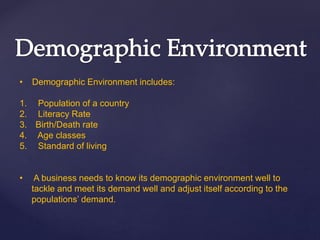
• Demographic Environment includes:
1. Population of a country
2. Literacy Rate
3. Birth/Death rate
4. Age classes
5. Standard of living
• A business needs to know its demographic environment well to
tackle and meet its demand well and adjust itself according to the
populations’ demand.
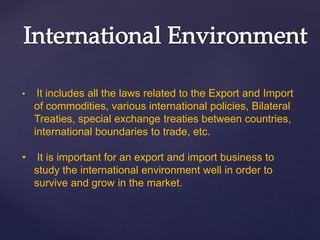
• It includes all the laws related to the Export and Import
of commodities, various international policies, Bilateral
Treaties, special exchange treaties between countries,
international boundaries to trade, etc.
• It is important for an export and import business to
study the international environment well in order to
survive and grow in the market.
1.pptx

1.pptx

  • 2.
    1. Definition –Business Environment 2. Classification of Business Environment 3. Micro Environment – Suppliers, Business Associates, Customers, Regulating Agencies, Competitors, Investors and Stakeholders, Laborers 4. Macro Environment – Economic, Political, Socio-Cultural, Natural, Technological, Demographic, International
  • 3.
    • Environment refersto all external factors which have a bearing on the functioning of the business. • It refers to those aspects of the surroundings of business enterprise and circumstances of business unit which affect or influence its activities and operations and decides its effectiveness.
  • 4.
    • According toCharles Hill and Gareth Jones, “ A company’s micro environment consists of elements that directly affect the company such as competitors, customers and suppliers.” • Thus, Micro Environment consists of all those factors which directly affect its functioning. It includes : 1. Suppliers 2. Competitors 3. Laborers 4. Business Associates 5. Customers 6. Investors and Stakeholders 7. Regulating Agencies
  • 5.
    • Suppliers arethe people who supply the inputs to the business. • Suppliers hold an important value for a business as the suppliers are responsible for helping a business meet its business demands. • A delay by suppliers would result in loss for the business and it would result in customers moving to another business.
  • 6.
    • Business Associatesare allies of the business who help the business during the time of the crisis. • A business needs to have proper allies in order to survive the times of crisis.
  • 7.
    • Customers areimportant for the business. • Thus a business is very much influenced by the customers’ taste and preference. • A business needs to take into account the taste and preference of the customers.
  • 8.
    • Competitors playan important role for a business. • A business needs to carefully analyze its competitors’ strategies in order to develop counter strategies and deal with the competition well. • A competitors strategy when carefully analyzed becomes an opportunity.
  • 9.
    • Laborers helpa business in producing goods to meet the demand. • Laborers are responsible for production of quality goods and thus are very important for the business • A business needs to manage its laborers well and keep them satisfied otherwise there would be strikes and lockouts which would effect the business negatively.
  • 10.
    • Regulating agenciesare the government agencies responsible for the implementation of the rules and laws related to businesses. • Regulating agencies ensures that a business abides by all the laws of the state.
  • 11.
    • Investors andstakeholders closely monitor each and every activity of the business. • For a business to function properly it needs Investors ,and investors carefully monitor the activities and influence its decisions since they would like to gain something out of their investments.
  • 12.
    • Macro Environmentincludes all those factors which indirectly influence the business. • It includes : 1. Economic Environment 2. Political Environment 3. Socio-Cultural Environment 4. Demographic Environment 5. Natural Environment 6. Technological Environment 7. International Environment
  • 13.
    • Economic environmentcomprises of all those economic factors that indirectly affect the business as the business has to keep in mind its economic constraints and system. • It includes: 1. Economic System ( Socialist, Capitalist or Mixed Economy) 2. Economic Condition (Inflation or Deflation) 3. Economic Growth 4. Economic Policies ( e.g.: Fiscal Policies, etc) 5. Exchange rates and interest rates
  • 14.
    • In India,,Political Environment comprises of : 1. Legislative: it is responsible for making laws 2. Executive: It implements laws 3. Judiciary: it enforces laws A business needs to know its political environment well and has to abide by all the rules and laws of the land it functions on.
  • 15.
    • It includes: 1. Social caste and class system 2. Religious beliefs 3. Linguistic Base 4. Racial diversity 5. Social evils • A business needs to be well versed with the socio-cultural environment because the socio-cultural environment decides the taste and preferences of the people and would create opportunities of threats for the business.
  • 16.
    • It isthe most dynamic environment of the business since it keeps changing rapidly. • A business needs to promote innovation and needs to change itself with the changing technology to be able to compete well with the competition and take all the advantages over the competitors.
  • 17.
    • It includes: 1.Climatic Conditions 2. Topographical Features 3. Kind of Soil 4. Weather 5. Natural resources A business needs to know its natural environment well in order to take advantage of its natural surroundings.
  • 18.
    • Demographic Environmentincludes: 1. Population of a country 2. Literacy Rate 3. Birth/Death rate 4. Age classes 5. Standard of living • A business needs to know its demographic environment well to tackle and meet its demand well and adjust itself according to the populations’ demand.
  • 19.
    • It includesall the laws related to the Export and Import of commodities, various international policies, Bilateral Treaties, special exchange treaties between countries, international boundaries to trade, etc. • It is important for an export and import business to study the international environment well in order to survive and grow in the market.