Ch 7 -3
“Thegreatest strategy is doomed if it’s
implemented badly.”
– Bernard Reimann
4.
Ch 7 -4
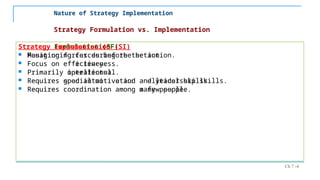
StrategyFormulation vs. Implementation
Strategy Formulation (SF)
Positioning forces before the action.
Focus on effectiveness.
Primarily intellectual.
Requires good intuitive and analytical skills.
Requires coordination among a few people.
Strategy Implementation (SI)
Managing forces during the action.
Focus on efficiency.
Primarily operational.
Requires special motivation and leadership skills.
Requires coordination among many people.
Nature of Strategy Implementation
5.
Ch 7 -5
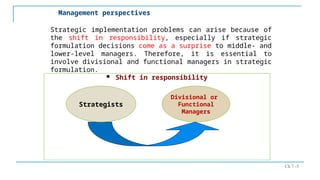
Shift in responsibility
Management perspectives
Strategic implementation problems can arise because of
the shift in responsibility, especially if strategic
formulation decisions come as a surprise to middle- and
lower-level managers. Therefore, it is essential to
involve divisional and functional managers in strategic
formulation.
Divisional or
Functional
Managers
Strategists
6.
Ch 7 -6
ManagementIssues Central to Strategy Implementation
Establish annual
objectives
Devise policies
Allocate resources
Alter existing
organizational structure
Restructure & reengineer
Revise reward &
incentive plans
Minimize resistance to
change
Match managers to strategy
Develop a strategy-
supportive culture
Adapt
production/operations
processes
Develop an effective human
resources function
Downsize & furlough as
needed
Link performance & pay to
strategies
Ch 7 -8
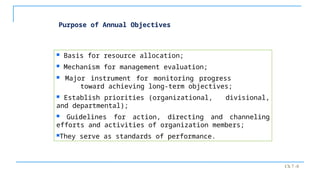
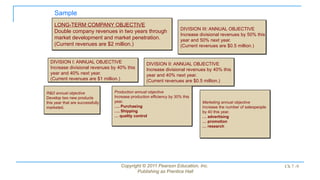
Purposeof Annual Objectives
Basis for resource allocation;
Mechanism for management evaluation;
Major instrument for monitoring progress
toward achieving long-term objectives;
Establish priorities (organizational, divisional,
and departmental);
Guidelines for action, directing and channeling
efforts and activities of organization members;
They serve as standards of performance.
Ch 7 -13
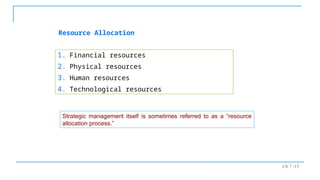
ResourceAllocation
1. Financial resources
2. Physical resources
3. Human resources
4. Technological resources
Strategic management itself is sometimes referred to as a “resource
allocation process.”
14.
Ch 7 -14
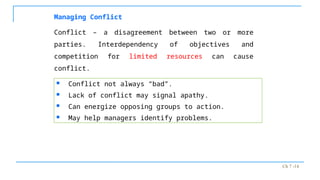
ManagingConflict
Conflict – a disagreement between two or more
parties. Interdependency of objectives and
competition for limited resources can cause
conflict.
Conflict not always “bad”.
Lack of conflict may signal apathy.
Can energize opposing groups to action.
May help managers identify problems.
15.
Ch 7 -15
MATCHINGSTRUCTURE WITH STRATEGY
Changes in strategy often require changes in the way an
organization is structured because: (1) structure largely
dictates how objectives and policies will be established (e.g.,
objectives and policies established under a geographic
organizational structure are couched in geographic terms) and
(2) structure dictates how resources will be allocated (e.g., if an
organization’s structure is based on customer groups, then
resources will be allocated in that manner).
Structure should be designed to facilitate the strategic pursuit
of a firm and, therefore, follow strategy.
When a firm changes its strategy, the existing organizational
structure may become ineffective. For example, new strategies
to reduce payroll costs may require a change in span of control.
16.
Ch 7 -16
BasicForms of Structure
Functional Structure (centralized)
Divisional Structure (decentralized)
Strategic Business Unit Structure (SBU)
Matrix Structure
17.
Ch 7 -17
Restructuring
Restructuring - reducing the size of an
organization. Also called:
Downsizing
Rightsizing
Delayering
These methods involve, respectively, reducing the
number of employees, number of divisions, and
number of hierarchical levels in a firm’s
organizational structure. Reducing the size of an
organization is intended to improve its efficiency
and effectiveness.
18.
Ch 7 -18
Creatinga Strategy-Supportive Culture
1. Formal statements of organizational philosophy
2. Design of physical spaces
3. Deliberate role modeling, teaching, and coaching
4. Explicit reward and status system
5. Stories, legends, myths, and parables
19.
Ch 7 -19
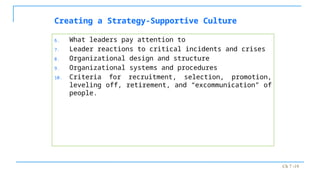
Creatinga Strategy-Supportive Culture
6. What leaders pay attention to
7. Leader reactions to critical incidents and crises
8. Organizational design and structure
9. Organizational systems and procedures
10. Criteria for recruitment, selection, promotion,
leveling off, retirement, and “excommunication” of
people.
20.
Ch 7 -20
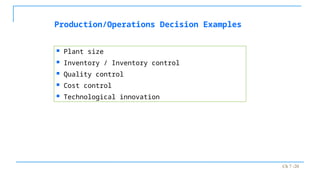
Production/OperationsDecision Examples
Plant size
Inventory / Inventory control
Quality control
Cost control
Technological innovation
Ch 8 -24
The best formulated and best implemented
strategies become obsolete as a firm’s
external and internal environments change.
Therefore, it is essential for strategists
to systematically review, evaluate, and
control the execution of strategies.
Strategy Review, Evaluation, and Control
25.
Ch 8 -25
StrategyReview, Evaluation, and Control
Strategy Evaluation
Strategy Evaluation is vital to an organization’s well
being.
Timely evaluations can alert management to potential or
actual problems before a situation becomes critical.
Strategy Evaluation includes three basic activities:
(1) Examining the underlying bases of a firm’s
strategy.
(2) Comparing expected results to actual results.
(3) Taking corrective actions to ensure that
performance conforms to plans.
26.
Ch 8 -26
StrategyReview, Evaluation, and Control
Adequate and timely feedback is the cornerstone of effective
Strategy Evaluation.
Strategy Evaluation is important because organizations face
dynamic environments in which key external and internal factors
can change quickly and dramatically.
Strategy Evaluation is essential to ensure that the stated
objectives of an organization are being achieved.
27.
Ch 8 -27
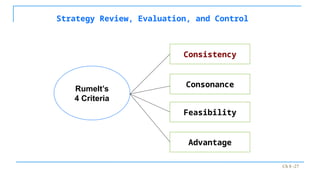
StrategyReview, Evaluation, and Control
Consonance
Consistency
Feasibility
Advantage
Rumelt’s
4 Criteria
28.
Ch 8-28
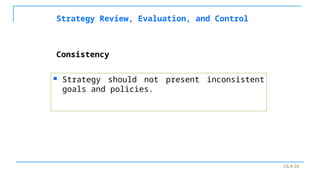
Strategy Review,Evaluation, and Control
Strategy should not present inconsistent
goals and policies.
Consistency
29.
Ch 8-29
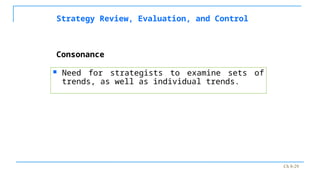
Strategy Review,Evaluation, and Control
Need for strategists to examine sets of
trends, as well as individual trends.
Consonance
30.
Ch 8 -30
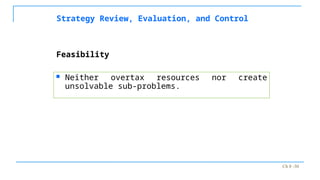
StrategyReview, Evaluation, and Control
Neither overtax resources nor create
unsolvable sub-problems.
Feasibility
31.
Ch 8 -31
StrategyReview, Evaluation, and Control
Creation or maintenance of competitive
advantage.
Advantage
32.
Ch 8 -32
StrategyReview, Evaluation, and Control
Initiate managerial questioning of expectations and
assumptions.
Trigger a review of objectives & values.
Stimulate creativity in generating alternative
strategies and formulating criteria for evaluation.
Be performed on a continuing basis, rather than at
the end of specified periods of time or just after
problems occur.
Strategy Evaluation Should –
33.
Ch 8 -33
StrategyReview, Evaluation, and Control
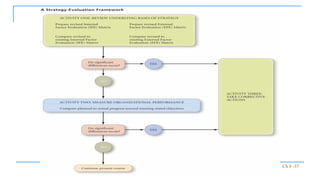
Develop revised IFE Matrix
Develop revised EFE Matrix
Review of Underlying Bases of Strategy –
34.
Ch 8 -34
StrategyReview, Evaluation, and Control
Are our strengths still strengths?
Has our organization added additional
strengths?
Are our weaknesses still weaknesses?
Has our organization developed other
weaknesses?
Monitor Strengths & Weaknesses; Opportunities
& Threats
35.
Ch 8 -35
StrategyReview, Evaluation, and Control
Are our opportunities still
opportunities?
Have other opportunities developed?
Are our threats still threats?
Have other threats emerged?
Monitor Strengths & Weaknesses; Opportunities
& Threats
36.
Ch 8 -36
StrategyEvaluation Framework
Note that corrective actions are needed
except when (1) external and internal
factors have not changed significantly and
(2) the firm is making satisfactory
progress toward achieving its objectives.
Ch 8 -38
StrategyReview, Evaluation, and Control
Compare expected to actual results.
Investigate deviations from plan.
Evaluate individual performance.
Examine progress toward stated
objectives.
Measuring Organizational Performance
39.
Ch 8 -39
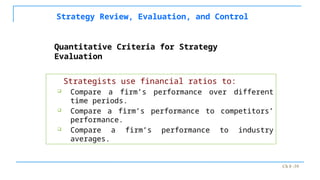
StrategyReview, Evaluation, and Control
Strategists use financial ratios to:
Compare a firm’s performance over different
time periods.
Compare a firm’s performance to competitors’
performance.
Compare a firm’s performance to industry
averages.
Quantitative Criteria for Strategy
Evaluation
40.
Ch 8 -40
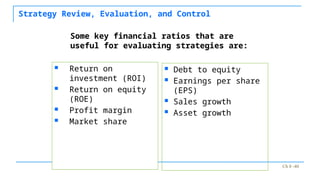
StrategyReview, Evaluation, and Control
Return on
investment (ROI)
Return on equity
(ROE)
Profit margin
Market share
Debt to equity
Earnings per share
(EPS)
Sales growth
Asset growth
Some key financial ratios that are
useful for evaluating strategies are:
41.
Ch 8 -41
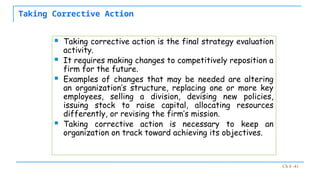
TakingCorrective Action
Taking corrective action is the final strategy evaluation
activity.
It requires making changes to competitively reposition a
firm for the future.
Examples of changes that may be needed are altering
an organization’s structure, replacing one or more key
employees, selling a division, devising new policies,
issuing stock to raise capital, allocating resources
differently, or revising the firm’s mission.
Taking corrective action is necessary to keep an
organization on track toward achieving its objectives.
42.
Ch 8 -42
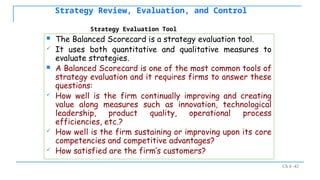
StrategyReview, Evaluation, and Control
The Balanced Scorecard is a strategy evaluation tool.
It uses both quantitative and qualitative measures to
evaluate strategies.
A Balanced Scorecard is one of the most common tools of
strategy evaluation and it requires firms to answer these
questions:
How well is the firm continually improving and creating
value along measures such as innovation, technological
leadership, product quality, operational process
efficiencies, etc.?
How well is the firm sustaining or improving upon its core
competencies and competitive advantages?
How satisfied are the firm’s customers?
Strategy Evaluation Tool
43.
Ch 8 -43
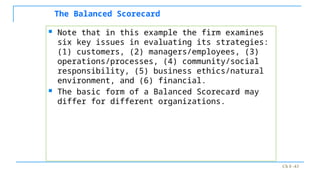
TheBalanced Scorecard
Note that in this example the firm examines
six key issues in evaluating its strategies:
(1) customers, (2) managers/employees, (3)
operations/processes, (4) community/social
responsibility, (5) business ethics/natural
environment, and (6) financial.
The basic form of a Balanced Scorecard may
differ for different organizations.