©2017 MDA Leadership Consulting											1
An excerpt from Awaken, Align, Accelerate: A Guide to Great Leadership, Chapter 3,“Develop Yourself.”
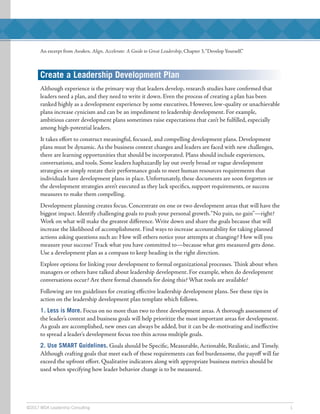
Create a Leadership Development Plan
Although experience is the primary way that leaders develop, research studies have confirmed that
leaders need a plan, and they need to write it down. Even the process of creating a plan has been
ranked highly as a development experience by some executives. However, low-quality or unachievable
plans increase cynicism and can be an impediment to leadership development. For example,
ambitious career development plans sometimes raise expectations that can’t be fulfilled, especially
among high-potential leaders.
It takes effort to construct meaningful, focused, and compelling development plans. Devel­
opment
plans must be dynamic. As the business context changes and leaders are faced with new challenges,
there are learning opportunities that should be incorporated. Plans should include experiences,
conversations, and tools. Some leaders haphazardly lay out overly broad or vague development
strategies or simply restate their performance goals to meet human resources requirements that
individuals have development plans in place. Unfortunately, these documents are soon forgotten or
the development strategies aren’t executed as they lack specifics, support requirements, or success
measures to make them compelling.
Development planning creates focus. Concentrate on one or two development areas that will have the
biggest impact. Identify challenging goals to push your personal growth.“No pain, no gain”—right?
Work on what will make the greatest difference. Write down and share the goals because that will
increase the likelihood of accomplishment. Find ways to increase accountability for taking planned
actions asking questions such as: How will others notice your attempts at changing? How will you
measure your success? Track what you have committed to—because what gets measured gets done.
Use a development plan as a compass to keep heading in the right direction.
Explore options for linking your development to formal organizational processes. Think about when
managers or others have talked about leadership development. For example, when do development
conversations occur? Are there formal channels for doing this? What tools are available?
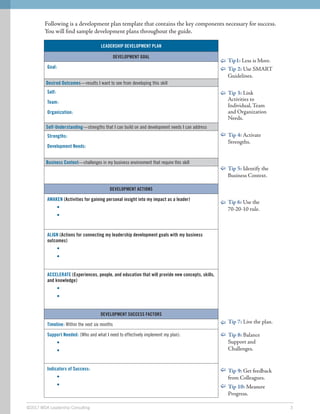
Following are ten guidelines for creating effective leadership development plans. See these tips in
action on the leadership development plan template which follows.
1. Less is More. Focus on no more than two to three development areas. A thorough assessment of
the leader’s context and business goals will help prioritize the most important areas for development.
As goals are accomplished, new ones can always be added, but it can be de-motivating and ineffective
to spread a leader’s development focus too thin across multiple goals.
2. Use SMART Guidelines. Goals should be Specific, Measurable, Actionable, Realistic, and Timely.
Although crafting goals that meet each of these requirements can feel burdensome, the payoff will far
exceed the upfront effort. Qualitative indicators along with appropriate business metrics should be
used when specifying how leader behavior change is to be measured.
©2017 MDA Leadership Consulting											2
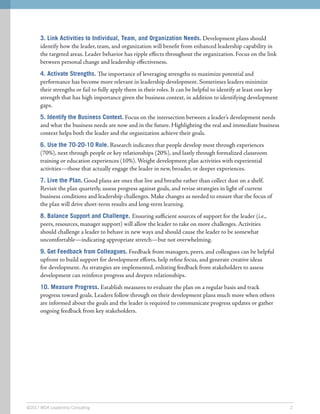
3. Link Activities to Individual, Team, and Organization Needs. Development plans should
identify how the leader, team, and organization will benefit from enhanced leadership capability in
the targeted areas. Leader behavior has ripple effects throughout the organization. Focus on the link
between personal change and leadership effectiveness.
4. Activate Strengths. The importance of leveraging strengths to maximize potential and
performance has become more relevant in leadership development. Sometimes leaders minimize
their strengths or fail to fully apply them in their roles. It can be helpful to identify at least one key
strength that has high importance given the business context, in addition to identifying development
gaps.
5. Identify the Business Context. Focus on the intersection between a leader’s development needs
and what the business needs are now and in the future. Highlighting the real and immediate business
context helps both the leader and the organization achieve their goals.
6. Use the 70-20-10 Rule. Research indicates that people develop most through experiences
(70%), next through people or key relationships (20%), and lastly through formalized classroom
training or education experiences (10%). Weight development plan activities with experiential
activities—those that actually engage the leader in new, broader, or deeper experiences.
7. Live the Plan. Good plans are ones that live and breathe rather than collect dust on a shelf.
Revisit the plan quarterly, assess progress against goals, and revise strategies in light of current
business conditions and leadership challenges. Make changes as needed to ensure that the focus of
the plan will drive short-term results and long-term learning.
8. Balance Support and Challenge. Ensuring sufficient sources of support for the leader (i.e.,
peers, resources, manager support) will allow the leader to take on more challenges. Activities
should challenge a leader to behave in new ways and should cause the leader to be somewhat
uncomfortable—indicating appropriate stretch—but not overwhelming.
9. Get Feedback from Colleagues. Feedback from managers, peers, and colleagues can be helpful
upfront to build support for development efforts, help refine focus, and generate creative ideas
for development. As strategies are implemented, enlisting feedback from stakeholders to assess
development can reinforce progress and deepen relationships.
10. Measure Progress. Establish measures to evaluate the plan on a regular basis and track
progress toward goals. Leaders follow through on their development plans much more when others
are informed about the goals and the leader is required to communicate progress updates or gather
ongoing feedback from key stakeholders.
©2017 MDA Leadership Consulting											3
LEADERSHIP DEVELOPMENT PLAN
Timeline:Within the next six months
Support Needed:(Who and what I need to effectively implement my plan):
•
•
•
•
Indicators of Success:
•
•
•
•
LEADERSHIP DEVELOPMENT PLAN
DEVELOPMENT GOAL
Goal:
Desired Outcomes

—results I want to see from developing this skill
Self:
Team:
Organization:
Self-Understanding
—strengths that I can build on and development needs I can address
Strengths:
Development Needs:
Business Context
—challenges in my business environment that require this skill
DEVELOPMENT ACTIONS
AWAKEN (Activities for gaining personal insight into my impact as a leader)
•
•
•
•
ALIGN 
(Actions for connecting my leadership development goals with my business
outcomes)
•
•
•
•
ACCELERATE 
(Experiences, people, and education that will provide new concepts, skills,
and knowledge)
•
•
•
•
DEVELOPMENT SUCCESS FACTORS
Tip1: Less is More.
Tip 2: Use SMART
Guidelines.
Tip 3: Link
Activities to
Individual, Team
and Organization
Needs.
Tip 4: Activate
Strengths.
Tip 5: Identify the
Business Context.
Tip 6: Use the
70-20-10 rule.
Tip 7: Live the plan.
Tip 8: Balance
Support and
Challenges.
Tip 9: Get feedback
from Colleagues.
Tip 10: Measure
Progress.
Z
Z
Z
Z
Z
Z
Z
Z
Z
Z
Following is a development plan template that contains the key components necessary for success.
You will find sample development plans throughout the guide.
©2017 MDA Leadership Consulting 4
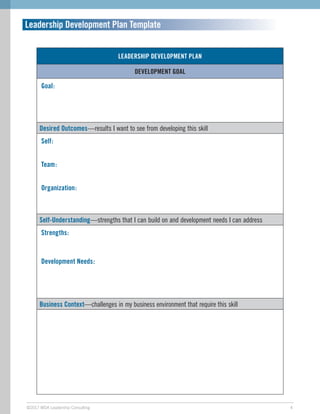
Leadership Development Plan Template
LEADERSHIP DEVELOPMENT PLAN
DEVELOPMENT GOAL
Goal:
Desired Outcomes

—results I want to see from developing this skill
Self:
Team:
Organization:
Self-Understanding
—strengths that I can build on and development needs I can address
Strengths:
Development Needs:
Business Context
—challenges in my business environment that require this skill
©2017 MDA Leadership Consulting											5
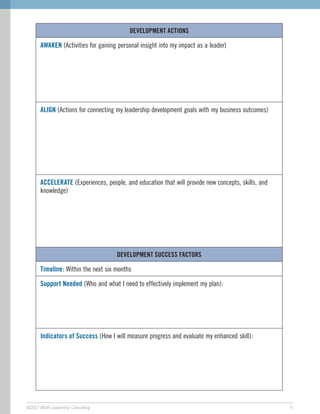
DEVELOPMENT ACTIONS
AWAKEN (Activities for gaining personal insight into my impact as a leader)
ALIGN 
(Actions for connecting my leadership development goals with my business outcomes)
ACCELERATE 
(Experiences, people, and education that will provide new concepts, skills, and
knowledge)
DEVELOPMENT SUCCESS FACTORS
Timeline:Within the next six months
Support Needed(Who and what I need to effectively implement my plan):
Indicators of Success (How I will measure progress and evaluate my enhanced skill):

1-Create-a-Leadership-Development-Plan.pdf

  • 1.
    ©2017 MDA LeadershipConsulting 1 An excerpt from Awaken, Align, Accelerate: A Guide to Great Leadership, Chapter 3,“Develop Yourself.” Create a Leadership Development Plan Although experience is the primary way that leaders develop, research studies have confirmed that leaders need a plan, and they need to write it down. Even the process of creating a plan has been ranked highly as a development experience by some executives. However, low-quality or unachievable plans increase cynicism and can be an impediment to leadership development. For example, ambitious career development plans sometimes raise expectations that can’t be fulfilled, especially among high-potential leaders. It takes effort to construct meaningful, focused, and compelling development plans. Devel­ opment plans must be dynamic. As the business context changes and leaders are faced with new challenges, there are learning opportunities that should be incorporated. Plans should include experiences, conversations, and tools. Some leaders haphazardly lay out overly broad or vague development strategies or simply restate their performance goals to meet human resources requirements that individuals have development plans in place. Unfortunately, these documents are soon forgotten or the development strategies aren’t executed as they lack specifics, support requirements, or success measures to make them compelling. Development planning creates focus. Concentrate on one or two development areas that will have the biggest impact. Identify challenging goals to push your personal growth.“No pain, no gain”—right? Work on what will make the greatest difference. Write down and share the goals because that will increase the likelihood of accomplishment. Find ways to increase accountability for taking planned actions asking questions such as: How will others notice your attempts at changing? How will you measure your success? Track what you have committed to—because what gets measured gets done. Use a development plan as a compass to keep heading in the right direction. Explore options for linking your development to formal organizational processes. Think about when managers or others have talked about leadership development. For example, when do development conversations occur? Are there formal channels for doing this? What tools are available? Following are ten guidelines for creating effective leadership development plans. See these tips in action on the leadership development plan template which follows. 1. Less is More. Focus on no more than two to three development areas. A thorough assessment of the leader’s context and business goals will help prioritize the most important areas for development. As goals are accomplished, new ones can always be added, but it can be de-motivating and ineffective to spread a leader’s development focus too thin across multiple goals. 2. Use SMART Guidelines. Goals should be Specific, Measurable, Actionable, Realistic, and Timely. Although crafting goals that meet each of these requirements can feel burdensome, the payoff will far exceed the upfront effort. Qualitative indicators along with appropriate business metrics should be used when specifying how leader behavior change is to be measured.
  • 2.
    ©2017 MDA LeadershipConsulting 2 3. Link Activities to Individual, Team, and Organization Needs. Development plans should identify how the leader, team, and organization will benefit from enhanced leadership capability in the targeted areas. Leader behavior has ripple effects throughout the organization. Focus on the link between personal change and leadership effectiveness. 4. Activate Strengths. The importance of leveraging strengths to maximize potential and performance has become more relevant in leadership development. Sometimes leaders minimize their strengths or fail to fully apply them in their roles. It can be helpful to identify at least one key strength that has high importance given the business context, in addition to identifying development gaps. 5. Identify the Business Context. Focus on the intersection between a leader’s development needs and what the business needs are now and in the future. Highlighting the real and immediate business context helps both the leader and the organization achieve their goals. 6. Use the 70-20-10 Rule. Research indicates that people develop most through experiences (70%), next through people or key relationships (20%), and lastly through formalized classroom training or education experiences (10%). Weight development plan activities with experiential activities—those that actually engage the leader in new, broader, or deeper experiences. 7. Live the Plan. Good plans are ones that live and breathe rather than collect dust on a shelf. Revisit the plan quarterly, assess progress against goals, and revise strategies in light of current business conditions and leadership challenges. Make changes as needed to ensure that the focus of the plan will drive short-term results and long-term learning. 8. Balance Support and Challenge. Ensuring sufficient sources of support for the leader (i.e., peers, resources, manager support) will allow the leader to take on more challenges. Activities should challenge a leader to behave in new ways and should cause the leader to be somewhat uncomfortable—indicating appropriate stretch—but not overwhelming. 9. Get Feedback from Colleagues. Feedback from managers, peers, and colleagues can be helpful upfront to build support for development efforts, help refine focus, and generate creative ideas for development. As strategies are implemented, enlisting feedback from stakeholders to assess development can reinforce progress and deepen relationships. 10. Measure Progress. Establish measures to evaluate the plan on a regular basis and track progress toward goals. Leaders follow through on their development plans much more when others are informed about the goals and the leader is required to communicate progress updates or gather ongoing feedback from key stakeholders.
  • 3.
    ©2017 MDA LeadershipConsulting 3 LEADERSHIP DEVELOPMENT PLAN Timeline:Within the next six months Support Needed:(Who and what I need to effectively implement my plan): • • • • Indicators of Success: • • • • LEADERSHIP DEVELOPMENT PLAN DEVELOPMENT GOAL Goal: Desired Outcomes —results I want to see from developing this skill Self: Team: Organization: Self-Understanding —strengths that I can build on and development needs I can address Strengths: Development Needs: Business Context —challenges in my business environment that require this skill DEVELOPMENT ACTIONS AWAKEN (Activities for gaining personal insight into my impact as a leader) • • • • ALIGN (Actions for connecting my leadership development goals with my business outcomes) • • • • ACCELERATE (Experiences, people, and education that will provide new concepts, skills, and knowledge) • • • • DEVELOPMENT SUCCESS FACTORS Tip1: Less is More. Tip 2: Use SMART Guidelines. Tip 3: Link Activities to Individual, Team and Organization Needs. Tip 4: Activate Strengths. Tip 5: Identify the Business Context. Tip 6: Use the 70-20-10 rule. Tip 7: Live the plan. Tip 8: Balance Support and Challenges. Tip 9: Get feedback from Colleagues. Tip 10: Measure Progress. Z Z Z Z Z Z Z Z Z Z Following is a development plan template that contains the key components necessary for success. You will find sample development plans throughout the guide.
  • 4.
    ©2017 MDA LeadershipConsulting 4 Leadership Development Plan Template LEADERSHIP DEVELOPMENT PLAN DEVELOPMENT GOAL Goal: Desired Outcomes —results I want to see from developing this skill Self: Team: Organization: Self-Understanding —strengths that I can build on and development needs I can address Strengths: Development Needs: Business Context —challenges in my business environment that require this skill
  • 5.
    ©2017 MDA LeadershipConsulting 5 DEVELOPMENT ACTIONS AWAKEN (Activities for gaining personal insight into my impact as a leader) ALIGN (Actions for connecting my leadership development goals with my business outcomes) ACCELERATE (Experiences, people, and education that will provide new concepts, skills, and knowledge) DEVELOPMENT SUCCESS FACTORS Timeline:Within the next six months Support Needed(Who and what I need to effectively implement my plan): Indicators of Success (How I will measure progress and evaluate my enhanced skill):