1
—Balance sheet computations.
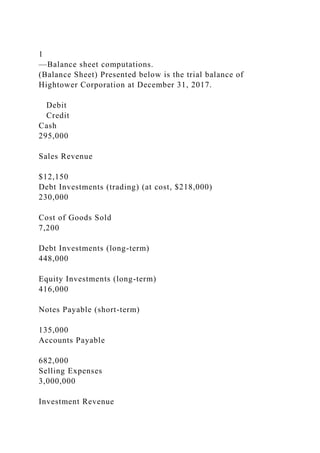
(Balance Sheet) Presented below is the trial balance of
Hightower Corporation at December 31, 2017.
Debit
Credit
Cash
295,000
Sales Revenue
$12,150
Debt Investments (trading) (at cost, $218,000)
230,000
Cost of Goods Sold
7,200
Debt Investments (long-term)
448,000
Equity Investments (long-term)
416,000
Notes Payable (short-term)
135,000
Accounts Payable
682,000
Selling Expenses
3,000,000
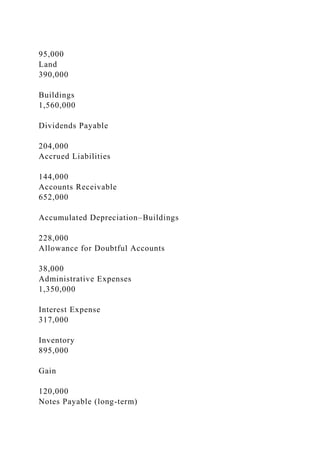
Investment Revenue
95,000
Land
390,000
Buildings
1,560,000
Dividends Payable
204,000
Accrued Liabilities
144,000
Accounts Receivable
652,000
Accumulated Depreciation–Buildings
228,000
Allowance for Doubtful Accounts
38,000
Administrative Expenses
1,350,000
Interest Expense
317,000
Inventory
895,000
Gain
120,000
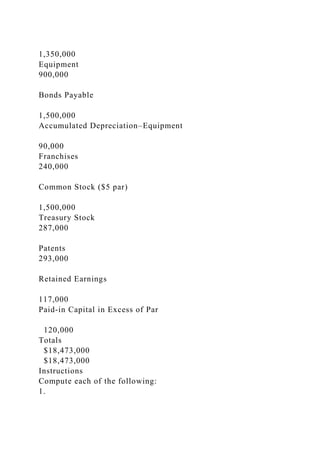
Notes Payable (long-term)
1,350,000
Equipment
900,000
Bonds Payable
1,500,000
Accumulated Depreciation–Equipment
90,000
Franchises
240,000
Common Stock ($5 par)
1,500,000
Treasury Stock
287,000
Patents
293,000
Retained Earnings
117,000
Paid-in Capital in Excess of Par
120,000
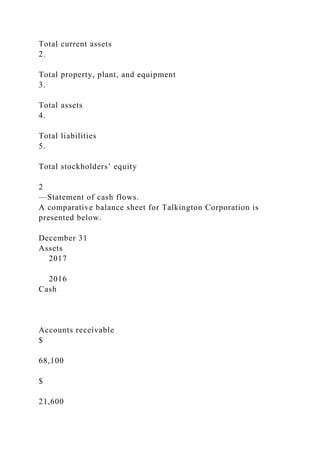
Totals
$18,473,000
$18,473,000
Instructions
Compute each of the following:
1.
Total current assets
2.
Total property, plant, and equipment
3.
Total assets
4.
Total liabilities
5.
Total stockholders’ equity
2
—Statement of cash flows.
A comparative balance sheet for Talkington Corporation is
presented below.
December 31
Assets
2017
2016
Cash
Accounts receivable
$
68,100
$
21,600
Inventory
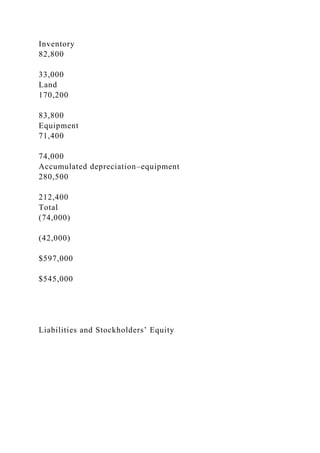
82,800
33,000
Land
170,200
83,800
Equipment
71,400
74,000
Accumulated depreciation–equipment
280,500
212,400
Total
(74,000)
(42,000)
$597,000
$545,000
Liabilities and Stockholders’ Equity
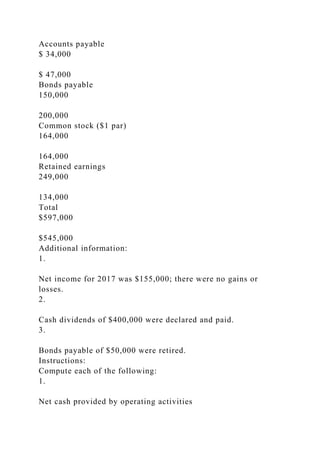
Accounts payable
$ 34,000
$ 47,000
Bonds payable
150,000
200,000
Common stock ($1 par)
164,000
164,000
Retained earnings
249,000
134,000
Total
$597,000
$545,000
Additional information:
1.
Net income for 2017 was $155,000; there were no gains or
losses.
2.
Cash dividends of $400,000 were declared and paid.
3.
Bonds payable of $50,000 were retired.
Instructions:
Compute each of the following:
1.
Net cash provided by operating activities
2.
Net cash provided (used) by investing activities
3.
Net cash provided (used) by financing activities
3
—Statement of cash flows ratios.
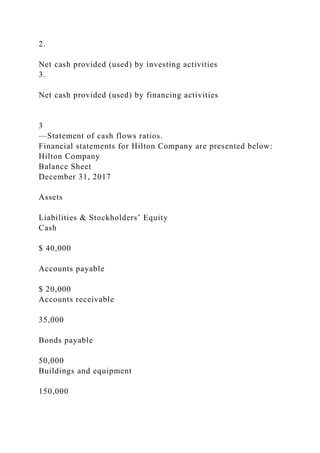
Financial statements for Hilton Company are presented below:
Hilton Company
Balance Sheet
December 31, 2017
Assets
Liabilities & Stockholders’ Equity
Cash
$ 40,000
Accounts payable
$ 20,000
Accounts receivable
35,000
Bonds payable
50,000
Buildings and equipment
150,000
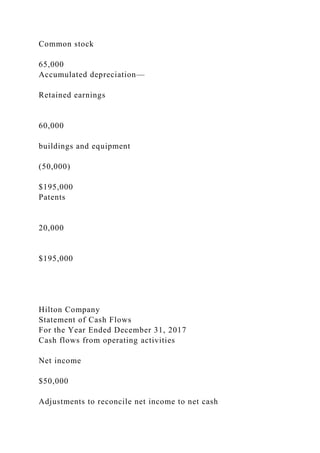
Common stock
65,000
Accumulated depreciation—
Retained earnings
60,000
buildings and equipment
(50,000)
$195,000
Patents
20,000
$195,000
Hilton Company
Statement of Cash Flows
For the Year Ended December 31, 2017
Cash flows from operating activities
Net income
$50,000
Adjustments to reconcile net income to net cash
provided by operating activities:
Increase in accounts receivable
$(16,000)
Increase in accounts payable
8,000
Depreciation—buildings and equipment
15,000
Gain on sale of equipment
(6,000)
Amortization of patents
2,000
3,000
Net cash provided by operating activities
53,000
Cash flows from investing activities
Sale of equipment
12,000
Purchase of land
(25,000)
Purchase of buildings and equipment
(48,000
)
Net cash used by investing activities
(61,000)
Cash flows from financing activities
Payment of cash dividend
(15,000)
Sale of bonds
30,000
Net cash provided by financing activities
15,000
Net increase in cash
7,000
Cash, January 1, 2017
33,000
Cash, December 31, 2017
$40,000
At the beginning of 2017, Accounts Payable amounted to
$12,000 and Bonds Payable was $20,000.
Instructions
Calculate the following for Hilton Company:
a.
Current cash debt coverage
b.
Cash debt coverage
c.
Free cash flow
d.
Explain the purpose of free cash flow analysis.
4
—Sales with returns and discounts.
On July 2, 2018, Lake Company sold to Sue Black merchandise
having a sales price of $9,000 (cost $5,400) with terms of 2/10.
n/30. f.o.b. shipping point. Lake estimates that merchandise
with a sales value of $900 will be returned. An invoice totaling
$120, terms n/30, was received by Black on July 6 from Pacific
Delivery Service for the freight cost. Upon receipt of the goods,
on July 3, Black notified Lake that $350 of merchandise
contained flaws. The same day, Lake issued a credit memo
covering the defective merchandise and asked that it be returned
at Lake’s expense. Lake estimates the returned items to have a
fair value of $140. The freight on the returned merchandise was
$20 paid by Lake on July 7. On July 12, the company received a
check for the balance due from Black.
Instructions
(a)Prepare journal entries for Lake Company to record all the
events noted above assuming sales and receivables are entered
at gross selling price.
(b)
Prepare the journal entry assuming that Sue Black did not remit
payment until August 5.
5
—Warranty arrangement.
On December 31, 2017, Dieker Company sells equipment to
Tabor Inc. for $125,000. Dieker includes a 1-year assurance
warranty service with the sale of all its equipment. The
customer receives and pays for the equipment on December 31,
2017. Dieker estimates the prices to be $122,000 for the
equipment and $3,000 for the cost of the warranty.
Instructions
(a)
Prepare the journal entry to record this transaction on December
31, 2017.
(b)
Repeat the requirements for (a), assuming that in addition to the
assurance warranty, Dieker sold an extended warranty (service
type warranty) for an additional 2 years (2019–2020) for
$2,000.
6
—Percentage-of-completion and completed-contract methods.
On February 1, 2017, Marsh Contractors agreed to construct a
building at a contract price of $17,400,000. Marsh estimated
total construction costs would be $12,000,000 and the project
would be finished in 2019. Information relating to the costs and
billings for this contract is as follows:
2017
2018
2019
Total costs incurred to date
$4,500,000
$7,920,000
$13,800,000
Estimated costs to complete
7,500,000
5,280,000
-0-
Customer billings to date
6,600,000
12,000,000
16,800,000
Collections to date
6,000,000
10,500,000
16,500,000
Instructions
Fill in the correct amounts on the following schedule. For
percentage-of-completion accounting and for completed-
contract accounting, show the gross profit that should be
recorded for 2017, 2018, and 2019.
Percentage-of-Completion
Completed-Contract
Gross Profit
Gross Profit
2017
_________
2017
_________
2018
_________
2018
_________
2019
_________
2019
_________
7
—Franchises.
Pasta Inn charges an initial fee of $2,400,000 for a franchise,
with $480,000 paid when the agreement is signed and the
balance in four annual payments. The present value of the
annual payments, discounted at 10%, is $1,521,000. The
franchisee has the right to purchase $90,000 of kitchen
equipment and supplies for $75,000. An additional part of the
initial fee is for advertising to be provided by Pasta Inn during
the next five years. The value of the advertising is $1,000 a
month. Collectibility of the payments is reasonably assured and
Pasta Inn has performed all the initial services required by the
contract.
Instructions
Prepare the entry to record the initial franchise fee. Show
supporting computations in good form.
8
—Future value of annuity.
(Tables needed.)
Linda Ogleby wants to accumulate $40,000 to use for an around
the world trip. She plans to accumulate the desired amount by
depositing $5,500 annual-year-end payments into an account at
the National Bank which pays 4% interest, compounded
annually.
1.
Compute the account balance at the end of the sixth year.
2.
Compute the amount of each payment that Linda must make at
the end of each of the six years to accumulate the $40,000.
9-
—Entries for bad debt expense.
A trial balance before adjustment included the following:
Debit
Credit
Accounts receivable
$140,000
Allowance for doubtful accounts
730
Sales
$610,000
Sales returns and allowances
8,000
Give journal entries assuming that the estimate of uncollectible
accounts is determined by taking (1) 5% of gross accounts
receivable and (2) 3% of gross accounts receivable and assume
a $730 debit allowance account balance.

1—Balance sheet computations.(Balance Sheet) Presented below is .docx

  • 1.
    1 —Balance sheet computations. (BalanceSheet) Presented below is the trial balance of Hightower Corporation at December 31, 2017. Debit Credit Cash 295,000 Sales Revenue $12,150 Debt Investments (trading) (at cost, $218,000) 230,000 Cost of Goods Sold 7,200 Debt Investments (long-term) 448,000 Equity Investments (long-term) 416,000 Notes Payable (short-term) 135,000 Accounts Payable 682,000 Selling Expenses 3,000,000 Investment Revenue
  • 2.
    95,000 Land 390,000 Buildings 1,560,000 Dividends Payable 204,000 Accrued Liabilities 144,000 AccountsReceivable 652,000 Accumulated Depreciation–Buildings 228,000 Allowance for Doubtful Accounts 38,000 Administrative Expenses 1,350,000 Interest Expense 317,000 Inventory 895,000 Gain 120,000 Notes Payable (long-term)
  • 3.
    1,350,000 Equipment 900,000 Bonds Payable 1,500,000 Accumulated Depreciation–Equipment 90,000 Franchises 240,000 CommonStock ($5 par) 1,500,000 Treasury Stock 287,000 Patents 293,000 Retained Earnings 117,000 Paid-in Capital in Excess of Par 120,000 Totals $18,473,000 $18,473,000 Instructions Compute each of the following: 1.
  • 4.
    Total current assets 2. Totalproperty, plant, and equipment 3. Total assets 4. Total liabilities 5. Total stockholders’ equity 2 —Statement of cash flows. A comparative balance sheet for Talkington Corporation is presented below. December 31 Assets 2017 2016 Cash Accounts receivable $ 68,100 $ 21,600
  • 5.
  • 6.
    Accounts payable $ 34,000 $47,000 Bonds payable 150,000 200,000 Common stock ($1 par) 164,000 164,000 Retained earnings 249,000 134,000 Total $597,000 $545,000 Additional information: 1. Net income for 2017 was $155,000; there were no gains or losses. 2. Cash dividends of $400,000 were declared and paid. 3. Bonds payable of $50,000 were retired. Instructions: Compute each of the following: 1. Net cash provided by operating activities
  • 7.
    2. Net cash provided(used) by investing activities 3. Net cash provided (used) by financing activities 3 —Statement of cash flows ratios. Financial statements for Hilton Company are presented below: Hilton Company Balance Sheet December 31, 2017 Assets Liabilities & Stockholders’ Equity Cash $ 40,000 Accounts payable $ 20,000 Accounts receivable 35,000 Bonds payable 50,000 Buildings and equipment 150,000
  • 8.
    Common stock 65,000 Accumulated depreciation— Retainedearnings 60,000 buildings and equipment (50,000) $195,000 Patents 20,000 $195,000 Hilton Company Statement of Cash Flows For the Year Ended December 31, 2017 Cash flows from operating activities Net income $50,000 Adjustments to reconcile net income to net cash
  • 9.
    provided by operatingactivities: Increase in accounts receivable $(16,000) Increase in accounts payable 8,000 Depreciation—buildings and equipment 15,000 Gain on sale of equipment (6,000) Amortization of patents 2,000 3,000 Net cash provided by operating activities 53,000 Cash flows from investing activities Sale of equipment 12,000 Purchase of land
  • 10.
    (25,000) Purchase of buildingsand equipment (48,000 ) Net cash used by investing activities (61,000) Cash flows from financing activities Payment of cash dividend (15,000) Sale of bonds 30,000 Net cash provided by financing activities 15,000 Net increase in cash 7,000 Cash, January 1, 2017 33,000 Cash, December 31, 2017 $40,000 At the beginning of 2017, Accounts Payable amounted to
  • 11.
    $12,000 and BondsPayable was $20,000. Instructions Calculate the following for Hilton Company: a. Current cash debt coverage b. Cash debt coverage c. Free cash flow d. Explain the purpose of free cash flow analysis. 4 —Sales with returns and discounts. On July 2, 2018, Lake Company sold to Sue Black merchandise having a sales price of $9,000 (cost $5,400) with terms of 2/10. n/30. f.o.b. shipping point. Lake estimates that merchandise with a sales value of $900 will be returned. An invoice totaling $120, terms n/30, was received by Black on July 6 from Pacific Delivery Service for the freight cost. Upon receipt of the goods, on July 3, Black notified Lake that $350 of merchandise contained flaws. The same day, Lake issued a credit memo covering the defective merchandise and asked that it be returned at Lake’s expense. Lake estimates the returned items to have a fair value of $140. The freight on the returned merchandise was $20 paid by Lake on July 7. On July 12, the company received a check for the balance due from Black. Instructions (a)Prepare journal entries for Lake Company to record all the events noted above assuming sales and receivables are entered
  • 12.
    at gross sellingprice. (b) Prepare the journal entry assuming that Sue Black did not remit payment until August 5. 5 —Warranty arrangement. On December 31, 2017, Dieker Company sells equipment to Tabor Inc. for $125,000. Dieker includes a 1-year assurance warranty service with the sale of all its equipment. The customer receives and pays for the equipment on December 31, 2017. Dieker estimates the prices to be $122,000 for the equipment and $3,000 for the cost of the warranty. Instructions (a) Prepare the journal entry to record this transaction on December 31, 2017. (b) Repeat the requirements for (a), assuming that in addition to the assurance warranty, Dieker sold an extended warranty (service type warranty) for an additional 2 years (2019–2020) for $2,000. 6 —Percentage-of-completion and completed-contract methods. On February 1, 2017, Marsh Contractors agreed to construct a building at a contract price of $17,400,000. Marsh estimated total construction costs would be $12,000,000 and the project would be finished in 2019. Information relating to the costs and billings for this contract is as follows:
  • 13.
    2017 2018 2019 Total costs incurredto date $4,500,000 $7,920,000 $13,800,000 Estimated costs to complete 7,500,000 5,280,000 -0- Customer billings to date 6,600,000 12,000,000 16,800,000 Collections to date 6,000,000
  • 14.
    10,500,000 16,500,000 Instructions Fill in thecorrect amounts on the following schedule. For percentage-of-completion accounting and for completed- contract accounting, show the gross profit that should be recorded for 2017, 2018, and 2019. Percentage-of-Completion Completed-Contract Gross Profit Gross Profit 2017 _________ 2017 _________ 2018 _________ 2018 _________
  • 15.
    2019 _________ 2019 _________ 7 —Franchises. Pasta Inn chargesan initial fee of $2,400,000 for a franchise, with $480,000 paid when the agreement is signed and the balance in four annual payments. The present value of the annual payments, discounted at 10%, is $1,521,000. The franchisee has the right to purchase $90,000 of kitchen equipment and supplies for $75,000. An additional part of the initial fee is for advertising to be provided by Pasta Inn during the next five years. The value of the advertising is $1,000 a month. Collectibility of the payments is reasonably assured and Pasta Inn has performed all the initial services required by the contract. Instructions Prepare the entry to record the initial franchise fee. Show supporting computations in good form. 8 —Future value of annuity. (Tables needed.) Linda Ogleby wants to accumulate $40,000 to use for an around the world trip. She plans to accumulate the desired amount by
  • 16.
    depositing $5,500 annual-year-endpayments into an account at the National Bank which pays 4% interest, compounded annually. 1. Compute the account balance at the end of the sixth year. 2. Compute the amount of each payment that Linda must make at the end of each of the six years to accumulate the $40,000. 9- —Entries for bad debt expense. A trial balance before adjustment included the following: Debit Credit Accounts receivable $140,000 Allowance for doubtful accounts 730 Sales $610,000
  • 17.
    Sales returns andallowances 8,000 Give journal entries assuming that the estimate of uncollectible accounts is determined by taking (1) 5% of gross accounts receivable and (2) 3% of gross accounts receivable and assume a $730 debit allowance account balance.