INTRODUCTION TO TAXATION
TAX TERMINOLOGY, TAX SYSTEM
Ing. Šárka Sobotovičová, Ph.D.
INTERNATIONAL TAXATION AND TAX SYSTEMS/NPMZD
INTRODUCTION TO TAXATION
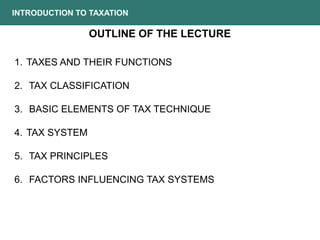
OUTLINE OF THE LECTURE
1. TAXES AND THEIR FUNCTIONS
2. TAX CLASSIFICATION
3. BASIC ELEMENTS OF TAX TECHNIQUE
4. TAX SYSTEM
5. TAX PRINCIPLES
6. FACTORS INFLUENCING TAX SYSTEMS
INTRODUCTION TO TAXATION
TAX
Albert Einstein said:
„ The hardest thing to understand in the world is the income tax.“
• It is a sad fact that almost any country´s taxation system is so
complex that very few people will understand it completely and
yet the average citizen and business are expected to comply in
full with the tax requirements that are applicable to them.
INTRODUCTION TO TAXATION
THE NEED OF TAXATION
 The economic resources available to society are limited,
and so an increase in government expenditure normally
means a reduction in private spending.
 Taxation is one method of transferring resources from the
private to the public sector.
 Governments often use also other methods of rising
resources, taxation is usually the most important source of
government revenue.
 Most countries have a tax system that differs from that of
other countries.
INTRODUCTION TO TAXATION
TAX
Characteristics of tax:
• monetary,
• mandatory,
• non-equivalent,
• nonspecific charge or other levy imposed on a taxpayer by a
state.
• Tax is implemented by law and failing to pay taxes is punishable
by law.
• Taxes can be paid regularly or occasionally based on certain
conditions stipulated by the tax legislation.
• Customs duties are also classified as taxes as they are paid on
imports of goods based on customs regulation. They are enforceable
by law and are included in the revenues of national budget.
INTRODUCTION TO TAXATION
THE SYSTEM OF PUBLIC INCOMES OF THE CR
Public
incomes
Non-credit
Tax
Non-tax
- compulsory contributions
to state funds
- charges
- other incomes
Credit
- state loans
- securities issued by
state
Taxes are the
basic and the
most significant
source of public
incomes;
however,
obviously they are
not the only
source.
INTRODUCTION TO TAXATION
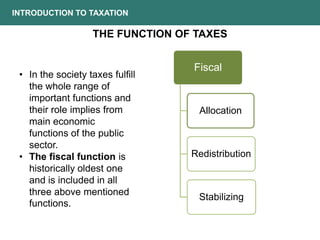
THE FUNCTION OF TAXES
Fiscal
Allocation
Redistribution
Stabilizing
• In the society taxes fulfill
the whole range of
important functions and
their role implies from
main economic
functions of the public
sector.
• The fiscal function is
historically oldest one
and is included in all
three above mentioned
functions.
INTRODUCTION TO TAXATION
ALLOCATION FUNCTION
• This function is asserted at symptoms of ineffectiveness of the
market in allocation of sources.
• Taxes can have the influence on placing the means into the
spheres or branches in which the state will be interested (e.g. by
means of tax allowances, or tax holidays at fulfilling certain
conditions related to the volume of investments, new
technologies, and creating new jobs).
• In case when taxes fulfill this function we speak about so called
indirect financing or the tax support.
INTRODUCTION TO TAXATION
REDISTRIBUTION FUNCTION
• The redistribution function relates to redistributing incomes in
the society.
• Taxes allow to moderate differences in incomes among people.
This function allows to transfer incomes from individuals with
higher incomes to the groups of population with lower incomes.
INTRODUCTION TO TAXATION
STABILIZING FUNCTION
• The stabilizing function of taxes is an integral part of the
economic policy of the state and by means of that taxes can
contribute to cyclic swings in economy.
• In the period of prosperity, when incomes and consumption as
well grow fast, taxes take away a higher part into public budgets.
It helps precede overheating of economy.
• On the contrary in the period of stagnation lower taxes help to
start up the economy.
INTRODUCTION TO TAXATION
FISCAL FUNCTION
• It is the primary function which ensures money for the public
budget.
• At the allocation function it gains financial means for financing
the areas underestimated by the market,
• at the redistribution function it is redistributing money with the
aim to reduce as least partly the income and the social inequality
in the society
• and at the stabilizing function incomes are regulated in
accordance with the economic cycle.
INTRODUCTION TO TAXATION
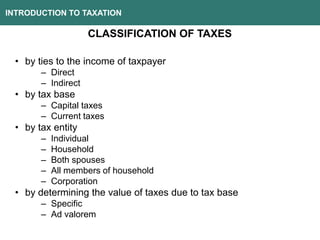
CLASSIFICATION OF TAXES
• by ties to the income of taxpayer
– Direct
– Indirect
• by tax base
– Capital taxes
– Current taxes
• by tax entity
– Individual
– Household
– Both spouses
– All members of household
– Corporation
• by determining the value of taxes due to tax base
– Specific
– Ad valorem
INTRODUCTION TO TAXATION
CLASSIFICATION OF TAXES by ties to the income of
taxpayer
• Tax is paid directly from the
taxpayer´s income.
• It is supposed that direct
taxes shouldn´t be generally
shifted to other taxpayers.
• For example income taxes
or taxes imposed on the
ownership of property or
transfers of property.
• Indirect taxes are supposed
to be paid from the price
charged by the taxpayer to
the customer.
• The tax burden is effectively
born by the customer and
not by the taxpayer who only
collects the tax for the
government.
• For example VAT or excise
duties.
Indirect
Direct
INTRODUCTION TO TAXATION
CLASSIFICATION OF TAXES by tax base
• Taxes based on a stock of
something.
• For example wealth
taxes, inheritance tax.
• Taxes based on a flow of
something.
• Current taxes on income are
– income tax, corporation tax.
• Current tax on expenditure
are
– VAT and excise duties.
Current
Capital
INTRODUCTION TO TAXATION
CLASSIFICATION OF TAXES by determining the value of
taxes due to tax base
• Taxes which are based on
the weight or size of the tax
base.
• ( x EUR from
liter, kilogram, …)
• For example excise duties.
• Taxes which are based on
values.
• ( x % from tax base)
• VAT and all direct taxes.
Ad valorem
Specific (unit)
INTRODUCTION TO TAXATION
The OECD classification
• 1000 Taxes on income, profits and capital gains
• 2000 Social security contributions
• 3000 Taxes on payroll and workforce
• 4000 Taxes on property
• 5000 Taxes on goods and services
• 6000 Other taxes
INTRODUCTION TO TAXATION
BASIC ELEMENTS OF TAX TECHNIQUE
1. TAXABLE SUBJECT
person to whom the tax liability applies (taxpayer)
2. TAX OBJECT
legal fact that causes the tax liability to arise (on income, on
existence – the pool tax)
3. TAX BASE
The tax object specified, quantified in money or in other exact units
4. TAX RATE
The measure applied to tax base, quantifying tax liability
INTRODUCTION TO TAXATION
TAXABLE SUBJECT
• The taxpayer is the person, who carries the tax burden, can be
at the same time the payer of the tax. That means the person
levies himself the tax to the public budget. The natural person
who runs business on the Trade Licence Certificate carries the
tax burden from incomes from business activity, that means
he/she is a taxpayer, but at the same time also a payer as
he/she is obliged to calculate the tax by himself/herself and to
levy it to the public budget.
• The payer of taxes is a payer who is obliged to levy the tax
from the law. In some examples it occurs that he levies the tax
for another taxpayer, that means his disposable income will not
reduce. In practice this possibility occurs at taxation of
employment (that means employees), when the employer (the
payer of the tax) is obliged to levy the tax for the employee (that
means the taxpayer) to the public budget.
INTRODUCTION TO TAXATION
TAX OBJECT AND TAX BASE
• The tax object is a magnitude from which the tax is collected. It
is a subject-matter for taxation. A brief definition of the object of
taxes is generally the part of the name of the tax act (e.g. the
Income Tax Act, the Act on Inheritance Tax, etc.).
• It does not have to be always expressed in value; it can appear
also in the material form – properties, buildings and land, or at
the excise duty hl of beer, etc. Consequently after transferring
the material formulation of the object of taxation into its value
formulation, after tax reliefs, tax allowances and tax exemptions
the tax object is made concrete in the defined tax base.
INTRODUCTION TO TAXATION
TAX BASE
• The tax base is necessary to be defined not only factually (i.e.
from what the tax will be levied), but also as for time. The
taxable period is a time interval for which the base, the amount
of taxes, is set and the tax is levied.
• The basic taxable period is generally one calendar year. It is
used at all direct taxes. At excise duties this interval is shortened
and one month or one calendar quarter is the taxable period.
• Taxes in relation to the taxable period can be divided into:
– taxes which are exempted from the taxable period, i.e. that they
are collected in connection with the occurrence of a certain
event (e.g. inheritance tax, gift tax),
– Taxes that are subject to the regular collecting (the income
tax, property taxes, etc.).
INTRODUCTION TO TAXATION
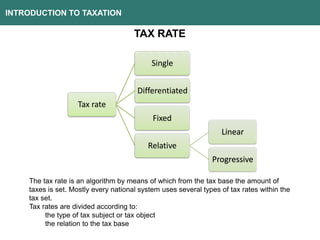
TAX RATE
Tax rate
Single
Differentiated
Fixed
Relative
Linear
Progressive
The tax rate is an algorithm by means of which from the tax base the amount of
taxes is set. Mostly every national system uses several types of tax rates within the
tax set.
Tax rates are divided according to:
the type of tax subject or tax object
the relation to the tax base
INTRODUCTION TO TAXATION
TAX RATE
• The single rate exists for example at the real estate transfer tax
(it makes x % from the tax base).
• The differentiated rate is used by the VAT tax (x %, y %) and it
can be differentiated not only as for the object of taxes, but also
as for the taxpayer (e.g. at the inheritance tax and the gift tax
when the tax rate is lower for persons next of kin and highest for
non relatives).
• The fixed rate is set by the absolute amount and we find it at
the excise duties (the tax rate on 1 hl of beer, one cigarette) or
at real estate taxes (taxation on 1 m2 of the build-up area).
INTRODUCTION TO TAXATION
TAX RATE
• The relative rate is used where the tax base has a value
character. The rate is set as a certain share (percentage) from
the tax base. It is used at common taxes (especially at income
taxes).
• The linear tax rate is constructed in the way that the tax rises
with the rise of the base in the same ratio. It is set by a certain
percentage from the tax base which will not change with the size
of the tax base. The advantage of the linear rate is a simplicity of
the calculation of taxes (it makes x % from the tax base).
INTRODUCTION TO TAXATION
TAX RATE
• The progressive tax rate is more difficult by its construction.
With the growth of the tax base the tax grows relatively faster
than the tax base. It can have the form of various calculation
algorithms. The most frequently the tax bracket rate is used and
it is in the way that the tax base is divided into several brackets
as its size and for each bracket another level of rate (the higher
the bracket the higher the tax) is set.
• Also here we find two variants, that is:
– a variant of the progressive graduate rate
– a variant of the progressive sliding rate
INTRODUCTION TO TAXATION
TAX SYSTEM
• Taxes are the essential source of financing of the public sector.
• The advanced tax system is characteristic by the effort to
influence, to stimulate and to respect the
social, economic, environmental, external, political and other
activities of the government.
• From this point of view it is obvious that many changes of taxes
correspond to the strategy of government priorities in another
sphere.
• Taxes should be neutral as most as possible and their selection
the cheapest for the state and the taxpayer as well.
Table 1: Total taxes (including compulsory actual social contributions) as % of GDP in 2018
0,0
5,0
10,0
15,0
20,0
25,0
30,0
35,0
40,0
45,0
50,0 EU-28
EU-27
EA-19
Belgium
Bulgaria
Czechia
Denmark
Germany
Estonia
Ireland
Greece
Spain
France
Croatia
Italy
Cyprus
Latvia
Lithuania
Luxembourg
Hungary
Malta
Netherlands
Austria
Poland
Portugal
Romania
Slovenia
Slovakia
Finland
Sweden
United
Kingdom
Iceland
Norway
39,2
40,240,6
44,8
29,9
36,1
45,1
40,1
32,8
22,6
38,9
34,7
46,5
38,6
41,8
33,8
31,030,2
39,3
37,6
31,8
38,7
42,3
35,234,9
26,3
37,6
34,1
42,2
43,8
33,8
36,9
40,0
Source: https://ec.europa.eu/taxation_customs/business/economic-analysis-taxation/data-taxation_en
INTRODUCTION TO TAXATION
TAX SYSTEM – TAX PRINCIPLES
• In conditions of the market economy the rational tax system is
based on certain tax principles:
– the principle of tax justice,
– the principle of tax efficiency,
– the principle of legal perfection,
– the principle of simplicity and comprehensibility,
– the principle of correct influencing of the conduct of economic
entities.
• For the conditions of the market economy it was necessary to
ensure also principle of:
– neutrality and
– tax universality.
INTRODUCTION TO TAXATION
TAX JUSTICE
• Every taxpayer contributes to the public budget by means of
taxes and his participation should correspond to his ability to pay
and also to the benefit which he has from the consumption of
services provided by the state. This principle of tax justice is
understood in two positions:
– The principle of the ability to pay consists in a simply said way in the
fact that the taxpayers approximately with the same incomes pay the
same taxes to the public budgets. It is also in the fact that they pay as
for their own possibilities, that means who has more should also
contribute more to the budget (from that the progressive tax scale at
incomes of natural persons applied in nearly all countries). Fulfilling this
principle is, however, very complicated.
– The principle of the benefit is connected to the fact that who uses
public services should also pay the taxes from which these services are
financed (e.g. at the road tax – the tax revenues are used for the
maintenance and building of roads).
INTRODUCTION TO TAXATION
TAX EFFICIENCY
• Tax efficiency is connected above all with administrative costs of
the tax option (the direct ones are carried by the state and the
indirect administrative costs (compliance costs) that are carried
by taxpayers).
• The claim of efficiency is connected with the claim for the
respective taxes not to cause distortion in prices and benefits for
various kinds of activities. Distortion leads the taxpayer to
substitution of taxed goods or other services that are not taxed.
This way the efficiency in allocation of sources in economy is
disrupted. Unproportional tax burden should also restrict work
effort of people, willingness to save and to accept business
risks; it should create barriers of the entry to the productive
foreign capital.
INTRODUCTION TO TAXATION
TAX PERFECTION
• Tax perfection is the essential requirement for creating a quality
tax system.
• In the opposite case the effectiveness of the tax law declines
and this obviously leads to the tax evasion.
• The task of the tax administration and tax legislation is to
minimize tax evasions which decrease incomes from public
budgets and limit the tax justice.
• This principle relates directly to simplicity and definiteness of
legislation.
• The collection of taxes should be simple, undemanding on
administration and undemanding on costs for the state and the
rate payer as well.
INTRODUCTION TO TAXATION
SIMPLICITY AND COMPREHENSIBILITY OF TAX
LEGISLATION
• Simplicity and comprehensibility of tax legislation lays thus in
definiteness and transparency.
• Every taxpayer should know the extent of his tax liabilities.
• Non-transparency of the tax system is one of causes which
discourage the foreign capital.
• Modern, effective tax and customs administration contributes to
this principle.
INTRODUCTION TO TAXATION
THE PRINCIPLE OF CORRECT INFLUENCING OF THE
CONDUCT OF ECONOMIC ENTITIES
• The principle of correct influencing of the conduct of economic
entities is no less important.
• The tax policy is a significant part of the macroeconomic policy
and it should support the business activity.
• It should make investments advantageous before
consumption, economic activities friendly to environment and
should attract the foreign capital.
INTRODUCTION TO TAXATION
PRINCIPLE OF NEUTRALITY AND UNIVERSALITY
• By the principle of neutrality taxes must not influence the actual
running reproductive process of business entities.
• Taxes represent the external factor which determines the
decision of every business entity and which every business
entity must take into account at preparation of the business plan.
• Taxes play role as the constant parameter in business plans, the
form of ownership, kinds of activities or kinds of products.
• They do not make differences between the domestic and foreign
capital.
• The principle of tax universality is connected closely to the
principle of tax neutrality.
• Taxes should be neutral, so they must be constructed as
universal, with the minimal number of exceptions. Taxes should
have the broadest tax base (universality is the second feature of
neutrality).
INTRODUCTION TO TAXATION
FACTORS INFLUENCING TAX SYSTEMS
• Tax systems depend on the whole range of factors which
influence in mutual contexture fulfilling of basic principles and
functions of taxes.
• There are:
– economic factors
– political factors
– cultural-historic factors
– administratively-institutional factors
– technical progress
– globalization
INTRODUCTION TO TAXATION
ECONOMICS FACTORS
• The structure and the size of tax incomes as well depend mainly
on economic factors, such as the branch and geographic
structure, the structure of labour force, the economic growth, the
rate of inflation and the rate of economy integration into the
international trade. The branch structure influences the share of
taxes paid by individual persons and by companies.
• In states, where the share of companies is higher, there it is also
a share of employees higher than the share of self-employed
ones. Employees are taxed in an easier way than self-employed
persons, as the tax is deducted from their wages at the source
and they cannot influence the tax base by decreasing their
incomes by tax expenses.
• The country with a higher proportion of small entrepreneurs
should incline to creating the tax system with a higher share of
indirect taxes.
INTRODUCTION TO TAXATION
POLITICAL FACTORS
• Political factors play a significant role at deciding on the tax
legislature in the country and they can (especially in the short
term) overweigh the economic arguments as well.
• Any change of the tax system is a result of the political decision
of the party in power (a left wing one or a right wing one) which
implement its political program.
• At present issues in the tax sphere are becoming a significant
part of the programme of every political party.
INTRODUCTION TO TAXATION
CULTURAL-HISTORIC FACTORS
• Cultural and historical factors are important as well. The
present interest of the European Union in harmonization of tax
systems is often in the contrast of national traditions.
• Especially in the sphere of personal income taxes this effort
conflict with the individual policy of country which has
established ways of taxation, tax moral and the tradition of
functioning of the state offices collecting taxes.
• In the countries, e.g. of Southern Europe, with a higher share of
grey economy it is recommended to increase the share of
indirect taxes at which the tax evasions are more difficult.
INTRODUCTION TO TAXATION
ADMINISTRATIVELY-INSTITUTIONAL FACTORS AND
TECHNICAL PROGRESS
• The disharmony of the tax legislation and the tax administration
do not correspond with needs of the current development.
• They negatively influence the business environment and the
complexity. Non transparency of the tax legislation discourage
domestic and foreign investors from business activities.
• Technical progress as well is not less important. This progress
influences all economic activities and it is reflected in the sphere
of taxes as well. More perfect forms of trade as the internet
shopping and trade with sophisticated financial derivates are
also the appeal for improving taxation.
• On the other hand the technical development provides more
effective instruments for collecting taxes and for the fight against
tax evasions.
INTRODUCTION TO TAXATION
FACTORS OF GLOBALIZATION
• The factor of globalization which partially or completely
annuals also tax borders manifests itself in tax systems in a
more and more intensive way.
• Reforms of tax systems do not proceed individually, but they
react on the international development. Adaptation to the
legislation of the EU also belongs into this category of tax
adjustment.
• It is necessary to take into account that the tax system is not a
single phenomenon and it is influenced by the whole range of
factors. The aim of the state in the tax sphere is mainly to create
conditions for the economic stability of the country, to promote
the economic development and competitiveness and to
suppress social tension and to develop social activities.

1_th_presentation_2021_tax.pdfddfffffffffff

  • 1.
    INTRODUCTION TO TAXATION TAXTERMINOLOGY, TAX SYSTEM Ing. Šárka Sobotovičová, Ph.D. INTERNATIONAL TAXATION AND TAX SYSTEMS/NPMZD
  • 2.
    INTRODUCTION TO TAXATION OUTLINEOF THE LECTURE 1. TAXES AND THEIR FUNCTIONS 2. TAX CLASSIFICATION 3. BASIC ELEMENTS OF TAX TECHNIQUE 4. TAX SYSTEM 5. TAX PRINCIPLES 6. FACTORS INFLUENCING TAX SYSTEMS
  • 3.
    INTRODUCTION TO TAXATION TAX AlbertEinstein said: „ The hardest thing to understand in the world is the income tax.“ • It is a sad fact that almost any country´s taxation system is so complex that very few people will understand it completely and yet the average citizen and business are expected to comply in full with the tax requirements that are applicable to them.
  • 4.
    INTRODUCTION TO TAXATION THENEED OF TAXATION  The economic resources available to society are limited, and so an increase in government expenditure normally means a reduction in private spending.  Taxation is one method of transferring resources from the private to the public sector.  Governments often use also other methods of rising resources, taxation is usually the most important source of government revenue.  Most countries have a tax system that differs from that of other countries.
  • 5.
    INTRODUCTION TO TAXATION TAX Characteristicsof tax: • monetary, • mandatory, • non-equivalent, • nonspecific charge or other levy imposed on a taxpayer by a state. • Tax is implemented by law and failing to pay taxes is punishable by law. • Taxes can be paid regularly or occasionally based on certain conditions stipulated by the tax legislation. • Customs duties are also classified as taxes as they are paid on imports of goods based on customs regulation. They are enforceable by law and are included in the revenues of national budget.
  • 6.
    INTRODUCTION TO TAXATION THESYSTEM OF PUBLIC INCOMES OF THE CR Public incomes Non-credit Tax Non-tax - compulsory contributions to state funds - charges - other incomes Credit - state loans - securities issued by state Taxes are the basic and the most significant source of public incomes; however, obviously they are not the only source.
  • 7.
    INTRODUCTION TO TAXATION THEFUNCTION OF TAXES Fiscal Allocation Redistribution Stabilizing • In the society taxes fulfill the whole range of important functions and their role implies from main economic functions of the public sector. • The fiscal function is historically oldest one and is included in all three above mentioned functions.
  • 8.
    INTRODUCTION TO TAXATION ALLOCATIONFUNCTION • This function is asserted at symptoms of ineffectiveness of the market in allocation of sources. • Taxes can have the influence on placing the means into the spheres or branches in which the state will be interested (e.g. by means of tax allowances, or tax holidays at fulfilling certain conditions related to the volume of investments, new technologies, and creating new jobs). • In case when taxes fulfill this function we speak about so called indirect financing or the tax support.
  • 9.
    INTRODUCTION TO TAXATION REDISTRIBUTIONFUNCTION • The redistribution function relates to redistributing incomes in the society. • Taxes allow to moderate differences in incomes among people. This function allows to transfer incomes from individuals with higher incomes to the groups of population with lower incomes.
  • 10.
    INTRODUCTION TO TAXATION STABILIZINGFUNCTION • The stabilizing function of taxes is an integral part of the economic policy of the state and by means of that taxes can contribute to cyclic swings in economy. • In the period of prosperity, when incomes and consumption as well grow fast, taxes take away a higher part into public budgets. It helps precede overheating of economy. • On the contrary in the period of stagnation lower taxes help to start up the economy.
  • 11.
    INTRODUCTION TO TAXATION FISCALFUNCTION • It is the primary function which ensures money for the public budget. • At the allocation function it gains financial means for financing the areas underestimated by the market, • at the redistribution function it is redistributing money with the aim to reduce as least partly the income and the social inequality in the society • and at the stabilizing function incomes are regulated in accordance with the economic cycle.
  • 12.
    INTRODUCTION TO TAXATION CLASSIFICATIONOF TAXES • by ties to the income of taxpayer – Direct – Indirect • by tax base – Capital taxes – Current taxes • by tax entity – Individual – Household – Both spouses – All members of household – Corporation • by determining the value of taxes due to tax base – Specific – Ad valorem
  • 13.
    INTRODUCTION TO TAXATION CLASSIFICATIONOF TAXES by ties to the income of taxpayer • Tax is paid directly from the taxpayer´s income. • It is supposed that direct taxes shouldn´t be generally shifted to other taxpayers. • For example income taxes or taxes imposed on the ownership of property or transfers of property. • Indirect taxes are supposed to be paid from the price charged by the taxpayer to the customer. • The tax burden is effectively born by the customer and not by the taxpayer who only collects the tax for the government. • For example VAT or excise duties. Indirect Direct
  • 14.
    INTRODUCTION TO TAXATION CLASSIFICATIONOF TAXES by tax base • Taxes based on a stock of something. • For example wealth taxes, inheritance tax. • Taxes based on a flow of something. • Current taxes on income are – income tax, corporation tax. • Current tax on expenditure are – VAT and excise duties. Current Capital
  • 15.
    INTRODUCTION TO TAXATION CLASSIFICATIONOF TAXES by determining the value of taxes due to tax base • Taxes which are based on the weight or size of the tax base. • ( x EUR from liter, kilogram, …) • For example excise duties. • Taxes which are based on values. • ( x % from tax base) • VAT and all direct taxes. Ad valorem Specific (unit)
  • 16.
    INTRODUCTION TO TAXATION TheOECD classification • 1000 Taxes on income, profits and capital gains • 2000 Social security contributions • 3000 Taxes on payroll and workforce • 4000 Taxes on property • 5000 Taxes on goods and services • 6000 Other taxes
  • 17.
    INTRODUCTION TO TAXATION BASICELEMENTS OF TAX TECHNIQUE 1. TAXABLE SUBJECT person to whom the tax liability applies (taxpayer) 2. TAX OBJECT legal fact that causes the tax liability to arise (on income, on existence – the pool tax) 3. TAX BASE The tax object specified, quantified in money or in other exact units 4. TAX RATE The measure applied to tax base, quantifying tax liability
  • 18.
    INTRODUCTION TO TAXATION TAXABLESUBJECT • The taxpayer is the person, who carries the tax burden, can be at the same time the payer of the tax. That means the person levies himself the tax to the public budget. The natural person who runs business on the Trade Licence Certificate carries the tax burden from incomes from business activity, that means he/she is a taxpayer, but at the same time also a payer as he/she is obliged to calculate the tax by himself/herself and to levy it to the public budget. • The payer of taxes is a payer who is obliged to levy the tax from the law. In some examples it occurs that he levies the tax for another taxpayer, that means his disposable income will not reduce. In practice this possibility occurs at taxation of employment (that means employees), when the employer (the payer of the tax) is obliged to levy the tax for the employee (that means the taxpayer) to the public budget.
  • 19.
    INTRODUCTION TO TAXATION TAXOBJECT AND TAX BASE • The tax object is a magnitude from which the tax is collected. It is a subject-matter for taxation. A brief definition of the object of taxes is generally the part of the name of the tax act (e.g. the Income Tax Act, the Act on Inheritance Tax, etc.). • It does not have to be always expressed in value; it can appear also in the material form – properties, buildings and land, or at the excise duty hl of beer, etc. Consequently after transferring the material formulation of the object of taxation into its value formulation, after tax reliefs, tax allowances and tax exemptions the tax object is made concrete in the defined tax base.
  • 20.
    INTRODUCTION TO TAXATION TAXBASE • The tax base is necessary to be defined not only factually (i.e. from what the tax will be levied), but also as for time. The taxable period is a time interval for which the base, the amount of taxes, is set and the tax is levied. • The basic taxable period is generally one calendar year. It is used at all direct taxes. At excise duties this interval is shortened and one month or one calendar quarter is the taxable period. • Taxes in relation to the taxable period can be divided into: – taxes which are exempted from the taxable period, i.e. that they are collected in connection with the occurrence of a certain event (e.g. inheritance tax, gift tax), – Taxes that are subject to the regular collecting (the income tax, property taxes, etc.).
  • 21.
    INTRODUCTION TO TAXATION TAXRATE Tax rate Single Differentiated Fixed Relative Linear Progressive The tax rate is an algorithm by means of which from the tax base the amount of taxes is set. Mostly every national system uses several types of tax rates within the tax set. Tax rates are divided according to: the type of tax subject or tax object the relation to the tax base
  • 22.
    INTRODUCTION TO TAXATION TAXRATE • The single rate exists for example at the real estate transfer tax (it makes x % from the tax base). • The differentiated rate is used by the VAT tax (x %, y %) and it can be differentiated not only as for the object of taxes, but also as for the taxpayer (e.g. at the inheritance tax and the gift tax when the tax rate is lower for persons next of kin and highest for non relatives). • The fixed rate is set by the absolute amount and we find it at the excise duties (the tax rate on 1 hl of beer, one cigarette) or at real estate taxes (taxation on 1 m2 of the build-up area).
  • 23.
    INTRODUCTION TO TAXATION TAXRATE • The relative rate is used where the tax base has a value character. The rate is set as a certain share (percentage) from the tax base. It is used at common taxes (especially at income taxes). • The linear tax rate is constructed in the way that the tax rises with the rise of the base in the same ratio. It is set by a certain percentage from the tax base which will not change with the size of the tax base. The advantage of the linear rate is a simplicity of the calculation of taxes (it makes x % from the tax base).
  • 24.
    INTRODUCTION TO TAXATION TAXRATE • The progressive tax rate is more difficult by its construction. With the growth of the tax base the tax grows relatively faster than the tax base. It can have the form of various calculation algorithms. The most frequently the tax bracket rate is used and it is in the way that the tax base is divided into several brackets as its size and for each bracket another level of rate (the higher the bracket the higher the tax) is set. • Also here we find two variants, that is: – a variant of the progressive graduate rate – a variant of the progressive sliding rate
  • 25.
    INTRODUCTION TO TAXATION TAXSYSTEM • Taxes are the essential source of financing of the public sector. • The advanced tax system is characteristic by the effort to influence, to stimulate and to respect the social, economic, environmental, external, political and other activities of the government. • From this point of view it is obvious that many changes of taxes correspond to the strategy of government priorities in another sphere. • Taxes should be neutral as most as possible and their selection the cheapest for the state and the taxpayer as well.
  • 26.
    Table 1: Totaltaxes (including compulsory actual social contributions) as % of GDP in 2018 0,0 5,0 10,0 15,0 20,0 25,0 30,0 35,0 40,0 45,0 50,0 EU-28 EU-27 EA-19 Belgium Bulgaria Czechia Denmark Germany Estonia Ireland Greece Spain France Croatia Italy Cyprus Latvia Lithuania Luxembourg Hungary Malta Netherlands Austria Poland Portugal Romania Slovenia Slovakia Finland Sweden United Kingdom Iceland Norway 39,2 40,240,6 44,8 29,9 36,1 45,1 40,1 32,8 22,6 38,9 34,7 46,5 38,6 41,8 33,8 31,030,2 39,3 37,6 31,8 38,7 42,3 35,234,9 26,3 37,6 34,1 42,2 43,8 33,8 36,9 40,0 Source: https://ec.europa.eu/taxation_customs/business/economic-analysis-taxation/data-taxation_en
  • 27.
    INTRODUCTION TO TAXATION TAXSYSTEM – TAX PRINCIPLES • In conditions of the market economy the rational tax system is based on certain tax principles: – the principle of tax justice, – the principle of tax efficiency, – the principle of legal perfection, – the principle of simplicity and comprehensibility, – the principle of correct influencing of the conduct of economic entities. • For the conditions of the market economy it was necessary to ensure also principle of: – neutrality and – tax universality.
  • 28.
    INTRODUCTION TO TAXATION TAXJUSTICE • Every taxpayer contributes to the public budget by means of taxes and his participation should correspond to his ability to pay and also to the benefit which he has from the consumption of services provided by the state. This principle of tax justice is understood in two positions: – The principle of the ability to pay consists in a simply said way in the fact that the taxpayers approximately with the same incomes pay the same taxes to the public budgets. It is also in the fact that they pay as for their own possibilities, that means who has more should also contribute more to the budget (from that the progressive tax scale at incomes of natural persons applied in nearly all countries). Fulfilling this principle is, however, very complicated. – The principle of the benefit is connected to the fact that who uses public services should also pay the taxes from which these services are financed (e.g. at the road tax – the tax revenues are used for the maintenance and building of roads).
  • 29.
    INTRODUCTION TO TAXATION TAXEFFICIENCY • Tax efficiency is connected above all with administrative costs of the tax option (the direct ones are carried by the state and the indirect administrative costs (compliance costs) that are carried by taxpayers). • The claim of efficiency is connected with the claim for the respective taxes not to cause distortion in prices and benefits for various kinds of activities. Distortion leads the taxpayer to substitution of taxed goods or other services that are not taxed. This way the efficiency in allocation of sources in economy is disrupted. Unproportional tax burden should also restrict work effort of people, willingness to save and to accept business risks; it should create barriers of the entry to the productive foreign capital.
  • 30.
    INTRODUCTION TO TAXATION TAXPERFECTION • Tax perfection is the essential requirement for creating a quality tax system. • In the opposite case the effectiveness of the tax law declines and this obviously leads to the tax evasion. • The task of the tax administration and tax legislation is to minimize tax evasions which decrease incomes from public budgets and limit the tax justice. • This principle relates directly to simplicity and definiteness of legislation. • The collection of taxes should be simple, undemanding on administration and undemanding on costs for the state and the rate payer as well.
  • 31.
    INTRODUCTION TO TAXATION SIMPLICITYAND COMPREHENSIBILITY OF TAX LEGISLATION • Simplicity and comprehensibility of tax legislation lays thus in definiteness and transparency. • Every taxpayer should know the extent of his tax liabilities. • Non-transparency of the tax system is one of causes which discourage the foreign capital. • Modern, effective tax and customs administration contributes to this principle.
  • 32.
    INTRODUCTION TO TAXATION THEPRINCIPLE OF CORRECT INFLUENCING OF THE CONDUCT OF ECONOMIC ENTITIES • The principle of correct influencing of the conduct of economic entities is no less important. • The tax policy is a significant part of the macroeconomic policy and it should support the business activity. • It should make investments advantageous before consumption, economic activities friendly to environment and should attract the foreign capital.
  • 33.
    INTRODUCTION TO TAXATION PRINCIPLEOF NEUTRALITY AND UNIVERSALITY • By the principle of neutrality taxes must not influence the actual running reproductive process of business entities. • Taxes represent the external factor which determines the decision of every business entity and which every business entity must take into account at preparation of the business plan. • Taxes play role as the constant parameter in business plans, the form of ownership, kinds of activities or kinds of products. • They do not make differences between the domestic and foreign capital. • The principle of tax universality is connected closely to the principle of tax neutrality. • Taxes should be neutral, so they must be constructed as universal, with the minimal number of exceptions. Taxes should have the broadest tax base (universality is the second feature of neutrality).
  • 34.
    INTRODUCTION TO TAXATION FACTORSINFLUENCING TAX SYSTEMS • Tax systems depend on the whole range of factors which influence in mutual contexture fulfilling of basic principles and functions of taxes. • There are: – economic factors – political factors – cultural-historic factors – administratively-institutional factors – technical progress – globalization
  • 35.
    INTRODUCTION TO TAXATION ECONOMICSFACTORS • The structure and the size of tax incomes as well depend mainly on economic factors, such as the branch and geographic structure, the structure of labour force, the economic growth, the rate of inflation and the rate of economy integration into the international trade. The branch structure influences the share of taxes paid by individual persons and by companies. • In states, where the share of companies is higher, there it is also a share of employees higher than the share of self-employed ones. Employees are taxed in an easier way than self-employed persons, as the tax is deducted from their wages at the source and they cannot influence the tax base by decreasing their incomes by tax expenses. • The country with a higher proportion of small entrepreneurs should incline to creating the tax system with a higher share of indirect taxes.
  • 36.
    INTRODUCTION TO TAXATION POLITICALFACTORS • Political factors play a significant role at deciding on the tax legislature in the country and they can (especially in the short term) overweigh the economic arguments as well. • Any change of the tax system is a result of the political decision of the party in power (a left wing one or a right wing one) which implement its political program. • At present issues in the tax sphere are becoming a significant part of the programme of every political party.
  • 37.
    INTRODUCTION TO TAXATION CULTURAL-HISTORICFACTORS • Cultural and historical factors are important as well. The present interest of the European Union in harmonization of tax systems is often in the contrast of national traditions. • Especially in the sphere of personal income taxes this effort conflict with the individual policy of country which has established ways of taxation, tax moral and the tradition of functioning of the state offices collecting taxes. • In the countries, e.g. of Southern Europe, with a higher share of grey economy it is recommended to increase the share of indirect taxes at which the tax evasions are more difficult.
  • 38.
    INTRODUCTION TO TAXATION ADMINISTRATIVELY-INSTITUTIONALFACTORS AND TECHNICAL PROGRESS • The disharmony of the tax legislation and the tax administration do not correspond with needs of the current development. • They negatively influence the business environment and the complexity. Non transparency of the tax legislation discourage domestic and foreign investors from business activities. • Technical progress as well is not less important. This progress influences all economic activities and it is reflected in the sphere of taxes as well. More perfect forms of trade as the internet shopping and trade with sophisticated financial derivates are also the appeal for improving taxation. • On the other hand the technical development provides more effective instruments for collecting taxes and for the fight against tax evasions.
  • 39.
    INTRODUCTION TO TAXATION FACTORSOF GLOBALIZATION • The factor of globalization which partially or completely annuals also tax borders manifests itself in tax systems in a more and more intensive way. • Reforms of tax systems do not proceed individually, but they react on the international development. Adaptation to the legislation of the EU also belongs into this category of tax adjustment. • It is necessary to take into account that the tax system is not a single phenomenon and it is influenced by the whole range of factors. The aim of the state in the tax sphere is mainly to create conditions for the economic stability of the country, to promote the economic development and competitiveness and to suppress social tension and to develop social activities.