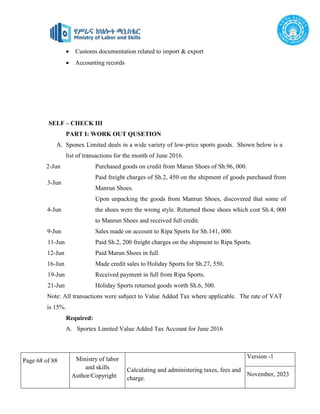
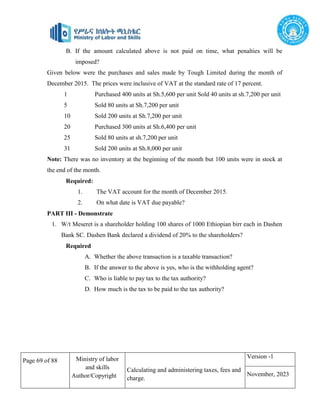
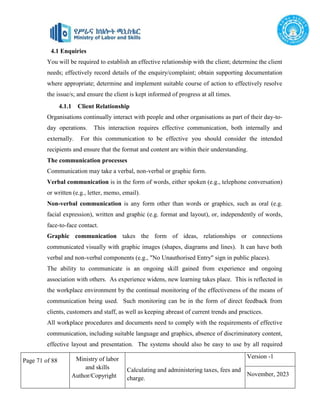
ACCOUNTING AND FINANCE
LEVEL–III
Based On November, 2023 Curriculum V – II
Module Title: Calculating and Administering Taxes,
Fees and Charges
Module Code: LSA ACF3 M09 1123
Nominal Duration: 60hr
Prepared By: Ministry of Labor and Skills
November, 2023.
Addis Ababa, Ethiopia.
2.
Page II of88
Minister of labor
and skills
Author/Copyright
Module Title: calculating and administering
taxes, fees and charge.
Version -1
November, 2023
Acknowledgment
Ministry of Labor and Skills wish to extend thanks and appreciation to the many
representatives of TVT instructors and respective industry experts who donated their time
and expertise to the development of this Teaching, Training and Learning Materials (TTLM).
3.
Page III of88
Minister of labor
and skills
Author/Copyright
Module Title: calculating and administering
taxes, fees and charge.
Version -1
November, 2023
TABLE OF Contents
Introduction to the module........................................................................................................ 6
Unit One: Tax Liability of goods............................................................................................. 7
1.1 Goods and Documents of tax ..................................................................................... 8
1.2 Basis of Tax, Fees and Charge................................................................................. 13
1.2.1 Concept of Taxation.......................................................................................... 13
1.2.1 Fees and charge................................................................................................. 13
1.2.2 Classification of Taxes, Fees and Charges. ...................................................... 16
1.2.3 Customizing Duty Law and Customs Tariff..................................................... 22
1.2.4 Tax System, Tax Policy, and Tax Laws ........................................................... 22
1.2.5 Work Area Standard Operating Procedures/Work Instructions........................ 23
1.3 Value of the Goods/Services.................................................................................... 25
1.4 Liability to Pay Taxes, Fees and Charges. ............................................................... 27
1.4.1 Service Charges ................................................................................................ 29
Self-check 1 ............................................................................................................................ 32
UNIT TWO: Taxes, Fees and Charges................................................................................... 34
2.1 Calculating Taxes, Fees and Charges............................................................................ 35
2.1.1 Duties and Taxes on Imported Goods............................................................... 37
2.1.2 Calculating Duties and Taxes ........................................................................... 37
2.2 payable Amount ....................................................................................................... 39
Self-check II............................................................................................................................ 48
UNIT THREE: Records Transaction...................................................................................... 53
3.1.1 VAT in Accounting........................................................................................... 56
3.1 Issuing Transaction Records. ................................................................................... 63
SELF – CHECK III................................................................................................................. 68
4.1 Enquiries................................................................................................................... 71
4.1.1 Client Relationship............................................................................................ 71
4.1.2 Client Needs...................................................................................................... 72
4.
Page IV of88
Minister of labor
and skills
Author/Copyright
Module Title: calculating and administering
taxes, fees and charge.
Version -1
November, 2023
4.1.3 Verbal and Non-Verbal Behaviour. .................................................................. 73
4.1.4 Questioning and listening. ................................................................................ 73
4.1.6 Client Records................................................................................................... 73
4.2 Payment options....................................................................................................... 76
4.3 Complaints and notifying decisions. ........................................................................ 81
4.4 Customer’s Dissatisfaction....................................................................................... 82
Self – check IV........................................................................................................................ 84
REFERENCE.......................................................................................................................... 86
5.
Page 5 of88 Ministry of labor
and skills
Author/Copyright
Calculating and administering taxes, fees and
charge.
Version -1
November, 2023
Acronym
TOT –––––––––––––––––––––––––––––––––– Turn Over Tax
CGTA ––––––––––––––––––––––––––––––––––Capital Gain Tax Act
SDT –––––––––––––––––––––––––––––––––––Stamp Duty Tax
ETA ––––––––––––––––––––––––––––––––––––Education Tax Act
WIS ––––––––––––––––––––––––––––––––––––Work Instructions
SOP––––––––––––––––––––––––––––––––––––Standard Operating Procedure
FOB ––––––––––––––––––––––––––––––––––––Free on Board
ERCA ––––––––––––––––––––––––––––––––––Ethiopian Revenue Custom Authority
VAT –––––––––––––––––––––––––––––––––––Value Added Tax
FY ––––––––––––––––––––––––––––––––––––Financial Year
AY ––––––––––––––––––––––––––––––––––––Accounting Year
AAB ––––––––––––––––––––––––––––––––––Authorized Agent Bank
BNBL –––––––––––––––––––––––––––––––––Buying Now Buying Latter
BPT –––––––––––––––––––––––––––––––––– Business Profit Tax
C.I.F –––––––––––––––––––––––––––––––––– Cost, Insurance, Freight
FIRA ––––––––––––––––––––––––––––––––––Financial Institutions Regulator
6.
Page 6 of88 Ministry of labor
and skills
Author/Copyright
Calculating and administering taxes, fees and
charge.
Version -1
November, 2023
Introduction to the module
Accounting and finance filed; the ‘calculate and administering tax, fees and charge” This
module covers the competence required to Tax Liability of goods ,Tax, Fees and Charge,
Transaction Records, Enquiries and Complaints of customers, calculate tax, fees and charge.
This module is designed to meet the industry requirement under the Accounting and Finance
occupational standard, particularly for the unit of competency calculate and administering
tax, fees and charge.
This module covers the units:
Tax Liability of goods
Tax, Fees and Charge.
Transaction Records
Enquiries and Complaints of customers
Learning objective of the module To
Identify methods of assess goods and documents for duty and tax liability
Identify tax, fees and charge.
Identify ways of calculate taxes, fees and charges
complete transaction records
handle enquiries and complaints of customers
Module instruction
For effective use these modules trainees are expected to follow the following module
instruction:
1. Read the information written in each unit
2. Accomplish the self-checks at the end of each unit
3. Perform operation sheets which were provided at the end of units
4. Red the identified reference book for examples and exercise
7.
Page 7 of88 Ministry of labor
and skills
Author/Copyright
Calculating and administering taxes, fees and
charge.
Version -1
November, 2023
Unit One: Tax Liability of goods
This unit is developed to provide you the necessary information regarding the following content
coverage and topics:
Goods and Documents of Tax
Basis of tax, fees and charge.
Goods/Services value
This unit will also assist you to attain the learning outcomes stated in the cover page. specifically,
upon completion of this learning guide, you will be able to:
Explain tax, fees and charge.
Determine Class of Taxes, Fees and Charges.
Determine Rate of Taxes, Fees and Charges.
Liability to Pay Taxes, Fees and Charges.
8.
Page 8 of88 Ministry of labor
and skills
Author/Copyright
Calculating and administering taxes, fees and
charge.
Version -1
November, 2023
1.1 Goods and Documents of tax
Examining goods and documents for duty and tax liability is a crucial process to ensure
compliance with customs and tax regulations. Below are key aspects to consider when
examining goods and documents for duty and tax liability:
Examining Goods:
Customs Classification: Verify that the goods are classified correctly according to
the Harmonized System (HS) codes. The HS code determines the applicable customs
duties and taxes.
Valuation: Ensure that the declared value of the goods is accurate and complies with
the customs valuation rules. The customs value is used to calculate customs duties.
Origin of Goods: Determine the origin of the goods as it influences eligibility for
preferential trade agreements and may affect the applicable customs duties.
Exemptions and Concessions: Check for any exemptions or concessions that may
apply to the goods. Some goods may be eligible for reduced rates or complete
exemption from duties and taxes.
Special Customs Procedures: Consider whether the goods qualify for any special
customs procedures, such as temporary importation, inward processing, or bonded
warehouses.
Prohibited and Restricted Goods: Ensure that the goods being imported or exported
comply with any restrictions or prohibitions. Certain goods may require special
permits or licenses.
Examining Documents:
Commercial Invoice: Verify the accuracy of the commercial invoice, including the
description of goods, quantity, and value. The invoice is crucial for customs
valuation.
Packing List: Check the packing list to ensure that it accurately reflects the contents,
quantities, and packaging of the shipment.
9.
Page 9 of88 Ministry of labor
and skills
Author/Copyright
Calculating and administering taxes, fees and
charge.
Version -1
November, 2023
Bill of Lading or Airway Bill: Confirm that the transportation documents accurately
represent the mode of transport and contain the necessary information for customs
clearance.
Certificate of Origin: Determine whether a certificate of origin is required and
ensure that it is correctly completed. This document verifies the origin of the goods.
Import or Export Licenses: Check if import or export licenses are required for
specific goods, and ensure that the necessary permits are in place.
Insurance Documents: Verify insurance documents, especially if the customs value
includes insurance costs. This is important for customs valuation purposes.
Customs Declarations: Review the accuracy and completeness of the customs
declarations, ensuring that they align with the supporting documents.
Tax Invoices: For domestic transactions, ensure that tax invoices comply with local
tax regulations and that the correct amount of value-added tax (VAT) is accounted
for.
Record-Keeping: Maintain accurate records of all relevant documents for a specified
period, as required by customs and tax authorities.
Compliance with Regulatory Requirements: Ensure that all documents comply
with relevant regulatory requirements, including those related to safety, health, and
environmental standards.
Thorough examination of goods and documents helps prevent errors, ensures compliance
with regulations, and minimizes the risk of penalties or delays in customs clearance.
Importers, exporters, and customs brokers should work closely with customs authorities and
stay informed about any changes in customs and tax regulations.
Assessing goods and documents for duty and tax liability involves a systematic examination
to ensure compliance with customs and tax regulations. Below is a step-by-step guide to help
you assess goods and documents for duty and tax liability:
10.
Page 10 of88 Ministry of labor
and skills
Author/Copyright
Calculating and administering taxes, fees and
charge.
Version -1
November, 2023
Understand the Regulatory Framework: Familiarize yourself with the customs and
tax regulations applicable to the specific jurisdiction where the goods will be
imported or exported.
Verify Customs Classification:
Confirm that the goods are classified correctly according to the Harmonized System
(HS) codes. The HS code determines the applicable customs duties and taxes.
Check Valuation: Verify the accuracy of the declared value of the goods. Ensure that
it includes all relevant costs, such as freight, insurance, and other charges, as required
by customs valuation rules.
Determine Origin of Goods: Establish the origin of the goods, as it can impact the
eligibility for preferential trade agreements and influence the calculation of customs
duties.
Examine Exemptions and Concessions: Check for any exemptions or concessions
that may apply to the goods. Certain goods may qualify for reduced rates or complete
exemption from duties and taxes.
Review Special Customs Procedures: Determine whether the goods qualify for any
special customs procedures, such as temporary importation, inward processing, or
bonded warehouses.
Check for Prohibited and Restricted Goods: Ensure that the goods comply with
any restrictions or prohibitions. Verify if special permits or licenses are required for
certain goods.
Verify Commercial Documents: Check the accuracy of commercial documents,
including the commercial invoice, packing list, bill of lading or airway bill, and
certificate of origin.
Examine Import or Export Licenses: Verify whether import or export licenses are
required for specific goods, and ensure that the necessary permits are obtained.
11.
Page 11 of88 Ministry of labor
and skills
Author/Copyright
Calculating and administering taxes, fees and
charge.
Version -1
November, 2023
Review Insurance Documents: Verify insurance documents, especially if the
customs value includes insurance costs. This is important for customs valuation
purposes.
Check Customs Declarations: Review the accuracy and completeness of customs
declarations. Ensure that they align with the information provided in other supporting
documents.
Understand Tax Liabilities: Determine the applicable taxes, such as value-added tax
(VAT) or goods and services tax (GST), and assess their impact on the overall tax
liability.
Maintain Record-Keeping: Keep accurate records of all relevant documents and
transactions for a specified period, as required by customs and tax authorities.
Seek Professional Advice: If needed, consult with customs brokers, tax
professionals, or legal experts to ensure comprehensive understanding and
compliance with all regulations.
Stay Informed: Regularly update your knowledge of customs and tax regulations to
adapt to any changes in the regulatory environment.
By following these steps, businesses and individuals can conduct a thorough assessment of
goods and documents, reducing the risk of errors, ensuring compliance, and facilitating a
smooth customs clearance process. Always consult with relevant authorities or professionals
for specific guidance in your jurisdiction.
Taxation of Goods:
Sales Tax: Applied to the sale of goods and services at the point of retail. Rates can
vary by jurisdiction, and some items may be exempt.
Value-Added Tax (VAT): Levied at each stage of the production and distribution
chain. Businesses collect VAT on their sales and receive credit for the VAT they have
paid on their purchases.
12.
Page 12 of88 Ministry of labor
and skills
Author/Copyright
Calculating and administering taxes, fees and
charge.
Version -1
November, 2023
Excise Tax: Applied to specific goods, often those considered luxury items or items
with potential negative externalities (e.g., tobacco, alcohol, fuel). Can be specific (a
set amount per unit) or ad valorem (a percentage of the product's value).
Customs Duty: Tax imposed on goods when they are imported into a country. Rates
vary based on the type of goods and the country of import.
Property Tax: In some cases, property tax may include tangible personal property,
such as business equipment and inventory.
Taxation of Documents:
Stamp Duty: Applied to various legal documents and transactions. Commonly
imposed on real estate transactions, certain contracts, and financial transactions.
Transfer Tax: Applied when ownership of certain assets, such as real estate, is
transferred. The tax is based on the value of the asset being transferred.
Documentary Stamp Tax: Similar to stamp duty, this tax is often applied to legal
documents, contracts, and deeds. The tax is usually a fixed amount or a percentage of
the document value.
Vehicle Registration Tax: Applied when registering the transfer of ownership of a
vehicle. The tax amount may be based on the vehicle's value.
Business License Tax: Some jurisdictions may impose a tax on businesses based on
the type of business and its activities, often requiring specific documentation for
compliance.
As of my last knowledge update in January 2022, it's essential to note that tax laws
and regulations can change, and it's advisable to consult with local tax authorities or a
tax professional in Ethiopia for the most current information. However, as of my last
update, here are some examples of goods and documents that may be subject to tax
liability in Ethiopia:
13.
Page 13 of88 Ministry of labor
and skills
Author/Copyright
Calculating and administering taxes, fees and
charge.
Version -1
November, 2023
1.2 Basis of Tax, Fees and Charge.
Definition of tax - it is a compulsory charge imposed by the government without any
expectation of direct return in benefit. A fee charged ("levied") by a government on a
product, income, or activity. If tax is levied directly on personal or corporate income, then it
is a direct tax. If tax is levied on the price of a good or service, then it is called an indirect
tax. The purpose of taxation is to finance government expenditure. One of the most important
uses of taxes is to finance public goods and services, such as street lighting and street
cleaning. Since public goods and services do not allow a non-payer to be excluded, or allow
exclusion by a consumer, there cannot be a market in the good or service, and so they need to
be provided by the government or a quasi-government agency, which tend to finance
themselves largely through taxes.
1.2.1 Concept of Taxation.
Tax is imposed for rising government Revenue and increasing welfare of state while fine and
penalties are imposed as punishment for violating the laws and rules of the state. Tax is a
compulsory contribution to public authorities to meet the general expenses of government
which have been incurred for the public good and without reference to special benefits.”
Tax base. It is a total amount of assets or income that can be taxed by a taxing authority,
usually by government. It is used to calculate tax liabilities. Tax liabilities. It is the total
amount of tax debt owed by an individual, corporation or other entity to a tax authority. It is
the total amount of tax you’re responsible for paying to the taxman. Tax liabilities can be
calculated as,
Tax Liability = Tax Base X Tax Rate
1.2.1 Fees and charge
Fees and charges generally refer to the costs associated with a particular service or
transaction. These can vary widely depending on the context, but here are a few common
examples:
Financial Services Fees:
14.
Page 14 of88 Ministry of labor
and skills
Author/Copyright
Calculating and administering taxes, fees and
charge.
Version -1
November, 2023
Bank Fees: Charges imposed by banks for various services such as account
maintenance, ATM withdrawals, wire transfers, etc.
Credit Card Fees: Charges associated with credit card usage, including annual fees,
late payment fees, and cash advance fees.
Investment Fees: Fees associated with investment services, such as management fees
for mutual funds or brokerage fees for stock trades.
Government Fees:
Tax Fees: Charges imposed by governments on income, property, sales, and other
taxable items.
License and Permit Fees: Charges for obtaining licenses or permits for certain
activities, such as driving licenses or building permits.
Service Fees:
Subscription Fees: Charges for access to a service over a period of time, such as
monthly fees for streaming services or software subscriptions.
Transaction Fees: Charges for individual transactions, common in financial and
online payment systems.
Utilities and Housing Fees:
Utility Fees: Charges for services like water, electricity, and gas.
Rental Fees: Monthly charges for the use of a property.
Educational Fees:
Tuition Fees: Charges for enrollment in educational institutions.
Registration Fees: Charges associated with registering for courses or programs.
Legal and Professional Fees:
Legal Fees: Charges for legal services provided by lawyers or law firms.
Consultation Fees: Charges for professional advice or consultation services.
some specific examples of fees and charges in various contexts:
Banking:
15.
Page 15 of88 Ministry of labor
and skills
Author/Copyright
Calculating and administering taxes, fees and
charge.
Version -1
November, 2023
ATM Withdrawal Fee: A charge imposed by a bank when a customer withdraws cash
from an ATM that is not part of the bank's network.
Overdraft Fee: A fee charged when an account balance goes below zero.
Credit Cards:
Annual Fee: A yearly charge for the use of a credit card.
Late Payment Fee: A fee imposed when a credit card payment is not made by the due date.
Investments:
Management Fee: A fee charged by a mutual fund or investment manager for managing an
investment portfolio.
Transaction Fee: A charge for buying or selling securities, such as stocks or bonds.
Utilities:
Water Bill: Charges for the use of water services.
Electricity Bill: Charges for the consumption of electricity.
Housing:
Rent: Monthly payment for the use of a property.
Security Deposit: A refundable fee paid upfront to cover potential damages to the
rented property.
Education:
Tuition Fee: The cost of instruction and education at a college or university.
Application Fee: A fee paid when submitting an application for admission to an
educational institution.
Travel:
Baggage Fee: Charges imposed by airlines for checked luggage.
Booking Fee: A fee charged by travel agencies for making reservations.
Legal Services:
Legal Consultation Fee: Charges for seeking legal advice from a lawyer.
Retainer Fee: An upfront fee paid to secure the services of a lawyer for a specific
period.
16.
Page 16 of88 Ministry of labor
and skills
Author/Copyright
Calculating and administering taxes, fees and
charge.
Version -1
November, 2023
Subscription Services:
Netflix Subscription Fee: Monthly charge for access to streaming services.
Gym Membership Fee: Monthly or annual fee for access to gym facilities.
Government Services:
Passport Application Fee: Charges associated with applying for a passport.
Vehicle Registration Fee: Charges for registering a vehicle with the local
transportation authority.
1.2.2 Classification of Taxes, Fees and Charges.
I. Direct taxes.
The proclamation provides for the taxation of incoming accordance with the following
schedules:
Schedule A, income from employment;
Schedule B, income from rental of buildings;
Schedule C, income from business;
Schedule D, other income;
Schedule E, exempt income.
II. Indirect taxes
The main types of indirect taxes are vat, customs duty, and excise and turn over taxes.
VAT (value add tax)
Turnover Tax (TOT)
Excise tax
Customs duty
Stamp Duty
Sur Tax
pension contribution
withholding tax
VAT (value add tax)
Page 18 of88 Ministry of labor
and skills
Author/Copyright
Calculating and administering taxes, fees and
charge.
Version -1
November, 2023
Turnover tax rates
The turnover tax shall be:
2% on goods sold locally.
for services rendered locally:
2% on contractors, grain mills, tractors and combine harvesters.
10% on others.
Ex 1 selam sew leather factory purchase leather product for shoe for birr 1000 and it sales
other leather factory. This leather factory also sales other merchandiser company for birr
2500. Based on the given information above compute the TOT for the following
A. 1st purchaser or selam sew leather factory = 1000*2/100 =20
B. 2nd purchaser = 2000*2/100 = 40
C. 3rd purchaser = 2500 * 2/100 =50 Total TOT is = 20+40+50 = 110
Excise tax
Excise taxes are taxes levied on particular products and services, typically with
discriminatory intent. Sometimes, they refer to the profits of fiscal monopolies. Excise taxes
are also called selective sales taxes.
Example 1 KK textile factory produced 2000 tons of printed bed sheet in meskerem1, 2009.
The unit cost of production for a ton of printed bed sheet is as follows:
Table 1.5: Cost Type
Table 1. 1 cost example
Required:
a) Unit base of excise tax (unit cost of production per ton for tax purpose)
Direct labor Br. 5000
Raw material 6,500
Cost of indirect inputs 2000
Overhead costs 1000
19.
Page 19 of88 Ministry of labor
and skills
Author/Copyright
Calculating and administering taxes, fees and
charge.
Version -1
November, 2023
b) Total amount of excise tax
Total unit cost = direct labor + raw material + cost of indirect inputs + overhead costs
= 5,000 + 6,500 + 2000 + 1000 = 14,500
Total production cost = tons of bed sheet produced * total unit cost
= 2000 * 14,500 = 29,000,000
Excise tax payable = total cost of production * tax rate
= 29,000,000 * 10% = 2,900,000
Example 2salt manufacturing company produce or manufacture salt at the time of produce
the product total amount of birr 12,000. Based on the given information compute the excise
tax of salt manufacturing company. Son’s the salt rate is 10% then 12,000 * 10/100=1200
Example 3: ABC trading import Clocks and watches from outside country at accost of birr
110 000, 25000, 15000 for invoice price, insurance and freight respectively. Based on the
given information above compute the excise tax of ABC trading at the time of import.
Example 4: XYZ company also imported disease vehicle at accost of 75,000 USD ,45000
birr and 30000 birrs for invoice price, insurance and freight respectively. Based on the given
information above compute the following question.
A. Calculate the total cost of the imported vehicle assume to pay 1.5 % for service
charge in FOB Value.
B. Calculate The Excise Tax liability of XYZ Company.
Customs duty
Any goods imported or exported would be subject to
Payment of duties and taxes according to the tariff of harmonized commodity
description and coding system.
Payment of duties and taxes according to the preferential tariff rate where goods
are imported from the preferred country.
Payment of duties and taxes at the rate in force on the day the declaration of the
goods is presented to and accepted by the customs office.
The following instruments shall be chargeable with stamp duty
20.
Page 20 of88 Ministry of labor
and skills
Author/Copyright
Calculating and administering taxes, fees and
charge.
Version -1
November, 2023
memorandum and articles of association of any business organization cooperative
or any other form of association
award, bonds, warehouse bound
contract and agreements and memoranda
security deeds
collective agreement
contract of employment
lease, including sub-lease and transfer of similar rights
notarial acts
power of attorney
documents of title to property
is affected.
Sur Tax
It is an additional 10% tax that is applicable on imported goods except for fertilizers,
petroleum and lubricants, motor vehicles for freight, passengers and special purpose motor
vehicles, aircraft, spacecraft, and parts thereof, and capital (investment) goods. The ministry
of finance is authorized to increase or decrease the list of goods exempt from Sur tax.
pension contribution
It is applicable to private organizations’ employees who are salaried persons employed in a
private organization for not less than 45 days for a definite or indefinite period or a piece of
work, including managerial employees. However, it does not include employees engaged in
cotton collection, sugar cane cutting, and such other similar works regularly repeated in the
year. The term “private organization” means an organization established to engage in
commerce, industry, agriculture, construction, social service or in any other lawful activity
and that has salaried employees and includes charities and associations.
The contributions payable to the private organizations pension fund shall, based on the
Employee’s salary, be:
21.
Page 21 of88 Ministry of labor
and skills
Author/Copyright
Calculating and administering taxes, fees and
charge.
Version -1
November, 2023
by the employer, 11%;
By the employee, 7%.
withholding tax
All bodies and specified sole proprietor businesses are required to deduct withholding tax on
domestic transactions at a rate of 2% of the value of the transaction and remit to the tax
authority monthly. The threshold subject to withholding tax is ETB 3,000 for purchase of
services and ETB 10,000 for purchase of goods. The withholding tax rate on suppliers that
fail to provide a tin and valid trade license is 30%. The amount of tax withheld is deductible
from the tax payable by the supplier at the end of the year. The tax authority refunds excess
withholding tax, paid over and above the tax payable for the year, to the supplier.
Table 1. 2 types of direct and indirect tax
Direct tax Indirect tax
Tax on Income from Employment / Personal Income
Tax
Business Profit Tax
Tax on Income from Rental of Buildings
Tax on Interest Income on Deposits
Dividend Income Tax
Tax on Income from Royalties
Tax on Income from Games of Chance
Tax on Gains of Transfer of Certain Investment
Property
Tax on Income from Rental of Property
Agricultural Income Tax and Land Use Tax
Turnover Tax
Excise Tax
Value Added Tax (VAT)
Customs Duty
Sur tax
Categories of Taxpayers
Taxpayers are classified into the following three major categories:
A. Category “A” Taxpayers
22.
Page 22 of88 Ministry of labor
and skills
Author/Copyright
Calculating and administering taxes, fees and
charge.
Version -1
November, 2023
B. Category “B” Taxpayers
C. Category ‘’C’’ ’Taxpayers
Category “A “Taxpayers
This category of taxpayers includes: a) any company incorporated under the laws of
Ethiopia or in a foreign country) any other business having an annual turnover of Birr
1,000,000 or more.
Category ‘’B’ “Taxpayers’’
Unless already classified in category “A”, any business having an annual turnover of Birr
500, 000-----1,000,000 would be classified under Category “B” taxpayers. This category
of taxpayers should submit to the Tax Authority profit and loss statement at the end of the
year.
Category ‘’C’’ “Taxpayers
Unless classified in Categories “A” and “B”, those businesses whose annual turnover is
estimated up to Birr 500,000or less than are classified under this category of taxpayers.
1.2.3 Customizing Duty Law and Customs Tariff
Customs duty is a tariff or tax imposed on goods when transported across international
borders. Duty on goods imported into the customs territory is paid at the rates specified by
the customs tariff regulation. Accordingly, there are six duty tax rates (0%, 5%, 10%, 20%,
30%, and 35%) that are applicable based on the type of the good imported.
1.2.4 Tax System, Tax Policy, and Tax Laws
Tax system is an embodiments of tax policy, tax law and tax administration. Tax policy: tax
policies are general statements of procedure which guide the thinking and action of all
concerned towards the realization of the stated tax objectives.
These are the various legal instruments put in place to ensure the realization of the tax policy
objectives of the governments. The notable ones are:
Enabling and allied legislation and regulations, such as:
Customs duty law
Customs Tariff
23.
Page 23 of88 Ministry of labor
and skills
Author/Copyright
Calculating and administering taxes, fees and
charge.
Version -1
November, 2023
Excise Tax law:
Quarantine law
Imported Items Control regulations
Export Control regulations
Excise Tax law:
Excise tax: - it has become necessary to review the type of goods on which excise tax has
been collected and impose the tax on goods and services that are believed to be luxury,
hazardous to health, causes social problems as well as on basic goods which are demand
inelastic;
Excise tax is charged on excisable goods manufactured in Ethiopia by a licensed
manufacturer, excisable goods imported into Ethiopia, and excisable services supplied in
Ethiopia by a licensed person. Generally, the rates of excise duty range between 5% to 500%.
The 500% applies to goods such as old motor vehicles
Goods commonly subject to excise taxes
Cigarettes
Whiskey
Firearms
Gasoline
Indoor tanning.
1.2.5 Work Area Standard Operating Procedures/Work Instructions.
Work instructions (WIS) are elaborated and linked to the sop. In addition to describing the
activities and those responsible for them, these documents provide more details on the tasks,
including aspects such as the mode and time of execution. In other words, WIS shows “how”
activities are carried out.
A work instruction is also known as
24.
Page 24 of88 Ministry of labor
and skills
Author/Copyright
Calculating and administering taxes, fees and
charge.
Version -1
November, 2023
Image2: work flow instruction
Document pyramid
Standard work when used in a lean system.
Job aids, which are typically more picture than words.
Work guides.
Checklists.
Recipe when used in cooking.
User manuals that may explain how to use a product.
Assembly instructions.
Standard operating procedure (SOP):- a sop is a procedure specific to your operation that
describes the activities necessary to complete tasks in accordance with industry regulations,
provincial laws or even just your own standards for running your business
Simply put, sops are brief, easy-to-understand-and-use documents that show action points
and workflows. You can use sops to create process flowcharts for performing defined tasks.
A well-thought-out sop for a cleaning organization outlines steps (so you don’t have to repeat
them) for routine actions like:
Onboarding and training new employees
Performing cleaning tasks
Managing employees (both managers and workers)
Fulfilling human resource practices
work loading cleaning tasks
25.
Page 25 of88 Ministry of labor
and skills
Author/Copyright
Calculating and administering taxes, fees and
charge.
Version -1
November, 2023
Standardizing tool use
Encouraging employee recognition and engagement
Difference between procedures and work instructions
Procedures describe a process, while a work instruction describes how to perform the
conversion itself. Process descriptions include details about the inputs, what conversion takes
place (of inputs into outputs), the outputs, and the feedback necessary to ensure consistent
results.
1.3 Value of the Goods/Services.
Determining the value of goods or services is a crucial aspect of various business
transactions, especially when it comes to pricing, taxation, and financial reporting. The
methods for determining value can vary depending on the context and industry. Here are
some common approaches with practical examples:
Market-Based Approach: Determines the value by comparing the goods or services to
similar items in the market.
Example: Real Estate Valuation
Suppose you want to determine the value of a residential property. You can look at recent
sales prices of similar properties in the same neighborhood to estimate the property's market
value.
Cost-Based Approach: Evaluates the value based on the cost of producing or acquiring the
goods or services.
Example: Manufacturing Cost
A company producing widgets calculates the cost of raw materials, labor, and overhead to
determine the total production cost per widget. This cost is then considered when setting the
selling price.
Income-Based Approach: Determines value based on the income generated by the goods or
services.
Example: Business Valuation
26.
Page 26 of88 Ministry of labor
and skills
Author/Copyright
Calculating and administering taxes, fees and
charge.
Version -1
November, 2023
For a business, the income-based approach might involve assessing the company's future
cash flows and applying a valuation multiple to arrive at an estimated business value.
Customer-Based Pricing: Sets the value based on what customers are willing to pay.
Example: Concert Ticket Pricing
In the entertainment industry, concert tickets are often priced based on what the target
audience is willing to pay for the experience, taking into account factors like artist popularity
and venue capacity.
Dynamic Pricing: Adjusts the value based on real-time market conditions, demand, and
other variables.
Example: Airline Ticket Pricing
Airlines use dynamic pricing algorithms that consider factors like demand, time until
departure, and seat availability to adjust ticket prices in real time.
Subscription-Based Pricing:
Sets a recurring fee for ongoing access to goods or services.
Example: Software as a Service (SaaS)
SaaS companies often charge a subscription fee for continued access to their software, with
pricing tiers based on features, usage, or the number of users.
Freemium Model: Offers basic goods or services for free, with premium features available
for a fee.
Example: Mobile Apps
Many mobile apps offer free versions with limited features and provide a premium version at
a cost, allowing users to upgrade for additional functionality.
Fair Market Value: Represents the price at which a willing buyer and a willing seller would
agree in an open market.
Example: Used Car Sale
When selling a used car, the fair market value is often determined by considering factors like
the car's make, model, mileage, condition, and recent comparable sales in the local market.
27.
Page 27 of88 Ministry of labor
and skills
Author/Copyright
Calculating and administering taxes, fees and
charge.
Version -1
November, 2023
Value of Goods and/or Services means the total value of all goods and/or services to be
exchanged amongst all the parties to any contract, which may or may 0not be fully
represented by a specific price or prices stated in the contract. Customs valuation is generally
based on the actual price of the goods, which is usually shown on the invoice. This price,
plus adjustments for certain elements, equals the transaction value. This constitutes the first
and most important method of valuation referred to in the Customs Valuation Agreement.
Assume that ABC agricultural enterprise engaged in import and export trade activities. The
enterprise imported materials at FOB value USD 50,000 BR 20,000, and 60,000 for
insurance, and transport respectively.
BUYING SELLING
USD 23.5 24
Required
Calculate the total cost of materials assuming that the enterprise charged 3% by the bank for
services?
MOHA Company imports soft drink powder from its parent company in New York that will
be used in the manufacturing of soft drink products. The following information’s were taken
from the customs declaration.
The quantity of soft drink powder imported is 6500 Kg.
Total invoice amount (transaction value) is USD 25000.
The rate of exchange 1USD = Br 23
Insurance cost = 10000 Br.
The Freight charge is Br. 15 per Kg.
Required:
Determine the total import tax liability?
1.4 Liability to Pay Taxes, Fees and Charges.
In Ethiopia, the liability to pay taxes falls on individuals, businesses, and other entities that
generate taxable income. The Ethiopian tax system encompasses various taxes, including
28.
Page 28 of88 Ministry of labor
and skills
Author/Copyright
Calculating and administering taxes, fees and
charge.
Version -1
November, 2023
income tax, value-added tax (VAT), and other taxes and duties. Here are key categories of
taxpayers in Ethiopia:
Individuals:
Income Tax: Individuals with taxable income are required to pay personal income tax. The
tax rates vary based on income brackets.
Businesses:
Corporate Income Tax: Companies operating in Ethiopia are subject to corporate
income tax on their profits. The standard corporate income tax rate is applicable, and
certain sectors may have specific tax rates.
AT (Value Added Tax): Businesses engaged in the supply of goods and services
may be liable to collect and remit VAT on taxable transactions. This is a consumption
tax levied on the value added at each stage of the production and distribution chain.
Turnover Tax: Small businesses with an annual turnover below a specified threshold
may be subject to turnover tax as an alternative to the corporate income tax.
Special Taxes: Certain industries or businesses may be subject to specific taxes or
levies based on their nature of operations.
29.
Page 29 of88 Ministry of labor
and skills
Author/Copyright
Calculating and administering taxes, fees and
charge.
Version -1
November, 2023
Employers and Employees:
Payroll Taxes: Employers are responsible for deducting and remitting payroll taxes,
including social security contributions, from employees' salaries.
Property Owners:
Property Tax: Owners of real property may be subject to property tax. The tax is
usually levied by local authorities.
Importers and Exporters:
Customs Duties: Importers are liable to pay customs duties on goods imported into
Ethiopia. Exporters may also be subject to certain duties or charges.
Consumers:
Excise Tax: Consumers of certain goods and services, such as tobacco, alcohol, and
luxury items, may pay excise taxes.
Others:
Withholding Tax: Entities making certain types of payments (e.g., interest,
dividends, royalties) may be required to withhold tax at the source and remit it to the
tax authority.
1.4.1 Service Charges
A service charge is a fee collected to pay for services related to the primary product or
service being purchased. A service charge is collected to pay for services related to the
primary product or service being purchased. Service charges are different from tips, which
are paid at the discretion of the customer after receiving a service. Many industries collect
service charges including restaurants, banking, and travel and tourism.
A service charge is a fee that is added to the cost of a service provided by a business. Unlike
a tip or gratuity, a service charge is typically mandatory and is often automatically added to
the total bill. The purpose of a service charge is to compensate the service staff or cover
additional costs associated with providing the service.
Key Points about Service Charges:
30.
Page 30 of88 Ministry of labor
and skills
Author/Copyright
Calculating and administering taxes, fees and
charge.
Version -1
November, 2023
Mandatory: Service charges are usually compulsory and are automatically included in the
total cost of the service.
Not a Tip: Unlike tips, which are voluntary and given directly to service staff, service
charges are part of the formal billing process.
Purpose: Service charges are intended to cover the costs of providing the service, including
wages for service staff, operational expenses, or other service-related costs.
Distribution: The distribution of service charge proceeds varies. In some cases, it may go
directly to service staff, while in other cases, it may be used to cover general operational
costs.
Practical Example:
Let's consider a restaurant that adds a 10% service charge to all bills. If a customer's meal
costs $100, the service charge would be $10, making the total bill $110.
Meal Cost: $100
Service Charge (10%): $10
Total Bill: $110
In this example, the service charge is automatically added to the customer's bill, and it is
expected that the customer will pay the total amount. The restaurant may use the service
charge to compensate its staff for their service or cover other operational expenses associated
with providing a dining experience.
Types of Service Charges
Most hotels and restaurants: in the U.S. charge a service fee that’s a percentage of the total
bill, often in lieu of tipping. The delivery fee charged for ordering room service at a hotel or a
gratuity applied to the bill for a large group dining at a restaurant are examples of service
charges. If the total bill on an order is $250, and gratuity is stated to be 18%, then the total
bill to be paid is $250 + (18% x $250) = $295.
Banking Industry
31.
Page 31 of88 Ministry of labor
and skills
Author/Copyright
Calculating and administering taxes, fees and
charge.
Version -1
November, 2023
The banking industry charges a number of different services charges, which are typically set
at a flat, standard rate. When you open a checking or savings account with a bank, the bank
charges a monthly maintenance fee.
Travel Industry
Airlines collect a number of service charges, some of which include checked or oversized
baggage fees, change or cancellation fees, early seat selection fees, and inflight experience
charges such as WIFI, food, beverage, and entertainment.
32.
Page 32 of88 Ministry of labor
and skills
Author/Copyright
Calculating and administering taxes, fees and
charge.
Version -1
November, 2023
Self-check 1
PART I: - choose the correct answer
1 a type of indirect tax that imposed on luxury goods
A. VAT
B. BPT
C. EIT
D. SUR TAX
2. a type of tax that imposed on annual profit
A. BPT
B. EIT
C. EXCISE TAX
D. VAT
3. Income tax is collected on all types of income, except?
A. Agricultural income
B. Industrial income
C. Capital gain
D. Household property
4. Income Tax is charged in -
A. Financial Year
B. Assessment Year
C. Previous Year
D. Accounting Year
2. In case of non-residents engaged in shipping business freight paid or payable to the
owner or charterer shall be deemed to be total income.
A. 5%
B. 10%
C. 7.5 %
D. 20%
33.
Page 33 of88 Ministry of labor
and skills
Author/Copyright
Calculating and administering taxes, fees and
charge.
Version -1
November, 2023
PART II: - workout questions
Required: compute the excise tax payable by the manufacturer for the month
1. Xyz importers imported pure alcohol that has CIF birr 950000.
Required: - what should the importer pay as excise tax on this import?
2. Ato Alem has won a lottery price of 50,000 Ethiopian birr from the notional lottery
administration
Required
A. Who is the withholding agent?
B. Who is liable to pay tax to tax authority?
C. How much is the tax to be paid to the tax authority?
D. If the amount is just 90 Ethiopian birr. Then how the above answer would
change?
PART III: - Demonstrate Question
1. List and explain types of tax in Ethiopian taxation concept?
2. Demonstrate and discuss classification of tax?
3. Discuss the difference between tax, fess and charge?
34.
Page 34 of88 Ministry of labor
and skills
Author/Copyright
Calculating and administering taxes, fees and
charge.
Version -1
November, 2023
UNIT TWO: Taxes, Fees and Charges.
This unit is developed to provide you the necessary information regarding the following
content coverage and topics:
Taxes, Fees and Charges.
Assess amounts payable.
This unit will also assist you to attain the learning outcomes stated in the cover page.
specifically, upon completion of this learning guide, you will be able to:
Calculate taxes, fees and charges.
Use systems to assess amounts payable.
Make and checking calculations.
35.
Page 35 of88 Ministry of labor
and skills
Author/Copyright
Calculating and administering taxes, fees and
charge.
Version -1
November, 2023
2.1 Calculating Taxes, Fees and Charges
calculating taxes, fees, and charges involves specific formulas and rates based on the type of
tax or fee in question. Below are examples of how you might calculate common types of
taxes, fees, and charges:
Income Tax Calculation:
Formula: Income Tax=Taxable Income×Tax RateIncome Tax=Taxable Income×Tax Rate
Example:
If the taxable income is $50,000 and the tax rate is 20%, the income tax would be $50,000
times 0.20 = $10,000.
Value-Added Tax (VAT) Calculation:
Formula: VAT=VAT Rate × Net Sales VAT=VAT Rate ×Net Sales
Example:
If the VAT rate is 10% and the net sales are $1,000, the VAT would be $1,000 times 0.10 =
$100.
Sales Tax Calculation:
Formula: Sales Tax=Sales Amount ×Tax Rate Sales Tax=Sales Amount × Tax Rate
Example:
If the sales amount is $1,500 and the sales tax rate is 8%, the sales tax would be $1,500
times 0.08 = $120.
Excise Tax Calculation:
Formula:
Excise Tax=Excise Rate×Quantity of Excisable GoodsExcise Tax=Excise Rate×Quantity of
Excisable Goods
Example: If the excise rate is $2 per unit, and you have 500 units of excisable goods, the
excise tax would be $2 times 500 = $1,000.
Customs Duty Calculation:
36.
Page 36 of88 Ministry of labor
and skills
Author/Copyright
Calculating and administering taxes, fees and
charge.
Version -1
November, 2023
Formula:
Customs Duty=Customs Duty Rate×Customs ValueCustoms Duty=Customs Duty Rate×Cust
oms Value
Example:
If the customs duty rate is 5% and the customs value of imported goods is $10,000, the
customs duty would be $10,000 times 0.05 = $500.
Property Tax Calculation:
Formula:
Property Tax=Property Value×Property Tax RateProperty Tax=Property Value×Property Tax
Rate
Example:
If the property value is $200,000 and the property tax rate is 1%, the property tax would be
$200,000 times 0.01 = $2,000.
Registration Fee Calculation:
Formula:
Registration Fee=Number of Registrations×Fee per RegistrationRegistration Fee=Number of
Registrations×Fee per Registration
Example:
If there are 50 registrations, and the fee per registration is $50, the total registration fee would
be 50 times $50 = $2,500.
Important Considerations:
Ensure that you are using the correct tax rates and fees as specified by relevant tax
authorities or regulations.
Some taxes and fees may have specific rules or exemptions that could affect the
calculation.
Depending on the jurisdiction, certain taxes may be progressive, with different rates
for different income or sales thresholds.
37.
Page 37 of88 Ministry of labor
and skills
Author/Copyright
Calculating and administering taxes, fees and
charge.
Version -1
November, 2023
2.1.1 Duties and Taxes on Imported Goods.
In order to calculate the duties and taxes payable, look up the applicable percentages for the
tariff classification number, either in the tariff book or online, and multiply them with the
duty paying value as obtained through the customs valuation. The table below provides
examples of how duties and taxes are calculated.
2.1.2 Calculating Duties and Taxes
Once a good has been classified into a tariff line, the importer determined the tariff rate to be
applied to be paid as per the Ethiopian tariff book. The tariff book is a publication by the
ministry of finance and economic cooperation (ministry), which lists the import and export
tariff rates which are applied in Ethiopia on goods exports and imports. The tariff book is
based on the international convention on the code. Ethiopian tariff structure the tariff book is
structured as follows
First schedule tariff: import tariff at basic rates;
Second schedule tariff: special privileges granted to business organizations
involved in activities, such as producing goods and services. The second schedule
consists of two parts, A and B.
Special customs tariff rates: applicable to goods produced in and imported from
member countries of COMESA (preferential rate).
Ethiopia distinguishes the following types of duties and taxes which are relevant
for imports and exports:
Customs duties are normally calculated as a percentage of the duty- paying value,
also known as cost, insurance, freight (CIF) value. this is the sum of the
transaction value (cost of goods), cost of transporting the good from the original
port of loading to the port of entry in Ethiopia, transport insurance, and other
charges, such as loading and unloading charges, port charges, etc. the duty rate
ranges from 0% to 35% depending on the type of imported goods.
Excise taxes are charged on selective goods, such as luxury goods, basic goods
for which demand is little affected by price changes, goods that are hazardous to
38.
Page 38 of88 Ministry of labor
and skills
Author/Copyright
Calculating and administering taxes, fees and
charge.
Version -1
November, 2023
health, etc. they are computed on the basis of the CIF value plus the amount of the
customs duty payable. The rate of the excise tax varies depending on the type of
imported goods, from 10% to 100%.
Value added tax (VAT) is levied at a flat percentage rate of 15% on the sum of
CIF value, customs duty, and excise tax. Some types of goods, services, and
imports are exempted from VAT.
A surtax of 10% is levied on all goods imported to Ethiopia with some
exceptions, such as fertilizers, petroleum, and lubricants. The amount payable is
calculated on the sum of CIF value, customs duty, excise tax, and vat.
Withholding taxes are collected on goods imported for commercial use. The
collected amount, 3% of the CIF, is creditable against the taxpayer’s income tax
liability for the year. Thus, it is not a tax in itself, but rather a (partial) guarantee
on the payment of income taxes. Calculation of duty and taxes.
Figure 2. 1 example for custom duty charge
39.
Page 39 of88 Ministry of labor
and skills
Author/Copyright
Calculating and administering taxes, fees and
charge.
Version -1
November, 2023
Calculate Duties
Customs duty = [duty-paying value * customs duty rate]
excise tax = [(duty-paying value + customs duty) * excise tax rate]
value added tax = [(duty-paying value + customs duty + excise tax) * 15%]
surtax = [(duty-paying value + customs duty + excise tax + value added tax) *
10%]
withholding tax = [(duty-paying value) * 3%]
for example, assume that item “a” has a duty paying value of birr 200,000.00, a customs duty
of 35%, excise tax 60%, value added tax 15%, SUR tax 10% and withholding tax 3%. The
duty and taxes are calculated as follows:
customs duty= [200,000.00 * 35%] = birr 70,000.00;
excise tax = [(200,000.00 + 70,000.00) * 60%] = birr 162,000.00;
value added tax= [(200,000.00 + 70,000.00 + 162,000.00)] * 15%= birr
64,800.00;
SUR tax = [(200,000.00 + 70,000.00 + 162,000.00 + 64,800.00)] * 10%= birr
49,680.00; and
withholding tax= [200,000.00 * 3%] = birr 6,000.00
Total duty and tax are the sum of customs duty, excise tax, value added tax, sur
tax and withholding tax, i.e., birr 352,480.00.
2.2 payable Amount
Many businesses and tax authorities use various systems and technologies to assess amounts
payable for calculating taxes, fees, and charges. These systems aim to streamline processes,
enhance accuracy, and ensure compliance with tax regulations. Here are common ways
systems are used for this purpose:
Automated Tax Calculation Systems:
40.
Page 40 of88 Ministry of labor
and skills
Author/Copyright
Calculating and administering taxes, fees and
charge.
Version -1
November, 2023
Description: Businesses often implement automated systems that calculate taxes based on
predefined rules and rates. These systems integrate with accounting or enterprise resource
planning (ERP) software.
Benefits:
Reduce manual errors in tax calculations.
Provide real-time calculations.
Ensure compliance with changing tax rates and regulations.
2. Electronic Point of Sale (ePOS) Systems:
Retail businesses use ePOS systems that automatically calculate and collect VAT or sales tax
at the point of sale. These systems are linked to inventory and financial systems.
Benefits:
Real-time tax collection.
Integration with sales data for reporting.
Improved accuracy in transaction recording.
3. Customs Management Systems:
Importers and exporters use customs management systems to calculate and manage customs
duties and taxes associated with international trade.
Benefits:
Automated classification of goods.
Calculation of customs duties based on tariff codes.
Compliance with customs regulations.
4. Enterprise Resource Planning (ERP) Systems:
Description: ERPs integrate various business processes, including finance and
accounting. They often include modules for tax calculations and compliance.
Benefits:
Centralized data for accurate calculations.
41.
Page 41 of88 Ministry of labor
and skills
Author/Copyright
Calculating and administering taxes, fees and
charge.
Version -1
November, 2023
Seamless integration with financial reporting.
Compliance with tax regulations.
5. Online Tax Calculators:
Description: Online tools or calculators are used by businesses or individuals to
estimate tax liabilities based on entered data. These tools may be provided by tax
authorities or third-party providers.
Benefits:
Quick estimation of tax liabilities.
User-friendly interfaces.
Accessibility for businesses and individuals.
6. Automated Payroll Systems:
Description: Payroll systems calculate and withhold taxes, including income tax and
social security contributions, from employees' salaries. They ensure compliance with
payroll tax regulations.
Benefits:
Accurate withholding of taxes.
Compliance with payroll tax laws.
Generation of tax-related reports.
7. Electronic Filing Systems:
Description: Tax authorities often provide electronic filing systems for taxpayers to
submit tax returns and declarations online. These systems may include built-in
calculators.
Benefits:
Faster and more efficient filing.
Reduction of manual errors.
42.
Page 42 of88 Ministry of labor
and skills
Author/Copyright
Calculating and administering taxes, fees and
charge.
Version -1
November, 2023
Automated validation of data.
8. Machine Learning and AI Systems:
Description: Advanced technologies, such as machine learning and artificial
intelligence, are increasingly used to enhance tax compliance and identify patterns
that may impact tax liabilities.
Benefits:
Predictive analytics for tax planning.
Detection of anomalies or potential tax issues.
Improved accuracy in complex calculations.
In order to compute the taxable income from rental of building we use the following
approach.
Table 2. 1 computation of rental income
Particulars Amount;(ETB) * Amount (ETB)
Rental income Received
Add: -Amount received on the
i. Lease of furniture
ii. Lease of equipment
less: - Deduction
i. Taxes paid on land and buildings
leased
ii. For those not maintain books of
accounts
* Allowance for rpair, maintenance and
depreciations (1/2 of gross income)
OR
iii. For those maintain books of
Accounts Expenses on
xxxx
xxxx
xxxx
xxxx
xxxx
xxxx
xxxx
xxxx
xxxx
43.
Page 43 of88 Ministry of labor
and skills
Author/Copyright
Calculating and administering taxes, fees and
charge.
Version -1
November, 2023
a. Cost of lease of land
b. Repairs
c. maintenance
d. Depreciation of building furniture
and equipment’s
e. Interest on bank loans
f. Insurance premiums
Taxable income from rent of
buildings
xxxx
xxxx
xxxx
xxxx xxxx
xxxx
Note: - ETB Ethiopian Birr
Illustration
1. Ato Belay has a house property in Addis. He has let out the house for the residential
purposes. The following are the details of the property let out.
i. Actual rent received birr 900 pm.
ii. Fair rental value of the house birr 1200 pm.
iii. He has paid 15% of the rent received as land taxes and 2% as others taxes to the
regional government.
iv. He spent birr 1560 for repairs of that house.
v. He does not maintain any book of accounts in this regard.
Compute the income from house properly tax payable for the year 1996 – 97 E.C
Solution
Actual rent 900*12 months = 10,800.00
Land tax 10,800*0.15 = (1620.00)
Other taxes 10,800*0.02 = (216.00)
Repair 10,800*1/2 = (5,400.00)
Income from house property 3,564 Per Year
44.
Page 44 of88 Ministry of labor
and skills
Author/Copyright
Calculating and administering taxes, fees and
charge.
Version -1
November, 2023
Taxable income Tax Free
Activity 2.1
Mr. X has a building that is available for rent. The following are the details of the property let
out
He has let out for twelve months.
Actual rent for a month is birr 2000.
He paid 15% of the actual rent received as land taxes and 3% as other taxes.
He spent birr 1000 for maintenance of the building.
He does not maintain any books of accounts in this regard.
Required: compute the taxable income and tax liability
III. Calculate Value added tax
VAT is a transaction tax collected on all goods and services at all stages of production and
distribution. Tax is collected on the value added at each stage. Value added is the difference
between the sales and the value of purchases at that stage. The collection of vat begins with
importers or producers and ends with the retailers.
A. Value added tax (VAT) rates
The Ethiopian vat system is invoice based and operates on the destination principle, where
goods and services are taxed in the country of consumption and not of origin. As indicated in
article 7 and 8 the tax has two main rates with exemptions that ultimately determine liability
to tax. These rates are standard rate, which is at 15%, and zero rate, which is 0%.
B. Standard rate at 15%
Goods and services applicable to the zero rates and exempt are specifically provided for in
the proclamation with the standard rate being applicable to all supplies so excluded. That
means all goods and services other than those specified as being exempt or liable at the zero
rate are liable to vat at the standard 15% rate. It would not be feasible to compile a definitive
45.
Page 45 of88 Ministry of labor
and skills
Author/Copyright
Calculating and administering taxes, fees and
charge.
Version -1
November, 2023
of the coverage of the 15% rate. In general, the value added tax rate of 15% would be levied
on the value of:
Every taxable transaction by a registered person. A taxable transaction is a supply
of goods or a rendering of services in Ethiopia in the course or furtherance of a
taxable activity, other than an exempt supply.
every import of goods, other than an exempt import; and
an import of services
b. VAT on imported goods and services
Article 14 and 15 are about the time and value of imports. As indicated in the proclamation
all goods imported into Ethiopia are liable to vat at a standard rate of 15% unless the
imported goods are zero-rated and exempted. as far as the payment is concerned the importer
is liable to the payment of the tax at the point of clearing the goods in the customs
department of Ethiopian custom authority no matter whether the goods are imported for
private or business purposes, and whether or not the importer is registered for value added
tax. The value on which an importer will have to pay vat at importation is determined by
adding the CIF (cost, insurance and freight) duty, the custom duty, and all cost of any
service- supplied incidental to the delivery of the goods. The Ethiopian custom authority will
give the basis of value for vat purposes. An importer, if he is registered for vat can claim vat
refund on imported goods if the imported goods are for taxable business purposes and not for
private use. To ask for a vat claim, however, the importer must obtain a copy of the customs
bill of entry certified by Ethiopian custom authority as to the amount of vat paid.
c. Computation of VAT
The computation of the vat liability from the manufacturer to the final consumer is presented
as follows.
Manufacturer birr tax
Purchases of raw materials br 2,000
VAT paid on raw material (15% x 2,000) 300
Cost of the material to the manufacturer 2,300
46.
Page 46 of88 Ministry of labor
and skills
Author/Copyright
Calculating and administering taxes, fees and
charge.
Version -1
November, 2023
Sells to the wholesaler the finished goods 4,000
VAT (4,000 x 15%) 600
Total selling price 4,600
VAT liability of the manufacturer (600-300) br 300.
Wholesaler
Sells to the retailer at a price 5,600
VAT (5,600 x15%) 840
Total selling price 6,440
VAT liability of the wholesaler (840-600)
240
Retailer
Sells to the final customer at a price 8,400
VAT (8,400 x 15%) 1,260
Total selling price 9,660
VAT liability of the retailer (1,260 – 840) 420
Total VAT paid to FIRA br 960
I. Zero - rating VAT
As discussed earlier in vat zero-rated goods or services are business transactions, which vat is
chargeable at 0%. In effect zero-rated means no vat is charged. However, from tax
perspective zero rate supplies are taxable supplies although no tax is charged and the value of
these supplies forms part of the taxable turnover for registration purposes. Re
II. VAT exemptions
The supply of certain goods and services is exempt from vat. Exemption from vat means that
the persons engaged in the exempt activity are not liable for VAT on their receipts and are
not entitled to a credit or deduction for VAT borne on their purchases. the sale, transfer or
lease of immovable property, except for the following:
I. Difference between zero-rated and exempt supplies
47.
Page 47 of88 Ministry of labor
and skills
Author/Copyright
Calculating and administering taxes, fees and
charge.
Version -1
November, 2023
It is necessary to identify the difference between exemption and zero-rating. These terms
appear to have the same meaning, but only to the extent that both exempt and zero-rated
supplies do not attract what is referred to as a positive rate of VAT. That is both mean that
there is no vat charged on the supply, so what is the difference? To the final consumer there
is very little difference as no vat will be charged to them, but to a business the difference is
very important. Dealing in taxable supplies, including zero rate supplies allows a business to
reclaim input tax; dealing in exempt supplies does not.
Because zero-rated supplies are taxable supplies, a vat registered business dealing in making
only zero-rated supplies is still entitled to reclaim input tax on purchases made (supplies
received). This means that most suppliers dealing in only zero-rated supplies will have input
tax, which exceeds their output tax, and they will claim for refund from FIRA. Because
exempt supplies are not taxable supplies, a business dealing only in making only exempt
supplies is not entitled to register for VAT. This means that this business will have no
opportunity to reclaim input tax on purchases (supplies received).
48.
Page 48 of88 Ministry of labor
and skills
Author/Copyright
Calculating and administering taxes, fees and
charge.
Version -1
November, 2023
Self-check II
Part I- True or False Questions:
1. Value-Added Tax (VAT) is a type of indirect tax applied at each stage of the
production and distribution chain.
2. Property taxes are usually levied on the value of real estate and are collected by local
authorities.
3. Service charges are always voluntary and can be paid at the discretion of the
customer.
4. Excise taxes are often imposed on specific goods, such as alcohol, tobacco, and
gasoline.
5. Payroll taxes are typically the responsibility of employees to pay, and employers have
no role in their collection.
6. Customs duties are fees imposed on goods when they are imported or exported across
international borders.
7. The primary purpose of fees for government services, such as license fees, is to
generate revenue for the government.
8. Corporate income taxes are only applicable to publicly traded companies and not to
privately held businesses.
9. "Ad Valorem" means a fixed amount and is commonly used in property taxes.
10. Importers are generally not responsible for paying customs duties on goods they bring
into a country.
PART II. Multiple choice
1. What is the primary purpose of Value-Added Tax (VAT)?
A. To discourage certain consumer behaviors
49.
Page 49 of88 Ministry of labor
and skills
Author/Copyright
Calculating and administering taxes, fees and
charge.
Version -1
November, 2023
B. To generate revenue for the government
C. To provide subsidies to businesses
D. To promote international trade
2. Which type of tax is typically applied to the income of individuals and businesses?
A. Value-Added Tax (VAT)
B. Sales Tax
C. Excise Tax
D. Income Tax
PART III - WORK OUT QUESTION
1. Ato Amaha owns four houses. The details regarding which are as follows: -
I. The first house of the annual rental value of birr 4400 was occupied by him for his
own residence.
II. The second house of the annual rental value of birr 5600 was let out at birr 400
pm. He paid birr 600 as interest on money borrowed for the construction of the
house, birr 80 as land tax and birr 200 as insurance premium of the house.
III. The third house is birr 1600 pm and its actual rent is 1400-birr pm. But in respect
of this house maintenance charge of birr 1600 per year including repaint charges.
IV. The fourth house of which is birr 6000 par year was let out at 600 pm. It remained
vacant for 4 months. The unrealized rent in respect of this house during the year
was birr 1200, which satisfies the conditions for clamming this loss.
REQUIRED: - Find out the income from house property and tax payable for the
year 1996-97 E.C
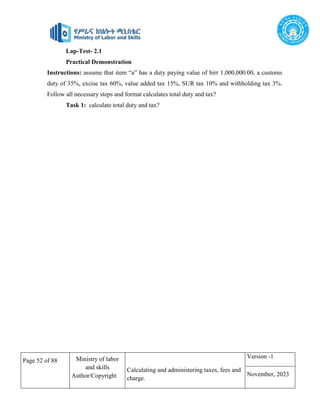
2. assume that item “a” has a duty paying value of birr 1,000,000.00, a customs duty of
35%, excise tax 50%, value added tax 15%, SUR tax 10% and withholding tax 3%.
REQUIRED
A. Calculates total duty and taxes?
50.
Page 50 of88 Ministry of labor
and skills
Author/Copyright
Calculating and administering taxes, fees and
charge.
Version -1
November, 2023
3. In sene 1999 E.C New Millennium Share Company, with head office in Addis Ababa,
purchased items with a total invoice price before VAT of birr 300,000 from a VAT
registered business in Ethiopia. New Millennium exported 60% of the items to a firm
in U.S.A with a selling price of birr 270,000. The remaining 40% of the items were
sold in the domestic market with a selling price of birr 220,000.
Required: -
Determine New Millennium Company’s total VAT liability for the month of sene 1999 E.C
4. Assume that ABC Company is not registered for VAT. In the year ended sene 30,
1999 E.C, the company’s output total birr 128,000 and it has inputs costing birr
40,000. plus VAT at 15% rate
Required: -
How much profit does the company make for the year if the company registered for
VAT voluntarily?
51.
Page 51 of88 Ministry of labor
and skills
Author/Copyright
Calculating and administering taxes, fees and
charge.
Version -1
November, 2023
Operation Sheet- 2.1: Calculating duty and tax import & export values of goods
Purpose
To generate revenue for governments and organizations to fund public
services, infrastructure, and various programs
RESOURCE REQUIRMENT
Blue Or Black Pen
A4 Size Paper
Computer
Total cost of the goods = FOB cost + insurance + freight + GALAFI cost (fixed at
USD 54/MT, and for customs calculation purpose only) + inland transport charge
1 Customs duty = [duty-paying value * customs duty rate] = A
2 excise tax = [(duty-paying value + customs duty) * excise tax rate] = B
3 value added tax = [(duty-paying value + customs duty + excise tax) * 15%] = C
4 surtax = [(duty-paying value + customs duty + excise tax + value added tax) *
10%] = D
5 withholding tax = [(duty-paying value) * 3%] = E
Total payable at the time of import = A+B+C+D+E
*Note - manufacturers who are exempted from surtax and withholding tax are
required to pay a social welfare levy of 3%.
52.
Page 52 of88 Ministry of labor
and skills
Author/Copyright
Calculating and administering taxes, fees and
charge.
Version -1
November, 2023
Lap-Test- 2.1
Practical Demonstration
Instructions: assume that item “a” has a duty paying value of birr 1,000,000.00, a customs
duty of 35%, excise tax 60%, value added tax 15%, SUR tax 10% and withholding tax 3%.
Follow all necessary steps and format calculates total duty and tax?
Task 1: calculate total duty and tax?
53.
Page 53 of88 Ministry of labor
and skills
Author/Copyright
Calculating and administering taxes, fees and
charge.
Version -1
November, 2023
UNIT THREE: Records Transaction
this unit is developed to provide you the necessary information regarding the following
content coverage and topics:
Completing transaction.
Issuing transaction records.
Copies of transaction records.
This unit will also assist you to attain the learning outcomes stated in the cover page.
specifically, upon completion of this learning guide, you will be able to:
complete records of transaction.
Understand issue of transaction records.
To retain and storing copies of transaction records.
54.
Page 54 of88 Ministry of labor
and skills
Author/Copyright
Calculating and administering taxes, fees and
charge.
Version -1
November, 2023
Transaction records for taxes, fees, and charges are crucial for maintaining accurate financial
records, ensuring compliance with tax regulations, and facilitating effective financial
management. These records provide a detailed account of financial transactions, including
the amounts involved, the nature of the transactions, and any associated taxes, fees, or
charges. Here's what transaction records for tax, fees, and charges typically include:
Transaction Date: The date when the financial transaction occurred.
Transaction Description: A clear description of the nature of the transaction, specifying the
goods or services involved.
Transaction Amount: The total amount of the transaction before taxes, fees, or charges are
applied.
Taxable Amount: If applicable, the portion of the transaction amount subject to taxes.
Tax, Fee, or Charge Details:
Tax Type: Specify the type of tax (e.g., VAT, income tax, sales tax).
Tax Rate: The applicable tax rate for the transaction.
Tax Amount: The calculated tax amount based on the taxable amount and tax
rate.
Fees and Charges Details:
Fee or Charge Type: Specify the type of fee or charge (e.g., service charge,
licensing fee).
Fee or Charge Amount: The amount of the fee or charge.
Total Amount Paid: The sum of the transaction amount, taxes, fees, and charges.
Payment Method: How the transaction was paid (e.g., cash, credit card, bank transfer).
Customer or Vendor Information: Information about the party involved in the transaction,
such as the customer or vendor name, address, and contact details.
Invoice or Receipt Number: A unique identifier for the transaction, which is useful for
tracking and referencing.
3.1 Transaction Records
55.
Page 55 of88 Ministry of labor
and skills
Author/Copyright
Calculating and administering taxes, fees and
charge.
Version -1
November, 2023
Currency: The currency in which the transaction was conducted.
Business Identification: Information identifying the business involved in the transaction.
Supporting Documentation: Attach any relevant supporting documents, such as invoices,
receipts, or contracts.
Compliance Reference: Any reference to specific tax regulations or legal requirements
governing the transaction.
transaction records for taxes, fees, and charges. In this scenario, we'll consider a business
providing consulting services to a client. The service fee is $1,000, and there is a Value-
Added Tax (VAT) of 10%. Additionally, a service charge of 5% is applied to the total
amount. Here's how the transaction records might look:
Transaction Records Example:
Transaction Date: 2023-11-15
Transaction Description: Consulting services for client XYZ
Transaction Amount (Service Fee): $1,000.00
Tax Details:
Taxable Amount: $1,000.00
Tax Type: Value-Added Tax (VAT)
Tax Rate: 10%
Tax Amount: $100.00
Fee and Charge Details:
Fee or Charge Type: Service Charge
Fee or Charge Rate: 5%
Fee or Charge Amount: $55.00
Total Amount Paid:
Total Amount Paid: $1,155.00
Additional Information:
Payment Method: Credit Card
Customer Information:
56.
Page 56 of88 Ministry of labor
and skills
Author/Copyright
Calculating and administering taxes, fees and
charge.
Version -1
November, 2023
Name: XYZ Corporation
Address: 123 Main Street, Cityville, State, ZIP
Contact: John Doe (Accounts Payable)
Invoice or Receipt Number: INV20231115001
Currency: USD (United States Dollar)
Business Identification: ABC Consulting, LLC
Supporting Documentation: Invoice, Credit Card Receipt
Compliance Reference: VAT Act 2023, Section 5
Summary:
Service Fee: $1,000.00
VAT (10%): $100.00
Service Charge (5%): $55.00
Total Amount Paid: $1,155.00
The vat proclamation provides rules relating to registration for vat purposes. It describes who
is obliged to register, who may not register, procedures for registration etc.
3.1.1 VAT in Accounting
Value Added Tax (VAT) is an indirect tax. This means it may be shifted or passed on the
buyer, transferee or lessee of the goods, properties or services.
A. Register: All entities with gross annual sales/receipts of at least P1, 500,000.00?
B. file: For as long as the VAT registration has not been cancelled, the VAT
return/declaration must be filed by the following taxpayers:
• A VAT-registered entity; and
• An entity required to register as a VAT taxpayer but failed to register.
• The returns/declarations must be filed with any Authorized Agent Bank (AAB)
within the jurisdiction of the Revenue District Office where the taxpayer is
required to register. In places where there is no AAB, the returns/declarations
shall be filed with the Revenue Collection Officer or duly Authorized City or
57.
Page 57 of88 Ministry of labor
and skills
Author/Copyright
Calculating and administering taxes, fees and
charge.
Version -1
November, 2023
Municipal Treasurer located within the revenue district where the taxpayer is
required to register.
The filing should be done even if (a) there is no taxable transaction during the month or (b)
the aggregate sales/receipts for any 12-month period did not exceed P1, 500,000.00.
The returns/declarations must be filed with any Authorized Agent Bank (AAB) within the
jurisdiction of the Revenue District Office where the taxpayer is required to register. In
places where there is no AAB, the returns/declarations shall be filed with the Revenue
Collection Officer or duly Authorized City or Municipal Treasurer located within the revenue
district where the taxpayer is required to register.
C. VAT payment:
Monthly VAT Payable is paid not later than the 20th day following the close of the month.
To illustrate, VAT for the month of May should be paid on or before June 20. Quarterly VAT
Payable must be paid not later than the 25th day following the close of the quarter. To
illustrate, VAT for the second quarter should be paid on or before July 25.
D. Rates and bases of tax:
On Sale of Goods – twelve percent (12%) of the gross selling price or gross value in money
of the goods or properties sold, bartered or exchanged On Sale of Services – twelve percent
(12%) of gross receipts derived from the sale or exchange of services
Accounts Used:
Input Tax means the value-added tax due from/paid by a VAT-registered entity in the course
of his trade or business on purchase of goods or services from another VAT-registered entity.
Output Tax means the value-added tax due on the sale of taxable goods or services by any
VAT-registered entity.
VAT Payable is the account used to record the excess of output tax over allowable input tax.
It is payable to the BIR. It is presented as part of Trade and Other Payables under the Current
Liability section of the Balance Sheet.
58.
Page 58 of88 Ministry of labor
and skills
Author/Copyright
Calculating and administering taxes, fees and
charge.
Version -1
November, 2023
Creditable Input Tax is the account used to record the excess of input tax over output tax. It
serves as tax credit. It is presented as part of Other Current Assets (after Prepaid Expenses)
under the Current Assets section of the Balance Sheet.
Excess of Input Tax over Output Tax may be used in lieu of the account Creditable Input
VAT.
Journal Entries for VAT
The following journal to be passed when goods are sold:
Trade Receivable A/c (including Vat) Debit
Sales A/c (excluding Vat) Credit
Vat Payable A/c (output tax) Credit
Example:
Suppose, ABC Co. sales 50 Ton steel product @ Birr1, 000 (including VAT) to XYZ Co.
Ltd. Total sales amount is Birr50, 000. How ABC Co. record this transaction? Say, VAT rate
is 5%.
Solution:
XYZ A/c (Trade Receivable A/c) Debit 50,000
Sales A/c (50,000/105*100) Credit 47,619
Vat A/c (Output Tax) (50,000/105*5) Credit 2,38
Raw materials are purchased from the market by paying the cost and input tax on these
materials. The entry will be:
Particularsl/f Debit Credit
Purchase Account XXX
Input VAT Account XXX
Cash/Creditor XXX
Finished goods are sold to customers and output VAT is also collected from respective
customers. The entry will be:
Particularsl/f Debit Credit
59.
Page 59 of88 Ministry of labor
and skills
Author/Copyright
Calculating and administering taxes, fees and
charge.
Version -1
November, 2023
Cash/Accounts receivables XXX
Sale Account XXX
Output VAT payable account XXX
Now we will have to calculate the amount that will be paid to the government. This amount
is calculated as a difference between input tax paid and output tax received from customers.
Two situations may arise here.
Input tax greater than output tax
Output tax collected from the customer is great than the input tax. In this case, following
journal entry will be passed.
Particulars l/f Debit Credit
VAT payable Account (net) XXX
Bank Account XXX
The debit impact of this transaction is the removal of liability from the books of accounts. On
the other hand, the credit impact is an outflow of cash from business and payment to the
Government.
Example
TPL ltd. Company has purchased raw materials from its suppliers costing @10,000(exclusive
of VAT). Assume that rate of VAT is 10%.
Particulars l/f Debit Credit
Purchase Account 10,000
Input VAT Account 1,000
Cash/Creditor 11,000
TPL ltd. Company has sold goods at price of Birr 12,000 (exclusive of VAT) to one of its
customers. Assume that rate of VAT is 10%.
Particulars l/f Debit Credit
Cash/Accounts receivables 13,200
Sale Account 12,000
60.
Page 60 of88 Ministry of labor
and skills
Author/Copyright
Calculating and administering taxes, fees and
charge.
Version -1
November, 2023
Output VAT payable account 1,200
At the end of the period, excess output VAT over input was paid to the government.
Particulars l/f Debit Credit
VAT payable Account (net) 200
Bank Account 200
Table 3. 1 vat exclusive
Transactions Journal Entries
1. Purchased merchandise e,
P10,000, on terms 2/10 n/30, plus
a 12% VAT
Purchases 10,000.00
Input Tax 1,200.00
Accounts Payable 11,200.00
2. Sold merchandise e, P18,000,
on terms 2/10 n/30, plus a 12%
VAT
Account Receivable 20,160.00
Sales 18,000.00
Output Tax 2,160.00
3. Returned merchandise e,
P1,000, plus 12% VAT
Accounts Payable 1,120.00
Purchase Returns and
Allowances
1,000.00
Input Tax 120
4. Sales returns, P1,000, plus
12% VAT
Sales Returns and Allowances
Output Tax (P1,000 x 0.12 =
P120)
1,000.00
120
Accounts Receivable (P1,000
x 1.12 = P1,120)
1,120.00
5. Partial
payment of P1,500
Accounts Payable 1,500.00
Cash 1,500.00
6. Partial
collection of P2,000
Cash 2,000.00
Accounts Receivable 2,000.00
61.
Page 61 of88 Ministry of labor
and skills
Author/Copyright
Calculating and administering taxes, fees and
charge.
Version -1
November, 2023
7. Payment of account within discount
period
Accounts Payable (P11,200-
1,120-1,500 = P8,580)
8,580
Purchase Discount (P11,200-
1,120) x0.02/1.12
180
Input Tax (P180 x 0.12 =
P21.60)
21.6
Cash
8,378.40
8. Collection of account within discount
period
Cash (P17,040-380.80 =
P16,659.20)
16,659.20)
Sales Discount ((P20,160-)
0.02=380.8/1.12) = 340
340
Output Tax (P340 x 0.12 =
P40.80
40.80
Account Receivable (P20,160-
1,120-2,000 = P17,040)
17,040
62.
Page 62 of88 Ministry of labor
and skills
Author/Copyright
Calculating and administering taxes, fees and
charge.
Version -1
November, 2023
Table 3. 2 vat inclusive
Transactions Journal Entries
A. Purchased merchandise
e, P10,000 VAT-
inclusive, on terms 2/10
n/30
Purchases (P10,000/1.12 =
P8,928.57)
8,928.57
Input Tax (P8,928.57 x 0.12 =
P1,071.43)
1,071.43
Accounts Payable 10,000.00
B. Sold merchandise,
P18,000 VAT-
inclusive, on terms 2/10
n/30 inclusive
Account Receivable 18,000.00
Sales (P18,000/1.12 = P16,071.43) 16,071.40
Output Tax (P16,071.43 x 0.12 =
P1,928.57)
1,928.57
3. Returned merchandise,
P1,000, VAT-
Accounts Payable 1,000.00
Purchase Returns and Allowances
(P1,000/1.12 = P892.86)
892.86
Input Tax (P892.86 x 0.12 = P107.14) 107.14
4. Sales returns, P1,000, VAT-
inclusive
Sales Returns and Allowances
(P1,000/1.12 = P892.86)
892.86
Output Tax (P892.86 x 0.12 =
P107.14)
107.14
63.
Page 63 of88 Ministry of labor
and skills
Author/Copyright
Calculating and administering taxes, fees and
charge.
Version -1
November, 2023
Accounts Receivable 1,000.00
5. Partial payment of P1,500
Accounts Payable 1,500.00
cash 1,500.00
6. Partial collection of P2,000
Cash 2,000.00
Accounts Receivable 2,000.00
7. Payment of account within
discount period
Accounts Payable
7,500.00
Purchase Discount 160.71
Input Tax 19.29
Cash
7,320.00
8. Collection of account within
discount period
Cash 14,660.00
Sales Discount 303.57
Output Tax 36.43
Account Receivable 15,000
f the difference is positive (Output tax > Input tax), then the difference is credited to VAT
Payable. difference is negative (Output tax < Input tax), then the difference is debited to
Creditable Input Tax or Excess of Input Tax over Output Tax.
3.1Issuing Transaction Records.
Issuing transaction records is a critical aspect of financial management for businesses.
Transaction records, such as invoices and receipts, serve as documentation of financial
64.
Page 64 of88 Ministry of labor
and skills
Author/Copyright
Calculating and administering taxes, fees and
charge.
Version -1
November, 2023
transactions, provide transparency to clients, and are essential for accounting, tax
compliance, and auditing purposes. Here's a guide on issuing transaction records:
Invoice Issuance:
Purpose: To request payment from a client for goods or services provided.
Components:
Invoice Date: The date the invoice is issued.
Invoice Number: A unique identifier for tracking and reference.
Business Information: Name, address, and contact details of the issuing business.
Customer Information: Name, address, and contact details of the client.
Description of Goods or Services: A detailed list of items or services provided.
Quantity, Unit Price, and Total Amount: For each item or service.
Tax Details: If applicable, include taxes such as VAT.
Total Amount Due: The sum of the transaction amount, taxes, and fees.
Payment Terms: Specify the due date and acceptable payment methods.
Receipt Issuance: To confirm that payment has been received for goods or services.
Components:
Receipt Date: The date the payment is received.
Receipt Number: A unique identifier for tracking and reference.
Business Information: Name, address, and contact details of the receiving
business.
Customer Information: Name, address, and contact details of the paying
client.
Description of Transaction: A summary of goods or services for which
payment was received.
Payment Details: Amount paid, payment method, and any reference numbers.
Transaction Status: Indicate if the payment is full or partial.
Acknowledgment: A thank-you message or acknowledgment of the payment.
65.
Page 65 of88 Ministry of labor
and skills
Author/Copyright
Calculating and administering taxes, fees and
charge.
Version -1
November, 2023
Best Practices:
Timeliness: Issue invoices promptly after providing goods or services.
Accuracy: Ensure all details are accurate, including amounts, dates, and contact
information.
Clarity: Use clear and concise language to describe items or services.
Consistency: Maintain a consistent format for invoices and receipts.
Organization: Keep copies of all issued transaction records for record-keeping.
Compliance: Ensure that transaction records comply with tax regulations and
accounting standards.
Automation:
Consider using accounting or invoicing software: Automated systems can
streamline the invoicing process, reduce errors, and provide a centralized record-
keeping system.
Integration: Integrate invoicing systems with accounting software for seamless
financial management.
Follow-Up:
Follow up on overdue payments: If payment is not received by the due date, send
reminders to clients.
Issuing accurate and timely transaction records is crucial for maintaining good financial
practices and fostering positive relationships with clients. These records also contribute to the
overall financial transparency and compliance of the business.
Retaining and storing copies of transaction records is essential for business accountability,
financial management, and compliance with legal and regulatory requirements. Here's a
guide on how to effectively retain and store copies of transaction records:
Create a Centralized Record-Keeping System:
3.2 Retaining and storing copies of transaction records.
66.
Page 66 of88 Ministry of labor
and skills
Author/Copyright
Calculating and administering taxes, fees and
charge.
Version -1
November, 2023
Use accounting software or an enterprise resource planning (ERP) system to
centralize and organize transaction records.
Implement a consistent file naming convention for easy retrieval.
Organize by Date and Type:
Arrange transaction records chronologically to facilitate tracking and auditing.
Categorize records by type, such as invoices, receipts, and financial statements.
Maintain Digital Copies:
Scan paper documents and store digital copies to reduce physical storage needs.
Back up digital records regularly to prevent data loss.
Cloud Storage:
Consider using cloud-based storage solutions for added security and accessibility.
Choose reputable cloud storage providers that prioritize data encryption and
compliance.
Secure Physical Storage:
For physical copies, use secure filing cabinets or storage rooms.
Implement access controls to restrict unauthorized access to physical records.
Retention Policies:
Develop and adhere to retention policies outlining how long different types of records
should be retained.
Ensure compliance with legal and regulatory requirements regarding record retention.
Data Security:
Implement security measures to protect sensitive financial information.
Use encryption for stored digital records and restrict access based on roles and
responsibilities.
Regular Audits:
Conduct regular internal audits to ensure that all transactions are accurately
documented and stored.
Implement reconciliation processes to cross-verify financial records.
67.
Page 67 of88 Ministry of labor
and skills
Author/Copyright
Calculating and administering taxes, fees and
charge.
Version -1
November, 2023
Document Destruction Protocols:
Establish protocols for the secure destruction of documents that have reached the end
of their retention period.
Shred physical documents or permanently delete digital files according to established
guidelines.
Legal and Regulatory Compliance:
Stay informed about legal and regulatory requirements for record retention in your
industry and jurisdiction.
Periodically review and update record retention policies to remain compliant with
changes in regulations.
Training and Awareness:
Train staff on the importance of proper record-keeping and the procedures for storing
and retrieving transaction records.
Foster a culture of compliance within the organization.
External Backups:
Consider storing external backups in a separate location to mitigate risks associated
with data loss due to unforeseen events like natural disasters or cyber-attacks.
Documentation of Changes:
Keep a log or documentation of any changes made to transaction records, especially
in digital systems.
By following these practices, businesses can establish a robust system for retaining and
storing copies of transaction records. This not only ensures compliance but also facilitates
efficient financial management and decision-making processes.
The books and records shall be kept by the tax payer for a period of ten years after the end of
the tax period to which they relate. These records may include:
Original tax invoice
A copy of all tax invoices
68.
Page 68 of88 Ministry of labor
and skills
Author/Copyright
Calculating and administering taxes, fees and
charge.
Version -1
November, 2023
Customs documentation related to import & export
Accounting records
SELF – CHECK III
PART I: WORK OUT QUSETION
A. Sponex Limited deals in a wide variety of low-price sports goods. Shown below is a
list of transactions for the month of June 2016.
2-Jun Purchased goods on credit from Marun Shoes of Sh.96, 000.
3-Jun
Paid freight charges of Sh.2, 450 on the shipment of goods purchased from
Manrun Shoes.
4-Jun
Upon unpacking the goods from Manrun Shoes, discovered that some of
the shoes were the wrong style. Returned those shoes which cost Sh.4, 000
to Manrun Shoes and received full credit.
9-Jun Sales made on account to Ripa Sports for Sh.141, 000.
11-Jun Paid Sh.2, 200 freight charges on the shipment to Ripa Sports.
12-Jun Paid Marun Shoes in full.
16-Jun Made credit sales to Holiday Sports for Sh.27, 550.
19-Jun Received payment in full from Ripa Sports.
21-Jun Holiday Sports returned goods worth Sh.6, 500.
Note: All transactions were subject to Value Added Tax where applicable. The rate of VAT
is 15%.
Required:
A. Sportex Limited Value Added Tax Account for June 2016
69.
Page 69 of88 Ministry of labor
and skills
Author/Copyright
Calculating and administering taxes, fees and
charge.
Version -1
November, 2023
B. If the amount calculated above is not paid on time, what penalties will be
imposed?
Given below were the purchases and sales made by Tough Limited during the month of
December 2015. The prices were inclusive of VAT at the standard rate of 17 percent.
1 Purchased 400 units at Sh.5,600 per unit Sold 40 units at sh.7,200 per unit
5 Sold 80 units at Sh.7,200 per unit
10 Sold 200 units at Sh.7,200 per unit
20 Purchased 300 units at Sh.6,400 per unit
25 Sold 80 units at sh.7,200 per unit
31 Sold 200 units at Sh.8,000 per unit
Note: There was no inventory at the beginning of the month but 100 units were in stock at
the end of the month.
Required:
1. The VAT account for the month of December 2015.
2. On what date is VAT due payable?
PART III - Demonstrate
1. W/t Meseret is a shareholder holding 100 shares of 1000 Ethiopian birr each in Dashen
Bank SC. Dashen Bank declared a dividend of 20% to the shareholders?
Required
A. Whether the above transaction is a taxable transaction?
B. If the answer to the above is yes, who is the withholding agent?
C. Who is liable to pay tax to the tax authority?
D. How much is the tax to be paid to the tax authority?
70.
Page 70 of88 Ministry of labor
and skills
Author/Copyright
Calculating and administering taxes, fees and
charge.
Version -1
November, 2023
Unit Four: Enquiries and Complaints of customers
This unit is developed to provide you the necessary information regarding the following
content coverage and topics.
Enquiries.
Payment options
Complaints and notifying decisions.
customer’s dissatisfaction.
This unit will also assist you to attain the learning outcomes stated in the cover page.
Specifically, upon completion of this learning guide, you will be able to.
Deal with Enquiries.
Explain Payment options, due dates and record-keeping requirements.
Deal with Complaints and recording and notifying decisions.
Review and explain decision for customer’s dissatisfaction.
71.
Page 71 of88 Ministry of labor
and skills
Author/Copyright
Calculating and administering taxes, fees and
charge.
Version -1
November, 2023
4.1 Enquiries
You will be required to establish an effective relationship with the client; determine the client
needs; effectively record details of the enquiry/complaint; obtain supporting documentation
where appropriate; determine and implement suitable course of action to effectively resolve
the issue/s; and ensure the client is kept informed of progress at all times.
4.1.1 Client Relationship
Organisations continually interact with people and other organisations as part of their day-to-
day operations. This interaction requires effective communication, both internally and
externally. For this communication to be effective you should consider the intended
recipients and ensure that the format and content are within their understanding.
The communication processes
Communication may take a verbal, non-verbal or graphic form.
Verbal communication is in the form of words, either spoken (e.g., telephone conversation)
or written (e.g., letter, memo, email).
Non-verbal communication is any form other than words or graphics, such as oral (e.g.
facial expression), written and graphic (e.g. format and layout), or, independently of words,
face-to-face contact.
Graphic communication takes the form of ideas, relationships or connections
communicated visually with graphic images (shapes, diagrams and lines). It can have both
verbal and non-verbal components (e.g., "No Unauthorised Entry" sign in public places).
The ability to communicate is an ongoing skill gained from experience and ongoing
association with others. As experience widens, new learning takes place. This is reflected in
the workplace environment by the continual monitoring of the effectiveness of the means of
communication being used. Such monitoring can be in the form of direct feedback from
clients, customers and staff, as well as keeping abreast of current trends and practices.
All workplace procedures and documents need to comply with the requirements of effective
communication, including suitable language and graphics, absence of discriminatory content,
effective layout and presentation. The systems should also be easy to use by all required
72.
Page 72 of88 Ministry of labor
and skills
Author/Copyright
Calculating and administering taxes, fees and
charge.
Version -1
November, 2023
staff and provide detailed instructions on the methods of use. Evaluating the response to
communication (feedback) is also essential.
If it is found that some or all of the communication styles of the organisation are causing
problems, immediate steps should be taken to remedy this. You first need to determine the
problem area (which is probably due to the presence of communication barriers) and analyse
the reasons for the ineffectiveness. These barriers can be caused by many factors:
inappropriate choice of words
inappropriate channel
inappropriate message
poor layout and presentation
inadequate feedback
lack of courtesy
4.1.2 Client Needs
The first contact clients have with an organisation makes a lasting impression. The way you
greet them, including the language used (both verbal and non-verbal) and the empathy
shown, convey the level of interest you have in their needs.
All clients who approach an organisation expect prompt and courteous service and to be
treated with respect. You should employ the following communication skills to establish
contact with clients:
Provide a welcoming client environment. A cheerful and warm atmosphere may
soothe an irate client.
Establish a positive communication climate by greeting the client warmly
according to organisational procedures, and showing empathy. Use client’s
names whenever possible and use a friendly tone.
Create an effective service environment through the use of appropriate verbal and
non-verbal behaviour. A smile improves anyone’s day.
Use questioning and active listening to determine client needs. If it can be seen
that you are genuinely interested, the client will be more forthcoming.
73.
Page 73 of88 Ministry of labor
and skills
Author/Copyright
Calculating and administering taxes, fees and
charge.
Version -1
November, 2023
Demonstrate tact and maintain confidentiality.
4.1.3 Verbal and Non-Verbal Behaviour.
Using positive and polite language is not sufficient. You should also display appropriate
non-verbal behaviour to reinforce what you are saying. Be friendly and relaxed in your
approach. Ensure that you demonstrate confidence in your professional skills and abilities by
being assertive and professional, while maintaining an interest in the client’s needs.
4.1.4 Questioning and listening.
Be attentive to clients and display interest while actively listening to what they have to say.
Use appropriate body language and maintain eye contact. By using careful questioning
techniques, you can work out the main message the client is trying to impart and extract
additional information that will assist you in determining their needs. It will also reinforce
their confidence in you and your ability to help them.
Active listening and how to use it in client service is shown below (Dwyer, 2006, p.229).
Attentive to the client
Concentrate on the issue, not the person
Target key points
Investigate with questions
Verify client’s needs
Energise your response
4.1.5 Client Complaint/Enquiry.
Records are a key component and are part of the accountability process of an organisation.
Keeping accurate and timely client records should be part of the overall objectives.
4.1.6 Client Records
Having a formal record of the interaction between the client and the organisation provides
background information that can be used by many areas of the organisation. It can also assist
in improving the services provided to clients and it is therefore important that this
information is recorded accurately and in a timely manner.
74.
Page 74 of88 Ministry of labor
and skills
Author/Copyright
Calculating and administering taxes, fees and
charge.
Version -1
November, 2023
These records should include a history of contacts, provide evidence of what has happened
and any action taken, the people involved, and any follow-up required. An effective system
will comply with all legislative and organisational requirements, have effective management
and monitoring processes in place, ensure secure and confidential storage of records, and be
well organised and readily available to appropriate staff.
The information to be included in these records is gathered and recorded using organisational
policies and procedures. This includes the use of a variety of documents.
Types of documents
The types of documents necessary to effectively record a complaint/enquiry will include:
Enquiry/complaint form
Complaints Register
Business letters
Memorandum
Facsimile transmission
Surveys & Questionnaires
Email
Web pages
The final document in all cases should be an effective communication tool that promotes the
business and achieves the outcome required. For example, does the complaint form provide
the opportunity for a client to express their grievance effectively?
In order to streamline the processing of information gathered, you need to make full use of
the business technology available within the organisation. Such technology may include:
Computer, printer
Telephone
Voicemail
Fax machine
Photocopier
75.
Page 75 of88 Ministry of labor
and skills
Author/Copyright
Calculating and administering taxes, fees and
charge.
Version -1
November, 2023
Document binder
Shredder.
Client feedback
In responding to client feedback the organisation should aim to develop a climate of trust and
confidence that will result in increased satisfaction and reduced complaints. It will provide
the opportunity to improve the overall client service process and, in turn, improve staff
motivation and job satisfaction. Ideally, staff should be empowered to take action in
response to complaints/enquiries or refer the matter to the person responsible, either internal
or external.
Organisational and legislative requirements
Once the needs of the client have been identified you need to apply processes which comply
with organisational requirements. There are many factors that need to be considered to effect
service delivery. These may include:
Legal obligations
Occupational health and safety policies, programmes and procedures
Confidentiality and security requirements
Anti-discrimination and related policy
Organisational best-practice policy
Quality measures
Continuous improvement processes
Ethical standards
Pricing and discount policies
Replacement and refund procedures
Payment and delivery options
Designated resource parameters.
76.
Page 76 of88 Ministry of labor
and skills
Author/Copyright
Calculating and administering taxes, fees and
charge.
Version -1
November, 2023
4.2 Payment options
Payment options refer to the various methods that individuals or businesses can use to settle
financial transactions. The availability of payment options depends on the entity receiving
the payment and the nature of the transaction. Here are some common payment options:
Fig2: payment option
4.2.1 Payment options
Figure 4. 1 payment option
A payment can be made in the form of cash, check, and wire transfer, credit card, or debit
card. More modern methods of payment types leverage the Internet and digital platforms.
The payment method specifies the procedure, such as check, transfer or bill of exchange, by
which payments are made. Payment Type specifies the type of payment. Partial payment,
final payment, additional payment, down payment, deferred payment. Please let me know if
you need more information.
Today’s purchasers pay for goods and services using eight principal payment types. Here’s a
rundown of these payment methods, including the advantages and disadvantages that come
with each.
8 popular payment options
Credit and debit card
Cash
Mobile wallet
77.
Page 77 of88 Ministry of labor
and skills
Author/Copyright
Calculating and administering taxes, fees and
charge.
Version -1
November, 2023
Buy now, pay later (BNPL)
Checks
Bank transfer
auto pay
Crypto currency
Credit and debit card
Credit and debit card payments are the most common payment type. Credit card companies,
including Visa, MasterCard, American Express, and Discover, extend credit to purchasers;
they cover the purchase price, and customers pay their card balance every month. Debit
cards, instead of extending credit to a purchaser, deduct money directly from the purchaser’s
bank account.
Advantages of credit and debit card payments: Credit cards allow customers to make large
purchases even if they don’t currently have a lot of cash. This may benefit retailers, since
using a credit card usually results in a larger shopping cart total than if the customer pays
with cash. Debit cards only let customers spend what is in their bank accounts, but they offer
the customer convenience and security, as they don’t have to walk around with large sums of
cash in their wallets.
Disadvantages of credit and debit card payments: The principal disadvantage is the payment
processing fee that credit card companies levy on merchants. Most debit card fees stay below
1% of the purchase price, but some credit cards can charge a merchant up to 3.5% of the
purchase price. Furthermore, there is a lag from when the purchase happens to when the
amount appears in the merchant’s bank account. This stands in contrast to cash, which is
immediately available after the sale.
Cash: Cash payments are the most traditional of payment methods (and no, we’re not
including the barter system in our list). This is when a customer hands paper or coin currency
to a merchant.
Advantages of cash payments: The merchant instantly receives payment, and they do not
owe any fees for payment processing.
78.
Page 78 of88 Ministry of labor
and skills
Author/Copyright
Calculating and administering taxes, fees and
charge.
Version -1
November, 2023
Disadvantages of cash payments: For all its simplicity, cash has lost much of its appeal
among customers. Many customers prefer credit cards that give them cash-back rewards,
while others like the convenience of mobile payment services embedded into their
smartphones and smartwatches. For a merchant, keeping cash on site renders them vulnerable
to theft. And for online retailers, accepting cash is largely impractical, if not impossible.
Mobile wallet: Mobile wallet services function via apps that run on smartphones, tablets,
and smartwatches, and link to a customer’s credit card, debit card, or bank account. They
include Apple Pay, Google Pay, and Samsung Pay. Once a person sets up their mobile wallet
account, they can use these apps to pay for things at vendors that accept mobile payments
Advantages of mobile wallet payments: Mobile wallets offer great convenience to
customers, who can use them at tap to pay terminals in brick-and-mortar stores or in an
online shopping cart when purchasing items over the internet. While they don’t yet rival
credit or debit cards in popularity, their popularity is growing. Global consumers spent
$1.786 billion via mobile payments in 2021, and financial analysts expect that figure to more
than triple within five years.
Disadvantages of mobile wallet payments: Merchants will need a new point of sale terminal
to accept tap to pay transactions in a brick-and-mortar store. Many mobile wallet apps also
place transaction limits on their customers—limits that tend to be much lower than most
credit card limits. This can put an artificial cap on the size of a customer’s purchase.
Buy now, pay later (BNPL)
A buy now, pay later plan (BNPL) is a loan that the BNPL Company offers to a customer so
that they can purchase merchandise on credit, but without a credit card. Popular BNPL
lenders include Shop Pay Installments from Shopify, Affirm, after pay, Sezzle, PayPal, and
Klarna. BNPL is particularly popular for online shopping, and some brick-and-mortar
retailers now accept it in stores.
Advantages of BNPL: A BNPL service extends credit to consumers, including to many of
those without good credit or those without credit cards. For consumers, there are typically no
fees to use the service. Customers pay back the loan in installments without interest, unless
79.
Page 79 of88 Ministry of labor
and skills
Author/Copyright
Calculating and administering taxes, fees and
charge.
Version -1
November, 2023
they miss a payment. Even then, interest tends to be less than credit cards charge. BNPL
often encourages customers to spend more than they might with cash, a debit card, or even a
traditional credit card.
Disadvantages of BNPL: BNPL services don't charge high interest rates to customers; they
instead charge higher percentages to retailers. This typically ranges from 2% to 8% of the
purchase, which is far higher than what credit cards charge retailers.
Checks: Some customers still pay with paper checks, either from a personal checking
account or with a cashier’s check from a bank. These checks serve as promissory notes that a
retailer can redeem at a bank for cash.
Advantages of check payments: For a customer, checks come with almost no purchase
limits. They can draft a check covering any amount of money in their bank account.
Disadvantages of check payments: Financial fraudsters have long favored checks as a way
to stiff merchants out of money. To avoid the risk of bounced checks, merchants must invest
in check processing terminals that rapidly process such financial transactions. These check
readers typically cost north of $250 and must link to a payment verification network. As
such, many small businesses accept bank checks but refuse personal checks.
Bank transfer: Also known as a wire transfer, a bank transfer sends money directly from the
account of one person or business to the account of another person or business. These
transfers are popular for very large purchases, particularly those involving real estate.
Advantages of bank transfers: Bank transfers are very secure. While they come with a one-
time fee for both sender and receiver, they do not involve a percentage-based commission
like one would pay in a BNPL or credit card transaction.
Disadvantages of bank transfers: Bank transfers are impractical for most everyday
purchases. They require advance planning because they typically require interacting with a
bank representative during business hours. The one-time wire transfer fee (often ranging
from $30 to $50) can be exorbitant when linked to small purchases. For this reason, bank
transfers tend to be limited to very large purchases.
80.
Page 80 of88 Ministry of labor
and skills
Author/Copyright
Calculating and administering taxes, fees and
charge.
Version -1
November, 2023
Auto pay: An autopsy system automatically debits a person’s bank account, credit card, or
debit card on a set date, usually once per month. Auto pay is popular for credit card
payments, utility payments, monthly subscriptions, and scheduled charitable donations.
Advantages of autopsy: auto pay promotes customer retention, since customers can schedule
automatic purchases as opposed to reauthorizing payment every single month. Customers
also like auto pay since it prevents them from missing important payments for items like
phone service and electric bills.
Disadvantages of autopsy: auto pay only applies to certain transactions that occur on a
periodic basis. It does not work for all types of purchases or for one-time purchases.
Crypto currency
Crypto currency has become an increasingly viable way to pay for goods and services, as
services like Bit Pay and Wire offer debit cards consumers can fund with mainstream cryptos
like Bit coin.
Advantages of crypto payments: Many leading digital currencies, including Bit coin, run via
block chains, which are systems that record financial transactions using decentralized peer-
to-peer computer networking. These block chains operate independently of government
control, which appeal to people who want to use currency that’s outside government-backed
financial systems. Accepting crypto as payment opens businesses up to this audience.
Disadvantages of crypto payments: Compared to government-backed “fiat” currencies like
the US dollar and the euro, crypto currency is unstable and prone to large losses in value.
This may pose a risk to merchants who accept crypto payments. Crypto also lacks the robust
payment infrastructure enjoyed by credit cards, debit cards, and mobile payments.
Due date
In business, a due date is the latest a payment can be made on an invoice or debt before it's
considered overdue. Sort your invoices by the due date to keep tr The due date is the payment
deadline or the latest time limit set to pay a financial obligation. The term is generally used in
the context of bill payments. When you have a financial obligation with a due date, it means
81.
Page 81 of88 Ministry of labor
and skills
Author/Copyright
Calculating and administering taxes, fees and
charge.
Version -1
November, 2023
that you have to pay off the amount owed before the specified date. Ask of your overdue
invoices and follow up with customers who owe you.
Put simply, a payment due date is when you are required to make at least the minimum
payment on your credit card. A closing date is when your billing cycle ends and a new
“statement period” begins. Again, the bank will also account for any interest from hanging
balances on your closing date.
A date on which the bill of exchange or invoice is payable by the creditor to the debtor is
known as the due date.
4.3 Complaints and notifying decisions.
It's important to carefully manage how you respond to negative feedback about your
business. Complaints can be uncomfortable to deal with, but they can be a good opportunity
to improve your products, services or operations.
Complaints are typically based on:
Poor service or product quality
Special requests not fulfilled
Dissatisfaction with products or facilities
Unhygienic conditions
Low comfort levels
The behavior of other customers
Errors with bills, reservations or orders
Unfair treatment.
Value of complaints
Complaints can highlight weaknesses in your training programs, policies, work instructions
and service delivery, and give you the opportunity to improve your operations.
Good complaint handling:
reassures customers that you are committed to resolving problems and improving
relationships
maintains and builds loyalty
82.
Page 82 of88 Ministry of labor
and skills
Author/Copyright
Calculating and administering taxes, fees and
charge.
Version -1
November, 2023
improves your accountability and transparency
evaluates and improves programs and services
informs decision making about future service deliver
4.4 Customer’s Dissatisfaction.
A dissatisfied customer has a problem in that they aren't happy about a product or service.
For these customers, polite treatment and a remedy, such as a refund or replacement, can
keep them from becoming an angry customer.
Reasons for customer dissatisfaction:
Your product feels like it's not fully developed.
The price is too high compared to the value it delivers.
The perceived value is different than the experienced value.
The product or its features aren't working properly.
You have abysmal customer support.
Customer dissatisfaction affects your business:
Unhappy users leave negative comments about your brand in public.
They also have the highest likelihood of leaving and unsubscribing from your
product.
Types of dissatisfied customers:
An angry customer is convinced that your company neither cares nor listens to
them.
An unhappy customer feels that your product failed to meet their expectations.
A demanding customer thinks highly of them and wants you to treat them
differently.
Ways to handle dissatisfied customers:
Make customers feel valued from the start using an onboarding process.
Deliver personalized experiences within your product.
Reduce time to value using interactive walkthroughs and demo content.
Identify detractors using an NPS survey.
83.
Page 83 of88 Ministry of labor
and skills
Author/Copyright
Calculating and administering taxes, fees and
charge.
Version -1
November, 2023
Analyze customer feedback gathered from your in-app surveys.
Implement product user segmentation to segment detractors and create
personalized experiences for them.
Use in-app help to remove friction and improve customer onboarding.
Take a proactive approach to proactively guide your customers.
Close the value gap to align with the customer perceived value.
Address customer complaints quickly and thoroughly.
Graciously reply to negative feedback.
84.
Page 84 of88 Ministry of labor
and skills
Author/Copyright
Calculating and administering taxes, fees and
charge.
Version -1
November, 2023
Self – check IV
Part I: True or false question
1. Customers can only submit inquiries through traditional channels such as phone calls or
in-person visits.
2. Complaints should always be viewed negatively, and businesses should try to avoid
receiving them.
3. Enquiries are typically more urgent than complaints and require immediate attention.
4. A business should respond to customer inquiries and complaints in a similar manner.
5. Feedback obtained from customer complaints is not useful for making improvements in
products or services.
Part II: multiple choice
1. What is the primary purpose of customer inquiries?
A) To express dissatisfaction
B) To seek information or clarification
C) To file a formal complaint
D) To provide positive feedback
2. How should businesses typically handle customer complaints?
A) Ignore them to avoid escalation
B) Address them promptly and find solutions
C) Categorize them as unimportant
D) Share them on social media immediately
85.
Page 85 of88 Ministry of labor
and skills
Author/Copyright
Calculating and administering taxes, fees and
charge.
Version -1
November, 2023
3. Which of the following is an example of a common channel for submitting customer
complaints?
A) Online inquiry form
B) Customer service hotline
C) Live chat support
D) All of the above
Part II: Demonstration
1. Traditional paper document in the ordinary course of business is not required to
construct such a record for tax purposes?
2. What is recordkeeping system?
3. Demonstrate and discuss calculate & administering taxes, fees and charge?
4. List types of payment option?
5. What is customer dissatisfaction?
6. What cause of customer dissatisfaction?
7. List ways to handle dissatisfied customers?
86.
Page 86 of88 Ministry of labor
and skills
Author/Copyright
Calculating and administering taxes, fees and
charge.
Version -1
November, 2023
REFERENCE
ABC of taxes in ETHIOPIA (1997), planning and research department, ETHIOPIA
ALKA-GUPTA (2005), public finance and tax planning, 1ST
ED, ANMOL publishing
putud.
J.K. Laser’s Your Income Tax 2021
Ethiopian chamber of commerce (ECC) (1,2005) taxation in ETHIOPIA, ADDIS
ABABA
ETHIOPIA business development service network (EBDSN) taxation in ETHIOPIA,
ADDIS ABABA
Federal income tax proclamation 2016
87.
Page 87 of88 Ministry of labor
and skills
Author/Copyright
Calculating and administering taxes, fees and
charge.
Version -1
November, 2023
Developer profile
N
o
Name Qualification Educational
background
Region College Mobile
number
E-mail
1 Kassa Terefe Gelaw MA Accounting &
Finance
A.A. Kirkos
Manufacturing
College
0993298301 kssterefe@gmail.com
2 Remedan
Abdurehman
MBA Accounting &
Finance
A.A GENERAL
WINGET PTC
0933233939 Rame.abdu10@gmail.com
3 Sewumehon Anteneh MSC Accounting &
Finance
A. A Kirkos
Manufacturing
College
0948032126 sewumehonanteneh@gmail.com
4 Aynabeba Zewdie MA Accounting
&Finance
Oromya Sebeta Polytechnic
College
0911724881 Aynabebazewdie81@gmail.com
5 Ejigu Terefe MA Accounting
&Finance
Oromya Burayu PTC 0913440478 kenaketejigu@gmail.com
88.
Page 88 of88 Ministry of labor
and skills
Author/Copyright
Calculating and administering taxes, fees and
charge.
Version -1
November, 2023

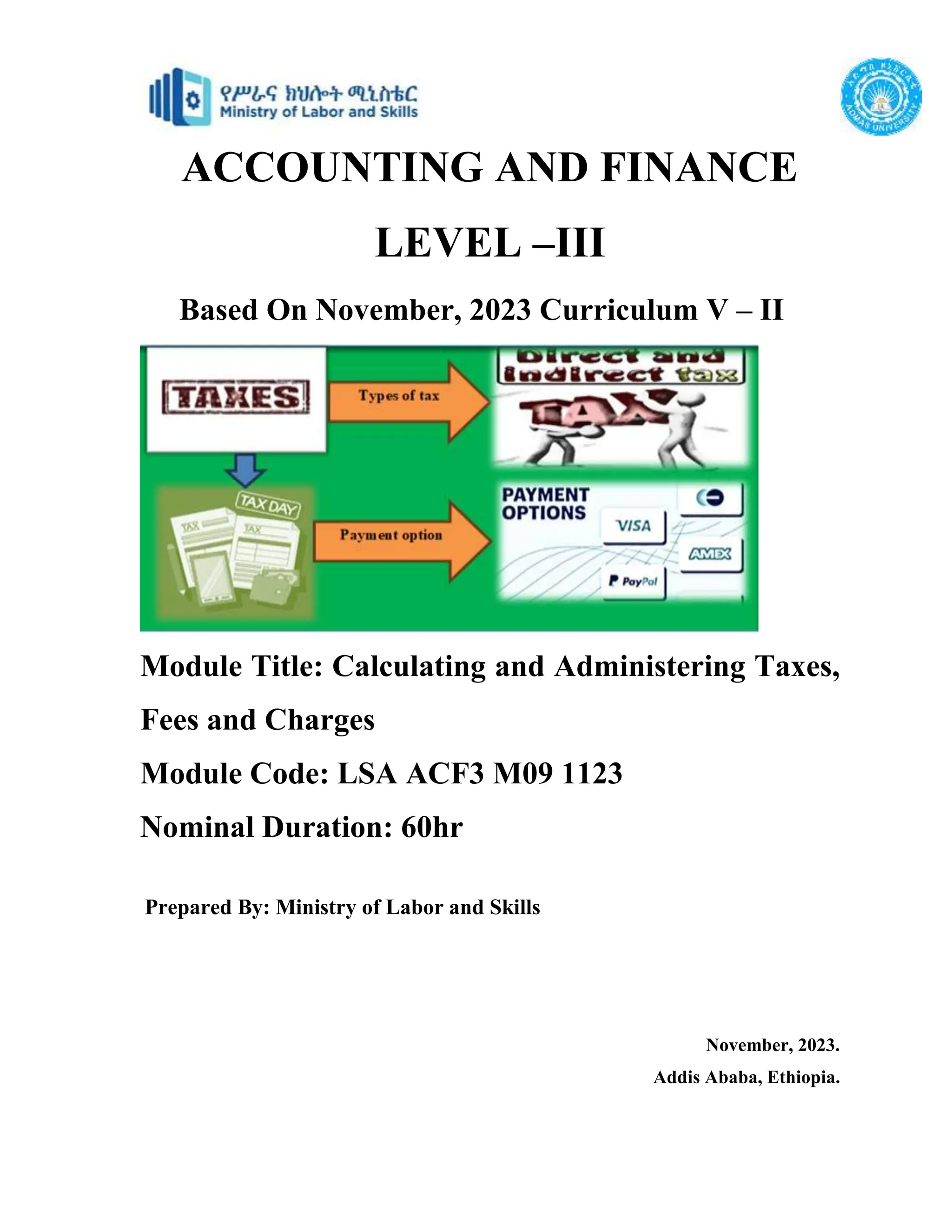
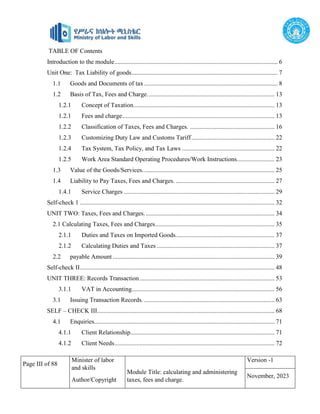
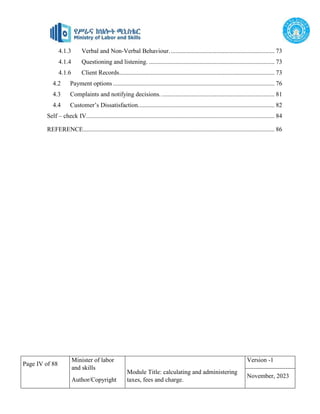
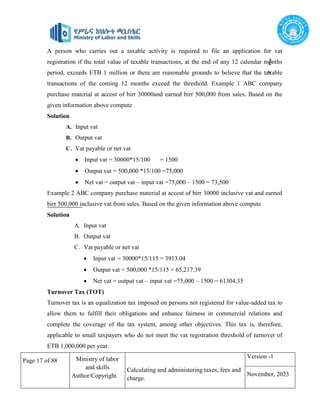
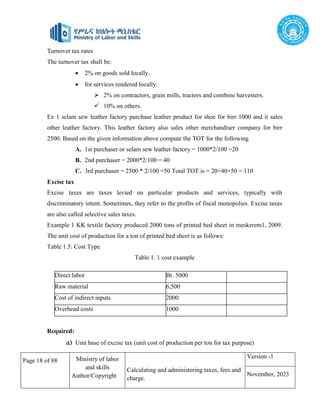
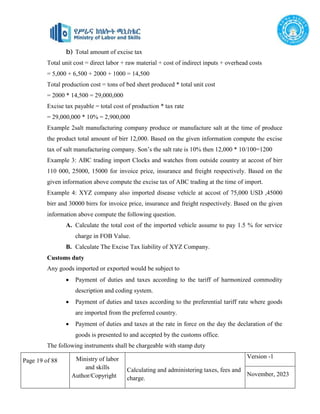
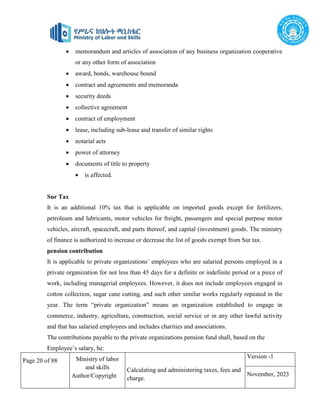
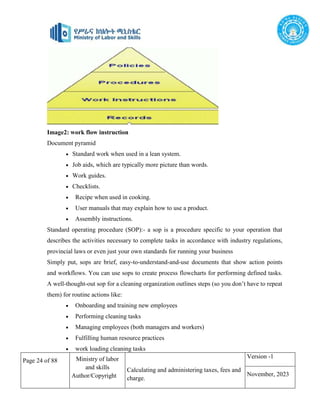
![Page 39 of 88 Ministry of labor
and skills
Author/Copyright
Calculating and administering taxes, fees and
charge.
Version -1
November, 2023
Calculate Duties
Customs duty = [duty-paying value * customs duty rate]
excise tax = [(duty-paying value + customs duty) * excise tax rate]
value added tax = [(duty-paying value + customs duty + excise tax) * 15%]
surtax = [(duty-paying value + customs duty + excise tax + value added tax) *
10%]
withholding tax = [(duty-paying value) * 3%]
for example, assume that item “a” has a duty paying value of birr 200,000.00, a customs duty
of 35%, excise tax 60%, value added tax 15%, SUR tax 10% and withholding tax 3%. The
duty and taxes are calculated as follows:
customs duty= [200,000.00 * 35%] = birr 70,000.00;
excise tax = [(200,000.00 + 70,000.00) * 60%] = birr 162,000.00;
value added tax= [(200,000.00 + 70,000.00 + 162,000.00)] * 15%= birr
64,800.00;
SUR tax = [(200,000.00 + 70,000.00 + 162,000.00 + 64,800.00)] * 10%= birr
49,680.00; and
withholding tax= [200,000.00 * 3%] = birr 6,000.00
Total duty and tax are the sum of customs duty, excise tax, value added tax, sur
tax and withholding tax, i.e., birr 352,480.00.
2.2 payable Amount
Many businesses and tax authorities use various systems and technologies to assess amounts
payable for calculating taxes, fees, and charges. These systems aim to streamline processes,
enhance accuracy, and ensure compliance with tax regulations. Here are common ways
systems are used for this purpose:
Automated Tax Calculation Systems:](https://image.slidesharecdn.com/7ea693f4-1206-4aad-b808-13a1f6dedf0f-251223005110-11472f46/85/7ea693f4-1206-4aad-b808-13a1f6dedf0f-pdf-39-320.jpg)
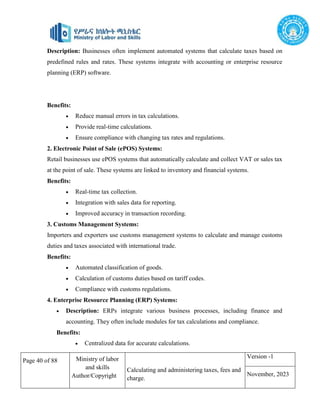
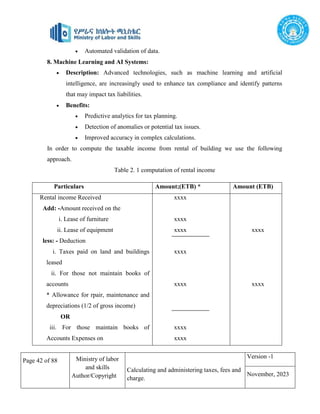
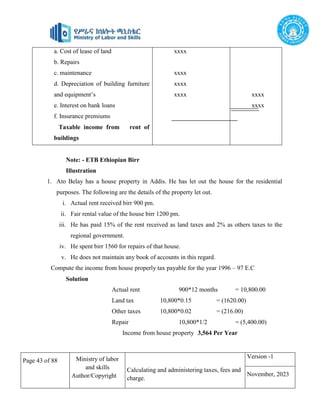
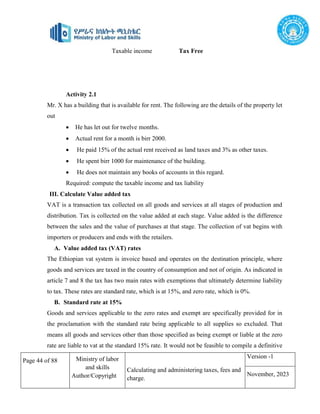
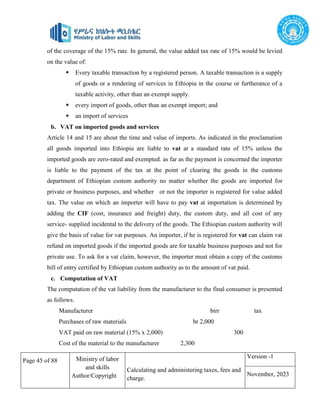
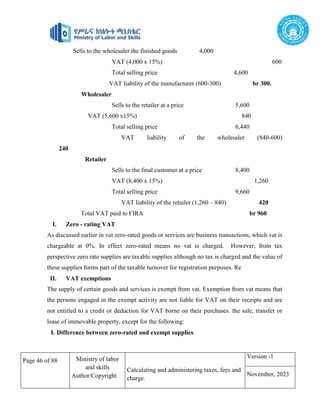
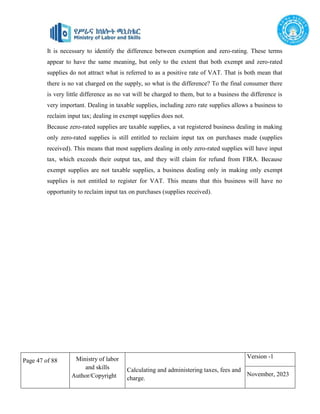
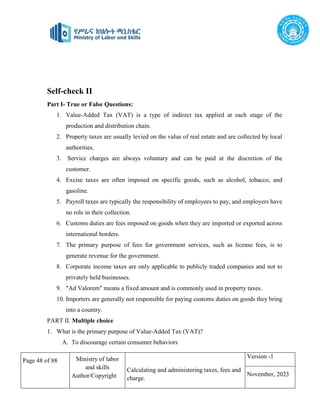
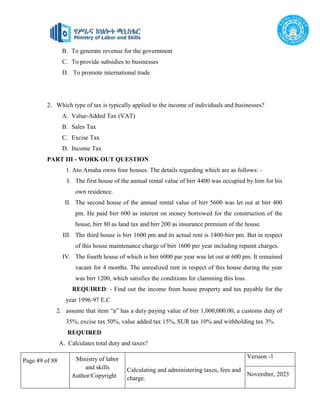
![Page 51 of 88 Ministry of labor
and skills
Author/Copyright
Calculating and administering taxes, fees and
charge.
Version -1
November, 2023
Operation Sheet- 2.1: Calculating duty and tax import & export values of goods
Purpose
To generate revenue for governments and organizations to fund public
services, infrastructure, and various programs
RESOURCE REQUIRMENT
Blue Or Black Pen
A4 Size Paper
Computer
Total cost of the goods = FOB cost + insurance + freight + GALAFI cost (fixed at
USD 54/MT, and for customs calculation purpose only) + inland transport charge
1 Customs duty = [duty-paying value * customs duty rate] = A
2 excise tax = [(duty-paying value + customs duty) * excise tax rate] = B
3 value added tax = [(duty-paying value + customs duty + excise tax) * 15%] = C
4 surtax = [(duty-paying value + customs duty + excise tax + value added tax) *
10%] = D
5 withholding tax = [(duty-paying value) * 3%] = E
Total payable at the time of import = A+B+C+D+E
*Note - manufacturers who are exempted from surtax and withholding tax are
required to pay a social welfare levy of 3%.](https://image.slidesharecdn.com/7ea693f4-1206-4aad-b808-13a1f6dedf0f-251223005110-11472f46/85/7ea693f4-1206-4aad-b808-13a1f6dedf0f-pdf-51-320.jpg)