NVIDIA Control Panel Quick
Start Guide
Release 195/196 v30 | January 15, 2010
User’s Guide
TABLE OF CONTENTS
NVIDIA Control Panel Quick Start Guide Release 195/196 v30 | i
1 Introduction.......................................................................... 1
About the NVIDIA Control Panel .................................................. 2
Overview .......................................................................... 2
Feature Differences from the Classic Control Panel ....................... 2
Changes in Release 195/196 ................................................... 3
Supported Operating Systems.................................................. 3
Supported NVIDIA Products..................................................... 4
Supported Languages............................................................ 4
Other NVIDIA Software Applications .......................................... 4
Getting Support and Information ................................................ 5
Online Help ....................................................................... 5
Technical Support................................................................ 5
System Information.............................................................. 5
2 Understanding the NVIDIA Control Panel....................................... 6
Opening and Closing the New NVIDIA Control Panel........................... 7
About the NVIDIA Control Panel Interface....................................... 8
Using the Main Task Area ....................................................... 9
Using the Select a Task Pane................................................... 9
Using the Tool Bar .............................................................. 10
Using the Menu Bar ............................................................. 12
3 Accomplishing NVIDIA Control Panel Tasks....................................16
Starting the NVIDIA Control Panel ............................................... 17
Accomplishing NVIDIA Control Panel Tasks ..................................... 18
NVIDIA Control Panel Feature List ........................................... 19
Correlating to the NVIDIA Classic Control Panel ........................... 24
NVIDIA Control Panel Groups.................................................. 26
LIST OF FIGURES
NVIDIA Control Panel Quick Start Guide Release 195/196 v30 | ii
Figure 2.1 NVIDIA Control Panel Home Page–Windows XP................................ 8
Figure 2.2 NVIDIA Control Panel Home Page–Windows Vista............................. 9
Figure 2.3 NVIDIA Control Panel Select a Task pane ..................................... 10
Figure 2.4 Navigation History Menu ........................................................ 11
Figure 2.5 NVIDIA Control Panel View Settings ........................................... 11
LIST OF TABLES
NVIDIA Control Panel Quick Start Guide Release 195/196 v30 | iii
Table 2.1 File Menu Commands ............................................................. 12
Table 2.2 Edit Menu Commands............................................................. 13
Table 2.3 View Menu Commands............................................................ 13
Table 2.4 Help Menu Commands ............................................................ 14
Table 2.5 Profiles Menu Commands......................................................... 14
Table 2.6 Display Menu Commands ......................................................... 15
Table 2.7 3D Settings Menu Commands .................................................... 15
Table 2.8 Workstation Menu Commands ................................................... 15
Table 3.1 NVIDIA Control Panel Features .................................................. 19
Table 3.2 Graphics Driver Tasks in the NVIDIA Control Panel ........................... 24
NVIDIA Control Panel Quick Start Guide Release 195/196 v30 | 1
01 INTRODUCTION
This quick start is addressed to users of the NVIDIA® Control Panel software. This guide 
focuses on getting you up and running with your NVIDIA software.
For technical details on the features and benefits of the NVIDIA Control Panel software 
and details about supported products, drivers, and other software, refer to the NVIDIA 
web page — www.nvidia.com.
This chapter discusses the following major topics:
 “About the NVIDIA Control Panel” on page 2
 “Getting Support and Information” on page 5
NVIDIA Control Panel Quick Start Guide Release 195/196 v30 | 2
Chapter 01 : Introduction
About the NVIDIA Control Panel
Welcome to the NVIDIA Control Panel, designed for Microsoft®
 Windows®
 XP,  
Windows Vista, and Windows 7. You can use NVIDIA Control Panel to control your 
NVIDIA hardware and access other NVIDIA software installed on your system.
Overview
In addition to setting up basic display configurations such as display resolution, refresh 
rate, and multiple display use, you can: 
 Tune your 3D settings with real‐time preview to maximize performance or image 
quality 
 Customize how 3D applications work in your system
 Adjust your screen colors and contrast
 Set custom timings
 Control video image settings
 Change your HDTV format
 Control your notebook system power using PowerMizer
 Control special workstation features such as Frame Synchronization.
Feature Differences from the Classic Control Panel
The following are features that were available in the NVIDIA classic control panel, but 
which are not available in the new NVIDIA Control Panel:
 Creating/Importing Color Profiles
 High Resolution Scalable Desktop 
 Video Zoom
 Full‐screen video mirroring
 Edge Blending
 nView Desktop Manager
nView Desktop Manager is available through the Windows control panel as a separate 
applet (Windows XP only).
 MultiView Display Mode (for NVIDIA Quadro NVS graphics cards)
As of driver Release 173, MultiView is available from the Windows Display 
Properties‐>Settings‐>Advanced tab for Windows XP only.
NVIDIA Control Panel Quick Start Guide Release 195/196 v30 | 3
Chapter 01 : Introduction
Changes in Release 195/196
Workstation Pages
 ECC State
New page for GPUs that support ECC (error correction code). The page lets you
• Change the Error Correction Code (ECC) state for GPUs.
• View the GPU error count.
• View GPU memory details.
 Manage Quadro Plex Settings ‐ now available under Windows Vista and Windows 
7.
PhysX Indicator
Enabled through the 3D Settings menu bar item, the PhysX indicator appears when 
running applications to let you verify the type of PhysX acceleration the game is using ‐ 
CPU or GPU ‐ or whether PhysX acceleration is being used at all. This feature also 
appears in later Release 190 drivers.
Supported Operating Systems
NVIDIA Release 195/196 Graphics drivers are available for the following Microsoft® 
Windows®
 operating systems:
• Windows XP Media Center Edition 2005 Update Rollup 2
• Windows XP Media Center Edition 2005/2004
• Windows XP Professional
• Windows XP Home Edition
• Windows XP Professional x64 Edition
• Windows Server 2003 x64 Edition
• Windows Vista Home Basic
• Windows Vista Home Premium
• Windows Vista Business
• Windows Vista Enterprise Edition
• Windows Vista Ultimate
• Windows 7 32‐bit and 64‐bit Editions
NVIDIA Control Panel Quick Start Guide Release 195/196 v30 | 4
Chapter 01 : Introduction
Supported NVIDIA Products
Refer to the release notes and NVIDIA driver download site for the list of products 
supported by the driver version that you have installed on your computer. 
Supported Languages
The NVIDIA Graphics Driver supports the following languages in the NVIDIA Control 
Panel:  
Other NVIDIA Software Applications
If installed, other NVIDIA software that you can access from the NVIDIA Control Panel 
includes:
 NVIDIA System Tools–Performance group and System Update 
 NVIDIA Stereoscopic 3D 
 NVIDIA MediaShieldTM 
 NVIDIA Network Access Manager
See the respective user documentation for information about these applications and 
instructions on how to use them. 
English (USA) German Portuguese (Euro/Iberian)
English (UK) Greek Russian
Arabic Hebrew Slovak
Chinese (Simplified) Hungarian Slovenian
Chinese (Traditional) Italian Spanish
Czech Japanese Spanish (Latin America)
Danish Korean Swedish
Dutch Norwegian Thai
Finnish Polish Turkish
French Portuguese (Brazil)
NVIDIA Control Panel Quick Start Guide Release 195/196 v30 | 5
Chapter 01 : Introduction
 Getting Support and Information
Online Help
 To open the online help, either :
• Press F1 on your keyboard, or 
• Select Help from the NVIDIA Control Panel menu bar and then select NVIDIA 
Control Panel Help.
 Help on various topics can be viewed using the Contents, Index, or Search tabs.
Technical Support
To access the NVIDIA Technical Support web page go the following web address:
http://www.nvidia.com/page/support.html
System Information
You can get detailed information about your system and the NVIDIA Control Panel 
configuration as well as version and copyright information.
 To view copyright and version information about the NVIDIA Control Panel:
From the Help menu, select About NVIDIA Control Panel.
 To view detailed system information:
Open the System Information dialog box by either selecting System Information from 
the Help menu, or by clicking the System Information link at the lower left corner 
of the NVIDIA Control Panel. 
Click any of the tabs in the System Information dialog box. 
NVIDIA Control Panel Quick Start Guide Release 195/196 v30 | 6
02 UNDERSTANDING THE NVIDIA
CONTROL PANEL
This chapter describes the NVIDIA Control Panel in the following sections:
 “Opening and Closing the New NVIDIA Control Panel” on page 7
 “About the NVIDIA Control Panel Interface” on page 8
NVIDIA Control Panel Quick Start Guide Release 195/196 v30 | 7
Chapter 02 : Understanding the NVIDIA Control Panel
Opening and Closing the New NVIDIA Control Panel
 You can open the NVIDIA Control Panel in several ways:
• Right‐click the Windows desktop, then click NVIDIA Control Panel from the 
context  menu, or
For Windows XP
• From the Windows Start menu, select Control Panel, then in the Control Panel 
window, double‐click on the NVIDIA Control Panel icon.
For Windows Vista/Windows 7
• From the Classic View of the Windows Control Panel, click the NVIDIA Control 
Panel icon, or 
• From the Control Panel Home view of the Windows Control Panel, click Additional 
Options and then click NVIDIA Control Panel from the Additional Options 
page. 
 To close the NVIDIA Control Panel,
• From the File menu, select Exit, or 
• Click the Close box in the upper right corner of the program window.
NVIDIA Control Panel Quick Start Guide Release 195/196 v30 | 8
Chapter 02 : Understanding the NVIDIA Control Panel
About the NVIDIA Control Panel Interface
The NVIDIA Control Panel provides an easy‐to‐use interface for managing your system. 
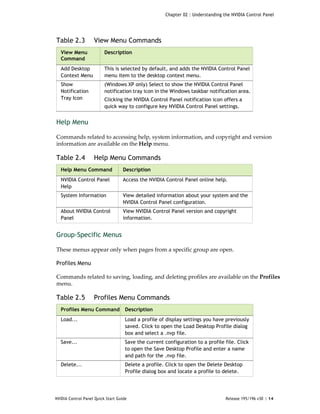
When you start the program for the first time, the NVIDIA Control Panel opens to the 
first page listed in the navigation tree.  On subsequent visits, the control panel reopens to 
the last page visited.  The NVIDIA Control Panel user interface consists of these main 
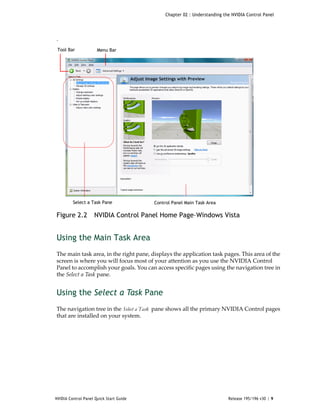
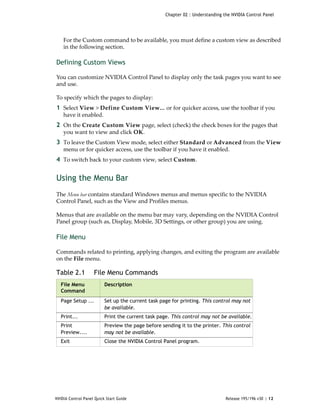
areas, as shown in Figure 2.1 and Figure 2.2:
 Main Task Area
 Select a Task (Navigation tree)
 Menu bar
 Toolbar  .
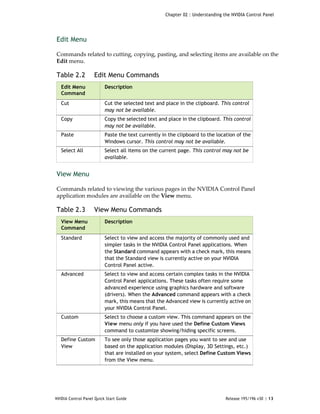
Figure 2.1 NVIDIA Control Panel Home Page–Windows XP
Menu BarTool Bar
Select a Task Pane
Control Panel Main Task Area
NVIDIA Control Panel Quick Start Guide Release 195/196 v30 | 9
Chapter 02 : Understanding the NVIDIA Control Panel
.
Figure 2.2 NVIDIA Control Panel Home Page–Windows Vista
Using the Main Task Area
The main task area, in the right pane, displays the application task pages. This area of the 
screen is where you will focus most of your attention as you use the NVIDIA Control 
Panel to accomplish your goals. You can access specific pages using the navigation tree in 
the Select a Task pane.
Using the Select a Task Pane
The navigation tree in the Select a Task  pane shows all the primary NVIDIA Control pages 
that are installed on your system. 
Menu BarTool Bar
Select a Task Pane Control Panel Main Task Area
NVIDIA Control Panel Quick Start Guide Release 195/196 v30 | 10
Chapter 02 : Understanding the NVIDIA Control Panel
The pages are grouped according to the same categories that existed in the previous 
version of the NVIDIA Control Panel. 
Figure 2.3 NVIDIA Control Panel Select a Task pane
Using the Tool Bar
The Toolbar provides quick back and forth navigation between pages, and also lets you 
choose a view setting. 
Using the Navigation Buttons
The back and forward buttons let you navigate sequentially among pages that you have 
visited.
Click to expand Click to open the
corresponding page
in the main task area.
or collapse the
group list.
NVIDIA Control Panel Quick Start Guide Release 195/196 v30 | 11
Chapter 02 : Understanding the NVIDIA Control Panel
You can also navigate directly to a previously visited page by clicking the list arrow next 
to the back button.  The drop‐down menu lists all the previously visited pages in the 
queue. Click the page that you want.  
Figure 2.4 Navigation History Menu
Working with View Settings
The currently selected view determines what options on each page are available..
Figure 2.5 NVIDIA Control Panel View Settings
There are three available views:
 Standard
 Advanced
 Custom
Most commands are available for both Standard and Advanced views. However, some 
options are available only if the Advanced view is selected before opening the  page. 
Also, task page options may different depending on the selected view. If the command 
you’re looking for is not displayed, select a different view.
To change the view:
 From the View menu, select Standard, Advanced, or Custom.
NVIDIA Control Panel Quick Start Guide Release 195/196 v30 | 12
Chapter 02 : Understanding the NVIDIA Control Panel
For the Custom command to be available, you must define a custom view as described 
in the following section.
Defining Custom Views
You can customize NVIDIA Control Panel to display only the task pages you want to see 
and use.
To specify which the pages to display:
1 Select View > Define Custom View... or for quicker access, use the toolbar if you 
have it enabled.
2 On the Create Custom View page, select (check) the check boxes for the pages that 
you want to view and click OK.
3 To leave the Custom View mode, select either Standard or Advanced from the View 
menu or for quicker access, use the toolbar if you have it enabled.
4 To switch back to your custom view, select Custom.
Using the Menu Bar
The Menu bar contains standard Windows menus and menus specific to the NVIDIA 
Control Panel, such as the View and Profiles menus.
Menus that are available on the menu bar may vary, depending on the NVIDIA Control 
Panel group (such as, Display, Mobile, 3D Settings, or other group) you are using. 
File Menu
Commands related to printing, applying changes, and exiting the program are available 
on the File menu. 
Table 2.1 File Menu Commands
File Menu
Command
Description
Page Setup ... Set up the current task page for printing. This control may not
be available.
Print... Print the current task page. This control may not be available.
Print
Preview....
Preview the page before sending it to the printer. This control
may not be available.
Exit Close the NVIDIA Control Panel program.
NVIDIA Control Panel Quick Start Guide Release 195/196 v30 | 13
Chapter 02 : Understanding the NVIDIA Control Panel
Edit Menu
Commands related to cutting, copying, pasting, and selecting items are available on the 
Edit menu. 
View Menu
Commands related to viewing the various pages in the NVIDIA Control Panel 
application modules are available on the View menu. 
Table 2.2 Edit Menu Commands
Edit Menu
Command
Description
Cut Cut the selected text and place in the clipboard. This control
may not be available.
Copy Copy the selected text and place in the clipboard. This control
may not be available.
Paste Paste the text currently in the clipboard to the location of the
Windows cursor. This control may not be available.
Select All Select all items on the current page. This control may not be
available.
Table 2.3 View Menu Commands
View Menu
Command
Description
Standard Select to view and access the majority of commonly used and
simpler tasks in the NVIDIA Control Panel applications. When
the Standard command appears with a check mark, this means
that the Standard view is currently active on your NVIDIA
Control Panel active.
Advanced Select to view and access certain complex tasks in the NVIDIA
Control Panel applications. These tasks often require some
advanced experience using graphics hardware and software
(drivers). When the Advanced command appears with a check
mark, this means that the Advanced view is currently active on
your NVIDIA Control Panel.
Custom Select to choose a custom view. This command appears on the
View menu only if you have used the Define Custom Views
command to customize showing/hiding specific screens.
Define Custom
View
To see only those application pages you want to see and use
based on the application modules (Display, 3D Settings, etc.)
that are installed on your system, select Define Custom Views
from the View menu.
NVIDIA Control Panel Quick Start Guide Release 195/196 v30 | 14
Chapter 02 : Understanding the NVIDIA Control Panel
Help Menu
Commands related to accessing help, system information, and copyright and version 
information are available on the Help menu. 
Group-Specific Menus
These menus appear only when pages from a specific group are open.
Profiles Menu
Commands related to saving, loading, and deleting profiles are available on the Profiles 
menu. 
Add Desktop
Context Menu
This is selected by default, and adds the NVIDIA Control Panel
menu item to the desktop context menu.
Show
Notification
Tray Icon
(Windows XP only) Select to show the NVIDIA Control Panel
notification tray icon in the Windows taskbar notification area.
Clicking the NVIDIA Control Panel notification icon offers a
quick way to configure key NVIDIA Control Panel settings.
Table 2.4 Help Menu Commands
Help Menu Command Description
NVIDIA Control Panel
Help
Access the NVIDIA Control Panel online help.
System Information View detailed information about your system and the
NVIDIA Control Panel configuration.
About NVIDIA Control
Panel
View NVIDIA Control Panel version and copyright
information.
Table 2.5 Profiles Menu Commands
Profiles Menu Command Description
Load... Load a profile of display settings you have previously
saved. Click to open the Load Desktop Profile dialog
box and select a .nvp file.
Save... Save the current configuration to a profile file. Click
to open the Save Desktop Profile and enter a name
and path for the .nvp file.
Delete... Delete a profile. Click to open the Delete Desktop
Profile dialog box and locate a profile to delete.
Table 2.3 View Menu Commands
View Menu
Command
Description
NVIDIA Control Panel Quick Start Guide Release 195/196 v30 | 15
Chapter 02 : Understanding the NVIDIA Control Panel
Display Menu
This menu item appears only when a Display group page is open. 
3D Settings Menu
This menu item appears only when a 3D Settings group page is open on an SLI system. 
Workstation Menu
This menu item appears only when a Workstation group page is open. 
Table 2.6 Display Menu Commands
Display Menu Command Description
Identify Displays Select to identify the displays configured with your
system.
Table 2.7 3D Settings Menu Commands
3D Settings Menu
Command
Description
Show SLI Visual Indicators Select to verify that SLI rendering is enabled and
working.
Show PhysX Visual
Indicator
Select to verify the type of PhysX acceleration the
game is using - CPU or GPU - or if PhysX acceleration
is being used at all.
Automatically Download
"Preferred Graphics
Processor" Updates.
This is selected by default, and lets the driver
periodically download small files to ensure that the
latest programs take advantage of your NVIDIA GPU.
Your custom settings are not affected by this
download.
Automatic download requires an internet
connection. This menu option appears only with
systems using NVIDIA © Optimus™ Hybrid technology.
Table 2.8 Workstation Menu Commands
Workstation Menu
Command
Description
Refresh View Select to refresh the graphical representation of the
displays and graphics cards installed on your system.
NVIDIA CONFIDENTIAL
NVIDIA Control Panel Quick Start Guide Release 195/196 v30 | 16
03 ACCOMPLISHING NVIDIA CONTROL
PANEL TASKS
This chapter provides instructions on how to use the NVIDIA Control Panel to 
accomplish common tasks. It contains the following sections:
 Starting the NVIDIA Control Panel
 Accomplishing NVIDIA Control Panel Tasks
Note: For Windows Vista/Windows 7 – Several features are cur-
rently under development and are not yet supported in the NVIDIA
Control Panel. Consult the release notes for the latest list of unsup-
ported features.
NVIDIA Control Panel Quick Start Guide Release 195/196 v30 | 17
Chapter 03 : Accomplishing NVIDIA Control Panel Tasks
Starting the NVIDIA Control Panel
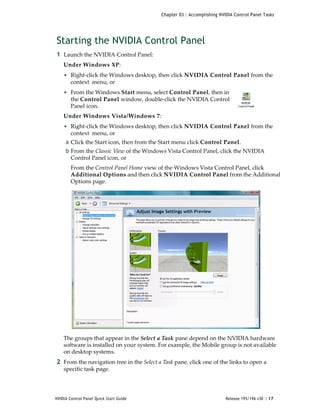
1 Launch the NVIDIA Control Panel: 
Under Windows XP:
• Right‐click the Windows desktop, then click NVIDIA Control Panel from the 
context  menu, or
• From the Windows Start menu, select Control Panel, then in 
the Control Panel window, double‐click the NVIDIA Control 
Panel icon. 
Under Windows Vista/Windows 7:
• Right‐click the Windows desktop, then click NVIDIA Control Panel from the 
context  menu, or
a Click the Start icon, then from the Start menu click Control Panel. 
b From the Classic View of the Windows Vista Control Panel, click the NVIDIA 
Control Panel icon, or 
From the Control Panel Home view of the Windows Vista Control Panel, click 
Additional Options and then click NVIDIA Control Panel from the Additional 
Options page. 
The groups that appear in the Select a Task pane depend on the NVIDIA hardware 
software is installed on your system. For example, the Mobile group is not available 
on desktop systems.
2 From the navigation tree in the Select a Task pane, click one of the links to open a 
specific task page.
NVIDIA Control Panel Quick Start Guide Release 195/196 v30 | 18
Chapter 03 : Accomplishing NVIDIA Control Panel Tasks
Each group in the navigation tree lists different tasks that you can accomplish, and 
each task page provides instructions on how to accomplish what you want.  Move the 
cursor over listed options to see a description and typical usage scenario for that 
option.
Detailed instructions for each task are also available through the online help.
Accomplishing NVIDIA Control Panel Tasks
The NVIDIA Control Panel provides an intuitive layout for locating graphics driver 
controls, including most of the controls that were available with the Classic NVIDIA 
Control Panel. 
• “NVIDIA Control Panel Feature List” on page 19 lists the current features available in the 
NVIDIA Control Panel.
• “Correlating to the NVIDIA Classic Control Panel” on page 24 shows where a Classic Control 
Panel feature is found in the new NVIDIA Control Panel.
• “NVIDIA Control Panel Groups” on page 26 provides an overview of the NVIDIA Control 
Panel pages by group.
NVIDIA Control Panel Quick Start Guide Release 195/196 v30 | 19
Chapter 03 : Accomplishing NVIDIA Control Panel Tasks
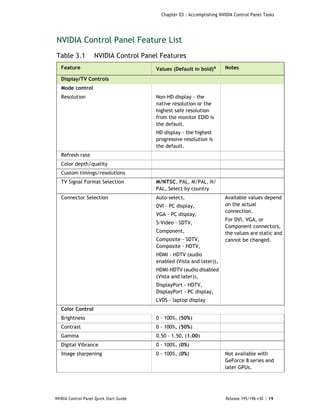
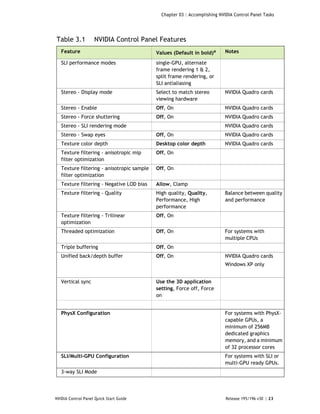
NVIDIA Control Panel Feature List
Table 3.1 NVIDIA Control Panel Features
Feature Values (Default in bold)a Notes
Display/TV Controls
Mode control
Resolution Non-HD display - the
native resolution or the
highest safe resolution
from the monitor EDID is
the default.
HD display - the highest
progressive resolution is
the default.
Refresh rate
Color depth/quality
Custom timings/resolutions
TV Signal Format Selection M/NTSC, PAL, M/PAL, N/
PAL, Select by country
Connector Selection Auto-select,
DVI - PC display,
VGA - PC display,
S-Video - SDTV,
Component,
Composite - SDTV,
Composite - HDTV,
HDMI - HDTV (audio
enabled (Vista and later)),
HDMI-HDTV (audio disabled
(Vista and later)),
DisplayPort - HDTV,
DisplayPort - PC display,
LVDS - laptop display
Available values depend
on the actual
connection.
For DVI, VGA, or
Component connectors,
the values are static and
cannot be changed.
Color Control
Brightness 0 - 100%, (50%)
Contrast 0 - 100%, (50%)
Gamma 0.50 - 1.50, (1.00)
Digital Vibrance 0 - 100%, (0%)
Image sharpening 0 - 100%, (0%) Not available with
GeForce 8 series and
later GPUs.
NVIDIA Control Panel Quick Start Guide Release 195/196 v30 | 20
Chapter 03 : Accomplishing NVIDIA Control Panel Tasks
Hue 0 - 359 degrees (30) For GeForce 8 series and
later GPUs
Flicker Filter 0 - 100%, (49%) For analog TVs
Gray border option Disabled For analog TVs; presents
unused black TV borders
as gray
Digital color format selection RGB, YCbCr For HDMI and
DisplayPort connections
Rotation 0, 90, 180, 270 degrees
Desktop Size and Position
Move CRT screen position For VGA displays
Flat panel scaling NVIDIA scaling
NVIDIA scaling with fixed-
aspect ratio
Display’s built-in scaling
No scaling
For non-HD display
modes on DVI/HDMI/
DisplayPort connection
Adjust screen size and position For analog TVs
Resize HDTV desktop For HD display modes
(over DVI/HDMI/
DisplayPort/Component
connections) that
support underscan or
desktop resizing.
Pan HD desktop when not resized WIndows XP only;
For HD display modes
(over DVI/HDMI/
DisplayPort/Component
connections) that
support underscan or
desktop resizing.
Multi-display Options
Single-display mode
Dualview (extended mode)
nView Clone Mode
nView Spanning Mode Windows XP only
Video Controls “Use video player settings” is the default. If “Use
NVIDIA settings” is selected, the following values
apply.
Color Settings
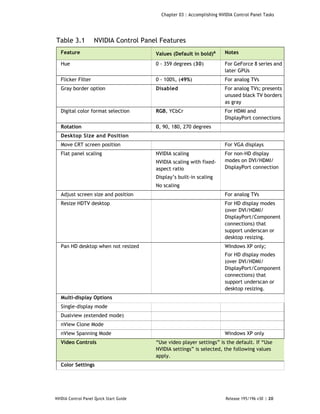
Table 3.1 NVIDIA Control Panel Features
Feature Values (Default in bold)a Notes
NVIDIA Control Panel Quick Start Guide Release 195/196 v30 | 21
Chapter 03 : Accomplishing NVIDIA Control Panel Tasks
Brightness 0 - 100%, (50%)
Contrast 0 - 100%, (50%)
Hue 0 - 100%, (0%)
Saturation 0 - 100%, (50%)
Gamma (including separate RGB) 0.3 - 3.00, (1.00)
Advanced Color Settings
Dynamic Range Full (0—255)
Limited (16—235)
Dynamic Contrast Enhancement Disabled GeForce 9 series and
later GPUS
Color Enhancement Disabled GeForce 9 series and
later GPUs
Image Settings
Edge Enhancement 0 - 100%, (0%)
Noise Reduction 0 - 100%, (0%)
Inverse Telecine option Disabled
Internet Video Enhancement option Disabled Select GeForce 8 series
and later GPUs
Digital Audio
Portal to the Windows Sound Settings
panel
For GPUs that support
digital audio when an
HDMI or DisplayPort
connection is made.
HDCP
Capability verification page For GPUs that support
HDCP.
3D Application Controls
Ambient Occlusion Off, On Windows Vista and later;
GeForce 8 series and
later GPUs
Anisotropic filtering Application-controlled,
Off, card-specific settings
Antialiasing - Mode Application-controlled,
Off, Enhance the
application setting,
Override any application
setting
Antialiasing - Setting Application-controlled,
card-specific settings
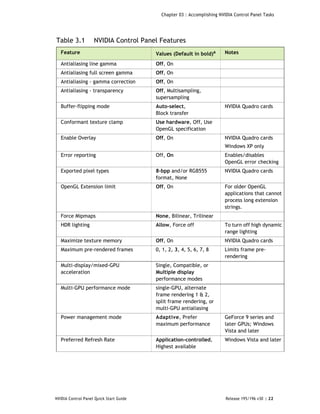
Table 3.1 NVIDIA Control Panel Features
Feature Values (Default in bold)a Notes
NVIDIA Control Panel Quick Start Guide Release 195/196 v30 | 22
Chapter 03 : Accomplishing NVIDIA Control Panel Tasks
Antialiasing line gamma Off, On
Antialiasing full screen gamma Off, On
Antialiasing - gamma correction Off, On
Antialiasing - transparency Off, Multisampling,
supersampling
Buffer-flipping mode Auto-select,
Block transfer
NVIDIA Quadro cards
Conformant texture clamp Use hardware, Off, Use
OpenGL specification
Enable Overlay Off, On NVIDIA Quadro cards
Windows XP only
Error reporting Off, On Enables/disables
OpenGL error checking
Exported pixel types 8-bpp and/or RGB555
format, None
NVIDIA Quadro cards
OpenGL Extension limit Off, On For older OpenGL
applications that cannot
process long extension
strings.
Force Mipmaps None, Bilinear, Trilinear
HDR lighting Allow, Force off To turn off high dynamic
range lighting
Maximize texture memory Off, On NVIDIA Quadro cards
Maximum pre-rendered frames 0, 1, 2, 3, 4, 5, 6, 7, 8 Limits frame pre-
rendering
Multi-display/mixed-GPU
acceleration
Single, Compatible, or
Multiple display
performance modes
Multi-GPU performance mode single-GPU, alternate
frame rendering 1 & 2,
split frame rendering, or
multi-GPU antialiasing
Power management mode Adaptive, Prefer
maximum performance
GeForce 9 series and
later GPUs; Windows
Vista and later
Preferred Refresh Rate Application-controlled,
Highest available
Windows Vista and later
Table 3.1 NVIDIA Control Panel Features
Feature Values (Default in bold)a Notes
NVIDIA Control Panel Quick Start Guide Release 195/196 v30 | 23
Chapter 03 : Accomplishing NVIDIA Control Panel Tasks
SLI performance modes single-GPU, alternate
frame rendering 1 & 2,
split frame rendering, or
SLI antialiasing
Stereo - Display mode Select to match stereo
viewing hardware
NVIDIA Quadro cards
Stereo - Enable Off, On NVIDIA Quadro cards
Stereo - Force shuttering Off, On NVIDIA Quadro cards
Stereo - SLI rendering mode NVIDIA Quadro cards
Stereo - Swap eyes Off, On NVIDIA Quadro cards
Texture color depth Desktop color depth NVIDIA Quadro cards
Texture filtering - anisotropic mip
filter optimization
Off, On
Texture filtering - anisotropic sample
filter optimization
Off, On
Texture filtering - Negative LOD bias Allow, Clamp
Texture filtering - Quality High quality, Quality,
Performance, High
performance
Balance between quality
and performance
Texture filtering - Trilinear
optimization
Off, On
Threaded optimization Off, On For systems with
multiple CPUs
Triple buffering Off, On
Unified back/depth buffer Off, On NVIDIA Quadro cards
Windows XP only
Vertical sync Use the 3D application
setting, Force off, Force
on
PhysX Configuration For systems with PhysX-
capable GPUs, a
minimum of 256MB
dedicated graphics
memory, and a minimum
of 32 processor cores
SLI/Multi-GPU Configuration For systems with SLI or
multi-GPU ready GPUs.
3-way SLI Mode
Table 3.1 NVIDIA Control Panel Features
Feature Values (Default in bold)a Notes
NVIDIA Control Panel Quick Start Guide Release 195/196 v30 | 24
Chapter 03 : Accomplishing NVIDIA Control Panel Tasks
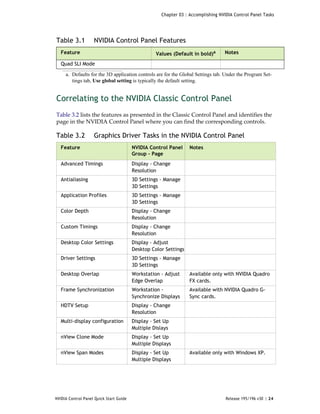
Correlating to the NVIDIA Classic Control Panel
Table 3.2 lists the features as presented in the Classic Control Panel and identifies the 
page in the NVIDIA Control Panel where you can find the corresponding controls. 
Quad SLI Mode
a. Defaults for the 3D application controls are for the Global Settings tab. Under the Program Set-
tings tab, Use global setting is typically the default setting.
Table 3.2 Graphics Driver Tasks in the NVIDIA Control Panel
Feature NVIDIA Control Panel
Group - Page
Notes
Advanced Timings Display - Change
Resolution
Antialiasing 3D Settings - Manage
3D Settings
Application Profiles 3D Settings - Manage
3D Settings
Color Depth Display - Change
Resolution
Custom Timings Display - Change
Resolution
Desktop Color Settings Display - Adjust
Desktop Color Settings
Driver Settings 3D Settings - Manage
3D Settings
Desktop Overlap Workstation - Adjust
Edge Overlap
Available only with NVIDIA Quadro
FX cards.
Frame Synchronization Workstation -
Synchronize Displays
Available with NVIDIA Quadro G-
Sync cards.
HDTV Setup Display - Change
Resolution
Multi-display configuration Display - Set Up
Multiple Dislays
nView Clone Mode Display - Set Up
Multiple Displays
nView Span Modes Display - Set Up
Multiple Displays
Available only with Windows XP.
Table 3.1 NVIDIA Control Panel Features
Feature Values (Default in bold)a Notes
NVIDIA Control Panel Quick Start Guide Release 195/196 v30 | 25
Chapter 03 : Accomplishing NVIDIA Control Panel Tasks
NVRotate Display - Rotate
Display
Performance and Quality
Settings
3D Settings - Adjust
Image Settings with
Preview
PowerMizer Mobile - Change
PowerMizer Settings
Available only with notebook
computers.
Available only with Windows XP.
Refresh Rate Settings Display - Change
Resolution
Resolution Settings Display - Change
Resolution
Screen Position on CRT Display - Adjust
Desktop Size and
Position
Screen Position on TV Display - Adjust
Desktop Size and
Position
SDI (Graphics to SDI Output) Workstation - Send
Graphics to SDI
Output
Available only with NVIDIA Quadro
FX SDI cards.
SLI Configuration 3D Settings - Set SLI
Configuration
Temperature Settings Performance Requires NVIDIA System Tools
software
TV Setup Display - Change
Resolution
Video Color Settings Video - Adjust Video
Color Settings
Overclocking Performance Requires NVIDIA System Tools
software
Table 3.2 Graphics Driver Tasks in the NVIDIA Control Panel
Feature NVIDIA Control Panel
Group - Page
Notes
NVIDIA Control Panel Quick Start Guide Release 195/196 v30 | 26
Chapter 03 : Accomplishing NVIDIA Control Panel Tasks
NVIDIA Control Panel Groups
This section provides an overview of the NVIDIA Control Panel groups.
 “Using the Display Pages” on page 26
 “Using the Video Pages” on page 27
 “Using the 3D Settings Pages” on page 27
 “Using the Stereoscopic 3D Pages” on page 27
 “Using the Mobile Pages” on page 27
 “Using the Workstation Pages” on page 28
 “Using the Networking Pages” on page 28
 “Using the Storage Pages” on page 29
 “Using the Performance Pages” on page 29
 “Using the System Update Pages” on page 29
Using the Display Pages
The actual tasks available on your system depend on your system hardware, such as the 
number and type of displays connected. Use the Display group pages to:
 Run the wizard to optimize your display configuration. 
 Change the display resolution. 
 Change the scaling on your flat panel display. 
 Adjust desktop color settings. 
 Rotate the display. 
 Adjust custom timings. 
 Configure multiple displays, including Spanning or Clone modes. 
Spanning modes are available only with Windows XP. 
 Adjust your television picture quality and video color settings for the best possible 
viewing in its environment. 
 Change the position and size of the desktop/video to best fit your television or HDTV 
(high definition television) screen. 
 Change the signal format to use for your standard television or HDTV as well as 
change country‐specific signal or the HDTV format. 
Note: For Windows Versions – Support for some features under
Windows Vista or Windows 7 is in development and may not be
available with your GeForce graphics driver version. Consult the
release notes for the latest list of unsupported features.
NVIDIA Control Panel Quick Start Guide Release 195/196 v30 | 27
Chapter 03 : Accomplishing NVIDIA Control Panel Tasks
 Verify the HDCP capability of your system.
 Access digital audio controls.
Using the Video Pages
The actual tasks available on your system depend on your system hardware, such as 
whether or not you have a TV connected and enabled. Use the Video page to:
 Adjust video and image color settings.
Using the 3D Settings Pages
The actual tasks available on your system depend on your system hardware, such as 
whether or not you have an SLI‐ready system. Use the 3D Settings page to:
 Change the image and rendering settings of your 3D applications and games that 
utilize Direct3D and OpenGL technology.
 Assign specific 3D settings to a game so that these settings automatically load when a 
game is launched (available under Advanced view).
 Set up your SLI or multi‐GPU configuration as well as PhysX configuration.
GPU temperature monitoring and GPU overclocking features are not included in the 3D 
Settings page. To use this functionality you must install NVIDIA nTune software.
Using the Stereoscopic 3D Pages
The Stereoscopic 3D pages are part of the NVIDIA 3D Vision software for viewing 3D 
programs and games in stereoscopic 3D. Use the Stereoscopic 3D pages to:
 Control stereoscopic 3D settings.
Enable stereoscopic 3D, adjust 3D depth, select a 3D laser sight, view and set the 
keyboard shortcuts, and run the setup wizard and various tests. 
 View game compatibility. 
See a stereoscopic 3D compatibility rating for a number of games, along with possible 
issues and recommendations for each game.
Using the Mobile Pages
The Mobile group is available if the NVIDIA software is installed on a notebook 
computer under Windows XP. 
Use the Mobile page to extend your notebook computer’s battery life using NVIDIA 
PowerMizer technology 
NVIDIA Control Panel Quick Start Guide Release 195/196 v30 | 28
Chapter 03 : Accomplishing NVIDIA Control Panel Tasks
Using the Workstation Pages
The Workstation group is available if you have an NVIDIA Quadro FX graphics card 
installed. 
The actual tasks available depend on which NVIDIA Quadro FX product you have 
installed. Use the Workstation page to:
 Synchronize your displays using frame sync or genlock technology.
 View a graphical representation of the displays and graphics cards installed on your 
system.
 Manage serial digital interface (SDI) output (requires NVIDIA Quadro FX SDI 
solution.)
 Configure SLI Mosaic mode (requires Quadro Plex unit) to combine multiple displays 
into a larger virtual canvass.
 Configure ECC control on supported GPUs.
 Overlap the edges of adjacent displays.
Display edge blending is no longer available.
Using the Networking Pages
The Networking group pages are part of the nForce drivers Networking software for 
NVIDIA nForce‐based PCs. 
Use the Networking pages to optimize your network performance and increase your 
network bandwidth with the following technologies:
 NVIDIA FirstPacket offers a new way to manage the traffic on your personal 
computer, allowing you to more effectively manage and improve the performance of 
networked games and other applications that are sensitive to network delay (latency), 
such as Voice‐over‐IP (VoIP).  
 NVIDIA TCP/IP Acceleration technology is a networking solution that moves the 
processing of TCP/IP network traffic from your computer’s CPU to its nForce 
hardware resulting in greatly improved system performance.  
 NVIDIA Teaming technology combines all the NVIDIA Ethernet interfaces on your 
system to form a team, resulting in increased bandwidth and network redundancy. 
 Alert Standard Format (ASF) controls lets you set up alerts and remote system 
management in an OS‐present or OS‐absent environment.
NVIDIA Control Panel Quick Start Guide Release 195/196 v30 | 29
Chapter 03 : Accomplishing NVIDIA Control Panel Tasks
Using the Storage Pages
The Storage group pages are part of the nForce drivers MediaShield Storage software for 
NVIDIA nForce‐based PCs. 
Use the Storage pages to 
 Create and manage RAID 0, RAID 1, RAID 0+1, RAID 5, and spanning arrays. 
 Run SMART tests on your RAID array disk drives.
Using the Performance Pages
The Performance group pages are part of the nForce drivers System Tools software for 
NVIDIA nForce‐based PCs. 
Use the Performance pages to: 
 Manage system tuning and profiles for nForce MCP clocks, voltages, timings, and 
fans.
 Manage Enthusiast System Architecture (ESA) components.
 View detailed system information for your nForce‐based PC. 
 Overclock your GeForce GPU.
Using the System Update Pages
The System Update pages are part of the nForce drivers System Tools software for 
NVIDIA nForce‐based PCs. 
Use the system update pages to: 
 Automatically check for nForce and GeForce driver updates.
 Update your system BIOS. 
 Update firmware for the Enthusiast System Architecture (ESA) components.
www.nvidia.com
Notice
ALL NVIDIA DESIGN SPECIFICATIONS, REFERENCE BOARDS, FILES, DRAWINGS, DIAGNOSTICS, LISTS, AND
OTHER DOCUMENTS (TOGETHER AND SEPARATELY, "MATERIALS") ARE BEING PROVIDED "AS IS." NVIDIA MAKES
NO WARRANTIES, EXPRESSED, IMPLIED, STATUTORY, OR OTHERWISE WITH RESPECT TO THE MATERIALS, AND
EXPRESSLY DISCLAIMS ALL IMPLIED WARRANTIES OF NONINFRINGEMENT, MERCHANTABILITY, AND FITNESS
FOR A PARTICULAR PURPOSE.
Information furnished is believed to be accurate and reliable. However, NVIDIA Corporation assumes no
responsibility for the consequences of use of such information or for any infringement of patents or other
rights of third parties that may result from its use. No license is granted by implication of otherwise under
any patent rights of NVIDIA Corporation. Specifications mentioned in this publication are subject to change
without notice. This publication supersedes and replaces all other information previously supplied. NVIDIA
Corporation products are not authorized as critical components in life support devices or systems without
express written approval of NVIDIA Corporation.
HDMI
HDMI, the HDMI logo, and High-Definition Multimedia Interface are trademarks or registered trademarks of
HDMI Licensing LLC.
Macrovision Compliance Statement
NVIDIA Products that are Macrovision enabled can only be sold or distributed to buyers with a valid and
existing authorization from Macrovision to purchase and incorporate the device into buyer's products.
Macrovision copy protection technology is protected by U.S. patent numbers 5,583,936; 6,516,132;
6,836,549; and 7,050,698 and other intellectual property rights. The use of Macrovision's copy protection
technology in the device must be authorized by Macrovision and is intended for home and other limited
pay-per-view uses only, unless otherwise authorized in writing by Macrovision. Reverse engineering or
disassembly is prohibited.
OpenCL
OpenCL is a trademark of Apple Inc. used under license to the Khronos Group Inc.
Trademarks
NVIDIA and the NVIDIA logo are trademarks or registered trademarks of NVIDIA Corporation in the United
States and other countries. Other company and product names may be trademarks of the respective
companies with which they are associated.
Copyright
© 2009, 2010 NVIDIA Corporation. All rights reserved.

196.21 nvidia control_panel_quick_start_guide

  • 1.
      NVIDIA Control PanelQuick Start Guide Release 195/196 v30 | January 15, 2010 User’s Guide
  • 2.
    TABLE OF CONTENTS NVIDIAControl Panel Quick Start Guide Release 195/196 v30 | i 1 Introduction.......................................................................... 1 About the NVIDIA Control Panel .................................................. 2 Overview .......................................................................... 2 Feature Differences from the Classic Control Panel ....................... 2 Changes in Release 195/196 ................................................... 3 Supported Operating Systems.................................................. 3 Supported NVIDIA Products..................................................... 4 Supported Languages............................................................ 4 Other NVIDIA Software Applications .......................................... 4 Getting Support and Information ................................................ 5 Online Help ....................................................................... 5 Technical Support................................................................ 5 System Information.............................................................. 5 2 Understanding the NVIDIA Control Panel....................................... 6 Opening and Closing the New NVIDIA Control Panel........................... 7 About the NVIDIA Control Panel Interface....................................... 8 Using the Main Task Area ....................................................... 9 Using the Select a Task Pane................................................... 9 Using the Tool Bar .............................................................. 10 Using the Menu Bar ............................................................. 12 3 Accomplishing NVIDIA Control Panel Tasks....................................16 Starting the NVIDIA Control Panel ............................................... 17 Accomplishing NVIDIA Control Panel Tasks ..................................... 18 NVIDIA Control Panel Feature List ........................................... 19 Correlating to the NVIDIA Classic Control Panel ........................... 24 NVIDIA Control Panel Groups.................................................. 26
  • 3.
    LIST OF FIGURES NVIDIAControl Panel Quick Start Guide Release 195/196 v30 | ii Figure 2.1 NVIDIA Control Panel Home Page–Windows XP................................ 8 Figure 2.2 NVIDIA Control Panel Home Page–Windows Vista............................. 9 Figure 2.3 NVIDIA Control Panel Select a Task pane ..................................... 10 Figure 2.4 Navigation History Menu ........................................................ 11 Figure 2.5 NVIDIA Control Panel View Settings ........................................... 11
  • 4.
    LIST OF TABLES NVIDIAControl Panel Quick Start Guide Release 195/196 v30 | iii Table 2.1 File Menu Commands ............................................................. 12 Table 2.2 Edit Menu Commands............................................................. 13 Table 2.3 View Menu Commands............................................................ 13 Table 2.4 Help Menu Commands ............................................................ 14 Table 2.5 Profiles Menu Commands......................................................... 14 Table 2.6 Display Menu Commands ......................................................... 15 Table 2.7 3D Settings Menu Commands .................................................... 15 Table 2.8 Workstation Menu Commands ................................................... 15 Table 3.1 NVIDIA Control Panel Features .................................................. 19 Table 3.2 Graphics Driver Tasks in the NVIDIA Control Panel ........................... 24
  • 5.
    NVIDIA Control PanelQuick Start Guide Release 195/196 v30 | 1 01 INTRODUCTION This quick start is addressed to users of the NVIDIA® Control Panel software. This guide  focuses on getting you up and running with your NVIDIA software. For technical details on the features and benefits of the NVIDIA Control Panel software  and details about supported products, drivers, and other software, refer to the NVIDIA  web page — www.nvidia.com. This chapter discusses the following major topics:  “About the NVIDIA Control Panel” on page 2  “Getting Support and Information” on page 5
  • 6.
    NVIDIA Control PanelQuick Start Guide Release 195/196 v30 | 2 Chapter 01 : Introduction About the NVIDIA Control Panel Welcome to the NVIDIA Control Panel, designed for Microsoft®  Windows®  XP,   Windows Vista, and Windows 7. You can use NVIDIA Control Panel to control your  NVIDIA hardware and access other NVIDIA software installed on your system. Overview In addition to setting up basic display configurations such as display resolution, refresh  rate, and multiple display use, you can:   Tune your 3D settings with real‐time preview to maximize performance or image  quality   Customize how 3D applications work in your system  Adjust your screen colors and contrast  Set custom timings  Control video image settings  Change your HDTV format  Control your notebook system power using PowerMizer  Control special workstation features such as Frame Synchronization. Feature Differences from the Classic Control Panel The following are features that were available in the NVIDIA classic control panel, but  which are not available in the new NVIDIA Control Panel:  Creating/Importing Color Profiles  High Resolution Scalable Desktop   Video Zoom  Full‐screen video mirroring  Edge Blending  nView Desktop Manager nView Desktop Manager is available through the Windows control panel as a separate  applet (Windows XP only).  MultiView Display Mode (for NVIDIA Quadro NVS graphics cards) As of driver Release 173, MultiView is available from the Windows Display  Properties‐>Settings‐>Advanced tab for Windows XP only.
  • 7.
    NVIDIA Control PanelQuick Start Guide Release 195/196 v30 | 3 Chapter 01 : Introduction Changes in Release 195/196 Workstation Pages  ECC State New page for GPUs that support ECC (error correction code). The page lets you • Change the Error Correction Code (ECC) state for GPUs. • View the GPU error count. • View GPU memory details.  Manage Quadro Plex Settings ‐ now available under Windows Vista and Windows  7. PhysX Indicator Enabled through the 3D Settings menu bar item, the PhysX indicator appears when  running applications to let you verify the type of PhysX acceleration the game is using ‐  CPU or GPU ‐ or whether PhysX acceleration is being used at all. This feature also  appears in later Release 190 drivers. Supported Operating Systems NVIDIA Release 195/196 Graphics drivers are available for the following Microsoft®  Windows®  operating systems: • Windows XP Media Center Edition 2005 Update Rollup 2 • Windows XP Media Center Edition 2005/2004 • Windows XP Professional • Windows XP Home Edition • Windows XP Professional x64 Edition • Windows Server 2003 x64 Edition • Windows Vista Home Basic • Windows Vista Home Premium • Windows Vista Business • Windows Vista Enterprise Edition • Windows Vista Ultimate • Windows 7 32‐bit and 64‐bit Editions
  • 8.
    NVIDIA Control PanelQuick Start Guide Release 195/196 v30 | 4 Chapter 01 : Introduction Supported NVIDIA Products Refer to the release notes and NVIDIA driver download site for the list of products  supported by the driver version that you have installed on your computer.  Supported Languages The NVIDIA Graphics Driver supports the following languages in the NVIDIA Control  Panel:   Other NVIDIA Software Applications If installed, other NVIDIA software that you can access from the NVIDIA Control Panel  includes:  NVIDIA System Tools–Performance group and System Update   NVIDIA Stereoscopic 3D   NVIDIA MediaShieldTM   NVIDIA Network Access Manager See the respective user documentation for information about these applications and  instructions on how to use them.  English (USA) German Portuguese (Euro/Iberian) English (UK) Greek Russian Arabic Hebrew Slovak Chinese (Simplified) Hungarian Slovenian Chinese (Traditional) Italian Spanish Czech Japanese Spanish (Latin America) Danish Korean Swedish Dutch Norwegian Thai Finnish Polish Turkish French Portuguese (Brazil)
  • 9.
    NVIDIA Control PanelQuick Start Guide Release 195/196 v30 | 5 Chapter 01 : Introduction  Getting Support and Information Online Help  To open the online help, either : • Press F1 on your keyboard, or  • Select Help from the NVIDIA Control Panel menu bar and then select NVIDIA  Control Panel Help.  Help on various topics can be viewed using the Contents, Index, or Search tabs. Technical Support To access the NVIDIA Technical Support web page go the following web address: http://www.nvidia.com/page/support.html System Information You can get detailed information about your system and the NVIDIA Control Panel  configuration as well as version and copyright information.  To view copyright and version information about the NVIDIA Control Panel: From the Help menu, select About NVIDIA Control Panel.  To view detailed system information: Open the System Information dialog box by either selecting System Information from  the Help menu, or by clicking the System Information link at the lower left corner  of the NVIDIA Control Panel.  Click any of the tabs in the System Information dialog box. 
  • 10.
    NVIDIA Control PanelQuick Start Guide Release 195/196 v30 | 6 02 UNDERSTANDING THE NVIDIA CONTROL PANEL This chapter describes the NVIDIA Control Panel in the following sections:  “Opening and Closing the New NVIDIA Control Panel” on page 7  “About the NVIDIA Control Panel Interface” on page 8
  • 11.
    NVIDIA Control PanelQuick Start Guide Release 195/196 v30 | 7 Chapter 02 : Understanding the NVIDIA Control Panel Opening and Closing the New NVIDIA Control Panel  You can open the NVIDIA Control Panel in several ways: • Right‐click the Windows desktop, then click NVIDIA Control Panel from the  context  menu, or For Windows XP • From the Windows Start menu, select Control Panel, then in the Control Panel  window, double‐click on the NVIDIA Control Panel icon. For Windows Vista/Windows 7 • From the Classic View of the Windows Control Panel, click the NVIDIA Control  Panel icon, or  • From the Control Panel Home view of the Windows Control Panel, click Additional  Options and then click NVIDIA Control Panel from the Additional Options  page.   To close the NVIDIA Control Panel, • From the File menu, select Exit, or  • Click the Close box in the upper right corner of the program window.
  • 12.
    NVIDIA Control PanelQuick Start Guide Release 195/196 v30 | 8 Chapter 02 : Understanding the NVIDIA Control Panel About the NVIDIA Control Panel Interface The NVIDIA Control Panel provides an easy‐to‐use interface for managing your system.  When you start the program for the first time, the NVIDIA Control Panel opens to the  first page listed in the navigation tree.  On subsequent visits, the control panel reopens to  the last page visited.  The NVIDIA Control Panel user interface consists of these main  areas, as shown in Figure 2.1 and Figure 2.2:  Main Task Area  Select a Task (Navigation tree)  Menu bar  Toolbar  . Figure 2.1 NVIDIA Control Panel Home Page–Windows XP Menu BarTool Bar Select a Task Pane Control Panel Main Task Area
  • 13.
    NVIDIA Control PanelQuick Start Guide Release 195/196 v30 | 9 Chapter 02 : Understanding the NVIDIA Control Panel . Figure 2.2 NVIDIA Control Panel Home Page–Windows Vista Using the Main Task Area The main task area, in the right pane, displays the application task pages. This area of the  screen is where you will focus most of your attention as you use the NVIDIA Control  Panel to accomplish your goals. You can access specific pages using the navigation tree in  the Select a Task pane. Using the Select a Task Pane The navigation tree in the Select a Task  pane shows all the primary NVIDIA Control pages  that are installed on your system.  Menu BarTool Bar Select a Task Pane Control Panel Main Task Area
  • 14.
    NVIDIA Control PanelQuick Start Guide Release 195/196 v30 | 10 Chapter 02 : Understanding the NVIDIA Control Panel The pages are grouped according to the same categories that existed in the previous  version of the NVIDIA Control Panel.  Figure 2.3 NVIDIA Control Panel Select a Task pane Using the Tool Bar The Toolbar provides quick back and forth navigation between pages, and also lets you  choose a view setting.  Using the Navigation Buttons The back and forward buttons let you navigate sequentially among pages that you have  visited. Click to expand Click to open the corresponding page in the main task area. or collapse the group list.
  • 15.
    NVIDIA Control PanelQuick Start Guide Release 195/196 v30 | 11 Chapter 02 : Understanding the NVIDIA Control Panel You can also navigate directly to a previously visited page by clicking the list arrow next  to the back button.  The drop‐down menu lists all the previously visited pages in the  queue. Click the page that you want.   Figure 2.4 Navigation History Menu Working with View Settings The currently selected view determines what options on each page are available.. Figure 2.5 NVIDIA Control Panel View Settings There are three available views:  Standard  Advanced  Custom Most commands are available for both Standard and Advanced views. However, some  options are available only if the Advanced view is selected before opening the  page.  Also, task page options may different depending on the selected view. If the command  you’re looking for is not displayed, select a different view. To change the view:  From the View menu, select Standard, Advanced, or Custom.
  • 16.
    NVIDIA Control PanelQuick Start Guide Release 195/196 v30 | 12 Chapter 02 : Understanding the NVIDIA Control Panel For the Custom command to be available, you must define a custom view as described  in the following section. Defining Custom Views You can customize NVIDIA Control Panel to display only the task pages you want to see  and use. To specify which the pages to display: 1 Select View > Define Custom View... or for quicker access, use the toolbar if you  have it enabled. 2 On the Create Custom View page, select (check) the check boxes for the pages that  you want to view and click OK. 3 To leave the Custom View mode, select either Standard or Advanced from the View  menu or for quicker access, use the toolbar if you have it enabled. 4 To switch back to your custom view, select Custom. Using the Menu Bar The Menu bar contains standard Windows menus and menus specific to the NVIDIA  Control Panel, such as the View and Profiles menus. Menus that are available on the menu bar may vary, depending on the NVIDIA Control  Panel group (such as, Display, Mobile, 3D Settings, or other group) you are using.  File Menu Commands related to printing, applying changes, and exiting the program are available  on the File menu.  Table 2.1 File Menu Commands File Menu Command Description Page Setup ... Set up the current task page for printing. This control may not be available. Print... Print the current task page. This control may not be available. Print Preview.... Preview the page before sending it to the printer. This control may not be available. Exit Close the NVIDIA Control Panel program.
  • 17.
    NVIDIA Control PanelQuick Start Guide Release 195/196 v30 | 13 Chapter 02 : Understanding the NVIDIA Control Panel Edit Menu Commands related to cutting, copying, pasting, and selecting items are available on the  Edit menu.  View Menu Commands related to viewing the various pages in the NVIDIA Control Panel  application modules are available on the View menu.  Table 2.2 Edit Menu Commands Edit Menu Command Description Cut Cut the selected text and place in the clipboard. This control may not be available. Copy Copy the selected text and place in the clipboard. This control may not be available. Paste Paste the text currently in the clipboard to the location of the Windows cursor. This control may not be available. Select All Select all items on the current page. This control may not be available. Table 2.3 View Menu Commands View Menu Command Description Standard Select to view and access the majority of commonly used and simpler tasks in the NVIDIA Control Panel applications. When the Standard command appears with a check mark, this means that the Standard view is currently active on your NVIDIA Control Panel active. Advanced Select to view and access certain complex tasks in the NVIDIA Control Panel applications. These tasks often require some advanced experience using graphics hardware and software (drivers). When the Advanced command appears with a check mark, this means that the Advanced view is currently active on your NVIDIA Control Panel. Custom Select to choose a custom view. This command appears on the View menu only if you have used the Define Custom Views command to customize showing/hiding specific screens. Define Custom View To see only those application pages you want to see and use based on the application modules (Display, 3D Settings, etc.) that are installed on your system, select Define Custom Views from the View menu.
  • 18.
    NVIDIA Control PanelQuick Start Guide Release 195/196 v30 | 14 Chapter 02 : Understanding the NVIDIA Control Panel Help Menu Commands related to accessing help, system information, and copyright and version  information are available on the Help menu.  Group-Specific Menus These menus appear only when pages from a specific group are open. Profiles Menu Commands related to saving, loading, and deleting profiles are available on the Profiles  menu.  Add Desktop Context Menu This is selected by default, and adds the NVIDIA Control Panel menu item to the desktop context menu. Show Notification Tray Icon (Windows XP only) Select to show the NVIDIA Control Panel notification tray icon in the Windows taskbar notification area. Clicking the NVIDIA Control Panel notification icon offers a quick way to configure key NVIDIA Control Panel settings. Table 2.4 Help Menu Commands Help Menu Command Description NVIDIA Control Panel Help Access the NVIDIA Control Panel online help. System Information View detailed information about your system and the NVIDIA Control Panel configuration. About NVIDIA Control Panel View NVIDIA Control Panel version and copyright information. Table 2.5 Profiles Menu Commands Profiles Menu Command Description Load... Load a profile of display settings you have previously saved. Click to open the Load Desktop Profile dialog box and select a .nvp file. Save... Save the current configuration to a profile file. Click to open the Save Desktop Profile and enter a name and path for the .nvp file. Delete... Delete a profile. Click to open the Delete Desktop Profile dialog box and locate a profile to delete. Table 2.3 View Menu Commands View Menu Command Description
  • 19.
    NVIDIA Control PanelQuick Start Guide Release 195/196 v30 | 15 Chapter 02 : Understanding the NVIDIA Control Panel Display Menu This menu item appears only when a Display group page is open.  3D Settings Menu This menu item appears only when a 3D Settings group page is open on an SLI system.  Workstation Menu This menu item appears only when a Workstation group page is open.  Table 2.6 Display Menu Commands Display Menu Command Description Identify Displays Select to identify the displays configured with your system. Table 2.7 3D Settings Menu Commands 3D Settings Menu Command Description Show SLI Visual Indicators Select to verify that SLI rendering is enabled and working. Show PhysX Visual Indicator Select to verify the type of PhysX acceleration the game is using - CPU or GPU - or if PhysX acceleration is being used at all. Automatically Download "Preferred Graphics Processor" Updates. This is selected by default, and lets the driver periodically download small files to ensure that the latest programs take advantage of your NVIDIA GPU. Your custom settings are not affected by this download. Automatic download requires an internet connection. This menu option appears only with systems using NVIDIA © Optimus™ Hybrid technology. Table 2.8 Workstation Menu Commands Workstation Menu Command Description Refresh View Select to refresh the graphical representation of the displays and graphics cards installed on your system.
  • 20.
    NVIDIA CONFIDENTIAL NVIDIA ControlPanel Quick Start Guide Release 195/196 v30 | 16 03 ACCOMPLISHING NVIDIA CONTROL PANEL TASKS This chapter provides instructions on how to use the NVIDIA Control Panel to  accomplish common tasks. It contains the following sections:  Starting the NVIDIA Control Panel  Accomplishing NVIDIA Control Panel Tasks Note: For Windows Vista/Windows 7 – Several features are cur- rently under development and are not yet supported in the NVIDIA Control Panel. Consult the release notes for the latest list of unsup- ported features.
  • 21.
    NVIDIA Control PanelQuick Start Guide Release 195/196 v30 | 17 Chapter 03 : Accomplishing NVIDIA Control Panel Tasks Starting the NVIDIA Control Panel 1 Launch the NVIDIA Control Panel:  Under Windows XP: • Right‐click the Windows desktop, then click NVIDIA Control Panel from the  context  menu, or • From the Windows Start menu, select Control Panel, then in  the Control Panel window, double‐click the NVIDIA Control  Panel icon.  Under Windows Vista/Windows 7: • Right‐click the Windows desktop, then click NVIDIA Control Panel from the  context  menu, or a Click the Start icon, then from the Start menu click Control Panel.  b From the Classic View of the Windows Vista Control Panel, click the NVIDIA  Control Panel icon, or  From the Control Panel Home view of the Windows Vista Control Panel, click  Additional Options and then click NVIDIA Control Panel from the Additional  Options page.  The groups that appear in the Select a Task pane depend on the NVIDIA hardware  software is installed on your system. For example, the Mobile group is not available  on desktop systems. 2 From the navigation tree in the Select a Task pane, click one of the links to open a  specific task page.
  • 22.
    NVIDIA Control PanelQuick Start Guide Release 195/196 v30 | 18 Chapter 03 : Accomplishing NVIDIA Control Panel Tasks Each group in the navigation tree lists different tasks that you can accomplish, and  each task page provides instructions on how to accomplish what you want.  Move the  cursor over listed options to see a description and typical usage scenario for that  option. Detailed instructions for each task are also available through the online help. Accomplishing NVIDIA Control Panel Tasks The NVIDIA Control Panel provides an intuitive layout for locating graphics driver  controls, including most of the controls that were available with the Classic NVIDIA  Control Panel.  • “NVIDIA Control Panel Feature List” on page 19 lists the current features available in the  NVIDIA Control Panel. • “Correlating to the NVIDIA Classic Control Panel” on page 24 shows where a Classic Control  Panel feature is found in the new NVIDIA Control Panel. • “NVIDIA Control Panel Groups” on page 26 provides an overview of the NVIDIA Control  Panel pages by group.
  • 23.
    NVIDIA Control PanelQuick Start Guide Release 195/196 v30 | 19 Chapter 03 : Accomplishing NVIDIA Control Panel Tasks NVIDIA Control Panel Feature List Table 3.1 NVIDIA Control Panel Features Feature Values (Default in bold)a Notes Display/TV Controls Mode control Resolution Non-HD display - the native resolution or the highest safe resolution from the monitor EDID is the default. HD display - the highest progressive resolution is the default. Refresh rate Color depth/quality Custom timings/resolutions TV Signal Format Selection M/NTSC, PAL, M/PAL, N/ PAL, Select by country Connector Selection Auto-select, DVI - PC display, VGA - PC display, S-Video - SDTV, Component, Composite - SDTV, Composite - HDTV, HDMI - HDTV (audio enabled (Vista and later)), HDMI-HDTV (audio disabled (Vista and later)), DisplayPort - HDTV, DisplayPort - PC display, LVDS - laptop display Available values depend on the actual connection. For DVI, VGA, or Component connectors, the values are static and cannot be changed. Color Control Brightness 0 - 100%, (50%) Contrast 0 - 100%, (50%) Gamma 0.50 - 1.50, (1.00) Digital Vibrance 0 - 100%, (0%) Image sharpening 0 - 100%, (0%) Not available with GeForce 8 series and later GPUs.
  • 24.
    NVIDIA Control PanelQuick Start Guide Release 195/196 v30 | 20 Chapter 03 : Accomplishing NVIDIA Control Panel Tasks Hue 0 - 359 degrees (30) For GeForce 8 series and later GPUs Flicker Filter 0 - 100%, (49%) For analog TVs Gray border option Disabled For analog TVs; presents unused black TV borders as gray Digital color format selection RGB, YCbCr For HDMI and DisplayPort connections Rotation 0, 90, 180, 270 degrees Desktop Size and Position Move CRT screen position For VGA displays Flat panel scaling NVIDIA scaling NVIDIA scaling with fixed- aspect ratio Display’s built-in scaling No scaling For non-HD display modes on DVI/HDMI/ DisplayPort connection Adjust screen size and position For analog TVs Resize HDTV desktop For HD display modes (over DVI/HDMI/ DisplayPort/Component connections) that support underscan or desktop resizing. Pan HD desktop when not resized WIndows XP only; For HD display modes (over DVI/HDMI/ DisplayPort/Component connections) that support underscan or desktop resizing. Multi-display Options Single-display mode Dualview (extended mode) nView Clone Mode nView Spanning Mode Windows XP only Video Controls “Use video player settings” is the default. If “Use NVIDIA settings” is selected, the following values apply. Color Settings Table 3.1 NVIDIA Control Panel Features Feature Values (Default in bold)a Notes
  • 25.
    NVIDIA Control PanelQuick Start Guide Release 195/196 v30 | 21 Chapter 03 : Accomplishing NVIDIA Control Panel Tasks Brightness 0 - 100%, (50%) Contrast 0 - 100%, (50%) Hue 0 - 100%, (0%) Saturation 0 - 100%, (50%) Gamma (including separate RGB) 0.3 - 3.00, (1.00) Advanced Color Settings Dynamic Range Full (0—255) Limited (16—235) Dynamic Contrast Enhancement Disabled GeForce 9 series and later GPUS Color Enhancement Disabled GeForce 9 series and later GPUs Image Settings Edge Enhancement 0 - 100%, (0%) Noise Reduction 0 - 100%, (0%) Inverse Telecine option Disabled Internet Video Enhancement option Disabled Select GeForce 8 series and later GPUs Digital Audio Portal to the Windows Sound Settings panel For GPUs that support digital audio when an HDMI or DisplayPort connection is made. HDCP Capability verification page For GPUs that support HDCP. 3D Application Controls Ambient Occlusion Off, On Windows Vista and later; GeForce 8 series and later GPUs Anisotropic filtering Application-controlled, Off, card-specific settings Antialiasing - Mode Application-controlled, Off, Enhance the application setting, Override any application setting Antialiasing - Setting Application-controlled, card-specific settings Table 3.1 NVIDIA Control Panel Features Feature Values (Default in bold)a Notes
  • 26.
    NVIDIA Control PanelQuick Start Guide Release 195/196 v30 | 22 Chapter 03 : Accomplishing NVIDIA Control Panel Tasks Antialiasing line gamma Off, On Antialiasing full screen gamma Off, On Antialiasing - gamma correction Off, On Antialiasing - transparency Off, Multisampling, supersampling Buffer-flipping mode Auto-select, Block transfer NVIDIA Quadro cards Conformant texture clamp Use hardware, Off, Use OpenGL specification Enable Overlay Off, On NVIDIA Quadro cards Windows XP only Error reporting Off, On Enables/disables OpenGL error checking Exported pixel types 8-bpp and/or RGB555 format, None NVIDIA Quadro cards OpenGL Extension limit Off, On For older OpenGL applications that cannot process long extension strings. Force Mipmaps None, Bilinear, Trilinear HDR lighting Allow, Force off To turn off high dynamic range lighting Maximize texture memory Off, On NVIDIA Quadro cards Maximum pre-rendered frames 0, 1, 2, 3, 4, 5, 6, 7, 8 Limits frame pre- rendering Multi-display/mixed-GPU acceleration Single, Compatible, or Multiple display performance modes Multi-GPU performance mode single-GPU, alternate frame rendering 1 & 2, split frame rendering, or multi-GPU antialiasing Power management mode Adaptive, Prefer maximum performance GeForce 9 series and later GPUs; Windows Vista and later Preferred Refresh Rate Application-controlled, Highest available Windows Vista and later Table 3.1 NVIDIA Control Panel Features Feature Values (Default in bold)a Notes
  • 27.
    NVIDIA Control PanelQuick Start Guide Release 195/196 v30 | 23 Chapter 03 : Accomplishing NVIDIA Control Panel Tasks SLI performance modes single-GPU, alternate frame rendering 1 & 2, split frame rendering, or SLI antialiasing Stereo - Display mode Select to match stereo viewing hardware NVIDIA Quadro cards Stereo - Enable Off, On NVIDIA Quadro cards Stereo - Force shuttering Off, On NVIDIA Quadro cards Stereo - SLI rendering mode NVIDIA Quadro cards Stereo - Swap eyes Off, On NVIDIA Quadro cards Texture color depth Desktop color depth NVIDIA Quadro cards Texture filtering - anisotropic mip filter optimization Off, On Texture filtering - anisotropic sample filter optimization Off, On Texture filtering - Negative LOD bias Allow, Clamp Texture filtering - Quality High quality, Quality, Performance, High performance Balance between quality and performance Texture filtering - Trilinear optimization Off, On Threaded optimization Off, On For systems with multiple CPUs Triple buffering Off, On Unified back/depth buffer Off, On NVIDIA Quadro cards Windows XP only Vertical sync Use the 3D application setting, Force off, Force on PhysX Configuration For systems with PhysX- capable GPUs, a minimum of 256MB dedicated graphics memory, and a minimum of 32 processor cores SLI/Multi-GPU Configuration For systems with SLI or multi-GPU ready GPUs. 3-way SLI Mode Table 3.1 NVIDIA Control Panel Features Feature Values (Default in bold)a Notes
  • 28.
    NVIDIA Control PanelQuick Start Guide Release 195/196 v30 | 24 Chapter 03 : Accomplishing NVIDIA Control Panel Tasks Correlating to the NVIDIA Classic Control Panel Table 3.2 lists the features as presented in the Classic Control Panel and identifies the  page in the NVIDIA Control Panel where you can find the corresponding controls.  Quad SLI Mode a. Defaults for the 3D application controls are for the Global Settings tab. Under the Program Set- tings tab, Use global setting is typically the default setting. Table 3.2 Graphics Driver Tasks in the NVIDIA Control Panel Feature NVIDIA Control Panel Group - Page Notes Advanced Timings Display - Change Resolution Antialiasing 3D Settings - Manage 3D Settings Application Profiles 3D Settings - Manage 3D Settings Color Depth Display - Change Resolution Custom Timings Display - Change Resolution Desktop Color Settings Display - Adjust Desktop Color Settings Driver Settings 3D Settings - Manage 3D Settings Desktop Overlap Workstation - Adjust Edge Overlap Available only with NVIDIA Quadro FX cards. Frame Synchronization Workstation - Synchronize Displays Available with NVIDIA Quadro G- Sync cards. HDTV Setup Display - Change Resolution Multi-display configuration Display - Set Up Multiple Dislays nView Clone Mode Display - Set Up Multiple Displays nView Span Modes Display - Set Up Multiple Displays Available only with Windows XP. Table 3.1 NVIDIA Control Panel Features Feature Values (Default in bold)a Notes
  • 29.
    NVIDIA Control PanelQuick Start Guide Release 195/196 v30 | 25 Chapter 03 : Accomplishing NVIDIA Control Panel Tasks NVRotate Display - Rotate Display Performance and Quality Settings 3D Settings - Adjust Image Settings with Preview PowerMizer Mobile - Change PowerMizer Settings Available only with notebook computers. Available only with Windows XP. Refresh Rate Settings Display - Change Resolution Resolution Settings Display - Change Resolution Screen Position on CRT Display - Adjust Desktop Size and Position Screen Position on TV Display - Adjust Desktop Size and Position SDI (Graphics to SDI Output) Workstation - Send Graphics to SDI Output Available only with NVIDIA Quadro FX SDI cards. SLI Configuration 3D Settings - Set SLI Configuration Temperature Settings Performance Requires NVIDIA System Tools software TV Setup Display - Change Resolution Video Color Settings Video - Adjust Video Color Settings Overclocking Performance Requires NVIDIA System Tools software Table 3.2 Graphics Driver Tasks in the NVIDIA Control Panel Feature NVIDIA Control Panel Group - Page Notes
  • 30.
    NVIDIA Control PanelQuick Start Guide Release 195/196 v30 | 26 Chapter 03 : Accomplishing NVIDIA Control Panel Tasks NVIDIA Control Panel Groups This section provides an overview of the NVIDIA Control Panel groups.  “Using the Display Pages” on page 26  “Using the Video Pages” on page 27  “Using the 3D Settings Pages” on page 27  “Using the Stereoscopic 3D Pages” on page 27  “Using the Mobile Pages” on page 27  “Using the Workstation Pages” on page 28  “Using the Networking Pages” on page 28  “Using the Storage Pages” on page 29  “Using the Performance Pages” on page 29  “Using the System Update Pages” on page 29 Using the Display Pages The actual tasks available on your system depend on your system hardware, such as the  number and type of displays connected. Use the Display group pages to:  Run the wizard to optimize your display configuration.   Change the display resolution.   Change the scaling on your flat panel display.   Adjust desktop color settings.   Rotate the display.   Adjust custom timings.   Configure multiple displays, including Spanning or Clone modes.  Spanning modes are available only with Windows XP.   Adjust your television picture quality and video color settings for the best possible  viewing in its environment.   Change the position and size of the desktop/video to best fit your television or HDTV  (high definition television) screen.   Change the signal format to use for your standard television or HDTV as well as  change country‐specific signal or the HDTV format.  Note: For Windows Versions – Support for some features under Windows Vista or Windows 7 is in development and may not be available with your GeForce graphics driver version. Consult the release notes for the latest list of unsupported features.
  • 31.
    NVIDIA Control PanelQuick Start Guide Release 195/196 v30 | 27 Chapter 03 : Accomplishing NVIDIA Control Panel Tasks  Verify the HDCP capability of your system.  Access digital audio controls. Using the Video Pages The actual tasks available on your system depend on your system hardware, such as  whether or not you have a TV connected and enabled. Use the Video page to:  Adjust video and image color settings. Using the 3D Settings Pages The actual tasks available on your system depend on your system hardware, such as  whether or not you have an SLI‐ready system. Use the 3D Settings page to:  Change the image and rendering settings of your 3D applications and games that  utilize Direct3D and OpenGL technology.  Assign specific 3D settings to a game so that these settings automatically load when a  game is launched (available under Advanced view).  Set up your SLI or multi‐GPU configuration as well as PhysX configuration. GPU temperature monitoring and GPU overclocking features are not included in the 3D  Settings page. To use this functionality you must install NVIDIA nTune software. Using the Stereoscopic 3D Pages The Stereoscopic 3D pages are part of the NVIDIA 3D Vision software for viewing 3D  programs and games in stereoscopic 3D. Use the Stereoscopic 3D pages to:  Control stereoscopic 3D settings. Enable stereoscopic 3D, adjust 3D depth, select a 3D laser sight, view and set the  keyboard shortcuts, and run the setup wizard and various tests.   View game compatibility.  See a stereoscopic 3D compatibility rating for a number of games, along with possible  issues and recommendations for each game. Using the Mobile Pages The Mobile group is available if the NVIDIA software is installed on a notebook  computer under Windows XP.  Use the Mobile page to extend your notebook computer’s battery life using NVIDIA  PowerMizer technology 
  • 32.
    NVIDIA Control PanelQuick Start Guide Release 195/196 v30 | 28 Chapter 03 : Accomplishing NVIDIA Control Panel Tasks Using the Workstation Pages The Workstation group is available if you have an NVIDIA Quadro FX graphics card  installed.  The actual tasks available depend on which NVIDIA Quadro FX product you have  installed. Use the Workstation page to:  Synchronize your displays using frame sync or genlock technology.  View a graphical representation of the displays and graphics cards installed on your  system.  Manage serial digital interface (SDI) output (requires NVIDIA Quadro FX SDI  solution.)  Configure SLI Mosaic mode (requires Quadro Plex unit) to combine multiple displays  into a larger virtual canvass.  Configure ECC control on supported GPUs.  Overlap the edges of adjacent displays. Display edge blending is no longer available. Using the Networking Pages The Networking group pages are part of the nForce drivers Networking software for  NVIDIA nForce‐based PCs.  Use the Networking pages to optimize your network performance and increase your  network bandwidth with the following technologies:  NVIDIA FirstPacket offers a new way to manage the traffic on your personal  computer, allowing you to more effectively manage and improve the performance of  networked games and other applications that are sensitive to network delay (latency),  such as Voice‐over‐IP (VoIP).    NVIDIA TCP/IP Acceleration technology is a networking solution that moves the  processing of TCP/IP network traffic from your computer’s CPU to its nForce  hardware resulting in greatly improved system performance.    NVIDIA Teaming technology combines all the NVIDIA Ethernet interfaces on your  system to form a team, resulting in increased bandwidth and network redundancy.   Alert Standard Format (ASF) controls lets you set up alerts and remote system  management in an OS‐present or OS‐absent environment.
  • 33.
    NVIDIA Control PanelQuick Start Guide Release 195/196 v30 | 29 Chapter 03 : Accomplishing NVIDIA Control Panel Tasks Using the Storage Pages The Storage group pages are part of the nForce drivers MediaShield Storage software for  NVIDIA nForce‐based PCs.  Use the Storage pages to   Create and manage RAID 0, RAID 1, RAID 0+1, RAID 5, and spanning arrays.   Run SMART tests on your RAID array disk drives. Using the Performance Pages The Performance group pages are part of the nForce drivers System Tools software for  NVIDIA nForce‐based PCs.  Use the Performance pages to:   Manage system tuning and profiles for nForce MCP clocks, voltages, timings, and  fans.  Manage Enthusiast System Architecture (ESA) components.  View detailed system information for your nForce‐based PC.   Overclock your GeForce GPU. Using the System Update Pages The System Update pages are part of the nForce drivers System Tools software for  NVIDIA nForce‐based PCs.  Use the system update pages to:   Automatically check for nForce and GeForce driver updates.  Update your system BIOS.   Update firmware for the Enthusiast System Architecture (ESA) components.
  • 34.
    www.nvidia.com Notice ALL NVIDIA DESIGNSPECIFICATIONS, REFERENCE BOARDS, FILES, DRAWINGS, DIAGNOSTICS, LISTS, AND OTHER DOCUMENTS (TOGETHER AND SEPARATELY, "MATERIALS") ARE BEING PROVIDED "AS IS." NVIDIA MAKES NO WARRANTIES, EXPRESSED, IMPLIED, STATUTORY, OR OTHERWISE WITH RESPECT TO THE MATERIALS, AND EXPRESSLY DISCLAIMS ALL IMPLIED WARRANTIES OF NONINFRINGEMENT, MERCHANTABILITY, AND FITNESS FOR A PARTICULAR PURPOSE. Information furnished is believed to be accurate and reliable. However, NVIDIA Corporation assumes no responsibility for the consequences of use of such information or for any infringement of patents or other rights of third parties that may result from its use. No license is granted by implication of otherwise under any patent rights of NVIDIA Corporation. Specifications mentioned in this publication are subject to change without notice. This publication supersedes and replaces all other information previously supplied. NVIDIA Corporation products are not authorized as critical components in life support devices or systems without express written approval of NVIDIA Corporation. HDMI HDMI, the HDMI logo, and High-Definition Multimedia Interface are trademarks or registered trademarks of HDMI Licensing LLC. Macrovision Compliance Statement NVIDIA Products that are Macrovision enabled can only be sold or distributed to buyers with a valid and existing authorization from Macrovision to purchase and incorporate the device into buyer's products. Macrovision copy protection technology is protected by U.S. patent numbers 5,583,936; 6,516,132; 6,836,549; and 7,050,698 and other intellectual property rights. The use of Macrovision's copy protection technology in the device must be authorized by Macrovision and is intended for home and other limited pay-per-view uses only, unless otherwise authorized in writing by Macrovision. Reverse engineering or disassembly is prohibited. OpenCL OpenCL is a trademark of Apple Inc. used under license to the Khronos Group Inc. Trademarks NVIDIA and the NVIDIA logo are trademarks or registered trademarks of NVIDIA Corporation in the United States and other countries. Other company and product names may be trademarks of the respective companies with which they are associated. Copyright © 2009, 2010 NVIDIA Corporation. All rights reserved.