Banking Codes and
Standards Board of
India (BCSBI)
BSE - INTERNAL
Banking Codes and Standards Board of India (BCSBI)
was constituted on the recommendation of the
committee under the Chairmanship of Shri S.S.Tarapore
former deputy Governor of RBI.
Registered as a Society under Societies registration Act
1860 in February 2006.
BCSBI is a board for hassle free service to the Common
Man.
BCSBI is an independent and autonomous watch dog to
monitor and ensure that the Banking Codes and
Standards adopted by the banks are adhered to in true
spirit while delivering their services.
3
Code will apply to all products and services of the banks like
Deposit accounts, Safe deposit lockers, settlement of
deceased accounts, Forex, remittance within India, Loans and
advances including guarantees, credit cards, internet banking.
Code also Apply to interest rates, tariff schedule, terms and
conditions governing relationship between the bank and the
customer, compensation of loss, privacy and confidentiality of
the information relating to the customer, norms governing
advertisements, marketing and sales by banks.
4
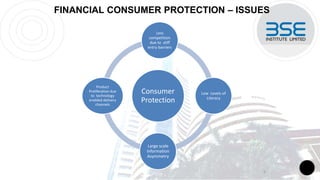
FINANCIAL CONSUMER PROTECTION – ISSUES
5
Consumer
Protection
Less
competition
due to stiff
entry barriers
Low Levels of
Literacy
Large scale
Information
Asymmetry
Product
Proliferation due
to technology
enabled delivery
channels
MAJOR CONCERNS
Mis-selling of products and services- Misleading
advertisements, unsolicited products, forced bundling
Transparency and Disclosure – Complex terms and conditions,
Non-disclosure of penal provisions, hidden fees and charges,
usurious penal charges
Consumer Education – Lack of awareness of MITCs, poor
customer responsibility
Collecting Dues – Harassment/ Intimidation, conduct of
recovery agents
No. of customers approaching BOs still high, indicating
inadequacy of banks’ internal redressal systems
6
CHALLENGES & TRENDS IN CONSUMER
PROTECTION
Product proliferation in the name of innovation- Structured products,
derivatives
Increase in virtual and cross-border transactions
Imbalances in bargaining power
Segregation of consumer protection and market conduct issues from
prudential regulation
Treating Customers Fairly (TCF)
7
CONSUMERS’ RIGHT TO FAIR TREATMENT
What is TCF
- Consumers understand the features, benefits, risks
and costs of products they buy and the services they use
- Transparent and non-discriminatory pricing
TCF characteristics:
access to adequate, comparable information
honest and ethical dealings
effective, responsive and robust grievance redressal
system
appropriate advice on suitability of products
8
FAIR TREATMENT OF CUSTOMERS THROUGH
PRODUCT LIFE -CYCLE
• CONTINUOUS SUPPORT
TILL EXPIRY OF TERM
• PROMPT SETTLEMENT OF
DISPUTES
• EASILY ACCESSIBLE
• OBJECTIVE TIME-LINES FOR
REDRESSAL
• INFORMATION ON
ALTERNATE DISPUTE
RESOLUTION MECHANISM
• ACCURATE INFORMATION
• TRAINED STAFF
• NO MISLEADING ADVTS.
• SIMPLICITY
• FAIR CONTRACT TERMS
• PLAIN LANGUAGE
• TRANSPARENT & NON –
DISCRIMINATORY PRICING
PRODUCT
DESIGN
MARKETING
AND
ADVERTISING
AFTER SALES
SERVICE
GRIEVANCES
REDRESSAL
9
ARE CONSUMERS BEING TREATED FAIRLY ?
Bundling of insurance with bank’s regular products
Perverse incentive structures encourage mis-selling-
Sale targets for front desk staff!
Floating interest rates – Sticky on the downside !
Wide variation in interest rates charged for retail
loans- Customers discriminated in spite of similar risk
profile
Discrimination in rates offered to old and new
customers with identical risk profiles
Discount on rate of interest charged during festivals
Charges for not providing services
- Non-maintenance of minimum balance
- Charges for no transaction in accounts
- Prepayment penalty 10
SOCIO- ECONOMIC FALLOUT OF IMPROPER
MARKET CONDUCT
Banks might meet legal and regulatory prescriptions but whether their market
conduct is in tune with wider socio-economic interest
- Lending against the security of gold (why it should not be treated as
consumption loan)
- Opening of accounts of MLM companies and allowing transactions
Cobrapost episode:
-Staff facilitating tax evasion through splitting of transactions
-Customers allotted multiple IDs, even within the same branch
- Laxity in CTR/STR reporting
- Sale of third party products/gold coins at branches – Without KYC
Lack of follow up on export bills sent for collection – implications for CAD
Large ‘unhedged forex exposures’ of corporates– implications for individual
banks and for systemic stability
11
CASE FOR TWIN PEAKS REGULATORY
ARCHITECTURE
Segregating prudential regulation from market conduct regulation –
Institutional solvency and systemic stability does not ensure consumer
protection
Growing recognition that institution-based structures are becoming irrelevant
- Changes in industry characteristics
- Changes in product characteristics
Neither institutional nor functional approaches were/ are adequate
Problem of scarce specialist skills – supervisory and regulatory
12
CHANGING PROFILE OF FINANCIAL
SERVICES INDUSTRY
Emergence of financial conglomerates – growing size
and numbers
Abolition of barriers/ restrictions on investment/
commercial banking combinations
Bank- insurance linkages becoming commonplace
Need for a “group-wide” perspective for monitoring
prudential soundness
13
CHANGING PRODUCTS PROFILE
New/ innovative products that overlap conventional deposit/ insurance/
securities boundaries
Credit default swaps – are they exposure in terms of credit or insurance ?
Problems posed in the area of consumer protection – who regulates which
product ?
Systemic issues – OTC derivative markets increased the interconnectedness
of institutions, banks and non-banks
14
TWIN PEAKS MODEL - OBJECTIVES
Functional Specialization
Optimum and efficient use of resources
Ensuring accountability
Avoiding comprehensive single point regulatory lapses and
systemic failures
Standardized KYC requirements-Remove irritation of
multiple KYC requirements
15
PRUDENTIAL REGULATION
Objective - ensure safety and soundness of individual entities and overall
financial stability (Systemic stability concerns)
Focus on large financial entities including financial conglomerates
Tools used include stipulation of liquidity and solvency requirements and
regulation of the payment system
16
MARKET CONDUCT REGULATION
How firms conduct their business, design and price their products, treat their
consumers
- Banks financing speculative products (Gold, Equity)
- Banks receiving commission/ fees from dealers/ suppliers
Whether banks’ activities are in national/societal interests
Objective is to secure consumer protection, improve market confidence,
promote access to financial services and protect the system from financial
crimes
Tools include prescribing standards and codes, monitoring performance
against these codes
17
CONCLUSION
Fair Treatment to Consumers not ingrained in the ethics and culture of
financial institutions in India
Conduct of banks not in the best of economic and societal interests
Need to nurture a culture of fair treatment to customers – A Board/Top
Management driven change in outlook necessary – If customers are not
happy, institutions can’t survive
Need to recognize that market conduct and consumer protection essential for
financial stability as well - Banks have to act as agents of change – for ending
the social divide and discrimination against the poor and the vulnerable
sections
BCSBI and the PCCOs have an important role to play
18
INTRODUCTION
This is a Code of Customer Rights, which sets minimum standards of banking
practices we will follow as a member of BCSBI while dealing with individual
customers. It provides protection to customers and explains how a member bank
is required to deal with customers in its day-to-day operations
19
OBJECTIVES
The Code has been developed to :
• Promote fair banking practices
• Increase transparency
• Achieve higher operating standards
• Promote a fair and cordial relationship
• Foster confidence in the banking system
• Promote safe and fair customer dealing
• Increase awareness of customers
20
CODE OF BANK’S COMMITMENT TO CUSTOMERS
This is a Code of Customer Rights, which sets
minimum standards of banking practices, we will
follow as a member of BCSBI, while dealing with
individual customers. It provides protection to
customers and explains how a member bank is
required to deal with customers in its day-to-day
operations.
21
RIGHT TO FAIR TREATMENT
1. Minimum banking facilities of receipt and payment.
2.Meeting the standards and commitment for the product and
services
3. Relevant laws
4. Ethical principles
5.Offering digital banking
6. Training staff
7. No discrimination
22
RIGHT TO FAIR
DEALING,TRANSPARENCY AND
HONESTY
• Timely and adequate information
• Advertising and Promotional literature is
clear and not misleading.
• Do Not Call service and Interest rate
• Tariff schedule
• Complete information through SMS,print media
etc.
• Displaying information in our branch and website
our policies
• Create awareness of the code among customers
23
RIGHT TO SUITABILITY
We will offer you product appropriate to your needs and based
on an assessment of your financial circumstances.
24
RIGHT TO PRIVACY AND
CONFIDENTIALITY
1. Personal information as private and
confidential Exceptions:
a)CICs-Loans,unsecured loans, credit
card etc. b)Information required by law
or regulator. c)Authorised by us
d)Banker’s reference
e)T
o prevent fraud
2.Marketing purpose
3.Information collected other than KYC 25
RIGHT TO GRIEVANCE
REDRESSAL AND FORUM
1.Correcting our mistakes promptly
2.Handling complaints
3.Guidances
4.Problem arising out of technological
failures
26
It is generally understood as the framework of rules,
relationships, systems and processes within and by
which authority is exercised and controlled in
corporations.
CORPORATE GOVERNANCE
27
NEED FOR CORPORATE GOVERNANCE
• Rights and equitable treatment of share
holders
• Role and responsibilities of the board
• Integrity and ethical behavior
• Corporate Scams or Scandals
• Globalization
28
CORPORATE GOVERNANCE PILLARS
29
THE MICRO, SMALL AND MEDIUM
ENTERPRISES DEVELOPMENT ACT, 2006
No. 27 oF 2006
[16thJune, 2006.]
An Act to provide for facilitating the promotion and
development and enhancing the competitiveness of
micro, small and medium enterprises iiDd for
matters connected therewith or incidental thereto.
30
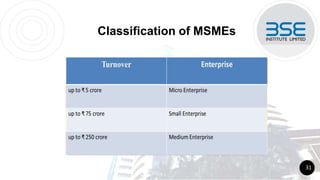
Classification of MSMEs
31
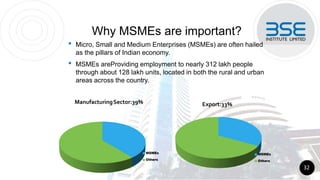
• Micro, Small and Medium Enterprises (MSMEs) are often hailed
as the pillars of Indian economy.
• MSMEs areProviding employment to nearly 312 lakh people
through about 128 lakh units, located in both the rural and urban
areas across the country.
Why MSMEs are important?
ManufacturingSector:39%
MSMEs
Others
Export:33%
MSMEs
Others
32
Code Of Bank’s Commitment To
Micro And Small Enterprises
It provides protection to you and explains how banks are expected
to deal with you in your day-to-day operations and in times of
financial difficulties
Objectives of Code
a. To give a positive thrust
b. To promote good and fair banking practices
c. T
o increase transparency
d. To improve our understanding of your business through
effective
communication.
e. To encourage market forces, through competition, to achieve
higher
operating standards.
f. To ensure timely and quick response to your banking needs.
g. To foster confidence in the banking system.
33
LENDING
• Credit Guarantee Fund Trust for Micro and Small
Enterprises which is extended by eligible banks
and is popularly known as CGTMSE guarantee
scheme for MSEs
• Reality: Most of the MSMEs crib that bank officials
very rarely
talk about the scheme
34
Code for loan application
Acknowledge, in writing, the receipt of your loan application,
whether submitted manually or online, indicating therein the time
frame within which the application will be disposed of.
ICICI InstaOD:
ICICI Bank has launched instant overdraft ‘InstaOD’ facility for
MSME. Customers can get overdraft facility up to Rs 15 lakh for
a year anytime, anywhere using the bank’s Internet and mobile
banking app. the new facility will avail the facility without visiting
a branch and submitting physical documents.
35
36
37
What is Banking Ombudsman?
38
Introduction
• Meaning of Banking Ombudsman?
• Appointment of banking ombudsman
• Number of banking ombudsman’s till date
• Banks covered under the Banking Ombudsman Scheme, 2006
1.Commercial banks
2.RRB’s
• Scheduled Primary co-operative Bank
An inexpensive forum
39
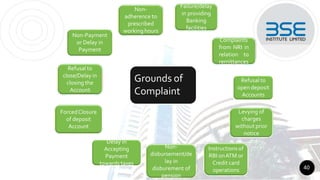
Grounds of
Complaint
Non-
adherence to
prescribed
workinghours
Failure/delay
in providing
Banking
facilities
Complaints
from NRI in
relation to
remittances
Refusal to
open deposit
Accounts
Levying of
charges
without prior
notice
Instructions of
RBI onATM or
Credit card
operations
Non-
disbursement/de
lay in
disburement of
pension
Delay in
Accepting
Payment
towards taxes
ForcedClosure
of deposit
Account
Refusal to
close/Delay in
closing the
Account
Non-Payment
or Delay in
Payment
40
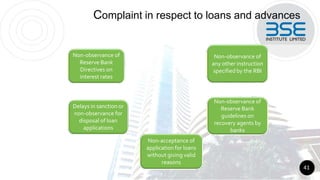
Complaint in respect to loans and advances
Non-observance of
Reserve Bank
Directives on
interest rates
Delays in sanction or
non-observance for
disposal of loan
applications
Non-acceptance of
application for loans
without giving valid
reasons
Non-observance of
Reserve Bank
guidelines on
recovery agents by
banks
Non-observance of
any other instruction
specifiedby the RBI
41
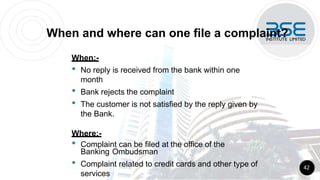
When and where can one file a complaint?
When:-
• No reply is received from the bank within one
month
• Bank rejects the complaint
• The customer is not satisfied by the reply given by
the Bank.
Where:-
• Complaint can be filed at the office of the
Banking Ombudsman
• Complaint related to credit cards and other type of
services
42
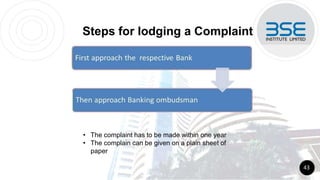
Steps for lodging a Complaint
• The complaint has to be made within one year
• The complain can be given on a plain sheet of
paper
43
Powers of the Banking Ombudsman
• Issue general powers of Superintendence.
• Control over the office .
• To incur expenditure on behalf of the office. In order to
exercise such power, the Banking Ombudsman will draw up
an annual budget for his office in consultation with Reserve
Bank and shall exercise the powers of expenditure within the
approved budget. The Reserve Bank will indicate the share of
expenditure to be borne by the concerned banks.
• The Banking Ombudsman shall send to the Governor,
Reserve Bank, by 31st May every year, a report containing a
general review of the activities of his Office during the
preceding financial year.
• Authority of each Banking Ombudsman extends to the
territorial limits entailed by the Reserve Bank of India.
44
When will one's complaint not be considered
by the Banking Ombudsman?
• The complaint to Banking Ombudsman is made after the lapse of more than one
year and one month from the date of complaint made to the bank.
• The subject matter of the complaint is pending for disposal / has already been dealt
with at any other forum like court of law, consumer court etc.
• Frivolous (not having any serious purpose or value) or vexatious (causing
trouble) complaints.
• The institution complained against is not covered under the
scheme.
• If the complaint is for the same subject matter that was settled through the office of
the Banking Ombudsman in any previous proceedings.
45
Rejection of Complaint
• The Banking Ombudsman may reject a complaint at any
stage if it appears that the complaint made to them is:
• Not on the grounds of complaint mentioned above.
• Requires consideration of elaborate documents and oral
evidence.
• The complaint is without any sufficient cause.
• The complaint that it is not pursued by the complainant with reasonable diligence.
• There is no loss or damage or inconvenience caused to the
complainant.
46
Limits of Compensation
• The amount, if any, to be paid by the bank to the complainant by way of
compensation for any loss suffered by the complainant is limited to the
amount arising directly out of the act or omission of the bank or ₹ 20
lakhs, whichever is lower.
• The Ombudsman may choose to award the compensation, not
exceeding Rs 1 lakh, to the complainant for mental agony and
harassment.
47
Legal Route
• If you are not happy with the settlement offered by the
Ombudsman, you can file an appeal before theAppellate
Authority within 30 days.
• The Appellate Authority in this case is the Deputy Governor of
the RBI.
• Alternatively, you can approach consumer redressal forums,
which take up bank-related complaints, or even the courts.
48
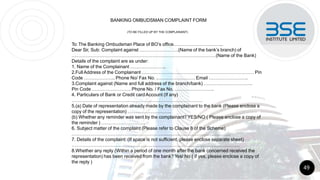
BANKING OMBUDSMAN COMPLAINT FORM
(TO BE FILLED UP BY THE COMPLAINANT)
To: The Banking Ombudsman Place of BO’s office…………………………..
Dear Sir, Sub: Complaint against …………………….(Name of the bank’s branch) of
…………………………………………………………………………………(Name of the Bank)
Details of the complaint are as under:
1. Name of the Complainant …………………..
2.FullAddress of the Complainant ……………………………………………………………… Pin
Code ……………….. Phone No/ Fax No. .…………………… Email …………………….
3.Complaint against (Name and full address of the branch/bank) ………………………….
Pin Code ……………………. Phone No. / Fax No. …………………….
4. Particulars of Bank or Credit cardAccount (If any)
…………………………………………………………………………
5.(a) Date of representation already made by the complainant to the bank (Please enclose a
copy of the representation) ……………………….
(b) Whether any reminder was sent by the complainant? YES/NO ( Please enclose a copy of
the reminder ) ……………………….
6. Subject matter of the complaint (Please refer to Clause 8 of the Scheme)
…………………………………………………………………………………………
7. Details of the complaint: (If space is not sufficient, please enclose separate sheet)
………………………………………………………………………………………………
8.Whether any reply (Within a period of one month after the bank concerned received the
representation) has been received from the bank? Yes/ No ( if yes, please enclose a copy of
the reply )
49
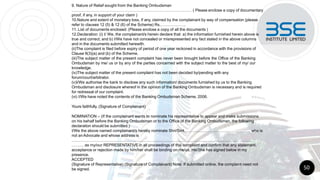
9. Nature of Relief sought from the Banking Ombudsman
……………………………………………………………………………… ( Please enclose a copy of documentary
proof, if any, in support of your claim )
10.Nature and extent of monetary loss, if any, claimed by the complainant by way of compensation (please
refer to clauses 12 (5) & 12 (6) of the Scheme) Rs.……………….
11. List of documents enclosed: (Please enclose a copy of all the documents )
12.Declaration: (i) I/ We, the complainant/s herein declare that: a) the information furnished herein above is
true and correct; and b) I/We have not concealed or misrepresented any fact stated in the above columns
and in the documents submitted herewith.
(ii)The complaint is filed before expiry of period of one year reckoned in accordance with the provisions of
Clause 9(3)(a) and (b) of the Scheme.
(iii)The subject matter of the present complaint has never been brought before the Office of the Banking
Ombudsman by me/ us or by any of the parties concerned with the subject matter to the best of my/ our
knowledge.
(iv)The subject matter of the present complaint has not been decided by/pending with any
forum/court/arbitrator.
(v)I/We authorise the bank to disclose any such information/ documents furnished by us to the Banking
Ombudsman and disclosure whereof in the opinion of the Banking Ombudsman is necessary and is required
for redressal of our complaint.
(vi) I/We have noted the contents of the Banking Ombudsman Scheme, 2006.
Yours faithfully, (Signature of Complainant)
NOMINATION – (If the complainant wants to nominate his representative to appear and make submissions
on his behalf before the Banking Ombudsman or to the Office of the Banking Ombudsman, the following
declaration should be submitted.)
I/We the above named complainant/s hereby nominate Shri/Smt………………………………………….. who is
not anAdvocate and whose address is
……………………………………………………………………………………………………………… ………
……… as my/our REPRESENTATIVE in all proceedings of this complaint and confirm that any statement,
acceptance or rejection made by him/her shall be binding on me/us. He/She has signed below in my
presence.
ACCEPTED
(Signature of Representative) (Signature of Complainant) Note: If submitted online, the complaint need not
be signed. 50

19 and 20 SME FINANCE Code.pptx

  • 1.
    Banking Codes and StandardsBoard of India (BCSBI) BSE - INTERNAL
  • 2.
    Banking Codes andStandards Board of India (BCSBI) was constituted on the recommendation of the committee under the Chairmanship of Shri S.S.Tarapore former deputy Governor of RBI. Registered as a Society under Societies registration Act 1860 in February 2006. BCSBI is a board for hassle free service to the Common Man. BCSBI is an independent and autonomous watch dog to monitor and ensure that the Banking Codes and Standards adopted by the banks are adhered to in true spirit while delivering their services. 3
  • 3.
    Code will applyto all products and services of the banks like Deposit accounts, Safe deposit lockers, settlement of deceased accounts, Forex, remittance within India, Loans and advances including guarantees, credit cards, internet banking. Code also Apply to interest rates, tariff schedule, terms and conditions governing relationship between the bank and the customer, compensation of loss, privacy and confidentiality of the information relating to the customer, norms governing advertisements, marketing and sales by banks. 4
  • 4.
    FINANCIAL CONSUMER PROTECTION– ISSUES 5 Consumer Protection Less competition due to stiff entry barriers Low Levels of Literacy Large scale Information Asymmetry Product Proliferation due to technology enabled delivery channels
  • 5.
    MAJOR CONCERNS Mis-selling ofproducts and services- Misleading advertisements, unsolicited products, forced bundling Transparency and Disclosure – Complex terms and conditions, Non-disclosure of penal provisions, hidden fees and charges, usurious penal charges Consumer Education – Lack of awareness of MITCs, poor customer responsibility Collecting Dues – Harassment/ Intimidation, conduct of recovery agents No. of customers approaching BOs still high, indicating inadequacy of banks’ internal redressal systems 6
  • 6.
    CHALLENGES & TRENDSIN CONSUMER PROTECTION Product proliferation in the name of innovation- Structured products, derivatives Increase in virtual and cross-border transactions Imbalances in bargaining power Segregation of consumer protection and market conduct issues from prudential regulation Treating Customers Fairly (TCF) 7
  • 7.
    CONSUMERS’ RIGHT TOFAIR TREATMENT What is TCF - Consumers understand the features, benefits, risks and costs of products they buy and the services they use - Transparent and non-discriminatory pricing TCF characteristics: access to adequate, comparable information honest and ethical dealings effective, responsive and robust grievance redressal system appropriate advice on suitability of products 8
  • 8.
    FAIR TREATMENT OFCUSTOMERS THROUGH PRODUCT LIFE -CYCLE • CONTINUOUS SUPPORT TILL EXPIRY OF TERM • PROMPT SETTLEMENT OF DISPUTES • EASILY ACCESSIBLE • OBJECTIVE TIME-LINES FOR REDRESSAL • INFORMATION ON ALTERNATE DISPUTE RESOLUTION MECHANISM • ACCURATE INFORMATION • TRAINED STAFF • NO MISLEADING ADVTS. • SIMPLICITY • FAIR CONTRACT TERMS • PLAIN LANGUAGE • TRANSPARENT & NON – DISCRIMINATORY PRICING PRODUCT DESIGN MARKETING AND ADVERTISING AFTER SALES SERVICE GRIEVANCES REDRESSAL 9
  • 9.
    ARE CONSUMERS BEINGTREATED FAIRLY ? Bundling of insurance with bank’s regular products Perverse incentive structures encourage mis-selling- Sale targets for front desk staff! Floating interest rates – Sticky on the downside ! Wide variation in interest rates charged for retail loans- Customers discriminated in spite of similar risk profile Discrimination in rates offered to old and new customers with identical risk profiles Discount on rate of interest charged during festivals Charges for not providing services - Non-maintenance of minimum balance - Charges for no transaction in accounts - Prepayment penalty 10
  • 10.
    SOCIO- ECONOMIC FALLOUTOF IMPROPER MARKET CONDUCT Banks might meet legal and regulatory prescriptions but whether their market conduct is in tune with wider socio-economic interest - Lending against the security of gold (why it should not be treated as consumption loan) - Opening of accounts of MLM companies and allowing transactions Cobrapost episode: -Staff facilitating tax evasion through splitting of transactions -Customers allotted multiple IDs, even within the same branch - Laxity in CTR/STR reporting - Sale of third party products/gold coins at branches – Without KYC Lack of follow up on export bills sent for collection – implications for CAD Large ‘unhedged forex exposures’ of corporates– implications for individual banks and for systemic stability 11
  • 11.
    CASE FOR TWINPEAKS REGULATORY ARCHITECTURE Segregating prudential regulation from market conduct regulation – Institutional solvency and systemic stability does not ensure consumer protection Growing recognition that institution-based structures are becoming irrelevant - Changes in industry characteristics - Changes in product characteristics Neither institutional nor functional approaches were/ are adequate Problem of scarce specialist skills – supervisory and regulatory 12
  • 12.
    CHANGING PROFILE OFFINANCIAL SERVICES INDUSTRY Emergence of financial conglomerates – growing size and numbers Abolition of barriers/ restrictions on investment/ commercial banking combinations Bank- insurance linkages becoming commonplace Need for a “group-wide” perspective for monitoring prudential soundness 13
  • 13.
    CHANGING PRODUCTS PROFILE New/innovative products that overlap conventional deposit/ insurance/ securities boundaries Credit default swaps – are they exposure in terms of credit or insurance ? Problems posed in the area of consumer protection – who regulates which product ? Systemic issues – OTC derivative markets increased the interconnectedness of institutions, banks and non-banks 14
  • 14.
    TWIN PEAKS MODEL- OBJECTIVES Functional Specialization Optimum and efficient use of resources Ensuring accountability Avoiding comprehensive single point regulatory lapses and systemic failures Standardized KYC requirements-Remove irritation of multiple KYC requirements 15
  • 15.
    PRUDENTIAL REGULATION Objective -ensure safety and soundness of individual entities and overall financial stability (Systemic stability concerns) Focus on large financial entities including financial conglomerates Tools used include stipulation of liquidity and solvency requirements and regulation of the payment system 16
  • 16.
    MARKET CONDUCT REGULATION Howfirms conduct their business, design and price their products, treat their consumers - Banks financing speculative products (Gold, Equity) - Banks receiving commission/ fees from dealers/ suppliers Whether banks’ activities are in national/societal interests Objective is to secure consumer protection, improve market confidence, promote access to financial services and protect the system from financial crimes Tools include prescribing standards and codes, monitoring performance against these codes 17
  • 17.
    CONCLUSION Fair Treatment toConsumers not ingrained in the ethics and culture of financial institutions in India Conduct of banks not in the best of economic and societal interests Need to nurture a culture of fair treatment to customers – A Board/Top Management driven change in outlook necessary – If customers are not happy, institutions can’t survive Need to recognize that market conduct and consumer protection essential for financial stability as well - Banks have to act as agents of change – for ending the social divide and discrimination against the poor and the vulnerable sections BCSBI and the PCCOs have an important role to play 18
  • 18.
    INTRODUCTION This is aCode of Customer Rights, which sets minimum standards of banking practices we will follow as a member of BCSBI while dealing with individual customers. It provides protection to customers and explains how a member bank is required to deal with customers in its day-to-day operations 19
  • 19.
    OBJECTIVES The Code hasbeen developed to : • Promote fair banking practices • Increase transparency • Achieve higher operating standards • Promote a fair and cordial relationship • Foster confidence in the banking system • Promote safe and fair customer dealing • Increase awareness of customers 20
  • 20.
    CODE OF BANK’SCOMMITMENT TO CUSTOMERS This is a Code of Customer Rights, which sets minimum standards of banking practices, we will follow as a member of BCSBI, while dealing with individual customers. It provides protection to customers and explains how a member bank is required to deal with customers in its day-to-day operations. 21
  • 21.
    RIGHT TO FAIRTREATMENT 1. Minimum banking facilities of receipt and payment. 2.Meeting the standards and commitment for the product and services 3. Relevant laws 4. Ethical principles 5.Offering digital banking 6. Training staff 7. No discrimination 22
  • 22.
    RIGHT TO FAIR DEALING,TRANSPARENCYAND HONESTY • Timely and adequate information • Advertising and Promotional literature is clear and not misleading. • Do Not Call service and Interest rate • Tariff schedule • Complete information through SMS,print media etc. • Displaying information in our branch and website our policies • Create awareness of the code among customers 23
  • 23.
    RIGHT TO SUITABILITY Wewill offer you product appropriate to your needs and based on an assessment of your financial circumstances. 24
  • 24.
    RIGHT TO PRIVACYAND CONFIDENTIALITY 1. Personal information as private and confidential Exceptions: a)CICs-Loans,unsecured loans, credit card etc. b)Information required by law or regulator. c)Authorised by us d)Banker’s reference e)T o prevent fraud 2.Marketing purpose 3.Information collected other than KYC 25
  • 25.
    RIGHT TO GRIEVANCE REDRESSALAND FORUM 1.Correcting our mistakes promptly 2.Handling complaints 3.Guidances 4.Problem arising out of technological failures 26
  • 26.
    It is generallyunderstood as the framework of rules, relationships, systems and processes within and by which authority is exercised and controlled in corporations. CORPORATE GOVERNANCE 27
  • 27.
    NEED FOR CORPORATEGOVERNANCE • Rights and equitable treatment of share holders • Role and responsibilities of the board • Integrity and ethical behavior • Corporate Scams or Scandals • Globalization 28
  • 28.
  • 29.
    THE MICRO, SMALLAND MEDIUM ENTERPRISES DEVELOPMENT ACT, 2006 No. 27 oF 2006 [16thJune, 2006.] An Act to provide for facilitating the promotion and development and enhancing the competitiveness of micro, small and medium enterprises iiDd for matters connected therewith or incidental thereto. 30
  • 30.
  • 31.
    • Micro, Smalland Medium Enterprises (MSMEs) are often hailed as the pillars of Indian economy. • MSMEs areProviding employment to nearly 312 lakh people through about 128 lakh units, located in both the rural and urban areas across the country. Why MSMEs are important? ManufacturingSector:39% MSMEs Others Export:33% MSMEs Others 32
  • 32.
    Code Of Bank’sCommitment To Micro And Small Enterprises It provides protection to you and explains how banks are expected to deal with you in your day-to-day operations and in times of financial difficulties Objectives of Code a. To give a positive thrust b. To promote good and fair banking practices c. T o increase transparency d. To improve our understanding of your business through effective communication. e. To encourage market forces, through competition, to achieve higher operating standards. f. To ensure timely and quick response to your banking needs. g. To foster confidence in the banking system. 33
  • 33.
    LENDING • Credit GuaranteeFund Trust for Micro and Small Enterprises which is extended by eligible banks and is popularly known as CGTMSE guarantee scheme for MSEs • Reality: Most of the MSMEs crib that bank officials very rarely talk about the scheme 34
  • 34.
    Code for loanapplication Acknowledge, in writing, the receipt of your loan application, whether submitted manually or online, indicating therein the time frame within which the application will be disposed of. ICICI InstaOD: ICICI Bank has launched instant overdraft ‘InstaOD’ facility for MSME. Customers can get overdraft facility up to Rs 15 lakh for a year anytime, anywhere using the bank’s Internet and mobile banking app. the new facility will avail the facility without visiting a branch and submitting physical documents. 35
  • 35.
  • 36.
  • 37.
    What is BankingOmbudsman? 38
  • 38.
    Introduction • Meaning ofBanking Ombudsman? • Appointment of banking ombudsman • Number of banking ombudsman’s till date • Banks covered under the Banking Ombudsman Scheme, 2006 1.Commercial banks 2.RRB’s • Scheduled Primary co-operative Bank An inexpensive forum 39
  • 39.
    Grounds of Complaint Non- adherence to prescribed workinghours Failure/delay inproviding Banking facilities Complaints from NRI in relation to remittances Refusal to open deposit Accounts Levying of charges without prior notice Instructions of RBI onATM or Credit card operations Non- disbursement/de lay in disburement of pension Delay in Accepting Payment towards taxes ForcedClosure of deposit Account Refusal to close/Delay in closing the Account Non-Payment or Delay in Payment 40
  • 40.
    Complaint in respectto loans and advances Non-observance of Reserve Bank Directives on interest rates Delays in sanction or non-observance for disposal of loan applications Non-acceptance of application for loans without giving valid reasons Non-observance of Reserve Bank guidelines on recovery agents by banks Non-observance of any other instruction specifiedby the RBI 41
  • 41.
    When and wherecan one file a complaint? When:- • No reply is received from the bank within one month • Bank rejects the complaint • The customer is not satisfied by the reply given by the Bank. Where:- • Complaint can be filed at the office of the Banking Ombudsman • Complaint related to credit cards and other type of services 42
  • 42.
    Steps for lodginga Complaint • The complaint has to be made within one year • The complain can be given on a plain sheet of paper 43
  • 43.
    Powers of theBanking Ombudsman • Issue general powers of Superintendence. • Control over the office . • To incur expenditure on behalf of the office. In order to exercise such power, the Banking Ombudsman will draw up an annual budget for his office in consultation with Reserve Bank and shall exercise the powers of expenditure within the approved budget. The Reserve Bank will indicate the share of expenditure to be borne by the concerned banks. • The Banking Ombudsman shall send to the Governor, Reserve Bank, by 31st May every year, a report containing a general review of the activities of his Office during the preceding financial year. • Authority of each Banking Ombudsman extends to the territorial limits entailed by the Reserve Bank of India. 44
  • 44.
    When will one'scomplaint not be considered by the Banking Ombudsman? • The complaint to Banking Ombudsman is made after the lapse of more than one year and one month from the date of complaint made to the bank. • The subject matter of the complaint is pending for disposal / has already been dealt with at any other forum like court of law, consumer court etc. • Frivolous (not having any serious purpose or value) or vexatious (causing trouble) complaints. • The institution complained against is not covered under the scheme. • If the complaint is for the same subject matter that was settled through the office of the Banking Ombudsman in any previous proceedings. 45
  • 45.
    Rejection of Complaint •The Banking Ombudsman may reject a complaint at any stage if it appears that the complaint made to them is: • Not on the grounds of complaint mentioned above. • Requires consideration of elaborate documents and oral evidence. • The complaint is without any sufficient cause. • The complaint that it is not pursued by the complainant with reasonable diligence. • There is no loss or damage or inconvenience caused to the complainant. 46
  • 46.
    Limits of Compensation •The amount, if any, to be paid by the bank to the complainant by way of compensation for any loss suffered by the complainant is limited to the amount arising directly out of the act or omission of the bank or ₹ 20 lakhs, whichever is lower. • The Ombudsman may choose to award the compensation, not exceeding Rs 1 lakh, to the complainant for mental agony and harassment. 47
  • 47.
    Legal Route • Ifyou are not happy with the settlement offered by the Ombudsman, you can file an appeal before theAppellate Authority within 30 days. • The Appellate Authority in this case is the Deputy Governor of the RBI. • Alternatively, you can approach consumer redressal forums, which take up bank-related complaints, or even the courts. 48
  • 48.
    BANKING OMBUDSMAN COMPLAINTFORM (TO BE FILLED UP BY THE COMPLAINANT) To: The Banking Ombudsman Place of BO’s office………………………….. Dear Sir, Sub: Complaint against …………………….(Name of the bank’s branch) of …………………………………………………………………………………(Name of the Bank) Details of the complaint are as under: 1. Name of the Complainant ………………….. 2.FullAddress of the Complainant ……………………………………………………………… Pin Code ……………….. Phone No/ Fax No. .…………………… Email ……………………. 3.Complaint against (Name and full address of the branch/bank) …………………………. Pin Code ……………………. Phone No. / Fax No. ……………………. 4. Particulars of Bank or Credit cardAccount (If any) ………………………………………………………………………… 5.(a) Date of representation already made by the complainant to the bank (Please enclose a copy of the representation) ………………………. (b) Whether any reminder was sent by the complainant? YES/NO ( Please enclose a copy of the reminder ) ………………………. 6. Subject matter of the complaint (Please refer to Clause 8 of the Scheme) ………………………………………………………………………………………… 7. Details of the complaint: (If space is not sufficient, please enclose separate sheet) ……………………………………………………………………………………………… 8.Whether any reply (Within a period of one month after the bank concerned received the representation) has been received from the bank? Yes/ No ( if yes, please enclose a copy of the reply ) 49
  • 49.
    9. Nature ofRelief sought from the Banking Ombudsman ……………………………………………………………………………… ( Please enclose a copy of documentary proof, if any, in support of your claim ) 10.Nature and extent of monetary loss, if any, claimed by the complainant by way of compensation (please refer to clauses 12 (5) & 12 (6) of the Scheme) Rs.………………. 11. List of documents enclosed: (Please enclose a copy of all the documents ) 12.Declaration: (i) I/ We, the complainant/s herein declare that: a) the information furnished herein above is true and correct; and b) I/We have not concealed or misrepresented any fact stated in the above columns and in the documents submitted herewith. (ii)The complaint is filed before expiry of period of one year reckoned in accordance with the provisions of Clause 9(3)(a) and (b) of the Scheme. (iii)The subject matter of the present complaint has never been brought before the Office of the Banking Ombudsman by me/ us or by any of the parties concerned with the subject matter to the best of my/ our knowledge. (iv)The subject matter of the present complaint has not been decided by/pending with any forum/court/arbitrator. (v)I/We authorise the bank to disclose any such information/ documents furnished by us to the Banking Ombudsman and disclosure whereof in the opinion of the Banking Ombudsman is necessary and is required for redressal of our complaint. (vi) I/We have noted the contents of the Banking Ombudsman Scheme, 2006. Yours faithfully, (Signature of Complainant) NOMINATION – (If the complainant wants to nominate his representative to appear and make submissions on his behalf before the Banking Ombudsman or to the Office of the Banking Ombudsman, the following declaration should be submitted.) I/We the above named complainant/s hereby nominate Shri/Smt………………………………………….. who is not anAdvocate and whose address is ……………………………………………………………………………………………………………… ……… ……… as my/our REPRESENTATIVE in all proceedings of this complaint and confirm that any statement, acceptance or rejection made by him/her shall be binding on me/us. He/She has signed below in my presence. ACCEPTED (Signature of Representative) (Signature of Complainant) Note: If submitted online, the complaint need not be signed. 50