Centre for Women’s Health, Gender and Society
Melbourne School of Population Health
Centre for Women’s Health, Gender & Society
WHO Collaborating Centre for Women’s Health
Challenging Myths About
Women’s Sexual and
Reproductive Mental Health: New
Evidence Across the Life Course
From
The Centre for Women’s Health, Gender & Society
University of Melbourne
MYTH 1:
Perinatal Mental Health Problems
are a ‘Culture Bound Syndrome’
Jane Fisher
Publications
Fisher JRW. Cabral de Mello M, Isutzu T. Pregnancy, childbirth and the postpartum year. In Fisher JRW, Astbury JA, Cabral de Mello M, Saxena S,
(editors). Mental Health Aspects of Women’s Reproductive Health. A Global Review of the Literature. Geneva, WHO and UNFPA, 2009
Fisher JRW, Cabral de Mello M, Tran T, Izutsu T. Maternal mental health and child survival, health and development in resource-constrained
settings: essential for Achieving the Millennium Development Goals. Statement from the UNFPA – WHO International Expert Meeting: Maternal
mental health and child health and development in resource constrained settings. Hanoi, June, 25th – 27th 2007; Geneva, 2009
Fisher J, Tran thu thi Huong, Tran Tuan. Relative socioeconomic advantage and mood during advanced pregnancy in women in Viet Nam Journal of
International Mental Health Systems 2007; 1:3 doi:10.1186/1752-4458-1-3
Fisher JRW, Morrow MM, Nhu Ngoc NT, Hoang Anh LT. Prevalence, nature, severity and correlates of postpartum depressive symptoms in Ho
Chi Minh City Vietnam. BJOG, an International Journal of Obstetrics and Gynaecology 2004: 111: 1353 – 1360
Centre for Women’s Health, Gender and Society
WHO Collaborating Centre for Women’s Health
Centre for Women’s Health, Gender and Society
Melbourne School of Population Health
Centre for Women’s Health, Gender & Society
WHO Collaborating Centre for Women’s Health
PERINATAL MENTAL HEALTH
PROBLEMS ARE A ‘CULTURE BOUND
SYNDROME’
Women who live in low and lower middle income countries
experience traditional ritualized care after birth including:
• Mandated periods of rest;
• Honoured status;
• Increased practical support and freedom from household and
income-generating work;
• Social seclusion;
• Gift giving and prescribed foods;
• These protect mental health and therefore;
• They do not experience perinatal mental disorders.
Stern and Kruckman, 1983; Howard, 1993
Centre for Women’s Health, Gender and Society
Melbourne School of Population Health
Centre for Women’s Health, Gender & Society
WHO Collaborating Centre for Women’s Health
MATERNAL MENTAL HEALTH IN
HO CHI MINH CITY, VIET NAM
Systematic survey in 2000 of 506 mothers attending healthy baby clinics with their
six-week old infants:
SURVEY
• Sociodemographic characteristics;
• Perinatal health;
• Observation of traditional
postpartum practices;
• Specific and non-specific somatic
symptoms;
• Symptoms of depression;
• Edinburgh Postnatal Depression
Scale (Cox et al ,1987)
RESPONSE
• 98% response rate;
• Sociodemographically and
obstetrically representative sample;
DEPRESSION SYMPTOMS
• Average EPDS score = 9.49 ± 6.32 (range 0
to 26)
• 32.8% (166 / 506) scores >12
• Q10 Have you had thoughts of not wanting
to live anymore and if so how often?
• 19.4% (99 / 506) acknowledged these ideas (Q 10)
• 64.6% (64 / 99) quite frequently or often
CORRELATES OF EPDS >12
• Unwelcome pregnancy,
• No economic security;
• Being unable to confide in their husbands;
• Not being given special foods;
• Less than a month of complete rest after
childbirth,
• Avoiding proscribed foods; and
• Caring for a crying unsettled baby who was not
thriving;
Centre for Women’s Health, Gender and Society
Melbourne School of Population Health
Centre for Women’s Health, Gender & Society
WHO Collaborating Centre for Women’s Health
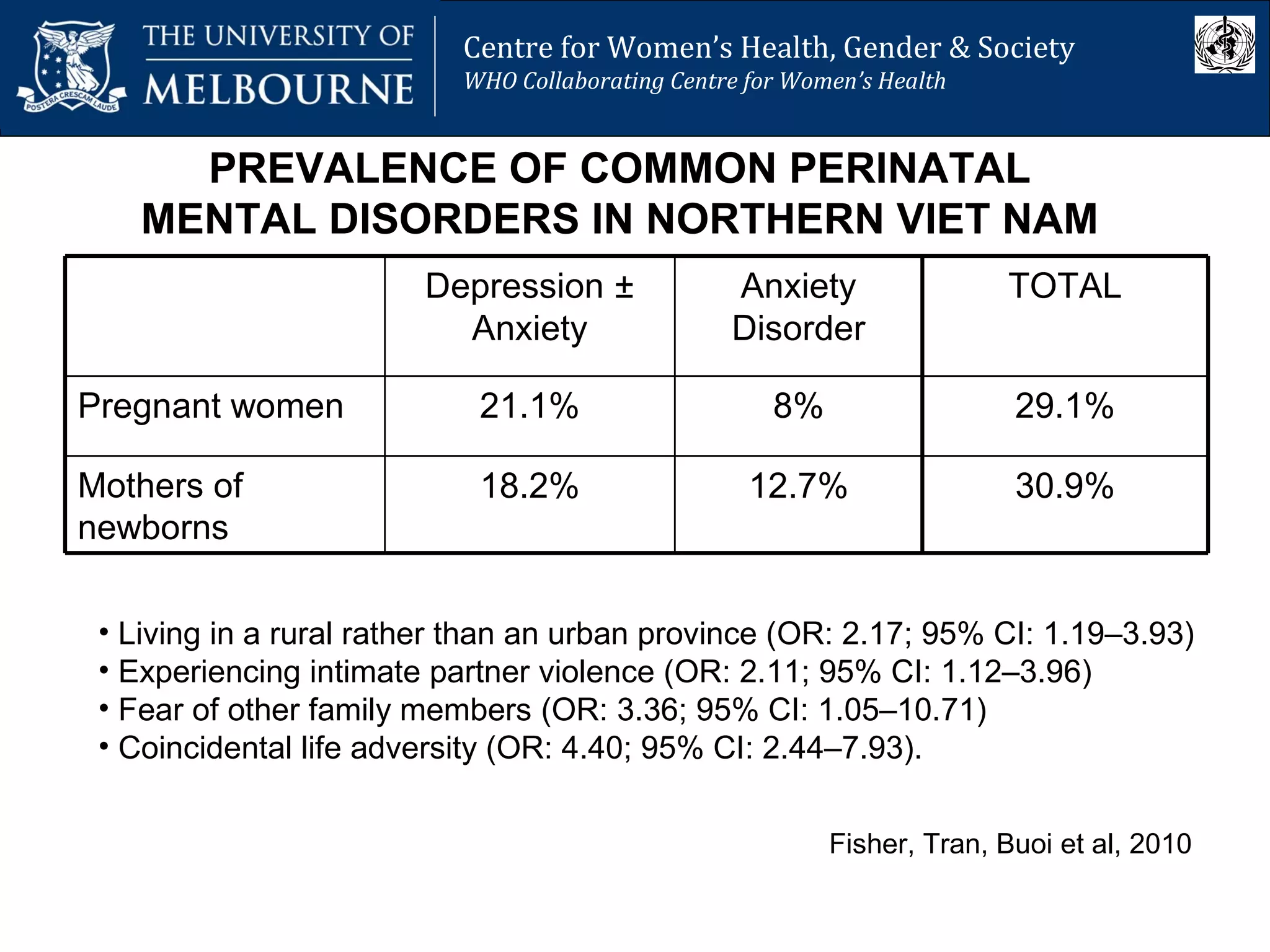
PREVALENCE OF COMMON PERINATAL
MENTAL DISORDERS IN NORTHERN VIET NAM
30.9%12.7%18.2%Mothers of
newborns
29.1%8%21.1%Pregnant women
TOTALAnxiety
Disorder
Depression ±
Anxiety
Fisher, Tran, Buoi et al, 2010
• Living in a rural rather than an urban province (OR: 2.17; 95% CI: 1.19–3.93)
• Experiencing intimate partner violence (OR: 2.11; 95% CI: 1.12–3.96)
• Fear of other family members (OR: 3.36; 95% CI: 1.05–10.71)
• Coincidental life adversity (OR: 4.40; 95% CI: 2.44–7.93).
Centre for Women’s Health, Gender and Society
Melbourne School of Population Health
Centre for Women’s Health, Gender & Society
WHO Collaborating Centre for Women’s Health
PERINATAL MENTAL HEALTH PROBLEMS
ARE A ‘CULTURE BOUND SYNDROME’…?
Prevalence of perinatal mental disorders in high income countries:
• ± 10% of pregnant women
• ± 13% of mothers of newborns
Prevalence of perinatal mental disorders in low and lower-middle income
countries:
• 12.5% - 42% of pregnant women and,
• 12% - 50% of mothers of newborns screen positive for symptoms of
depression;
Double disparity between developed and developing countries:
Availability of evidence:
• High income countries (91%)
• Low and lower middle countries (10%)
Fisher, Tran, Cabral de Mello, Izutsu, 2009; Hendrick, 1998; O’Hara and Swain, 1996
Centre for Women’s Health, Gender and Society
Melbourne School of Population Health
Centre for Women’s Health, Gender & Society
WHO Collaborating Centre for Women’s Health
Myth 2:
Careless young women have
unintended pregnancies and abortions
Heather Rowe
Publications
Rowe H, Kirkman M et al. Considering abortion: 12-month audit of records of women contacting a Pregnancy
Advisory Service. Medical Journal of Australia. 2009; 190:69-71.
Kirkman M, Rowe et al. Abortion is a difficult solution to a problem: A discursive analysis of interviews with women
considering or undergoing abortion in Australia. Women’s Studies International Forum. 2 June 2009.
Kirkman M, Rowe H et al. Reasons Women Give for Abortion: A Review of the Literature. Archives of Women’s
Mental Health 2009; 12(6), 365-378.
Kirkman M, Rowe H et al. Understanding Abortion From Women’s Perspective: Reasons For Contemplating or
Undergoing Abortion in Victoria, Australia. Sexual & Reproductive Healthcare under review.
Centre for Women’s Health, Gender and Society
Melbourne School of Population Health
Centre for Women’s Health, Gender & Society
WHO Collaborating Centre for Women’s Health
• Reliable data on incidence unavailable
Chan and Sage, 2005
• South Australia 29% to 31% of women have had an
induced abortion in their lifetime
Chan and Keane 2004
• Nationally representative telephone survey (n=9134)
23% women reported having experienced abortion
Smith et al 2003
“Willy-nilly pregnant women so dumb”
The Age 30 August 2004
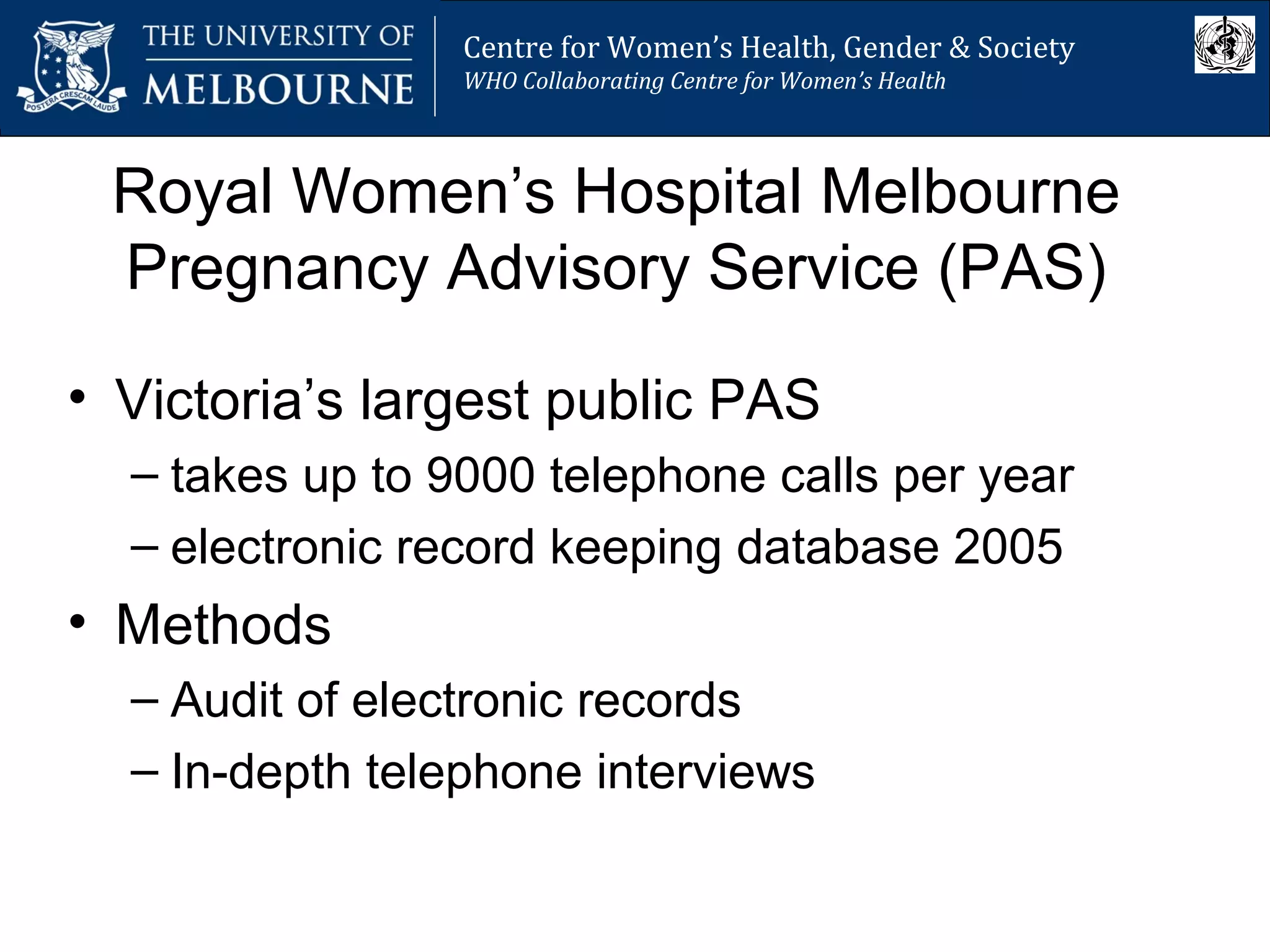
Royal Women’s Hospital Melbourne
Pregnancy Advisory Service (PAS)
• Victoria’s largest public PAS
– takes up to 9000 telephone calls per year
– electronic record keeping database 2005
• Methods
– Audit of electronic records
– In-depth telephone interviews
Centre for Women’s Health, Gender and Society
Melbourne School of Population Health
Centre for Women’s Health, Gender & Society
WHO Collaborating Centre for Women’s Health
Audit
1 October 2006 to 30 September 2007.
• Data collection tool
• Clinical not research database
• De-identified data
• During the audit period
– 5462 women made contact
– 3827 women registered for pregnancy support
and counselling services
– we conducted 60 in-depth interviews
Centre for Women’s Health, Gender and Society
Melbourne School of Population Health
Centre for Women’s Health, Gender & Society
WHO Collaborating Centre for Women’s Health
Centre for Women’s Health, Gender and Society
Melbourne School of Population Health
Centre for Women’s Health, Gender & Society
WHO Collaborating Centre for Women’s Health
Age Under 18 years 7%
18-29 years 60%
30-39 years 28%
Over 40 years 5%
Already had at least one child 42%
Using a reliable form of contraception 39%
Previous abortion 39%
Partner aware and supportive 71%
Violence 16%
Young rural women later contact p<0.05
Centre for Women’s Health, Gender and Society
Melbourne School of Population Health
Centre for Women’s Health, Gender & Society
WHO Collaborating Centre for Women’s Health
Careless young women have unintended
pregnancies and abortions…?
• Many Australian women have unintended pregnancies
despite widespread access to and use of contraception
• Most abortions are sought by women over 20 years
• Many mothers seek services
• No evidence that decisions are taken “willy nilly”
Centre for Women’s Health, Gender and Society
Melbourne School of Population Health
Centre for Women’s Health, Gender & Society
WHO Collaborating Centre for Women’s Health
Myth 3:
Pregnant adolescents
aren’t interested in their
babies
Karen Wynter
Publication
Rowe H, Wynter KH, Steele A, Fisher JR, Lee M, Quinlivan JA (to be submitted to
Birth). Pregnant Adolescents’ Emotional Attachment to their Fetuses
Centre for Women’s Health, Gender and Society
Melbourne School of Population Health
Centre for Women’s Health, Gender & Society
WHO Collaborating Centre for Women’s Health
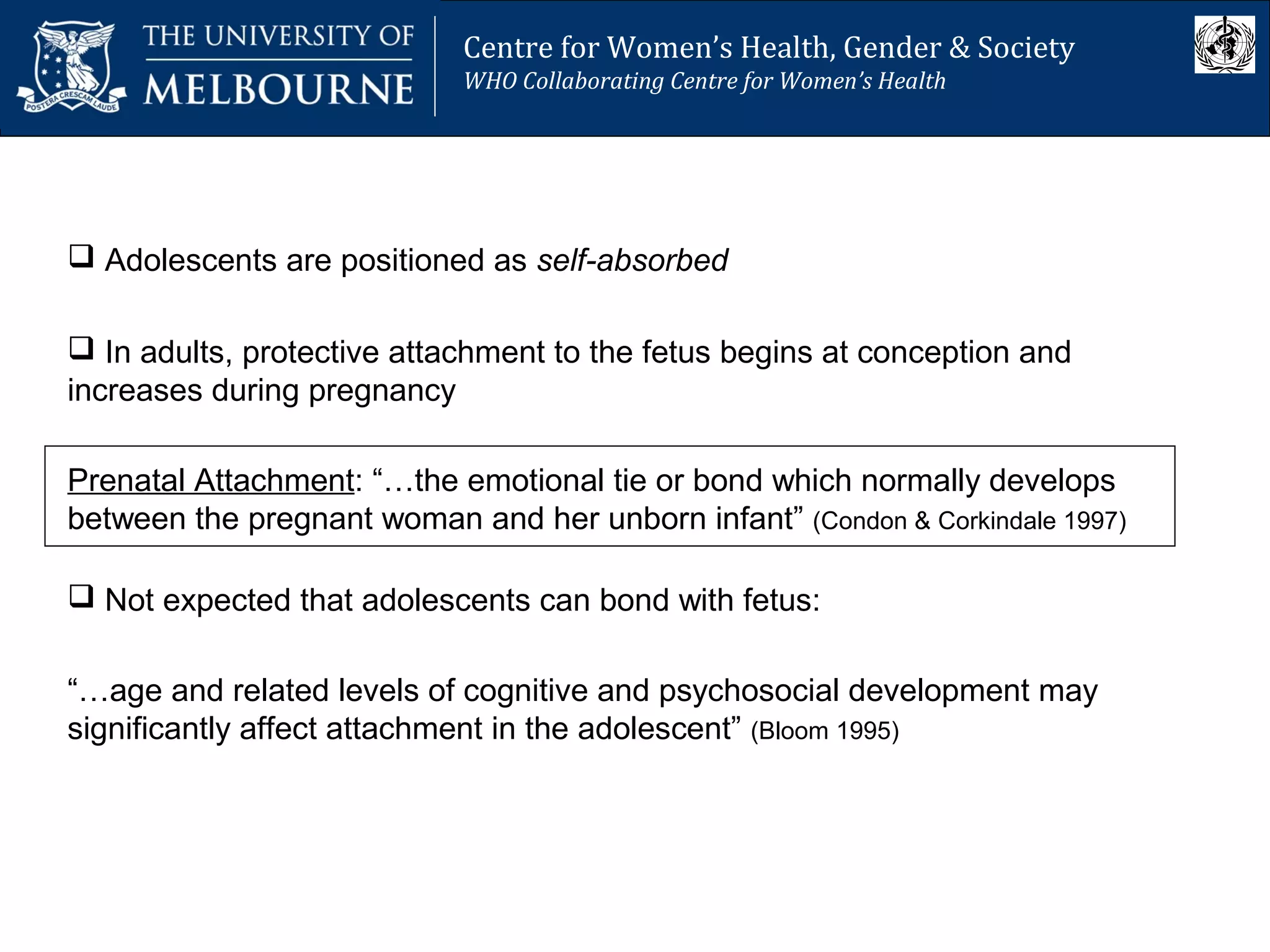
 Adolescents are positioned as self-absorbed
 In adults, protective attachment to the fetus begins at conception and
increases during pregnancy
Prenatal Attachment: “…the emotional tie or bond which normally develops
between the pregnant woman and her unborn infant” (Condon & Corkindale 1997)
 Not expected that adolescents can bond with fetus:
“…age and related levels of cognitive and psychosocial development may
significantly affect attachment in the adolescent” (Bloom 1995)
Centre for Women’s Health, Gender and Society
Melbourne School of Population Health
Centre for Women’s Health, Gender & Society
WHO Collaborating Centre for Women’s Health
Antenatal attachment is clinically important because:
 Precursor of postnatal attachment to the infant
 Associated with positive health behaviours eg
nutrition
avoiding harmful substances
attending antenatal care (Lindgren 2001)
Adolescents at risk of negative health behaviours (Quinlivan 2002)
Associated with:
 Gestational age, quickening
 ? Psychological wellbeing, stress, self-esteem, anxiety & depression
Only one study compared adolescents and adults
 No difference (Kemp et al. 1990)
Centre for Women’s Health, Gender and Society
Melbourne School of Population Health
Centre for Women’s Health, Gender & Society
WHO Collaborating Centre for Women’s Health
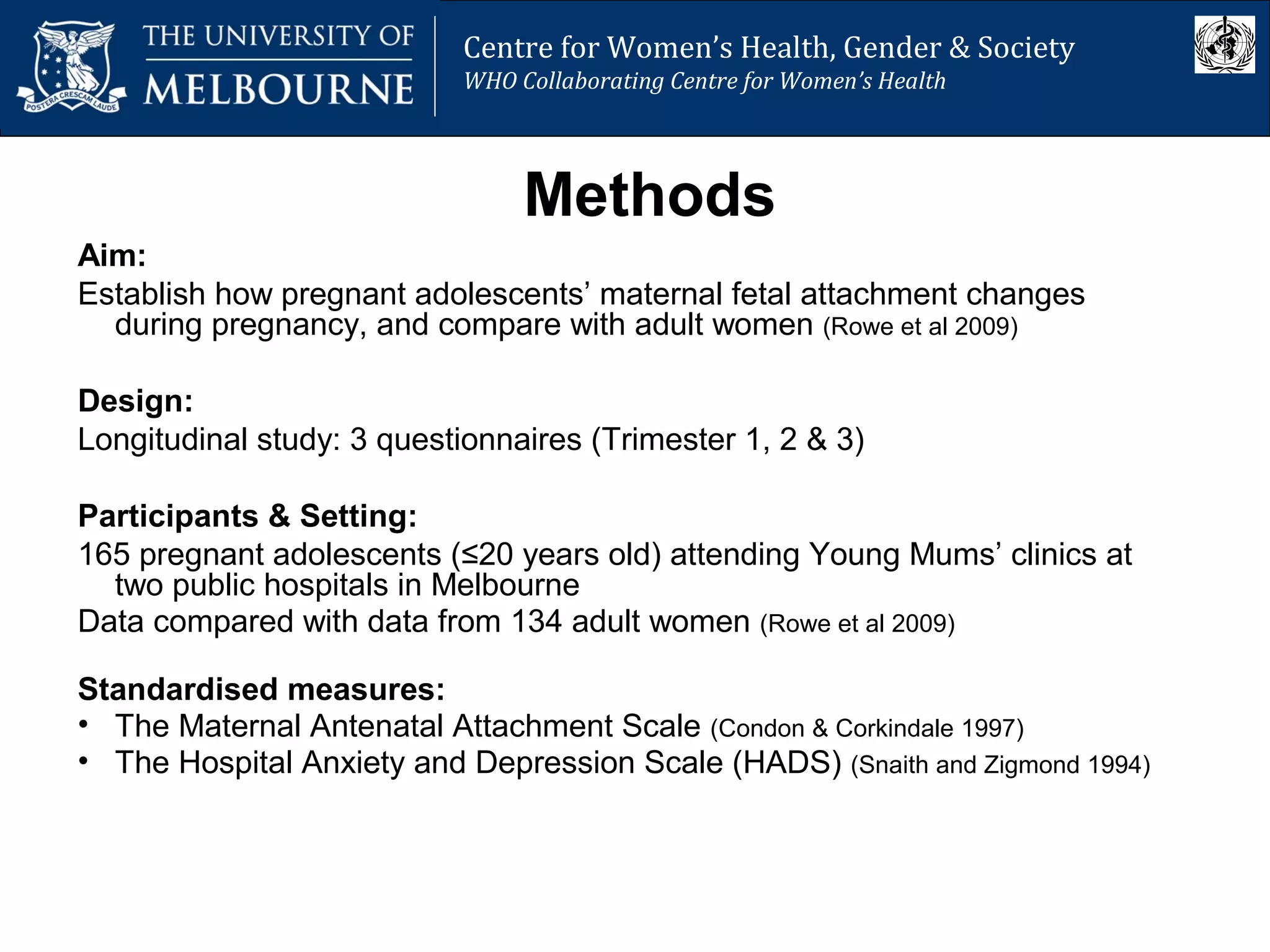
Methods
Aim:
Establish how pregnant adolescents’ maternal fetal attachment changes
during pregnancy, and compare with adult women (Rowe et al 2009)
Design:
Longitudinal study: 3 questionnaires (Trimester 1, 2 & 3)
Participants & Setting:
165 pregnant adolescents (≤20 years old) attending Young Mums’ clinics at
two public hospitals in Melbourne
Data compared with data from 134 adult women (Rowe et al 2009)
Standardised measures:
• The Maternal Antenatal Attachment Scale (Condon & Corkindale 1997)
• The Hospital Anxiety and Depression Scale (HADS) (Snaith and Zigmond 1994)
Centre for Women’s Health, Gender and Society
Melbourne School of Population Health
Centre for Women’s Health, Gender & Society
WHO Collaborating Centre for Women’s Health
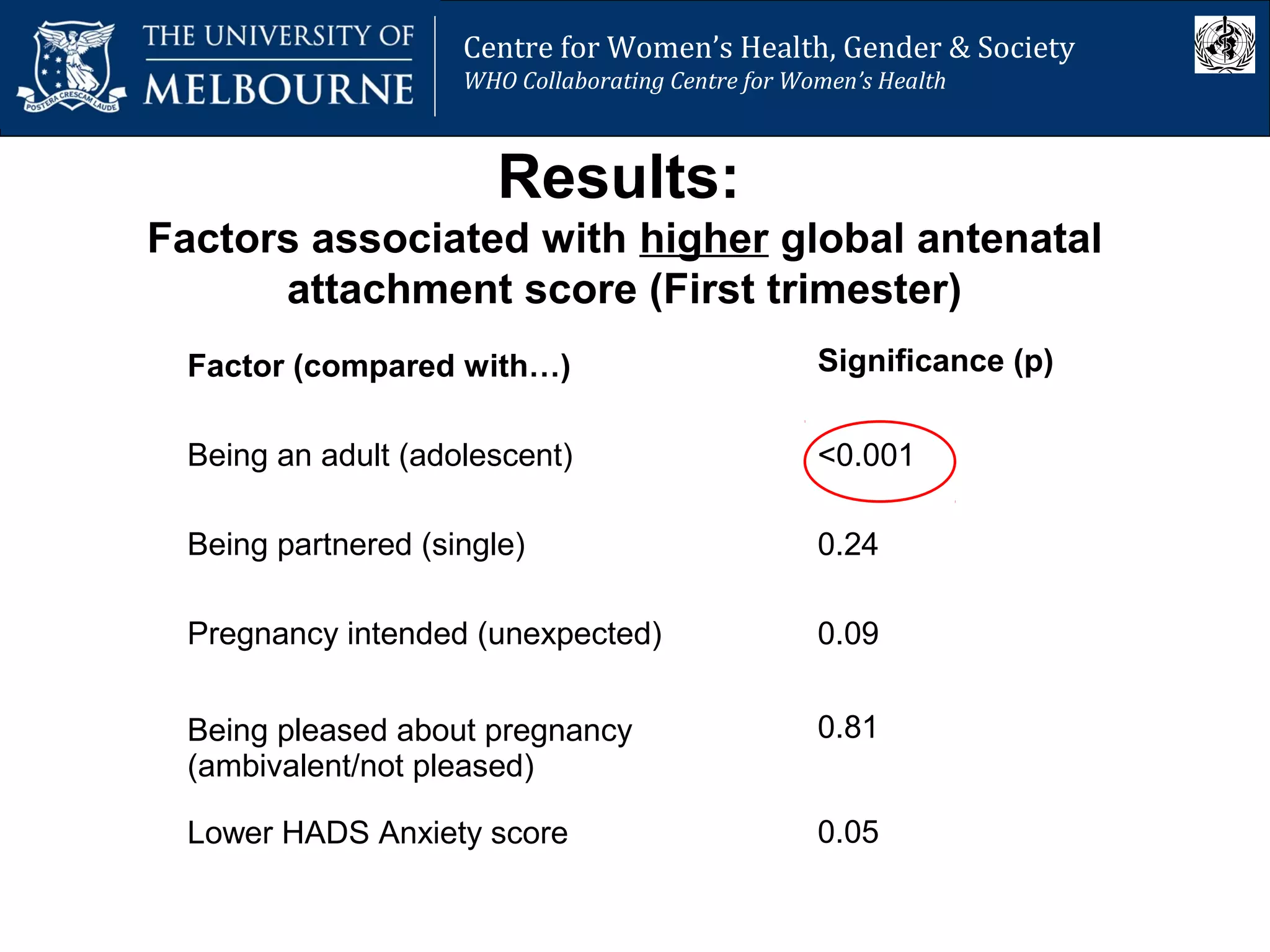
Results:
Factors associated with higher global antenatal
attachment score (First trimester)
Factor (compared with…)
Being an adult (adolescent)
Being partnered (single)
Pregnancy intended (unexpected)
Being pleased about pregnancy
(ambivalent/not pleased)
Lower HADS Anxiety score
Significance (p)
<0.001
0.24
0.09
0.81
0.05
Centre for Women’s Health, Gender and Society
Melbourne School of Population Health
Centre for Women’s Health, Gender & Society
WHO Collaborating Centre for Women’s Health
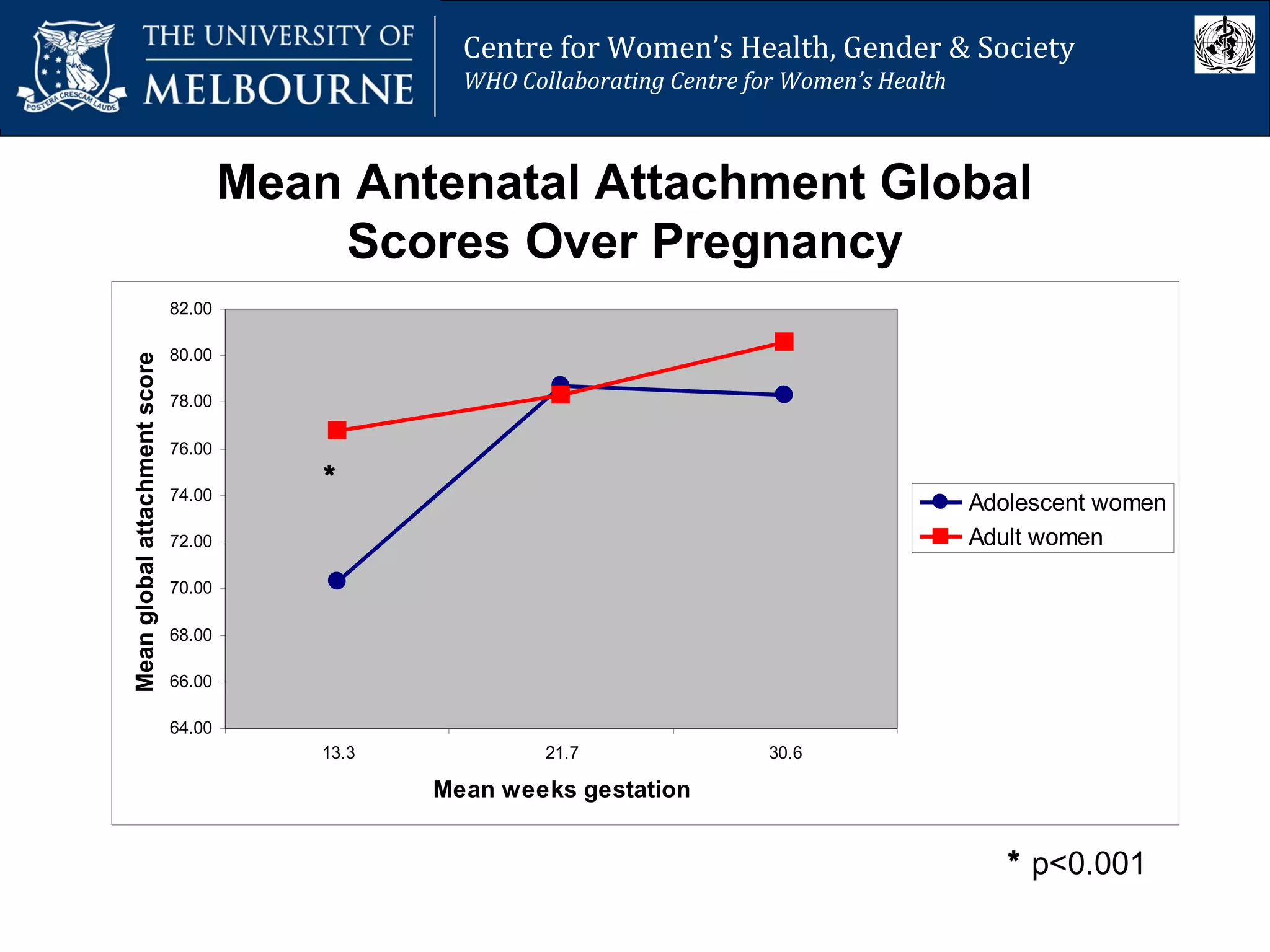
Mean Antenatal Attachment Global
Scores Over Pregnancy
* p<0.001
64.00
66.00
68.00
70.00
72.00
74.00
76.00
78.00
80.00
82.00
13.3 21.7 30.6
Mean weeks gestation
Meanglobalattachmentscore
Adolescent women
Adult women
*
Centre for Women’s Health, Gender and Society
Melbourne School of Population Health
Centre for Women’s Health, Gender & Society
WHO Collaborating Centre for Women’s Health
Pregnant adolescents aren’t interested
in their babies…?
Adolescents can and do have emotional bond with
fetus:
 May take longer to develop
 Grows as pregnancy progresses
Centre for Women’s Health, Gender and Society
Melbourne School of Population Health
Centre for Women’s Health, Gender & Society
WHO Collaborating Centre for Women’s Health
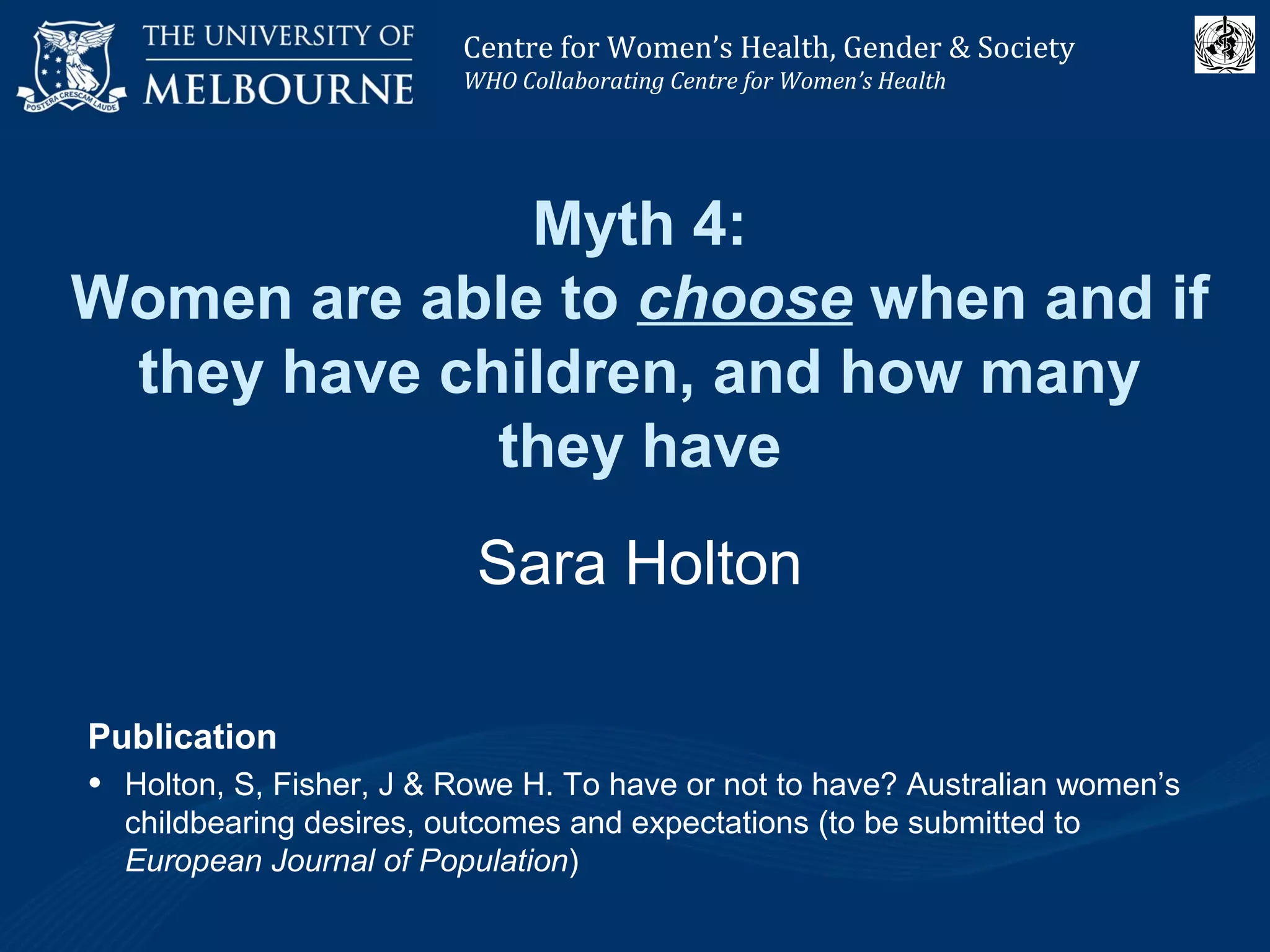
Myth 4:
Women are able to choose when and if
they have children, and how many
they have
Sara Holton
Publication
• Holton, S, Fisher, J & Rowe H. To have or not to have? Australian women’s
childbearing desires, outcomes and expectations (to be submitted to
European Journal of Population)
Centre for Women’s Health, Gender and Society
Melbourne School of Population Health
Centre for Women’s Health, Gender & Society
WHO Collaborating Centre for Women’s Health
Myth: Women are able to choose when
and if they have children, and how many
they have
• Australia’s low fertility rate is commonly
attributed to deliberate decisions by women to
avoid having children (Maher 2004; Weston 2004)
• “Women say no to babies” (de Krester 2002, Herald Sun)
• Existing theoretical explanations of fertility
decision-making and low fertility tend to assume
that childbearing is a rational, voluntary process
(Neal 1980; Radecki 1992; Liefbroer 2005)
Centre for Women’s Health, Gender and Society
Melbourne School of Population Health
Centre for Women’s Health, Gender & Society
WHO Collaborating Centre for Women’s Health
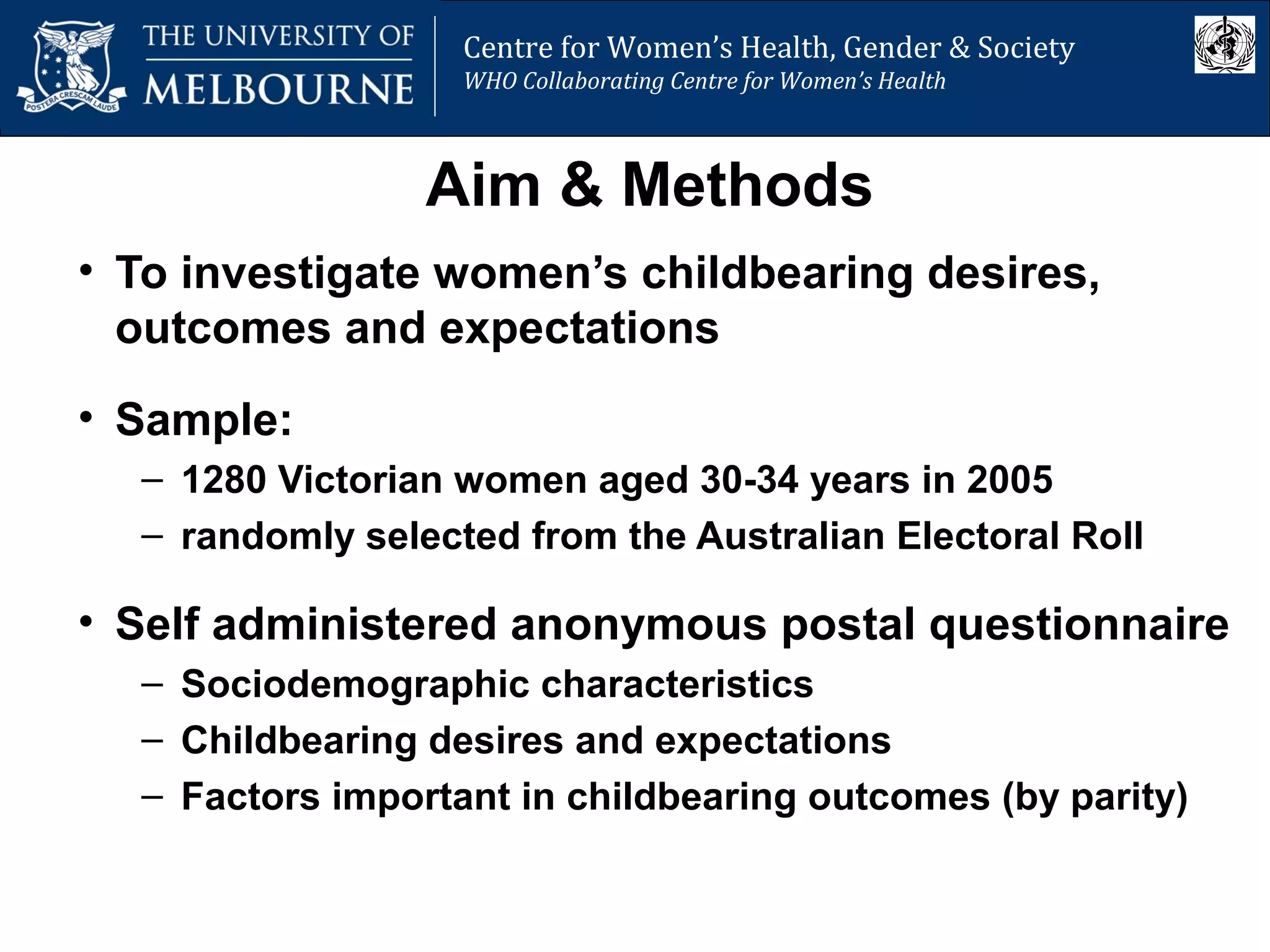
Aim & Methods
• To investigate women’s childbearing desires,
outcomes and expectations
• Sample:
– 1280 Victorian women aged 30-34 years in 2005
– randomly selected from the Australian Electoral Roll
• Self administered anonymous postal questionnaire
– Sociodemographic characteristics
– Childbearing desires and expectations
– Factors important in childbearing outcomes (by parity)
Centre for Women’s Health, Gender and Society
Melbourne School of Population Health
Centre for Women’s Health, Gender & Society
WHO Collaborating Centre for Women’s Health
Results
Response = 46.7% (N=569)
Childbearing desires and expectations:
• Most participants wanted children
• Most (71%) wanted 2 or 3 children
• Average number of current children = 1.1
• Most (80%) had fewer children than they desired
• Most (54%) thought it was unlikely that they would
have (more) children in the future
Centre for Women’s Health, Gender and Society
Melbourne School of Population Health
Centre for Women’s Health, Gender & Society
WHO Collaborating Centre for Women’s Health
Results
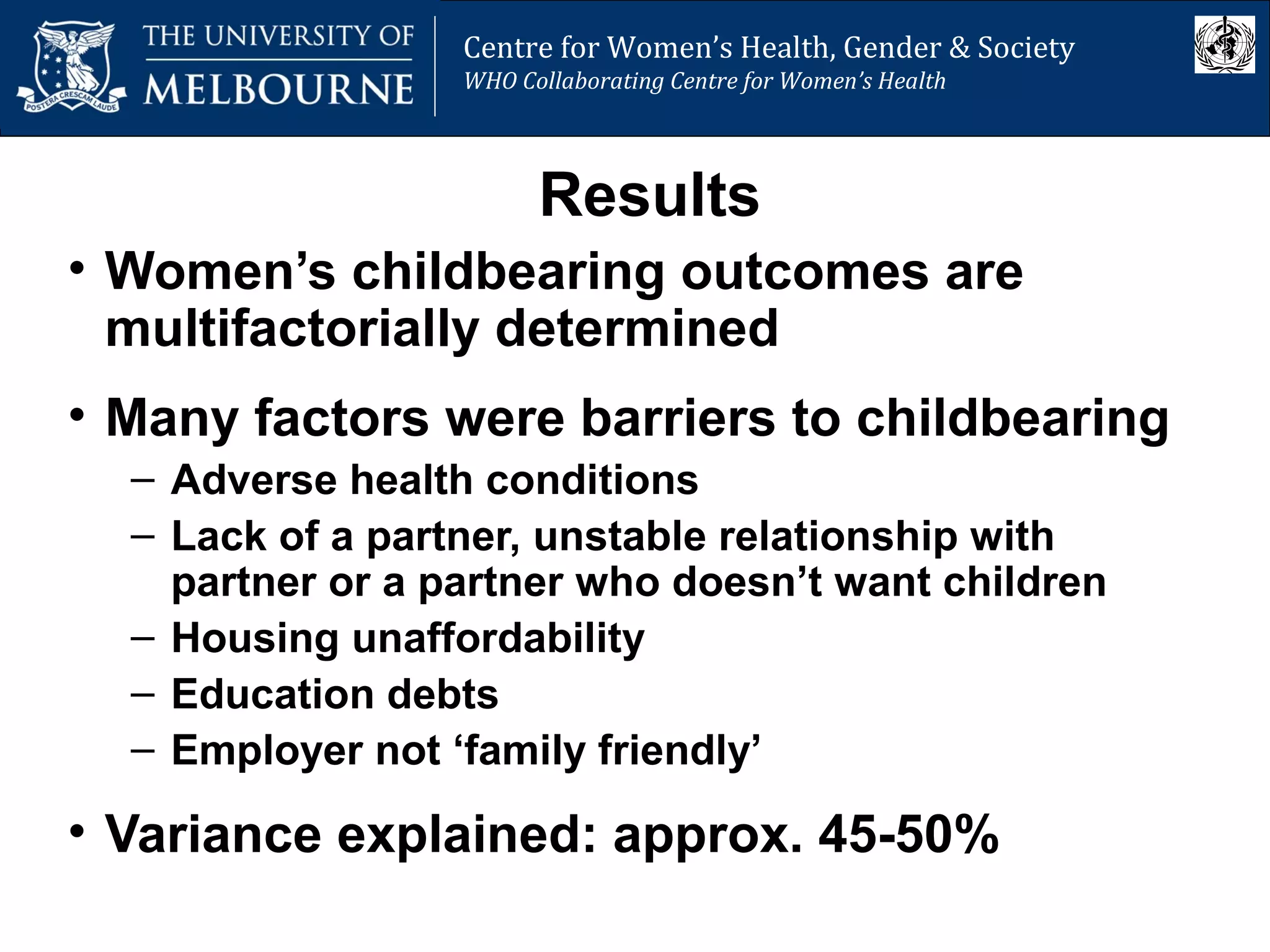
• Women’s childbearing outcomes are
multifactorially determined
• Many factors were barriers to childbearing
– Adverse health conditions
– Lack of a partner, unstable relationship with
partner or a partner who doesn’t want children
– Housing unaffordability
– Education debts
– Employer not ‘family friendly’
• Variance explained: approx. 45-50%
Centre for Women’s Health, Gender and Society
Melbourne School of Population Health
Centre for Women’s Health, Gender & Society
WHO Collaborating Centre for Women’s Health
Are women able to choose when and if they
have children, and how many they have?
• Women often have fewer children than they desire
• Many women would have (more) children if their
circumstances were different
“Circumstances are the only reason that I don’t have children – I want
them desperately and always have” [woman without children aged 34 years]
“Rather than having made a conscious decision to not have children, it’s
really been a lack of opportunity” [woman without children aged 32 years]
“We have three children and I would like to have a fourth but as my
husband doesn’t want another child, it is unlikely that we will have any
more” [woman with three children aged 33 years]
• Women’s childbearing behaviour is not always a
voluntary process
Centre for Women’s Health, Gender and Society
Melbourne School of Population Health
Centre for Women’s Health, Gender & Society
WHO Collaborating Centre for Women’s Health
Myth 5:
Permanently Childless Women Have
Selfishly Chosen Careers Over Children
Heather McKay
Centre for Women’s Health, Gender and Society
Melbourne School of Population Health
Centre for Women’s Health, Gender & Society
WHO Collaborating Centre for Women’s Health
Myth: Permanently Childless Women Have
Selfishly Chosen Careers Over Children
• Cliché = “selfish career women” … “Commentators seem to assume
that [childless] women have made a deliberate choice to put career
(or, to be more realistic, job) over family” (Peart 2006, The Mail on Sunday).
• Contemporary childlessness is:
– presumed voluntary (theoretical perspective),
– assumed chosen (people’s attitudes),
– negatively stereotyped: voluntarily childless women considered selfish.
(Poston and Trent 1982; Callan 1983; Morell 1994; Rowland 1998a; Campbell 1999, Merlo
and Rowland 2000; Qu et al. 2000; LaMastro 2001; Park 2002; Koropeckyj-Cox 2007)
Centre for Women’s Health, Gender and Society
Melbourne School of Population Health
Centre for Women’s Health, Gender & Society
WHO Collaborating Centre for Women’s Health
Aim and Methods
• Aim: To investigate the reasons for childlessness amongst mid-age
Australian women and explore the role of choice in this reproductive
outcome.
• Design: Cross-sectional study conducted in collaboration with the
Australian Longitudinal Study on Women’s Health (ALSWH).
• Participants: All ALSWH Mid-aged cohort (born 1945 – 1952) who
specifically indicated they had never given birth to a child and met ALSWH
sub-study eligibility requirements (n = 535).
• Data Collection: Self-report postal questionnaire – fixed choice responses.
• Measurements : Study specific measures to assess choice in and reasons
for biological childlessness.
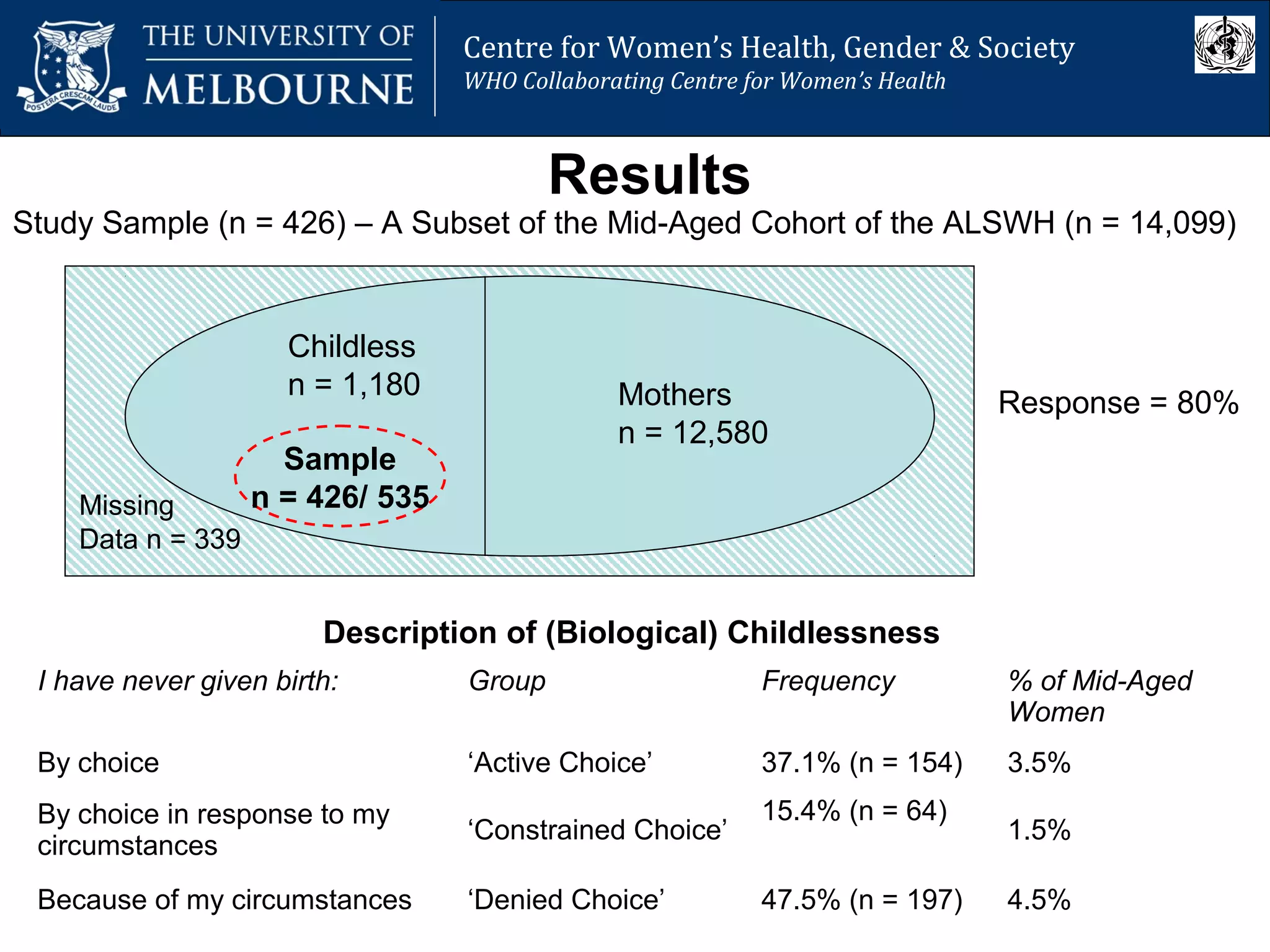
Childless
n = 1,180 Mothers
n = 12,580
Missing
Data n = 339
Centre for Women’s Health, Gender and Society
Melbourne School of Population Health
Centre for Women’s Health, Gender & Society
WHO Collaborating Centre for Women’s Health
Results
Description of (Biological) Childlessness
I have never given birth: Group Frequency % of Mid-Aged
Women
By choice ‘Active Choice’ 37.1% (n = 154) 3.5%
By choice in response to my
circumstances
‘Constrained Choice’
15.4% (n = 64)
1.5%
Because of my circumstances ‘Denied Choice’ 47.5% (n = 197) 4.5%
Study Sample (n = 426) – A Subset of the Mid-Aged Cohort of the ALSWH (n = 14,099)
Sample
n = 426/ 535
Response = 80%
Centre for Women’s Health, Gender and Society
Melbourne School of Population Health
Centre for Women’s Health, Gender & Society
WHO Collaborating Centre for Women’s Health
Results
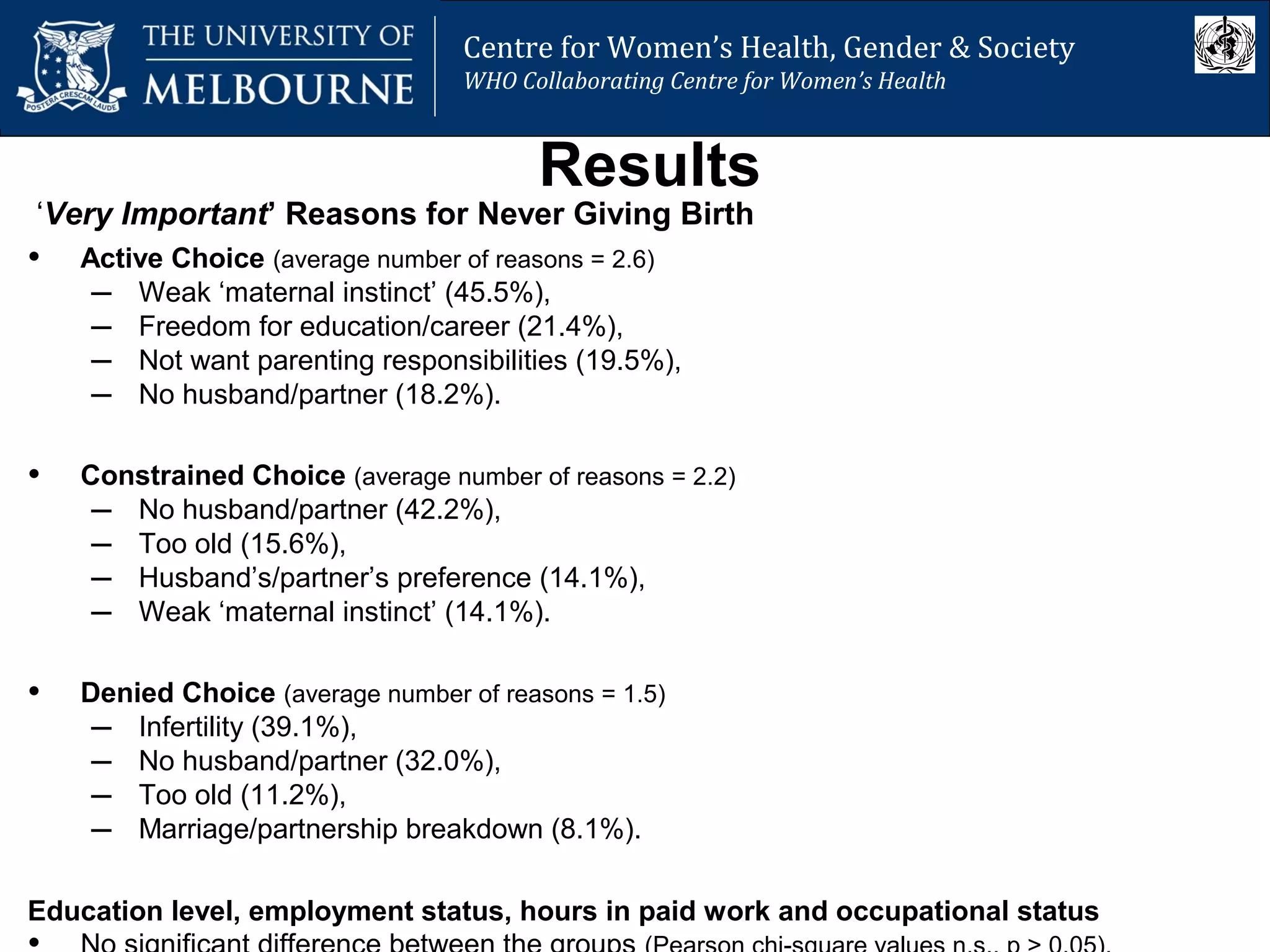
‘Very Important’ Reasons for Never Giving Birth
• Active Choice (average number of reasons = 2.6)
– Weak ‘maternal instinct’ (45.5%),
– Freedom for education/career (21.4%),
– Not want parenting responsibilities (19.5%),
– No husband/partner (18.2%).
• Constrained Choice (average number of reasons = 2.2)
– No husband/partner (42.2%),
– Too old (15.6%),
– Husband’s/partner’s preference (14.1%),
– Weak ‘maternal instinct’ (14.1%).
• Denied Choice (average number of reasons = 1.5)
– Infertility (39.1%),
– No husband/partner (32.0%),
– Too old (11.2%),
– Marriage/partnership breakdown (8.1%).
Education level, employment status, hours in paid work and occupational status
Centre for Women’s Health, Gender and Society
Melbourne School of Population Health
Centre for Women’s Health, Gender & Society
WHO Collaborating Centre for Women’s Health
Permanently Childless Women Have Selfishly
Chosen Careers Over Children…?
Conclusions from this study:
• The majority of mid-aged biologically childless women did not
actively choose this reproductive outcome.
• Amongst Active Choice women, freedom to pursue
education/career is not the leading reason for never giving birth.
Centre for Women’s Health, Gender and Society
Melbourne School of Population Health
Centre for Women’s Health, Gender & Society
WHO Collaborating Centre for Women’s Health
Myth 6:
Australia’s “universal" unpaid
maternity leave scheme
Amanda Cooklin
Publication
Cooklin AR, Rowe HJ and Fisher JRW. 2007. Employee entitlements and maternal
psychological well-being. Australian and New Zealand Journal of Obstetrics and
Gynaecology, 47: 483-490.
Centre for Women’s Health, Gender and Society
Melbourne School of Population Health
Centre for Women’s Health, Gender & Society
WHO Collaborating Centre for Women’s Health
• Childbearing occurs in the context of employment for most
Australian women:
• 80% employed prior to birth of first child
• 40% resume employment in first year following birth
(Baxter, 2005; 2008; Australian Bureau of Statistics, 2006)
• Employment conditions and entitlements have been largely
ignored in investigation of structural factors contributing to
women’s mental health in pregnancy and following birth
Centre for Women’s Health, Gender and Society
Melbourne School of Population Health
Centre for Women’s Health, Gender & Society
WHO Collaborating Centre for Women’s Health
• The 1996 Commonwealth Workplace Relations Act states
that:
All full-time, permanent part-time employees are entitled to 52
weeks of unpaid parental leave after 12 month of continuous
employment with the same employer
• In 2001, this entitlement was extended to all eligible casual
employees
Centre for Women’s Health, Gender and Society
Melbourne School of Population Health
Centre for Women’s Health, Gender & Society
WHO Collaborating Centre for Women’s Health
Methods
• Aim: investigate the relationship between employment
conditions, including maternity entitlements, and maternal
psychological well-being in pregnancy
• Consecutive sample of 165 employed women (>18 yrs),
pregnant with first child:
• Compared to all Victorian births 2005-6:
• Similar age, similar proportion were Australian born, married, privately
insured
• More likely to have a tertiary qualification / professional occupation
• Data collected at trimester 3:
• Demographic characteristics
• Access to maternity leave, experience of workplace discrimination
• Two standardised assessments of maternal well-being
• Edinburgh Depression Scale (Cox et al 1987)
• Profile of Mood States (McNair et al., 1971)
Centre for Women’s Health, Gender and Society
Melbourne School of Population Health
Centre for Women’s Health, Gender & Society
WHO Collaborating Centre for Women’s Health
Results
• 34% of women had no access to any maternity leave
• Relied upon combinations of: accrued annual leave, sick leave,
informal arrangement with employer, or resignation
• 40% of women had NO access to unpaid maternity leave
• 54% of women had NO access to paid maternity leave
• Women with private health insurance more likely to access
maternity leave:
• Paid maternity leave OR (95% CI) = 3.6(1.8 – 6.8)
• Unpaid maternity leave OR (95% CI) = 3.5(1.8-6.8)
Centre for Women’s Health, Gender and Society
Melbourne School of Population Health
Centre for Women’s Health, Gender & Society
WHO Collaborating Centre for Women’s Health
Results
•Workplace adversity experienced by 69% (114/166) including:
• No access to maternity entitlements and / or
• Pregnancy-related sex discrimination and /or
• Reported difficulty negotiating leave with employer
•Women who experienced workplace adversity had measurably
worse mood than those with no adversity
• EPDS scores 7.7 versus 5.5 (p<0.003)
• PoMS total scores 31.3 versus 20.3 (p<0.01), symptoms of
• Depression
• Anger
• Fatigue
• Anxiety
Centre for Women’s Health, Gender and Society
Melbourne School of Population Health
Centre for Women’s Health, Gender & Society
WHO Collaborating Centre for Women’s Health
Debunking the Myth: Australia’s
“universal" unpaid maternity leave scheme
• Access to unpaid maternity leave is not “universal”
• 40% of women in this diverse cohort were unable to utilise
this leave
• Mainly accessed by women of higher socioeconomic position
• Why?
• Poor information, knowledge about their rights to this entitlement
• Employers not providing adequate information about unpaid leave
• Policy is inadequate if not monitored to ensure equitable
implementation
• Adverse employment conditions contribute to worse maternal
psychological well-being in pregnancy
Centre for Women’s Health, Gender and Society
Melbourne School of Population Health
Centre for Women’s Health, Gender & Society
WHO Collaborating Centre for Women’s Health
Myth 7:
Postnatal Health Services are Over-
Utilised by the Worried Well
Sonia Young
Publication
Young S, Rowe H, Gurrin L, Quinlivan J, Rosenthal D, Fisher J. Unsettled infant
behaviour and health service use: a cross-sectional community survey in
Melbourne, Australia. Journal of Paediatric and Child Health. 2010;(under review).
Centre for Women’s Health, Gender and Society
Melbourne School of Population Health
Centre for Women’s Health, Gender & Society
WHO Collaborating Centre for Women’s Health
Myth: Postnatal Health Services are Over-
Utilised by the Worried Well
• Mothers and infants are high consumers of health services
•On average, 36 visits to services in the first year (Goldfeld et al., 2003)
• Women are blamed for ‘Doctor shopping’
AIM
• To investigate high health service use and determine which
factors are associated
Centre for Women’s Health, Gender and Society
Melbourne School of Population Health
Centre for Women’s Health, Gender & Society
WHO Collaborating Centre for Women’s Health
Methods
Design Cross sectional survey at immunisation clinics
Participants Women and their 4 month old infant
Measurements
•Socio-demographic characteristics
•Maternal mood
•Unsettled infant behaviour
•Health services used
Centre for Women’s Health, Gender and Society
Melbourne School of Population Health
Centre for Women’s Health, Gender & Society
WHO Collaborating Centre for Women’s Health
Results: Use of >3 services associated with…
Factor (compared with…) P-value
Socioeconomic position 0.79
Partnered (not partnered) 0.72
Speaking English at home (not) 0.34
Full-term birth (pre-term) 0.14
Worse maternal mood 0.03
Increased unsettled infant behaviour 0.01
(n=875)
Centre for Women’s Health, Gender and Society
Melbourne School of Population Health
Centre for Women’s Health, Gender & Society
WHO Collaborating Centre for Women’s Health
Results: Which services?
Worse maternal mood
•General Practitioner
•Mental Health Service
Unsettled infant behaviour
•Emergency Department
•Telephone Help Services
•Parenting Services
Centre for Women’s Health, Gender and Society
Melbourne School of Population Health
Centre for Women’s Health, Gender & Society
WHO Collaborating Centre for Women’s Health
Are Postnatal Health Services Over-
Utilised by the Worried Well?
• Women are seeking services appropriate to their needs
• Unsettled infant behaviour appears to be an unmet need
• Increased use to Emergency Department, Telephone Help
Services
Centre for Women’s Health, Gender and Society
Melbourne School of Population Health
Centre for Women’s Health, Gender & Society
WHO Collaborating Centre for Women’s Health
Myth 8:
Homelessness happens to other
women
Maggie Kirkman
Publications
• Kirkman, M., Keys, D., Turner, A., & Bodzak, D. (2009). "Does camping count?": Children's
experiences of homelessness. Melbourne: The Salvation Army
• Kirkman, M., Keys, D., Bodzak, D., & Turner, A. (2010). “Are we moving again this week?”
Children's experiences of homelessness in Victoria, Australia. Social Science & Medicine, 70,
994-1001
Centre for Women’s Health, Gender and Society
Melbourne School of Population Health
Centre for Women’s Health, Gender & Society
WHO Collaborating Centre for Women’s Health
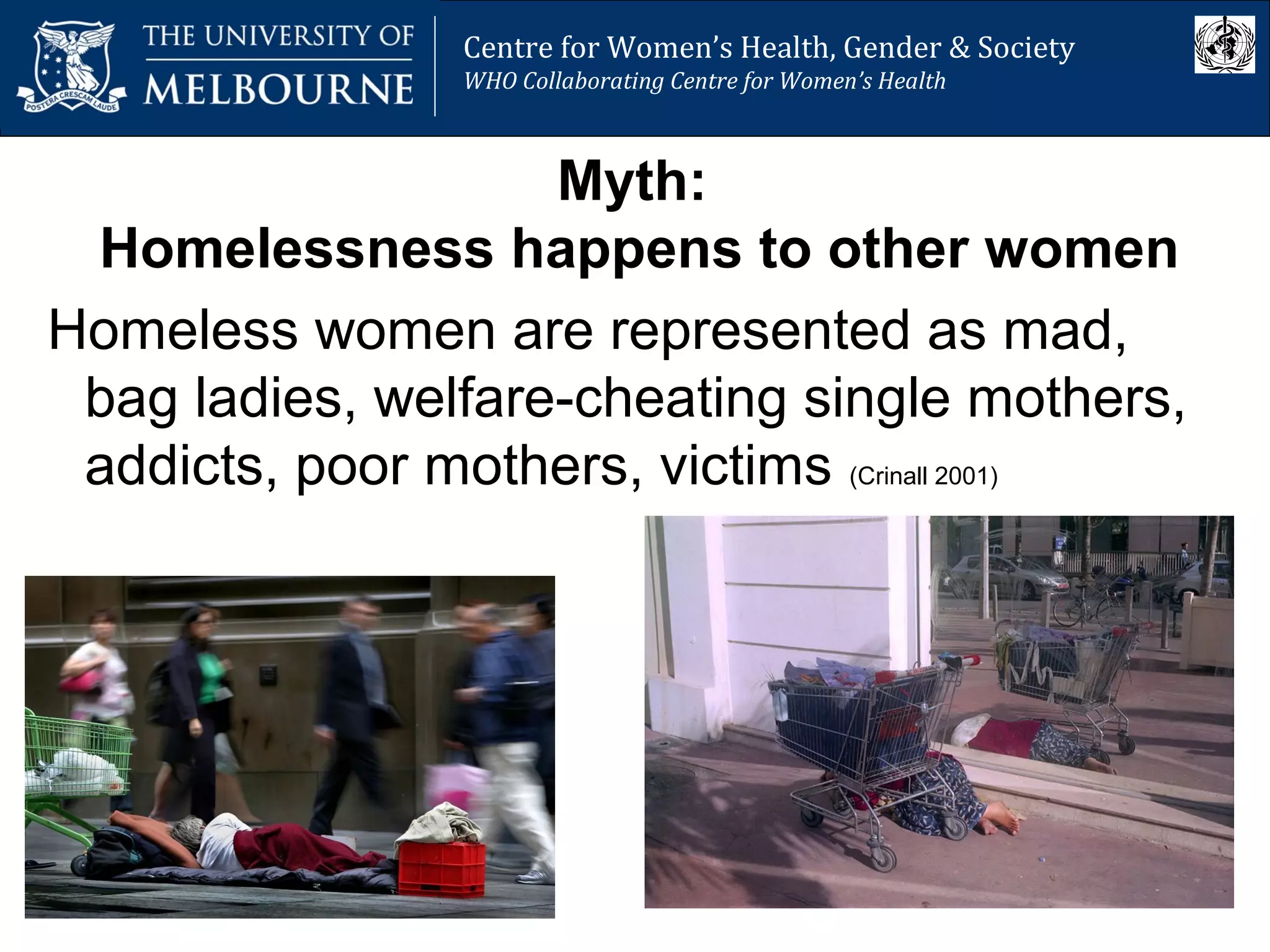
Myth:
Homelessness happens to other women
Homeless women are represented as mad,
bag ladies, welfare-cheating single mothers,
addicts, poor mothers, victims (Crinall 2001)
Centre for Women’s Health, Gender and Society
Melbourne School of Population Health
Centre for Women’s Health, Gender & Society
WHO Collaborating Centre for Women’s Health
Methods
• Design: Qualitative, phenomenological
• Setting: Homelessness services in Melbourne
• Participants: 13 adults (mothers, grandmother)
• 20 children aged 6-12
• Data Collection & Analysis:
– Semi-structured interview
– Constant comparative analysis
–Questionnaire developed for the research
– Descriptive statistics
Centre for Women’s Health, Gender and Society
Melbourne School of Population Health
Centre for Women’s Health, Gender & Society
WHO Collaborating Centre for Women’s Health
Results
Centre for Women’s Health, Gender and Society
Melbourne School of Population Health
Centre for Women’s Health, Gender & Society
WHO Collaborating Centre for Women’s Health
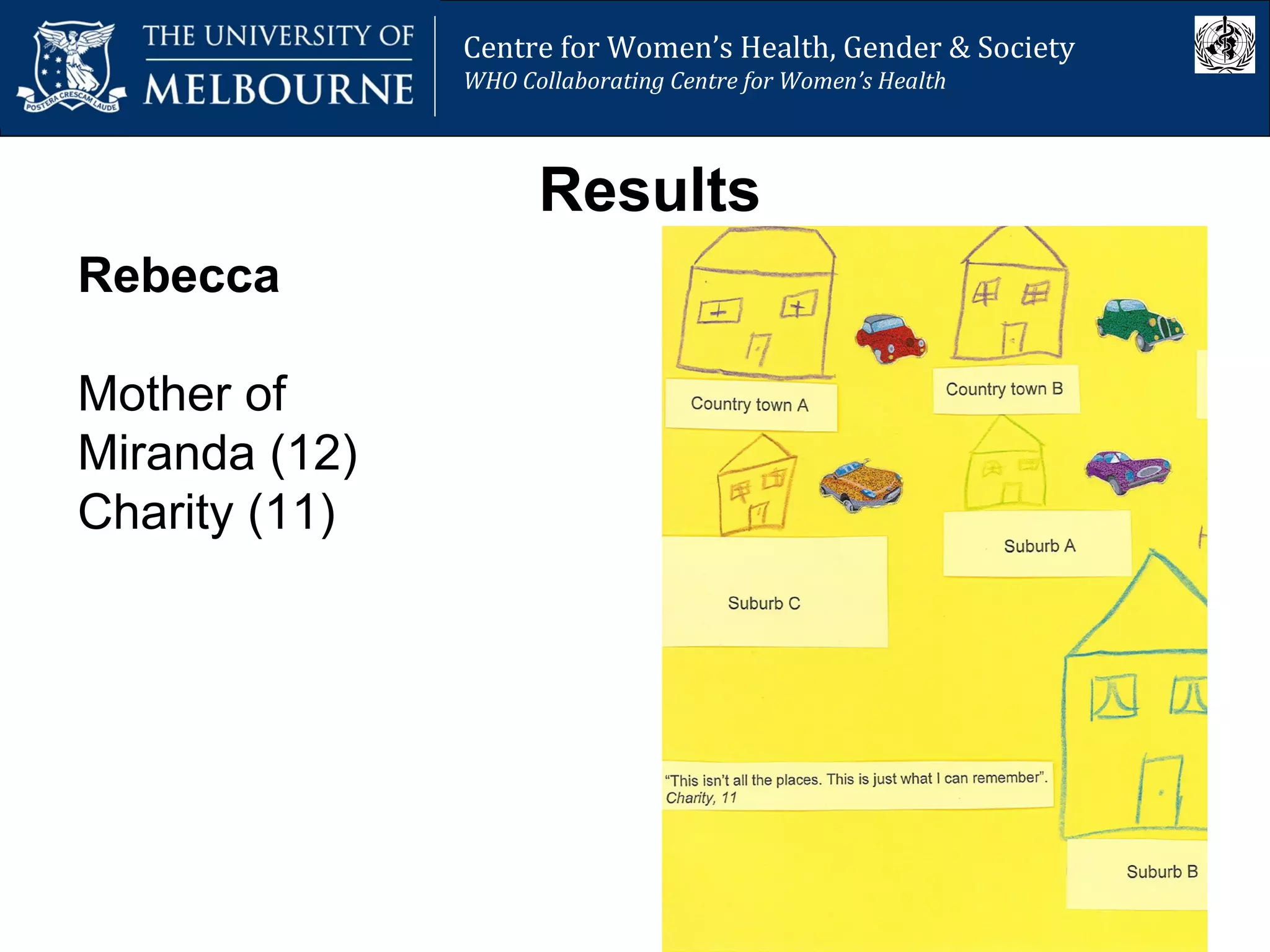
Results
Rebecca
Mother of
Miranda (12)
Charity (11)
Centre for Women’s Health, Gender and Society
Melbourne School of Population Health
Centre for Women’s Health, Gender & Society
WHO Collaborating Centre for Women’s Health
Debunking the myth: Homelessness is not
restricted to “other” women
Centre for Women’s Health, Gender and Society
Melbourne School of Population Health
Centre for Women’s Health, Gender & Society
WHO Collaborating Centre for Women’s Health
Acknowledgements
•Total number of participants who completed
interviews or questionnaires for all studies
= 7,074 women
Centre for Women’s Health, Gender and Society
Melbourne School of Population Health
Centre for Women’s Health, Gender & Society
WHO Collaborating Centre for Women’s Health
Acknowledgements
Funding Organisations
•AusAID ALA Leadership Award to Dr Tran Tuan
•Australian Research Council
•CWHeGS Director’s Grant
•Faculty of Medicine, Dentistry and Health Science, University of Melbourne
•Family Access Network
•Helen Macpherson Smith Trust
•Melbourne Citymission
•Myer Foundation
•NHMRC
•Royal Women’s Hospital, Melbourne
•The Council to Homeless Persons
•The Salvation Army
•University of Melbourne Joint Research Grant
•VicHealth
•WHO Western Pacific Regional Office
Centre for Women’s Health, Gender and Society
Melbourne School of Population Health
Centre for Women’s Health, Gender & Society
WHO Collaborating Centre for Women’s Health
Acknowledgements
Partner Organisations
• Australian Longitudinal Study on Women’s Health
• Family Access Network
• Frances Perry House
• Ha Nam Provincial Health Department
• Immunisation Clinic Staff
• Local Government Areas in Melbourne (Wyndham, Hobsons Bay, Moreland, Moonee
Valley, Yarra)
• Melbourne Citymission
• Research and Training Centre for Community Development, Ha Noi
• Royal Women’s Hospital, Melbourne
• Sunshine Hospital, Melbourne
• The Council to Homeless Persons
• The Salvation Army
• WHO Western Pacific Regional Office
Centre for Women’s Health, Gender and Society
Melbourne School of Population Health
Centre for Women’s Health, Gender & Society
WHO Collaborating Centre for Women’s Health
Acknowledgements
Co-Investigators and Staff Involved
•Alina Turner
•Dang hai Tho
•Deb Keys
• Helen Rawson
•Julie Quinlivan
•Luu thi Hoang Anh
•Martha Morrow
•Pam Rugkhla
•Tran Tuan
•Christina Lee
•Daria Bodzak
•Doreen Rosenthal
•Ian Gordon
•La thi Buoi
•Lyle Gurrin
•Nguyen thi nhu Ngoc
•Thach Tran
•Turi Berg

1.8 Workshop Jane Fisher

  • 1.
    Centre for Women’sHealth, Gender and Society Melbourne School of Population Health Centre for Women’s Health, Gender & Society WHO Collaborating Centre for Women’s Health Challenging Myths About Women’s Sexual and Reproductive Mental Health: New Evidence Across the Life Course From The Centre for Women’s Health, Gender & Society University of Melbourne
  • 2.
    MYTH 1: Perinatal MentalHealth Problems are a ‘Culture Bound Syndrome’ Jane Fisher Publications Fisher JRW. Cabral de Mello M, Isutzu T. Pregnancy, childbirth and the postpartum year. In Fisher JRW, Astbury JA, Cabral de Mello M, Saxena S, (editors). Mental Health Aspects of Women’s Reproductive Health. A Global Review of the Literature. Geneva, WHO and UNFPA, 2009 Fisher JRW, Cabral de Mello M, Tran T, Izutsu T. Maternal mental health and child survival, health and development in resource-constrained settings: essential for Achieving the Millennium Development Goals. Statement from the UNFPA – WHO International Expert Meeting: Maternal mental health and child health and development in resource constrained settings. Hanoi, June, 25th – 27th 2007; Geneva, 2009 Fisher J, Tran thu thi Huong, Tran Tuan. Relative socioeconomic advantage and mood during advanced pregnancy in women in Viet Nam Journal of International Mental Health Systems 2007; 1:3 doi:10.1186/1752-4458-1-3 Fisher JRW, Morrow MM, Nhu Ngoc NT, Hoang Anh LT. Prevalence, nature, severity and correlates of postpartum depressive symptoms in Ho Chi Minh City Vietnam. BJOG, an International Journal of Obstetrics and Gynaecology 2004: 111: 1353 – 1360 Centre for Women’s Health, Gender and Society WHO Collaborating Centre for Women’s Health
  • 3.
    Centre for Women’sHealth, Gender and Society Melbourne School of Population Health Centre for Women’s Health, Gender & Society WHO Collaborating Centre for Women’s Health PERINATAL MENTAL HEALTH PROBLEMS ARE A ‘CULTURE BOUND SYNDROME’ Women who live in low and lower middle income countries experience traditional ritualized care after birth including: • Mandated periods of rest; • Honoured status; • Increased practical support and freedom from household and income-generating work; • Social seclusion; • Gift giving and prescribed foods; • These protect mental health and therefore; • They do not experience perinatal mental disorders. Stern and Kruckman, 1983; Howard, 1993
  • 4.
    Centre for Women’sHealth, Gender and Society Melbourne School of Population Health Centre for Women’s Health, Gender & Society WHO Collaborating Centre for Women’s Health MATERNAL MENTAL HEALTH IN HO CHI MINH CITY, VIET NAM Systematic survey in 2000 of 506 mothers attending healthy baby clinics with their six-week old infants: SURVEY • Sociodemographic characteristics; • Perinatal health; • Observation of traditional postpartum practices; • Specific and non-specific somatic symptoms; • Symptoms of depression; • Edinburgh Postnatal Depression Scale (Cox et al ,1987) RESPONSE • 98% response rate; • Sociodemographically and obstetrically representative sample; DEPRESSION SYMPTOMS • Average EPDS score = 9.49 ± 6.32 (range 0 to 26) • 32.8% (166 / 506) scores >12 • Q10 Have you had thoughts of not wanting to live anymore and if so how often? • 19.4% (99 / 506) acknowledged these ideas (Q 10) • 64.6% (64 / 99) quite frequently or often CORRELATES OF EPDS >12 • Unwelcome pregnancy, • No economic security; • Being unable to confide in their husbands; • Not being given special foods; • Less than a month of complete rest after childbirth, • Avoiding proscribed foods; and • Caring for a crying unsettled baby who was not thriving;
  • 6.
    Centre for Women’sHealth, Gender and Society Melbourne School of Population Health Centre for Women’s Health, Gender & Society WHO Collaborating Centre for Women’s Health PREVALENCE OF COMMON PERINATAL MENTAL DISORDERS IN NORTHERN VIET NAM 30.9%12.7%18.2%Mothers of newborns 29.1%8%21.1%Pregnant women TOTALAnxiety Disorder Depression ± Anxiety Fisher, Tran, Buoi et al, 2010 • Living in a rural rather than an urban province (OR: 2.17; 95% CI: 1.19–3.93) • Experiencing intimate partner violence (OR: 2.11; 95% CI: 1.12–3.96) • Fear of other family members (OR: 3.36; 95% CI: 1.05–10.71) • Coincidental life adversity (OR: 4.40; 95% CI: 2.44–7.93).
  • 7.
    Centre for Women’sHealth, Gender and Society Melbourne School of Population Health Centre for Women’s Health, Gender & Society WHO Collaborating Centre for Women’s Health PERINATAL MENTAL HEALTH PROBLEMS ARE A ‘CULTURE BOUND SYNDROME’…? Prevalence of perinatal mental disorders in high income countries: • ± 10% of pregnant women • ± 13% of mothers of newborns Prevalence of perinatal mental disorders in low and lower-middle income countries: • 12.5% - 42% of pregnant women and, • 12% - 50% of mothers of newborns screen positive for symptoms of depression; Double disparity between developed and developing countries: Availability of evidence: • High income countries (91%) • Low and lower middle countries (10%) Fisher, Tran, Cabral de Mello, Izutsu, 2009; Hendrick, 1998; O’Hara and Swain, 1996
  • 8.
    Centre for Women’sHealth, Gender and Society Melbourne School of Population Health Centre for Women’s Health, Gender & Society WHO Collaborating Centre for Women’s Health Myth 2: Careless young women have unintended pregnancies and abortions Heather Rowe Publications Rowe H, Kirkman M et al. Considering abortion: 12-month audit of records of women contacting a Pregnancy Advisory Service. Medical Journal of Australia. 2009; 190:69-71. Kirkman M, Rowe et al. Abortion is a difficult solution to a problem: A discursive analysis of interviews with women considering or undergoing abortion in Australia. Women’s Studies International Forum. 2 June 2009. Kirkman M, Rowe H et al. Reasons Women Give for Abortion: A Review of the Literature. Archives of Women’s Mental Health 2009; 12(6), 365-378. Kirkman M, Rowe H et al. Understanding Abortion From Women’s Perspective: Reasons For Contemplating or Undergoing Abortion in Victoria, Australia. Sexual & Reproductive Healthcare under review.
  • 9.
    Centre for Women’sHealth, Gender and Society Melbourne School of Population Health Centre for Women’s Health, Gender & Society WHO Collaborating Centre for Women’s Health • Reliable data on incidence unavailable Chan and Sage, 2005 • South Australia 29% to 31% of women have had an induced abortion in their lifetime Chan and Keane 2004 • Nationally representative telephone survey (n=9134) 23% women reported having experienced abortion Smith et al 2003 “Willy-nilly pregnant women so dumb” The Age 30 August 2004
  • 10.
    Royal Women’s HospitalMelbourne Pregnancy Advisory Service (PAS) • Victoria’s largest public PAS – takes up to 9000 telephone calls per year – electronic record keeping database 2005 • Methods – Audit of electronic records – In-depth telephone interviews Centre for Women’s Health, Gender and Society Melbourne School of Population Health Centre for Women’s Health, Gender & Society WHO Collaborating Centre for Women’s Health
  • 11.
    Audit 1 October 2006to 30 September 2007. • Data collection tool • Clinical not research database • De-identified data • During the audit period – 5462 women made contact – 3827 women registered for pregnancy support and counselling services – we conducted 60 in-depth interviews Centre for Women’s Health, Gender and Society Melbourne School of Population Health Centre for Women’s Health, Gender & Society WHO Collaborating Centre for Women’s Health
  • 12.
    Centre for Women’sHealth, Gender and Society Melbourne School of Population Health Centre for Women’s Health, Gender & Society WHO Collaborating Centre for Women’s Health Age Under 18 years 7% 18-29 years 60% 30-39 years 28% Over 40 years 5% Already had at least one child 42% Using a reliable form of contraception 39% Previous abortion 39% Partner aware and supportive 71% Violence 16% Young rural women later contact p<0.05
  • 13.
    Centre for Women’sHealth, Gender and Society Melbourne School of Population Health Centre for Women’s Health, Gender & Society WHO Collaborating Centre for Women’s Health Careless young women have unintended pregnancies and abortions…? • Many Australian women have unintended pregnancies despite widespread access to and use of contraception • Most abortions are sought by women over 20 years • Many mothers seek services • No evidence that decisions are taken “willy nilly”
  • 14.
    Centre for Women’sHealth, Gender and Society Melbourne School of Population Health Centre for Women’s Health, Gender & Society WHO Collaborating Centre for Women’s Health Myth 3: Pregnant adolescents aren’t interested in their babies Karen Wynter Publication Rowe H, Wynter KH, Steele A, Fisher JR, Lee M, Quinlivan JA (to be submitted to Birth). Pregnant Adolescents’ Emotional Attachment to their Fetuses
  • 15.
    Centre for Women’sHealth, Gender and Society Melbourne School of Population Health Centre for Women’s Health, Gender & Society WHO Collaborating Centre for Women’s Health  Adolescents are positioned as self-absorbed  In adults, protective attachment to the fetus begins at conception and increases during pregnancy Prenatal Attachment: “…the emotional tie or bond which normally develops between the pregnant woman and her unborn infant” (Condon & Corkindale 1997)  Not expected that adolescents can bond with fetus: “…age and related levels of cognitive and psychosocial development may significantly affect attachment in the adolescent” (Bloom 1995)
  • 16.
    Centre for Women’sHealth, Gender and Society Melbourne School of Population Health Centre for Women’s Health, Gender & Society WHO Collaborating Centre for Women’s Health Antenatal attachment is clinically important because:  Precursor of postnatal attachment to the infant  Associated with positive health behaviours eg nutrition avoiding harmful substances attending antenatal care (Lindgren 2001) Adolescents at risk of negative health behaviours (Quinlivan 2002) Associated with:  Gestational age, quickening  ? Psychological wellbeing, stress, self-esteem, anxiety & depression Only one study compared adolescents and adults  No difference (Kemp et al. 1990)
  • 17.
    Centre for Women’sHealth, Gender and Society Melbourne School of Population Health Centre for Women’s Health, Gender & Society WHO Collaborating Centre for Women’s Health Methods Aim: Establish how pregnant adolescents’ maternal fetal attachment changes during pregnancy, and compare with adult women (Rowe et al 2009) Design: Longitudinal study: 3 questionnaires (Trimester 1, 2 & 3) Participants & Setting: 165 pregnant adolescents (≤20 years old) attending Young Mums’ clinics at two public hospitals in Melbourne Data compared with data from 134 adult women (Rowe et al 2009) Standardised measures: • The Maternal Antenatal Attachment Scale (Condon & Corkindale 1997) • The Hospital Anxiety and Depression Scale (HADS) (Snaith and Zigmond 1994)
  • 18.
    Centre for Women’sHealth, Gender and Society Melbourne School of Population Health Centre for Women’s Health, Gender & Society WHO Collaborating Centre for Women’s Health Results: Factors associated with higher global antenatal attachment score (First trimester) Factor (compared with…) Being an adult (adolescent) Being partnered (single) Pregnancy intended (unexpected) Being pleased about pregnancy (ambivalent/not pleased) Lower HADS Anxiety score Significance (p) <0.001 0.24 0.09 0.81 0.05
  • 19.
    Centre for Women’sHealth, Gender and Society Melbourne School of Population Health Centre for Women’s Health, Gender & Society WHO Collaborating Centre for Women’s Health Mean Antenatal Attachment Global Scores Over Pregnancy * p<0.001 64.00 66.00 68.00 70.00 72.00 74.00 76.00 78.00 80.00 82.00 13.3 21.7 30.6 Mean weeks gestation Meanglobalattachmentscore Adolescent women Adult women *
  • 20.
    Centre for Women’sHealth, Gender and Society Melbourne School of Population Health Centre for Women’s Health, Gender & Society WHO Collaborating Centre for Women’s Health Pregnant adolescents aren’t interested in their babies…? Adolescents can and do have emotional bond with fetus:  May take longer to develop  Grows as pregnancy progresses
  • 21.
    Centre for Women’sHealth, Gender and Society Melbourne School of Population Health Centre for Women’s Health, Gender & Society WHO Collaborating Centre for Women’s Health Myth 4: Women are able to choose when and if they have children, and how many they have Sara Holton Publication • Holton, S, Fisher, J & Rowe H. To have or not to have? Australian women’s childbearing desires, outcomes and expectations (to be submitted to European Journal of Population)
  • 22.
    Centre for Women’sHealth, Gender and Society Melbourne School of Population Health Centre for Women’s Health, Gender & Society WHO Collaborating Centre for Women’s Health Myth: Women are able to choose when and if they have children, and how many they have • Australia’s low fertility rate is commonly attributed to deliberate decisions by women to avoid having children (Maher 2004; Weston 2004) • “Women say no to babies” (de Krester 2002, Herald Sun) • Existing theoretical explanations of fertility decision-making and low fertility tend to assume that childbearing is a rational, voluntary process (Neal 1980; Radecki 1992; Liefbroer 2005)
  • 23.
    Centre for Women’sHealth, Gender and Society Melbourne School of Population Health Centre for Women’s Health, Gender & Society WHO Collaborating Centre for Women’s Health Aim & Methods • To investigate women’s childbearing desires, outcomes and expectations • Sample: – 1280 Victorian women aged 30-34 years in 2005 – randomly selected from the Australian Electoral Roll • Self administered anonymous postal questionnaire – Sociodemographic characteristics – Childbearing desires and expectations – Factors important in childbearing outcomes (by parity)
  • 24.
    Centre for Women’sHealth, Gender and Society Melbourne School of Population Health Centre for Women’s Health, Gender & Society WHO Collaborating Centre for Women’s Health Results Response = 46.7% (N=569) Childbearing desires and expectations: • Most participants wanted children • Most (71%) wanted 2 or 3 children • Average number of current children = 1.1 • Most (80%) had fewer children than they desired • Most (54%) thought it was unlikely that they would have (more) children in the future
  • 25.
    Centre for Women’sHealth, Gender and Society Melbourne School of Population Health Centre for Women’s Health, Gender & Society WHO Collaborating Centre for Women’s Health Results • Women’s childbearing outcomes are multifactorially determined • Many factors were barriers to childbearing – Adverse health conditions – Lack of a partner, unstable relationship with partner or a partner who doesn’t want children – Housing unaffordability – Education debts – Employer not ‘family friendly’ • Variance explained: approx. 45-50%
  • 26.
    Centre for Women’sHealth, Gender and Society Melbourne School of Population Health Centre for Women’s Health, Gender & Society WHO Collaborating Centre for Women’s Health Are women able to choose when and if they have children, and how many they have? • Women often have fewer children than they desire • Many women would have (more) children if their circumstances were different “Circumstances are the only reason that I don’t have children – I want them desperately and always have” [woman without children aged 34 years] “Rather than having made a conscious decision to not have children, it’s really been a lack of opportunity” [woman without children aged 32 years] “We have three children and I would like to have a fourth but as my husband doesn’t want another child, it is unlikely that we will have any more” [woman with three children aged 33 years] • Women’s childbearing behaviour is not always a voluntary process
  • 27.
    Centre for Women’sHealth, Gender and Society Melbourne School of Population Health Centre for Women’s Health, Gender & Society WHO Collaborating Centre for Women’s Health Myth 5: Permanently Childless Women Have Selfishly Chosen Careers Over Children Heather McKay
  • 28.
    Centre for Women’sHealth, Gender and Society Melbourne School of Population Health Centre for Women’s Health, Gender & Society WHO Collaborating Centre for Women’s Health Myth: Permanently Childless Women Have Selfishly Chosen Careers Over Children • Cliché = “selfish career women” … “Commentators seem to assume that [childless] women have made a deliberate choice to put career (or, to be more realistic, job) over family” (Peart 2006, The Mail on Sunday). • Contemporary childlessness is: – presumed voluntary (theoretical perspective), – assumed chosen (people’s attitudes), – negatively stereotyped: voluntarily childless women considered selfish. (Poston and Trent 1982; Callan 1983; Morell 1994; Rowland 1998a; Campbell 1999, Merlo and Rowland 2000; Qu et al. 2000; LaMastro 2001; Park 2002; Koropeckyj-Cox 2007)
  • 29.
    Centre for Women’sHealth, Gender and Society Melbourne School of Population Health Centre for Women’s Health, Gender & Society WHO Collaborating Centre for Women’s Health Aim and Methods • Aim: To investigate the reasons for childlessness amongst mid-age Australian women and explore the role of choice in this reproductive outcome. • Design: Cross-sectional study conducted in collaboration with the Australian Longitudinal Study on Women’s Health (ALSWH). • Participants: All ALSWH Mid-aged cohort (born 1945 – 1952) who specifically indicated they had never given birth to a child and met ALSWH sub-study eligibility requirements (n = 535). • Data Collection: Self-report postal questionnaire – fixed choice responses. • Measurements : Study specific measures to assess choice in and reasons for biological childlessness.
  • 30.
    Childless n = 1,180Mothers n = 12,580 Missing Data n = 339 Centre for Women’s Health, Gender and Society Melbourne School of Population Health Centre for Women’s Health, Gender & Society WHO Collaborating Centre for Women’s Health Results Description of (Biological) Childlessness I have never given birth: Group Frequency % of Mid-Aged Women By choice ‘Active Choice’ 37.1% (n = 154) 3.5% By choice in response to my circumstances ‘Constrained Choice’ 15.4% (n = 64) 1.5% Because of my circumstances ‘Denied Choice’ 47.5% (n = 197) 4.5% Study Sample (n = 426) – A Subset of the Mid-Aged Cohort of the ALSWH (n = 14,099) Sample n = 426/ 535 Response = 80%
  • 31.
    Centre for Women’sHealth, Gender and Society Melbourne School of Population Health Centre for Women’s Health, Gender & Society WHO Collaborating Centre for Women’s Health Results ‘Very Important’ Reasons for Never Giving Birth • Active Choice (average number of reasons = 2.6) – Weak ‘maternal instinct’ (45.5%), – Freedom for education/career (21.4%), – Not want parenting responsibilities (19.5%), – No husband/partner (18.2%). • Constrained Choice (average number of reasons = 2.2) – No husband/partner (42.2%), – Too old (15.6%), – Husband’s/partner’s preference (14.1%), – Weak ‘maternal instinct’ (14.1%). • Denied Choice (average number of reasons = 1.5) – Infertility (39.1%), – No husband/partner (32.0%), – Too old (11.2%), – Marriage/partnership breakdown (8.1%). Education level, employment status, hours in paid work and occupational status
  • 32.
    Centre for Women’sHealth, Gender and Society Melbourne School of Population Health Centre for Women’s Health, Gender & Society WHO Collaborating Centre for Women’s Health Permanently Childless Women Have Selfishly Chosen Careers Over Children…? Conclusions from this study: • The majority of mid-aged biologically childless women did not actively choose this reproductive outcome. • Amongst Active Choice women, freedom to pursue education/career is not the leading reason for never giving birth.
  • 33.
    Centre for Women’sHealth, Gender and Society Melbourne School of Population Health Centre for Women’s Health, Gender & Society WHO Collaborating Centre for Women’s Health Myth 6: Australia’s “universal" unpaid maternity leave scheme Amanda Cooklin Publication Cooklin AR, Rowe HJ and Fisher JRW. 2007. Employee entitlements and maternal psychological well-being. Australian and New Zealand Journal of Obstetrics and Gynaecology, 47: 483-490.
  • 34.
    Centre for Women’sHealth, Gender and Society Melbourne School of Population Health Centre for Women’s Health, Gender & Society WHO Collaborating Centre for Women’s Health • Childbearing occurs in the context of employment for most Australian women: • 80% employed prior to birth of first child • 40% resume employment in first year following birth (Baxter, 2005; 2008; Australian Bureau of Statistics, 2006) • Employment conditions and entitlements have been largely ignored in investigation of structural factors contributing to women’s mental health in pregnancy and following birth
  • 35.
    Centre for Women’sHealth, Gender and Society Melbourne School of Population Health Centre for Women’s Health, Gender & Society WHO Collaborating Centre for Women’s Health • The 1996 Commonwealth Workplace Relations Act states that: All full-time, permanent part-time employees are entitled to 52 weeks of unpaid parental leave after 12 month of continuous employment with the same employer • In 2001, this entitlement was extended to all eligible casual employees
  • 36.
    Centre for Women’sHealth, Gender and Society Melbourne School of Population Health Centre for Women’s Health, Gender & Society WHO Collaborating Centre for Women’s Health Methods • Aim: investigate the relationship between employment conditions, including maternity entitlements, and maternal psychological well-being in pregnancy • Consecutive sample of 165 employed women (>18 yrs), pregnant with first child: • Compared to all Victorian births 2005-6: • Similar age, similar proportion were Australian born, married, privately insured • More likely to have a tertiary qualification / professional occupation • Data collected at trimester 3: • Demographic characteristics • Access to maternity leave, experience of workplace discrimination • Two standardised assessments of maternal well-being • Edinburgh Depression Scale (Cox et al 1987) • Profile of Mood States (McNair et al., 1971)
  • 37.
    Centre for Women’sHealth, Gender and Society Melbourne School of Population Health Centre for Women’s Health, Gender & Society WHO Collaborating Centre for Women’s Health Results • 34% of women had no access to any maternity leave • Relied upon combinations of: accrued annual leave, sick leave, informal arrangement with employer, or resignation • 40% of women had NO access to unpaid maternity leave • 54% of women had NO access to paid maternity leave • Women with private health insurance more likely to access maternity leave: • Paid maternity leave OR (95% CI) = 3.6(1.8 – 6.8) • Unpaid maternity leave OR (95% CI) = 3.5(1.8-6.8)
  • 38.
    Centre for Women’sHealth, Gender and Society Melbourne School of Population Health Centre for Women’s Health, Gender & Society WHO Collaborating Centre for Women’s Health Results •Workplace adversity experienced by 69% (114/166) including: • No access to maternity entitlements and / or • Pregnancy-related sex discrimination and /or • Reported difficulty negotiating leave with employer •Women who experienced workplace adversity had measurably worse mood than those with no adversity • EPDS scores 7.7 versus 5.5 (p<0.003) • PoMS total scores 31.3 versus 20.3 (p<0.01), symptoms of • Depression • Anger • Fatigue • Anxiety
  • 39.
    Centre for Women’sHealth, Gender and Society Melbourne School of Population Health Centre for Women’s Health, Gender & Society WHO Collaborating Centre for Women’s Health Debunking the Myth: Australia’s “universal" unpaid maternity leave scheme • Access to unpaid maternity leave is not “universal” • 40% of women in this diverse cohort were unable to utilise this leave • Mainly accessed by women of higher socioeconomic position • Why? • Poor information, knowledge about their rights to this entitlement • Employers not providing adequate information about unpaid leave • Policy is inadequate if not monitored to ensure equitable implementation • Adverse employment conditions contribute to worse maternal psychological well-being in pregnancy
  • 40.
    Centre for Women’sHealth, Gender and Society Melbourne School of Population Health Centre for Women’s Health, Gender & Society WHO Collaborating Centre for Women’s Health Myth 7: Postnatal Health Services are Over- Utilised by the Worried Well Sonia Young Publication Young S, Rowe H, Gurrin L, Quinlivan J, Rosenthal D, Fisher J. Unsettled infant behaviour and health service use: a cross-sectional community survey in Melbourne, Australia. Journal of Paediatric and Child Health. 2010;(under review).
  • 41.
    Centre for Women’sHealth, Gender and Society Melbourne School of Population Health Centre for Women’s Health, Gender & Society WHO Collaborating Centre for Women’s Health Myth: Postnatal Health Services are Over- Utilised by the Worried Well • Mothers and infants are high consumers of health services •On average, 36 visits to services in the first year (Goldfeld et al., 2003) • Women are blamed for ‘Doctor shopping’ AIM • To investigate high health service use and determine which factors are associated
  • 42.
    Centre for Women’sHealth, Gender and Society Melbourne School of Population Health Centre for Women’s Health, Gender & Society WHO Collaborating Centre for Women’s Health Methods Design Cross sectional survey at immunisation clinics Participants Women and their 4 month old infant Measurements •Socio-demographic characteristics •Maternal mood •Unsettled infant behaviour •Health services used
  • 43.
    Centre for Women’sHealth, Gender and Society Melbourne School of Population Health Centre for Women’s Health, Gender & Society WHO Collaborating Centre for Women’s Health Results: Use of >3 services associated with… Factor (compared with…) P-value Socioeconomic position 0.79 Partnered (not partnered) 0.72 Speaking English at home (not) 0.34 Full-term birth (pre-term) 0.14 Worse maternal mood 0.03 Increased unsettled infant behaviour 0.01 (n=875)
  • 44.
    Centre for Women’sHealth, Gender and Society Melbourne School of Population Health Centre for Women’s Health, Gender & Society WHO Collaborating Centre for Women’s Health Results: Which services? Worse maternal mood •General Practitioner •Mental Health Service Unsettled infant behaviour •Emergency Department •Telephone Help Services •Parenting Services
  • 45.
    Centre for Women’sHealth, Gender and Society Melbourne School of Population Health Centre for Women’s Health, Gender & Society WHO Collaborating Centre for Women’s Health Are Postnatal Health Services Over- Utilised by the Worried Well? • Women are seeking services appropriate to their needs • Unsettled infant behaviour appears to be an unmet need • Increased use to Emergency Department, Telephone Help Services
  • 46.
    Centre for Women’sHealth, Gender and Society Melbourne School of Population Health Centre for Women’s Health, Gender & Society WHO Collaborating Centre for Women’s Health Myth 8: Homelessness happens to other women Maggie Kirkman Publications • Kirkman, M., Keys, D., Turner, A., & Bodzak, D. (2009). "Does camping count?": Children's experiences of homelessness. Melbourne: The Salvation Army • Kirkman, M., Keys, D., Bodzak, D., & Turner, A. (2010). “Are we moving again this week?” Children's experiences of homelessness in Victoria, Australia. Social Science & Medicine, 70, 994-1001
  • 47.
    Centre for Women’sHealth, Gender and Society Melbourne School of Population Health Centre for Women’s Health, Gender & Society WHO Collaborating Centre for Women’s Health Myth: Homelessness happens to other women Homeless women are represented as mad, bag ladies, welfare-cheating single mothers, addicts, poor mothers, victims (Crinall 2001)
  • 48.
    Centre for Women’sHealth, Gender and Society Melbourne School of Population Health Centre for Women’s Health, Gender & Society WHO Collaborating Centre for Women’s Health Methods • Design: Qualitative, phenomenological • Setting: Homelessness services in Melbourne • Participants: 13 adults (mothers, grandmother) • 20 children aged 6-12 • Data Collection & Analysis: – Semi-structured interview – Constant comparative analysis –Questionnaire developed for the research – Descriptive statistics
  • 49.
    Centre for Women’sHealth, Gender and Society Melbourne School of Population Health Centre for Women’s Health, Gender & Society WHO Collaborating Centre for Women’s Health Results
  • 50.
    Centre for Women’sHealth, Gender and Society Melbourne School of Population Health Centre for Women’s Health, Gender & Society WHO Collaborating Centre for Women’s Health Results Rebecca Mother of Miranda (12) Charity (11)
  • 51.
    Centre for Women’sHealth, Gender and Society Melbourne School of Population Health Centre for Women’s Health, Gender & Society WHO Collaborating Centre for Women’s Health Debunking the myth: Homelessness is not restricted to “other” women
  • 52.
    Centre for Women’sHealth, Gender and Society Melbourne School of Population Health Centre for Women’s Health, Gender & Society WHO Collaborating Centre for Women’s Health Acknowledgements •Total number of participants who completed interviews or questionnaires for all studies = 7,074 women
  • 53.
    Centre for Women’sHealth, Gender and Society Melbourne School of Population Health Centre for Women’s Health, Gender & Society WHO Collaborating Centre for Women’s Health Acknowledgements Funding Organisations •AusAID ALA Leadership Award to Dr Tran Tuan •Australian Research Council •CWHeGS Director’s Grant •Faculty of Medicine, Dentistry and Health Science, University of Melbourne •Family Access Network •Helen Macpherson Smith Trust •Melbourne Citymission •Myer Foundation •NHMRC •Royal Women’s Hospital, Melbourne •The Council to Homeless Persons •The Salvation Army •University of Melbourne Joint Research Grant •VicHealth •WHO Western Pacific Regional Office
  • 54.
    Centre for Women’sHealth, Gender and Society Melbourne School of Population Health Centre for Women’s Health, Gender & Society WHO Collaborating Centre for Women’s Health Acknowledgements Partner Organisations • Australian Longitudinal Study on Women’s Health • Family Access Network • Frances Perry House • Ha Nam Provincial Health Department • Immunisation Clinic Staff • Local Government Areas in Melbourne (Wyndham, Hobsons Bay, Moreland, Moonee Valley, Yarra) • Melbourne Citymission • Research and Training Centre for Community Development, Ha Noi • Royal Women’s Hospital, Melbourne • Sunshine Hospital, Melbourne • The Council to Homeless Persons • The Salvation Army • WHO Western Pacific Regional Office
  • 55.
    Centre for Women’sHealth, Gender and Society Melbourne School of Population Health Centre for Women’s Health, Gender & Society WHO Collaborating Centre for Women’s Health Acknowledgements Co-Investigators and Staff Involved •Alina Turner •Dang hai Tho •Deb Keys • Helen Rawson •Julie Quinlivan •Luu thi Hoang Anh •Martha Morrow •Pam Rugkhla •Tran Tuan •Christina Lee •Daria Bodzak •Doreen Rosenthal •Ian Gordon •La thi Buoi •Lyle Gurrin •Nguyen thi nhu Ngoc •Thach Tran •Turi Berg

Editor's Notes

  • #5 We conducted the first systematic survey of the mental health of mothers attending healthy baby clinics in Ho Chi Minh City in 2000 Completion of self-report questionnaires was unfamiliar and time-consuming Interviews conducted by trained members of the medical and nursing staff Survey assessed sociodemographic factors, pregnancy health and childbirth events, observation of traditional postpartum practices Symptoms of poor mental health Translated, back-translated and culturally verified, but not locally validated version of the EPDS Large sample because we hypothesized that clinically significant distress would be rare. By international standards rates of elevated EPDS scores were extremely high and fitted with other recent investigations in very poor countries A logistic regression model provided evidence that a constellation of social factors was associated with EPDS scores above 12. Having an unwelcome pregnancy, no personal economic security; being unable to confide in their husbands not being given special foods; avoiding proscribed foods and less than a month of complete rest after childbirth, caring for a crying unsettled baby who was not thriving,
  • #6 A screening measure that had not been locally validated; Did not use structured clinical interviews to diagnose mental disorders; Did not include women living in rural province. Did not include the North of the country Did not assess exposure to family violence; Did not assess pregnant women. Study Two in northern Viet Nam Individual Structured Clinical Interview DSM IV Axis 1 Diagnoses (SCID) modules for depression, generalised anxiety, panic disorder and alcohol abuse; All were administered by a senior psychiatrist
  • #7 Entered all factors which were significantly different in groups with and without CMD into logistic regression: In the North of Viet Nam experience of CMD is increased by: living in a rural rather than an urban province Experiencing intimate partner and family violence Coincidental life adversity: poverty (income and food insecurity), who will care for the baby, relationships with in-laws and infidelity by partner. Even in this context it was apparent that a sensitive confiding relationship with a partner and experiencing affection from her own mother were protective.
  • #8 Methodological differences, but consistency of evidence; Among the many disparities between the world’s industrialised and resource-constrained countries is awareness of the mental health of pregnant women and mothers: Two: Availability of local systematically generated evidence on which to base policy and practice, in a technical review undertaken for a WHO Expert Meeting in 2007, it emerged that only 10% of the world’s 112 low and lower middle-income countries had local evidence, but in contrast all the high income countries had substantial detailed and sophisticated local evidence. There are marked differences in prevalence of depression and anxiety, consistent finding that about 10 to 13% of pregnant women and mothers of newborns in developed countries; One in three to one in five pregnant women and one in two to one in three mothers of newborns in resource-constrained countries meet screening criteria for clinically significant symptoms of depression; These rates are two to four times higher than those found in developed countries; Some of these differences are attributable to differences in samples and psychometric measures, many of which were not validated for local use; However, in all the resource-constrained countries in which investigations have taken place, high rates of perinatal depressive states have been identified in women; Most in hospital based samples including in countries where most women give birth without skilled attendants.
  • #10 …this headline in The Melbourne Age newspaper reporting on comments made by a Member of federal Parliament. Like all stereotypes, this one is based on ignorance. There is in fact very little reliable information about abortion in Australia. No national statistics are kept and even Medicare data are unreliable. However, we do know that abortion is common. Analysis of routinely collected South Australian data reports that nearly one third of women have an abortion in their lifetime And in a large telephone survey a substantial proportion of women of reproductive age report experiencing abortion. So in partnership with Melbourne’s Royal Women’s Hospital, VicHealth and with funding form the Australian Research council we set out to find out more about the circumstances of women who have unintended pregnancies and seek pregnancy advice.
  • #11 The PAS at The Women’s was the location for the study As part of improvements to service provision an electronic database was created in Access This database enables the workers to record details of their consultation with women who contact them seeking assistance We conducted an audit of these records for a one year period And conducted 60 follow-up interviews
  • #12 The audit was conducted over a one-year period During a consultation, data recording is driven by circumstances and clinical need so not all items are completed for all women Data were de-identified before being made available to us for analysis. RWH PAS is a busy service; over 5000 women called or visited in the year and pregnancy support was provided to nearly 4000 women 60 women agreed to participate in a follow-up telephone interview conducted by MK during which they talked about their reasons for considering abortion; Not all women went on to have abortions What did the audit tell us?
  • #13 Small proportion very young Most women in their 20s Fewer older that 30 Many were already mothers who had completed their families or wanted to delay having further children Reliable contraception frequently fails Some have more than one unintended pregnancy and abortion Most are partnered women Violence is a part of the lives of a significant minority There is inequality of access to pregnancy advisory services- young women living in rural locations are disadvantaged. Interviews revealed complex reasoning about the decision to have an abortion or not - in the context of the women themselves, motherhood, their families and their other children. Not all had gone on to have an abortion
  • #14 Unintended pregnancy happens to many women, including to women just like us It can and does happen at any phase of reproductive life Availability and use of contraception is not always sufficient to prevent pregnancy – we need to know more about why We found abundant evidence that women thought carefully about pregnancy, abortion and motherhood and no evidence that decisions are taken lightly
  • #15 Focus on adolescents who choose to continue their pregnancies Adolescents positioned as busy with own development, even self-absorbed Negative stereotypes &amp; prejudices
  • #17 Harmful substances – smoking, alcohol, caffeine, alcohol Postnatal attachment , essential for infant’s survival If higher attachment associated with positive health behaviours, and adolescents at risk of not participating in these behaviours, all the more important to investigate attachment in adolescents Adolescents at higher risk of depression &amp; anxiety? no agreement on whether psychological well-being in adolescent pregnancy is compromised by younger age alone, or whether antenatal symptoms may be the result of other, underlying factors related to age, such as socio-economic correlates, single status and unwanted pregnancy Seems important to control for anxiety &amp; depression. Kemp et al did not control for gestational age
  • #18 Eligibility: sufficient English 8 – 14 weeks gestation first hospital visit adult women attending antenatal clinic at one hospital, same procedure &amp; measures The Maternal Antenatal Attachment Scale (Condon &amp; Corkindale 1997) The Hospital Anxiety and Depression Scale (HADS) (Snaith and Zigmond 1994) Study-specific questions: Socio-demographic information, reproductive history, duration of relationship Not pleased / ambivalent about current pregnancy Adol 54.5% Adult 26.1  Pregnancy unexpected Adol 61.8% Adult 28.4%
  • #20 MAAS scores range 19 to 95 132 adolescents, 68 adults
  • #21 In first trimester, maternal fetal attachment lower in pregnant adolescents than adult pregnant women, but no difference later in pregnancy Important to NOT assume that they will not bond.
  • #22 Introductory/linking statement: I am going to look at the childbearing behaviour of a different aged group of women to Karen and the myth I am going to examine is that: ‘women are able to choose when and if they have children, and how many they have’
  • #23 Despite recent modest increases, Australia’s fertility rate has been below replacement level since the mid 1970s. Much of the recent public debate regarding Australia’s fertility rate has implied that women are responsible for the low fertility rate and that current fertility patterns reflect women’s individual choices or planning around reproduction {Maher, 2004 #542}. Substantial media coverage has also been given to Australia’s low fertility rate, including newspaper headlines proclaiming that women have decided not to have children Existing theoretical explanations of fertility decision-making and low fertility, such as the rational choice or cost-benefit models, tend to describe childbearing behaviour as a rational voluntary process in which women have the capacity to choose whether or when they have a child; and assess the costs and benefits of having children, {Neal, 1980 #737: 222; Liefbroer, 2005 #829: 368}. If the costs of having a child outweigh the benefits, a woman will ‘choose’ not to have a child, and if the benefits outweigh the costs a woman will ‘choose’ to have a child {Radecki, 1992 #840: 158}.
  • #24 The aim of this study was to investigate women’s childbearing desires, outcomes and expectations The study used a cross sectional design in a population based sample of Victorian women aged 30-34 years in 2005 who were randomly selected from the Australian Electoral Roll by the Australian Electoral Commission. Participation in the study involved the completion and return of a study specific self administered anonymous postal questionnaire. The questionnaire assessed participants’: sociodemographic characteristics including their marital status, highest level of education achieved, country of birth and religious affiliation, Their childbearing desires and expectations, including whether or not they wanted children, their ideal number of children and the likelihood of them having children in the future and importance of a range of factors in their childbearing outcomes including their relationship status, level of interest in motherhood and children, housing aspirations, and availability of child care. The contributory factors and their relative importance were examined by parity. Space was also provided at the end of the questionnaire for participants to make comments if they wished.
  • #25 In total 569 questionnaires were returned completed, a response of approximately 47% The participants included a diverse range of women including both mothers and childless women. However, as is common with this method of data collection, participants were more likely to hold a post secondary school qualification, live in an area of socioeconomic advantage, be employed and not be affiliated with a religion than women of the same age in the general population. Nevertheless, the reproductive experiences and childbearing desires of the participants including the proportions who were mothers, who had difficulties conceiving or had sought fertility treatment; and the number of children they regarded as ideal, were similar to women of the same age in the general population enhancing the ability to generalise the results. In terms of the participants’ childbearing desires and expectations: Most wanted children – only twenty participants definitely did not want to have children, and most participants wanted 2 or 3 children Yet, the average number of children the participants currently had was 1.1. Most women at the time of being surveyed had fewer children than they desired. The age range of the sample (which was 30-34 years) and the current trend in Australia for childbearing at later ages makes it unlikely that most participants would have completed their childbearing. However, when we asked the participants if they were likely to have children or have more in the future, more than half said that they were unlikely to.
  • #26 A wide range of complex and often interrelated biological, psychological, and social factors including: adverse health conditions that precluded pregnancy, the lack of a partner, housing aspirations and affordability Education debts and difficulties managing paid employment and family responsibilities were associated with women’s childbearing outcomes, including both having any children and having more children These factors and their relative importance varied for each child women had. The factors identified accounted for approximately 45-50% of the variability in women’s childbearing outcomes
  • #27 Many of the factors participants identified as important in their childbearing outcomes were actually obstacles or constraints which prevented them from achieving their childbearing desires. The results indicate that women who are currently of childbearing age often have fewer children than they actually desire, and many would have children or have more children if their circumstances were different. Participants’ comments also indicated that their circumstances had limited their ‘choice’ in childbearing. For example, one participant commented that ‘circumstances are the only reason that I don’t have children – I want them desperately and always have’ And another stated that ‘rather than having made a conscious decision to not have children, it’s really been a lack of opportunity’ And another wrote that ‘we have three children and I would like to have a fourth but as my husband doesn’t want another child, it is unlikely that we will have any more’ Therefore, the findings challenge and expand popular understandings of women’s childbearing behaviour and current theoretical explanations of women’s fertility decision-making, and suggest that childbearing is not always a rational, voluntary process, and women are not always able to ‘choose’ when and if they have a child, or how many children they have.
  • #35 However, as maternal mental health has long been regarded as of biological rather than social influence, the relationship of structural factors to maternal mental health has been largely ignored. So....relationship of adverse employment conditions to maternal mental health , including access to maternity entitlements has not been investigated.
  • #36 Austr only one of 2 OECD countries with no pml BUT
  • #37 recruited from 1 public and 1 private maternity hospital
  • #39 Even when known risl factors for poorer amternal outcomes were included in analysis.
  • #40 Whether a provision that 40% of women are unable to access can be described as “universal” is questionable, and is suggestive of poor knowledge about women’s rights to this entitlement, and poor monitoring of the appropriate provision of this leave by employers and workplaces in Australia.
  • #41 The myth I am addressing, follows on from Mandi’s as it investigates women with their infants during the postnatal period.
  • #42 During the first year, women with their infants visit a high number of services, one study shown that in Australia 36 visits are made to health services in the first year. A paradox in regards to the use of health services for women exist. On the one hand, women are told to help seek, however they are then blamed if they use a high number of services, and Dr shop, they are then labelled as being over-anxious or ‘neurotic’ We were interested in what factors that were associated with high health service use
  • #43 The study we performed was a cross sectional survey where we recruited women and their 4 month old infants at immunisation clinics. Women completed a brief questionnaire including questions on socio-demographic characteristics (socico-economic position, partnership status, language spoken at home) Maternal mood, assessed using EPDS, which measures of the symptoms of depression and anxiety – higher score indicates more symptoms of depression, Unsettled infant behaviour – seven structured questions indicating the severity of infant crying, sleeping, ease of soothing and one question on maternal confidence. Responses summed to generate a single score on a scale with higher score = more unsettled behaviour Participants were asked about the types of health services they had used in the past 4 months, since their baby was born. This was primary outcome.
  • #44 We added number of different types of services used together for each participant. This excluded MCHN, near universal. On average participants used 3 types of services. Considered this normal, allows for 1 baby, 1 self, 1 both. Above this was considered high. Looked at factors associated with this by performing statistical analysis accounting for the following variables. These results show that worse maternal mood (increased symptoms of depression based on EPDS) and an increase in unsettled infant behaviour was sig associated with high service use, with these participants more likely to use &amp;gt;3 services
  • #45 To look at this in more detail, we investigated those services which were more likely to be used by women with worse maternal mood and found associated with GP and mental health service use (psychologist, psychiatrist and counsellor). Good, shows that women with poorer mental health are seeking services appropriate for their needs, not unnecessary visits to paediatricians as previously considered. Participants scoring high on the Unsettled infant behaviour, indicating more problematic behaviour were more likely to access ED, telephone help services and parenting services which encompassed lactation services, early parenting centres, and family support services
  • #46 Our results suggest that women are seeking services for their needs as shown by women with symptoms of depression being more likely to access their GP and mental health services. Increased likelihood of participants with an unsettled infant using a high number of services may represent an unmet need in service delivery and therefore women are visiting other services as they are not getting the help they need. The increased likelihood of participants with an unsettled infant accessing the ED identified in this study was particularly concerning