This document discusses how heterogeneity in longevity across socioeconomic groups can act as an implicit tax/subsidy mechanism in pension schemes. It finds that differences in life expectancy linked to lifetime income can result in taxes of up to 20% for lower-income groups and subsidies of similar magnitude for higher-income groups. This longevity heterogeneity has implications for pension reform goals like strengthening the contribution-benefit link and increasing retirement ages. The document explores policy options to address longevity heterogeneity, such as interventions at the accumulation, annuitization, or disbursement stages of a pension scheme, and models how a two-tier contribution structure could help compensate for differences in life expectancy related to income.


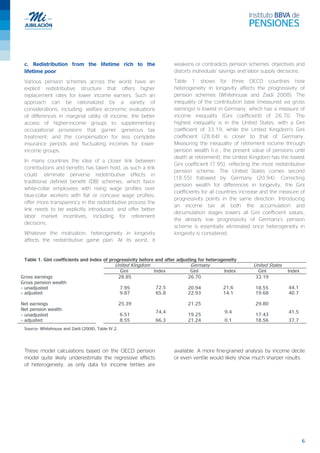
![7
2.2 Heterogeneity in longevity
as an implicit tax/subsidy
mechanism
To assess the redistributive/distortionary effects of
heterogeneity in longevity, the model herein follows
Ayuso, Bravo, and Holzmann (2016) and characterizes
differences in longevity by lifetime income levels as a
tax/subsidy mechanism.
Consider individuals who have all accumulated the same
savings amount at retirement to be converted into an
annuity. Assume they retire at the same age and face
the same interest rate, but have different life
expectancies.
Let t(s) be the implicit tax (subsidy) rate. AK is the
accumulation at retirement, α is the annuity rate, p is
the pension, and PW is pension wealth. The subscript i
denotes individual values and subscript a the average
values of these variables.
The pension for each individual is the annuity rate
applied to the identical wealth accumulation:
pi = α.AK [1]
Each individual’s PWi is different from everyone else’s to
the extent that his/her life expectancy (LE) differs. PW
can be written in this simple form if the interest rate
equals the growth rate (indexation) of pensions:
PWi = pi.LEi = α.AK.LEi [2]
With these elements, the tax (subsidy) rate is easily
defined as the difference in pension wealth compared to
the average:
t(s)i = (a.AK.LEi – a.AK.LEa) / a.K.LEa = LEi/ LEa – 1 [3]
with negative values representing the tax rate and
positive values the subsidy rate.
1
Equation [3] offers a simple assessment of the effect of
heterogeneity in longevity on income distribution and
incentives.
1
If the interest and indexation rates differ, the formula is slightly more complex,
with results that differ from equation [3] by up to 12–20 percent in both
directions for relevant values; see Ayuso, Bravo, and Holzmann (2016).
If life expectancy is positively correlated with lifetime
income/accumulated contributions then individuals with
above-average income receive a subsidy; those with
below-average income have to pay a tax that is higher
the stronger the correlation. This effect renders a neutral
pension scheme pro-rich, and a pro-poor scheme less
pro-poor or even pro-rich.
The implicit tax payment at the time of retirement has
the same tax rate as taxing the contribution payment
throughout active life (assuming no market
imperfections), and the tax rate is higher the lower the
contribution base/income. For the lowest income
earners, the tax rate can be quite high and can thus
affect decisions to join the formal labor market, with
implications for the amount worked and contributions
paid (i.e., the contribution density). And the tax/subsidy
is also likely to affect retirement decisions.
To understand the potential scope of perverse
redistribution of longevity heterogeneity and the
incentive effects for individuals, the actual scope of
implicit taxes and subsidies must be recognized.
2.3 The scope of the
tax/subsidy component
In recent years more empirical evidence became
available on the link between heterogeneity in longevity
(particularly life expectancy at retirement) and key
socioeconomic characteristics (particularly gender,
education, and income). This subsection presents
estimated tax/subsidy rates for measures of lifetime
income from high-income countries around the world.
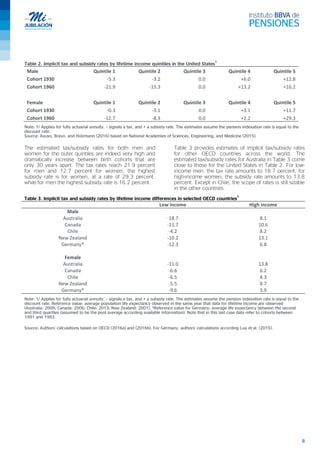
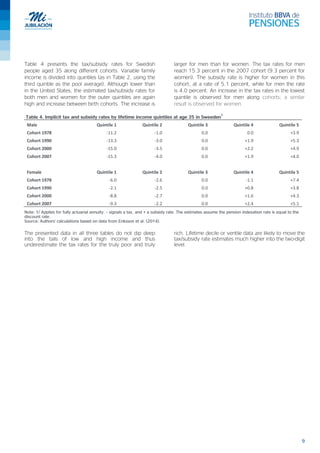
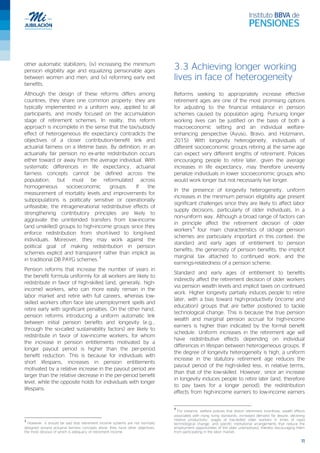
Table 2 presents the results for recent US data from a
2015 study by the National Academies of Sciences,
Engineering, and Medicine. It translates the reported
gaps in life expectancy between the third income
quintile (assumed to be the pool average) and other
income quintiles into tax/subsidy rates for actuarial
annuities.](https://image.slidesharecdn.com/18addressinglongevityheterogeneitying-170220114137/85/17-Addressing-longevity-heterogeneity-in-pension-scheme-design-and-reform-2016-ENG-7-320.jpg)
![10
3. Implications of longevity heterogeneity for
pension reform and scheme redesign
Socioeconomic differences in mortality and life
expectancy have important implications for the analysis
of pension schemes and for the redesign of pension
policies. This is because these differences modify the
redistributive features and overall progressivity of
pension schemes and alter the incentives provided by
the pension scheme for both labor supply and the
timing of retirement and benefit uptake, counteracting
the desired effect of recent pension reforms. This
section discusses selective implications of systematic
longevity heterogeneity for key areas of pension scheme
design, and analyzes how this affects the reform
objectives and reform directions of recent years.
2
3.1 Perverting the
redistributive objectives of
pension schemes
One of the key functions of a pension system is to
provide insurance against individual longevity risk
though risk pooling. Pension schemes typically combine
a proportional system of contributions with pension
benefits (closely or loosely) linked to contributions, paid
out as a collective lifetime annuity, typically from the
time of retirement. Survival probabilities play a key role
in computing initial (and, in some cases, subsequent)
pension benefits (e.g., through annuity factors in
defined contribution [DC] and non-financial defined
contribution [NDC] schemes, and through
demographic/sustainability factors in DB/points
schemes). They also critically determine the time during
which the pension will be paid, and thus the lifetime
value of the flow of pension benefits. In many countries
(e.g., Portugal, Denmark), they also define the qualifying
conditions for pensions (e.g., by linking the statutory
retirement age to life expectancy, by underlying the
parameters that determine the bonus [penalties] for late
[early] retirement). The defining characteristic of
collective annuities is that they do not depend on an
individual's survival probabilities but on the longevity
prospects of the "average" (often national) plan
participant. As a result, individuals with a high (low) life
expectancy receive benefits for a longer (shorter) period
compared to the average individual.
2
For an alternative discussion on this topic, see Whitehouse and Zaidi (2008).
In the presence of systematic differences in the level and
gradient of improvements in mortality and life
expectancy over time across different socioeconomic
groups, even if a pension scheme is actuarially fair for
the population as a whole, it will be actuarially unfair to
groups with systematically shorter life expectancy. In the
presence of positive correlation between lifetime income
and longevity, the risk-pooling mechanism thus implies
an unintended redistribution from low-income groups to
high-income groups, also reinforcing the redistribution in
favor of women. The fact that the provision of insurance
may have regressive distributional effects, and that a
pension promise is worth more ex-ante to a rich person
than to a poor one because of socioeconomic
differences in longevity, challenges the design of
pension schemes, which often include explicit
redistributive features offering higher replacement rates
for lower income earners. The extent to which longevity
heterogeneity offsets the formal progressivity built into
the retirement benefit program depends critically on the
degree to which retirement benefits are linked to
earnings when working.
The potential differences in the level and mortality
improvements across socioeconomic groups pose a
challenge for pension schemes to establish appropriate
prospective life tables on which to base the pricing of
annuities and the valuation of their liabilities. Such a task
requires sufficiently large datasets and the use of
complex statistical methodologies.
3.2 Counteracting the
objectives of recent reform
approaches: strengthening
contributory principles
In recent decades, a major trend in pension reform in
both public pay-as-you-go (PAYG) and privately funded
schemes has been to strengthen the link between
pension entitlements and the length and value of
contributory records. This reduces the progressivity of
the contribution-benefit formula, makes the redistributive
process more transparent and explicit, and offers better
labor market incentives. The strengthening of
contributory principles was accomplished by: (i) shifting
from DB to DC schemes; (ii) Increasing the contribution
period from “best years” to average lifetime earnings; (iii)
linking pension rules to life expectancy and introducing](https://image.slidesharecdn.com/18addressinglongevityheterogeneitying-170220114137/85/17-Addressing-longevity-heterogeneity-in-pension-scheme-design-and-reform-2016-ENG-10-320.jpg)

![15
5. Exploratory models of compensating longevity
heterogeneity: Policy options at retirement,
accumulation, and disbursement stage
This section presents and reviews alternative policy
options that intervene at different stages of the
contribution-benefit lifecycle. It starts with an
intervention approach at retirement (when a lifetime
accumulation is translated into a lifetime annuity); this is
followed by an intervention at accumulation stage (when
contributions are paid); and the section ends with an
intervention at disbursement stage (when benefits are
paid out). All interventions explored here are based on:
(i) the observation that life expectancy at retirement is
closely linked to lifetime contributions/income, and (ii)
expectations that changes in that link can be periodically
empirically updated for subsets of groups with
exogenous longevity differences.
5.1 Intervention at retirement
stage
Retirement is quite likely the most appropriate stage for
intervention. First, it is limited to one point in time and
thus offers the greatest transparency and hopefully
credibility. Second, at this stage, the full lifetime
accumulation for retirement purposes is known. For
most people, this accumulation constitutes (together
with housing) their most important asset across the
lifecycle. Third, the personal characteristics that are
likely to determine differences in longevity are pretty
much known and should change little from retirement
onward. Last and perhaps most important, if the link
between lifetime income and longevity heterogeneity
holds, it is at this moment that it can be measured and
translated into an operational approach.
If (approximate) individual life expectancy at retirement
could be determined, then the welfare-economic optimal
approach would be to transform the retirement
accumulation into a life annuity bi by applying an
individualized annuity rate that takes into account estimated
individual life expectancy LEi as well as the expected
indexation during retirement d and the assumed discount
factor r. If d=r then the annuity rate α boils down to 1/LE.
( ), ,α= i
i i i
i
AK
b LE r d AK
LE
[4]
where i denotes individual and AKi the accumulation
at retirement.
With such an approach, the tax/subsidy associated with
applying a unique annuity rate across all individuals
would disappear, as the very reason for its existence
would vanish. The challenge of the approach is thus to
provide an estimate for LEi that comes as close as
possible to the true value
5
The review of determinants of longevity heterogeneity in
Ayuso, Bravo, and Holzmann (2016) signaled a large
number of socioeconomic characteristics, of which
some are essentially exogenous (such as gender and
race), while others are endogenous (such as income and
education but also geographic location and profession,
with strong correlations between the first two
particularly).
It would be ideal to empirically establish the relationship
between life expectancy and lifetime income at
retirement Yi and other relevant factors such as
education Ei (e.g., number of years in school or highest
level of education achieved):
( ), , ε= Σ +i i i iLE LE Y E [5]
Lifetime income Yi may go beyond retirement
accumulation (i.e., accumulated contributions or similar);
Ei is a vector of relevant education characteristics; and
the other relevant socioeconomic characteristics, Σ
represent both common exogenous and endogenous
components.
A common approach to modelling differential mortality
is to consider a relational model. Under this approach,
mortality for people in poorer or better conditions than
the average is expressed in relation to average (or
standard) mortality. This allows the use of only with one
life table (or mortality law), properly adjusted when
substandard (also referred to as impaired lives) or
preferred risks are dealt with. Standard mortality is
indexed with (S) and a different (higher or lower)
mortality with (D).6
5
For a proposal to include a linear estimate of the individual life
expectancy/income position link into the German point system, see Breyer and
Hupfeld (2009). This results in a revised pension formula that is linear in
contribution years but concave in individual point value(s), producing a
replacement rate curvature similar to that of the United States and also close to
that of the Swiss basic pillar.
6
For a discussion of the suitability of the modelling and forecasting of
socioeconomic differences in mortality of several multiple population extensions
of the Lee-Carter model, and the application of a newly introduced relative
model based on modelling mortality in socioeconomic subpopulations alongside
mortality of a reference population, see Villegas and Haberman (2014).](https://image.slidesharecdn.com/18addressinglongevityheterogeneitying-170220114137/85/17-Addressing-longevity-heterogeneity-in-pension-scheme-design-and-reform-2016-ENG-15-320.jpg)
![16
A simple but popular differential mortality model, the
frailty model, is used as an example. This model
includes a mortality multiplier by which the actual
mortality of each individual differs from a given standard
mortality table. Formally, the one-year individual
mortality rate for a given individual aged x with mortality
multiplier λ is given by:
, 1
1
λ λ ≤
=
S S
D x x
x
q q
q
otherwise
[6]
with [ ]0,ω∈x , and where ω denotes the highest
attainable age of the standard mortality table (i.e., the
age that cannot be survived according to that table).
The parameter λ , to be estimated, describes the
relative life expectancy of an individual:
o For 0 1λ< < ,
<D S
x xq q ; individuals belonging to
this group have an above-average life expectancy
o For 1λ = ,
=D S
x xq q ; individuals have an average
life expectancy
o For 1 λ< ,
>D S
x xq q ; individuals have a below-
average life expectancy.
A particular implementation of equation [3], the so-called
“numerical rating system,” is given by:
1
1 ρ
=
= +
∑
k
D S
x x h
h
q q [7]
where h is a set of risk factors (socioeconomic
characteristics) and the rates
ρh lead (additively) to
higher or lower mortality rates for the individual in
relation to the standard values assumed by the chosen
risk factors.
Let
1
1
+
=
+
d
v
r
denote the discount factor for some
interest and indexation rates. Let t xp and t xq denote,
respectively, the t -year estimated survival and death
probabilities of an individual aged x , with
( )
1
0
1 1 1 λ
−
+
=
=− =− −∏
t
D D S
t x t x x j
j
q p q
Assuming the pension scheme pays an immediate
lifelong annuity at retirement, for a given (real or
notional) accumulated capital ,x iAK
the annual benefit
amount would then be:
( )
, ,
, 1
0 0 0
1
ω ω
ν ν λ
− −−
+
= = =
= =
−∑ ∑ ∏
x i x i
x i x tx
t D t S
t x x j
t t j
AK AK
b
p q
[8]
Data for such estimation are available at country level
through social security administrations that offer either
actual lifetime contribution accumulations (under NDC
schemes) or approximations (e.g., indexed contributions
of last 25 years or more under an NDB scheme) for
retirement cohorts of different age and projected or
actual mortality rates/life expectancy. Using realized
longevity data leads to outdated estimates by the time
they become available; using projected longevity data
risks introducing significant biases if the expected trend
accelerates or reverses. Recent estimates with the latter
approach exist for the United States (National Academies
of Sciences, Engineering, and Medicine 2015) but
seemingly not yet for Europe.
5.2 Intervention at
accumulation stage
Intervention at the accumulation stage happens at a
time when information about an individual is only
partially known and when proxies such as income and
education are even less reliable as they are still
changing. However, from a political economy point of
view, a smaller intervention over a longer period may be
more palatable than a large one-time intervention. Yet to
be politically sustainable the intervention needs to be
simple and transparent and thus less prone to political
manipulation.
One approach is to apply an estimate of the projected
lifetime income based on the period income and
calculate and apply the resulting contribution rate
required to achieve a predetermined replacement rate at
retirement. Highly variable period income across the
active lifecycle would lead to corresponding highly
variable individual contribution rates. This approach may
be possible but would perhaps be irritating and politically
infeasible.
The approach proposed here is to mimic the income
relationship with longevity through a two-tier
contribution allocation structure in which a total
contribution rate tc% is split into a social component
with a contribution rate of sc% and an individual
component of rate nc%. The social component sc% of
the average contribution base Ya is allocated to each](https://image.slidesharecdn.com/18addressinglongevityheterogeneitying-170220114137/85/17-Addressing-longevity-heterogeneity-in-pension-scheme-design-and-reform-2016-ENG-16-320.jpg)
![17
individual account in a lump-sum manner (i.e., sc.Ya),
while the individual component nc% is allocated in the
traditional way (i.e., nc.Yi). As a result, at retirement the
individual receives a pension benefit that consists of two
components:
• a flat-rate benefit that is proportional to the length of
activity, social contribution rate, and average
contribution base, and
• a contribution-based benefit that is proportional to
length of activity, individual contribution rate, and
individual contribution base.
Both components are indexed with the same sustainable
rate of return and are inversely proportional to life
expectancy at retirement.
To derive the contribution split for a cohort, it is
proposed to minimize the squared distance between the
pension level di that results from applying to the
accumulation under a unique contribution rate the best
estimate for individual life expectancy LEi and the
pension level bi that results from applying to the
accumulation with the two tier contribution rates the
average life expectancy for the cohort LEa:
[9]
con
di = AK(tc)i / LEi = tc .Yi / LE(Yi) [9a]
bi = AK(sc+nc)i / LEa = (sc.Ya+nc.Yi)/ LEa [9b]
[9c]
LE(Yi) =f(LEa, Yi/Ya, …); f’ > 0, f’’ >< 0 [9d]
In this simplified setting the pension base is the lifetime
income Y that results from the aggregated period
income of individual yi and equals the contribution base.
This assumes perfect markets; hence, only lifetime
income counts, not how it is distributed over the
individual’s lifecycle. The budget constraint assures that
the expenditure for the individualized pension benefits di
fits the revenues from the split contribution rate.
To gain intuition about the magnitude of the
contribution split and its capacity to compensate for
unequal life expectancy, which is linked with lifetime
income, the analysis makes use of the tax/subsidy
structure of both the heterogeneous life expectancy and
the split contribution rate.
Based on Ayuso, Bravo, and Holzmann (2016), Section
2 demonstrated that applying a single average cohort
life expectancy value to calculate the annuity when the
individual values are actually different amounts to a tax
or subsidy, depending on the individual’s life expectancy
value compared to the average. If the interest rate
equals the growth rate (indexation) of pensions, this
boils equation [3] down to:
t(s)i = LEi/ LEa - 1 [3a]
with negative values representing the tax rate and
positive values the subsidy rate.
Similarly, applying a two-tier contribution schedule to
individuals with equal life expectancy but different
lifetime incomes measured at retirement amounts to a
tax for those with above-average income and a subsidy
for those with below-average income:
t(s)i = ((tc – nc)/tc)*(1 – Ya/Yi) [10]
with negative values again representing the tax rate and
positive values the subsidy rate.
Equating the tax/subsidy rates in [3a] with the
tax/subsidy rates of [10] provides the link for how the
relationship between individual life expectancy and
individual lifetime income needs to be structured so that
any deviation in one is compensated by the other and
no tax/subsidy element remains.
LEi = LEa [1 – (tc – nc)/tc) (1 – Ya/Yi)] [11]
Figure 1 presents this linear link graphically for a
selection of social contribution rates (sc = tc – nc) of 2,
5, and 10 percentage points und a total contribution
rate of 20 percent, normalized values of lifetime income
between 10 and 300, in steps of 10 (with an average of
100), and an assumed average life expectancy of 20
years at the assumed retirement age at 65.
Figure 1. A Two-tier contribution scheme and the
tax/subsidy neutral link between life expectancy and life
time income at 65
Source: Authors’ elaborations.
The selected numerical example suggests that the
investigated contribution split for the social contribution
rate would go a long way to comprise the empirically
found positive link between life expectancy and lifetime
income (see Ayuso, Bravo, and Holzmann 2016). For
𝑀𝑀𝑀𝑀𝑀𝑀 �(𝑑𝑑𝑖𝑖 − 𝑏𝑏𝑖𝑖)2
𝑖𝑖∈𝐼𝐼
𝑠𝑠. 𝑡𝑡. � 𝑑𝑑𝑖𝑖 = � 𝑛𝑛𝑛𝑛 𝑌𝑌𝑖𝑖
𝑖𝑖∈𝐼𝐼𝑖𝑖∈𝐼𝐼
+ (𝑡𝑡𝑡𝑡 − 𝑛𝑛𝑛𝑛) 𝑌𝑌𝑎𝑎
𝑌𝑌𝑖𝑖 = �
𝑦𝑦𝑖𝑖𝑖𝑖
(1 + 𝑟𝑟)𝑡𝑡
𝑇𝑇
𝑡𝑡=0
10 20 30 40 50 60 70 80 90 100 110 120 130 140 150 160 170 180 190 200 210 220 230 240 250 260 270 280 290 300
LE (SC=2%) 18.2 18.4 18.6 18.8 19.0 19.2 19.4 19.6 19.8 20.0 20.2 20.4 20.6 20.8 21.0 21.2 21.4 21.6 21.8 22.0 22.2 22.4 22.6 22.8 23.0 23.2 23.4 23.6 23.8 24.0
LE (SC=5%) 15.5 16.0 16.5 17.0 17.5 18.0 18.5 19.0 19.5 20.0 20.5 21.0 21.5 22.0 22.5 23.0 23.5 24.0 24.5 25.0 25.5 26.0 26.5 27.0 27.5 28.0 28.5 29.0 29.5 30.0
LE (SC=10%) 11.0 12.0 13.0 14.0 15.0 16.0 17.0 18.0 19.0 20.0 21.0 22.0 23.0 24.0 25.0 26.0 27.0 28.0 29.0 30.0 31.0 32.0 33.0 34.0 35.0 36.0 37.0 38.0 39.0 40.0
0.0
5.0
10.0
15.0
20.0
25.0
30.0
35.0
40.0
45.0
LifeExpectancyat65
Life Time Income at 65](https://image.slidesharecdn.com/18addressinglongevityheterogeneitying-170220114137/85/17-Addressing-longevity-heterogeneity-in-pension-scheme-design-and-reform-2016-ENG-17-320.jpg)
![18
example, a social contribution amounting to a quarter of
the total contribution rate (in this numerical example, 5
out of 20 percentage points) would accommodate a
lower life expectancy of 2.5 years for somebody who
has only 50 percent of the average lifetime income or a
2.5 years higher life expectancy for somebody who has
double the average lifetime income – i.e., a difference in
life expectancy of five years at age 65 between roughly
the 8th and 2nd lifetime income decile. For many
countries, the total difference in life expectancy is
typically smaller and thus the needed contribution split is
also reduced (Table 5).
Table 5. Difference in life expectancy at age 65 by income
group, relative to the population average
Males
High income Low income
Total
difference
Australia 1.5 -3.5 5.0
Canada 1.9 -2.1 4.0
Chile 1.4 -0.7 2.1
New Zealand 2.2 -1.7 3.9
Females
High income Low income
Total
difference
Australia 3.0 -2.4 5.4
Canada 1.3 -1.4 2.7
Chile 0.9 -1.3 2.2
New Zealand 1.7 -1.1 2.8
Note: Australian figures shown for age 60.
Source: OECD (2016a).
The two-tier contributory pension scheme’s ability to
compensate for heterogeneity in longevity also emerges
from estimates for Korea, which has such a structure
(Han and Lee 2012). Measures of implicit rates of return
for low-, middle-, and high-income groups exhibit a
progressive benefit structure when homogenous
mortality rates are applied. When differentiated mortality
rates that are lower for high-income groups are applied,
the implicit rates of return show a much less progressive
structure that is, however, not overturned.
If confirmed by more data and an application of the
estimation process proposed under Equations [9a-d], the
approach would be fully operational. The application
could periodically (e.g., every 10 years) re-estimate the
contribution split, with rules for triggers and, perhaps,
additional ex-post adjustments during the disbursement
stage.
5.3 Intervention at
disbursement stage
In view of the scope of heterogeneity in longevity and its
translation into taxes and subsidy equivalents until first
disbursement, an intervention after the annuity is
determined may need to be limited to corrections for
longevity differentials that happen after retirement.
Doing otherwise would imply major nominal benefit
reductions for some and benefit increases for others.
Nominal reductions in benefits for retirees are politically
close to impossible as events in recent years
demonstrated (such as in Sweden). And from a design
point of view, a potential benefit reduction creates a
higher welfare loss than equivalent increases as the
effects are not symmetric for the elderly, given their
increasingly limited risk-management instruments
available to react to such income shocks.
An intervention after annuitization may be triggered by
two kinds of changes in longevity:
• Homogenous shocks that affect pension cohorts in a
similar manner, as they leave heterogeneity among
cohorts essentially unchanged (perhaps through a
medical breakthrough). In this case the intervention
may consist of a risk-sharing mechanism across
generations.
• Asymmetric developments that decrease or increase
heterogeneity, with the latter perhaps more relevant
for policy concerns and interventions.
Evidence on the development of mortality at different
ages for different socioeconomic groups has a long
tradition in demographic and medical sciences that has
expanded to many other disciplines (Rogers and
Crimmins 2011). Summing up the literature and
empirical evidence suggests that all outcomes are
possible depending on the socioeconomic dimension
investigated yet the effects are not large. For example,
Marmot and Shipley’s 1996 study of British civil servants
of different grades suggested that socioeconomic
differences in mortality persist beyond retirement age
and increase in magnitude with age. Social differentials
in mortality based on an occupational status measure
seem to decrease to a greater degree after retirement
than those based on a non-work measure. Hoffman’s
(2005) work based on the US Health and Retirement
Study suggested that socioeconomic mortality
differences are stable across age but clearly decline with
decreasing health. The first finding that health rather
than age is the equalizer combined with the second
finding of unequally distributed health leads to the
conclusion that in old age, the impact of socioeconomic](https://image.slidesharecdn.com/18addressinglongevityheterogeneitying-170220114137/85/17-Addressing-longevity-heterogeneity-in-pension-scheme-design-and-reform-2016-ENG-18-320.jpg)

![21
Referencias
1. Ayuso, Mercedes, Jorge M. Bravo, and Robert Holzmann. 2015. “Answers from demographic policy to the aging of
the population: family, labor market and migration: Moving beyond convenient assumptions on fertility, mortality
and migration.” BBVA Pensions Institute Working Paper 14/2015, Madrid, September.
2. Ayuso, Mercedes, Jorge M. Bravo, and Robert Holzmann. 2016. “Sobre la heterogeneidad de la longevidad entre
los distintos grupos económicos: ámbito de aplicación, tendencias e implicaciones para los planes de pensiones
vinculados a los ingresos.” Documentos de Trabajo Instituto BBVA de Pensiones, 16/2016. English version: “On the
Heterogeneity of Longevity among Socio-economic Groups: Scope, Trends and Implications for Earnings-Related
Pension Programs.” IZA Discussion Paper Series DP No. 10060. Bonn: IZA, July.
3. Breyer, Friedrich, and Stefan Hupfeld. 2009. “Fairness of Public Pensions and Old-Age Poverty.” FinanzArchiv/Public
Finance Analysis 65(3): 358-380.
4. Davidoff, Thomas, Jeffrey R. Brown, and Peter A. Diamond. 2005. “Annuities and Individual Welfare.” American
Economic Review 95(5) (December): 1573–1590.
5. Eriksson, Karin Hederos, Markus Jäntti, Lena Lindahl, and Jenny Torssander. 2014. “Trends in life expectancy by
income and the role of specific causes of death.” Working paper 8/2014, Swedish Institute for Social Research
(SOFI), Stockholm University.
6. Han, Jeonlim, and Hangsuck Lee. 2012. “Benefit-cost analysis using life expectancy differentials by lifetime incomes
for beneficiaries of national pension old-age benefit.” [in Korean with Tables in English] National Pension Research
Institute & Department of Actuarial Science/Mathematics, SungKyunKwan University (mimeo).
7. Hoffmann, Rasmus. 2005. “Do socioeconomic mortality differences decrease with rising age?” Demographic
Research Vol. 13, Article 2.
8. Holzmann, Robert. 1984. Lebenseinkommen und Verteilungsanalyse: Ein methodischer Rahmen für eine
Neuorientierung der Verteilungspolitik. Studies in Contemporary Economics, Volume 9. Springer: Berlin Heidelberg
New York Tokyo.
9. Holzmann, Robert. 1990. “The welfare effects of public expenditure programs reconsidered.” IMF Staff Papers 37:
338-359.
10. Holzmann, Robert, and Richard Hinz. 2005. Old-Age Income Support in the 21st Century: An International
Perspective on Pension Systems and Reform. Washington, DC: The World Bank.
11. Luy, Marc, Christian Wegner-Siegmundt, Angela Wiedemann, and Jeroen Spijker. 2015. “Life Expectancy by
Education, Income and Occupation in Germany: Estimations Using the Longitudinal Survival Method.” Comparative
Population Studies Vol. 40(4): 399-436.
12. Marmot, M.G., and M.J. Shipley. 1996. “Do socioeconomic differences in mortality persist after retirement? 25 year
follow up of civil servants from the first Whitehall study.” British Medical Journal 313 (7066): 1177-80.
13. National Academies of Sciences, Engineering, and Medicine. 2015. “The Growing Gap in Life Expectancy by
Income: Implications for Federal Programs and Policy Responses.” Committee on the Long-Run Macroeconomic
Effects of the Aging U.S. Population-Phase II. Committee on Population, Division of Behavioral and Social Sciences
and Education. Board on Mathematical Sciences and Their Applications, Division on Engineering and Physical
Sciences. Washington, DC: The National Academies Press.
14. Organisation of Economic Co-operation and Development (OECD). 2016a. “Fragmentation of retirement markets
due to differences in life expectancy.” In OECD Business and Finance Outlook 2016, pp. 177-205. OECD Publishing:
Paris.
15. OECD. 2016b. “OECD Health Statistics 2016. Frequently requested data: health status (mortality)”,
http://www.oecd.org/els/health-systems/health-data.htm
16. Reichling, Felix, and Kent Smetters. 2015. “Optimal Annuitization with Stochastic Mortality and Correlated Medical
Costs.” American Economic Review 105(11): 3273-3320.
17. Rogers, Richard G., and Eileen M. Crimmins, eds. 2011. International Handbook of Adult Mortality. International
Handbooks on Population No. 2. Springer: New York.
18. Villegas, Andres M., and Steven Haberman. 2014. “On the modelling and forecasting of socio-economic mortality
differentials: an application to deprivation and mortality in England.” North American Actuarial Journal 18(1): 168-193.
19. Whitehouse, Edward, and A. Zaidi. 2008. “Socio-Economic Differences in Mortality: Implications for Pensions Policy.”
OECD Social, Employment and Migration Working Papers, No. 71, OECD Publishing, Paris.](https://image.slidesharecdn.com/18addressinglongevityheterogeneitying-170220114137/85/17-Addressing-longevity-heterogeneity-in-pension-scheme-design-and-reform-2016-ENG-21-320.jpg)


